Archive for the ‘Victoria Cooper’ Category
NICHOLAS WALTON-HEALEY – SALT FRAMES


.
.
A SELECTION OF IMAGES
.
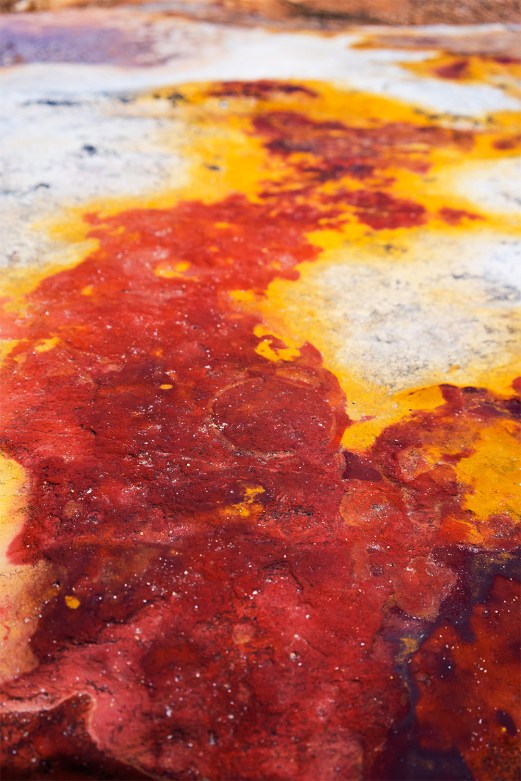
‘SPOOR’ Nicholas Walton-Healey from the exhibition SALT FRAMES
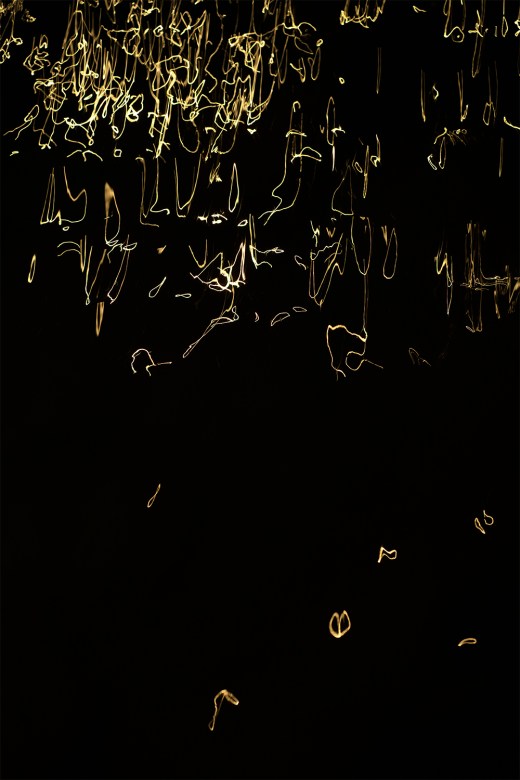
‘WHISPER’ by Nicholas Walton-Healey from the exhibition SALT FRAMES
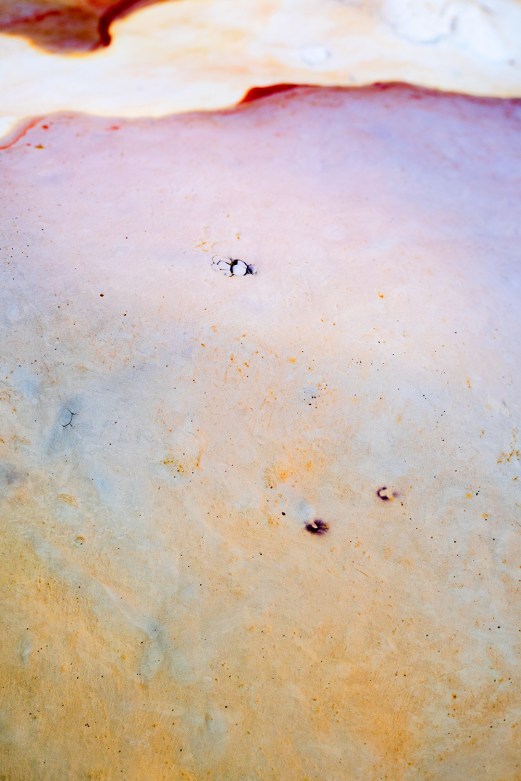
‘SKIN’ Nicholas Walton-Healey from the exhibition SALT FRAMES
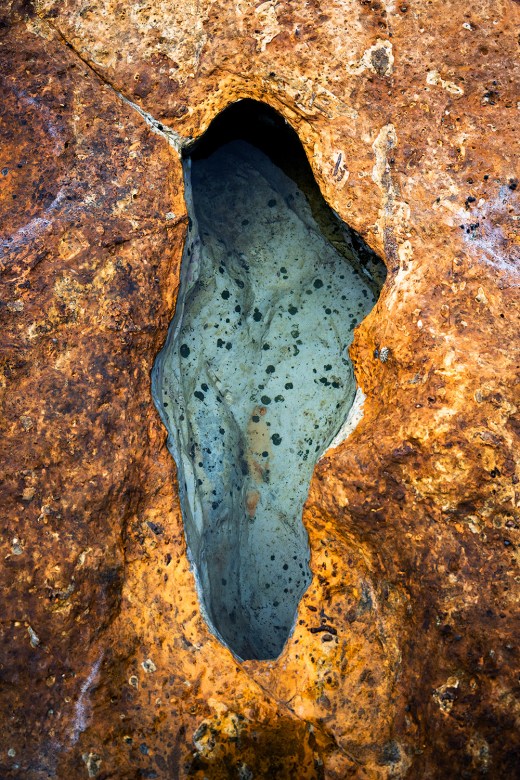
‘TOUNGE’ Nicholas Walton-Healey from the exhibition SALT FRAMES
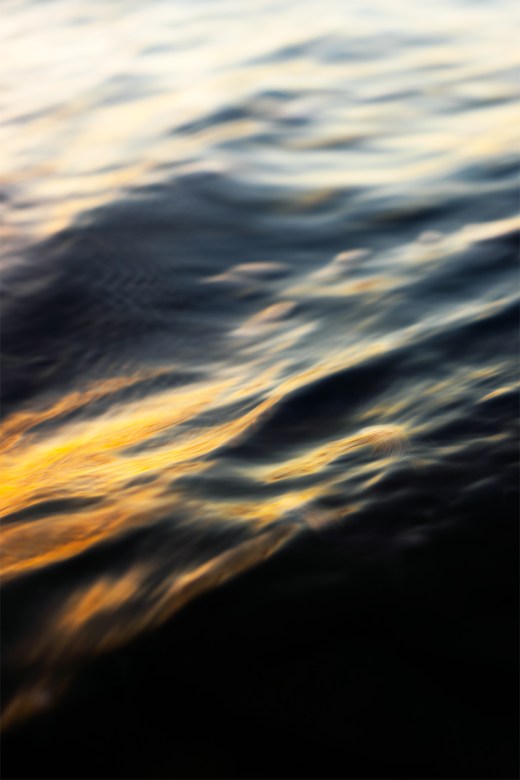
‘CARESS’ Nicholas Walton-Healey from the exhibition SALT FRAMES
.
A COMMENTARY ON THE BODY OF WORK by Victoria Cooper
.
watch the water long enough and you’ll see a fish jump … *
.
Salt Frames review
Nicholas is a poet…
Salt Frames is simultaneously a visual and textual poem. On the surface it is an exhibition of light and colour abstractions from time spent on the Nightcliff Foreshore, Darwin. But this work also has deeper layers and meaning that are evoked through the supporting words and symbols within the images, as Walton-Healey discloses: “Sea salt aids the healing of wounds (including those beneath the surface of the skin).”
Walton-Healey points out that more broadly Australians have an affinity to the coast. The sea and the coast become places of personal meditation and for some physical and psychological healing. His seascapes are not the usual pictorial or grand panorama – instead he shares visual metaphors; those moments of revelation and contemplation that can hold many different meanings to the viewer.
The text blocks with the images are, for me, not titles but words that operate as codes to other ways of being and thinking. If we cast our minds to memories of reverie by the sea, perhaps these words articulate our collective human experience of being at the coast.
On connecting with Walton-Healey’s opening speech, the meaning embedded in the words and the images of layered light, colour and stilled moments was underpinned by a deeply moving human story. Through the visual poetry of this exhibition the artist has humbly shared vulnerability, tenderness and deep thinking. In this openness of vision he also created space for the viewer to spend time to consider and connect with our own stories and memories.
.
Dr Victoria Cooper
* A teaching by Larrakia Warrior Robert E. Lewis to Nicholas Walton-Healey
.
.
THE OPENING SPEECH BY PAMELA KLEEMANN-PASSI
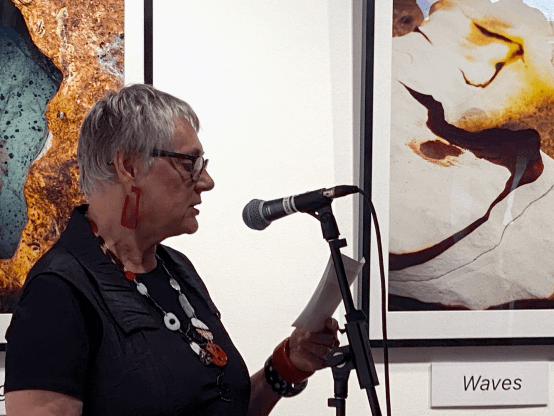
Pamela Kleeman-Passi speaks
.
Acknowledgement to Country
We respectfully acknowledge the Traditional Owners of the land, the Boon Wurrung and Woiwurrung (Wurundjeri) peoples of the Kulin Nation. We extend gratitude to all Elders past and present and their enduring connection to land, sea and community.
.
.
Welcome to the Salt Frames exhibition …
.
My friendship with Nick grew out of a deeply personal connection of loss and renewal, and a mutual passion for experiencing life through the lens of creativity. And now we have Darwin in common! Our shared stories meandered and overlapped during my month there mid-last year for my own exhibition. I actually didn’t know that much about Darwin until that visit, and I returned to Melbourne with a deep fondness for the culture, the landscape and the communities. I thank Nick for facilitating a visit to the Tiwi Islands to spend a moment of precious, rejuvenating time at the Tarntipi Bush Camp on Bathurst Island.
.
So what you see within these salt frames of the Nightcliff foreshore is Nick’s immersion in and introspection on the blessings and cruelties of life, and the healing power of the water and the land. The evocative single word titles express an array of feelings and experiences and the images are imbued with opposites:
Landscape / seascape Water / land Surface / depth
Smoothness / crusty, gritty textures Clarity / blurriness Light / dark
Shadows / highlights Colour / monochrome Reflection / absorption
Representation / abstraction Emotion / rationale
He’s combined the poetic and the photographic, with an Impressionist painterly quality to many of the works. Nightcliff is a very special place for Nick… but it also has a fascinating history and I quote from Tess Lea’s personal/historical book, Darwin: “Even the dumping grounds of Nightcliff, where unwanted machinery and detritus from WWII were tipped over a cliff, have merged into the rocks below, no longer distinguishable, just deformed lumps of rust and chalk.” The colour of rusted metal is very evident within some of the images – how over time, it’s merged with the landscape shaped by the power of the sea.
In this time of climate fragility and significant settler land and sea degradation, I feel compelled to refer to ecological grief and the healing power of the land and the water because the land and sea are absolutely fundamental to a community’s overall mental health. Nick’s images are testament to that healing power.
For Nick…
On the edge, at the edge… of love and loss and longing,
And remembering and wanting to forget
And letting go but holding on…
Wedged between land and water, pushing and pulling
Lapping across a surface that belies a depth so utterly profound and unfathomable
A photographic imprint, focused and blurred
Where light inscribes water, water inscribes land
And language and form mutate and merge, rippling and surging in a constant soundtrack
That violently crashes and gently caresses in waves and heartbeats
Eroding, erasing, healing and repairing
The run-off leaving traces that ebb and flow
As life and love and loss and longing ebb and flow…
And it’s sink or swim or scramble to a fragile stability on solid ground and remain upright
or undone
Or both…
.
.
Pamela Kleemann-Passi © 2023
.
.
ROBERT LEWIS TALKS ABOUT HIS CONNECTION WITH NICK
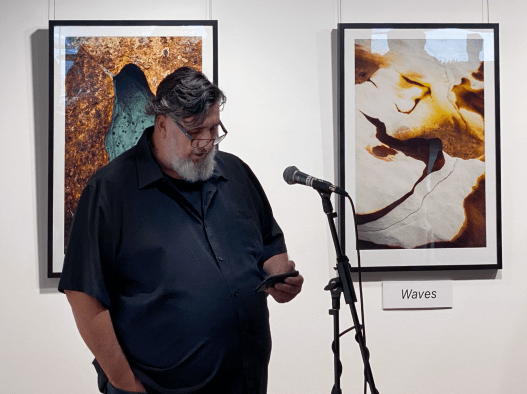
Robert Lewis, Larrakia Warrior, speaks at the opening of SALT FRAMES
.
Nic from Vic
Hi my name is Robbie Lewis, I’m a Larrakia Man. Born and bred on Larrakia land in Darwin.
2013, The Eye See Workshop, working with young Indigenous people living on a local community, in the Darwin region, where I met a young man trying to make understanding of life, this is when I first met a young spirited man, Nicholas Walton-Healey!!
.
A student photographer trying to find he’s way around the community. At first, I saw another white man taking photos of Indigenous people. But now, 10 years later, I see a great man showing the rest of the world through he’s eyes the beautiful things he sees through a camera.
To talk about
Communications – to talk, to say, to hear, to listen, to answer, to reply, also to understand and help.
Management – to be a leader, a teacher, to educate, to be in charge, to manage and help.
Worker – to do a job, to earn a wage, to keep things moving forward, to do work and to help where there is no other.
Just don’t forget why they go together.
The Student
This one person brings all these people together.
Now I see this man as a teacher!!
.
Robert Lewis © 2023
.
.
NICK’S RESPONSE
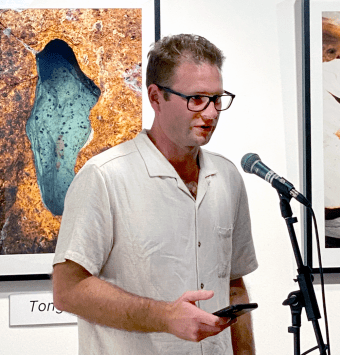
Nick addresses the audience at his exhibition
.
Thank you everyone for making it out tonight. I don’t have the time to personally thank each one of you, here. But I’m really proud of, and humbled by, the diversity of the groups represented in this room. Friends. Family. Collaborators. Colleges. Mentors. And Muses. You’ve all contributed in some important way to the journey I’ve been on, with my photography.
Pam and Rob, I’m especially grateful for the friendship I share with each of you, and for your very kind and thoughtful words tonight.
.
What you’re looking-at in the salt frames photographs, is The Timor Sea. And more people go missing each year in The Timor Sea, than they do in any other sea throughout the world.
I can certainly say that I’ve felt the pull. The allure of its rhythm, and hypnotic calamity.
It made perfect sense to me, when I read that statement in a book that Pam recently lent to me. Over the past twelve months, Pam has gifted me some important inspiration – we met at the ANAT Spectra Live event in Melbourne, and our paths crossed again in The Northern Territory last year. They converged at Tactile Arts in Darwin, during Sweet Dreams and Gut Reactions, the title of Pam’s exhibition, which got me thinking…
It’s probably an understatement, for those of you who know me, to say I’m inspired by the viscerality of art. I’ve always understood the role of the artist to entail a questioning of accepted definitions of the normal and possible. And that the moral and aesthetic responsibility of the photographer is to make the invisible, visible and the familiar, strange…
Photography is a highly intuitive process for me. I make the pictures first, and make-sense of them, second. So, I wasn’t exactly sure what I was doing, walking up and down the Nightcliff foreshore at all hours of day and night, last year.
I was actually stopped one evening by an elderly couple, who said ‘ahh, you’re a photographer!?’ I looked-at them, bemused, because I had a camera in my hand, and responded with, ‘yeah!’ But then the lady then came closer, and touched me on the arm. She looked into my eyes and said, ‘Well, that’s good, because we’ve seen you out here every night this week and thought you were homeless.’
The remark startled me because, while I was always on the lookout for crocs, I actually felt pretty safe in Darwin last year, which was when I made the majority of these photographs. Even if I was sleeping on a mattress on the floor of Rob’s kitchen.
I have a really special connection with Rob, who is like a big brother, to me; one of my mentors, teachers, guides and best mates, over the past ten years.
I first met Rob on an Indigenous community known and referred to in Darwin as Knuckey’s. This was back in 2013, when I first travelled-up to Darwin with one of my university lectures – Mark Galer – for The Eye See Workshop. Although our initial encounters were brief, I remember being struck by the enormity of Rob’s heart; the fact that he actually, genuinely cared for the people living on this, and the other communities we visited.
At the end of that workshop, I was invited back to Darwin by Rob’s boss-at-the-time. From this point, I entered into what became a five-year-plus partnership. This lead me back out onto those communities, and ultimately, to almost all of the so-called town camps in and around the Greater Darwin Region.
For all this time, I was like Rob’s little shadow. I followed him everywhere, and especially to the programs he ran with the men and family groups from these communities. Through these means, I built my own friendships and connections. But that’s another story, another project…
The Salt Frames are more overly focussed on my personal connection with Rob. Our friendship grew partly through the bond I developed with his late mother, Robyn, who I learnt to recognise and identify as an authentically Darwin person; Robyn’s mother (Rob’s maternal grandmother), was born at Lamaroo Beach, before being stolen as a child, and was eventually adopted by Juma Fejo.
The Fejos are one of the original eight family groups recognised as the Traditional Custodians of the Greater Darwin Region.
So Rob’s Larrakia, and the Larrakia are also known as The Salt Water People. The Salt Frames show Larrakia country, which includes Nightcliff, the place where Rob and I spent a lot our time when we weren’t working on the communities together.
Watch the water long enough and you’ll see a fish jump. That’s what Rob used to say to me. And I found it really frustrating at first, because I couldn’t see any fish. But over time, I realised that, rather than asking me to simply look-at the water, Rob was actually asking me to look into it. In this way, he transformed my ability to ‘see.’
But he wasn’t the only person I went to Nightcliff beach with. Before and after re-locating from Melbourne to Darwin, Nightcliff was the place that my late fiancé most liked to visit. She loved watching the sunsets. And unwinding and connecting on the beach. Over the years, we made a lot of love along this coastline. Beside the Timor Sea. And sure enough, it was not too far up from one of these spots that we returned on the afternoon she received her cancer diagnosis.
Shit happens. We deal with it. And then we move-on. That’s also one of Rob’s sayings; but it was the teaching I found most difficult to comprehend. Dealing with it, was what I really trying to do in the five and half months I spent in The Territory last year, walking around the beach like a homeless person.
Making these photographs was one way I felt I could make-good on my promise to do something with my photography, while at the same-time maintaining the connection that my finance and I shared with the families and communities we worked with. In August last year, Rob accompanied my mother and I over to the Tiwi Islands, for her Pukamani ceremony. The overwhelming majority of the photographs in this collection were made in the weeks that followed this event.
So whichever way you look at them, the Salt Frames show profound and enduring connection. But they also acknowledge the inescapably transient nature of being. You don’t get to beauty without pain, and love is very hard to name, without seeing the full-face of loss. The process of curating and assembling this show, and gathering you all in this room tonight, is part of an attempt to move forward.
..
Thank you all … Nicholas Walton-Healey
Nicholas Walton-Healey © 2023
.
.
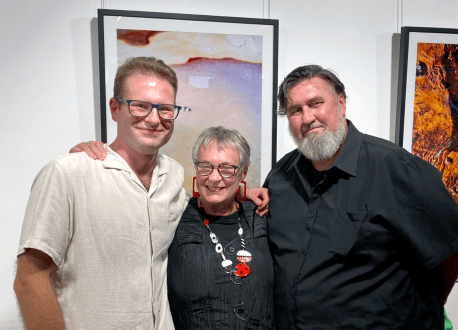
Nicholas with Pam Kleemann-Passi and Robert Lewis
.
.
.
.


.
.
© Photographs by Nicholas Walton-Healey Photographs of the opening ©2023 Doug Spowart
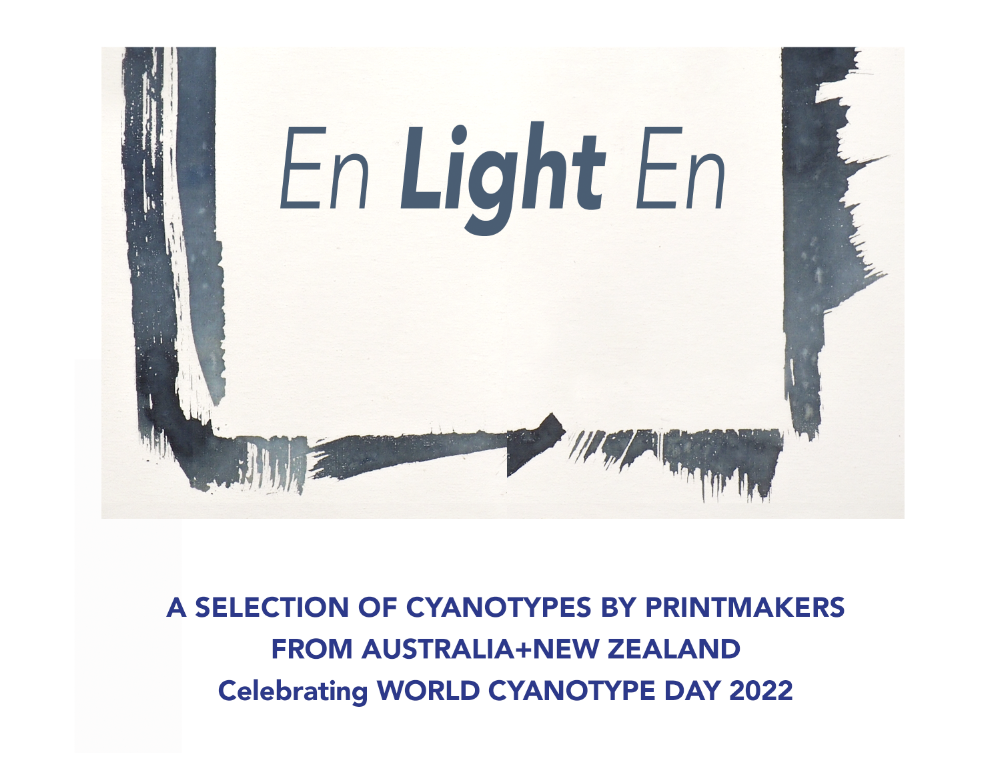
WORLD CYANOTYPE DAY 2022: ANZ – Online Exhibition
 .
.
EACH YEAR FOR THE LAST 4 YEARS WE HAVE COORDINATED AN EXHIBITION OF ARTWORKS BY AUSTRALIAN CYANOTYPE PRINTMAKERS TO CELEBRATE INTERNATIONAL EVENTS LINKED TO WORLD CYANOTYPE DAY.
Unlike most years where the exhibition is in a physical gallery this year the exhibition is an online catalogue. Another aspect of World Cyanotype Day (WCD) events is the connection that works made should respond to a theme which this year was – ENLIGHTEN. This year WCD falls on Saturday September 24th.
Our preparations for the exhibition began back in May with a call for expressions of interest from members of the Facebook Group The Cyanotype in Australia and New Zealand – A group we founded in 2019 to facilitate the first WCD exhibition at the Monash Gallery of Art.
Respondents were presented with the concept of “presenting your cyanotype in a way that shows something about you – It could be positioned in your studio, home setting, in the garden or somewhere in your locality”.
Twenty-five cyanotype makers sent in their submissions. These artworks were collated and prepared for the design stage of the project by us. Here are their cyanotypes and a link to download the catalogue. ALSO at the end of the post is the story and links to the previous year”s catalogues.
.
Here the submissions:
“CLICK” on the thumbnail to enlarge the image and see the author’s name and title


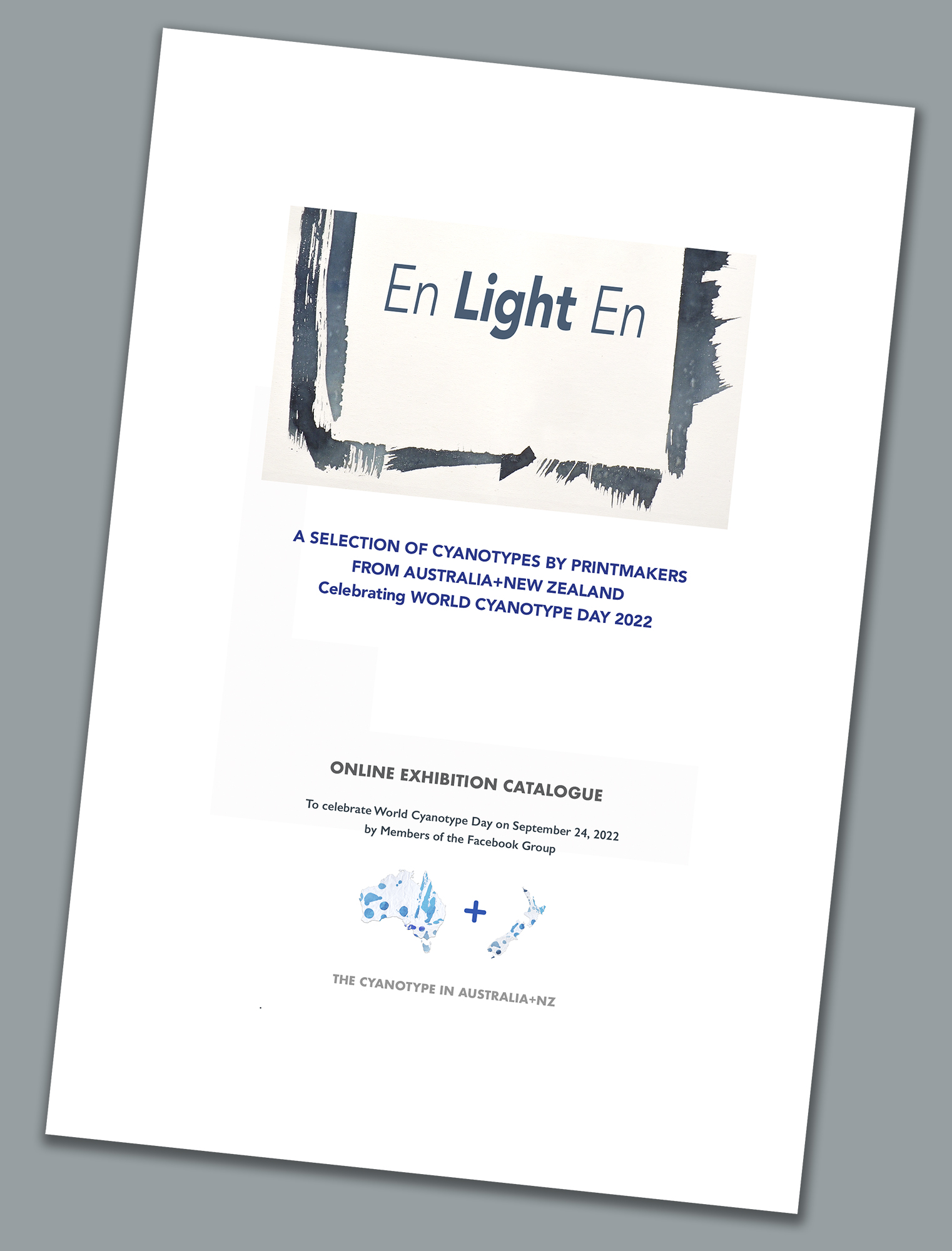
THE ONLINE CATALOGUE IS AVAILABLE TO DOWNLOAD –
Here is the file: CYANOTYPE CATALOGUE 2022v3
Here is the backstory the 5 Cyanotype in Australia and New Zealand WORLD CYANOTYPE DAY exhibitions & catalogues
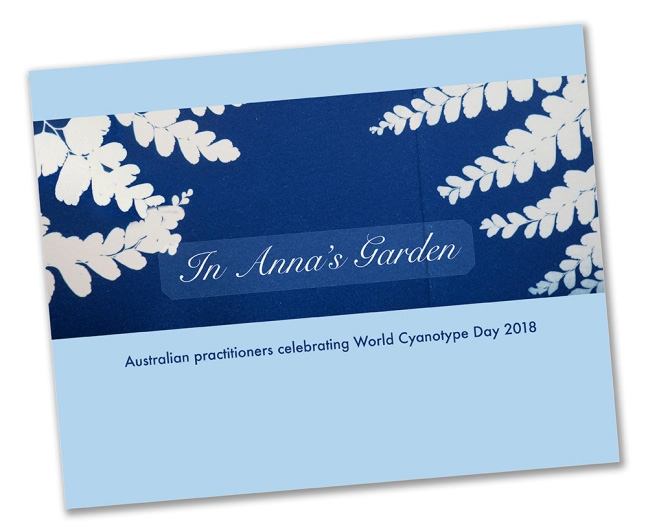 Download: WCD_CinA-Catalogue-2018
Event 1 – 2018
In September 2018 The Cyanotype in Australia Facebook group was founded and held its first collective exhibition and illustrated catalogue as part as the global event World Cyanotype Day (WCD). Entitled In Anna’s Garden the exhibition referenced Anna Atkins’ pioneering role in the development of the cyanotype.
The exhibition was held in the Atrium Space at Monash Gallery of Art, Wheeler’s Hill, Melbourne and was opened by Gael E Phillips. Gallery staff members Stephanie Richter and Gillian Jones joined with Victoria Cooper and Doug Spowart to prepare and hang the diverse representation of Australian contemporary cyanotype work. The Gallery Director Anouska Phizacklea attended the event along with many of the exhibitors.
 Download: WCD_CinA-catalogue-2019
Event 2 – 2019
A world-wide call out from the A. Smith Gallery in Texas, USA, invited artists to participate in an exhibition by sending a cyanotype made on a 30cm square of fabric – referred to as ‘Flags’. The work was a personal response to the WCD theme for that year, Land / Sea / Sky.
The Cyanotype in Australia (CinA) co-ordinators decided to organize a collaborative show of cyanotype flags connecting with the WCD. Coordinated at the Maud Street Photo Gallery in Brisbane, the exhibition was called Under the Southern Sun. Again, the coordinators were supported by Gail Neumann, David Symons and Keiko Goto in the unpacking and hanging the flags in the gallery. However this was only the first part of a long and exciting journey for these cyanotype prints.
After the show came down, the working party packed up the show and the Flags were sent off to Texas where they were shown with all the other works from across the world at the A. Smith Gallery. Subsequently the exhibition was also shown at PhotoNOLA in New Orleans.
 Download: ____WCD 2020 CATALOGUE-FINALv3
Event 3 – 2020
Due to the pandemic 2020 was a difficult year to show work in a physical gallery space so the CinA co-ordinators created an online presence and an illustrated catalogue referencing the WCD theme of Interconnected. After a call out to all members of our Facebook group, artists from across Australia and around the world responded by contributing to the collection of a creative work that showcased the diverse practice of the cyanotype in Australia and elsewhere.
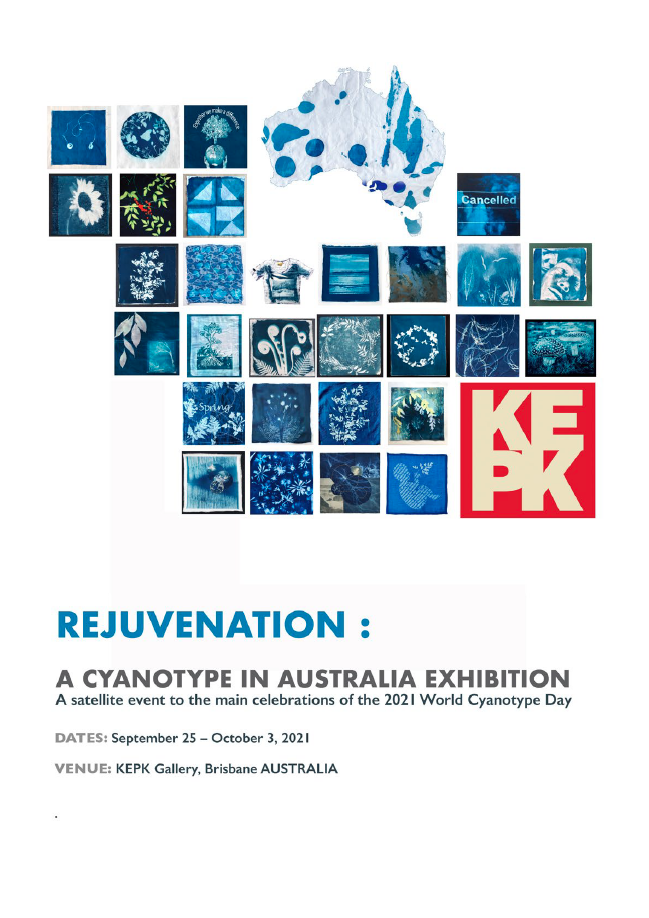 Download: WCD 2021 Exhibition-SCREEN_Res-Sept27
Event 4 – 2021
Despite the challenges of Covid, 2021 saw the return of a physical exhibition. Gail Neumann curated the show at KEPK Gallery in Brisbane, supported by other members of the CinA team. The WCD theme this year was REJUVENATION. Local art identity and cyanotyper LeAnne Vincent opened the exhibition and an illustrated catalogue was made available to participants.
Event 5 – 2022
For many surviving Covid, floods and fire and rebuilding their arts practice has been challenging over the last 2-3 years, so the return to an online format seemed a good option. Also at this time, the organisers felt that it was important to recognize our friends and colleagues from across “the ditch” in New Zealand, so our group name was changed to The Cyanotype in Australia and New Zealand.
The call for expressions of interest was made in May and those who responded were asked to submit work on the WCD theme – ENLIGHTEN. They were also requested to consider making an in-situ representation of their cyanotype image in their studio space or where they live, to add a personal and physical dimension to the virtual online space. The 2022 catalogue includes the artists who responded to the in-situ request, and also those who only sent through a photograph of their cyanotype.
Once again, the catalogue presents a survey of the practice of cyanotype within our region. We wish to thank the contributors for making work available for this catalogue as well as providing commentaries about their work.
ENJOY and be ENLIGHTENED about the work by the members of the Cyanotype in Australia and New Zealand.
.
.
ABOUT THE CYANOTYPE IN AUSTRALIA + NEW ZEALAND
The Cyanotype in Australia + New Zealand Facebook group has actively supported a vibrant community of practice of not only local, but also international cyanotypers for 5 yearsFF.
The Facebook page is a closed group though we welcome ‘Requests to join’ from cyanotype practitioners of this region.
The Cyanotype in Australia+New Zealand Team are Doug Spowart, Gail Neumann, David Symons and Victoria Cooper.
.
.B
.
.
 .
.MGA POSTCARDS EXHIBITION – Our images


.
WE RECENTLY RESPONDED TO A ‘CALL OUT’ FROM THE MONASH GALLERY OF ART to make and send in a POSTCARD representing ‘Our back yard’.
It is an interesting Mail Art Project so we selected images and sent them in. Recently we are in Melbourne and managed to go out to MCA to see their exhibitions and the post card show in the Atrium Gallery.
.
If you are interested in participating – The details and link are at the end of this post.
VICTORIA’s CARD: Image from the book VISUAL FIELD NOTES
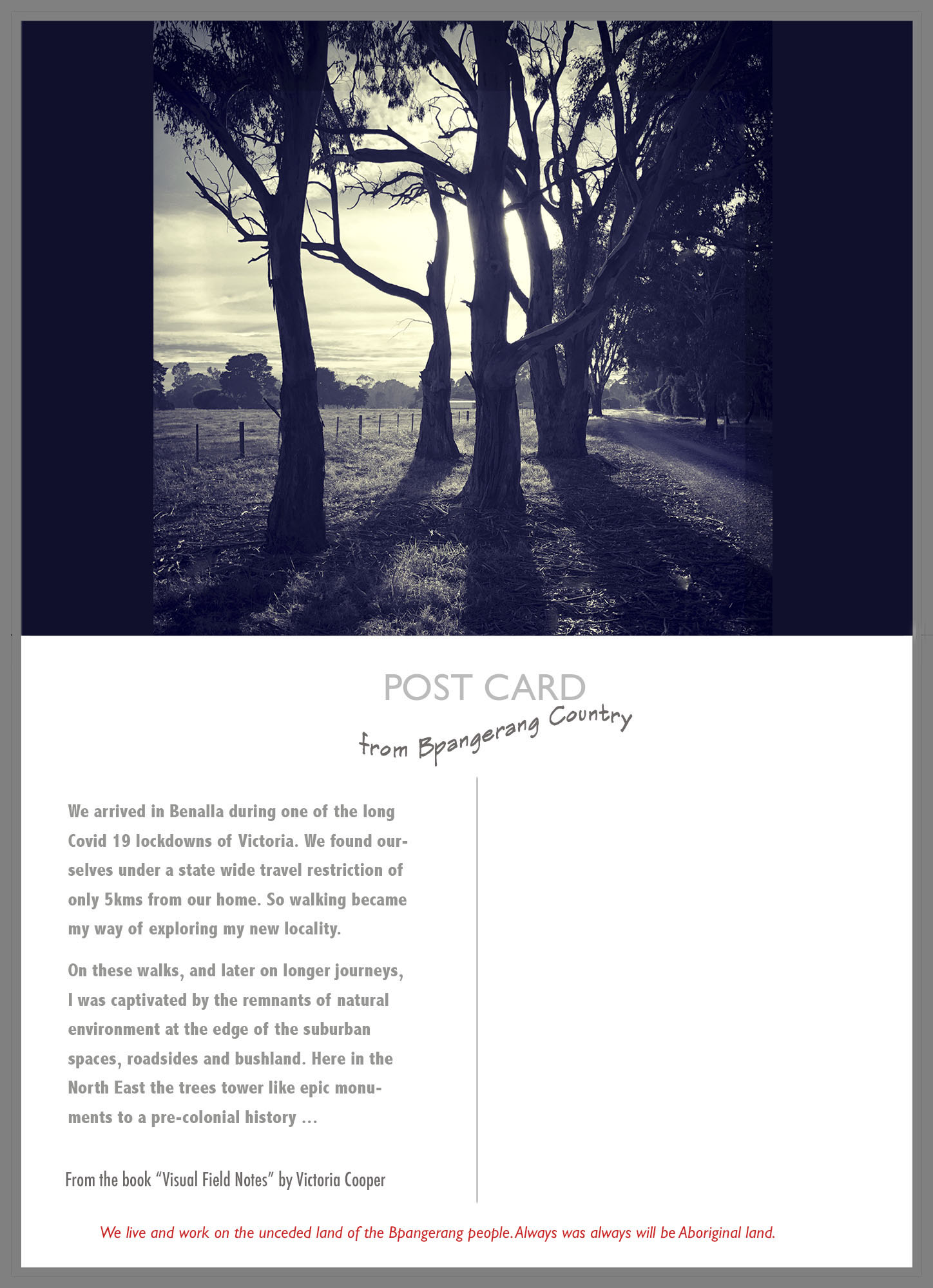
Victoria Cooper MGA POSTCARD
.
ABOUT VICKY’S POST CARD IMAGE: DAY DREAMING
We arrived in Benalla during one of the long Covid 19 lockdowns of Victoria. We found ourselves under a state wide travel restriction of only 5kms from our home. So walking became my way of exploring my new locality.
On these walks, and later on longer journeys,
I was captivated by the remnants of natural environment at the edge of the suburban spaces, roadsides and bushland. Here in the North East the trees tower like epic monuments to a pre-colonial history …
DOUG’s CARD:
An image from the book WALKING URBAN GROUND
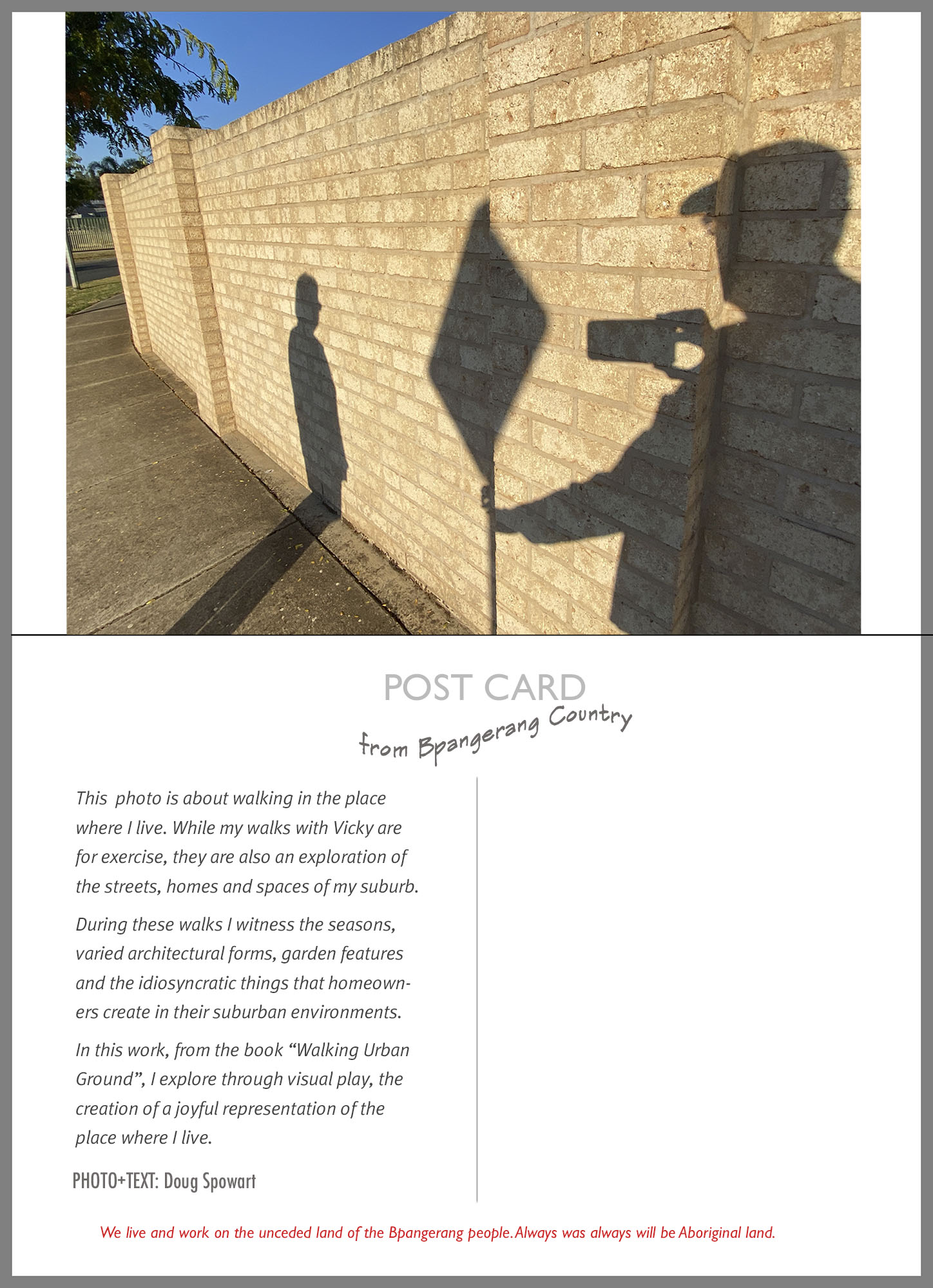
Doug Spowart’s MGA POSTCARD SHOW
.
ABOUT DOUG’S POST CARD IMAGE:
This photo is about walking in the place where I live. While my walks with Vicky are for exercise, they are also an exploration of the streets, homes and spaces of my suburb.
During these walks I witness the seasons, varied architectural forms, garden features and the idiosyncratic things that homeowners create in their suburban environments.
In this work, from the book “Walking Urban Ground”, I explore through visual play, the creation of a joyful representation of the place where I live.
year I wandered as a free-ranging spirit on a bright sunny day through my local botanic garden. Spontaneously I responded to the subjects that emerged into my line of sight…
.
.
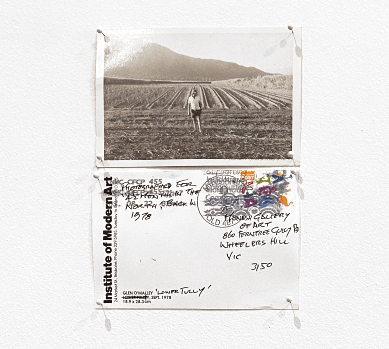
A POSTCARD FROM GLEN O’MALLEY is also in the show…
.
.
HERE’S THE SUBMISSION DETAILS
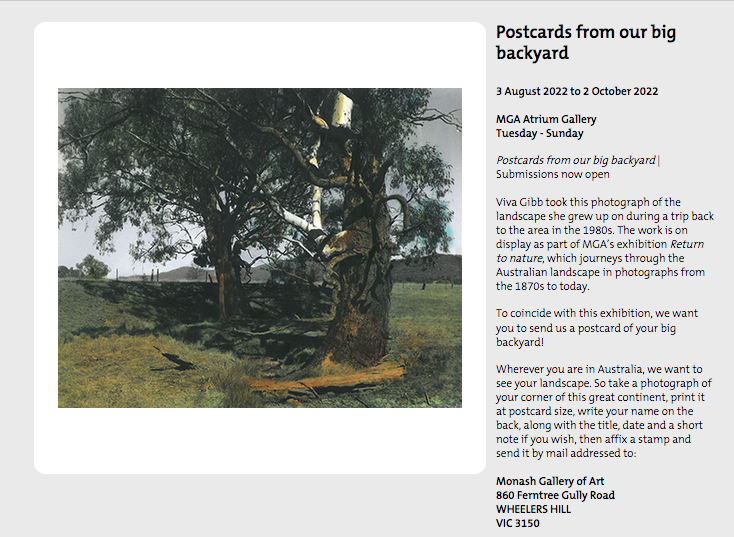
Postcards from our big backyard
“CLICK” URL HERE
3 August 2022 to 2 October 2022
MGA Atrium Gallery
Tuesday – Sunday
Postcards from our big backyard | Submissions now open
Viva Gibb took this photograph of the landscape she grew up on during a trip back to the area in the 1980s. The work is on display as part of MGA’s exhibition Return to nature, which journeys through the Australian landscape in photographs from the 1870s to today.
To coincide with this exhibition, we want you to send us a postcard of your big backyard!
Wherever you are in Australia, we want to see your landscape. So take a photograph of your corner of this great continent, print it at postcard size, write your name on the back, along with the title, date and a short note if you wish, then affix a stamp and send it by mail addressed to:
Monash Gallery of Art
860 Ferntree Gully Road
WHEELERS HILL
VIC 3150
We will then display your postcard in a growing exhibition in MGA’s Atrium gallery from 3 August to 2 October.
.
.
.2022 WORLDWIDE PINHOLE DAY – Our images

.
ON THE LAST SUNDAY IN APRIL pinhole photographers across the world gather together as individuals or groups to celebrate pinhole photography in all its forms.
This year for the first time in many years we find ourselves in a place that we call home. On this warm sunny April morning we connected with fellow Benalla artist, Maggie Hollins, and found joy in pinhole play on Worldwide Pinhole Photography Day.
We met in the Benalla Botanic Gardens renown for its rose garden, cricket field, the lake and the Benalla Art Gallery. The Gardens and surrounds are a popular place for locals to picnic, exercise, canoe or just hang out.
 Benalla Pinholers – Maggie with Vicky+Doug
This is the 16th year we have supported the WPPD project!
SEE LINKS to our other submissions at the end of this Post.
.
WHAT IS WORLDWIDE PINHOLE PHOTOGRAPHY DAY ALL ABOUT?
From the Worldwide Pinhole Photography Day website introduction:
All the photographs in this extraordinary collection share two common characteristics: (1) they are lensless photographs (2) they were all made on April 24, 2022.
They also share an additional and less formal characteristic: the sincere enthusiasm of their creators who, by participating in this collective event, shared individual visions and techniques. Hence the amazing diversity of subjects, cameras, techniques and photographic materials combined in this exhibit!
The process is that photographs are made on April 24 > they are processed / optimised by the photographer > uploaded and captioned on the WPPD website. The 2022 Gallery of images can be searched to see what photographers from around the world did on that day…
.
VICTORIA’s PINHOLE IMAGE: DAY DREAMING
.

.
ABOUT VICKY’S PINHOLE IMAGE: DAY DREAMING
.
A beautiful Autumn day beside the Benalla Art Gallery and lake.
OTHER IMAGES BY VICKY:


VICKY’s DIGI-PINHOLE CAMERA
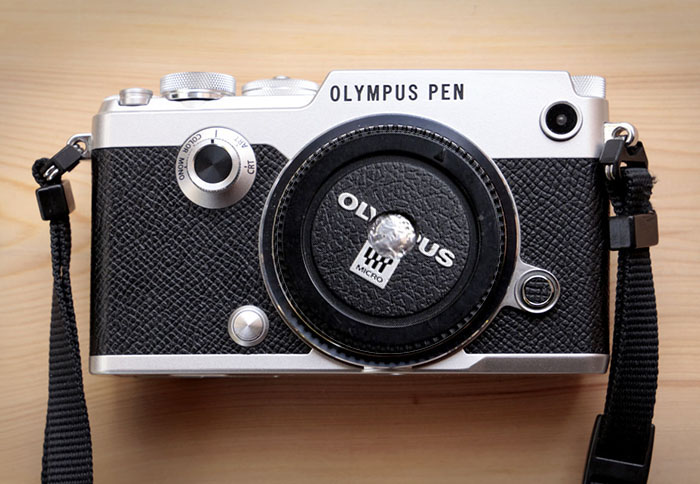
Vicky’s Pinhole Olympus Pen
Camera Olympus Pen: 1/90 @2500 ISO the pinhole is made with a camera body cap and a handmade pinhole in pie tin foil.
.
DOUG’s PINHOLE IMAGE: WALKING THE DOGS

ABOUT DOUG’S PINHOLE IMAGE:
.
This year I wandered as a free-ranging spirit on a bright sunny day through my local botanic garden. Spontaneously I responded to the subjects that emerged into my line of sight…
.
SOME OF DOUG’s OTHER IMAGES
.


DOUG’s DIGI-PINHOLE CAMERA
.
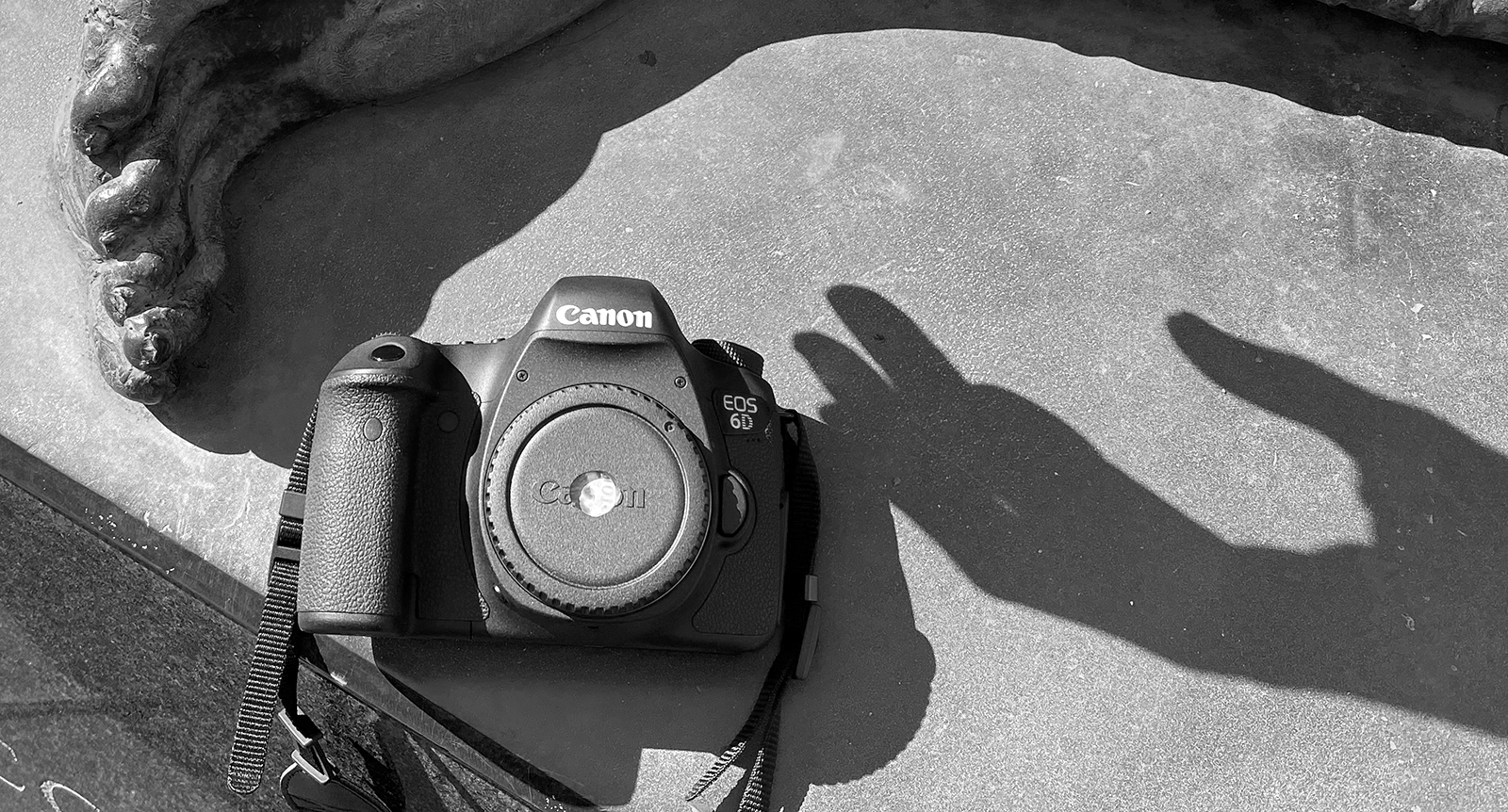
My pinhole was a readymade found in our pinhole workshop toolbox – capture device a digital Canon 6D operated around ISO 6000 with a S/S of 60th part of a second.
Visit the WWPD Site for details of other submissions: http://pinholeday.org/
.
VIEW 16 YEARS OF PAST WPPD iMAGES:
2021 Doug+Vicky https://wordpress.com/post/wotwedid.com/12227
2020 Doug+Vicky https://wotwedid.com/2020/05/13/2020-worldwide-pinhole-day-26-april-our-images/
2019 Doug+Vicky https://wotwedid.com/2019/04/29/2019-worldwide-pinhole-day-28-april-our-images/
2018 Doug+Vicky https://wotwedid.com/2018/04/29/2018-worldwide-pinhole-day-29-april-our-images/
2016 Doug: http://www.pinholeday.org/index.php?id=1235
2016 Vicky: http://www.pinholeday.org/index.php?id=1540
2015 https://wotwedid.com/2015/05/04/april-26-worldwide-pinhole-day-our-contributions-for-2015/
2014 Vicky’s http://pinholeday.org/gallery/2014/index.php?id=1810&City=Toowoomba
2014 Doug’s http://pinholeday.org/gallery/2014/index.php?id=1811&City=Toowoomba
2013 https://wotwedid.com/2013/04/29/world-pinhole-photography-day-our-contribution/
2012 http://www.pinholeday.org/gallery/2012/index.php?id=1937&searchStr=spowart
2011 http://www.pinholeday.org/gallery/2011/index.php?id=924
HERE IS THE LINK to the 2011 pinhole video http://www.youtube.com/watch?v=Yk4vnbzTqOU
2010 http://www.pinholeday.org/gallery/2010/index.php?id=2464&Country=Australia&searchStr=spowart
2006 http://www.pinholeday.org/gallery/2006/index.php?id=1636&Country=Australia&searchStr=cooper
2004 Vicky http://www.pinholeday.org/gallery/2004/index.php?id=1553&Country=Australia&searchStr=cooper
2004 Doug http://www.pinholeday.org/gallery/2004/index.php?id=1552&Country=Australia&searchStr=spowart
2003 http://www.pinholeday.org/gallery/2003/index.php?id=615&Country=Australia&searchStr=spowart
2002 http://www.pinholeday.org/gallery/2002/index.php?id=826&Country=Australia&searchStr=spowart
.
.
.2021 WORLDWIDE PINHOLE DAY – Our images

WWPD 2021 LOGO
.
Around the [w]hole world on Sunday April 25, 20201pinholers were out having fun – Making their images for the 2021 Worldwide Pinhole Photography Day.
This year – still in Toowoomba we’ve been working on projects and supporting family. Once again, far away from the darkroom, we’ve fitted a piece of aluminium with a light admitting pin-prick to the body cap of our Olympus Pen camera and braved the parkland at the end of our street. Recently we uploaded our images with a detailed caption to the WPPD website to add to the contributions from Australian pinholers and many more from around the world.
This is the 17th year we have supported the WPPD project!
SEE LINKS to our other submissions at the end of this Post.
WHAT IS WORLDWIDE PINHOLE PHOTOGRAPHY DAY ALL ABOUT?
From the Worldwide Pinhole Photography Day website introduction
All the photographs in this extraordinary collection share two common characteristics: (1) they are lensless photographs (2) they were all made on April 25, 2021.
They also share an additional and less formal characteristic: the sincere enthusiasm of their creators who, by participating in this collective event, shared individual visions and techniques. Hence the amazing diversity of subjects, cameras, techniques and photographic materials combined in this exhibit!
The process is that photographs are made on April 25 > they are processed / optimised by the photographer > uploaded and captioned on the WPPD website. The 2021 Gallery of images can be searched to see what photographers from around the world did on that day…
Here’s the website page of the Australian pinhole photographer’s works:
WPPD 2021 Australian submissions @ May 11, 2021
.
VICTORIA’s PINHOLE IMAGE: AFTERNOON WALK
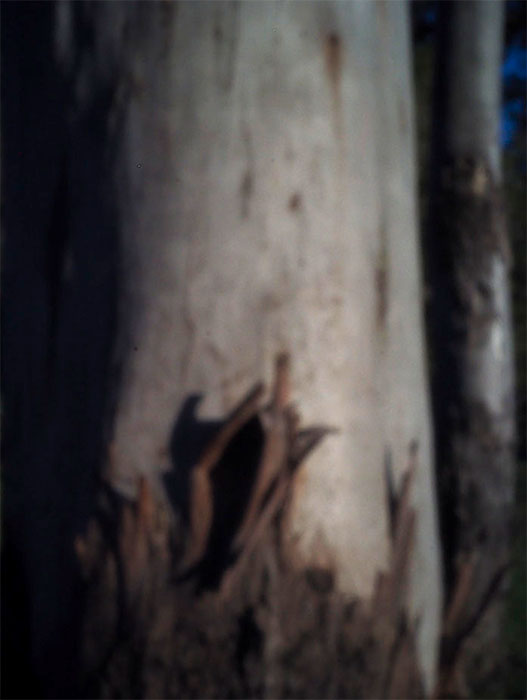
Victoria Cooper’s Evening walk pinhole photo
ABOUT VICKY’S PINHOLE IMAGE:
We pass by these trees everyday… I decided to take pinhole photos of our walk as I enjoy the way they transform these everyday places into a kind of poem, not distinct nor descriptive just evocative.
DOUG’s PINHOLE IMAGE: TREE HOUSE
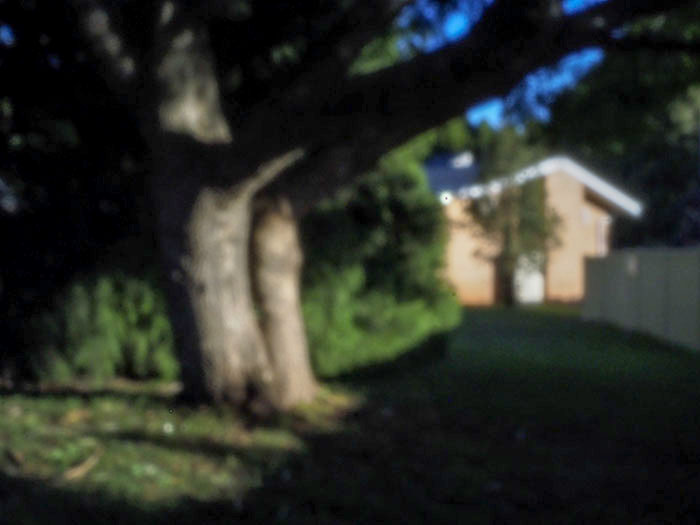
Tree House a pinhole image by Doug Spowart
ABOUT DOUG’S PINHOLE IMAGE:
I chose the late afternoon to go out and make images as the low light angle and the deep shadows add drama and mystery to pinholes made at this time.
Over recent years I have continued to choose a digital camera and aluminium pie dish with a pin prick in it. Wet darkrooms and film, although it suited the zone plates of landscape that I made are beyond my current means – perhaps next year…
.
OUR Digi-PINHOLE CAMERA
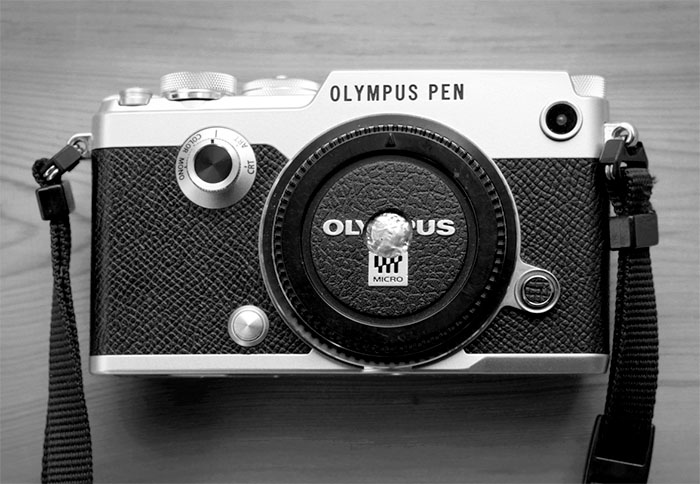
The Cooper+Spowart digi OLYMPUS PEN with pinhole …
This is a converted digital Olympus Pen, shared with my partner Doug Spowart. The pinhole is a pin pierced hole in aluminium which is inserted into a hole drilled into a body cap. It is a hand held exposure of 1/25th second at ISO 2000.
Visit the WWPD Site for details of other submissions: http://pinholeday.org/
.
Our Past WPPD images:
2020 Doug+Vicky https://wotwedid.com/2020/05/13/2020-worldwide-pinhole-day-26-april-our-images/
2019 Doug+Vicky https://wotwedid.com/2019/04/29/2019-worldwide-pinhole-day-28-april-our-images/
2018 Doug+Vicky https://wotwedid.com/2018/04/29/2018-worldwide-pinhole-day-29-april-our-images/
2016 Doug: http://www.pinholeday.org/index.php?id=1235
2016 Vicky: http://www.pinholeday.org/index.php?id=1540
2015 https://wotwedid.com/2015/05/04/april-26-worldwide-pinhole-day-our-contributions-for-2015/
2014 Vicky’s http://pinholeday.org/gallery/2014/index.php?id=1810&City=Toowoomba
2014 Doug’s http://pinholeday.org/gallery/2014/index.php?id=1811&City=Toowoomba
2013 https://wotwedid.com/2013/04/29/world-pinhole-photography-day-our-contribution/
2012 http://www.pinholeday.org/gallery/2012/index.php?id=1937&searchStr=spowart
2011 http://www.pinholeday.org/gallery/2011/index.php?id=924
HERE IS THE LINK to the 2011 pinhole video http://www.youtube.com/watch?v=Yk4vnbzTqOU
2010 http://www.pinholeday.org/gallery/2010/index.php?id=2464&Country=Australia&searchStr=spowart
2006 http://www.pinholeday.org/gallery/2006/index.php?id=1636&Country=Australia&searchStr=cooper
2004 Vicky http://www.pinholeday.org/gallery/2004/index.php?id=1553&Country=Australia&searchStr=cooper
2004 Doug http://www.pinholeday.org/gallery/2004/index.php?id=1552&Country=Australia&searchStr=spowart
2003 http://www.pinholeday.org/gallery/2003/index.php?id=615&Country=Australia&searchStr=spowart
2002 http://www.pinholeday.org/gallery/2002/index.php?id=826&Country=Australia&searchStr=spowart
.
.
.Father’s Day: A remembrance in an art project
Father’s Day 2020 – Thinking of our Dads
In 2010 artist, and then gallerist, Julie Barratt put out a call for artworks that asked artists to respond about their Fathers and their passing.
The request from Julie Barratt is as follows:
This project was borne out of the recent sudden death of my father, a handkerchief, some emotive words written by a sibling on his death and the traumatic aftermath of a death processed according to particular societal and cultural mores. Interested artists and Individuals are invited to create an artwork on a handkerchief (any handkerchief not necessarily a man’s) based around death/grief/bereavement.
We reflected on our connection with our Fathers and created artworks using the cyanotype process.
Doug’s Hankie
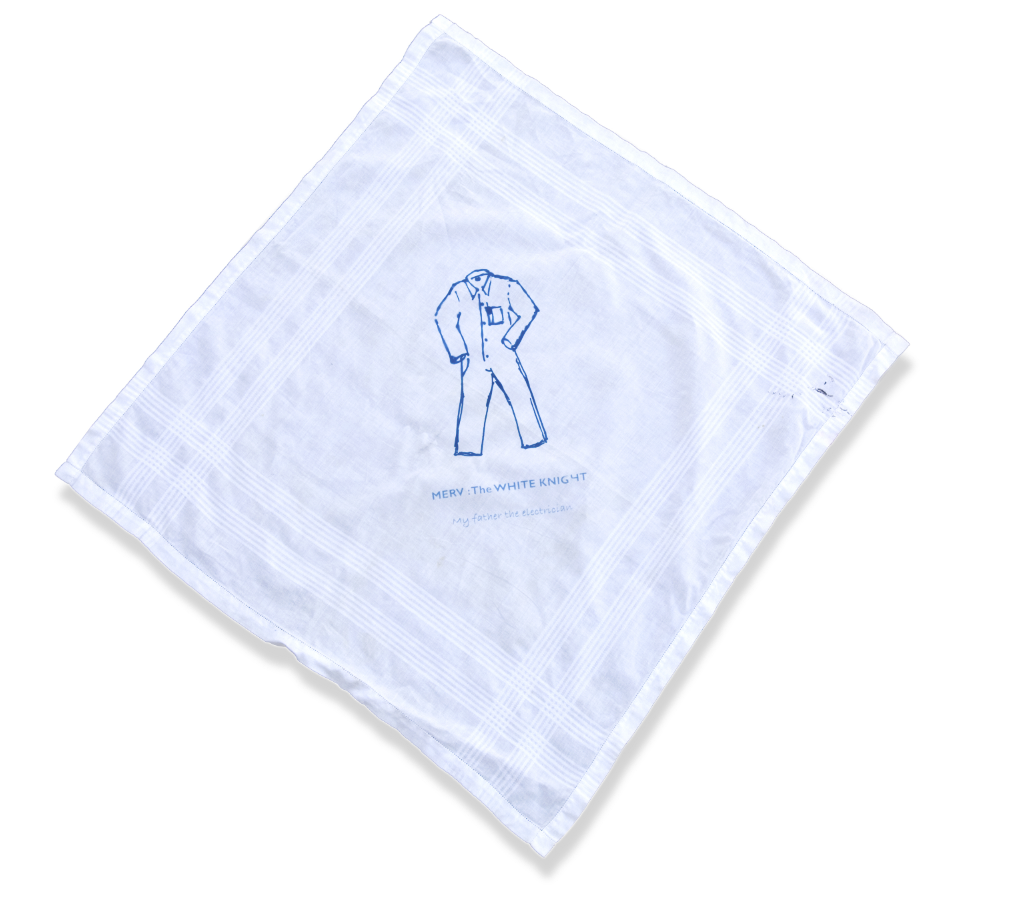
The WHITE KNIGHT – for Merv by Doug Spowart
MERV: The White Knight
My father was an electrician for around sixty years. He always wore King Gee white overalls—even when we went on holidays.
Ever ready to help someone in need he would dash off at a moment’s notice—even when the family organised an outing on the weekend we would always fit in another job along the way.
Over the years he helped many an electrically troubled soul so we, his family, dubbed him the nickname – “The white knight”.
Victoria’s Hankie
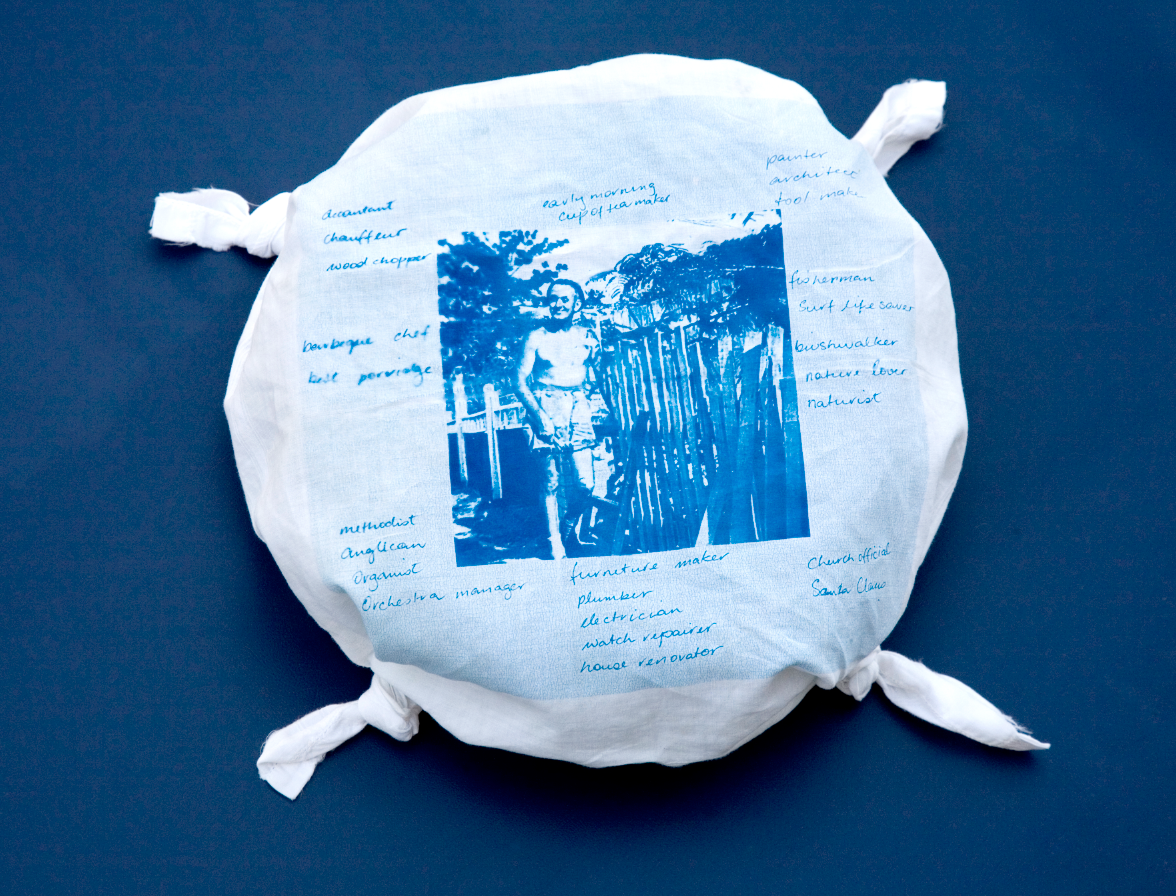
Dad’ll do it – for Reg by Victoria Cooper
Dad’ll do it
I remember that he always tied knots in his hankie to keep it in place on his head and to soak up the sweat when he was working on things around the home. He had lived in this home (in the photo) for most of his life except for the time he was in Papua New Guinea for WW2 and shorter periods of time in other places. Over the years he adapted and renovated this home to suit the changing needs of the family.
.
.
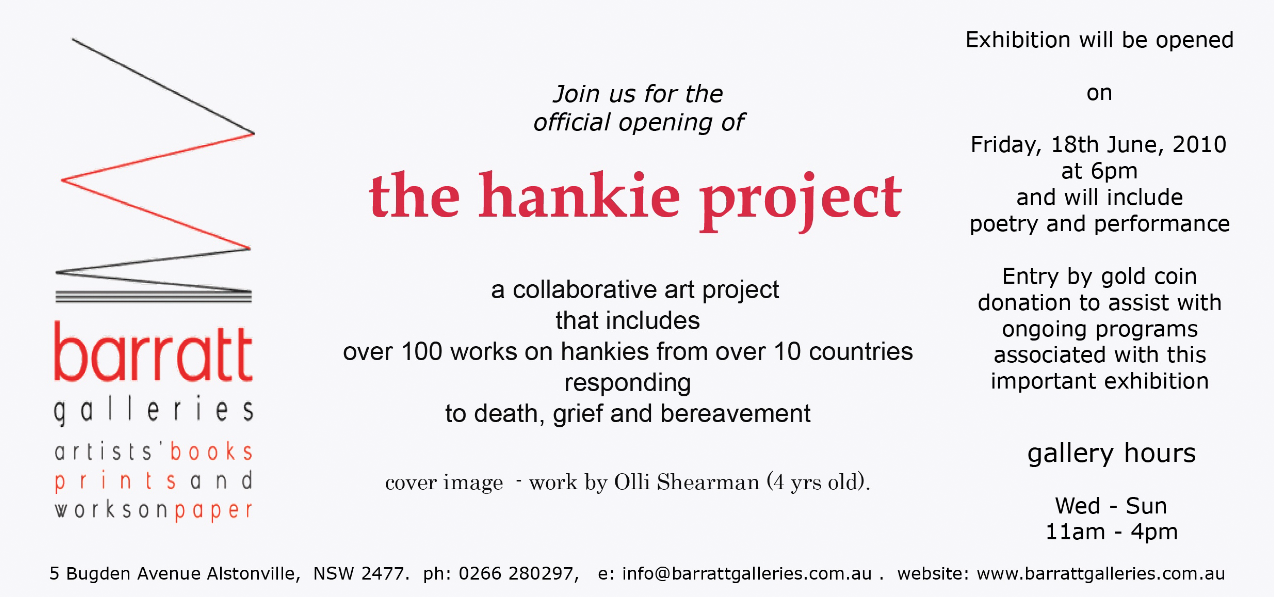
Barratt Gallery Invite
.
The exhibition was shown at Barratt Gallery at Alstonville and Napier Gallery Melbourne
.


A post about the exhibition can be found HERE
.
.
.
.
.
.
A Poem for Dad on Father’s Day – Victoria Cooper
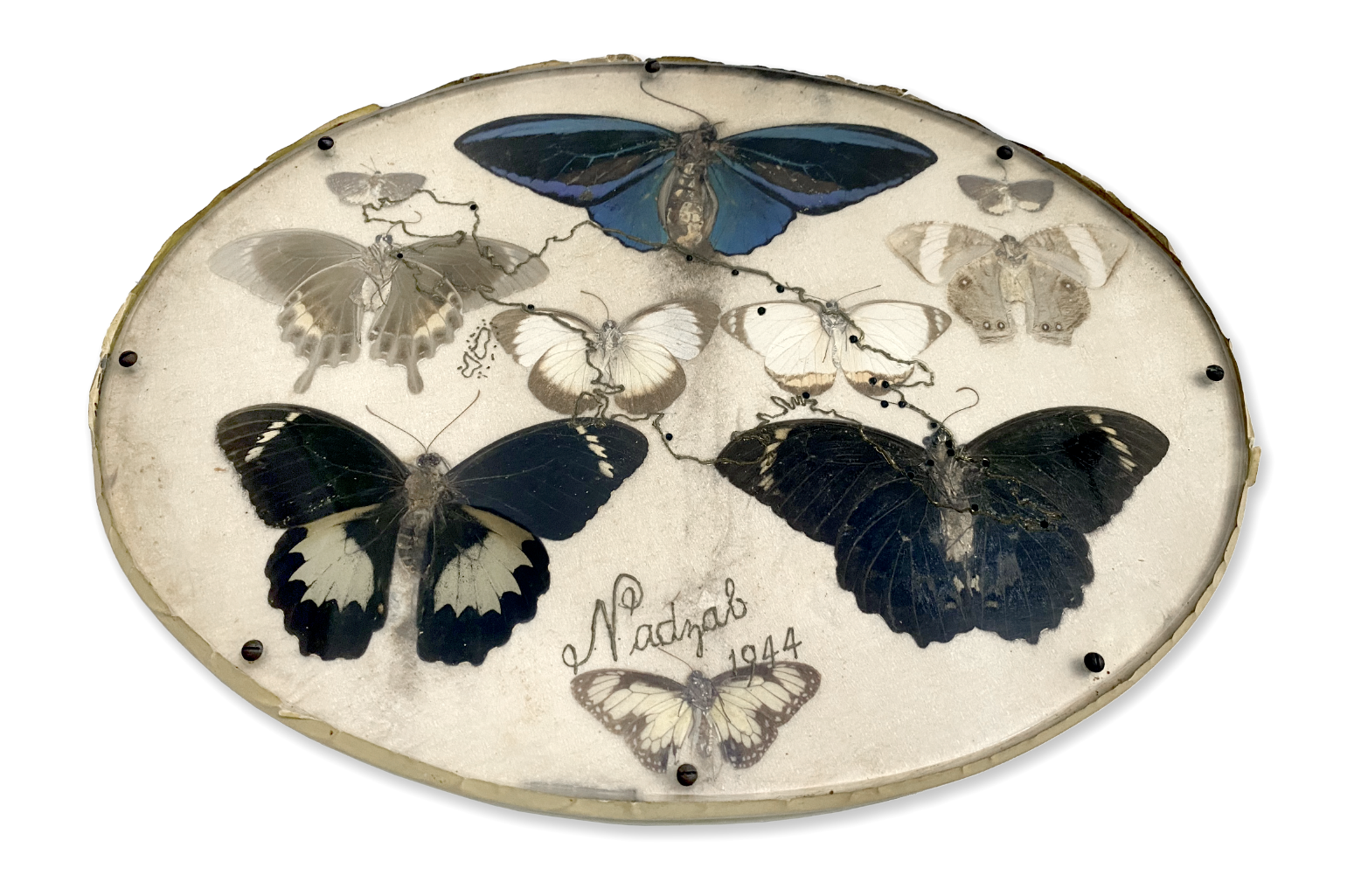
Reg Cooper’s WW2 PNG Butterfly collection*
.
A Poem on Fathers Day – Victoria Cooper 2020
Remembering small shared moments of joy for the natural world.
Many of which no longer exist but for a museum of memories.
With gratitude to my father
Pneumas
.
Flashes of colour
Flutter across the wall
The souls of the warriors
Fly over
The sublime terrain
While pinned
To a never ending present
.
Years pass
This man
Tends a distant garden
Preparing a fertile space
In anticipation for the end of dormancy
.
And so the decades
They fly
This man and a small child
Tend the garden
With humility in everyday work
Merging into a gentle rhythm
No expectations
Just joy in the flowers
That simply grow
.
But the Butterflies
Remain
Souls Hovering
Over that memory
What do they know
About Time…..
.
Eventually
The child alone
Tends the garden
Now a field
Rich with Dreams
Of Flowers
And Forests
.
All this …
For The Butterflies
To breathe
.
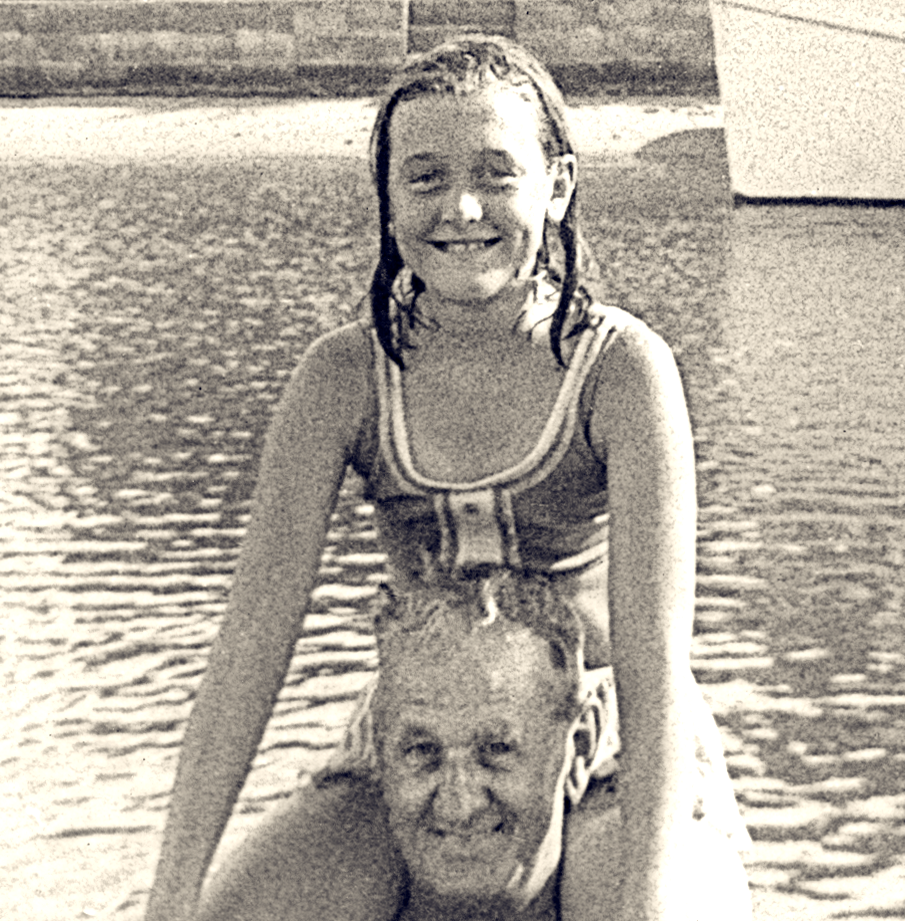
Vicky and her Dad Reg …circa 1960s
*Pneuma (πνεῦμα) is an ancient Greek word for “breath“, and in a religious context for “spirit” or “soul“.[1]
.
Reg’s Butterfly collection
Reg Cooper served in the Royal Australian Air Force in Papua New Guinea in World War II. During this time he made this work by collecting butterflies and placing them over a map of PNG and framing. It is entitled “Nadzab 1944” – where he was stationed.
.
.
.
.
.
This Blogpost is copyright: Text – Victoria Cooper ©2020, Nadzab 1944 © Reg Cooper, Portrait of Victoria & Reginald Cooper – Helen Cooper ©circa1960
Any RSS reposting from this Blog without permission represents a breach of Copyright.
.
.
.
.
.
WOTWEDID BLOG CELEBRATES 100,000 VIEWS
100K Header
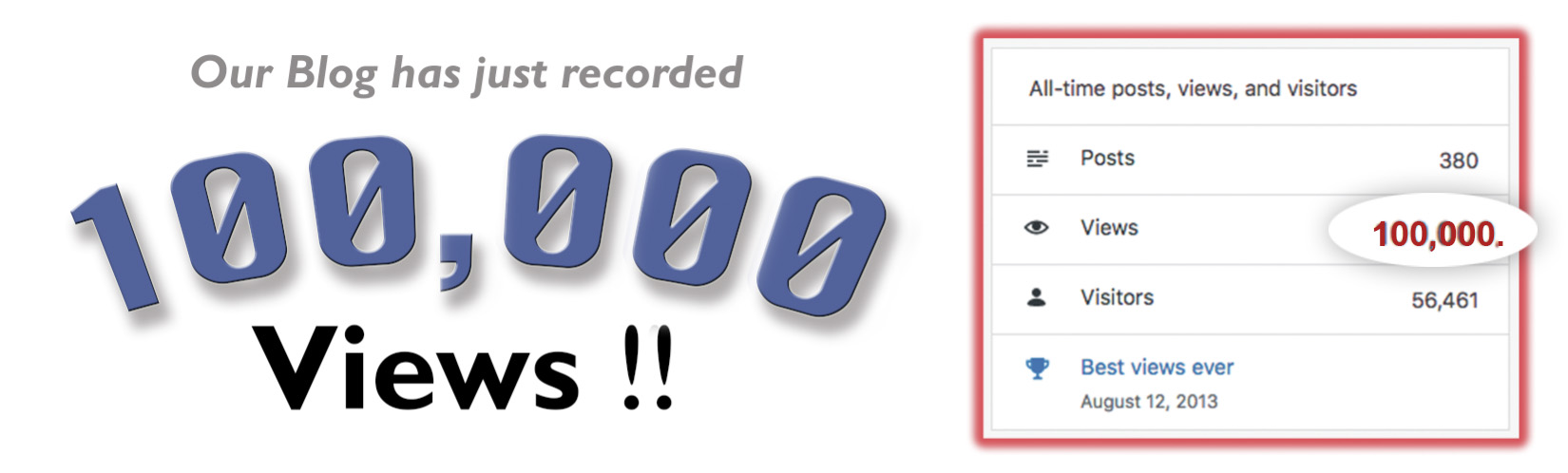
Our www.wotwedid.com blog reached the milestone of 1000,000 views last week. It has had 56,000 visitors who have had the opportunity to view 380 posts and read around 250K words and see the hundreds of photographs that we have made to compliment the stories.
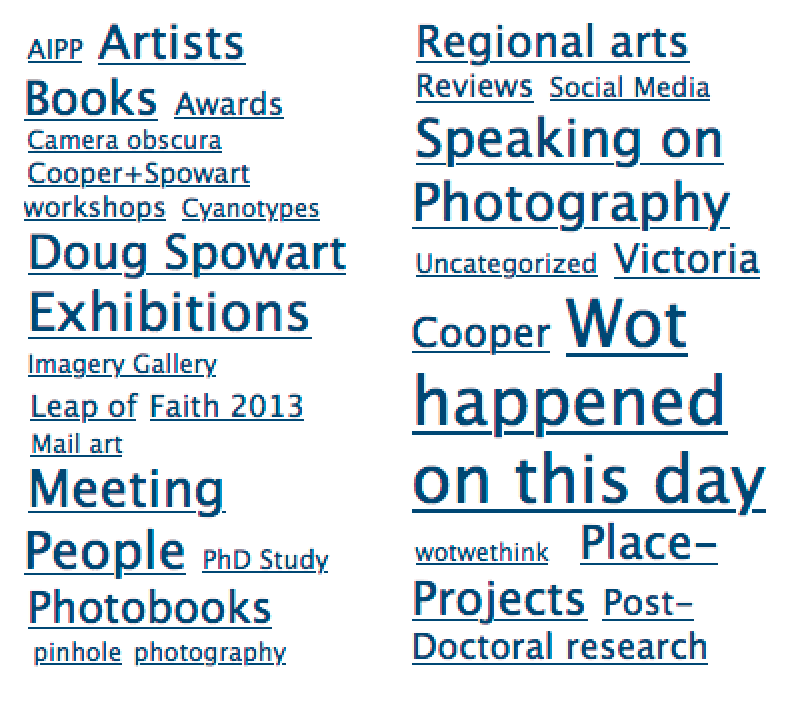
Our wotwedid Blog was started nine years ago as an opportunity to connect with our friends and creative communities via social media. The topic cloud for the wotwedid Blog includes ARTISTS’ BOOKS, PHOTBOOKS, CAMERA OBSCURA, EXHIBITIONS, MEETING PEOPLE, THE ART AND PRACTICE OF PHOTOGRAPHY, REGIONAL ARTS, CYANOTYPES, PLACE PROJECTS and POST-DOCTORAL RESEARCH.
Topic cloud wotwedid
Usually the content that we post is generated by us and includes the written commentaries, the photographs and illustrations – it can be quite a lengthy time consuming task to get a blog up.
While many posts relate to what we do, have done or will be doing, the Blog represents a chronology of activity in our art practice, our lives and issues that we are concerned about. Due to the contemporary space that the arts and artists occupy today much activity and many events go unnoticed and unrecorded. So a significant driver is to provide a space for commentary on what is happening outside of the popularist ‘art bubble’.
Early this year we were excited to learn that the State Library of Queensland had nominated wotwedid.com for inclusion in the Pandora Archive managed by the National Library of Australia, ‘to ensure the collection and long-term preservation of online publications relating to Australia and Australians. This objective contributes to the Library’s statutory function to comprehensively collect Australia’s documentary heritage.’
Over the years we have found that many views, screen dumps and downloads of resources we make available take place anonymously without comment or feedback. Then again, we understand that this is the same for most online resources. Despite this we find that as we travel and meet friends, fellow artists, academics and curators many say how much they appreciate and enjoy the content that we generate and post.
So, a BIG Thank You to all have visited … And we look forward to your return to help take www.wotwedid.com to the next milestone – 200,000K views.
D+V with masks
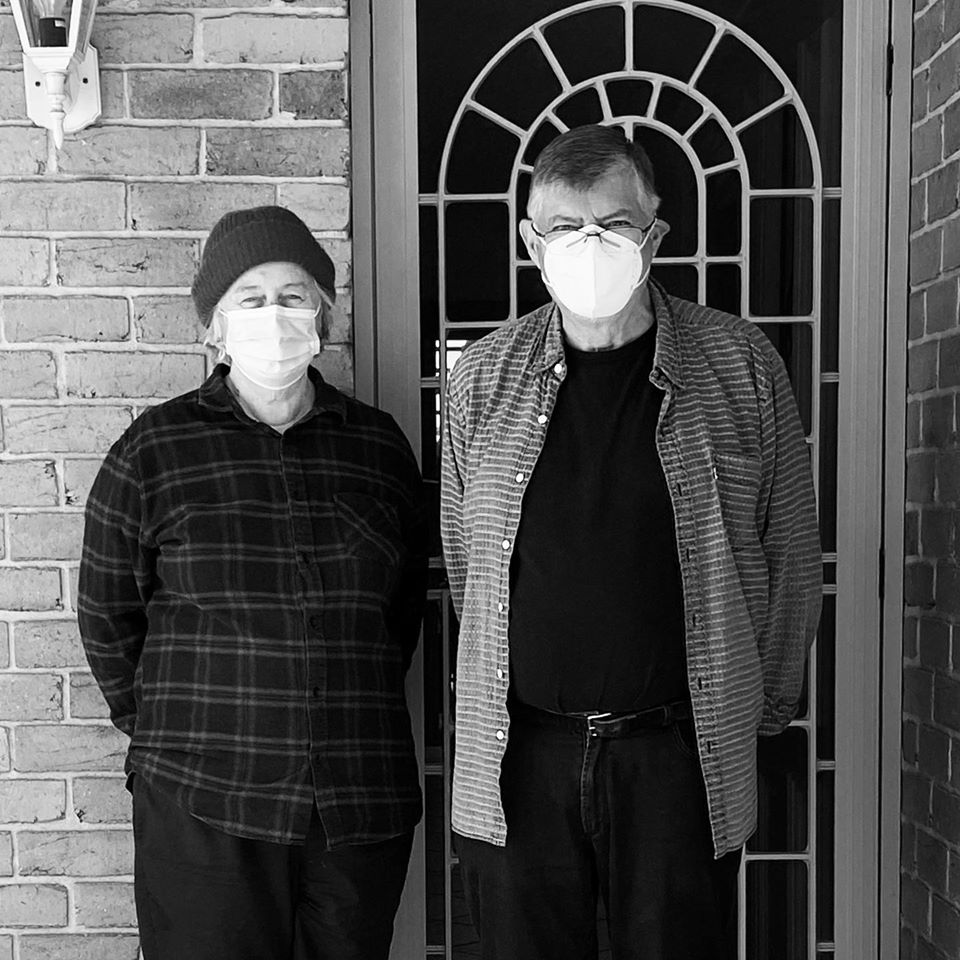
Vicky+Doug
PORTRAIT PHOTO: Susan Belperio
Here are some images of people met, events documented and our own art activities over recent years …


©2020 Doug Spowart+Victoria Cooper
..

.
Our photographs and words are licensed under a Creative Commons Attribution-NonCommercial-NoDerivs 3.0 Unported License.http://creativecommons.org/licenses/by-nc-sa/2.5/au/..
FOUND: A camera obscura in a storage shed box
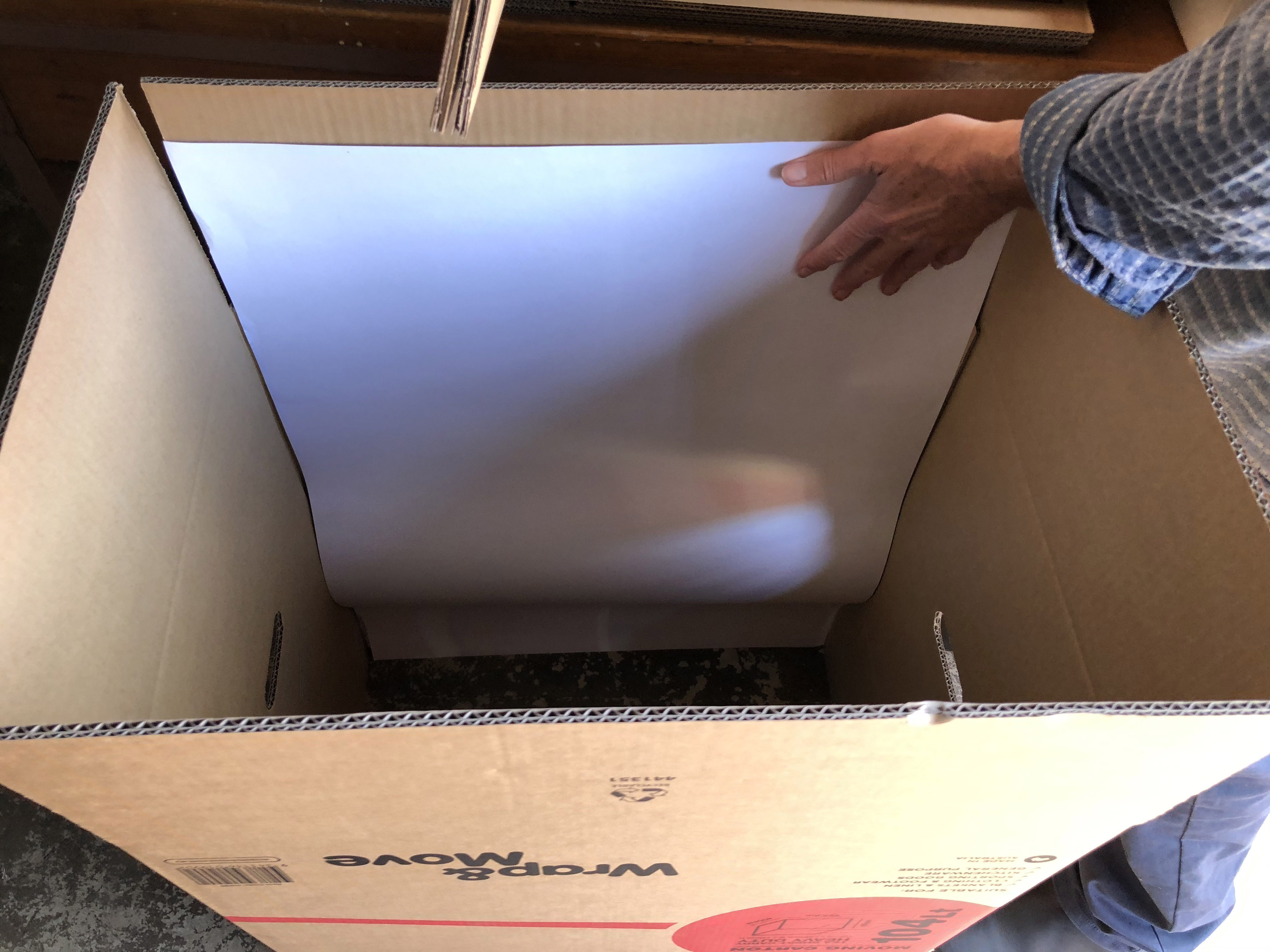
An image is found in a packing box
.
.
So today we were planning a day of shedding in our storage shed. We donned our dust masks and glasses, and cut through the five years of dust on many boxes and began to move our precious things into protective packing boxes.
Just as we were getting into the rhythm of this challenging chore we found something amazing in one of the empty boxes…
From that moment we stopped all work…
What follows is an impromptu document of performance we made in this remarkable image discovery. Found within an ordinary box – in a dusty storage shed – somewhere in the rows of storage sheds where we and others store our forgotten treasures…
.
A video featuring the performance …
.
.
.
.
Here are some images and a video on the refinement of the image by using other boxes and a pair of gloves to mask-out the light admitting aperture to around 3cm square.
.


.
A video revealing the storage shed packing box set-up …
.
.
OTHER COOPER+SPOWART CAMERA OBSCURA POSTS:
A collection of camera obscura works
https://wotwedid.com/2013/10/26/camera-obscura-2000-2020-in-hotels-and-other-places/
A porthole camera obscura on the Spirit of Tasmania
https://wotwedid.com/2019/01/11/2018-field-studies-camera-obscura-spirit-of-tasmania-porthole/
A gallery camera obscura
https://wotwedid.com/2016/11/14/maud-gallery-camera-obscura-for-one-day-only/
Our Tarago CarCamera Obscura
https://wotwedid.com/2016/05/13/ode-to-tarago-carcamera-obscura/
.
.
.
Until the next obscura reveals itself …
.
.
.
COOPER’s SUBMISSION: Review of Environmental Protection and Biodiversity Conservation Act
FROM THE FORWARD TO THE EPBC REVIEW DOCUMENT:
The Environment Protection and Biodiversity Conservation Act 1999, plays a significant role in the protection and management of our environment and heritage. It operates within a broader context, alongside other Commonwealth laws and activities and those of state, territory and local governments. The activities of businesses, land managers and the community are also central to achieving environmental outcomes.
The EPBC Act requires that an independent review be undertaken at least once every ten years. The review must examine the operation of the Act and the extent to which its objects have been achieved. The last review was completed in 2009.
.
Victoria’s response to this review that follows comments on the potential acute and long term affects of environmental damage to the very substance that makes up our planet: land, water and sky.
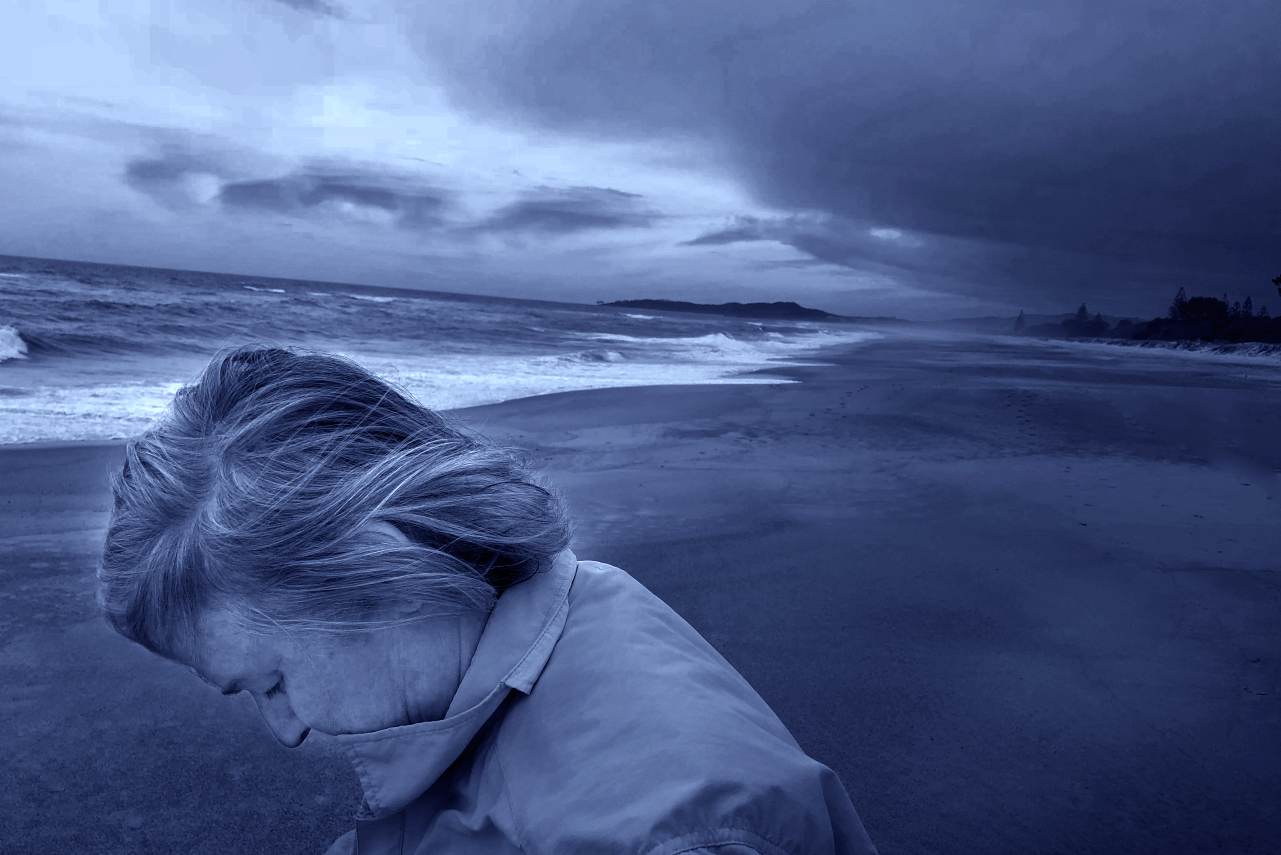
A reflective Victoria Cooper in the field ….PHOTO: Doug Spowart
The importance of Microbial life in the protection of, and biodiversity conservation in, the Australian environment.
My background in science is at a technical level working in both Human and Plant Pathology. I have also completed a PhD where my research examined the communication of freshwater issues in Australia and focussed on the interplay of cultural and creative visual narratives with a science project on aquatic fungi. This research brought together both my current practice in the visual arts and my past experience in science.
In my work I have witnessed the power of microbes as they shape our corporeal and environmental ecologies. When any of our physical systems become unbalanced or neglected these unseen co-inhabitants can become pathogenic impacting on our health and that of the planet. Alternatively if these organisms are lost from the many systems they support – life will cease to exist. For example a forest without fungi and bacteria, dead material would not be decomposed and recycled to renew the land.
My response to this review comments on the potential acute and long term affects of environmental damage to the very substance that makes up our planet: land, water and sky.
My concern is that this review is not addressing the following:
- The creation of a researchable archive on the renewable and sustainable effects of any impact on any microbiological agent. For example the change to the natural microbial community and populations on soil health from removing native grasses, or deforestation of old growth habitat; or the affects on the microbial environment in drying-out of critical wetlands that are drained and not replenished when water is available. If we create an imbalance in the microsphere, this will continue throughout the entire system.
- Create more professional and academic avenues of research to highlight the importance of a cross-discipline collaborative intelligence in this archive.
2.1 By including and financially supporting more broadly the Aboriginal and Torres Strait Indigenous knowledge and experience;
2.2 Australia government initiatives and entrepreneurship for Research and Development into innovative forms of Sustainable and Renewable technology to provide new ways to live with, know and imagine the unique Australian microbiota; and
2.3 Recognizing the urgency with which this action is needed for this work to be undertaken.
The ecology of the micro-environment has developed over many millennia from the beginning of life on Earth. Micro-organisms are in every part of our existence: in and on our bodies, the air we breathe, the food we eat, our soils and waterways. Australia has uniquely developed systems that support our diverse and rich geology, flora and fauna.
The interconnected relationships of micro to macro need to be well understood, protected and maintained in order to continue to sustain life’s balance.
Victoria Cooper PhD
A copy of the EPBC ACT REVIEW Document can be downloaded – Click this link: epbc_act_review_discussion_paper_0
.
Some of Victoria’s visual research work relating to the ideas embodied above…
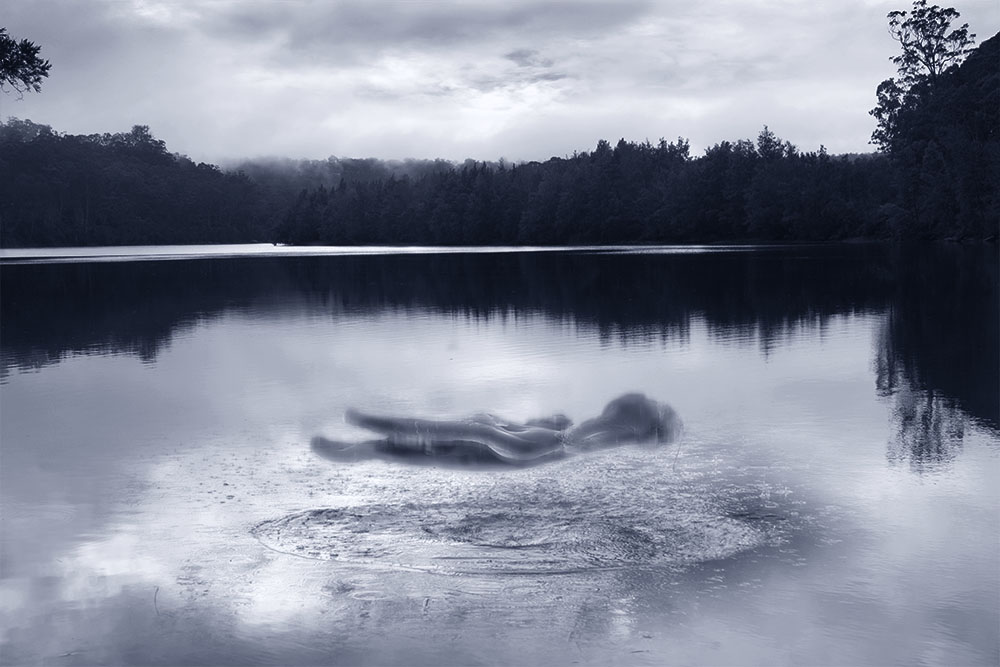
Vicky’s a page from the The River book
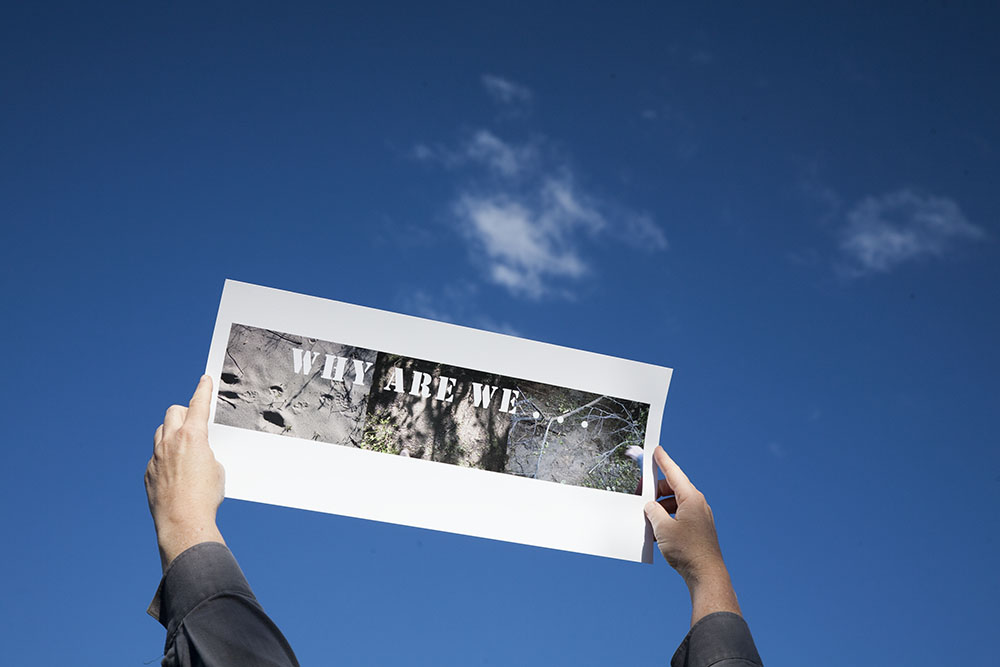
Documentation of a page from the book The Island
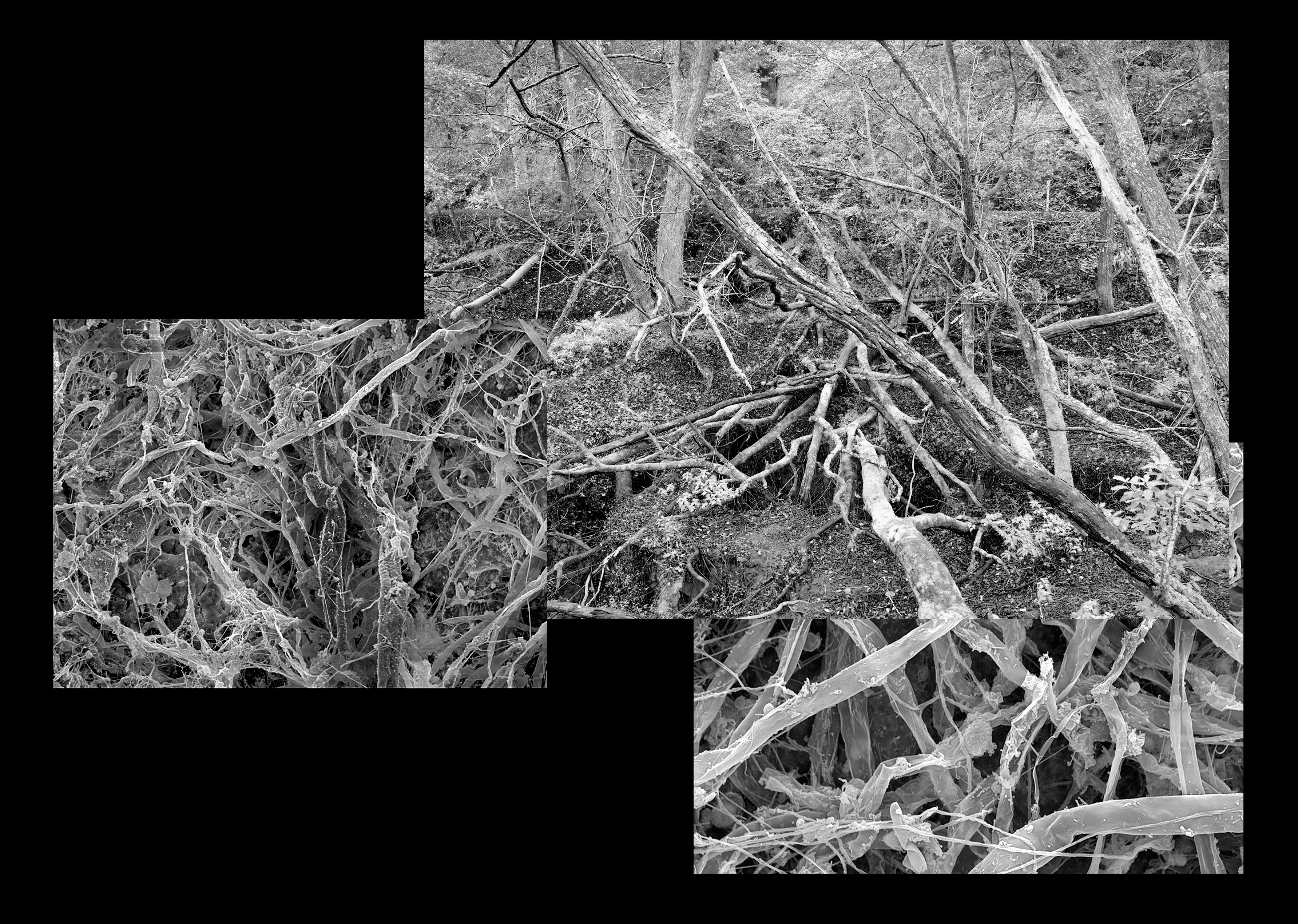
A double-page spread from the artists’ book Being Present
.
.
.
.
.
.
.
.


