Over the last ten years I have had many conversations with Juno about her work and its need to be published to tell the story of The Movement as well as recognise the extensive documentary archive that she had created. Such a publication would celebrate her life’s work as a photo-activist.
Last year, Juno was finally able to publishus her extensive document of The Movement. About the time of it being launched she forwarded a copy of the book to me. What follows is an essay by me commenting on Juno which may help us to understand her motivation and what sustains her in her undertaking of this level of witnessing for fifty years.
.
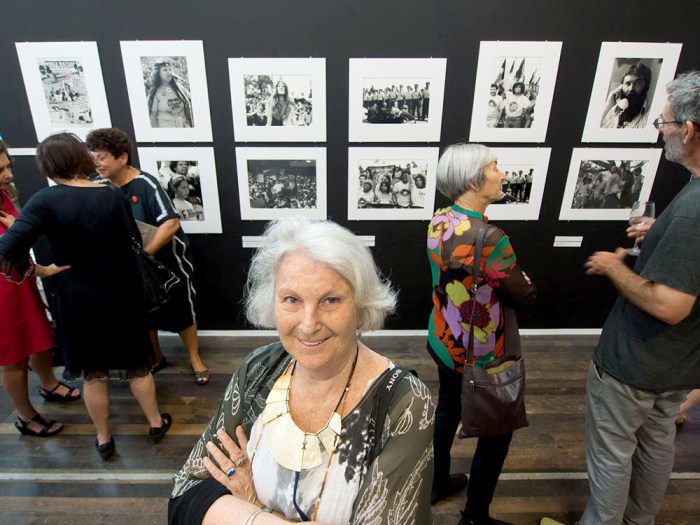
Juno Gemes in the exhibition Up Close at Fireworks Gallery 2015
.
.
The totemic power inherent in the photographic image comes from the subtitle power of recognition and connectivity between people. These are the dynamics I work from.
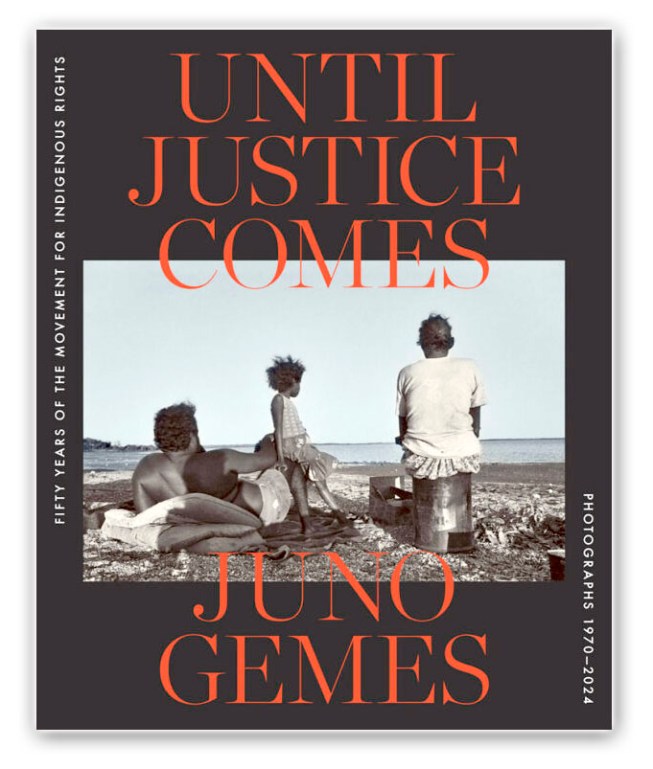
After fifty years of prodigious and dedicated activity in photographically documenting Indigenous life and challenges in Australia Juno Gemes has finally published a book to house an edited selection of photographs from her exceptional archive. The book, entitled Until Justice Comes: Fifty Years of The Movement for Indigenous Rights is a weighty publication, not unlike the topic of its contents. In turning the pages of the book it would seem that Juno and her camera were there to record every aspect of Indigenous life. Photographs, mainly in black&white range from people – both the significant and famous to ordinary people living on traditional ancestral lands to major and minor protest events and moments where recognition and respect has been achieved.
In 1995 edition of the Photofile Juno Gemes posed the question: “What can a woman do with a camera?”[ii] Today, with the publication of this latest book we can now reflect upon her question and come to a conclusive answer.
How does one describe Juno Gemes? For me she is some kind of a rhizomic individual, a chameleon, and a shape-shifter. She is everywhere for everyone and watch out if you are on the wrong side – particularly if it is to do with injustice. There is more to Juno Gemes. The manifesto that drives her is deeply and often quite vocally expressed is rooted in social justice. Central to her personal crusade are concepts relating to humanity, culture/s and communication.
In 2003 she posed the following observations and questions in relation to what motivates her work: “If cultural difference is the true wealth of humanity … why is it that people from one culture find it so difficult to recognise the cultures of others? If our sense of culture–our value system–is fragmented and broken, how can we heal it? How does mythic thought function for different peoples?”[iii] Her strategy in responding to these questions are: “… to be curious and ask the difficult questions is the crucible of art.”[iv]
Over fifty years her photographs have become powerful statements, they are authentic, they respectfully bear witness and give voice to issues of Aboriginal identity and presence on the land. Gemes’ photographs were distributed in all kinds of media, not only those of the Movement itself but also in political and academic papers and mainstream newspapers like the Sydney Morning Herald.
The art of the camera and the photograph became her way of dealing with the difficult questions of the times – Australia and its treatment and recognition of its first peoples. But Gemes’ approach to photography may not have been the traditionally accepted ‘impartial’ documentary style but rather more inclusive, active and interactive motivated by her, and her subject’s desire for authenticity in the story that is told through her photographs. Rather than calling herself a documentary photographer, Gemes considers her work photo-activism. This stance is based on advice given to her by many of her mentors and teachers including UK photographers Jo Spence and David Hurn. In 1979 at a workshop in Venice photographer Lisette Model counselled Juno advising that: “You do not photograph with your camera but with your eyes, your head and your heart…”
In 1978 when photographing on Mornington Island Juno was to ask: “What images should I make? What do you want your fellow Australian to see?” The answer from the Aboriginal community was: “Show them that we are still here, we been here all along. Show them that our culture is still strong. Show them that, my girl.”[v] Juno made photographs then, and ever since, as an advocate of this simple request.
Due to the photo-activism approach to photography she was not always successful in getting what she wanted published. In 1982 she documented the land rights marches associated with the Commonwealth Games Action Protests in Brisbane. When she offered her images to the Sydney Morning Herald the pictorial editor said: “Juno, I can’t publish this, it’s clear what side you’re on. What about your objectivity?”[vi] She replied: “Objectivity is fiction. It’s a refusal to take a conscious position. There can be no fence–sitting on this issue. Pictures you are publishing also have a clear position. A negative position not informed by what this action is really about.”[vii]
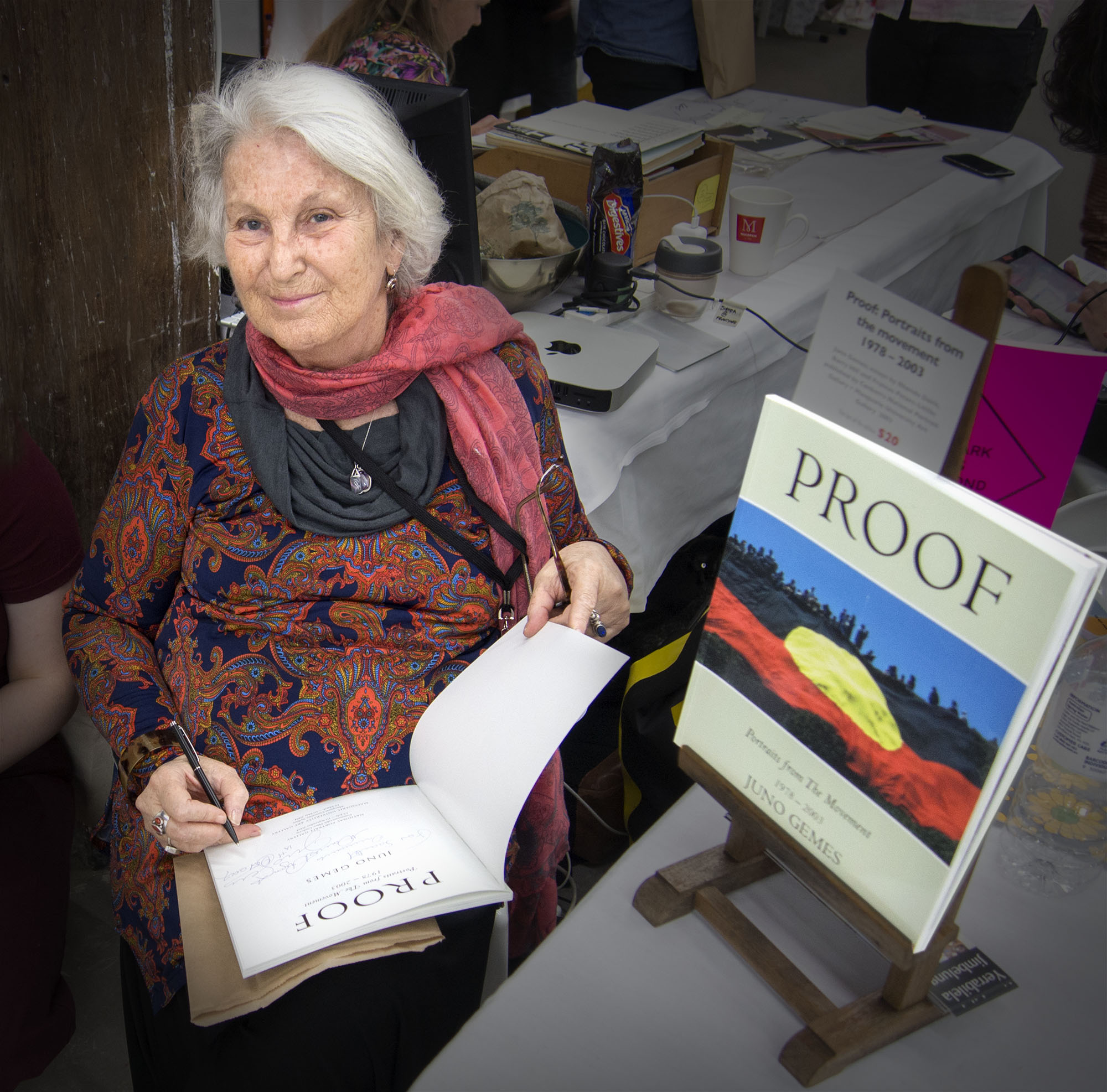
Juno Gemes signs her book PROOF, Sydney 2017
Over time Juno Gemes’ photographs have become a comprehensive record of the times, and with camera in hand, she continues to amass and archive of critical and sublime moments of Aboriginal culture, life and those who and connect with it. What cannot be left out in this story is the significant support that Juno Gemes has given to an entourage of Aboriginal photographers in all fields of practice from personal documentation to the highest levels of art photography.
In reflection on Juno’s approach to her work, one looks for defining moments in her life that underpin and inspire her dedication, empathy, respect and creativity. She references being born in Hungary and coming, as a child, to Australia. As a child she talks of questioning the history of this country that was taught in her classroom. She also speaks about how her life was disrupted by dispossession from her homeland. In a Photofile journal in 1995 she recounted one of her earliest childhood memories that shaped her life: “… carried out of my homeland, Hungary, on my father’s shoulders; he was walking in knee-deep snow, gunfire rang out in the distance.”[viii]
As a closing summation Juno’s own words may add to our understanding of the person. These come from the catalogue of the National Portrait Gallery’s 2003 exhibition Proof: Portraits from the Movement 1978-2003, Juno Gemes says:
I have eyes that see in a particular way. My eyes are informed by everything I have experienced, by all that I am. I saw powerful beauty, strength, resilience, ingenuity, and hope at a time where others mostly saw only despair, their own discomfort and shame. I saw what had been hidden, kept invisible. I tried to communicate from within one culture to another. It was sometimes a lonely place to be. I had many great teachers who taught me so much along the way. I understood how important it is never to forget what has been. For we are also — what we have lost.[ix]
I say again: “What can a woman do with a camera!” we now know the answer.
Congratulations Juno Gemes on your work in Until Justice Comes: Fifty Years of The Movement for Indigenous Rights book and thank you for your solid contribution to making the often invisible visible and sharing these stories through the photographs you have made …
.
Dr Doug Spowart
.
.
.
[i] Gemes Juno, “Until Justice Comes: Fifty Years of The Movement for Indigenous Rights” v Upwell Publishing. Perth 2024
[iii] “The Political and the Personal Process in Portraiture: Juno Gemes in Conversation,” Australian Aboriginal Studies (The Journal of the Australian Institute of Aboriginal & Torres Straight Islander Studies) (2003).
Having met Juno and reviewed her book, I very much enjoyed reading your description of her and what drives her. Juno’s photo-activism has been, and remains, highly significant and important.


a review with the depth and grace that the book and life deserve well
done xg
Gael-Newton Home email
October 5, 2026 at 5:02 pm
Having met Juno and reviewed her book, I very much enjoyed reading your description of her and what drives her. Juno’s photo-activism has been, and remains, highly significant and important.
Brian Rope
October 6, 2026 at 3:26 pm
A wonderful review of such important and inspiring work. Well done, Doug.
Robert Ashdown
October 14, 2026 at 8:28 pm