Archive for the ‘Speaking on Photography’ Category
A PHOTOBOOK FAIR: BIFB Photobook Weekend
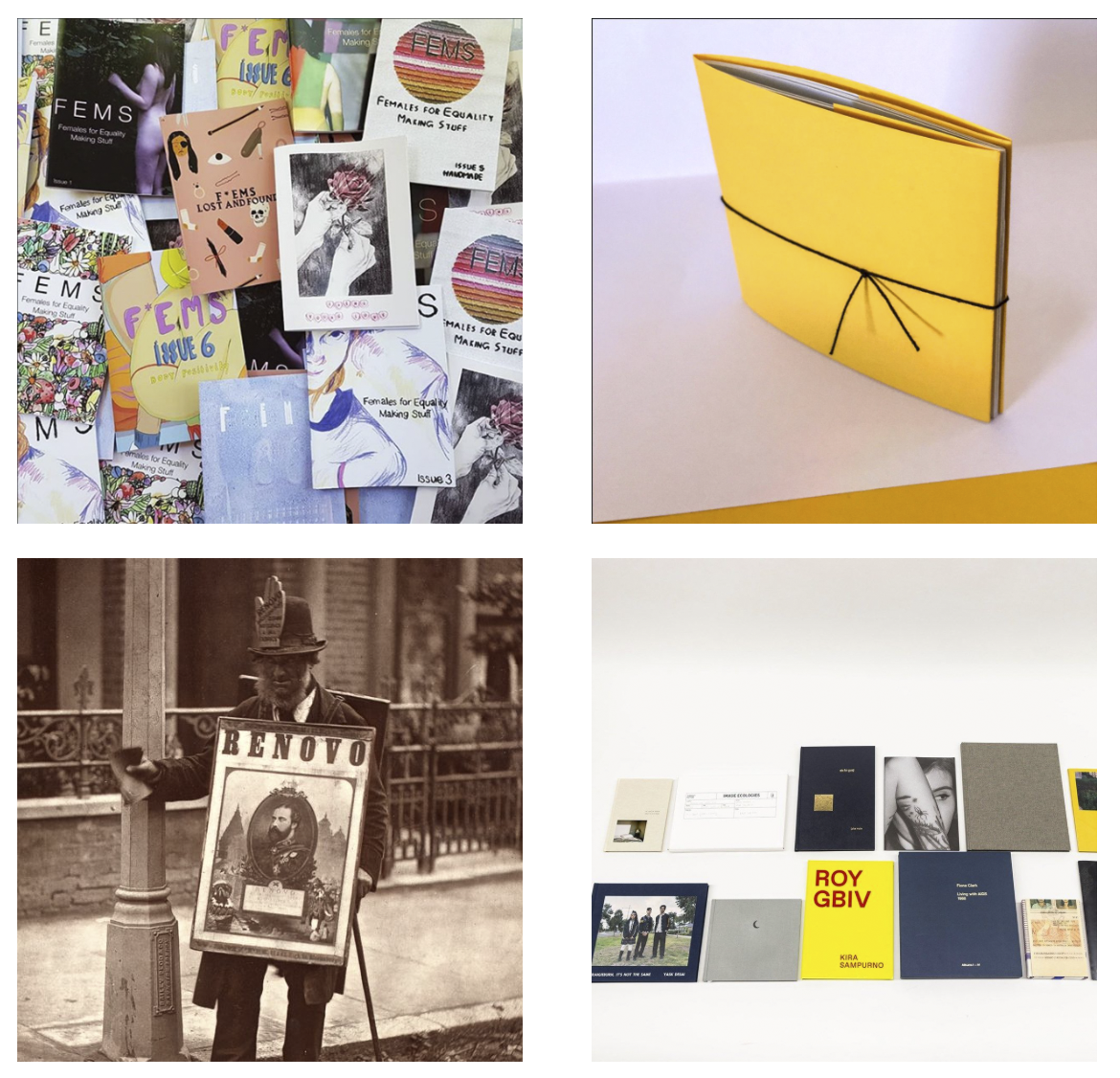
BIFB Book Fair Website image
BIFB World Photobook Weekend – Photobook Fair
Sunday October 13, 10am – 5pm
Art Gallery Ballarat, 40 Lydiard Street North
The BIFB celebrated World Photobook Day with other photography enthusiasts awith their second Foto Book Fair.
Participants of the Fair included:
- Australian and New Zealand Photo Book Awards
- Ballarat International Foto Biennale bookshop
- Bookhouse
- Studio Yeah
- Colin Abbott
- Fems
- Melbourne Photobook Collective
- Particle Books
- Photography Studies College
- Sainsburys Books
- State Library Victoria
- The Fridge Door Project
- Tess Maunder and Vault


Significant and rare books from the State Library of Victoria were presented including:
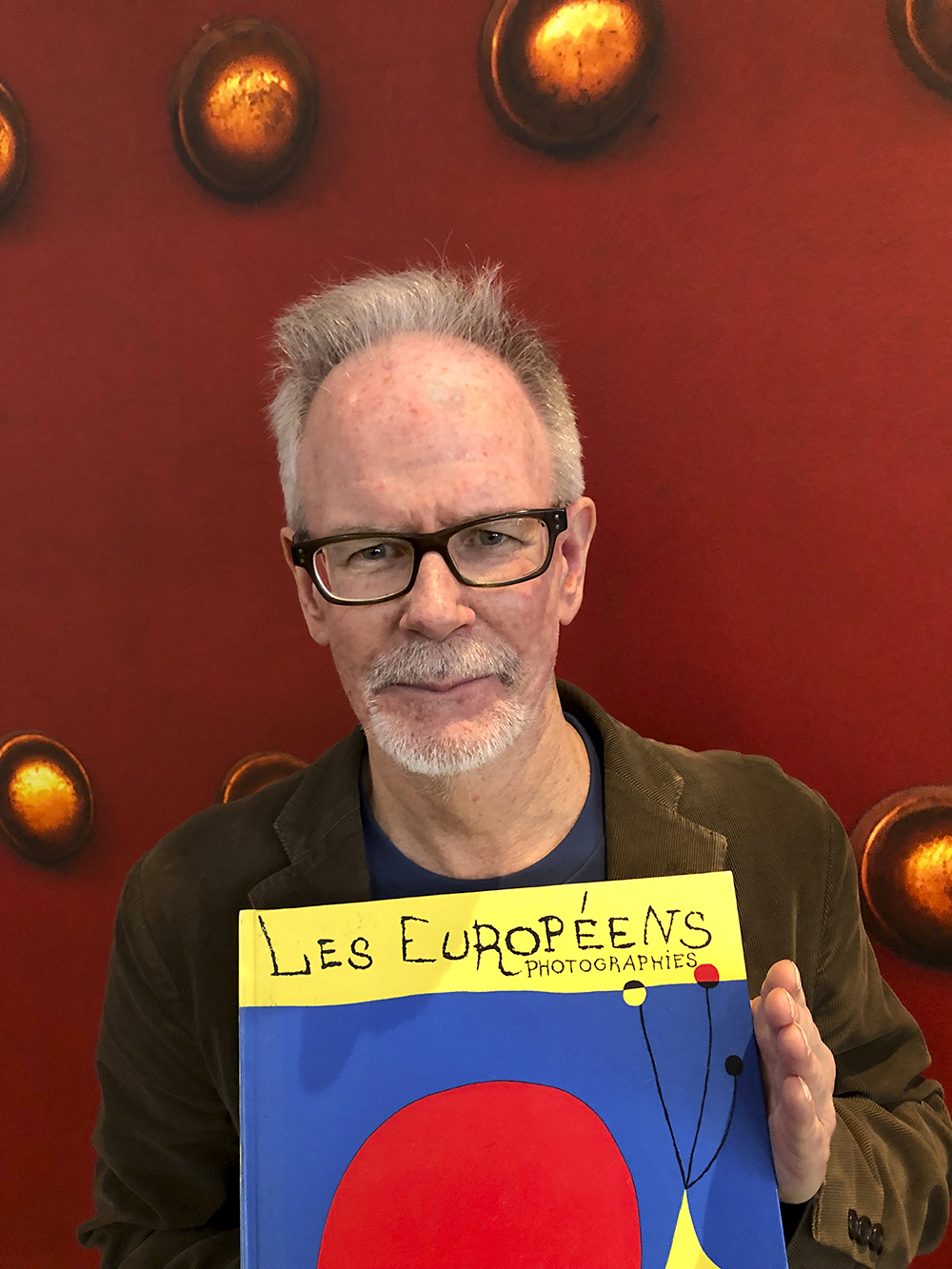
Des Cowley+Cartier-Bresson’s Book
Henri Cartier-Bresson Les Européens
Paris, Editions Verve, 1955
Henri Cartier-Bresson iconic photobook Les Européens comprises 114 photographs, taken between 1950 and 1955, documenting a vanishing way of life in post-war Europe. His lens captured the moods of Greece, Spain, Germany, England, Ireland, Italy, USSR, France. The book, which comprises some of Cartier-Bresson’s best known and finest images, features a striking colour lithographic design by Catalan artist Joan Miró.

Street Life in London
John Thomson, and Adolphe Smith Street life in London: with permanent photographic illustrations taken from life expressly for this publication
London, Sampson Low, Marston, Searle, & Rivington, 1877
First released in twelve monthly installments beginning in February 1877, Street Life in London is the among the first published collections of social documentary photographs. The book consists of thirty-six photographs by John Thomson, each accompanied by a brief essay by the writer and activist Adolphe Smith. Like the photographs, the essays are sharply drawn vignettes of “local characters” – cab drivers, flower sellers, sign painters, locksmiths, fishmongers, chimney sweeps, beggars, and street musicians – whose individual stories are meant to encapsulate the conditions of an entire class of worker or street dweller.
Charles Nettleton Melbourne illustrated by photographs
Melbourne, Charles Nettleton, 1868
A set of photographs of Melbourne by the commercial photographic studio of Nettleton and Arnest. The collection features significant Melbourne buildings and streets including Parliament House, the Treasury Buildings, St Patrick’s Cathedral, the Royal Exhibition Building and Melbourne University Colleges. Few people feature in the photographs, which are predominantly focused upon architecture. The collection is significant as it provides a visual record of Melbourne’s early development, and also reveals the work of an important local photography studio.
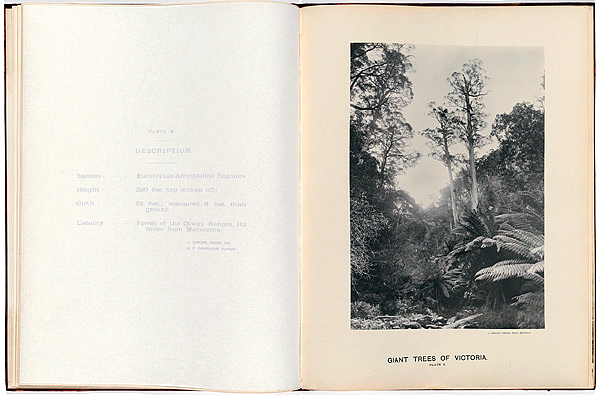
Duncan J Peirce Giant Trees of Victoria
J Duncan Peirce Giant Trees of Victoria
Melbourne, Victorian Department of Lands and Survey, c.1888
A volume containing a series of eight of J Duncan Peirce’s photolithographs of giant trees of Victoria, with descriptions of the species, height, girth and locality of the trees illustrated. All trees illustrated are Eucalyptus amygdalina regnans, commonly known as mountain ash. Enlargements of these photographs were displayed at the Melbourne Centennial Exhibition of 1888 and later at the Exposition Universelle in Paris in 1889.
Julia Margaret Cameron Alfred, Lord Tennyson and his friends: a series of 25 portraits and frontispiece/ in photogravure from the negatives of Julia Margaret Cameron and H.H.H. Cameron
London, T. Fisher Unwin, 1893
Published in 1893, the year after Alfred, Lord Tennyson’s death, this book features a selection of Julia Margaret Cameron’s iconic photographic portraits of the poet and his circle of friends. A friend and neighbour of Tennyson’s, Cameron took photographs of the poet several times across a decade.
Peter Lyssiotis What the Moon Lets Me See
Melbourne, Masterthief, 2017
Peter Lyssiotis’s deluxe large-scale publication What the Moon Lets Me See comprises an extended text by the artist, accompanied by numerous photographic images. The work sees a return by Lyssiotis to the dream-like coloured photomontages of earlier books such as The Harmed Circle (1992) and From the Secret Life of Statues (1994). The images represent a collaboration with Australian photographers Doug Spowart and Victoria Cooper, who adapted Peter’s photomontages using a pin hole camera. The book was produced in an edition of 10 copies, printed by Memento Pro, in Sydney. Boldly typographic and beautifully designed, it can be considered a high-point amongst Peter Lyssiotis’s books.
Return to the BIFB Photobook Weekend Blog Homepage.
.
.
.
A PHOTOBOOK BIRTHDAY PARTY – BIFB Photobook Weekend

WPD Birthday Candles
A Birthday Party – Celebrating 176 years of photobooks..!
On World Photobook Day – Monday October 14, 2019
World Photobook Weekend Hub, Mitchell Harris Wines, 38 Doveton Street North
Each year World Photobook Day is celebrated by members of the international network of Photobook Clubs around the world. Since it’s inception 7 years ago it has been organized by The Photobook Club Madrid and Matt Johnston. October 14th has been selected as it was on this date in 1843 that Anna Atkins’ Photographs of British Algae: Cyanotype Impressions was accepted into and catalogued by the British Library.
This year a small group celebrated the 176th birthday at the Ballarat International Foto Biennalé…

The BIFB World Photobook Day Birthday Cake
.The cake was cut…
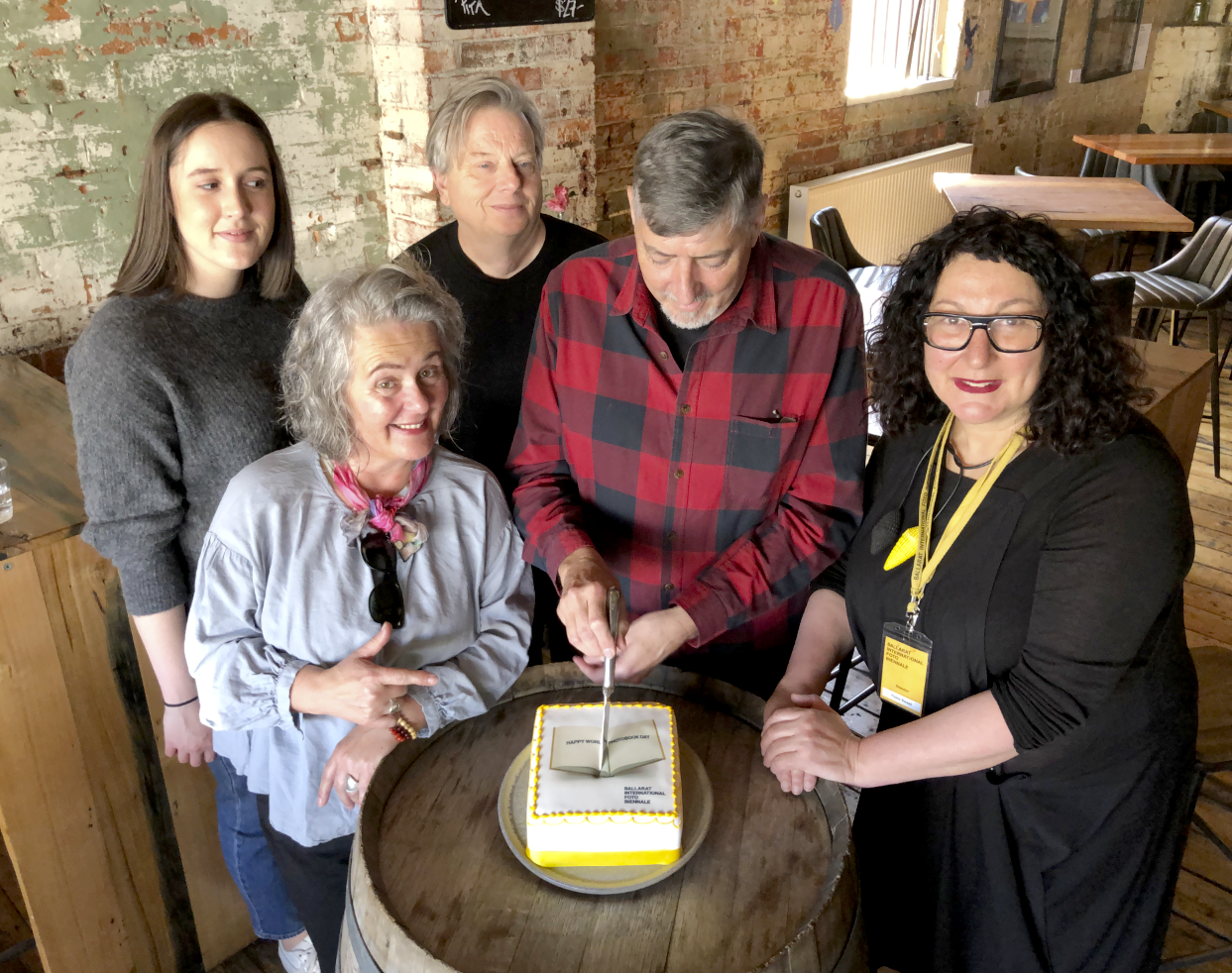
Doug cuts the World Photobook Day Birthday cake
.
.And then we all sang HAPPY BIRTHDAY…
As the Australian and New Zealand Photobook Award travelling exhibition concluded over the weekend we were able to announce the winner of the PEOPLE’S CHOICE AWARD
.
Congratulations Tammy Law for your book Permission to belong
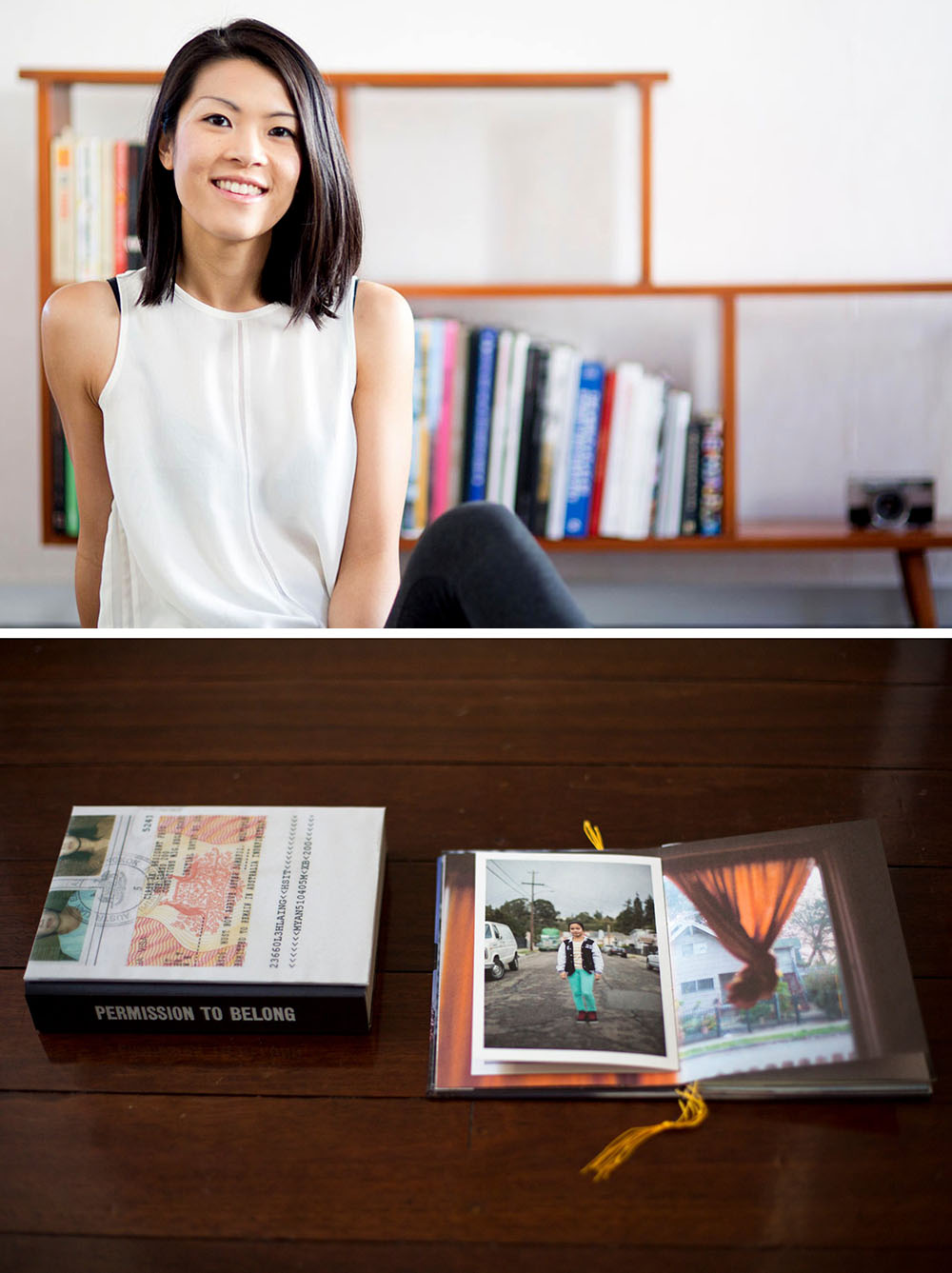
Tammy Law and her book ANZPA People’s Choice award winning book Permission to Belong
Videos and photographs by Victoria Cooper.
.
.
.
Return to the BIFB Photobook Weekend Blog Homepage.
A RE-PHOTOGRAPHY PROJECT Revisited at TRAG

Doug in the exhibition space … PHOTO: Victoria Cooper
SAME SITES HINDSIGHT – Toowoomba Regional Art Gallery
For me rephotography is a way of re-viewing place and change through a comparative documentation using the perspectives of earlier photographers. I have always enjoyed the challenge to re-align the contemporary view with the past to see visual narratives of change either subtle or profound. At this time I discovered the work by Mark Klett and others published in their 1984 book Second View: The Rephotographic Survey Project. Their approach to the reimaging of the photographs of the American west by William Henry Jackson, Timothy O’Sullivan and others in the 1860s was methodical and scientific. Although I was informed by this seminal work as a record of social and historical change, in some of my work I also enjoyed questioning the notion of the original photographers as a kind of truth.
.
In the mid 1980s I rephotographed tourist postcard scenes in outback Australia and reimaged tourist camera photos placing them in the context of a wider-angled view. These projects were presented at the Araluen Art Gallery in Alice Springs in 1986 in the exhibition Tourists Facts, Acts, Rituals & Relics.
Other projects emerged including a commission from Di Baker, Director of the Toowoomba Regional Art Gallery to locate the subject matter of artworks from the Toowoomba Gallery’s collection and to re-image the subject by photography.
The artworks that were my source reference covered a range of approaches to the artist’s vision imbued with the appearance of the painting techniques that they employed. Working with Victoria we travelled around the region to find the matching locations and met with some success finding the exact location. On occasion however we were only able to create a general locational view.
I chose a 4×5 large format camera and a black and white film made by Polaroid. Called Type 55 the film gave a black and white print and also a negative that, after in-field processing could be printed in a conventional enlarger.
The 1996 the exhibition NEW SIGHTS – SAME SITES was opened at the Toowoomba Regional Art Gallery and installation of the selected artworks were paired with our photographic interpretation of the same scene.
Now 23 years later the Gallery has re-presented the work for reconsideration by a new generation of art gallery visitors.

Don Featherstone (L) Golden Tree (Corner of Kitchener and Herries Streets)1959 watercolour Spowart+Cooper (R) Corner of Kitchener and Herries Streets 1996 silver gelatin fibre print
The Gallery wall sheet for the Same Sites Hindsights exhibition states:
In 1996 photographer Doug Spowart assisted by Victoria Cooper undertook a project called New sight-Same sites which re-imaged Downs landscapes and other regional sites depicted in selected works from the Toowoomba Regional Art Gallery Toowoomba City Collection.
The project compared and contrasted the direct recording of a site using photography with the painter’s vision of the same location. One of the biggest challenges for Spowart in making these images was to replicate the painters’ viewpoints and, in some instances, even finding the locations proved problematic.
From the time of the initial recording to now, almost 25 years later, these photographs indicate constants and change. Time is transformational. In 1996, the Gallery challenged the photographer to identify these locations and in 2019 we challenge the viewer to explore Toowoomba and surrounds in response to these works.
The exhibition is on show from 14 September to November 3, 2019.
A selection from the subjects presented in the exhibition
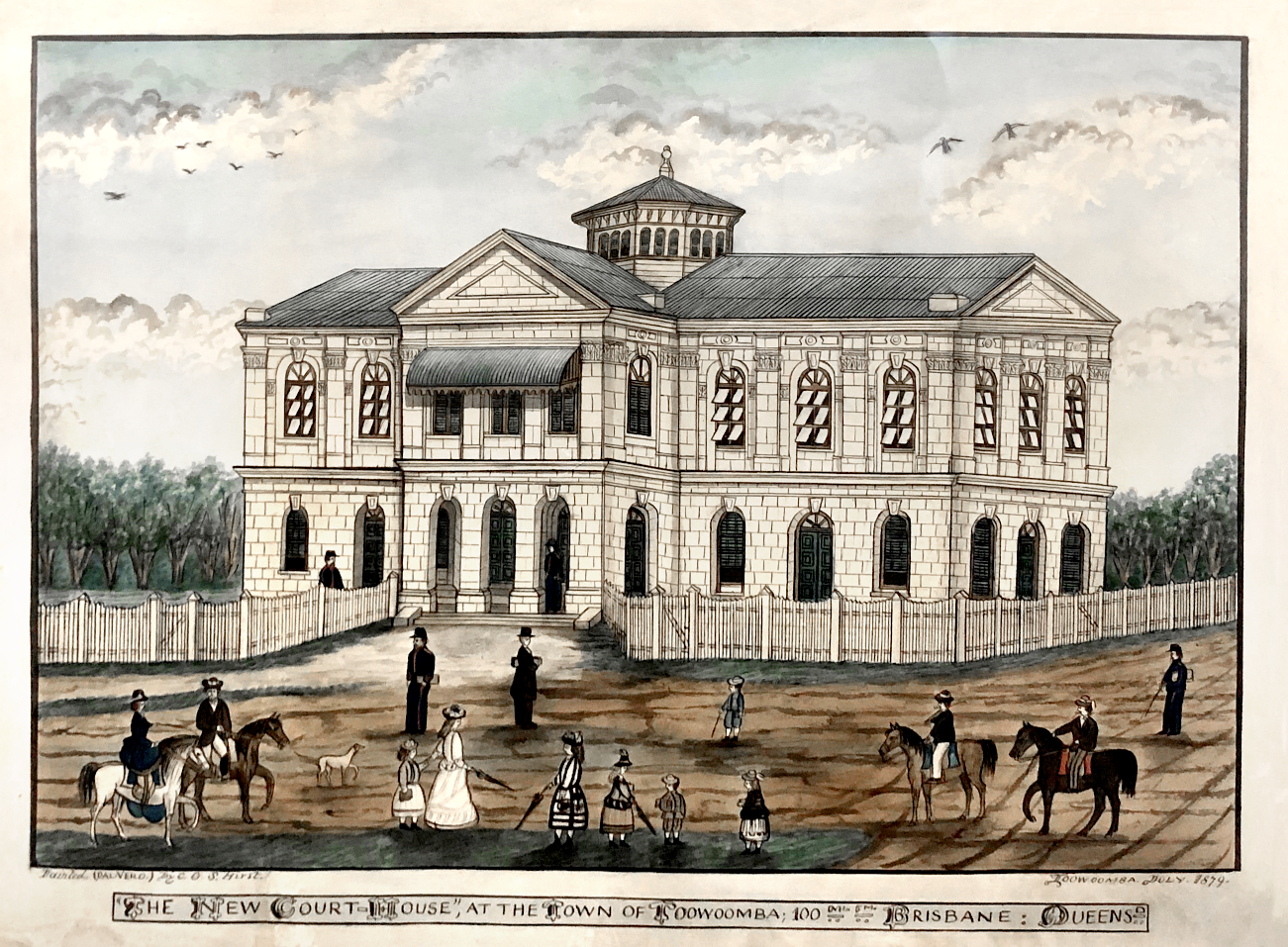
C. G. S. Hirst The New Court House 1879 watercolour and ink on paper
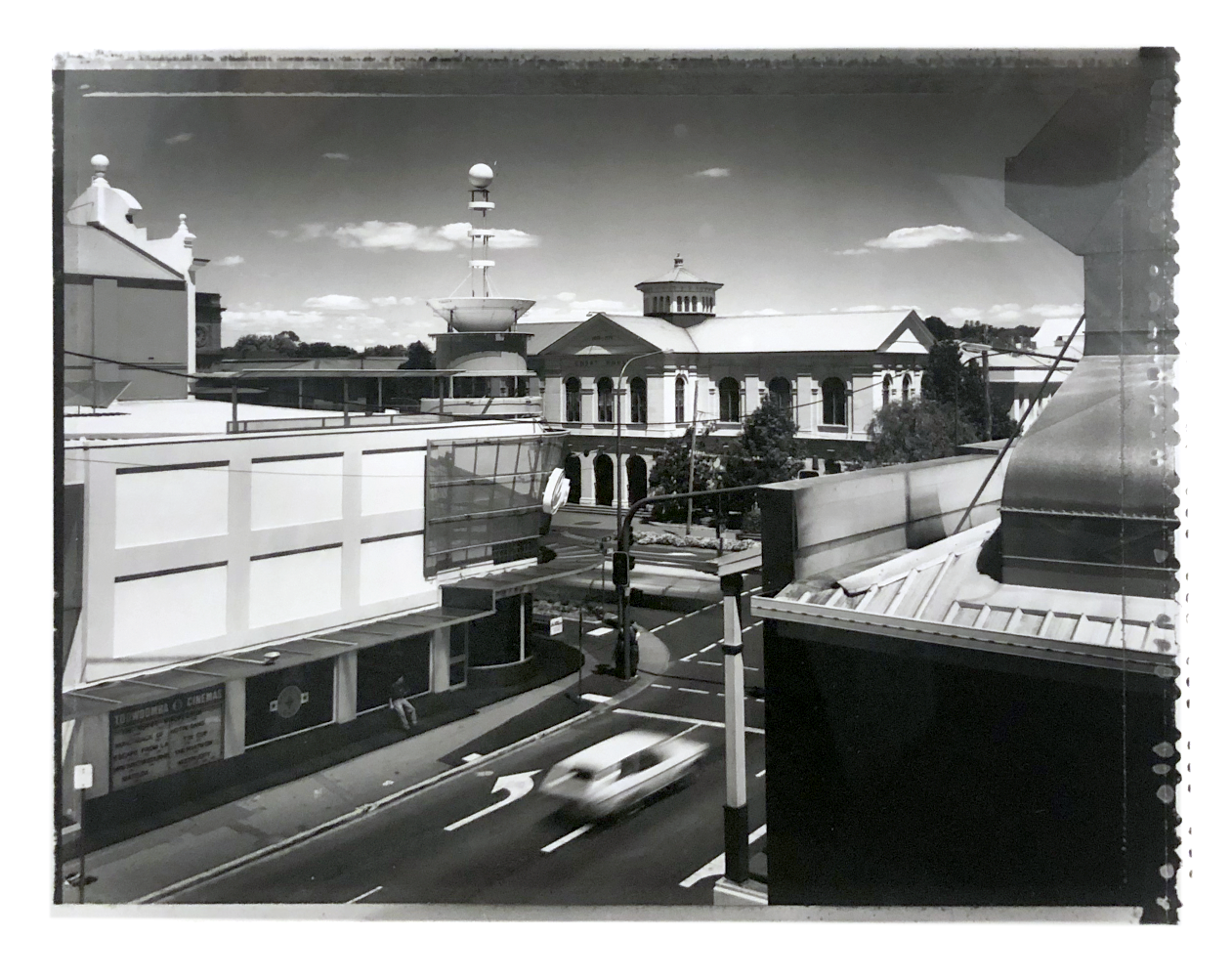
Spowart+Cooper The Old Court House 1996 silver gelatin fibre print
..
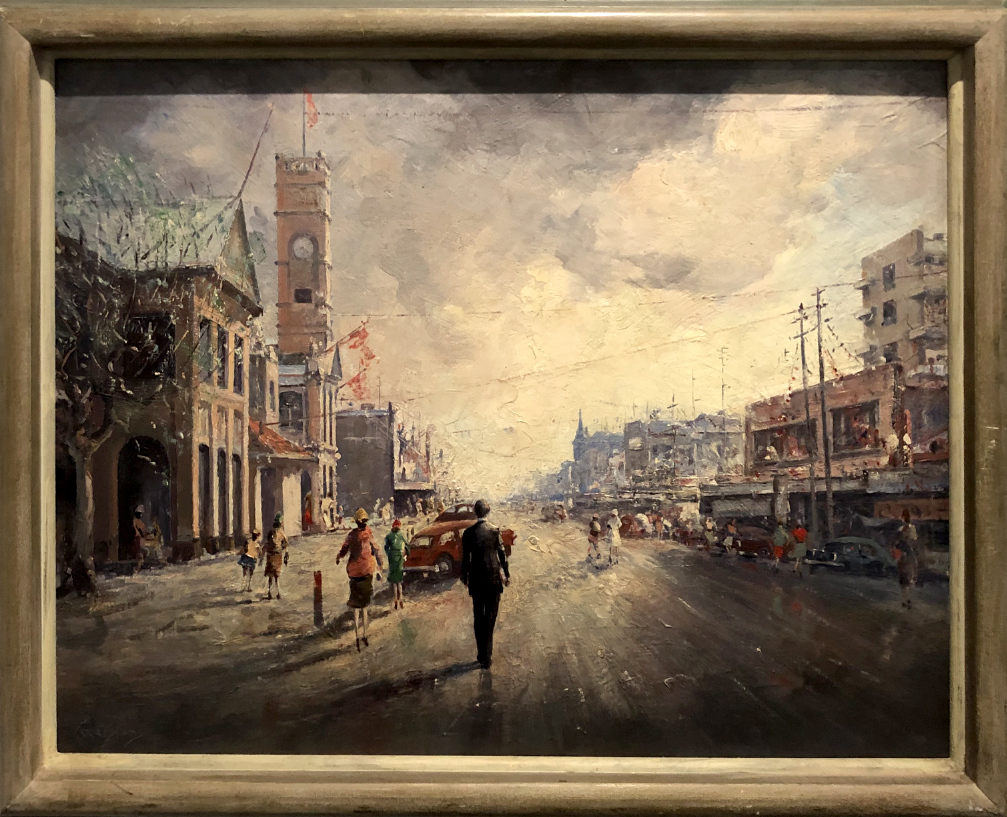
Herb Carstens Sunday Morning (Street scene Toowoomba) 1961 oil on comp board

Spowart+Cooper Sunday morning 1996 silver gelatin fibre print
.
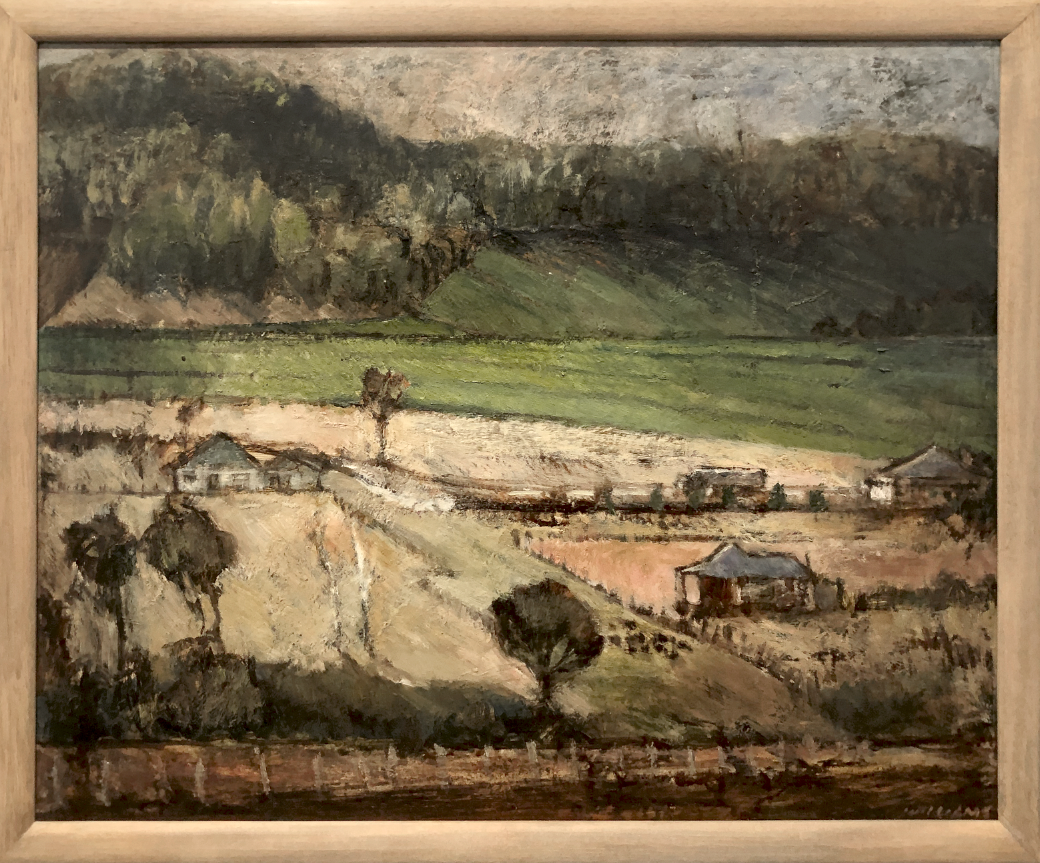
Brian Williams Near Drayton 1960 oil on comp board

Spowart+Cooper Near Drayton 1996 silver gelatin fibre print
.
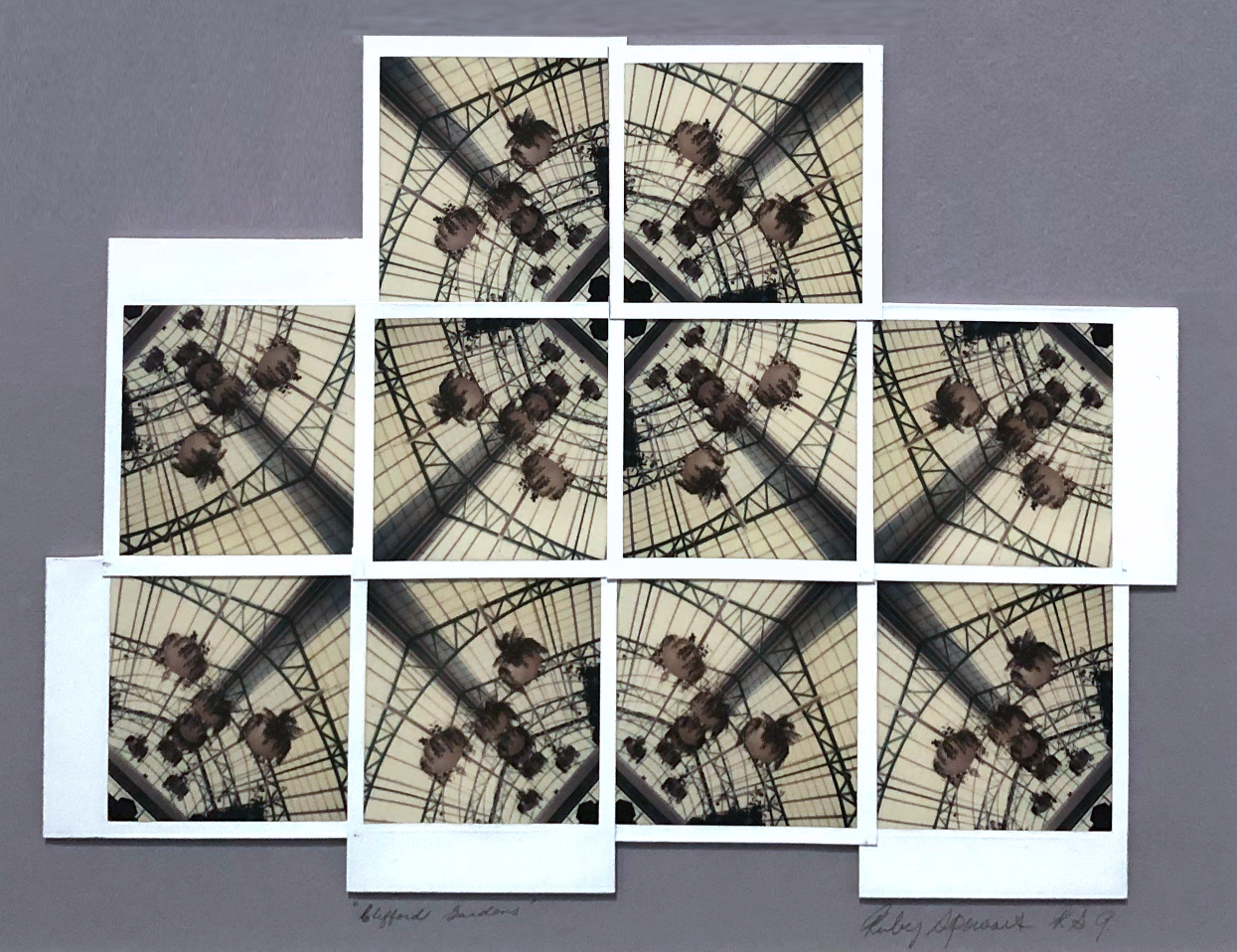
Ruby Spowart Clifford Gardens 1986 photograph Polaroid SX-70
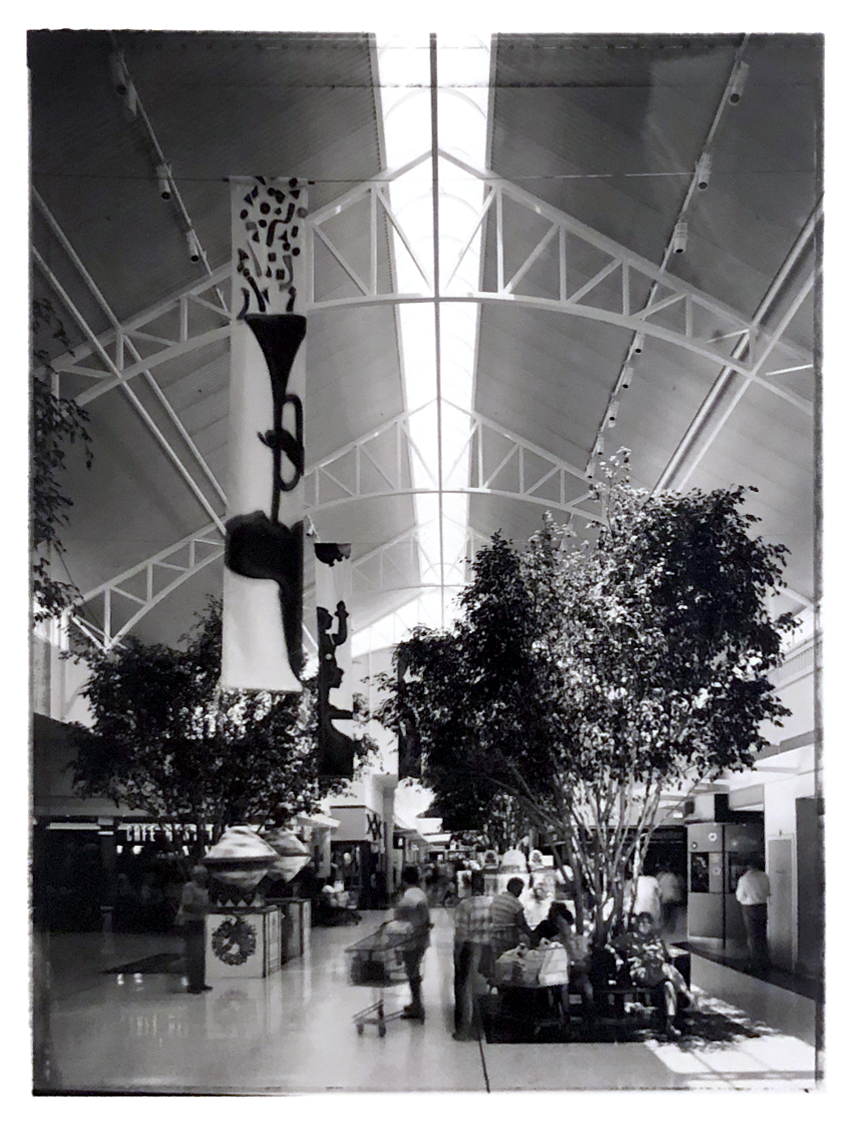
Spowart+Cooper Clifford Gardens 1996 silver gelatin fibre print
.
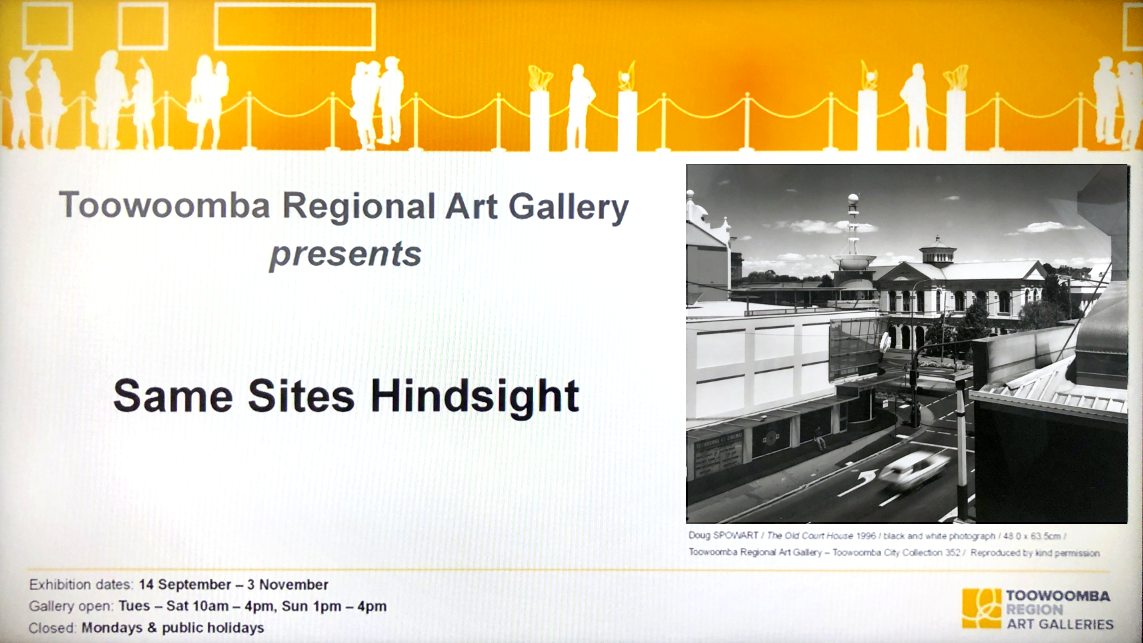
TRAG Display
.
OTHER REPHOTOGRAPHY PROJECTS BY Doug Spowart & COOPER+SPOWART

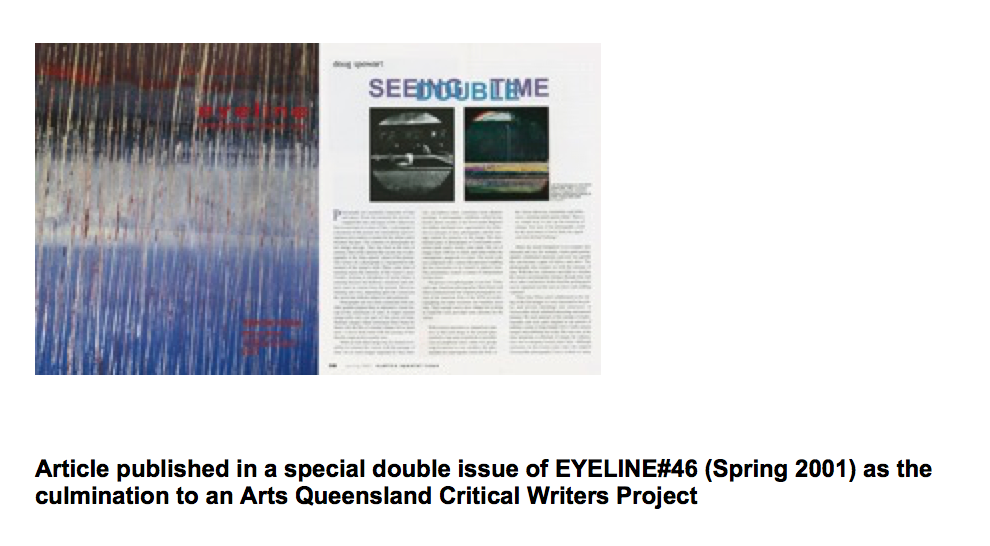
LINK: SEEING DOUBLE Toowoomba Regional Art Gallery 2001 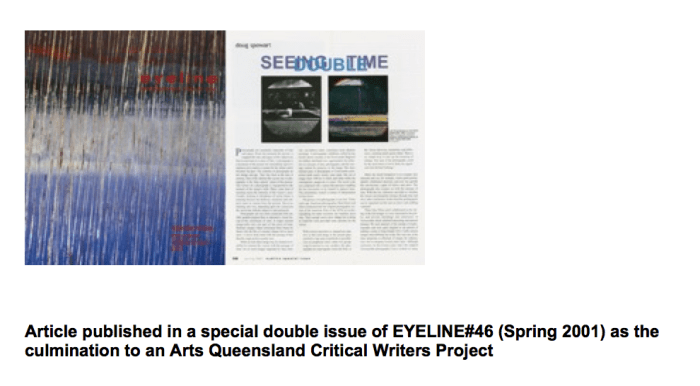
.
.
.
HARVEY BENGE: An appreciation from a fellow traveller
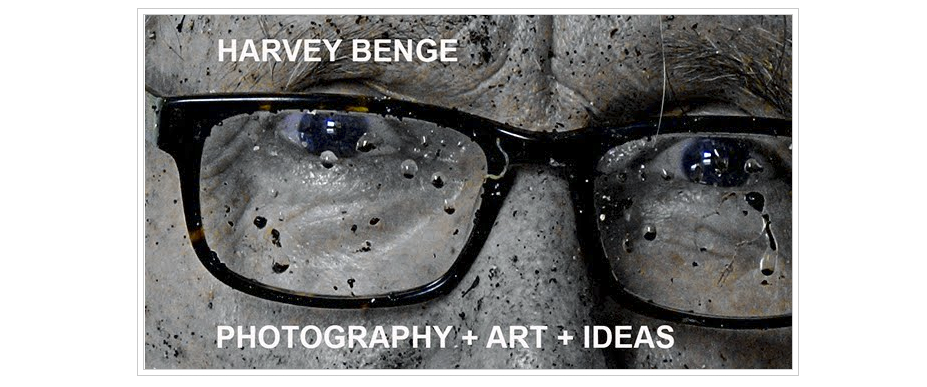
Harvey Benge’s portrait from his Blog header
VALE: HARVEY BENGE
With the recent passing of Harvey Benge many whose lives have been touched by the man have told stories of their connection with Harvey. In many ways my story is no different – Harvey gave so much to those he met. He enriched lives as well as nurtured and encouraged networks to form, information to be shared and contributed to the critique and philosophy of photobooks to a worldwide audience. In December 2017 his Blog recorded its 1,000,000th view…
Recently I have been thinking and reflecting about Harvey a great deal and how for a moment we shared a friendship through our interest for the photobook in it many forms. At this time I feel a need to share some my reflections of Harvey…
it’s not hard to find erudite statements from photobook commentators and critics from all over the world about Harvey and his work – But I wanted to find his manifesto for life, photography and books … and I found it in his description for the book The Traveller…
The Traveller is a personal reflection of the world where strange connections occur. The photographs never offer answers, only questions to tempt the curious. This democratic view is an acerbic, wry response to the world in free-fall where nothing is certain. Yet I hope that readers can find humour, affection, and unexpected beauty.

Harvey Benge photobook: The Traveller PHOTOs: Courtesy MomentoPro
About 15 years ago I came across a book that seemed to be a compilation of photographs by the world’s doyens of photography – Adams, Araki, Baltz, Eggleston, Felman, Frank Friedlander et al. The book was entitled seductively A short history of photography and was authored by Harvey Benge and Gerry Badger. So I bought a copy. It wasn’t until after the package arrived and I turned the pages that I found that Benge in fact created all of images. Many purchasers of the book may have felt ripped off but I laughed and laughed. This book also resonated with personal projects of mine 10 to 15 years earlier where I too had created and presented work under pseudonyms to an unsuspecting audience.
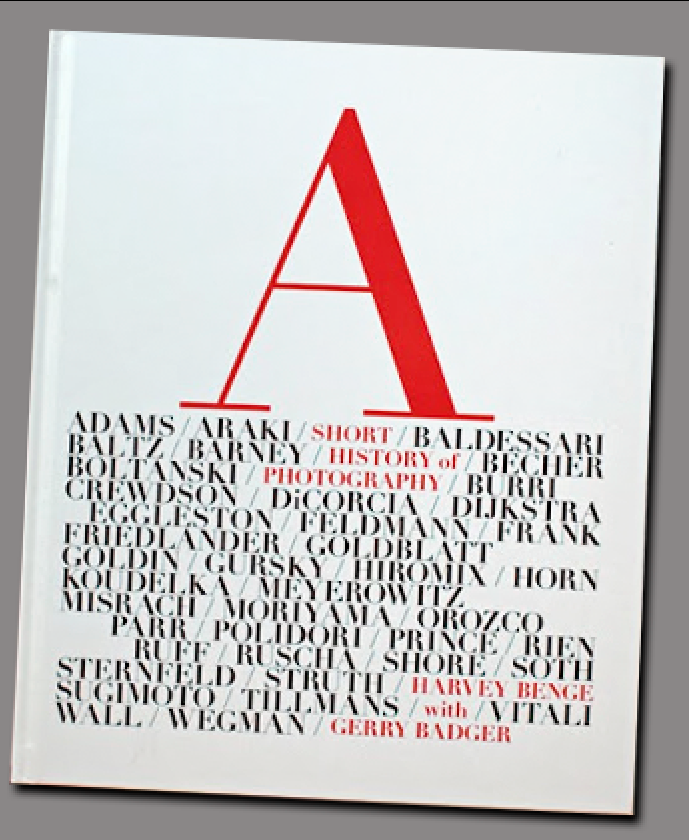
A History of Photography book
Whilst the name Harvey Benge kept on cropping up in my academic research in photobooks I felt that his work did not fit with my project at that time. This changed when I attended one of the most significant forums at that time on the topic of the photobook at the Museum of Contemporary Art Sydney on Saturday, June 7 2014. Coordinated by Daniel Boetker-Smith from the Asia Pacific Photobook Archive, the event featured a Photobook Fair and a Forum at which key identities of the emerging photobook community were panelists. This included Professor Christopher Stewart (UTS), Dan Rule (Perimeter Books), Harvey Benge, Helen Frajman (M33), Benjamin Chadbond (Try Hard Magazine), Ying Ang and Daniel Boetker-Smith.
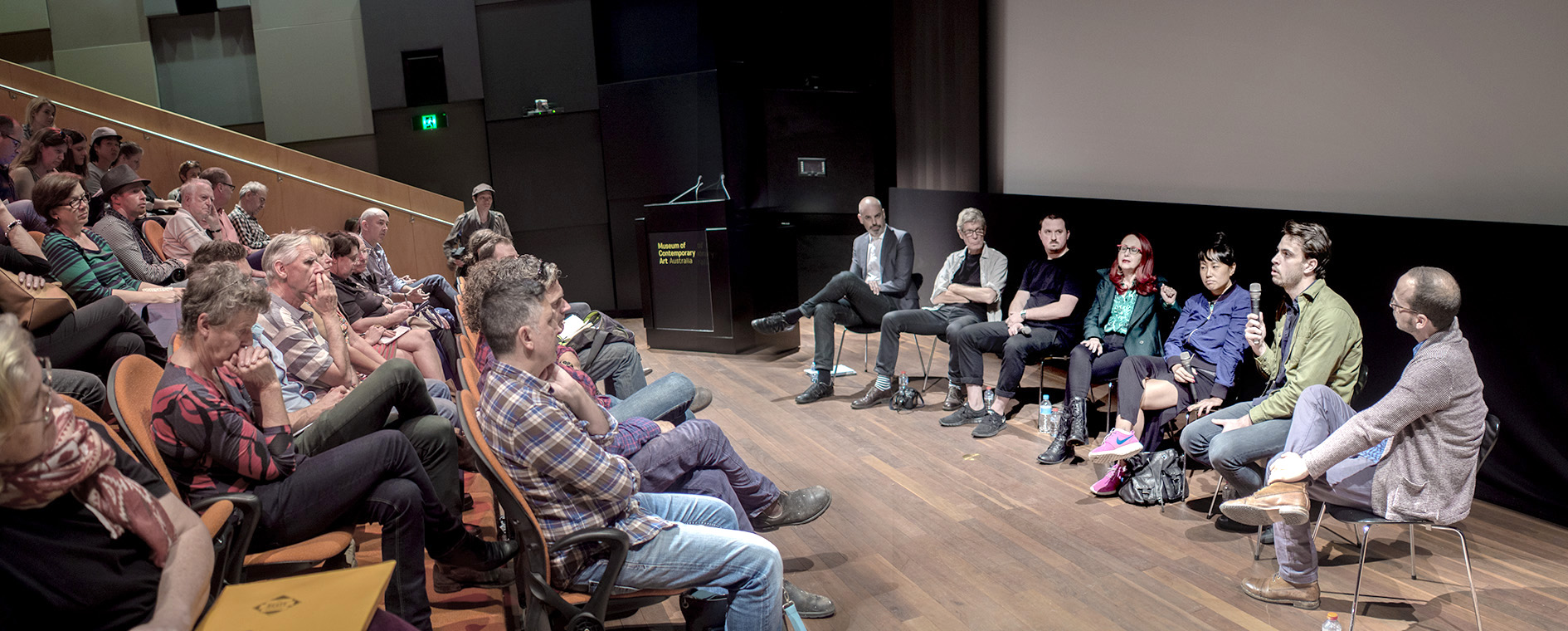
At the MCA Photobook Forum June 2014 PHOTO: Doug Spowart
The Forum discussion, responses and questions from the audience seemed to located in addressing the desires that attendees had in wanting to find their way in creating, marketing, selling books and being successful photobook makers.
I asked a couple of questions to broaden the discussion, which related to a key interest of mine that emerged as part of my PHD research. My questioning referred to the way that the freedoms that are well established in the artists’ book discipline in design, structure and narrative could inform future directions for the photobook. Harvey was the only one on the panel that understood the rationale of my question and at the end of the Forum we connected and spoke more about the ideas behind my question and he commented that he had appreciated my input. A few days later I sent some photos to him of the Forum including photos of him in action and he incorporated them in a piece he wrote about the Forum on his blog.
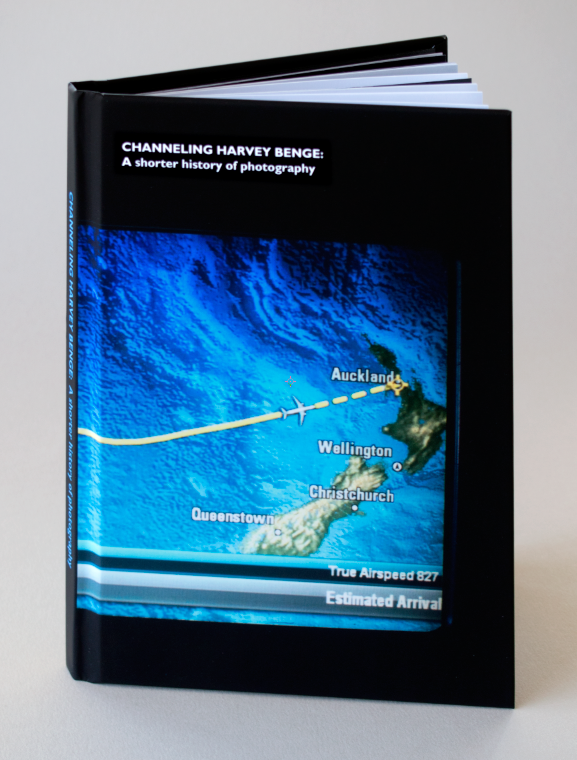
Channeling Harvey Benge photobook
In 2015 I was invited to make a presentation about photobooks at the Auckland Festival of Photography’s Talking Culture Symposium – Photobook Stories at the Auckland Art Gallery. I was looking forward to meeting up with Harvey but alas he was in Europe at the time attending the yearly string of photography events that happen between May-July. Even though I was unable to connect with him at that time, and inspired by his Short history of photography, I set about making a body of photographs that would emulate his style. These images were formed into a little book I called “Channeling Harvey Benge”. I had MomentoPro print out a copy and I sent it to him. When he returned Harvey enthusiastically got back to me saying “Thank you so much for … the wonderful Channelling Me! I’m flattered and honoured that you have made such a tribute… so thoughtful…”
A Preview copy of Channeling Harvey Benge can be downloaded here PREVIEW PROOF of Channelling Harvey Benge-book
(Note this is a printer-ready PDF and due to page setup for double-pages some images may not match across the gutter)
.
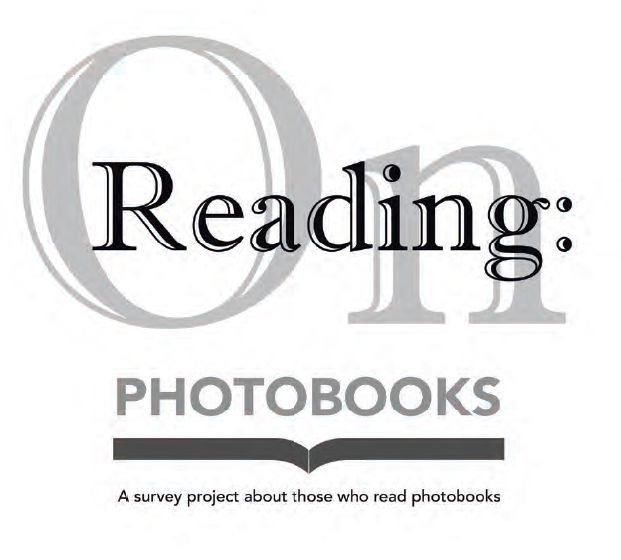
On Reading Photobooks WPD Project
.
Another remembrance of our connection was from an event I coordinated for World Photobook Day (WPD). The WPD has it origins with the date, October 14 1843, when Anna Atkins’ book Algae of the British Isles: Cyanotype impressions was catalogued by the British Library. The WPD was formed by a worldwide movement of Photobook Clubs to celebrate Anna Atkins and her book on this day. Since 2014, as part of my role as the coordinator of the Photobook Club Brisbane, I have created events to celebrate WPD. In 2015 my partner Victoria Cooper and I curated a project in which we asked significant contributors to the photobook discipline to nominate their favourite photobook, tell us why they like the book and to make a photo (a selfie) of them reading the book.

Harvey reading Collier Schorr’s Blumen – for the On Reading Photobooks WPD exhibition
A PDF of Harvey’s page and project information can be downloaded HERE: ON READING: Harvey Benge submission
Harvey enthusiastically responded to our request and was one of the first submissions. His favourite book, at the time was Collier Schorr’s Blumen. Other contributors to the project included Martin Parr, Larissa Leclair, Polixeni Papapetrou, Michael Coyne, Daniel Boetker-Smith, Stephen Dupont, Jack Picone et al. The exhibition was entitled “On Reading Photobooks” and was shown in Maud Gallery Brisbane, The Photography Room in Canberra, and a PDF catalogue was produced.
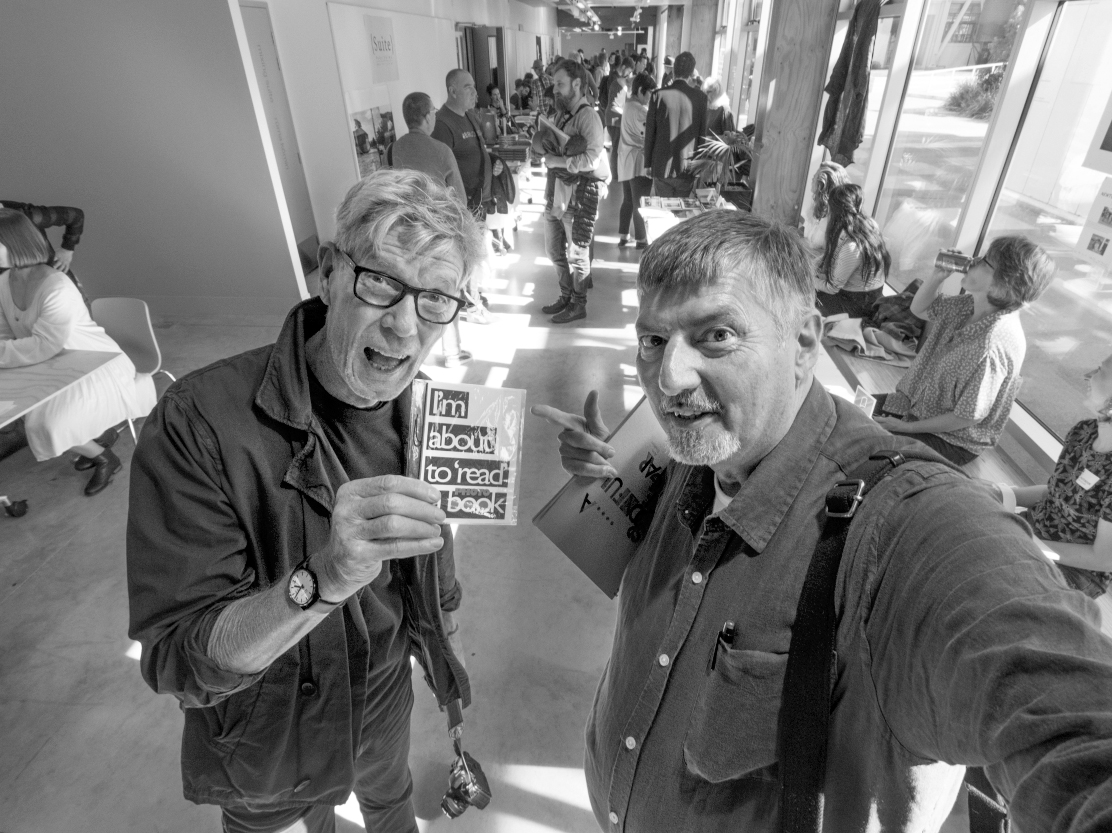
Harvey+Doug at Photobook New Zealand 2016
.
Over the years we connected via email but I did finally meet up with Harvey at the first Photobook New Zealand conference in Wellington in March 2016. We shared some conversations and I gave him a copy of a little book that I’d made entitled “I’m about to read a photobook”. I attended the Photobook Fair, book displays and a lecture that included David Cook, Anita Totha, Bruce Connew and Harvey discussing “Getting your photobook into the world”.
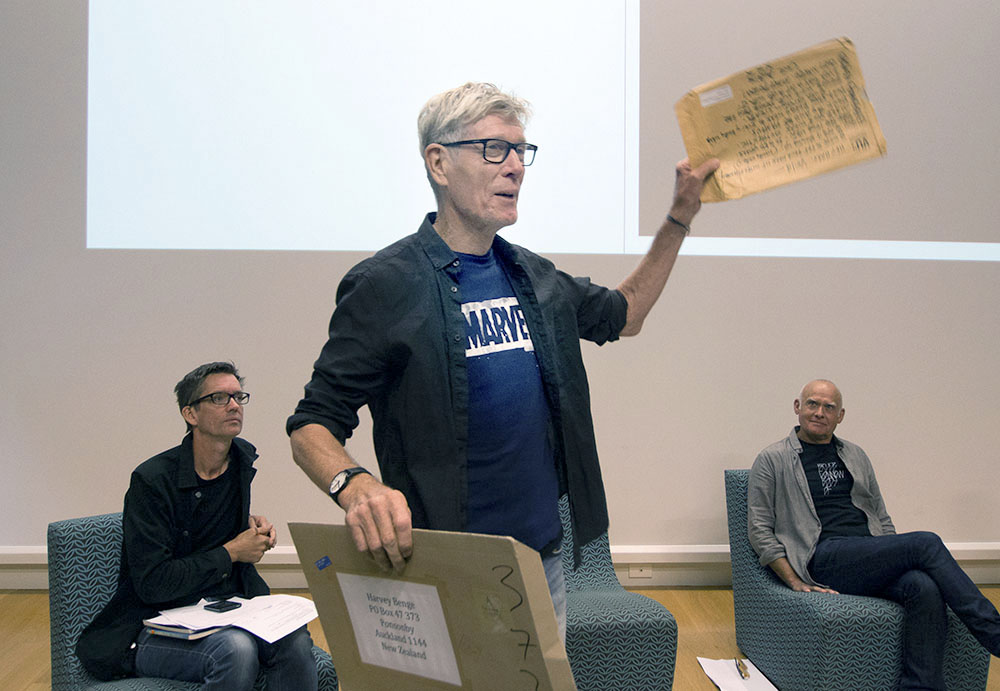
Harvey and his list
Harvey was animated and delivered a salient talk outlining an 8 point plan assisted by a handwritten text on an envelope received from his friend and colleague Antoine D’Agata. He said:
1. 90% of life is showing up (Woody Allen)
2. Take the long view – 30 to 50 years
3. Make your work authentic
4. Don’t try and be famous
5. Don’t show dodgy work to everybody who has ever drawn breath
6. People work with people they like
7. Luck has a lot to do with it
8. Get naked, make porn
In 2017 I was preparing a lecture on the Antipodean Photobook that I had been invited to present at the Vienna Photobook Festival. To bring a range of voices into the lecture I approached Harvey and asked him about what photobook makers in Australia and New Zealand could do to get their photobooks onto the world stage. He responded quickly again and came back with 3 points:
- Take the long view, in my case I made my first book 24 years ago.
- Show up in the world, don’t just sit at home in Aust or NZ looking at the wall.
- Do it for yourself, that way there is a chance the work will be authentic.
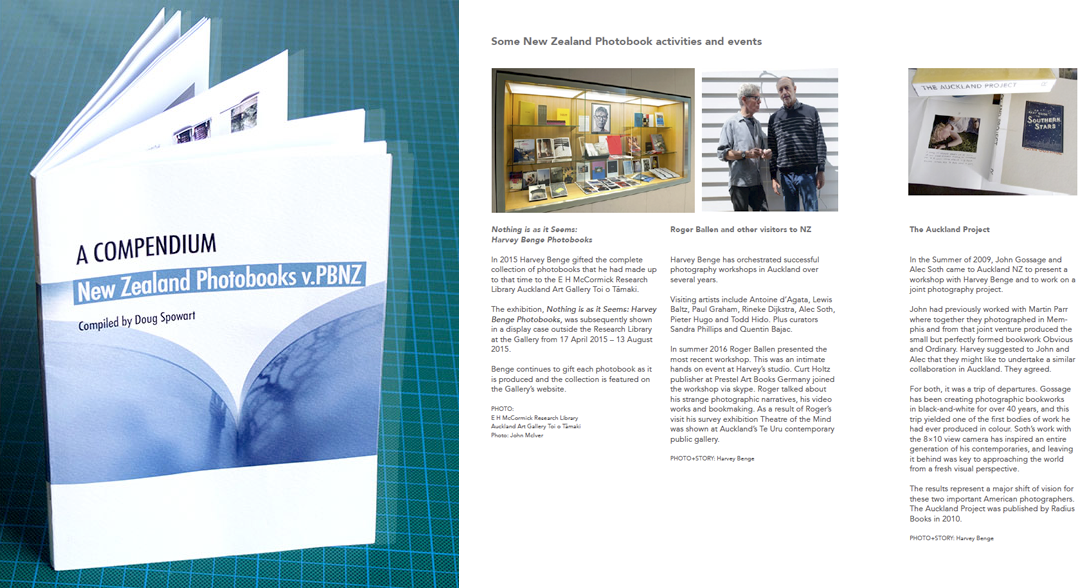
Harvey Benge pages in the New Zealand Photobook Compendium
As part of the continual update of my ANZ Photobook Compendium for the second PBNZ I approached Harvey for some of the back story behind two book projects: 1. ‘The Auckland Project’ that he had coordinated with John Gossage and Alec Soth and, 2. his visiting photographer series that had included Roger Ballen. Interestingly at this time Harvey had just donated one of every book that he’d made to the Auckland Art Gallery. Harvey sent through what I’d requested and it was incorporated into the Compendium that was launched at PBNZ in the Te Papa Photobook Fair by Ann Shelton.
.
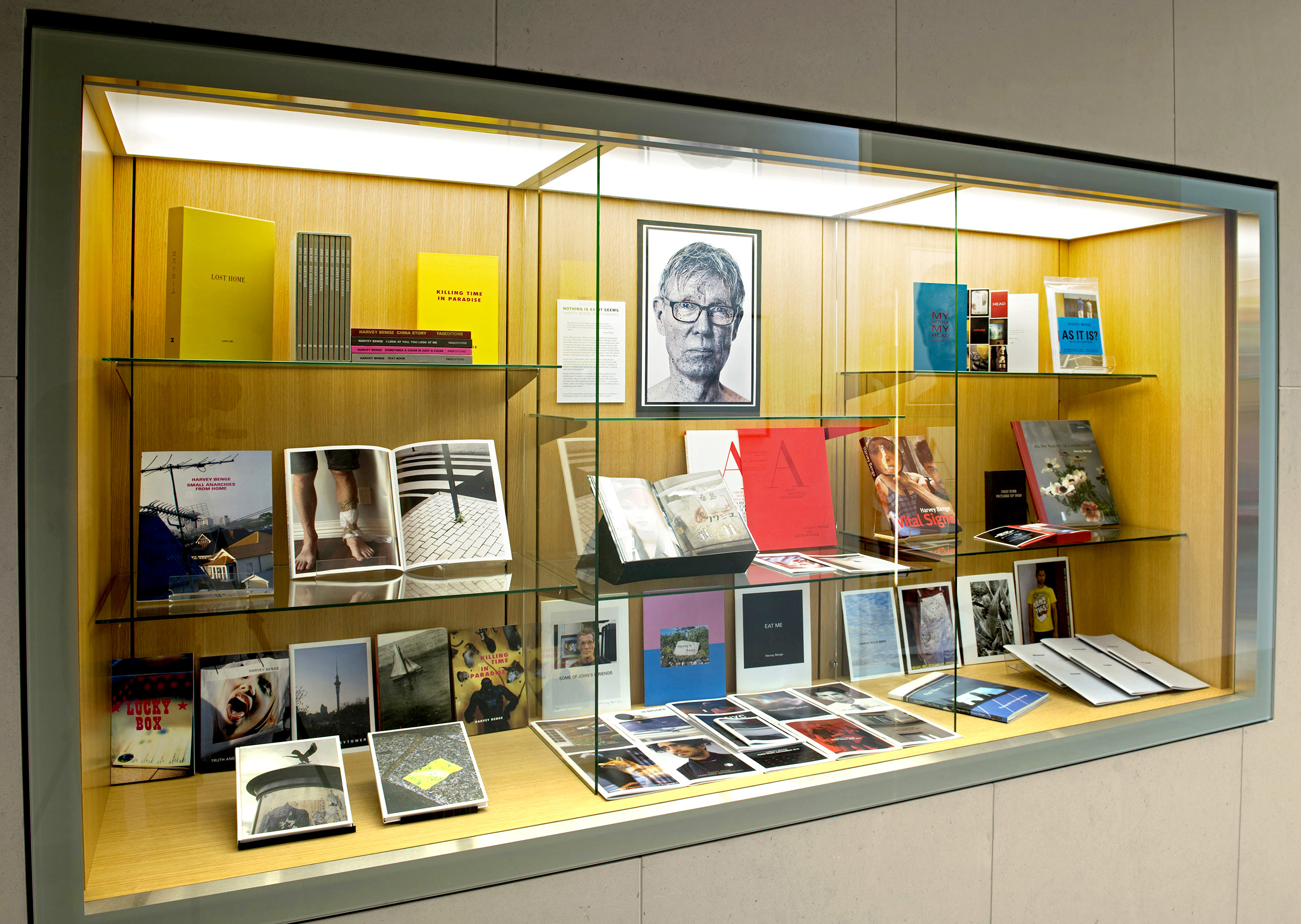
Harvey Benge Auckland Art Gallery vitrine for Nothing Is As It Seems Photo: Supplied by Harvey
.
During much of 2018 Victoria and I worked on a commission from the Tate on Martin Parr’s recommendation to curate a collection of Australian and New Zealand photobooks. In a conversation Harvey’s name came up and Parr said he had been collecting Harvey’s work over the years and had visited him in Auckland. Parr recounted mentioning to Harvey that he was interested in getting a copy of Gary Baigent’s 1967 classic Unseen city. To his surprise Harvey and he had walked down the street to a little book shop and picked one up for a modest fee.
Over recent times I had not seen much from Harvey only the occasional post on his Blog and I had heard something from New Zealand friends about him not being in good health. Then very early one morning about a month ago Harvey rang me and told me of his illness and its prognosis. We spoke about many things – about unfinished books, how he felt about the work that I’d been doing on the ANZ photobook and how much he appreciated what I was doing. He mentioned my little book ‘Channeling Harvey Benge’ and how chuffed he was that I’d made it and presented it to him. He asked me if I could let my network of friends know of his circumstances. There were difficult moments of unfinished work but there was joy in the recognition of the continuing legacy that his books, his love of books and the love he had for people who made them. During the conversation he became tired and emotional – he said “I must go my friend….”
Vicky and I sat dazed – it was 6.00am local time…
I think of the times that Harvey would sign-off an email with the message ‘would be good to catch up for a talk sometime and perhaps chat about a collaboration…’ And I would have loved walking down the street with him to that little book shop to pick up Unseen city.
Although I will now miss the opportunity for those and many other things with Harvey’s passing, I know that in my future, and perhaps also for many of Harvey’s friends, he will still be an important part of the community he loved and supported. I know I will continue ‘channelling the spirit’ of Harvey Benge.
Doug Spowart
Written on World Photobok Day 2019
.
.
.
.
.
.
.
.
.
PHOTOBOOK WEEKEND @ Ballarat International Foto Biennalé

BIFB Header
WORLD PHOTOBOOK WEEKEND
The Ballarat International Foto Biennale is proud to host the World Photobook Day during our festival. Join us from Saturday 12 October until Monday 14 October to celebrate this auspicious birthday!
Celebrate World Photobook Day with other photography enthusiasts. Participants will meet at Mitchell Harris Wines the World Photobook Weekend Hub to share their books before heading together to the talks and the Fotobook Fair.
SATURDAY 12 OCTOBER

VR Book Train
9.16am
Photobook Train from Southern Cross Station
Celebrate World Photobook Day by hopping on the train to meet other photography enthusiasts. Meet at Southern Cross Station to catch the train to Ballarat with your photobooks and discuss with others. (Passengers must have a valid myki. Regional fares are listed at ptv.vic.gov).

Doug Spowart + ANZ Photobooks
2pm
Talk by Doug Spowart
Many Tribes: The Australian And New Zealand Photobook
The photobook disrupted the 1990’s prediction that ‘the book is dead’ and grew into a worldwide phenomenon. Doug Spowart will address key aspects of the historical and contemporary makeup of the photobook in Australia & New Zealand where the various ‘tribes’ contribute to a vibrant and progressive discipline.
World Photobook Weekend Hub
Mitchell Harris Wines, 38 Doveton Street North
SUNDAY 13 OCTOBER
9.16am
Photobook Train from Southern Cross Station
Celebrate World Photobook Day by hopping on the train to meet other photography enthusiasts. Meet at Southern Cross Station to catch the train to Ballarat with your photobooks and discuss with others. (Passengers must have a valid myki. Regional fares are listed at ptv.vic.gov).
Book Fair participants
10am – 5pm
Photobook Fair
Art Gallery Ballarat, 40 Lydiard Street North
Celebrate World Photobook Day with other photography enthusiasts at our second Foto Book Fair – an all-day event at the Art Gallery of Ballarat. Participants:
- Australian and New Zealand Photo Book Awards
- Ballarat International Foto Biennale
- Bookhouse
- Studio Yeah
- Colin Abbott
- Fems
- Melbourne Photobook Collective
- Particle Books
- Photography Studies College
- Sainsburys
- State Library Victoria
- The Fridge Door Project; Vault.
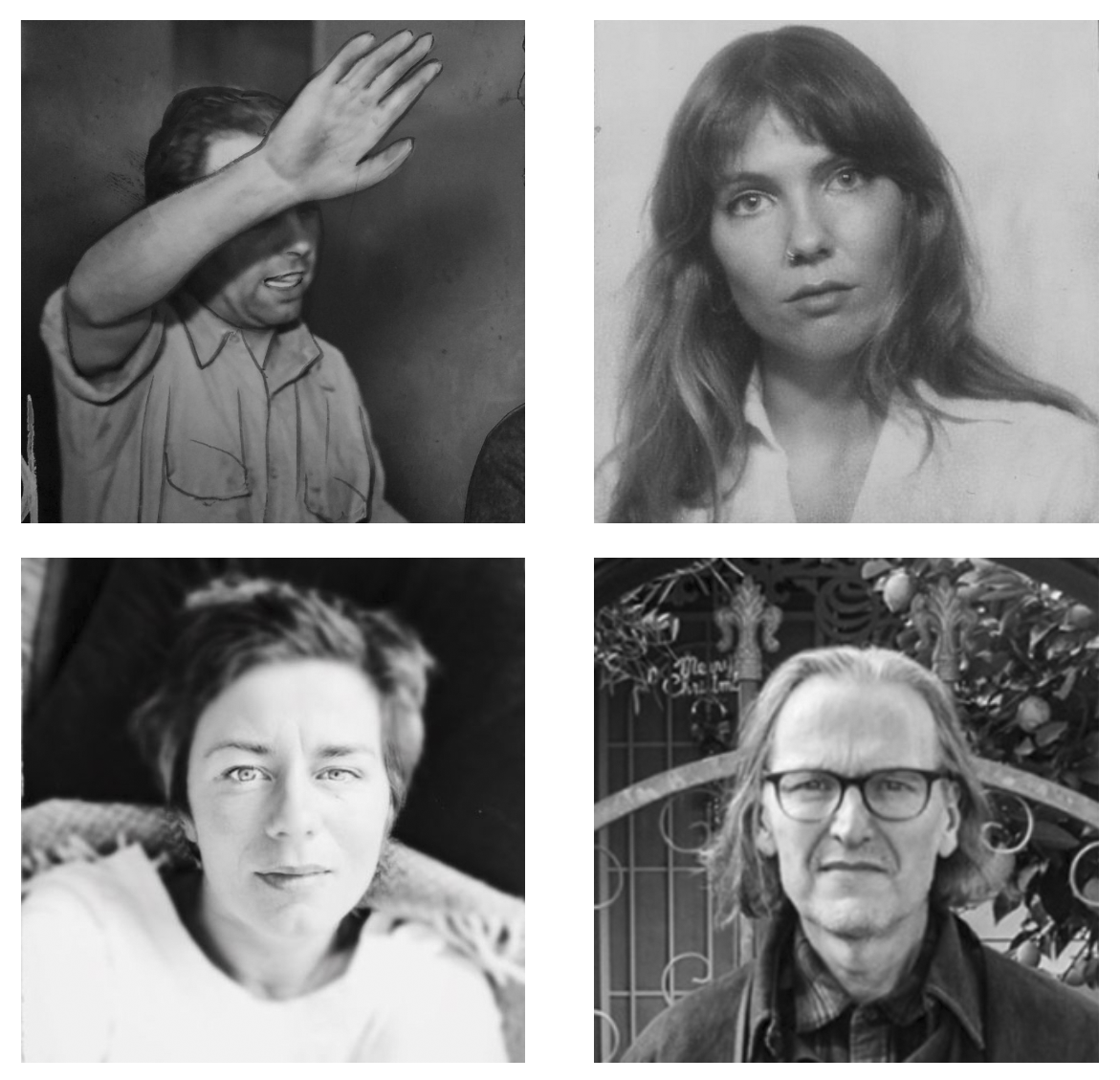
Forum Panelists
11am
FORUM: Photobooks – Getting Published & Getting Collected
with Patrick Pound, Sarah Walker, Heidi Romano and David Wadelton. Moderated by Doug Spowart
What sparks and drives the passion for the photo book? How do photographers get published? And how can photographers establish and grow meaningful collections? Join Doug Spowart and a diverse panel of photobook practitioners and publishers as they answer these and other associated questions through their personal observations, stories and predictions.
Join us as we blow out the candles for the official World Photobook Day celebrations.
World Fotobook Weekend Hub
Mitchell Harris Wines, 38 Doveton Street North
MONDAY 14 OCTOBER
WPD Birthday Candles
11am – 1pm
Happy Birthday Party! Celebrating 176 years of photobooks
Join us as we blow out the candles for the official World Photobook Day celebrations.
World Photobook Weekend Hub
Mitchell Harris Wines, 38 Doveton Street North
ALL EVENTS ARE FREE: Please book at the BIFB website
CLICK THE PHOTO BELOW TO VISIT BIFB SITE
AUSTRALIAN CYANOTYPES on exhibition at home & in the USA
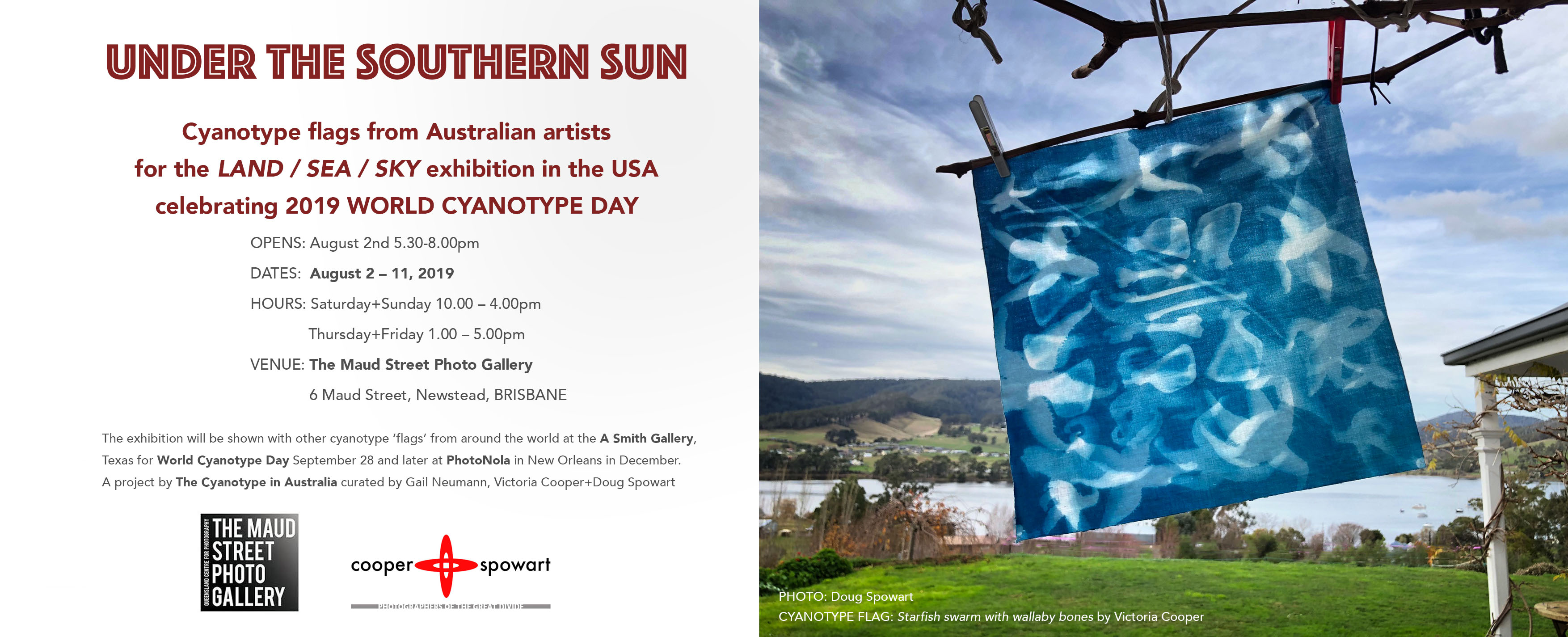
INVITE: The Maud Street Photo Gallery Under the Southern Sun exhibition
.
For over a year we have been coordinating with Gail Neumann the Facebook group THE CYANOTYPE IN AUSTRALIA. In June of this year we circulated through our networks an Invitation for Australian cyanotypers to submit work for a travelling exhibition to be shown in Brisbane, Australia and then Texas, USA to link with World Cyanotype Day celebrations on September 28, 2019. This work will be first shown at The Maud Street Photo Gallery, Brisbane in August and will then travel to the USA to be part of two international exhibitions, one at the A Smith Gallery, Texas in September, and then at PhotoNola, New Orleans in December.
.
.
THE BRIEF FROM THE INTERNATIONAL WORLD CYANOTYPE EXHIBITION COORDINATORS:
The exhibition theme Land/Sea/Sky with the exhibition abstract being: Most ancient peoples had no word for the color blue. They could not explain the sky nor the ocean. Poetry and love letters suffered. Once “blue” entered the world the earth rattled and chimed, sending forth “turquoise” and “sapphire.” The Navajo and the Jewelers rejoiced. Poets wept. Picasso danced and Policemen beamed. Mary smiled.
It was hoped that everyone in the world making cyanotypes that could be connected with was invited to create the cyanotypes on white cloth, each 12×12 inches (30×30cm) and that they will be strung together, the flags symbolize the beautiful planet we all inhabit.
.
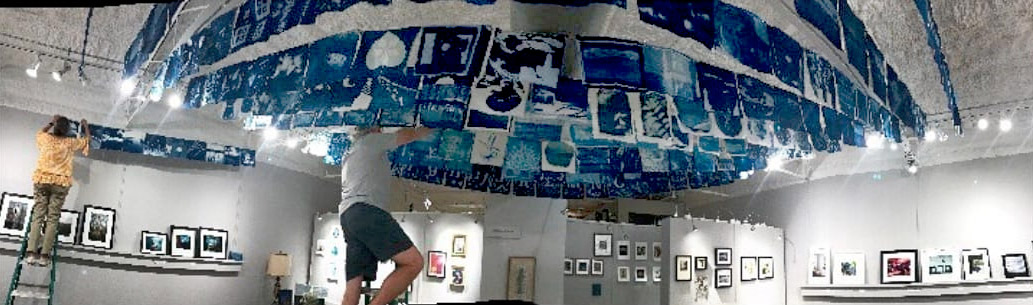
Install day at the A Smith Gallery 24 September
.
CYANOTYPERS FROM OVER AUSTRALIA RESPONDED TO THE CALL-OUT
Here are their images:


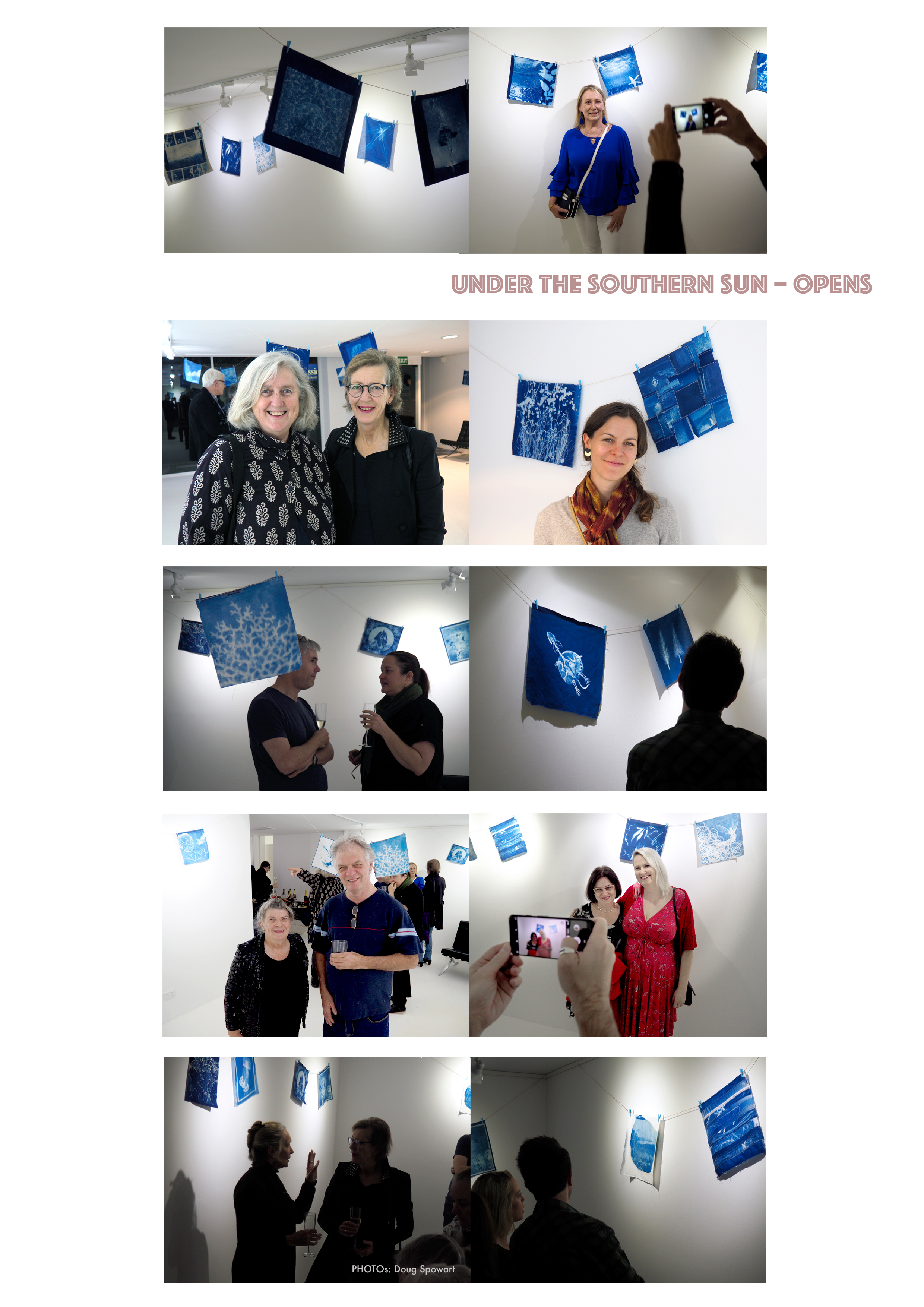
THE EXHIBITION AT THE MAUD STREET PHOTO GALLERY

The installation at The Maud Street Photo Gallery PHOTOs: Gail Neumann
THE CATALOGUE
A catalogue about the Under the southern sun project featuring each submission, artist’s statements and exhibition documents has been collated, the cyanotypes copied and designed by Doug Spowart. The catalogue forward states:
The Cyanotype in Australia is a photographic medium that continues to be enthusiastically utilised by a growing group of creative practitioners ranging from analogue photographers to fine art printmakers.
While the process and the chemical formulas may be the same the resulting images vary depending on the subject chosen and the creative input of the cyanotypist. This is proven by this body of work and the plethora of potential outcomes presented. And sometimes, as with the vagaries of the process, many results may be a surprise to the author at the time the image is washed-out. Such is the nature and the promise of things hand-made.
We are excited to contribute this collection of cyanotype flags to the 2019 World Cyanotype Day Celebrations at the A Smith Gallery in Texas and PhotoNola in New Orleans in the U.S.A.

The catalogue
FREE TO DOWNLOAD HERE: AUSTRALIAN_WCD_CATALOGUE-Final
THE BEHIND THE SCENES
THE CYANOTYPE IN AUSTRALIA Team coordinated:
- A gallery exhibition at The Maud Street Photo Gallery in early August that will include an opening event
- The packaging and shipment of the ‘Flags’ to the USA by the due date
- The creation and distribution of social media content promoting the Australian artworks and their makers
- A PDF catalogue of all contributor’s works
- And later the return of the works to their makers on conclusion of the project.
A fee of $40 was charged to all participants
This project, by The Cyanotype in Australia team, was curated by Gail Neumann, Victoria Cooper + Doug Spowart with assistance from David Symons.


The gallery installation team: Gail Neumann, Victoria Cooper, Irena Prikryl, David Symons and Doug Spowart
.
.
.
ADELAIDE HERE WE COME – BEST PHOTOBOOKS & WORKSHOP
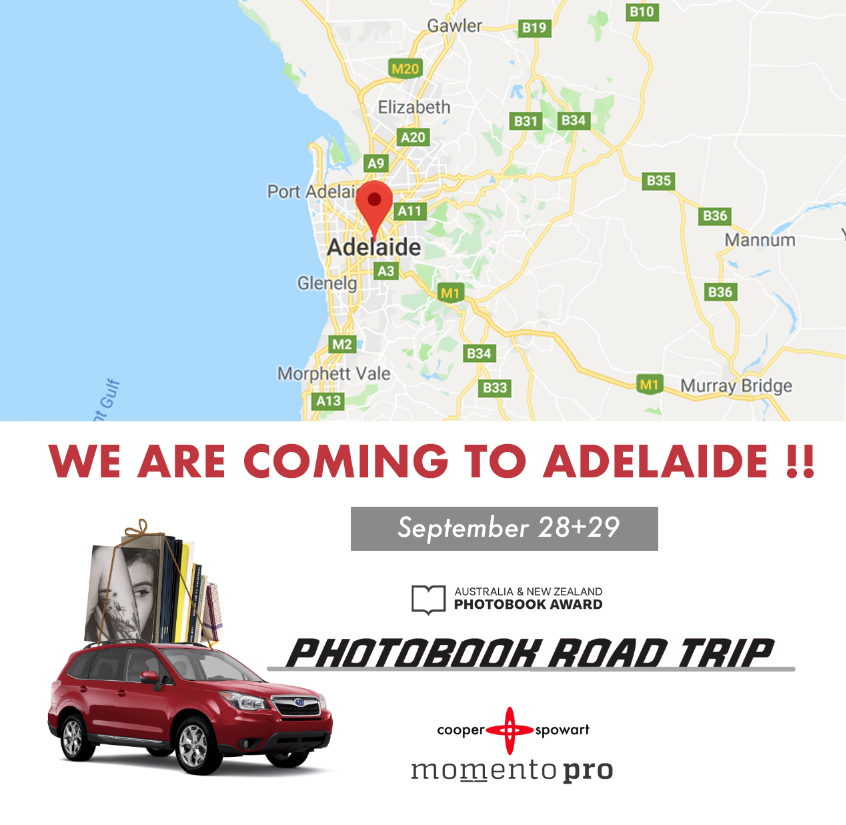
Adelaide Road Trip
The Australian and New Zealand Photobook Awards have been to Hobart, Canberra and Brisbane and now we are taking them to Adelaide.
The presentation of the books, a talk about the photobooks by Doug Spowart and a one-day workshop will be hosted by us at Adelaide’s Centre for Creative Photography.
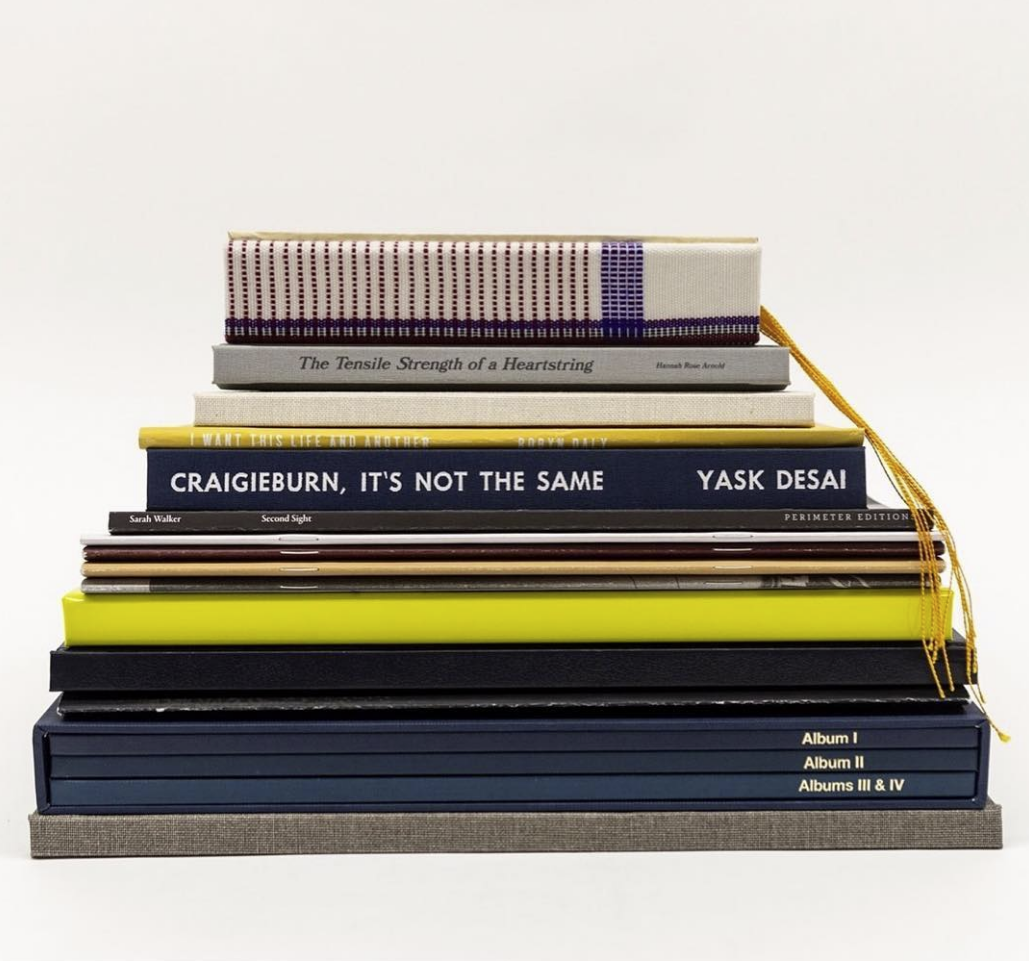
ANZ Photobook Awards Finalists
.
COME AND SEE THE BEST AUSTRALIAN & NEW ZEALAND PHOTOBOOKS
On Saturday September 28 the books will be on show from 10am–4.00pm. The Official Launch, the announcement of the People’s Choice Award and a talk about photobooks by Doug Spowart will take place at 2.00pm.
There is no charge to view the books and attending the talk however we do request that you book via this Eventbrite link: https://tinyurl.com/y225btkx

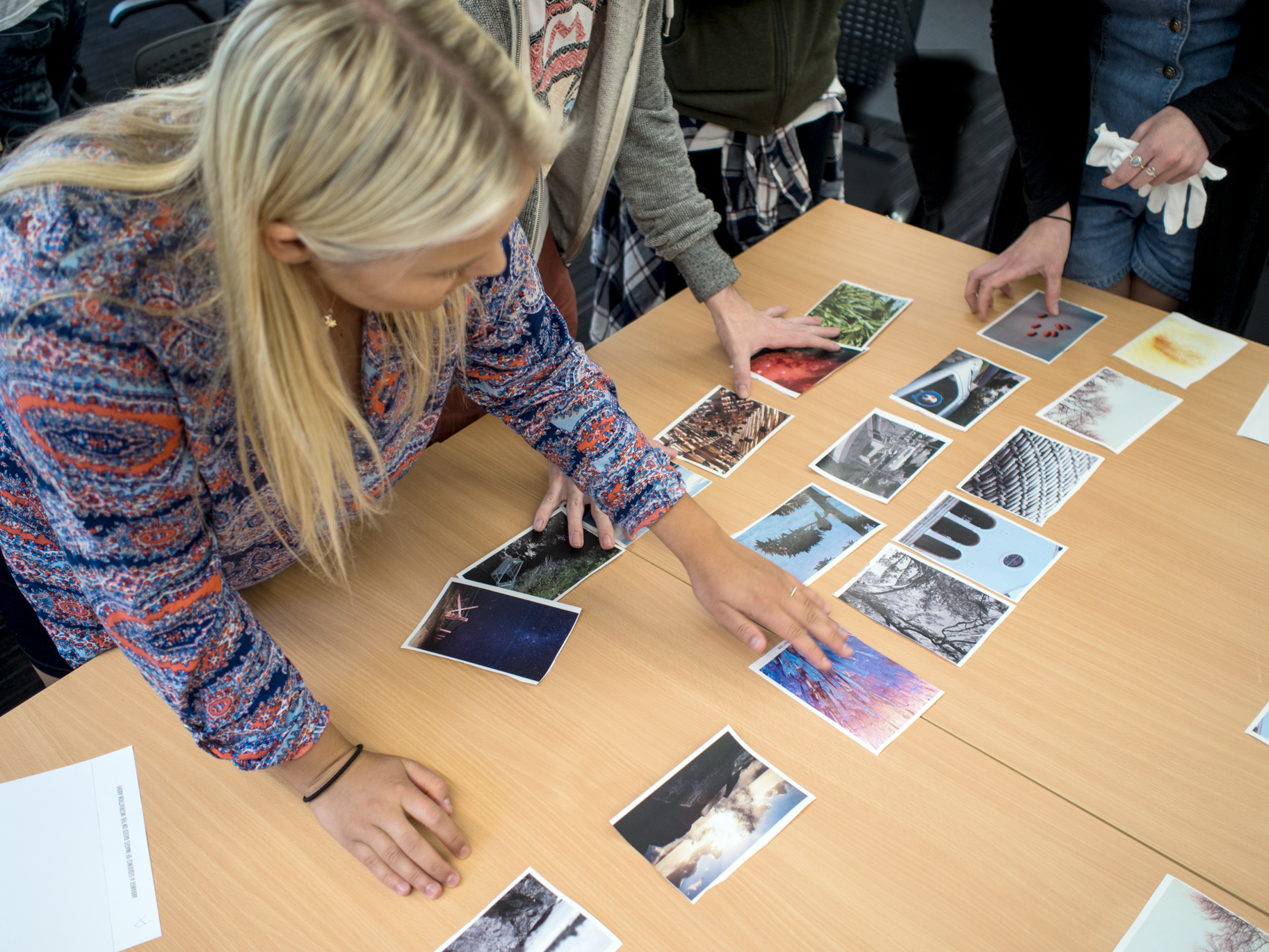
Arranging photos
ATTEND A ONE-DAY PHOTOBOOK WORKSHOP
On Sunday September 29 photobook road trip co-ordinators Victoria Cooper and Doug Spowart will present concepts and hands on practical exercises for working on photobook projects. These are designed to assist the photographer in distilling images from their archives and then structure them into an engaging narrative flow. The workshop includes practical work in hand-making photobook formats and preparing book ideas for Print-on-Demand output.
There is a charge to attend the workshop – Details of the workshop and booking information can be found on this Eventbrite Link: https://tinyurl.com/y2pnpbhu
.
.
Victoria Cooper & Doug Spowart acknowledge the support of MomentPro Photobooks and the Centre for Creative Photography in making this event possible.
.
.
.
BEAUTIFUL FRUIT – Tilley Wood+Linda Spowart
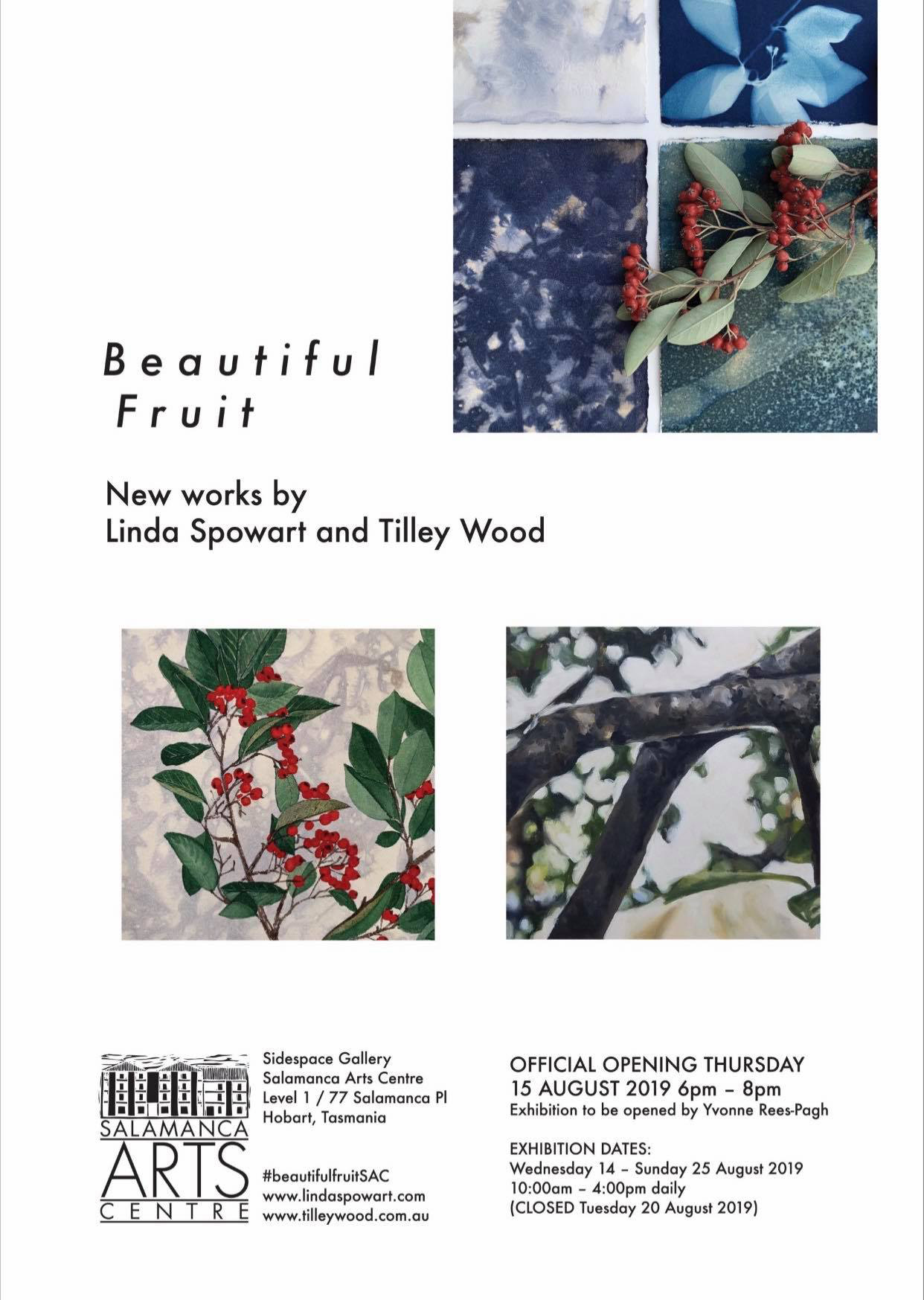
Beautiful Fruit Invite
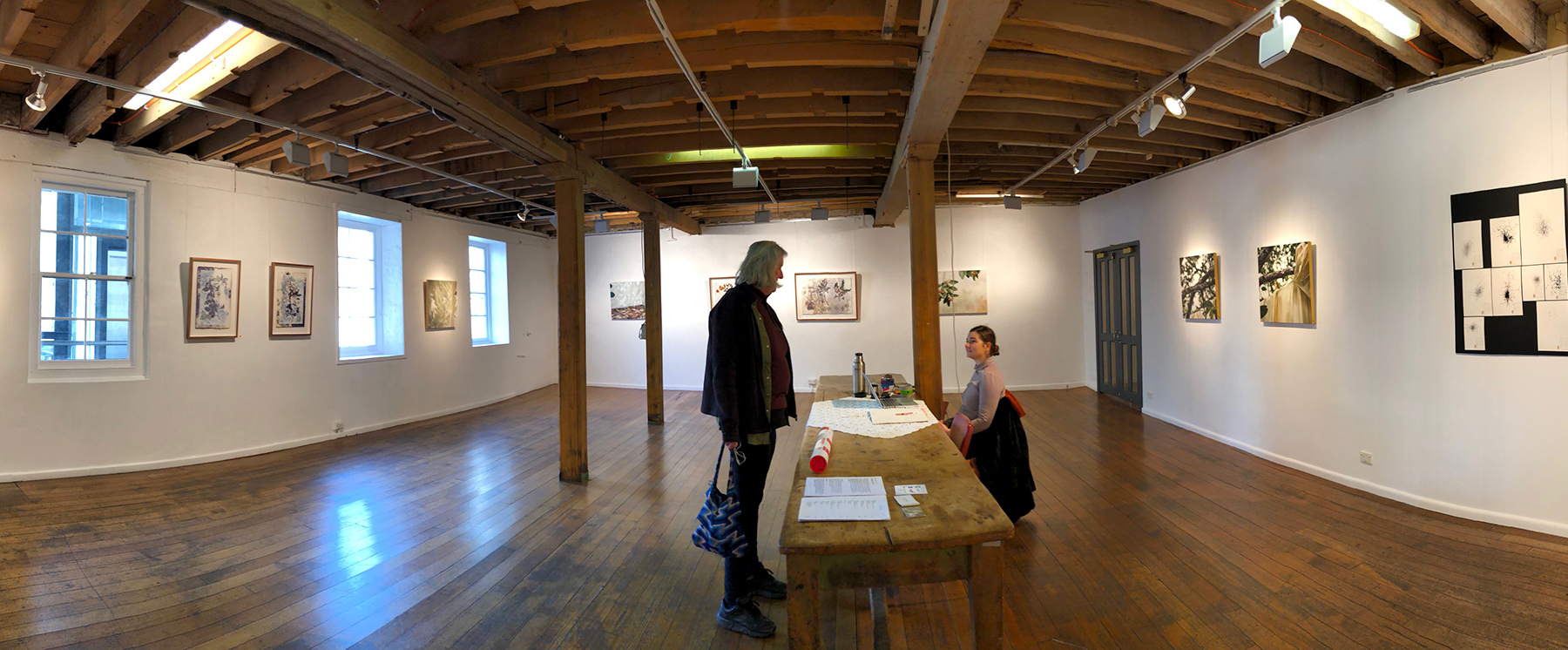
Beautiful Fruit installation in the Sidespace Gallery at Salamanca ………. PHOTO: Doug Spowart
.
A Fruitful Place – a review by Victoria Cooper
Place, of course, as opposed to the more generalized ‘site’ or ‘land,’ is a specific collaboration between nature and people, constantly altered and inevitably defined by narratives from the contact zones.[1]
This exhibition is the result of a collaborative interaction between the artists, the cotoneaster tree and its environment. The intent was to create visual responses to observations of the tree and its rhythms over time that forms:
… a dedication to and recording of this tree. Its life is multifaceted, one that connects to and affects the space and people around it. Its vital and variable presence is what they are drawn to and present here. This exhibition is the fruit of the artists and subject together.
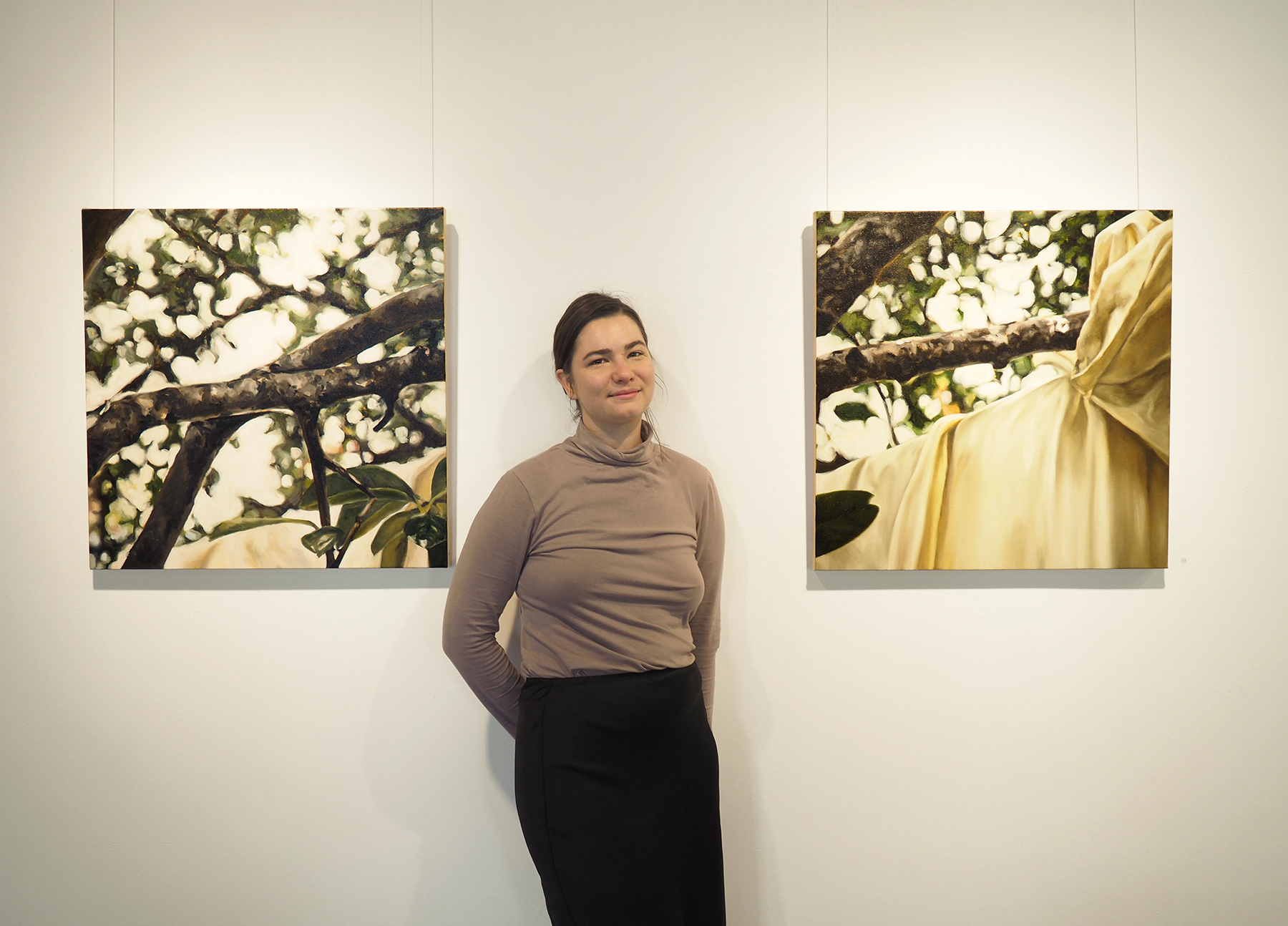
Tilley Wood artist with light 4 + light 5, 2019 Oil on canvas ………. PHOTO: Doug Spowart
.
Although Linda and Tilley approached the project from two different perspectives both were influenced by the phenomena of light and wind to define the tree, its form and movement. Tilley’s paintings of the tree evoked a poetic place illuminated by memory. Linda’s prints were layered using cyanotype photograms[2] or inks in contact with parts of the tree and its surroundings, then over printed with gesso and drawings were full of detail referencing the visual language of botanical illustration and empirical scientific evidence gathering.
.
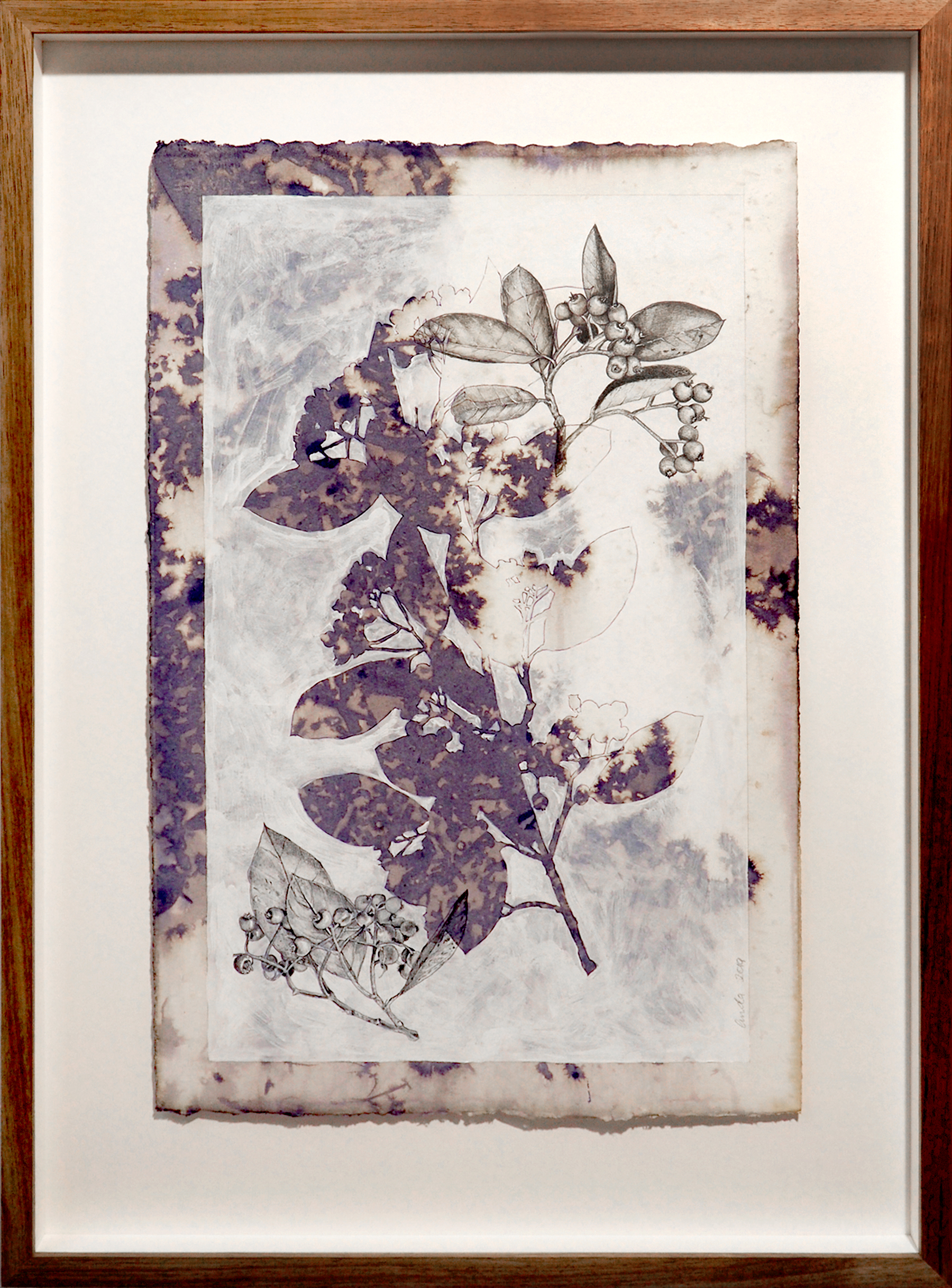
Debris 1 Linda Spowart 2019Ink, gesso and graphite on cotton ………. PHOTO: Doug Spowart
.
As part of their investigation, the artists individually and collaboratively created through direct contact with parts of the tree: leaves, fruit and branches, they made more cyanotype photograms. These prints were more like impressions, rather than the detailed recording of scientific photographs. On one wall at the entrance to the main gallery there was an impressive installation of these blue prints creating a feeling for the tree’s blue shadowy and dappled light space.
.
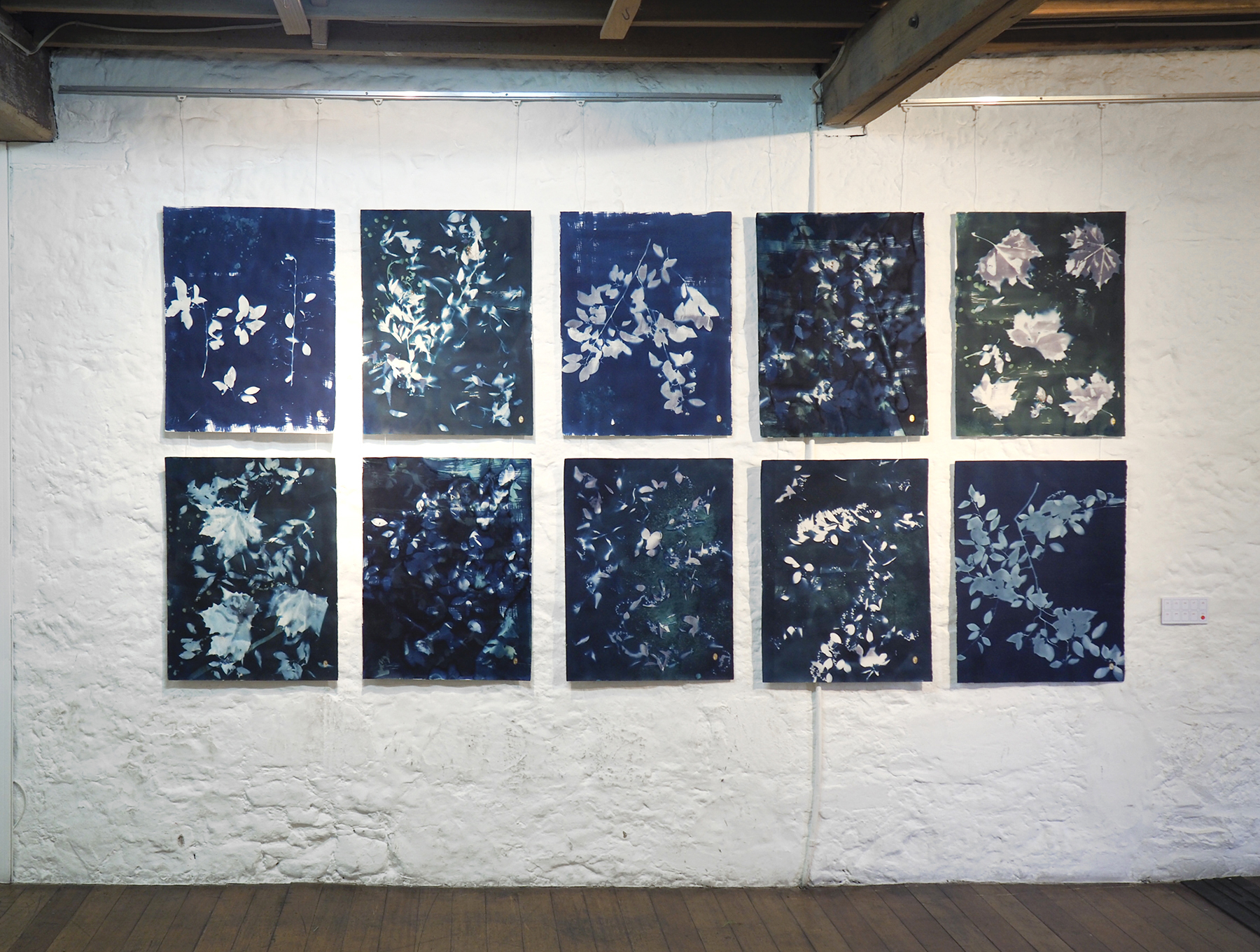
Beautiful Fruit Nos. 3-13 Tilley Wood+Linda Spowart 2019 Wet Cyanotype & gold leaf on cotton
.
The cotoneaster tree was both subject and collaborator in this exhibition. As part of their investigations, the artists attached drawing devices to branches of the tree in order that it would self record its movement without the intervention of the artists’ hand. This is an important methodology for many artists as it opens up an inclusive space where the agency or ‘voice’ of objects and other life-forms as collaborators can present new and surprising perspectives. Australian artist, Cameron Robbins[3], presented the drawings that were formed through devices attached to a windmill to record the movement of the wind around Museum of Old and New Art (MONA), Hobart, Tasmania. Robbins intent was
… to connect to landscape, and to the greater dynamic of the whole climate system; how patterns move through a particular location. For me, that’s the most direct way to access the greater energies and forces around us.’ Cameron Robbins[4]
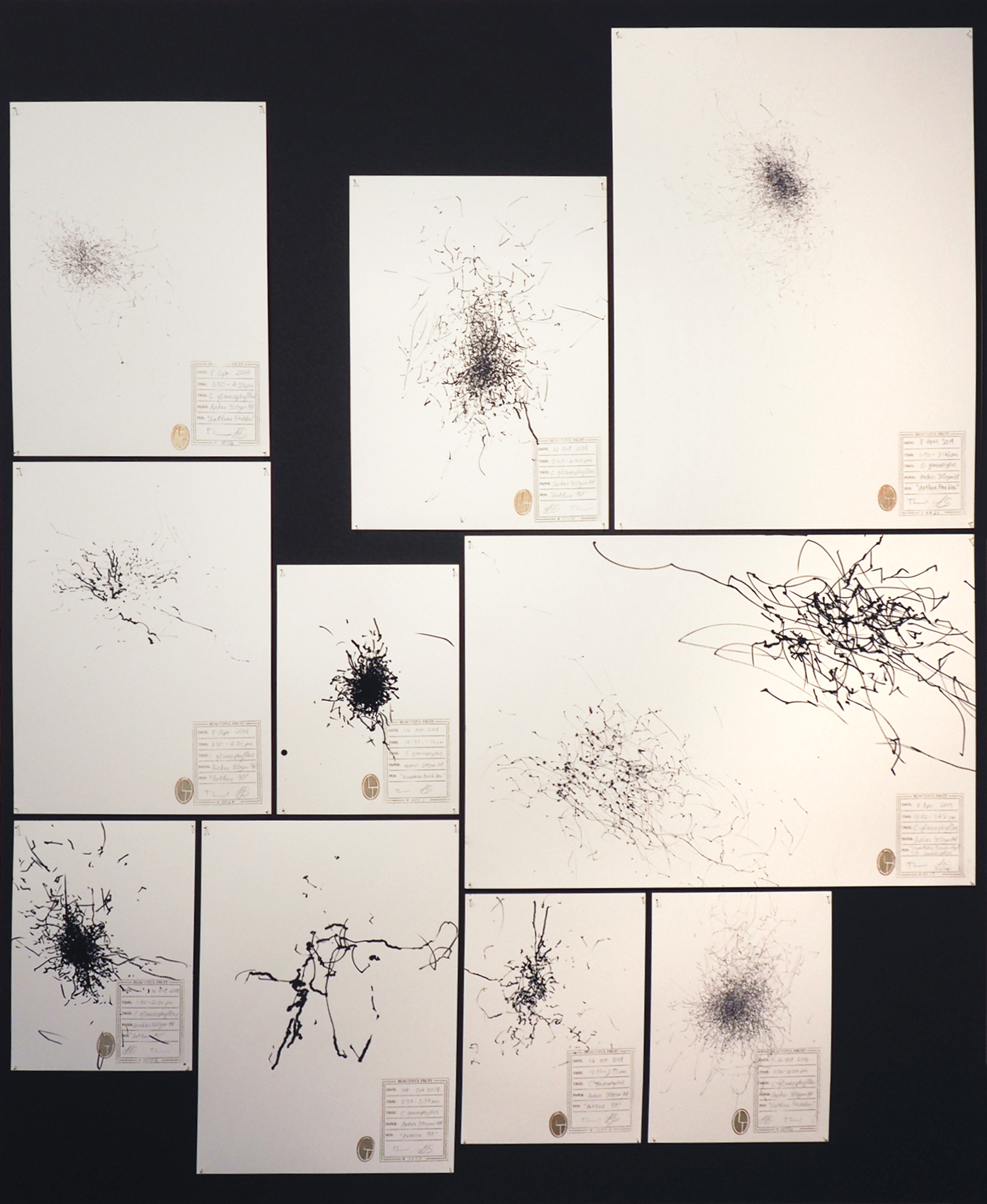
Tree Drawings #0001- #0026 ………. PHOTO: Doug Spowart
Art when made in collaboration with both human and non-human entities involves a corporeal, sensate empathy that evolves over time spent in contact within their space and place. These are dynamic contact zones where human and nature interaction can stimulate the development of alternative views and knowledge to bring fresh ways of understanding the changing world we share with Others. Both Tilley and Linda have engaged with the Place that is the tree, not to objectify or imitate, but to wonder, imagine, transform and be transformed.
Dr Victoria Cooper
.
.
NOTES:
[1] Stuart, M & Lippard, L 2010, Michelle Stuart, Sculptural Objects: Journeys In & Out of the Studio, Charta, Milano, page 11.
[2] The Cyanotype process was developed by Sir John Herschel in the 1840’s and at this time 19 th century botanist Anna Atkins used the process to document her plant specimens. The process: water colour paper or cloth is coated with a chemical made by the light sensitive combination of potassium ferricyanide and ferric ammonium citrate. After drying, objects placed on the material and then exposed in sunlight. Ultra-violet light is required and exposure times may be 8-10 minutes although times may vary depending on the time of year – or day. Many photographer also expose enlarged contact negatives of photographs onto the cyanotype emulsion.
[3] Cameron Robbins, Field Lines, MONA see https://mona.net.au/museum/exhibitions/past-exhibitions/cameron-robbins-field-lines
[4] ibid. an in-text quote from the article by the curators, Nicole Durling and Olivier Varenne
.
.
.
.
.
.
2019 PHOTOBOOK ROAD TRIP BEGINS – HOBART
The 2019 Photobook Road Trip
PHOTOBOOKS @ TOPSPACE STUDIO/GALLERY IN HOBART
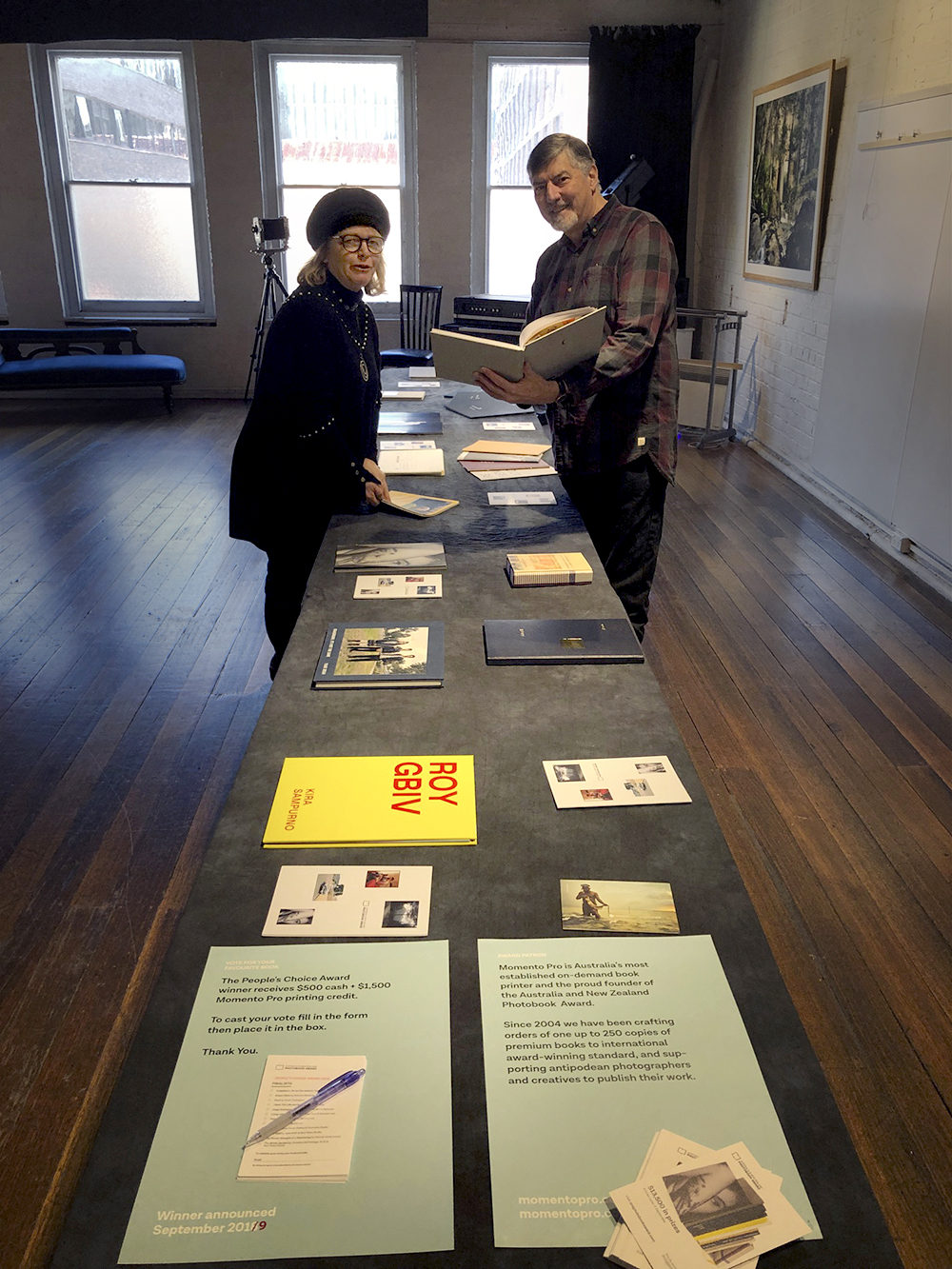
Ilona Schneider and Doug Spowart
.
The 2019 Photobook Road Trip began last night at the TopSpace StudioGallery in Hobart. The Australia & New Zealand Photobook Awards (ANZPA) exhibition was installed by Victoria Cooper and Doug Spowart. Visitors to the Gallery were welcomed by the gallery Director Ilona Schneider.
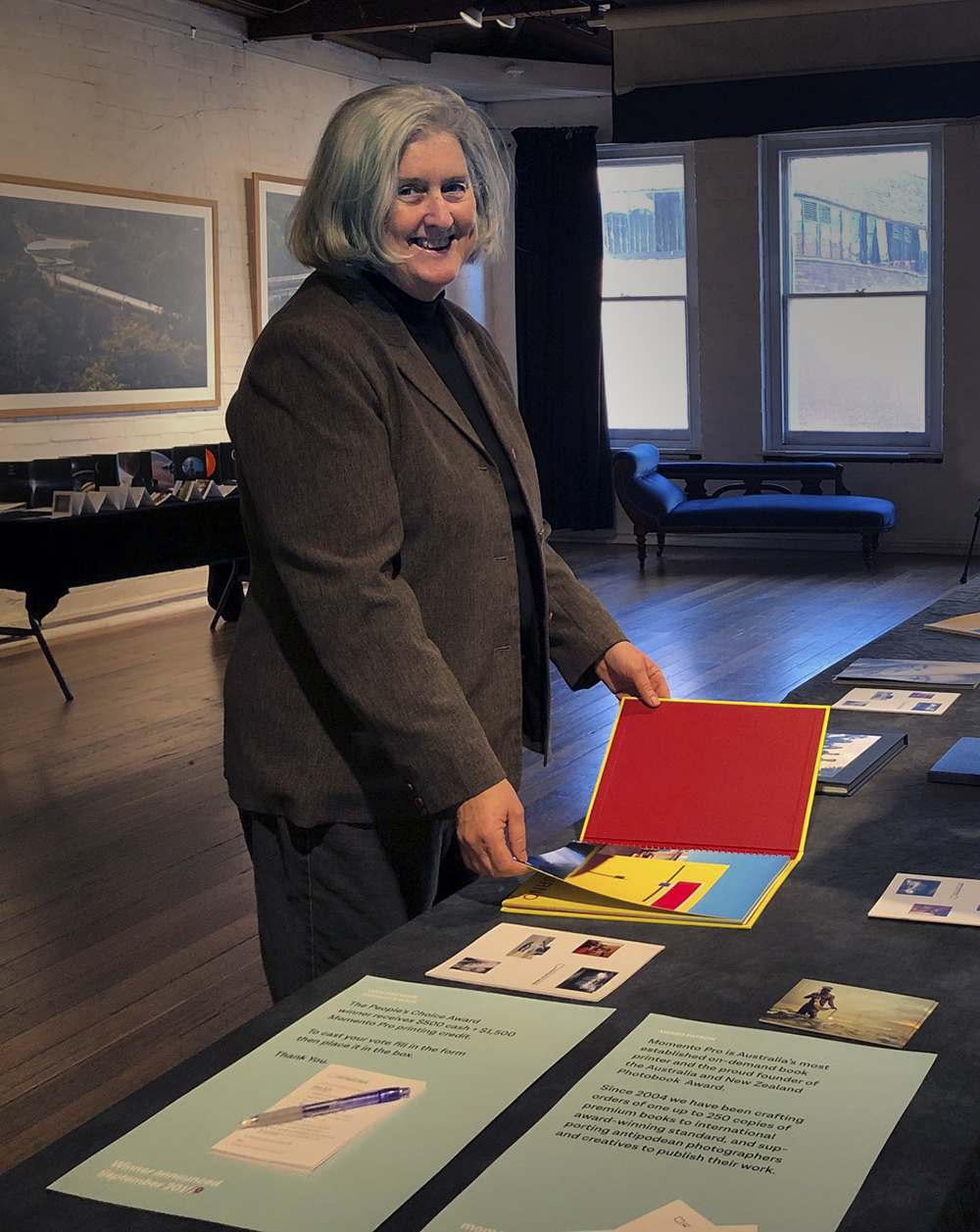
Vicky setting up the dispaly
.
Winners 2018
- PHOTOBOOK WINNER: Second Sight by Sarah Walker & Perimeter Books (AU)
- PHOTOBOOK COMMENDED: Huon by Noah Thompson (AU)
- STUDENT WINNER: ROYGBIV by Kira Sampurno at Massey University, Wellington (NZ)
- STUDENT COMMENDED: Craigieburn, it’s not the same by Yask Desai at Photography Studies College, Melb (AU)
Finalists 2018 from 117 entries:
- Dream State by Stavros Messinis / M-Art Books (AU)
- I Want This Life and Another by Robyn Daly (NZ)
- Image Ecologies by James Farley & Jacob Raupach / Currency Editions (AU)
- Living with AIDS (1988) by Fiona Clark & Michael Lett (NZ)
- Permission To Belong by Tammy Law (AU)
- Six for Gold by Jake Mein & Bad News Books (NZ)
- The Tensile Strength of a Heartstring by Hannah Rose Arnold (NZ)
- The Winter Garden by Christine McFetridge, Bad News Books & M.33 (NZ)


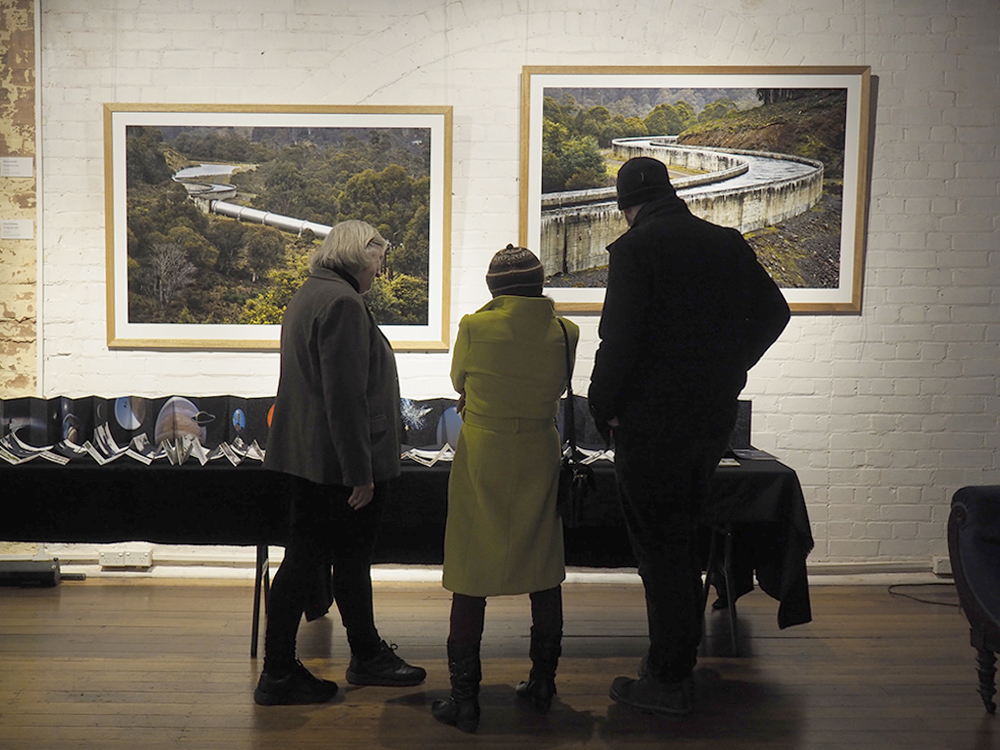
Looking at the Cooper+Spowart books
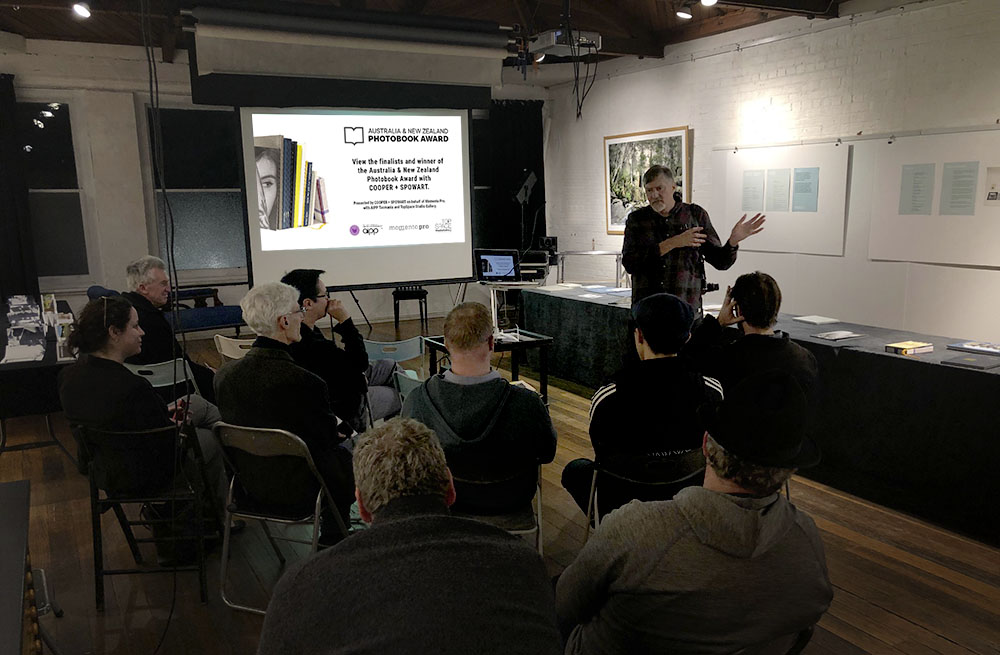
Doug presenting his talk
THANK YOU!
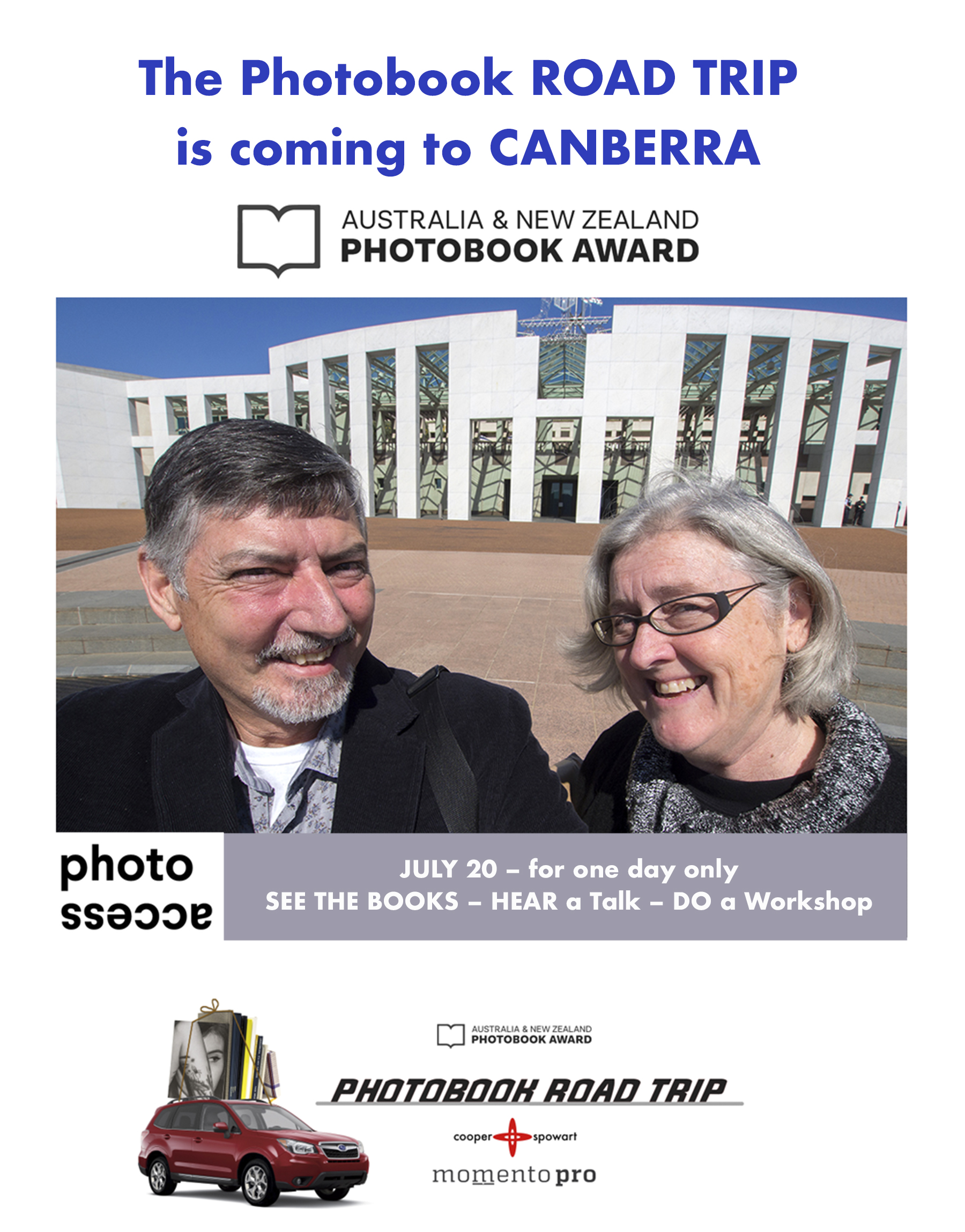
D+V Coming to Canberra
.
.
ANTIPODEAN Photobooks acquired by Tate

.
We are delighted that this collection is entering Tate’s library collection as a rich resource for our public and for academics of photobooks in these regional areas.
.Sarah Allen
Assistant Curator, International Art, Tate
.
.
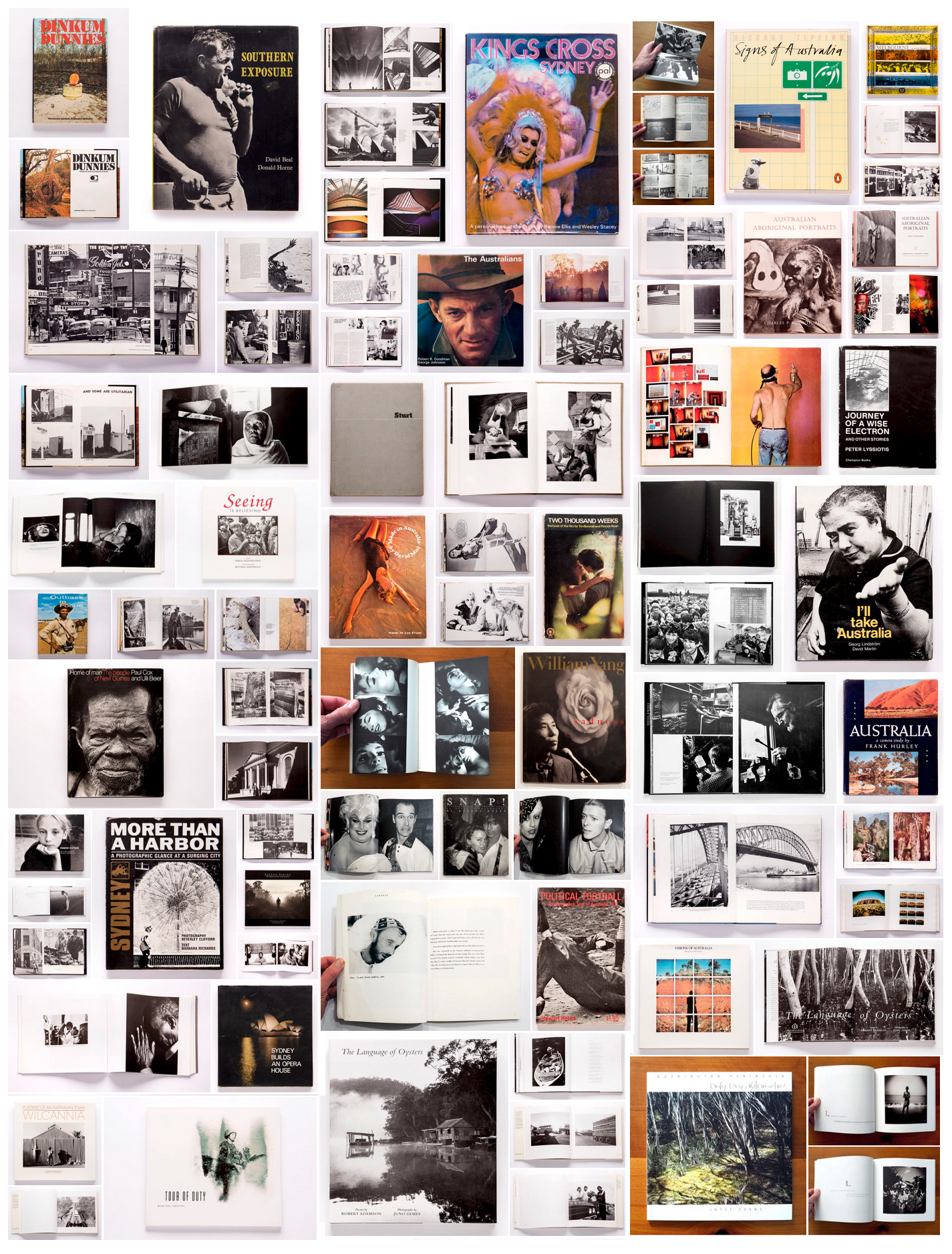
Some ANZ Tate Photobooks
We’ve just completed a commissioned project where a collection of 52 Australian and New Zealand photobooks were acquired by the United Kingdom’s national collection in the Tate. Two years ago the project began as a result of our participation in the 2017 Vienna Photobook Festival and a connection with Martin Parr.
.
.
THE BACK STORY
In 2017 we presented a cyanotype/photobook workshop on the Greek Island of Skopelos. At the end to the workshop we coordinated a visit to our friends Lachlan Blair and Anna Pritz who live near Vienna in Austria. Just after we booked our flights Lachlan excitedly advised us that we would be in Vienna at the time of the Vienna Photobook Festival.
I contacted co-ordinator of the Festival Regina Anzenberger and offered to make a presentation about my research on Australian and New Zealand (ANZ) photobooks. After some conversations between Lachlan and Regina she enthusiastically accepted my lecture offer. Through some further negotiations with Regina and Libby Jeffery from MomentoPro we were able to present the ANZ Photobook of the Year finalists on a table at the Fair.
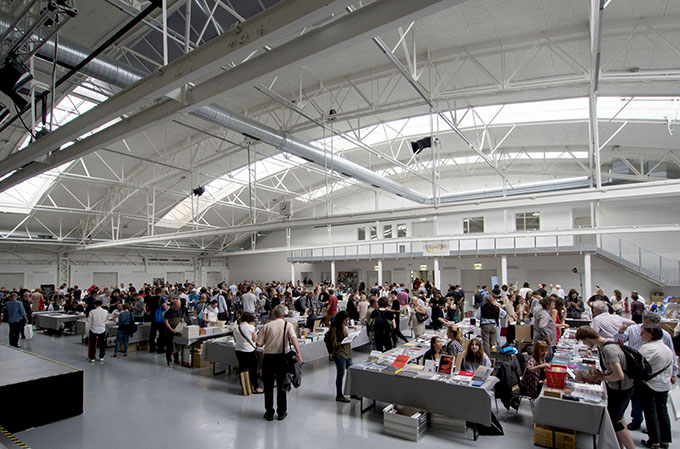
The 2017 Vienna Photobook Festival exhibition
.
The Vienna Photobook Festival was an event of an unimaginable scale – 100+ tables of photobooks new and old, a photobook award, key identities of the photobook community and attendees from western European countries far and wide.
40-50 people including photobook aficionado Martin Parr and photo historian Hans-Michael Koetzle attended my lecture. There was quite a bit of interest about my topic and many of the lecture attendees came by the ANZ Photobook Awards table to view the books and talk more with us about our local photobooks.
.
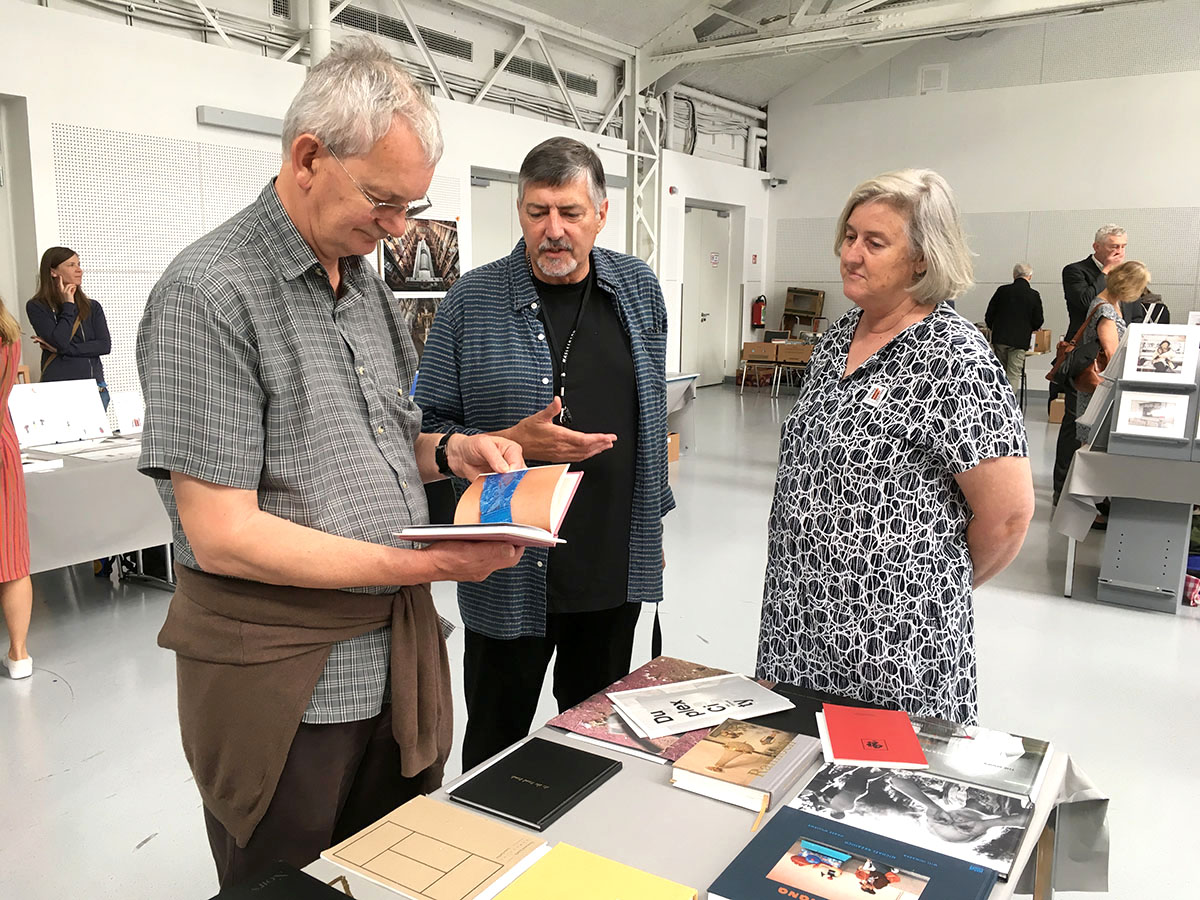
Parr looking at ANZ photobooks at the Festival …PHOTO: Lachlan Blair
.
Further to an earlier private meeting in the Anzenberger Gallery and his attendance at my lecture, Parr caught up with us again for a chat on the afternoon of the first day of the Festival. He mentioned that soon there would be a public announcement about his donation of over 12,000 photobooks from his collection to Tate.
Parr felt that although his collection had pretty well covered the world the one area that was under represented was the ANZ region. He had many of the big Australian names but acknowledged that there were gaps. After hearing my lecture he felt that I would be well positioned to fill that gap. He said that he would be recommending me to his Tate contacts to assist with this issue. At first I was a little daunted, but he insisted that I would be the right person for the project. I accepted the role as it would not only be an honour to work with him on the project but also a great opportunity for the ANZ photobook community.
Vicky and I came back to Brisbane in July and both began sessional work with the Queensland College of Art. A couple of months later an email came through from a Tate representative inviting my involvement in the project. I then prepared a list of ANZ books that I thought would be suitable additions to the collection. I also reviewed Parr’s collection to ensure that I had not duplicated books on his list.
Initially I suggested that I would source the books from bookshops, collectors and the photographers and that I would receive a fee for the list development and the management of the process. I mentioned that some books were quite rare and that they would be sourced from my own library as I could replace them as they became available in the future. My Tate contact came back saying that rather than what I suggested they preferred to purchase the books from a single collection and asked, ‘were my books available?’ After some consideration I agreed to take books from my library.
.
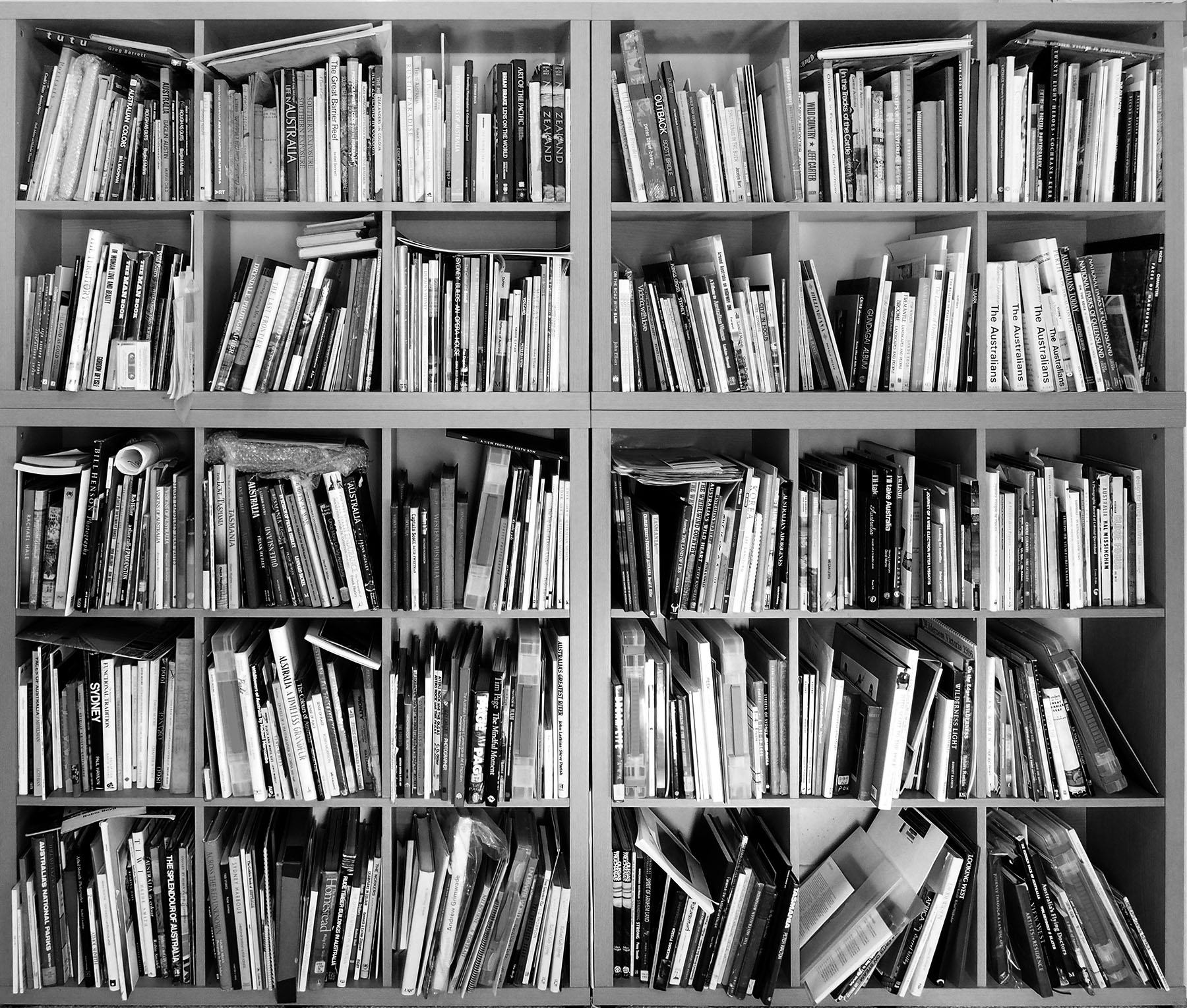
Part of my ANZ photobook collection c2015
.
THE PREMISE FOR THE COLLECTION
My curation premise for the 52 books was:
- That these books should resonate with the Australia/New Zealand social, political, environmental and cultural space of post-Second World War to early 21st century.
- Where possible, I have selected works that have been referenced or identified by curators and researchers for their prominence within the photographically illustrated and photobook publishing genres in ANZ.
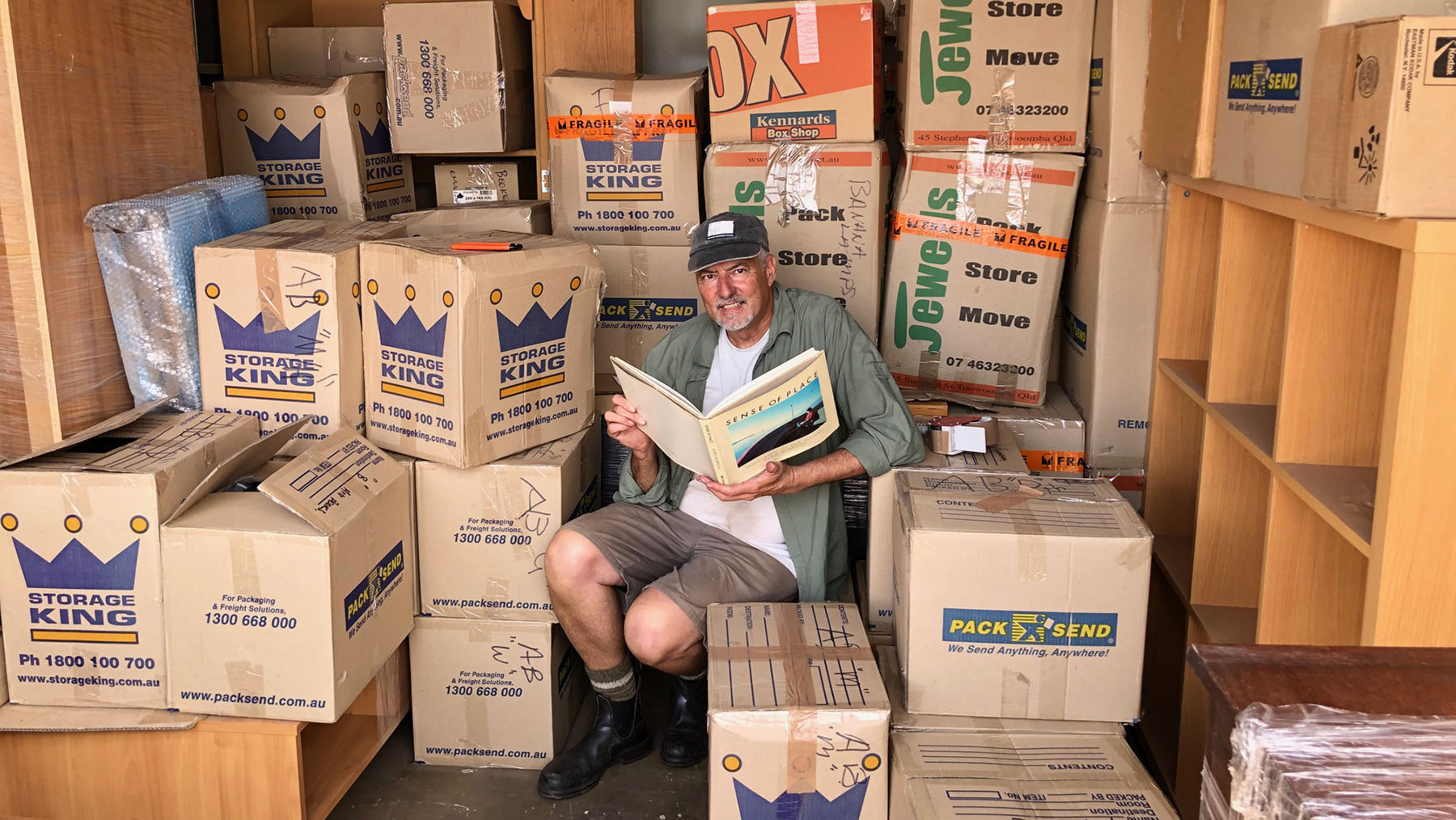
In the storage shed opening boxes looking for books …PHOTO: Victoria Cooper
.
At this time and still today, my photobook collection is boxed and in storage. So for over a year on my intermittent visits back to our storage sheds in Toowoomba we would seek out the missing books. As we began to assemble the proposed books I became concerned about particular issues that were arising. As my collection has been built up over 50 years some of the books were not necessarily the best condition – some exhibited signs of use including shelf-wear, bumped corners and occasionally missing covers.
I wanted to be able to offer Tate the best possible condition books. Additionally, I could not find some key books that I knew I had in my collection including Carol Jerrems’ book Story about Australian women. What followed was an 18-month process of curation and research to bring together the books.
I sought out and purchased better copies of the chosen books either by online booksellers or by visiting bookshops in Australia. I contacted some of the photographers that I knew to see if ‘as new’ condition copies of the books were available. If they were what would the cost be and if possible, would they consider a donation to extend the potential of the collection. The response was very supportive with many of the photographers prepared to provide pristine condition copies of their books free of charge.
.
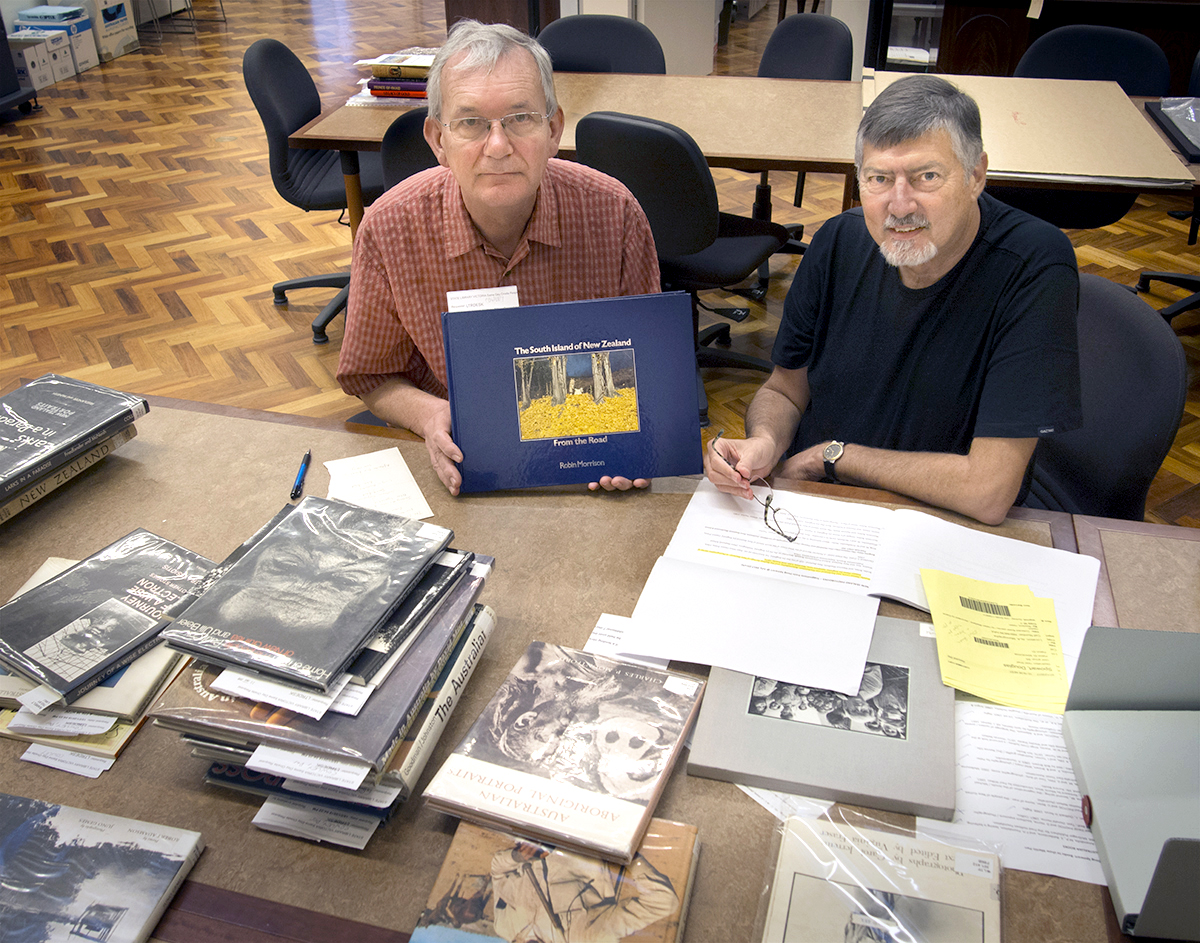
Meeting with Martin Parr at the SLV…PHOTO: Victoria Cooper
.
MEETING WITH MARTIN PARR
In January 2018 Martin Parr came to Melbourne to photograph the Australian Open tennis tournament. We flew down from Brisbane and arranged to meet him at the State Library of Victoria where we had about 30 of the proposed books assembled for him to review. As only a couple of books did not fit into his collection approach for the Tate I felt buoyed by the progress. Over the next 6 months I prepared a detailed bibliographic submission and significantly documented the books. We finally found the Jerrems book in a box marked ‘Photobook library extras’ in January this year.
.
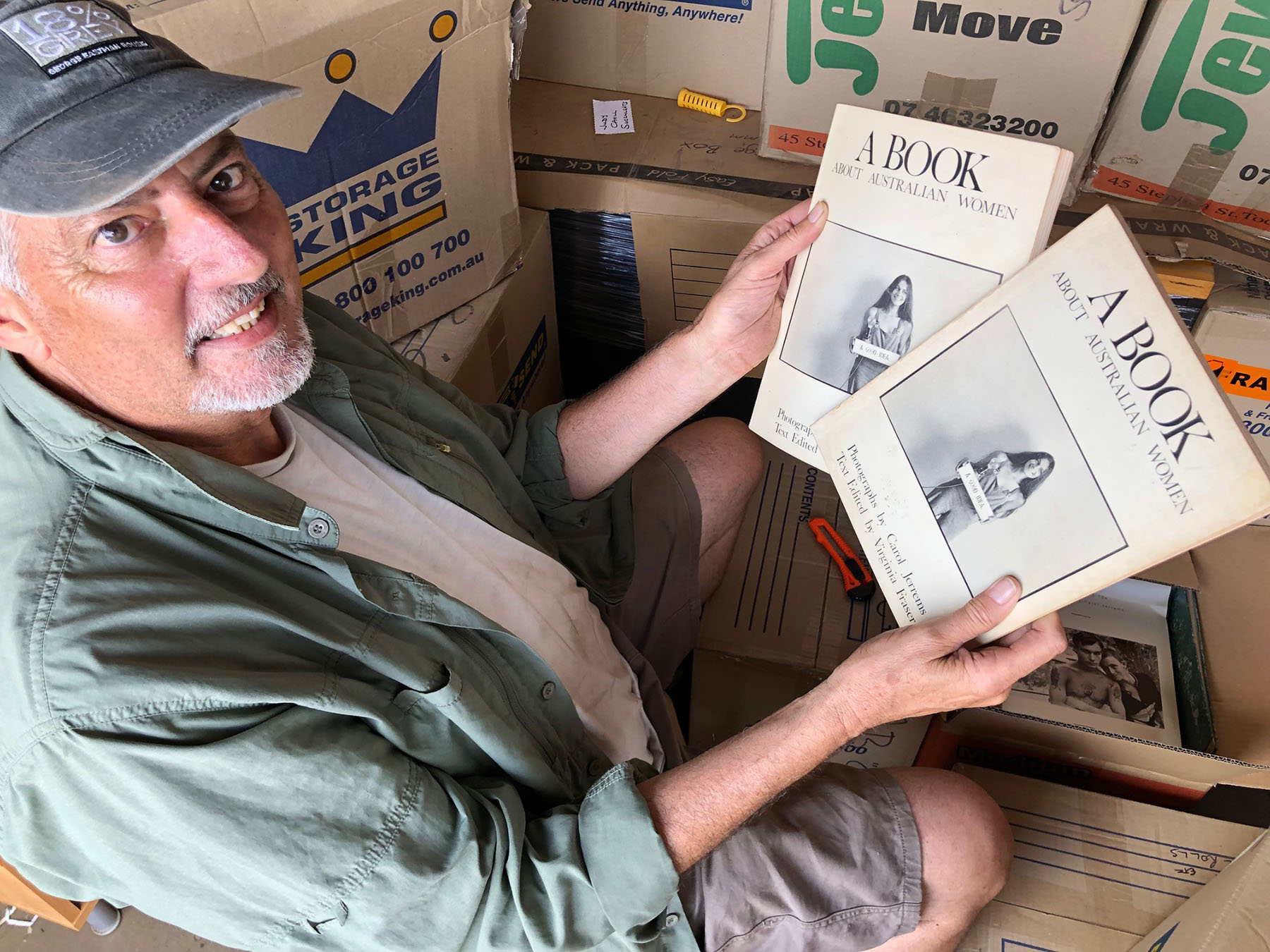
Finding Carol … …PHOTO: Victoria Cooper
.
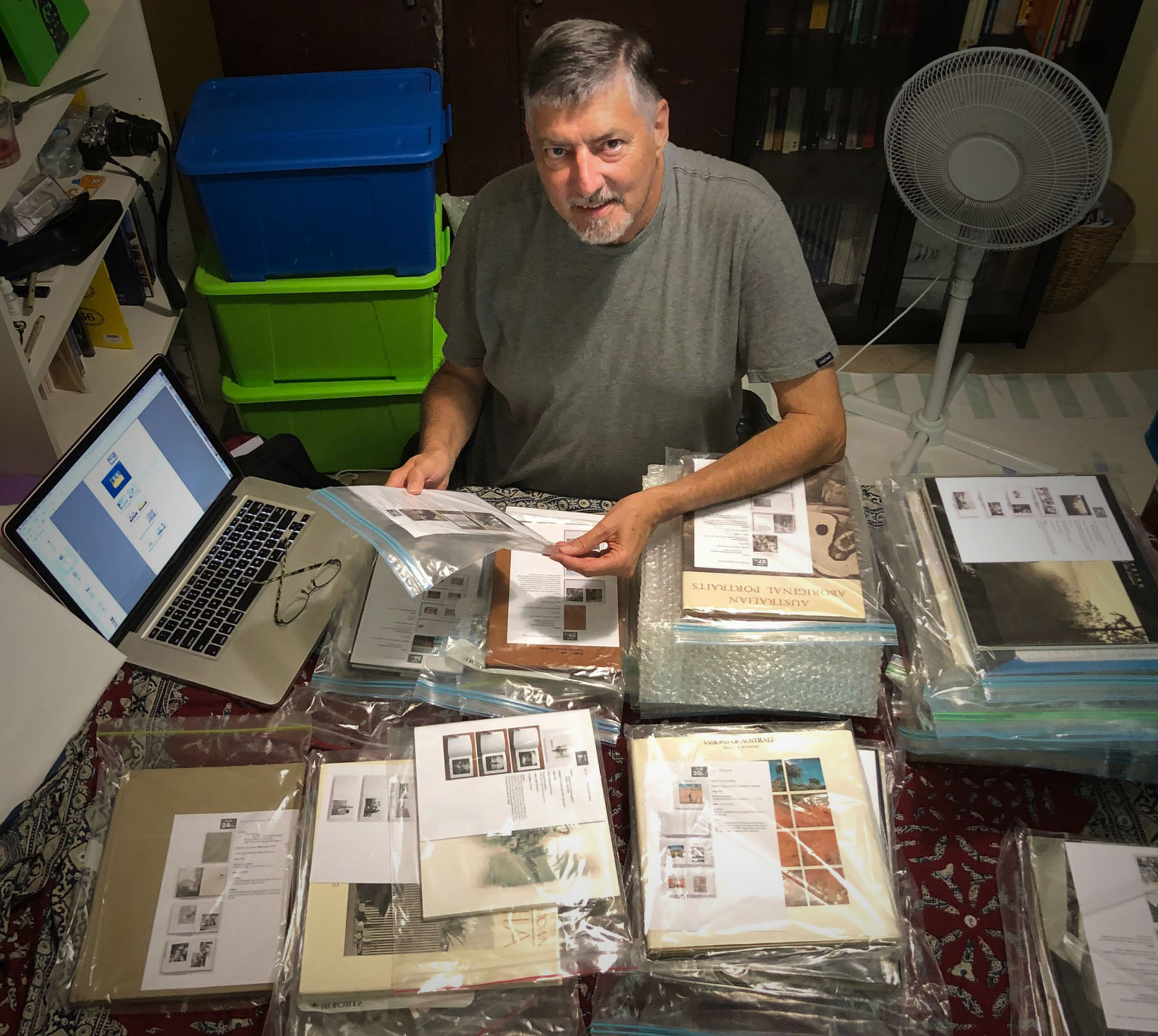
Packing up the books …PHOTO: Victoria Cooper
.
SHIPPING THE PACKAGE
The books were protectively packaged and we arranged their shipment and it took only a few days for the consignment to travel from Brisbane to the UK. After nearly 2 years in the making Tate received the books on April 12, 2019. Once catalogued they will form part of the Martin Parr Photobook Collection with the provenance being recorded that the books came from ‘The Doug Spowart and Victoria Cooper Photobook Research Library’. The books will be publicly accessible in London in Spring 2020.
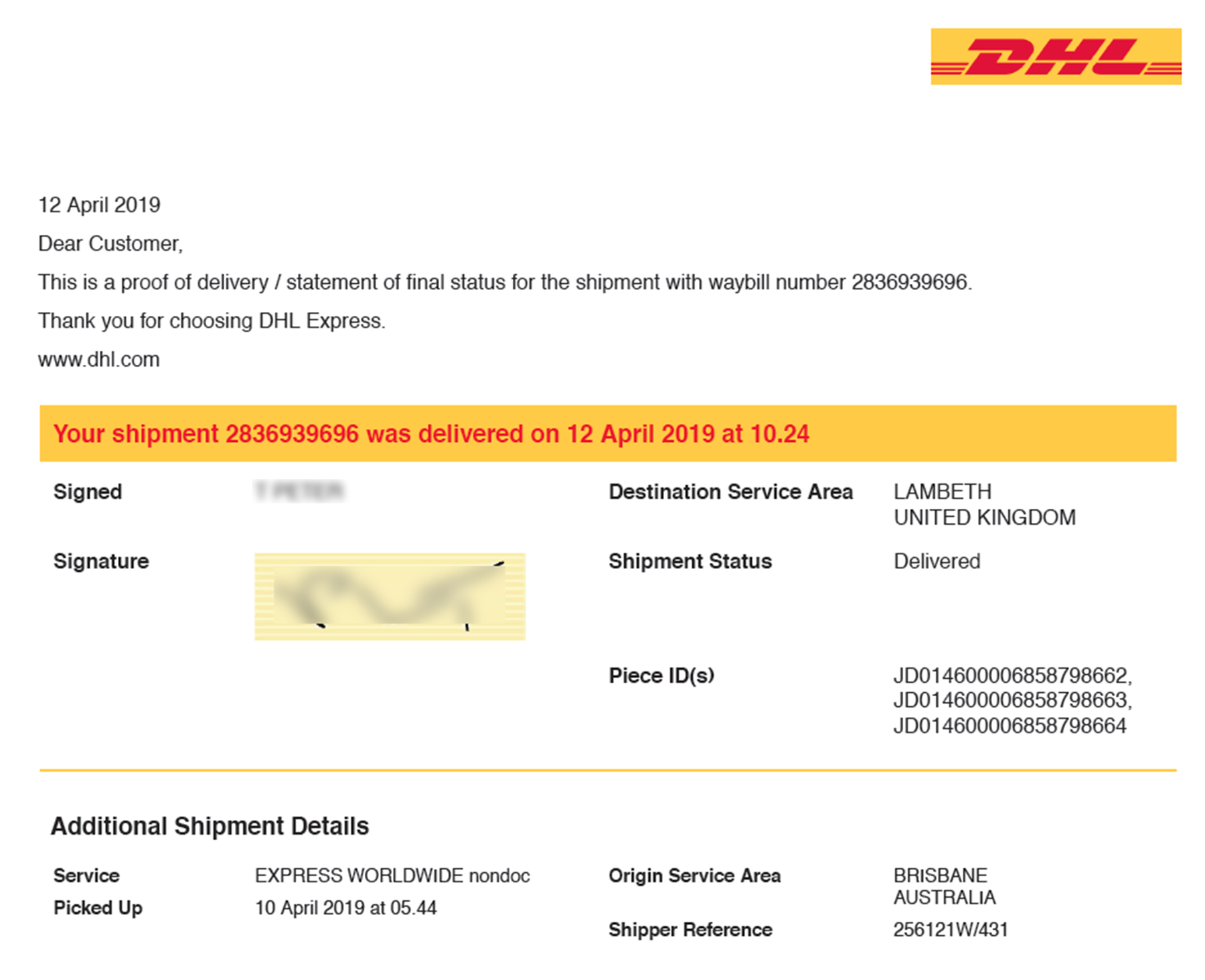
Pack and Send – DHL Proof of delivery
.
ON REFLECTION
What is important to us is that books from our region are now placed within the context of the worldwide history and practice of the photobook in a significant institution. Although not a complete history of the Photobook in Australia and New Zealand it is an embryonic beginning for a broader recognition of the unique voices and stories from our part of the world and those that make them.
Doug Spowart + Victoria Cooper
ACKNOWLEDGEMENTS
We are indebted to those who supported us during this process. In particular Sarah Allen (Tate) for her coordination of the project. Martin Parr for his interest and continued support in providing a place for Antipodean photobooks in his Tate collection. We also wish to thank Lachlan Blair and Anna Pritz for making the initial connection with Regina Anzenberger, Gael Newton for her support, Helen and Donald Cole for their advice and storage of the books and the coordination of the final shipment, Des Cowley at the State Library of Victoria for the preparation of books to show Martin, Pack and Send Milton (DHL) for their assistance and coordination of the shipment to the UK.
THE LIST OF PHOTOGRAPHERS
Where the photographer has more than one book in the collection the multiple is shown in (brackets).
It should be noted that a book is the culmination of a creative process that may include the contributions of writers, poets, designers, printers and binders. In this list only the photographers are listed.
The photographer’s names are:
AUSTRALIA
Michael Amendolia
Douglass Baglin
David Beal
Jeff Carter
Beverley Clifford
Paul Cox
Michael Coyne (2)
Max Dupain (2)
Sandy Edwards
Rennie Ellis (2)
Joyce Evans
Juno Gemes
Robert B. Goodman
Marion Hardman
Alan Hirons
Douglas Holleley
Frank Hurley
Carol Jerrems
Georg Lindström
Peter Lyssiotis
Olive McInerney nee Olive Cotton
David Mist
David Moore
Charles P. Mountford
Robert Rosen
Wesley Stacey
Mark Strizic (2)
Richard Tipping
William Yang
PARR’s Australian book donation already included:
Bill Henson
J. Hurley
Frank Hurley
Max Pam
Trent Parke
NEW ZEALAND
Laurence Aberhart
Peter Black
Brian Brake
Jocelyn Carlin
Les Cleveland
Bruce Connew
David Cook
Marti Friedlander
Lloyd Godman
Glenn Jowitt
Mary Macpherson
Robin Morrison (2)
Anne Noble
Haruhiko Sameshima
Grant Sheehan
Ann Shelton
John B. Turner
Ans Westra
PARR’s New Zealand book donation already included:
Gary Baigent
Harvey Benge (a significant collection)
Ans Westra
FOR MORE INFORMATION ABOUT THE BOOKS and other ANTIPODEAN PHOTOBOOK activities and events follow the BLOG HERE
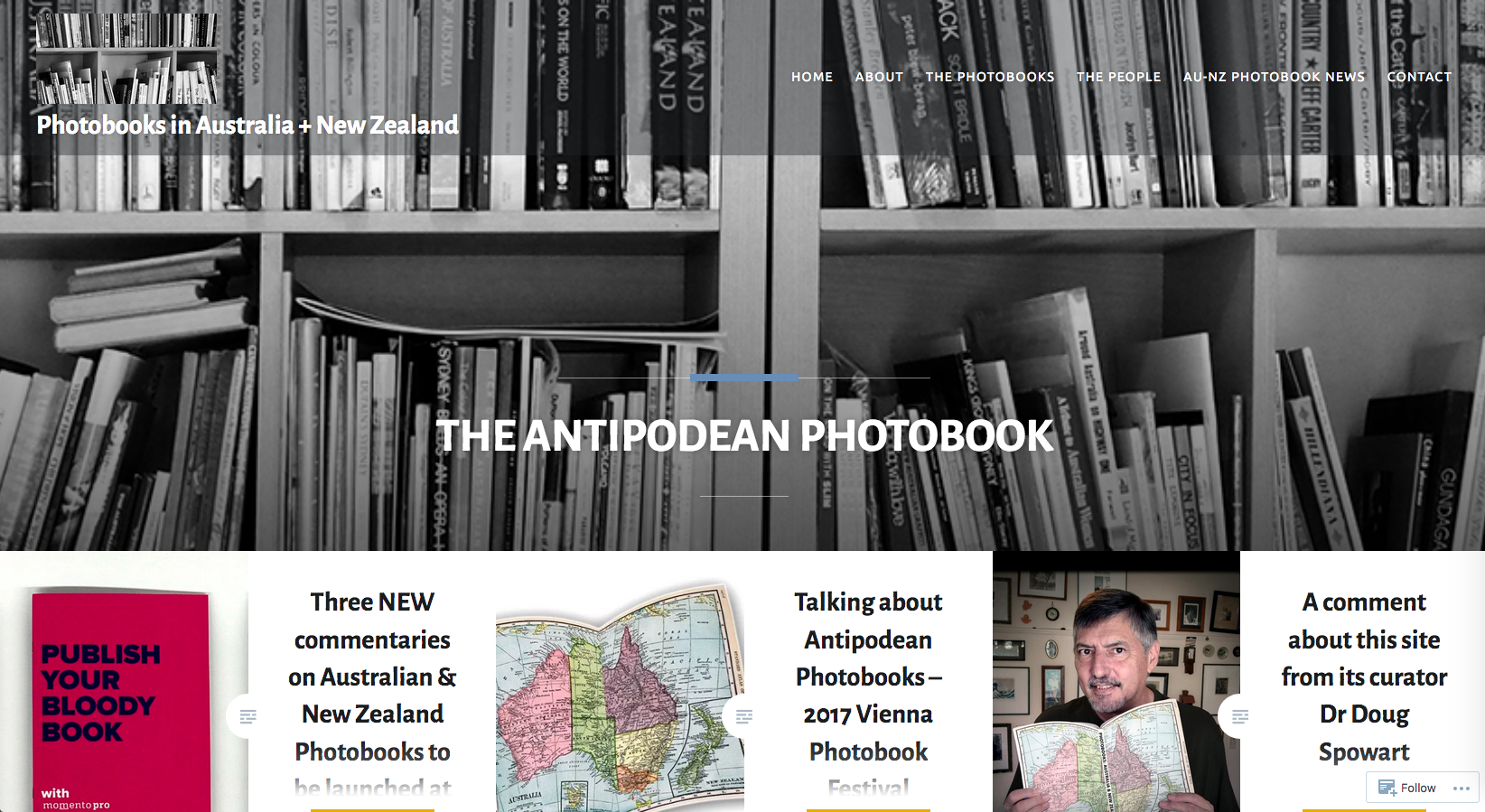
The Antipodean Photobook BLOG
READ MORE ABOUT THE TATE DONATION
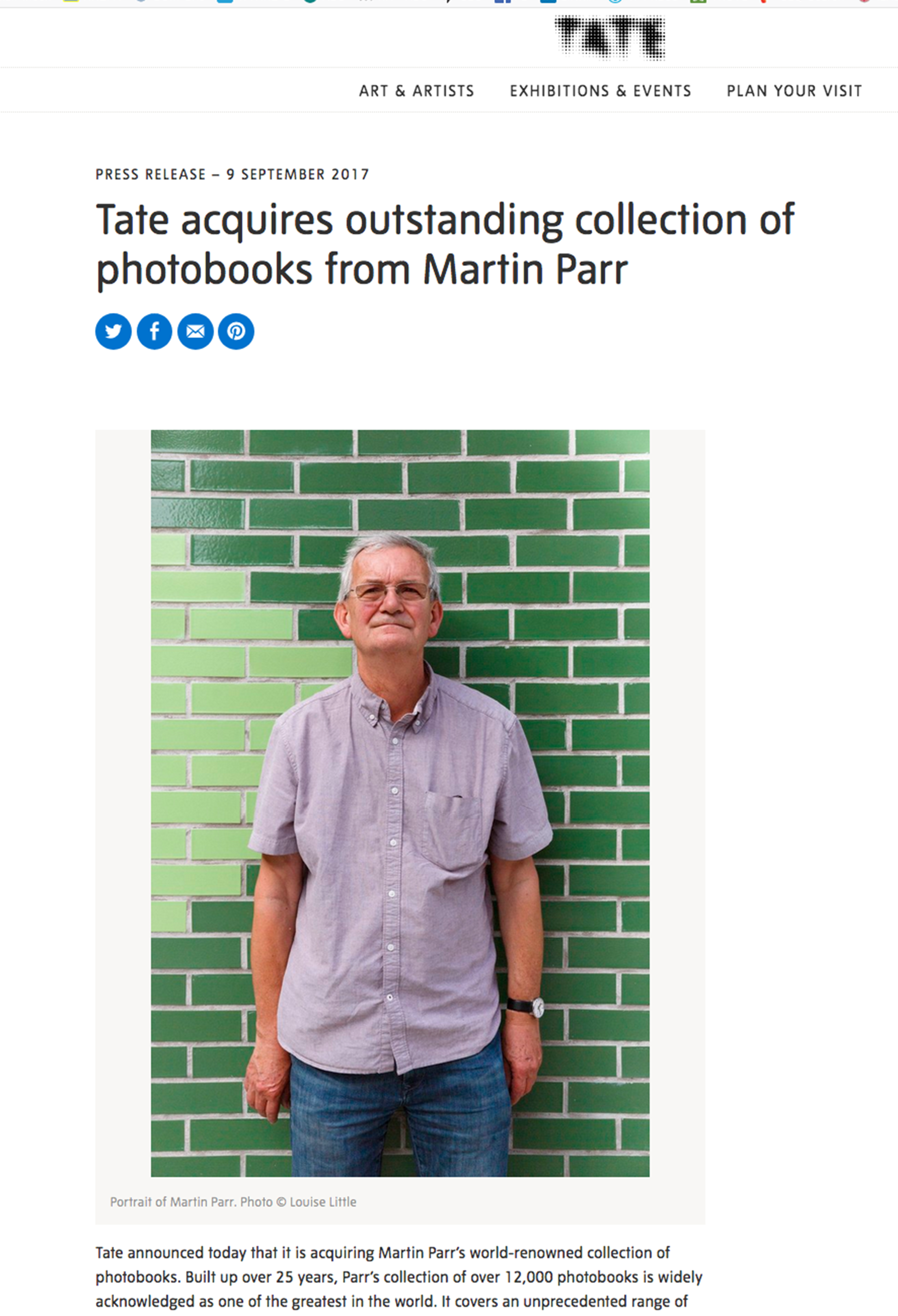
Tate Media post about Parr donation
A PDF download of the Tate post can be downloaded by ‘clicking’ this link Tate website post on Parr donation
.
READ MORE IN THE INSIDE IMAGING STORY
https://www.insideimaging.com.au/2019/tate-commission-for-photo-book-keeper/
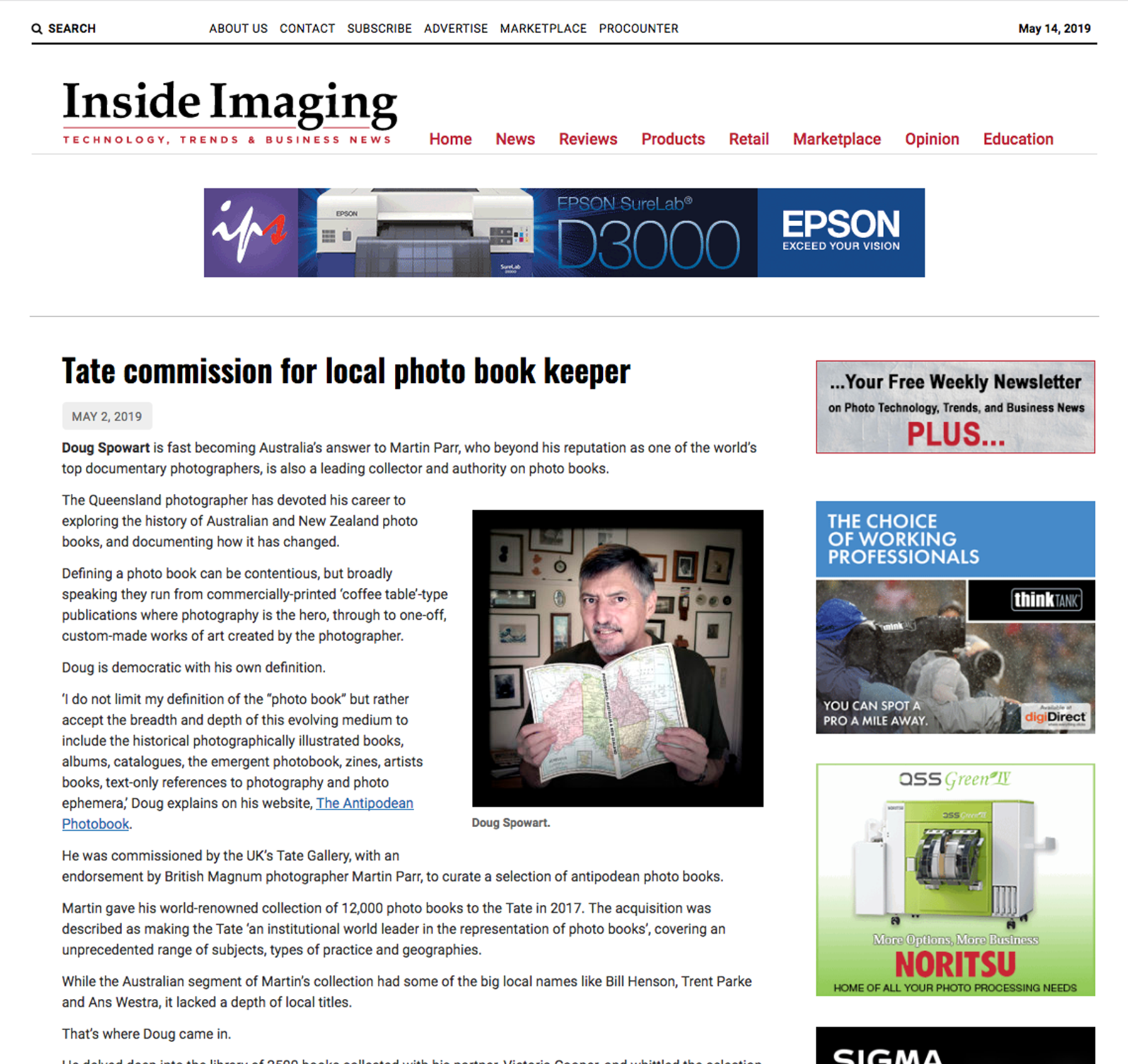
Inside Imaging story
A PDF download of the Inside Imaging post can be downloaded by ‘clicking’ this link. Inside Imaging story-R
.
.
.
.
.
.
.
.
.
.

.
.
.
.
.

 wotwedid