Archive for the ‘Exhibitions’ Category
VICTORIA COOPER: Loud & Luminous – Women’s Day Exhibition
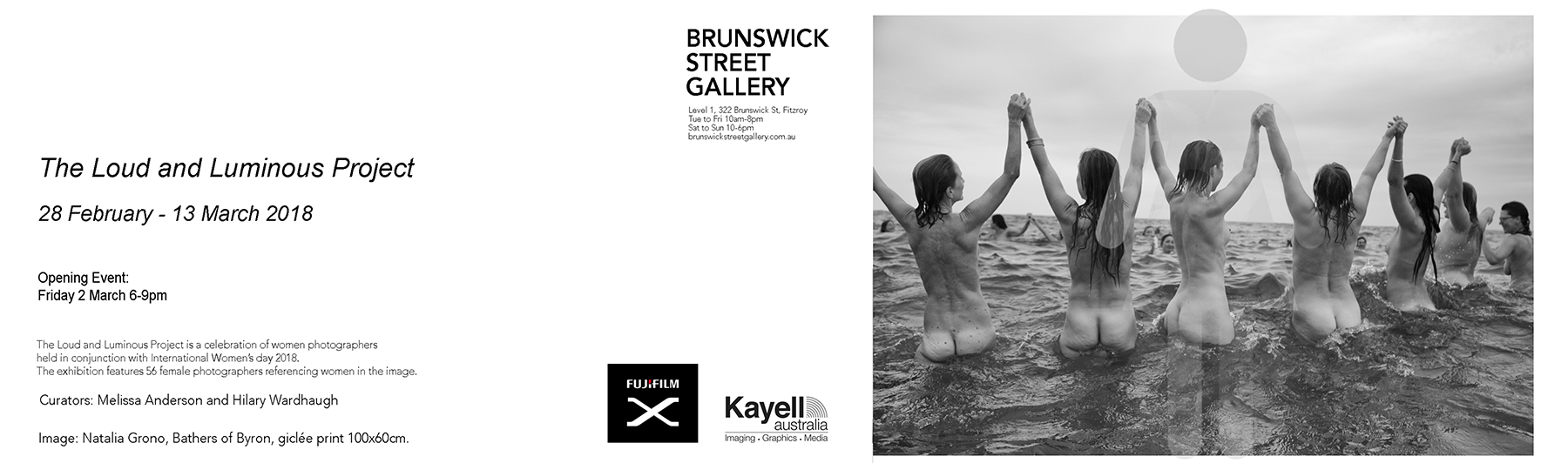
Loud & Luminous invite
.
VICTORIA COOPER IN A NATIONAL EXHIBITION OF WOMEN PHOTOGRAPHERS
LOUD AND LUMINOUS the exhibition, a celebration of Australian Women photographers, has been on show at Brunswick Street Gallery in Melbourne from 28th February – 13th March 2018 linking with International Women’s Day.
The Loud and Luminous mission concieved by Mel Anderson and Hilary Wardhaugh was to recognise and celebrate the contribution of contemporary women in the photographic arts in Australia. The exhibition has 56 emerging and influential Australian women photographers, referencing a women’s symbol in their finished work. Australian women from 9 years to 90 years contributed, with the goal to empower women of today and tomorrow.
The brief was completely open to interpretation. Artists used the figure of a woman literally or referenced it by shape or to make a statement. Each artists’ interpretation is quite unique and as a collective there is a strong message revealed.
This is a timely project and will educate and inspire women of all ages, backgrounds and disciplines by recognising the extensive cultural contribution women photographic artists make. It aims to empower the girls and women of today and tomorrow to chase in their dreams.
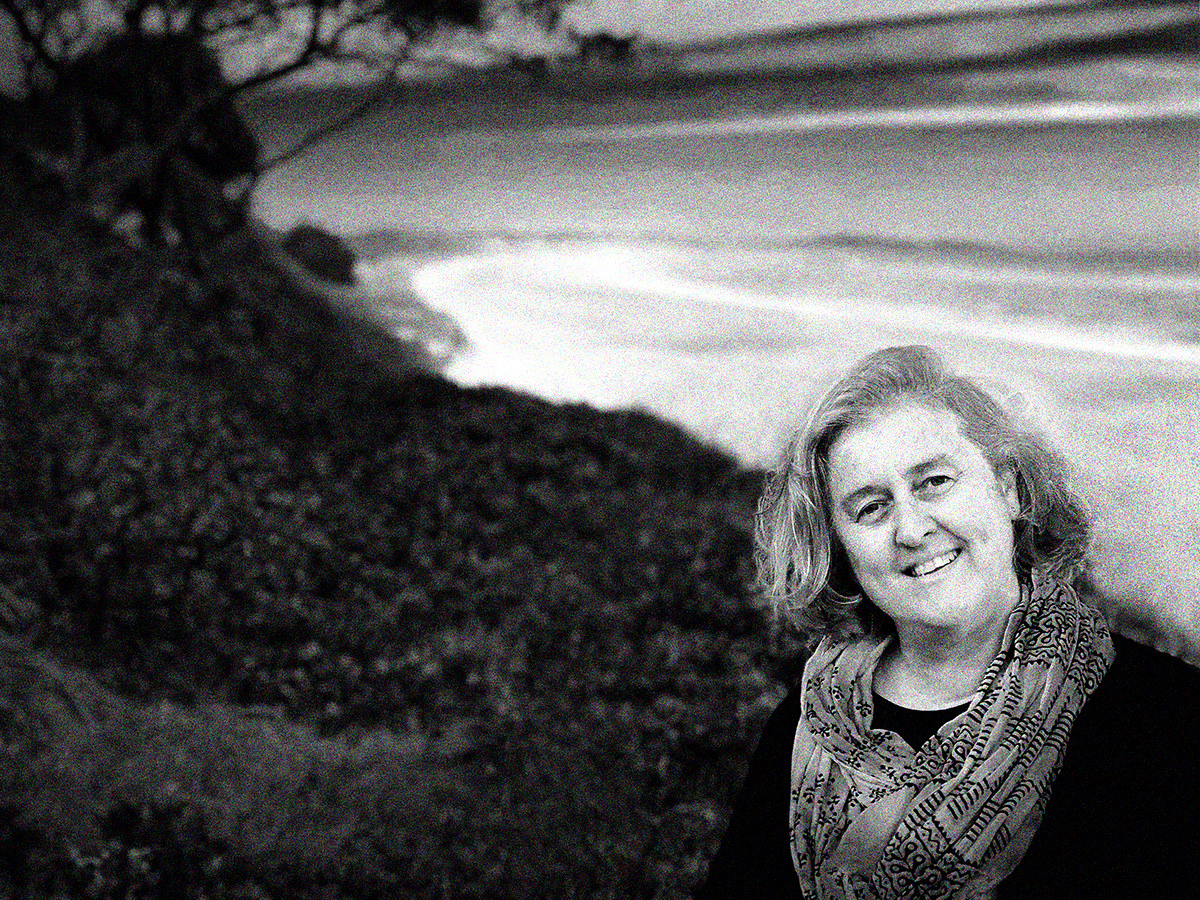
Victoria Cooper portrait
Artists Statement: Dreaming a River by Victoria Cooper
Influenced by Gerhard Richter’s enigmatic painting ‘Betty’, I was drawn to this photograph I made of a friend while travelling along the Danube River in Austria. It is an everyday moment but yet I find myself drawn into the reverie.
At first I struggled with the intervention of the exhibition symbolic motif, but as I contemplated my time walking beside this iconic river it was transformed through the thinking process. The motif multiplied: a thought pattern; a metaphorical weaving into a psychological fabric; or the confluence of symbolic women becoming a river.
Rather than a message or a memory of time and place, this work is embedded in the story of everyday life– of being in the world, and moments of dreaming …
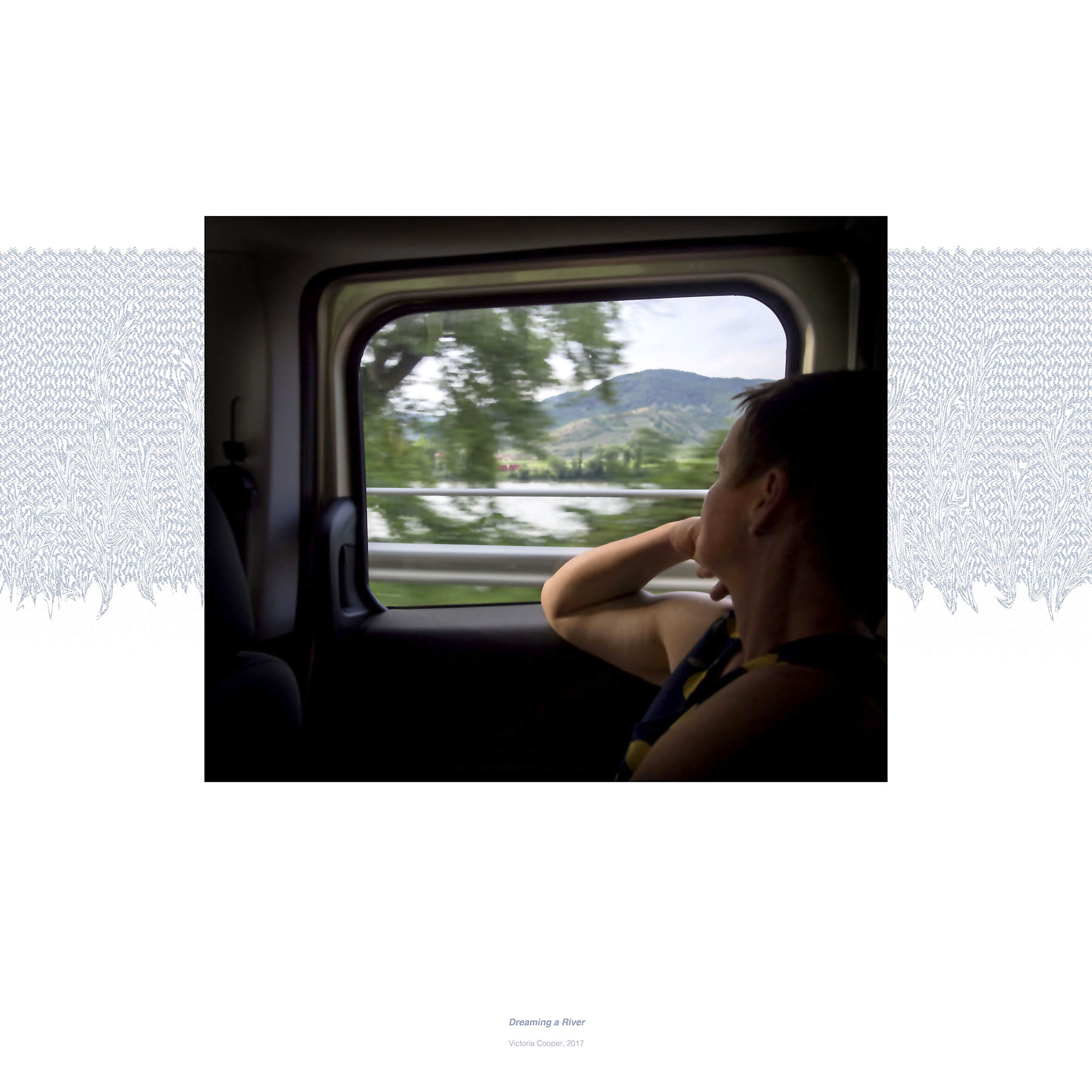
Digital photomontage created for the Loud and Luminous Project World Women’s Day 2018 exhibition
Victoria Cooper talks about her work
Who is in the show…?
SEE THE LOUD AND LUMINOUS SITE FOR BIOGs Click HERE
The opening event

The Loud+Luminous opening PHOTO: Hilary Wardhaugh
The conference
SEE THE LOUD AND LUMINOUS SITE FOR DETAILS Click HERE
A book about the exhibition made by sponsor MomentoPro
Thank you Melissa Anderson and Hilary Wardhaugh for coming up with the idea and coordinating the project through to its conclusion.
Thanks also to the Sponsors…

Sponsors
.
ABBE 2017 – The academic artists book conference
ABBE Logo
The second Artist Book Brisbane Event (ABBE) promised an academic conference dealing with the artists book as a folded and risky space. The event consisted of three elements at the Queensland College of Art and a fourth satellite pop-up exhibition at the State Library of Queensland. Drawn to ABBE 2017 were artists bookmakers, thinkers, commentators, teachers, lecturers and tinkerers from across Australia. All came with a desire to contribute to, or participate in, perhaps this Australia’s penultimate artists book gathering.
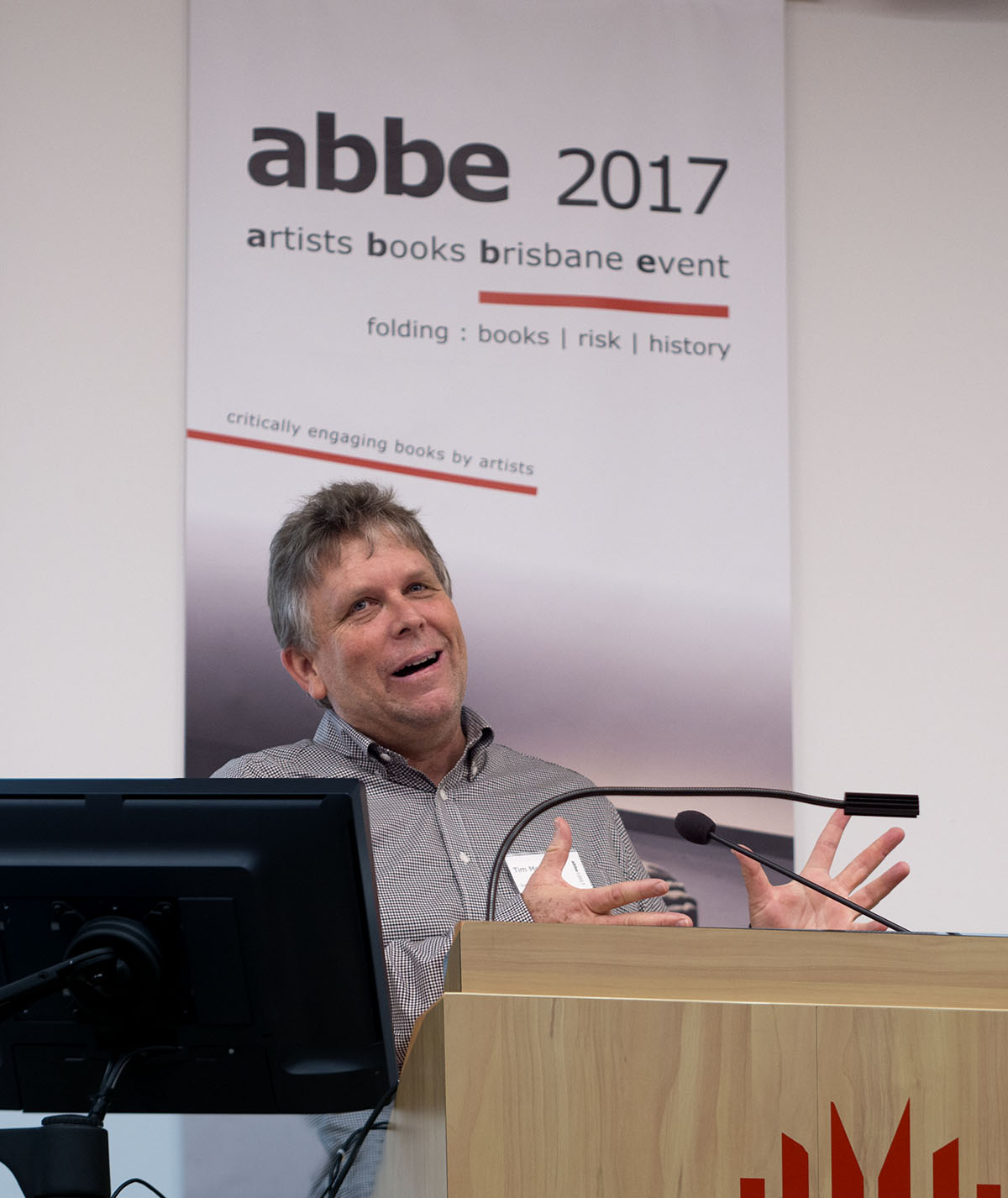
Dr Tim Mosely ABBE coordinator and chair
The event was convened and chaired by QCA lecturer Tim Mosely and was launched by Griffith University’s Dean Academic, Arts, Education and Law Professor Ruth Bereson who spoke about the book as art and the need for that the discipline has for scholarly discourse. She commented that the Griffith Centre for Creative Arts Research ABBE program and its connection with Columbia University’s JAB (Journal of Artists Book) publication of selected papers would contribute to this discourse. Significant keynote speakers, Uta Schneider and Ulrike Stoltz from Germany and Clyde McGill from Western Australia headlined the event. Other program contributors came from practitioners, academic staff, students, and recent graduates from institutions in the USA, New Zealand and around Australia.
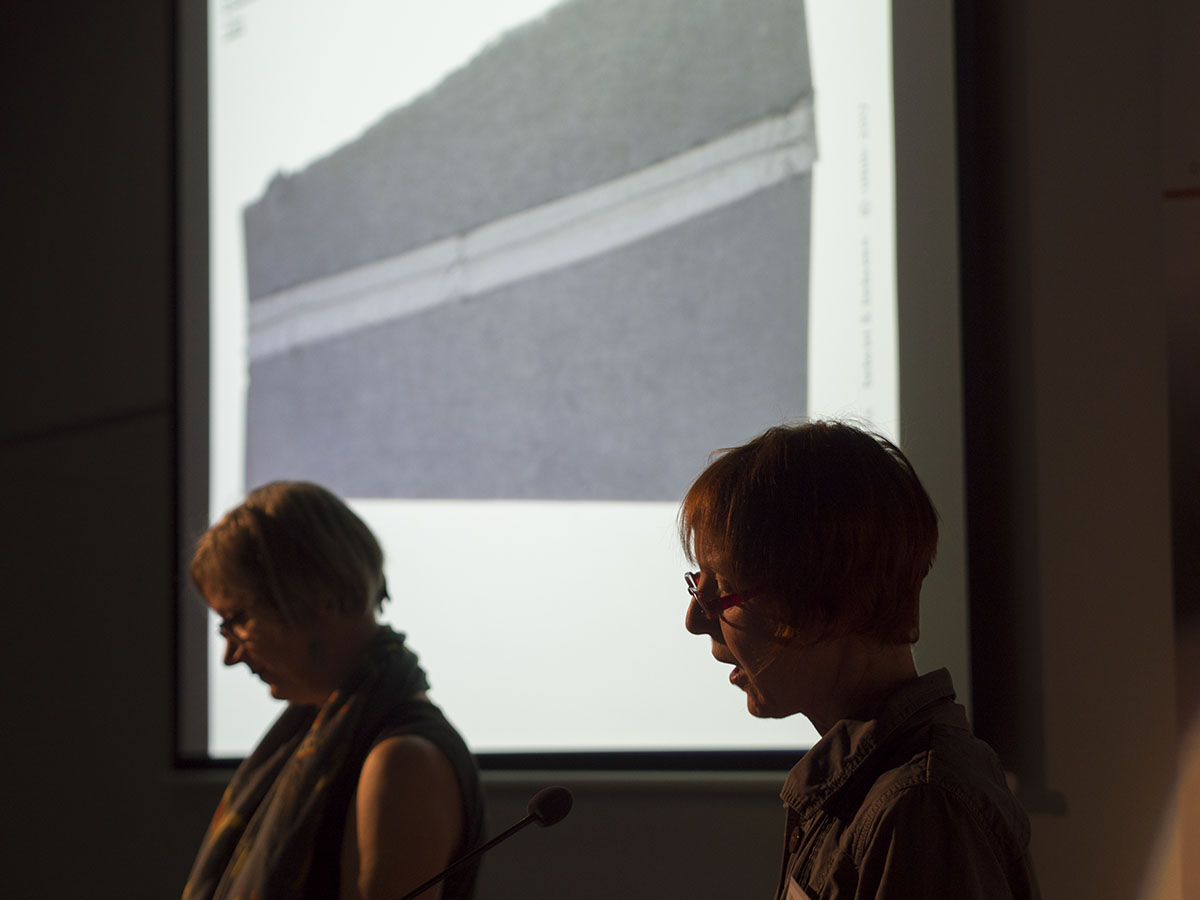
Ulrike Stoltz & Uta Schneider
The first keynotes were Uta Schneider and Ulrike Stoltz who presented a paper entitled betwixt & between. Presenting in tandem their voices were almost like a turning of the pages – recto and verso. They teased out and formed the conference theme of ‘folding’ into an ordered analysis of the physical and metaphorical ways that books fold. They connected the theme ‘folding’ with their own individual and collaborative works and the concepts, philosophies and discussions about artists books that informed them. Mythology, Martin Heidegger on contemprality and the ekstaticon, Carrion, Gillies Deleuze and ‘thinking means folding’ and Michel Serres and ‘the crumpled nature of time’.
The lecture then proceeded to a review of book forms with terms like:
- Folded paper
- Cross fold
- Sharpness of the fold
- Container folds
- Staging folds
- French fold
- Inside folding outside
- Concertina and multi-concertina folds
- Wormholes and science fiction
The works they illustrated their paper with were refined and exquisitely designed. They featured wordplay and poetry, folded page spaces, transparency using ‘show-through’, typography and graphic design elements. As an introduction to the topic, the hour long presentation provided a solid and exciting insight into ways of considering the fold, its forms and the way it can connect with the reader, as receiver of the communiqué.
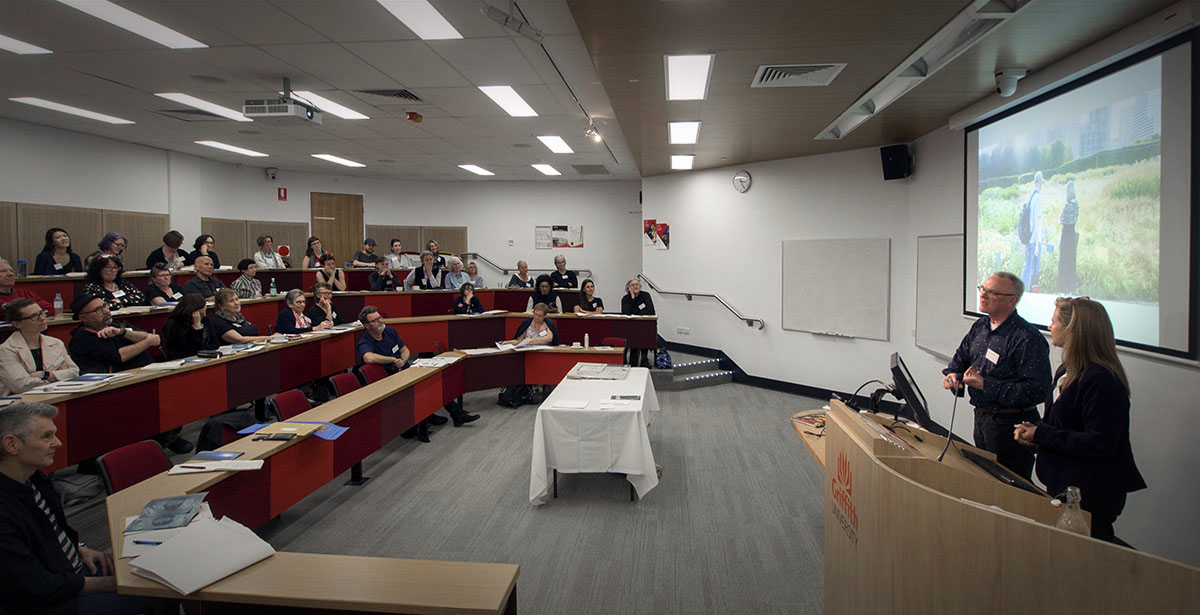
A K Milroy + Brad Freeman presenting
Other presentations on the program included:
- Marian Macken Reading Volume: Between Folded Drawings and Collapsible Models
- Caren Florance & Angela Gardner Unfolding to refold: collaborative wordings
- Paul Uhlmann Meditations on process: Three artists books, letters to the land, sea and sky
- Caren Florance An Instrument of Collaboration: Unfolding the GIW Legacy
- Monica Oppen Eclectic items: early books by Australian artists
- Ana Paula Estrada “Memorandum”, from concept to publication
- Wim de Vos Air, edge, surface image – concertina books
- Nicola Hooper The Citronella Artists Book as an Augmented Narrative
- Amy E. Thompson Folding and the potential of Artists’ Books
- A K Milroy & Brad Freeman Folding and unfolding in JAB41: cultures, research, pages
- Tess Mehonoshen DISINTEGRATE: the destructive folding of materials
- Marian Crawford A lively phantom: the rare and popular artists book
- Carolyn Craig Unfolding(s)
- Isaac Brown Relationship risk and ethics in photographic artist books
- Monica Carroll & Adam Dickerson Unfolding the episteme of artists’ books
- Bridget Hillebrand Handling folds: an intimate encounter
- Julie Barratt & Virginia Barratt The exquisite fold, the immanent word
- Maren Götzmann The Anarchist Notebooks


While most papers were read from the dais with carefully illustrated PowerPoint slides the second keynote speaker Clyde McGill emerged on the stage with a device that could be called a ‘bibliophone’. McGill had altered a range of book titles by folding back the pages and attaching a sound pick-up to the book cover and then connected the 7 books to an amplifier. Volunteers from the audience were given bonefolders as plectrums and, on McGill’s guidance were instructed to make the various movements of hands and object associated with hand-making a book. The haptic actions were converted to sound and the room filled with the noise of ‘making’ associated with a great deal of laughter.
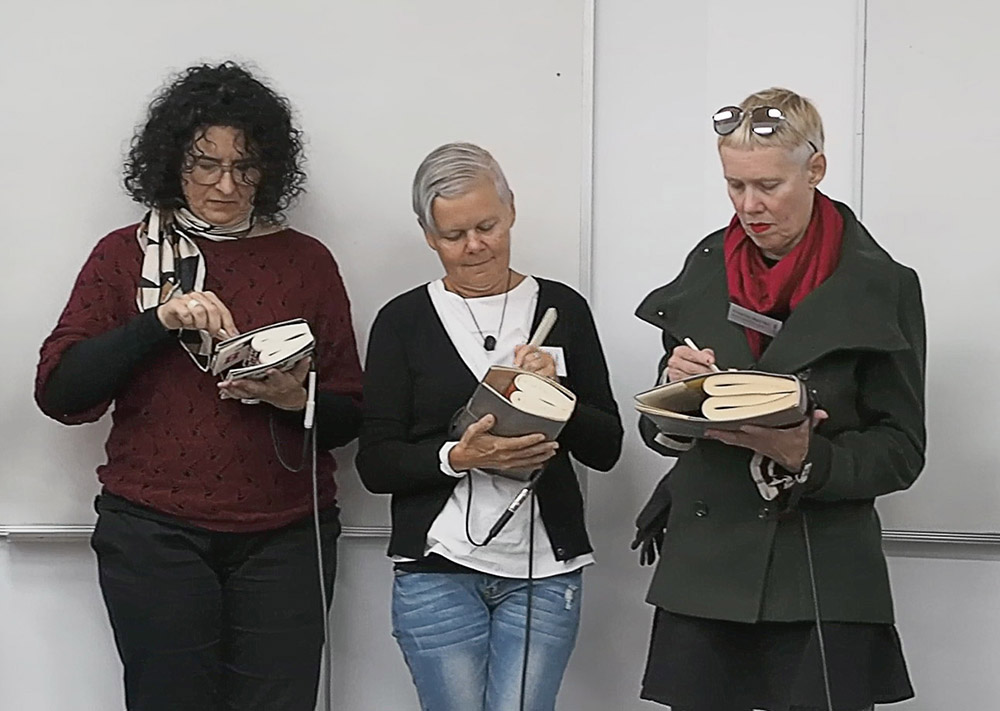
Making book music with Clyde McGill


McGill continued his presentation with a detailed investigation of the idea of folding books. Where possible his own works were referenced. At other times he created new books by playful investigation… bending and folding light was a particularly humorous but gave those present an insight into how the artist’s off-tangential and obtuse thought processes process can lead to new conceptual and visual discoveries.

Julie and Virginia Barrett’s performance
Another departure from the read-the-paper format was a performance by Julie Barratt and her sister Virginia Barratt. Attendees, on returning to the lecture theatre after morning tea, found the space darkened except for two sharply defined spotlit circles. One pool of light was vacant, just the floor’s carpet – in the other artists’ book maker Julie Barratt was busy unfurling paper, measuring it and tearing of lengths and positioning them in a stack on the table before her. Also on the table were scissors a ball of thread and other bookmaker’s things. The unroll>measure>cut>position sequence was progressing methodically for some time making the sheets one might guess that would go to making a book. A soundtrack began with a female voice expressing thoughts ideas, word associations sometimes repeated – perhaps the thoughts of the bookmaker? There was a rustling sound – stage right. Gradually a large dome-like white shape appeared and moved towards the empty spotlight area. The shape was covered in what looked like pages – ominous maybe… the audio continued and Julie Barratt left her table and proceeded toward the shape and picked up a folded sheet and returned to the table – flattening out the sheet it was melded with other sheets. The performance continued. What was it about? What came to my mind was that the shape was like the book working with Julie so its story could be told as in Paul Carter’s ‘material thinking’. At the end of the performance it was revealed that Virginia Barratt, Julie’s sister, was the artists book ‘monster’.


Another aspect of the conference presentations were two papers by photographers Ana Paula Estrada and Isaac Brown both featuring bookwork’s that they had created. Estrada, as a State Library of Queensland Siganto Foundation Creative Fellow, discussed concepts of memory, photography and old age as the inspiration for her project. She detailed the process of design, making maquettes, refining and working with commercial printers and binders to complete the project. Brown spoke of the integration of his project and PhD study focussing on his relationship to his father, a Vietnam veteran. Aspects of text and dialogue were addressed as well as Brown’s own recent fatherhood. What was interesting was the informal narrative and connection with audience that both presenters had and the expanding space of the artists book being inhabited by photographers.
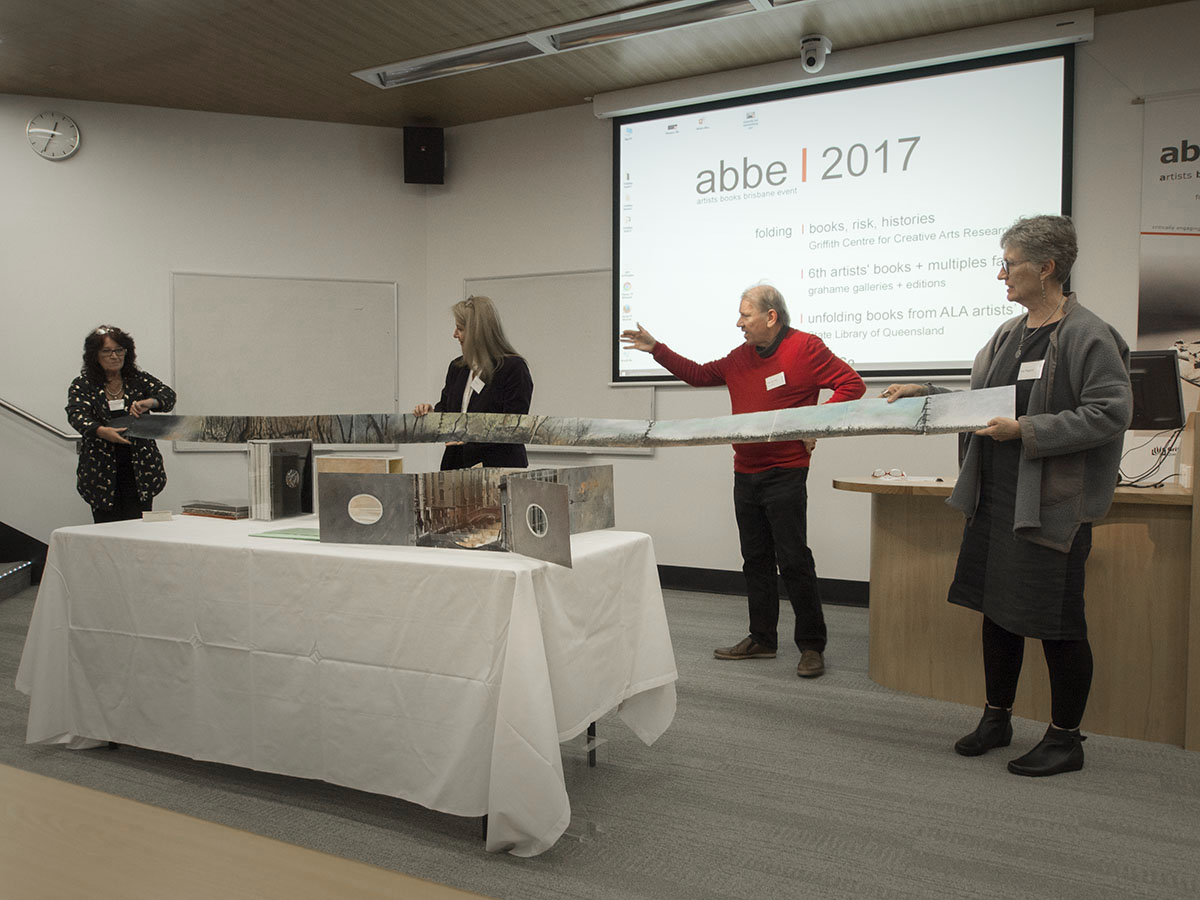
Wim de Vos presents his work
Wim de Vos made an animated presentation and several helpers as his concertina books by the metre unfolded across the width of the theatre and tunnel books expanded, evidence of the pre-eminence of his artists book practice in Queensland.


Midway through the academic papers a ‘plenary’ session consisting of a panel of artists’ book ‘movers and shakers’ discussed several issues relating to the discipline. The session quickly became absorbed with the perennial issues of nomenclature, the dearth of private and public purchasers of bookworks and the grooming of possible artists book collectors. The impact of the term ‘Art Book’ was mentioned and the way events associated with the term has grown in popularity worldwide and has come to encompass artists books, photobooks, zines, art books and institutional catalogues. Another topic mentioned was the importance of research and critical commentary on the discipline. A suggestion was made for the formation of a ‘double-blind peer review’ collective.
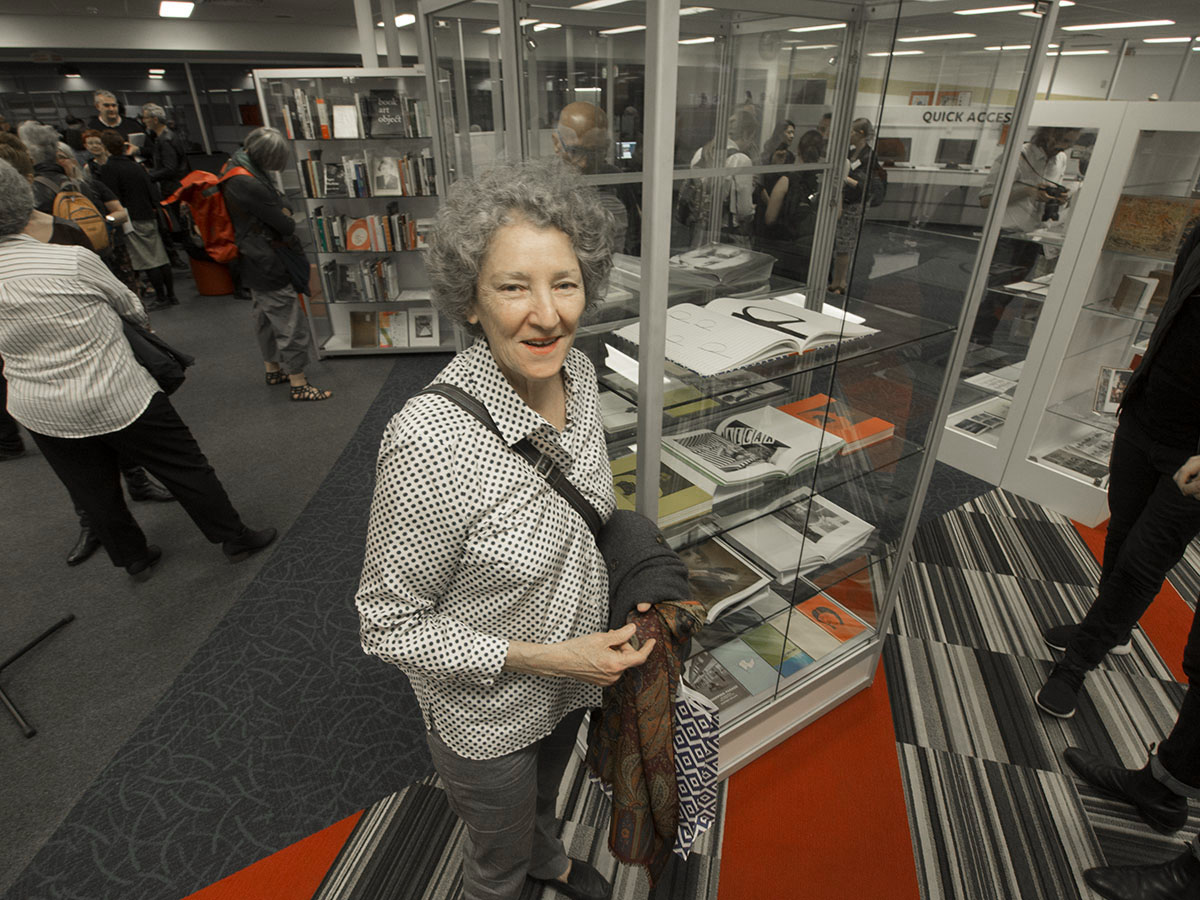
Noreen Grahame at the QCA Library and her ‘… & So’ artists book show
On the evening of the first day Robert Heather, Director, New England Regional Art Museum opened the exhibition “… & So” at QCA Library. The exhibition features a significant collection of seminal Australian and international artists books and multiples sourced predominately from Noreen Grahame’s Centre for the Artist Book collection and her numero uno publications alongside artists’ books from the Queensland College of Art. A list of the selected works can be downloaded here. ALA Books for abbe 2017 … $ so Exhibition list
Mid afternoon on the second day the State Librarian and CEO from the State Librarian of Queensland Vicki McDonald opened the 6th artists’ books + multiples fair. Twelve tables presented a hand-to-eye experience of books by significant makers of contemporary artists’ books. These included:

A silhouette view of the Grahame Galleries tables
Stand 1 – grahame galleries + editions
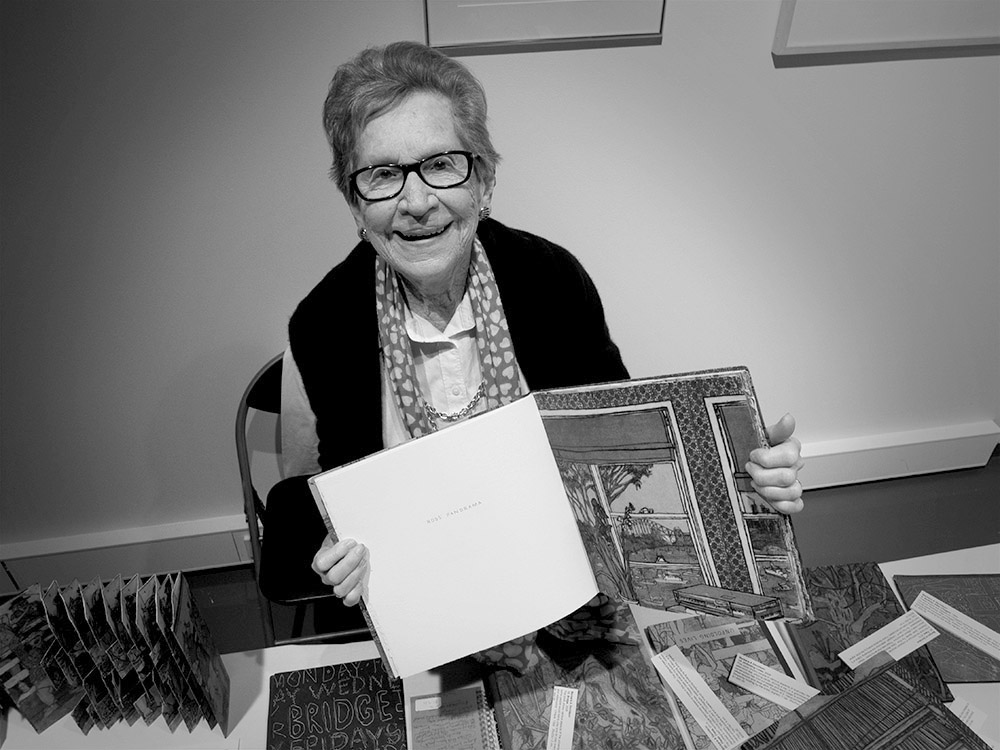
Barbara Davidson

Caren Florance
Stand 3 – Caren Florance – Ampersand Duck

Photo from ABBE Artists Book Conference July 6-9 2017 at the Queensland College of Art

Anne-Marie Hunter
Stand 7 – Psyclonic Studios – Anne-Maree Hunter
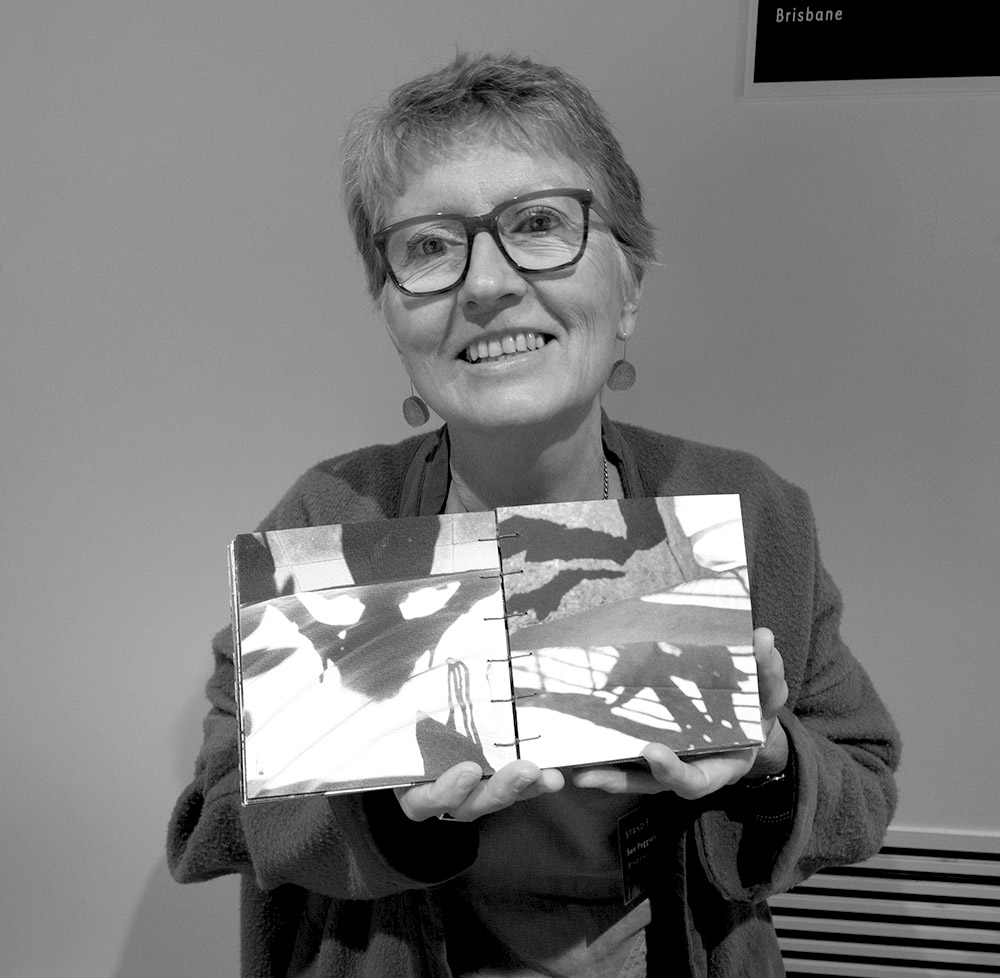
Sue Poggioli
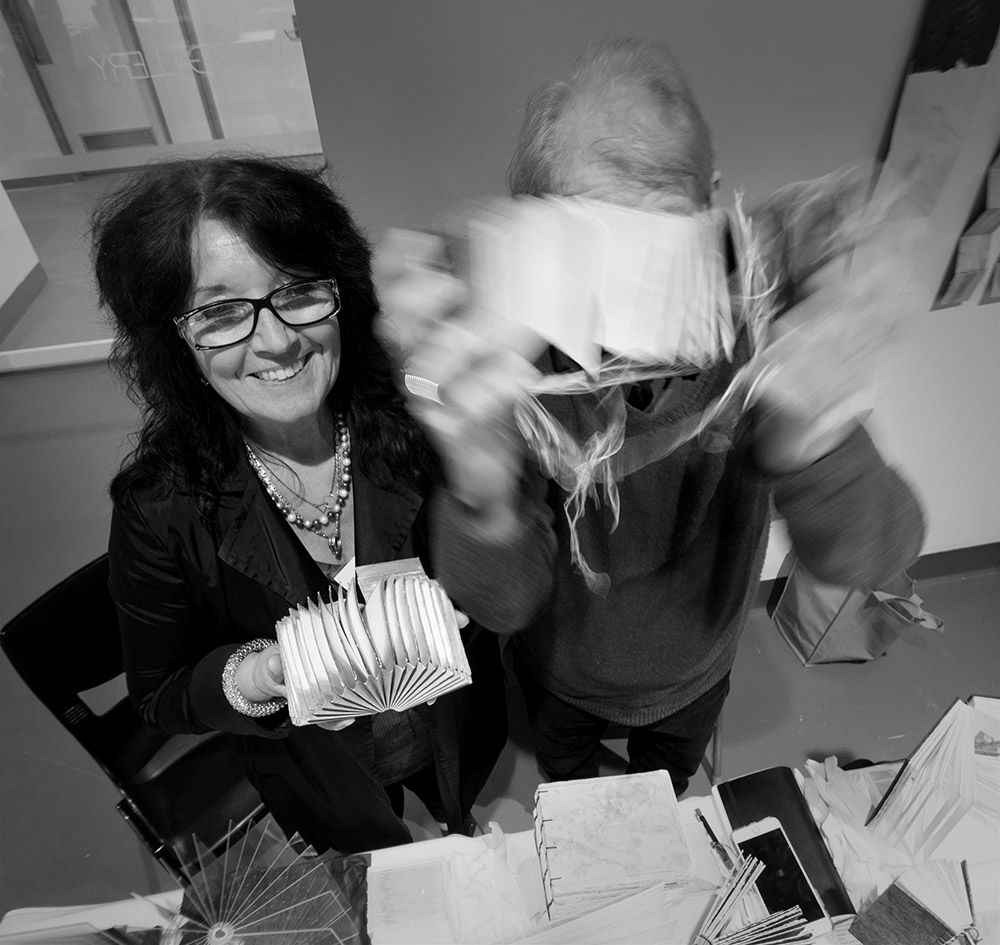
Adele Outteridge & Wim de Vos

Ulrike Stoltz & Uta Schneider
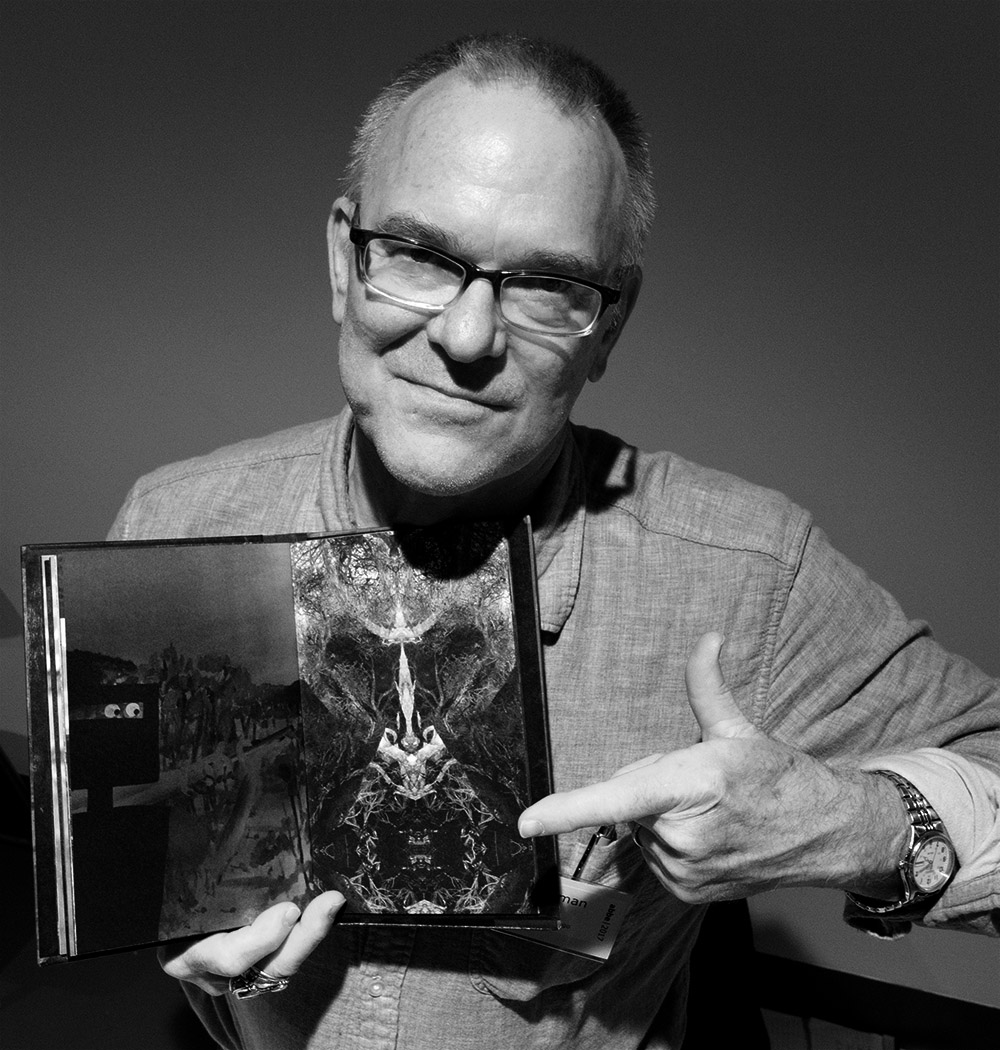
Brad Freeman

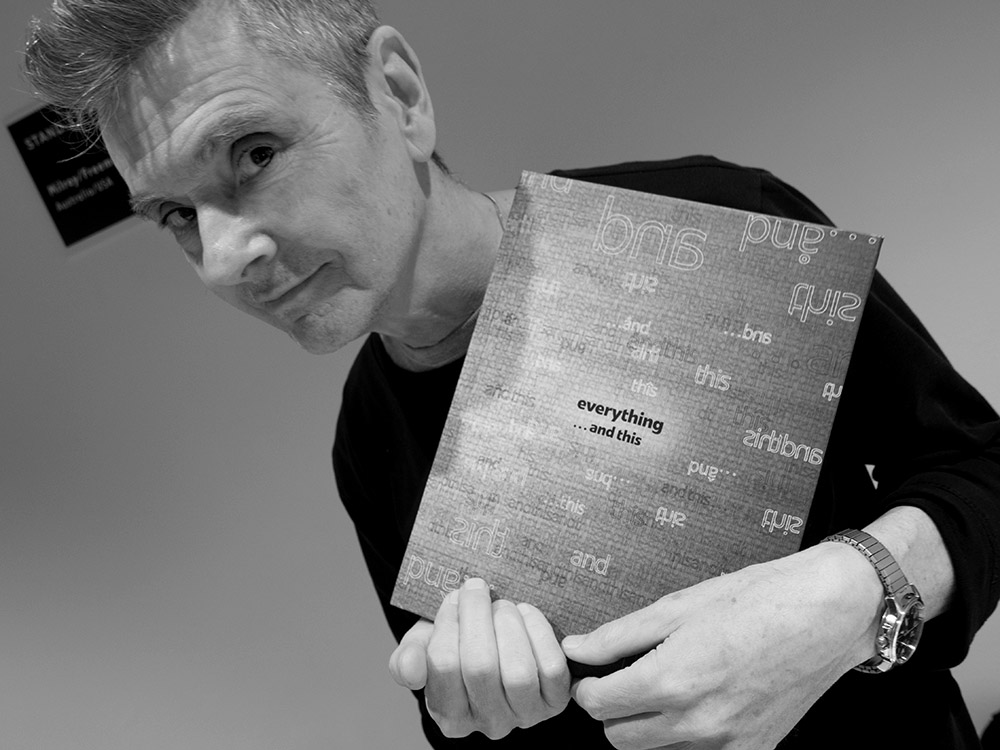
Anita Milroy
Lyn Ashby
Stand 11 – Milroy-Australia / Freeman-USA / Ashby-Australia
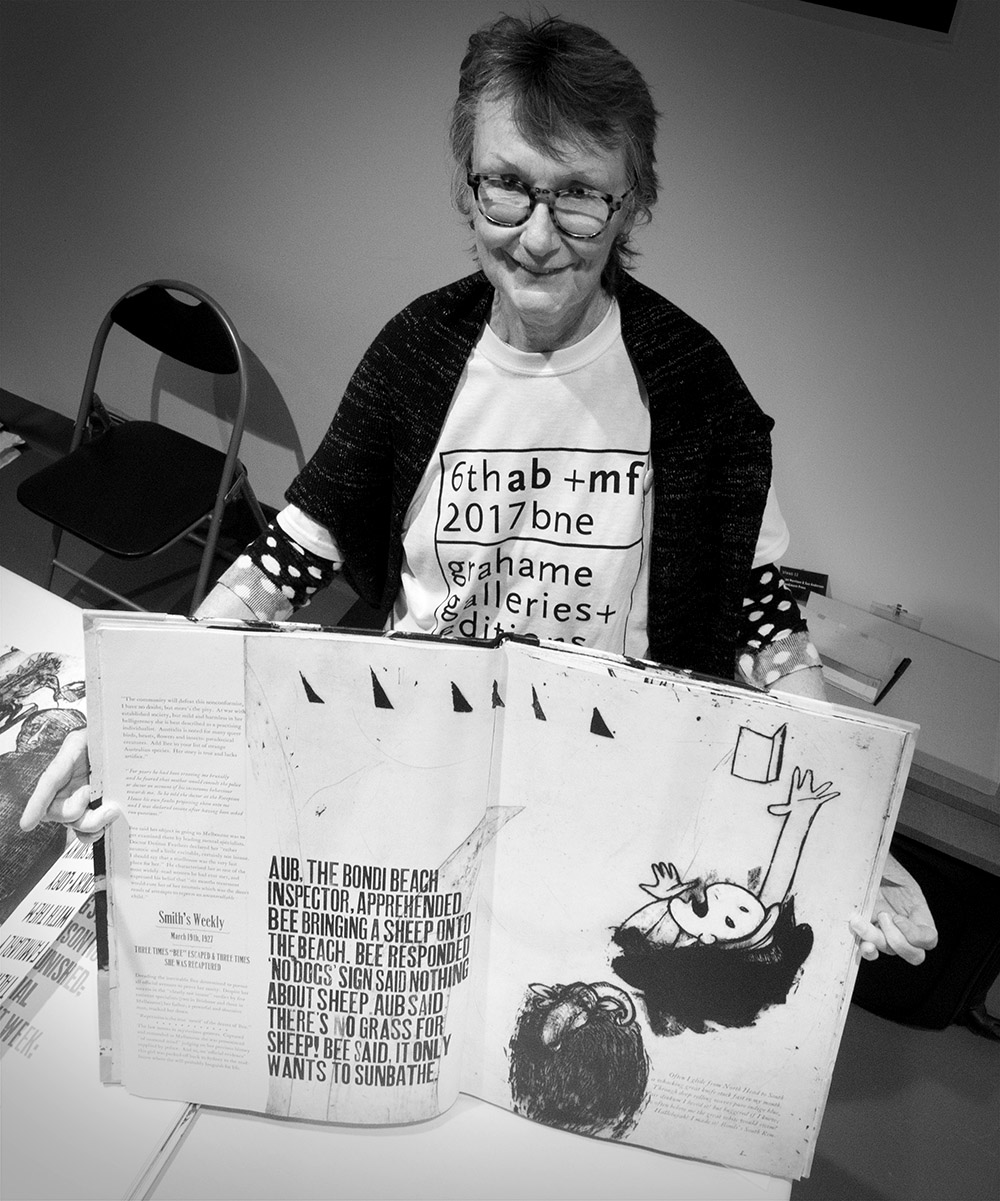
Sue Anderson

SLQ Australian Library of Art artists book exhibition
To complement the theme of the ABBE conference a special collection of concertina and folded books was curated by Christene Drewe of the Australian Library of Art at the State Library of Queensland. Open only for 2 hours on the Saturday morning of the conference this satellite event was well patronised. The Australian Library of Art is recognised as Australia’s premier public collection of artists books and the range of works presented was a testimony to the variety and depth of the collection. A list of the books displayed can be downloaded here. ALA Books for abbe 2017
In keeping with the conference theme the community of practice for artists books in this country is supported by the ‘folding’ and ‘unfolding’ of ideas, theories, concepts, access to exemplar book samples and the social connection that ABBE provides. While selected ABBE 2017 papers will be published in JAB, beyond that, the influence and impact of this gathering highlights the need for ABBE to provide this ongoing forum in Australia.
Dr Doug Spowart
All photographs and text ©2017 Doug Spowart
.
.
ANNOUNCEMENT: The 2016 Australian Photobook of the Year Award
Momento Pro and UNLESS YOU WILL joined forces to present the 2016 Australian Photobook of the Year Awards culminating with a presentation in Melbourne on February 17, 2017.
The awards were open to unpublished, self-published or trade published photo books by Australian citizens and residents. The Australian Photobook of the Year Awards celebrates excellence and innovation in photobook creation and also showcases the work of Australian photographers to a growing local and international audience.
THE ANNOUNCEMENT OF THE WINNER

Libby Jeffery talking about the Award
A group of around 70 photobook makers, collectors, commentators and others interested in the discipline attended a presentation of the finalist books and the announcement of the overall winner at Magic Johnston in Melbourne on February 17, 2017. Brief speeches were presented by UNLESS YOU WILL’s founder Heidi Romano and MomentoPro’s Libby Jeffery were followed by the announcement of Katrin Koenning & Sarker Protick’s Astres Noirs as the winner. The Commended awards were also announced and attendees were able to experience the finalist’s books first-hand.


.
THE WINNER: Astres Noirs by Katrin Koenning & Sarker Protick & Chose Commune
.

APOTY WINNER: Astres Noirs by Katrin Koenning & Sarker Protick & Chose Commune
THE 2016 APOTY FINALISTS
- Astres Noirs by Katrin Koenning & Sarker Protick & Chose Commune Winner
- Elsewhere by Fuad Osmancevic Commended
- J.W. by Clare Steele Commended
- Memorandum by Ana Paula Estrada Commended
- Some Want Quietly by Drew Pettifer & M.33 Commended
- Surface Phenomena by Bartolomeo Celestino & Perimeter Editions Commended
- Bird by Gary Heery
- Courts 02 by Ward Roberts & Editions
- Elemental by Rohan Hutchinson
- Golden Triangle by Hannah Nikkelson
- Kinglake by Jade Byrnes
- Two Pandanus Trees Side by Side by Aaron Claringbold
.
A detailed report and images of the winner and commended books can be seen on the Australian Photobook of the Year Website – HERE
ALL photographs ©2017 Doug Spowart
.
.
.
.
ZINES IN MELBOURNE: Sticky Institute’s Festival of the Photocopier
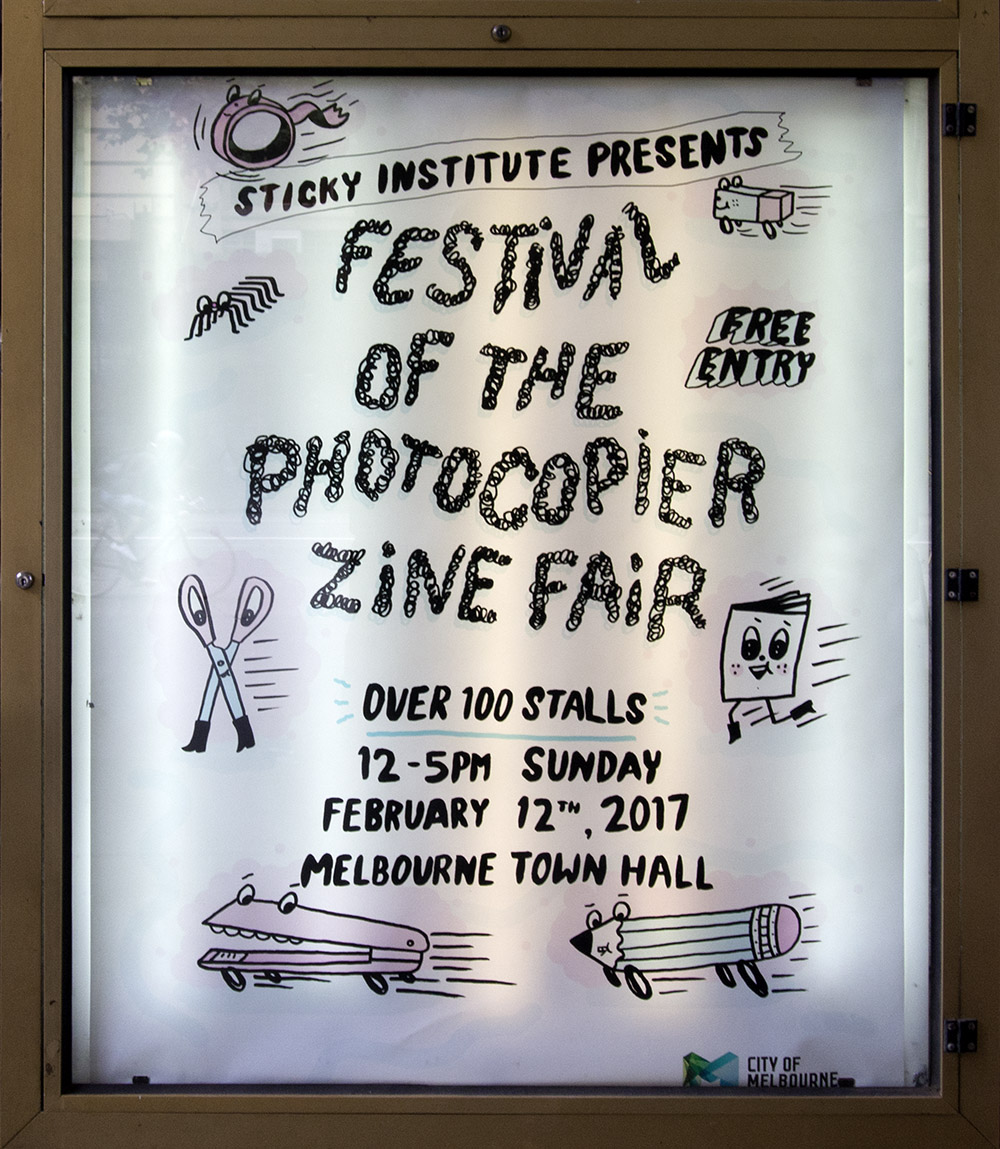
Town Hall foyer sign
On Sunday 12 February the Melbourne Town Hall and was packed with sellers, lookers and buyers attending the Sticky Institute’s Festival of the Photocopier Zine Fair. At a guess, there could have been around 100 zine tables with a variety of zine-makers: both showing their own work, or representing other zinesters. For the visitor to the Fair there was an opportunity to see and handle almost any kind of communication that could put onto a sheet of paper, or into collated pages – folded, stapled, glued, stitched and sewn. Each ‘publication’ representing a personal approach to what the medium “zine” means to the author. And, as the ‘Zine’ is a slippery medium those within the discipline keep pushing the limits by integration of opportunistic technologies and ideas gleaned from contemporary media.
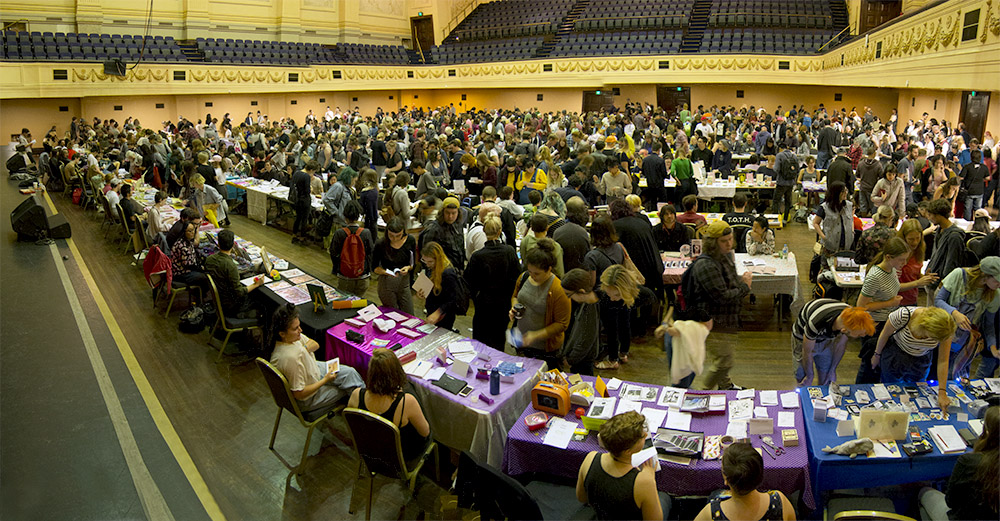
PHOTO: Doug Spowart – Stickies Festival of the Photocopier Zine Fair 2017
The content of the zines presented to us were from a broad church of visual and written media including: text as prose, poetry or as visual typographic forms, and calligraphy. There was a rich diversity of illustration from photo-realism to comic flat field work, photographs and even, in one sighted example – the ancient art of marbling. The narrative forms in these publications ranged from concrete poetry, prose, comic stories and disjointed stream of consciousness curated visuals.
In keeping with the tradition some zine makers aired their political opinions while others shared a fascination of contemporary everyday life. There were groups that concentrated on gender issues, music and issues of the street, while others presented dreamy naive and whimsical scenarios, adventures in suburbia, the road and outer space, nonsensical ghoulish and vampire episodes.
Our specific interest were zines based on or utilising photos sometimes referred to as photozines, as well as others that use photomontage in their narrative or conceptual work. Examples seen dealt with topics like the destruction of traditional family homes in the Chinese city of Guangzhou, skateboard stories, and a faux streetscape made up of photos of distressed buildings.
The Fair was a place to network. Greetings were made with like-minded people across the display tables and discussions took place about zines, life and art. We caught up with a few people we knew – David Dellafiora, Gracia and Louise and Glen Smith – Queensland’s zine hero Jeremy Staples was in the building somewhere but we didn’t get to meet. Zine-makers, or sellers, were keen to engage with us to tell the story of the work and where it fits with their practice and their life.
But did anyone sell anything? Many visitors were seen toting quite a few brown envelopes and calico bags filled with new additions to their personal collections. Perhaps a personal experience might shed some light on how success for such an event could be measured. It was right at the end of our shop, we had spent our budget and were talking to two young zinesters who were actually making their little photo zines on demand at their table. Their selling price was $3 and we wanted one of each but could only scrape together $5 in coin. One of the zinesters said ‘that’s fine, I’ll take the $2’, and stated that, ‘it’s important to have my zine out there…’
Being out there with your work. That is what zines are all about … your message in print as a democratic multiple … telling your story, was always what zines were about. That tradition it seems, continues…
Doug Spowart
February 13, 2017
.
SOME ZINES ADDED TO OUR COLLECTION
.
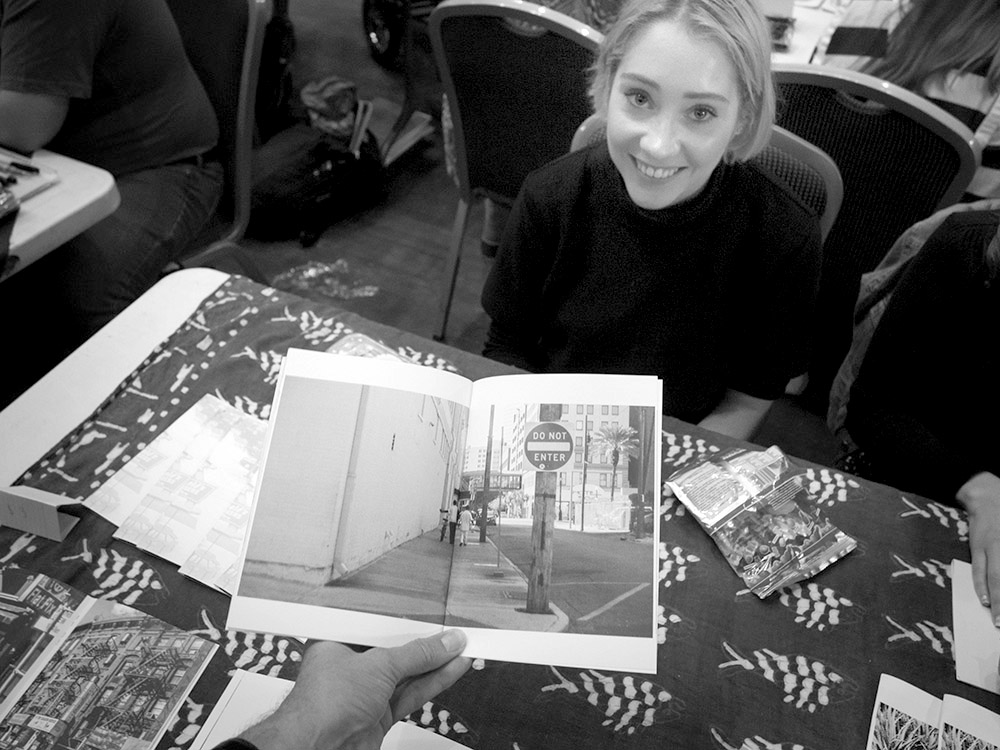
Trudi Treble at the Fair
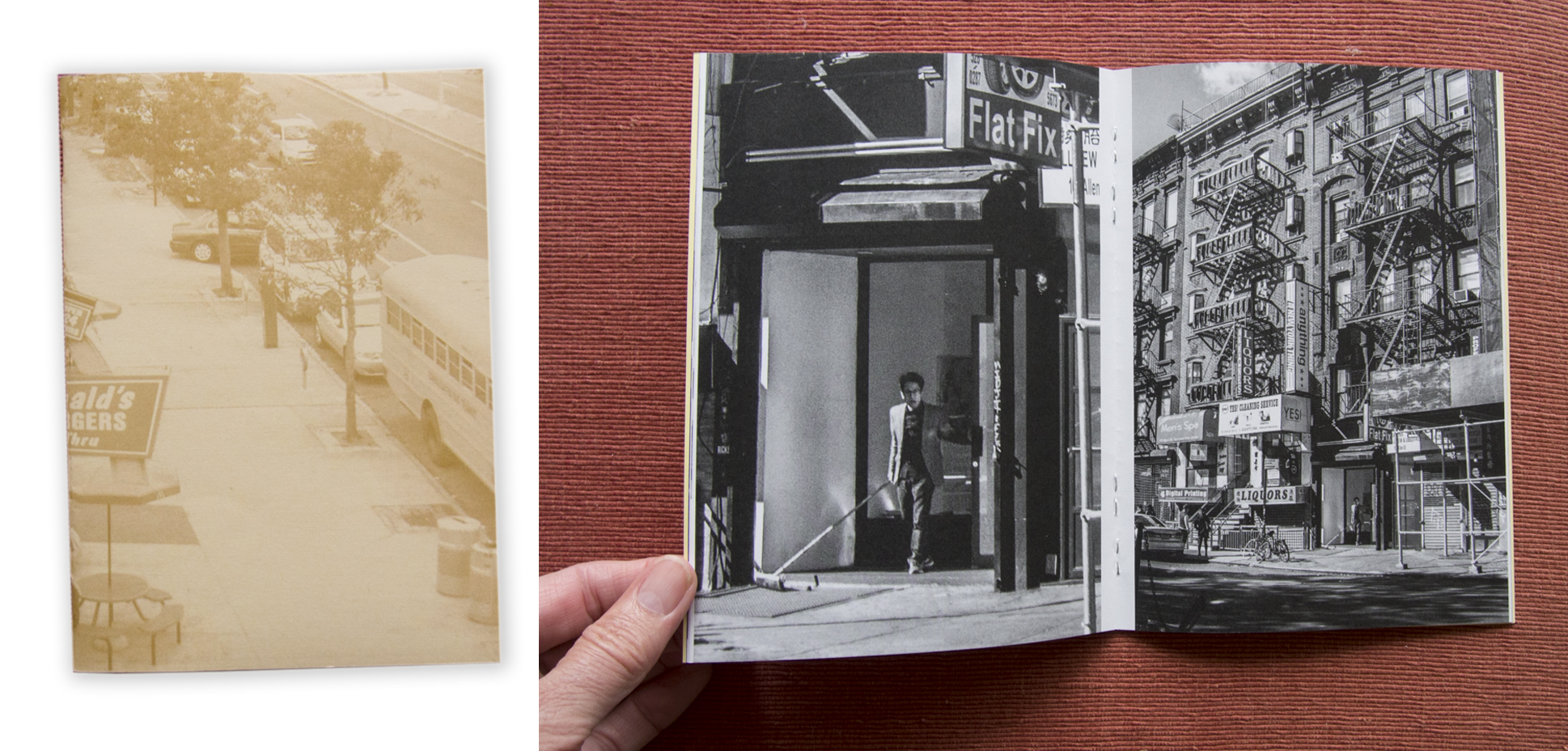
Trudi Treble: united states of america – october 2017 – november 2017, my diary. #6/25.
Trudi Treble – Instagram: trud.i
.
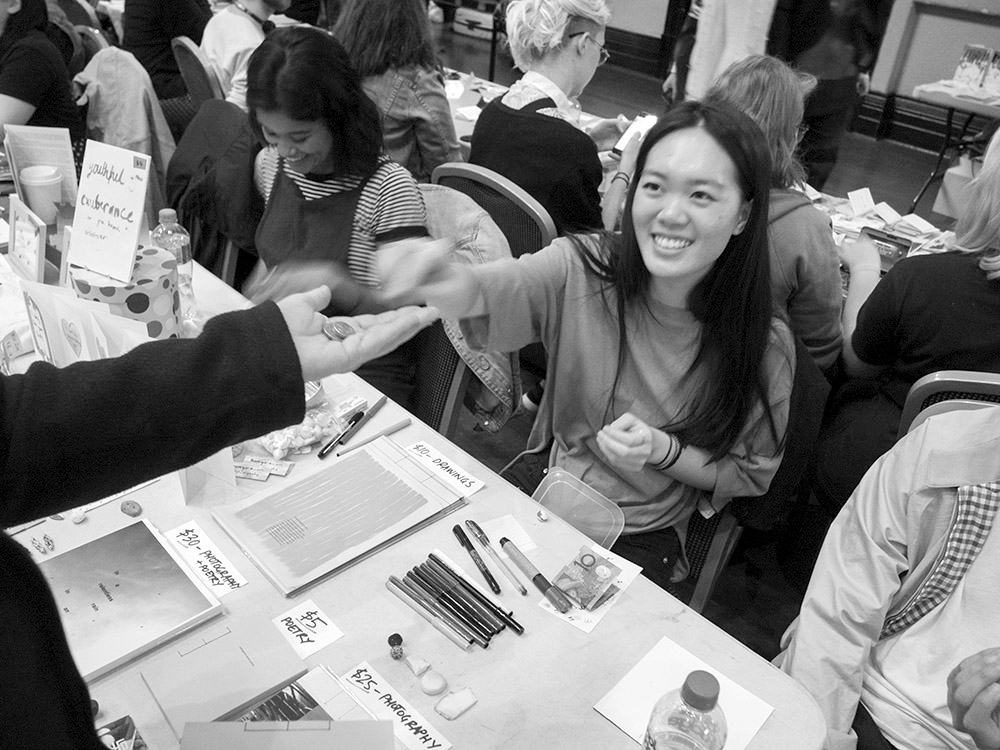
Johanna Ng at the Fair
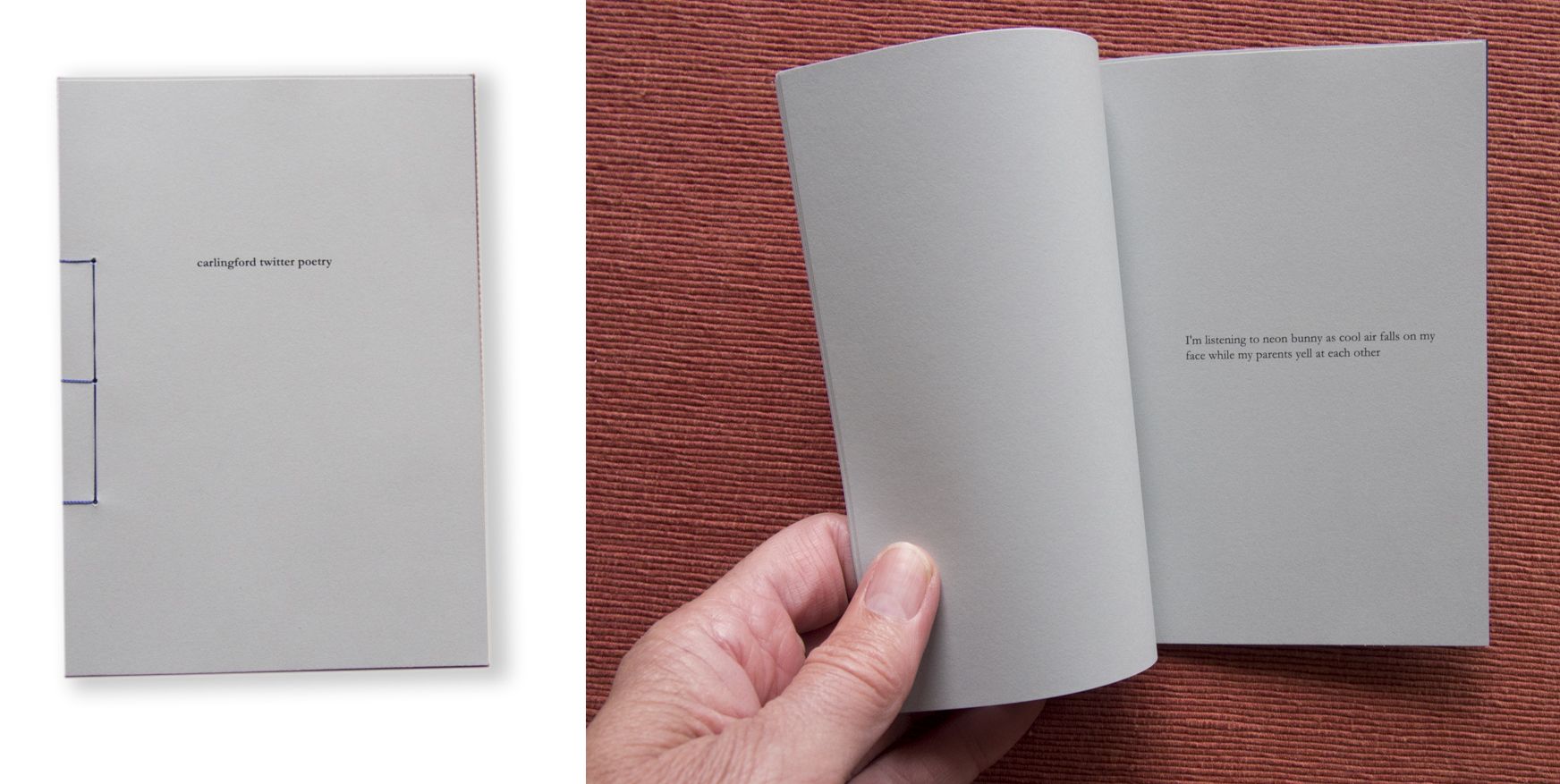
Johanna Ng: carlingford twitter poetry
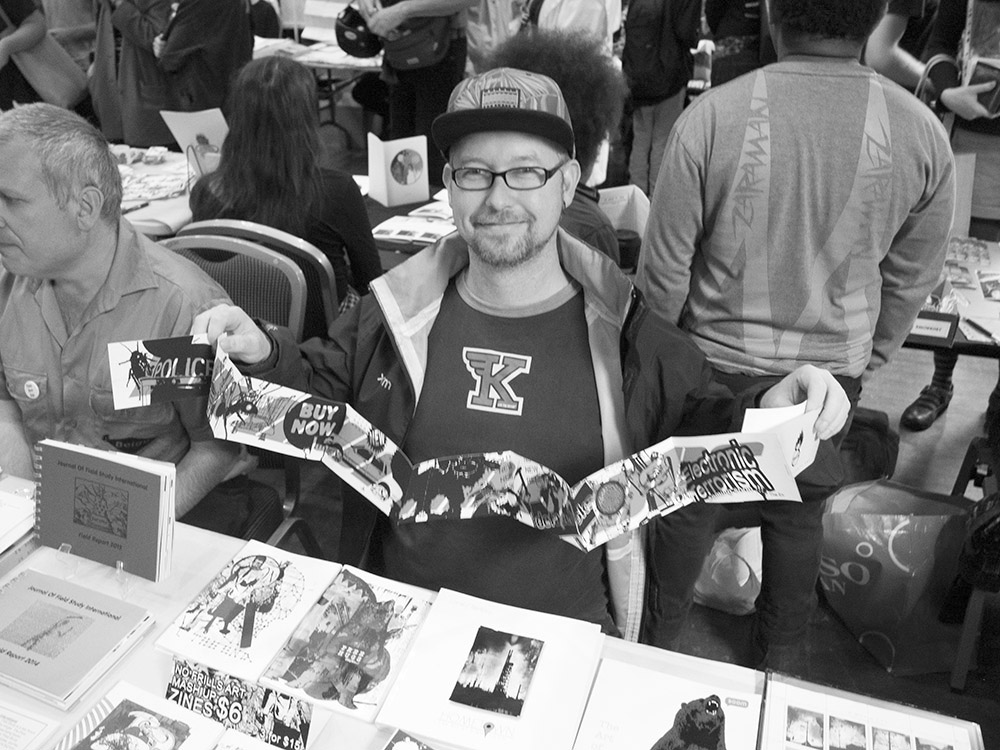
Glen Smith at the Fair
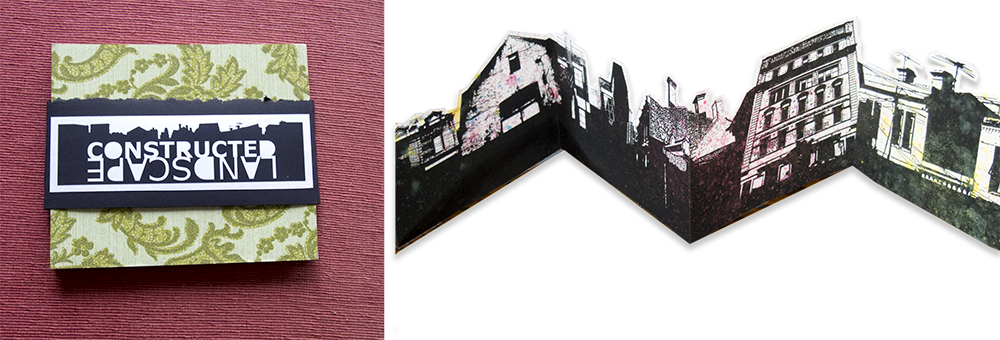
Glen Smith: Constructed Landscape
Glen Smith: https://nofrillsart.net/
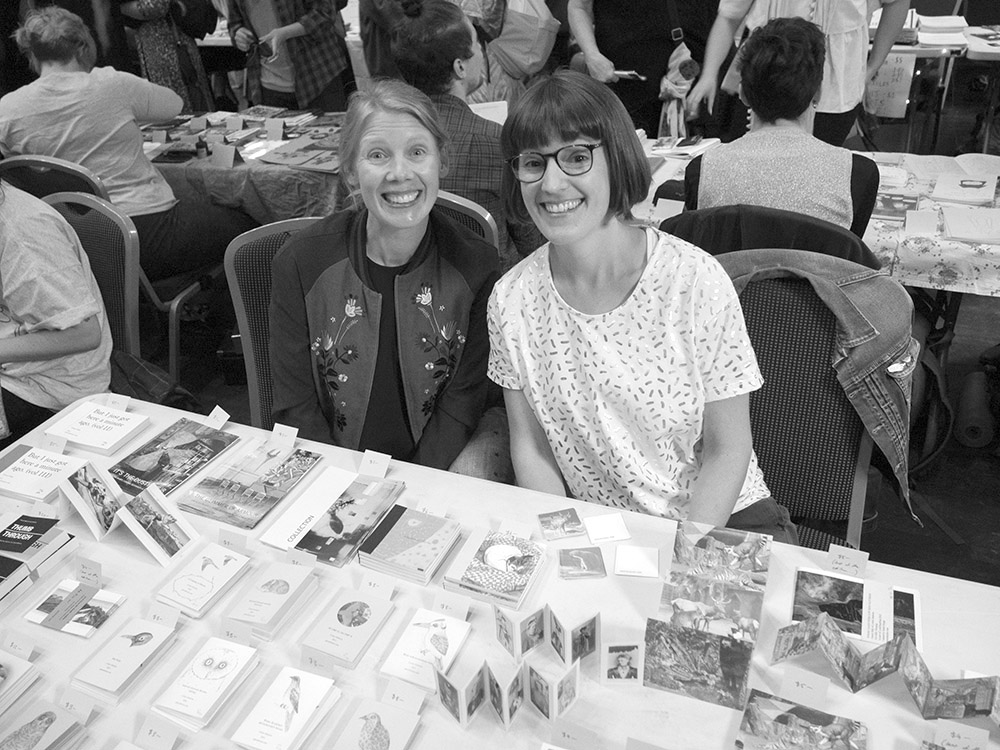
Gracia and Louise
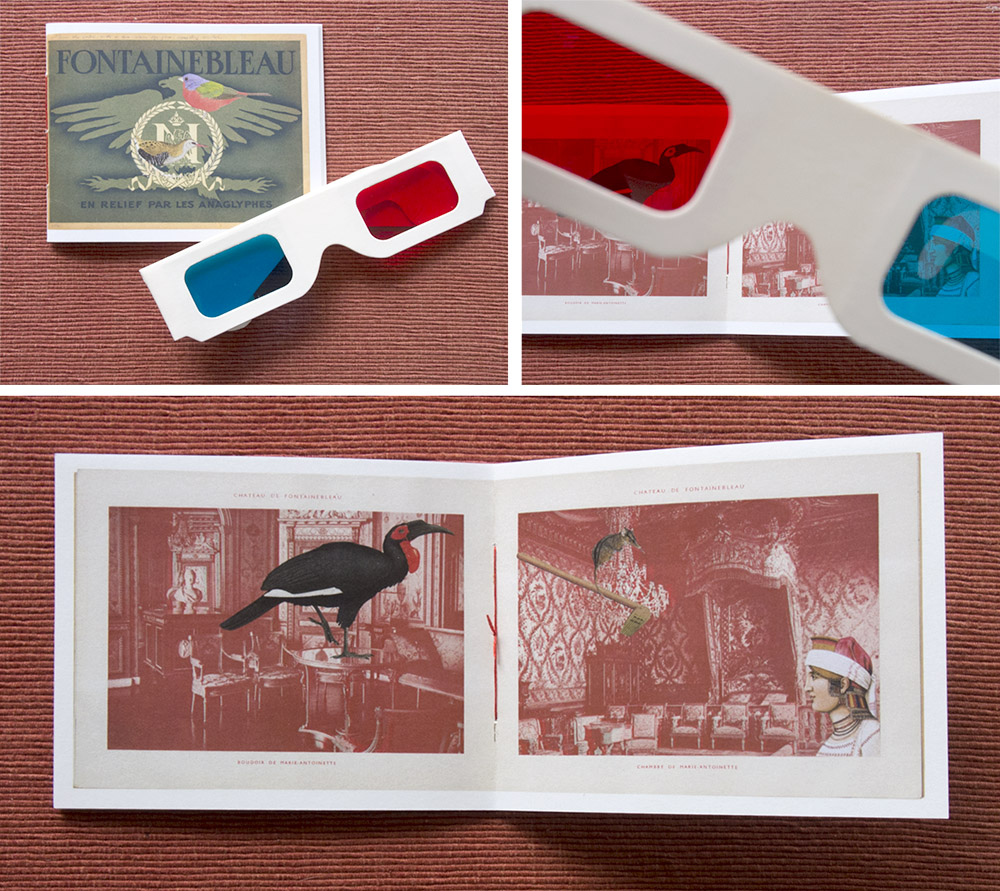
Gracia Haby: Under the water with a two-colour eye-glass, something similar (2014) #49/100
Gracia and Louise: www.gracialouise.com
.
.
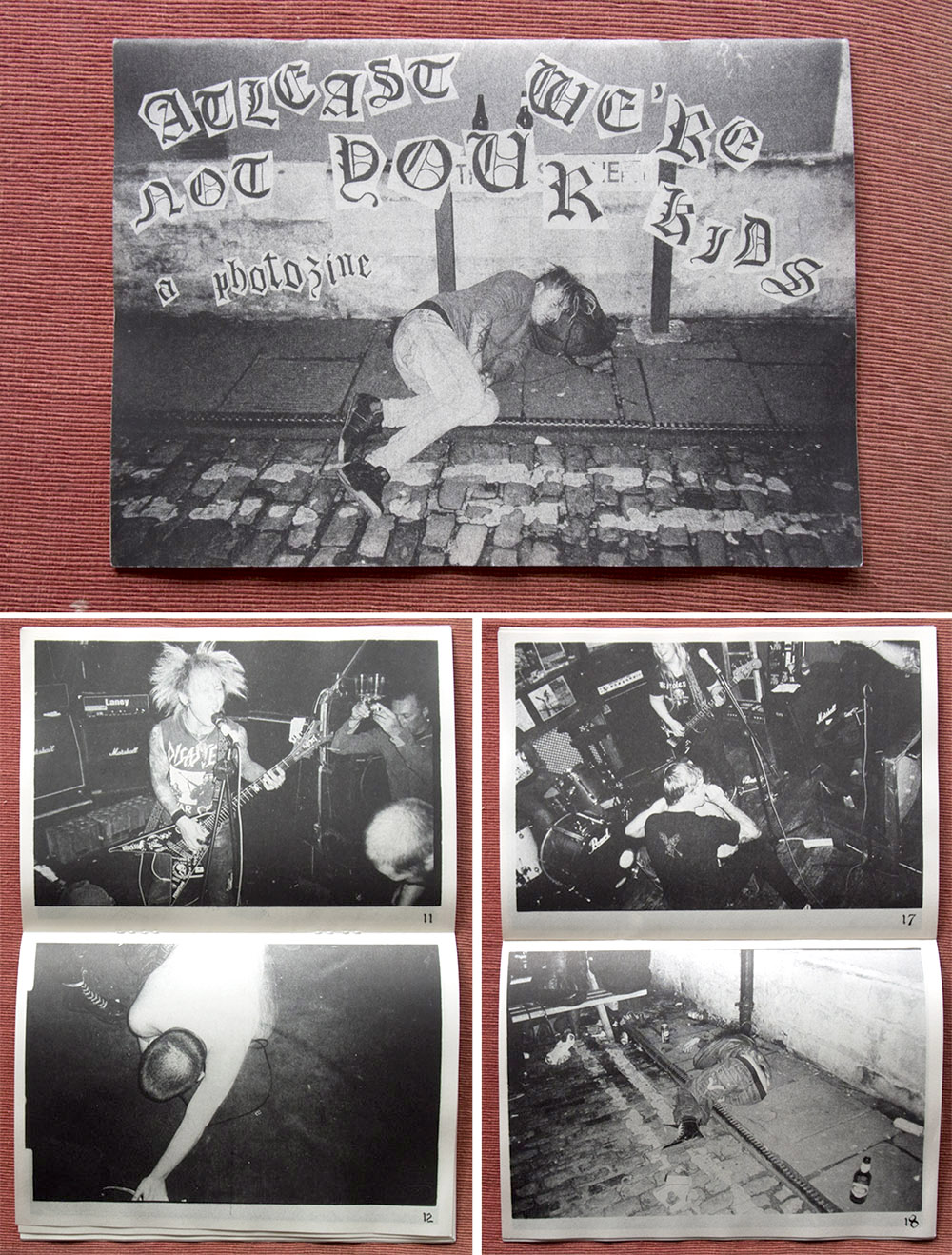
martinpf: At least we’re not your kids – a photozine. #81/100. Published by Russian Glue Press
martinpf@hotmail.co.uk. Russiangluepress@gmail.com
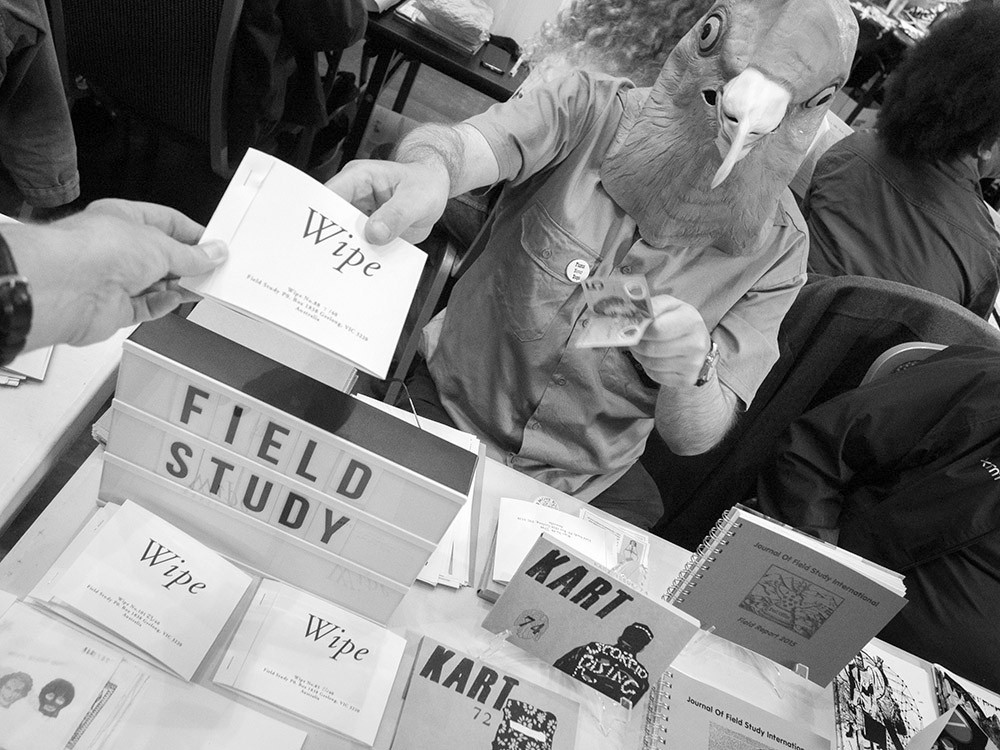
David Dellafiora Field Studies
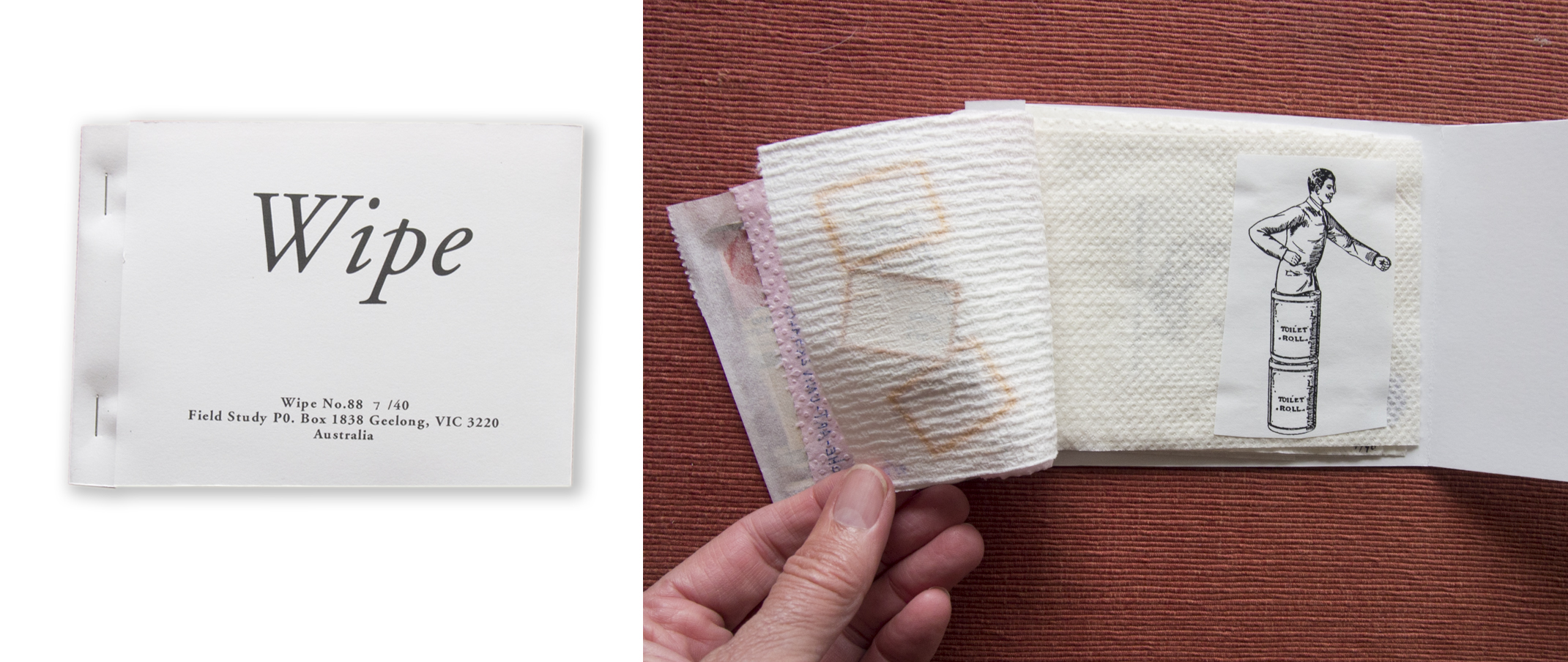
Field Study (David Dellafiora): Wipe No.88
Field Study – https://daviddellafiora.blogspot.com.au/
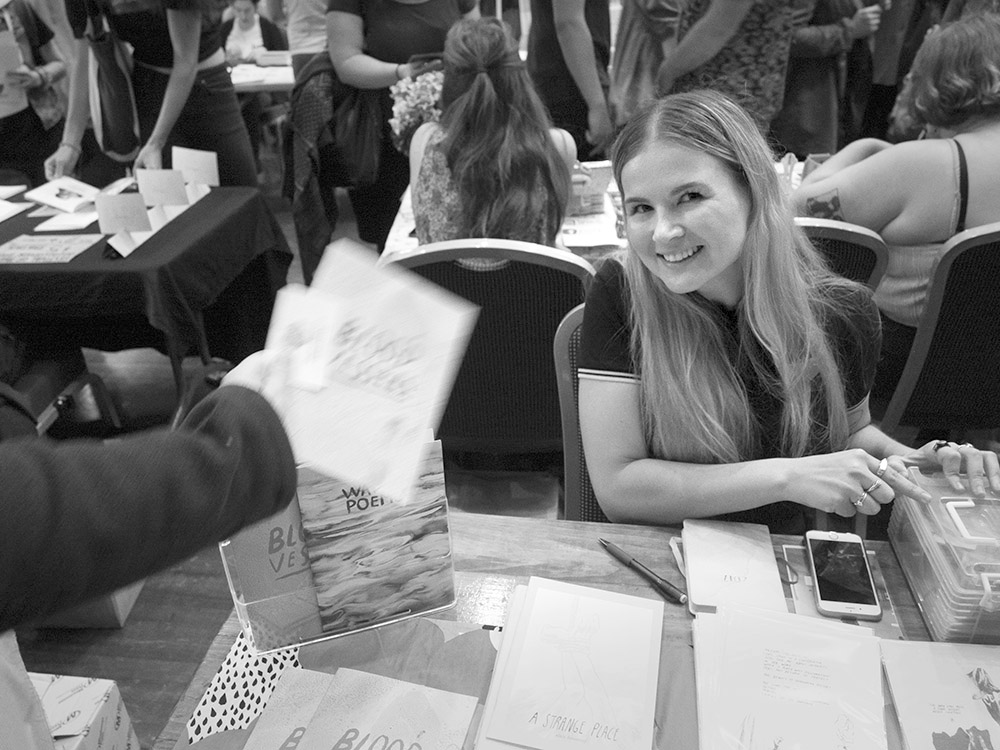
Alice Fennessy at her table
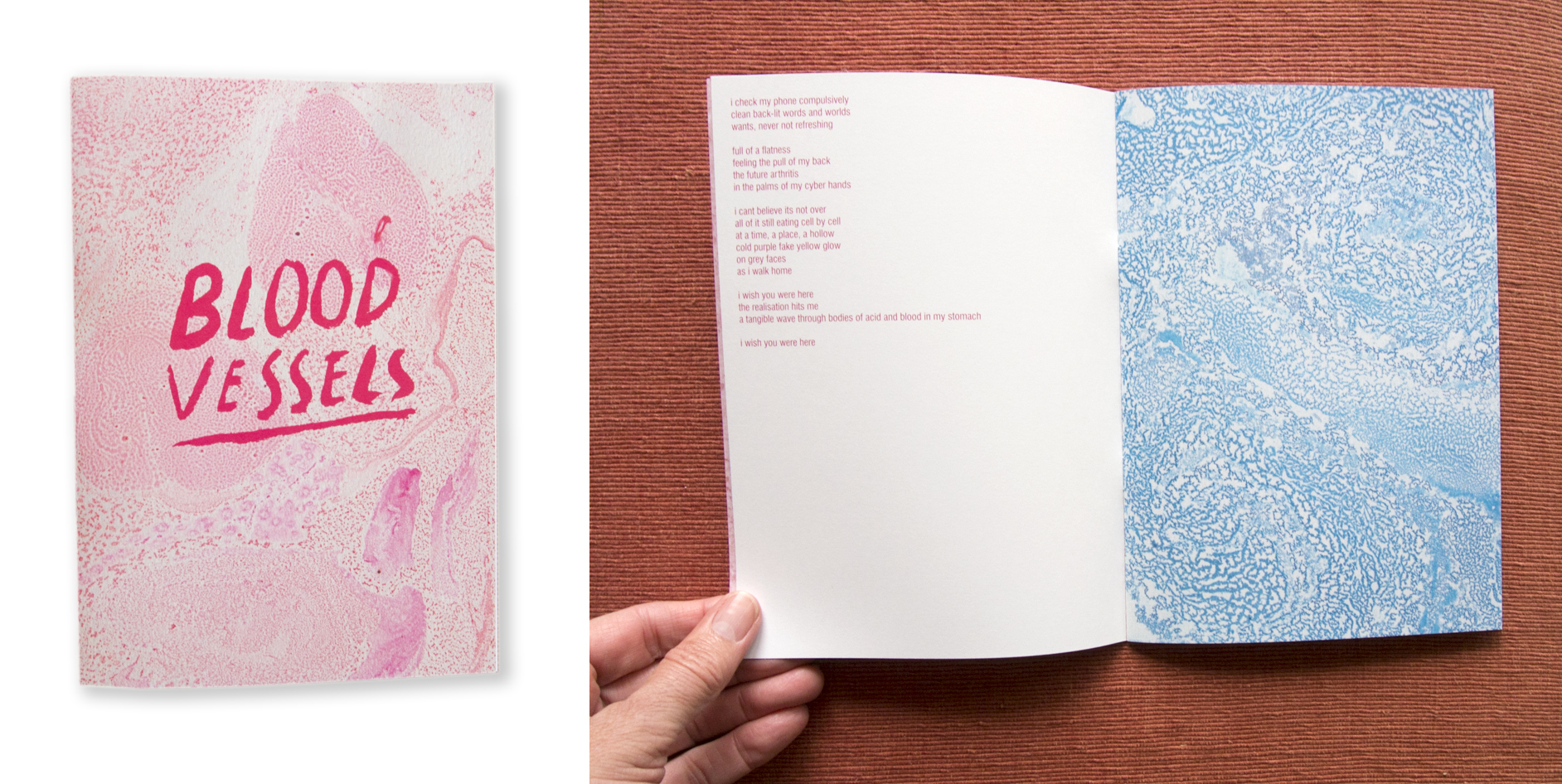
Alice Fennessy: Blood Vessels – A collection of poems about me memories
Alice Fennessy Instagram: @alicefennessy
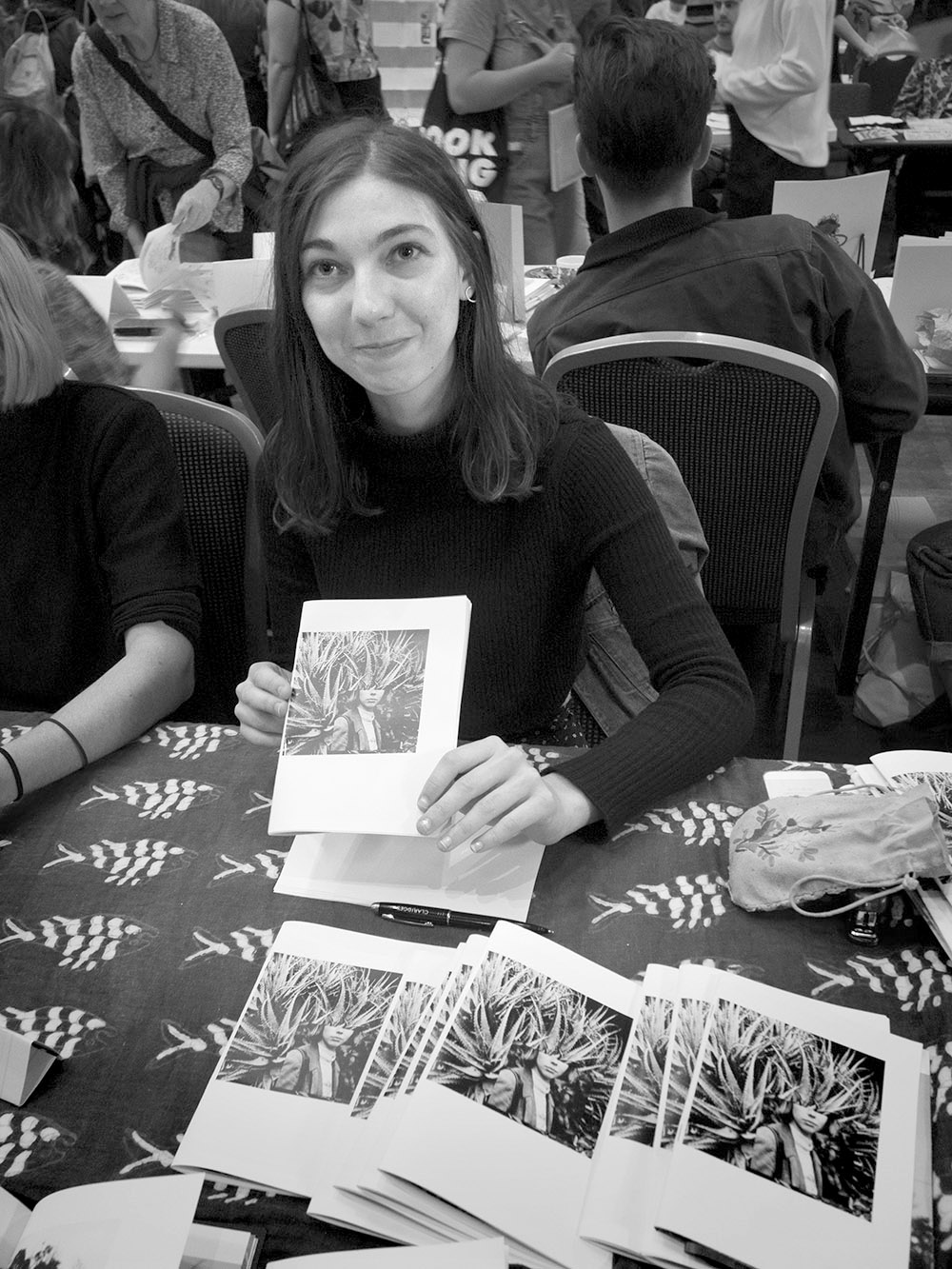
Claire Wakeford and her zine
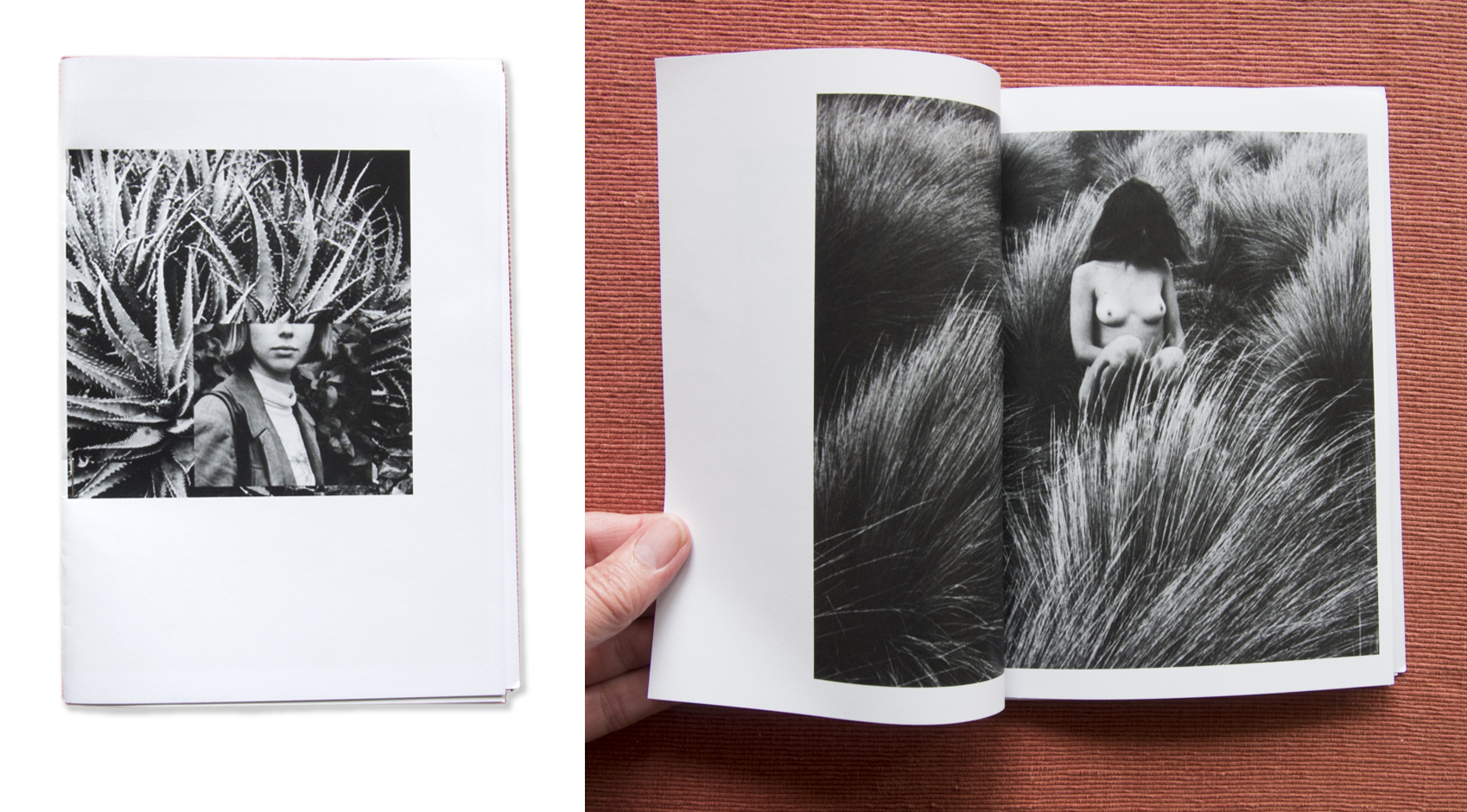
Claire Wakeford: Untitled
Claire Wakeford: www.clairewakeford.com
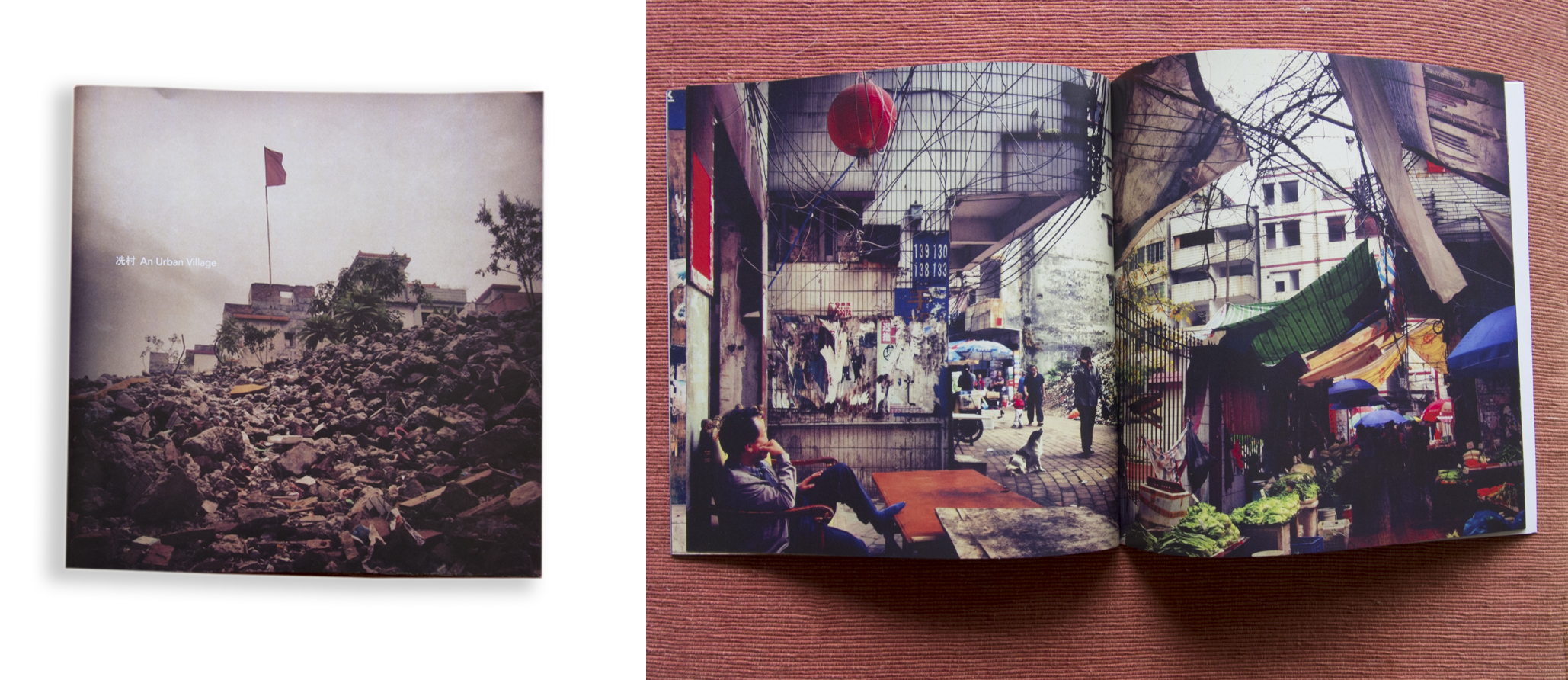
Ning Xue: An Urban Village
Ning Xue: http://www.xuening.me/me.html
.
UNTIL NEXT YEAR …
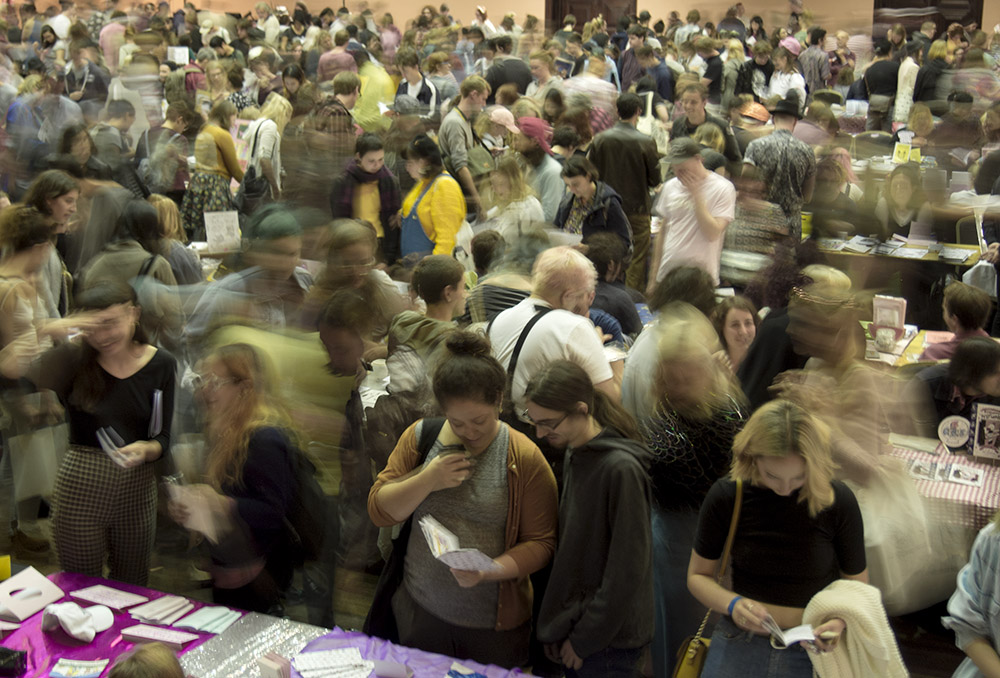
PHOTO: Doug Spowart – Sticky Institute’s Festival of the Photocopier Zine Fair 2017
.
.
Copyright in the zines is retained by the authors. All photographs + text + video ©2017 Doug Spowart
THOMAS OLIVER’s ‘Disconnection’ exhibition & essay
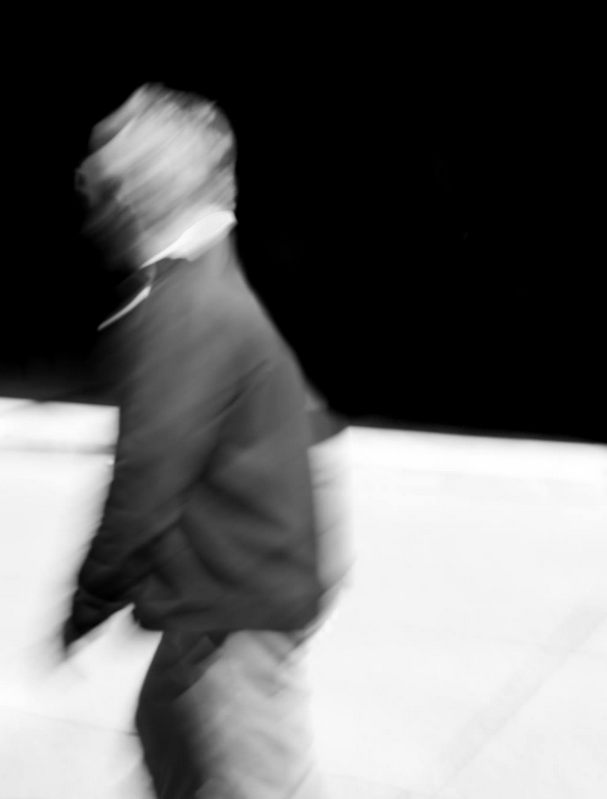
Thomas Oliver – image from the series Disconnection
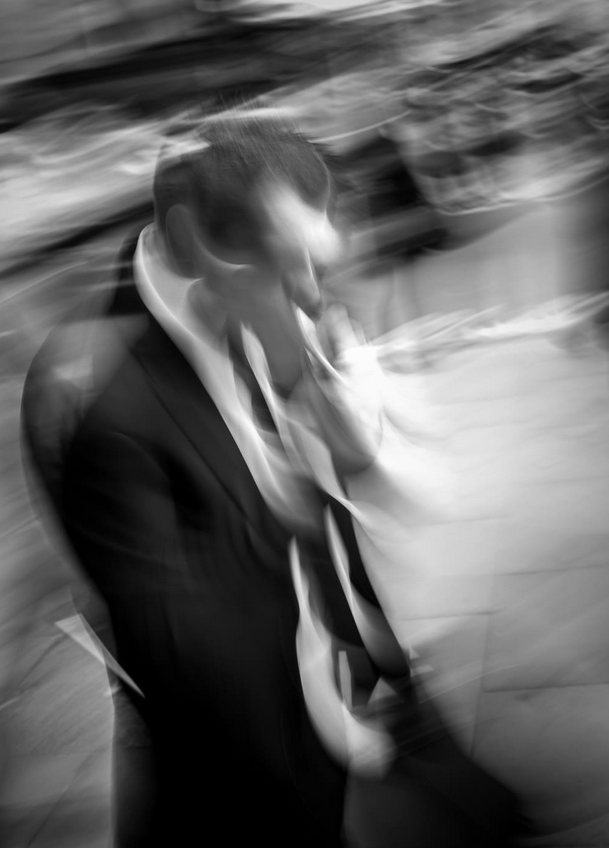
Thomas Oliver – image from the series Disconnection
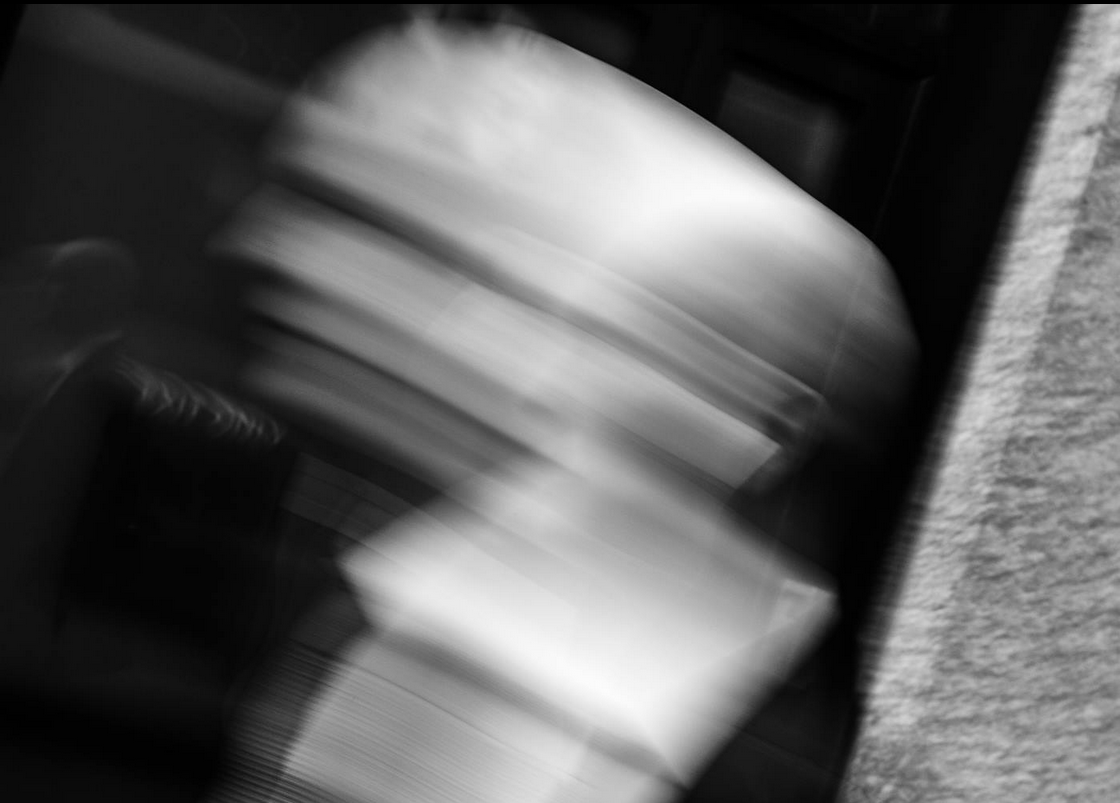
Thomas Oliver – image from the series Disconnection
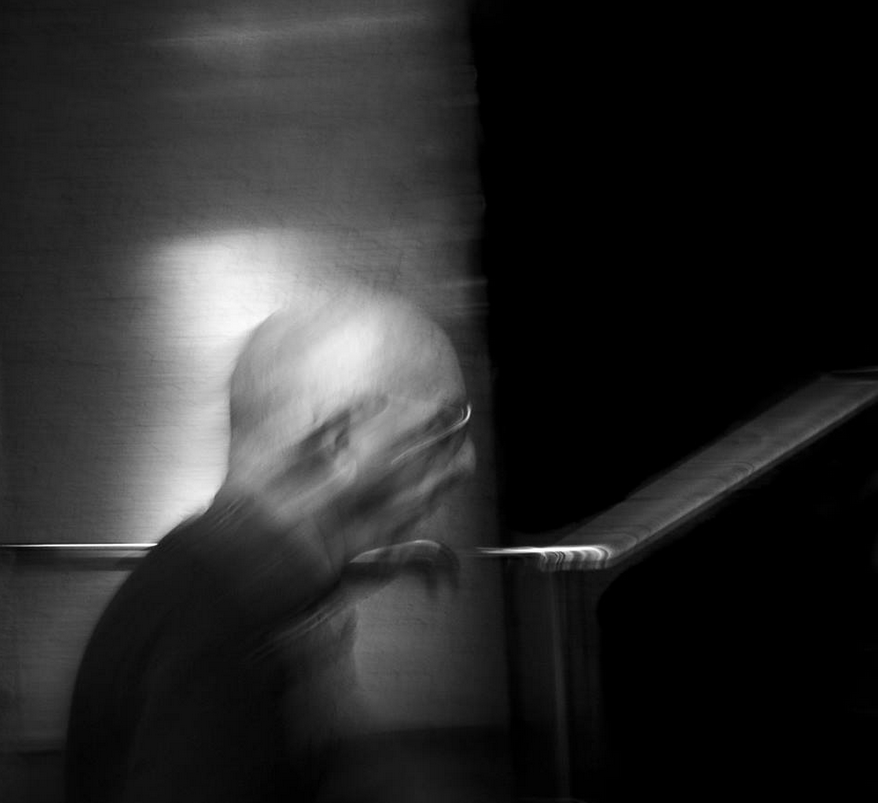
Thomas Oliver – image from the series Disconnection
Disconnection is a solo show by Brisbane photographer Thomas Oliver. The series consists of work that has been captured in London, New York, Toronto, Paris and (of course) Brisbane. The exhibition is accompanied with a catalogue essay written by Dr. Doug Spowart.
Artist’s Talk: Interview with Dr. Heather Faulkner, 11am-1pm Saturday 25th February
Full Exhibition Dates: Tuesday 13th – Saturday 25th February
Gallery Hours: Tuesday to Saturday, 10am – 4pm
Address: Project Gallery – QCA South Bank Campus, 226 Grey Street
OLIVER’s Artist Statement
Experiencing the ebb and flow of life in a capital city, it is easy to become consumed by the gurgling hum of activity. It sparks and pulses like an amped-up generator. We slip from one task to the next, leaving ourselves behind in the process. The lights flicker and the air vibrates warmly around us. And like a mad hive, our cities swarm with ghostly forms, smoothly transparent and faceless.
My Words for Thomas …
What makes photography a strange invention – with unforeseeable consequences – is that its primary raw materials are light and time.[1]
John Berger died last week. But his work will continue to reveal insights on how we perceive photographic communications. Even now I continue to hear his words in my head as I write. Most of the time his voice inhabits my writing, saying the words that I have just typed. His writing and critical thinking offered new ‘ways of seeing and looking at photographs’ – as ‘quotes’ from appearances, photos and memory. The photograph presents to us information that has connections to a reality as in Berger’s assertion, ‘A photograph arrests the flow of time in which the event photographed once existed’.[2]
But what happens when the photographic moment is slurred by slow shutter-speeds, movement of subject and camera panning? In this approach Thomas Oliver creates visual documents that could never have been seen by the photographer or an observer of the scene. These are documents of not a moment but of time passing. They transcend the instantaneous moment and suggest a visual concept of the subject’s spirit seemingly extracted by the act of photography–a tear in temporality ‘arrested’.

Francis Bacon: Three studies for a portrait of Lucian Freud 1969
Oliver’s images also have a resonance with Gilles Deleuze’s discussion on Francis Bacon’s[3] work in his 1981 book Francis Bacon: The Logic of Sensation. Deleuze highlights how ‘chance’ and the expressiveness of the random and indiscriminate effects of vigorous brush strokes inform Bacon’s painting. Deleuze proposes that: ‘there is no chance except “manipulated” chance, no accident except a “utilized” accident.’[4] In making his photographs Oliver has no way of knowing what each slow shutter release will reveal. He relies on his understanding of technique during the process of exposure to realize the potential for an evocative outcome.
For me Oliver’s photographs are based on the ‘manipulated chance’. He is ready to respond with the tools photography to capture the phenomenon of light and time in everyday places frequented by people. His work seems to also rely on his acceptance of ‘utilized accidents’. It is from this principle that his moments of strange and powerful visual poetry come into being.
But are they his photographs? My favourite Berger quote also relates to Oliver’s spontaneous street images. That there are things beyond us, I’m not talking about God or Gods, but rather more about the involvement of the ‘other’ in the making of art. Berger said it beautifully for me – his voice echoes in my mind:
The modern illusion concerning painting [I read photography here]. . . is that the artist is a creator. Rather he is a receiver. What seems like creation is the act of giving form to what he has received.[5]
I respectfully present to you – Thomas Oliver’s Disconnection photographs of simulacra from the street.
Doug Spowart PhD
[1] Berger, John. “Appearances/the Ambiguity of the Photograph.” In Another Way of Telling: A Possible Theory of Photography, 47-52. Malden, MA, USA: Blackwell Publishing Ltd, 2002.
[2] Ibid
[3] I refer also to Francis Bacon’s paintings based on Diego Velázquez’s Pope, Portrait of Innocent X (1650) and his portraits of friends, for example Three studies for a portrait of Lucien Freund (1964).
[4] Deleuze, Gilles. Francis Bacon: The Logic of Sensation. Translated by Continuum. Continuum Edition ed. London: Continuum Books, 1981. Editions de la Difference.
[5] Berger, John. The Shape of a Pocket. London: Bloomsbury Publishing, 2001.
NOCTURNE ARMIDALE: a community photo project
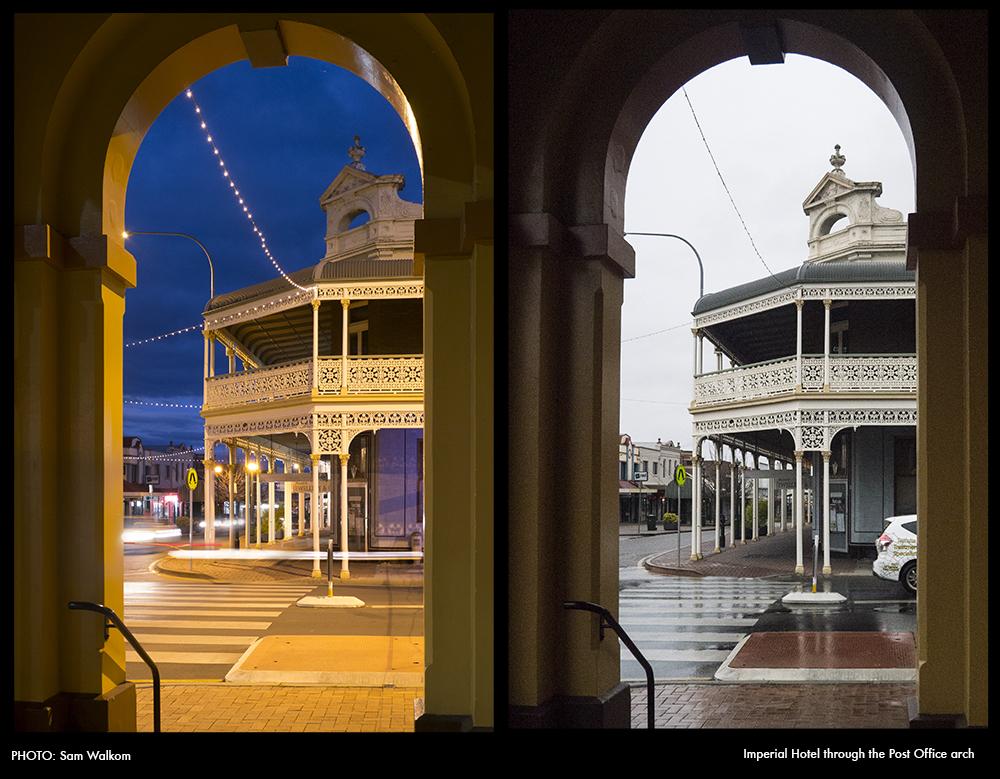
Sam Walkom’s Imperial Hotel rephotography DUO taken through the Post Office’s arches
NOCTURNE ARMIDALE: Capturing Armidale in a new light
In our latest Nocturne project we worked with a group of photographers from the Armidale region to document the change of light from day to night. The special theme we developed for the Nocturne: Armidale project was to capture the town in both the early evening’s nocturnal light with a second photograph of the subject during daylight. This ‘re-photography’ approach resulted in a comparative pairs of images revealing the evocative nature of nocturne light and how it transforms everyday places.
The project began in mid-September when we conducted a workshop at the New England Region Art Museum (NERAM) in re-photography and nocturne light capture. This included practical shoots around Armidale from which images were then optimized and uploaded to Nocturne: Armidale project Facebook page to share with the wider community. Another aspect of the project was the digital processing and optimising of nocturne photographs. This was accomplished in a mentored section of the workshop with the participant’s images.
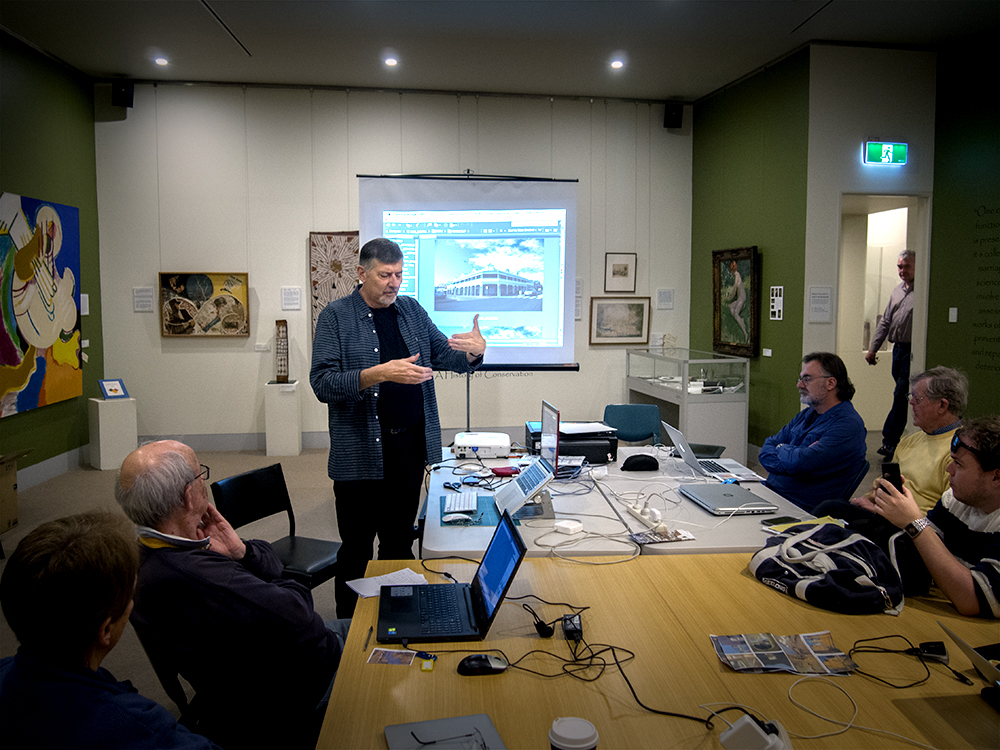
Doug presenting his workshop on file optimisation
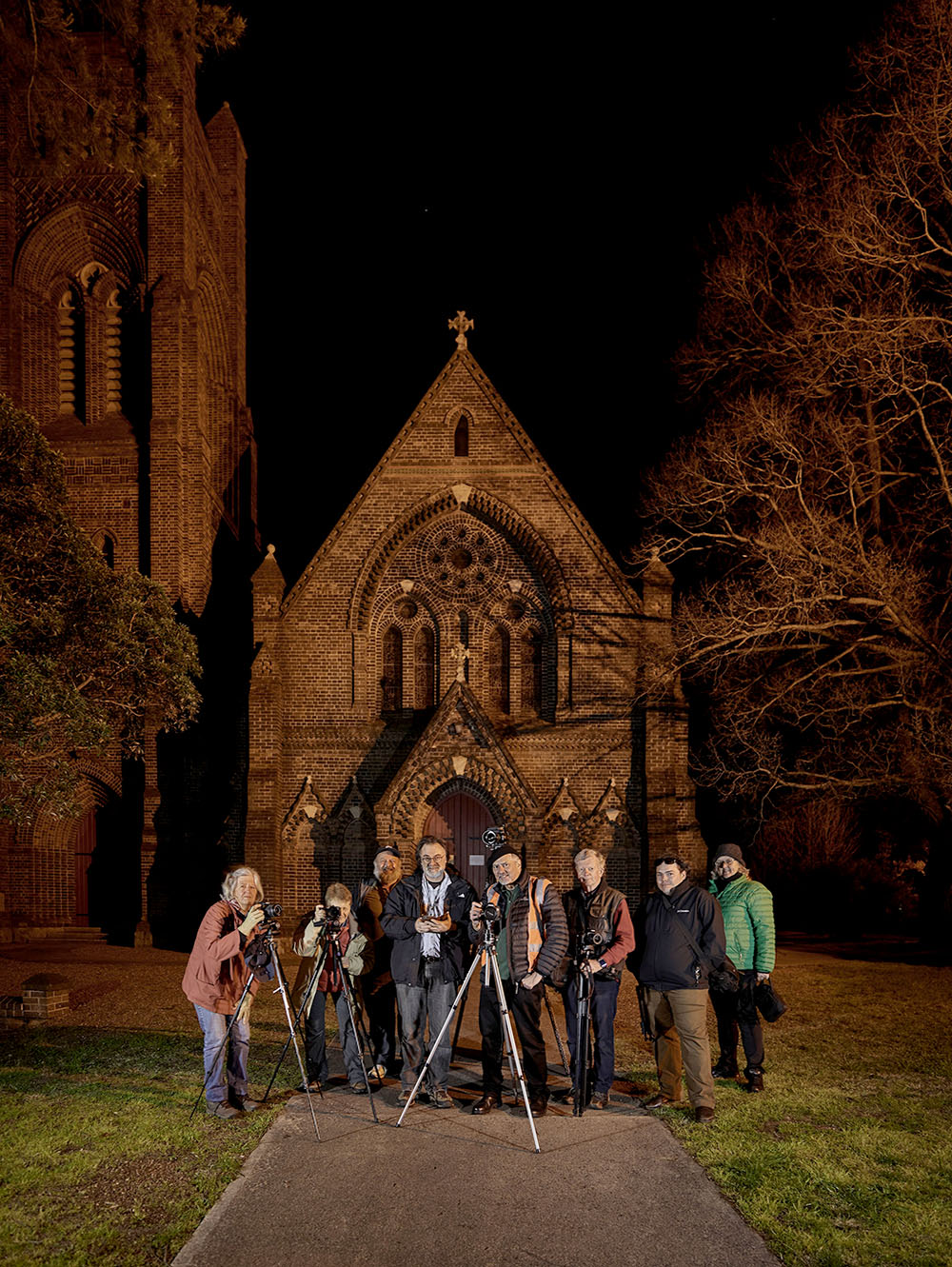
A group shot of some of the Nocturne Armidale participants PHOTO: Neil Burton
Les Davis from the National Trust Home Saumarez, provided project participants with a unique opportunity to photograph this magnificent historical homestead. Over two separate nights images were made to highlight the home’s colonial architecture.
It was suggested in our original proposal that the work produced could be at some later stage be exhibited. And during the workshop Greg from the New England Art Society Armidale Art Gallery came forward with the offer of an exhibition space in their gallery.
In the two months following the workshop we finalised the optimisation of 25 pieces from the workshop – most of them re-photography Duos, and printed them for the participants. Other print coordination took place with workshop participant Neil Burton who provided access to his wide-format printer for large images to be made. At the end of November we returned to Armidale with Neil and his partner Lindy Osbourne to hang the shows.
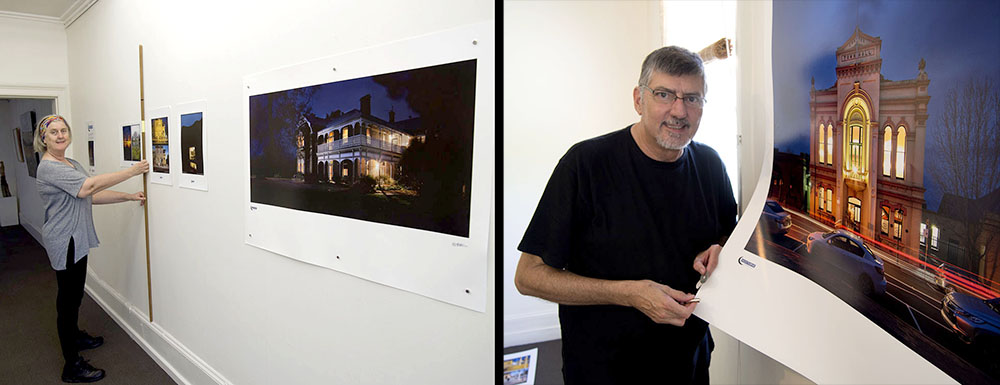
Hanging the Nocturne Armidale exhibition
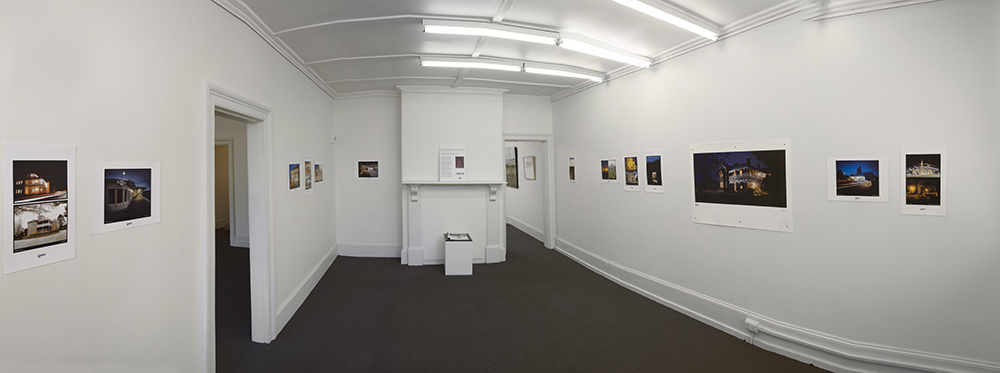
Part of the Nocturne Armidale exhibition at the Armidale Art Gallery
The project’s main exhibition was shown at the Armidale Art Gallery in Beardy Street and we presented a floortalk on December 3rd that was attended by around 25 visitors as well as most of the project’s participants. The exhibition of images from the Saumarez shoot-outs was officially opened by photographer and publisher Terry Cooke on December 2 and will remain on display at Saumarez until January 29th, 2017. A third exhibition of photographs included our images and works by Neil Burton will be on show in the Armidale Council Chambers until March 5, 2017.
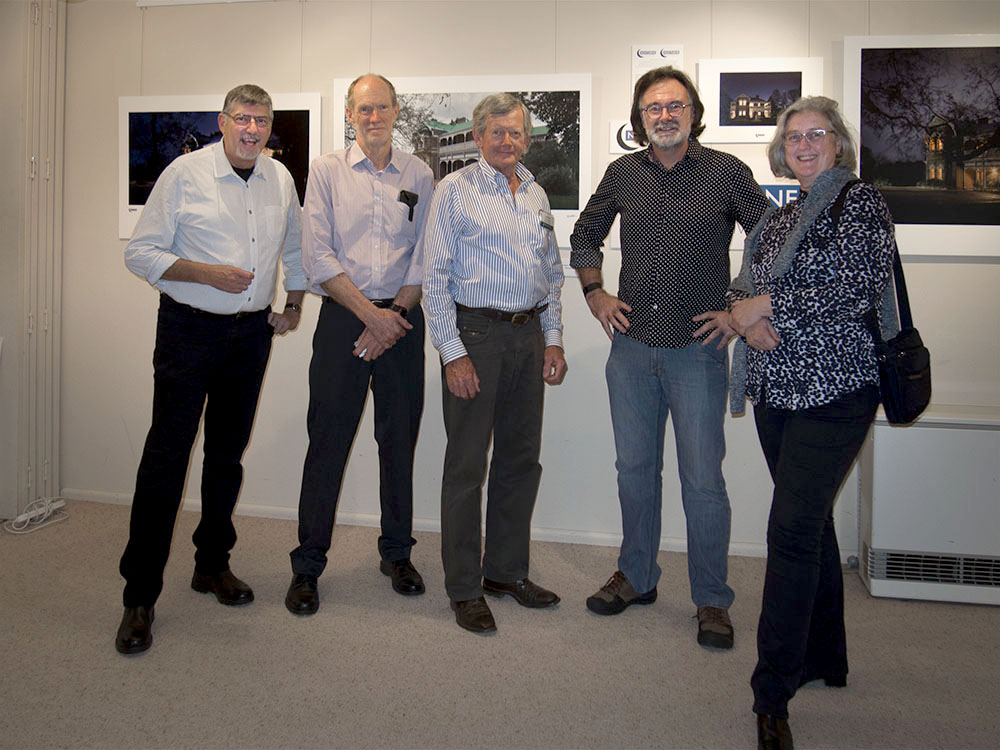
With Terry Cooke, Les Davis and Neil Burton at the opening of the Saumarez show PHOTO: Lindy Osbourne
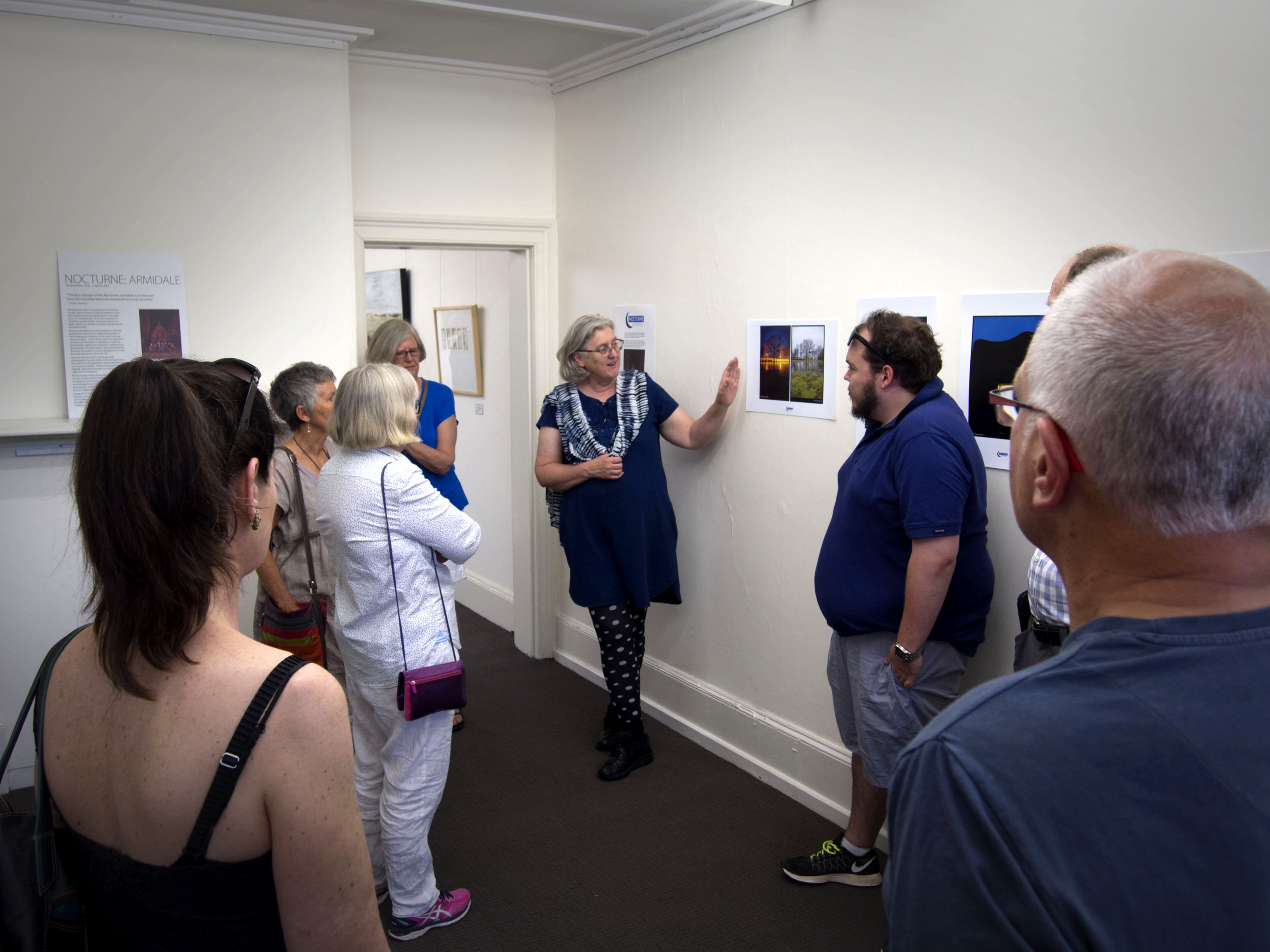
Vicky presenting a floortalk about the Nocturne show
The Nocturne: Armidale exhibitions include photographs by Paul Bayne, Sue Burgess, Neil Burton, Victoria Cooper, Les Davis, Ross Jenkins, Jeni Mackenzie, Doug Spowart, Sam Walkom and Jim Walmsley.
Here is a selection of the Nocturne Armidale project images…
Click on image to open a gallery viewer for author and subject details.


Robert Heather, the Director of NERAM described us as a ‘nomadic photographic duo’ and acknowledged that we had, with our group of local photographers, had ‘braved cold, wet and windy conditions to create some beautiful and dramatic images of places which we all know well such as the old Courthouse, Saumarez Homestead, the cathedrals, hotels and railway station.”
The New England FOCUS Magazine published a story on our work and background to the Nocturne Armidale project – Download a PDF focus-nocturnearmidale-red (20Mb)
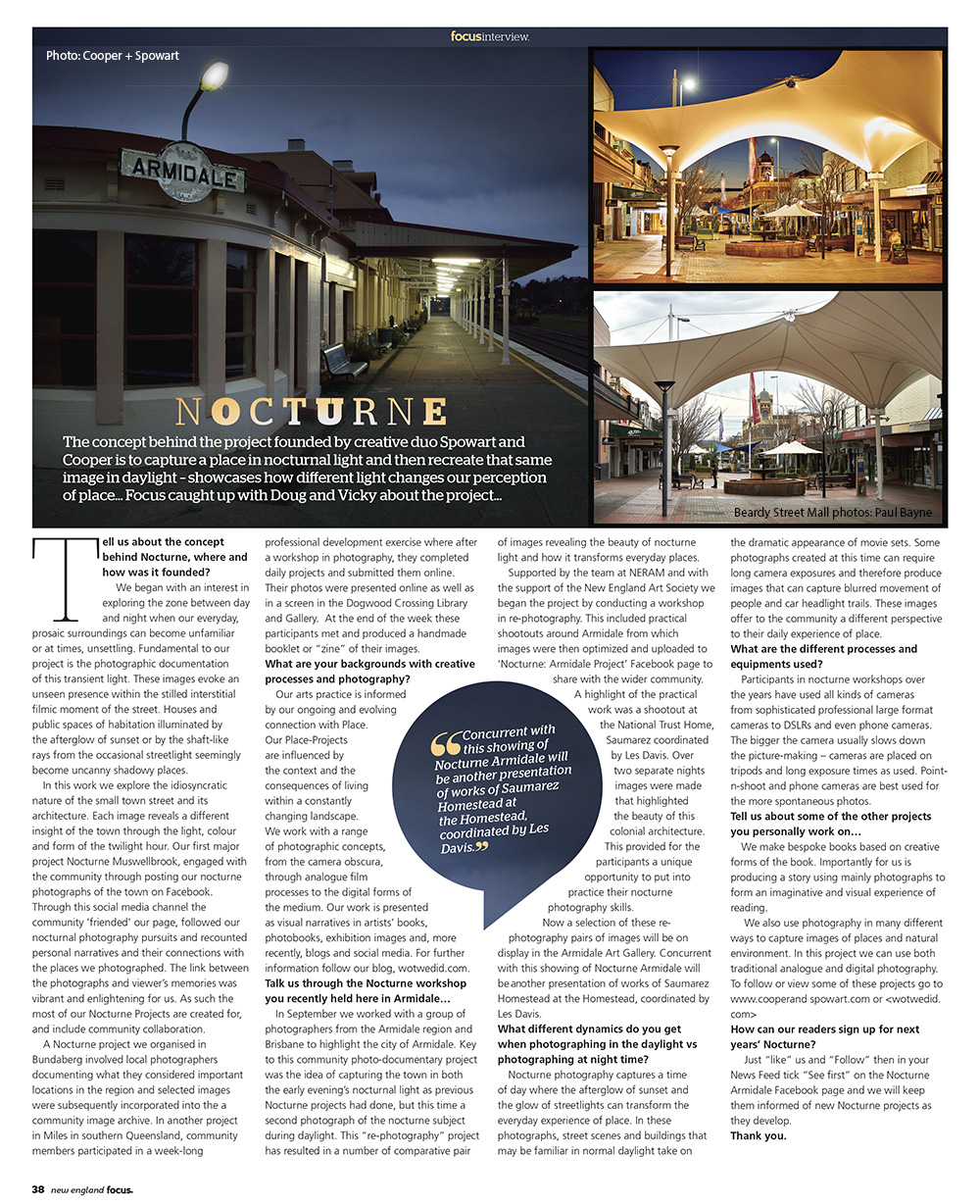
The Nocturne: Armidale project was coordinated by the New England Regional Art Museum in partnership with the New England Art Society and supported by Saumarez Homestead and Armidale Regional Council.
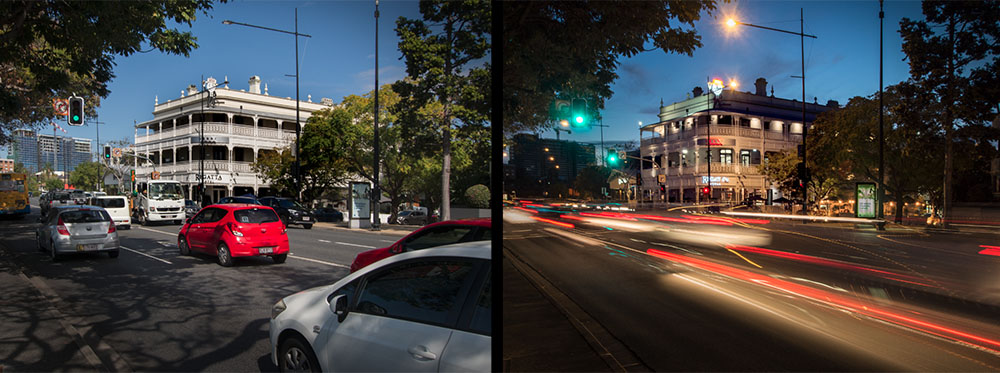
Regatta Hotel, Brisbane – Rephotography DUO
ABOUT NOCTURNE PHOTOGRAPHY
Nocturne photography captures a time of day where the afterglow of sunset and the glow of streetlights can transform the everyday experience of place. In these photographs, street scenes and buildings that may be familiar in normal daylight take on the dramatic appearance of movie sets. Some photographs created at this time can require long camera exposures and therefore produce images that can capture blurred movement of people and car headlight trails. These images offer to the community a different perspective to their daily experience of place.

Nocturne Armidale Logo
MORE ABOUT COOPER and SPOWART NOCTURNE PROJECTS
NOCTURNE: ARMIDALE, the project is part of continuing series, conducted by Victoria Cooper and Doug Spowart, across Eastern Australia including past events in Muswellbrook, Grafton, Bundaberg and Miles.
Through our Nocturne documentary photography and Facebook social media projects, we have explored connections with Place in urban and regional communities throughout Queensland, New South Wales and Victoria. For us the phenomenon of nocturnal light transforms these everyday spaces. Buildings, busy street corners, quiet alleyways all become filled with the dramatic light of a movie scene. In 2013 and 2014 we were given the opportunity, through funded Artists-in-Residence (AIR) programmes, to undertake Nocturne projects in the regional communities of Muswellbrook, Grafton and Bundaberg.
The photographs in themselves have no intrinsic meaning – it is the viewer, with their experience and memory that brings life to the image. In this moment of connection they may recount a personal narrative or connect with the historical significance of the place. This collaboration between photograph and viewer is exciting and vibrant – expanding the potential for the documentary image to go beyond the vision of the photographer.
Examples of other Nocturne Projects and Facebook responses can be found at: <www.nocturnelink.com>
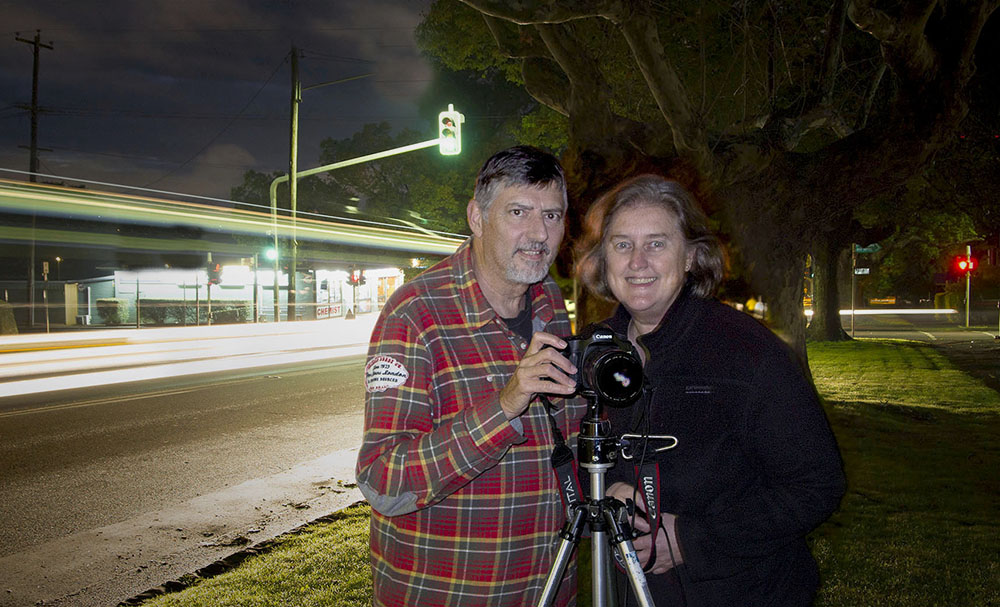
Cooper+Spowart shooting Nocturne
ABOUT COOPER+SPOWART
Our arts practice is informed by our ongoing and evolving connection with Place. Our Place-Projects are influenced by the context and the consequences of living within a constantly changing landscape. We work with a range of photographic concepts, from the camera obscura, through analogue processes to the digital forms of the medium. Our work is presented as visual narratives in artists’ books, photobooks, exhibition images and and on blogs and social media.
Logo
.
Copyright in all Nocturne Armidale project images is retained by the author – any use of these photographs must be approved by the copyright owner.
.
.
DARK LOVE: Stories of the darkroom @ Maud Gallery

It seems that in the digital age many photographers still pine for the days past when the darkroom was familiar territory. While older photographers may have fond memories, today they share their darkroom love with new-comers, mainly younger and digitally native photographers. To honour the past and to celebrate the future of the darkroom we worked with the Director of Maud Creative Gallery Irena Prikryl recently to host a series of events and workshops to recognise analogue photography in contemporary photographic practice.
On November 8 a group of photographers responded to the call to attend an event at the gallery called DARK LOVE: Stories of the Darkroom. They were asked to come along with something special about the darkroom and tell a story associated with it. On arrival at the gallery their photographs were prepared and then hung on the wall. The presentations were timed at around 5 minutes and were quite fascinating.
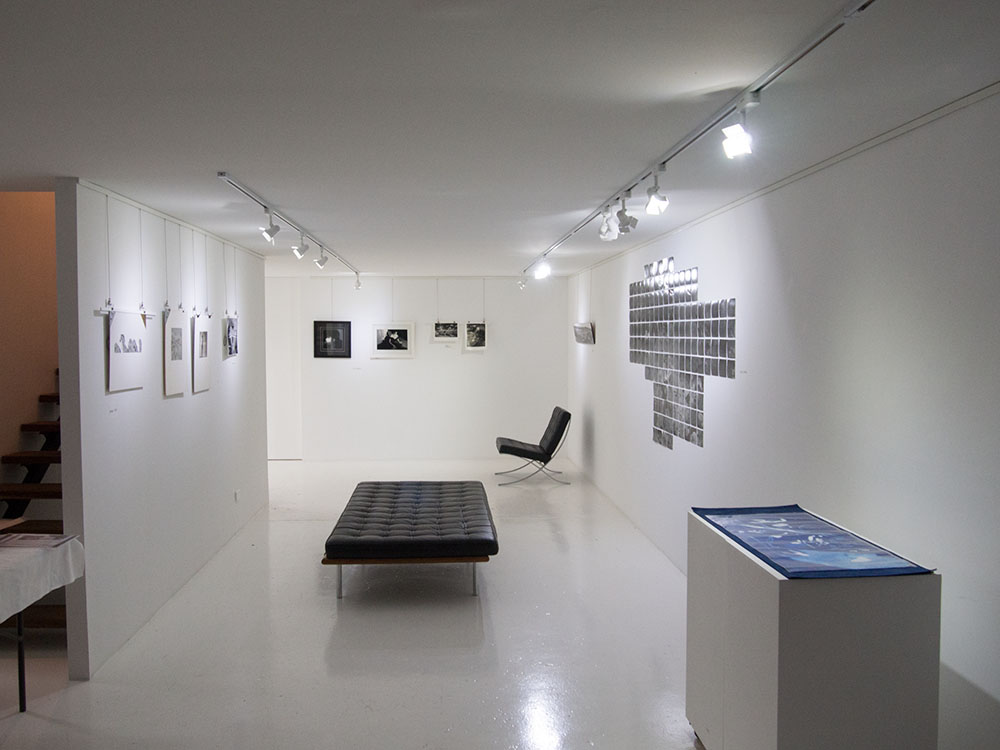
Part of the Dark Love exhibition at Maud Gallery
What follows is a photo of the attendee, their print and a brief comment about their stories …
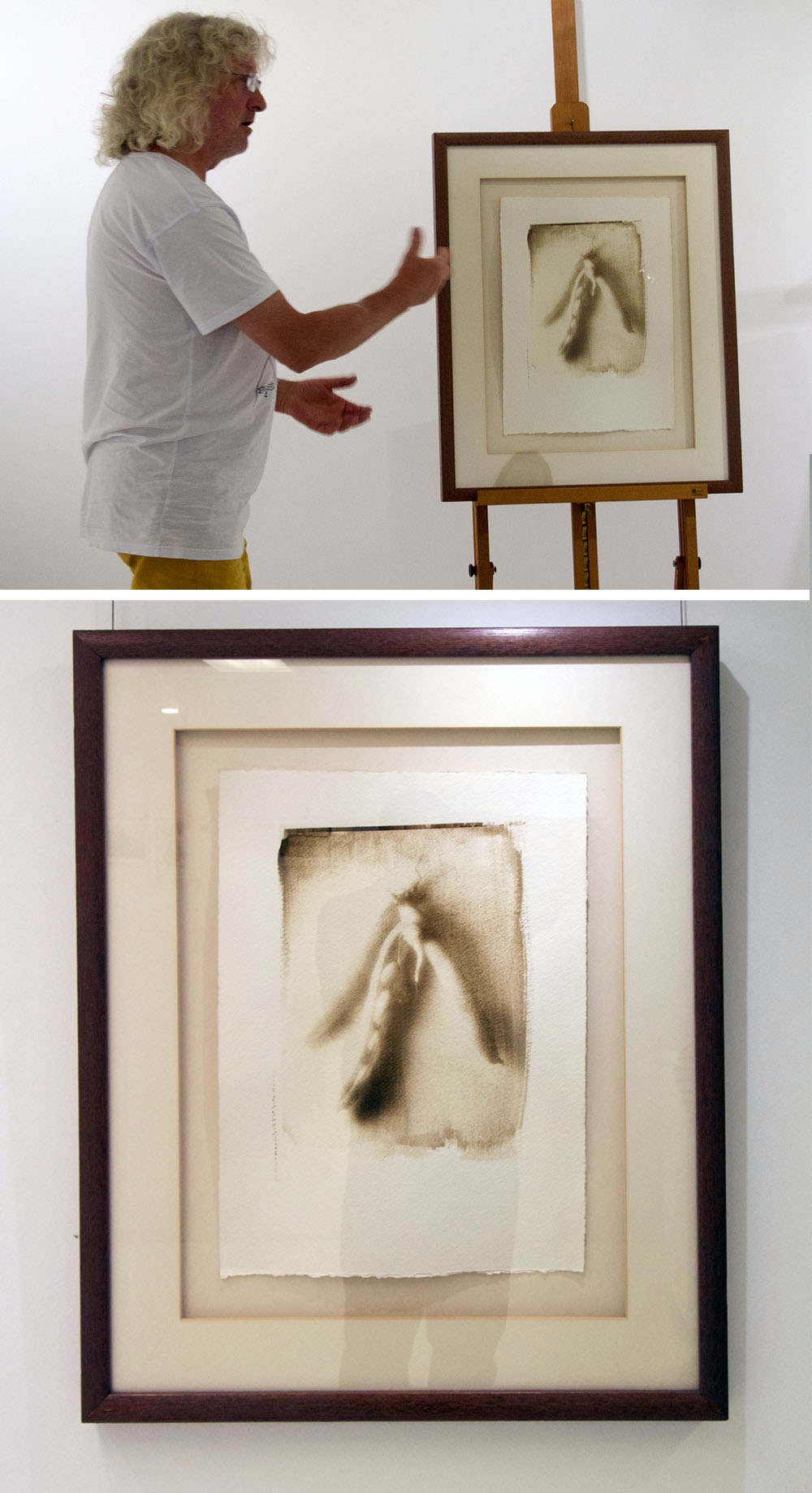
Alex Buckingham
Alex spoke about working with Liquid Light emulsions
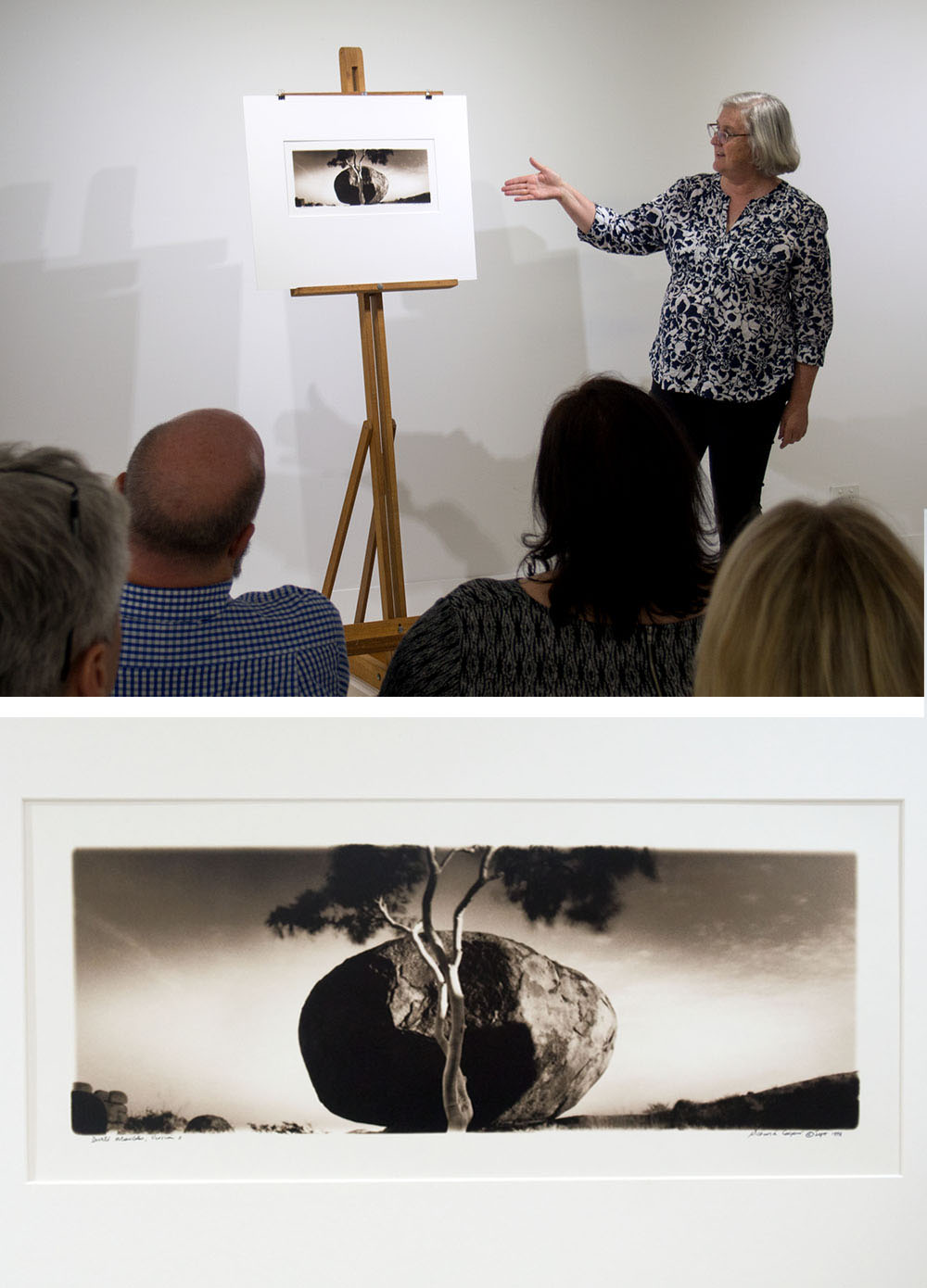
Victoria Cooper
Victoria Cooper discussed the making of this pinhole biscuit tin photo and the challenges of printing the 6x18cm negative
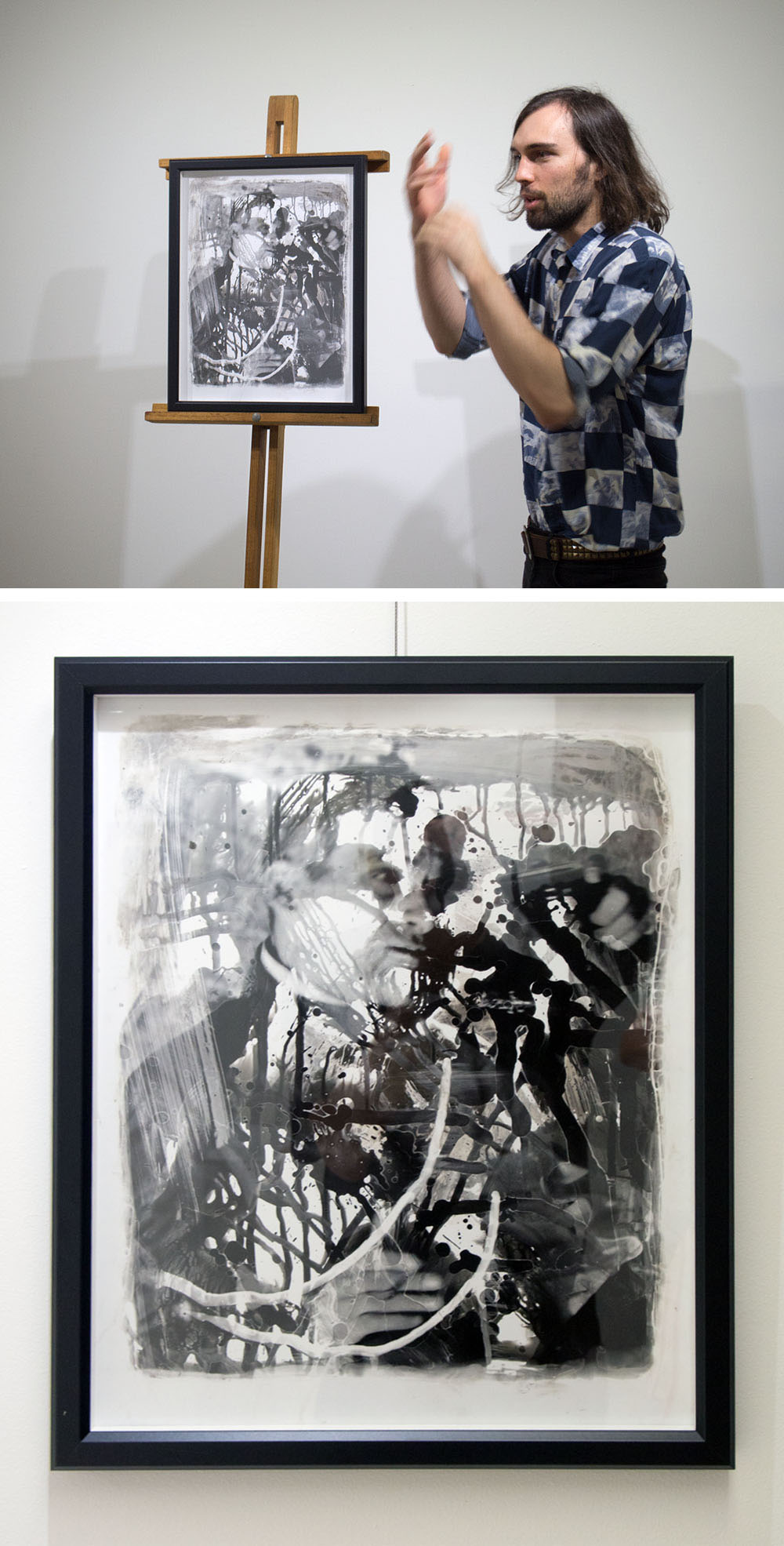
Thomas Oliver
Thomas spoke about his current academic research in the multiple printing of a single negative.
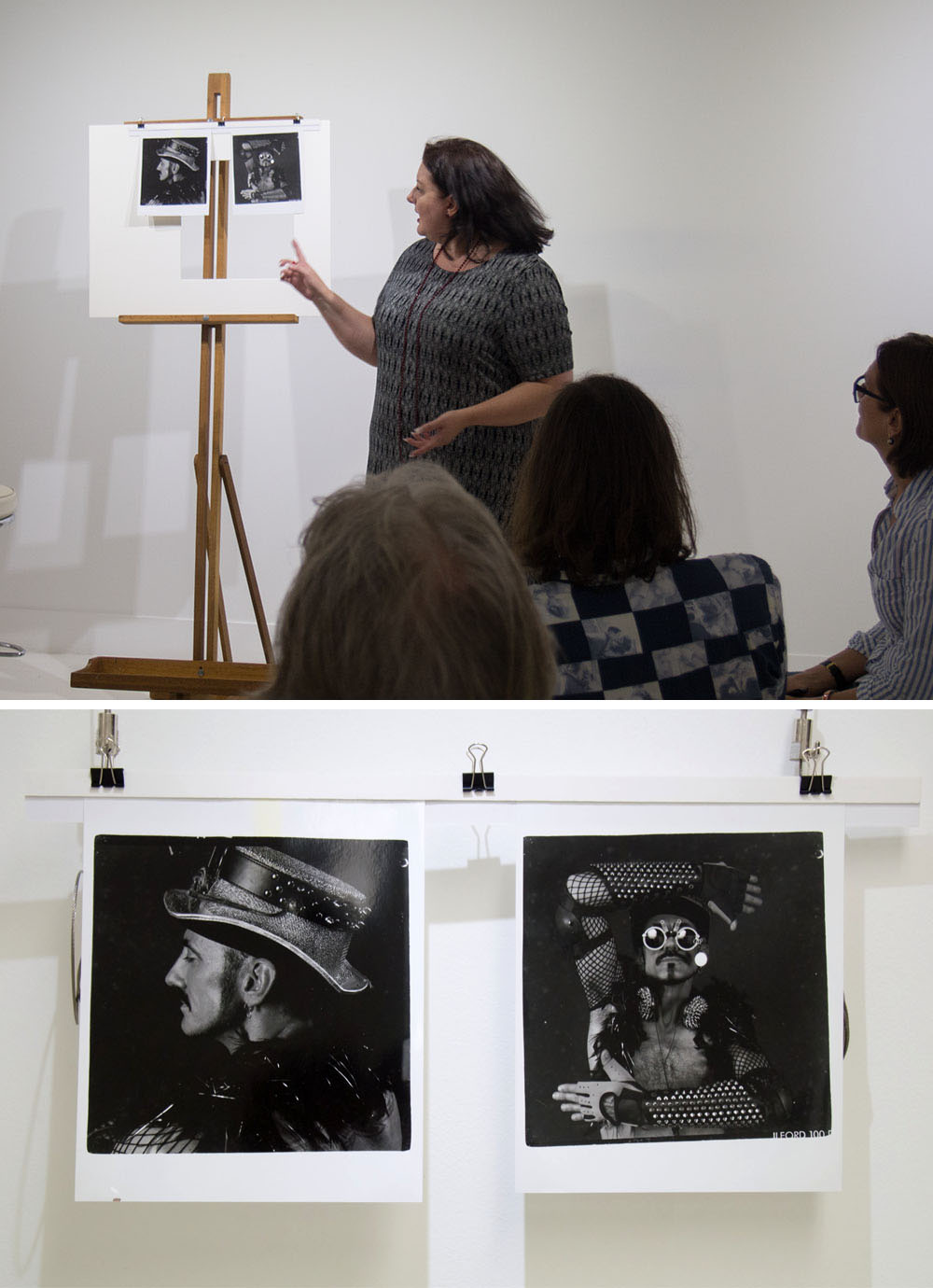
Tammy Forward
Tammy discussed the making of a studio portrait.
Sandy Barrie
Sandy spoke of the dangers of shooting large format in busy Sydney traffic.
Robyn Hills
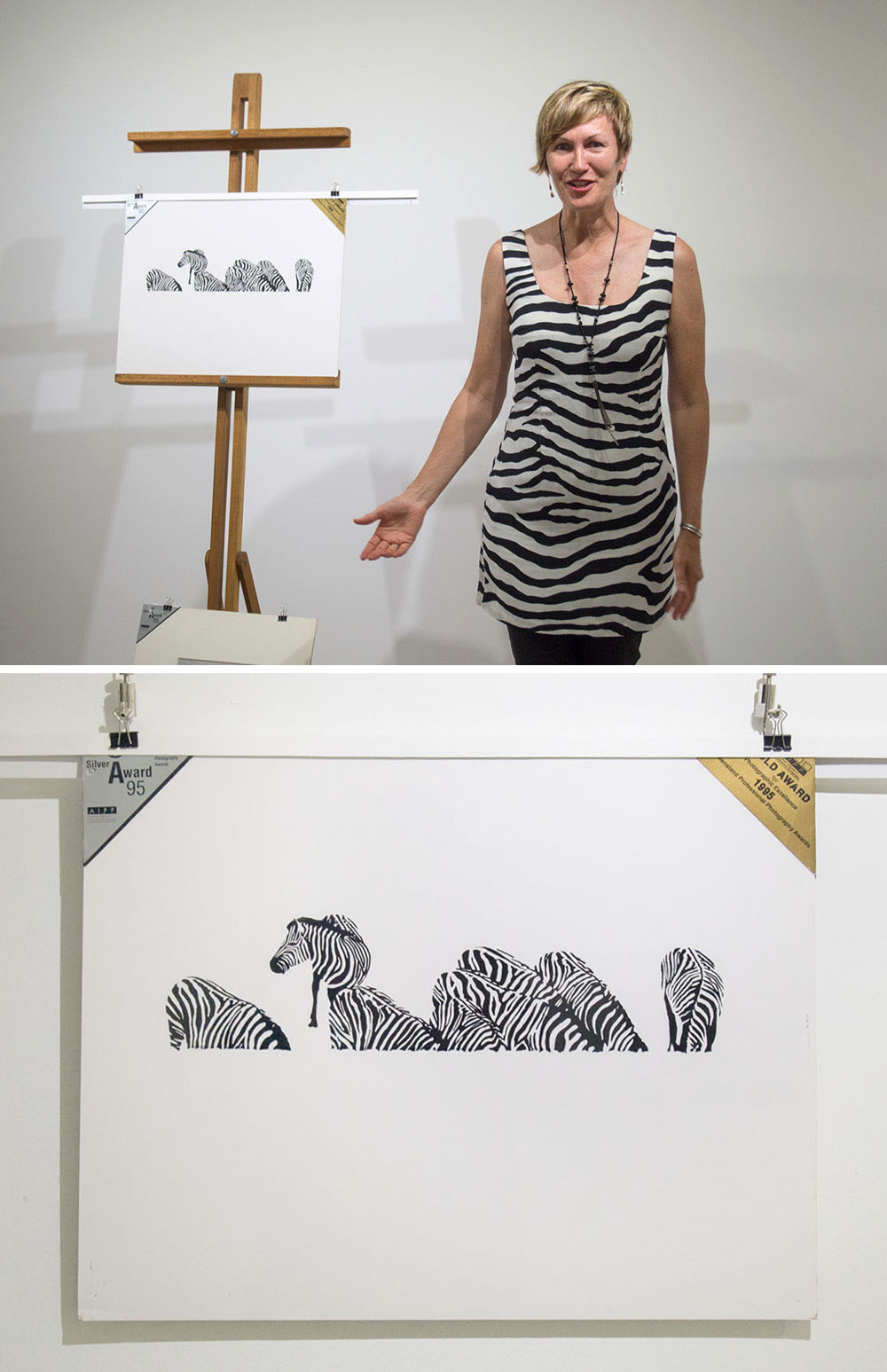
Robyn told the story of the making of this award winning print – from its origins from a point-n-shoot camera to darkroom high contrast printing ‘Tipp-ex” and a little bit of marker pen… A great animated performance….

Rob Crapnell
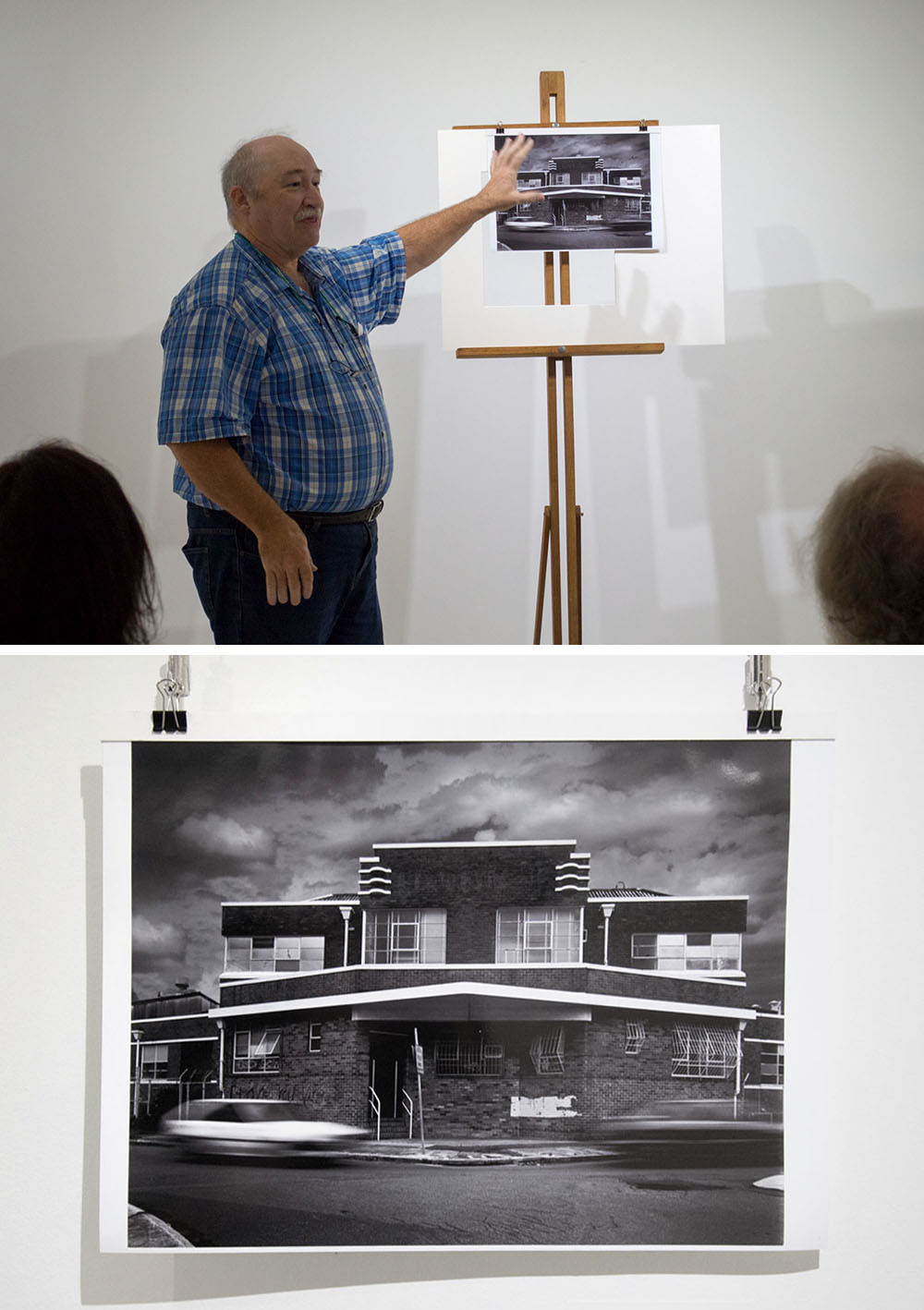
Rob discussed his interest in the darkroom and work with a 6×7 Pentax documenting how old heritage buildings in Brisbane are being cramped by the skyscraper…

Peter Pescell
Peter discussed his use of an ‘ancient’ bellows camera and reloaded 120 aerial film on spools to make this image… the old and the outdated still have currency in analogue…
Michael Stephenson
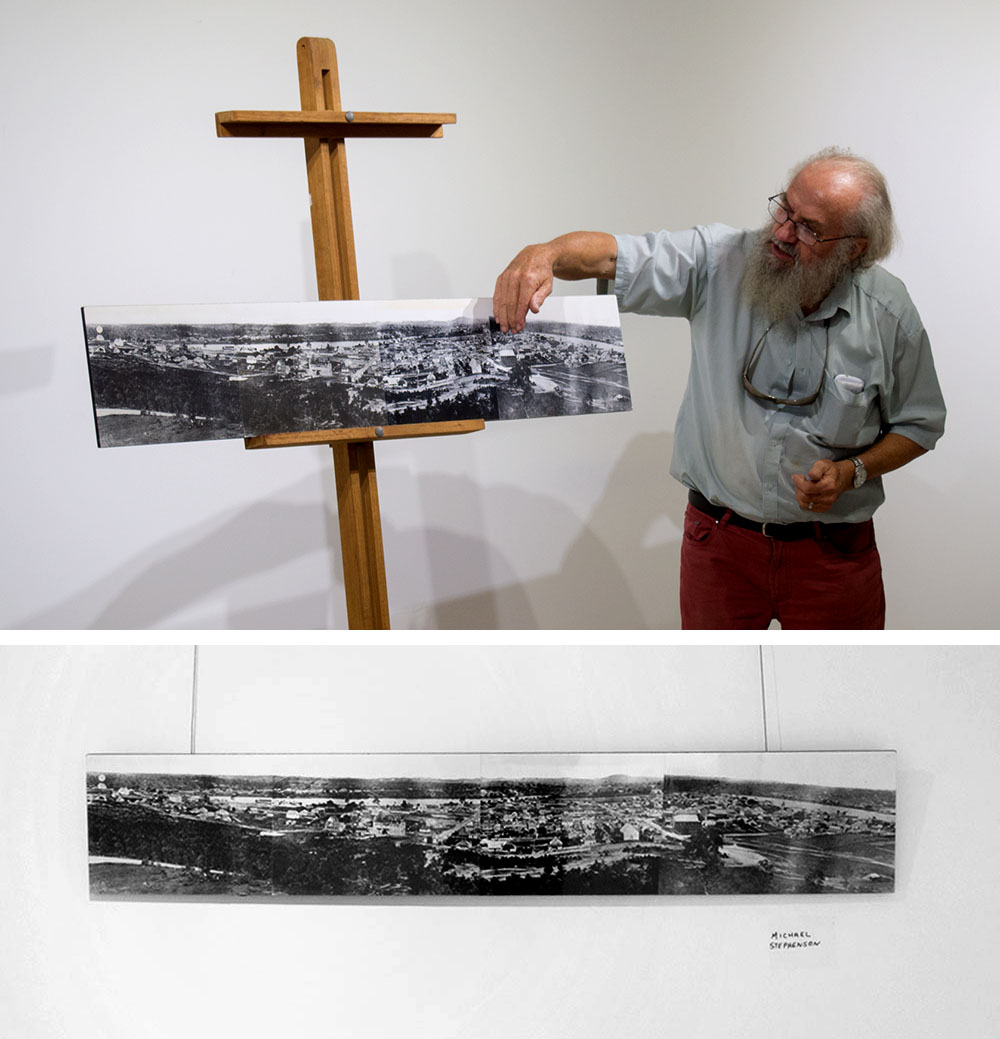
Michael discussed his modern printing of a series of lantern slides that represented a panorama of Brisbane made in the 1870s(?) by the photographer a Mr Wilson(?).
Louis Lim
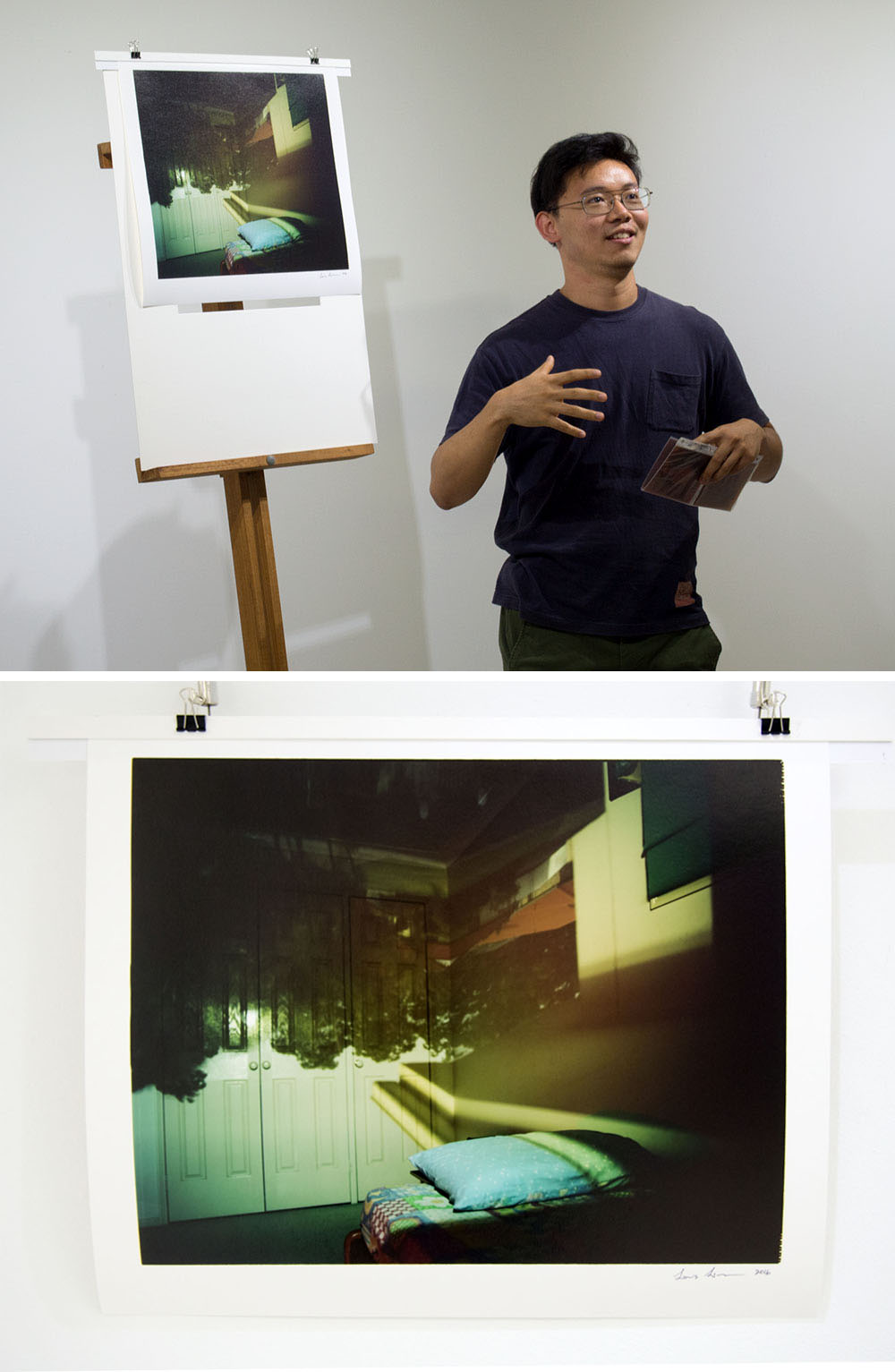
Louis spoke of a camera obscura that he made in a children’s hospital as part of an artist in residence. He described the view of Vulture Street in Brisbane on the ceiling of the room and how children visiting the space were enthralled by the images on the ceiling and walls…
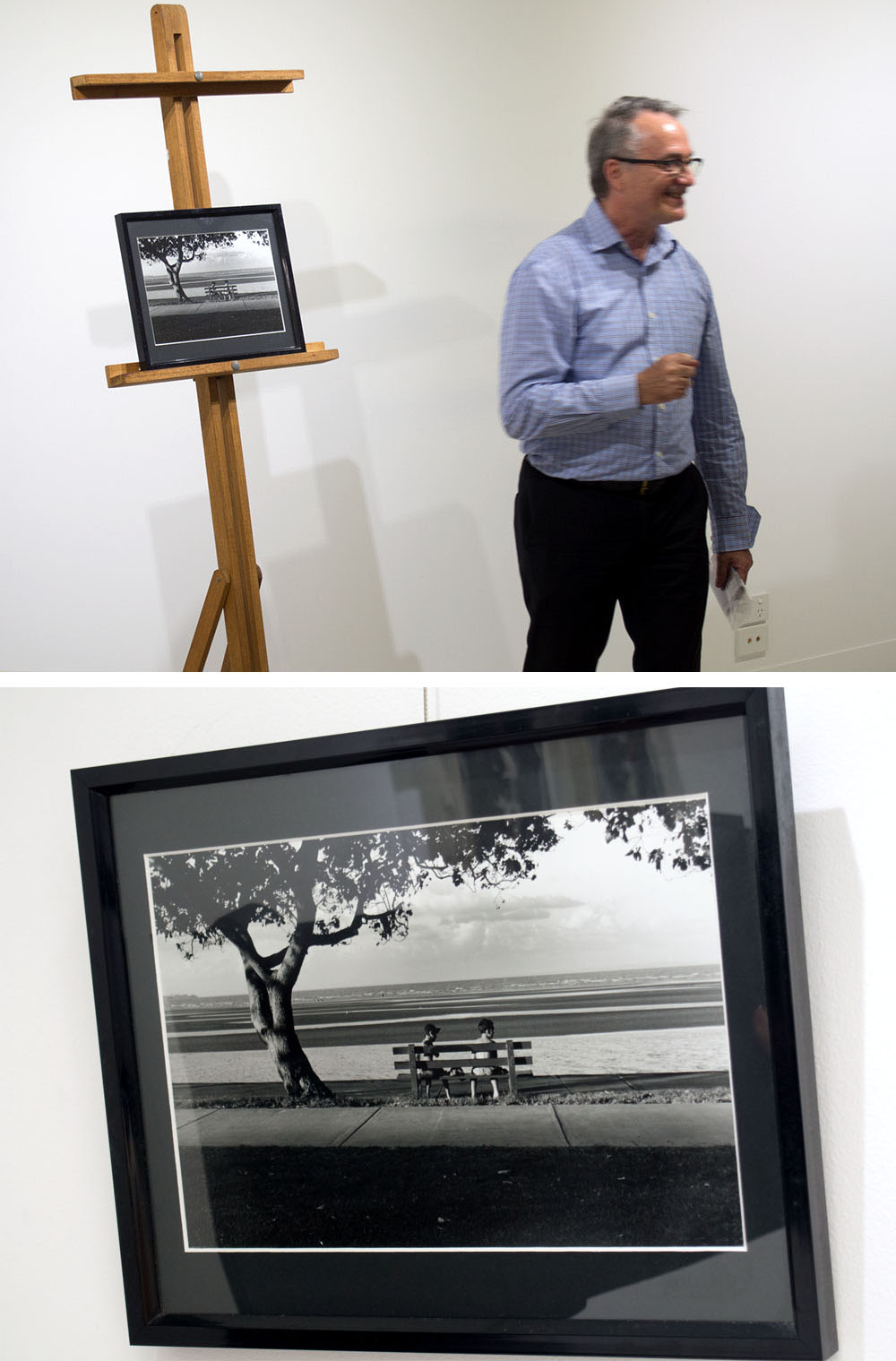
Jeff Ryan
Jeff discussed the taking of this photograph and its connection personal connection with he and his brother’s lives. The photo was made relatively recently at a place where Jeff and his brother played as kids 40 years earlier.

Irena Prikryl
Irena’s story related to buying her first serious camera – a Hasselblad and then taking some photos in Grand Central Station in New York. The camera was balanced on a railing and the shutter speed was long… The photo was recently printed in a Fine Art Print workshop at Maud with Doug+Vicky.
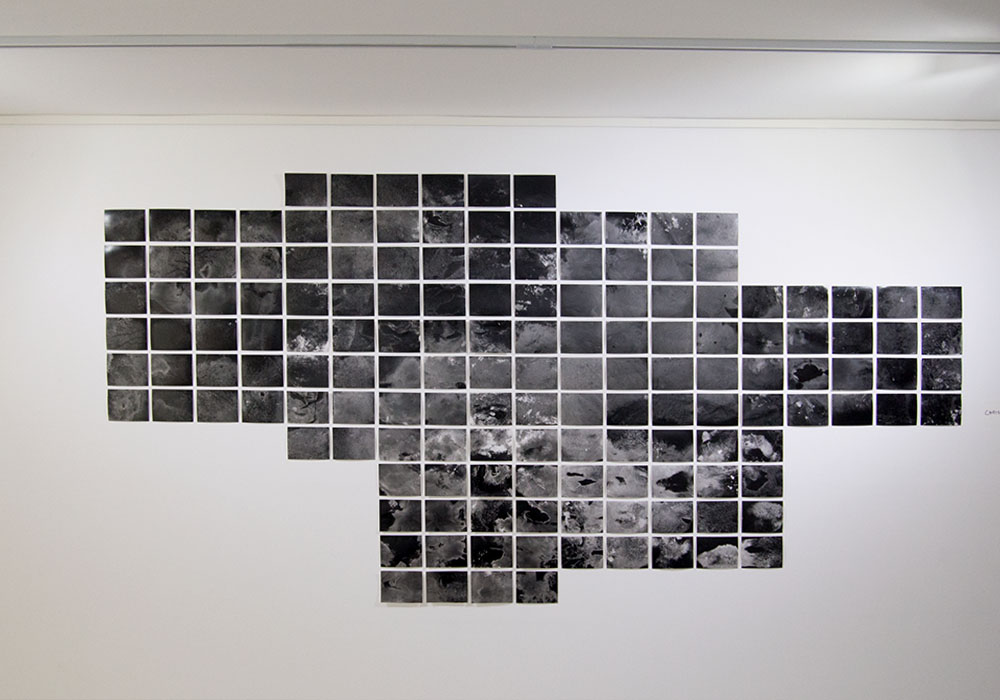
Chris Bowes
Chris Bowes was unable to attend but had come by earlier to install his personal investigation of self and sweat by placing un-exposed B&W photopaper against his body. The prints are then process yield a ‘Chemigram’. Chris will present a floortalk at the gallery. Check the Dark Love page for details…

David Symons
David discussed that the origins of his 1980s photographic series was a response to the work and photobooks of David Hamilton. Hamilton was well known for his ‘soft-porn’ photos of young girls. Symons spoke about how he appropriated Hamilton’s photos by double printing copy negatives through a cracked mud image. Texts from Hamilton’s book were adapted by Symons using a redactive process to reveal an alternative story….
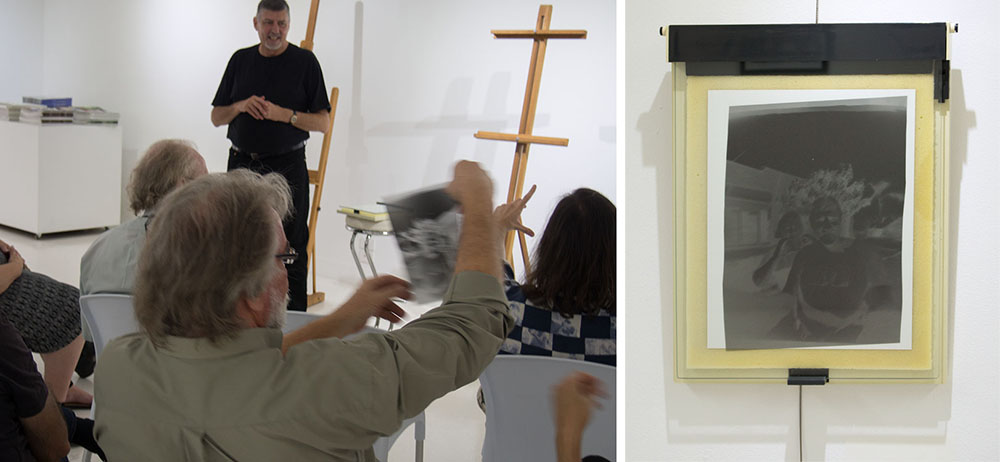
Doug Spowart
I commented about how a recent re-connection with pinhole photography during the Pinhole workshop last weekend had helped to resolve a need for a new project that Vicky and I will be working on next year. I passed around an 8″x10″ film pinhole negative that had revived my interest and love of the darkroom. PHOTO: Victoria Cooper.

Edwin Wecker
Edwin discussed his experiences with film photography whilst on tour to India with his friend Russell Shakespeare.

Gail Hoger-Neuman
Gail showed some photographs from her early 1990s exhibition ‘Hollywood Stills’ that was shown at Imagery Gallery.
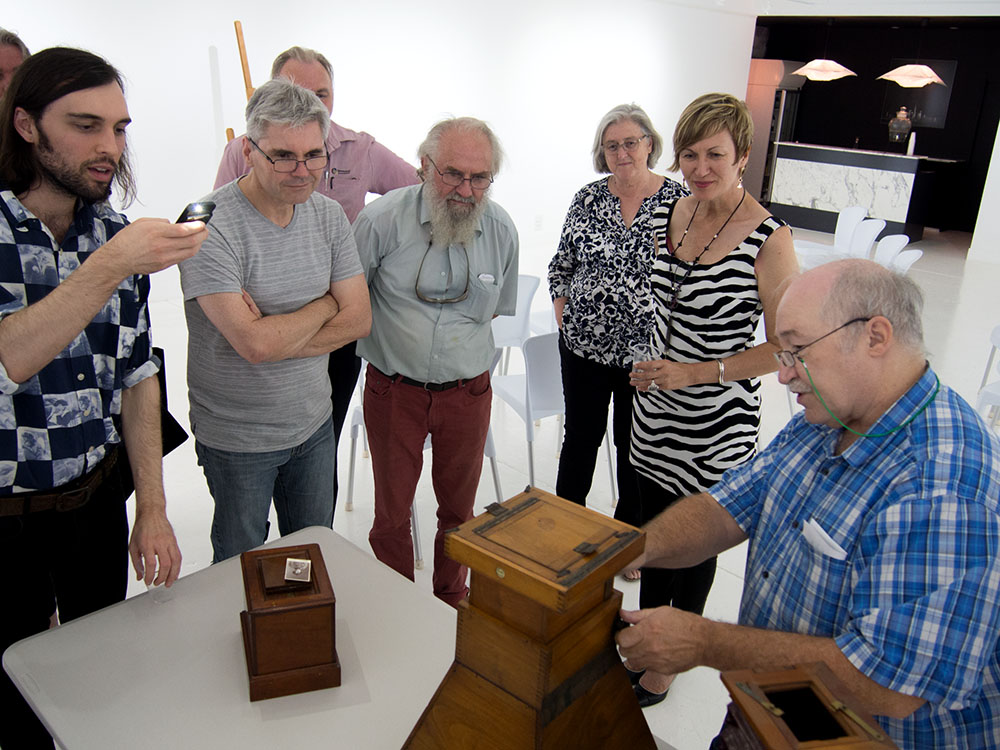
Sandy Barrie demonstrates ancient portable daylight enlargers – the oldest was made before 1859.
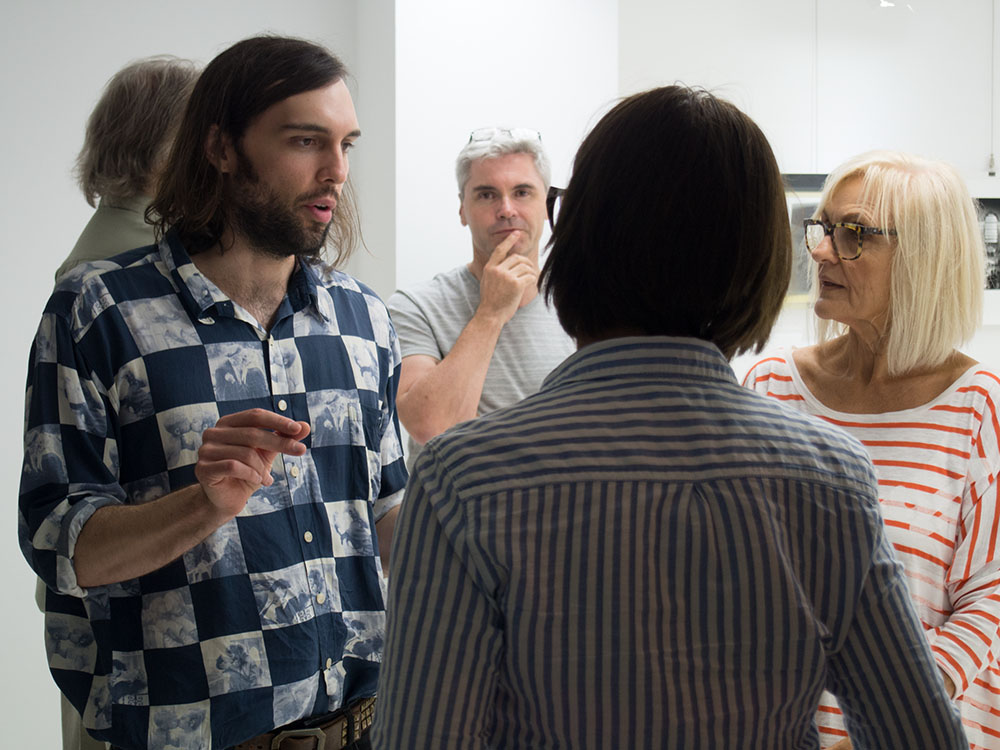
Conversations continued after the presentations
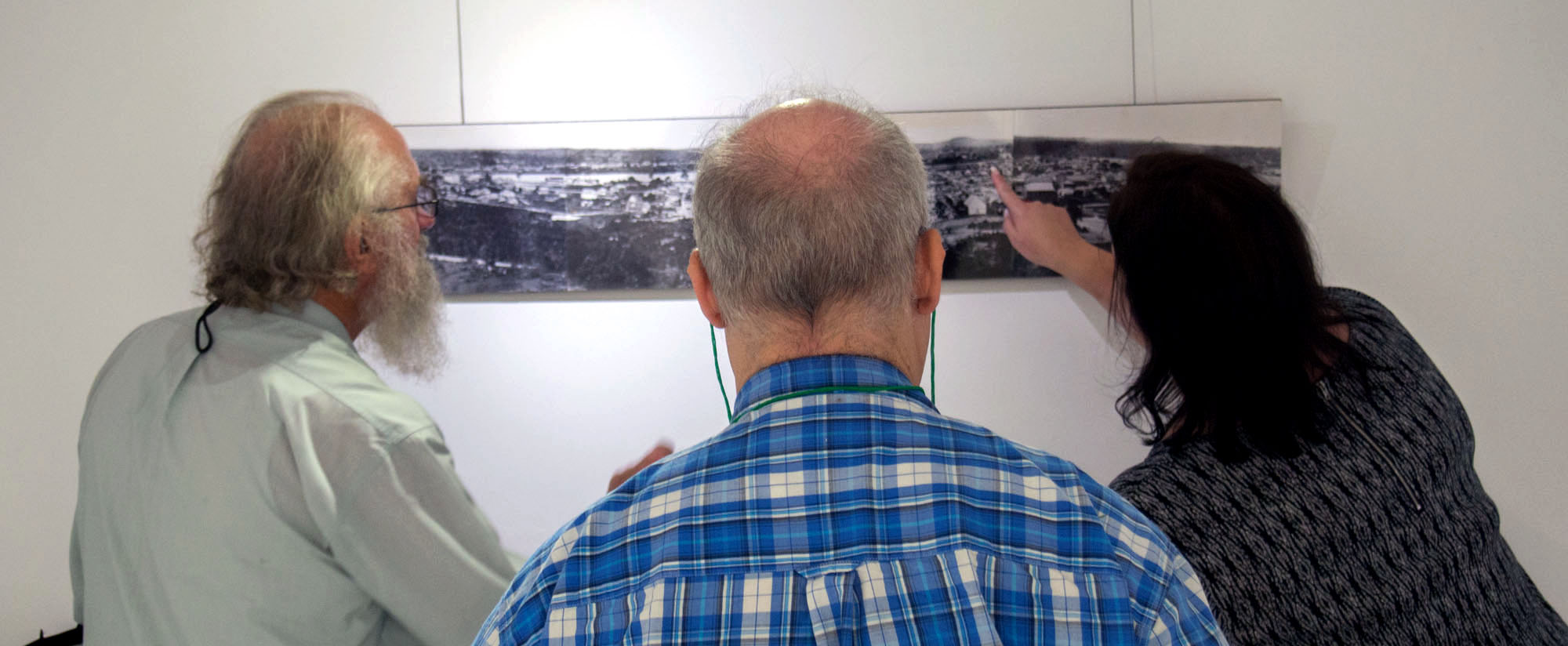
The DARK LOVE works were enjoyed and discussed
CHRIS BOWES FLOORTALK – 26 November – details to be confirmed
A FINE ART PRINTING WORKSHOP WILL TAKE PLACE ON – Postponed to 2017
A CYANOTYPE WORKSHOP – Details HERE
AND THE FRONT GALLERY WILL BE CONVERTED INTO A CAMERA OBSCURA on November 26 (to be confirmed)
Festival of the Darkroom logo
All portrait photographs and gallery documentations unless credited otherwise ©2016 Doug Spowart
.
.
STUDIO WEST END: REPRISE
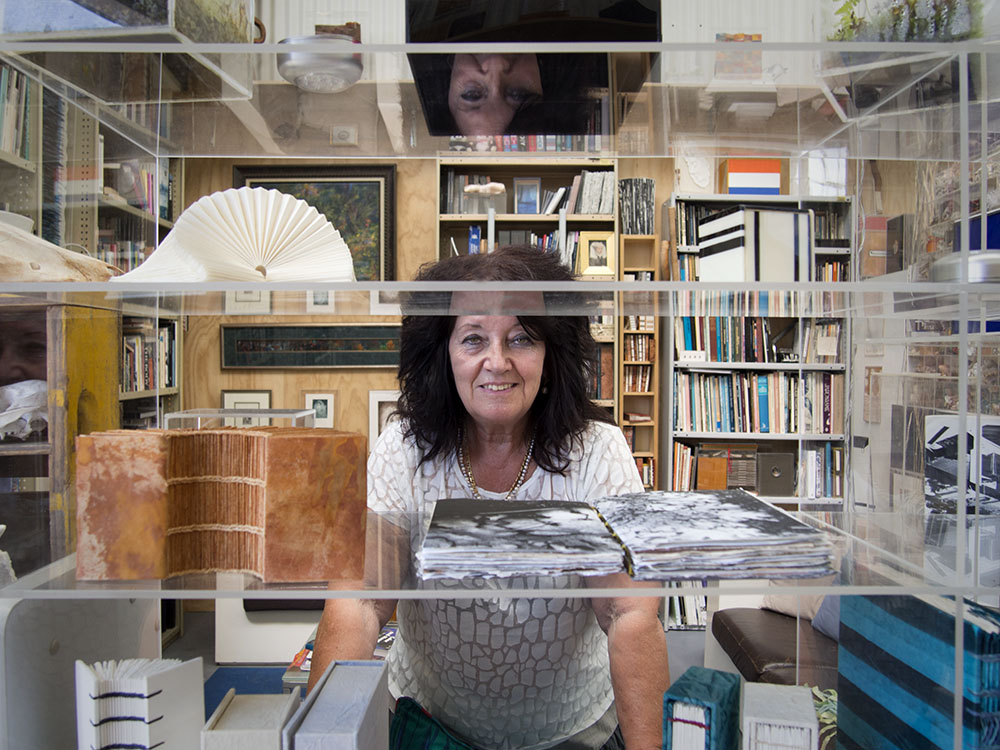
Adele Outtridge photographed in the new Studio by Doug Spowart
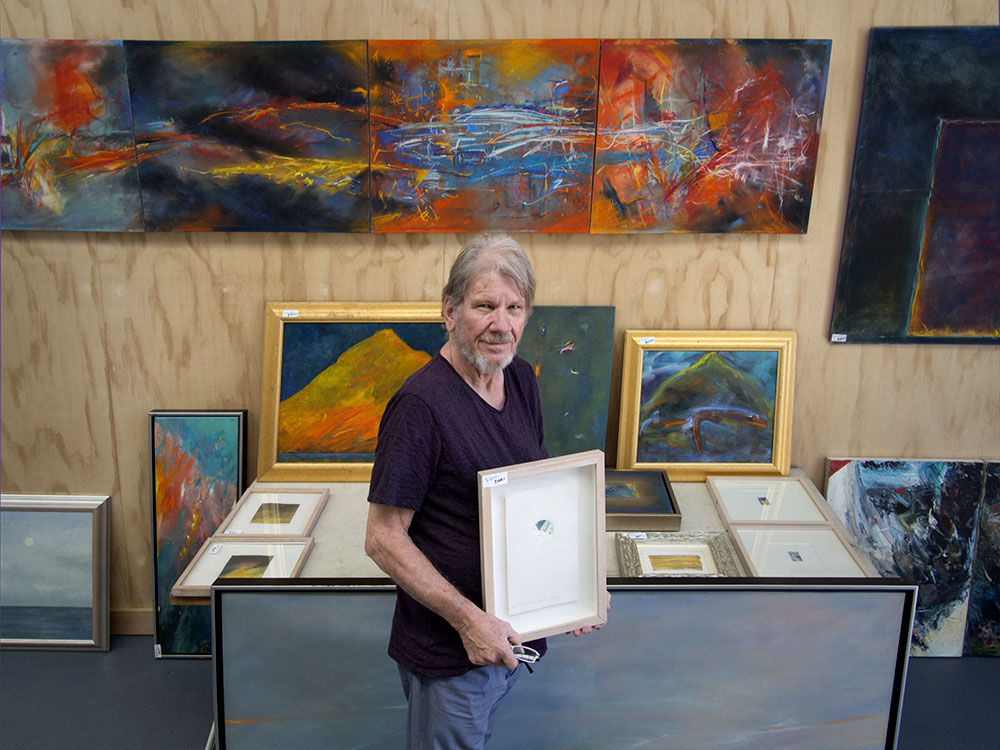
Wim de Vos photographed in the new Studio by Doug Spowart
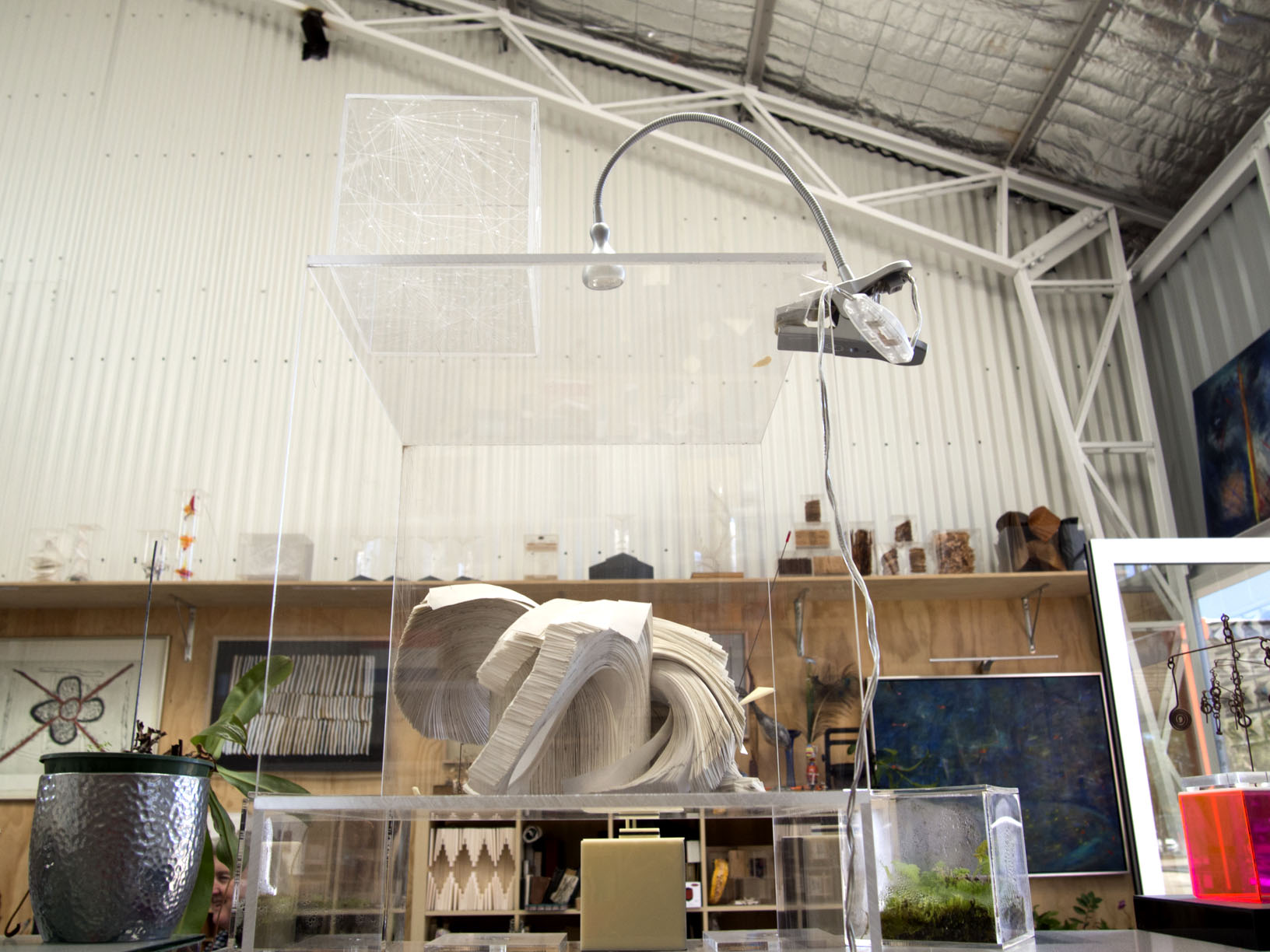
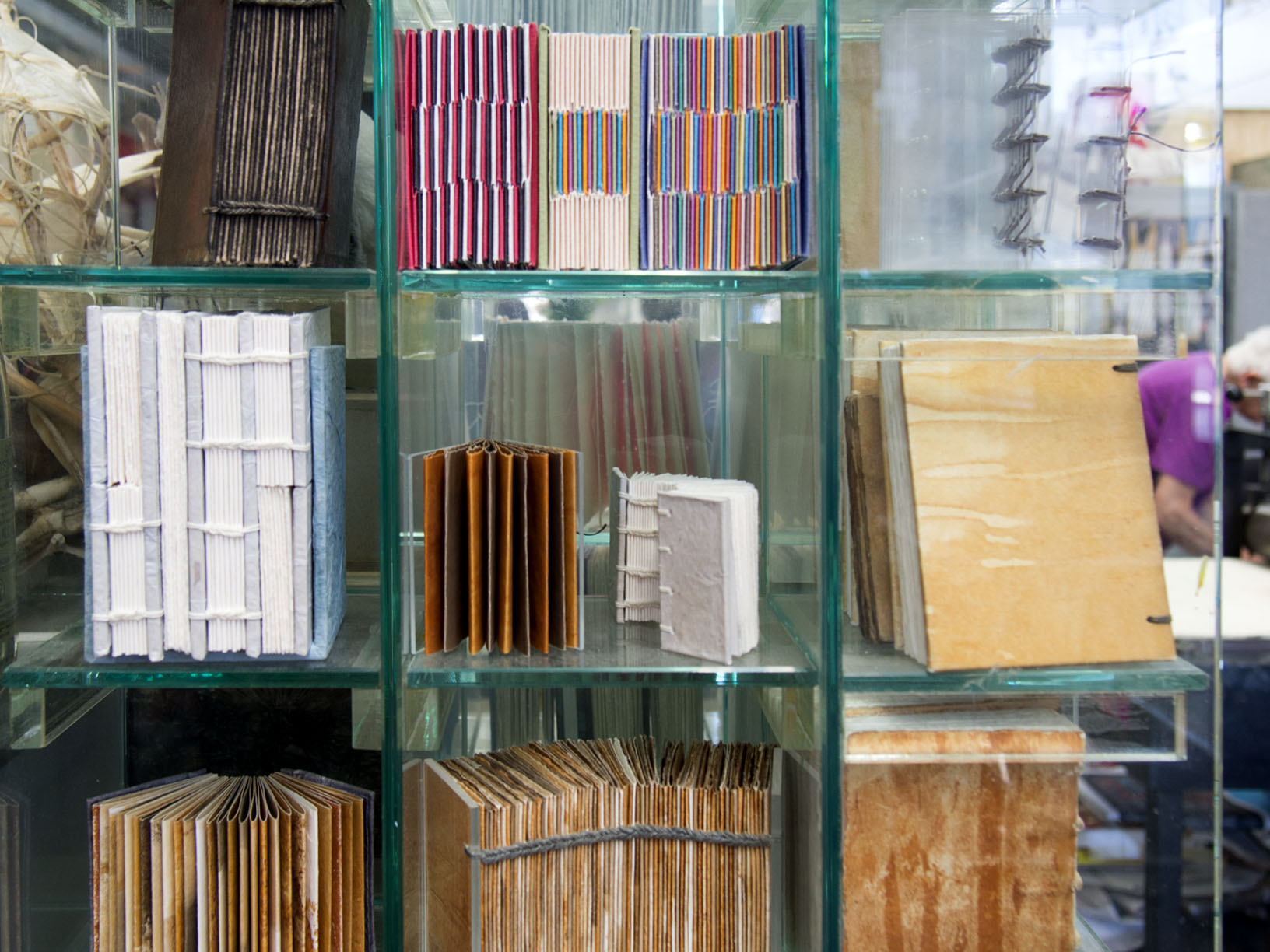
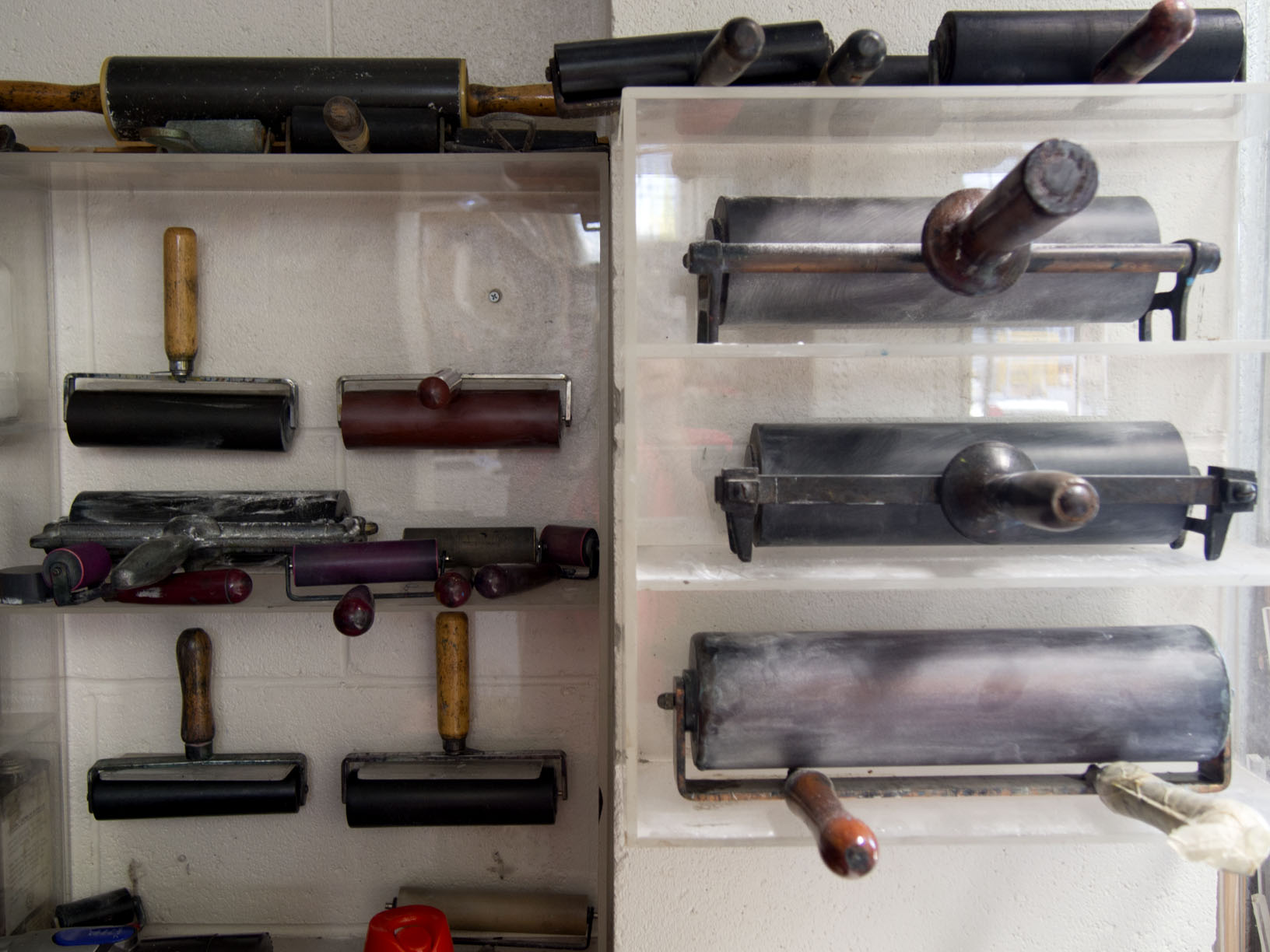
Adele Outteridge and Wim de Vos are like ‘family’ for many artists and creatives in Queensland, and I’m sure around Australia and beyond. Their Studio West End has provided a space for artists to access printing technologies, be supported by mentoring and teaching provided by Adele and Wim, and also connect through the social meeting place that the studio was.
Over the years both Vicky and I have connected with them in many different ways; as co-teachers in an art college, as collaborators on art projects, attending events that each other had organised, learning and sharing skills and, at times, just sitting around – as other do – talking about art and artists…
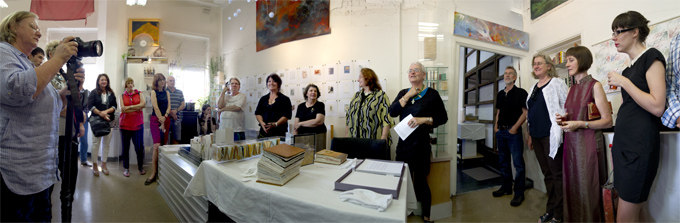
Helen Cole opens the Studio West End artists book show Photo: Doug Spowart
Adele and Wim have for many years operated their business Studio West End in the suburb of West End in Brisbane in an old soft drink and later and ice-cream factory. They made these places little palaces of art, inspiration and creativity. The workshop was often converted into an exhibition space and example of which would be the project launch of EX LIBRIS: WHO OWNS THIS BOOK
However the creeping menace of gentrification and the scourge of massive high rise development meant that earlier this year they had to pack up and leave their premises in the ABSOE building.
Vicky and I attended the last day party on the 23rd of April and I made some photographs of the state of the studio and its conversion into neat stacks of crates on pallets. What follows is a small selection of the ABSOE Studio West End wake…
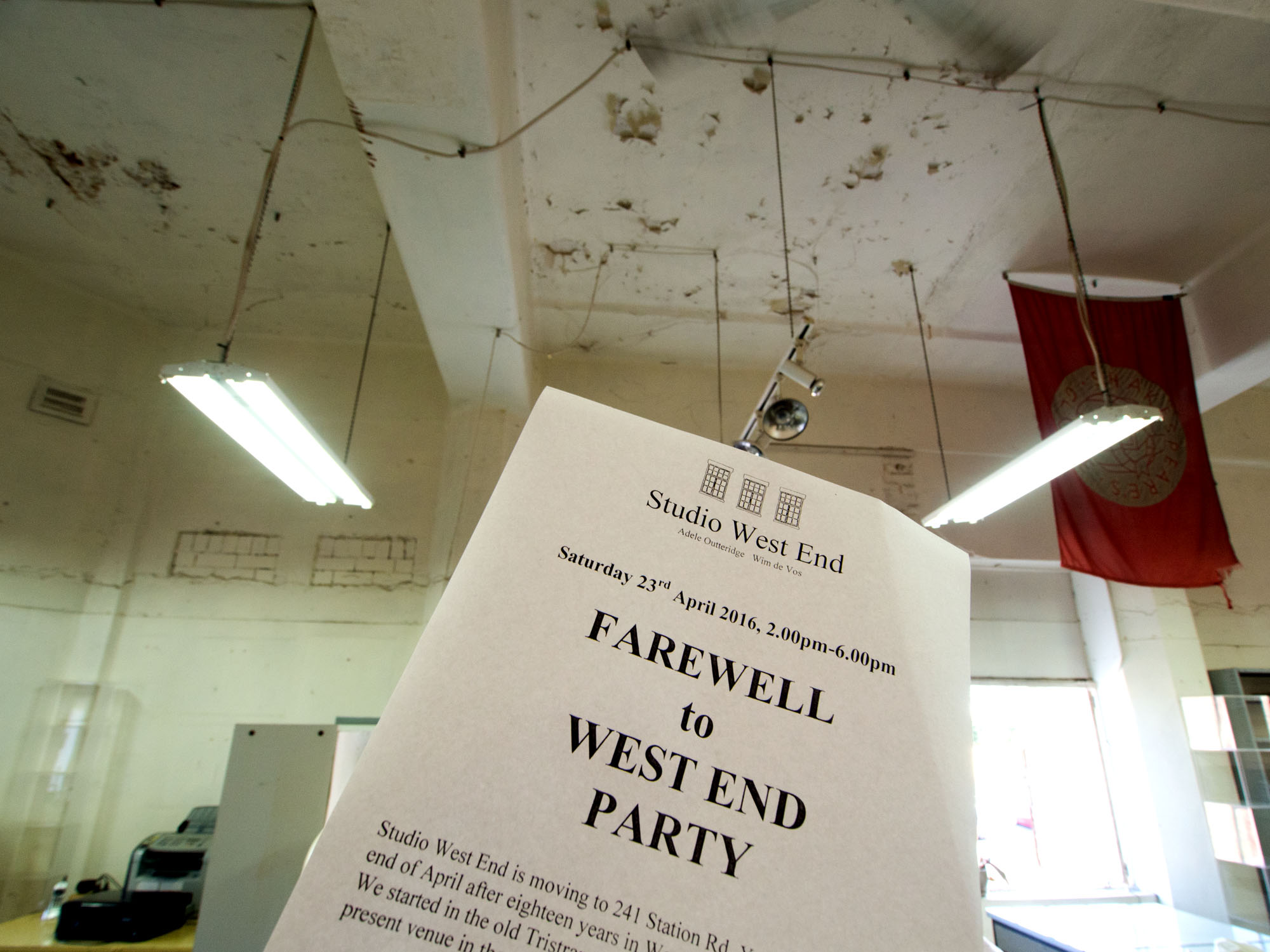
Invitation to the Farewell Party
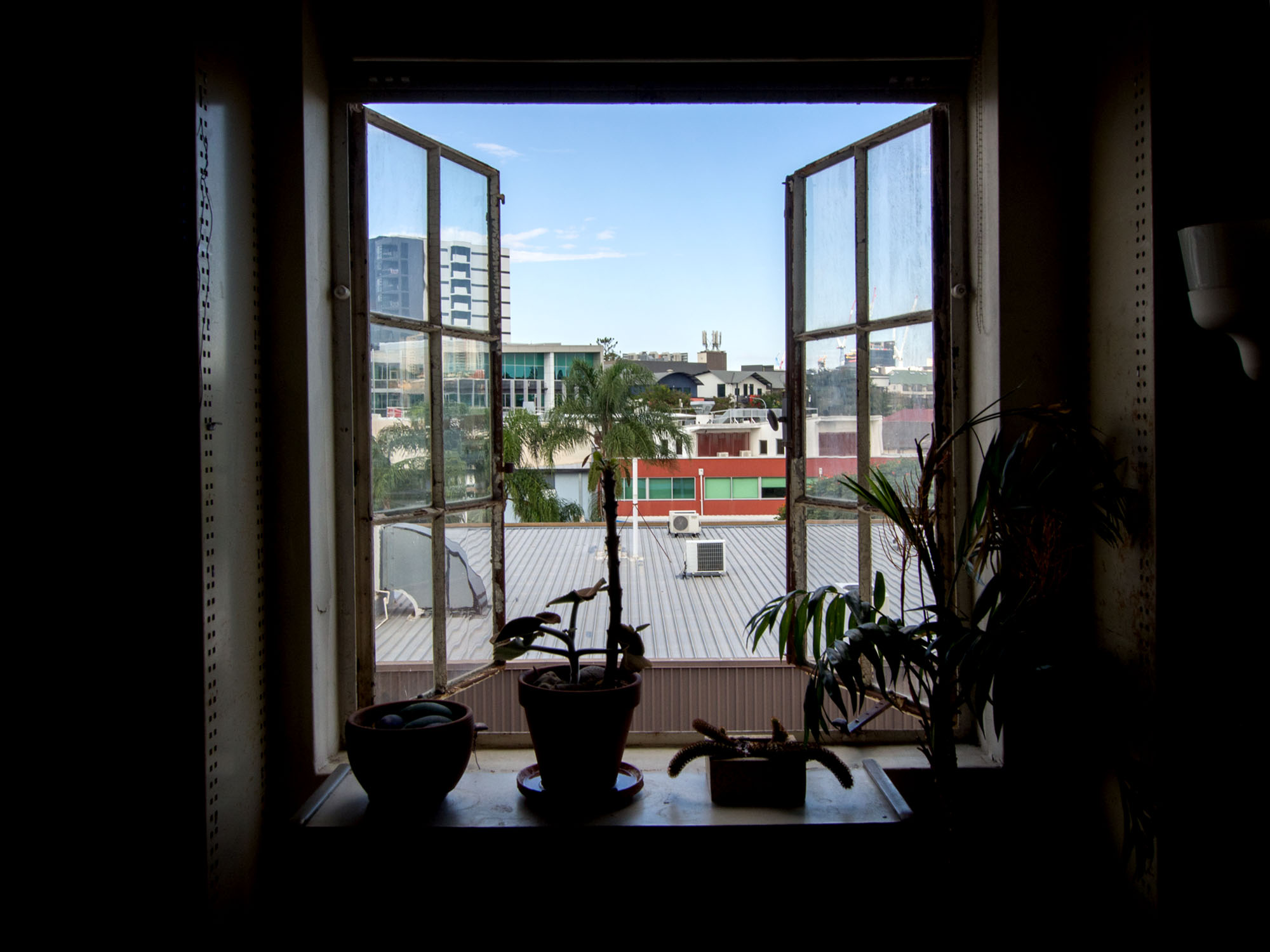
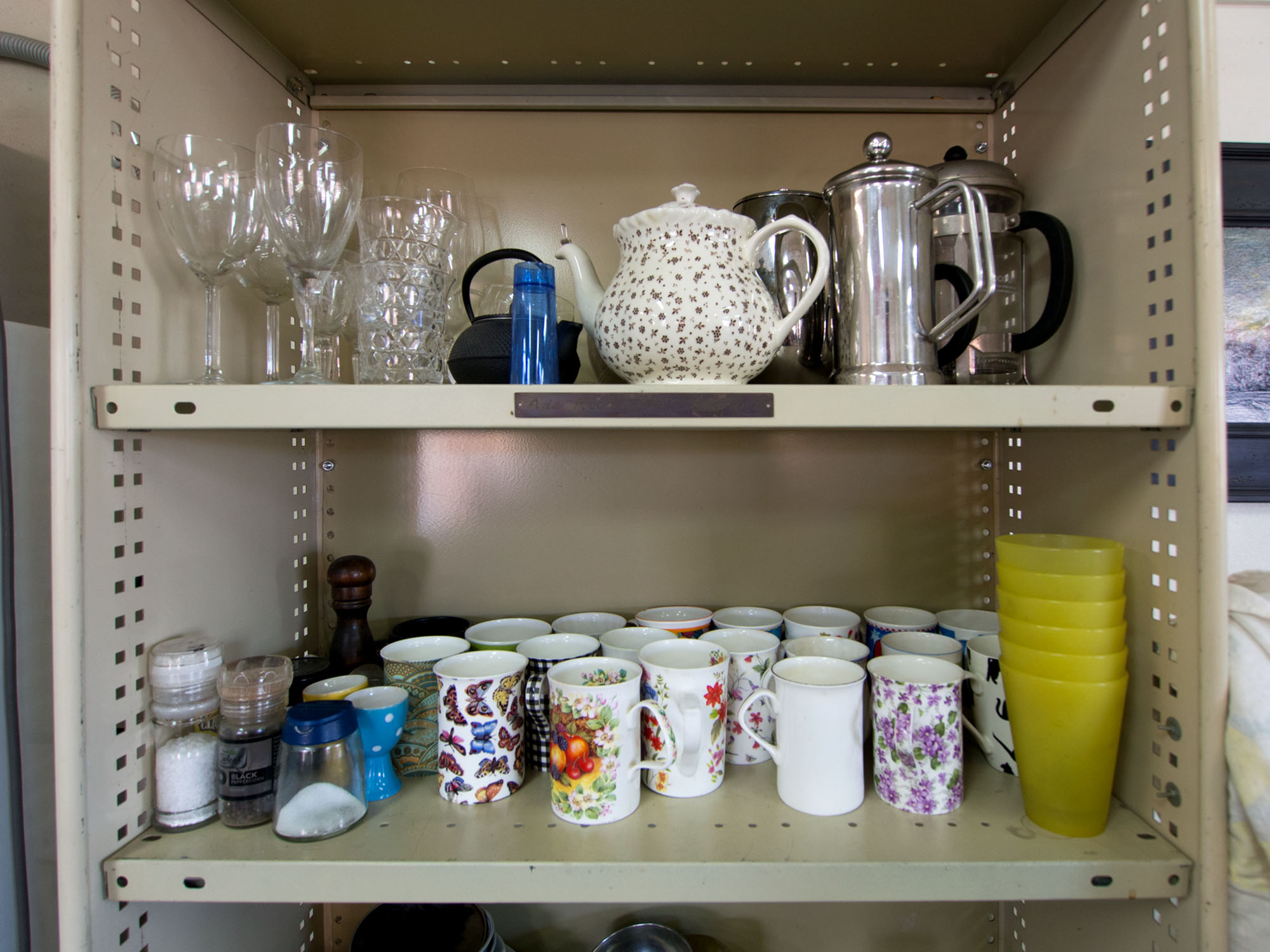
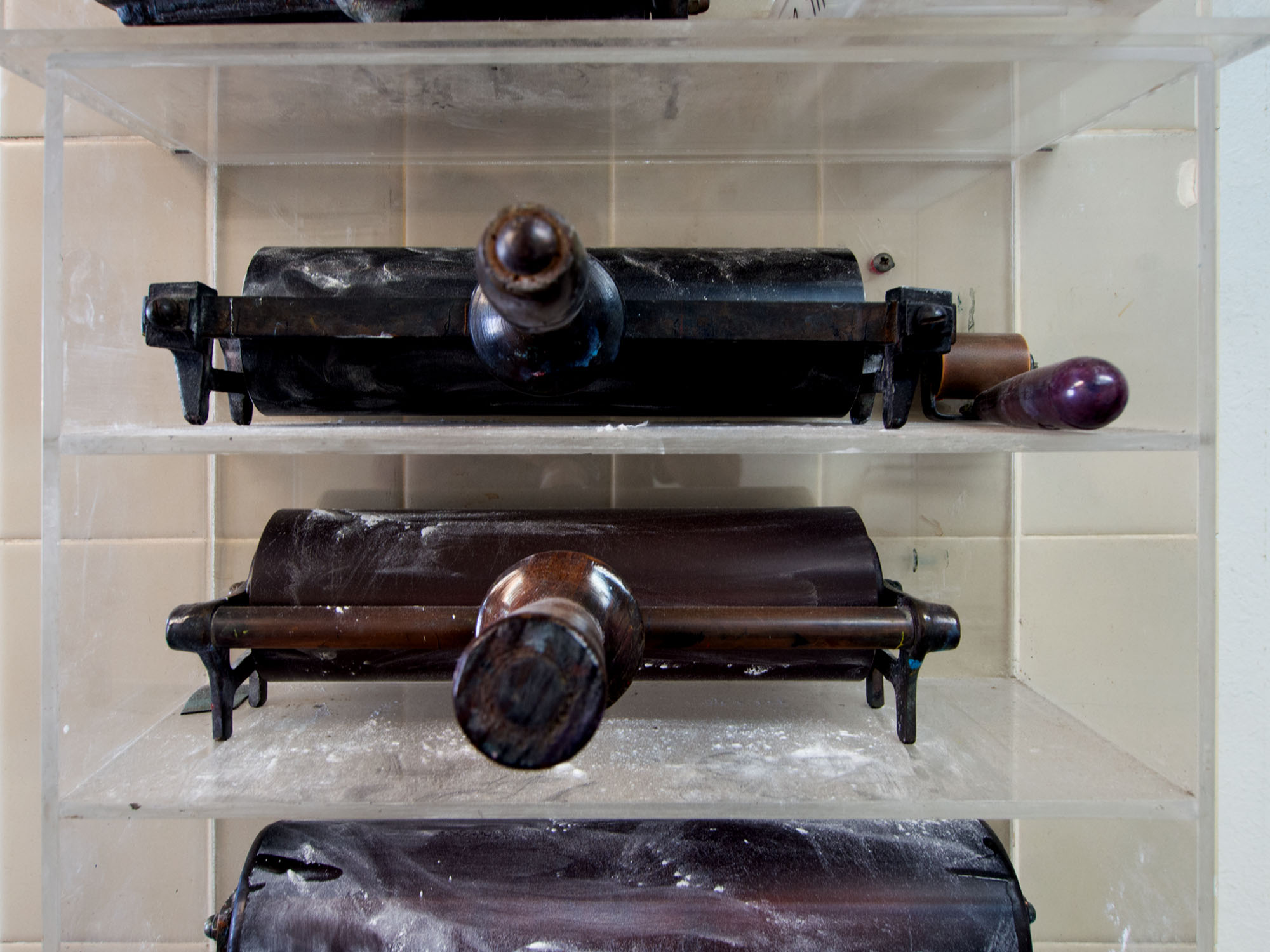
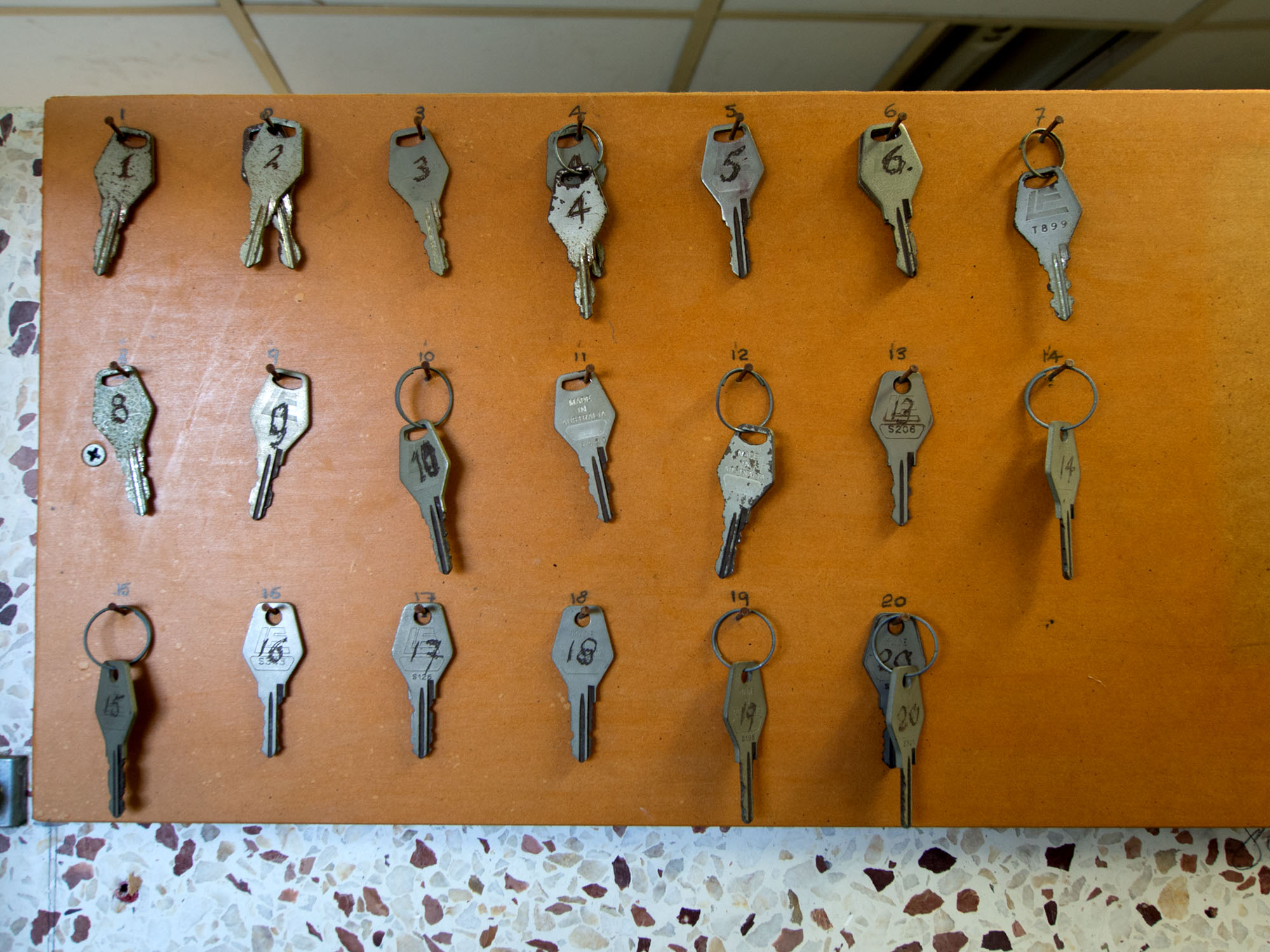
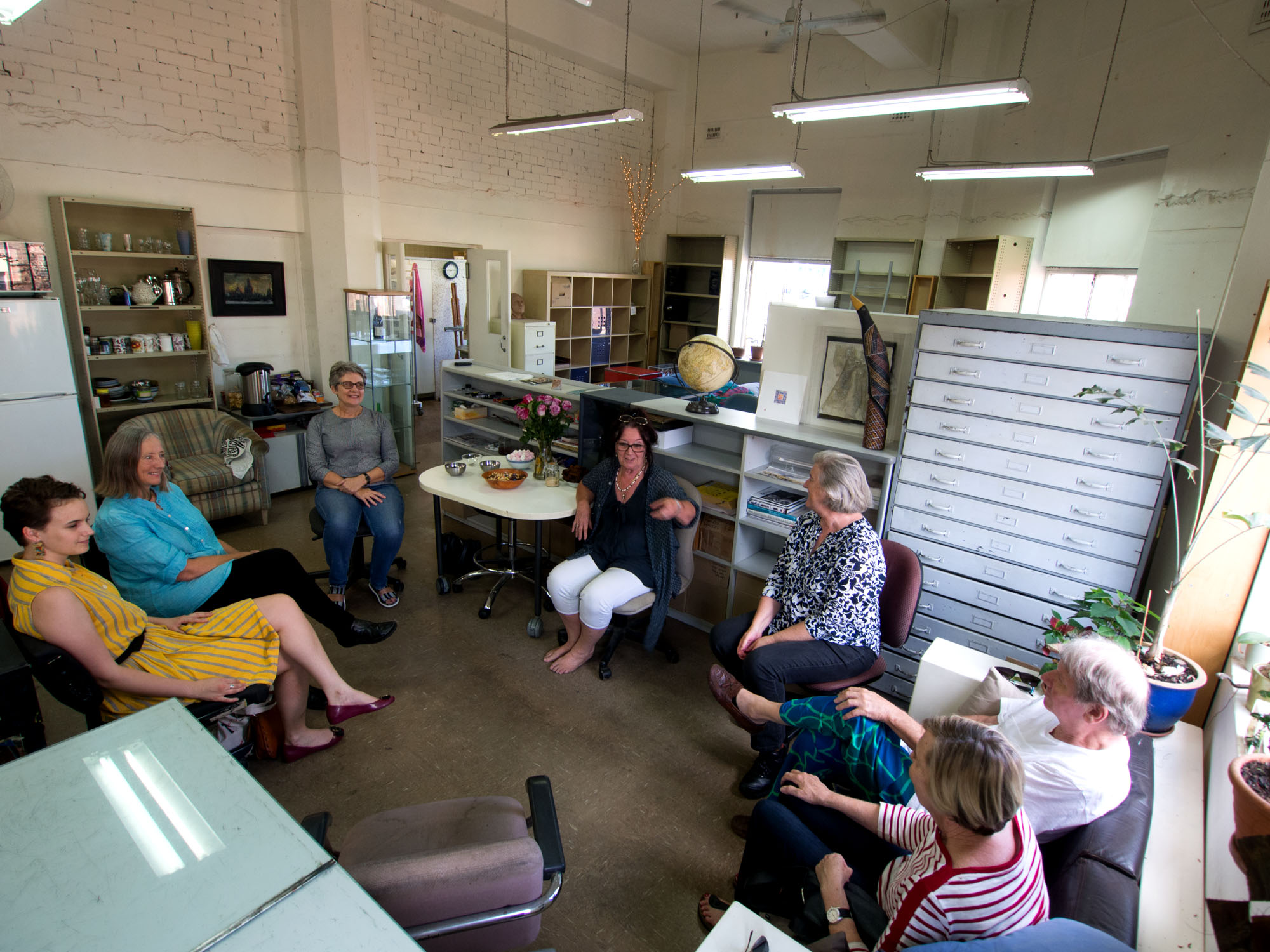
The farewell Absoe Building wake…
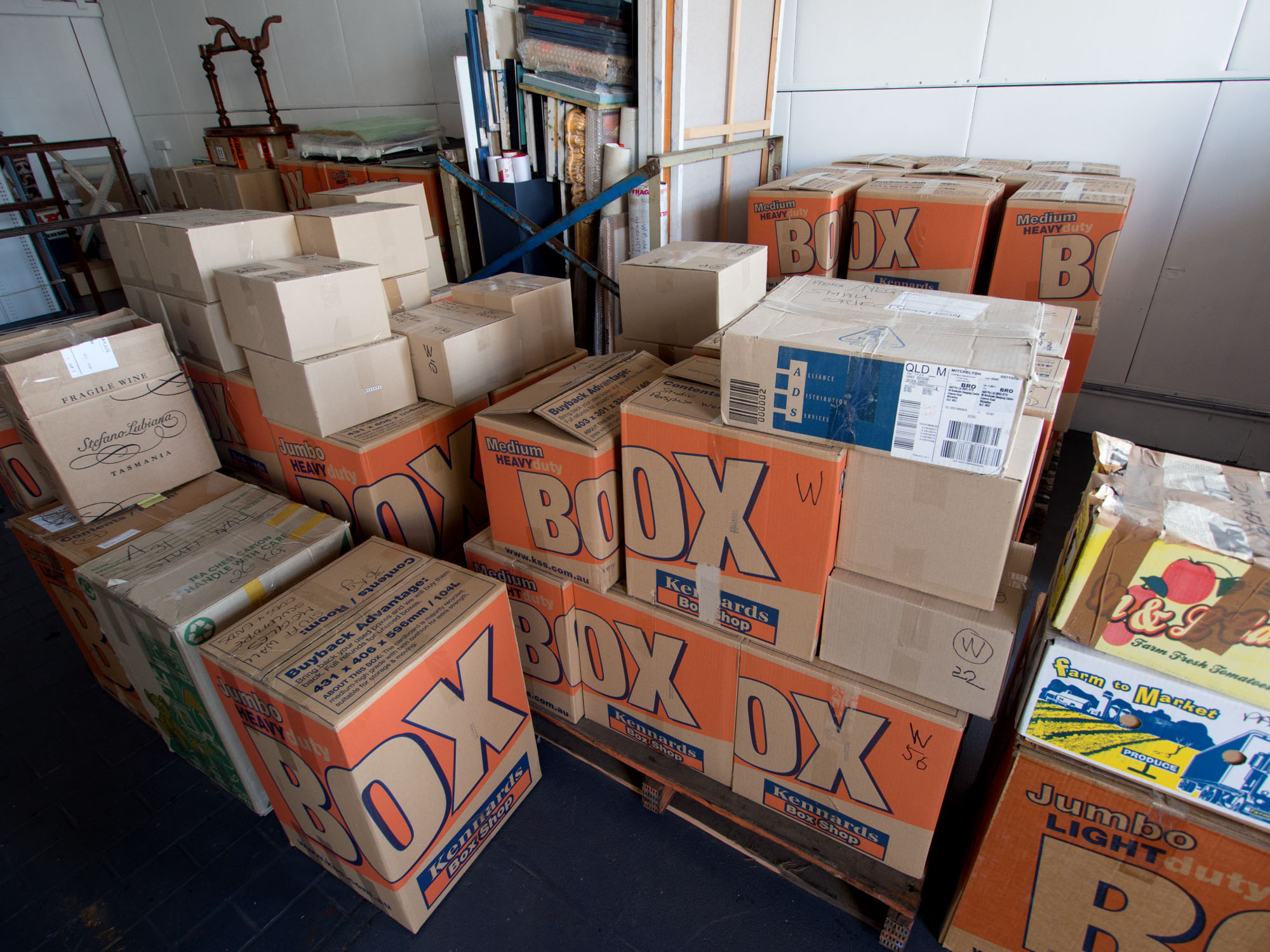
Moving out of West End
On October 30 Adele and Wim re-opened STUDIO WEST END at a new location –
241F Station Rd, Yeerongpilly 4105. Come to Gate 4, YCP (Yeerongpilly Corporate Park)
A large opening party was held on Friday evening with the new consecration of the new studio being performed by artist and raconteur Janet de Boer OAM. Acquaintances and friends were invited to visit the studio over the weekend and we went along for lunch the next day. We wish them all the best for the Studio’s continued operation.
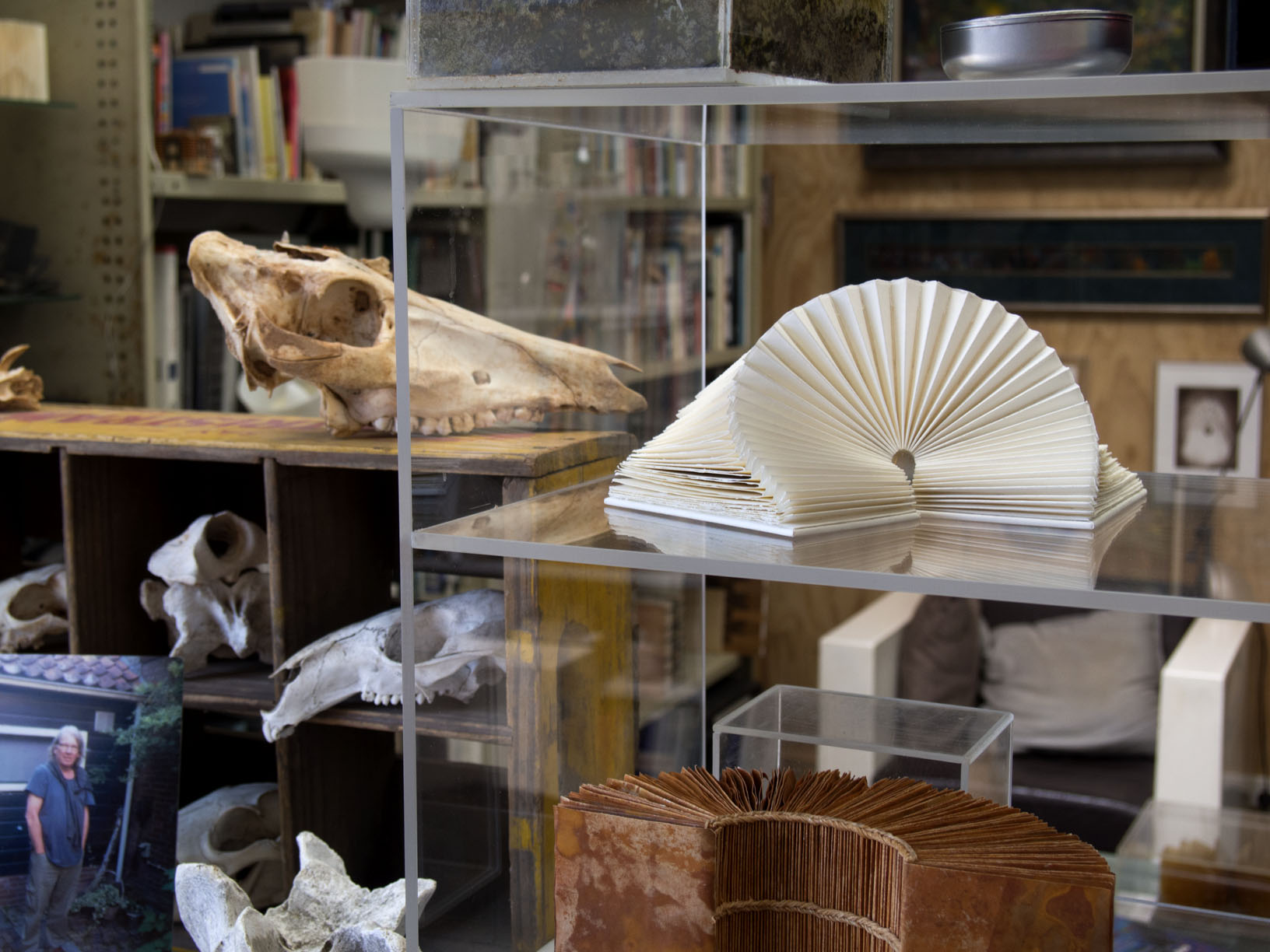
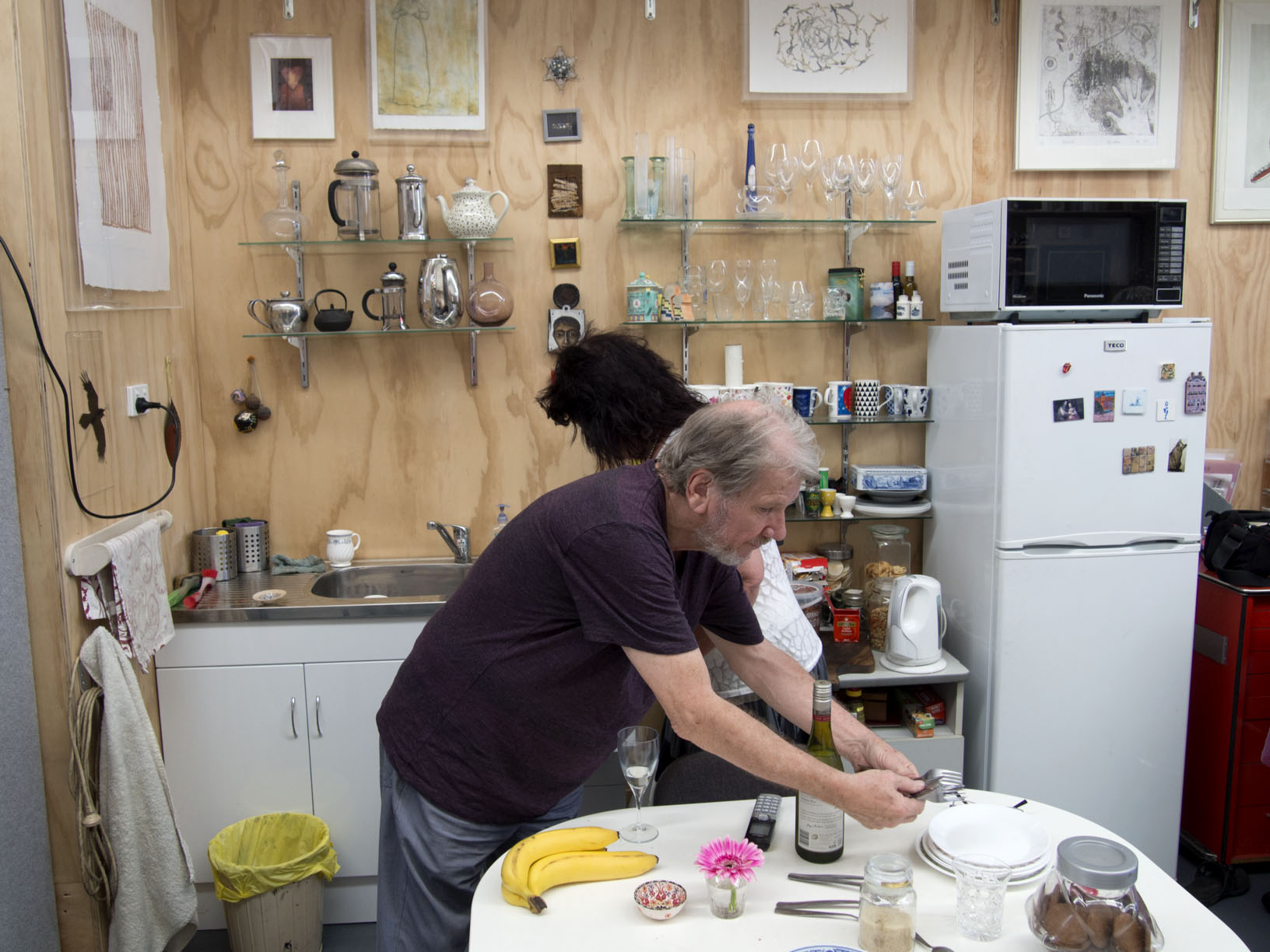
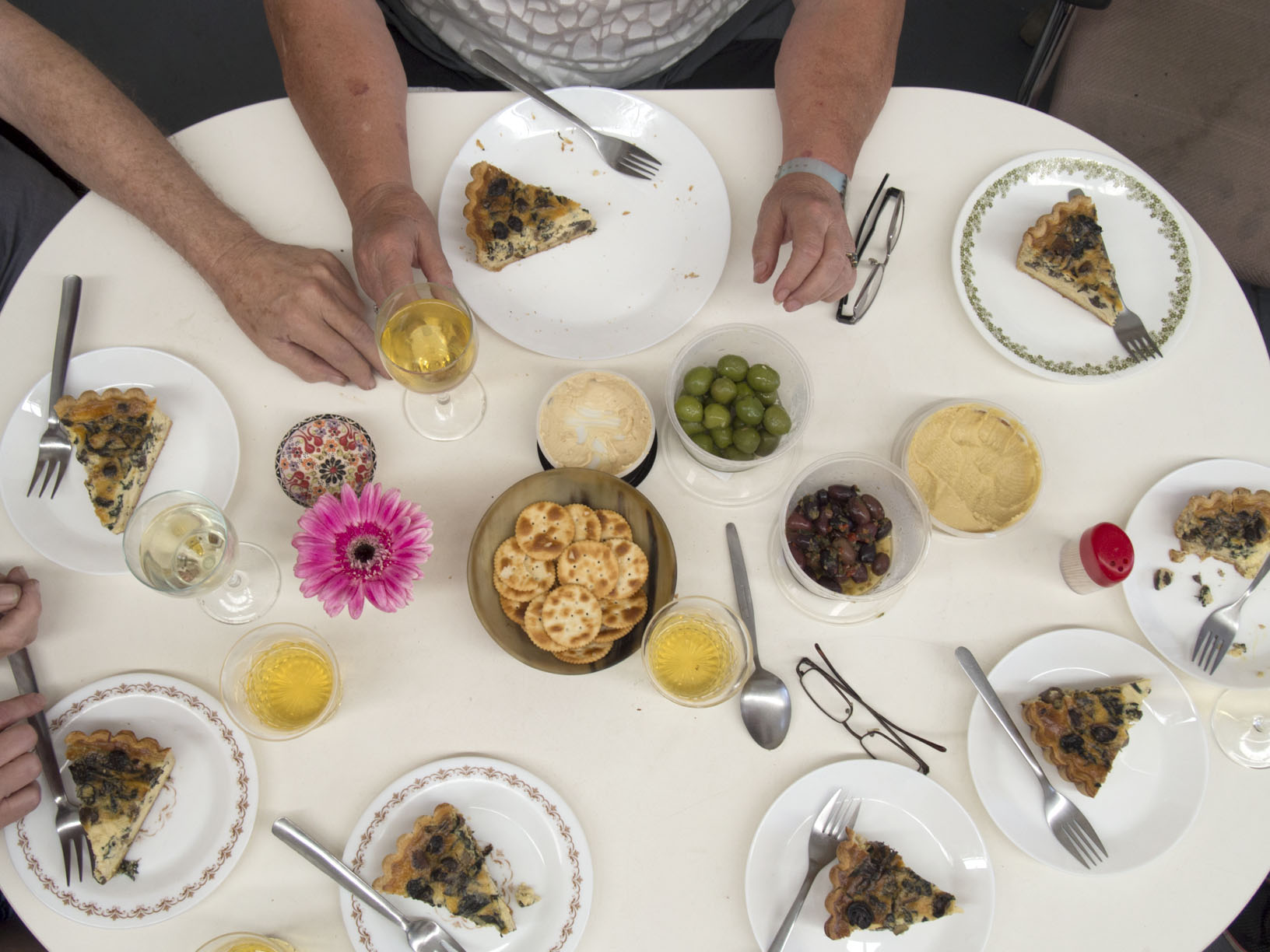
What follows is a documentation of the new space and its migration into a new space for art making, teaching and mentoring artists…
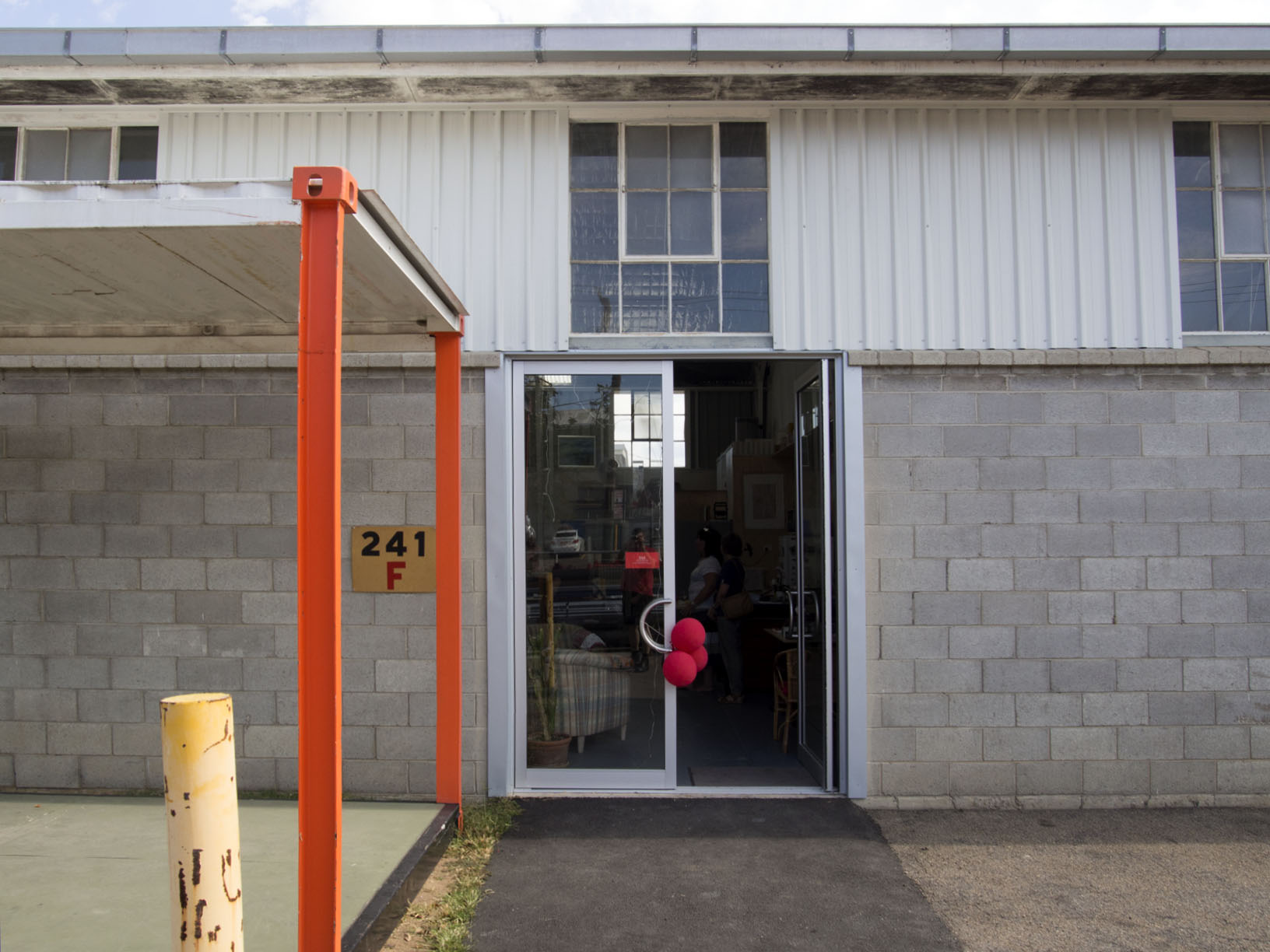
The NEW Studio West End
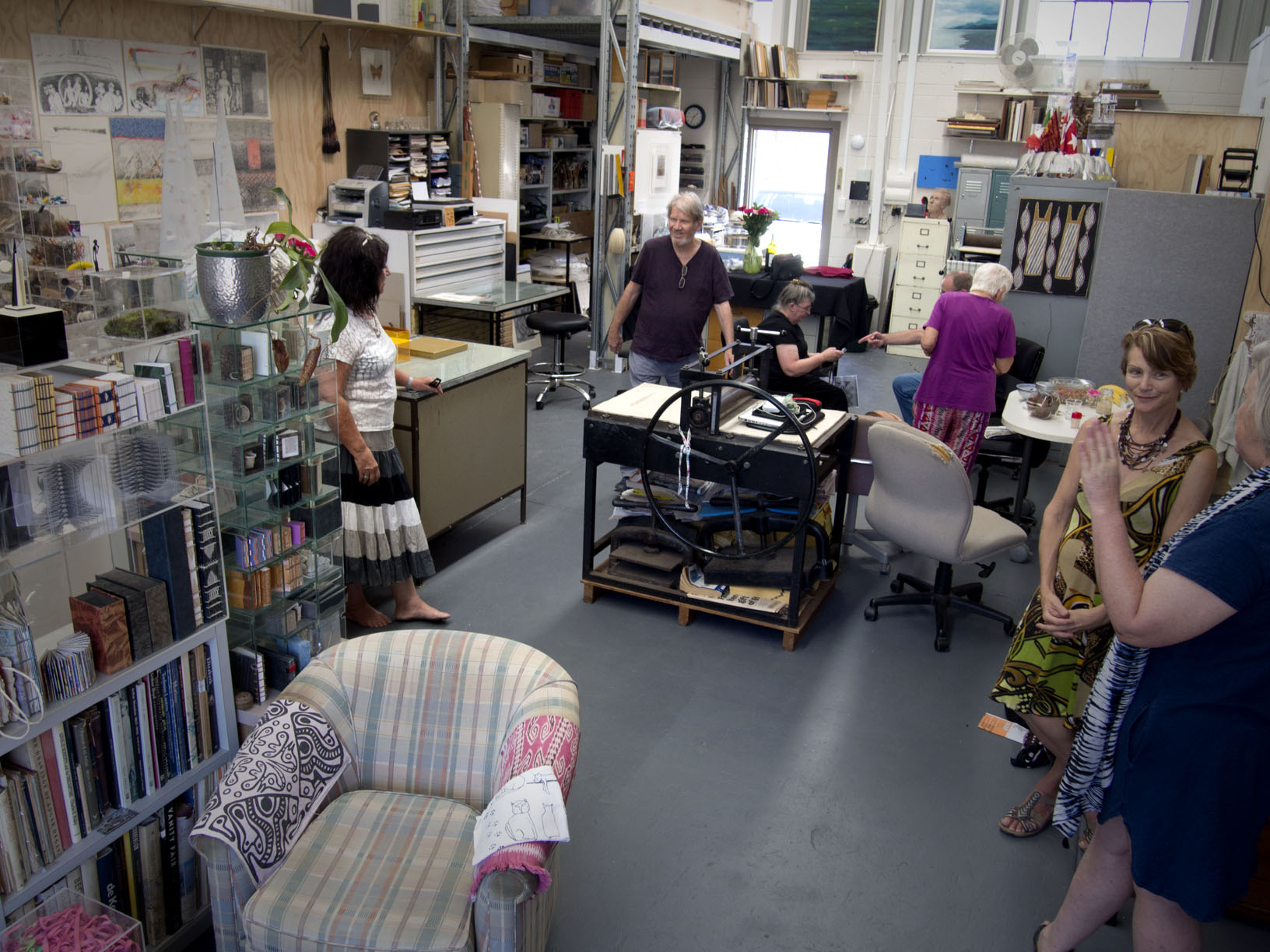
In the new Studio West End
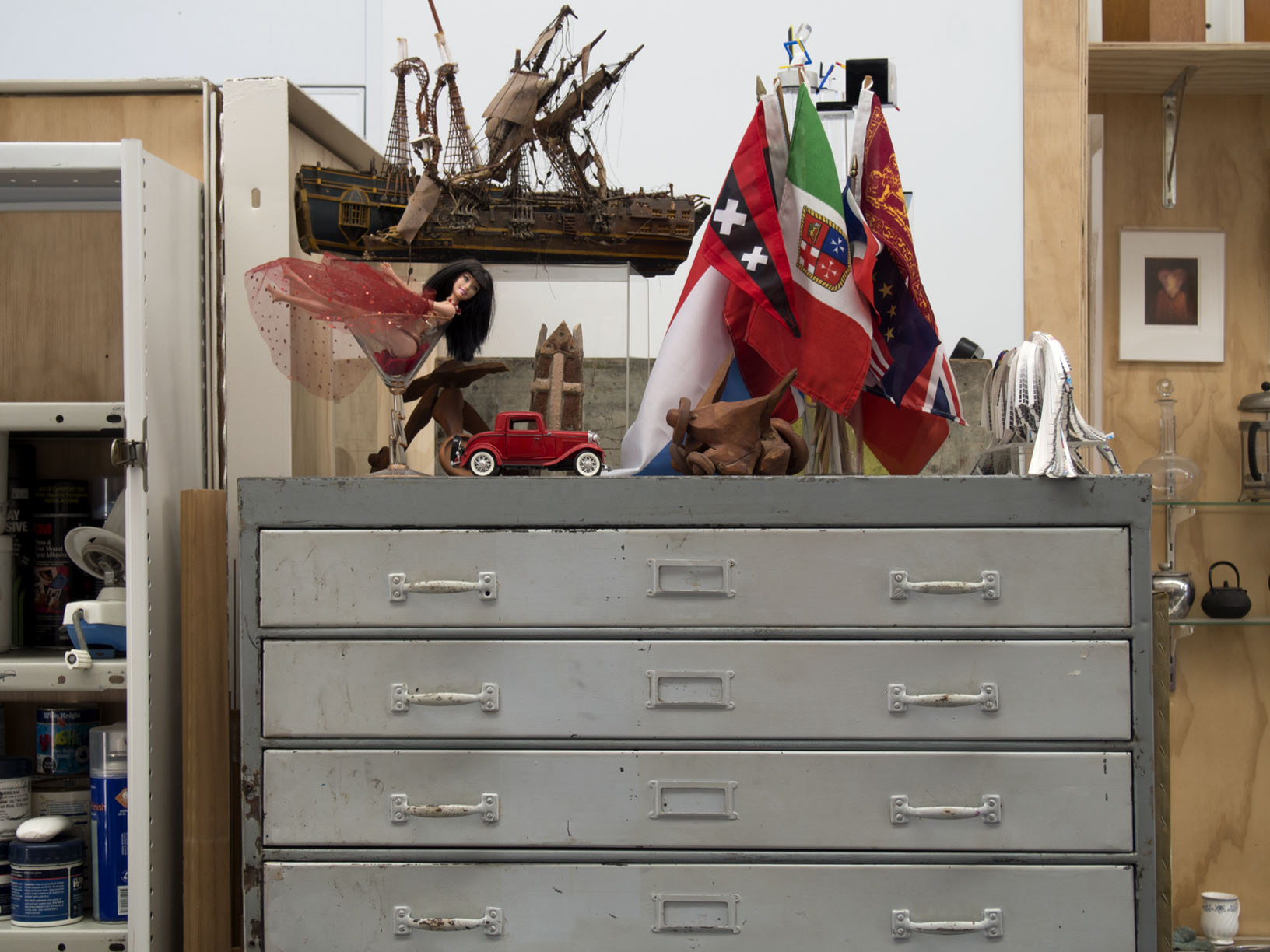
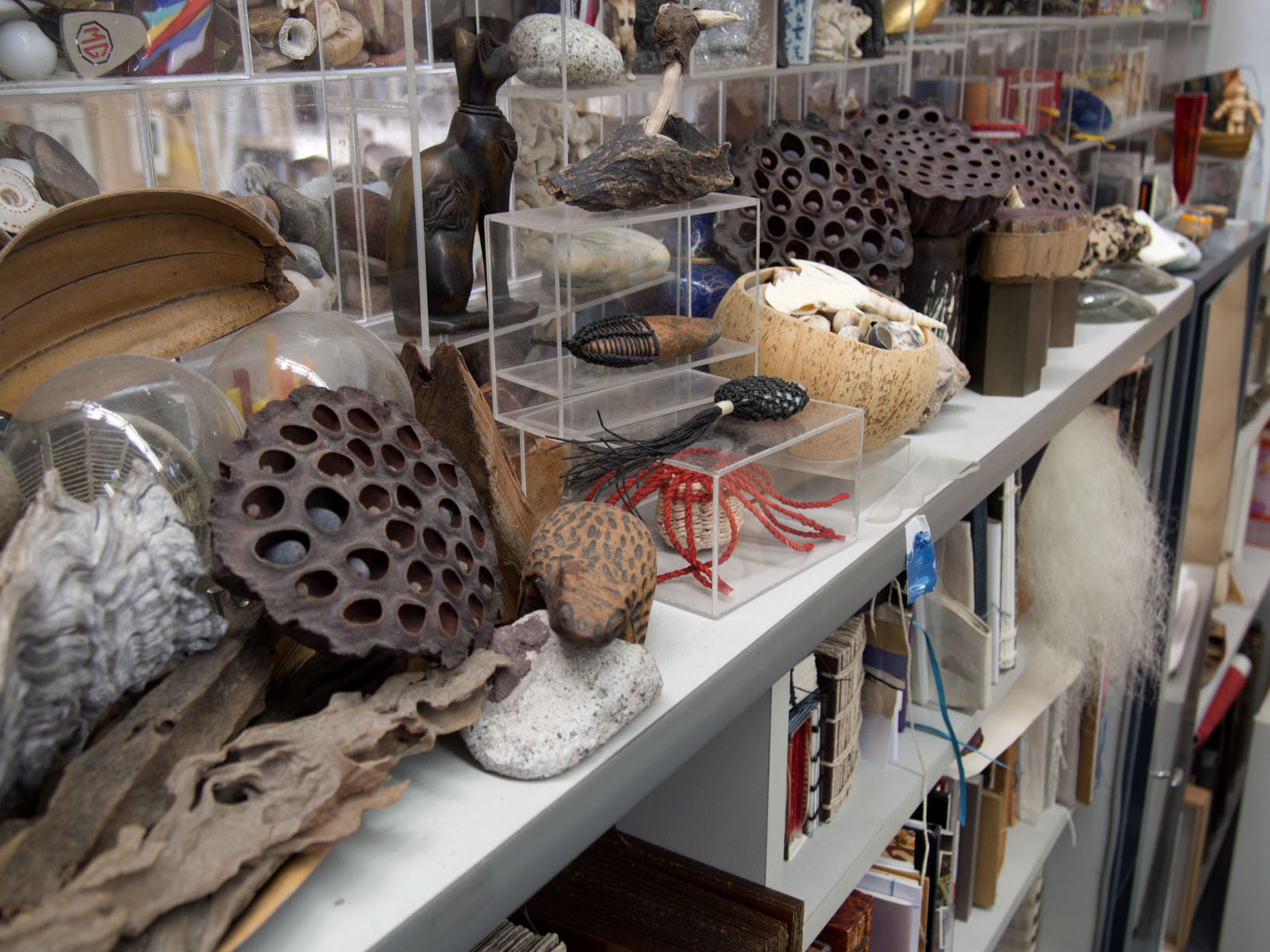
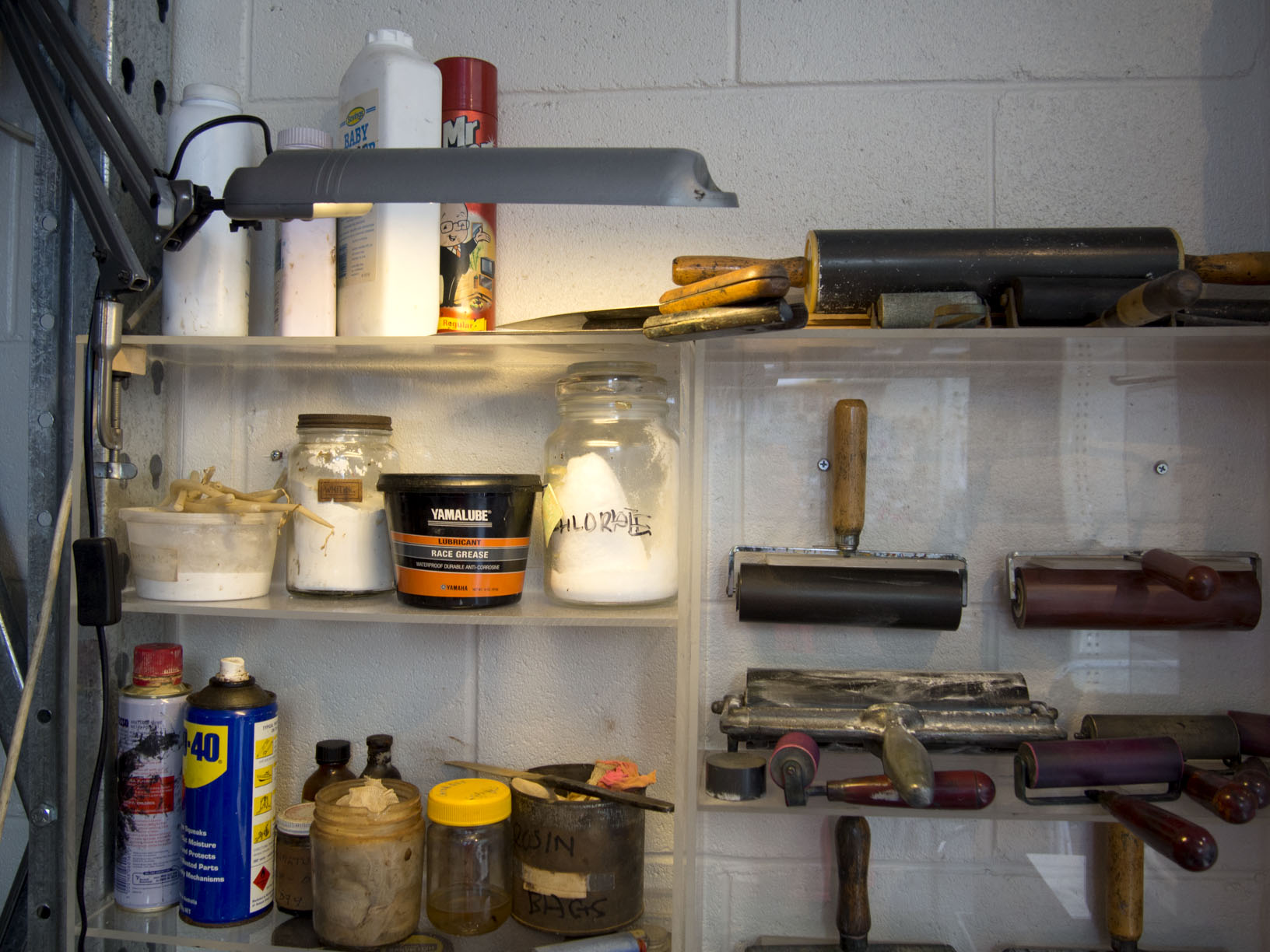
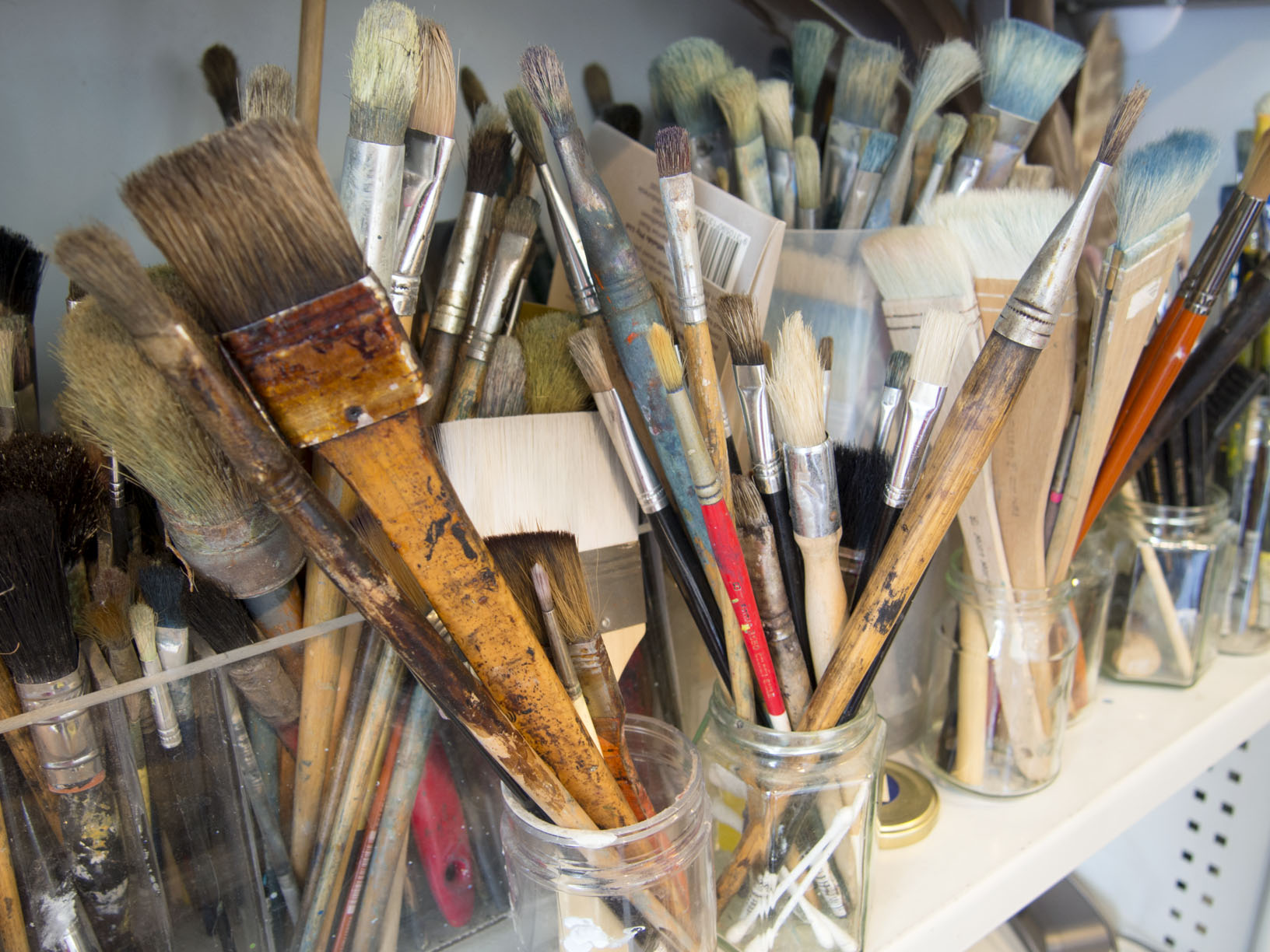
ALL photographs and text ©2016 Doug Spowart
.
.
COVERING: The 2016 Libris Artists’ Book Award
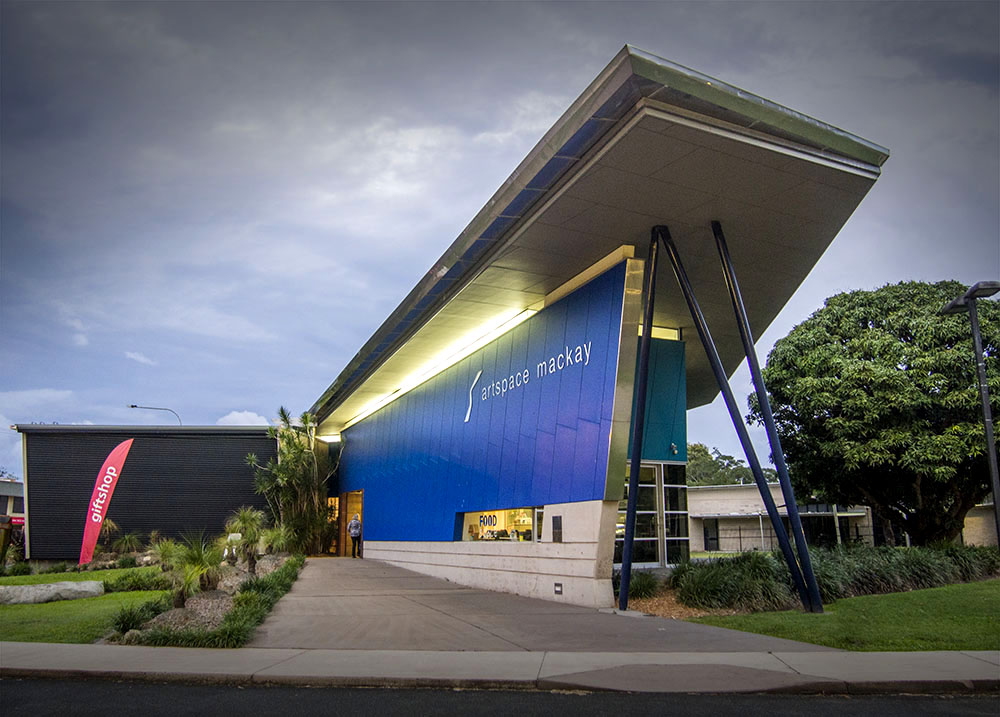
Artspace Mackay
A COMMENT ON THE 2016 LIBRIS ARTISTS’ BOOK AWARDS
In his announcement speech for the 2016 Libris Awards at Artspace Mackay judge Sasha Grishin makes the observation that: ‘The contemporary artists book is characterised by boundless freedom’, and adds that: ‘… it has absorbed many conceptual frameworks, many art mediums and technologies and goes across the spectrum of the senses.’
Visitors to Artspace and the Libris Awards encounter an open space with islands of book presentation devices. Plinths of all sizes – some encased, others at floor level, there are shelves on walls, books as mobile installations hung from the ceiling and other books with ‘pages’ covering large expanses of wall. This is not an easy walk-through exhibition as each work beckons, siren-like, calling for the extended gaze of the reader.

The Artspace Libris exhibition
.
On this occasion the winners were:
- Dalrymple Bay Coal Terminal National Artists Book Award $10,000 Acquisitive Award went to George Matoulas and Angela Cavalieri, with the text by Antoni Jach, for Europa to Oceania.*
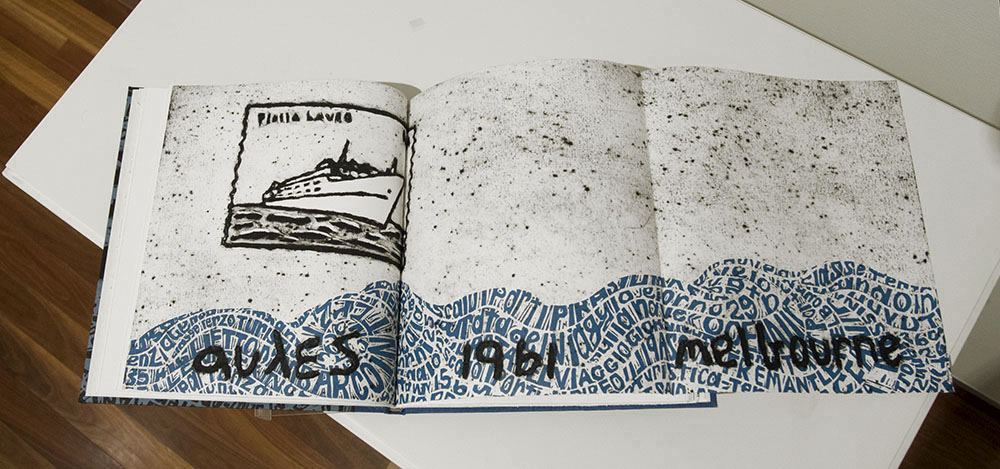
George Matoulas & Angela Cavalieri, with the text by Antoni Jach, Europa to Oceania
Grishin’s comments about the work were:
After much soulsearching I decided to allot the winning entry for the major prize to a collaborative and fabulous artists book by two Melbourne‐based artists, George Matoulas and Angela Cavalieri, with the text by the novelist and playwright Antoni Jach, titled Europa to Oceania. The three linocuts are by Angela, the three collographs are by George and there are another two collaborative foldout prints. The two artists, one of Greek extraction, the other from Calabria in Italy, with wit, profundity and beauty explore the migrant experience at a time when the Australian social fabric is under stress with the question of refugees and migration.
Highly commended in this award were:
Gracia Haby and Louise Jennison’s Closer to Natural
Monica Oppen’s Metropolis
Tim Moseley’s Kange pholu wandaPeter Lyssiotis’ Blind Spot
- Mackay Regional Council Regional Artists Book Award for a local artist went to May‐Britt Mosshamer for Tapping the knowledge.*
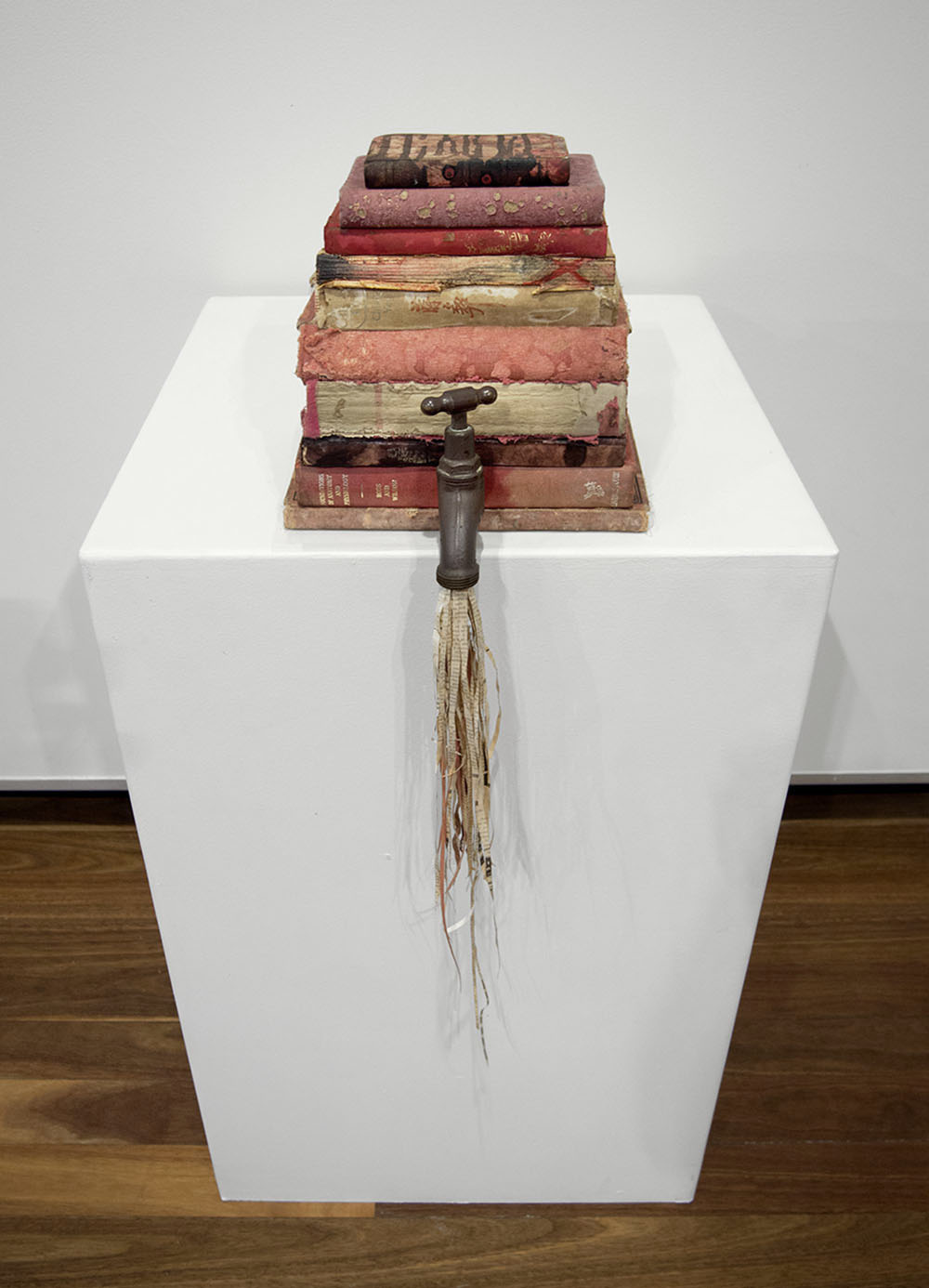
May‐Britt Mosshamer Tapping the knowledge.*
Grishin’s comments about the work were:
As much as one fought the temptation, the $2,500 award had to go to the local artist, May‐Britt Mosshamer and her effective piece Tapping the knowledge. In art you can say very important things with a bit of humour in your back pocket. This work is all about the flood of information and the drought in knowledge.
The highly commended, or runner‐up entries in this category were:
Denise Vanderlugt’s I used to wrap rainbows
Jo Mitchell’s For Mary
- Artspace Mackay Foundation Youth and Student Artists Book Award (under 26years), went to Brooke Ferguson and her The Small Garden (for M.S.).*
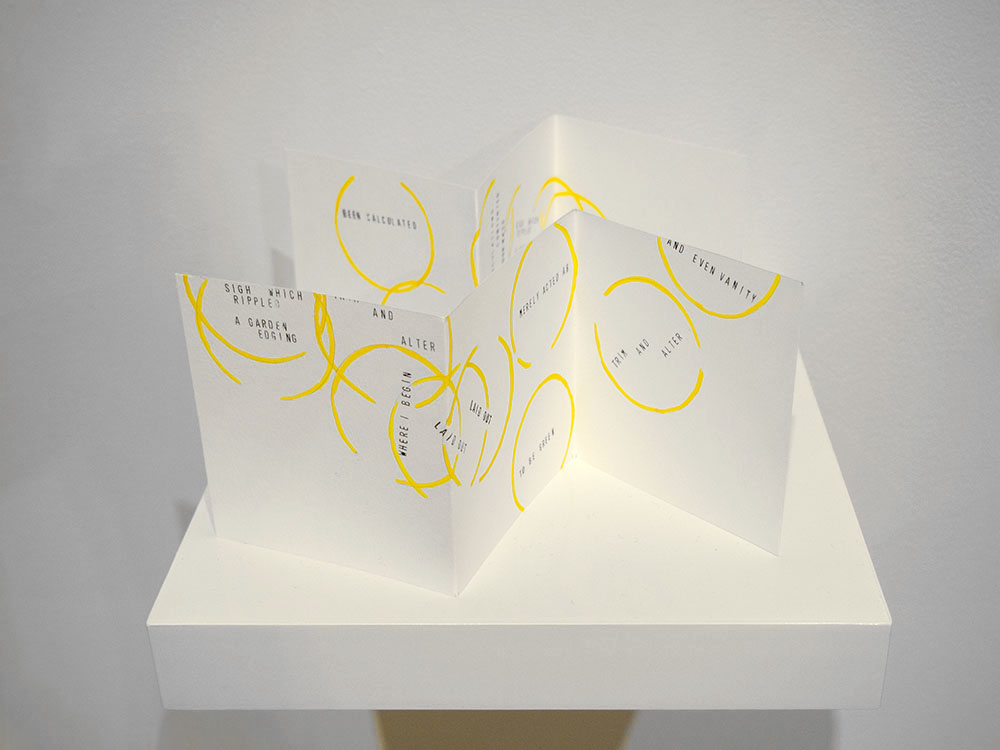
Brooke Ferguson The Small Garden (for M.S.).
Judge Grishin’s comment on the work:
This is an award that is about taking risks, a punt and choosing the unexpected, the promising and the challenging. It is literally a once in a lifetime opportunity for an emerging artist to gain national recognition plus a handy fistful of dollars. I selected the work by the 25‐year‐old Brisbane‐based artist, Brooke Ferguson and her The Small Garden (for M.S.) The MS stands for the wonderful veteran artist, Madonna Staunton, where young Brooke Ferguson was inspired by a poem by Staunton and with gouache, pen and ink and pencil has created a fragile concertina – a beautiful sensibility from a promising young artist.
.
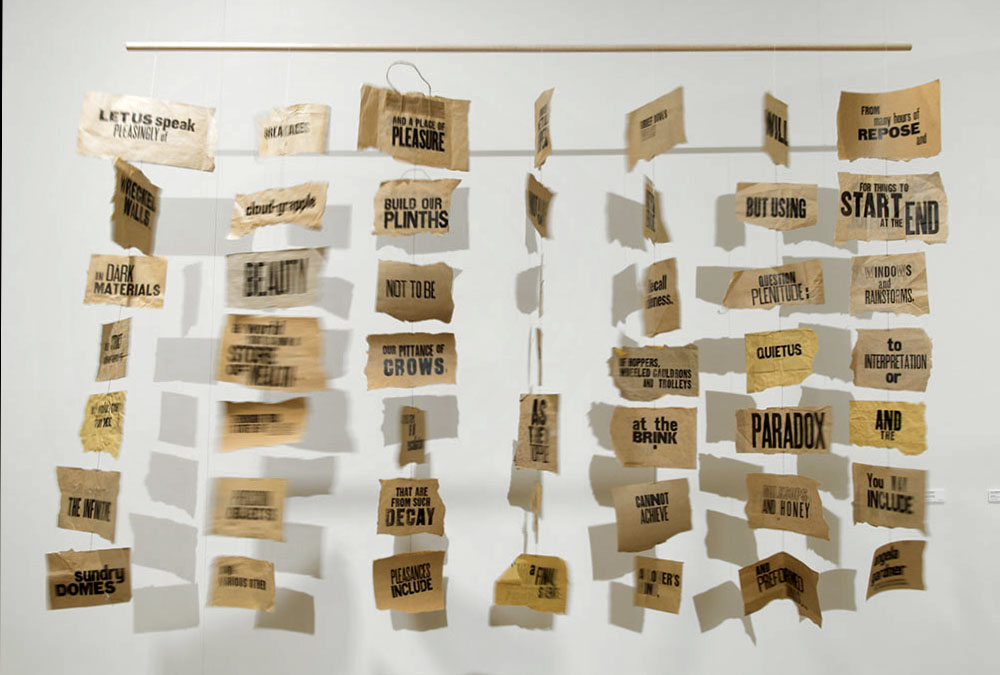
In my opinion some books call for special mention. Caren Florance’s Pleasure demolition is transfixing. The suspended brown paper sheets with a hand printed letterpress phrases from poetry by Angela Gardner are animated by the flow of air and movement in the space. Forever moving, the oscillation of the pages becomes a machine for the generation of concrete poetry… phrases twirl and merge, poetic moments where new meaningful/less messages materialise.
.
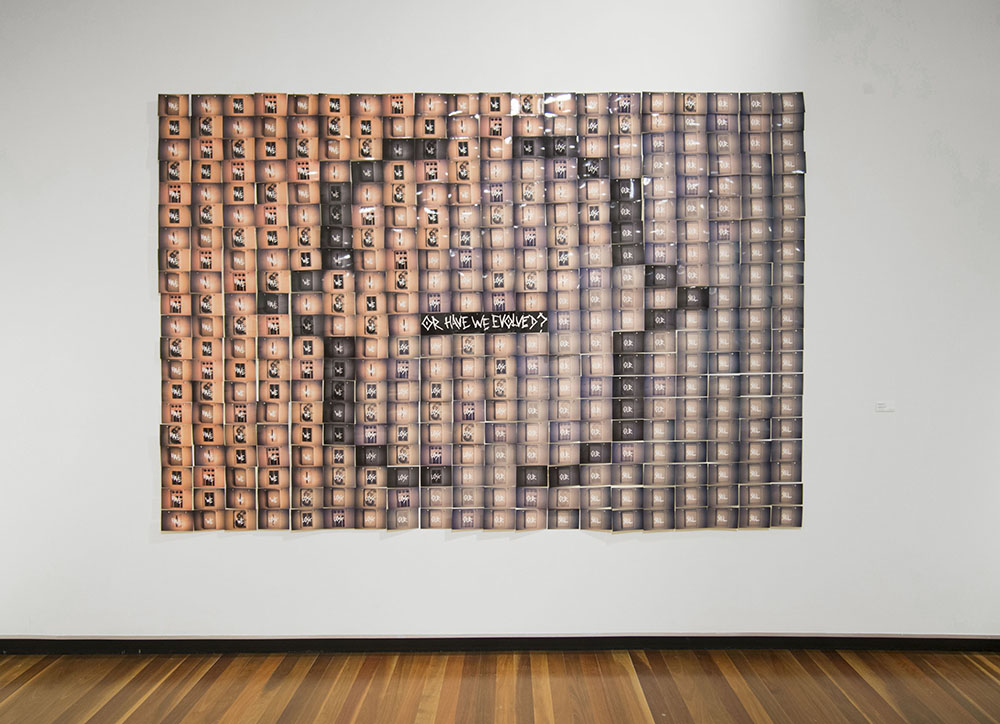
Jamian Stayt’s Soulless evolution
The individual pages of Jamian Stayt’s Soulless evolution are pinned to the wall making what may seem like a vast wallpaper pattern. However, Stayt’s work invites a closer reading of the cipher hidden within the layers of the image. He presents some big questions where contemporary notions of tradition are challenged and rapidly changing technology has intertwined agency in the evolutionary pathway for humanity.
.
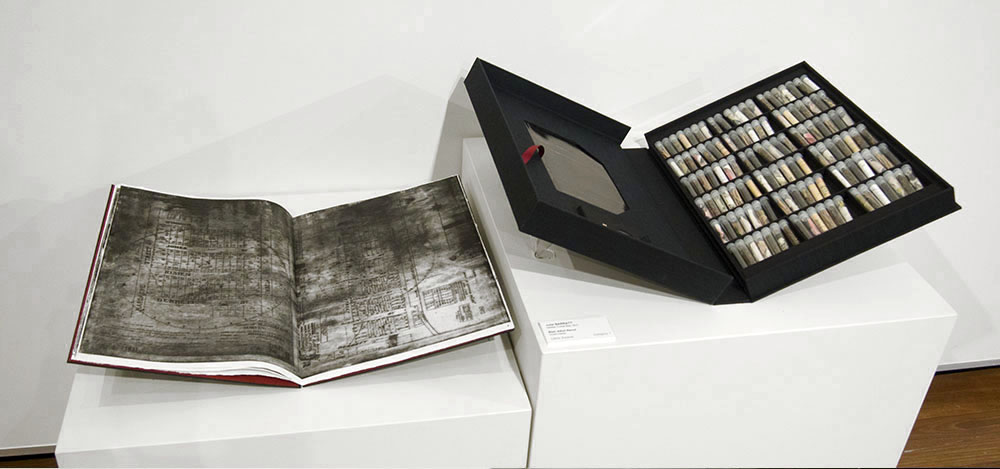
Julie Barratt Blair Athol recut
Julie Barratt’s Blair Athol recut refers to Solastalgia: a theory on the contemporary human condition for a deep loss of place. In one part of the installation there is a book of dark photolithographs where maps are encroached upon by black inks. For the reader this growing blackness evokes a gloomy absence. Facing the dark pages in the clamshell container are vials of coloured soils, plant fragments and found objects. Although collected from this disturbed place, these samples are vibrant and alive – perhaps they are the vestiges of childhood memories that recall a different time before the destruction of the physical place by coal mining.
.
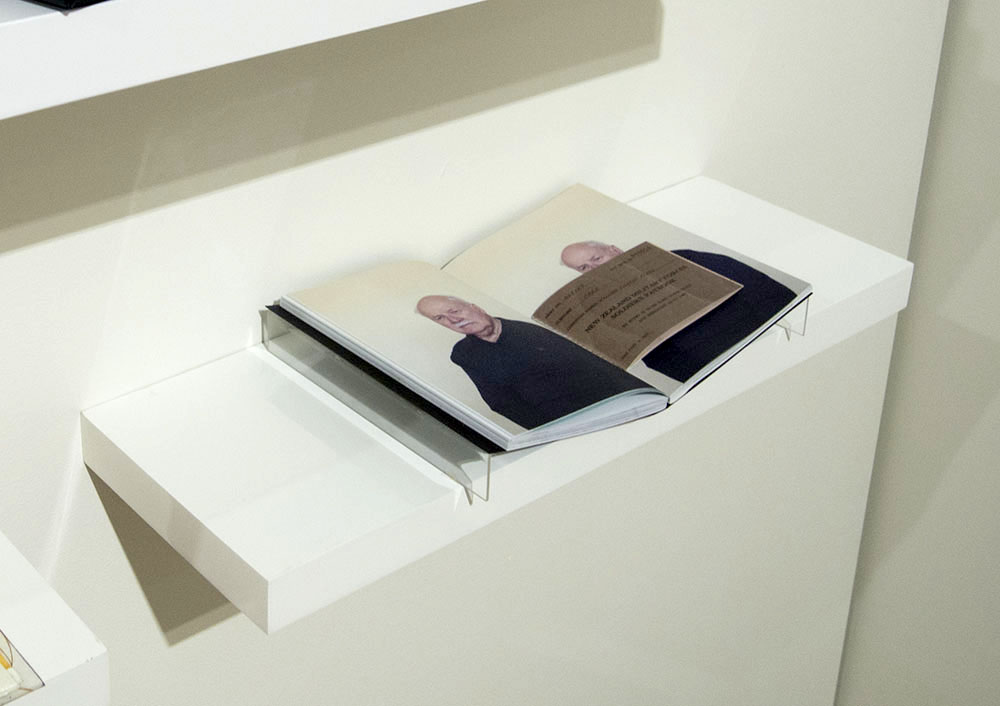
Ana Paula Estrada Memorandum
Many books feature photographs as the primary carrier of the narrative. Ana Paula Estrada’s Memorandum employs the medium to document elderly people and their connection with life through personal photographs and how their memories are re-lived through viewing these photos. The book, conceived and made through the Siganto Foundation Creative Fellowship in the Australian Library of Art at the State Library of Queensland, is a complex assemblage of contemporary portraits, photo-glimpses from family albums and a narrative conveyed through the turning of pages.
.

Exhibition view
.
As usual the artists’ book as exhibition defies direct touch and the turning of pages for narratives to be revealed and for the book to speak of what it has allowed the artist to create. But for the 72 books in the exhibition to be read the visitor would need to stay for the duration of the exhibition, working through the night with white gloves and torchlight. The exhibition reconnects and continues the significant contribution of the Artspace Mackay’s Libris Award to inspire artists and create a space discourse on the book in all its forms. In doing so the assembled exhibition represents cutting edge survey of Australian artists’ book practice.
Some works will become part of the Artspace Mackay collection; others will be re-packaged and returned to their makers. While the exhibition is dispersed its spirit will continue in the form of the gallery’s excellent illustrated catalogue, the text of Grishin’s speech, reviews, videos and other commentaries such as this, as well as the memories of the readers who viewed the show.
In two years time – the next iteration of this important event in the Australian artists’ book calendar will take place again. Wouldn’t it be nice if the whole collection could be purchased and held in perpetuity as a record of the discipline? Until then …
Dr Doug Spowart
16 October 2016

DOWNLOAD THE CATALOGUE: 2016-librisawards_illustratedlistofworks
Click to access 2016LibrisAwards_IllustratedListofWorks.pdf
.
A VIDEO FLY-THRU OF THE EXHIBITION
OTHER BOOKS FROM THE EXHIBITION

Denise Vanderlugt with her highly commended bookwork I used to wrap rainbows
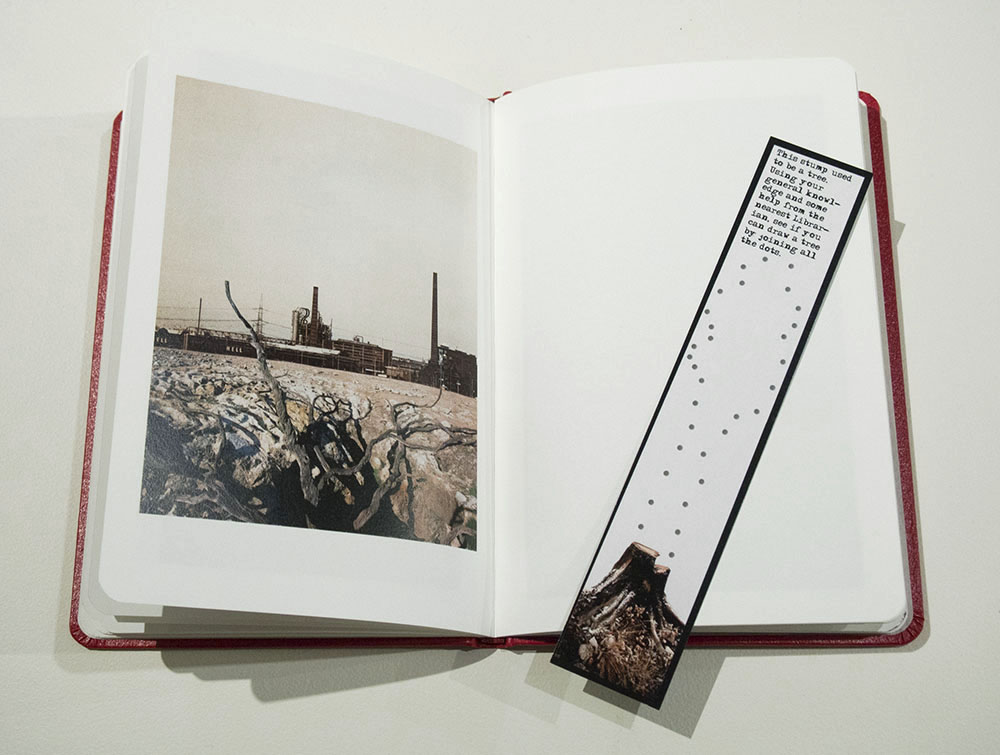
Peter LYSSIOTIS Blind spot
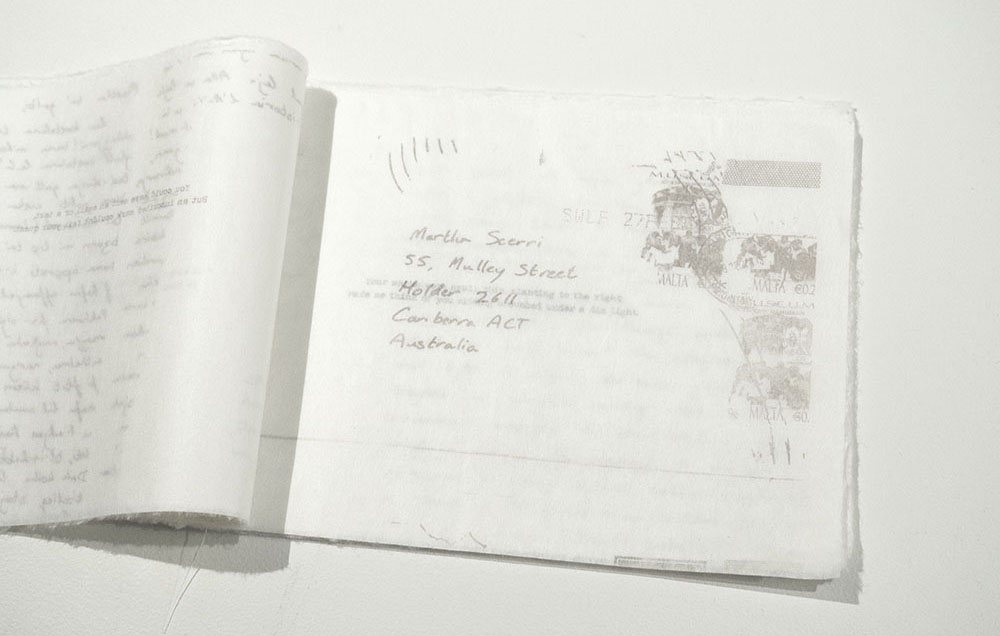
Martha BOWMAN You could have sent an email or a text
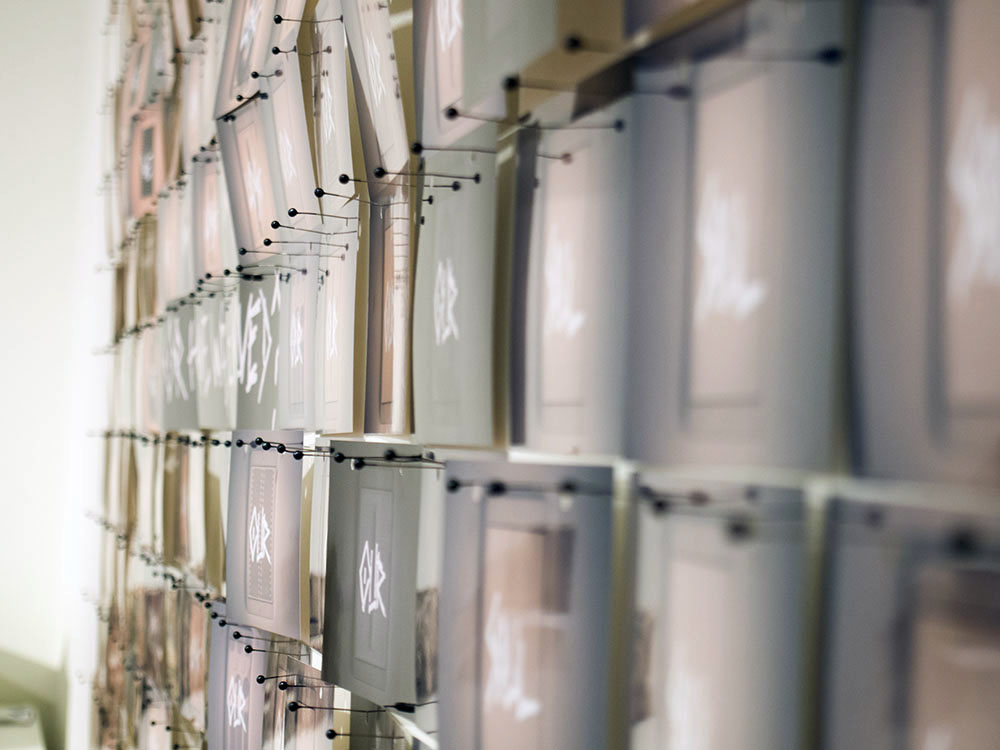
Jamian Stayt’s Soulless evolution (Detail)
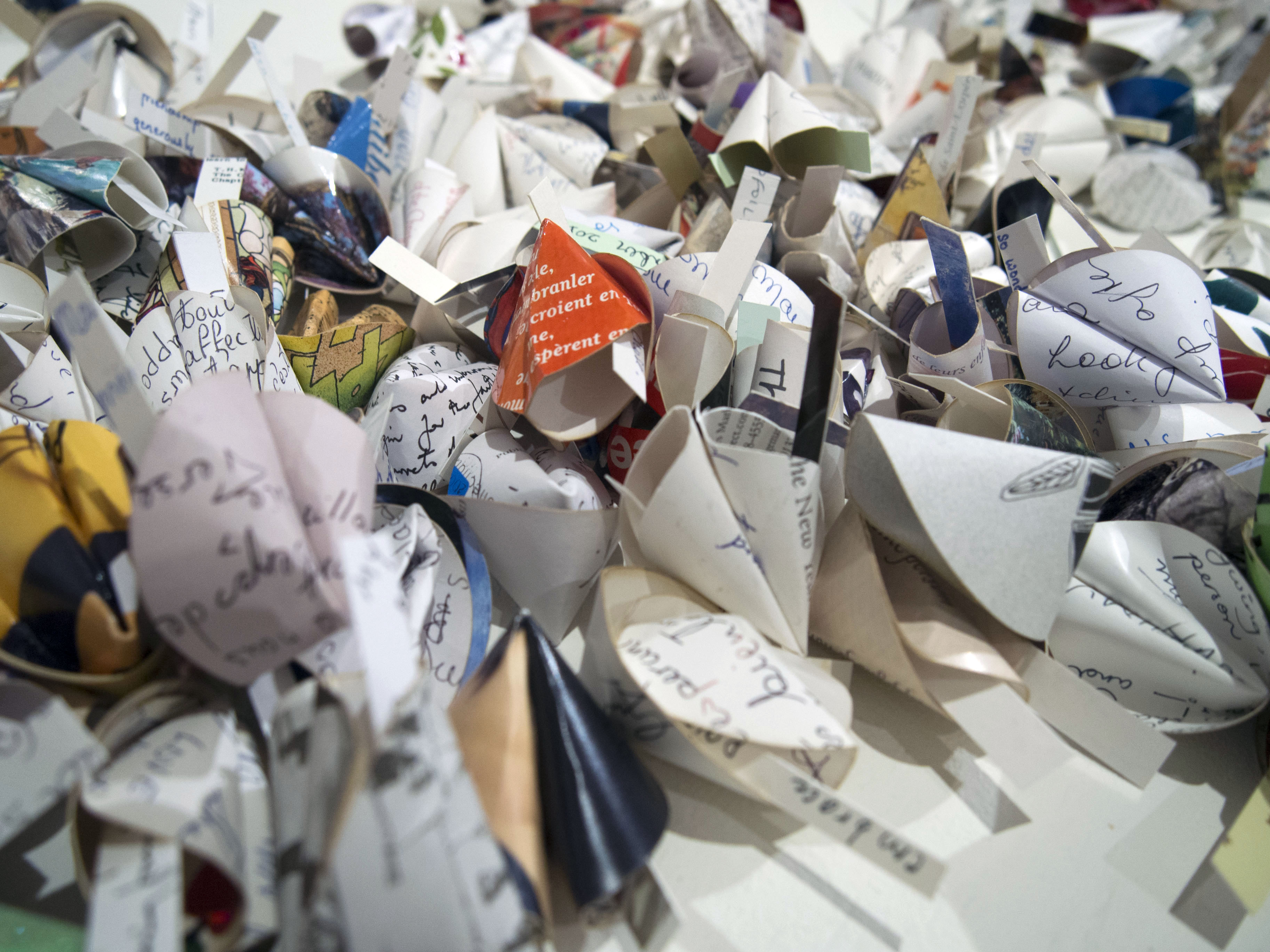
Bernard APPASSAMY Constellation of endearment (Detail)

Deanna HITTI Assimilated museum

Gracia HABY and Louise JENNISON Closer to natural
Caren Florance’s Pleasure demolition
.
.
All photographs and videos ©2015 Doug Spowart. Main text (except Judge Sasha Grishin’s words) ©2016 Doug Spowart With thanks to Victoria Cooper for her suggestions and edits.
.
.
AUSTRALIAN & NEW ZEALAND PHOTOBOOKS OF THE YEAR 2015
AUSTRALIAN + NEW ZEALAND PHOTOBOOK @ MAUD GALLERY
The photobook continues to capture the imagination of not just photographers but a broader community who enjoy ‘reading’ the visual nature of photostories. Part of the enthusiasm for the photobook lies in the diversity of the discipline from hand-made zines stapled together on the kitchen table to the slick graphic design of commercially printed books. The other major aspect of interest in the photobook is it’s accessibility – anyone can make his or her own book within the diverse range of practice. How then can the best books be acknowledged, rewarded and celebrated?
In Australia there have been awards for photographic books such as the Australian Institute of Professional Photography’s Photography Book of the Year Award, and more recently the Australian Photobook of the Year. This year for the first time, New Zealand photographers were able to enter their own Photobook of the Year Awards and have the ‘best’ books defined by a group of respected photobook judges and commentators on the art. An important contributor in the development of a critical evaluation structure for photobooks in Australia and New Zealand is the ongoing work being done by Australian print-on-demand service provider Momento Pro. Once again Momento Pro teamed up with Heidi Romano of Photobook Melbourne to sponsor and coordinate the Australian award. The creation of a New Zealand photobook award was also sponsored through Momento Pro’s local branch was coordinated with the organisers of this year’s inaugural Photobook New Zealand event in Wellington.
From April 14-22, under the auspices of the Brisbane Photobook Club, I coordinated an exhibition of the award winners and the finalists of both the Australian and the New Zealand Photobook of the Year Awards at Brisbane’s Maud Gallery. A special ‘launch’ event was followed by around a week of potential viewing time for those interested in seeing 26 of the ‘best’ books from our part of the world.
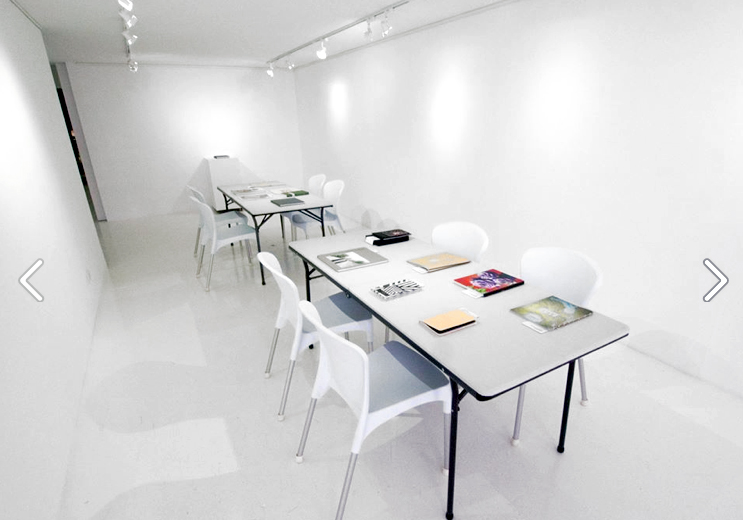
Conscious of the need to provide a ‘reading’ experience rather than the usual gallery ‘viewing’, Vicky and I installed the books within the gallery space on tables with chairs or stools. To highlight the winners, I chose to place these four books on plinths and therefore provide not only a prominent positioning within the space but also to allow a more intimate access the books without the visual ‘clutter’ of other displayed works and their readers.
The tables setup
.
Around 60 people attended the launch event. It was an unusual gallery experience as attendees found a space at a table, sat down and began reading. Moving on occasionally to the next chair and the selection of books in close proximity. A group of students clustered around certain books discussing quietly amongst themselves the book design and narrative features that interested them. I had intended to present a welcome and a short talk about the books but chose not to as it just seemed that everyone was engrossed in the process of reading. The video made in one part of the evening shows the intensity of the ‘shush — I’m reading’ vibe permeating the gallery.
That evening, and over the following days, I had many conversations with those who had come to see the show. Many attendees enquired about technical production attributes of the books. Some seemed to have been expecting a collection of books that were of a more traditional bookshop nature. Readers noted the diversity of physical forms of the photobook, how the story was communicated and the themes pursued by these successful book award entrants. Most attendees enthusiastically accepted the opportunity to cast their vote for the People’s Choice Award.

ANZ Photobooks of the Year @ Maud Gallery
An interesting topic of discussion emerging from conversations with attendees related to the current categories of entry and the characteristics of the selected books. It was noted that the awarded books and finalists from both categories seemed to blur these category perceptions. This is in part because self-publishers may create ‘trade-like’ products and trade publishers may make ‘creative style products’.
Ultimately it comes down to the question ‘Did they like what they saw?’ I would say yes… although some comments related to the seriousness of selected photobooks as they often dealt with austere, conceptual themes or raw documentary – ‘Where are the happy books?’ one reader commented.
Would they come again to another Photobook of the Year showing? I would think they would. Many indicated that they would enter the next awards…
A call for entries in the 2016 Photobook of the Year Awards will be made later in the year
REPORT: Doug Spowart
WHAT FOLLOWS ARE COMMENTS ABOUT EACH AWARD AND THE WINNERS
(Edited from the Awards’ press releases)

APBOTY LOGO
.
AUSTRALIAN PHOTOBOOK OF THE YEAR AWARDS 2015
The judging panel included representatives from photography, publishing and art institutions, and was co-chaired by international art consultant and curator, Alasdair Foster, and Photobook Melbourne Director, Heidi Romano. The judges assessed the physical books for excellence in photography, layout and design, and the suitability of the format for the book’s theme and purpose, resulting in a selection of 14 finalist books.
The winners were announced at the Photobook Melbourne project space, Southbank, on 25 February. “Australian photographers are continuing to embrace the book format as a means for exploring, documenting and disseminating photography, just as locally created photography books and the artists behind them are being applauded internationally,” stated Foster. “Our finalists prove that a successful photo book does not require a major capital investment or an expensive publicity machine, but it does require a strong and engaging visual narrative in a sophisticated design, as well as genuine relationships within the photo book community.”
Generation AK: The Afghanistan Wars, 1993 – 2012 by Stephen Dupont
TRADE PUBLISHED
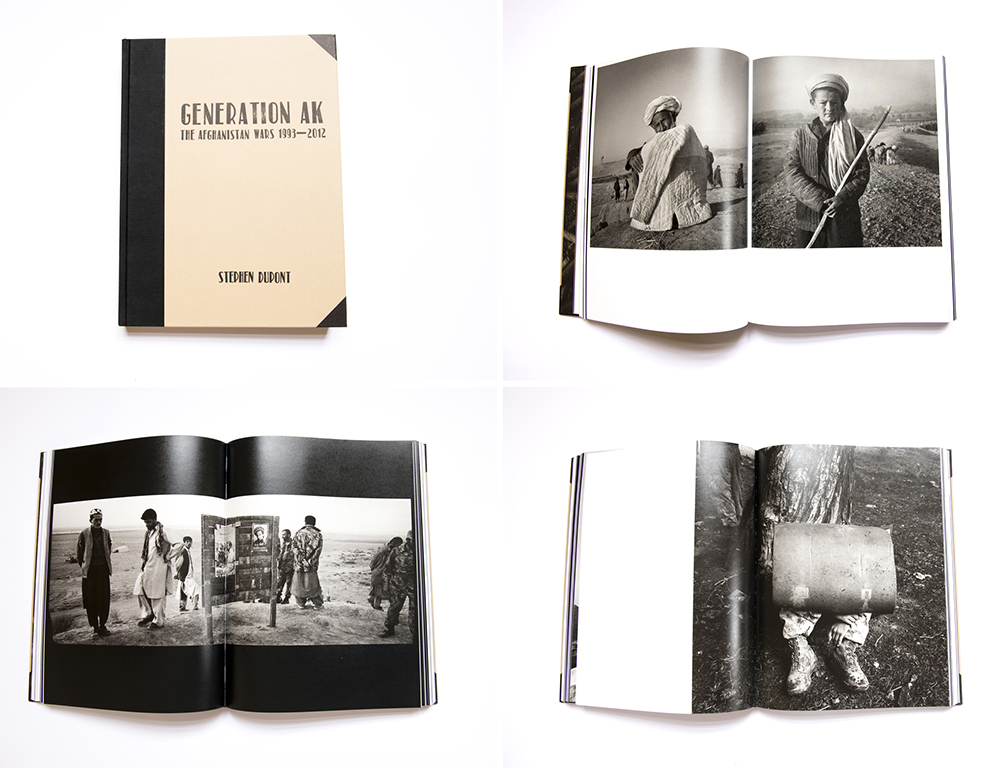
Winner – Generation AK: The Afghanistan Wars, 1993 – 2012 by Stephen Dupont, Steidl –
Commended – Belanglo by Warwick Baker, Perimeter Editions, Dan Rule –
Commended – Birdland by Leila Jeffreys, Hachette
Finalists
+ The Middle of Somewhere by Sam Harris, Ceiba Foto
+ Arc by Zoe Croggon, Perimeter Editions, Asia Pacific Photobook Archive
+ Limits to Growth by James Farley, Currency Editions
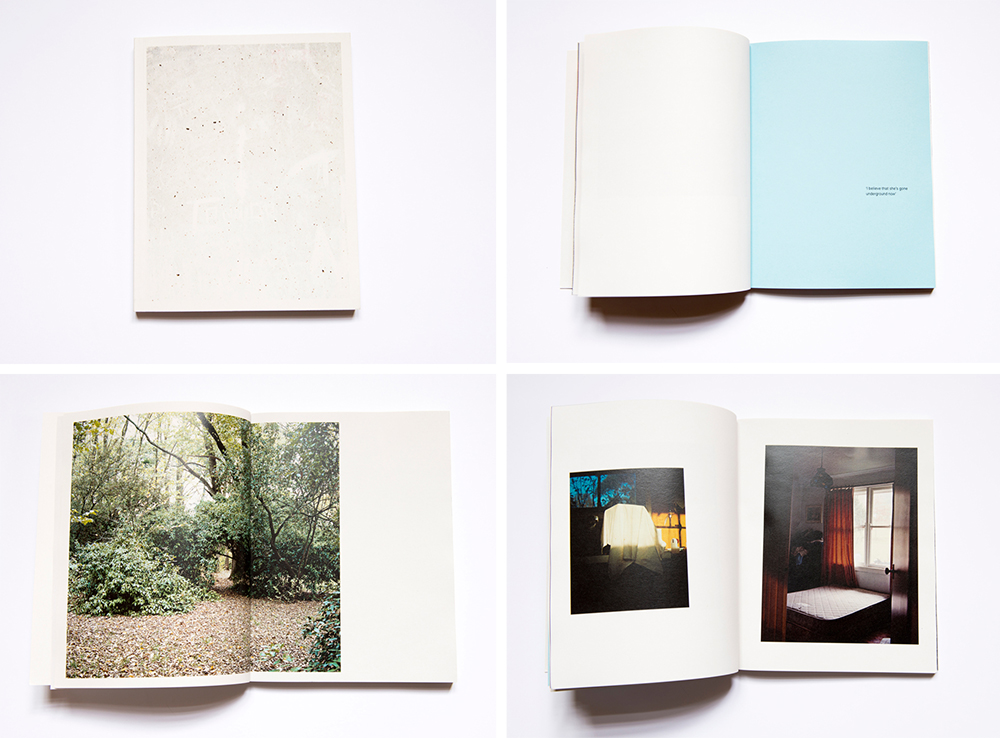
SELF-PUBLISHED WINNER – Red Herring by Jordan Madge
SELF PUBLISHED
Winner – Red Herring by Jordan Madge
Commended – Your love is not safe with me by Ailsa Bowyer –
Commended – LA – NY by Sam Wong and Jack Shelton –
Finalists
+ By the River by Ian Flanders
+ The Smell of Narenj by Hoda Afshar
+ Magic City #2 by Chloe Ferres
+ The Moon Belongs to Everyone by Stacy Mehrfar
+ STAN by Christian Belgaux and Jack Pam
People’s Choice – The Middle of Somewhere by Sam Harris, Ceiba Foto
.
.

NZPBOTY LOGO
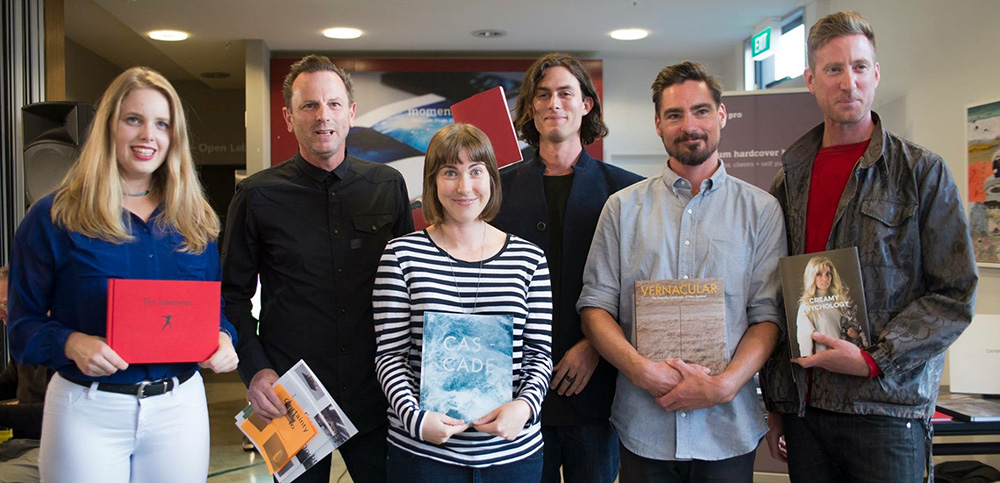
THE NZPBOTY WINNERS
.
NEW ZEALAND PHOTOBOOK OF THE YEAR AWARDS 2015
.
The judging panel, chaired by David Cook, a Senior Lecturer in photography at Massey University, Wellington, selected 13 finalist books that presented excellence in photography, layout and design, and whose format complemented the book’s theme and purpose.
“The best works presented a carefully edited selection of images, in an engaging visual narrative, with sophisticated design that didn’t overwhelm the imagery,” stated Cook, “Age and experience weren’t the defining characteristics, it was the skill of visual storytelling and the ability to combine photos with graphics, text and materials to enhance the story told by the images, to create a new artwork in its own right.”
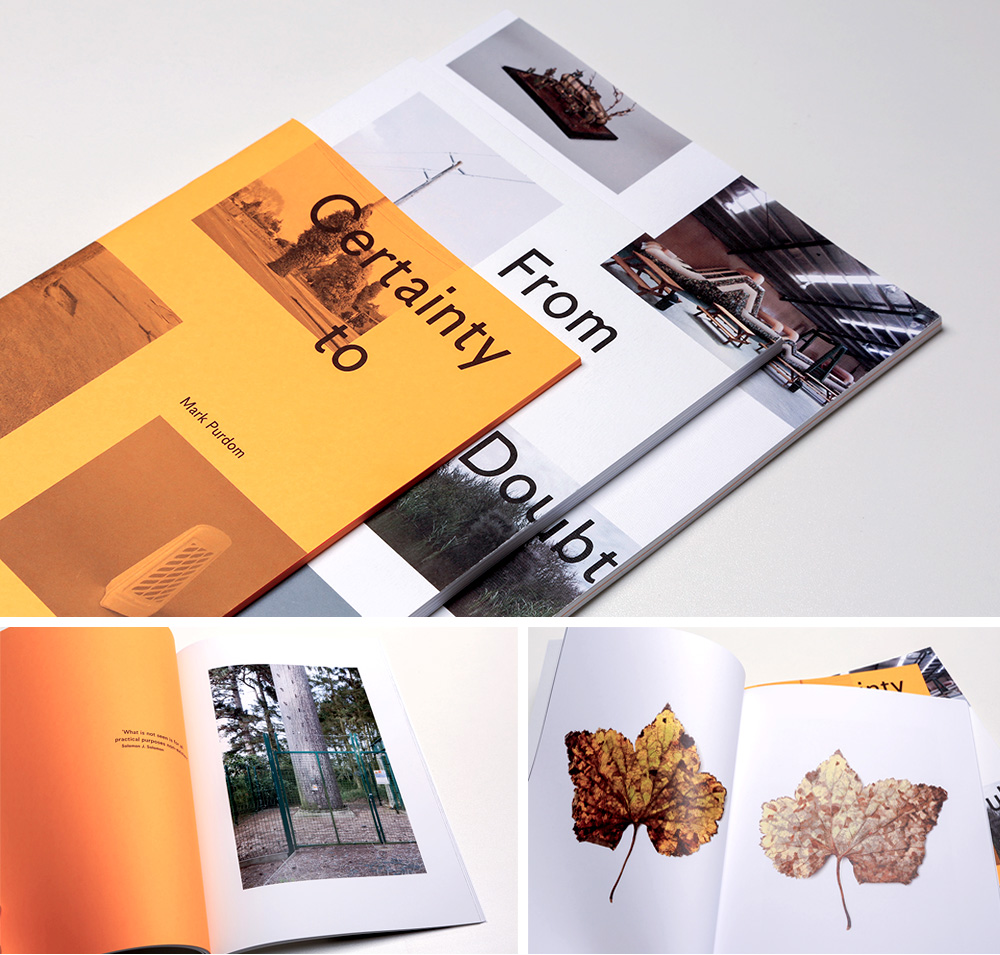
Winner – From Certainty to Doubt by Mark Purdom
Trade Published
Winner – From Certainty to Doubt by Mark Purdom, Ramp Press
Commended – Creamy Psychology by Yvonne Todd, Victoria University Press
Commended – Vernacular by David Straight, Potton & Burton
Finalists
+ New Zealand Photography Collected by Te Papa Press
+ Karakia by Ben Clement, Sallyann Clement, Bloom Publishing
+ The Imperial Body by Fiona Amundsen, split/fountain
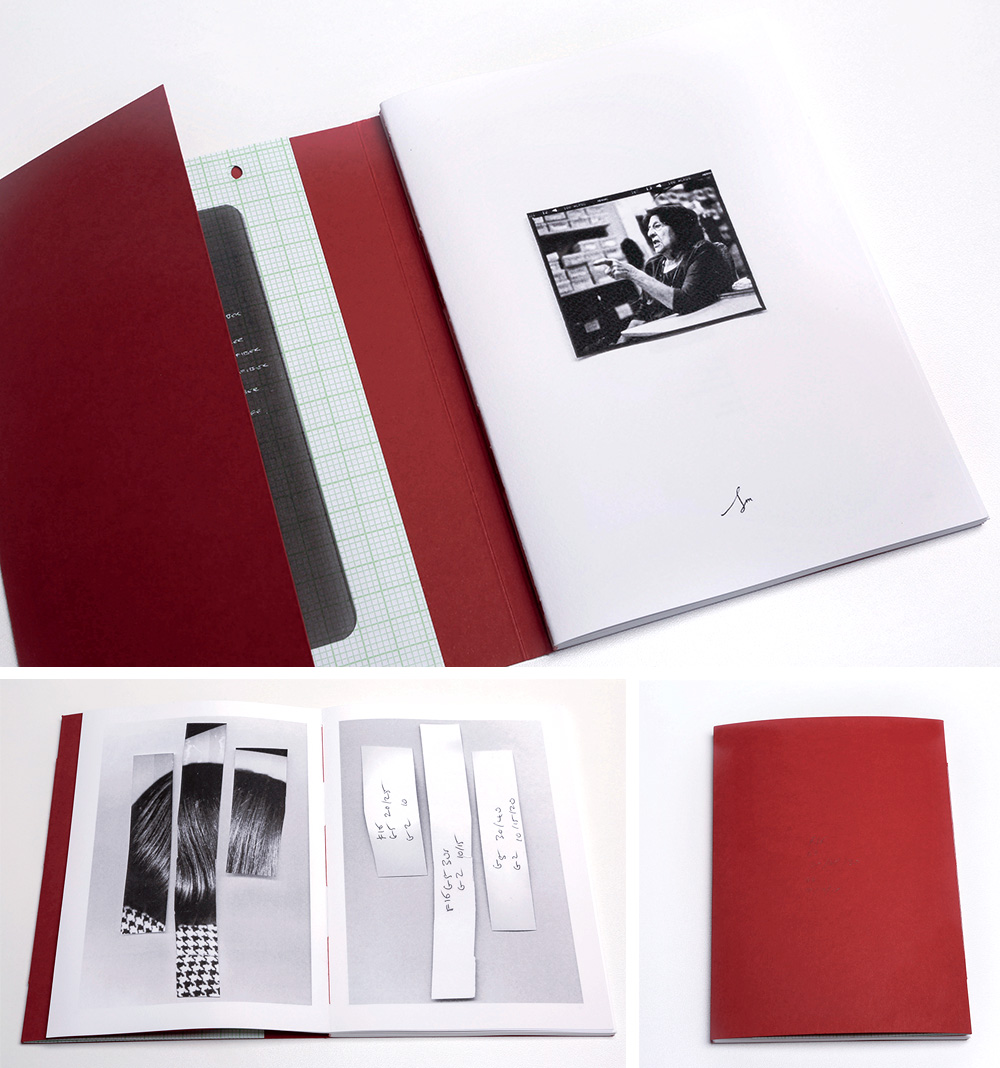
F.16 G3 20/25/30 by Solomon Mortimer
Self Published
Winner – F.16 G3 20/25/30 by Solomon Mortimer
Commended – Cascade by Shelley Jacobson
Commended – The Inbetween by Georgia Periam
Finalists
+ Some kind of life in dying by Shelley Ashford
+ The Reality Principle by Yvonne Shaw
+ Waipureku by Conor Findlay
+ When the sun sets your eyes change colour by Solomon Mortimer & + Zahra Killeen-Chance
People’s Choice – Waipureku by Conor Findlay
A PDF Catalogue of the New Zealand Awards is available NZPOTY 2015 Exhibition Brochure
.
.
All photographs of books and the individual awards text supplied by Momento Pro.
Photographs @ Maud Gallery and introductory text ©2016 Doug Spowart

 wotwedid