Archive for the ‘Regional arts’ Category
QUEENSTOWN’s UNCONFORMITY 2018 – From the Archive
Driving to Queenstown for the 2018 UNCONFORMITY Art Festival
A diaristic record of the journey to Tasmania’s west coast two years ago – October 2018
NOTE: The 2020 UNCONFORMITY was cancelled due to the pandemic.
A link to their COVOD-19 response can be seen HERE
vvv
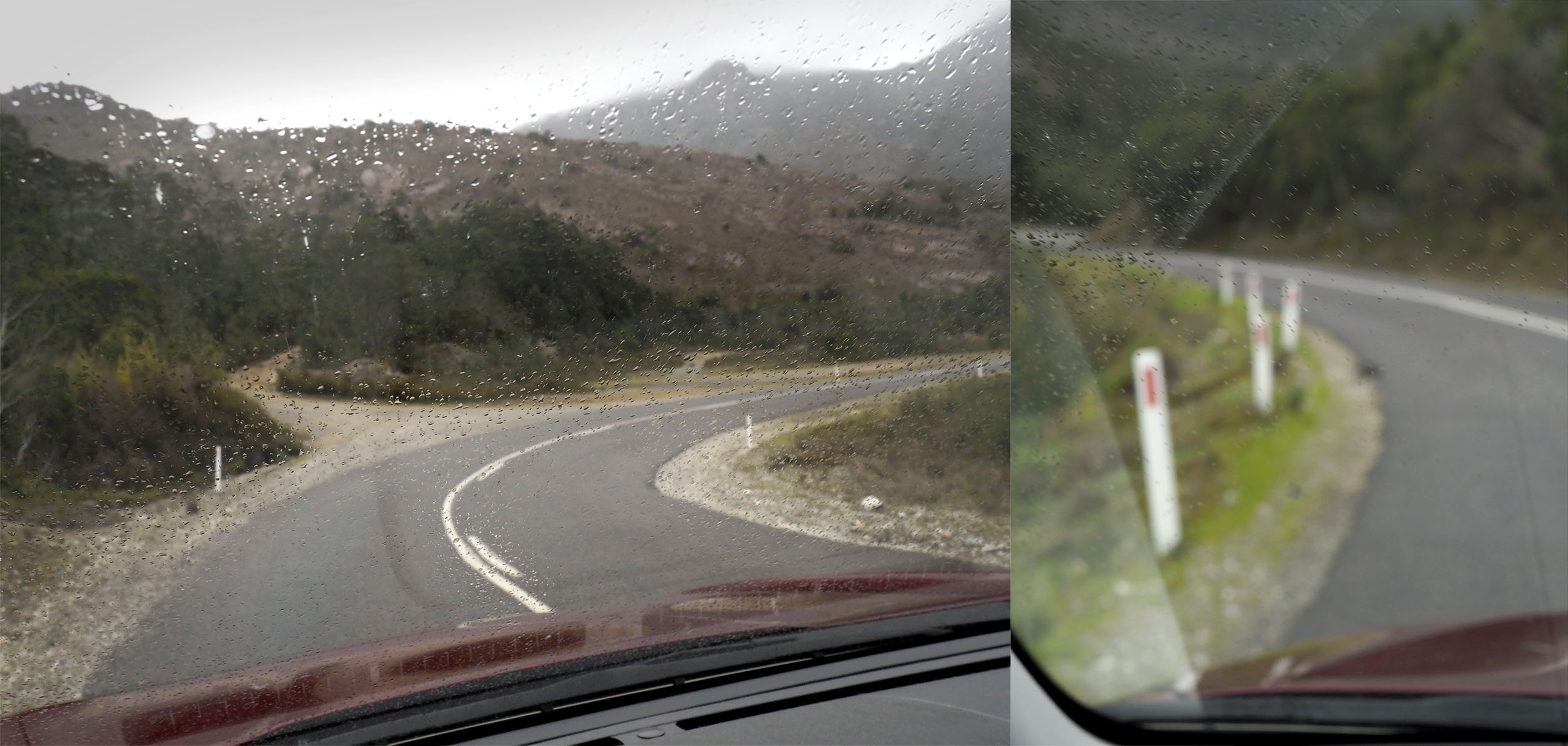
Road to Queenstown
The road convulses, twists and turns as if the wilderness has challenged its taming by the road builders and engineers. Just when the wild begins to overcome your imagination a mountain ridge is crested and opening up before you is a place made by man and commerce showing their destruction of the landscape to make a place, a wild place – home.
The town of Queenstown is nestled in a valley floor through which flows a stream, a road and a railway line. The mining ceased after 100 years of operation and the town now seems devoid of what must have been the hustle and bustle of its glory days. Left orphaned by those who have moved on are commercial buildings intended for a permanence that is now redundant. Other buildings are kept cobbled together by make-do maintenance. The occasional sign in the empty shop window proclaiming “FOR RENT”. Houses of corrugated iron and rough stone construction and the occasional 1940s or 50s flat roofed ‘modern style’ straddle the ridges. They sometimes hang precariously from the narrow winding roads that move from the central business area outwards and upwards like a schematic of the human circulatory system.


In this unlikely place there exists a community of artists ranging from those for whom it is a hobby for personal life enrichment to those, many of whom are of national stature in their disciplines. Bi-yearly a special event in Queenstown celebrates its art community as well as those from around that country and the world who consider the locale as a touchstone and inspiration for their art.
Called ‘The Unconformity’ the event takes its name from an unusual rock formation found locally that was the natural catalyst for the mineral riches that were found there. ‘The Unconformity’ takes place over 3 days and attracts a worldwide audience.
Our unique proposition is to be a cultural conduit into western Tasmania—a place hard to get to and harder to engage—by mining a new cultural commodity with the spirit of independence, boldness, risk and adventure that is melded to our region’s DNA.
Mission statement from The Unconformity website
.


We sat in a café munching on a magnificent homemade pie and at a table nearby the (then) former senator for Tasmania Jacqui Lambie also having lunch. I discovered a long lost cousin, the artist Beverley Loverock in a shop that is her studio at the top end of town. And just walking down a street between visiting art galleries and events we encountered Marc Pricop, a photodocumentary photographer who we knew from Brisbane when he was a student at the Queensland College of Art.


Just off the main street we caught up with nationally recognised printmaker Raymond Arnold who first came to the region in the 1970s as part of the Franklin Gordon Blockade protest. His connection with the place at that time left an indelible mark on him and for the last 18 years has set up his studio there with his wife Helena Demczuk. Called LARQ his modern studio and gallery featured an expansive artwork created in response to his years in Tasmania. It featured 100 hard ground line etchings, some multi-plates, which were presented in the gallery as 100 individually framed works as well as the assembled plates in a mosaic format that stretched the length of the studio’s main wall.


We were only able to stay for the better part of two days as local accommodation is booked out well in advance and we travelled from Tarraleah to Strahan and back to Tarraleah late Sunday afternoon. There was just not enough time to take in the range of art, performance, videos and presentations on offer many of which were booked out … But then there’s the next event in two years – we’ll be back.
HERE IS A COLLAGE OF THINGS WITNESSED DURING OUR VISIT…
NOTE: Due to copyright restrictions Youtube has muted most of the audio in this video – Imagine AC/DC music LOUD…!
.


SOME LINKS…
https://www.theunconformity.com.au/
https://unco-assets.s3.amazonaws.com/static/images/background-looped.4d0f74bf780d.mp4
PROGRAM
https://www.theunconformity.com.au/program/
EVENTS
https://www.theunconformity.com.au/events/
A WIKI
https://en.wikipedia.org/wiki/The_Unconformity
Father’s Day: A remembrance in an art project
Father’s Day 2020 – Thinking of our Dads
In 2010 artist, and then gallerist, Julie Barratt put out a call for artworks that asked artists to respond about their Fathers and their passing.
The request from Julie Barratt is as follows:
This project was borne out of the recent sudden death of my father, a handkerchief, some emotive words written by a sibling on his death and the traumatic aftermath of a death processed according to particular societal and cultural mores. Interested artists and Individuals are invited to create an artwork on a handkerchief (any handkerchief not necessarily a man’s) based around death/grief/bereavement.
We reflected on our connection with our Fathers and created artworks using the cyanotype process.
Doug’s Hankie
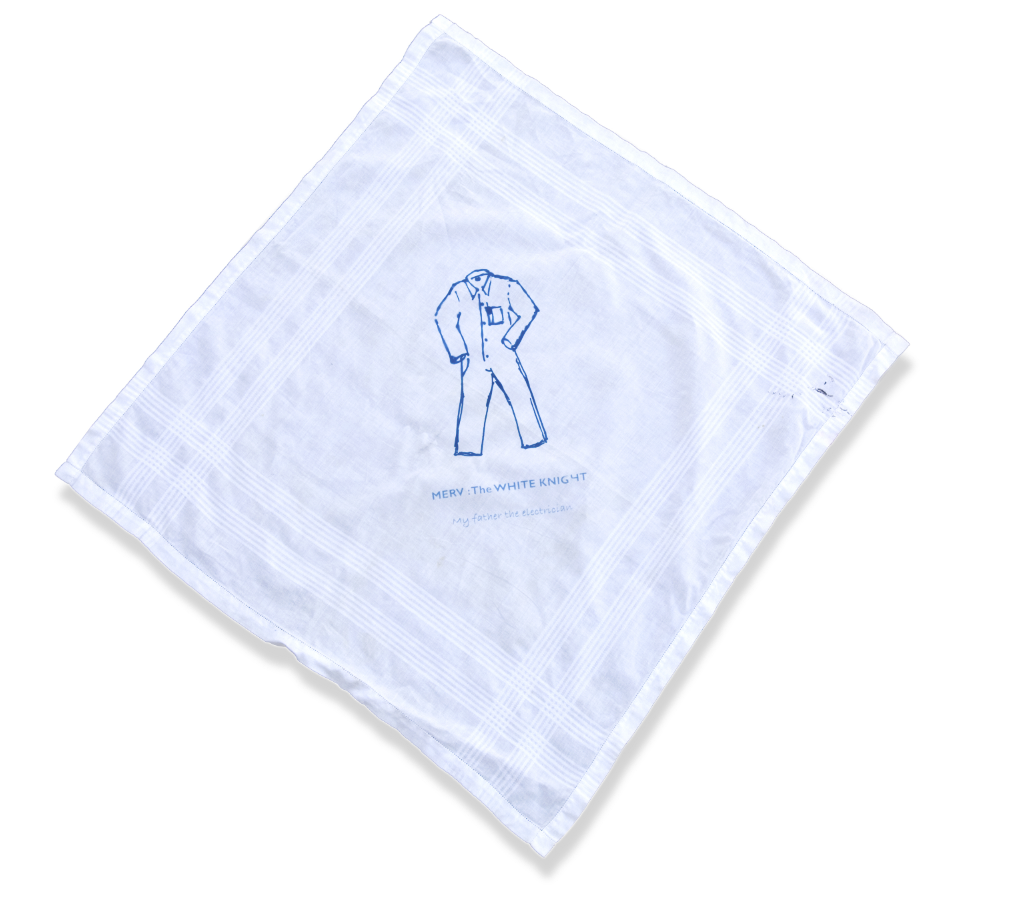
The WHITE KNIGHT – for Merv by Doug Spowart
MERV: The White Knight
My father was an electrician for around sixty years. He always wore King Gee white overalls—even when we went on holidays.
Ever ready to help someone in need he would dash off at a moment’s notice—even when the family organised an outing on the weekend we would always fit in another job along the way.
Over the years he helped many an electrically troubled soul so we, his family, dubbed him the nickname – “The white knight”.
Victoria’s Hankie
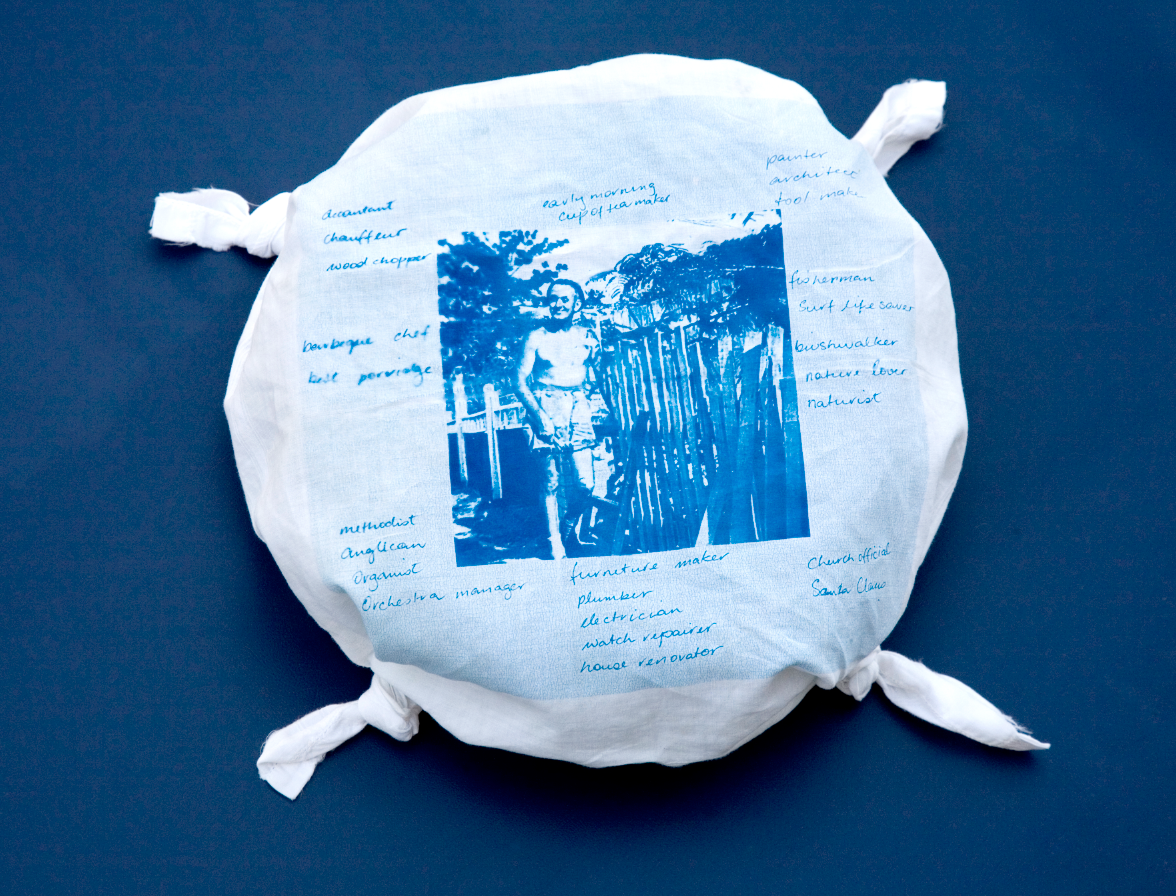
Dad’ll do it – for Reg by Victoria Cooper
Dad’ll do it
I remember that he always tied knots in his hankie to keep it in place on his head and to soak up the sweat when he was working on things around the home. He had lived in this home (in the photo) for most of his life except for the time he was in Papua New Guinea for WW2 and shorter periods of time in other places. Over the years he adapted and renovated this home to suit the changing needs of the family.
.
.
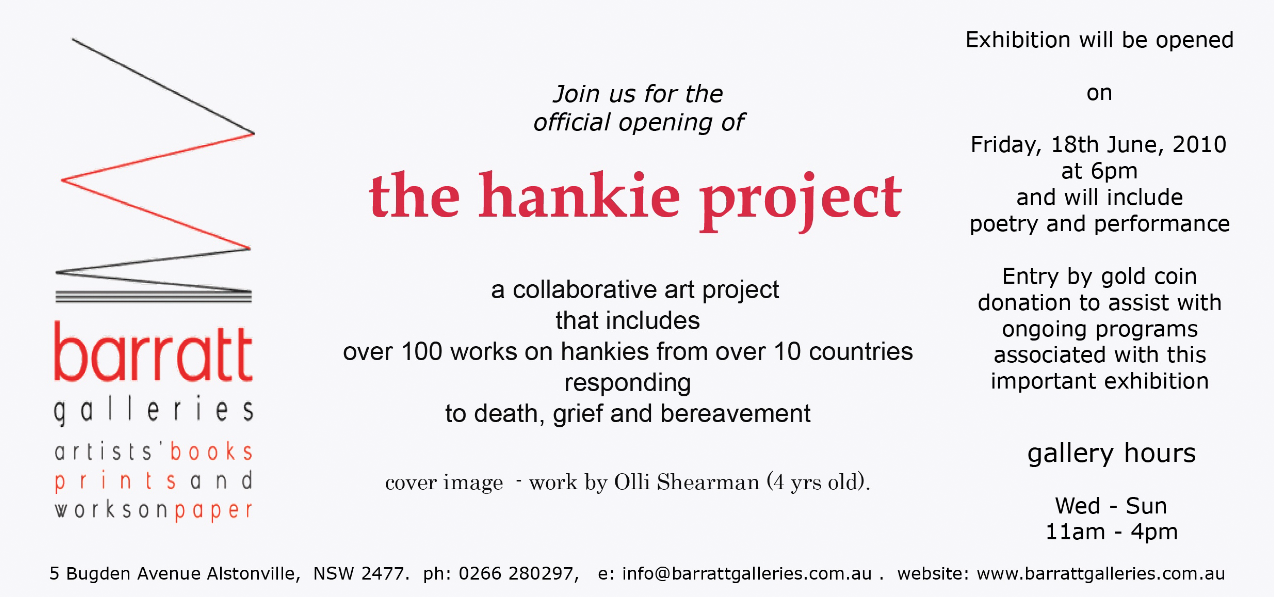
Barratt Gallery Invite
.
The exhibition was shown at Barratt Gallery at Alstonville and Napier Gallery Melbourne
.


A post about the exhibition can be found HERE
.
.
.
.
.
.
A TASMANIAN CYANOTYPE: Untitled Found Objects by Victoria Cooper
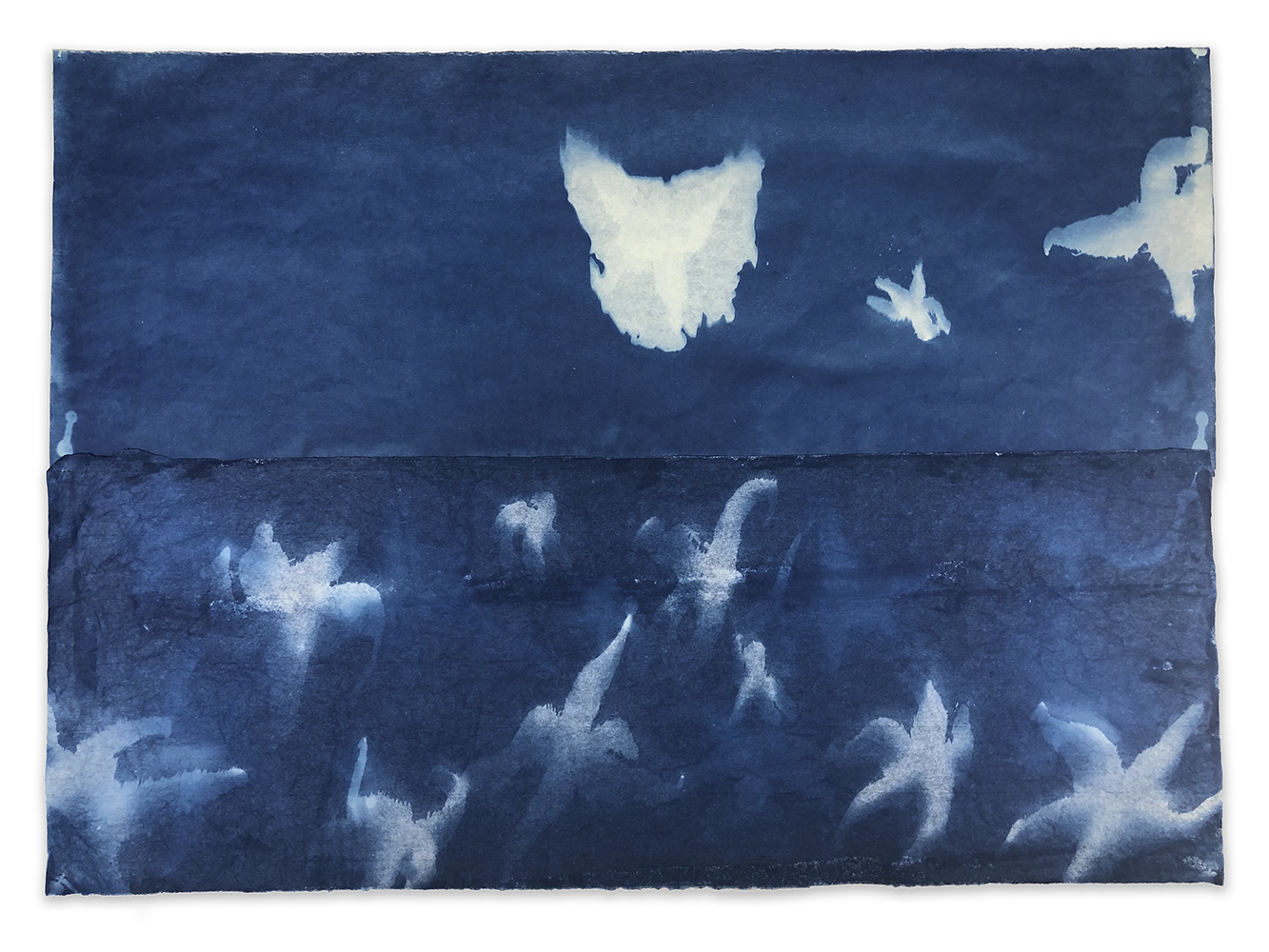 Untitled found objects a cyanotype by Victoria Cooper
Untitled Found Objects is created from a collection made of invasive starfish species colonising parts of Tasmanian waters and a map-shaped beer coaster found discarded in the streets of Hobart. In this work I play with these found objects and speculate on their relationship with Place.
.
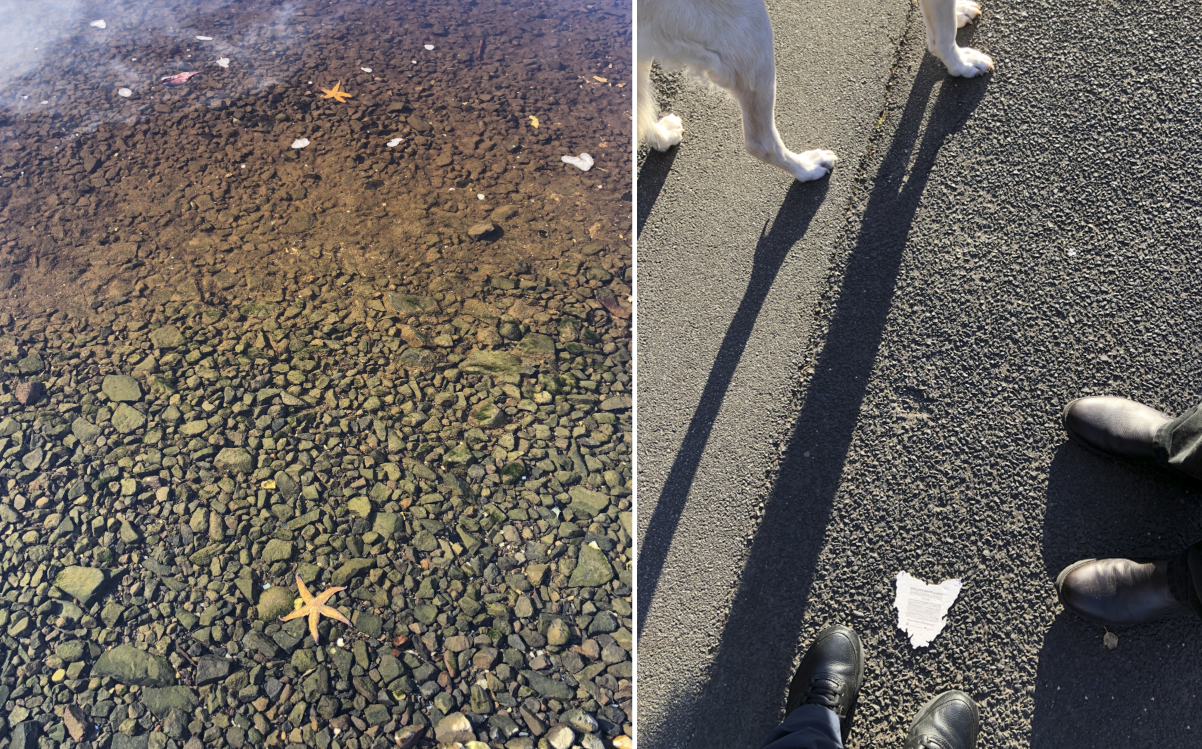 Found objects: Starfish and Tasmanian coaster map
.
When I take the time to study a place through photography and Material Thinking* history is unearthed, reconsidered and reordered. As I walk in each place, I identify and collect objects for further study. Some objects are commonplace or endemic while others may be discarded or dislocated dissonant interventions. I then utilise the cyanotype process as a site-specific medium to record these collections using sunlight and other environmental conditions as experienced in-situ. In this work the cyanotype forms a blue matrix in which these objects are imaged as their shadows. The shadowy imprints inhabit the blue as white ghostly forms referential of their solid origins.
The final work of blue and white is a paradox between its fiction and truth, the featureless blueness only revealing form by its absence. To think about the cyanotype in this way ushers in many questions: Is the cyanotype blue a political or aesthetic statement? Do the white shadows speak of absence or are they the essence of a presence? Does the reader need an exegesis to understand a poem?i
Victoria Cooper
.
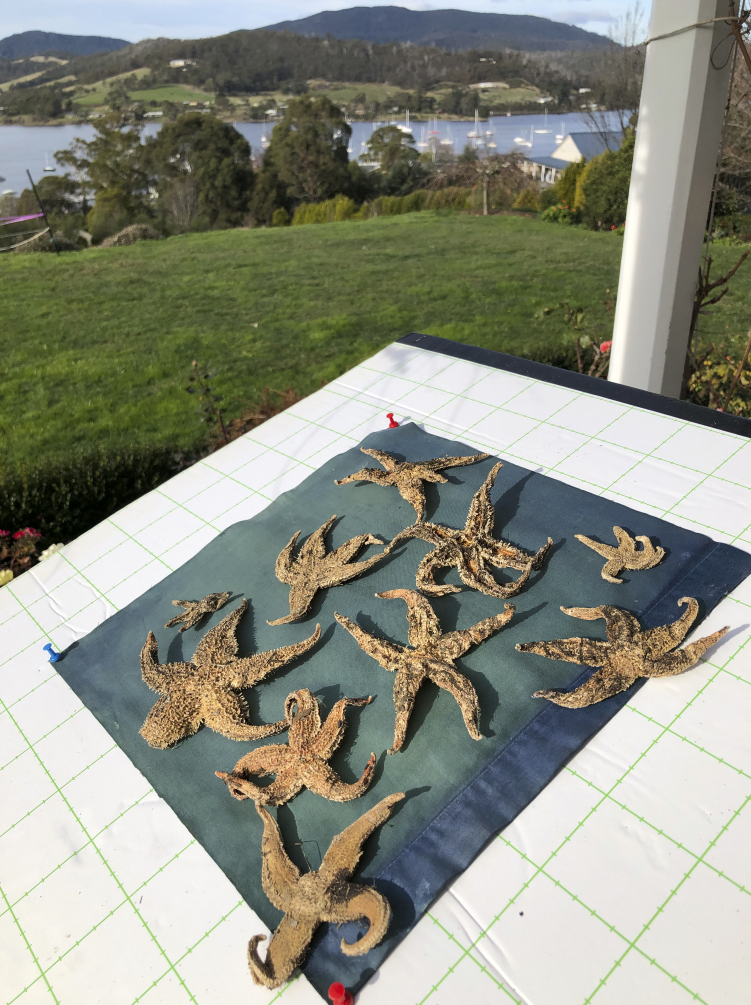 Untitled found objects exposing the cyanotype
*The concept of an aesthetic methodology proposed by Paul Carter in his book, Material Thinking, defines my art, and underpins the making of my work. Through a psychological dialogue with materials, subjects and objects, my work evolves reflexively and in concert with the response to physical experience of time and place. In this process I am taken in new directions and presented with unexpected outcomes for the work.
Just as human collaborators needed to suspend an irritable desire for control of the project, substituting instead a lover’s readiness to be plastically moulded by the other’s (intellectual) desire, so with materials: they self selected, those of especial value to enquiry displaying gifts of amalgamation and self transformation analogous to the emotional environment characteristic of the human exchange. (Carter 2004:xiii)
Paul Carter, 2004, Material Thinking, Melbourne University Publishing Ltd, Melbourne.
.
.
.
.
.
.
©2019 Victoria Cooper
ARTISTS SURVEY #23: Artists in Pandemic Isolation

Artists Survey #23 Composite
ARTISTS HAVE ALWAYS ADAPTED TO AND EMBRACED CHANGE IN CHALLENGING TIMES OFTEN WORKING IN ISOLATION. Nearing the end of their artists in residence in Finland, Australian artist Julie Barratt and Argentinian photographer Solange Baques found themselves stranded on the other side of a pandemic stricken world. Concerned for their friend and colleague, Cooper and Spowart connected with Barratt and proposed the concept of a collaborative Artists Survey book project to present the artists’ experiences during the COVID-19 enforced isolation.
This small book compilation is published by the Centre for Regional Arts Practice is the result of the collaboration. It is a small gesture to bridge the vast physical and psychological distance that this pandemic has engendered.
Here is the story of Artists Survey #23: Artists in Pandemic Isolation project.
THE BACKSTORY TO THIS SPECIAL EDITION OF THE ARTISTS SURVEY
The Centre for Regional Arts Practice (acronym C.R.A.P.) was founded in 2007 during an artist in residence at Arthur Boyd’s Bundanon property near Nowra on the NSW south coast. As artists’ bookmakers, we saw the opportunity to produce a democratic multiple publication to present our perspective on regional artist experience and to develop C.R.A.P. manifestoes.
All of our C.R.A.P. Artists Survey books draw upon humour and irony of the prosaic routines and events encountered in life of a regional artist. These publications are usually produced in editions of 25 with 5 artist’s proofs. They are humble handmade books which are sold to collectors and institutions – most are given away to friends and peers.
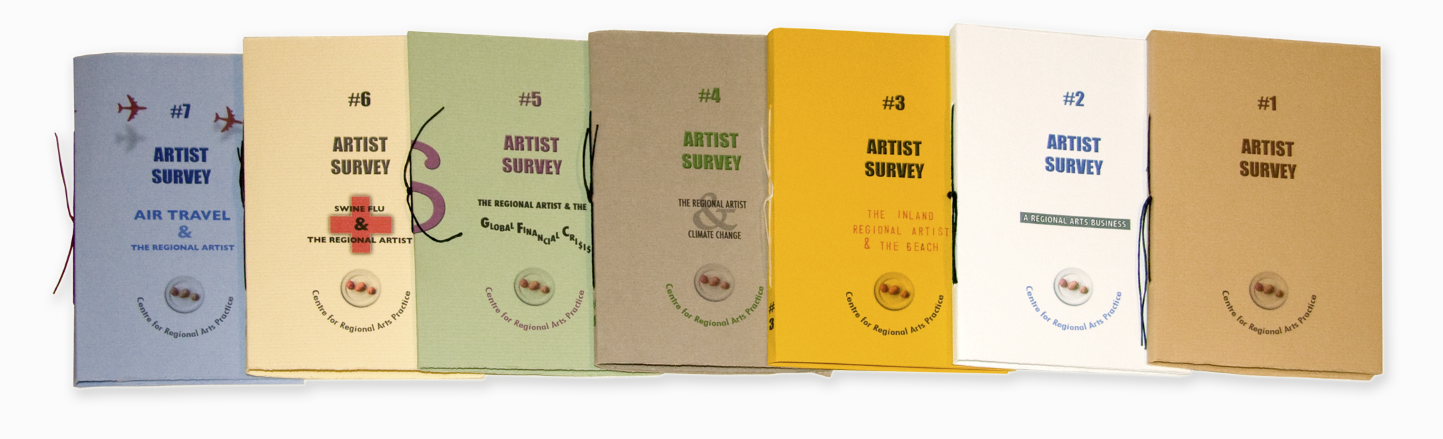
Some early C.R.A.P. Artists Survey books
The C.R.A.P. and its Artists Surveys have become a vehicle for highlighting, critiquing and questioning many issues both local and global affecting regional artists. The 23 editions to date have included topics such as Swine Flu, The Global Financial Crisis and Global warming. On seven occasions collaborative Artists Survey books have been created with a regional artists.
In late March we witnessed Julie Barratt’s situation as a participation in an artist’s residency in regional Finland. At that time the viral pandemic was closing the world down and cutting off homeward travel with airlines grounded. Though Julie seemed unphased we thought our shared isolation experiences could be an important commentary on these times. So we suggested to Julie our idea of a C.R.A.P. Artists Survey book about Covid-19 isolation and she agreed enthusiastically. Within a a short time Julie’s compatriot in isolation – Argentinian photographer Solange joined the project.
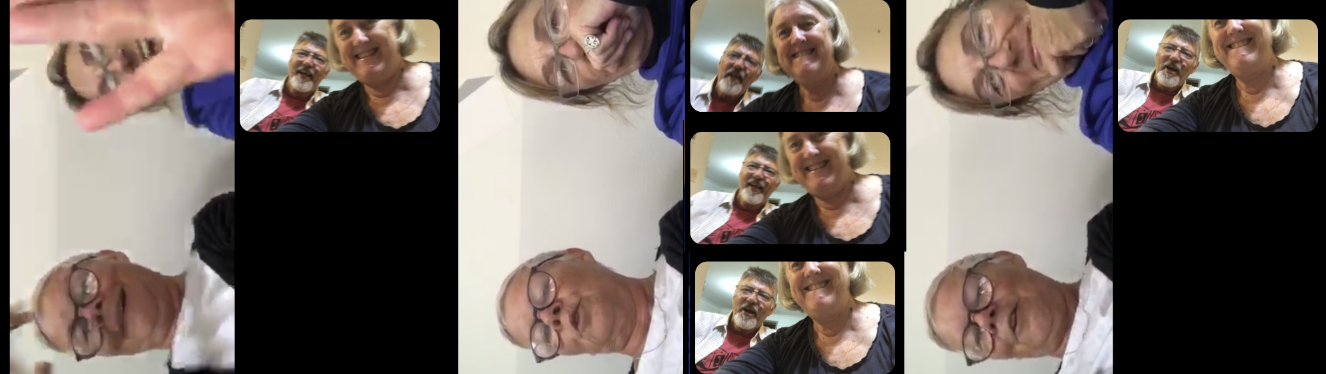
Screen snaps of Facebook group meetings
We formed a Facebook group and held online meetings to talk over the concepts, we shared work, discussed design ideas and quickly our isolation had a creative purpose. We are excited to share our stories with you …
ABOUT THE ARTISTS SURVEY #23
The Artists Survey project culminated in a book of 6 elements:
- An introduction booklet
- 2 works from Solange Baques (1) An image from her ‘Through the window project, and (2) a small piece of Finnish soap enclosed in a stitched holder accompanied by messages about anti COVID-19 hand washing techniques.
- An original Polaroid image made by Julie Barratt in a stitched folder made at the residency with red thread used by Julie in some of her performance work.
- A collaborative concertina book by Victoria Cooper and Doug Spowart.
- All the elements are enclosed in a special folder cover designed and handmade by Doug Spowart with the support of Victoria Cooper

COVER Open with INTRO Booklet
.
A PDF COPY OF THE INTRO BOOKLET CAN BE DOWNLOADED HERE: ARTIST Survey 23 INTRO Book Aug 21
SOLANGE BAQUES: is an Argentinean photographer born in Buenos Aires city. In her work she explores identities through memories and family albums. Her images are intimate and subtle.
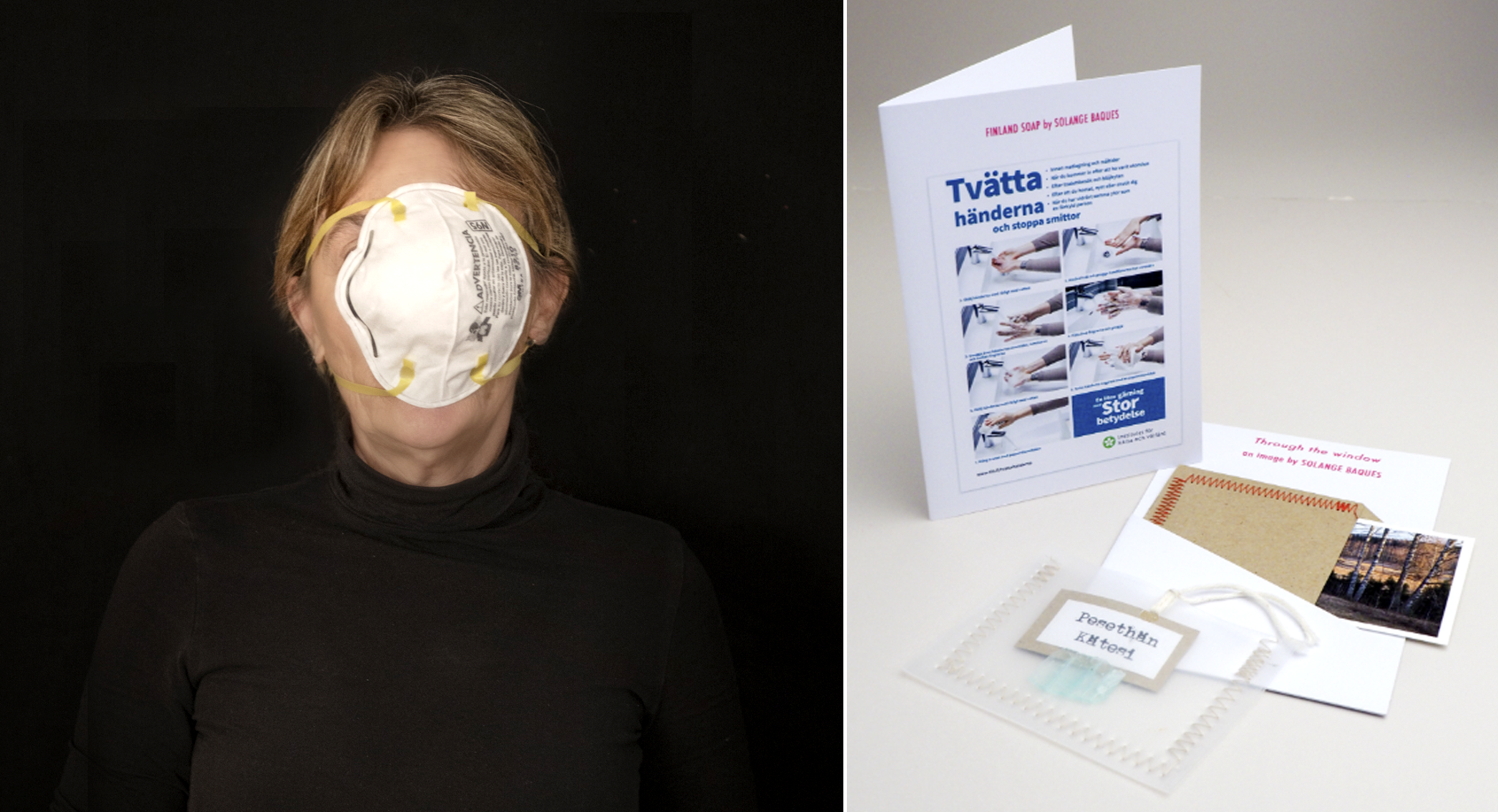
Solange Baques and her two works
.
Solange arrived in Finland on March 2nd to participate in the program “Silence Awareness Existence” as an artist in residency with 13 fellow artists at the Arteles Creative Center, which is located in a rural area near Tampere. Her project was to include visiting Valmet Oy plant and doing some research on the pulp and paper industry but due to the lockdown, this was not possible.
Within a short time of the growing worldwide shutdown of entry to countries 10 of the 13 artists in residency left Finland to return to their home countries. However by March 16 three remained.
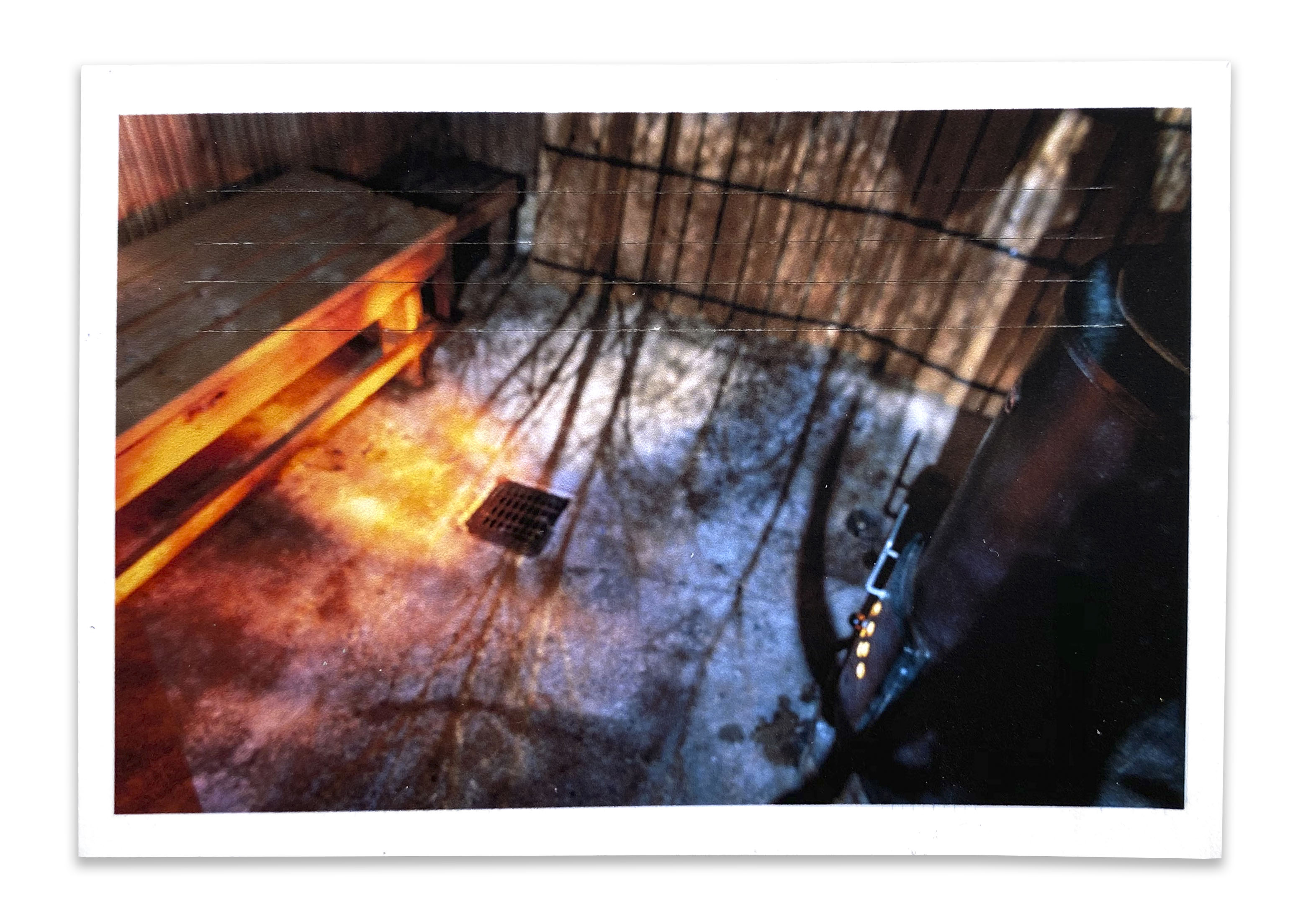
Through the Window images included in this collaborative artists’ book was born as a part of the self-isolation program at Arteles Creative Center.
Solange was not able to return home due to the Argentine borders being closed and the only planes allowed to bring back Argentineans being those of Aerolíneas Argentinas. Around the world there were more than 20,000 citizens trying to get home with only 400 people allowed to arrive every day. On May 9th she was finally able to leave Finland and made it back to Argentina on May 11 and out of quarantine to her family on May 25!
JULIE BARRATT: is an Australian visual artist and arts producer whose mixed media practice encompasses printmaking, photography, artist books, installation and performance.
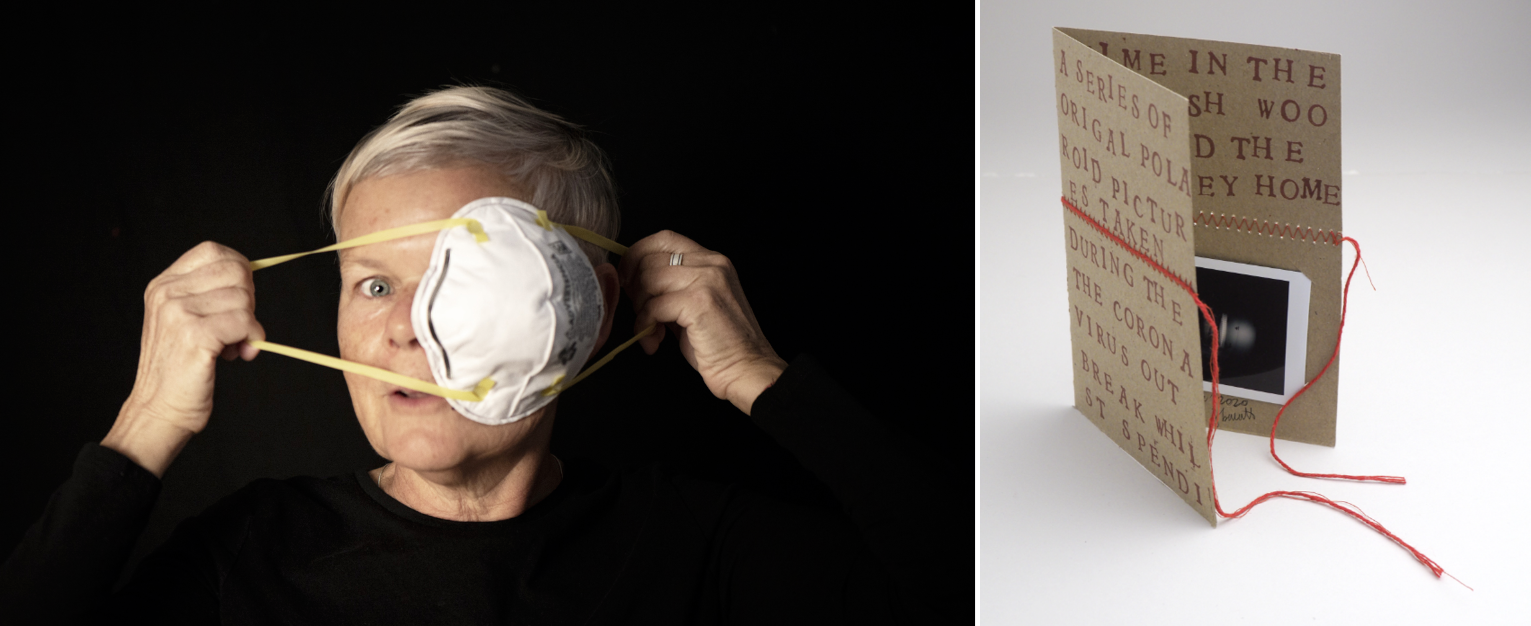
Julie Barratt and her Polaroid print + folder
.
Julie arrived at the Arteles Creative Center in the beginning of March for a 1-month residency. As the worldwide lockdowns were initiated she experienced difficulty in getting flights back to Australia and her residency became an extended period of creative production.
Having this extra period of time in rural Finland has kept Julie just about as far from the grips of Covid-19 as you can imagine. And being distant from family and friends having little access to the Internet or the outside world for that matter was quite surreal!

Although she arrived without a clear project in mind Julie’s work became a visual diary of this period of isolation rendered through the mediums of photography, stitching, mixed media and hand stamping. This work in this collaborative artists’ book made with unique state Polaroid photographs relates to her experience of spending the Covid-19 period of isolation far from home in rural Finland!
By the 4th May she was still there! Cancelled flights, border closures and local transport collapses meant that options for getting home are all but non-existent. Finally Julie was able to get a direct flight from Helsinki to Sydney on May 10. On her arrival in Sydney she was escorted by Federal Police and Army personnel to 2 weeks forced isolation in a Melbourne hotel. She arrived home in Rockhampton on May 24!
COOPER+SPOWART

Cooper+Spowart collaborative book
.
VICTORIA COOPER:
Victoria’s early career in science and microbiology is influential in much of her arts practice. Engaged in experimental photographic processes from pinhole to digital photomontage, she creates visual narratives, in the physical form of the book, exploring the human-non-human relationships of Place.
I began with energy for our collaboration across the ISO CO-void… This seemed a good time to explore new work informed by my past experience with pathogenic microorganisms. But I was unsettled in this COVID space — challenged by the consequences of being in familiar places that now were significantly altered by unseen entities. Continuity of creative thought was becoming increasingly more difficult under the existential struggle as sharp highs and lows destabilized every aspect of daily life.
During this time I utilised the social space of Instagram to break away from the silence of isolation. I captured and collected moments as they presented themselves and then instantly shared their potential to evoke memories and dreams with others. Over the next few weeks, my Instagram archive of isolated and unconnected fragments grew into a poetic narrative.
In this collaborative book with Doug there is no intended theme, our Instagram images present the fractured moments of our shifting altered reality.

DOUG SPOWART: is an Australian visual artist with a multi-media practice.
About 5 years ago Victoria Cooper and I sold our home in Toowoomba and headed out onto the road in search of a new place to live, work opportunities and to connect with friends and our extensive professional networks.
In early March we were on the beach in northern NSW and were planning our next foray into the real estate scene in Victoria. We were just about to head south when we recognised that the expanding threat of Covid-19 was something that could not be taken lightly.
Considering our options we decided to head back to the familiar location of Toowoomba. Our doctor is there, we have family there and importantly we have storage sheds with our art, library and personal effects. We saw isolation as presenting an opportunity to review and downsize our stored possessions.
Within a week we were back in Toowoomba and had viewed possible rental units, made a selection and had paid the first rental instalment.
My contribution to this project is a collaborative concertina book made with Victoria which features photographs made our first isolation period – it is entitled Fractured moments and small glimpses.
.
OTHER STORIES ABOUT C.R.A.P. ARTISTS SURVEYS can be found at the links below:

Artists Survey Flash Mob Grafton
https://wotwedid.com/2013/09/23/artists-book-flash-mob-create-collaborative-artists-survey-book/
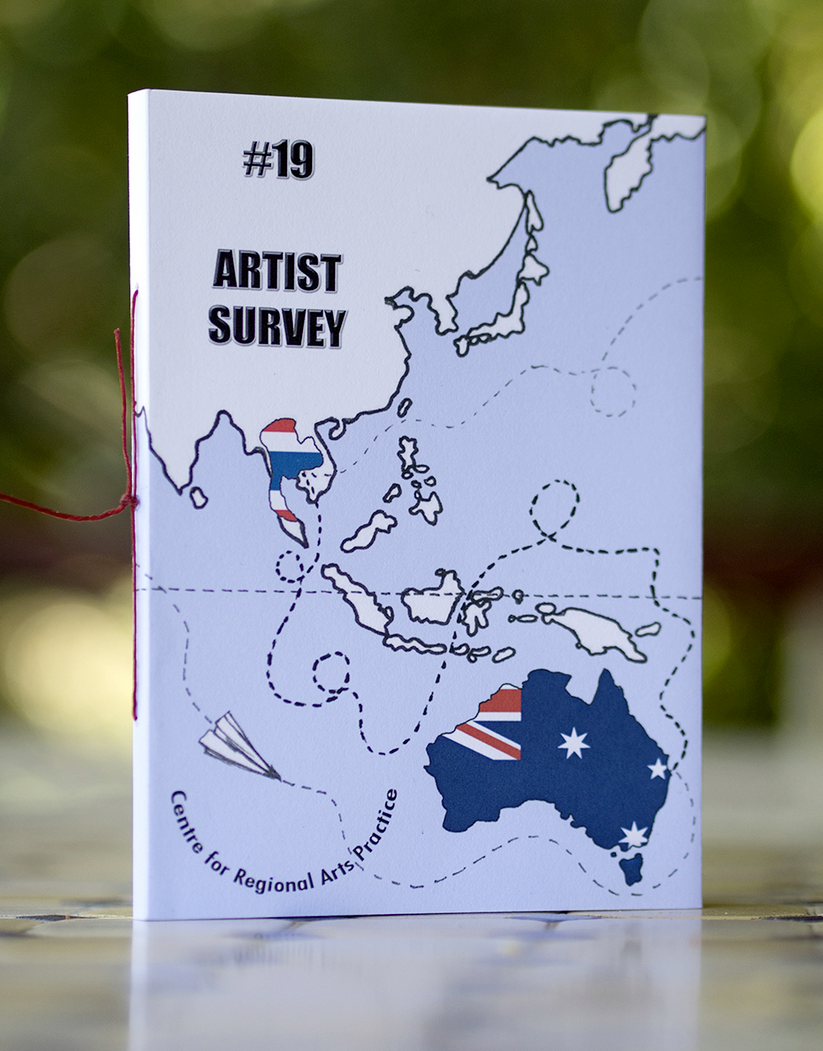
Artists Survey #19
https://wotwedid.com/2018/08/09/a-book-a-collaboration-time-19-artist-survey-book/
WOTWEDID BLOG CELEBRATES 100,000 VIEWS
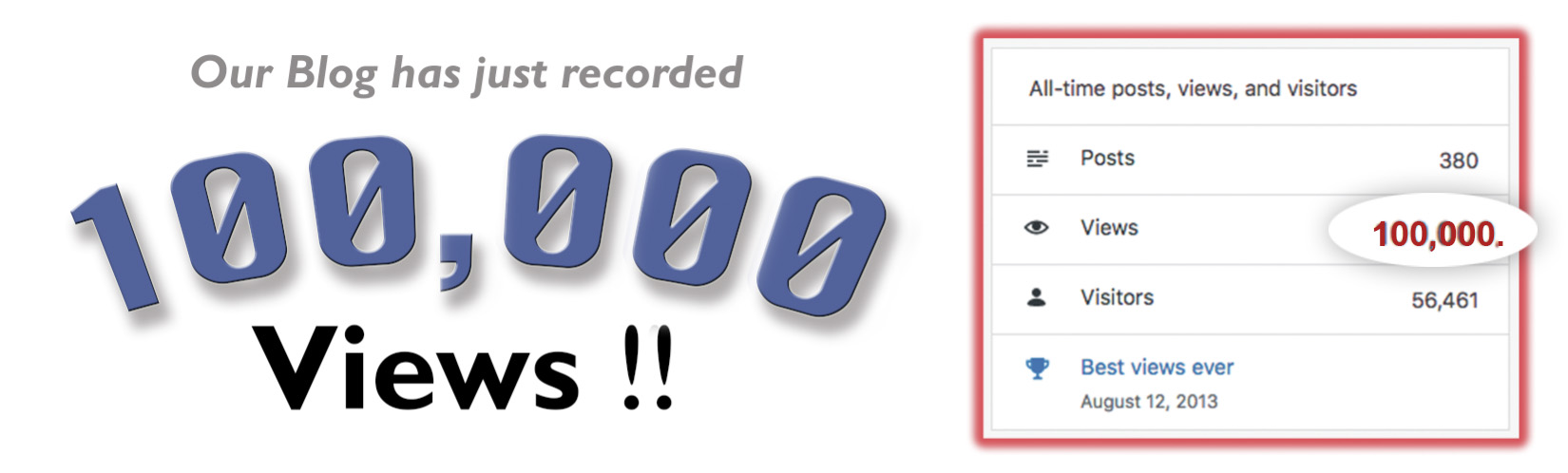
100K Header
Our www.wotwedid.com blog reached the milestone of 1000,000 views last week. It has had 56,000 visitors who have had the opportunity to view 380 posts and read around 250K words and see the hundreds of photographs that we have made to compliment the stories.
Our wotwedid Blog was started nine years ago as an opportunity to connect with our friends and creative communities via social media. The topic cloud for the wotwedid Blog includes ARTISTS’ BOOKS, PHOTBOOKS, CAMERA OBSCURA, EXHIBITIONS, MEETING PEOPLE, THE ART AND PRACTICE OF PHOTOGRAPHY, REGIONAL ARTS, CYANOTYPES, PLACE PROJECTS and POST-DOCTORAL RESEARCH.
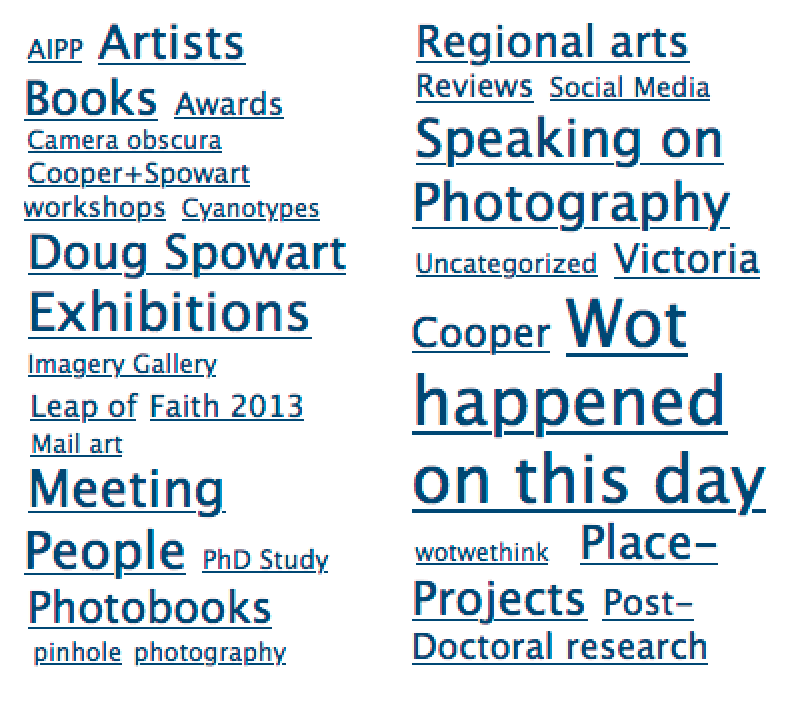
Topic cloud wotwedid
Usually the content that we post is generated by us and includes the written commentaries, the photographs and illustrations – it can be quite a lengthy time consuming task to get a blog up.
While many posts relate to what we do, have done or will be doing, the Blog represents a chronology of activity in our art practice, our lives and issues that we are concerned about. Due to the contemporary space that the arts and artists occupy today much activity and many events go unnoticed and unrecorded. So a significant driver is to provide a space for commentary on what is happening outside of the popularist ‘art bubble’.
Early this year we were excited to learn that the State Library of Queensland had nominated wotwedid.com for inclusion in the Pandora Archive managed by the National Library of Australia, ‘to ensure the collection and long-term preservation of online publications relating to Australia and Australians. This objective contributes to the Library’s statutory function to comprehensively collect Australia’s documentary heritage.’
Over the years we have found that many views, screen dumps and downloads of resources we make available take place anonymously without comment or feedback. Then again, we understand that this is the same for most online resources. Despite this we find that as we travel and meet friends, fellow artists, academics and curators many say how much they appreciate and enjoy the content that we generate and post.
So, a BIG Thank You to all have visited … And we look forward to your return to help take www.wotwedid.com to the next milestone – 200,000K views.
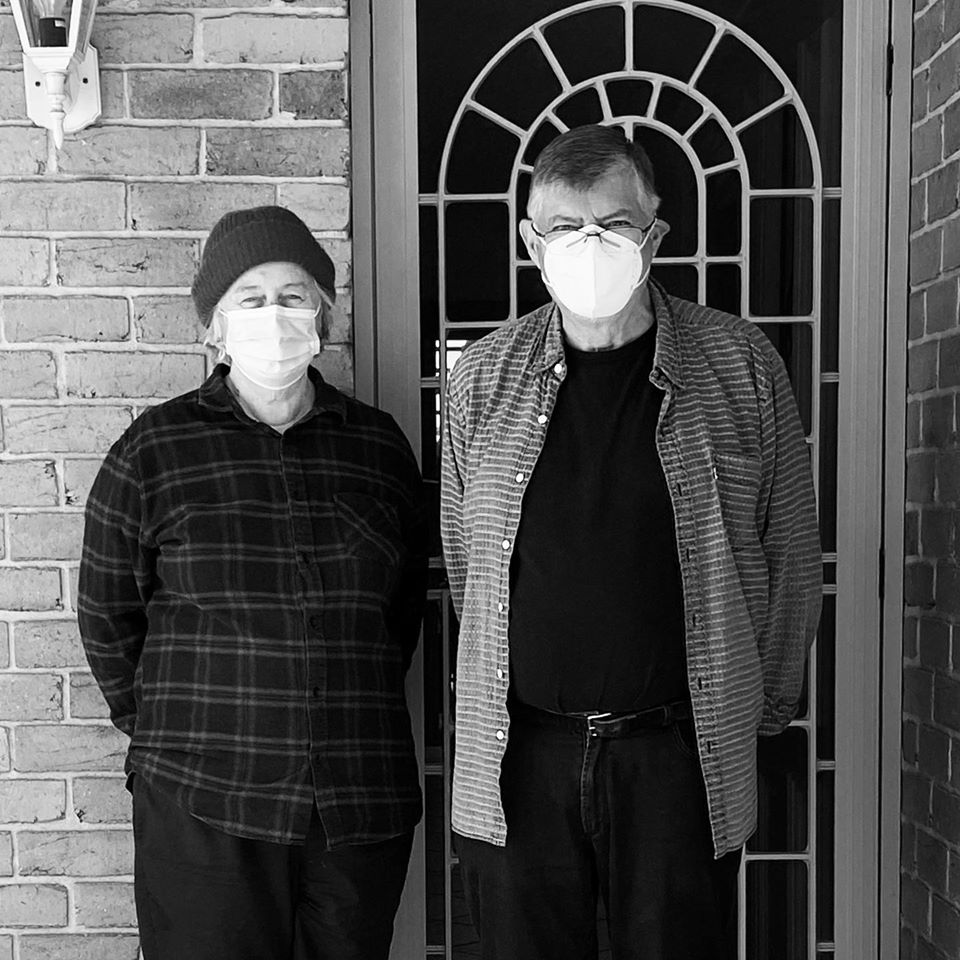
D+V with masks
Vicky+Doug
PORTRAIT PHOTO: Susan Belperio
Here are some images of people met, events documented and our own art activities over recent years …


©2020 Doug Spowart+Victoria Cooper
..

.
Our photographs and words are licensed under a Creative Commons Attribution-NonCommercial-NoDerivs 3.0 Unported License.http://creativecommons.org/licenses/by-nc-sa/2.5/au/..
FOUND: A camera obscura in a storage shed box
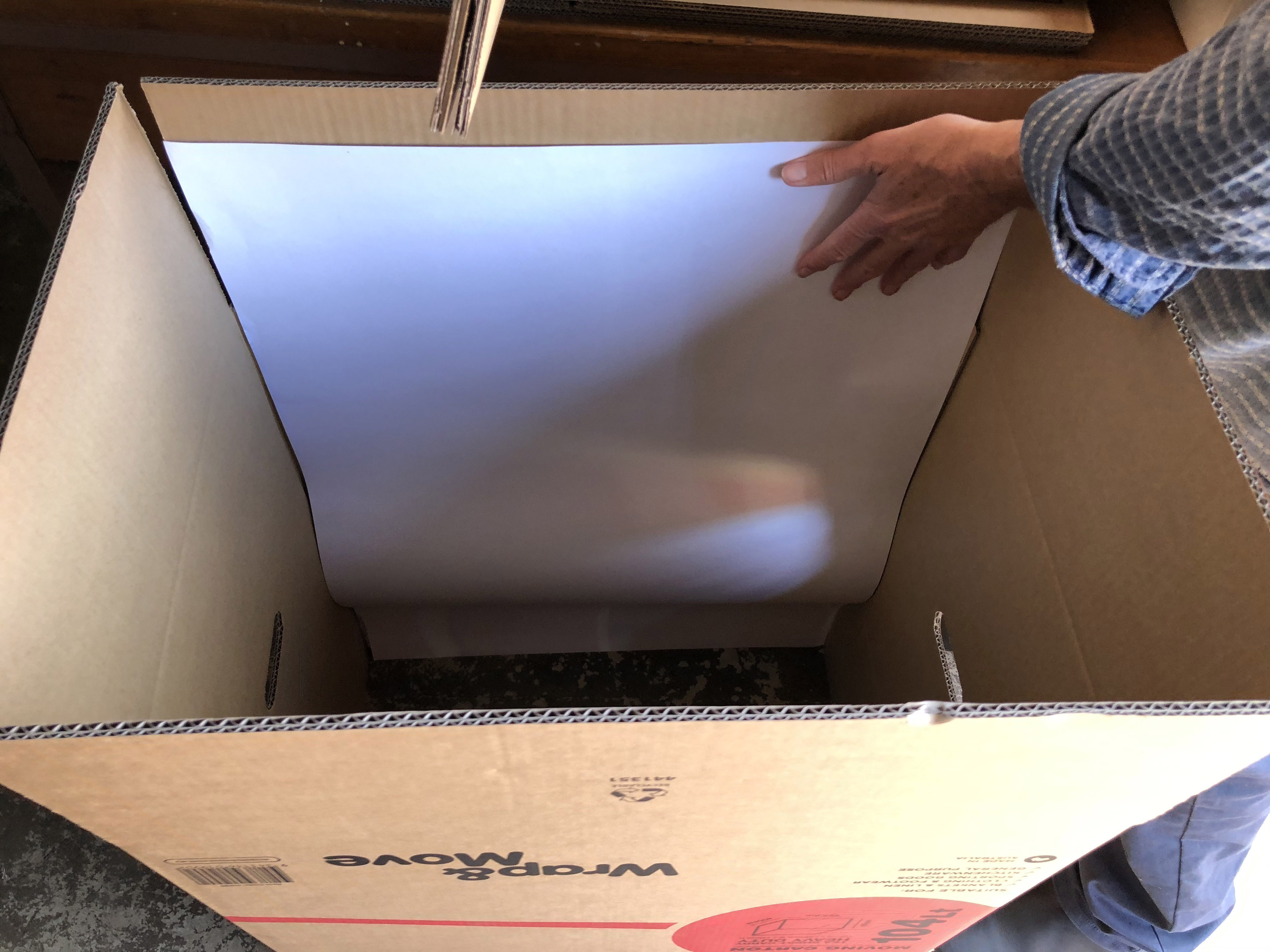
An image is found in a packing box
.
.
So today we were planning a day of shedding in our storage shed. We donned our dust masks and glasses, and cut through the five years of dust on many boxes and began to move our precious things into protective packing boxes.
Just as we were getting into the rhythm of this challenging chore we found something amazing in one of the empty boxes…
From that moment we stopped all work…
What follows is an impromptu document of performance we made in this remarkable image discovery. Found within an ordinary box – in a dusty storage shed – somewhere in the rows of storage sheds where we and others store our forgotten treasures…
.
A video featuring the performance …
.
.
.
.
Here are some images and a video on the refinement of the image by using other boxes and a pair of gloves to mask-out the light admitting aperture to around 3cm square.
.


.
A video revealing the storage shed packing box set-up …
.
.
OTHER COOPER+SPOWART CAMERA OBSCURA POSTS:
A collection of camera obscura works
https://wotwedid.com/2013/10/26/camera-obscura-2000-2020-in-hotels-and-other-places/
A porthole camera obscura on the Spirit of Tasmania
https://wotwedid.com/2019/01/11/2018-field-studies-camera-obscura-spirit-of-tasmania-porthole/
A gallery camera obscura
https://wotwedid.com/2016/11/14/maud-gallery-camera-obscura-for-one-day-only/
Our Tarago CarCamera Obscura
https://wotwedid.com/2016/05/13/ode-to-tarago-carcamera-obscura/
.
.
.
Until the next obscura reveals itself …
.
.
.
LYSSIOTIS+COOPER+SPOWART: WE ARE LIBRIS AWARD Finalists
.
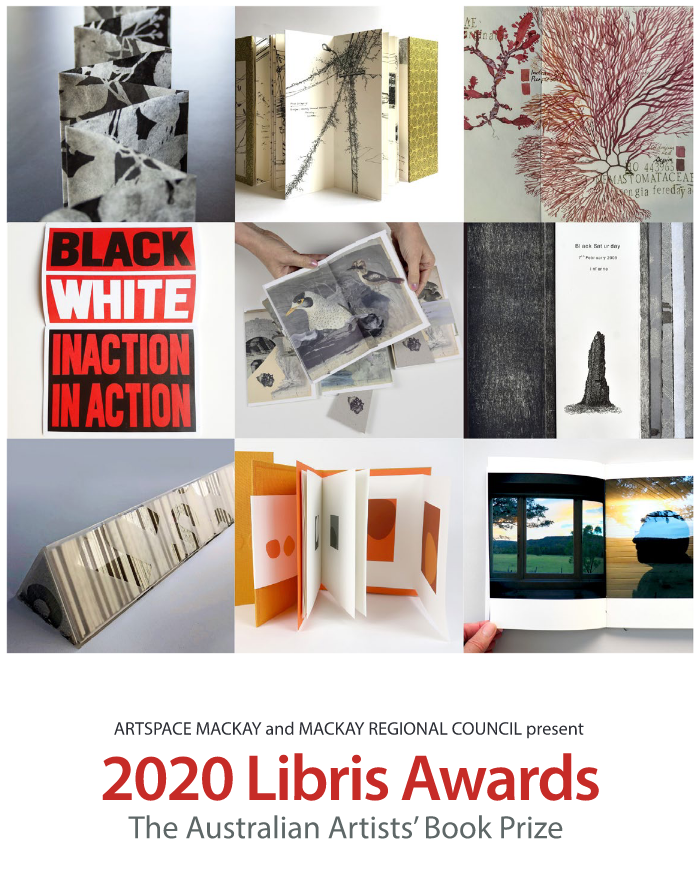
The LIBRIS AWARDS for Australian Artists Books is on again this year at Artspace Mackay – We are excited to announce that our works, including a Peter Lyssiotis book we collaborated on, have been selected in the 60 finalists. The exhibition is scheduled at Artspace Mackay between 27 June and 13 September 2020.
.
A statement from the Artspace Director Tracey Heathwood
Since opening its doors in 2003, the gallery has been dedicated in its exploration and support of the artists’ book medium. The Libris Awards play a significant role in showcasing the very latest and best in contemporary artists’ book practice in Australia.
As extraordinary developments continue to unfold in response to Covid19, Artspace Mackay has faced and overcome many challenges presented throughout the year to now be in the final exciting stages of delivering another inspirational exhibition, 2020 Libris Awards: The Australian Artists’ Book Prize.
Despite restrictions beginning to ease across the country, lingering interstate travel constraints prevent our designated 2020 Libris Awards judges, Des Cowley and Robert Heather – who have already completed the challenging job of selecting finalists from an extensive range of artists’ books entries from across the nation – from travelling to Mackay for the final process of selecting winners in the three categories. In these exceptional circumstances, Artspace Mackay Director Tracey Heathwood will complete the final process of selecting this year’s prize winners.
Announcement of 2020 Winners: 4:30pm (AEST) Monday 13 July – Live streamed online via Artspace’s Facebook page.
HERE ARE THE BOOKS we were involved with :
PETER LYSSIOTIS: WHAT THE MOON LET ME SEE
A collaboration with Victoria Cooper + Doug Spowart who created and optimised pinhole images of Peter’s montage image to accompany his texts.
Peter Lyssiotis: What The Moon Let Me See
ARTIST’S STATEMENT
The narrative of What The Moon Let Me See is a journey. It is also about a father and son and how their lives, and their purposes in life interweave. The journey is to a mountain; it could be Thomas Mann’s ‘Magic Mountain’, it could be the Bible’s Mount Ararat or it might be that mountain you see on the horizon when you look out of your car window as you drive through the country. The father and the son may be Abraham and Isaac or Kafka and his father or the father and son who live next door, or you and your father … the journey they’re on involves making decisions; perhaps the son will release the father, maybe the father will free the son … how do these two people read and map their worlds, how do they refer to the world here and the world beyond them?
VICTORIA COOPER: BEING PRESENT
Victoria Cooper’s BEING PRESENT
ARTIST’S STATEMENT
Being Present has its physical origins from the Bundanon Trust and the Shoalhaven River.
The electron microscopic images come from unexplored work made during an earlier residence in 2007 of collected detritus from the river. The montages were constructed with these microscopic images as interventions into a riparian environment near the property.
The book is informed by the work of notable writers, thinkers and philosophers, Martin Heidegger and Rachel Carson.
DOUG SPOWART: HOME
.
Doug Spowart’s book HOME
ARTIST’S STATEMENT
This book was conceptualised and created during an artist’s residency at Bundanon near Nowra in New South Wales in June 2018. The final design of the book took place in 2019.
For 5 years I have been homeless resulting from the need to travel, seeking work, looking for a place to settle, and maintaining connections with supporting friends and colleagues. The residency enabled inner thoughts to emerge that have been suppressed throughout this time.
Self-imaging is not something new to me. What is new however in this work is the frank reality of the expression, pose and perhaps vulnerability I present in these moments contemplating ‘home’ and what it means to me.
.
.
.
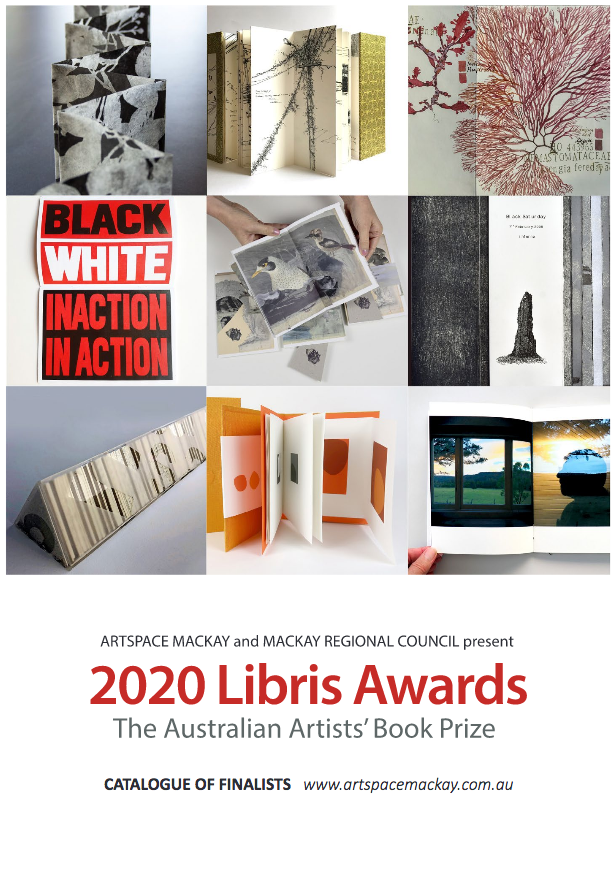
Libris_Catalogue pic
Download a copy of the Catalogue:
LIBRIS_AWARDS-2020_Finalists_Catalogue
.
.
.
.
.
.
.
.
SEE Other WOTWEDID.COM posts about the LIBRIS AWARDS:
Our FINALIST work from the 2018 Awards
https://wotwedid.com/2018/05/27/libris-artists-book-award-cooperspowart-finalists/
A COMMENT on the 2016 Awards
https://wotwedid.com/2016/10/22/covering-the-2016-libris-artists-book-award/
The JUDGE’S VIEW from Helen Cole of the 2013 Awards
https://wotwedid.com/2013/05/13/2013-libris-awards-the-judges-view/
.
.
.
.
.
.
.
TWENTY-Documentary photography in Queensland
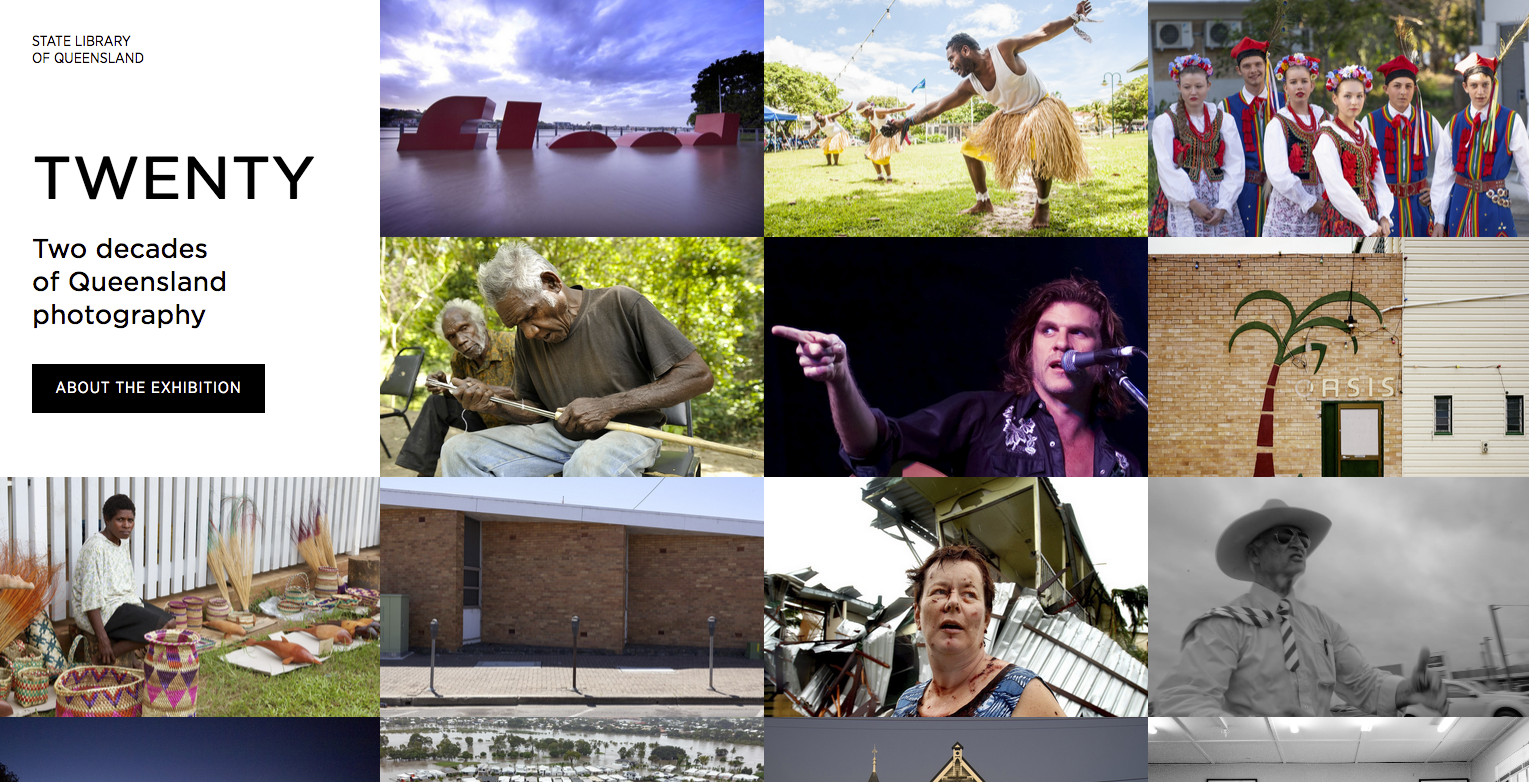
SLQ TWENTY Webstie header
We are excited to announce that a selection of our Nocturne photographs of Queensland are featured in the new State Library of Queensland exhibition TWENTY: Two decades of Queensland Photography
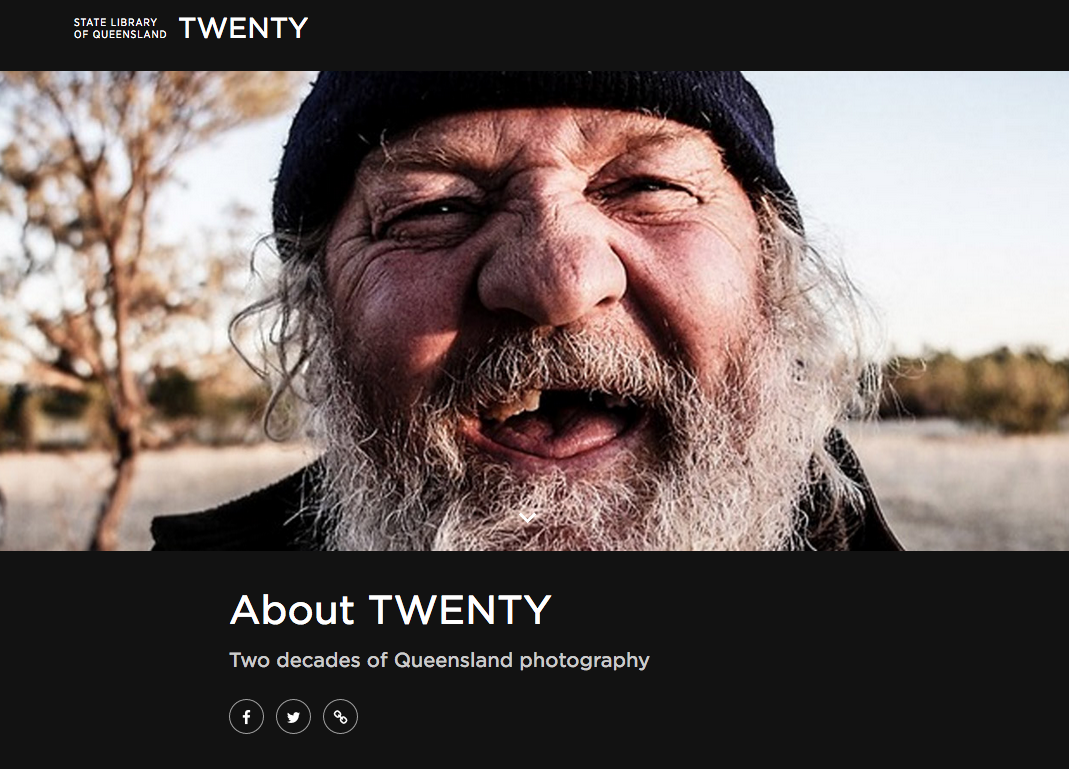
ABOUT the TWENTY exhibition
FROM THE SLQ Website:
The State Library of Queensland has grown a vast photographic archive reflecting the lives of generations of Queenslanders. TWENTY focuses on images in State Library’s contemporary collections. They reveal a story of a changing Queensland—one that still has echoes of its past but is also embracing a more diverse and tolerant future.
TWENTY is an opportunity to reflect on the last 20 years in Queensland’s history. Documentary photography plays a vital role in capturing the events and experiences that shape our lives. It offers us a powerful insight into a particular moment in time.
Looking back, the year 2000 seems a simpler time. Over the last two decades, society has undergone seismic shifts. Yet, some things transcend time: the shock and devastation caused by natural disasters; the beauty of our state’s wide-open spaces; and the ongoing connection of people to place. Immerse yourself in this rich and complex history.
.
VIEW THE ONLINE EXHIBITION HERE: https://twenty.slq.qld.gov.au/
.
Some of our Nocturne Queensland photographs featured in the TWENTY exhibition


ABOUT COOPER+SPOWART: Nocturne Imaging Projects
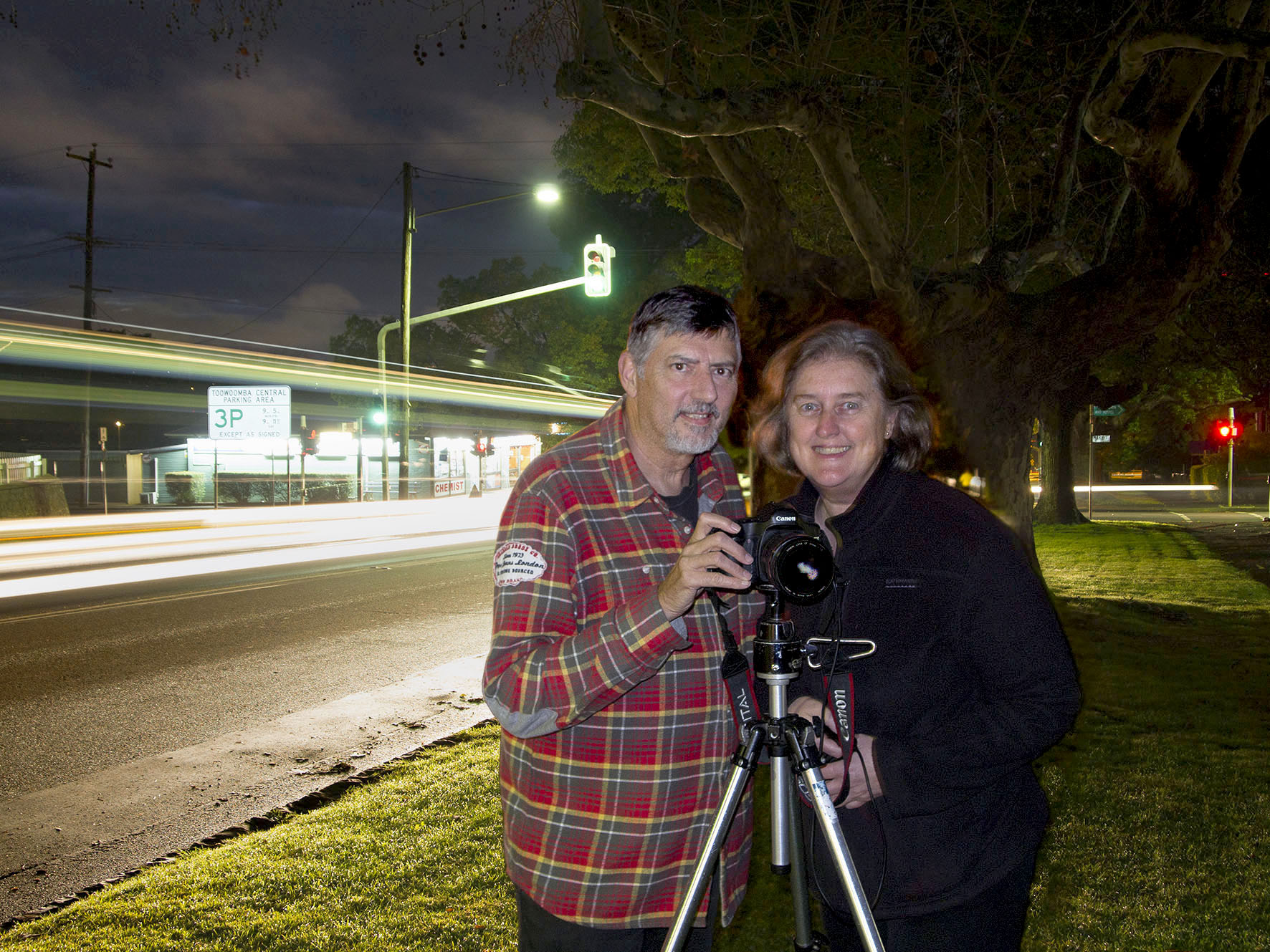
Victoria Cooper+Doug Spowart making Nocturne images
Photography is integral to the way we capture, interpret and share our experiences and deeply considered views of our world.
For around ten years we have been photographing the visual transformation of small towns and suburban places in those last moments of daylight and into night. Our intent is to capture this transient magical atmosphere of twilight where the afterglow of sunset combines with the illumination of streetlights and the room lights from inside houses that say someone is home. Additionally as some photographs created at this time require long camera exposures, the image captured shows the ghostly, blurred movement of people and car headlight trails.
The experience of nocturnal light is seductive yet uncanny. It connects us to the sustained beautiful melancholy felt when listening to Debussy’s Clair de lune while simultaneously evoking the unsettling, dark moments of a film noir movie.
Over the last seven years we have significantly documented as artists in residencies and personal projects communities including Muswellbrook, Grafton, Armidale, Bundaberg, Toowoomba, Miles, Cygnet, Wooli, Castlemaine, Murwillumbah, Bribie Island and numerous central NSW and Victorian regional towns.
.
SEE MORE OF OUR NOCTURNE IMAGES FROM EAST COAT AUSTRALIA
@ www.nocturnelink.com
.
.
TWENTY: THE CONTRIBUTING PHOTOGRAPHERS
FROM THE SLQ Website: The 56 photographers featured in TWENTY represent the incredible diversity of Queensland’s documentary photography community. Some are well-known, some are emerging, some have been practising their craft for years relatively unknown. Some studied photography, some are self-taught. They are all dedicated to documenting Queensland and their work has allowed State Library to develop an astonishing visual archive of our state in the contemporary era.
Michael Aird
David Allen
Anthony Anderton
Patricia Baillie
Stephen Booth
Hamish Cairns
Brian Cassey
Darren Clark
Suzanna Clarke
Jacqueline Curley
Rodney Dekker
Heidi Den Ronden
Jo-Anne Driessens
Justin Edwards
Leif Ekstrom
Liss Fenwick
Peter Fischmann
Amanda Gearing
Juno Gemes
Craig Golding
John Gollings
Troy Hansen
Josie Huang
Kelly Hussey-Smith and Alan Hill
John Immig
Reina Irmer
Daryl Jones
Cassandra Kirk
Marko Laine
Cameron Laird
Madeleine Marx-Bentley
Dominique Normand
Glen O’Malley
Chris Osborne
Renee Eloise Raymond
Mick Richards
Hannah Roche
Troy Rodgers
Brian Rogers
Dean Saffron
Jeremy Santolin
Cathy Schusler
Sarah Scragg
Arthur Liberty Seekee
Clare Sheldon
Doug Spowart and Victoria Cooper
Reuben Stafford
Brodie Standen
Jason Starr
Richard Stringer
Garry Taylor
Shehab Uddin
Alf Wilson
Marc Wright
.
.
.
.
.
.
.
LOOKING AT PHOTOs IN THE GALLERY: a talk by Doug Spowart
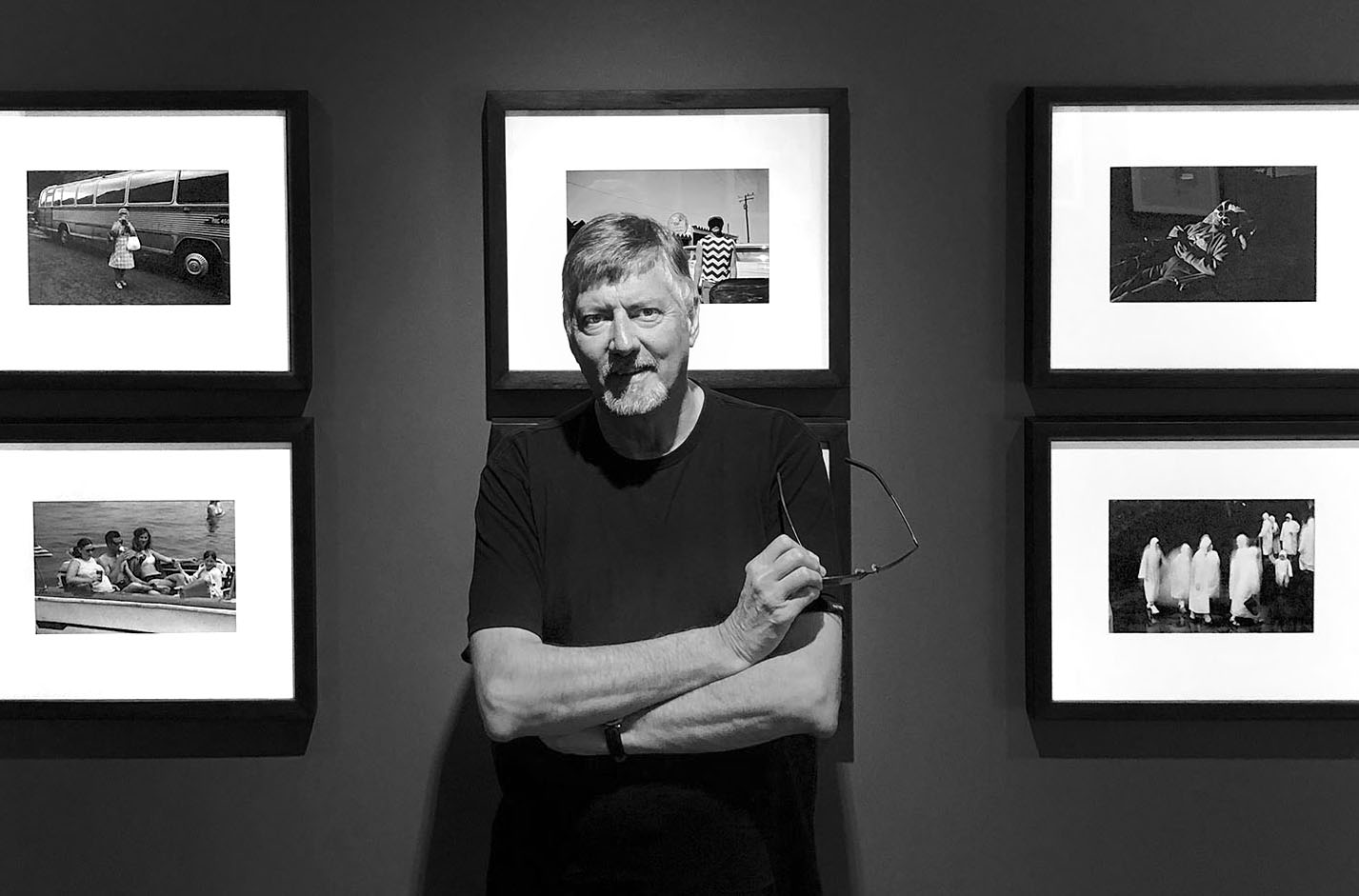
Doug Spowart in The Museum Project exhibition at Lismore Regional Gallery .…..PHOTO: Victoria Cooper
I’ve a lifetime of connection with art galleries from exhibitor to director and curator to reviewer. I’ve often pondered on how the gallery space connects with those who visit it and what insights they may take-away from that interaction.
Viewing an exhibition can be a very superficial activity or it can be one that can create the opportunity for a meaningful and personal experience.
I have often been interested in observing people in the gallery space and wondered whether they were: (1) an interested and attentive participant, (2) using the space for social interaction – with friends/partners/children, (3) there as a flâneur to be seen in the gallery or possibly (4) a person accompanying 1, 2 or 3.
Floor talks are a necessary part of the educative process carried out in an art gallery. It can transform the way art is introduced to a new audience and enlighten those wanting to know more.
At the end of last year I was invited to present a floor talk about an exhibition of photography at the Lismore Regional Gallery in northern NSW. The talk was to coincide with the gallery’s showing of The Museum Project a collection of American photography work from the 1970-2010. The project represents a selection of works from 7 photographers that cover a diverse range of approaches to photography. The photographers, and genre of their works are:
- Bonnie Schiffman – Celebrity portraiture
- Darryl Curran – Alternative imaging in cyanotype and van dyk browns
- Robert Von Sternberg – Photodocumentary travel locations
- Melanie Walker – Early digital montage and performance
- Barry Andersen & Robert Fichter – Landscape
- Victor Landweber – Approaches to idea of art as document
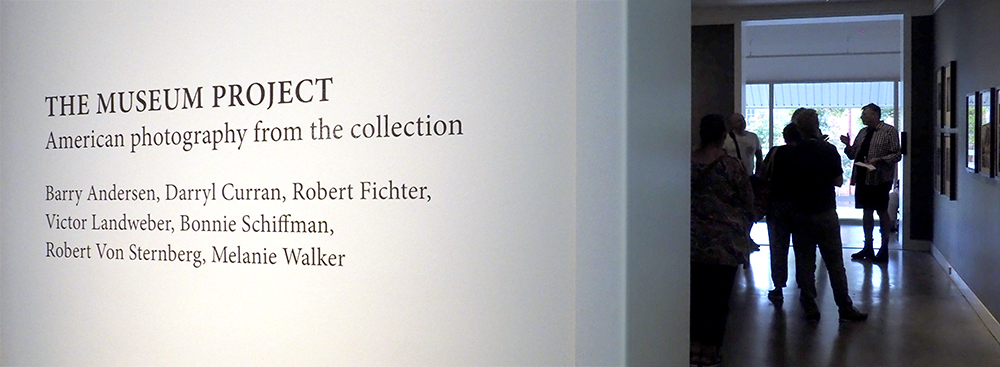
The Museum Project at the Lismore Regional Gallery
.
I considered the invitation and proposed that the talk would be based upon the idea of ‘Looking at photos in the gallery’. Rather than a direct translation of curator’s didactics I decided that I would use my gallery and photography experiences to suggest a number of steps and questions for the visitor in their engagement in the gallery space so they may derive more from the experience. I also acknowledged that attendees would be interested in a commentary about interesting aspects of the works including the conceptual and technical approaches taken by the photographers. The works presented an excellent opportunity to also talk about different approaches to photography as a visual art form.
In my preparation for the talk I visited the gallery and made notes on the works as well as carried out online research about the photographer’s backgrounds, manifestos and techniques.
I thought further about the proposition of looking at photographs in the gallery and prepared a script for the talk. To make the talk more interactive and personal, I decided to hand make a little booklet for each attendee to refer to during the talk and as take-home information source. In the 2015 Artists’ Book Brisbane Event, I did a similar process where I made a booklet of my talk for each of the 60 attendees of the conference and rather than an electronic presentation, I performed the book …
The gallery staff member assisting me for the day, Claudie Frock, had printed up 25 A3 sheets of my 8-page fold booklet the evening before so that Joanna Kambourian, Vicky and I could make up the books.
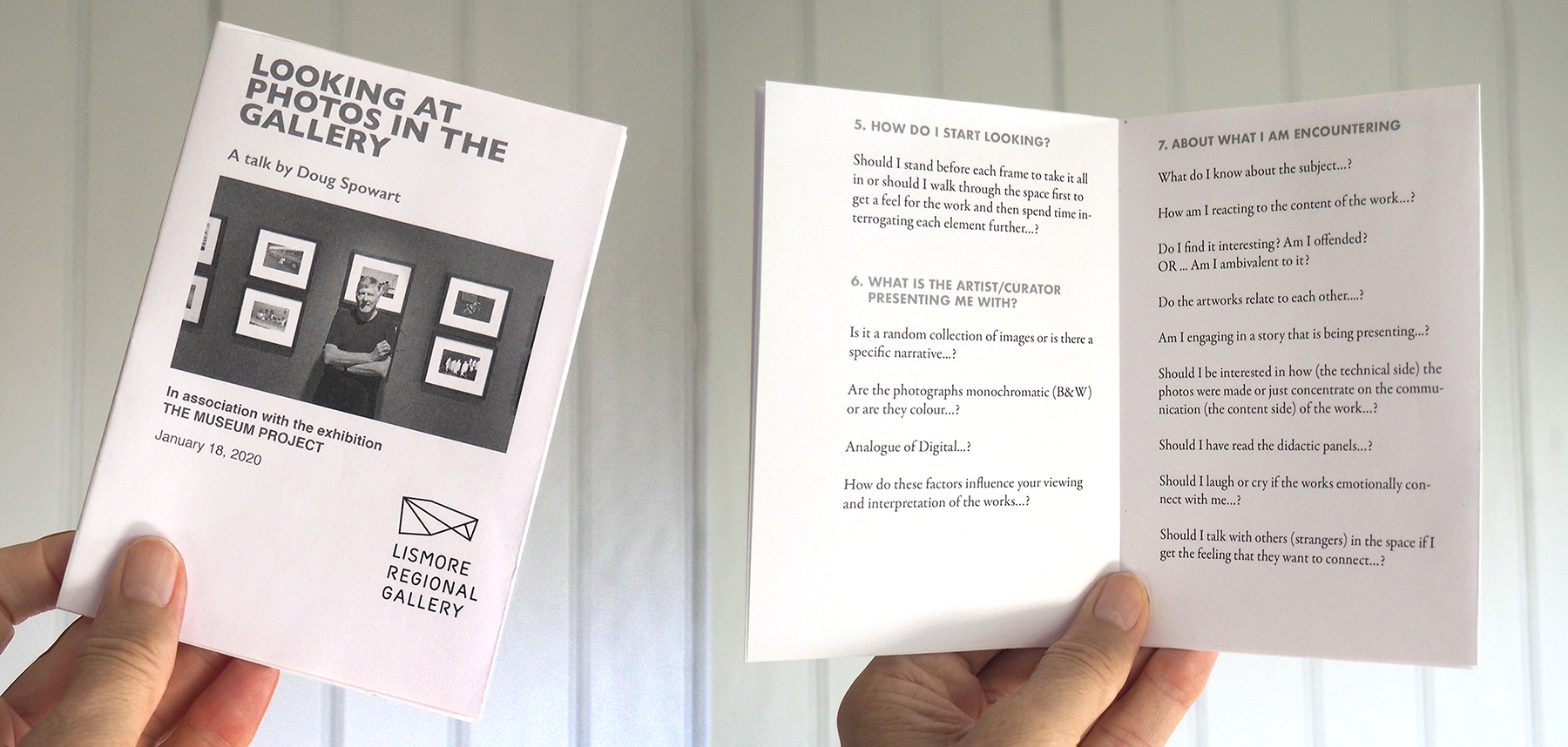
The Looking at Photos in the Gallery booklet
Overnight before the talk Lismore, and South-East Queensland and North-East New South Wales were drenched with flash-flooding rains so I was pleasantly surprised in the morning when 25 people came along to the talk. There was also a small group of deaf people attending the talk and I was supported in my presentation by AUSLAN interpreter Bronwyn. After the acknowledgement of country and an introduction by Claudie we began the talk.
.


Participant involvement is a necessary part of my presentation style and the question/answer format gave ample opportunities for attendees to interact in the talk. One of the gallery’s curators that attended, Fiona, added special insights about gallery installation, copyright and image conservation. The booklet process worked well and we managed to cover a diverse range of topics within the 1-hour time allotted.
You can download a PDF of the little A5 booklet LRG-Booklet
Vicky and I stayed on after the talk to connect with attendees who wanted to chat further and also to re-connect with two local photographers Jacklyn Wagner and Peter Derrett OAM who were associated with workshops that we had presented in Lismore at the Gasworks Art Centre and the Southern Cross University in the early 1990s. They presented us with a copy of the catalogue for a documentary project called Heart & Soul that featured people from around the region.
On leaving the gallery the rain had cleared to a sunny day…
.
.
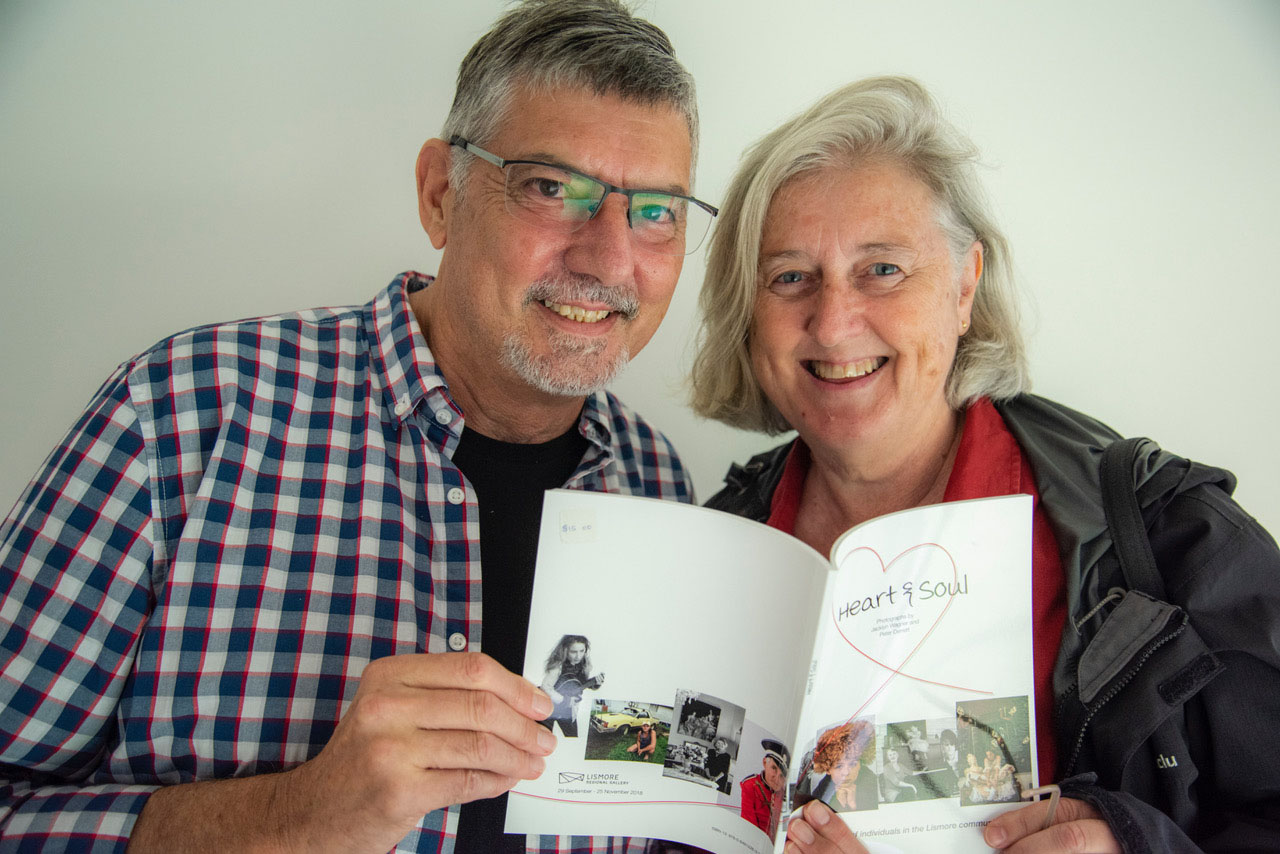
Vicky + Doug with the catalogue for the Heart&Soul exhibition by Jacklyn and Peter PHOTO: Peter Derrett OAM
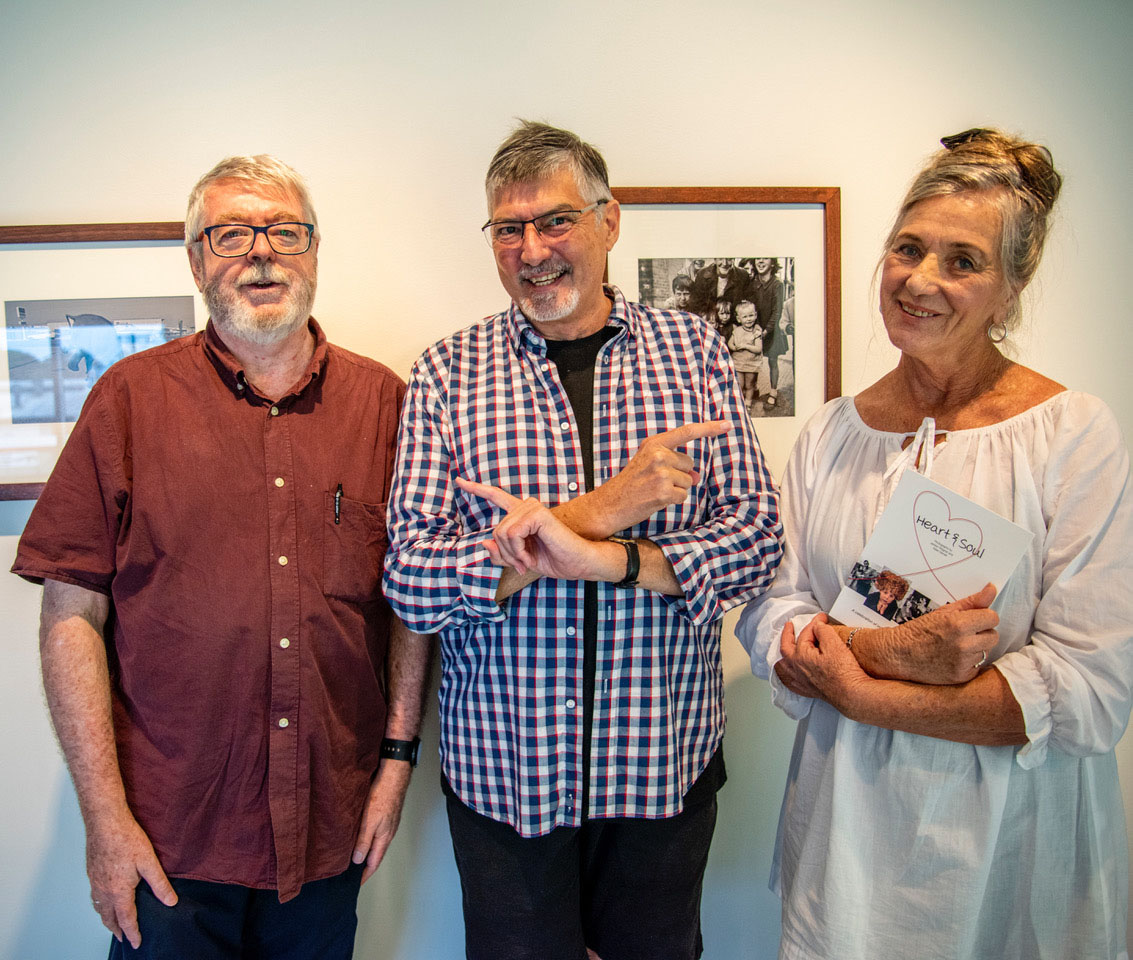
Doug with Jacklyn Wagner + Peter Derrett PHOTO: Dr Ros Derrett OAM
Please note the Booklet and the lecture are a work in progress to be added to in future versions – and it’s ©2020 Doug Spowart.
VICTORIA COOPER: Scroll works 1998-2003

Victoria Cooper: Portrait
.
Victoria Cooper talks about her early montage works in the form of 10 scrolls made in the period 1998-2003
The text below begins with a discussion about the first five scrolls, three from Mt Buffalo and two of Phillip Island clouds. This is the first public viewing of these early scroll works.
Following this is a short statement about the next five scrolls, The Five Stories of the Gorge. There is a separate blog post about these scrolls that presents more details and exhibition history along with an image of each scroll. HERE
.
For those who can see, existence takes place in an unfurling scroll of pictures captured by sight enhanced or tempered by other senses . . . Building up a language made of pictures translated into words and words translated into pictures, through which we try to grasp and understand our very existence. (Manguel, 2001, p.7)
.
Montage and digital narratives
Timothy Druckrey (1994) discusses the montage early in digital era: One of the central considerations in the emergence of electronic montage is the redefinition of narrative and the single image is not sufficient to serve as a record of an event but, rather, that events are themselves complex configurations of experience, intention, and interpretation. Nearly 30 years of the digital evolution, the montage and the collage in all its forms both traditional and analogue continues to shape perception and narrative of the human condition.
About my digital montage scroll works
My first major digital body of work in the late 1990’s was a series constructed visual narratives from photo-documentation in sites significant in my development as an environmental visual poet. In the digital medium, I then cut and blended my collected data/ resource of photographic elements into the multiple perspectives that visually tell my story through the form of rice paper scrolls. The sites were Mt Buffalo, coastal Victoria, and a small area of original forest near Toowoomba.
When I first encountered the landscape at Mount Buffalo, I was filled with a sense of awe. The most significant memories that remain with me are of the journeys from the valley to the summit. Over the years I have undertaken many walks that meander through or climb impressive granite landforms and rich stands of native flora. The Buffalo Scrolls were constructed from many individual elements of the analogue photographic material gathered on site and woven together in the computer later. Although initially informed by the tradition of Chinese and Japanese scroll making, I could not conform to the strict rituals of Asian art school but rather was guided in the production of these works by material thinking and the reflective/reflexive response to memory and corporeal experience.
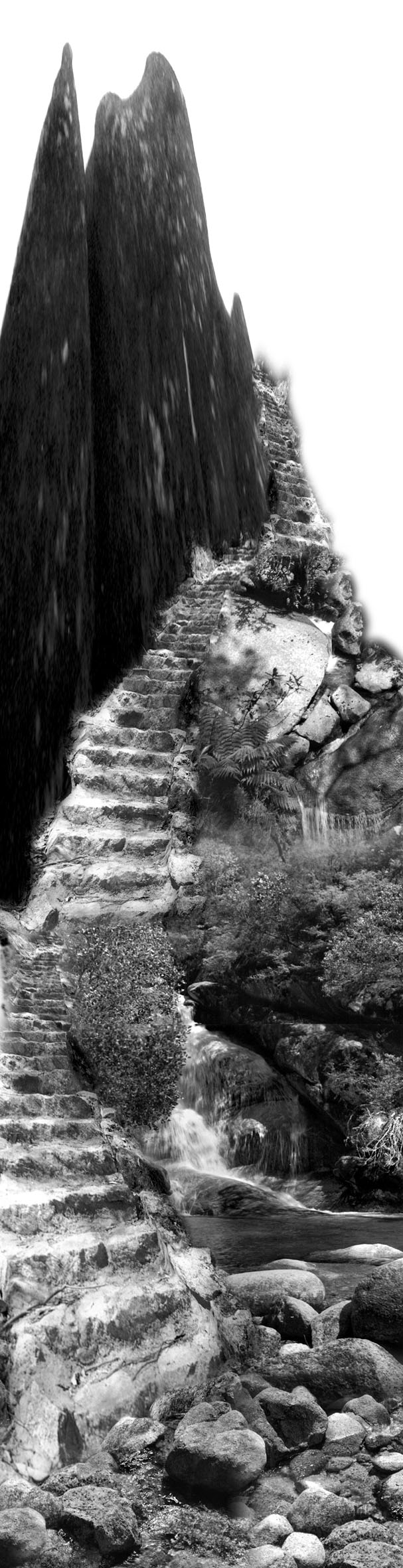
Victoria Cooper (August, 1999), Buffalo Scrolls, Waterfall,
inkjet on rice paper in acrylic boxes,
Image: 107×27.5 cm, Scroll: 250×30 cm.
The digital environment provided me with a psychological space in which images could be combined, manipulated and layered in the shaping of my story. I utilised image manipulation software to ‘grow’ and distort the landscape. Through this process I found that I was directed to imaginative places beyond any original intent or pre-visualization. Although the work originates in my direct recordings of place, the fluidity of digital space allowed for experimentation and new work to transform and evolve any fixed idea I may have had. So in creating The Waterfall scroll, a large boulder became a precipitous mountain to emphasis the terrain encountered. The trail up to the waterfalls was a seemingly endless rock-formed staircase that proved to be a challenging path.
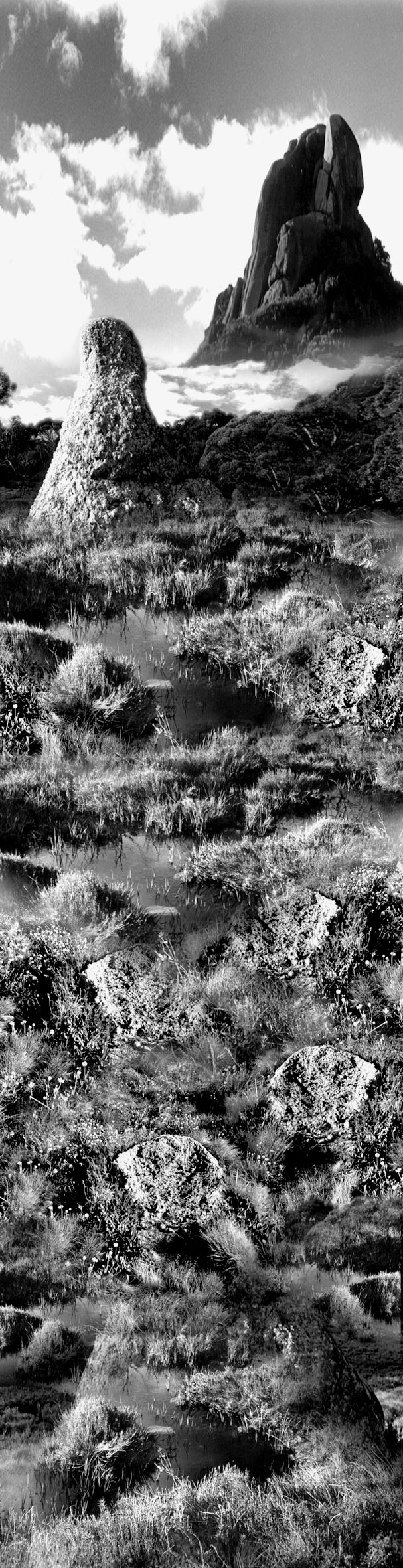
Victoria Cooper (August, 1999), Buffalo Scrolls, The Cathedral,
inkjet on rice paper in acrylic boxes, Image: 107×27.5 cm,
Scroll: 250×30 cm. Collection of the artist.
The Cathedral scroll journey across a watery marsh dotted with fragile alpine daisies is at times a precarious rock hop. Taking care not to step onto the vegetation beneath. In another of the Buffalo scrolls the ominous granite corridor of The Pinnacle defines the way through expanses of rock to the summit of the mountain in the distance.
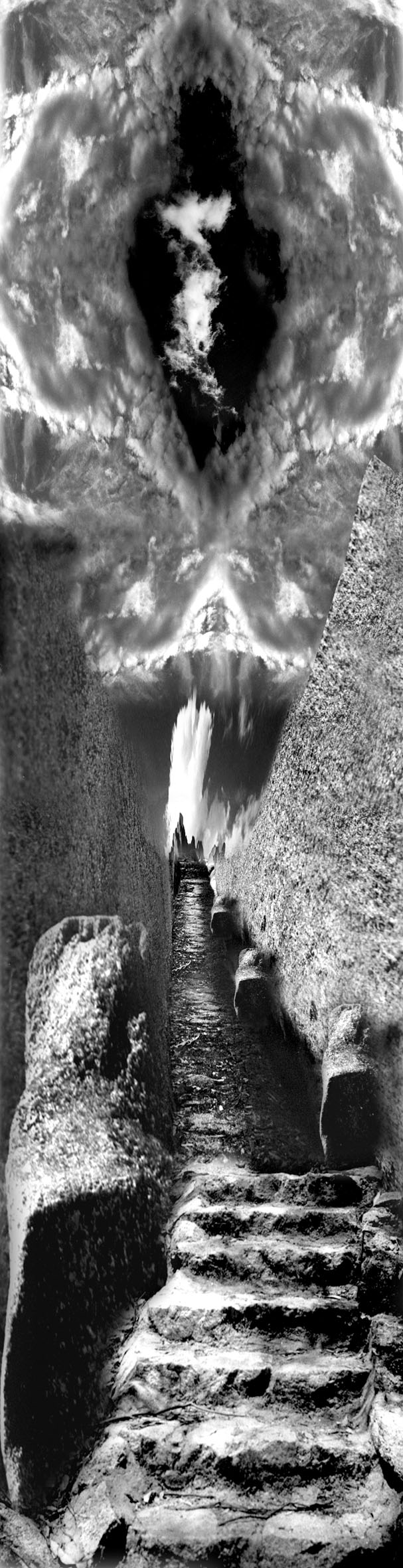
Victoria Cooper (August, 1999), Buffalo Scrolls, The Pinnacle, inkjet on rice paper in acrylic boxes, Image: 107×27.5 cm, Scroll: 250×30 cm. Collection of the artist.
.
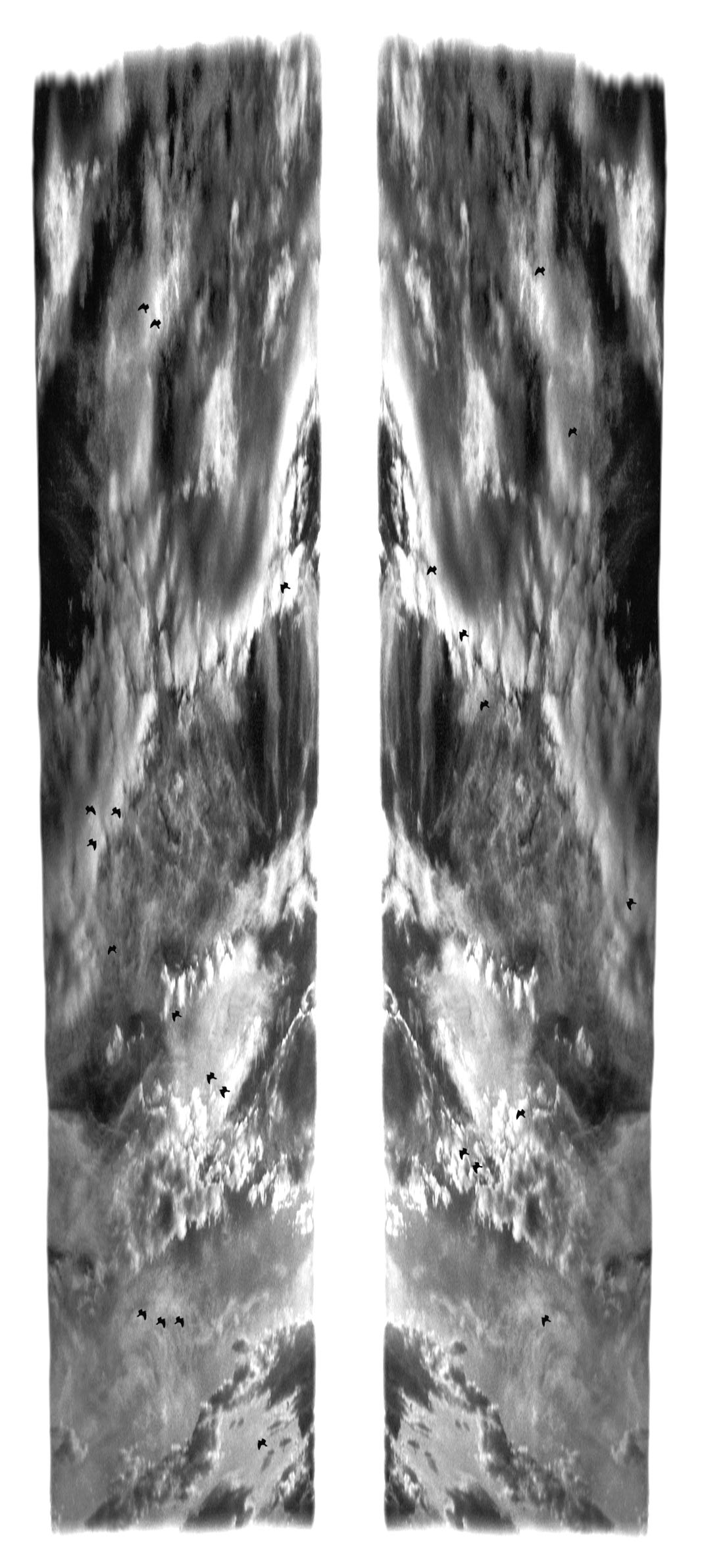
Victoria Cooper (August, 1999), Phillip Island Storm Cloud, left and right views,
inkjet on rice paper in acrylic boxes, Image: 107×24 cm, Scroll: 250×30 cm.
Collection of the artist.
My work with digital scrolls continued with the production of the diptych, Phillip Island Storm Cloud. These two images relate to the sense of anticipation felt when observing an approaching storm.
At Mount Buffalo and Phillip Island, I wrestled with both a fear of taking risks when encountering new and difficult terrain and a strong curiosity to explore the unknown. The scrolls reflect the memories of conflict and fear together with a sense of wonder I experienced within this sublime landscape and, in some ways more broadly, my life.
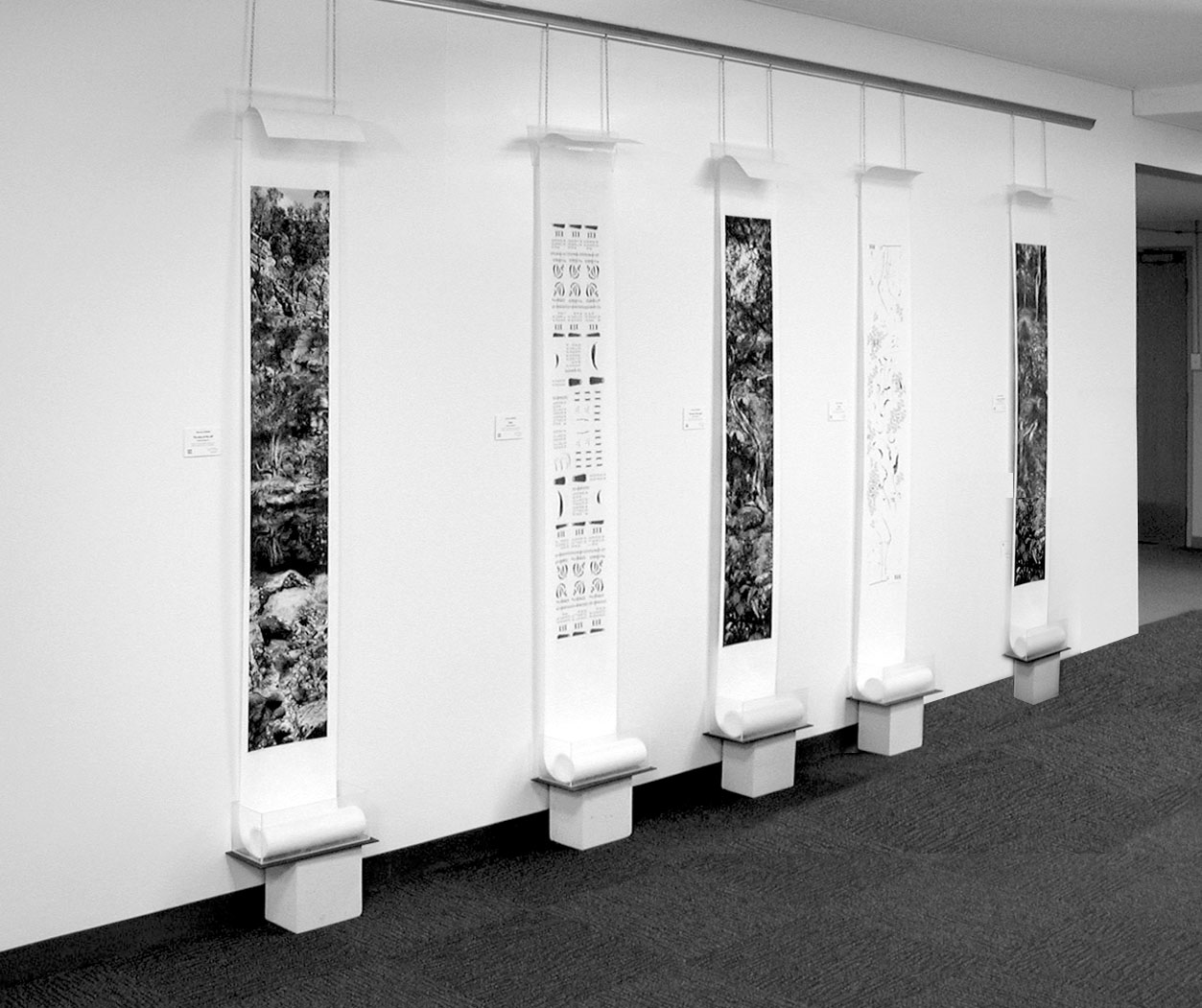
Installation of Victoria Cooper’s Five Stories of the Gorge
The virtual to the physical
The digital montages can only be seen in the electronic medium through the action of ‘scrolling’. Therefore, as some of my early inspiration came from the Asian form of presenting narratives, I utilised the rice paper scroll transformed the virtual to physical, tactile form. The scrolls are displayed in the vertical format and unravelled from their acrylic container to reveal the entire image. The viewer can enter the scroll at any point as with the initial perusal of a written story and, if engaged fully, can follow the narrative through from beginning to end.
The Five Stories from the Gorge Scrolls
Following this initial work I became more interested with the concept of small and intimate spaces found in everyday life. Five stories from the Gorge, presents a more intimate connection with the environment than the Buffalo series. Instead of trekking up precipitous climbs of distant mountain regions, I followed forgotten pathways and looked into the small, enclosed spaces of this gorge environment near where I lived. I made many journeys into the gorge and on each occasion I took time to absorb many sensory impressions as well as creating a digital photographic record.
As with the Buffalo work, I found that the single viewpoint photographic image did not give me the dynamic reading I sought. So again I created a series of montage scroll works synthesised from my collected visual recordings and sense-memory.
The physical environment of the gorge presented me with some complexities when blending the changes of photographic perspective into a seamless passage through the landscape. Central to this work was to attempt, by the use of scale and viewpoint changes, to reconstruct how the eye scans a scene. As the eye of the observer focuses on single viewpoints then moves to another it not possible to take in an entire scene with a single perspective. With this characteristic of visual perception in mind, I set out to recreate the landscape visually from multiple viewpoints. So in this body of work I seamlessly combined disjointed and sometimes perceptively conflicting views to form images that go beyond the static visual document.
During my visits to photograph the gorge, I also collected objects from the site. For me, the found elements provided a different narrative opportunity. In the scrolls Chaos and Order I investigated these natural elements presented in groupings as a kind of language. These pictographs form poems made up from a natural vocabulary associated with the visual form of the written word.
Each element was scanned into the computer to obtain a replica of their likeness, the objects themselves were later returned to the site to continue their natural cycle. The scroll, Order, begins the dialogue by suggesting the elements of a genetic code. The arrangements of the seeds and leaves and other fragments are seemingly organised and uniform but, on closer observation, there are subtle differences to the repeated segments.
Chaos came as an answer to the cyclic relentless processes that continually ebb and flow through time in nature. It is the interruptions, upheavals and the process of change that nurture and ensure survival. Though these scrolls are without the scenic detail, they are the essence of the region, a distilled manuscript of the cycles and disruptive events in nature over time.
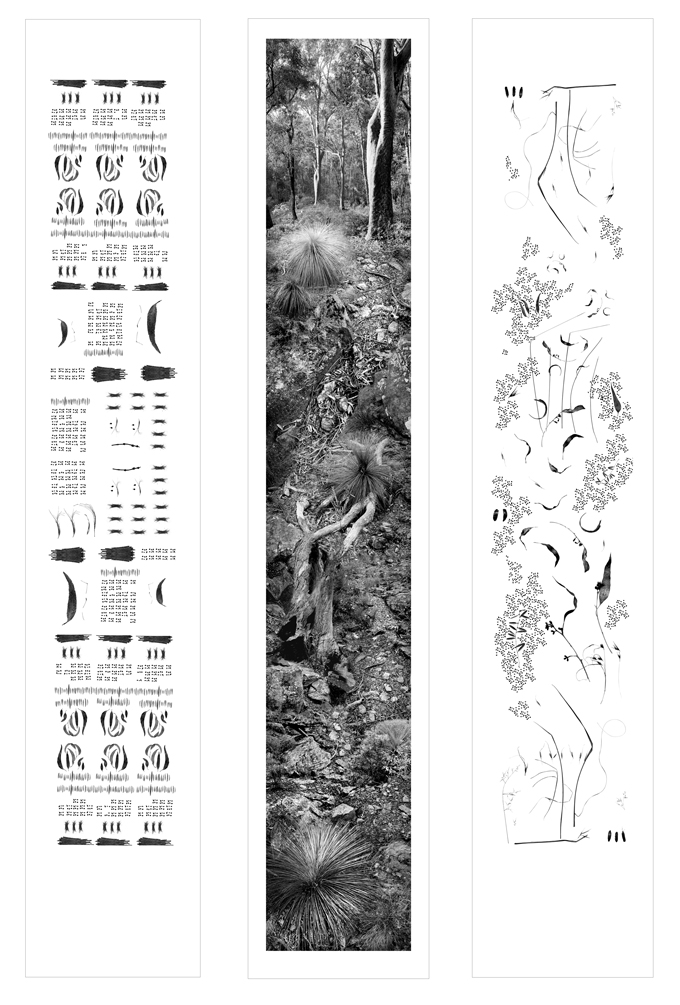
The Chaos and Order scrolls alongside the Hillside scroll
Five Stories from the Gorge, investigates the idea of wilderness and nature that exists in or on the edges of these human inhabited spaces.
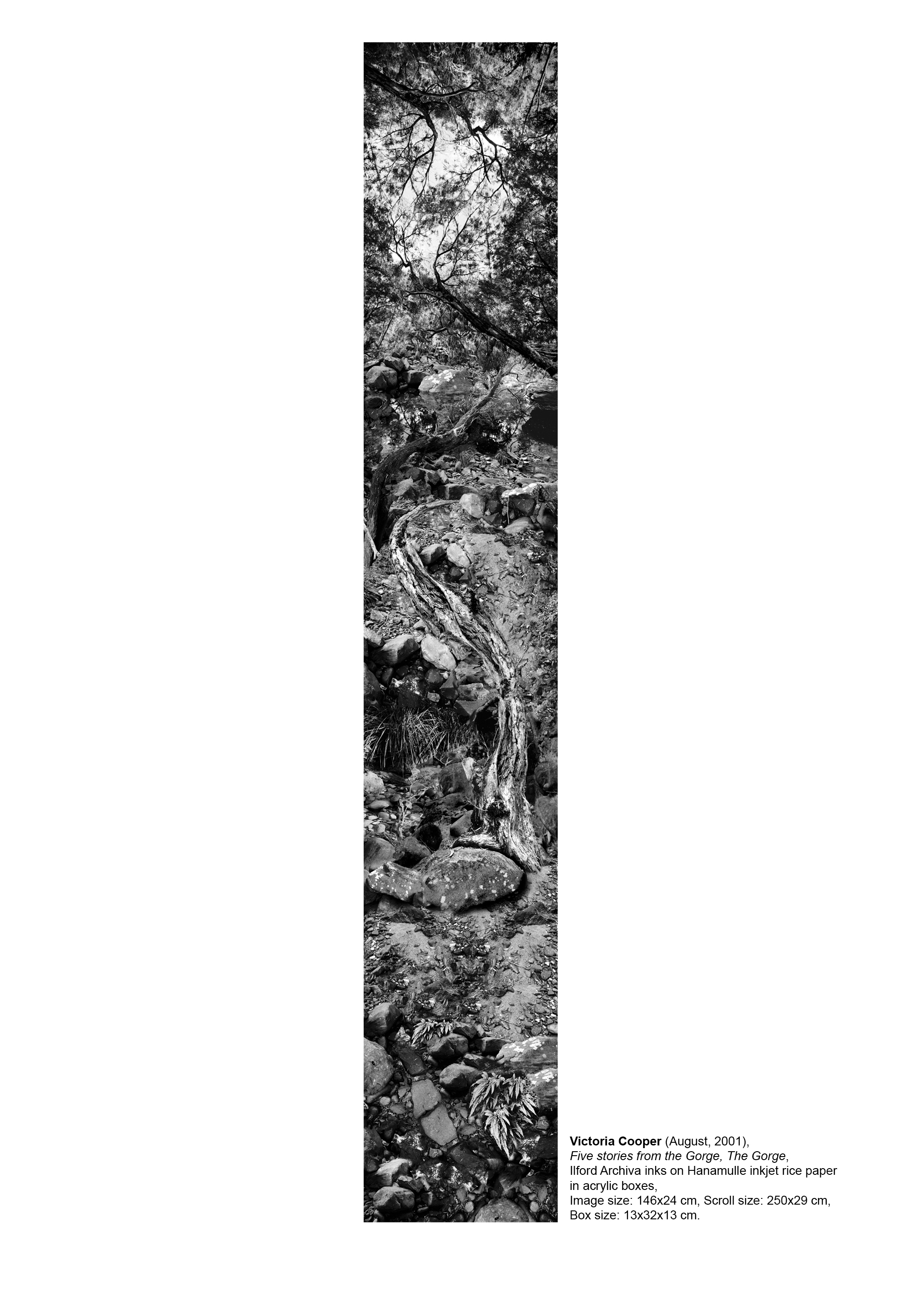
The Gorge – from the series Five Stories from the Gorge 2001
Throughout the process of image collection and construction I was informed by the influences of visual poetry, environmental art and my scientific background. The landscape paintings of William Robinson and Lin Onus have both innately influenced the way I see and work over my career. These reconstructed spaces are as fictional as a Tolkien novel but at the same time provide the evidence of existence as if collected in a Darwinian exploration.
Victoria Cooper
.
SEE A BLOG POST ABOUT The Five Stories of the Gorge: HERE
Bibliography
Timothy Druckrey (1994). ‘From Dada to Digital, Montage in the twentieth century’, Metamorphoses: Photography in the Electronic Age, Aperture, 136, Summer, pp 4-7.
Timothy Druckery (1996) editor. Electronic Culture, Technology and Visual Representation, New York, Aperture Foundation Inc.
Alberto Manguel (1996). A History of Reading, London, Harper Collins Publishers.
Alberto Manguel (2001). Reading Pictures, London, Bloomsbury Publishing Plc.
.

 wotwedid