Archive for the ‘Meeting People’ Category
The man who photographed every house in Australia
BACK STORY on the FRANK & EUNICE CORLEY HOUSE PHOTOGRAPH COLLECTION
in the State Library of Queensland and the exhibition HOME: a suburban obsession

Imagery Gallery – with my mother and business partner Ruby Spowart
.
From 1980 to 1995 I was co-director, with my mother Ruby, of Imagery (photography) Gallery (1). The gallery operated in 3 locations in South Brisbane two of them being on the corner of Grey and Melbourne Streets. Although our main business activity was a photographic gallery and workshop we were also suppliers for specialised equipment for photographers – one of them was the famous Leica 35mm camera. As a Leica user myself since the early 1970s my special knowledge of this equipment was not so much from the point of view of a salesperson but rather as a user of the full range of Leica cameras, projectors, enlargers, binoculars and accessories in my documentary and art photography practice.
.
In the late 1980s or early 1990s an elderly man visited the gallery and exhibited an interest in Leicas. He mentioned that has had been a professional photographer and that he used the older screw mount Leica gear. Initially I saw him as a potential purchaser, though in time and after many visits I realised that this was not to be the case. His name was Frank Corley and I found him to be a storyteller. With each visit came my understanding that he enjoyed the opportunity to talk with someone interested in his life.
Frank lived in Annerley and dined every evening at Sizzlers – he called it “Zizzlers”. He was a dapper man with a hat and very well dressed. His visits to the gallery were easily accomplished by train as the gallery was situated just over the road from the South Brisbane Railway Station.
.
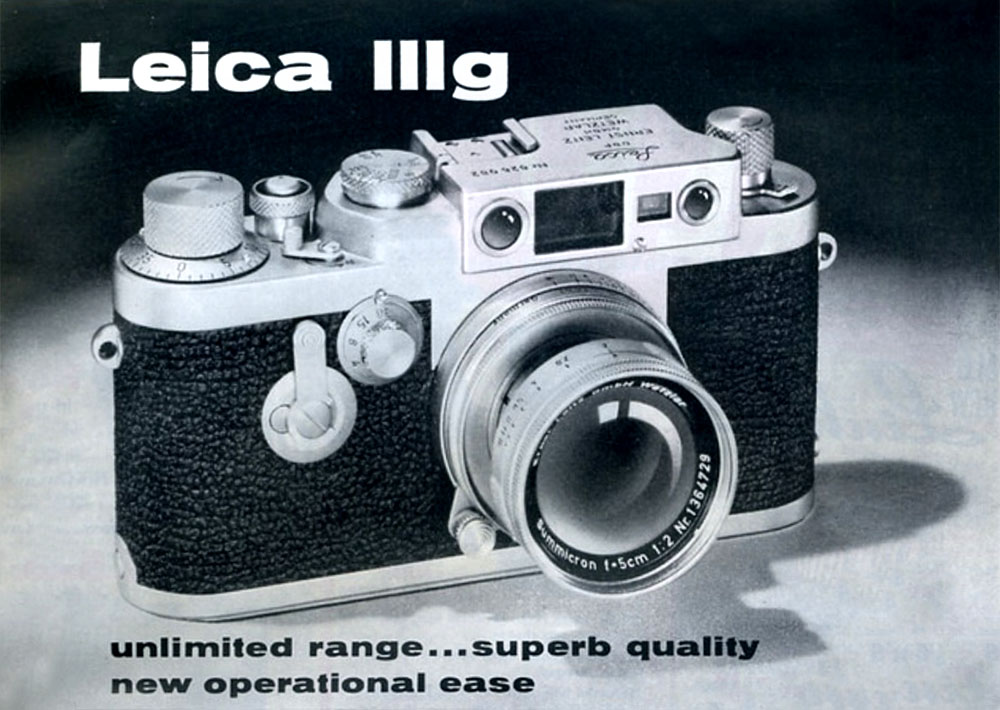
Frank’s camera
At one stage in 1994 Frank indicated that he had some Leica equipment he wanted to sell and invited me to his home. I went with my partner Victoria Cooper to his Annerley home. On entering the house one came in contact with the enormity of Frank and his wife’s life as in every room there was ‘stuff’. His partner in his business his wife Eunice had passed away by this time. Everything had a story – a watercolour painting of Central Australia by Ewald Namatjira (if I remember correctly), Frank recounted was purchased by him when he was photographing homes in Alice Springs. He bought the painting from the artist who presented work for sale at the front gate of the caravan park from which Frank was operating his business. We went from room to room looking for the items he wanted to sell which finally amounted to some very out-dated photographic paper, an enlarging easel and an old Leica Focomat enlarger.
We did a tour of the back yard in which were parked several vehicles. One was the now famous Cadillac (though not pink in colour as often described), another was a little like a Bedford delivery van. We went inside and in the back of the vehicle was a compact darkroom, enlargers, trays, and rolls of processed film in special cardboard gridded boxes. It was cramped but functional – later I was to discover that Eunice was the darkroom operator. I had a lot of respect for that lady and her workspace.
In a lean-to shed at the back of the property Frank reached into a large cardboard box and pulled out a handful of black and white prints of houses. He had already told me of his Pan American Home Photographic Company business of photographing houses from the Cadillac (and other vehicles) as he drove down the street steering the car with his knees taking photos. These photographs were subsequently processed and printed and salesmen, sometime Frank himself, would then call back at the houses and sell prints that could be mounted on cards or calendars. The company brand phrase was From Our Home to Your Home.
I looked around and saw maybe 8-10 boxes the size of which would have been 80cmx60cmx60cm and each box was crammed full of prints. I asked how did he end up with so many photographs? His answer was that at the time the sales tax on photographic materials was 27.5% and as he did not have a sales tax exemption number for his business he paid tax when he bought film and photo paper. At the end of each financial year the value of the tax on the unsold photographs could be claimed as a sales tax credit. The volume of work he was doing that was unsold amounted to a reasonable credit but the prints needed to be retained along with other taxation documents for many years. These photographs came from a time 20-25 years earlier and had not been disposed.
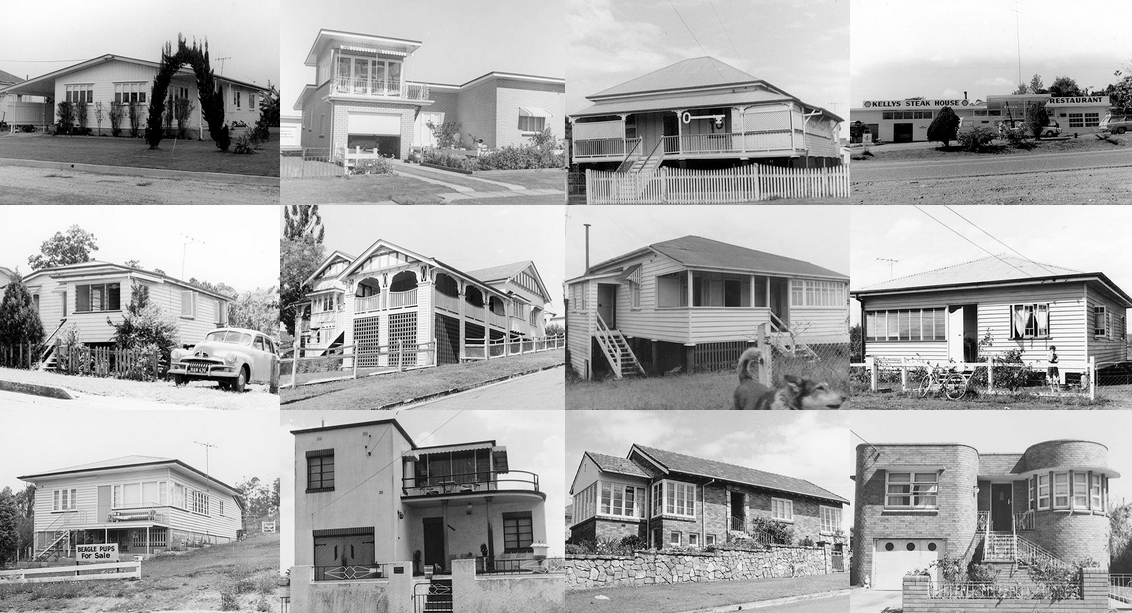
Some Corley house photographs Source: State Library of Queensland
I reached into one of the boxes and pulled out a bundle of photos. What I saw were very ‘straight’ photos of houses all with very similar framing, usually recorded almost as plan elevations. The houses look dated to perhaps 20-30 earlier and I sensed that I was holding in my hands a documentary photography history record. I asked Frank what would happen to these photographs when he moved on… his answer was that they’d probably be sent to a silver recovery plant or dumped. Ohhh! I thought. Before leaving Frank that day he posed for a couple of portrait photos with his trusty Leica IIIg.

Frank Corley circa 1994
At this time in my photodocumentary practice I had undertaken re-photography projects where early photographer’s pictures were relocated and re-imaged as a way of showing the passing of time. My own history making photographs and also from building my own collection of photographs from the beginnings of the invention of photography 150 years earlier meant that to me these images were special and needed preserving. I couldn’t let them be lost, not only because they represented Frank’s life work, but also for their historical value.
On leaving Frank’s home I worked through some ideas with Vicky as to what could happen with Frank’s photographs. At the time I was a valuer for the Australian Government’s Taxation Incentives for the Arts a program where the value of donations to cultural institutions could be used as a tax credit for the donor. I had been involved in valuations for the State Library of Queensland so I made contact with some of the people I knew there. I must have sounded convincing, as there was interest in the work from SLQ Field Officer Niles Elvery. I contacted Frank who said that he would be happy to donate the photographs to the Library and in due course I travelled in a Library station wagon driven by Niles back to Frank’s place.
I’m not sure how we fitted the boxes into the station wagon but I remember it being a tight fit. Frank signed a document that Niles had brought with him and we travelled back to the Library. We reckoned that there were around 12,000 photographs.
A few months later I heard via Frank’s solicitor that he had died and that any items that Imagery Gallery was holding of his pending sale needed to be returned. I was somewhat taken by Frank’s passing and as he seemed to be without friends or family around I thought it appropriate that I write an obituary which I published in a journal I edited called PHOTO.Graphy, ISSN 1038-4332 – The Christmas edition, v. 6, 1995. It reads:
FRANK CORLEY: Obituary
Unknown to most of us Frank Corley, a travelling photographer passed away on October 19, 1995. I suppose we all die eventually and our life’s work, the photographs we make are left to the destinies of those who possess them. In a life full of entrepreneurial activities Frank owned and managed a transport business, caravan parks and a lolly shop. A fascination for photography led to the formation of Pan American Studios. Street photography and in particular photographing houses was his big passion.
I call him the man who photographed every house in Australia because if you ever spoke with him about it he made you believe that he did. Frank Corley won’t be missed by many but his legacy ~ his photographs, will live on in private family archives but most significantly through the donation of around 12,000 prints of Queensland homes presented to the John Oxley Library, Brisbane in June this year. This fragment of Frank’s work would have been lost except for a fluke of meeting with me and his generosity.
I just wish there could have been more time to record the experiences that he so happily shared with me.
Doug Spowart 6/11/95
The years went by and memory of Frank and his donation were for me a faded memory. In 2015 I was granted a Siganto Foundation Artists’ Book Research Fellowship at the SLQ. One day I met a volunteer called John Wilson at the library and I found out that he had been working for years in trying to unlock the Corley code for the photographs, what town – what street? We spoke about his method of working which was hindered by limited information available in the bundles of prints and scant markings on the prints. John had street directories from Queensland towns which he had identified street names and had himself been out on the road looking to confirm hunches.


Soon after this meeting I met Denis Peel and became aware of the work that the Annerley-Stephens History Group had done in identifying many of Corley’s home photographs from the Fairfield, Annerley, Yeronga, Yeerongpilly, Tennyson and Moorooka areas. As a volunteer group they held meetings, provided teams and individuals with Corley photos who then went out looking to identify houses. A significant Phase One report was generated by the group in 2015. Additional research was subsequently prepared. By June 2016 they reported that they had located over 3000 matching houses. I visited one of their meetings and was impressed by the energy of the volunteers. In 2017 The Annerley-Stephens History Group were awarded the John Oxley Library Community History Award for their continued and highly successful community project. The activities of the group were supported by the State Library through access to the photographs and later aided by the digitisation of the collection that has only recently been completed.
.
SLQ Home Website Banner
With the growing interest in the Corley Collection and the recognition of its value as an extensive and unique record of Queensland houses and suburbs the SLQ scheduled the planning and preparation of the exhibition which they have entitled – Home: a suburban obsession. As the facilitator of the donation and my knowledge of Frank and his work I have assisted Chenoa Pettrup and Adam Jefford from the Asia Pacific Design Library wherever possible in the preparations for this show. As an artist/photographer and researcher I appreciate the efforts by the exhibition coordinators to involve appropriately talented and skilled personnel to give this event the opportunity to capture community interest. Special commissions for inclusion in the show include Ian Strange‘s large-scale charcoal rendition of a Queensland home, an installation by Queensland artist/designer Jennifer Marchant and an immersive Brisbane virtual reality streetscape by [f]FLAT. Assembled in the exhibition space were artists’ books, books, catalogues and photographs from the SLQ collections that highlighted the idea of ‘home’ and included Ed Ruscha, Bernd and Hilla Becher and Australian photographer John Gollings and his Gold Coast works. Alan Scurr, a Leica camera collector collector from Toowoomba loaned camera items for a display of the camera equipment that Frank used.

Entry to the exhibition Home: a suburban obsession
The Home: a suburban obsession offers many significant opportunities:
(1) It reveals how suburban architecture looked 40 or so years ago,
(2) It provides an opportunity for contemporary Queenslanders to connect with their homes of the era,
(3) The historical nature of the photographs will be a provocative agent for nostalgia and, for some solastaligia,
(4) It enables us to appreciate unusual photographic business activities and the partnership that exists in many small photographic enterprises, and
(5) It celebrates the value of the physical photograph as a time capsule.
The Internet may have given us the modern invention the Google Street View but in a way the Corleys were doing it 40 years ago – the evidence is in the nearly 62,000 photographs in the collection. Though it is interesting to consider how the digital age and the Corley Explorer Webpage will provide the key to unlocking the code to enable every one of the Corley’s houses to be located and revisited anew. The process has started and according to SLQ sources the Corley Explorer in the first few weeks has enabled a further 14% of the collection to be identified. SEE the Stories webpage HERE.
Back in Frank Corley’s shed nearly 25 years ago I could never had imagined how those boxes of house photos could provide the amazing opportunities that we are just now encountering with this exhibition and other uses yet to be discovered. But I did know one thing and that is I could not allow them to be lost. I’m sure that Frank would feel quite chuffed that his unsuccessful unsold photographs have finally found success and have made the journey from his home to a their rightful home in the history of Queensland.
Dr Doug Spowart
(1) LINK TO: The Imagery Gallery Archive is held in the State Library of Queensland
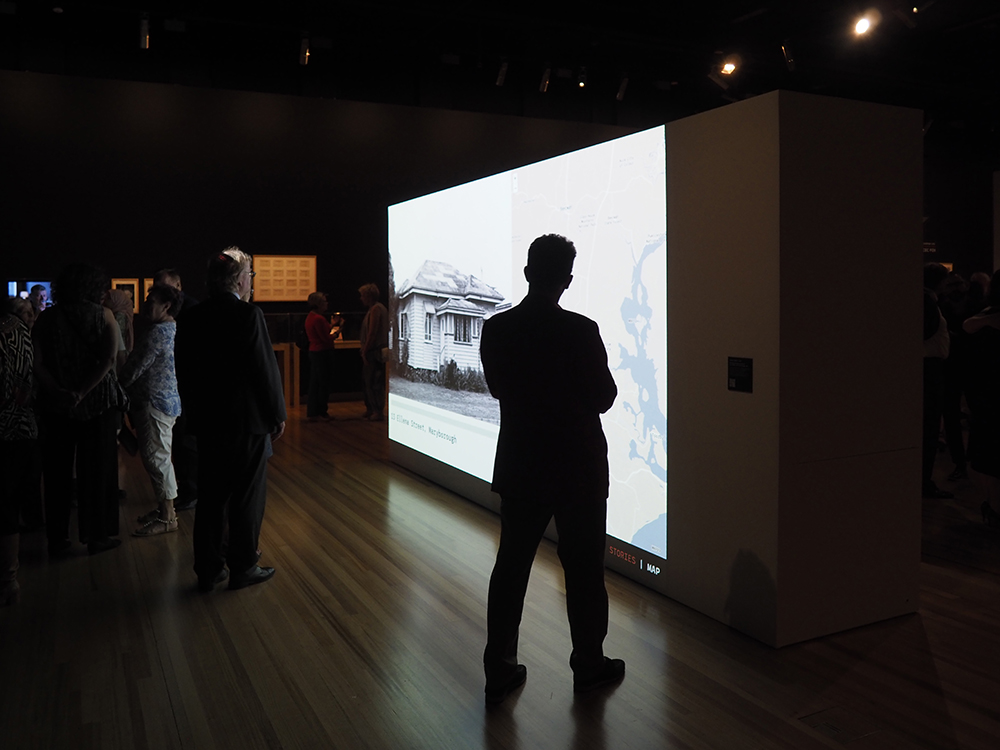
In the exhibition – I muse that this man was Frank looking at the interest his work has now received…
Various links and associated reports and reviews of the Corley Collection follow:
The SLQ website for the exhibition: http://home.slq.qld.gov.au/
SLQ Home Website Banner
..
.
Photographs of the exhibition’s opening event on December 6, 2018


.
My video of the exhibition opening
.
2 Special commission video projects produced, directed and edited by Shih-Yin Judy Yeh. These videos present the story of Frank and Eunice Corley and the SLQ work with the Corley Collection.
SLQ The Corley story Video
A video describing the SLQ’s story about the Corley collection, includes information about the donation, conservation and investigation
A link to the Annerley-Stephens History Group’s Corley project HERE
An SLQ event with Denis Peel and Kate Dyson talking about the Annerley-Stephens History Group project HERE
.
Frank Corley Wikipedia HERE
ArchitectureAu article HERE
.
Brisbane News / Sydney Morning Herald Article HERE
.
.
.
All photographs © Doug Spowart unless othervise credited. The copyrights in other material and website resides with their relevant copyright owners.
WIM de VOS – Artist, teacher, musician, mentor, brother & friend
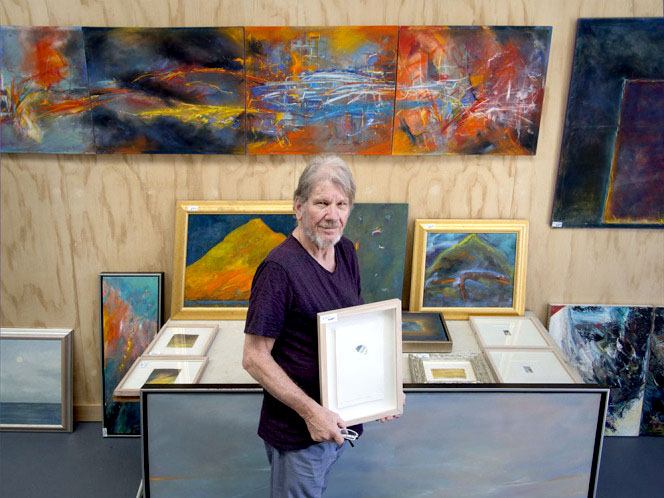
A portrait of Wim de Vos with his work at Studio West End
For Wim, by Vicky Cooper
In your last days we visited you….
Like the artist thinking about your next artwork…
You described your final work…
How, where, when…
You would be buried….
An acrylic case made by friends
In the bush
Up a hilly rocky track
To a hidden mountain
A stand of trees that had black bark
A particular view across a Valley
A golden sunset
A rock with the Red Fox coat of arms
Also created by a friend
50 years I have known you
Sometimes distant
Sometimes close
I danced with your groupies
In Cloudland where
You played a red Fender
Those favourite songs
Neil Young, Focus, George Harrison
Beach Boys and so may more…
I danced with Opa
At the Dutch Club
I loved Oma’s apple pie
The paper flowers and the needle work
The smell of pipe tobacco
The Dutch jokes
Stories of WW2
I remember your first exhibition
Michael Milburn
Your time in Maastricht
My sister with the two boys and soon a girl
My sister is now another beautiful story
The boys are also creating new stories
And the girl is strong and confident
The world has not limited them
At seminal moments
I needed inspiration and support
You were there
With Doug…
Fellow teacher, artist and family
I for 50 years
Doug for 30….
You could be at times testing…
But you were also investing
Your energy, creativity, ingenuity and knowledge
There are so many years of art
Toowoomba, Flying Arts, McGregor…
Then West End and Adele
A collaboration that built a strong community
Each of us all has personal stories
Each will be different
But all of it rich
Just like your studio and apartment
The walls and corners of your life
Are jam packed with collections
Of moments
Sad or cantankerous
Solitary or social
Dedicated and creative
But your parting words to me now echo in my everyday
That I never stop making my art…
And I now reflect that if it were not for his support
I – and perhaps many others – would not have started…..
It is in this legacy that you will always remain
.
.
.
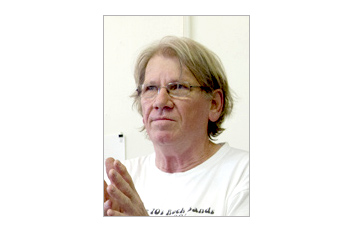
Wim de Vos
VALE Wim de Vos 27/5/1947-8/12/2018.
Christene Drewe has written a post in the State Library of Queensland’ John Oxley Library Blog about Wim and the works that they have in their collection.
http://blogs.slq.qld.gov.au/jol/2019/01/24/remembering-brisbane-artist-wim-de-vos/
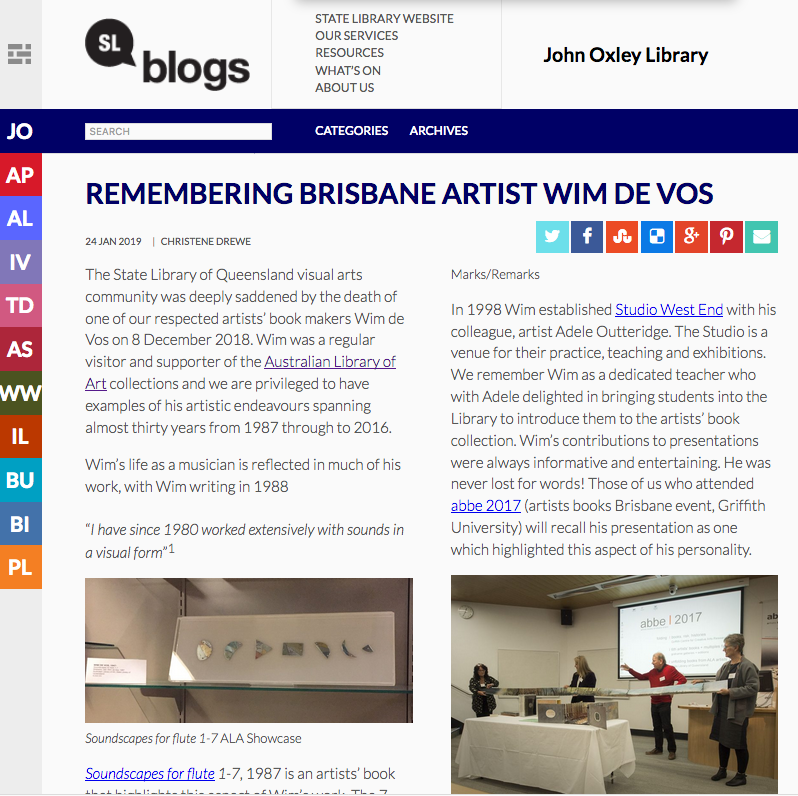
SLQ-JOL Blog post by Christene Drewe
.
.
.
Some images of Wim from events over the last few years…
.
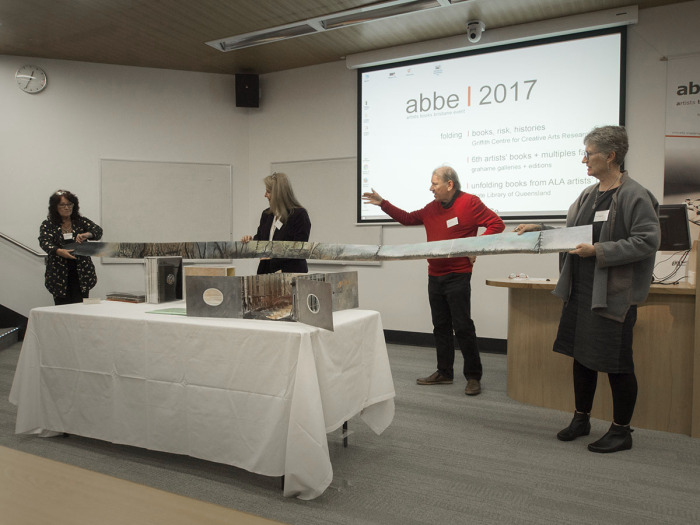
Wim presenting a long book at the Artists Book Brisbane Event – Griffith University Brisbane
Wim & Adele at ABBE Artists Book Conference July 2015
Wim showing the State Librarian Janette Wright his tunnel books at the Siganto Seminar 2015
Wim & Adele at the State Library of Qld’s Artists’ Book Fair 2015
The launch of the Bookplate collection with Anne Jolly, Helen Cole and Gael Phillips and others
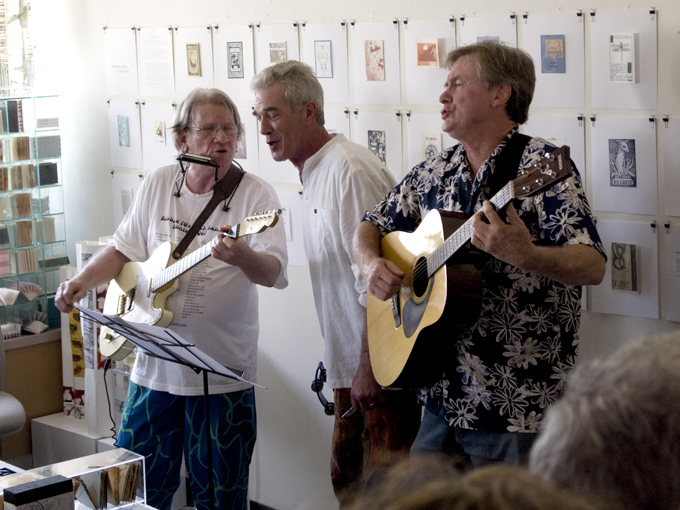
A return to the ‘Band’ days at Studio West End
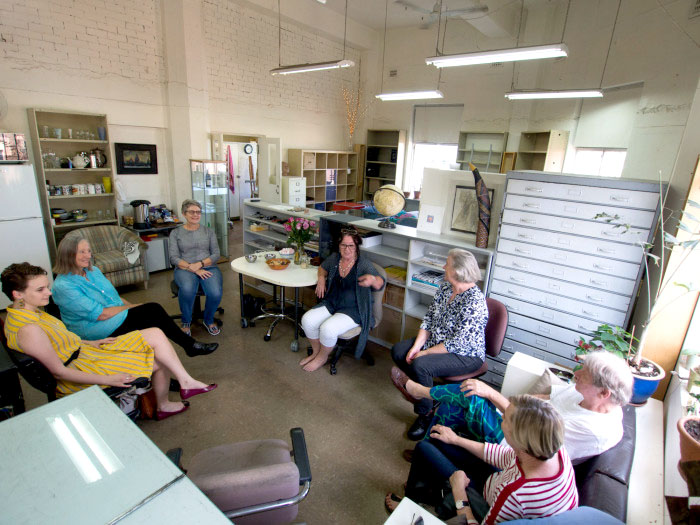
Farewell to ABSOE party, 23rd April 2016
A blog post about the ABSOE Studio and the NEW Studio can be found HERE
.
At the NEW West End Studio – November 2016
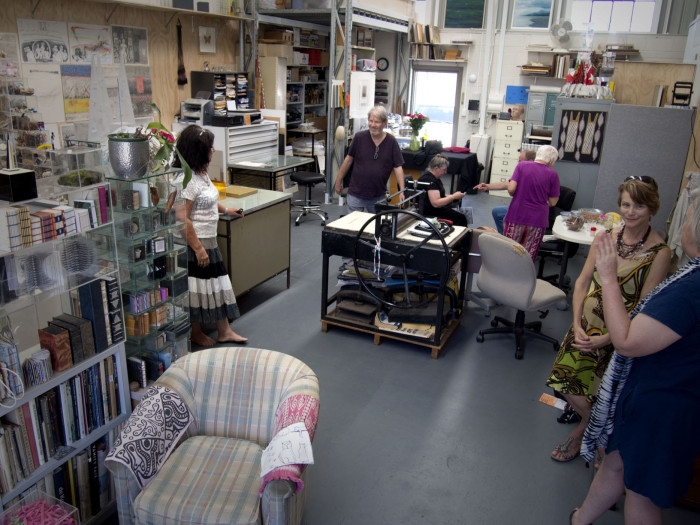
The NEW West End Studio
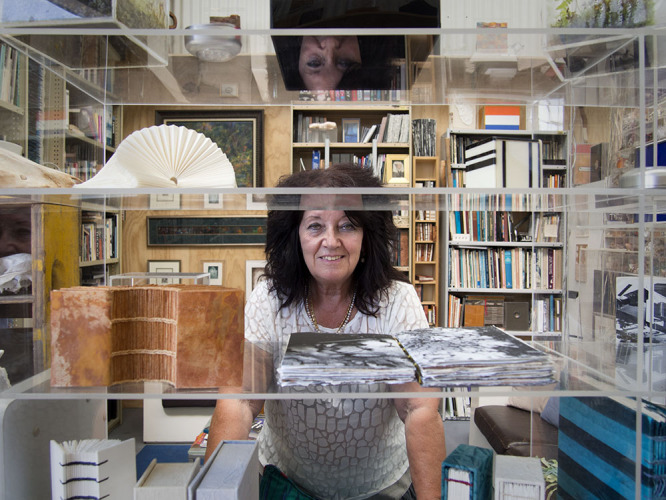
Adele in the New West End Studio
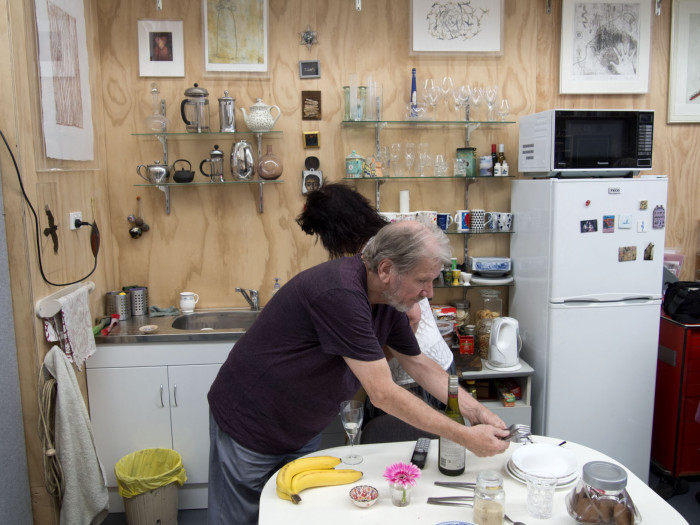
Lunch is prepared at the New West End Studio
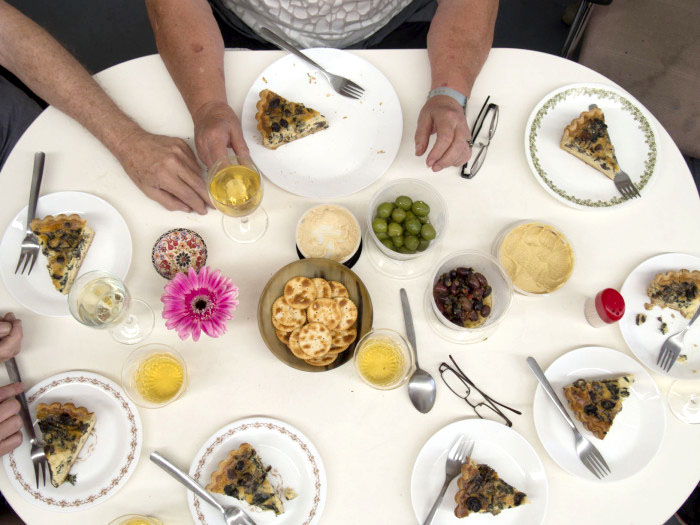
Lunch at the New West End Studio
.
Wim will be back in the studio soon…
.
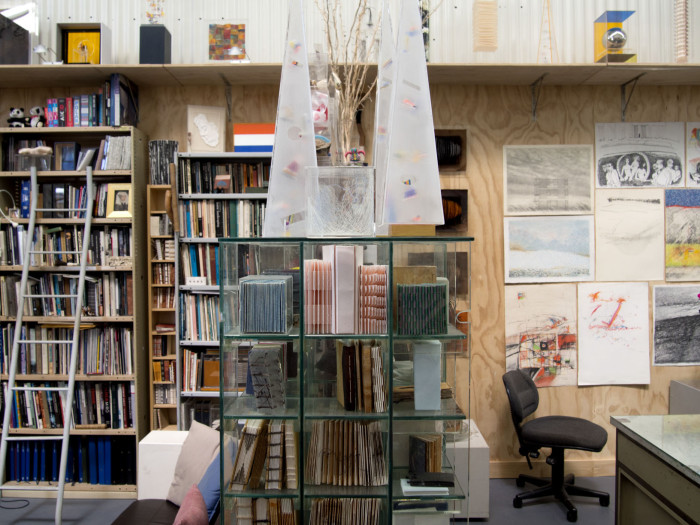
The studio


.
.
.
.
©Texts by Vicky Cooper . . . © All photographs by Doug Spowart
.
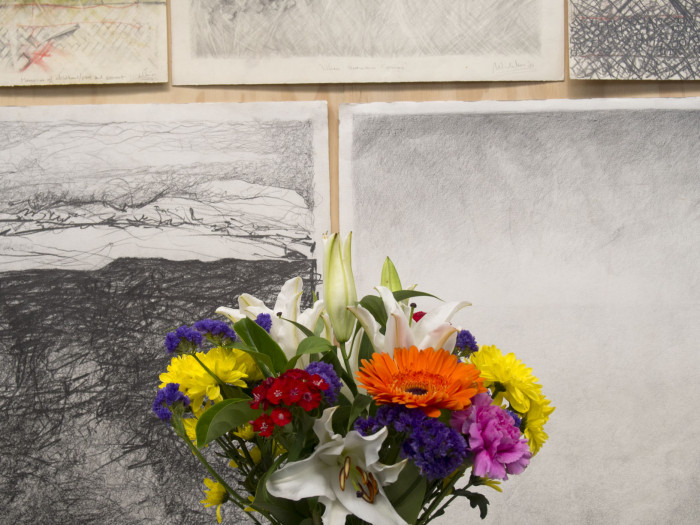
In remembrance….
.
.
.
THE QLD PHOTOBOOK CONSORTIA – SUCCESSFUL SUBMISSION National Gallery of Victoria ART BOOK FAIR 2019
The Queensland Photobook Consortia
.
Over the last few weeks we’ve put together a submission from Queensland photobook authors and self-publishers for next year’s National Gallery of Victoria ART BOOK FAIR. The Fair is a huge event attendances of 12-16,000 over the three days of the event have been recorded. The who’s who from collecting institutions, private collectors and fellow exhibitors all view, read – and sometimes purchase books…! Apart from networking and selling or trading books the Fair has associated with it a program from the Melbourne Design Week.
To celebrate photobooks and to bring together Queensland authors, designers and self-publishers we have formed a group called THE QUEENSLAND PHOTOBOOK CONSORTIA. Over the next week or so we will find out if our submission has been successful – In the meantime we are interested in hearing from any Queensland photobook maker that we can add to our list of contacts.
HERE IS SOME MORE INFO about the Fair and the Consortia’s submission…
WE WERE SUCCESSFUL….! Got the news 21st of December
.
.
BLURB FROM THE NGV
.
About the Melbourne Art Book Fair
Melbourne Art Book Fair returns for its fifth year in 2019. Since the event began, the publishing and broader creative landscape has undergone many shifts. MABF 2019 asks: what is publishing now? What is encompassed by the term and how can publishing bring about positive change on multiple fronts?
Featuring diverse emerging and established local and international publishers, artists and writers, Melbourne Art Book Fair 2019 presents a four-day program of ideas, discussions and book launches at the National Gallery of Victoria. The 2019 program explores ideas around experimental and discursive publishing, challenging how we think about the publishing field. Guests ask the question: what can books do? How might the form change? How might publishing provoke and influence other creative and social phenomena such as fashion diffusion lines, capsule collections, event spaces, activist movements and community development?
.
The submission is only the first stage of the process. If successful we will seek some extra participants – HERE ARE THE MAIN ANSWERS IN OUR SUBMISSION….
QUESTION: Please tell us what you do, and why:
The Queensland Photobook Consortia is a group of photobook and artists’ book makers and self-publishers from Queensland who, through their publishing projects, provide comment on contemporary issues relating to life and times, not only of their home state Queensland but also Australia and the rest of the world.
The opportunity to present Queensland photobooks within the premier event of the NGV Art Book Fair will enable this substantial group of artists to share their creativity and visual stories. It is our proposal to showcase this group of contemporary emerging and established Queensland practitioners and their latest works.
Their backgrounds are many and varied and include the following:
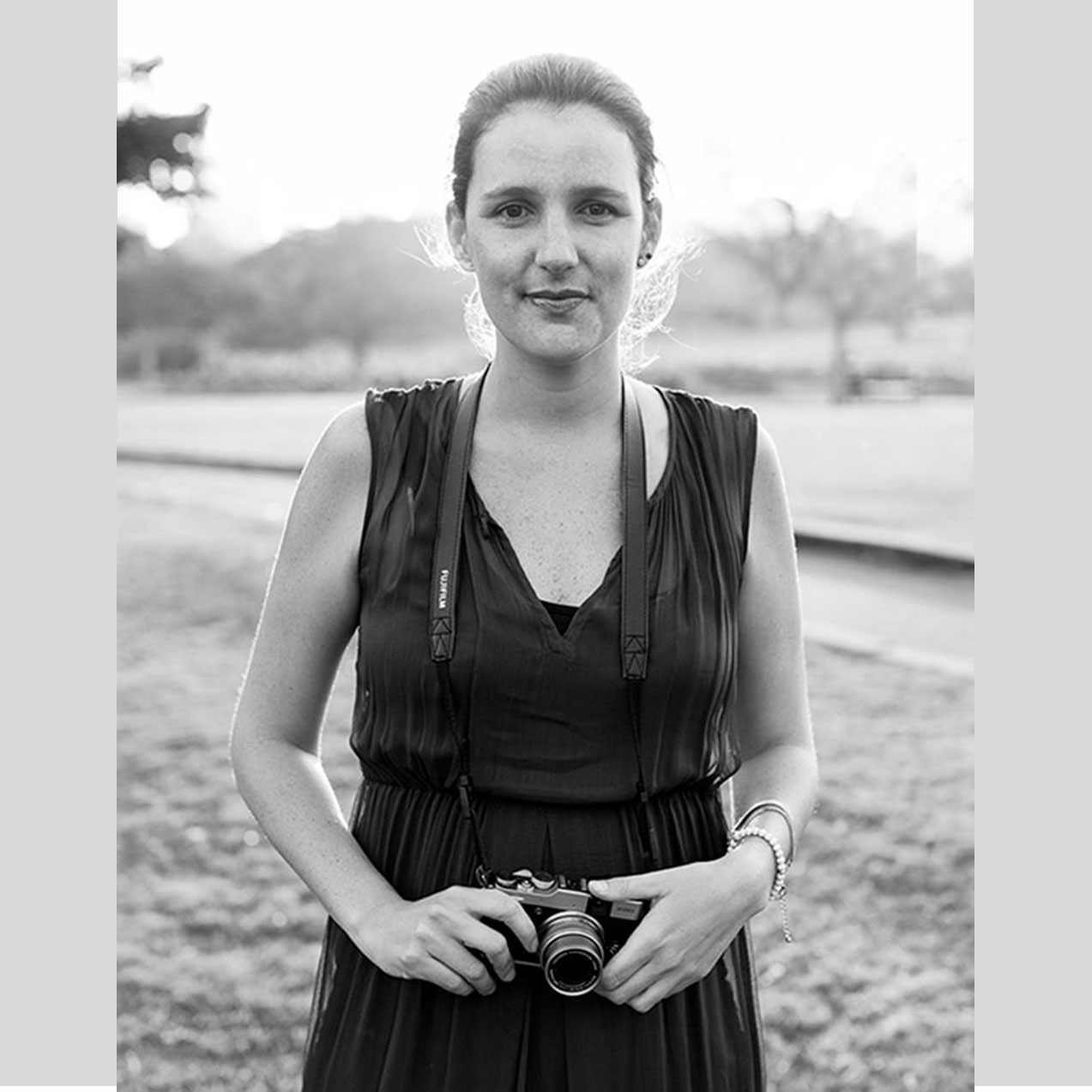
Ana Paula Estrada
ANA PAULA ESTRADA is a Mexican–Australian artist based in Brisbane. For the last seven years her art practice has focused mainly on the documentation of life stories of older Australians by combining photography, oral history, and the artist book. She is currently completing a Master of Visual Arts by research degree at the Queensland College of Art. In 2016, she self-published an artist book called Memorandum in an edition of 200, which has been recognized and exhibited broadly nationally and internationally.
http://www.anapaulaestrada.com

Tammy Law
TAMMY LAW documents stories that are reflective of her experiences of being a child of Chinese migrants, and the bubble of Asian/Australianness within which she lives. Her travels through Asia—mostly in Japan, China, Malaysia, Thailand and Burma—and the differences between Asia and the West propel her to focus on concepts of migration, home and belonging. This book’s development and production has been supported by the celebrated Tokyo based Reminders Photography Stronghold.
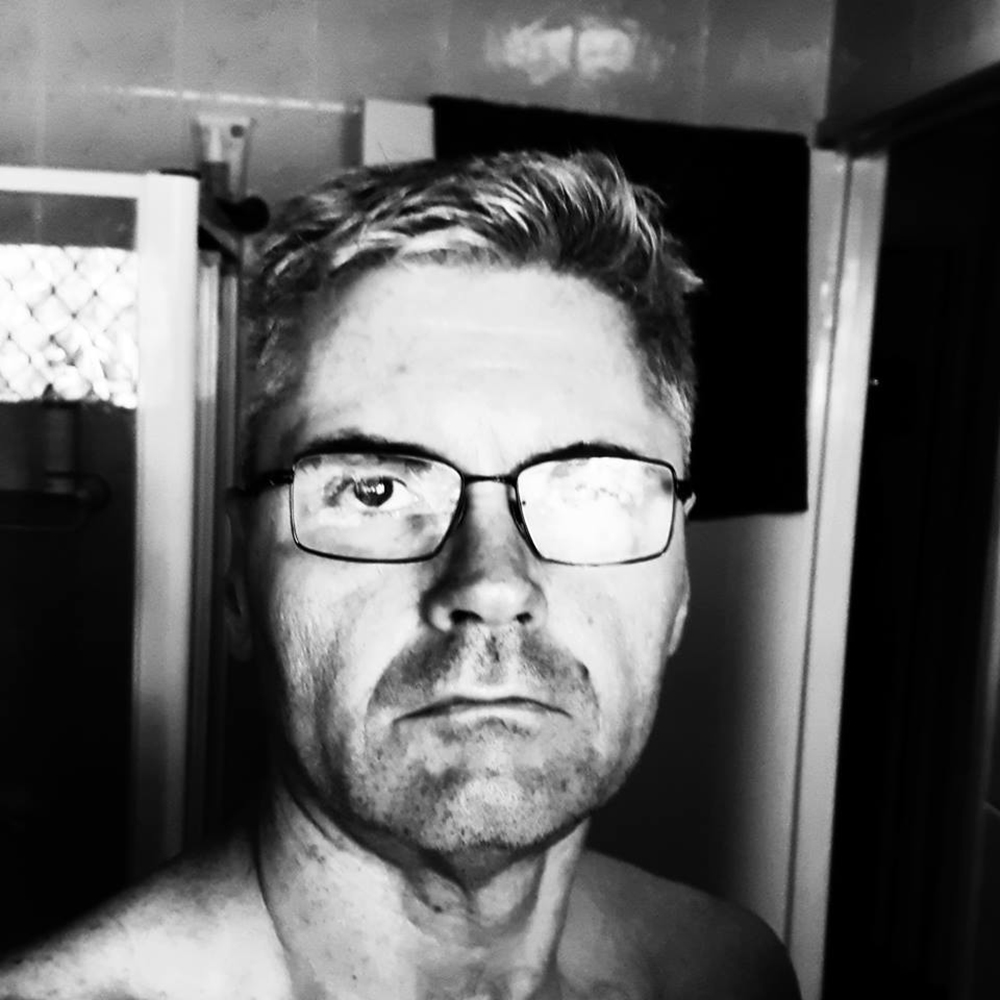
David Symons
DAVID SYMONS is a Brisbane based artist. The idea that the photograph sits precariously on the edge of the real and imagined is the great appeal of the medium to David. Born in Scotland, he studied photography in Western Australia in the 1980s. David has exhibited locally and nationally and has been a finalist prizes including The Olive Cotton Award and the IRIS Award. His photographic work is held in The Art Gallery of Western Australia Collection.
http://www.davidsymons.com.au/about-2/
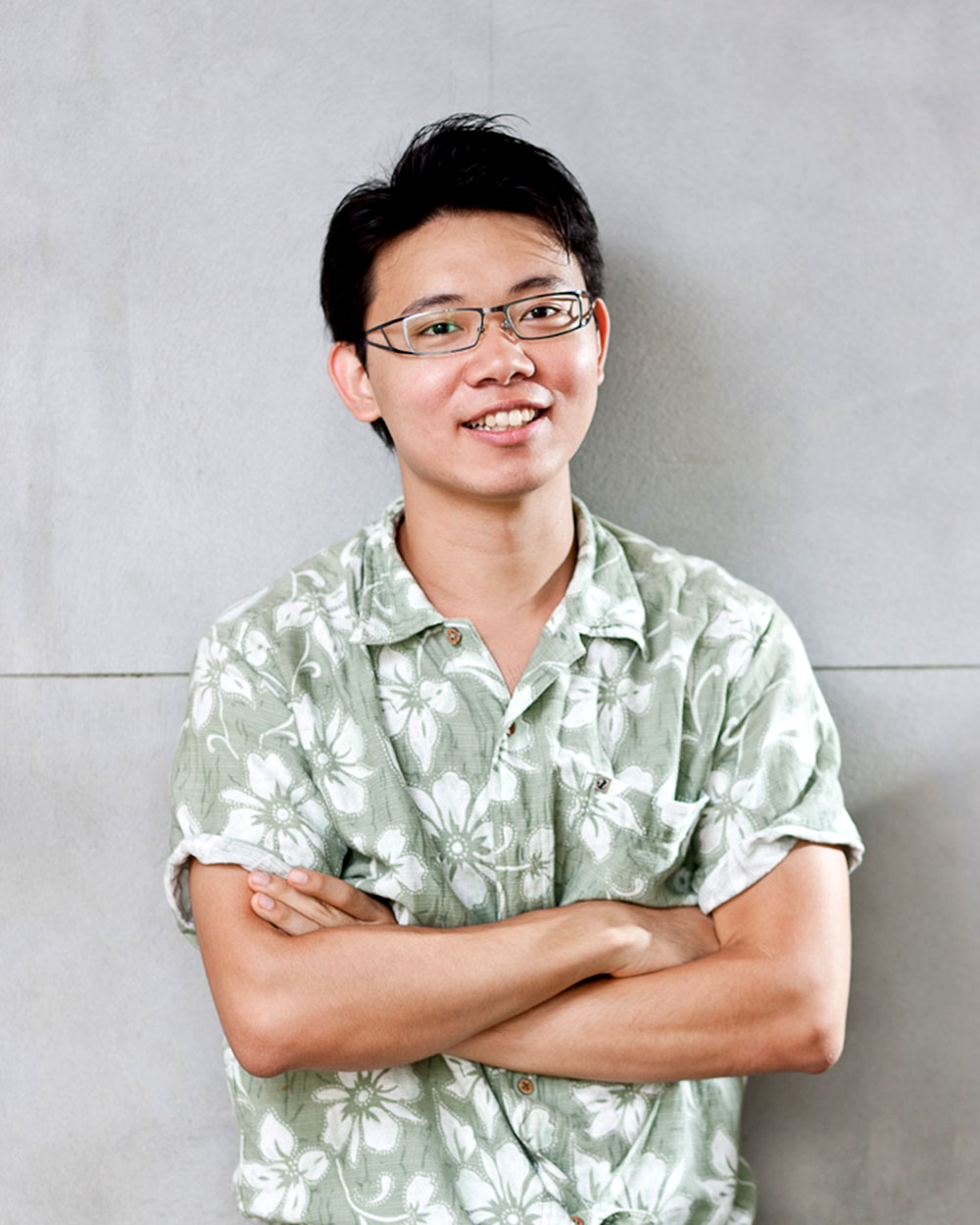
Louis Lim
LOUIS LIM is a Brisbane-based photographer and photobook-maker whose work explores the diversity in human conditions, specifically those that are under-represented in mainstream media. His work has been exhibited in several Australian galleries and presented internationality.
Lim has exhibited his photobook with live bookbinding demonstration in Central Embassy Open House as part of Photo Bangkok Festival. Lim has attended the highly regarded Reminders Photography Stronghold Masterclass and is currently developing his personal photobook project in a collaboration with Beth Jackson.
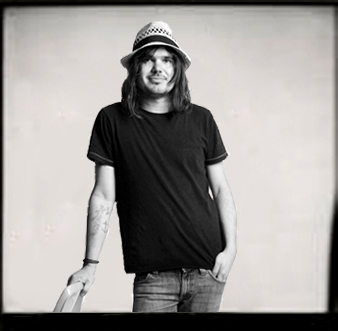
Dane Beesley
DANE BEESLEY is an Australian photographer who has created photography books, exhibited widely, and his photographs are held in public and private collections. Beesley has been described as a “leading Australian rock photojournalist” by Melbourne street press Beat Magazine. Marei Bischarn, photo editor at Rolling Stone Australia, described his work as “honesty in photos; nothing planned or fabricated – just pure energy and great times”.
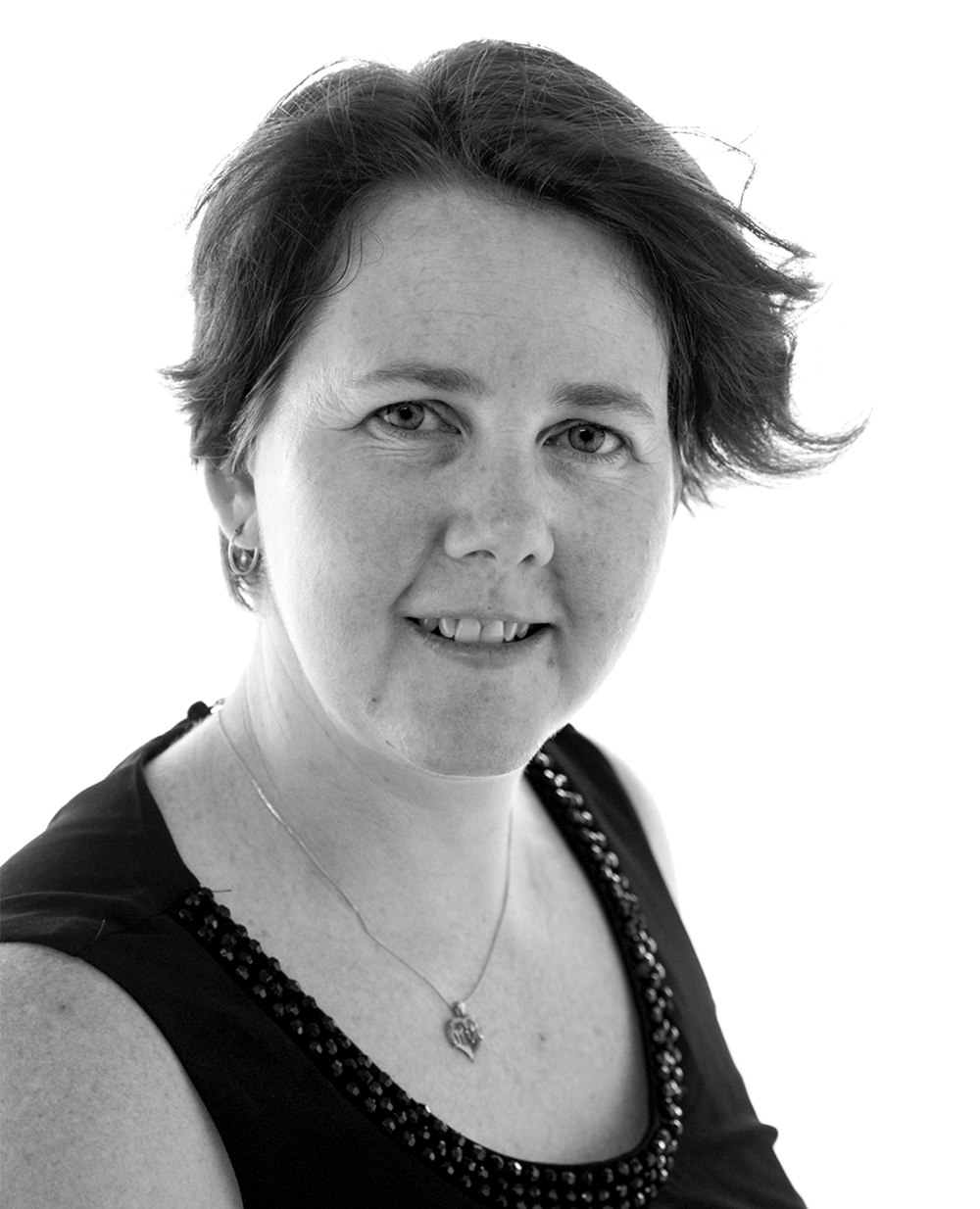
Victoria Reid
VICTORIA REID is a freelance photographer based in South East Queensland. She is interested in documenting the human condition and provides a voice for injustices in society. Reid is about to graduate from the Queensland College of Art, Griffith University, with a Bachelor of Photography (Honours) with a major in Photojournalism and Social Documentary.
https://www.victoriareidphotography.com.au/
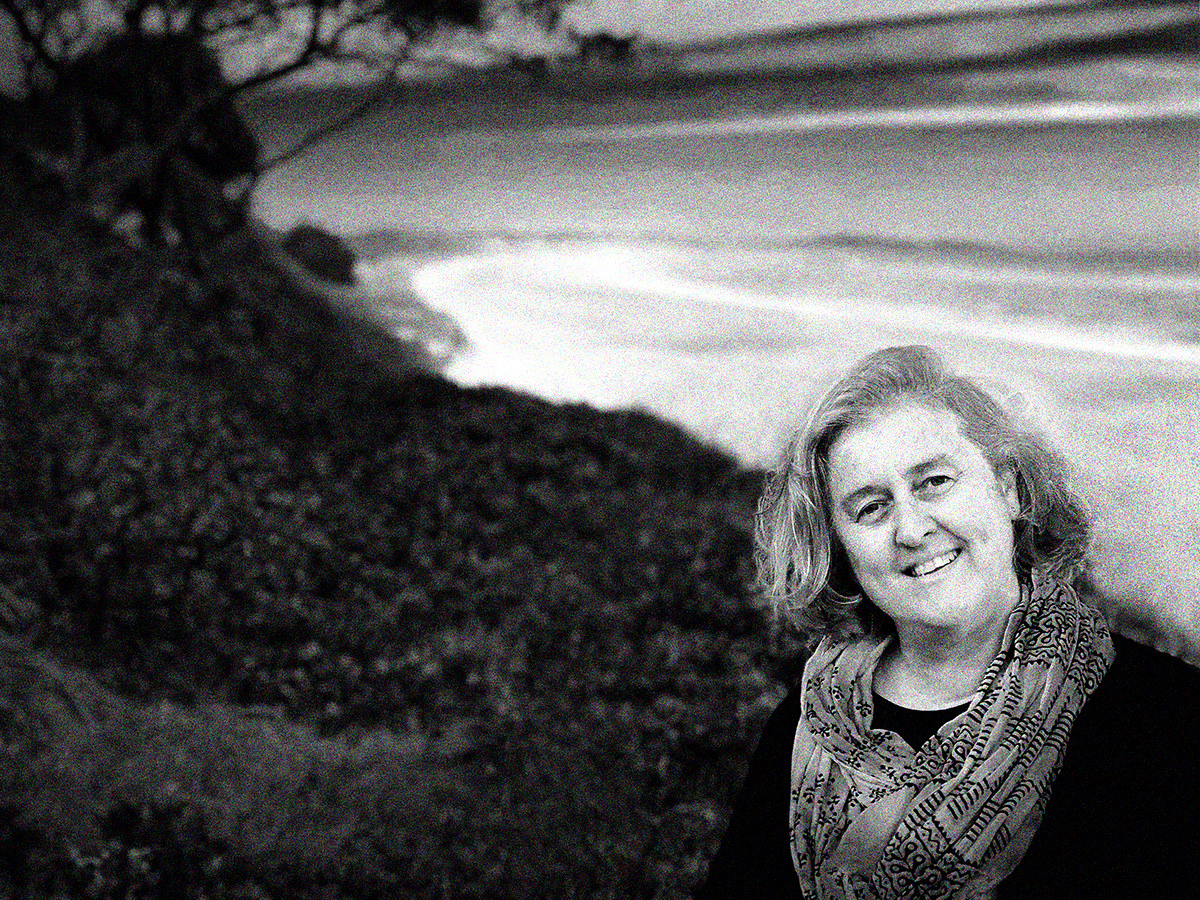
Victoria Cooper
VICTORIA COOPER’s work traverses both personal and political territories in the investigation and representation of an Australian “site” and “place”. She creates visual narratives in response to, and informed by, contemporary social and environmental issues intertwined with historical, scientific and mythological insights intrinsic to each site. Her books are held in major artists’ book collections including the National Library of Australia, the State Libraries of Queensland and Victoria and Artspace Mackay.
http://www.cooperandspowart.com.au/
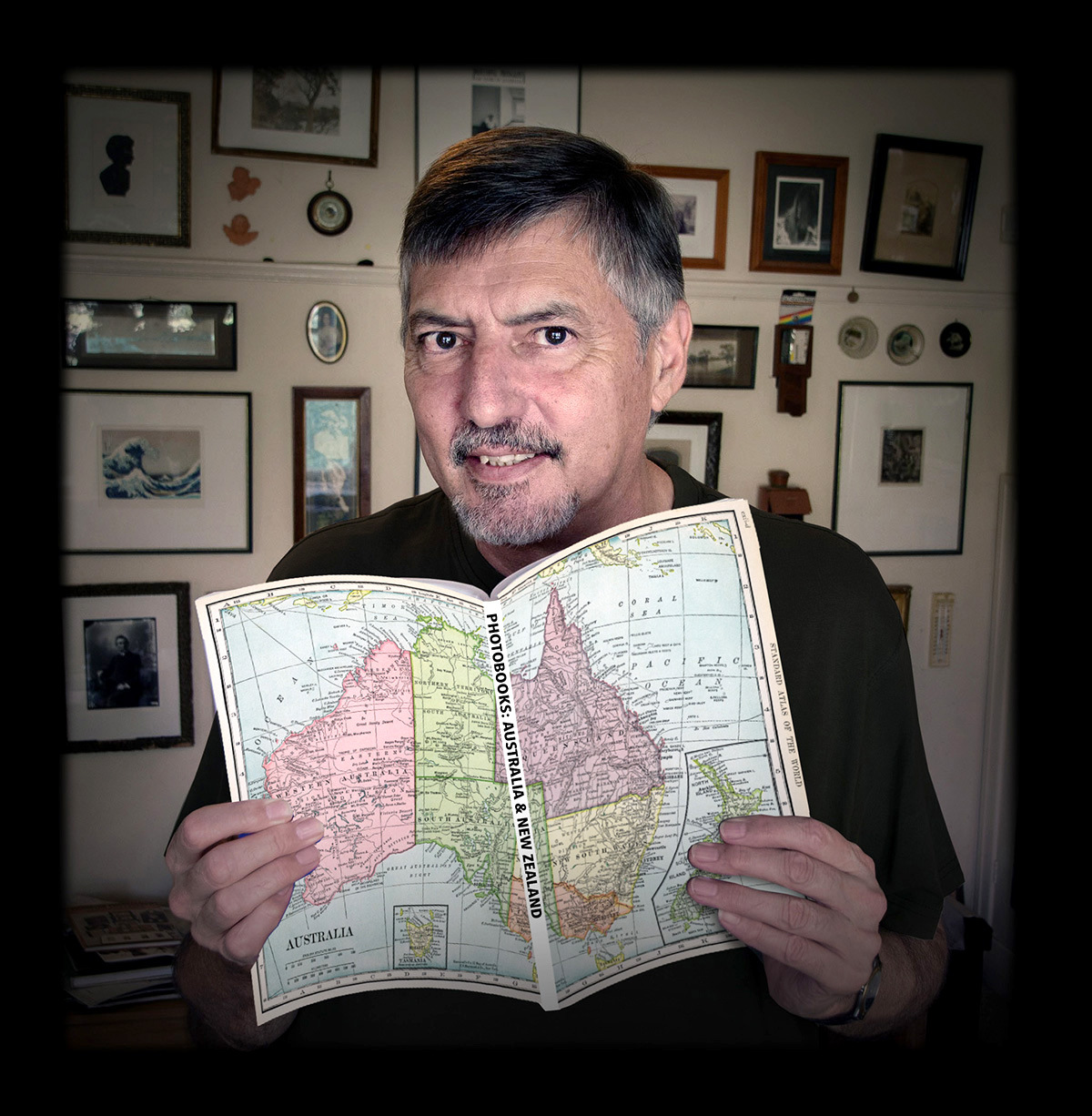
Doug Spowart
DOUG SPOWART has an extensive involvement in Australian creative industries as an artist, educator, curator, commentator and reviewer. For over 25 years he has made photobooks and artists’ books. Many of these books are held in private, regional and state public galleries, national and international photography and artists’ book collections.
http://www.cooperandspowart.com.au/
What are some of your recent titles?
SOME RECENT TITLES FROM MEMBERS OF THE QLD PHOTOBOOK CONSORTIA
.
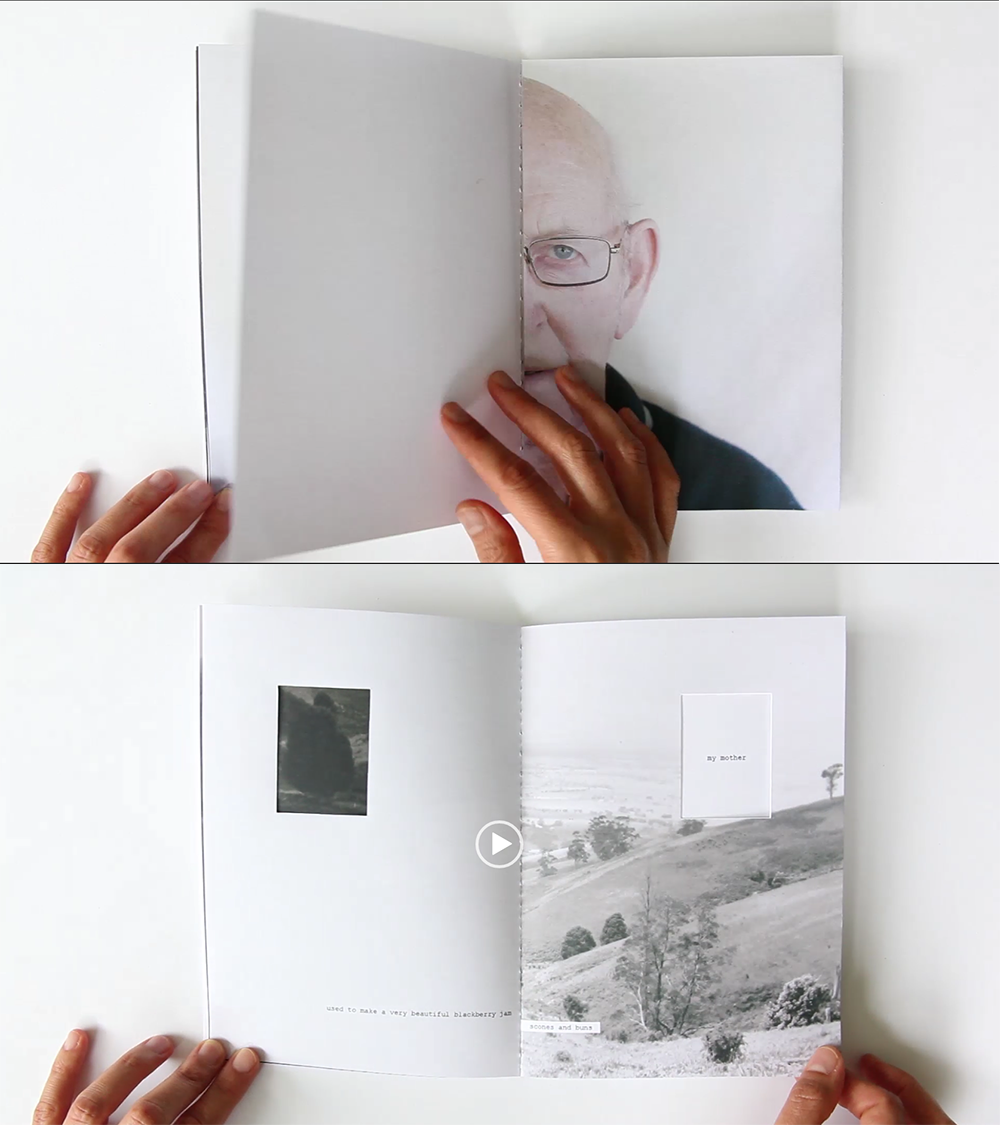
I was there V.I by Ana Paula Estrada
I WAS THERE V. I & II by Ana Paula Estrada consists of a two-volume artist book that tells the life stories of Kevin and Esta, two participants aged over eighty, with whom she has been collaborating. Merging the fields of documentary practice, oral history and fine arts, and influenced by visual poetry, her books explore the combination of text, image and the blank space of the page.
http://www.anapaulaestrada.com/book-preview/
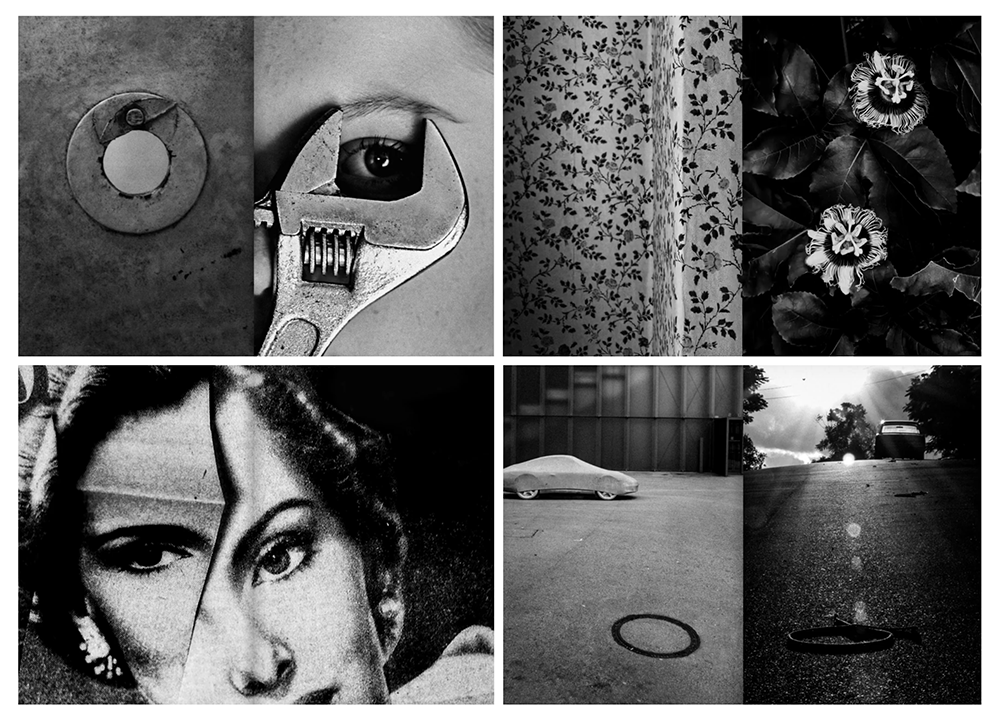
The shadow inside by David Symonds
THE SHADOW INSIDE by David Symons is a noir photobook. The book stylistically revisits the visual languages of the pulp noir genre and police evidence photograph of the mid 20th Century. A low-voltage current of psychoanalytical and surrealist themes run through the pages weaving the narrative in and out the real and imagined. This is a game constantly played out in the viewers mind. For the author the mystery is where the door is between the two states.
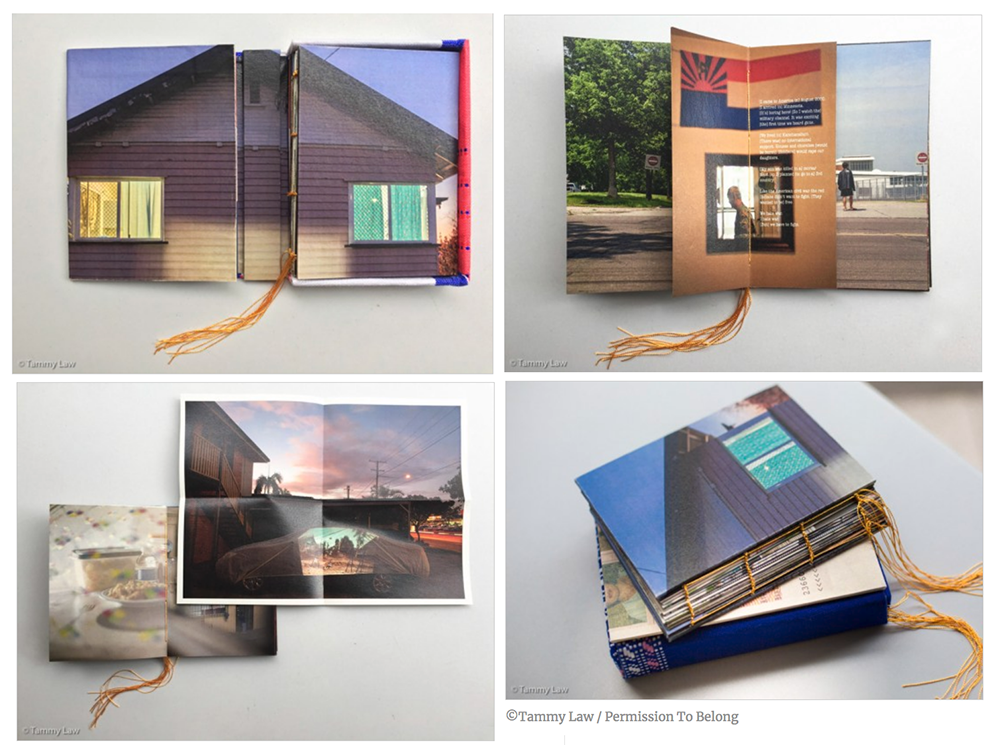
Permission to belong by Tammy Law
PERMISSION TO BELONG by Tammy Law explores themes of migration, home and belonging through the everyday lives of refugee families from Myanmar. Living against the backdrop of decades of repressive rule and civil war, countless families live between a place of home and homelessness, belonging and unbelonging. The negotiation and renegotiation of identities is as complex as the history and future of Myanmar.
http://reminders-project.org/rps/permissiontobelongsaleen/
Yelseeb Enad by Dane Beesley
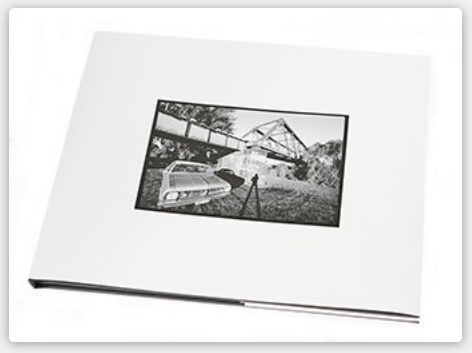
YELSEEB ENAD by Dane Beesley deals with the mythic place that the road occupies in the American west. It is a romanticised Kerouac/Dylanesque view of the road captured in small moments and big cars invested with meaning. There’s an honesty, a quest for truth, perhaps a naiveté in the images reminiscent of cinéma vérité that captures the adolescent wanderlust it seeks to document.
… There is no end by Louis Lim and Beth Jackson
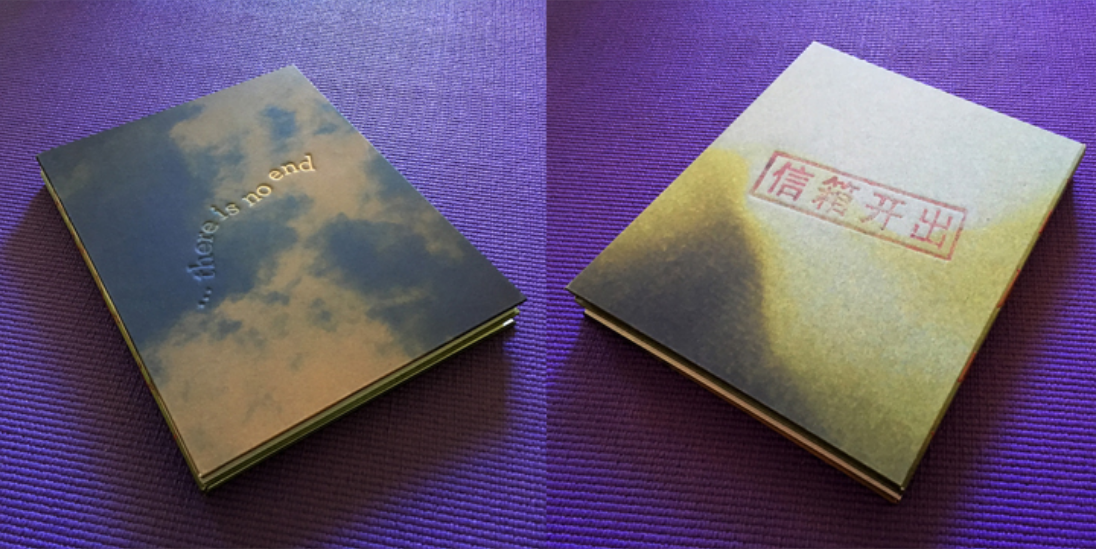
… THERE IS NO END a collaboration between Louis Lim and Beth Jackson deals with grief, loss and upheaval from two separate encounters that intertwine through the process of photobook making. The book was shortlisted in the Singapore International Photography Festival Photo Book Showcase 2018, and the 2018 Libris Award with acquisition by Artspace Mackay.
The final version of the book is in current production for release in early 2019.
http://sipf.sg/photobook/there-is-no-end/
liberté by Victoria Reid
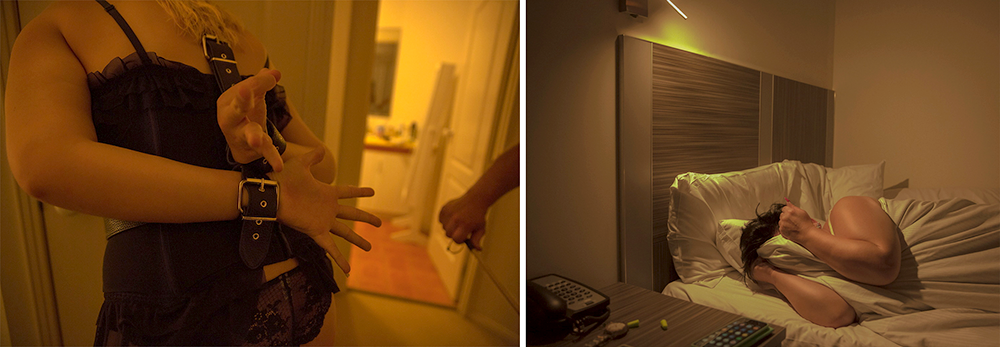
LIBERTÉ by Victoria Reid is her first self-published book. This book of photographic work examines the search for sexual freedom in a society in which tightly prescriptive sexual norms prevail. This project focuses on people who create meaning in their worlds outside of what is considered ‘normative’ behaviour. Exchange of power, consent, trust, role-playing and gender identity are explored. The intention of this project is to promote dialogue around existing sexual stereotypes and stigmas.
We’ll keep in touch to let you know how our submission got on….
AND, If you are from Queensland and have a book do get in contact with us….
.
.
The Queensland Photobook Consortia.
.
.
.
.
.
.
.
.
.
.
.
ADVANCE NOTICE: WORLD PHOTOBOOK DAY Brisbane Event
WPBD Header
To mark the 175th anniversary of what is recognised as the first photobook – Anna Atkins’ ‘Photographs of British Algae: Cyanotype Impressions‘ we invite photobook lovers/collectors/makers to a Brisbane celebration of World Photobook Day 2018.
.
Green Anna Logo
.
.
This year the theme of the WPBD is ‘Anna goes green’ and is intended to focus on the concerns of:
– Global warming
– Environmental change and destruction
– Books about natural history topics including plants and nature
– Books with links to planet earth
The theme originates from Atkins’ activities as a scientific illustrator of flora and other specimens.
.
.
.
.
At this year’s event you will have the opportunity to:
- HEAR: Special guest speaker: Dr Paolo Magagnoli from the UQ School of Communications and Arts
- VIEW: Photobooks from the Fryer Library collection
- DISCUSS: “My favourite photobook”
- BRING: Along your favourite photobook to share.
VENUE: Fryer Library University of Queensland, St Lucia Campus from 11.00 am Saturday the 13th of October.
.
David Symons
.
This event is being coordinated by David Symons – we thank David for taking on this task while we are away in Tasmania.
We also wish to acknowledge that the World Photobook Day has been set up as a collaboration between the organizers of Photobook Club Madrid and Matt Johnston the founder of the Photobook Club network.
PLEASE NOTE: World Photobook Day is October 14 – This event is scheduled on the 13th due to the availability of the venue.
.
FOR MORE DETAILS & TO REGISTER>>> https://www.facebook.com/events/247464655970747/
.
.

Photobook Club Logo
ABBE 2017 – The academic artists book conference
ABBE Logo
The second Artist Book Brisbane Event (ABBE) promised an academic conference dealing with the artists book as a folded and risky space. The event consisted of three elements at the Queensland College of Art and a fourth satellite pop-up exhibition at the State Library of Queensland. Drawn to ABBE 2017 were artists bookmakers, thinkers, commentators, teachers, lecturers and tinkerers from across Australia. All came with a desire to contribute to, or participate in, perhaps this Australia’s penultimate artists book gathering.
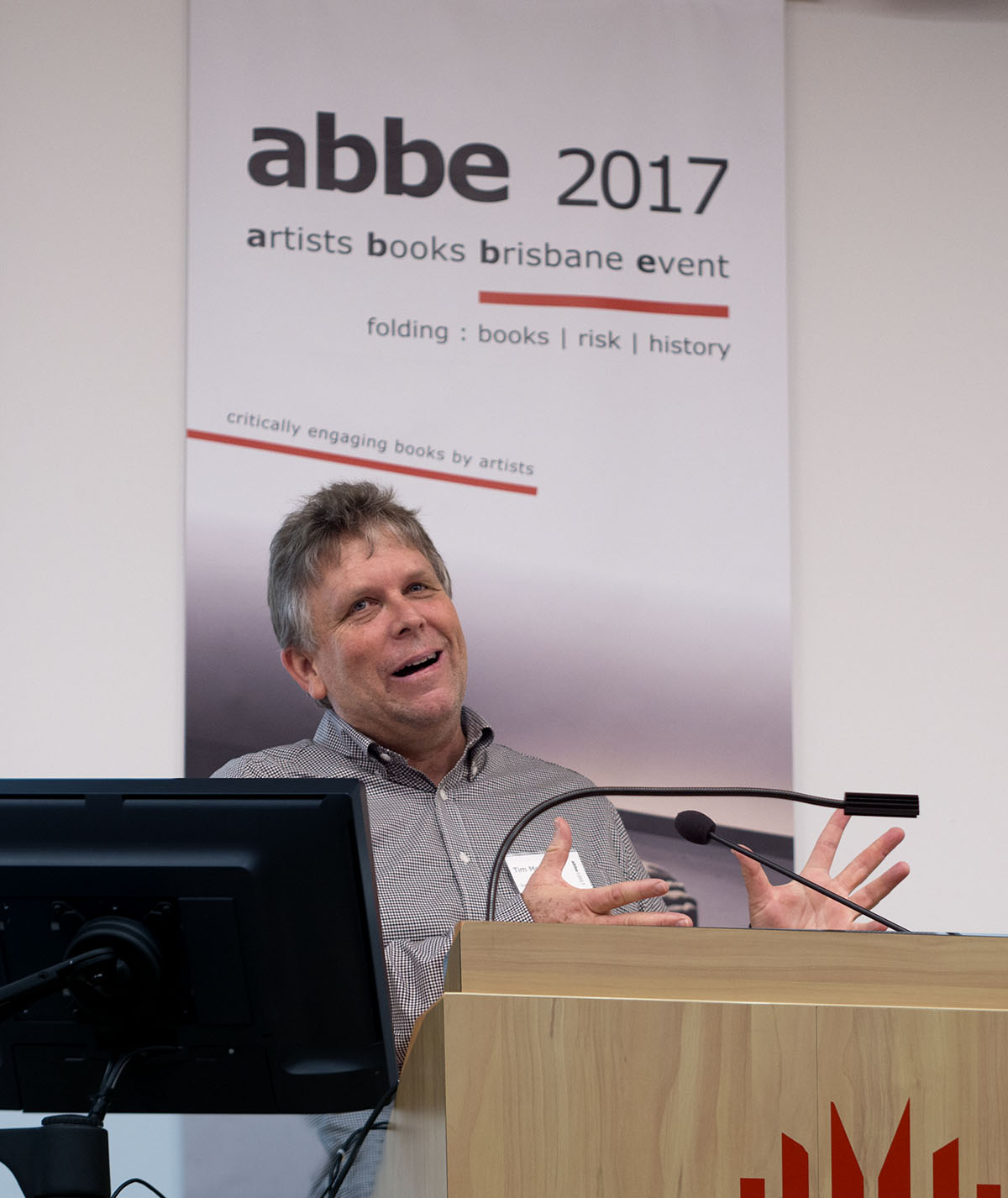
Dr Tim Mosely ABBE coordinator and chair
The event was convened and chaired by QCA lecturer Tim Mosely and was launched by Griffith University’s Dean Academic, Arts, Education and Law Professor Ruth Bereson who spoke about the book as art and the need for that the discipline has for scholarly discourse. She commented that the Griffith Centre for Creative Arts Research ABBE program and its connection with Columbia University’s JAB (Journal of Artists Book) publication of selected papers would contribute to this discourse. Significant keynote speakers, Uta Schneider and Ulrike Stoltz from Germany and Clyde McGill from Western Australia headlined the event. Other program contributors came from practitioners, academic staff, students, and recent graduates from institutions in the USA, New Zealand and around Australia.
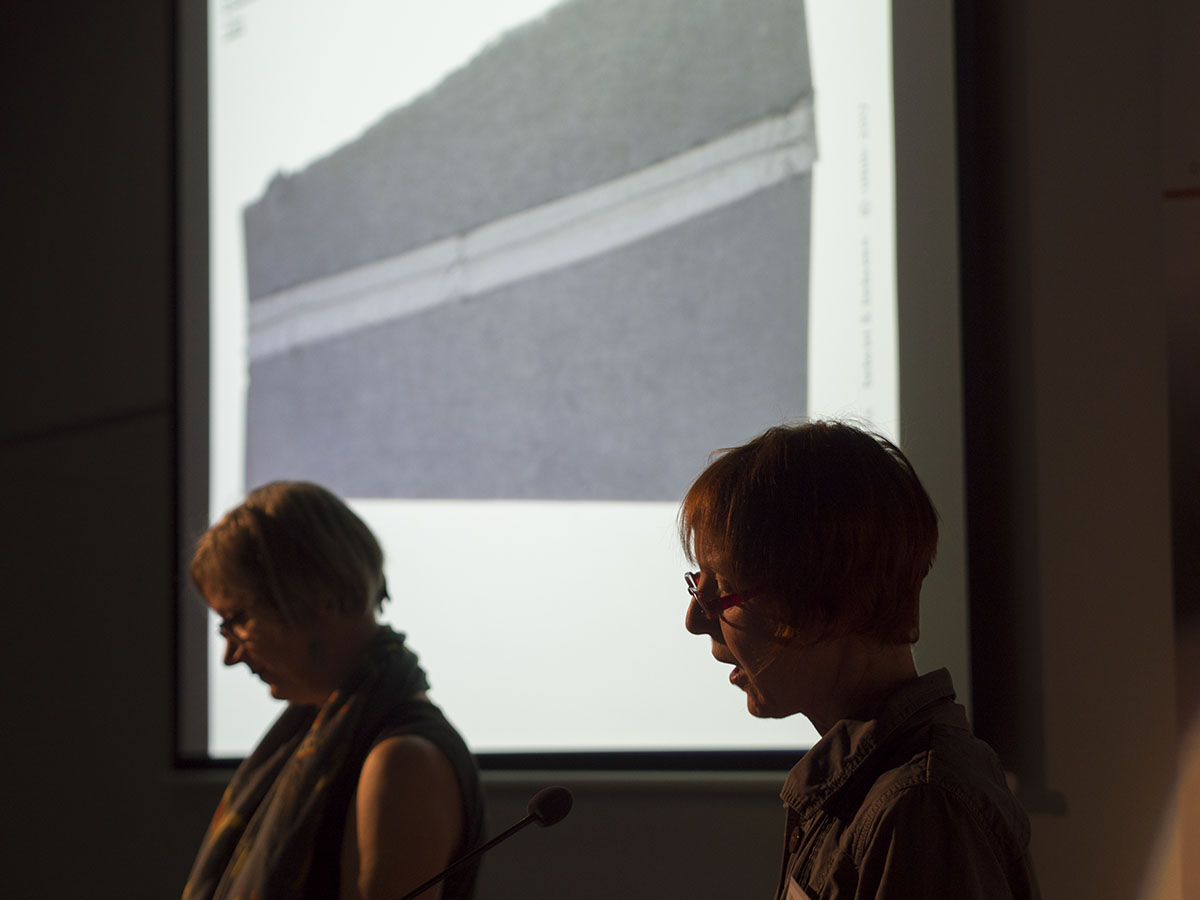
Ulrike Stoltz & Uta Schneider
The first keynotes were Uta Schneider and Ulrike Stoltz who presented a paper entitled betwixt & between. Presenting in tandem their voices were almost like a turning of the pages – recto and verso. They teased out and formed the conference theme of ‘folding’ into an ordered analysis of the physical and metaphorical ways that books fold. They connected the theme ‘folding’ with their own individual and collaborative works and the concepts, philosophies and discussions about artists books that informed them. Mythology, Martin Heidegger on contemprality and the ekstaticon, Carrion, Gillies Deleuze and ‘thinking means folding’ and Michel Serres and ‘the crumpled nature of time’.
The lecture then proceeded to a review of book forms with terms like:
- Folded paper
- Cross fold
- Sharpness of the fold
- Container folds
- Staging folds
- French fold
- Inside folding outside
- Concertina and multi-concertina folds
- Wormholes and science fiction
The works they illustrated their paper with were refined and exquisitely designed. They featured wordplay and poetry, folded page spaces, transparency using ‘show-through’, typography and graphic design elements. As an introduction to the topic, the hour long presentation provided a solid and exciting insight into ways of considering the fold, its forms and the way it can connect with the reader, as receiver of the communiqué.
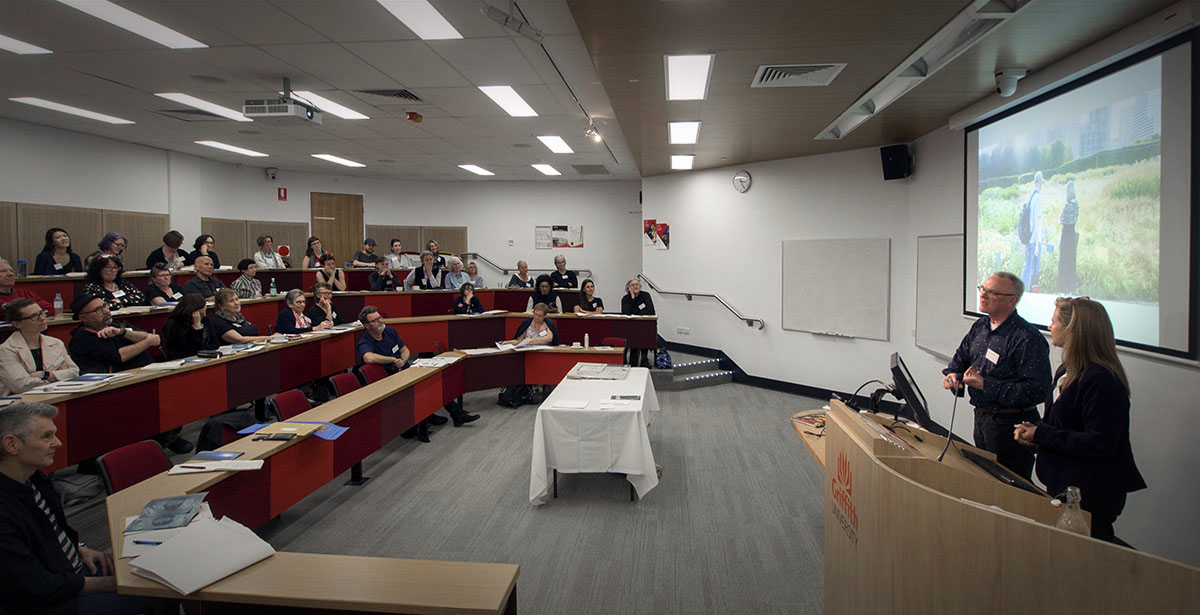
A K Milroy + Brad Freeman presenting
Other presentations on the program included:
- Marian Macken Reading Volume: Between Folded Drawings and Collapsible Models
- Caren Florance & Angela Gardner Unfolding to refold: collaborative wordings
- Paul Uhlmann Meditations on process: Three artists books, letters to the land, sea and sky
- Caren Florance An Instrument of Collaboration: Unfolding the GIW Legacy
- Monica Oppen Eclectic items: early books by Australian artists
- Ana Paula Estrada “Memorandum”, from concept to publication
- Wim de Vos Air, edge, surface image – concertina books
- Nicola Hooper The Citronella Artists Book as an Augmented Narrative
- Amy E. Thompson Folding and the potential of Artists’ Books
- A K Milroy & Brad Freeman Folding and unfolding in JAB41: cultures, research, pages
- Tess Mehonoshen DISINTEGRATE: the destructive folding of materials
- Marian Crawford A lively phantom: the rare and popular artists book
- Carolyn Craig Unfolding(s)
- Isaac Brown Relationship risk and ethics in photographic artist books
- Monica Carroll & Adam Dickerson Unfolding the episteme of artists’ books
- Bridget Hillebrand Handling folds: an intimate encounter
- Julie Barratt & Virginia Barratt The exquisite fold, the immanent word
- Maren Götzmann The Anarchist Notebooks


While most papers were read from the dais with carefully illustrated PowerPoint slides the second keynote speaker Clyde McGill emerged on the stage with a device that could be called a ‘bibliophone’. McGill had altered a range of book titles by folding back the pages and attaching a sound pick-up to the book cover and then connected the 7 books to an amplifier. Volunteers from the audience were given bonefolders as plectrums and, on McGill’s guidance were instructed to make the various movements of hands and object associated with hand-making a book. The haptic actions were converted to sound and the room filled with the noise of ‘making’ associated with a great deal of laughter.
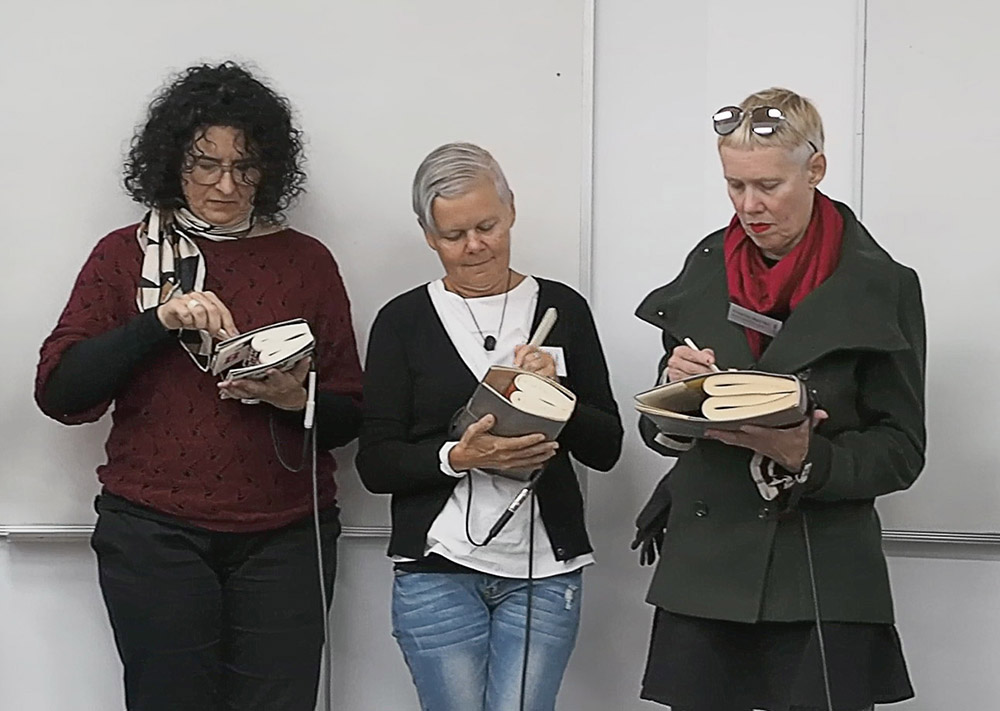
Making book music with Clyde McGill


McGill continued his presentation with a detailed investigation of the idea of folding books. Where possible his own works were referenced. At other times he created new books by playful investigation… bending and folding light was a particularly humorous but gave those present an insight into how the artist’s off-tangential and obtuse thought processes process can lead to new conceptual and visual discoveries.

Julie and Virginia Barrett’s performance
Another departure from the read-the-paper format was a performance by Julie Barratt and her sister Virginia Barratt. Attendees, on returning to the lecture theatre after morning tea, found the space darkened except for two sharply defined spotlit circles. One pool of light was vacant, just the floor’s carpet – in the other artists’ book maker Julie Barratt was busy unfurling paper, measuring it and tearing of lengths and positioning them in a stack on the table before her. Also on the table were scissors a ball of thread and other bookmaker’s things. The unroll>measure>cut>position sequence was progressing methodically for some time making the sheets one might guess that would go to making a book. A soundtrack began with a female voice expressing thoughts ideas, word associations sometimes repeated – perhaps the thoughts of the bookmaker? There was a rustling sound – stage right. Gradually a large dome-like white shape appeared and moved towards the empty spotlight area. The shape was covered in what looked like pages – ominous maybe… the audio continued and Julie Barratt left her table and proceeded toward the shape and picked up a folded sheet and returned to the table – flattening out the sheet it was melded with other sheets. The performance continued. What was it about? What came to my mind was that the shape was like the book working with Julie so its story could be told as in Paul Carter’s ‘material thinking’. At the end of the performance it was revealed that Virginia Barratt, Julie’s sister, was the artists book ‘monster’.


Another aspect of the conference presentations were two papers by photographers Ana Paula Estrada and Isaac Brown both featuring bookwork’s that they had created. Estrada, as a State Library of Queensland Siganto Foundation Creative Fellow, discussed concepts of memory, photography and old age as the inspiration for her project. She detailed the process of design, making maquettes, refining and working with commercial printers and binders to complete the project. Brown spoke of the integration of his project and PhD study focussing on his relationship to his father, a Vietnam veteran. Aspects of text and dialogue were addressed as well as Brown’s own recent fatherhood. What was interesting was the informal narrative and connection with audience that both presenters had and the expanding space of the artists book being inhabited by photographers.
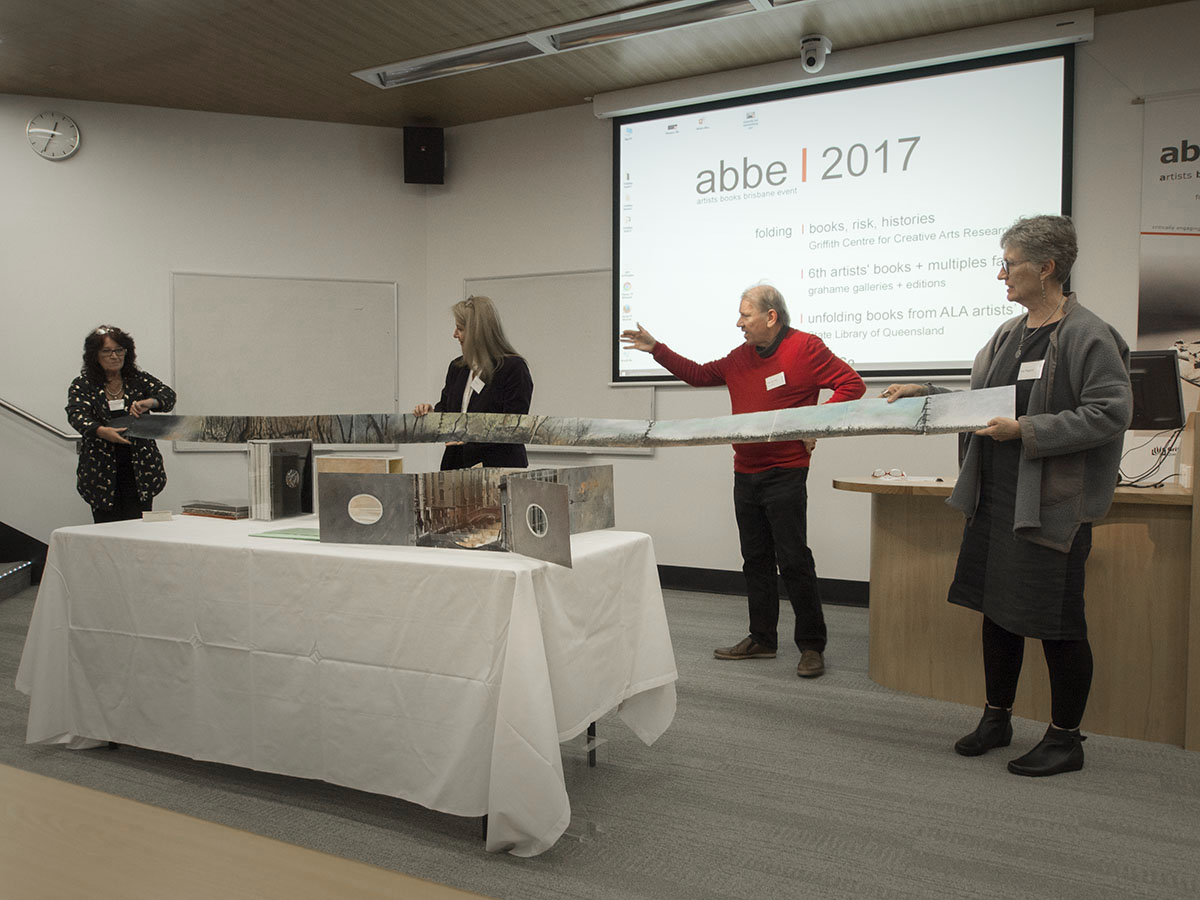
Wim de Vos presents his work
Wim de Vos made an animated presentation and several helpers as his concertina books by the metre unfolded across the width of the theatre and tunnel books expanded, evidence of the pre-eminence of his artists book practice in Queensland.


Midway through the academic papers a ‘plenary’ session consisting of a panel of artists’ book ‘movers and shakers’ discussed several issues relating to the discipline. The session quickly became absorbed with the perennial issues of nomenclature, the dearth of private and public purchasers of bookworks and the grooming of possible artists book collectors. The impact of the term ‘Art Book’ was mentioned and the way events associated with the term has grown in popularity worldwide and has come to encompass artists books, photobooks, zines, art books and institutional catalogues. Another topic mentioned was the importance of research and critical commentary on the discipline. A suggestion was made for the formation of a ‘double-blind peer review’ collective.
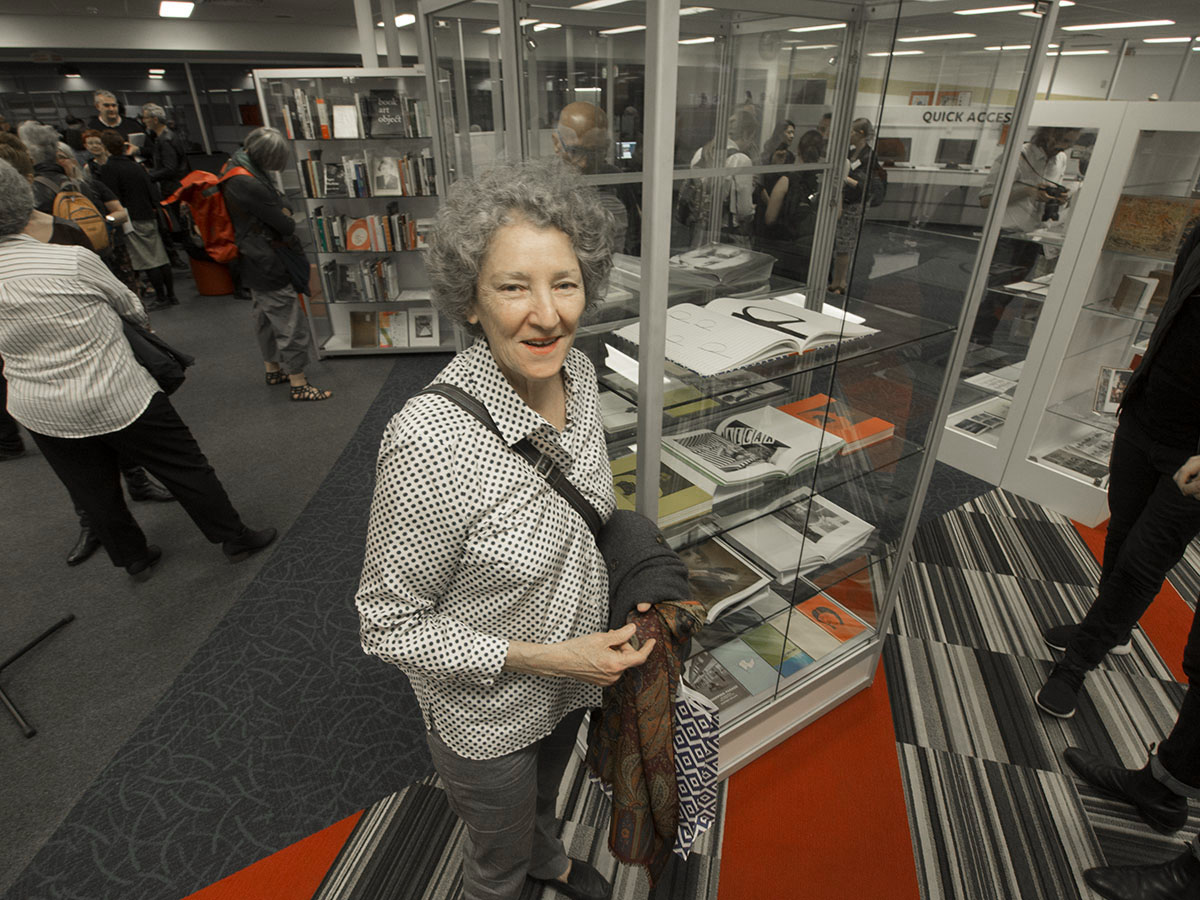
Noreen Grahame at the QCA Library and her ‘… & So’ artists book show
On the evening of the first day Robert Heather, Director, New England Regional Art Museum opened the exhibition “… & So” at QCA Library. The exhibition features a significant collection of seminal Australian and international artists books and multiples sourced predominately from Noreen Grahame’s Centre for the Artist Book collection and her numero uno publications alongside artists’ books from the Queensland College of Art. A list of the selected works can be downloaded here. ALA Books for abbe 2017 … $ so Exhibition list
Mid afternoon on the second day the State Librarian and CEO from the State Librarian of Queensland Vicki McDonald opened the 6th artists’ books + multiples fair. Twelve tables presented a hand-to-eye experience of books by significant makers of contemporary artists’ books. These included:

A silhouette view of the Grahame Galleries tables
Stand 1 – grahame galleries + editions
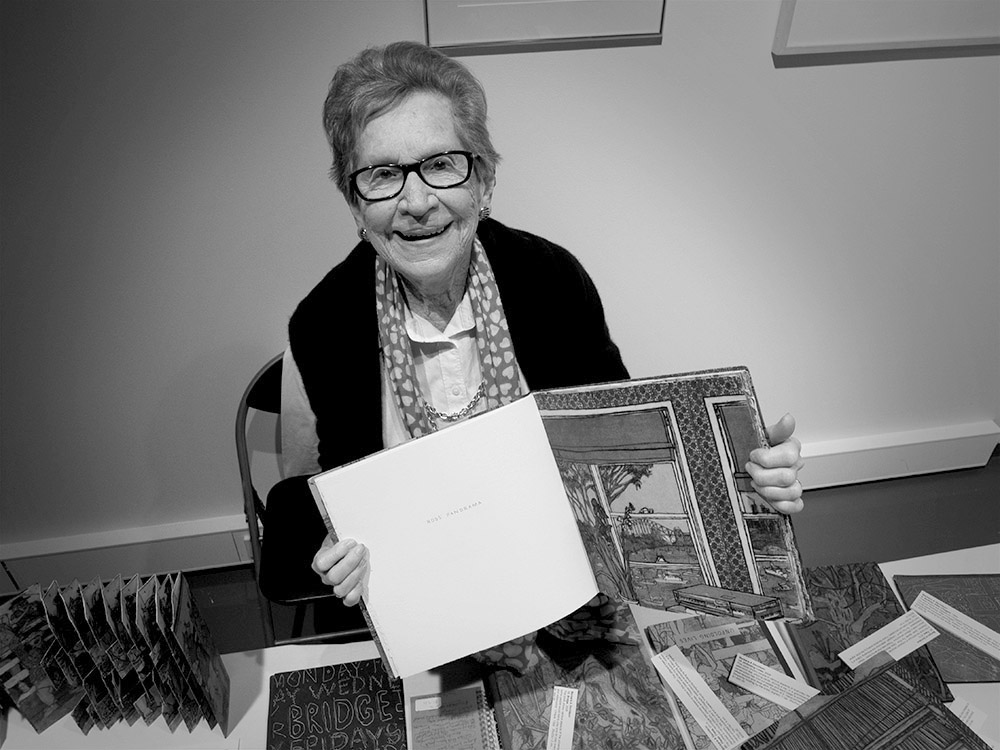
Barbara Davidson

Caren Florance
Stand 3 – Caren Florance – Ampersand Duck

Photo from ABBE Artists Book Conference July 6-9 2017 at the Queensland College of Art

Anne-Marie Hunter
Stand 7 – Psyclonic Studios – Anne-Maree Hunter
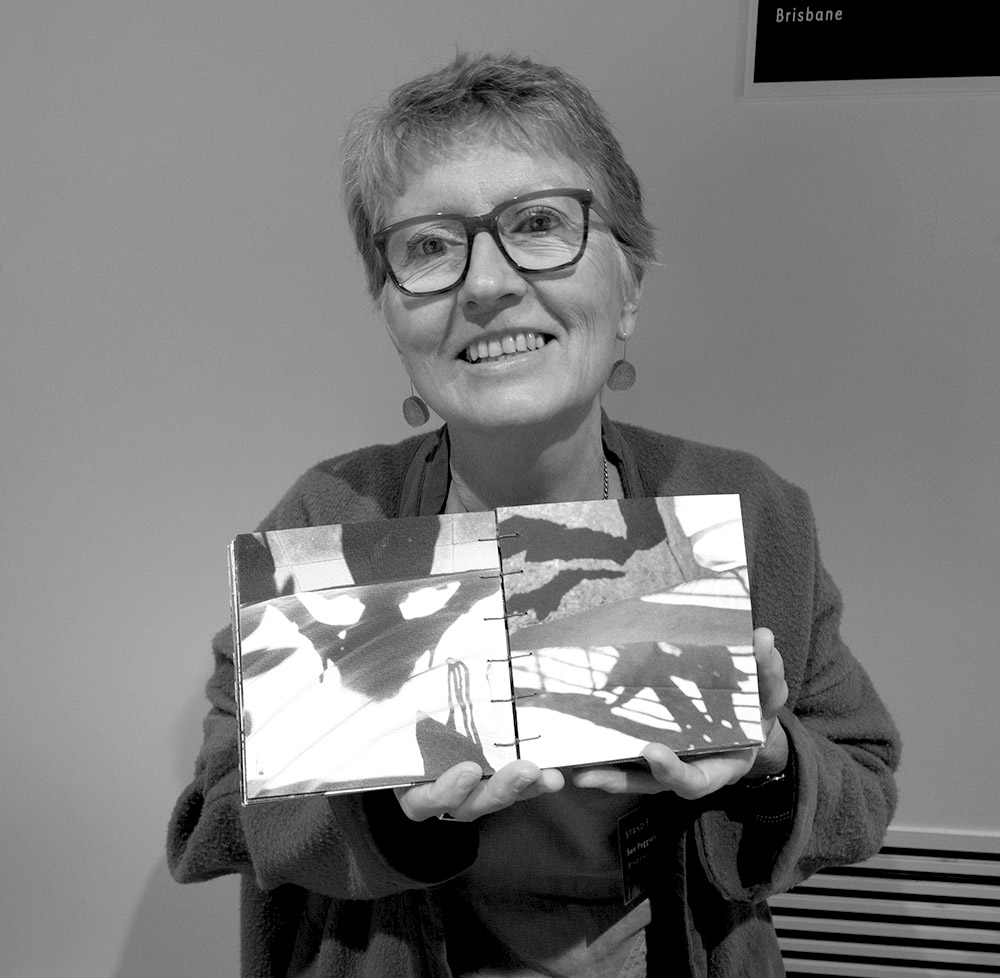
Sue Poggioli
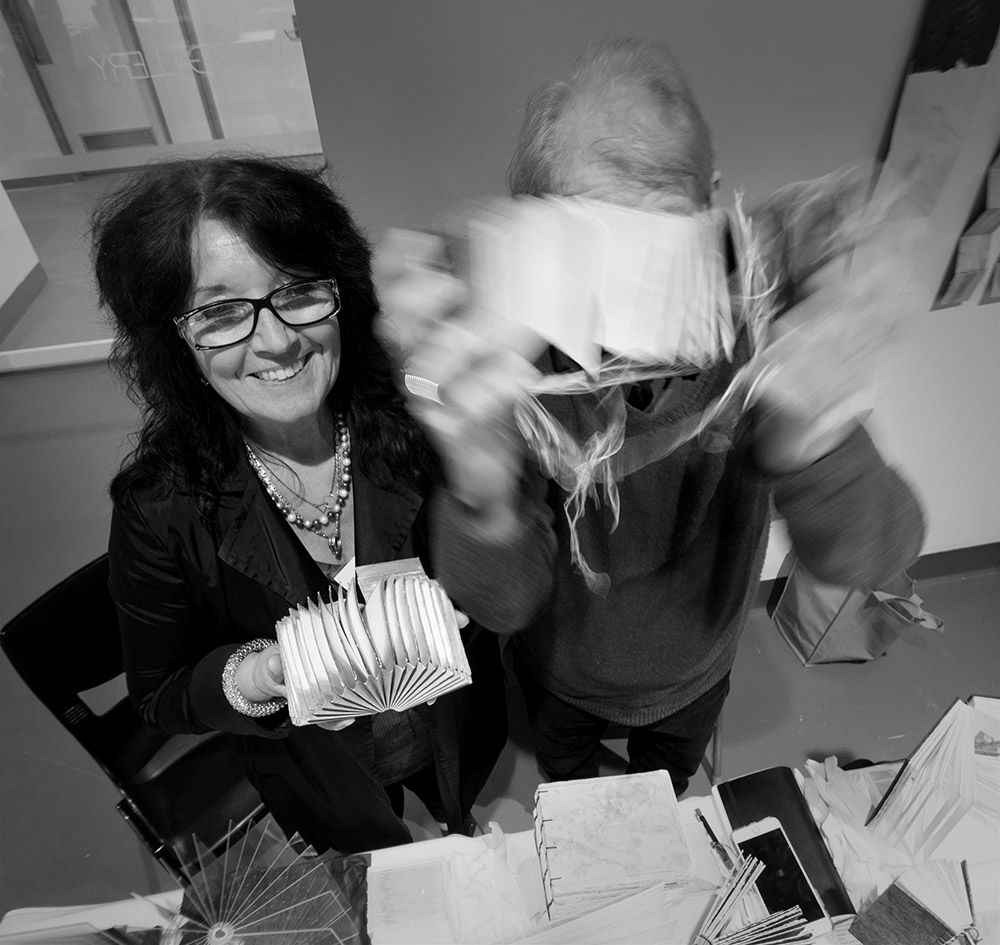
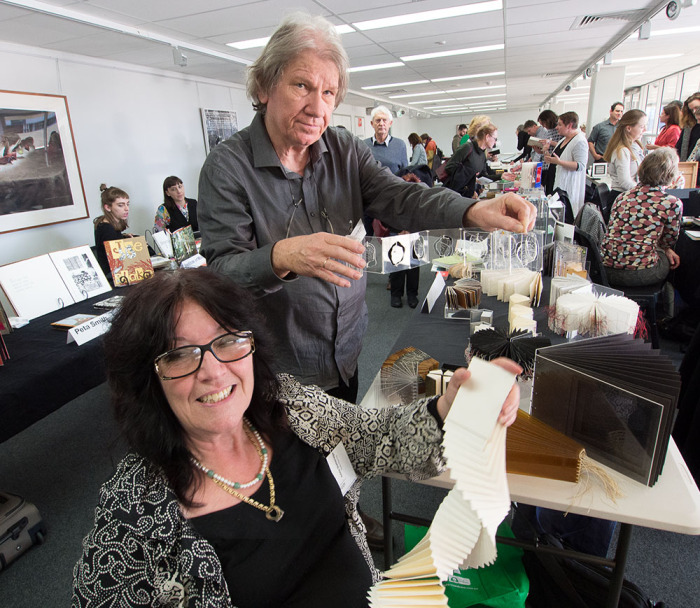
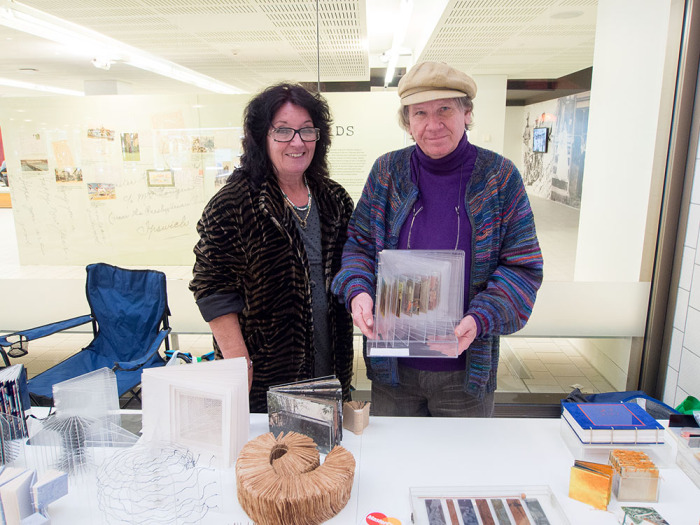
Adele Outteridge & Wim de Vos

Ulrike Stoltz & Uta Schneider
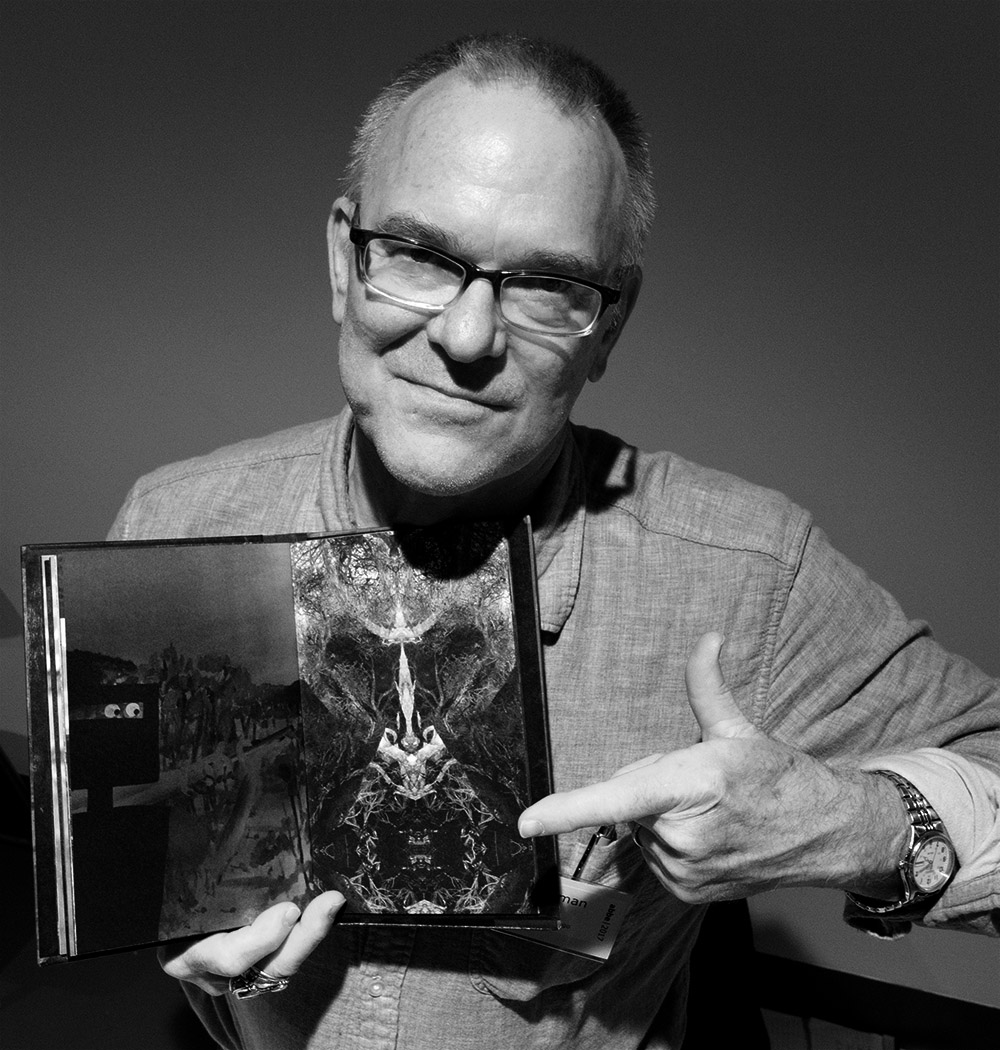
Brad Freeman

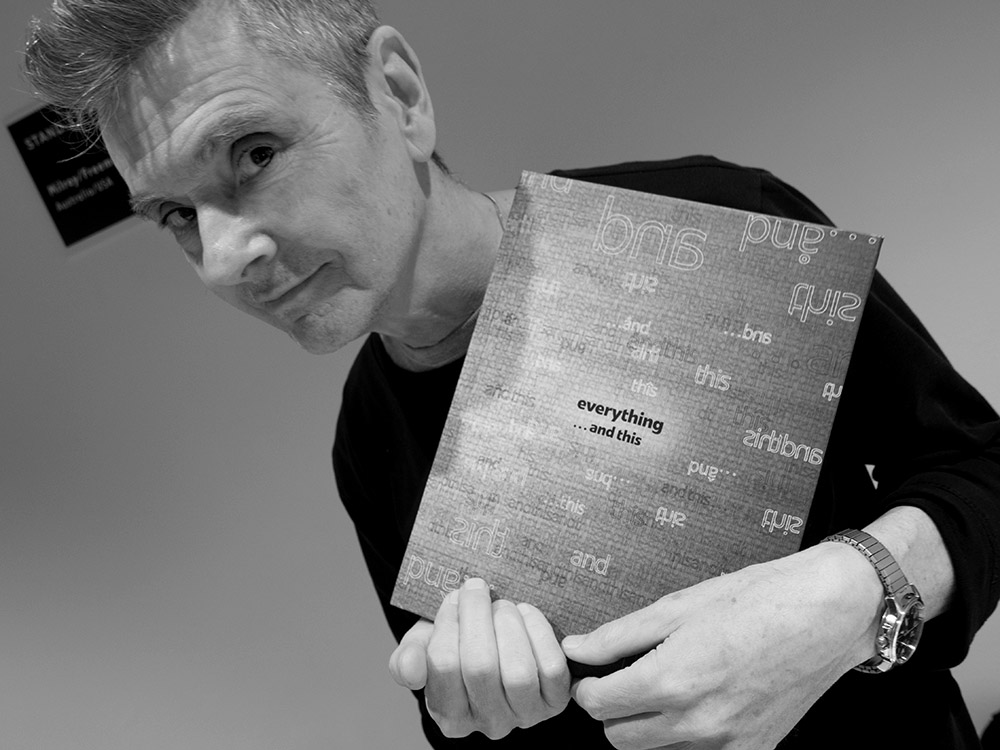
Anita Milroy
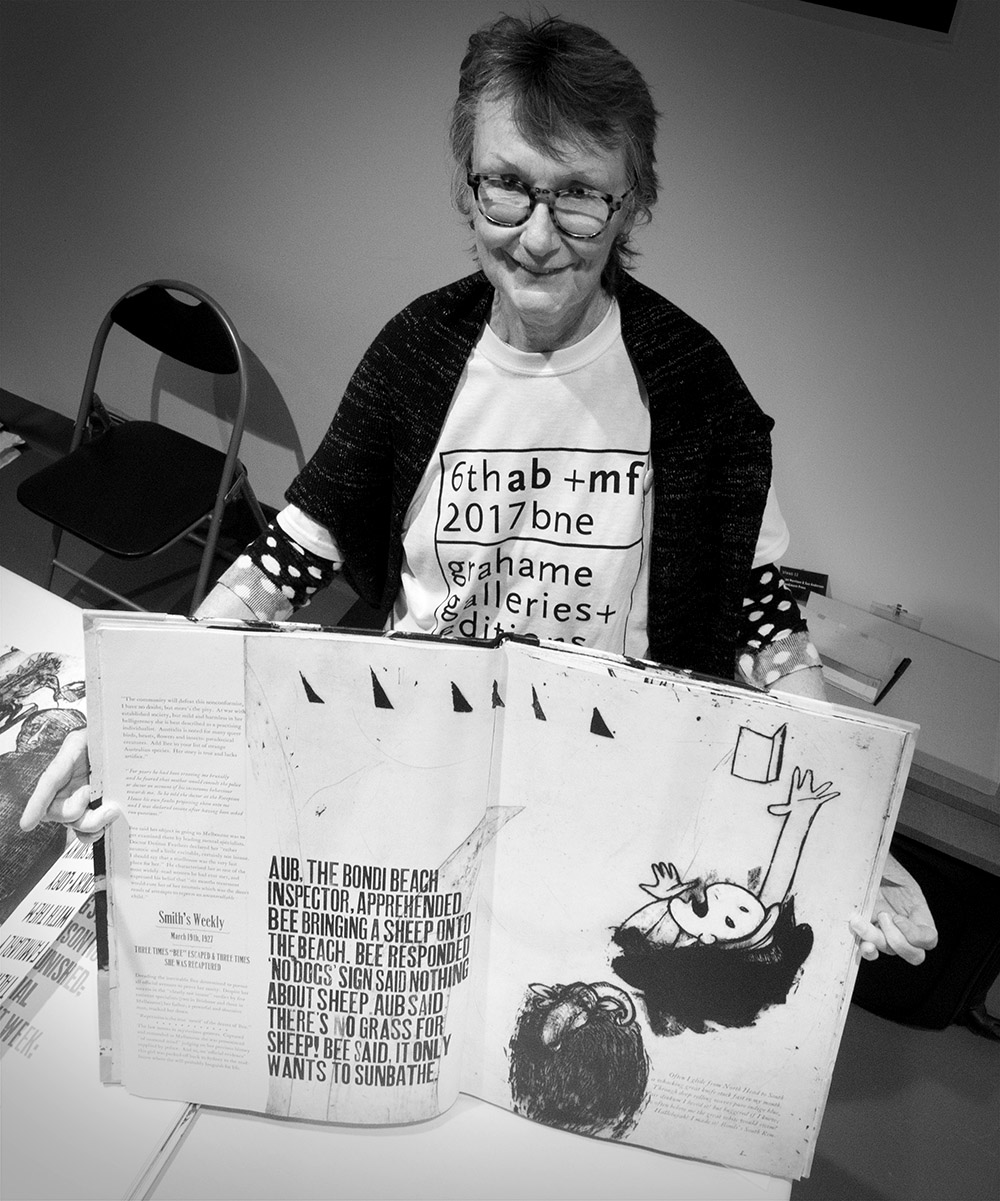
Lyn Ashby
Stand 11 – Milroy-Australia / Freeman-USA / Ashby-Australia
Sue Anderson

SLQ Australian Library of Art artists book exhibition
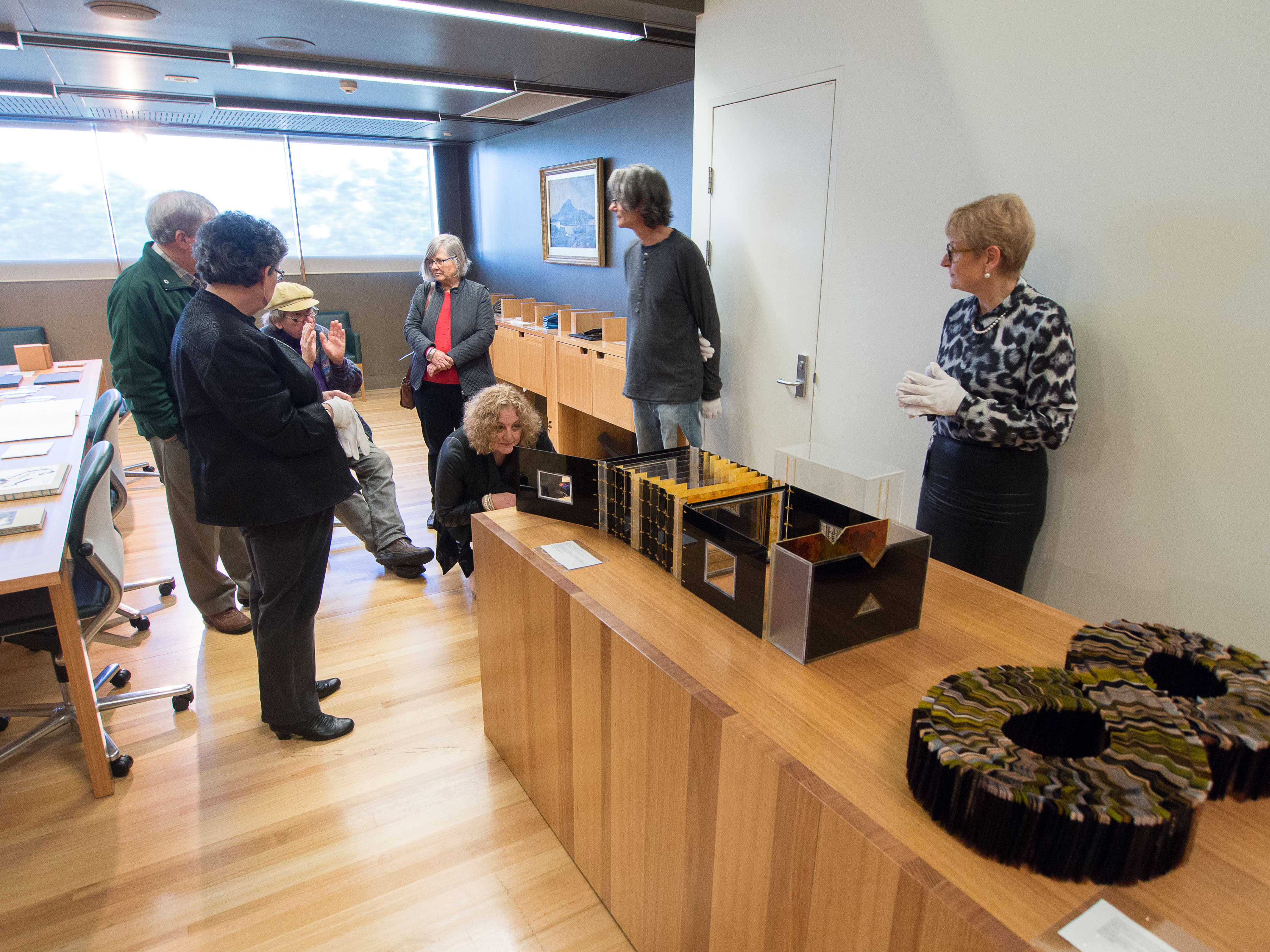
To complement the theme of the ABBE conference a special collection of concertina and folded books was curated by Christene Drewe of the Australian Library of Art at the State Library of Queensland. Open only for 2 hours on the Saturday morning of the conference this satellite event was well patronised. The Australian Library of Art is recognised as Australia’s premier public collection of artists books and the range of works presented was a testimony to the variety and depth of the collection. A list of the books displayed can be downloaded here. ALA Books for abbe 2017
In keeping with the conference theme the community of practice for artists books in this country is supported by the ‘folding’ and ‘unfolding’ of ideas, theories, concepts, access to exemplar book samples and the social connection that ABBE provides. While selected ABBE 2017 papers will be published in JAB, beyond that, the influence and impact of this gathering highlights the need for ABBE to provide this ongoing forum in Australia.
Dr Doug Spowart
All photographs and text ©2017 Doug Spowart
.
.
TAKING AuNZ PHOTOBOOKS TO THE WORLD – The Vienna Photo Book Festival
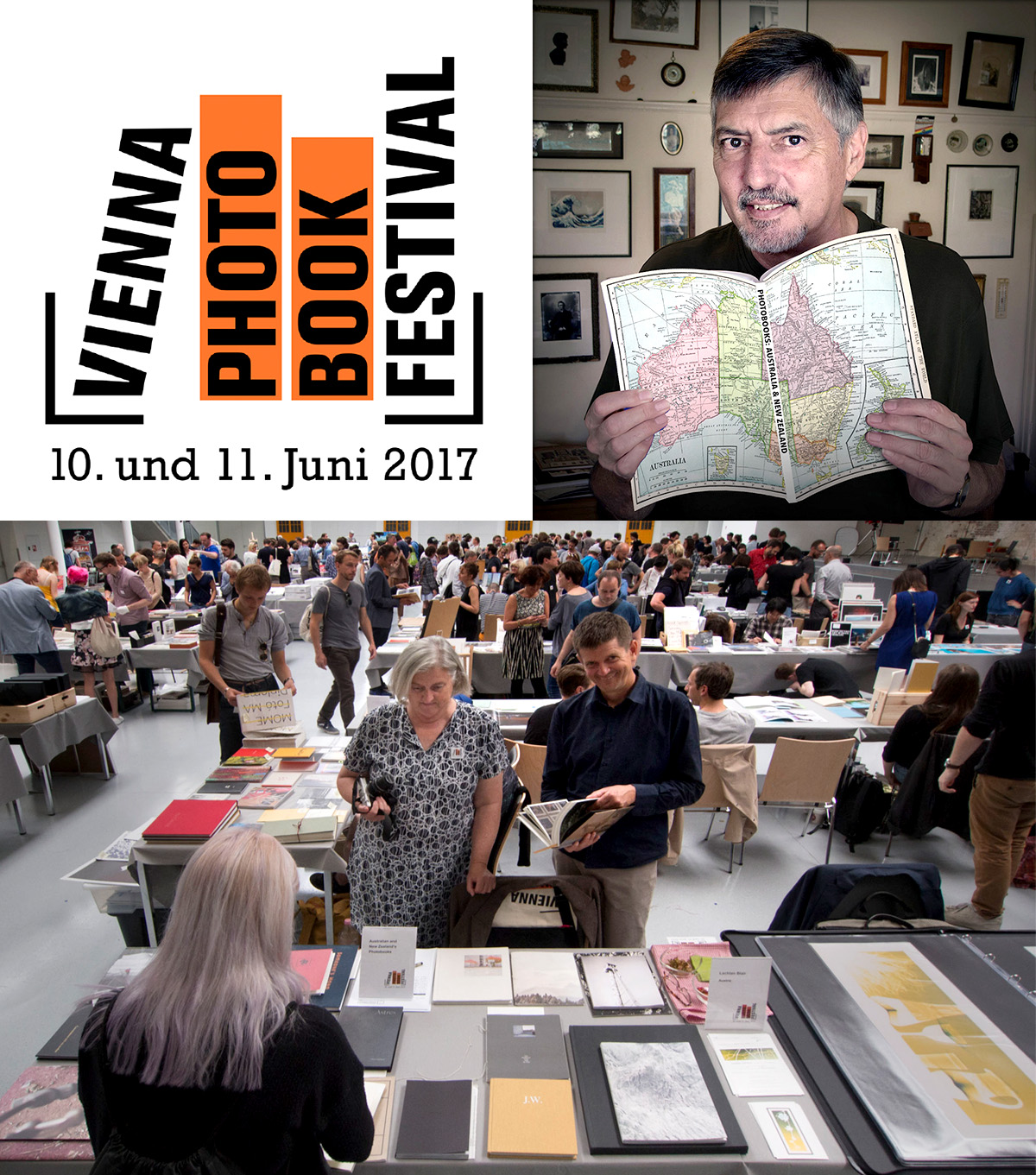
The MomentoPro AuNZ Photobooks of the Year @ VPBF
In the Antipodes we think we are far away from the centre of activities in so many areas of human endeavour that we just get on with it – doing it our own way. The field of photobooks is one such area.
Recently I had an opportunity to take photobooks from our part of the world to Europe and present a ‘show ‘n’ tell’ at the Vienna Photo Book Festival in Austria. Before the event I was wondering how our books would be received – would they match the Euro photobook for production values, innovation and story-telling capability? I would soon have my answer…
I presented a lecture on Australian and New Zealand photobooks and spent two days with Victoria Cooper and Lachlan Blair on our book presentation table featuring the finalists and winners of the 2016 MomentoPro Australian and New Zealand Photobooks of the Year Awards (ANZPOTY).
The answer to the question I posed earlier would soon be answered.
In a series of 3 blog posts I will tell the story of three aspects of the Vienna Photo Book Festival (1) the lectures, book and print sales, (2) my lecture and (3) the Vienna Photo Book Reviews.
Read on: THERE ARE 3 BLOG POSTS WITH THE DETAILS … links below…
The LECTURE
The EVENT
https://wotwedid.com/2017/06/18/aunz-photobooks-the-vienna-photo-book-festival/
The REVIEW SESSIONS
https://wotwedid.com/2017/06/18/review-panels-at-the-vienna-photo-book-festival/


.
.
.
.
THE ANTIPODEAN PHOTOBOOK – a lecture at the Vienna Photo Book Festival
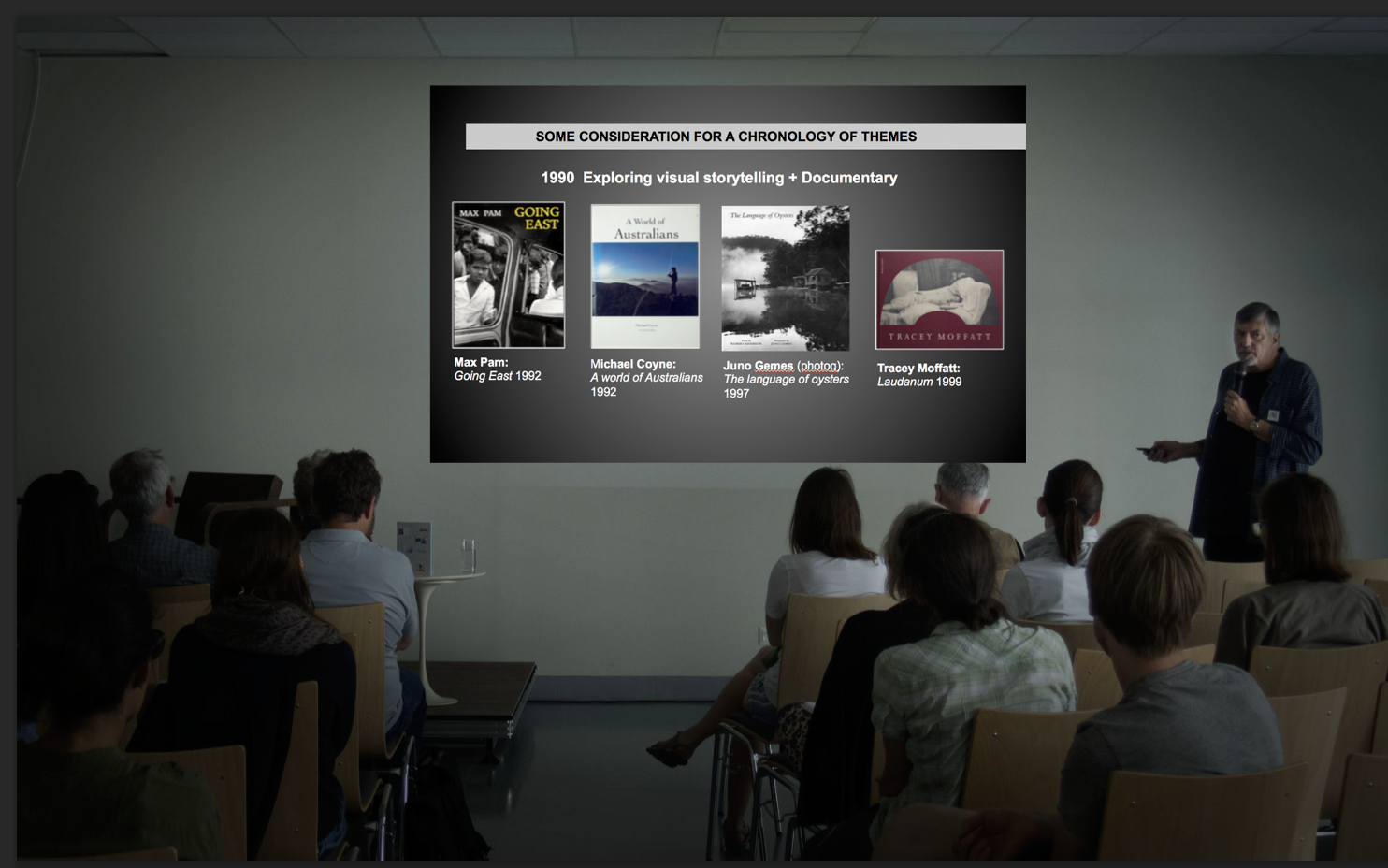
Doug Spowart presenting The Antipodean Photobook at Vienna Photo Book Festival
THE LECTURE: THE ANTIPODEAN PHOTOBOOK
My lecture brief was to make an hour-long presentation about the Australian and New Zealand photobook scene. After some thought I organised my lecture content around 4 distinct areas.
1. The supporting structures
The contemporary scene was to be included covering both practitioners and the major events in AuNZ that have shaped and contributed to the development of strong network and community of practice. The key events, movers and shakers such as:
- Photobook Melbourne
- Photobook New Zealand
- Unless you will 2017 event and book reviews
- Melbourne Artbook Fair
- Sydney’s Volume Another Artbook Fair
- Zinefairs
- The Photobook of the Year Awards
- Bookshops
- Perimeter Editions
- m.33
- T&G
- Rim Books
- Remote Photobooks
- Perimeter
- Photobook Clubs
- Asia Pacific Photobook Archive
- Photobook collections
I commented also on the sources of critical discourse on photobooks in AuNZ.
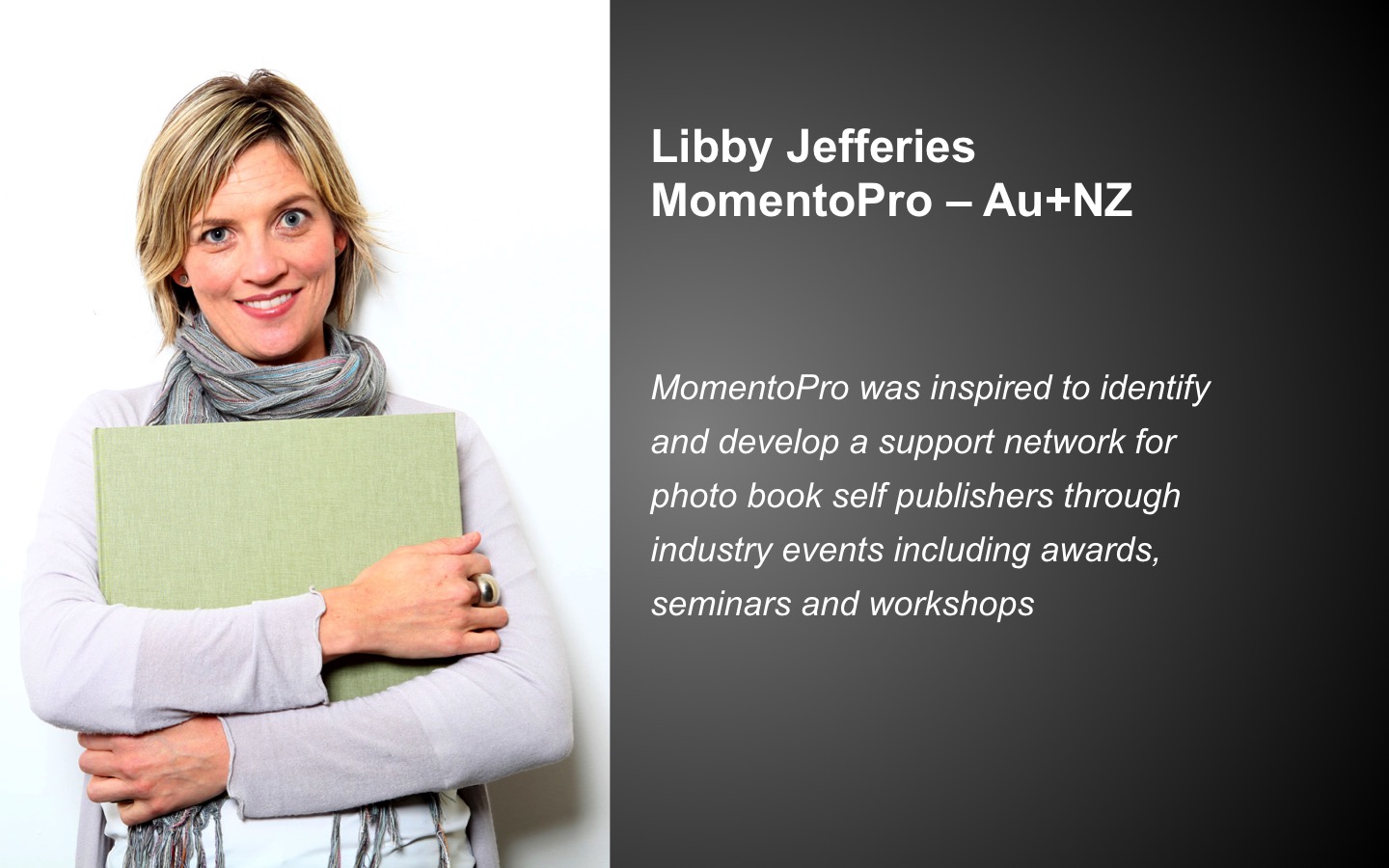
The role of Libby Jeffery and Geoff Hunt of MomentoPro as patrons and supporters of all things photobook in Australia and New Zealand was acknowledged.
2. Photobook histories of Australia and New Zealand from first examples to 2000
Here are a few slides from the presentation…
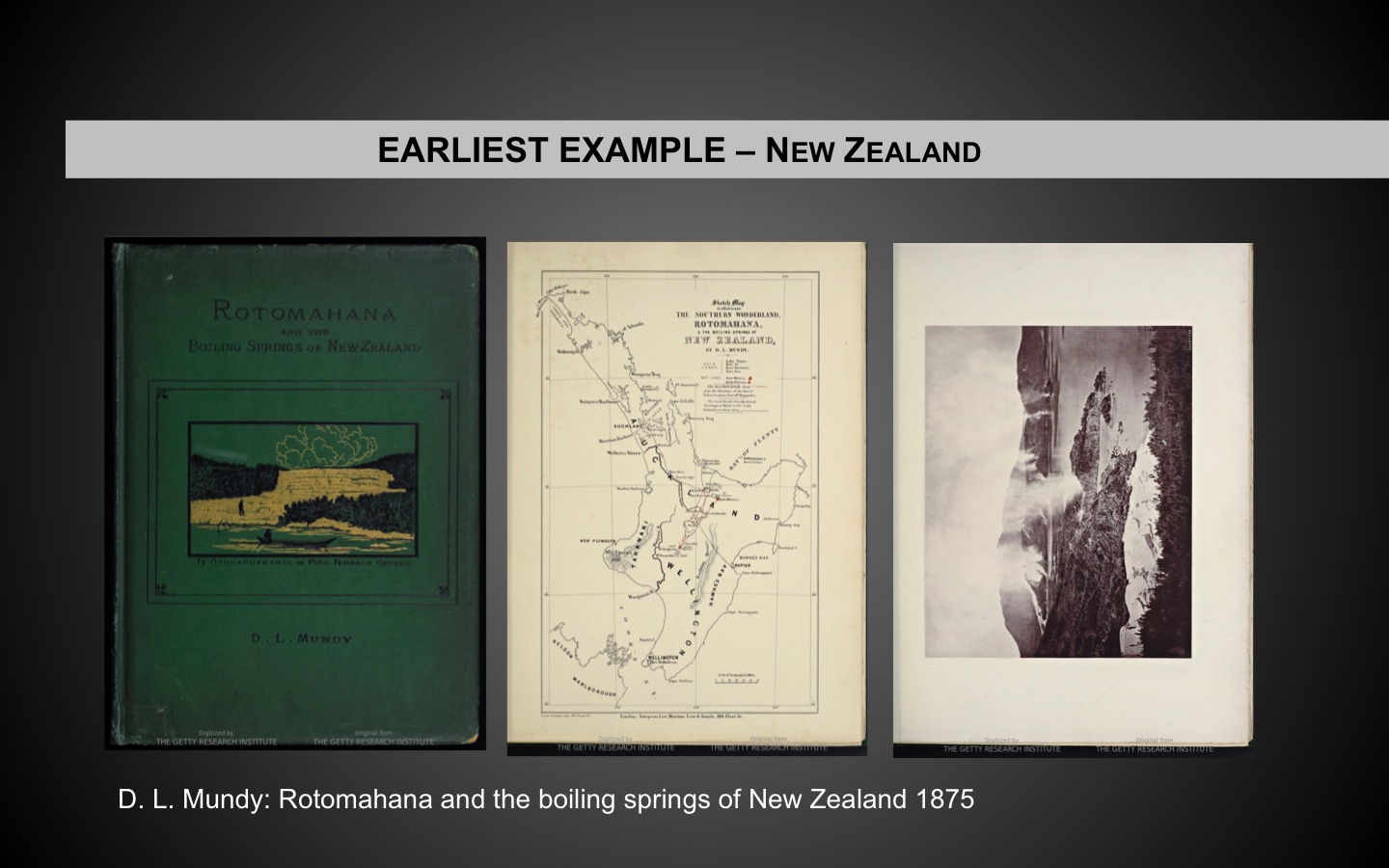
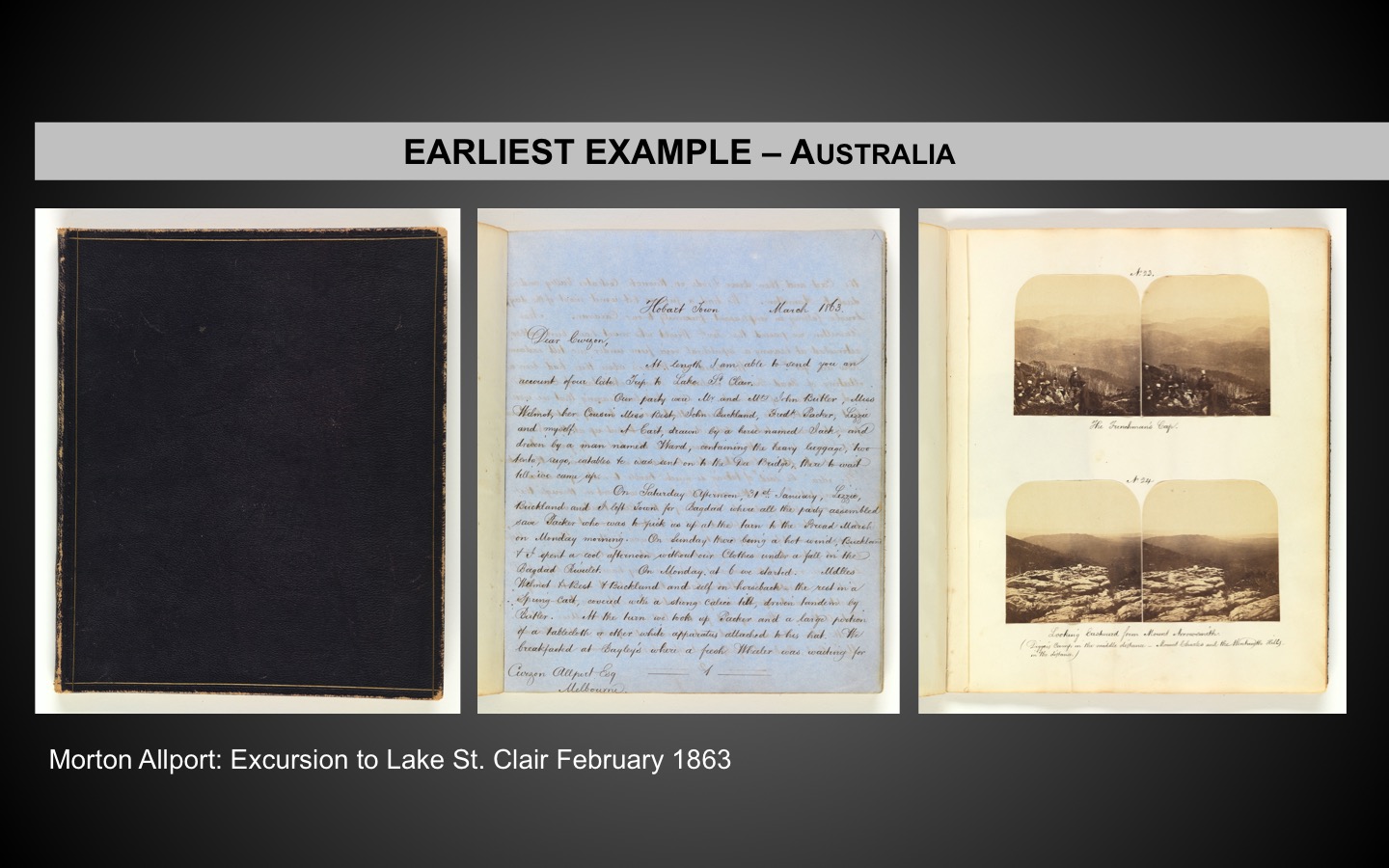
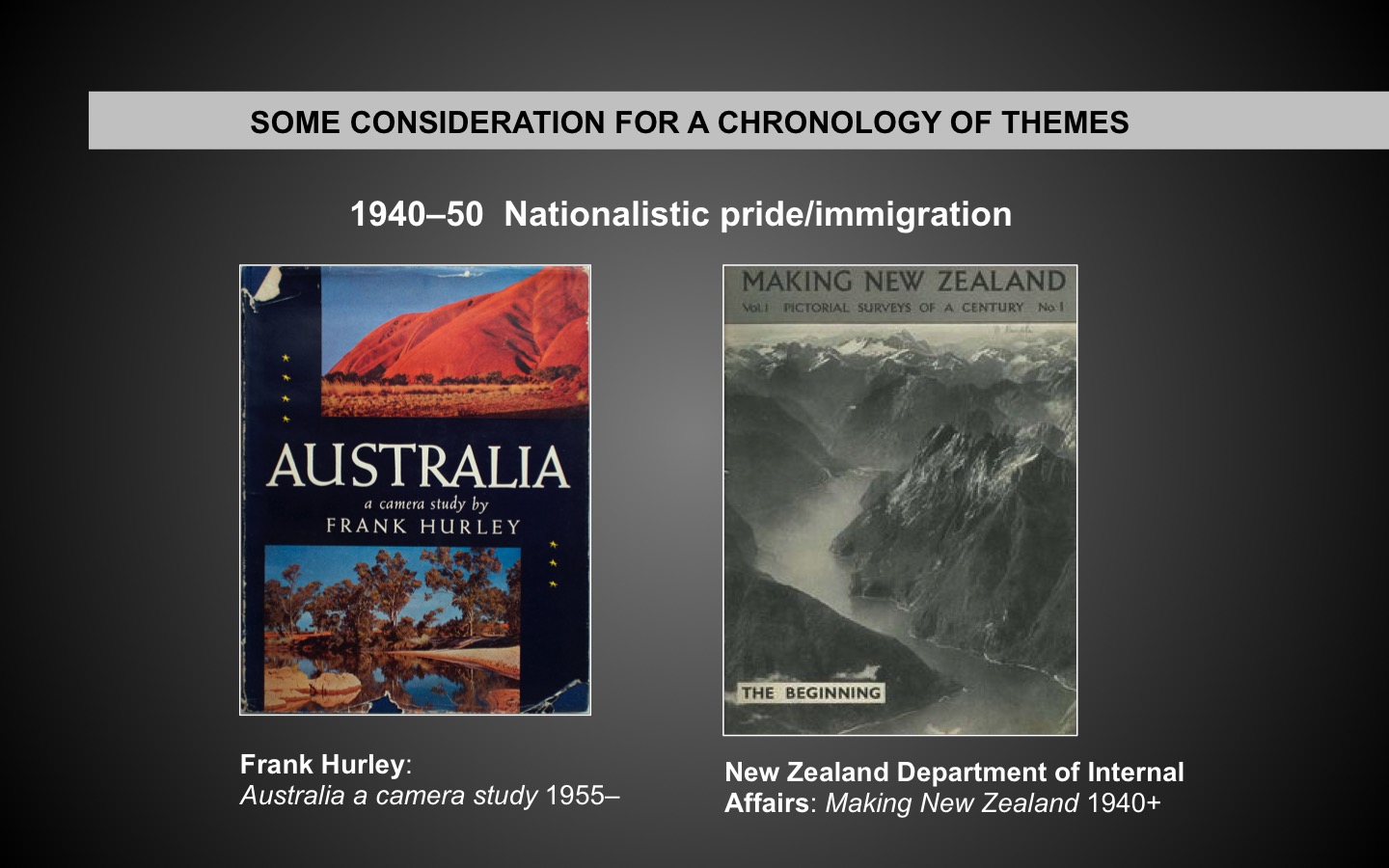
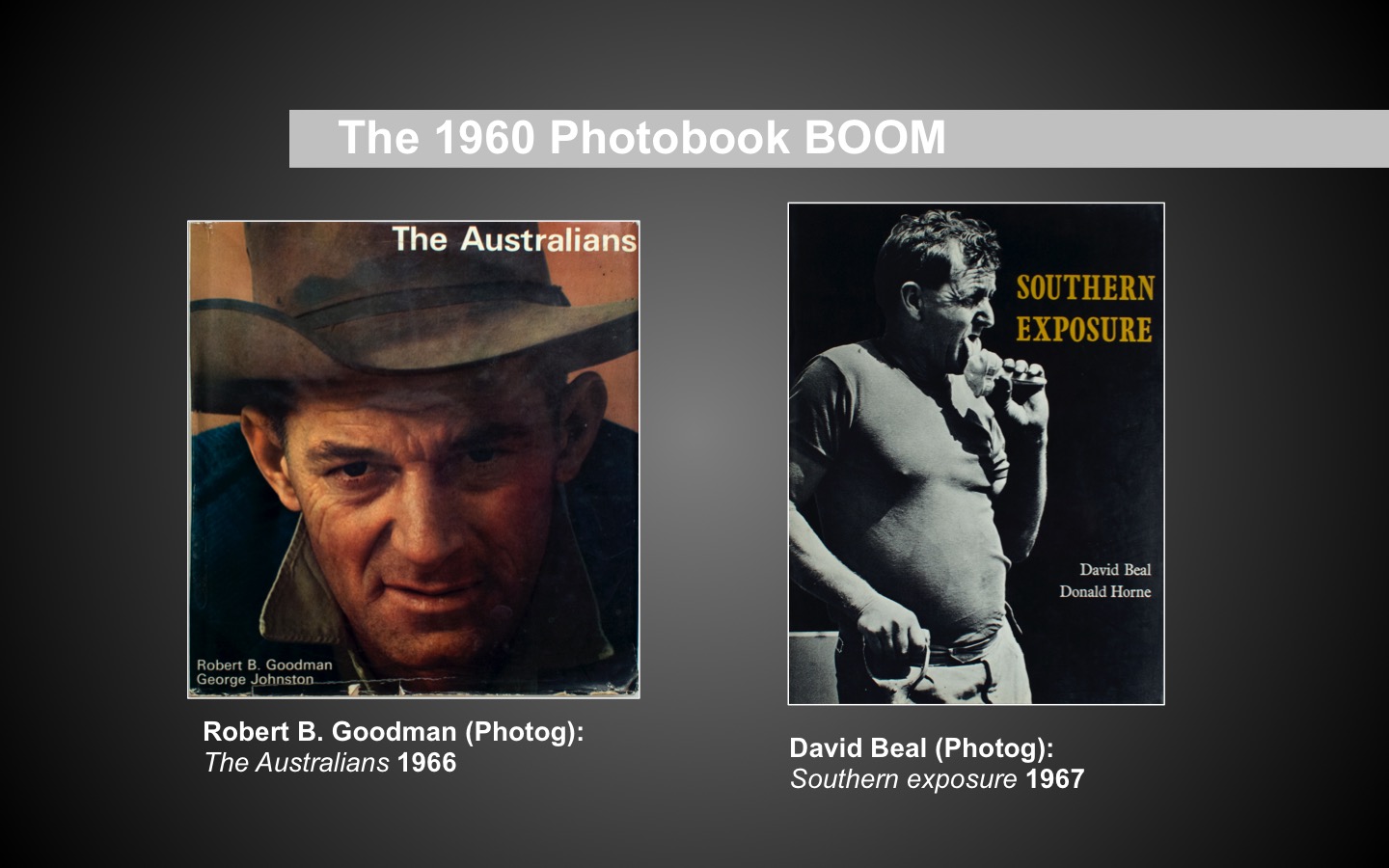
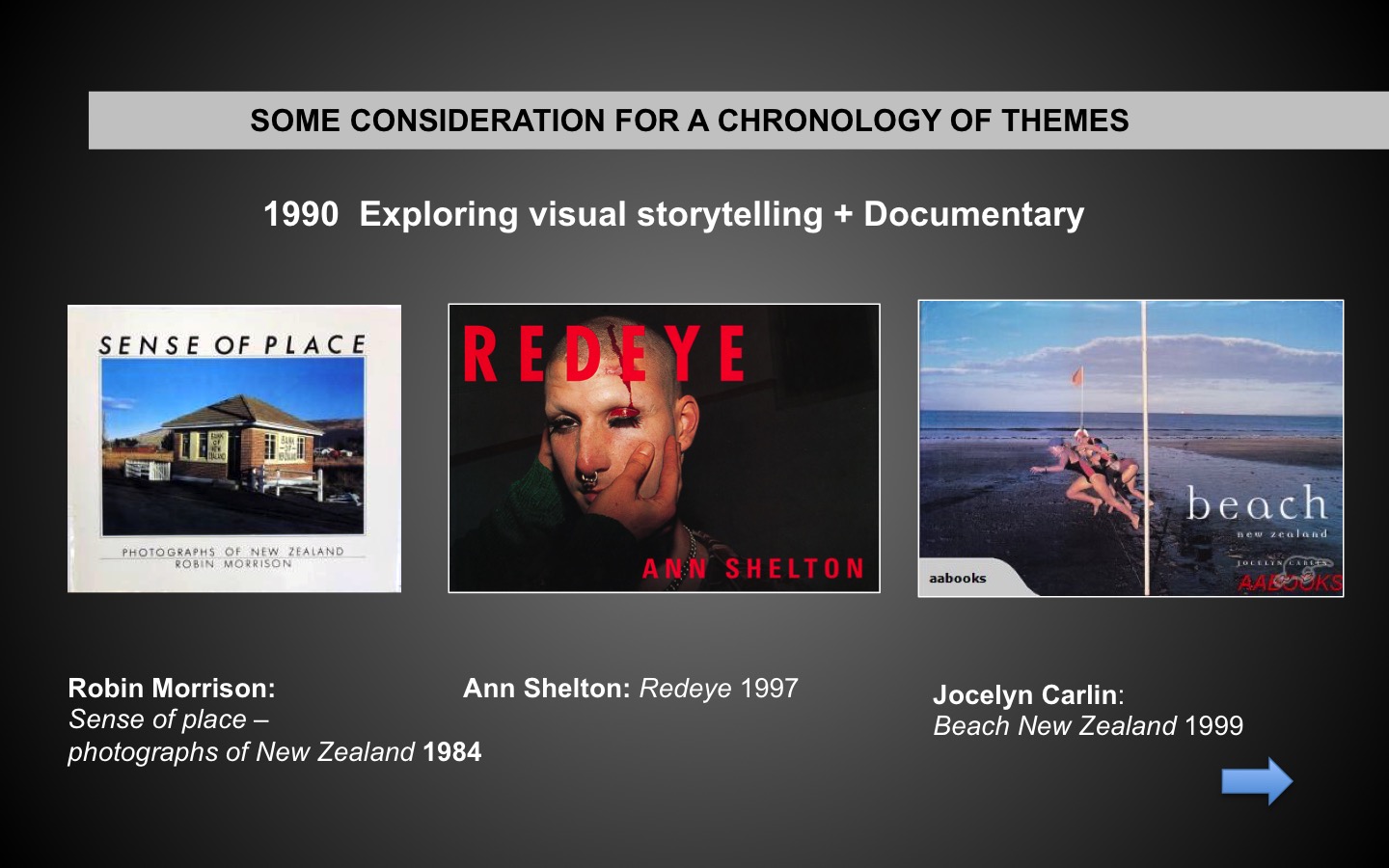
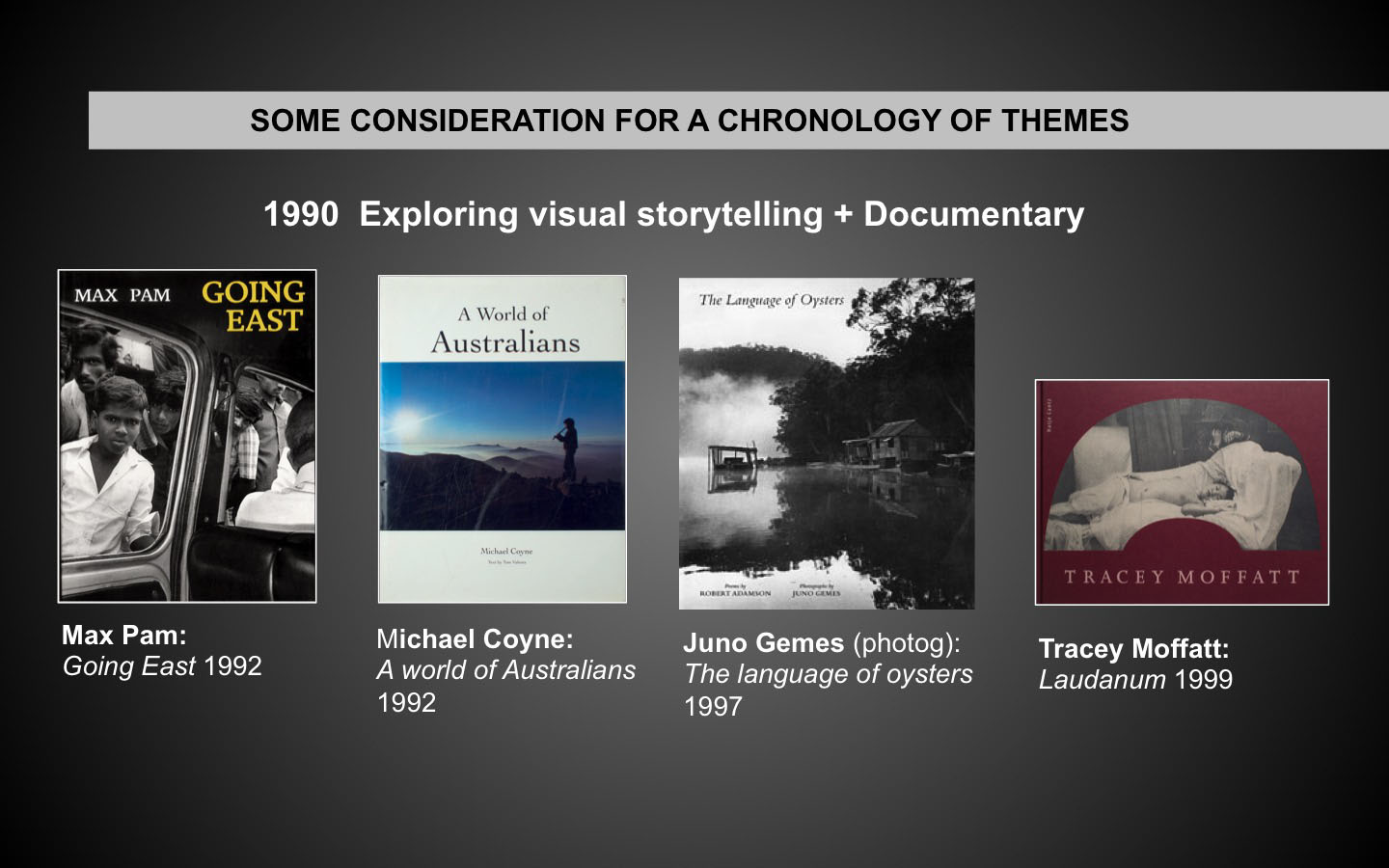
I was able also to present a discussion on the challenge of commercial book production as against personal work using Wes Stacey as an exemplar.
I also spoke about the informal links that exist between the photobook and artists’ book disciplines.
3. The contemporary scene and a selection of interesting books and makers
Here are a few slides from the presentation…
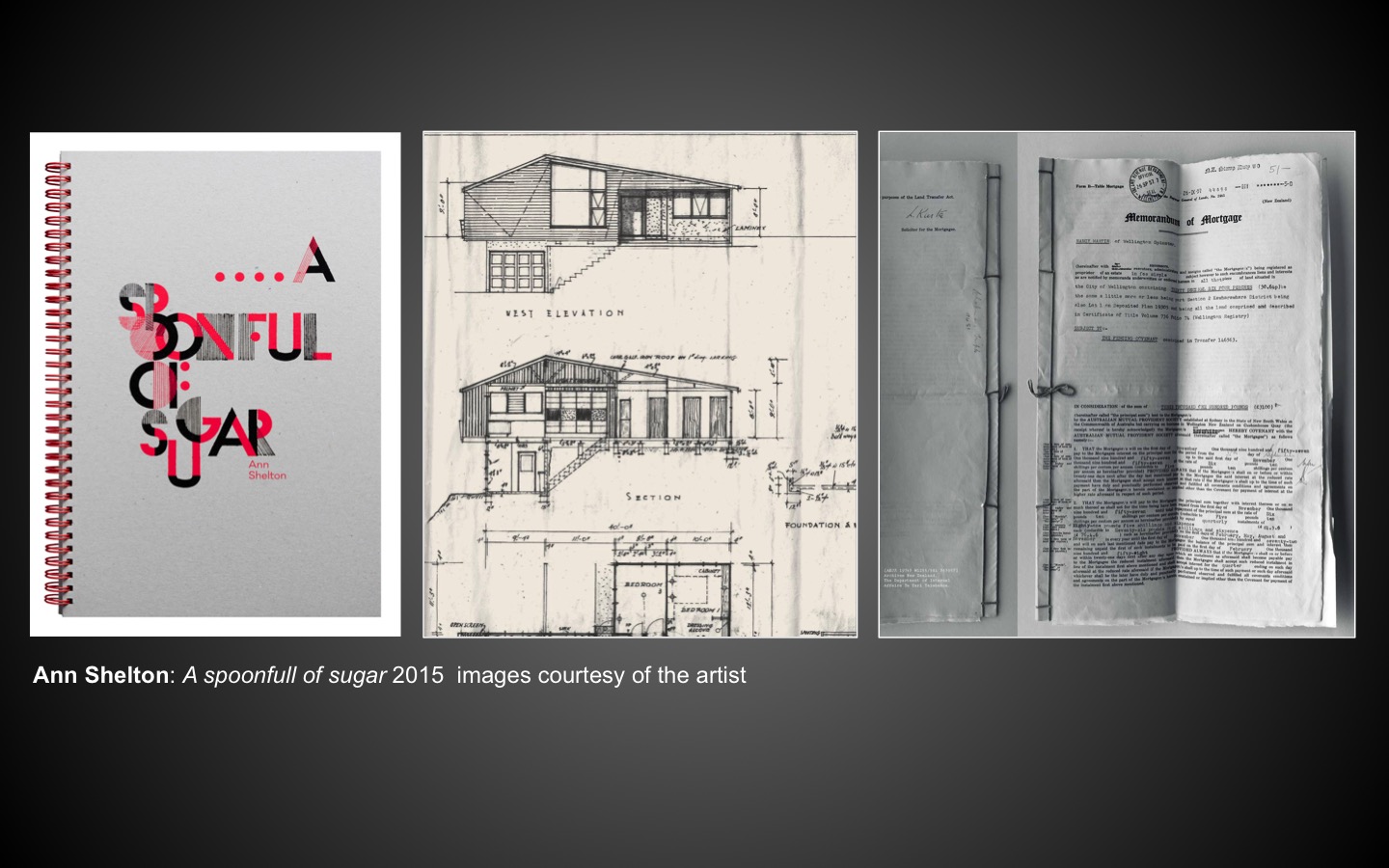
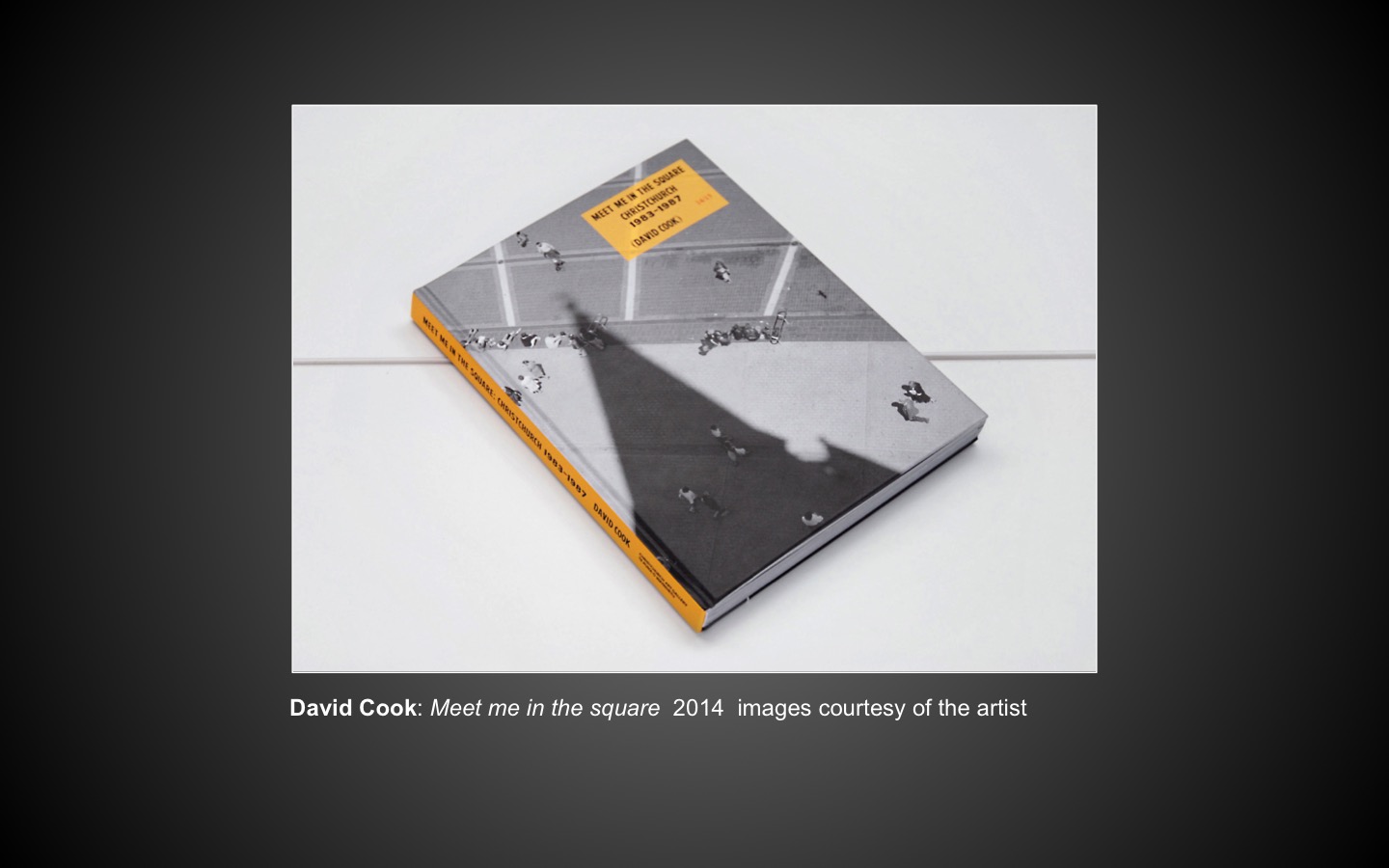
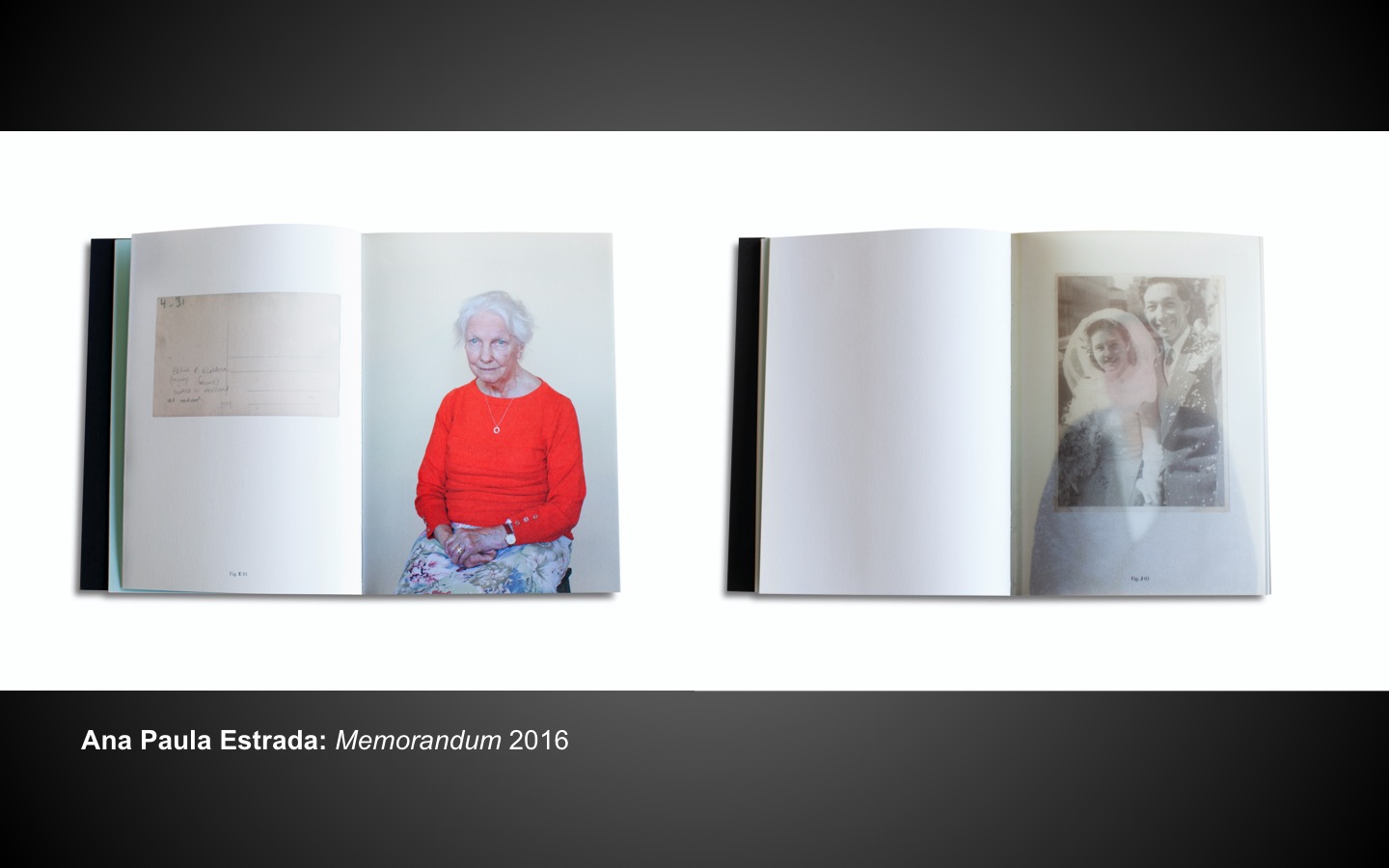
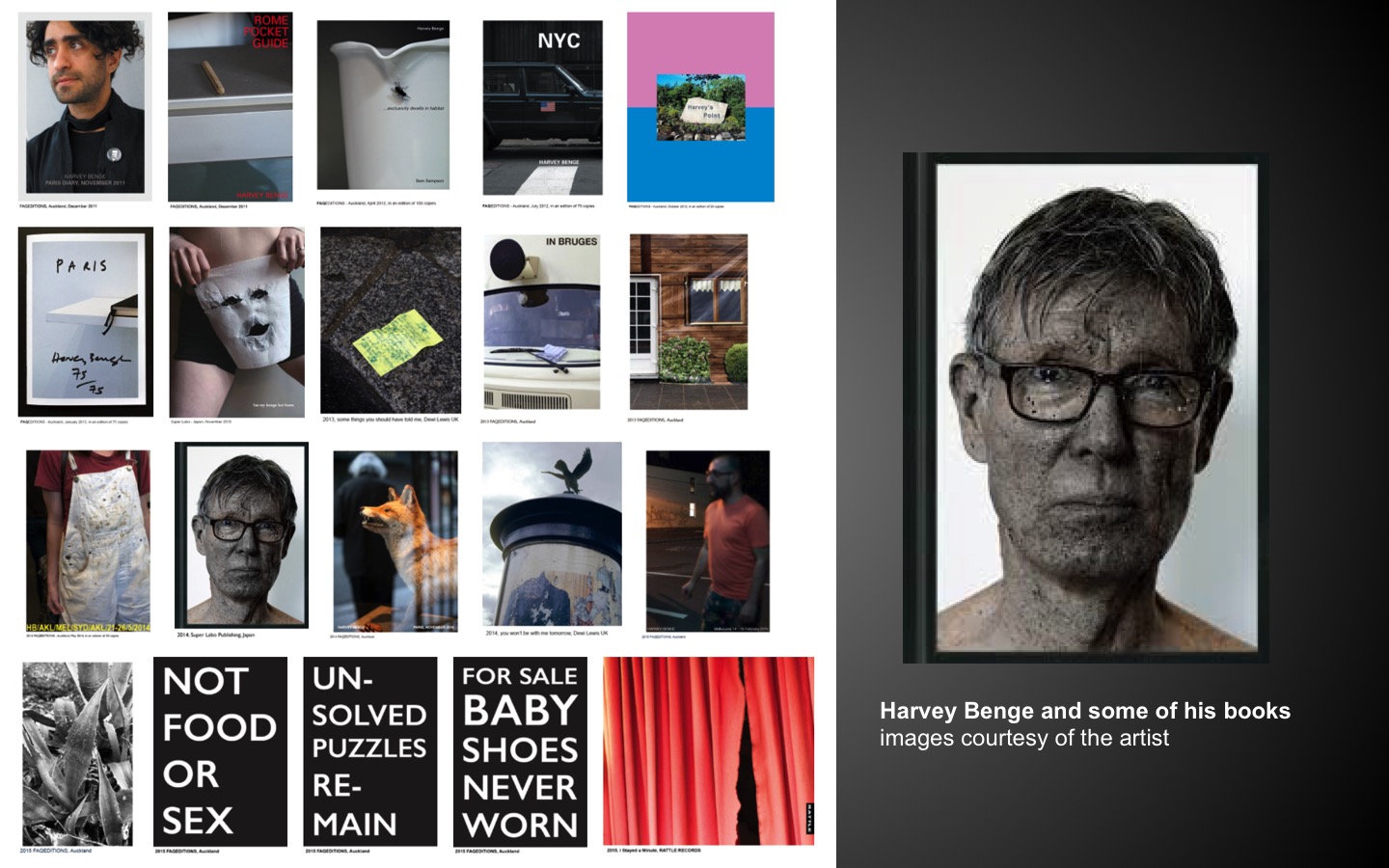
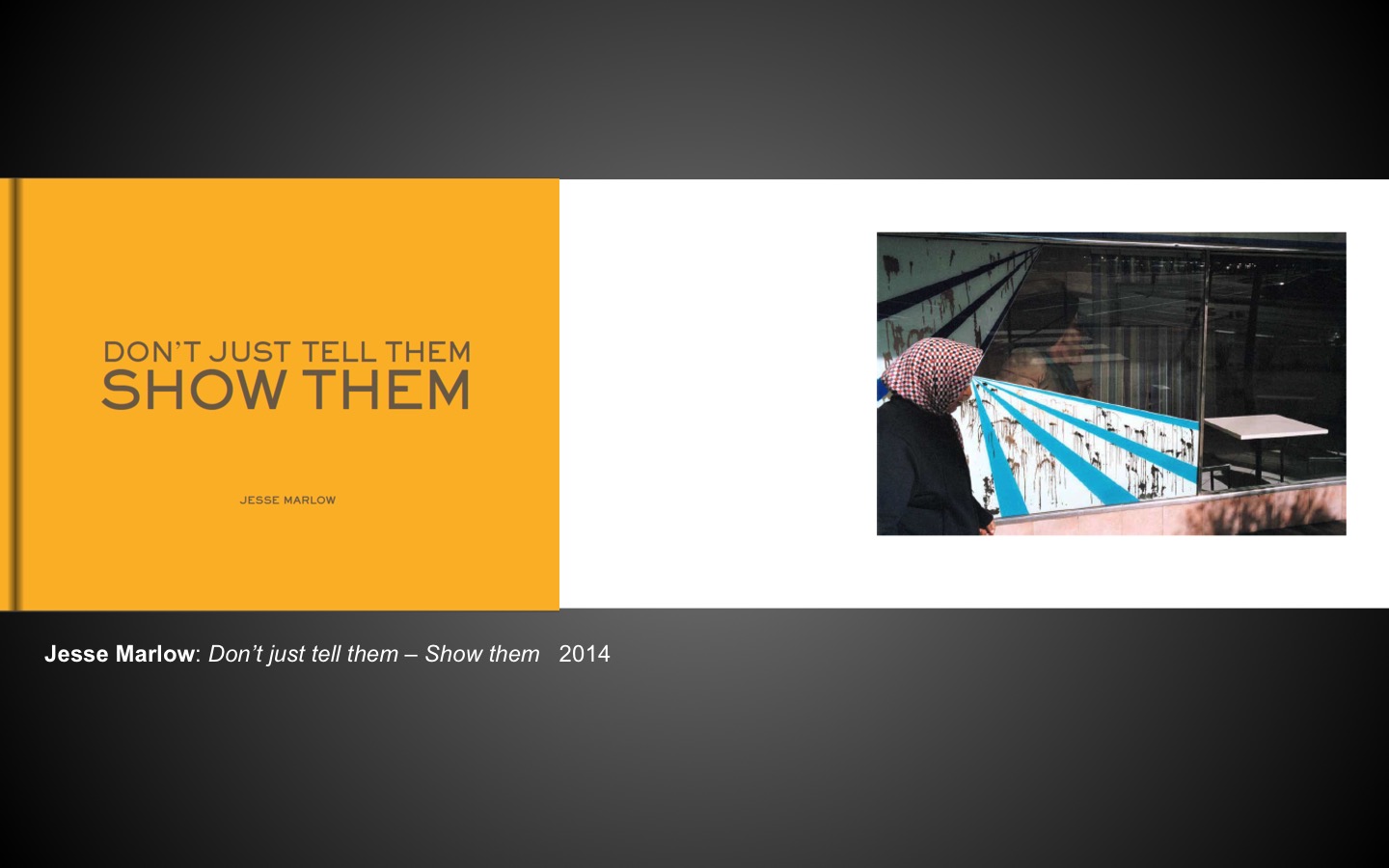
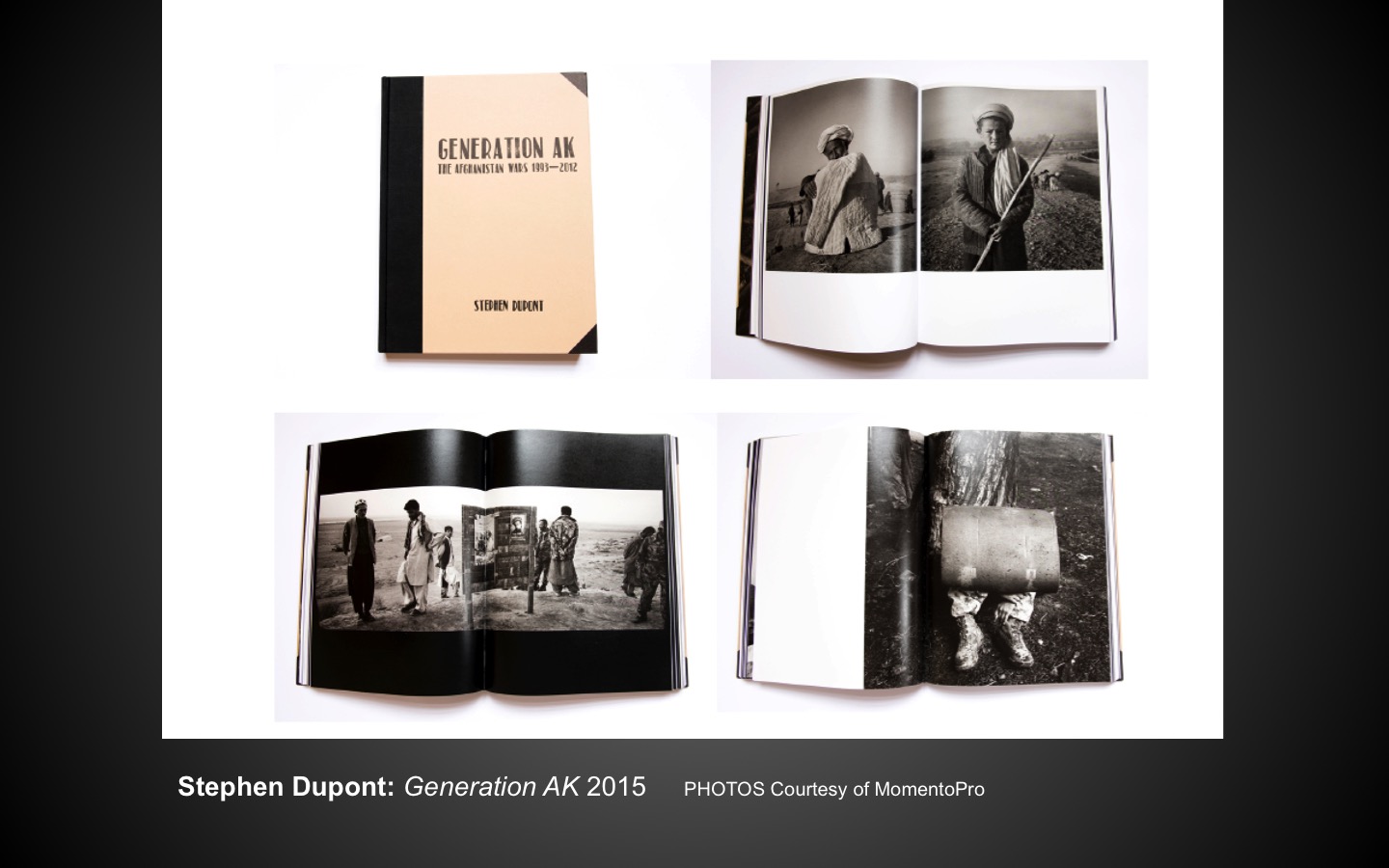
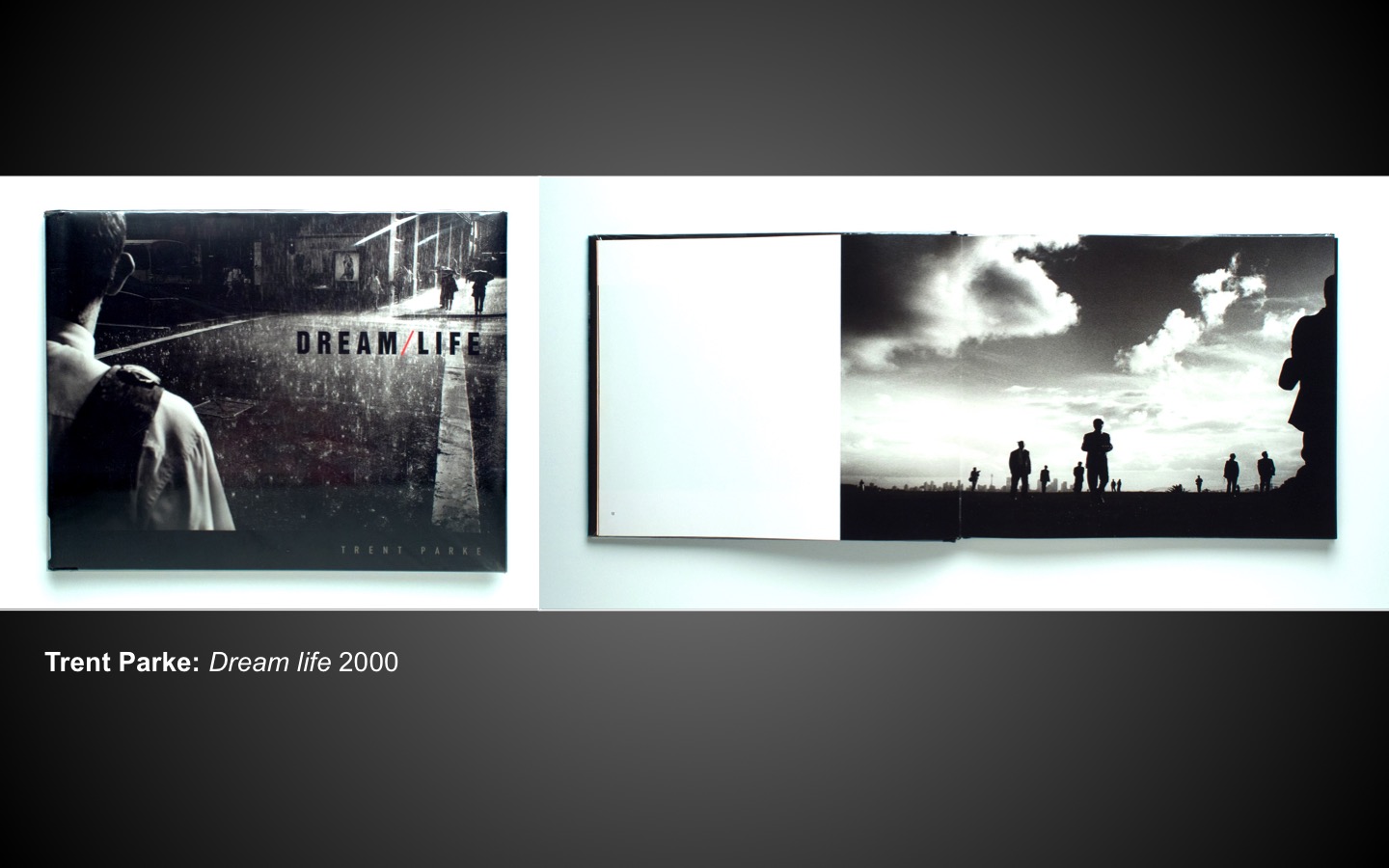
4. Voices from the Antipodean scene
It was important for me that contributors to the photobook discipline in Australia and New Zealand be given an opportunity to provide their personal insights to my presentation.
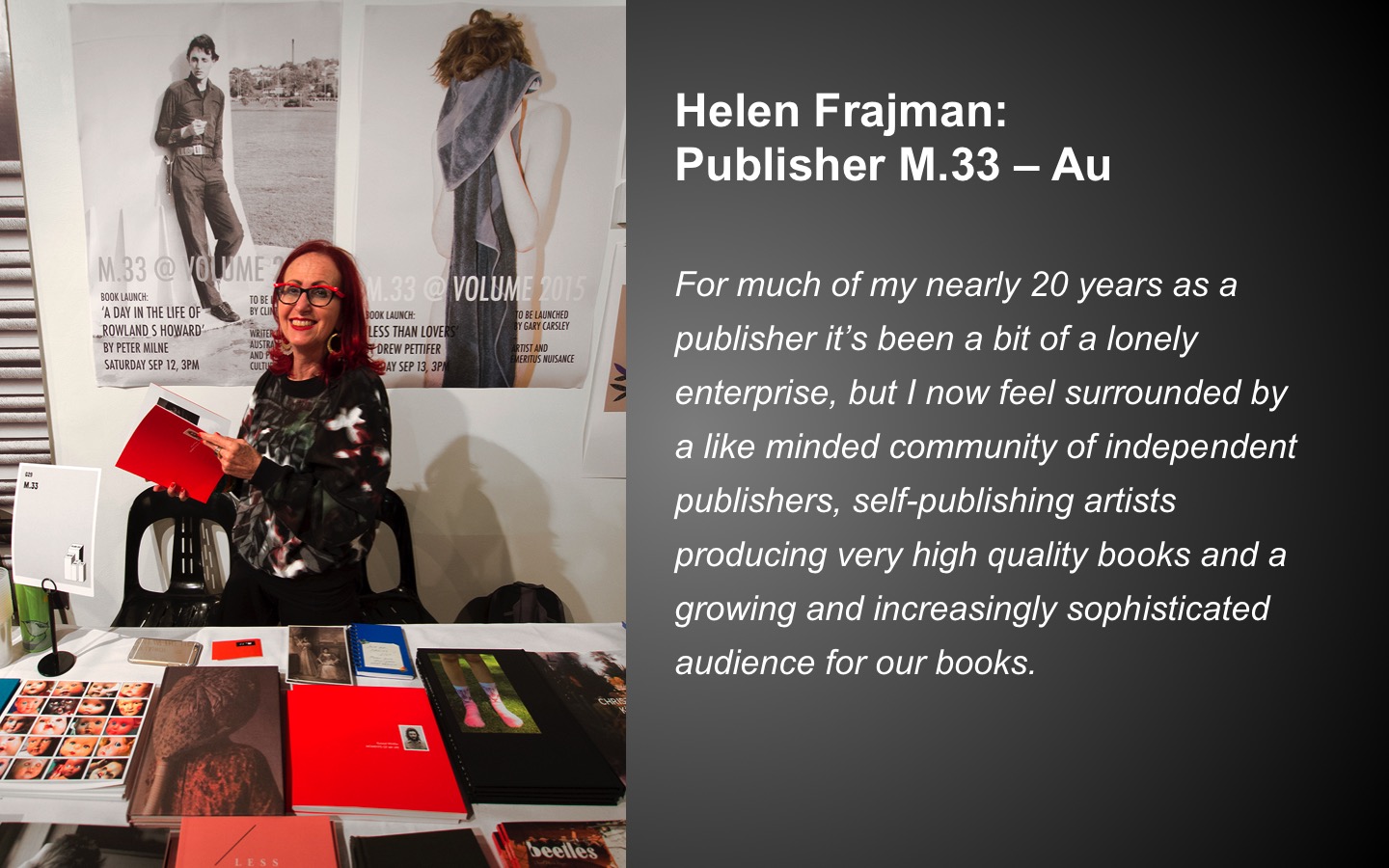
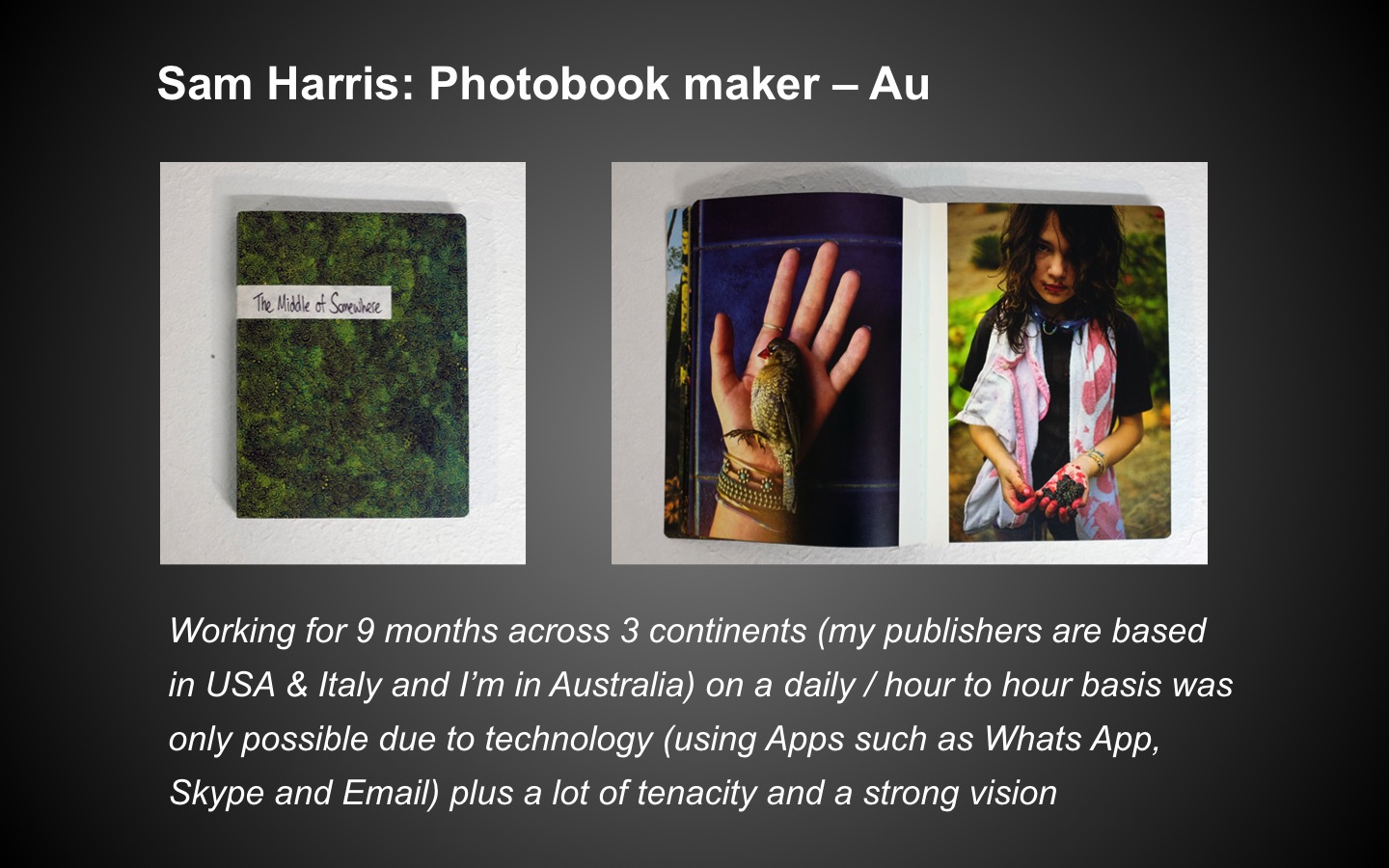
I sought comments from a range of key contributors and received responses from Libby Jeffery, Daniel Boetker-Smith, Helen Frajman, Harvey Benge, Bruce Connew, Garry Trinh, Sam Harris, Ying Ang, Anith Totha, The 2018 Photo Book Wellington Committee.
Here are a few slides from the presentation…
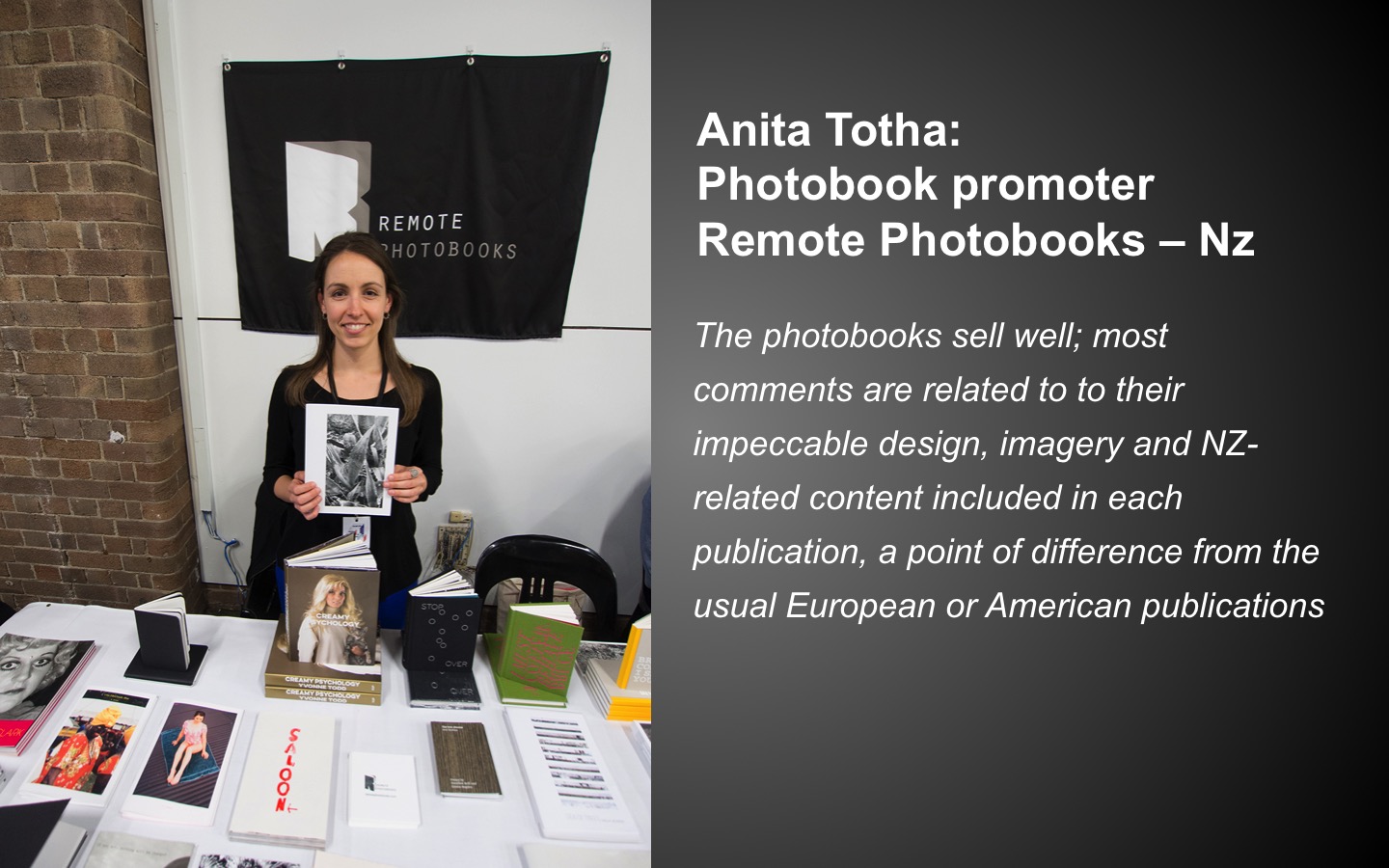
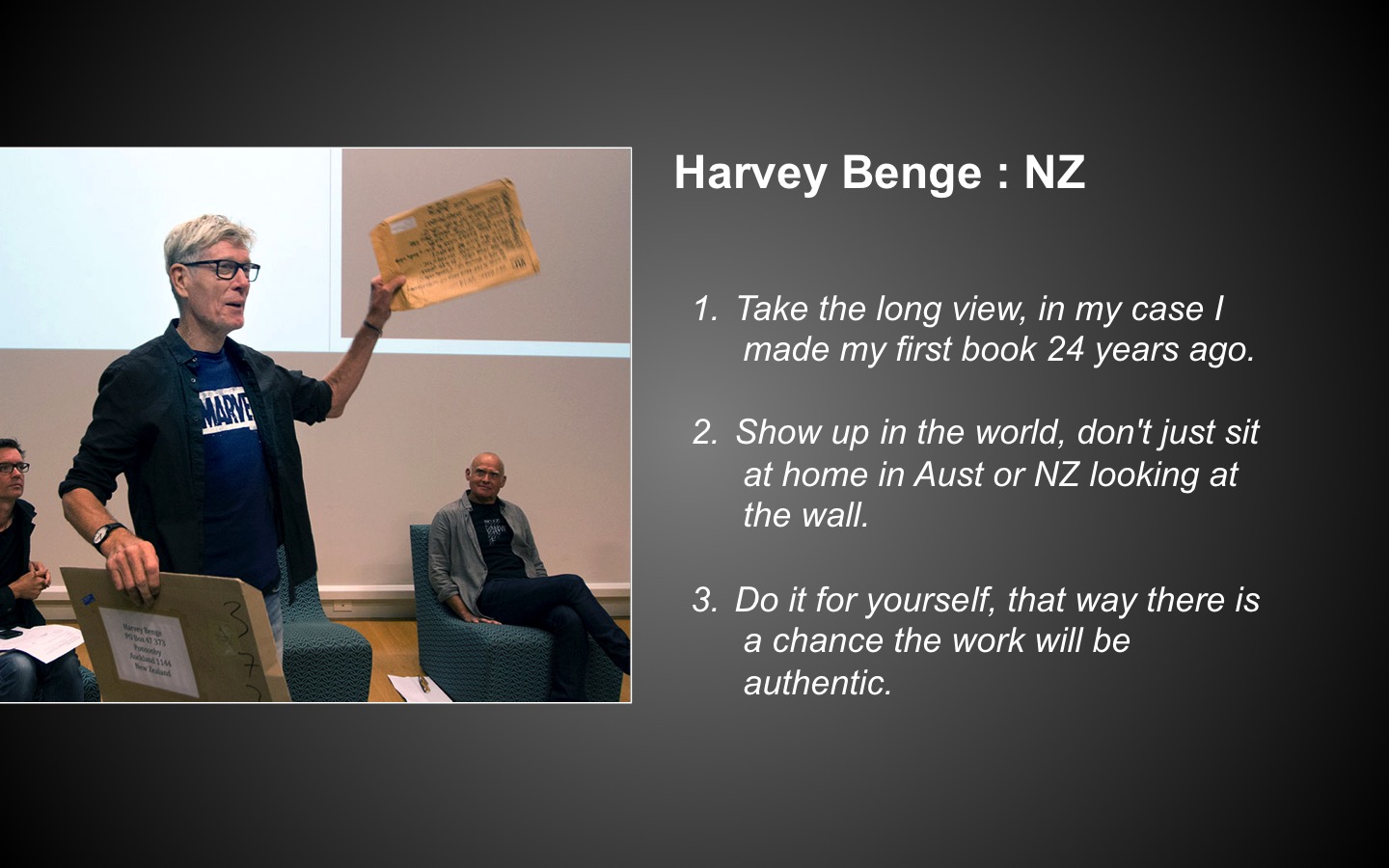
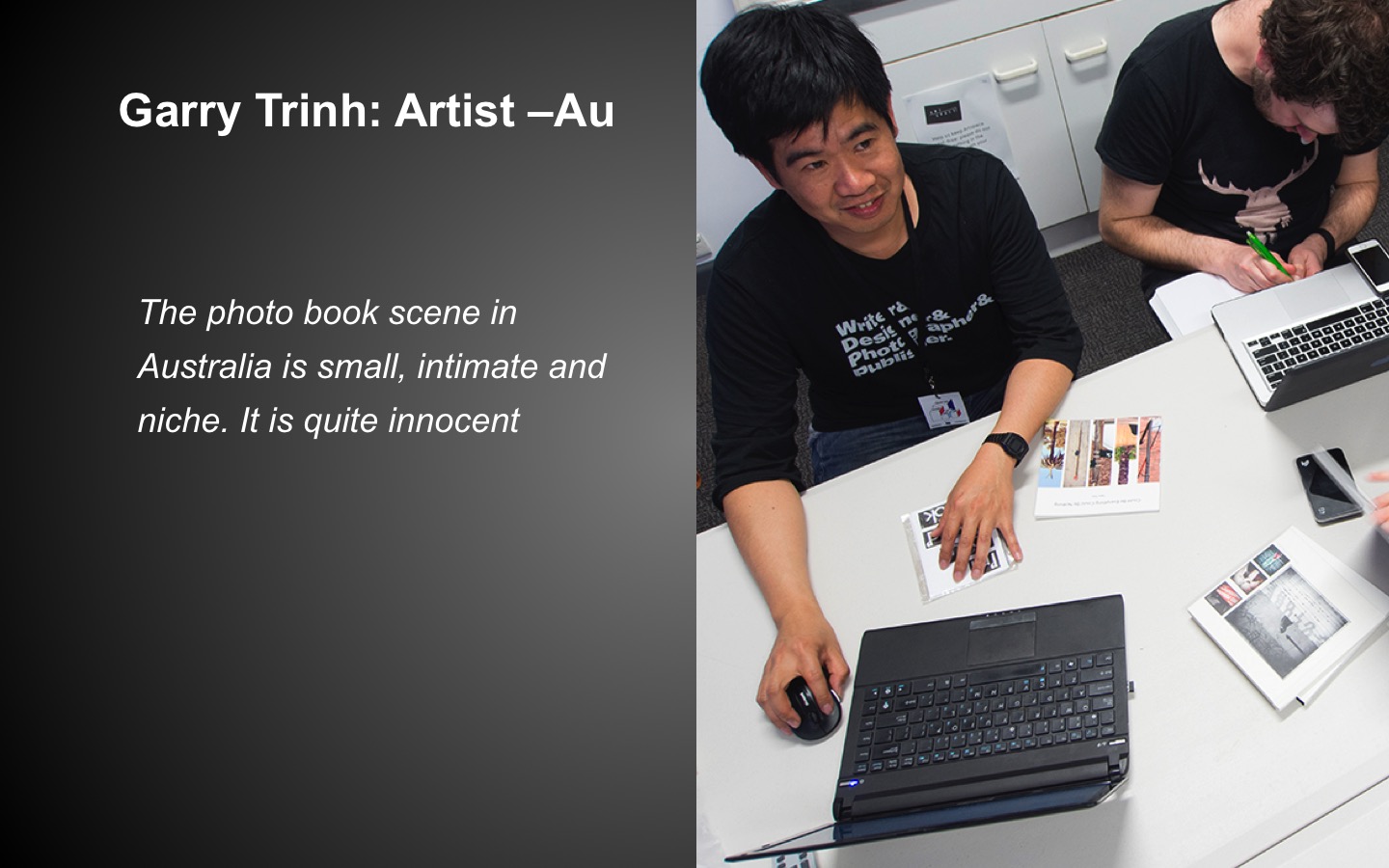
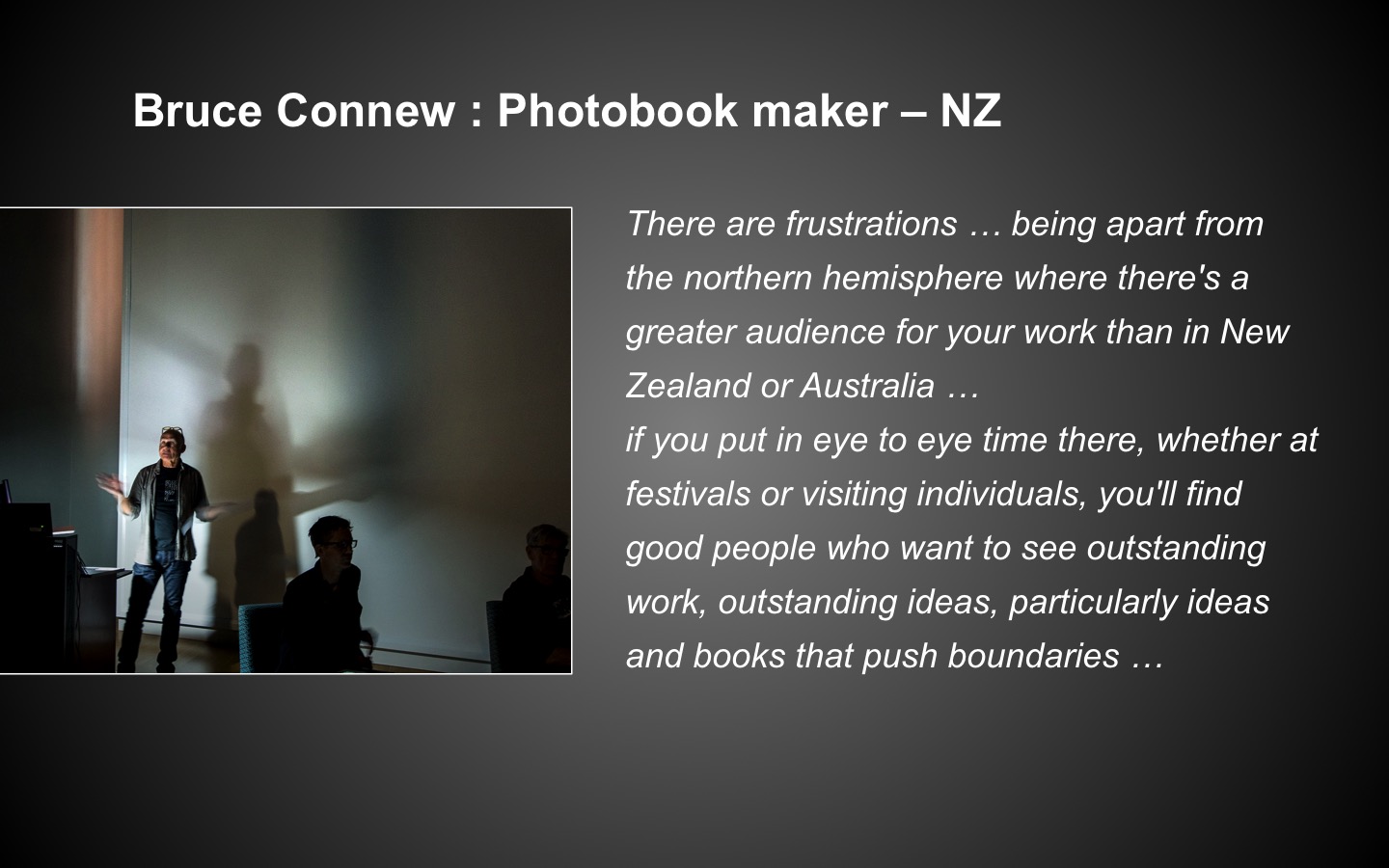
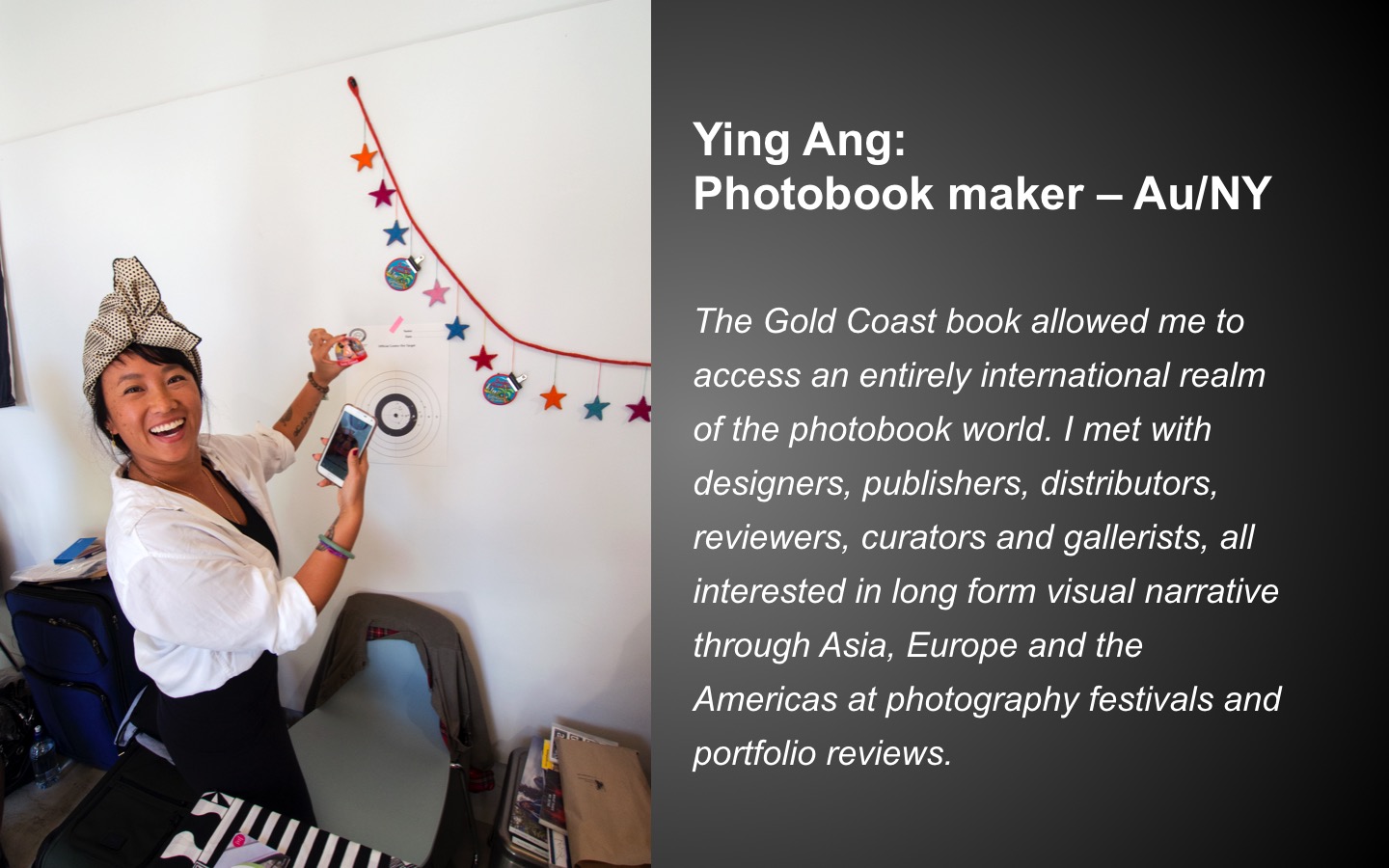
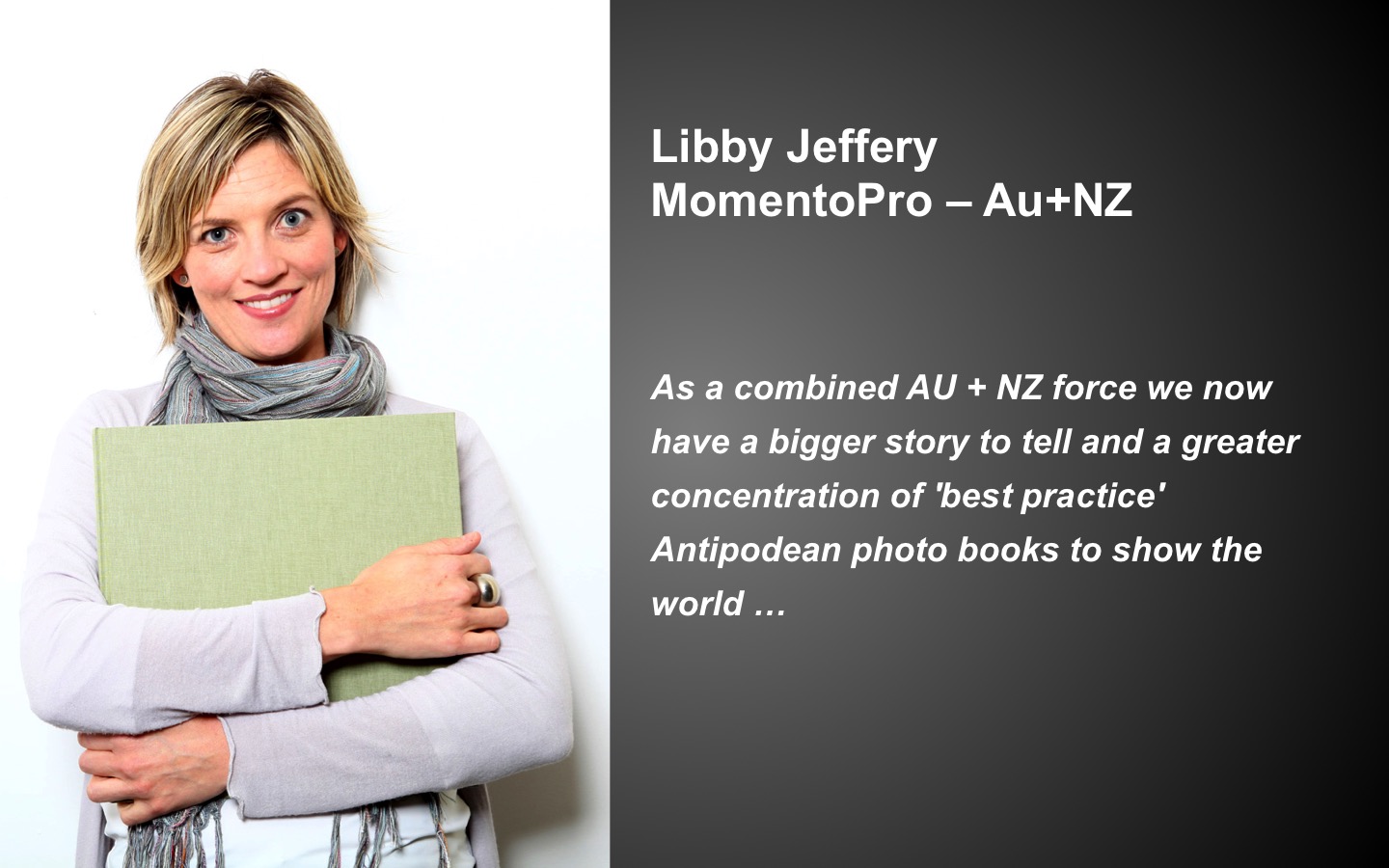
My concluding comment was that AuNZ and the Asia-Pacific regions offer new and refreshing ideas of what a photobook could be and the stories of peoples outside of the usual Euro/Americano scene.
I invited all attendees to visit our table and view the Photobook of the Year finalists and winners and offered, as an additional incentive a copy of the Awards booklet.
My lecture was well attended by festival participants from different parts of Europe including Martin Parr, Photo historian Hans-Michael Koetzle and collectors with an interest in the AuNZ books.
After the lecture Martin Parr and I discussed AuNZ photobooks that he was aware of and commented that in my lecture he had seen many new books. Our conversation continued later that day and he, Gerry Badger, and probably most of those who attended the lecture came to our table to look at the books.
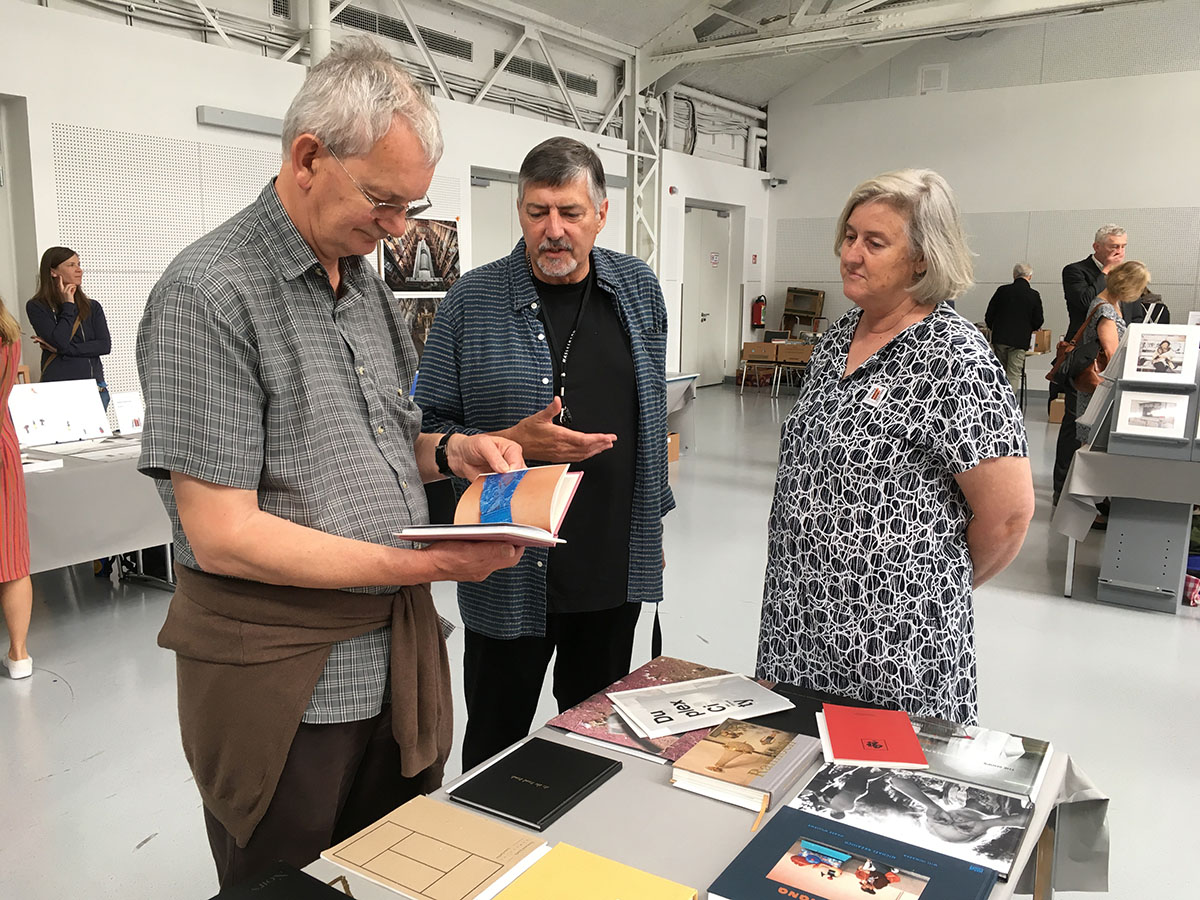
Martin Parr at the AuNZ photobook table PHOTO: Lachlan Blair
SEE ALSO
The EVENT
https://wotwedid.com/2017/06/18/aunz-photobooks-the-vienna-photo-book-festival/
The REVIEW SESSIONS
https://wotwedid.com/2017/06/18/review-panels-at-the-vienna-photo-book-festival/
.
.
.
.
.
.
.
.
.
.
.
AuNZ PHOTOBOOKS @ The Vienna Photo Book Festival
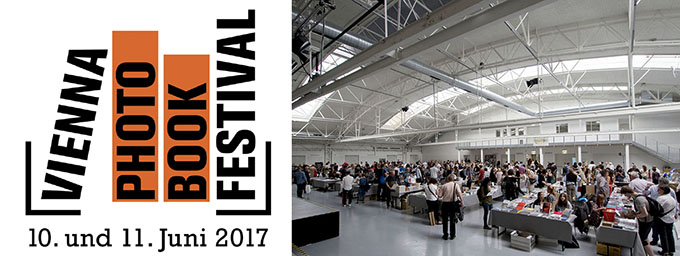
The exhibition at Brotfabrik Wien
.
THE FESTIVAL: LECTURES, ACTIVITIES, OLD+NEW BOOKS & PRINT SALES
(from the ViennaPhotoBookFestival website)
The Artistic Directors, Regina Maria Anzenberger of Anzenberger Gallery and Michael Kollmann of OstLicht Gallery state that:
The ViennaPhotoBookFestival is celebrating its 5th anniversary on the 10th and 11th of June 2017 and to celebrate the medium of the photobook accordingly we have set up an exciting program. In addition to prominent guests like the Magnum legend Bruce Davidson and the creator of The Photobook: A History and Magnum photographer Martin Parr, we are expecting the photo critics Gerry Badger and Hans-Michael Koetzle, the Russian photographer Nikolay Bakharev, archipelago founder Magali Avezou, the chief curator of the Italian center for photography Camera Francesco Zanot, the Danish photographer Krass Clement and the Swiss photographer Rene Groebli, who is celebrating his 90th birthday this year.
Also in 2017 we are following the vision of a modern platform that helps to create networks between publishers, rare photobook dealers, independent publishers, artists and students. In addition, the festival’s international lectures will attract photobook aficionados from all over the world making Vienna a photobook metropolis once again.
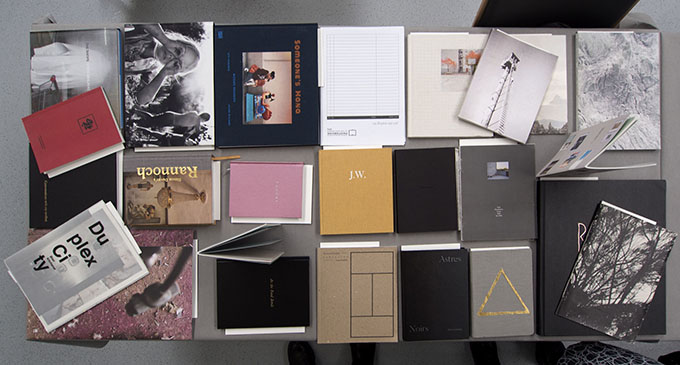
The AuNZ Photobook of the Year set of books
Early Saturday morning along with 100 other table holders we unpacked and set-up our display. Around us other table holders offered everything from prints to booksellers of new and antiquarian books, student groups and educational institutions from all over Europe. There were special activities including a 10×8 Polaroid portrait and wet plate photography studios.
Our ANZ PBOTY display was positioned next to our Austrian/expat Australian friend Lachlan Blair’s table. Although he had paid for his table to show his beautiful photogram works and prints, Lachlan also shared the table minding duties with us. With his support we all were able to attend lecture events and also checkout other VPBF tables.
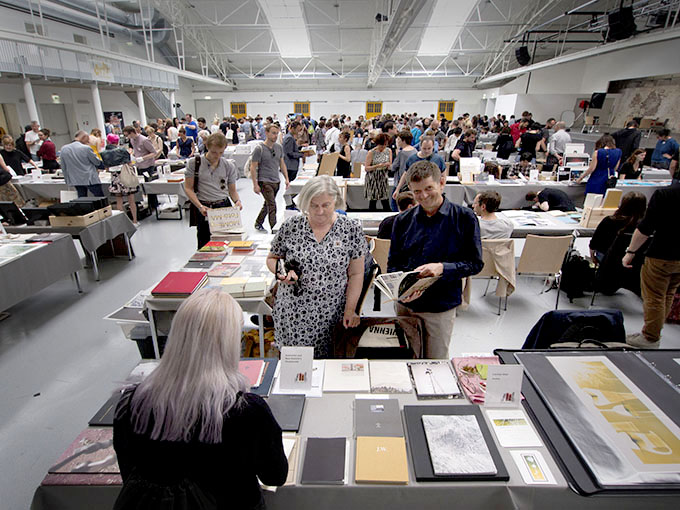
The exhibition space with the AuNZ table in the foreground
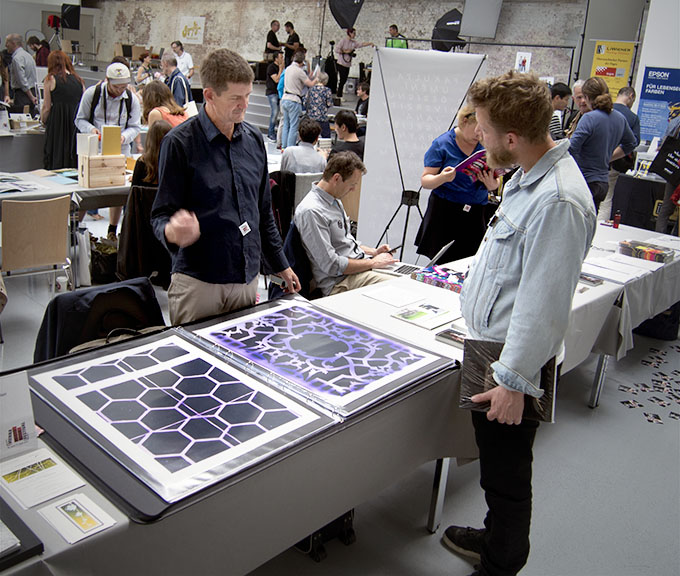
Lachlan Blair’s photogram print display
The history of the photobook was represented by significant collections and booksellers – I held a copy of Roy DeCarava’s Sweet flypaper of life… Lazlo Moholy-Nagy’s essay in Telehor from 1936 – books by Blossfeldt, Brandt, Van Elsen, Klaus Clement. I held back – a limited budget, though my new friend from Russia Natalia had an amazing handmade book by Julia Borissova that I had to buy, other books were bought and some were swapped – one of these was Surveillance by Valentyn Odnoviun which featured the circular observation peep-holes from Gestapo, STASI and KGB prisons – a most chilling yet remarkable book, this work was inspired by his father’s incarceration for 3 years on false charges.
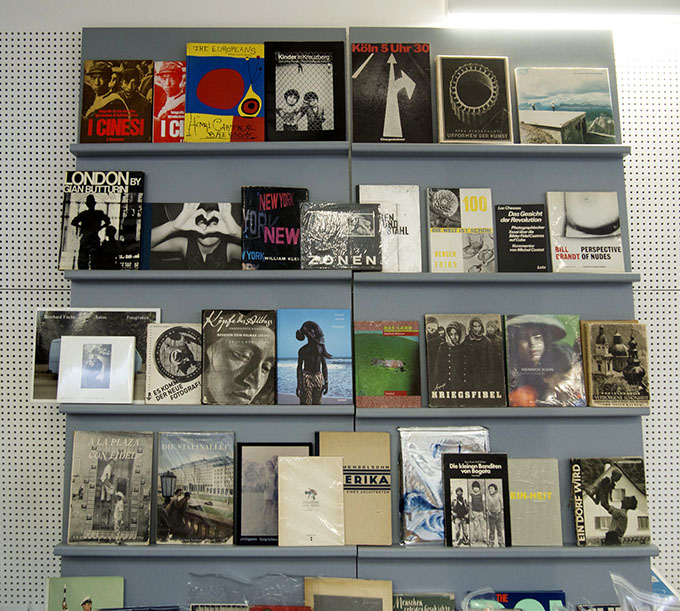
Classic photobooks
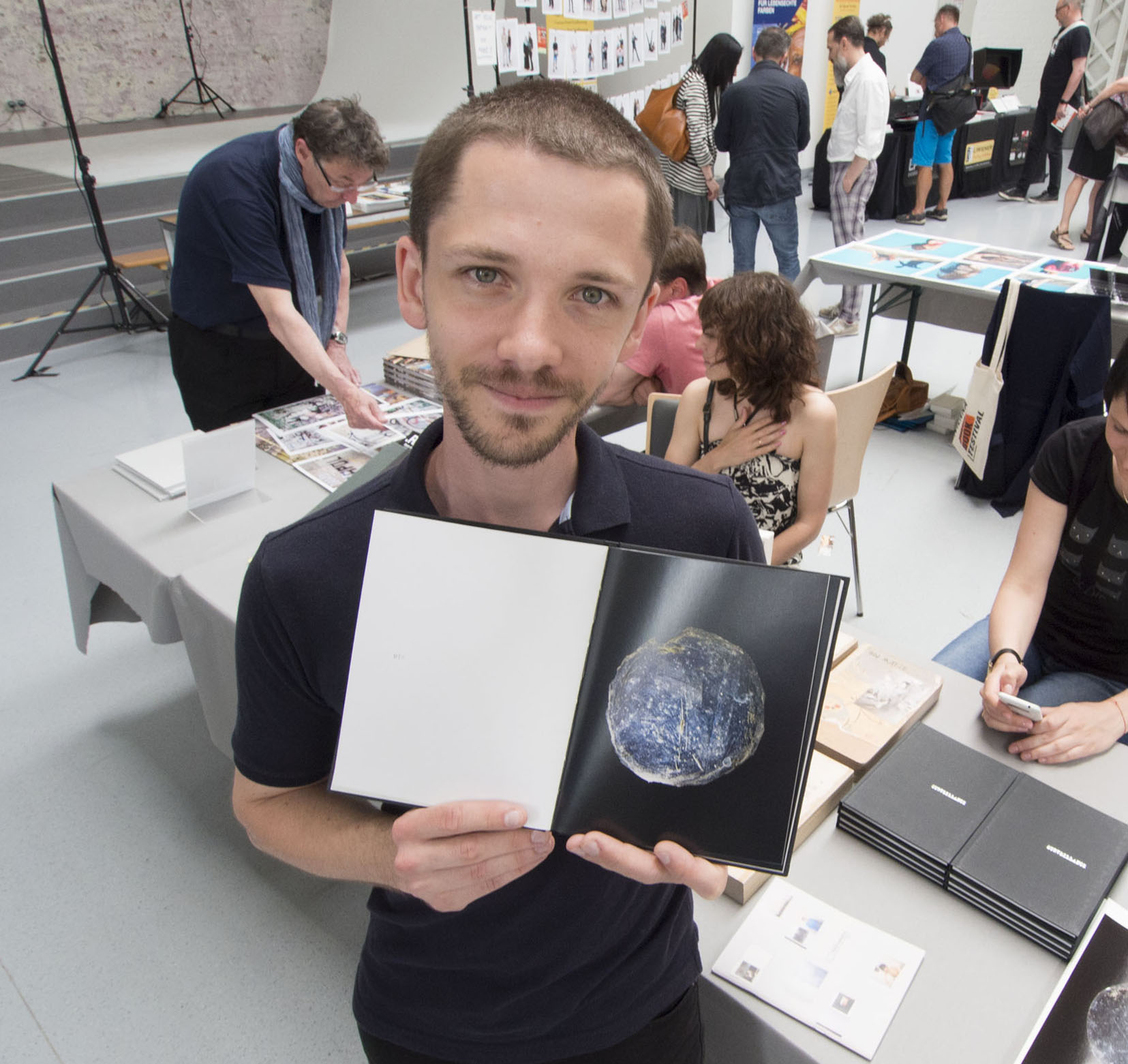
Valentyn Odnoviun with his book ‘Surveillance’
Martin Parr was interviewed by Verena Kaspar-Eisert at the opening event – the room was full. Parr was the complete mischievous interviewee as Verena teased out some interesting facts and comments from this ‘Photobook Rock Star’.
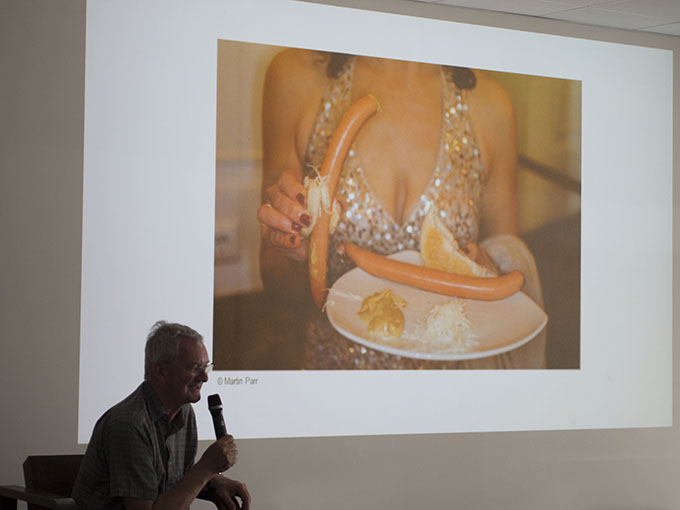
Martin Parr being interviewed by Verena Kaspar-Eisert
Sunday continued the frantic pace – lectures, including one by Bruce Davidson, another by Nikolay Bakharev and Klaus Clement interviewed by Gerry Badger.
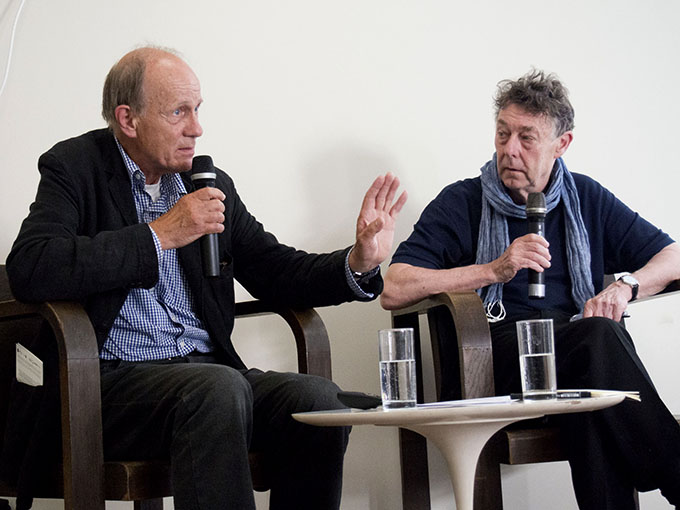
Krass Clement being interviewed by Gerry Badger
As the hours wore down there was a frantic activity to see other tables and catch up with as much as one could handle. MomentoPro had also sent along with the books around 30 of the little catalogues and these became gifts to selected viewers of our books… these included collectors, teachers serious photobook makers and others from the photo press and of course Anzenberger, Badger and Parr.
We received many statements from viewers complimenting the quality of our books some even saying that the work was better than the general European scene. In response to people wanting to buy ANZ books we suggested direct connection with the photographers websites, bookshops and online stores in ANZ. One collector came to us on Sunday and excitedly exclaimed that he had been in contact with a NZ photographer and had bought the book…! Katrin Koenning+ Sarker Protick’s Astres Noirs APOTY winner could have been sold many time over as it’s 1st edition is ‘sold out’ and is now a rarity – luckily the Anzenberger Bookshop had copies of the 2nd edition.
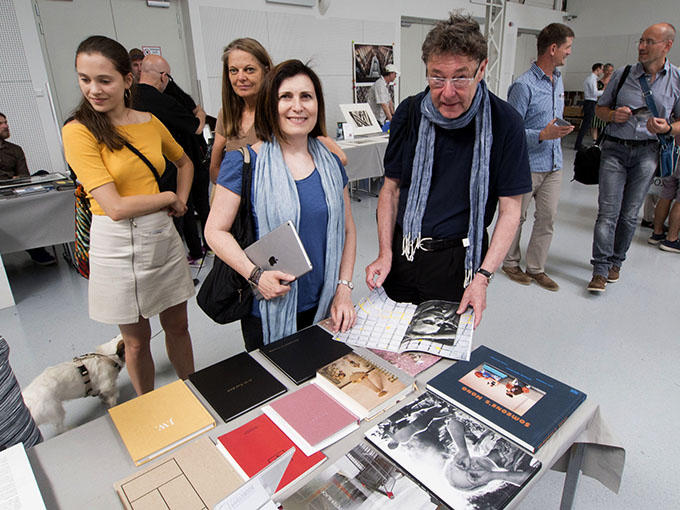
Gerry Badger with Sonia Lenzi at the AuNZ table
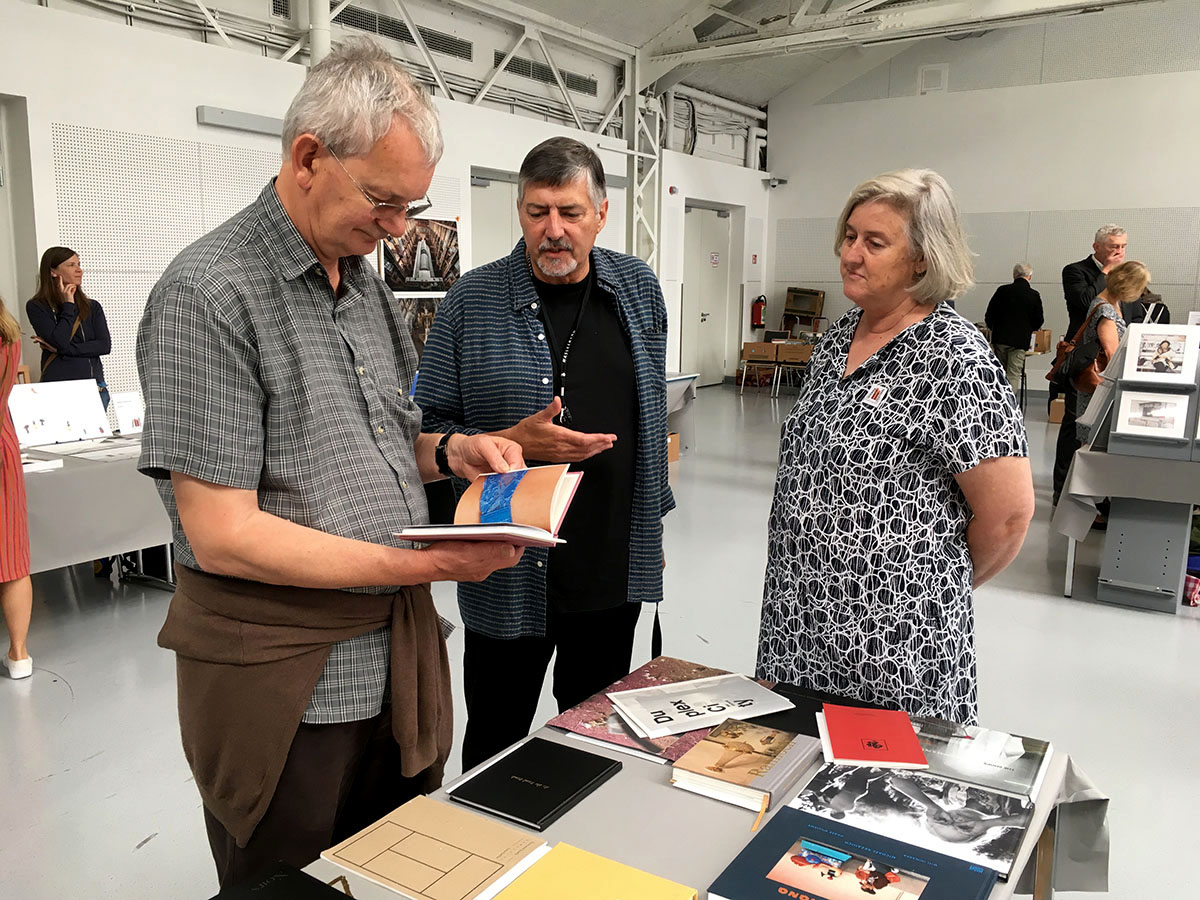
Martin Parr at the AuNZ table
In the final minutes of the 2016 VPBF all table holders packed up their displays of books and prints leaving behind a vacant space that had once held so many books, their stories and those who make or care for them. We left the building, said our goodbyes, repacked suitcases with new books and a couple of hours later Lachlan took us to Vienna airport to catch our flight home.
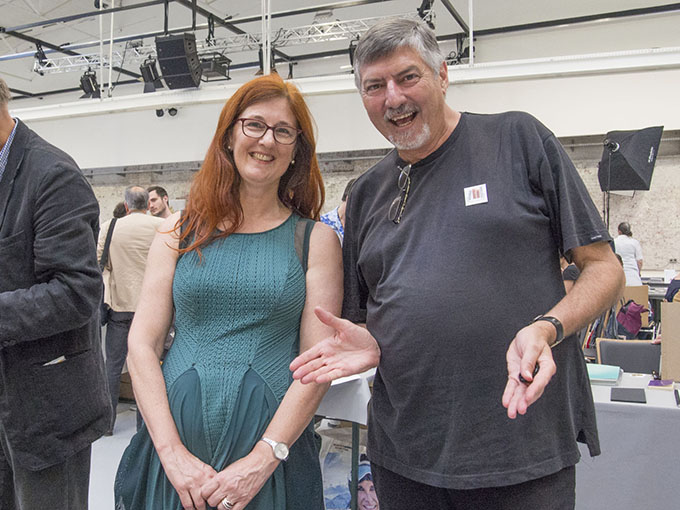
Regina Maria Anzenberger and Doug Spowart
It’s now the middle of the plane flight somewhere over the Black Sea – about 1.35am. I’m still pumped and excited to have been able to have made this foray into the European photobook scene. I also want to acknowledge the support of Regina Marie Anzenberger and Michael Kollmann from Vienna Photobook Festival, Libby Jeffery and Rony Wilson of MomentoPro, Lachlan Blair and my partner Victoria Cooper,
For many people in the northern hemisphere Australia and New Zealand will be known not just as an interesting travel destination but rather a place where a dynamic photobook network of practitioners exists making great books….
.
What follows is a selection of images from the event…


SEE ALSO:
The LECTURE
The REVIEW SESSIONS
https://wotwedid.com/2017/06/18/review-panels-at-the-vienna-photo-book-festival/
ZINES IN MELBOURNE: Sticky Institute’s Festival of the Photocopier
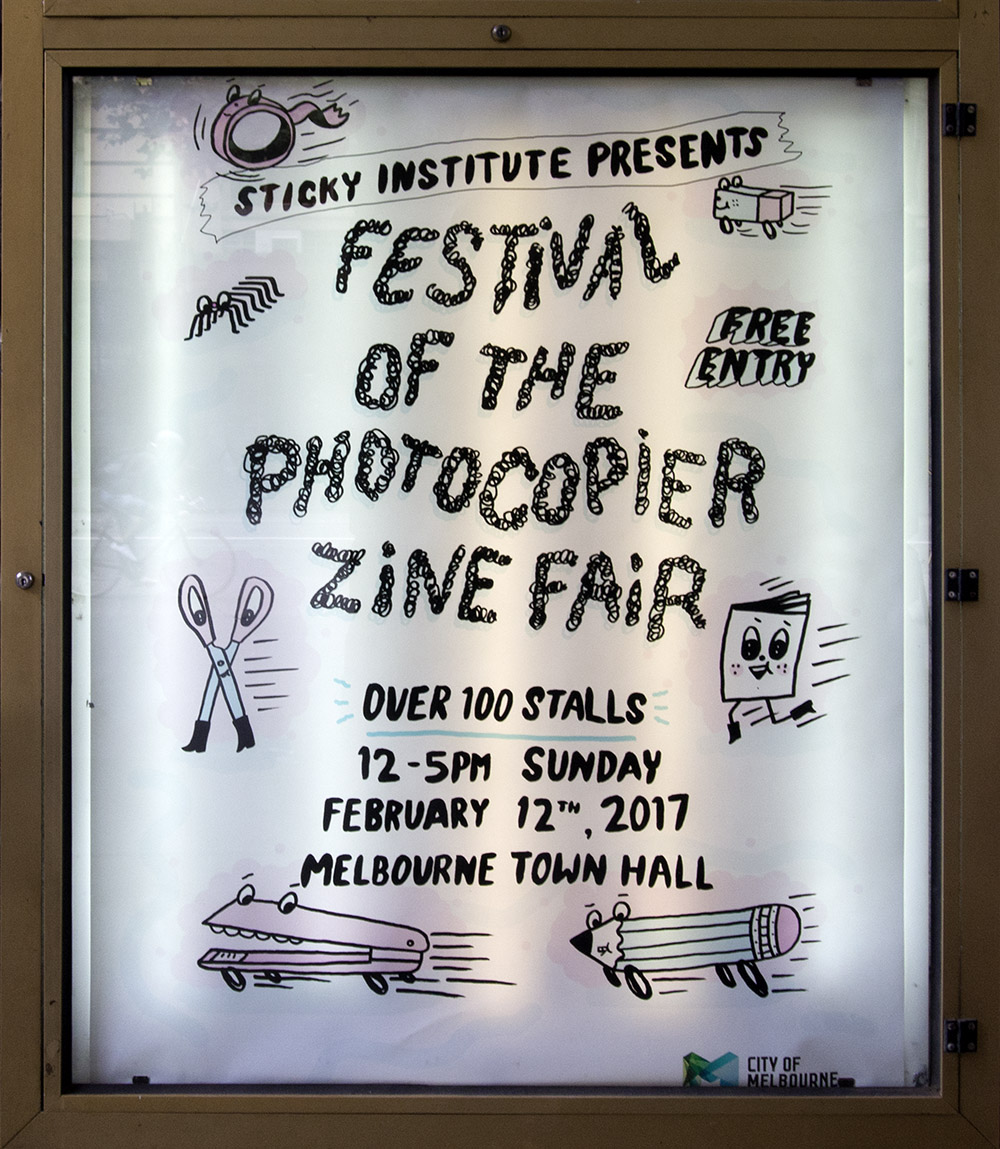
Town Hall foyer sign
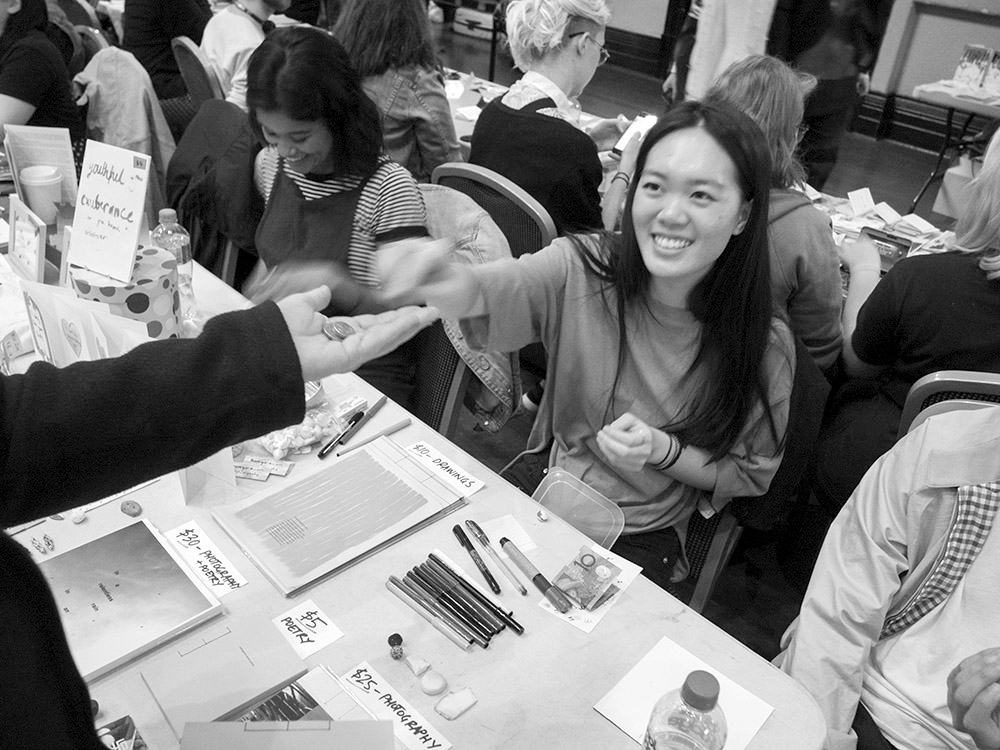
On Sunday 12 February the Melbourne Town Hall and was packed with sellers, lookers and buyers attending the Sticky Institute’s Festival of the Photocopier Zine Fair. At a guess, there could have been around 100 zine tables with a variety of zine-makers: both showing their own work, or representing other zinesters. For the visitor to the Fair there was an opportunity to see and handle almost any kind of communication that could put onto a sheet of paper, or into collated pages – folded, stapled, glued, stitched and sewn. Each ‘publication’ representing a personal approach to what the medium “zine” means to the author. And, as the ‘Zine’ is a slippery medium those within the discipline keep pushing the limits by integration of opportunistic technologies and ideas gleaned from contemporary media.
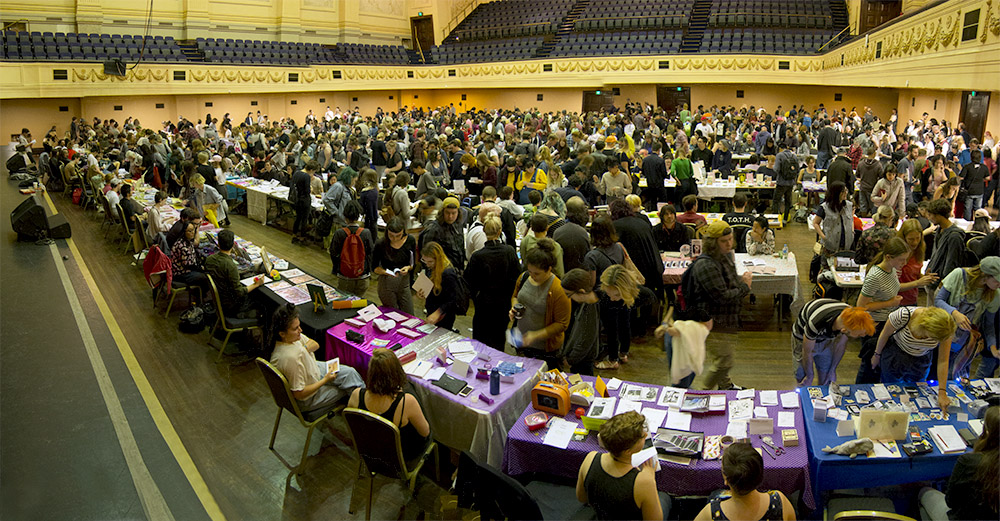
PHOTO: Doug Spowart – Stickies Festival of the Photocopier Zine Fair 2017
The content of the zines presented to us were from a broad church of visual and written media including: text as prose, poetry or as visual typographic forms, and calligraphy. There was a rich diversity of illustration from photo-realism to comic flat field work, photographs and even, in one sighted example – the ancient art of marbling. The narrative forms in these publications ranged from concrete poetry, prose, comic stories and disjointed stream of consciousness curated visuals.
In keeping with the tradition some zine makers aired their political opinions while others shared a fascination of contemporary everyday life. There were groups that concentrated on gender issues, music and issues of the street, while others presented dreamy naive and whimsical scenarios, adventures in suburbia, the road and outer space, nonsensical ghoulish and vampire episodes.
Our specific interest were zines based on or utilising photos sometimes referred to as photozines, as well as others that use photomontage in their narrative or conceptual work. Examples seen dealt with topics like the destruction of traditional family homes in the Chinese city of Guangzhou, skateboard stories, and a faux streetscape made up of photos of distressed buildings.
The Fair was a place to network. Greetings were made with like-minded people across the display tables and discussions took place about zines, life and art. We caught up with a few people we knew – David Dellafiora, Gracia and Louise and Glen Smith – Queensland’s zine hero Jeremy Staples was in the building somewhere but we didn’t get to meet. Zine-makers, or sellers, were keen to engage with us to tell the story of the work and where it fits with their practice and their life.
But did anyone sell anything? Many visitors were seen toting quite a few brown envelopes and calico bags filled with new additions to their personal collections. Perhaps a personal experience might shed some light on how success for such an event could be measured. It was right at the end of our shop, we had spent our budget and were talking to two young zinesters who were actually making their little photo zines on demand at their table. Their selling price was $3 and we wanted one of each but could only scrape together $5 in coin. One of the zinesters said ‘that’s fine, I’ll take the $2’, and stated that, ‘it’s important to have my zine out there…’
Being out there with your work. That is what zines are all about … your message in print as a democratic multiple … telling your story, was always what zines were about. That tradition it seems, continues…
Doug Spowart
February 13, 2017
.
SOME ZINES ADDED TO OUR COLLECTION
.
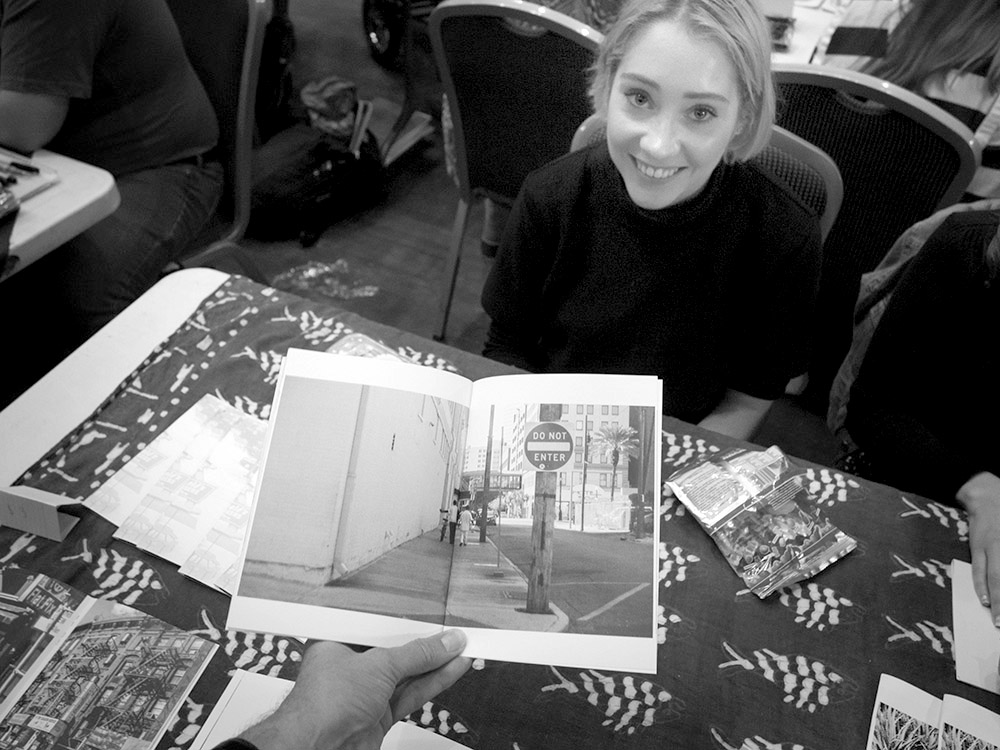
Trudi Treble at the Fair
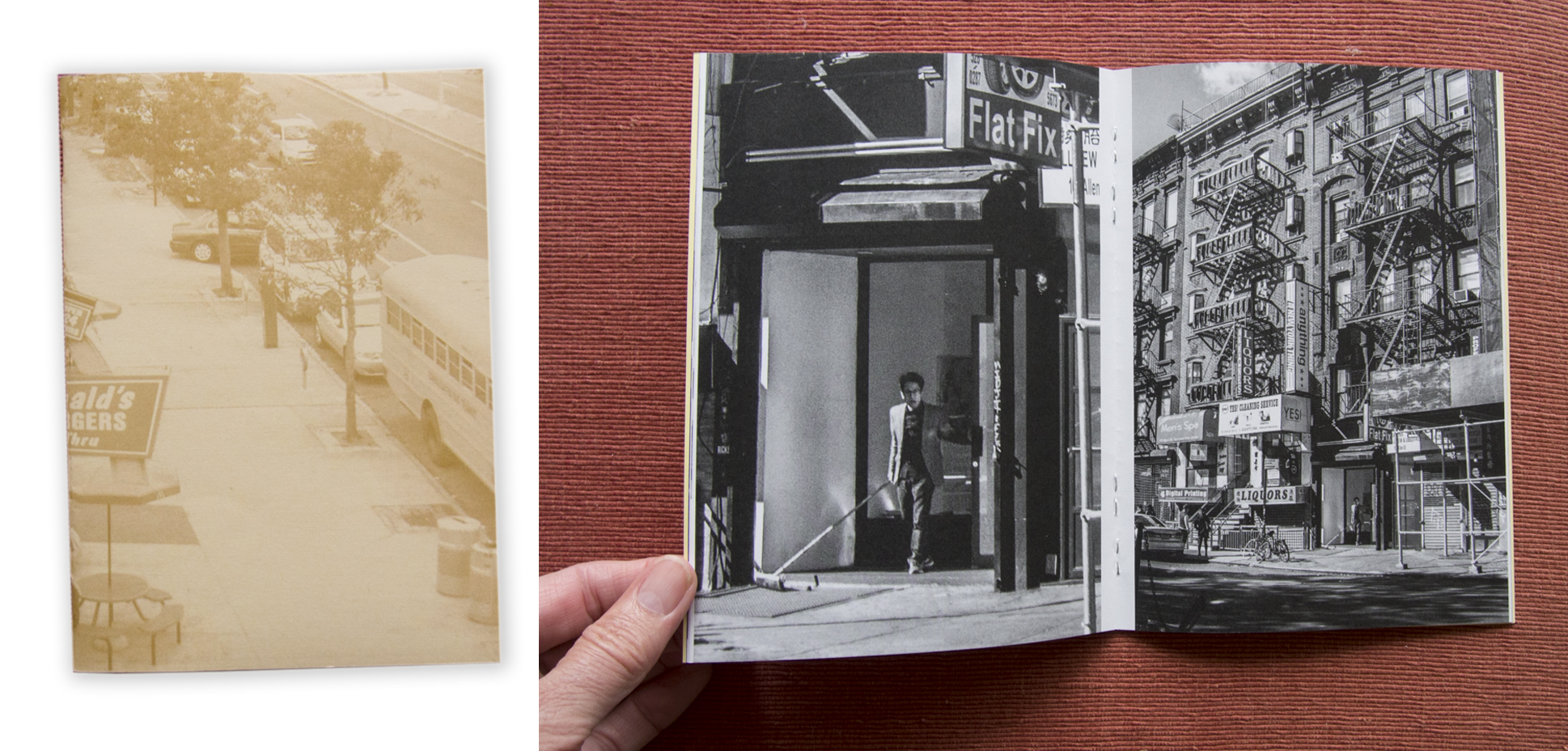
Trudi Treble: united states of america – october 2017 – november 2017, my diary. #6/25.
Trudi Treble – Instagram: trud.i
.
Johanna Ng at the Fair
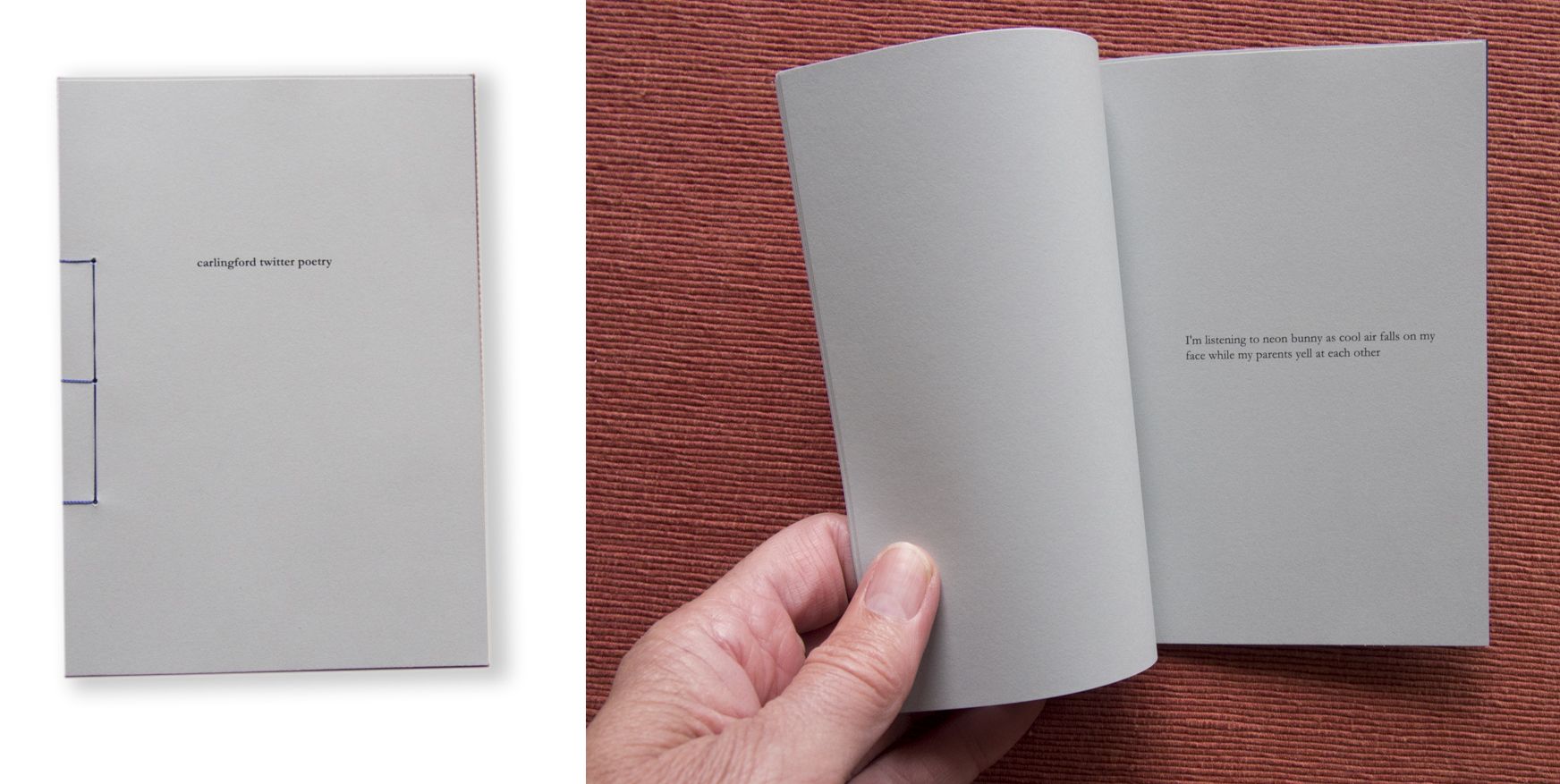
Johanna Ng: carlingford twitter poetry
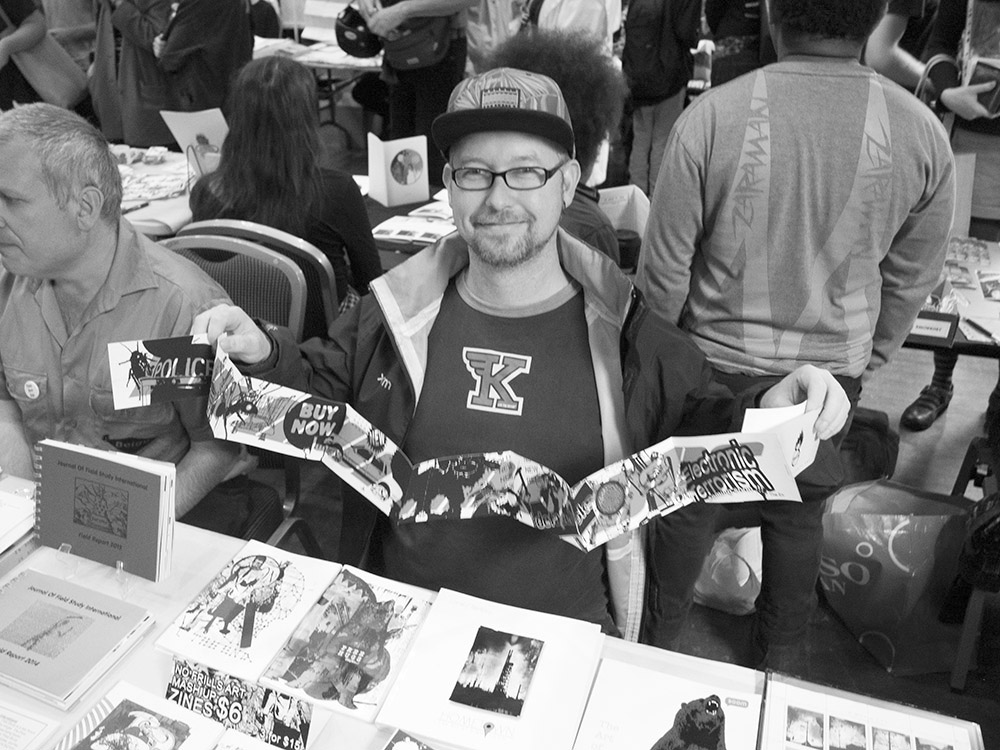
Glen Smith at the Fair
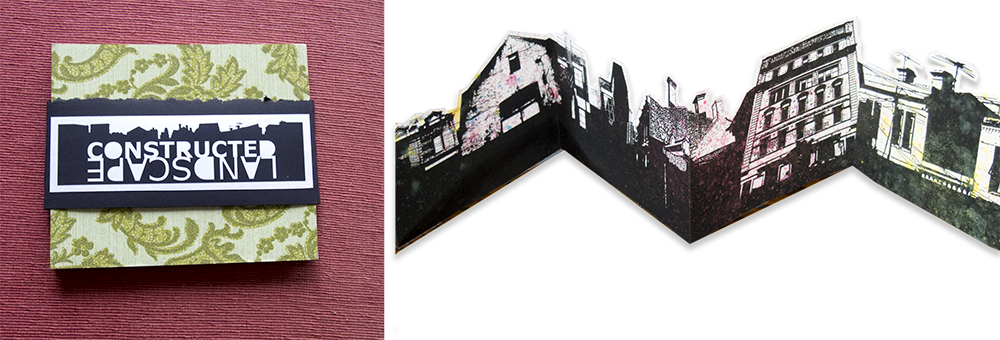
Glen Smith: Constructed Landscape
Glen Smith: https://nofrillsart.net/
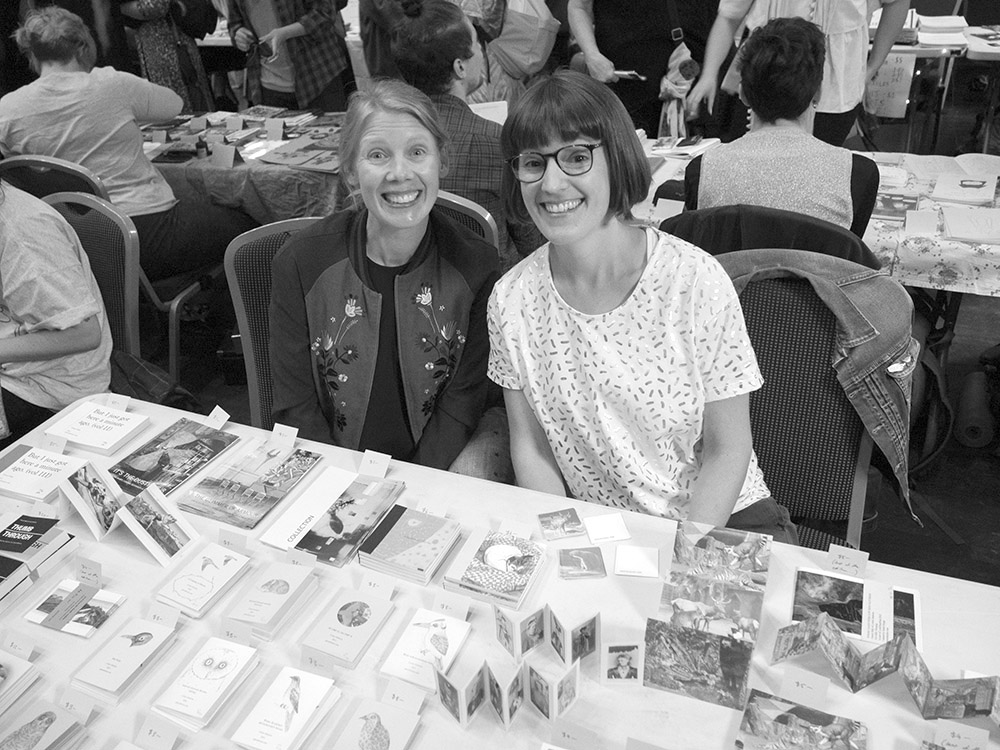
Gracia and Louise
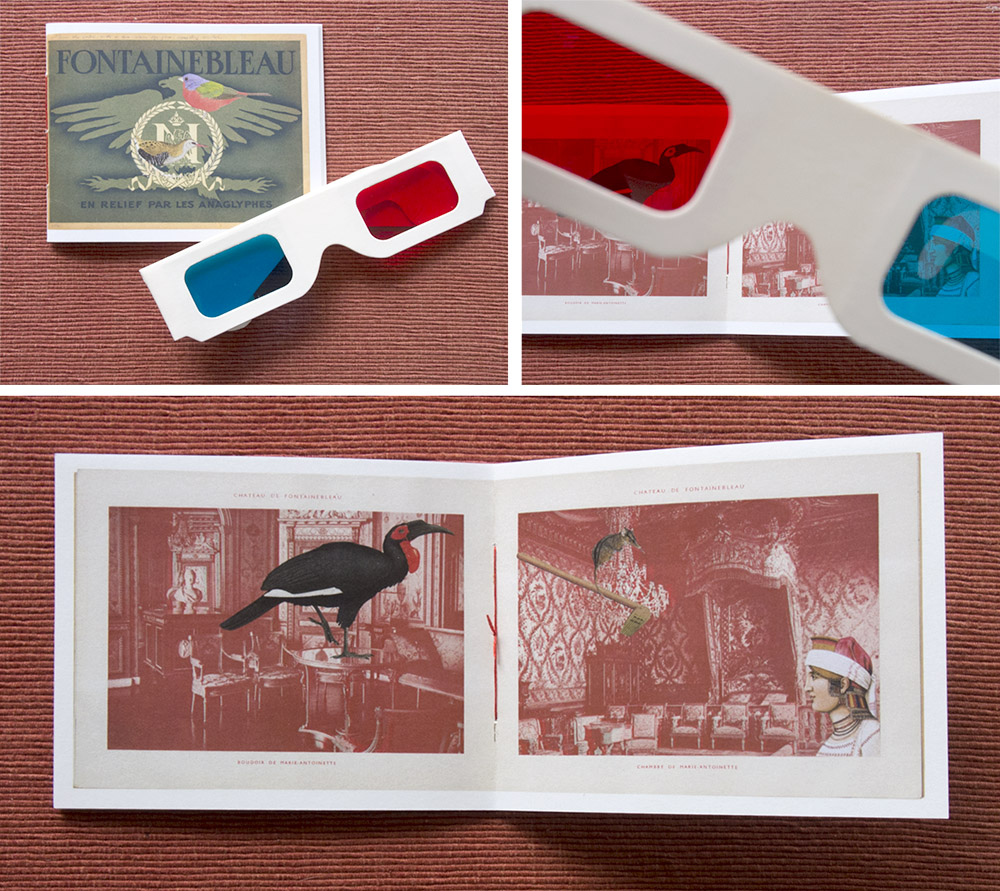
Gracia Haby: Under the water with a two-colour eye-glass, something similar (2014) #49/100
Gracia and Louise: www.gracialouise.com
.
.
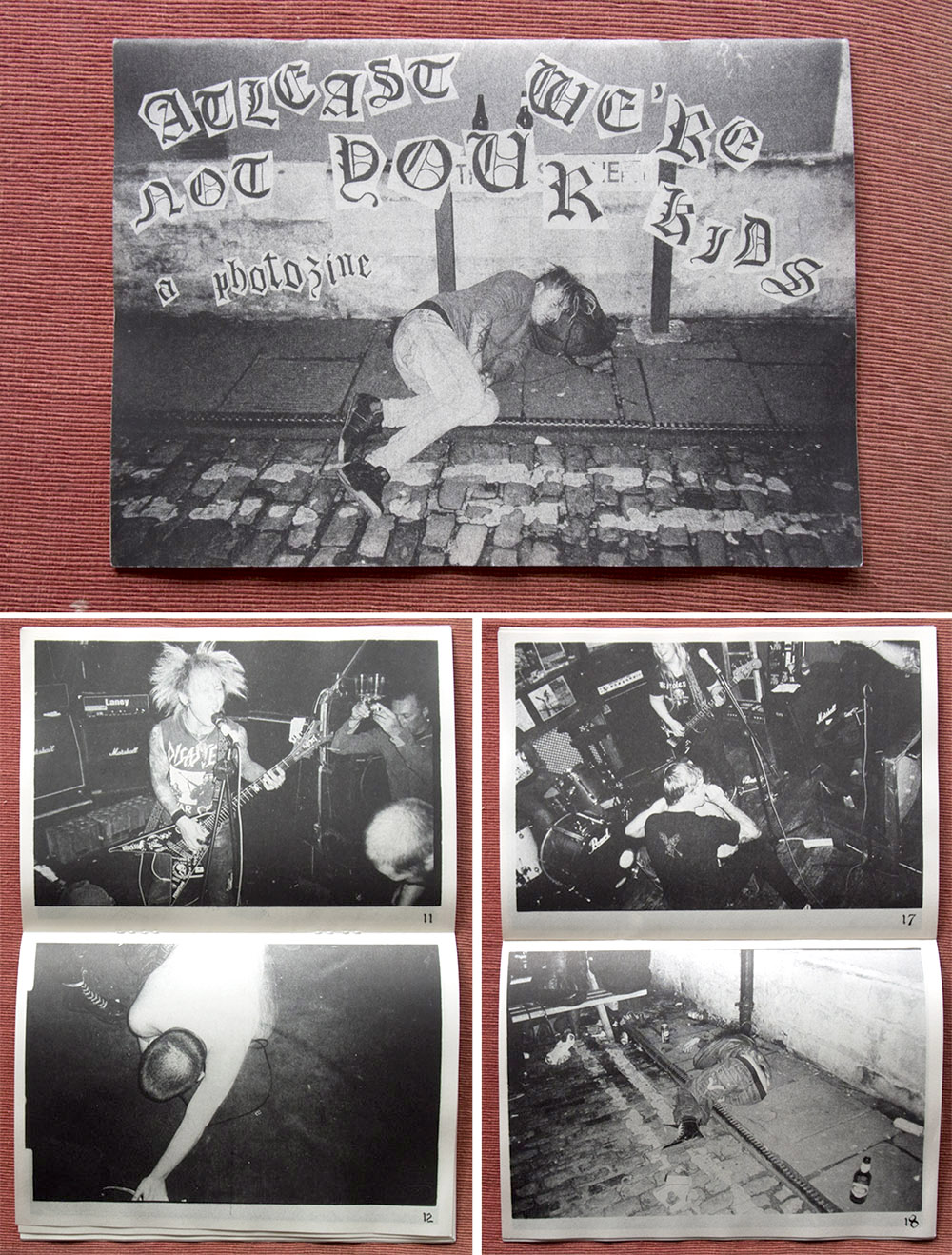
martinpf: At least we’re not your kids – a photozine. #81/100. Published by Russian Glue Press
martinpf@hotmail.co.uk. Russiangluepress@gmail.com
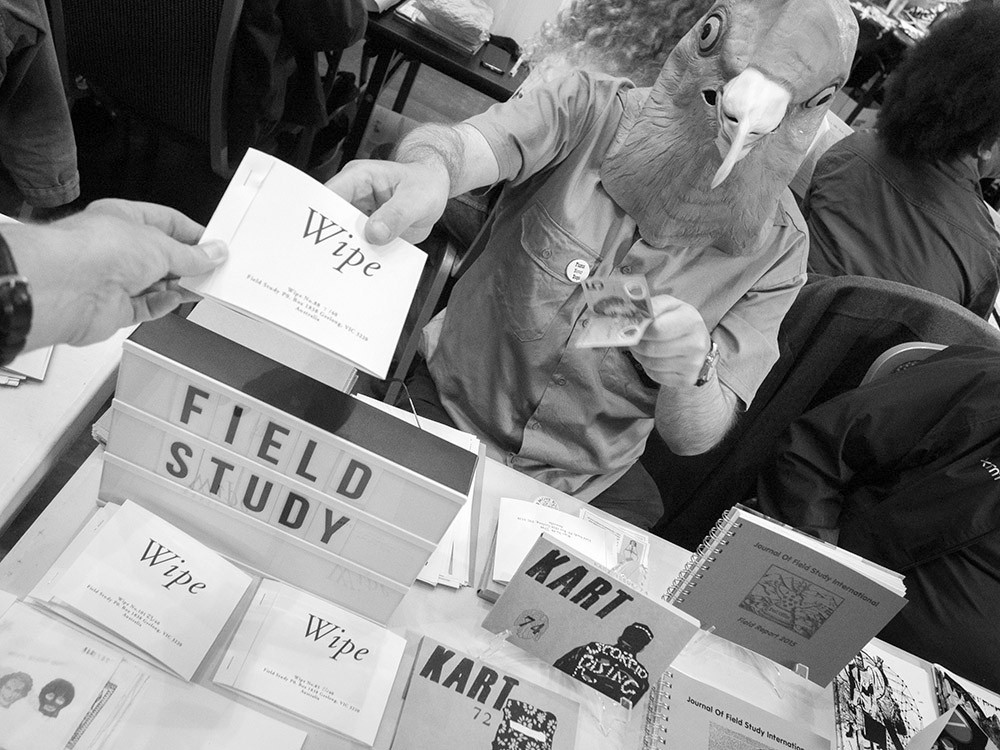
David Dellafiora Field Studies
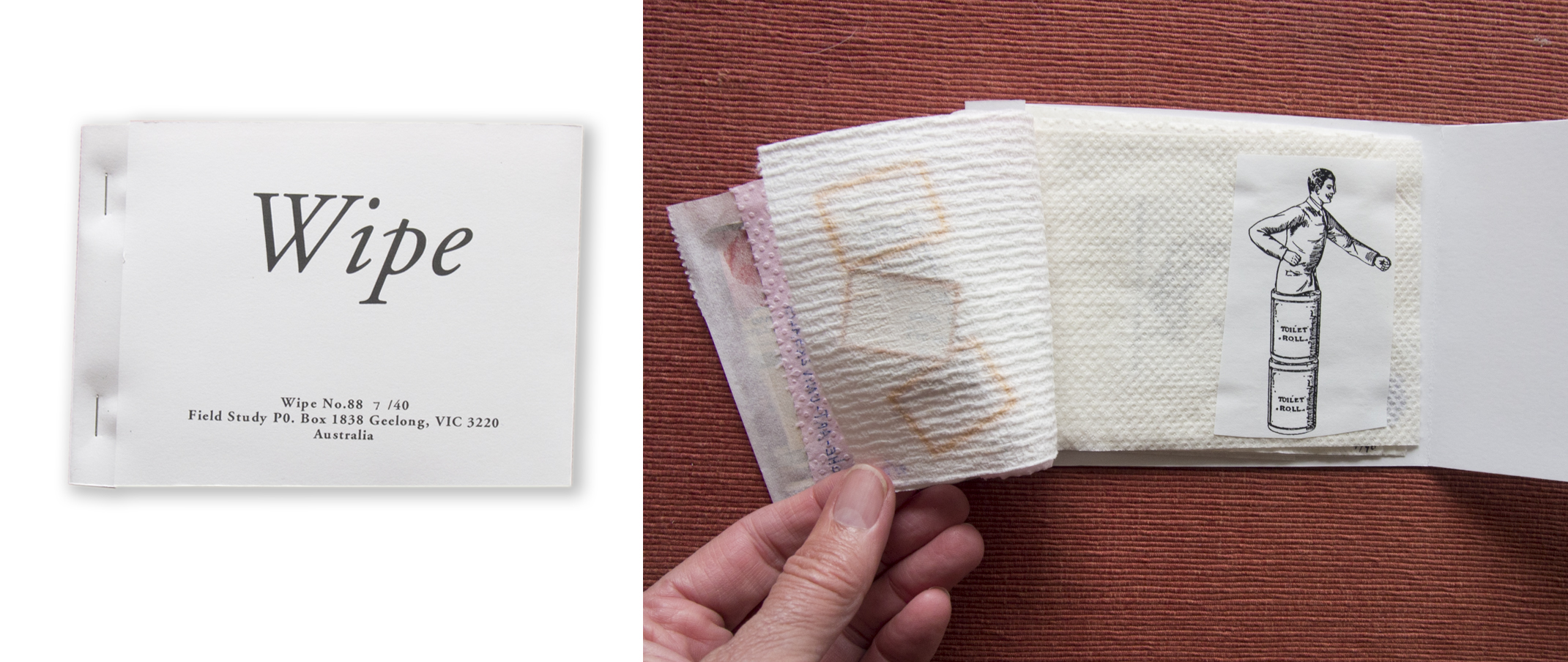
Field Study (David Dellafiora): Wipe No.88
Field Study – https://daviddellafiora.blogspot.com.au/
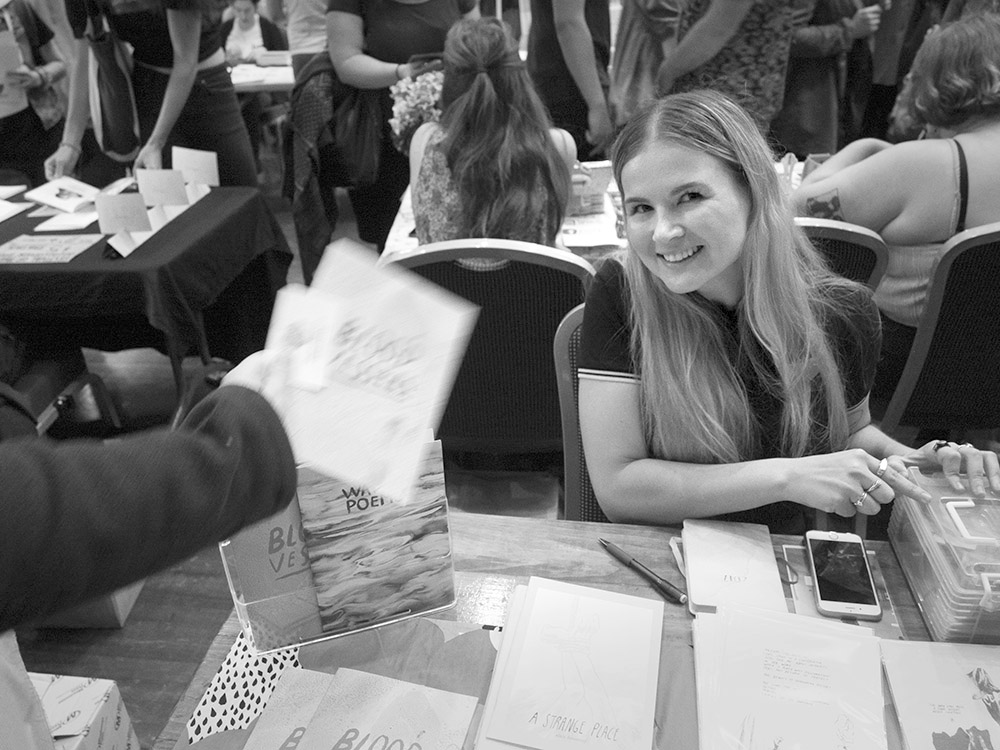
Alice Fennessy at her table
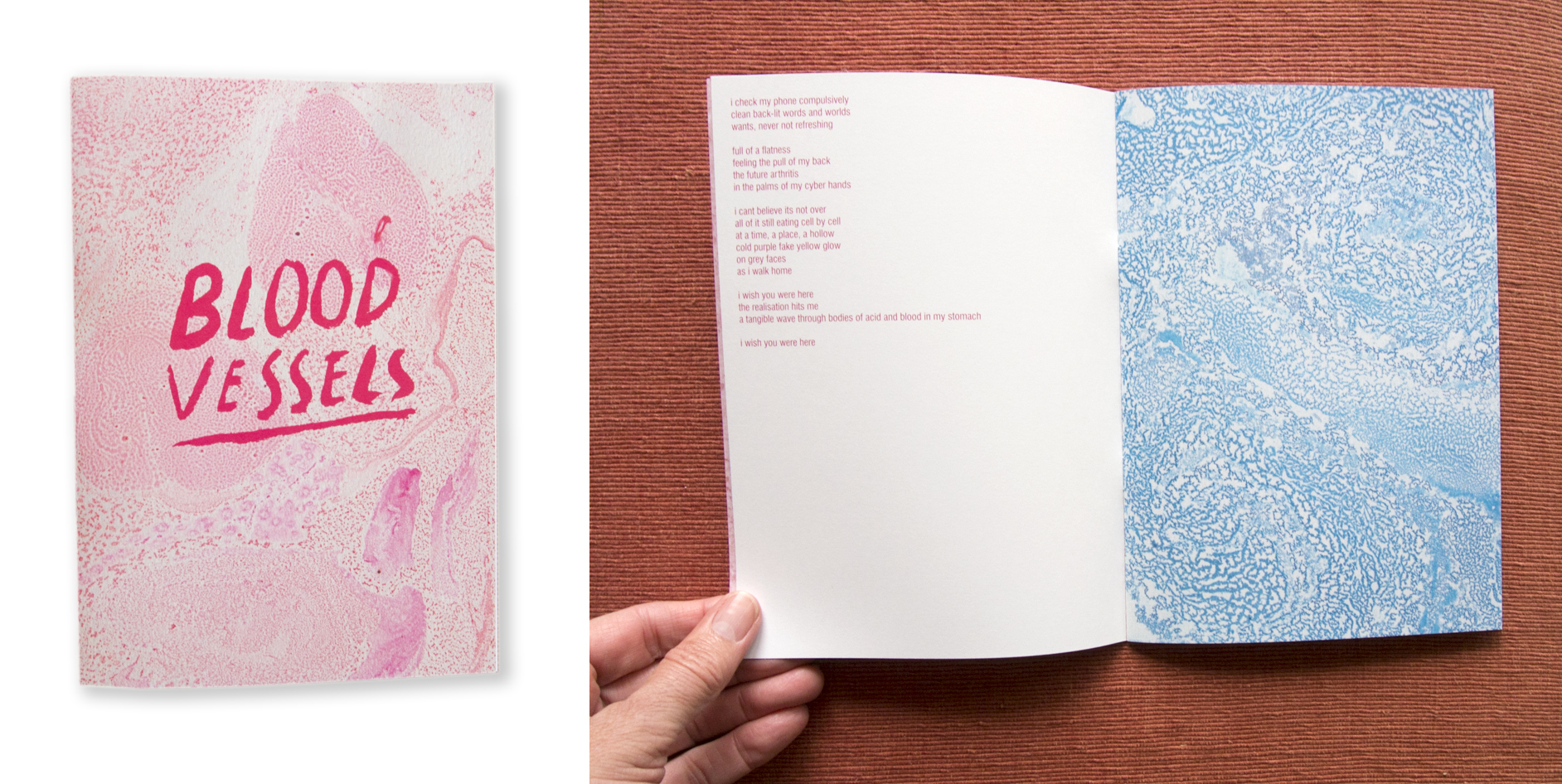
Alice Fennessy: Blood Vessels – A collection of poems about me memories
Alice Fennessy Instagram: @alicefennessy
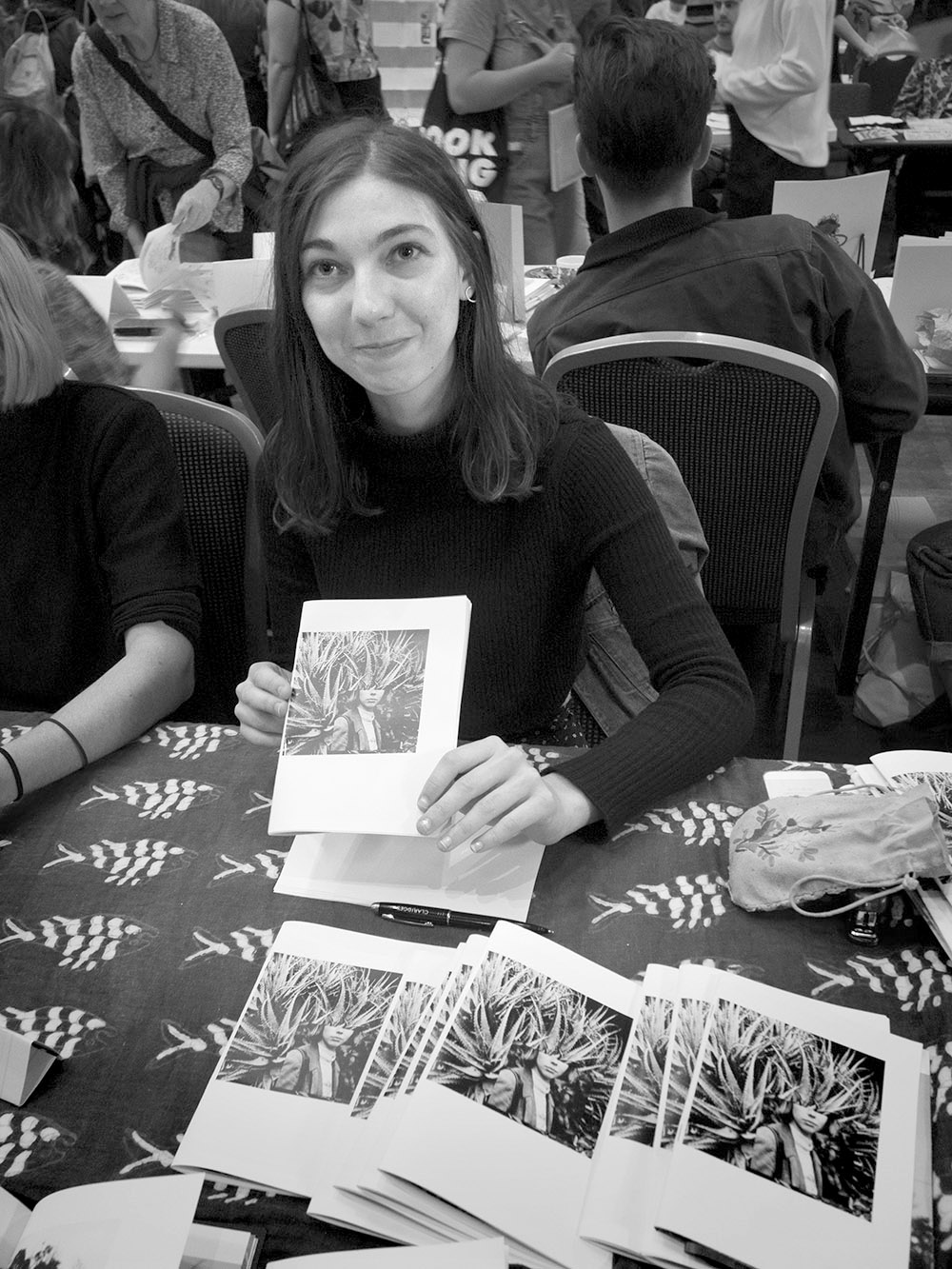
Claire Wakeford and her zine
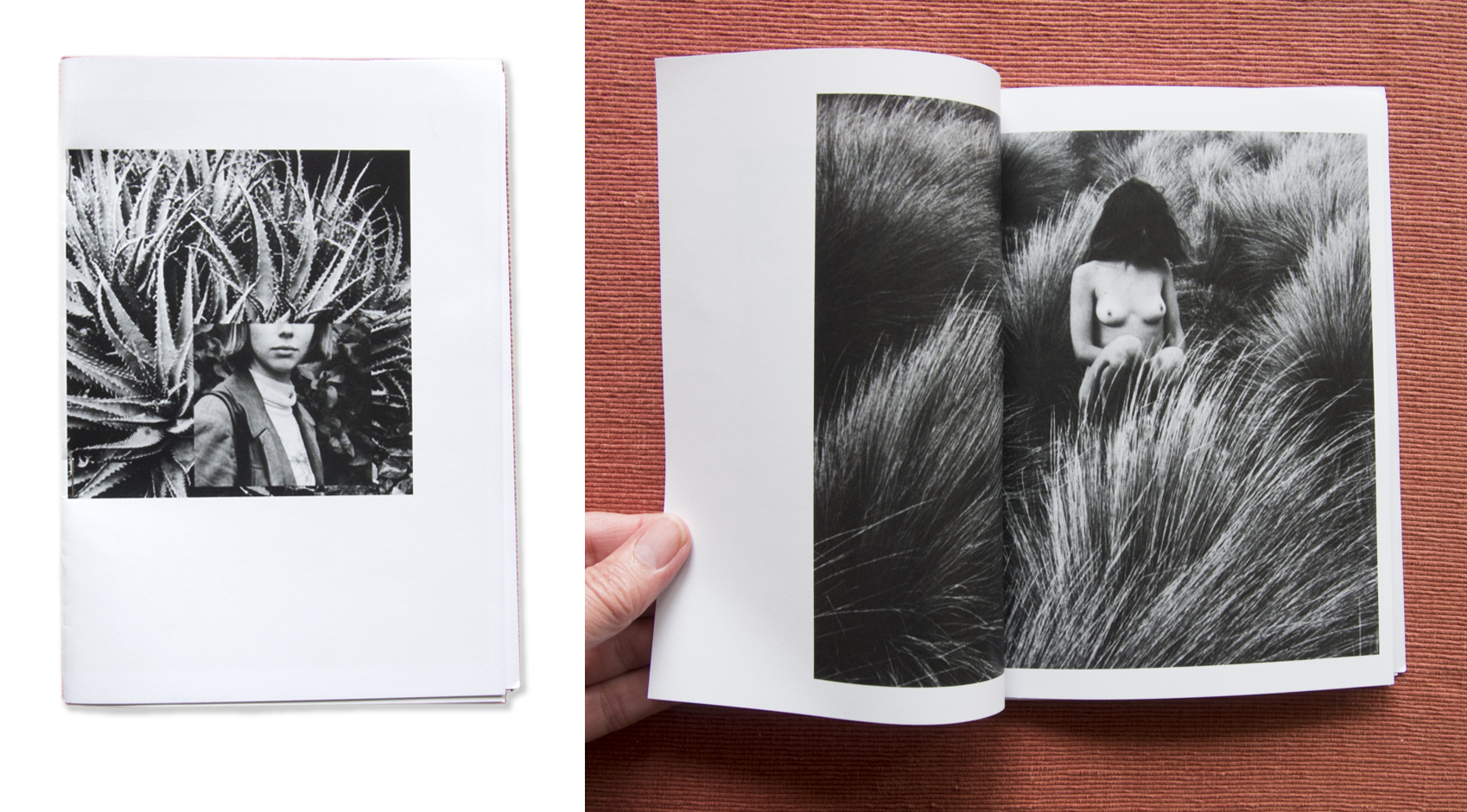
Claire Wakeford: Untitled
Claire Wakeford: www.clairewakeford.com
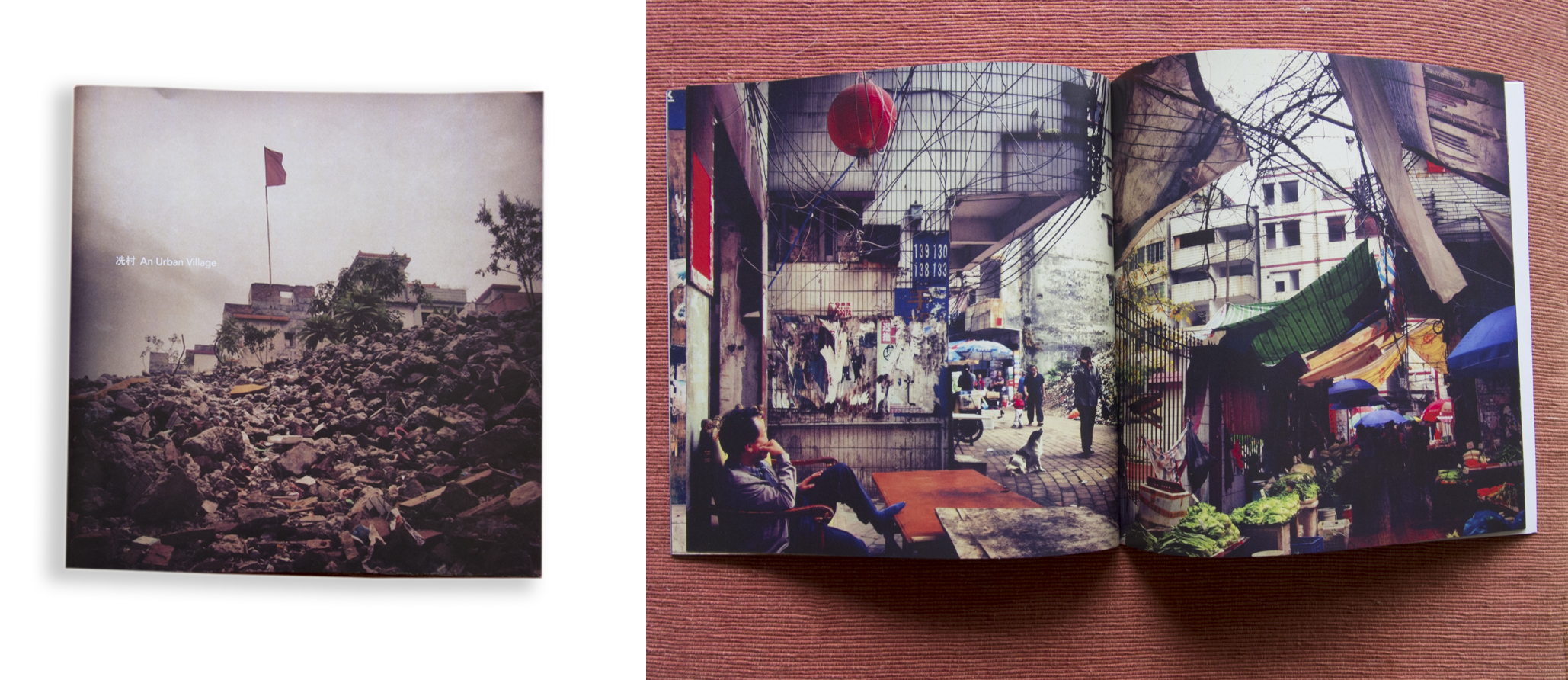
Ning Xue: An Urban Village
Ning Xue: http://www.xuening.me/me.html
.
UNTIL NEXT YEAR …
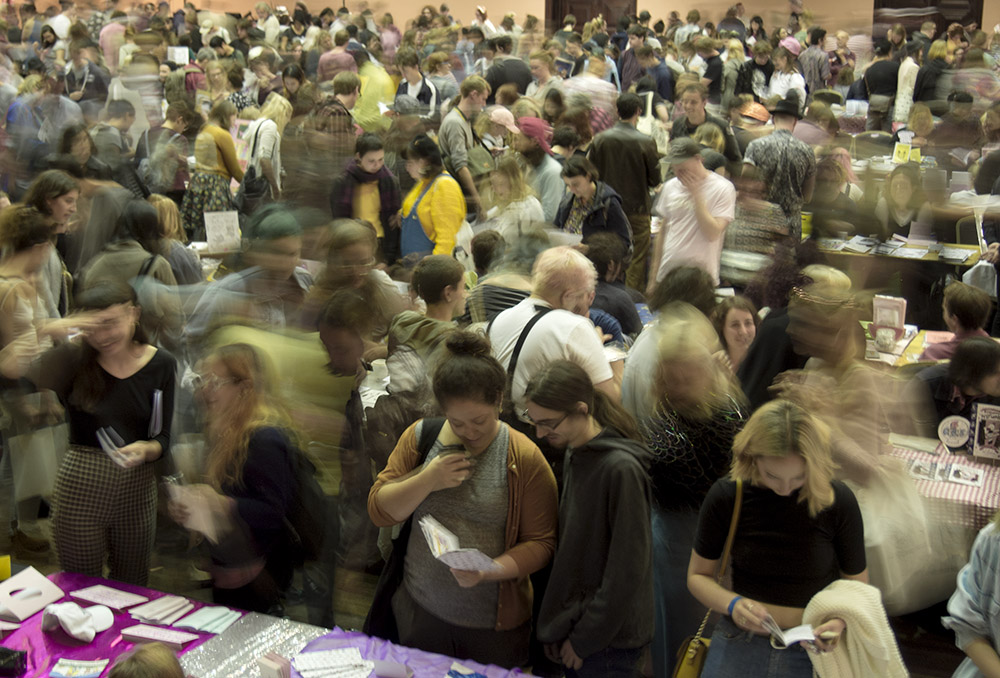
PHOTO: Doug Spowart – Sticky Institute’s Festival of the Photocopier Zine Fair 2017
.
.
Copyright in the zines is retained by the authors. All photographs + text + video ©2017 Doug Spowart
A GIFT OF A CAMERA: David Tickell’s cameras
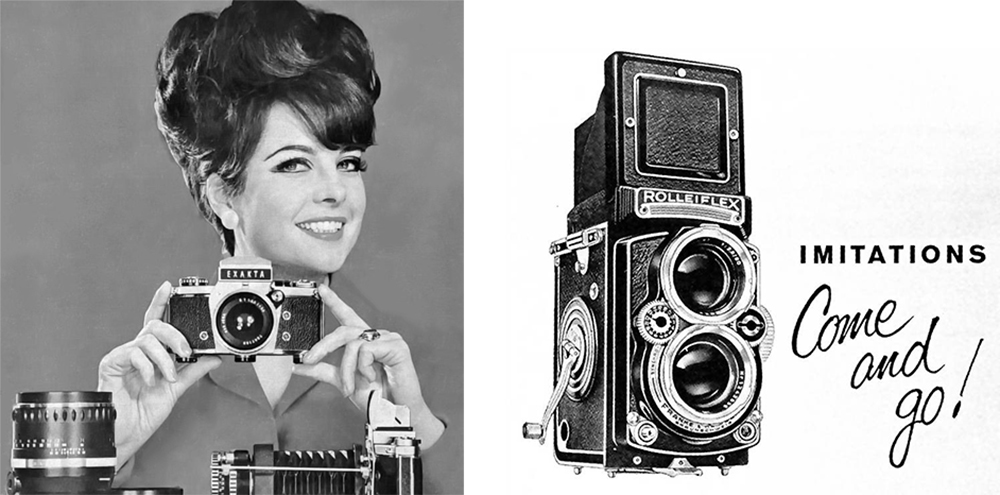
Advertising stuff from the 1960s for David’s cameras
In March 2013 I was contacted by David Tickell who wanted to meet with me to talk about a proposition he had in mind. I had known David for many years – he had been a writer and critic for the local press and had written the text for a book by my photographer friend John Elliott. In the early 2000s David had enrolled in photography studies at the college I taught at in Toowoomba. He was always an enthusiastic contributor to the classroom as he sought to learn and master digital photography. It became evident to me at the time that David had a considerable interest and capability in photography from his past career activities.
When David came by to visit he brought an aluminium case covered with the patina of travel and use. Inside the case were the things that David had wanted to talk with me about. We sat in our carport rainforest and talked about what we’ve both been up to and changes in our lives. David spoke about downsizing his life’s goods and chattels and introduced the aluminium case’s treasures to me… a Rollei twin lens reflex with a range of filters and accessories, an Exakta 35mm SLR – all neatly packed with manuals and other ephemera. It was all in immaculate condition. He told me that he had purchased it in the Middle East at a time in his journalism career that needed quality photographs.
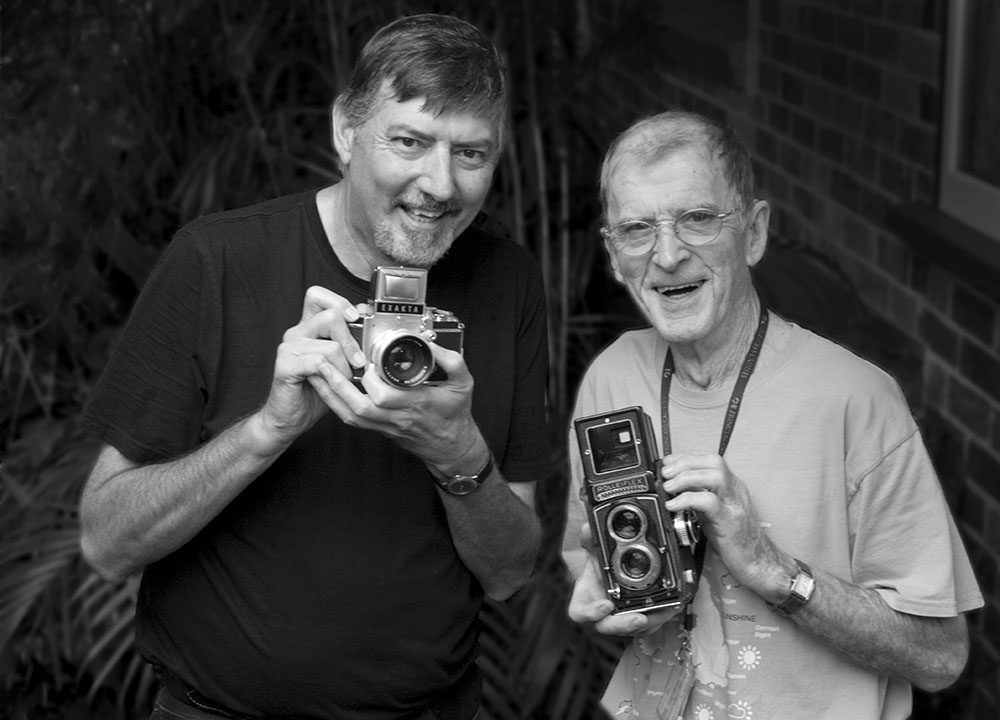
With David Tickell on the day of his gift to me in 2013
His dilemma now was that with digital photography he had no need for the equipment and he wanted to pass it on to someone who would appreciate it and perhaps even use it – he proposed that I was that person. I appreciated his gesture and felt honoured by his offer. I mentioned that Vicky and I had a Rollei in our possession and that we would look after the gear and pass it on to an individual, perhaps a student, who we considered would value this equipment and use it to extend their analogue photography work. We made photographs of our meeting with the cameras and David left feeling excited that his gift was well received and would be looked after.
For some time I’ve been looking out for a suitable person to receive David’s gear. Quite a few years ago I’d come across a Brisbane band webpage called ‘Something from the scene’, and a little while later I had a student who was interested in contemporary band photography who had found the same site as an inspiration. In June 2015 we met Thomas Oliver at the Siganto Artists Book Forum in Brisbane. He was the guy from ‘Something from the scene’. We both connected with Thomas who we found out was a Queensland College of Art Bachelor of Photography student. Our paths have crossed many times since including his involvement in exhibitions and projects I’ve curated include a Skype artist’s talk that he participated in at Maud Gallery in March for the In situ documentary show.
Recently Thomas has completed his Bachelor of Photography and was the winner of the John Mckay Award for the student going into honours, and a Saint Margaret School’s internship award. He is continuing his studies with an Honours year at QCA. I was particularly interested in Thomas’ engagement with analogue photography. Extensive project work while on study tour to Europe, the UK and Canada was shown at Maud in the ‘In situ’ show and his graduating BP work featured an involvement in the variants and deviations possible from the printing of the singular black and white film negative.
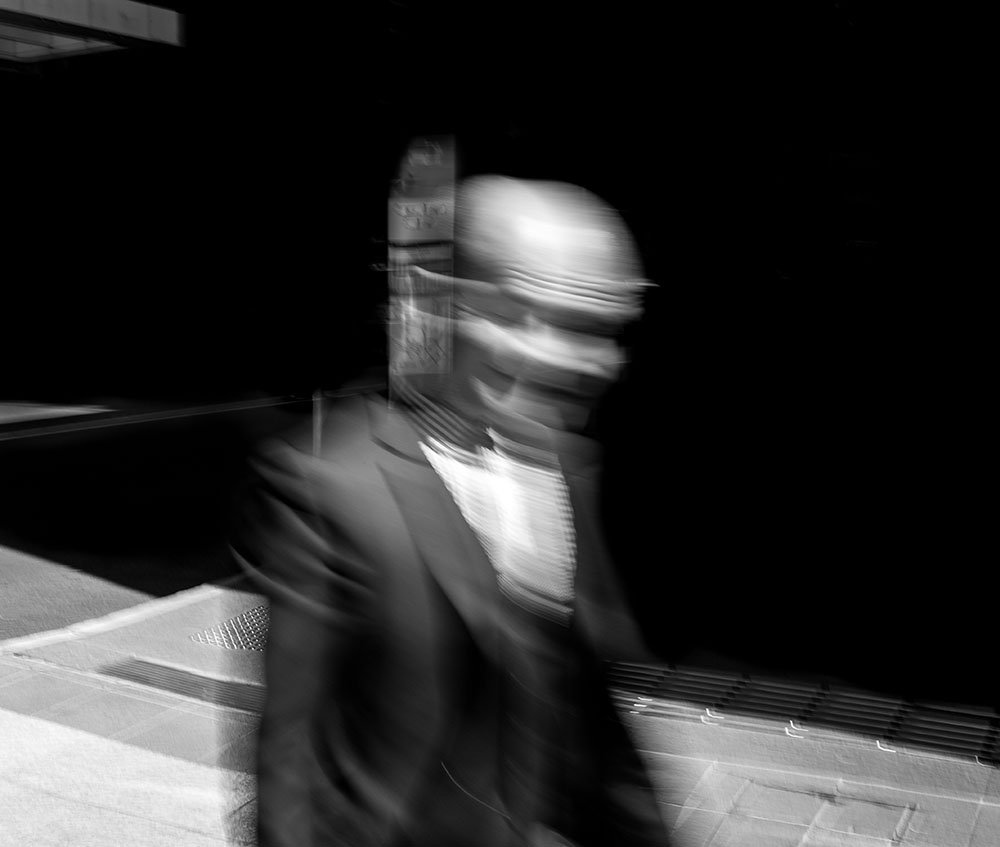
PHOTO: Thomas Oliver from his ‘Disconnection’ series
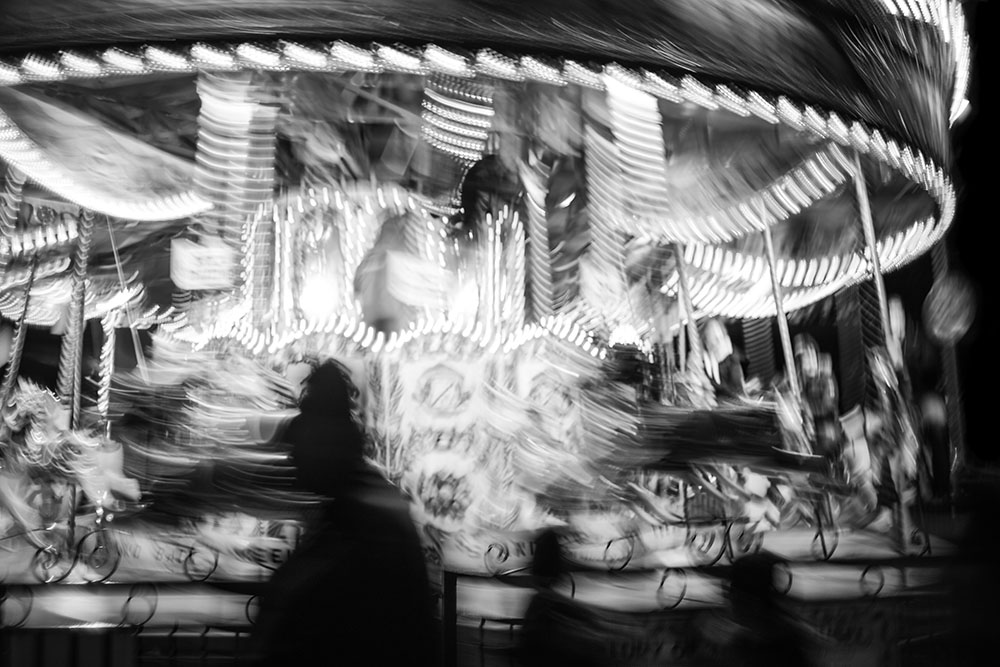
PHOTO: Thomas Oliver from his ‘Disconnection’ series
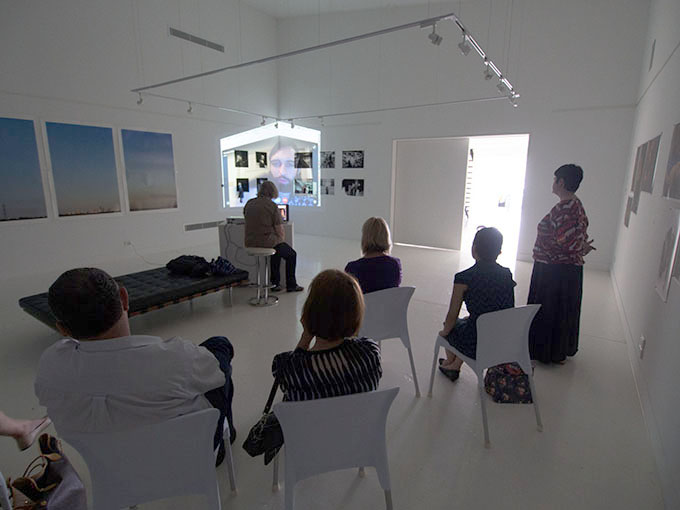
Thomas Oliver giving his ‘In Situ’ floortalk by Skype from Canada
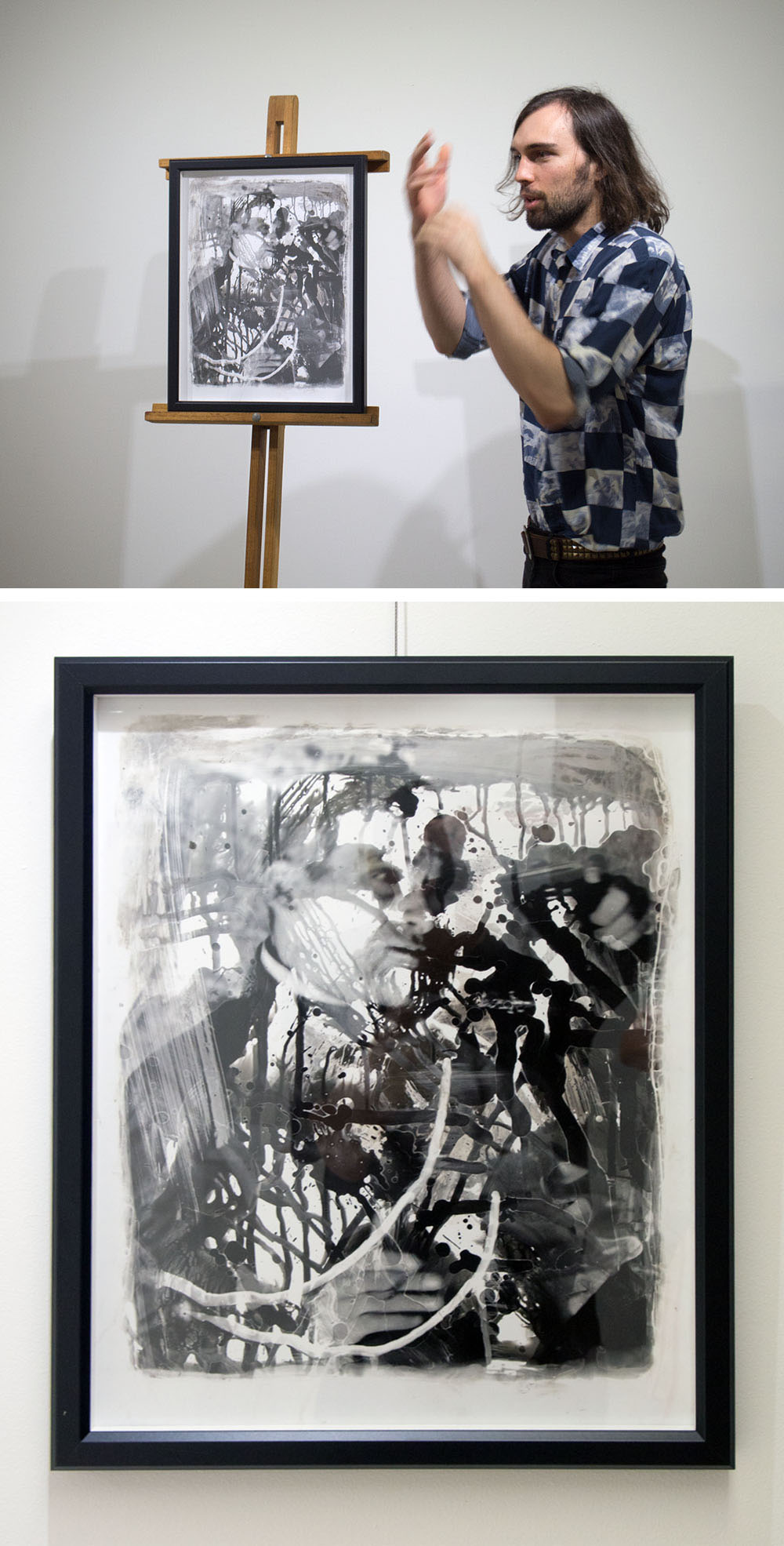
Thomas talking about his work at the Maud Gallery ‘Dark Love’ event in November 2016
For his enthusiasm for photography and his dedication to analogue photography I chose to pass on David’s gear to Thomas. We met at Maud Gallery at the end of November and the exchange made. He was excited to be the recipient of David’s equipment legacy and excitedly talked about how the gear could be used in his future photographic research work.
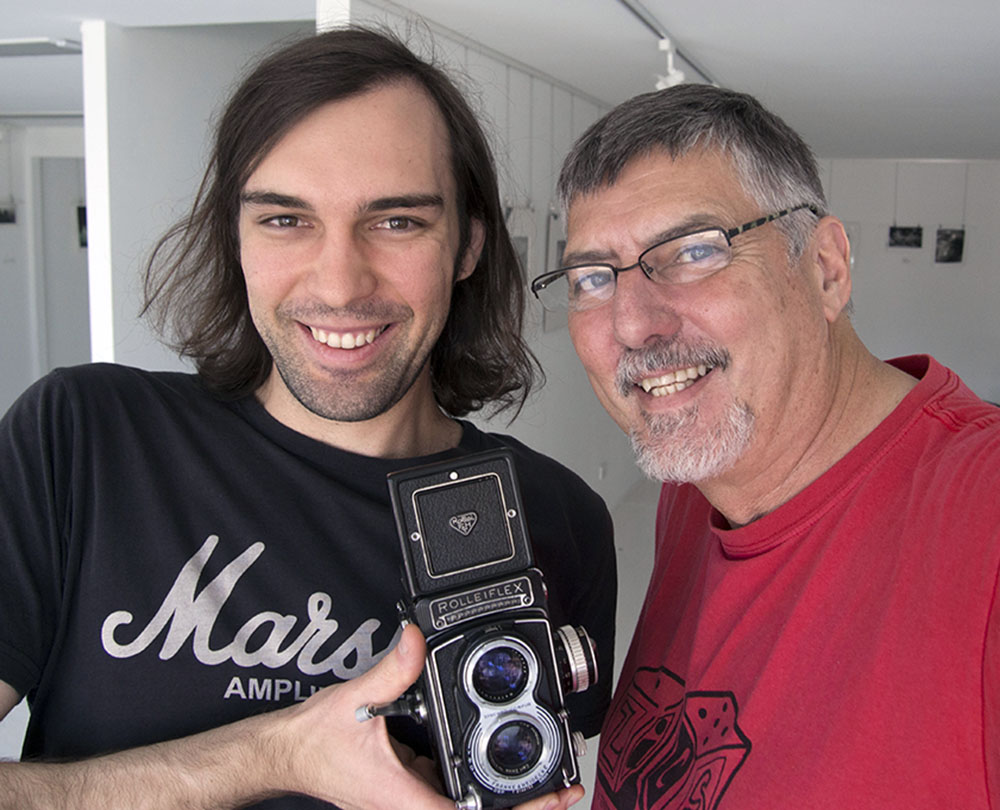
Thomas Oliver and me
David’s equipment has found a new life with Thomas and as long as he has a need and a interest it will reside with him – until he wishes to pass it on to a new custodian…
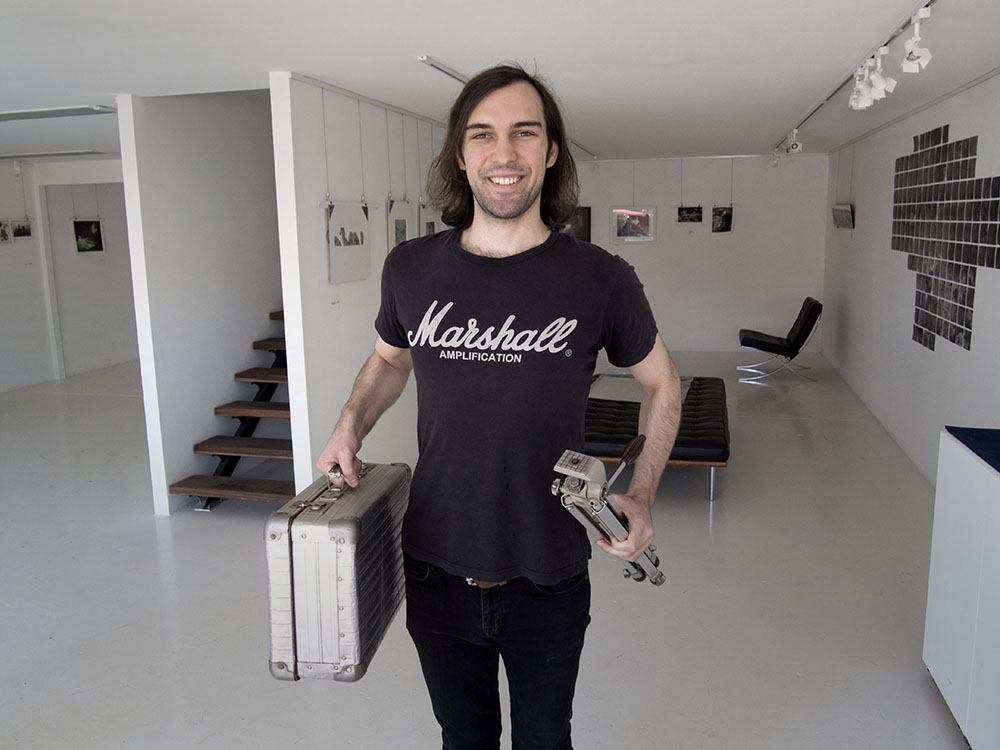
Thomas Oliver with David’s gear
Words about David Tickell from John Elliot’s photographic documentary book The Last Show published in 1986. The book was about the last Toowoomba Agricultural Show held on the inner-city site bordering Bridge, Campbell and Lindsay Streets. Elliott’s photographs were complimented by a text telling the story of the show written by David.
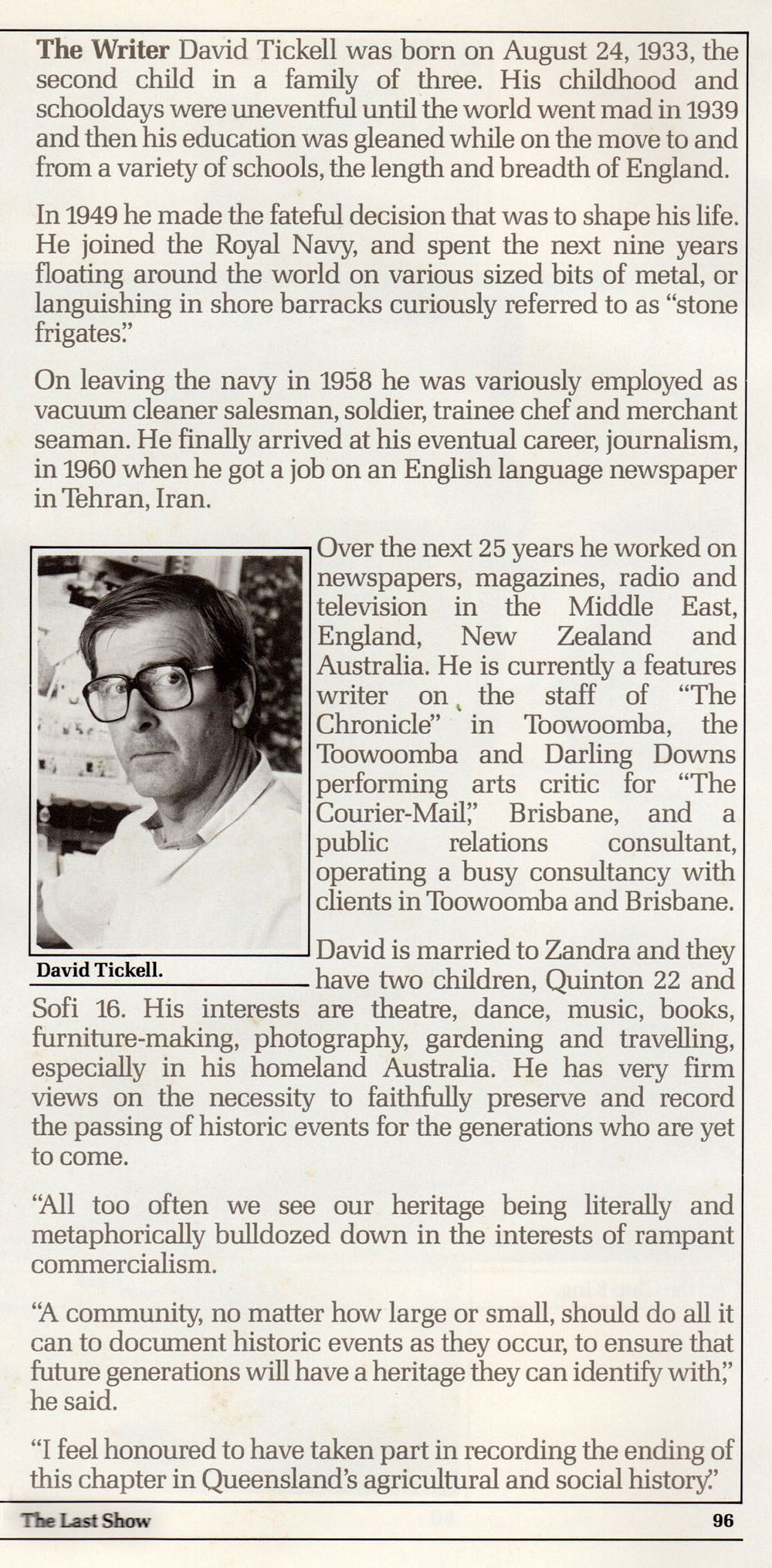
From John Elliott’s book The Last Show 1986
.
.
.
.

 wotwedid