wotwedid

Victoria Cooper+Doug Spowart Blog

Posts Tagged ‘Peter Lyssiotis

HELEN COLE VISITS A PAPER UNIVERSE

with 5 comments

..

“Artists’ books break all the rules. They stretch, fold, sculpt and reimagine the book as an object — not just something to read, but something to experience”

Curator Maria Savvidis.


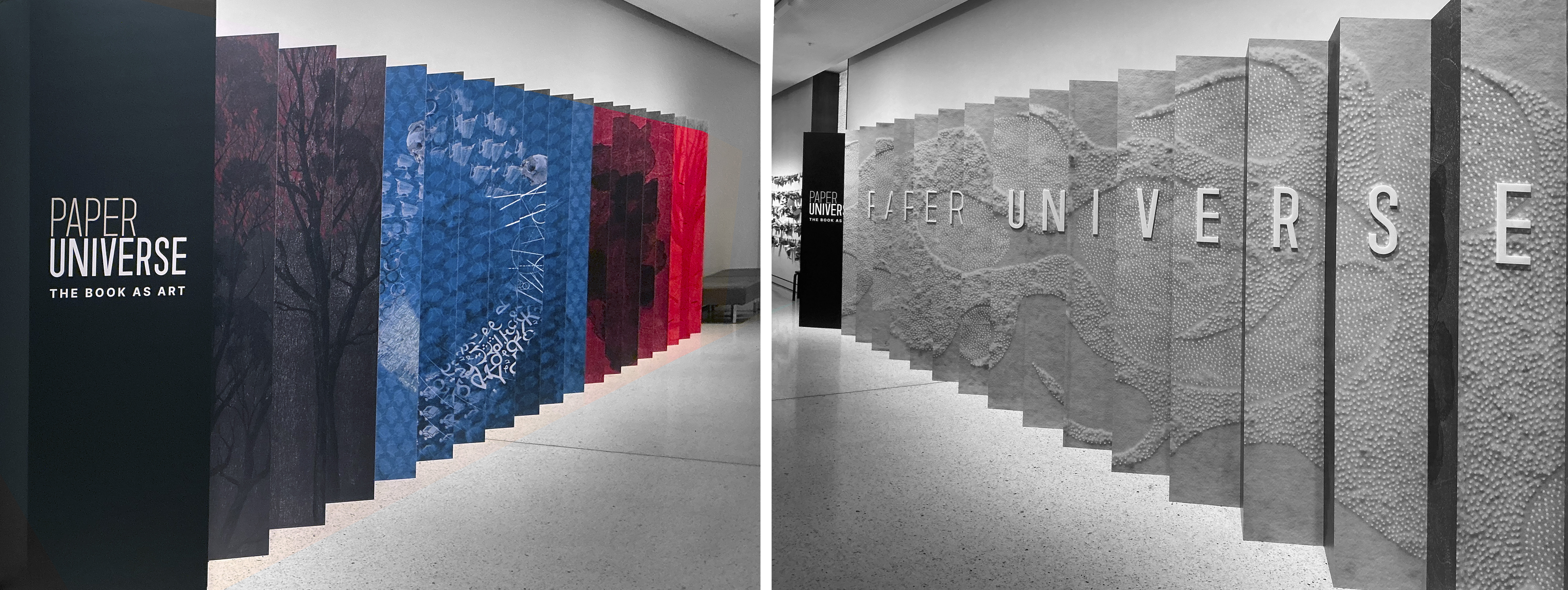
Two views of the ‘Paper Universe: The Book as Art’ entry concertina    PHOTOs: Helen Cole

.

PAPER UNIVERSE: THE BOOK AS ART

A MAJOR EXHIBITION OF ARTISTS BOOKS AT THE STATE LIBRARY OF NSW

.

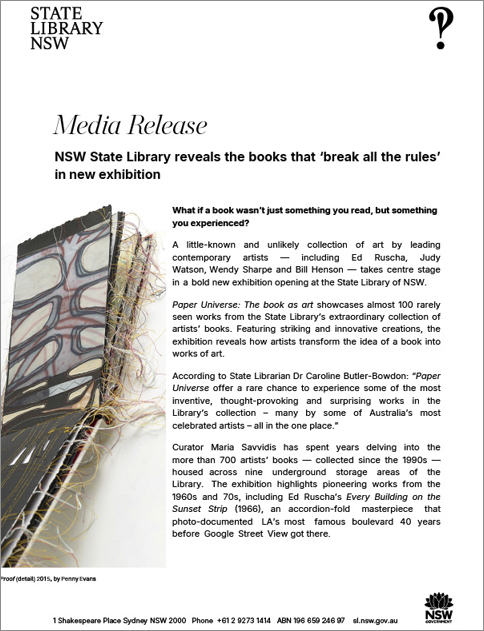
The exhibition press release states, ‘Paper Universe: The book as art’ showcases almost 100 rarely seen works from the State Library’s extraordinary collection of artists’ books. Featuring striking and innovative creations, the exhibition reveals how artists transform the idea of a book into works of art. According to State Librarian Dr Caroline Butler-Bowdon: “Paper Universe offers a rare chance to experience some of the most inventive, thought-provoking and surprising works in the Library’s collection – many by some of Australia’s most celebrated artists – all in the one place.”

.

Paper Universe: The book as art is a free exhibition at the State Library of NSW until 3 May 2026

.

Visiting ‘PAPER UNIVERSE’ with Helen Cole+Victoria+Doug

Towards the end of 2025 we were drawn to Sydney to encounter the seminal artists book exhibition PAPER UNIVERSE: The Book as Art. We invited our friend Helen Cole to join us and Helen was able to arrange a meeting with the curator Maria Savvides to discuss the exhibition, the books and their presentation.

After our viewing of the exhibition our reflective discussion about what we had encountered led to an invitation for Helen to write an informed essay from her significant experience and knowledge of the artists book.

What follows after a selection of images, mainly taken by Helen, is her essay and a collection of documents and a video of the exhibition.


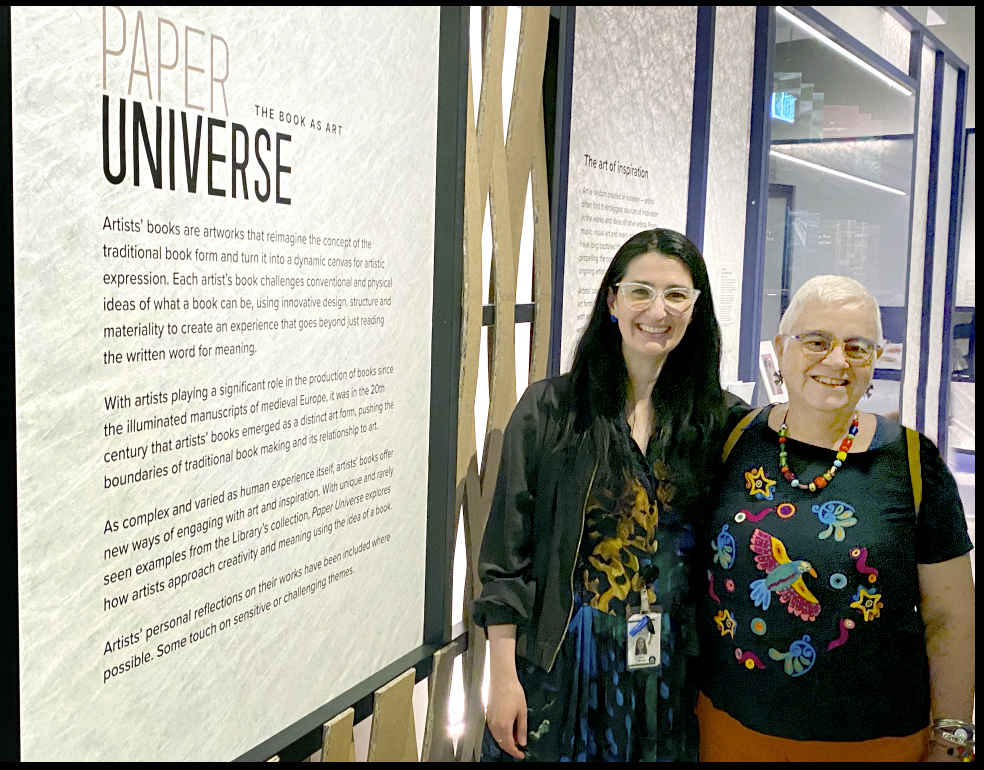
Paper Universe: The Book as Art  – curator Maria Savvidis with Helen Cole  PHOTO: Doug Spowart


.

HERE’S A SELECTION OF BOOKS FROM THE EXHIBITION

“Click” on the image to enlarge and see the caption.

.


.

HELEN COLE’S REFLECTIONS ON THE SHOW


When I curated the artists’ books exhibition Freestyle Books from State Library of Queensland’s artists’ books collection in 2008 it was supposed to be a mere taster before a major exhibition of the artform. That never happened. It was very gratifying to find out that State Library of New South Wales has taken up the challenge of both curation and display of this form that can be difficult to exhibit, and given it the title of Paper Universe: The book as art. The curator, librarian Maria Savvidis and her supporting team of librarians, conservators and designers have done a superb job in showcasing the richness of stories and artworks that artists books yield. They were fortunate to have five years to bring the exhibition to fruition, and this is shown by the attention to detail in its staging.

.

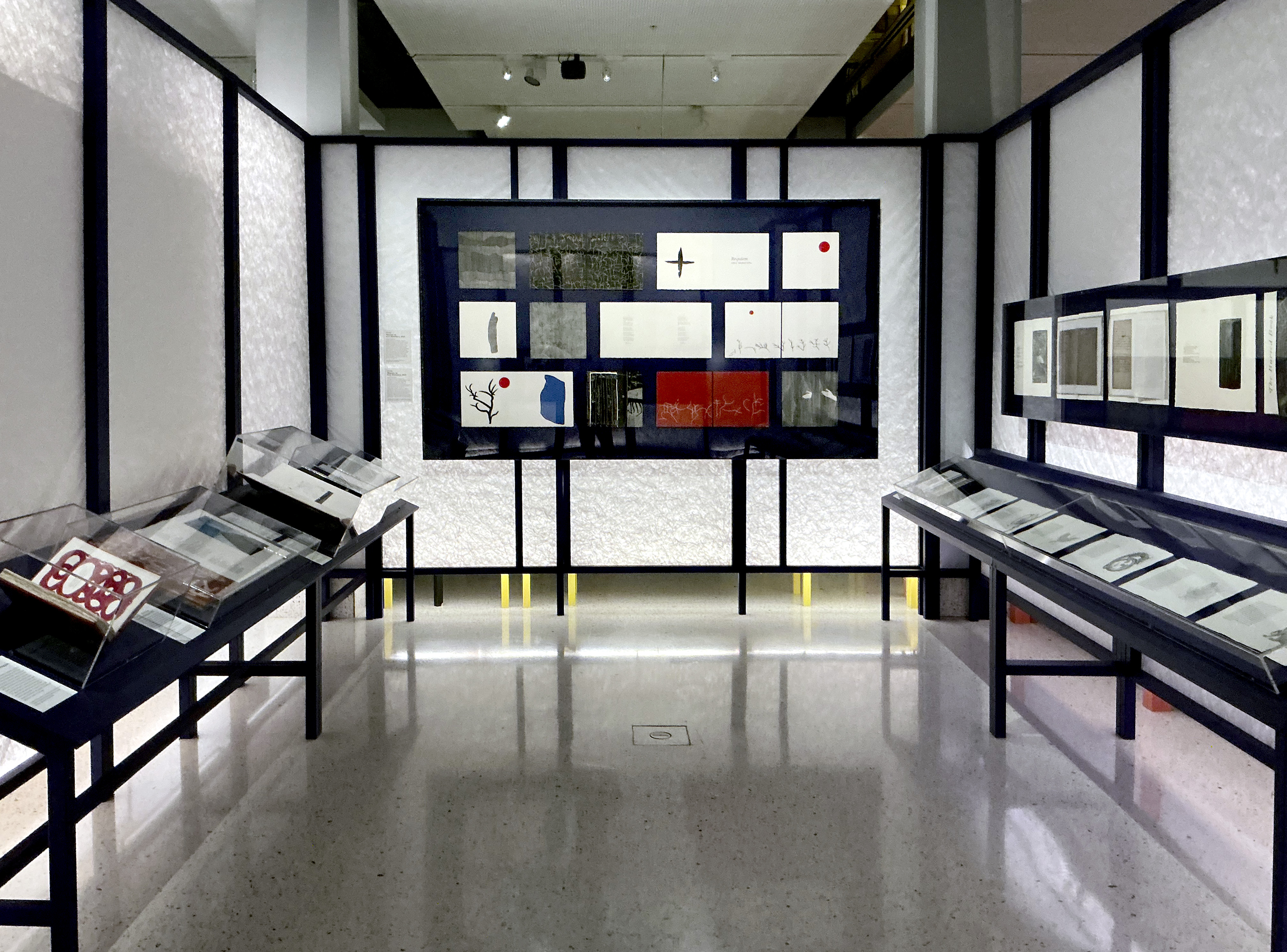
The exhibition is introduced in the wide corridor leading to it by a huge concertina ‘book’ with blown-up details of three distinctive works. Before you enter, the view of the concertina is a quiet white book by Nicole Hayes with a delicate texture pierced through the page from front and back with pins. As you leave the view is of colourful, forceful black, red and blue designs in linocut and digital prints from books by Dianne Fogwell and Lyn Ashby, summing up the other extreme of the books you have seen.


Paper Universe exhibition   PHOTO: Doug Spowart

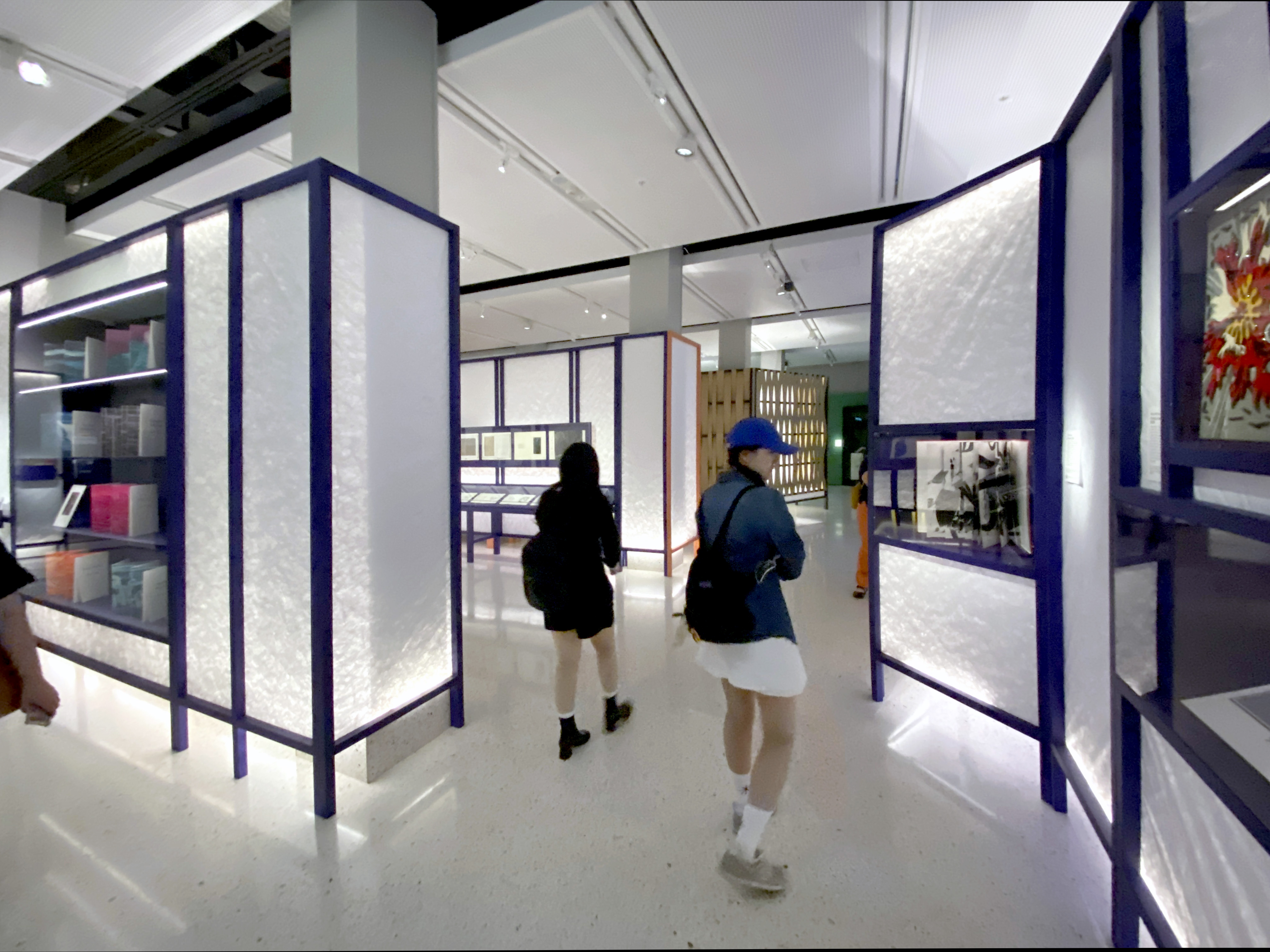
That calm entry leads into a quiet space to engage with the works in the exhibition, provided by dividers reminiscent of Japanese shoji screens. The themes around which the exhibition is woven are well chosen and enunciated in the didactics: the art of inspiration – influences and sources in other artists work; the natural world – its beauty, its power, but also its fragility; the civil condition – investigating, reflecting and challenging social issues, politics, morality and equality; unveiling identity – the shaping of personal, family, and national identities and memories; the artist’s eye –  investigations into the notion of the book. Each is signified by a different colour in the surrounding exhibition architecture – walls, plinths and borders on the screens

The books are very well displayed, individually, with several strategies used to overcome the perennial problem of exhibiting artists books, that they generally cannot be fully experienced when closed or open at only one page. The most common comment about an artists’ book exhibition is “I wish I could see the whole book” and indeed it is my thought too, even knowing how difficult it is to avoid. The curator has gone to great lengths to show as many books in their entirety as possible.


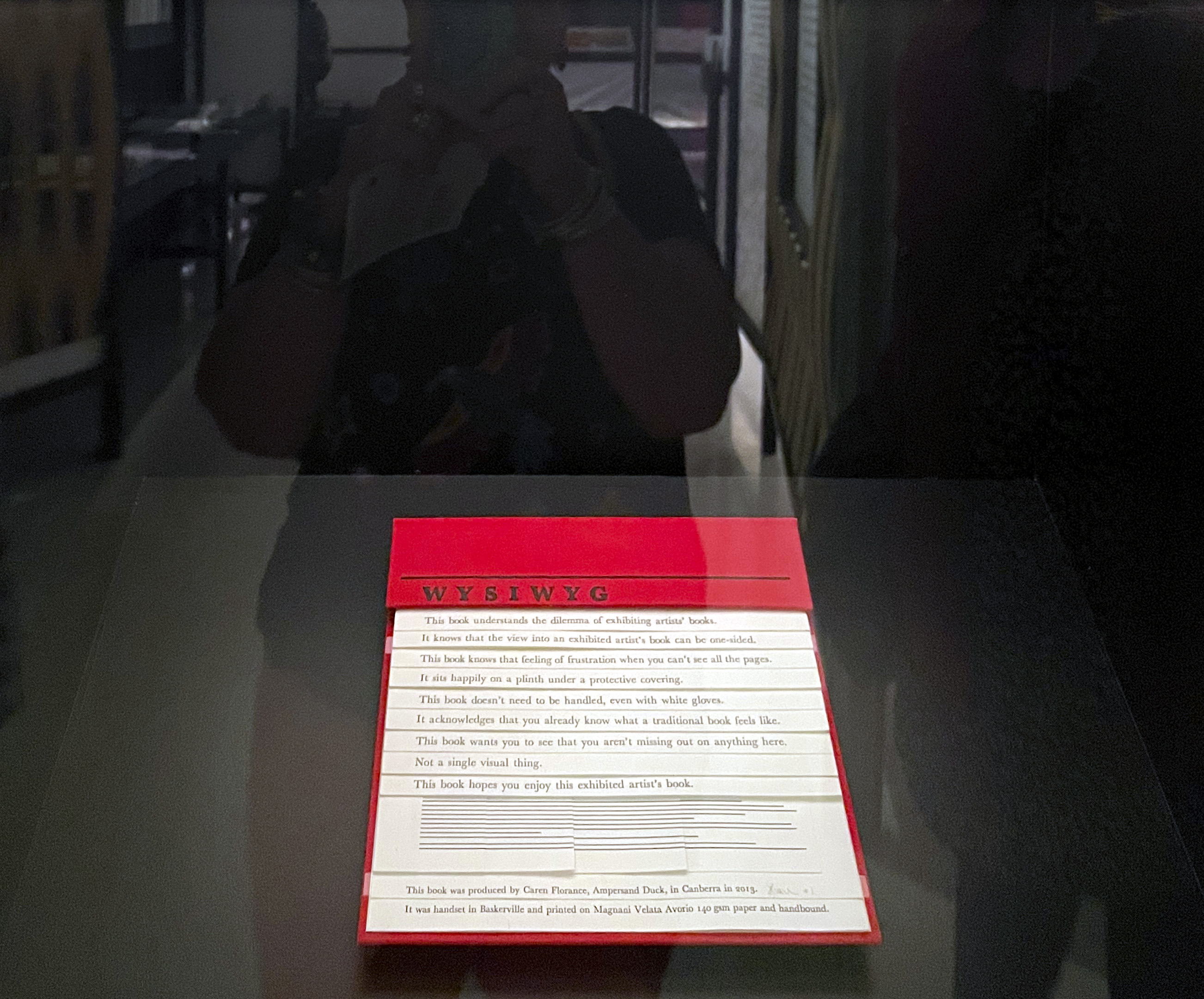
Caren Florance WYSIWYG, 2013

The first book in the exhibition, or is it the last? WYSIWYG (What you see is what you get) (2013) by Caren Florance, the curator’s own copy, was designed to be seen as a whole when the book is closed, displaying what a rarity that is. The text lines are printed on increasingly larger pages, each peeking out from the one above. Maria Savvidis wrote: “This book served as both a talisman and inside joke for me as the curator of this exhibition, years spent thinking about the paradox of exhibiting artist’s books…WYSIWYG is a wry but generous show of empathy from the artist who understands this difficulty and has shown mercy on collecting institutions tasked with the impossible.” Anne-Marie Hunter created the Tower of Babel (2006), (The Tower of Babel, Artists’ Book By Anne-Maree Hunter | State Library of Queensland) a book in the round which was exhibited in my 2008 exhibition, with the same intent.


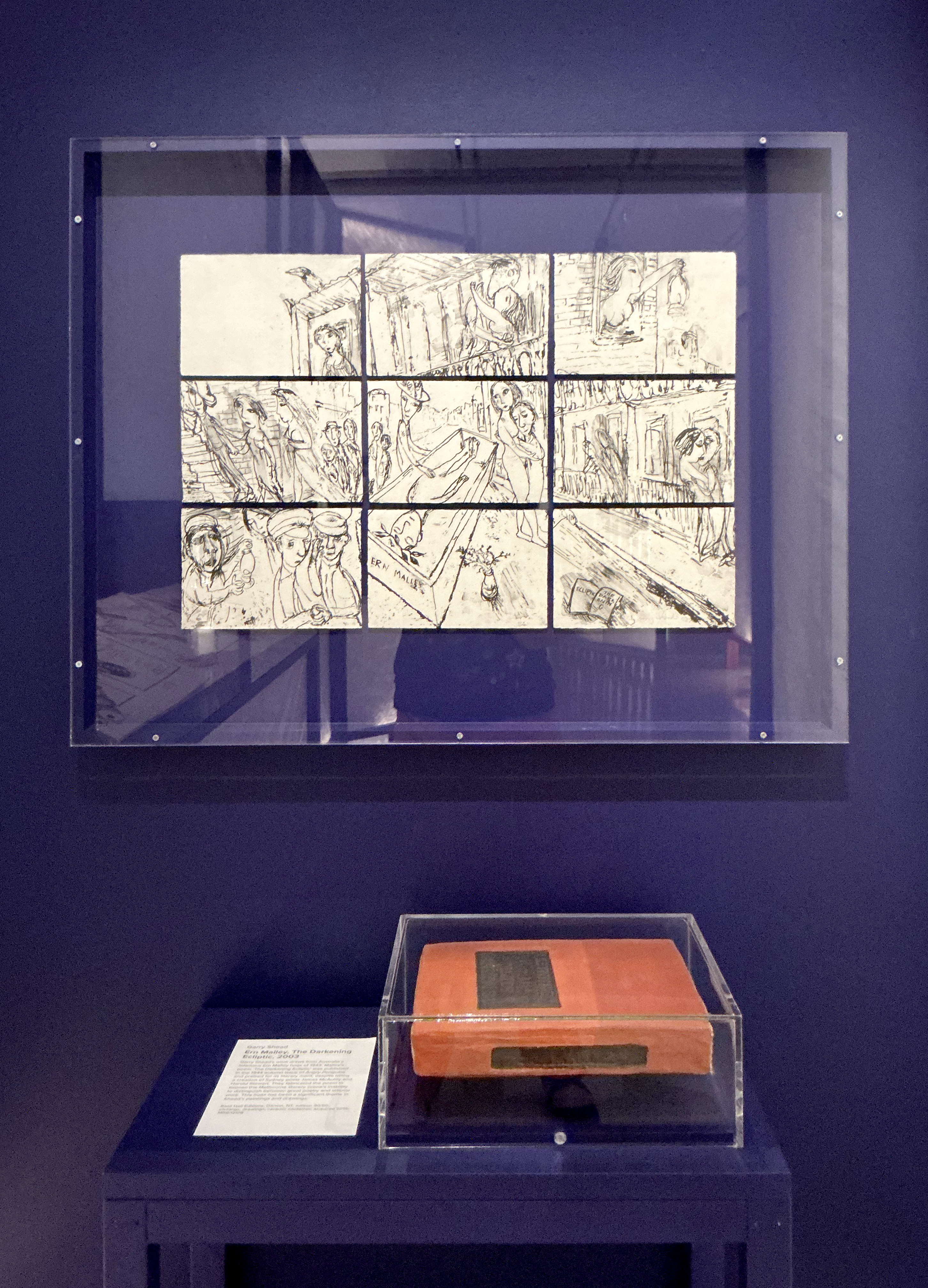
Garry Shead Ern Malley: The Darkening Ecliptic, 2003

Several of the works have been removed from their covers and are displayed, page by page, on the wall.  These include Garry Shead’s Ern Malley: The darkening ecliptic (2003): a sequence of etchings, which when presented together create a single image. Along with the display of the ceramic box in which it was presented, this is possibly the best way to show this work.


G.W. Bot Requiem by Anna Akhmatova, 2020

The pages of G.W. Bot’s superb linocuts for Requiem by Anna Ahkmatova (2020) are beautifully arranged framed on a blue background, however not all pages of the book are included so it is unfortunately a circumscribed view of the production.

Other works displayed page by page include Paul Uhlmann’s New Insecta, Queensland: AA Girault (1989), Judy Watson’s A preponderance of Aboriginal blood (2005), Peter Lyssiotis and George Matoulis’ Bridge (2021) and Glenda Orr and Kathy Boyle’s Paradise Lost : an artists’ book exploring the status of threatened & iconic plants from Australia and New Zealand collected by Daniel Solander and Joseph Banks during Captain Cook’s 1770 voyage (2020).


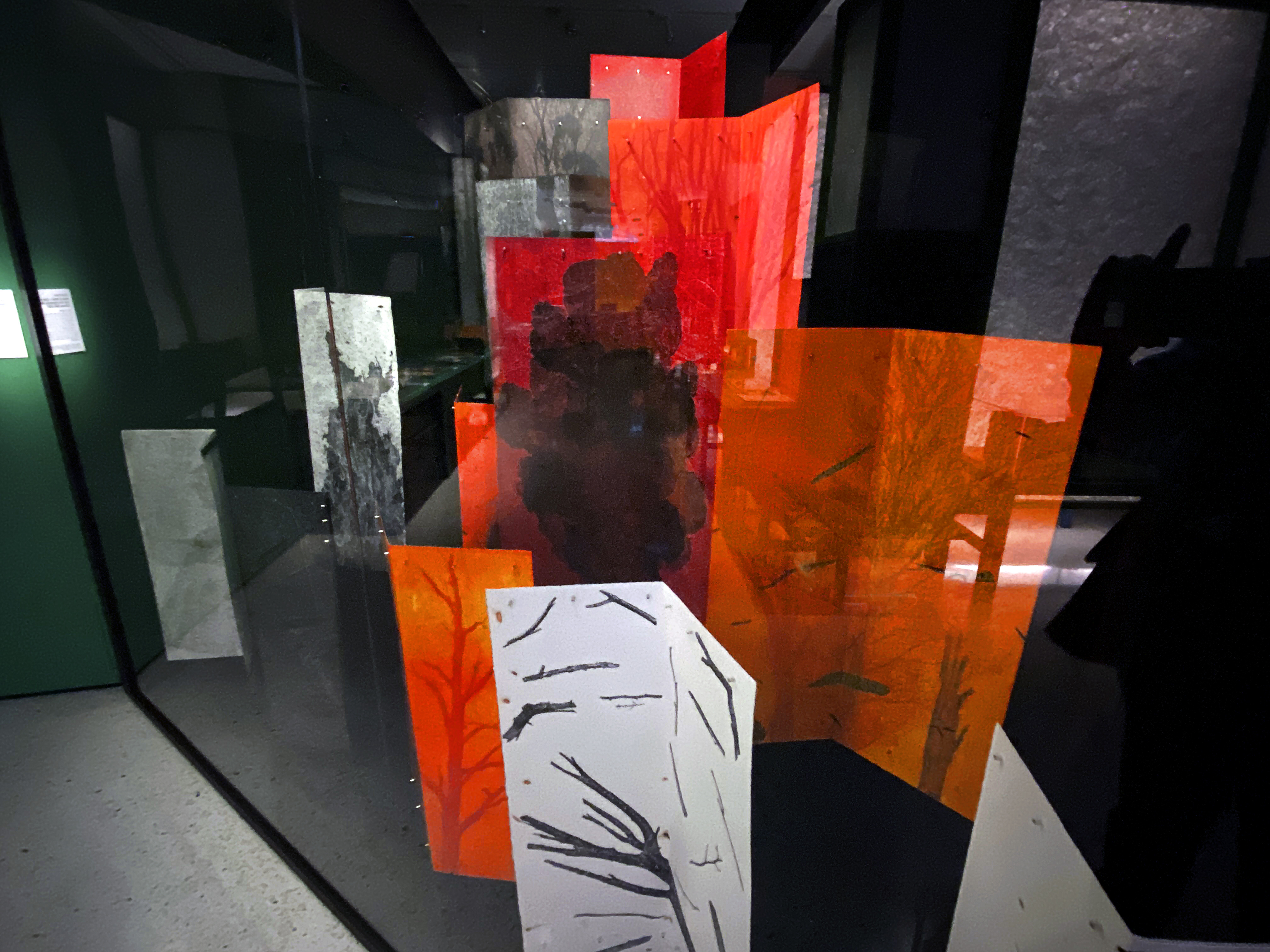
Dianne Fogwell Ashes to Ashes – Dust to Dust- Ash Wednesday 16th February 1983, (2018)  PHOTO: Doug Spowart

The pages of Di Fogwell’s Ashes to ashes – dust to dust: Ash Wednesday 16th February 1983 (2018) are arranged upright to evoke the flames of the bushfire it describes. There has been some comment that this destroys the original form and order of the books, but I disagree. Some books are meant to be rearranged by the reader or at least read in any order they want. Also, the curator went to some lengths to speak to the artists and present their work as they would want. For most of the works artists’ statements are provided, along with translations of foreign language texts, where appropriate.

I don’t consider print portfolios on a single subject, often by printmaking groups, constitute successful and cohesive artists books, and there are a few in this show including Natural Collection (2017) by the Warringah Printmakers Studio. It was published to celebrate the 20th anniversary of the Studio and is based on the species and ecological communities of the Northern Beaches of Sydney that are under threat. Ten of the 29 prints that comprise the work are exhibited over three changeovers, not including the texts which accompany each print. I don’t think this work has a conceptual framework – a common subject, yes, but not enough to tie them together – as a book.


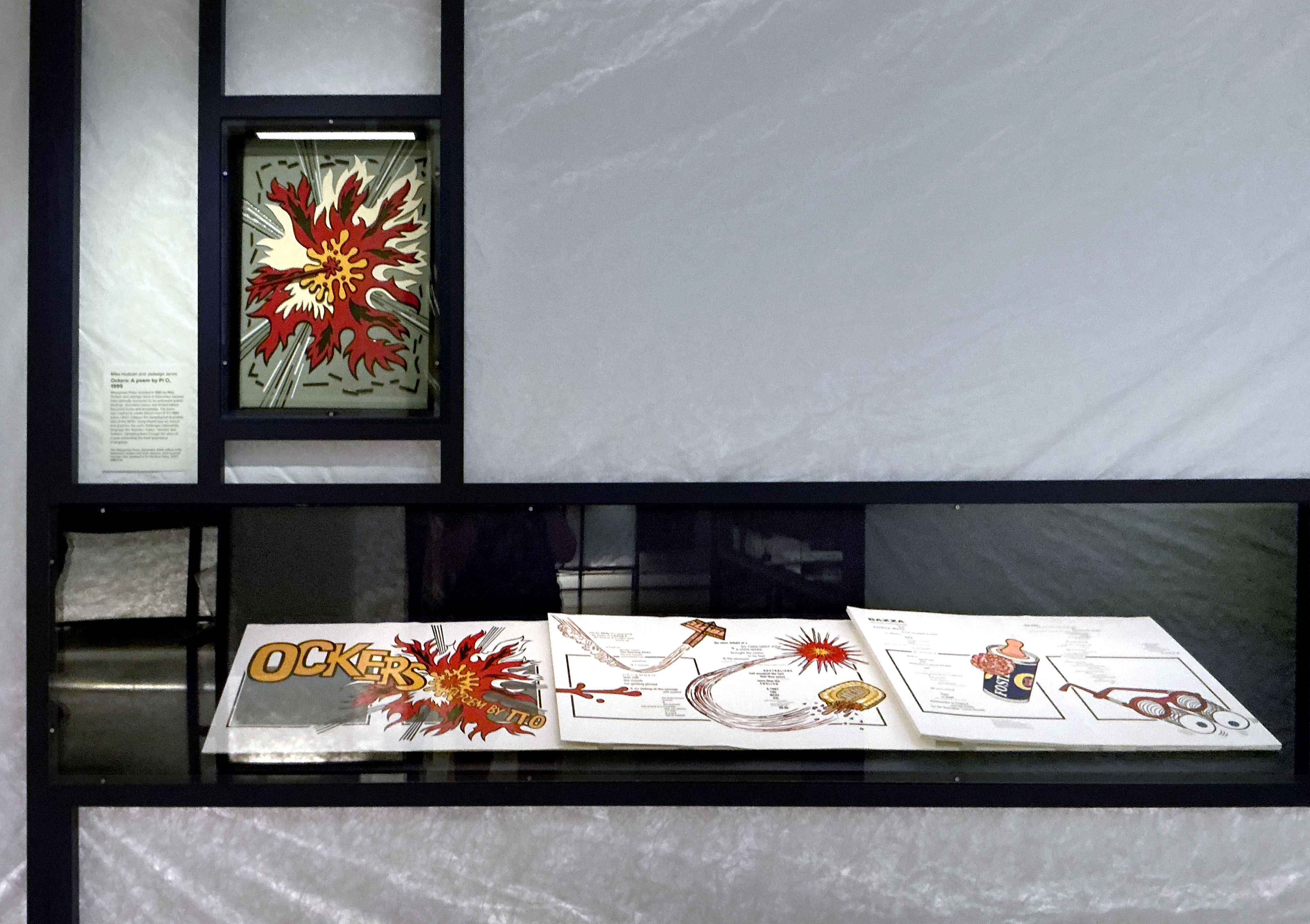
Mike Hudson & Jadwiga Jarvis Ockers: A poem by Pi O 1999

Concertina books are perfectly made for display, extended either framed on a wall or standing upright on a plinth. The bold and colourful Wayzgoose Press book Ockers: a poem by Pi O (1999) is displayed partly opened behind glass. A thoughtful work previously unknown to me was Theo Strasser’s In ecstasy, Franz Kafka (2013) in acrylic painting and collage, based on an aphorism by Kafka. Another is Lossed (2022) by Sara Bowen.  Reduction lino prints of her parents, at first strong, becoming lighter as the book is opened page by page. I’m not sure if it represents her memory of them fading or their memories of each other fading through dementia, but it is a very touching work which is displayed to perfection.


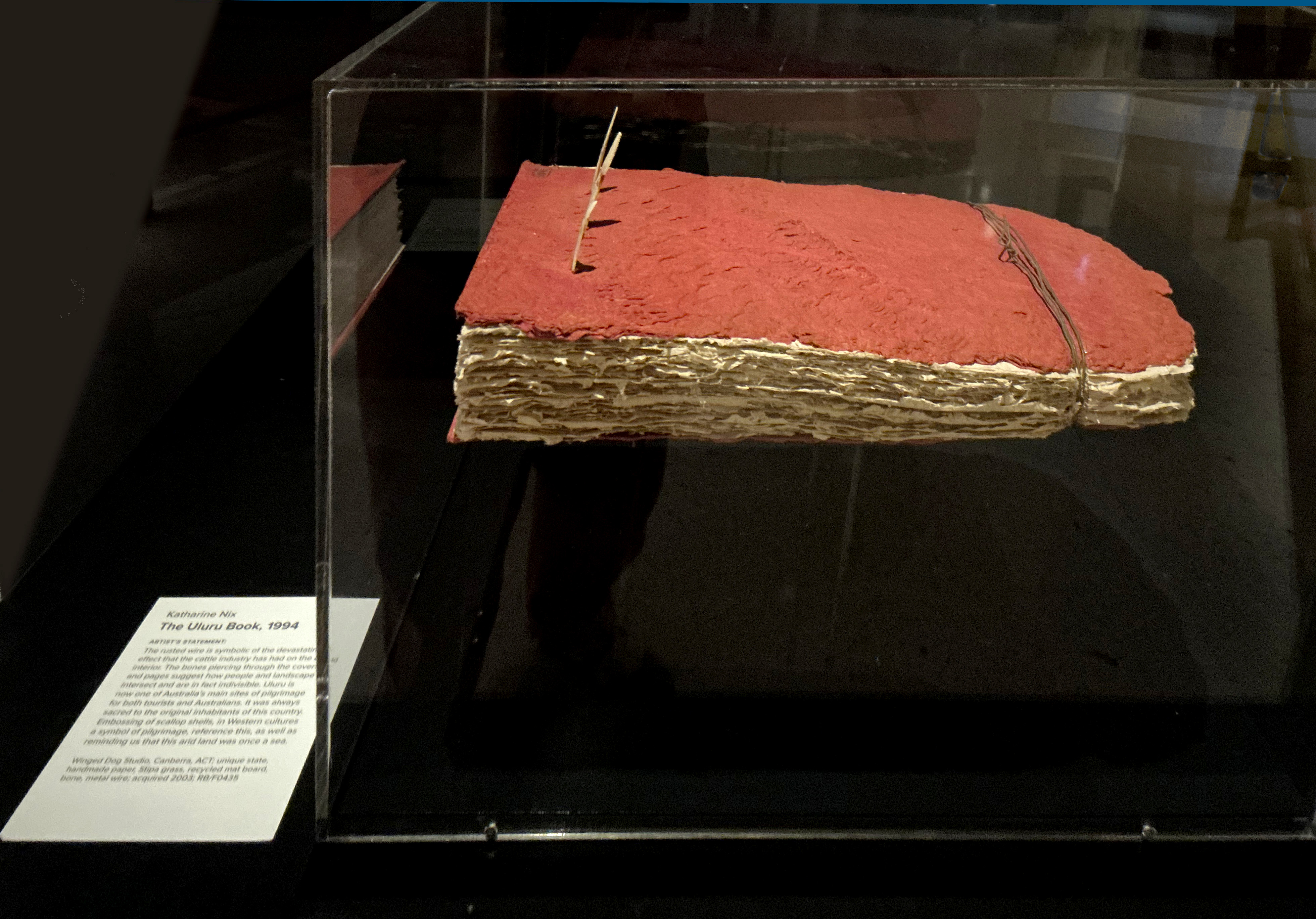
Katharine Nix The Uluru Book, 1994

Several works which could be regarded as book objects were included. The Uluru Book (1994) by Katharine Nix has an imposing physical presence; multiple layers of the hand-made paper for which she is well known, with ochre coloured covers tied with rusted wire and pierced by bones. All elements allude to the close links between the rock and its original inhabitants, and the damage done to the rock and its surrounding environment by the thousands of visitors. Teledex (1981), by Ted Hopkins is a container for poems in the form of an old-fashioned metal teledex, indexed with tabs.


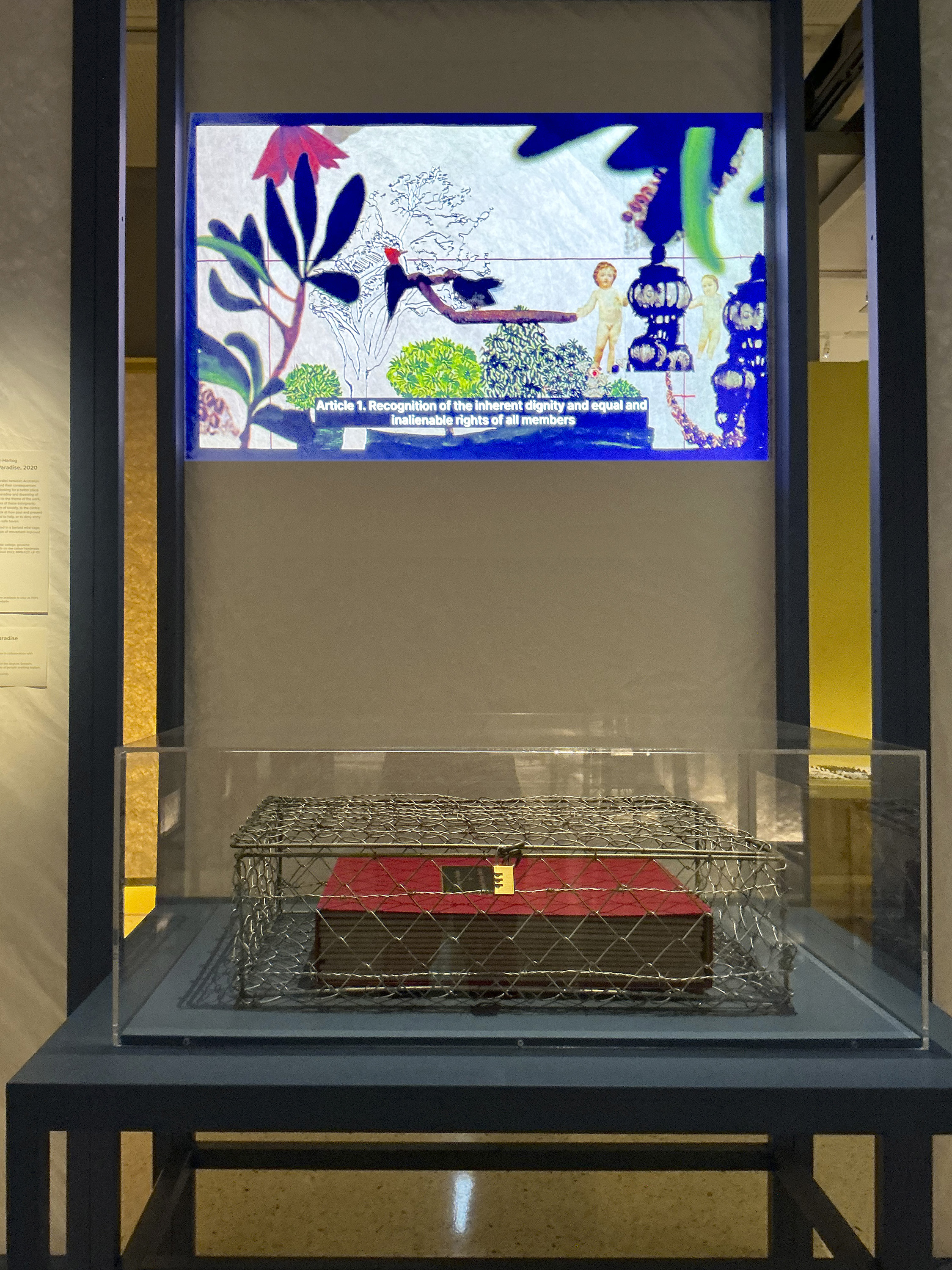
Nathalie Gautier-Hartog
Looking for Paradise, 2020 + Video a collaboration with Broken Yellow

Looking for paradise (2020) by Nathalie Gautier-Hartog, is about refugees seeking a home in Australia, but subject to Australian government policies. It is presented as 12 books inside a wire cage, further emphasizing the restrictions placed on refugees. It is noted that all of the books are available to view as PDFs on the artist’s website with a QR code linking to it displayed. There is also a clever animation based on the United Nation’s Human Rights Charter with images from the books showing in the gallery. It is also on her website. It was created in collaboration with Broken Yellow Studio and the Asylum Seekers Centre. I’m not a great fan of digitised artists books but must admit this combination of media enhances interaction and appreciation of the work.


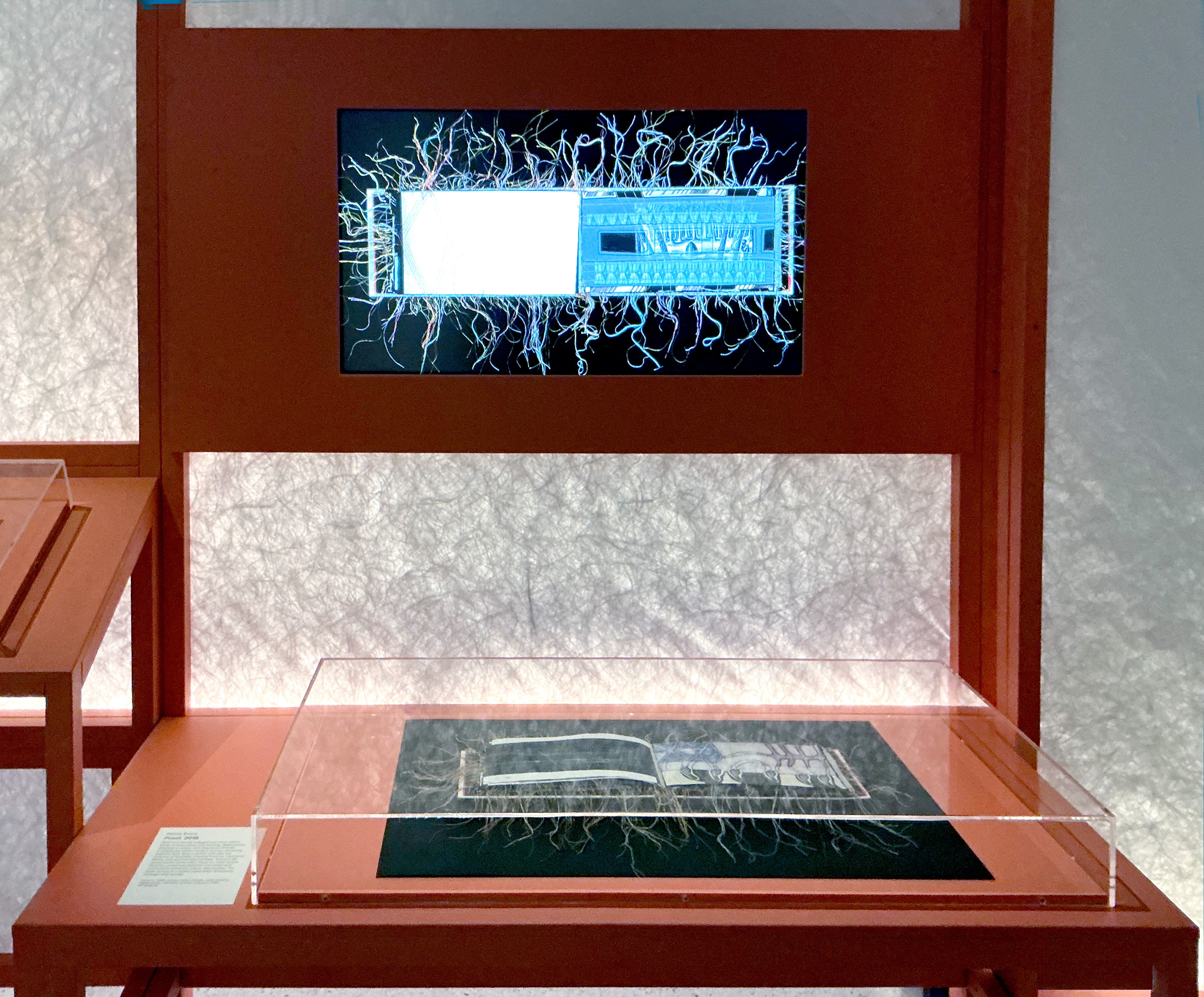
Penny Evans Proof, 2015

Relatively few First Nations artists create artists books, so it was great to see a works by Judy Watson and a work by Penny Evans, who has Gamilaroi, Welsh, Irish and German heritage using the form to examine connections between culture and country in her unique state book Proof (2015). Using collage and digital prints with stitching it was accompanied by a page-by-page video of the work.


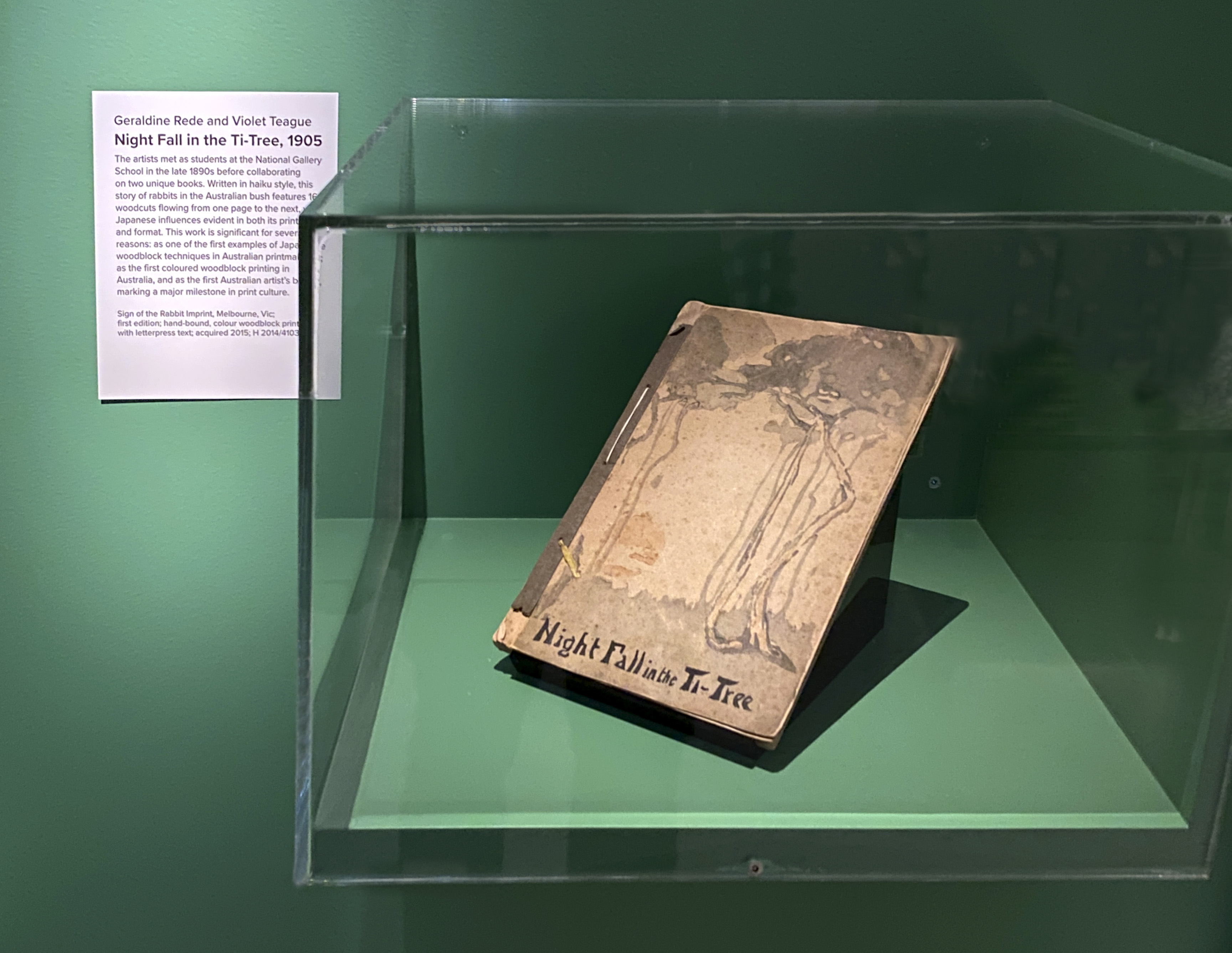
Geraldine Rede & Violet Teague Night Fall in the Ti-Tree, 1905  PHOTO: Doug Spowart

I was surprised that no works from the origins of artists books were shown: books such as those by Picasso and Bonnard published by Ambroise Vollard and Daniel-Henry Kahnweiler in Paris in the early twentieth century. It could be because the library doesn’t hold them. A quick search of the SLNSW catalogue revealed Dingo, with drypoint etchings by Pierre Bonnard published by Vollard in 1924, but few others. I was pleased to see the inclusion of Night fall in the ti-tree (1905) by Violet Teague and Geraldine Rede with its delicate woodcuts, and its acknowledgement as the first Australian artists’ book.


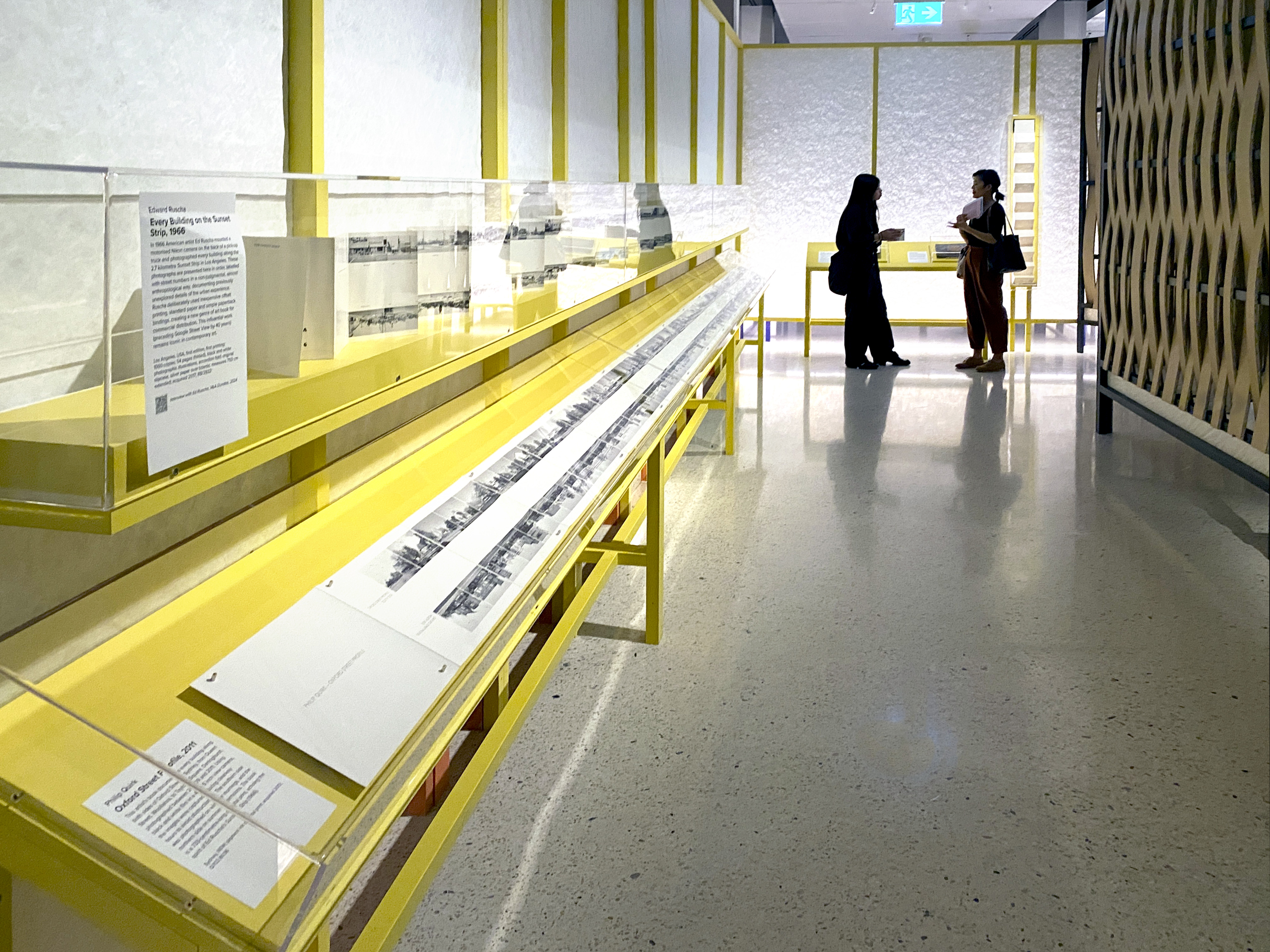
Ed Rusha Every Building on the Sunset Strip, 1966 + Philip Quirk Oxford Street Profile, 2011   PHOTO: Doug Spowart

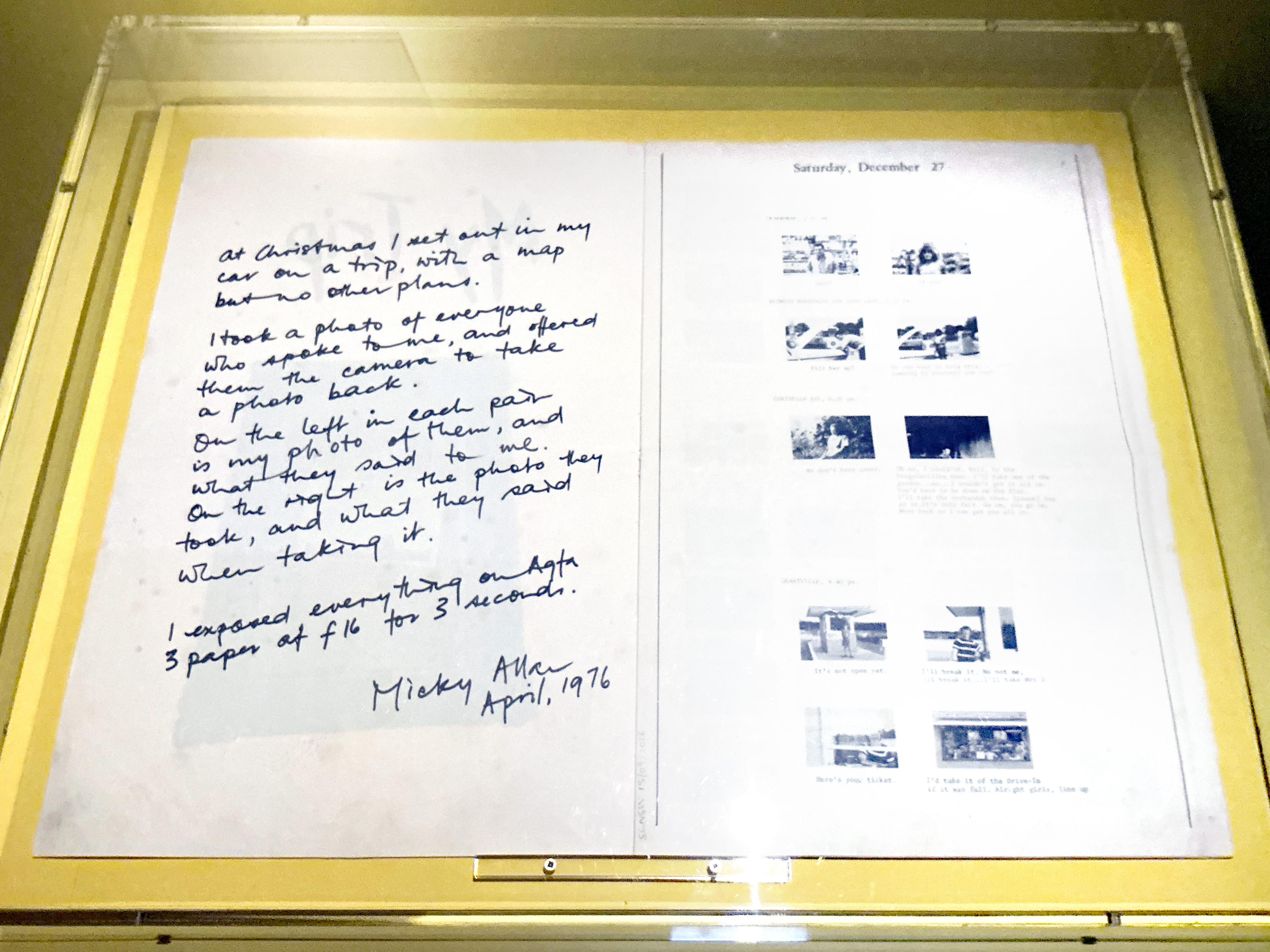
In a small way the exhibition demonstrates the limitations of the artists’ book collection at the SLNSW, which has not concentrated on its development until relatively recently. Most of the exhibited works have been created in the twenty-first century. There are few books published overseas, one being the fabulous version of the Rubaiyat of Omar Khayyam (1973) by the British artist Susan Allix. The Rubaiyat is a very popular subject for interpretation by artists. An important artist in the history of the artist’s book is American Edward Ruscha, an early exponent of the democratic multiple. He is represented by the concertina photobook Every building on the sunset strip (1966) which has had a huge influence on other artists who continue to create similar works. In this exhibition the book is unusually displayed fully extended to 7.5 metres and is shown with Oxford Street Profile (2011) documenting Oxford Street in Sydney by Australian photographer Philip Quirk. It only stretches to 7.33 metres. It was interesting to see Micky Allan’s early (in Australian terms) artist’s book My Trip (1976). Displayed open, a full facsimile of its newspaper format is also available for closer investigation.

Micky Allan My Trip, 1976


Dancing Over Dark Waters (2012), Howl for a Black Cockatoo (2015), and Phantomwise Flew the Black Cockatoo (2017), by Sue Anderson and Gwen Harrison, with Peter Lyssiotis writing the text for Dancing over dark waters, very impressive books all, are very similar materially and in subject. They could have been replaced by other works expanding the breadth of vision made available in the exhibition. Similarly, several artists are represented by more than one work when other artists and their ideas could have been embraced.


Deanna Hitti Towla, 2017

The exhibition includes some of my favourite artists books including Towla (2017) by Deanna Hitti, with the integral clamshell box creating a board for backgammon, the subject of the book. It is an intriguing book with instructions for backgammon phonetically translated using Arabic and Latin characters but with a twist. Arabic letters spell the instructions in English and Latin letters spell the instructions in Arabic. Some of the books in this exhibition have become my new favourites.


In Conclusion

Criticisms of some components of the exhibition are mere quibbles. In retrospect I could make many about my own exhibition in 2008. This is a fabulous exhibition, beautifully curated, wonderfully designed, and a rare opportunity for the public to experience the breadth and depth of the artists’ book. I hope it will introduce the magical world of artists’ books to a whole new audience in Sydney who will follow up with personal experiences with artists’ books in the library. I also hope that SLNSW will continue to support the art form in both acquisitions and exhibitions.


Helen Cole

March 14, 2026


.

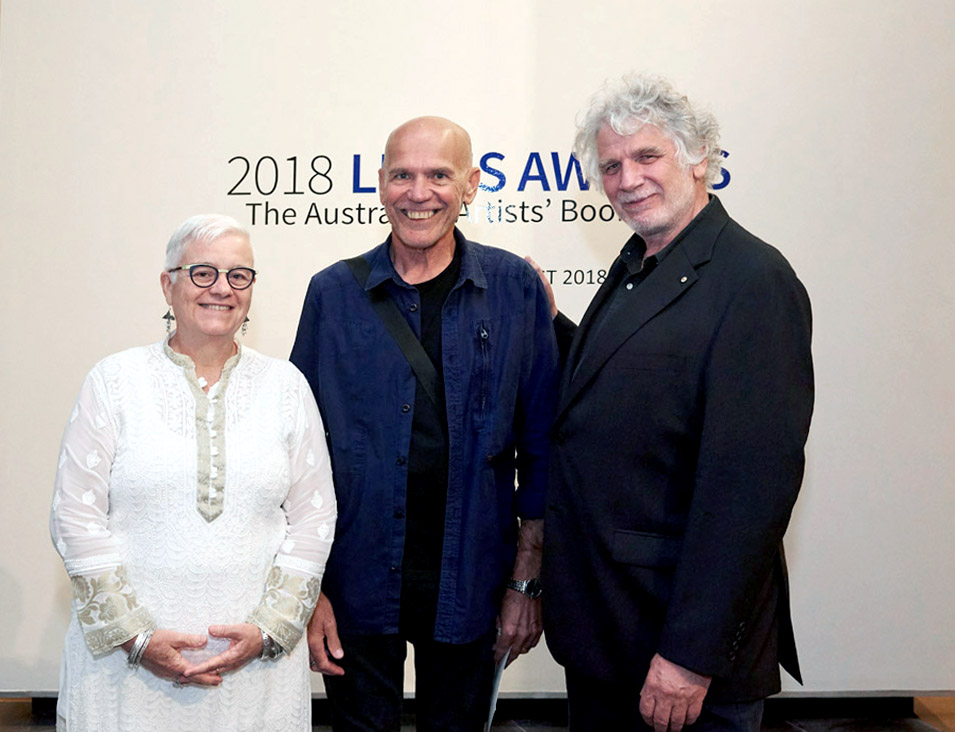
Judges: Helen Cole & Roger Butler with Clyde McGill    PHOTO: Artspace Mackay

HELEN COLE: Brief Biography

Helen Cole is intimately acquainted with the world of artists’ books, including their collection and the opportunities and difficulties in presenting these artworks in a public context. Helen was the Arts and Rare Book librarian at State Library of Queensland for thirty years. During much of that time she was responsible for the development of the Library’s extensive Artists’ Books Collection. She has been significantly involved in the artists’ book discipline writing articles and making presentations at conferences. She has judged the Manly Artists Book Prize once and on two occasions judged the Libris Australian Artists’ Book Prize for Artspace Mackay. In 2008 she curated the SLQ exhibition Freestyle Books: Artists’ books from the collection. Helen also co-curated the Tales from the Lyrebird with Ron McBurnie for Artspace Mackay. Apart from her work developing public collections she has amassed a personal library of cherished books.

..

.

OTHER PAPER UNIVERSE RESOURCES


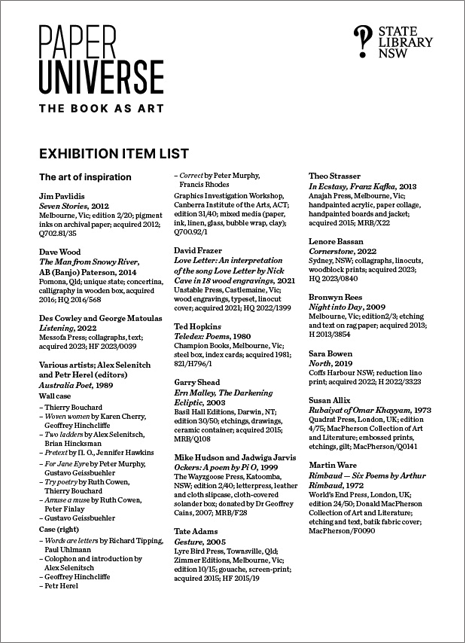
DOWNLOAD: A list of all books in Paper Universe:  Paper Universe Book List


DOWNLOAD: A catalogue of Didactic Information on Each Book: Paper Universe Exhibition Captions


DOWNLOAD: A Press Release of the exhibition: Paper Universe Media Release


We wish to acknowledge the courtesy extended to us by curator Maria Savvidis.


The Reflection text ©2026 Helen Cole
All photographs are by Helen Cole unless otherwise credited.
© is retained by all authors


All photographs have been digitally optimised by Doug Spowart.


Two views of th ‘Paper Universe’ entry concertina PHOTO: Helen Cole


.


.

  .

.

.

.

.

.

ARTISTS BOOKS IN AUSTRALIA: The People+Events

leave a comment »

Doug Spowart’s ARTISTS BOOK FAMILY Mosaic

.

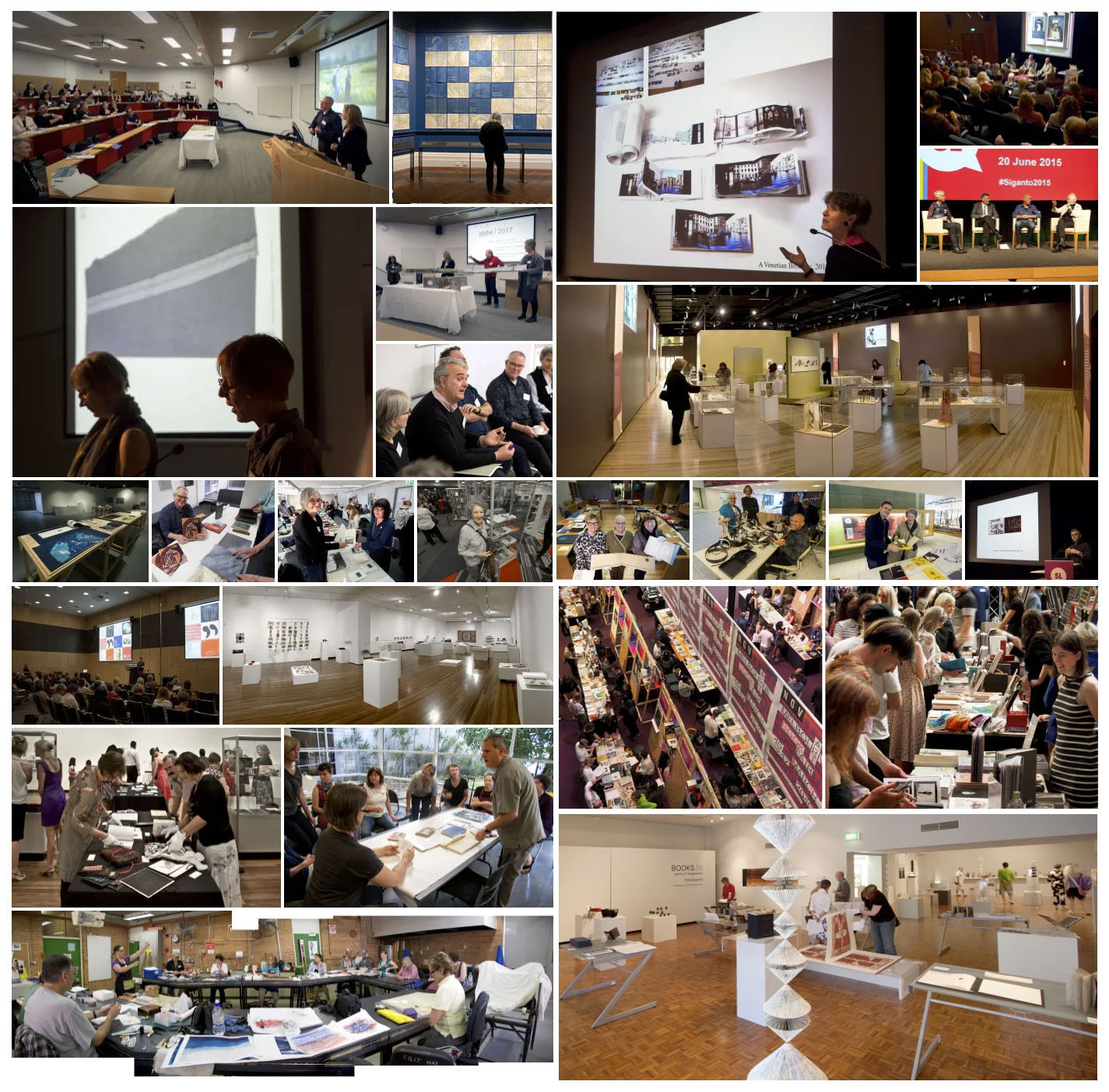
In July the artists book symposium ABBE 2025 took place at Artspace Mackay.  A key theme of this event was the ‘mapping Australia’s artists book histories’ and in the extended brief for the conference there was the lament that while artists books in Australia had been broad and active there was a scant record of the history the discipline.

.

Reference was made to the understated history of the two main texts Gary Catalano’s The Bandaged Image (1983) and Alex Selenitsch’s NGA published Australian Artists Books 2008, conferences such as those coordinated by Artspace Mackay, many unpublished PhD thesis and the ‘valiant attempts by journals’ that burn out after a few years.

‘Bring your stories, your artifacts, and your memories’ they said so I put forward a submission consisting of aspects of the visual record that I have been making over 22 years of the artists book scene. My submission was to be an illustrated presentation consisting of approximately 200 portraits of the people of the artists book discipline as well as a few events.

.

Here is my submission rationale:

AN ARTISTS BOOK FAMILY ALBUM   –   A ‘paper’ by Dr Doug Spowart

“A family’s photograph album is generally about the extended family

and, often, is all that remains of it.”

Susan Sontag in On Photography 1977

Family archives are a profound thread connecting past, present, and future, serving as repositories of memory, identity, and history.

Photography is more than just a medium for capturing pictures—it is a lens through which we view and understand history. Its ability to document, provoke, and preserve moments in time has made it an indispensable tool for both personal and collective memory.

In this way photographs hold the power to evoke vivid recollections, introducing us to lost relatives and forgotten stories while anchoring us within a broader familial narrative. Yet, the fragility of these archives is striking — images tucked away on devices or in drawers risk being lost to time, their stories untold.

The passing of key family members often deepens this void, as context and meaning tied to people and events can vanish. Establishing and preserving a family archive becomes not just an act of personal curation but a legacy-building effort, ensuring that these visual fragments of memory remain accessible to future generations.

In an era where countless photos are taken but rarely saved, the challenge lies in collecting and annotating these fleeting moments. A taking them into lasting archives for some to have as a touchtone for memory, and for others to review and research. Maybe to tell the story for future eyes and minds of the books that were made, what events happened and who was there…

This paper will present an illustrated fragment of photographs of the artists book family taken by the author over a 20 years period.

Dr Doug Spowart

.

.

This submission was accepted, and the presentation offered to attendees of the symposium, and later online as a movie via the Artspace website.

.

.

A LINK TO THE YOUTUBE VIDEO ON DOUG SPOWART’s Channel: “CLICK IMAGE”

For BEST viewing quality select HD quality in the SETTINGS menu. NOTE: The full video is 12 minutes long.

.

.

 .

.

PRESENTER’S COMMENT from Doug Spowart

In curating these photographs I have focussed on selecting images from the broad artists book community and have not included many photographs from my collaborative practice with Victoria Cooper.

Every attempt has been made to ensure correct captions – Please advise of any errors or omissions. Thanks to Caren Florance, Helen Cole, Robert Heather and Adele Outteridge for their assistance with captions.

Victoria and I have provided commentary about the artists book and photobook disciplines for many years in our Blog, journals, events coordinated and lecture presentations.

.

.

.
All photographs are Copyright Doug Spowart (Some by Victoria Cooper).  The subject pictured, after contacting the copyright owner, may be able to use the portrait of themselves for non-commercial applications. Other usage may require negotiation of a fee.

.

.

.

.

.

WHAT FOLLOWS IS A LIST OF ALL CAPTIONS IN THE VIDEO

.

MABF 2017        National Gallery of Victoria
Deanna Hitti and Deidre Brollo @ MABF 2017        National Gallery of Victoria
‘Life’s Journey’ exhibition @ Redland Art Gallery, Cleveland    2012
Julie Barratt in her gallery at Alstonville  2011
Dianne Longley in her exhibition ‘Navigations’ at Barrett Galleries    2008
Tim Mosely in his exhibition Make Like An Eskimo 2012
grahame galleries opening of Lessons in History Vol. II – Democracy   2012
Heather Matthew and Stephen Spurrier @ grahame galleries opening of Lessons in History Vol. II – Democracy 2012
Monica Oppen and Jan Davis @ grahame galleries opening of Lessons in History Vol. II – Democracy 2012
Volume Art Book Fair, Artspace, Woolloomooloo, Sydney    2017
Helen Cole chairs presentations by Keith Smith and Scott McCarney       State Library of Queensland  2012
Siganto Seminar: The Trouble with Artists’ Books     SLQ 2013
Helen Cole –Siganto Seminar: The Trouble with Artists’ Books     SLQ 2013
Noreen Graeme and Jan Davis – Siganto Seminar: The Trouble with Artists’ Books     SLQ 2013
Hearsay book launch with Euan Mcleod, Ron McBurnie, Susi Muddiman & Lloyd Jones  SLQ  2013
Jo Kambourian at Artists Books Flash Mob Survey Book event Grafton 2013
Catherine McCue Boes Books as art: 30 years in the making   Bundaberg Regional Gallery 2014
George Paton Gallery, Artist’s Books (reprised)  University of Melbourne 2014
International speaker Sarah Bodman presents a paper – Abbe 2015     Griffith University
International speaker Brad Freeman – Abbe 2015     Griffith University
Lyn Ashby  –  Abbe 2015     Griffith University
Convener Tim Mosely presenting  – Abbe 2015     Griffith University
  Books By Artists exhibition – Abbe 2015     Griffith University
Sue Anderson + Gwen Harrison   Abbe 2015     Griffith University
Deidre Brollo with Christene Drewe + Helen Cole and Marian Crawford with Sarah Bodman
Abbe 2015     Griffith University
Penny Carey-Wells and Caren Florance    Abbe 2015     Griffith University
Robyn Foster + Fiona Dempster and Angela Gardner     Abbe 2015     Griffith University
Sheree Kinlyside and Impress Printmakers: Sue Poggioli + Jennifer Stuerzl    Abbe 2015     Griffith University
Tim Mosely and Heather Matthew    Abbe 2015     Griffith University
Adele Outteridge + Wim de Vos – Abbe 2015     Griffith University
Jo Kambourian and Darren Bryant at Lismore Art Space  2014
The SLQ White Gloves team Christene Drewe, Helen Cole and Jeanette Garrard for Abbe 2015
State Librarian Janette Wright welcomes attendees      SLQ 2015
Brazillian artist Amir Brito Cadôr keynote presentation Siganto Foundation Artists’ Book Seminar 2015
Julie Barratt and Clyde McGill discusse their Siganto Foundation Creative Fellowship  2015
Jan Davis and Doug Spowart discuss their Siganto Foundation Creative Fellowship  2015
A forum on collaboration – Siganto Foundation Artists’ Book Seminar 2015
Judy Bourke and Adele Outteridge+Wim de Vos at the Siganto Foundation Artists’ Book Fair  SLQ 2015
Clyde McGill and Anne Kirker and Sue Poggioli at the Siganto Foundation Artists’ Book Fair  SLQ 2015
Helen Malone and Sandra Pearce at the Siganto Foundation Artists’ Book Fair  SLQ 2015
Amir Brito Cadôr with Noreen Grahame & Helen Malone at the Siganto Foundation Artists’ Book Fair  SLQ 2015
Helen Cole, Michael Wardell & Clyde McGill at the Siganto Foundation Artists’ Book Fair  SLQ 2015
Dr Marie Siganto makes a presentation to Ana Paula Estrada and Victoria Cooper
PAPER CONTEMPORARY  –  Sydney Contemporary  2015
Grahame Galleries stand with Ron + Jonathan McBurnie at Paper Contemporary  –  Sydney Contemporary  2015
Victoria Cooper, Jan Davis and Trent Walter at Paper Contemporary  –  Sydney Contemporary  2015
Sue Anderson + Gwen Harrison and Brigita Oppen at Paper Contemporary  –  Sydney Contemporary  2015
Helen Cole, Akky van Ogtrop, Robyn Berkeley from Berkeley Editions and Victoria Cooper at
Paper Contemporary  – Sydney Contemporary  2015
Fellow Travellers a book by William Kelly, SLV Creative Fellow and Baldessin Press Studio Residency recipient
Personal Histories International Artist Book Exhibition   Uni of NSW Canberra 2015
Robyn Foster (Curator), Judy Bourke, Selena Griffith, Tracie Toohey, Rachel Hunter, Lisa Morisset –
Personal Histories International Artist Book Exhibition   Uni of NSW Canberra 2015
Christene Drewe introduces UK artist Guy Begbie –  The Siganto Foundation Fellowship artist book series 2016    SLQ
Guy Begbie presents his keynote address – The Siganto Foundation Fellowship artist book series 2016    SLQ
Victoria Cooper and Lyn Ashby presentations – The Siganto Foundation Fellowship artist book series 2016-7    SLQ
Helen Douglas presents her keynote address – The Siganto Foundation Fellowship artist book series 2017   SLQ
Clyde McGill performs his book and a White Gloves presentation of artists books
– The Siganto Foundation Fellowship artist book series 2016    SLQ
Freestyle Books exhibition curated by Helen Cole at the State Library of Queensland 2008
Freestyle Books Symposium with Ron McBurnie, Peter Lyssiotis, Judy Watson, Jonathon Tse and others
 at the State Library of Queensland 2008
At the launch of Ana Paula Estrada’s book MEMORANDUM  –  Ana Paula with Louis Lim and Annette Green  2016
Visiting Wim de Vos and Adele Outteridge at Studio West End Brisbane   2017
Visiting the 2017 Festival of the Photocopier Zine Fair  –  Melbourne
David Dellafiora and Gracia Haby + Louise Jennison at the
2017 Festival of the Photocopier Zine Fair  –  Melbourne
Ulrike Stoltz & Uta Schneider international presenters at Artists book Brisbane Event   Griffith University    2017
A K Milroy + Brad Freeman – presenters at Artists Book Brisbane Event   Griffith University    2017
Marian Crawford and Ana Paula Estrada presents their papers
Artists Book Brisbane Event   Griffith University    2017
Marian Macken presents at Artists Book Brisbane Event   Griffith University    2017
Wim de Vos at Artists Book Brisbane Event   Griffith University    2017
A plenary session on artists books at Artists Book Brisbane Event   Griffith University    2017
Noreen Grahame in her curated exhibition “… & So”   – Artists Book Brisbane Event   Griffith University    2017
Barbara Davidson and Caren Florance at Artists Book Brisbane Event   Griffith University    2017
Sue Poggioli and Anne-Maree Hunter at Artists Book Brisbane Event   Griffith University    2017
Brad Freeman and Anita Milroy  –  Artists Book Brisbane Event   Griffith University    2017
Lyn Ashby and Sue Anderson at Artists Book Brisbane Event   Griffith University    2017
Anna Welch, Des Cowley and Madeleine Say at Ballarat International Foto Biennale
World Photobook Day Book Fair 2019
Helen Cole presents and a floortalk – The First Focus of Artists Books and the Libris Awards at Artspace Mackay 2004
Looking at books and the opening crowd – Focus of Artists Books and the Libris Awards at Artspace Mackay 2004
Bruno Leti workshop – Focus of Artists Books and the Libris Awards at Artspace Mackay 2004
Focus of Artists Books and the Libris Awards at Artspace Mackay 2005
Caren Florance, Sasha Grishin and Dianne Fogwell in the ANU exhibition at FOAB 2005
Unknown lady, Adele Outteridge, Madonna Staunton and Wim de Vos and Sasha Grishin    FOAB 2005
Focus of Artists Books and the Libris Awards at Artspace Mackay 2006
Robert Heather welcomes attendees + Marshall Weber presents Focus of Artists Books at Artspace Mackay 2006
Katherine Nix workshop – Focus of Artists Books at Artspace Mackay 2006
The installation view of the 2008 Libris Awards
Michael Wardell welcomes attendees and a Forum at the 4th Focus on Artists Books event and
Judge Michael Desmon presents his address to the 2008 Libris Award
Clyde McGill’s foyer artwork  FOAB 2028
Michael Desmond presents his lecture in the 4th Focus on Artists Books event
2008 FOAB some of the presenters McGill, Fogwell, Florance and Cooper
Focus on Artists Books V and the 5th Libris Awards 2010
Michael Wardell addresses the attendees – 2010 Libris Awards and 5th Focus on Artists Book event
2010 FOAB  Deanna Hitti in her exhibition ‘Bint Trembucky (daughter of the drum)’
Caren Florance and David Dellafiora in their workshops – 5th Focus on Artists Book
Victoria Cooper with Judy Barrass and Linda Douglas – 5th Focus on Artists Book
Barbara Davidson and Caren Florance with Sheree Kinlyside of Red Rag Press  –  5th Focus on Artists Book
Victoria Cooper with Monica Oppen and Sara Bowen (Book Art Object), Julie Barratt and Caren Florance
Visiting the 2016 Libris Artists Book Award
Denise Vanderlugt with her highly commended bookwork I used to wrap rainbows and Jamian Stayt’s
Soulless evolution 2016 Libris Artists Book Award
graeme galleries’ 5th Artists’ Books + Multiples Fair in the Dell Gallery Griffith University   2007
Monica Oppen and Michael Wardell with Doug Spowart
at graeme galleries’ 5th Artists’ Books + Multiples Fair in the Dell Gallery Griffith University
Helen Cole + Dianne Fogwell and Stephen Spurrier + Normana White
at graeme galleries’ 5th Artists’ Books + Multiples Fair in the Dell Gallery Griffith University
Victoria Cooper with Dianne Longley and Anne-Maree Hunter
at graeme galleries’ 5th Artists’ Books + Multiples Fair in the Dell Gallery Griffith University
12th Edition Noosa Artists Book event ‘Back to Basics’   2008
Southern Cross University Acquisitive Artists Book Award  2006
Southern Cross University Acquisitive Artists Book Award  2007
Southern Cross University Acquisitive Artists Book Award  judged by Robert Heather 2008
Judge Tara O’Brien announces the winner – Southern Cross University Acquisitive Artists Book Award  2009
Southern Cross University Acquisitive Artists Book Award  2011 – Judge Ross Woodrow
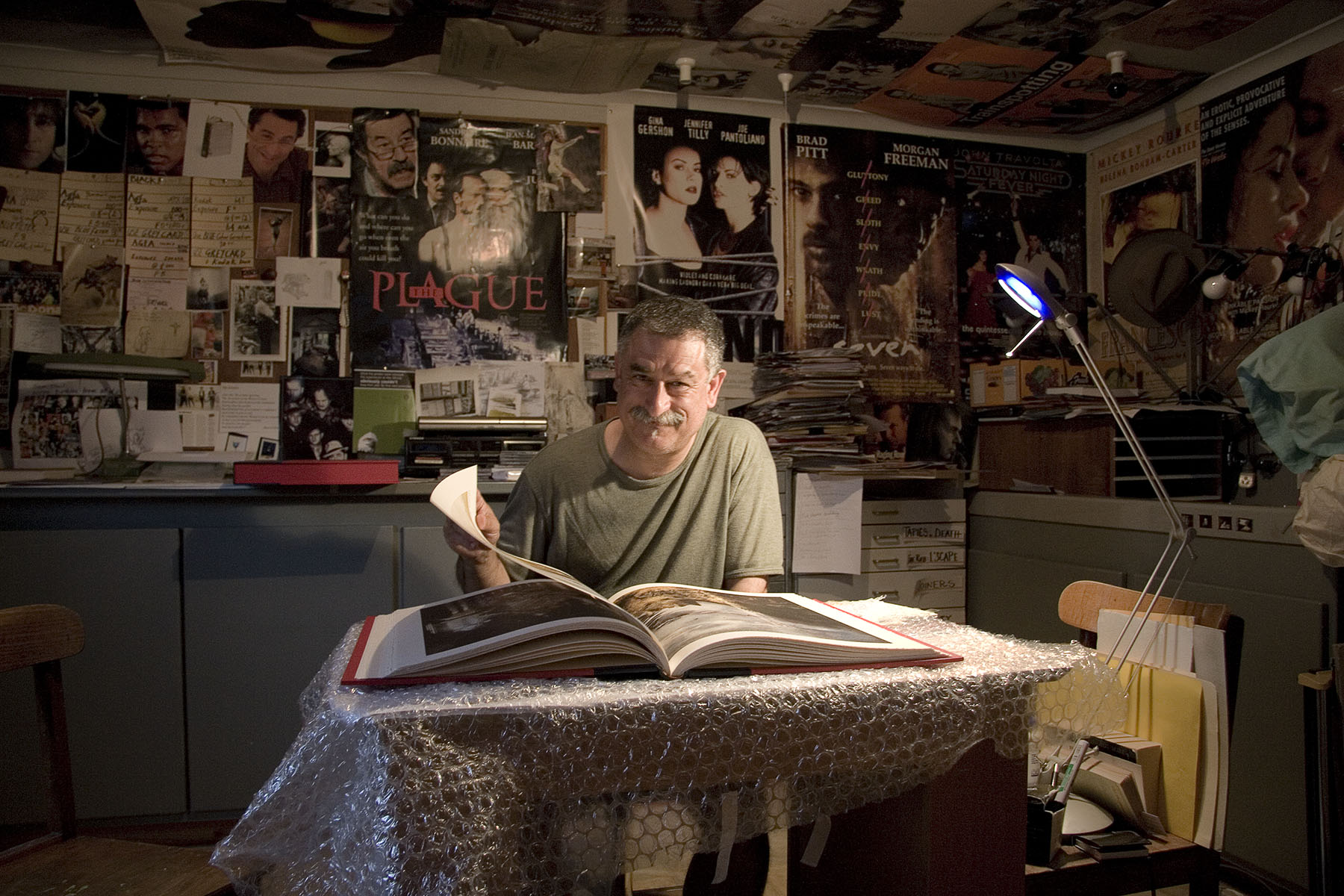
Peter Lyssiotis is his studio  2014
Ana Paula Estrada presenting her Mexican photobook collection in Maud Gallery, Brisbane  2017
Keith Smith and Scott McCarney in a workshop at West End Studios Brisbane 2006
Deanna Hitti’s exhibition of the book ‘A is for Alam (pen)’ at the State Library of Victoria   2022
 

.

 .
 

Any RSS reposting from this Blog without permission represents a breach of Copyright.

.

.

.

.

.

Written by Cooper+Spowart

August 8, 2025 at 2:57 pm

Posted in Victoria Cooper, Wot happened on this day

Tagged with , , , , , , , , , , , , , , , , , , , , , , , , , , , , , , , , , , , , , , , , , , , , , , , , , , , , , , , , , , , , , , , , , , , , , , , , , , , , , , , , , , , , , , , , , , , , , , , , , , , , , , , , , , , , , , , , , , , , , ,

LYSSIOTIS+COOPER+SPOWART: WE ARE LIBRIS AWARD Finalists

leave a comment »

.


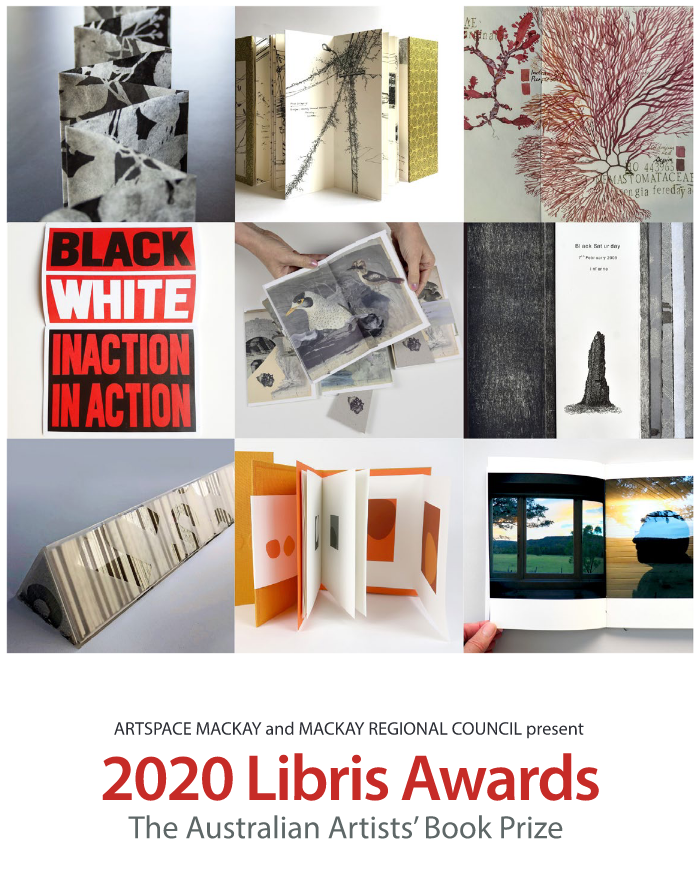
The LIBRIS AWARDS for Australian Artists Books is on again this year at Artspace Mackay – We are excited to announce that our works, including a Peter Lyssiotis book we collaborated on, have been selected in the 60 finalists. The exhibition is scheduled at Artspace Mackay between 27 June and 13 September 2020.


.

A statement from the Artspace Director Tracey Heathwood

Since opening its doors in 2003, the gallery has been dedicated in its exploration and support of the artists’ book medium. The Libris Awards play a significant role in showcasing the very latest and best in contemporary artists’ book practice in Australia.

As extraordinary developments continue to unfold in response to Covid19, Artspace Mackay has faced and overcome many challenges presented throughout the year to now be in the final exciting stages of delivering another inspirational exhibition, 2020 Libris Awards: The Australian Artists’ Book Prize.

Despite restrictions beginning to ease across the country, lingering interstate travel constraints prevent our designated 2020 Libris Awards judges, Des Cowley and Robert Heather – who have already completed the challenging job of selecting finalists from an extensive range of artists’ books entries from across the nation – from travelling to Mackay for the final process of selecting winners in the three categories. In these exceptional circumstances, Artspace Mackay Director Tracey Heathwood will complete the final process of selecting this year’s prize winners.

Announcement of 2020 Winners: 4:30pm (AEST) Monday 13 July – Live streamed online via Artspace’s Facebook page.


HERE ARE THE BOOKS we were involved with :


PETER LYSSIOTIS:  WHAT THE MOON LET ME SEE

A collaboration with Victoria Cooper + Doug Spowart who created and optimised pinhole images of Peter’s montage image to accompany his texts.

This slideshow requires JavaScript.


Peter Lyssiotis: What The Moon Let Me See

ARTIST’S STATEMENT

The narrative of What The Moon Let Me See is a journey. It is also about a father and son and how their lives, and their purposes in life interweave. The journey is to a mountain; it could be Thomas Mann’s ‘Magic Mountain’, it could be the Bible’s Mount Ararat or it might be that mountain you see on the horizon when you look out of your car window as you drive through the country. The father and the son may be Abraham and Isaac or Kafka and his father or the father and son who live next door, or you and your father … the journey they’re on involves making decisions; perhaps the son will release the father, maybe the father will free the son … how do these two people read and map their worlds, how do they refer to the world here and the world beyond them?


VICTORIA COOPER:  BEING PRESENT


Victoria Cooper’s BEING PRESENT

ARTIST’S STATEMENT

Being Present has its physical origins from the Bundanon Trust and the Shoalhaven River.

The electron microscopic images come from unexplored work made during an earlier residence in 2007 of collected detritus from the river. The montages were constructed with these microscopic images as interventions into a riparian environment near the property.

The book is informed by the work of notable writers, thinkers and philosophers, Martin Heidegger and Rachel Carson.


DOUG SPOWART:  HOME


.

Doug Spowart’s book  HOME

ARTIST’S STATEMENT

This book was conceptualised and created during an artist’s residency at Bundanon near Nowra in New South Wales in June 2018. The final design of the book took place in 2019.

For 5 years I have been homeless resulting from the need to travel, seeking work, looking for a place to settle, and maintaining connections with supporting friends and colleagues. The residency enabled inner thoughts to emerge that have been suppressed throughout this time.

Self-imaging is not something new to me. What is new however in this work is the frank reality of the expression, pose and perhaps vulnerability I present in these moments contemplating ‘home’ and what it means to me.

.

.

.

Libris_Catalogue pic


Download a copy of the Catalogue:

LIBRIS_AWARDS-2020_Finalists_Catalogue

.

.

.

.

.

.

.

.

SEE Other WOTWEDID.COM posts about the LIBRIS AWARDS:

Our FINALIST work from the 2018 Awards

https://wotwedid.com/2018/05/27/libris-artists-book-award-cooperspowart-finalists/

A COMMENT on the 2016 Awards

https://wotwedid.com/2016/10/22/covering-the-2016-libris-artists-book-award/

The JUDGE’S VIEW from Helen Cole of the 2013 Awards

https://wotwedid.com/2013/05/13/2013-libris-awards-the-judges-view/

.

.

.

.

.

.

.


MONTAGE+THE ARTISTS’ BOOK: a paper by Victoria Cooper

leave a comment »

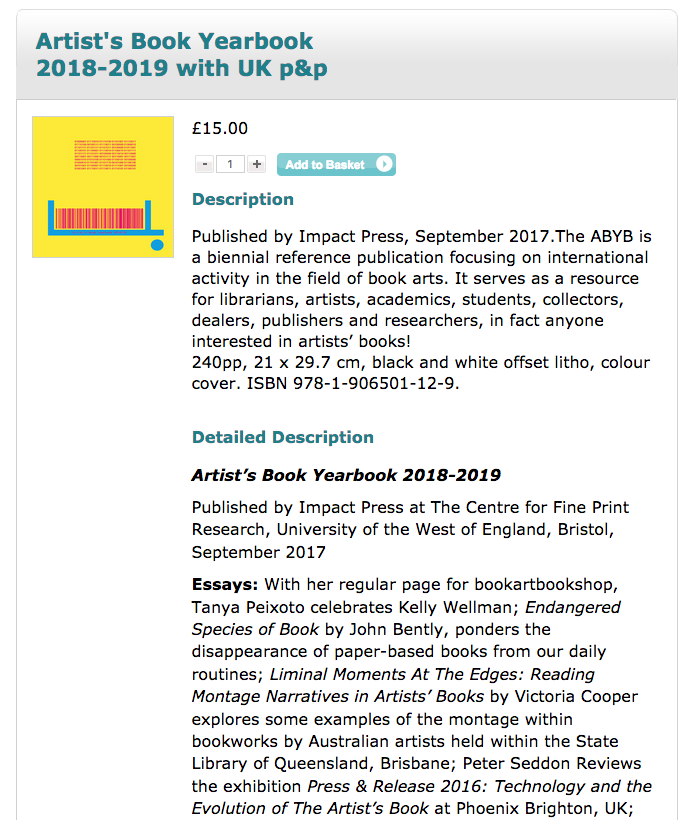
Victoria and the ARTISTS’ BOOK YEARBOOK 2018-9

.

 I’ve recently had a major paper on my research into the montage and artists’ books published in the ARTISTS’ BOOK YEARBOOK 2017-8 edited by Sarah Bodman from the Centre for Fine Print Research (CFPR) at the University of the West of England. The paper covers ongoing research which was undertaken as part of my Siganto Foundation Research Fellowship at the State Library of Queensland.


Here are the first 2 paragraphs from the paper


LIMINAL MOMENTS AT THE EDGES: READING MONTAGE NARRATIVES IN ARTISTS BOOKS        


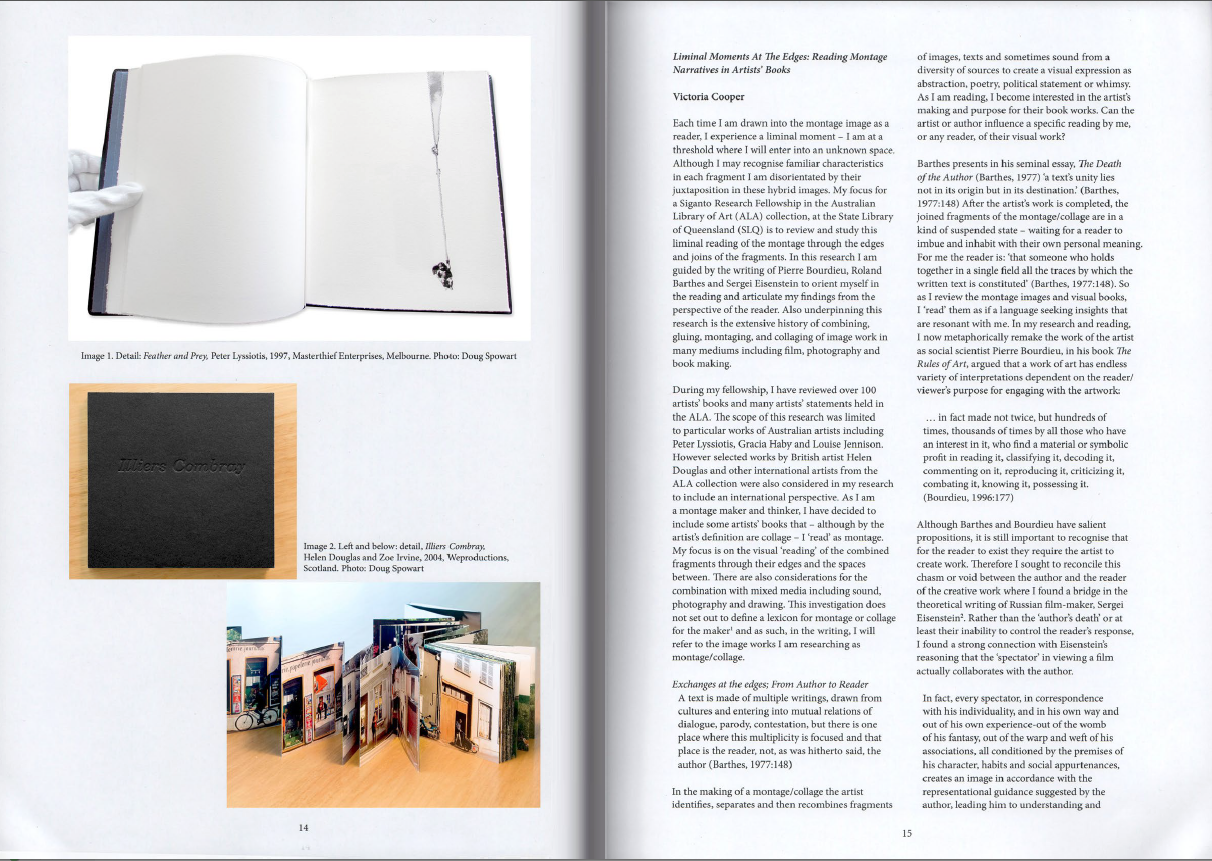
Each time I am drawn into the montage image as a reader, I experience a liminal moment – I am at a threshold where I will enter into an unknown space. Although I may recognise familiar characteristics in each fragment I am disorientated by their juxtaposition in these hybrid images. My focus for the Siganto Research Fellowship in the Australian Library of Art (ALA) collection, at the State Library of Queensland (SLQ) is to review and study this liminal reading of the montage through the edges and joins of the fragments. In this research I am guided by the writing of Pierre Bourdieu, Roland Barthes and Sergei Eisenstein to orient myself in the reading and articulate my findings from the perspective of the reader. Also underpinning this research is the extensive history of combining, gluing, montaging, and collaging of image work in many mediums including film, photography and book making.

.

During my fellowship, I have reviewed over 100 artists’ books and many artists’ statements held in the ALA. The scope of this research was limited to particular works of Australian artists including Peter Lyssiotis, Gracia Haby and Louise Jennison. However selected works by British artist Helen Douglas and other international artists from the ALA collection were also considered in my research to include an international perspective. As I am a montage maker and thinker, I have decided to include some artists’ books that–although by the artist’s definition are collage– I ‘read’ as montage. My focus is on the visual ‘reading’ of the combined fragments through their edges and the spaces between. There are also considerations for the combination with mixed media including sound, photography and drawing.

This investigation does not set out to define a lexicon for montage or collage for the makeri and as such, in the writing, I will refer to the image works I am researching as montage/collage.

[i] See my blog post for the Australian Library of Art, State Library of Queensland, http://blogs.slq.qld.gov.au/ala/2016/05/27/reading-montages-perceptions-dilemmas-edges-and-resolution/


Key books that I discuss in the paper are from the following artists:

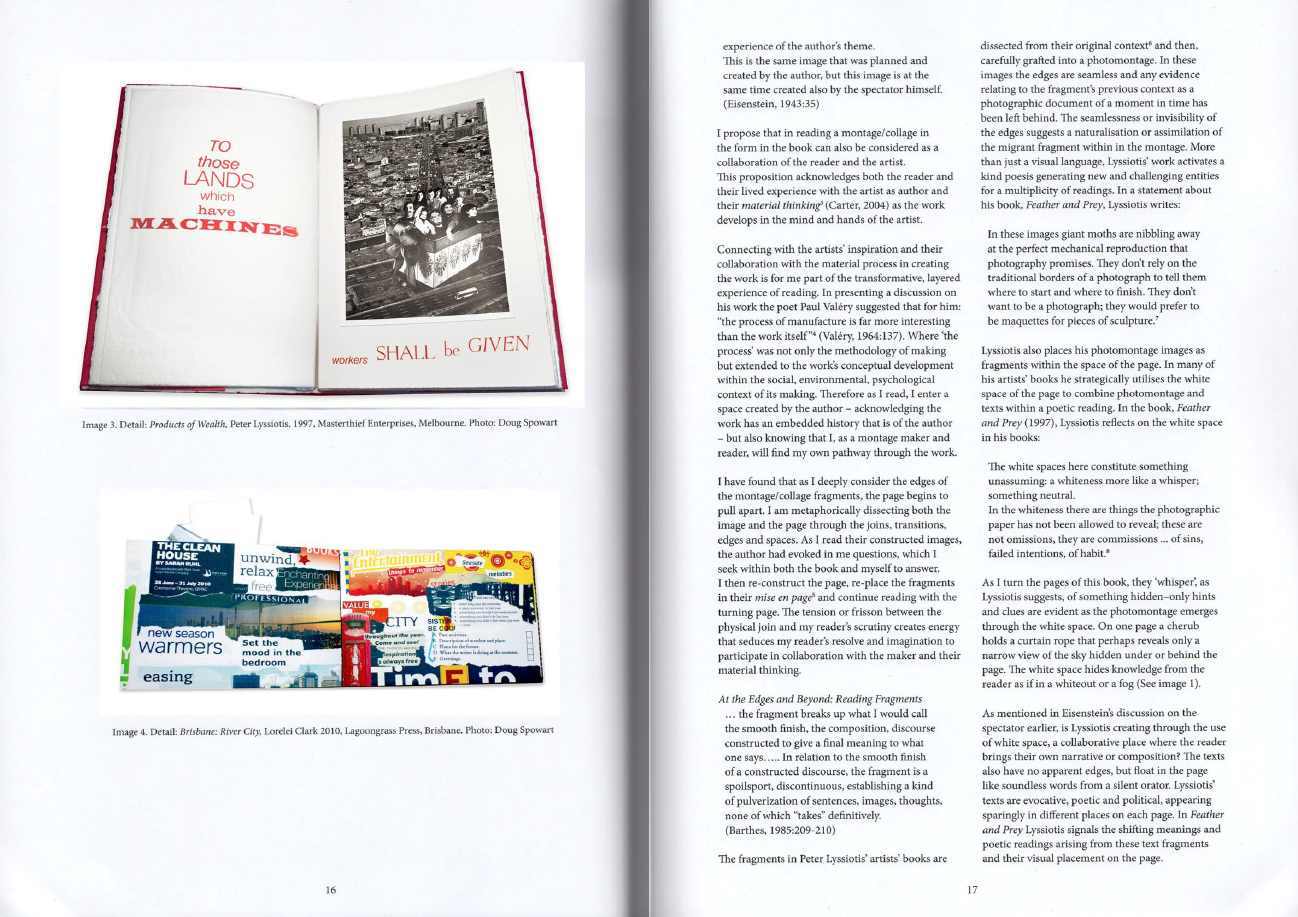
Peter Lyssiotis, Feather and Prey, (1997), Masterthief Enterprises, Melbourne

Peter Lyssiotis, Products of Wealth, (1997), Masterthief Enterprises, Melbourne

Lorelei Clark, Brisbane: River City, (2010), Lagoongrass Press, Brisbane

Jack Oudyn, The very first book of fish, (199?), Micro Press, Ormiston, Queensland

Gracia Haby and Louise Jennison, And we stood alone in the silent night, (2008), Melbourne

Gracia Haby and Louise Jennison, Salvaged Relatives, Melbourne

Lyn Ashby, 20 minutes, , (2011), ThisTooPress, Victoria

Helen Douglas & Zoe Irvine, Illiers Combray. (2004), Weproductions, Scotland

Dianne Fogwell, Gene Pool, (2000), Edition & Artist Book Studio, Canberra School of Art, Canberra


You can download a copy of my paper HERE

PLEASE NOTE: This download version contains colour photographs of the books discussed – the Yearbook is published in monochrome.

.

Thank you to all the artists who gave permission for their works to be photographed and presented in the publication.

Enjoy — and I would appreciate any comments you may have about the paper…


You can buy your own hard copy of the Yearbook from UWE HERE

UWE Publications website

.

.

.

.

.

.

.

.

.

.

VICKY DISCUSSES ‘READING MONTAGES’ on the SLQ Blog

leave a comment »

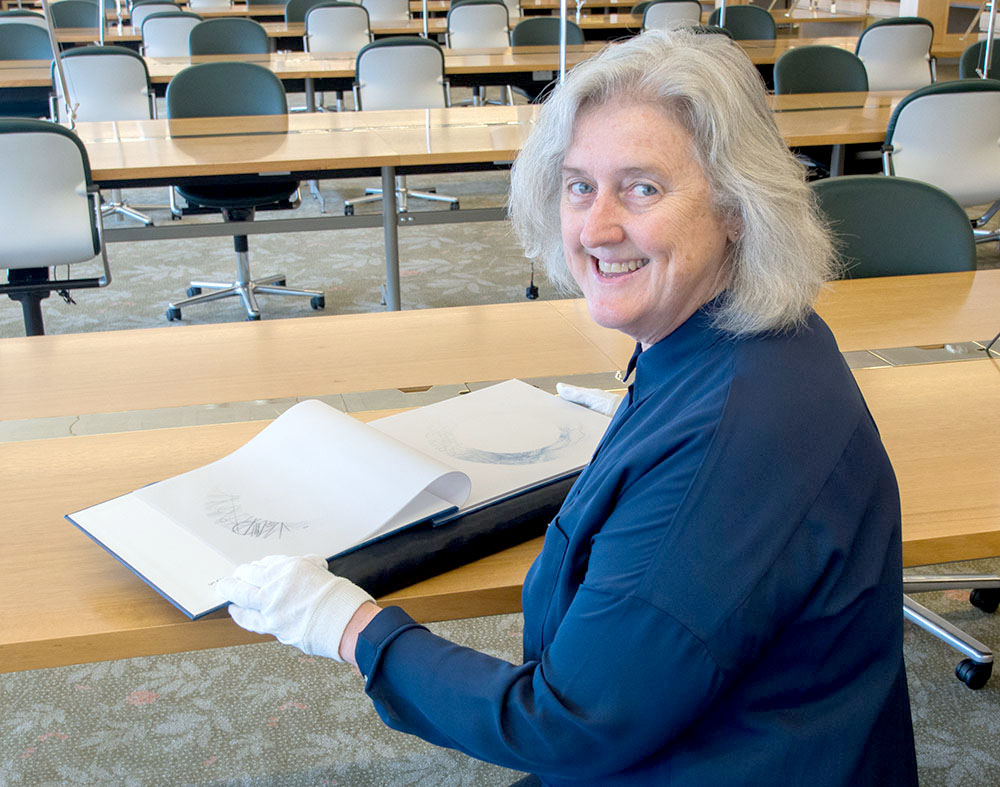
Siganto Research Fellow Victoria Cooper

Siganto Research Fellow Victoria Cooper

 .

Vicky has recently posted a her latest paper about her research on the State Library of Qld’s Blog. This latest post comments on the montage and is illustrated by some interesting books from the SLQ’s Artists’ Book Collection.

 .
Read on or visit the post here: http://blogs.slq.qld.gov.au/ala/2016/05/27/reading-montages-perceptions-dilemmas-edges-and-resolution/

.

Reading Montages: perceptions, dilemmas, edges and resolution.

Nomenclature Dilemma: Collage or Montage

In this third blog post I will share the dilemmas of encountering the blurred boundaries associated with the lexicon of these art forms, for example: What is the difference between collage and montage? Does it matter? Are there different “readings” of collage vs montage images that have been reproduced by mechanical or digital means for both wall art, or as encountered in my research, book forms? I will present an Occam’s Razor resolution arising from the considerations that inform my research to provide a path through the complexity of these issues.

Responding to terminology dilemma:

As I progress through the research I am continually confronted with terminology issues and questions regarding the nature of montage and its intersection with collage. The dilemma is with me as a kind of Sisyphean cycle where, after climbing the mountain of wondrous diversity in the Australian Library of Art artists’ book collection; I am drawn back down by the weighty issues of inconsistent terminology.

Many artists, who cut, arrange and glue disparate and/or mixed media elements refer to their work as collage or for computer made images, digital collage.  This should be the end of the debate as the etymology of collage is the French word ‘to glue’. But there are others who cut and piece together disparate elements and ‘glue’ and then fuse them within the image and refer to their process as montage (or digital montage for computer images). Also interesting to note is that the origin of the word montage is a French word meaning ‘to mount’.  Is there a need to differentiate between these similar practices? Does terminology affect the ‘reading’ of these works? In my art practice I refer to myself as a montage maker, thinker and reader and as such I bring my own perspective to reading visual narratives.

Gracia Haby and Louise Jennison, who prefer to be known as paper artists, make collage works. Their unique state artists’ books and democratic multiples in the form of zines and editions of artists’ books have a place within this discussion.
Haby and Jennison responded to my email question regarding the nature of the digital work in their book, ‘And we stood alone in the silent night’, where they state that: ‘Digital collages are made in chorus with unique state pieces. They are all a means of making, with the ‘how’ of lesser interest to us than the ‘why’ or ‘message’.

In their statement above they suggest that the means of the making is secondary to the final work. Even when the collage has been digitally scanned and then printed it remains, for them, a collage.

‘And we stood alone in the silent night’

‘And we stood alone in the silent night’

The book, ‘And we stood alone in the silent night’, presents the reader with an enchanted narrative through the composition of images and poetic texts across the pages. Underpinning the reading is the smooth and seamless joins of the elements creating a surreal landscape with a theatre of colourful inhabitants. The compositional elements draw the reader into a kind of Alice in Wonderland experience of reading: where the fused elements are arranged in a mise en page; and the turning page emulates the scenes of a paper movie (i) . The small size text comes through the reading as a poetic aside to underscore the scene.

‘And we stood alone in the silent night’

‘And we stood alone in the silent night’

Haby and Jennison’s careful cutting and pasting of added elements over or alongside the original image distinguish their broader collage work.  Again, in these works the silent edges between these interventions and the original image provide uninterrupted reading. Importantly as this transition or interval between the elements goes unnoticed the added element ultimately colonize the interior space and time of the original image.

So far in my research, I have not found many artists that tear and roughly cut their elements intentionally leaving these edges in the final montage for the reader to interpret. One example however is Lorelei Clark’s work, ‘Brisbane: River City‘.

Although the elements are fused by digital

reproduction, their roughly torn or cut edges seem to separate the elements so that the reading is disturbed much like a jump-cut (ii)  edit in a film.

'Brisbane: River City'

‘Brisbane: River City’

The elements combined in this way demand separate attention and focus on individual parts of the narrative or issue presented. As the source material may have been glossy magazines or pictorial publications, these edges could represent a critique or even an attack on social issues that affect the human condition. In many ways the reading is unsettling, rather like the political montages of Peter Lyssiotis, they shout back at the reader.

'The very first book of fish'

‘The very first book of fish’

Another example of the rough cut collage can be found in Jack Oudyn’s Book of Fish series of small books, where the original collage or paste-up can be seen in the ALA collection along with the small zine like productions. Rather than attached to the surface, the reproduction of these collages fuses the elements into the page and transforms the reading of the text and images. In these little books, the elements are submerged within the narrative and seem to float around like the flotsam and jetsam of everyday life.

Jack Oudyn 'The very first book of fish'.

Jack Oudyn ‘The very first book of fish’.

My resolve:

For the purpose of this research, I have decided to take account of how the artist defines their work as stated in the Library catalogue. As a researcher I am reliant on the information supplied by the artist, either in the form of an artist’s statement or catalogue information. This information allows a deep engagement with the work that ultimately enriches the reading experience for the researcher. Many may consider that too much information may reduce the potential for the book to be reimagined, but for readers like myself there are many ‘readings’ of an artists’ book.  As social scientist, Pierre Bourdieu suggests that an artwork is:

‘in fact made not twice, but hundreds of times, thousands of times by all those who have an interest in it, who find a material or symbolic profit in reading it, classifying it, decoding it, commenting on it, reproducing it, criticizing  it, combating it, knowing it, possessing it.’ (iii)

As mentioned earlier in this blog I refer to my work as montage, and align my methodology and inspiration with that of film and the pioneers of montage and page design from the early 20th century. In this research I have found similarities in the ‘reading’ of collages that have been either created or reproduced through mechanical or digital processes with the images created as montages. As I strive to engage with the many new ways of reading that each artist presents, any background information can take me into new spaces and places, each time I read the same book.

So rather than questioning the terminology, either a collage or montage, I am more informed by the way elements are grafted or combined; their arrangement on the page; the typography and page design. When the elements such as type, photographs, painting, drawing, found objects etc have been fused within the space of the page of the book by photomechanical, digital or another printmaking process, I will read these as a montage. As such, in the research I will consider the following:

•    whether I am seduced by nature of the smooth transition and the interval between elements is subliminal or if the torn edge focuses my attention;
•    whether the adjacency of the elements is disturbing or attacking my attempts to flow smoothly;
•    whether the transition has been digitally achieved or by hand if the information is available.

The nature of the edges of the combined visual elements within the composition is a profound aspect to reading these visual books. So rather than questioning the terminology, whether a collage or montage, I will continue in my ‘montage readings’ informed by the narratives contained within and between grafted edges.

.

Victoria Cooper


PART 2 of this research series can be viewed here https://wotwedid.com/2016/03/19/victorias-slq-blog-post-montage-research/

.


i. Lou Stoumen is the author of visual books including ‘Can’t Argue With Sunrise: A Paper Movie‘ (1975)
ii. Film makers Jean-Luke Godard and Sergei Eisenstein championed the use of discontinuity devices such as jump cuts in scenes to disrupt the flow of the cinematic narrative and create the illusion of moving through time and space. This was intended to engage the viewer proactively to think about the issues surrounding the scene.
iii. Bourdieu, Pierre. ‘The Rules of Art: Genesis and Structure of the Literary Field’. Translated by Susan Emanuel. Stanford University Press, 1996. Editions du Seuil 1992. Page 171.

.

.

.

VICTORIA’S SLQ BLOG POST – Montage Research

leave a comment »

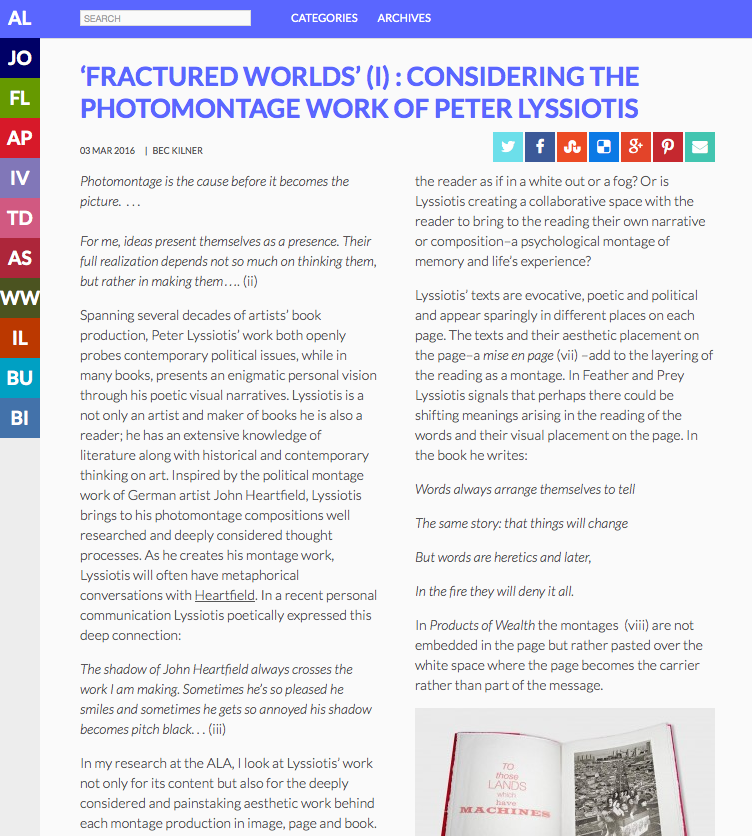
____ALA-Blog-Victoria


http://blogs.slq.qld.gov.au/ala/2016/03/03/fractured-worlds-i-considering-the-photomontage-work-of-peter-lyssiotis/

.

Recently Victoria’s ongoing research on the topic of montage in artists’ books was published. This paper discussed Peter Lyssiotis’ work and the use of photomontage.

.

‘Fractured Worlds’ (i) : Considering the photomontage work of Peter Lyssiotis

.

Photomontage is the cause before it becomes the picture.  . . .
For me, ideas present themselves as a presence. Their full realization depends not so much on thinking them, but rather in making them…. (ii)

Spanning several decades of artists’ book production, Peter Lyssiotis’ work both openly probes contemporary political issues, while in many books, presents an enigmatic personal vision through his poetic visual narratives. Lyssiotis is a not only an artist and maker of books he is also a reader; he has an extensive knowledge of literature along with historical and contemporary thinking on art. Inspired by the political montage work of German artist John Heartfield, Lyssiotis brings to his photomontage compositions well researched and deeply considered thought processes. As he creates his montage work, Lyssiotis will often have metaphorical conversations with Heartfield. In a recent personal communication Lyssiotis poetically expressed this deep connection:

The shadow of John Heartfield always crosses the work I am making. Sometimes he’s so pleased he smiles and sometimes he gets so annoyed his shadow becomes pitch black. . . (iii)

In my research at the ALA, I look at Lyssiotis’ work not only for its content but also for the deeply considered and painstaking aesthetic work behind each montage production in image, page and book. In his statement in Products of wealth (cited in the epigraph) he discloses how the power of the work is developed through the making. It is this Material Thinking (iv) process that informs my ‘reading’ of the artists books I have chosen to engage with in this research. All artists’ books are invested with rich imagery drawn from the artist’s mind and hand, including computer or photo-mechanically generated and composed narratives.

As a reader of these books I now hold the object that represents the time spent problem solving, the years of knowledge in making and working with materials, the conceptual development of all elements that is the book–whether simple or complex, the aesthetic choices for image, page and text design, the many small or big decisions that are embodied in this work of art that is made to be held and considered by a reader.  My challenge now is to find a way to share these insights with you as a distant reader who is unable to take in the necessary sensory and haptic experience of reading these works of art. In this blog I share my ruminations and questions that inspire me to read and read again many times these books of wondering and wandering, which are deeply poetic and sometimes melancholic.

I chose, Feather and Prey, for the deeply considered and poetic use of the page; the balance and arrangement of image, text and white space. Alternatively, Products Of Wealth has politically motivated photomontage prints tipped-in or glued onto the page. These are two very different ways of composing a narrative with photomontage and text and ultimately presented two different experiences for reading the montage.

Feather and Prey is bound in black leather with details of red leather on the spine and embossed images on the front and back covers.

Covers of Feather and prey by Peter Lyssiotis.

These embossed images at the beginning and end importantly announce that the reading starts from the cover rather than from inside the book. Along with this distinctive book binding, the use of fine art papers and considered printing processes, suggests a reverence in the reading of each page.

The photo-elements in Lyssiotis’ montage narratives are no longer records of reality but now have emerged, through a process of poiesis, as visual codes with a new life and purpose:

In these images giant moths are nibbling away at the perfect mechanical reproduction that photography promises. They don’t rely on the traditional borders of a photograph to tell them when to start and where to finish. They don’t want to be a photograph; they would prefer to be maquettes for pieces of sculpture. (v)

These new hybrid images create a disturbance within the familiar routine of everyday practice and present an alternate way of perceiving and referring to the world. The visual semiotics of reality that photography represents is now channeling through montage–new spaces for imagining–a poetics of dreams.

But what characteristic does Lyssiotis identify in each element as he carefully separates them from their original contexts? Does this question really matter, as each fragment will be transformed having little relationship to its origin. These montaged elements are then fused together perhaps as a metaphorical act of transcendence and then placed or montaged within the page.

These fragments of images and text strategically appear across the white space in the book. In a short exegetic essay or artist’s statement on this book Lyssiotis discusses his intention for the white space in the book:

The white spaces here constitute something unassuming: a whiteness more like a whisper; something neutral.

In the whiteness there are things the photographic paper has not been allowed to reveal; these are not omissions, they are commissions … of sins, failed intentions, of habit. (vi)

I turn the pages and they ‘whisper’ of something hidden where only hints and clues are allowed through as the photomontage emerges through the white space. A cherub holds a curtain rope that reveals a narrow view of the sky behind.

Feather and prey by Peter Lyssiotis

Does the white space hide knowledge from the reader as if in a white out or a fog? Or is Lyssiotis creating a collaborative space with the reader to bring to the reading their own narrative or composition–a psychological montage of memory and life’s experience?

Lyssiotis’ texts are evocative, poetic and political and appear sparingly in different places on each page. The texts and their aesthetic placement on the page–a mise en page (vii) –add to the layering of the reading as a montage. In Feather and Prey Lyssiotis signals that perhaps there could be shifting meanings arising in the reading of the words and their visual placement on the page. In the book he writes:

Words always arrange themselves to tell

The same story: that things will change

But words are heretics and later,

In the fire they will deny it all.

In Products of Wealth the montages  (viii) are not embedded in the page but rather pasted over the white space where the page becomes the carrier rather than part of the message.

Products of wealth by Peter Lyssiotis

These images become windows–looking into a montage hybrid world that may seem alien to us but paradoxically it is of us. Looking into the space of the image–rather than the page as in Feather and Prey–I am transported to a place where there is no space left to think… claustrophobic. The view shows the reader terrifying and perhaps even diabolic territories for consideration and reflection.

The edition consists of six separate books stored and presented in a bespoke box.

Products of wealth by Peter Lyssiotis

The books are bound using the simple pamphlet style, perhaps referencing the tradition of the political publication. The covers of the books are red and the box is covered in red and black cloth again suggesting the political nature of the reading. As I read, I notice that the 3D relief pattern of the letterpress texts (ix) seems to bite emphatically into the paper.  Lyssiotis’ choice of font styles along with the red and black font colours also adds to the political tone that is invested in the photomontages and the binding. In book 6, Lyssiotis writes about the montage:

In these montages, the planet isn’t about to explode; the explosion has already happened. What is left is a fractured world

Finally, I find it interesting to note that these books were produced in the same year, 1997, and yet each have quite different approaches to the montage of image, text and page. Can these differences point to a deeper comprehension of the value in and values of visual reading? In this kind of reading the psychology and memory of the reader can be engaged in the transference of something more than knowledge and information.

So is the montage a space for questions rather than answers?  Reading these artists’ books is in some way also a montage where the visual narrative and the artistic intention is adapted and interpreted by the memory and mind of the reader. Perhaps the nature of the montage hybrid including the page could be comprehended in terms of gestalt. As it is greater than the individual parts–the montage can be a holistic comment or reflection on the cultural and human questions of its historical location.


Victoria Cooper PhD

Feb 2016


(i) Peter Lyssiotis, 1997, The Products of Wealth, Book 6: Political Photomonteurs Can Give You The Courage To Eat Bricks, Masterthief Enterprises, Melbourne.
(ii) Ibid.
(iii) Handwritten note sent by email to the author, February 23 2016. In this note, Lyssiotis presents an evocative and intriguing discussion on the montage works in his books Feather and Prey and The Products of Wealth. Although seemingly a dialogue between himself and Heartfield, it is more a self-critique informed by the Heartfield polemics and the political montage. This note will be published in full with the permission of Peter Lyssiotis in a future article I am writing on his work.
(iv) As presented in: Paul Carter 2004, Material Thinking, Melbourne University Publishing Ltd, Melbourne. In many ways this book is a philosophical discussion on the work and methodology of the artist including: the interaction with their materials, the intellectual nature of the artists’ visual research and their resulting art.
(v) In the ALA original Materials Archive there are several boxes of Peter Lyssiotis papers. This quote is cited from unpublished writing discussing his book “Feather and Prey” Call Number: item #29358/3 box # 13331.
(vi) ibid.
(vii) This references the mise en scène in cinema theory.
(viii) The montages are black and white archival fibre-based silver gelatin photographic prints where Lyssiotis worked with Robert Colvin to print for this publication.
(ix) Texts were handset and printed by Nick Doslov, Renaissance Bookbinding


THE ARTIST & PHOTOBOOK MELBOURNE

leave a comment »

The forum panel

The forum panel….Photo: Anthony McKee


In February this year Melbourne hosted the biggest photobook event ever in this country. Called Photobook Melbourne the event brought together exponents, collectors and critics from around the world as well as from around Australia and New Zealand. Hundreds of books were handled, read and appraised in the many galleries and venues that came on board to support the event.


Martin Parr and Gerry Badger in their second volume of The Photobook: A History (2006), recognised artists who worked with photographs in a specific chapter entitled Appropriating Photography: The Artist’s Photobook.

Participants in the artists’ book discipline have been active indie, DIY publishers worldwide for sixty years or more and many of them use photography in their books. They have well established networks, events activities, awards, critical debate and collectors both private and public.

At a time such as Photobook Melbourne where all things photobook are celebrated and discussed it may be worthwhile to consider what concurrence may exist today between the artists’ book and the photobook. How do artists consider their use of photography and the photograph in their books? Is there any sympatico between the photobook and the artists’ book.

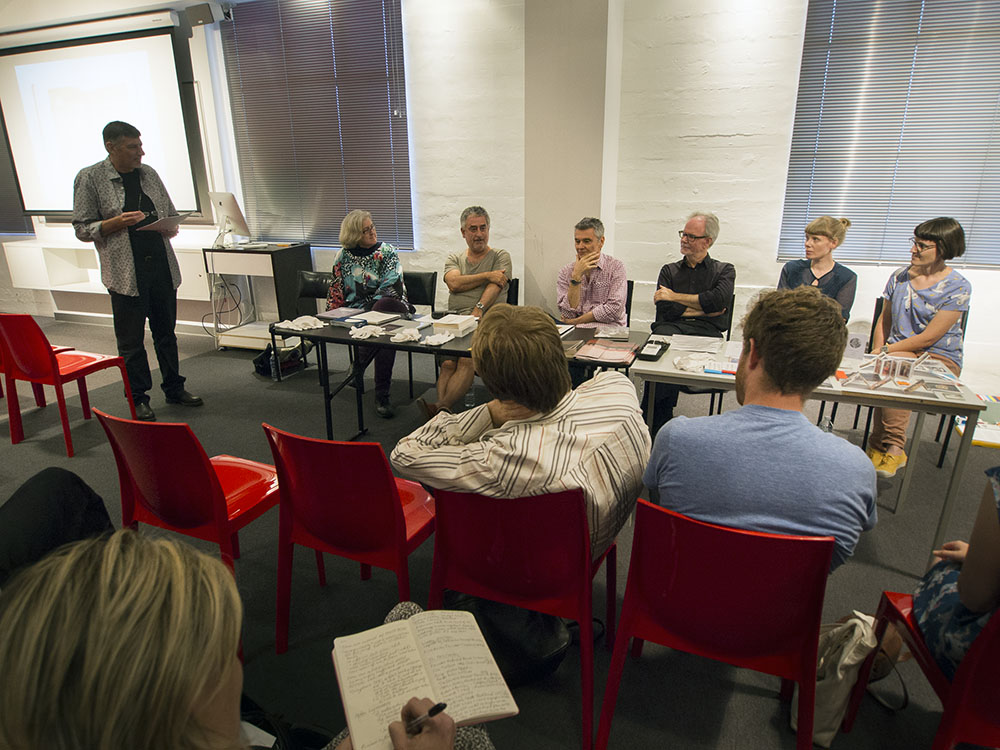
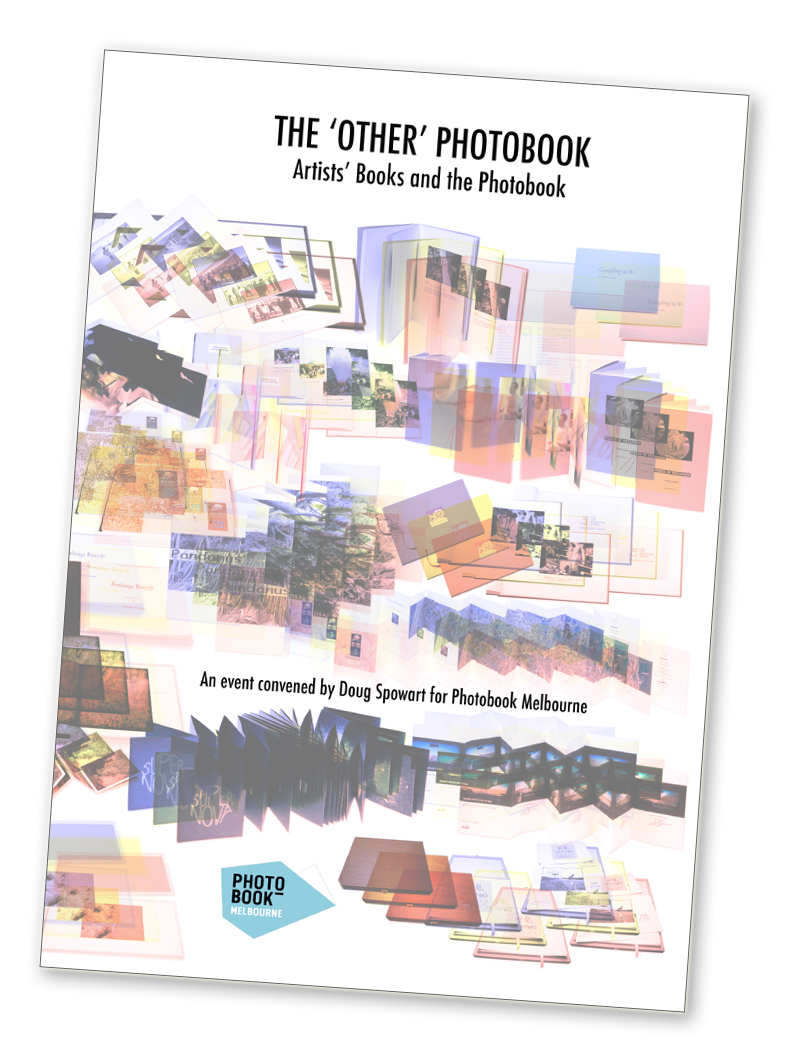
To address these and many more questions I was supported by the Photobook Melbourne organisers Heidi Romano and Daniel Boetker-Smith, to convene a forum to bring the voice of the artists’ book into the photobook conversation. The participants in the forum were; Dr Lyn Ashby, Gracia Haby and Louise Jennison, Peter Lyssiotis, Des Cowley and Dr Victoria Cooper (who was co-opted as Georgia Hutchison withdrew due to personal reasons in the final days).

The proceedings of the forum, with the support of the participants, have now been formed into a PDF booklet that can be downloaded FREE from this site. To provide a taste of the presentations I present the following quotes from the texts:


The PDF Forum book

The PDF Forum book

 .

DOWNLOAD HERE:  PM-OTHER PB-BOOK

.

Lyn Asby

Lyn Asby

Lyn Ashby

I make books. With few exceptions, these are hand-made, limited-edition books that would generally be considered to be “artist’s books” using the standard codex form. These are not photographic books. That is, the photograph is rarely the core of the meaning or purpose of the book. But I often use components or aspects of photographs and composite these with graphics, texts, drawings and painting etc, all of which feed into the overall material on each page.


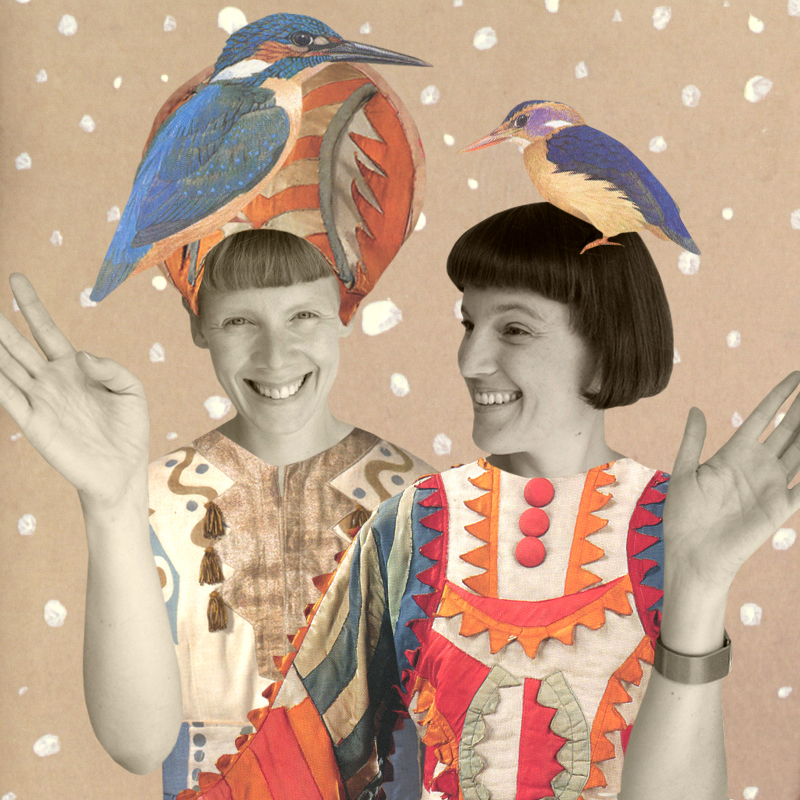
Gracia Haby + Louise Jennison

Gracia Haby + Louise Jennison

Gracia Haby and Louise Jennison

For those of you who we have yet to meet, we are besotted with paper for its adaptable, foldable, cut-able, concealable, and revealing nature. In our artists’ books, prints, zines, drawings, and collages, we use play, humour, and perhaps the poetic, to lure you closer. And sometimes this will incorporate photography. For us, it is not the medium that is always of greatest import, but the message. And so, we use found photographs in our artists’ books and zines not because they are photos, but because of what they can enable us to say, and what we hope you might feel.


Des Cowley

Des Cowley

Des Cowley

History of the Book Manager, Collection Development & Discovery, State Library Victoria

One of the challenges for libraries and collecting institutions is to build representative collections of contemporary books and ephemeral works created by artists, photographers, and zinemakers. Artists books, photobooks, and zines generally circulate outside mainstream distribution channels – publishers, general bookshops, distributors – and are effectively off-radar for many libraries. It is therefore incumbent upon staff in these institutions to build networks and relationships with the communities creating this work in order to be informed about what is being produced, and to ensure this material is acquired and preserved for future researchers.


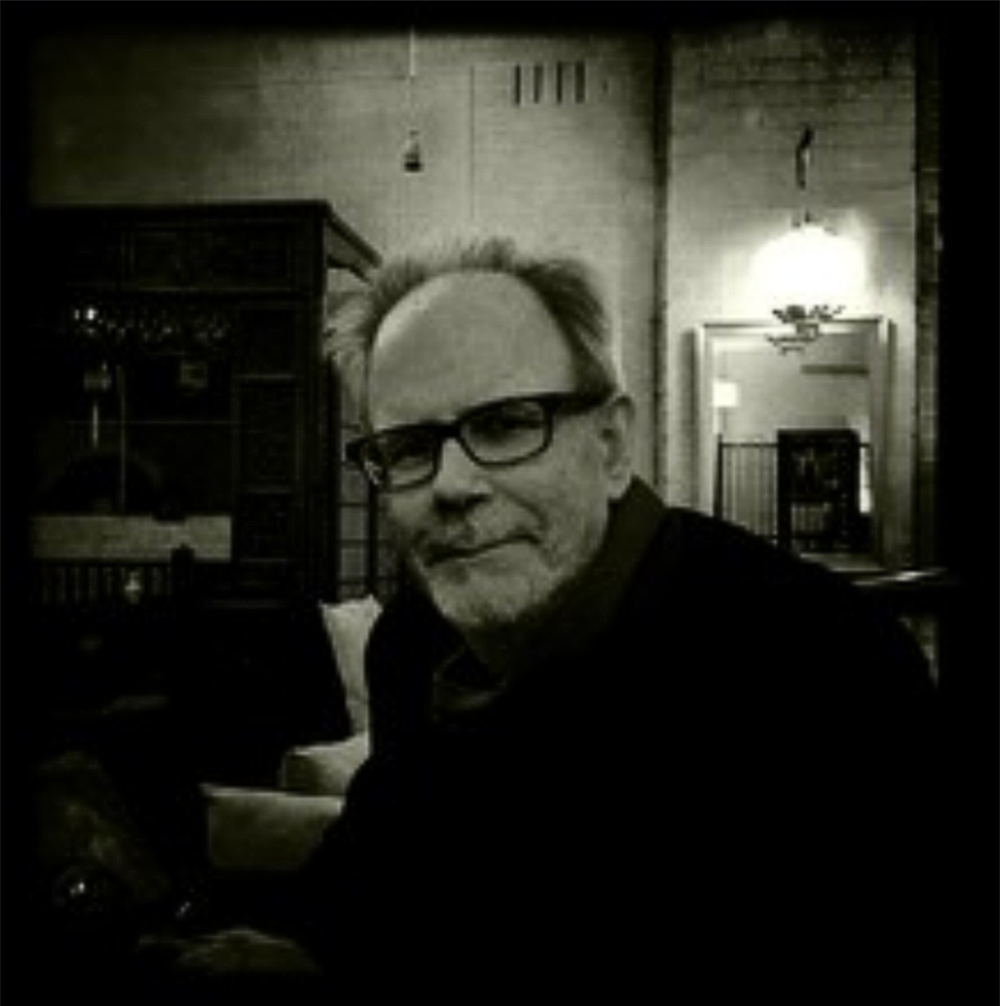
Peter Lyssiotis

Peter Lyssiotis

Peter Lyssiotis

I had a friend who lived in Belgium. He died a while back. Before he did, though, he painted a pipe on a canvas and underneath it he wrote “This is not a pipe”.

To continue my friend’s mission I say “This is not a book”.

The artists’ book is rather a workshop, a garage; a space where a time-honored craft is practised: it is here that the world gets repaired, reconditioned, reassembled.


Victoria Cooper

Victoria Cooper

Victoria Cooper

The digital cutting, dissecting, layering and suturing of the photographic quotations is an absorbing process through which the visual story emerges. I then materialize this virtual image of the narrative as a physical book in many forms: scroll, concertina or codex.     Rather than images on a gallery wall, the narrative space of the book offers for me an endless potential for interplay of the corporeal and the imagination through the idiosyncratic experience of reading.

.

.

DOWNLOAD THE BOOK HERE:  PM-OTHER PB-BOOK

.

.

.

GEORGE PATON GALLERY: Artist’s Books (reprised) Exhibition

with 5 comments

Selfie

Artists’ Book Selfie

.

Digging in the archive: past and present


Artist’s Books (reprised) [artists’ books 1978-2014]: George Paton Gallery, University of Melbourne

Dates: 26 August to 5 September


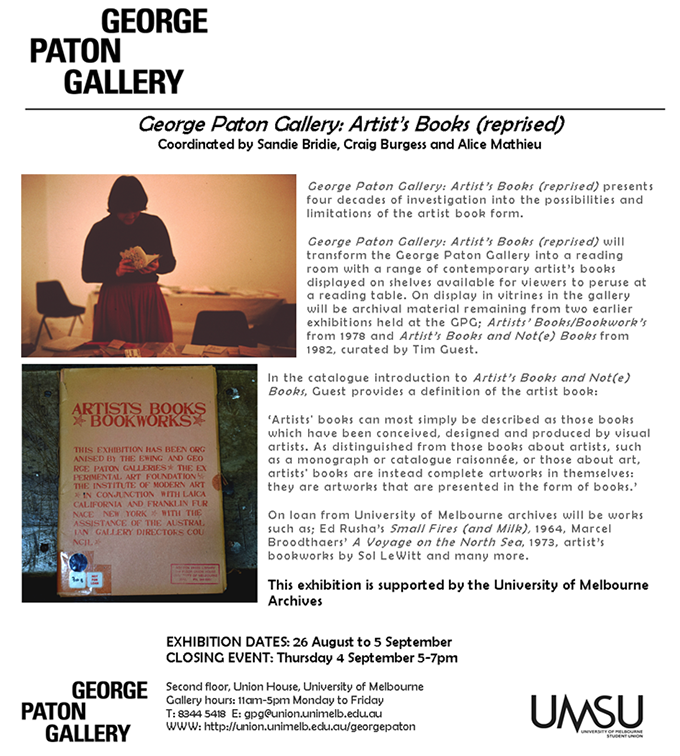
A recent show entitled, George Paton Gallery, Artist’s Books (reprised), promoted that it would be showing “four decades of investigation into the possibilities and limitations of the artists’ book form.” Whilst the exhibition as presented had some gaps in the chronology, it did live up to its claim of presenting a significant collection of contemporary works alongside a carefully curated group of seminal artists’ book works from shows presented at the George Paton Gallery in the 1970s and 80s.

.

George Paton Gallery Website notice

George Paton Gallery Website notice

.

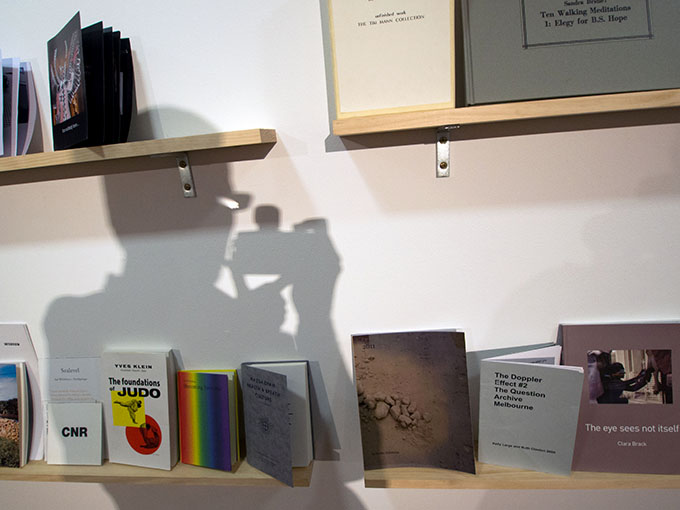
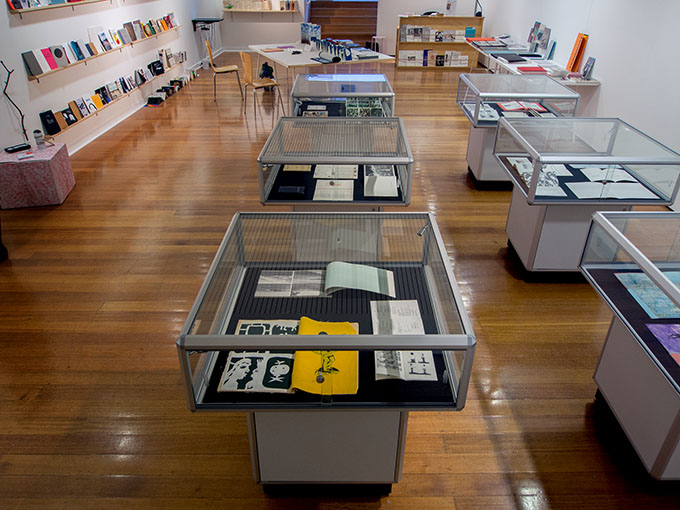
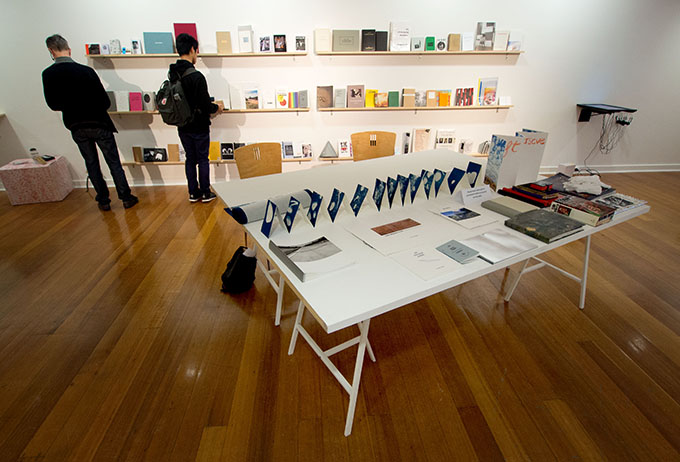
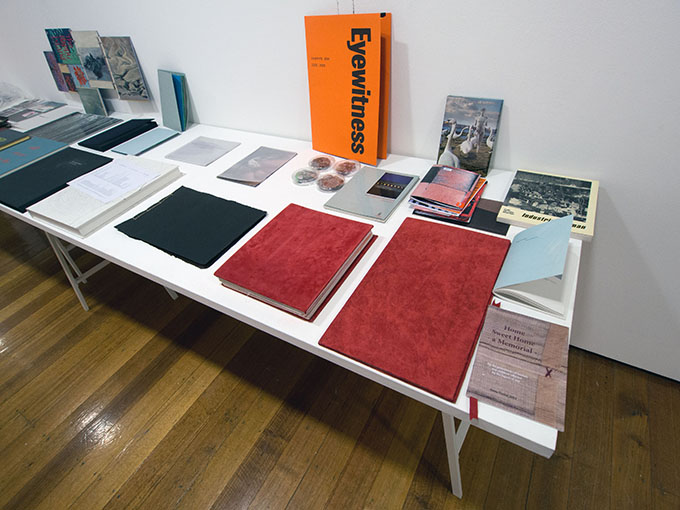
Visitors to the gallery encountered a space resembling a reading room with trestle tables and bookshelves presenting the contemporary books for viewing, handling and reading. Some books were marked as ‘white-gloved’ handling whilst the majority was available for direct tactile experience. Enclosed in vitrines were the historical books on loan from the University of Melbourne archives. Interestingly during the 1970s and 80s these books would have only cost a few dollars to buy but now they attract significant values. Included in this prized collection of books are: Ed Ruscha’s Small Flres and Milk; 1964; Marcel Broodthaers’ A Voyage on the North Sea; 1973; Sol LeWitt’s Grids – using all combinations of straight, not- straight and broken lines; 1975; Richard Long’s The North Woods, 1977 and Dieter Roth’s, Gesammelte Werke, Band 7, 1974. These books were sourced from past exhibitions held by the George Paton Galley: Artists’ Books/Bookworks from 1978 and Artist’s Books and Not (e) Book! from 1982, the latter curated by Canadian Tim Guest.

.

George Paton Gallery

George Paton Gallery


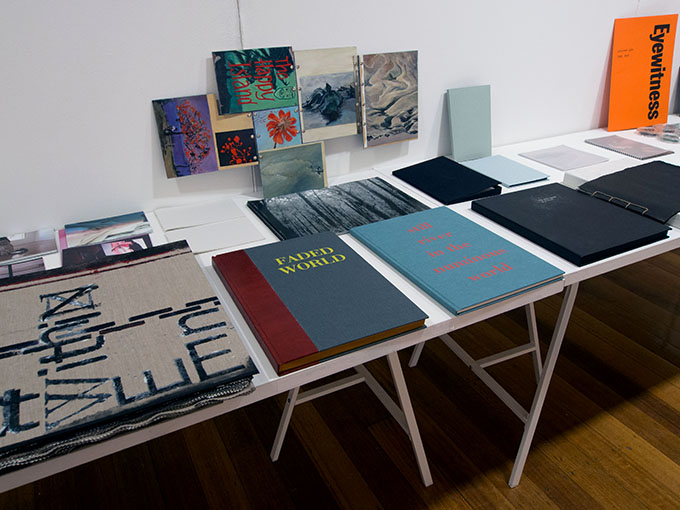
In all just over 100 books were available for viewing essentially coming from a ‘call out’ for artists book makers to present work for the show. There were some interesting names; Peter Lyssiotis, Theo Strasser, Sandra Bridie, mail artist David Dellafiora, zinesters Gracia Haby and Louise Jennison, and photo-newspaper publisher Jacob Raupach. Anyone with a preconceived idea of what an artists’ book is, or should be, may have been challenged by some of the works in the show – but what an experience it was to be challenged in that way. It was a rare opportunity to view and compare such a diverse and historical collection of artists’ books.

.

Exhibition installation

Exhibition installation

OLYMPUS DIGITAL CAMERA

Antoni Jach’s Faded World and books by other artists

Lyssiotis, Theo Strasser books

Books by Peter Lyssiotis, Theo Strasser and others


After spending a couple of hours in the exhibition space I searched for a way of describing the show. Then I found a text that offered a perceptive critical evaluation of the artists’ book genre. Some relevant passages from this text follow…

.

Artists’ books can most simply be described as those books which have been conceived, designed and produced by visual artists. As distinguished from those books about artists, such as a monograph of catalogue raisonee, or about art, artists’ books are instead complete artworks in themselves: they are artworks that are presented in the form of books.

 Since about 1960 a distinct genre of artists’ books has appeared. These are by artists who are self-consciously exploring the possibilities of printed books: the social dynamics of a reproducible vs. a unique art object; the aesthetics of the mass print media vs. fine art prints or deluxe editions.

 The contemporary genre of artists’ books is now a widespread phenomenon. Practically every significant development in western art has been reflected in the ongoing publication of artists’ books. There are books coming out of the movements of pop art, minimalism, arte povera, performance art, fluxus, happenings, and new image painting. Conceptual artists of the 1960’s and 70’s in particular, utilized the book form as a method of realizing artworks. We can regard these books now as a vein which runs through many areas of contemporary art and includes diverse movements, interests and preoccupations.

Or have the interests been so diverse? Pop art, minimalism, performance art, arts provera, were all movements distinct from (even antagonistic to) one another, yet they all belonged to a general tendency towards “non-objective” art… Briefly, this tendency has been reflected in a desire on the part of artists to explore new media, in an attempt to abandon the traditional (modernist) disciplines of painting and sculpture. It was/is in favour of the widened scope of the flux and flow of a multi-disciplinary approach. For example, an artist may be involved in sculpture as easily as film, performance, video, photography and/or books. Perhaps most significantly there has been a conscious determination to undercut the reification of artworks – society’s valuation of art – by concentrating on the non-objective. This has meant, for instance, producing works from common industrial or throw away materials (art povera, fluxus), works constructed only in theory (conceptual art, language art), imagery stolen from the banal repertoire of mass media (pop art) ….. All this seems to have been more successful as an ideal than as an actual practice. Minimal sculpture in the late 60’s was quite successful in the art marketplace. Conceptual art has been immensely influential, popular, and saleable. As much as these artworks were determined in opposition to the bourgeoise reification of art they were inevitably complicit with it. That is because capitalism is a social system which seems to embrace new ideas but in fact appropriates and establishes a commercial value for then.


Bling book - title and maker to be added soon

A book by Dianne Dickson


Artists’ books typify this interest in non-objectivity and reflect the internal contradictions of such an ideal in a particular way. In contrast to the traditional “livre d’artistes” of deluxe editions, artists’ books are usually inexpensively produced and sold. They are affordable, accessible and as plebeian as an art object can be. In fact they are almost too exemplary of the non-objective ideal.

As books they are not commercially viable simply because they defy the expectations of a mass market by presenting avant-garde information. Yet they have few patrons in the art world because their affordability to the public represents a low profit for a dealer. Also, books can not [sic] be viewed in the same way as other art objects; they must be held in one’s own hands and read. It is remarkable then that despite the contradictions and foils of art’s survival, artists’ books have become such a highly evolved genre of contemporary art, as evidenced by the works in this exhibition.


Suzannah Griffith's While The City Sleeps

Suzannah Griffith’s While The City Sleeps

.

To illustrate means to make something clear by example, or to adorn a book with pictures. Within a publication, an illustration can be a picture, a drawing, a photograph, a design, or an ornament. Illustration is, of course, a prominent element in all mass media publishing. To consider all illustrations as a single genre is, in a way, quite boggling. It means imagining all magazines in the world and all the printed pictures.

With this imagining I try to analyze these pictures but have only an individual response to guide me. In principle my inquiries and suggestions are all subjective, my curiosity is intuitive, my critical remarks are speculative. These habits of mind and predilections constitute the trail of my argument. Because illustration operates as such an enormous social phenomenon, it is difficult to grasp its total meaning as a genre. It is too huge a concept. Yet paradoxically, all is intimately familiar.


Sarah McConnell's 29 2011

Sarah McConnell’s 29 2011


Practically everyone looks through magazines, sees the pictures, knows what they mean. But try to separate yourself from a simple recognition of the picture and examine the picture as a conceptual model and you may understand how difficult it can be. An illustration is not simply a picture of an object or thing. In that object’s absence a picture is a way of visualizing it, recalling it or conjuring it. Then all together the medium of illustration is a way of visualizing the world. As illustration is a mass medium, it is certainly a very powerful and influential instrument of ideas. As a conceptual model, a picture is showing us how to think and what to think about.

Art characteristically departs from conventions. In leading the way from these conventions and artists can end up revealing and/or inventing upon a given culture, popular or otherwise. Furthermore, the artists’ books in this exhibition occupy a middle ground between the hermetic region of high art and the mass culture of popular illustration. They also embody a comparison between the two; they have been produced as a way of participating (in theory at least) in the mainstream of popular culture at the same time as they are an extension of art, extending beyond galleries and museums, and outside of the realm of the rarified art object.


Jon Hewitt's feel the confidence 2011

Jon Hewitt’s feel the confidence 2011


It may be noted that the photo works included in the exhibition are not photography books in the usual sense. For example in some books, the artist has exchanged the customary fine detail and high quality printing found in most art photography books for the flat, grainy, aesthetic of newswire or snapshot photographs, with all their vernacular associations. In other books the artist may manipulate the photographic frame by cropping it tightly to draw attention to narrative details or expanding it to the edge of the page for a window effect. Some books here constitute a repertoire of personalities through a wide array of photographic self-portraits. Others are collections of images specific thematic subject matter which suggests an interpretation of the complex meanings of culture and its institutions through the examination of its artifacts.

.

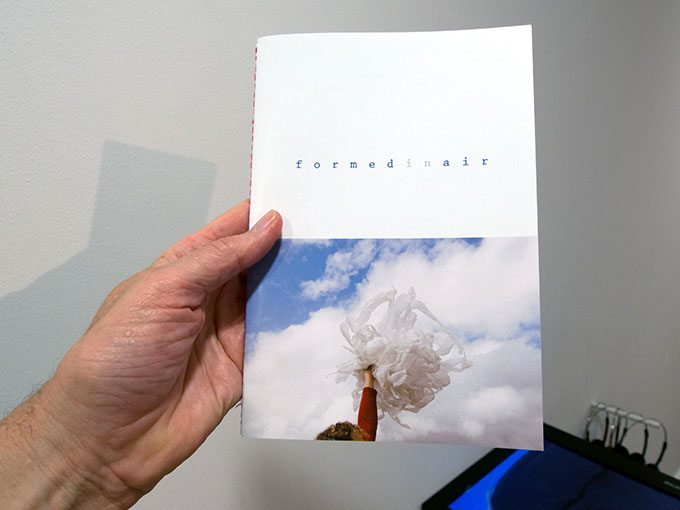
Yasmin Heisler's formed in air 2014

Yasmin Heisler’s formed in air 2014


In opposition to the conventions of art photography, which dictate an aesthetic around the “integrity” of an individual print, these photo books, to some extent, are each engaged with the qualities inherent in reproduction by offset and other printing processes. The artists represented in this exhibition are utilizing photographs as something other than a clear, well-composed picture. In their books they manipulate the “natural reality” of photographs and so inform our recognition of photographic images with their mannered inventiveness.

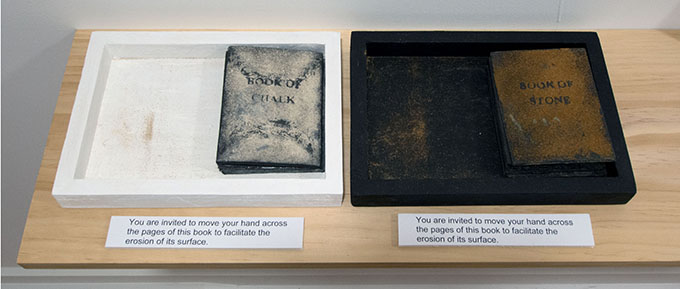
There are also a few books included here which are constructed sculpturally to introduce a tactile sensation to the fingertips and so expand the act of reading illustrations into the field of sensory awareness.

.

Bridget Hillebrand's Book of Chalk 2014 and Book of Stone 2014

Bridget Hillebrand’s Book of Chalk 2014 and Book of Stone 2014


Finally, just as the works in this exhibition are included towards an exploration of the social and aesthetic attributes of illustration, they also demonstrate a way of looking at and experiencing the world. Theses artist’s books reveal and embody a way of reading deeply into they dimensions of contemporary culture. As much as they foster an incipient consciousness they ask for sensitivity on the part of the reader.

.

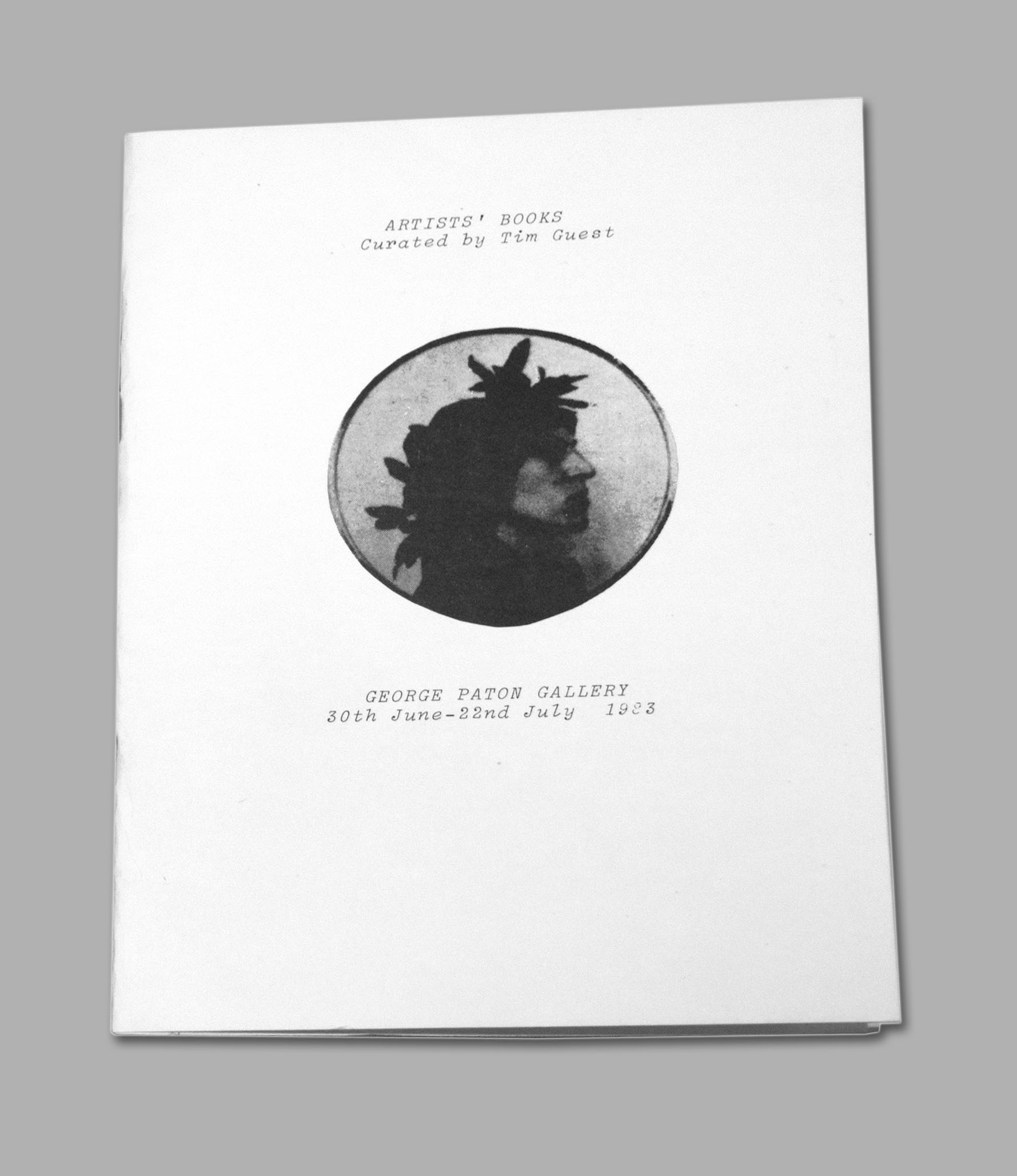
Tim Guest, the curator's essay for the 1982 George Paton Gallery Artist's Books and Not (e) Book!

Tim Guest, the catalogue for the 1982 George Paton Gallery Artist’s Books and Not (e) Book!


These words come from Tim Guest, the curator for the 1982 George Paton Gallery Artist’s Books and Not (e) Book! A copy of his catalogue for the show was made available at the exhibition. Guest’s commentary is as relevant today as it was in the early 1980s, and while we have moved on, and now view the artists’ book works of that time with a degree of comfort and acceptance, the new artists’ book works continue, as Guest points out to, ‘demonstrate a way of looking at and experiencing the world’. For me it emphatically confirms that artists’ book are still ‘edgy’ and still pushing limits.


Doug Spowart

September 5, 2014


DOWNLOAD the contemporary list of artists’ books gpg artists books list of works


DOWNLOAD the books on loan from the University of Melbourne ArtistsBooksloanselectionGPG2014 docx

.

.

Part of the associated activity for the show – an artists’ book making event outside the gallery led by Michele and Laine. It was a a sunny and warm late winter’s day in Melbourne.

Michele Grimston and Laine Stewart and their Free Artist's Book activity

Michele Grimston and Laine Stewart and their Free Artist’s Book activity

.

.

.


.

COMMENTARIES: ARTISTS BOOKS … AS POPULAR AS TATOOs!

leave a comment »

OLYMPUS DIGITAL CAMERA

The wide view

COMMENTARIES ARISING FROM THE SLQ SIGANTO FOUNDATION SEMINAR

The trouble with artists’ books  

State Library of Queensland – May 4, 2013

.

The quote “artists’ books … as popular as tatoos” was an opening remark by gallerist Noreen Grahame

.

All great seminars, forums, conferences and meetings stir discussion and commentary; The trouble with artists’ books seminar was no exception. We approached a number of artists book people to contribute to this blog post responding to the stimulus created by the event – I have included their responses after my introductory comments.

.

In Volume 7 of the Bonefolder e-journal  I reported on the dual artists book events of the 2010 Artspace Mackay Focus on Artists Book V, event and the 3rd Libris Awards. In this report I commented on the speaker’s presentations and reviewed the artists book award. I then concluded that these events were integral to the development and maintenance of a community of practice for those who make artists books in this country.  Three years on the energy and enthusiasm for artists’ books remains however the Mackay Focus event has been abandoned and some awards events have slipped from their usual place in the yearly/bi-yearly calendar.

We are indeed indebted to the Siganto Foundation and the SLQ who in 2012 made possible the Keith Smith and Scott McCarney workshop and seminar, and this year the The trouble with artists’ books seminar. It seems to me that artists book community in this country has a great appetite for information, connecting with the heroes and heroines of the discipline, learning about methods and techniques as well as participating in camaraderie with their peers.  My concluding words in the Bonefolder report recognised the importance of events such as Artspace’s Focus on Artists Books and the Libris Awards as they invigorate the discipline and the art of artists books … The significant response to this seminar indicates that the pace and frequency of artists book events should not slacken – we want more!

The Bonefolder report concluding comments were:

Awareness of the origins of the discipline of artists’ books and the Australian context as well as issues of contemporary and emergent practice is a unique outcome for FOAB. Where else in Australia this year would one be able to experience, or participate in a program where issues as diverse as Avatars making books in their second life, the death of the book/author, wild books and zoo viewing of books, propositions for new perceptive literature, mail art and the products of psychometry being resolved as artists’ books? Perhaps attendees should be warned of the ride that they would encounter.

Central to need for the FOAB, as an event, is its ability to pull together artists’ book interested people and provide a forum for them to be a part of something bigger than themselves. Artists’ bookmakers are individual artists, sometimes collaborators, librarians, academics, gallerists and collectors are isolated as islands of interest in their usual place of activity. But at FOAB they meet, greet, mingle, chat, discuss, argue and get down to the flensing-out of ideas, polemics and concerns about practice and the book as a work of art. This blend of interested parties forms the nucleus, the hub, of the discipline within this country – without it, there would only be individual soliloquies in the wilderness

.
OLYMPUS DIGITAL CAMERA

Julie Barratt

Julie Barratt   –  Artist

I guess really briefly what I got from ‘the trouble with artist book ‘ talk if I was going to quote is ” it seems the trouble with artist books is that there are too many to love!!!” On a more serious note I guess for me it always comes down to how we talk about/define an artist book, as an ongoing discussion.

Almost on a daily basis when I had the gallery (I always had at lead a few artist books on display) people would ask what these books are! How to define them without quoting Johanna Drucker?  Should there be categories i.e. Sculptural, digital etc etc. How do we expect the audience to understand them if we as practitioners have difficulty talking about them? But how do we agree on a definition?

That’s what I imagined the forum to be about because ‘isn’t that the trouble with artist books’? Having said that I thoroughly enjoyed the forum and think there need to be many many more of them when in fact there seem to be less (Mackay forum? ) so that the discussion can continue….

Its always a pleasure to catch up with the artist book community, feels like a reunion every time!

Julie

.
Maureen Trainor portrait

Maureen Trainor

Maureen Trainor  –  Photographer and QCA Masters student

I found these presentations to be very informative and inspiring.

The content and sequence of the presentations were dynamic.

By breaking down the delivery into the three different viewpoints the three Keynote speakers were engaging and thought provoking.

Starting with Helen Cole presenting ‘the Librarian’s view’, Noreen Grahame presenting ‘the Gallerist’s view’, Jan Davis presenting ‘the Artist’s view’ and ending with an interactive audience time for ‘questions and answers’ was right on target with information.

The Hearsay team discussing their project was fantastic. Combined with humour and wit they certainly kept the attention of a diverse audience.

I truly enjoyed the afternoon and felt I could of stayed into the night with more speakers and presentations.

Maureen

.

OLYMPUS DIGITAL CAMERA

Monica Oppen

Monica Oppen  –  Artist and collector

The Trouble with Artists’ Books (and the Libris Awards)

Coming away from the SLQ seminar where the attendance was so strong and having attended the opening and announcement of the Libris Award at Artspace Mackay the conviction that has risen strongly in my mind is that there is a real need for events such as the SLQ Siganto Seminar. The strong attendance not only indicates a real interest in the topic but a desire of artists to reconnect with others working in the field. As Helen writes in her post about the Libris Awards, and I can vouch for it, there were very, very few artists there but also no other significant persons from the institutions who have an ongoing interest and involvement in artists’ books were there. The tyranny of distance and the associated costs of travel and accommodation will only be overcome by creating an event that is worth travelling for.

The topic The Trouble with Artists Books is pertinent and complex and was way too big to handle in one afternoon; a multi-day conference could have been structure around this topic. Time restrictions meant that Jan Davis and Noreen Grahame could only touch on, hint at and introduce the work/books from which a broader discussion could have expanded. The sense that there is a need for these seminars (judging from the attendance numbers) also hopefully indicates a need for more rigorous, mature critical discourse around the genre, a breadth of conversation and argument. Does the constant discussion of definition and the non-committal responses from ‘those who should know’ arise from this lack of discourse? I don’t consider the definition ‘if the artist calls it a book, it is a book’ to be an adequate, exciting nor empowering definition unless some force is allowed to work in opposition to it, that demands a justification, demands some critical analysis. The lines will always be blurry but this could be an energizing force and contribute a dynamism to the genre. By not taking a stand are we in fact leaving definitions to the gallery? Surely the gallery as a medium is the antithesis of the (artists’) book. The gallery is exposed and extraverted; the book is enclosed and introverted. Always it comes up, the problem with exhibiting artists books— this is because books are not meant to be exhibited, they are meant to be read. What are the implications for the genre if books are only viewed in the gallery, and more seriously if the gallery maintains a ‘no touch’ policy? Ironically, making a (artist’s) book was originally about abandoning the gallery; about the subversion of the commercialism of the art object. The book was meant to be a free-floating object in wider society. Where is that rebel spirit?

A hundred more questions could be asked. I hope the SLQ seminar is not a one-off but gives an impetus to more symposiums throughout the country.

Monica Oppen 14/5/13

.
Judy Barrass

Judy Barrass

Judy Barrass  –  Artist

THIS COMMENTARY COMES FROM JUDY’s BLOG – ‘Critical Mass’ http://www.criticalmassblog.net/2012/?p=2568

No one can agree on what they are, or even where the apostrophe should be placed, but a seminar on artists’ books at the State Library on Saturday drew a crowd.

It was a  rare get-together of artist book makers and officianados, with attendees travelling from other states and regional Queensland just to attend the two-and-a-half-hour seminar and catch up with old friends.

According to the speakers, librarian Helen Cole, gallerist Noreen Grahame, and artist book maker and academic Jan Davis, artist books are problematic. That’s not just because no one seems to be able to agree on a definition, but also because they are hard to store, hard to display, and are not usually included in mainstream collections or exhibitions. They attract mostly a smallish group of makers and collectors and don’t sell in large numbers. Despite this, artists’ books draw a passionate audience of makers and supporters whenever they are on show (or whenever there’s a seminar).

Queensland has been a leader in the artist book phenomenon. The Queensland State Library is a significant collector, and Grahame Galleries took an early leading role. Artspace Mackay and Noosa Regional Gallery added public gallery support to exhibitions and collecting.

Someone suggested that it’s an inbred audience made up almost entirely of artist book makers, but a show of hands in the crowd on Saturday debunked this myth since at least half the attendees were not makers. Still, as Noreen Grahame remarked, artist books are a sort of ‘underground’ movement outside the mainstream.

I can’t help wondering if this is merely a question of naming. By calling these artworks ‘books’ they are relegated to the collections of libraries rather than art galleries, or they exist in a no man’s land between library and gallery. Nonetheless I have seen many works in public art gallery collections that could (or perhaps should) be called artist books. The boundaries are thin and flexible, and this was evident at the seminar. The mantra seems to be that if the artist calls it a book then it is a book.

One of the more interesting questions on the day was about the growing number of artist books that exist only in digital format. Helen Cole said the library was considering how these books might be collected and preserved, but indicated it was extremely difficult, particularly as technology changes so rapidly and formats and software become obsolete. Noreen Grahame solved the problem by referring to digital books as ‘ephemera’, and Jan Davis thought the number of artists working in the digital realm was small.

Following the discussion, a very chatty audience enjoyed a scrumptious afternoon tea and the  launch of Hearsay, a large format collaborative artists’ book by artist Euan Macleod, printmaker Ron McBurnie, and writer Lloyd Jones. They apparently didn’t worry too much whether or not their work was or was not an artist book, but have sensibly hedged their bets by also producing the pages as a portfolio of unbound prints (in case anyone thought it wasn’t art, or more probably because the portfolio might be more saleable than an artist book ).

The seminar ‘The Trouble with Artist Books’ was sponsored by the Siganto Foundation through the Queensland Library Foundation.

The State Library artist book collection is part of the Australian Library of Art.

(Thank you Judy for allowing this re-posting in this blog)

.

.
OLYMPUS DIGITAL CAMERA

Wim de Vos

Wim de Vos  –  Artist

‘The Trouble with Artists Books’

The lecture sponsored by the Siganto Foundation was very well attended by a large audience of art practitioners, administrators, and lovers of Artists Books, and was introduced by the new head of the State Library, Janette Wright. The speakers were Helen Cole, Senior Librarian of Special Collections at the Library; Noreen Grahame, Gallerist and long time respected promoter of the Artist Books within Australia and Internationally; and Jan Davis, Academic, and practitioner of Artists Books at Southern Cross University, Lismore, NSW.

Technically the lecture was informative, ran smoothly and was very well presented.

It was great to see so many practitioners (well over half the audience) and the general public, as this event facilitated a forum – to share, and some time to catch up with friends and colleagues. This has over the last few years become non-existent with the loss of the Art Space Mackay Artist Book Forum. Also the Noosa Regional Gallery’s ‘demise’ of the Artists Book annual exhibition was a sad occurrence. In addition, both venues offered successful workshops with renowned National and International Practitioners in the Visual Arts to nurture the visual arts and the book.

Many aspects of the development of Artists Books were addressed. Helen Cole addressed the ‘Trouble with Artists Books’ from a Librarian’s point of view, in that, because they were ‘Artists Books’ and diverse in so many ways, the logistics of preservation, cataloguing and storage were ‘Troublesome’. Furthermore, it was stated that the ‘Galleries’ had passed the Artists Books onto Libraries to display and make use of them, and by making Libraries the custodians of the ever-growing phenomenon of the Artists Book.

The concept of Artists Books is generally not an easy topic to present. It is in fact generally not understood at all. A friend recently pointed out, ‘I didn’t even know that an artist book existed, but as I have learnt through the language of art over time, I can say, I view this process as Book Works by Artists.’ A major exhibition of books of this nature: DAS BUCH was presented at the Queensland Art Gallery in association with the Museum of Contemporary Art in Sydney and the Goethe Institut in Germany during 1992. This was, I’m sure, a huge influence on art practitioners and the public. At the time, it placed an emphasis on the ‘Book as Object’ in a context never before experienced in the Antipodes. There has been no major exhibition of this type in a public gallery in this State, since.

As I am a practising artist and maker of prints, paintings, and sculpture, and work with a wide variety of materials, the book as object comes naturally as a medium to extend my practice. It has in fact tied together all my processes of making art, including text, giving me the freedom of story telling on many levels.

I observed, as the afternoon progressed, that in the presentation not all aspects of Artists Books practice was being fully covered and explored by the presenters. This became, indeed, troublesome. There is actually content within books, books with text, images and text, objects and materials, and so on. There was very little mentioned on the subject of the Sculptural Book or the Photo Book. A visual list WAS presented with images of the types of books that were in the collection of the Library. But no further elaboration was offered to those in the audience that were not already ‘in the know’. The State Library of Queensland has one of the largest collections of Creative & Historical books in the southern hemisphere.

Let it be said that we can be proud of a comprehensive, diverse, eclectic and public collection of books – particularly in the collection of Contemporary Art practice in Queensland and beyond. It is promoted that it ‘may be visited at any time, by appointment’.

I recognise that there is not time to cover everything fully. This made duplication and repetition even more irritating. Time may have been used more productively.

The lecture continued with the history of the Artists Book and it’s growth within Australia over the last 30 odd years. This painted an impressive picture of collections and practise over that time. Artists were mentioned who were instrumental in its development, but presenters did not go far enough on this issue, and failed to mention key motivators: artists both local and international. There was a ‘flow of words’ promoting a few artists over and over again. When the presentation of ‘Favourite Artists Books’ was introduced the theme of the lecture was totally abandoned. We were presented with a self-indulgent diversion as to what the book may mean only to the ‘literate Artists Book fans’ present.

It would have been more useful to give the audience an indication of how they may wish to learn more about Artist Books through the public and private system. There was enough talent and experience behind the microphone to impart this information. It seemed much of this lecture was preaching to the converted.

Afternoon tea on the terrace was followed by the launch of a collaboration of an Artist Book created by two well-known visual artists:  Ewan McCloud and Ron McBurnie, and the writer Lloyd Jones. This was a very good presentation chaired by Suzi Muddiman: Director of the Murwillumbah Regional Art Gallery in NSW. This gave the opportunity for the layperson to experience the processes of collaboration in art making.

As there are no indications of any follow-up lecture or activities relating to Artist Books, it would be worthwhile to plan something on the promotion and educational aspects of Artists Books. I am sure it would be a great success.

A ‘large bouquet’ to Helen Cole in particular, and the State Library, for organising this generally informative and pleasant afternoon. We look forward to a more expansive event in the future.

Wim de Vos

.

.
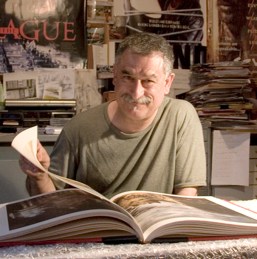
Peter_Lyssiotis-port

Peter Lyssiotis

Peter Lyssiotis  –  Artists book-maker and photomonteur

OLYMPUS DIGITAL CAMERA

Peter’s letter

.

A vodcast for the event is available at  http://www.slq.qld.gov.au/audio-video/webcasts/recent-webcasts/siganto-seminar

.

Cheers  Doug+Victoria

.

.

© Of all texts resides with the authors

Photograph of the SLQ Theatre, Julie Barratt, Monica Oppen, Wim de Vos  © Doug Spowart 2013. Self-portrait of Maureen Trainor ©2013. Judy Barrass portrait supplied by Judy.

Creative Commons-by-nc-nd.eu

This work is licensed under a Creative Commons Attribution-NonCommercial-NoDerivs 3.0 Unported License.

.

.
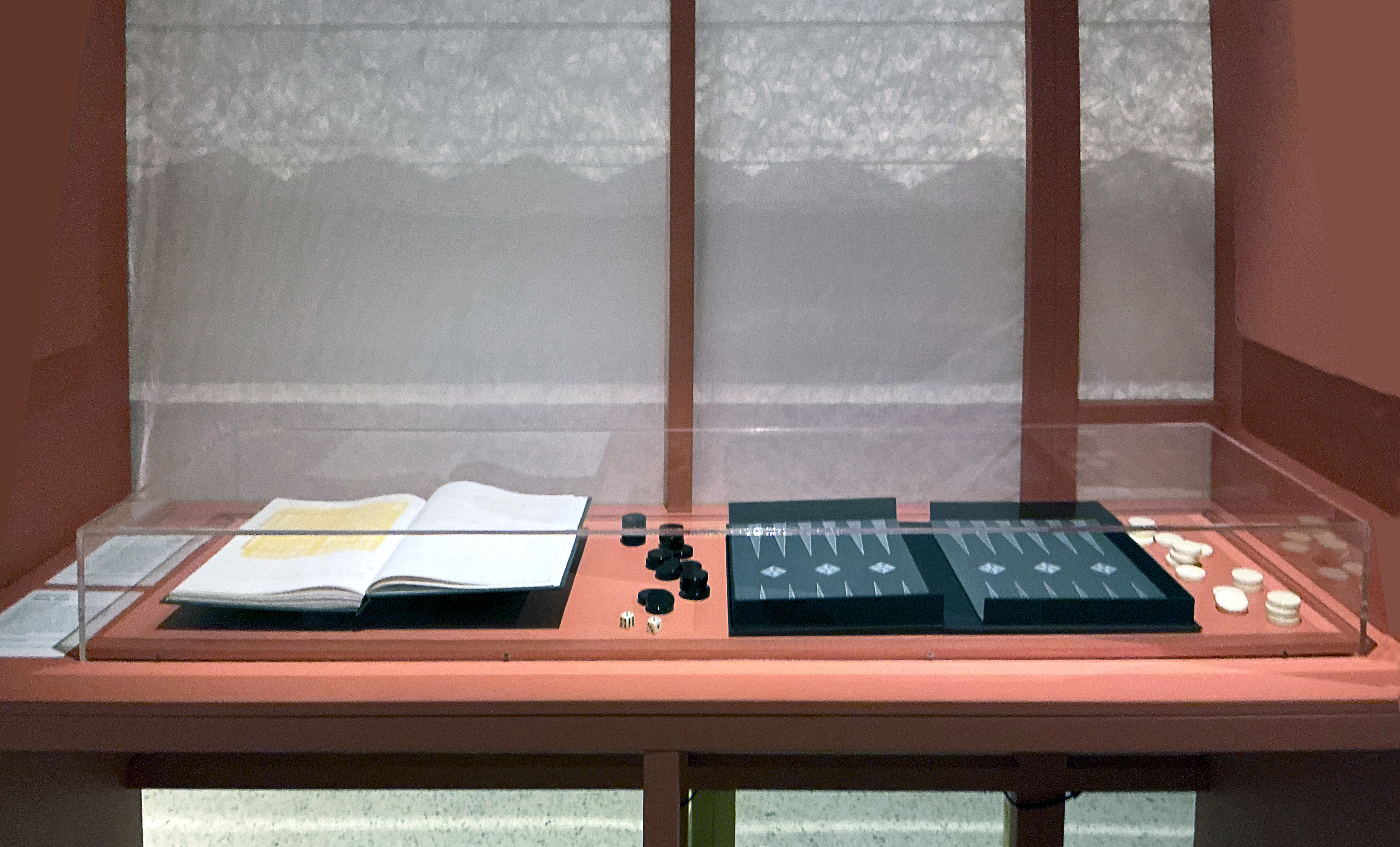
.