Posts Tagged ‘art’
THE ‘OURS FOR THE MAKING’ PROJECT
..
.
“… this project keeps growing with wisdom, connection and
heart with every place (and places) that are present
and all who share in it.”
Sound artist Bree Marchbank.
.
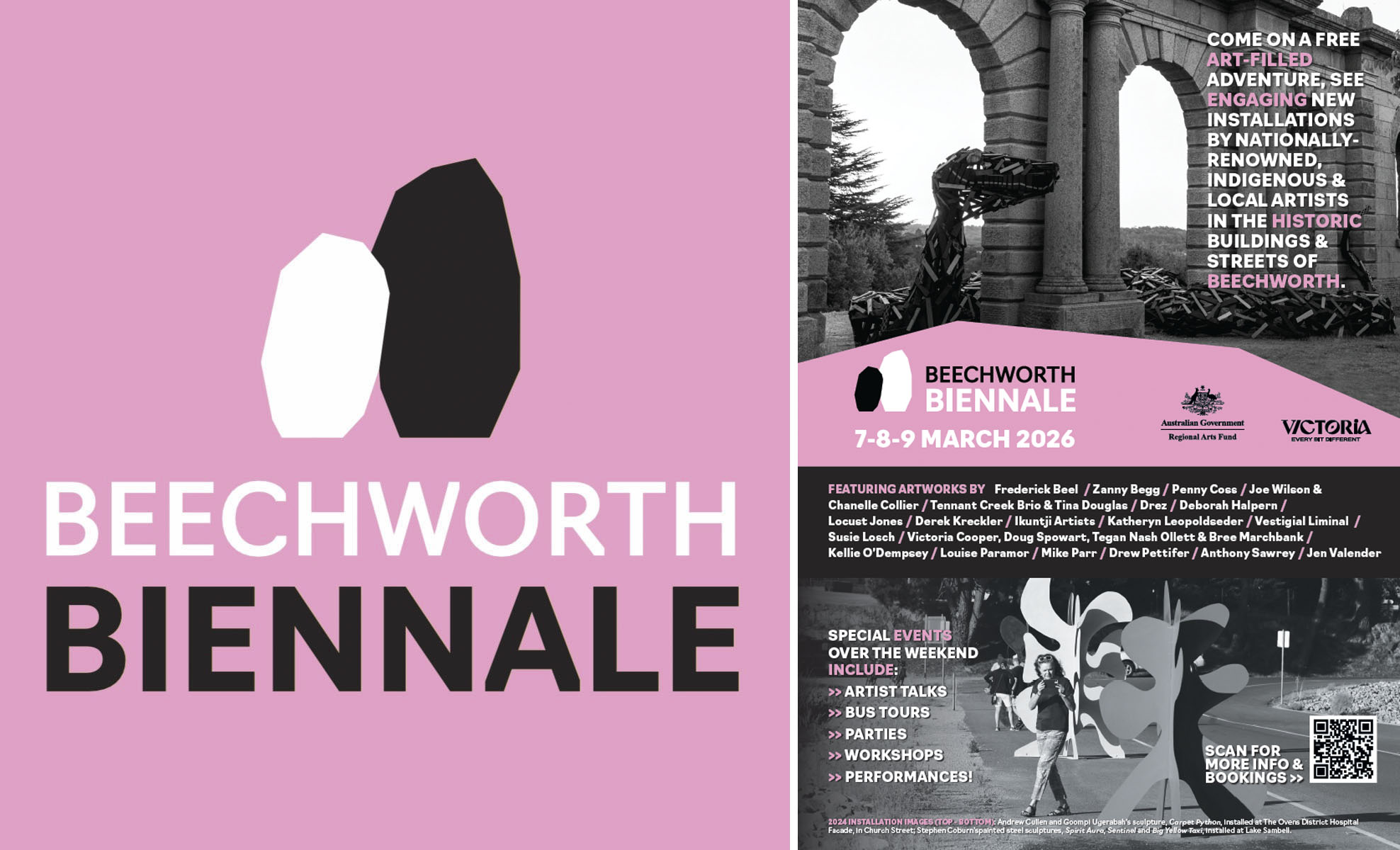
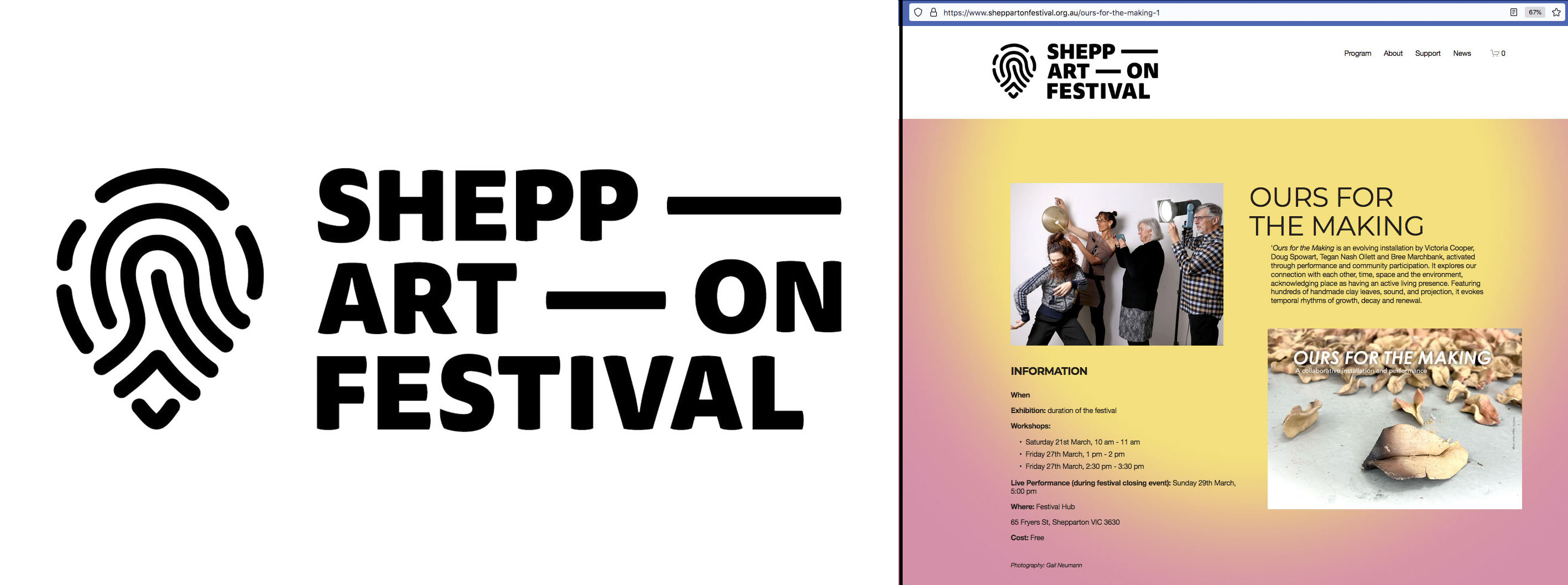
In March 2026 the Ours for the Making project was presented at two venues: the first, for Beechworth Biennale on the 7–9 of March and the second, at the Shepparton Arts Festival Hub 20–29 March. The following text is edited from project documents written by Tegan Nash Ollett with contributions from team members Bree Marchbank, Victoria Cooper and Doug Spowart.
.
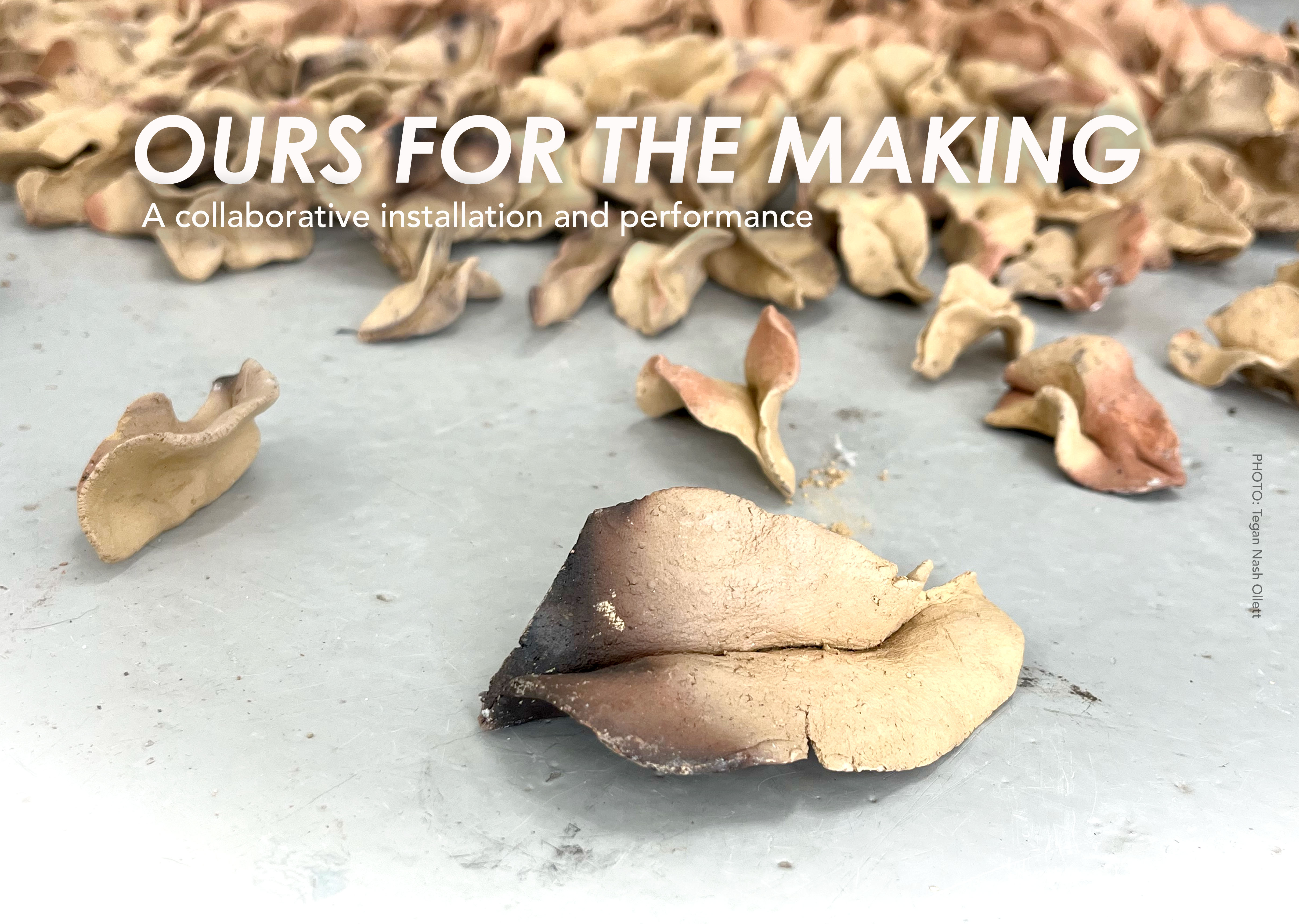
Ours for the Making is an evolving installation activated through performance and community participation in clay leaf-making sessions. The project was presented as an audio/visual installation. In the final day of each showing was concluded with an improvised live performance. It explores our connection with each other, time, space and the environment. It also acknowledges place as having an active living presence. Featuring hundreds of handmade clay leaves, sound, and visual projections the work is intended to evoke temporal rhythms of growth, decay and renewal that mirror the life histories embedded in natural materials.
.
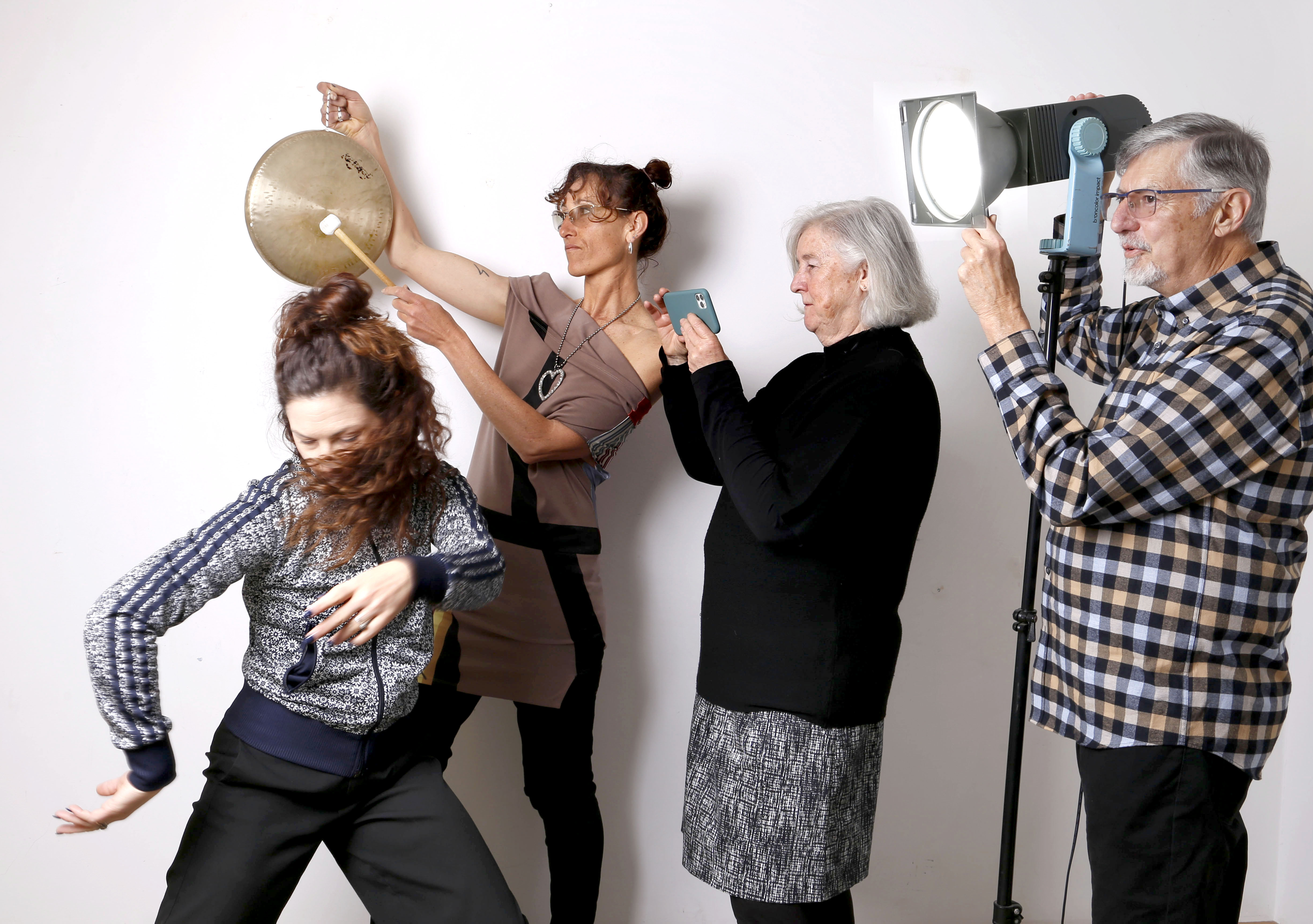
Tegan Nash Ollett, Bree Marchbank, Cooper+Spowart PHOTO: Gail Neumann
.
THE ARTISTS
The Ours for the Making is a newly formed collective with each of the artists having a long-standing commitment to exploring place as an active, living presence. All four artists live and work in Benalla. Tegan Nash Ollett’s work in performance and community engagement foregrounds artistic practice as a connective, transformative process. Bree Marchbank’s sound works draw from environmental listening and experimental composition while Victoria Cooper and Doug Spowart’s photographic, artists book and site-responsive practices examine how landscapes accumulate memory.
Separately, the four artists have received awards and featured in festivals and galleries across Australia, however, each share a strong interest and connection to regional contexts and communities through their work.
.
.
THE CORE INSPIRATION FOR THE PROJECT
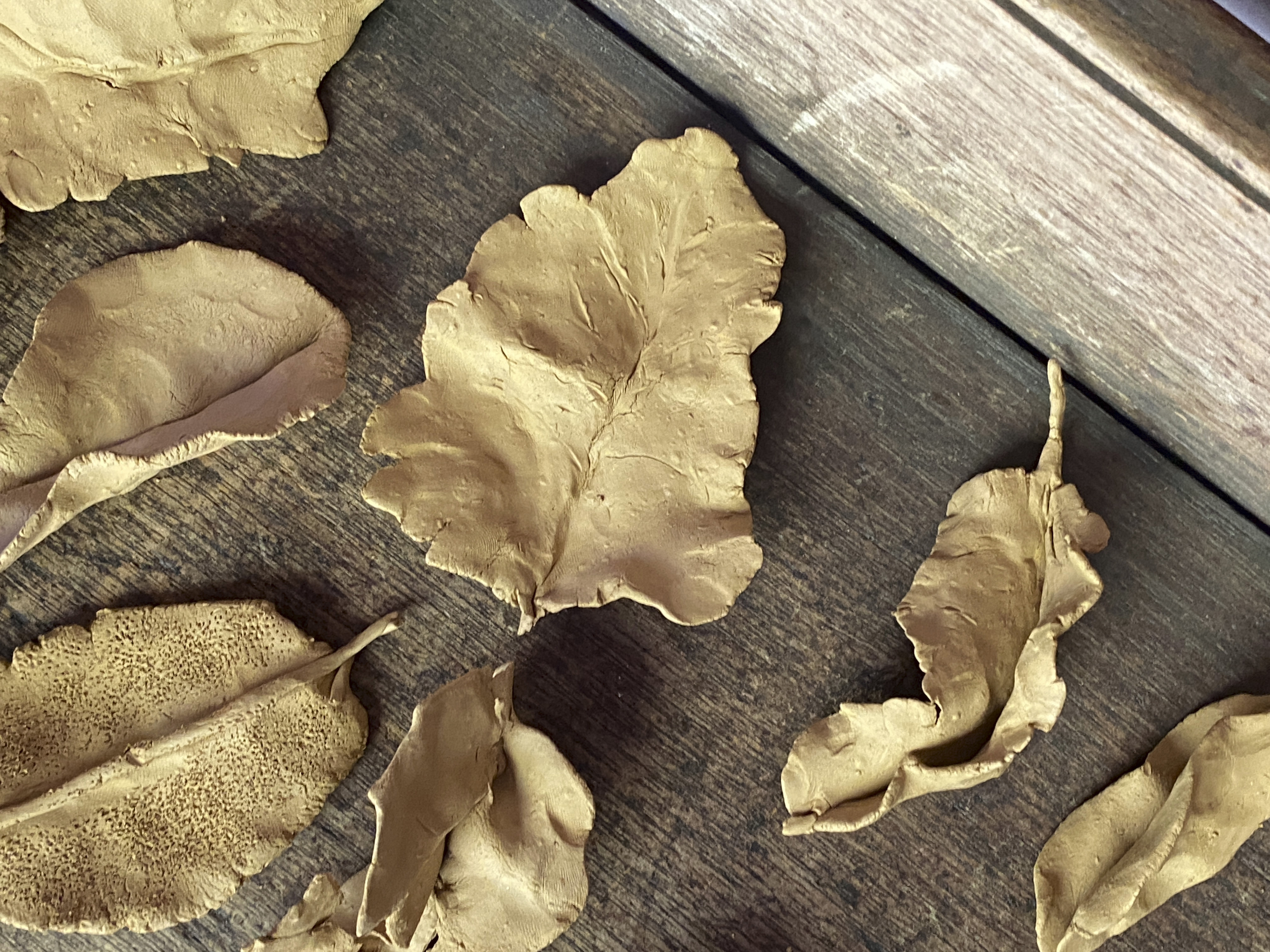
Over many years Tegan has work with communities in a process that engages participants in conversation while they worked by hand with potter’s clay to form leaf shapes. She found that people gathering together in this way shared their lived experiences, community’s histories and other personal reflections. Through these sessions the conversations were metaphorically embedded into the leaf objects they made. For her “making is a conduit for connection” and she believes “that through this process, knowledge is not transmitted hierarchically but shared laterally – through material, gesture, and collective experience”.
Following the leaf-making sessions Tegan fires the clay with wood in a fire-pit. Variations in the colour of the clay and occasional ‘blush’ marks and the maker’s fingerprints on the ceramic leaves evidence the story of their making.
Later the ceramic leaves are incorporated into the existing body of leaves created by the Artist (Tegan), allowing the installation’s evolution, with design considerations to reference a response to site. They are the muse for the artists in the development of the full audio-visual installation. The leaves are the centrepiece of the artwork.
.
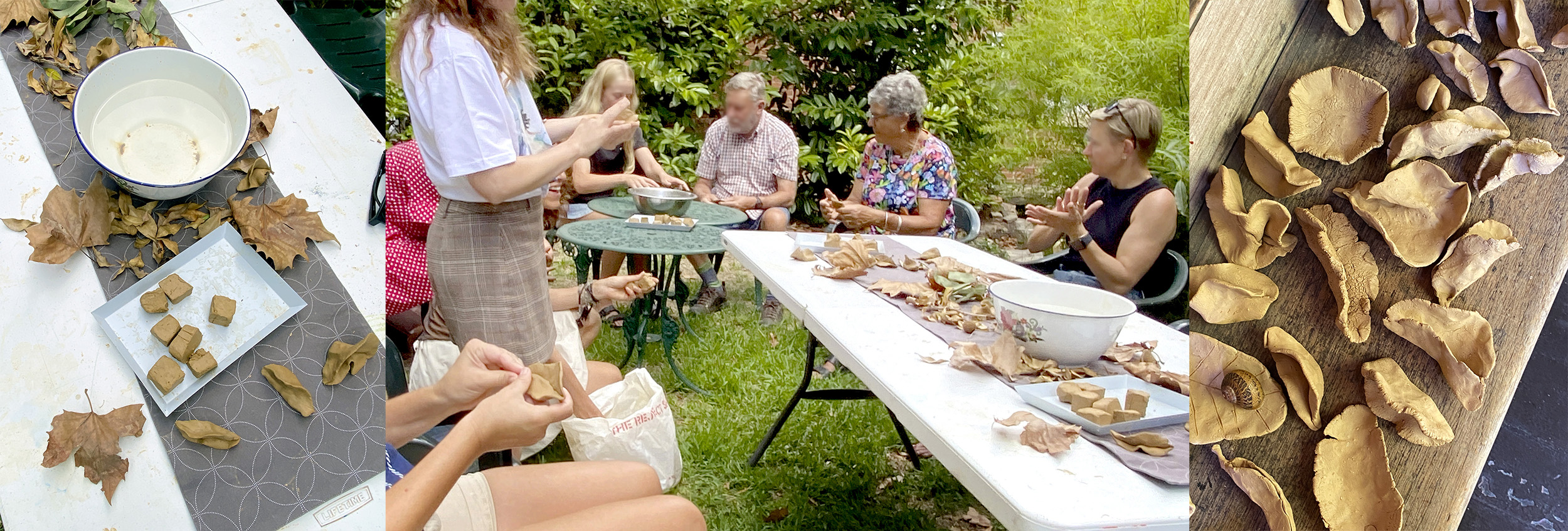
A communal clay leaf-making sessions taking place at The Old Priory
.
.
.
VIDEO PROJECTION IMAGES+SOUND
Through initial team discussions, five themes/concepts arose as evocative and powerful connections for the leaves with the project. Each of the five themes evoked different expressions of being with/and in Nature. Cooper+Spowart drew from their lived experience traversing landscapes and walking. From this they created visual narratives – montages, for projection, as pathways through each of the five themes.
These five videos were then passed on to Bree who crafted her sound-works to respond to the visual montages. As Bree states she “approaches sound creation as ritual and collaboration, using improvisation to explore the life cycle of a leaf and our connection to place”.
Viewing of these video works in the installation is enhanced by the fragmentation of the image as it passes over the different suspended ‘veils’ they are, in themselves, individual performative elements, Acts, adding depth and filling the space with imagery.
Together the experience of each animated projection montage with the sound work is deeply layered and form individual elements – Acts, within the installation.
SEE: Bree, Victoria and Doug’s Artist Statements at the end of the Post for deeper insights on process and meaning
THE FIVE VIDEOS
Act of Fire
Act of Paralysis: Burnt Banksia
Act of Transformation: Decay and renewal
Act of Fragility: Sunrise
Act of Intimacy: Walking the path
THE INSTALLATION
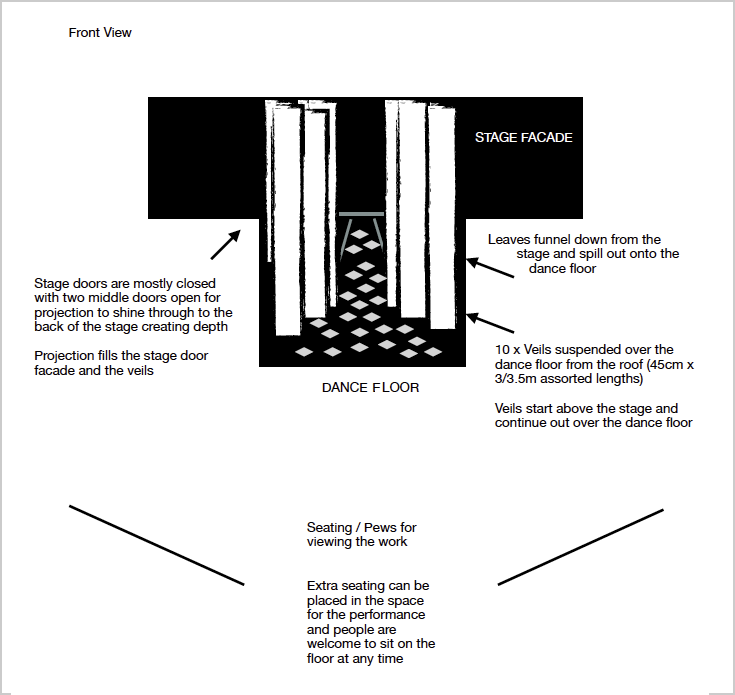
Tegan’s draft install plan (Detail)
.
.
.
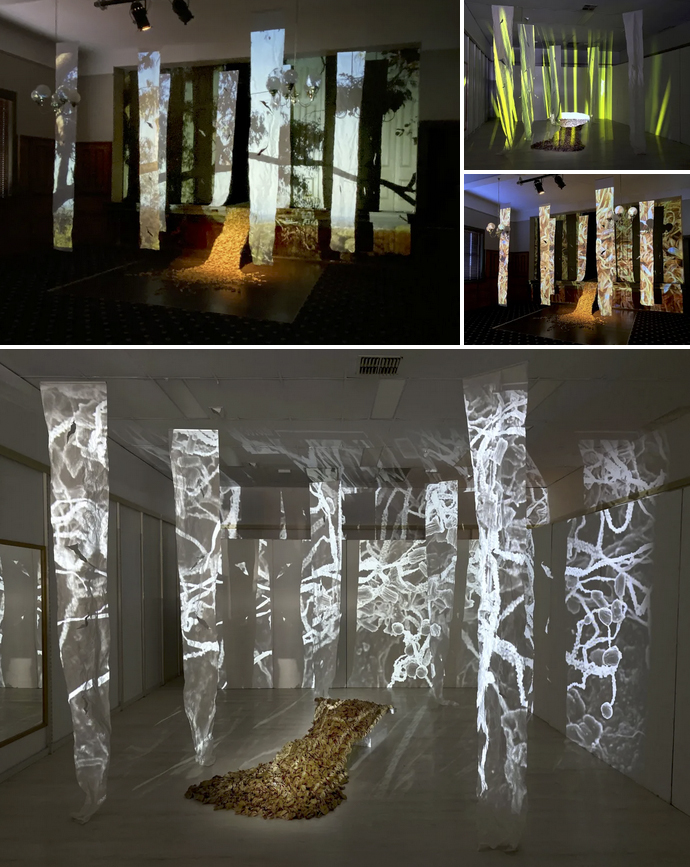
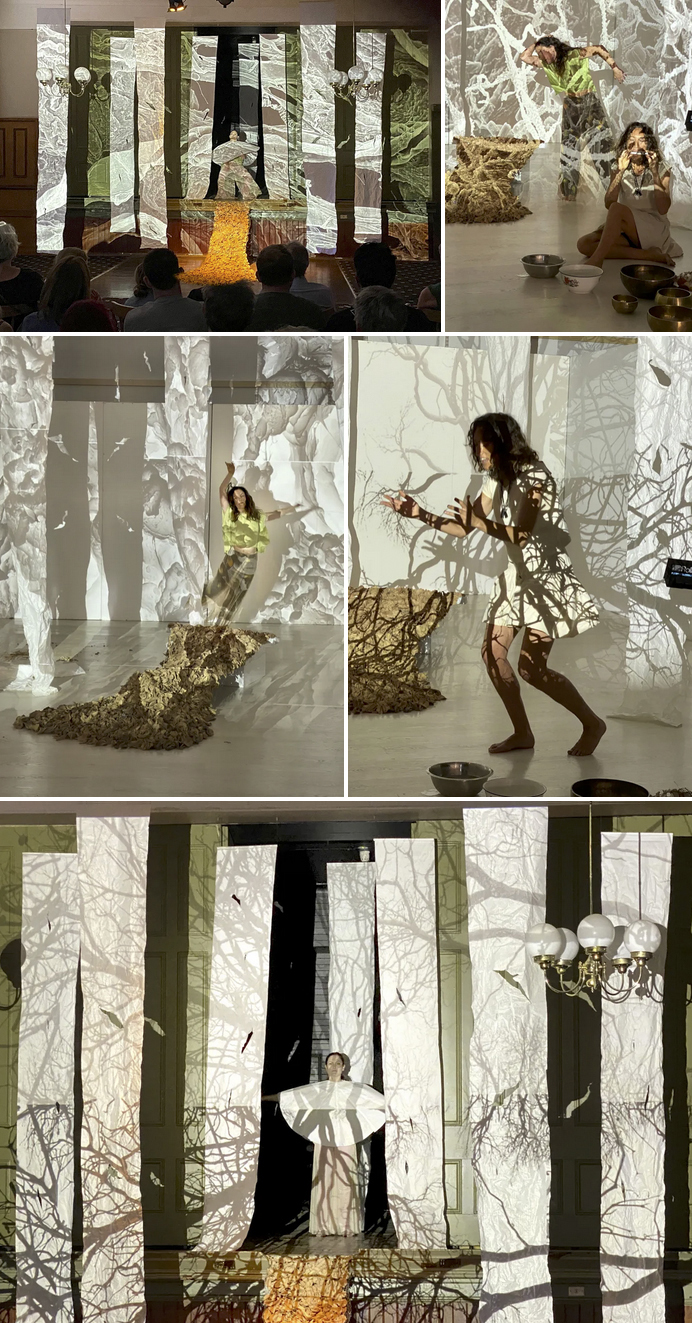
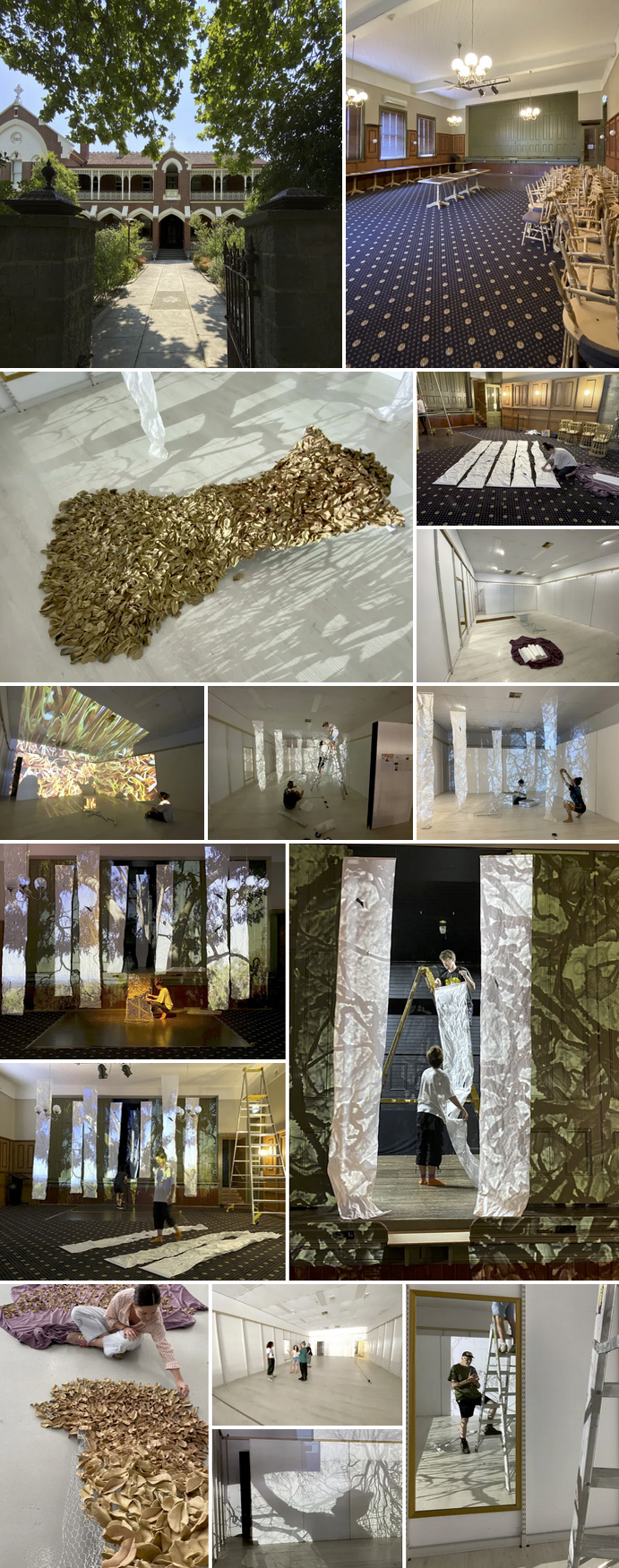
In the installation a flow of clay leaves is both architectural and organic. Suspended above are rice-paper veils that catch image projection’s light, shadow, and act like memory skins. The rice paper has been intentionally torn and crumpled to add texture and visual light play. The grouping of leaves suggests concepts of ritual and offering, acknowledging its close relationship to nature, while the veils evoke garments, shrouds, and thresholds.
The sound and image projection animate the space slowly, asking viewers to linger rather than consume. The overall installation invites contemplation of time, care, and the residue of human gesture where gathering becomes an act of devotion and what remains has both material and memory.
.
THE PERFORMANCE
 ..
..
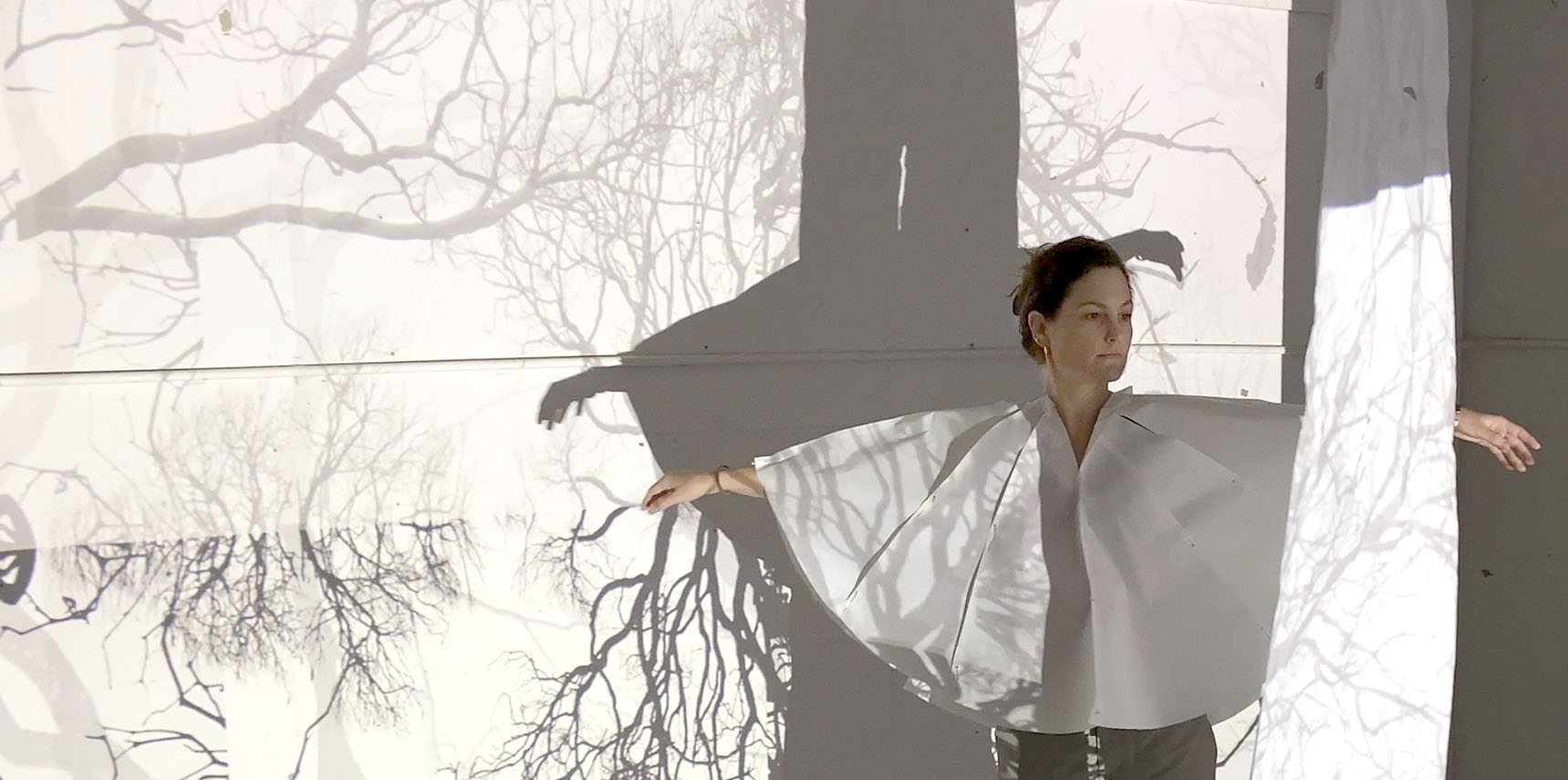
The one-off live performance is a unique opportunity for attendees to experience the Ours for the Making installation, highlighting the work’s themes through movement, sound and performance. The performance is improvised and features movement by Tegan. Bree activates her instrument’s and sings, at times harmonising with Tegan. In this live performance both respond, through movement and sound, to the sonic and visual rhythms of growth, decay and renewal.
SEE: Tegan’s Artist Statement at the end of the Post for deeper insights on process and meaning
.
This YouTube video of the Beechworth Biennale performance by Cooper+Spowart is from a stationary camera position. Its run time is 40 minutes and is best viewed on a larger screen device.
.
.
VICTORIA+DOUG’S REFLECTION ON THE PROJECT
In 2025 we connected with Tegan and her practice in performance and dance. Each month she leads a free ranging improvisation space for community engagement at Benalla Art Gallery called Fresh Juice. At one of these sessions Tegan witnessed Victoria’s exploration of the materiality of rice paper through her crumpling and ripping the sheet then moving it through the air and identified the performative nature of the act.
In a later conversation we learned about her many years of working with community engaging them in conversation while working with clay making leaf shapes. She mentioned that what she had seen at Fresh Juice had inspired her to discuss a collaborative project with us using rice paper, her ceramic leaves and a movement performance.
.
.
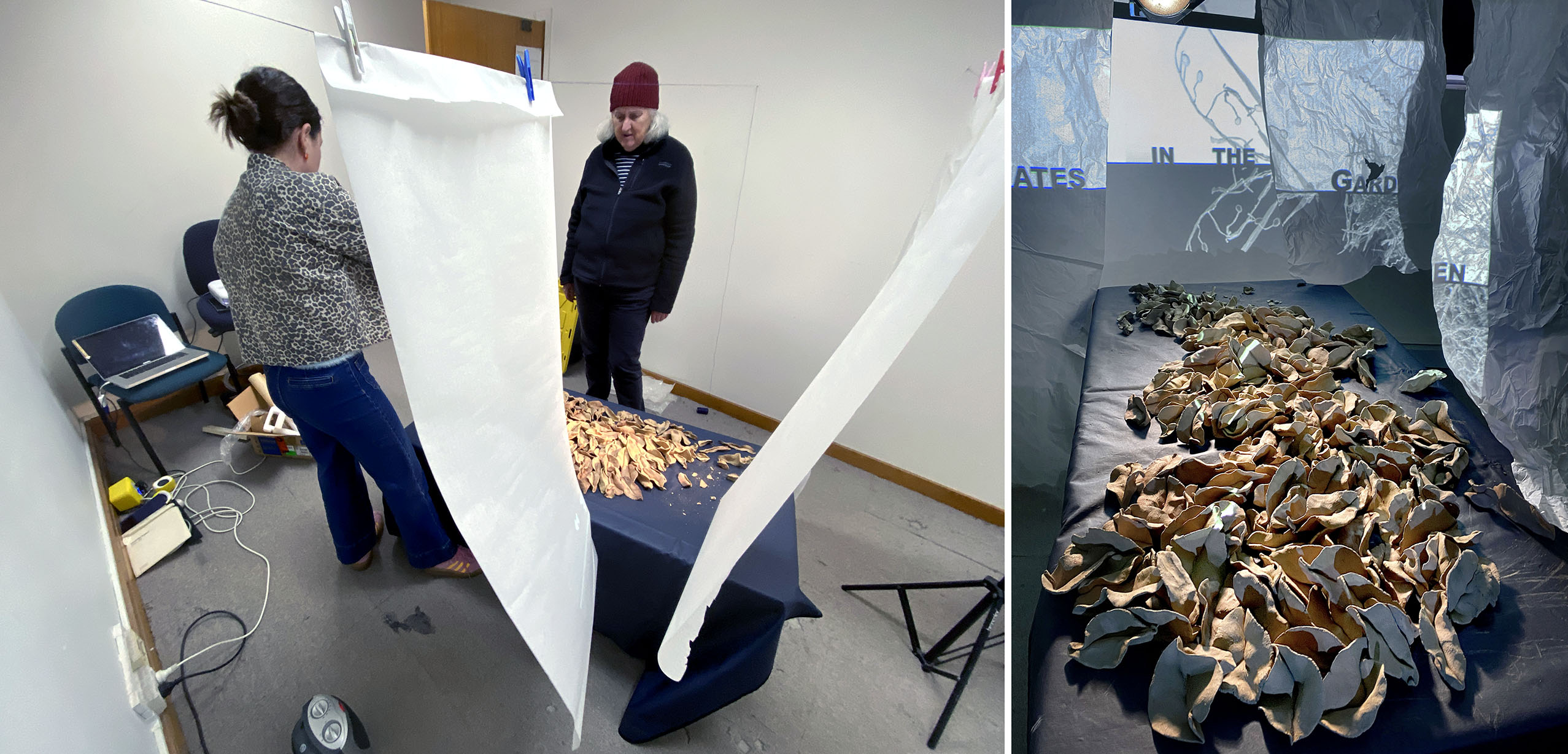
Excited by the flow of concepts we set up an experimental installation with Tegan in our studio. We hung veils of rice paper from the ceiling over a large surface covered with her clay leaves. Studio lighting was arranged and an animated interpretation of an artists book by Victoria was projected over the scene. We saw potential for the work to be developed further. As Tegan had a strong connection with sound artist Bree Marchbank – she was invited to become the fourth member in this evolving collective project.
.
.
With a successful application for an audio-visual, and sculptural installation engaging community to be developed for the Beechworth Biennale we began to work on the project – that was now entitled Ours for the Making.
From the start this work was developed though the team’s sensory response and reflexive exploration and this continued through to the final installation as a visual, spatial and sonic connection with the site.
After discussions with the Beechworth Biennale we were offered the theatre in The Old Priory. Built in the 1870s the large seating area, stage, dance floor all under an 8-metre ceiling – the site at first seemed challenging. However the installation issues were resolved, and the site was opened for public viewing on March 7 for the duration of the Festival, with a one-off performance taking place on the evening of the 9th of March.
.
.
Through Tegan’s efforts we also received an offer of a presentation of the installation in The Hub at the Shepparton Art Festival. As a transformed vacant shop it was a totally different space and provided an exciting opportunity to reinterpret the installation and the concluding improvised performance.
In Conclusion
For us Ours for the Making has been both an exciting and challenging project. Working within this creative and innovative team was an enriching experience. We can see potential for this project to continue in other spaces – each time, a reimagining.
.
Vicky+Doug
April 4, 2026.
.
.
SOME DOCUMENTS OF THE SETTING UP OF THE 2 SPACES
.
BEECHWORTH BIENNALE 7-8-9 March 2026 in THE OLD PRIORY (Site 11)
.
SHEPPARTON ARTS FESTIVAL in the Festival HUB 20–29 March
.
ARTISTS’ STATEMENTS
Tegan Nash Ollett in projection
TEGAN NASH OLLETT
While developing the ceramic leaf component of the installation, engages deeply with both the conceptual framework of the work and its physical, immersive elements, including space, projection, sound and structure. Nash-Ollett’s movement practice embodies both the visceral and experiential dimensions of the work’s central themes of life cycles and transformation, offering a physical articulation of the body’s encounter with these ideas.
Through improvisation, she responds intuitively to the spatial environment, sonic landscape, projected imagery, and the installation itself, activating the work and foregrounding the body’s relationship to place and its capacity to hold memory. This exploration unfolds through an emotive and physical engagement with life and its cyclical nature. Each cell of the body becomes implicated in this inquiry, as movement transports performer and audience through layered moments of embodiment.
.
.
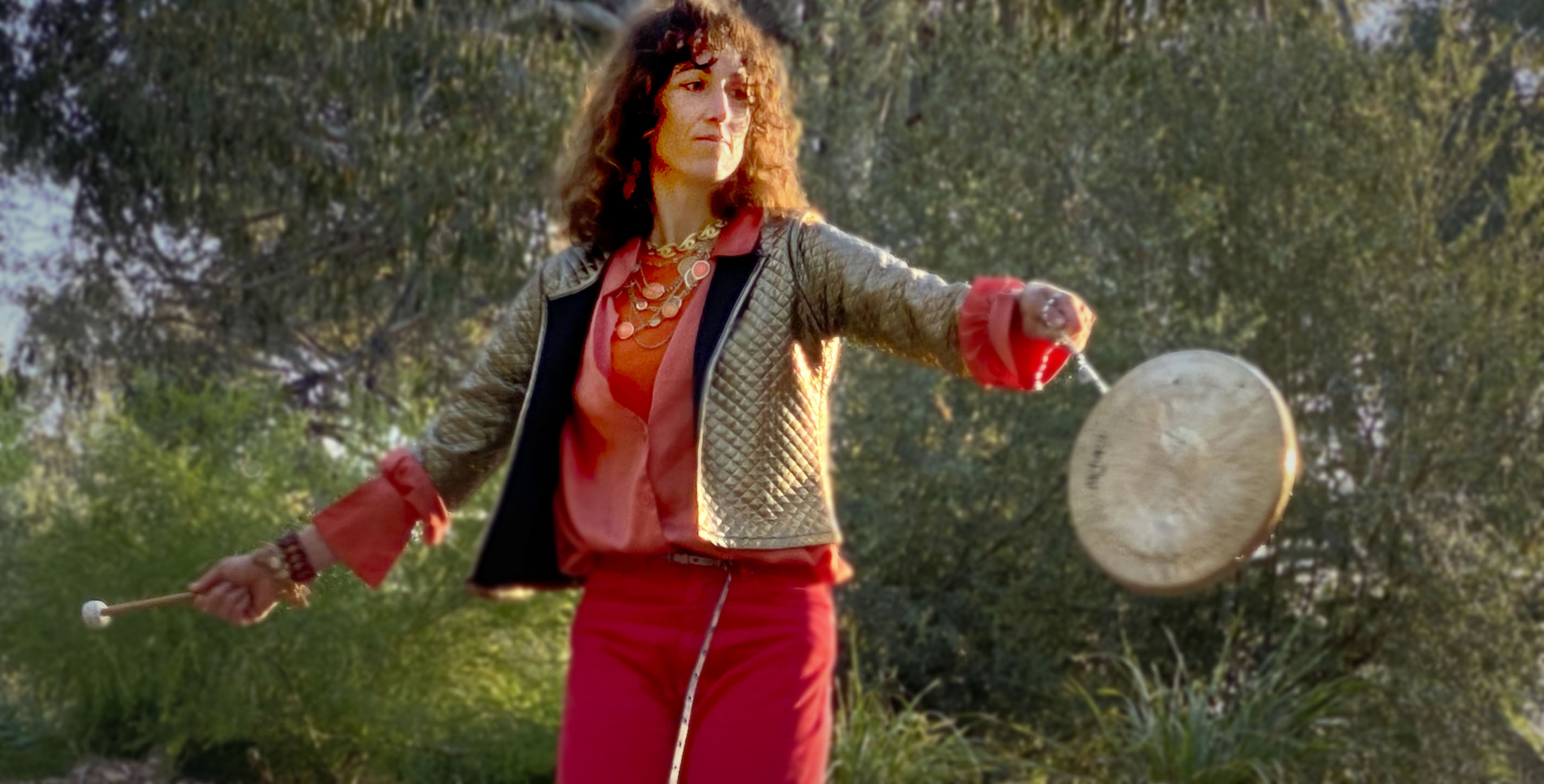
Bree Marchbank with gong
BREE MARCHBANK
Approaches sound creation as ritual and collaboration, using improvisation to explore the life cycle of a leaf and our connection to place. The sound developed through a devotional practice which included field recordings and attentive listening in community and nature. These recordings capture the living presence of place, with and without instrumentation, creating sonic textures, and relational gestures that invite deeper connection and shared experiences for the audience. The sound reflects repeating patterns that mirror organic processes of emergence and transformation.
For me music begins with deep listening, sitting, feeling and remembering with/and on country. Sounds, song, rhythm, movement, melody and their carriers always ask me to listen with all my essence first. Being invited to collaborate on this project, I was pulled to go and sit with country and listen in deep remembering in different locations that were connected to land, waters and sky of each of the festival sites. From there, sometimes I was invited in to sing and create in song and ritual and other times it was to go home and take in what I had remembered or had to relearn/unlearn and then act accordingly. It is devotional, it is ritual, but it is also humbling and honouring to be able to create music.
I create improvisations for and with my body, my blood, all my ancestors (known and remembering), mother earth, mother universe, all spirit who share this journey with me. This was how I began the listening journey for ‘Ours for the Making’. Then I went into deep listening in collaboration with us as a team, and all the places we brought together, further places upon where deep listening had happened, and with community who shared in story, place, creating together, connecting in and with country.
.
.
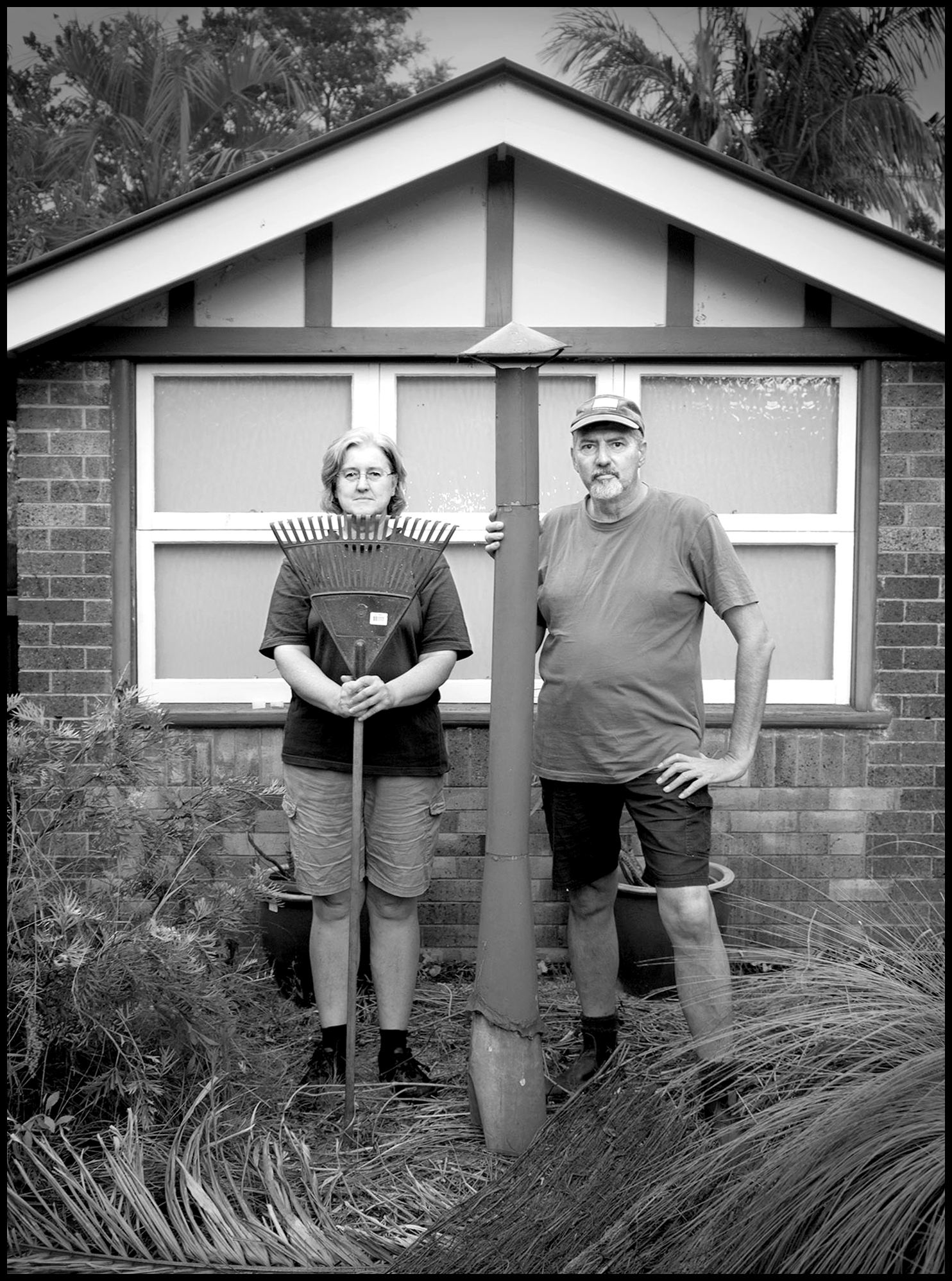
Cooper+Spowart – Toowoomba Gothic Assisted Photo by John Elliott
VICTORIA COOPER + DOUG SPOWART
For these two artists collaboration is a dynamic space to test and challenge their individual creative practice and explore new and uncharted territory. They are informed by Charles Green’s book The Third Hand, where he proposes that collaboration creates a new entity full of potential and possibilities.
Over time they have recognised that their collaboration with Nature and the non-human has deepened and broadened their perceptions of Being-in-the-world. Their practice of Being is therefore fully engaged with Nature. Here, they loose themselves – corporeality evaporates and the physical space becomes a psychological state where poetic and aesthetic narratives emerge through deep reverie.
.
.
IN A FUTURE BLOG POST
In the future we will consider a reflection statement for the project. Currently under development there is a video documentation of the project’s performance at the Shepparton Art Festival which will be made public when complete.
.
.
.
ACKNOWLEDGEMENTS
The artists acknowledge the support of Nina Machielse Hunt the BEECHWORTH BIENNALE team, and Gareth Hart the Executive Producer of the SHEPPARTON ART FESTIVAL, Eric Nash and the Benalla Art Gallery. Also families and friends across Victoria, Melbourne and Benalla, who have contributed to the installation through leaf-making sessions, discussions and sharings in the development of the ceramic leaf feature.
.
Acknowledgement of Country
The artists also wish to acknowledge the Traditional Owners of the various Country locations on which this art project has been made and presented. The artists also acknowledge and pay their respect to the ancestors and Elders – Past, Present and Emerging from these lands and any indigenous people who may attend or read about this presentation.
.
.
The post header photograph is by Tegan Nash Ollett.
.
The team photograph is by Gail Neumann.
.
The portrait of Victoria + Doug was an assisted self portrait with John Elliott.
.
All photographs are by Doug Spowart + Victoria Cooper unless otherwise credited.
.
© All Copyrights are retained by all authors.
.
.
.
.
.
.
.
.
PHOTOS WITH CAPTIONS FOLLOW …


.
.


.
.
.
HELEN COLE VISITS A PAPER UNIVERSE
..
“Artists’ books break all the rules. They stretch, fold, sculpt and reimagine the book as an object — not just something to read, but something to experience”
Curator Maria Savvidis.
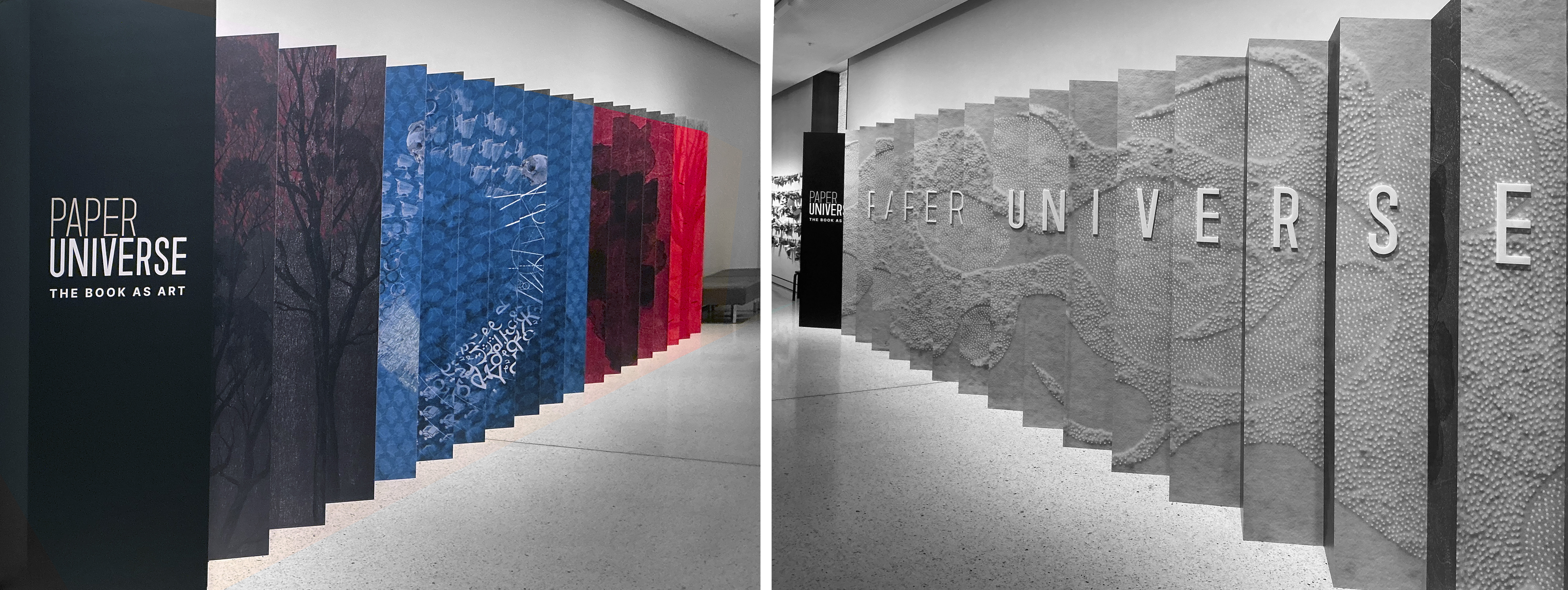
Two views of the ‘Paper Universe: The Book as Art’ entry concertina PHOTOs: Helen Cole
.
PAPER UNIVERSE: THE BOOK AS ART
A MAJOR EXHIBITION OF ARTISTS BOOKS AT THE STATE LIBRARY OF NSW
.
The exhibition press release states, ‘Paper Universe: The book as art’ showcases almost 100 rarely seen works from the State Library’s extraordinary collection of artists’ books. Featuring striking and innovative creations, the exhibition reveals how artists transform the idea of a book into works of art. According to State Librarian Dr Caroline Butler-Bowdon: “Paper Universe offers a rare chance to experience some of the most inventive, thought-provoking and surprising works in the Library’s collection – many by some of Australia’s most celebrated artists – all in the one place.”
.
Paper Universe: The book as art is a free exhibition at the State Library of NSW until 3 May 2026
.
Visiting ‘PAPER UNIVERSE’ with Helen Cole+Victoria+Doug
Towards the end of 2025 we were drawn to Sydney to encounter the seminal artists book exhibition PAPER UNIVERSE: The Book as Art. We invited our friend Helen Cole to join us and Helen was able to arrange a meeting with the curator Maria Savvides to discuss the exhibition, the books and their presentation.
After our viewing of the exhibition our reflective discussion about what we had encountered led to an invitation for Helen to write an informed essay from her significant experience and knowledge of the artists book.
What follows after a selection of images, mainly taken by Helen, is her essay and a collection of documents and a video of the exhibition.
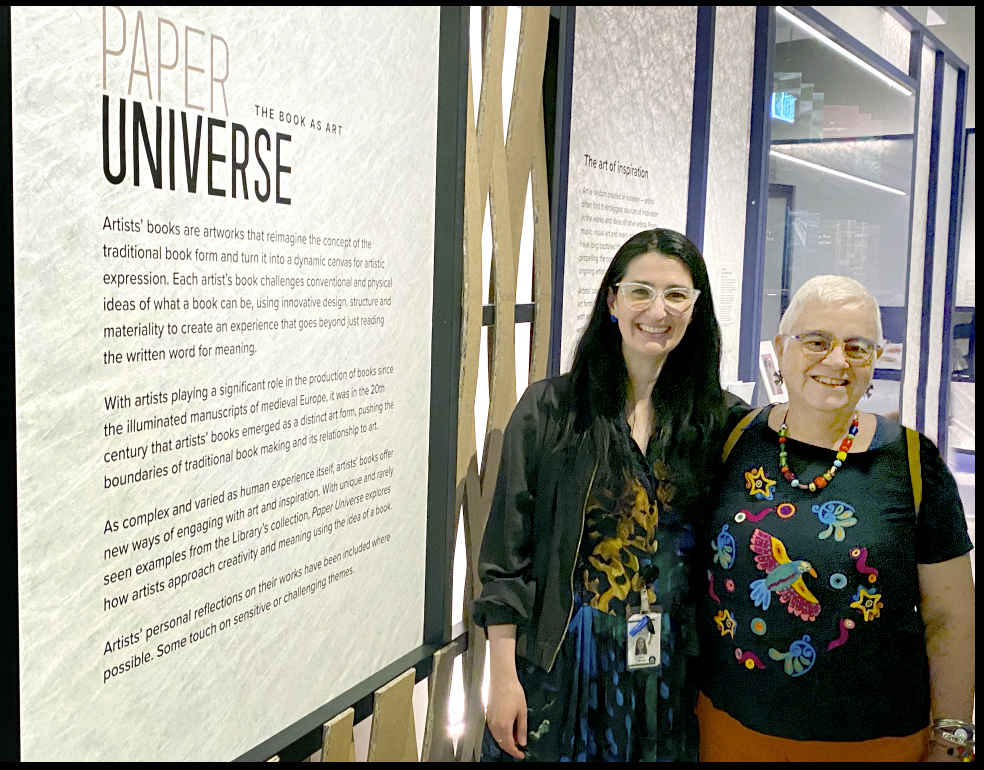
Paper Universe: The Book as Art – curator Maria Savvidis with Helen Cole PHOTO: Doug Spowart
.
HERE’S A SELECTION OF BOOKS FROM THE EXHIBITION
“Click” on the image to enlarge and see the caption.
.


.
HELEN COLE’S REFLECTIONS ON THE SHOW
When I curated the artists’ books exhibition Freestyle Books from State Library of Queensland’s artists’ books collection in 2008 it was supposed to be a mere taster before a major exhibition of the artform. That never happened. It was very gratifying to find out that State Library of New South Wales has taken up the challenge of both curation and display of this form that can be difficult to exhibit, and given it the title of Paper Universe: The book as art. The curator, librarian Maria Savvidis and her supporting team of librarians, conservators and designers have done a superb job in showcasing the richness of stories and artworks that artists books yield. They were fortunate to have five years to bring the exhibition to fruition, and this is shown by the attention to detail in its staging.
.
The exhibition is introduced in the wide corridor leading to it by a huge concertina ‘book’ with blown-up details of three distinctive works. Before you enter, the view of the concertina is a quiet white book by Nicole Hayes with a delicate texture pierced through the page from front and back with pins. As you leave the view is of colourful, forceful black, red and blue designs in linocut and digital prints from books by Dianne Fogwell and Lyn Ashby, summing up the other extreme of the books you have seen.
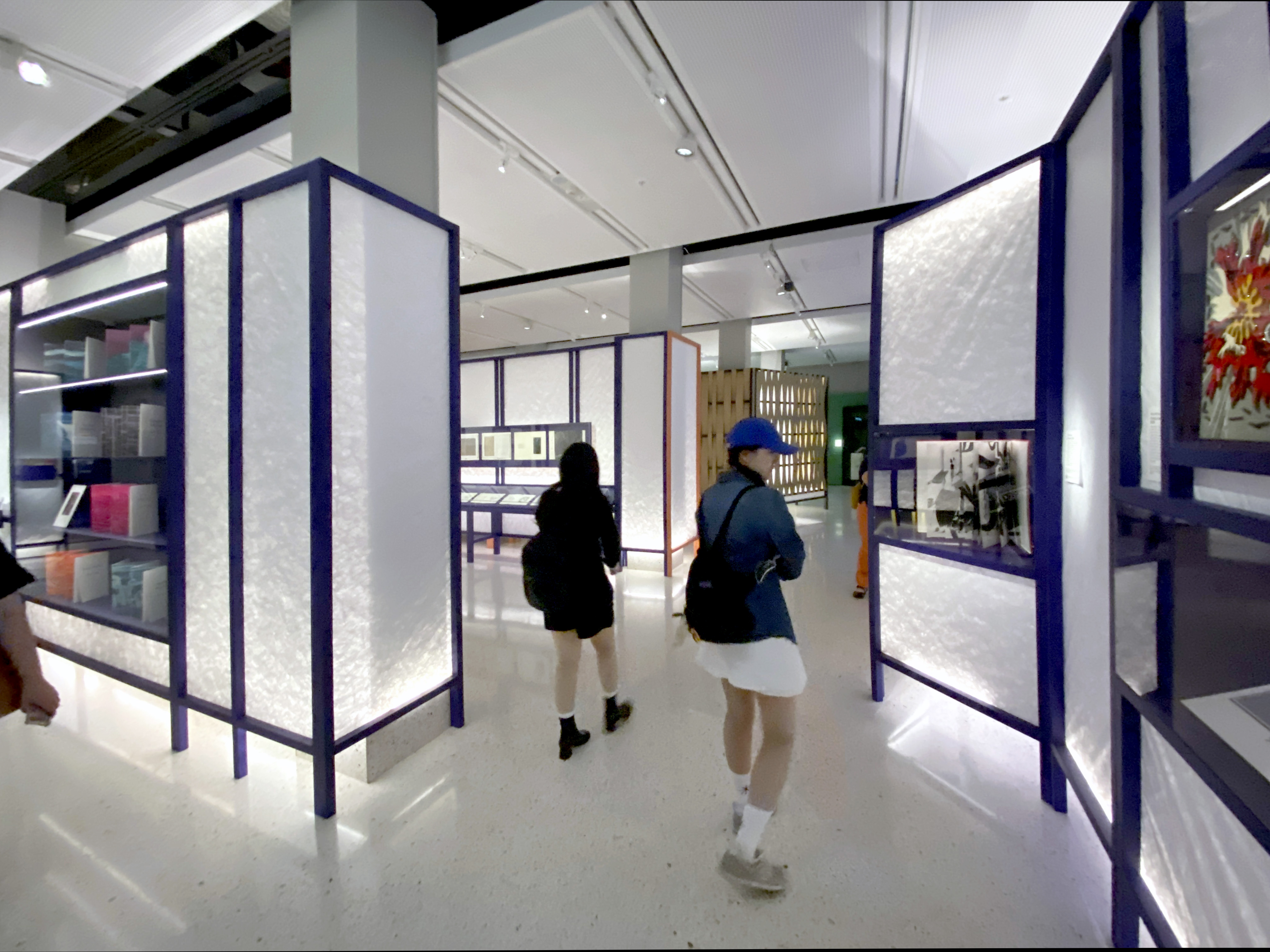
Paper Universe exhibition PHOTO: Doug Spowart
That calm entry leads into a quiet space to engage with the works in the exhibition, provided by dividers reminiscent of Japanese shoji screens. The themes around which the exhibition is woven are well chosen and enunciated in the didactics: the art of inspiration – influences and sources in other artists work; the natural world – its beauty, its power, but also its fragility; the civil condition – investigating, reflecting and challenging social issues, politics, morality and equality; unveiling identity – the shaping of personal, family, and national identities and memories; the artist’s eye – investigations into the notion of the book. Each is signified by a different colour in the surrounding exhibition architecture – walls, plinths and borders on the screens
The books are very well displayed, individually, with several strategies used to overcome the perennial problem of exhibiting artists books, that they generally cannot be fully experienced when closed or open at only one page. The most common comment about an artists’ book exhibition is “I wish I could see the whole book” and indeed it is my thought too, even knowing how difficult it is to avoid. The curator has gone to great lengths to show as many books in their entirety as possible.
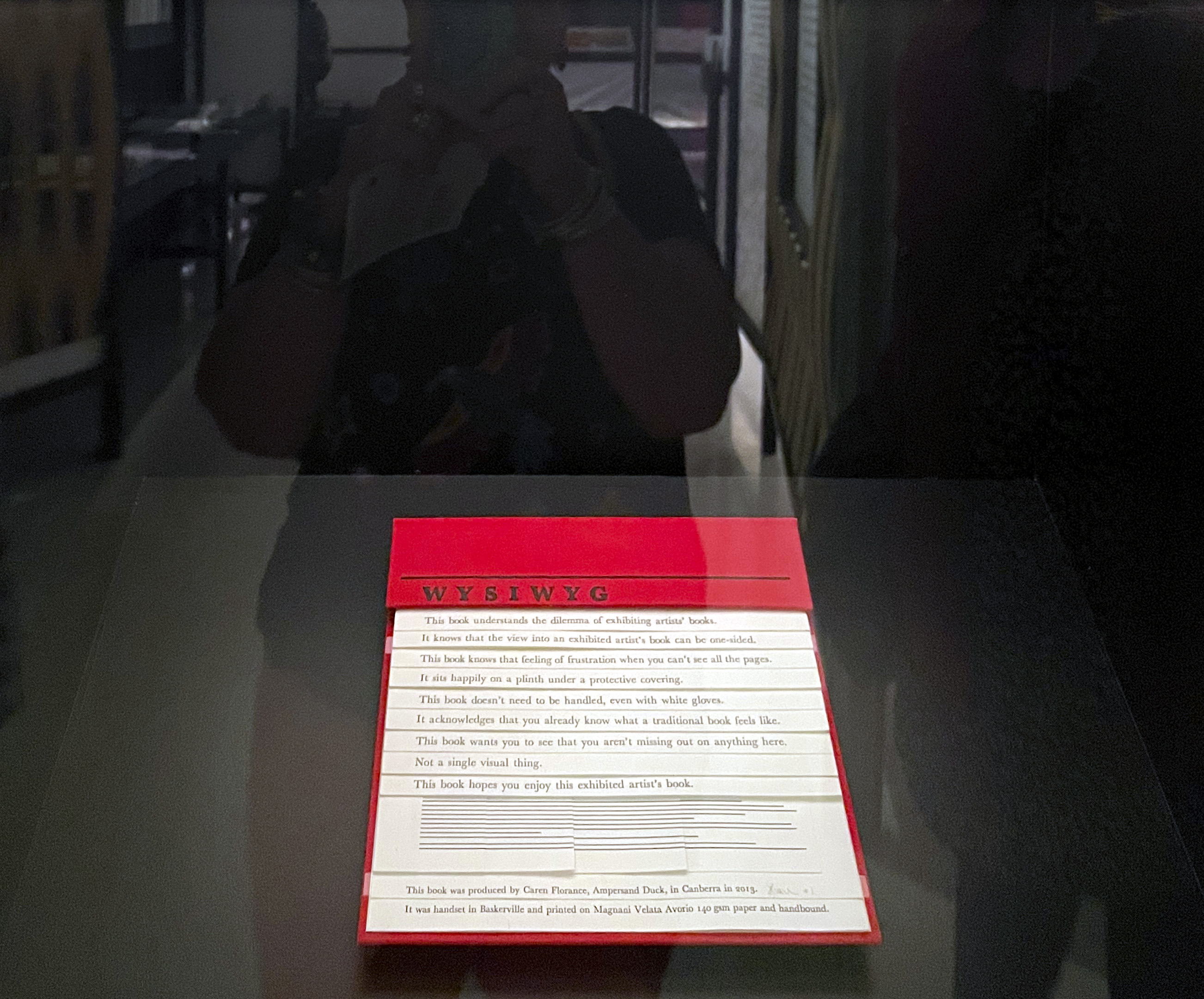
Caren Florance WYSIWYG, 2013
The first book in the exhibition, or is it the last? WYSIWYG (What you see is what you get) (2013) by Caren Florance, the curator’s own copy, was designed to be seen as a whole when the book is closed, displaying what a rarity that is. The text lines are printed on increasingly larger pages, each peeking out from the one above. Maria Savvidis wrote: “This book served as both a talisman and inside joke for me as the curator of this exhibition, years spent thinking about the paradox of exhibiting artist’s books…WYSIWYG is a wry but generous show of empathy from the artist who understands this difficulty and has shown mercy on collecting institutions tasked with the impossible.” Anne-Marie Hunter created the Tower of Babel (2006), (The Tower of Babel, Artists’ Book By Anne-Maree Hunter | State Library of Queensland) a book in the round which was exhibited in my 2008 exhibition, with the same intent.
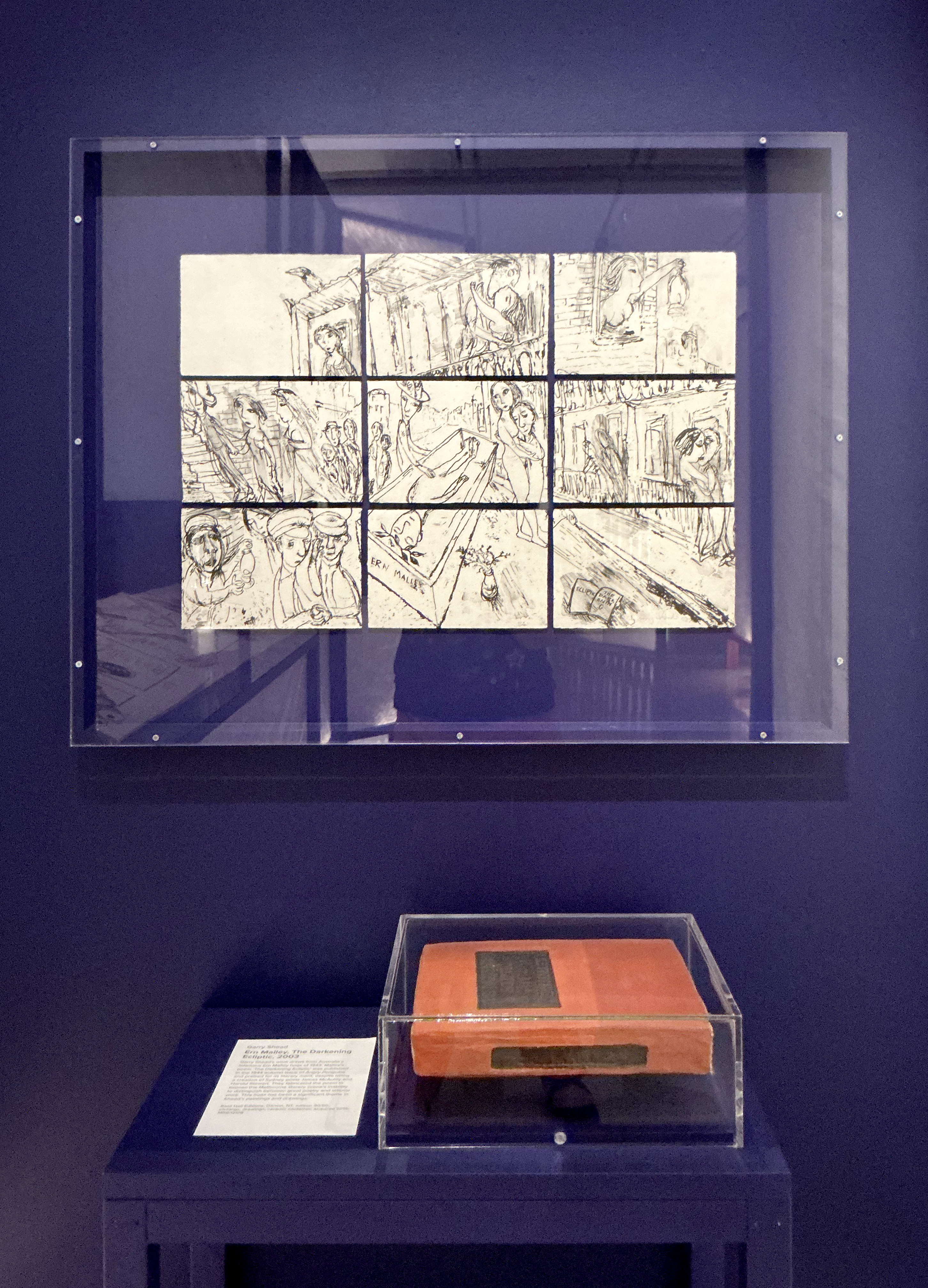
Garry Shead Ern Malley: The Darkening Ecliptic, 2003
Several of the works have been removed from their covers and are displayed, page by page, on the wall. These include Garry Shead’s Ern Malley: The darkening ecliptic (2003): a sequence of etchings, which when presented together create a single image. Along with the display of the ceramic box in which it was presented, this is possibly the best way to show this work.
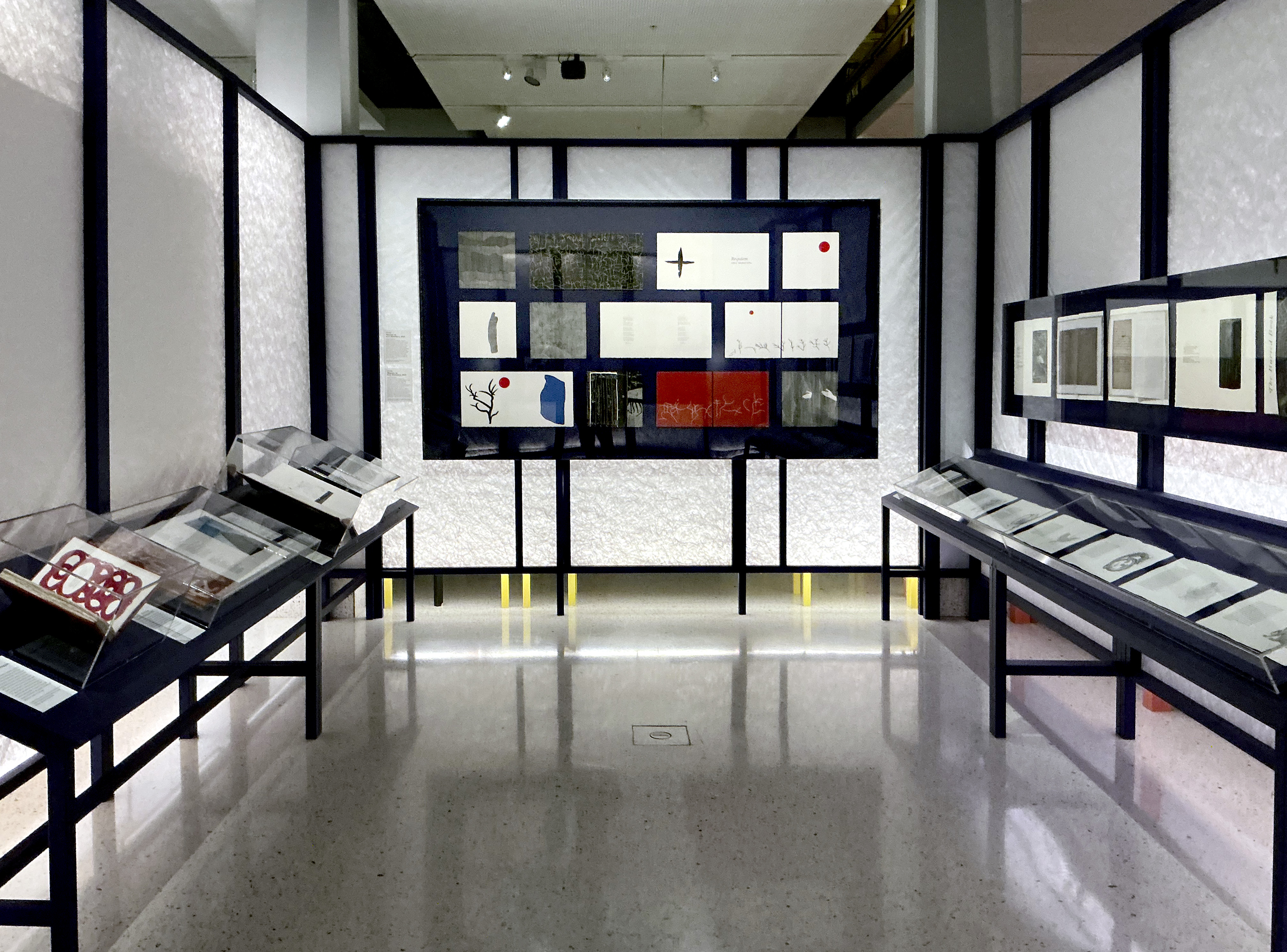
G.W. Bot Requiem by Anna Akhmatova, 2020
The pages of G.W. Bot’s superb linocuts for Requiem by Anna Ahkmatova (2020) are beautifully arranged framed on a blue background, however not all pages of the book are included so it is unfortunately a circumscribed view of the production.
Other works displayed page by page include Paul Uhlmann’s New Insecta, Queensland: AA Girault (1989), Judy Watson’s A preponderance of Aboriginal blood (2005), Peter Lyssiotis and George Matoulis’ Bridge (2021) and Glenda Orr and Kathy Boyle’s Paradise Lost : an artists’ book exploring the status of threatened & iconic plants from Australia and New Zealand collected by Daniel Solander and Joseph Banks during Captain Cook’s 1770 voyage (2020).
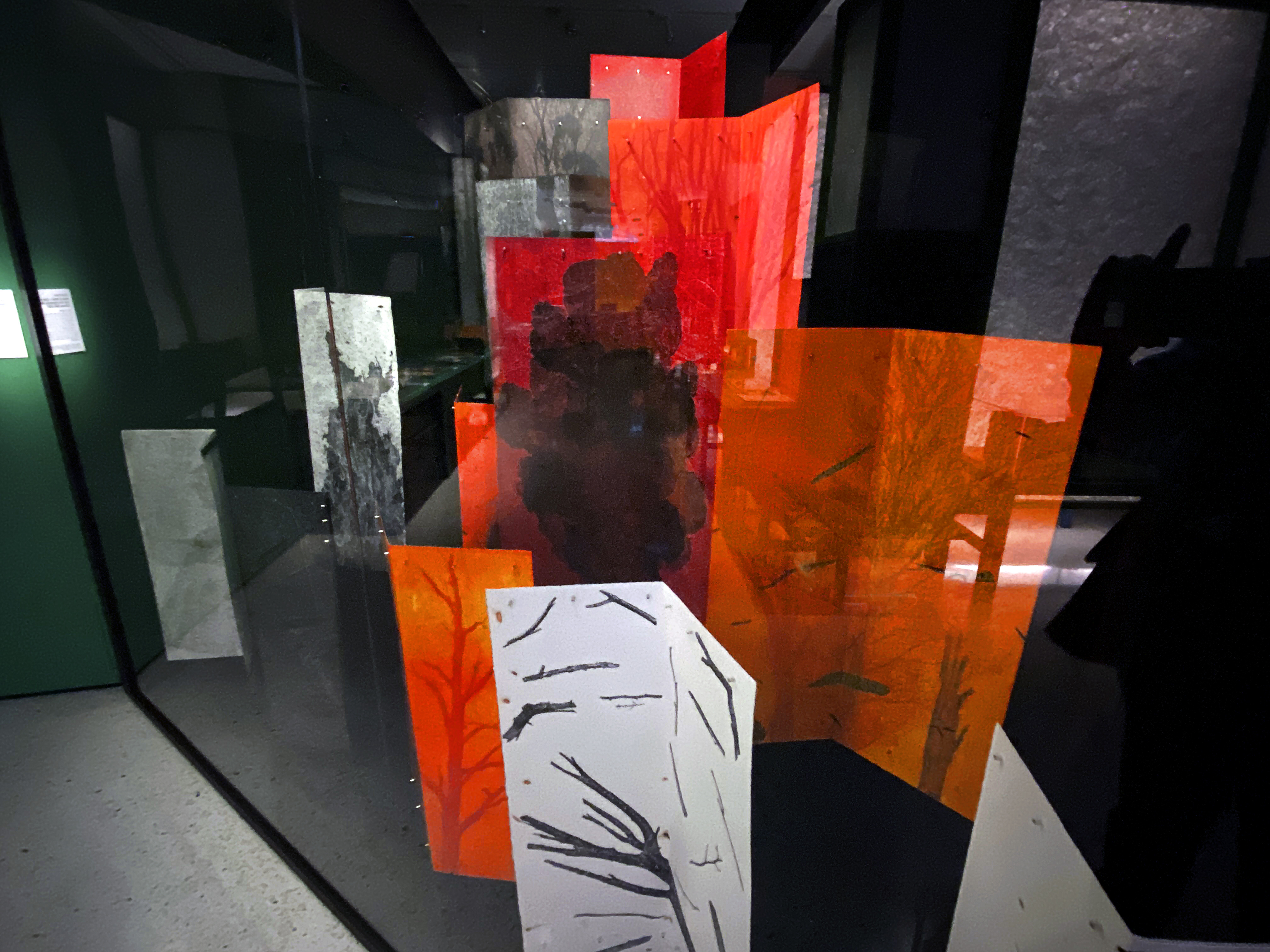
Dianne Fogwell Ashes to Ashes – Dust to Dust- Ash Wednesday 16th February 1983, (2018) PHOTO: Doug Spowart
The pages of Di Fogwell’s Ashes to ashes – dust to dust: Ash Wednesday 16th February 1983 (2018) are arranged upright to evoke the flames of the bushfire it describes. There has been some comment that this destroys the original form and order of the books, but I disagree. Some books are meant to be rearranged by the reader or at least read in any order they want. Also, the curator went to some lengths to speak to the artists and present their work as they would want. For most of the works artists’ statements are provided, along with translations of foreign language texts, where appropriate.
I don’t consider print portfolios on a single subject, often by printmaking groups, constitute successful and cohesive artists books, and there are a few in this show including Natural Collection (2017) by the Warringah Printmakers Studio. It was published to celebrate the 20th anniversary of the Studio and is based on the species and ecological communities of the Northern Beaches of Sydney that are under threat. Ten of the 29 prints that comprise the work are exhibited over three changeovers, not including the texts which accompany each print. I don’t think this work has a conceptual framework – a common subject, yes, but not enough to tie them together – as a book.
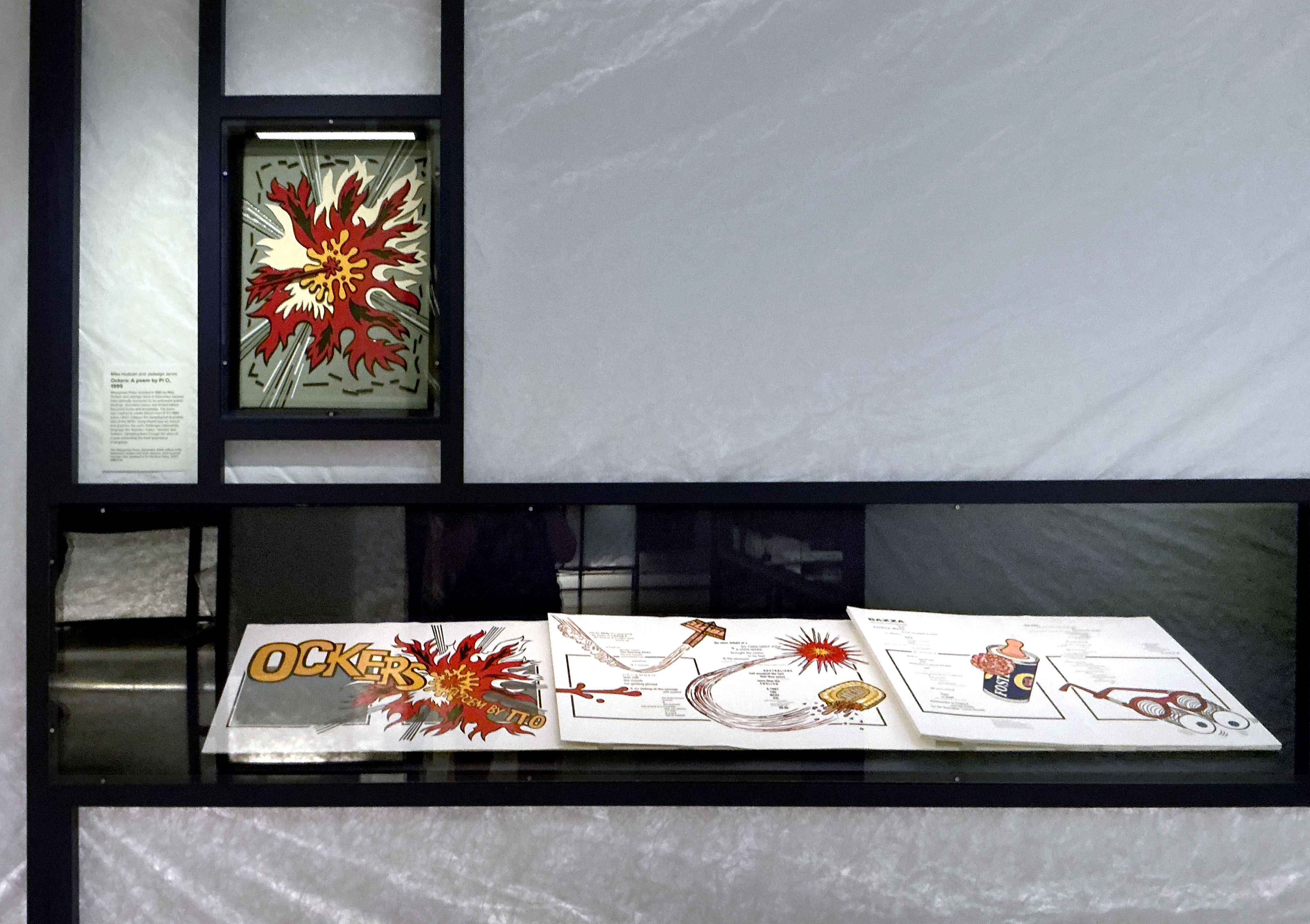
Mike Hudson & Jadwiga Jarvis Ockers: A poem by Pi O 1999
Concertina books are perfectly made for display, extended either framed on a wall or standing upright on a plinth. The bold and colourful Wayzgoose Press book Ockers: a poem by Pi O (1999) is displayed partly opened behind glass. A thoughtful work previously unknown to me was Theo Strasser’s In ecstasy, Franz Kafka (2013) in acrylic painting and collage, based on an aphorism by Kafka. Another is Lossed (2022) by Sara Bowen. Reduction lino prints of her parents, at first strong, becoming lighter as the book is opened page by page. I’m not sure if it represents her memory of them fading or their memories of each other fading through dementia, but it is a very touching work which is displayed to perfection.
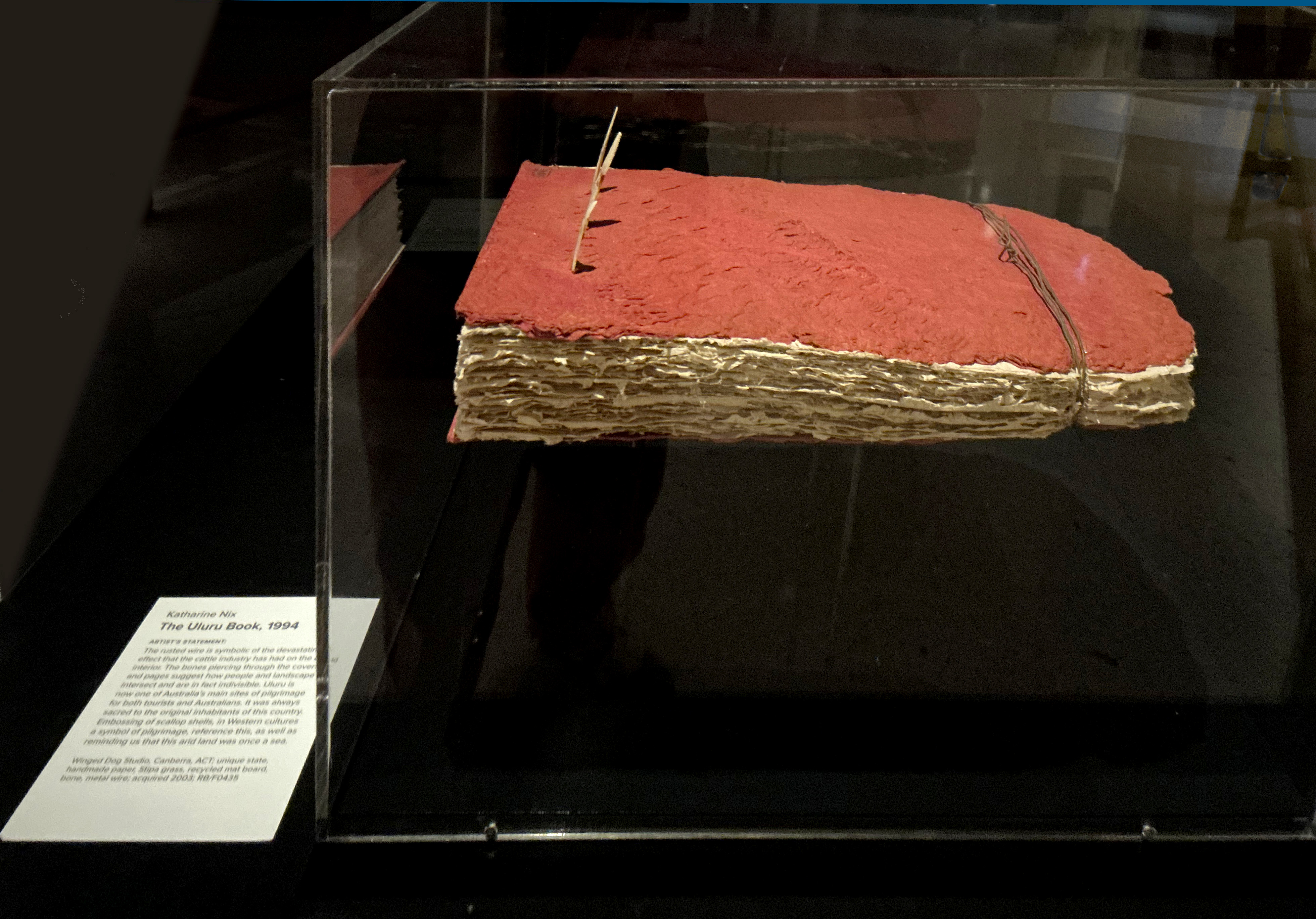
Katharine Nix The Uluru Book, 1994
Several works which could be regarded as book objects were included. The Uluru Book (1994) by Katharine Nix has an imposing physical presence; multiple layers of the hand-made paper for which she is well known, with ochre coloured covers tied with rusted wire and pierced by bones. All elements allude to the close links between the rock and its original inhabitants, and the damage done to the rock and its surrounding environment by the thousands of visitors. Teledex (1981), by Ted Hopkins is a container for poems in the form of an old-fashioned metal teledex, indexed with tabs.
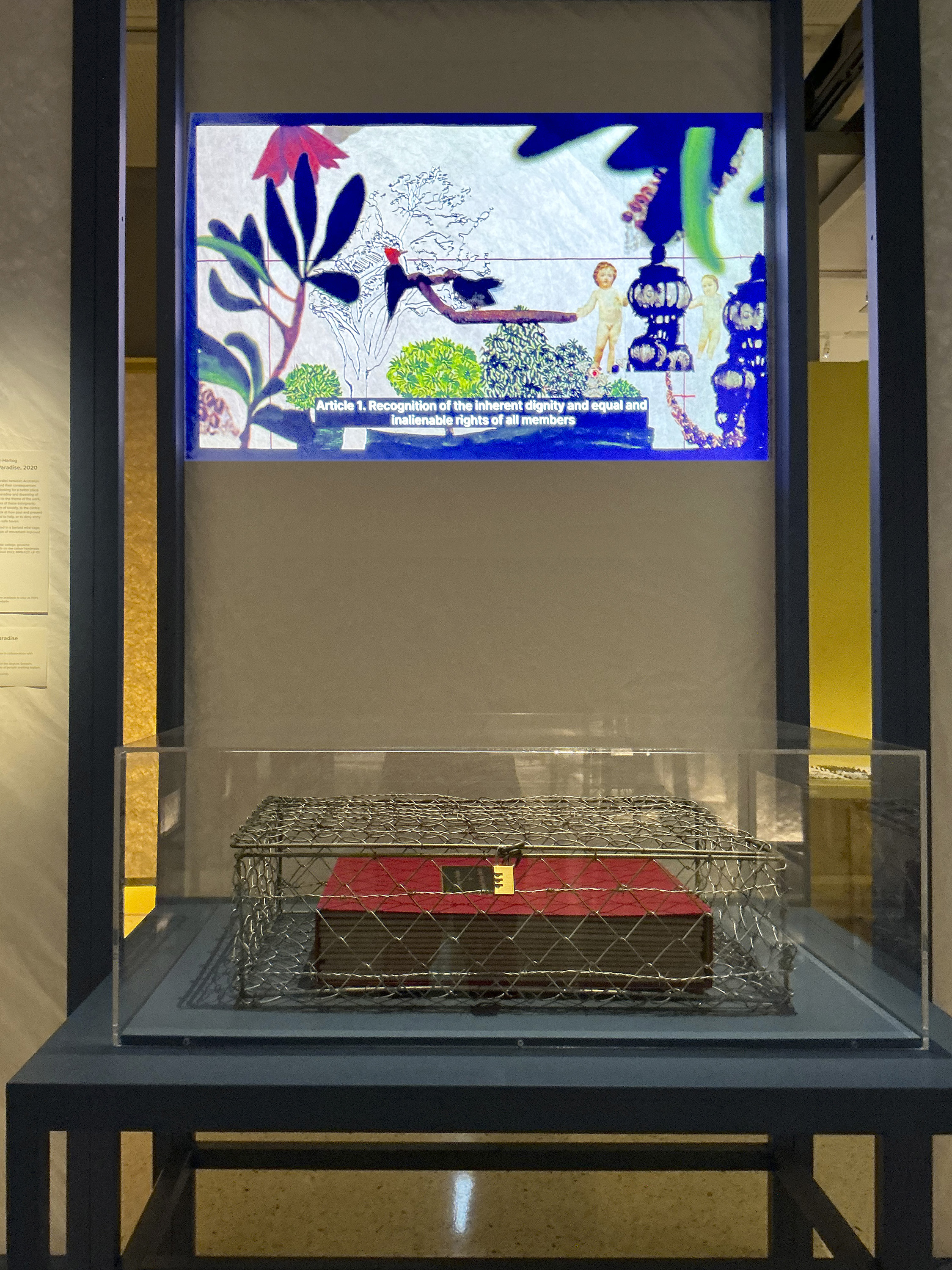
Nathalie Gautier-Hartog
Looking for Paradise, 2020 + Video a collaboration with Broken Yellow
Looking for paradise (2020) by Nathalie Gautier-Hartog, is about refugees seeking a home in Australia, but subject to Australian government policies. It is presented as 12 books inside a wire cage, further emphasizing the restrictions placed on refugees. It is noted that all of the books are available to view as PDFs on the artist’s website with a QR code linking to it displayed. There is also a clever animation based on the United Nation’s Human Rights Charter with images from the books showing in the gallery. It is also on her website. It was created in collaboration with Broken Yellow Studio and the Asylum Seekers Centre. I’m not a great fan of digitised artists books but must admit this combination of media enhances interaction and appreciation of the work.
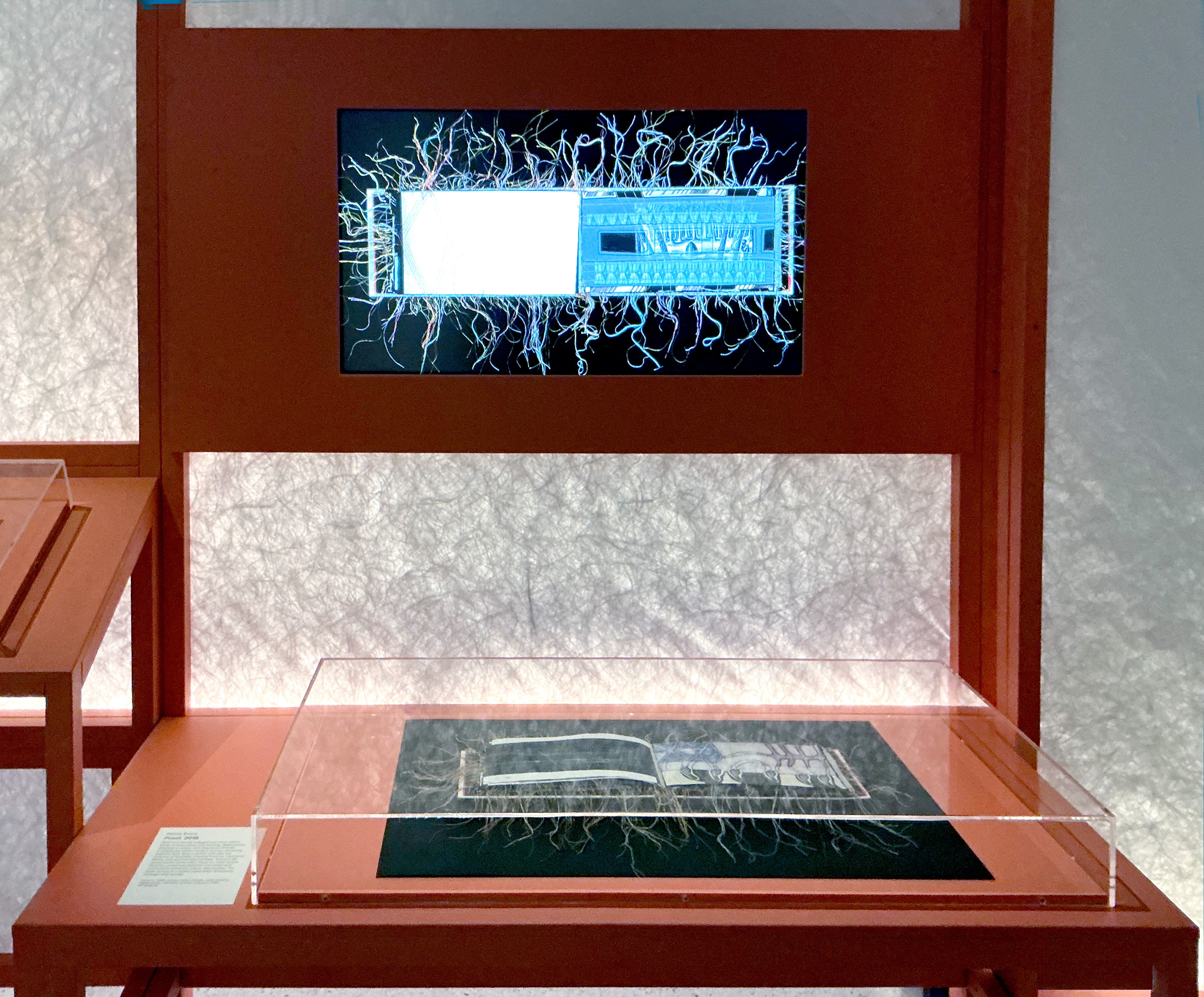
Penny Evans Proof, 2015
Relatively few First Nations artists create artists books, so it was great to see a works by Judy Watson and a work by Penny Evans, who has Gamilaroi, Welsh, Irish and German heritage using the form to examine connections between culture and country in her unique state book Proof (2015). Using collage and digital prints with stitching it was accompanied by a page-by-page video of the work.
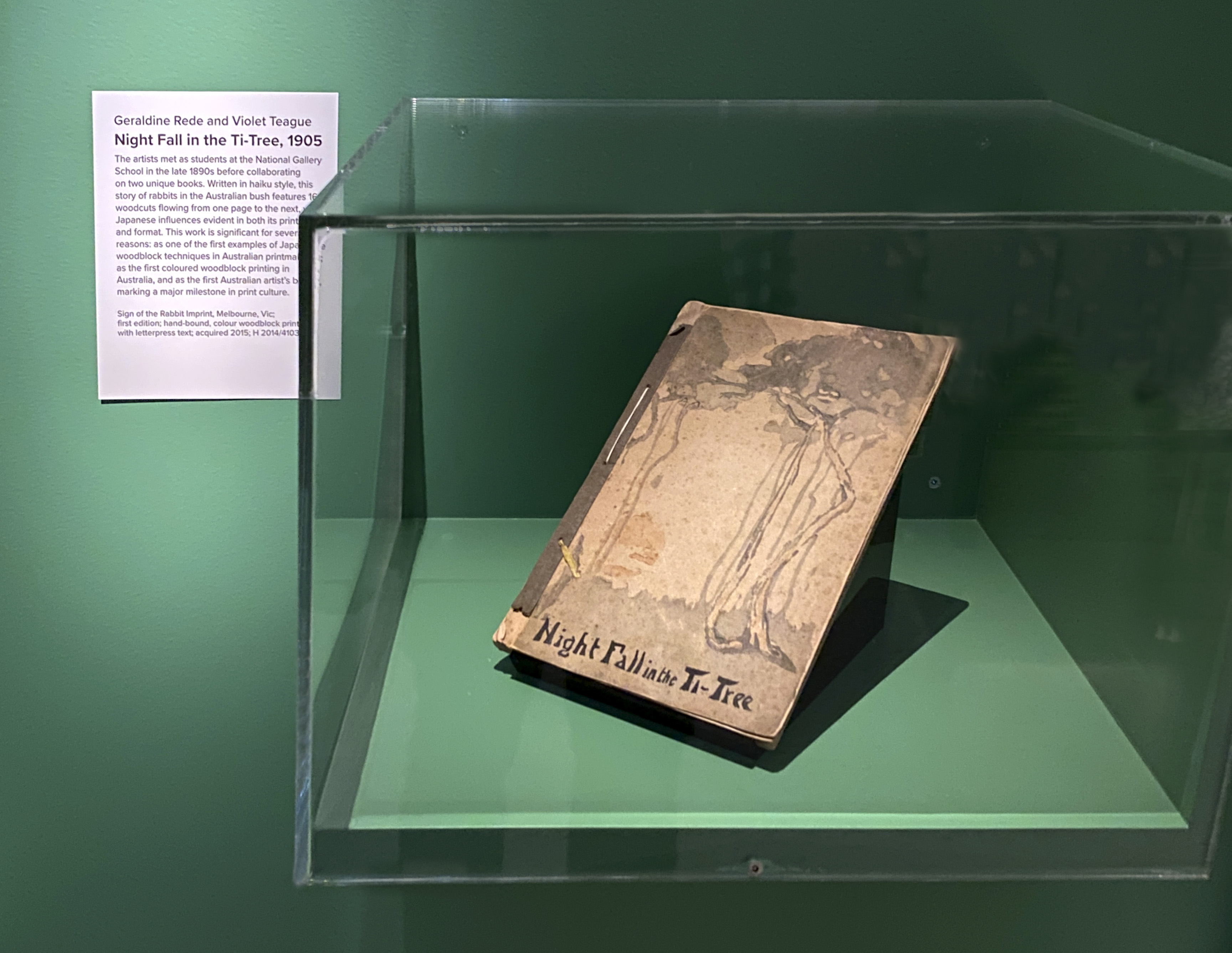
Geraldine Rede & Violet Teague Night Fall in the Ti-Tree, 1905 PHOTO: Doug Spowart
I was surprised that no works from the origins of artists books were shown: books such as those by Picasso and Bonnard published by Ambroise Vollard and Daniel-Henry Kahnweiler in Paris in the early twentieth century. It could be because the library doesn’t hold them. A quick search of the SLNSW catalogue revealed Dingo, with drypoint etchings by Pierre Bonnard published by Vollard in 1924, but few others. I was pleased to see the inclusion of Night fall in the ti-tree (1905) by Violet Teague and Geraldine Rede with its delicate woodcuts, and its acknowledgement as the first Australian artists’ book.
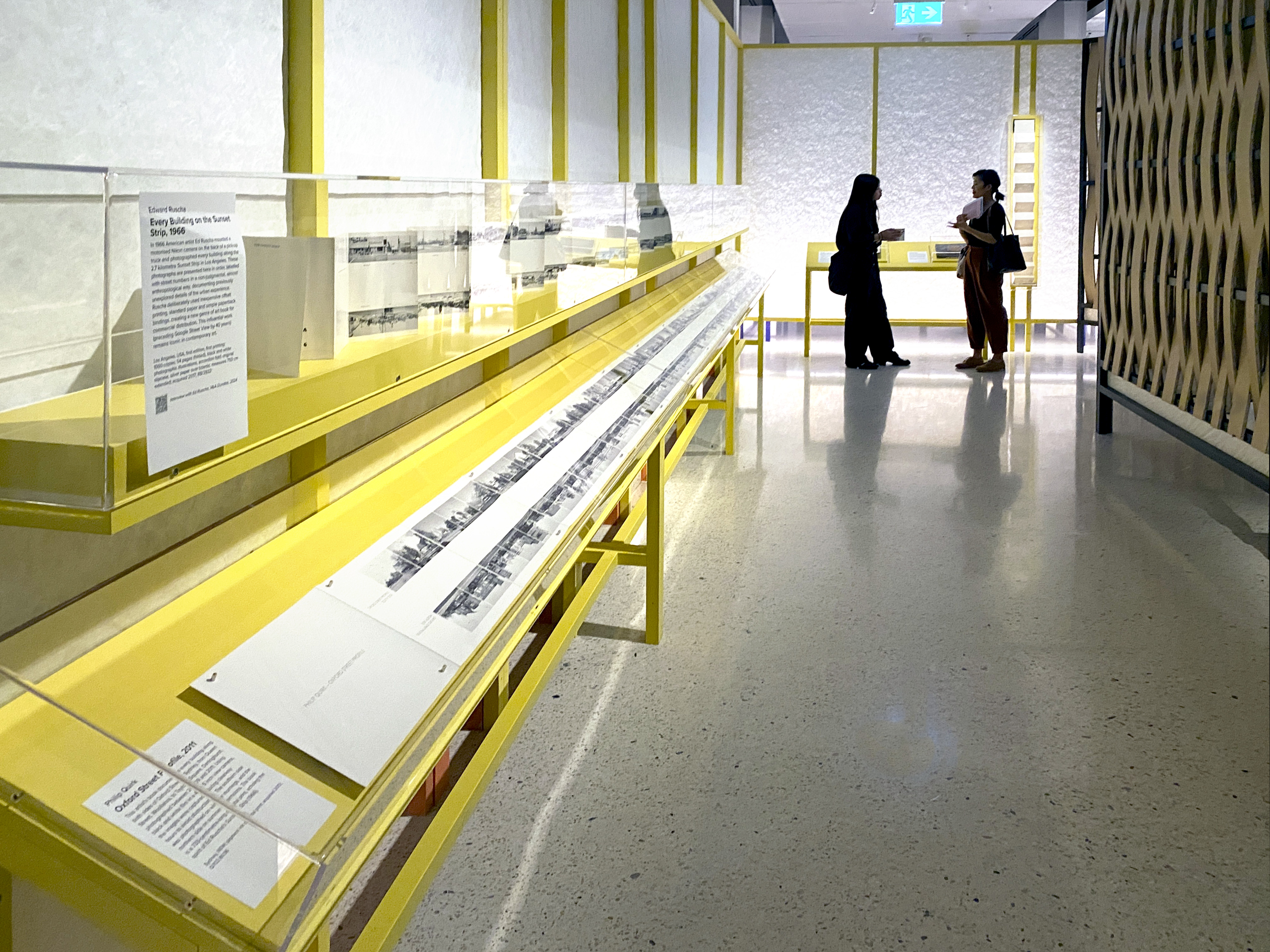
Ed Rusha Every Building on the Sunset Strip, 1966 + Philip Quirk Oxford Street Profile, 2011 PHOTO: Doug Spowart
In a small way the exhibition demonstrates the limitations of the artists’ book collection at the SLNSW, which has not concentrated on its development until relatively recently. Most of the exhibited works have been created in the twenty-first century. There are few books published overseas, one being the fabulous version of the Rubaiyat of Omar Khayyam (1973) by the British artist Susan Allix. The Rubaiyat is a very popular subject for interpretation by artists. An important artist in the history of the artist’s book is American Edward Ruscha, an early exponent of the democratic multiple. He is represented by the concertina photobook Every building on the sunset strip (1966) which has had a huge influence on other artists who continue to create similar works. In this exhibition the book is unusually displayed fully extended to 7.5 metres and is shown with Oxford Street Profile (2011) documenting Oxford Street in Sydney by Australian photographer Philip Quirk. It only stretches to 7.33 metres. It was interesting to see Micky Allan’s early (in Australian terms) artist’s book My Trip (1976). Displayed open, a full facsimile of its newspaper format is also available for closer investigation.
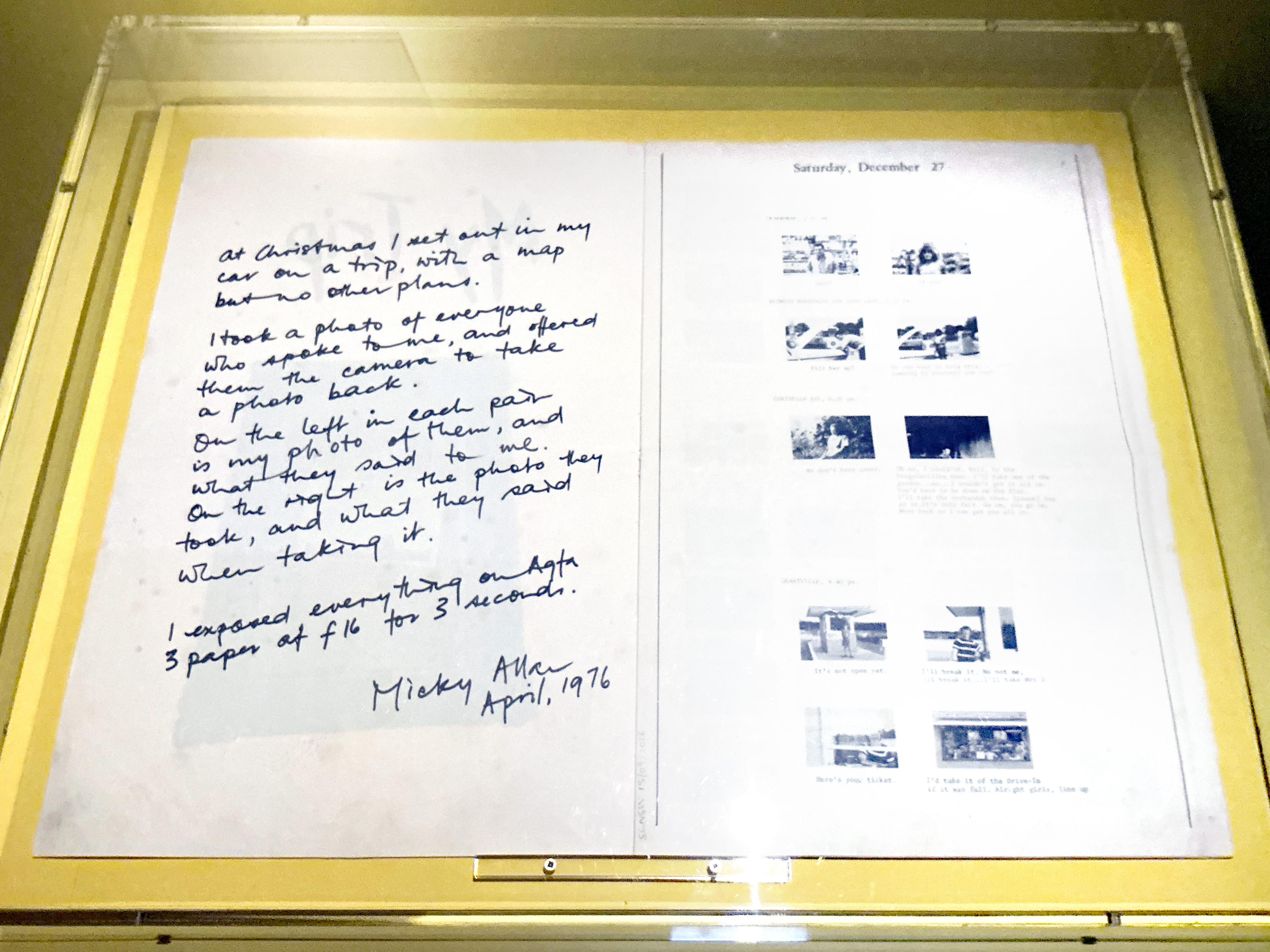
Micky Allan My Trip, 1976
Dancing Over Dark Waters (2012), Howl for a Black Cockatoo (2015), and Phantomwise Flew the Black Cockatoo (2017), by Sue Anderson and Gwen Harrison, with Peter Lyssiotis writing the text for Dancing over dark waters, very impressive books all, are very similar materially and in subject. They could have been replaced by other works expanding the breadth of vision made available in the exhibition. Similarly, several artists are represented by more than one work when other artists and their ideas could have been embraced.
Deanna Hitti Towla, 2017
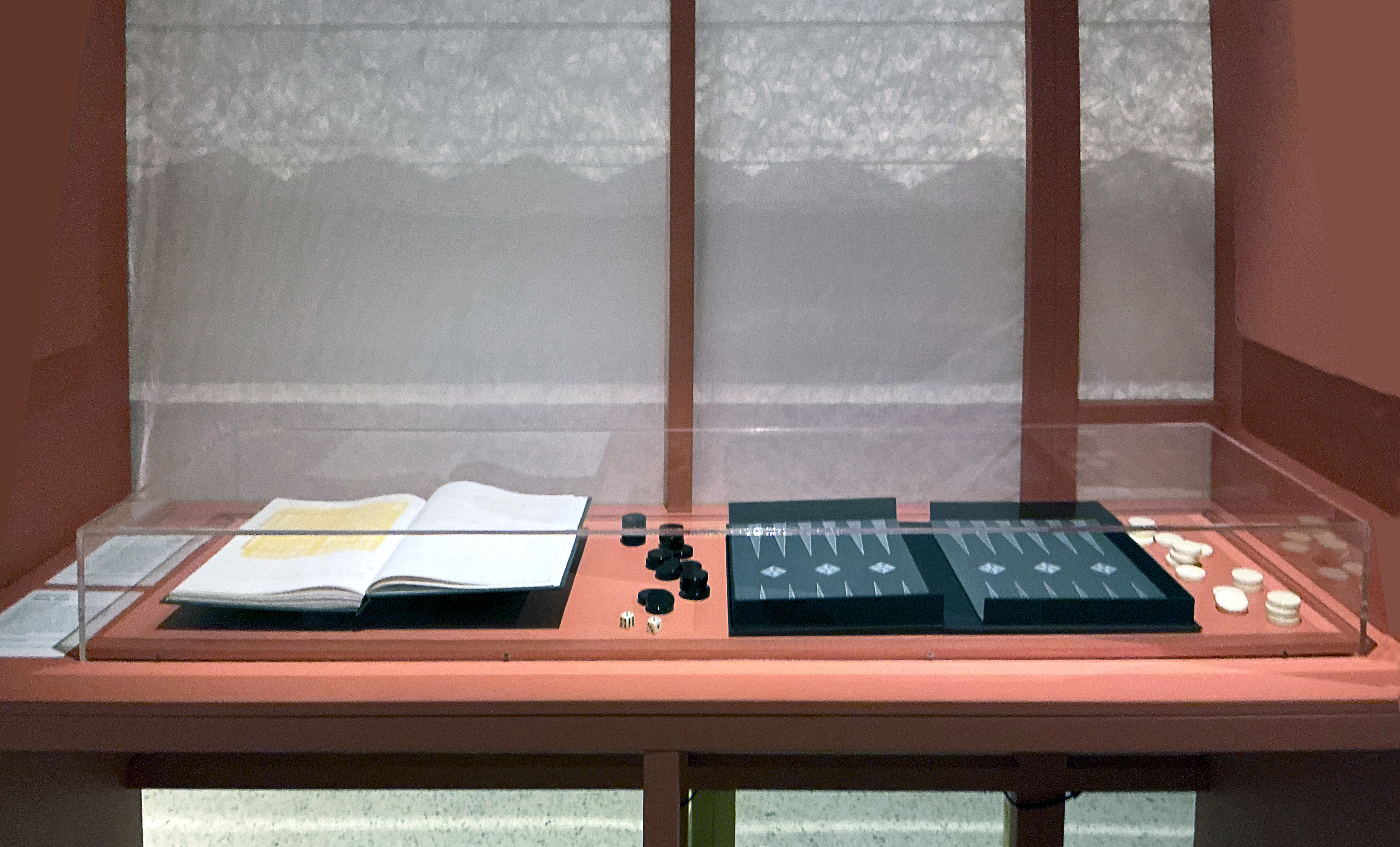
The exhibition includes some of my favourite artists books including Towla (2017) by Deanna Hitti, with the integral clamshell box creating a board for backgammon, the subject of the book. It is an intriguing book with instructions for backgammon phonetically translated using Arabic and Latin characters but with a twist. Arabic letters spell the instructions in English and Latin letters spell the instructions in Arabic. Some of the books in this exhibition have become my new favourites.
In Conclusion
Criticisms of some components of the exhibition are mere quibbles. In retrospect I could make many about my own exhibition in 2008. This is a fabulous exhibition, beautifully curated, wonderfully designed, and a rare opportunity for the public to experience the breadth and depth of the artists’ book. I hope it will introduce the magical world of artists’ books to a whole new audience in Sydney who will follow up with personal experiences with artists’ books in the library. I also hope that SLNSW will continue to support the art form in both acquisitions and exhibitions.
Helen Cole
March 14, 2026
.
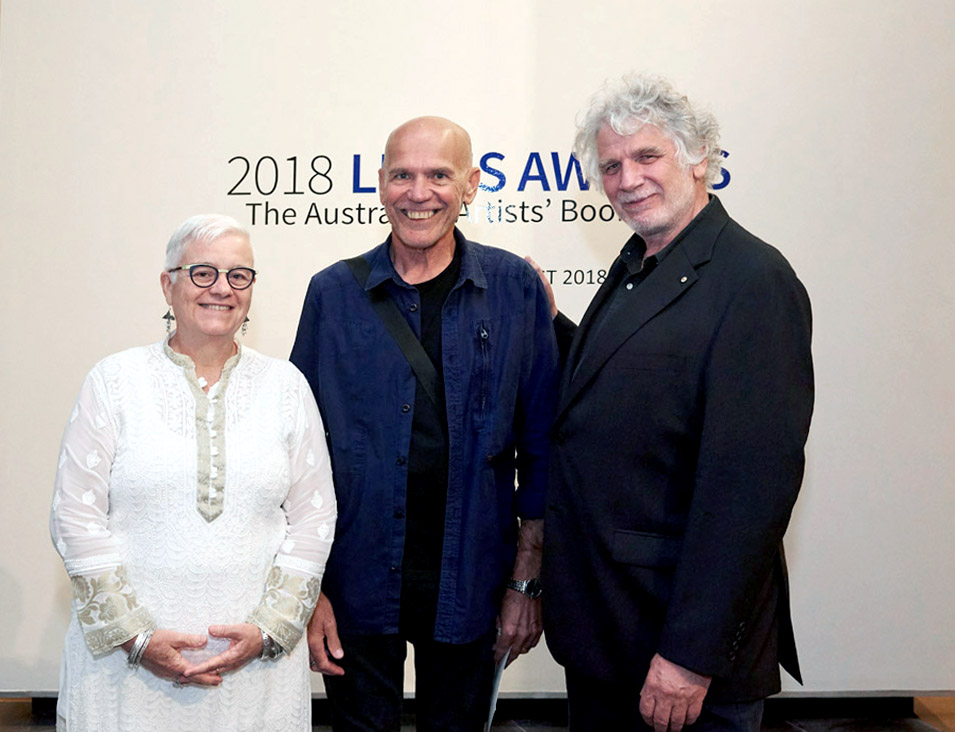
Judges: Helen Cole & Roger Butler with Clyde McGill PHOTO: Artspace Mackay
HELEN COLE: Brief Biography
Helen Cole is intimately acquainted with the world of artists’ books, including their collection and the opportunities and difficulties in presenting these artworks in a public context. Helen was the Arts and Rare Book librarian at State Library of Queensland for thirty years. During much of that time she was responsible for the development of the Library’s extensive Artists’ Books Collection. She has been significantly involved in the artists’ book discipline writing articles and making presentations at conferences. She has judged the Manly Artists Book Prize once and on two occasions judged the Libris Australian Artists’ Book Prize for Artspace Mackay. In 2008 she curated the SLQ exhibition Freestyle Books: Artists’ books from the collection. Helen also co-curated the Tales from the Lyrebird with Ron McBurnie for Artspace Mackay. Apart from her work developing public collections she has amassed a personal library of cherished books.
..
.
OTHER PAPER UNIVERSE RESOURCES
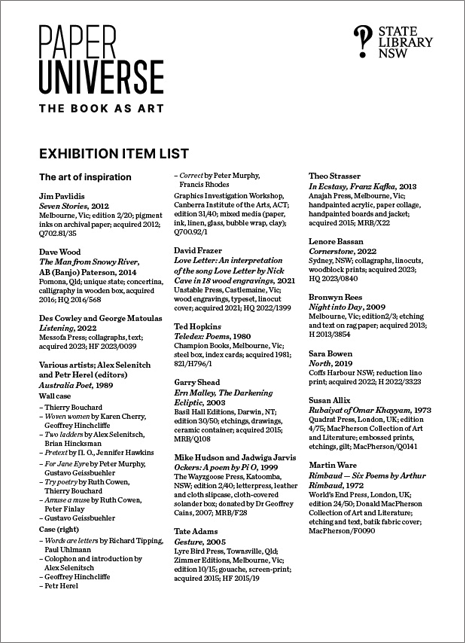
DOWNLOAD: A list of all books in Paper Universe: Paper Universe Book List
DOWNLOAD: A catalogue of Didactic Information on Each Book: Paper Universe Exhibition Captions
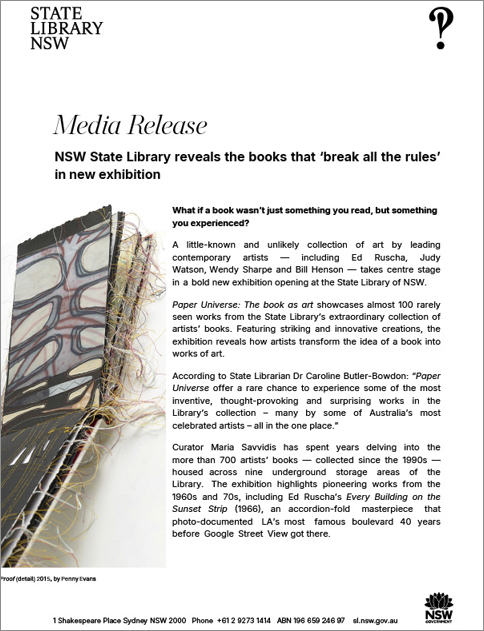
DOWNLOAD: A Press Release of the exhibition: Paper Universe Media Release
We wish to acknowledge the courtesy extended to us by curator Maria Savvidis.
The Reflection text ©2026 Helen Cole
All photographs are by Helen Cole unless otherwise credited.
© is retained by all authors
All photographs have been digitally optimised by Doug Spowart.
Two views of th ‘Paper Universe’ entry concertina PHOTO: Helen Cole
.
.
.
.
.
.
.
.


