Posts Tagged ‘Lyn Ashby’
HELEN COLE VISITS A PAPER UNIVERSE
..
“Artists’ books break all the rules. They stretch, fold, sculpt and reimagine the book as an object — not just something to read, but something to experience”
Curator Maria Savvidis.
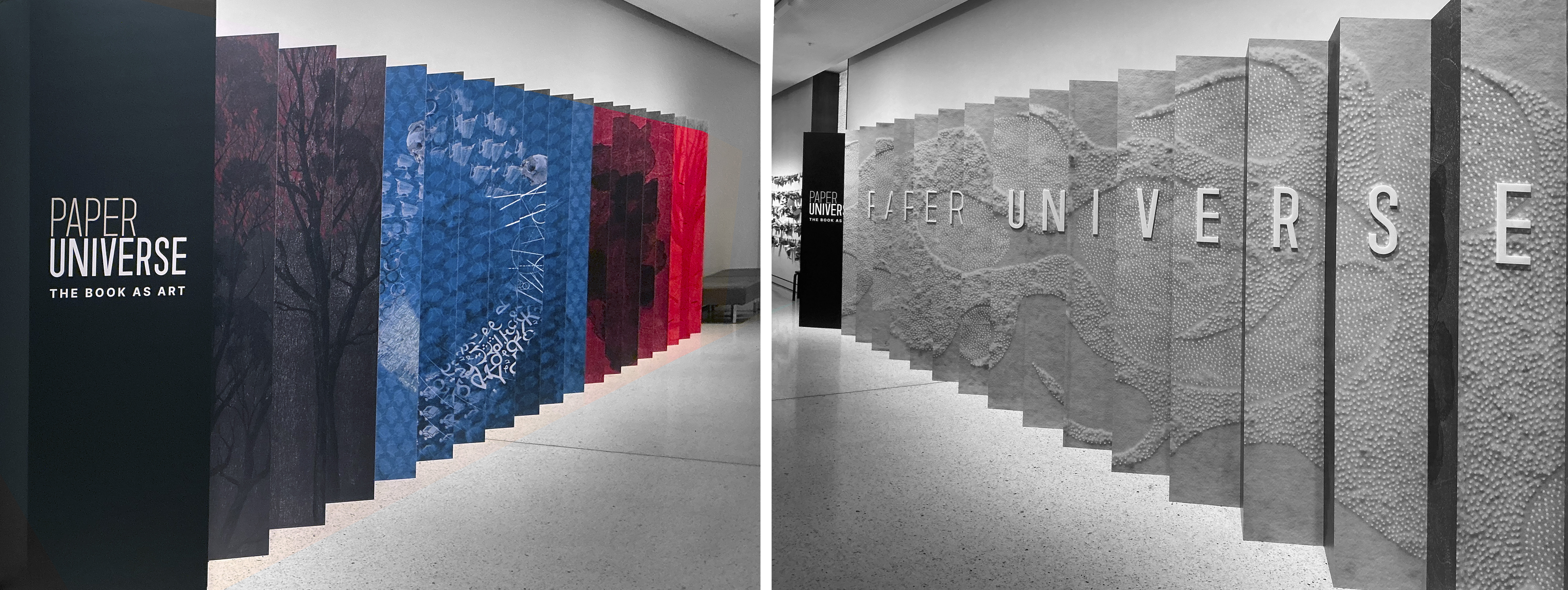
Two views of the ‘Paper Universe: The Book as Art’ entry concertina PHOTOs: Helen Cole
.
PAPER UNIVERSE: THE BOOK AS ART
A MAJOR EXHIBITION OF ARTISTS BOOKS AT THE STATE LIBRARY OF NSW
.
The exhibition press release states, ‘Paper Universe: The book as art’ showcases almost 100 rarely seen works from the State Library’s extraordinary collection of artists’ books. Featuring striking and innovative creations, the exhibition reveals how artists transform the idea of a book into works of art. According to State Librarian Dr Caroline Butler-Bowdon: “Paper Universe offers a rare chance to experience some of the most inventive, thought-provoking and surprising works in the Library’s collection – many by some of Australia’s most celebrated artists – all in the one place.”
.
Paper Universe: The book as art is a free exhibition at the State Library of NSW until 3 May 2026
.
Visiting ‘PAPER UNIVERSE’ with Helen Cole+Victoria+Doug
Towards the end of 2025 we were drawn to Sydney to encounter the seminal artists book exhibition PAPER UNIVERSE: The Book as Art. We invited our friend Helen Cole to join us and Helen was able to arrange a meeting with the curator Maria Savvides to discuss the exhibition, the books and their presentation.
After our viewing of the exhibition our reflective discussion about what we had encountered led to an invitation for Helen to write an informed essay from her significant experience and knowledge of the artists book.
What follows after a selection of images, mainly taken by Helen, is her essay and a collection of documents and a video of the exhibition.
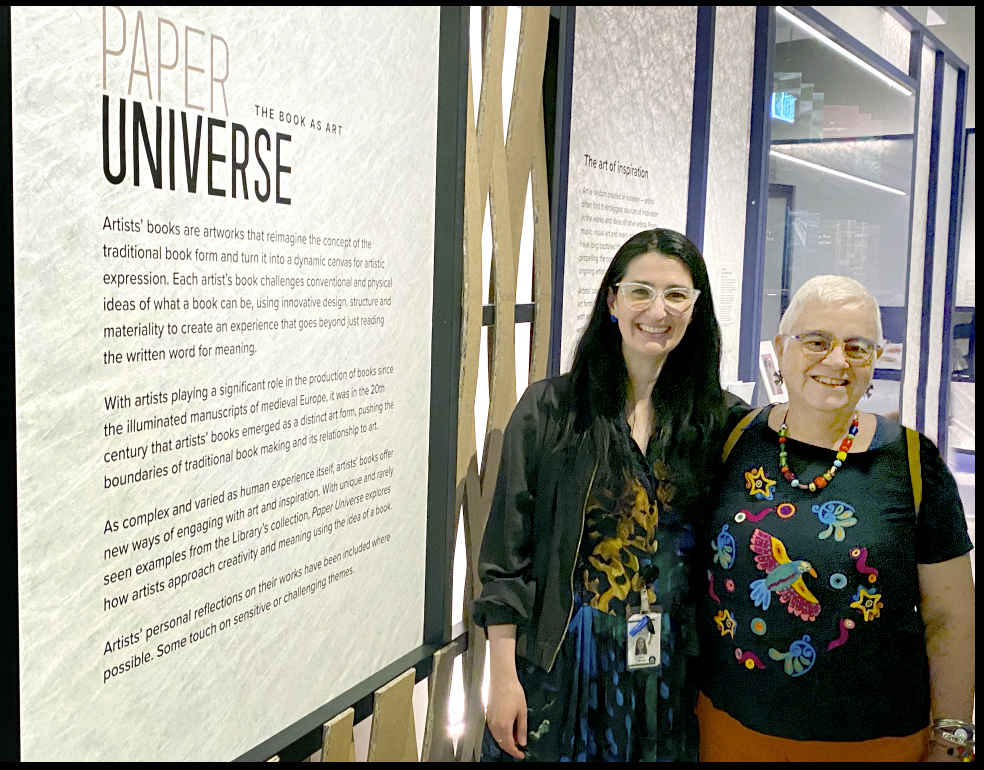
Paper Universe: The Book as Art – curator Maria Savvidis with Helen Cole PHOTO: Doug Spowart
.
HERE’S A SELECTION OF BOOKS FROM THE EXHIBITION
“Click” on the image to enlarge and see the caption.
.


.
HELEN COLE’S REFLECTIONS ON THE SHOW
When I curated the artists’ books exhibition Freestyle Books from State Library of Queensland’s artists’ books collection in 2008 it was supposed to be a mere taster before a major exhibition of the artform. That never happened. It was very gratifying to find out that State Library of New South Wales has taken up the challenge of both curation and display of this form that can be difficult to exhibit, and given it the title of Paper Universe: The book as art. The curator, librarian Maria Savvidis and her supporting team of librarians, conservators and designers have done a superb job in showcasing the richness of stories and artworks that artists books yield. They were fortunate to have five years to bring the exhibition to fruition, and this is shown by the attention to detail in its staging.
.
The exhibition is introduced in the wide corridor leading to it by a huge concertina ‘book’ with blown-up details of three distinctive works. Before you enter, the view of the concertina is a quiet white book by Nicole Hayes with a delicate texture pierced through the page from front and back with pins. As you leave the view is of colourful, forceful black, red and blue designs in linocut and digital prints from books by Dianne Fogwell and Lyn Ashby, summing up the other extreme of the books you have seen.
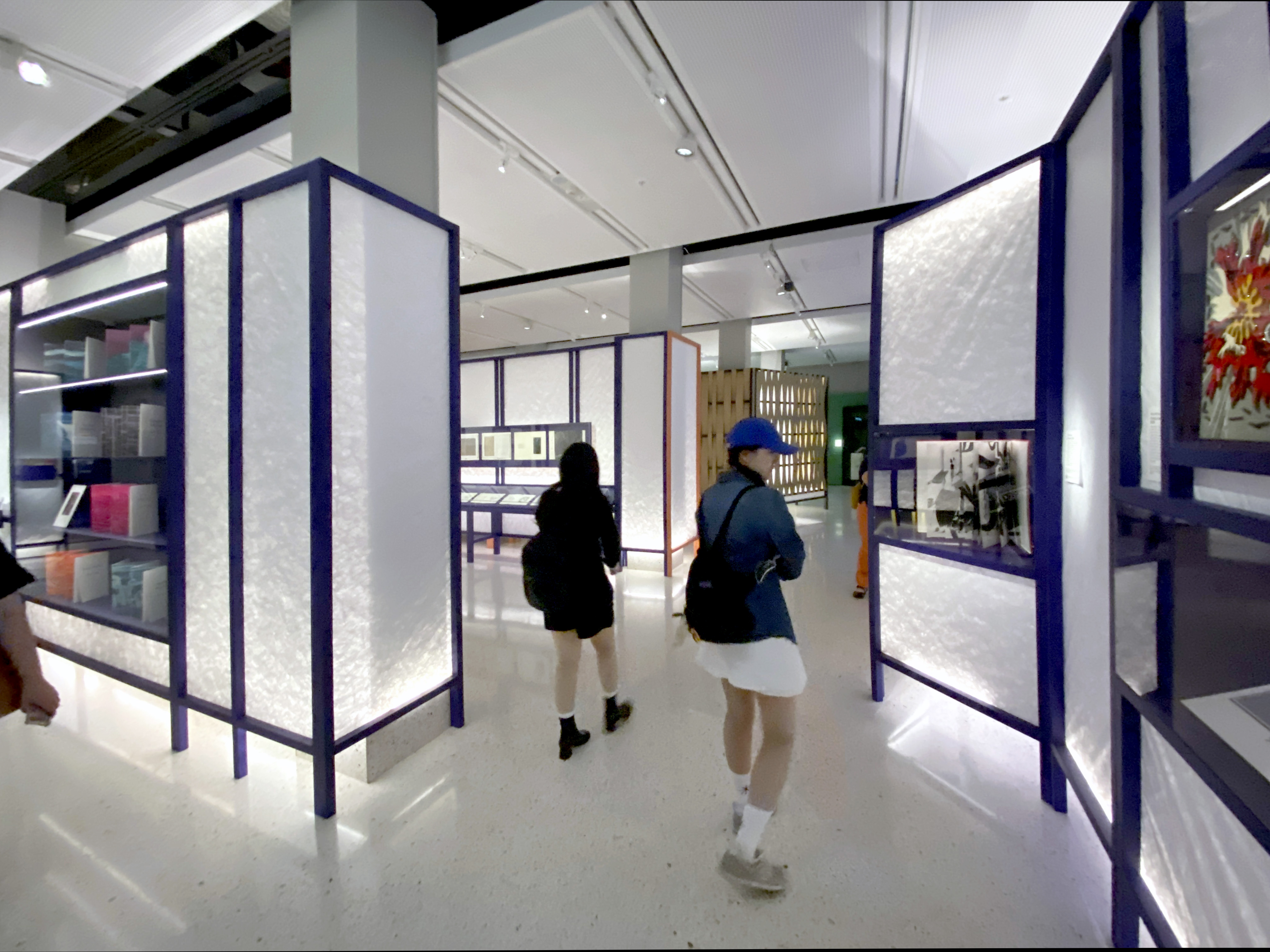
Paper Universe exhibition PHOTO: Doug Spowart
That calm entry leads into a quiet space to engage with the works in the exhibition, provided by dividers reminiscent of Japanese shoji screens. The themes around which the exhibition is woven are well chosen and enunciated in the didactics: the art of inspiration – influences and sources in other artists work; the natural world – its beauty, its power, but also its fragility; the civil condition – investigating, reflecting and challenging social issues, politics, morality and equality; unveiling identity – the shaping of personal, family, and national identities and memories; the artist’s eye – investigations into the notion of the book. Each is signified by a different colour in the surrounding exhibition architecture – walls, plinths and borders on the screens
The books are very well displayed, individually, with several strategies used to overcome the perennial problem of exhibiting artists books, that they generally cannot be fully experienced when closed or open at only one page. The most common comment about an artists’ book exhibition is “I wish I could see the whole book” and indeed it is my thought too, even knowing how difficult it is to avoid. The curator has gone to great lengths to show as many books in their entirety as possible.
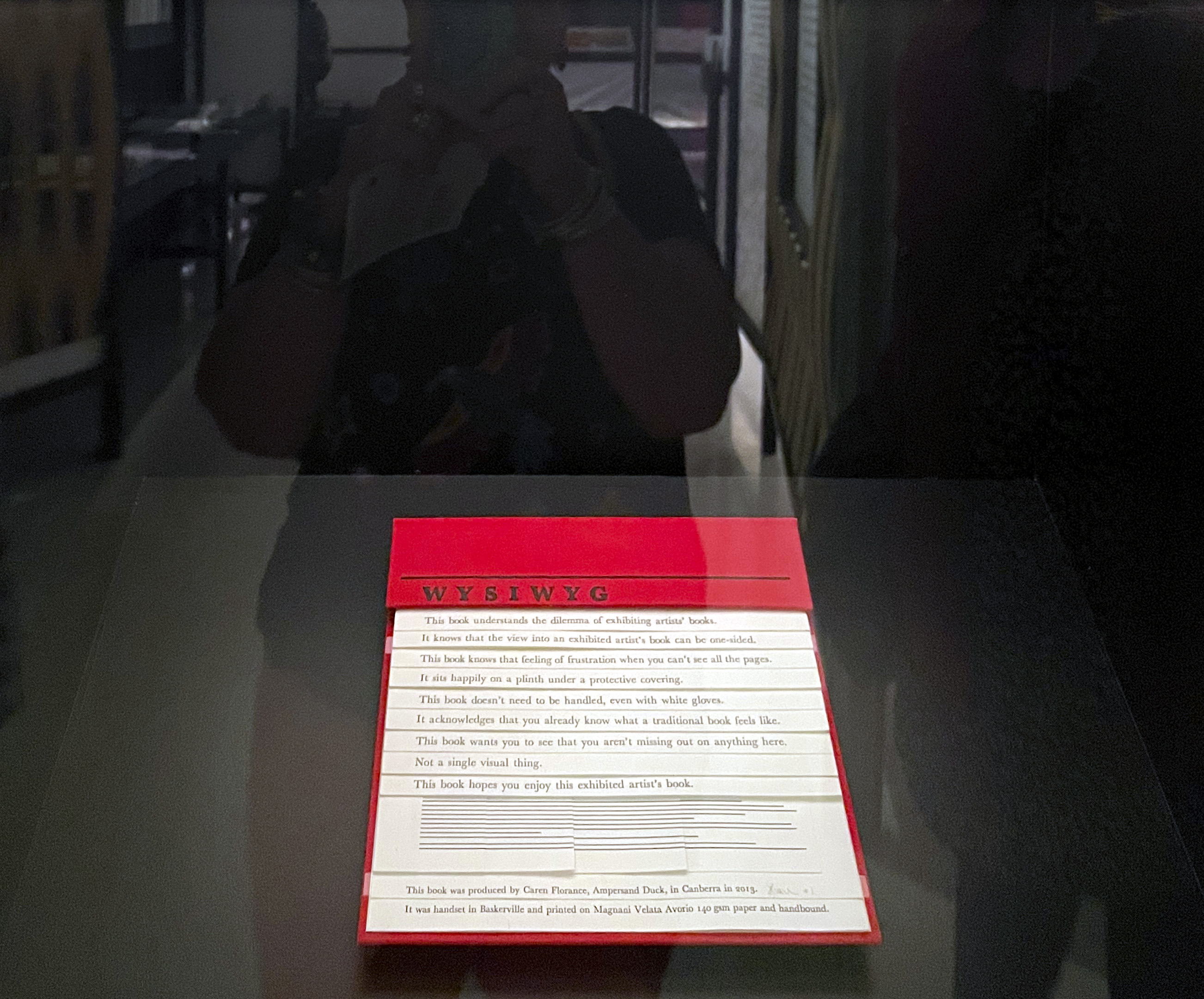
Caren Florance WYSIWYG, 2013
The first book in the exhibition, or is it the last? WYSIWYG (What you see is what you get) (2013) by Caren Florance, the curator’s own copy, was designed to be seen as a whole when the book is closed, displaying what a rarity that is. The text lines are printed on increasingly larger pages, each peeking out from the one above. Maria Savvidis wrote: “This book served as both a talisman and inside joke for me as the curator of this exhibition, years spent thinking about the paradox of exhibiting artist’s books…WYSIWYG is a wry but generous show of empathy from the artist who understands this difficulty and has shown mercy on collecting institutions tasked with the impossible.” Anne-Marie Hunter created the Tower of Babel (2006), (The Tower of Babel, Artists’ Book By Anne-Maree Hunter | State Library of Queensland) a book in the round which was exhibited in my 2008 exhibition, with the same intent.
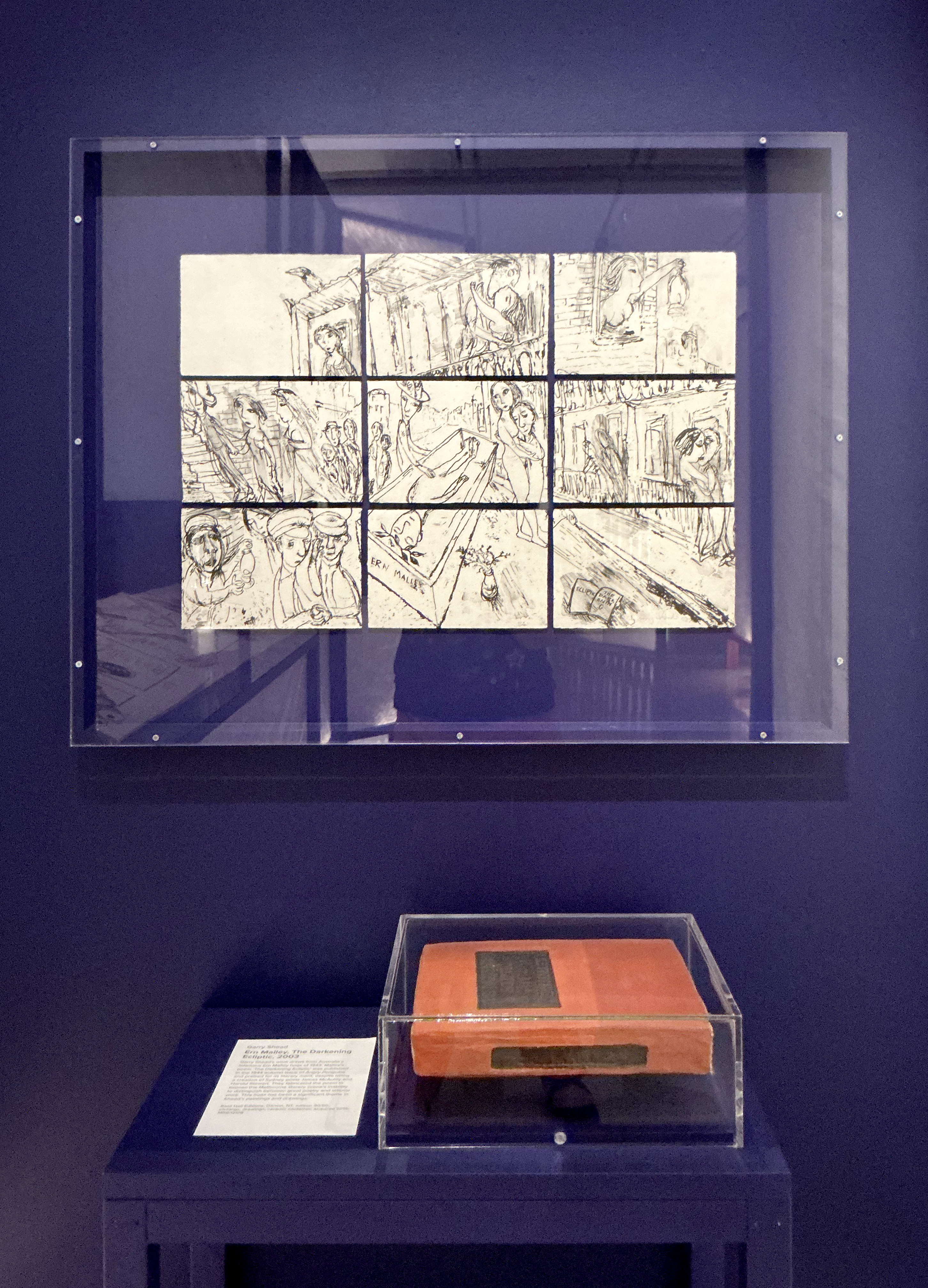
Garry Shead Ern Malley: The Darkening Ecliptic, 2003
Several of the works have been removed from their covers and are displayed, page by page, on the wall. These include Garry Shead’s Ern Malley: The darkening ecliptic (2003): a sequence of etchings, which when presented together create a single image. Along with the display of the ceramic box in which it was presented, this is possibly the best way to show this work.
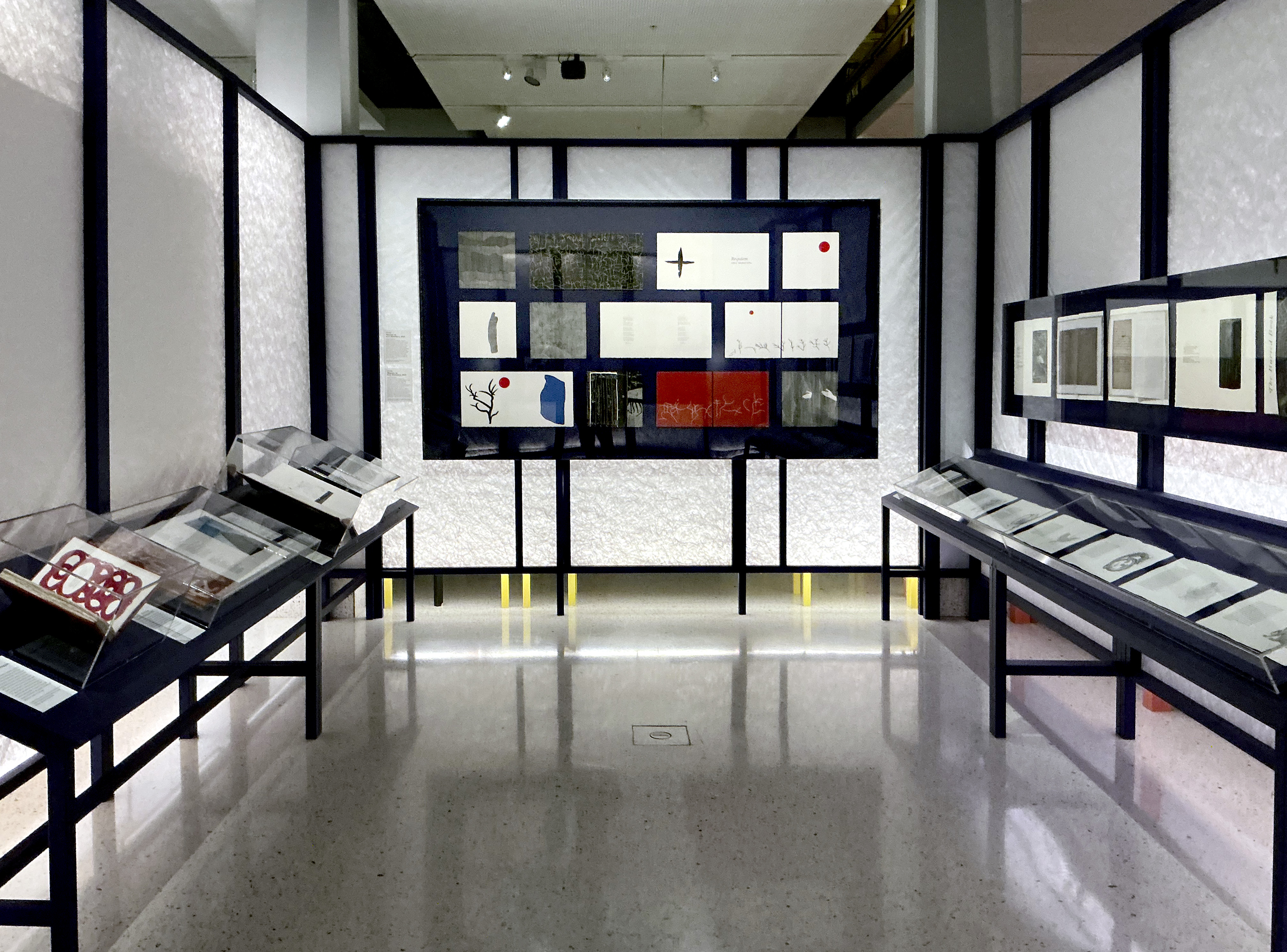
G.W. Bot Requiem by Anna Akhmatova, 2020
The pages of G.W. Bot’s superb linocuts for Requiem by Anna Ahkmatova (2020) are beautifully arranged framed on a blue background, however not all pages of the book are included so it is unfortunately a circumscribed view of the production.
Other works displayed page by page include Paul Uhlmann’s New Insecta, Queensland: AA Girault (1989), Judy Watson’s A preponderance of Aboriginal blood (2005), Peter Lyssiotis and George Matoulis’ Bridge (2021) and Glenda Orr and Kathy Boyle’s Paradise Lost : an artists’ book exploring the status of threatened & iconic plants from Australia and New Zealand collected by Daniel Solander and Joseph Banks during Captain Cook’s 1770 voyage (2020).
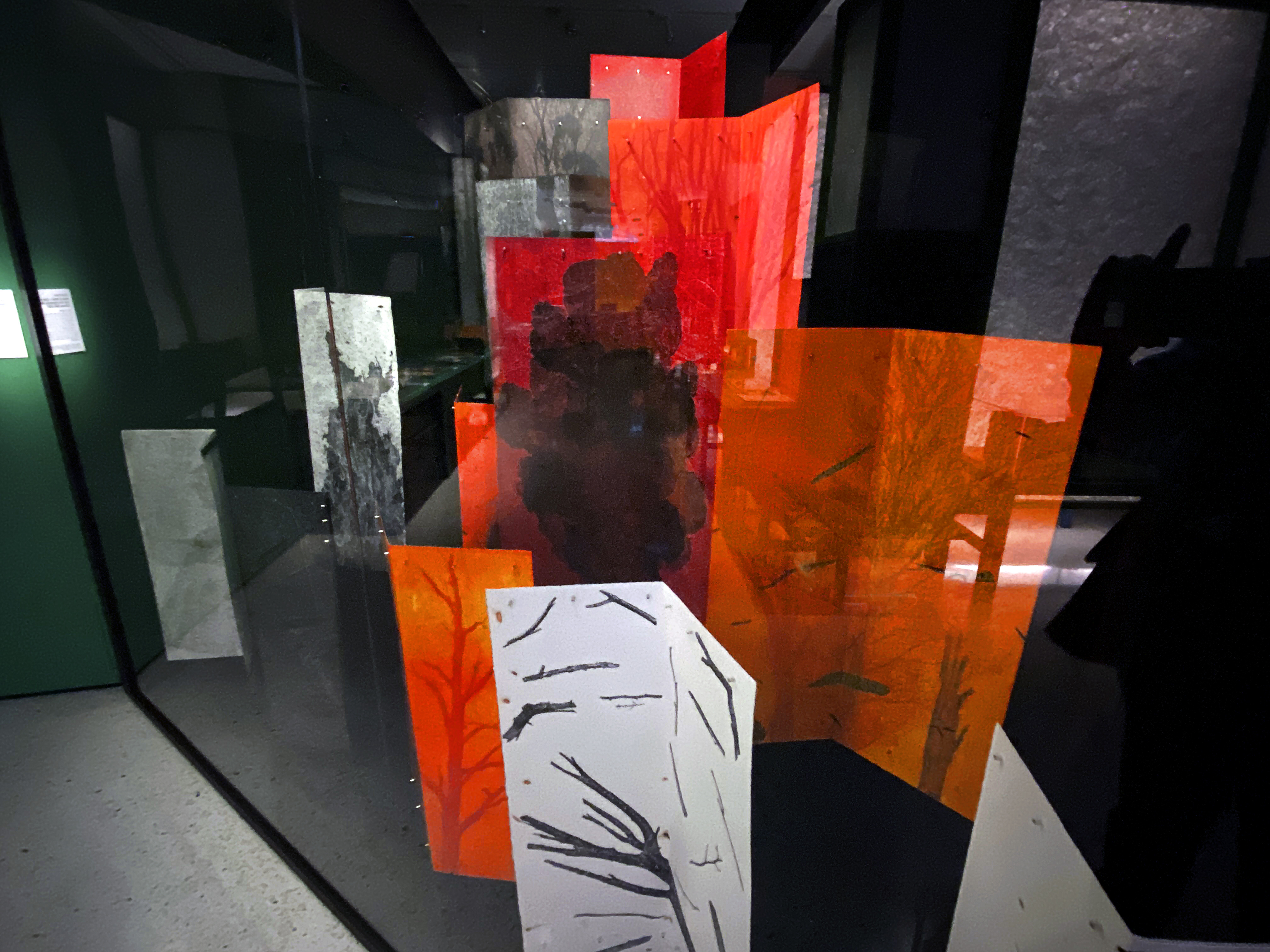
Dianne Fogwell Ashes to Ashes – Dust to Dust- Ash Wednesday 16th February 1983, (2018) PHOTO: Doug Spowart
The pages of Di Fogwell’s Ashes to ashes – dust to dust: Ash Wednesday 16th February 1983 (2018) are arranged upright to evoke the flames of the bushfire it describes. There has been some comment that this destroys the original form and order of the books, but I disagree. Some books are meant to be rearranged by the reader or at least read in any order they want. Also, the curator went to some lengths to speak to the artists and present their work as they would want. For most of the works artists’ statements are provided, along with translations of foreign language texts, where appropriate.
I don’t consider print portfolios on a single subject, often by printmaking groups, constitute successful and cohesive artists books, and there are a few in this show including Natural Collection (2017) by the Warringah Printmakers Studio. It was published to celebrate the 20th anniversary of the Studio and is based on the species and ecological communities of the Northern Beaches of Sydney that are under threat. Ten of the 29 prints that comprise the work are exhibited over three changeovers, not including the texts which accompany each print. I don’t think this work has a conceptual framework – a common subject, yes, but not enough to tie them together – as a book.
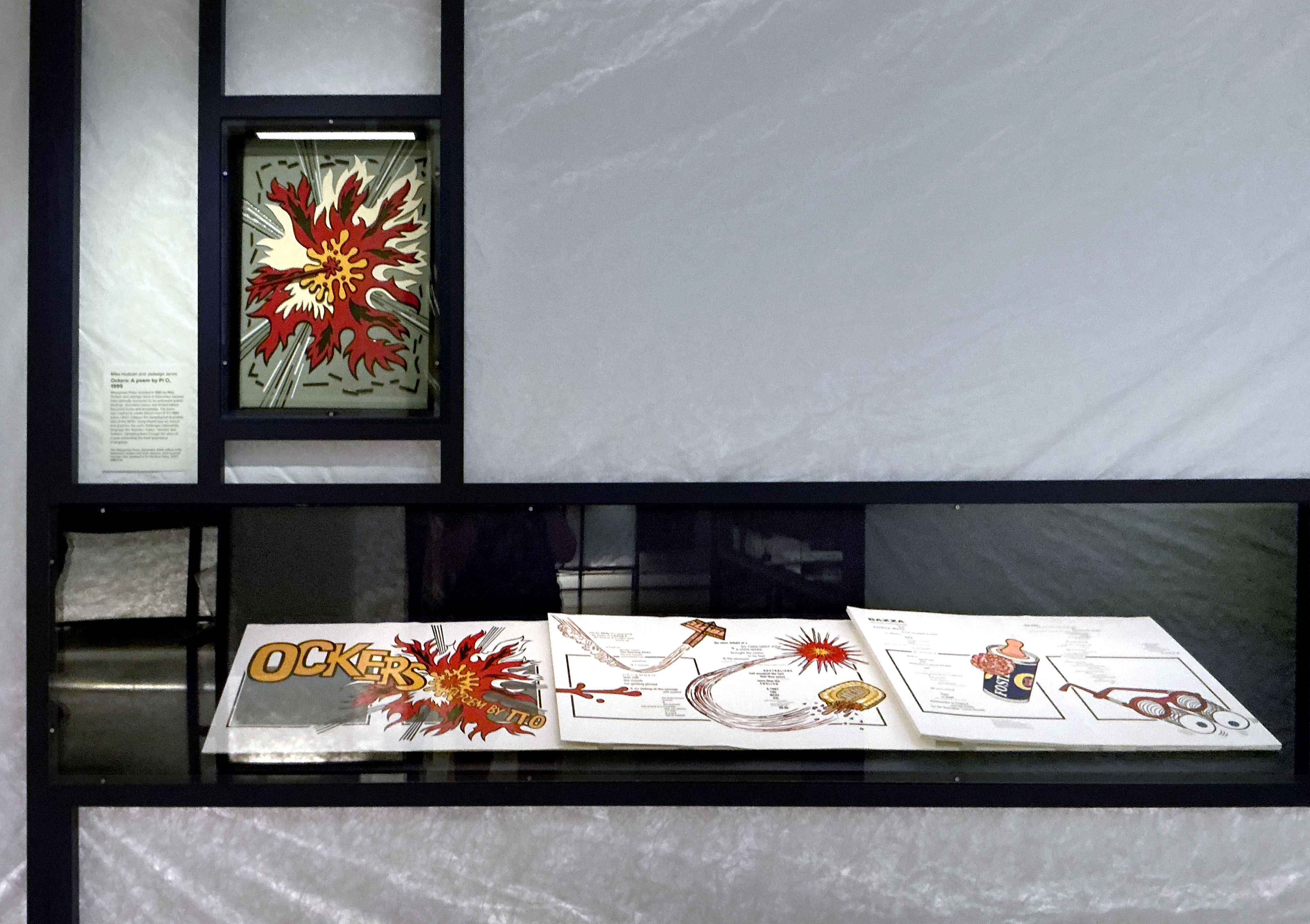
Mike Hudson & Jadwiga Jarvis Ockers: A poem by Pi O 1999
Concertina books are perfectly made for display, extended either framed on a wall or standing upright on a plinth. The bold and colourful Wayzgoose Press book Ockers: a poem by Pi O (1999) is displayed partly opened behind glass. A thoughtful work previously unknown to me was Theo Strasser’s In ecstasy, Franz Kafka (2013) in acrylic painting and collage, based on an aphorism by Kafka. Another is Lossed (2022) by Sara Bowen. Reduction lino prints of her parents, at first strong, becoming lighter as the book is opened page by page. I’m not sure if it represents her memory of them fading or their memories of each other fading through dementia, but it is a very touching work which is displayed to perfection.
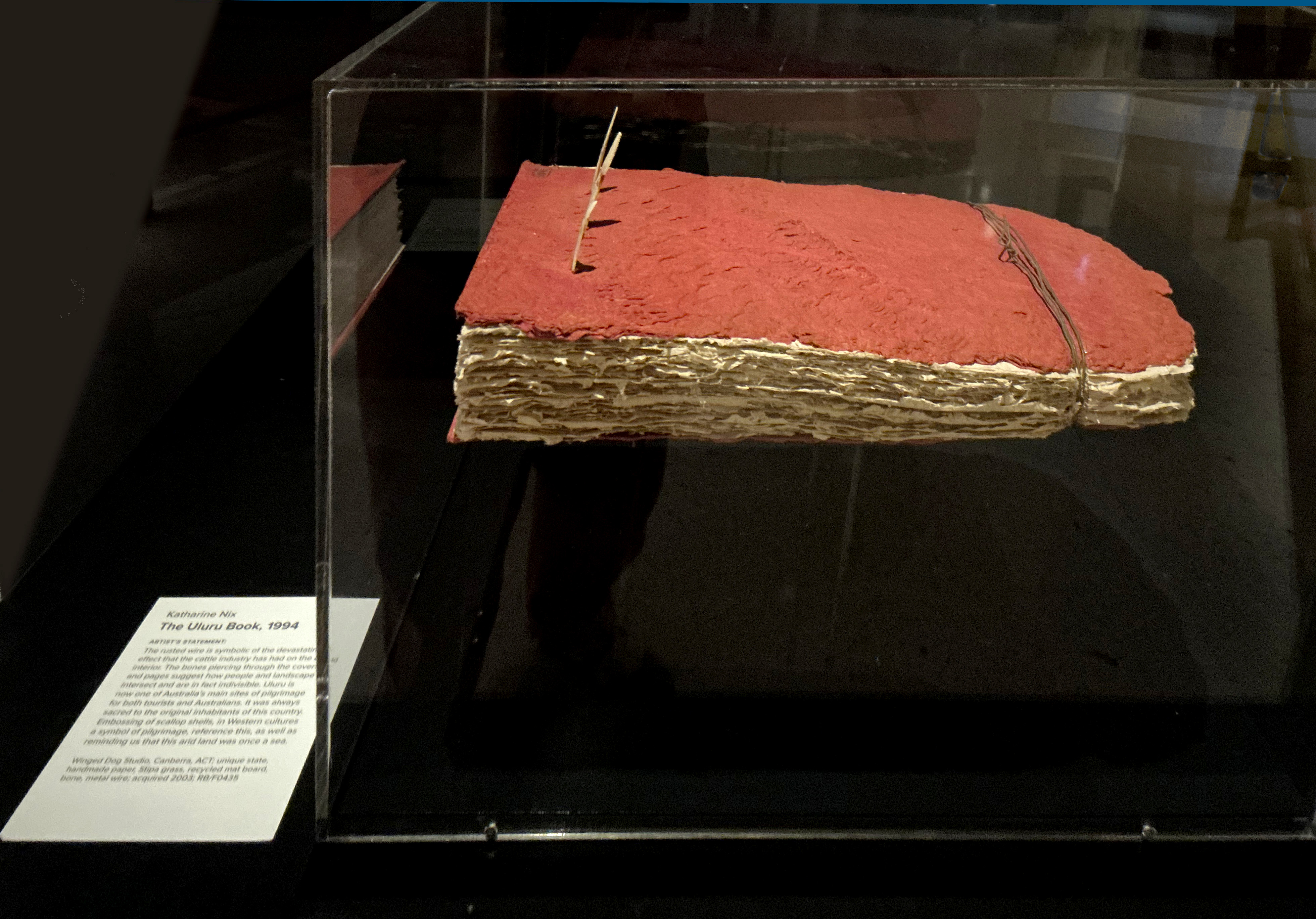
Katharine Nix The Uluru Book, 1994
Several works which could be regarded as book objects were included. The Uluru Book (1994) by Katharine Nix has an imposing physical presence; multiple layers of the hand-made paper for which she is well known, with ochre coloured covers tied with rusted wire and pierced by bones. All elements allude to the close links between the rock and its original inhabitants, and the damage done to the rock and its surrounding environment by the thousands of visitors. Teledex (1981), by Ted Hopkins is a container for poems in the form of an old-fashioned metal teledex, indexed with tabs.
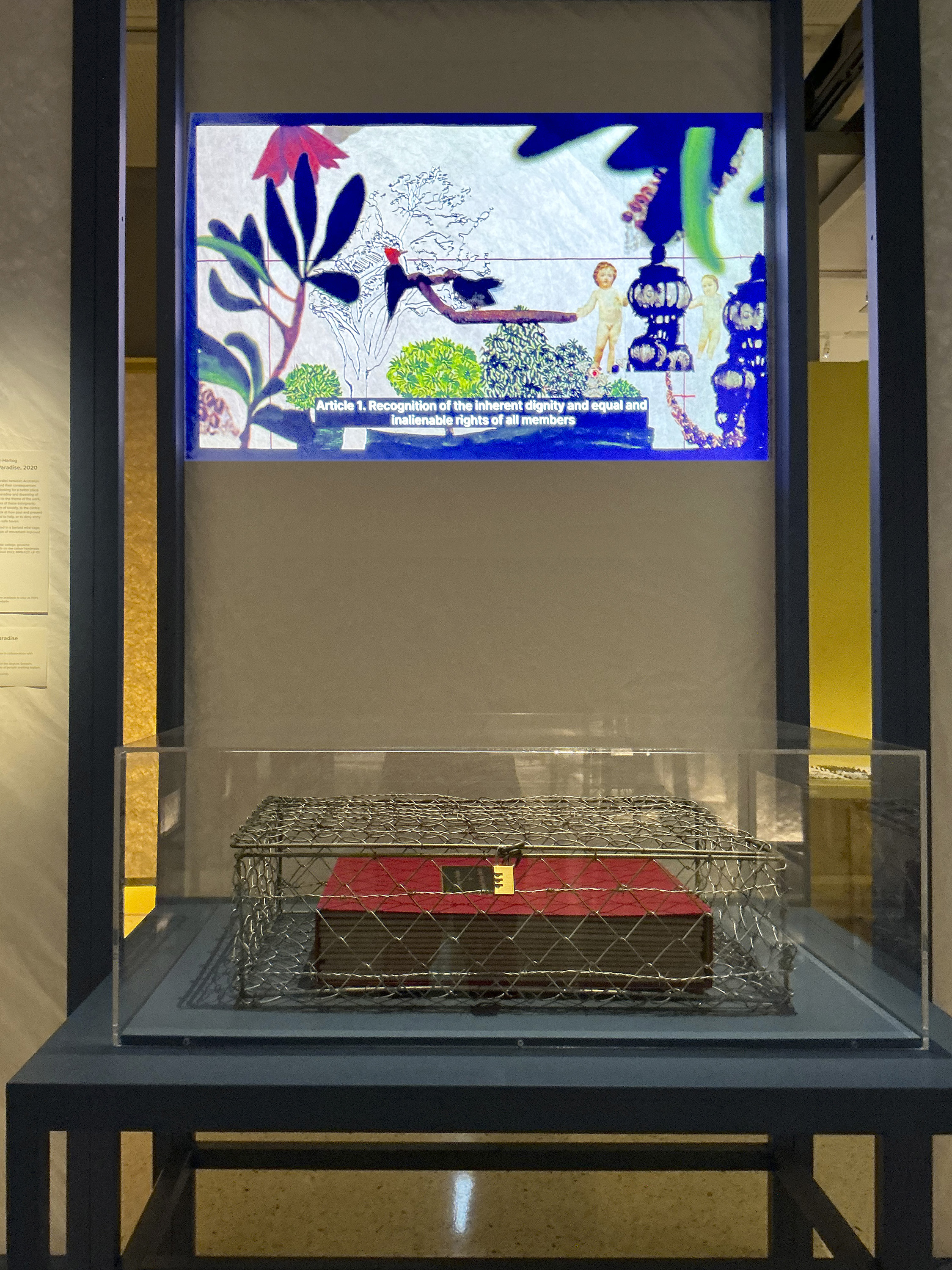
Nathalie Gautier-Hartog
Looking for Paradise, 2020 + Video a collaboration with Broken Yellow
Looking for paradise (2020) by Nathalie Gautier-Hartog, is about refugees seeking a home in Australia, but subject to Australian government policies. It is presented as 12 books inside a wire cage, further emphasizing the restrictions placed on refugees. It is noted that all of the books are available to view as PDFs on the artist’s website with a QR code linking to it displayed. There is also a clever animation based on the United Nation’s Human Rights Charter with images from the books showing in the gallery. It is also on her website. It was created in collaboration with Broken Yellow Studio and the Asylum Seekers Centre. I’m not a great fan of digitised artists books but must admit this combination of media enhances interaction and appreciation of the work.
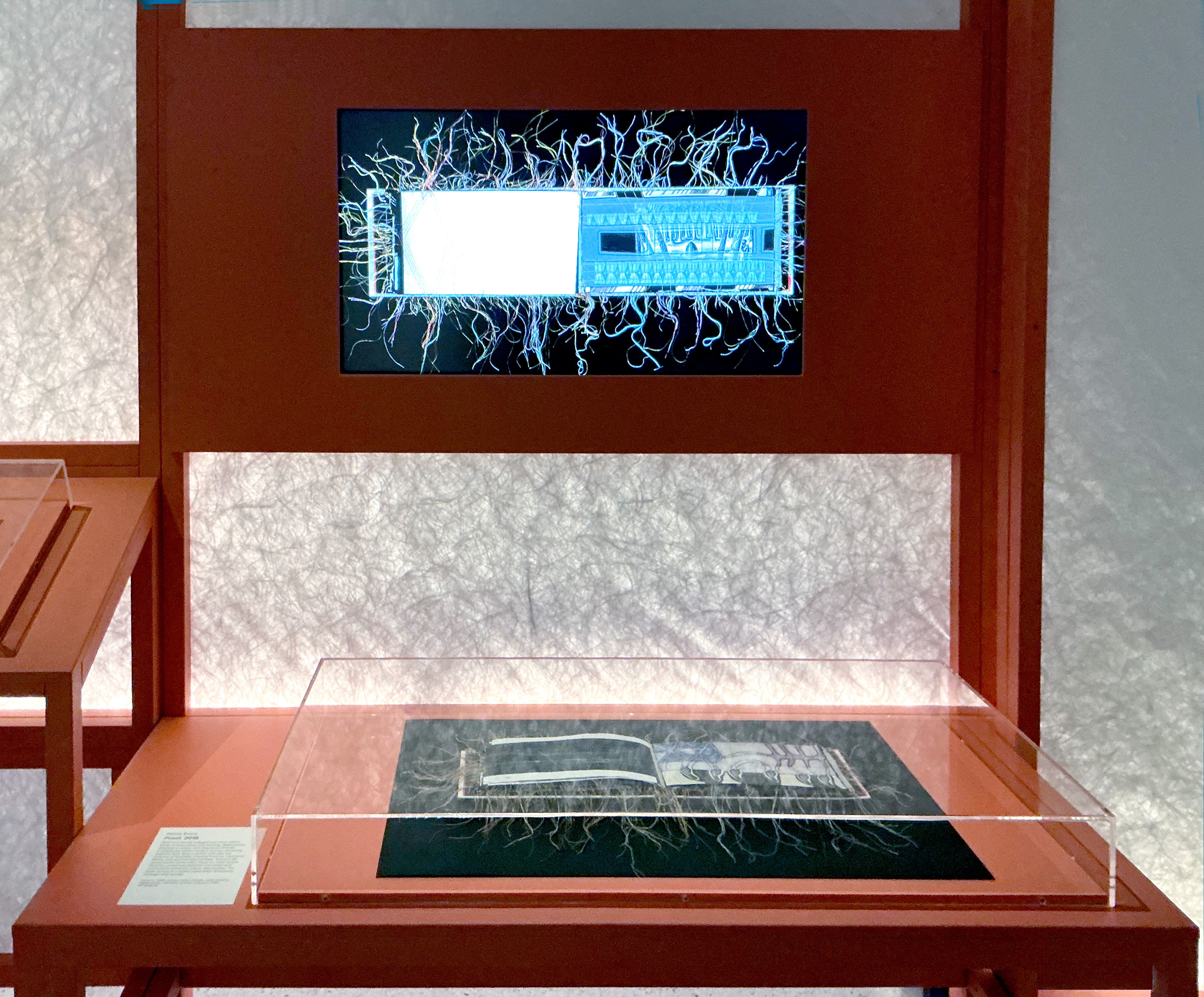
Penny Evans Proof, 2015
Relatively few First Nations artists create artists books, so it was great to see a works by Judy Watson and a work by Penny Evans, who has Gamilaroi, Welsh, Irish and German heritage using the form to examine connections between culture and country in her unique state book Proof (2015). Using collage and digital prints with stitching it was accompanied by a page-by-page video of the work.
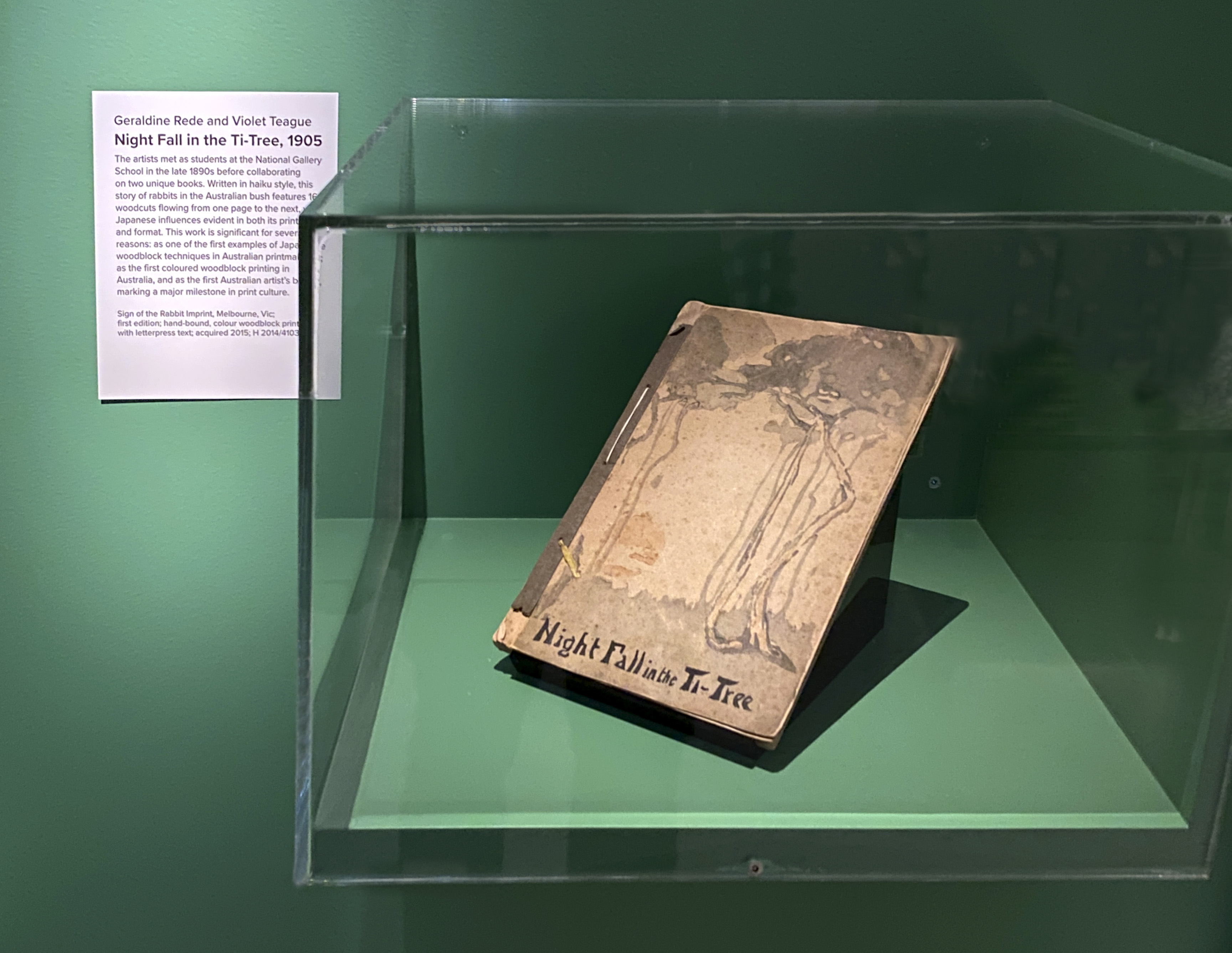
Geraldine Rede & Violet Teague Night Fall in the Ti-Tree, 1905 PHOTO: Doug Spowart
I was surprised that no works from the origins of artists books were shown: books such as those by Picasso and Bonnard published by Ambroise Vollard and Daniel-Henry Kahnweiler in Paris in the early twentieth century. It could be because the library doesn’t hold them. A quick search of the SLNSW catalogue revealed Dingo, with drypoint etchings by Pierre Bonnard published by Vollard in 1924, but few others. I was pleased to see the inclusion of Night fall in the ti-tree (1905) by Violet Teague and Geraldine Rede with its delicate woodcuts, and its acknowledgement as the first Australian artists’ book.
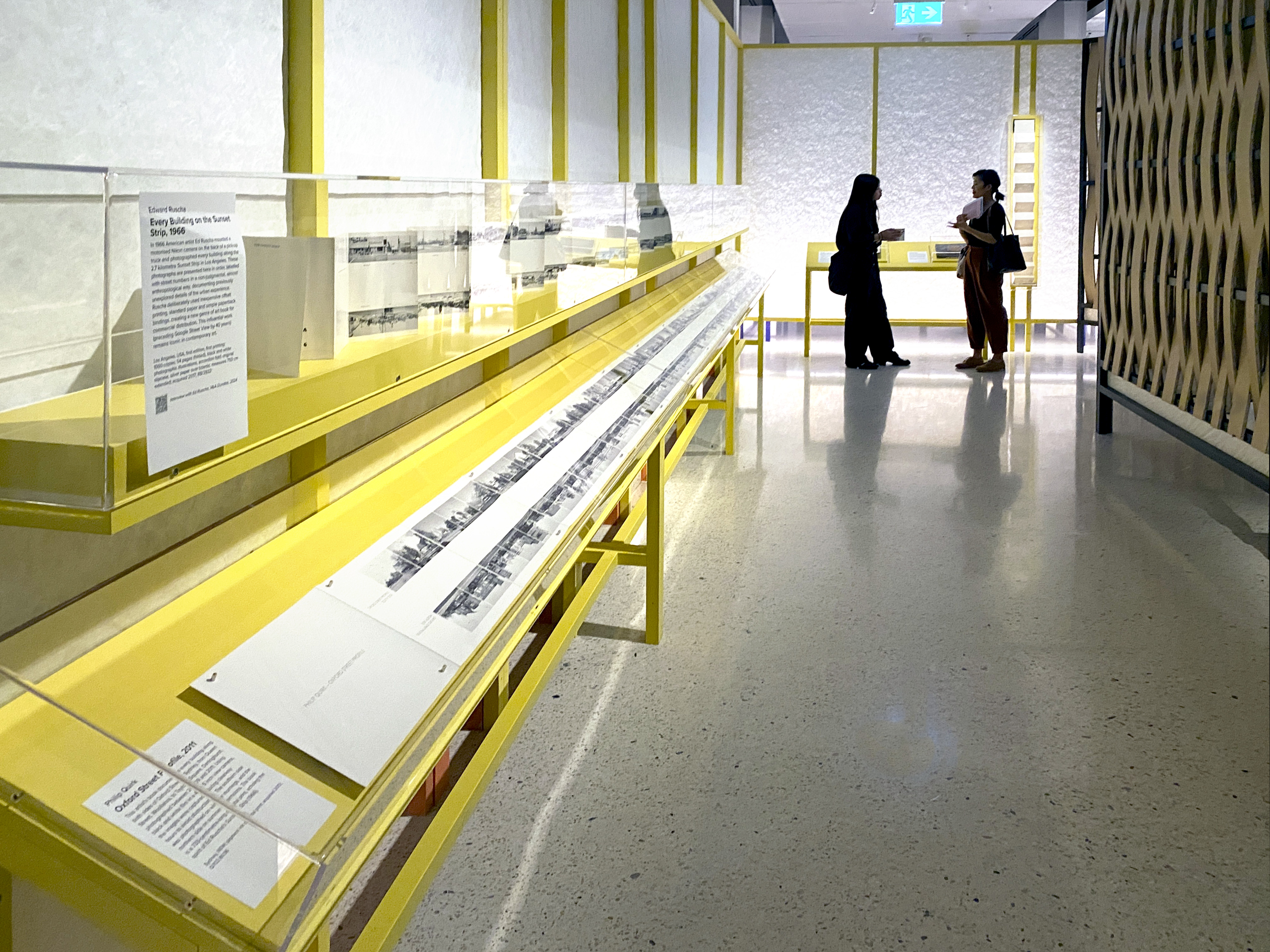
Ed Rusha Every Building on the Sunset Strip, 1966 + Philip Quirk Oxford Street Profile, 2011 PHOTO: Doug Spowart
In a small way the exhibition demonstrates the limitations of the artists’ book collection at the SLNSW, which has not concentrated on its development until relatively recently. Most of the exhibited works have been created in the twenty-first century. There are few books published overseas, one being the fabulous version of the Rubaiyat of Omar Khayyam (1973) by the British artist Susan Allix. The Rubaiyat is a very popular subject for interpretation by artists. An important artist in the history of the artist’s book is American Edward Ruscha, an early exponent of the democratic multiple. He is represented by the concertina photobook Every building on the sunset strip (1966) which has had a huge influence on other artists who continue to create similar works. In this exhibition the book is unusually displayed fully extended to 7.5 metres and is shown with Oxford Street Profile (2011) documenting Oxford Street in Sydney by Australian photographer Philip Quirk. It only stretches to 7.33 metres. It was interesting to see Micky Allan’s early (in Australian terms) artist’s book My Trip (1976). Displayed open, a full facsimile of its newspaper format is also available for closer investigation.
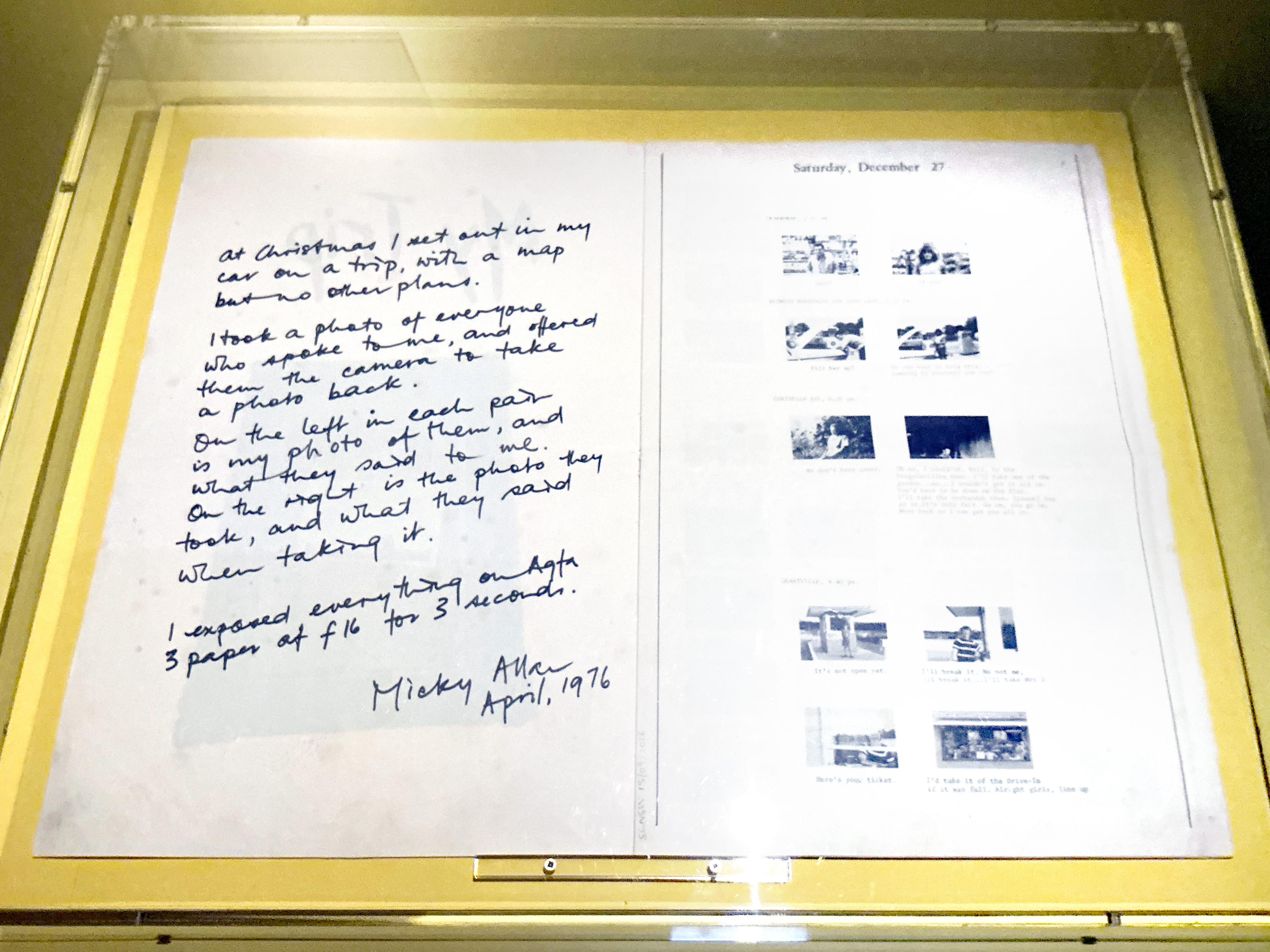
Micky Allan My Trip, 1976
Dancing Over Dark Waters (2012), Howl for a Black Cockatoo (2015), and Phantomwise Flew the Black Cockatoo (2017), by Sue Anderson and Gwen Harrison, with Peter Lyssiotis writing the text for Dancing over dark waters, very impressive books all, are very similar materially and in subject. They could have been replaced by other works expanding the breadth of vision made available in the exhibition. Similarly, several artists are represented by more than one work when other artists and their ideas could have been embraced.
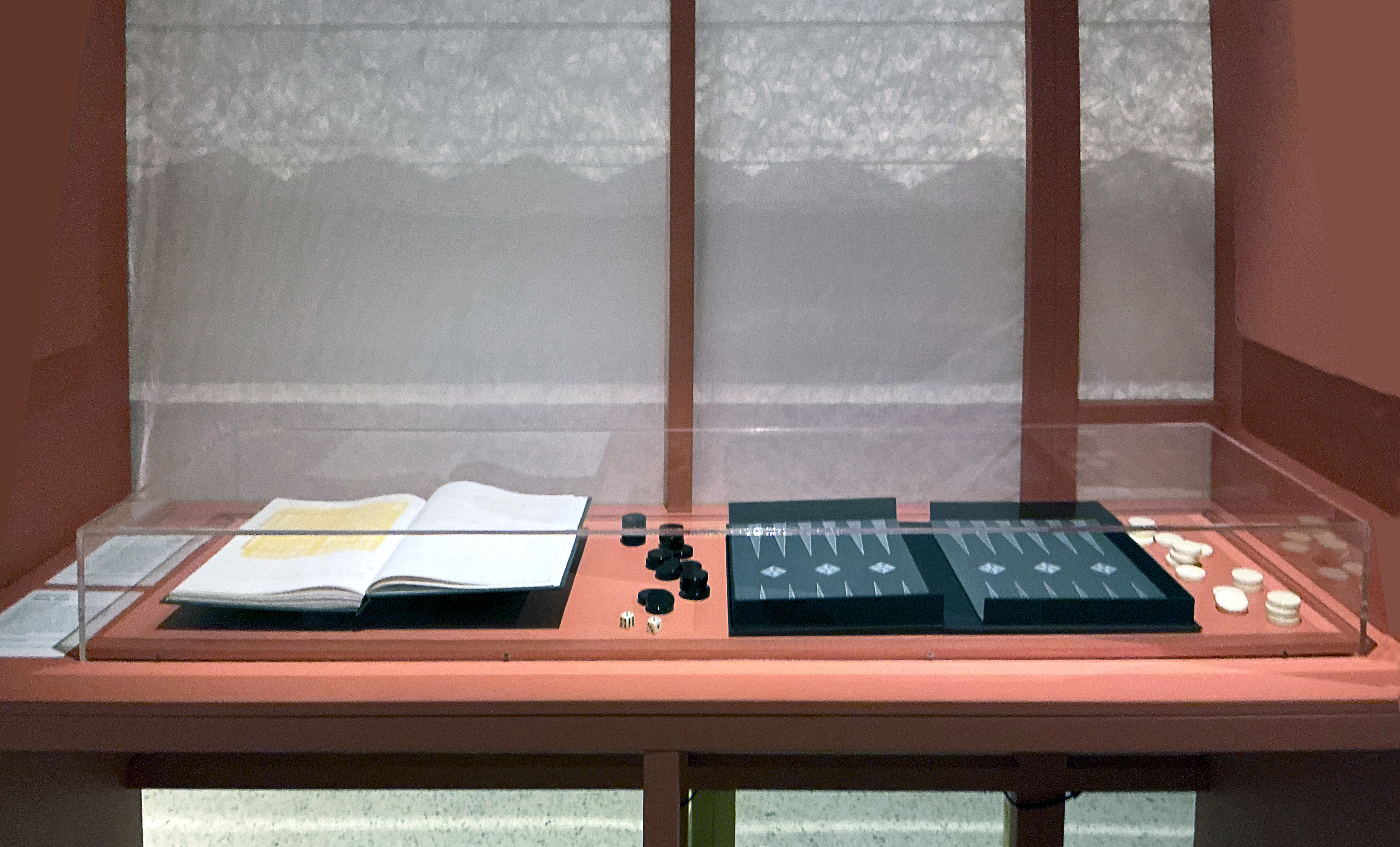
Deanna Hitti Towla, 2017
The exhibition includes some of my favourite artists books including Towla (2017) by Deanna Hitti, with the integral clamshell box creating a board for backgammon, the subject of the book. It is an intriguing book with instructions for backgammon phonetically translated using Arabic and Latin characters but with a twist. Arabic letters spell the instructions in English and Latin letters spell the instructions in Arabic. Some of the books in this exhibition have become my new favourites.
In Conclusion
Criticisms of some components of the exhibition are mere quibbles. In retrospect I could make many about my own exhibition in 2008. This is a fabulous exhibition, beautifully curated, wonderfully designed, and a rare opportunity for the public to experience the breadth and depth of the artists’ book. I hope it will introduce the magical world of artists’ books to a whole new audience in Sydney who will follow up with personal experiences with artists’ books in the library. I also hope that SLNSW will continue to support the art form in both acquisitions and exhibitions.
Helen Cole
March 14, 2026
.
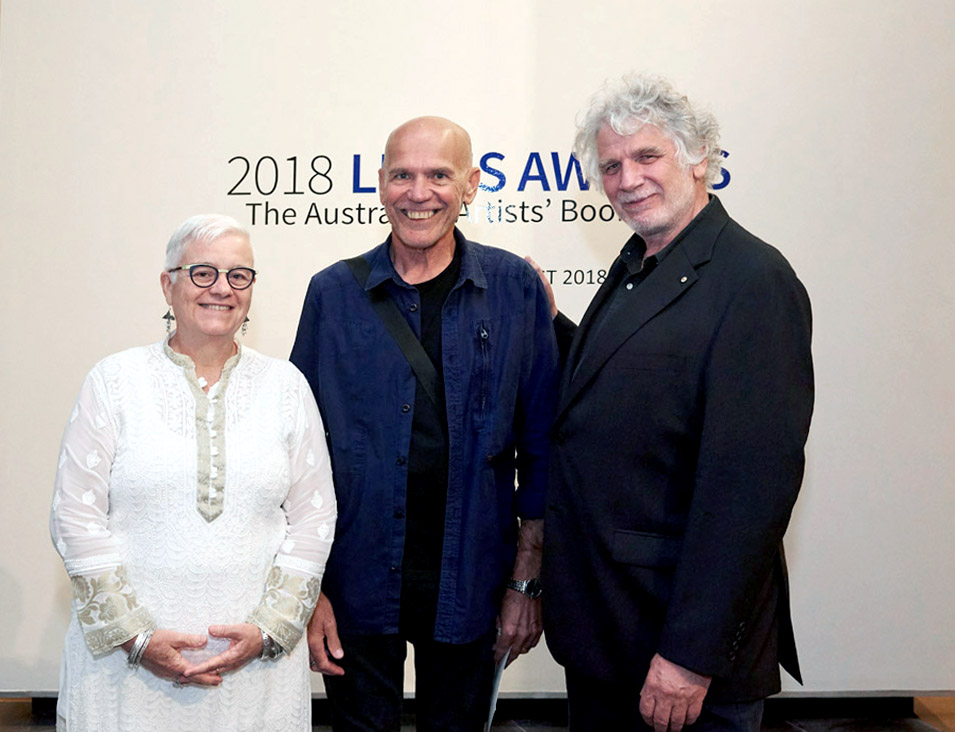
Judges: Helen Cole & Roger Butler with Clyde McGill PHOTO: Artspace Mackay
HELEN COLE: Brief Biography
Helen Cole is intimately acquainted with the world of artists’ books, including their collection and the opportunities and difficulties in presenting these artworks in a public context. Helen was the Arts and Rare Book librarian at State Library of Queensland for thirty years. During much of that time she was responsible for the development of the Library’s extensive Artists’ Books Collection. She has been significantly involved in the artists’ book discipline writing articles and making presentations at conferences. She has judged the Manly Artists Book Prize once and on two occasions judged the Libris Australian Artists’ Book Prize for Artspace Mackay. In 2008 she curated the SLQ exhibition Freestyle Books: Artists’ books from the collection. Helen also co-curated the Tales from the Lyrebird with Ron McBurnie for Artspace Mackay. Apart from her work developing public collections she has amassed a personal library of cherished books.
..
.
OTHER PAPER UNIVERSE RESOURCES
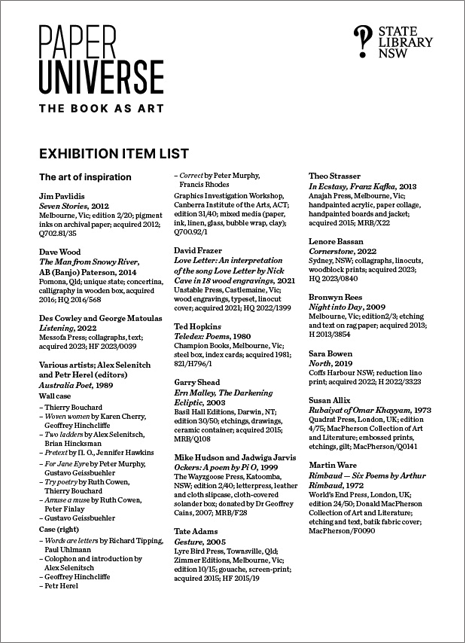
DOWNLOAD: A list of all books in Paper Universe: Paper Universe Book List
DOWNLOAD: A catalogue of Didactic Information on Each Book: Paper Universe Exhibition Captions
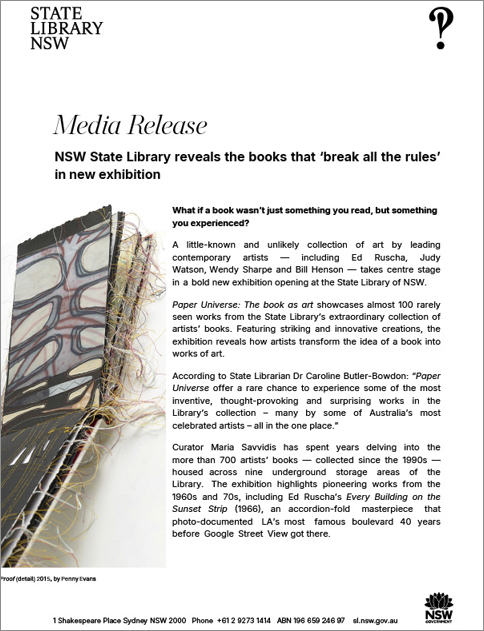
DOWNLOAD: A Press Release of the exhibition: Paper Universe Media Release
We wish to acknowledge the courtesy extended to us by curator Maria Savvidis.
The Reflection text ©2026 Helen Cole
All photographs are by Helen Cole unless otherwise credited.
© is retained by all authors
All photographs have been digitally optimised by Doug Spowart.
Two views of th ‘Paper Universe’ entry concertina PHOTO: Helen Cole
.
.
.
.
.
.
.
.
ARTISTS BOOKS IN AUSTRALIA: The People+Events
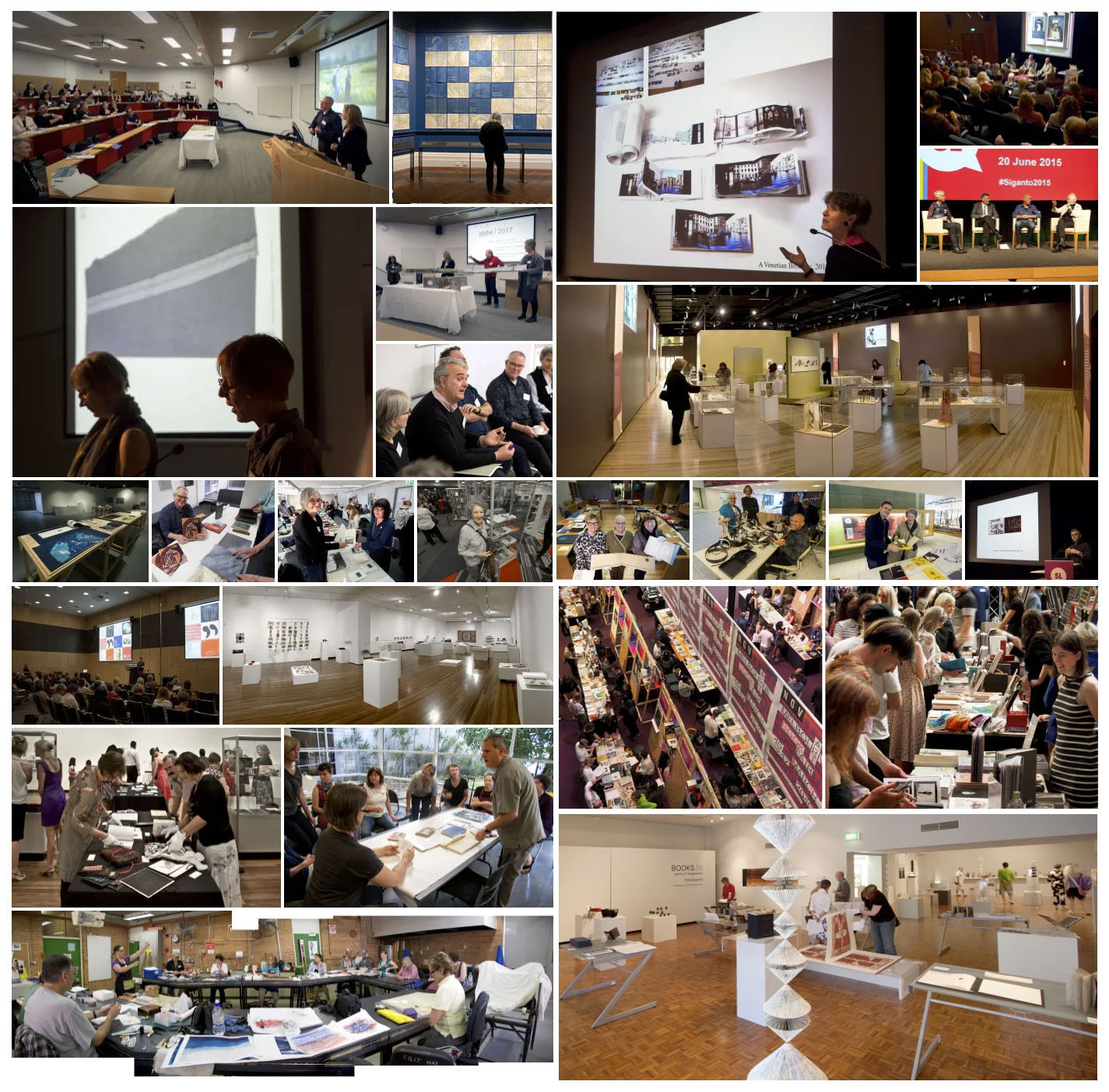
Doug Spowart’s ARTISTS BOOK FAMILY Mosaic
.
In July the artists book symposium ABBE 2025 took place at Artspace Mackay. A key theme of this event was the ‘mapping Australia’s artists book histories’ and in the extended brief for the conference there was the lament that while artists books in Australia had been broad and active there was a scant record of the history the discipline.
.
Reference was made to the understated history of the two main texts Gary Catalano’s The Bandaged Image (1983) and Alex Selenitsch’s NGA published Australian Artists Books 2008, conferences such as those coordinated by Artspace Mackay, many unpublished PhD thesis and the ‘valiant attempts by journals’ that burn out after a few years.
‘Bring your stories, your artifacts, and your memories’ they said so I put forward a submission consisting of aspects of the visual record that I have been making over 22 years of the artists book scene. My submission was to be an illustrated presentation consisting of approximately 200 portraits of the people of the artists book discipline as well as a few events.
.
Here is my submission rationale:
AN ARTISTS BOOK FAMILY ALBUM – A ‘paper’ by Dr Doug Spowart
“A family’s photograph album is generally about the extended family
and, often, is all that remains of it.”
Susan Sontag in On Photography 1977
Family archives are a profound thread connecting past, present, and future, serving as repositories of memory, identity, and history.
Photography is more than just a medium for capturing pictures—it is a lens through which we view and understand history. Its ability to document, provoke, and preserve moments in time has made it an indispensable tool for both personal and collective memory.
In this way photographs hold the power to evoke vivid recollections, introducing us to lost relatives and forgotten stories while anchoring us within a broader familial narrative. Yet, the fragility of these archives is striking — images tucked away on devices or in drawers risk being lost to time, their stories untold.
The passing of key family members often deepens this void, as context and meaning tied to people and events can vanish. Establishing and preserving a family archive becomes not just an act of personal curation but a legacy-building effort, ensuring that these visual fragments of memory remain accessible to future generations.
In an era where countless photos are taken but rarely saved, the challenge lies in collecting and annotating these fleeting moments. A taking them into lasting archives for some to have as a touchtone for memory, and for others to review and research. Maybe to tell the story for future eyes and minds of the books that were made, what events happened and who was there…
This paper will present an illustrated fragment of photographs of the artists book family taken by the author over a 20 years period.
Dr Doug Spowart
.
.
This submission was accepted, and the presentation offered to attendees of the symposium, and later online as a movie via the Artspace website.
.
.
A LINK TO THE YOUTUBE VIDEO ON DOUG SPOWART’s Channel: “CLICK IMAGE”
For BEST viewing quality select HD quality in the SETTINGS menu. NOTE: The full video is 12 minutes long.
.
.
.
.
PRESENTER’S COMMENT from Doug Spowart
In curating these photographs I have focussed on selecting images from the broad artists book community and have not included many photographs from my collaborative practice with Victoria Cooper.
Every attempt has been made to ensure correct captions – Please advise of any errors or omissions. Thanks to Caren Florance, Helen Cole, Robert Heather and Adele Outteridge for their assistance with captions.
Victoria and I have provided commentary about the artists book and photobook disciplines for many years in our Blog, journals, events coordinated and lecture presentations.
.
.
.
All photographs are Copyright Doug Spowart (Some by Victoria Cooper). The subject pictured, after contacting the copyright owner, may be able to use the portrait of themselves for non-commercial applications. Other usage may require negotiation of a fee.
.
.
.
.
.
WHAT FOLLOWS IS A LIST OF ALL CAPTIONS IN THE VIDEO
.
MABF 2017 National Gallery of Victoria
Deanna Hitti and Deidre Brollo @ MABF 2017 National Gallery of Victoria
‘Life’s Journey’ exhibition @ Redland Art Gallery, Cleveland 2012
Julie Barratt in her gallery at Alstonville 2011
Dianne Longley in her exhibition ‘Navigations’ at Barrett Galleries 2008
Tim Mosely in his exhibition Make Like An Eskimo 2012
grahame galleries opening of Lessons in History Vol. II – Democracy 2012
Heather Matthew and Stephen Spurrier @ grahame galleries opening of Lessons in History Vol. II – Democracy 2012
Monica Oppen and Jan Davis @ grahame galleries opening of Lessons in History Vol. II – Democracy 2012
Volume Art Book Fair, Artspace, Woolloomooloo, Sydney 2017
Helen Cole chairs presentations by Keith Smith and Scott McCarney State Library of Queensland 2012
Siganto Seminar: The Trouble with Artists’ Books SLQ 2013
Helen Cole –Siganto Seminar: The Trouble with Artists’ Books SLQ 2013
Noreen Graeme and Jan Davis – Siganto Seminar: The Trouble with Artists’ Books SLQ 2013
Hearsay book launch with Euan Mcleod, Ron McBurnie, Susi Muddiman & Lloyd Jones SLQ 2013
Jo Kambourian at Artists Books Flash Mob Survey Book event Grafton 2013
Catherine McCue Boes Books as art: 30 years in the making Bundaberg Regional Gallery 2014
George Paton Gallery, Artist’s Books (reprised) University of Melbourne 2014
International speaker Sarah Bodman presents a paper – Abbe 2015 Griffith University
International speaker Brad Freeman – Abbe 2015 Griffith University
Lyn Ashby – Abbe 2015 Griffith University
Convener Tim Mosely presenting – Abbe 2015 Griffith University
Books By Artists exhibition – Abbe 2015 Griffith University
Sue Anderson + Gwen Harrison Abbe 2015 Griffith University
Deidre Brollo with Christene Drewe + Helen Cole and Marian Crawford with Sarah Bodman
Abbe 2015 Griffith University
Penny Carey-Wells and Caren Florance Abbe 2015 Griffith University
Robyn Foster + Fiona Dempster and Angela Gardner Abbe 2015 Griffith University
Sheree Kinlyside and Impress Printmakers: Sue Poggioli + Jennifer Stuerzl Abbe 2015 Griffith University
Tim Mosely and Heather Matthew Abbe 2015 Griffith University
Adele Outteridge + Wim de Vos – Abbe 2015 Griffith University
Jo Kambourian and Darren Bryant at Lismore Art Space 2014
The SLQ White Gloves team Christene Drewe, Helen Cole and Jeanette Garrard for Abbe 2015
State Librarian Janette Wright welcomes attendees SLQ 2015
Brazillian artist Amir Brito Cadôr keynote presentation Siganto Foundation Artists’ Book Seminar 2015
Julie Barratt and Clyde McGill discusse their Siganto Foundation Creative Fellowship 2015
Jan Davis and Doug Spowart discuss their Siganto Foundation Creative Fellowship 2015
A forum on collaboration – Siganto Foundation Artists’ Book Seminar 2015
Judy Bourke and Adele Outteridge+Wim de Vos at the Siganto Foundation Artists’ Book Fair SLQ 2015
Clyde McGill and Anne Kirker and Sue Poggioli at the Siganto Foundation Artists’ Book Fair SLQ 2015
Helen Malone and Sandra Pearce at the Siganto Foundation Artists’ Book Fair SLQ 2015
Amir Brito Cadôr with Noreen Grahame & Helen Malone at the Siganto Foundation Artists’ Book Fair SLQ 2015
Helen Cole, Michael Wardell & Clyde McGill at the Siganto Foundation Artists’ Book Fair SLQ 2015
Dr Marie Siganto makes a presentation to Ana Paula Estrada and Victoria Cooper
PAPER CONTEMPORARY – Sydney Contemporary 2015
Grahame Galleries stand with Ron + Jonathan McBurnie at Paper Contemporary – Sydney Contemporary 2015
Victoria Cooper, Jan Davis and Trent Walter at Paper Contemporary – Sydney Contemporary 2015
Sue Anderson + Gwen Harrison and Brigita Oppen at Paper Contemporary – Sydney Contemporary 2015
Helen Cole, Akky van Ogtrop, Robyn Berkeley from Berkeley Editions and Victoria Cooper at
Paper Contemporary – Sydney Contemporary 2015
Fellow Travellers a book by William Kelly, SLV Creative Fellow and Baldessin Press Studio Residency recipient
Personal Histories International Artist Book Exhibition Uni of NSW Canberra 2015
Robyn Foster (Curator), Judy Bourke, Selena Griffith, Tracie Toohey, Rachel Hunter, Lisa Morisset –
Personal Histories International Artist Book Exhibition Uni of NSW Canberra 2015
Christene Drewe introduces UK artist Guy Begbie – The Siganto Foundation Fellowship artist book series 2016 SLQ
Guy Begbie presents his keynote address – The Siganto Foundation Fellowship artist book series 2016 SLQ
Victoria Cooper and Lyn Ashby presentations – The Siganto Foundation Fellowship artist book series 2016-7 SLQ
Helen Douglas presents her keynote address – The Siganto Foundation Fellowship artist book series 2017 SLQ
Clyde McGill performs his book and a White Gloves presentation of artists books
– The Siganto Foundation Fellowship artist book series 2016 SLQ
Freestyle Books exhibition curated by Helen Cole at the State Library of Queensland 2008
Freestyle Books Symposium with Ron McBurnie, Peter Lyssiotis, Judy Watson, Jonathon Tse and others
at the State Library of Queensland 2008
At the launch of Ana Paula Estrada’s book MEMORANDUM – Ana Paula with Louis Lim and Annette Green 2016
Visiting Wim de Vos and Adele Outteridge at Studio West End Brisbane 2017
Visiting the 2017 Festival of the Photocopier Zine Fair – Melbourne
David Dellafiora and Gracia Haby + Louise Jennison at the
2017 Festival of the Photocopier Zine Fair – Melbourne
Ulrike Stoltz & Uta Schneider international presenters at Artists book Brisbane Event Griffith University 2017
A K Milroy + Brad Freeman – presenters at Artists Book Brisbane Event Griffith University 2017
Marian Crawford and Ana Paula Estrada presents their papers
Artists Book Brisbane Event Griffith University 2017
Marian Macken presents at Artists Book Brisbane Event Griffith University 2017
Wim de Vos at Artists Book Brisbane Event Griffith University 2017
A plenary session on artists books at Artists Book Brisbane Event Griffith University 2017
Noreen Grahame in her curated exhibition “… & So” – Artists Book Brisbane Event Griffith University 2017
Barbara Davidson and Caren Florance at Artists Book Brisbane Event Griffith University 2017
Sue Poggioli and Anne-Maree Hunter at Artists Book Brisbane Event Griffith University 2017
Brad Freeman and Anita Milroy – Artists Book Brisbane Event Griffith University 2017
Lyn Ashby and Sue Anderson at Artists Book Brisbane Event Griffith University 2017
Anna Welch, Des Cowley and Madeleine Say at Ballarat International Foto Biennale
World Photobook Day Book Fair 2019
Helen Cole presents and a floortalk – The First Focus of Artists Books and the Libris Awards at Artspace Mackay 2004
Looking at books and the opening crowd – Focus of Artists Books and the Libris Awards at Artspace Mackay 2004
Bruno Leti workshop – Focus of Artists Books and the Libris Awards at Artspace Mackay 2004
Focus of Artists Books and the Libris Awards at Artspace Mackay 2005
Caren Florance, Sasha Grishin and Dianne Fogwell in the ANU exhibition at FOAB 2005
Unknown lady, Adele Outteridge, Madonna Staunton and Wim de Vos and Sasha Grishin FOAB 2005
Focus of Artists Books and the Libris Awards at Artspace Mackay 2006
Robert Heather welcomes attendees + Marshall Weber presents Focus of Artists Books at Artspace Mackay 2006
Katherine Nix workshop – Focus of Artists Books at Artspace Mackay 2006
The installation view of the 2008 Libris Awards
Michael Wardell welcomes attendees and a Forum at the 4th Focus on Artists Books event and
Judge Michael Desmon presents his address to the 2008 Libris Award
Clyde McGill’s foyer artwork FOAB 2028
Michael Desmond presents his lecture in the 4th Focus on Artists Books event
2008 FOAB some of the presenters McGill, Fogwell, Florance and Cooper
Focus on Artists Books V and the 5th Libris Awards 2010
Michael Wardell addresses the attendees – 2010 Libris Awards and 5th Focus on Artists Book event
2010 FOAB Deanna Hitti in her exhibition ‘Bint Trembucky (daughter of the drum)’
Caren Florance and David Dellafiora in their workshops – 5th Focus on Artists Book
Victoria Cooper with Judy Barrass and Linda Douglas – 5th Focus on Artists Book
Barbara Davidson and Caren Florance with Sheree Kinlyside of Red Rag Press – 5th Focus on Artists Book
Victoria Cooper with Monica Oppen and Sara Bowen (Book Art Object), Julie Barratt and Caren Florance
Visiting the 2016 Libris Artists Book Award
Visiting the 2016 Libris Artists Book Award
Denise Vanderlugt with her highly commended bookwork I used to wrap rainbows and Jamian Stayt’s
Soulless evolution 2016 Libris Artists Book Award
graeme galleries’ 5th Artists’ Books + Multiples Fair in the Dell Gallery Griffith University 2007
Monica Oppen and Michael Wardell with Doug Spowart
at graeme galleries’ 5th Artists’ Books + Multiples Fair in the Dell Gallery Griffith University
Helen Cole + Dianne Fogwell and Stephen Spurrier + Normana White
at graeme galleries’ 5th Artists’ Books + Multiples Fair in the Dell Gallery Griffith University
Victoria Cooper with Dianne Longley and Anne-Maree Hunter
at graeme galleries’ 5th Artists’ Books + Multiples Fair in the Dell Gallery Griffith University
12th Edition Noosa Artists Book event ‘Back to Basics’ 2008
Southern Cross University Acquisitive Artists Book Award 2006
Southern Cross University Acquisitive Artists Book Award 2007
Southern Cross University Acquisitive Artists Book Award judged by Robert Heather 2008
Judge Tara O’Brien announces the winner – Southern Cross University Acquisitive Artists Book Award 2009
Southern Cross University Acquisitive Artists Book Award 2011 – Judge Ross Woodrow
Peter Lyssiotis is his studio 2014
Ana Paula Estrada presenting her Mexican photobook collection in Maud Gallery, Brisbane 2017
Keith Smith and Scott McCarney in a workshop at West End Studios Brisbane 2006
Deanna Hitti’s exhibition of the book ‘A is for Alam (pen)’ at the State Library of Victoria 2022
.
.
Any RSS reposting from this Blog without permission represents a breach of Copyright.
.
.
.
.
.
MONTAGE+THE ARTISTS’ BOOK: a paper by Victoria Cooper

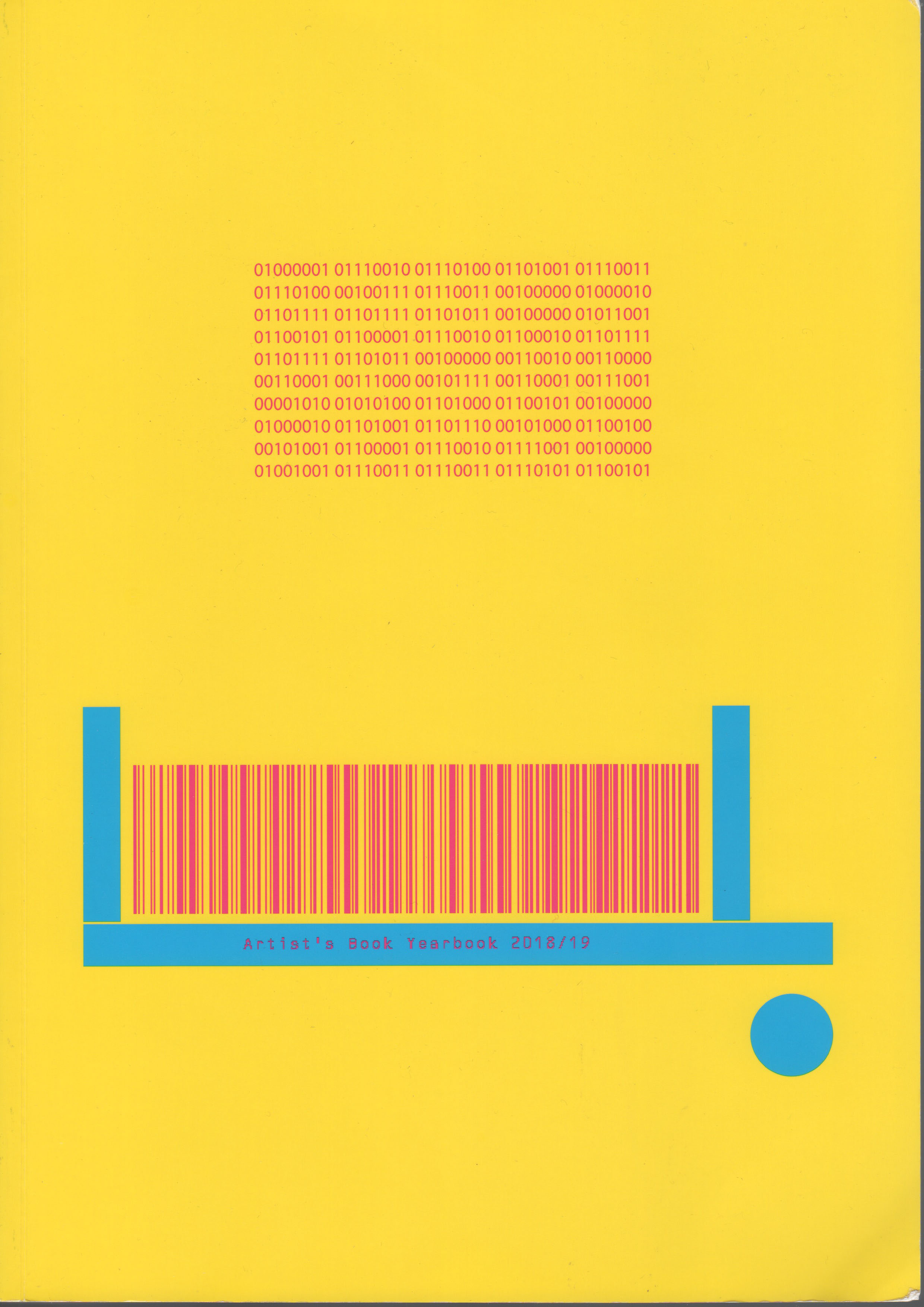
Victoria and the ARTISTS’ BOOK YEARBOOK 2018-9
.
I’ve recently had a major paper on my research into the montage and artists’ books published in the ARTISTS’ BOOK YEARBOOK 2017-8 edited by Sarah Bodman from the Centre for Fine Print Research (CFPR) at the University of the West of England. The paper covers ongoing research which was undertaken as part of my Siganto Foundation Research Fellowship at the State Library of Queensland.
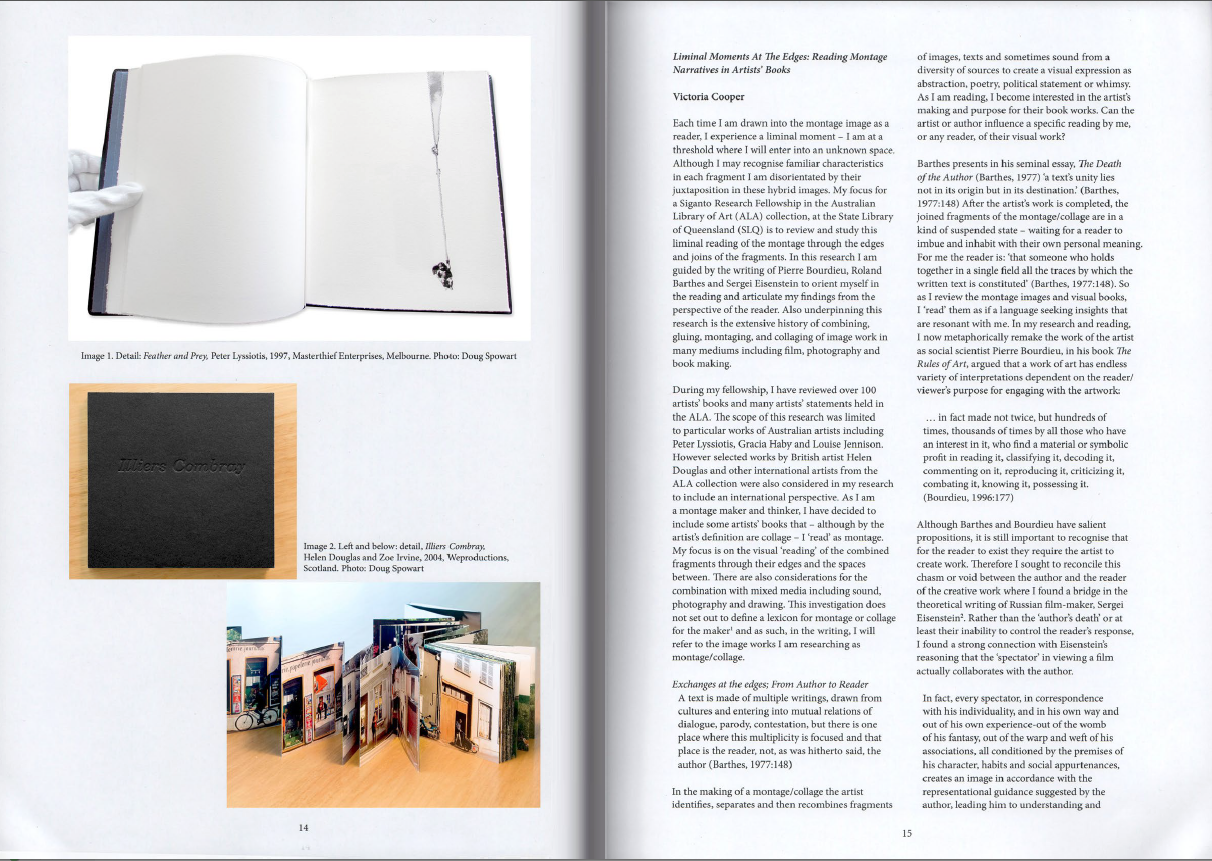
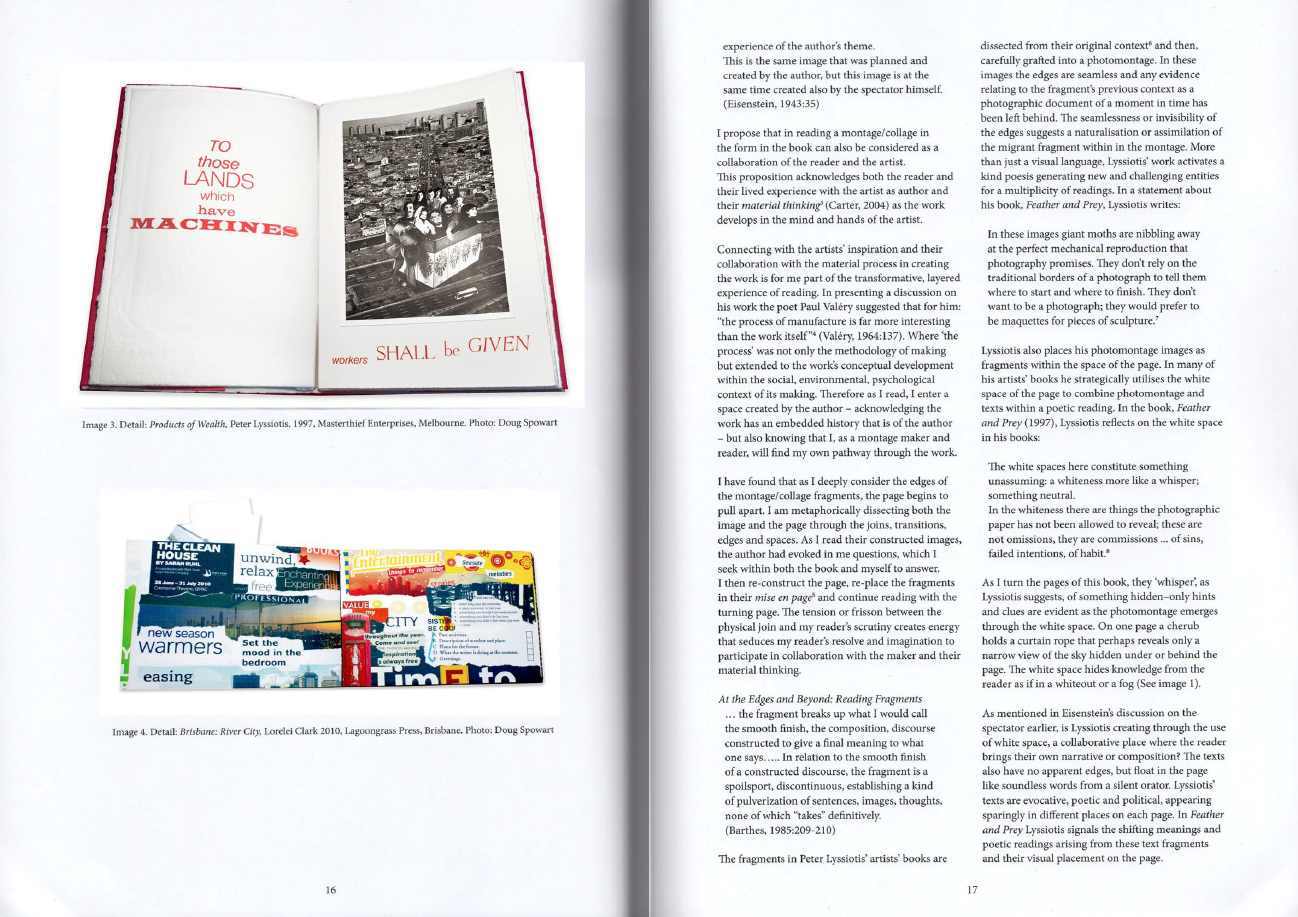


Here are the first 2 paragraphs from the paper
LIMINAL MOMENTS AT THE EDGES: READING MONTAGE NARRATIVES IN ARTISTS BOOKS
Each time I am drawn into the montage image as a reader, I experience a liminal moment – I am at a threshold where I will enter into an unknown space. Although I may recognise familiar characteristics in each fragment I am disorientated by their juxtaposition in these hybrid images. My focus for the Siganto Research Fellowship in the Australian Library of Art (ALA) collection, at the State Library of Queensland (SLQ) is to review and study this liminal reading of the montage through the edges and joins of the fragments. In this research I am guided by the writing of Pierre Bourdieu, Roland Barthes and Sergei Eisenstein to orient myself in the reading and articulate my findings from the perspective of the reader. Also underpinning this research is the extensive history of combining, gluing, montaging, and collaging of image work in many mediums including film, photography and book making.
.
During my fellowship, I have reviewed over 100 artists’ books and many artists’ statements held in the ALA. The scope of this research was limited to particular works of Australian artists including Peter Lyssiotis, Gracia Haby and Louise Jennison. However selected works by British artist Helen Douglas and other international artists from the ALA collection were also considered in my research to include an international perspective. As I am a montage maker and thinker, I have decided to include some artists’ books that–although by the artist’s definition are collage– I ‘read’ as montage. My focus is on the visual ‘reading’ of the combined fragments through their edges and the spaces between. There are also considerations for the combination with mixed media including sound, photography and drawing.
This investigation does not set out to define a lexicon for montage or collage for the makeri and as such, in the writing, I will refer to the image works I am researching as montage/collage.
[i] See my blog post for the Australian Library of Art, State Library of Queensland, http://blogs.slq.qld.gov.au/ala/2016/05/27/reading-montages-perceptions-dilemmas-edges-and-resolution/
Key books that I discuss in the paper are from the following artists:
Peter Lyssiotis, Feather and Prey, (1997), Masterthief Enterprises, Melbourne
Peter Lyssiotis, Products of Wealth, (1997), Masterthief Enterprises, Melbourne
Lorelei Clark, Brisbane: River City, (2010), Lagoongrass Press, Brisbane
Jack Oudyn, The very first book of fish, (199?), Micro Press, Ormiston, Queensland
Gracia Haby and Louise Jennison, And we stood alone in the silent night, (2008), Melbourne
Gracia Haby and Louise Jennison, Salvaged Relatives, Melbourne
Lyn Ashby, 20 minutes, , (2011), ThisTooPress, Victoria
Helen Douglas & Zoe Irvine, Illiers Combray. (2004), Weproductions, Scotland
Dianne Fogwell, Gene Pool, (2000), Edition & Artist Book Studio, Canberra School of Art, Canberra
You can download a copy of my paper HERE
PLEASE NOTE: This download version contains colour photographs of the books discussed – the Yearbook is published in monochrome.
.
Thank you to all the artists who gave permission for their works to be photographed and presented in the publication.
Enjoy — and I would appreciate any comments you may have about the paper…
You can buy your own hard copy of the Yearbook from UWE HERE
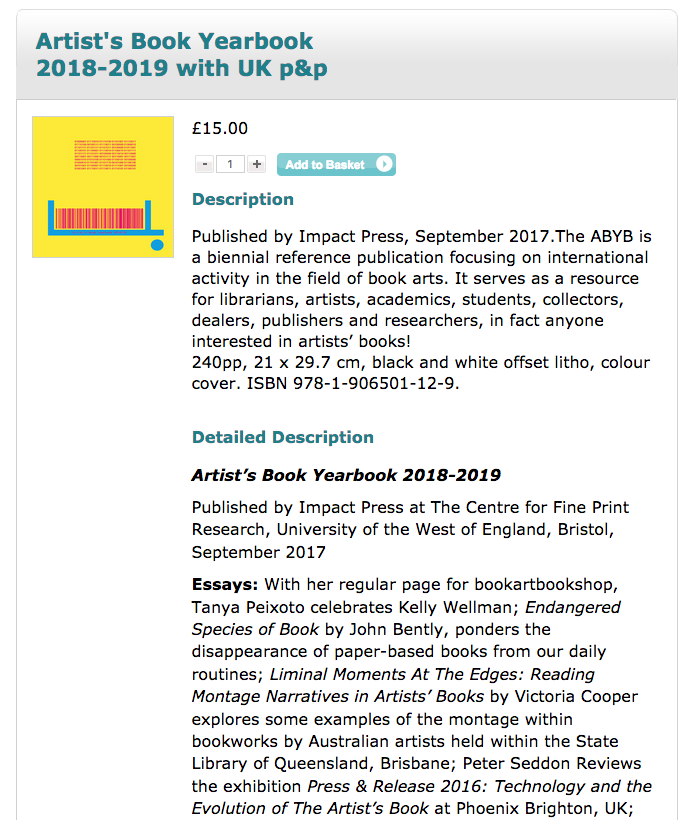
UWE Publications website
.
.
.
.
.
.
.
.
.
.
ABBE 2017 – The academic artists book conference
ABBE Logo
The second Artist Book Brisbane Event (ABBE) promised an academic conference dealing with the artists book as a folded and risky space. The event consisted of three elements at the Queensland College of Art and a fourth satellite pop-up exhibition at the State Library of Queensland. Drawn to ABBE 2017 were artists bookmakers, thinkers, commentators, teachers, lecturers and tinkerers from across Australia. All came with a desire to contribute to, or participate in, perhaps this Australia’s penultimate artists book gathering.
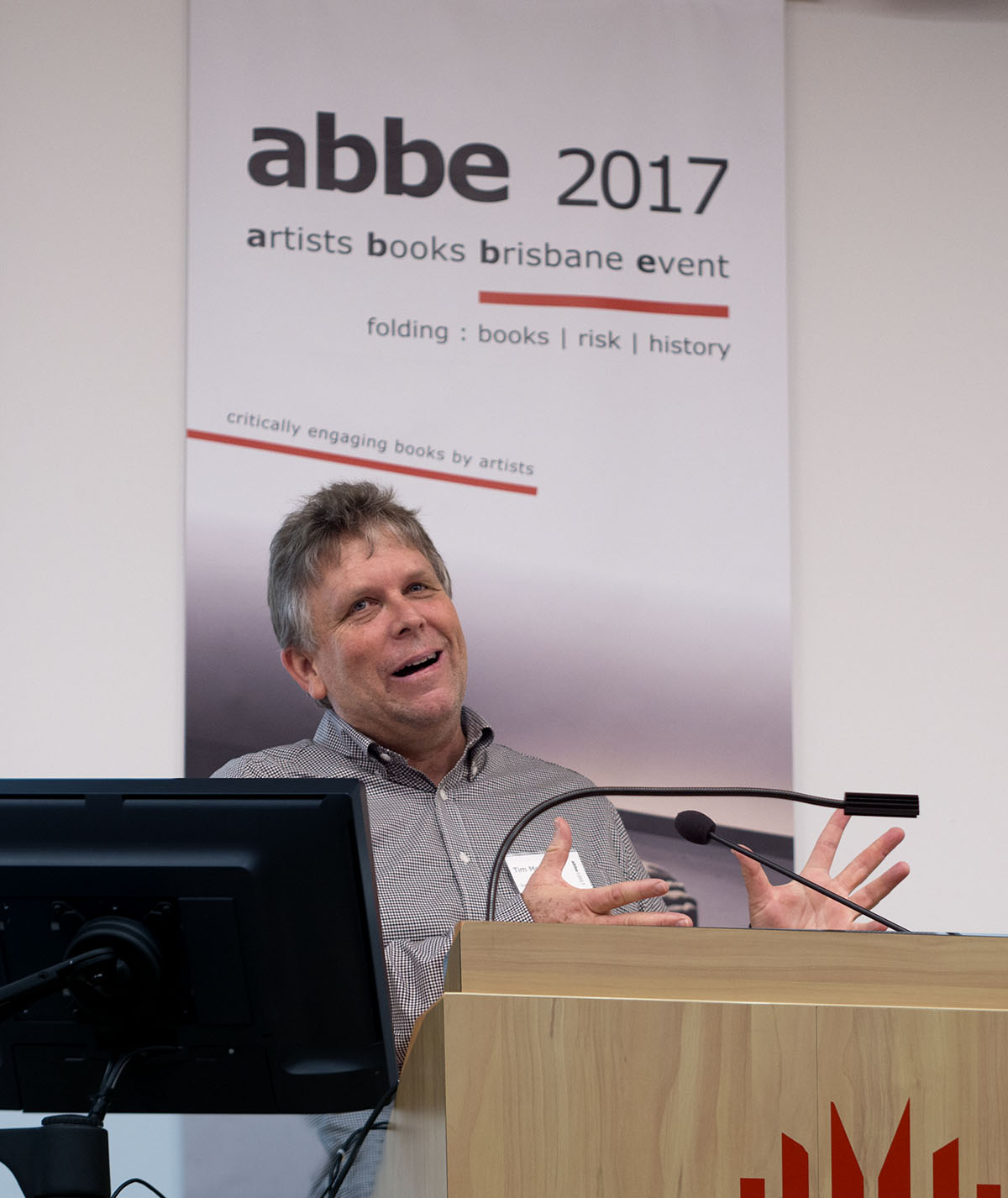
Dr Tim Mosely ABBE coordinator and chair
The event was convened and chaired by QCA lecturer Tim Mosely and was launched by Griffith University’s Dean Academic, Arts, Education and Law Professor Ruth Bereson who spoke about the book as art and the need for that the discipline has for scholarly discourse. She commented that the Griffith Centre for Creative Arts Research ABBE program and its connection with Columbia University’s JAB (Journal of Artists Book) publication of selected papers would contribute to this discourse. Significant keynote speakers, Uta Schneider and Ulrike Stoltz from Germany and Clyde McGill from Western Australia headlined the event. Other program contributors came from practitioners, academic staff, students, and recent graduates from institutions in the USA, New Zealand and around Australia.
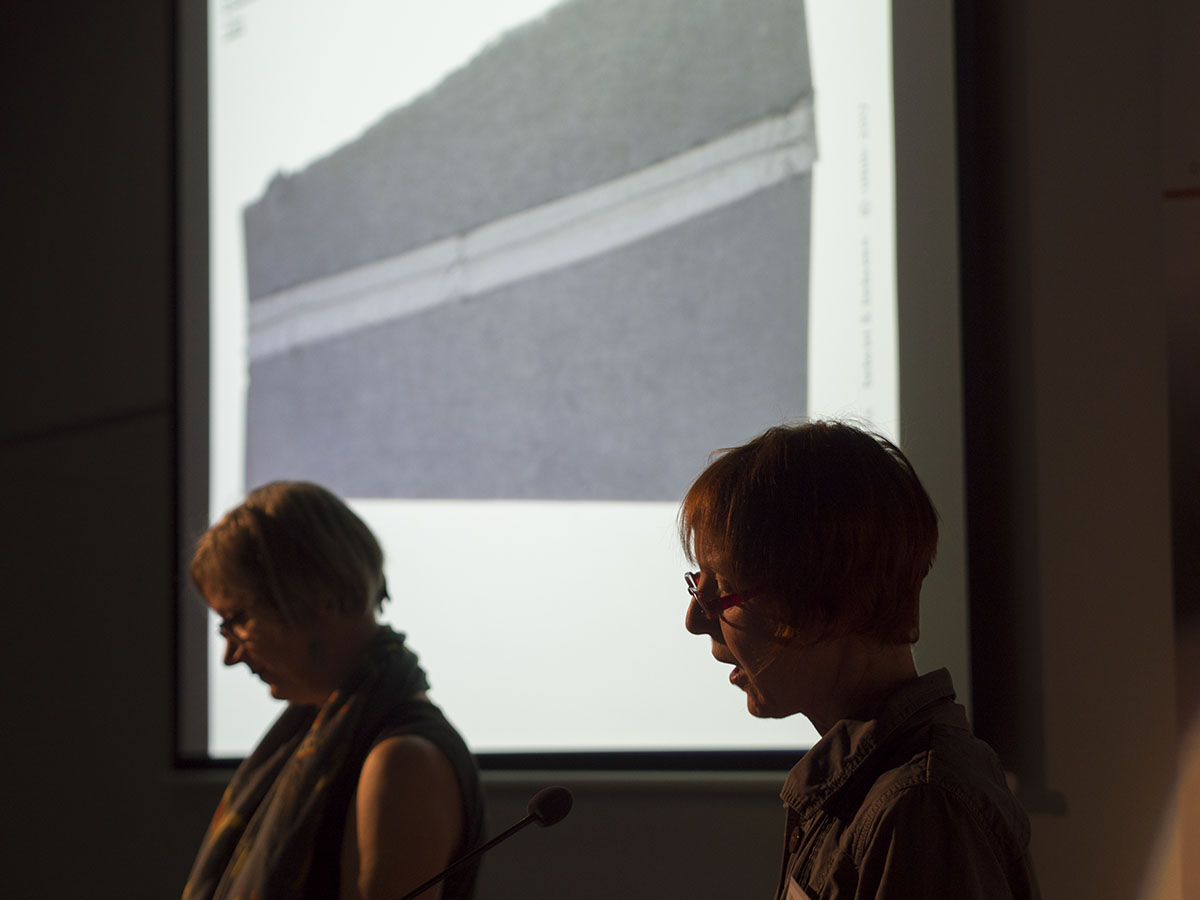
Ulrike Stoltz & Uta Schneider
The first keynotes were Uta Schneider and Ulrike Stoltz who presented a paper entitled betwixt & between. Presenting in tandem their voices were almost like a turning of the pages – recto and verso. They teased out and formed the conference theme of ‘folding’ into an ordered analysis of the physical and metaphorical ways that books fold. They connected the theme ‘folding’ with their own individual and collaborative works and the concepts, philosophies and discussions about artists books that informed them. Mythology, Martin Heidegger on contemprality and the ekstaticon, Carrion, Gillies Deleuze and ‘thinking means folding’ and Michel Serres and ‘the crumpled nature of time’.
The lecture then proceeded to a review of book forms with terms like:
- Folded paper
- Cross fold
- Sharpness of the fold
- Container folds
- Staging folds
- French fold
- Inside folding outside
- Concertina and multi-concertina folds
- Wormholes and science fiction
The works they illustrated their paper with were refined and exquisitely designed. They featured wordplay and poetry, folded page spaces, transparency using ‘show-through’, typography and graphic design elements. As an introduction to the topic, the hour long presentation provided a solid and exciting insight into ways of considering the fold, its forms and the way it can connect with the reader, as receiver of the communiqué.
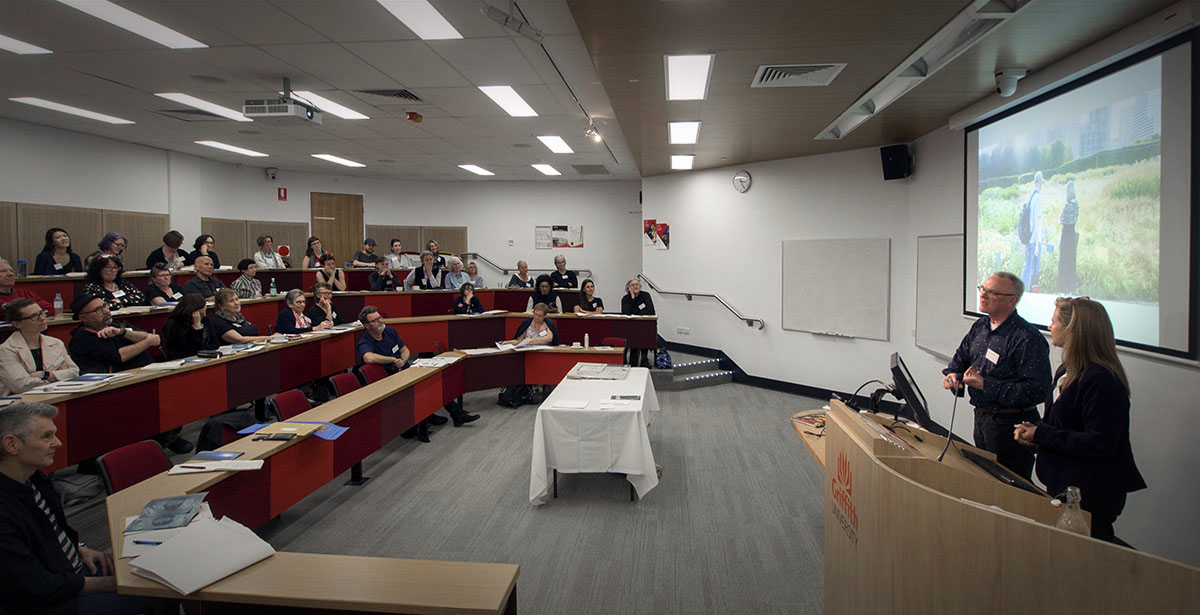
A K Milroy + Brad Freeman presenting
Other presentations on the program included:
- Marian Macken Reading Volume: Between Folded Drawings and Collapsible Models
- Caren Florance & Angela Gardner Unfolding to refold: collaborative wordings
- Paul Uhlmann Meditations on process: Three artists books, letters to the land, sea and sky
- Caren Florance An Instrument of Collaboration: Unfolding the GIW Legacy
- Monica Oppen Eclectic items: early books by Australian artists
- Ana Paula Estrada “Memorandum”, from concept to publication
- Wim de Vos Air, edge, surface image – concertina books
- Nicola Hooper The Citronella Artists Book as an Augmented Narrative
- Amy E. Thompson Folding and the potential of Artists’ Books
- A K Milroy & Brad Freeman Folding and unfolding in JAB41: cultures, research, pages
- Tess Mehonoshen DISINTEGRATE: the destructive folding of materials
- Marian Crawford A lively phantom: the rare and popular artists book
- Carolyn Craig Unfolding(s)
- Isaac Brown Relationship risk and ethics in photographic artist books
- Monica Carroll & Adam Dickerson Unfolding the episteme of artists’ books
- Bridget Hillebrand Handling folds: an intimate encounter
- Julie Barratt & Virginia Barratt The exquisite fold, the immanent word
- Maren Götzmann The Anarchist Notebooks


While most papers were read from the dais with carefully illustrated PowerPoint slides the second keynote speaker Clyde McGill emerged on the stage with a device that could be called a ‘bibliophone’. McGill had altered a range of book titles by folding back the pages and attaching a sound pick-up to the book cover and then connected the 7 books to an amplifier. Volunteers from the audience were given bonefolders as plectrums and, on McGill’s guidance were instructed to make the various movements of hands and object associated with hand-making a book. The haptic actions were converted to sound and the room filled with the noise of ‘making’ associated with a great deal of laughter.
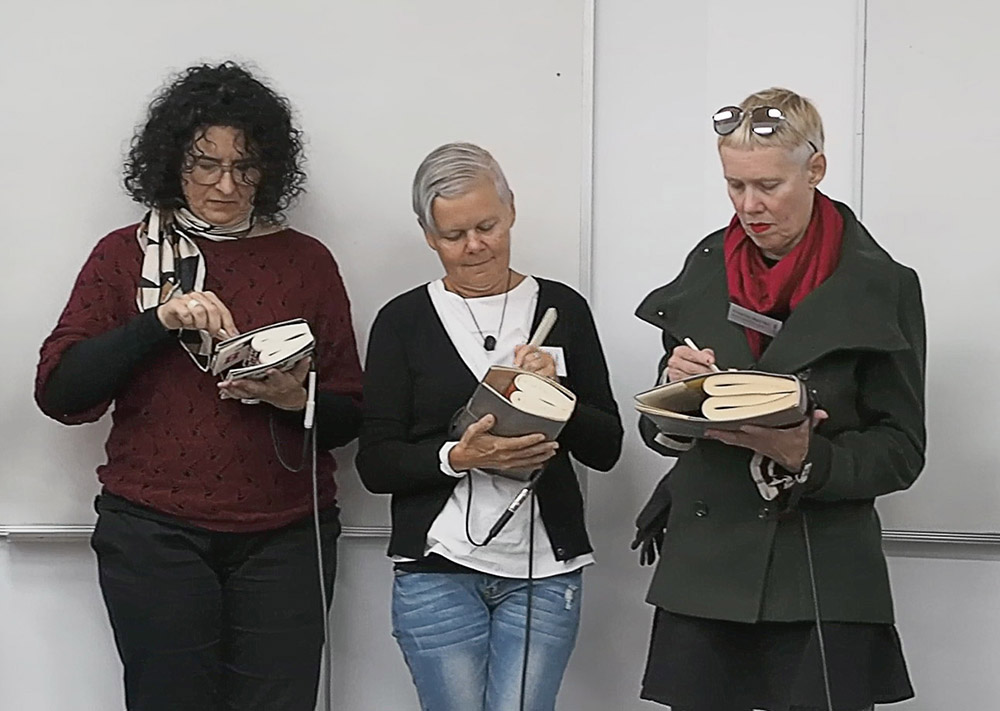
Making book music with Clyde McGill


McGill continued his presentation with a detailed investigation of the idea of folding books. Where possible his own works were referenced. At other times he created new books by playful investigation… bending and folding light was a particularly humorous but gave those present an insight into how the artist’s off-tangential and obtuse thought processes process can lead to new conceptual and visual discoveries.

Julie and Virginia Barrett’s performance
Another departure from the read-the-paper format was a performance by Julie Barratt and her sister Virginia Barratt. Attendees, on returning to the lecture theatre after morning tea, found the space darkened except for two sharply defined spotlit circles. One pool of light was vacant, just the floor’s carpet – in the other artists’ book maker Julie Barratt was busy unfurling paper, measuring it and tearing of lengths and positioning them in a stack on the table before her. Also on the table were scissors a ball of thread and other bookmaker’s things. The unroll>measure>cut>position sequence was progressing methodically for some time making the sheets one might guess that would go to making a book. A soundtrack began with a female voice expressing thoughts ideas, word associations sometimes repeated – perhaps the thoughts of the bookmaker? There was a rustling sound – stage right. Gradually a large dome-like white shape appeared and moved towards the empty spotlight area. The shape was covered in what looked like pages – ominous maybe… the audio continued and Julie Barratt left her table and proceeded toward the shape and picked up a folded sheet and returned to the table – flattening out the sheet it was melded with other sheets. The performance continued. What was it about? What came to my mind was that the shape was like the book working with Julie so its story could be told as in Paul Carter’s ‘material thinking’. At the end of the performance it was revealed that Virginia Barratt, Julie’s sister, was the artists book ‘monster’.


Another aspect of the conference presentations were two papers by photographers Ana Paula Estrada and Isaac Brown both featuring bookwork’s that they had created. Estrada, as a State Library of Queensland Siganto Foundation Creative Fellow, discussed concepts of memory, photography and old age as the inspiration for her project. She detailed the process of design, making maquettes, refining and working with commercial printers and binders to complete the project. Brown spoke of the integration of his project and PhD study focussing on his relationship to his father, a Vietnam veteran. Aspects of text and dialogue were addressed as well as Brown’s own recent fatherhood. What was interesting was the informal narrative and connection with audience that both presenters had and the expanding space of the artists book being inhabited by photographers.
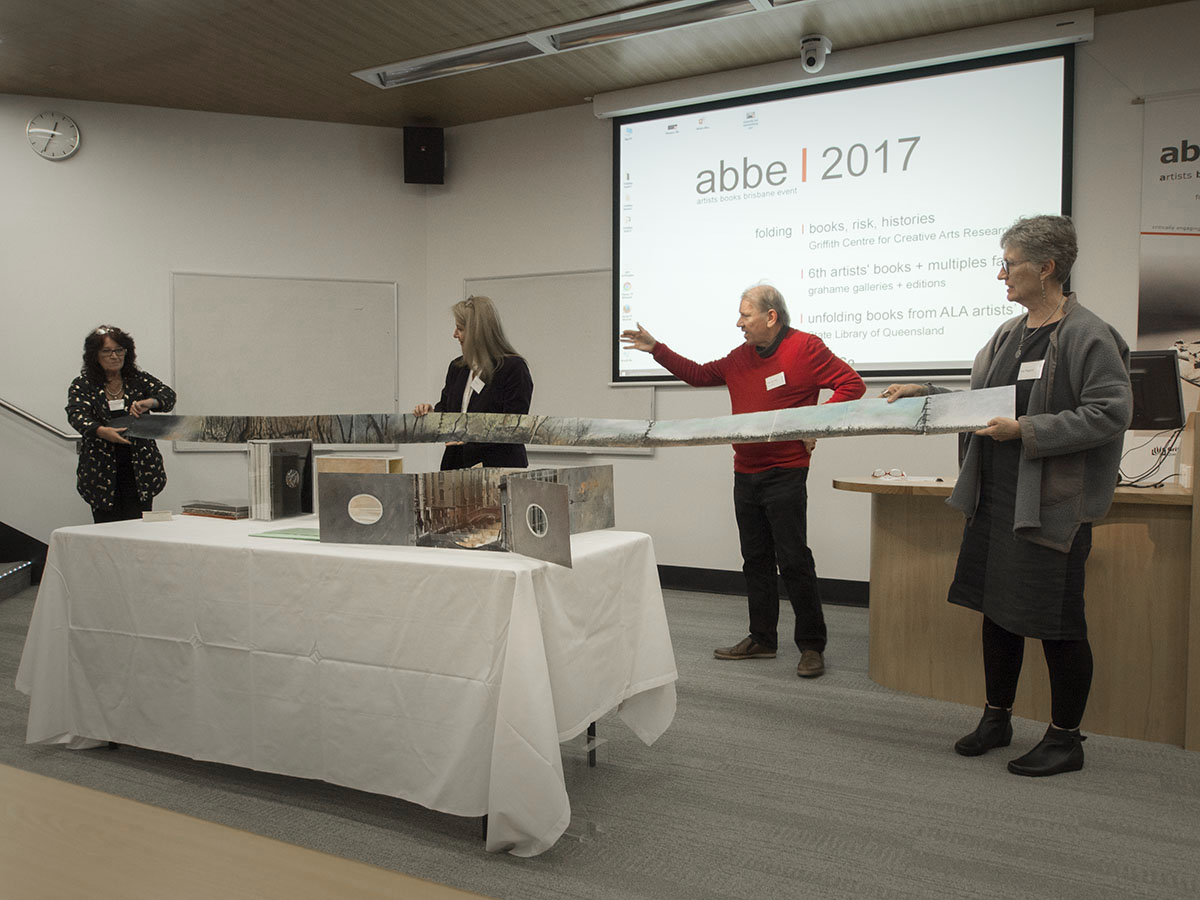
Wim de Vos presents his work
Wim de Vos made an animated presentation and several helpers as his concertina books by the metre unfolded across the width of the theatre and tunnel books expanded, evidence of the pre-eminence of his artists book practice in Queensland.


Midway through the academic papers a ‘plenary’ session consisting of a panel of artists’ book ‘movers and shakers’ discussed several issues relating to the discipline. The session quickly became absorbed with the perennial issues of nomenclature, the dearth of private and public purchasers of bookworks and the grooming of possible artists book collectors. The impact of the term ‘Art Book’ was mentioned and the way events associated with the term has grown in popularity worldwide and has come to encompass artists books, photobooks, zines, art books and institutional catalogues. Another topic mentioned was the importance of research and critical commentary on the discipline. A suggestion was made for the formation of a ‘double-blind peer review’ collective.
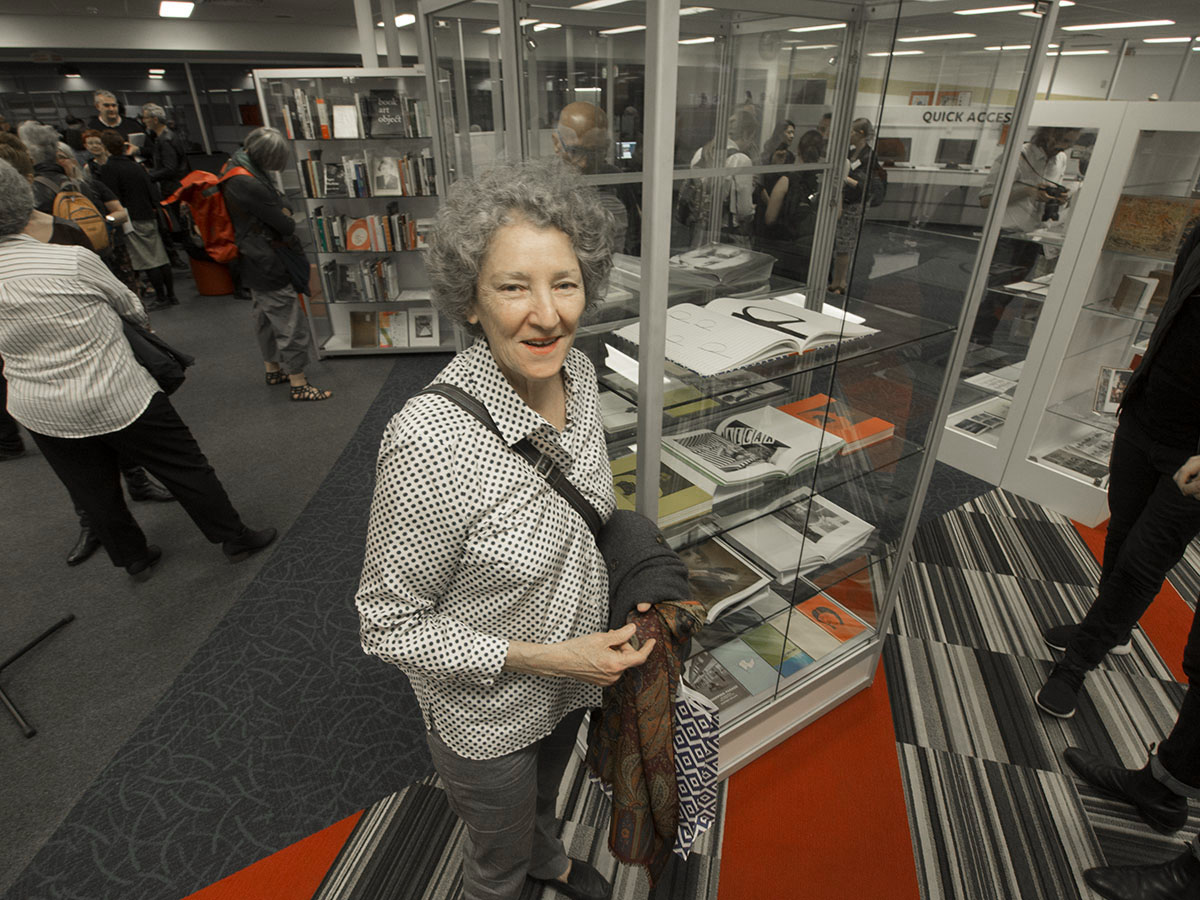
Noreen Grahame at the QCA Library and her ‘… & So’ artists book show
On the evening of the first day Robert Heather, Director, New England Regional Art Museum opened the exhibition “… & So” at QCA Library. The exhibition features a significant collection of seminal Australian and international artists books and multiples sourced predominately from Noreen Grahame’s Centre for the Artist Book collection and her numero uno publications alongside artists’ books from the Queensland College of Art. A list of the selected works can be downloaded here. ALA Books for abbe 2017 … $ so Exhibition list
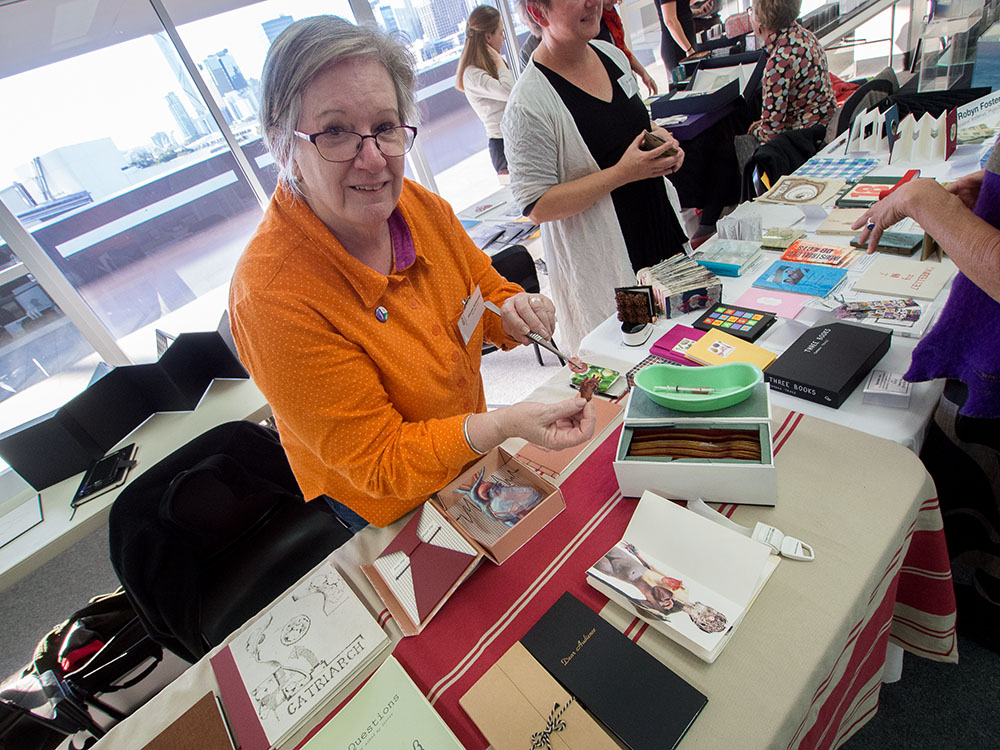
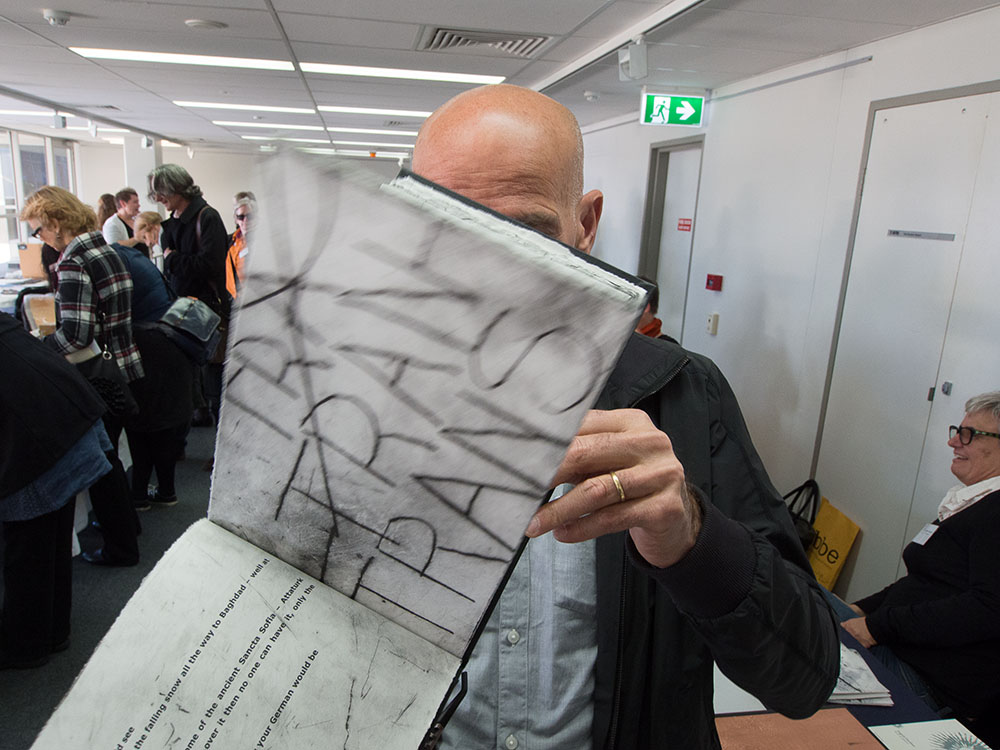
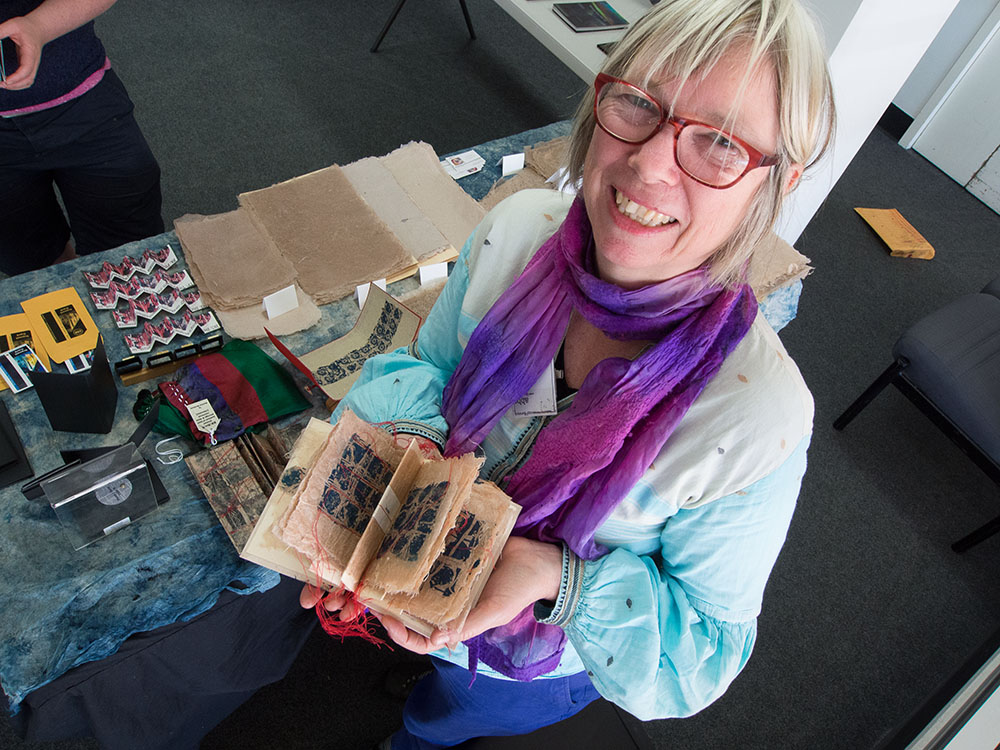
Mid afternoon on the second day the State Librarian and CEO from the State Librarian of Queensland Vicki McDonald opened the 6th artists’ books + multiples fair. Twelve tables presented a hand-to-eye experience of books by significant makers of contemporary artists’ books. These included:

A silhouette view of the Grahame Galleries tables
Stand 1 – grahame galleries + editions
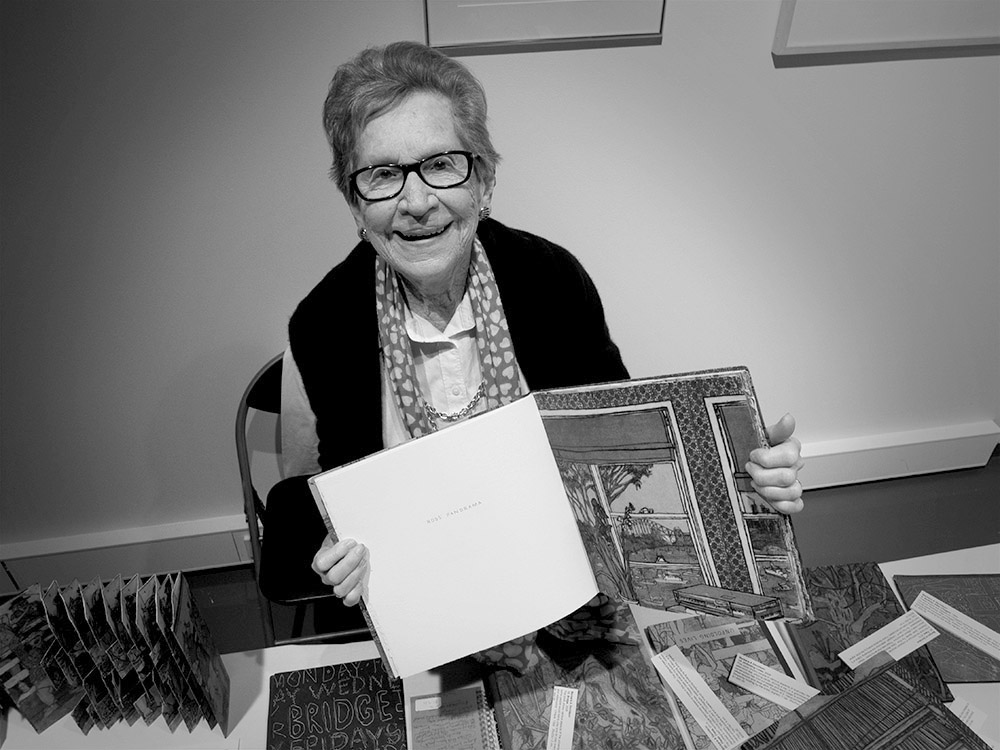
Barbara Davidson

Caren Florance
Stand 3 – Caren Florance – Ampersand Duck

Photo from ABBE Artists Book Conference July 6-9 2017 at the Queensland College of Art

Anne-Marie Hunter
Stand 7 – Psyclonic Studios – Anne-Maree Hunter
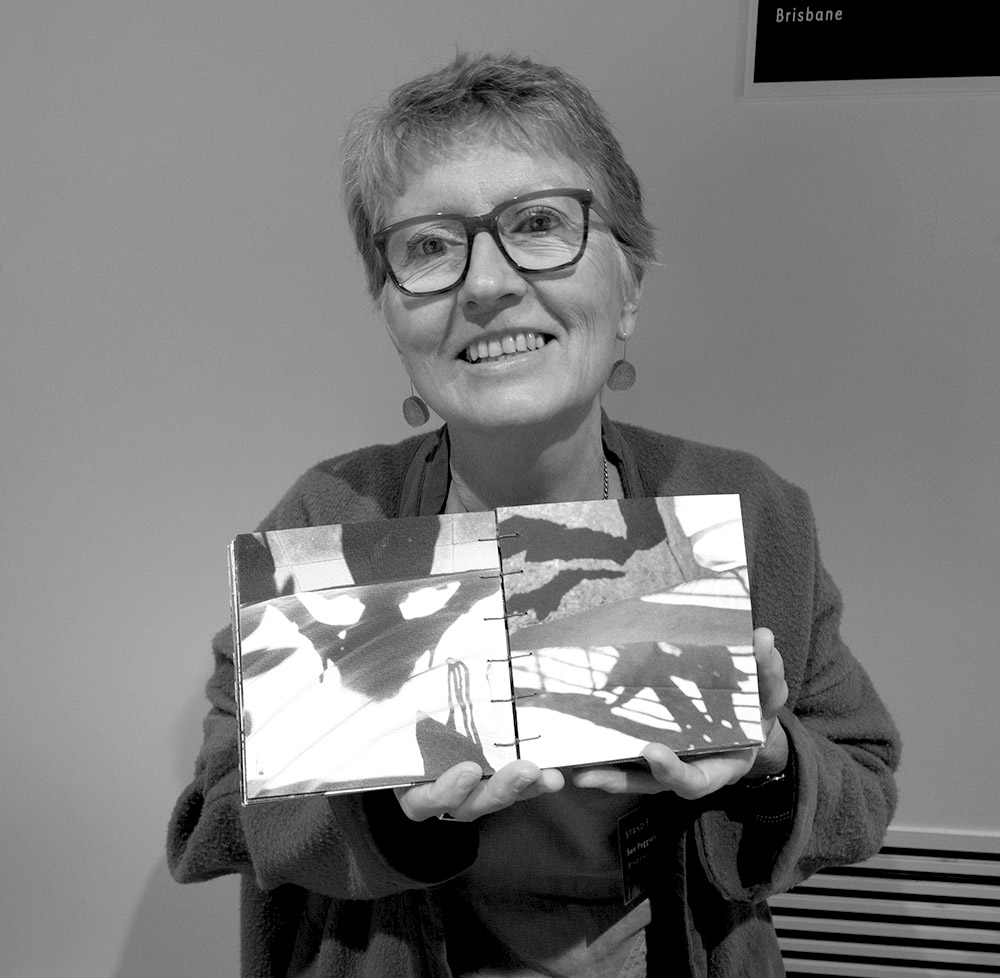
Sue Poggioli
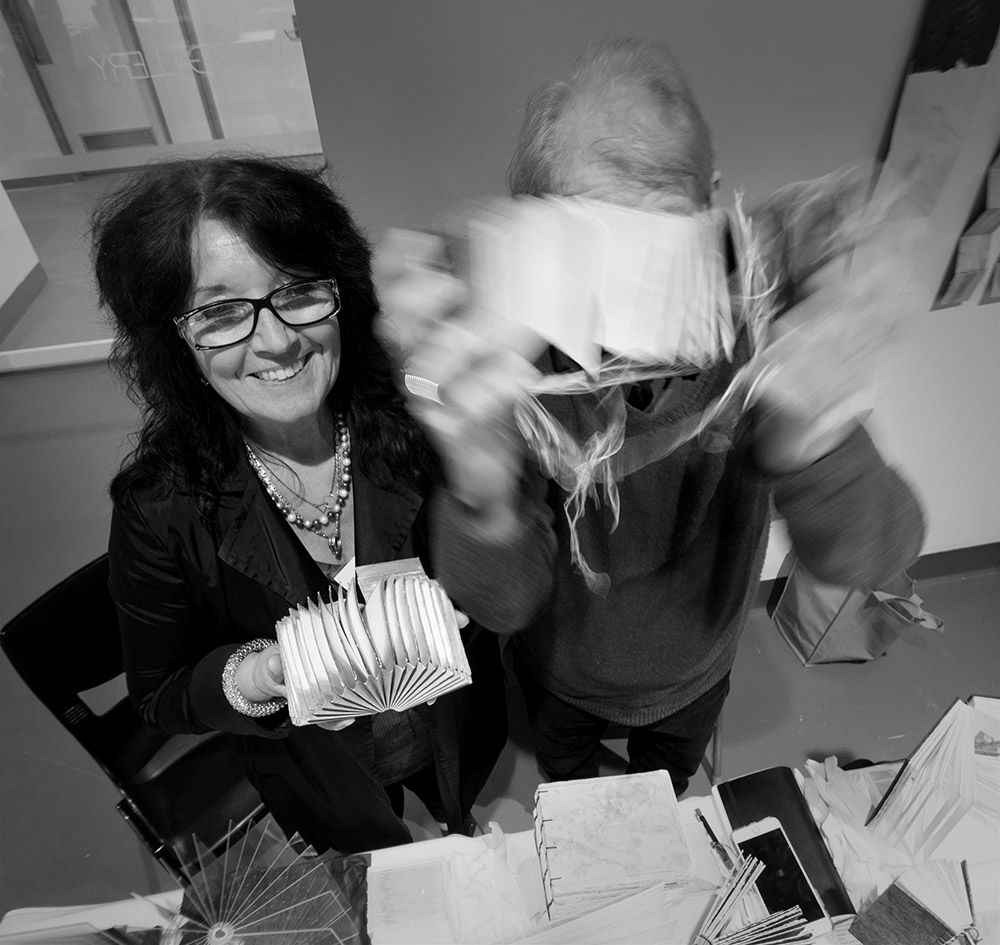
Adele Outteridge & Wim de Vos

Ulrike Stoltz & Uta Schneider
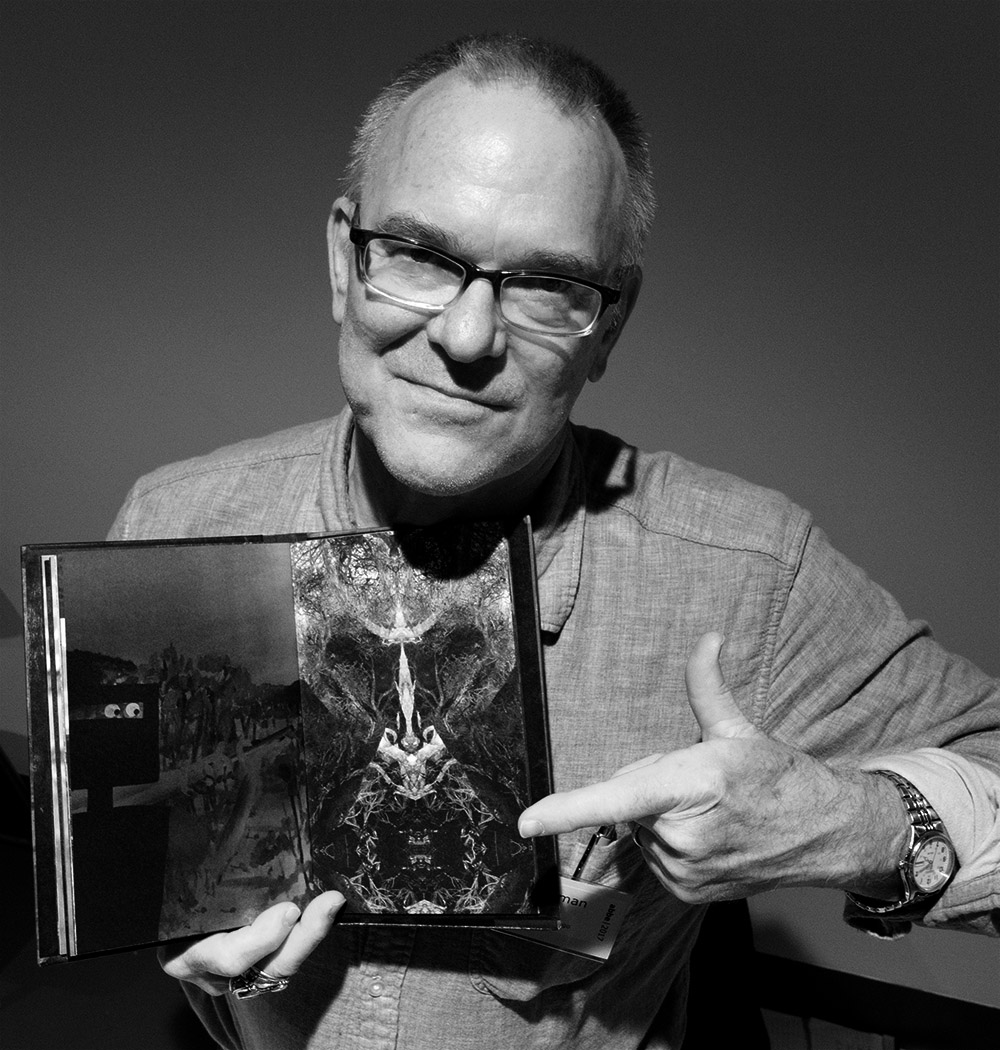
Brad Freeman

Anita Milroy
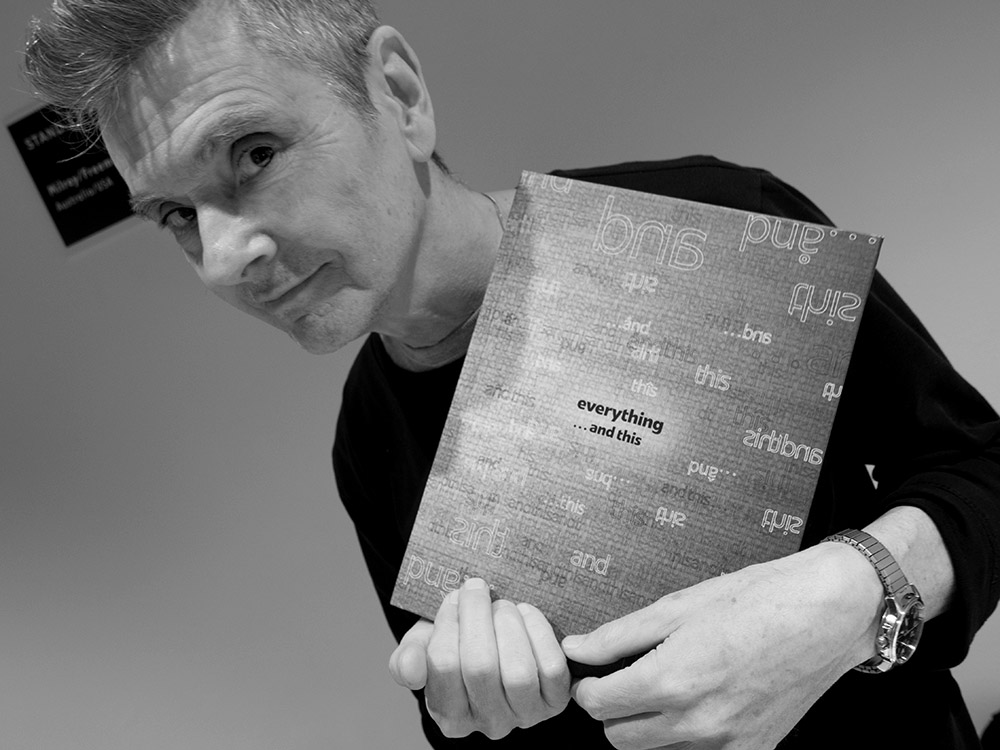
Lyn Ashby
Stand 11 – Milroy-Australia / Freeman-USA / Ashby-Australia
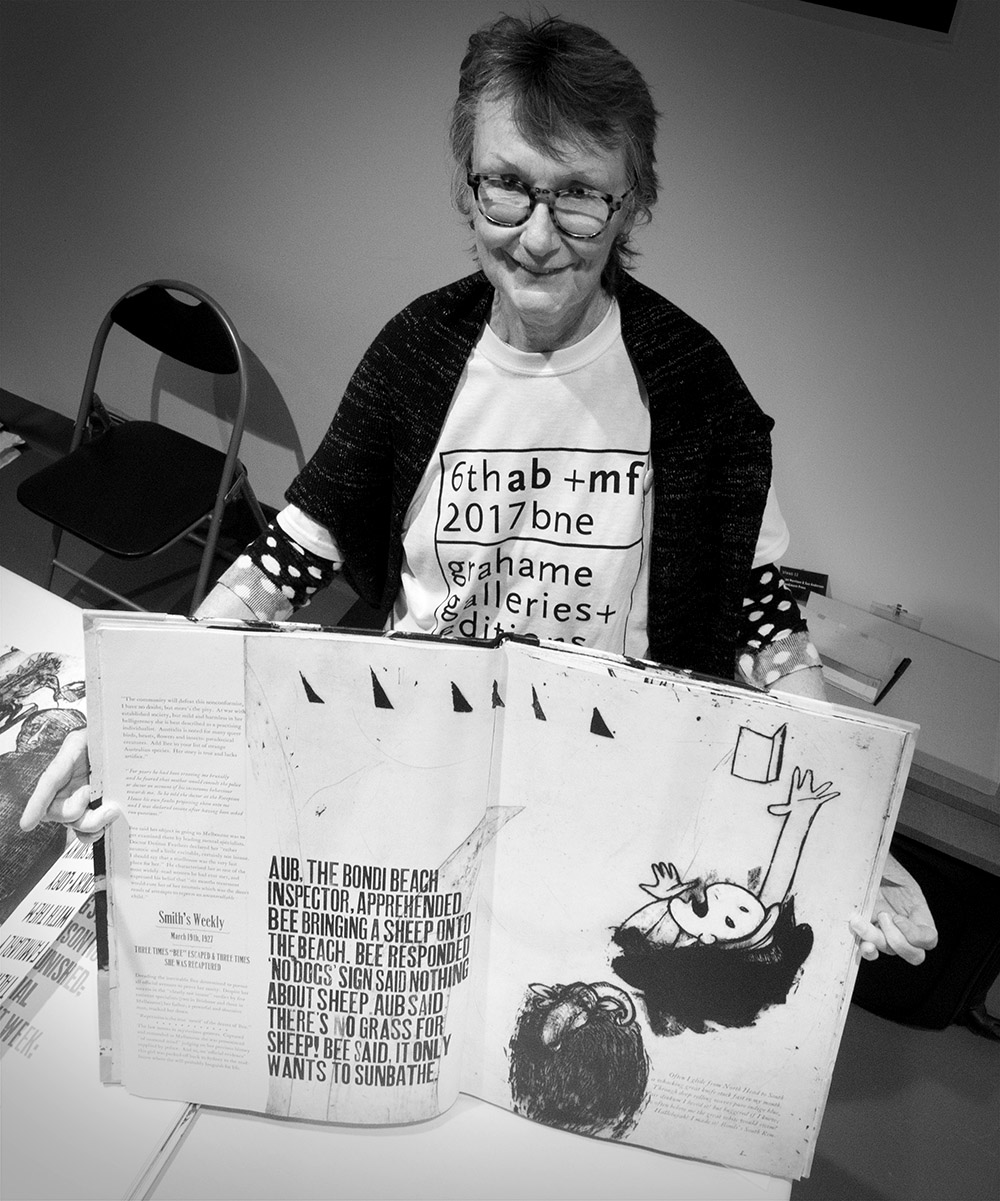
Sue Anderson

SLQ Australian Library of Art artists book exhibition
To complement the theme of the ABBE conference a special collection of concertina and folded books was curated by Christene Drewe of the Australian Library of Art at the State Library of Queensland. Open only for 2 hours on the Saturday morning of the conference this satellite event was well patronised. The Australian Library of Art is recognised as Australia’s premier public collection of artists books and the range of works presented was a testimony to the variety and depth of the collection. A list of the books displayed can be downloaded here. ALA Books for abbe 2017
In keeping with the conference theme the community of practice for artists books in this country is supported by the ‘folding’ and ‘unfolding’ of ideas, theories, concepts, access to exemplar book samples and the social connection that ABBE provides. While selected ABBE 2017 papers will be published in JAB, beyond that, the influence and impact of this gathering highlights the need for ABBE to provide this ongoing forum in Australia.
Dr Doug Spowart
All photographs and text ©2017 Doug Spowart
.
.
THE ARTIST & PHOTOBOOK MELBOURNE
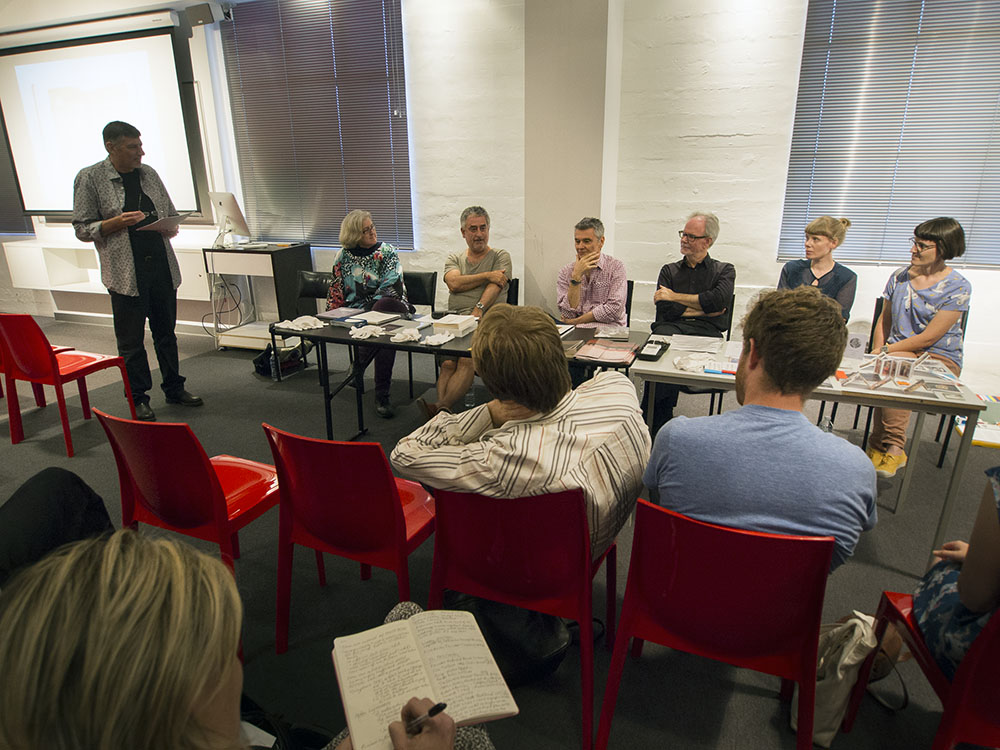
The forum panel….Photo: Anthony McKee
In February this year Melbourne hosted the biggest photobook event ever in this country. Called Photobook Melbourne the event brought together exponents, collectors and critics from around the world as well as from around Australia and New Zealand. Hundreds of books were handled, read and appraised in the many galleries and venues that came on board to support the event.
Martin Parr and Gerry Badger in their second volume of The Photobook: A History (2006), recognised artists who worked with photographs in a specific chapter entitled Appropriating Photography: The Artist’s Photobook.
Participants in the artists’ book discipline have been active indie, DIY publishers worldwide for sixty years or more and many of them use photography in their books. They have well established networks, events activities, awards, critical debate and collectors both private and public.
At a time such as Photobook Melbourne where all things photobook are celebrated and discussed it may be worthwhile to consider what concurrence may exist today between the artists’ book and the photobook. How do artists consider their use of photography and the photograph in their books? Is there any sympatico between the photobook and the artists’ book.
To address these and many more questions I was supported by the Photobook Melbourne organisers Heidi Romano and Daniel Boetker-Smith, to convene a forum to bring the voice of the artists’ book into the photobook conversation. The participants in the forum were; Dr Lyn Ashby, Gracia Haby and Louise Jennison, Peter Lyssiotis, Des Cowley and Dr Victoria Cooper (who was co-opted as Georgia Hutchison withdrew due to personal reasons in the final days).
The proceedings of the forum, with the support of the participants, have now been formed into a PDF booklet that can be downloaded FREE from this site. To provide a taste of the presentations I present the following quotes from the texts:
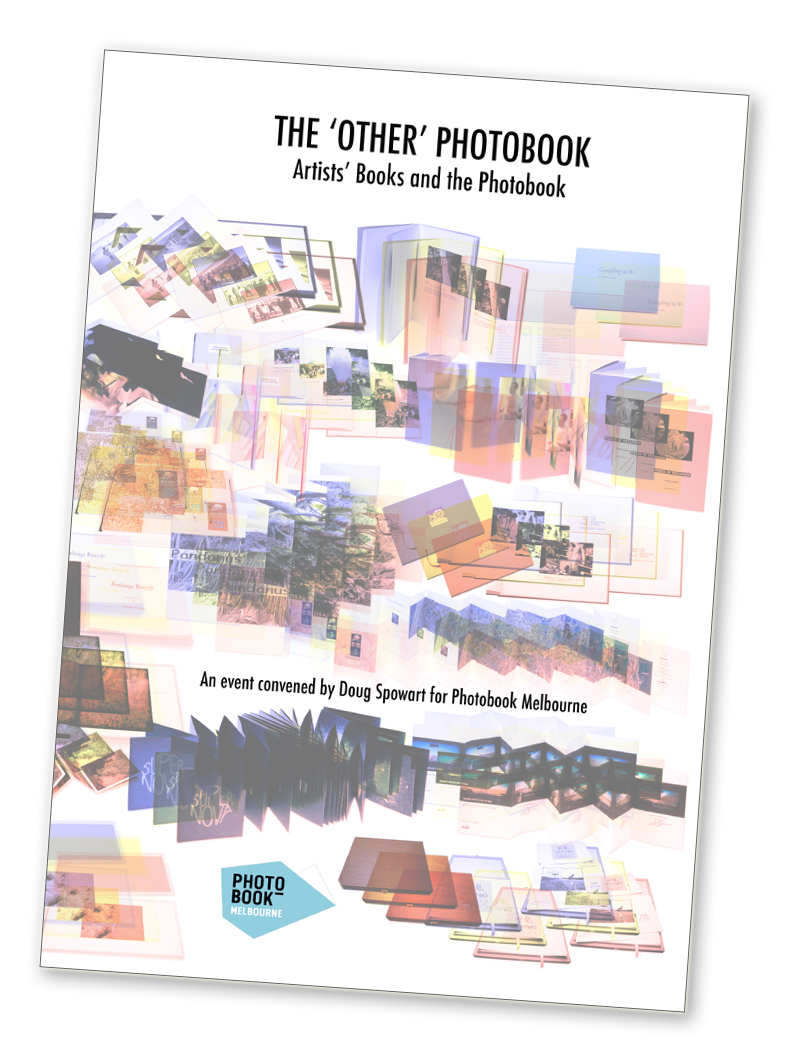
The PDF Forum book
.
DOWNLOAD HERE: PM-OTHER PB-BOOK
.
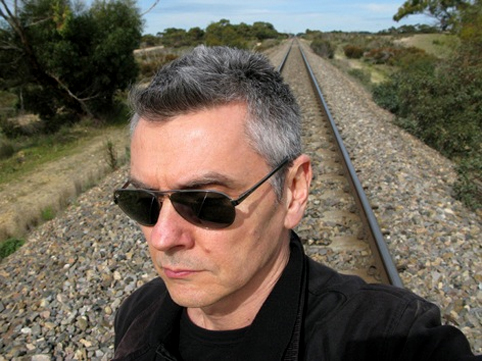
Lyn Asby
Lyn Ashby
I make books. With few exceptions, these are hand-made, limited-edition books that would generally be considered to be “artist’s books” using the standard codex form. These are not photographic books. That is, the photograph is rarely the core of the meaning or purpose of the book. But I often use components or aspects of photographs and composite these with graphics, texts, drawings and painting etc, all of which feed into the overall material on each page.
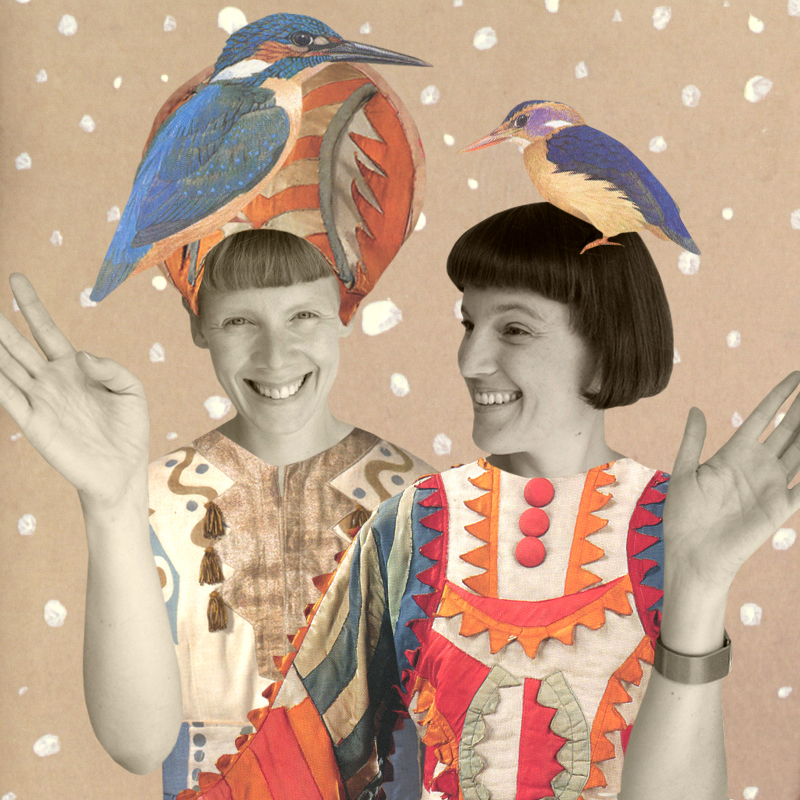
Gracia Haby + Louise Jennison
Gracia Haby and Louise Jennison
For those of you who we have yet to meet, we are besotted with paper for its adaptable, foldable, cut-able, concealable, and revealing nature. In our artists’ books, prints, zines, drawings, and collages, we use play, humour, and perhaps the poetic, to lure you closer. And sometimes this will incorporate photography. For us, it is not the medium that is always of greatest import, but the message. And so, we use found photographs in our artists’ books and zines not because they are photos, but because of what they can enable us to say, and what we hope you might feel.
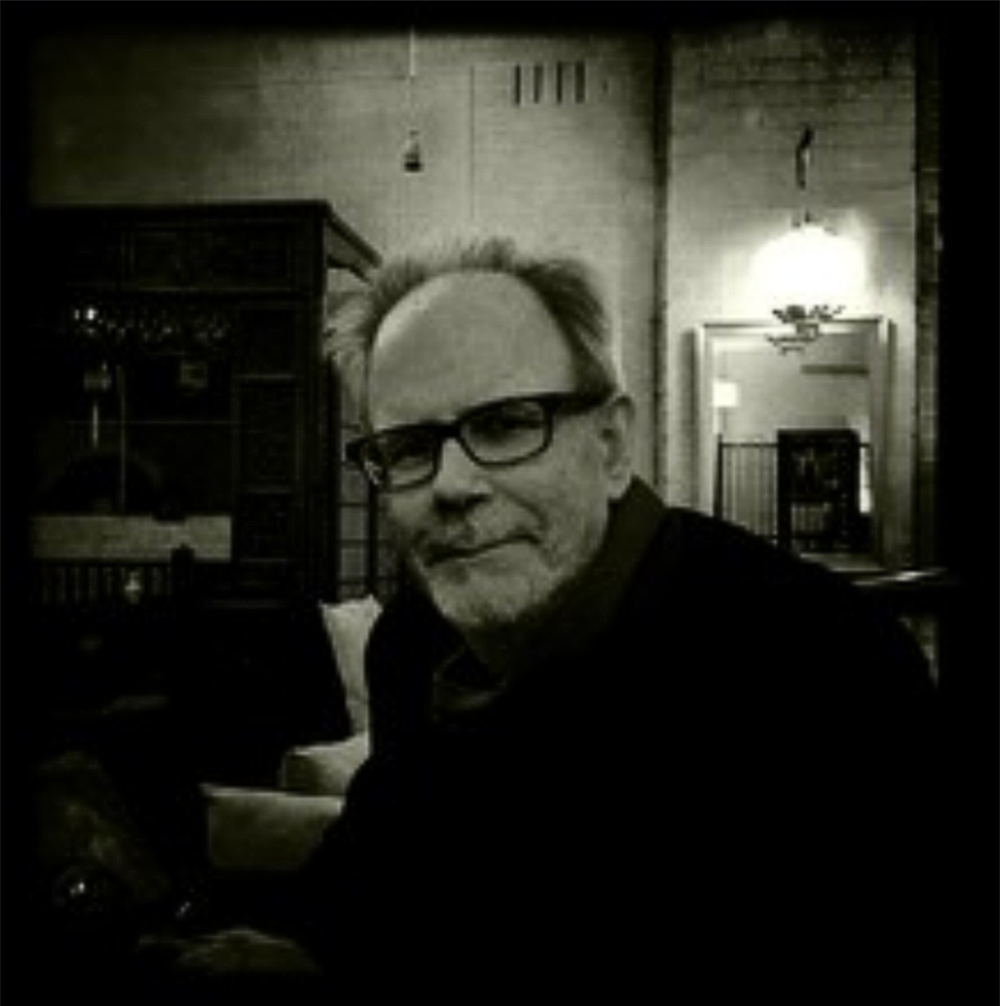
Des Cowley
Des Cowley
History of the Book Manager, Collection Development & Discovery, State Library Victoria
One of the challenges for libraries and collecting institutions is to build representative collections of contemporary books and ephemeral works created by artists, photographers, and zinemakers. Artists books, photobooks, and zines generally circulate outside mainstream distribution channels – publishers, general bookshops, distributors – and are effectively off-radar for many libraries. It is therefore incumbent upon staff in these institutions to build networks and relationships with the communities creating this work in order to be informed about what is being produced, and to ensure this material is acquired and preserved for future researchers.
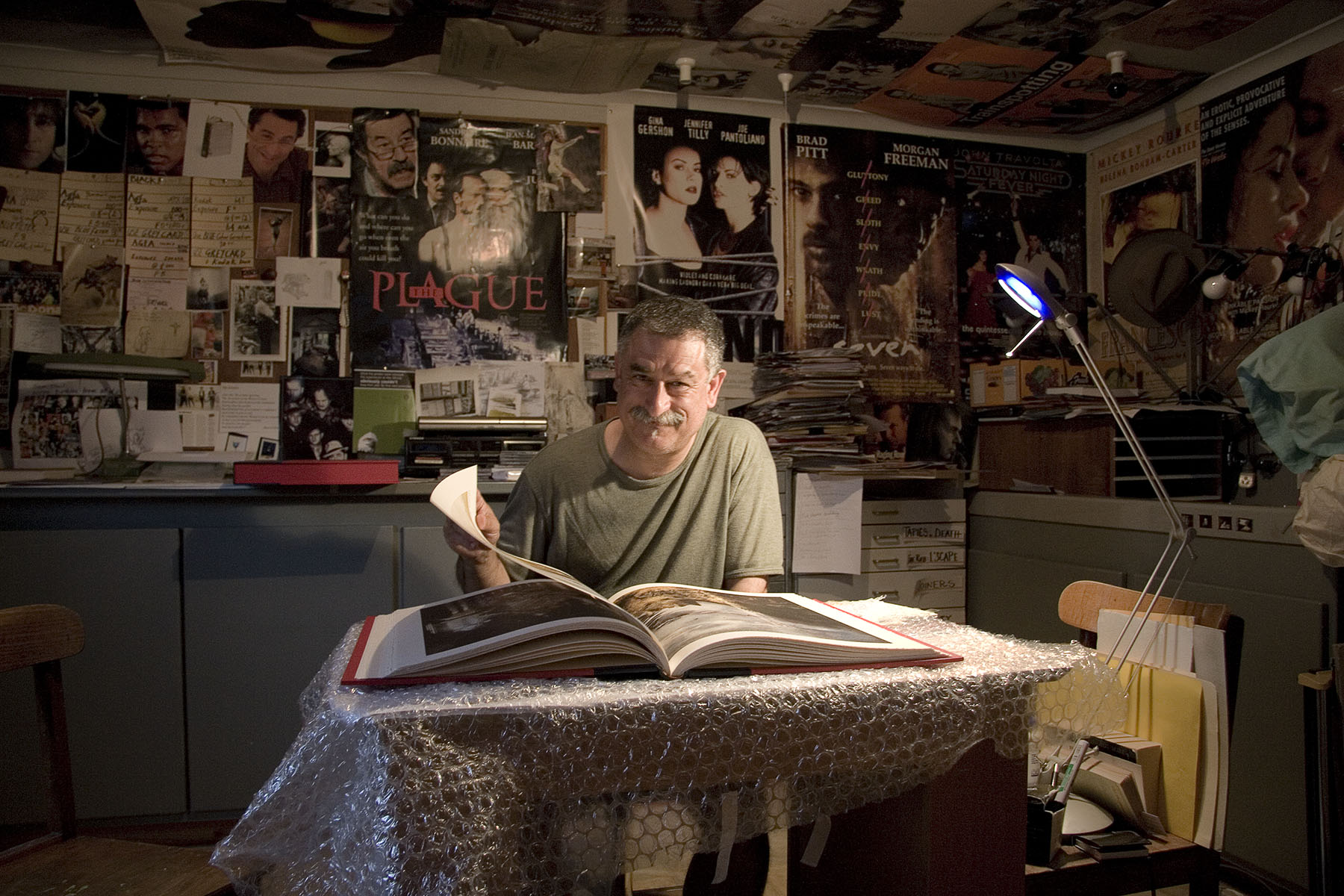
Peter Lyssiotis
Peter Lyssiotis
I had a friend who lived in Belgium. He died a while back. Before he did, though, he painted a pipe on a canvas and underneath it he wrote “This is not a pipe”.
To continue my friend’s mission I say “This is not a book”.
The artists’ book is rather a workshop, a garage; a space where a time-honored craft is practised: it is here that the world gets repaired, reconditioned, reassembled.
Victoria Cooper
Victoria Cooper
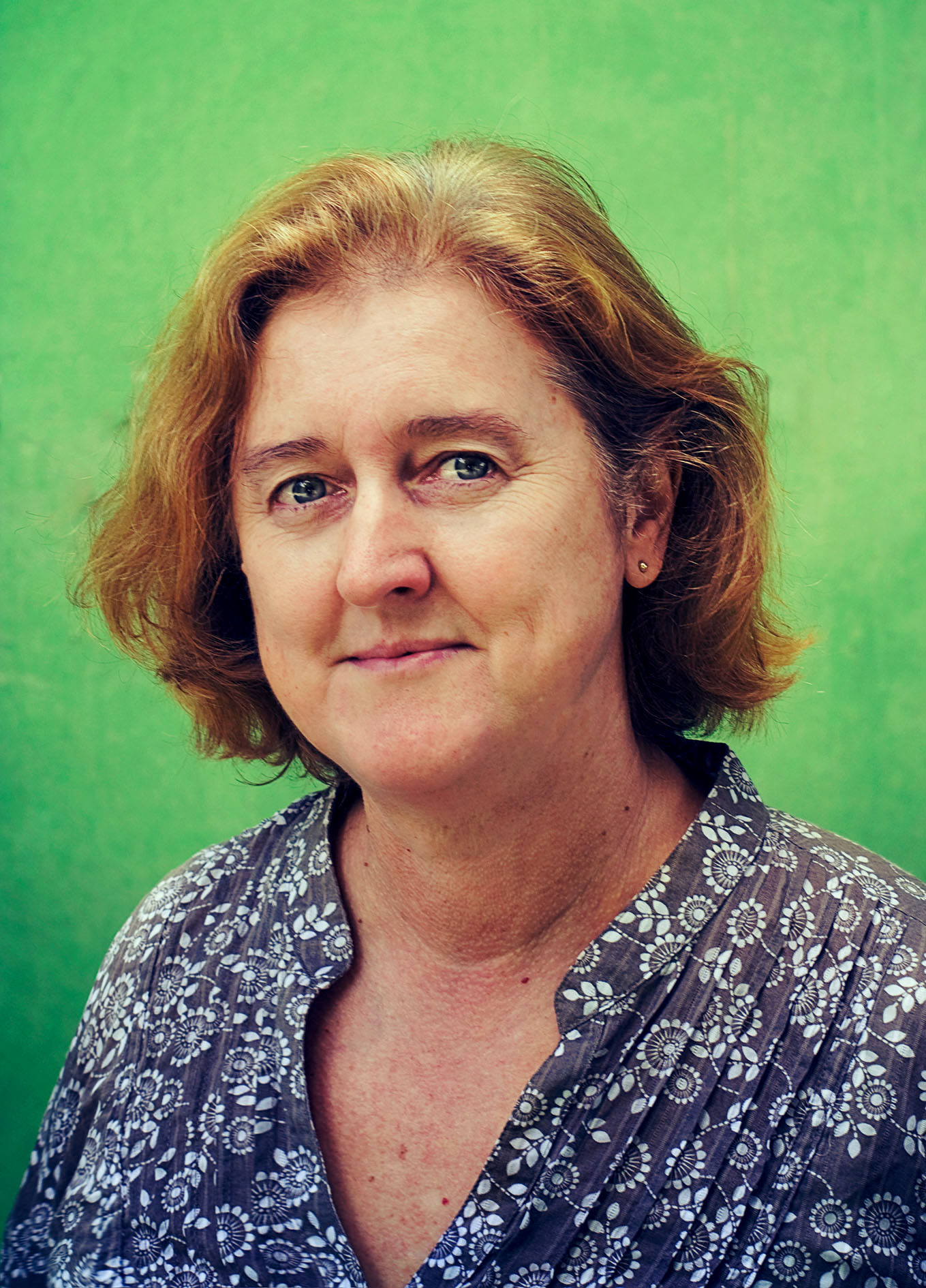
The digital cutting, dissecting, layering and suturing of the photographic quotations is an absorbing process through which the visual story emerges. I then materialize this virtual image of the narrative as a physical book in many forms: scroll, concertina or codex. Rather than images on a gallery wall, the narrative space of the book offers for me an endless potential for interplay of the corporeal and the imagination through the idiosyncratic experience of reading.
.
.
DOWNLOAD THE BOOK HERE: PM-OTHER PB-BOOK
.
.
.
ABBE: Artists books Brisbane Event 2015
ABBE Logo
For many years Queensland had a diversity of artists book activities: the bi-ennial Artspace Mackay Artists Book Forums and Libris Awards, the once yearly Noosa Artists Book Events and the Southern Cross University Acquisitive Artists Book Awards. Also contributing to this fertile artists book environment the State Library of Queensland’s Australian Library of Art which included the SLQ’s Siganto Foundation fellowships, ‘white glove’ presentations and events. Added to this were exhibitions and artists book fairs coordinated by Grahame Galleries and other shows at scattered venues. With the recent demise of the Mackay, Noosa and Southern Cross events their absence was felt by the artists book community. Now a new event has emerged to add to the SLQ and Grahame Galleries support of the art – the Artists Book Brisbane Event (ABBE). Over July 16, 17 and 18 ABBE featured a triptych of activities; a conference, an exhibition of books, an artists book fair and allied exhibition events at the State Library of Queensland, Grahame Galleries, The Studio West End, the IMA and Impress Printmakers Gallery.
The conference sought to address 3 main themes relating to the artists book:
- post literacy
- materiality/the haptic
- the nature of reading artists books.
Three keynote presenters lead the program:
- Sarah Bodman – Senior Research Fellow for Artists Books, CFPR editor of the Blue Notebook
- Brad Freeman – Founder and editor in chief of the Journal of Artist’s Books
- Dr Lyn Ashby – Australian artist and scholar making books
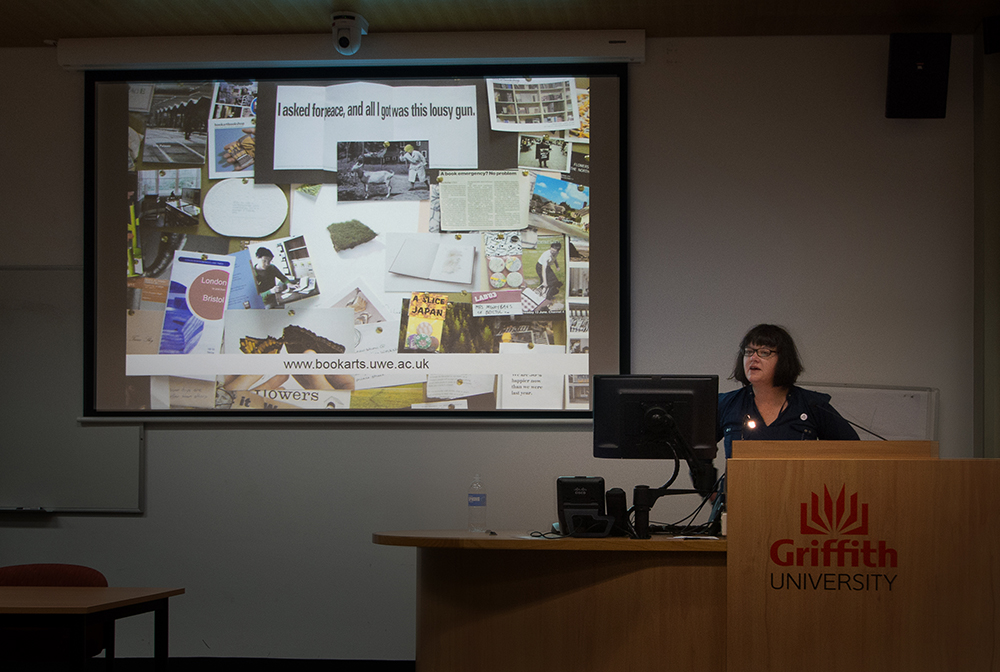
Sarah Bodman presents her keynote lecture
.
SARAH BODMAN (Abstract)– ARTISTS’ BOOKS AS A PHYSICAL SITE OF PRACTICE
If a post-Literate society might also encompass new ways of thinking about reading, we could think of contemporary artists’ books as a site of practice beyond that of McLuhan’s sign posting of the invention of moveable type as fundamentally responsible for how the Western world physically reads: “along the straight Lines of the printed page.”
We seem to have already moved from Linear to non-linear reading; we are used to flitting through digital screen-based texts, and losing our attention through a multitude of online multi-tasking. Physical engagement with artists’ books provides us with spaceto breathe, a slower rhythm of ingesting information and time to reflect, so what about the artists who are making them? How are artists engaging with the physical book now?
These examples focus on celebrating the book as a physical container used by artists to: re-present language, offer performative reading, view how reading is perceived, appropriate text from novels and instructional manuals into new works, or to transform information from the virtual into the physical.
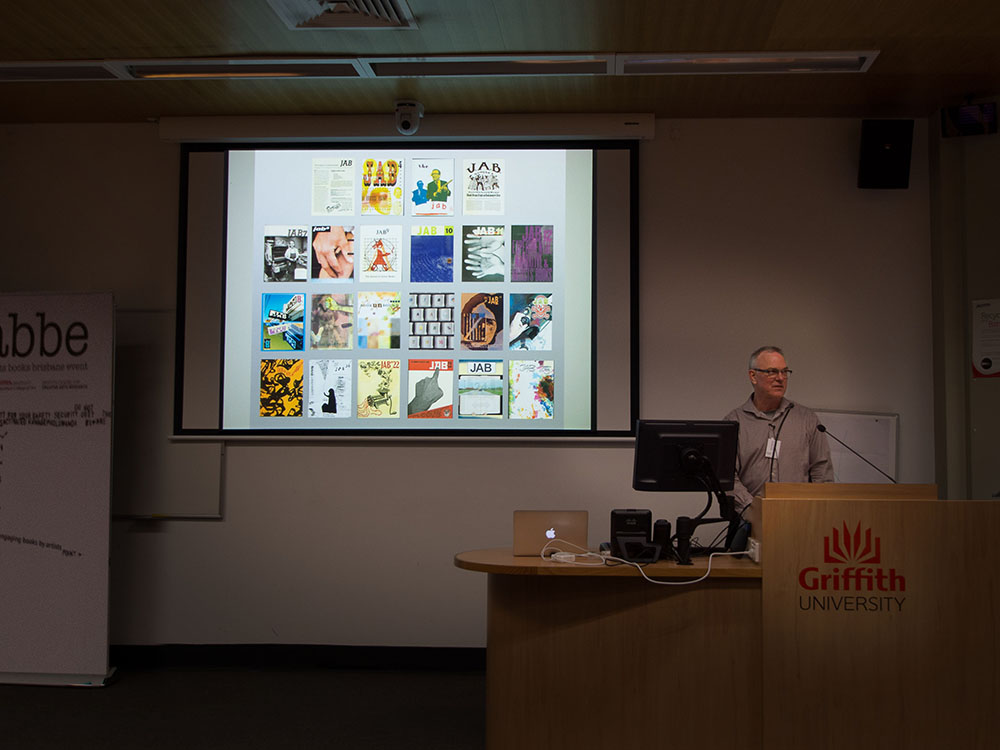
Brad Freeman presents his keynote lecture
.
BRAD FREEMAN (Abstract) – JOURNAL OF ARTISTS’ BOOKS
Brad Freeman’s Lecture focussed on JAB, the Journal of Artists’ Books, that supports critical inquiry into artists’ books. Since 1994 JAB has published interviews with contemporary artists whose primary medium is the artist book, reviews of artists’ books, and essays about historical issues and contemporary artists and their work. JAB has a two pronged approach to culture creation via publication arts; an educational approach with critical writing and documentation of current activity; and second, a creative approach with publication art-exploring the creative potential of print and the book by commissioning artists’ covers (letterpress and offset), artist designed pages, and artists’ books made especially for insertion into JAB.
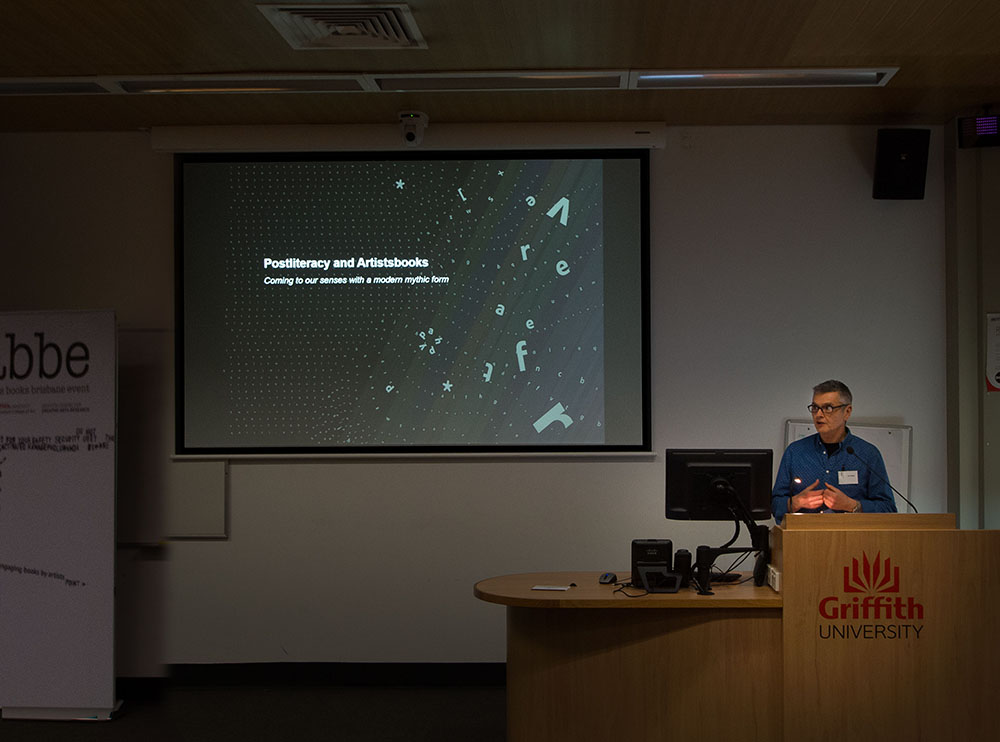
Lyn Ashby presents his keynote lecture
.
LYN ASHBY (Abstract) – POSTLITERACY AND ARTISTSBOOKS: Coming to our senses with a modern mythic form
This presentation is a speculation on the idea that contemporary artistsbooks may be the laboratory for a new literacy, and that in honor of the quietly evolutionary nature of this new literacy, we might call it “postliteracy”.
As background, it explores how our centuries of standard literacy and its attendant conventions of pictorial space and chronological, narrative time, have privileged a specific code in the representations of our language systems (both image and text) and their operations across the page and through the book. The prescriptions of these conventions and the domination of the line and the grid onto the look of language have come to minimise the participation (and uncertainty) of the senses in the direct process of apprehending meaning with language forms.
But the pages of artistsbooks are often filled with the explorations of other ways that language forms can activate a lively, sensory involvement with the page space, or how meaning can be formulated beyond the limitations of chronology.
Some of these experiments involve the invocation of pre literate, oral language structures that work more by the devices and grammars of music, song and myth than the usual strategies of standard literacy. in this way, the contemporary artistsbook may be the hardcopy home of a modern, mythic form.
.
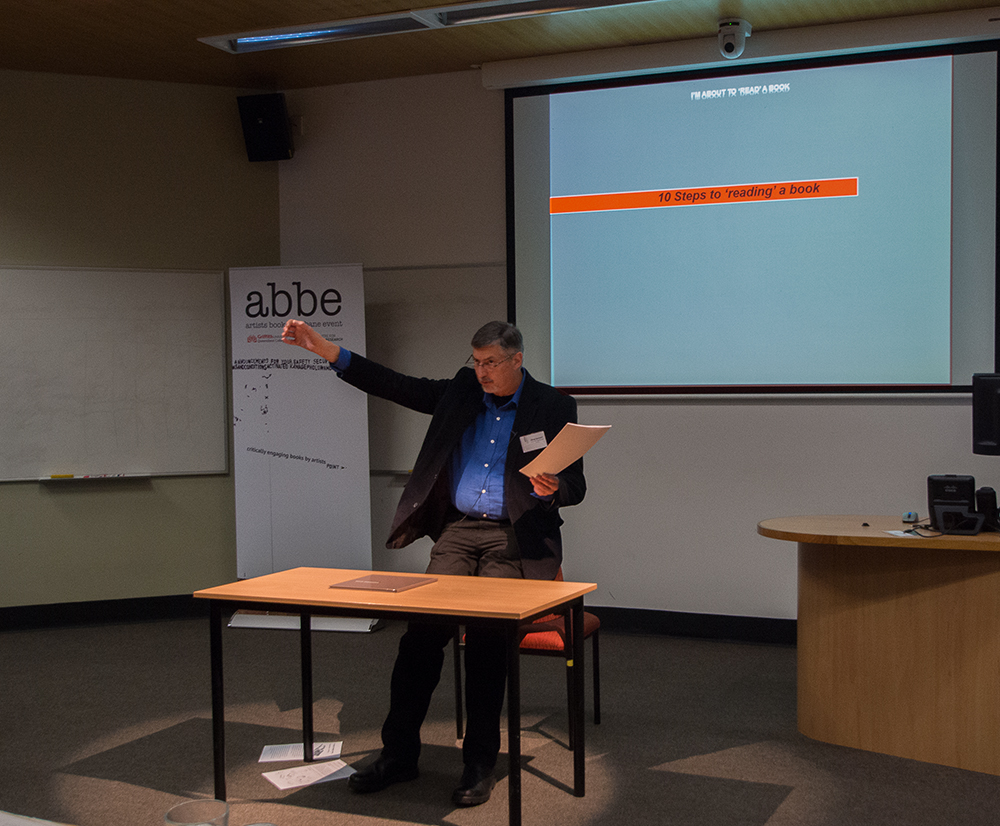
Doug Spowart performs his lecture ‘I’m about to ‘read’ a book’
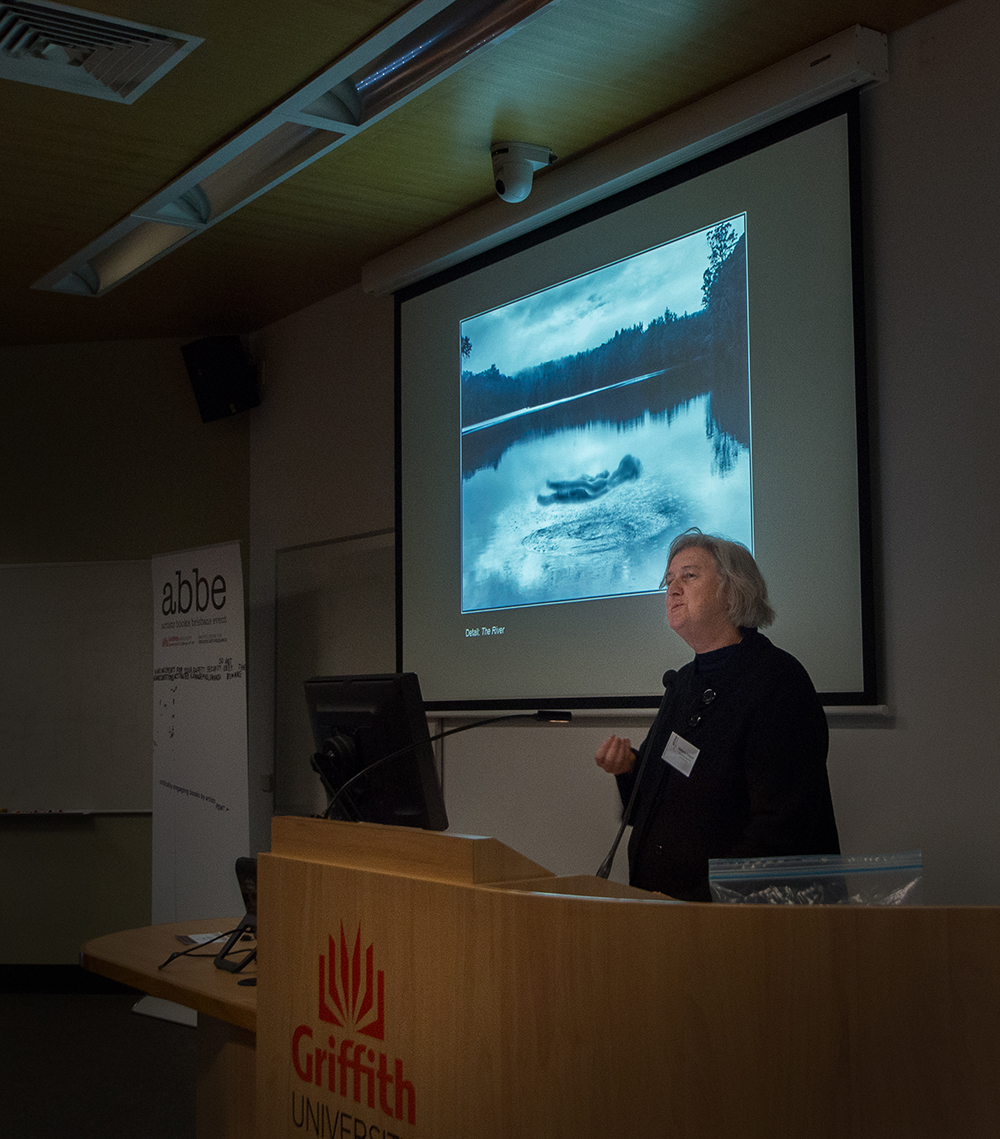
Victoria Cooper presents her lecture ‘The Grafted Image: The Montage’
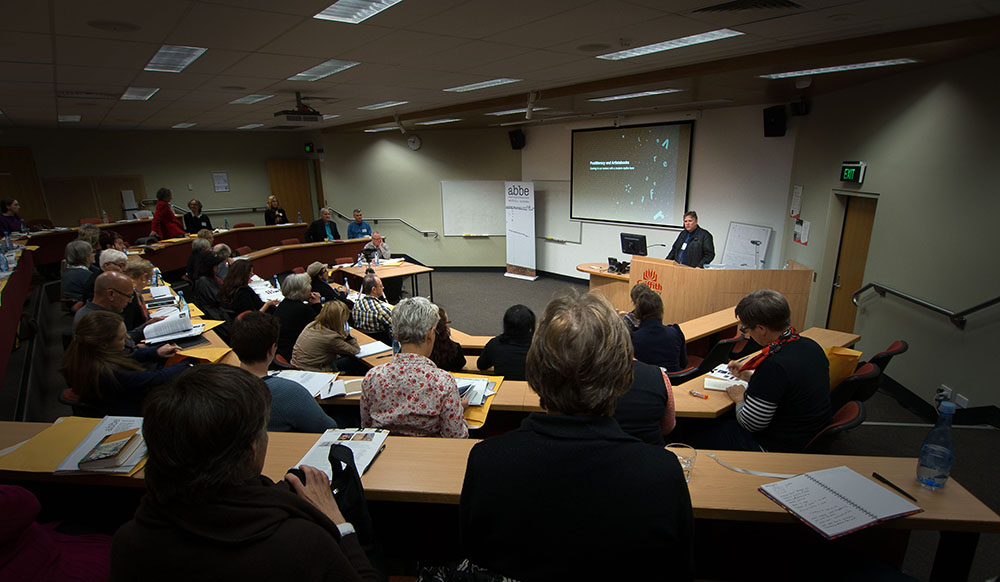
Tim Mosely presents in the lecture room
Presenting/Participating at the conference
.
- Lyn Ashby
- Sarah Bodman
- Sara Bowen
- Deidre Brollo
- Helen Cole
- Victoria Cooper
- Marian Crawford
- Daniel Della-Bosca
- Fiona Dempster
- Caren Florance
- Jenny Fraser
- Brad Freeman
- Angela Gardner
- Noreen Grahame
- Bridget Hillebrand
- Joel Lardner
- Marian Macken
- Tim Mosely
- Adele Outteridge
- Mikhail Pogarsky
- Doug Spowart
- Kym Tabulo
- Wim de Vos
- Gabriella Wilson
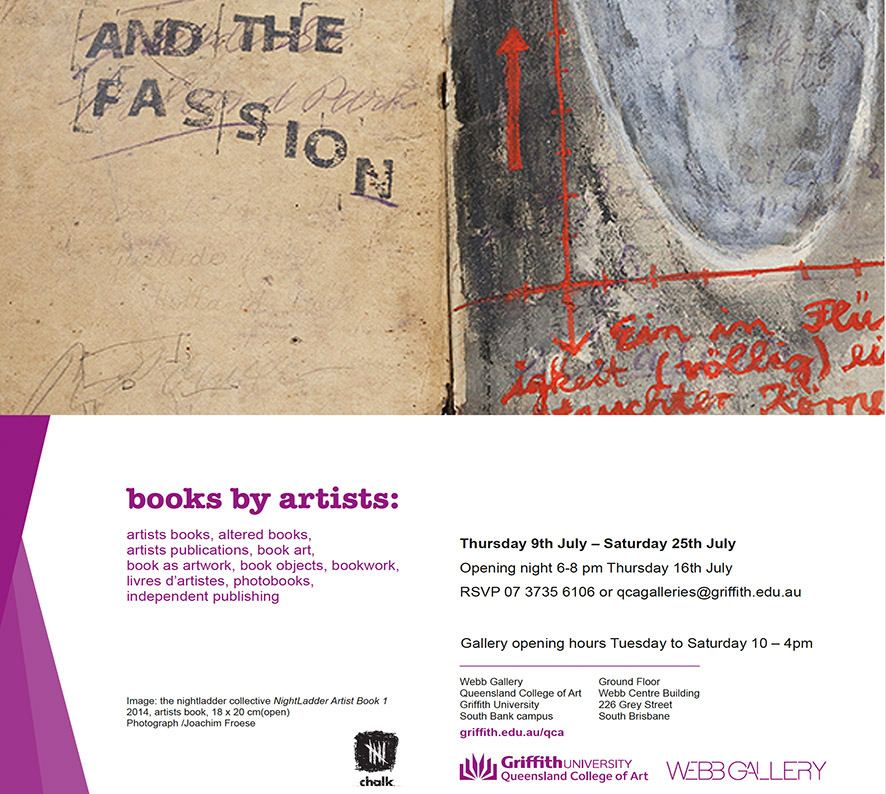
Invite – ‘books by artists’
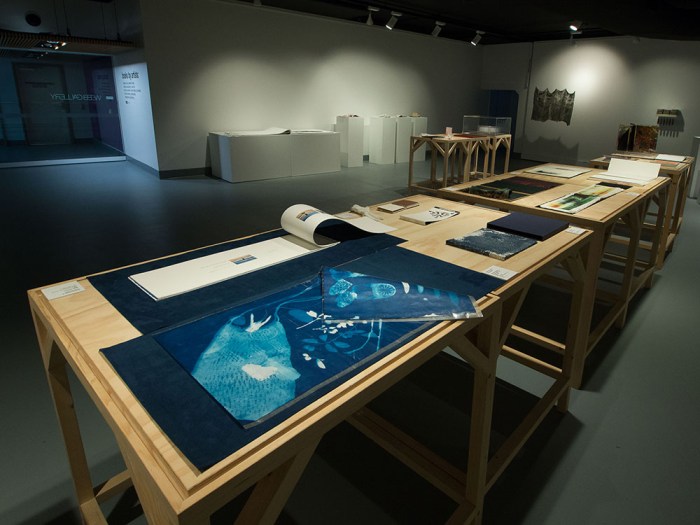
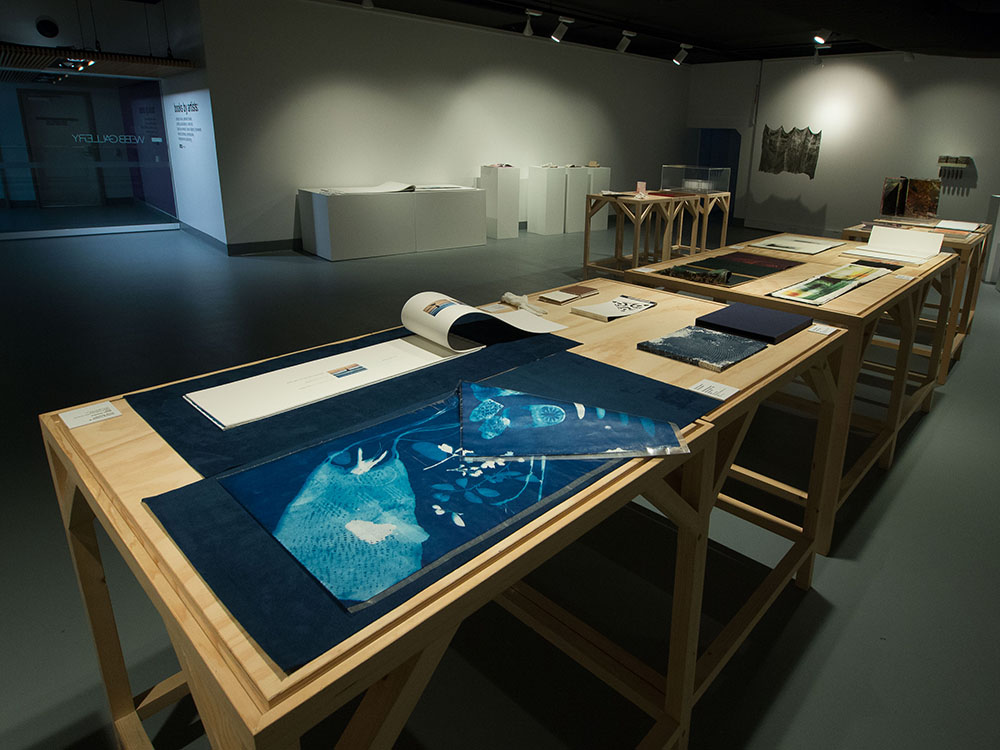
- books by artists’ in the Webb Gallery, QCA
The ‘books by artists’ exhibitors
- Isaac Brown
- Blogger_dad
- Penny Carey-Wells
- Victoria Cooper
- Caroline Craig
- Fiona Dempster
- Hesam Fetrati Angela Gardner
- Annique Goldenberg
- Alannah Gunter
- Institute of Modern Art Cassandra Lehman-Schultz
- Alison Mackay
- Judy Macklin
- Heather Matthew
- Tess Mehonoshen
- Christine Mellor
- Tim Mosely
- night ladder collective
- Naomi O’Reilly
- Adele Outteridge
- Mona Ryder
- Rose Rigley
- Glen Skien
- Doug Spowart
- Wim de Vos
.
.
THE ABBE ARTISTS BOOK FAIR
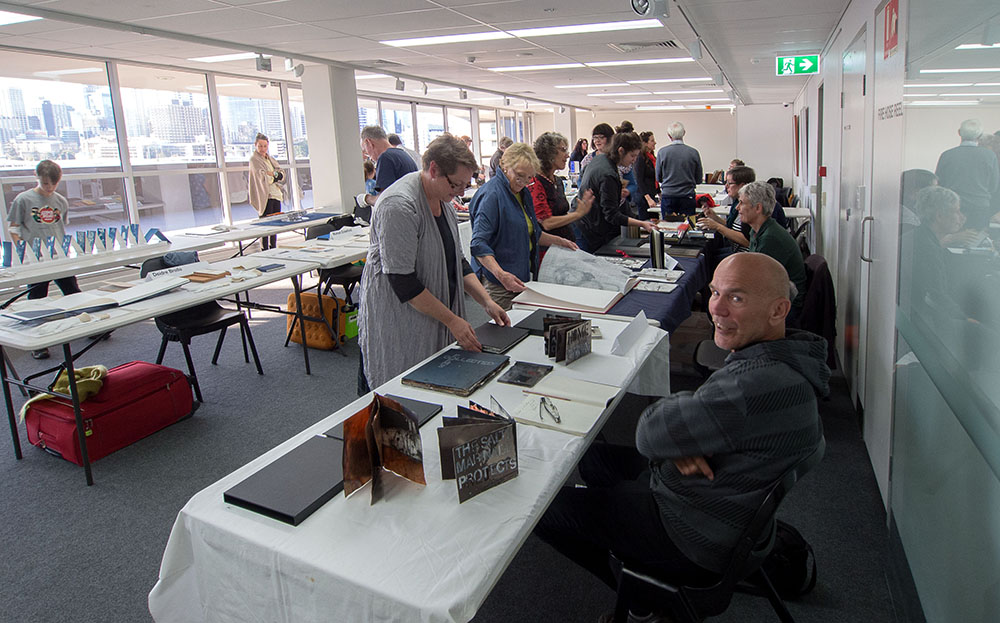
Artists Book Fair
.
Artists Book Fair stallholders
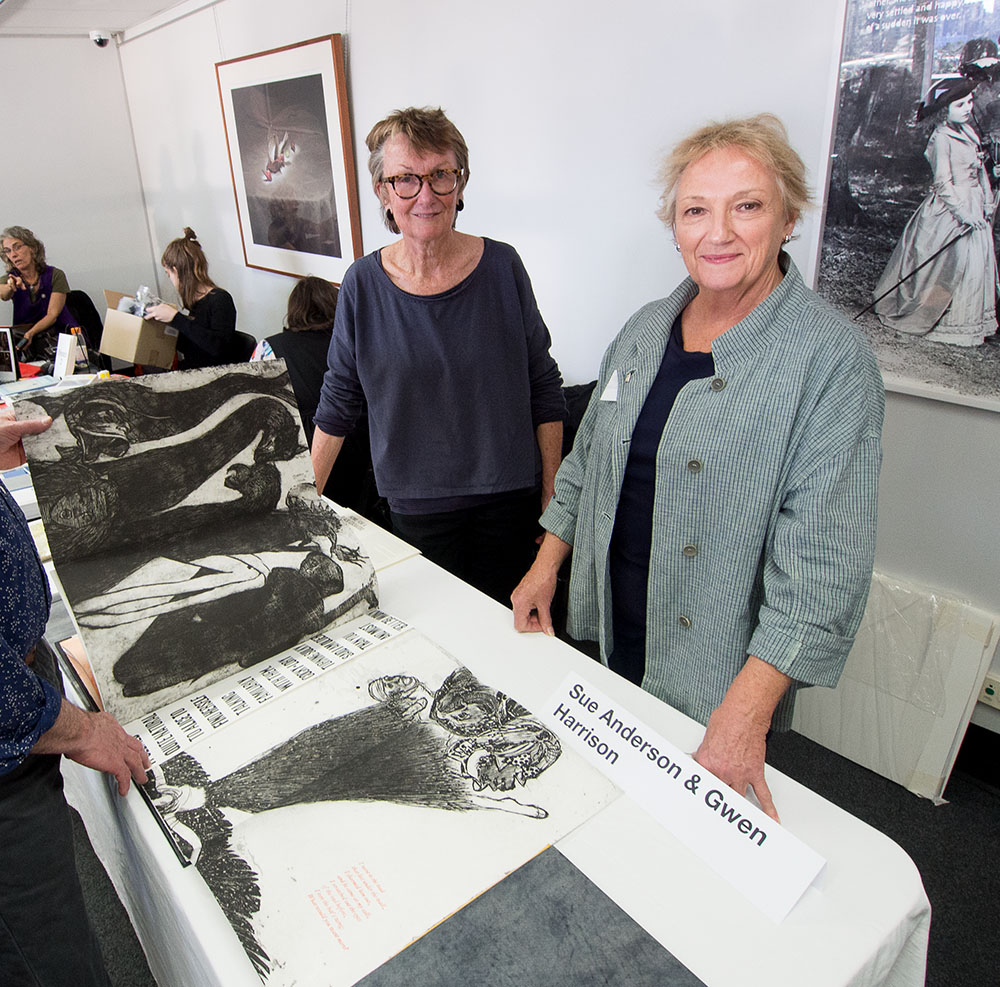
Sue Anderson + Gwen Harrison
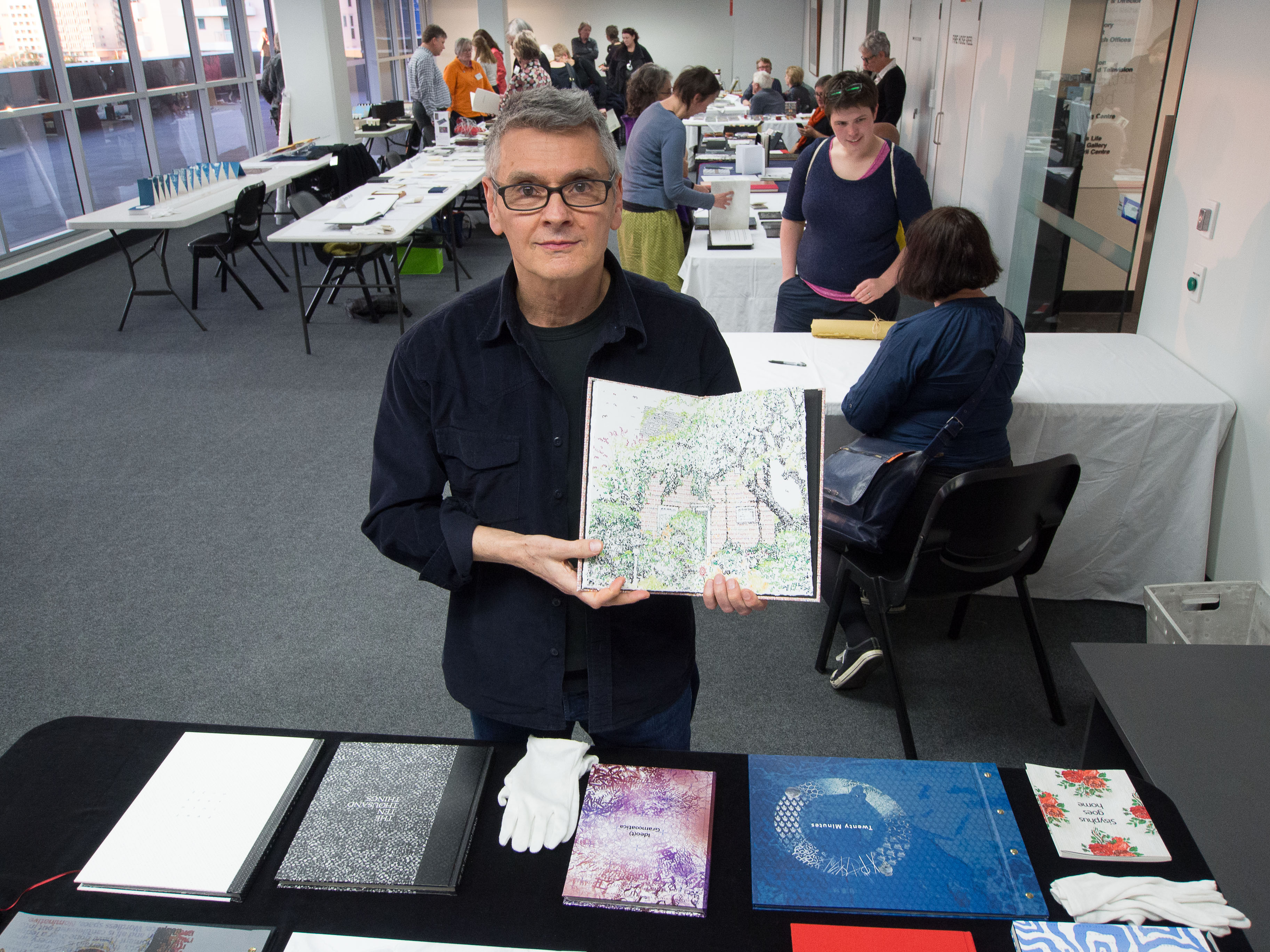
Lyn Ashby
Sara Bowen (no image taken)
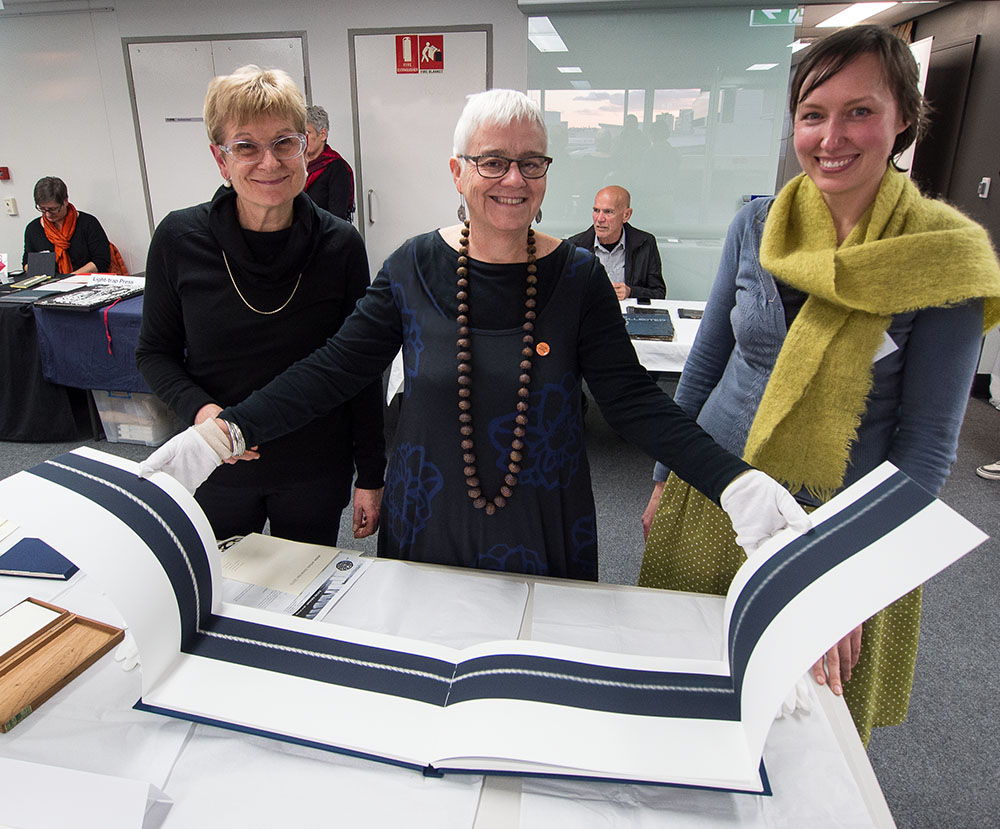
Deidre Brollo with Christene Drewe and Helen Cole
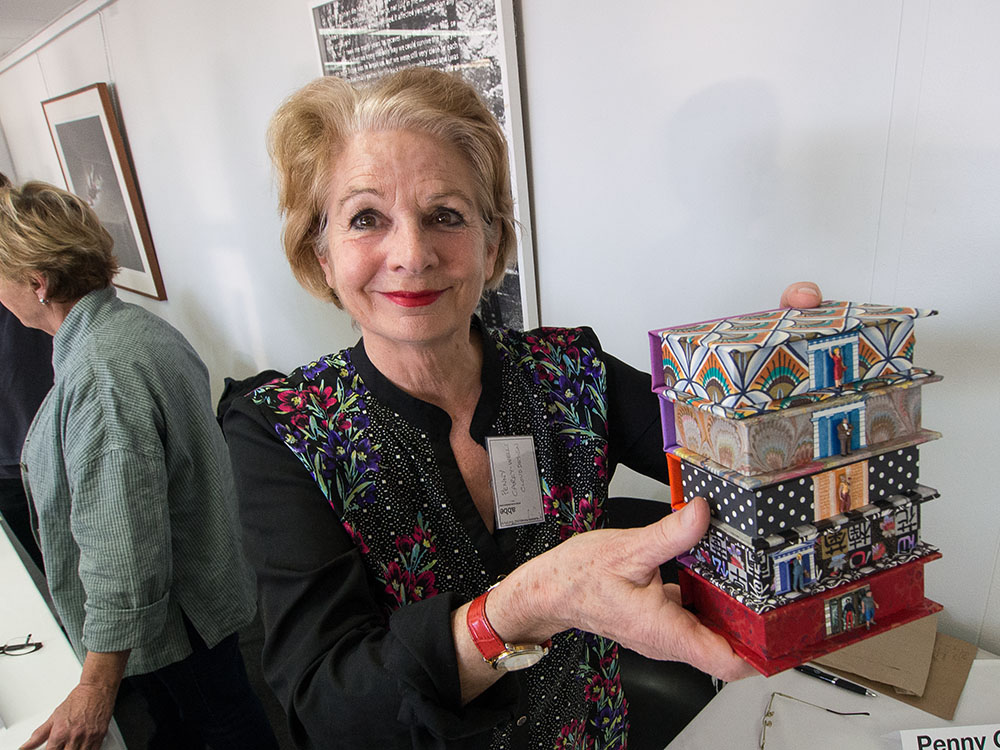
Penny Carey-Wells
Centre for Regional Arts Practice (Cooper+Spowart) (no image taken)
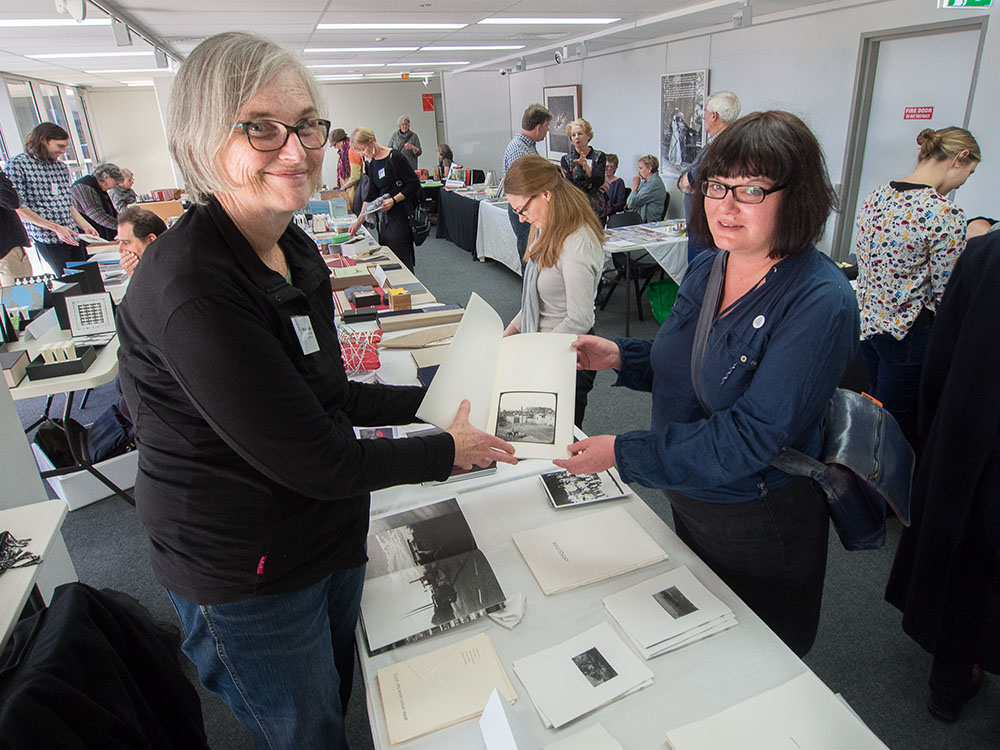
Marian Crawford with Sarah Bodman
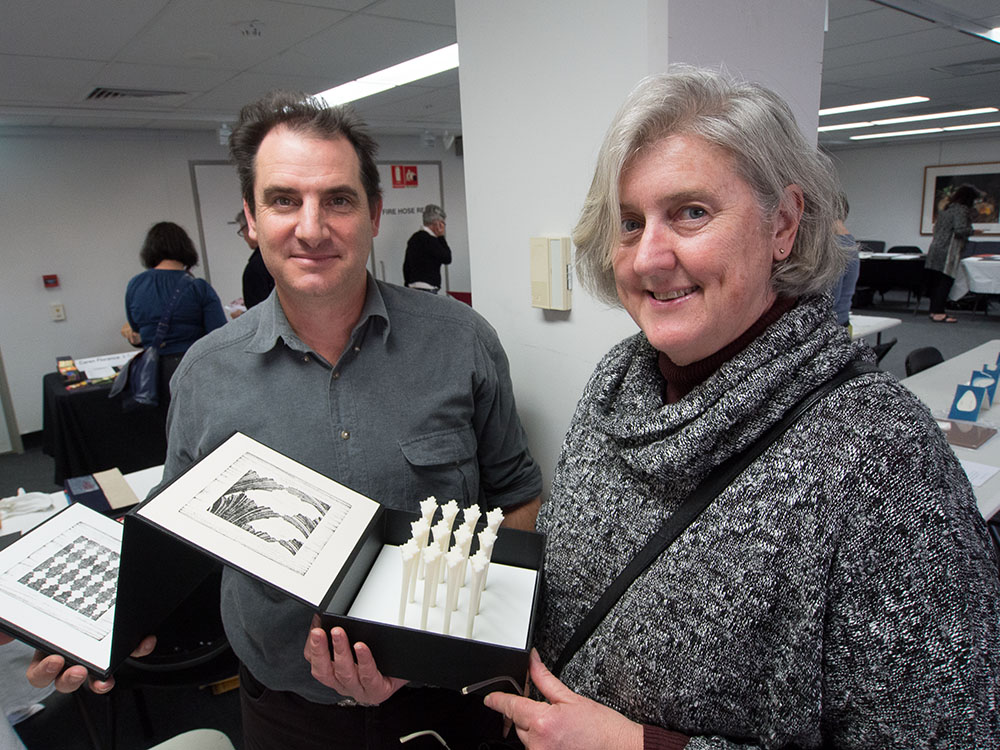
Daniel Dell-Bosca with Victoria Cooper
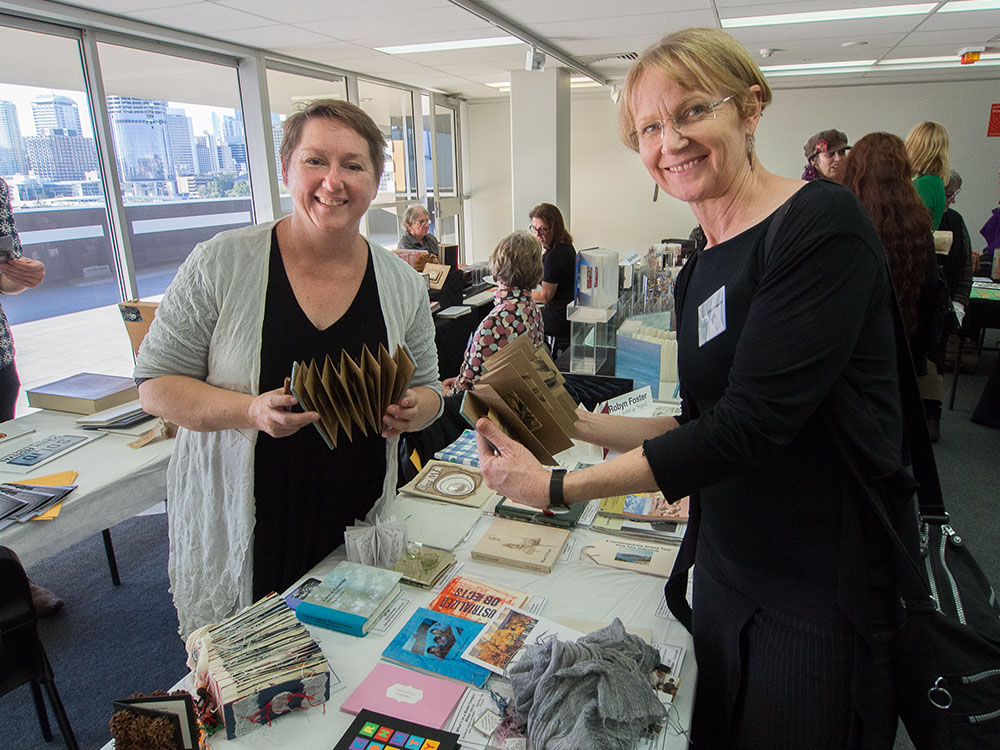
Robyn Foster + Fiona Dempster
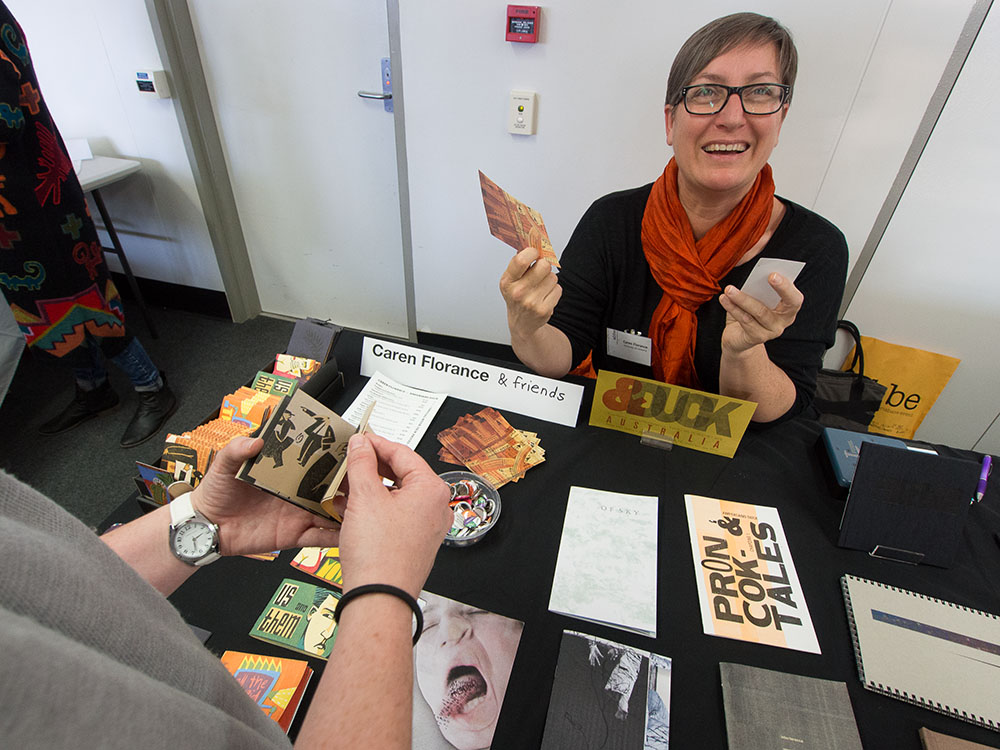
Caren Florance
Robyn Foster (no image taken)
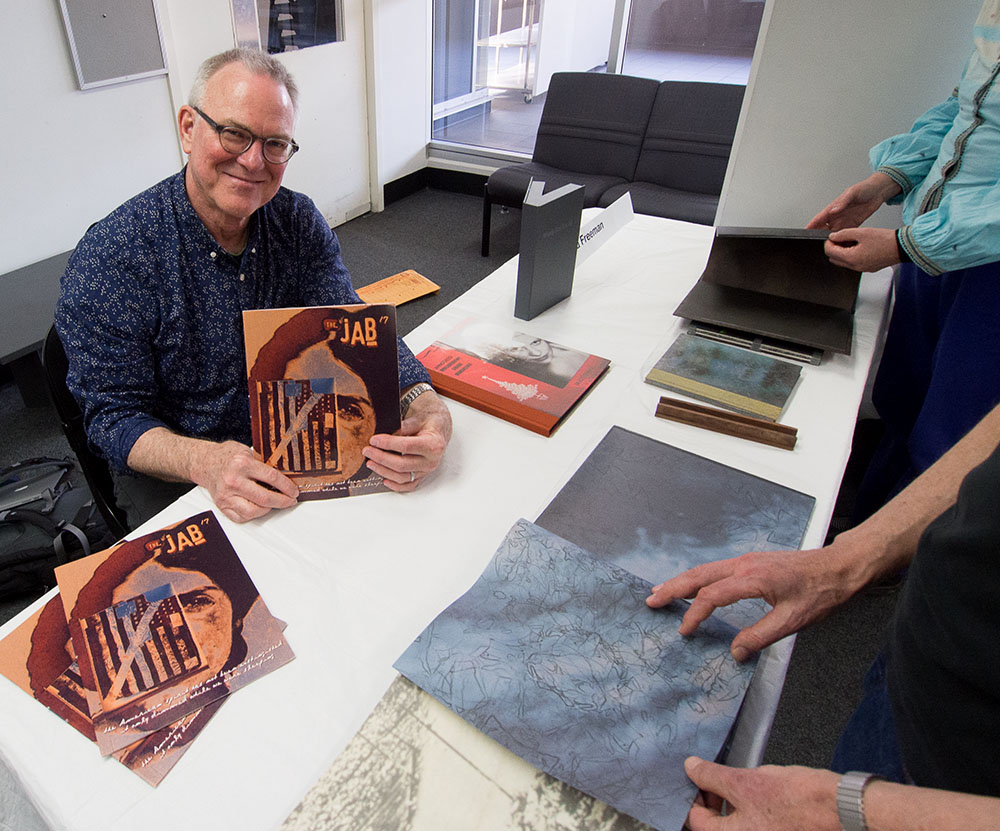
Brad Freeman JAB
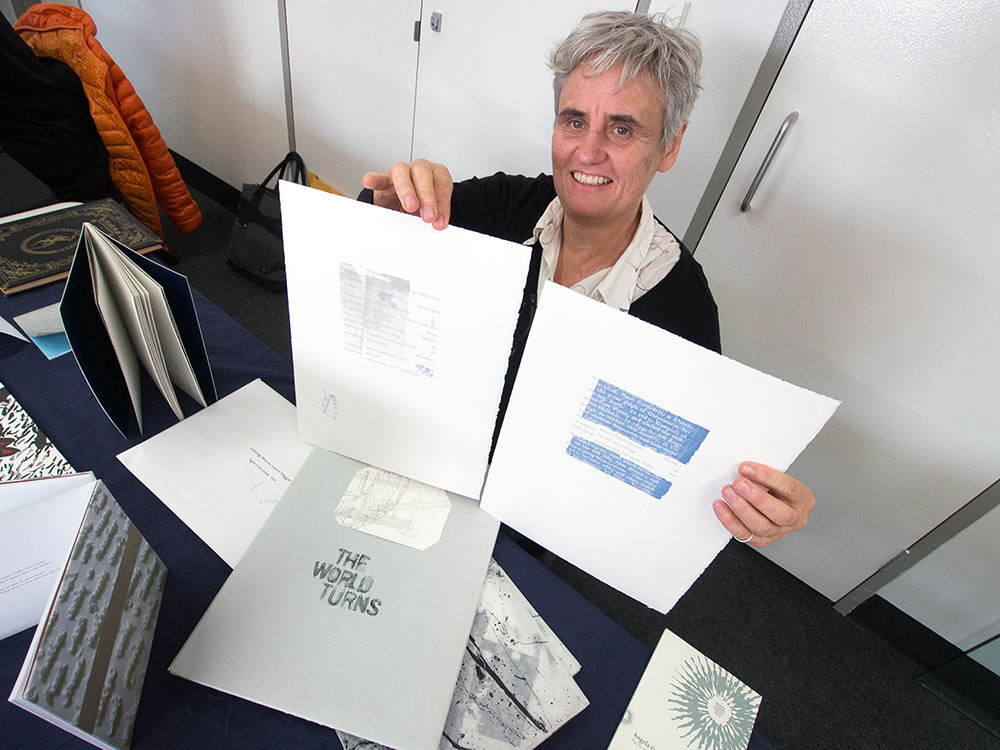
Angela Gardner
Griffith Centre for Creative Arts Research (no image taken)
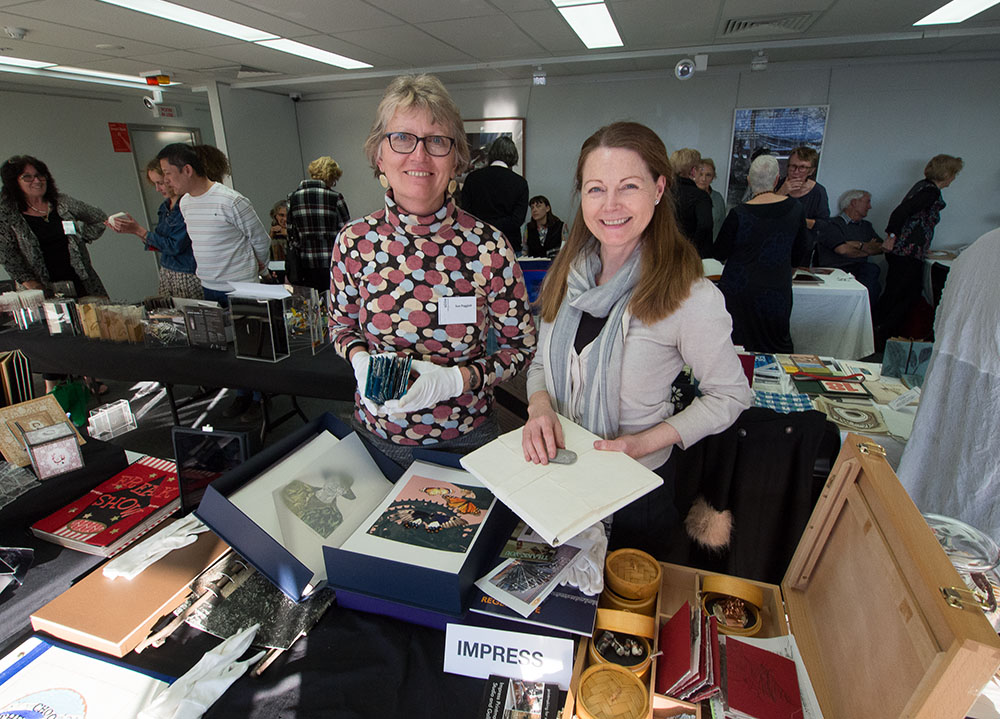
Impress Printmakers: Sue Poggioli + Jennifer Stuerzl
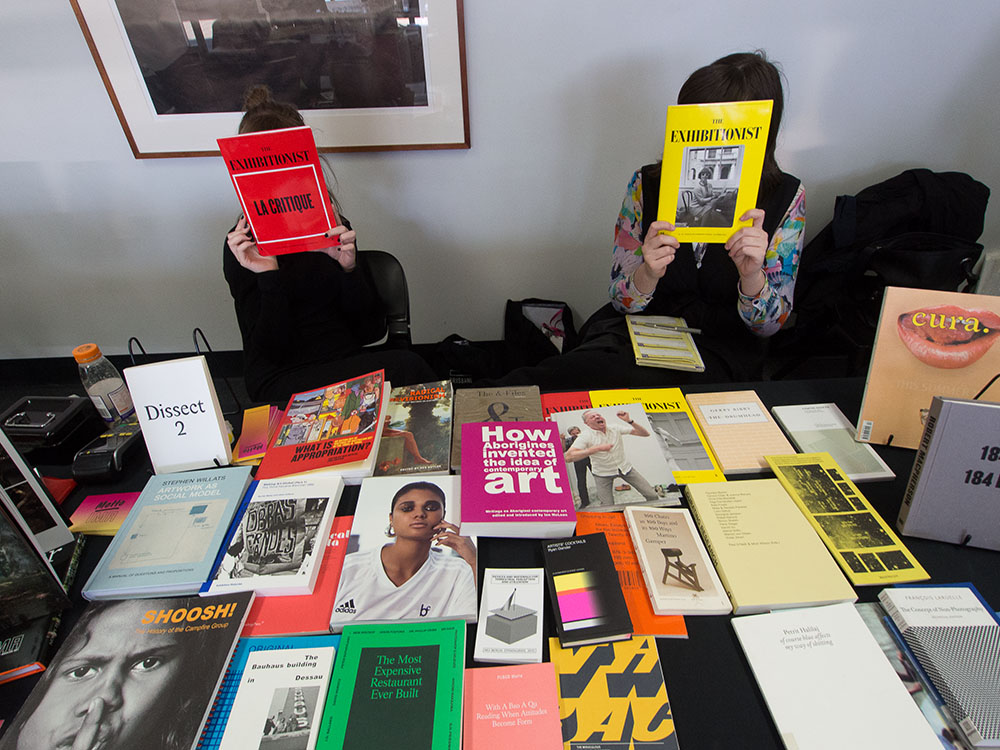
Institute of Modern Art
Sheree Kinlyside
Clyde McGill
Heather Matthew
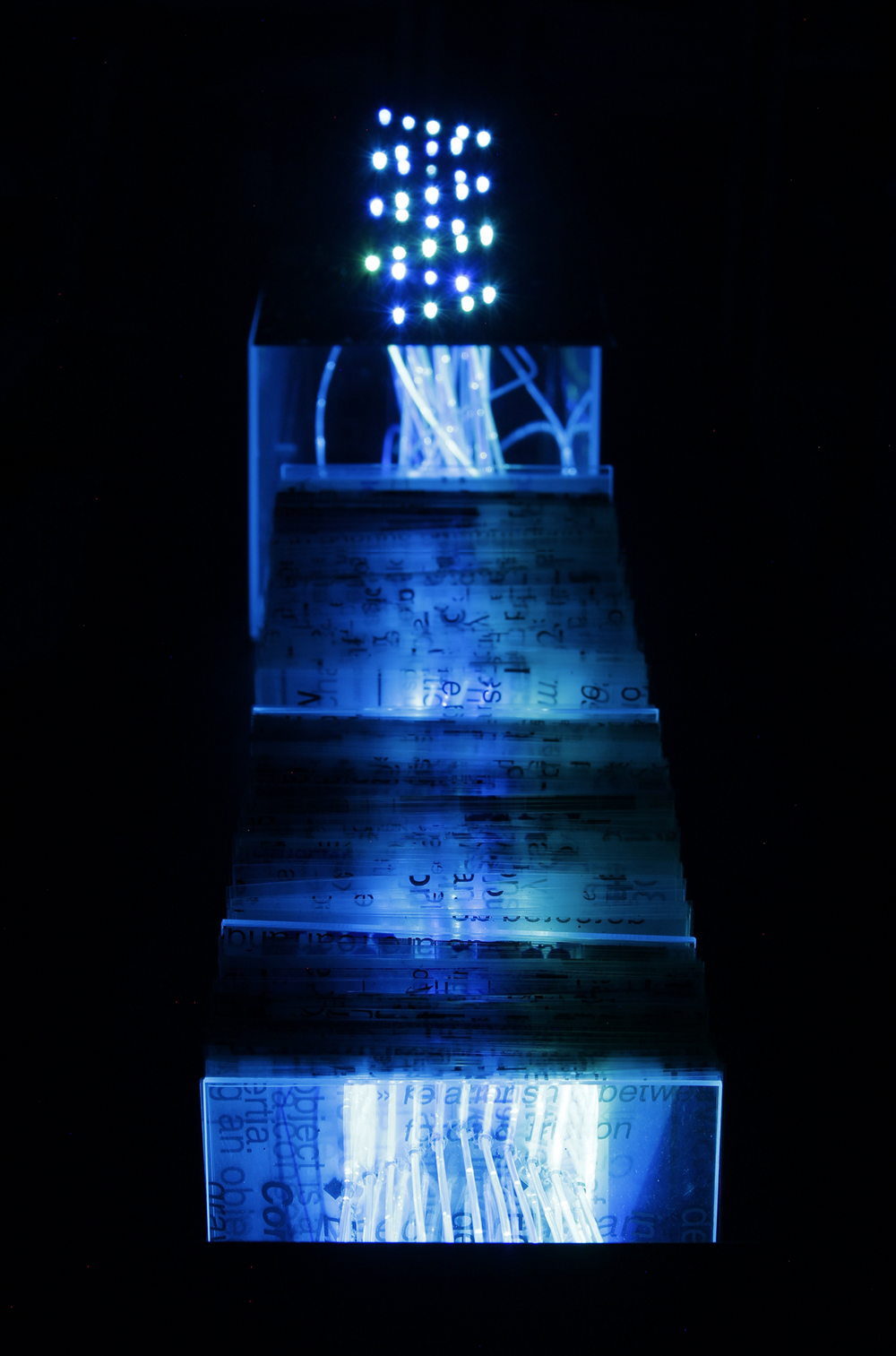
Anita Milroy book – ‘Biography of a Physicist’ (Image supplied by the artist)
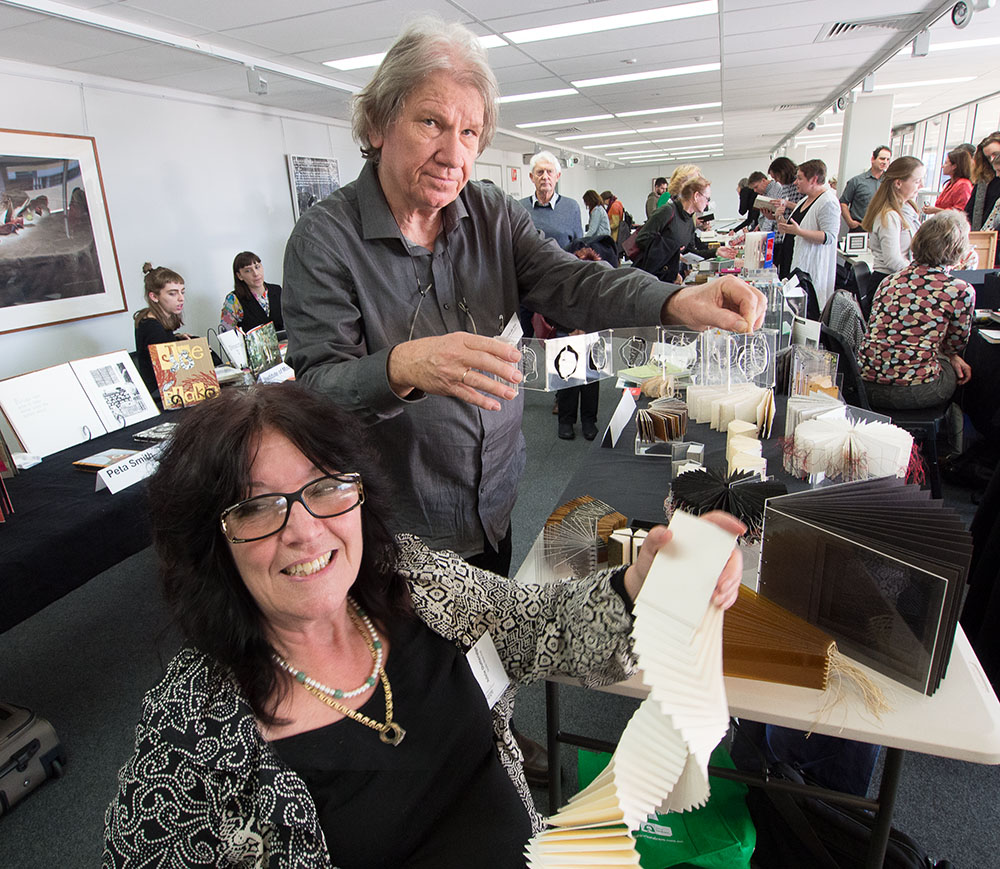
Adele Outteridge + Wim de Vos
QCA Gold Coast (no image taken)
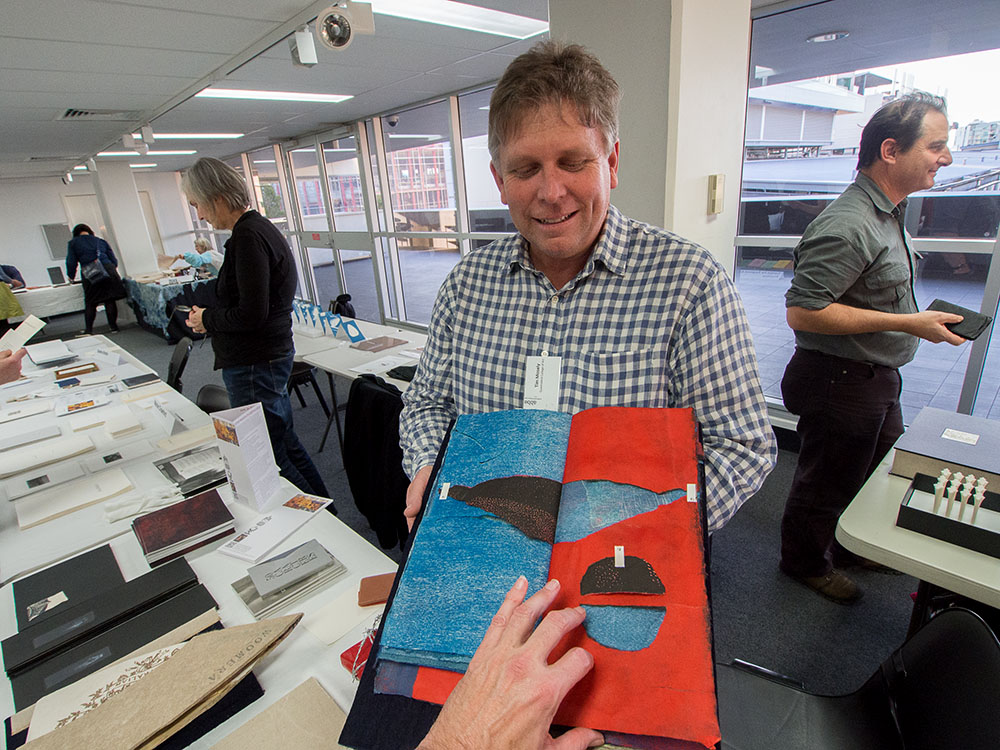
silverwattle bookfoundry (Tim Mosely)
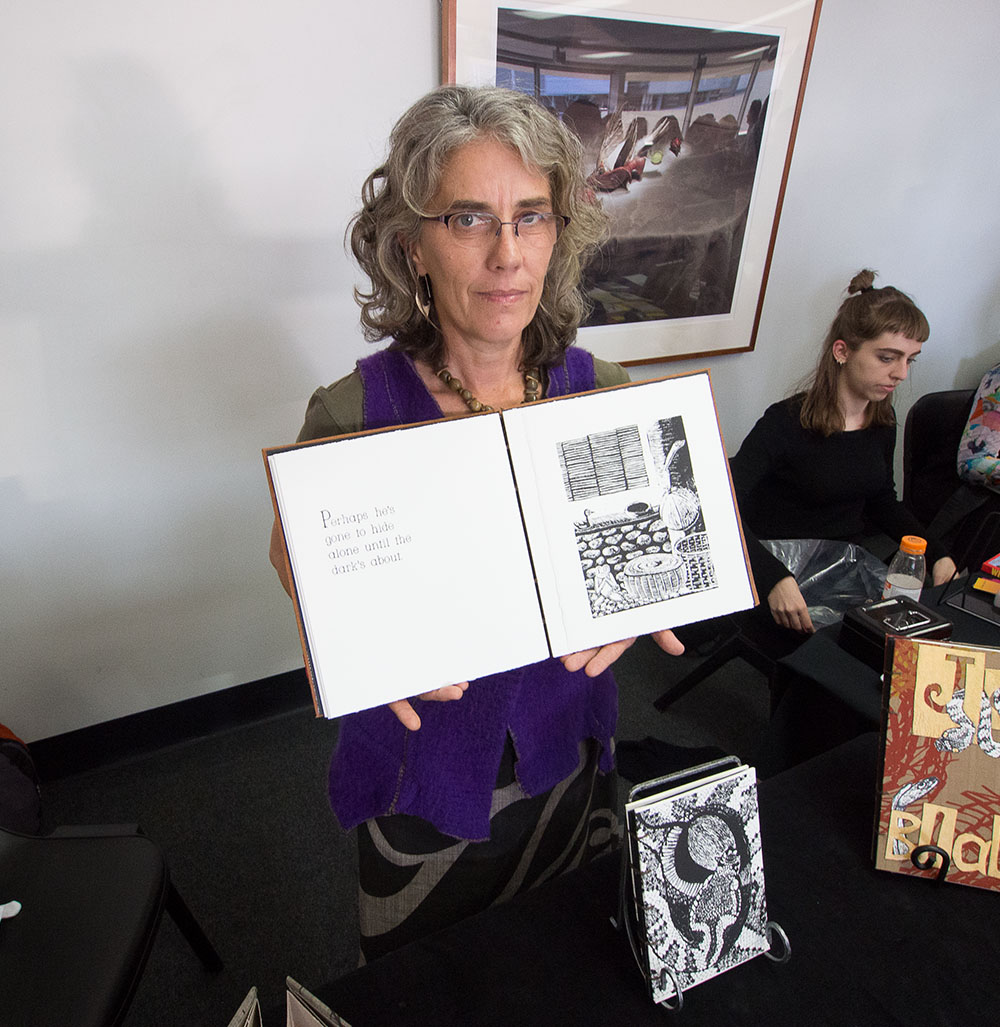
Peta Smith
.
ABBE participants also visited Grahame Galleries, The Studio West End and the State Library of Queensland
.
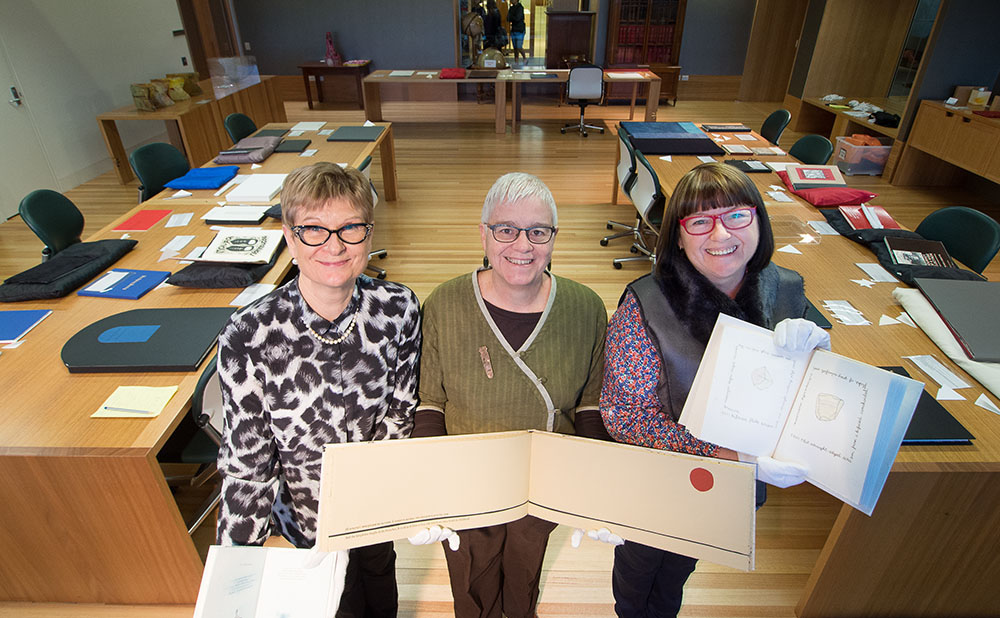
The SLQ White Gloves team Christene, Helen and Jeanette
.
.
ABBE Logo
ABBE was an initiative of the Griffith Centre for Creative Arts Research and was coordinated by Dr Tim Mosely and Dr Lynden Stone.
All photographs © 2015 Doug Spowart
.

This work is licensed under a Creative Commons Attribution-NonCommercial-NoDerivs 3.0 Unported License.

 wotwedid