COOPER+SPOWART to talk @ Cobb+Co Museum Dec 13
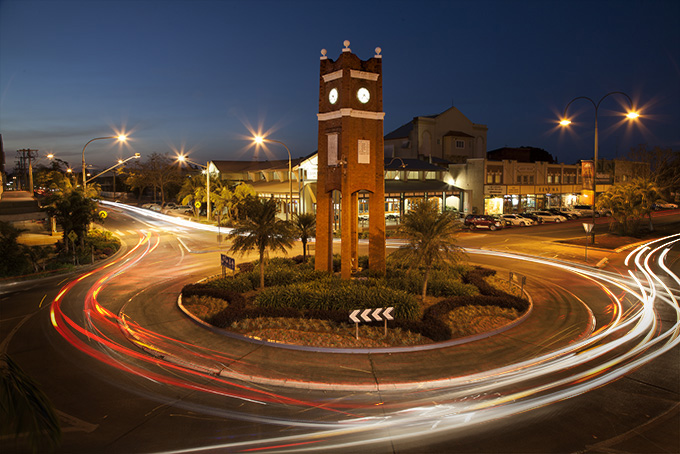
The Roundabout Clocktower from Weiley’s Hotel balcony
.
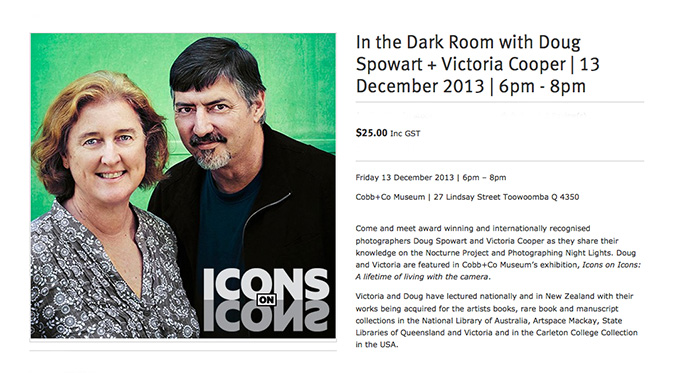
CLICK HERE TO BOOK ON THE COBB+CO WEBSITE
.
In the Dark Room with… Cooper+Spowart
In this talk we will discuss a number of topics and including:
-
A commentary on the works in the ICONS on ICONS exhibition
-
Our Nocturne residency projects around Australia
-
How to make amazing Nocturne Photographs
-
Our use of Social Media to connect art with the community.
.
Attendees may wish to conclude their night activities @ Cobb+Co with a visit to the nearby Christmas Wonderland Spectacular in Queens Park
.
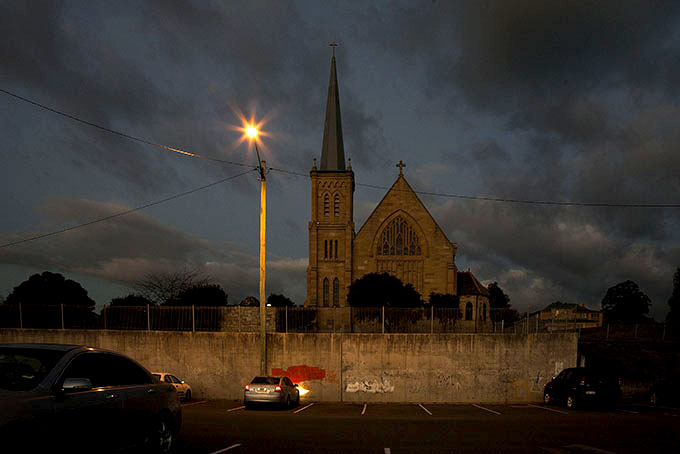
St James’ Catholic Church
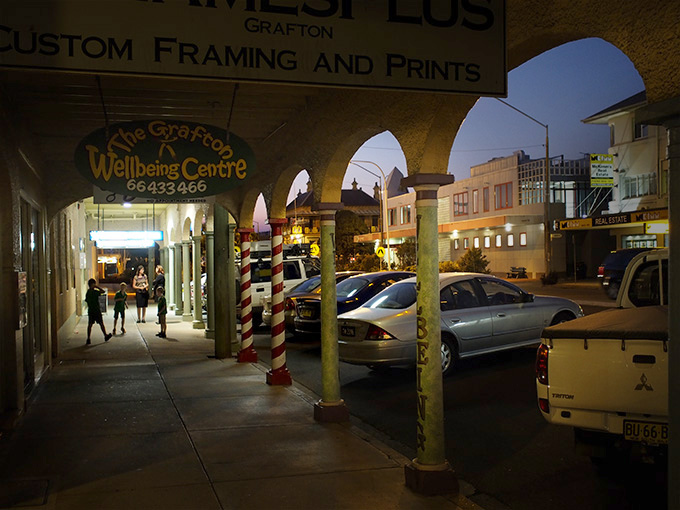
Outside the Grafton Hotel
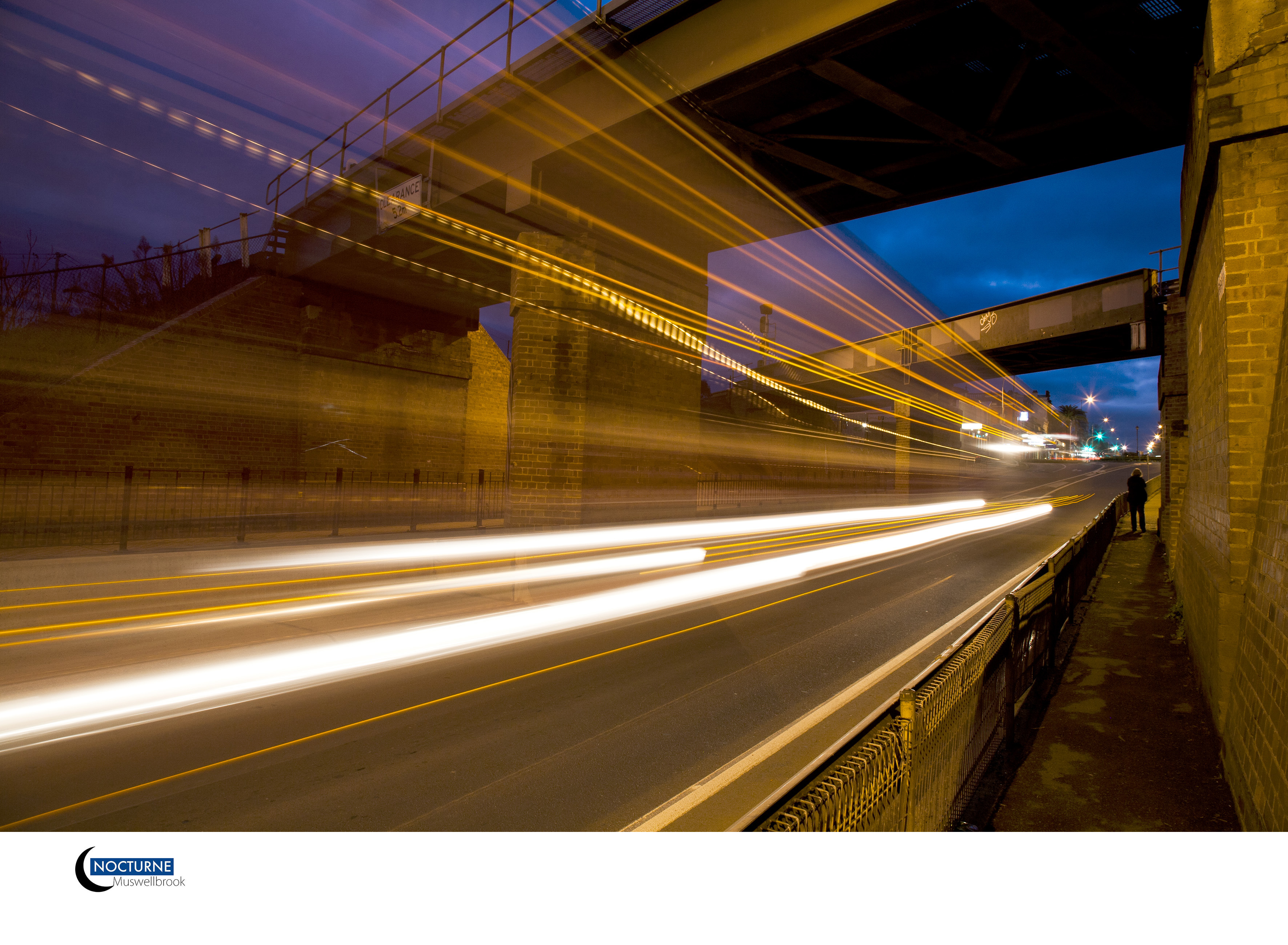
The Subway – The Nocturne Muswellbrook Project
.
VIEW A VIDEO OF THE ICONS SHOW FEATURING THE PHOTOGRAPHERS
.
.
TO BOOK THE EVENT
http://www.shop.qm.qld.gov.au/cobbandco/in-the-dark-room-with-doug-and-victoria.html
.

Cobb+Co Museum – Icons on Icons
.
.
CENTRAL QLD PROJECT: REVIEW published in Queensland Review

…
The latest issue of the journal Queensland Review features a review by us of the exhibition The Central Queensland Project that was shown at the Powerhouse Brisbane from 22 July to 18 August, 2013.
As the journal has publishing rights over their commissioned review we are unable to publish the text here. The review can be accessed from Cambridge Journals with the following links–a charge applies unless you are able to gain access through an academic institution or library.
Queensland Review, ,Volume20, Issue02, December 2013 pp 238-240
http://journals.cambridge.org/abstract_S1321816613000329
As an introduction to the piece we provide the following:
.
Queensland, its society and natural resources, has been the source of investigation by photographers for over 150 years. In the 1860s surveyor and photographer Richard Daintree created a quantitative analysis of the region’s potential for development. Associated with this record was a significant visual document in the form of photographs. In the lead up to Australia’s Bicentennial of white settlement the Queensland Art Gallery commissioned 6 photographers under the title Journeys North, to travel the state and: ‘produce a portfolio of photographs on the theme of community life in Queensland’ (Williamson 1988: p5). Now, nearly 25 years after this latest project, two photographers, Kelly Hussey-Smith and Alan Hill, have travelled north with cameras to document the current life and situations of people far away from the urbanized southeast corner.
The products of this latest documentary coverage were presented as the exhibition The Central Queensland Project (CQP) at the Powerhouse in Brisbane from July 22 to August 18, 2013. In exhibition material the photographers claim that:
Given the complexity of the modern economy, and the insularity of city life, many of us are blind to what lies beyond the city limits. Through this project we seek to gain insight into the lives, values and experiences of Central Queenslanders (Hill and Hussey-Smith 2013).
.References:
Hill, A. and K. Hussey-Smith. (2013). “About: Central Queensland Project ” Retrieved 25 July 2013, from http://centralqldproject.com/about/.
Williamson, C. (1988). Journeys North – Photographic Practice in Queensland in the 1980s: one aspect. Q. A. Gallery. Brisbane, Queensland, Queensland Art Gallery.
.
.
A selection of installation photographs as well as images and captions commented on in the review are published here courtesy of the photographers Kelly Hussey-Smith and Alan Hill:
.
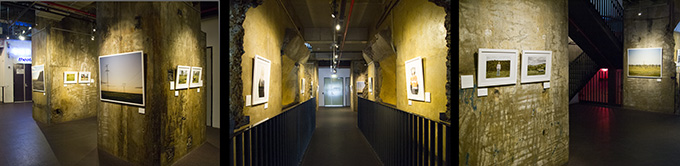
Installation triptich ….Photos: Doug Spowart
.
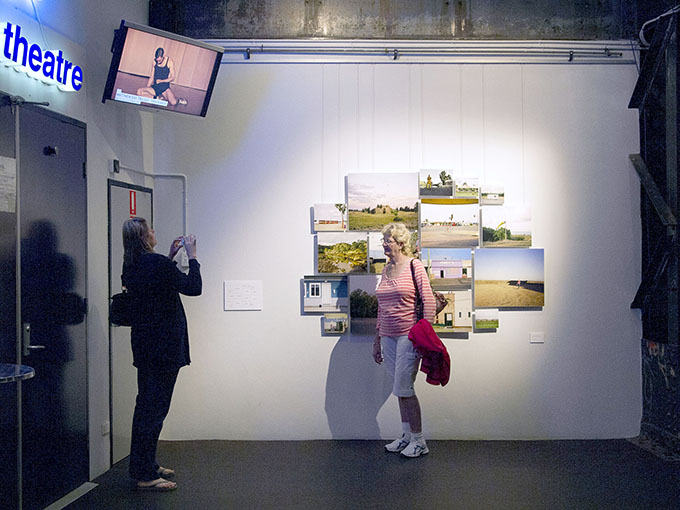
An exhibition visitor is photographed before the artwork Postcards From The Shires …Installation photo: Doug Spowart
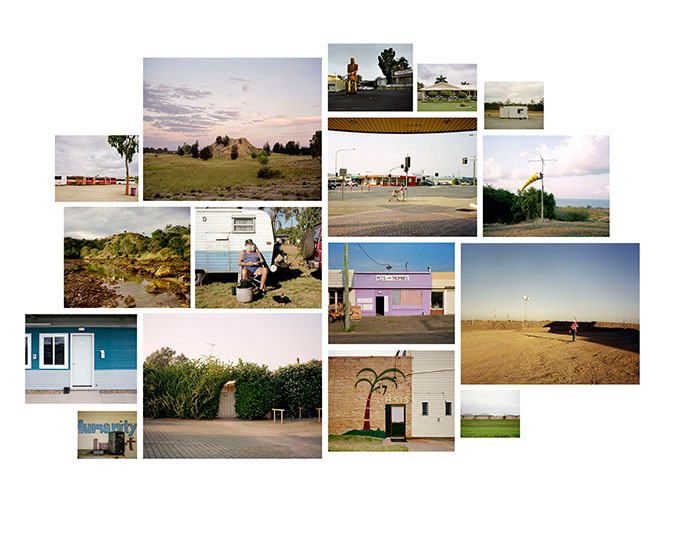
Postcards from the Shires
.
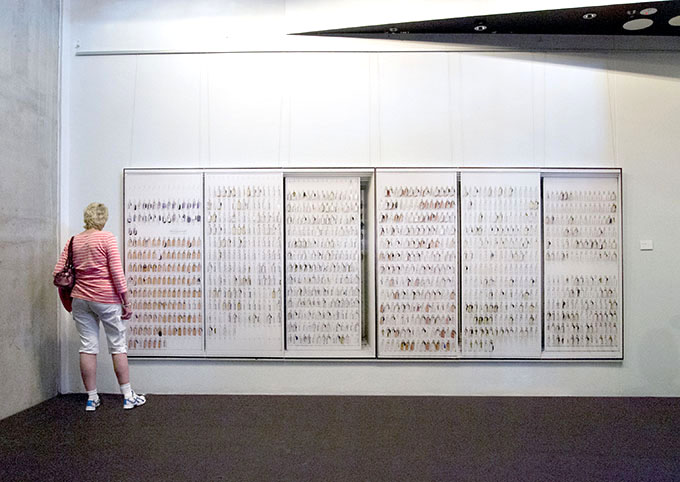
The New Village ..Installation photo: Doug Spowart
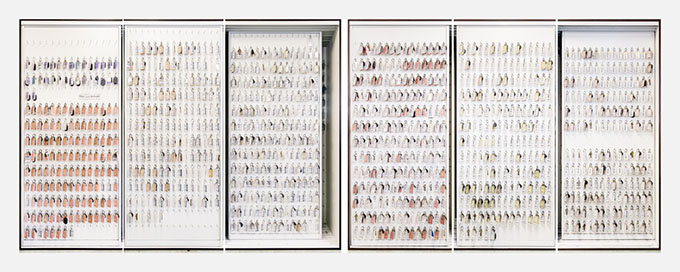
The New Village
With 3048 beds, The MAC Coppabella is one of the largest workers villages in Australia and larger than many towns in the region. Up to 1000 people will check in or out on any given day.
.
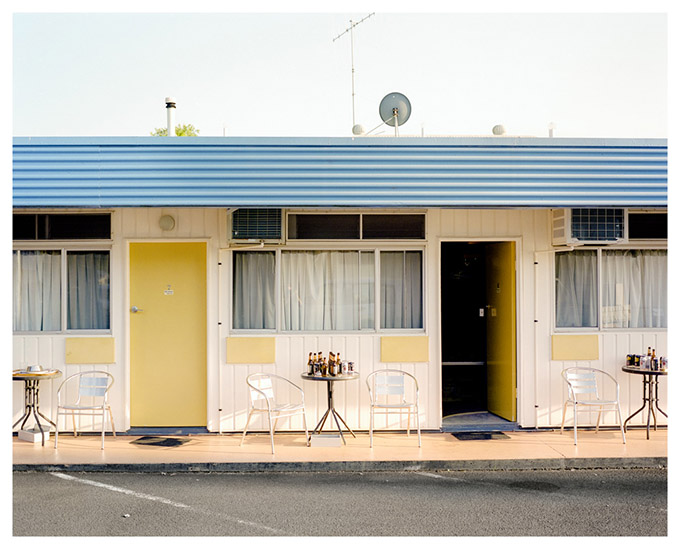
5am
Three Moon Motel, Monto. FIFO and DIDO have entered the Australian vocabulary, along with debates about their social impacts. As a result, accommodation is often difficult to find, and motels have become temporary homes for transient workers.
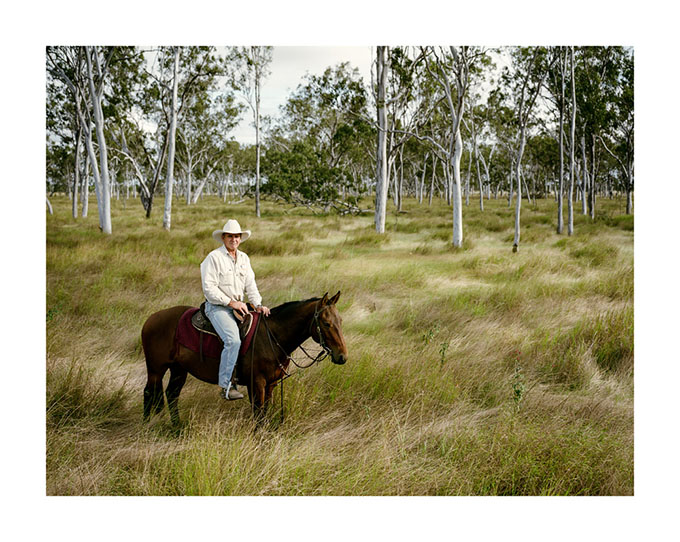
Caterpillar Cowboy
Greg Barr introduced us to the phenomena of the Caterpillar Cowboy, which he describes himself as, being a ‘Cat’ machinery operator in the mines who is really a cowboy at heart. He and his partner Debbie run a modest property where they spend half the week on the land with their crops, cattle, and horses, and the other half of the week in the mines to support their rural lifestyle.
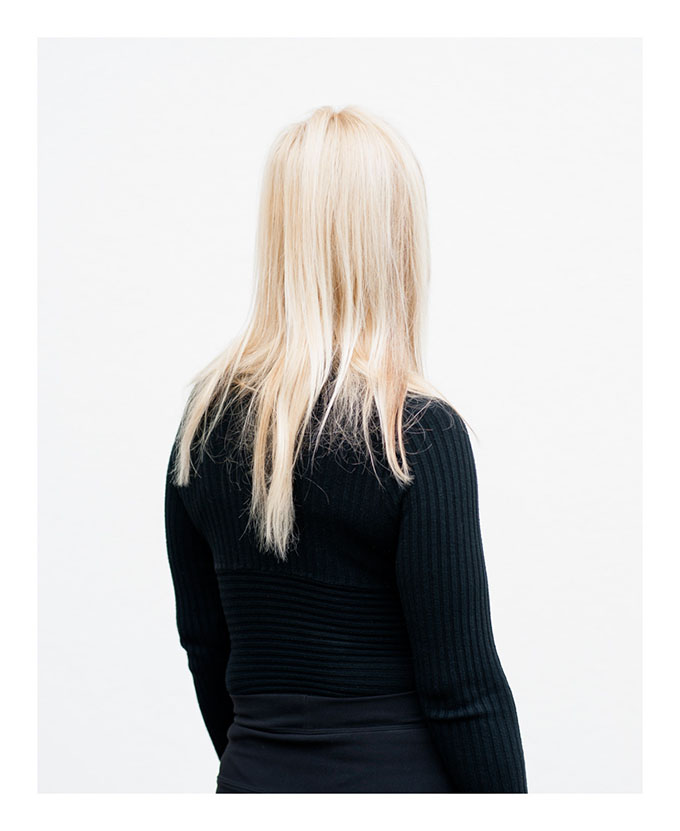
Karlaa
FIFO work does not just apply to mining. Karlaa works legally as a FIFO sex worker in the Central Queensland region. In 2010 Karlaa was asked not to return to a motel she had been working from discretely for two years after the proprietors realised she was a sex worker. She took the motel to court claiming discrimination on the basis of her profession. She initially lost this case, as it was found the motel did not discriminate against her because she was a sex worker, but because she was running her business from their premises. Many feared the decision would send the industry underground, resulting in unsafe working conditions and less transparency. Karlaa appealed the decision and in 2012 it was ruled that discrimination had taken place and the decision revoked. However, in November that year the Queensland Government made changes to the anti-discrimination act making it legal for moteliers and hoteliers to refuse sex workers accommodation.
Karlaa understands her profession may not appeal to everyone, but believes she has as much right as other businesses to take advantage of opportunities in the region.
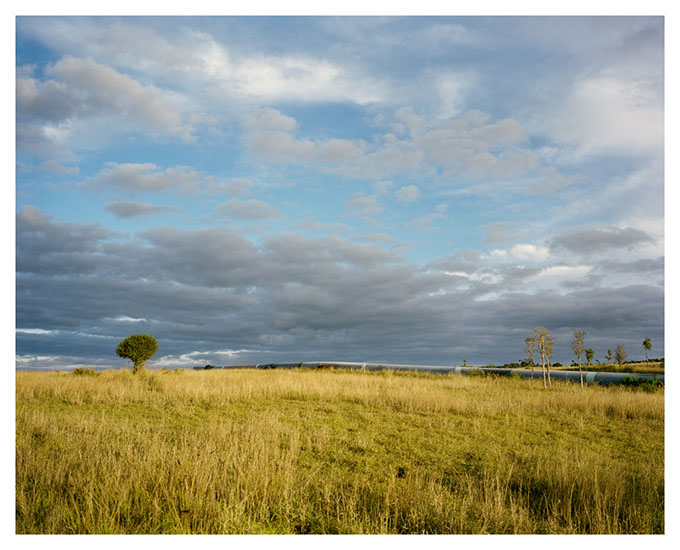
From the ‘Transmission’ series
A section of the 540-kilometre long coal seam gas pipeline currently under construction crosses a property near Thangool. The pipeline stretches from southern Queensland to a liquefaction plant on Curtis Island near Gladstone.
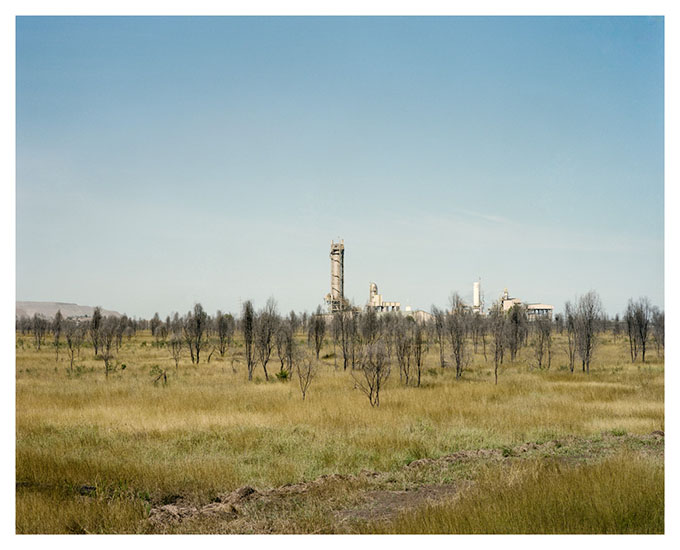
From the ‘Extraction’ series
View towards Dawson Mine Complex, Moura.
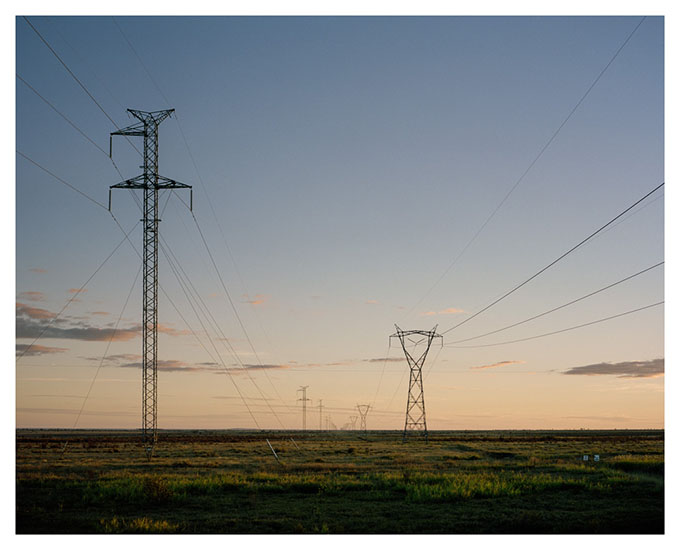
From the ‘Transmission’ series
Coal and electricity are inextricably linked. In the first half of the 20th century, Brisbane’s electricity came from power stations in the city that were fuelled by coal from Ipswich. Now Queensland is part of a complex energy network not only spanning the state and the nation, but as the world’s largest coal exporter, the globe. Powerlines outside Middlemount.
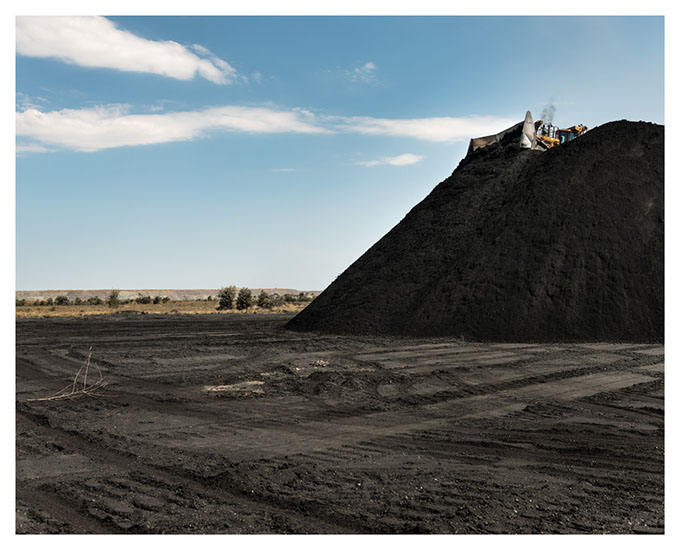
From the ‘Extraction’ series
Export ready semi-hard coking coal in a Bowen Basin coal mine.
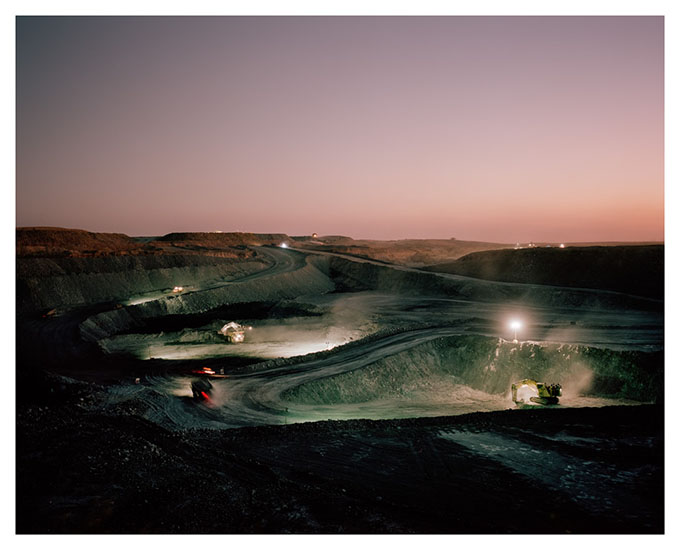
From the ‘Extraction’ series
Coal mining in the Central Queensland region is a 24-hour operation. The night shift begins in a Bowen Basin coal mine near Mooranbah.
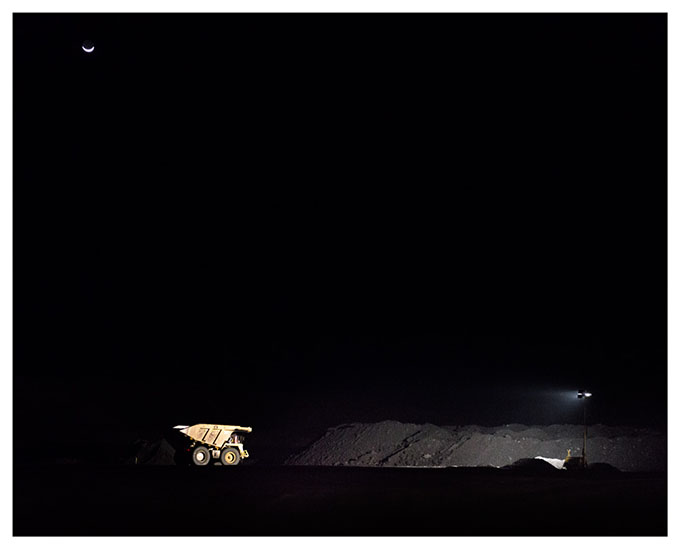
From the ‘Extraction’ series
Coal mining in the Central Queensland region is a 24-hour operation. Night shift in a Bowen Basin coal mine near Mooranbah.
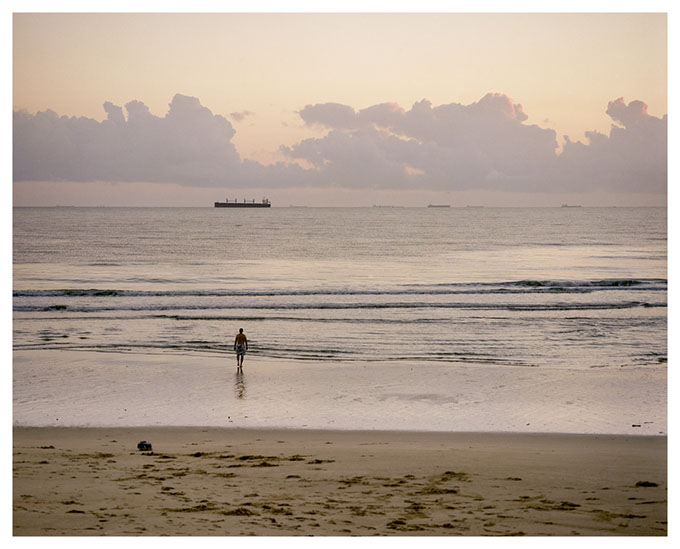
From the ‘Transmission’ series
Tannum Sands, south of Gladstone. In addition to being a major coal port, Gladstone is the destination for several major coal seam gas pipelines snaking their way through the Central Queensland landscape. The pipelines will deliver gas to three major liquefaction and export facilities currently under construction on Curtis Island.
.
Photos © 2013 The Central Queensland Project Kelly Hussey-Smith and Alan Hill and installation photos Doug Spowart.
..
.
.
.
PERV: Jess Martin does an iPhone Cloud @ MARS Gallery
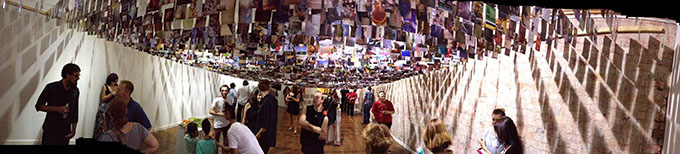
The Mars Gallery with the Perv exhibition photo ‘cloud’
.
In 1936, the one-time Bauhaus teacher Làzlò Moholy-Nagy, described his idea of the ‘photographic series’, and he spoke of it as being ‘the logical culmination of photography’. In his discussion he states that the ‘picture loses its identity as such and becomes a detail of assembly, an essential structural element of the whole which is the thing itself.’
.
An exhibition, entitled Perv, by Toowoomba artist Jess Martin on show at MARS Gallery would no doubt excite Mohly-Nagy in that she has taken the idea of a photo sequence and turned it into a sculptural form to express her view of contemporary life and photography. Martin has for two years been collecting iPhone images of her life. Last year she exhibited at Futures Gallery in Toowoomba a mosaic of 2,000 of these images in three 1 square metre murals. The theme was her life as a photographer, curious about the visual nature of the world and the access to quick imaging via the mobile phone.
Perv takes the idea further by expanding it to encompass iPhone image submissions sent to her via Facebook social media from friends and their friends …. Deciding to take the concept off the gallery wall where it’s just glanced at by the viewer Martin has constructed a 3-Dimensional space to mirror the image overload of modern life. What’s more, is that the images are suspended the full length and breadth of the Mars space – some 5×10 metres creating a cloud of photo images.
.
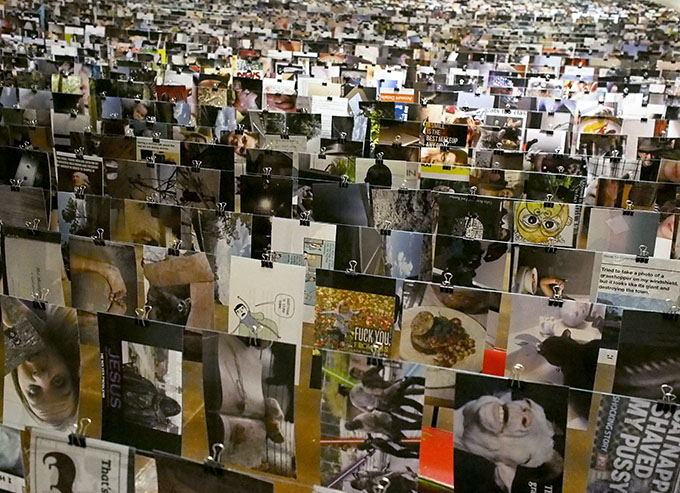
The view from above
.
Who knows how many thousand images are here… who cares? Who measures our daily dose of images anyway? So while this exhibition is confrontational it is also indicative of the prevalence, pervasiveness and proliferation of vernacular photography today. Viewers encountering this sky-load of images will need to search far if they are looking for classic pictorial beauty, or even well crafted documentary images. These pics are rapid snaps — faces, places, events, Facebook trivia, the weird and wonderful, rude and humorous. In a few seconds you can find photos of cats and dogs doing amazing things, food being devoured, over-flashed close-up faces and obviously candid and personal moments between lovers, family and friends.
.
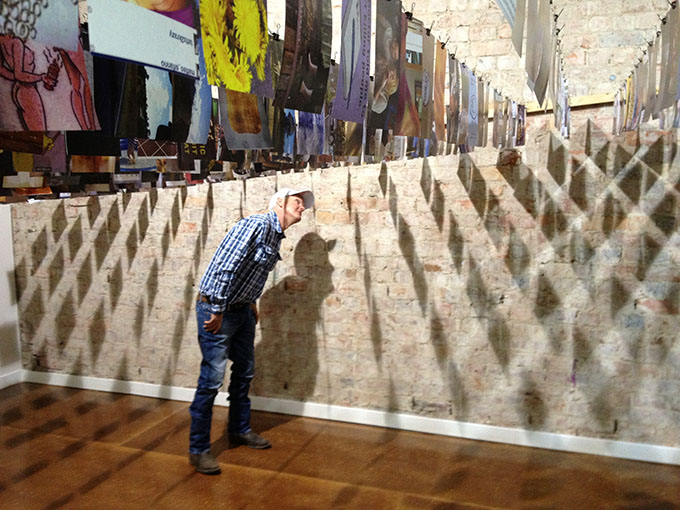
Looking at Perv’s pics
.
Billions of photographs are made and Perv‘s several thousand may be the equivalent of a grain of sand in all the beaches of the world however within this space we have an opportunity to connect with the contemporary reality of the photo today and the use of this once specialist human activity.
In coming back to Moholy-Nagy again there is something else to ponder that this exhibition celebrates and that is, in Nagy’s words; ‘its separate but inseparable parts a photographic series inspired by a definite purpose can become at once the most potent weapon and the tenderest lyric.’
The exhibition remains on show at Mars Gallery until December 6, 2013.
.
Words and photos: Doug Spowart
.
Moholy-Nagy, L. (1936). From Pigment to Light. Telehor. 1: 32-36.
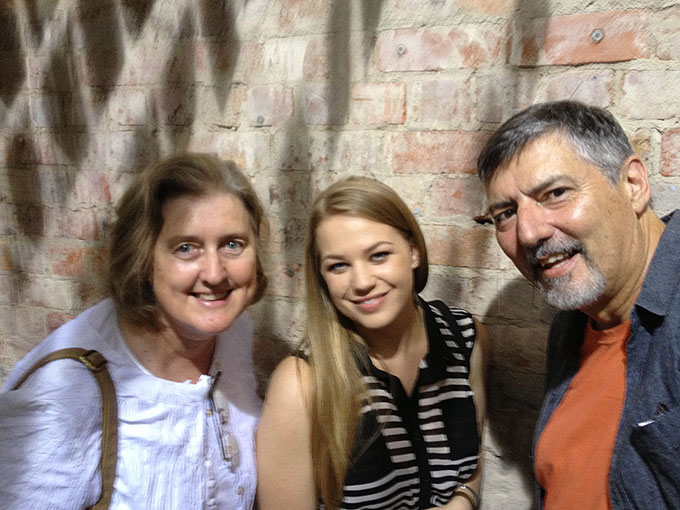
Vicky, Jess and Doug
Jess is a past student from Doug’s SQIT Art Photography class. We have mentored her during this project however Jess’ creativity, innovation and hard work has transformed this exhibition into a significant outcome – Congratulations Jess!
It should also be acknowledged that this exhibition has been supported by the Queensland Government through an RADF Arts Queensland Grant.
.

This work is licensed under a Creative Commons Attribution-NonCommercial-NoDerivs 3.0 Unported License.
.
.
QCP FUNDING CUT: Statements 1&2 from the QCP Board
FOLLOWING ON FROM PREVIOUS POST: LETTER TO THE MINISTER SUPPORTING THE QCP.
NOW THE QCP HAS HAD ITS QUEENSLAND GOVERNMENT FUNDING CUT
STATEMENT #1 Posted by QCP today (November 11, 2013) on their Lucida Site:
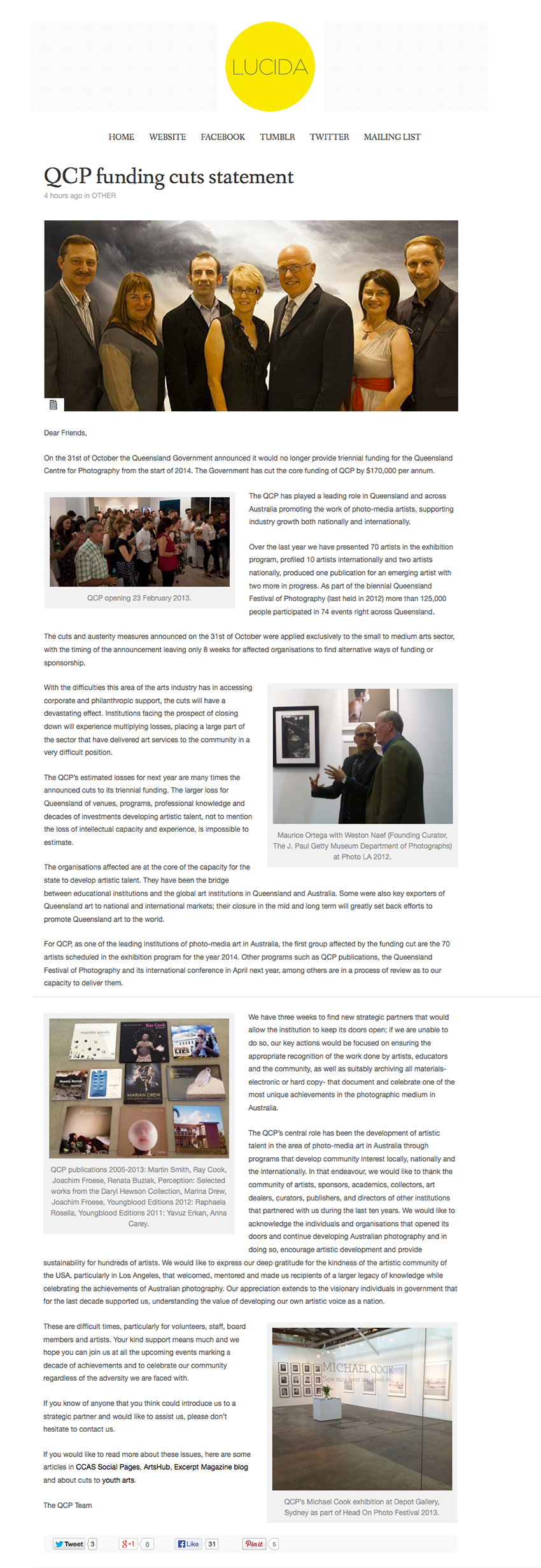
.
UPDATE
THE QCP HAS BEEN ABLE TO NEGOTIATE SUPPORT TO CONTINUE ALL PROGRAMS AND PROJECTS INCLUDING THE QLD FESTIVAL OF PHOTOGRAPY, LA ART FAIR & CONFERENCE UNTIL THE END OF APRIL 2014
STATEMENT #2 Posted by QCP December 11, 2013 on their Lucida Site:
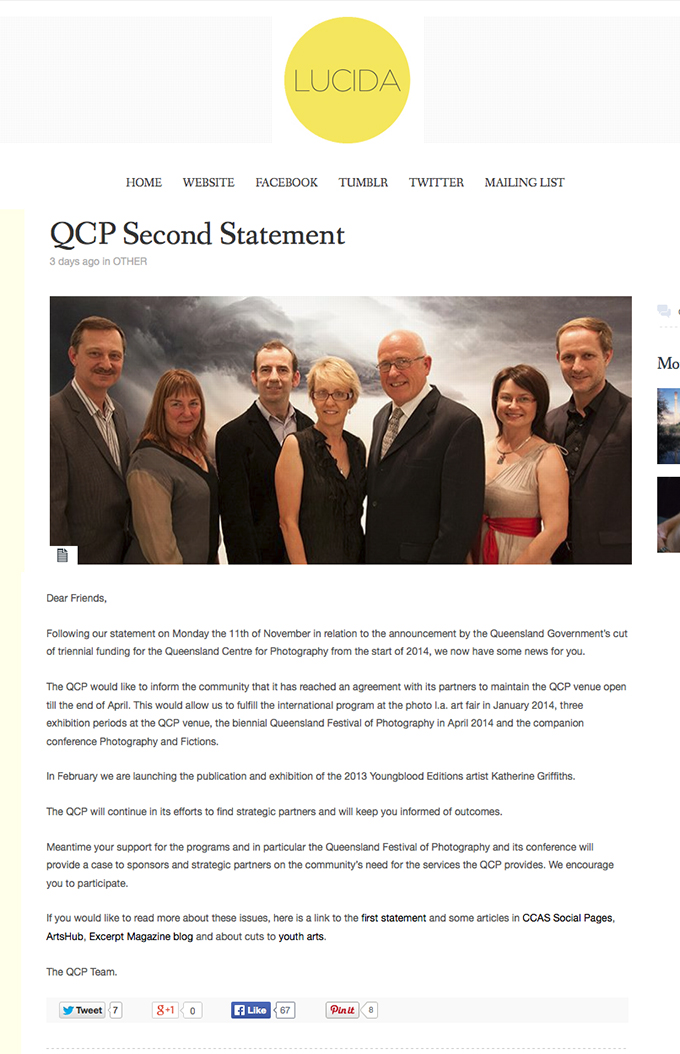
.
OTHER RELATED COMMENTARIES:
Overland Website – Article by Alison Croggon:
http://overland.org.au/previous-issues/issue-212/feature-alison-croggon/
.
Tamara Winikoff on current cuts to the Arts in Queensland:
http://www.artshub.com.au/news-article/news/all-arts/savage-queensland-arts-cuts-197252
.
Article by David Broker, director of CCAS, reflecting on funding cuts by the Queensland Government to QCP:
http://canberracontemporaryartspace.wordpress.com/2013/11/04/qcp-hard-times/
.
ImageNews comments:
http://imagenews.com.au/article/savage-implementation-reform
.
.
SELFIES: A history according to Doug & Others
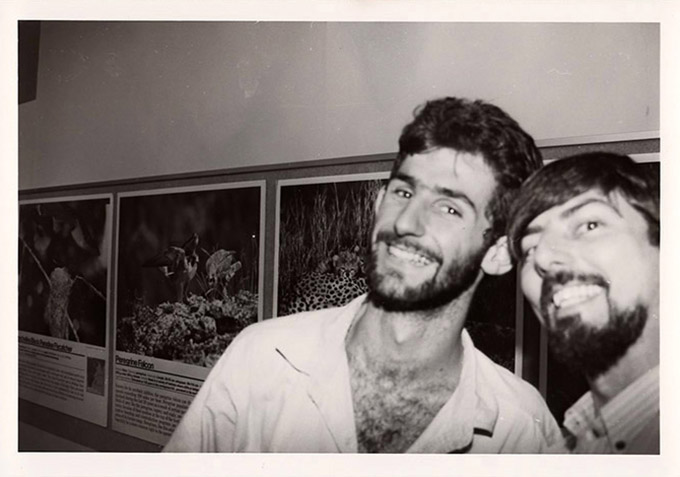
Darren & Doug ‘Selfie’ @ Imagery Gallery c1987
.
This recent Facebook post of a photo I made with Darren Jew in 1987 resulted in discussion around the idea of the ‘Selfie’ and my early connection with the technique. Around 12 years ago I discussed my inspiration and work with self-imaging in a university thesis – For your interest I publish the text here and add some images that date from my use of ‘Selfies’ in the 1980s.
For me the term ‘Selfie’ is a self image made by holding the camera at an arms length and angled back towards the photographer.
.
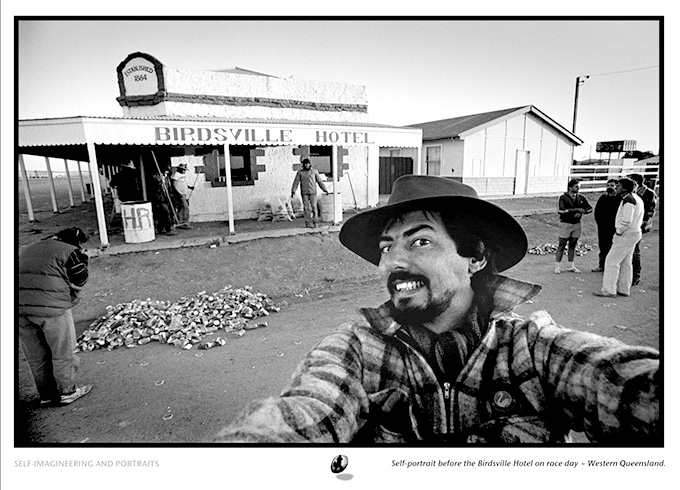
Doin’ a selfie @ Birdsville 1983
.
Self imagineering and portraits (now called Selfies)
.
For some time my photography has included the self-portrait. The inspiration came from a friend (John Elliott) in the early 1980s who held up the camera before himself and friends and then fired the shutter. He attributed his use of the technique to Jean Pigozzi a Hollywood paparazzi photographer who employed this method to make pictures which showed himself posing with the rich and famous subjects he photographed. In the book Pigozzi’s Journal of the Seventies Jann Wenner, then the Editor of Rolling Stone magazine, was to write in his introduction a description Pigozzi’s self-portraits as being: the ultimate fantasy of the fan in everyone: A picture of yourself with your favourite star. Conquests! Self-immortalisation!
.
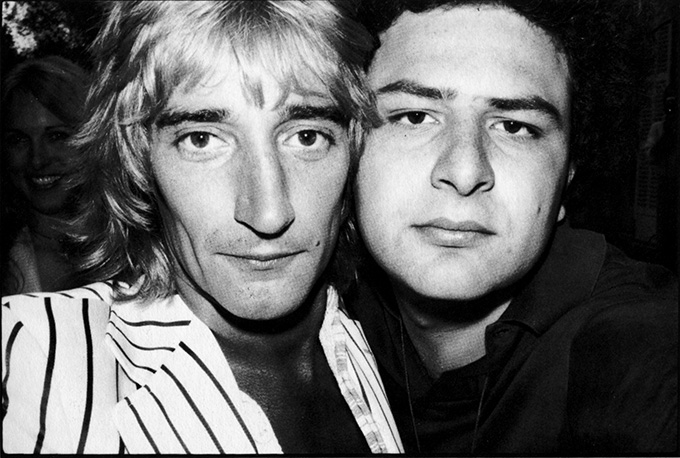
Rod Stewart with Jean Pigozzi
.
My use of the technique was basically to make images documenting myself at tourist locations as I travelled usually as a photo tour leader. Perhaps I was a ‘fan’ of the location, the location was one of my ‘conquests’, or maybe I sought ‘self-immortalisation’ through the photo – whatever. For me it just seemed the logical way of resolving problems relating to the imaging of personal experiences.
Using a 35mm Leica rangefinder camera with 35mm, and later with a 21mm lens, enabled wide angled views and sufficient depth of field to achieve the view I wanted. These self-portrait images often exhibit a random approach to composition as precise viewfinder alignment was not possible. I took care not to ‘dress up’ for the photograph so my appearance is what it was – no brushing of the hair, no straightening of the collar. They are, as intended, frank and factual.
.
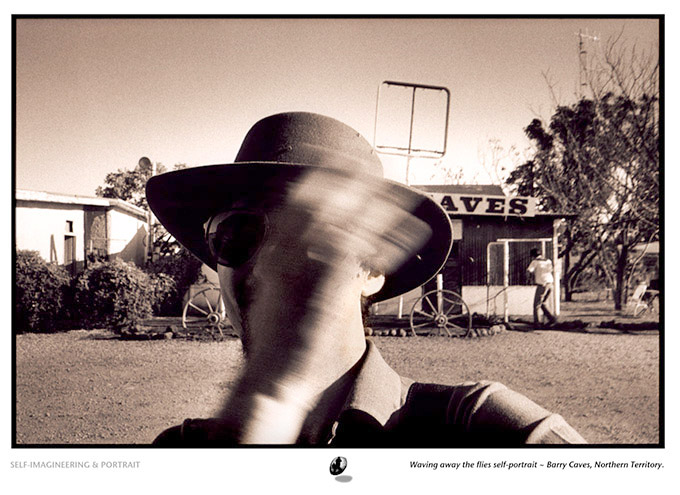
Waving away flies, Barry Caves NT, 1982
.
In time these images formed a collection of “This is me at. . .“ pictures. They were a kind of “Foo was here” with me being the Foo graffiti figure. On occasions the only reason I would stop and photograph at a particular location was to capture another self-portrait for the collection. Sontag in her book On Photography alludes to this modus operandi in her comment that: Travel becomes a strategy for accumulating photographs. Travel and self-imagineering was indeed to put me in situations where I could produce photographs that told of my experience – often in a humorous way.
.
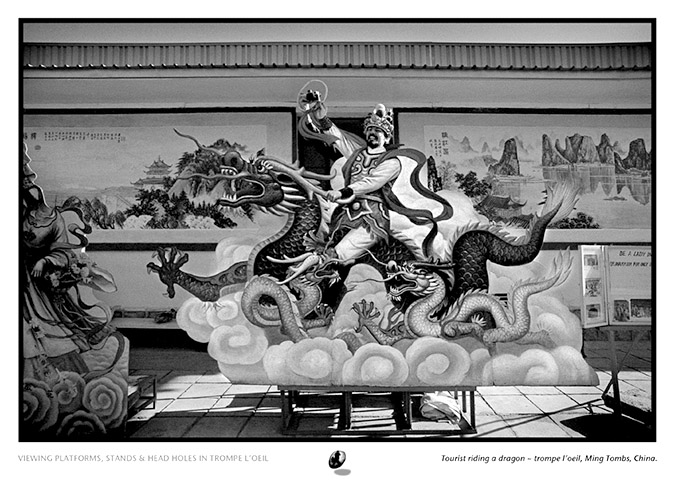
Riding a dragon and doin’ a selfie, China 1989
.
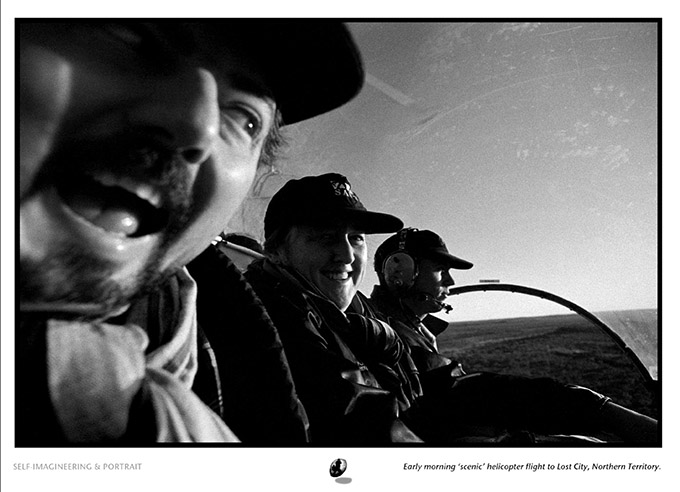
With Vicky & helicopter pilot, Heartbreak Hotel NT c1992
.
There were other aspects pertaining to self-imagineering work which encouraged my practice. I found that thrusting the camera before myself and in front of tourists assembled at the place of visitation was a kind of art performance. It was a spontaneous act; a celebration of experience that culminated in the ritual of photo taking. Self-imaging was crammed with fun and triviality. And having fun, and being seen to have fun and capturing that fun were certainly part of the agenda that drove my interest in this activity. The technique often caught on and doin’ a self-portrait became part of my fellow tourist’s recording rituals as well.
.
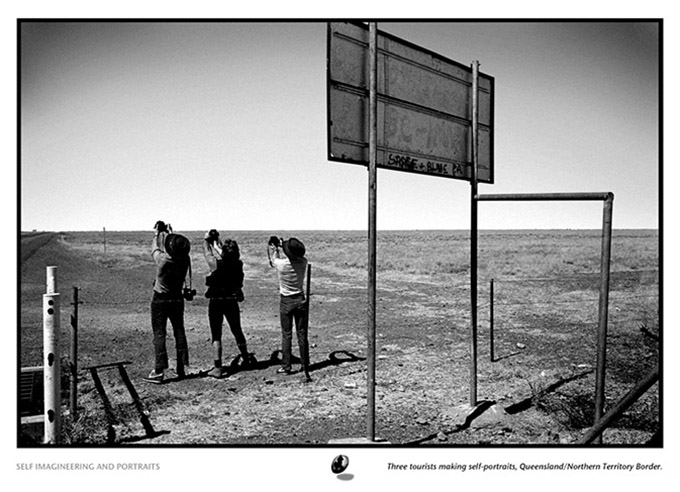
Tony, Rob and Mark doin’ Selfies @ the Qld NT Border 1983
.
Abridged from a Graduate Diploma thesis entitled My Shadow and I by Doug Spowart 2002. The thesis contains a discussion on the artist as tourist and the self-image as a document of personal experience.
.
SOME MORE IMAGES:
.
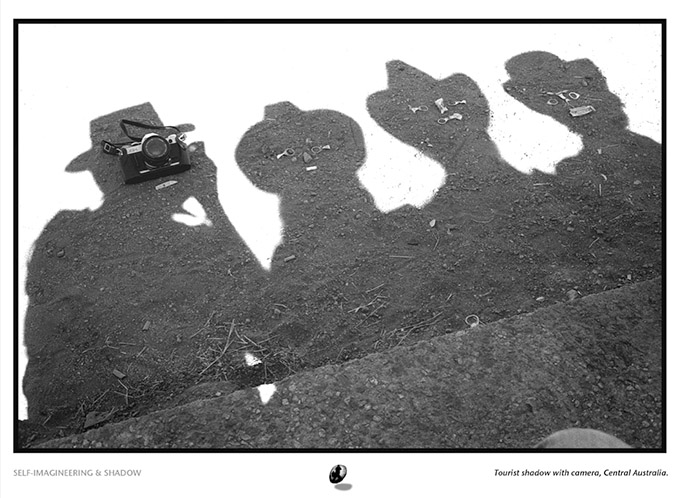
Selfie shadows with camera and ring-pulls, Alice Springs 1982
.
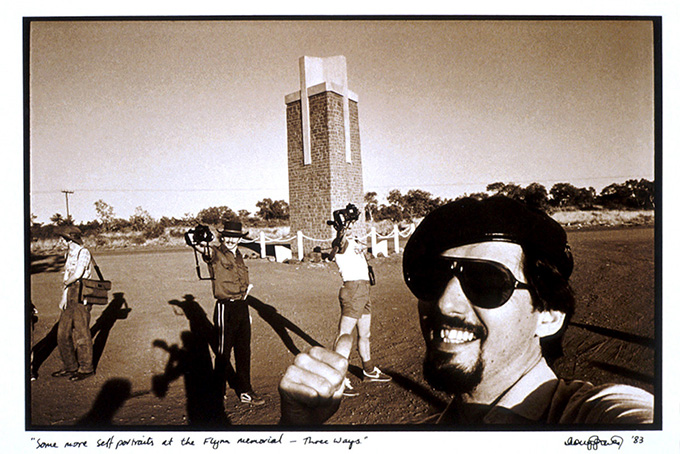
‘Che’ (Doug) Selfie with Tony & Mark @ Three Ways NT, 1983
.
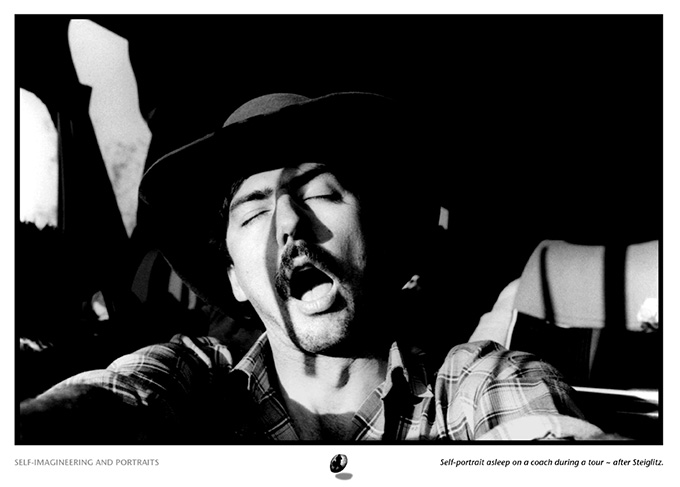
On a coach in Central Australia 1982
.
NEW UPDATES ON ‘SELFIES’
Texas town errects ‘selfies’ statue…
TEXTS ON PIGOZZI
http://www.helmutnewton.com/previous_exhibitions/pigozzi_and_the_paparazzi/index.html
A. D. COLEMAN’S COMMENT
A RECENT ADDITION TO THE DISCUSION ON ‘SELFIES’ (Although I’d say it was a self portrait)
http://www.openculture.com/2013/11/the-first-selfie-in-history-1839.html
AND ‘THE OXFORD DICTIONARY ‘WORD OF THE YEAR’
http://blog.oxforddictionaries.com/2013/11/an-infographic-of-selfie
AND A SPANISH INFOGRAPHIC
ANOTHER INFO GRAPHIC (English)
http://www.bestcomputerscienceschools.net/selfies/
.
Images and text © Doug Spowart
..
.
This work is licensed under a Creative Commons Attribution-NonCommercial-NoDerivs 3.0 Unported License.
.
.
.
.
CAMERA OBSCURA 2000–2020: In hotels and other places

Bedroom Camera Obscura 2000 (Y2K)
.
Our rhythms insert us into a vast and infinitely complex world, which imposes on us experience and the elements of this experience. Let us consider light, for example. We do not perceive it as a waveform carrying corpuscles but as a wonder that metamorphoses things, as an illumination of objects, as a dance on the surface of all that exists.…………
Henri Levebvre, Rhythmanalysis; Space, Time and Everday Life, page 82.
.
Cooper+Spowart: 20 years of Camera Obscura Collaborations
In our collaborative work, we are interested in both the physical construct and cultural conventions that inform and shape us. This includes the common rituals and structures that surround, support and transport us in our everyday lives. In this work we have extended the context of documentary photographic methodology to include the narrative potential of the camera obscura and architectural projections.
.
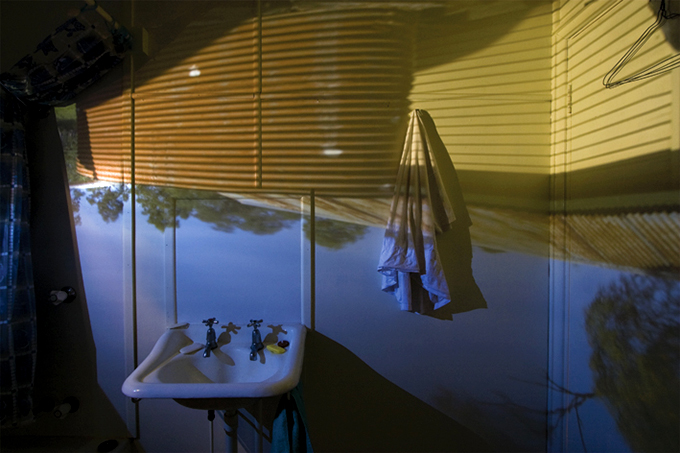
Avochie Bathroom Camera Obscura
.
In the camera obscura work the viewer’s perception of the everyday is spatially challenged. The structures that can form camera obscura are everywhere, but some spaces present themselves as clearly suitable for the making. This could be a city office, a motel room, a country bathroom or even a car. Our work attempts to contextualize the experience of the camera obscura within a concept, space or site. Upon entering the darkened space, the viewer is initially displaced, as the familiar image of the everyday is dim and unrecognizable. Then after time spent in the camera obscura, the image becomes clearer and the familiar is re-established ultimately resulting in a relocation of the observer’s awareness of place.
.

CarCamera Obscura graphic – how it works…
.

A CarCamera Obscura on the Barkly Tablelands 2005
.

Porthole on the Spirit of Tasmania – panorama camera obscura image 2018
.
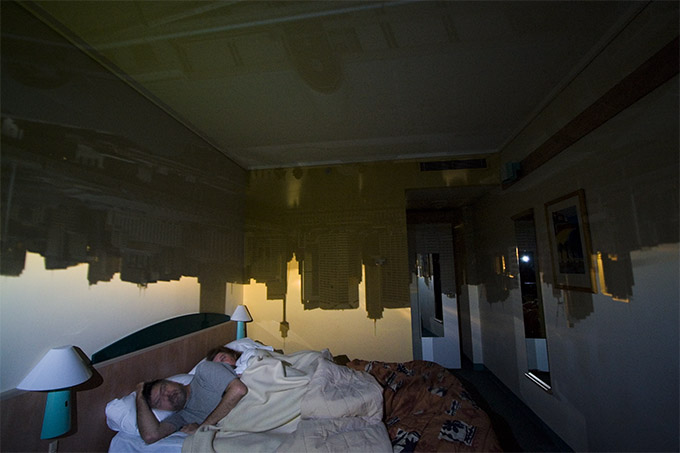
City of Dreams – Ibis Hotel sunrise over Sydney
.
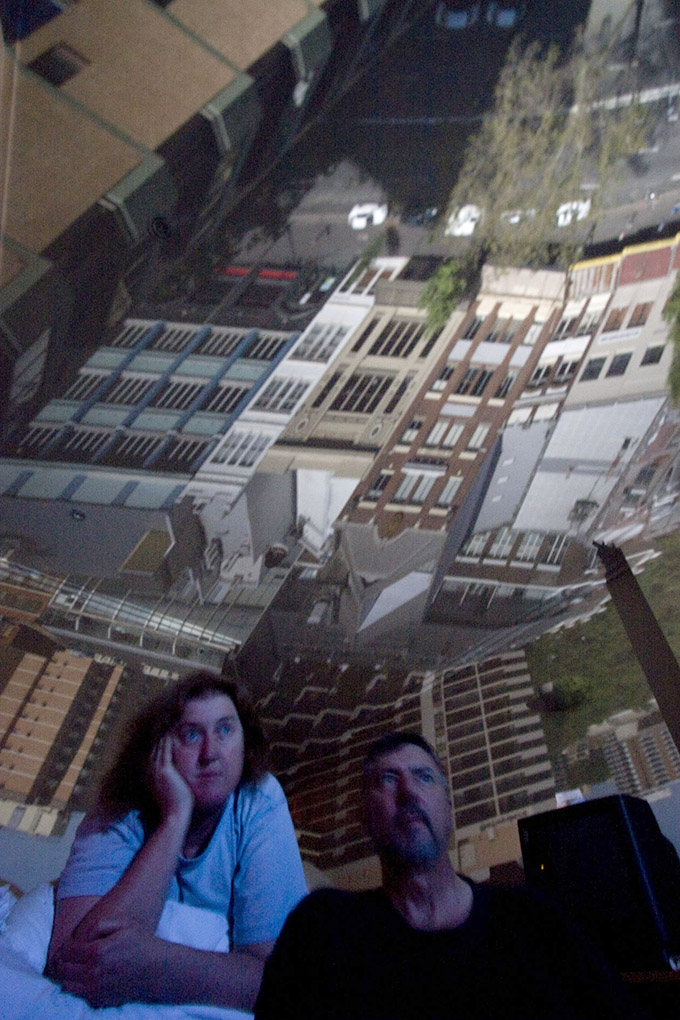
The Travelodge camera obscura 2008
.
Some background on the set-up for the Travelodge camera obscura:
Simple black garbage bags and some black electrical tape from the local 711 store. An aperture cut from a ‘found’ piece of aluminium – size around 8mm … we don’t use sophisticated glass lenses – these are direct light projections. A digital camera bares witness to our experience by capturing the image of the camera obscura projection.
.
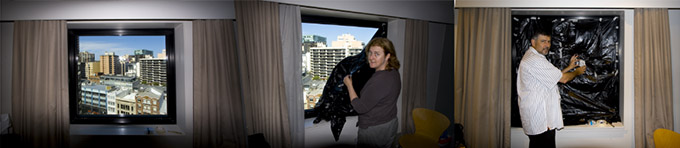
Blacking out the room
.

We were watching TV …
.
OUR MOST RECENT CAMERA OBSCURA: ORPHEUS ISLAND BEACH TENT
(A collaborative event with John de Rooy, Spyder Displays and the Orpheus Is Photo Workshop)
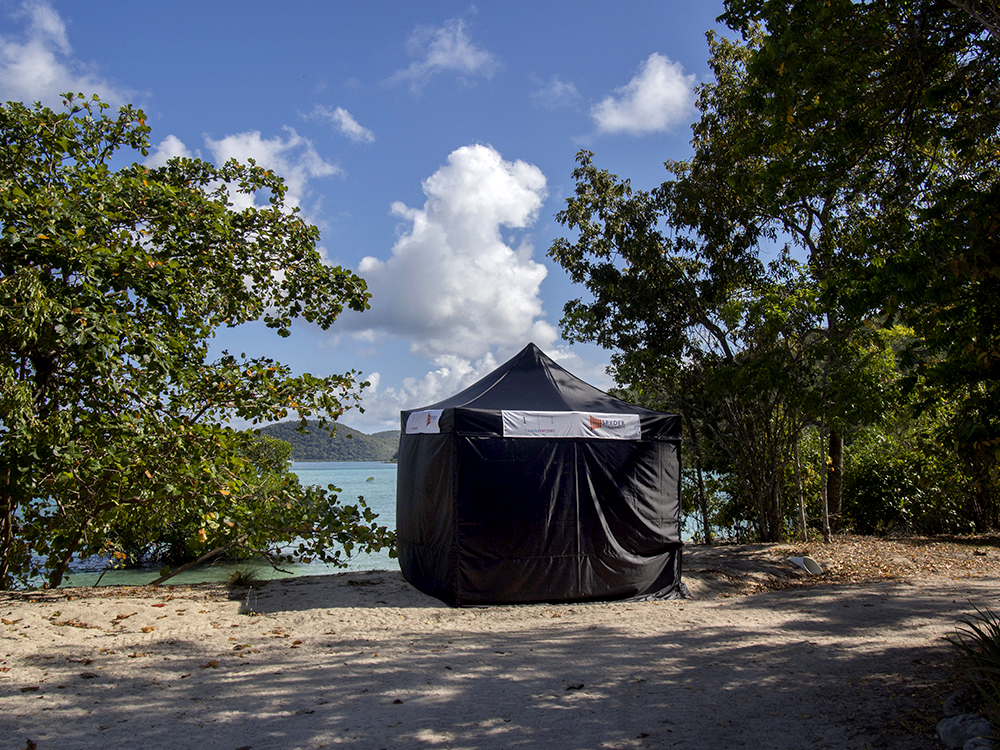
Our Spyder Camera Obscura

A DUO View of the scene and the Camera Obscura image
TO VIEW OTHER CAMERA OBSCURA WORK BY COOPER AND SPOWART SEE THE LINKS
.
Our Website:
http://www.cooperandspowart.com.au/4_PROJECTS/RoomCameraObscura-Project.html
The porthole on the Spirit of Tasmania Ferry
https://wotwedid.com/2019/01/11/2018-field-studies-camera-obscura-spirit-of-tasmania-porthole/
Our car converted into a camera obscura and driven across Australia:
http://www.cooperandspowart.com.au/4_PROJECTS/CarCamera-Project.html
Two New Zealand Camera Obscuras in the the Queenstown Rydges Hotel:
https://wotwedid.wordpress.com/2012/05/07/two-new-zealand-camera-obscuras/
A public Camera Obscura performance and live video:
https://wotwedid.wordpress.com/2013/04/22/camera-obscura-pinhole-event-foto-frenzy-a-report/
YouTube videos:
http://www.youtube.com/watch?v=lyA5QP-mX-E
A camera obscura at the Queenstown Centre fro Creative Photography:
https://wotwedid.wordpress.com/2012/05/07/camera-obscura-qccp/
A World Pinhole Day Camera Obscura at Mt Barney:
https://wotwedid.wordpress.com/2013/04/29/world-pinhole-photography-day-our-contribution/
.

Closing off the hole in the Travelodge Hotel camera obscura
.
© 2019 Victoria Cooper and Doug Spowart for 20 Years of Camera Obscuras Projects
..
.
This work is licensed under a Creative Commons Attribution-NonCommercial-NoDerivs 3.0 Unported License.
.
.
Map of activities, #PhotoBookDay 2013
Toowoomba joined the world on PhotoBook Day – Here is the report…

After collecting the activities that were organized, this is the resulting map of activities of World PhotoBook Day 2013.

In the following posts we will continue with some of the stories behind all theses activities. So links will change as long as new stories come up.
A BOOK ABOUT DEATH: Now in Australia
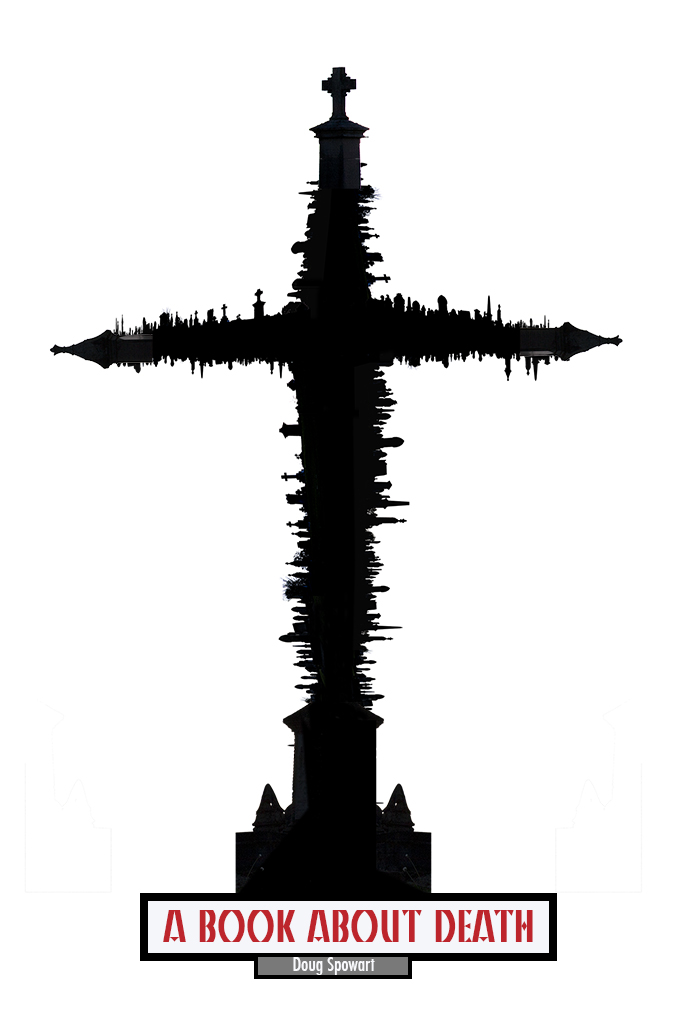
Doug’s contribution to A Book About Death
.
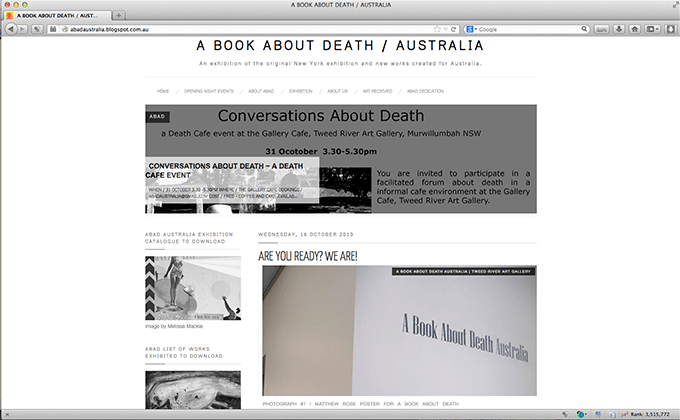
A new exhibition at the Tweed River Art Gallery presents an exhibition of mail art contributed by artists from all over the world which that deals with the topic of death. Entitled, A Book About Death (ABAD), this exhibition is the most recent iteration of the concept that began in 1963 by Mail Art ‘father’ Ray Johnson – The difference on this occasion being that most of the artists represented in the show are Australian. The coordination and curation of this ABAD exhibition has been overseen by Julie Barrett and Heather Matthew.
.
.
The following background information comes from the ABAD website:
.
First and foremost, the American artist Ray Johnson (1927-1995) the founder of the New York Correspondence School deserves all the credit for creating the concept of A Book About Death because he was really onto something when he came up with the concept in 1963. Between March of that year and February 1965, he sent out 13 pages or so of something he called A Book About Death. In framing one piece of a paper as one page of a conceptual book, he anticipated many literary developments of the four decades that have followed. Ray Johnson’s A Book About Death connects to hypertext, cyberpunk, the internet, as well as devices like the Kindle, a device that is an accumulator of electrons that shows its user pictures on a screen of what can be thought of as a book. But the Kindle, one of the possible signposts of what the future of reading will be like, cannot show us an entire book. It can only show us one page at a time.
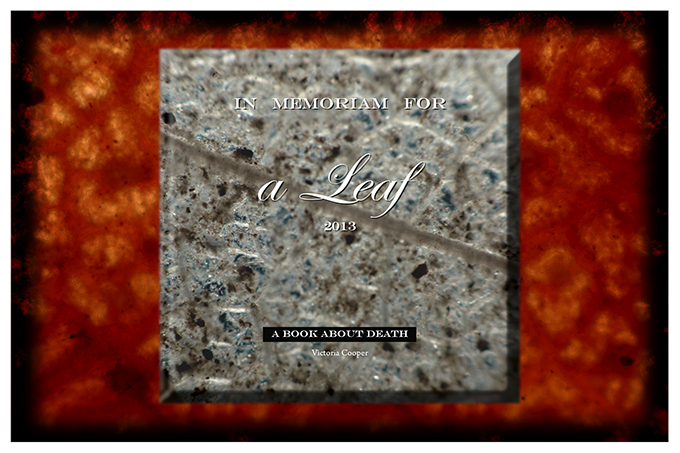
Vicky’s contribution to the ABAD exhibition
.
Vicky’s statement about the work:
Through the microscope I saw the death of a leaf as a metaphor for the forest.
In this leaf I could see
The searing flames of a bush fire,
The decay and recycling of its flesh and bones,
The crystallization of time
A fossil
The past and the future
The story of the forest
In the death of a leaf . . .
.
AN EVENT ASSOCIATED WITH THE EXHIBITION
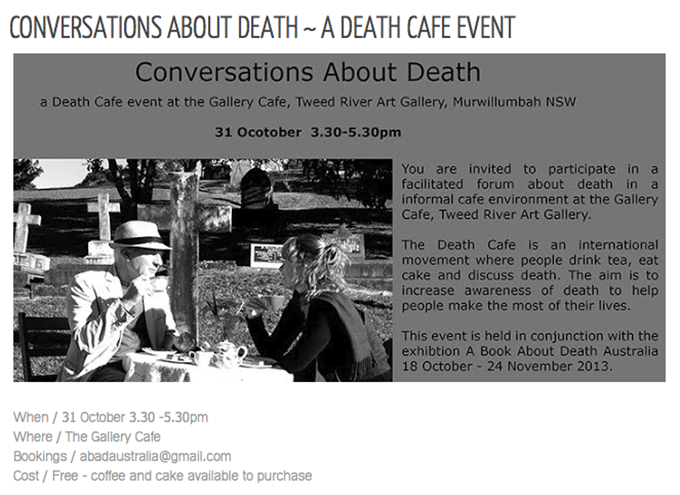
Death Cafe Event
.
The Cooper+Spowart text and work is licensed under a Creative Commons Attribution-NonCommercial-NoDerivs 3.0 Unported License.WORLD PHOTOBOOK DAY: Toowoomba Oct 14, 2013
.
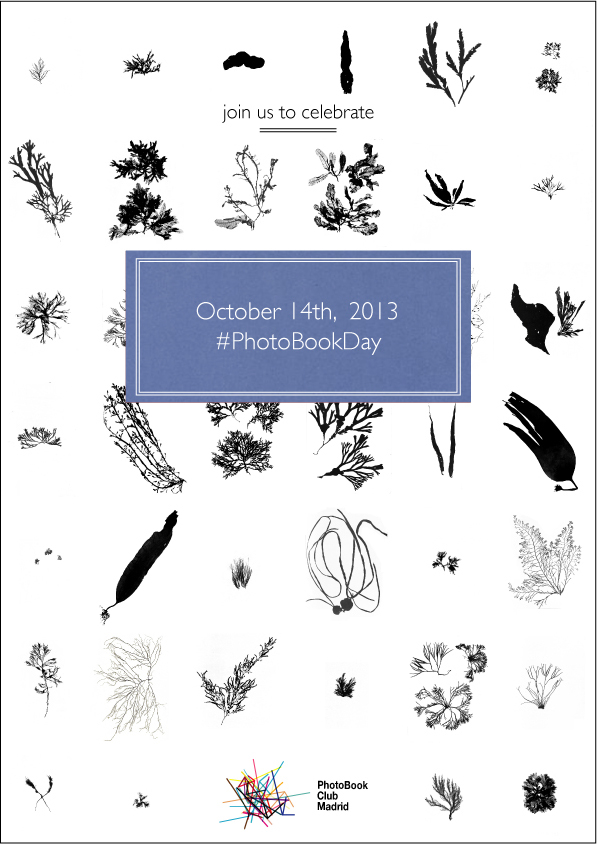
WORLD PHOTOBOOK DAY – CELEBRATED IN AUSTRALIA
.
.
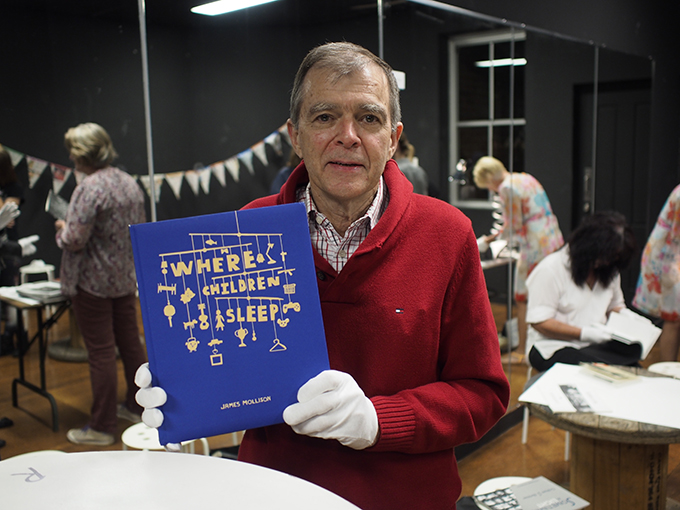
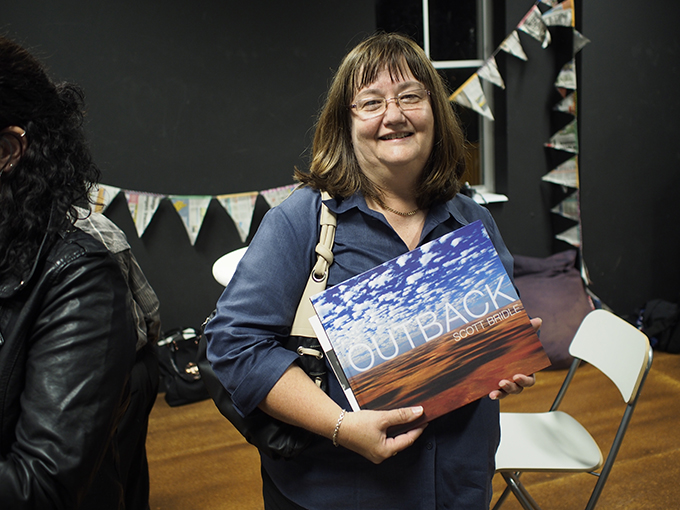
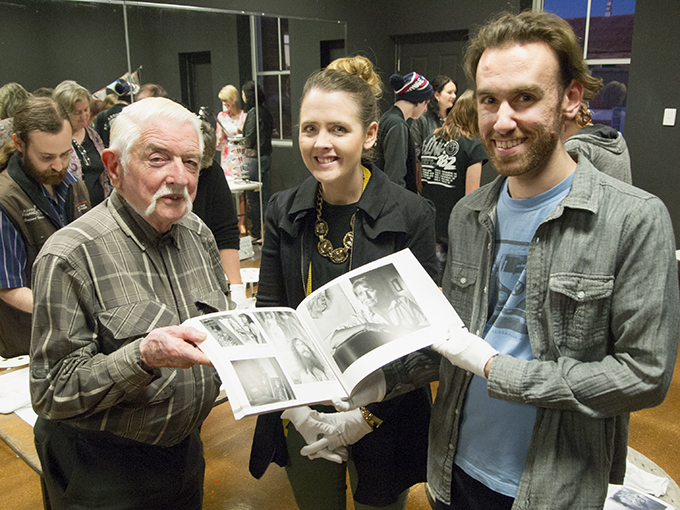
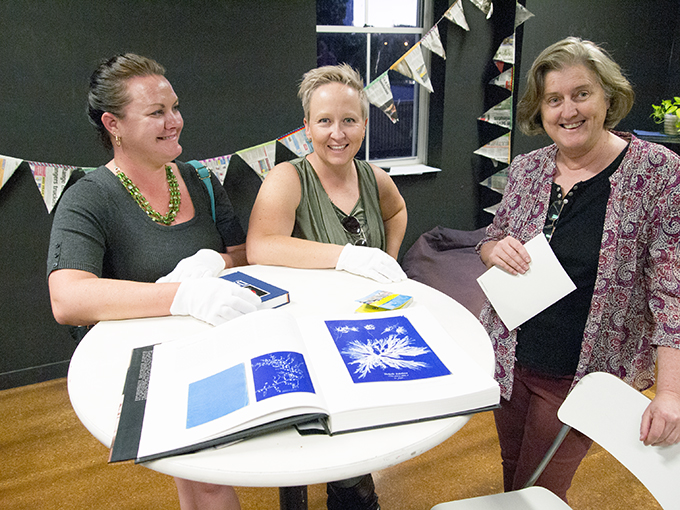
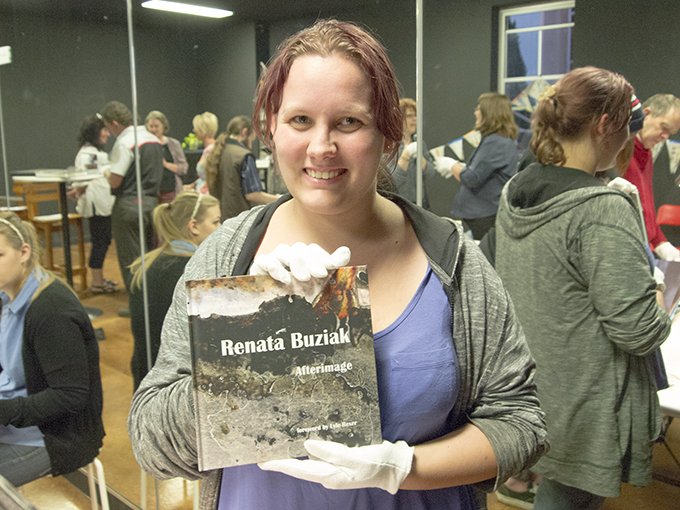
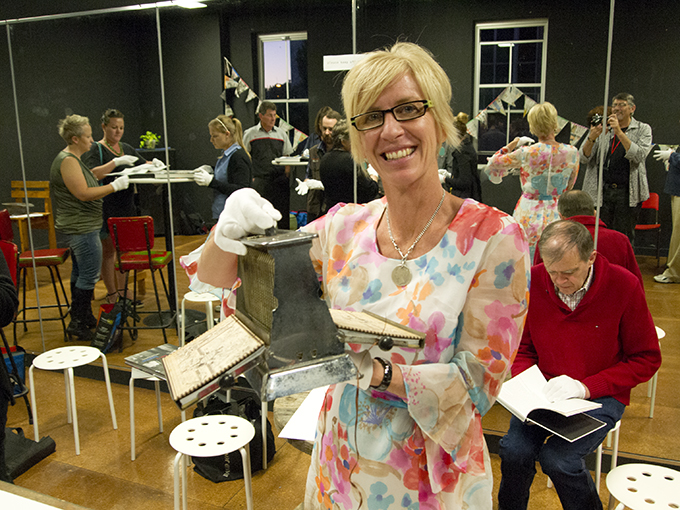
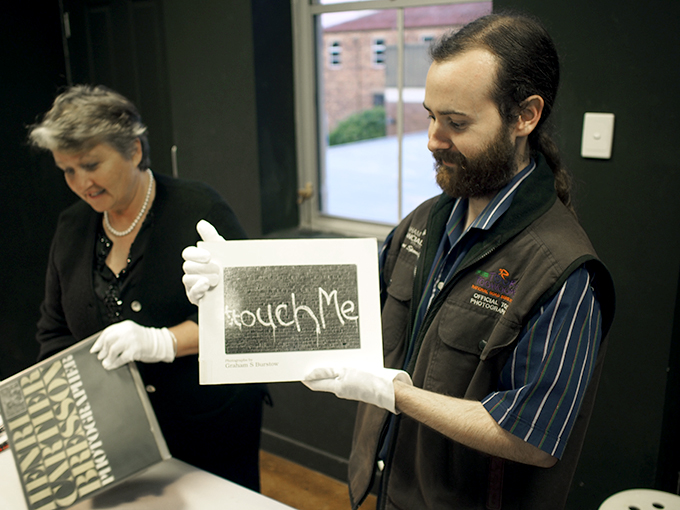
The city of Toowoomba in Queensland Australia celebrated World Photobook Day with a group of around thirty attending a Photo Book Club meeting. The event was held at TheGRID: Hybrid Arts Collective. The participants were from a wide range of photographically interested people: some from the local TAFE college, The Toowoomba Photographic Society, professional photographers, artists and academics. Each brought with them a favourite photobook to share and talk over with others. There were some precious books, some funky contemporary publications, and some of the more traditional coffee table tomes.
.
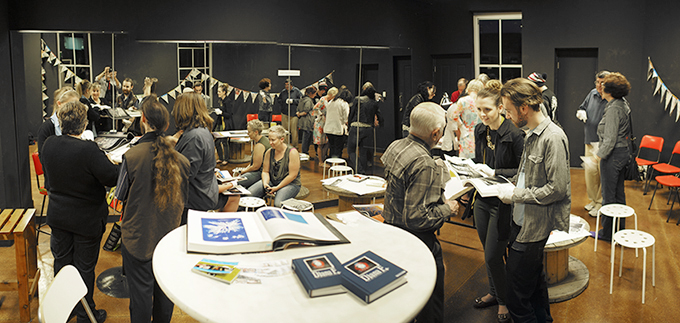
Toowoomba Celebrates World Photobook Day
.
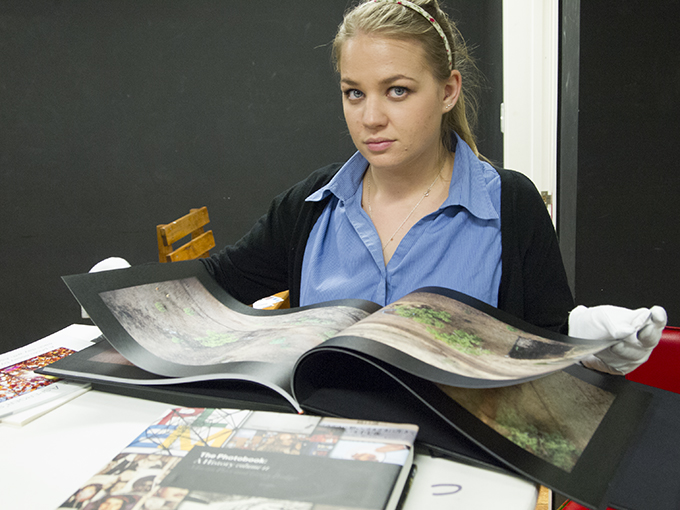
Event coordinator Doug Spowart welcomed the group and gave some background on the history of the photobook and the amazing place that Anna Atkins has within that history. On hand was the Badger and Parr The Photobook: A History Vol1 opened to the page of the Atkins Algae of the British Isles. Doug announced that an acquaintance of he and Victoria Cooper’s – Gael Phillips, was a distant relative of Anna Atkins and that whilst be unable to attend she has provided a commentary on the times, life and family. Gaels words are as follows…
… I thought I might give you a few details of the family of Anna Atkins, nee Children, which may help to explain the setting in which she produced the world’s first photographic book. My cousins, Elizabeth Parkes and Jean Doggett, with input from other family members, have published an account of our family which includes chapters on the Children family. At their family home, “Ferox Hall”, in Tonbridge, Kent, John George Children, Anna’s father and George Children, her grandfather, had built the largest electric battery the world has ever seen at their private laboratory. They were collaborating with Sir Humphry Davy on electrical experiments. It was because of her family’s experience with battery technology and electrochemistry, and almost certainly with the help of her father, that Anna would have had access to sufficient ferric ammonium citrate to produce cyanotypes. Her publication of “Photographs of British Algae” first appeared in October 1843 – British Algae – Cyanotype Impressions. Fox Talbot, a friend of the family, and from whom Anna had obtained her first camera, published “Pencil of Nature” between 1844 and 1846, in several parts. In 1979 Professor Larry Schaaf brought the attention of the world to the fact that the author of the world’s first photo book, AA, was Anna Atkins.
Anna Atkins, nee Children, was born in 1799. Her mother, Hester Anna Children, nee Holwell, was the grand-daughter of Governor Hollwell, one of the survivors of the Black Hole of Calcutta in 1756. Hester never recovered from the birth of Anna and died in 1800.
Anna also wrote a biography of her father, partly concealing her authorship under the initials, “AA”, as she did with her “Photographs of British Algae”.
.
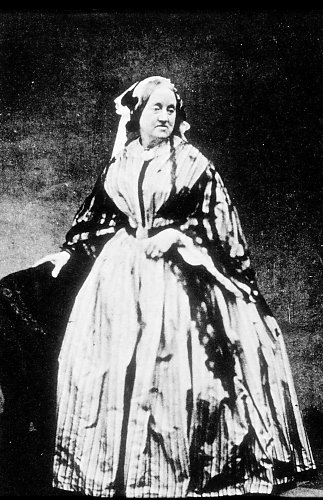
Anna Atkins 1861 [Source Wikipedia}
Anna and her husband, John Pelly Atkins, had no children of their own. Anna died in 1871 and her husband a year later. Their home, “Halstead Place”‘ has since been demolished.
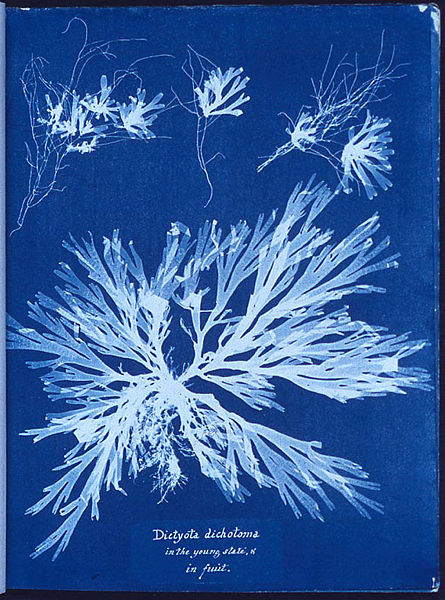
A photogram of Algae, made by Anna Atkins as part of her 1843 book, Photographs of British Algae: Cyanotype Impressions. Courtesy of The New York Public Library http://www.nypl.org.
.
Naturally my favourite photo book (or books, because the Cyanotypes of British Algae by AA run to three volumes) – “Photographs of British Algae – Cyanotype Impressions” by Anna Atkins, my distant cousin. In 1992 I had the great privilege to view copies of the volumes at the Library of the Royal Society in London. The edition ran from between 10 to 12 copies and a few of the plates from one of the copies are held in the National Gallery of Australia in Canberra.
I wish you all well for this celebration of the world’s first photo book by Anna Atkins.
Doug thanked Gael for her insight into the lady whose premier photographic pursuit we celebrate today.
Guests were then invited to continue their looking and talking about books, photography and other worthy matters. It was a remarkable event and one which will no doubt repeated in the future –– but it will be sooner than the next time we gather, once again, to celebrate WORLD PHOTOBOOK DAY.
..A PHOTOBOOK CLUB EVENT

.
HERE SOME IMAGES OF ATTENDEES AND BOOKS … A detailed list of books presented for viewing and other contributions submitted online will be added to this post in the near future.
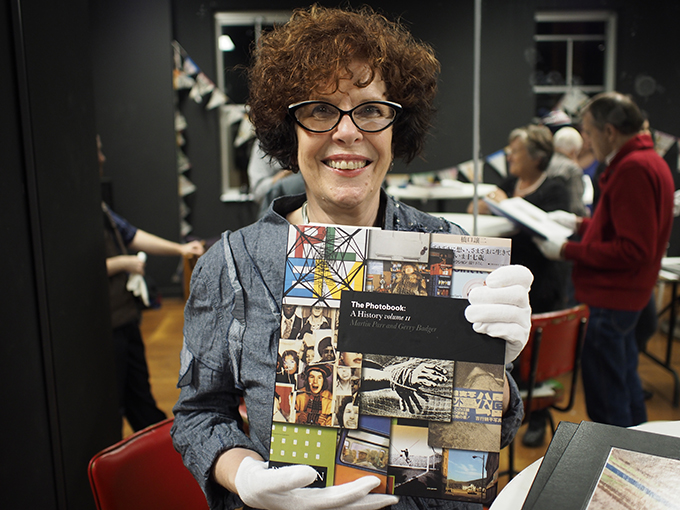
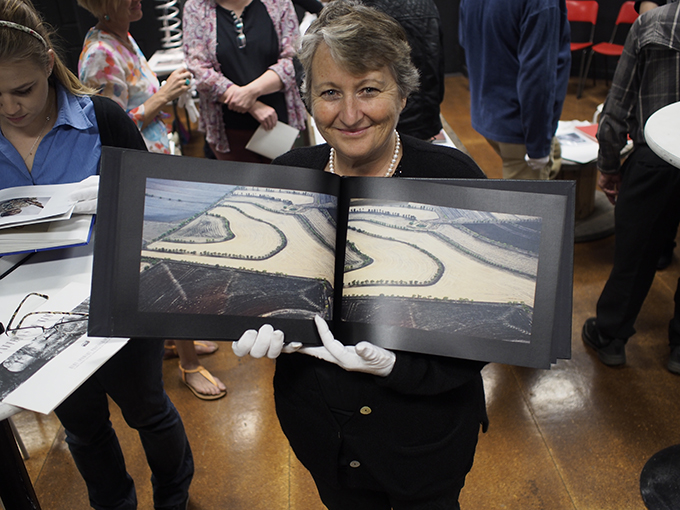
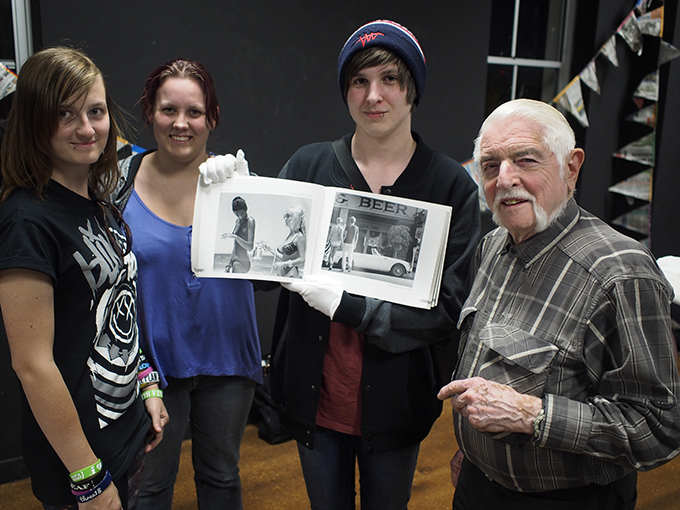
.
Report and photographs: ©2013 Doug Spowart. Anna Atkins’ story © Gael Phillips. Images of Anna Atkins sourced from Wikipedia and acknowledged appropriately.
.
.
FACING FACES: Judging the photographic portrait
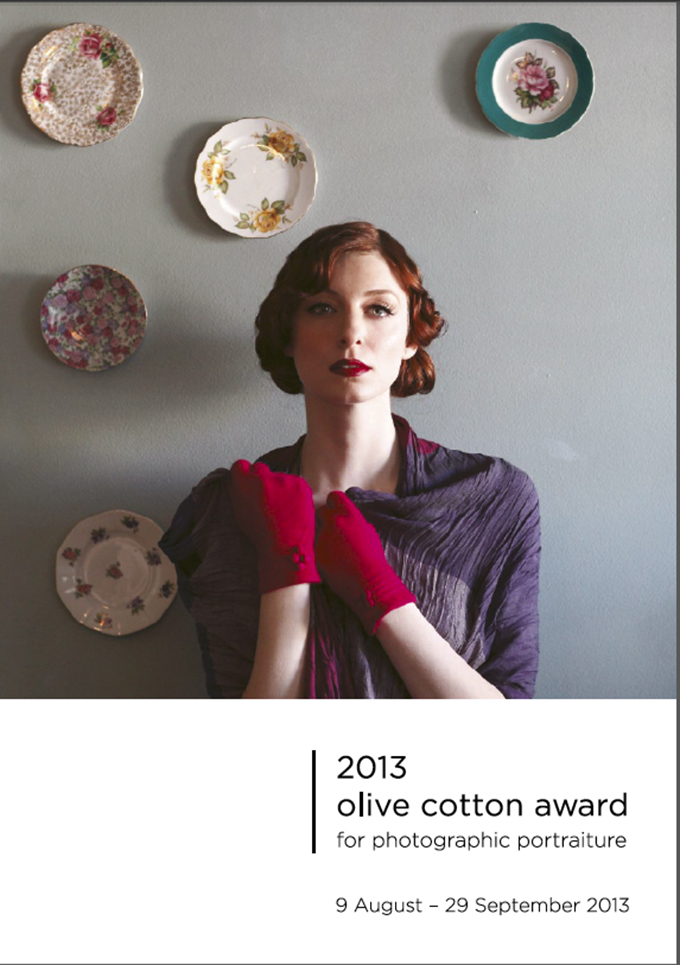
OCA Catalogue Cover
.
Olive Cotton Award Floortalk, Tweed River Art Gallery
.
On September 15 about 30 people attended a floortalk in the exhibition space of the 2013 Olive Cotton Photography Award (OCA). In my preparation I reflected on the demands of a floortalk. Over the years I have given quite a few floortalks about my own as well as the work of others, including one at a previous Olive Cotton Award. I have also attended presentations by others. In this years OCA award I wanted to create an inclusive space for the audience. Rather than taking centre stage, I wanted to empower the attendees in a kind of role reversal–to bring to the discussion their approaches to looking at, and responding to, the photographic portrait.
.
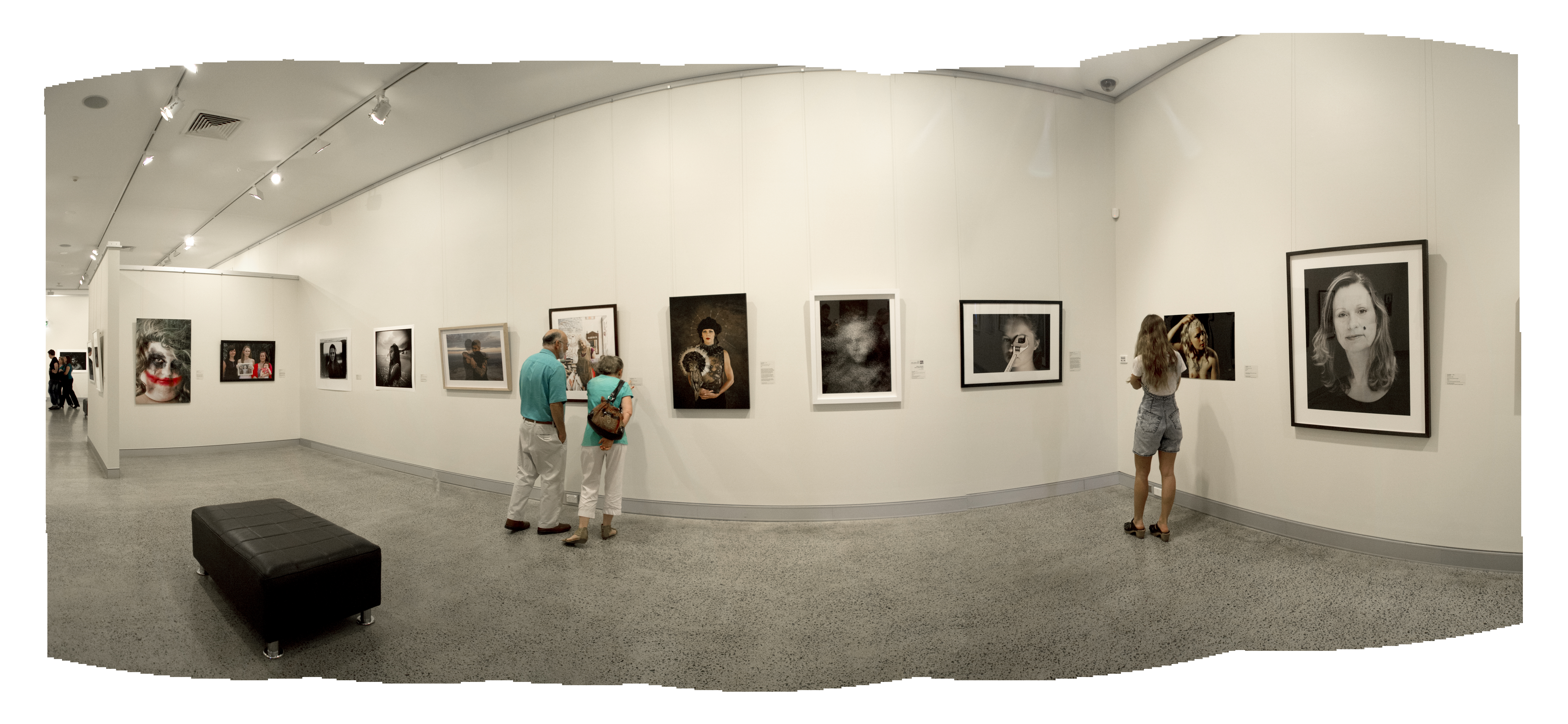
Olive Cotton Award installation at Tweed River Art Gallery
I introduced a concept for viewing and interpreting photographs that I call ‘positioning’. It relates to the interaction that takes place when looking at a photograph – particularly a portrait. It is what reaches into our emotions lived experience and solicits our response. The premise of this floortalk format draws upon the notion that everyone is a judge and is also informed by Roland Barthes’ concept of the ‘death of the author’. I am interested in how the viewer’s interpretation relates to their own life’s experience rather than a direct connection with the author’s intent for the communication. After all, I as the floortalk presenter, can only offer an opinion based on my personal experience and knowledge.
What follows is a conversational précis of the floortalk and the concepts covered relating to portrait photography and the OCA. After a formal introduction by Tweed River Art Gallery’s Public Programs Curator and Coordinator of the Award Anouk Beck, I addressed the group.
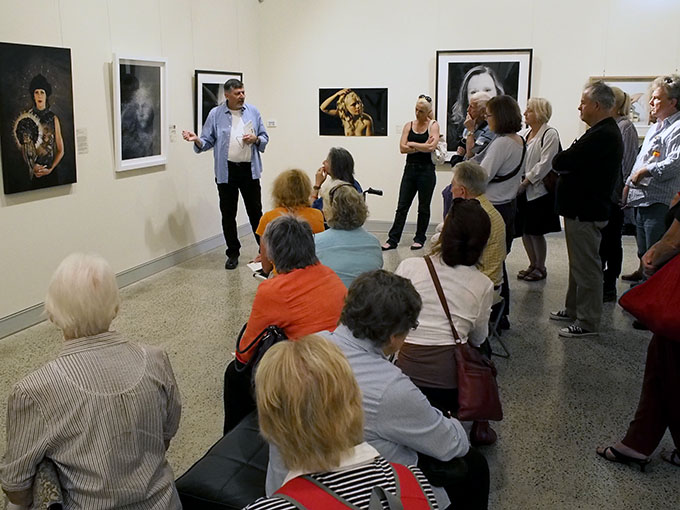
Doug Spowart presenting the floortalk
.
We stand this morning in a gallery exhibition dedicated to the most photographed subject of all – the human face! The floor talk today will explore the idea of the photographic portrait and how we reflect on the success of this visual communication.
There is an old saying that you can tell a great portrait because the eyes follow you around the room – Well any portrait, even a painting, where the subject is represented looking toward the photographer’s/artist’s viewpoint will capture the subject in a way that will enable this ‘phenomenon’ to be observed. So this method for assessing a portrait will not successfully operate here.
Another way of knowing what great portraits look like is to ask an expert, whomever they may be, to make a decision. Awards such as the Olive Cotton Award use this principle and over the years an impressive list of pre-eminent photographers and/or critics and commentators on photography have been commissioned for the task. I must acknowledge the judge for this year’s award – Helen Ennis. I cannot think of anyone who would be as knowledgeable of the ideas, thoughts and working methods of Olive Cotton than Helen Ennis. In her connection with Olive Cotton, Ennis has written several books and catalogues, selected works and curated exhibitions and is in the process of writing Cotton’s biography. Ennis has provided for us all a greater understanding of Cotton’s work and prominent position within the history of Australian photography.
Now, let us think about portraiture and the act, as we find ourselves today, looking at and evaluating portraits. It is interesting to note that although the portrait is at the top of the list of photographic subjects, we can see in this award there is no standard approach. As we look around this gallery space today no two portraits look the same – I’m not referring to the diversity of subject’s portrayed, but rather the way the photographer has created and presented the subject to us. The photographs range from snapshots of unplanned spontaneous moments to documentary reportage and illustrative magazine styled images, and then to the overtly staged theatrical tableaux. Some images are derivative – that is that the approach to the image replicates time honoured, and sometimes perhaps over used or common, techniques, styles or treatments. Other images may represent subject and styles in ways that are vibrant and fresh.
When a portrait is made the photographer makes personal decisions relating to equipment selected, technique, style, lighting, posing, gesture and subject expression. They make a portrait that satisfies their personal urge to tell a story. This story is usually firmly related to the subject; although it can be a theme the photographer is investigating or be based on something from the photographer’s own life experience. The photographer may want or even demand that viewers take from the work a particular and specific meaning. The artist’s statement accompanying exhibited works can support and signpost and influence the readings that a photographer may want to pass on.
However, I would suggest to you, that once the image leaves the photographer and is presented publically a new paradigm exists. Writer and commentator on photography Roland Barthes wrote ‘… the birth of the reader must be at the cost of the death of the Author.’ (Barthes 1977:148). In this instance I propose that the photographer is the author – the reader is the viewer. When looking at photographs the viewer connects their life experience to what the work presents, and the narrative or meaning that emerges can no longer be the photographers alone – it is a hybrid born by the activation of the viewer.
We are all judges in a way and each of us has a unique experience of the world that directs and supports our response to images that we view. We will no doubt encounter portraits here today that are universally powerful and profound yet there will be other images that may reach individuals amongst us in the most direct and personal ways. What this means is that each of us is a kind of judge, and that our individual responses may be just as profound as those experienced by Helen Ennis five or so weeks ago.
Today then, I invite you all to be the judge and what we will be doing is engaging with selected works from the exhibition to discuss and review – and I will be asking you to contribute to the conversation. To assist you with this I’d like to pass on the concept that may help us with this process – it’s essentially about what I will call ‘positioning’. Your response to a portrait photograph, or perhaps in another context any photograph or work of art, is informed by your personal background as we have already discussed. Your ‘position’ can be informed by the synergies of your life experiences that may include; physical, ideological, religious, gender, specific demographic, life experience of birth, death, love, illness, war or personal achievement or tragedy. So when we talk about a portrait please consider your position…
[What followed in the floortalk was a conversation by the participants moderated through my involvement. The audience contributed some interesting responses and ideas about portraits that included; Tamara Dean’s ‘Brothers’ 2013, Russell Shakespeare’s ‘Bob Katter’ MP 2011, Tina Fiveash’s ‘Twin Spirits’ 2013, Imogen Hall’s ‘Barry Jones and the ancestor’ 2012. At times there were powerful and emotional connections made by particular participants which were then shared through this floortalk conversational strategy.
.
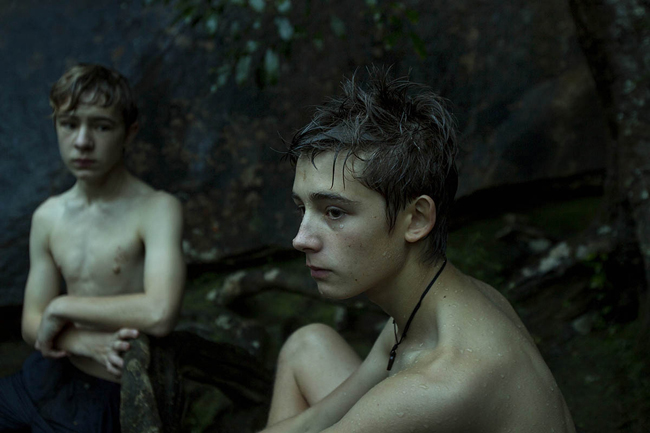
Tamara Dean’s Brothers
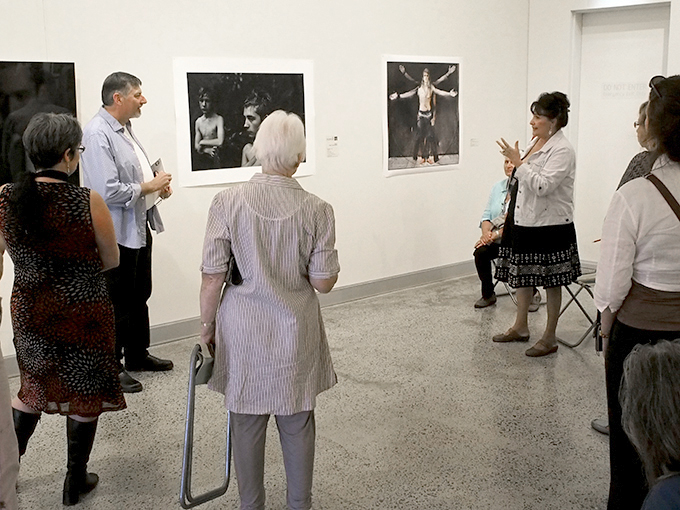
Participants discussing their position and response to a portrait
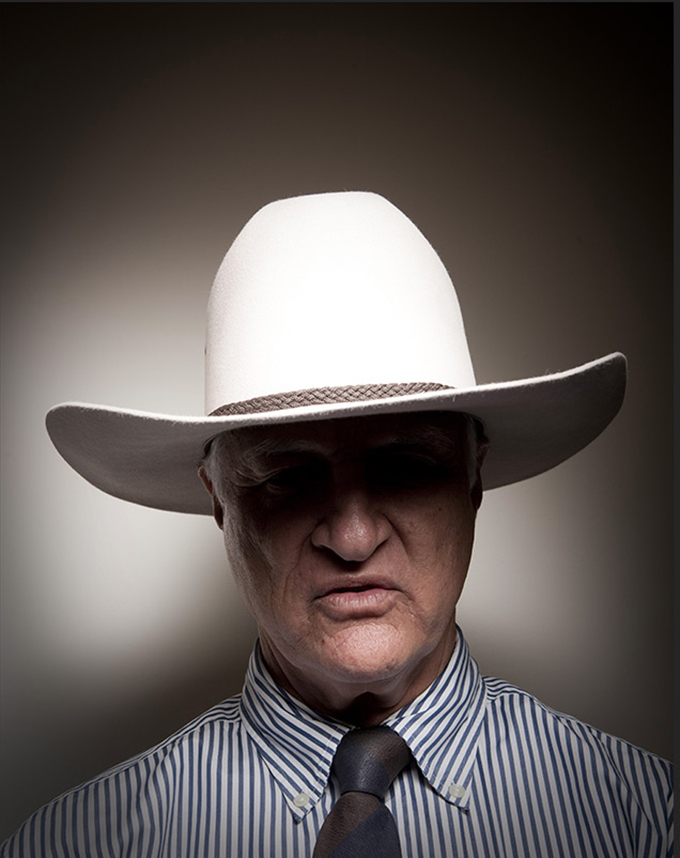
Russell Shakespeare’s Bob Katter MP
.
I was asked to give my position on the winning photograph – Trent Parke’s ‘Candid portrait of a woman on a street corner’ 2013. Many attendees did not –or– could not find a ‘position’, that would enable them to understand the reason behind its selection. I spoke from my position informed by my background in the art and professional practice of photography and many years dedicated to the education and critique of this medium – I knew from comments made by the judge on announcing the award that she found Parke’s image something that she at first didn’t standout as so many images do – but she kept coming back to it. My position on the image was as follows…]
.
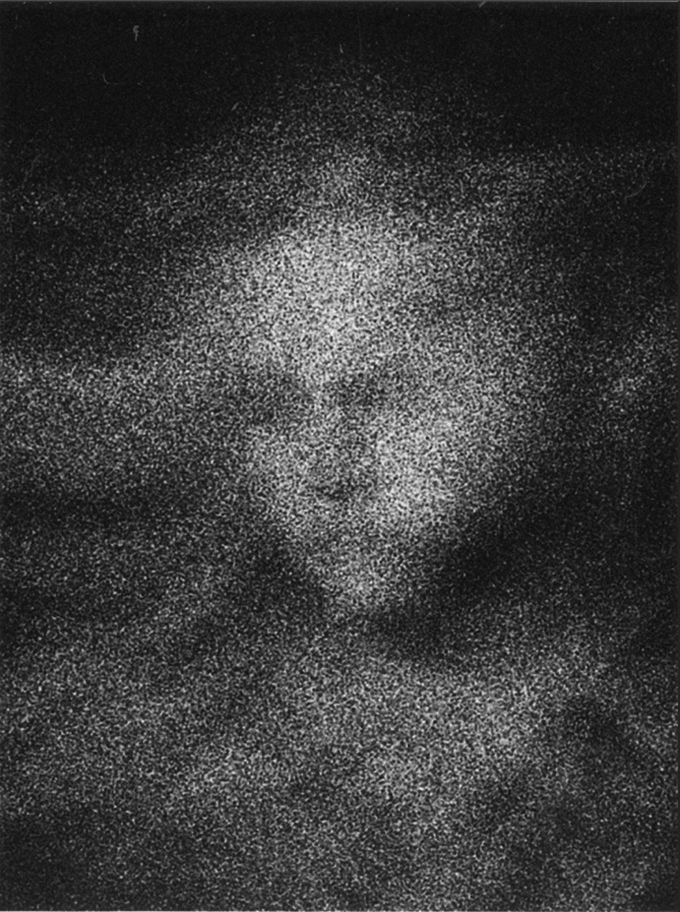
Trent Parke’s Candid portrait of a woman on a street corner
.
On first encountering Parke’s image it does not give us much – it initially appears as a field of greatly magnified monochrome film grain, which hides the delicate structure of a female face. A closer view reveals less, and interestingly, the further away you move the ‘sharper’ the image. Parke’s portrait demands more of the viewer to find meaning – it challenges, it questions, it’s not a specific person, unlike every other portrait in this award, but more the generic form. For me it also comments about the romance of film and ‘humanness’ in the digital age. At the beginning of this floortalk I suggested that much of portraiture can be derivative – but this image has no provenance in contemporary portraiture – it stands alone, perhaps signalling that there is room for new and exciting representations of the human visage yet to come…
[The floortalk concluded and attendees continued viewing other portraits in the show from their newfound critical ‘position’. The outcomes and exchanges resulting from my floortalk strategy was, for me, personally enlightening and rewarding. A number of participants came up after the talk to say how much they had enjoyed and appreciated the opportunity to discuss work and have their ideas, opinions and experiences shared in that way.
From their participation and responses today one could perhaps say that the author is dead – and many readers have been born …]
.
Dr Doug Spowart 3 October 2013
.
A PDF catalogue of the Olive Cotton Award is available here 2013 OCA catalogue for web_screen
.
Barthes, R. (1977). Image Music Text. London, Fontana Press.
,
Photographs of the floortalk © 2013 Victoria Cooper. All other images are the copyright of the photographer.
.
This work is licensed under a Creative Commons Attribution-NonCommercial-NoDerivs 3.0 Unported License.
.

 wotwedid