VISITING GRAFTON REGIONAL GALLERY: June 2024
.
Regional Art Galleries exhibitions and events not only say a lot about the culture of a local community but they also provide a connection to the broader national and international world of art. These institutions are places where locals can engage with and present their stories and celebrate their creative spirits. This experience is not one that a capital city can provide – it is unique to the regional gallery and arts centre. It also provides an opportunity for local artists to be located or acknowledged within the broader art community. The Grafton Regional Gallery is one of these galleries.
.
.
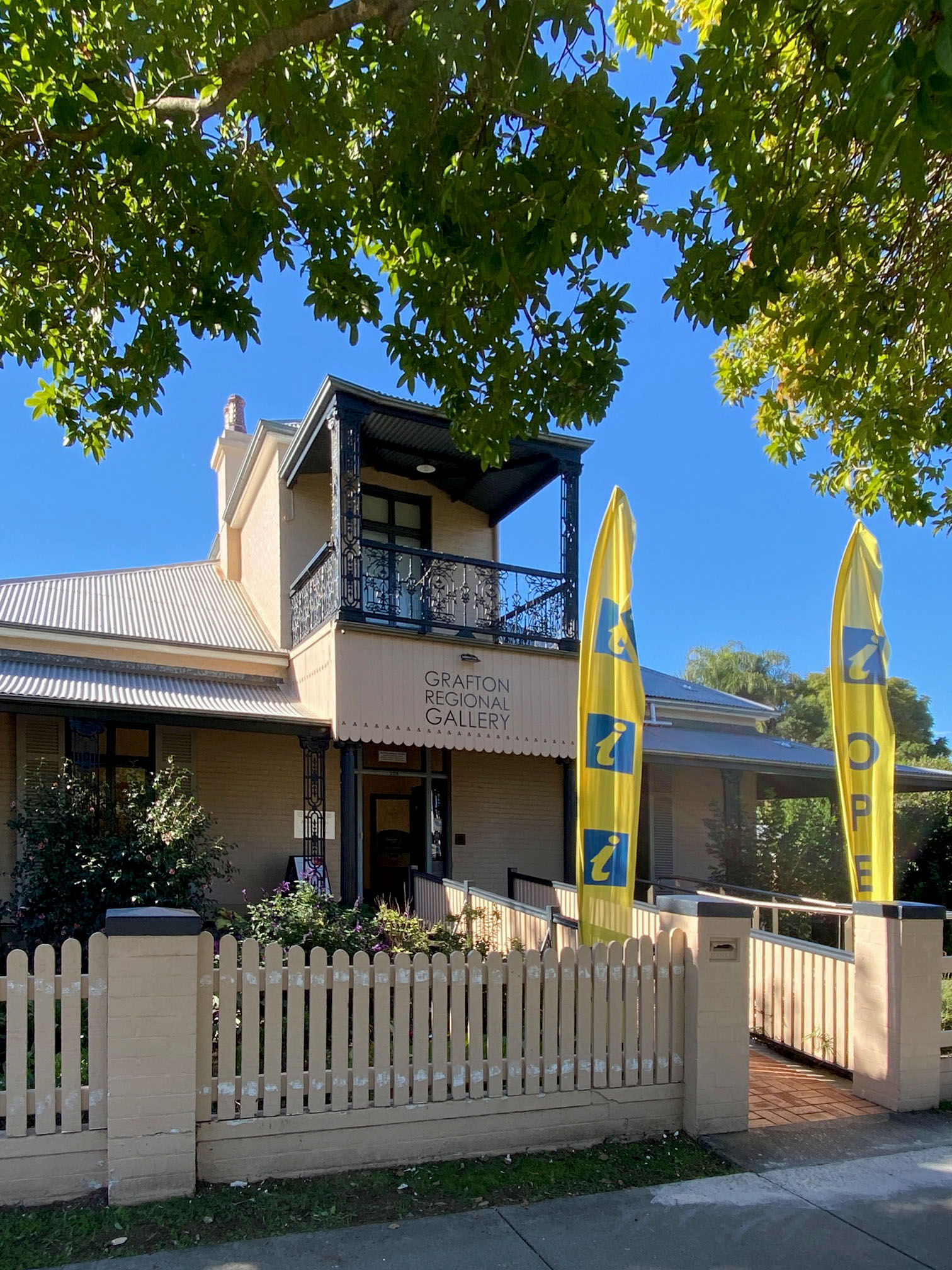
When visiting this region we always make time to see what is showing at the gallery and the current exhibitions were again full of interesting stories and creative work. The entrance to the front of the gallery and information centre is on the ground floor of historic Prentice House[1] . In these front rooms there is a wonderful show of botanical drawings and paintings by local artist, Doris O’Grady. O’Grady’s art can be appreciated for the aesthetics and taxonomic work she made from her collection during the mid 20th Century.
.
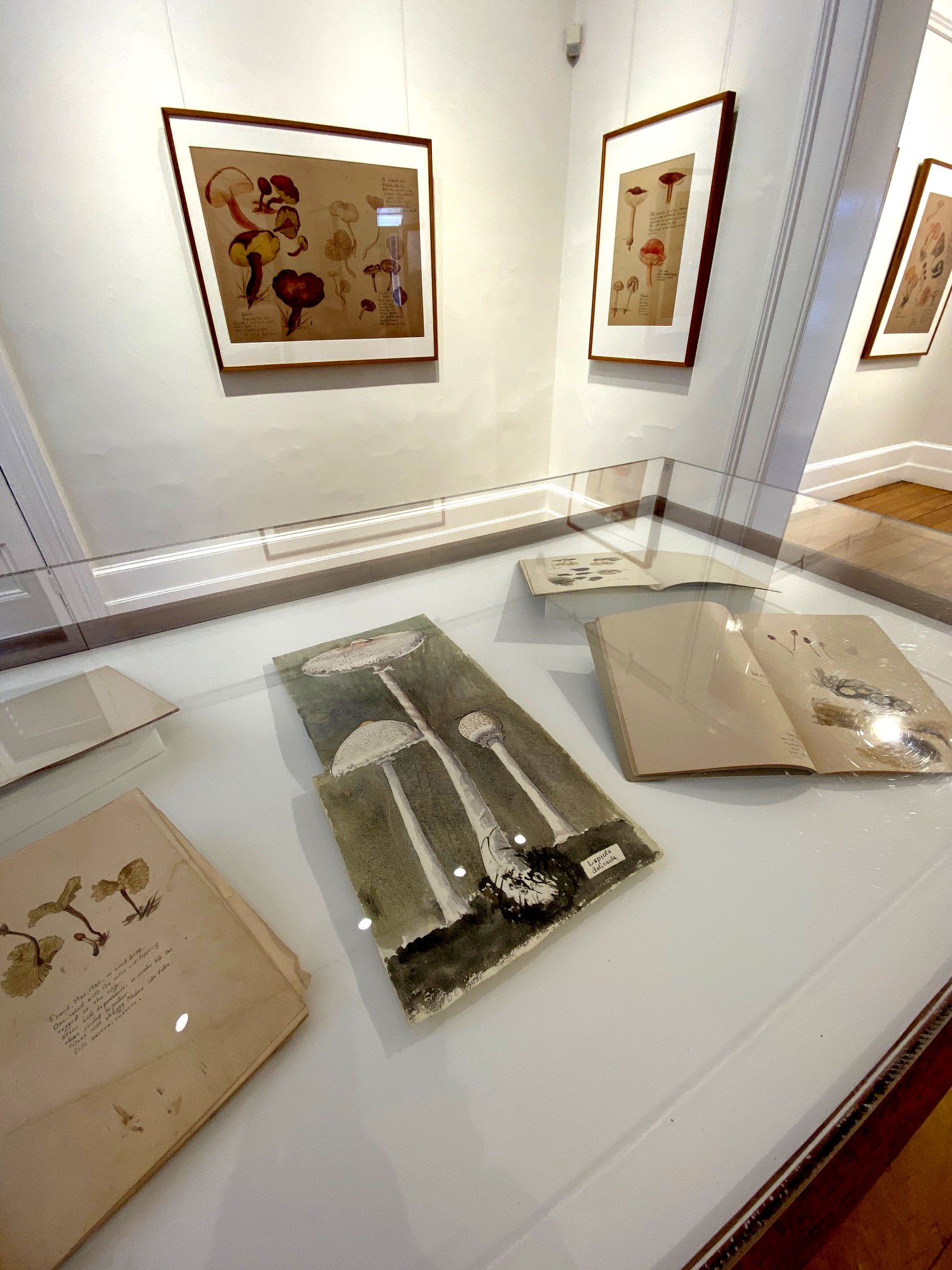
Doris O’Grady “Mushrooms” exhibition
.
Interestingly the place where we are staying in this region had some strange fungi growing in the garden about which we were curious. Amongst Doris’ paintings was the very same fungus we had seen that morning in the front garden! O Grady’s work in emblematic of the blurred lines between art and science. Where the scientist or naturalist creates interpretive aesthetic drawings of their beloved subject for both further investigation and display.
.
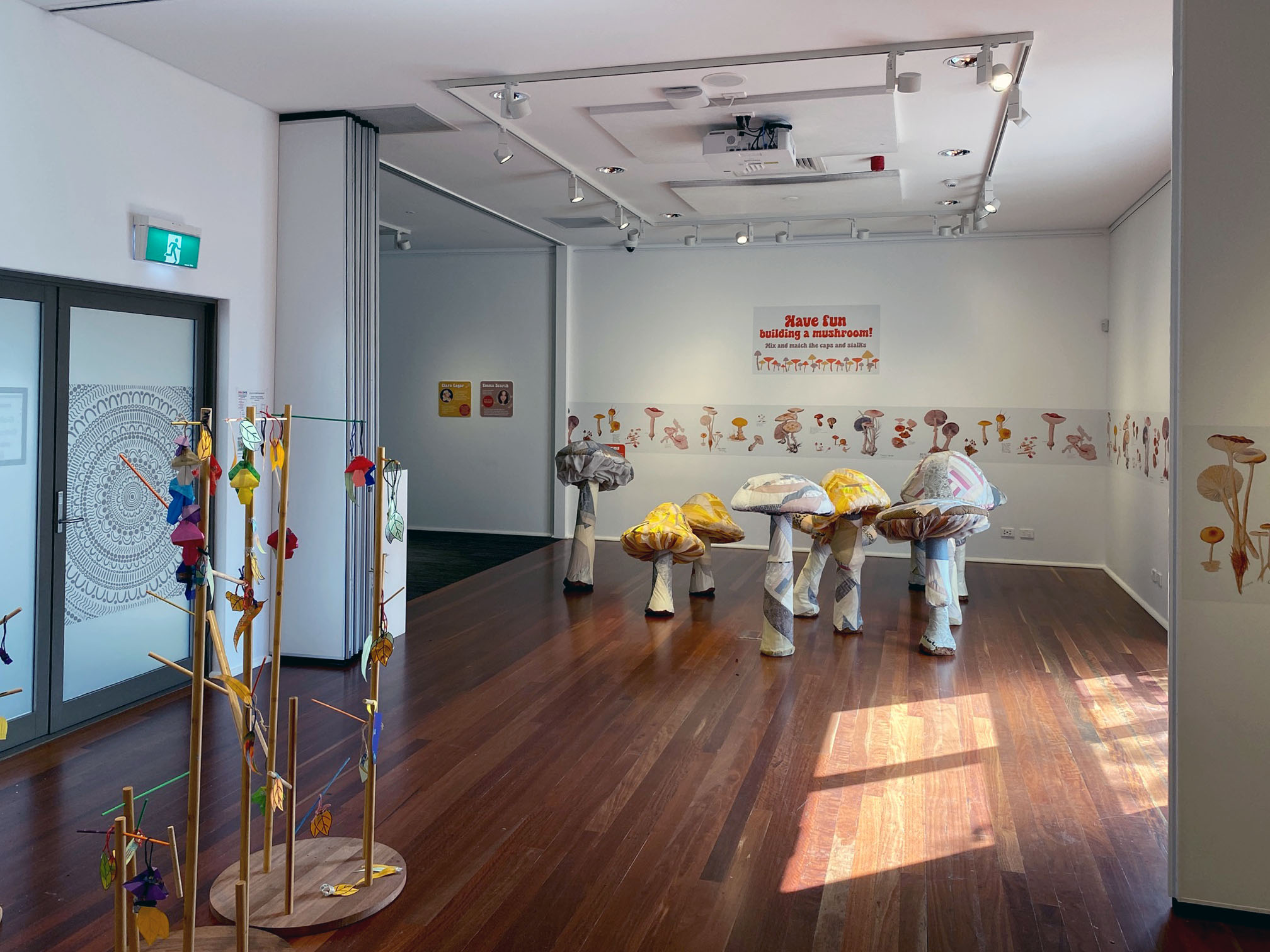
The Mush Room Family Play Space with soft sculptures by Antony Perring, Design and education by Bush Fairy animations by Clara Lagor (USA) and Emma Scarth (Canada)
.
Across the courtyard the newer second part of the gallery, we encountered a magical space inventively named, The Mush Room. Here artists and designers have playfully created a space of soft sculptures, a video and didactic wall panels. There is also an interactive drawing and sculpture for the young at heart to investigate fungi and environmental themes by creating their own work and adding leaf elements to adorn the wooden tree shapes.
.


.
In the next gallery spaces, mushrooms and fungi feature again within a larger exhibition of prints and an artists book, The Printer’s Proof: The Fred Genis Collection. Genis over his long career as a master printmaker collaborated with many nationally and internationally renowned artists including John Cage, Robert Rauschenberg, Tim Storrier, Judy Watson and Brett Whiteley.
.


.
There is a huge diversity of themes and work, the Mushroom Book by John Cage is a main feature. Pages from the book are displayed between Perspex to allow the viewer to see both sides of the pages and connect with the books conceptual design incorporating lyrical texts and visual elements. The bound book was displayed in a vitrine adjacent with some archive documents of the production and sale.
.


.
Artists Proof is a comprehensive exhibition bringing together a history of art and printmaking, the artists and studios. It is an exhibition that would appeal to many particularly those wanting to touch with the practice of Genis and his contemporary colleagues. There is the potential for many discussions around the individual works as objects and concepts, of and for their time in art.
We will return to the gallery as to fully engage with the depth of these exhibitions will take more than one visit.
Victoria Cooper
[1] For more history see https://galleryfriends.com.au
.
.
Grafton Regional Gallery
June 2024
Exhibitions, 11 May to 7 July 2024
Doris O’Grady: Mushrooms
The Mush Room
The Printer’s Proof: The Fred Genis Collection
.
All photographs by Doug Spowart Text by Victoria Cooper
.
.
.
.
.
.
.
.
.
A Poem for Dad on ANZAC DAY – Victoria Cooper
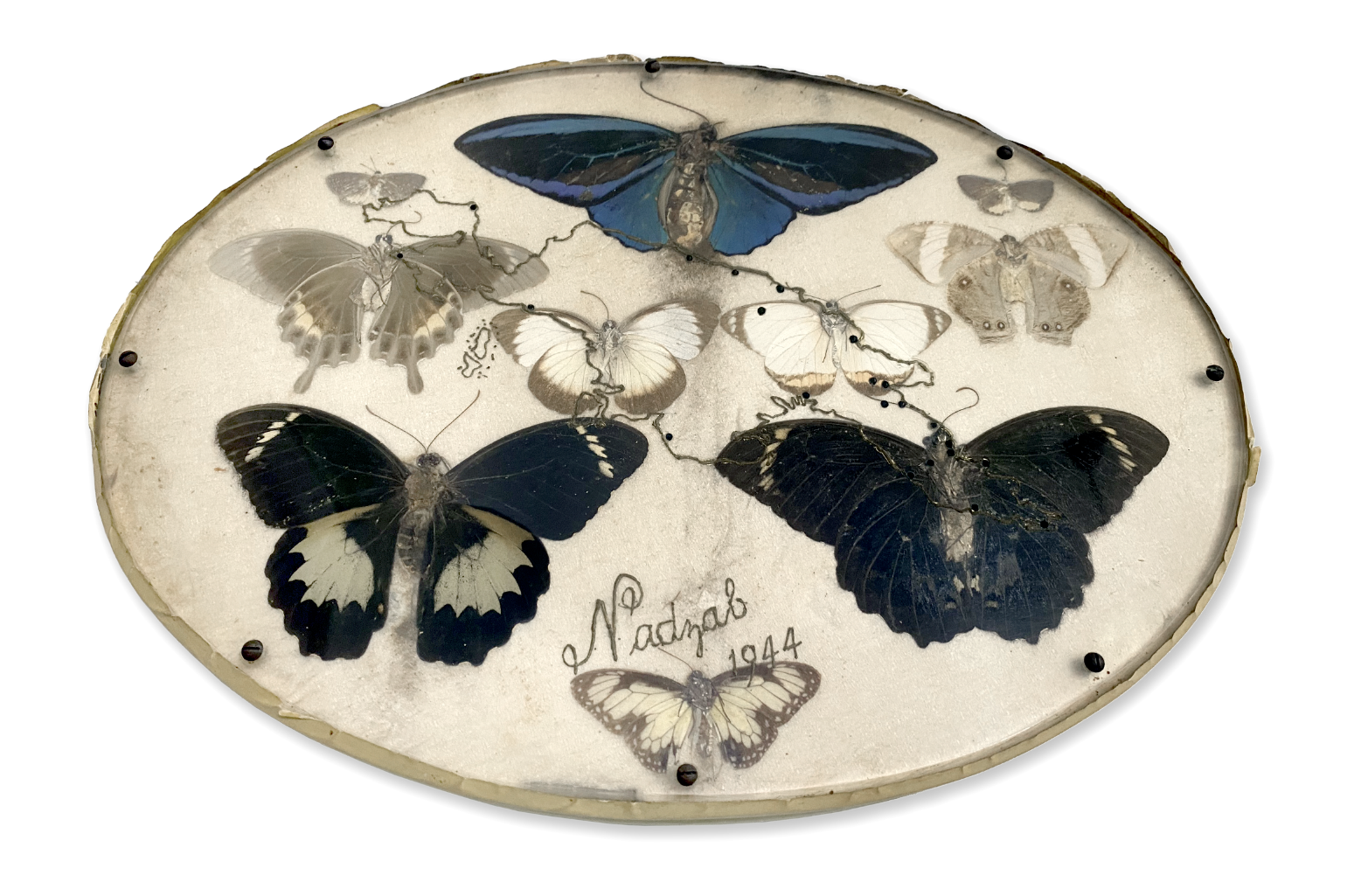
Reg Cooper’s WW2 PNG Butterfly collection*
.
My father Reg Cooper served in the Royal Australian Air Force in Papua New Guinea in World War II. During this time he made this work by collecting butterflies and placing them over a map of PNG and framing. It is entitled “Nadzab 1944” – where he was stationed.
Remembering small shared moments of joy for the natural world.
Many of which no longer exist but for a museum of memories.
With gratitude to my father
.
Pneumas
.
Flashes of colour
Flutter across the wall
The souls of the warriors
Fly over
The sublime terrain
While pinned
To a never ending present
.
Years pass
This man
Tends a distant garden
Preparing a fertile space
In anticipation for the end of dormancy
.
And so the decades
They fly
This man and a small child
Tend the garden
With humility in everyday work
Merging into a gentle rhythm
No expectations
Just joy in the flowers
That simply grow
.
But the Butterflies
Remain
Souls Hovering
Over that memory
What do they know
About Time…..
.
Eventually
The child alone
Tends the garden
Now a field
Rich with Dreams
Of Flowers
And Forests
.
All this …
For The Butterflies
To breathe
.
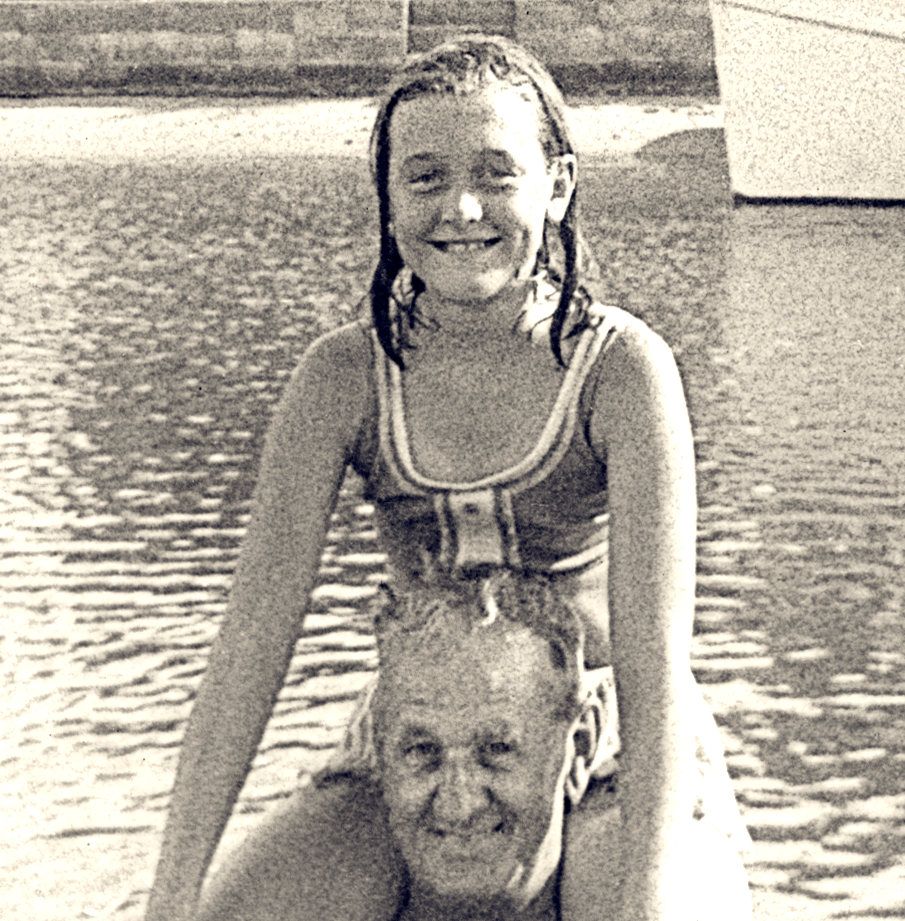
Vicky and her Dad Reg …circa 1960s
*Pneuma (πνεῦμα) is an ancient Greek word for “breath“, and in a religious context for “spirit” or “soul“.[1]
.
.
.
.
.
.
This Blogpost is copyright: Text – Victoria Cooper ©2020, Nadzab 1944 © Reg Cooper, Portrait of Victoria & Reginald Cooper – Helen Cooper ©circa1960
Any RSS reposting from this Blog without permission represents a breach of Copyright.
.
.
.
.
.
JULIE MILLOWICK’s ‘Surrounding’– Intrinsically Local

Continuing Drought El Nino year – Julie Millowick with son Christian McArdle at Crocodile Reservoir PHOTO: Courtesy of the artist
.
SURROUNDING
The beauty of Central Victoria’s landscape in tumult and recovery
.
An exhibition by Julie Millowick at Castlemaine Art Museum
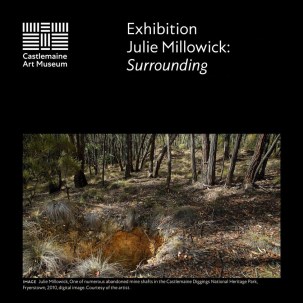
CAM – Surrounding Julie Millowick
.
“Photography is my life; it is the very core of my being”
Julie Millowick
Surrounding is an exhibition by Julie Millowick surveying her lived experience over 36 years in Fryerstown, Victoria. Over time this celebrated documentary and commercial photographer, driven by a curious and creative mind, has created a photographic archive both cataloguing her visual inquiry and providing a chronicle of her life within this place. Millowick’s work is multifaceted where the poetic and psychological is interconnected with an almost scientific aesthetic thus sharing deep insights into the land that has both nourished and challenged her.
The curator, Jenny Long, has written a sensitive and informative essay for the book Surrounding that accompanies the exhibition. Long discusses Millowick’s process and conceptual thinking along with observations to provide background and framework for the viewer to consider this extensive project. Along with the book there is promotional material and didactics that proposes the exhibition will ‘show us the devastating effects of mining, drought, flood and invasive plants, but also remind us of the interconnectedness that links all parts of this ecosystem including its human occupants.’ And that there is a, ‘capacity for renewal … that offers a spark of hope for the future.’
.
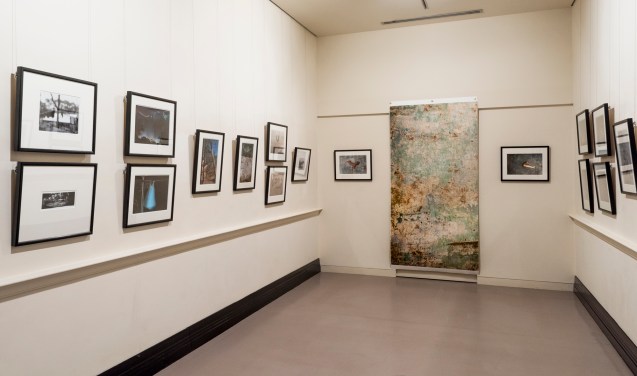
Surrounding House and domestic installation PHOTO: Supplied by the artist
.
In the first gallery space, the ‘house and domestic’ body of work is presented as twenty-three individual framed works including an 1870s photograph an original owner, Mrs King, standing outside the home. In this work Millowick’s subject matter includes botanical still-life works, images of the detritus of past inhabitants unearthed in the house grounds and there is also a large print of a section of a house wall interior etched with the marks of habitation and the patina of age. Images of washing drying on the clothesline refer to the domestic space of the past and present habitation of this home. Far from being prosaic records of domesticity, the photographs of the washing have an ethereal perhaps even ghostly appearance.
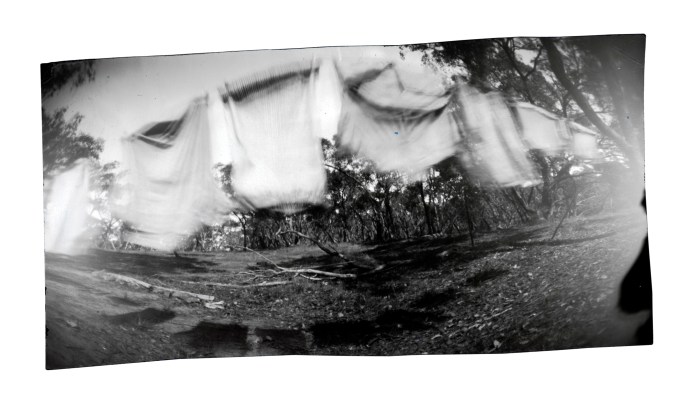
Washing in Horse Paddock pinhole image 1996 PHOTO: Courtesy of the artist
.
There is also a kind of haunting in the walls and surrounds of the house, which continues through the shadowy and dramatically lit scenes of this exhibition. The appearance of a selectively illuminated tree branch or the enchanted presence of Millowick’s horse Goldie, imbues the place with a mythical spirit that beckons the viewer to follow into the mysterious dark forest.
.


.
Contrasted with a sense of wonder and fairy tale mystery, Millowick’s work is also deeply grounded in the reality of place, which is as sharp and unadorned as the land itself. In the larger exhibition space, there are groupings of unframed images that explore both topographical and psychological aspects of specific spaces and themes including mine sites, the Castlemaine Diggings National Heritage Park, ecological thinning, the Crocodile Reservoir Drought and horse paddock. A constant subject for Millowick is her son Christian whose activities are documented in many of these themes. images within the groups are placed together to form clues and evidences that suggest larger narratives. It is also interesting to consider the installations as visual representations of the conversation between artist and curator piecing together the rich collection of work and the resonance or dissonance between images and concepts.
.
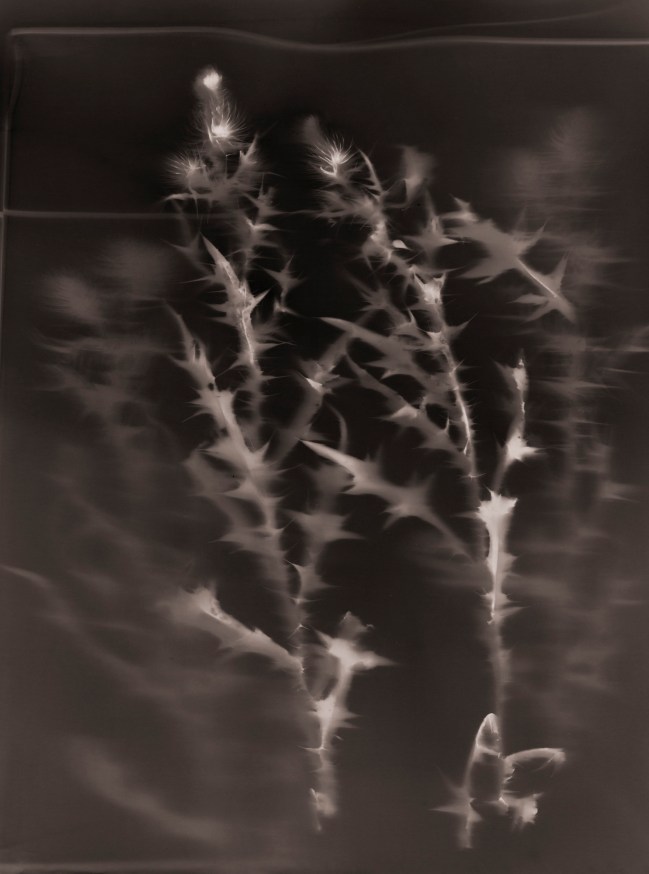
Invasive Thistles 2002 Lumen print by Julie Millowick
.
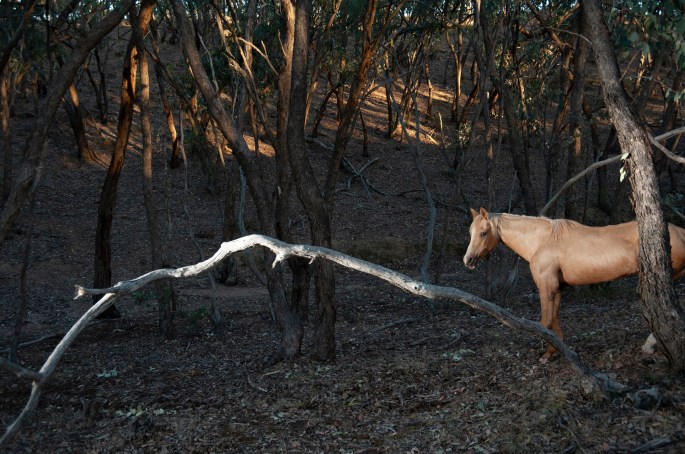
Goldie, 34 year old horse 2009 PHOTO: Julie Millowick
.
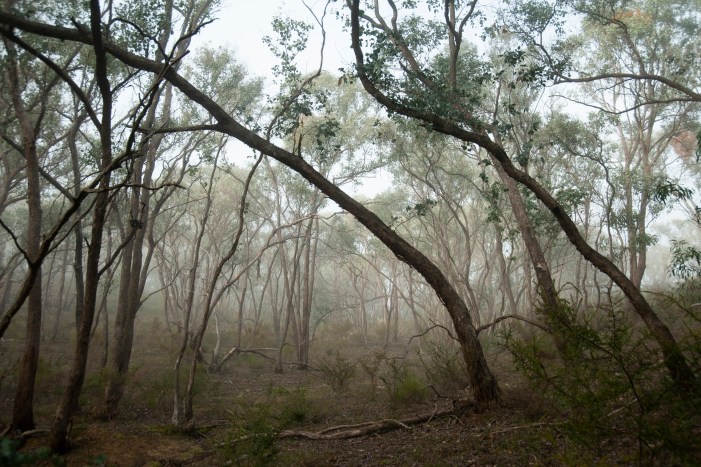
Horse Paddock Post Goldrush Uniform Regrowth PHOTO: Julie Millowick
.
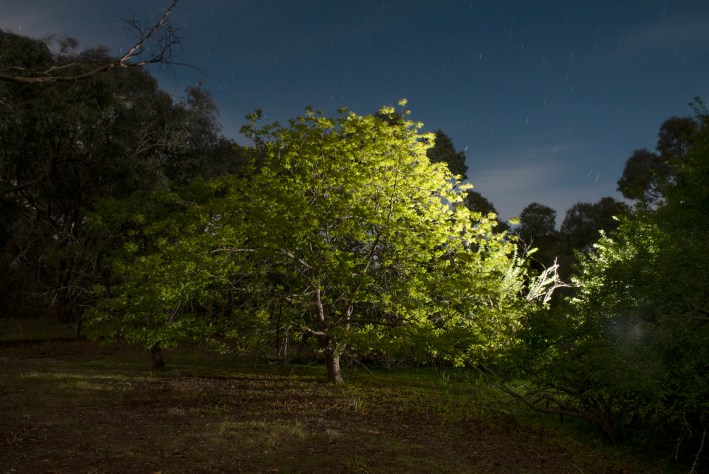
Fryerstown, Isolation, Lockdown, Orchard, Chinese Pistachiola Tree, last moments before midnight on 21 October, and first moFryerstown, Isolation, Lockdown, Orchard, Chinese Pistachiola Tree, last moments before midnight on 21 October, and first moments on 22 October PHOTO: Julie Millowick
.
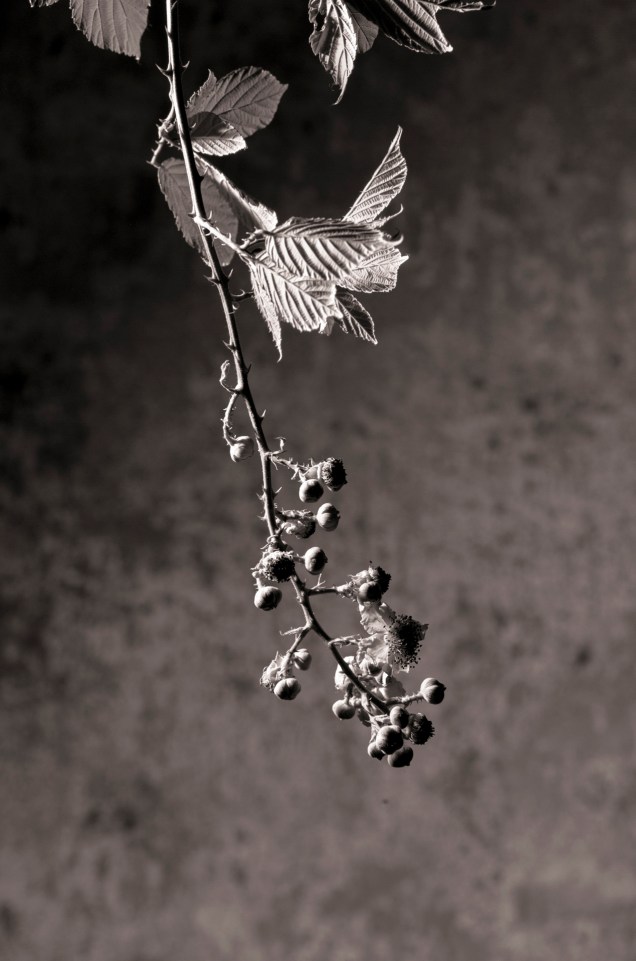
Original Cottage Wall with introduced Invasive Blackberry 2023 PHOTO: Julie Millowick
.
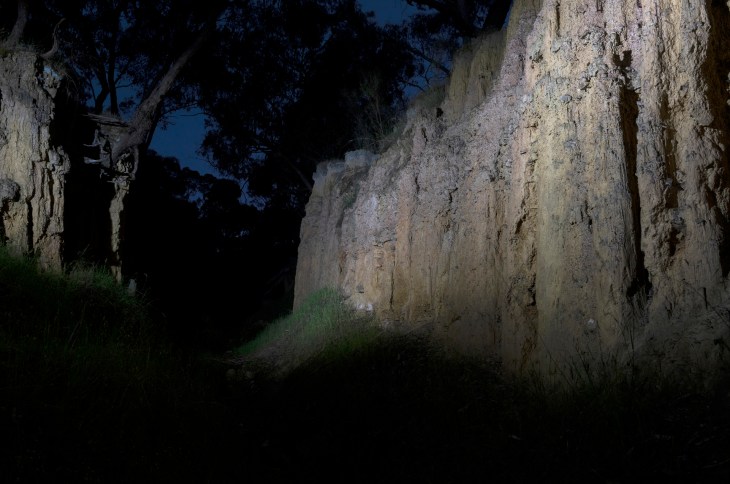
Fryers Diggings, Sluicing, Heron’s Reef 2023 PHOTO: Julie Millowick
.
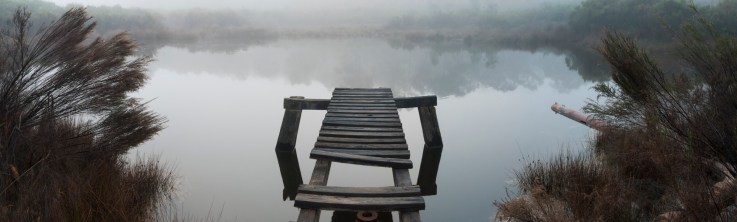
Crocodile Reservoir 2006 PHOTO: Julie Millowick
.
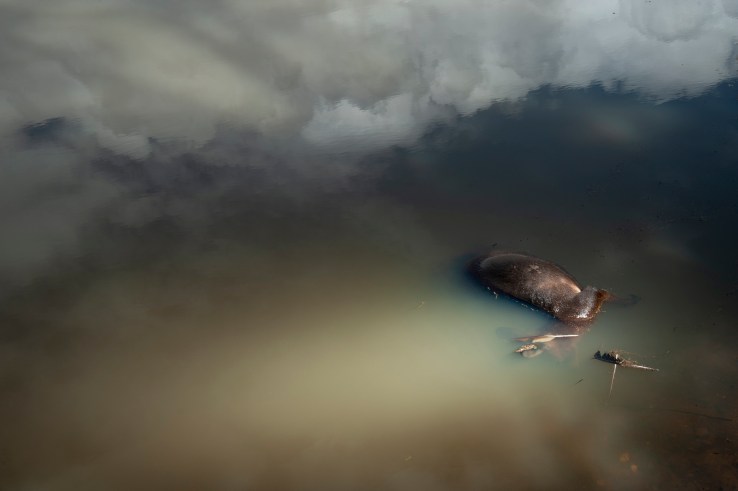
Drowned Kangaroo PHOTO: Julie Millowick
.
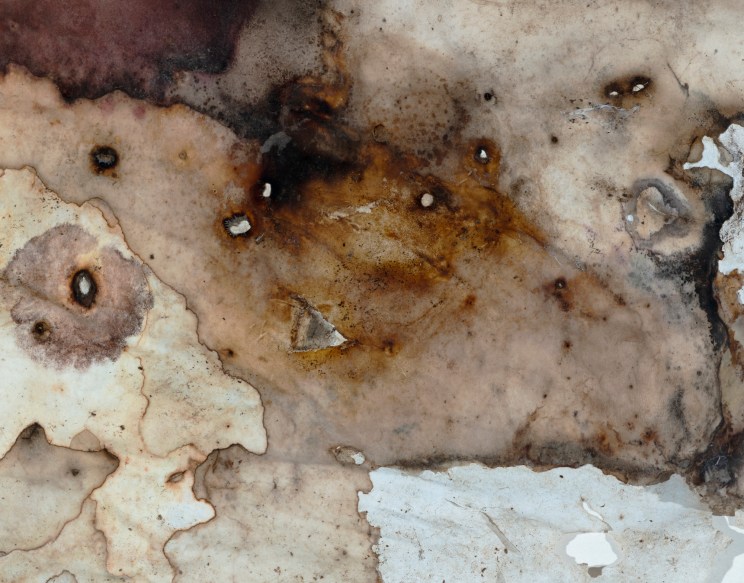
Lumen Buried Paper Under Blackberry Bush by Julie Millowick
.

Castlemaine Diggings National Heritage Park Cherry Ballart 2022 PHOTO: Julie Millowick
.
A photographer with less time moving over the space would document the superficial surface of things and create a record time-locked to when they were there. Millowick has set for herself the challenge of distilling a life of experience of time and place by using her comprehensive knowledge of photographic techniques* that, when combined with personal vision, can present to the viewer something deeper. As Millowick explores the environment or found objects, she reveals deeper layers and meanings through her experimentation with the visual language of each process and technique. The depth and complexity of this work tells of the unwavering commitment to her art, the community and the environment.
.
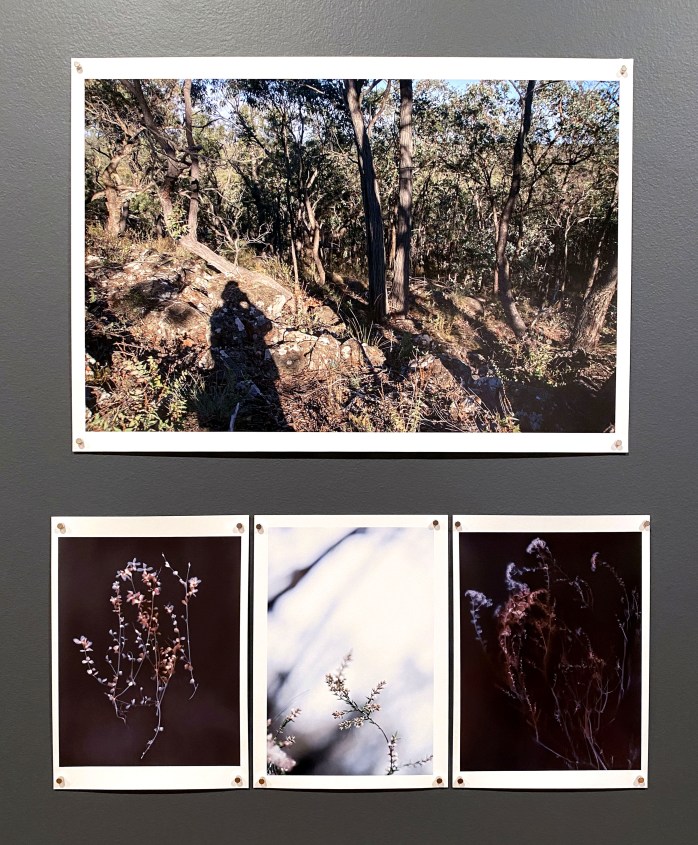
Image grouping
.
When introducing Julie Millowick at a recent artist’s talk about her exhibition the Gallery Director Naomi Cass described her as a ‘Localist’. ‘Localist’ is indeed an appropriate term not only for the work in this exhibition but also for Millowick’s continued photographic activity in the community. As a localist Millowick’s activity is part of the growing contemporary global movement for living locally and telling local stories particularly since the impacts of the Covid Pandemic. As it was 36 years in the making, this exhibition could only be just a fragment of Millowick’s creative visual documentation of her surroundings and community. Further digging or mining of her extensive archive will potentially reveal new perspectives and meanings on these powerful local stories of her place. Surrounding is just a beginning, there are so many other stories yet to be told …
.
A commentary on the exhibition by Victoria Cooper and Doug Spowart
Surrounding was part of the PHOTO2024 program
.
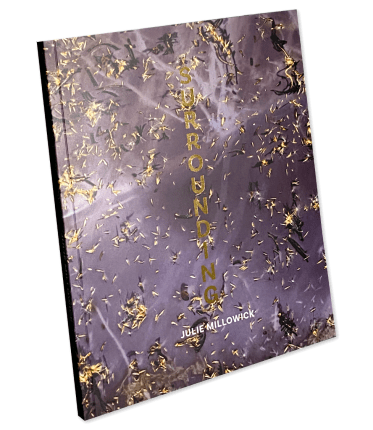
Surrounding – the book
.
P.S. The Surrounding exhibition is complemented by an illustrated book copies of which can be purchased from Castlemaine Art Museum or directly from Julie Millowick
.
IMAGES FROM THE IN CONVERSATION EVENT | Julie Millowick and Kyla McFarlane
Sunday 10 March, 11:30am — 12:30pm
.


.
* Photographic techniques that Julie Millowick employed in the exhibition include – pinhole photography, lumen printing, added lighting (painting-with-light), double exposure, cyanotypes, out-of-focus capture, re-photography, progressive sequencing, documentary and personal narrative.
We wish to thank Julie Millowick and congratulate her on the exhibition and for the images of her photographs and the exhibition installation. Photographs of the IN CONVERSATION event were by Doug Spowart.
Castlemaine Art Museum is a member of the Public Galleries Association of Victoria
.
.
.C
.
This site is archived by PANDORA, Australia National Library’s Web Archive
.
.
.
.
.
.
.
A GALAXY OF ART: Visiting 10 Victorian Regional Art Galleries in December 2023
.


.
The regional gallery provides worlds of new experiences and inspiration for all visitors and locals. It is a hub for the building of culture and identity for both the very young and old. The regional gallery or arts centre is a uniquely dynamic and generative space that energises and underpins the soul of each community.
Victoria Cooper
.
We planned our journey from northern Victoria to a coastal town in the extreme south west corner of the state for a beach holiday – Little did we know it would turn out to be a galactic journey into the rich cosmos of Victorian Regional Galleries in Victoria.
This Blog post is an illustrated and conversational report of our travels, the galleries visited and the amazing exhibitions witnessed.
.
.
In preparing this post we wish to acknowledge and show our support of the current call for action by the Public Galleries Association of Victoria – PUBLIC GALLERIES: OUR CREATIVE HEART.
.

Our Creative Heart is a campaign by the Public Galleries Association of Victoria, sharing the role and value of galleries to local communities and highlighting why greater investment from the Victorian Government is vital to sustaining these cultural hubs … Without significant change, art collections worth some $4 billion will deteriorate, community stories will disappear, gallery professionals will burn out, and millions of Victorians will miss out on access to a vibrant local visual arts culture. [From the PGAV website]
.
.


.
Our first stop was Ballarat on the lands of Wadawurrung Traditional Owners. Where we met a friend and colleague for a coffee at the Art Gallery of Ballarat. New exhibitions had been installed since we were there in October and instead of the short visit we had planned we were drawn into a stellar show of works that took us into another dimension of experience and creative works.
We were deeply moved by the work of Tamara Bekier, Between Worlds, on show in the main gallery. It was wonderful to see some of our friends work on show in Whereabouts: Printmakers Respond. We also had a deep synergy with a specially curated show on the concept of artists in work and life partnerships, Significant Others.
.
.We travelled to Ararat, also on Wadawurrung. Our trip plan was to spend two nights camping on Gariwerd, the Grampians National Park, BUT rain and bitterly cold weather for summer made us retreat to a motel in Ararat – So we day tripped to see some nature … at Halls Gap we overheard a couple talking about how cold they were at the campsite.
.

Gariwerd Grampians National Park (Diptych) PHOTO:Cooper
.
We felt happy that we decided to stay as we now had time to visit the Ararat Gallery – Textile Art Museum Australia (TAMA). Walking into the gallery just before closing, we found ourselves in yet another world with no time to discover what this gallery had to offer. So the next day we went back to the gallery to explore the rich history of Australian ceramics on show, SIXTY: The Journal of Australian Ceramics 60th Anniversary 1962–2022. Also on show was, Overlay, by Cara Johnson residing on and responding to the Otways hinterland, Gadubanud country. The next day we returned to the TAMA as part of our journey through the unknown territories of the crater lakes district.
.


.
Next we headed towards the coast for a stop at Warrnambool. This was our first connection with the beach for some time – the last being 6 months ago in northern NSW. It was far too windy to sit on the beach and have a sumptuous fish and chip lunch (straight out of the paper wrapping), so we huddled in a sheltered spot.
.


.
It was part of the itinerary to visit the Warrnambool Art Gallery. After walking through a makers market on the front lawn of the gallery we then entered into a completely magical space filled with the work of Mirka Mora and Lisa Gorman, To breathe with the rhythm of the heart. Then, as we visited the second gallery, we felt like we were entering a dark side of the human psyche with the show, Structures of Feeling, connecting the dark paintings of Albert Tucker and Paul Yore’s mixed media work commenting on social issues. The current director Aaron Bradbrook curated both shows. A third exhibition space presented the exhibition Maar Nation Made featuring First Nations works. These shows transported us into the wormhole of those artists’ creative minds and psychological spaces – far from the reality of a beach resort town.
Sadly we had to pull ourselves from the gravitas of these amazing shows, as we needed to get to Port Fairy for the night.
.

Port Fairy Monument
Exploring Port Fairy we encountered a monument that reminded us of the presence of First Nations and the conflicts that still need to be acknowledged along with their stories and deep connection to the country. The monument commemorates the Eumeralla Wars, which were violent encounters between British colonists and Gunditjmara Peoples in this region of Victoria.
.
Continuing our look around Port Fairy connection with art continued. How could we not do an orbit around the ancient volcano crater, Tower Hill to search for the Eugene von Guérard view? The painting by von Guérard from this viewpoint has been influential in the restoration of this site. At the lookout a weathered image of the painting remains on a plaque fixed to a boulder.
.

BOTTOM IMAGE: Eugene von Guerard “Tower Hill” 1855 and TOP: Photo by Doug Spowart 2023
.
.
After our epic journey, we finally landed in Nelson for a three day suspended animation to refuel, rest and consider the natural world – the Glenelg River, The Great South West Walk and the beach …

.
.
From the outer limits of the Victorian Universe at Nelson we then plotted our return via an unchartered route to explore new territory and a rare and beautiful display of art at Hamilton Gallery and their latest exhibition Emerging From Darkness, a collaboration with the National Gallery of Victoria.


.
When we arrived at the gallery we were able to participate in an informative session about the Baroque artworks in this extraordinary and astronomical exhibition – the scale of which is rarely seen in the regional Australia. We felt that visitors to this gallery could consider that they have been ‘beamed’ into a European gallery as they ascend the grand staircase to the main exhibition. The work on show went beyond oil painting and drawings as it also included musical instruments, ceramics and a large tapestry. The walls are painted richly and the art theatrically lit to add to the sensual and intellectual experience of this important exhibition showcasing the creative life of the Baroque.
.
Moving on from Hamilton we glided past constellations of paddocks, forests and small pockets of native bushland until we came into land at the Victorian town of Maryborough. The sensitive restoration of a former fire station has created the Central Goldfields Art Gallery, which has become a cultural hub for the community, local children and their extended families. On show were three exhibitions and activities, which included a contemporary and strident VCE Student art exhibition and a creative workshop with children. That day we had traveled the span of art from the celestial history to the living ground of community.
.


.
.
As we near the end of our journey we visited the Castlemaine Art Gallery & Museum. After we entered the gallery through its stunning art deco facade we spent time in an interesting group of exhibitions. The first, Stonework, was a thoughtful curation of material from their art and museum collection. In the back gallery there was the 2023 Experimental Print Prize that brought a different dimension to the traditional art experience.
.


.
.
Next day we track our route to the Bendigo Art Gallery. As with Ballarat, this significant gallery was established from the profits of the 19th century gold rush and continued through philanthropy. It cannot be experienced as a quick flyby as there are a many galleries. On show was First Nations Photography, Essays on Earth, the 2023 Arthur Guy Memorial Painting Prize and works from the extensive collection.
.


.
.
The diverse astral phenomenon of the Victorian Regional Gallery continues even after we have landed home again. We ascended the curved elevated path that leads up to the main entrance of the Benalla Art Gallery as it floats serenely beside the lake. Inside was a world of activity, three galleries with a diverse ecosystem of contemporary art. Alongside a curated show of 20th century work from the gallery’s Bennett Bequest collection to a contemporary art experience of Gonketa’s Moving Forward and Mark Dober’s plein air paintings in Wetlands.
.


.
.
The next day we headed off to Shepparton Art Museum, on the unceded lands of the Yorta Yorta Nations. The architecture of this gallery is quite contemporary and stands in the landscape much like a landed sleek metal and glass space ship. After negotiating the revolving doors we climbed the formidable staircase to each the three floors. In side each of the climate controlled galleries with their typical high walls to lofty ceilings were collections of many forms of art: from the talented local to prominent European and Australian artists.
.


.
.
Not far from us is the town of Wangaratta, part of the Taungurung Traditional Owners land, where we try and visit the Wangaratta Art Gallery regularly. When we were there in December, we saw a show, Beauty & Fear, paintings by Robert Hirschmann and Andy Pye, who have worked and lived in this region. The scale of work in this exhibition exemplifies the depth of creativity and arts practice in Victoria’s North East.
.


.
Our journey to the Gallery Universe in December was not complete until we ascended a mountain also on the lands of the Taungurung Traditional Owners, Mt Buffalo, to a place of granite boulders and snow gums that is named by colonial explorers as the Old Galleries. Here we were transported to a more-than-human experience where Nature is …

Old Galleries Mt Buffalo National Park
.
In conclusion
Interestingly it seems that the curated experience of vast collections from the big city art gallery is being transported into these regional gallery spaces. Much like walking into Dr Who’s Tardis or Alice’s wonderland we found ourselves in an ever-expanding universe of the history and the enormity of Art. The walls are no longer the support for hanging but have become part of art display.
.
Public programmes value add to both the traveller and the local connections with these regional gallery blockbusters. Galleries with cafes have the extended experience for the visitor to spend time and engage with the cultural ambience.
.
Importantly most galleries, councils and national parks acknowledge the rich and enduring heritage of First Nations Peoples ownership of the stories and knowledge of their unceded lands.
.
The regional gallery provides worlds of new experiences and inspiration for all visitors and locals. It is a hub for the building of culture and identity for both the very young and old. The regional gallery or arts centre is a uniquely dynamic and generative space that energises and underpins the soul of each community.
.
Victoria Cooper + Doug Spowart
.
PS: We have visited other regional galleries in Victoria though there are still another 10 or so on our ‘to-do’ list … And then, as the shows change we need to go back and visit again …

.
.
.
Acknowledgement of Country:
We wish to acknowledge the First Nation’s lands we have travelled across and stayed on during this journey. We respect their deep enduring connection to their lands, waterways and seas and recognise that sovereignty was never ceded. We also honour and respect their ancestors, their Elders past, present and emerging.
.
.
.
.
.
© 2023 All photographs and story in this post are the copyright of Doug Spowart + Victoria Cooper.
.
.
.
DOUG GOES WHERE THE SURFERS HAVE NO WAVES – Again…!

.
IPPY DROPS IN … AND RIPS!
The exhibition reprise after 30 years
.
THE PHOTOGRAPHIC COMPONENT FROM DOUG SPOWART: Read more later in the post
Click on the photo to enlarge …
.


.
THE VIDEO COMPONENT FROM KATE ELLOVEE:
.
The inspiration for the original exhibition was Kate Ellovee (Versace) who was working on a documentary project commenting on surfers who live at Ipswich and surf on the north and south coasts – much to the dislike of the locals. Entitled A Slagheap Safari the video takes centre stage in the reprise of the exhibition.
.


.
Kate’s A Slagheap Safari video can be viewed HERE
.
A mini booklet of the exhibition can be downloaded: Ippy Drops In and Rips Booklet
.
.
The exhibition will be on show in the Ipswich Community Gallery, d’Arcy Doyle Place, Limestone Street, Ipswich until the 22nd of December 2023.
.

IPPY-Australian Photography Cover
.
Back in 1993 my work in the exhibition was featured in Australian Photography – the story inside added to the craziness of the whole project …
Click to enlarge text …
.

Australian Photography story p1 of 3

Australian Photography story p2 of 3

Australian Photography story p3 of 3
.
.
A reflection on the project by photographer Doug Spowart
Background to my work
I have a forty-year practice in conceptual photography. This approach to photography so profoundly directed my work that in the late 1980s my business card described my art practice as ‘Conceptual Photographer’. The methodologies of re-photography, photomontage sequential imaging and the use of a range of photo technologies and materials underpinned the conceptualisation, creation and presentation of the creative work. I look for the strange and the surreal or the sublime in everyday life addressed through irony and humour. I am always absorbed by how the mundane and ordinary can hold hidden moments of surprise if time is taken to see what is revealed.
The Ippy Drops in and Rips Project
In 1993 I received a phone call from Elizabeth Bates a curator at Ipswich Art Gallery. I had worked with Elizabeth at Araluen Art Gallery in Alice Springs a few years earlier on a documentary exhibition commenting on the tourist experience in Central Australia, so she was aware of the style of my photographic work. Elizabeth introduced the project she was working on with Kate Ellovee (Versace) in which Kate was to create a documentary video commenting on Ipswich’s landlocked surfers. It was suggested that I could create photography works that would complement the video presentation in the gallery. In the initial project development meeting with Kate she discussed the concepts behind the ‘A Slagheap Safari’ documentary video. Her project was full of the curiosity, irony, and humour that had resonance with my approach to documentary work.
My partner and fellow artist Victoria Cooper and I were intrigued by the idea that there was such a strong surfing culture in Ipswich. It seemed surreal to us and we wondered: where could we find a concept of surf or surfing in this mining town at the western edge of Brisbane? Who were these surfers and how did they navigate the cross-over from Ipswich to beach?
After contemplating these questions I put forward a proposition consisting of three concepts: (1) Re-photography portraits – commenting on the dual identities that surfers have living and working in Ipswich and yet maintaining a surfing life on the weekend down the beach, (2) ‘Hold-ups’, where I would search Ipswich town settings and mining landscapes for evidence or connection with the beach or surf and (3) Photomontages – through improbable interventions I would metaphorically bring the surf and surfers to Ipswich. Clearances were provided by surfing photographers and the pictured surfers for their photographs to be photomontaged with Ipswich location scenes.
In making the photographs we sometimes collaborated with Kate and at other times we worked independently. Kate’s energy and coordination skills were important to the project as surfers usually have one specific thing in mind – surfing. With Kate we went to the beaches to seek out these Ippy surfers in their preferred natural environment. In this quest we too “searched for the best waves” to find the surfers. Interestingly the Ippy project was pre the proliferation of mobile phones, so we needed to check the radio’s ‘best waves’ reports, we then went to the beaches and then looked out for the surfer’s cars, boards or the surfers themselves.
Working on the project’s themes Victoria and I would cruise around Ipswich looking for places that resonated with the concepts of beach and surfing. Gradually these were revealed to us: the top of a water tower with skateboarders, a tunnel leading into the mine, navigating a graffiti covered underpass, a mine cutting that looked like a wave. Each place we found was evocative and full of potential metaphors of surfing culture within this inland mining town.
A Concluding Comment
Documentary projects, either as video or photography, have the potential to tell stories and create a commentary on contemporary culture and social life. Thirty years on, the Ippy Drops in and Rips show returns to a new era, a new audience, and for those who participated in the original project, a possibility to recall memories of a different time.
In re-viewing Ippy Drops in and Rips Ipswich surfing culture story, perhaps not much has changed – or has it? Is the credo of the Ipswich surfing culture – surf to live and live to surf, still as strong as ever … ?
And finally … Do north and south coast locals cuss the new generation of Ipswich surfers when they “DROP IN … AND RIP …?”
.
.
Doug Spowart+ Victoria Cooper November 12, 2023
.
.
Thanks to Kate Ellovee for resurrecting the Ippy exhibition after 30 years and to Alison McKay and Ellia Shurte from Ipswich Art Gallery for their support with the exhibition. And also to Thomas Oliver and John Elliott for the photos.
.
.
.
MARTIN HANSON MEMORIAL ART AWARDS: Our Works

.
Once again we entered the Martin Hanson Memorial Art Awards at the Gladstone Regional Art Gallery and Museum. These Awards are the 48th event – Congratulations to the Gallery Team and the continued recognition of Martin Hanson’s early patronage of artists initiatives in Gladstone through these Awards.
For us each award entered is a place to present new works and their presentation – it is a challenge that hones our skills as artists.
.
This year Victoria’s entry was an artist book entitled String Theory Explained.
.

Victoria COOPER’s String Theory Explained presented
.Artist’s Statement:
String Theory Explained… its all about the unplanned and chaotic nature of everyday life… the beauty and terror within the order of “normal” existence.
.

.

Opening up the book
.
Bibliographic Details:
Format: Concertina book embedded in folded cover
Media: various pen inks on art paper with Stonehenge black cover
Size: 764 x 230mm
.
.
Doug’s entry this year was Story Trees – First Nations a concertina artists book presented in a circular form.
.

Doug SPOWART – Story Trees artists book
.
Artist’s Statement:
For me a poignant physical sign of First Nations presence remains embedded in the dead trees found throughout Mokoan. In witnessing these scar trees I found a profound sense of a time now passed and thoughts of the many stories that this place can tell.
This book was book two in a series of personal responses to encountering the locality of Mokoan and the Winton Wetlands. It was part of my contribution to the PALIMPSEST collaborative exhibition with Maggie Hollins and Victoria Cooper shown at Bainz Gallery in Wangaratta in August.
.
Bibliographic Details:
Format: Concertina book
Media: Pigment inks on photographic paper
Size in circular presentation: 600 x 700mm
.

Doug’s Story Trees installed at GRAGM
.
.
The Martin Hanson Memorial Art Awards exhibition will be on show until 2.00pm on the 27th of January 2024 at the Gladstone Regional Art Gallery and Museum.
.
Here is some information about the 2023 Awards and the Entry Form.
.
 CLICK THIS LINK MH 23 Catalogue Online-r
.
 CLICK THIS LINK Martin Hanson Award 2023 Entry Details
.
.
Photo of gallery installation courtesy of GRAGM
.
.
.
.
.
.
.
.
HILL END ANALOGUE: Our Cyanotype Works

We are excited to announce that a selection of our Cyaanotype artists books was presented at the Hill End Analogue event.
.
HERE’S THE BACK STORY
Hill End Analogue ( HEA ) is an analogue photographic arts festival presented by Hill End Arts Council Inc. ( HEAC ) in the Central West township of Hill End, N.S.W. HEA
showcased and connected contemporary analogue photographic artists world-wide. The event comprised exhibitions and workshops, the festival engaged with the general community, while promoting contemporary analogue arts and technology.
Hill End is an historic site, managed by N.S.W. National Parks Wildlife Service, and is significant in the history of Australian Photography. The documentation of Hill End and surrounds during the gold boom of the 1870’s by Beaufoy Merlin and Charles Bayliss, forms a large part of the Holtermann Collection in the N.S.W. State Library. Hill End has a thriving arts community, supported by the Bathurst Regional Art Gallery and is closely associated with the National Art School.
(Text modified from the HEA website)
.

Hill End Analogue Installation PHOTO: Courtesy of Lisa Sharkey
.
OUR CYANOTYPES


.
MORE INFORMATION ON THESE CYANOTYPE WORKS
.

Victoria Cooper’s “Flood” in situ on the island Bundanon
.
FLOOD An artists book by Victoria Cooper
MEDIA: Concertina format with 26 pages, cyanotype on Arches watercolour paper with hand-set type in black ink
Binding by Doug Spowart
SIZE: 10 x 15 x 3cm cm
EDITION: Two unique states
Download a didactic about this book: COOPER – Flood installation at Bundanon
.
.
.

On the wire … A book by Doug Spowart
.
ON THE WIRE … A book by Doug Spowart
A performance based on open-air cyanotype bookmaking directly off subjects in the field.
CREATED: 2007 at Bundanon during an artist in residence
MEDIA: 16 sided concertina format book of double-sided cyanotype images on Arche Aquarelle watercolour paper
SIZE: 11 x 14 x .4 cm – extends to 116 cm
EDITION: Unique state 2 variants
Download a didactic about this book: SPOWART – On the wire – extended recto+verso
.

Starfish swarm with wallaby bones by Victoria Cooper
.
STARFISH SWARM WITH WALLABY BONES An artists book by Victoria Cooper
A double-sided cyanotype made from objects gathered in Tasmania. The work was made to celebrate the 2019 World Cyanotype Day.
CREATED: 2019 in Cygnet, Tasmania
MEDIA: Cyanotype on recycled linen pillowcase
SIZE: 30 x 30 cm
EDITION: Unique state
Download a didactic about this book: COOPER-Starfish swarm an wallaby bones
.
.

Roland Barthes an artists book by Doug Spowart
.
ROLAND BARTHES An artists book by Doug Spowart
Roland Barthes the French writer and theorist, has contributed significantly to the discourse and critique of photography. This book is a visual comment on two of his texts.
CREATED: 2017 at Bundanon during an artist in residence
MEDIA: Concertina format with 16 pages, cyanotype on Arches watercolour paper
Binding by Doug Spowart
SIZE: 11 x 14 x .4 cm
EDITION: Two unique states
Download a didactic about this book: Doug SPOWART -Barthes
.
.

AUSTRALIAN BANQUET: January 26 / 26, 1788 by Cooper+Spowart
.
AUSTRALIAN BANQUET: January 26 / 26, 1788 by Cooper+Spowart
This work reflects on the ‘turning of the page’ in history that Australia Day represents.
CREATED: 2010 on Australia Day in Toowoomba
MEDIA: A unique state double-sided cyanotype on rice paper broadsheet of 7 variants.
SIZE: 37.6 x 77cm
Download a didactic about this book: COOPER+SPOWART – Australian banquet
.
.

PHOTOGRAPHS OF ARTHUR’S GARDEN A book by Doug Spowart
.
PHOTOGRAPHS OF ARTHUR’S GARDEN A book by Doug Spowart
A cyanotype concertina book made on the veranda of Arthur Boyd’s studio during an artist in residence
CREATED: 2007 at Bundanon
MEDIA: 24-sided concertina book. Cyanotype on Arche watercolour paper
SIZE: 11 x 14 x .4 cm – extends to 168 cm
EDITION: Unique state
Download a didactic about this book: SPOWART – Photographs of Arthur’s Garden – extended
..
.
.
.
.
THANKS TO: Lisa Sharkey and the Team for the opportunity to present these works at Hill End Analogue.
The photograph of the HEA installation courtesy of Lisa Sharkey
Text and cyanotype works and photographs © Doug Spowart+Victoria Cooper
.
.
.
.
TONES OF HOME: Cooper+Spowart in group show
.

TONES OF HOME – Arts Project Australia
.
Tones of Home draws together artists from Arts Project Australia (APA), Melbourne, regional Victoria, and north Queensland to present works inspired by domestic and urban spaces. Curated by Eric Nash, Director Benalla Art Gallery the exhibition extends beyond these settings to consider ‘what makes a place, a home?’, touching on notions of family, community, belonging, connection, love, comfort, safety, and personal histories.
Featuring APA artists Steven Ajzenberg, Miles Howard-Wilks, Chris Mason, Chris O’Brien, Lisa Reid, Anthony Romagnano, Georgia Szmerling and Amani Tia alongside Atong Atem, Susie Buykx, Cooper+Spowart, Erub Arts Torres Strait and Ghost Net Collective, Aishah Kenton and Ron McBurnie.
(Text from the APA Website)
Tones of Home continues until 25 November 2023
.

Tones of Home Exhibition
.
SOME COMMENTS FROM THE CURATOR – ERIC NASH
The seeds of this exhibition were truly sewn at home. As my wife and I awaited the arrival of our second child, I found myself considering a work by Mini Graff that hangs above our bed. It is a street art poster in a vintage drawing style. Text on the work reads ‘Today is my lucky washing day’, and a woman hangs washing on a clothesline while an atomic bomb appears to have gone off in the background. It seemed to resonate with my experience of our domestic bubble of safety, and, when at home, perhaps even my ignorance to the outside world.This caused me to ponder what ‘home’ felt like, and indeed meant, to others? It had to mean more than just somewhere we reside. I couldn’t help but imagine my favourite fictional retired barrister, Lawrence Hammill QC, declaring, “You can acquire a house, but you can’t acquire a home”.
I owe a debt of gratitude to the Arts Project Australia team and artists who kicked this project off by sharing their thoughts on the topic of home. A number of responses stuck with me and have framed the exhibition. Home, in their words, could be “where the most important people in your life are”… “where you feel safe”… “a base where you start from”… “a place that fits your ideas of design,
location, and convenience.” Common themes emerged, specifically ‘Personal histories’; ‘Love and family’; ‘Community and connection’; and ‘Belonging, comfort and safety’. …READ MORE FROM THE CURATOR – Download the exhibition Catalogue
“CLICK LINK” TonesOfHomeCatalogue_Web
“CLICK LINK” “Tones-of-Home-Room-Sheet-2
..
SOME VIEWS OF THE EXHIBITION

Susie Buykx and her ceramics

Chris O’Brien’s works

Georgia Szmerling ceramics (front) & Erub Arts Torres Strait and Ghost Net Collective (back wall)

Chris Mason “Me and Monica Together” & “Me and my friends at work” 2019

Anthony Romagnano’ works

Aishah Kenton’s photographs
.
.
COOPER+SPOWART WORKS IN THE SHOW

Cooper+Spowart “Desire Paths 2+3” Proposed layout

Victoria with Jo Salt Gallery Director + Doug PHOTO: Michael Coyne
C
COMMENTARY ON OUR DESIRE PATHS ARTISTS BOOKS…
Some words from Curator Eric Nash
… I write this essay now during paternity leave. This is the longest time I have spent consistently at home in years. This break and time with Tegan and our children brought something into clear focus: while Tegan and I have moved cities several times in the last ten years, I have always felt ‘at home’ as we have been together. Cooper and Spowart (Victoria Cooper and Doug Spowart) exemplify this through their extensive photography, photobook and artists book practices, which are maintained both as individual practitioners, and as life collaborators. For these artists, ‘home’ “was an idealised state of being in Place, which offered a sanctuary and a garden. More than architecture, ‘home’ is also a psychological and sensorial place for the safe shelter ofmemories and experiences.” (4)
Cooper and Spowart’s recent Desire Paths books resonate with their shared life and artistic journey, explaining “Our artistic process is also defined by the desire to discover new paths around the traditional norms. Over time these new paths become alternative solutions to the ultimate desired outcome. All these paths or lines are theexistential experience and representation of desire.” (5)
1.The astle (1997) Directed by Rob Sitch. [Feature .ilm]. Sydney, NSW, Australia: Roadshow Entertainment.
4 & 5. Cooper, V and Spowart, D (2023) Email to Eric Nash, 27 August.
.

Susie Buykx+Victoria+Eric Nash (Curator) +Doug
.
Thanks to Eric Nash, Jo Salt and the Team at Arts Project Australia for the opportunity to to show work in this exhibition in Melbourne (Naarm). N
.
.
.
Unless noted otherwise photographs are by Doug Spowart
.
.ash

.
.
.
.
.
.
MAGGIE HOLLINS: An artist in the Winton Wetlands

Maggie Hollins in Winton Wetlands Photo: Doug Spowart
.
In my current practice I aim to observe, absorb, and have a conversation with, a place. I document the physical and intangible qualities of the landscape and use the materials I find at that place to honour its essence. I want to draw more attention to the need for a biotic interaction with our surroundings.
Since 2016 I have been inspired by the Winton Wetlands. I have documented the changing seasons and evidence of previous habitation at the Winton Wetlands with my photography. My engagement with the Winton Wetlands has led to the creation of woollen wall hangings and ephemeral artworks at the site. Found materials I have used in this exhibition will also become ephemeral works when I return them to the Winton Wetlands.
I have long been aware of the Winton Wetlands but it was not until 2016 that I engaged fully with the site. I visited the site often and became a Friend of the Winton Wetlands which allowed me to see some projects up-close being completed. I did some ephemeral works at the site and some felted works inspired by the wetlands. One felted work is included in this exhibition.
2022 saw my renewed interest in the site and together with colleagues, Doug Spowart and Victoria Cooper, we set out to discover the intricacies of site. This exhibition is the result of our collaboration.
.
ABOUT MAGGIE HOLLINS’ WORKS

Maggie Hollins with “Harmony” PHOTO: Doug Spowart
.
Guided by the water, tree branches and barks, fallen feathers, leaves and grasses, I have participated in the narrative of the Winton Wetlands.
.

Maggie Hollins’ ‘Recognition of the Past”, “Shelter” &”The Dead Stags”
.
These natural elements, coloured ghostly grey on my textiles are a spectral testimony to their origin. The found metal shards authored the presence of others’ existence and together with the natural elements these works were fused by the hot sun. My textile works aim to celebrate the resilience and vitality of the wetlands ecosystem while eliciting the many distant voices of this special place.
.
.

Maggie Hollins “Drifting on a Current” Photo: a collaboration
.
Feathers drift and amass in favourite resting places in the wetlands. I have often watched in awe at the murmuration of birds in the wetlands. My kinetic work aims to evoke a floating pattern of flight.
.


.
I have attempted to use my collage works as a metaphor for the layered past of the site to script stories of drought and flood, along with species that have occupied the wetlands.
.


.
The simple woven works aim to invoke the symbiosis binding all existence. The found materials will become ephemeral works when I return them to the site.
.

Maggie Hollins “Layers of the Wetlands”
.
.

Winton Wetlands logo
FOR MORE INFORMATION ABOUT THE WINTON WETLANDS VISIT: https://wintonwetlands.org.au/
.
ACKNOWLEDGEMENTS
The artists wish to acknowledge the Winton Wetlands team for their support.
We acknowledge the traditional lands of the Yorta Yorta people & their 8 clans the original owners of Country.
We respect their deep enduring connection to their lands and waterways and recognise that sovereignty was never ceded.
We honour and respect their ancestors, their Elders past, present and emerging.
.
Most documentation photos and the video b Doug Spowart. The on-location photographs were a collaborative production by all 3 artists.
.
.
.
.
.
.
.
.
.
.
IN THE WETLANDS: 3 Artists – Cooper + Hollins + Spowart collaborate, drawing inspiration from Winton Wetlands
.

PALIMPSEST Exhibition artists in Winton Wetlands
.
The Winton Wetlands in north-eastern Victoria, also once known as Lake Mokoan, has been through many changes from farming to the building then decommissioning of a dam. Now this visually haunting and beautiful place is undergoing a new phase of regeneration – reviving the natural state of living wetland environment.
.
Dr Lisa Farnsworth, Winton Wetlands Restoration Manager, has been working with local artists to form a group that finds inspiration for their art in the Wetlands. She comments:
.
The Winton Wetlands Creatives Group is driven by a passion for the natural beauty and cultural richness of the Winton Wetlands Reserve. Through various art mediums and engagement opportunities, the group aims to advocate for the Winton Wetlands restoration project and for the ongoing protection and appreciation of its cultural and ecological assets. I’m genuinely excited to see how art, culture and ecology can align to create great outcomes for the health of our local people and natural landscapes.
.

Artists Victoria Cooper, Maggie Hollins + Doug Spowart
.
In the spirit of Lisa’s vision we formed a collaboration with fellow Benalla artist Maggie Hollins to create a visual response to the Winton Wetlands inspired by its layered human and natural history and contemporary renewal. In our work we have associated this altered landscape with the concept of a palimpsest – a manuscript that was reused by writing new text over the previous words.
.
The Palimpsest features again in the exhibition where the collaboration between us as artists can be experienced as a layered narrative, where multiple stories and experiences intertwine to form a cohesive whole.
.
Check out our INSTAGRAM Project picture trail https://www.instagram.com/wetlands.palimpsest/
.

3 Invitations for the exhibition in BAINZ GALLERY in Wangaratta
.
.
SOME VIEWS OF THE EXHIBITION


.
.
SEE A FLY-THROUGH VIDEO OF THE EXHIBITION
.
.
.
A COMMENTARY ON THE EXHIBITION …
Victoria Cooper, Maggie Hollins and Doug Spowart have collaborated to produce and display a wonderful and diverse visual exhibition. They have sought to associate the altered Winton Wetlands landscape with the concept of a palimpsest. In doing so they are contributing to discussion of different, yet overlapping, stories of the wetlands.
Cooper and Spowart have been involved in the arts as practitioners, teachers and commentators for a lengthy time, including having residencies at Bundanon. Hollins has qualifications in ceramics, leads art workshops and enjoys playing fiddle. Unsurprisingly therefore, each and every artwork displayed is of a high standard.
There are unique, handmade textural and sculptural artworks by Hollins that use a diverse variety of materials – including found small branches, knotted bark, dyed cotton thread, solar and rust dyed cotton fabric, metal rings, and found grasses. They are accompanied by postcard sized images of the same artworks “displayed” on site in the wetlands. Those images were a team effort – Hollins operated the camera, Cooper was location scout and camera assistant, and Spowart did the lighting and Director of Photography duties.
There are larger standalone photographic prints and collaborative diptychs by Cooper & Spowart conveying stories of witnessing, magnificent 3 metre wide concertina photobooks by Spowart displayed folded out and attached to the wall, plus artist books and poetry by Cooper.
It all comes together splendidly, successfully conveying the messages the artists want visitors to hear.
.
BRIAN ROPE Reviewer for and member of the Canberra Critics Circle
Read Brian Rope’s full review HERE
.
.
LATER POSTS WILL FEATURE MORE ABOUT THE INDIVIDUAL ARTISTS & THEIR WORKS …


.
.
.
SEE MORE ABOUT THE WINTON WETLANDS …

Winton Wetlands website Home page
CLICK HERE FOR THE WINTON WETLAND’S WEBSITE
.
.

Winton Wetlands logo
.
ACKNOWLEDGEMENTS
The artists wish to acknowledge the Winton Wetlands team for their support.
We acknowledge the traditional lands of the Yorta Yorta people & their 8 clans the original owners of Country.
We respect their deep enduring connection to their lands and waterways and recognise that sovereignty was never ceded.
We honour and respect their ancestors, their Elders past, present and emerging.
.
.
.
.
.


