PERFORMING the BOOK @ SLQ – Siganto Artists Book Seminar
The Siganto Artists’ Books Seminar 2015
On June 20+21 the 2015 The Siganto Artists’ Books Seminar took place at the State Library of Queensland. Attendees were presented with a one–day series of lectures, performances and a forum addressing the diversity of the artists’ book and importantly visual and creative research being undertaken by Fellowships supported by the Siganto Foundation.
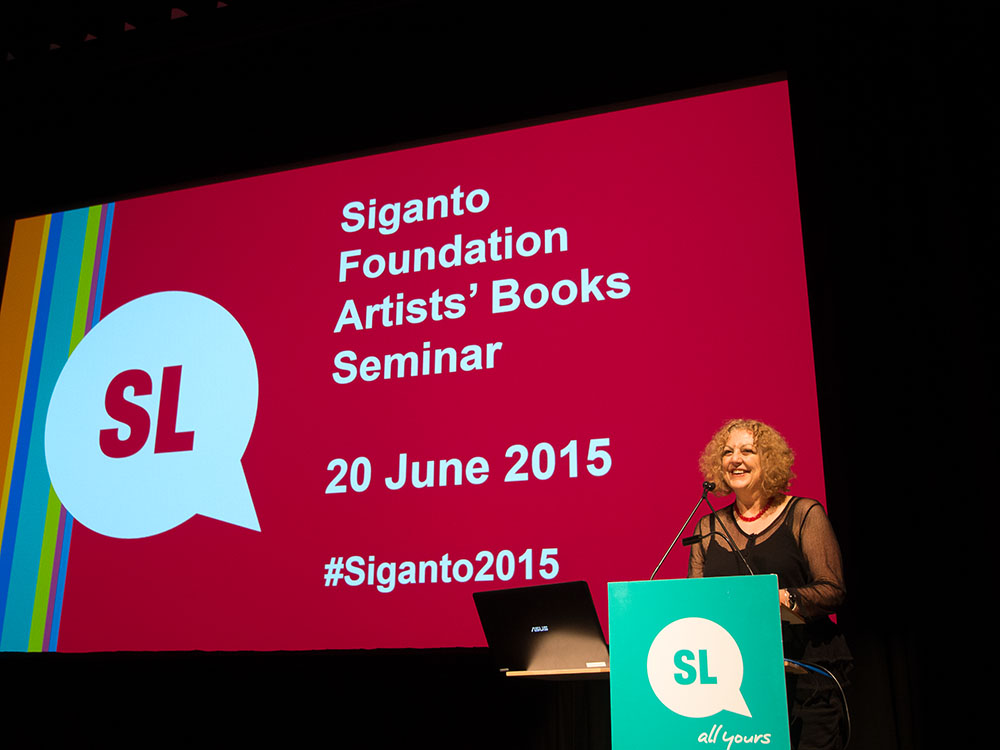
State Librarian Janette Wright welcomes attendees to the seminar
The State Librarian Jeanette, introduced by MC Christene Drewe, spoke of the Library’s Artists’ Book Collection. This was followed by Dr Marie Siganto from the Siganto Foundation who spoke enthusiastically about the Foundation’s support of the Artists’ Book Collection.
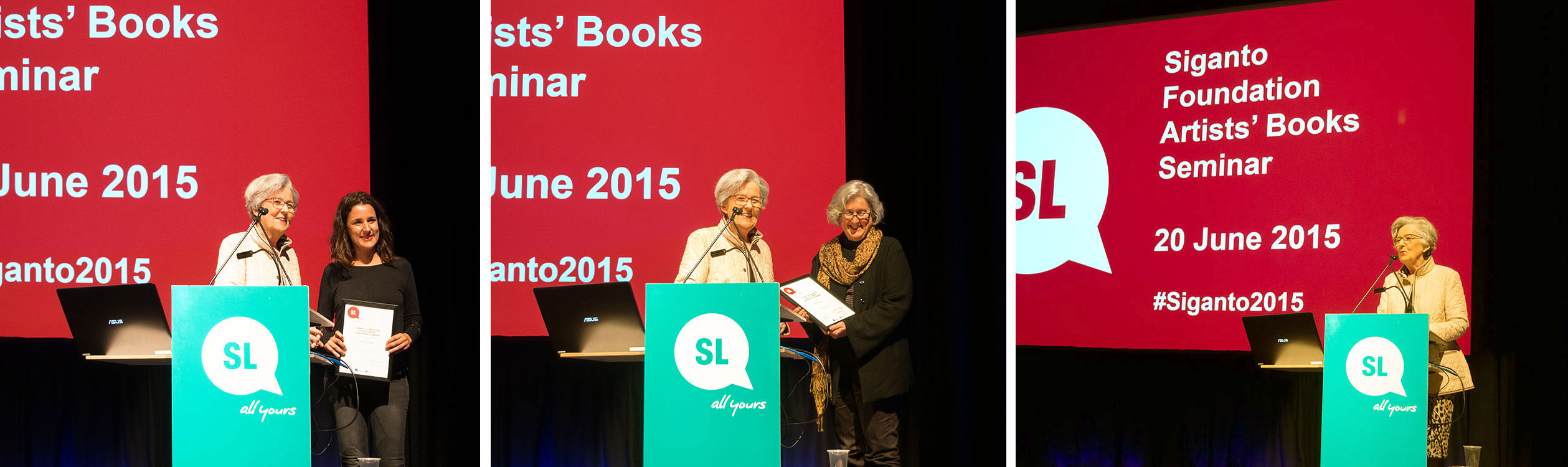
Dr Marie Siganto makes a presentation to the attendees of the seminar and presents 2015 Fellowships
A significant theme of this years’ event was based around the idea of artists’ books as performance. Brazilian artist, performer and academic Amir Brito Cadôr’s presented his keynote address The Book as Performance – he also performed a book reading of Momento Vital by Brazilian artist Vera Chaves Barcellos.
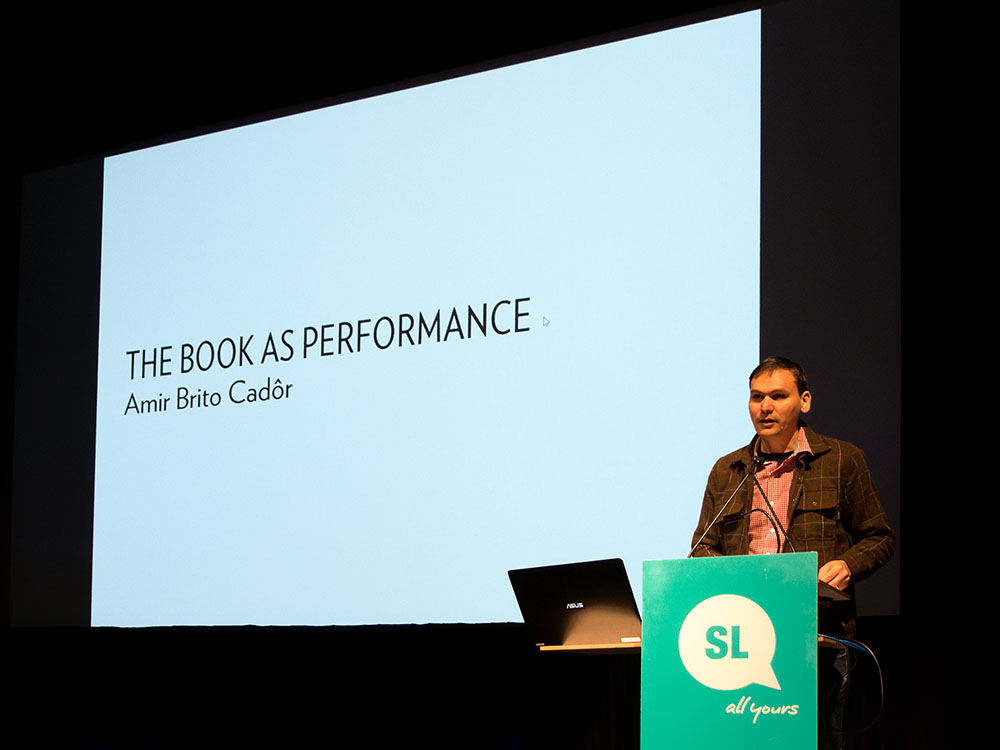
Amir Brito Cadôr makes his keynote presentation
In the morning session 2015 Siganto Foundation Artists’ Books Fellows Clyde McGill and Julie Barratt presented progress reports on their research projects. Jan Davis discussed her 2014 Creative Fellowship and presented the completed artists’ book to the Library. The book was entitled Drawing on the ground and referenced the historical aspects of work and toil on Queensland farms. Reference material for Jan’s book came from diaries, books and documents held by the Library. Her artists’ book features text fragments and line sketches – the book was bound by Fred Pohlman and the cover was styled to resemble an old station journal.
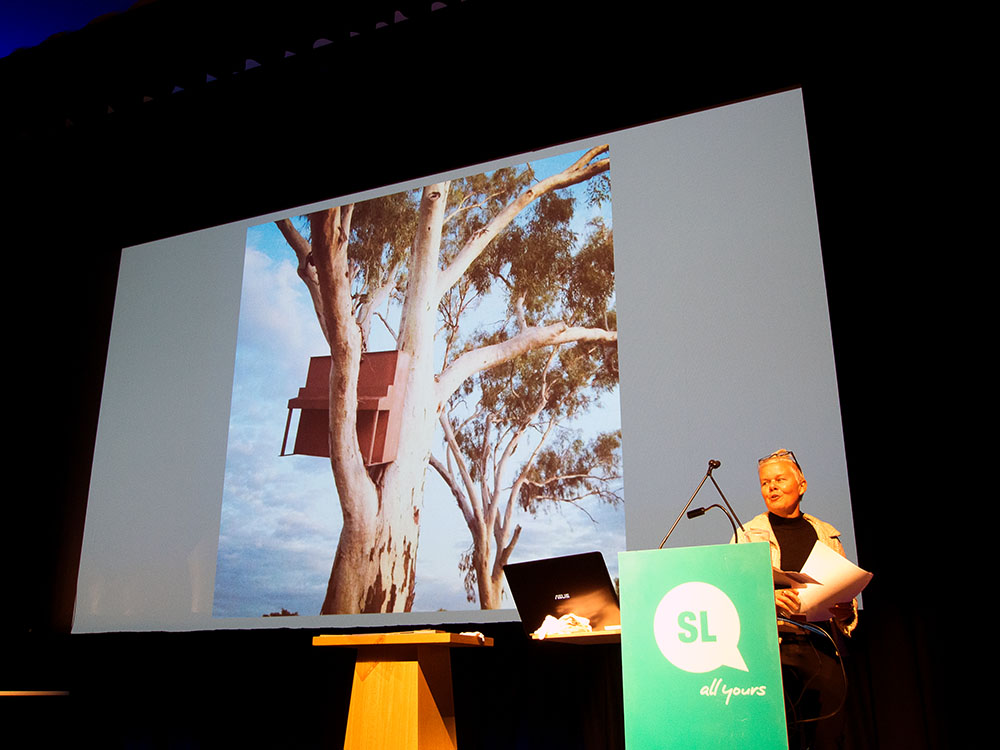
Julie Barratt discusses her Siganto Creative Fellowship
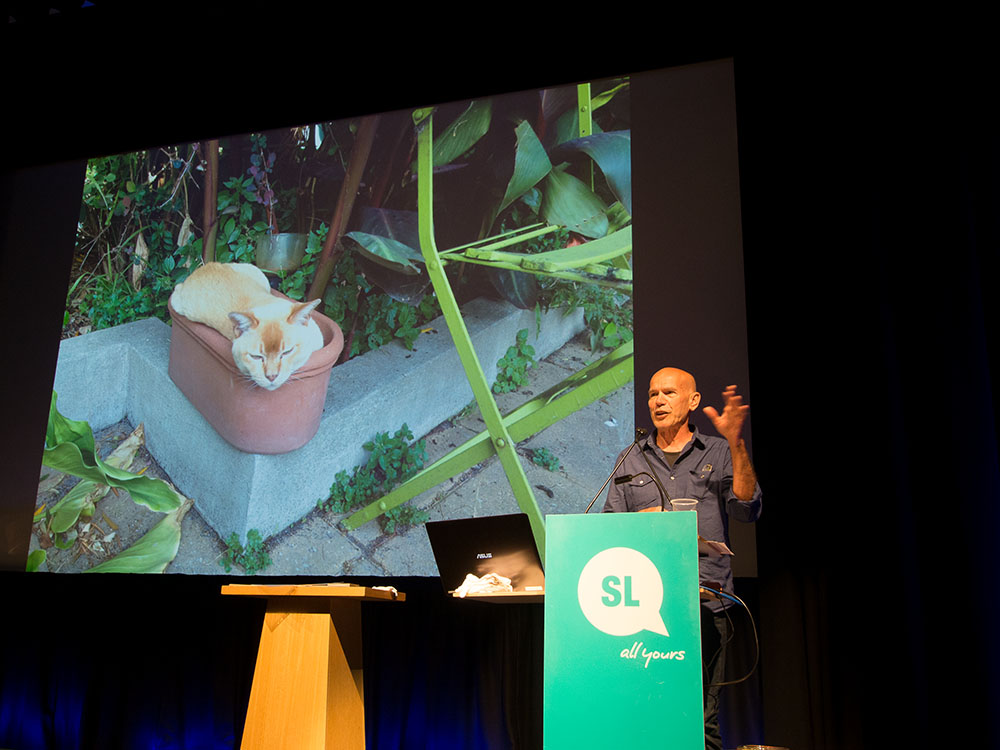
Clyde McGill discusses his Siganto Artists’ Book Creative Fellowship
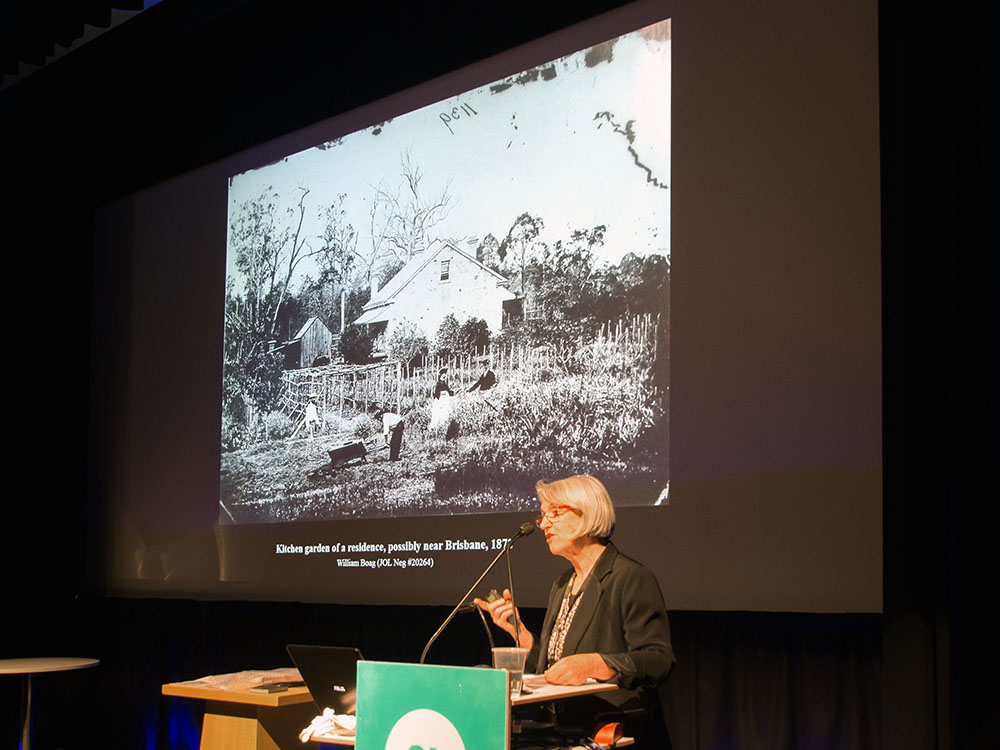
Jan Davis discusses Drawing on the ground, her Siganto Artists’ Book Creative Fellowship
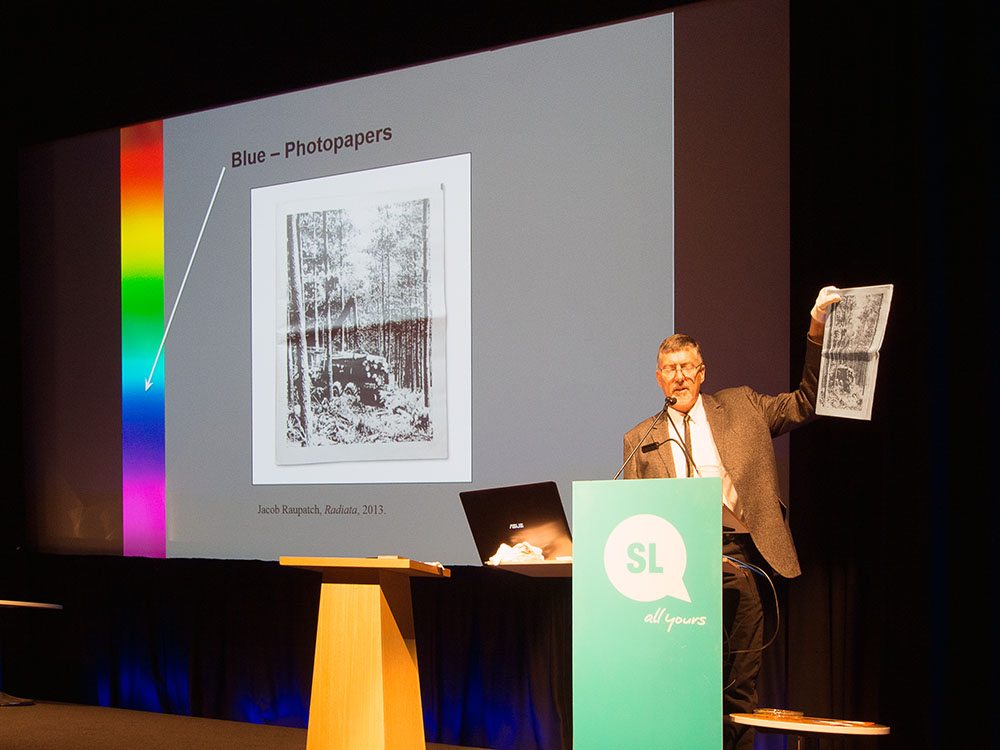
Doug Spowart discusses Jacob Raupach’s Radiata
As the 2014 Siganto Artists’ Books Research Fellow I presented an illustrated lecture on my experiences as a researcher of the Australian Library of Art, a selection of the range of books I encountered that employed photography from very minor references in text to conceptual pieces based on photographs. This list included:
Anne Wilson in, Tock 01-01-2000, 2000
Codex Event: Darren Bryant .. [et al.], Wild Cherry Tin Mine, 2006.
Vince Dziekian, Blooms Books, 1993-4.
Barbara Davidson, Different moods of the Opera House, 2001.
Felipe Ehrenberg, Generacion 1973
Peter Kingston, The Blue Mountains, 1987.
Michael Buhler, Oblique Lines, 19-.
William Copley Notes on a Project for a Dictionary of Rediculous Images, 1972.
Adam Broomberg + Oliver Chanarin, Holy Bible, 2013.
Judy Barrass, Eden-Monaro in Summer, 2001.
Juli Haas, The oyster book of lessons from the memory room, 2007.
Jihad Muhammad aka John Armstrong, Ten menhirs at Plouharnel, Carnac, Morbihan, Bretagne, France, 1982.
Angela Callanan, 7 Signs of Absence, 2010.
Susan King, Photo bio, 2011.
Malcolm Enright, Western Wisdom, 1998.
Pierre Cavalan, Artists Book, 1998.
Compiled by Kay Faulkner Indulge, 2006.
Debra Gibson, Kamikaze, 2004.
Dick Jewell, Found Photos, 1977.
Julie Barratt, Collateral damage, 2008.
Alison Knowles, Bread and Water, 2004.
David King, Raw deal, 1997.
Valerie Keenan HY1, 2001.
Tim Johnson, Fittings, 1972.
Christian Boltanski, Scratch, 2002.
Amanda Watson-Will, Judy and the Jacaranda, 2010.
Phillip Zimmerman, High tension, 1993.
Jan Davis, Solomon, 1995.
I then disclosed the principal research product the paper: The artists’ book, the photobook and the photo-a spectral approach, as well as recommendations to the Library for photobooks to be relocated from the General collection into places that reflected the significance of these books in the history of photography and the photobook. I also supplied Photobook Publishers and Info URLs that could be used by anyone wanting to keep up with new photobook releases an purchasing opportunities. I particularly noted that the Library held no Trent Parke books and provided, as an example, his book Dream Life that could have been purchased in 2000 for around $60 is now sold for $1,000+. Highlighting the need for the SLQ to be pro-active in purchasing contemporary book for modest outlay – rather than waiting until they are nearly unaffordable. I also highlighted the need for institutions to engage with and maintain links with artists’ book and photobook self-publishers as they exist outside of the usual publishing structures. I quoted Des Cowley, the State Library of Victoria’s History of the Book Manager from a statement made by him in his presentation at the ‘Other Photobook’ forum at Photobook Melbourne. He said:
… It is therefore incumbent upon staff in these institutions to build networks and relationships with the communities creating this work in order to be informed about what is being produced, and to ensure this material is acquired and preserved for future researchers.
My presentation concluded with two quotes from book artist and mail art aficionado Ulises Carrion that I felt related to the contemporary artists’ book and photobook. Carrion states:
I include books in the category of
living creatures … : they grow, reproduce, change colour, become ill and finally die.
At this moment we are witnessing the final stage of this process.
… if books are to survive they have to change. And [artists’] bookworks is the real possibility that books have for survival.
Schraenen, G. (1992). Ulises Carrion : We have won! Haven’t we?
.
HERE IS THE SLQ VIDEO OF THE SIGANTO FELLOW’S PRESENTATIONS
.
Other artists’ book performances included: Virginia and Julie Barratt’s The Morning After, one by Clyde McGill and a performance by QUT drama students of the three-part book Robert Bringhurst’s artist’s book New World Suite number three: a poem in four movements for three voices. The performers were Thomas Yaxley, Emily Weir and Meghan Clarke and was directed by QUT lecturer Floyd Kennedy.
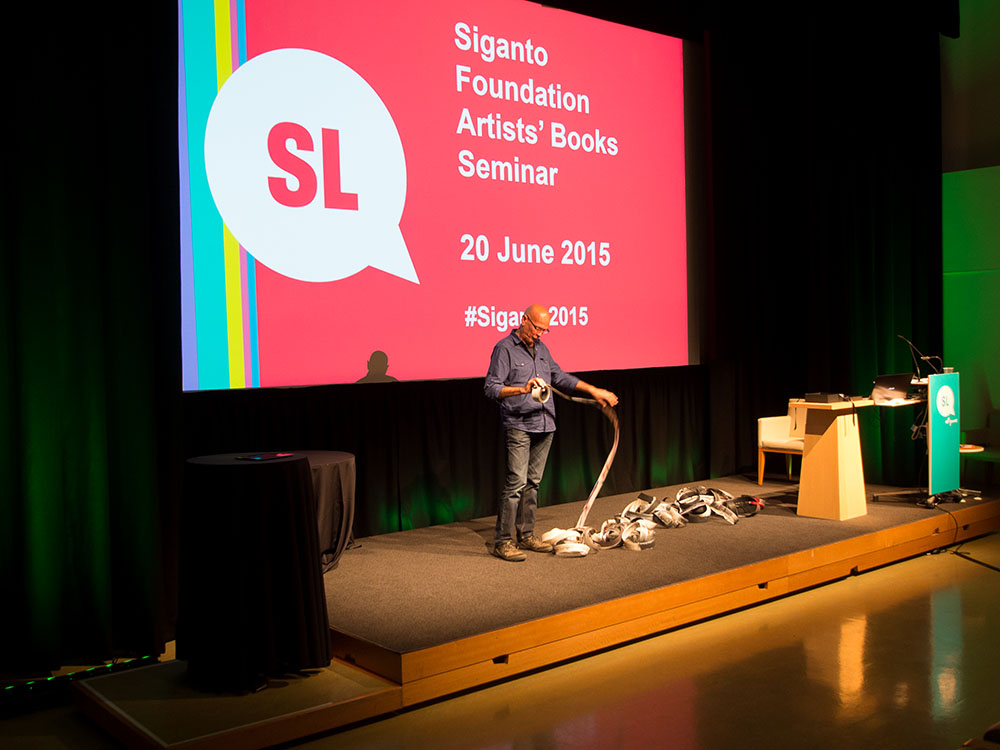
Clyde McGill performs his book
The afternoon concluded with a forum moderated by Louise Martin-Chew on the topic of collaboration. The forum participants were Clyde McGill, Julie Barratt and Doug Spowart. Each participant discussed a project that involved collaboration and questions were posed by Louise to bring out important points from each panelist. The most interesting aspect of this forum was when questions from the floor created heated debate around the idea of the physical book and its experience verses the virtual online experience.
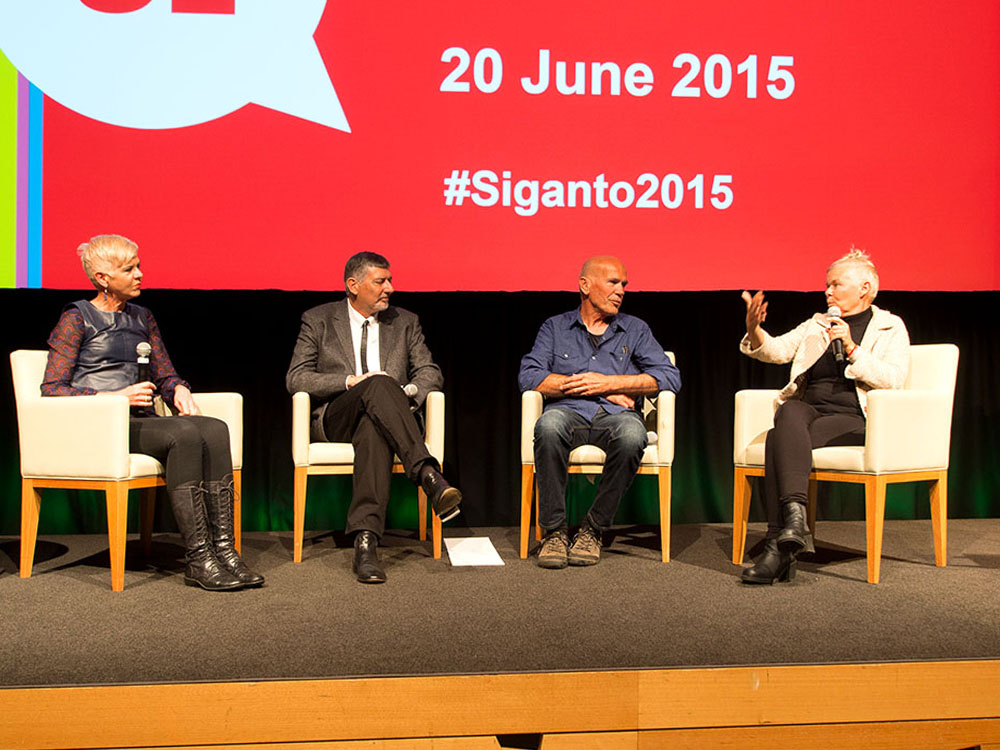
Julie answers a question in the collaboration forum
On Sunday many local and interstate stallholders presented their work for an Artists’ Book Fair in the Knowledge Walk at the SLQ. Tours of selected artists’ books from State Library’s Artists’ Book Collection were well attended and provide rare access to special books from the Australian Library of Art Collection. The two-day event was significant for the opportunity for artists’ book aficiandos, makers, collectors and readers to engage with the physicality of not only the books but also to touch with the extensive community of the book. Our thanks must go to the SLQ, particularly Christene Drewe and Helen Cole, and to the Dr Marie Siganto and the Siganto Foundation for their continued support of the artists’ book collection of the Australian Library of Art and events such as these. Doug Spowart
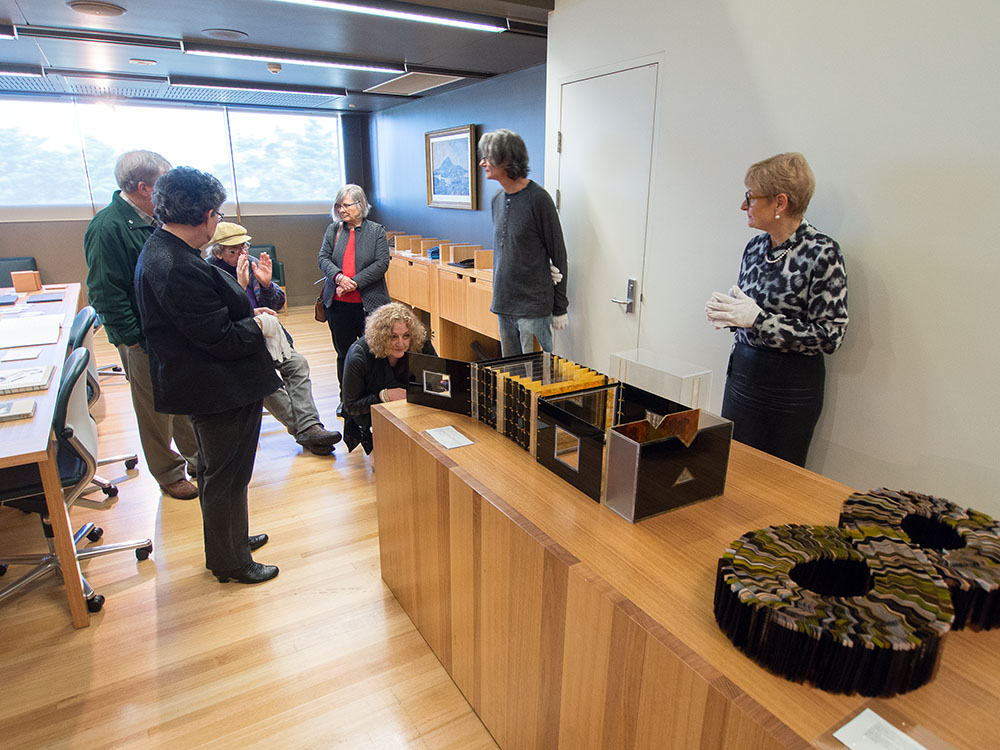
State Librarian, Janette Wright views a tunnel book by Wim de Voss
What follows are a range of images from the Seminar and Artists’ Book Fair
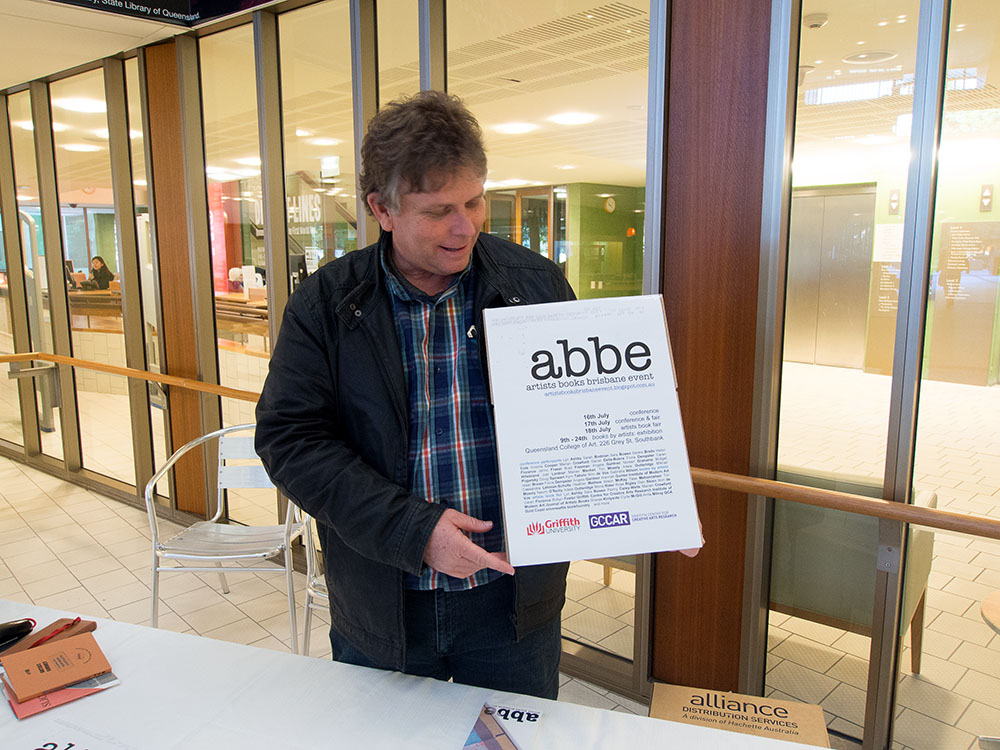
Tim Mosely promotes the ABBE Conference @ QCA in July
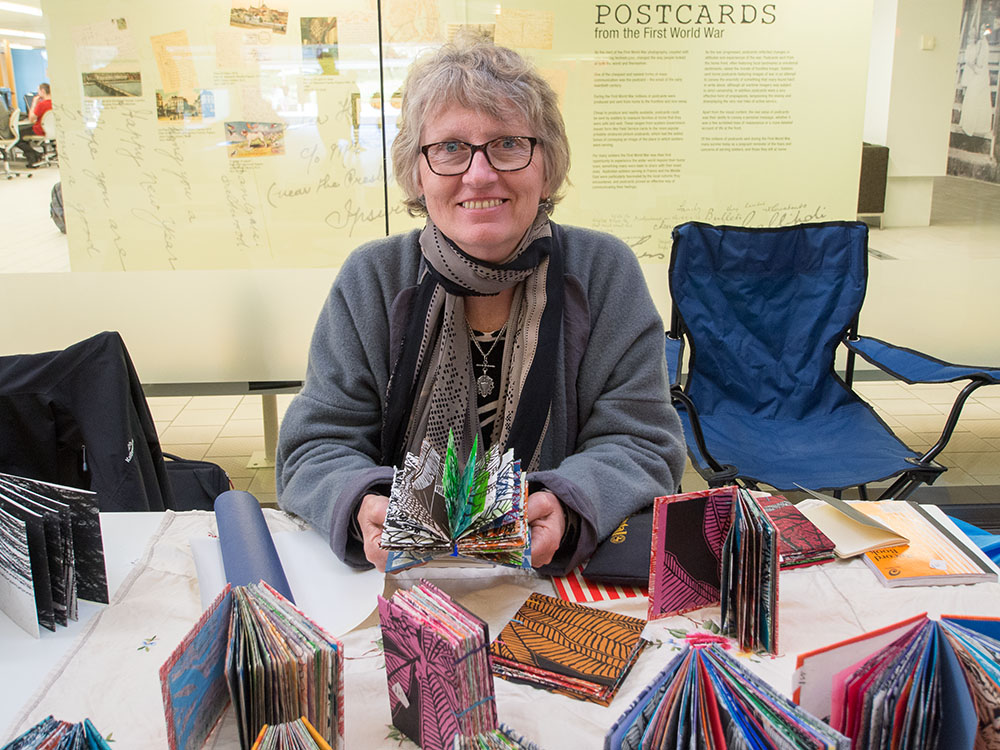
Sue Poggioli at the Artists’ Book Fair
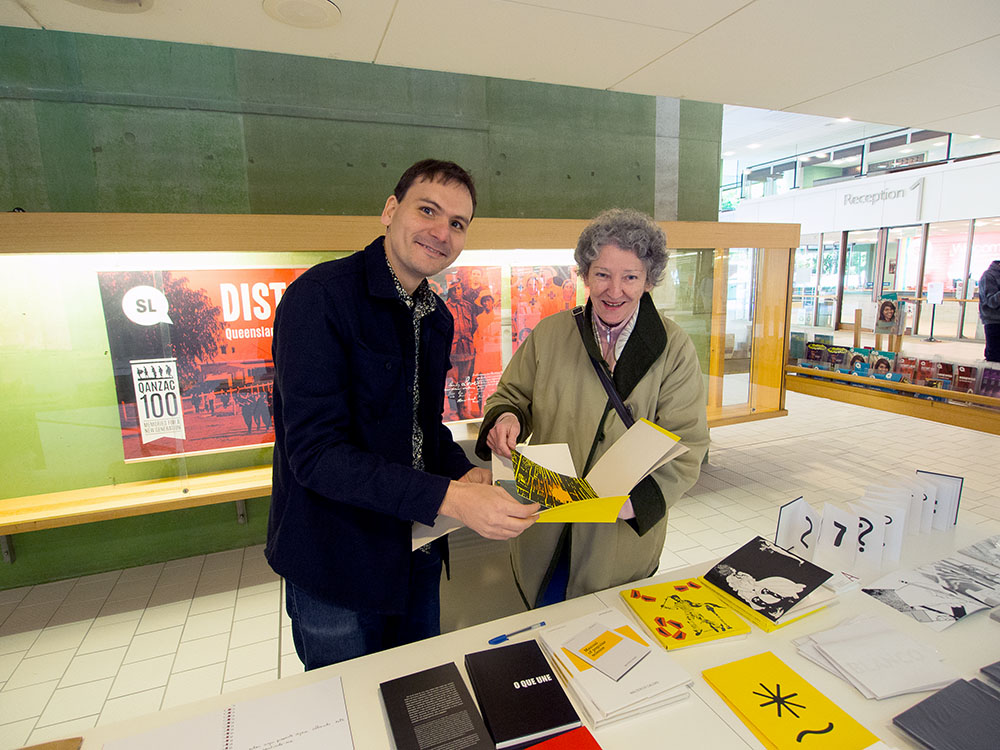
Amir and Noreen Grahame
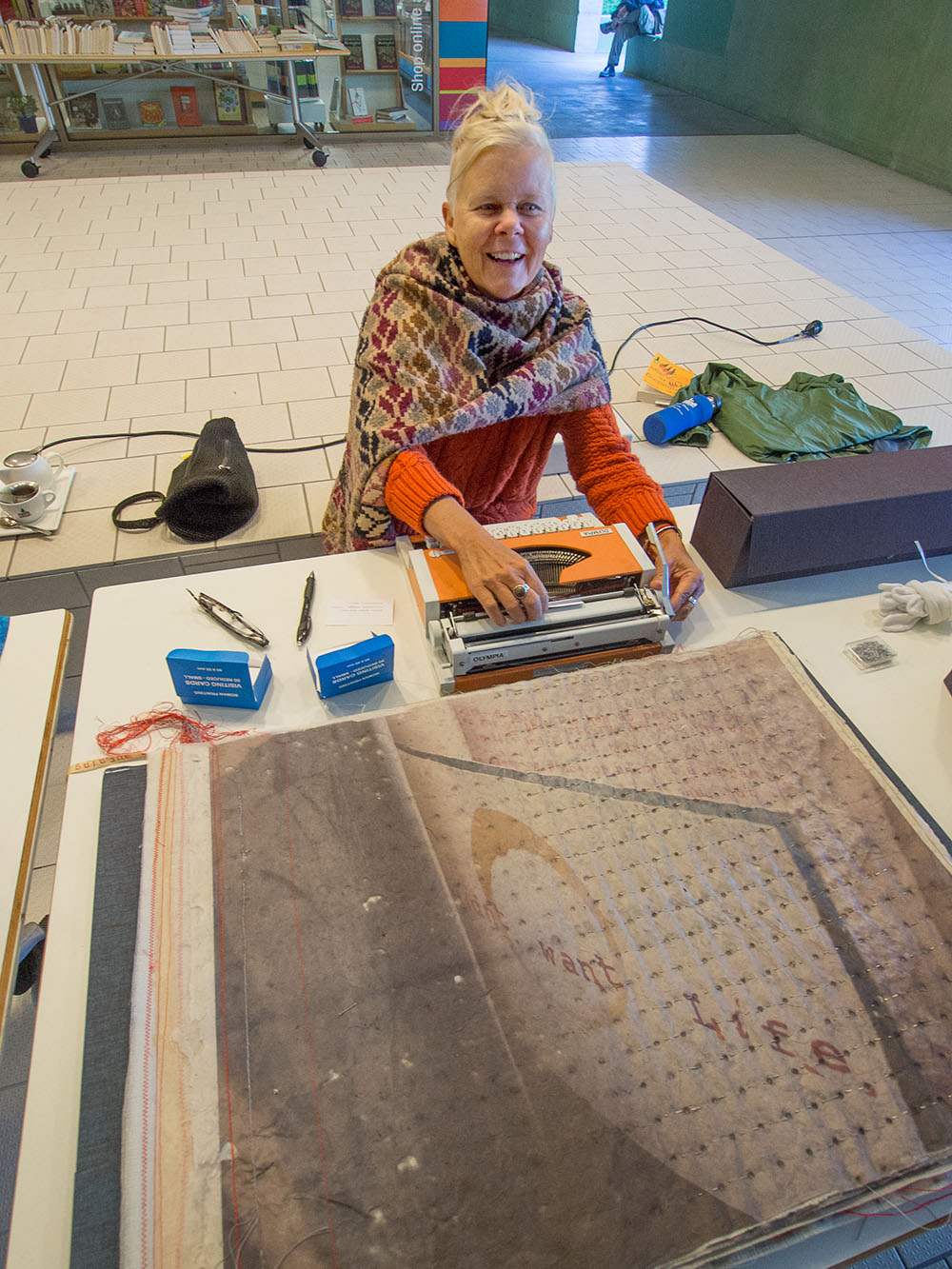
Julie Barratt at the Artists’ Book Fair
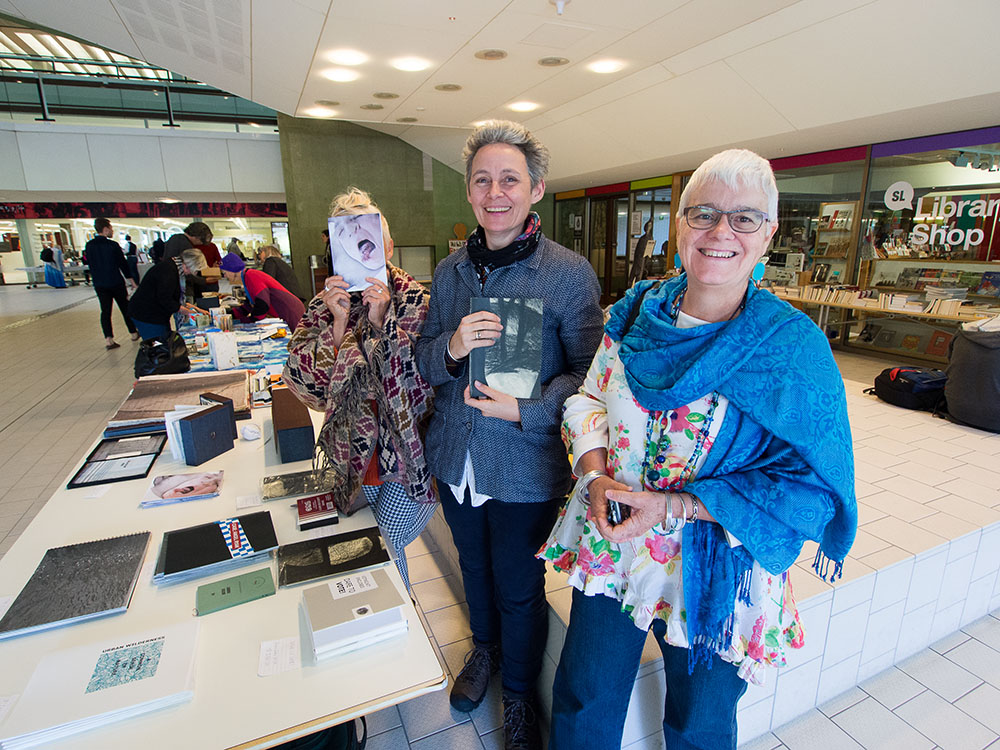
Julie Barratt, Monica Oppen and Helen Cole Artists’ Book Fair
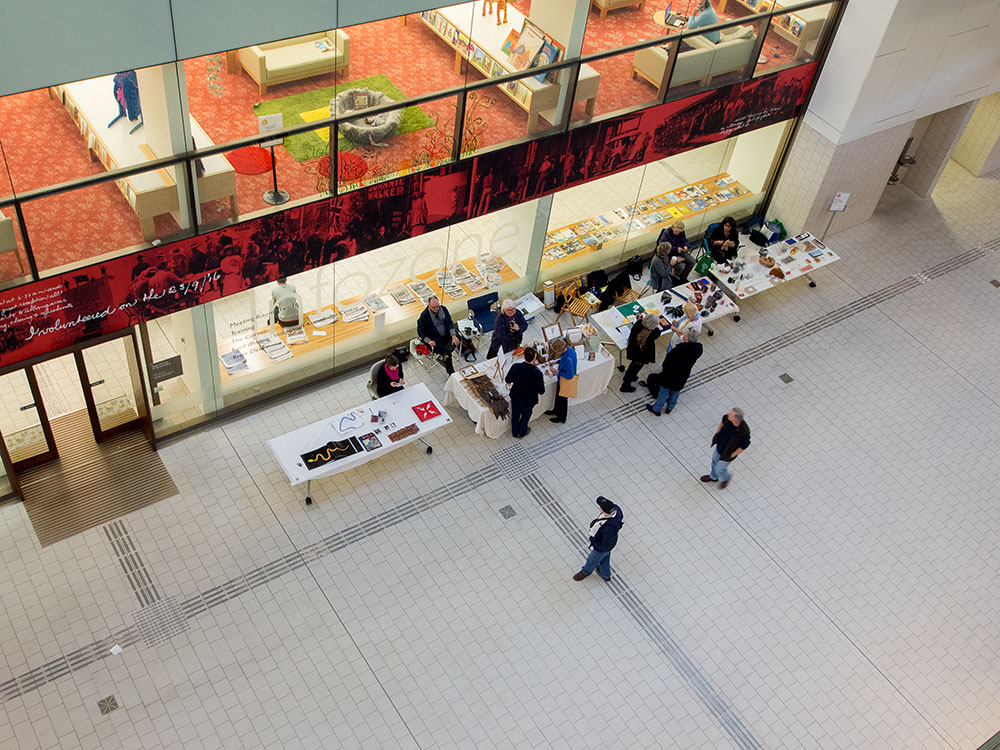
A section of the Artists’ Book Fair at the SLQ
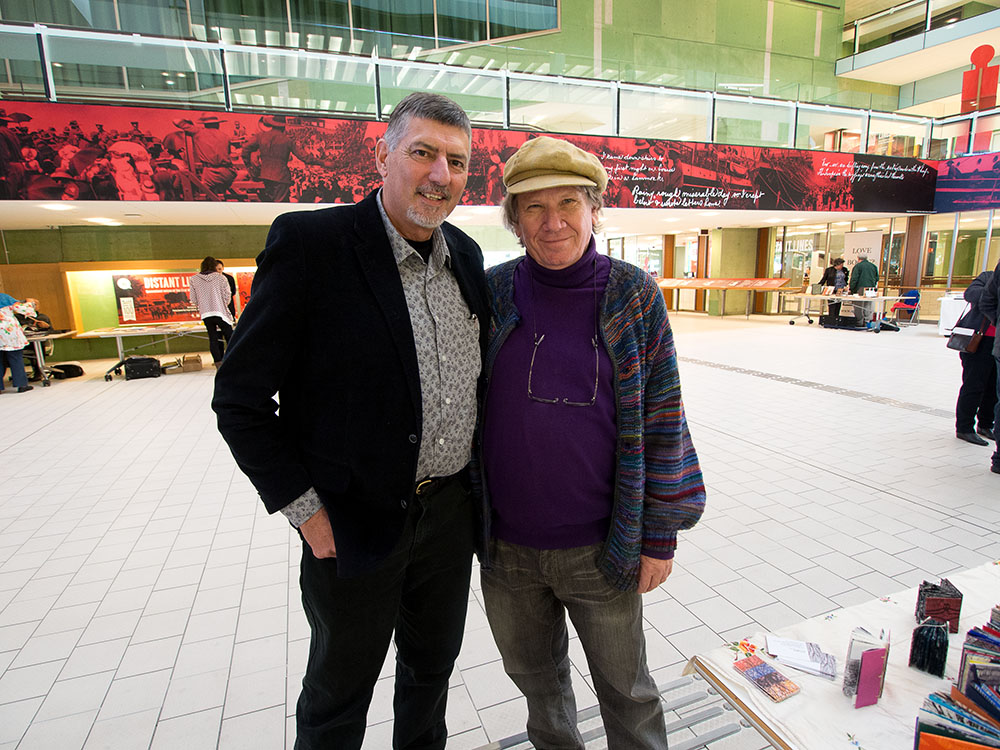
Doug Spowart and Wim de Voss
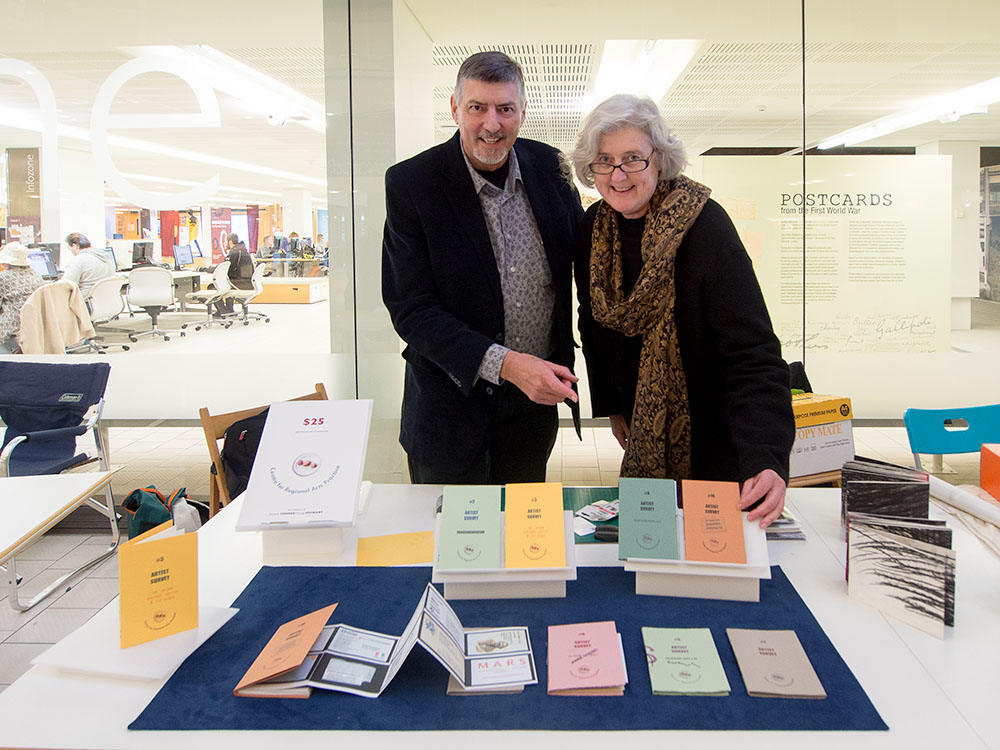
Doug Spowart and Victoria Cooper and their C.R.A.P. display
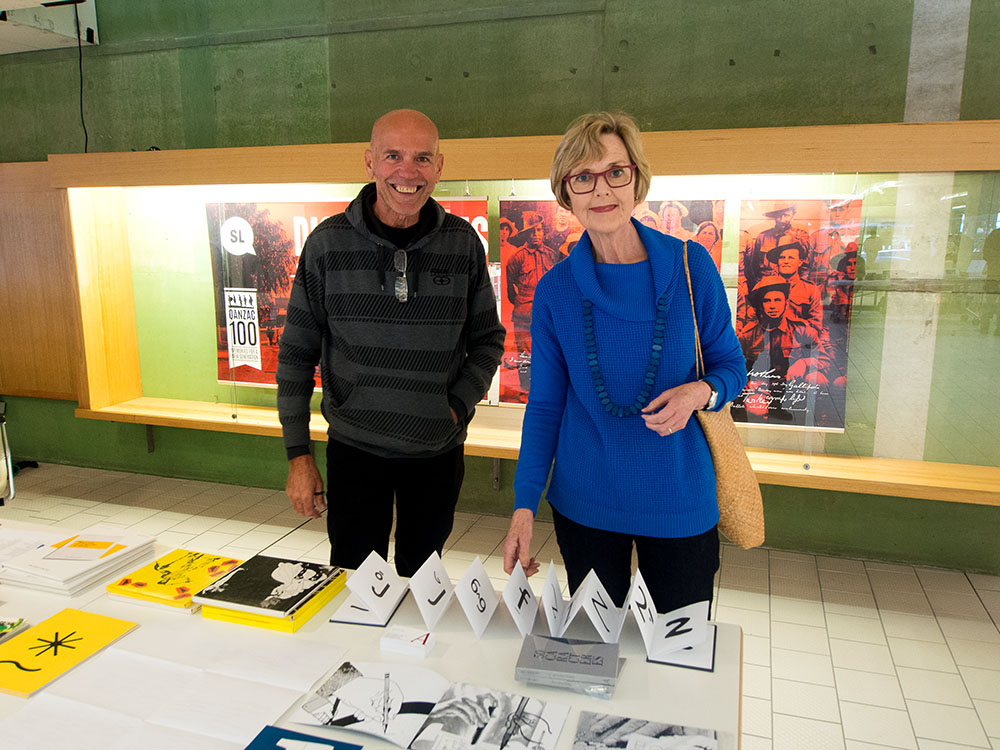
Clyde McGill and Anne Kirker
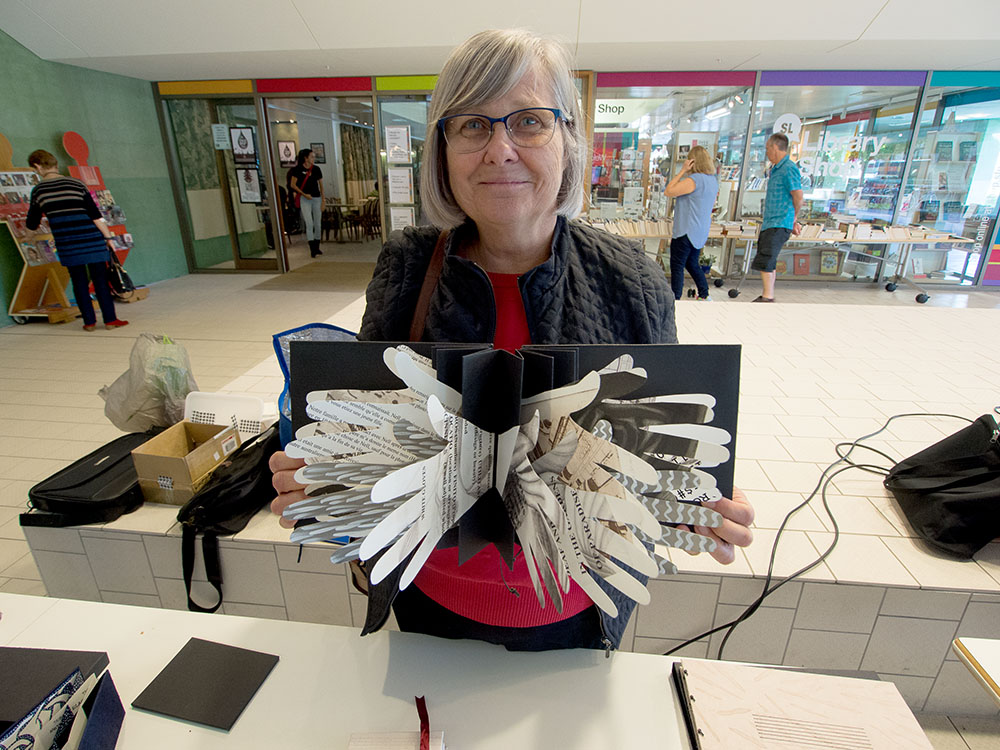
Helen Malone at the Artists’ Book Fair
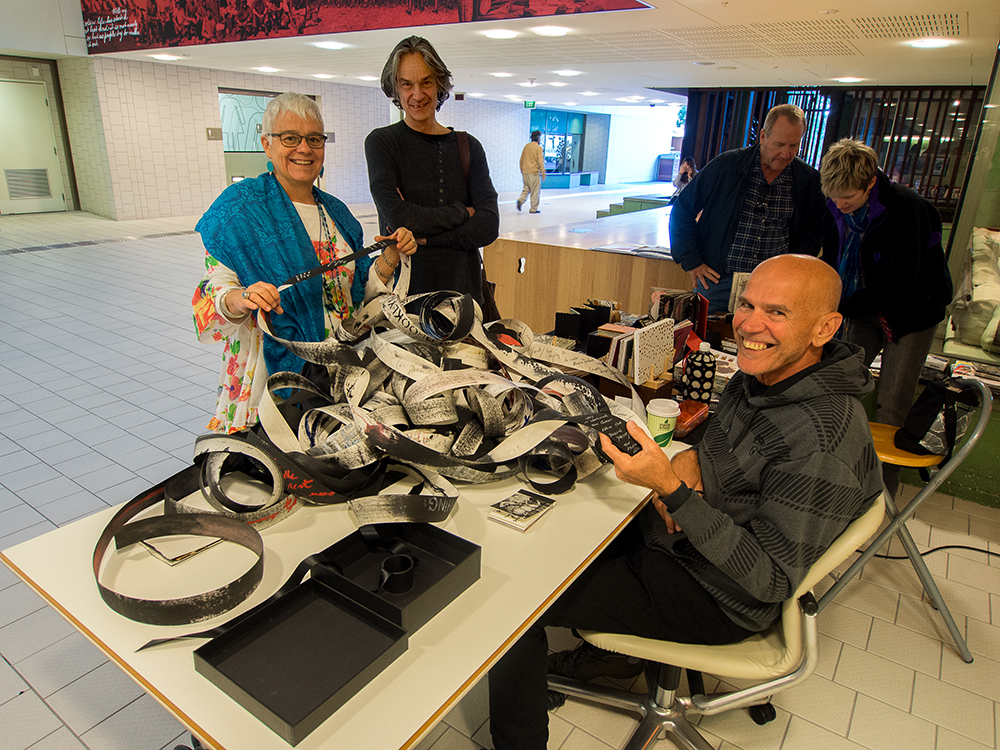
Helen Cole, Michael Wardell and Clyde McGill at the Artists’ Book Fair
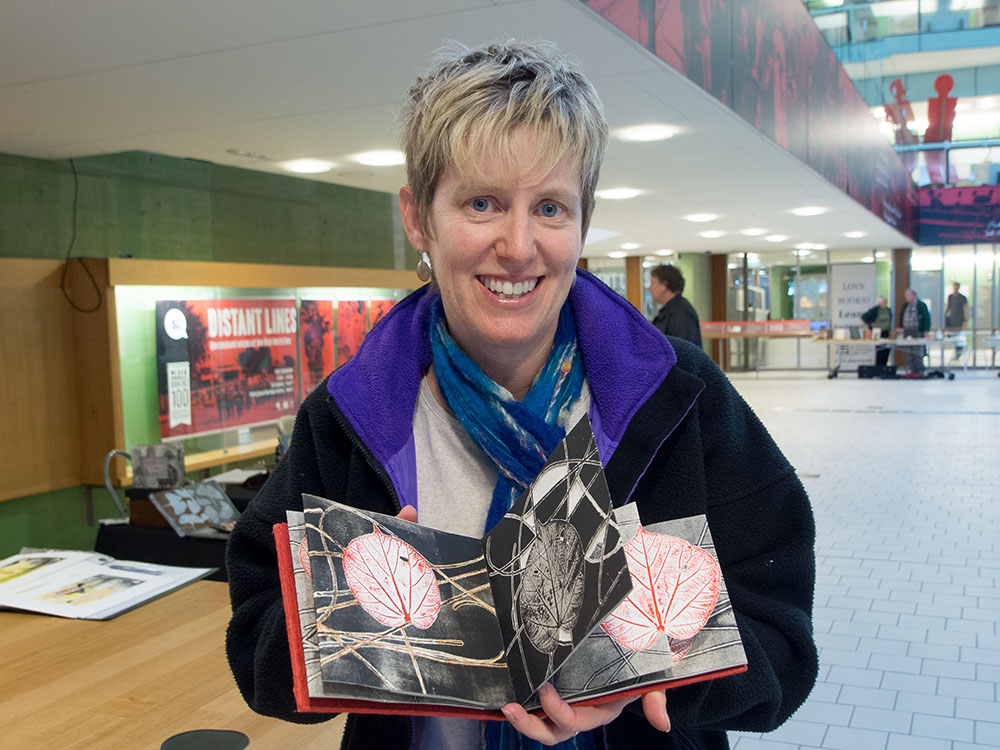
Sandra Pearce at the Artists’ Book Fair
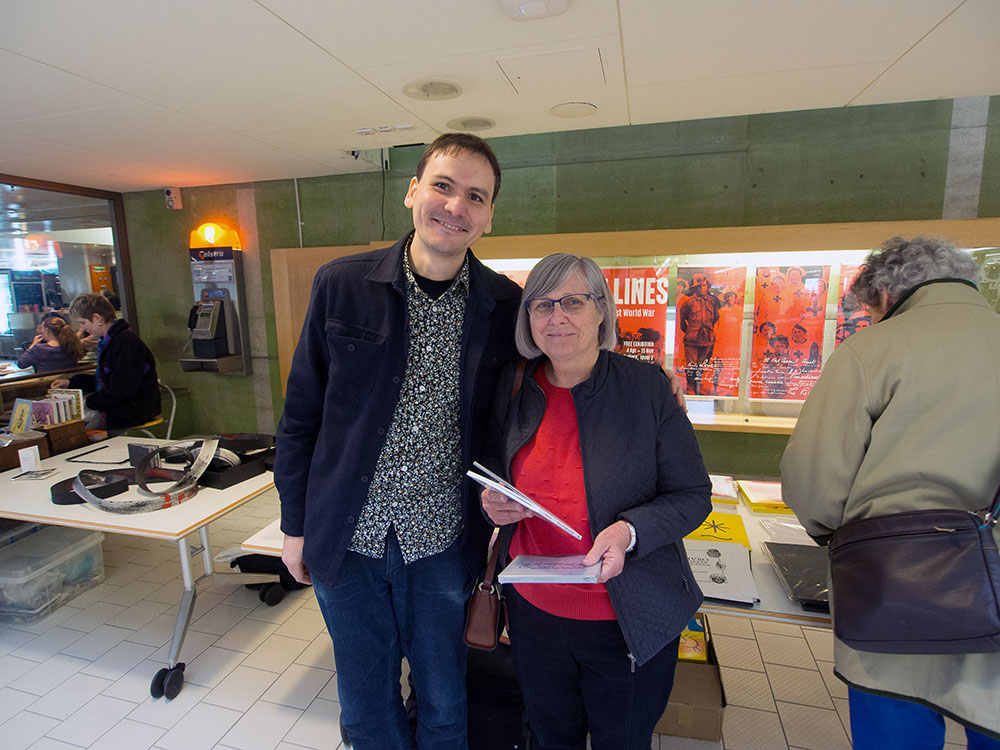
Amir Brito Cadôr with Helen Malone
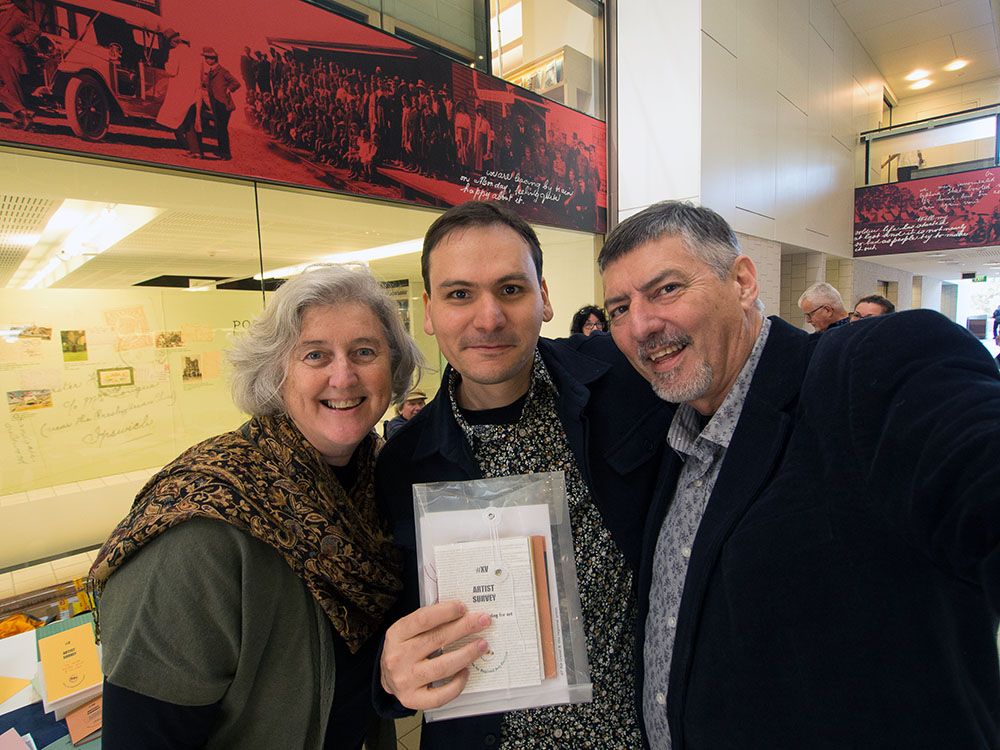
Amir Brito Cadôr with Victoria Cooper and Doug Spowart
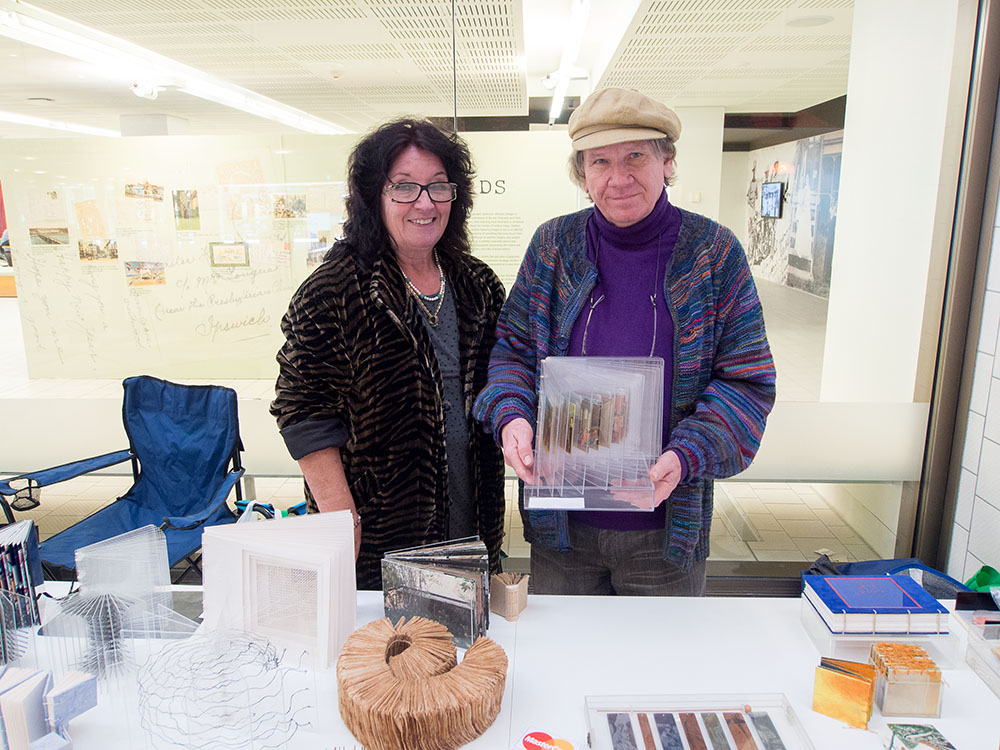
Adele Outteridge and Wim de Voss
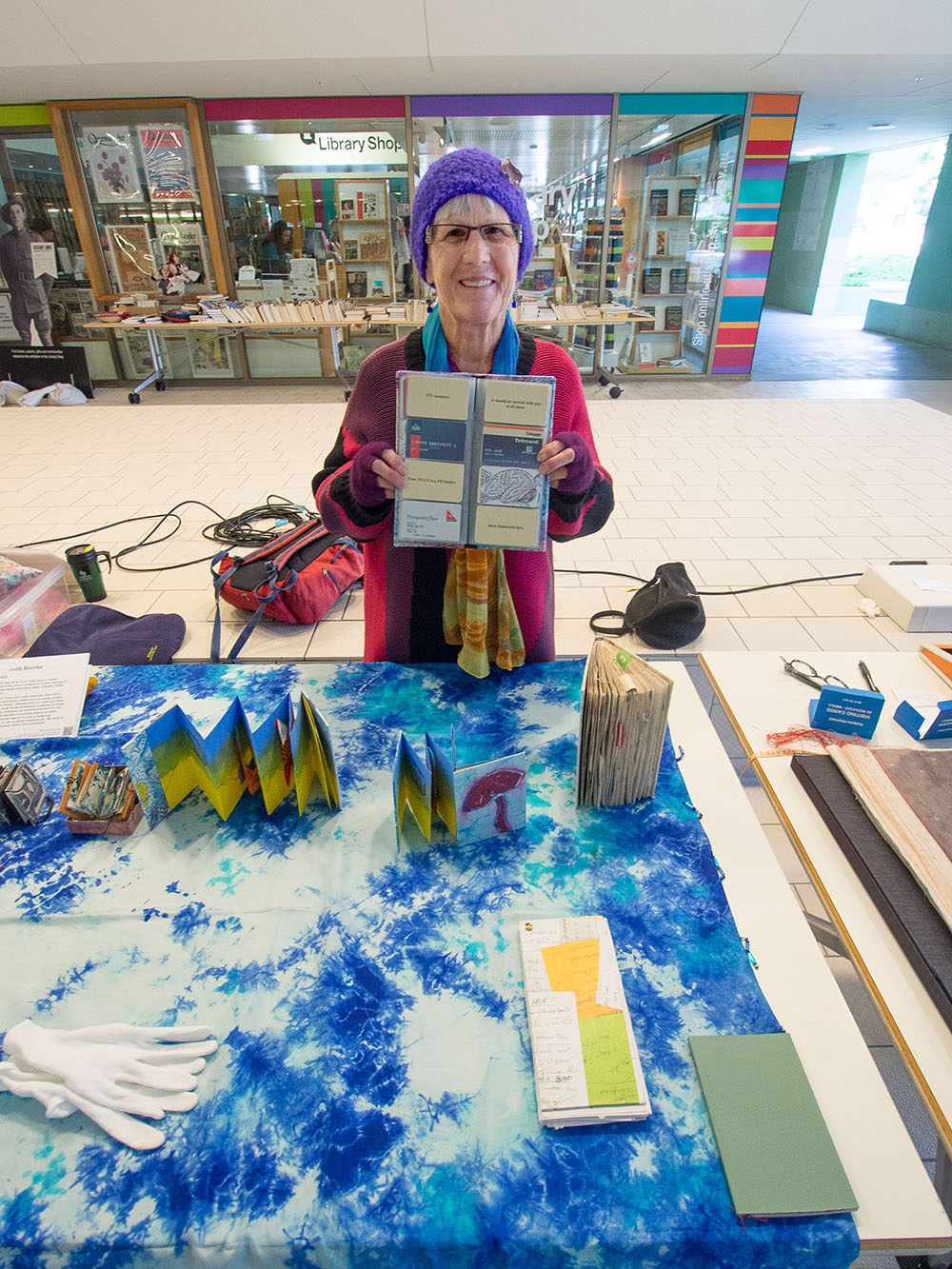
Judy Bourke at the Artists’ Book Fair
Presented by SLQ with the generous support of the Siganto Foundation. All photos and text ©2015 Doug Spowart
REPORT on SIGANTO ARTISTS’ BOOK RESEARCH FELLOWSHIP @ SLQ
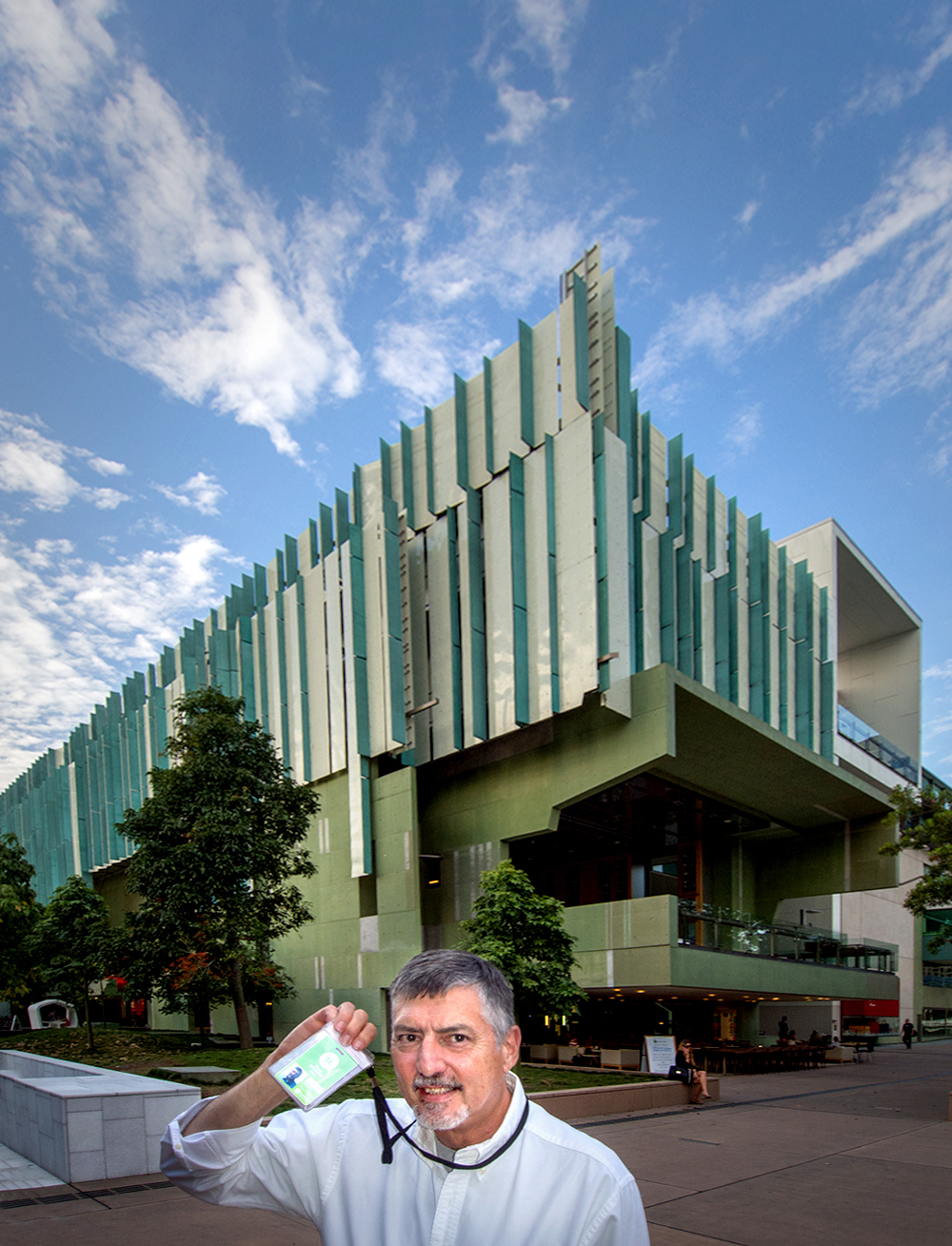
Doug Spowart at the SLQ with his Security pass
.
A PHOTO OPPORTUNITY: Looking for photos in the Australian Library of Art
As the inaugural Siganto Artists’ Book Research Fellow I have had an opportunity to access the State Library of Queensland’s resources including the significant artists’ book collection held in the Australian Library of Art. During the Fellowship I have engaged in specific research related to my proposal and in doing so it has enabled the creation of a much-needed critique on photography and the artists’ book. It has enhanced my understanding of the photography and artists’ book creative products and has placed me in a position of knowledge of these disciplines, the nature of these creative works, their collection and description.
.
In this research my particular interest is in the intersection of photography and the artists’ book. Over a four-month period from October to January in 2014-5 I worked in the Fellows Room and in the Repository at the SLQ. During this time I engaged in a variety of activities that related to my proposed research activities. These included:
- A review of artists’ books in the Australian Library of Art collection looking for the presence of photography
- Creating and using a spreadsheet in which the review was logged
- Documentation of books containing photography
- Selected books were considered for critical evaluation
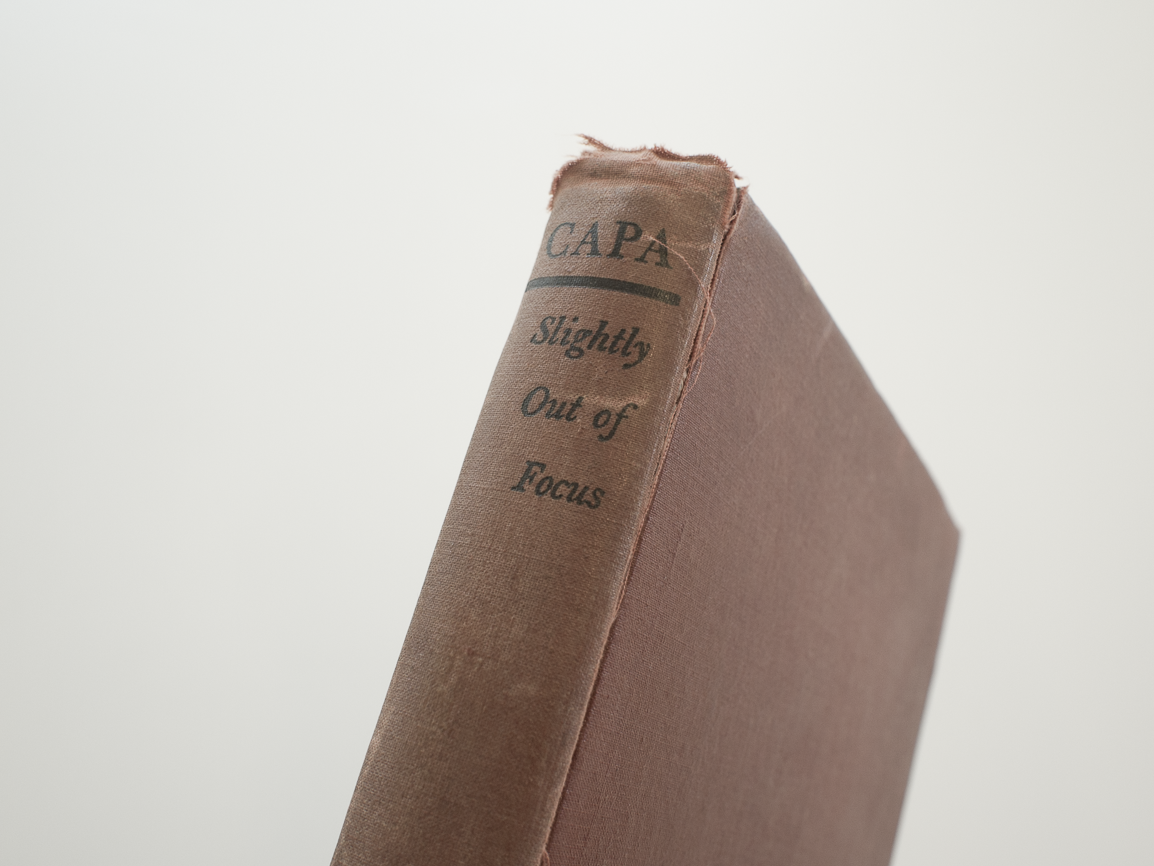
Robert Capa’s ‘Slightly out of focus’
I was also interested in books that have emerged as being significant in the newly documented history of the photobook and also the ALA’s acquisition of contemporary photobooks. I found in the library’s general collection many key seminal photobooks like Robert Capa’s 1947 Slightly out of focus: [the story of a war photographer], Henri Cartier-Bresson’s 1952 The decisive moment, and Richard Avedon’s 1976 Portraits. While some of these books are difficult to find, expensive to buy, and have been re-released in modern printings the original book is an important touchstone for those interested in photographic history. The ALA collection also revealed surprises with my discovery of a Japanese ‘Provoke era’ book from the 1960s and Broomberg and Chanarin’s ‘The Holy Bible’ from 2013 – both books representative of key approaches to the photobook and the use of photographs in creative book publishing.
.
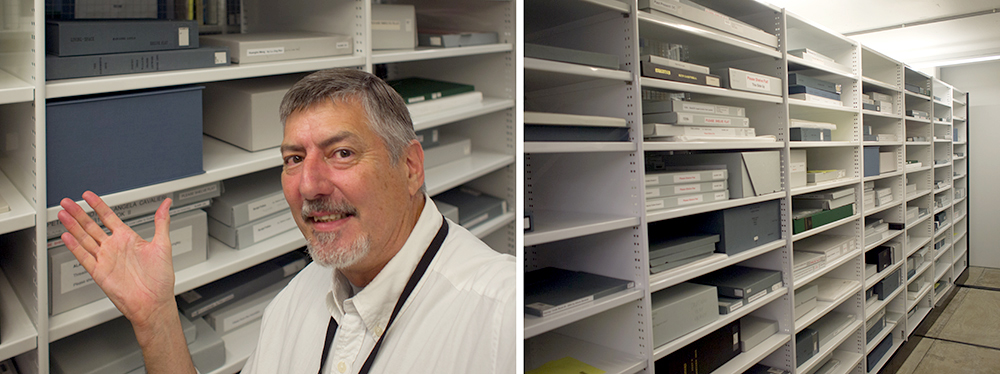
Doug Spowart in the SLQ Repository
I attended the library usually 4-5 days per week. After an initial settling-in and establishment of my methodology for work I began near-daily research in the Repository. I usually worked on a 3-hour time limit per session during which I viewed and reviewed as many books as possible. My methodology involved direct contact with the book and an engagement with the physical and the metaphysical. I held each book, I turned each page, I read each word (where text existed), I made my assessment and logged the results of the appraisal on my spreadsheet and photographically documented the book. It was a slow and intense process that has resulted in a significant resource which has the possibility to reveal interesting facts about the photo in the artists’ book.
An integral aspect of the review process was the haptic experience of encountering the book, opening its enclosure, clamshell or paper wrap, and sensing the book’s activation by this act. I found that these books were entities to themselves, a containers for sharing the artists’ vision, idea or narrative. Some perhaps were being read for the first time in a while. And in the quietness of the Repository the books revealed themselves to me… At the end of each 3-hour session I was quite exhausted. Although the ALA staff were always interested to hear my report of the favourite ‘book of the day’.
What intrigued me was the diversity of the media and the message that artists place in the creative vessel of the artists’ book. I found myself seduced as much by books of abstract, textural or other non-photo print forms as I was with books with photographs in them.
Working through the library’s catalogue I often found myself looking up obscure books, different editions of books, photographers, topics and references allied to my research interests. I would request these items and they would be delivered to me. I would stack and categorise these books relating to different research interests. Subsequently, as my desk grew with more and more books, I requested a printout of my personal loans. The librarian assisting me looked surprised as the printer spat out around 50 items. One of my life follys is collecting books and there came a time when this personal library-in-the-library would need to be returned, as I was to exceed my loan limit.
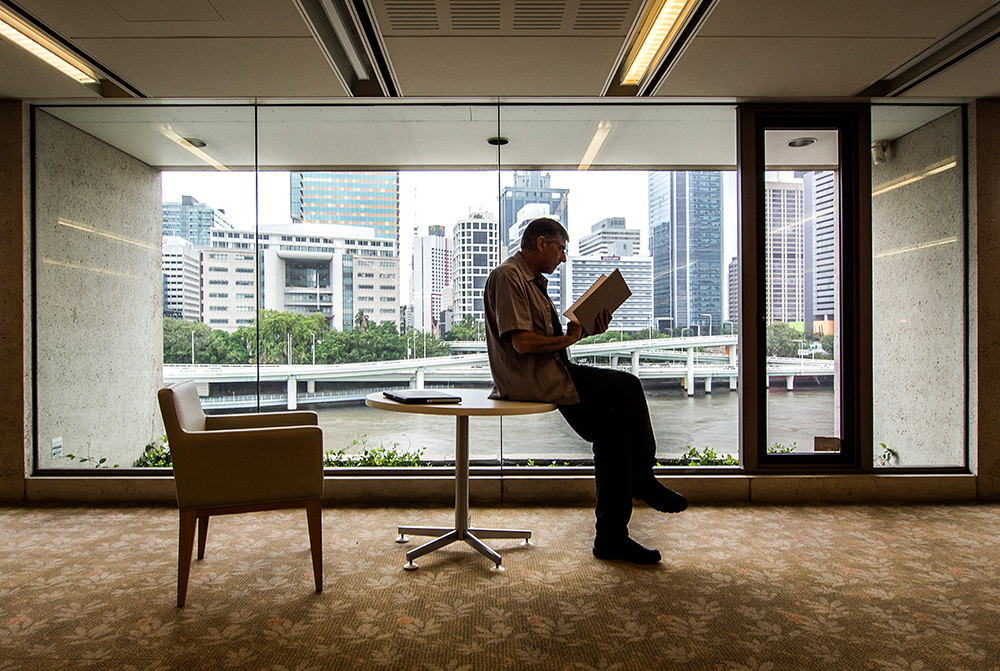
Doug Spowart reading a book at the SLQ
During my Fellowship I was able to develop and complete a significant paper outlining a way of categorising the presence of the photograph in the creative book production genres of artists’ books and photobooks. Entitled, A Photo Spectrum: Book genres and photography, it encompasses the limited edition livre d’artiste through artists’ books, zines, self-published photobooks, designer photobooks and limited edition deluxe photobooks. This paper is presently being held by an American publisher to be included in a book on the contemporary photobook. I intend to discuss this outcome in the seminar. Another paper about contemporary photobooks written during the Fellowship entitled, Everyone a publisher, was published in the recent special issue on artists’ books in the State Library of Victoria’s La Trobe journal. I also coordinated and chaired a forum on The OTHER Photobook – Artists’ books and Zines at the Photobook Melbourne event in February, and in May I spoke on Encountering a photobook at the Talking Culture Symposium of the Auckland Photo Festival. The Siganto Fellowship assisted in providing me with time and a place where my activities could be dedicated in the pursuance of my research.
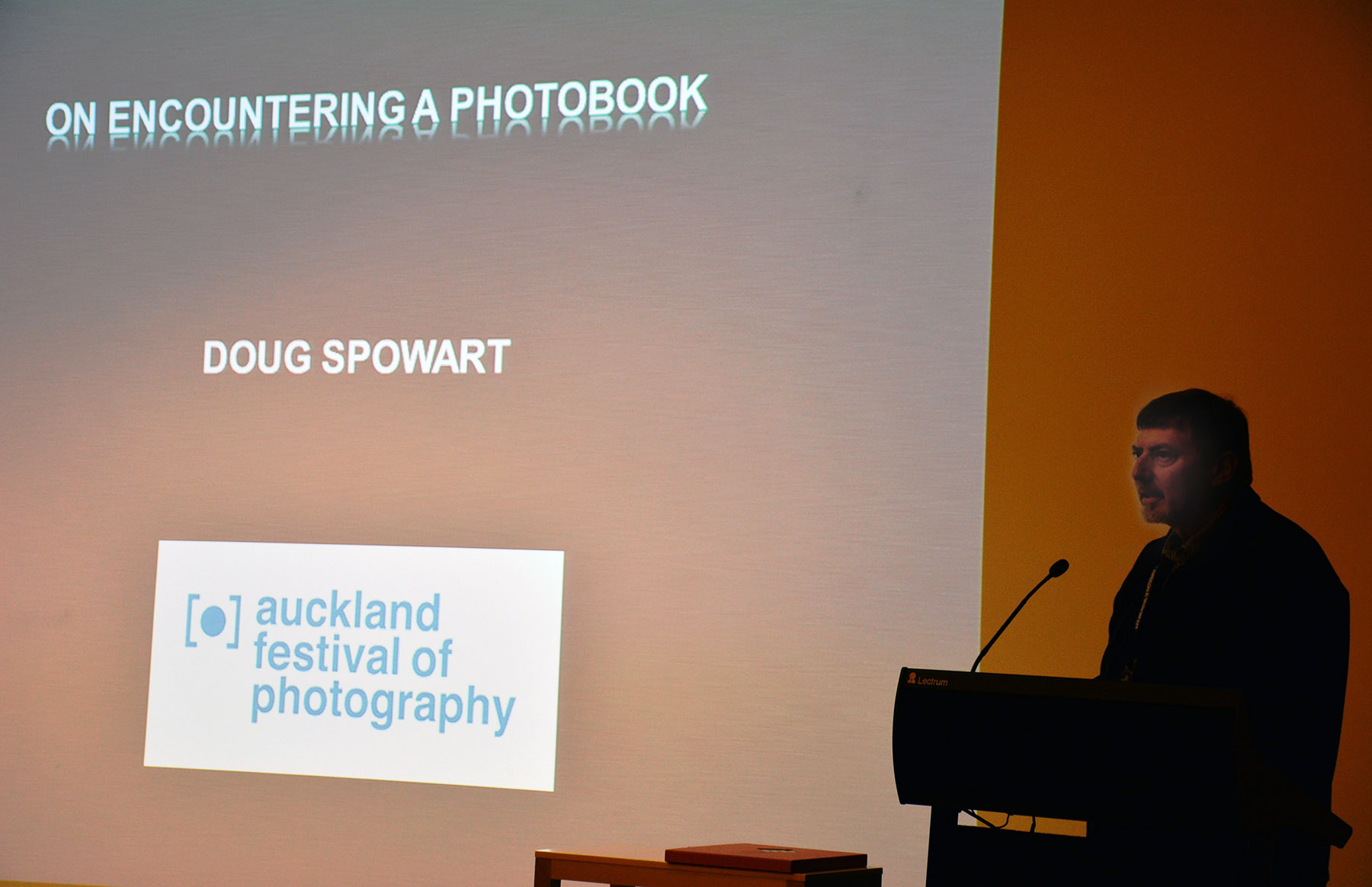
Doug speaking at the Auckland Festival of Photography
As a result of the Fellowship I am working on projects that include the presentation to the SLQ of a strategy for the continuing purchase and collection of contemporary photobooks in the ALA. Still in development is the preparation and design of a book of selected works from the ALA collection that were fundamental to my research thesis on the photo in the book.
At the Siganto Artists’ Book Seminar (Click here for the Blog post) I will present a paper outlining the curious and interesting aspects of my ALA review including amazing books that need to be seen, held, and pages turned so that they can share the maker’s communiqué, and stimulate the reader to encounter … the photo in the book.
Dr Doug Spowart
2014 Siganto Artists’ Book Research Fellow
PHOTOBOOKS: everyone a publisher – The LA TROBE Journal
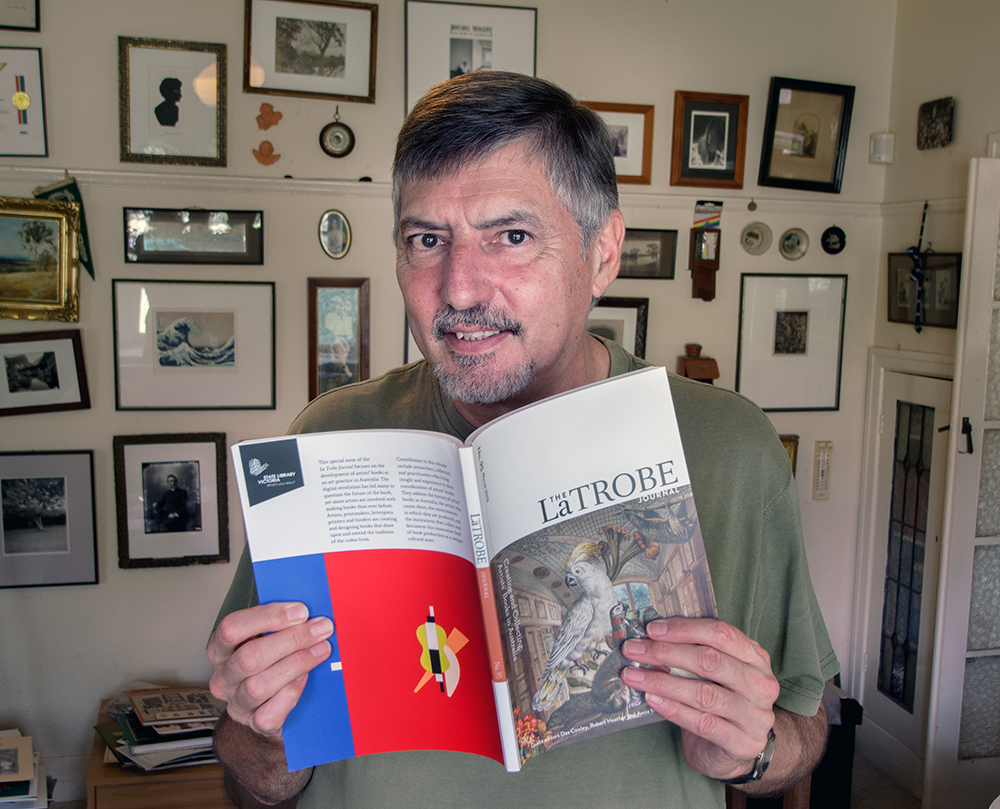
Doug Spowart with the La Trobe journal
.
I’m particularly excited to announce that a copy of my essay on Photobooks published in the State Library of Victoria’s La Trobe journal is now available as a free download. Here are some details and links
.
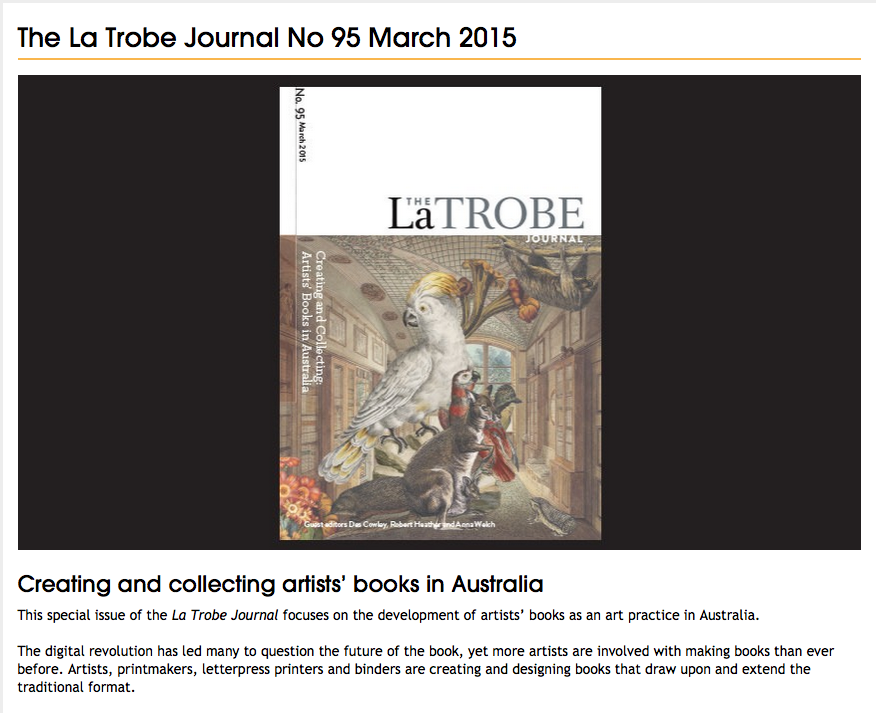
The La Trobe journal with the great Gracia & Louise cover
TITLE:
The photobook: everyone a publisher?
ABSTRACT:
Digital technology, indie DIY and print-on-demand photobooks have transformed contemporary photography book publishing, however the creative and innovative influence that graphic designers have brought to the artists’ book is now extending into the photobook artform.
FIRST PARAGRAPH:
Over recent years the photographically illustrated book has undergone a massive makeover, in effect freeing it from traditional publisher controls. Digital technologies have been the major cause of this paradigm shift due to the democratisation of photography, new production technologies, and new funding and marketing platforms. The 19th-century polymath Henry Fox Talbot, inventor of the positive/negative process for photography, was so enthusiastic about the potential for his discovery that he made a prediction for a future where: ‘Every man [would be] his own printer and publisher’. It would now seem that Talbot’s prediction has come to pass. Increased public access to book publishing is particularly important for those photographers and artists who employ the camera and the photograph in their art practices.
Topic headings:
- Photographers desire books
- A new term emerges
- A new critique forms for the photobook
- A new accessibility to book production
- The happy self-publisher
- The artist book and self-publishing
- A new challenge emerges: design my book
- In conclusion
Features a commentary on Ying Ang’s Gold Coast and photos of books by Louis Porter, Lloyd Stubber and Mimmo Cozzolino.
CLICK THE LINK BELOW TO DOUG SPOWART’s ESSAY DOWNLOAD
http://www.slv.vic.gov.au/sites/default/files/La-Trobe-Journal-95-Doug-Spowart.pdf
LINKS TO OTHER DOWNLOADS
- [Front matter] (pdf,276.52 KB)
- · Des Cowley, Robert Heather & Anna Welch – Editors’ introduction (pdf,105.18 KB)
- · Helen Cole – Public collections of artists’ books in Australia (pdf,617.45 KB)
- · Andrew Schuller – A history of the Croft Press (pdf,859.45 KB)
- · Sasha Grishin – Books in the Canberra region: the golden years (pdf,1011.85 KB)
- · Steven Tonkin – A defining decade: Australian artists’ books in the 1970s (pdf,461.45 KB)
- · Artists’ books from the State Library of Victoria: a photo essay (pdf,5.3 MB)
- · Caren Florance – The changing face of contemporary letterpress in Australia (pdf,493.65 KB)
- · Peter Anderson – Conceptual and perceptual: the early artists’ books of Robert Jacks (pdf,503.25 KB)
- · Marian Macken – Reading time: the book as an alternative architectural practice (pdf,1.28 MB)
- · Doug Spowart – The photobook: everyone a publisher? (pdf,523.78 KB)
- · [Back matter] (pdf,274.28 KB)
.
.
.
COOPER+SPOWART NOCTURNE MUSWELLBROOK – Revisitied
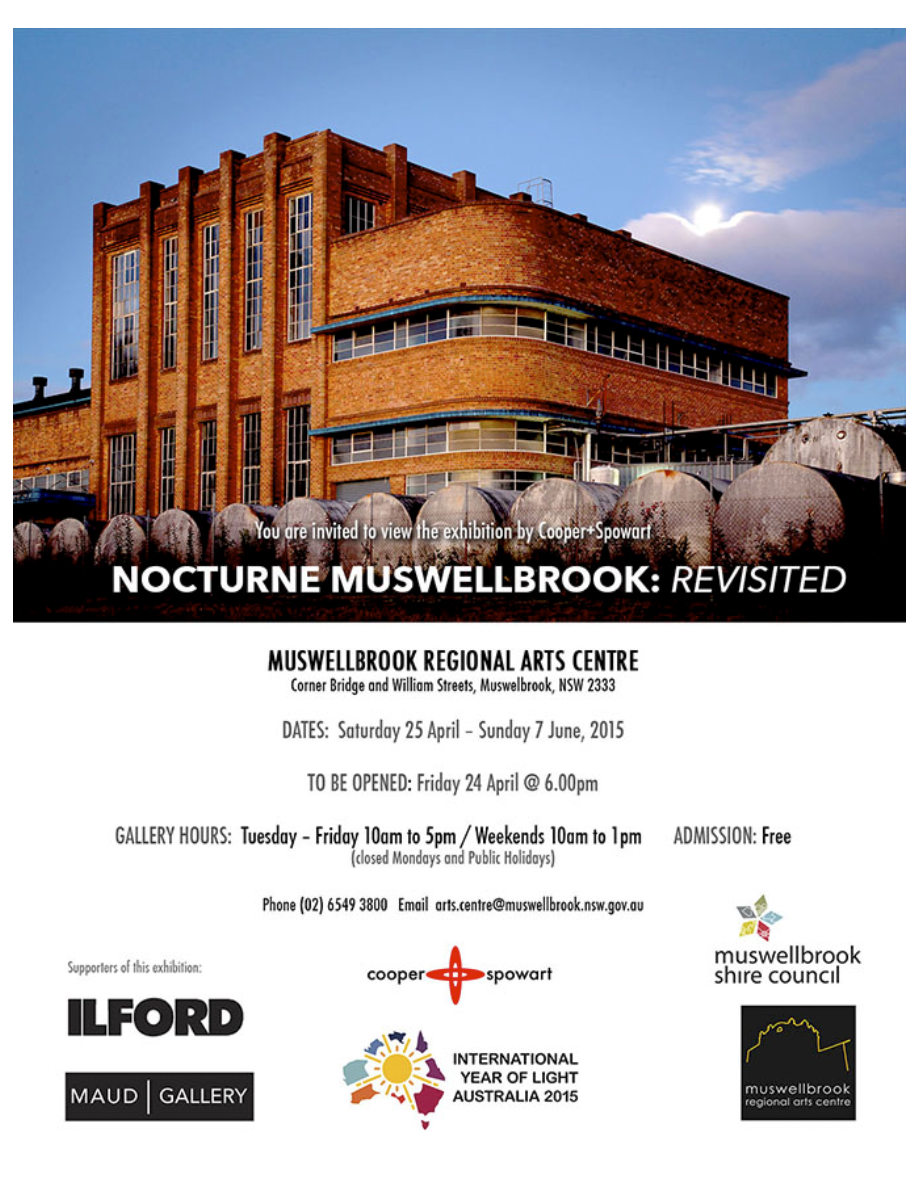
.
.
2015 was the INTERNATIONAL YEAR OF LIGHT – Our Nocturne projects celebrate light and to celebrate we presented a major exhibition entitled NOCTURNE MUSWELLBROOK: Revisited at the Muswellbrook Regional Arts Centre.
.
Nocturne Muswellbrook: Reflections on Light
As the sun goes down and the last light fades–cars pass by with commuters heading home for respite at the end of a days work or others just embarking on a nights work. Trucks move through the town with little thought for the places they pass through. People meet and have a conversation…. The street lights come on one by one up the street. The illuminated advertising signage lights the buildings along with the internal lights of the building.
This transition from daylight to night is rhythmical–a diurnal phenomenon–but one that is also pervaded with the uncanny or un-homely sense of place. At nocturne and into the night everyday places change, becoming mysterious as the shadows replace familiar surrounds. A sense of melancholy also grows with the passing of the day–a lament born from the relentlessness of change.
Yet these ephemeral moments can also be seductive and evocative, experiencing the aesthetics of the nocturne can inspire new imaginings of everyday places. The colour and chiaroscuro compositions of light and shadow replace the tired and indifferent prose of daily life. A magical narrative evolves from the personal memories of a shared living history in these laneways, streets, buildings and spaces.
.
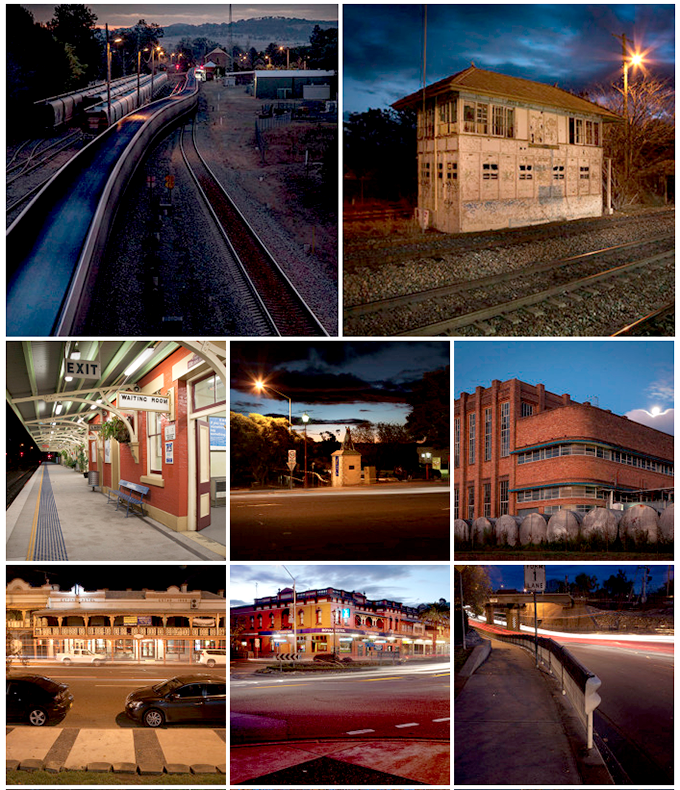
A selection of Nocturne Muswellbrook: Revisited images
.
COOPER+SPOWART NOCTURNE PROJECTS
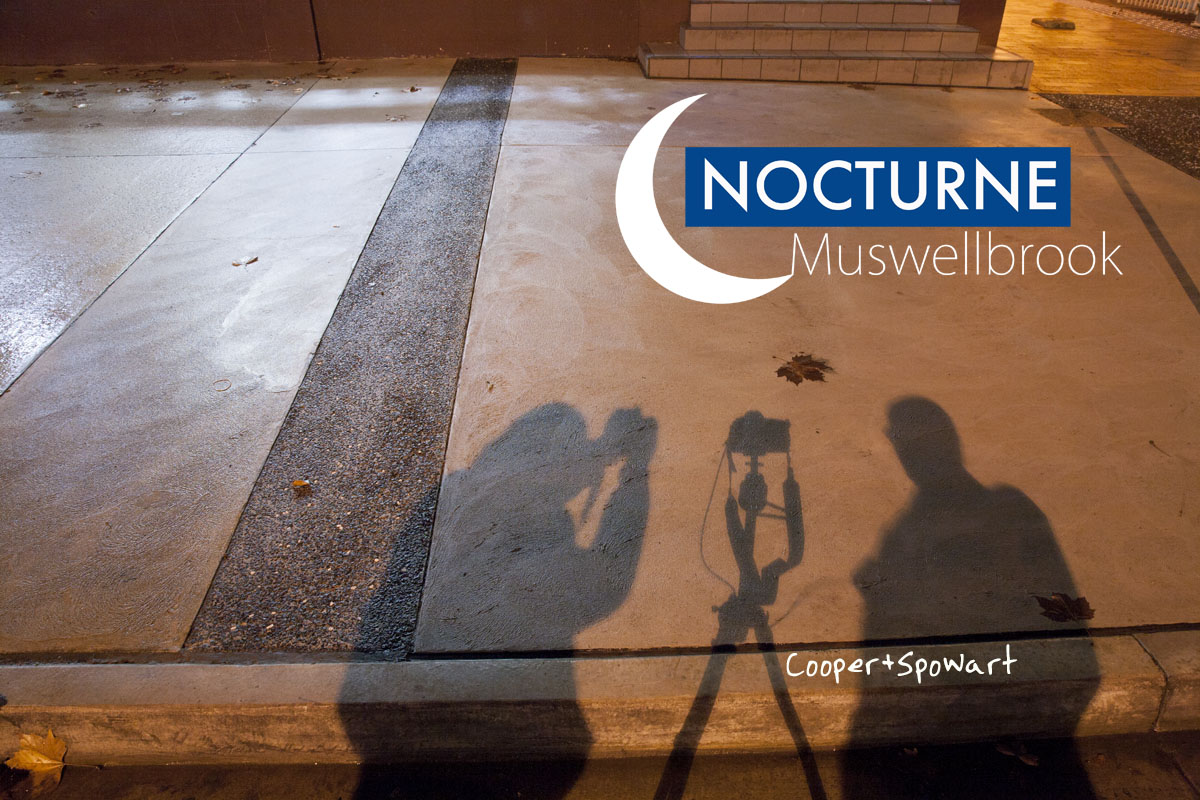
Cooper+Spowart Nocturne shadow
For many years we have engaged in nocturne projects. These have included artists in residency programs in the regional galleries of Muswellbrook, Grafton, Bundaberg and Miles as well as self-funded projects across east coast Australia. The Artist in Residence (AIR) projects are associated with a Facebook page to connect the community with the photographs and evoke stories about the places photographed.
A sample of community Facebook responses can be seen here:
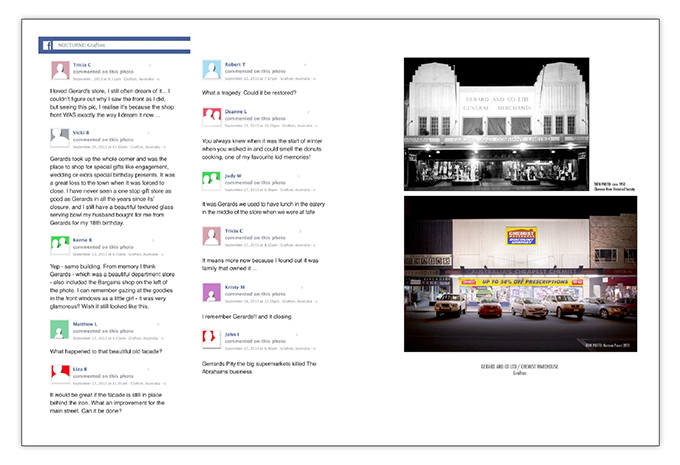
Catalogue-Comments-interact-FP3
.
Nocturne AIR Projects include workshops, mentoring in photography, image enhancement, social media as well as photobook and zine making. Future Nocturne Projects are in the planning stage and we seek expressions of interest from communities looking to participating in a Nocturne light project.
.
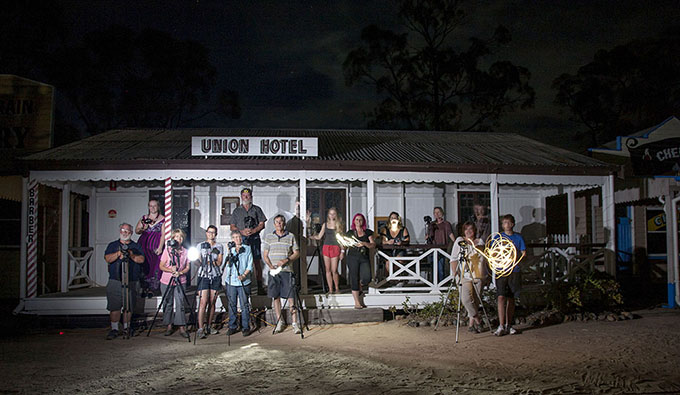
Participating community members from the Nocturne Miles Project
.
A link to a collective of NOCTURNE PROJECTS can be found: HERE
.
THE BACK STORY: Nocturne Muswellbrook
The Nocturne Muswellbrook Facebook page was launched in June 2013
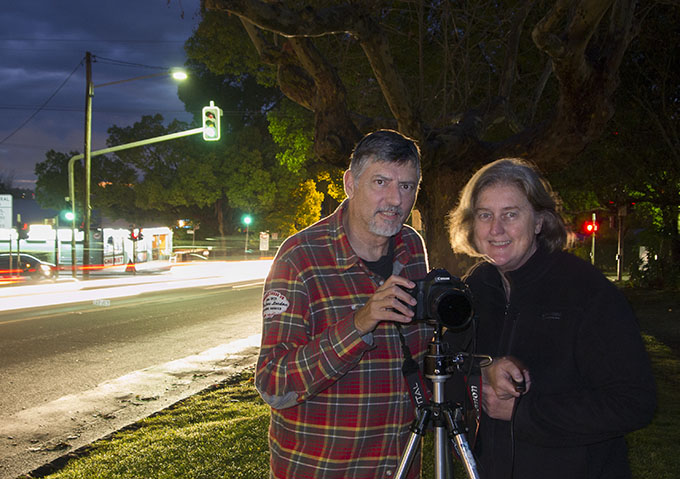
From 23rd June we began a 2week Artist in Residence in Muswellbrook. Our studio was a vacant shop in the Campbell’s Corner building fronting onto the main street, Bridge Street
.
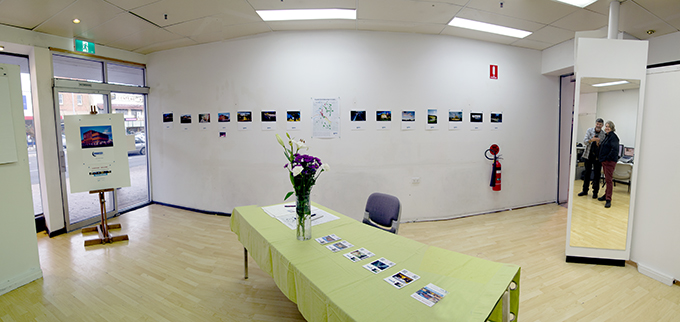
Our gallery and workspace
We set up our digital studio workspace to:
- Master the nocturne photographs for the Facebook page
- Print out the mastered images for a small display in the shop
- Greet anyone that wanted to come by and share their story about Muswellbrook
- Prepare for the evening’s shooting around the town
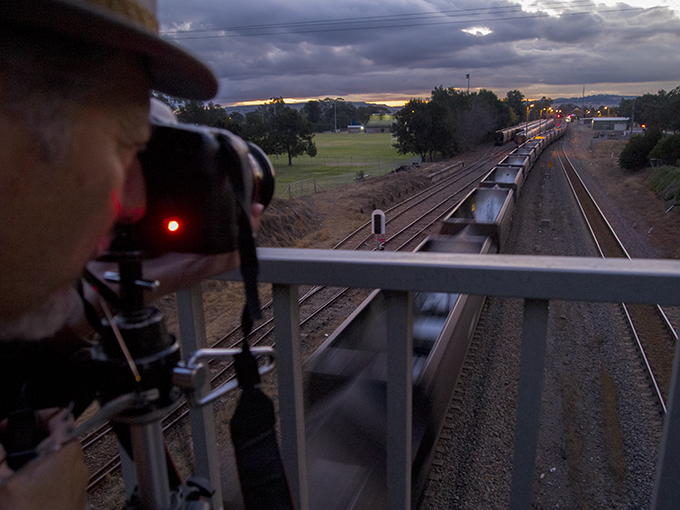
Photographing a coal train from the Bell Street bridge
Each night and day, once the images were uploaded onto the Nocturne Muswellbrook page we invited everyone to tell their stories about each place photographed. We were excited to engage with the community and a deeper knowledge and experience of Muswellbrook through this process.
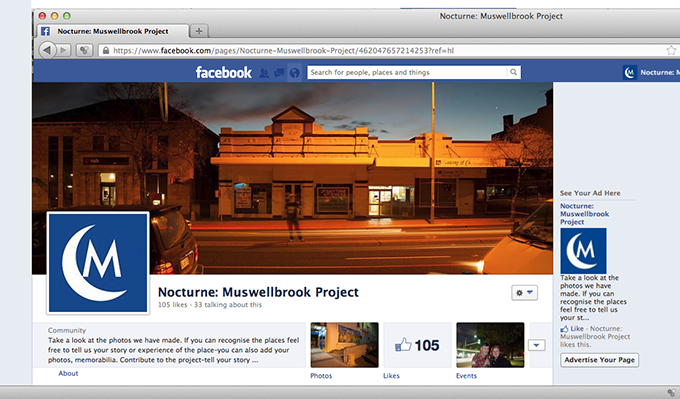
An early FB Cover
Many people that visited the page were once residents of Muswellbrook but now live in other parts of Australia and some were international expats. The number of ‘Page LIKES’ grew quickly – today the number stands @ 620. There was a pride and a melancholy for this once rural town. Some stories were full of humour and the irony of the Aussie yarn. While others shared poignant moments of their lives from the memories evoked by the photographs.
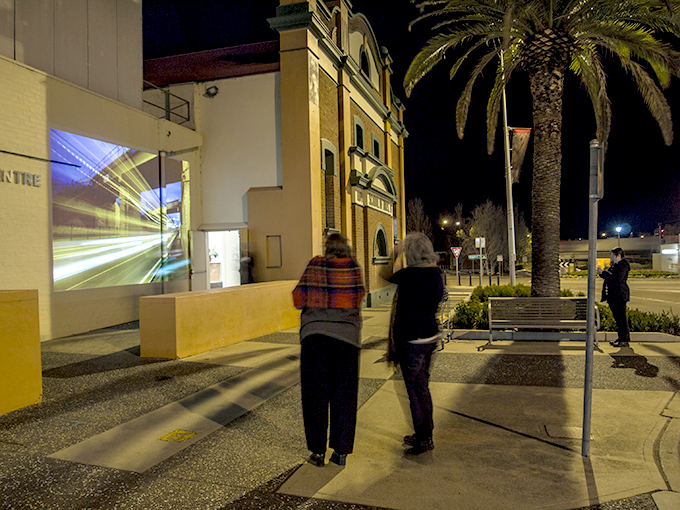
Video projection on MRAC wall
We also created a Youtube video that was uploaded and premiered at our artists talk held in the Muswellbrook Regional Arts Centre on the July 5. In evening we projected our images as a visual performance on the outside of the Gallery for public viewing and to extend the experience of the nocturne project.
Even though our 2 weeks in residence had come to an end on July 6, we still continued to connect with the Facebook page: uploading images and connecting them with the community’s stories.
SETTING UP THE EXHIBITION
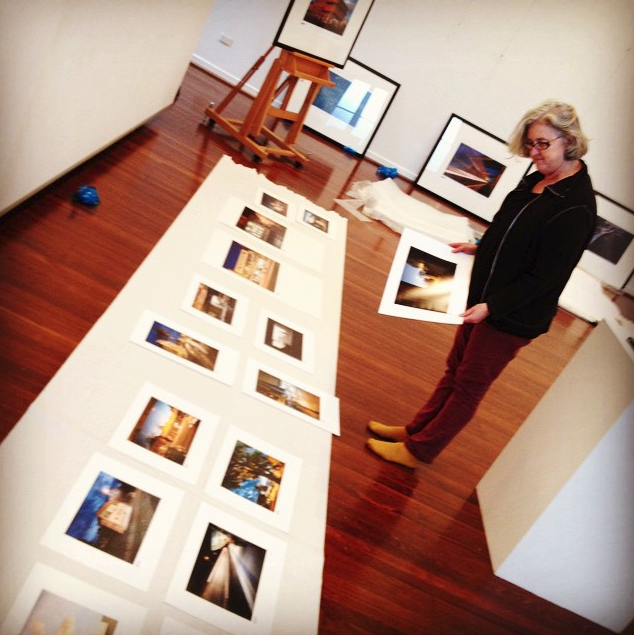
Vicky arranging the hang
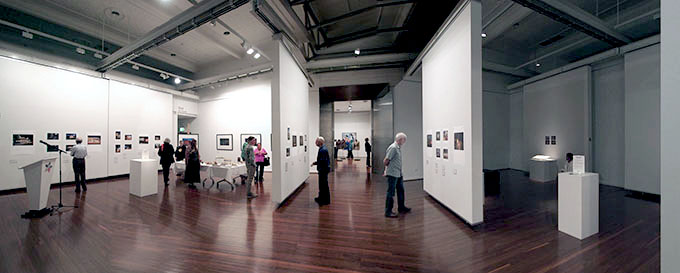
The MRAC exhibition space
In 2015 we came back to show an exhibition of the work on the walls of the Gallery. The Sunday after the opening we presented a workshop for participants wanted to upskill or engage with how we captured and mastered these nocturnal images.
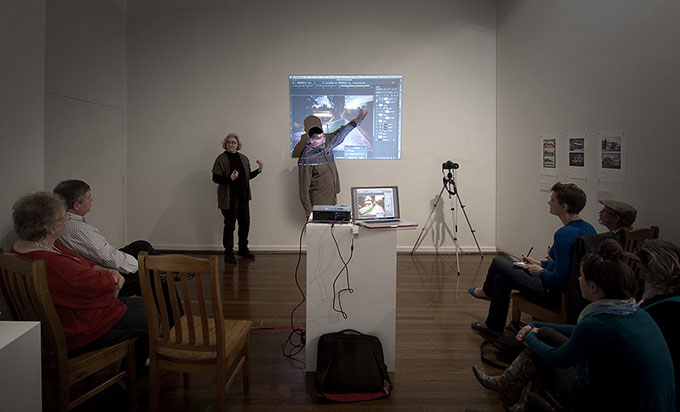
Workshop at the MRAC
Now the works are on the wall for all to come and see… and we are inviting anyone who visits to write down their story and place on the wall next to the image. The gallery is now a physical “Facebook page”. We look forward to seeing your written stories on the walls of the gallery.
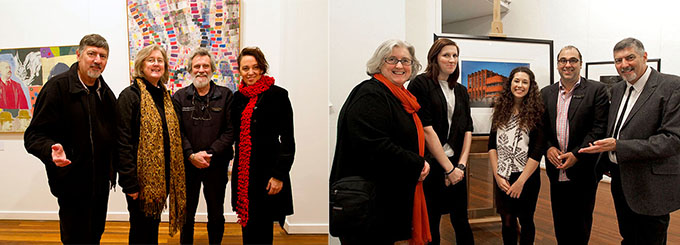
2013: with Silvana & Roger Skinner – MRAC AIR Coordinator – 2015 with Elissa, Jade and MRAC Director Brad Franks
.
We want to express our thanks to the MRAC Team, Roger Skinner, ILFORD papers and Maud Gallery.

.
2015 is the INTERNATIONAL YEAR OF LIGHT – Our Nocturne projects celebrate light and this year at the Muswellbrook Regional Arts Centre we are showing a major exhibition entitled NOCTURNE MUSWELLBROOK: Revisited.
Nocturne Muswellbrook: Reflections on Light
As the sun goes down and the last light fades–cars pass by with commuters heading home for respite at the end of a days work or others just embarking on a nights work. Trucks move through the town with little thought for the places they pass through. People meet and have a conversation…. The street lights come on one by one up the street. The illuminated advertising signage lights the buildings along with the internal lights of the building.
This transition from daylight to night is rhythmical–a diurnal phenomenon–but one that is also pervaded with the uncanny or un-homely sense of place. At nocturne and into the night everyday places change, becoming mysterious as the shadows replace familiar surrounds. A sense of melancholy also grows with the passing of the day–a lament born from the relentlessness of change.
Yet these ephemeral moments can also be seductive and evocative, experiencing the aesthetics of the nocturne can inspire new imaginings of everyday places. The colour and chiaroscuro compositions of light and shadow replace the tired and indifferent prose of daily life. A magical narrative evolves from the personal memories of a shared living history in these laneways, streets, buildings and spaces.
.
A selection of Nocturne Muswellbrook: Revisited images
.
COOPER+SPOWART NOCTURNE PROJECTS
Cooper+Spowart Nocturne shadow
For many years we have engaged in nocturne projects. These have included artists in residency programs in the regional galleries of Muswellbrook, Grafton, Bundaberg and Miles as well as self-funded projects across east coast Australia. The Artist in Residence (AIR) projects are associated with a Facebook page to connect the community with the photographs and evoke stories about the places photographed.
A sample of community Facebook responses can be seen here:
Catalogue-Comments-interact-FP3
.
Nocturne AIR Projects include workshops, mentoring in photography, image enhancement, social media as well as photobook and zine making. Future Nocturne Projects are in the planning stage and we seek expressions of interest from communities looking to participating in a Nocturne light project.
.
Participating community members from the Nocturne Miles Project
.
A link to a collective of NOCTURNE PROJECTS can be found: HERE
.
THE BACK STORY: Nocturne Muswellbrook
The Nocturne Muswellbrook Facebook page was launched in June 2013
From 23rd June we began a 2week Artist in Residence in Muswellbrook. Our studio was a vacant shop in the Campbell’s Corner building fronting onto the main street, Bridge Street
.
Our gallery and workspace
We set up our digital studio workspace to:
- Master the nocturne photographs for the Facebook page
- Print out the mastered images for a small display in the shop
- Greet anyone that wanted to come by and share their story about Muswellbrook
- Prepare for the evening’s shooting around the town
Photographing a coal train from the Bell Street bridge
Each night and day, once the images were uploaded onto the Nocturne Muswellbrook page we invited everyone to tell their stories about each place photographed. We were excited to engage with the community and a deeper knowledge and experience of Muswellbrook through this process.
An early FB Cover
Many people that visited the page were once residents of Muswellbrook but now live in other parts of Australia and some were international expats. The number of ‘Page LIKES’ grew quickly – today the number stands @ 620. There was a pride and a melancholy for this once rural town. Some stories were full of humour and the irony of the Aussie yarn. While others shared poignant moments of their lives from the memories evoked by the photographs.
Video projection on MRAC wall
We also created a Youtube video that was uploaded and premiered at our artists talk held in the Muswellbrook Regional Arts Centre on the July 5. In evening we projected our images as a visual performance on the outside of the Gallery for public viewing and to extend the experience of the nocturne project.
Even though our 2 weeks in residence had come to an end on July 6, we still continued to connect with the Facebook page: uploading images and connecting them with the community’s stories.
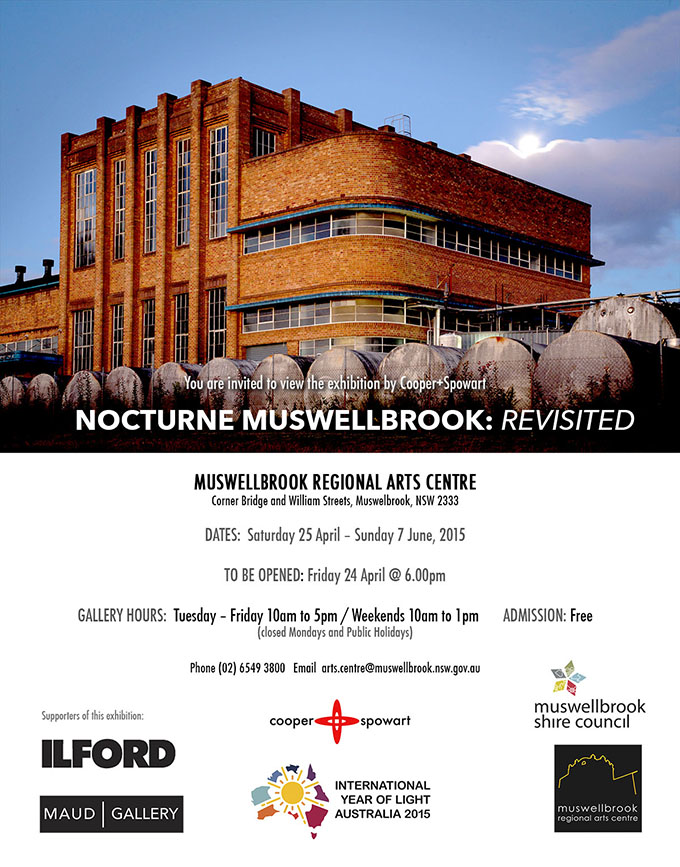
Exhibition invite
Vicky arranging the hang
The MRAC exhibition space
In 2015 we came back to show an exhibition of the work on the walls of the Gallery. The Sunday after the opening we presented a workshop for participants wanted to upskill or engage with how we captured and mastered these nocturnal images.
Workshop at the MRAC
Now the works are on the wall for all to come and see… and we are inviting anyone who visits to write down their story and place on the wall next to the image. The gallery is now a physical “Facebook page”. We look forward to seeing your written stories on the walls of the gallery.
2013: with Silvana & Roger-MRAC AIR Coordinator ….. 2015 with Elissa, Jade and MRAC Director Brad…………………..
.
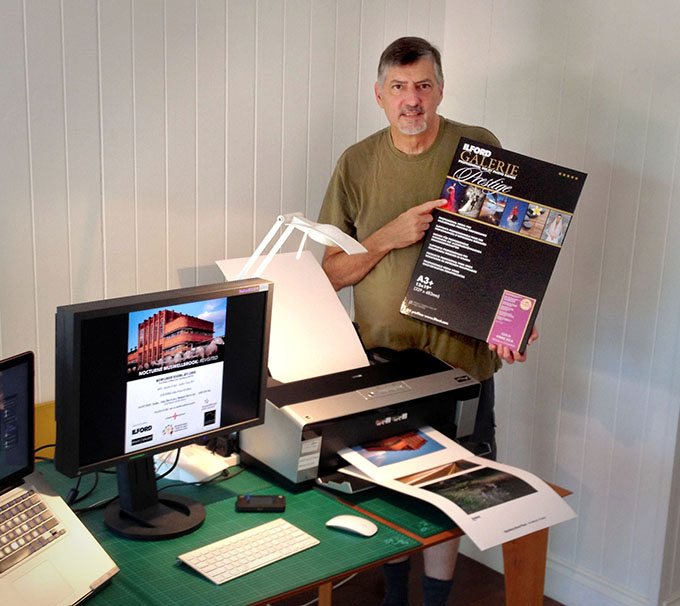
Printing with ILFORD Galerie GOLD SILK papers
.
We want to express our thanks to the MRAC Team, Roger Skinner, ILFORD papers and Maud Gallery.
.
2015 is the INTERNATIONAL YEAR OF LIGHT – Our Nocturne projects celebrate light and this year at the Muswellbrook Regional Arts Centre we are showing a major exhibition entitled NOCTURNE MUSWELLBROOK: Revisited.
Nocturne Muswellbrook: Reflections on Light
As the sun goes down and the last light fades–cars pass by with commuters heading home for respite at the end of a days work or others just embarking on a nights work. Trucks move through the town with little thought for the places they pass through. People meet and have a conversation…. The street lights come on one by one up the street. The illuminated advertising signage lights the buildings along with the internal lights of the building.
This transition from daylight to night is rhythmical–a diurnal phenomenon–but one that is also pervaded with the uncanny or un-homely sense of place. At nocturne and into the night everyday places change, becoming mysterious as the shadows replace familiar surrounds. A sense of melancholy also grows with the passing of the day–a lament born from the relentlessness of change.
Yet these ephemeral moments can also be seductive and evocative, experiencing the aesthetics of the nocturne can inspire new imaginings of everyday places. The colour and chiaroscuro compositions of light and shadow replace the tired and indifferent prose of daily life. A magical narrative evolves from the personal memories of a shared living history in these laneways, streets, buildings and spaces.
.
A selection of Nocturne Muswellbrook: Revisited images
.
COOPER+SPOWART NOCTURNE PROJECTS
Cooper+Spowart Nocturne shadow
For many years we have engaged in nocturne projects. These have included artists in residency programs in the regional galleries of Muswellbrook, Grafton, Bundaberg and Miles as well as self-funded projects across east coast Australia. The Artist in Residence (AIR) projects are associated with a Facebook page to connect the community with the photographs and evoke stories about the places photographed.
A sample of community Facebook responses can be seen here:
Catalogue-Comments-interact-FP3
.
Nocturne AIR Projects include workshops, mentoring in photography, image enhancement, social media as well as photobook and zine making. Future Nocturne Projects are in the planning stage and we seek expressions of interest from communities looking to participating in a Nocturne light project.
.
Participating community members from the Nocturne Miles Project
.
A link to a collective of NOCTURNE PROJECTS can be found: HERE
.
THE BACK STORY: Nocturne Muswellbrook
The Nocturne Muswellbrook Facebook page was launched in June 2013
From 23rd June we began a 2week Artist in Residence in Muswellbrook. Our studio was a vacant shop in the Campbell’s Corner building fronting onto the main street, Bridge Street
.
Our gallery and workspace
We set up our digital studio workspace to:
- Master the nocturne photographs for the Facebook page
- Print out the mastered images for a small display in the shop
- Greet anyone that wanted to come by and share their story about Muswellbrook
- Prepare for the evening’s shooting around the town
Photographing a coal train from the Bell Street bridge
Each night and day, once the images were uploaded onto the Nocturne Muswellbrook page we invited everyone to tell their stories about each place photographed. We were excited to engage with the community and a deeper knowledge and experience of Muswellbrook through this process.
An early FB Cover
Many people that visited the page were once residents of Muswellbrook but now live in other parts of Australia and some were international expats. The number of ‘Page LIKES’ grew quickly – today the number stands @ 620. There was a pride and a melancholy for this once rural town. Some stories were full of humour and the irony of the Aussie yarn. While others shared poignant moments of their lives from the memories evoked by the photographs.
Video projection on MRAC wall
We also created a Youtube video that was uploaded and premiered at our artists talk held in the Muswellbrook Regional Arts Centre on the July 5. In evening we projected our images as a visual performance on the outside of the Gallery for public viewing and to extend the experience of the nocturne project.
Even though our 2 weeks in residence had come to an end on July 6, we still continued to connect with the Facebook page: uploading images and connecting them with the community’s stories.
Exhibition invite
Vicky arranging the hang
The MRAC exhibition space
In 2015 we came back to show an exhibition of the work on the walls of the Gallery. The Sunday after the opening we presented a workshop for participants wanted to upskill or engage with how we captured and mastered these nocturnal images.
Workshop at the MRAC
Now the works are on the wall for all to come and see… and we are inviting anyone who visits to write down their story and place on the wall next to the image. The gallery is now a physical “Facebook page”. We look forward to seeing your written stories on the walls of the gallery.
2013: with Silvana & Roger-MRAC AIR Coordinator ….. 2015 with Elissa, Jade and MRAC Director Brad…………………..
.
Printing with ILFORD Galerie GOLD SILK papers
.
We want to express our thanks to the MRAC Team, Roger Skinner, ILFORD papers and Maud Gallery.
.
2015 is the INTERNATIONAL YEAR OF LIGHT – Our Nocturne projects celebrate light and this year at the Muswellbrook Regional Arts Centre we are showing a major exhibition entitled NOCTURNE MUSWELLBROOK: Revisited.
Nocturne Muswellbrook: Reflections on Light
As the sun goes down and the last light fades–cars pass by with commuters heading home for respite at the end of a days work or others just embarking on a nights work. Trucks move through the town with little thought for the places they pass through. People meet and have a conversation…. The street lights come on one by one up the street. The illuminated advertising signage lights the buildings along with the internal lights of the building.
This transition from daylight to night is rhythmical–a diurnal phenomenon–but one that is also pervaded with the uncanny or un-homely sense of place. At nocturne and into the night everyday places change, becoming mysterious as the shadows replace familiar surrounds. A sense of melancholy also grows with the passing of the day–a lament born from the relentlessness of change.
Yet these ephemeral moments can also be seductive and evocative, experiencing the aesthetics of the nocturne can inspire new imaginings of everyday places. The colour and chiaroscuro compositions of light and shadow replace the tired and indifferent prose of daily life. A magical narrative evolves from the personal memories of a shared living history in these laneways, streets, buildings and spaces.
.
A selection of Nocturne Muswellbrook: Revisited images
.
COOPER+SPOWART NOCTURNE PROJECTS
Cooper+Spowart Nocturne shadow
For many years we have engaged in nocturne projects. These have included artists in residency programs in the regional galleries of Muswellbrook, Grafton, Bundaberg and Miles as well as self-funded projects across east coast Australia. The Artist in Residence (AIR) projects are associated with a Facebook page to connect the community with the photographs and evoke stories about the places photographed.
A sample of community Facebook responses can be seen here:
Catalogue-Comments-interact-FP3
.
Nocturne AIR Projects include workshops, mentoring in photography, image enhancement, social media as well as photobook and zine making. Future Nocturne Projects are in the planning stage and we seek expressions of interest from communities looking to participating in a Nocturne light project.
.
Participating community members from the Nocturne Miles Project
.
A link to a collective of NOCTURNE PROJECTS can be found: HERE
.
THE BACK STORY: Nocturne Muswellbrook
The Nocturne Muswellbrook Facebook page was launched in June 2013
From 23rd June we began a 2week Artist in Residence in Muswellbrook. Our studio was a vacant shop in the Campbell’s Corner building fronting onto the main street, Bridge Street
.
Our gallery and workspace
We set up our digital studio workspace to:
- Master the nocturne photographs for the Facebook page
- Print out the mastered images for a small display in the shop
- Greet anyone that wanted to come by and share their story about Muswellbrook
- Prepare for the evening’s shooting around the town
Photographing a coal train from the Bell Street bridge
Each night and day, once the images were uploaded onto the Nocturne Muswellbrook page we invited everyone to tell their stories about each place photographed. We were excited to engage with the community and a deeper knowledge and experience of Muswellbrook through this process.
An early FB Cover
Many people that visited the page were once residents of Muswellbrook but now live in other parts of Australia and some were international expats. The number of ‘Page LIKES’ grew quickly – today the number stands @ 620. There was a pride and a melancholy for this once rural town. Some stories were full of humour and the irony of the Aussie yarn. While others shared poignant moments of their lives from the memories evoked by the photographs.
Video projection on MRAC wall
We also created a Youtube video that was uploaded and premiered at our artists talk held in the Muswellbrook Regional Arts Centre on the July 5. In evening we projected our images as a visual performance on the outside of the Gallery for public viewing and to extend the experience of the nocturne project.
Even though our 2 weeks in residence had come to an end on July 6, we still continued to connect with the Facebook page: uploading images and connecting them with the community’s stories.
Exhibition invite
Vicky arranging the hang
The MRAC exhibition space
In 2015 we came back to show an exhibition of the work on the walls of the Gallery. The Sunday after the opening we presented a workshop for participants wanted to upskill or engage with how we captured and mastered these nocturnal images.
Workshop at the MRAC
Now the works are on the wall for all to come and see… and we are inviting anyone who visits to write down their story and place on the wall next to the image. The gallery is now a physical “Facebook page”. We look forward to seeing your written stories on the walls of the gallery.
2013: with Silvana & Roger – MRAC AIR Coordinator ….. 2015 with Elissa, Jade and MRAC Director Brad Franks…………………..
.
.
We want to express our thanks to the MRAC Team, Roger Skinner, ILFORD papers and Maud Gallery.
APRIL 26–WORLDWIDE PINHOLE DAY: Our Contributions for 2015
.
Round the [w]hole world on the 26th of April pinholers were out having fun – Making their images for the 2015 WPD. Far away from the darkroom we once had we’ve once again fitted a pin-prick in a piece of aluminium fitted to a body cap of our Olympus Pen EP-5 camera.
This is the 11th year we have made pinhole images to support the WPD project! The other submissions are listed at the end of this post.
.
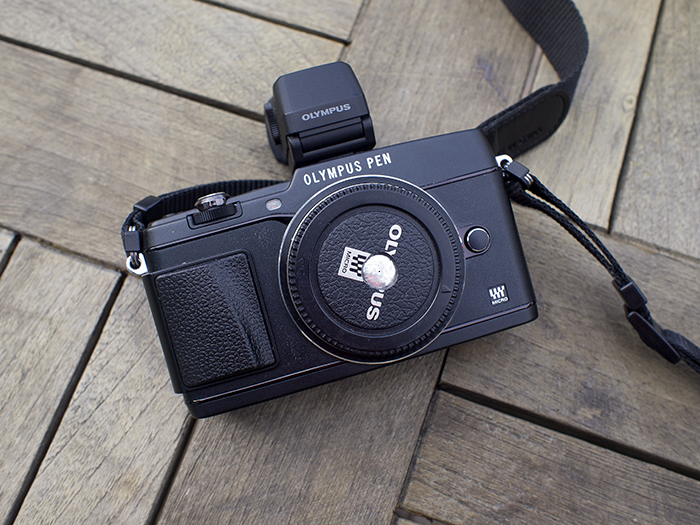
Olympus Pen with hand pierced aluminum foil hole, Auto exposure mode, ISO 1600.
.
VICKY’s Submission:
Great to take this image of a moving subject – I used a digital camera with a pinhole to make this possible.
.
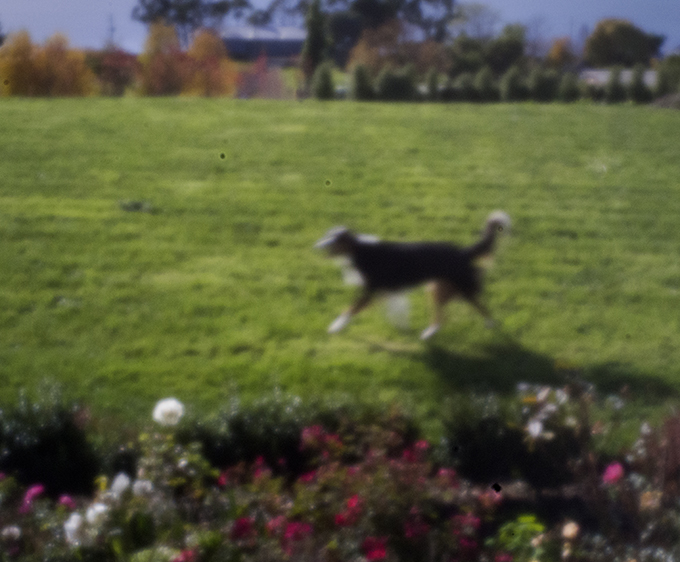
Charlie chasing a ball … 1/45th of a second @ 1,600 ISO
.
DOUG’s Submission:
I have made pinhole photos with all kinds of technology from tin cans to cars but what I like the most is how direct sunlight splashes a rainbow onto the image. It’s Autumn in Australia s the two ephemeralities – light and autumn leaves were an ideal subject for pinhole investigation.
.
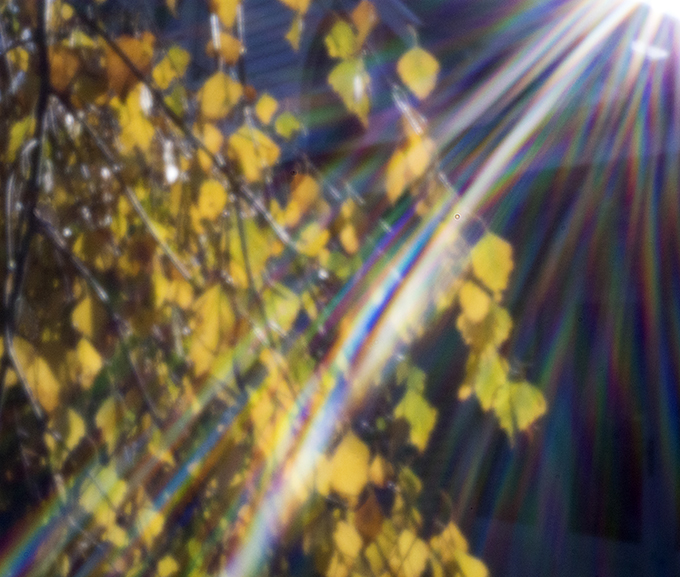
Autumn rainbow splash … 1/45th of a second @ 1,600 ISO
.
Vist the WPD Site for other contributors: http://www.pinholeday.org/gallery/2015/
.
Our Past WPD images:
2014 Vicky’s http://pinholeday.org/gallery/2014/index.php?id=1810&City=Toowoomba
2014 Doug’s http://pinholeday.org/gallery/2014/index.php?id=1811&City=Toowoomba
2013 https://wotwedid.com/2013/04/29/world-pinhole-photography-day-our-contribution/
2012 http://www.pinholeday.org/gallery/2012/index.php?id=1937&searchStr=spowart
2011 http://www.pinholeday.org/gallery/2011/index.php?id=924
HERE IS THE LINK to the 2011 pinhole video http://www.youtube.com/watch?v=Yk4vnbzTqOU
2010 http://www.pinholeday.org/gallery/2010/index.php?id=2464&Country=Australia&searchStr=spowart
2006 http://www.pinholeday.org/gallery/2006/index.php?id=1636&Country=Australia&searchStr=cooper
2004 Vicky http://www.pinholeday.org/gallery/2004/index.php?id=1553&Country=Australia&searchStr=cooper
2004 Doug http://www.pinholeday.org/gallery/2004/index.php?id=1552&Country=Australia&searchStr=spowart
2003 http://www.pinholeday.org/gallery/2003/index.php?id=615&Country=Australia&searchStr=spowart
2002 http://www.pinholeday.org/gallery/2002/index.php?id=826&Country=Australia&searchStr=spowart
.
.

PHOTOBOOK INDEPENDENT: Our books in Hollywood – thanks to QCP
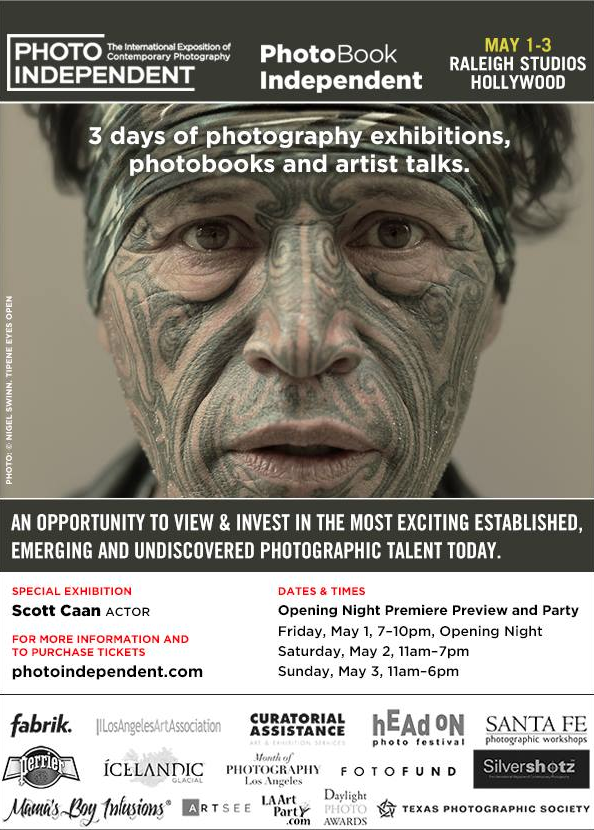
Photo Independent poster
.
As part of its international activities for Queensland and Australian photographers the Queensland Centre for Photography participated in the inaugural Photo Independent art fair at Raleigh Studios, Los Angeles 1–3 May, 2015. The main Australian contingent consists of the wall images of 12 photomedia artists. They are Anna Carey, Belinda Kochanowska, Chris Bowes, David La Roche, Henri van Noordenburg, Kim Demuth, Kelly Hussey-Smith & Alan Hill, Katelyn-Jane Dunn, Lynette Letic, Michael Cook and Marian Drew.
.
An additional aspect of Photo Independent is one dedicated to the recognition of photographers who work in the book format. Called Photobook Independent the QCP curated a selection of 16 Australian photo publishers to present in the L.A. event.
In QCP media about these two events the following statement was made:
The QCP is excited to be part of this ground-breaking event as the world of photography will set its focus on Los Angeles 1–3 May, 2015 for a weekend celebrating international photography and the most talented image-makers across various genres of the medium. Numerous high profile art fairs including Paris Photo Los Angeles, Photo Contemporary, Photo Independent and PhotoBook Independent will launch their annual editions in Hollywood with additional special photography exhibitions throughout Los Angeles. The weekend promises to offer the enthusiastic art patron a plethora of opportunities to experience photography at its highest calibre.
The photobook publishers were: Ingvar Kenne, Dane Beesley, Anne Ferran, Lindsay Varvari, Rohan Hutchinson, Julie Shiels, Prudence Murphy, Christopher Young, Paul Batt, Ian Tippett, Doug Spowart, Victoria Cooper, Gemma Avery, Michelle Powell, Mathias Heng and Christopher Köller.
Interviews with the artists and photobook makers can be found on the LUCIDA Site: http://lucidamagazine.com/
Biogs on the photobook participants can be seen here: http://qcpinternational.com/portfolios/photo-book-independent-2015/
.
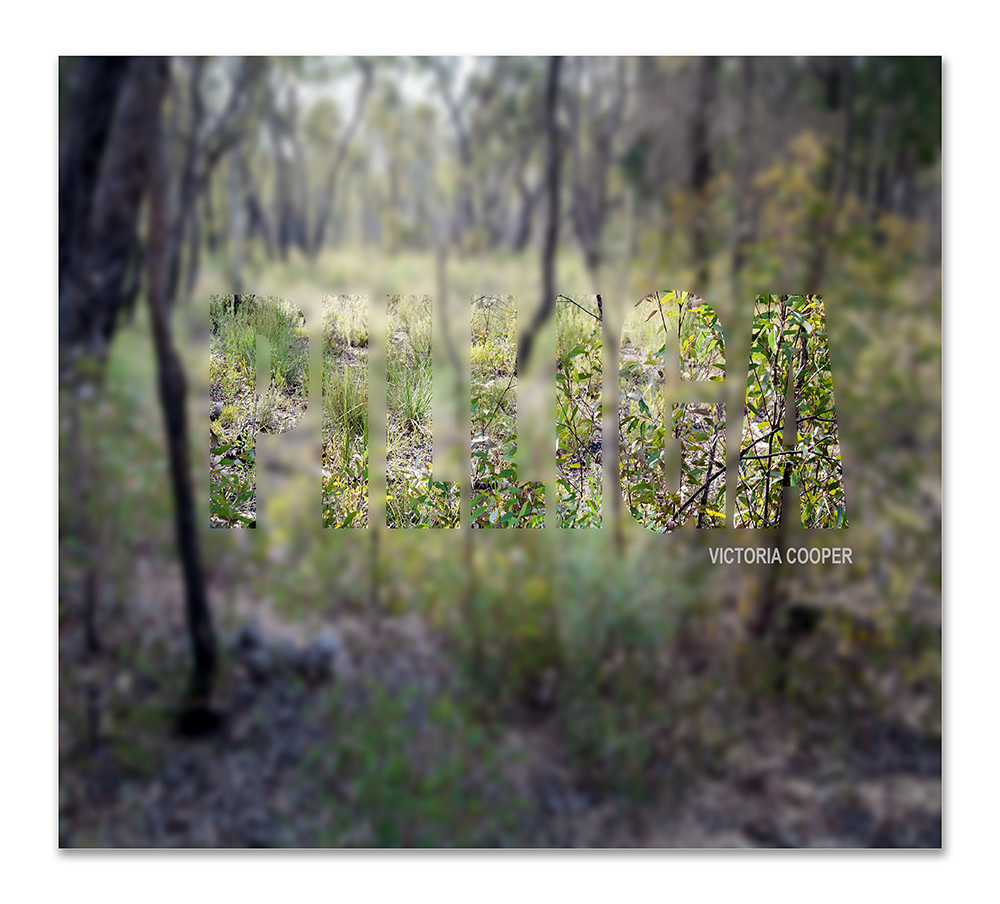
Victoria Cooper’s PILLIGA
.
About Victoria’s Book: PILLIGA
Pilliga is the culmination of 10 years work. It is informed by the many physical, psychological and metaphorical journeys through this enigmatic place during the decade of its creation.
This book is not a topographic depiction of the Pilliga Scrub, a remote location in the Australian Bush. Rather it is a human story of lurking deep anxiety manifested as a destructive invisible entity feeding on fears of the unknown and unknowable.
A PDF of the book can be seen here:PILLIGA-redsmr
The book can be purchased from BLURB here: http://blur.by/1Q9cGhh
.
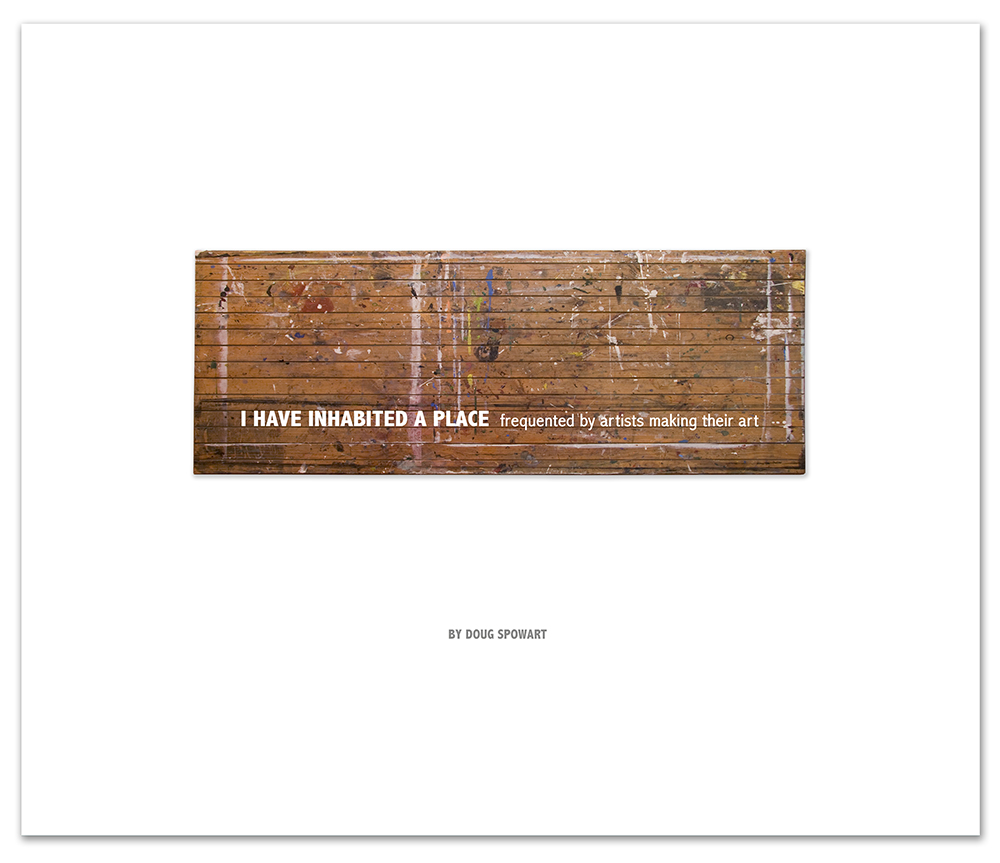
Doug Spowart’s I have inhabited a place …
About Doug’s Book: I HAVE INHABITED A PLACE FREQUENTED BY ARTISTS MAKING THEIR ART …
This book relates to the experience of being a documentary photographer within the world. The subject, a deserted artist’s studio, becomes an immersive landscape for investigation. This photobook expresses a personal narrative about loss, absence, place, and concepts around the relationship between the non-human and the working practices of artists.
A PDF of the book can be seen here: I have inhabited a place …red2
The book can be purchased from AMAZON here: http://blur.by/1K65dMu
.
.
.
BOOKEND: Photobook Melbourne — what a read?
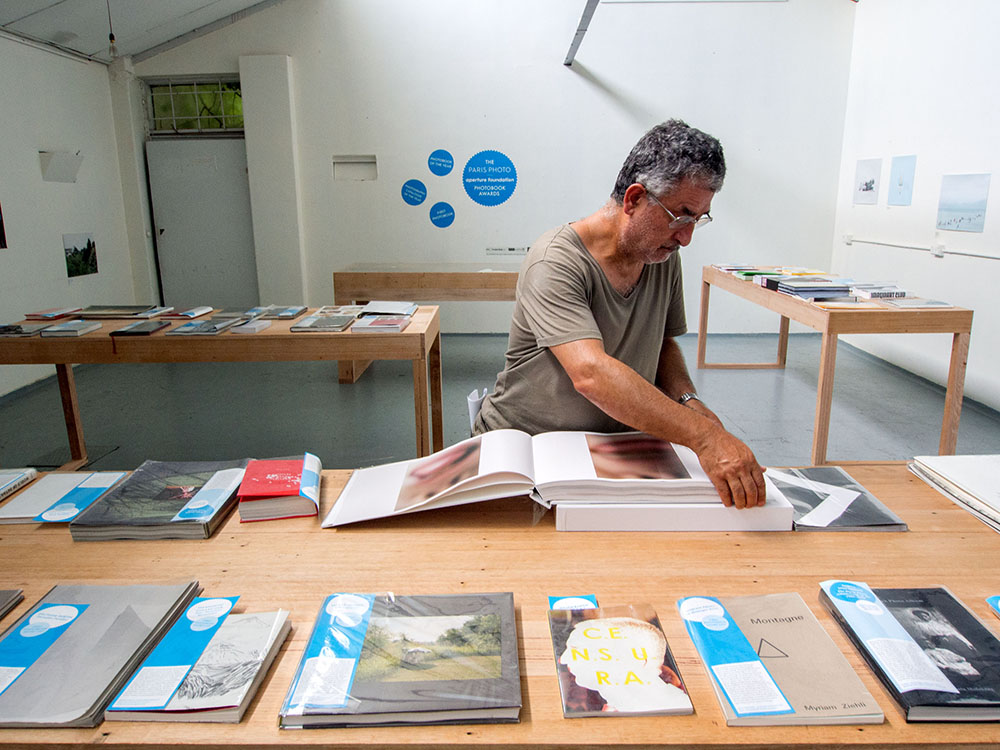
Photobook Melbourne: Peter Lyssiotis looking at an Aperture Books
We all know that feeling when you are really getting into a book, its narrative and flow, and then you reach the point where, as the last page is turned, you wish it could go on, and on… Photobook Melbourne (PM) was something of that kind of experience. The books seen, perhaps around 300, the exhibitions seen, and the people met now all vividly reside in memory and digital capture code.
The Photobook Melbourne event took place between February 12 to 22 it was coordinated by Heidi Romano and Daniel Boetker-Smith. It was always an ambitious undertaking. Its vision was to connect international photobook world with makers and lovers of the book from around Australia… and New Zealand. This was achieved through numerous exhibitions, library displays, photobook awards, forums and workshops.
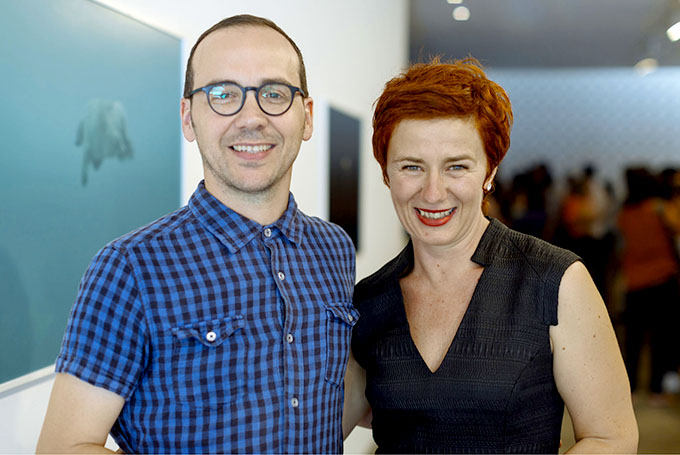
Daniel Boetker-Smith + Heidi Romano PHOTO: Courtesy of Lauren Dunn www.artdocumentation.com.au
Photobook Melbourne can only be described as a massive success. The photobook community of practice needs events like these so they can band together to affirm their interest and belief in the importance and creative power of the photobook. For once, the world of photobooks has come to us, or at least Melbourne, and for that we are a stronger and more informed cohort of makers, readers, collectors and lovers of photobooks.


Some of the attendees have responded to a request for comments – others are posts from Blogs and Facebook posts…
FROM JACOB RAUPACH: Photobook Melbourne was an amazing week full of a genuinely insightful mix of talks, exhibitions and book exhibitions, with the fair during the first weekend proving to be a great networking point for the rest of the week that followed. … I felt that the inaugural festival set an amazing benchmark for the following years! Looking forward to 2016.
FROM HARVEY BENGE‘s BLOG: On a zero to ten scale I’d give the festival a ten! Visit his site for more commentaries about photobook
FROM CHRIS BOWES: For someone naïve to the world of photobooks, Photobook Melbourne was an eye opening experience. Although coming in as a virtual outsider to this rapidly expanding art scene, I sank my teeth into as many of the talks, exhibitions and book collections I could manage, and came away a lot more informed than I was going in. Personal favourites were the Paris Photo – Aperture Foundation Photobook Awards exhibition, where the content of the books was engaging and the calibre unmatched, and ‘The Other Photobook Forum’, where in particular Gracia Haby and Louise Jennison showed that with a little creativity and business sense one can make a buck and do what they love.
FROM LIBBY JEFFERY – Momento Pro: The number of participants, visitors, books and buyers at Photobook Melbourne were fantastic and they confirmed that small press and self publishing is alive and well in Australia. The Awards and Book Fair also proved that a selection of high standard work is being created here, but a collaborative promotion and showcase of Australian photo books to the global market would benefit everyone.
FROM: ANGEL LUIS GONZALEZ FERNANDEZ Facebook Comment Back in Dublin after an amazing first edition of PHOTOBOOK MELBOURNE, having discovered tons of new work and books from Australia, New Zealand, and more -and having met a truckload of awesome people.
FROM KELVIN SKEWES: As someone that attended almost all of the events that were part of Photobook Melbourne I can only describe it as a tour de force for lovers of the Photobook. The festival opened on February 12th at the Centre for Contemporary Photography with Robert Zhao Renhui’s exhibition
A Guide To The Flora And Fauna Of The World and with a smoking ceremony by the traditional owners to welcome the festival to their land. Also announced on the opening night was the Australian Photobook of the year which was won by Raphaela Rosella for her unpublished book ‘We Met a Little Early But I Get to Love You Longer’ and I was humbled to be the runner up with my newspaper as photobook ‘Nauru: What was taken and what was given’. …
The main event for the first weekend of the festival was the Photobook Melbourne Book fair at CCP an event at was full of frenetic energy and far too many photobooks to browse let alone buy; amongst the many booksellers highlights included the infatigable Perimeter book with titles from Mack and Spector books and Anita Totha from Remote books who is doing to sterling job promoting photobooks from New Zealand. …
Great thanks are due to the entire Photobook Melbourne team so thank you Heidi Romeo, Daniel Boetker-Smith, esteemed guests Ángel Luis González Fernández, Ron Jude and the Dysturb Photo Collective, festival partners and sponsors Momento Pro, Photography Studies College, Copyright Agency and venues CCP, MGA, Strange Neighbour, Colour Factory, Neo Space, Baron Said and James Makin Gallery and to all the volunteers without whom this could not have happened so thanks to Felix Wilson, Kate Robinson, Bella Capezio, Katrin Koenning and countless others.
See you next year!
MORE COMMENTS WILL BE ADDED AS THEY BECOME AVAILABLE…
WHAT FOLLOWS IS A PERSONAL DIARY OF PHOTOBOOK MELBOURNE
Our arrival on the first weekend was delayed by my recent medical incursion so we fly into Melbourne on Wednesday. Through a friend we were able to stay in an apartment right in the middle of the city and our journeys out and about were by tram, train and lifts given by friends.
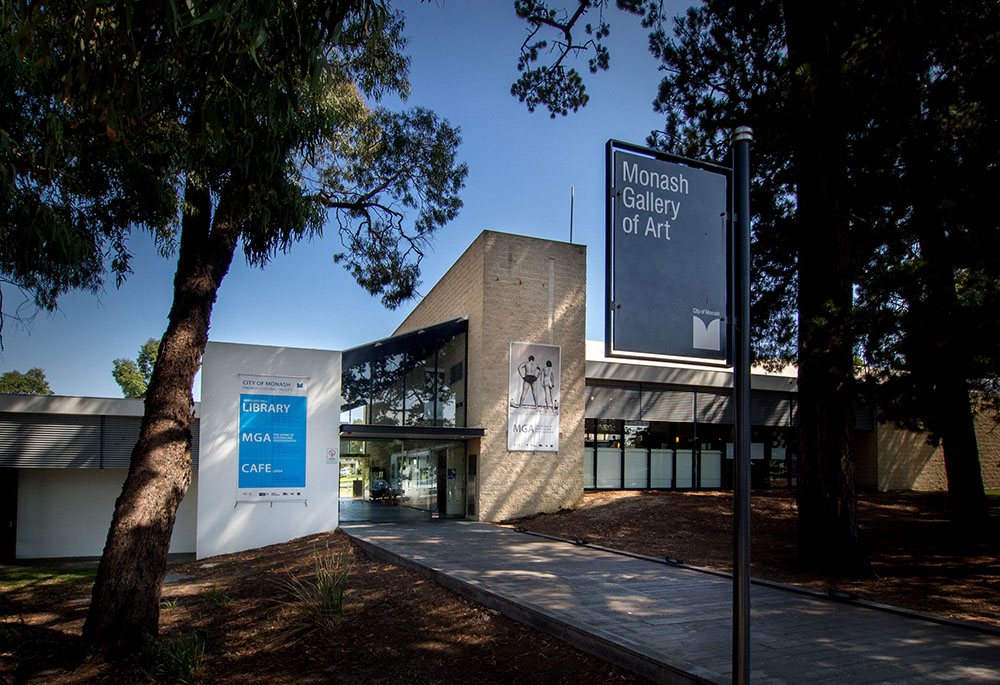
The MGA – The Home of Australian Photography
THURSDAY: We attended two book related exhibitions at the Monash Gallery of Art. Badged as the ‘Home of Australian Photography’ the gallery presented two photobook exhibitions, one of images from the collection that featured the theme of books and reading and was entitled ‘Light Reading’. The other was The Natural Collection an assemblage of books by The Photobook Club’s Matt Johnston and co-curated by Lucy Johnson. The Natural Collection brings together photobooks that explore “the harmony, tension and play” that occurs in the human relationship with nature and the natural landscape.
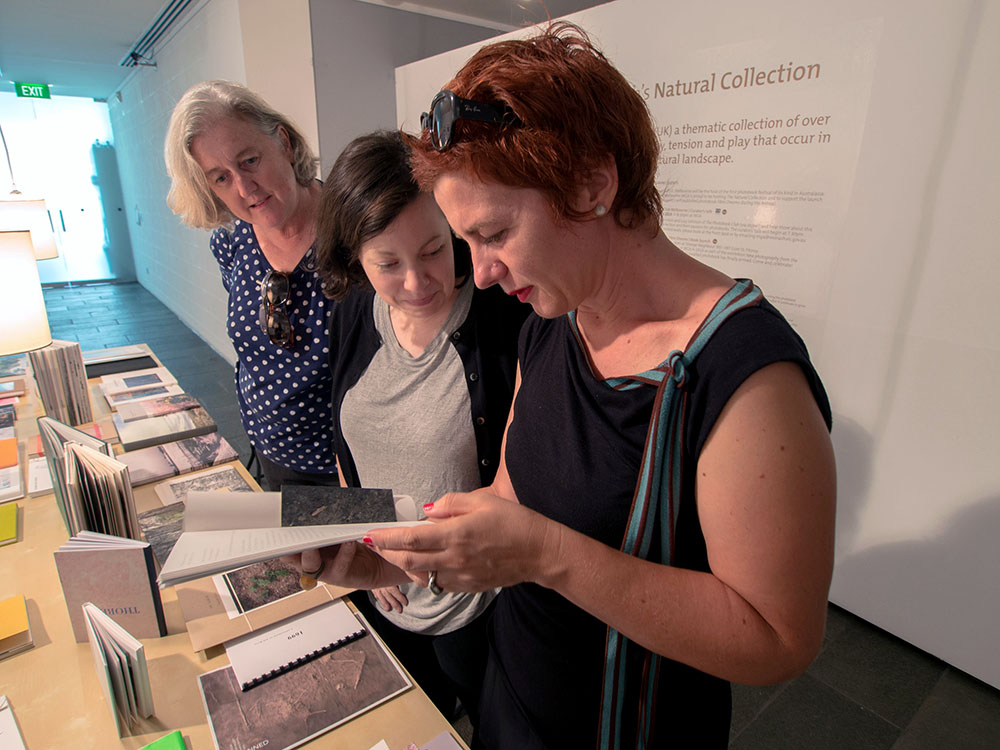
Heidi, Steph and Vicky discussing a book
The exhibition space was setup for readers to sit and work their way through a most interesting selection of Euro/American centric responses to the theme. Grand trade books sat next to simple fold ‘n’ staple zine-like booklets. We were there with Heidi Romano, Simone Rosenbauer from Sydney and MGA Gallery’s Education and Public Programs officer Stephanie Richter. We engaged in a spirited debate about book design; production methods and how to evaluate books.
That evening we attend a dinner for PM speakers, contributors, supporters and sponsors. By this stage it was acknowledged that the PM had been an enormous success so congratulatory statements were announced and a great feeling of an Australian photobook community being well and truly launched by this event.
Bohemian Vicky+Doug
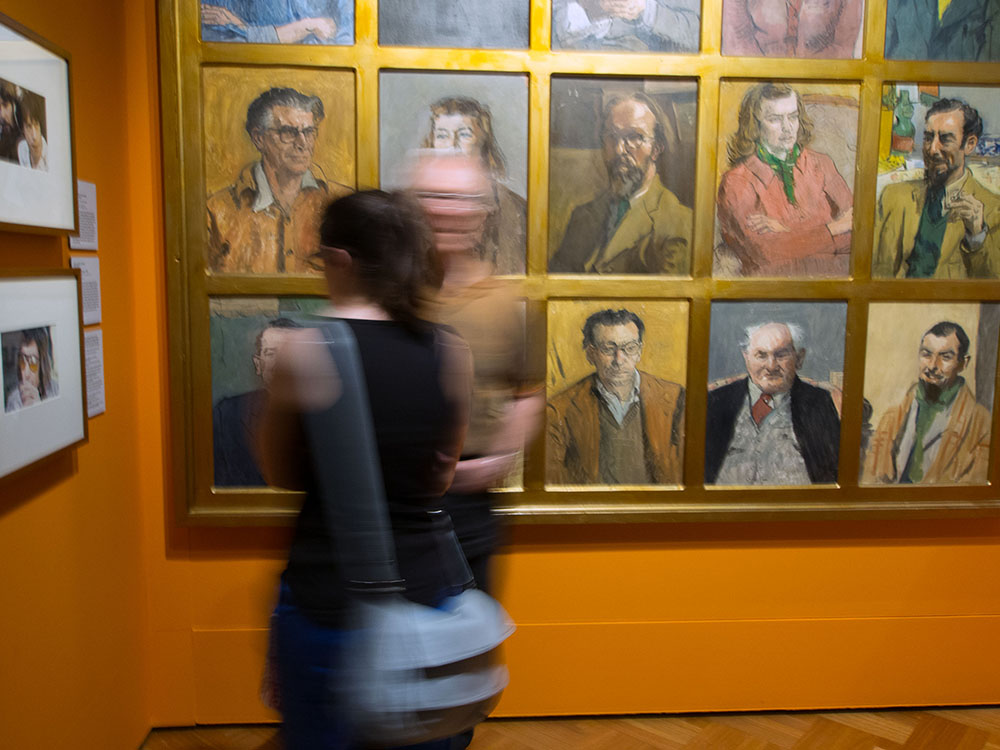
Bohemian Melbourne portrait wall
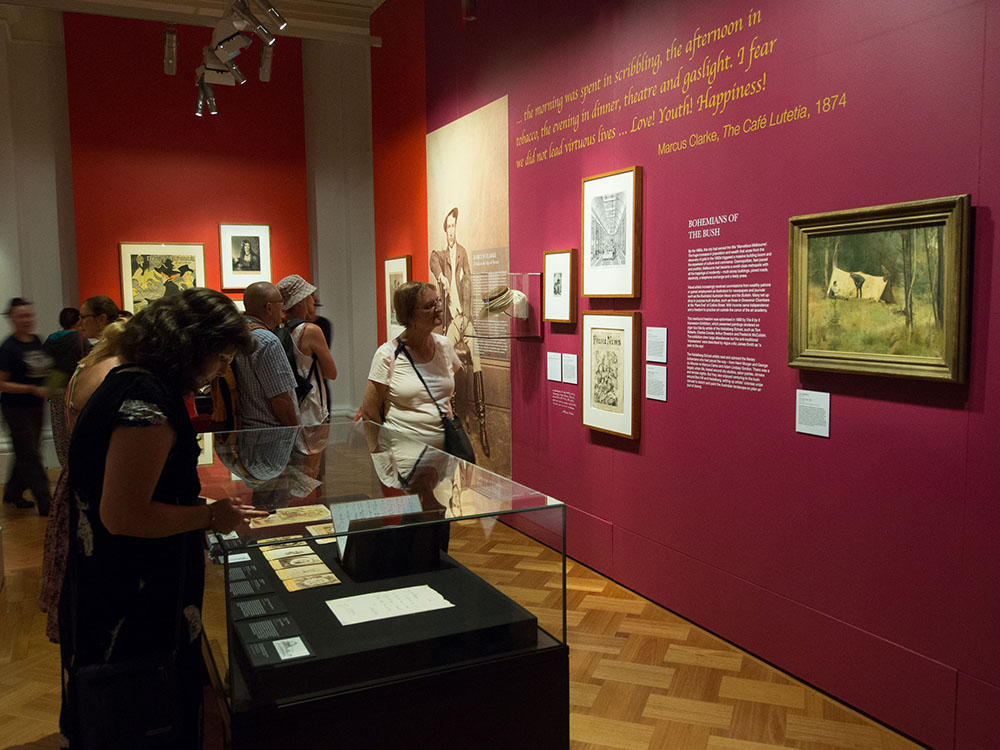
Bohemian Melbourne
FRIDAY MORNING: A breakfast of avocado, bacon and relish was partaken at a suburban street café while being interviewed by Australian Photography contributor Anthony McKee for a feature on photobooks. Morning tea with Robert Heather and Des Cowley at the State Library of Victoria and a visit to the SLV exhibition Bohemian Melbourne – a fascinating reflection on the creative, musical and arty sub-culture of Melbourne. Rennie Ellis’ photos contributed much to this history as well as poster art, paintings and the ephemera and memorabilia of the different eras represented by the theme.
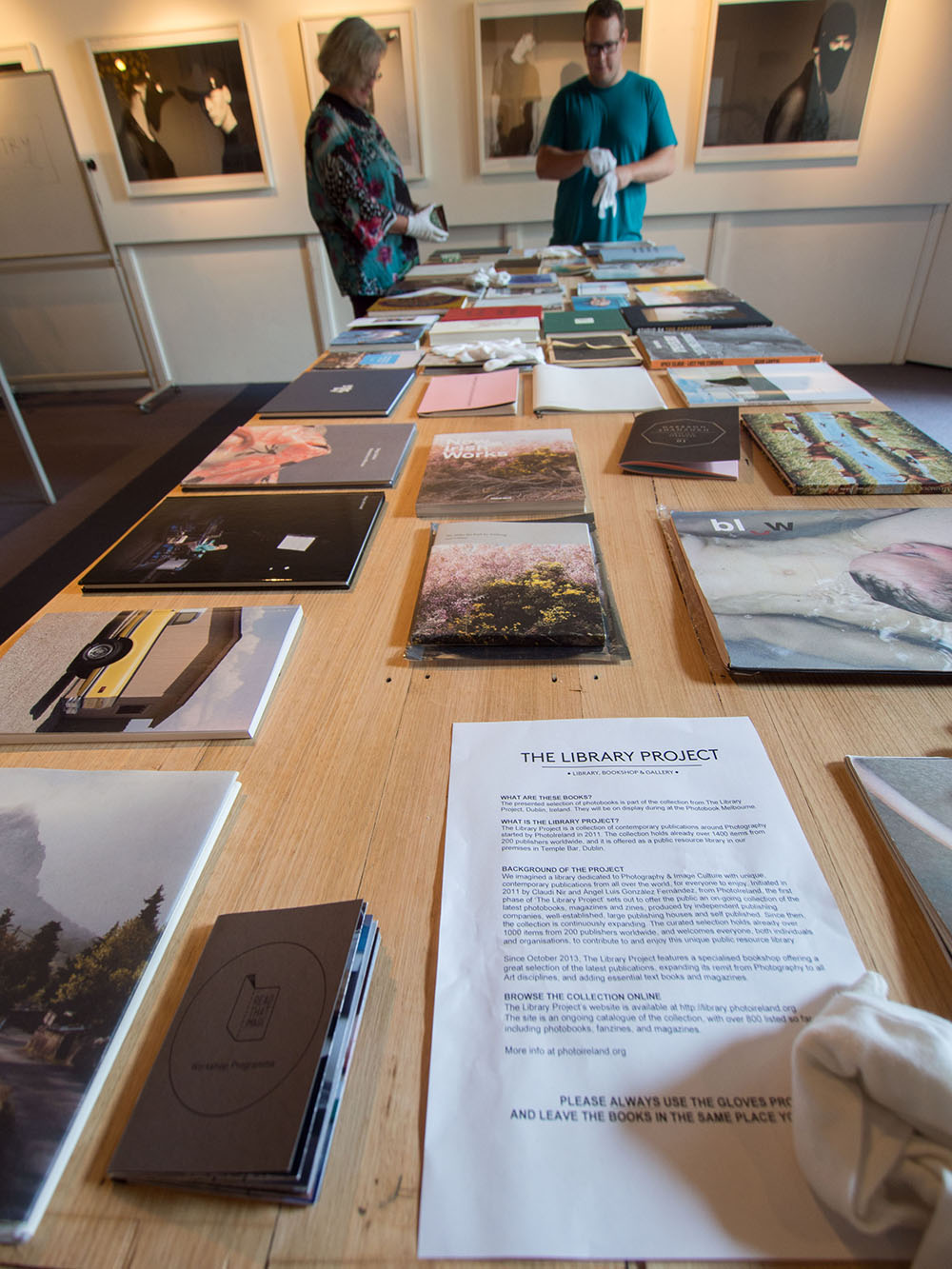
The Library Project @ PSC
FRIDAY AFTERNOON: We visited Photography Studies College to view ‘The Library Project’, a collection of photobooks brought to PM by Ángel Luis González Fernández from PhotoIreland. ‘The Library Project’ aim is to collect contemporary publications based on photography to create a public resource library. We viewed many books that are not easily available to see in Australia including Cristina de Middel’s Afronauts.
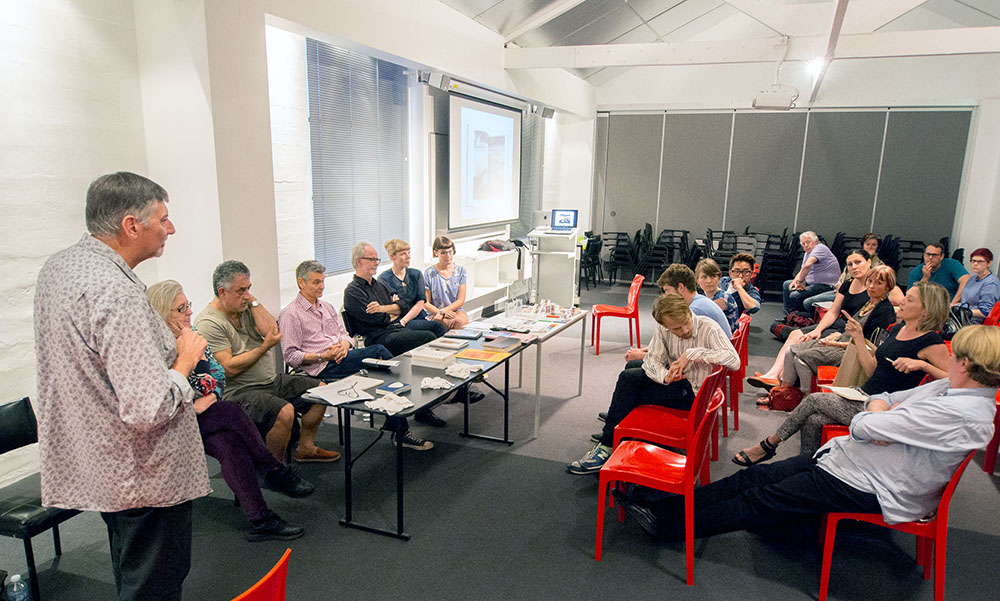
The ‘OTHER’ Photobook Forum – a question from the floor
FRIDAY EVENING: Later that evening we were involved with The ‘OTHER’ Photobook Forum – Artists’ Books, Zinesters and the Photobook took place. We have been working on this project for a couple of months now and we were able to bring together key practitioners from these ‘other’ photobook disciplines who discussed and provided commentary on their use of the photo in the book. The participants included photomonteur Peter Lyssiotis, zinesters Gracia Haby and Louise Jennison, artists’ book maker Dr Lyn Ashby, Des Cowley from the State Library of Victoria and Victoria Cooper who stood in for Georgia Hutchison who was unable to attend due to extenuating family issues.
It was an event that stirred much interest with artists like Deanna Hitti and Theo Strasser attending as well as Momento Pros’ Libby Jeffery, and photobook makers Kelvin Skewes, Daniel Boetker-Smith and Chris Bowes.
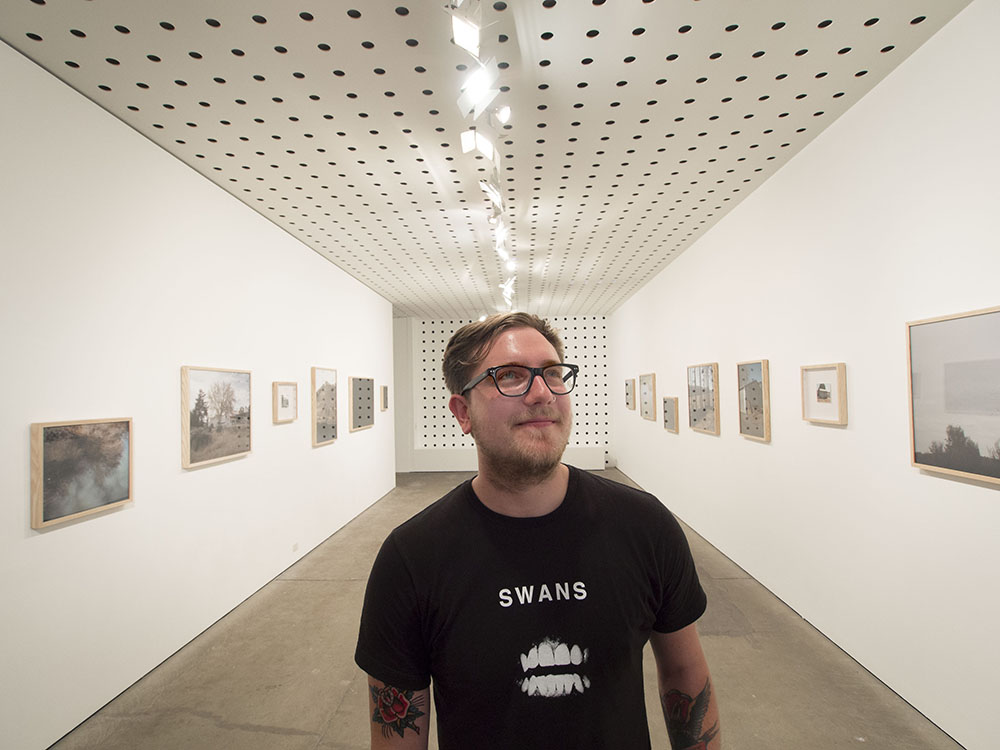
Jacob Raupach @ CCP
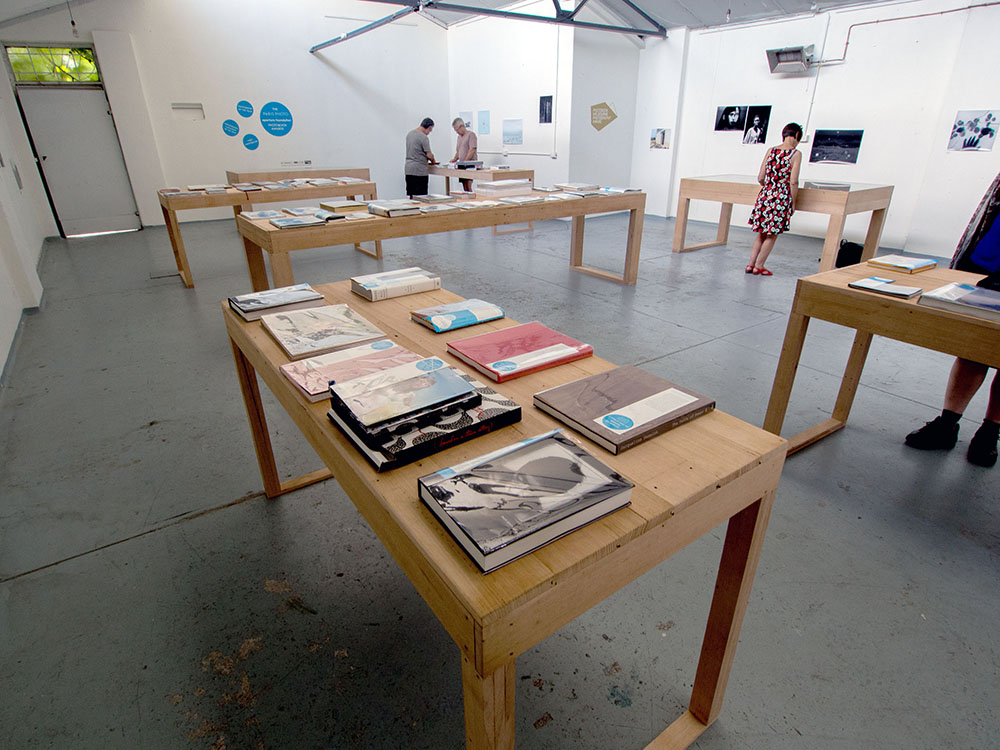
Aperture Books on display @ The Baron Said
SATURDAY: A day to attend artists talks at the Centre for Creative Photography by, amongst others photobookmaker Jacob Raupach and the exhibition FELL – Bought a copy of his latest book WEALTH. Following up with visits to the Momento Pro Australian Photo Book of the Year Award at the Asia Pacific Photobook Archive and the Aperture Photobook exhibition @ The Baron Said and a stimulating lunch with Peter and Tess Lyssiotis @Babkah.
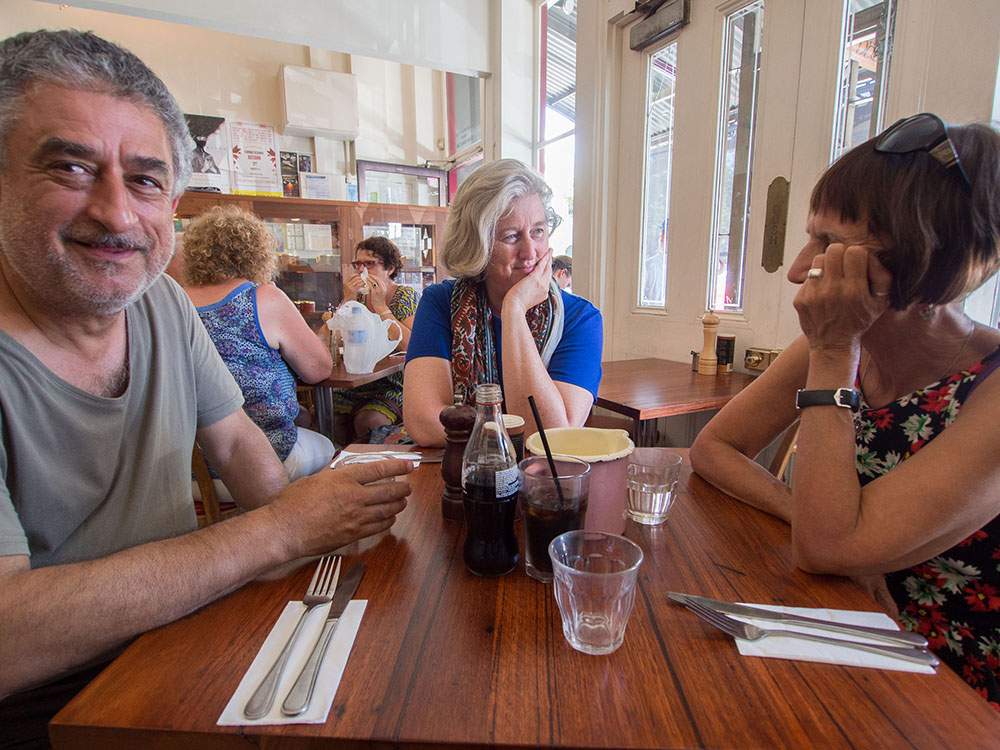
Lunch with Tess + Peter
Photobooked-out we headed back to the city by tram and had a chance meeting with Lismore artist and Siganto Artists Book Fellow Jan Davis who was attending a Print Council meeting – Only in Melbourne could strange intersections like that could happen.


SATURDAY EVENING: Melbourne White Night event
450,000 Melbournians took over the streets of the CBD – everything stayed open and performances and projections, bands and music were everywhere. Amongst other things we went to see the projections in the Dome at the State Library of Victoria at 10.30 at night – queued in line for 30 minutes with 1000s of others what a night…!
SUNDAY
A day of traveling home to cyclone weather drenched Brisbane.
UNTIL NEXT TIME —- For PHOTOBOOK MELBOURNE 2nd EDITION….
Regional Selfies: Communities and Self-Documentation
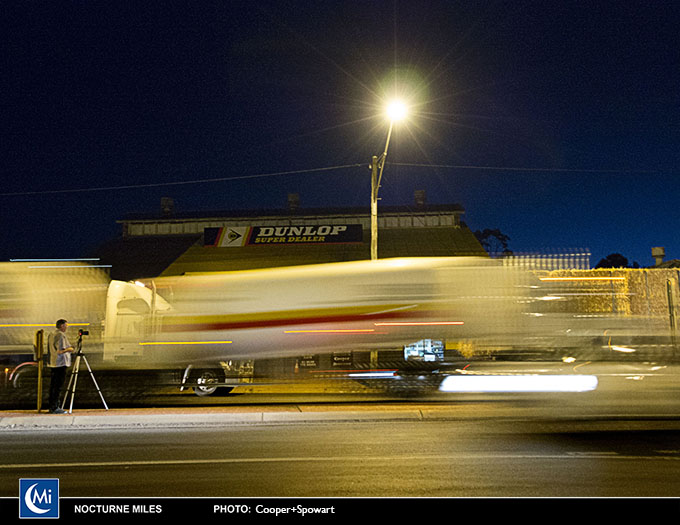
Through documentary photography and social media Victoria Cooper and Doug Spowart have explored connections with Place in urban and regional communities in Queensland, New South Wales and Victoria. The purpose of these Nocturne Projects is to capture everyday scenes of each community in nocturnal light, dusk and dawn. These images are then posted on a Nocturne project Facebook page to evoke stories, memories and shared experiences from the community.
In each project Spowart and Cooper found different ways to include community participation. In 2014, they were invited to work in Miles, a major town of the Western Downs Region of Queensland. The Nocturne Miles Community Documentary project sought to engage with the broader public to undertake self-documentation projects and skill development in nocturne photography. Both local and temporary residents who enjoy taking photos, as well as those more skilled in photography were all invited to participate. After an initial workshop, Spowart and Cooper mentored the 18 participants to create images for the project including self-portraits and daily assignments and produce Facebook reports and a zine.
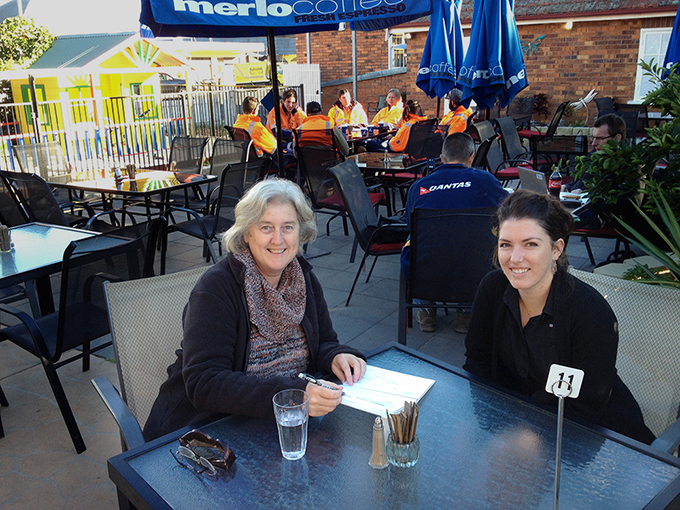
Vicky and Ashleigh Campbell in a pre-event planning meeting
To begin the project consultations were undertaken with staff from the Western Downs Regional Council’s Cultural Development team Ashleigh Campbell and Anne Keam at Dogwood Crossing to refine the project to match the needs of their community. Then centre staff sought out members of the community who could be interested in the project. Possible candidates then completed an Expressions of Interest form to provide some information on their experience and the photography tools they had access to e.g. DSLR camera, point and shoot camera, mobile phone or tablet cameras. Another important consideration was that the applicants were going to be in the region during the project to participate in briefings, workshops and shootouts as well as the final day’s zine making activity.
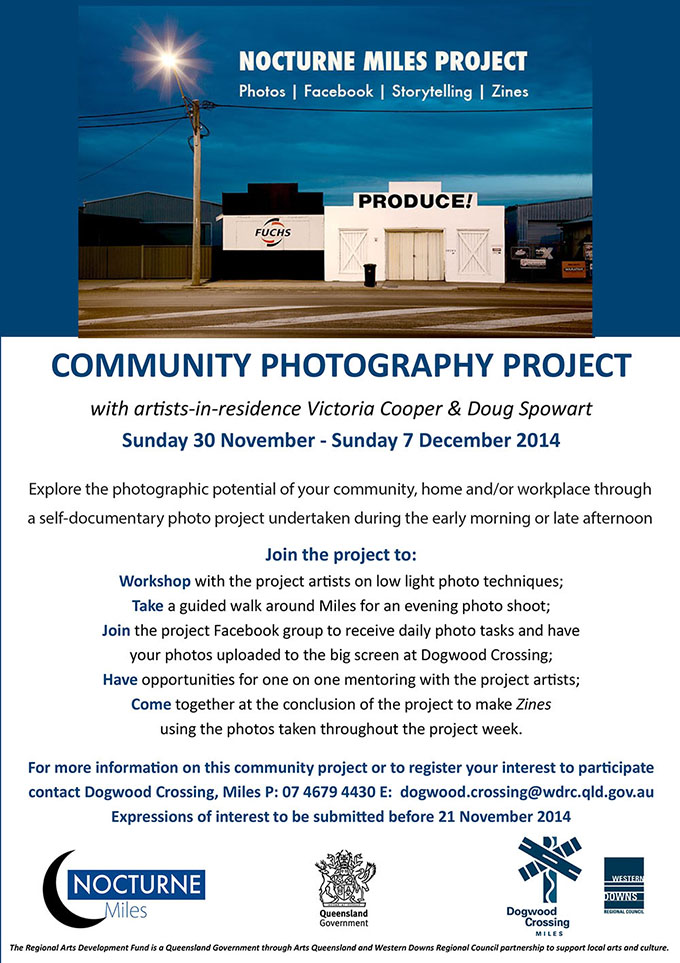
Project Flyer – Nocturne Miles
While numbers were limited there was a desire by the artists and Dogwood Crossing that the project accessible to as many participants and be as inclusive as possible. The one proviso was that project participants needed to live and/or work in or near Miles including the smaller surrounding towns or on properties/work camps in the Miles district.
The participants engaged with the project in a variety of different ways including:
- An initial introduction to the project and skill development workshop;
- Guided evening photography shoot-outs in the main Street of Miles as well as at the Miles Historic Village;
- Daily photo tasks over the week of the project assigned through a project Facebook group;
- Optional mentoring sessions, where required, to enable images to be prepared and uploaded for the project;
- Display of participants photos to a digital screen at Dogwood Crossing; and
- A practical ‘zine’ making workshop.

Doug doing a briefing
The project began on Sunday November 30 with an introductory workshop, briefing and a shootout. Progressively images were collated and uploaded to the Nocturne Miles Community Facebook page. Each day a new topic was presented a challenge and their interpretation formed into a photocollage. Communication with the participants was made through a private Facebook group page that enabled hear 24hour contact with participants and Cooper+Spowart. Some participants came into Dogwood Crossing with their photos or with requests for support in making and/or optimising better photographs. On Wednesday evening special access was provided to the Miles Historical Village for group to experiment with ‘painting with light’ and ‘projection’ techniques.
The Nocturne Miles participants at Miles Historical Village
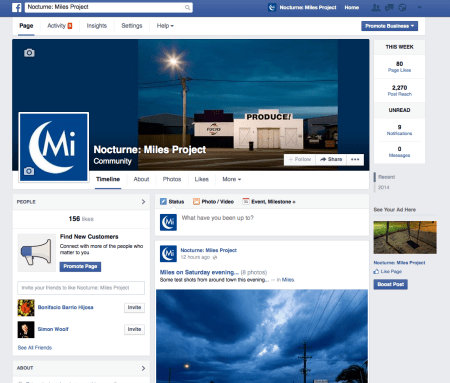
Facebook page
Cooper and Spowart added their images to the Facebook page as well and some visitors to the page posted stories about the places pictured. By the project’s end the page had 241 Page Likes, 60 Posts and the Total Reach was 17,771. Both the group page and the community page are still active.

Vicky and Doug in the Dogwood Crossing foyer
Some of the photocollages that formed the 8 page Zines that were made using the Dogwood Crossing’s A3 colour photocopier. These were cut and folded into zines that were inserted into a red and yellow special edition of the Centre for Regional Arts Practice’s Artists Survey Books.
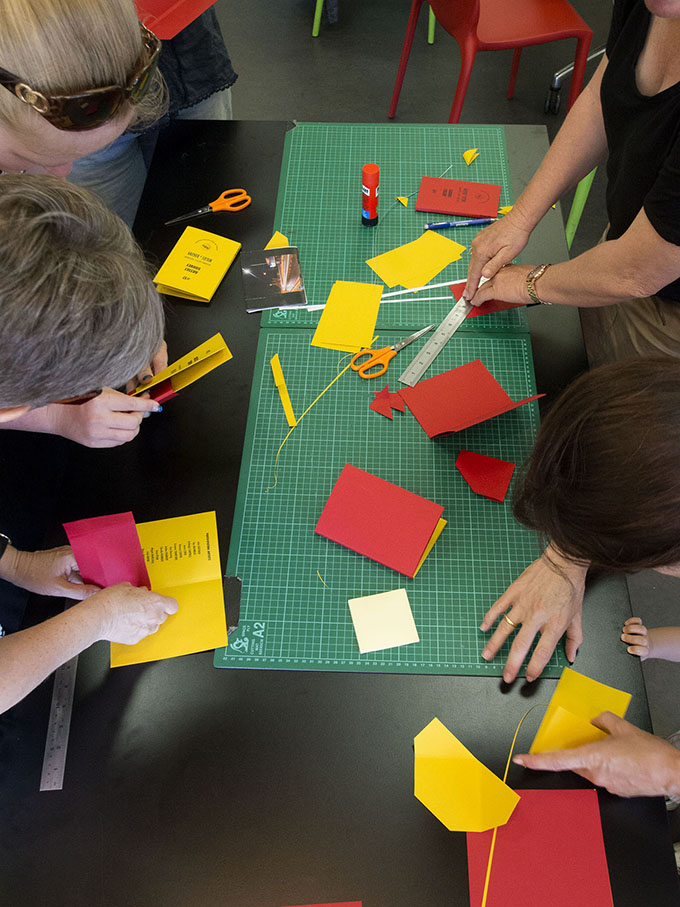
Nocturne Miles Zine making workshop
Some of the Photocollages
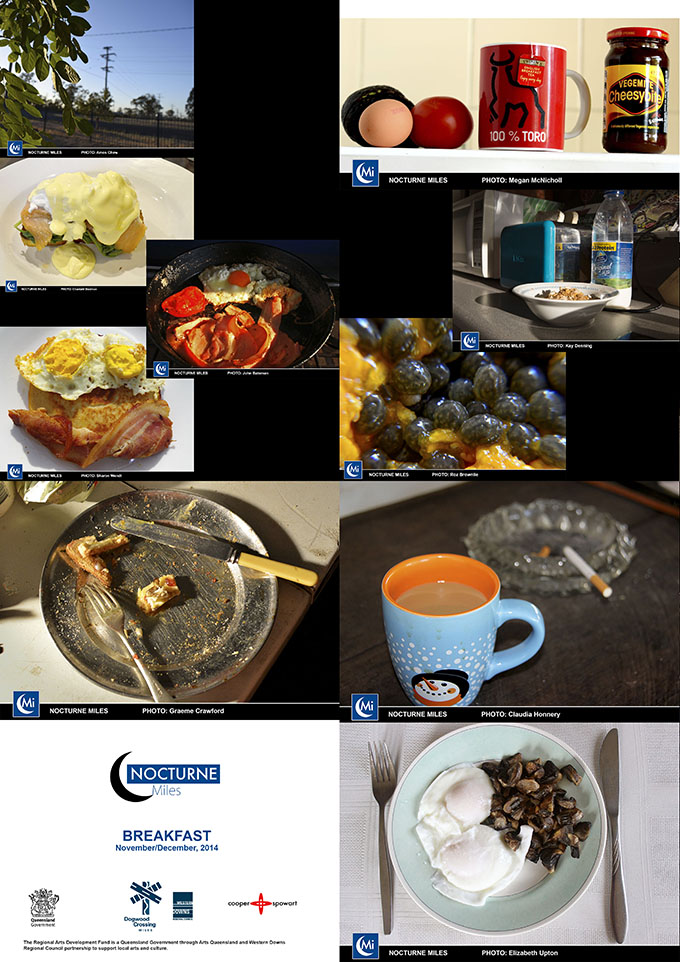
Breakfast – Nocturne Miles
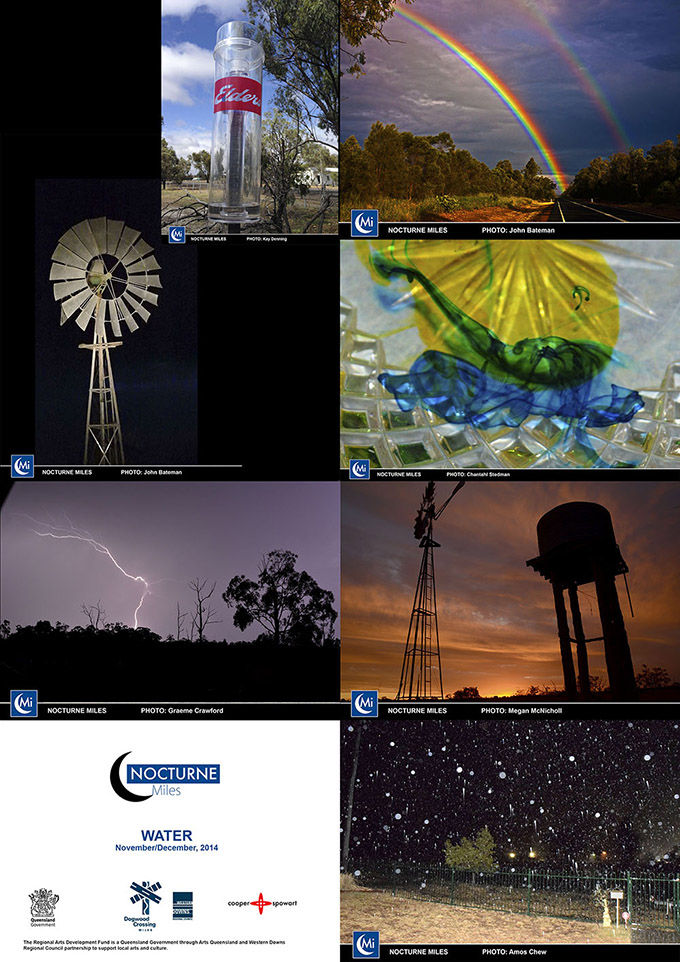
Water – Nocturne Miles

Miles Historical Villiage – Nocturne Miles
The photocollages presented here are examples of the image sets created by the participants. It is interesting to note that the original images may have emanated from all camera formats fro iPhone, simple digital point-n-shoot to sophisticated DSLRs.
We hear a lot about documentary photographers and student photographers travelling out into the country to create documents of life outside of the metropolis. Once on the ground these photographers seek out subjects to pursue and photograph. In this way significant documents are created of these outlying communities. However, the subject of the of the photographer’s gaze, and what is photographed, is based on the view of ‘outsiders’. The photographs they make may match preconceived ideas, and mythologised opinions, that they bring with them rather than how the people who inhabit these places feel about how and where they live.
What the Nocturne Miles project shows is perhaps that in an age where everyone can be a photographer what is important is the photograph itself. What then stands out the most is the link between the photograph and it’s authenticity. With this in mind these photographs are actual fragments of the lives of local people, whether they are from the farm, or people engaged in extractive industries, or those who work in administration roles or students at school, their voice in this conversation adds another view we can have of our regional communities.
The project was undertaken between November 21 and December 7 2014 and was overseen by Western Downs Regional Council’s Cultural Development Coordinator Ashleigh Campbell and Cultural Development Officer Anne Keam. The success of the project was also made possible by the enthusiastic support of the WDRC team at Dogwood Crossing.
What follows are more photocollages and individual images from the project
More images are on the Surat Basin.com.au website HERE
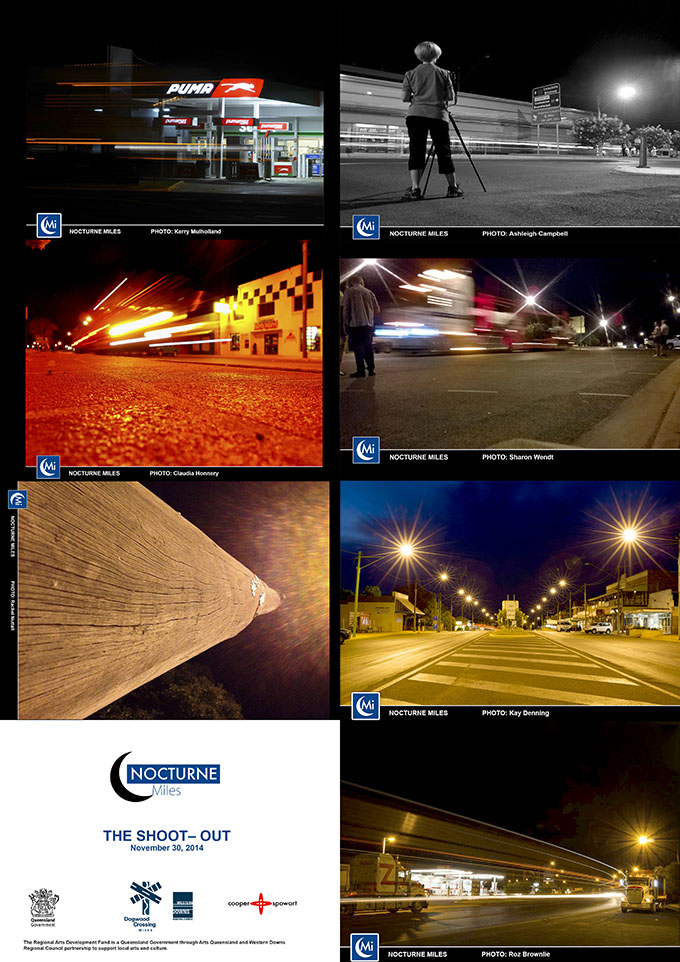
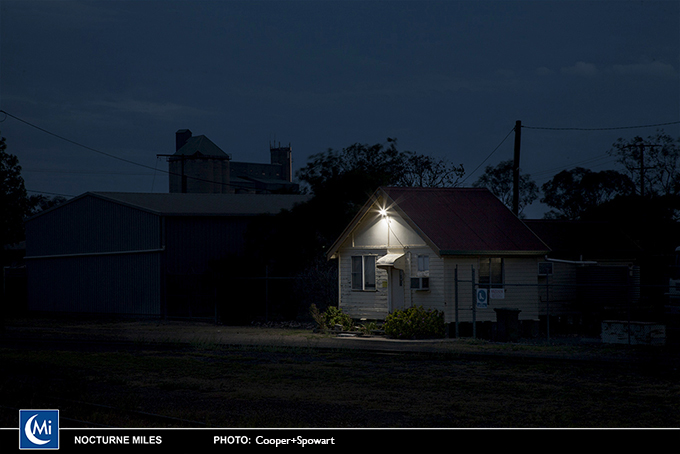
Murlilla Street – Nocturne Miles
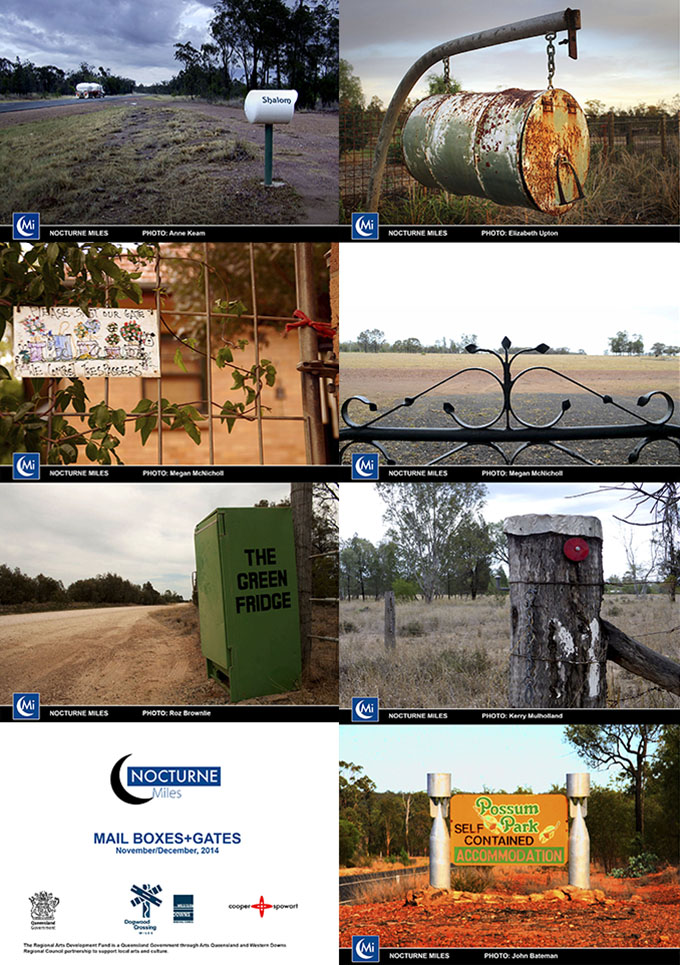
The front gate – Nocturne Miles
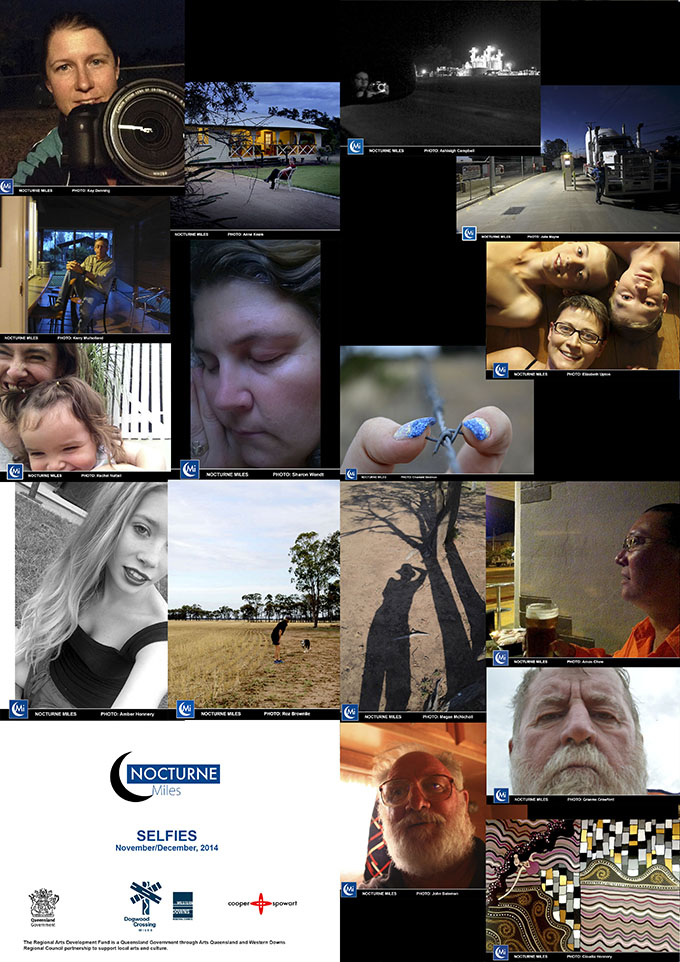
Selfies – Nocturne Miles
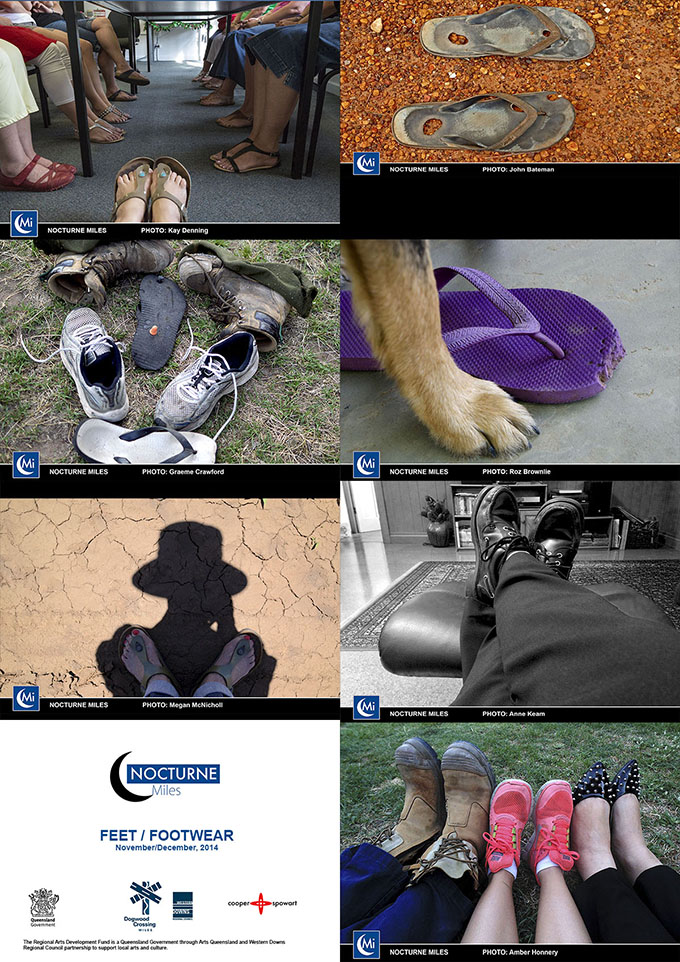
Footwear – Nocturne Miles
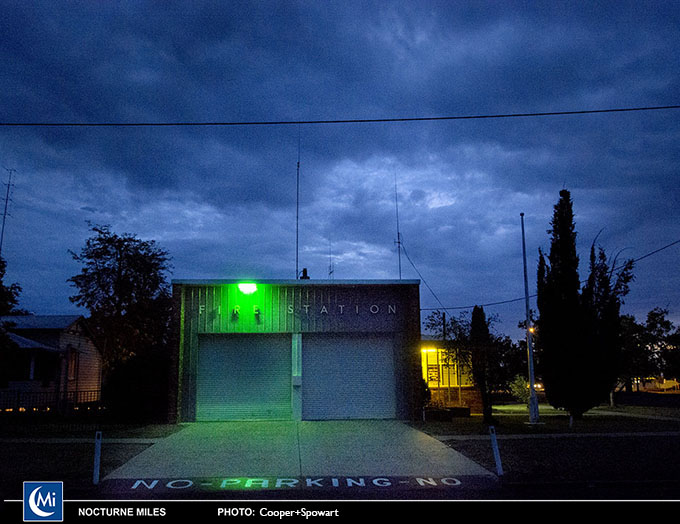
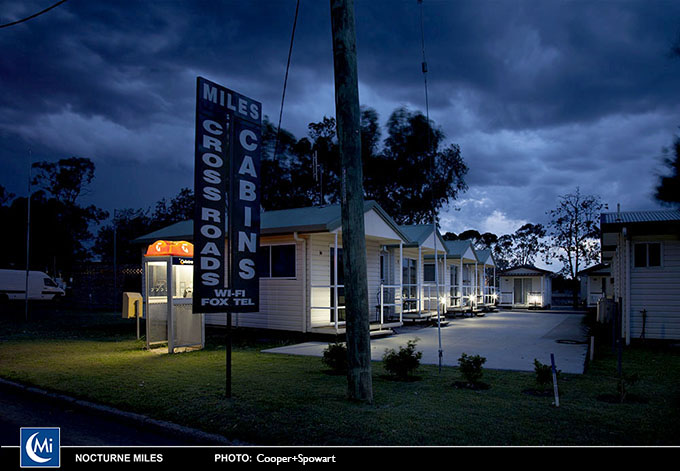

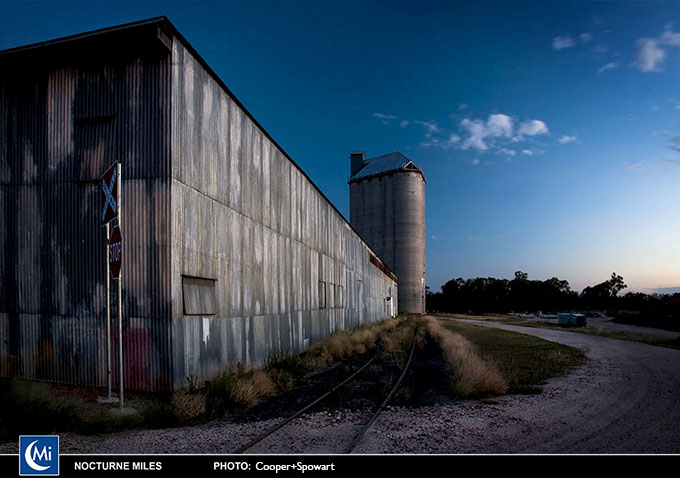
Text and photos unless otherwise accredited are Copyright ©2014 Victoria Cooper+Doug Spowart
DOING IT BY THE BOOK: Judging the 2015 Momento Pro Australian Photo Book Awards
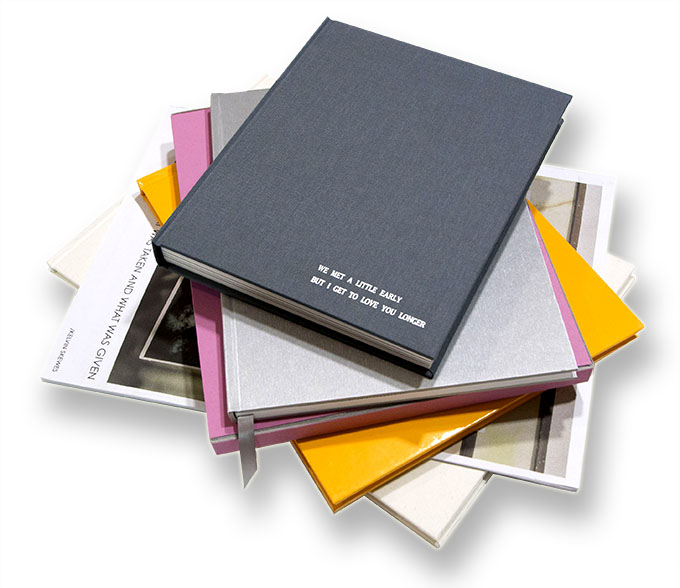
The 2014 Australian Photobook of the Year Finalists stack
On the 30th of January six identities from the Australian publishing and photography scene gathered in Sydney to review a selection of the best photo books from Australian authors and to select a recipient for the title Momento Pro Australian Photo Book of the Year. Prior to this event 100 books had been submitted in the award by Australian photographers working in a wide range of book forms that employ photography.
The judges for the award were: Shaune Lakin (Curator of Photography @ National Gallery Of Australia), Diana Hill [Publisher @ Murdoch Books), Sonya Jeffery (Books at Manic), Kim Hungerford (Art and Design Consultant and Buyer @ Kinokuniya), Michael Howard (Joint Art Director @ Sydney Morning Herald) and Doug Spowart (Research Fellow – Australian Library of Art, State Library of Queensland).
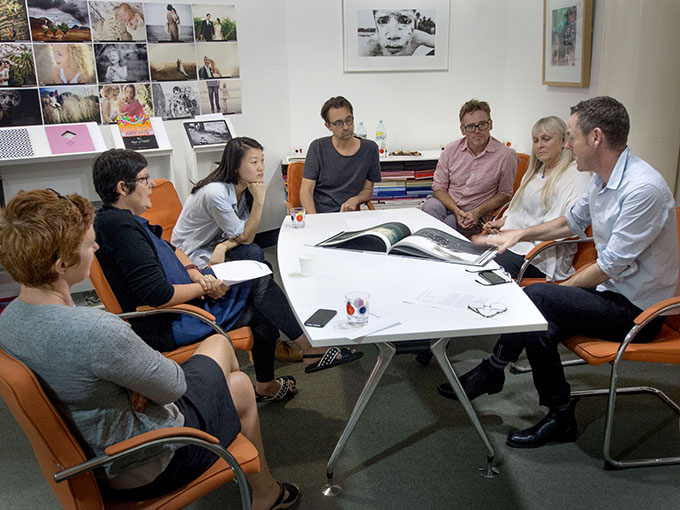
The judges deliberating PHOTO: Doug Spowart
The process started 10 days earlier when the judges were sent a USB drive containing the 100 PDF files. Within a few days the judges were to review the files and select their top 12 books. These results where then collated by the Momento Pro team to give 15 finalists. They were:
- Gold Coast Ying Ang
- Nonna to Nana Jessie + Jacqueline DiBlasi
- Typhoon Stephen Dupont
- Better Half Jackson Eaton
- Lover of Home Odette England
- The Beginning Brendan Esposito
- The Kings of KKH Andrea Francolini
- Bedrooms of the Fallen Ashley Gilbertson
- Tribal PNG David Kirkland
- In the Folds of Hills Kristian Laemmle-Ruff
- Don’t Just Tell Them, Show Them Jesse Marlow
- SALT Emma Phillips
- Nauru: What was taken and what was given Kelvin Skewes
- We Met a Little Early But I Get to Love You Longer Raphaela Rosella.
- Fibro Dreams Glenn Sloggett
Of these finalists, one book was published by an academic institution, three were published through an independent publisher and two were unpublished – the remaining books were self-published. The diversity of subject matter covered by the books included a portraiture and documentary cookbook, ethnographic documentary, social documentary, conceptual projects about human relationships of place and memory, books about irony and humour or glimpsed juxtapositions of subjects seen and photographed in the street. The books mainly fitted the conventional codex model and were trade printed and bound. One ‘photo book’ was a newspaper styled publication, and another was a deluxe artists’ book laparello of an exceptionally large size.
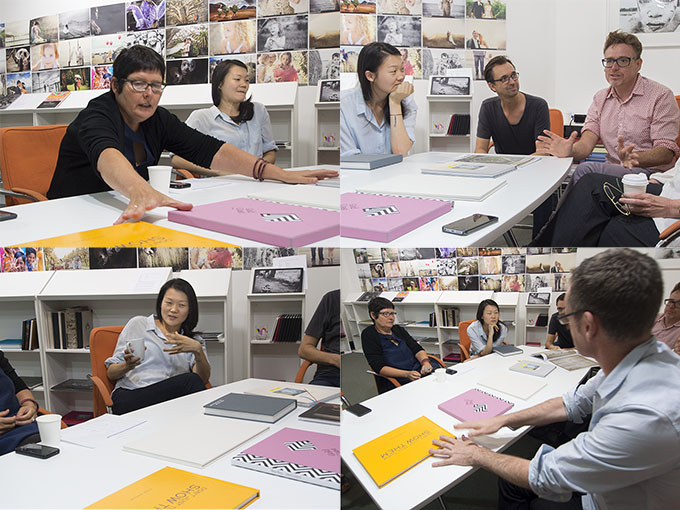
More debating … PHOTOS: Doug Spowart
As the judges came together at the Momento Pro facility in Chippendale they introduced themselves and participated in briefings conducted by Chairman of Jurors Heidi Romano, Director of Photo Book Melbourne and Libby Jeffery from the award sponsor Momento Pro. Then each judge engaged with the books – turning pages, cracking spines, smelling paper and inks, looking, reading, touching and connecting with the narrative and the experience that each book may contain. As all books were originally seen as digital images on screen there were some surprises as the digital version presented quite different experience to the physical printed book.
At this time individual conversations took place, ideas and responses to books shared. Opinions about photo books expressed and probed. Some of the key discussion points related to questions like ‘What is a photo book?’, and the validity of certain book topics and forms like cookbooks, newspapers, grand artists’ book productions – were they able to be considered as photo books? This part of the process was useful as it enabled a range of ideas to emerge from the broad views and experience of the judging panel.
The six judges then gathered around a large table – each book was presented for discussion at the end of which a vote was made as to whether it would be held-over in a ‘for further consideration’ stack or not. The discussions enabled each judge to express their experience of the book, opinions about narrative, sequencing, design and typography, production values as well as how the books ‘fitted’ with the idea of the photo book. One interesting consideration was the suitability of the book’s format, design and structure as a container to hold and present the narrative.
Some of the other discussion points that emerged included:
- A trend which is emerging where the cover of the book has no photograph on it or minimal text to identify it;
- The absence of the author’s name on the cover of the book;
- The length of the book – many books the judges felt were just too long;
- The editing and sequencing of images – many judges felt that they’d like to have done a review of the book to give an opportunity for the great photos and story to be more effectively told;
- Texts within books need quality editing as well;
- Aspects of book size and binding – a concern was ‘whether the physical nature of the book gets in the way of its storytelling potential’;
- Design features that do not support the narrative; and
- Ethics in documentary photography in relation to what level of personal information about the subject is OK to disclose in a book.
As a result of this judging segment the 15 finalists were reduced to six books. These books were interrogated further with particular attention being paid to the expectation that a great photo book should create, as it is activated by the viewer/reader, a moment where the book’s design, photographs, texts, layout, sequencing all combine to express a powerful statement, narrative or emotional response.
Of these six books selected Heidi Romano was to comment that ‘they were equal to any of the world’s current great photo books’. One final review and discussion needed to follow to select the ultimate title winner. This was preceded with discussion regarding the message that awards like these make to the photo book community about what constitutes exemplary work. The participating judges recognized the importance of this aspect of the final award selection. Ultimately all of the books were given highly commended awards with Kelvin Skewes’ Nauru: What was taken and what was given being awarded the title of Runner Up. First prize was awarded to Raphaela Rosella’s We Met a Little Early But I Get to Love You Longer book. Although unpublished the book had been printed and bound by the Momento Pro team to the author’s specifications. It featured personal narratives written by young mothers, the design and page-turning/text sequencing, powerful imagery and the inclusion of personal notes and letters extended the story and loaded the emotional response potential for the viewer.

We Met a Little Early But I Get to Love You Longer Raphaela Rosella
Images and words from this book are available HERE: RAPHAELA_ROSELLA-We_met_Book
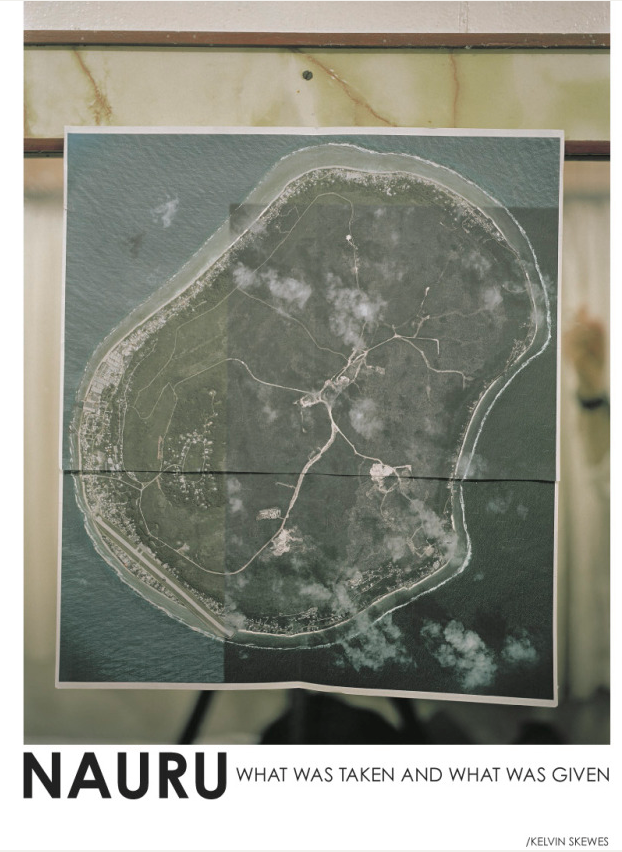
Nauru: What was taken and what was given Kelvin Skewes
The details of this book are available HERE
MORE DETAILS ABOUT THE BOOKS AND JUDGES COMMENTS ARE AVAILABLE HERE
The award winners receive:
Winner – $1,500 cash + $8,000 Momento Pro credit
Runner Up – $1,500 Momento Pro credit
People’s Choice – $500 Momento Pro credit
An additional award will be the ‘peoples choice’ from votes received during the exhibition of the books at the Asia Pacific Photobook Archive at the Photo Book Melbourne event.
This award helps to define what great Australian photobooks can be is and has rewarded great Australian photobooks. Additionally it will continue to fuel commentary and debate around the nature of the practice in Australia and serve to extend interest in and recognition of the discipline and the practitioners of the discipline in Australia.
Doug Spowart
February 12, 2015

 wotwedid
WORKING WITH “ACT WATERWAYS” A community art project
with one comment
ACT Logo
The artists involved in the project had responded to the theme in diverse and inventive ways producing artworks that engaged the public and caused them to consider places and creeks that previously they may have just walked or driven past.
Our task was to manage and coordinate the documentation of the 11 art projects and the Facebook social media. In our activities we closely linked with the project leader, and then President of the Arts Council Toowoomba, Jennifer Wright (Summers), and the design coordinator Mary-Kate Khoo – both energetic, creative artists themselves and hard workers for the artists within our region.
.
Doug in a pre-planning meeting with Jennifer and Mary-Kate
To extend the opportunities for an extended learning experience for media photography students from the TAFE South-West Photoimaging department. We provided them with mentor support and professional practice skills to satisfy the demands of the project through a Facebook closed group as well as face-to-face location work.
The Facebook presence enabled a community connection with the project, activities that were taking place as well as a forum for comments and feedback. While the Facebook page was most active during the event it is still viewable as a record of the event and the creativity of the artists of our region and how the Arts Council Toowoomba provides leadership in arts projects. <https://www.facebook.com/toowoombawaterways>
FROM A PROJECT PRESS RELEASE:
A FLOW OF ART … Artists and water in our community
.
After the floods in 2011 another Arts Council Toowoomba project enabled artists to tell the community’s story. The project was called Splashing back mosaic trail. At the opening Assistant Commissioner Fire and Emergency services Tom Dawson stressed the importance of greater awareness of where and how water flows through Toowoomba.
Now our Arts Council Toowoomba volunteer team and our creative artists have been working hard again and their latest venture, ACT Waterways addresses this aspect of Toowoomba’s water systems. Soon ten artists will be installing works across Toowoomba that tell new stories about our local waterways, with works ready for viewing by 19 September 2014. For those wanting to connect with this exciting and creative project there is a map of the ACT Waterways project and a program of events featuring musical performances at each of the sites.
ACT President Jennifer Wright (Summers) said: ‘We really hope members of the public and visitors enjoy the installations and free events. Working on this project has made us more aware of the wonderful waterways in our city. I was surprised to find yabbies, turtles and waterbirds in the CBD where I am installing bird sculptures.’ Residents and visitors are invited to visit the sites, come to daily performances, and learn about life in our waterways and the history of the Waterbird Habitat.
We invite everyone to share their stories and photos of Toowoomba’s East and West Creeks and to visit the ACT Waterways Facebook page
<https://www.facebook.com/toowoombawaterways>.
.
So, over a two-week period we worked with the artists and students documenting the project and uploading images to the Facebook page and managing the social media aspects of the project. The TAFE students did a fantastic job in taking photographs of the artists and their artworks, and also in complying with the professional demands and workflows that we required for the project.
.
.
WHAT FOLLOWS ARE EXAMPLES OF THE TAFE STUDENTS AND SOME MORE OF OUR PHOTOGRAPHS
.
Share this:
Written by Cooper+Spowart
January 9, 2015 at 11:41 am
Posted in Meeting People, Place-Projects, Regional arts
Tagged with ACT Waterways Project, artists commenting about water and place, Jennifer Wright (Summers), regional artists, Regional arts