PHOTOBOOK WORKSHOPS by Spowart+Cooper @ Maud Gallery
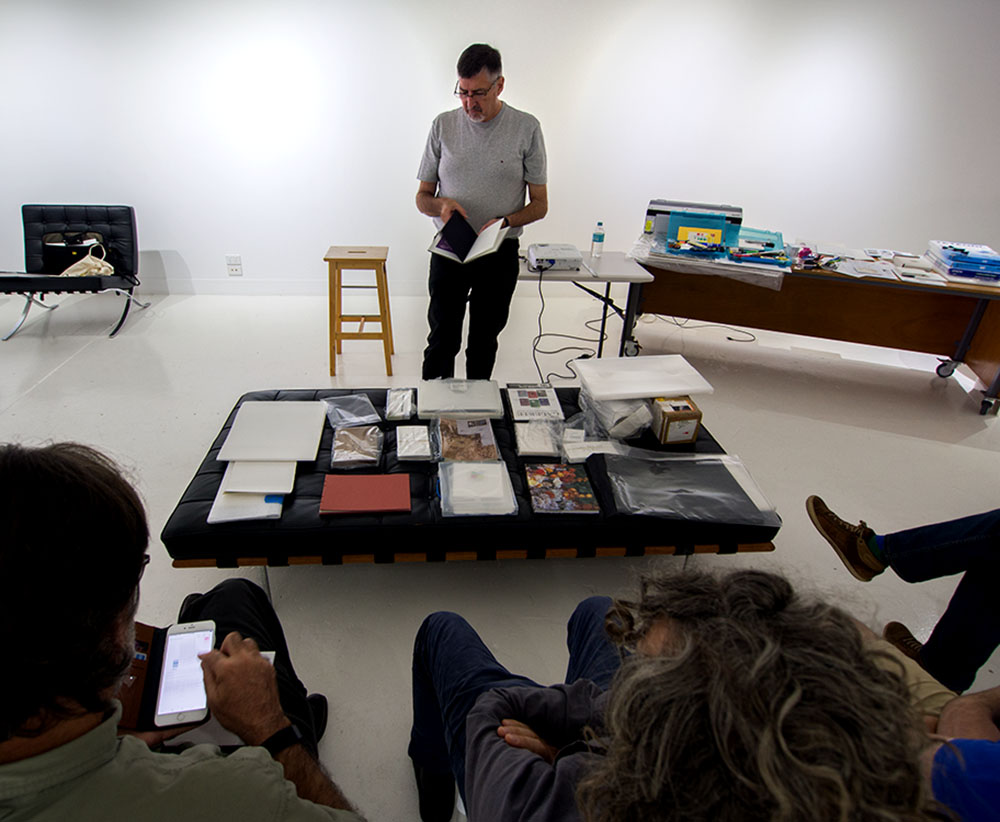
Doug doing a show ‘n’ tell with examples of their handmade photobooks and artists’ books
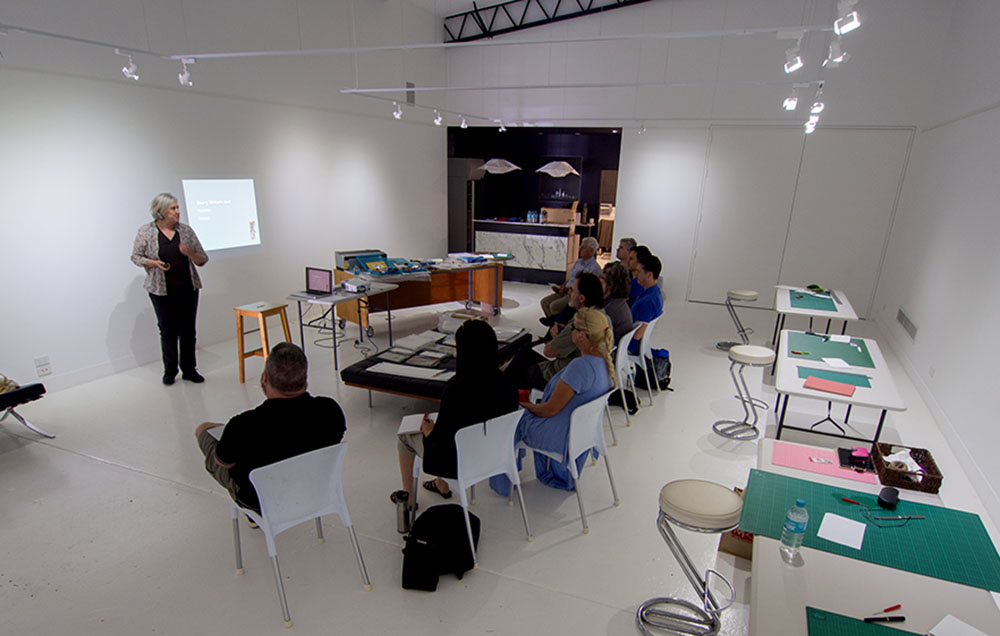
Vicky making a presentation on constructing narrative in the photobook form
.
As a companion to the exhibition of the Australian and New Zealand Photobooks of the Year at Maud Gallery we developed and presented a workshop series on the Photobook.
Our next series of Photobook workshops are in the planning stage – if you are interested please get in contact with us by filling out the form at the bottom of this page….
.
- These workshops are ideally suited to people who want to know what is happening within the discipline
- How to DIY photobook projects within your studio workspace
- How to access and master online Print-on-Demand photobook-making services – their needs and products.
- One-on-one mentorships.
The program has the following 4 sessions:
.
DIY PHOTOBOOKS: YOU CAN MAKE IT FOR YOURSELF
Show and tell tips, tricks and secrets

The photobook ‘Borderlines’ by Doug Spowart
Participants will engage in a lecture presentation that will develop a broader understanding of what a photobook can be—extending them beyond just a collection of photos into a resolved personal narrative of high technical and aesthetic values.
$35
Wednesdays – 2.5 hours, 6pm-8.30pm
.
.
.
DIY PHOTOBOOK DESIGN and INKJET PRINTING
Demonstrate, share and do – tips, tricks and secrets

Photoshopping a book
In participating in this workshop you will gain awareness and knowledge of how to create documents and templates, design, colour manage (for books), select papers, prepare files, print and output self-made photobooks.
$70 including materials (limited to 8 participants)
Saturdays – 3 hours 9.30am-12.30pm
.
.
.
MAKING IT – THE HANDMADE PHOTOBOOK
Demonstrations and Practical hands-on

Making a book
- Folding, stitching and sewing
- Materials, methods and making
- The 8-page single sided fold booklet
- The 3-hole pamphlet stitch
- Concertina and snake books
$70 including materials (limited to 8 participants)
Saturdays – 3 hours 1.30pm-4.30pm
.
.
PHOTOBOOKS: THE ONLINE (PRINT-ON-DEMAND) + TRADE BOOKS
Demonstrate and share tips, tricks and downfalls
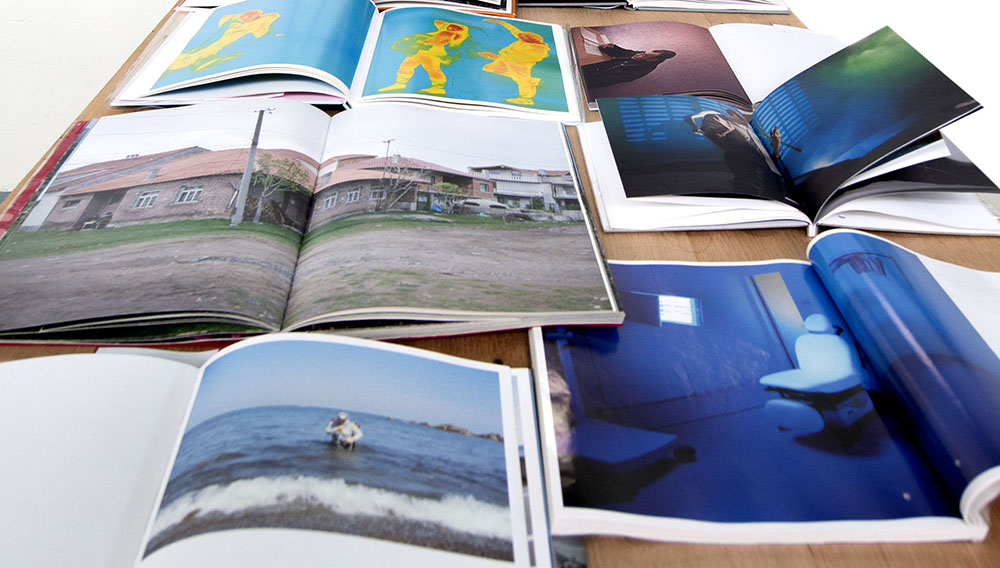
POD and trade books
- Working with Print-on-Demand service providers
- Using Publishers and Trade Printers
- Coffee table books, Zines and Newspapers
- Colour management
- Selecting a provider
- The things that no one ever tells you…
$40
Wednesday April 20, 2.5 hours, 6pm-8.30pm
BOOK HERE: http://photobookspod.eventbrite.com.au.
.


NEW PHOTODOC SHOW Curated by Doug @ Maud Gallery
In-situ – Frontispiece
.
IN SITU: New Photodocumentary Work
At the end of 2015 I was the external assessor for the Queensland College of Art Bachelor of Photography Documentary stream. The work that I encountered from their recently completed documentary photography projects was inspiring. The projects that they had engaged in employed an ‘embedded’ methodology. Each photographer created stories expressing concepts and ideas that I felt deserved a wider audience. As some of the projects crossed-over into the slippery areas of art and concept documentation I felt that presenting the work in this context would encourage comment and discourse.
.
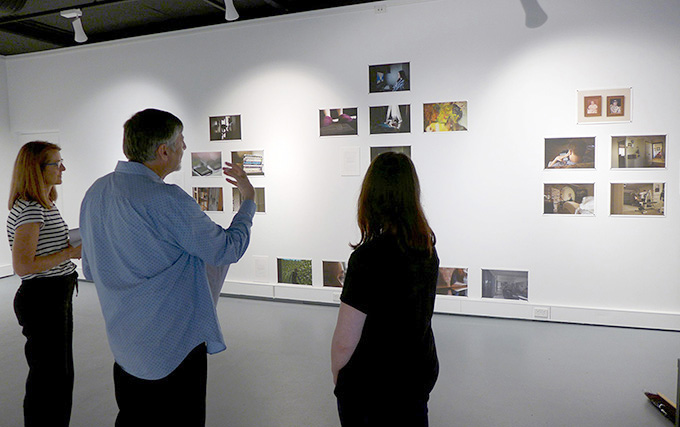
Doug in an assessment @ the Queensland College of Art PHOTO: Earle Bridger
I sought support from Irena Prikryl, Director of Brisbane’s Maud Gallery, with my intention being to curate a show of selected works. Over a week I forwarded to Irena websites and links to the student’s works – each submission was met with a response – ‘these photos are awesome!’ Irena then offered an exhibition early in 2016. In discussions with students I found that one of them was interested in curating and gallery management – so an honorary internship was offered to Gillian Jones.
The rationale for exhibition is as follows:
Every photograph is a document. A photographic document may be about a friend’s smile, a family event, a dramatic storm cloud or a dent in a car door. But, what about those documentary images that tell us about the greater aspects of life in our times? These other photographs can encompass the tragedies of human suffering, of rituals and habits, of things that escape our casual view of the world and documents of hidden acts, a performances or a ‘happening’.
The documentary photographs in this exhibition are made by photographers not working as the casual iPhone snapshot ‘photographer’ of today, but rather individuals who embed themselves in human and natural environments to witness, to empathise and to document with a camera so a story can be shared.
The documentary photographers in this exhibition present their work as evidence of what they have seen, felt and been touched by. This work represents new photodocumentary practice and will place viewers in situ – surrounded by issues of contemporary life…
The exhibitors who accepted the invitation were:
Follow the links to the Maud Gallery website to see the projects (NOTE: Some links may now be inactive)
.
Chris Bowes for the work ‘Sweat‘
Richard Fraser for the work ‘Pup play and beyond – exploring Brisbane’s BDSM subculture’
Gillian Jones for her work ‘Choice, Chance or Circumstance‘
Louis Lim for his work ‘Waiting for Sunshine‘
David Mines for the work ‘Beautiful one day perfect the next?
Thomas Oliver for his work ‘Disconnection‘
Marc Pricop for the work ‘Our Place in The Valley‘
Elise Searson for her work ‘Karen’ Lyme disease sufferer
Cale Searston for his work ‘BLU‘
The show was opened by arts writer Louise Martin-Chew on March 9 who was to comment at the beginning of her address that:
I am not an expert on photo documentary: my interest is in art and artist stories. I’m interested in the way in which we may tell and share these stories most effectively, and it is the many narratives, often those that are hidden unless you are part of that experience, or sub culture, that is at the heart of this exhibition of new photography.
.
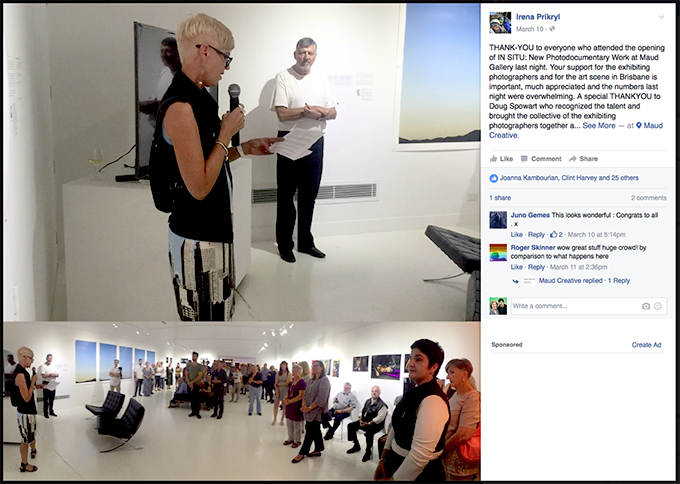
Louise Martin-Chew opens ‘In Situ’ PHOTOS: Irena Prikryl
.
Well over 120 people attended the exhibition opening. A cash bar operated with the profits going to the Lyme Disease Association of Australia charity – associated with Elise Searson’s project’
.
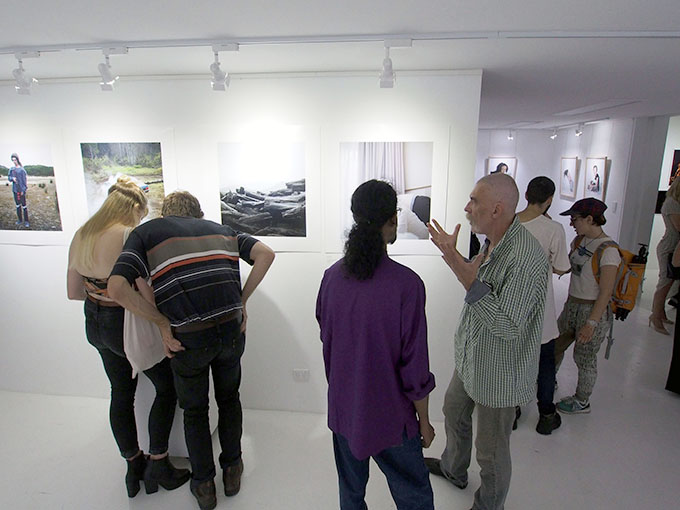
Opening attendees
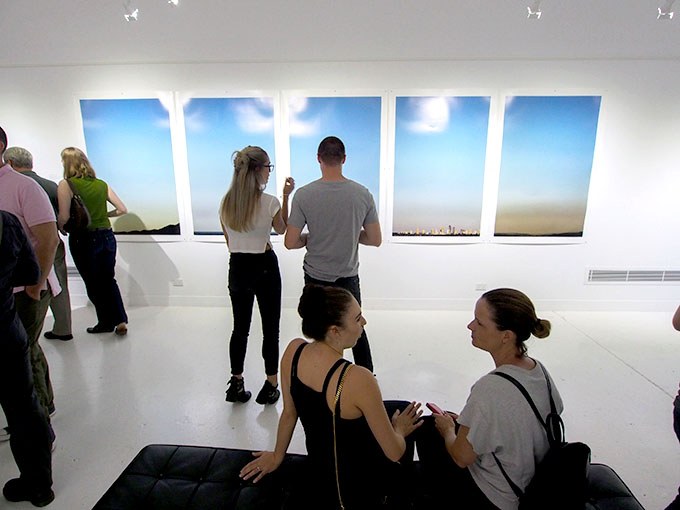
Opening attendees
.
Some views of the exhibition:
.
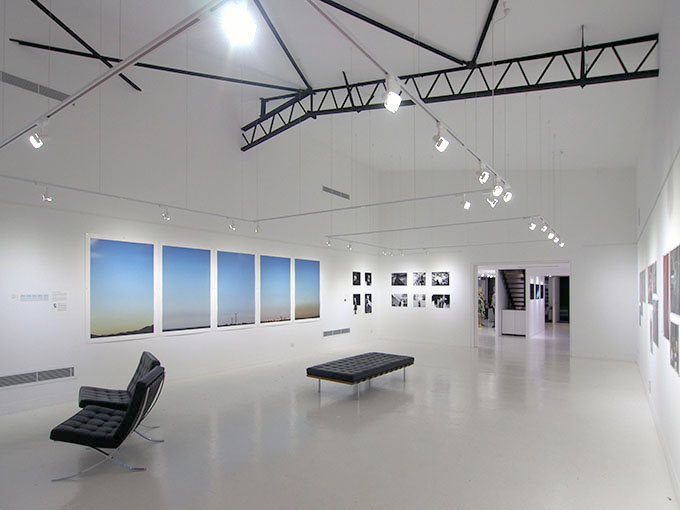
David Mines’ ‘Beautiful one day perfect the next?’
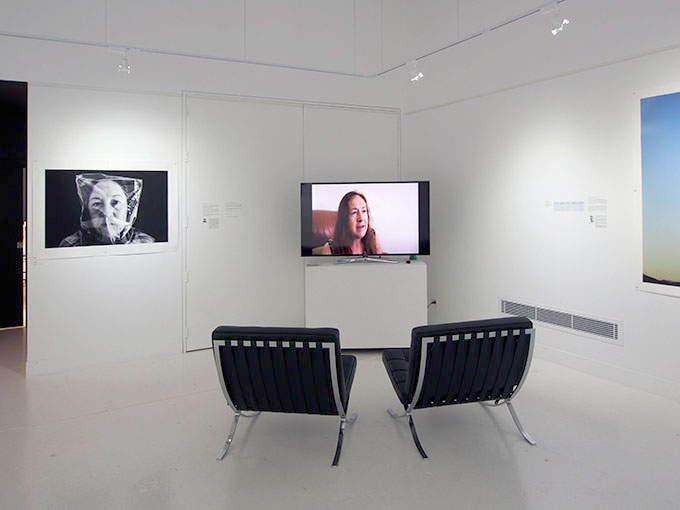
Elise Searson’s ‘Karen’ Lyme disease
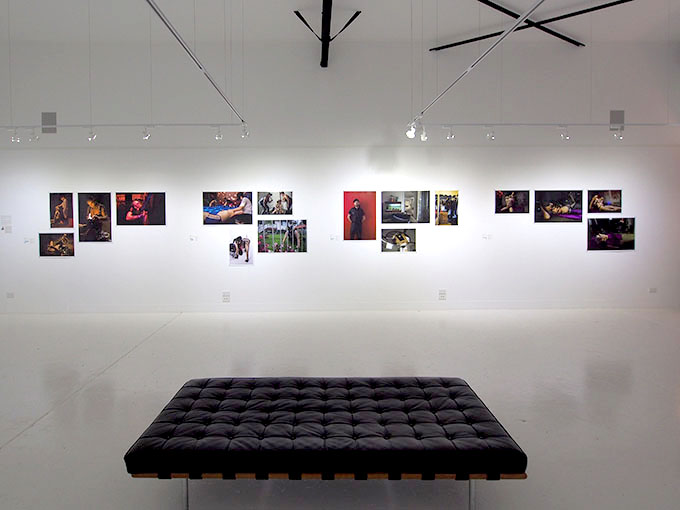
Richard Fraser’s ‘Pup play and beyond’
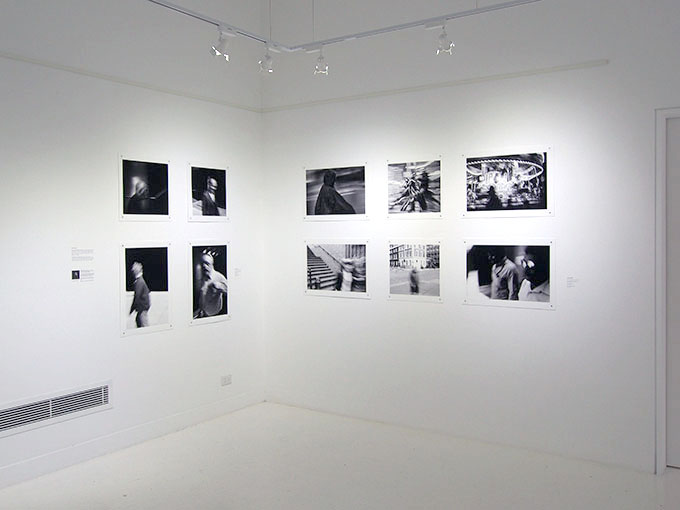
Thomas Olivers’ ‘Disconnection’
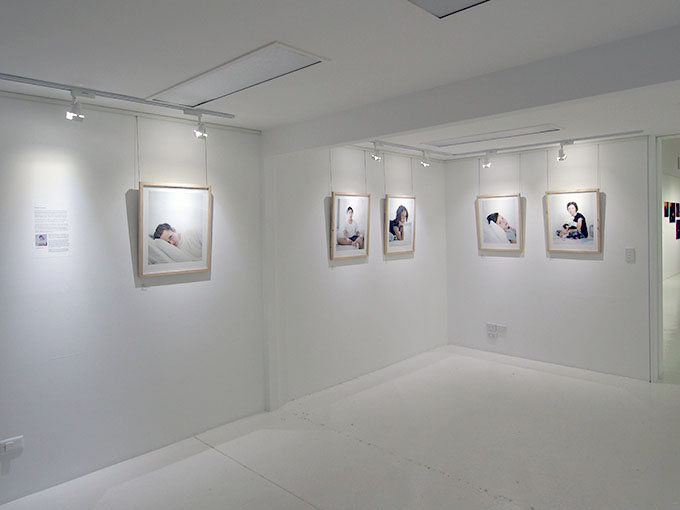
Louis’ ‘Waiting for Sunshine’
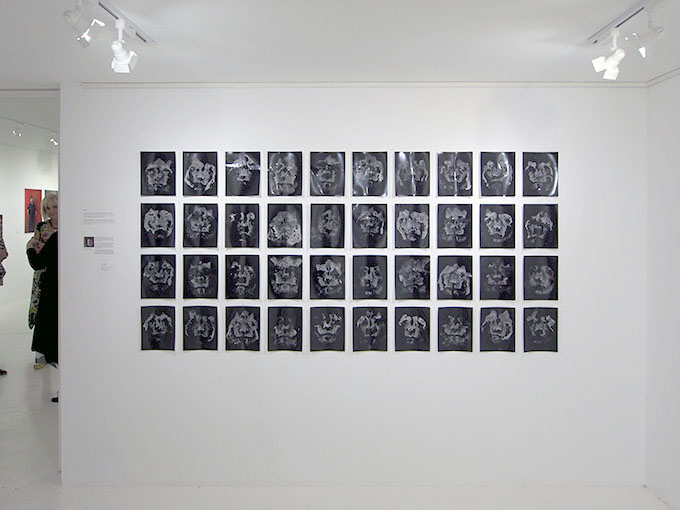
Chris Bowes’ ‘Sweat’
.
Over the course of the exhibition each of the photographers presented a floortalk at the gallery. One contributor was Thomas Oliver, who is currently studying overseas in Toronto, Canada presented a Skype session in the gallery before his work.
.
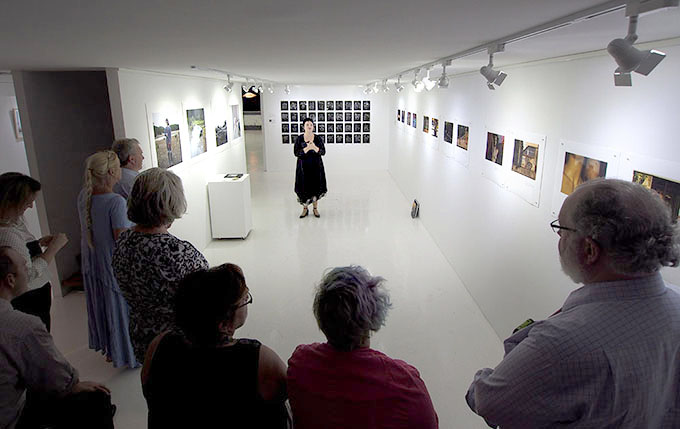
Gillian Jones presenting her floortalk
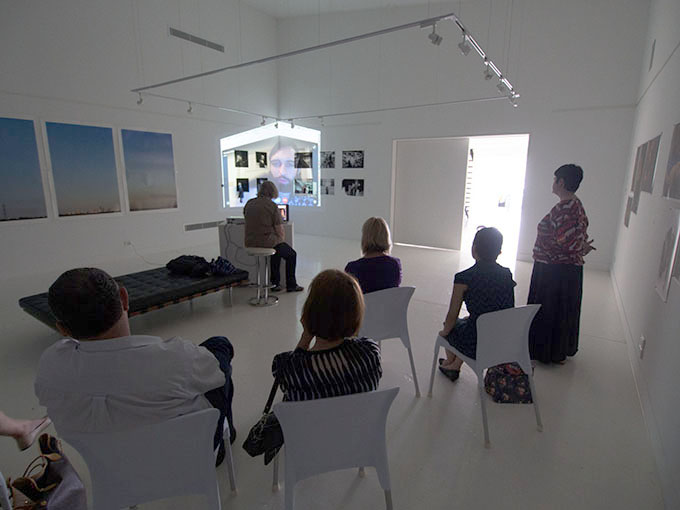
Thomas Oliver giving his floortalk by Skype
.
The exhibition concluded on the 20th March with a dinner for the exhibitors and gallery members within the white walled empty space of the gallery.
.
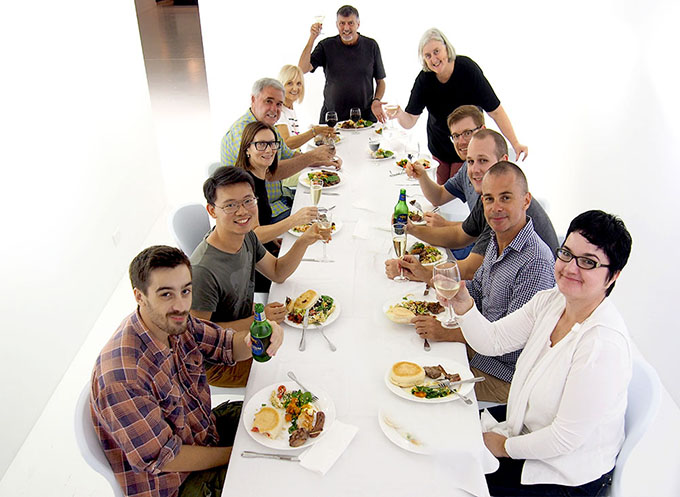
The artists’ dinner @ Maud Gallery
.
In my comments at the opening of the exhibition I stated that a documentary photograph does not exist until it is publically distributed. The exhibition, In Situ: New Photodocumentary Work, put this work and the stories it contains before an audience. Everyone seeing it may interpret this work differently; such is the nature of the photodocument. Perhaps the true value of photodocumentary work can be summed up in Louise martin-Chew’s closing statement:
The power of this collection of works by a very talented group is simply summed up I think: Art may not be able to save the world, but it has an unparalleled ability to help us understand the individuals that comprise a community, a country, a continent = the world. And that may be sufficient.
Thank you to Irena Prikryl and Maud Gallery, Gillian Jones, the contributing photographers and Louise Martin-Chew for a memorable and powerful photodocumentary exhibition of new works.
Dr Doug Spowart
Louise Martin-Chew’s opening address can be seen on her website: HERE
New-PhotoDoc Catalogue
A catalogue of selected works from the show can be downloaded: NEW-DOC-CATALOGUE
Each of the photographer’s works can be seen on the Maud Gallery website under the participant’s names in the OUR ARTISTS menu – they can be purchased from the site as well.
.
Unless attributed otherwise all texts and photographs are ©2016 Doug Spowart
VICTORIA’S SLQ BLOG POST – Montage Research
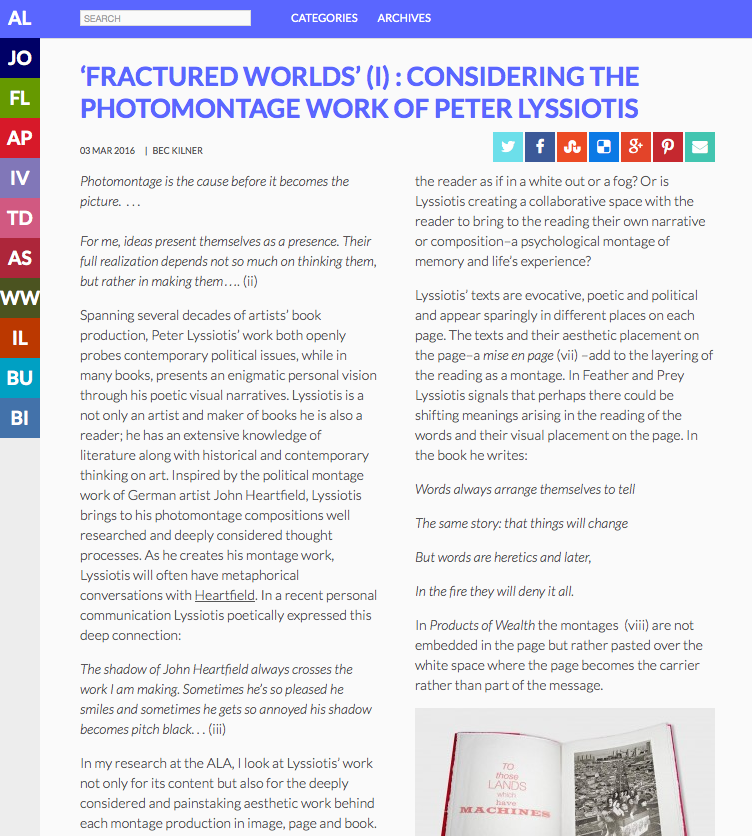
http://blogs.slq.qld.gov.au/ala/2016/03/03/fractured-worlds-i-considering-the-photomontage-work-of-peter-lyssiotis/
.
Recently Victoria’s ongoing research on the topic of montage in artists’ books was published. This paper discussed Peter Lyssiotis’ work and the use of photomontage.
.
‘Fractured Worlds’ (i) : Considering the photomontage work of Peter Lyssiotis
.
Photomontage is the cause before it becomes the picture. . . .
For me, ideas present themselves as a presence. Their full realization depends not so much on thinking them, but rather in making them…. (ii)
Spanning several decades of artists’ book production, Peter Lyssiotis’ work both openly probes contemporary political issues, while in many books, presents an enigmatic personal vision through his poetic visual narratives. Lyssiotis is a not only an artist and maker of books he is also a reader; he has an extensive knowledge of literature along with historical and contemporary thinking on art. Inspired by the political montage work of German artist John Heartfield, Lyssiotis brings to his photomontage compositions well researched and deeply considered thought processes. As he creates his montage work, Lyssiotis will often have metaphorical conversations with Heartfield. In a recent personal communication Lyssiotis poetically expressed this deep connection:
The shadow of John Heartfield always crosses the work I am making. Sometimes he’s so pleased he smiles and sometimes he gets so annoyed his shadow becomes pitch black. . . (iii)
In my research at the ALA, I look at Lyssiotis’ work not only for its content but also for the deeply considered and painstaking aesthetic work behind each montage production in image, page and book. In his statement in Products of wealth (cited in the epigraph) he discloses how the power of the work is developed through the making. It is this Material Thinking (iv) process that informs my ‘reading’ of the artists books I have chosen to engage with in this research. All artists’ books are invested with rich imagery drawn from the artist’s mind and hand, including computer or photo-mechanically generated and composed narratives.
As a reader of these books I now hold the object that represents the time spent problem solving, the years of knowledge in making and working with materials, the conceptual development of all elements that is the book–whether simple or complex, the aesthetic choices for image, page and text design, the many small or big decisions that are embodied in this work of art that is made to be held and considered by a reader. My challenge now is to find a way to share these insights with you as a distant reader who is unable to take in the necessary sensory and haptic experience of reading these works of art. In this blog I share my ruminations and questions that inspire me to read and read again many times these books of wondering and wandering, which are deeply poetic and sometimes melancholic.
I chose, Feather and Prey, for the deeply considered and poetic use of the page; the balance and arrangement of image, text and white space. Alternatively, Products Of Wealth has politically motivated photomontage prints tipped-in or glued onto the page. These are two very different ways of composing a narrative with photomontage and text and ultimately presented two different experiences for reading the montage.
Feather and Prey is bound in black leather with details of red leather on the spine and embossed images on the front and back covers.

These embossed images at the beginning and end importantly announce that the reading starts from the cover rather than from inside the book. Along with this distinctive book binding, the use of fine art papers and considered printing processes, suggests a reverence in the reading of each page.
The photo-elements in Lyssiotis’ montage narratives are no longer records of reality but now have emerged, through a process of poiesis, as visual codes with a new life and purpose:
In these images giant moths are nibbling away at the perfect mechanical reproduction that photography promises. They don’t rely on the traditional borders of a photograph to tell them when to start and where to finish. They don’t want to be a photograph; they would prefer to be maquettes for pieces of sculpture. (v)
These new hybrid images create a disturbance within the familiar routine of everyday practice and present an alternate way of perceiving and referring to the world. The visual semiotics of reality that photography represents is now channeling through montage–new spaces for imagining–a poetics of dreams.
But what characteristic does Lyssiotis identify in each element as he carefully separates them from their original contexts? Does this question really matter, as each fragment will be transformed having little relationship to its origin. These montaged elements are then fused together perhaps as a metaphorical act of transcendence and then placed or montaged within the page.
These fragments of images and text strategically appear across the white space in the book. In a short exegetic essay or artist’s statement on this book Lyssiotis discusses his intention for the white space in the book:
The white spaces here constitute something unassuming: a whiteness more like a whisper; something neutral.
In the whiteness there are things the photographic paper has not been allowed to reveal; these are not omissions, they are commissions … of sins, failed intentions, of habit. (vi)
I turn the pages and they ‘whisper’ of something hidden where only hints and clues are allowed through as the photomontage emerges through the white space. A cherub holds a curtain rope that reveals a narrow view of the sky behind.

Does the white space hide knowledge from the reader as if in a white out or a fog? Or is Lyssiotis creating a collaborative space with the reader to bring to the reading their own narrative or composition–a psychological montage of memory and life’s experience?
Lyssiotis’ texts are evocative, poetic and political and appear sparingly in different places on each page. The texts and their aesthetic placement on the page–a mise en page (vii) –add to the layering of the reading as a montage. In Feather and Prey Lyssiotis signals that perhaps there could be shifting meanings arising in the reading of the words and their visual placement on the page. In the book he writes:
Words always arrange themselves to tell
The same story: that things will change
But words are heretics and later,
In the fire they will deny it all.
In Products of Wealth the montages (viii) are not embedded in the page but rather pasted over the white space where the page becomes the carrier rather than part of the message.

These images become windows–looking into a montage hybrid world that may seem alien to us but paradoxically it is of us. Looking into the space of the image–rather than the page as in Feather and Prey–I am transported to a place where there is no space left to think… claustrophobic. The view shows the reader terrifying and perhaps even diabolic territories for consideration and reflection.
The edition consists of six separate books stored and presented in a bespoke box.

The books are bound using the simple pamphlet style, perhaps referencing the tradition of the political publication. The covers of the books are red and the box is covered in red and black cloth again suggesting the political nature of the reading. As I read, I notice that the 3D relief pattern of the letterpress texts (ix) seems to bite emphatically into the paper. Lyssiotis’ choice of font styles along with the red and black font colours also adds to the political tone that is invested in the photomontages and the binding. In book 6, Lyssiotis writes about the montage:
In these montages, the planet isn’t about to explode; the explosion has already happened. What is left is a fractured world
Finally, I find it interesting to note that these books were produced in the same year, 1997, and yet each have quite different approaches to the montage of image, text and page. Can these differences point to a deeper comprehension of the value in and values of visual reading? In this kind of reading the psychology and memory of the reader can be engaged in the transference of something more than knowledge and information.
So is the montage a space for questions rather than answers? Reading these artists’ books is in some way also a montage where the visual narrative and the artistic intention is adapted and interpreted by the memory and mind of the reader. Perhaps the nature of the montage hybrid including the page could be comprehended in terms of gestalt. As it is greater than the individual parts–the montage can be a holistic comment or reflection on the cultural and human questions of its historical location.
Victoria Cooper PhD
Feb 2016
(i) Peter Lyssiotis, 1997, The Products of Wealth, Book 6: Political Photomonteurs Can Give You The Courage To Eat Bricks, Masterthief Enterprises, Melbourne.
(ii) Ibid.
(iii) Handwritten note sent by email to the author, February 23 2016. In this note, Lyssiotis presents an evocative and intriguing discussion on the montage works in his books Feather and Prey and The Products of Wealth. Although seemingly a dialogue between himself and Heartfield, it is more a self-critique informed by the Heartfield polemics and the political montage. This note will be published in full with the permission of Peter Lyssiotis in a future article I am writing on his work.
(iv) As presented in: Paul Carter 2004, Material Thinking, Melbourne University Publishing Ltd, Melbourne. In many ways this book is a philosophical discussion on the work and methodology of the artist including: the interaction with their materials, the intellectual nature of the artists’ visual research and their resulting art.
(v) In the ALA original Materials Archive there are several boxes of Peter Lyssiotis papers. This quote is cited from unpublished writing discussing his book “Feather and Prey” Call Number: item #29358/3 box # 13331.
(vi) ibid.
(vii) This references the mise en scène in cinema theory.
(viii) The montages are black and white archival fibre-based silver gelatin photographic prints where Lyssiotis worked with Robert Colvin to print for this publication.
(ix) Texts were handset and printed by Nick Doslov, Renaissance Bookbinding
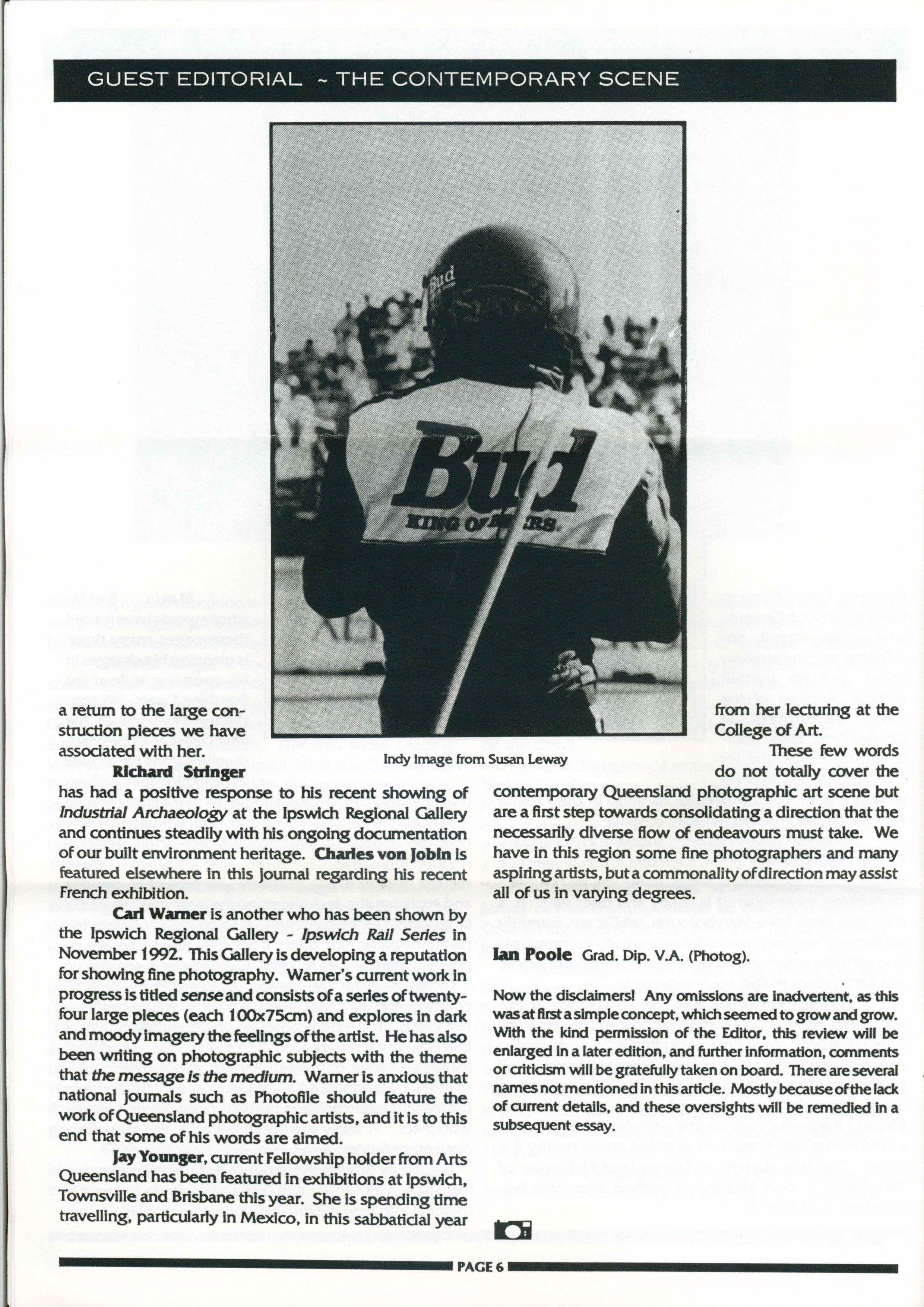
1993 THE BRISBANE PHOTOGRAPHY SCENE: Ian Poole Guest Editor
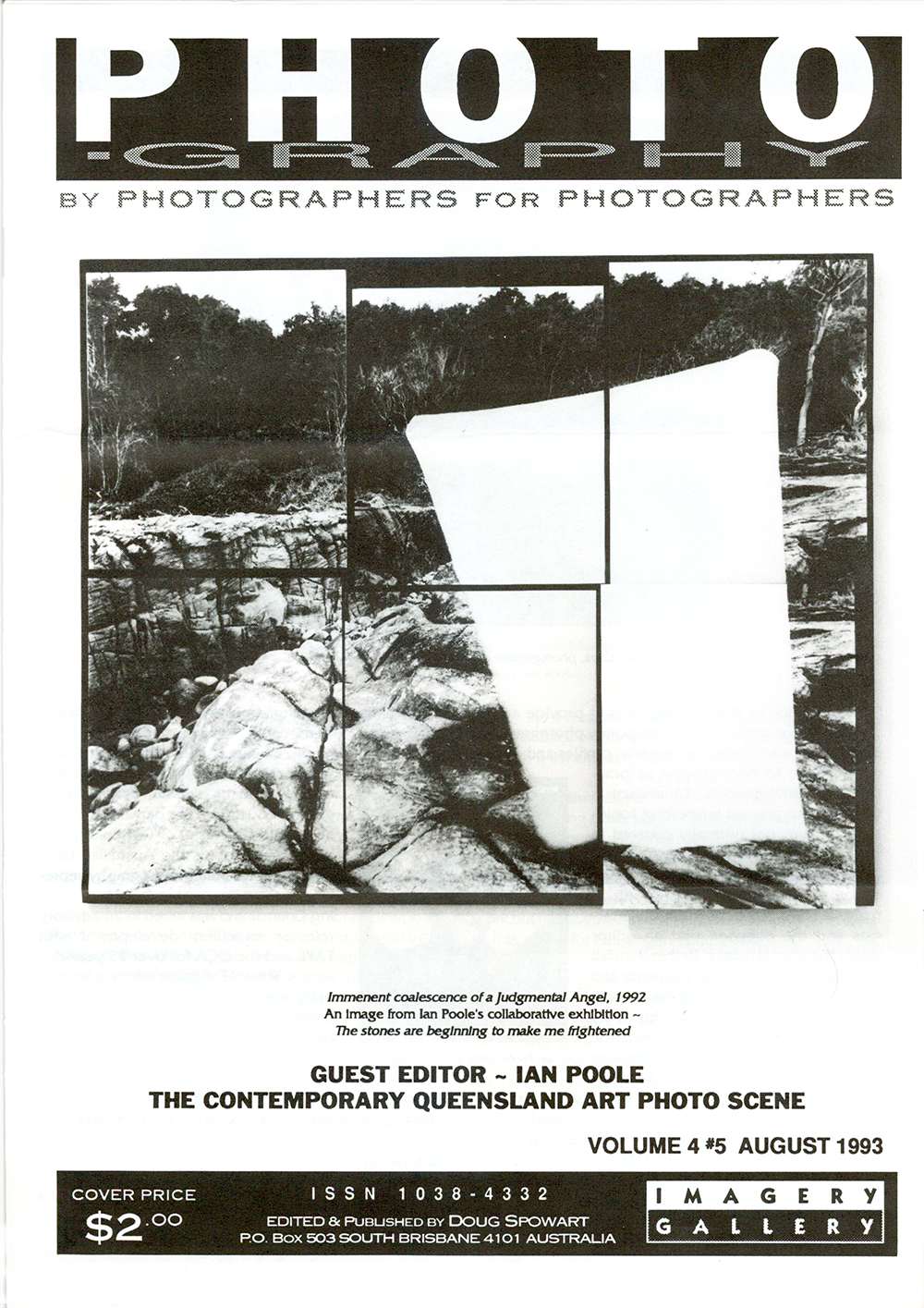
Cover-PHOTO.Graphy Vol4 #5
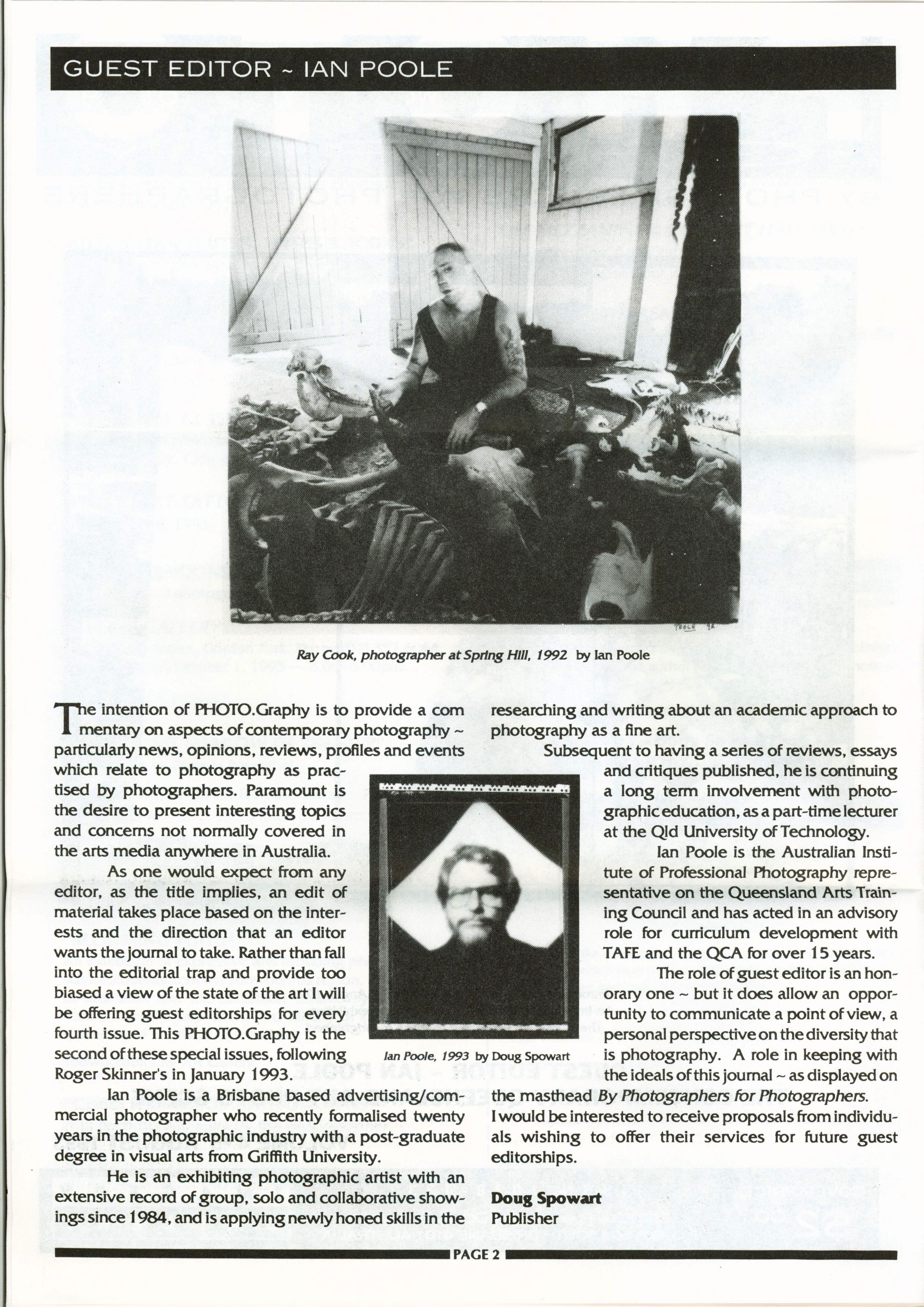
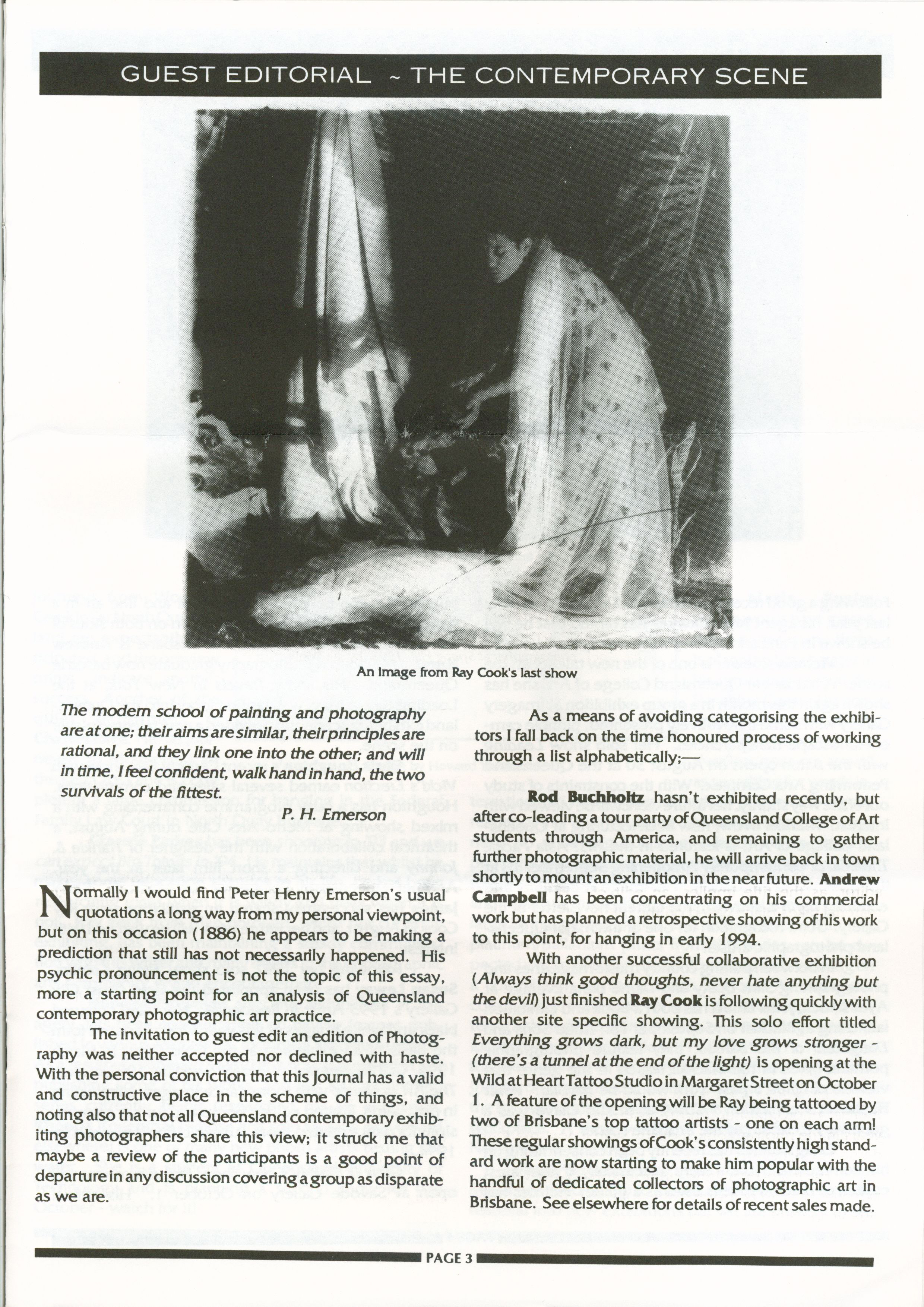
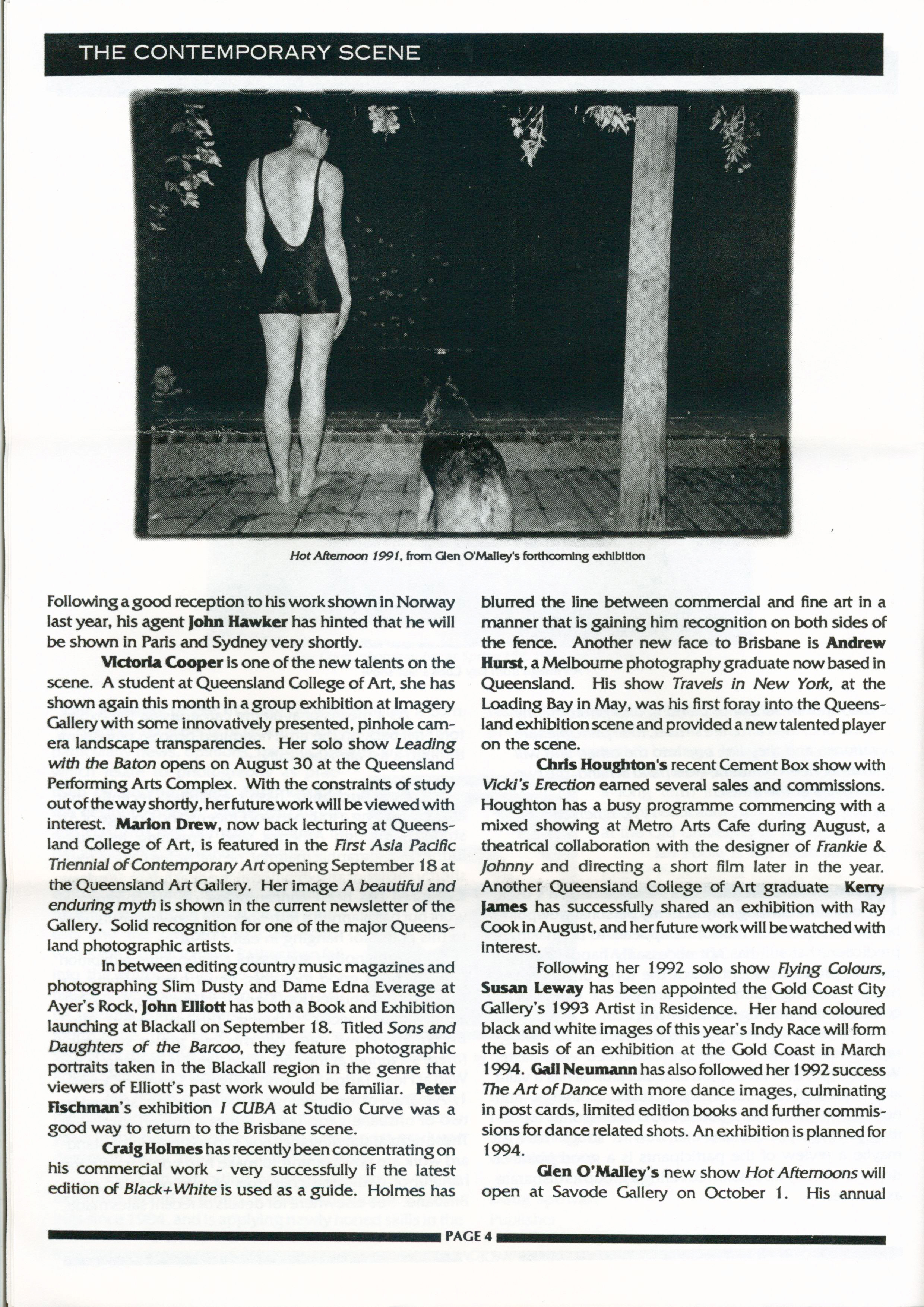
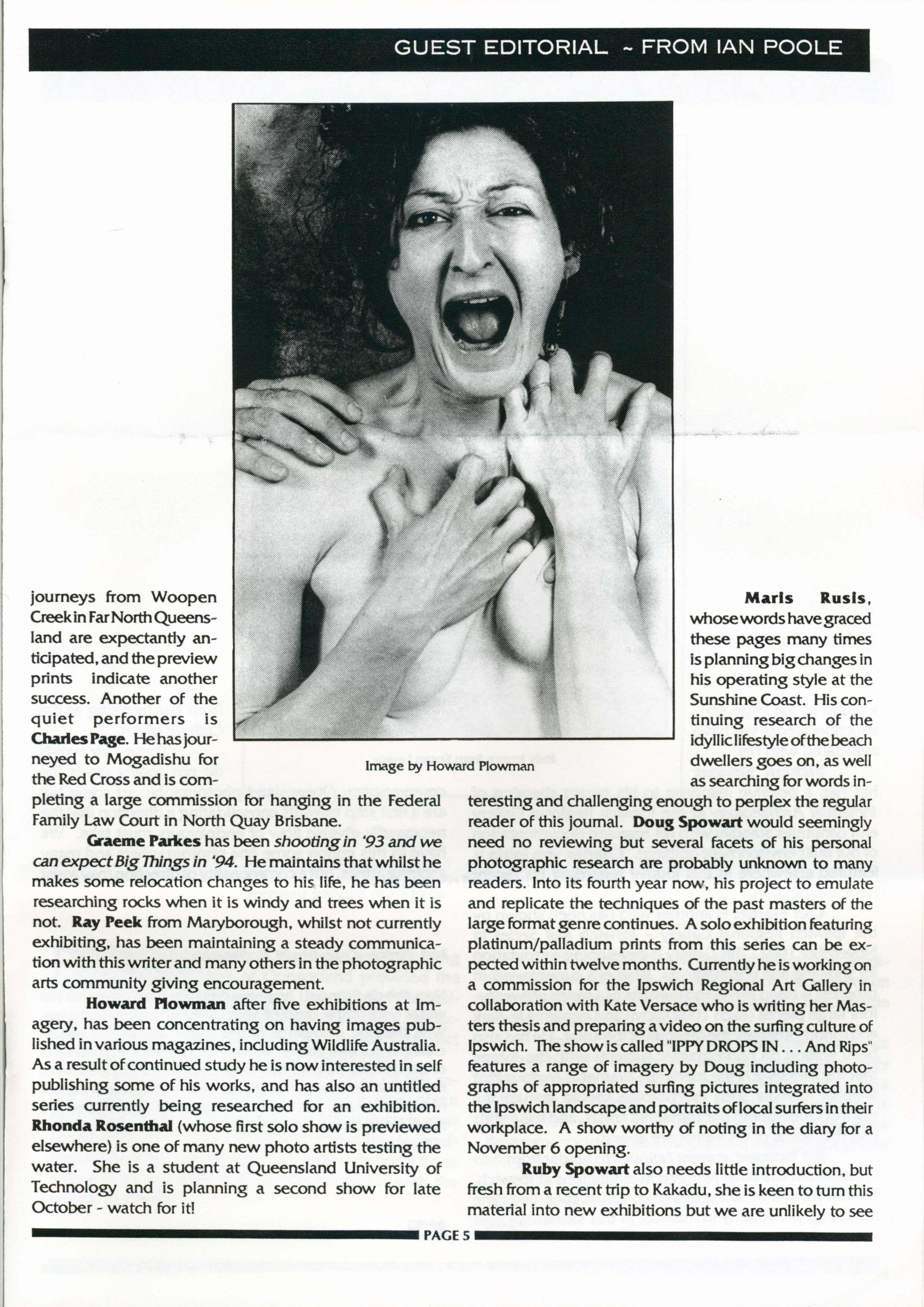
From 1990 to 2001 I edited and published a journal called PHOTO.Graphy (ISSN 1038-4332 and earlier called ‘News Sheet’). This journal was created to fill a gap in the discussion, critique and commentary about a segment of the photography discipline within Australia. Occasionally I would engage guest editors to add their voice to the conversation. Ian Poole was the Guest Editor for Volume 4 #5 – Here is my Editorial introducing to Ian’s view of the art photography scene in Queensland in 1993.
Ian’s survey of the Queensland art photography scene makes for interesting reading nearly 25 years on… Mentioned in the survey are; Rod Buchholtz, Andrew Campbell, Ray Cook, Victoria Cooper, Marion Drew, John Elliott, Peter Fischman, Craig Holmes, Andrew Hurst, Chris Houghton, Susan Leway, Kerry James, Gail Newmann, Glen O’Malley, Charles Page, Graeme Parkes, Ray Peek, Howard Plowman, Rhonda Rosenthal, Maris Rusis, Doug Spowart, Ruby Spowart, Richard Stringer, Carl Warner, Jay and Younger. Charles A. von Jobin is also featured in the issue.
.
A PDF of the full issue is available HERE: PHOTO.G-Vol4n5r.
ADVANCE NOTICE: COOPER+SPOWART @ AIPP Brisbane ‘Hair of the Dog’ Conference

Hair of the Dog header
On the 6th of February we will be presenting a breakout session at the annual AIPP Hair of the Dog Conference in Brisbane. Our presentation, entitled OPENING-UP THE PHOTOBOOK will provide a commentary on the contemporary photobook/artists book. Our spiel from the HOTD website states:
The photobook has emerged as a ubiquitous form of story telling. Now everyone makes these books to varying levels of expertise. Photobooks and albums have always been the domain of photographers. To maintain their leadership and innovation in this discipline, professional photographers need to be aware of the options available and emergent trends in the photobook. This Breakout session will present a contemporary view of the photobook in all its forms from simple photo-zines to print-on-demand productions and handmade artisan books.
We will be giving attendees a digital presentation to introduce the topic and a major show ‘n’ tell session will follow that will unpack the contemporary photobook/artists’ book. The books presented will come from our collection including some of our own works. A special part of this session will be inclusion of books from Australia’s best print on demand service providers ASUKABOOK, BLURB, MOMENTOPRO and PICPRESS who have given us examples of their most innovative books.
As a result of this session participants will be able to consider innovative and new commercial publishing products that will provide them with a point of difference from competitors and the general public.
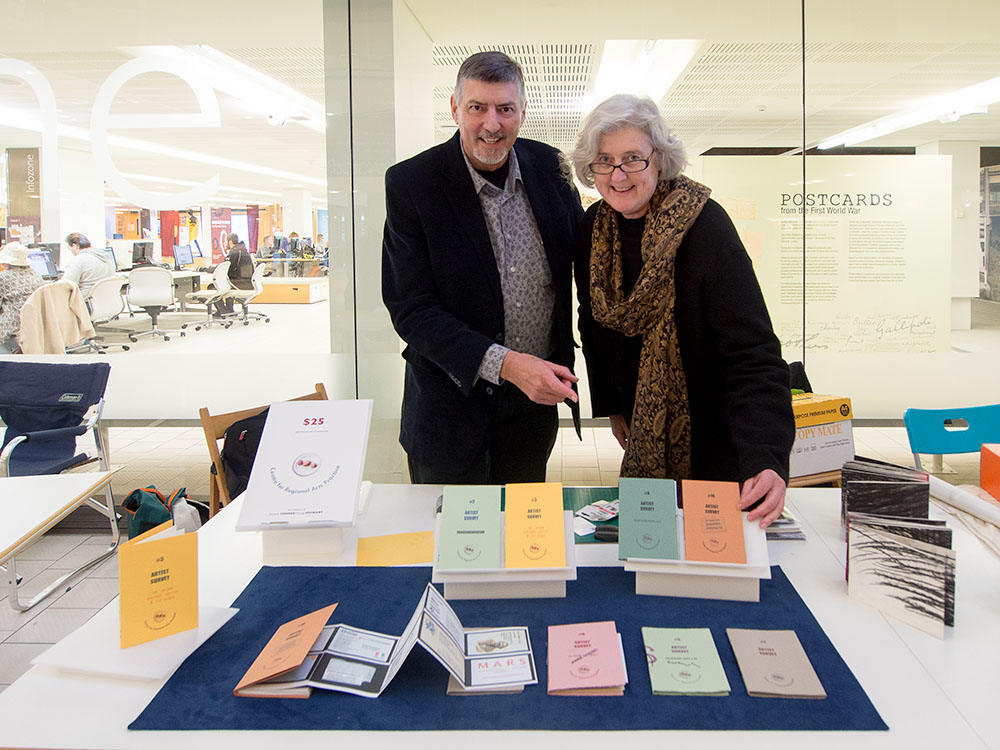
Doug Spowart and Victoria Cooper at the State Library of Qld’s 2015 Art Book Fair
.
Victoria Cooper and Doug Spowart are leaders in the fields of photobooks and artists’ books. Their books are held in major rare books and manuscript collections of the National Library of Australia, State Libraries and other significant public and private collections. In the last 10 years both have completed PhDs that related to the book and visual storytelling. They have both been awarded Research Fellowships at the State Library of Queensland. In the last 12 months Doug has presented lectures on photobooks at Photobook Melbourne, the Ballarat International Foto Biennale and the Auckland Festival of Photography.
FOR MORE INFORMATION VISIT:
http://www.hotd.aippblog.com/index.php/speakers-2016/doug-spowart-victoria-cooper/
PRICING INFORMATION:
Earlybird Rates (End January 15th, 2016)
AIPP Member 2 Days plus the Business Masterclass on Monday – Early Bird $420 After Early Bird $520
AIPP Member 2 Days Only (Sat & Sun) – Early Bird $290 After Early Bird $390
AIPP Member 1 Day (either the Sat or Sun) – Early Bird $200 After Early Bird $280
Student 2 Days plus the Business Masterclass Monday – $150
Student 2 Days (Sat & Sun) – $120
Student 1 Day (either the Sat or Sun) – $90
Non-Member 2 Days (Sat & Sun) – Early Bird $435 After Early Bird $585
Non-Member 1 Day (either the Sat or Sun) – Early Bird $300 After Early Bird $420

Hair of the Dog header
PERSONAL HISTORIES–Artists Books @ Uni of NSW–ADFA, Canberra
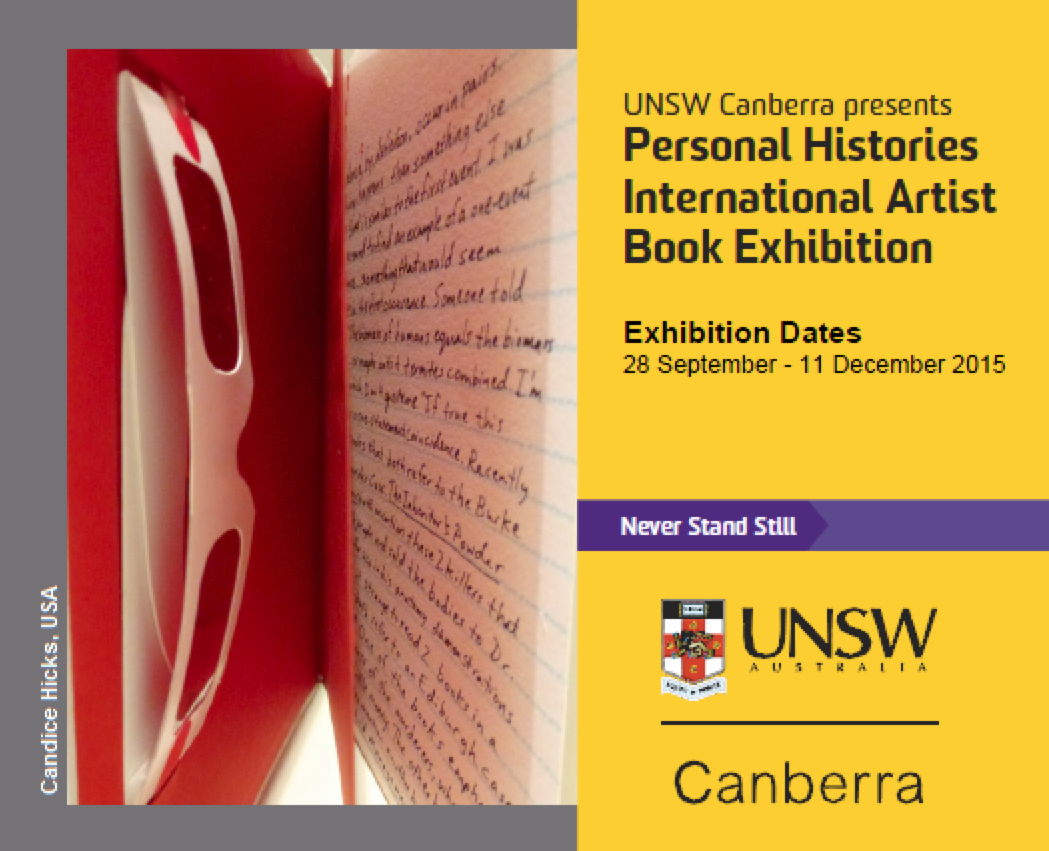
‘Personal Histories’ invite
To survive and work as an artist is a big enough challenge in this day and age–but for some that’s not enough. A few have dreams for fantastic extravaganzas and then commit themselves to the necessary problem solving and planning to bring these wild ideas into fruition. One such inspired individual is Robyn Foster who curated an international exhibition of artists books that was first shown at the Redland Museum, then Redlands Art Gallery. The show, Personal Histories was then traveled as a self funded initiative for the third exhibition at the University of NSW Library at ADFA in Canberra.
.
Ms Selena Griffith, Senior Lecturer in Design, UNSW Art & Design, officially launched the exhibition on the 1st October in Canberra and was attended by members of the local artists book community. We also attended the Canberra opening, viewed the exhibition and met some of the artists.
The exhibition is a curatorial masterpiece, the like of which is usually only undertaken by an institutional team! The works shown represent a wide gamut of practice from books that look and operate like books, to books as sculptural object. The books presented were made by every conceivable process and materials. Represented in the exhibition was every form of container for stories from codices, to concertinas and prosaic ‘ready-mades’. There is no resolution to the question ‘what is an artists book?’ as it continues to be challenged by the diversity and inventiveness of the works in this exhibition.
The stories in Personal Histories came from each artist’s life and experiences expressed through their creative art process. Through the intimacy of the book and the visual and haptic experience of reading, these personal narratives have the potential to be shared with those encountering these books in the future.
Congratulations Robyn Foster for curating and presenting this wonderful opportunity for us to experience the diversity of books by artists and the opportunity for these books to be seen.
Doug Spowart

Judy Bourke talking about her book ‘Born to life’ 2014. A tribute to Anne Murray.
A video of the exhibition showing a ‘fly through’ of some of the works as well as the opening address from Ms Selena Griffith and Robyn Foster’s response is available HERE:
.
.
FROM THE PERSONAL HISTORIES WEBSITE:
Bringing together artists from around the globe to share their own stories in artist book form.
Sharing similarities, diversities and individual perspectives.
Highlighting the dynamic world of artist books.
The Personal Histories International Artist Book Exhibition highlights the dynamic world of contemporary artists’ book practice, with contributing artists from over 16 countries who attempt to reconfigure and reignite our relationship with the book.
This exhibition intimately catalogues a perspective of individual life experience exploring various structures and content, with curator Robyn Foster inviting us to contemplate our evanescent relationship with books at a seminal point in history where technology has overtaken books as society’s primary information source.
A detailed website discussing the project, the exhibitions and the works can be found HERE
http://personalhistoriesartistbooks.weebly.com/
Some images from the event:
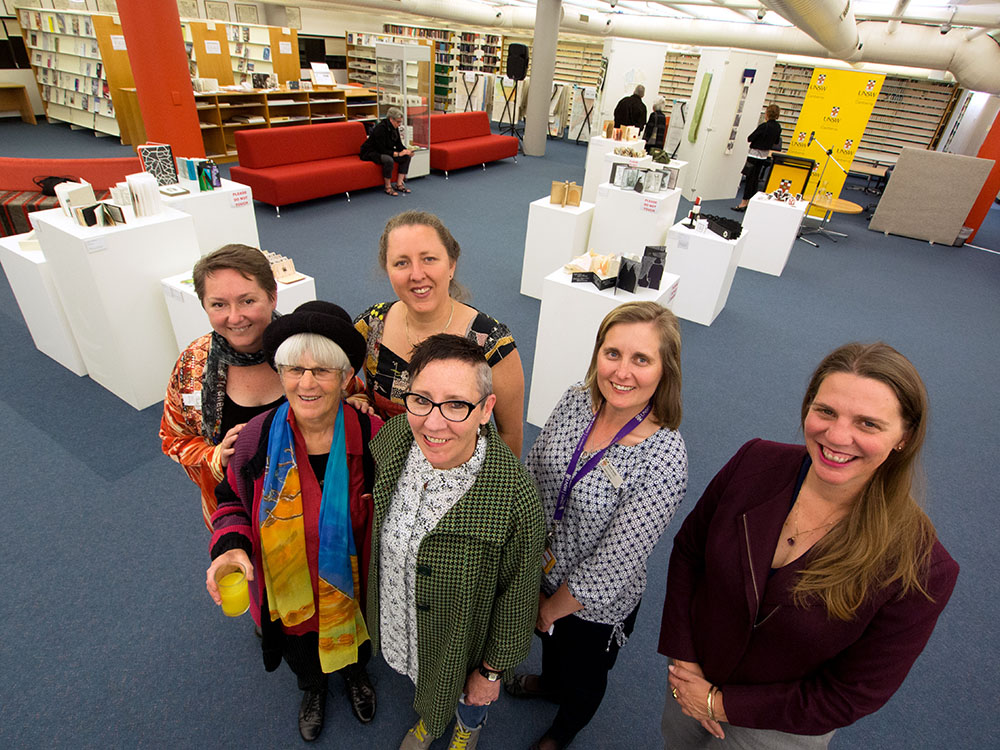
Robyn Foster, Judy Bourke, Selena Griffith, Tracie Toohey, Rachel Hunter, Lisa Morisset.

Tracie Toohey @ ‘Personal Histories’ opening Uni NSW, ADFA, Canberra.

Judy Bourke @ ‘Personal Histories’ opening Uni NSW, ADFA, Canberra.
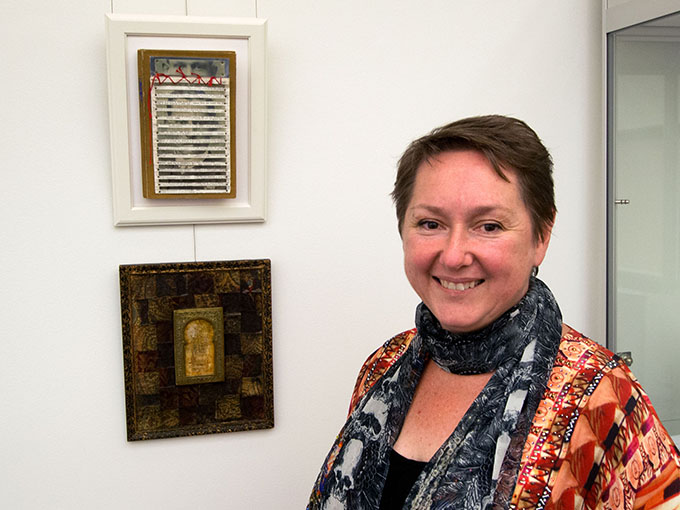
Robyn Foster @ ‘Personal Histories’ opening Uni NSW, ADFA, Canberra.
.
.
.
.
.
.
WordPress’ WOTWEDID 2015 review
The WordPress.com stats people have prepared an 2015 annual report for this blog. It shows some unusual and bizarre data, some of which is obscure like “how many comments” — very few people post comments to blogs so it’s a bit irrelevant. Anyway — Enjoy. And sometimes please comment!

Here’s an excerpt:
The concert hall at the Sydney Opera House holds 2,700 people. This blog was viewed about 12,000 times in 2015. If it were a concert at Sydney Opera House, it would take about 4 sold-out performances for that many people to see it.
UP CLOSE: Gemes, Driessens & Aird and their photographs of Aboriginal people
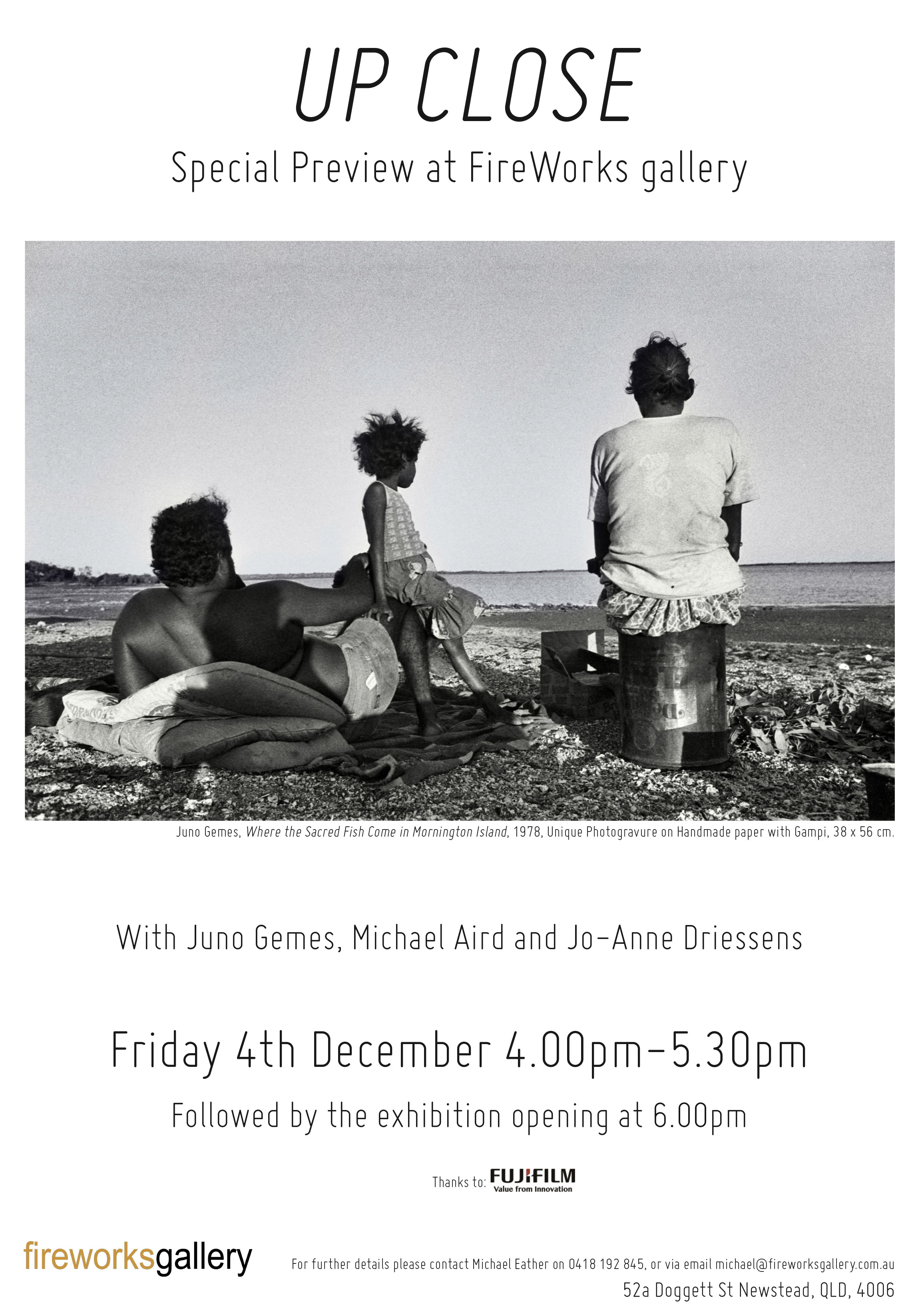
“Up Close” exhibition invitation
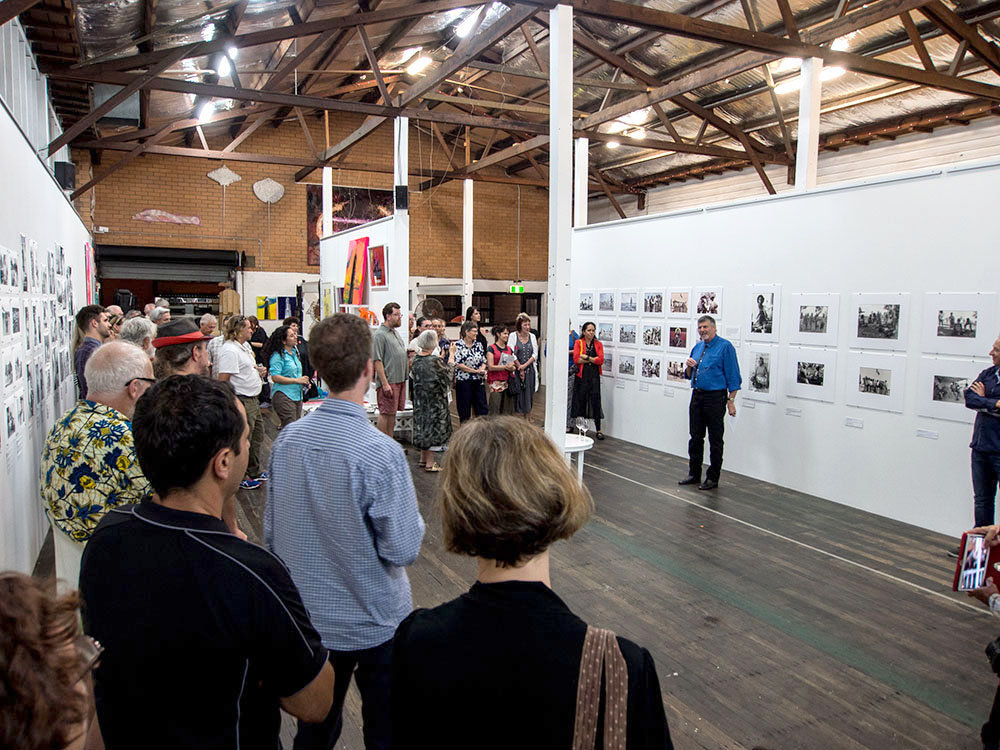
Doug Spowart opens the “Up Close” exhibition @ Fireworks Gallery PHOTO: Victoria Cooper
PHOTOGRAPHER: JUNO GEMES
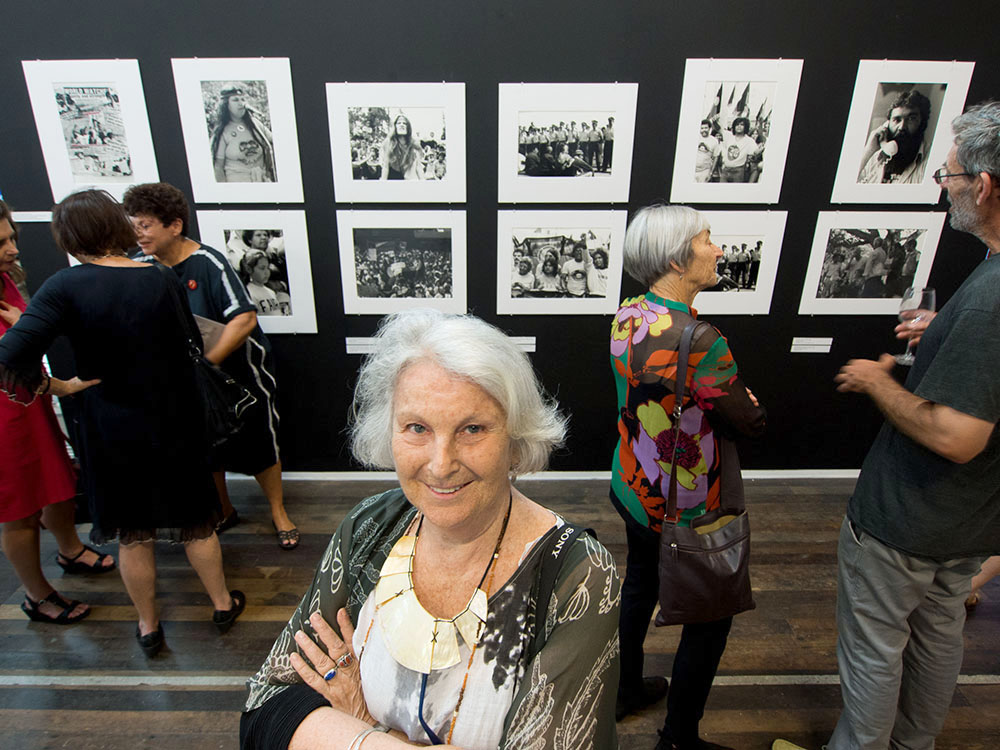
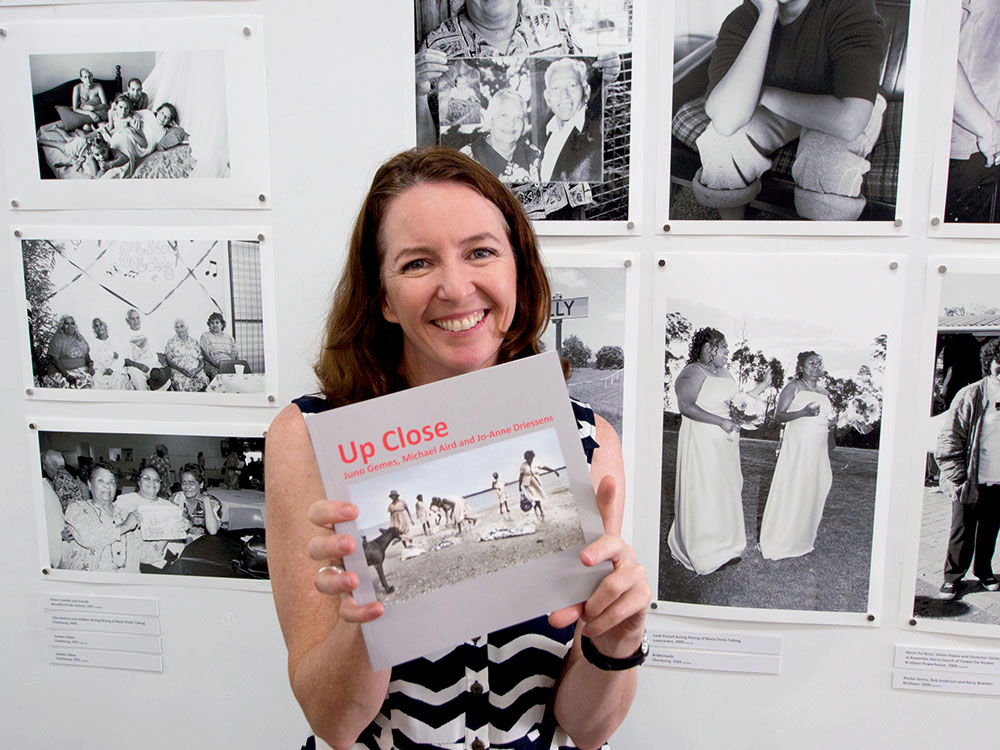
Juno Gemes – “Up Close” @ Fireworks Gallery PHOTO: Doug Spowart
.
Juno Gemes is one of Australia’s most significant photographers. For over 40 years, she has advocated for justice, recognition and respect for Aboriginal Australians through her photographic documentation. While her photographic mode could most accurately described as ‘photo-activism’ her artworks are resolved using a range of techniques that enhance the communicative qualities of the work. These include gelatine silver prints, type C prints, photogravure, photomontage, artists books and hand-colouring.
Gemes’ works have been shown in exhibitions world-wide and a solo exhibition of her Aboriginal portraits was shown in the National Portrait Gallery exhibition Proof in 2003. Photographs by Gemes have been published in all forms of media from national and Aboriginal newspapers to academic journals and publications.
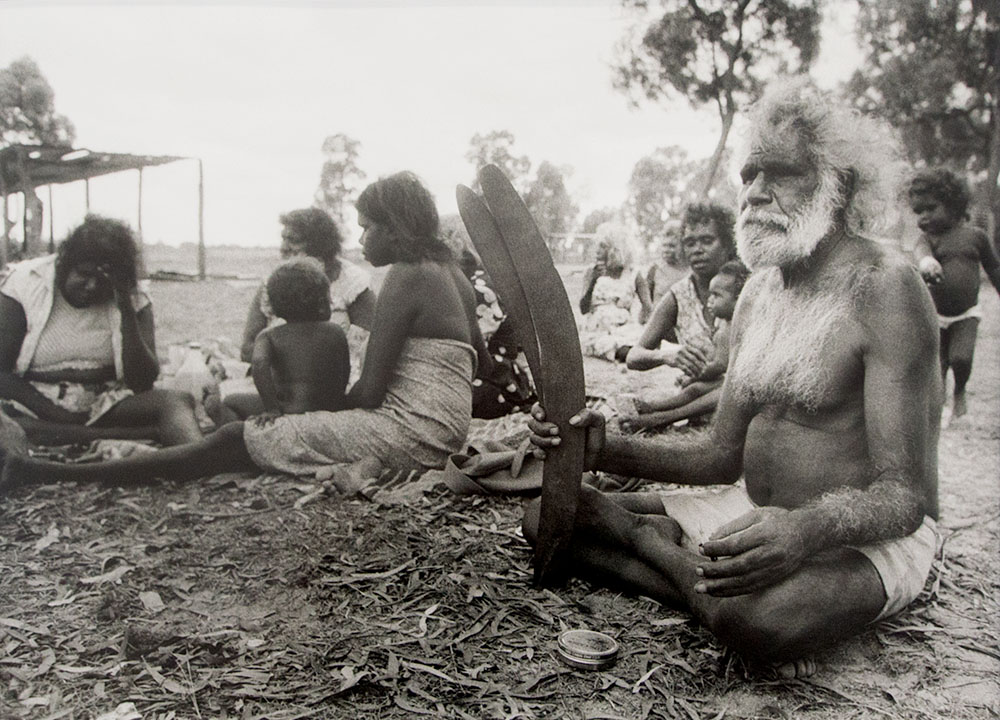
PHOTO Juno Gemes. Lindsay (Spider) Roughsey on the Bora Ground with women of his clan, Mornington Island, 1978
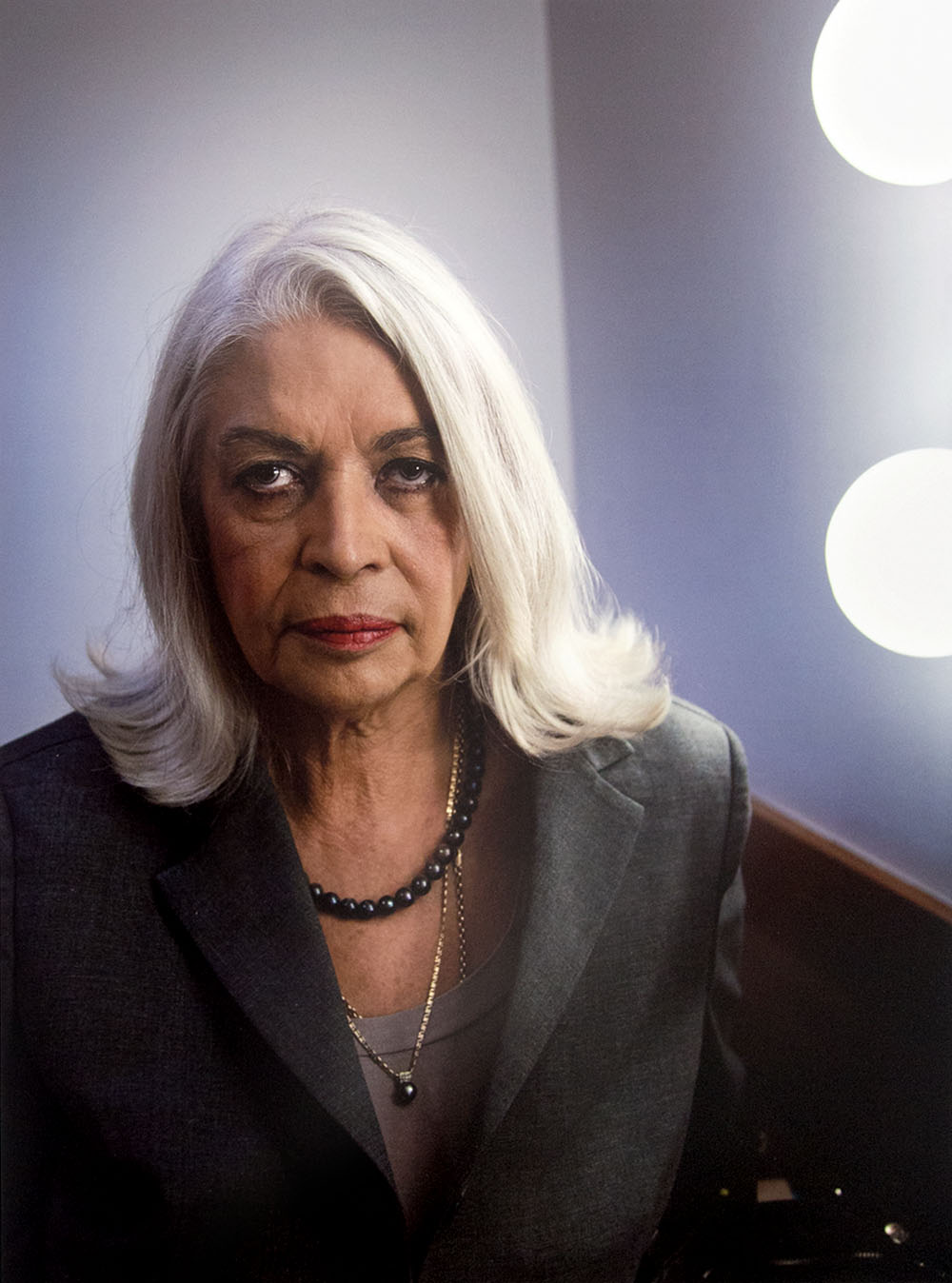
PHOTO: Juno Gemes. Marcia Langton backstage at the Deadleys, Sydney Opera House, 2013
WORDS WRITTEN FOR JUNO
In a 1995 edition of the Photofile Juno Gemes poses the question: “What can a woman do with a camera?”[i] 20 years on we can now reflect upon her question, particularly as the exhibition Up Close opens at Fireworks Gallery in Brisbane, December 2015.
How does one describe Juno Gemes? For me she is some kind of a rhizomic individual, a chameleon, and a shape-shifter. She is everywhere for everyone and watch out if you are on the wrong side her – particularly if it is to do with injustice. There is more to Juno Gemes. The manifesto that drives her is deeply and often quite vocally expressed, is rooted in social justice. Central to her personal crusade are concepts relating to humanity, culture/s and communication.
In 2003 she posed the following observations and questions in relation to what motivates her work:
“If cultural difference is the true wealth of humanity … why is it that people from one culture find it so difficult to recognise the cultures of others? If our sense of culture–our value system–is fragmented and broken, how can we heal it? How does mythic thought function for different peoples?”[ii]
Her strategy in responding to these questions are: “… to be curious and ask the difficult questions is the crucible of art.”[iii]
And the art of the camera and the photograph became her way of dealing with the difficult questions of the times – Australia and its treatment and recognition of its first peoples. But Gemes’ approach to photography may not have been the traditionally accepted ‘impartial’ documentary style but rather more inclusive, active and interactive motivated by her, and her subject’s desire for authenticity in the story that is told through her photographs.
In 1978 when photographing on Mornington Island Juno was to ask: “What images should I make? What do you want your fellow Australian to see?” The answer from the Aboriginal community was: “Show them that we are still here, we been here all along. Show them that our culture is still strong. Show them that, my girl.”[iv] Juno made photographs then, and ever since, as an advocate of this simple request.
Rather than calling herself a documentary photographer, Gemes’ considers her work photo-activism. This stance is based on advice given to her by many of her mentors and teachers including Jo Spence and David Hurn. In 1979 at a workshop in Venice Lisette Model counselled Juno advising that: You do not photograph with your camera but with your eyes, your head and your heart…
In the years that followed Gemes was a constant photographer of The Movement its activities, meetings and people. Her photographs became powerful statements, authentic, respectful bearing witness and giving voice to issues of Aboriginal identity and presence on the land. Gemes’ photographs were distributed in all kinds of media, not only those of the Movement itself but also in political and academic papers and mainstream newspapers like the Sydney Morning Herald.
Due to her photo-activism approach to photography she was not always successful in getting what she wanted published. In 1982 she documented the land rights marches associated with the Commonwealth Games Action Protests in Brisbane. When she offered her images to the Sydney Morning Herald the pictorial editor said: “Juno, I can’t publish this, it’s clear what side you’re on. What about your objectivity?”[v]
She replied: “Objectivity is fiction. It’s a refusal to take a conscious position. There can be no fence–sitting on this issue. Pictures you are publishing also have a clear position. A negative position not informed by what this action is really about.”[vi]
Over time Juno Gemes’ photographs have become a comprehensive record of the times, and with camera in hand, she continues to amass and archive of critical and sublime moments of Aboriginal culture, life and those who and connect with it. What cannot be left out in this story is the significant support that Juno Gemes’ has given to an entourage of Aboriginal photographers in all fields of practice from personal documentation to the highest levels of art photography. Her methods, ideals and integrity continues on through the work of photographers like Jo-Anne Driessens who is also in this show.
In reflection on Juno’s approach to her work, one looks for defining moments in her life that underpin and inspire her dedication, empathy, respect and creativity. She references being born in Hungary and coming, as a child, to Australia. As a child she talks of questioning the history of this country that was taught in her classroom. She has spoken about how her life was disrupted by dispossession from her homeland. In a Photofile journal in 1995 she recounted one of her earliest childhood memories that shaped her life: “… carried out of my homeland, Hungary, on my father’s shoulders; he was walking in knee-deep snow, gunfire rang out in the distance.”[vii]
In closing I’d like to read you Juno’s words from the catalogue of the National Portrait Gallery’s 2003 exhibition Proof: Portraits from the Movement 1978-2003, Juno Gemes was to say:
I have eyes that see in a particular way.
My eyes are informed by everything I have experienced, by all that I am.
I saw powerful beauty, strength, resilience, ingenuity, and hope at a time where others mostly saw only despair, their own discomfort and shame.
I saw what had been hidden, kept invisible.
I tried to communicate from within one culture to another.
It was sometimes a lonely place to be.
I had many great teachers who taught me so much along the way.
I understood how important it is never to forget what has been.
For we are also — what we have lost.[viii]
I say again: “What can a woman do with a camera!”
Congratulations Juno Gemes on your work in the Up Close exhibition and thank you for sharing the stories that you tell in the photographs before us….
Dr Doug Spowart
[i] Juno Gemes, “Profile: Juno Gemes,” Photofile, no. 46 (1995).
[ii] “The Political and the Personal Process in Portraiture: Juno Gemes in Conversation,” Australian Aboriginal Studies (The Journal of the Australian Institute of Aboriginal & Torres Straight Islander Studies)
(2003).
[iii] Ibid.
[iv] “Up Close,” ed. Fireworks Gallery (Brisbane: Keeaira Press, Southport, Queensland, Australia, 2015).
[v] “The Political and the Personal Process in Portraiture: Juno Gemes in Conversation.”
[vi] Ibid.
[vii] “Profile: Juno Gemes.”
[viii] “Proof: Portraits from the Movement 1978-2003,” ed. National Portrait Gallery (Canberra2003).
PHOTOGRAPHER: MICHAEL AIRD.
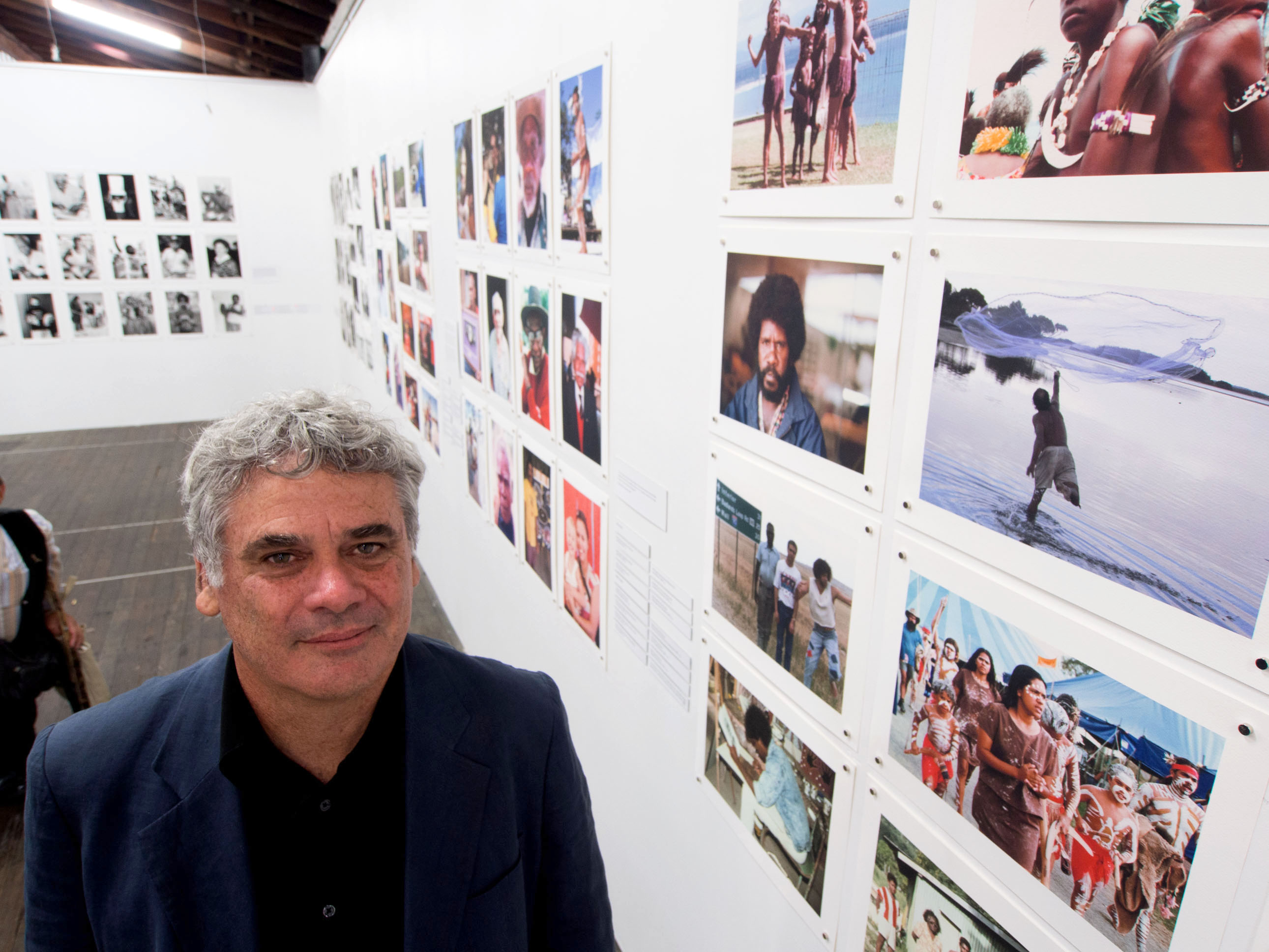
Michael Aird – “Up Close” @ Fireworks Gallery PHOTO: Doug Spowart
Michael Aird is a photographer anthropologist and curator of Aboriginal cultural heritage since 1985. Aird has produced numerous exhibitions and publications focused on photographs of Aboriginal people, including Portraits of our Elders, Brisbane Blacks, Transforming Tindale, Object of the Story and Captured: Early Brisbane Photographers and their Aboriginal Subjects. Michael Aird established Keeaira Press in 1996 and this year was awarded a University of Queensland Alumni Indigenous Community Impact Award. He is also the President of the Gold Coast Historical Society.
Michael Aird’s photographs deal with photographs of the everyday – He is interested in ordinary people and their lives. Although his work includes portraits of the leaders and elders he turns the interest of his camera lens on those not usually photographed as part of a community record. All his photographs are carefully catalogued and archived creating a significant record of the subjects and localities he has photographed.
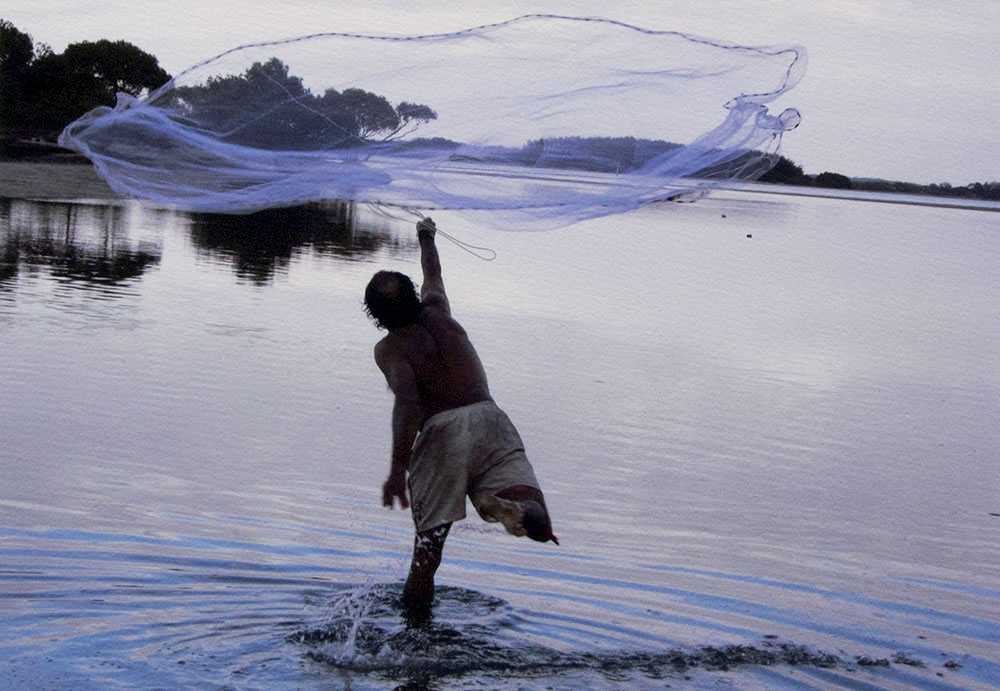
PHOTO: Michael Aird. Paul Wright casting net South Stradbroke Island 2007
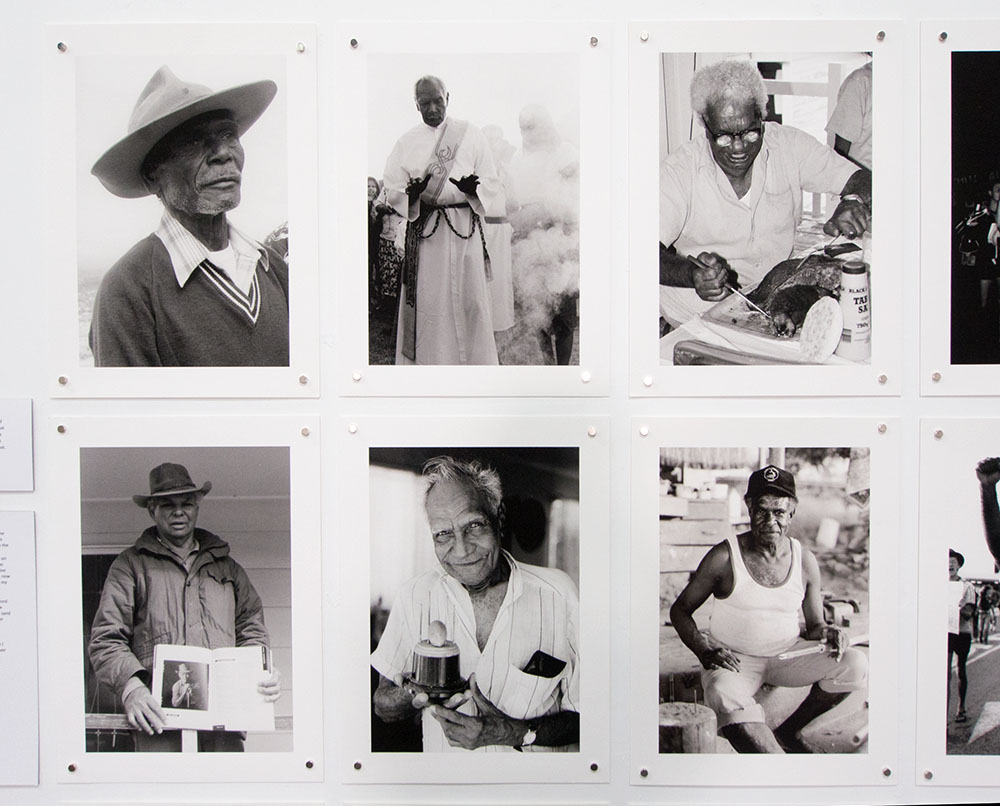
A selection of Michael Aird’s portrait images
.
PHOTOGRAPHER: JO-ANNE DRIESSENS
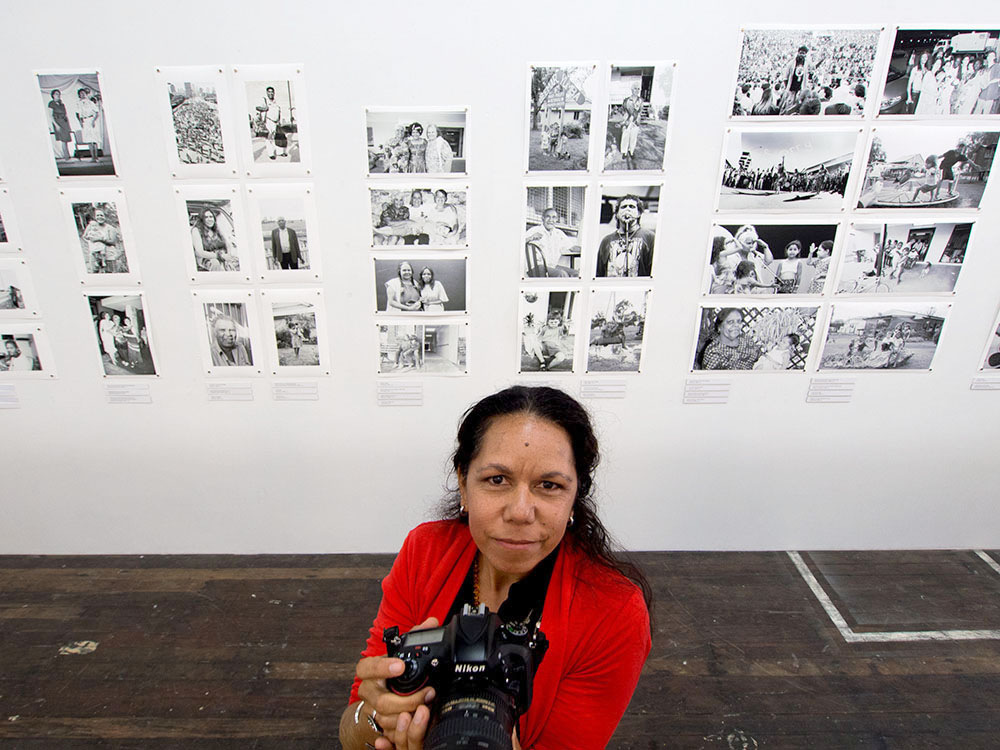
Jo-Anne Driessens – “Up Close” @ Fireworks Gallery PHOTO: Doug Spowart
Completed a Diploma of Photography and a cadetship at the State Library of Queensland working as a photographer and later as an Indigenous Research Officer. She has worked as an assistant to Juno who has also been her mentor and supporter. Over a 15 year period she has had an extensive photography documentary and exhibition practice. Jo-Anne has acted in a number of roles and positions including her current one as a Senior Arts and Culture Officer and exhibition curator for the City of the Gold Coast. She was recently selected to participate in the Wesfarmers Indigenous Arts Leadership Program in Canberra.
Jo-Anne Driessen’s work centers on community and family. Her images can at times be a record of major activities and events – yet on other occasions they may be personal expressions and exchanges between friends and family.
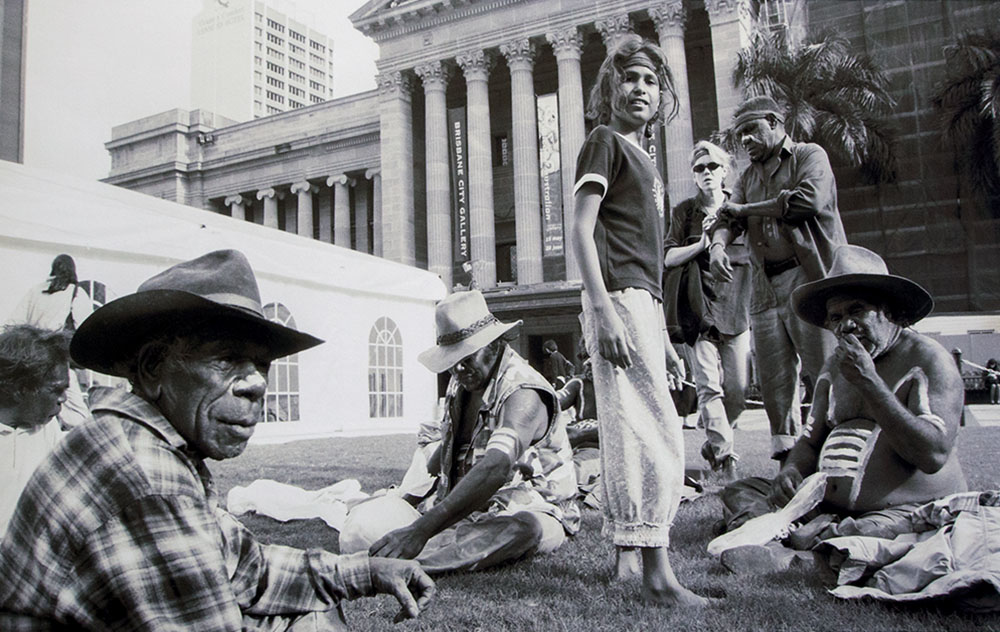
PHOTO: Jo-Anne Driessens. William Sandy, Paddy Carroll, Dicky Brown, Alice Eather, Michael Nelson, and Two Bob Jungari at the Dar Festival King George Square, Brisbane, 1998
.
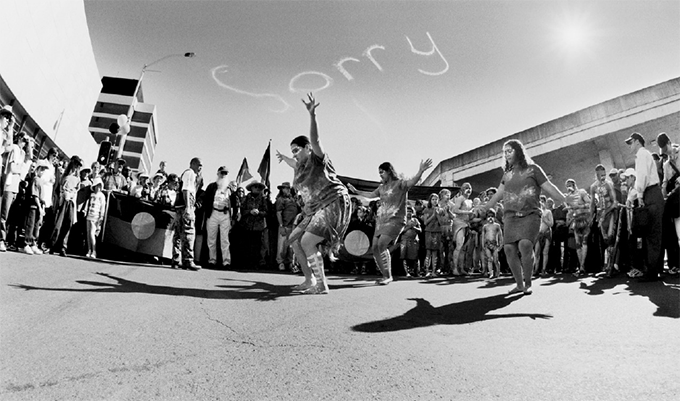
PHOTO: Jo-Anne Driessens – Reconcilliation Bridge Walk, Bisbane 2000
.
ESSAYIST: BETH JACKSON
Beth Jackson – Calatlogue essayist for “Up Close” PHOTO: Doug Spowart
Beth Jackson is a multi-discipline arts professional, curator and consultant of contemporary art.
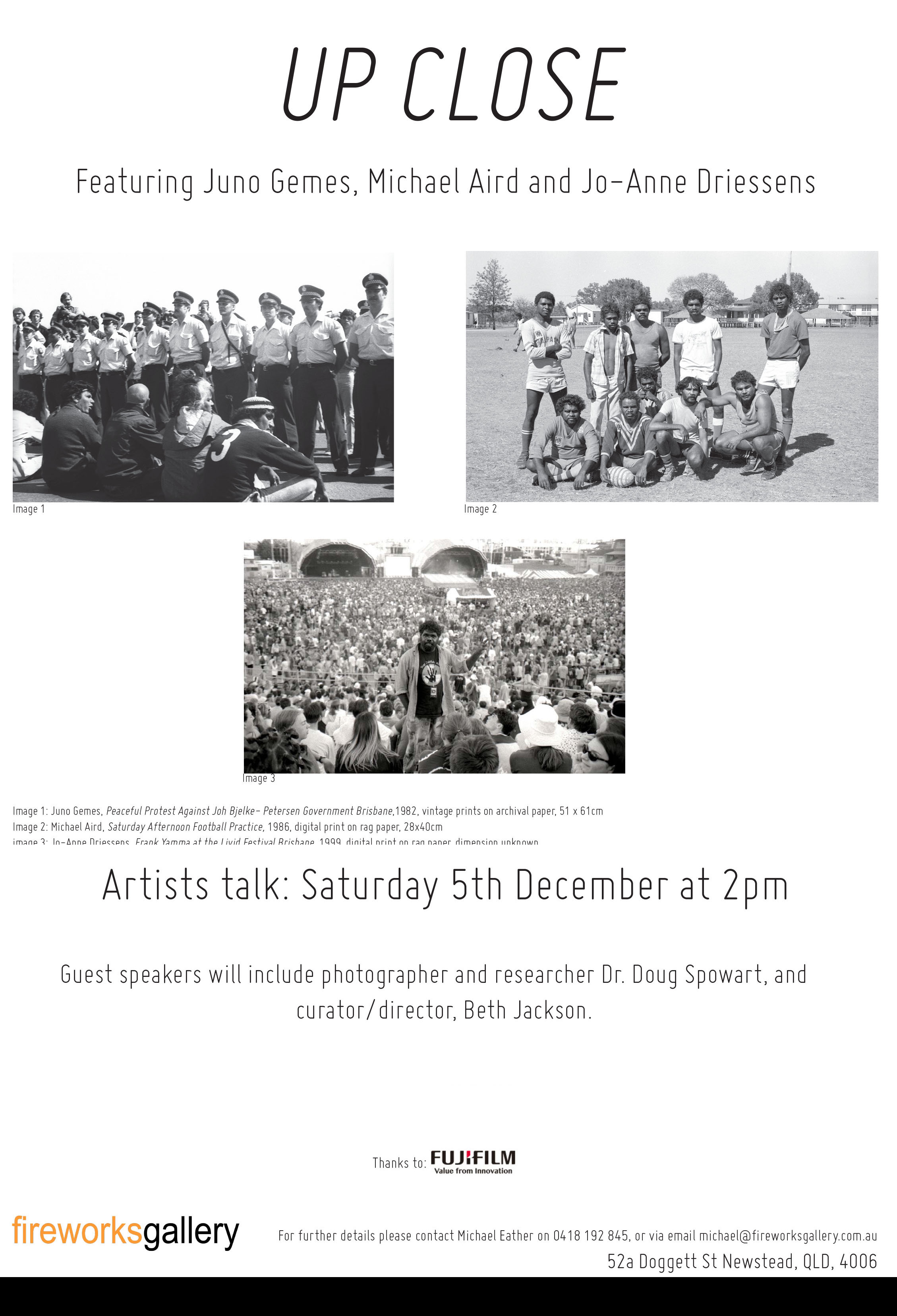
“Up Close” Artist Talk invitation
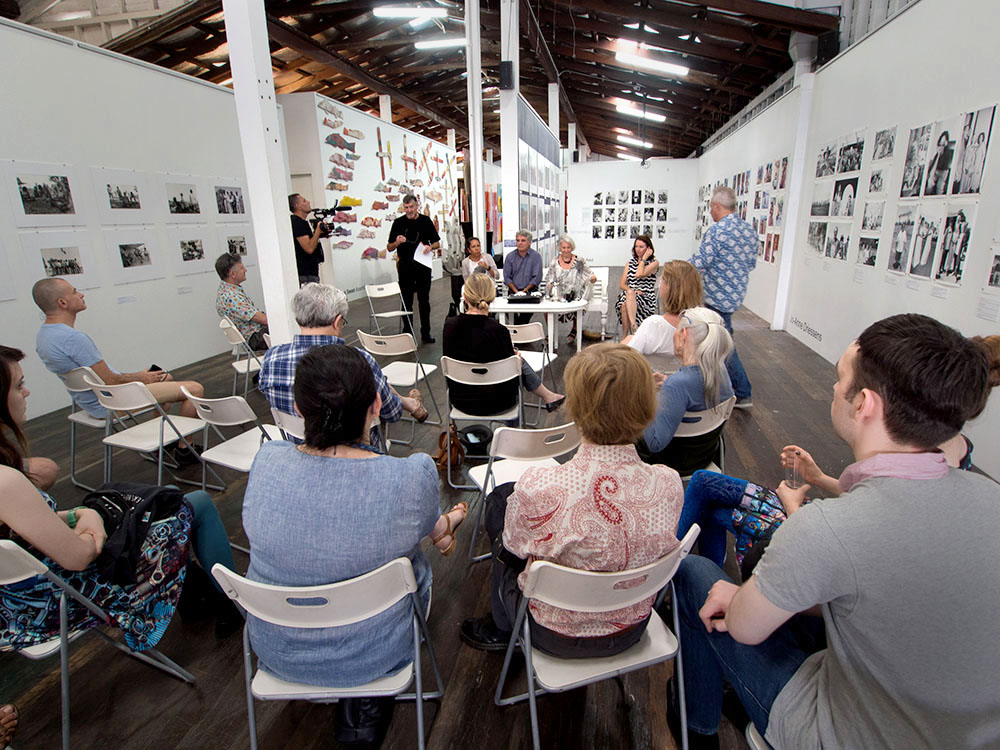
“Up Close” Artist Talk chaired by Doug Spowart PHOTO: Victoria Cooper
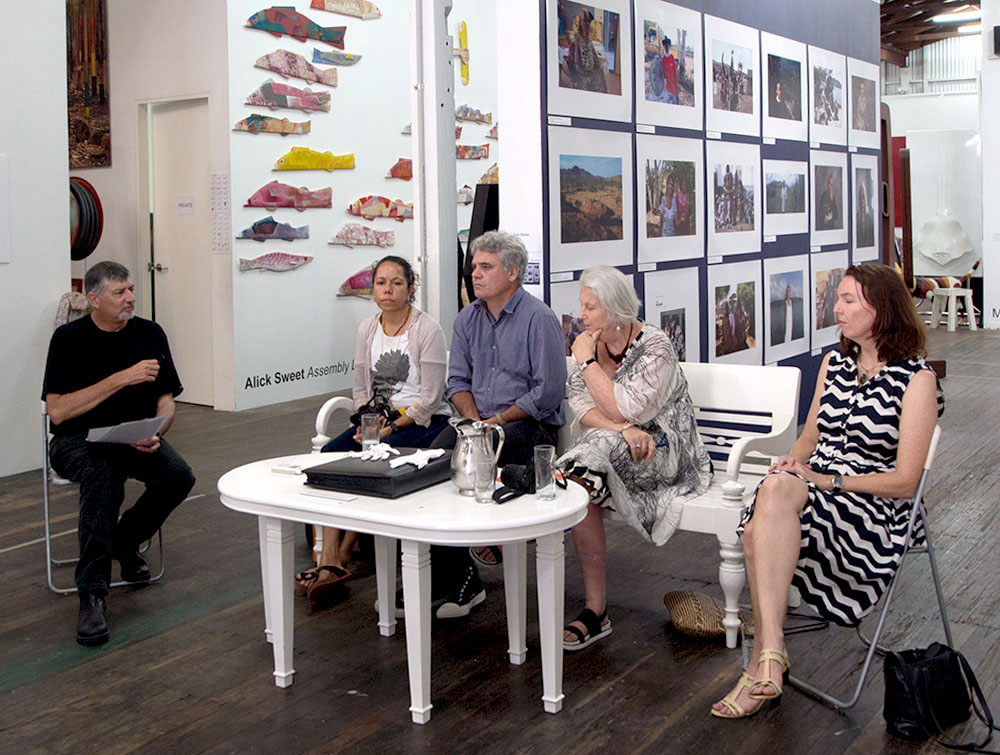
“Up Close” Artist Talk panel PHOTO: Victoria Cooper
A sound recording of the hour-long talk is available by ‘Clicking’ the link below. The file size is 15mb and will be available to download via a link to Dropbox.
Please note that simple recording systems were used – the sound quality is variable…
UP CLOSE ARTIST TALK AUDIO FILE
.
.
.
.
.
The copyright of all photographs of artworks is maintained by the photographers. All other photographs ©2015 Doug Spowart + Victoria Cooper.
VICTORIA COOPER: Shortlisted for National Library Creative Fellowship
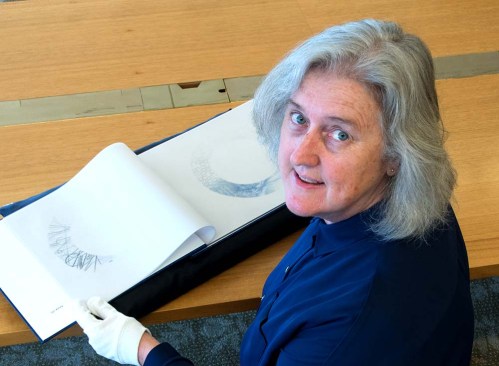
Victoria Cooper researching artists books
I was recently shortlisted for a Creative Fellowship at the National Library of Australia. Even though I was not successful in receiving the fellowship, this level of recognition for my project is very exciting. For a long time I have been dreaming about a project in which I can unleash the bunyip from its exile within the contemporary narrative of children’s books. Muzzled by anthropomorphism, this chimera of the dark swampy corners of Australia may seem to be docile and quaint, but I believe there is still a sublime wildness within–waiting to surface…..
This was my proposal for the National Library of Australia’s Creative Fellowship
The bunyip was once a feared monster of Australian waterways and swamps. In this project I ask: Where is this chimera of Indigenous and early colonial storytelling and myth to be found in contemporary life? Has this fearsome spirit been tamed through parody or clichéd as the mythical swamp creature found only in children’s storybooks or travel brochures?
Perhaps as Henry Rankine, of the Ngarrindjeri tribe in South Australia, proposes in Robert Holden’s 2001 book ‘Bunyips, Australia’s Folklore of Fear’:
‘So the Bunyip (the Mulgewongk) he is still in our Dreamings. He is still there today, just like we have fast jets in the sky, we still have got that fellow in the river’.
Through the opportunity provided by the Creative Fellowship, I had hoped to build upon preliminary research highlighted in my PhD[i] by engaging with the National Library’s substantial collection of material on the bunyip. I had intended to build a visual and textual resource to underpin my development of an alternative concept of the bunyip.
Ultimately this work would form the basis of creative visual narratives that are intended to challenge, re-imagine and re-establish a sense of wonder and respect for this arcane, sublime phenomenon.

Victoria Cooper’s artists book “Koolunga Bunyip” 2007 collected by the National Library
The Project Continues:
Strongly guided by the contemporary theory of Solastalgia[ii], both Doug and I plan to continue this research as an integral part of our individual and collaborative practice. Our Nocturne Projects and many bookworks are created in response to the current issues of living with this transforming human/nature relationship.
[i] My research project, I have witnessed a strange river, can be found online at James Cook University research online site: http://researchonline.jcu.edu.au/31799/
[ii] Solastalgia: the distress caused by environmental change
Glenn Albrecht , Gina-Maree Sartore, Linda Connor, Nick Higginbotham, Sonia Freeman, Brian Kelly, Helen Stain, Anne Tonna, Georgia Pollard Australasian Psychiatry Vol. 15, Iss. sup1, 2007
POETICS OF LIGHT: Pinhole Book and our work
.
It’s not everyday that you wander into an art gallery bookshop and you stumble across a book with your work in it…! A favourite gallery bookshop for me is the QAGOMA bookshops in Brisbane – it’s always worth spending a little time there to see the latest books, to do a little in-store pre-reading, and to check out the ‘Specials’ table where the unaffordable book often becomes affordable.
The other day I’d escaped from some research work at the State Library of Queensland by walking through the preparations in QAGOMA for the 8th Asia Pacific Triennial to drop by the gallery bookshop. I held and flicked through a few books when a large volume entitled Poetics of Light with a big white reduced price label – $99.95 to $59.95. The title seemed familiar to me – then I saw the sub-title Contemporary Pinhole Photography, ‘yes, I remember that’, I thought to myself.
.
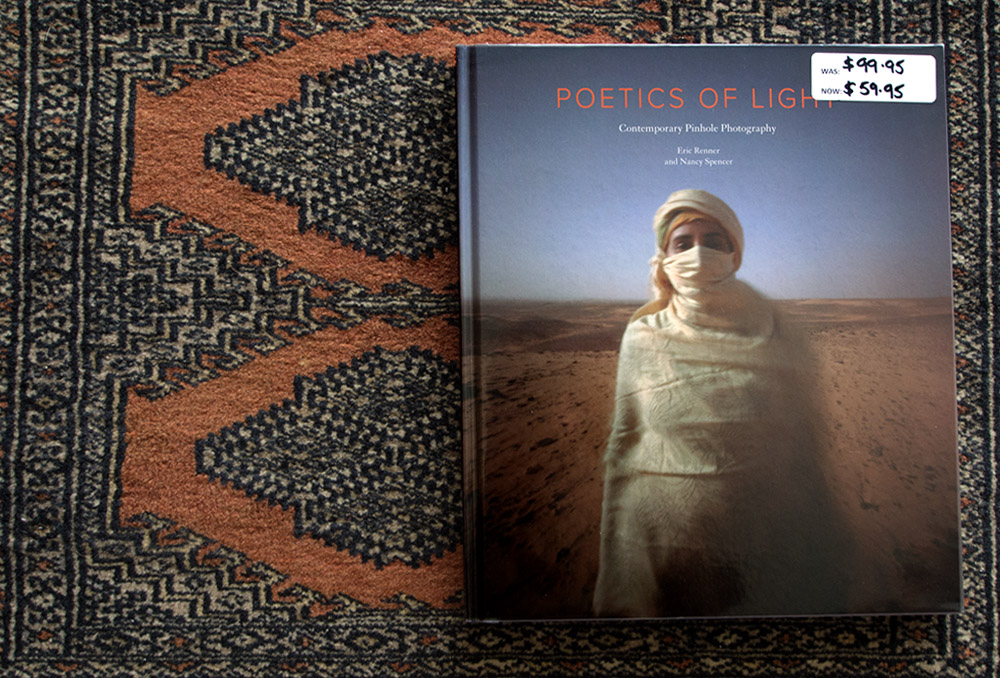
The book Poetics of Light
.
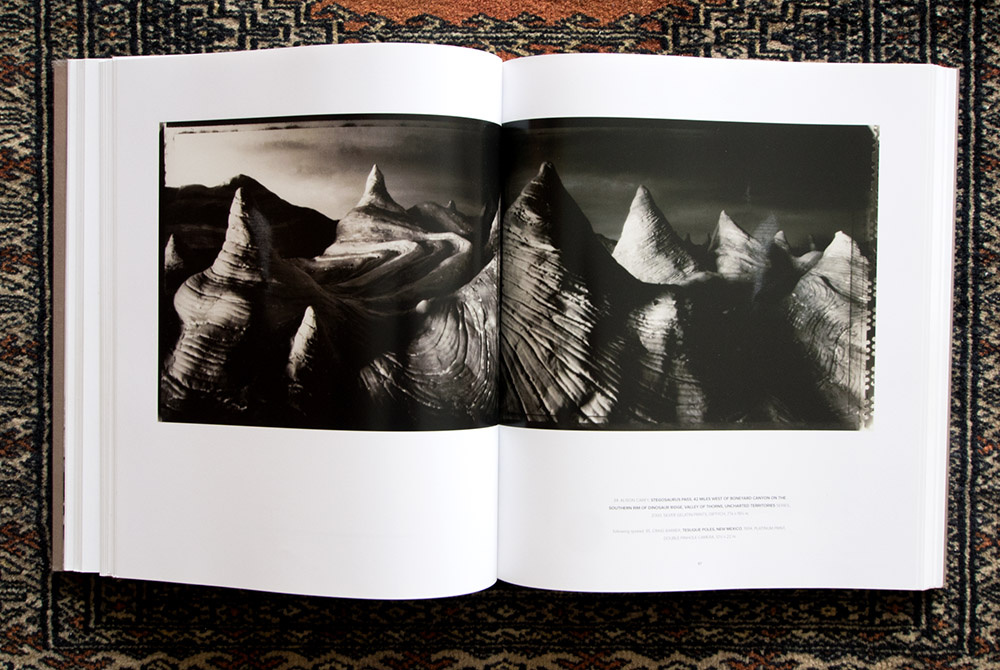
I flicked a few pages at the front of the book and one of my pinhole/zoneplate photos … a few pages on there was one of Vicky’s … I kept turning pages and I witnessed a compendium of amazing lensless imagery …
.

Doug’s ‘The Sentinel’ page

Vicky’s Banksia lineup


.
The last couple of years for us have been full of life-changing experiences and dealing with the issues of the moment, my being made redundant at TAFE and the subsequent time spent job searching, selling our house, lecture and writing commitments and amazing house-sit opportunities for friends – I’d completely lost track of this book and the exhibition that it compliments.
The Poetics of Life exhibition and book celebrates the donation of the pre-eminent Pinhole Resource Collection to the New Mexico History Museum (NMHM). The Pinhole Resource was founded by Eric Renner in 1984 and became the world’s centre for all things pinhole. Through personal research, workshops, networking and publishing Renner led the resurgence in pinhole photography, its techniques, images and its discourse. In 1989 Renner was joined by Nancy Spencer as a co-director of Pinhole Resource and co-editor of the Pinhole Resource journal.
.

The Poetics of Light Exhibition
.
Over the years Renner and Spencer amassed a unique collection of pinhole and camera obscura images, cameras both old and contemporary and texts, books and references about the art and practice of pinhole photography. Much of this material was donated by practitioners as a way of contributing to the ‘Resource’.
The Pinhole Resource Collection became part of the permanent collection of the Photo Archives of the New Mexico History Museum in 2012. This research archive is has the largest collection of pinhole photography and paraphernalia in the world with over 6,000 photographs, cameras, documents and books, as well as an entire run of Pinhole Journal. The NMHM has a website with images available to be searched by author’s/artist’s name, and also includes education resources and a blog.
So what is it about the pinhole image – why would anyone want to make photographs with a lens-less camera…? Renner and Spencer, in the book comment that: ‘describing the mystery of pinhole images is difficult, the concepts of soul, depth, yearning, timelessness, and archetypal feeling all contribute to the kind of visual reality produced, one perhaps only seen in a dreamlike state.’
We both felt privileged to have been selected for this book and exhibition and felt excitement at the opportunity to be recognised for our long practice in this worldwide movement.
Whilst much of our contemporary work centres on the camera obscura each year we participate in the yearly World Pinhole Day in late April – SEE our 2015-submission post HERE.
In the late 1990s I (Doug Spowart) was to state that: “pinholing creates images by simplicity, there is no techno-pretence; the images speak as murmurings, incantations of nostalgia, of mystique and memory; they are incisive and nebulous simultaneously; the process is an enigma.”
.

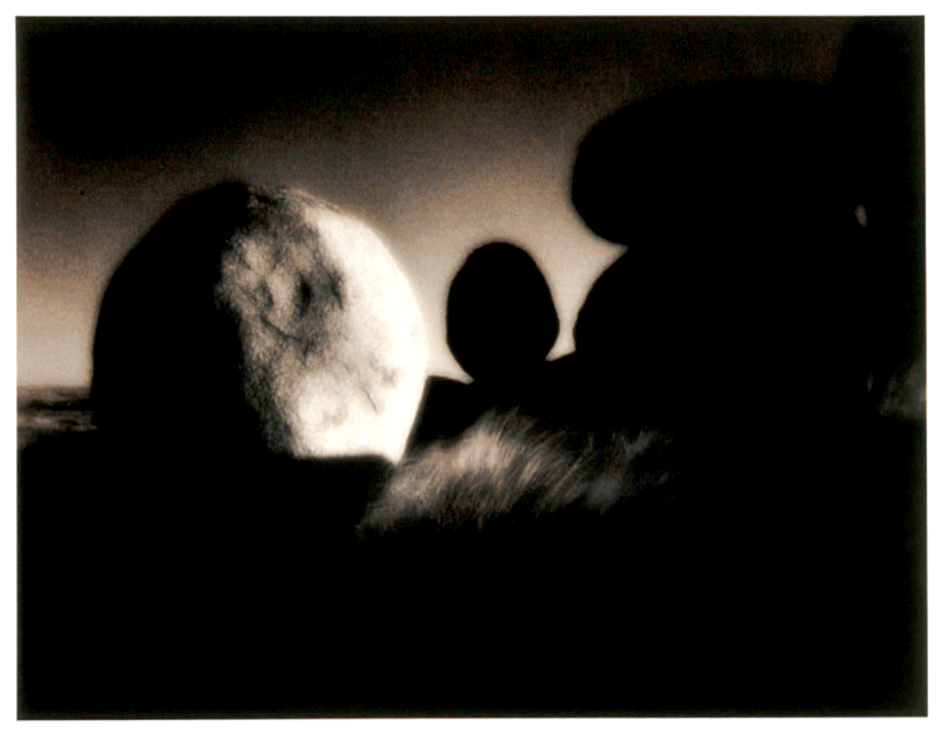
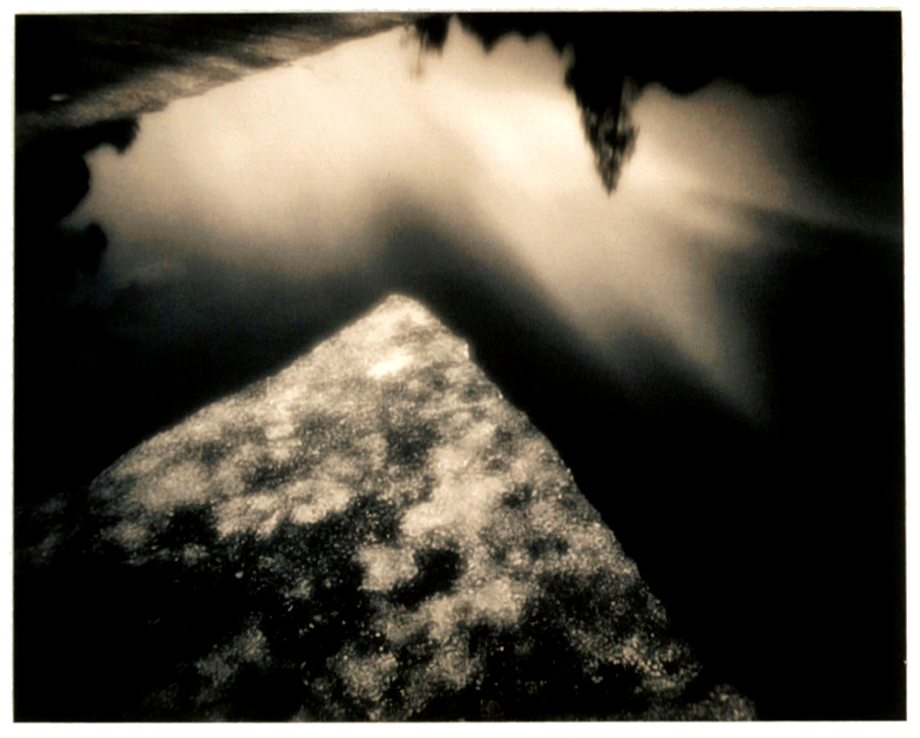
My pinhole (zoneplate) image from the Poetic of Light exhibition and book was taken at The Sentinel at Mt Buffalo using a modified 4×5 Graflex camera. In 1999 ILFORD featured the image in a PROPHOTO Magazine feature on my work. A story about the image is featured on our old website HERE
In a statement about the body of work, The Rocks of Ages, Victoria Cooper discusses her view that image is a result of the connection of technology, process, photographer and subject in the space/time of pinhole photography.
“These images formed part of an ongoing documentation of my corporeal and psychological experiences with the land. They were created using an ancient imaging device, the Pinhole, and analogue photographic materials. Each handcrafted image was then selectively toned to identify with memories other than the eidetic captured within the film. This process is slow and considered – the subject’s light remains on the photographic paper as not a direct document but rather as a visual exegesis of a time and place.”
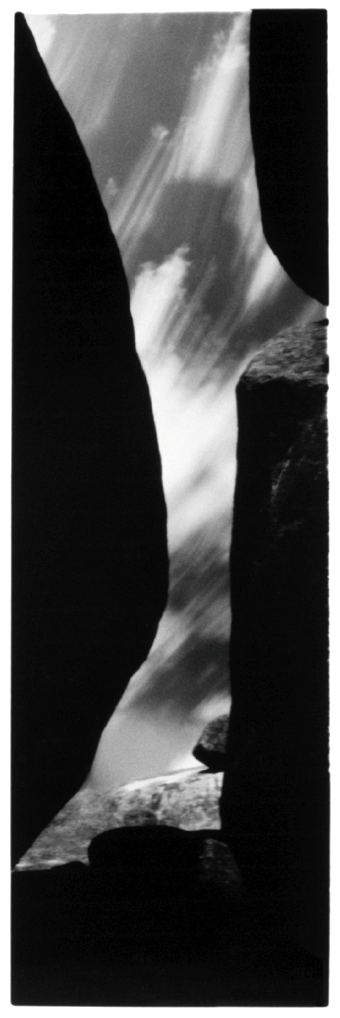
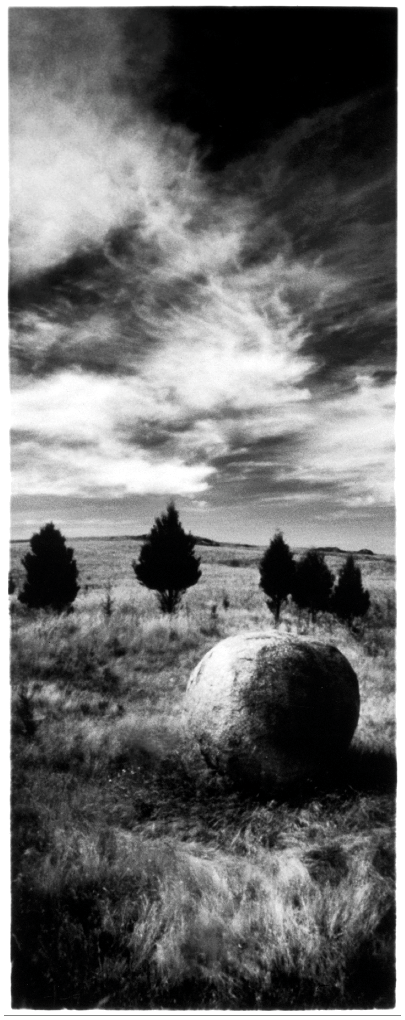
What follows is a selection of pinhole images made by Cooper+Spowart

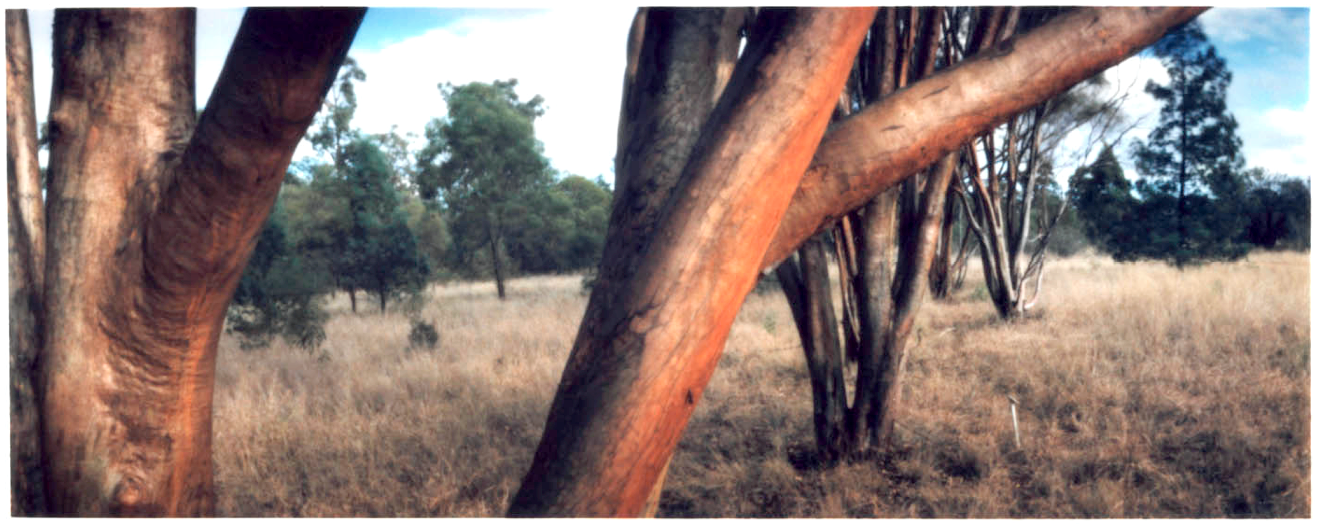
Vicky’s shortbread biscuit tin 6x17cm panorama roll film

.
Other pinhole works by Vicky from film boxes and other cameras …

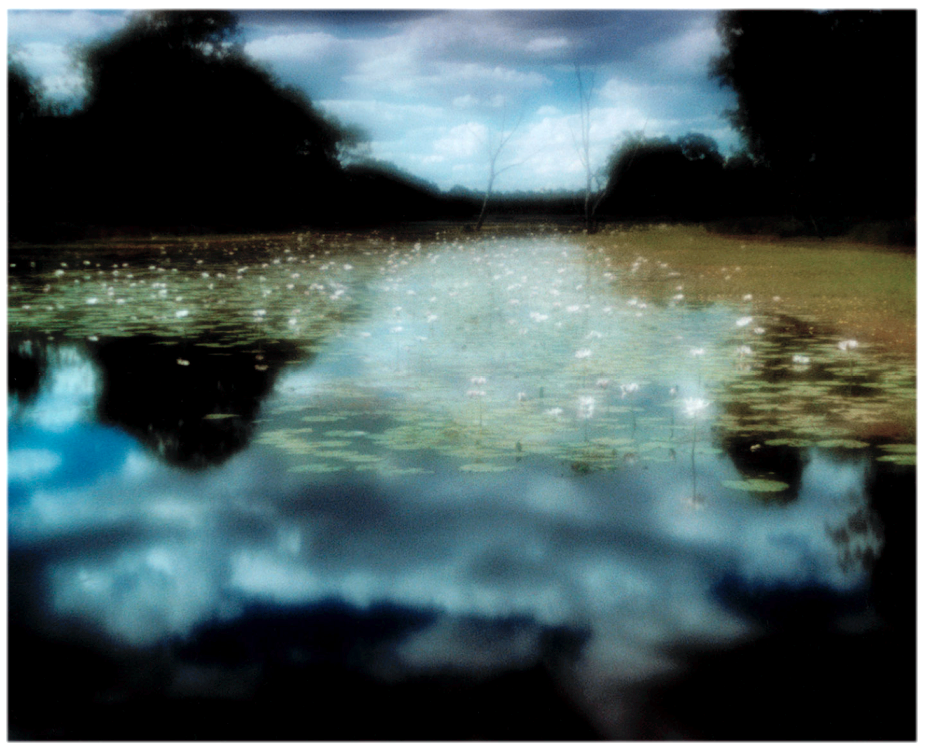

4×5 Chrome film exposed in a film box
.
Doug’s pinhole/zoneplate work from the 1990s

Doug’s Graflex 4×5 fitted with a zone plate

.
The CarCamera
From 2000-2008 we converted our Toyota Tarago into a travelling camera obscura and completed a transcontinental crossing from Adelaide to Darwin in what we called our CarCamera Obscura. Here is a small selection of work from this project…
.

The CarCamera in the field
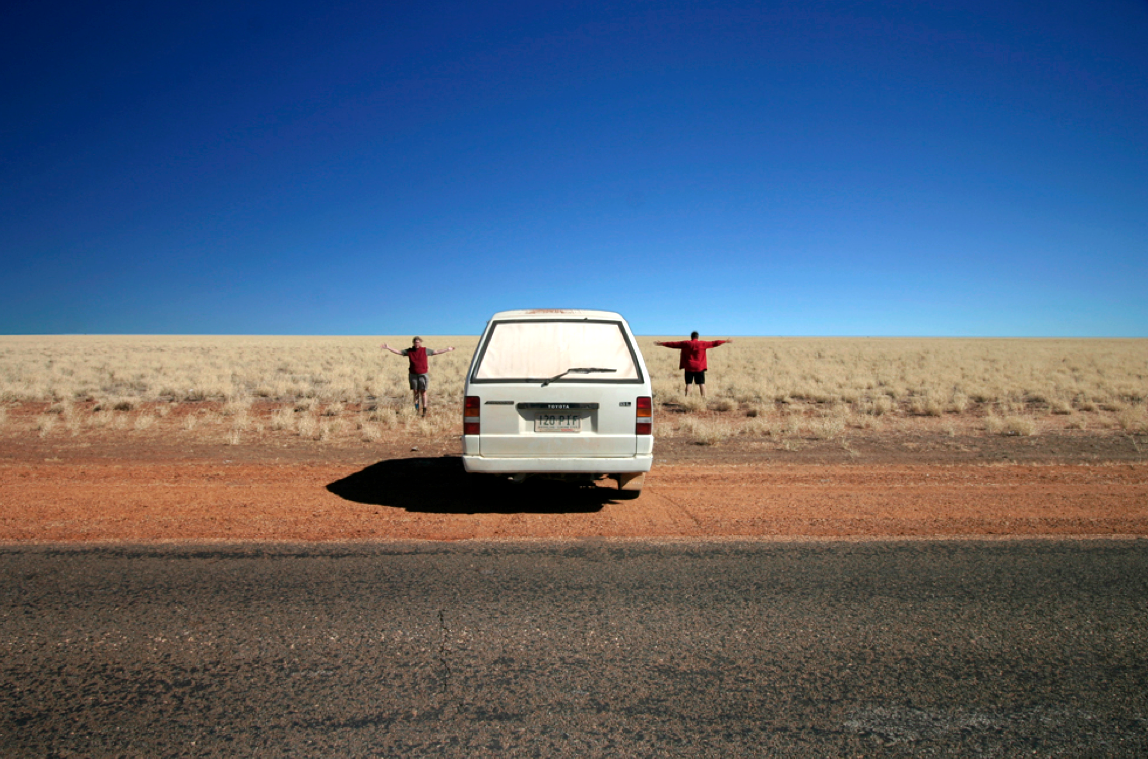
The CarCamera on the Barkly Tableands during the transcontinental crossing
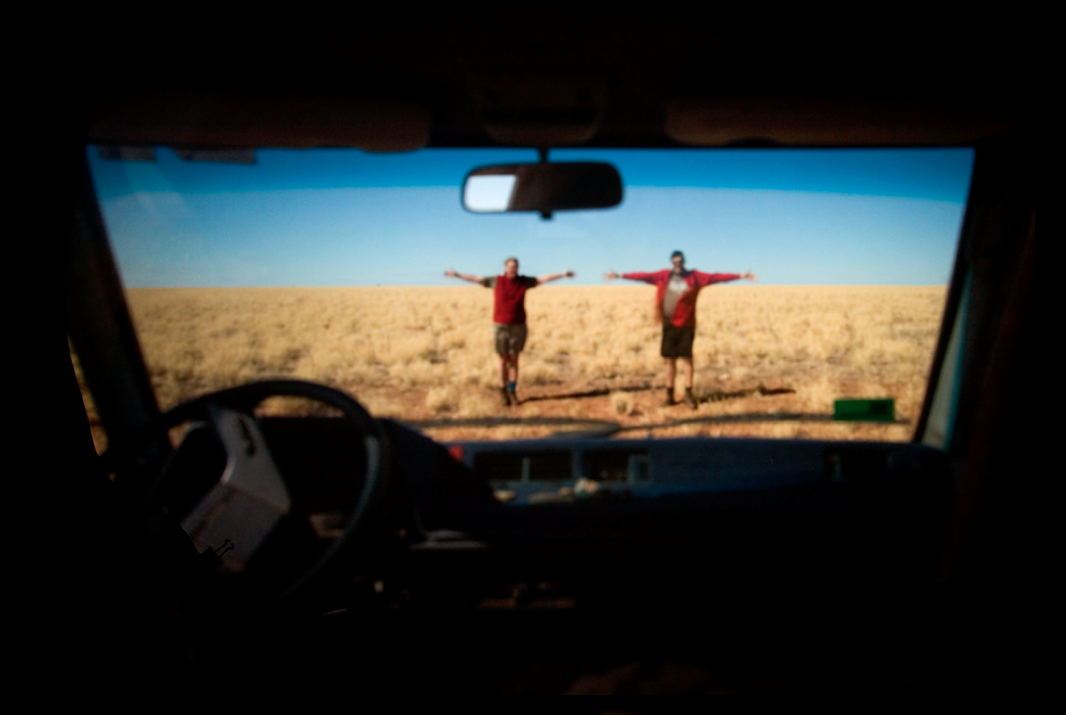
VIEW A DIGITAL MEDIA PRESENTATION OF CARCAMERA IMAGES
.
In a time where digital photography has impacted upon old analogue technologies we saw digital as just another opportunity to explore. When we were loaned a Fuji S1 Pro camera in the later part of 2000 we fitted a pinhole and made images…
.

A pinhole digital photo made with a Fuji S1 Pro camera in late 2000.
.
There are still more challenges … photography has some more to give, and, be discovered …
Oh!! And I bought the book too …
.
.
.
.
.
All images (except the NMHM exhibition instalation) © Doug Spowart and Victoria Cooper

 wotwedid