Archive for the ‘Wot happened on this day’ Category
July 1 – Diggers Rest for Lunch
Doing lots of thesis writing right now – can’t you see?
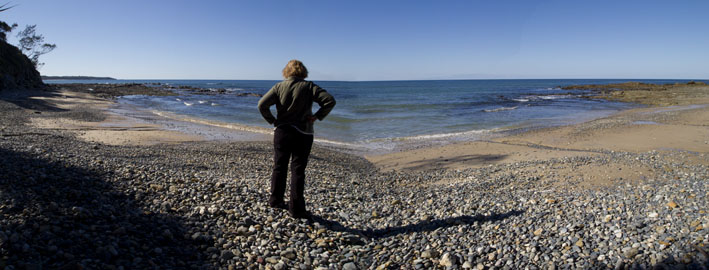
Vicky - looking for a suitable reference
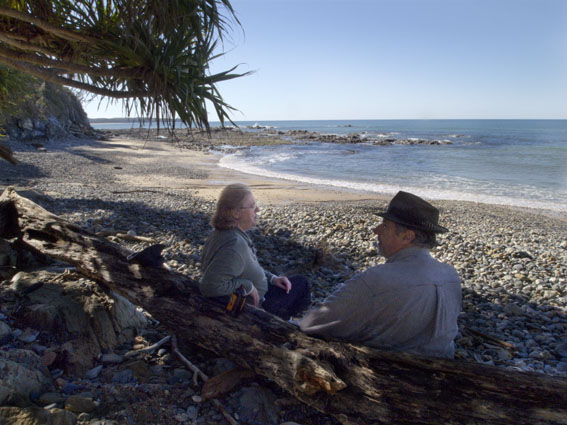
A working lunch under the pandanus
Other research work were Doug almost looses it: See the YouTube video
http://www.youtube.com/watch?v=qo1IiDDVcoc
ODE TO A PENULTIMATE DRAFT
I MUST GET BACK TO MY WRITING AGAIN
. . . but it’s a beautiful day at the beach!
I MUST GET BACK TO MY WRITING AGAIN
. . . but the washing machine needs fixing!
I MUST GET BACK TO MY WRITING AGAIN
. . . but I have a review to write!
I MUST GET BACK TO MY WRITING AGAIN
. . . but I think I need a little midday nap!
I MUST GET BACK TO MY WRITING AGAIN
. . . but’s lunch time!
I MUST GET BACK TO MY WRITING AGAIN
. . . but I should check if the shop has fresh oysters!
I MUST GET BACK TO MY WRITING AGAIN
. . . but the waves are telling me – – – – something!
I MUST GET BACK TO MY WRITING AGAIN
. . . but I still need to read last weekends newspapers!
I MUST GET BACK TO MY WRITING AGAIN
. . . again writing my to back get must I
I MUST GET BACK TO MY WRITING
. . . writing my to back get must I
I MUST GET BACK TO MY WRITING
. . . my to back get must I
I MUST GET BACK TO MY
. . . to back get must I
I MUST GET BACK TO
. . . back get must I
I MUST GET BACK
. . . get must I
I MUST GET
. . . must I
I MUST . . . I
June 24 – Visiting the 2011 OLIVE COTTON

Tamara Dean's First Prize Image "Damien Skipper"
The Tweed River Art Gallery @ Murwillumbah is once again hosting the Olive Cotton Award for Photographic Portraiture – The exhibition will be on show until July 31, 2011.
This year the Judge was Naomi Cass from CCP in Melbourne and as usual the selected works present a comprehensive review of contemporary Australian photo portraiture from the best photographers in the country as well as the latest crop of emerging image-makers. The portrait remains one of the most fascinating genres of photography – there is something about the face that connects with the viewer.
Some observations
In this year’s Olive Cotton Award for Photographic Portraiture there was something for everyone. This exhibition always provides a broad overview of contemporary photographic practice as 2D wall presented images.
The process and media by which the works were made were described by didactic panels placed around the gallery —everything from cyanotypes to gliclee printing and from Type C to inkjet. Those looking for historical processes found large format (whole plate?) ambrotypes paying tribute to the soft romantic feel of 19th century photography. Sizes of the works ranged from the larger than life images of the famous and infamous to the small personal and the everyday through which we can all find some empathy and connection.
In this mix there seemed to be a trend towards the selection of the reinvented holiday or family album snapshot—mostly in black and white. Some of these images showed the poser/s as acting out or ‘hamming up’ personal moments which when placed on the gallery walls transformed these images into arcane representations of everyday life. Others, whether staged or seen images, were illustrations of current political and cultural issues reframed by utilizing the informality and familiarity of the snap shot and then presented as austere gallery-crafted images for the consideration of thoughtful viewers.
For me, the most successful portraits are the ones that draw upon a deep understanding of photographic quality (tone, colour, detail, time etc.) and aesthetics. Alongside this there needs to be a flexible and experimental approach to style embedded in the psyche of the photographer that is combined with an empathy and curiosity for the subject. For me the portrait is developed through time spent by the photographer in collaboration with the subject and created in a moment of synergy and intensity that distils the portrait concept. The strength, depth and intensity of this collaboration, if handled skilfully, can visually transfer an afterimage onto the viewer’s imagination and memory that transcends the gallery experience. For me all of these decisive factors came together in not only the winning image of Tamara Dean, Damien Skipper, but they were also very strong in Russell Shakespeare’s, Michael Zavros and Samantha Everton’s, Illusion.
.
Victoria Cooper 25 June 2011
.
TO ACCESS a list of the finalists and the winners visit:
http://www.tweed.nsw.gov.au/ArtGallery/ArtGalleryOliveCotton2011Exhibition.aspx
DOWNLOAD a copy of the catalogue for the 2011 Award here
June 24 – Visit to Barratt Galleries, Alstonville
On the way south through northern New South Wales we called in on Julie Barratt at Barrett Galleries @ Altsonville. Julie’s current show is by photographer Mike Greenslade and is called Beneath the Surface.
SEE: http://www.barrattgalleries.com.au
Julie spoke of the challenges of operating a regional gallery and her current honours studies at Southern Cross University. She excitedly told us about the Hankie Project being shown in a Melbourne Gallery soon. The Hankie project incorporated handkerchiefs from over one hundred artists that commented on the loss of a loved one – their response as artists was represented on a handkerchief.
SEE: http://objectsofthedead.blogspot.com/2010/06/media-release-from-opening-at-barratt.html
We photographed Julie in the gallery in a moment of exhilaration – A flying Julie!!

Julie Barratt flying
June 13 – Speakers@PSQ Convention, Goondiwindi
PSQ Goondiwindi Logo
Victoria’s topic was “Our home : emoh ruO” which dealt with re- visualizing local neighbourhoods, landscapes and familiar places with personal narratives and perspectives.
She says that, “We all have experienced disaster and change within our own “back yard”. We have been flooded repeatedly by images of this destruction and it’s traumatic effects on humanity. Is it now time, rather than yearning for the exotic travel photo experience, to re-discover our everyday environments and invent new ways of visualizing ourselves and the land we inhabit? Victoria Cooper will be discussing her work in this area and how places can be transformed by bringing together knowledge and personal experience to build creative visual stories.”

Vicky speaks at the convention
Doug’s topic was “LANDSCAPE: Between the covers” in which he spoke about making photobooks of the landscape. His lecture dealt with the idea of the extended narrative of the book and how the ‘artists’ book’ can inform contemporary photobook making. His talk was illustrated by examples and his own work in the form of the hand-made (home-made) book. Ideas about the print-on-demand book and the do-it-yourself monograph were covered. He said “Ken Duncan and Steve Parish did it – You can do it too — Self publish and have Fun!”

Attendees viewing Cooper+Spowart books
The PSQ Convention program speakers program included the photodocumentary photographer John Elliott, Somalia hostage Nigel Brennan and large format guru Richard White.
More details of the event may be available on the website:
http://psqgoeswest2011.weebly.com/
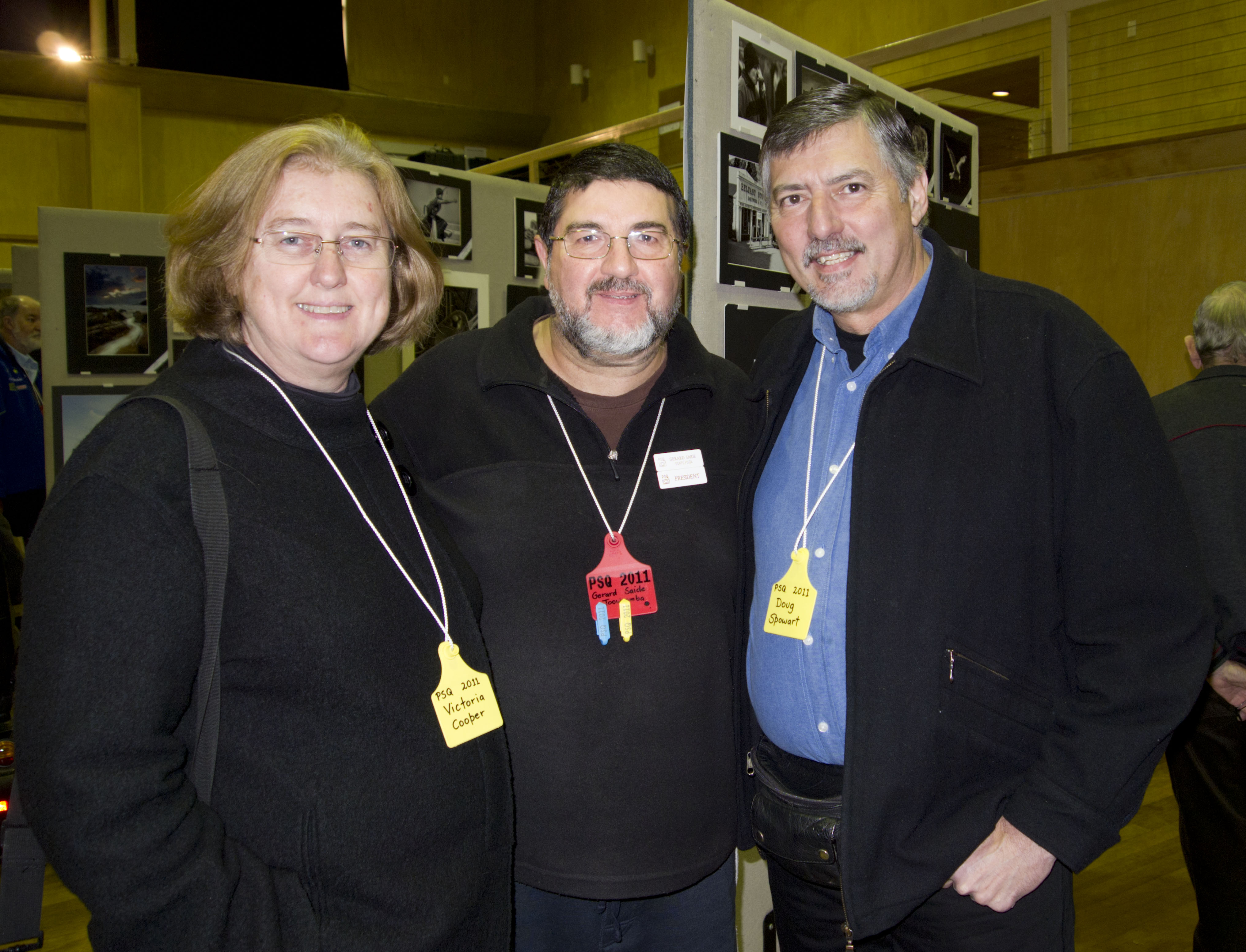
Vicky+Doug with PSQ President Gerry Saide
June 11 – Lydia Egunnike – Qld Disaster Hero, Ipswich Ceremony
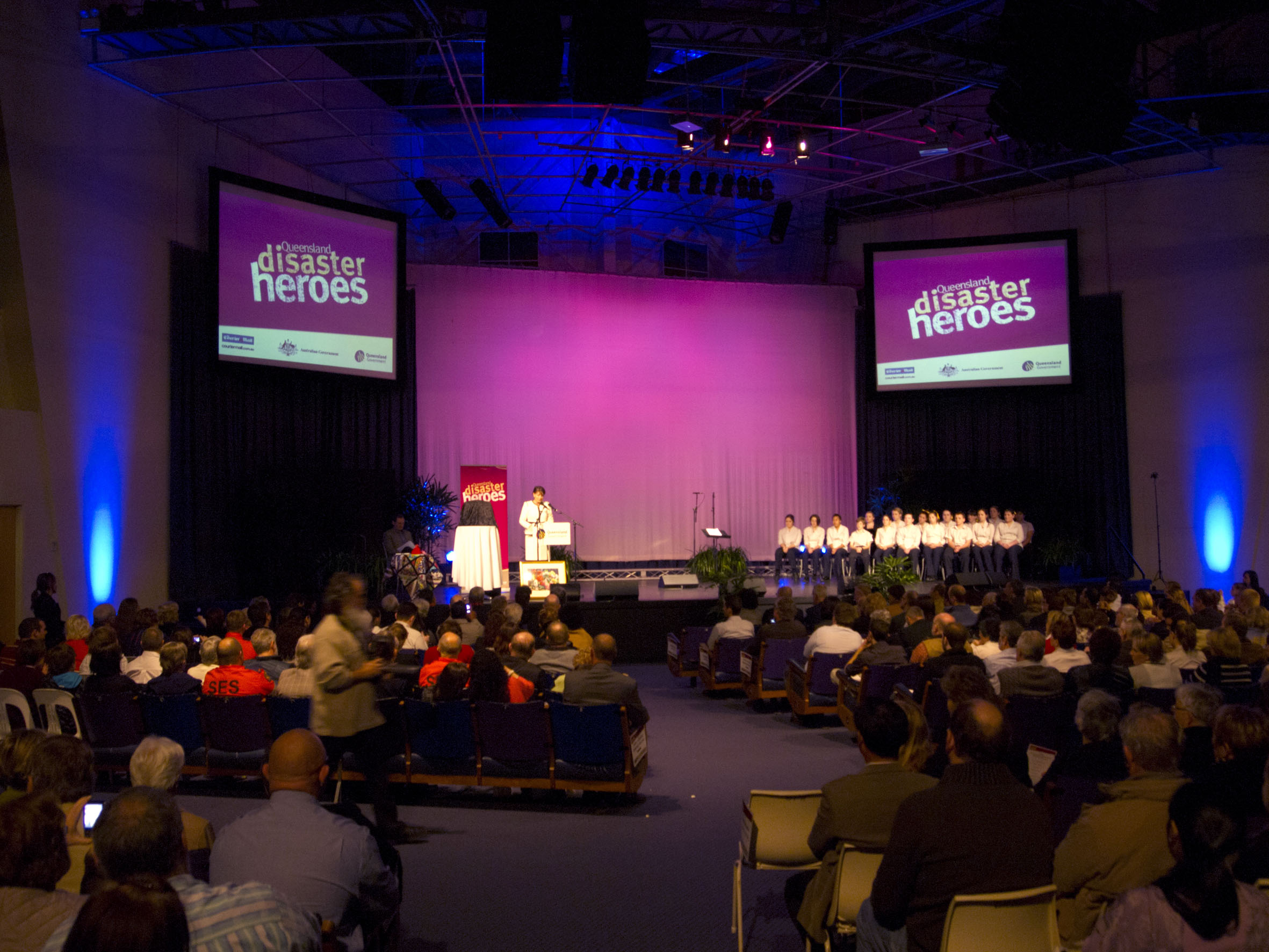
Premier Anna Bligh @ Qld Disaster Heroes Ceremony - Ipswich
For those who follow our WOTWEDID blog will remember the post about the salvage work done on the Sandy Barrie Photo Collection that was inundated in the Ipswich Floods. Conservator Lydia Egunnike, a member of the Australian Institute for the Conservation of Cultural Materials, worked tirelessly with a team that included Noel, John Rossiter and Peter Marquis-Kyle.
As part of Anna Bligh’s Queensland Government DISASTER HEROES awards Lydia, and Sandy’s friend and Salvage Recovery Co-ordinator – Marcel Safier, were both nominated for the dedication and support that they provided during the emergency.
Lydia attended the award ceremony at Ipswich today – Vicky and I attended the event to congratulate Lydia and the members of her team who were able to attend.
Words+Pictures: Doug Spowart
SEE original story post https://wotwedid.wordpress.com/2011/04/08/flood-image-salvage-sandy-barrie-collection/

Noel, Christine Ianna, Lydia, John Rossiter and Victoria Cooper

Lydia's Medal and Certificate
For other information about the Queensland Disaster Heroes awards SEE:
http://www.abc.net.au/local/stories/2011/06/10/3241339.htm?site=brisbane
http://www.qt.com.au/story/2011/06/04/qld-disaster-heroes-honoured/
May 30, 2011 – Celebration of a Life: Helen Cooper
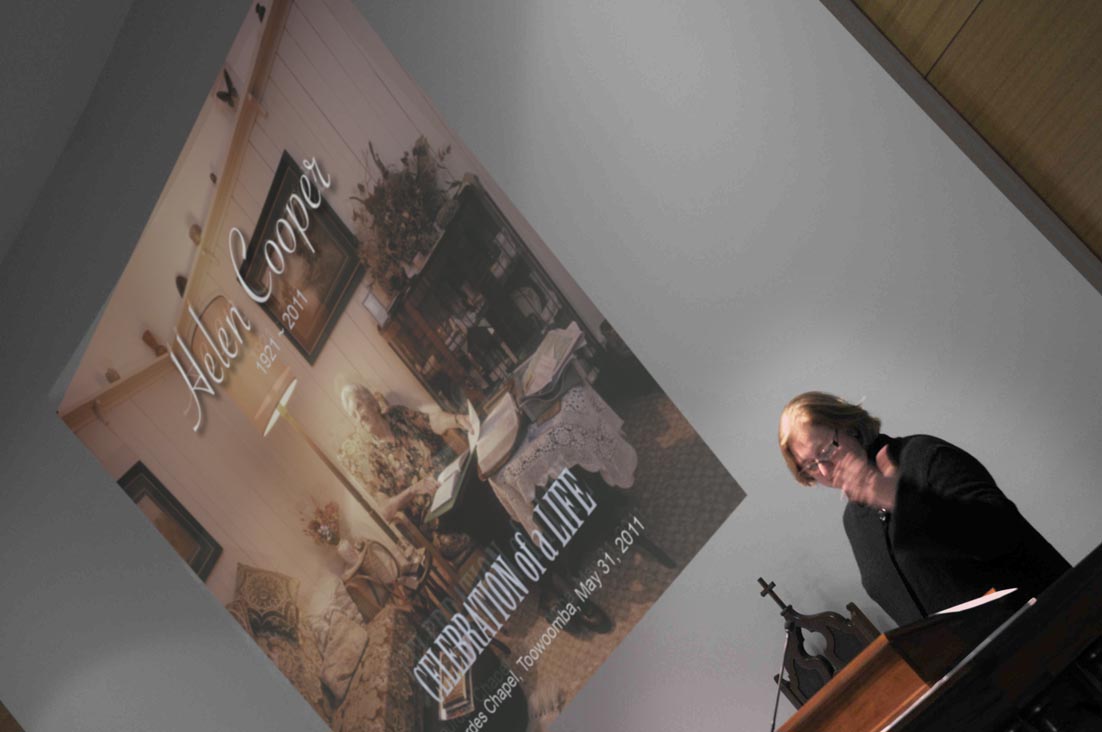
Vicky speaking at the service PHOTO: John Elliott
Celebration of a Life: Helen Cooper
Susan Sontag in her seminal, although now somewhat aged, book On Photography stated that, ‘All photographs are momento mori. To take a photograph is to participate in another person’s mortality, vulnerability, mutability. Precisely by slicing out that moment and freezing it, all photographs testify to time’s relentless melt.’1
Vicky’s mother Helen passed away last week. Aged 89 Helen was quite a character and a local identity in Toowoomba. As part of a service to celebrate her life we assembled a photographic record of her life from images that she had gathered over the years as well as images from family and friends. Whilst the idea of a slide show is considered a standard part of any memorial service when we came to make our own, particularly as photographers, we were captivated by poignancy of the photographic image that we worked with.
Helen’s image collection traversed over half of the history of photography beginning with classic 1920s studio portraits, warm sepia family groups and dreamy high key pen-wash portraits. The oldest photograph is the youngest image of Helen is a snapshot: torn corners, creases, with the patina of being handled and held as a fragment of existence—perhaps even a cherished talisman in the journey of life.
The flow of images can only represent a small fraction of the life lived. Moments captured in a time and Place. Snaps of a young woman, full-length in the landscape, the bathing costume, and a young man appears, the young woman models on the beach full of the promise of life. The young man, Reg, becomes husband—a swatch of beautifully hand-coloured wedding prints attests to that, a house follows and then the first child, then two and soon there are three—another house, another baby.
The photographic process changes and as such identifies the passage of time. The photographs transition from 1930s soft black and white hand coloured studio portraits, to home processed contact prints, on to the gritty 1970s black and white and finally to the dominance of colour firstly from square colour images of 126 Kodak Instamatic cameras to contemporary digital.
The images depict a family growing up, having fun at Currumbin Bird Sanctuary, one graduates from university. The flow of life continues … weddings grand children – all come and visit Helen and Reg. In the middle years colour photographs emerge from the albums—a pink dress and Reg in a sunlit garden, a new home in a wilderness, a place that we now know is the metropolis of Coolum. New Guinea holidays, another image with Reg holding someone’s baby.
Then Helen faces a new life on her own, a new house—with the garden, family memories surround, and the photographs show meetings with family members, now older with their own grown up kids. More weddings, pictures with birds an ANZAC parade, a scene in a coffee shop—the images shift from Helen to two, and then three generations of Cooper. Helen grows older, family visits, church groups, breakfasts downtown—another hat, another . . . another
The photograph as Sontag once quipped is ‘incontrovertible proof’ of existence—but for whom is the proof required? Helen’s collected images were undoubtedly her memories, a record of moments – memorable ones. Moments that define a life and life shared. At the time of her passing the photographs become as Sontag suggests, ‘both a pseudo-presence and a token of absence’. 2
The images in this sequence present both presence and absence—photographs provide a poignant bridge to what has been, memories and an understanding of a life well lived.
1 On Photography, Susan Sontag, 1979, Penguin Books, page 15
2 ibid, page 16
Helen Cooper - YouTUBE Video
May 23 – Re-New[s]ing the news Exhibition
Chronicle Zine: Re-new[s]ing the news
An exhibition of artists’ zines based on the Toowoomba Chronicle newspaper
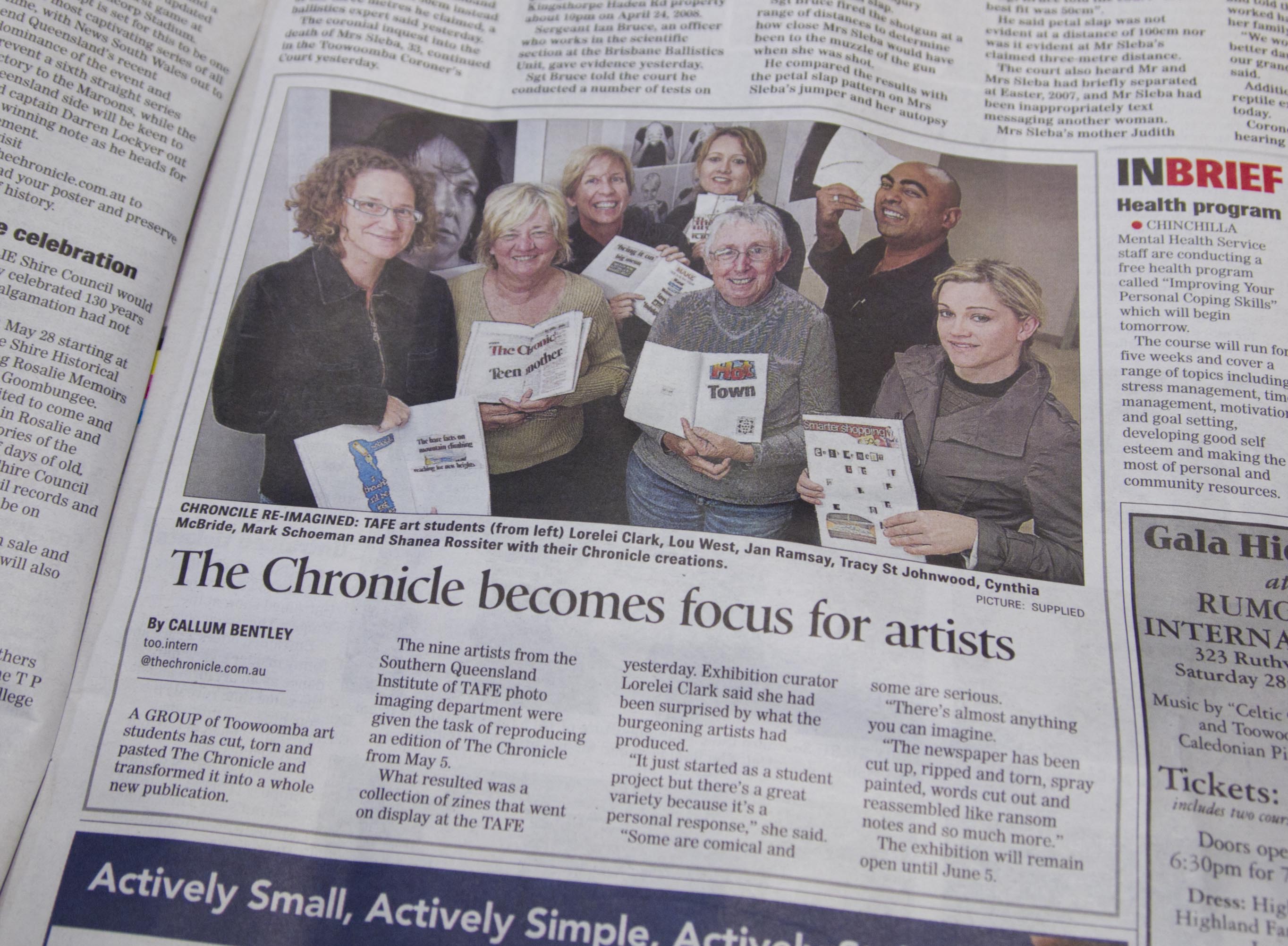
Exhibition story in the Chronicle Newspaper May 25
http://www.thechronicle.com.au/story/2011/05/25/chronicle-artists-toowoomba-tafe-students
.
On Saturday 5 March 2011, nine artists all bought a copy of the Chronicle newspaper. Their challenge was to read, interpret and make an artists’ statement by reading between the lines.
In doing so they find a place where their artistic view collides with the truth of the newspaper. Now these re-used newspapers are presented to the public for viewing at an exhibition in the Flexilearn Centre (library) at the Southern Queensland Institute of TAFE (SQIT).
The publication form chosen by the artists to present their statements is the informal pamphlet format commonly known as the ‘Zine’. This ubiquitous newspaper form has its origins in the ‘free’ press and personal expression.
The contributing artists are all art photography students from SQIT and Teacher Doug Spowart set the project as part of course work.
“The zine task has resulted in some insightful commentary about Toowoomba. Interestingly, whilst each artist made their own statement about news items, in many ways they have retold the news with their own spin on it,” Mr Spowart said.
Curator of the exhibition, SQIT Artist in Residence Lorelei Clark describes the works as almost anything you can imagine.
“The Chronicle newspaper has been cut-up, ripped and torn, spray painted, words cut out and reassembled, with some works having a ransom note look about them,” Ms Clark said,
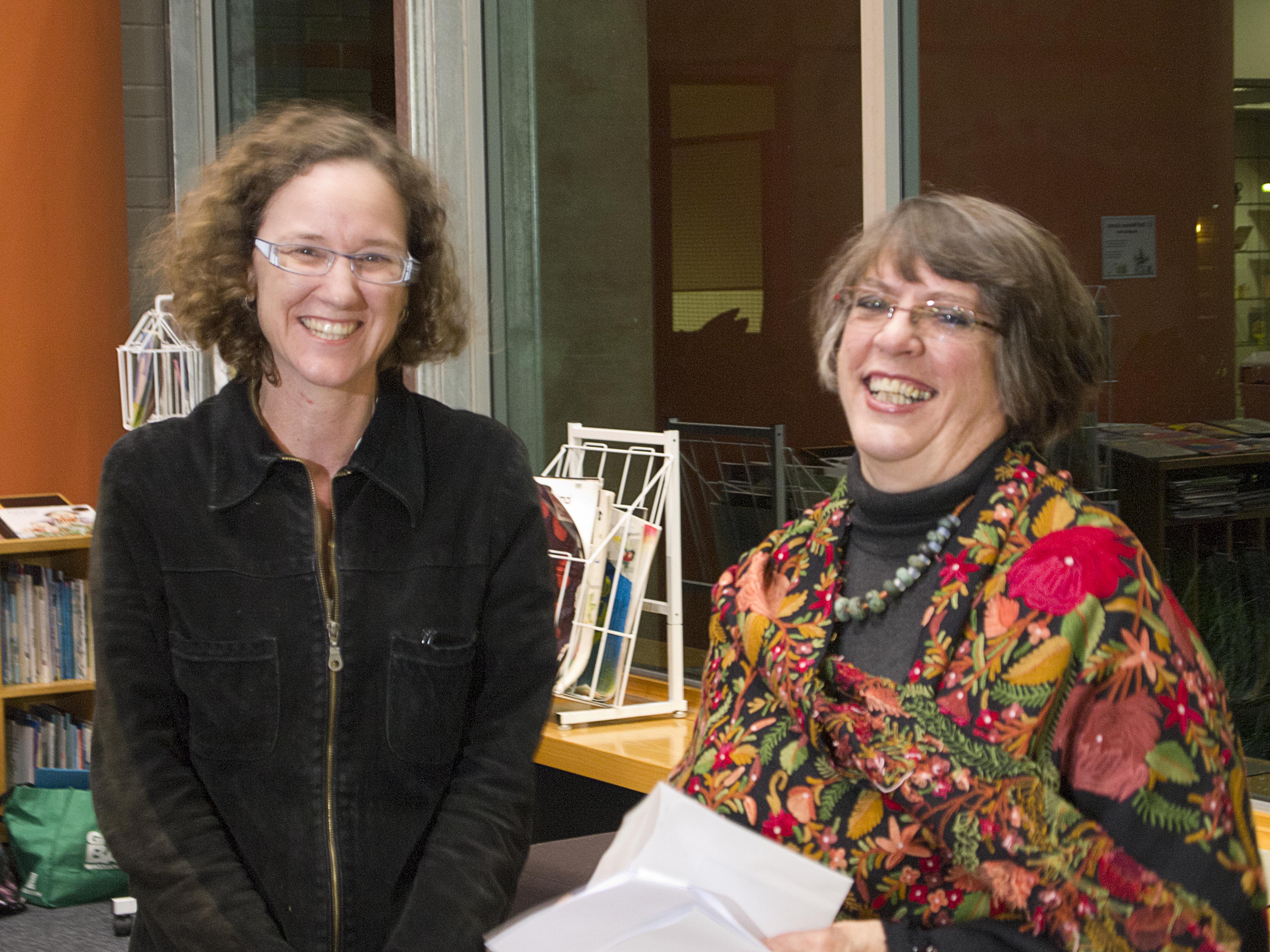
Curator Lorelei Clark and Beverley Bloxham
The exhibition was opened by local arts identity Beverley Bloxham who said
As the name implies, the brief for this project was to take back copies of Toowoomba’s Chronicle as the source material to creatively refashion it with new geometries and to invest it with new meaning as artist’s zines.
According to Wikipedia, “a zine (an abbreviation of fanzine, or magazine) is most commonly a small circulation publication of original or appropriated texts and images. More broadly, the term encompasses any self-published work of minority interest usually reproduced via photocopier.
A popular definition includes that circulation must be 5,000 or less, although in practice the significant majority are produced in editions of less than 1,000, and profit is not the primary intent of publication.”
This exhibition gives me a giggle in choice of source material: repurposing an ephemeral object: ie: yesterday’s news, as a creative exercise. It is many moons since I was so engaged in reading the Chronicle, having decided long ago that it was not the most efficient use of my news gathering time since I became a devotee of Radio National & SBS. However, I do dip into it from time to time to get my fix of local news.
But here, fresh from the minds and hands of creative people, is another reason the read the print emanating from our local daily purveyor of news which had its beginnings as a four penny weekly on July 4, 1861 in a coachbuilder’s shop in James Street with founder Darius Hunt.
The newsprint, however, in these artists’ hands, has been sliced, spliced, torn and shorn, with realigned and juxtaposed journalism, hacked (not hackneyed) headlines, dubious by-lines, reinvented meaning, and re-contextualised content in a manner unintended by the founder and original authors.
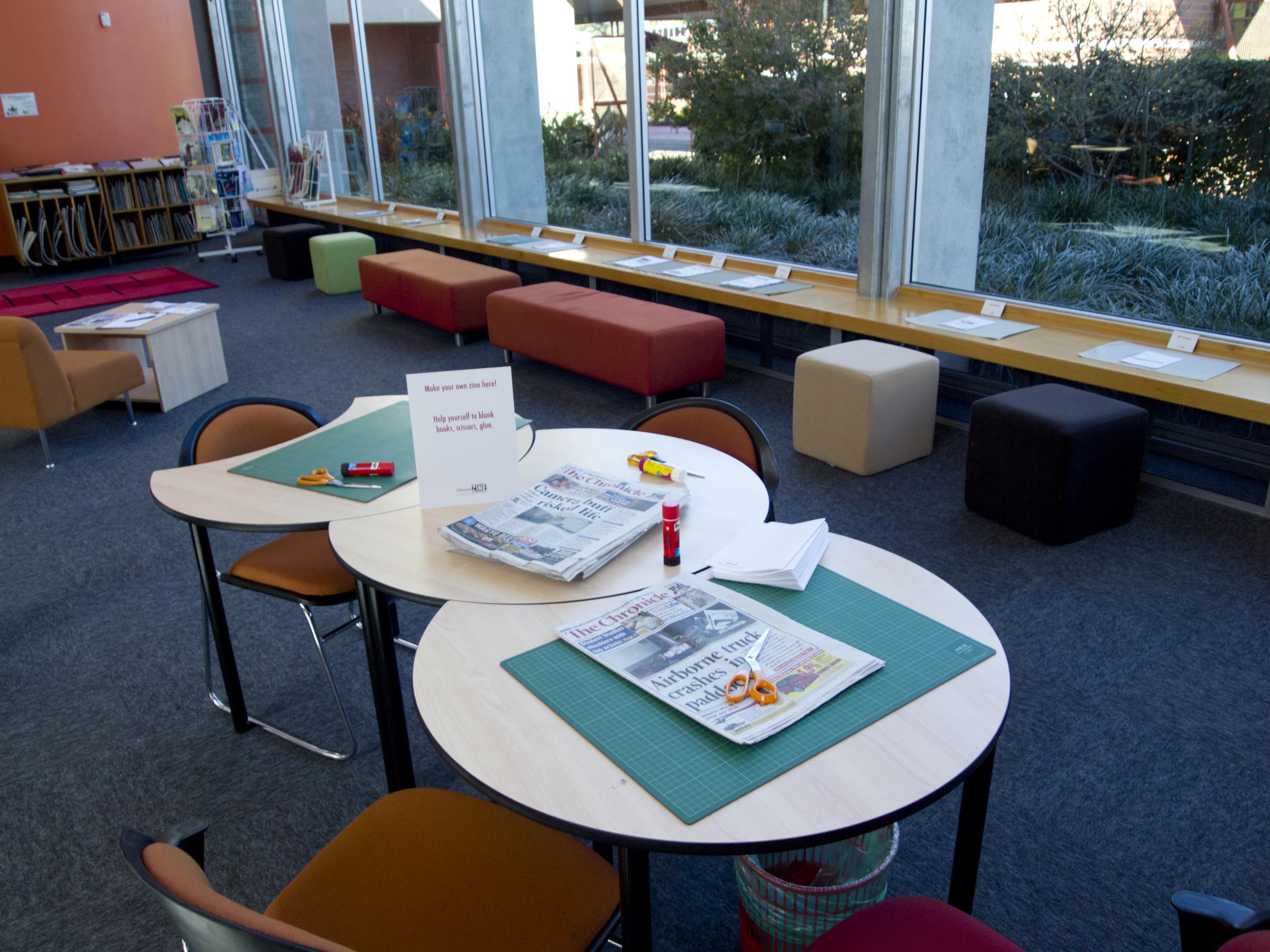
The exhibition - including the 'Make your own Zine' workspace
The zines are available for viewing from May 24 to June 5, 2011 at SQIT Flexilearn Centre in A Block at 100 Bridge Street. Open Monday and Wednesday 8am to 6pm, Tuesday to Thursday from 8am to 5pm and Friday from 8am to 4pm.
.
.
.
May 17 – NEW VIDEOs – QCP ALT & Japanese Pinhole Opening
Uploaded two Video presentations from the Queensland Centre for Photography shows – ALT and Seven Japanese Pinhole Photographers.
THE ALT + PINHOLE OPENING
SEE THE OPENING VIDEO:
https://www.youtube.com/watch?v=WYAY3zXQrfI&feature=mfu_in_order&list=UL
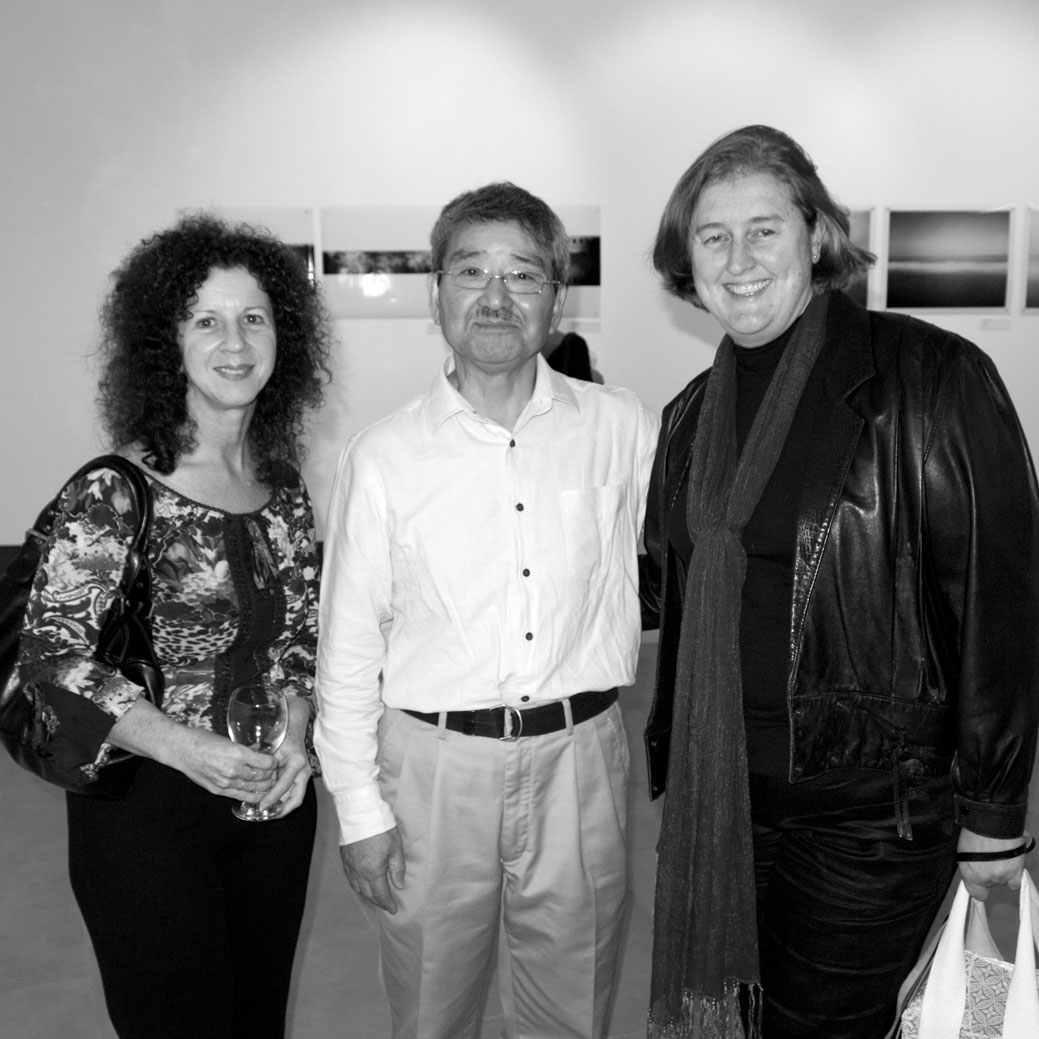
SEE THE JAPANESE PINHOLE PHOTOGRAPHERS VIDEO (Note: Mainly in Japanese language)
https://www.youtube.com/watch?v=ewUTYY2enKc&feature=mfu_in_order&list=UL.
.
May 7, 2011 ALT Exhibition opens @ Qld Centre for Photography
SEE TWO NEW EXHIBITIONS @ QCP – Our video work “CARCAMERA” is on show
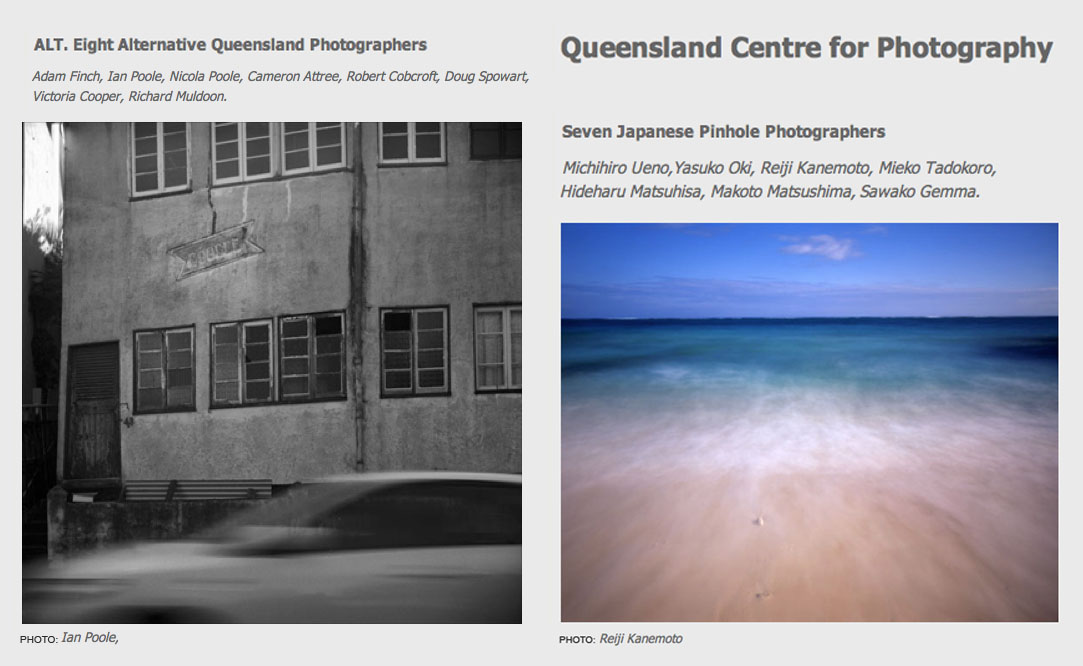
SEE <http://www.qcp.org.au/exhibitions/current/album-603/28>
SEE OUR VIDEO <https://www.youtube.com/watch?v=Wg8zdvr1nfY&feature=mfu_in_order&list=UL>
.
We wrote the exhibition catalogue text – See below
.
Somewhere between the making, the idea and dreaming: Post-technology Photography
Ban lenses and viewfinders. Ban your auto-wind buzzy-flashing built in obsolescence jewellery.
Give up aspiring to the conventional. Play with light, rediscover your vision and party.
Justin Quinnell[1] talking about pinhole photography
Who would have thought that age old processes along with out dated technology would have any relevance in the seamless slick technological digital image world. Or even that the latest digital technology could become hijacked as a mere emulator of the appearance of old time photos. With its arcane history of chemicals, darkrooms and focussing cloths photography is now morphing into a brave new emancipated world where everything old can be new again and anything goes.
Many photographers find this review of processes and technologies liberating—providing an alternative avenue for exploring photography often resulting in the excitement of discovering new visions. A recent popular photobook on the Holga[2] camera illustrates a kaleidoscope of visual imagery created with this simple plastic camera. In the introduction to the book Adam Scott exemplifies this method of working, “I had already been shooting for many years with single lens reflex cameras and was beginning to get bored of photography, but the Holga reopened my eyes and injected me with new love, I felt as though I had discovered a new sense or a new colour.”[3]
Into this argument steps curator Ian Poole with this exhibition entitled ALT. Photographers in this show are similarly enamored by this technological tinkering as Scott and dust off old junk cameras like the Russian Lubitel or dislocate a Diana lens and relocate it onto a DSLR sensor. Some photographers may use new technology like the ubiquitous iPhone as creative stimulation for follow-up imaging. But is it the technology that lubricates creativity in these photographers work? As in Justin Quinnell’s challenge in the opening quote “give up aspiring to the conventional” these image makers aim to subvert the ‘conventional’ and reinvent photography for and by themselves.
The images made by photographers in the ALT exhibition exalt and capitalise on the vagaries and flaws arising from technology, uncontrolled serendipitous moments and the slowing of time. All of these questionable qualities are commonly regarded as poor technique from faulty and inadequate equipment. Through their experimentation these photo-rebels appear to be reacting against technological control by preferring the serendipity and imperfections of real human experience.
It seems that these processes allow a space for pure wonderment much like that of children at play. Here the photographer’s imagination is stimulated by ‘tinkering’ with technology and the conventions of photographic practice from which new approaches to subjects and concepts arise. Critically the act of making, discovery and reflexive action is fundamental throughout the process. In other words the photographer makes the photograph—not the technology.
Pinhole photography is another malleable medium for the tinkerer. The exhibition, Seven Japanese Pinhole Photographers, brought together by Hideharu Matsuhisa a respected graphic designer and pinhole photographer, shows the diversity and commonalities of the pinhole experience. In the catalogue specially produced by Matsuhisa for this show, Reiji Kanemoto comments, “These pinhole views of restless waves show me the passage of time, condensed into a single moment that lives forever.” This is an experience that is common to many pinhole photographers as long exposures are inherent in the process. In a recent exhibition of Matsuhisa’s pinhole photography at Caloundra Regional Gallery, the Director, John Waldron referred to pinhole photography as “part of the Slow Revolution”[4]
Slow cameras: slow photography—creates a kind of image making approach that is just as satisfying and as good for you as slow food. For some Japanese pinhole photographers the work is meditative as Michihiro Ueno finds when working with pinhole cameras that, “I’m made to be more conscious to face time and objects.”[5] Alternatively Yasuko Oki is motivated by the pure wonderment of capturing unseen visual phenomena as she photographs fluids in glasses (water, juice and beer) that she drinks everyday.
As the camera, the lens and the darkroom/computer are increasingly open to subversion, the photograph maybe now free from connection to a specific technological time and place and it’s associated obsolescence. Although there has always been a cult following for the “alternative” in photography, what we see strongly from this exhibition series, and more broadly in the electronic medium, is that photographers are well equipped and ready to grasp, shape and fiddle with any means to extract images. Is this the sign of the onset of a post technology condition? Has the “alternative” contagion gone viral? Can technology or iPhone apps keep pace with the imagination and the inventive nature of the photographer? Certainly, photography has loosened up. Rather than being the keeper of secret knowledge and technological proficiency, the photographer is now more . . .
Victoria Cooper and Doug Spowart
Victoria Cooper and Doug Spowart are visual artists working in the fields of photoimaging, artists’ books and photo education. Victoria and Doug have collaborated on many art projects and exhibitions including pinhole, projections, the room and car camera obscura. Their images and artists’ books are included in major national collections.
[1] The World through a pinhole (catalogue) curated by Diane Stoppard and Ellie Smith, Wellington, New Zealand, 1998.
[2] Lomographic Society International (ed), 2006. Holga, The world through a plastic lens, compiled by the Lomographic Society International and Adam Scott. Lomographic Society International, Vienna, Austria.
[3] Introduction by Adam Scott, Holga, The world through a plastic lens, Page 17.
[5] See catalogue, Japanese Seven Pinhole Photographers, by Hideharu Matsuhisa
WORLD PINHOLE DAY: April 24, 2011
‘Round the [w]hole world today pinholers were out having fun – Making their images for the 2011 WPD.
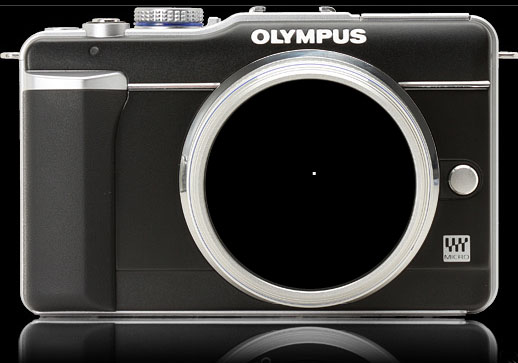
We have just purchased an OLYMPUS EPL1 a Micro Four Thirds digital camera. It features interchangeable lenses, 12 megapixel capture and HD Video – It’s not the latest and greatest but it is very reasonably priced @ around $450 at JB-HiFi or Harvey Norman.
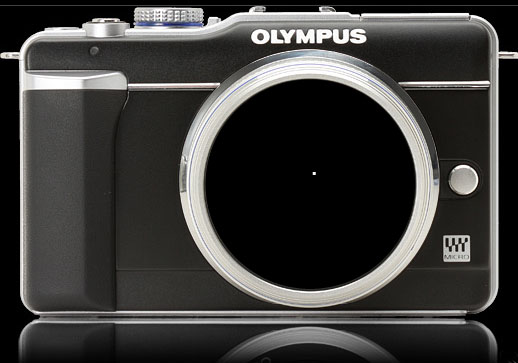
What is exciting is we drilled out the body cover – put about a 10mm hole in the middle and stuck an old home-made pinhole into it and made pictures. In ‘LiveView’ mode you can even see what you are shooting and, better still, we are shooting pinhole movies!!! In fact out 2011 WPD offering will feature a ‘stilled’ image (SEE Below) with a link to a YouTube video.
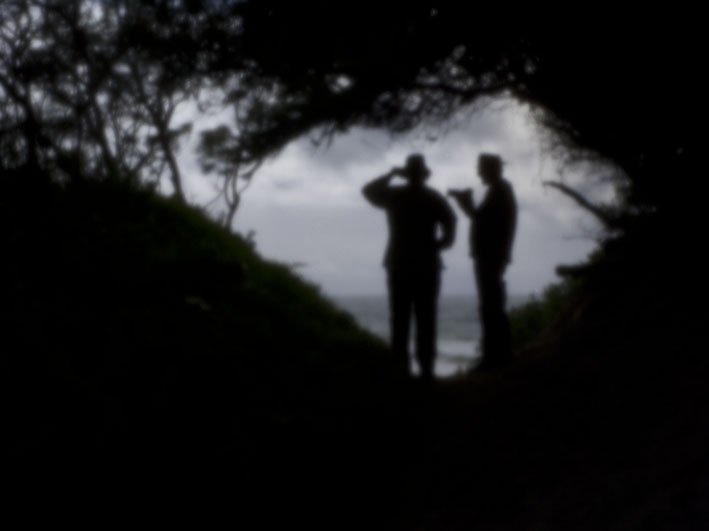
Still from the Pinhole Movie: "Being There . . ."
HERE IS THE LINK http://www.youtube.com/watch?v=Yk4vnbzTqOU
Vist the WPD Site for other contributors: http://www.pinholeday.org/gallery/2011/
Our WPD images:
2011 http://www.pinholeday.org/gallery/2011/index.php?id=924
2010 http://www.pinholeday.org/gallery/2010/index.php?id=2464&Country=Australia&searchStr=spowart
2006 http://www.pinholeday.org/gallery/2006/index.php?id=1636&Country=Australia&searchStr=cooper
2004 Vicky http://www.pinholeday.org/gallery/2004/index.php?id=1553&Country=Australia&searchStr=cooper
2004 Doug http://www.pinholeday.org/gallery/2004/index.php?id=1552&Country=Australia&searchStr=spowart
2003 http://www.pinholeday.org/gallery/2003/index.php?id=615&Country=Australia&searchStr=spowart
2002 http://www.pinholeday.org/gallery/2002/index.php?id=826&Country=Australia&searchStr=spowart

 wotwedid