Archive for the ‘Wot happened on this day’ Category
‘TAKE 3’ @ Block Work Gallery (Toowoomba)
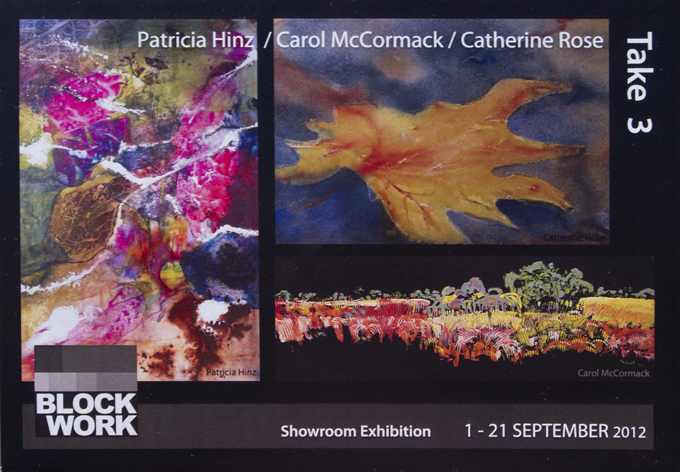
Block Work Gallery – Take 3 Invite
We visited the Block Work Gallery on Saturday for the opening of the exhibition TAKE 3 featuring paintings from three Western Downs artists – Carol McCormack, Catherine Rose & Patricia Hinz. The gallery’s ‘white box’ walls were laden with the colours of the landscape, abstract forms and quirky stuff that artists just happen to see and then share with us through their work. The gallery was filled with supporters and well-wishers, and hopefully a few interested in purchasing work.
Gallery Director Sally Johnston has once again shown her gallery’s support for the regional artist and their vision – congratulations on a great show.
Here are some images of the event, the artists and their work…
.
.
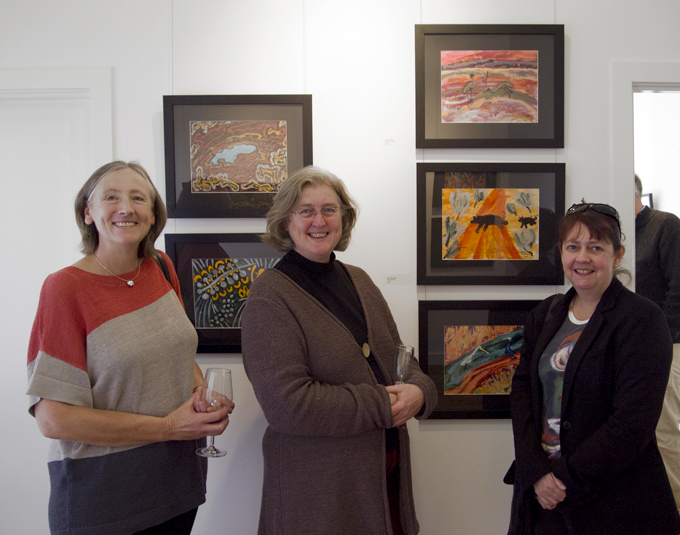
Felicity Rea, Victoria Cooper and Deb Beaumont @ Take 3
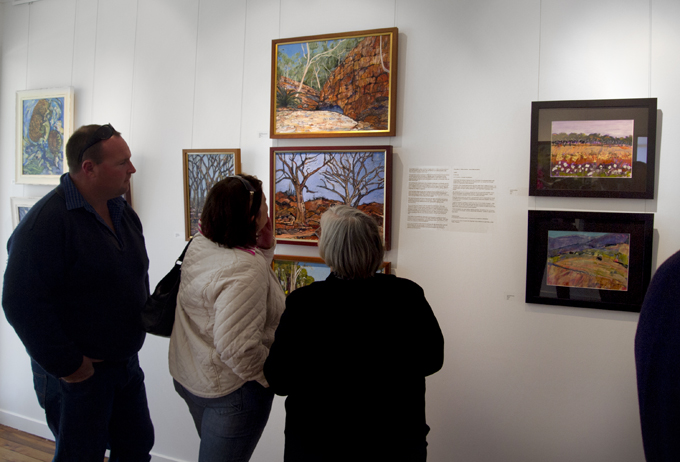
Take 3 exhibition, Block Work Gallery
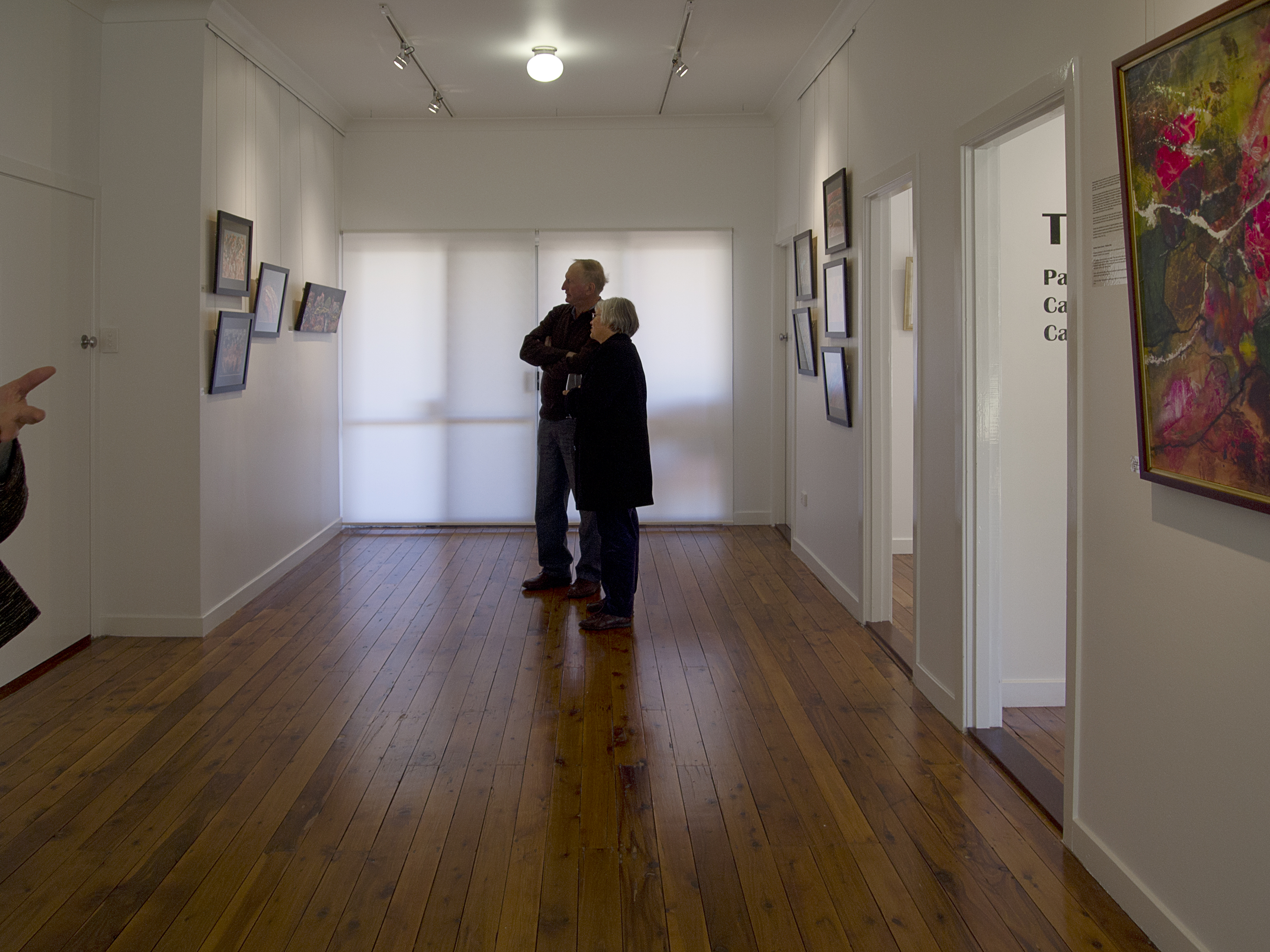
Take 3 exhibition Block Work Gallery
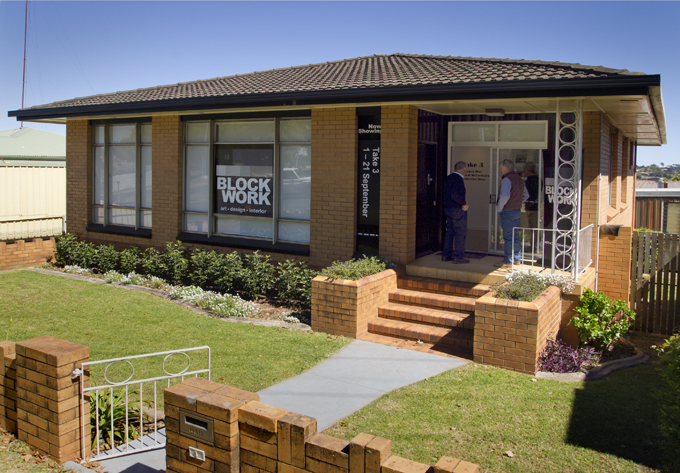
Block Work Gallery IMAGE: Doug Spowart
FROM TOOWOOMBA TO SPAIN AND BACK AGAIN – IN 24 HOURS!
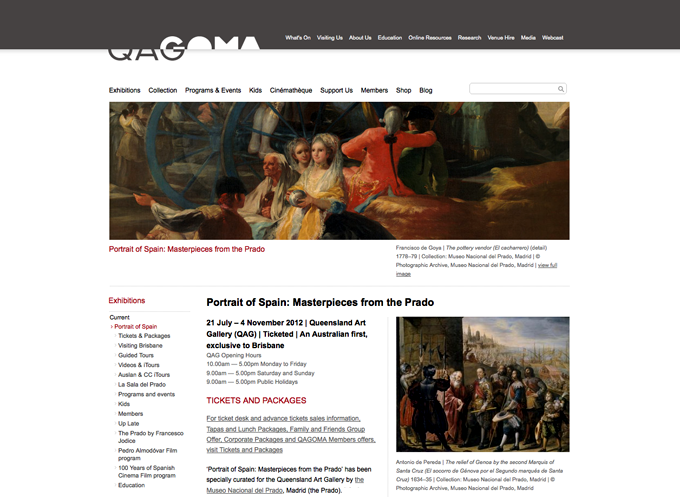
The fastest way for a Toowoomba person to get to Spain is to visit the Portrait of Spain—Masterpieces from the Prado exhibition at the Queensland Art Gallery. 100 paintings and prints are on loan from the Museo Nacional del Prado, Madrid. The QAG walls have been re-painted red and the gallery has been converted into a little Spanish culture experience.
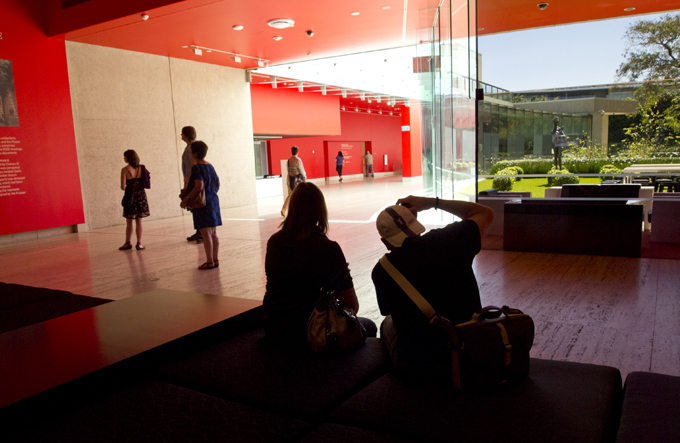
We visited the show last Saturday and participated in what was offered to the viewer/attendee.

Vicky and Doug @ Prado trompe l’oeil
The paintings were magnificent examples of oil painting from the 16th-19th century. Spanish aristocracy, royalty, religious iconography, decorative still-life and court-life. There were no nude or clothed Majas, no Meninas nor swirling clouded El Greco landscapes however there were a few of the famous work to stir the interest. One work of huge scale and interest was Pereda’s The Relief of Genoa.
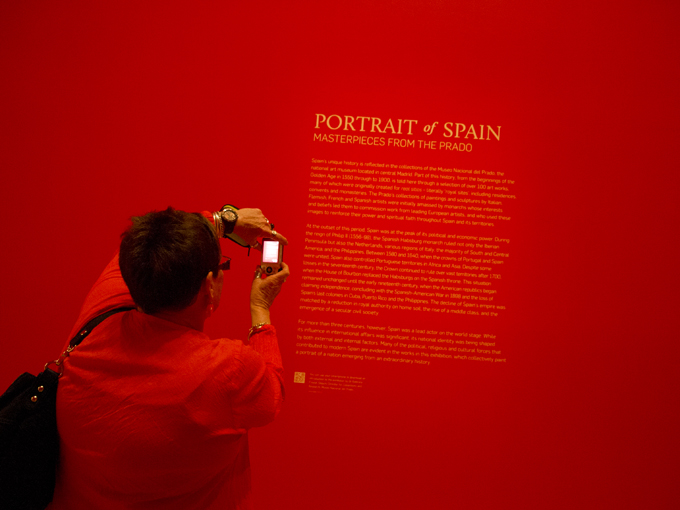
The exhibition is extended over many rooms and is broken into eras and subject matter. Didactic panels and QR coded prompts help the visitor to discover the curator’s spin on what they are seeing.
All in all the Spanish portraits seem a pretty interesting lot. Fine clothing, porcelain skin, mustashes (even on some women), dogs, horses drawfs and aloof expressions abound. Then you enter the Goya’s Disasters of War series—It’s a reminder that for much of the duration of time that this exhibition covers the Spanish were at war with most of Europe at one time or another and were exercising colonial power and plunder in Central America, the Phillipines and other places.
The last room of the exhibition features the 19th century—some predictible landscapes, one entitled ‘Landscape with sheep’, our own QAG Picasso La Belle Hollandaise and some works which didn’t seem to add to the narrative of Spain in the context of the emerging trends in world art at the time.
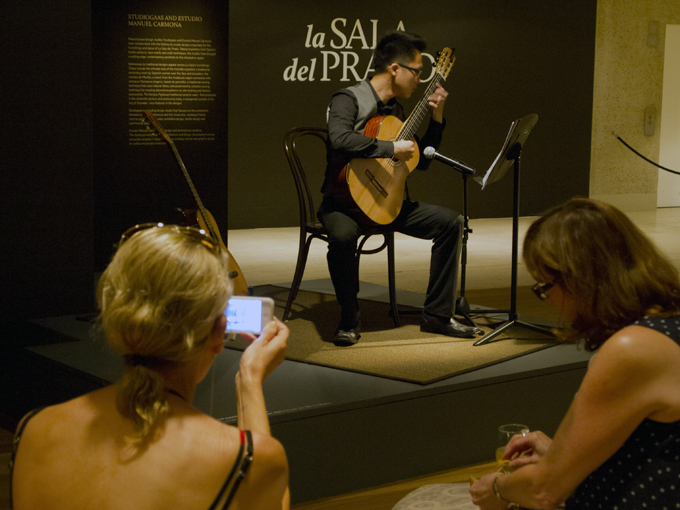
We breezed through the exhibition shop and were drawn to the Tapas Bar for lunch after which we were enticed to play with the ‘DIY interactive portrait photobooths’ and the still-life drawing stations accompanied by a Spanish guitar performance.
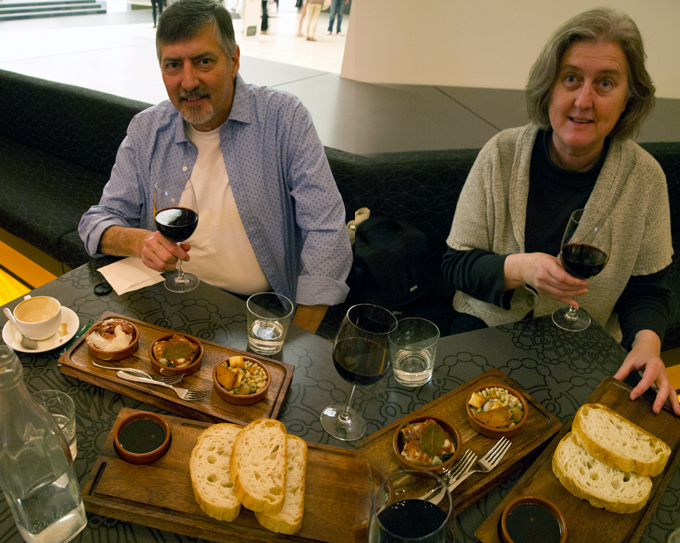
Seeing the exhibition is one thing but now, in the contemporary manifestation of gallery, we experienced a little more; Spanish culture, the work practice of the artist and other entertainment. We went to see a art exhibition and came away with so much more …
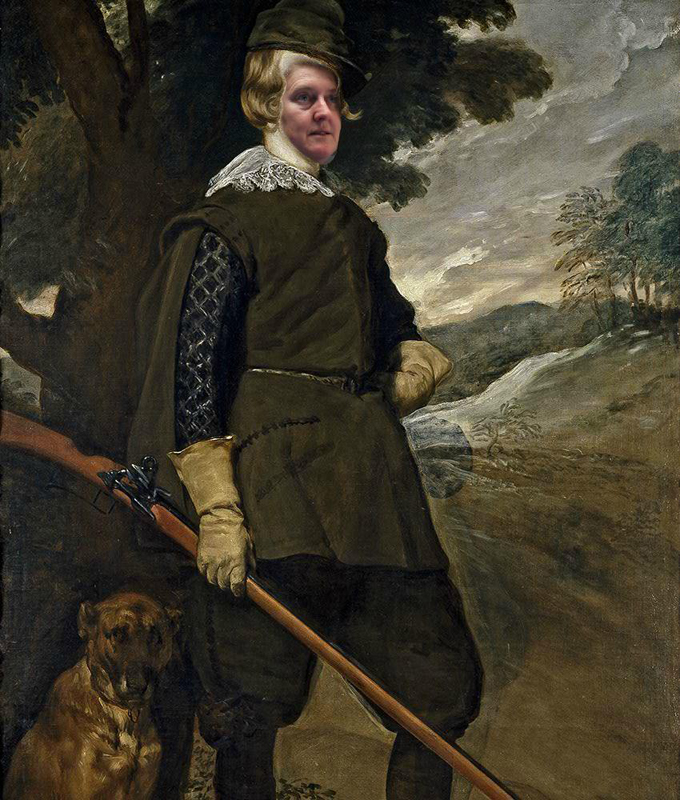
King Victoria
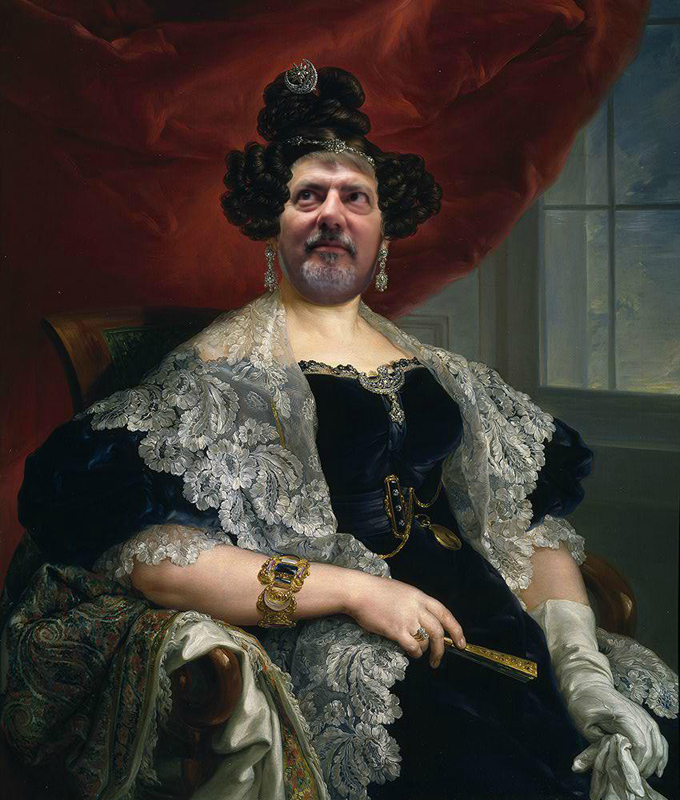
Doug posing as a moustached lady
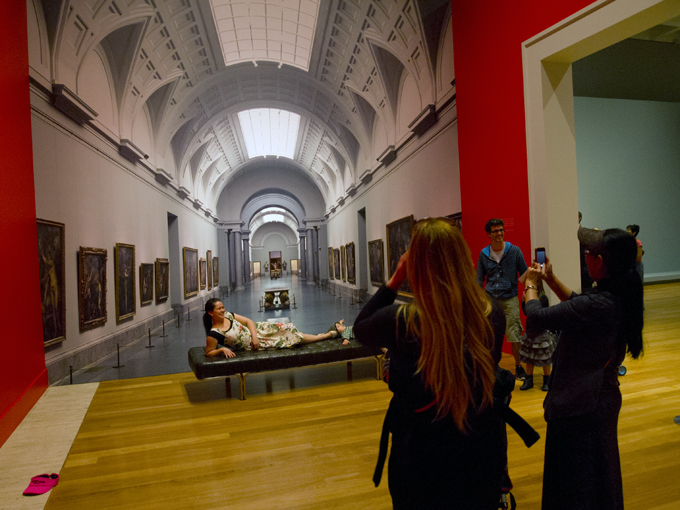
A visitor poses as the ‘Clothed Maja'(?) before the trompe l’oeil
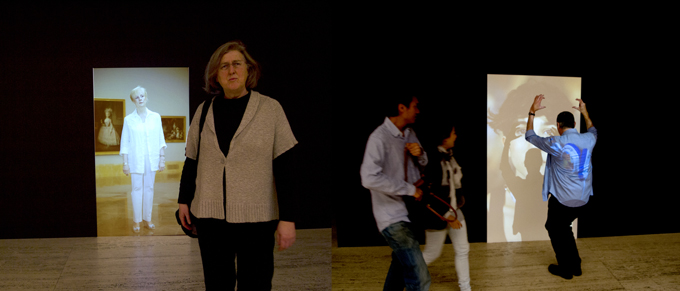
Playing with projected images of Prado visitors
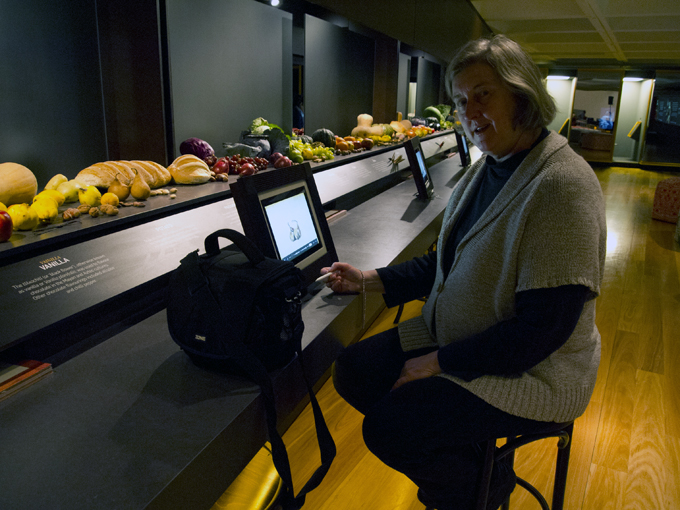
Vicky @ still-life drawing station
STELARC: New York, Berlin, Melbourne, Tokyo – and now Toowoomba!
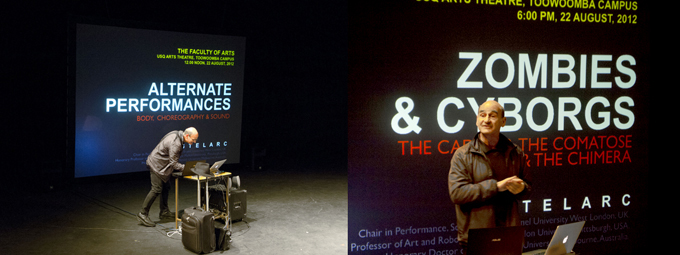
Stelarc @ University of Southern Queensland
On Wednesday August 22, 2012 Stelarc presented two lectures about performance art at the University of Southern Queensland. Local USQ students and lecturers, TAFE students and teachers as well as members of the extended Toowoomba arts community reveled in the opportunity to see and hear an artist of Stelarc’s stature in their own town. Usually they would need to travel to the above mentioned big city locations to even come close to a Stelarc event.
The opportunity for Stelarc came about as he visited local friend Michael Cook, an offer was made to connect with the local community and USQ was approached to provide a venue. Amazingly no charge was made for those to attend and the Uni supplied a light supper for attendees to the evening presentation. Thank you to Stelarc, Michael and USQ for their respective generosities.
What follows is a montage of images by Doug and text by Vicky as a record and reflection on the event.
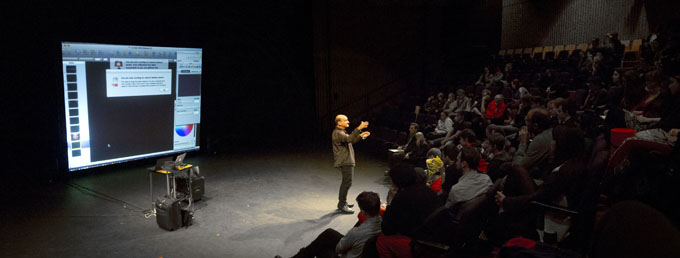
Stelarc speaking @ USQ
STELARC: Present/Future
Stelarc immersed the audience in the intellectual discourse and unsettling condition of the technological age. As an internationally respected artist, he has sustained a significant investigation on what it means to be a human. In his performance/lectures, Stelarc recounted technological advances, including the organ printer, advanced robotics and AI, that drive his philosophical and artistic enquiry. Through this visual and philosophical presentation, we were confronted with the concept of our emergent post-human state.
Should we consider that we are now monsters? Are we breaking free from the human certainty of mortality—evolving into an early form of immortality? Could we just ‘be’ a digital database—an artificial consciousness made up of memories, emotions and ideas that are supported by the promise of replacement parts and eternal connectivity? This discussion may seem to be in the domain of philosophers, ethicists and scientists. But everyday there are new technological and medical procedures that intervene on, or replace our human-ness.
As we consider our future in this post-human condition, Stelarc’s “contested futures” opens up the possibilities for a number of agencies to direct the evolving human narrative. I ponder the historical human exploitation of ‘natural’ machines and knowledge since the Renaissance. What contingencies would Charles Darwin have envisaged in the event that his biological evolution had incorporated machines? Perhaps also the believers of Intelligent Design may also now need to consider the agency of their God in this evolution of the post-human? As we all benefit from machine interventions and technology in some way we cannot escape from this present future.
Sharing this history, there are ‘others’. Our bodies and our environment are constituted by these “other”, non-artificial, nonhumans. They are totally unaware of our post-human evolutionary path. Their existence is in many ways linked to human existence. In their place in the world these nonhumans arguably have acquired ‘intelligence’. Unavoidably they will be actors/actants in the milieu of humanity’s “contested futures”.
Thanks Stelarc, for your memorable and stimulating lecture/performances. Your line of inquiry evokes more and more questions. In a metaphorical way perhaps we are all stripped bare and suspended in the gravity of time, space and place as we, the ‘audience’, consider and are challenged by, our own concept of humanity.
.
Victoria Cooper
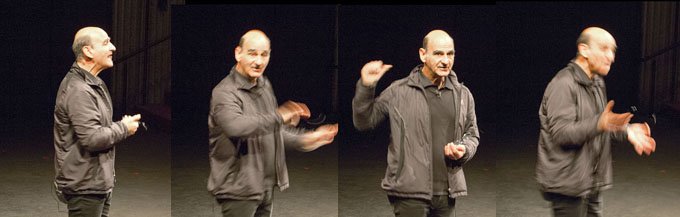
Stelarc in animated lecture mode
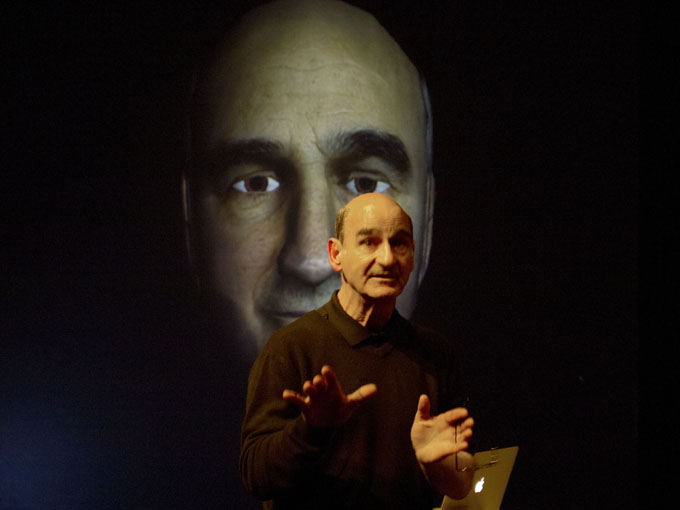
Stelarc and Prosthetic Head
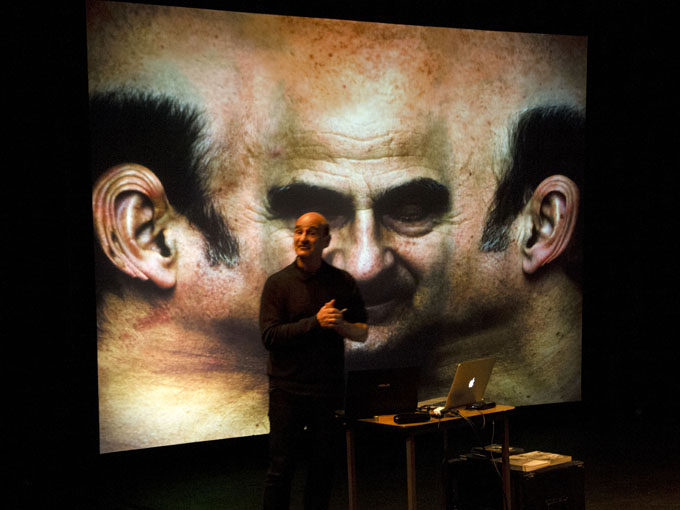
Stelarc with flattened and floating face portrait
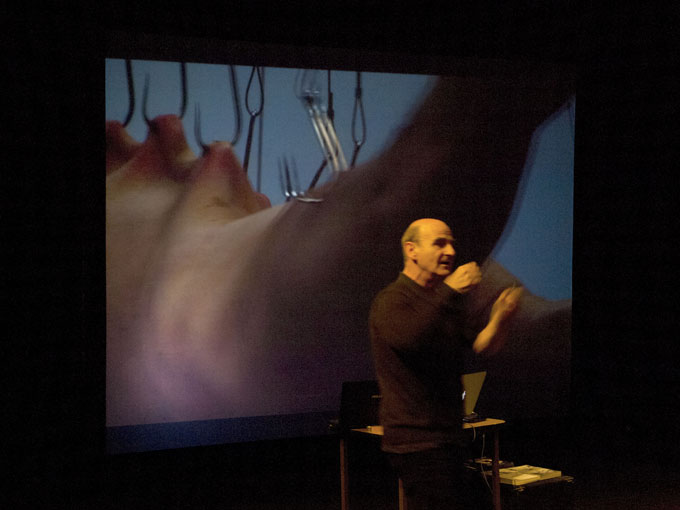
Stelarc discusses his suspension work
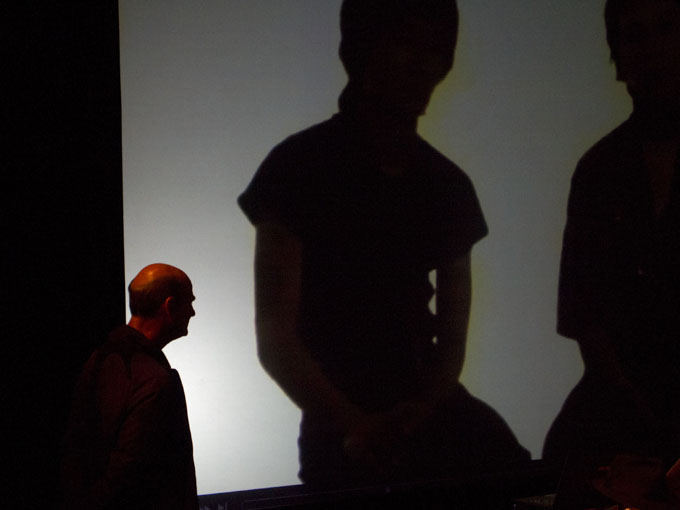
Stelarc watching Hsieh and Montano video
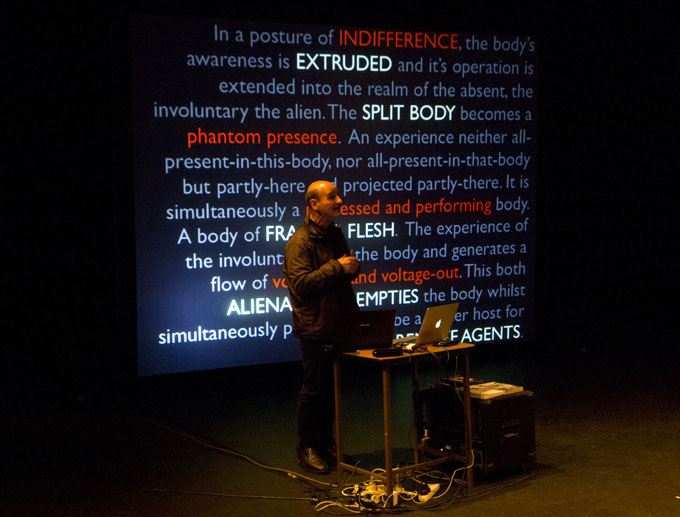
Stelarc and manifesto texts
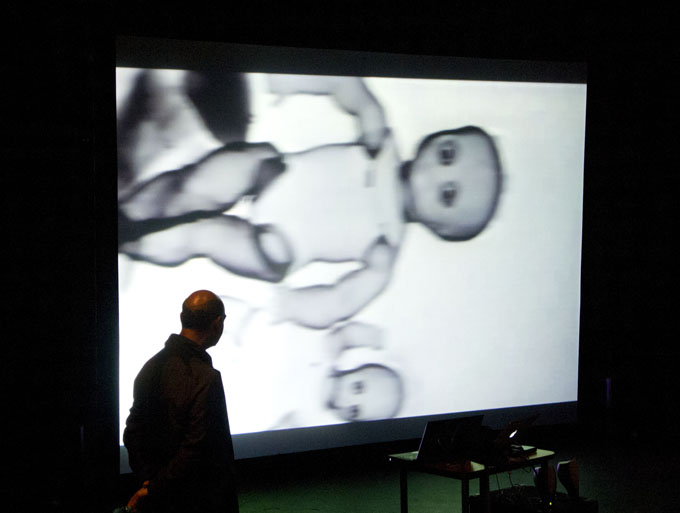
Stelarc watching Queen music film clip
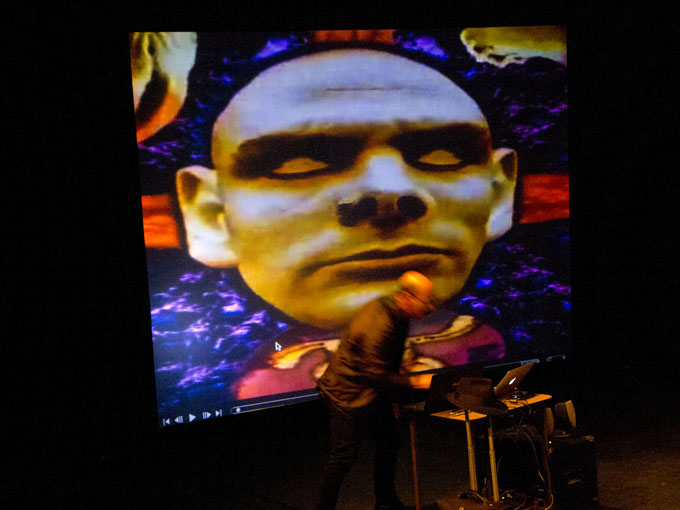
Stelarc and Marcelli video
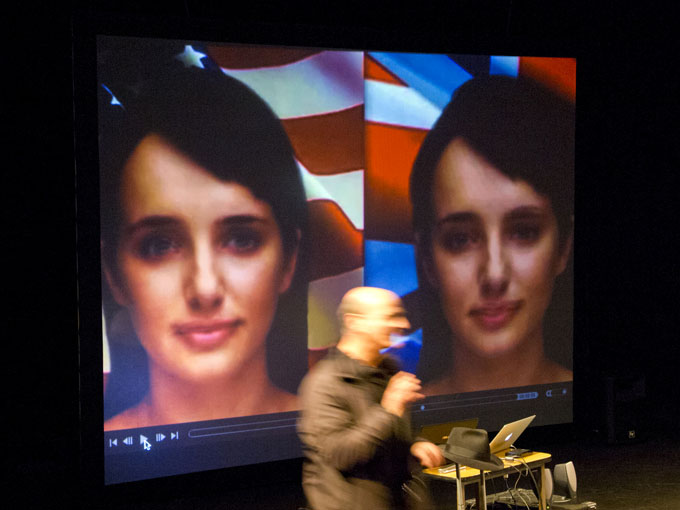
Stelarc discussing chatting heads
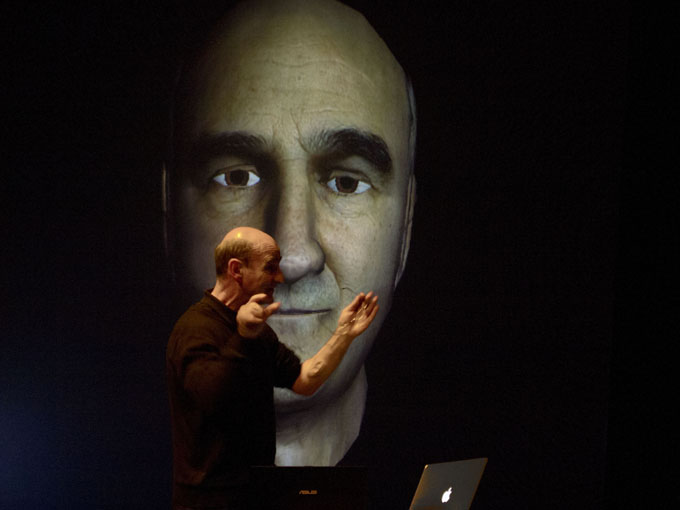
Stelarc and ear/arm @ University of Southern Queensland
SOME ART GALLERIES OF WESTERN QUEENSLAND
This post offers a pictorial view of 6 regional art galleries of western Queensland visited during an 800 klms journey from Toowoomba to Roma, Surat and return.
Weblinks for the galleries are included for further information.
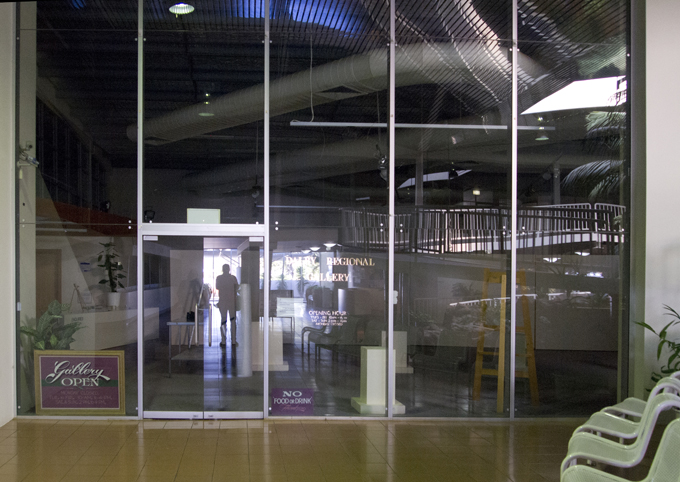
Dalby Gallery: Closed at the time of visit, 6 July 2012
http://www.dalby.info/news/autumn09_art.asp
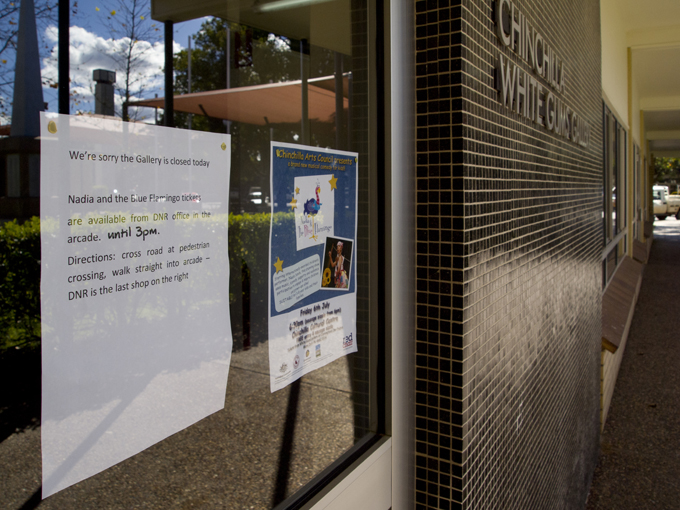
Chinchilla White Gums Gallery: Closed at the time of visit, 6 July 2012
http://www.rgaq.org.au/Chinchilla.html
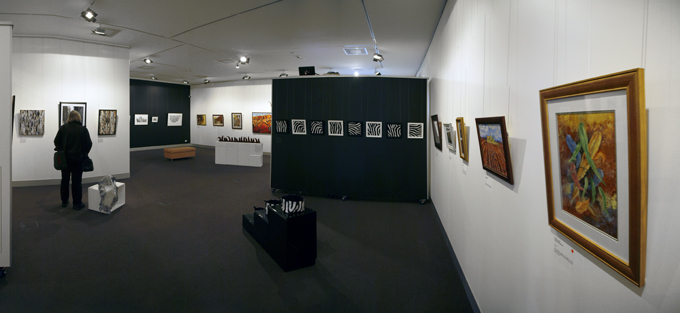
Dogwood Crossing, John Mullins Memorial Art Gallery: Patterns in Nature
http://www.dogwoodcrossing.com
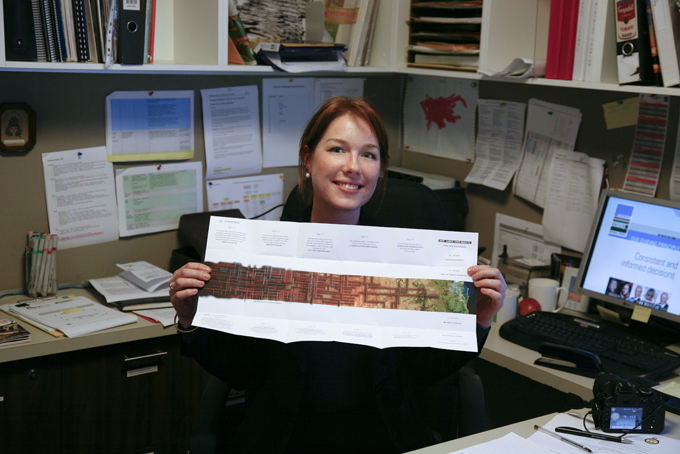
Elysha Gould Gallery Supervisor in her office @ Dogwood Crossing
.
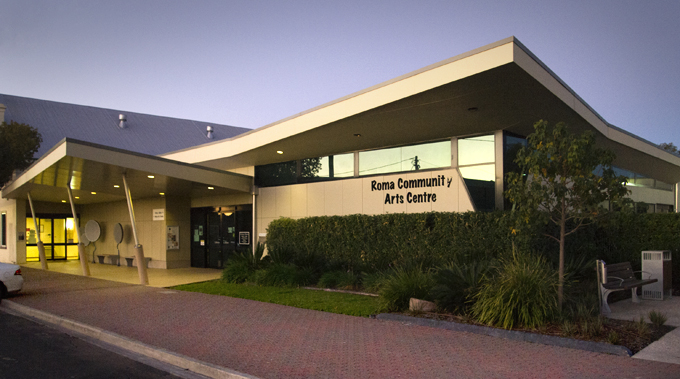
Bungil Art Gallery, Roma
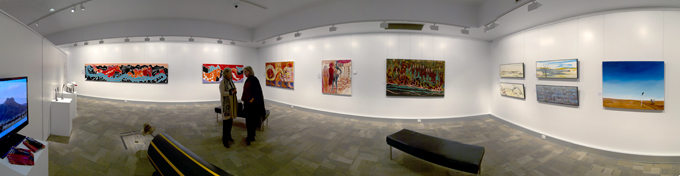
Bungil Art Gallery @ Roma: 6 July 2012: Shoot Straight You Bastards exhibition
http://www.romaonbungil.com.au
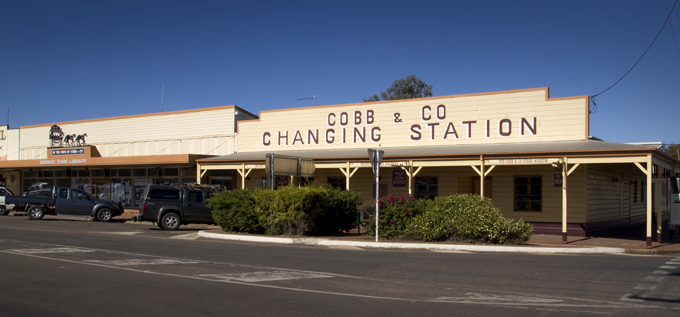
Cobb & Co Changing Station, Balonne River Art Gallery: Open 7 July 2012
http://www.rgaq.org.au/Balonne%20River%20Gallery.html
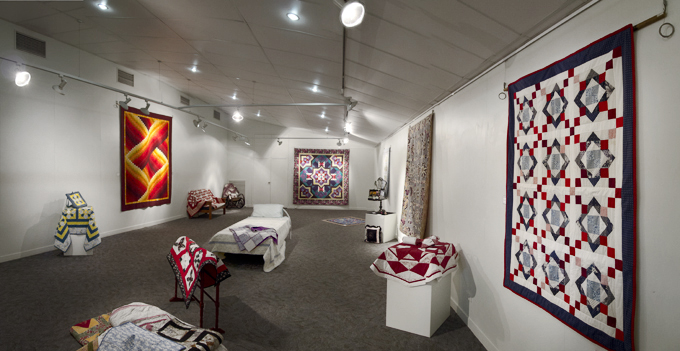
Cobb & Co Changing Station, Balonne River Art Gallery: Exhibition – Debbie Weinert Quilter
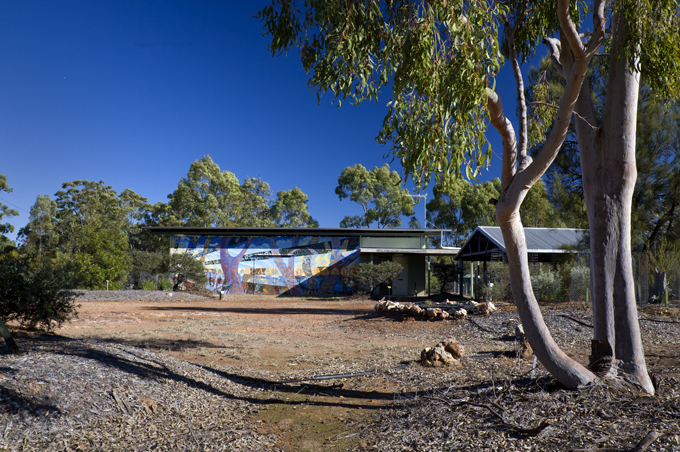
Myall Park Botanic Gardens Art Gallery
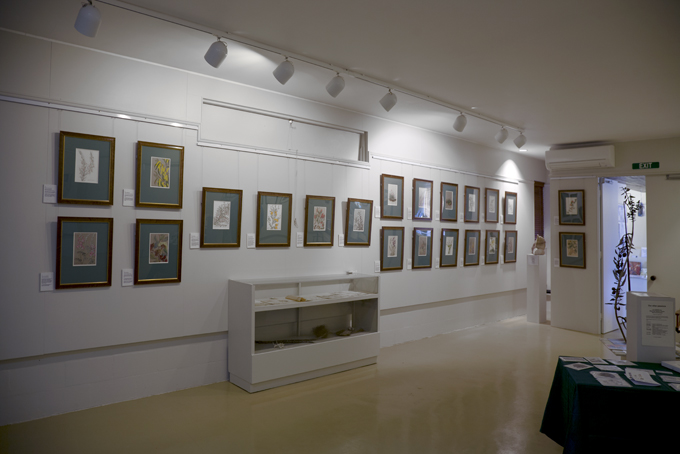
Myall Park Botanic Garden: Dorothy Gordon’s botanic paintings
http://www.myallparkbotanicgarden.org.au/gallery.htm
JOURNEY COMPLETED BY VICTORIA AND DOUG : ALL PHOTOS BY DOUG
75 Years: Toowoomba Regional Art Gallery
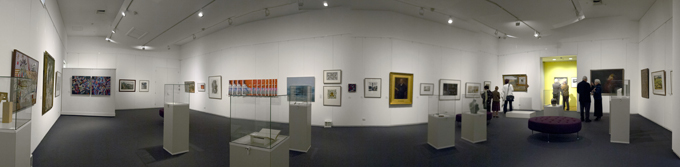
Toowoomba Regional Art Gallery Panorama
Toowoomba Regional Art Gallery, the oldest regional art gallery in Queensland, this month celebrated its 75th year of operation. When we consider that Queensland only recently celebrated its sesquicentennial therefore the gallery is half the age of Queensland itself! Other interesting dates; the Toowoomba region was settled in the 1840s and was proclaimed a city in 1904 The Toowoomba Show Society recently achieved a milestone of 142 years of shows in agriculture and industry and the Empire theatre celebrated its 100th birthday last year. It seems that the Toowoomba region was well and truly fired up as a community and perhaps overdue for an art gallery that was finally established in 1937.
The records show that various Governors of Queensland were associated with TRAG over the years and this association continues to this day with the current Governor Her Excellency Ms Penelope Wensley opening the 75th exhibition on July 2, 2012. In an impressively researched speech Governor Wensley recounted newspaper reports of the day relating to the gallery’s foundation. The 75th opening was attended by around 100 members of the local community including Mayor Paul Antonio, various councillors and members of the trustees or families of significant donors to the gallery.

Gallery Curator Di Baker with Governor Wensley discussing artworks
The exhibition features 75 individual artworks from the gallery’s collection—one for each of the 75 years. Standing in the middle of the main exhibition area one sees a diverse range of visual material. Paintings of bygone and contemporary eras by some very prominent artists, there are ceramics, fine jewellery (from the gallery’s principle collection media—contemporary wearables), and finally photographs and prints complete the veritable visual cornucopia on show. When I came to testing my recollection of the artwork’s titles and artists I was stumped, as the artwork didactics bore none of that information. This presented some confusion until I became aware the curatorial strategy for the show. The 75 works were selected on the basis of the year and the work’s conceptual connection with significant social, political or historical aspects of that year. The key to the sometimes quirky and idiosyncratic curatorial selection is the exhibition catalogue in which the rationale for the selection is linked with the title, media and the artist’s name.
While at first this seems a little strange my reflection on the concept confirms, for me at least, that the strategy is conceptually stimulating. The usual gallery exhibition is about artists and their art—this show IS about the gallery, its PLACE in the community and TIME, or rather the passage of time—75 years in fact. In this exhibition the gallery then assumes the position of ‘artist’ and were the ‘artwork’ is the curatorial team’s strategy.
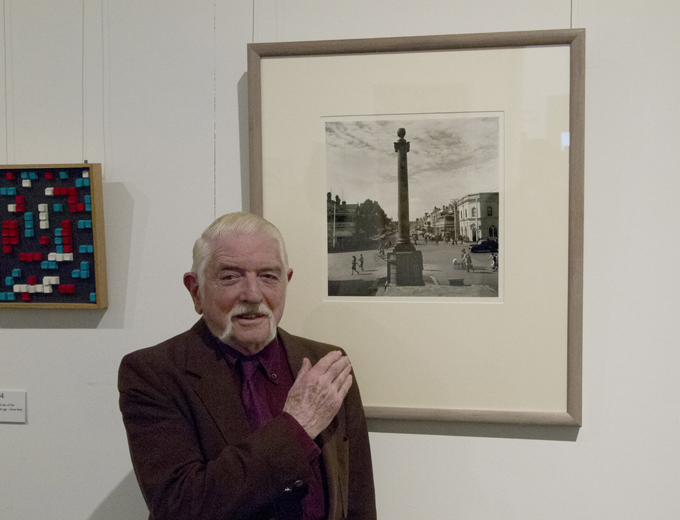
Doyen of Toowoomba’s photo scene Graham Burstow with a Max Dupain photograph in the exhibition
Bravo to the Toowoomba Regional Art Gallery and the team for bringing to us an exhibition featuring the gems of art from its collection that can tell these multiple stories. One, which is about the assiduous collection by the gallery of art stimulated by and/or created by the regional community. And secondly, this show provides recognition of significant art from outside Toowoomba that has been generously donated by benefactors over the years. Through the gallery display of these artworks the local community is able to connect with these wonderful touchstones of artists’ creative practice.
A visit to TRAG to see this show will require much more engagement than usual walk-through, so do plan for extended visits while the 75th year celebration show is on.
SEE more info Toowoomba Regional Council website
Doug Spowart 8 July 2012
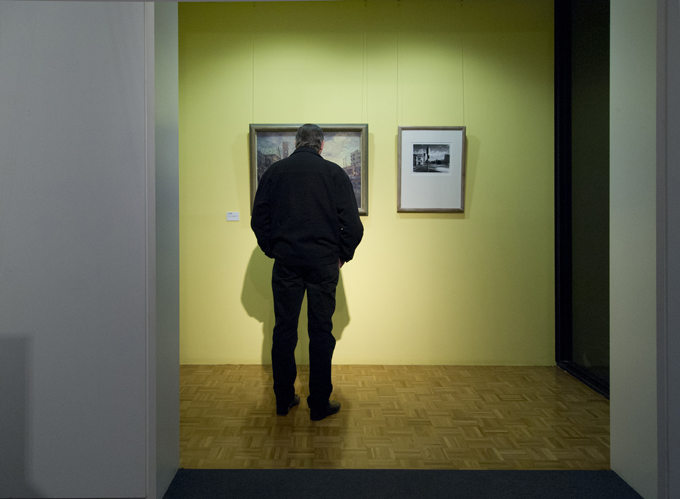
Doug next to his photograph of Ruthven Street selected for the exhibition
PRESS THIS!!! Peter Wallis – Press Photographer

Peter Wallis with Vicky + Doug in Toowoomba (iPhone image)
We had a call today from Peter Wallis today to say he was in town and wanted to have yarn. Peter was a photography student of mine at Southern Queensland Institute of TAFE in the mid 1990s. For quite a while he has been one of the main shooters for Brisbane’s Courier Mail newspaper—mainly specialising in sports. As we sat sipping coffee Peter cradled in his hands an advanced production model from a well-known DSLR manufacturer that was being trialled by the newspaper. That seemed fitting as Peter always had a fetish for the latest and best camera technologies.
Peter Wallis was one of those people who truly loved photography and was a lot of fun in classroom and darkroom. One day he found our Canon 50~350mm zoom (white lens) and probably had it on permanent loan for most of the second year of his associate diploma studies. The lens went to the Birdsville races, to sporting events and places I daren’t ask about. His end of study folio was an impressive generalist photographer with a strong bias to media photojournalism.
On graduating from TAFE Peter fell into newspaper photography in the regional papers in towns like Bundaberg and Gladstone. His break came in the early 2000s when he was shortlisted for a position at the Courier. He and his fellow shortlisted applicant had to work at the paper for a few days to show how they would handle the job. At the end of their trial they were interviewed by the Pictorial Editor—they were both asked what they considered was their BEST picture. Apparently the other candidate pointed out their best shot from the folio laid out on the table—Peter was to tell me later that he’d remembered something I had spoken about during his study years, about the idea of thinking that the BEST picture ‘is the next one I’m going to take!’ He felt that way about his work and used that statement and got the job.
In the nine years since Peter has amassed a significant body of work in the newspaper genre as well as undertaken personal projects in India and Nepal. He is currently documenting the Brisbane Firebirds basketball team. In our conversation we discussed aspects of his industry over his 15 years or practice. He commented, ‘My first newspaper had a darkroom, then we shot colour film, processed it and scanned the images, and then finally we were presented with digital cameras.’
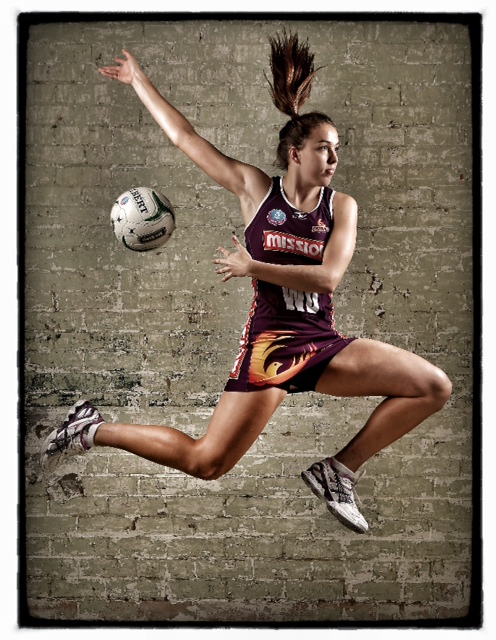
Firebird Shannon Eagland Photo: Peter Wallis
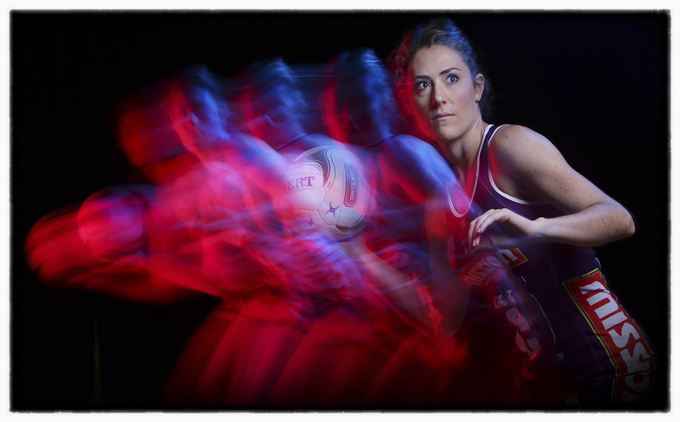
Firebird Elissa Maclead Photo: Peter Wallis
.
He continues commenting on how the picture got to the back to the paper. Film was straight forward as its physical nature meant that you travelled with it and lovingly processed it. Instant digital capture led to instant transmission. ‘We used to send our images back to the Courier Mail via a satellite dish, then laptop and phone—recently I travelled with Bligh on the election and didn’t even open a laptop. Sent everything back via an iPad. And now we shoot DSLR video and send that back as well’.

A grab shot – On the hustings with Bligh and Newman Photo: Peter Wallis
.
We spoke of concerns for the newspaper industry and the current challenge for the on-line 24-hour update and how images are syndicated through agencies like Getty. Peter has concerns about the future—but right now he’s living the dream that most photographers have that have a love of the challenge of being told by the editor to ‘go here … see the man … and make a bloody great image that I can publish’.

Sporting shadows Photos: Peter Wallis
Open any Courier Mail or Sunday Mail and on most days you’ll see a Peter Wallis picture and most probably it will be an amazing sporting peak action image or an editorial styled image with some kind of visual twist that captures your attention. As mentioned earlier most newspapers today are struggling to maintain print readership and their attempt to transition to online subscription is forcing a hybrid text, still image and video presentation. At this time Peter’s ability to conceptualise and create visually interesting images on the fly is as valuable as ever and stridently makes the claim that photos made by photographers are as important as ever in telling a news story in a moment, on the page, or … on the screen.
Doug Spowart
http://peterwallisphotographer.blogspot.com.au
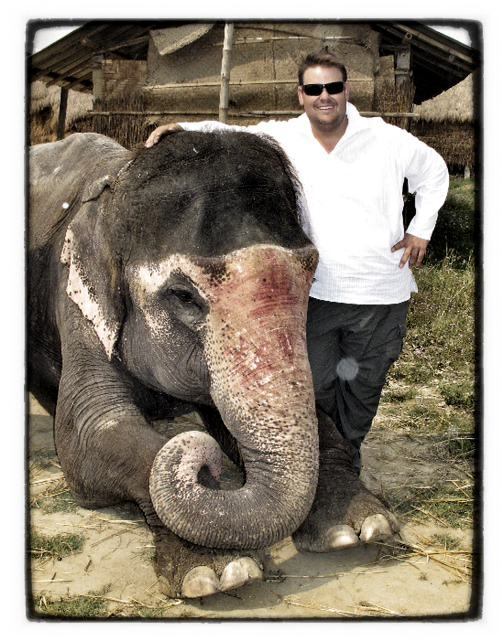
Pater Wallis with elephant
KEITH SMITH + SCOTT McCARNEY @ SLQ
Please note: This post is derived from personal notes made at the event – They may contain some inconsistencies that are a result of my interpretation.
AUDIO NOW AVAILABLE @ http://enc.slq.qld.gov.au/audio/slq/pp/mp3/artdesign/Artistsbooks.mp3
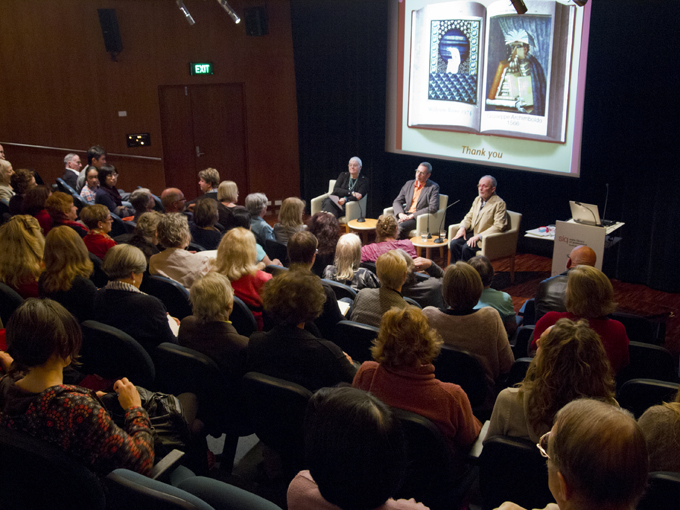
In what looks like the one highlight in the Queensland artists’ book calendar for 2012 Keith Smith and Scott McCarney are visiting the State Library of Queensland to present a lecture about their work and to conduct a five-day workshop. Unable to attend the workshop due to teaching commitments I attended the talk at the SLQ today. I was not alone and the smaller SLQ auditorium was full of interested attendees — including some notables like Sarah Bowen, Adele Outteridge, Madonna Staunton, Wim deVos, Anne Marie Hunter and Lorelei Clark. The visit to SLQ by Scott and Keith is supported by the Siganto Foundation and members of the family were in attendance at the lecture.
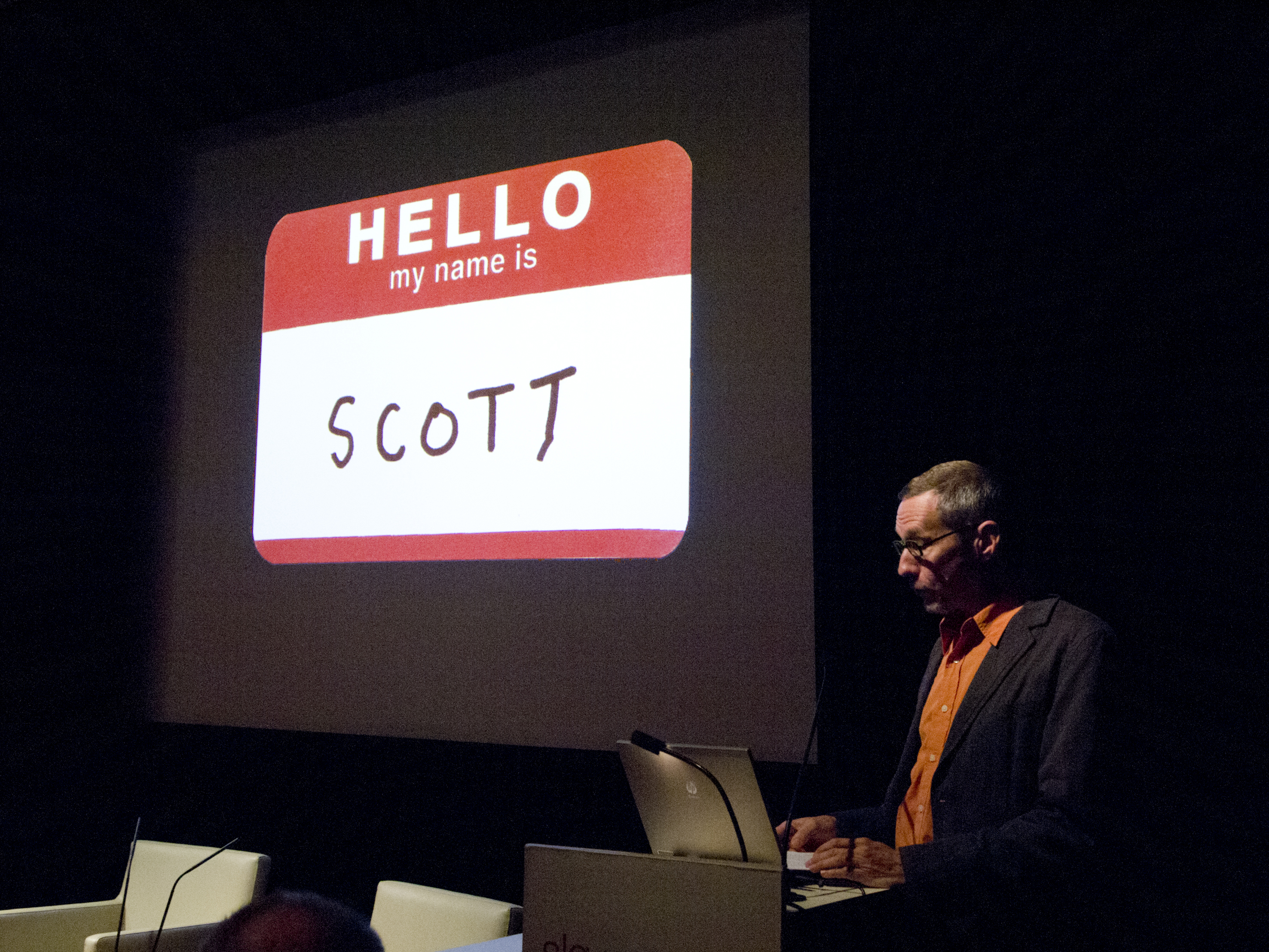
‘HELLO’ Scott!
After and introduction by SLQ Artists’ Bookie Helen Cole, Scott began his presentation by talking about the nature of the book in the digital age. He seemed to lament that libraries were beginning to change into Wi-Fi coffee houses — that’s not a problem for him as he believes the book, as a physical thing, will go beyond the electronic age.
He sees a real discussion about the future of the book is all about ‘display’. This remains a contentious issue for the artists’ book as they are difficult to handle and read as in exhibitions they are usually displayed frozen and ‘under glass’. Some of Scott’s work has been about presenting books as sculptural forms (Hanging Index) so the viewer does not really need to turn the pages to engage with the work.
Scott spoke in detail about his Autobiography series. He described how he couldn’t throw anything away and that he makes collections from things like name badges, rejection letters from galleries and grant applications, to-do lists and mud maps. This body of work provides an insight into the trivia and ephemera of life that escapes disposal through its transformation into his art. Connecting with the Internet world Scott’s Google Vanitas begun on Christmas Day last year represents the search results for his own name.
Scott showed many examples of works with where he cut through various pages within books to subvert the content of the book.
In a homage to Ed Ruscha Scott has taken Ruscha’s 1964 book Various small fires and milk and made his own take on the subject — Scott’s fires are those of riots and the curious inclusion of a glass of milk in Ruscha’s book is shortened to MLK, standing for Martin Luther King whose portrait appears in the book. l
A recent project by Scott was to participate in the al-Mutanabbi Street Coalition’s response to the car bombing of this street in Bagdad which was home to many of the city’s booksellers. Scott’s work Material Meditation on Mending Al Mutanabbi Street comprises fifteen two-sided loose-leaf prints made from collages made from remnants of found books, rubbings from bookbindings and photographs.
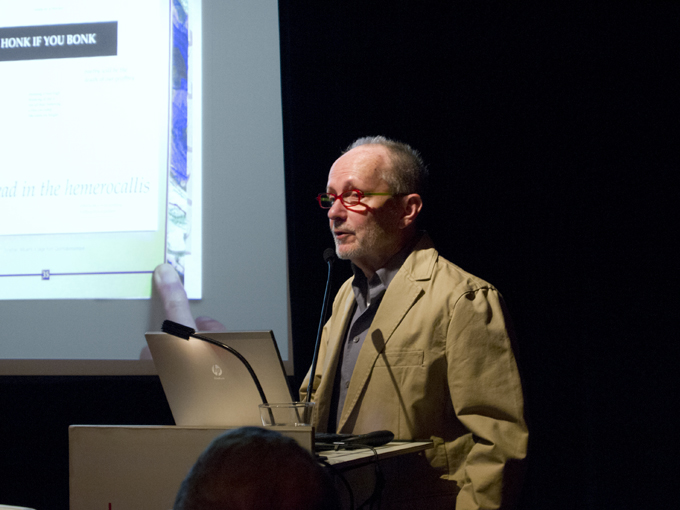
Keith Smith speaks
Scott then handed over to Keith who comments that he is now up into the 280s on his ever increasing list of books. He spoke of a number of book projects dealing with subjects like re-contextualisation of paintings of Saint Sebastian into Smith’s own painted backgrounds. Many variations on this theme have been created from an amassed collection of source paintings — he intimated that he was even working on a book as he was preparing to travel to Australia.
He spoke of his connection with the computer and digital book Bobby made as early as 1984 with an early Macintosh computer using MacPaint and MacWrite. In his latest work he has re-formatted the book and re-jigged the content. The new Bobby has been supersized to one of Smith’s biggest ever books.
One of Keith’s trademarks is the digitally created multi-layered photomontage and his rainbow borders and edges. He states that when using Photoshop he may be working with between 12 and 24 layers of colour. Pages for the book Seminal were shown as examples.
Book number 283 is Struggling to see deals with Smith’s continuing fascination with text and image. The book is dedicated to Nathan Lyons whose own books and image sequencing presents Smith with a constant source of challenge. Smith acknowledged Lyon’s mastery of organising images in a book in a way where the message of the book is spoken ‘between the pages’.
Question time yielded perennial questions to do with inkjet printers, papers, the ‘archivalness’ of the technology and editioning.
One questioner spoke of how books can be made by anyone via print on demand technologies …
Another question dealt with the montage …
Keith commented that the book tells him where to go …
A comment made by one participant was that they were coming to understand that with all the standardization of the book through language and form and that that is where the psychology of the artists’ book really kicks-in to say something else that we were not ready for…
A question about the eBook and where it fits in contemporary practice. Scott answered that with eBooks one must learn the tools and understand that they are about text in a multi-media platform and that translating work into digital form you need to recognise that it is married to the content.
Keith’s response was that was something for the younger generation, ‘I’m too old ….’ Perhaps it is, for him, that the eBook is not a tactile medium that you cut, fold, touch and be touched by — although it may be something else?
Doug Spowart May 28, 2012
NOTE: The SLQ will be posting this lecture online in the near future
JOHN ELLIOTT’s ‘GIFTED COUNTRY’

An image of the ballad of country and western

As a photographer attempting to communicate personal experiences and my, at least I think, special view of life and the world, occasionally I have thoughts that if I wanted to connect en mass I should have been into music! When I look at what music does to I see participants who will slap, tap, hum, whistle, laugh, tear up and even cry. Music sure beats the visual arts hands down as a way of creating a connected audience response. But an exhibition of photographs at the Caboolture Regional Art Gallery, just a few kilometres north of Brisbane, may just win some points back for the visual artist.
Gifted Country is a photographic exhibition of the doyens of the world of country and western music by Toowoomba photographer John Elliott. As a follower of the music industry for over 30 years Elliott has amassed a collection of the latest top hits and the golden oldies. On the walls of the gallery the faces of C&W music stare out at the viewer — frozen and mute. Elliott has reduced them to an eye-only sensory experience. The only sounds permeating the space are the shuffle of footsteps of other gallery viewers and the muffled voices of local community members returning books to the library next door.
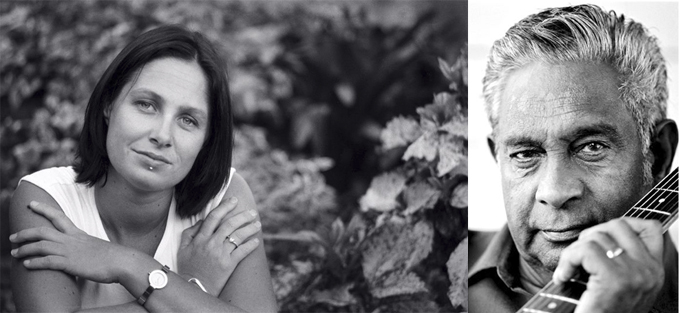
Casey Chambers + Jimmy Little
Before you get the feeling that the show is a little underwhelming there are other things to consider. Firstly the music and photography industry do share some similarities. Apart from practitioners at the most visible pinnacle of the discipline, those who make the sound and the image – the photographer behind the camera, the songwriter, the muso behind the lead singer and the mixer at the sound deck — are faceless. Only the products of their creative efforts are known to us. Okay, we can all recognise a Slim Dusty, Casey Chambers and Keith Urban from across the room. And that is perhaps because photographers like Elliott have made their image, apart from their music, famous. A reflective Jimmy Little leaning on a guitar neck (the one Little’s family selected as the ‘hero’ image for his recent funeral service), Lee Kernaghan stridently stands sky-pointing before a dramatic theatrically lit stage and a wide-eyed Chad Morgan’s face pokes out from his trade-mark safety-pinned hat. Once you’ve cherry-picked a few of the icons you are left with portraits of haggard faced, guitar holding middle-aged men, sweet smiling young girls and longhaired youths that crowd the rectangle photo frame.
What Elliott’s efforts bring to us is the human face of the extended country and western industry. These faces could be those of the waitress, the farm hand, the rodeo queen and the Big Mack truck mechanic. To help make the connection for the viewer Elliott pairs the portrait with the carefully chosen words of a biography that makes visible the musical provenance that we may share with the subject. Additionally a website links to interviews, commentaries and music to enliven the interest of those with a passion for C&W music.
What is remarkable is that over the years John Elliott has worked to amass this body of work. And this is not his sole interest — there are landscapes, urban vistas, other portraits and the personal and intimate moments of life. But this body of work has a quality and magnitude that sets it aside from the usual music documentary record.
This exhibition will be of great interest to the country and western dilettante, the music maker and the photographer alike. For this is a unique assemblage that is testimony to value of photography as record that is at once about history and the present — becoming history. The John Elliott Gifted Country performance will continue until June 23, and then, hopefully, will in the tradition of C&W — go on the road …
Doug Spowart May 26, 2012.
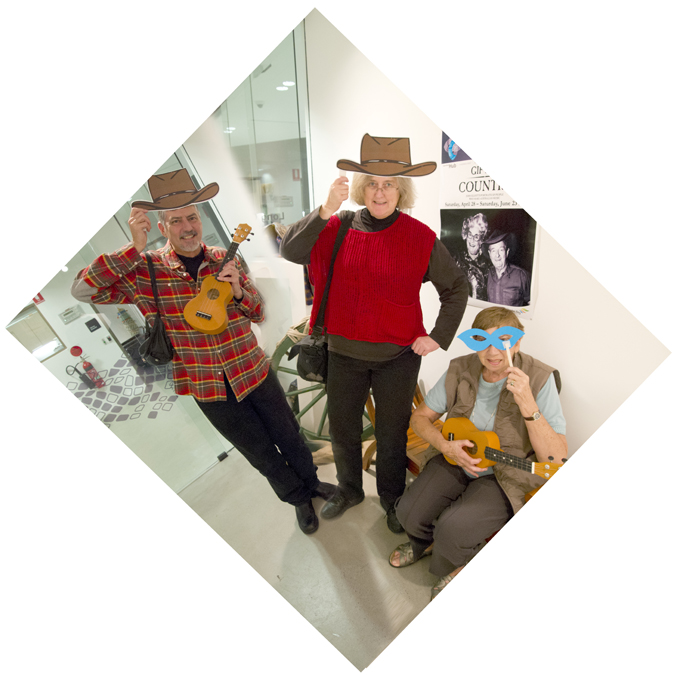
Also @ the Gifted Country show is a C&W PHOTO BOOTH – we had a bit of fun there …
IAN POOLE: AIPP On the Lounge

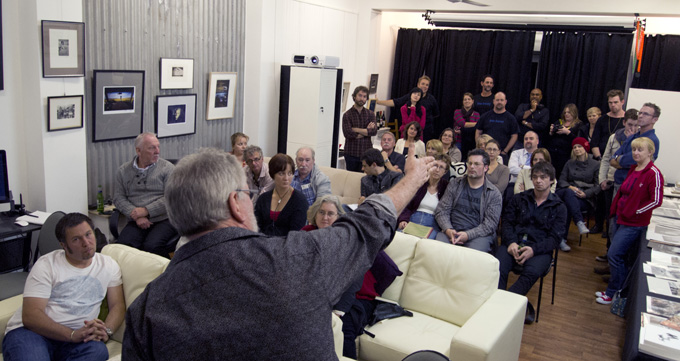
Ian Poole addressing the audience @ Photo Frenzy
Ian Poole is well placed to have an opinion about fine art photography and collecting photographs. He has been a major player in professional photography in Brisbane for nearly 40 years and is a respected AIPP judge with yearly invitations to also judge the New Zealand Institute of Professional Photography awards. Despite his professional photography connection he has been a part of a sector of the Queensland photographic art scene that extends from the early 1980s with Imagery Gallery, later with the Photographer’s Gallery and more recently with the Queensland Centre for Photography. He has completed a Graduate Diploma in Visual Arts from the Queensland College of Art and has been awarded an Australia Council residency in Tokyo. Adding to this he has curated photographic exhibitions in Japan (of Queensland photographers) and exhibitions in Australia (of local and Japanese photographers).
So when Poole offers commentary on aspects of the photographic art world of Brisbane and Queensland it should be something of an opportunity to connect with his extensive knowledge of the genre. Recently as part of the AIPP ‘On the Lounge’ lecture series Ian Poole presented to an assembled audience of around 40 a dissertation entitled, ‘Have you ever wanted to collect photographic art, or be collected as a photographic artist?’

Ian – getting his message across with passion
Ian Poole began his presentation by reviewing recent art auction records for photographic artworks including those by Adams, Sexton and Dupain. Thousands, hundreds of thousands and even millions will change hands for well-known and rare works. The recent phenomena of Nick Brandt’s African work,which had been shown only weeks earlier in Brisbane, attracted some discussion. Perhaps some in the audience felt a little inspired by the possibility that, if they could enter the fine art field, that there was recognition and the possibility for a significant income to be made.
Poole introduced his collection of images that were hung on the walls and laid out on tables before the audience and discussed their histories and stories. For him the concept of ‘provenance’ elevated the importance of each work. A small Dupain image of the interior of the National Gallery in Canberra made during its construction was linked to his encounter with the work in a Brisbane gallery where it was purchased for a few hundred dollars. His most exuberant discussion related to a Joachim Froese diptych acquired when he swapped it with Joachim for a 4×5 enlarger. An expanded provenance trail led to it being loaned back to Joachim so that it could be displayed a QUT exhibition of his work.
A long-term friendship with north Queensland photographer Glen O’Malley presented some interesting provenance stories. O’Malley is not fully recognised for the significance of his practice in Queensland – he could probably claim to have had the first ‘photographic art’ exhibition in this state in the mid 1970s. Poole presented to the audience an image from O’Malley made as part of the Queensland Art Gallery’s 1988 Journeys North commission. The 20×24” black and white photograph showed a scene in Poole’s home where the O’Malleys were having dinner. The image was part of the accepted images for the Journeys North show and was subsequently published. Somehow Poole’s own life had become art photography itself.
Another photography collaborator presented by Poole was John Elliott. Well known for his documentation of country and western music and its heroes and doyens including Slim Dusty, Chad Morgan and Jimmy Little, Elliott is an enigmatic character of the photography scene. Ian spoke of John’s most recent show Gifted Country at the Caboolture Regional Art Gallery and his photobook publishing ventures. A recent journey to Townsville that Poole had shared with another of Queensland’s enigmatic photographers, Maris Rusis, resulted in a body of work by Rusis that dealt with the décor of budget north Queensland motel rooms. These small and fine gelatin silver fibre B&W prints presented to the audience the fact that traditional values remain key to some workers who continue to practice analogue photography in a digital world.
Question time brought up some difficult truths – Why does the Queensland Art Gallery/GOMA not seem to be collecting photography generated within this state? Did they ever collect? Some discussion related to the archival needs for conservation framing and presentation.
As a conclusion to the presentation Poole spoke of the way in which he and his photography acquaintances swapped and shared their works, and how much of his collection was built around the generosity of fellow photographers and their desire to share. He held a bundle of his own gelatin silver images up before the audience and made an offer that ‘you can have one of my prints this evening – and send a print to me as a swap. Start your collection this evening …’
While Ian Poole began his presentation with a review of the overtly mercantile auction scene, it seemed that his passion about photography, photographs, friends, shared experiences and the meaningfulness of the provenance of the works, that these things could not be commodified. He spoke of his collection of photos, books and ephemera as being an entity that would be bequeathed to his daughter Nicola, also a photographer and present at the talk. Through the audience he directed to Nicola to ‘treasure and look after these things … they were important, valuable – not only as the stories they depicted through their image on the front-side of the print, but also of the back-story of their origin and collection.’
There is no doubt that Ian Poole’s passion for photography and his understanding of how it operates at a personal and cultural level is something that was shared and communicated on this evening. And those present will be inspired to develop a new appreciation of what photographs are and what they can say about the human condition.
Doug Spowart May 20, 2012
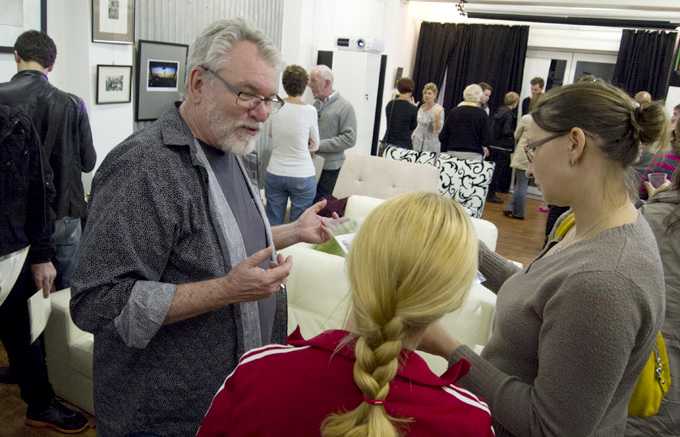
Ian talking with OTL attendees at the end of his presentation
An unusual meeting – Face-to-Face with an early portrait of one’s self – circa 1982 found in Poole’s collection

CAMERA OBSCURA: QCCP
Later in our time in Queenstown we made another camera obscura at Jackie and Mike’s Queenstown Centre for Creative Photography. The room image featured a view up Late Wakatipu reflected in a mirror. The expanse of the glacial lake with the layered horizon of mountains seemed, for the moment, peaceful.
We sat in the background view—the picture in a ‘lensed’ camera view of the image within the room. The camera sits on a chair on the right-hand side of the image and its shadow falls into the bottom of the frame. We’ve posted a second image of this photo inverted so to external view can be more easily interpreted.
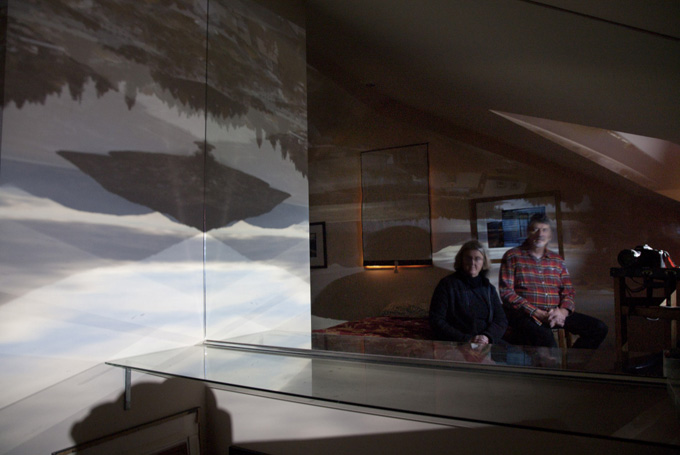
Camera Obscura: Queenstown Centre for Creative Photography
Cheers Doug and Vicky

 wotwedid