Archive for the ‘Speaking on Photography’ Category
National Works on Paper submission – not shortlisted

NWOP-banner
.
As an artist there is a need for affirmation and justification for one’s life in the activity and practice of artmaking. Artists prepare and curate their work in gallery exhibitions to present work – and then there are awards and competitions. Each year, as the call for entries comes around, we like many artists around the country, look at recent work and consider its appropriateness for specific awards.
There are of course thoughts of winning an award but perhaps more importantly is the opportunity to be shortlisted for exhibition and considered for purchase or collection. Equally important for us is the opportunity to connect with fellow artists in the curated exhibition that represent the judge’s opinion of what constitutes the most relevant works based on the competition’s criteria.
This year I submitted to the National Works on Paper Award an artists’ book that I had made during our Skopelos Works on Paper workshop in Greece last year. The book is an exploration of the idea of a montage of light capturing the performance of reading a book. Simultaneously the reader, the location where the reading took place and the page-turning action of reading is imaged in light sensitive cyanotype on the watercolour pages of the book.
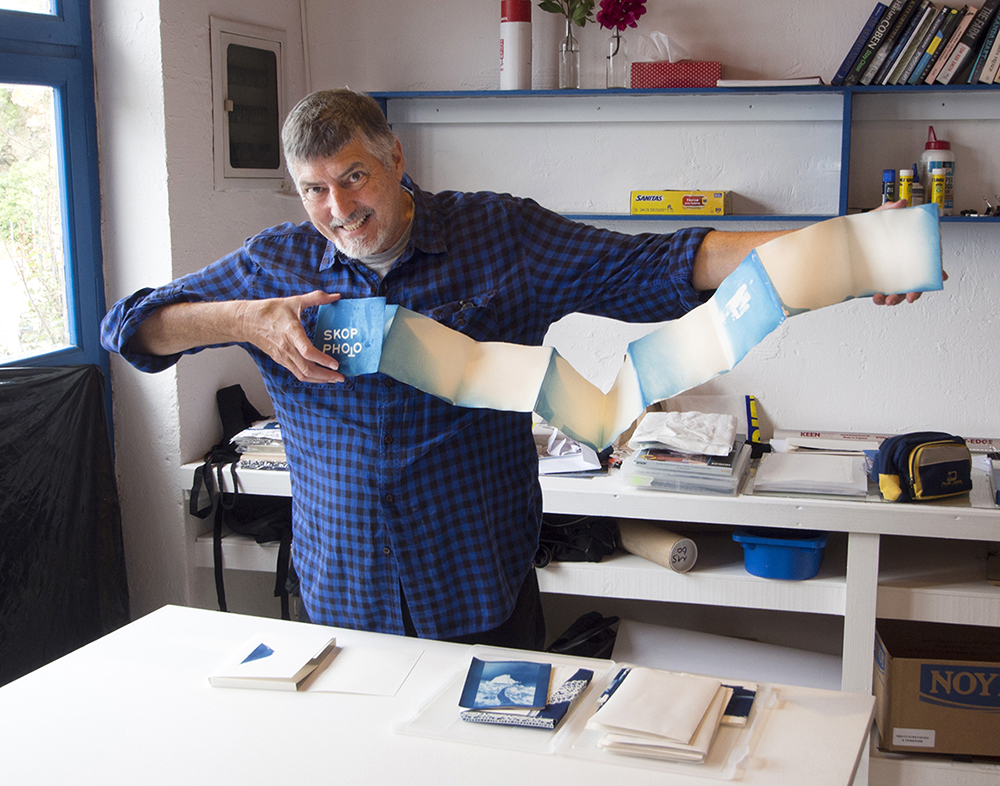
Doug Spowart opens SKOP PHOTO after its creation in Greece PHOTO: Victoria Cooper
.
Here’s an image of the book:
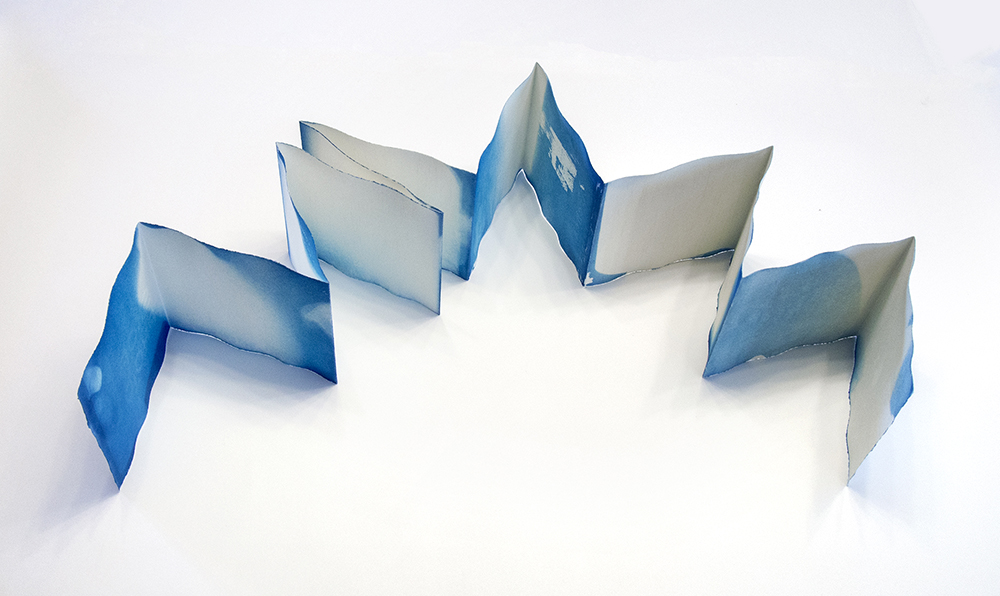
SKOP PHOTO artists’ book by Doug Spowart
.
Other images of SKOP PHOTO folder, cover and details


ARTIST’S STATEMENT: SKOP PHOTO an artists’ book by Doug Spowart
This book is created using the cyanotype (sun print) process as part of the author’s ongoing investigation on the ontology of reading.
The book was folded into a concertina form to eventually allow for a variety of potential readings; either extended or page after page. The author then coated the light sensitive cyanotype emulsion onto the pages of the book.
The pages were slowly turned and extended over several minutes allowing the sunlight of the Greek island of Skopelos to strike the emulsion as author performed reading.
After washing in a bath of water, an image of the Aegean light was formed in Prussian blue on the pages of the book. Alternatively, where the light had not fallen on the page – there seemed to be no image formed. But this apparent absence was a “shadow” – a kind portrait of the artist reading the book in its moment of creation.
Today I received an email advising that my submission was not shortlisted..
.
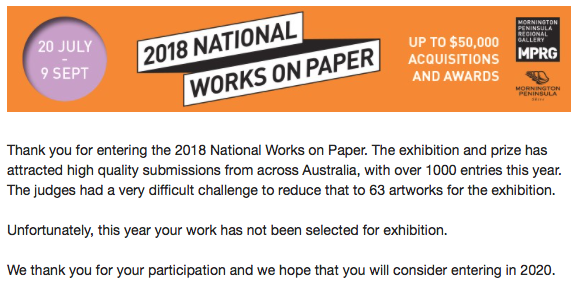
Not a big problem for me as only 1 in 16 artworks were accepted for the 2018 awards and those names on the list are a fine group of artists.
.
If you are interested the 2018 National Works on Paper finalists were:
Raymond Arnold, Peter Atkins, Alec Baker, Martin Bell, Ray Besserdin, Solomon Booth, David Bosun, Godwin Bradbeer, Kate Briscoe, Jane Brown, Jon Campbell, Susanna Castleden, Danica Chappell, Hua Cun Chen, Sam Cranstoun, Lesley Duxbury, Robert Fielding, David Frazer, Ian Friend, Dana Harris, Katherine Hattam, Pei Pei He, Kendal Heyes, Mark Hislop, Deanna Hitti, Anna Hoyle, Natalya Hughes, Alana Hunt, Locust Jones, Jennifer Joseph, Noŋgirrŋa Marawili, Brian Martin, Georgie Mattingley, Mish Meijers, Viv Miller, Helen Mueller, John Nixon, Open Spatial Workshop, Elena Papanikolakis, Louise Paramor, Hubert Pareroultja, Jemima Parker, Riley Payne, Dan Price, Lisa Reid, Louise Rippert, Cameron Robbins, Brian Robinson, Elissa Sampson, Emily Sandrussi, Geoff Sargeant, Jo Scicluna, Liz Shreeve, William Smeets, Kylie Stillman, TextaQueen, James Tylor and Laura Wills, Trent Walter, Rosie Weiss, Mumu Mike Williams, Puna Yanima, Yvonne Zago, Tianli Zu.
Exhibition details at the Mornington Peninsula Regional Art Gallery:
The opening event and award presentations will take place on Saturday 21 July from 4-6pm. An electronic invitation will be sent to you closer to the date.
Now I’m looking forward to 2020
In the meantime I’ll be pursuing some more cyanotype documentations of the act of reading – maybe during our upcoming Bundanon Artists Residency in June…
.
.
,
2018 WORLDWIDE PINHOLE DAY 29 April – Our images
.
Round the [w]hole world on Sunday the 29th of April 2018 pinholers were out having fun – Making their images for the 2018 WPD. Far away from the darkroom (again) we’ve once again fitted a pin-prick in a piece of aluminium fitted to a body cap of our Olympus Pen EP-5 camera and we went on a cruise around the New South Wales town of Muswellbrook pinholing…
This is the 13th year we have supported the WPD project!
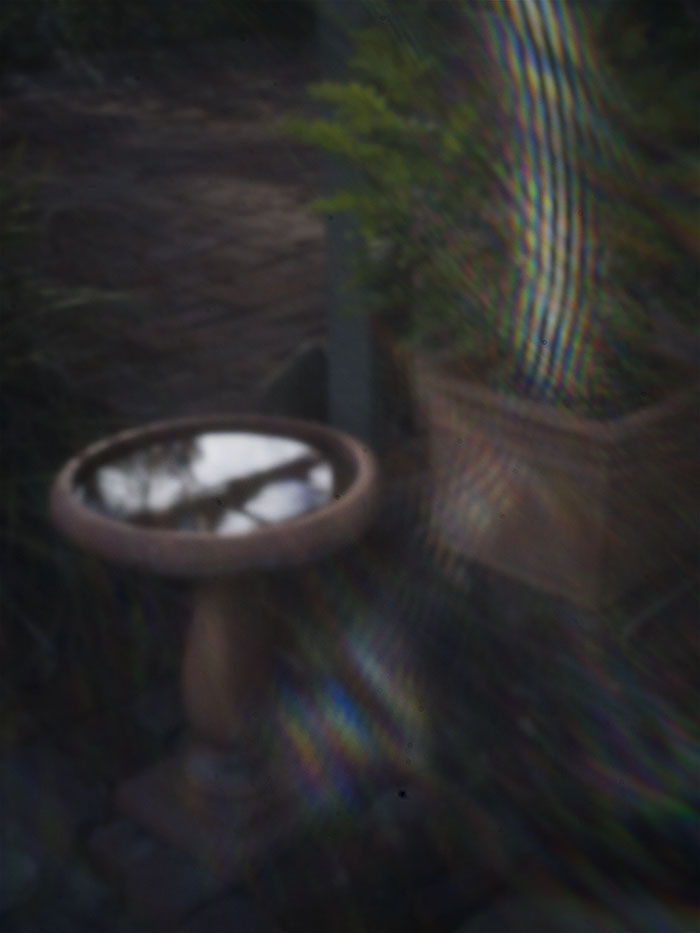
Bird bath by Victoria Cooper
.
ABOUT VICKY’S PINHOLE IMAGE:
.
Each day birds of all sizes come to drink from this and it is shared with the two cats who live here too… It is the driest April on record in this region of Australia.
The photo was taken with the intention of capturing the sun flare. Digital capture with hand-made hole on an Olympus EP5 on manual setting.
.
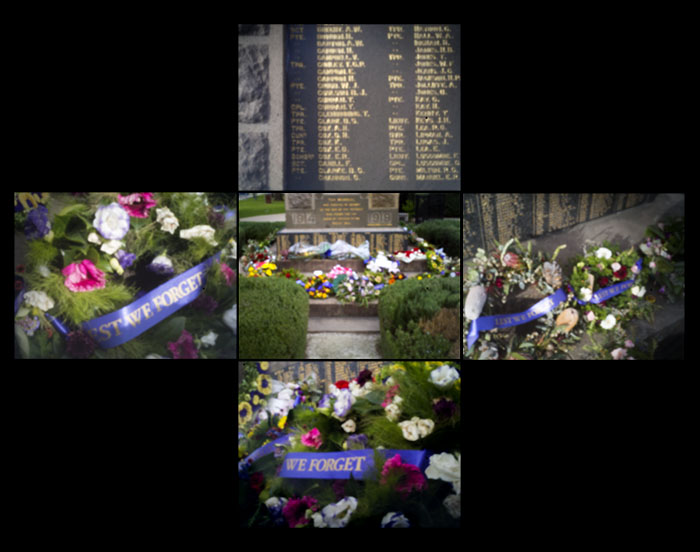
Lest we forget – April 25th by Doug Spowart
.
ABOUT DOUG’S PINHOLE IMAGE:
.
Each year on April 25 Australian and New Zealand peoples commemorate ANZAC Day in recognition of the sacrifice made by soldiers from our country in the First World War. Floral tributes are laid at memorials all over the country. The message on most wreaths is the phrase ‘Lest we forget’.
The photomontage is made up of 5 images – each photo was taken on an Olympus EP5 digitally with a hand-made pinhole.
.
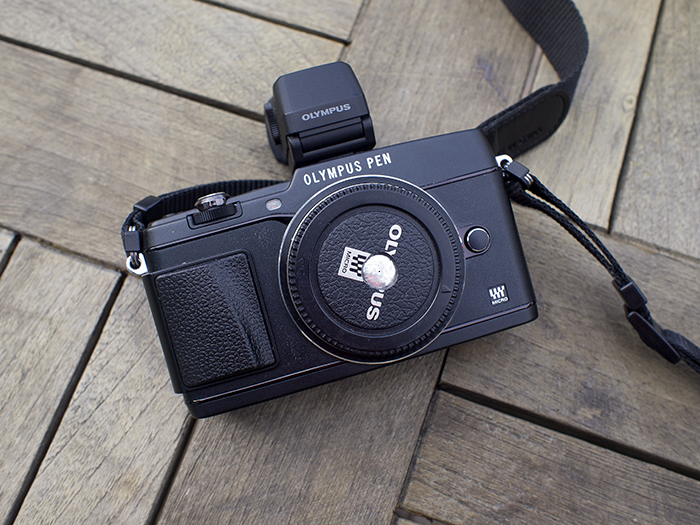
Olympus Pen with hand pierced aluminum foil hole, Aperture exposure mode, ISO 800.
.
.
Visit the WPD Site for details of other posted: http://pinholeday.org/
.
Our Past WPD images:
2016 Doug: http://www.pinholeday.org/index.php?id=1235
2016 Vicky: http://www.pinholeday.org/index.php?id=1540
2015 https://wotwedid.com/2015/05/04/april-26-worldwide-pinhole-day-our-contributions-for-2015/
2014 Vicky’s http://pinholeday.org/gallery/2014/index.php?id=1810&City=Toowoomba
2014 Doug’s http://pinholeday.org/gallery/2014/index.php?id=1811&City=Toowoomba
2013 https://wotwedid.com/2013/04/29/world-pinhole-photography-day-our-contribution/
2012 http://www.pinholeday.org/gallery/2012/index.php?id=1937&searchStr=spowart
2011 http://www.pinholeday.org/gallery/2011/index.php?id=924
HERE IS THE LINK to the 2011 pinhole video http://www.youtube.com/watch?v=Yk4vnbzTqOU
2010 http://www.pinholeday.org/gallery/2010/index.php?id=2464&Country=Australia&searchStr=spowart
2006 http://www.pinholeday.org/gallery/2006/index.php?id=1636&Country=Australia&searchStr=cooper
2004 Vicky http://www.pinholeday.org/gallery/2004/index.php?id=1553&Country=Australia&searchStr=cooper
2004 Doug http://www.pinholeday.org/gallery/2004/index.php?id=1552&Country=Australia&searchStr=spowart
2003 http://www.pinholeday.org/gallery/2003/index.php?id=615&Country=Australia&searchStr=spowart
2002 http://www.pinholeday.org/gallery/2002/index.php?id=826&Country=Australia&searchStr=spowart
.
.

A Spectrum: Photobook to Artists’ Book
About 4 years ago during post doctoral research I was involved with at the State Library of Queensland as a Siganto Foundation Research Fellow. I submitted a paper concept to a call-out for contributions to a major book on photobooks being prepared by a significant contributor to the international photobook discipline at that time. Unfortunately the publishing project was never realised and the essay did not enter the critical discourse on photobooks.
Recently there has been much discussion about terminologies in photobooks and some aspects of the artists’ book are beginning to blur. I passed the paper on to a UK PhD candidate who found interest in the discussion that I raised and suggested that I self-publish the essay.
So here it is…
.

Spectrum
. A Photo Spectrum: Photobook to Artists’ Book
.. [DRAFT@January 21, 2015]
The contemporary popularization of the ‘photobook’ is arguably attributed to the three published commentaries that have become seminal texts on the subject, the first of which: The Photobook: A History Volume I was released in 2004 by photographer and photobook maker Martin Parr, and photo historian Gerry Badger. Commentator and photographer Tim McLaughlin observes: ‘The term “photobook” which never really existed before Parr and Badger (most dictionaries still do not recognize it), would, within a few years, come to identify a growing industry…’(McLaughlin 2013). Interest in the photobook has never been greater. Digital technologies have emancipated photography and book publishing and now anyone can take photos and make their own photobooks. Accompanying this publishing revolution are awards, ‘books of the year’ lists, catalogues, and an auction market. Specialist online and bricks-and-mortar bookshops now service an ever-increasing buying and collector market.
Although photobook publications have aesthetic definitions for what a photobook is, the term has a lot of ground to cover. Photography writer and teacher David Campany recently noted in Aperture’s Photobook Review that: ‘The compound noun ‘photobook’ is a nifty little invention, designed to turn an infinite field (books with photographs in them) into something much more definable’(Campany 2014). But while the ‘infinite field’ may be ‘easily defined’ the term photobook can only serve as a generalised umbrella for the plethora of photobook products that shelter under it.
The definition of photobook today could include a roughly printed or photocopied zine-like object created by a child, to a blatantly over-designed limited edition book. In between these bookends lies a range of products: Print-on-demand and hand-made unique state, small editions, self-published or bespoke books, ephemeral items, newspapers, pamphlets and zines. Although many of these published forms may not have the universal distribution and commercial opportunities afforded a trade published book, they are, none the less, part of the broad practice of the contemporary photobook. Additionally many of these books occupy much of the emergent contemporary scene and tend to be overlooked as the critical discussion is usually focussed on the photobook exemplars from the past.
The boundaries of the photobook discipline are blurred by their intersection with a variety of other book genres including the expansive mediums of artists’ books and zines. As independent publishers of books, artists have for over 100 years communicated their ideas and stories using their chosen media in book form. Artists have embraced photography and the various forms of photography from found collaged photos, to screen-printing, photo etching and gravure, as well as actual silver gelatin, type C, inkjet or laser prints in their artists’ book works. Anne Thurmann-Jayes commented in the catalogue for ars photographica, an exhibition about artists and photographers and their photobooks, that: ‘In very general terms, it is possible to say that half of all artists’ books produced to date have been based on photographs’ (Thurmann-Jajes 2002:19). For that reason any discussion of the photobook needs to consider a broader range of contributors to the discipline as well as other forms of the book where photographs act as carrier of the visual communiqué.
In her essay Thurmann-Jajes also comments on the differences that she felt existed between the artist and the photographer in conceptual aspects of making a photobook. She states that:
The authors of photo books followed photographic tradition, according to which the photograph as such was decisive, becoming the bearer of meaning… By contrast to the photo book, the artists’ book is not the bearer, but the medium of the artistic message. (Thurmann-Jajes 2002:20)
In highlighting the differences in the way the photograph is used and considered by these two groups, Thurman-Jajes has identified a division may have always existed between the photographer and the artist using photography. Yet making books with the photograph as a ‘bearer of meaning’ or ‘message’ should not belong to any particular practitioner. If the photograph is therefore a universal and an open medium for all book makers then any questioning on what is and what can be a photobook requires consideration that embraces this diversity.
To ensure that the photobook remains vibrant and relevant, a flexible space for discourse and critique needs to be created that is inclusive of the broad range of authors and book forms in this medium. In 1998 artists’ book librarian, collector and curator Clive Phillpot suggested a metaphor for the artists’ book discipline as being ‘white light’ and the individual colors that made up white light as being the ‘many categories of the spectrum’ representing the broad nature of the practice. In this essay Phillpot’s ‘white light’ metaphor is now applied to the range of published forms that employ or contain photographs beyond that of the artists’ book. (Phillpot 1998:38)
Through an extension of Phillpot’s prism, this essay will propose a grouping of the various forms of the book from photobook through zines to artists’ books and their salient characteristics using individual colors (wavelengths of light). As the visible light spectrum has a rainbow of seven visible colors this proposition has seven as well. Although two additional ‘colors’, familiar to photographers, that of infrared and ultra-violet, have been added to recognise specific aspects of photography publishing at the extreme ends of the range. Each color and book form has specific characteristics and identifiers associated with it – it is recognized that many books may challenge attempts to place them within just one color in this spectrum.
The transition from the infrared to ultra-violet intentionally locates those books conceived and produced by photographers at the warmer end of the spectrum. Book forms in the cooler end of the spectrum would be principally books made by artists using photography. Placement within this spectral framework may create some interesting challenges including the divisions of ‘artist’ and ‘photographer’, and how practitioners describe themselves and their creative products.
The 9 colors and their identifiers are:
Infrared – The Deluxe Photobook
- A book of monumental proportions approaching what bibliographers and librarians call ‘double elephant’ (up to 78cm tall for Helmut Newton’s Sumo);
- Usually consists of a monograph styled ‘best of’, or, of a tightly thematic subject matter by a particular photographer;
- Are limited editions, expensive to buy and have limited markets that center on private collectors and institutions; and
- Are usually commissioned by a small number of specialist art publishing houses as opulent objects of art, design and packaging.
An exemplar:
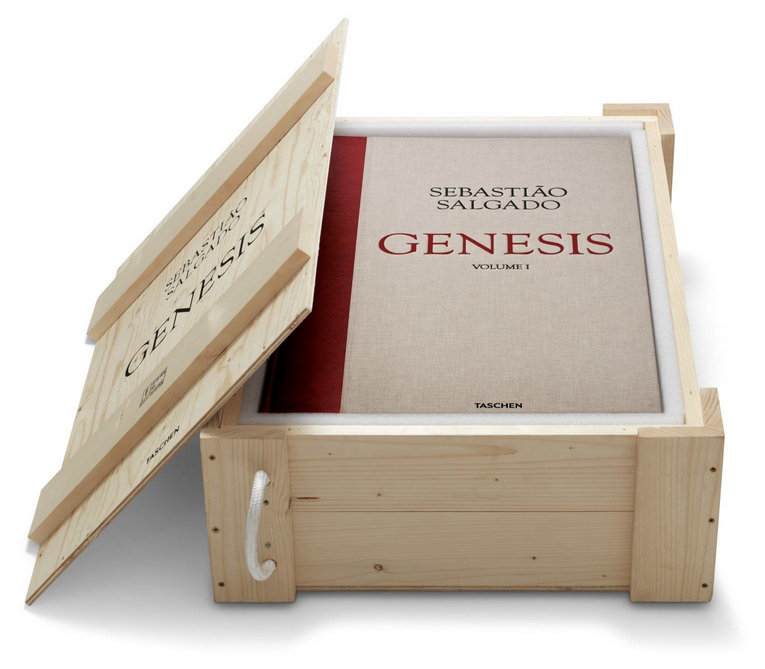
Genesis, Sebastião Salgado, Taschen
Genesis
Sebastião Salgado, Taschen, Hardcover, 2 vols, with bookstand, 18.4 x 27.6 in., 704 pages, £ 2,500. https://www.taschen.com/pages/en/catalogue/photography/all/02613/facts.sebastio_salgado_genesis.htm
Viewed: April 6, 2018
Red – The ‘Classic trade’ Photobook
A book form in the tradition of Walker Evans’ American Photographs (1938), William Eggleston Eggleston’s Guide (1976), Robert Frank’s The Americans (1959), and John Gossage’s The Pond (1985). Characteristics of these books may include;
- A single photograph per opening, the facing page blank and may sometimes contain a title or caption;
- Sometimes it is a book co-published with an exhibition of the same title;
- Simulation of the gallery experience of viewing photographs and therefore is sometimes referred to as an ‘exhibition in a book’;
- Images in these books are carefully and purposefully sequenced to carry the narrative intended by the author; and
- An essay relating to the work by the photographer, curator or writer often accompanies this book form – occasionally the essay may be of an obtuse content.
An exemplar:
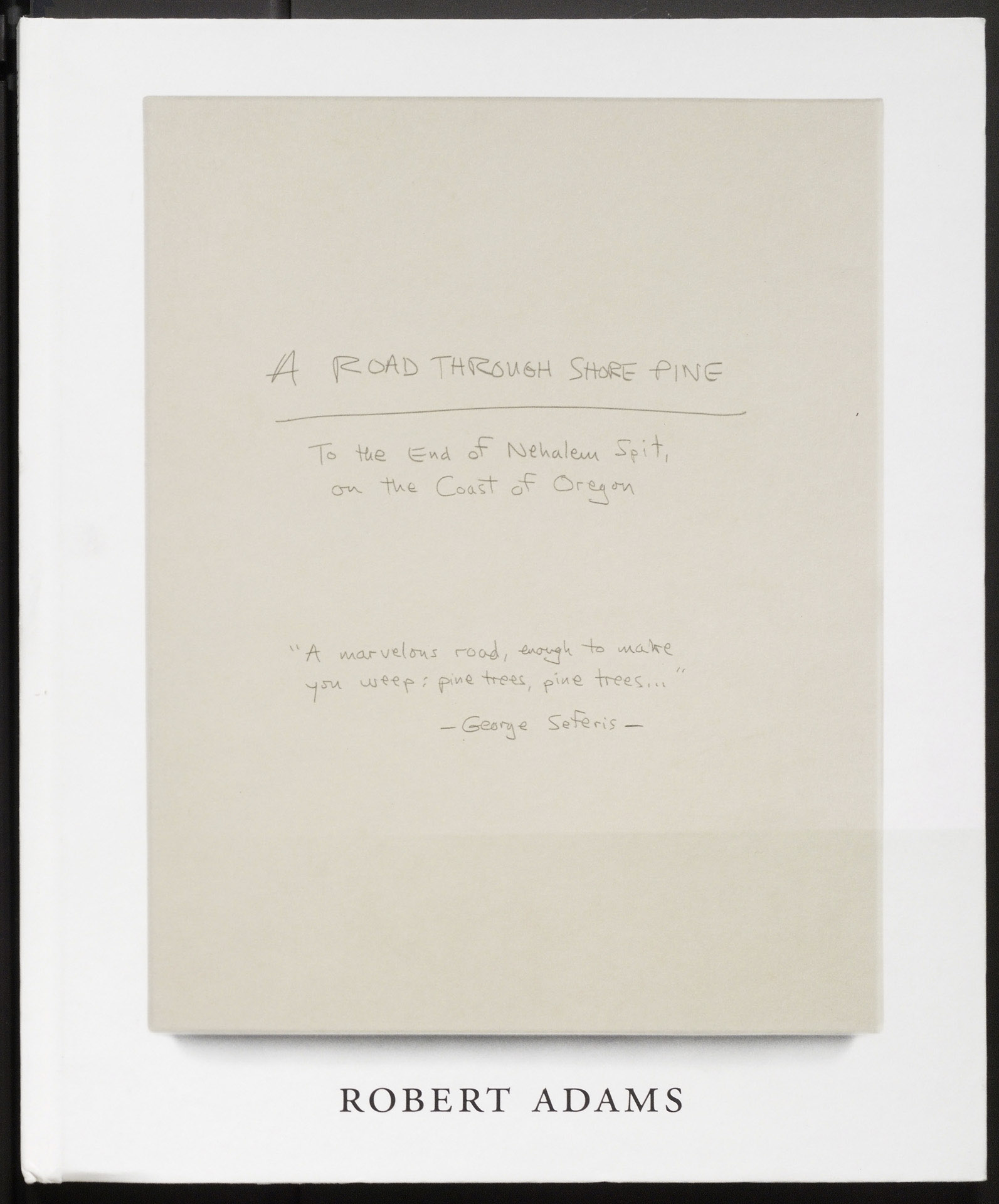
A Road Through Shore Pine, Photographs by Robert Adams
A Road Through Shore Pine
Photographs by Robert Adams. Fraenkel Gallery, 2014. 42 pp., illustrated throughout, 9¾x11¾”. http://www.photoeye.com/bookstore/citation.cfm?Catalog=DS364
Orange – Design Photobook (collaboration)
The authors of this form consider that photobooks are an experience that can be enhanced by the influence of creative graphic design that may include:
- Usually is a collaboration between the photographer and a designer so as to transform the photographs into a strident work of visual communication;
- The presentation of photographs over double pages, or being montaged, or printed full-bleed as well as being scaled variably;
- Inventive typography and layout design enhancements;
- High quality book production, printing, finishing and packaging; and
- A differentiation from other photobooks by the inventiveness of the design features and the surprise that is encountered by the reader in engaging with the physicality of the book and how it operates as a communicative device.
Exemplars:
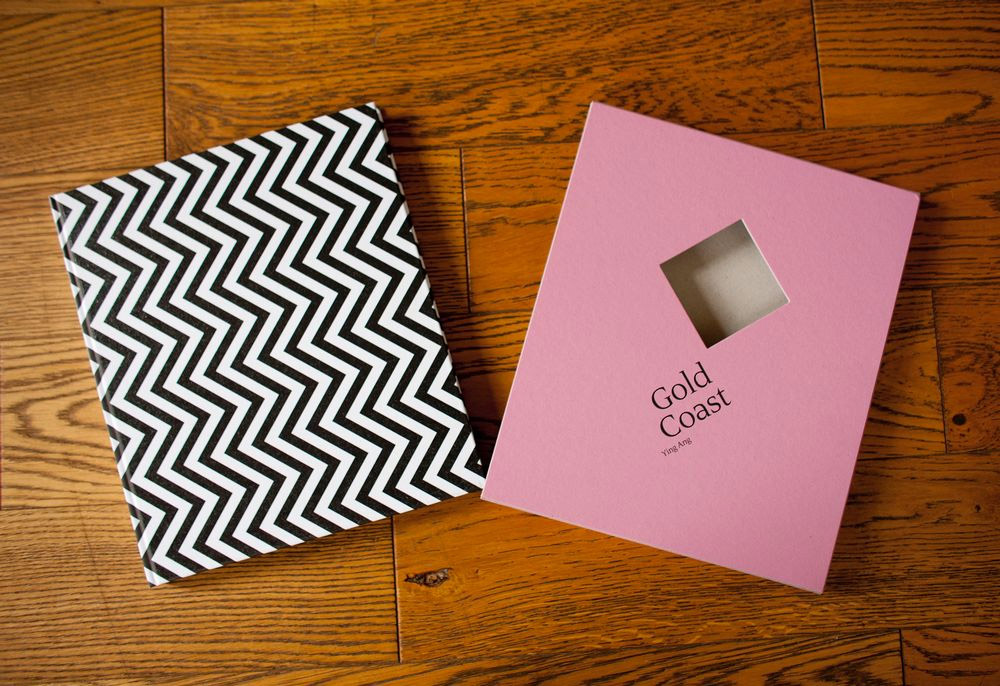
Gold Coast, photography by Ying Ang, co-designed with Teun Van Der Heijden
Gold Coast, photography by Ying Ang, co-designed with Teun Van Der Heijden
Self-Published, 2014. 132 pp., 72 color illustrations, 9½x11¼”.
http://yingangphoto.com/page.cfm?id=34&subid=121
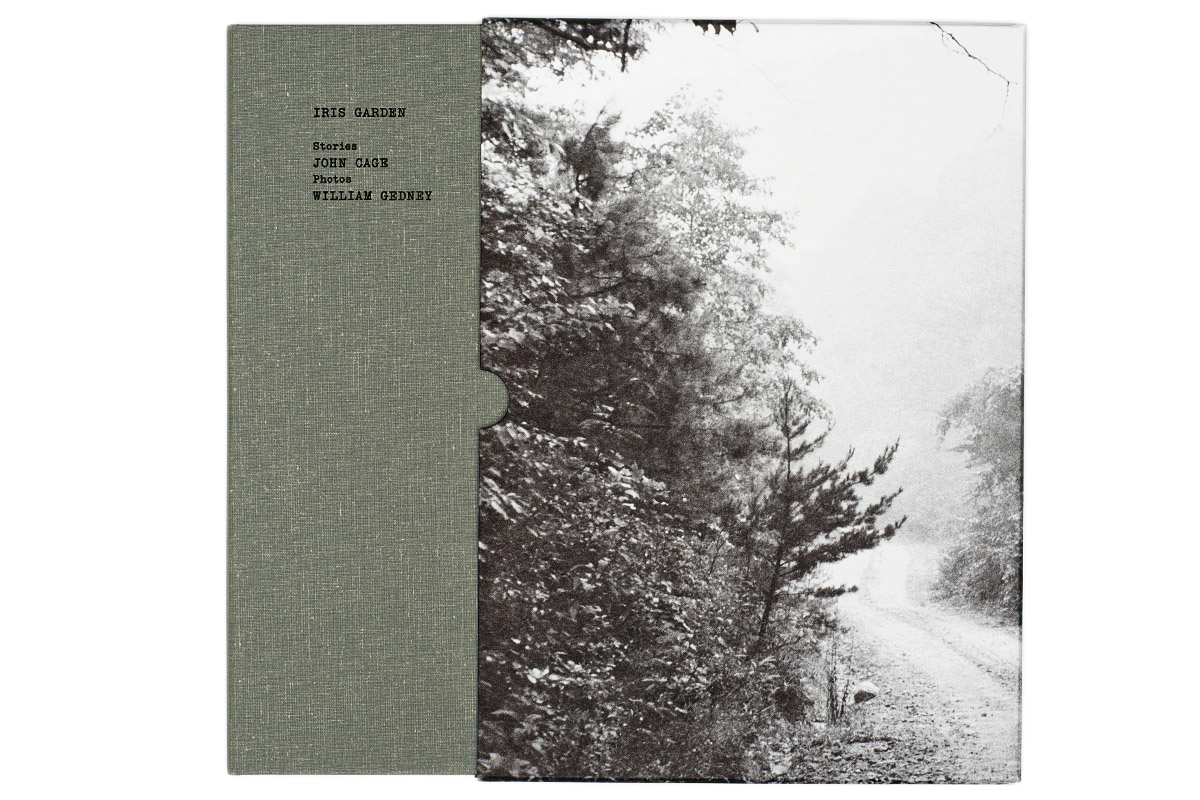
Iris Garden, photography by William Gedney and designed by Hans Seeger
Iris Garden, photography by William Gedney and designed by Hans Seeger
63 pages plus insert, 6.75 x 9.5 in. Heavy softcover with wraps & slipcase,
Little Brown Mushroom, 2013, in an edition of 1,000.
http://www.littlebrownmushroom.com/products/iris-garden/
Yellow – POD Photobook
- These books are usually self-published;
- They may emulate bookstore trade books from simple booklets to grand coffee table tomes;
- They can be produced by anyone with minimal photography and computer skills and just require access to online photobook-service providers;
- Single book or multiple copies can be made;
- Affordable pricing considering the sophistication of the product;
- POD services generally utilize templates for ease of use by clients of limited skill;
- POD books may have designer input, but due to the limited range of options for special finishing or designed-in features; and
- Many POD book users create book ‘dummies’ that may lead to a more trade-based publication at a later stage.
For exemplars see works offered in the photography category of http://www.Blurb.com.
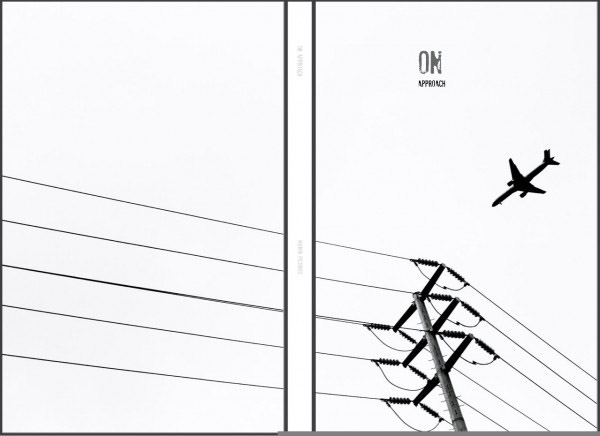
On Approach by Daniel Milnor, BLURB Book
On Approach by Daniel Milnor, BLURB Book, 13x20cm, 26 pgs
http://www.photoeye.com/bookstore/citation.cfm?Catalog=ze462
http://www.smogranch.com/2012/09/26/cleveland-musuem-of-art-diy-photobooks/
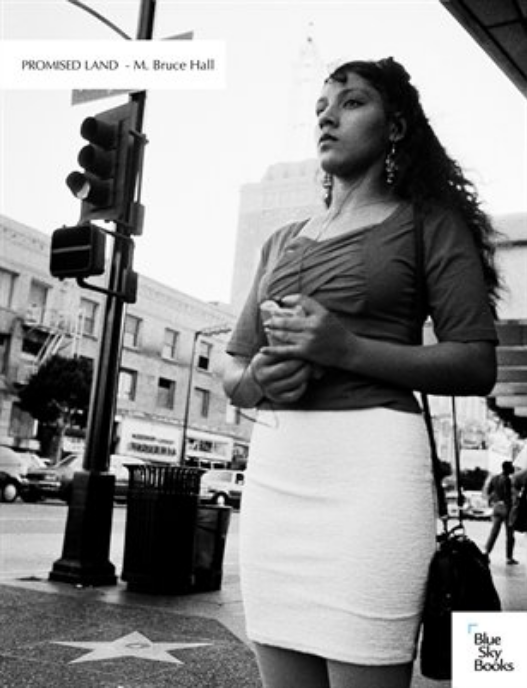
Promised land by M Bruce Hall
Promised land by M Bruce Hall, Blue Sky Books/MagCloud. Standard 8.25″ x 10.75″. 56 pages, perfect-bound.
http://www.magcloud.com/browse/issue/815317
Green – Emergent – PhotoStream* [of Consciousness], Photozine*or Insta-photobook*, Imagistbooks*
This aspect of photobook publishing is occupied by a large number of DIY practitioners accessing a range of print technologies from desktop inkjet and laser printers to affordable digital press printing and binding technologies. Content of these books could be considered a visual form of imagist or concrete poetry – they exhibit and subject and assembly sensibility that could match ‘stream of consciousness’ approaches to art. Other aspects include:
- Usually self-authored or collaborative publications;
- Are made in limited numbers/editions, often hand sewn or stapled;
- The books are sold through specialist popular culture bookshops or online;
- Often these books may be the result of crowd sourced funding and may be derived from online image storage or social media platforms like Instagram; and
- Their locale of popularity and distribution may be regional.
*Names considered to best describe these emergent forms
Exemplar:
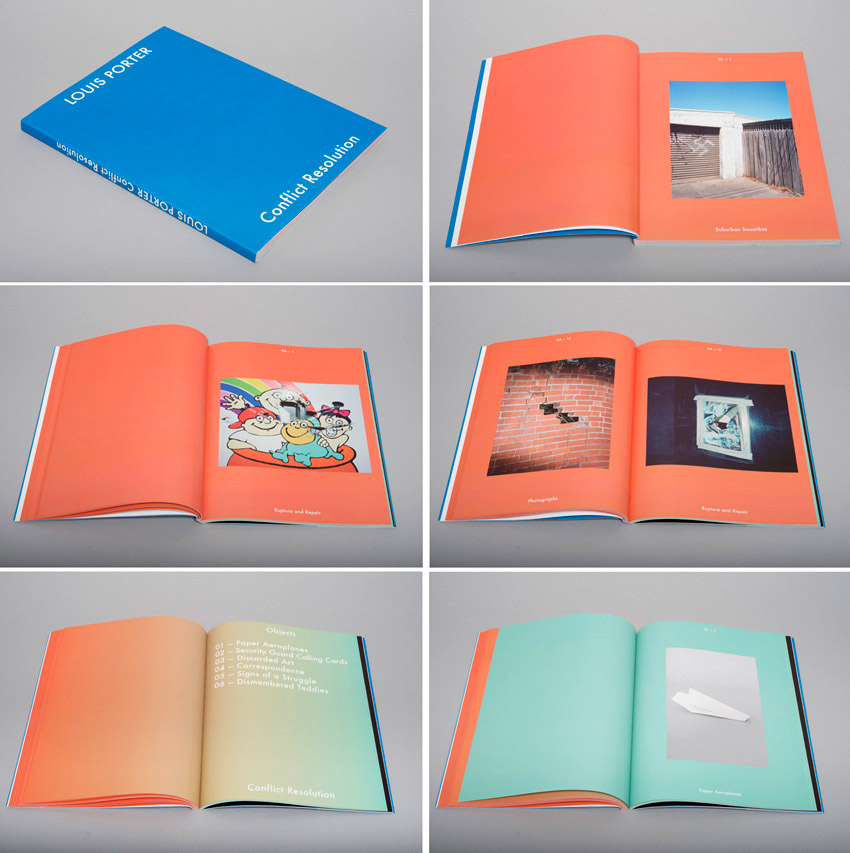
Conflict Resolution by Louis Porter
Conflict Resolution by Louis Porter, published by Twenty Shelves (Melbourne/Australia), 164 Pages full color, Design by Pierre Hourquet, Section sewn paperback with de-bossed cover, 20 x 27 cm, Edition of 1000.
http://louisporter.com/twenty-shelves/
Blue – Photopapers* Photomag* (broadsheet / newspaper / magazine)
These emergent photobooks take their physical form and production values from conventional print media. Other aspects include:
- Availability through POD service providers;
- Print runs may be small and limited or quite extensive of 1,000 copies or more;
- These works may parody existing newspaper or magazine titles as a form of activism or commentary on print media and society; and
- They may provide a photographer with a larger-scale publication format at a low production cost.
*Names considered to best describe these emergent forms
Exemplars: Photopaper
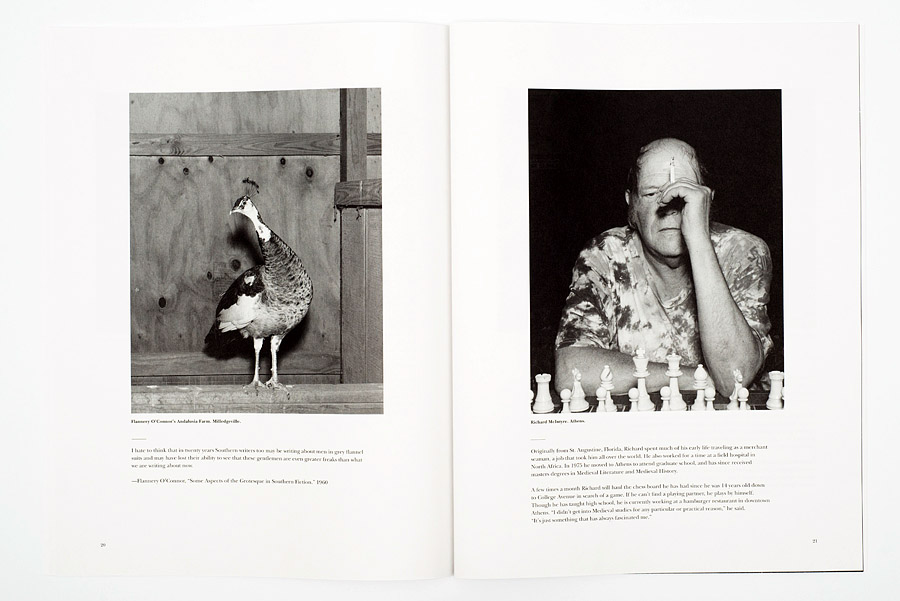
LBM Dispatch #7: Georgia photography by Alec Soth and Brad Zellar, designed by Meredith Oberg
LBM Dispatch #7: Georgia photography by Alec Soth and Brad Zellar, designed by Meredith Oberg
Little Brown Mushroom, Publication Date, November, 2014
48 pages 11.25 inches x 15 inches, 50 lb newsprint paper, Edition of 2000
http://www.littlebrownmushroom.com/products/lbm-dispatch-7-georgia/
Exemplar: Photomag
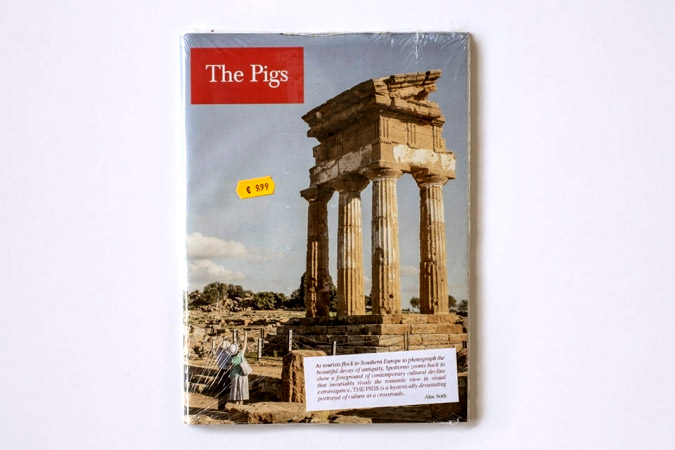
PIGS Photography by Carlos Spottorno, designed by Carlos Spottorno and Jaime Narváez
PIGS
Photography by Carlos Spottorno, designed by Carlos Spottorno and Jaime Narváez based on a replica of The Economist magazine.
Published by: RM Verlag and Phree, Madrid, 2013
112 pages 27 x 19 cm
http://spottorno.com/web/pigs
Indigo – Innovative Artists’ Book
This genre of the book is based around the idea of the artist as author, publisher and maker, and forms of the book that represent innovation, creativity and exploration of the book form. Historically this book form has been the domain of the artist and the way photography finds its way into the book can be more about the photo as a record, a fact or a trace representing the world and society that created it. Rather than something representing the passion that photographers have for the photograph as the product of their special visual perception of the world. Characteristics of these books include;
- Forms integral to the narrative expression and the artist will break rules and conventions to achieve their expectations for the book;
- Books engineered in ways that demand interaction, both through the visual senses but also through the haptics of handling and reading – the turning of pages;
- Books that may mix photographs and text or text over photographs, or text as photographs and photographs as text;
- Multi-media productions where the photograph becomes a part of a larger interplay of media; and
- Bespoke unique state or a work that is published as a limited edition.
It should be noted that the artists’ book discipline might encompass an equally diverse range of book forms
Artists’ Book exemplar:
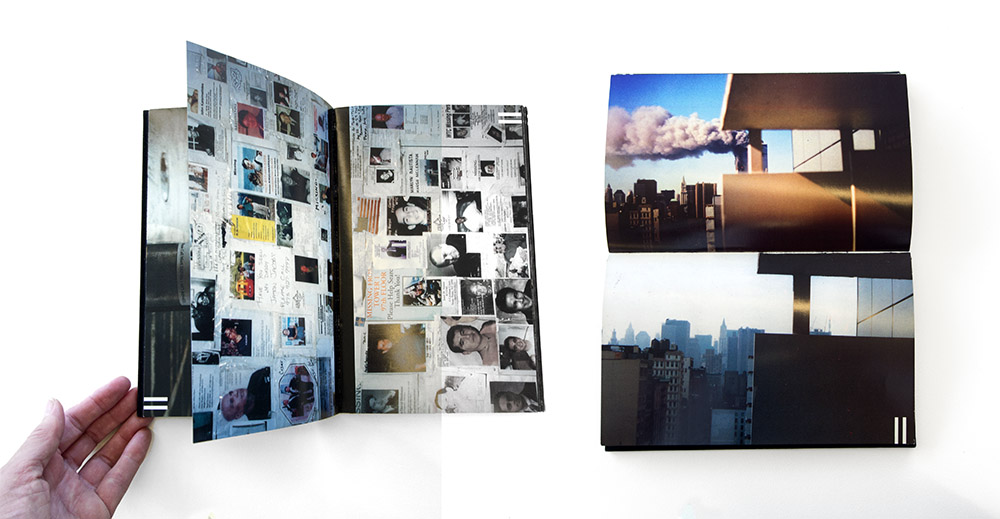
Eleven, Marshall Weber et al.
Eleven, Marshall Weber 1960- ; Christopher Wilde; Sara Parkel; Alison E Williams; Isabelle Weber; Booklyn Artists Alliance. New York : Booklyn :c2002
http://www.booklyn.org/artists/Marshall%20Weber.php
Violet – ‘Artists’ Book’ Codex
Related to books that utilize the conventional codex form and may explore the narrative form, conceptual art ideas as well as artmaking techniques. These books may exhibit the following characteristics:
- Codex book form;
- A range of production values including artisan printers and binders;
- Contain texts as well as graphic elements and photographs; and
- Printing techniques such as silkscreen, photoetching and gravure, inkjet, digital press and alternative imaging techniques like cyanotype.
An exemplar:
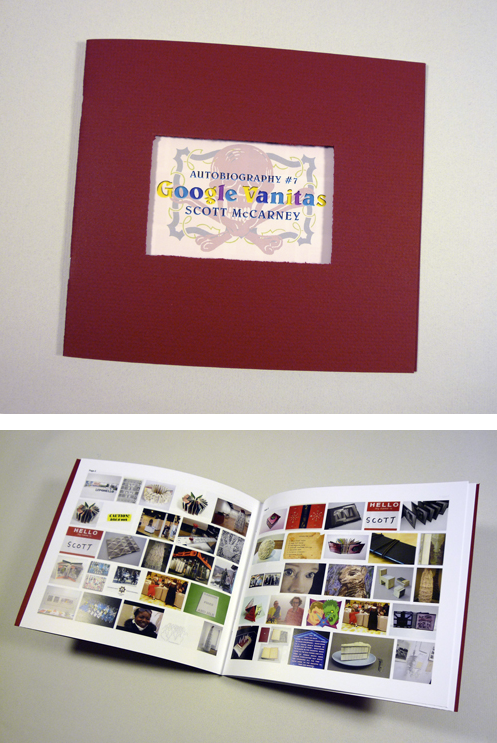
Google vanitas : autobiography # 7 concept and design by Scott McCarney
Google vanitas : autobiography # 7 concept and design by Scott McCarney.
16, [2] p. : col. ill. ; 22 x 20 cm.
http://scottmccarneyvisualbooks.com/Pages/google%20vanitas.html
Ultra-Violet – ‘Book Arts’, Livre d’Artiste Book
Consistent with the production and aesthetic values of the ‘fine press’ with the following characteristics:
- Texts are usually handset letterpress, photographs made by traditional photo etching or gravure techniques and binding and presentation in cloth and leather often with ‘book arts’ embellishments;
- The books are limited editions and utilize artisan practitioners and specialists in the production of the work;
- Often the book may be commissioned by an entrepreneurial publisher following the French tradition of the latter 19th century; and
- These works are expensive to buy and have limited markets that center on private collectors and institutions.
An exemplar:
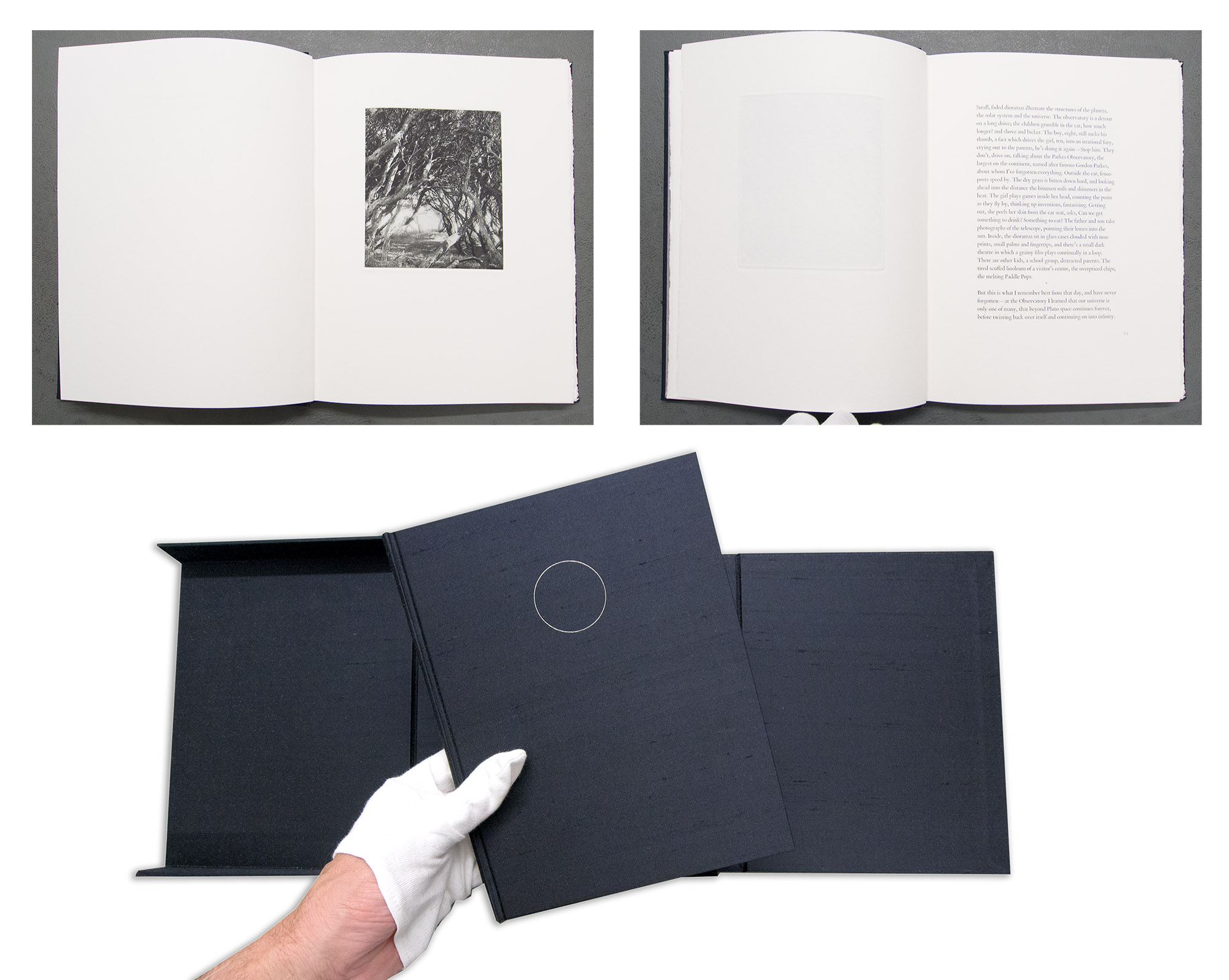
Extinguishing of stars Carolyn Fraser and Holly Morrison
Extinguishing of stars Carolyn Fraser and Holly Morrison
Idlewild Press, Cleveland, Ohio :2003. 61 p. : ill. ; 24 cm., in case 26 x 20 x 4 cm. Edition of fifty.
https://thedesignfiles.net/2011/03/interview-and-studio-visit-carolyn-fraser-of-idlewind-press/
http://www.carolynfraser.com/wp-content/uploads/2011/11/Issue4_Uppercase_Fraser.pdf
In any attempt to define creative book publishing caution needs to be exercised. The artists’ book discipline has for years been dogged by attempts to define ‘what is, and what isn’t an artists’ book’. In 2005 Johanna Drucker put forward a proposal for classification of artists’ books. Even though she predicted that her proposition would ‘… cause strife, competition, [and] set up a hierarchy, make people feel they are either included or excluded’, (Drucker 2005:3) it inspired worldwide debate and furore from artists and librarians and became known as ‘Druckergate’. Ultimately the angst cooled and the artists’ book field continued with qualified debate, in both academic literature and everyday conversation, thus creating a basis for ongoing questioning and commentary on the discipline.
More recently, in 2010, Sarah Bodman and Tom Sowden from the Centre for Fine Print Research at the University of the West of England sought to define the canon for the artists’ book in the 21st century. They did this by creating a survey of world practitioners of bookmaking by artists in every conceivable outcome, including the emergent eBook. They found that the hierarchical form of a tree diagram was ‘too rigid and too concerned with process’ (Bodman and Sowdon 2010:5). They discovered that their respondents wanted to alter the diagram to satisfy the, ‘cross-pollination that is often required by artists’ and added in, ‘connectors across, up and down to bring seemingly disparate disciplines together.’
Just as Bodman and Sowdon found from their research, this visual spectrum structure is open to challenge where practitioners and commentators are encouraged to mix and augment new color palettes for the presence of the photograph within the book. So what is proposed is not a rigid structure, deeply rooted and immovable as in the tree trunk, branch and leaf, but rather one where books of similar characteristics can be grouped, blended and mixed.
The intention for this nomenclature is to bring visibility to the diversity of creative publishing forms using the photograph. It is offered as a potential tool that recognises this evolving and extended medium to: curators, judges, cataloguers preparing ‘the best books of the year’ lists and books for sale or auction, and commentators engaging in critical debate. Additionally the links with artists’ books and zines can also be acknowledged thus extending and enriching the discipline of the photobook.
In the debate surrounding the evolving photobook this photo-specific spectrum analysis is offered, as a non-hierarchical, flexible and creative nomenclature. The spectrum should be able to move with change and developments within the photo in the book and the ideas and the motivations behind those who create these communicative devices and their commentators and readers. Each constituent of the spectrum, although emanating its own ‘wavelength’ or ‘color’, forms a part of the “white light” that is the continuum of the photograph and its place in the book.
Dr Doug Spowart[1]
January 2015
.
Bodman, S. and T. Sowdon (2010). A Manifesto for the Book: What will be the canon for the artist’s book in the 21st Century? T. S. Sarah Bodman. Bristol, England, Impact Press, The Centre for Fine Print Research, University of the West of England, Bristol.
Campany, D. (2014). “The ‘Photobook’: What’s in a name?” Aperture: The Photobook Review(#007).
Drucker, J. (2005). “Critical Issues / Exemplary Works.” The Bonefolder: An e-journal for the bookbinder and book artist 1(2): 3-15.
McLaughlin, T. (2013). “Classic – The Photobook: A History Vol 1.” Retrieved 17 June 2014, 2014, from http://imageonpaper.com/2013/05/17/131/.
Phillpot, C. (1998). Books by artists and books as art. Artist/Author: Contemporary Artists’ Books. C. Lauf and C. Phillpot. New York, D.A.P./Distributed Art Publications Inc.
Thurmann-Jajes, A. (2002). ars photographica: Fotografie und Künstlerbücher. Weserburg, Bremen, Neues Museum
[1] This essay is informed by an ongoing and long term personal interest which involved a practice of making, observing and considering the position of photographs published in the creative book realm along with recent research into the intersection of photobooks, zines and artists’ books.
.
TEXT © Doug Spowart 2018
Most of the images in this post are from the promotional websites for the books and some are by the author – copyright resides with the authors and the images here are used for the purpose of review and commentary. Source links are provided for the reader’s connection with the publication under discussion.
.
.
.
.
.
IAN POOLE photographer: eulogy

Poole by Poole 2006
IAN POOLE photographer: eulogy by Doug Spowart
I was over in Wellington New Zealand attending the Photobook NZ conference when our mutual friend Simon Woolf came to tell me that Ian had passed away. Vicky and I had visited Ian and Louise at the Mater Hospital a couple of weeks ago and while Ian was in a difficult place we shared some past experiences. We spoke excitedly about how Ian came out of hospital recently to open ‘Floating’ at Woolloongabba Art Gallery. It was an important occasion as the exhibition featured work by his long-term friends Glen O’Malley and Yoshiteru Asai as well as artworks by Yayu, Ken Yamane’s grand-daughter.
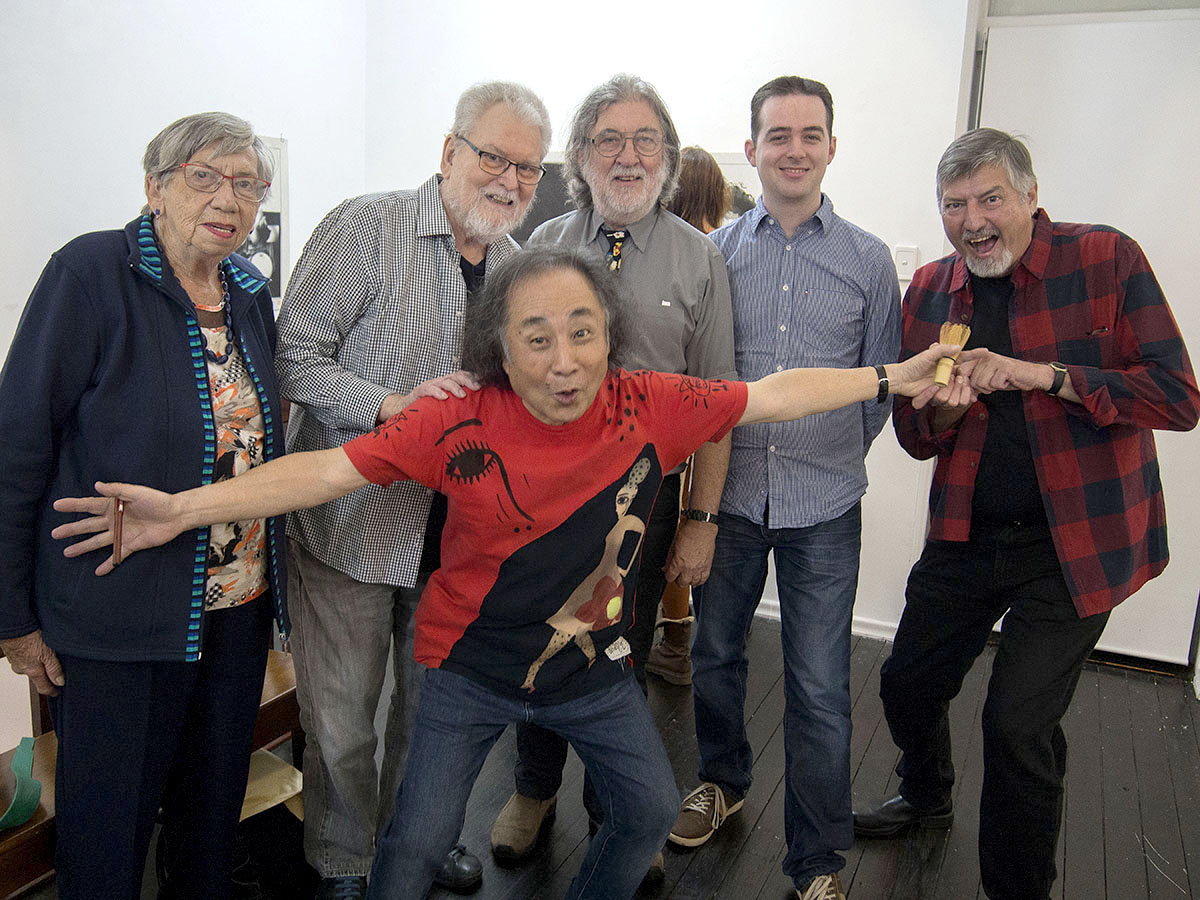
Ian Poole, Glen, Ruby, Asai, Joe and Doug at the opening of Floating
Ian Poole and I shared quite a chunk of history – On hearing the news whatever I was to do that day in Wellington, and my flight home to Brisbane, my thoughts were with Ian, Louise, Nicola and Denise. What follows is a fragment of our connections and things that I remember about the guy…

Pinhole portrait of Ian Poole 1993 by Doug Spowart
My earliest memory of Ian was in the mid 1970s when I met him as an employee of Kodak in Brisbane. Ian had formed a commercial photography partnership with Greg Minns and I served him in my early sales position behind a wholesale warehouse counter in the Fortitude Valley head office. Over time I was to learn of Ian’s pre-commercial work as a part-time wedding photographer for some of Brisbane’s significant studios.
Ian Poole went out on his own in 1976 with the business name ‘Ian Poole does Photography’. He shared a studio in an old church in Warren Street, Fortitude Valley with commercial photographer and AIPP devotee and then Federal President David McCarthy. From there good wine, cigars and Fiats were funded through a diverse range of commercial commissions.
Ian and Denise were married and soon after Nicola was born. A long-term relationship with documentary/art photographer Glen O’Malley strengthened along with his interest in photography beyond the ‘job’ – for him photography was more than just what you did to earn a living.
Ian Poole and the IAP and the AIPP
Ian joined the Institute of Australian Photography (now AIPP) in 1975. An interesting bit of information about Ian is that he entered the very first Merit Awards (APPA) in 1977, and was awarded a Merit for a high contrast photo of a fuzzy hairstyled, seated, saxophone player. I remember that photo well.
In reflection, I always remember Poole being involved with the AIPP in some capacity either at state division level and in the late 1980s on the National Board. During the 1980s I served with Ian on the Queensland Divisional Council and remember many council meetings at Imagery Gallery that finished with us discussing the meaning of life and photography. Together, we also contributed to the development of education and training for photography in Queensland and served on many Arts Industry Advisory Council and Curriculum development committees.
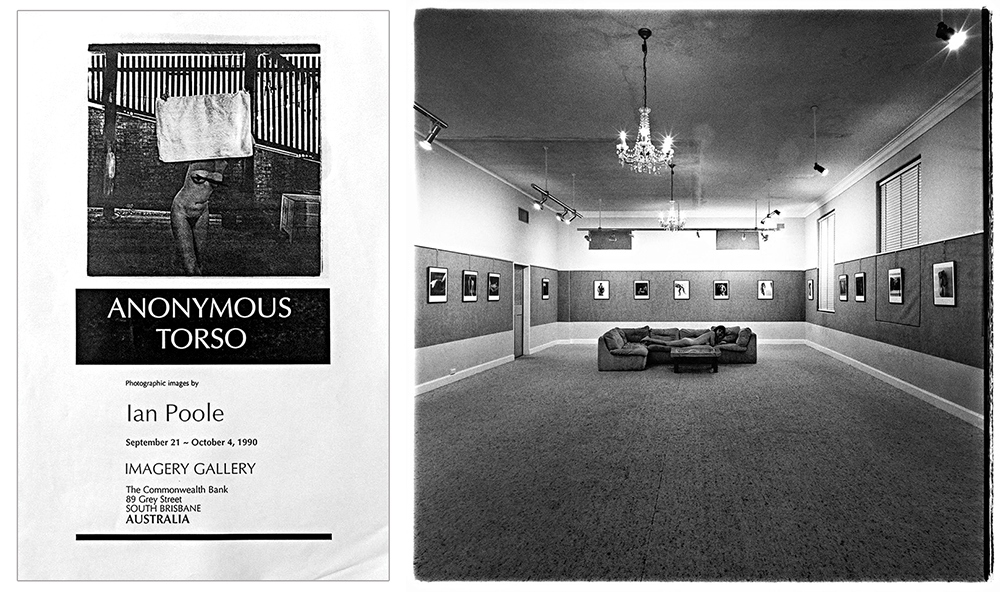
Anonymous Torsos exhibition at Imagery Gallery 1990
Early exhibitions of his work
His interest in personal photography, and in particular the female nude, led to his work being presented in exhibitions. In 1984 I curated an exhibition entitled ‘5 One man shows’ in Stephens Gallery in the Brisbane City Hall, which included a selection of Ian’s nudes. Later in 1990 his first solo exhibition ‘Anonymous Torsos’, was held in Imagery Gallery (a gallery run by myself and my mother Ruby). He also participated in many group shows in galleries in Australia and Japan.

Doug Spowart and Ian Poole with the poster for Shot from down under PHOTO: Victoria Cooper
The Japanese connection
Ian made connections with Japanese photographers through his co-ordination of AIPP events in the early 1980s. This led to an exhibition of 13 photographers organised by Ian and hosted by artist Rick Everingham in his Brisbane studio during Expo 88. Poole followed up this exhibit with an exchange show, ‘A shot from down under’ at Design Expo in Nagoya, Diacolo Gallery in Osaka and amazingly in the Kodak Salon, the Ginza, Tokyo. Ian coordinated a tour for the participating Queensland photographers who spent about 3 weeks in Japan travelling with the exhibition, attending the openings, staying with the Japanese photographer’s families and experiencing Japanese life and landscape.

Poole+Spowart at QCP: Photo Adam Finch
Working for the Queensland Government
By the early 90s photography was changing and the Queensland Government reviewed all their departments that had employed staff photographers. They decided that only 3 photographer positions would be funded into the future. The 3 positions were advertised in the public domain and Ian, not only applied, but also won a position. It should be noted that Ian around that time completed by part-time study a Graduate Diploma of Visual Art at the Queensland College of Art. The topic of his research was portraits of artists.
Australia Council Residency and sessional teaching
Poole’s interest in the art of photography needed to be pursued alongside the day-to-day grind of professional work. After completing the Graduate Diploma he sought and was awarded and Australia Council Artist in Residency in Tokyo where he immersed himself in his passion for portraiture and Japanese culture.
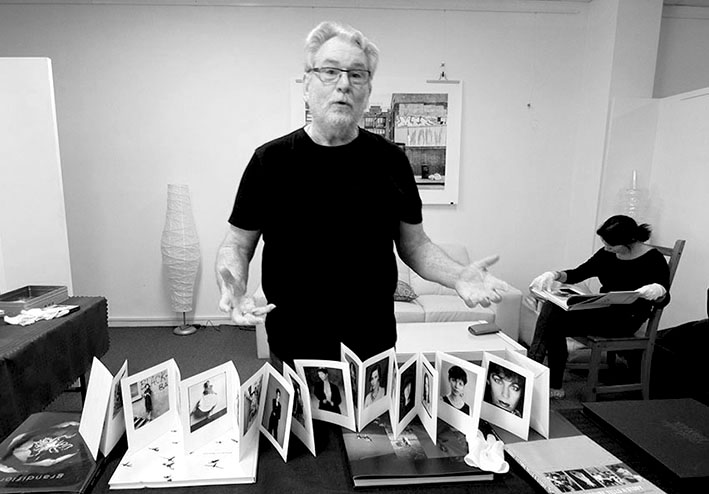
Ian Poole and photobook made in a workshop with Simon Woolf with Vicky and I in 2005
Ian’s assistants, peers and mentorees
Ian always had assistants, mentored those seeking advancement of their skills, as well as sessional teaching at the Queensland College of Art and the Queensland University of Technology. His endorsement of professional practice meant that through his patronage and support many of the Institute’s significant photographers came into the AIPP fold.
Poole and the Australian Professional Photography Awards
Soon after I became Chairperson of the APPA’s in the 1990 I championed the development of judge training and the need for judges to have extended their understanding and appreciation of the art as well as professional practice.
Into this space I brought Ian Poole – he had the ideas, debating skills, knowledge and understanding of art to help with this aesthetic transformation of APPA. His dedication to ensuring that the entrant who made special works, in Ian’s opinion, got a fair hearing. I’ve spoken to many awards entrants, at all levels, and they have a story about Ian ‘going into bat’ for one of their works.
Ian skills as a judge and inspirational speaker were recognised by New Zealand Institute of Professional Photography and he became an Australian judging ambassador for the NZIPP Awards.
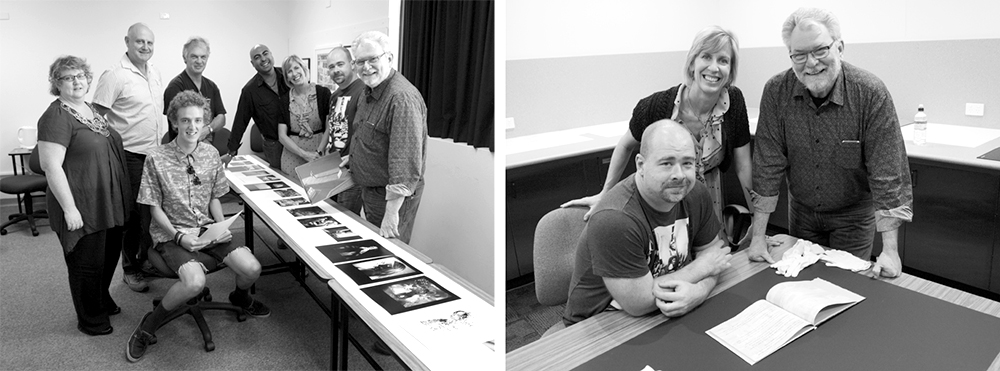
Ian Poole and others at Toowoomba TAFE doing final year assessments
Support for TAFE Toowoomba and Nicola’s study
As a teacher in the photography programs at the TAFE college in Toowoomba I was always privileged to have Ian and many other professional photographers and artists carry out the final holistic assessment of student work as well as endorse and support my institution.
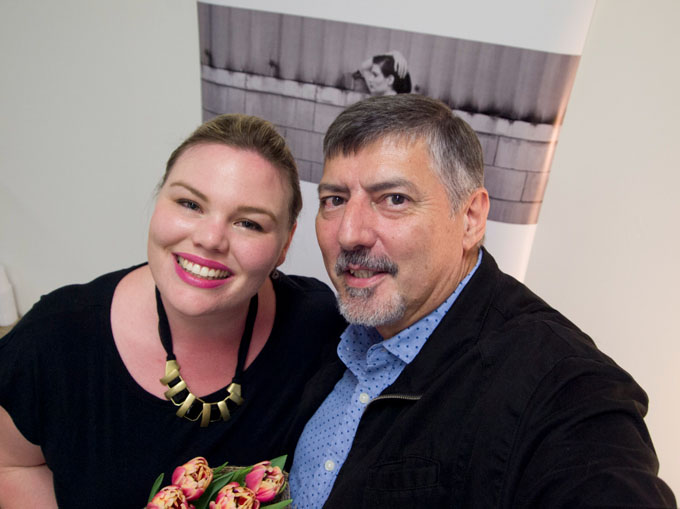
Nicola Poole and Doug Spowart
When Ian’s daughter Nicola wanted to pursue photography Ian arranged to bring her to Toowoomba suggesting this is where she needed to be. She enrolled and over the next two years she completed her diploma studies in 2003 with the Graduating Student of the Year Award.
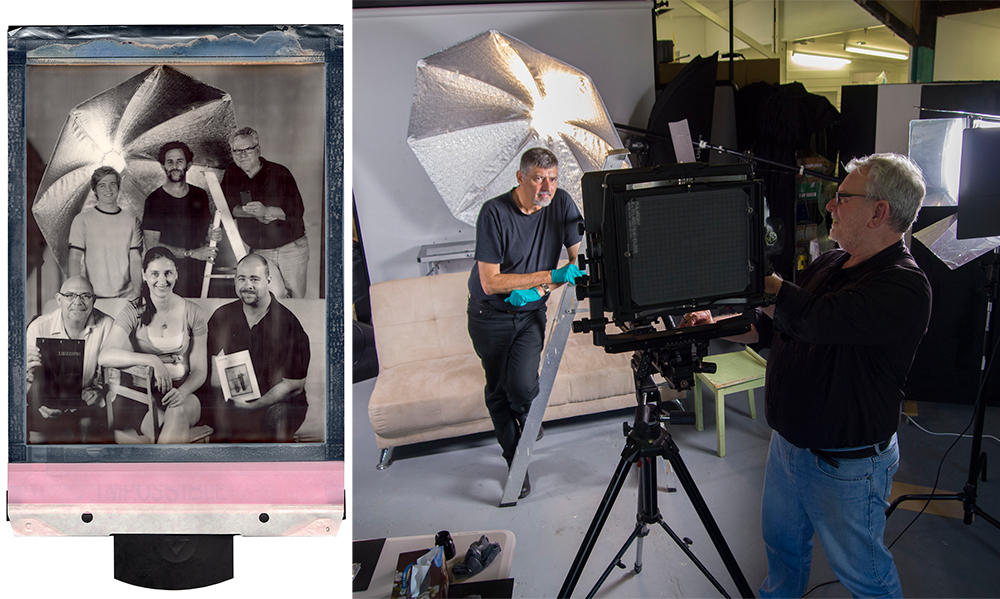
Team Foto Frenzy – an Impossible Project 10×8 Polaroid by Doug Spowart – RHS Ian photographs Doug
Foto Frenzy
When Ian formed Foto Frenzy with a small group of photography identities including Darren Jew, Tony Holden, Cam Attree and Susan Gravina from Brisbane Camera Hire I was honoured to open the enterprise. Later, Vicky and I were invited as Artists in Residence for a month in 2013. While we where at Foto Frenzy we participated in workshops, re-configured the premises into a camera obscura, made 10×8 Polaroid Impossible Project images and held an exhibition of our photobook and image work.
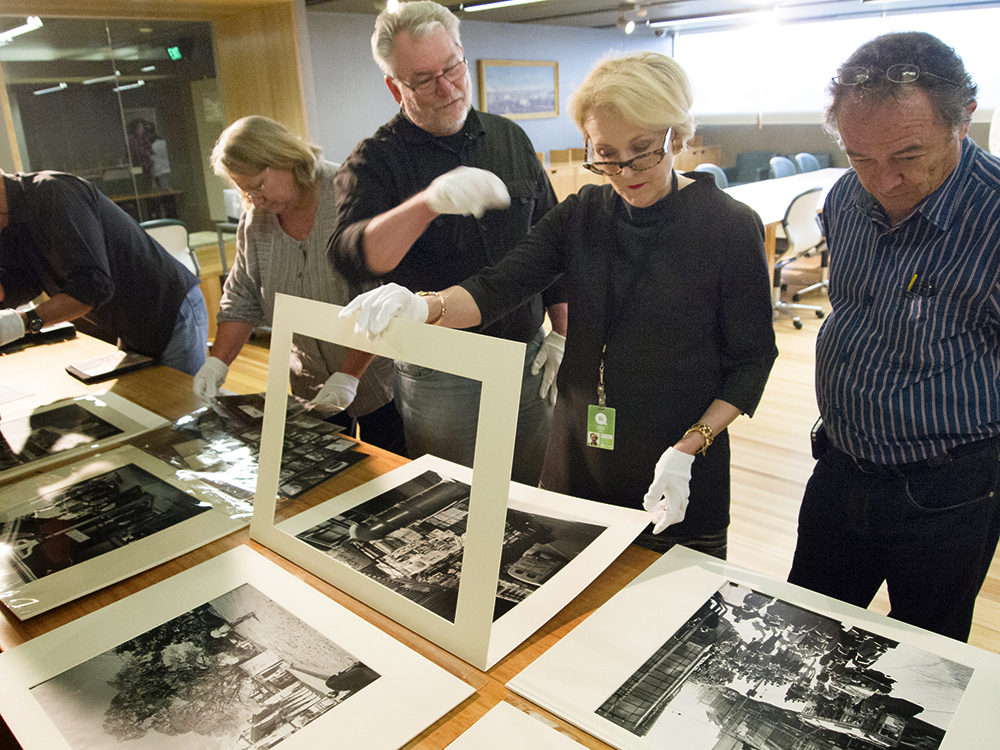
Ian Poole, Diane Byrne and Eric Victor at the State Library of Qld looking at prints by Richard Stringer
John Oxley Library donation
One of many things undertaken by Ian that many may not be aware of is his donation of his professional photography archive to the John Oxley Library at the State Library of Queensland. For quite a few years he has been going into the Library to unpack and catalogue the work so that it can be successfully searched and retrieved into the future. Now much of Brisbane’s cultural history from buildings to fashion, ballet and theatre, portraits of the rich and famous and those curious dated art-directed advertisements of the 1970s and 80s, are there as a document of our times.
I’ve been around professional photography for nearly 50 years and I’ve seen the disappearance of numerous professional photographers and their businesses – but what of their photographs? Lost? – Not Ian’s work, which he has given in an altruistic act for Queenslanders and their history.
In conclusion
I was always fascinated by Ian’s business name – ‘Ian Poole does photography’, we now know he did much more…
At this time I, and many others, will reflect on and remember Ian Poole
– his legacy will continue on in all of us.
Doug Spowart
NOTE: I hope that all this is correct – should their be any errors I am happy to make the corrections
What follows are some published works relating to Ian, some links and some other images…
Ian Poole’s website: https://poolefoto.wordpress.com/

Photo.Graphy Journal: Ian Poole Guest Editor
PHOTO.Graphy Journal – Ian Poole Guest Editor
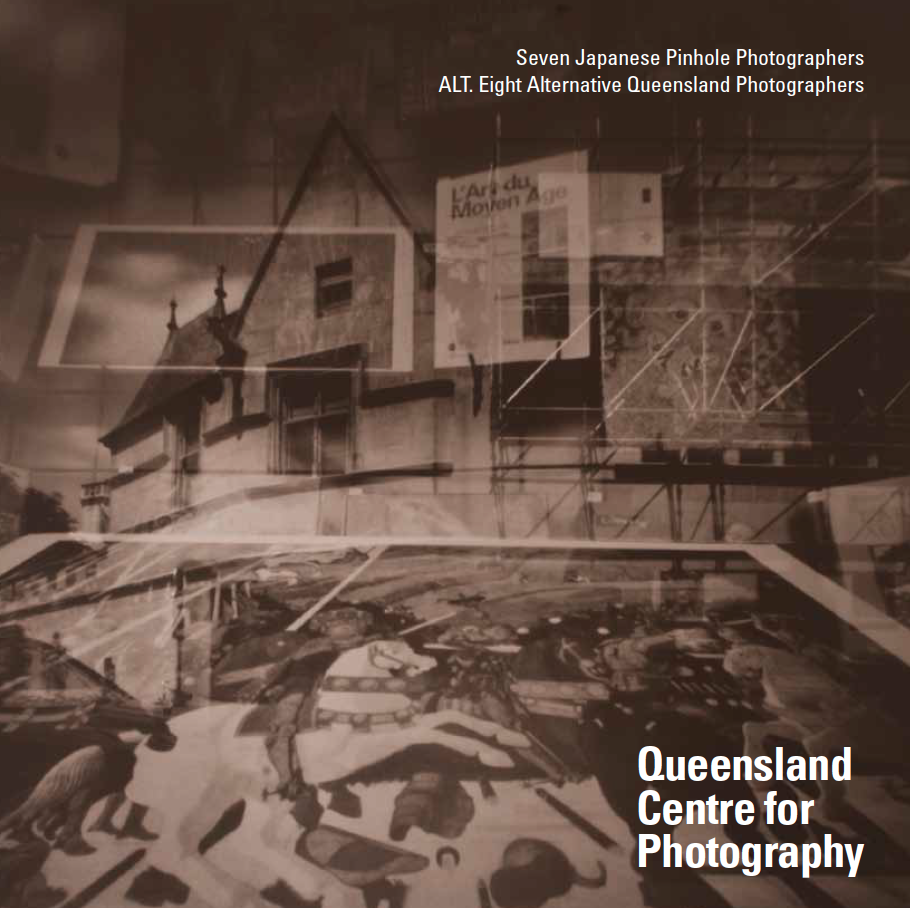
QCP ALT Catalogue — Curated by Ian Poole
Ian Poole curated show at Qld Centre for Photography

f11 Magazine Ian Poole Folio
f11 Online magazine: Ian Poole folio

Ian Poole – On the lounge
https://wotwedid.com/2012/05/17/ian-poole-aipp-on-the-lounge/
Some images by or about Ian…
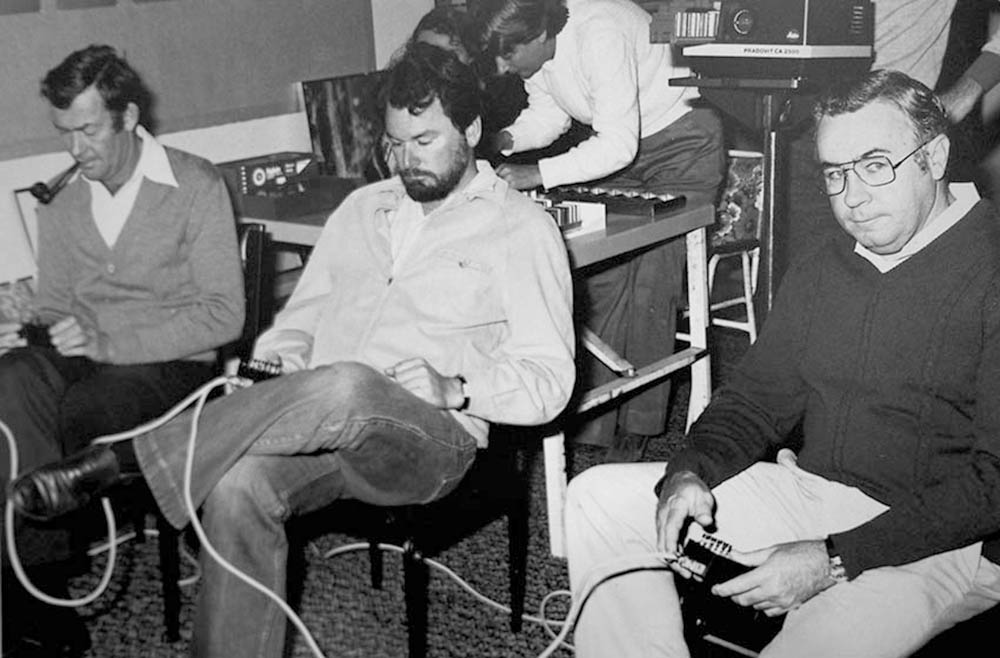
Ian Poole and Kev Hudson judging the 1982 Brisbane National Exhibition of Photography at Imagery Gallery
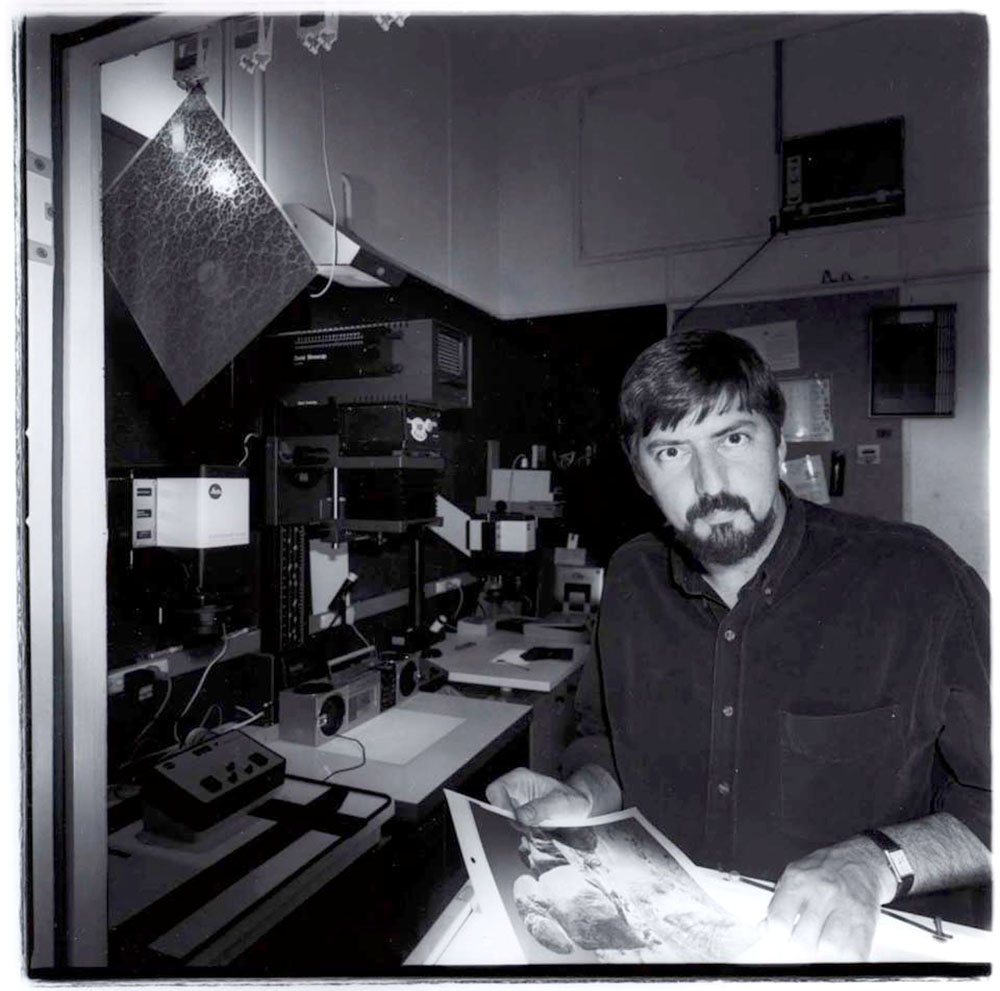
Doug Spowart in Imagery Gallery Darkroom by Ian Poole

Ian Poole moving out of Berry Street
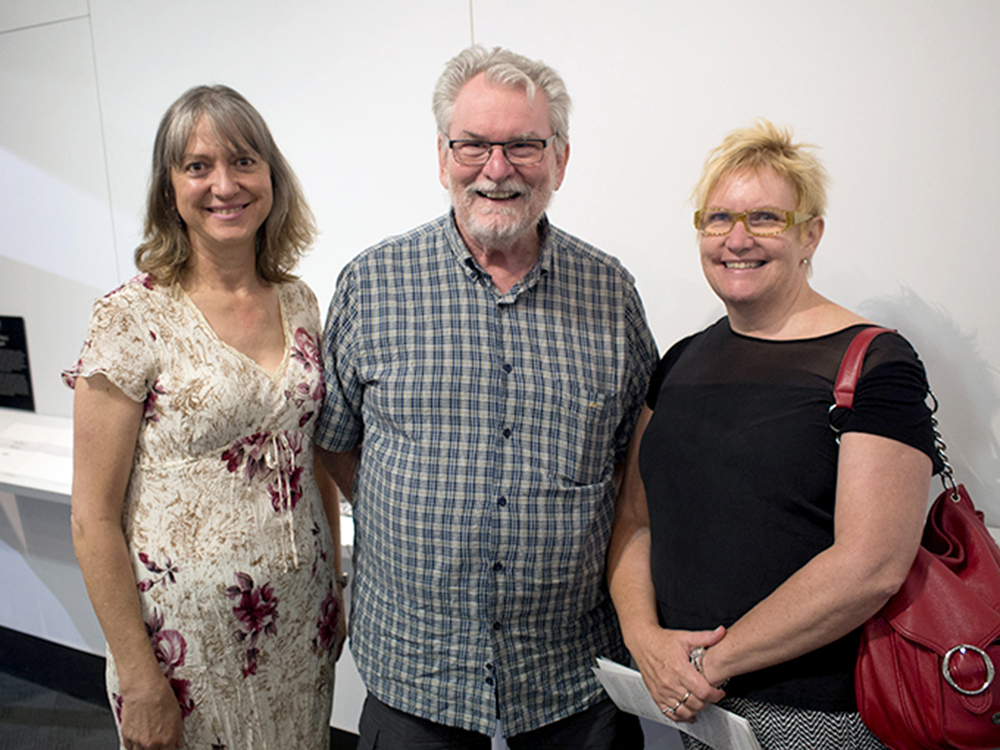
Toula, Ian and Louise at the Photobook Club meeting at the Cobb & Co Museum Toowoomba

Ian and Doug at a Foto Frenzy opening
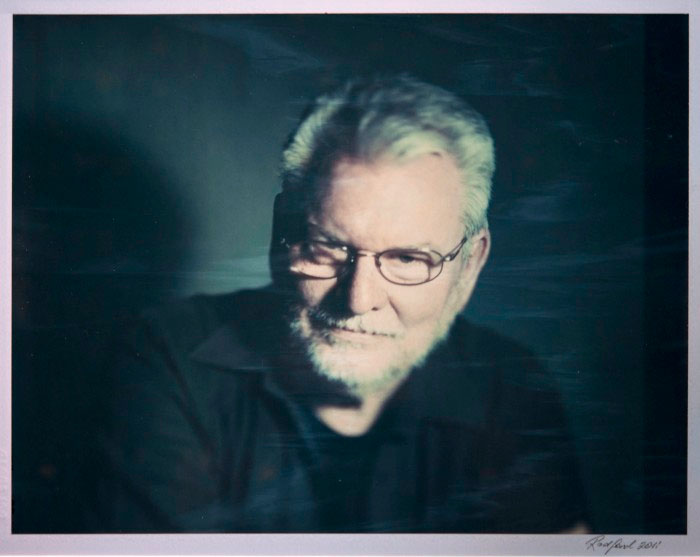
Ian Poole photographed by Wayne Radford at the exhibition End of the roid curated by Doug Spowart
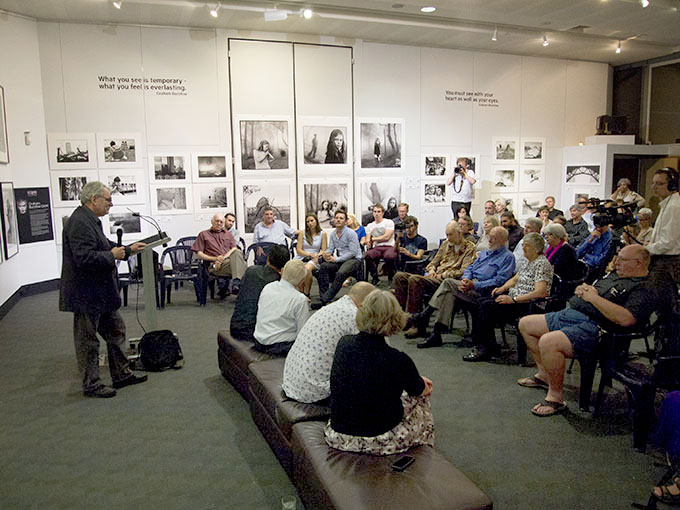
Ian Poole at the opening of ICONS at the Cobb&Co Museum in Toowoomba
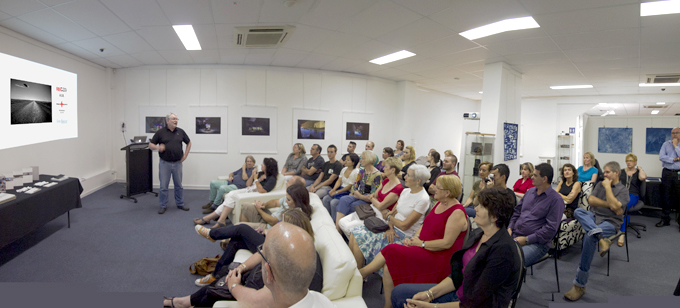
A Foto Frenzy opening

The opening of Foto Frenzy
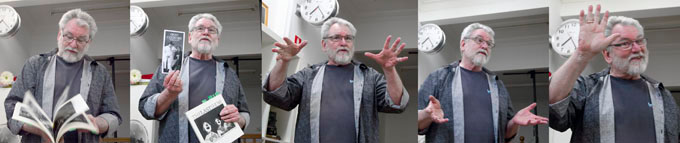
An animated Ian Poole at an AIPP ‘On the lounge’
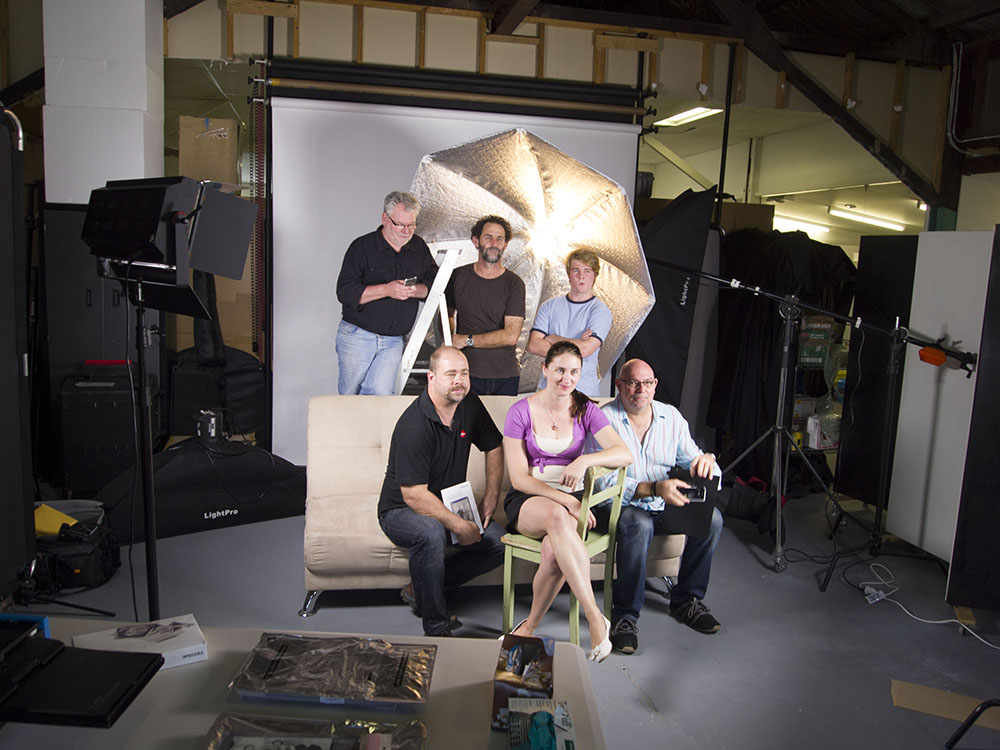
Foto Frenzy Polaroid group setup PHOTO: Victoria Cooper
.
.

Ian Poole, Glen, Asai at the opening of Floating
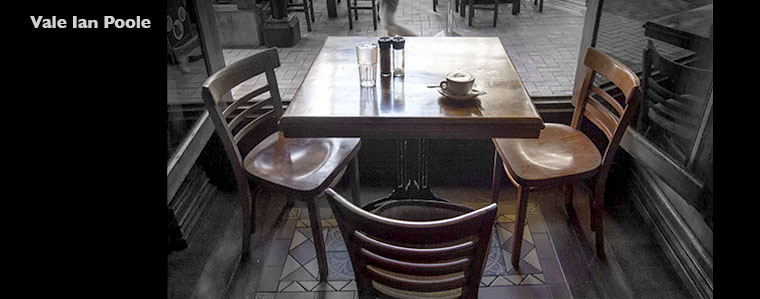
Farewell Ian….
.
.
.
.
OFFICIAL LAUNCH OF A PHOTOBOOK COMPENDIUM FOR AUSTRALIA & NEW ZEALAND

Cover: A Compendium of Australian & New Zealand Photobooks v.PBNZ
To celebrate PHOTOBOOK NEW ZEALAND in Wellington over March 9-11 2018, I have published an updated version of my Photobook Compendium that was first issued in October 2017 at the VOLUME ART BOOK FAIR in Sydney.
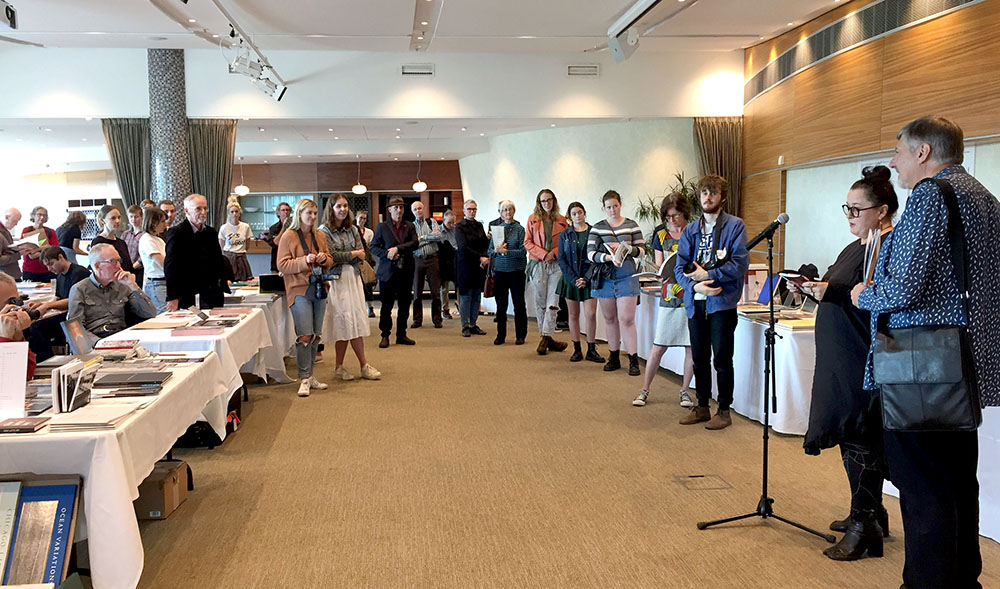
Associate Professor Ann Shelton launches the Compendium @ Te Papa PHOTO: Libby Jeffery
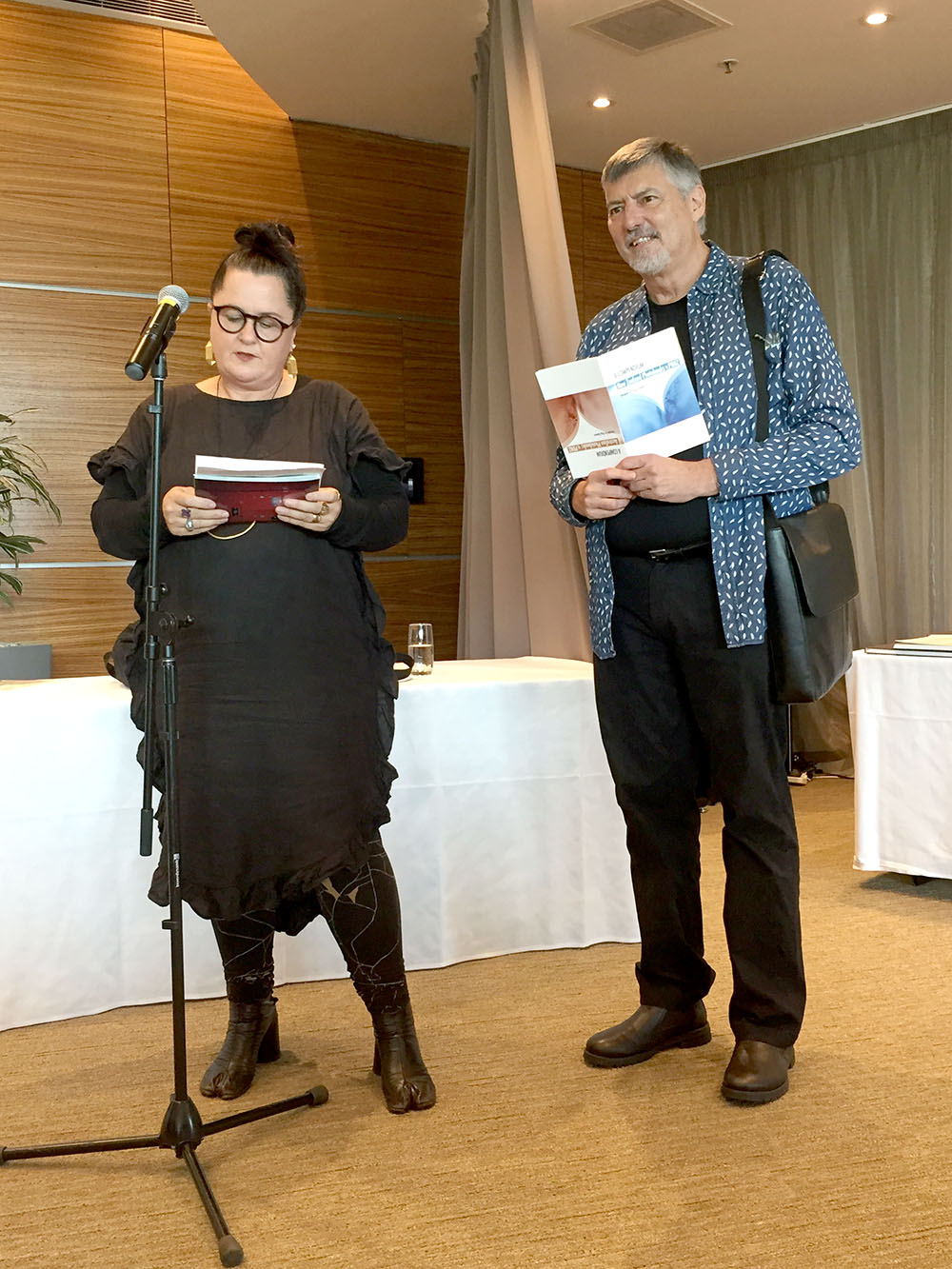
Ann Shelton launches the Photobook Compendium PHOTO: Libby Jeffery
The Compendium is a soft cover 40 page A5 booklet that lists key contributors, both contemporary and historical, to the Australian and New Zealand photobook discipline. Apart from photographer’s names and many portraits I’ve included publishers, designers and book shops.
To extend the coverage of key aspects of the genre I have included visual coverage of significant photobook events and activities as well as portraits of many practitioners. Most of the photographs come from personal documents made in Australia, New Zealand and Vienna of these events.
The book is designed with two covers so both countries have prominence. The Compendium is printed by MomentPro and is a Numbered LIMITED EDITION of 40.
The book was launched at The Museum of New Zealand Te Papa Tongarewa in Wellington by artist and photobook maker Associate Professor Ann Shelton on Saturday 10 at 2.00pm. At the event books will be available through Remote Photobooks.
WHAT’s IN THE COMPENDIUM…?
- Over 400 listings relating to the photobook
- 26 portraits of photobook people
- 50 photobook covers – exemplars of the discipline
- 60 photographs of events
- Australian and New Zealand Photobook of the Year winners list
The book is now SOLD OUT! Although REMOTE PHOTOBOOKS may still have some copies
Some of the pages

The Compendium preface
.
FOREWORD TO THE BOOK
This Compendium does not attempt a definition of the ‘photobook’ – therefore to reflect the breadth and depth of this evolving medium I have considered a range of photo-based products that may include photographically illustrated books, albums, catalogues, photobooks, zines, artists books, text-only references to photography and photo ephemera.
This data and images has been compiled over many years as a result of my interest in the photobook from the historical viewpoint as well as its contemporary phenomenon. I am particularly interested in books where the photograph acts as the principal narrative agent. Additionally I am also drawn to the haptic experience and design of the book and how it operates as a vehicle for presenting ideas and telling stories.
Listed here are names of people and organisations who have contributed (both historically and recently), to the development of photobook discipline. Although most of the listings are from New Zealand or Australian residents and establishments there are some inclusions relating to itinerant or short-lived connections with this region. Some publishing houses listed may be based offshore and have a presence in this region.
I wish to acknowledge the energy and support for Antipodean photobooks provided by Libby Jeffery and the MomentoPro company. Through their patronage and sponsorship they have played a pivotal role in the building of a strong and active photobook community.
This current Compendium is published in a limited edition of 40 on the occasion of the 2nd Photo Book New Zealand Festival in March 2018. Subsequent revised versions will contain new information arising from my ongoing research.
As much of this knowledge lies hidden in personal archives and libraries, I am most interested to receive information about New Zealand and Australian photobooks and the discipline’s community of practice.
Doug Spowart
Email: Greatdivide@a1.com.au
Mail: PO Box 3063, South Brisbane, Queensland 4101, AUSTRALIA
.
.
.
.
.
.
CYANOTYPE: Working the ‘blues’ in Greece
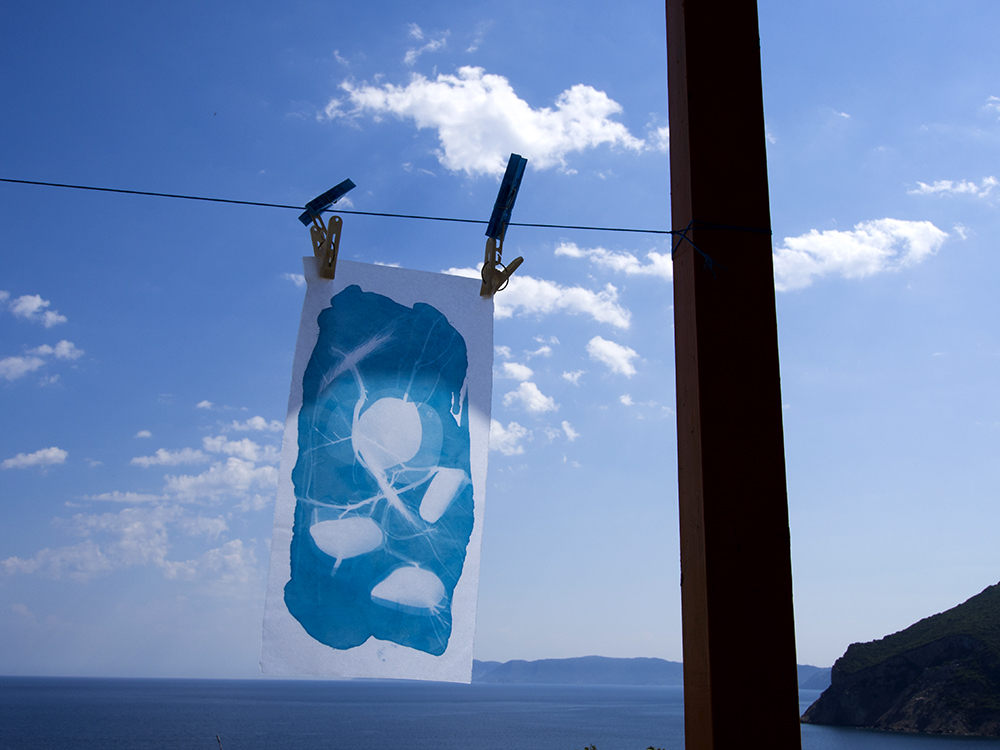
A cyanotype print on rice paper hung out to dry on Skopelos
.
The azure blue of the Aegean Sea perfectly matches the prussian blue of the historic process cyanotype. The ancient stories of Ulysses and Jason’s Argonauts lend themselves to the contemporary narratives that can be made through photography and the photobook. In May we sought to explore these creative possibilities through a collaborative workshop coordinated by artist Steph Bolt and Skopelos Works on Paper on the island of Skopelos located in the Sporades north-east of Athens.
Six participants worked with us over a two-week program of structured lectures, practical sessions and photo forays to explore the possibilities for image taking and art making on the island. Staying in the main town on the island we worked out of the purpose-built printmaking studio with a view out over rocky headlands, distant islands, blue waters and skies. The studio sits atop of the town next to the remains of a castle with steps and paved pathways leading to the harbour and the Paralia. Tourism is a significant industry for the island however its impact does not destroy a feeling of being within an authentic experience of Greece.


The workshops started with breakfast daily at 8.30am with a studio start at 9.00am. By 2.30pm the formal program finished enabling personal exploration of the diverse subject matter available. Everyday participant’s day concluded in the restaurants of the Paralia partaking in the culinary delights of rustic Greek food supported by ouzo, retsina and aspro krasi (white wine). We ate fantastic squid, octopus, anchovies, little fishes, rabbit, goat, traditional foraged foods like the succulent kritima, local cheeses, Skopelos pies and gyros. Some members of the group formed relationships with the restaurateurs and towards the end of each meal extra wine and special desserts were presented as gifts by the host.


At regular intervals in the program Steph and her husband Robin took us on photo adventures: to the ancient graves at Sendoukia for sunrise, the Roman bathhouse ruins of Loutraki, the hillside town of Glossa and the classic white rocky cliffs and beaches of the island. The island is also famous for providing the setting for the Bronson and Streep film, Mama Mia so we visited the famous church on the rock Agios Ioannis. As part of most of these forays we had more opportunities to dine in tavernas, coffee shops and seaside restaurants.

Agios Ioannis
Key to the program was the concept of ‘place-making’, that is making photographs and forming them into themes and photo-essays that told of the personal experience of place by the photographer. The process of the cyanotype was explored employing traditional ‘shadow’ imprint of objects collected from the island to some very experimental work with multiple materials and exposures and double-sided printing. We worked not only with art papers but also with rice paper, various cloth materials event kitchen paper towelling. We had also gathered some special objects like a range Greek laces and linens, local rocks and a diverse range of plant material. Connecting direct photography with the cyanotype process was achieved on-site by the making of enlarged inkjet negatives.


Photobooks were developed at first as mini-book projects that could lead to online projects with MomentoPro software. MomentoPro supported the project by accrediting our program as part of the ‘Club’ services giving the participants 40% discount on their first book and 10% on each of their future books.

A local cat keeps Gail amused while she exposes a cyanotype
The participants were accommodated near the studio at the top of the town – one group had extensive views of the Aegean Sea sunrise with the other group overlooking the town. As mentioned earlier the distance to the shops and restaurants in the harbour required the negotiation of several hundred bespoke steps of local stone and concrete all with their leading edge painted white. The steps meandered past mainly two storied whitewashed houses with ornate doors and grilles. Ancient churches some built with reclaimed stones from other building provided an experience of place that was quite memorable. Coming home from shopping or dinner meant a steep climb up through the paths, sometime dodging motorcycles although many steps are so narrow that even they are footpaths alone. On one early evening return we encountered a church group with candles being led in a song procession with a Greek Orthodox priest leading the way – a memorable moment indeed.


The weather was very changeable requiring some program shuffles, as cyanotypes are direct sun exposures for many minutes. Ah! Today is sunny – we’ll make cyanotypes then… Once participants grasped the technique each took the process in their own directions. Many sophisticated books were made based on other workshop classes in book binding and finishing. Some went BIG making full sheet (55x76cm) cyanotypes.
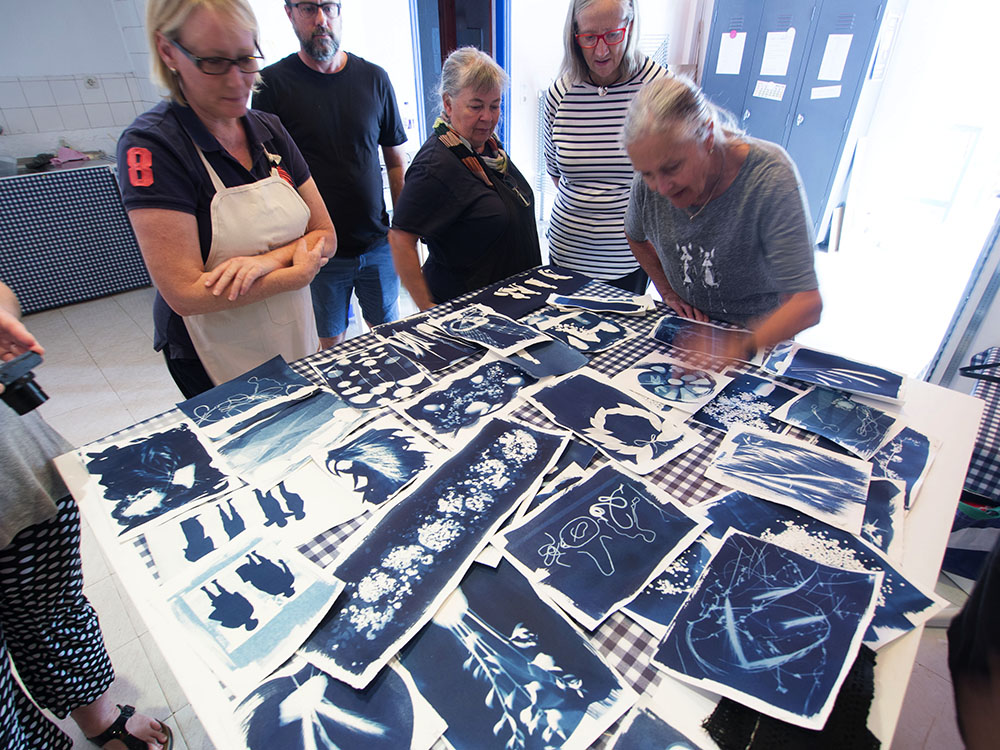
Morning review
At the beginning of each workday a review of the previous activities was undertaken. The specific needs of each participant could be covered and ideas shared.
On the final day each photographer presented their best work – what an amazing body of work that represented – although within hours each had said their goodbyes and had caught ferries off the island and were flying homeward. We were all jealous of Steph and Robin who have a house in the town and stay there for about half the year. Their knowledge of the island and networking with island people was invaluable for the success of the workshop. Works were shared and a folio set of eight small books were made in multiple so everyone ended up with a memento from each of other individual experiences …
All of us were touched by something special on the island – our photographs and books act as evidence of experience but also a touchstone to relive and share those experiences…
Here are some photos of the final presentations…


Copyright in the text and all photographs are the copyright of Doug Spowart+Victoria Cooper unless otherwise indicated. The copyright of the artworks is held by the artists.
.
TAKING AuNZ PHOTOBOOKS TO THE WORLD – The Vienna Photo Book Festival
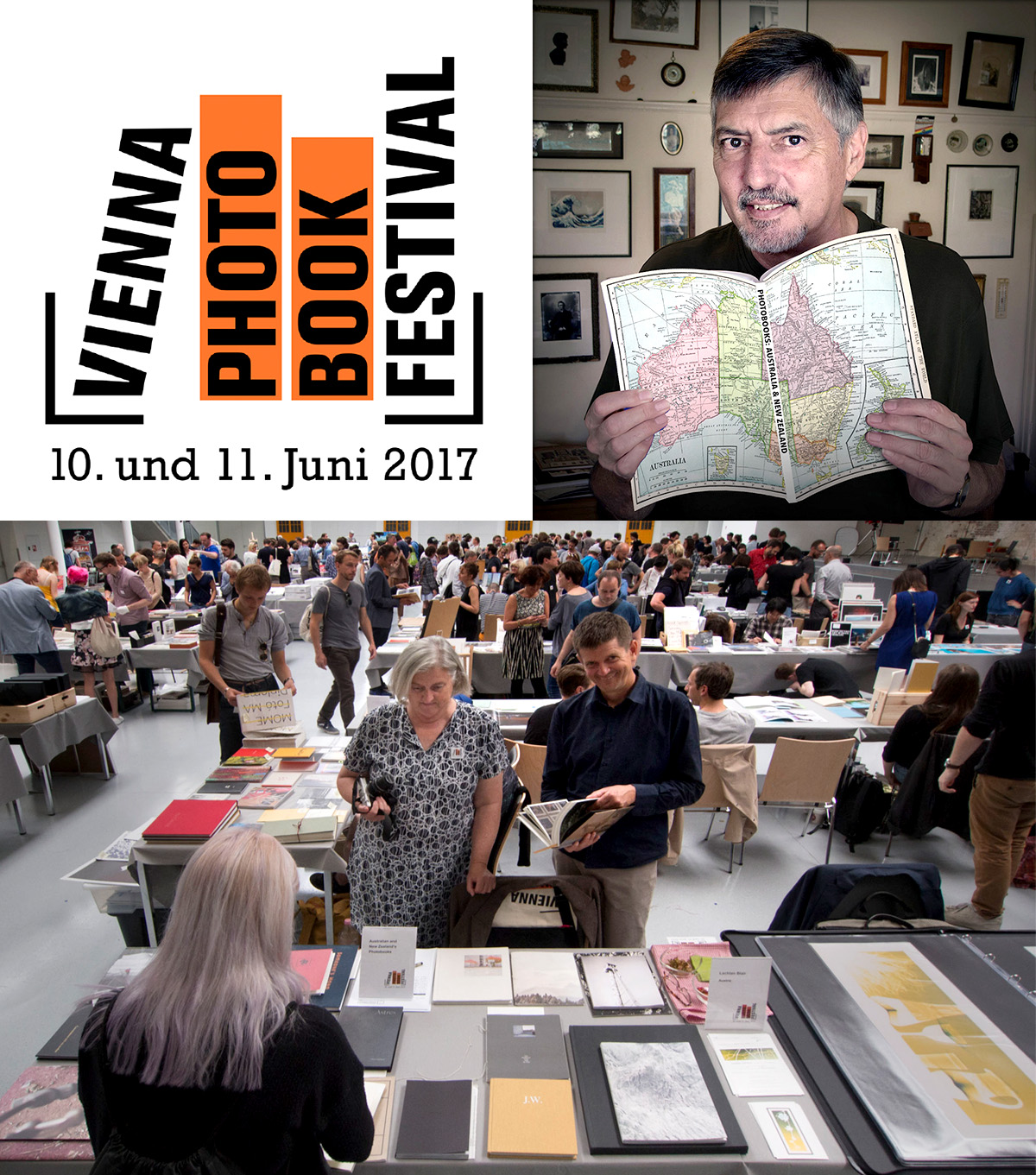
The MomentoPro AuNZ Photobooks of the Year @ VPBF
In the Antipodes we think we are far away from the centre of activities in so many areas of human endeavour that we just get on with it – doing it our own way. The field of photobooks is one such area.
Recently I had an opportunity to take photobooks from our part of the world to Europe and present a ‘show ‘n’ tell’ at the Vienna Photo Book Festival in Austria. Before the event I was wondering how our books would be received – would they match the Euro photobook for production values, innovation and story-telling capability? I would soon have my answer…
I presented a lecture on Australian and New Zealand photobooks and spent two days with Victoria Cooper and Lachlan Blair on our book presentation table featuring the finalists and winners of the 2016 MomentoPro Australian and New Zealand Photobooks of the Year Awards (ANZPOTY).
The answer to the question I posed earlier would soon be answered.
In a series of 3 blog posts I will tell the story of three aspects of the Vienna Photo Book Festival (1) the lectures, book and print sales, (2) my lecture and (3) the Vienna Photo Book Reviews.
Read on: THERE ARE 3 BLOG POSTS WITH THE DETAILS … links below…
The LECTURE
The EVENT
https://wotwedid.com/2017/06/18/aunz-photobooks-the-vienna-photo-book-festival/
The REVIEW SESSIONS
https://wotwedid.com/2017/06/18/review-panels-at-the-vienna-photo-book-festival/


.
.
.
.
THE ANTIPODEAN PHOTOBOOK – a lecture at the Vienna Photo Book Festival
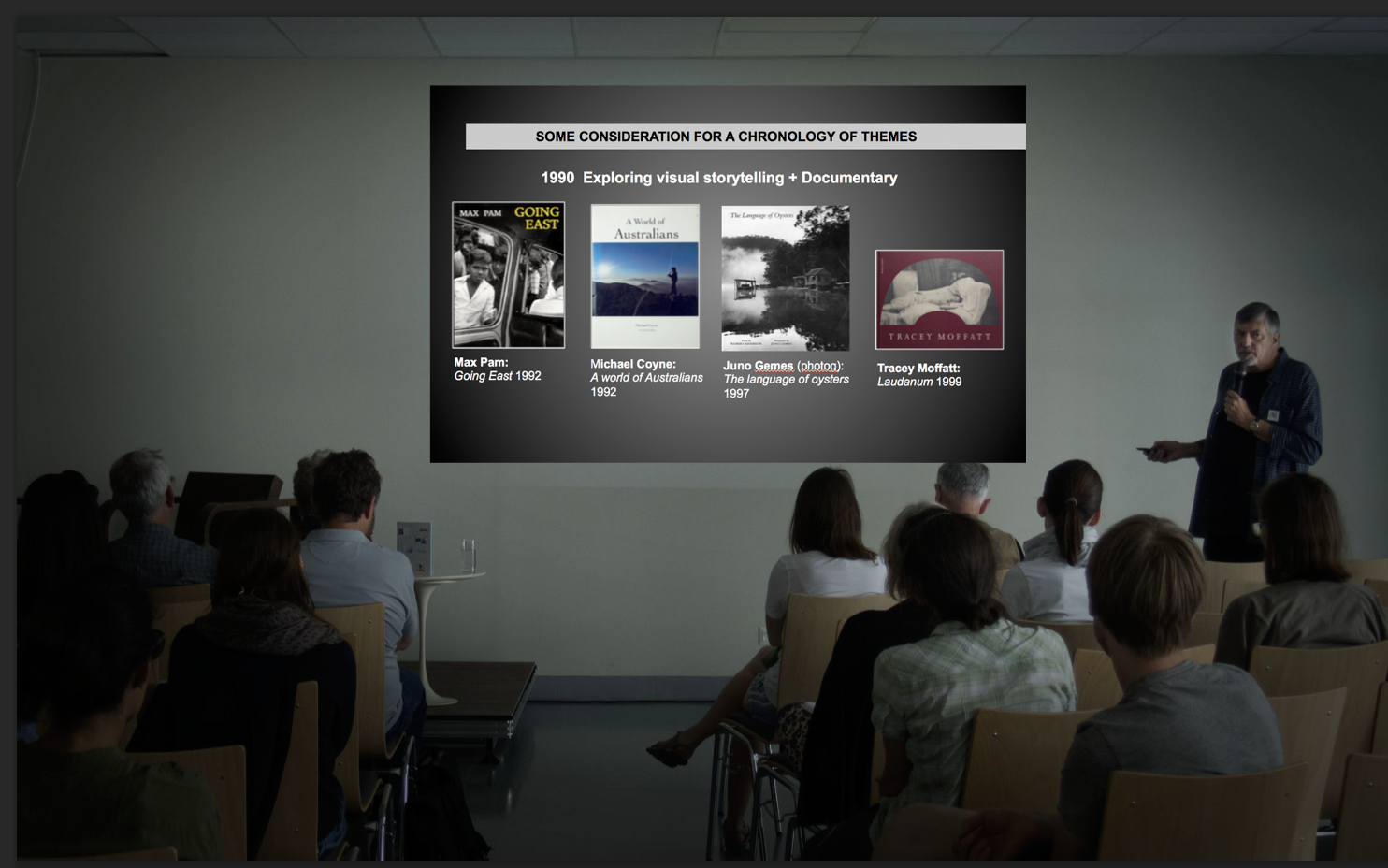
Doug Spowart presenting The Antipodean Photobook at Vienna Photo Book Festival
THE LECTURE: THE ANTIPODEAN PHOTOBOOK
My lecture brief was to make an hour-long presentation about the Australian and New Zealand photobook scene. After some thought I organised my lecture content around 4 distinct areas.
1. The supporting structures
The contemporary scene was to be included covering both practitioners and the major events in AuNZ that have shaped and contributed to the development of strong network and community of practice. The key events, movers and shakers such as:
- Photobook Melbourne
- Photobook New Zealand
- Unless you will 2017 event and book reviews
- Melbourne Artbook Fair
- Sydney’s Volume Another Artbook Fair
- Zinefairs
- The Photobook of the Year Awards
- Bookshops
- Perimeter Editions
- m.33
- T&G
- Rim Books
- Remote Photobooks
- Perimeter
- Photobook Clubs
- Asia Pacific Photobook Archive
- Photobook collections
I commented also on the sources of critical discourse on photobooks in AuNZ.
The role of Libby Jeffery and Geoff Hunt of MomentoPro as patrons and supporters of all things photobook in Australia and New Zealand was acknowledged.
2. Photobook histories of Australia and New Zealand from first examples to 2000
Here are a few slides from the presentation…
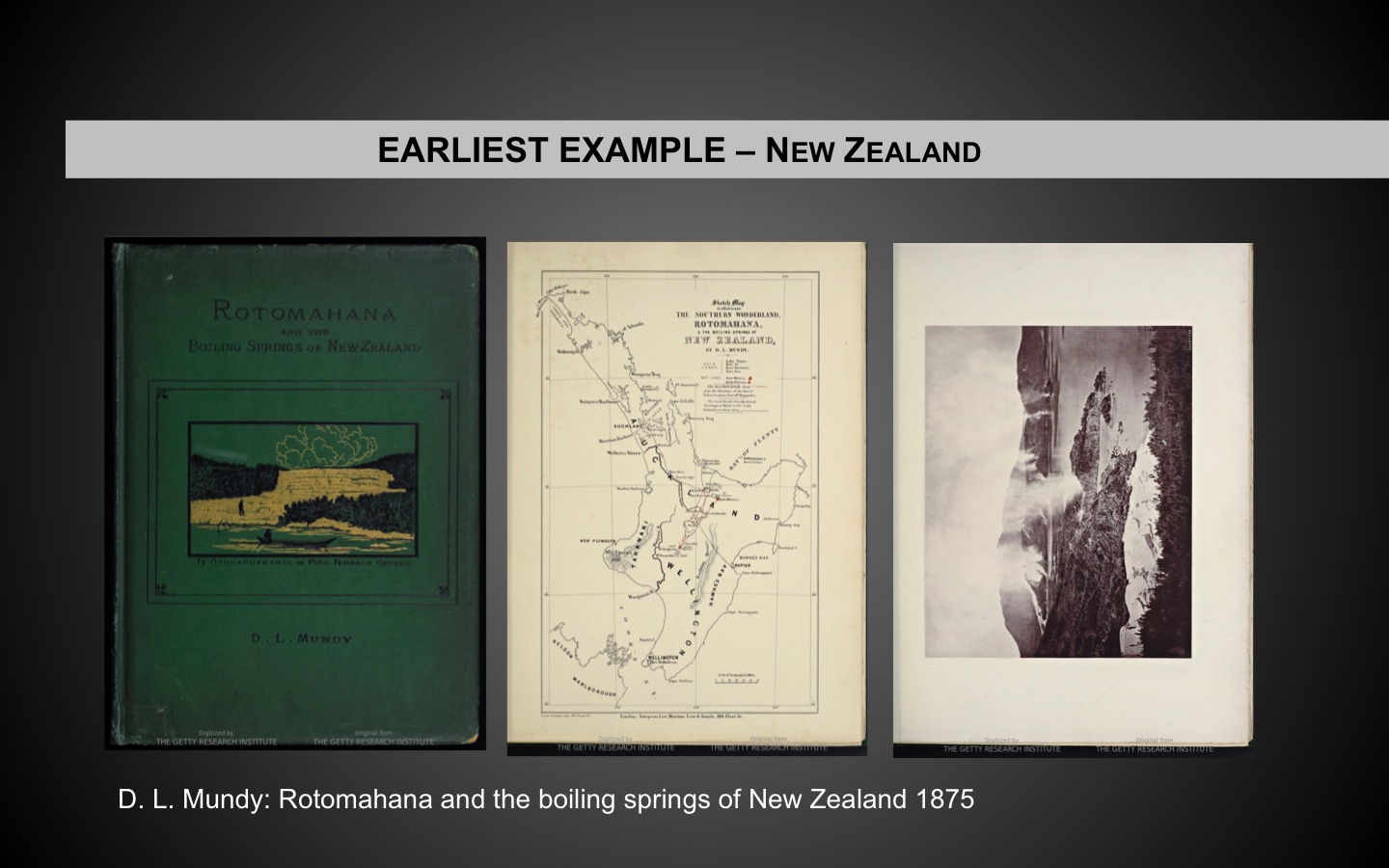
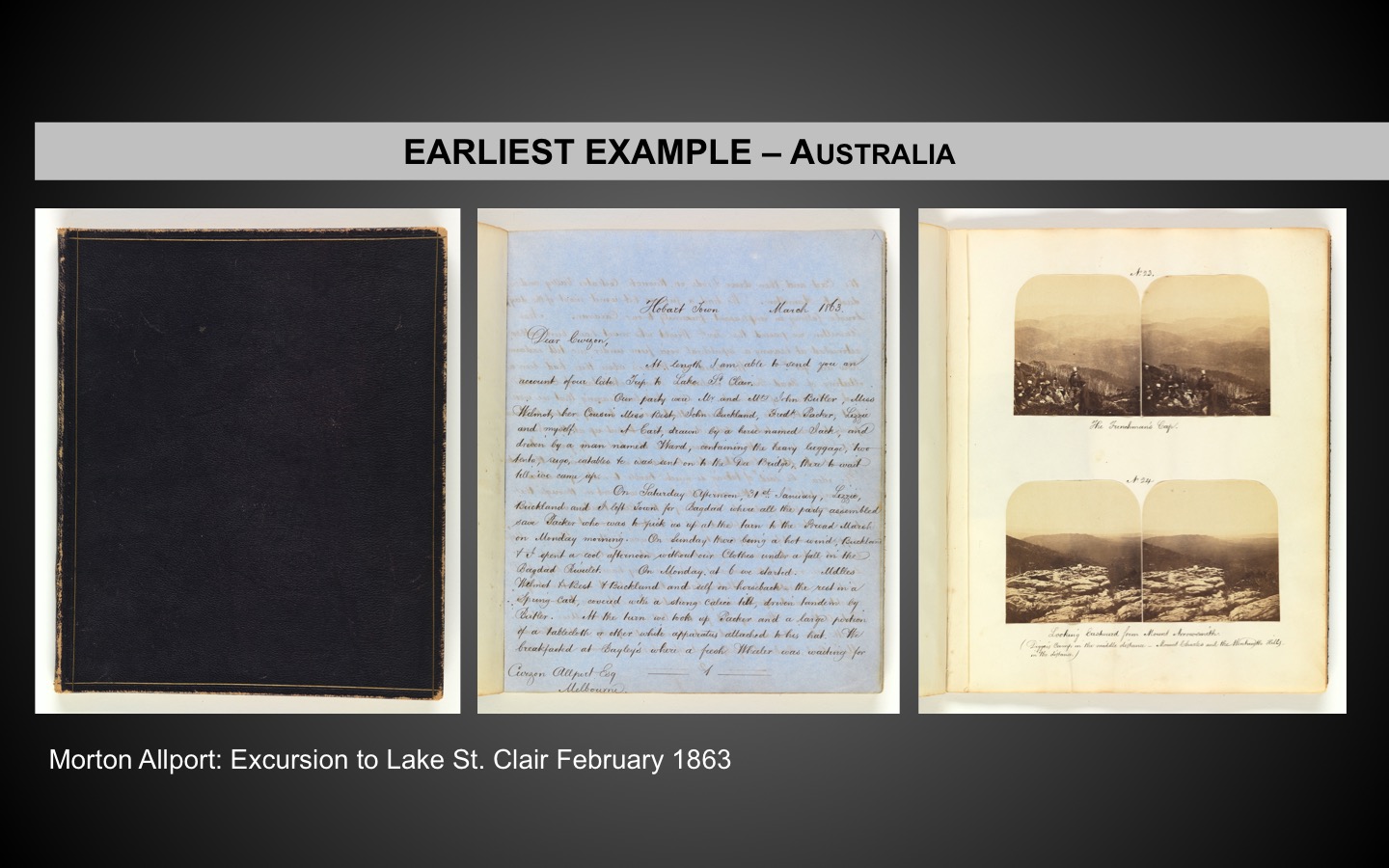
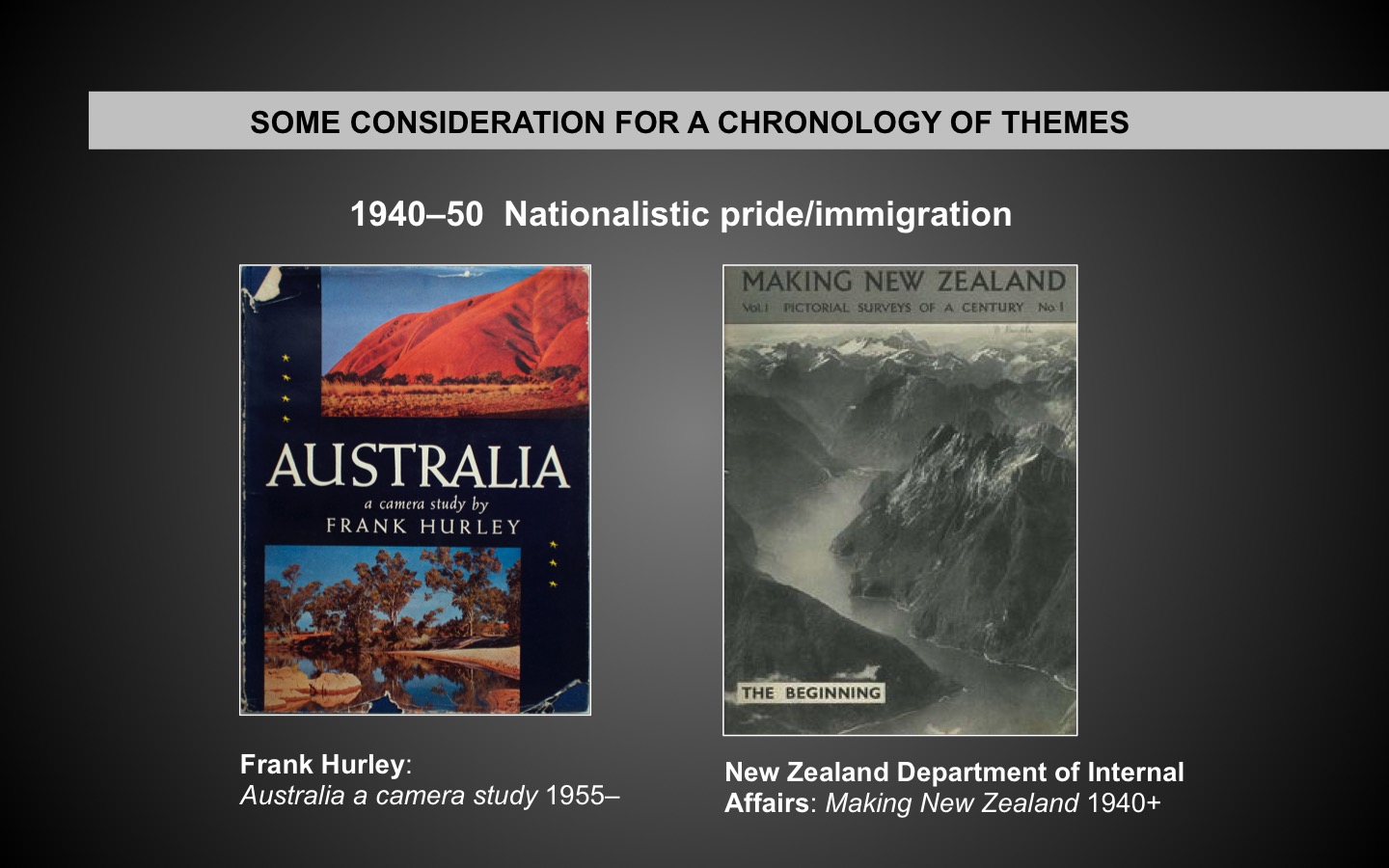
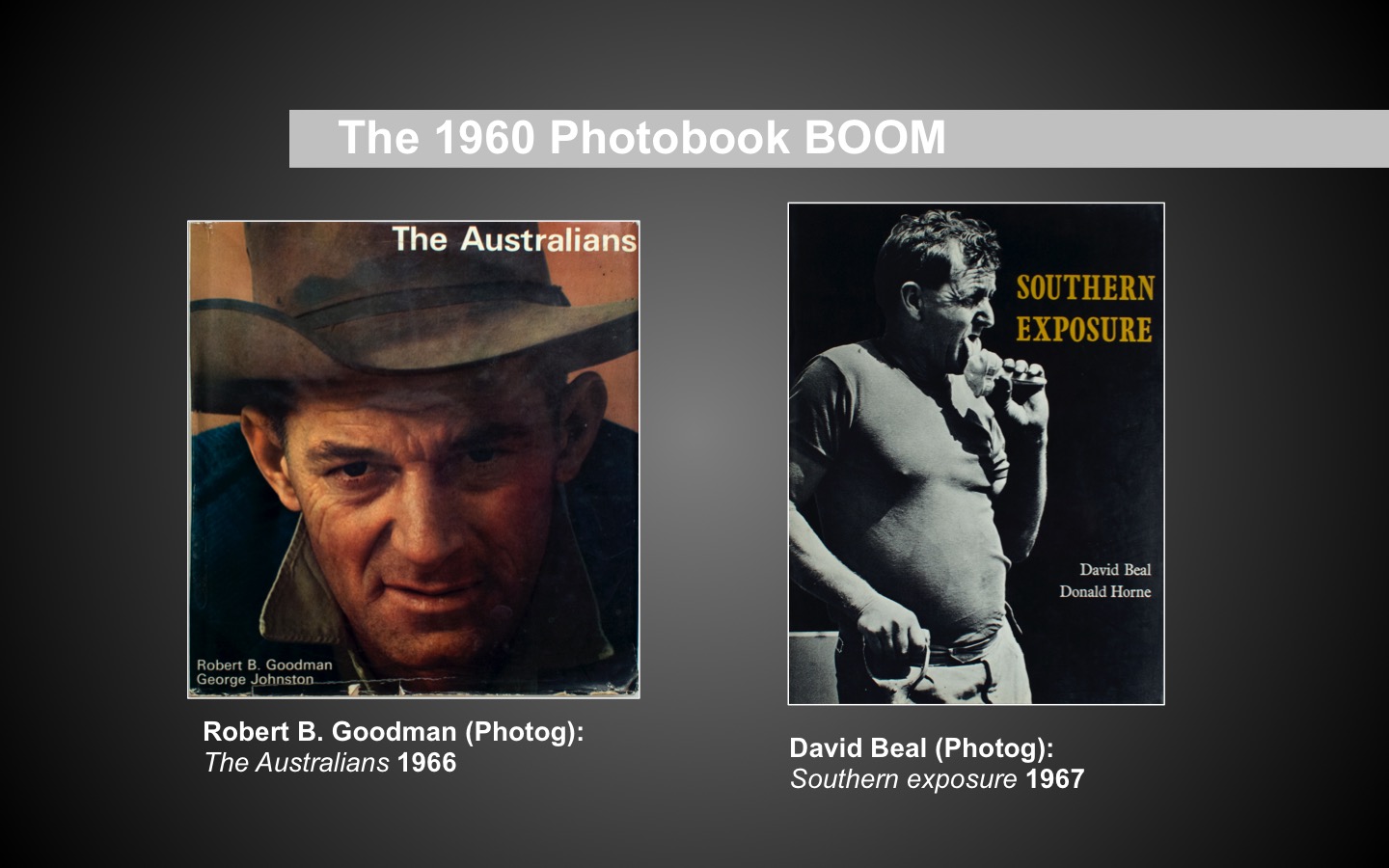
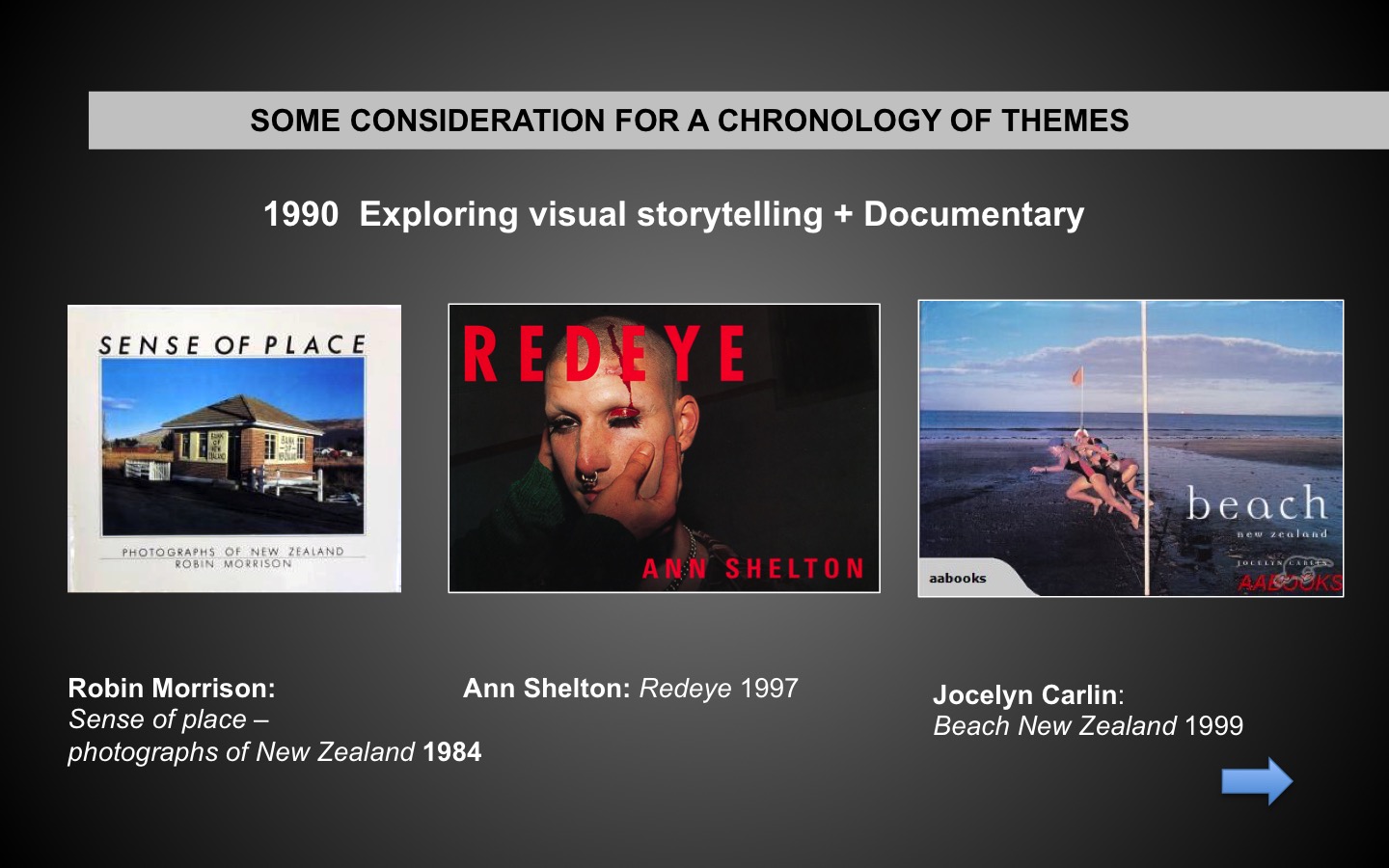
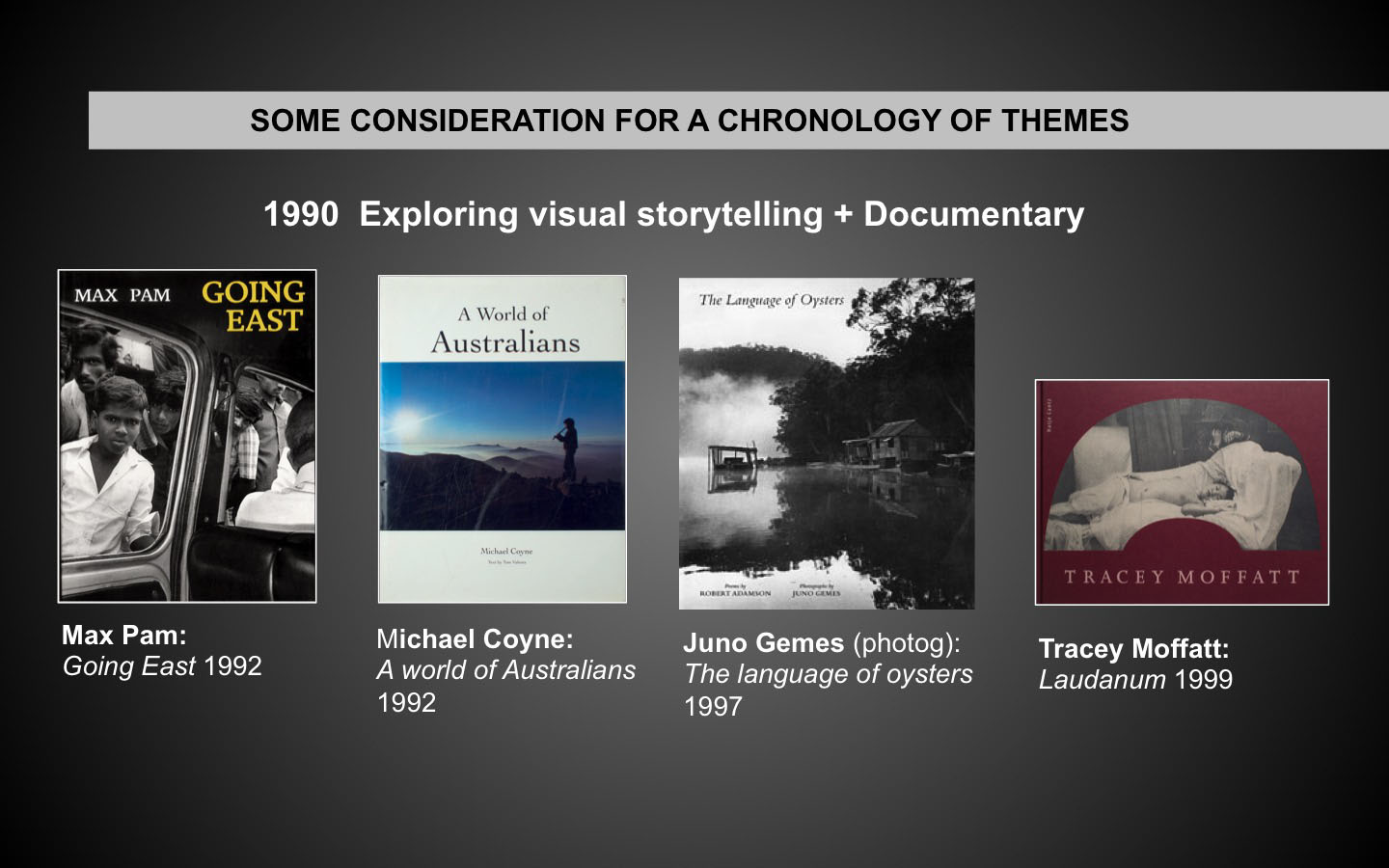
I was able also to present a discussion on the challenge of commercial book production as against personal work using Wes Stacey as an exemplar.
I also spoke about the informal links that exist between the photobook and artists’ book disciplines.
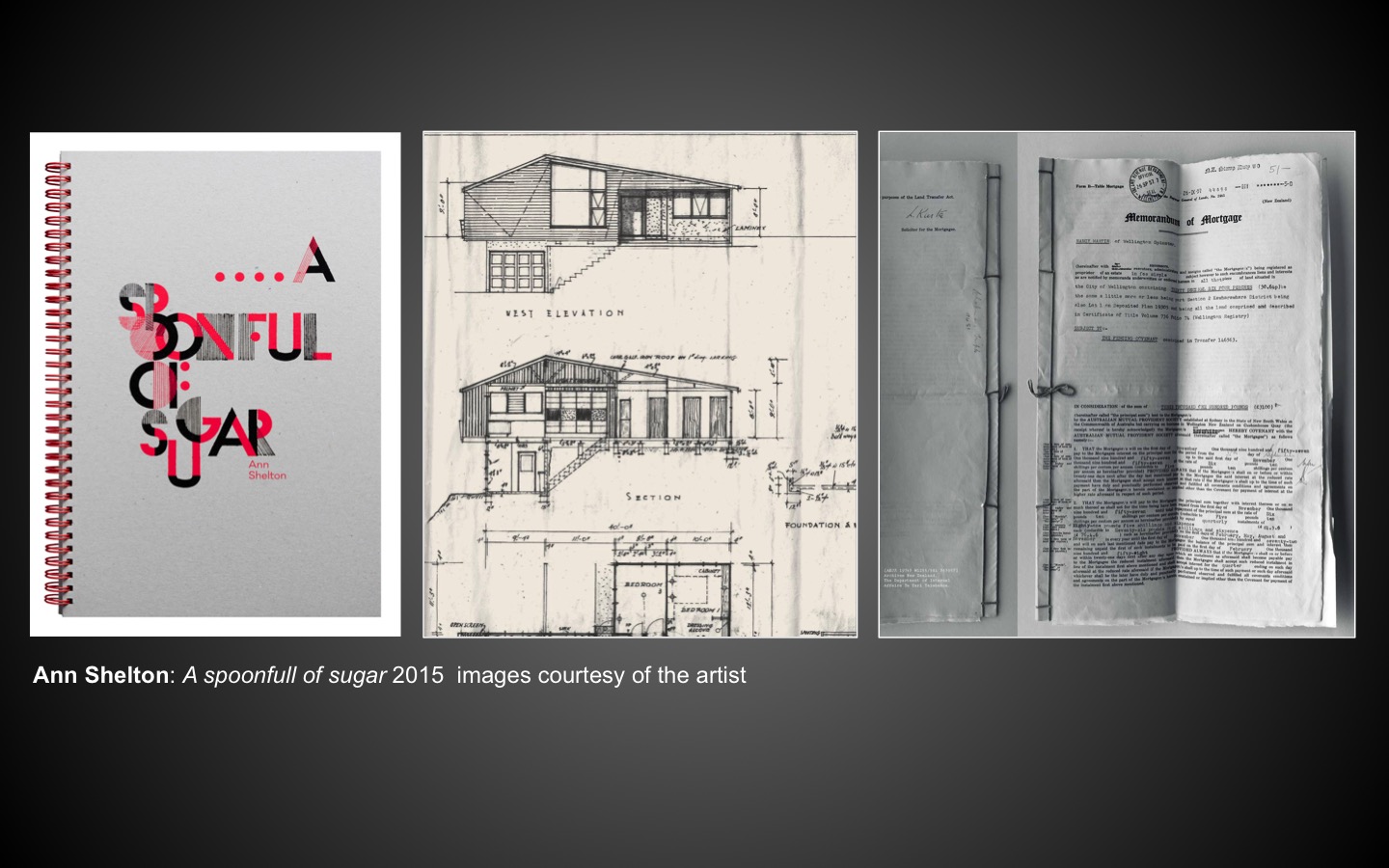
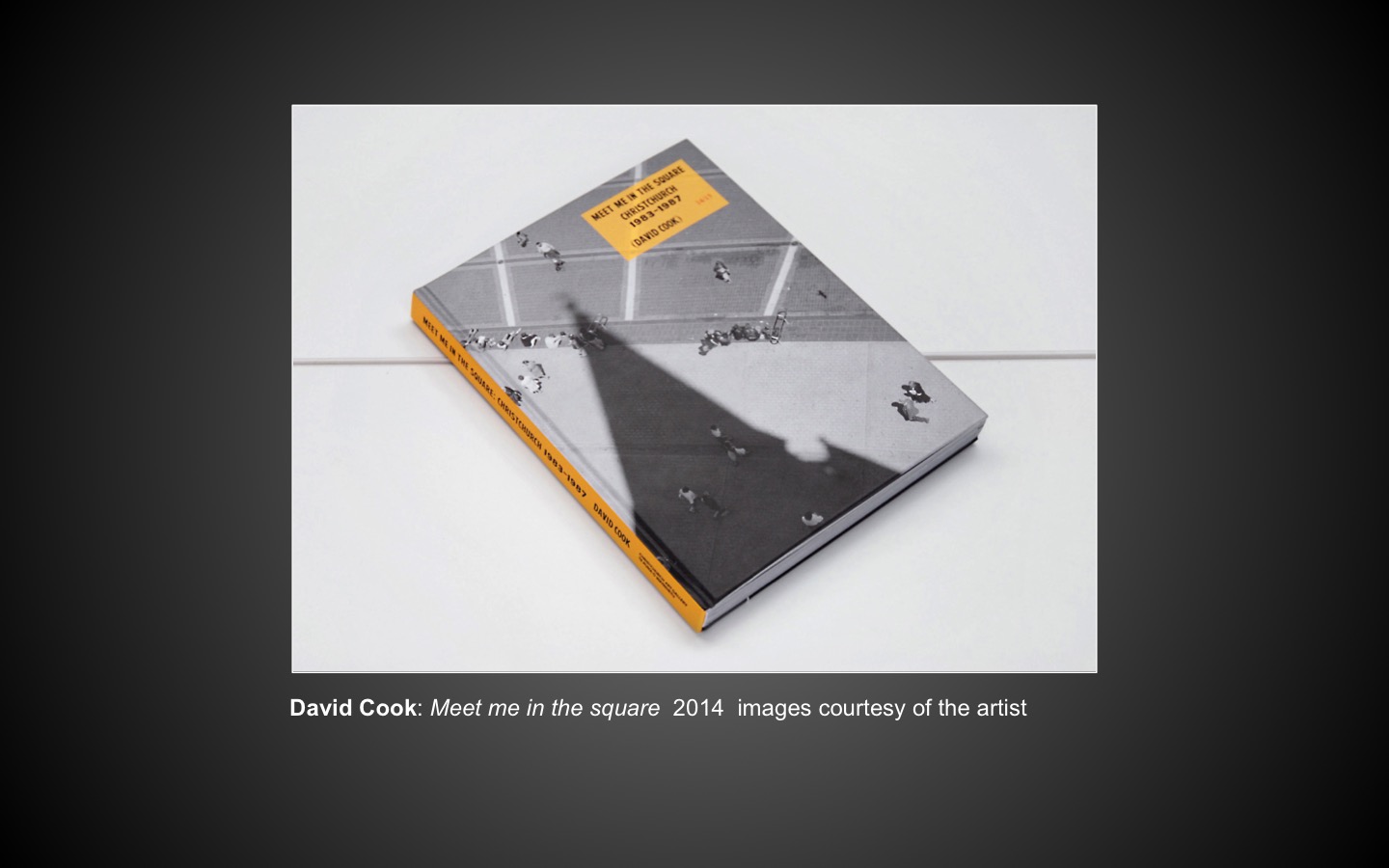
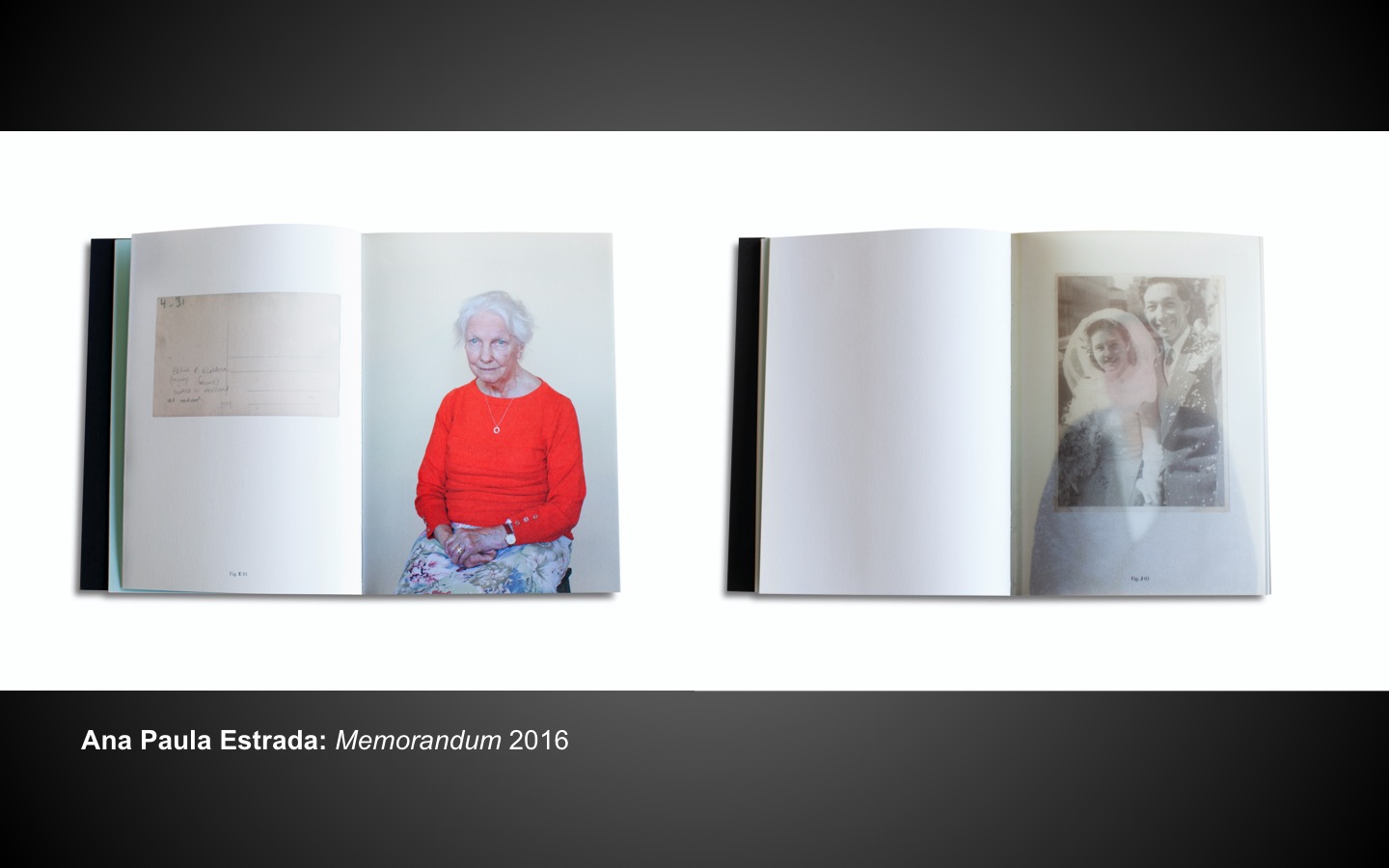
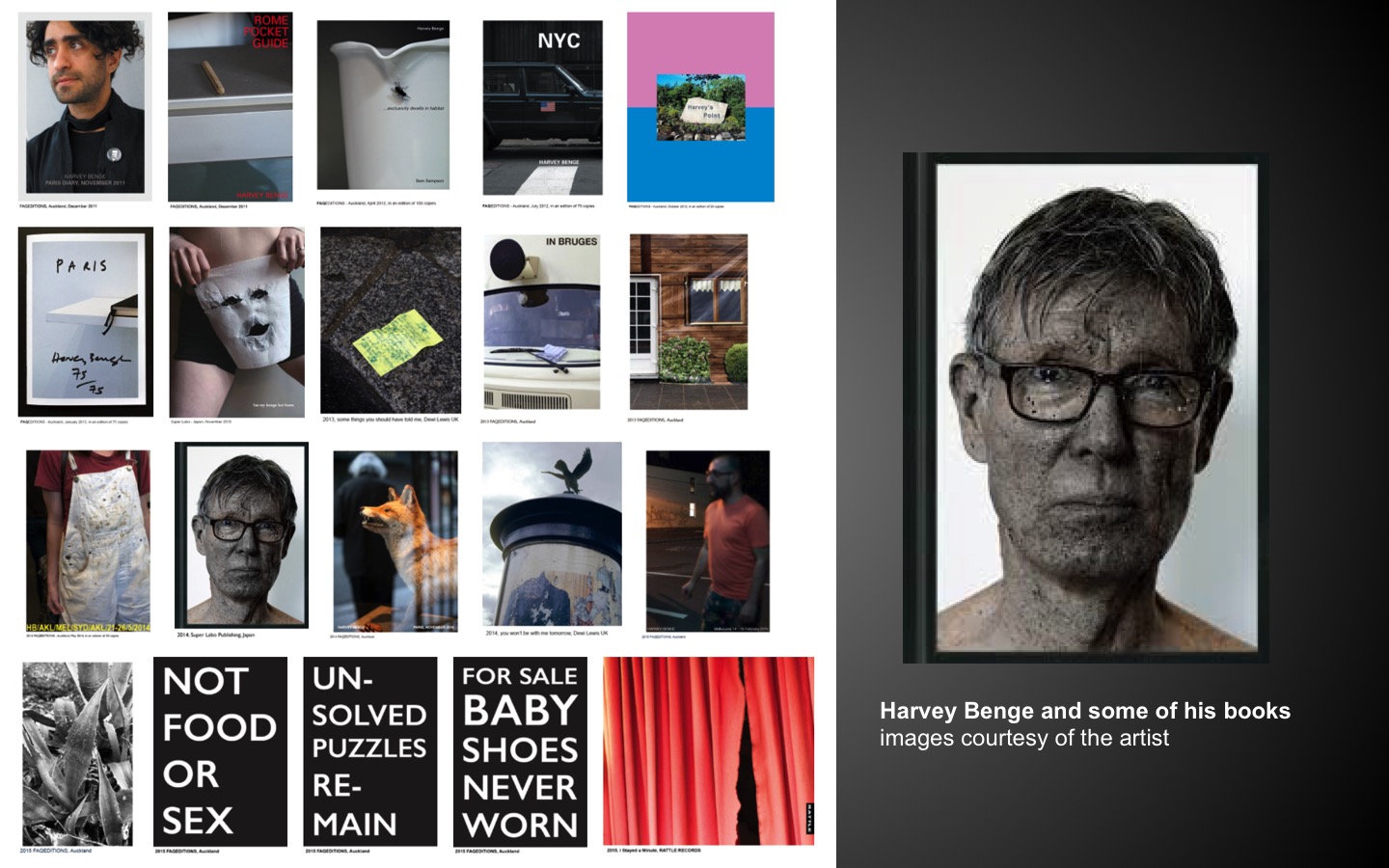
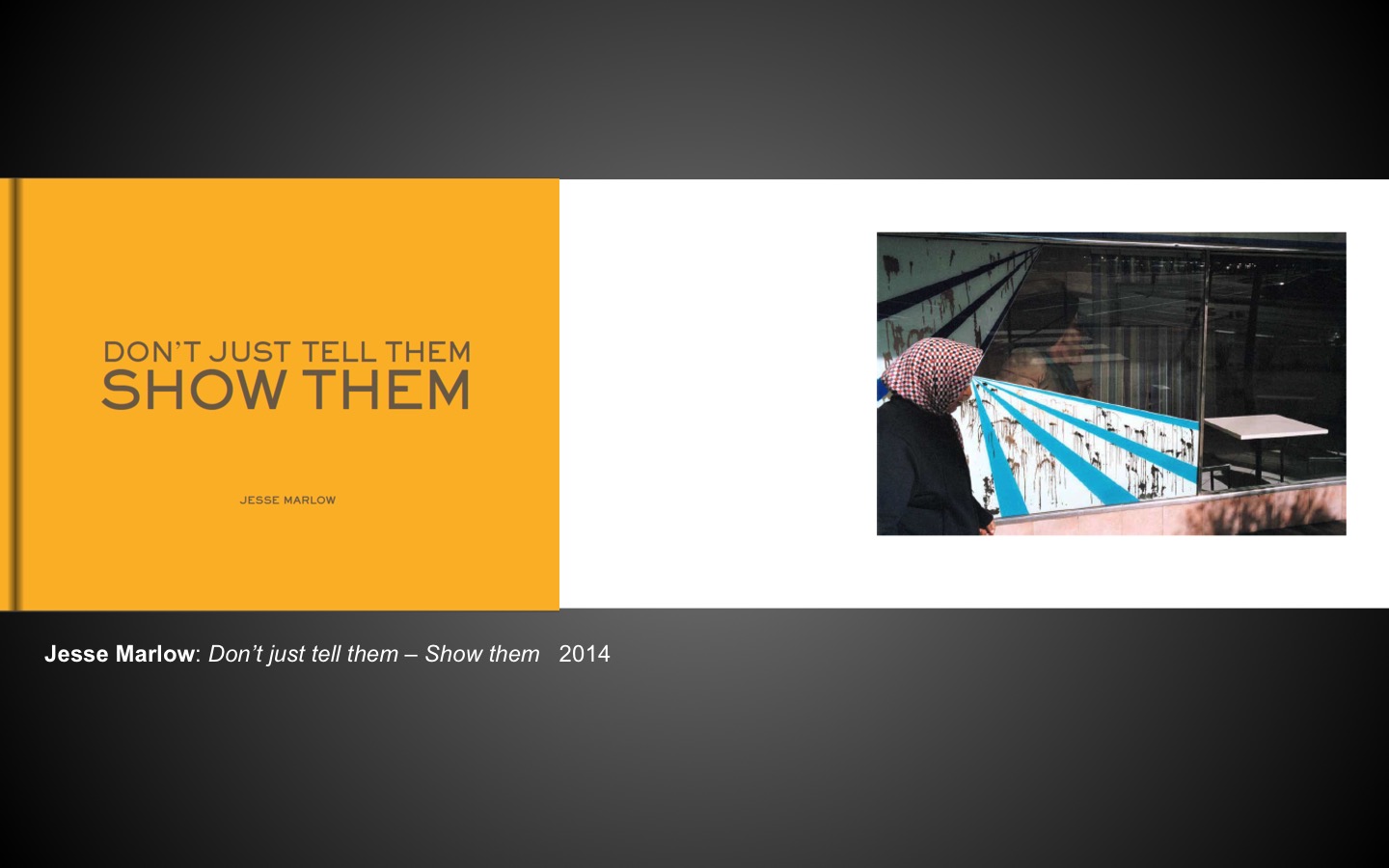
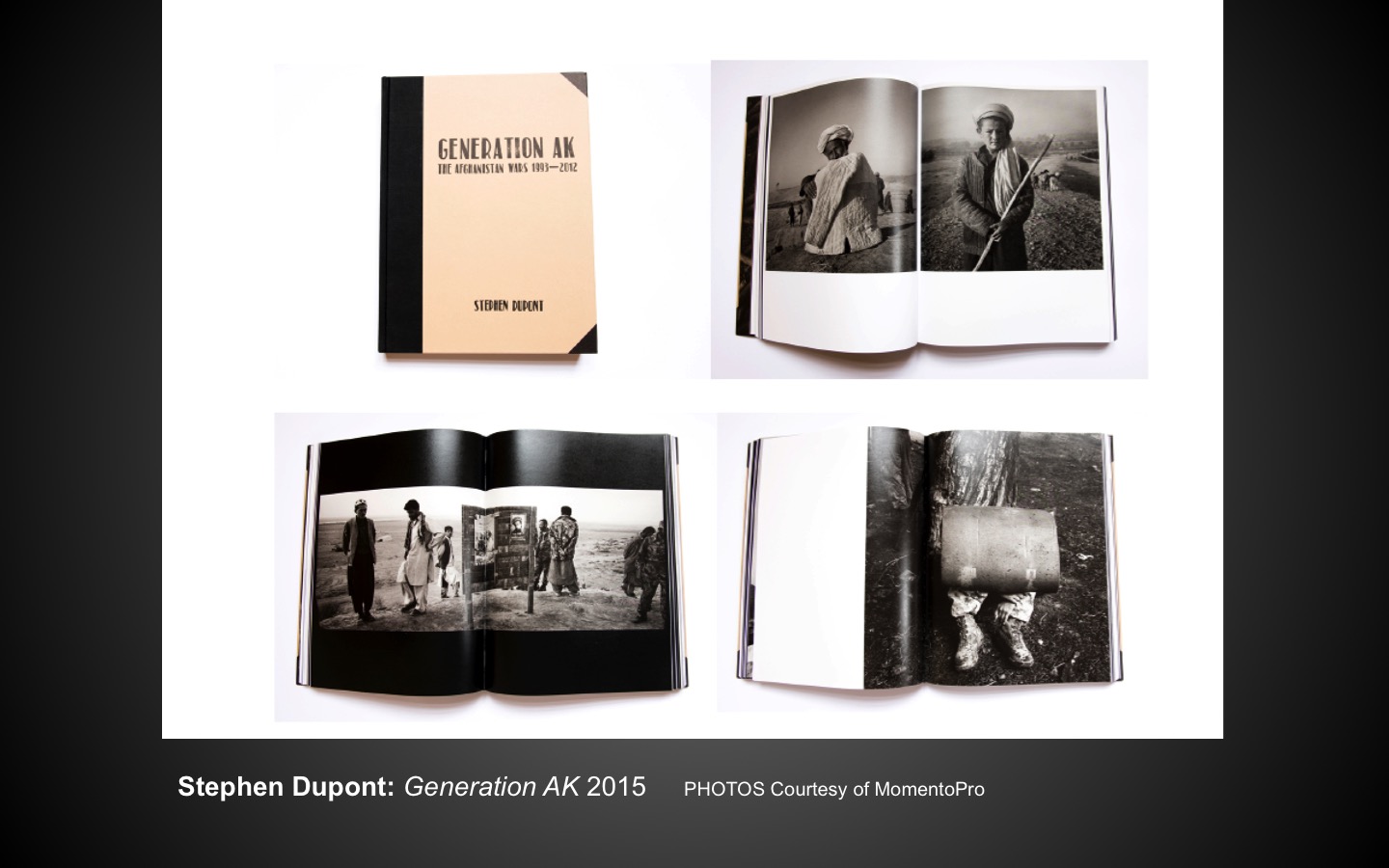
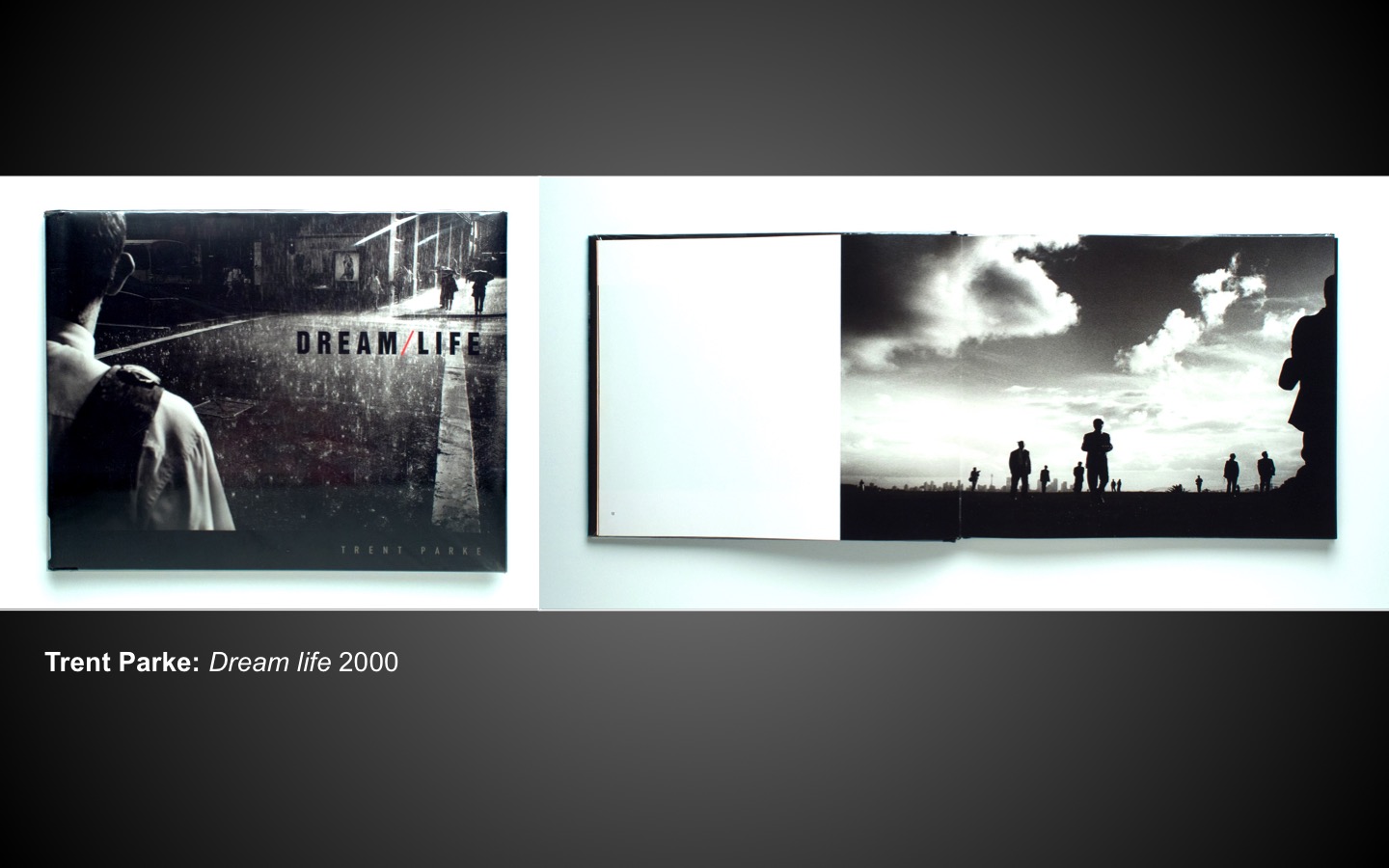
3. The contemporary scene and a selection of interesting books and makers
Here are a few slides from the presentation…
4. Voices from the Antipodean scene
It was important for me that contributors to the photobook discipline in Australia and New Zealand be given an opportunity to provide their personal insights to my presentation.
I sought comments from a range of key contributors and received responses from Libby Jeffery, Daniel Boetker-Smith, Helen Frajman, Harvey Benge, Bruce Connew, Garry Trinh, Sam Harris, Ying Ang, Anith Totha, The 2018 Photo Book Wellington Committee.
Here are a few slides from the presentation…
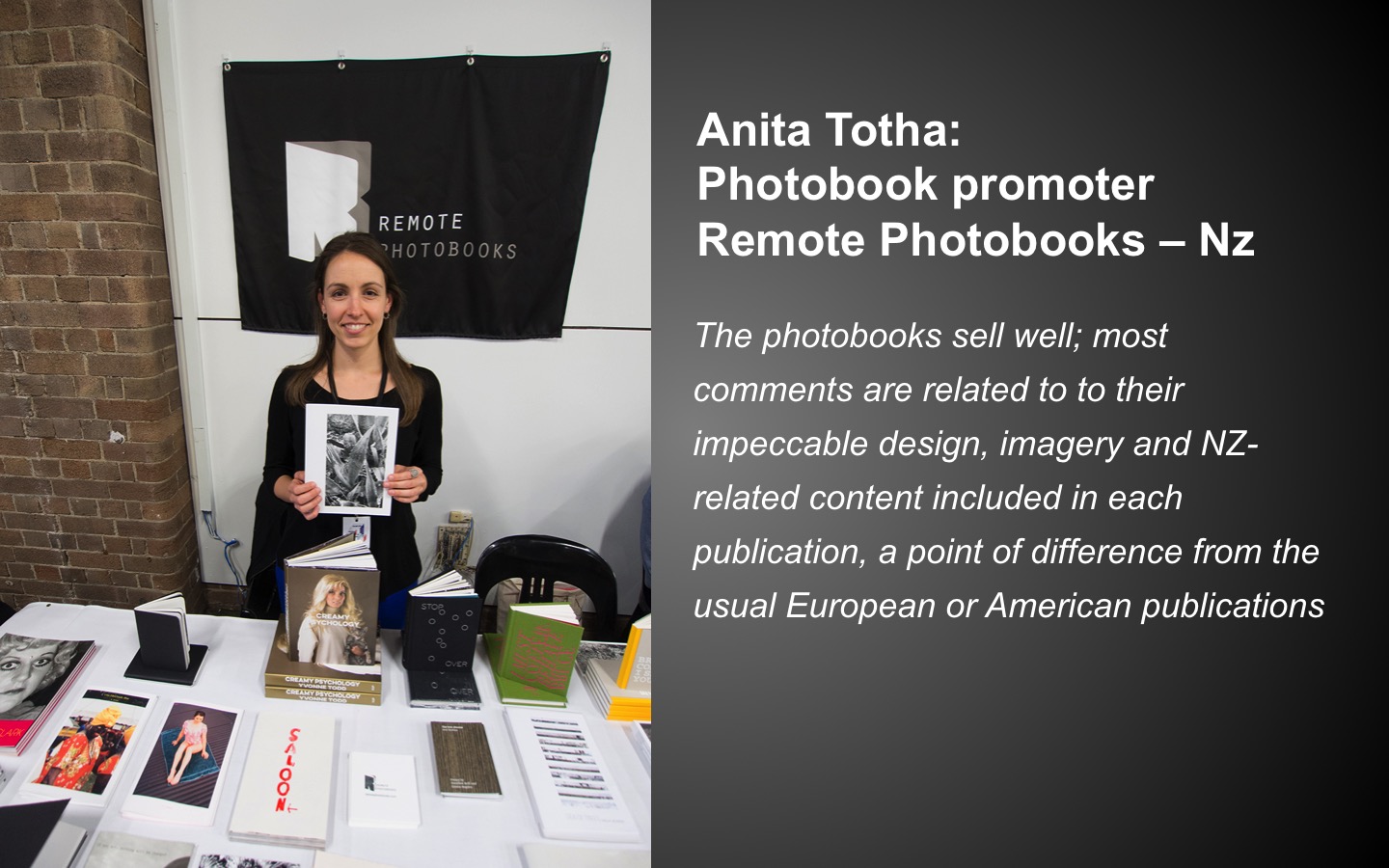
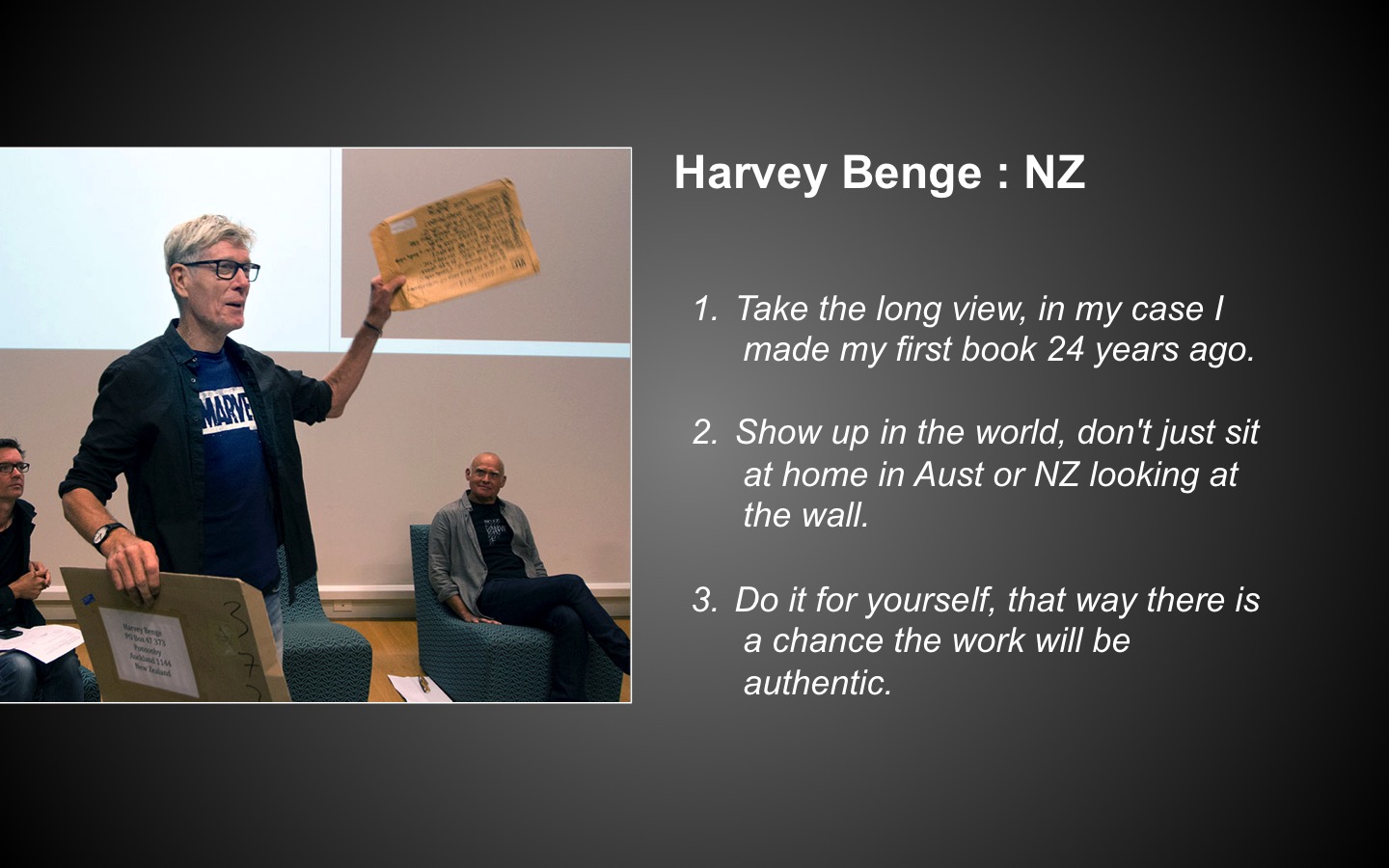
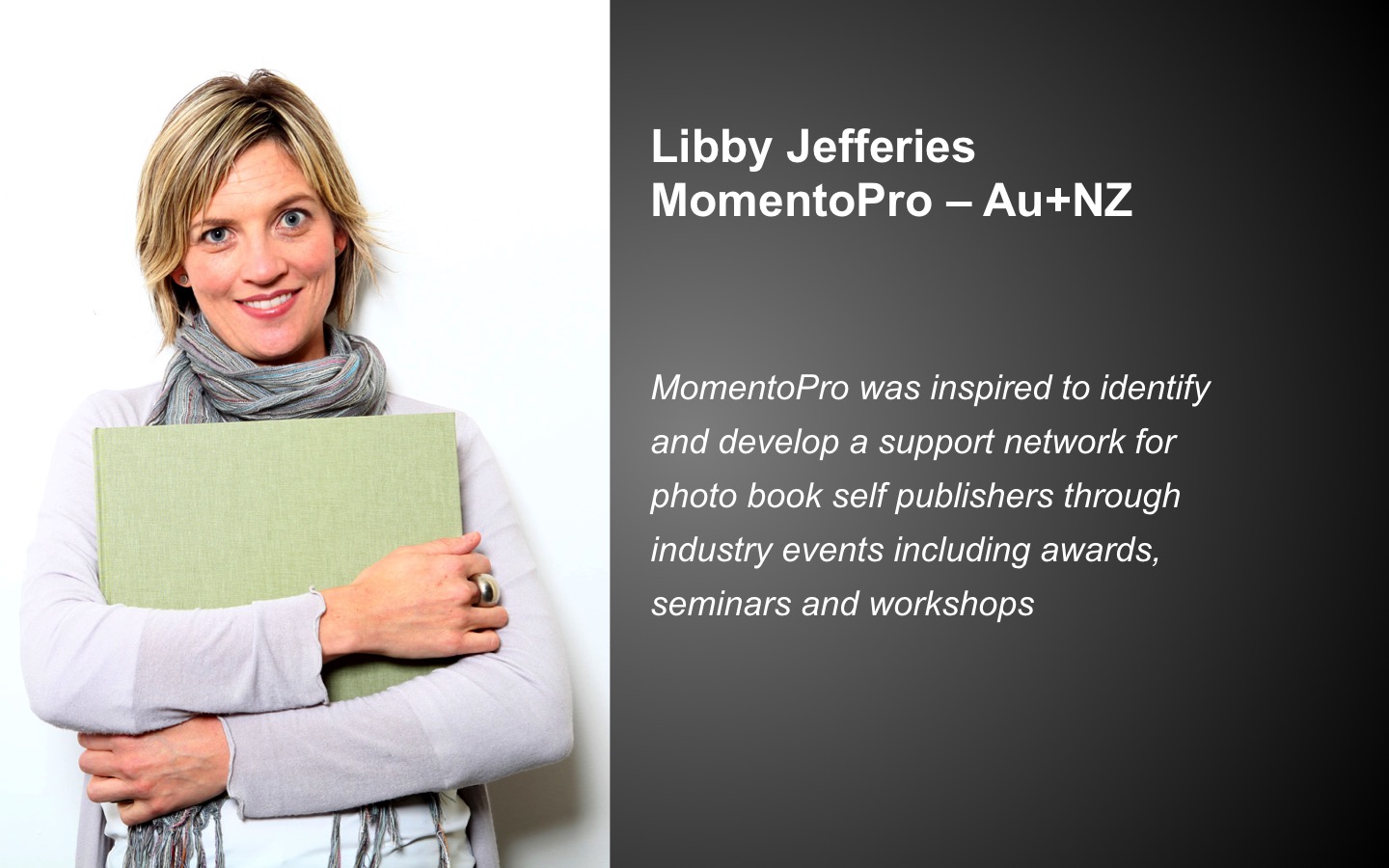
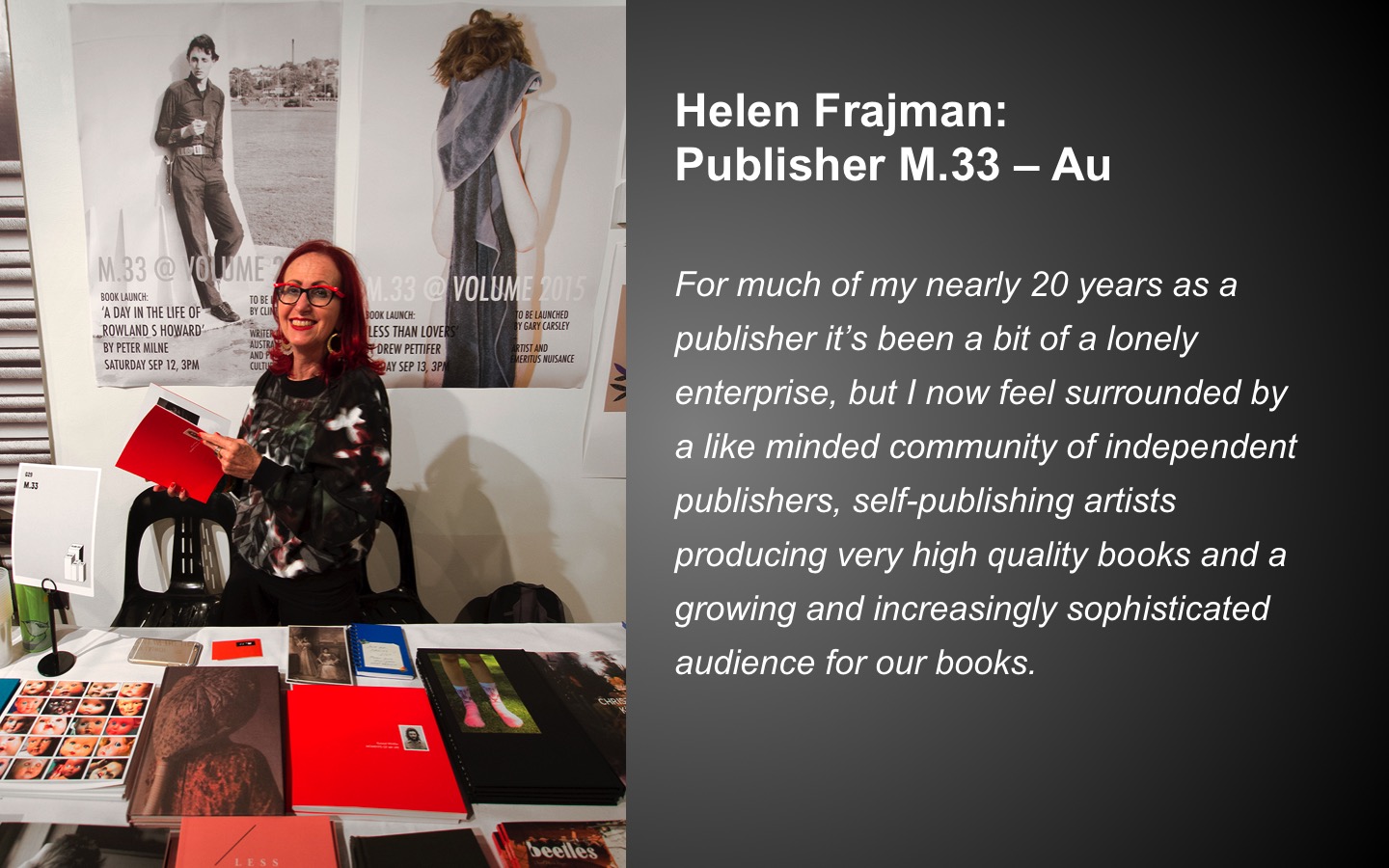
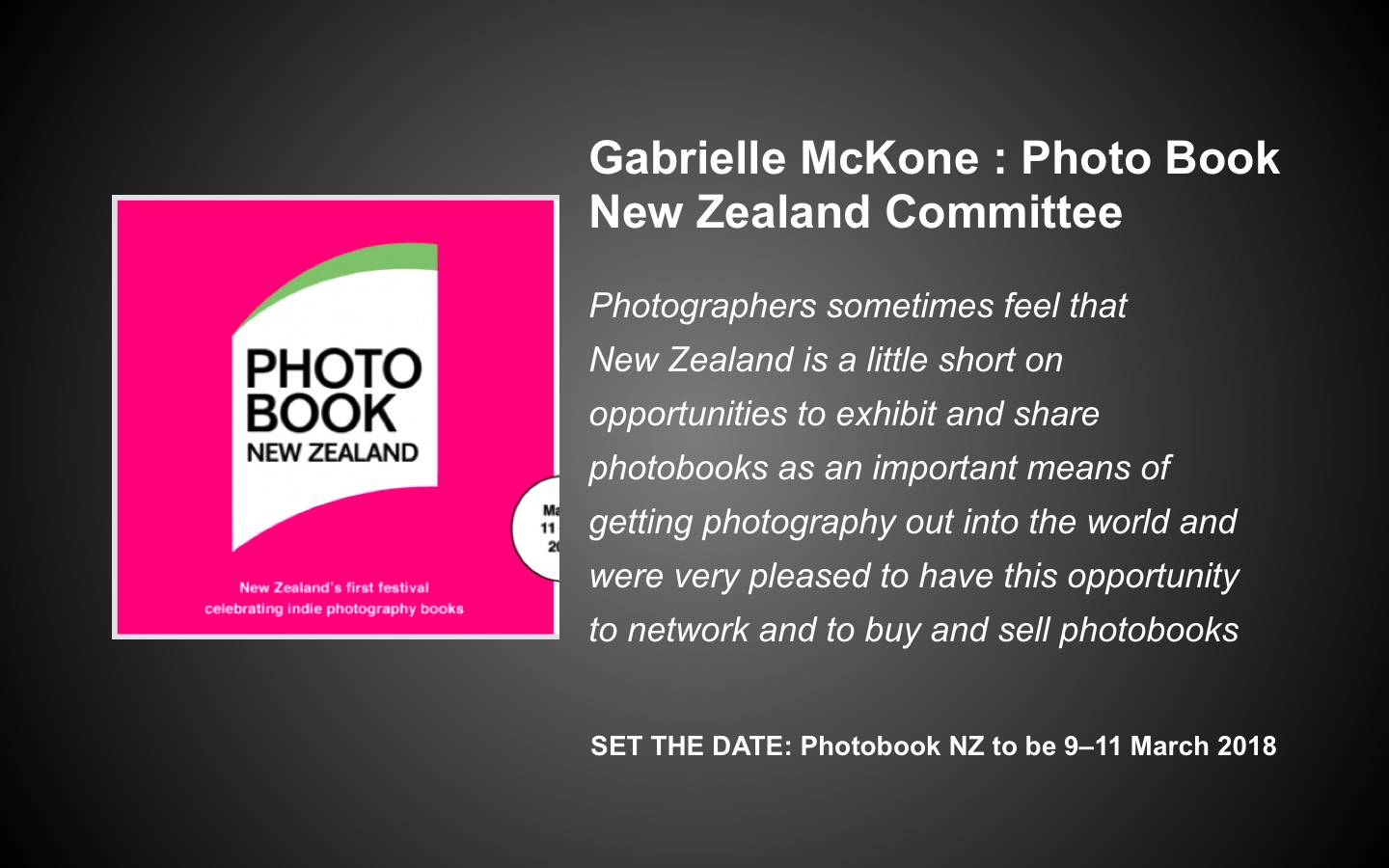
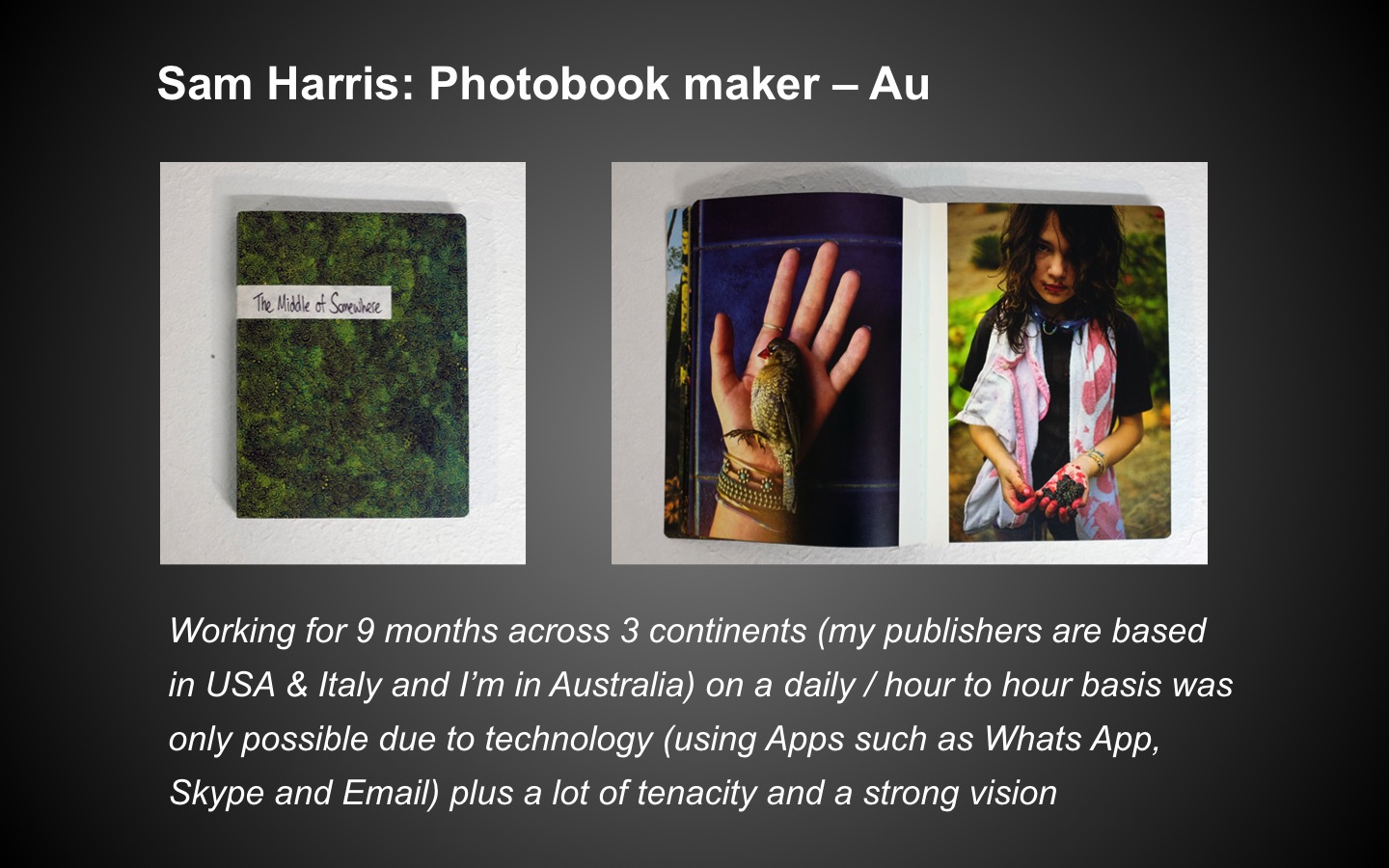
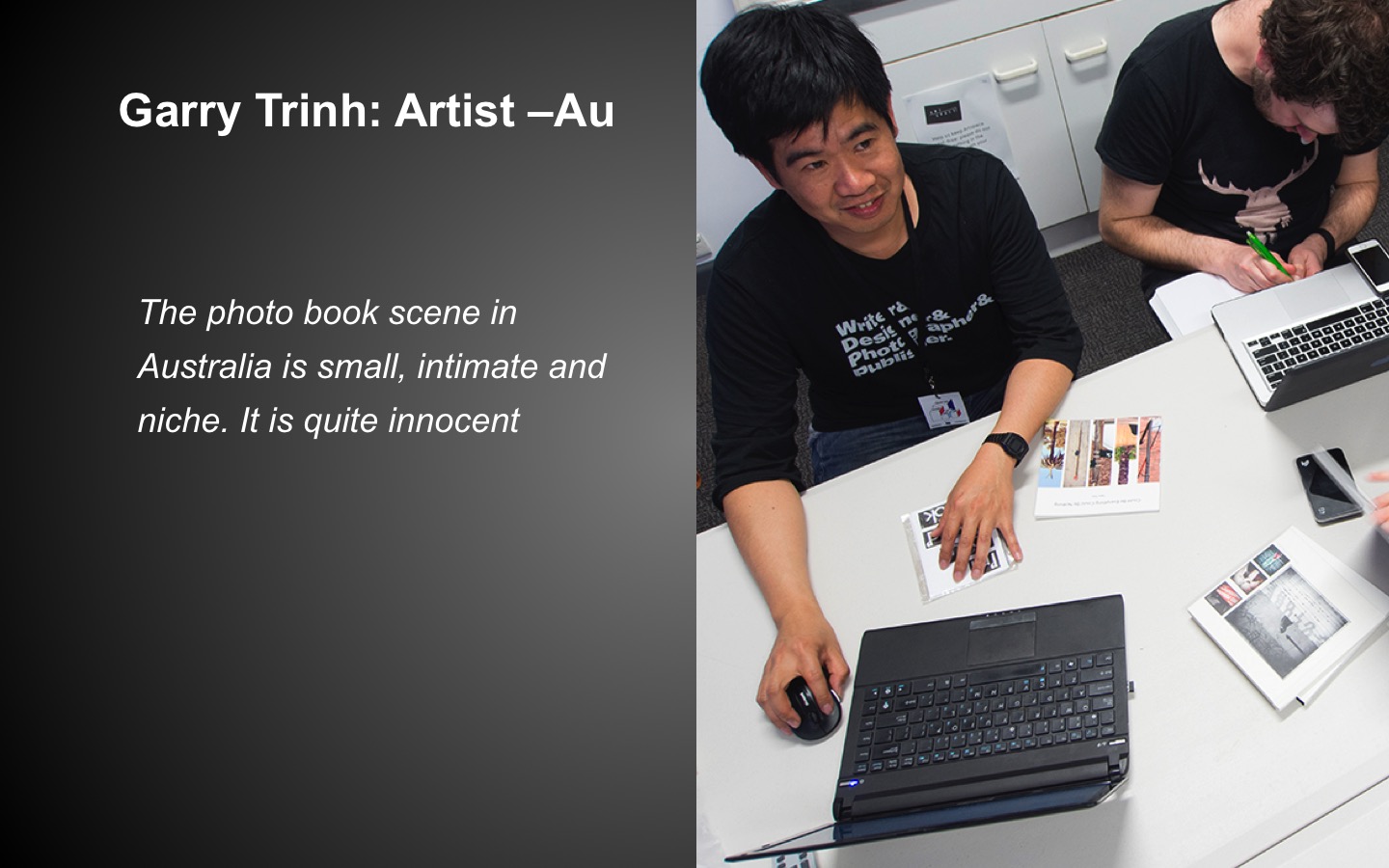
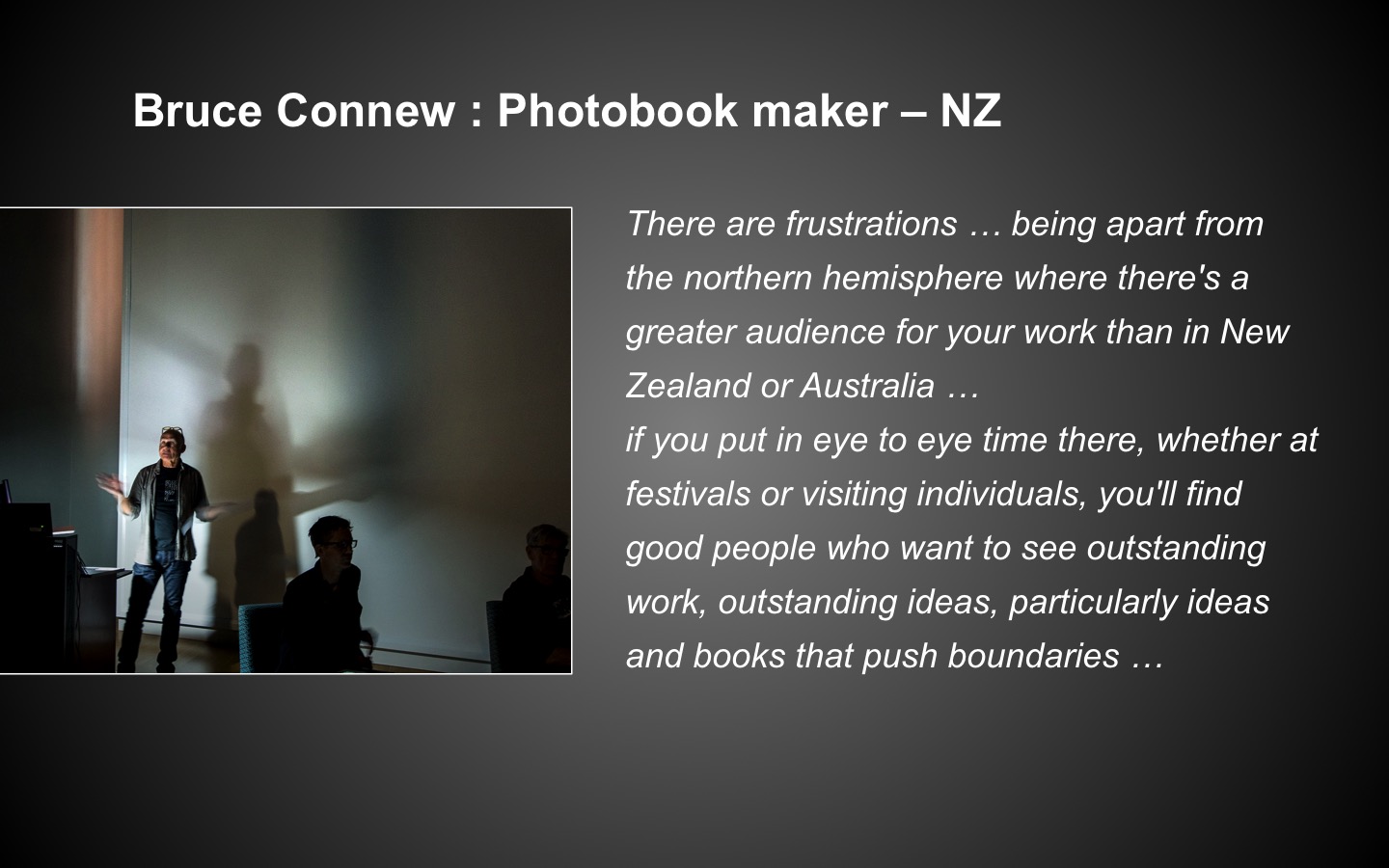
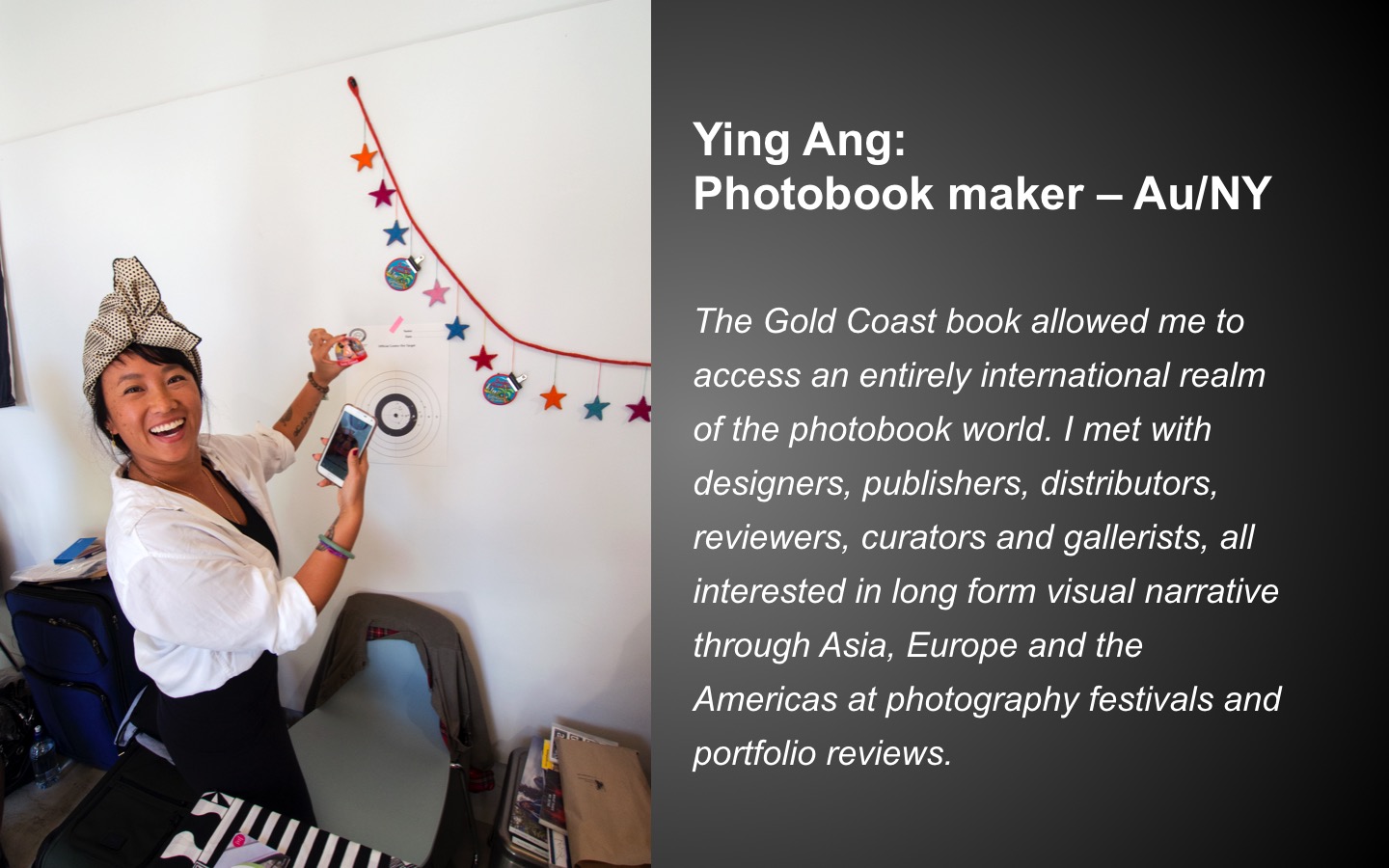
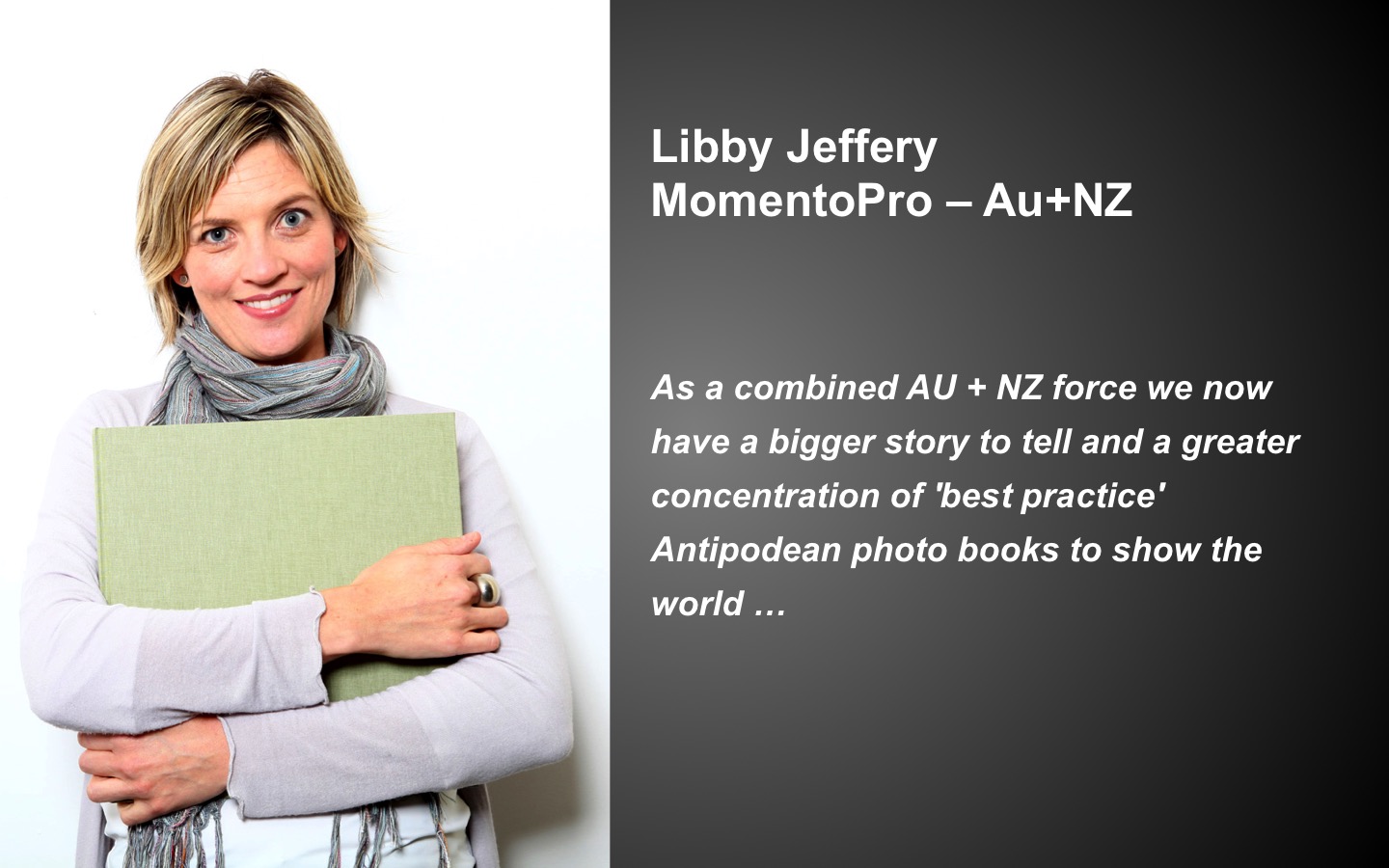
My concluding comment was that AuNZ and the Asia-Pacific regions offer new and refreshing ideas of what a photobook could be and the stories of peoples outside of the usual Euro/Americano scene.
I invited all attendees to visit our table and view the Photobook of the Year finalists and winners and offered, as an additional incentive a copy of the Awards booklet.
My lecture was well attended by festival participants from different parts of Europe including Martin Parr, Photo historian Hans-Michael Koetzle and collectors with an interest in the AuNZ books.
After the lecture Martin Parr and I discussed AuNZ photobooks that he was aware of and commented that in my lecture he had seen many new books. Our conversation continued later that day and he, Gerry Badger, and probably most of those who attended the lecture came to our table to look at the books.
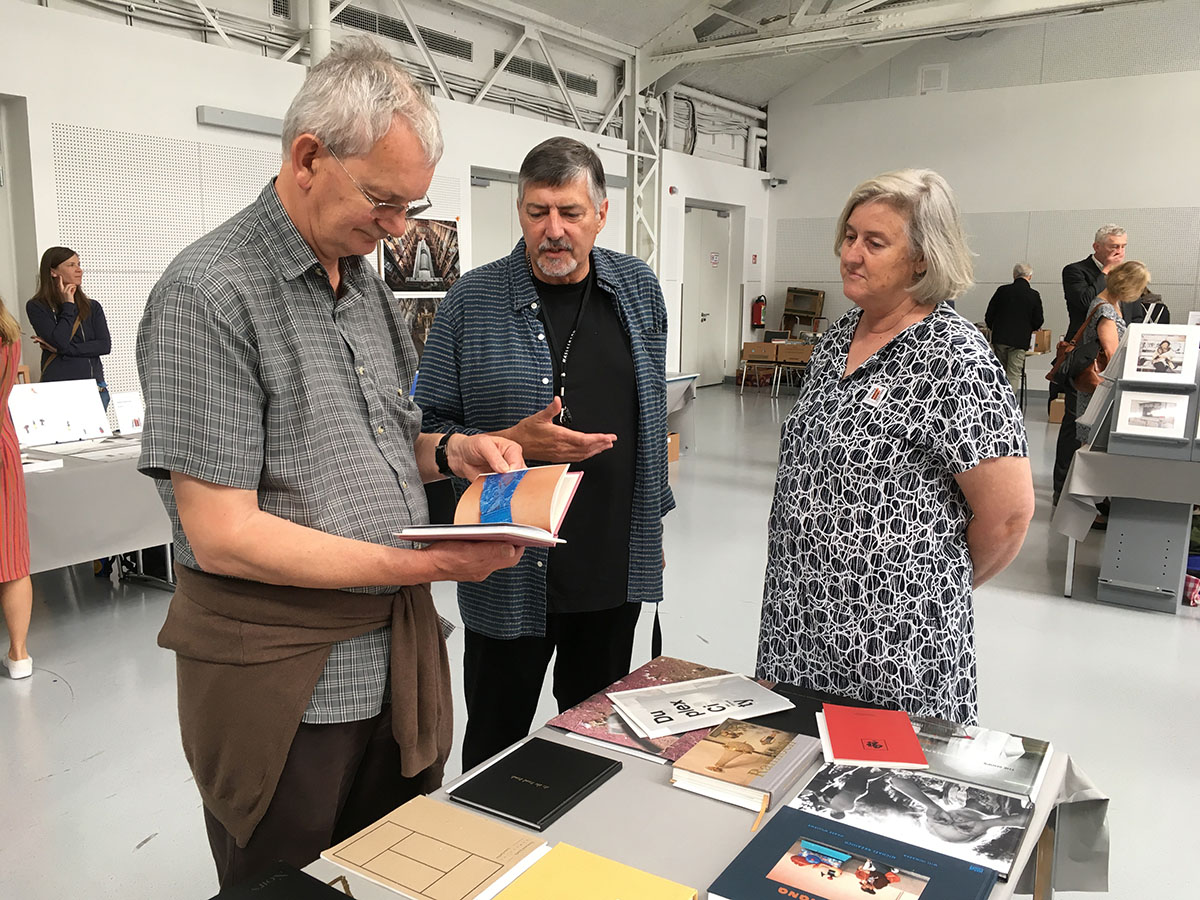
Martin Parr at the AuNZ photobook table PHOTO: Lachlan Blair
SEE ALSO
The EVENT
https://wotwedid.com/2017/06/18/aunz-photobooks-the-vienna-photo-book-festival/
The REVIEW SESSIONS
https://wotwedid.com/2017/06/18/review-panels-at-the-vienna-photo-book-festival/
.
.
.
.
.
.
.
.
.
.
.
AuNZ PHOTOBOOKS @ The Vienna Photo Book Festival
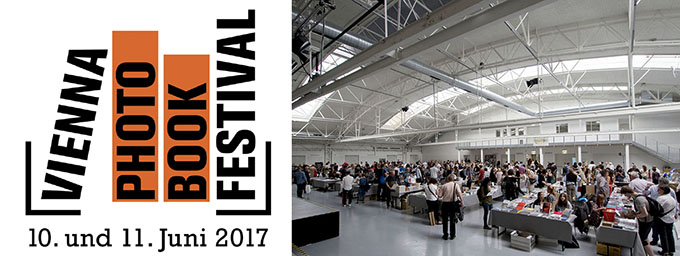
The exhibition at Brotfabrik Wien
.
THE FESTIVAL: LECTURES, ACTIVITIES, OLD+NEW BOOKS & PRINT SALES
(from the ViennaPhotoBookFestival website)
The Artistic Directors, Regina Maria Anzenberger of Anzenberger Gallery and Michael Kollmann of OstLicht Gallery state that:
The ViennaPhotoBookFestival is celebrating its 5th anniversary on the 10th and 11th of June 2017 and to celebrate the medium of the photobook accordingly we have set up an exciting program. In addition to prominent guests like the Magnum legend Bruce Davidson and the creator of The Photobook: A History and Magnum photographer Martin Parr, we are expecting the photo critics Gerry Badger and Hans-Michael Koetzle, the Russian photographer Nikolay Bakharev, archipelago founder Magali Avezou, the chief curator of the Italian center for photography Camera Francesco Zanot, the Danish photographer Krass Clement and the Swiss photographer Rene Groebli, who is celebrating his 90th birthday this year.
Also in 2017 we are following the vision of a modern platform that helps to create networks between publishers, rare photobook dealers, independent publishers, artists and students. In addition, the festival’s international lectures will attract photobook aficionados from all over the world making Vienna a photobook metropolis once again.
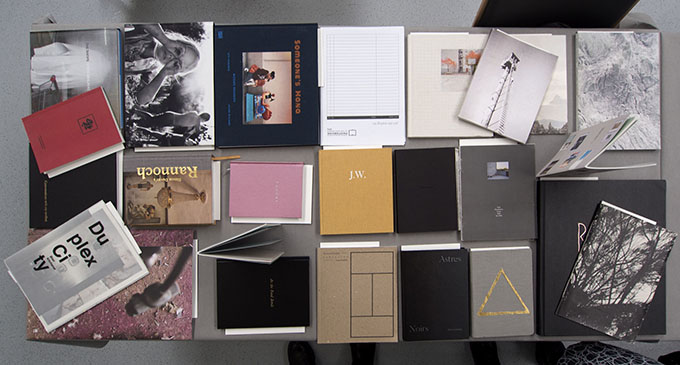
The AuNZ Photobook of the Year set of books
Early Saturday morning along with 100 other table holders we unpacked and set-up our display. Around us other table holders offered everything from prints to booksellers of new and antiquarian books, student groups and educational institutions from all over Europe. There were special activities including a 10×8 Polaroid portrait and wet plate photography studios.
Our ANZ PBOTY display was positioned next to our Austrian/expat Australian friend Lachlan Blair’s table. Although he had paid for his table to show his beautiful photogram works and prints, Lachlan also shared the table minding duties with us. With his support we all were able to attend lecture events and also checkout other VPBF tables.
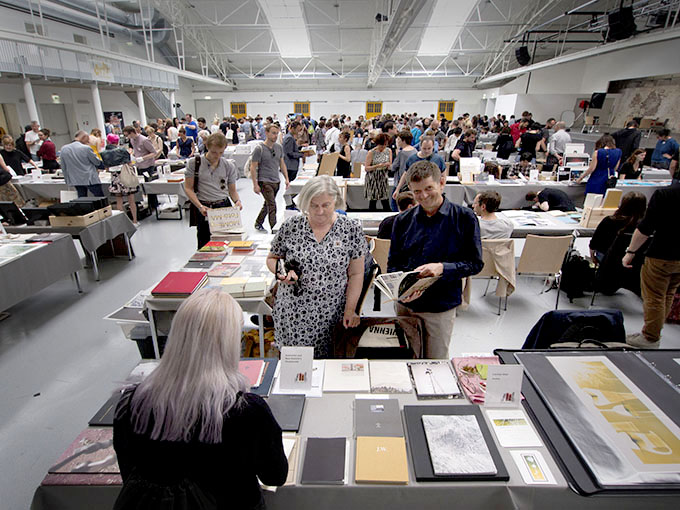
The exhibition space with the AuNZ table in the foreground
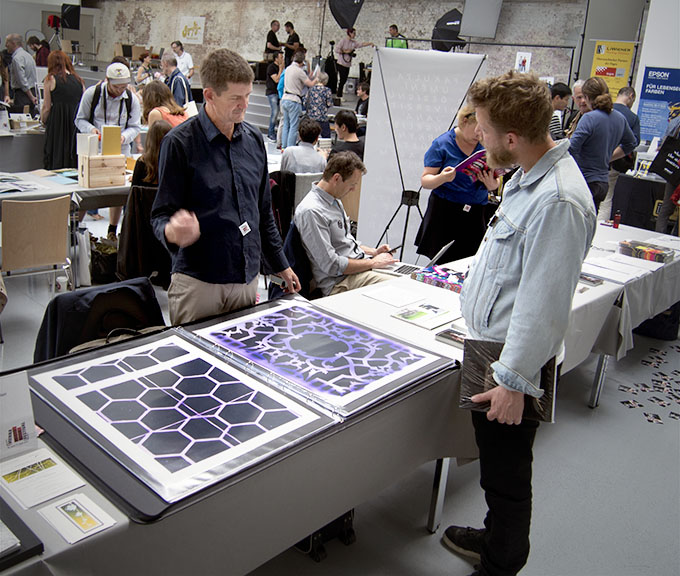
Lachlan Blair’s photogram print display
The history of the photobook was represented by significant collections and booksellers – I held a copy of Roy DeCarava’s Sweet flypaper of life… Lazlo Moholy-Nagy’s essay in Telehor from 1936 – books by Blossfeldt, Brandt, Van Elsen, Klaus Clement. I held back – a limited budget, though my new friend from Russia Natalia had an amazing handmade book by Julia Borissova that I had to buy, other books were bought and some were swapped – one of these was Surveillance by Valentyn Odnoviun which featured the circular observation peep-holes from Gestapo, STASI and KGB prisons – a most chilling yet remarkable book, this work was inspired by his father’s incarceration for 3 years on false charges.
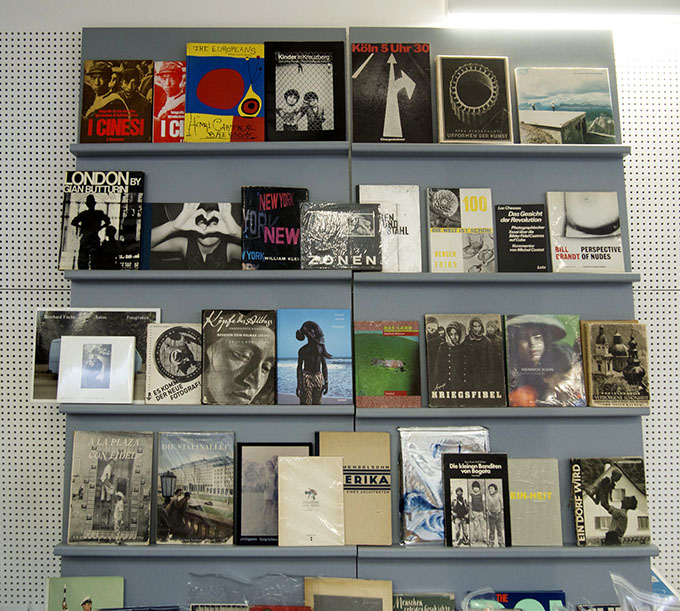
Classic photobooks
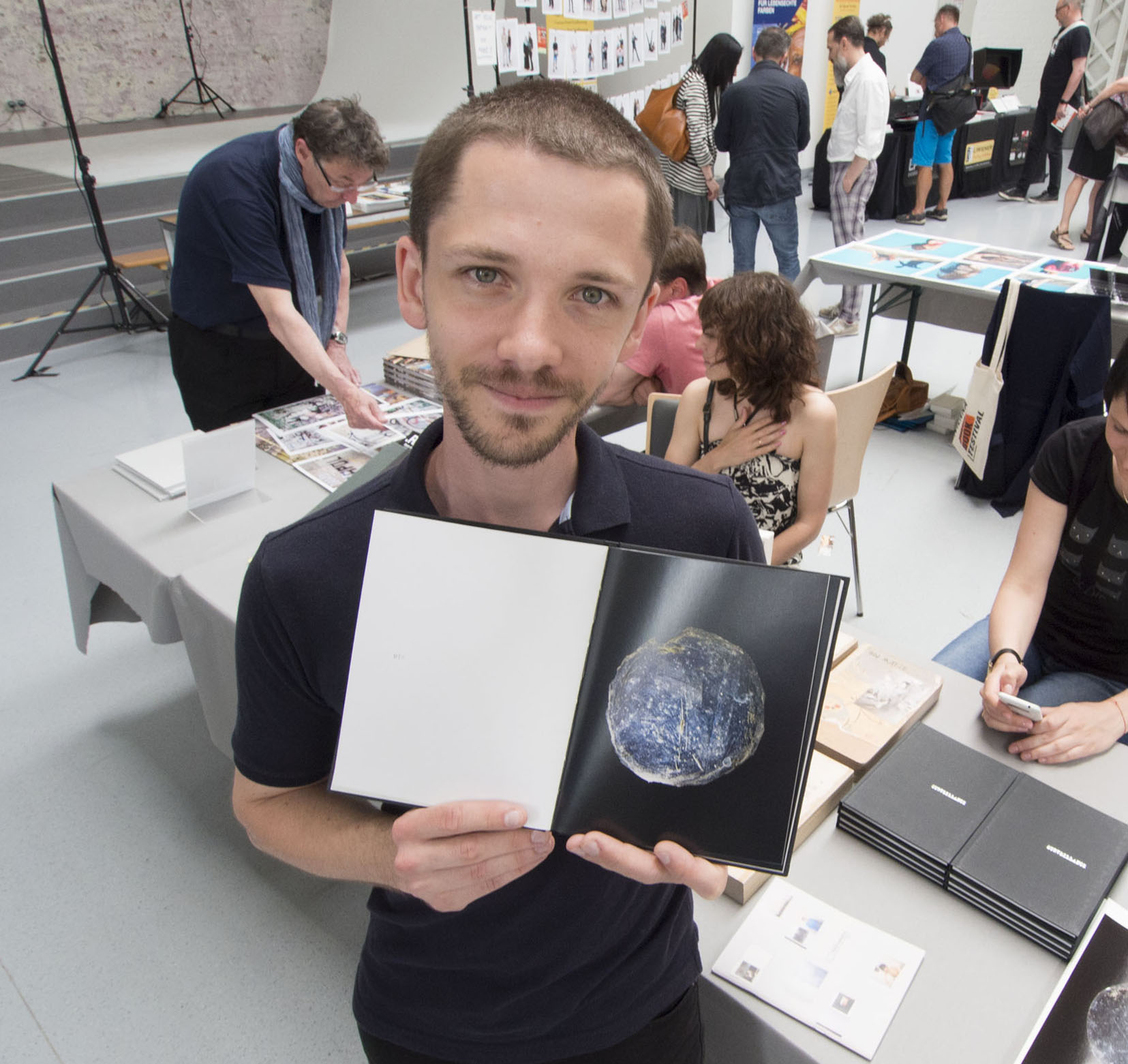
Valentyn Odnoviun with his book ‘Surveillance’
Martin Parr was interviewed by Verena Kaspar-Eisert at the opening event – the room was full. Parr was the complete mischievous interviewee as Verena teased out some interesting facts and comments from this ‘Photobook Rock Star’.
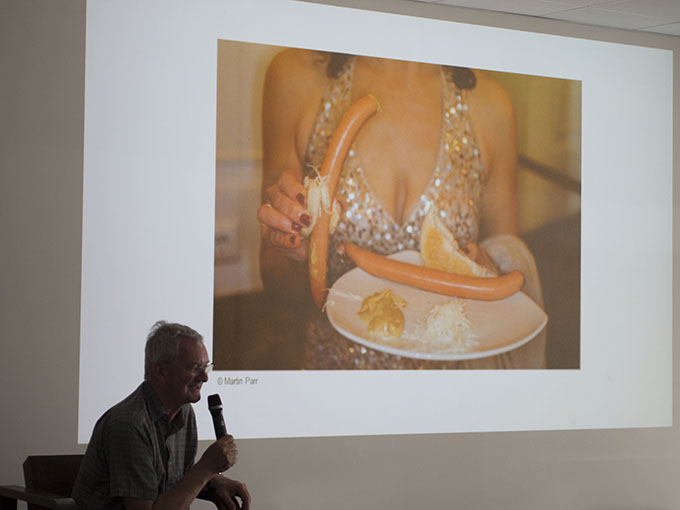
Martin Parr being interviewed by Verena Kaspar-Eisert
Sunday continued the frantic pace – lectures, including one by Bruce Davidson, another by Nikolay Bakharev and Klaus Clement interviewed by Gerry Badger.
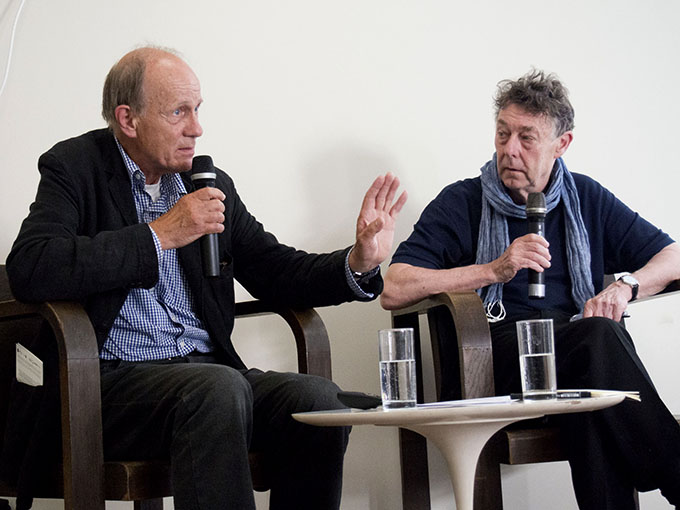
Krass Clement being interviewed by Gerry Badger
As the hours wore down there was a frantic activity to see other tables and catch up with as much as one could handle. MomentoPro had also sent along with the books around 30 of the little catalogues and these became gifts to selected viewers of our books… these included collectors, teachers serious photobook makers and others from the photo press and of course Anzenberger, Badger and Parr.
We received many statements from viewers complimenting the quality of our books some even saying that the work was better than the general European scene. In response to people wanting to buy ANZ books we suggested direct connection with the photographers websites, bookshops and online stores in ANZ. One collector came to us on Sunday and excitedly exclaimed that he had been in contact with a NZ photographer and had bought the book…! Katrin Koenning+ Sarker Protick’s Astres Noirs APOTY winner could have been sold many time over as it’s 1st edition is ‘sold out’ and is now a rarity – luckily the Anzenberger Bookshop had copies of the 2nd edition.
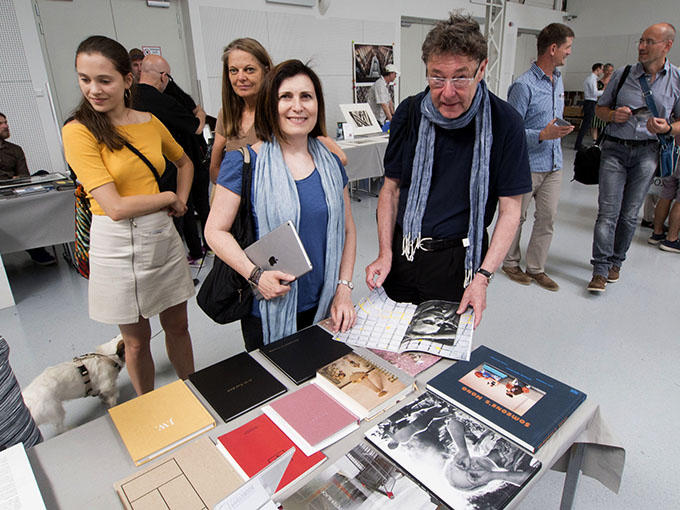
Gerry Badger with Sonia Lenzi at the AuNZ table
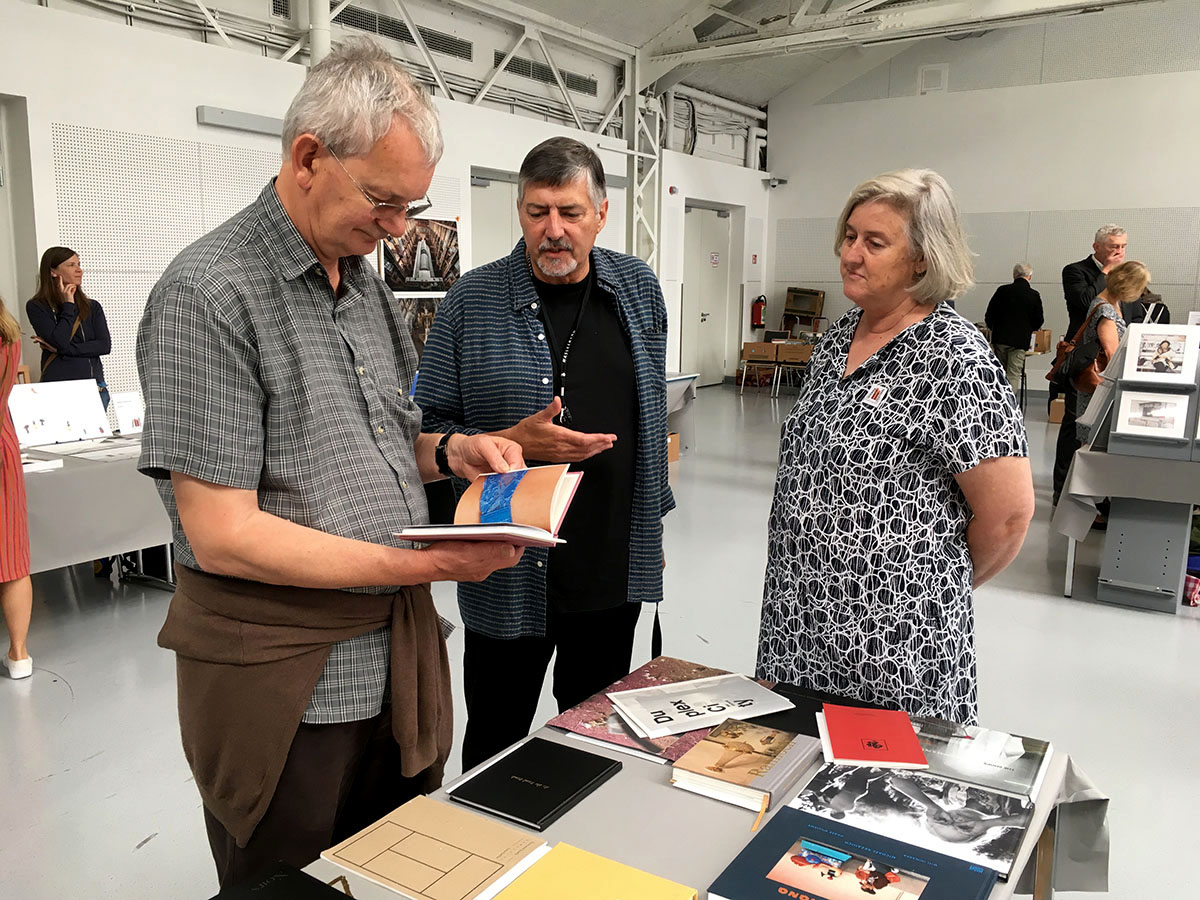
Martin Parr at the AuNZ table
In the final minutes of the 2016 VPBF all table holders packed up their displays of books and prints leaving behind a vacant space that had once held so many books, their stories and those who make or care for them. We left the building, said our goodbyes, repacked suitcases with new books and a couple of hours later Lachlan took us to Vienna airport to catch our flight home.
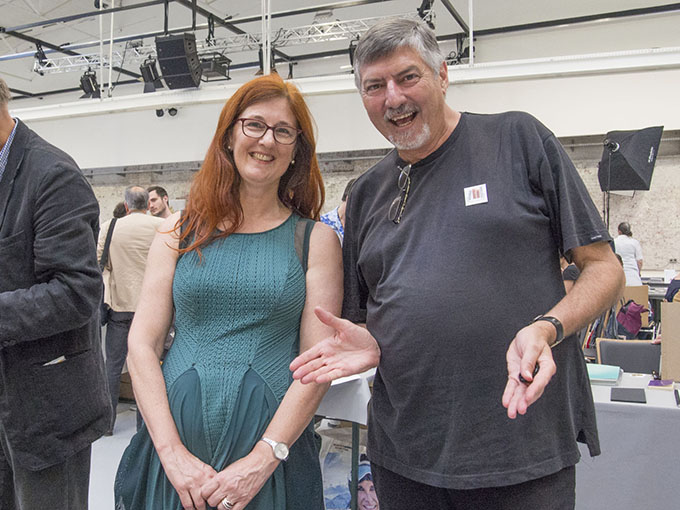
Regina Maria Anzenberger and Doug Spowart
It’s now the middle of the plane flight somewhere over the Black Sea – about 1.35am. I’m still pumped and excited to have been able to have made this foray into the European photobook scene. I also want to acknowledge the support of Regina Marie Anzenberger and Michael Kollmann from Vienna Photobook Festival, Libby Jeffery and Rony Wilson of MomentoPro, Lachlan Blair and my partner Victoria Cooper,
For many people in the northern hemisphere Australia and New Zealand will be known not just as an interesting travel destination but rather a place where a dynamic photobook network of practitioners exists making great books….
.
What follows is a selection of images from the event…


SEE ALSO:
The LECTURE
The REVIEW SESSIONS
https://wotwedid.com/2017/06/18/review-panels-at-the-vienna-photo-book-festival/
REVIEW PANELS at the Vienna Photo Book Festival
Vienna Photo Book Festival logo
.
THE REVIEW PANELS AT THE VIENNA PHOTO BOOK FESTIVAL
(From the website)
Publishers, gallery owners, curators, critics and collectors representing small, mid-sized, and major venues from all over Europe, will gather in Vienna to review unpublished photo books. 30 photographers will be selected to show their photobook dummies to15 national and international reviewers.
Our goal is to offer talented photographers from around the world a forum to discuss their books with a wide range of photography experts, thereby producing a lively dialogue between the aspiring artists and the experts from various prestigious institutions.
Photographers will have one-on-one meetings with the reviewers. Each review session will last 20 minutes and we will limit the number of participants to assure that everyone receives six reviews each. It is a great way to network. Numerous photographers have walked away with opportunities to publish, exhibit and sell their work after attending such reviews.
Vicky and I submitted our ‘You are here’ book to be considered for the Vienna Photo Book Festival Reviews. ‘You are here’, that considers our place on planet Earth within the solar system and has also been a finalist in a couple of artists book awards in Australia over the last 9 months. Additionally the State Libraries of Queensland and Victoria have collected this artists’ book.
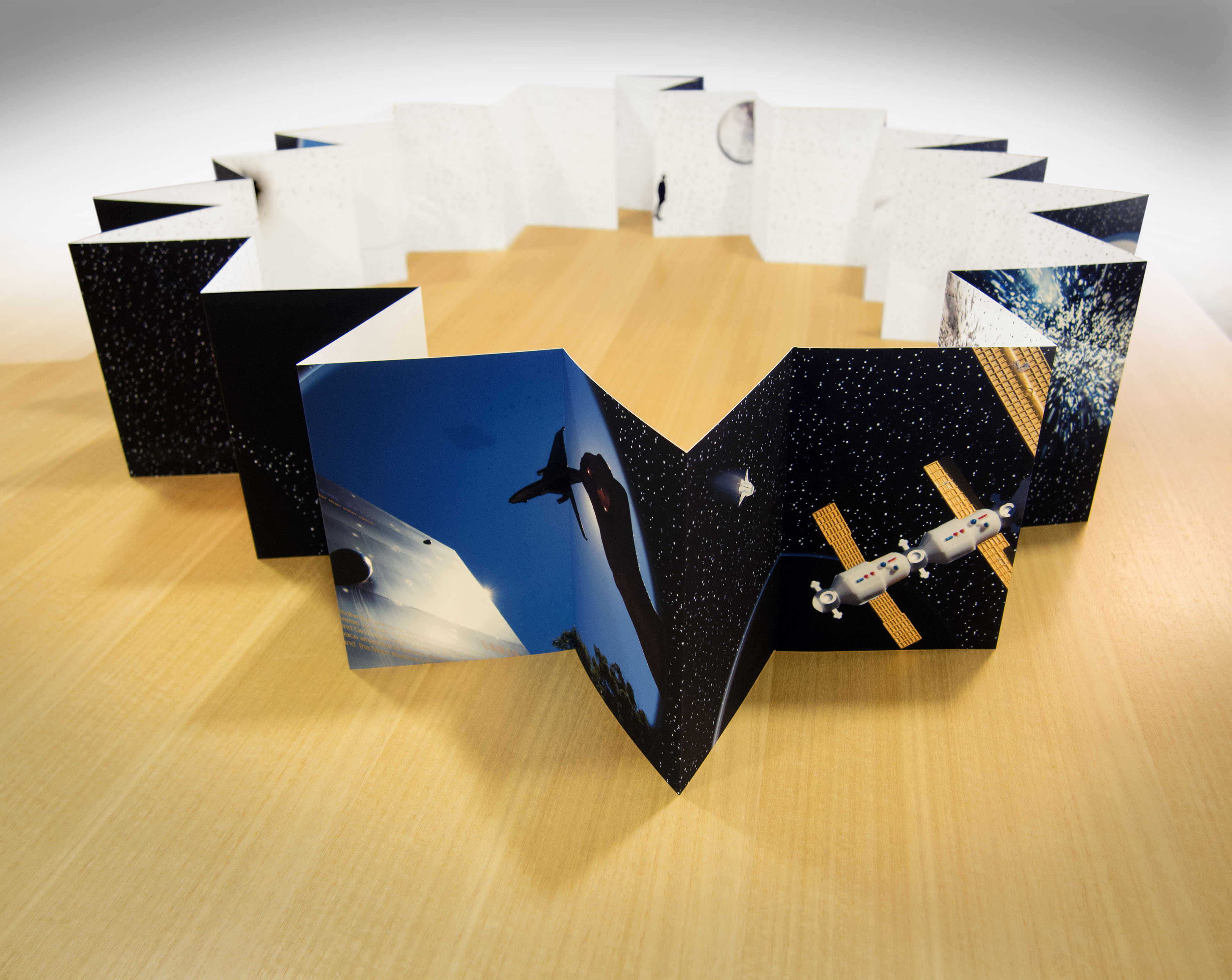
You are here…
At the end of April we were advised that our submission for the review session had been successful. At this time we were asked to suggest six possible reviewers from their list to look at our book. We selected the following:
- Gerry Badger, photographer, curator, photo critics, architect UK. http://www.gerrybadger.com
- Peter Gössner, collector, Austria.
- Rob van Hoesel, The Eriskay Connection, The Netherlands. http://www.eriskayconnection.com
- Hannes Wanderer, Peperoni Books, 25 books, Germany. http://www.peperoni-books.de
- Matej Sitar, The Angry Bat, Slovenia. http://www.matejsitar.com
- Manfred Zollner, fotomagazin, Germany.
.
Regina Maria Anzenberger opens the Reviews
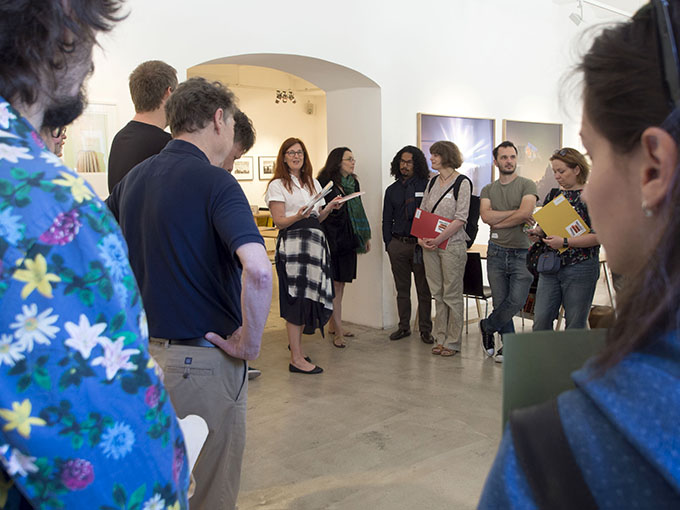
On Friday 9th we excitedly waited outside the Anzenberger Gallery with 30 other finalists who came from all over Europe. The reviewers were assembled and Regina Anzenberger opened the event and advised participants of the process – 20 minutes each, then a bell is rung, and the next review gets underway. Sufficient time is given for reviewers and photographers to take breaks and have lunch.
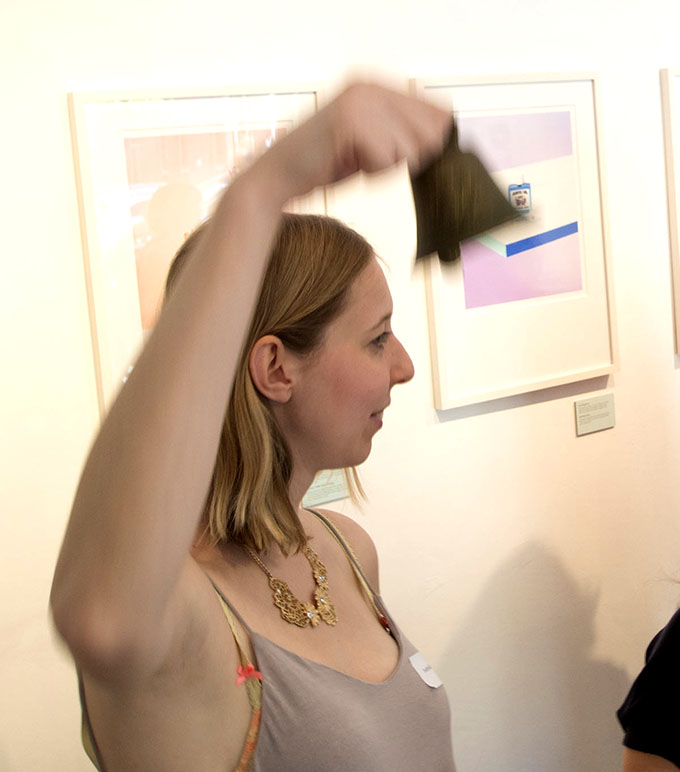
Isa Maria rings the bell
The bell rang and we sat down with photobook aficionado Gerry Badger. He asked to look at the book first, so we silently sat as he turned the pages of our concertina book as a codex. Badger said he loved it and couldn’t improve on it as an object and visual narrative. We then spoke about other things including his latest project documenting graffiti in Italy. He then pulled out his prints to share with us… an interesting project he has been working on over many years. The bell soon rang and we moved on to the next reviewer.


Over the next few hours we met with the other reviewers. The responses we received acknowledged the beauty of the object and the work’s ‘challenge’ to accepted photobook practice. Most of the attendees were looking for publishers for the ‘dummy’ book that they were presenting. As ours was a resolved work and more of an object/artwork rather than a publishable codex-based photo-project, there was not much room for suggestions. However many points emerged from the discussions that will inform future directions for new work from the project.
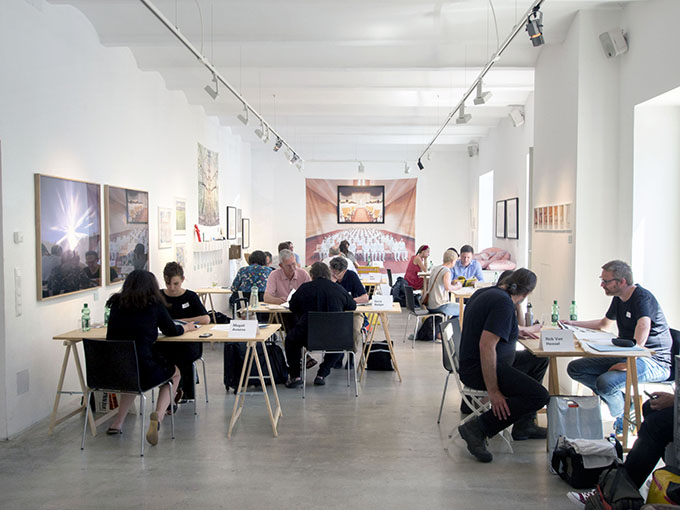
The review tables
It was a warm Vienna day and review participants gathered outside the gallery when their work was not being reviewed. We actively connected with these photobook makers – a fascinating experience as we were meeting members of with representatives of a united nations of photobooks – Russians, French, Austrians, Polish and Czech, German, Hungarian and Slovakian. Most spoke English and from these new ‘friends’ we had instant contacts to see their works for sale in the Book and Print Sale Festival event.
After the seeing the books, the reviewers discuss the projects/books and the winner of the Vienna Photo Book Award was determined. The 1st prize winner receives a book publishing contract from Anzenberger Edition which covers production costs of Euro 5,000.
On Saturday evening the winner of the 4th Vienna Photo Book Award was announced. The winners were Nadine Schlieper and Robert Pufleb with their photobook ‘Alternative Moons’.
.
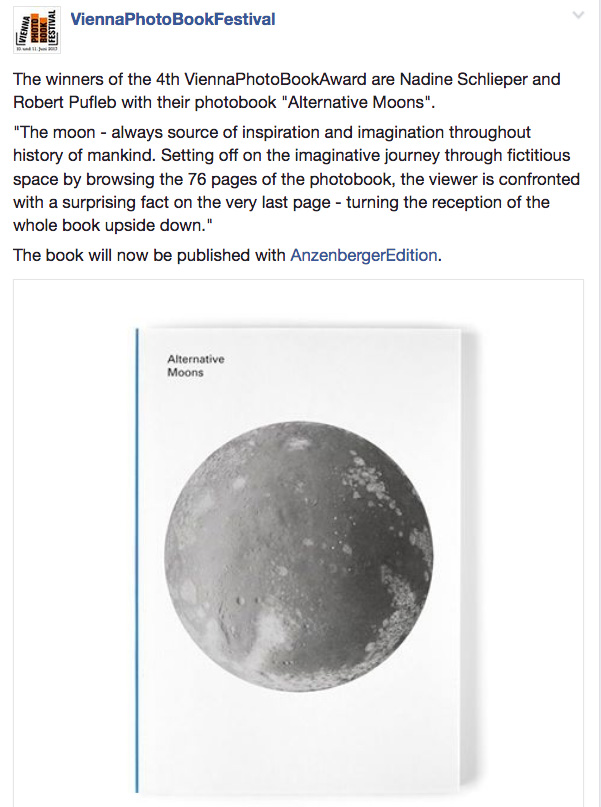
The winner
Here are photos of some of our fellow review participants
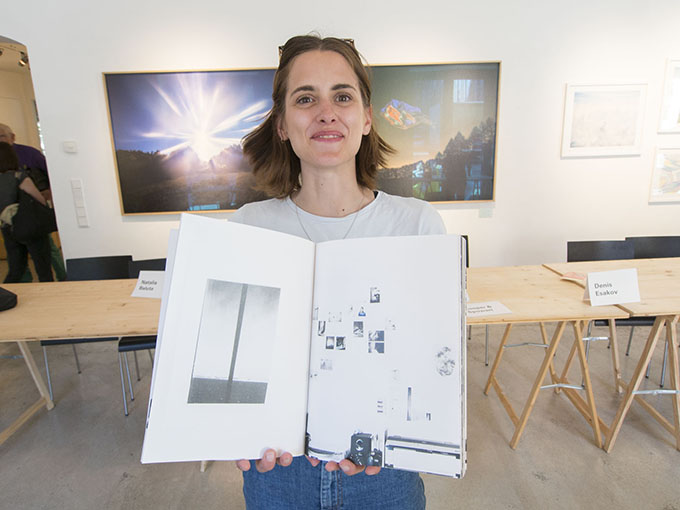
Lore Horre
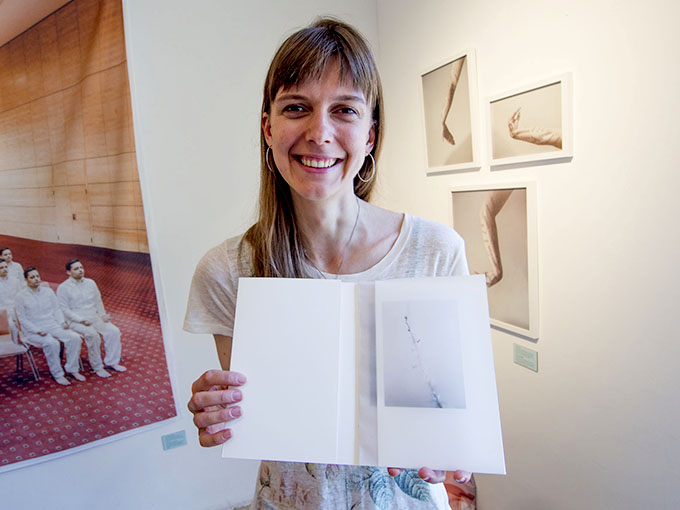
Mariya_Kozhanova
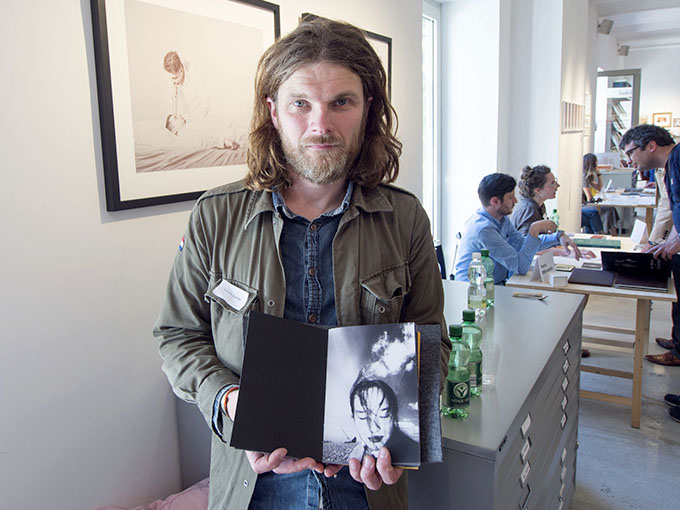
Thomaz Laczny
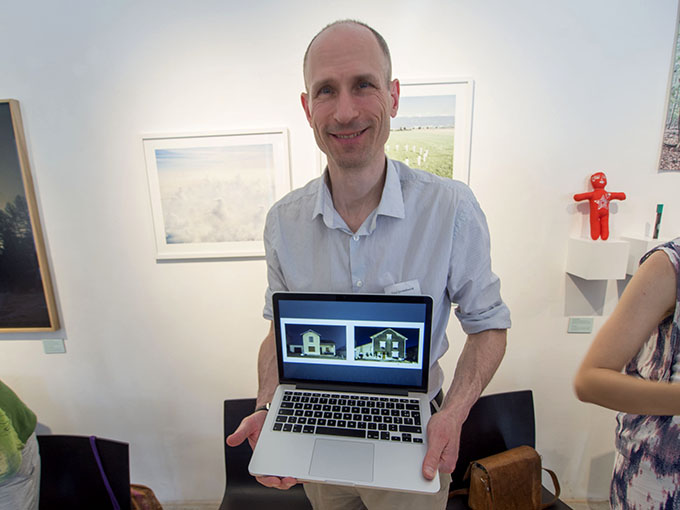
Paul Grandsard
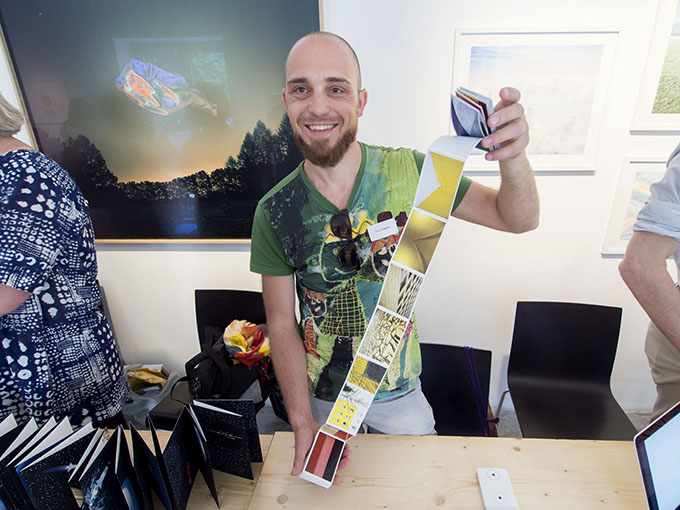
Denis Esakov
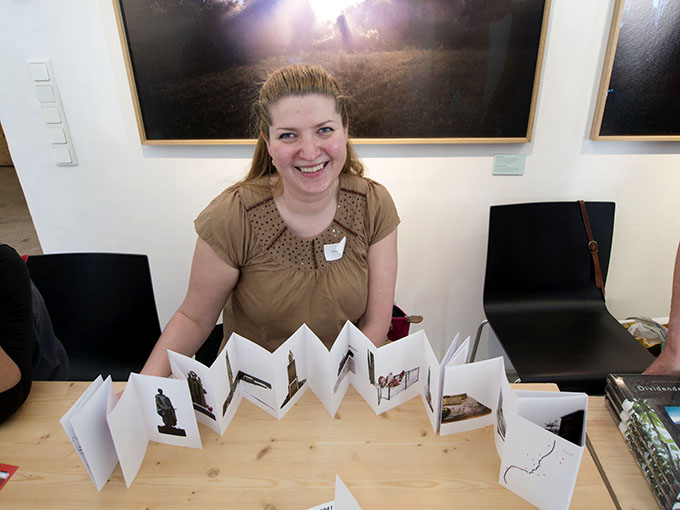
Natalia Baluta
SEE ALSO:
The LECTURE
The EVENT
https://wotwedid.com/2017/06/18/aunz-photobooks-the-vienna-photo-book-festival/
.
.
.
.

 wotwedid