Archive for the ‘Speaking on Photography’ Category
PHOTOGRAPHER’S NIGHTMARE: Client returns faded wedding album after nearly 40 years!!
Not many people would pick me as a wedding photographer – Well, I’ve been to many, shot a few and even been employed as the wedding photographer. One of my photographs was the highest scoring wedding photograph at the AIPP Awards in 1991, and in the mid 1990s, I won the award ‘Queensland Innovative Wedding Photographer of the Year’ on two occasions. Masquerading as a wedding album, one of my artists books is even held in the State Library of Queensland’s rare books collection. SEE: http://srlopac.slq.qld.gov.au/cgi-bin/Pwebrecon.cgi?BBID=1381161
My wedding photography ‘career’ began auspiciously, as I guess most photographers do – with a family wedding. I was a naive 18 year old studying photography part-time at the College of Art in Brisbane. At the time I was working with an old Mamiya C33 and an M3 Leica with a Metz 202 flash, and the idea of shooting a wedding an adventure. At the time I was working at Kodak and some of my clients helped me out with advice and the ‘slip your prints in’ album that was the final outcome for the project.
All went to plan – I did the bride in the mirror at home, in the church during the ceremony with flash, the bride and groom walking up the isle, a quasi-documentary bride ‘n’ groom outside the church, family groups, bride and groom in the rear window of the car and the cake cutting. My brother Garry did marry Sheridan Draisey at All Saints Church and I had the photos to prove it.
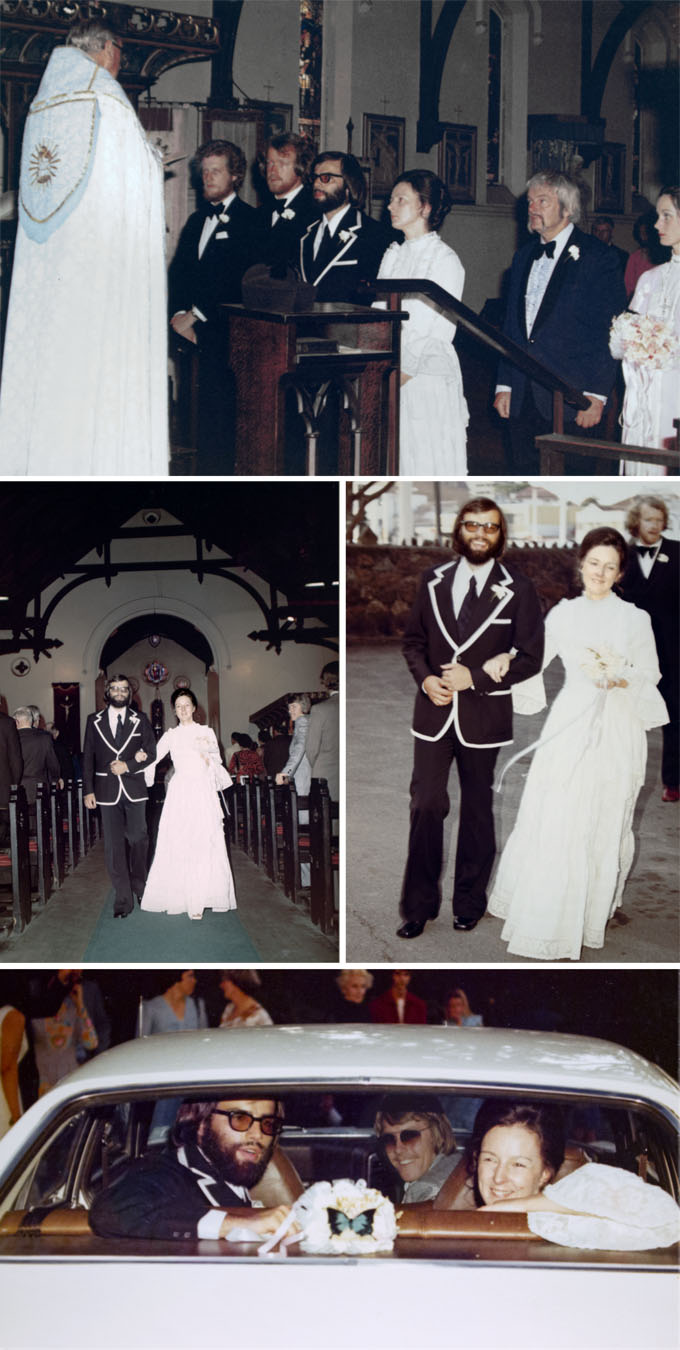
Wedding mosaic
Kodak printed the images; probably at their colour lab in Sydney as the Brisbane lab was still doing black and white processing exclusively. The prints were slipped into the pages and passed on to the happy couple.
Time passes…
A few years ago I heard through the family grapevine that the album was falling apart and that images were fading. I wonder how many photographers experience this fear of whether their goods and services will last and the possibility of the disgruntled client appearing from the past with faded, leuco-cyan (reddish) or yellowed prints and the grunge of time coating everything? Eventually I was reunited with the album and its sorry condition. What to do?
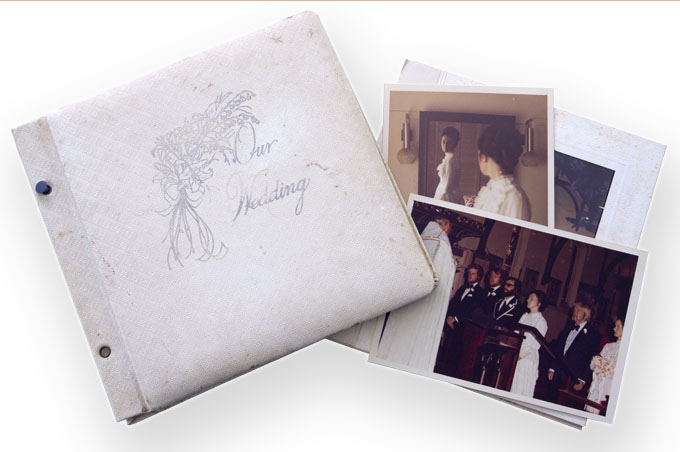
The original album
I scanned the images and used simple Adobe Photoshop techniques to remove casts and reconstitute faded colours. All images were reprinted on inkjet pigments and archival papers and the pages fitted into a new album cover. A CD-Rom was included loaded with the restored jpeg images. The original album was assembled as best as possible, wrapped archivally and inserted into a container for safe keeping and the new album similarly presented.
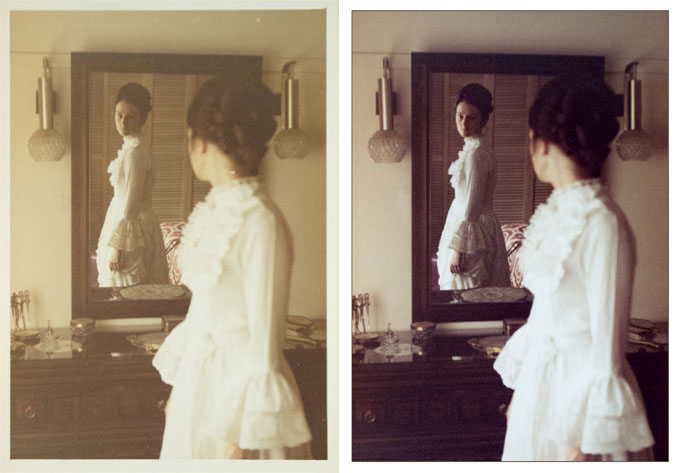
Before & after Adobe Photoshop restoration
On the next convenient occasion the album was represented to the client (my sister-in-law). She excitedly reviewed the album and recounted the wedding, and the stories of those in the group photos were updated – even perhaps made alive by their remembrance and telling.
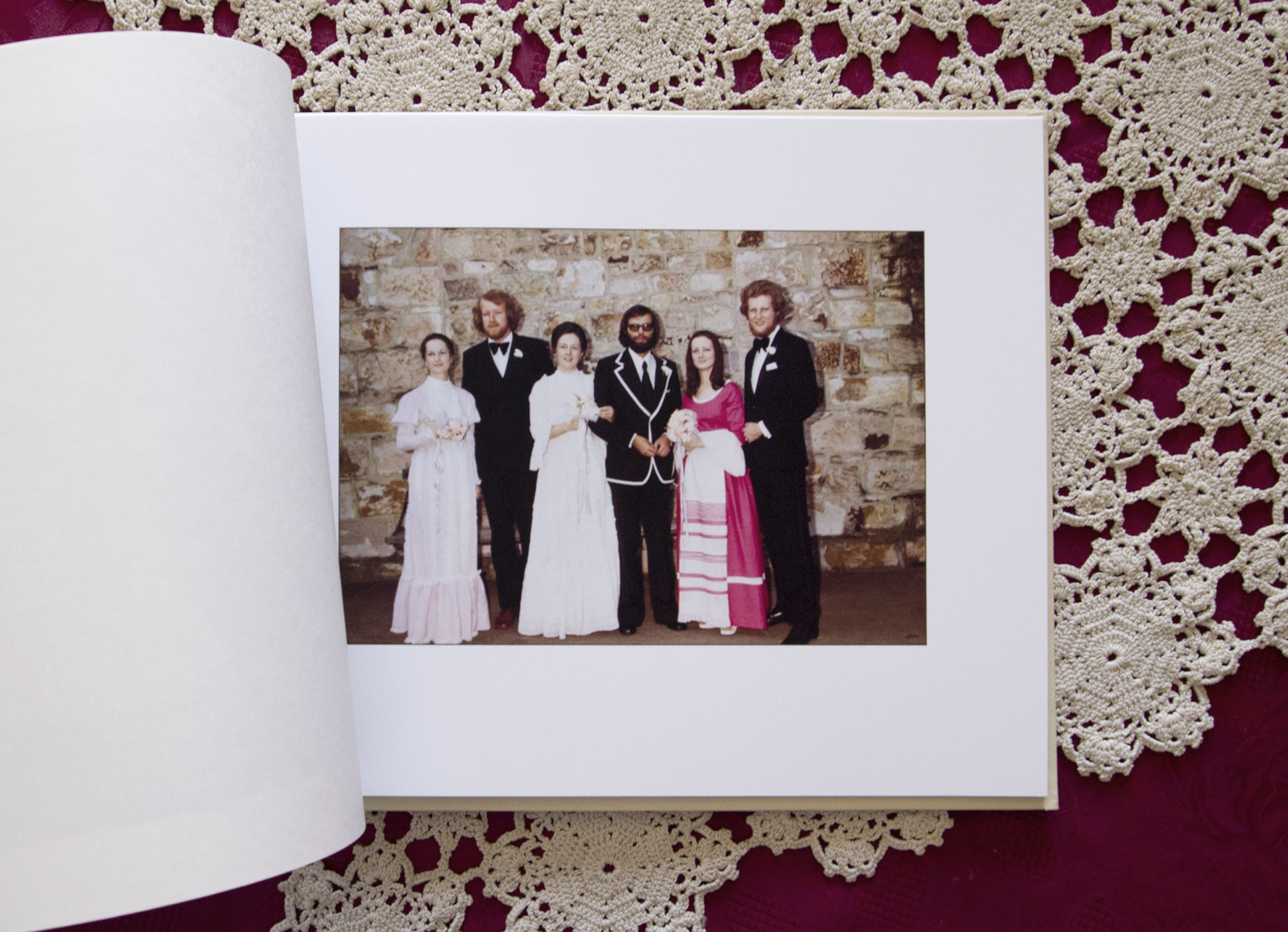
The New Album
My experience made me think about how photographers constantly push ‘photo memories’ as a selling point for choosing a professional photographer for important events. And I wondered how often the pro photographer’s images may, as in this case, not last as well as everyone might have expected. I came to also reflect upon how memories are recreated through photographs and how important the photograph of times past is for people – particularly as they age.
As the photographer and re-creator of the album I was rewarded by the experience and how many a faded image may be restored to its memorable potential by Adobe Photoshop. It is interesting how digital imaging was once touted as being the death of photography – it may very well be its salvation.
Doug Spowart
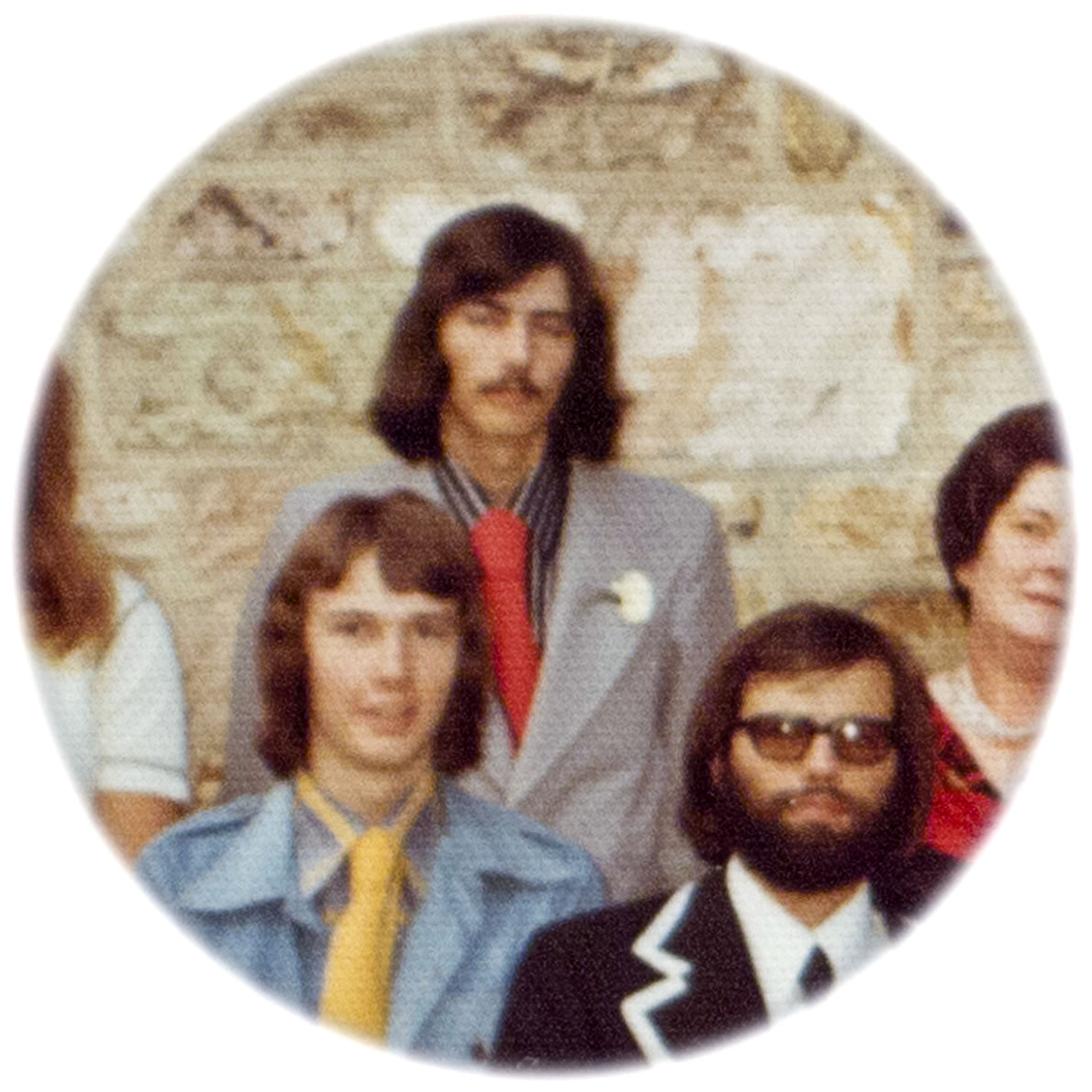
The photographer in the wedding group with brothers Garry and Peter
WHIPPING UP A FOTO FRENZY
Dr Doug opens the FOTO FRENZY Photographic Centre in Brisbane
The much awaited reopening of the expanded FOTO FRENZY Photographic Centre in Coorparoo took place on Friday, January 18, 2013. Attended by a crowd of around 100 well-wishers the event heralded a new beginning for dilettantes of a wide range of photography interests including:
- photography workshops
- photographic gallery
- fine art printing, mounting and framing
- photographic darkroom hire
- studio hire
- one-on-one consultations

Mark photographs the Foto Frenzy Team PHOTO: Victoria Cooper
The FOTO FRENZY space is shared with BRISBANE CAMERA HIRE, specialist in providing a range of photographic gear and unusual accessories.
The Foto Frenzy team includes Brisbane photo identities Ian Poole, Cam Attree, Tony Holden and Darren Jew. All four are photographers and have specialist areas of activity from photography as art, to location and underwater photography, nude and glamour photography and photography as personal expression. Darren Jew is well known in photo workshop circles for the ‘Faces and Places’ workshop that he established with Jim McKitrick in the late 1980s.
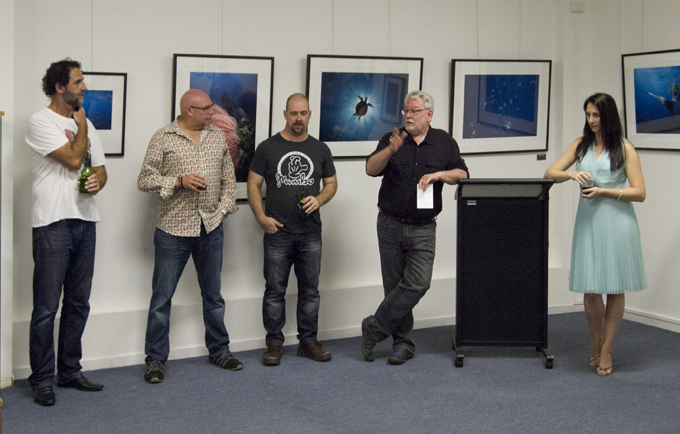
The team l-r Darren Jew, Tony Holden, Cam Attreee, Ian Poole and Susan BCH PHOTO: Victoria Cooper
The Foto Frenzy team have been together for twelve months in a modest facility just a short distance away from the new home. Now with the larger facility and the linkup with Susan & Jacob and Brisbane Camera Hire new and amazing opportunities for the business and the clients that they service are available.
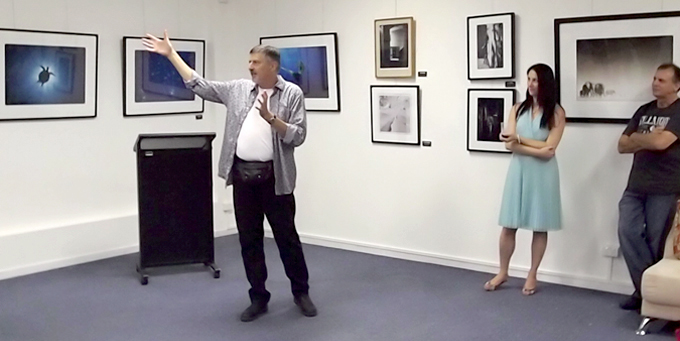
Doug Spowart opens Foto Frenzy PHOTO: Victoria Cooper
As someone with a history in photography that connects with most of the Foto Frenzy team, as well as being a former Director of the photo gallery and workshop—Imagery Gallery, (that operated in Brisbane from 1980-1995), I was asked to open the new Foto Frenzy Photographic Centre. Some of my comments in the opening speech were…
The other day I was made aware of a TIME magazine article in which the claim was made that 10% of all the photographs ever made in the over 170 year history of photography were made in 2012!! This statement is evidence that with digital photography, including the now ubiquitous mobile phone, means that anyone can take photographs—But does that mean that everyone IS a photographer? My opinion is no—Because there is something special in the blood of the photographer that enables them, or demands of them, that just seeing and snapping isn’t enough.
True photographers want to ‘craft’ and create images that are about significant visual communication. Sometimes powerful, sometimes sublime, sometimes nonsensical or humorous and sometimes, perhaps even bland and boring. We know of these kinds of photographs because they tell us about beauty in the world, of atrocity, of feast, famine and of love and the human condition. These images inspire us and drive us, perhaps even spur us on to be better photographers ourselves—and this is where we encounter the need for networking, training, nurturing support, guidance and technology support. This is where the Foto Frenzy suite of services will link with our lives.
I congratulate the Foto Frenzy team and Brisbane Camera Hire for their vision, entrepreneurship and financial commitment in establishing this photographic centre. And what I see are the great opportunities for those of us interested in being a part of what photography is, and where it is going—to have a place that will be a hub, or should I say, a frenzied hive of activity.
It is with great pleasure that I declare the Foto Frenzy centre open….
Ian Poole in his thank you advised the attendees that Cooper and Spowart were to be, in a couple of months, the Foto Frenzy’s first Artists in Residence.
SPECIAL NOTE: We will be conducting a range of workshops @ Foto Frenzy over the following months. The topics of our workshops and consultations will include aspects of our PhD research into photobooks, creative photography practice, narrative and story telling in the photo sequence and aspects of social media, in particular Linkedin, Blogs and YouTube. We will also be available for one-on-one project/concept development.
To let us know you would like to be advised of the workshops when they become available
Contact us <Greatdivide@a1.com.au>
.
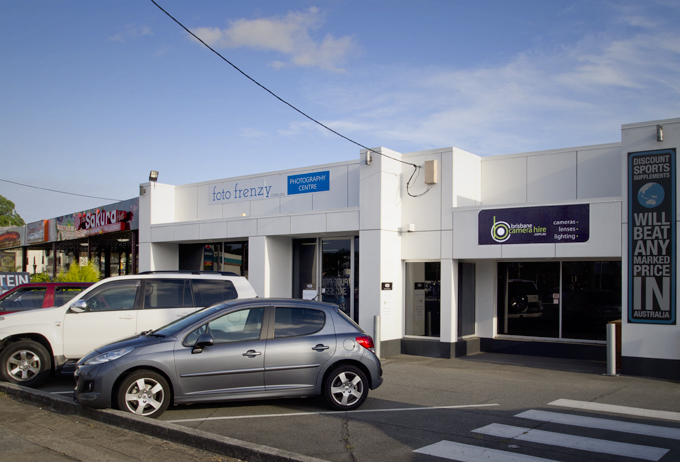
Foto Frenzy @ Corparoo, cnr Old Cleveland & Bennets Rds PHOTO: Doug Spowart

The Foto Frenzy Gallery PHOTO: Victoria Cooper
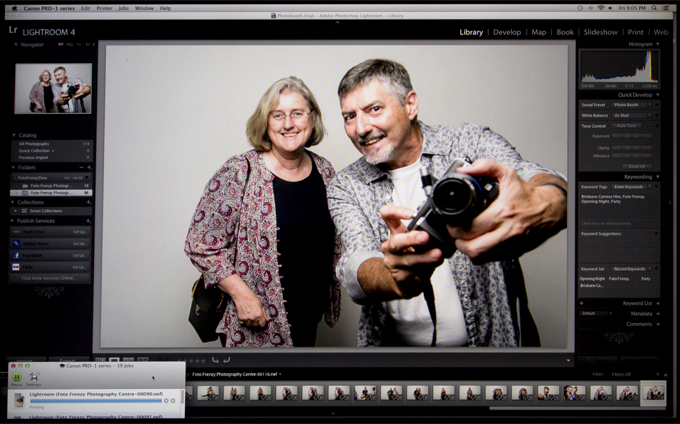
Doug Spowart and Victoria Cooper in the Foto Frenzy Photobooth
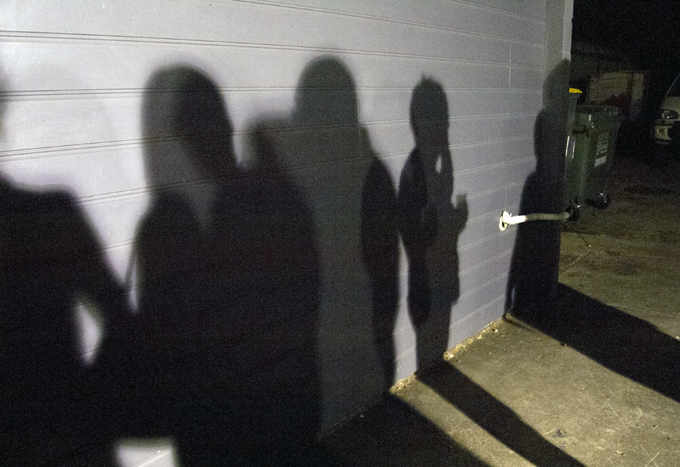
Foto Frenzy opening shadows PHOTO: Doug Spowart
Cheers Doug and Victoria
2013 SABBATICAL for Doug+Victoria: A ‘Leap of Faith’
A NEW YEARS MESSAGE FROM COOPER+SPOWART
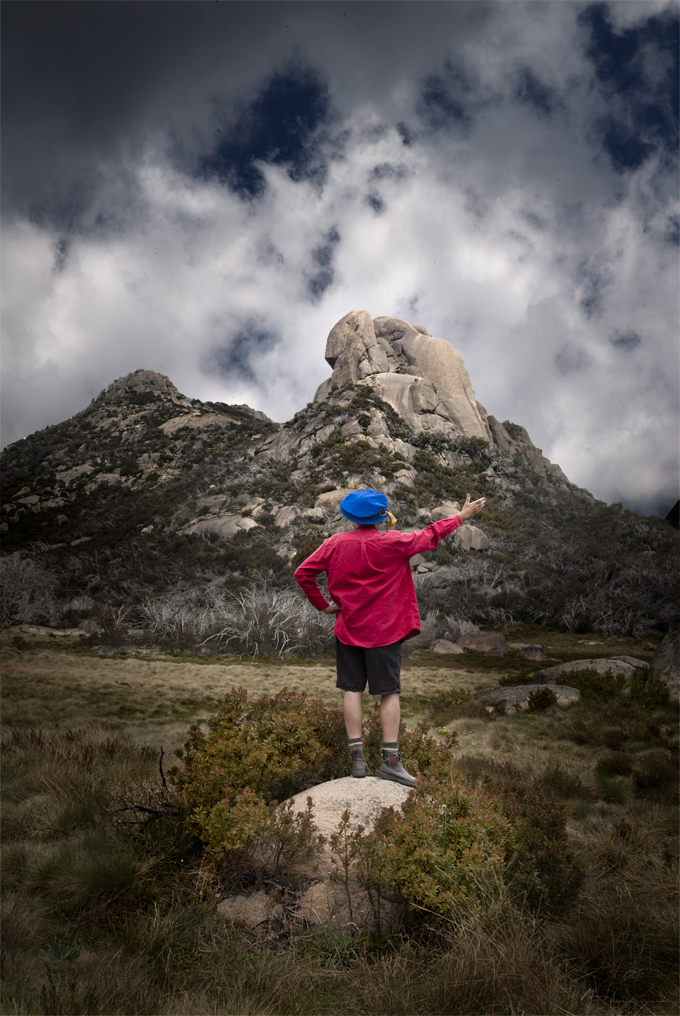
Dr Doug consulting Casper David Friedrichs re 2013 sabbatical, The Cathedral, Mt Buffalo.
In the year 2000 we began our involvement in higher academic study at Monash University in Post Graduate Diploma study. Since then, except for a small break in 2003, we continued our university research and art practice. Throughout this period we maintained both our arts practice and working at TAFE where Doug was full-time employed as a teacher and Victoria worked as a sessional teacher. All holidays and long service leave was consumed by the demands of study, research and at times a busy exhibition and private lecture programme. The hard work and study culminated last year (2012) with Doug being awarded Doctor of Philosophy at James Cook University in May, and Victoria submitting her PhD for final examination in late November.
Now, as we head into 2013, we are taking time out to pursue our post-doctorial research interests, opportunities to present and share our specialist knowledge and skills and to re-connect with our professional practice as artists and commentators on contemporary issues. It is a ‘self-funded sabbatical’. To finance this venture we intend to generate opportunities that may include ‘cloud funded projects’, artists in residencies, specialist workshops, seminars and consultancies, and sessional teaching or lecturing. We are also open to projects that may become available through our connections.
To up date you on our current interests and professional activities we include the following:
Doug: Social media and its applications within creative practice and personal communication; assembling and writing a critical commentary about Australian photobooks from 1900-2000; the narrative form of the hybrid photobook and the elevation of the print-on-demand photobook into a higher order of visual communication.
Victoria: Maintain a review of contemporary science/art interdisciplinary research as an accepted practice in academic institutions. Special interest in: the scientist, the artist and intuition; the historical use of visual art practice as information within scientific publications; Montage Thinking, as a mode for visual thinking and intellectual discourse through visual and non-visual information.
This adventure is somewhat a ‘leap of faith’ and as such we have created a blog onto which we will post sabbatical related content – we will invite to view this site when it comes online. This WOTWEDID blog will continue as our broader commentary platform – on occasion dual postings may occur. Other special research interest blogs will also emerge and you will be advised of opportunities to connect with their content.
Please contact us if you see any opportunities to support our ‘leap of faith’ sabbatical.
We wish you all an exciting 2013 New Year and look forward to perhaps connecting with you, and also connecting you with, commentaries about the issues of our shared interests.
Cheerio
Victoria and Doug
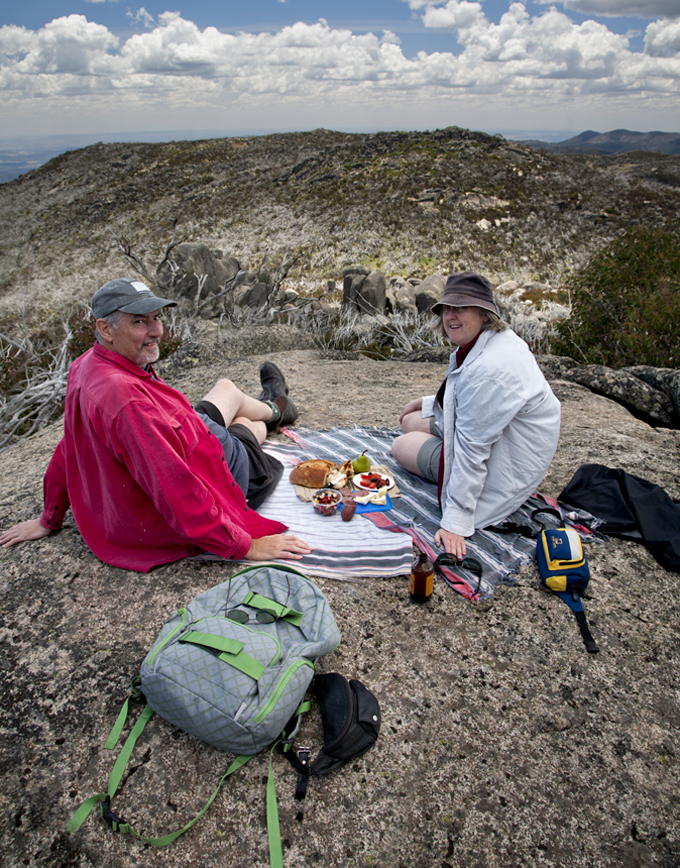
A 2013 lunch planning meeting at The Horn @ Mt Buffalo on 12.12.12
RUBY SPOWART TURNS 85
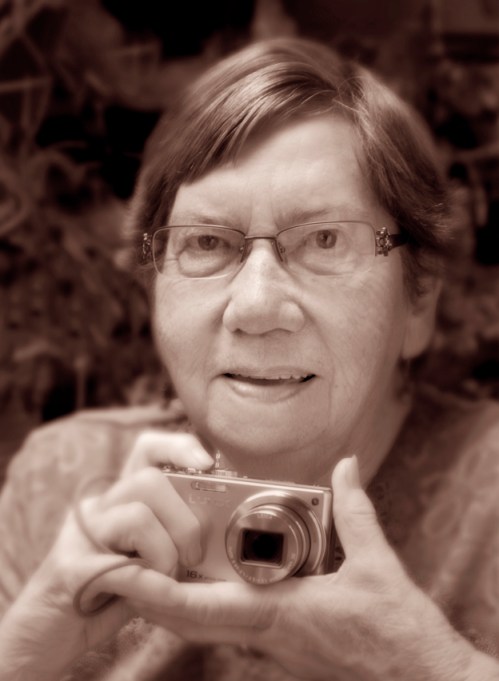
Ruby Spowart Photo: Doug Spowart
I visited my mother last month just after the family birthday celebration given by her three sons and their families. 85 is a big number when it comes to years lived on this planet and one of Ruby’s recent projects gave me an opportunity to reflect on the life that she has witnessed. Ruby just finished an Apple iPhotobook entitled Meet my ancestors which contains family portraits, group photographs, texts and personal visual ephemera from the last 170 years of her, and mine–Ancestors. This is the third book she has made of this genre, the first being an artists book made from collected images of each year of her life from 1 to 21, and the second, a photobook entitled Bringing home the grain in which she describes the agricultural processes of grain growing and harvesting she encountered in her childhood on a farm in Northern Victoria.
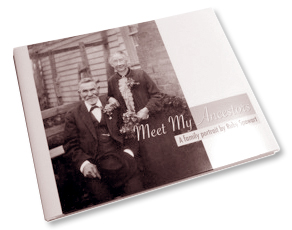
Ruby’s Meet my ancestors book
The Meet my ancestors project brought me in contact with the value of the family photograph, either professionally made or made at home as a box Brownie snapshot, in its ability to provide proof of existence and the aging process encountered by a subject over many successive portraits. Another feature of Ruby’s assemblage and ordering of these family photographs is that they all have a connected linage. This is distinctly different to family photos encountered in junk shops, antique shops and car boot sales. In these circumstances the photographs are separated from their meaning, they become isolated examples of someone and not ‘a’ specific ‘known’ individual—a kind of image orphan.
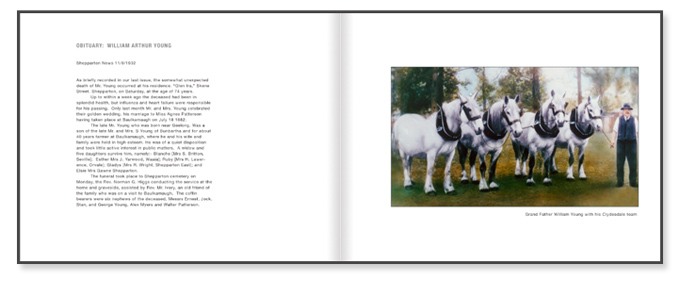
Ruby’s Meet my ancestors book inside
These family portraits are not just photos as she has added a text as well and linked it to other records like personal correspondence and newspaper reports—usually of obituaries. A picture may be worth the proverbial 1000 words but a picture and an appropriate amount of text can place it within a context, a time and ancestral linage. John Berger wrote about this necessary liaison of photo and text in his book Another way of telling1. He says: ‘In the relation between a photograph and words, the photograph begs for an interpretation, and the words usually supply it. The photograph, irrefutable as evidence but weak in meaning, is given a meaning by the words.’
In contemporary society with the popularity of TV programs like Who do you think you are and the online availability of genealogical information there is a heightened interest in our family trees and ancestry. And, as Ruby has lived half of the time covered by her book it is important for her to be engaged in such a project. What is equally exciting for me is that she sits before a computer, sending and receiving communiqués and images from the extended family, she orders, optimizes and designs the pages of the book (with a little help from me): when she was 3 could she have ever dreamed of such a thing…

Ruby Spowart aged about 3
SEE earlier post about Ruby and her work
Ruby can be contacted through LINKEDIN
Happy Birthday Ruby,
Son Doug, and Vicky
.
1. Berger, J 1982, ‘Appearances’, in Another way of telling, Writers and Readers Publishing Cooperative Society Ltd., London, UK.
RUBY SPOWART: Artist Talk @ Queensland AIPP
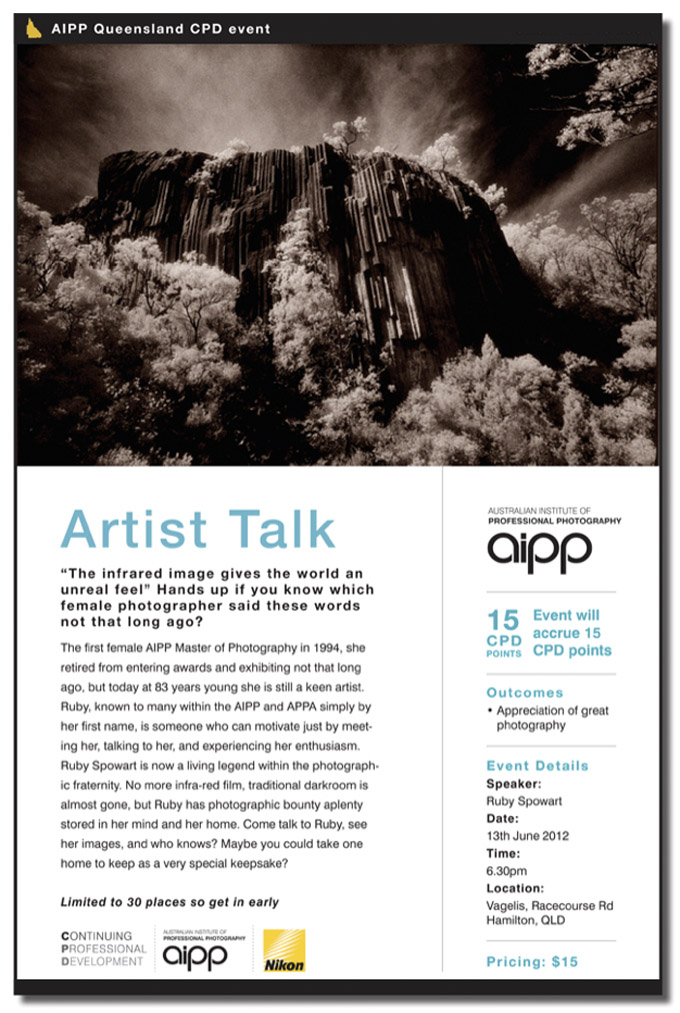
RUBY SPOWART: Art Photographer
Around 30 photographers gathered to hear about the life and photographic art of Ruby Spowart in Brisbane on June 13th. Now in her mid 80s, Ruby has over the years participated in a range of photographic pursuits that have led to some quite substantial achievements. She is a triple Master of Photography, Fellow and Honorary Fellow of the Australian Institute of Professional Photography; in her academic studies she has achieved a Certificate in Art from the Queensland College of Art and also an Associate Diploma of Visual Art from QUT. Recognised for her contribution in visual art she was awarded a Don Fraser Fellowship of QUT and, earlier in her career in the camera club movement she was awarded both an SSAPS and an APR Medal by the Australian Photographic Society. She co-founded Imagery Gallery in Brisbane that showed exhibitions of photography for fifteen years from 1980-1995. Her photographs have won major art photography awards in the 1980s and 90s including the Muswellbrook Photographic Award and the McGregor Prize for Photography and is held in major regional art collections and the Queensland Art Gallery and the National Gallery of Australia.
SEE Ruby’s curriculum vitae
Ruby has created an immense body of work in the following techniques:
- Polaroid 10”x8” colour photograms (1980s)
- Polaroid SX-70 multi-image (joiner-style works) (1980s)
- Massive pseudo-panorama landscapes (1980s & 90s)
- Camera toss mosaics (1980s & 90s)
- Large-scale photo mosaics (1980s & 90s)
- Artists’ books and photobooks (2000-2012)
Her most recognisable works, particularly from the AIPP APP Awards successes, comes from her work with Kodak High Speed Infrared film and a Leica M2. The images are usually of outback Australian landscapes and are heavily sepia toned. SEE a folio of works in Ruby’s Behance Folio

Jan Ramsay introduces Ruby and Marianne
Queensland AIPP President Jan Ramsay enthusiastically introduced Ruby and Marianne Irvine (recently awarded AIPP Honorary Life Membership) who, we learned was to interview Ruby as part of the evening’s presentation. At first Ruby discussed her life and touched upon the following points;
- Her mother was a keen artist who painted in oils
- Her schooling was cut short by World War II, as she had to help out on the farm as her brothers had enlisted
- She had always done things with art-making; enamelling, ceramics, china painting, drawing
- Ruby joined the Numurkah Camera Club (in Victoria) and the Australian Photographic Society in the mid-1960s
- Had served as National Membership Officer in the APS
- Had participated in all levels of the camera club movement in Queensland in the 1980s
- Founded Imagery Gallery with son Doug in 1980 and was a director until the gallery closed its doors in 1995
- Exhibited extensively throughout the 1980s and 90s
- Founded Imagery Gallery Tours with Doug in 1982 and over 17 years undertook around 40 outback safari tours around Australia, as well as tours to New Zealand, Africa and South-Western USA. It was noted that Imagery Gallery Tours may well be the Australia’s first Photo Tour business.
- Ruby became involved with the AIPP and the APP Awards in the early 1990s and served as the administrator for many years
- In the early 2000s Ruby cared for her husband who was in ill health and she moved to the Gold Coast on his passing in 2006.
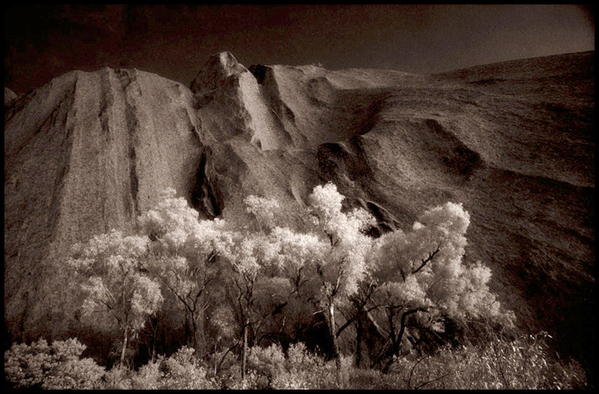
‘Uluru elevation’ – Infrared film image by Ruby Spowart
This presentation was illustrated by examples of artworks and personal images from these recollections. Marianne Irvine then led a lively discussion around the infrared work and travelling in the Australian outback. The concept of taking photographs with film was commented on as many in the audience did not have a significant connection with infrared film, processing, fine print making on fibre papers and the variations of the toning processes that were employed by Doug, who had printed most of Ruby’s work—although she did hold up for the audience to see an image that she announced as her last APPA Gold awarded print, and said that she, ‘had printed that one!’
Doug explained the infrared film process as it existed 20 years ago and connected his knowledge and skill in the darkroom with the prints before the audience. SEE: Doug Spowart’s infrared film ‘How To’
Ian Poole interjected that the images were masterworks made by the photographer Ruby, and the printer Doug, and that the APPA print scores and labels on the print backs provided a wonderful provenance for the work as high quality ‘vintage’ prints.
When asked about her beginnings in art photography Ruby explained the creative space that was created by Imagery Gallery’s presence within the Brisbane photography scene. During its 15 years of operation Imagery Ruby and Doug showed over 200 exhibitions of photography, they curated major exhibitions of Queensland photographers work, some of which were shown in China, New Zealand and Noumea. She had found, as she believed many others had as well, that Imagery Gallery had provided inspiration for new ideas and directions of photography, exploration of themes and the presentation of photography within the gallery context. SEE: IMAGERY GALLERY Biog
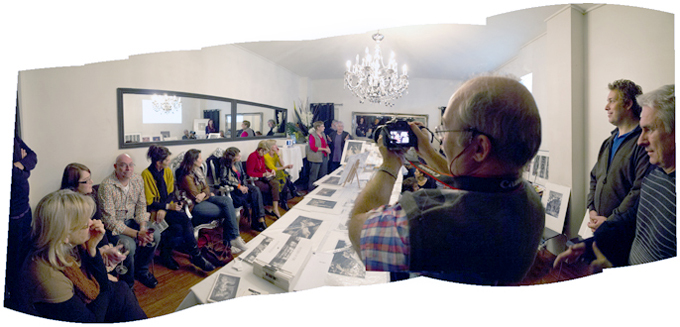
Marianne asks Ruby a question …
Questions from the floor enabled other insights into Ruby’s process and workflow to be revealed. The presentation concluded with everyone being presented with the Patterns in Time catalogue of Ruby’s work and an invitation to visit her on the Gold Coast to see more work from her extensive practice. Ruby advised that she was making her work available to interested purchasers and many attendees eagerly approached her at the conclusion of her presentation.
It’s not often that we can gather together and meet with photographers who have been a part of the recent history of the discipline and who in some way may have helped create that space and opportunities that we enjoy today—this occasion was certainly one of these. Thank you to Ruby for sharing her story and her art, to Marianne for her chairing the meeting, thanks also the AIPP Queensland Division and in particular Jan Ramsay for coordinating this and other events for the benefit of AIPP members and those interested in photography.
.
Doug Spowart with contributions from Vicky
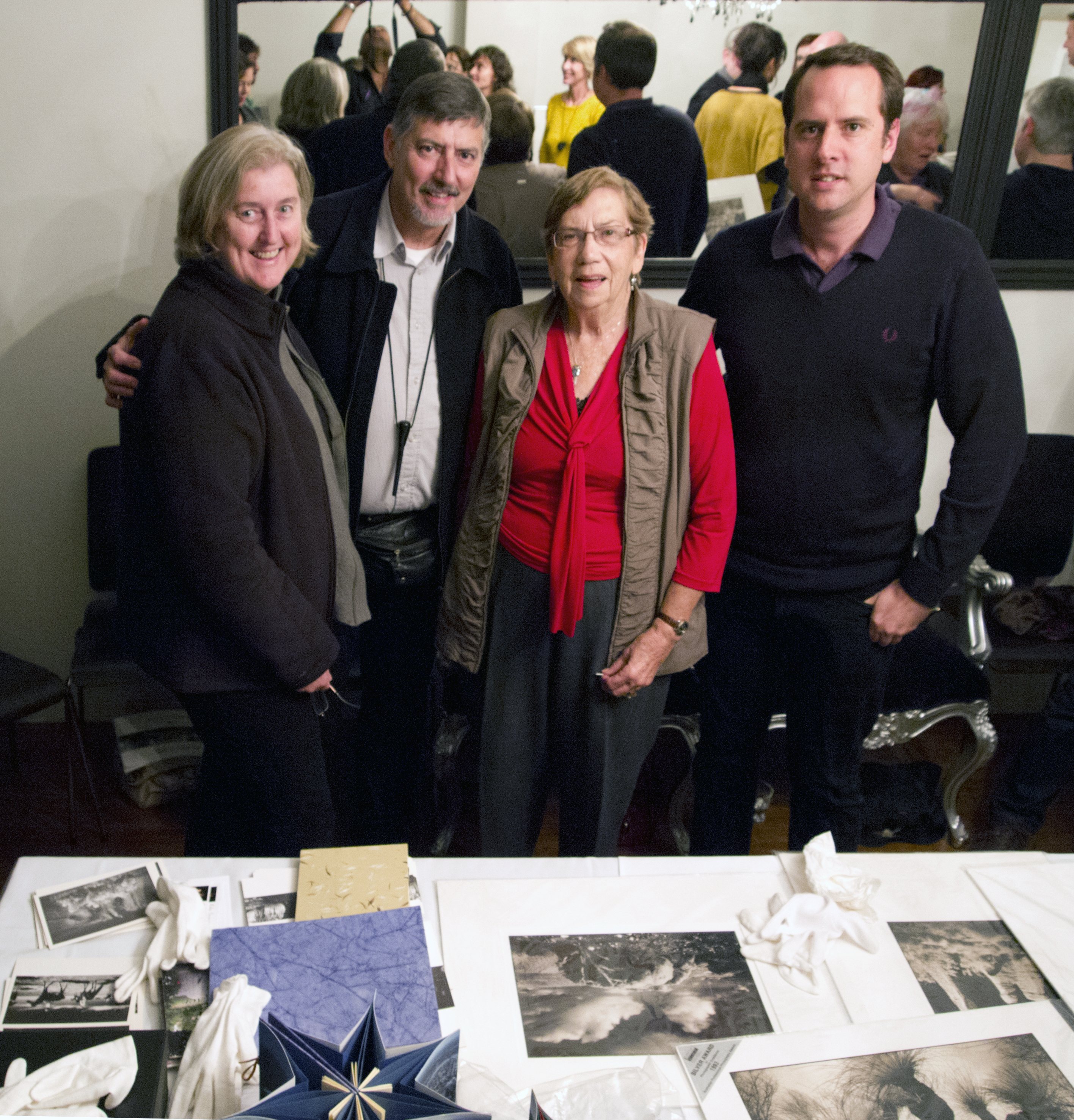
The Spowarts: Vicky, Doug, Ruby and grandson Ted. Photo: Mark Schoemann
PRESS THIS!!! Peter Wallis – Press Photographer

Peter Wallis with Vicky + Doug in Toowoomba (iPhone image)
We had a call today from Peter Wallis today to say he was in town and wanted to have yarn. Peter was a photography student of mine at Southern Queensland Institute of TAFE in the mid 1990s. For quite a while he has been one of the main shooters for Brisbane’s Courier Mail newspaper—mainly specialising in sports. As we sat sipping coffee Peter cradled in his hands an advanced production model from a well-known DSLR manufacturer that was being trialled by the newspaper. That seemed fitting as Peter always had a fetish for the latest and best camera technologies.
Peter Wallis was one of those people who truly loved photography and was a lot of fun in classroom and darkroom. One day he found our Canon 50~350mm zoom (white lens) and probably had it on permanent loan for most of the second year of his associate diploma studies. The lens went to the Birdsville races, to sporting events and places I daren’t ask about. His end of study folio was an impressive generalist photographer with a strong bias to media photojournalism.
On graduating from TAFE Peter fell into newspaper photography in the regional papers in towns like Bundaberg and Gladstone. His break came in the early 2000s when he was shortlisted for a position at the Courier. He and his fellow shortlisted applicant had to work at the paper for a few days to show how they would handle the job. At the end of their trial they were interviewed by the Pictorial Editor—they were both asked what they considered was their BEST picture. Apparently the other candidate pointed out their best shot from the folio laid out on the table—Peter was to tell me later that he’d remembered something I had spoken about during his study years, about the idea of thinking that the BEST picture ‘is the next one I’m going to take!’ He felt that way about his work and used that statement and got the job.
In the nine years since Peter has amassed a significant body of work in the newspaper genre as well as undertaken personal projects in India and Nepal. He is currently documenting the Brisbane Firebirds basketball team. In our conversation we discussed aspects of his industry over his 15 years or practice. He commented, ‘My first newspaper had a darkroom, then we shot colour film, processed it and scanned the images, and then finally we were presented with digital cameras.’
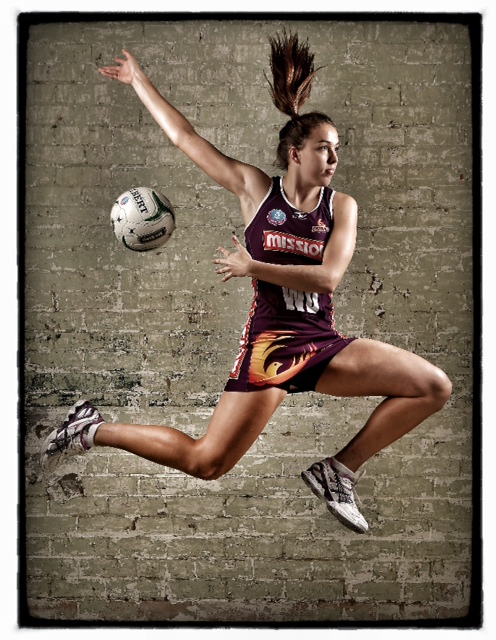
Firebird Shannon Eagland Photo: Peter Wallis
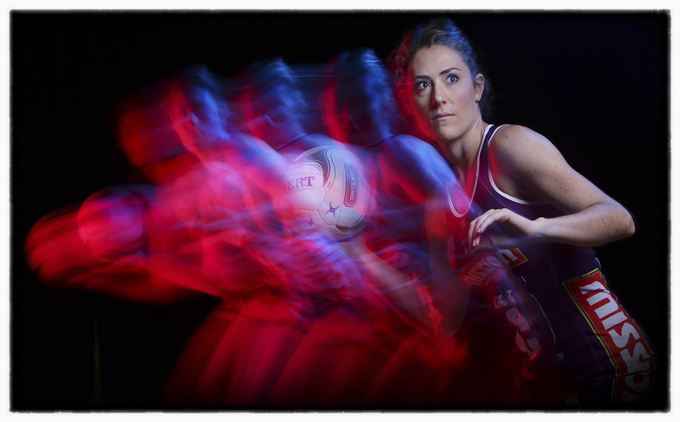
Firebird Elissa Maclead Photo: Peter Wallis
.
He continues commenting on how the picture got to the back to the paper. Film was straight forward as its physical nature meant that you travelled with it and lovingly processed it. Instant digital capture led to instant transmission. ‘We used to send our images back to the Courier Mail via a satellite dish, then laptop and phone—recently I travelled with Bligh on the election and didn’t even open a laptop. Sent everything back via an iPad. And now we shoot DSLR video and send that back as well’.

A grab shot – On the hustings with Bligh and Newman Photo: Peter Wallis
.
We spoke of concerns for the newspaper industry and the current challenge for the on-line 24-hour update and how images are syndicated through agencies like Getty. Peter has concerns about the future—but right now he’s living the dream that most photographers have that have a love of the challenge of being told by the editor to ‘go here … see the man … and make a bloody great image that I can publish’.

Sporting shadows Photos: Peter Wallis
Open any Courier Mail or Sunday Mail and on most days you’ll see a Peter Wallis picture and most probably it will be an amazing sporting peak action image or an editorial styled image with some kind of visual twist that captures your attention. As mentioned earlier most newspapers today are struggling to maintain print readership and their attempt to transition to online subscription is forcing a hybrid text, still image and video presentation. At this time Peter’s ability to conceptualise and create visually interesting images on the fly is as valuable as ever and stridently makes the claim that photos made by photographers are as important as ever in telling a news story in a moment, on the page, or … on the screen.
Doug Spowart
http://peterwallisphotographer.blogspot.com.au
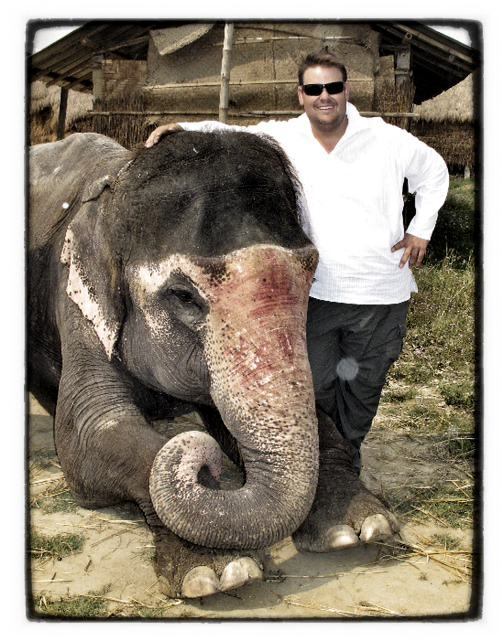
Pater Wallis with elephant
IAN POOLE: AIPP On the Lounge

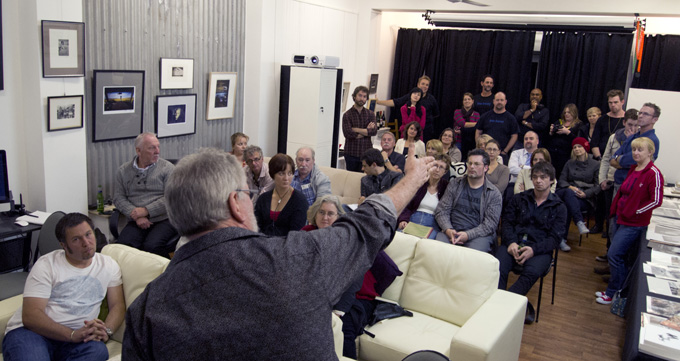
Ian Poole addressing the audience @ Photo Frenzy
Ian Poole is well placed to have an opinion about fine art photography and collecting photographs. He has been a major player in professional photography in Brisbane for nearly 40 years and is a respected AIPP judge with yearly invitations to also judge the New Zealand Institute of Professional Photography awards. Despite his professional photography connection he has been a part of a sector of the Queensland photographic art scene that extends from the early 1980s with Imagery Gallery, later with the Photographer’s Gallery and more recently with the Queensland Centre for Photography. He has completed a Graduate Diploma in Visual Arts from the Queensland College of Art and has been awarded an Australia Council residency in Tokyo. Adding to this he has curated photographic exhibitions in Japan (of Queensland photographers) and exhibitions in Australia (of local and Japanese photographers).
So when Poole offers commentary on aspects of the photographic art world of Brisbane and Queensland it should be something of an opportunity to connect with his extensive knowledge of the genre. Recently as part of the AIPP ‘On the Lounge’ lecture series Ian Poole presented to an assembled audience of around 40 a dissertation entitled, ‘Have you ever wanted to collect photographic art, or be collected as a photographic artist?’

Ian – getting his message across with passion
Ian Poole began his presentation by reviewing recent art auction records for photographic artworks including those by Adams, Sexton and Dupain. Thousands, hundreds of thousands and even millions will change hands for well-known and rare works. The recent phenomena of Nick Brandt’s African work,which had been shown only weeks earlier in Brisbane, attracted some discussion. Perhaps some in the audience felt a little inspired by the possibility that, if they could enter the fine art field, that there was recognition and the possibility for a significant income to be made.
Poole introduced his collection of images that were hung on the walls and laid out on tables before the audience and discussed their histories and stories. For him the concept of ‘provenance’ elevated the importance of each work. A small Dupain image of the interior of the National Gallery in Canberra made during its construction was linked to his encounter with the work in a Brisbane gallery where it was purchased for a few hundred dollars. His most exuberant discussion related to a Joachim Froese diptych acquired when he swapped it with Joachim for a 4×5 enlarger. An expanded provenance trail led to it being loaned back to Joachim so that it could be displayed a QUT exhibition of his work.
A long-term friendship with north Queensland photographer Glen O’Malley presented some interesting provenance stories. O’Malley is not fully recognised for the significance of his practice in Queensland – he could probably claim to have had the first ‘photographic art’ exhibition in this state in the mid 1970s. Poole presented to the audience an image from O’Malley made as part of the Queensland Art Gallery’s 1988 Journeys North commission. The 20×24” black and white photograph showed a scene in Poole’s home where the O’Malleys were having dinner. The image was part of the accepted images for the Journeys North show and was subsequently published. Somehow Poole’s own life had become art photography itself.
Another photography collaborator presented by Poole was John Elliott. Well known for his documentation of country and western music and its heroes and doyens including Slim Dusty, Chad Morgan and Jimmy Little, Elliott is an enigmatic character of the photography scene. Ian spoke of John’s most recent show Gifted Country at the Caboolture Regional Art Gallery and his photobook publishing ventures. A recent journey to Townsville that Poole had shared with another of Queensland’s enigmatic photographers, Maris Rusis, resulted in a body of work by Rusis that dealt with the décor of budget north Queensland motel rooms. These small and fine gelatin silver fibre B&W prints presented to the audience the fact that traditional values remain key to some workers who continue to practice analogue photography in a digital world.
Question time brought up some difficult truths – Why does the Queensland Art Gallery/GOMA not seem to be collecting photography generated within this state? Did they ever collect? Some discussion related to the archival needs for conservation framing and presentation.
As a conclusion to the presentation Poole spoke of the way in which he and his photography acquaintances swapped and shared their works, and how much of his collection was built around the generosity of fellow photographers and their desire to share. He held a bundle of his own gelatin silver images up before the audience and made an offer that ‘you can have one of my prints this evening – and send a print to me as a swap. Start your collection this evening …’
While Ian Poole began his presentation with a review of the overtly mercantile auction scene, it seemed that his passion about photography, photographs, friends, shared experiences and the meaningfulness of the provenance of the works, that these things could not be commodified. He spoke of his collection of photos, books and ephemera as being an entity that would be bequeathed to his daughter Nicola, also a photographer and present at the talk. Through the audience he directed to Nicola to ‘treasure and look after these things … they were important, valuable – not only as the stories they depicted through their image on the front-side of the print, but also of the back-story of their origin and collection.’
There is no doubt that Ian Poole’s passion for photography and his understanding of how it operates at a personal and cultural level is something that was shared and communicated on this evening. And those present will be inspired to develop a new appreciation of what photographs are and what they can say about the human condition.
Doug Spowart May 20, 2012
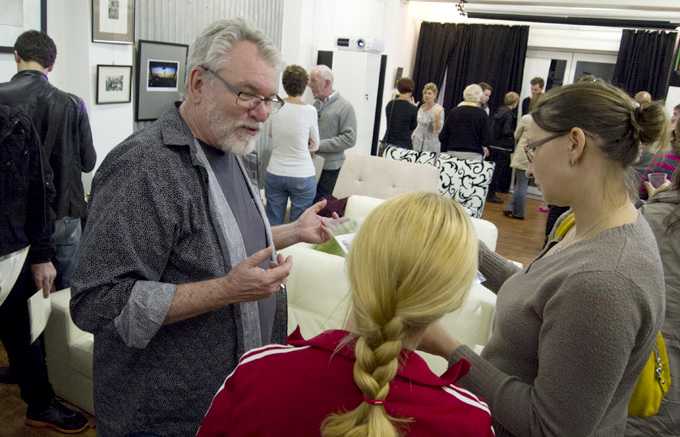
Ian talking with OTL attendees at the end of his presentation
An unusual meeting – Face-to-Face with an early portrait of one’s self – circa 1982 found in Poole’s collection

DOUG SPEAKS: Qld Festival of Photography, Toowoomba Forum
FRIDAY 27 APRIL – TOOWOOMBA REGIONAL ART GALLERY
1.30 – 3.00 pm: Panel discussion: Contemporary Photography
Panel: Marian Drew, Ray Cook, Henri van Noordenburg, Doug Spowart and Maurice Ortega
Topic:
Photography is going through major changes due to digital technologies and the explosion of images used through the internet. This panel questions new and emerging practices in photography and presents visual examples of these developments.
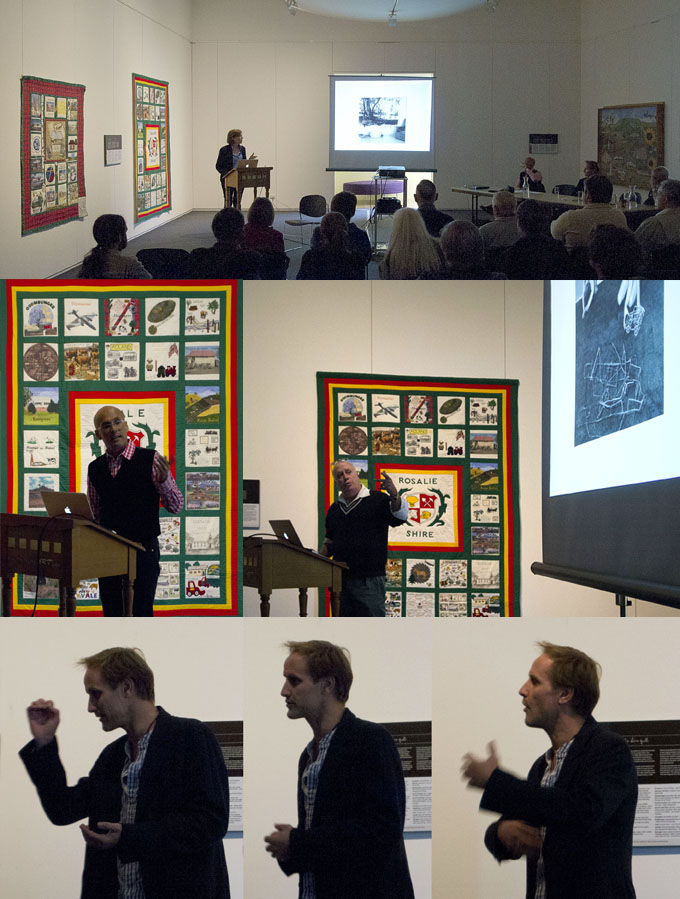
Marian Drew (top), Maurice Ortega, Ray Cook (centre), Henri van Noordenburg (bottom)
An audience of about 45 drawn from the local photography community attended the forum. Each speaker spoke of the aspects of contemporary art photography that informs their work. Marian discussed works by Camilla Birkland, Deb Mansfield, Kate Bernauer, Jenny Carter White; Ray’s hero was Roger Ballin and he spoke of his experience of the ongoing issues of minority groups like gays in society, Henri spoke of his close work transforming the surface of the image and works by Shirin Neshat, Sebastiaan Bremer. Finally Maurice discussed the international scene and the rise of the constructed image – what I’d call faux-photo or photo-fictions. Question time was led by a fired-up John Elliott challenging the blandness and the falseness of contemporary art photography and the lack of space given the ‘still vibrant’ documentary scene.

Doug Spowart speaking @ the QCP FORUM @ TRAG
My contribution to the forum was a paper that discussed the idea that emergent technologies in production and distribution of photography has made everyone a photographer. For those interested in this commentary on contemporary photography the text is published below…
(formatting is a little changed in WordPress)
.
EVERYONE A PHOTOGRAPHER
At this time, as we find ourselves within the 200th anniversary of the photographic experiments of Wedgewood, Davies, Neipce and, if Geoffrey Batchen is right, a host of other inventors, we are witnessing a transfer of the power of photography from the chosen few to the masses – everyone is now a photographer and the camera-made image synonymous with life itself.
In the 1930s Lazlo Maholy-Nagy saw it coming in his prediction that, ‘a knowledge of photography is just as important as that of the alphabet. The illiterate of the future will be ignorant of the use of the camera and pen alike.’ (Moholy-Nagy 1936:32) Although in the text Moholy-Nagy was discussing the photographic sequence and the emerging moving image, his comments allude to our times and how images have replaced words.
In the 1980s the instant imaging giant Polaroid took the concept further by pronouncing in their advertising that we all needed to, ‘learn to speak Polaroid’ – that is, use images to express ideas and concepts, not words. They suggested the we take a Polaroid SX70 image; it will only take a minute to develop before our eyes, to show the time on a clock, the creama of a freshly expressoed coffee or the smile on a child’s face.
Maholy-Nagy was talking about the way images operate in society, and Polaroid was certainly selling their product to the masses, but in the eras in which these statements were made the photographer was a professional imaging technologist. Sure, making photographs had a wide range of users – vernacular photography was well established, George Eastman and Kodak had ensured that, and amateurs and dilettantes banded together to form camera clubs and societies to pursue pictorial beauty. But ‘real’ photography was carried out by specialists who acted with the passion and pain of religious zealots.
Photographers and their colluding commentators created a pantheon of masters and masterworks. They protected their secret knowledges, skills and dark workings within the fields of optics, chemistry and their cumbersome technologies. In their work they excised meaning from the chaos of time and space, and they served and informed the societies in which they lived. They did something that others could not – they made photographs and had access to the media of newspaper, magazines and books through which their images could be communicated to a mass audience.
We may consider digital technology as a major disruption for photography, however the process of photography has always been challenged and transformed by waves of new technologies as part of its liaison with science and art; photographs on silvered metal mirrors, negatives on glass and paper, celluloid and plastic, monochrome, colour transparency/movies/prints … and most recently, electronic files. Cameras of wood and brass, bellows and focusing cloth, tripod-fixed and handheld, carved from solid metal blocks, molded in carbon fibre and plastic …
What is different about the technology of digital photography today is that instead of maintaining the technological barrier between photographers and other users, it has dissolved and democratised image-making.
Other underlying factors drive the march of digital by satisfying some rather basic human needs. Photography historian and commentator Geoffrey Batchen defines photography as being, ‘a persistent economy of photographic desires and concepts’. He lists within this economy concepts like, ‘nature, knowledge, representation, time, space, observing subject, and the observed object.’ For Batchen photography is about, ‘the desire, conscious or not, to orchestrate a particular set of relationships between these various concepts.’ (Batchen 1999:213) I have no doubt that everyone wants to ‘orchestrate’ an image collection of experiences that are important to them and digital imaging has facilitated just that.
Another commentator on this concept adds to this broader human need to photograph, philosopher Vilem Flusser claims that the,
‘Photographer’s intensions are to inform others and through their photographs to immortalise themselves in the memory of others. For photographers, their concepts (and the ideas signified by these concepts) are the main raisons d’être for taking photographs, and the camera’s program is in the service of these raison d’être.’ (Flusser 2002:46)
Now, with digital technologies everyone can access these opportunities ascribed to the photographer and the image. And this process starts in the making of images using a range of newly developed capture technologies. In the Australian Newspaper of January 29 and 30, 2011, journalist Ross Bilton states, ‘Anyone with an iPhone, and a good eye, can claim to be one of an emerging breed of photographic artist: an [iPhonographer.]’ (Bilton 2011:7)
Once the image is made cheap and easy to use enhancement apps can be employed to make the image look like whatever the photographer wants. These mobile apps ape professional-grade software with the advantage that in one-or-two ‘clicks’ the image can be transformed beyond its optical reality into an aesthetic, esoteric or just plain funny photo. Immediate distribution of the image via phone, tablet or later by computer is so easy.
The nature of the photograph in technical and design aesthetic terms has changed as well. The random carefree snapshot, once the domain of documentary photographers, is now part of the vernacular imaging toolbox. In the hands of the nouveaux digital photographer the snapshot has come to be as seductive and as slick as the advertising photograph of old.
As everyone is now a photographer anyone can be a revered as a master, mentor or critic. As a teacher of photography I have encountered the demise of the history of the process. Now students are more likely to seek feedback from Facebook friends and inspiration from peers encountered online. The tradition and the myth of the discipline have little inspiration for a generation of image-makers hell-bent on making what the can from their experience of life. As with any revolution, some will regress to retro-technology: pinhole, Holgas and Dianas and even Hasselblads and large format – if you can still get film.
Everyone now is an exhibitor through the online technologies of Flickr, Facebook, Instagram, blogs, web galleries and Pinterest. The screen of the computer is the gallery wall leaving ‘bricks and mortar’ spaces, perhaps even like this one, to being white cubed mausoleums to the art of the past. Or, to survive, high visitation galleries have become converted into the kind of experience once found in funparks, with slippery-slides, art playgrounds, interactive content – even allowing visitors to use cameras and coffee shops with iPads and everywhere, noisy spaces.
Online downloads brought the music distribution cartels to their knees and expanded opportunities for emerging bands to have an active presence on the world stage. The same is happening now with books and publishing as any photographer can self-publish and self-market using the online services of companies like Blurb and LuLu. In using these technologies photographers are leaving behind the gatekeeping machinery of publishers, distributors and bookshops.
The promulgation of the image through informal independent channels of all forms emancipates both makers and viewers from the control of politicians, commerce and religion. And everyday new opportunities are emerging. In 2011 Magnum photographer Christopher Anderson re-published his documentary book Capitolio in an eBook form and sold copies for tablets and eReaders for a few dollars. In an interview with Nathan Lee Bush, he proposed that it was an experiment in the dual media of the physical book and its virtual ‘equivalent’. He states, ‘I do like the idea of this being a potential model for new media. Time will tell.’ (Bush 2011)
In proposing a philosophy of photography Vilem Flusser put forward many propositions of how and why photography operates. One concept he introduces is that it provides the ‘possibility of freedom’. He states,
‘… in a world dominated by apparatuses; to reflect upon the way in which, despite everything, it is possible for human beings to give significance to their lives in the face of the chance necessity of death. Such a philosophy is necessary because it is the only form of revolution left open to us.’ (Flusser 2000)
Perhaps digital imaging is part of that revolution and we are all contributing to it.
.
Doug Spowart 27 April, 2012
.
Batchen, G 1999, Burning with desire : the conception of photography, Massachusetts Institute of Technology, Massachusetts.
Bilton, R 2011, ‘iPhoneography’, The Weekend Australian, 29-30 January, 2011.
Bush, NL 2011, Through the looking glass | A pro Photo/Video Blog, Interview: Magnum Photographer Publishes Photobook for iPad, Adorama Rentals, viewed March 31 2011, <http://arcrental.wordpress.com/2011/03/30/interview-magnum-photographer-publishes-photobook-for-ipad/>.
Flusser, V 2000, Towards a philosophy of photography, Reaktion Books Ltd., London.
—- 2002, Writings, vol. 6, Electronic Mediations, University of Minnesota Press, Minneapolis.
Moholy-Nagy, L 1936, ‘From Pigment to Light’, in Telehor, vol. 1, pp. 32-36.

 wotwedid