Archive for the ‘Awards’ Category
2019 PHOTOBOOK ROAD TRIP BEGINS – HOBART
The 2019 Photobook Road Trip
PHOTOBOOKS @ TOPSPACE STUDIO/GALLERY IN HOBART
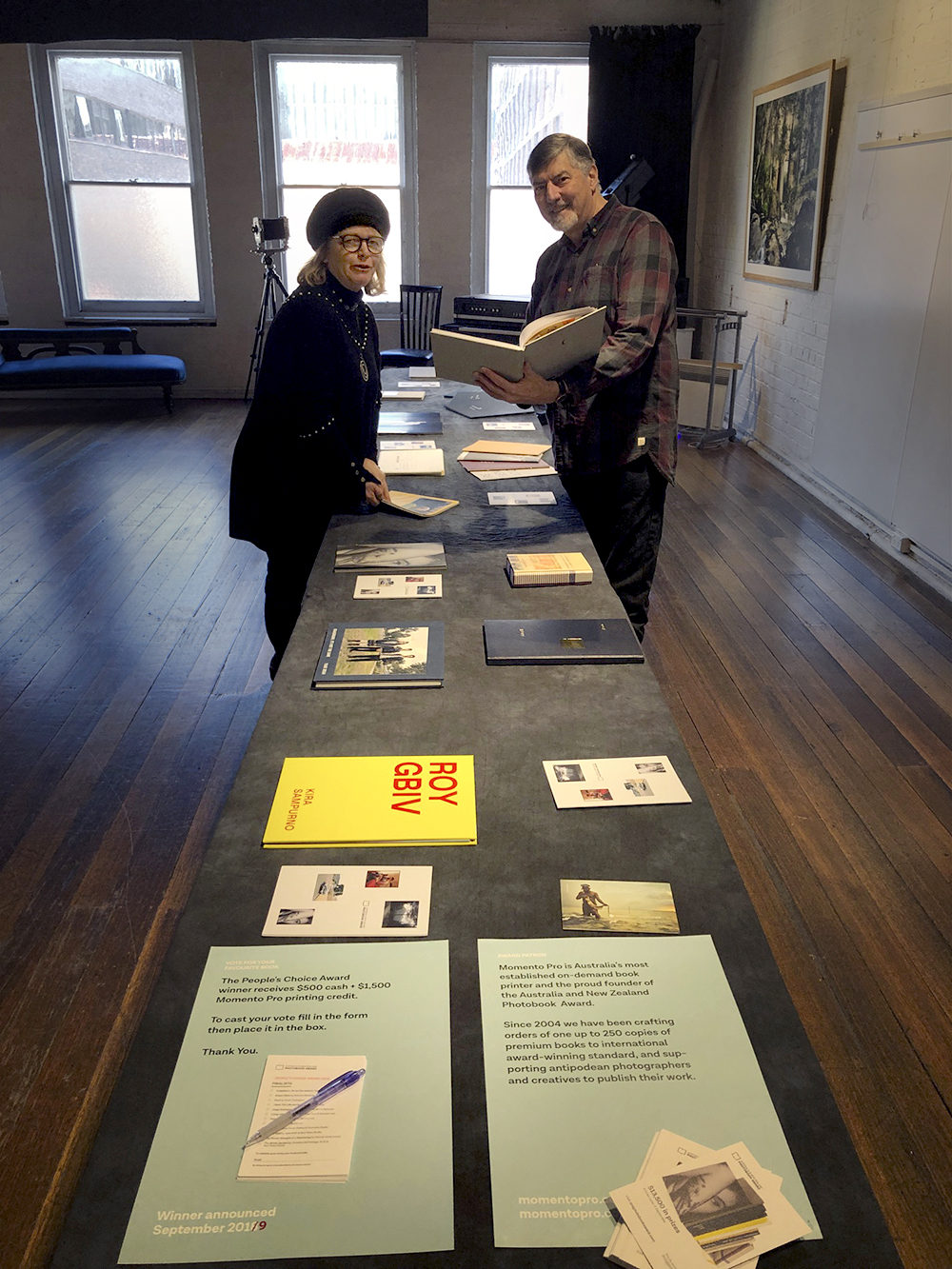
Ilona Schneider and Doug Spowart
.
The 2019 Photobook Road Trip began last night at the TopSpace StudioGallery in Hobart. The Australia & New Zealand Photobook Awards (ANZPA) exhibition was installed by Victoria Cooper and Doug Spowart. Visitors to the Gallery were welcomed by the gallery Director Ilona Schneider.
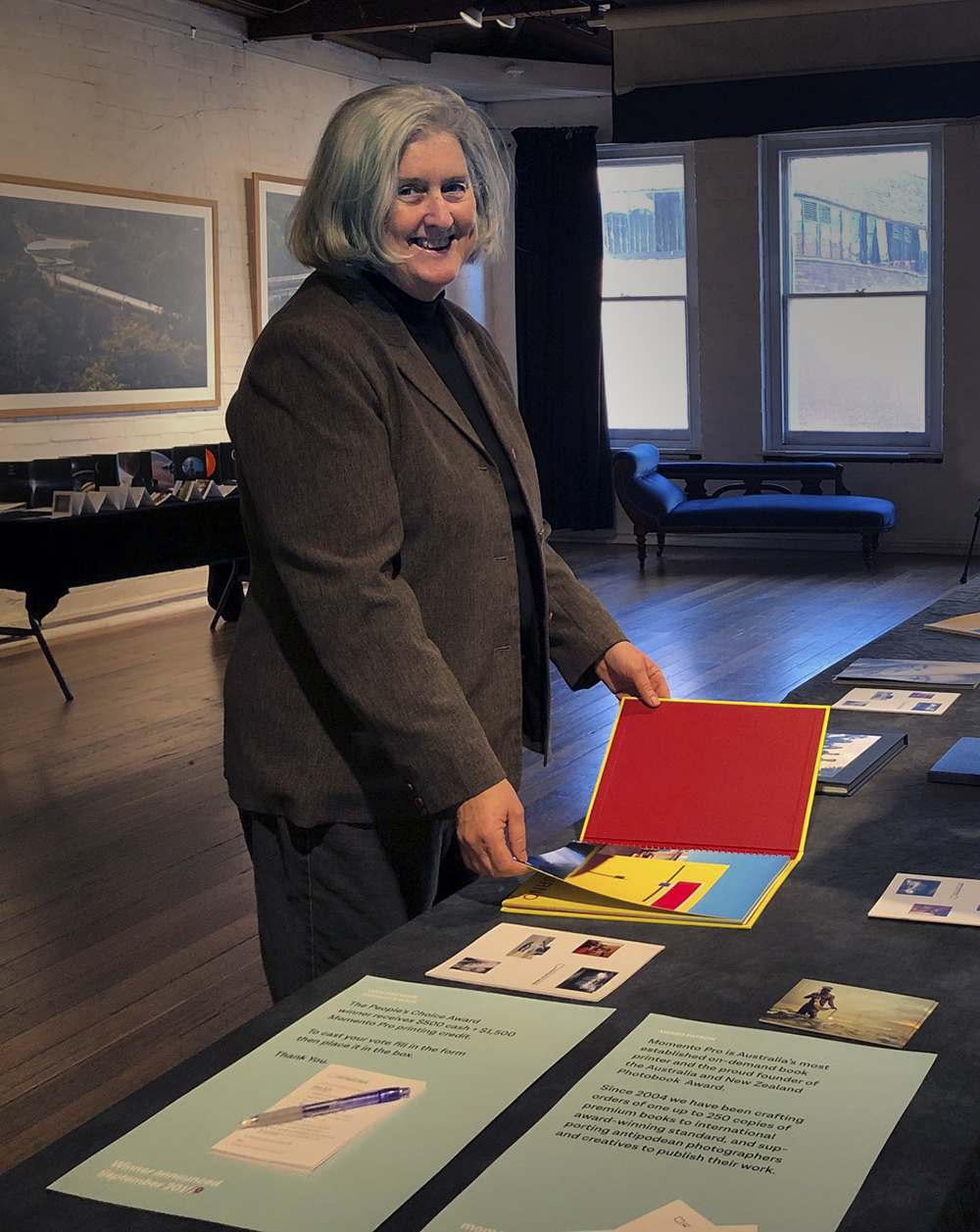
Vicky setting up the dispaly
.
Winners 2018
- PHOTOBOOK WINNER: Second Sight by Sarah Walker & Perimeter Books (AU)
- PHOTOBOOK COMMENDED: Huon by Noah Thompson (AU)
- STUDENT WINNER: ROYGBIV by Kira Sampurno at Massey University, Wellington (NZ)
- STUDENT COMMENDED: Craigieburn, it’s not the same by Yask Desai at Photography Studies College, Melb (AU)
Finalists 2018 from 117 entries:
- Dream State by Stavros Messinis / M-Art Books (AU)
- I Want This Life and Another by Robyn Daly (NZ)
- Image Ecologies by James Farley & Jacob Raupach / Currency Editions (AU)
- Living with AIDS (1988) by Fiona Clark & Michael Lett (NZ)
- Permission To Belong by Tammy Law (AU)
- Six for Gold by Jake Mein & Bad News Books (NZ)
- The Tensile Strength of a Heartstring by Hannah Rose Arnold (NZ)
- The Winter Garden by Christine McFetridge, Bad News Books & M.33 (NZ)


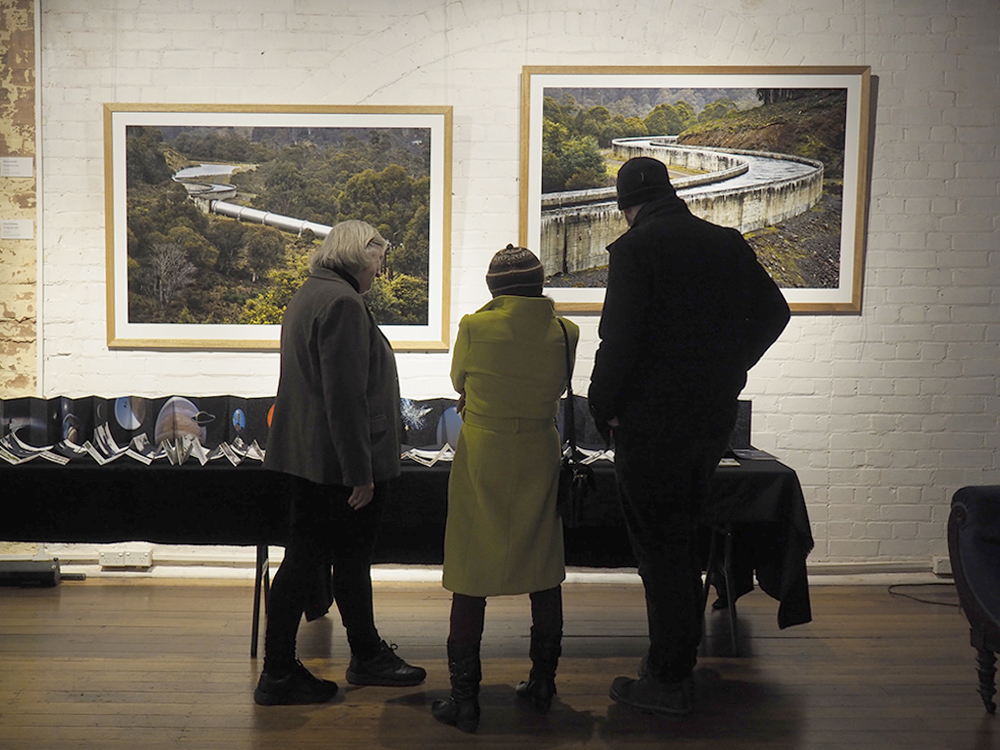
Looking at the Cooper+Spowart books
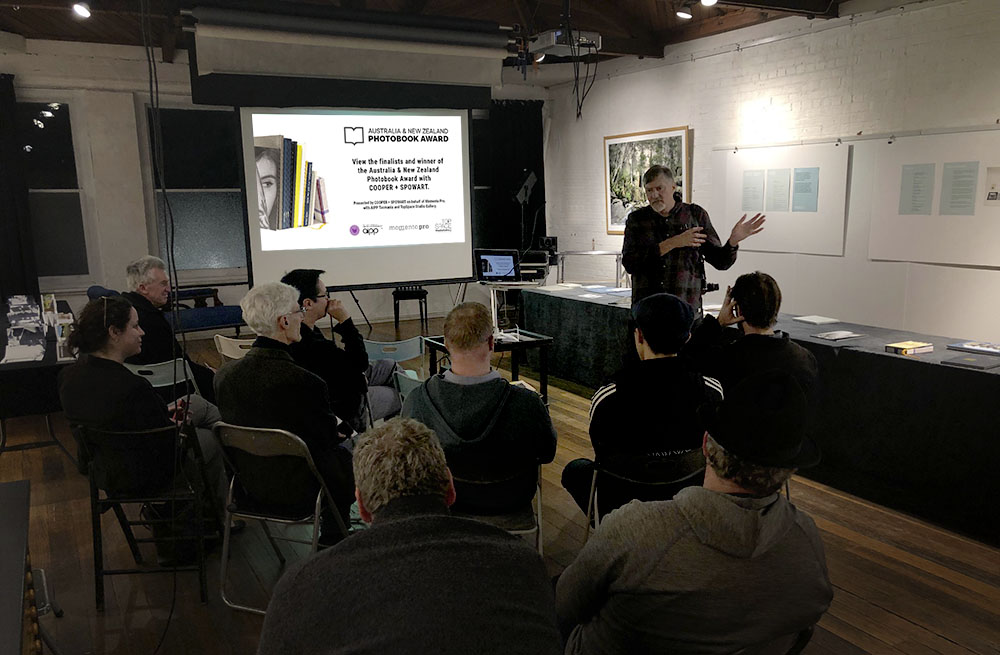
Doug presenting his talk
THANK YOU!
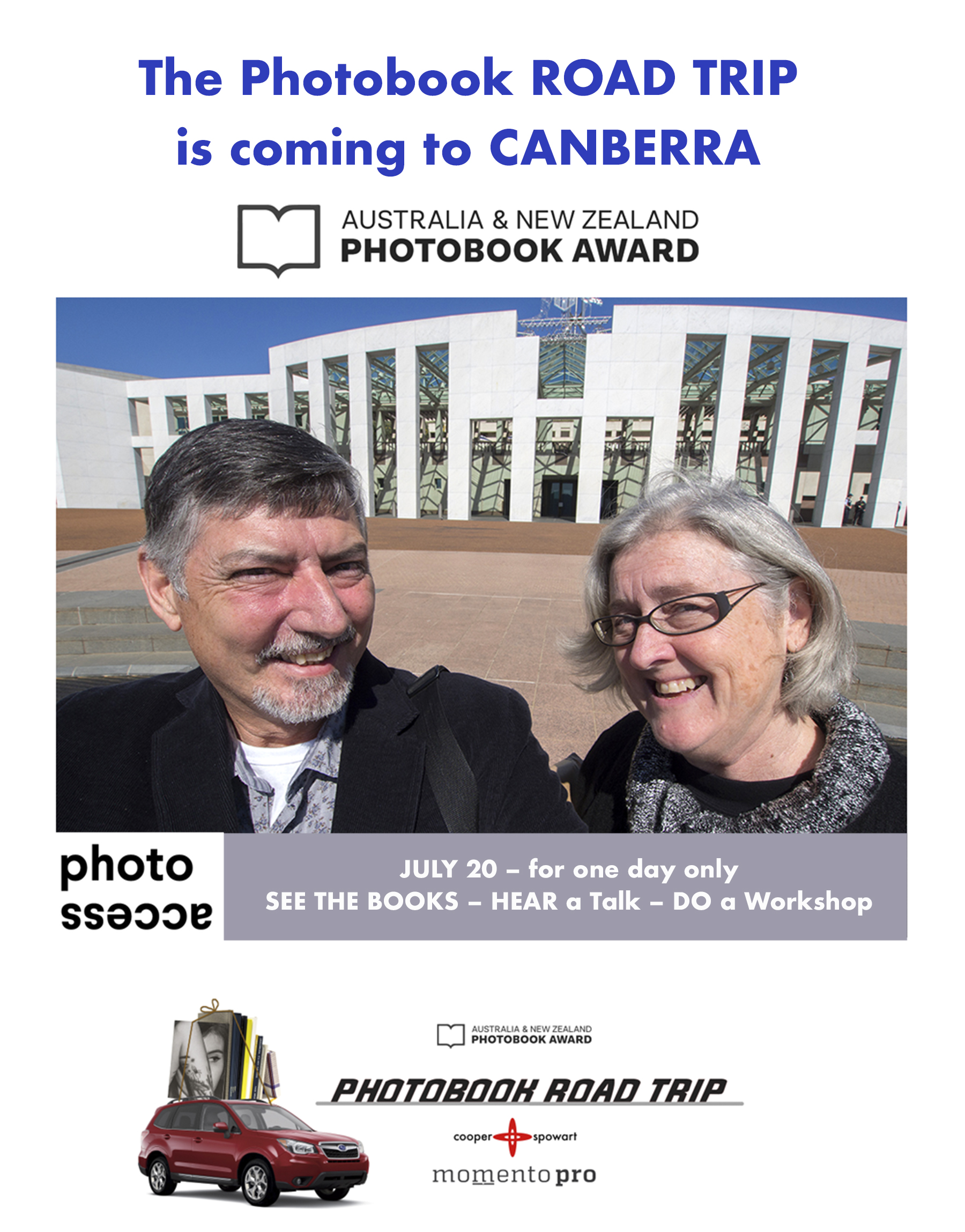
D+V Coming to Canberra
.
.
PETER EASTWAY – The New [Photography] Tradition
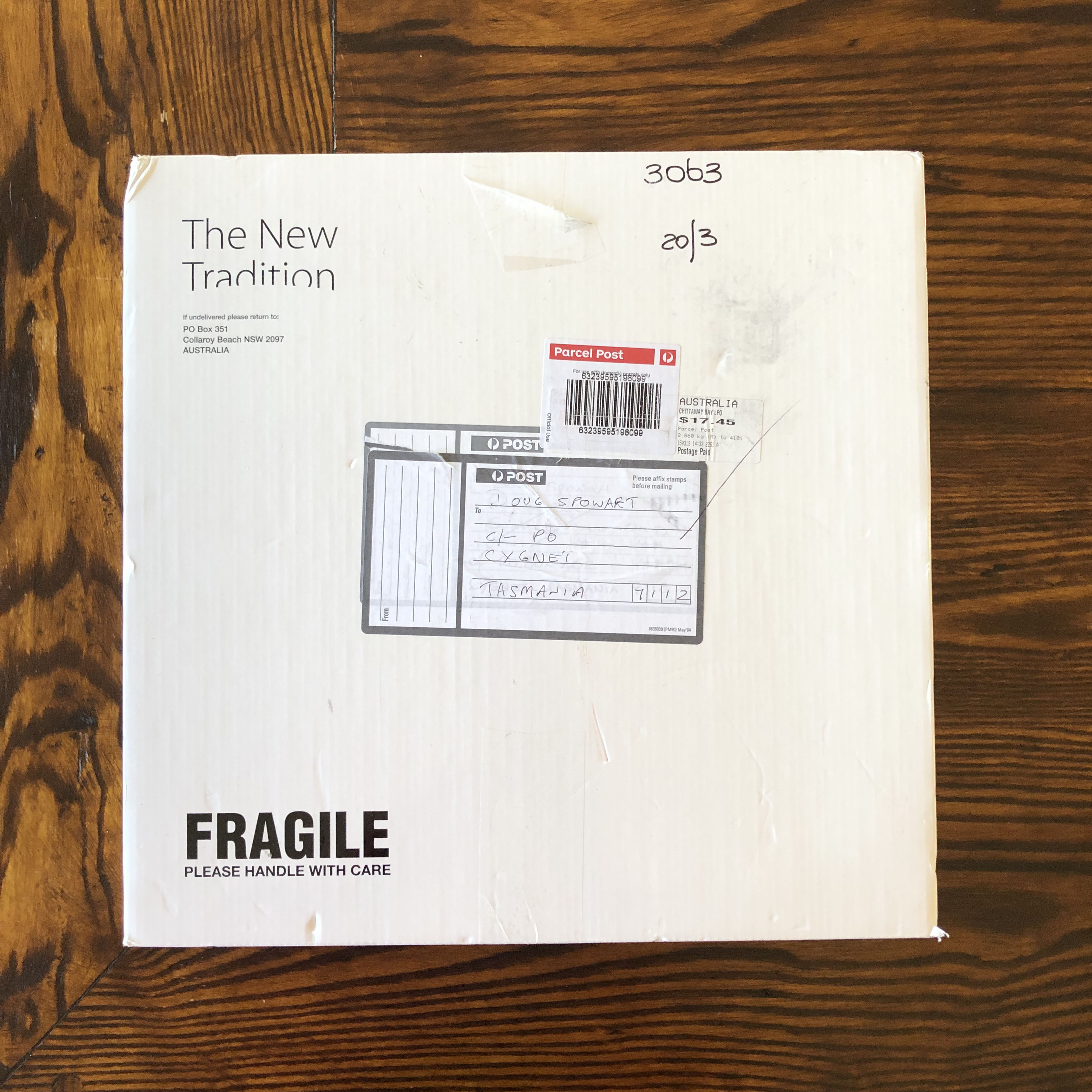
A box in the mail
.
A box came in the mail the other day and in the box was a book from the photographer Peter Eastway. I have known Peter for over 35 years and have followed his many and varied careers – as a photographer, editor and publisher, darkroom and digital Guru, AIPP advocate, photography commentator, judge, lecturer and mentor.
Our paths crossed many times as our interests, activities and creative pursuits were very similar. Over the years Peter published more than a few stories about my work as well as articles I wrote for his magazine Better Photography. Around 1990 Peter was invited to come on my Imagery Gallery Photo Tours to central Australia and Africa to enthuse and inspire the photographers on the tour.
When monochrome photography and the darkroom re-emerged in the 1980s as an exciting ‘new’ trend in the professional photography awards scene Peter became interested in my work. At the time my B&W photographs had on two occasions won the AIPP Australian Professional Photography Awards ‘Highest Scoring Print in Australia, one of them was a 10”x8” contact print. I had also won categories in the Australian Hasselblad Masters Awards.
Peter came to my darkroom in Toowoomba, witnessed my technique, and published a Better Photography story about my technique. One of the main aspects of my work at the time was my use of Leica 35mm cameras and a printmaking style that employed what I called ‘dramatic theatrical effect’ by utilising very heavy burning-in and local dodging.
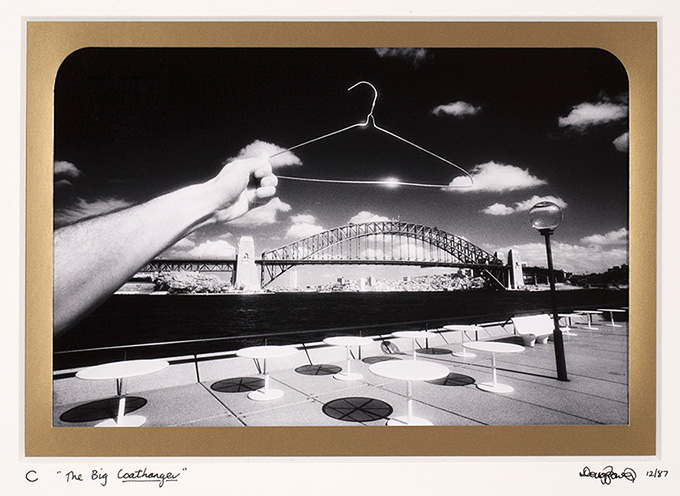
From the ICONS series ….PHOTO: Doug Spowart
.
Within a short time I found my entries in the AIPP Awards coming up against Peter’s prints and some of his images were even made on photo tours that he had undertaken for Imagery. One year he won the AIPP Professional Photographer of the Year – I was the runner-up. Since then my partner Victoria Cooper has referred to Peter as #1 and me, #2!
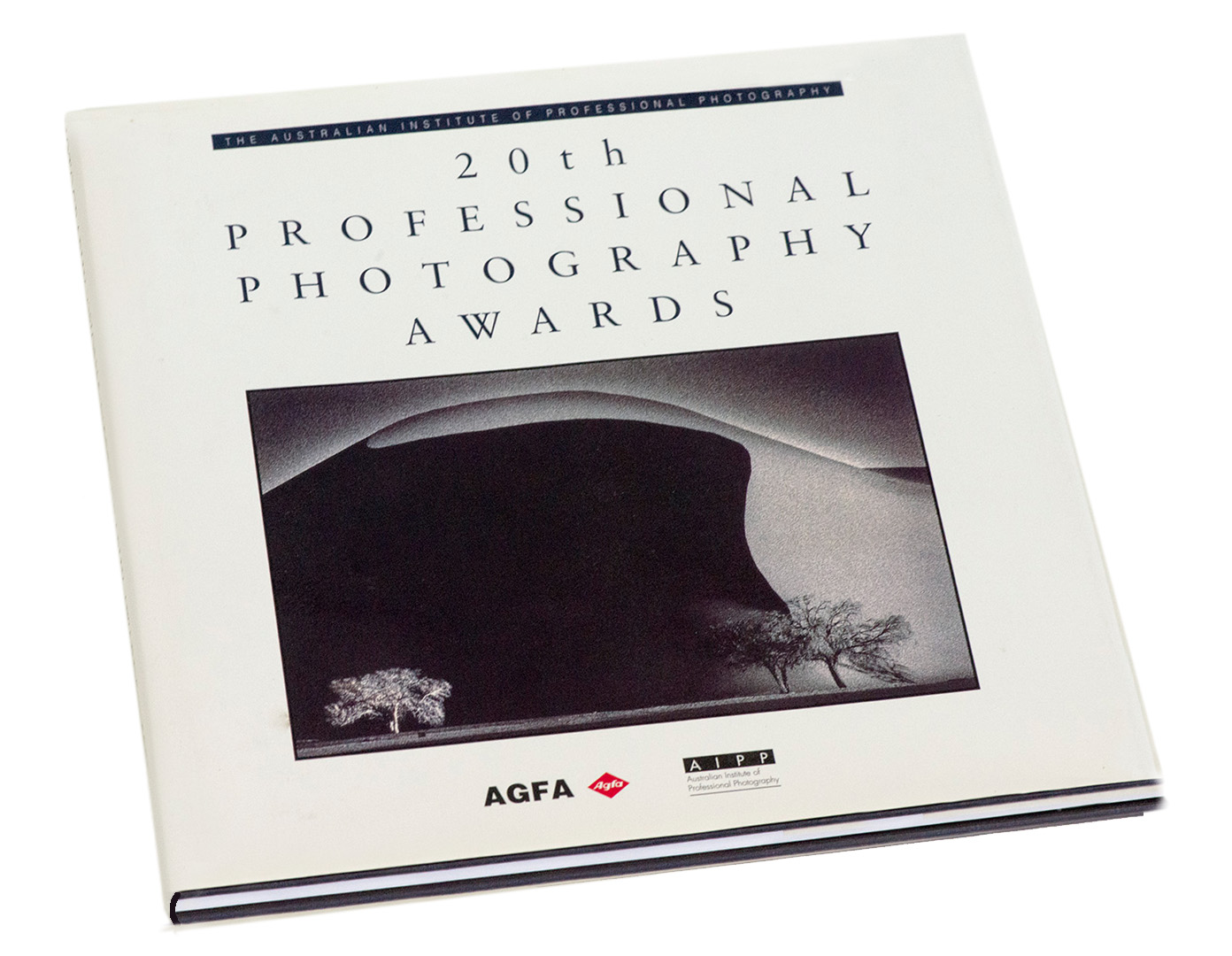
AIPP Australian Professional Photography Awards with one of Peter’s Professional Photographer of the Year award winning photos of Africa on the cover
.
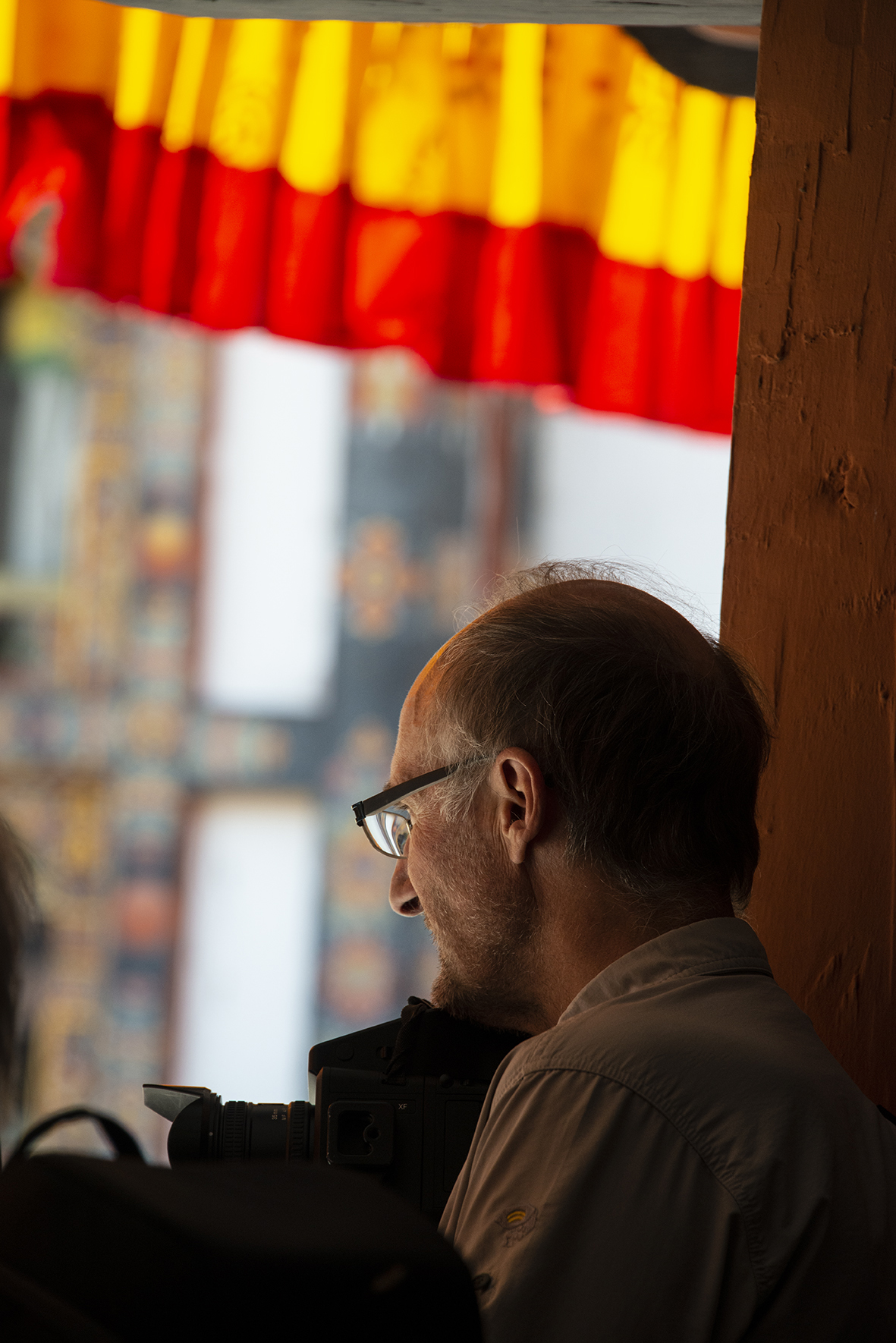
Eastway photographing on tour in Bhutan … PHOTO: Roger Skinner
When you get to know Peter you quickly understand his capacity for grasping ideas and knowledge, assimilating into his process and then to make images that are uniquely his own.


Back to the book… I turned the opening pages and read Peter’s introduction for ‘generational change’ in photography. He challenges those who have fixed ideas about emulating the great past masters like Adams and Weston and how digital photography has transformed the photographic image and the possibilities available to enhance the way the subject is presented. What follows in the book are very detailed reviews of the ‘making’ of Peter’s images over the years including his transition from analogue to digital. This book is a handbook on Peter’s process and also a manifesto where he claims the establishment of a ‘new tradition’ in photography.
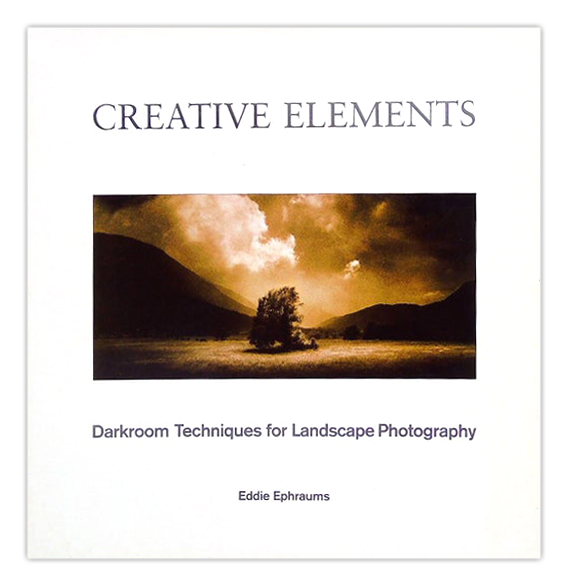
Ephraums’ book cover
I turn a few more pages to the first photograph he discusses and dissects. To my surprise Peter acknowledges Eddie Ephraums‘ and my technique as having a significant influence on his B&W work. As I have already said Peter’s way is to grasp, master and go far beyond the initial inspiration. In this way he has come to lead a whole new representation of the lens-seen reality and created for the viewer images of the mystical and sublime. Whether it’s a landscape photograph, an ancient architectural form or a portrait Peter makes images that are seductive to behold, ponder and visually explore.
There is no doubt that he now inspires new a generation of photographers and created disciples and followers for whom this tome will be a ‘book of revelations’, a Bible for those whose wish to understand the eye, the process and the aesthetic of the photographer.
If there is a new tradition and Peter’s work will no doubt continue to influence photographers but his never-ending exploration of the visual world and how the idea of the human seen reality can be transformed through capture and rapture in processing will continue to advance the art of photography.
What interests me is that when I look back at the photographs I was making in the 1980s and 90s I didn’t think at the time about being a follower of a particular ‘tradition’. I just did, as I still do now, what seemed appropriate at the time. Perhaps Peter’s motivation is the same and the only ‘tradition’ that we follow is the constant renewal of the discipline by progressive practitioners…
Thank you Peter for a copy of your book … and for the opportunity to appreciate and consider your work.
Doug Spowart
May 20, 2019
.
To read more and order Peter’s New Traditions Book –
CLICK THE LINK: Better Photography Online Shop New Traditions Book
.
HERE’s SELECTION OF MY MONOCHROME WORK FROM THE LATE 1980s and EARLY 1990s …
.


Images and text © Doug Spowart
..
.

This work is licensed under a Creative Commons Attribution-NonCommercial-NoDerivs 3.0 Unported License.
.
IMPRINT JOURNAL: Article on regional arts awards
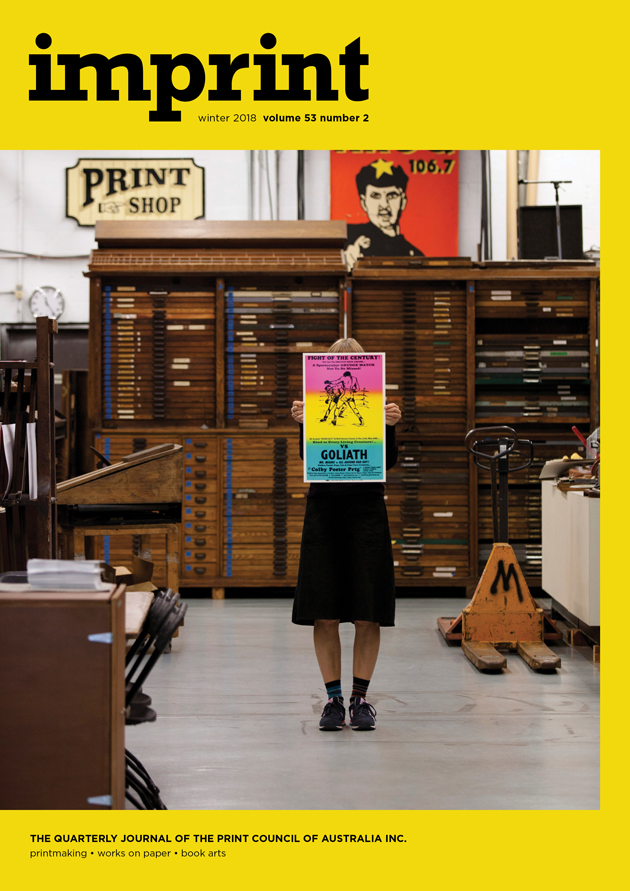
IMPRINT COVER Vol53 #2
In March this year we were approached by the Editor of IMPRINT MAGAZINE, the journal of the Print Council of Australia to write a piece about regional galleries and the national awards that they coordinate. Of particular interest to Editor Andrew Stephens was Artspace Mackay’s Libris Awards: National Artists’ Book Award, and Mornington Peninsula Regional Gallery’s National Works on Paper Awards.
We were familiar with both awards events and in particular we’ve had a long connection with the Libris Awards as entrants and reviewers. In 2017 we visited the Mornington Peninsula Regional Gallery as viewed and exhibition of works from their awards. Many of you will also be aware of our interest in, and support of regional art so we were excited by the opportunity that the commission provided.
We set about to prepare the commentary and to add extra voices to the piece we contacted some artists who have significant participation in regional arts awards. What follows is the article with the 4 page layout and photographs followed by the text, references and acknowledgements.
.
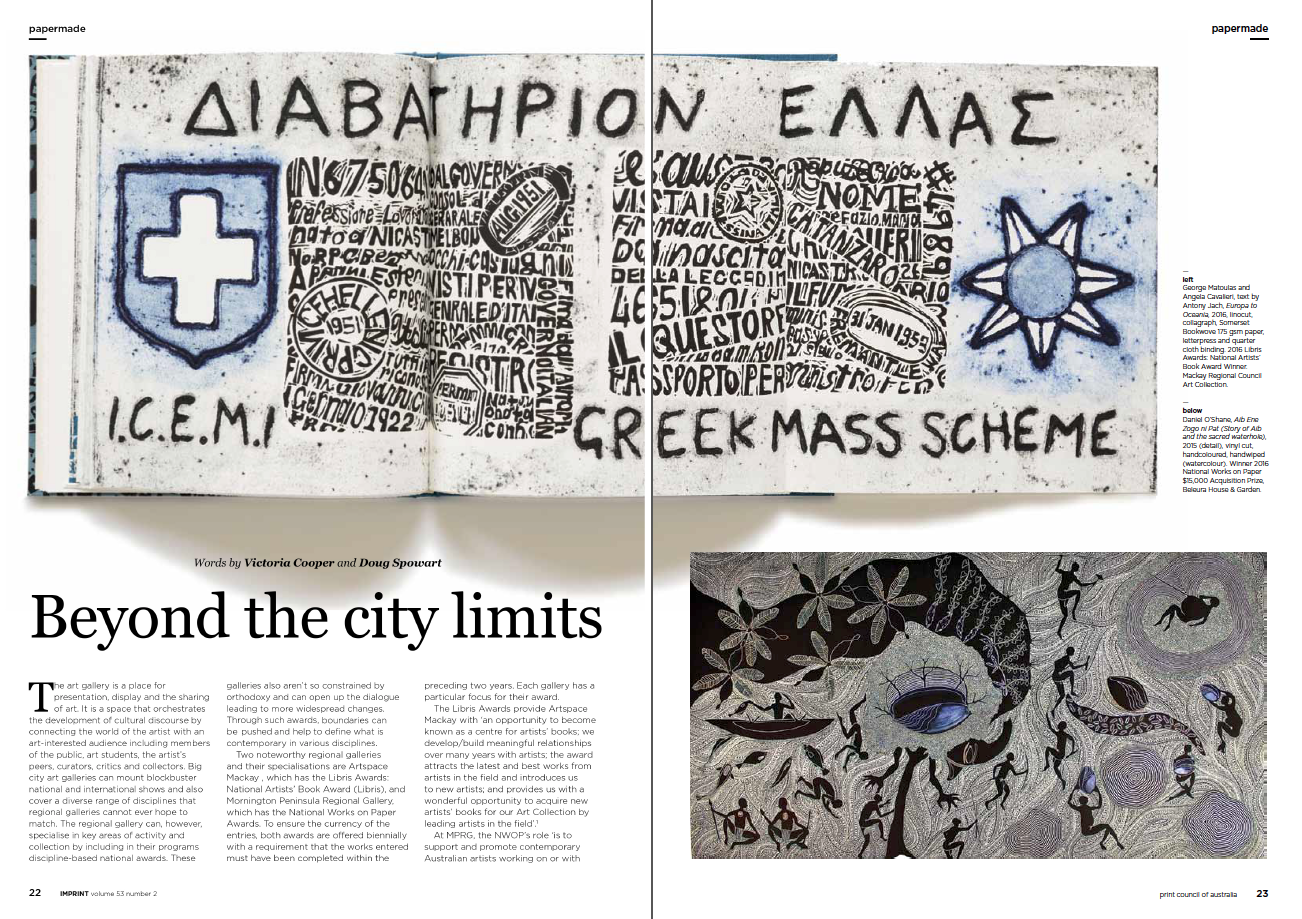
Imprint: Page 22+23
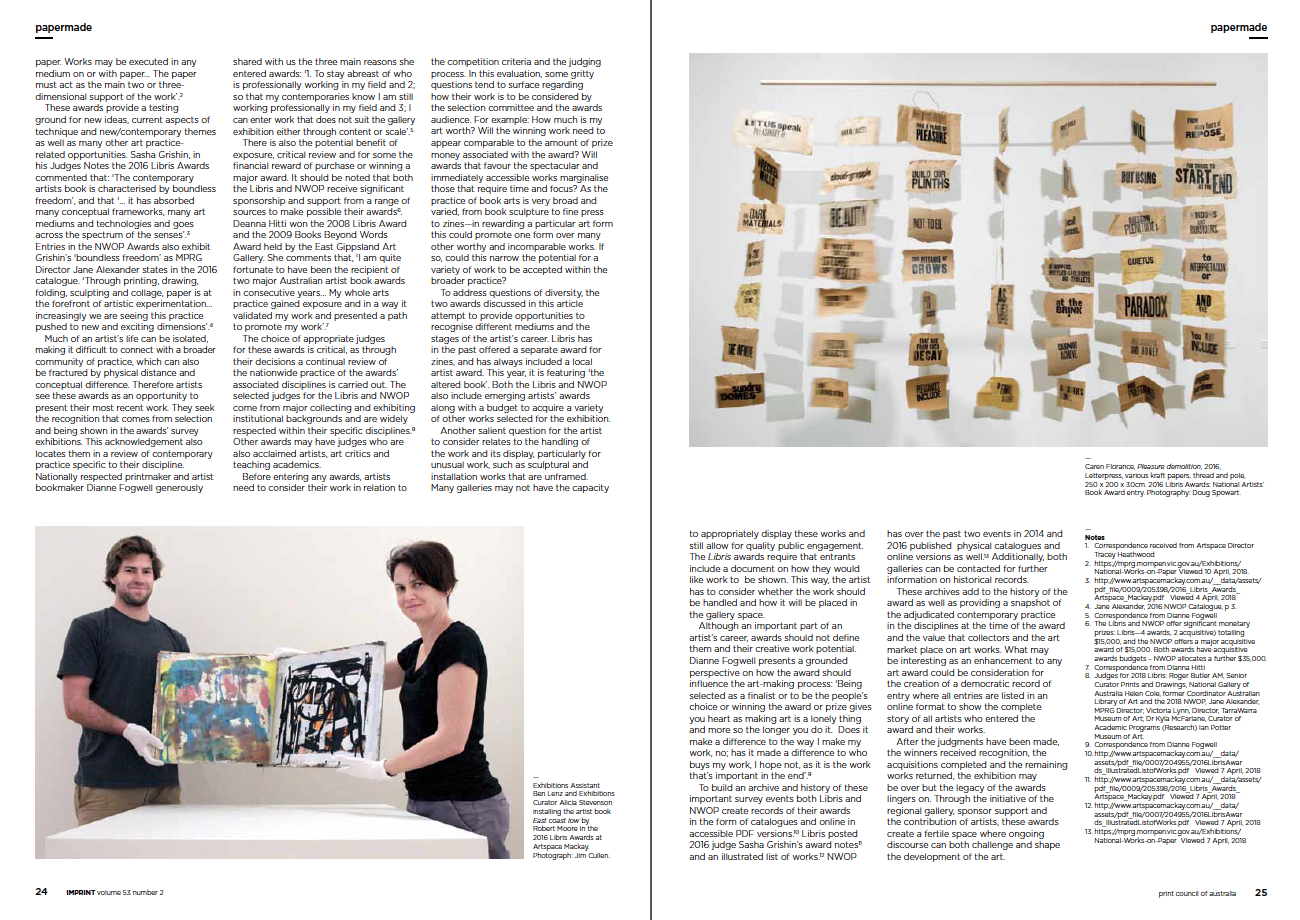
Imprint: Page 24+25
BEYOND THE CITY LIMITS:
Two regional art awards for artists’ books and works on paper
The art gallery is a place for presentation, display and the sharing of art. It is a space that orchestrates the development of cultural discourse by connecting the world of the artist with an art-interested audience including members of the public, art students, the artist’s peers, curators, critics and collectors. Big city art galleries can mount blockbuster national and international shows and also cover a diverse range of disciplines that regional galleries cannot ever hope to match. The regional gallery can however specialise in key areas of activity and collection by including in their programs discipline based national awards. These galleries also aren’t so constrained by orthodoxy and can open up the dialogue leading to more widespread changes. Through the awards they can push boundaries and help to define what is contemporary in various disciplines.
.
Two noteworthy regional galleries and their specialisations are Artspace Mackay (AM) has the Libris Awards: National Artists’ Book Award (Libris) and Mornington Peninsula Regional Gallery (MPRG) has National Works on Paper Awards (NWOP). To ensure the currency of the entries both awards are offered biennially with a requirement that the works entered must have been completed within the preceding two years. Each gallery has a particular focus for their award.
The Libris Awards provide Artspace Mackay with: ‘an opportunity to become known as a centre for artists’ books; we develop/build meaningful relationships over many years with artists; the award attracts the latest and best works from artists in the field and introduces us to new artists; and provides us with a wonderful opportunity to acquire new artists’ books for our Art Collection by leading artists in the field’.[1]
At the Mornington Peninsula Regional Gallery the NWOP’s role ‘is to support and promote contemporary Australian artists working on or with paper. Works may be executed in any medium on or with paper… The paper must act as the main two or three-dimensional support of the work’.[2]
These Awards provide a testing ground for the new ideas, current aspects of technique and new/contemporary themes as well as many other art practice related opportunities. Sasha Grishin, in his ‘Judges Notes’ the 2016 Libris Awards commented that: ‘The contemporary artists book is characterised by boundless freedom’, and adds that: ‘… it has absorbed many conceptual frameworks, many art mediums and technologies and goes across the spectrum of the senses’.[3] Entries in the NWOP Awards also exhibit Grishin’s ‘boundless freedom’ as MPRG Director Jane Alexander states in the 2016 catalogue: ‘Through printing, drawing, folding, sculpting and collage, paper is at the forefront of artistic experimentation… increasingly we are seeing this practice pushed to new and exciting dimensions’.[4]
Much of an artist’s life can be isolated making it difficult to connect with a broader community of practice, which can also be fractured by physical distance and conceptual difference. Therefore artists see these awards as an opportunity to present their most recent work. They seek the recognition that comes from selection and being shown in the awards’ survey exhibitions. This acknowledgement also locates them in a review of contemporary practice specific to their discipline. Nationally respected printmaker and artist bookmaker Dianne Fogwell generously shared with us the three main reasons she entered awards: ‘1. To stay abreast of who is professionally working in my field and 2; so that my contemporaries know I am still working professionally in my field and 3; I can enter work that does not suit the gallery exhibition either through content or scale’.[5]
There is also the potential benefit of exposure, critical review and for some the financial reward of purchase or winning a major award. It should be noted that both the Libris and NWOP receive significant sponsorship and support from range of sources to make possible their awards[6]. Deanna Hitti won the 2008 Libris Award and the 2009 Books Beyond Words Award held by the East Gippsland Art Gallery. She comments that, ‘I am quite fortunate to have been the recipient of two major Australian artist book awards in consecutive years… My whole arts practice gained exposure and in a way it validated my work and presented a path to promote my work through’.[7]
The choice of appropriate judges for these awards is critical as through their decisions a continual review of the nation-wide practice of the award’s associated disciplines is carried out. The selected judges for the Libris and NWOP come from major collecting and exhibiting institutional backgrounds and are widely respected within their specific disciplines.[8] Other awards may have judges who are also acclaimed artists, art critics and teaching academics.
Before entering any awards the artist needs to consider their work in relation to the competition criteria and the judging process. In this evaluation some gritty questions tend to surface regarding how their work is to be considered by the selection committee and the awards audience. For example: How much is my art worth? Will the winner’s work need to appear comparable to the amount of prize money associated with the award? Will awards that favour the spectacular and immediately accessible works marginalise those that require time and focus? As the practice of book arts is very broad and varied, from book sculpture to fine press to zines—in rewarding a particular art form/s this could promote one form over many other worthy and incomparable works. If so this could narrow the potential for a variety of work to be accepted within the broader practice?
To address questions of diversity, the two awards discussed in this article attempt to provide opportunities to recognise different mediums and the stages of the artist’s career. Libris has in the past offered a separate award for Zines, and have always included a local artists award. This year they are featuring the altered book. Both the Libris and NWOP also include emerging artists’ awards along with a budget to acquire a variety of other works selected for the exhibition.
Another salient question for the artist to consider relates to the handling of the work and its display, particularly for unusual work, such as sculptural and installation works that are unframed. Many galleries may not have the capacity to appropriately display these works and still allow for quality public engagement. The Libris awards require that entrants include a document on how they would like work would be shown. This way the artist has to consider whether the work should be handled and how it will be placed in the gallery space.
Although an important part of an artists career awards should not define them and their creative work potential. Dianne Fogwell presents a grounded perspective on how the award should influence the artmaking process: ‘Being selected as a finalist or to be the people’s choice or winning the award or prize gives you heart as making art is a lonely thing and more so the longer you do it. Does it make a difference to the way I make my work, no, has it made a difference to who buys my work, I hope not, as it is the work that’s important in the end’.[9]
To build an archive and history of these important survey events both Libris and NWOP create records of their awards in the form of catalogues and online in accessible PDF versions.[10] Libris posted 2016 judge Sasha Grishin’s award notes[11] and an illustrated list of works.[12] NWOP has over the last two events, 2014 & 2016 published a physical catalogue and online versions as well.[13] Additionally AM and MPRG can be contacted for further information on historical records.
These archives add to the history of the award as well as a snapshot of the adjudicated contemporary practice in the disciplines at the time of the award and the value that collectors and the art market place on artworks. What may be interesting as an enhancement to any art award could be consideration for the creation of a democratic record of entry where all entries are listed in an online format to show the complete story of all artists who entered the award and their works.
CONCLUSION:
After the judgements have been made, the winners received recognition, the acquisitions completed and the remaining works returned, the exhibition may be over but the legacy of the awards lingers on. Through the initiative of the regional gallery, sponsor support and the contribution of artists, these awards create a fertile space where ongoing discourse can both challenge and shape the development of the art.
Prepared by Dr Victoria Cooper and Dr Doug Spowart
With thanks to: Tracey Heathwood Director Artspace Mackay and Narelle Russo MPRG Curator-Collections / Registrar.
Dr Lyn Ashby, Dianne Fogwell, Deanna Hitti, Johanna Kambourian, Dr Clyde McGill, Dr Felicity Rea.
[1] Correspondence received from Artspace Director Tracey Heathwood
[2] https://mprg.mornpen.vic.gov.au/Exhibitions/National-Works-on-Paper Viewed 10 April, 2018.
[3] http://www.artspacemackay.com.au/__data/assets/pdf_file/0009/205398/2016_Libris_Awards_Artspace_Mackay.pdf Viewed 4 April, 2018
[4] Jane Alexander, 2016 NWOP Catalogue, p 3.
[5] Correspondence from Dianne Fogwell
[6] The Libris and NWOP offer significant monetary prizes: Libris—4 awards, 2 acquisitive) totalling $15,000, and the NWOP offers a major acquisitive award of $15,000. Both awards have acquisitive awards budgets – NWOP allocates a further $35,000.
[7] Correspondence from Dianna Hitti
[8] Judges for 2018 Libris: Roger Butler AM, Senior Curator Prints and Drawings, National Gallery of Australia Helen Cole, former Coordinator Australian Library of Art
and the 2018 NWOP, Jane Alexander, MPRG Director;
Victoria Lynn, Director, TarraWarra Museum of Art;
Dr Kyla McFarlane, Curator of Academic Programs (Research) Ian Potter Museum of Art.
[9] Correspondence from Dianne Fogwell
[10] http://www.artspacemackay.com.au/__data/assets/pdf_file/0007/204955/2016LibrisAwards_IllustratedListofWorks.pdf Viewed 7 April, 2018
[11] http://www.artspacemackay.com.au/__data/assets/pdf_file/0009/205398/2016_Libris_Awards_Artspace_Mackay.pdf Viewed 7 April, 2018
[12] http://www.artspacemackay.com.au/__data/assets/pdf_file/0007/204955/2016LibrisAwards_IllustratedListofWorks.pdf Viewed 7 April, 2018
[13] https://mprg.mornpen.vic.gov.au/Exhibitions/National-Works-on-Paper Viewed 7 April, 2018
SOME OTHER AUSTRALIAN – PRINTMAKING + ARTISTS’ BOOK AWARDS @ March 2018
Manly Artists Book Award—Bi-yearly, next 2019
https://www.northernbeaches.nsw.gov.au/things-to-do/arts-and-culture/manly-artists-book-award
Hazelhurst Art on Paper Award—Bi-yearly, next 2019
Gippsland Print Award—Bi-yearly, next 2019
http://www.gippslandartgallery.com/prizes/gippsland-print-award/
Swan Hill Print & Drawing Acquisitive Awards—Bi-yearly, current 2018
https://gallery.swanhill.vic.gov.au/2018/03/print-drawing-finalists/
2017 Geelong Aquisitive Print Awards
http://www.geelonggallery.org.au/cms_uploads/docs/2017-geelong-acquisitive-print-awards_online.pdf
Banyule Award for Works on Paper—Hatch Contemporary Arts Space
https://www.banyule.vic.gov.au/Arts-and-Events/Banyule-Award-for-Works-on-Paper
.
.
.
.
.
LIBRIS ARTISTS’ BOOK AWARD – Cooper+Spowart Finalists
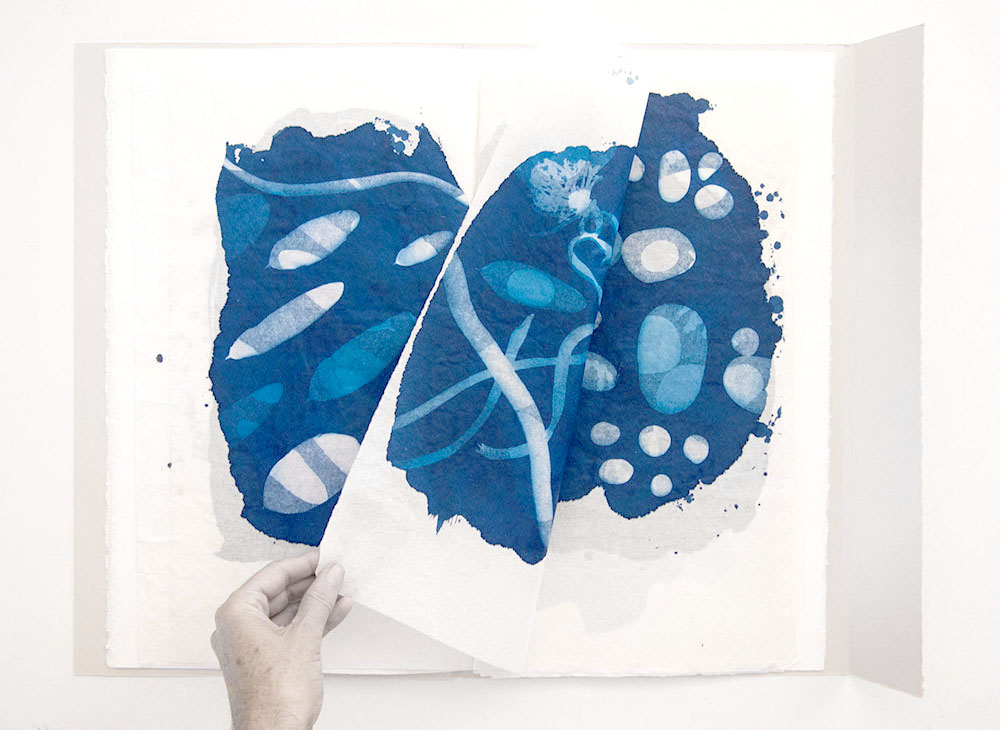
The artists’ book TIDAL by Cooper+Spowart
Our artists’ book TIDAL is now on show as a FINALIST in the 2018 LIBRIS ARTISTS’ BOOK AWARD at Artspace Mackay, Queensland, Australia.
We are excited to be finalists in this Award exhibition. The awards were announced on May 26 – details of the winning works and a download of the exhibition catalogue are available at the bottom of this post.
ABOUT OUR ARTISTS’ BOOK – TIDAL :
TIDAL is a montage of fragmented imprints made from the solid reality of found objects swept up by the tide–beautiful castaways from the ocean.
These objects as image elements, no longer in their original form, are woven together as if a poem, song or dance. In many ways TIDAL relates to a ‘desire for that melancholy wonder that is the blue of distance’ from Rebecca Solnit’s A field guide to getting lost. Or just simply it could be about the artist and their art.
It is book of double-sided cyanotype prints, when held to the light, allow for the montage of the images front and back, thus merging and unfolding the space and time of the page and the book. Reading becomes the blending of the fragments through the spatial divide of the turning page.
The video that follows gives a basic view of the TIDAL book:
ABOUT THE TIDAL BOOK PROJECT:


This project began with the collection of beach detritus at low tide after the super moon at Wooli, north coast New South Wales.
We worked collaboratively in the intense heat of Christmas Day 2016 to hand coat the cyanotype emulsion on ricepaper, expose the ‘found objects’ to the paper in the sun, and then wash-out in running water with a dash of lemon juice to create the double-sided cyanotype folios.
Over the next year we developed the structural form of the book, and finally returned to finish it at Wooli, as this state, over Christmas in 2017.
The double-sided cyanotype prints, when held to the light, allow for the montage of the images front and back, thus merging and unfolding the space and time of the page and the book. Reading becomes the blending of the fragments through the spatial divide of the turning page.
THE BOOK:
A unique state book of 6 double-sided cyanotype images on rice paper.
Book size 49.5x30x1 cm
The text was written by Victoria Cooper and includes a quote by Rebecca Solnit.
Folders and text:
Canson Stonehenge and Arches paper with rice-paper collage elements.
Garamond font family in pigmented inks on Arches paper.
This book is another work created in an ongoing series relating to the locality of Wooli and we acknowledge the support provided by Dr Felicity Rea
BOOK TEXT:
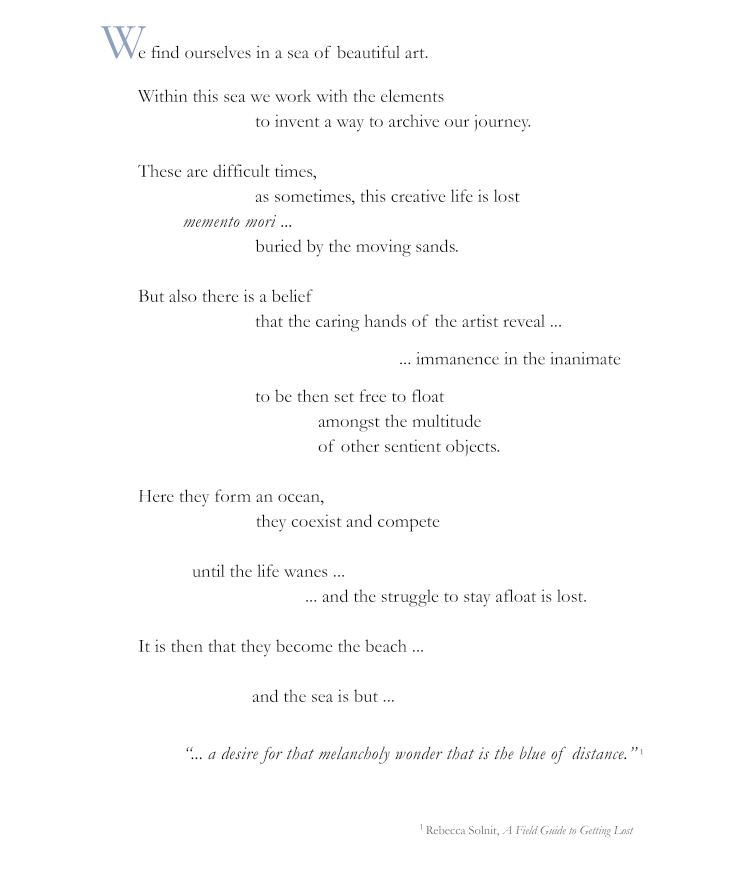
Frontpiece: TIDAL
OTHER INFORMATION INCLUDING THE WINNING BOOKS:
Category 1. Dalrymple Bay Coal Terminal National Artists’ Book Award
Winner: Clyde McGill for his work ‘Witness’
Category 2. Dalrymple Bay Coal Terminal Altered Book Award
Michelle Vine for her work ‘Contested Biography I (quadrat)’
Category 3. Mackay Regional Council Regional Artists’ Book Award
Jamian Stayt for his work ‘Tagged’
Category 4. Artspace Mackay Foundation Tertiary Artists’ Book Award
Jenna Lee for her work ‘A plant in the wrong place’
LIBRIS CATALOGUE
CLICK THE LINK BELOW TO DOWNLOAD A COPY OF THE CATALOGUE
Libris_Awards_2018_Catalogue_of_Entries_brochureA4
SEE OUR POST ABOUT THE 2016 LIBRIS AWARDS HERE
.
.
.
.
.
MORE THAN THE COVER: Judging the Photobook of the Year
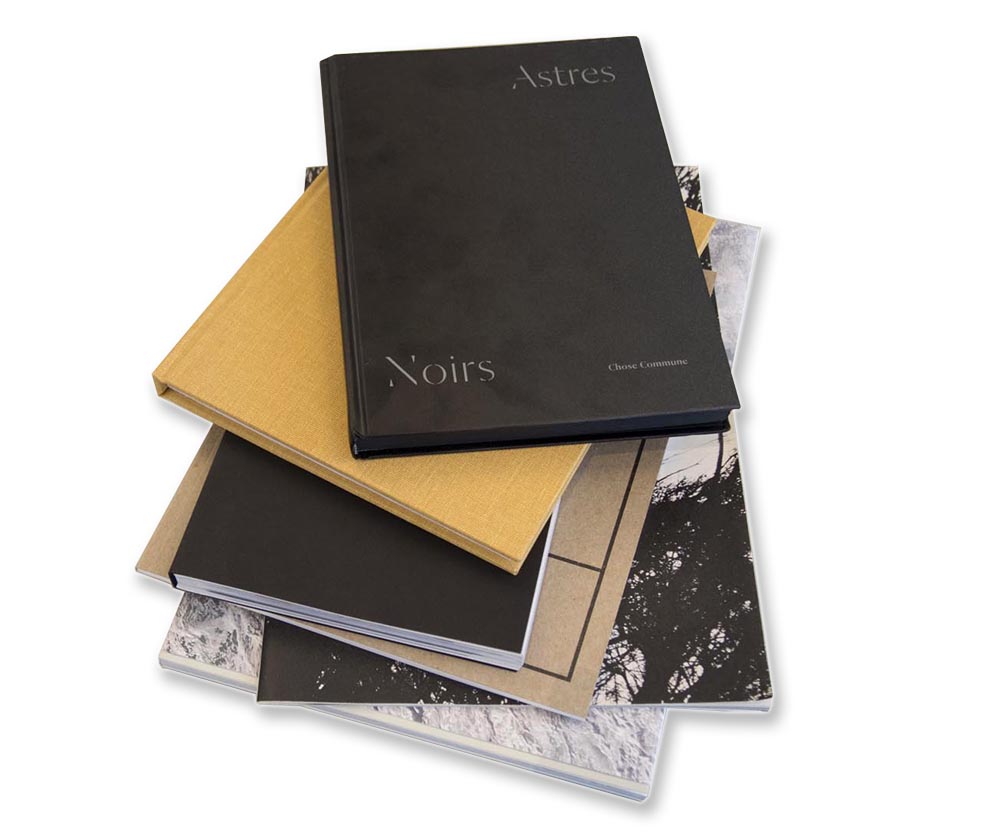
The Finalists…
.
Recently in Auckland and Melbourne two groups of photobook aficionadas and aficionados assembled before 31 and 71 books respectively, and worked as a team to decide which of the books before them were exemplary of contemporary photobooks and, if consensus could prevail, which book – in each location, was the ‘best’ photobook.
The selection process is based on a ‘Judging Criteria’ that has been developed and enhanced over the many years of the awards which states that the judges will review each entry to assess the:
- excellence of the photography, design, layout, typography and cover art
- quality of the photo editing and sequencing to create an engaging visual narrative
- ability of any additional imagery, text or ephemera to enhance the story in the photographs and/or book
- appropriateness of the photography, design and format for the book’s intended purpose and audience
As the definition of a photobook remains broad, from photozines to trade coffee table books, a key consideration for the judging panel is to evaluate the ‘appropriateness’ of the book in the context of its ‘intended purpose and audience’. This aspect of the Criteria creates an opportunity for diverse products to be sensitively and fairly assessed.
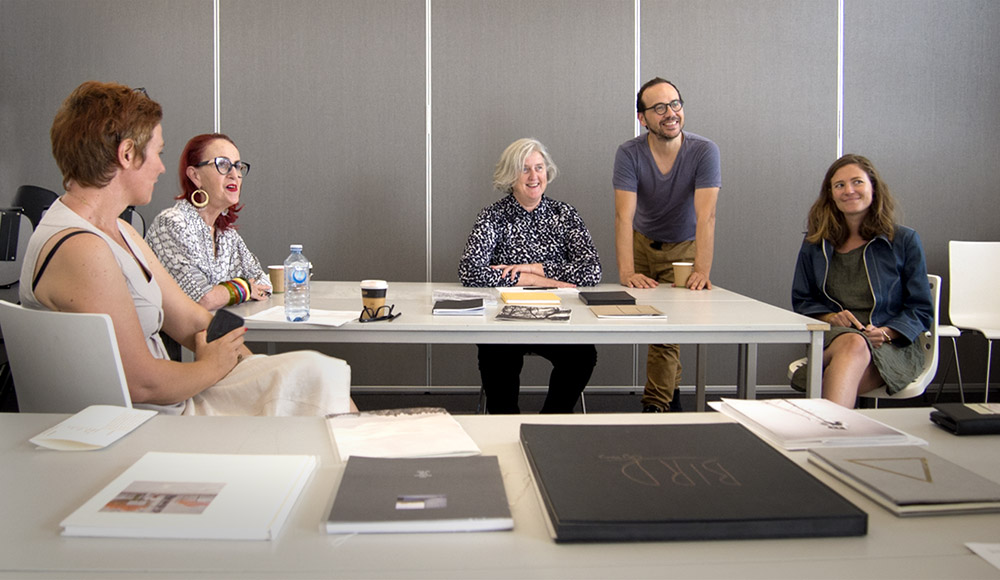
The AuPOTY judges: Heidi Romano, Helen Frajman, Victoria Cooper, Daniel Boetker-Smith and Emma Phillips
The judging panel is purposefully selected to include experts in photography, design and book publishing. Each year these judges are changed to allow for representatives from different backgrounds, locations, gender, industry areas including design, publishing, media, cultural institution, academia, retail, art and commercial worlds.
Additionally judges weren’t allowed to score or advocate for books in which potential conflict of interest may cause problems. This is a particularly important issue as our photobook communities in Australia and New Zealand are small and connected.
The Photobook of the Year – 5 stage judging process:
Stage 1. A PDF of each book was forwarded to the judges in advance for them to gauge a preliminary impression of the book, its visual nature, content and narrative. Each judge completed a ‘first impression’ top 10 books spread sheet and provided feedback in the form of a comment and score for the books that they had selected.


Stage 2. The judges met and participated in some introductory discussions about the award and the processes that were to follow. After that the books were laid out on tables enabling the judges to encounter the physical and haptic experience of each book. Another ‘score sheet’ was provided so that judges could quantify their response to each book. While this review was basically carried out individually some casual discussion took place between judges. Many judges were to comment that seeing the ‘real’ book was surprisingly different from the impression that they had gained from the PDF screen view.
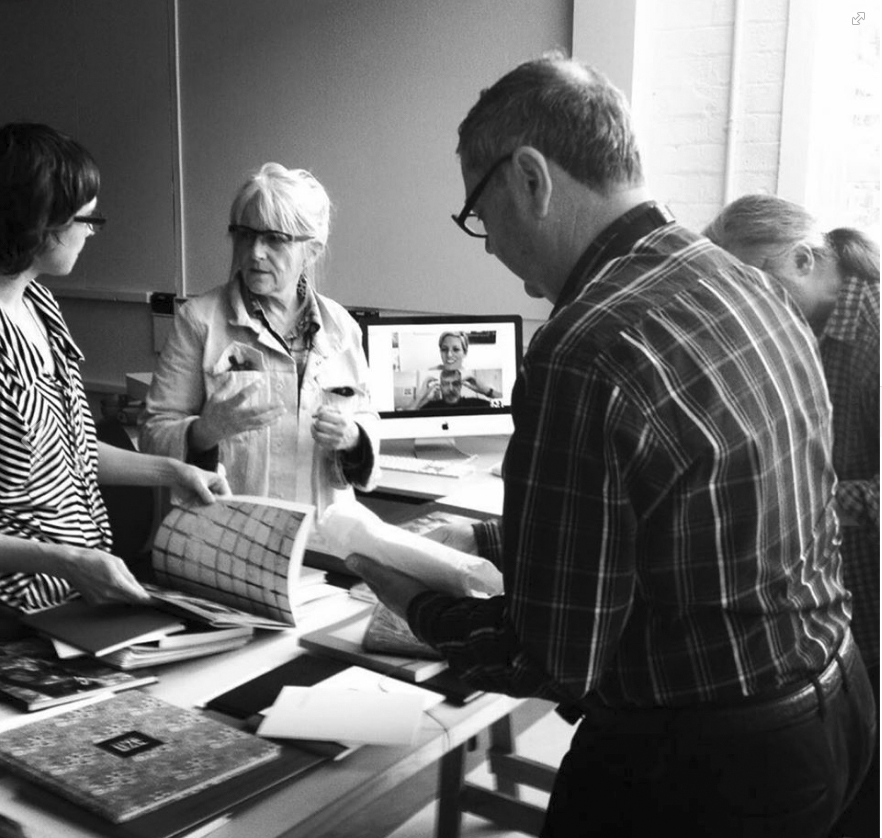
NzPOTY Judging team included Jonty Valentine, Anne Noble, Layla Tweedie-Cullen, Haru Sameshima, Ron Brownson and Doug Spowart PHOTO: From Facebook post
Stage 3. The judges score sheets were tallied resulting in a group of books being selected for round-table review and discussion. From this group activity the finalists were determined. In the AuPOTY 12 books were selected and in NzPOTY 10 made the finalist list. It should be noted that judge/s disclosed any involvement or potential conflict of interest with particular books or association that they may have with the author.
.


Stage 4. In this, the final stage, the judges debated the relative attributes of the books working towards a point where consensus over the ultimate winner could be determined as well as any books deserving of ‘Commended’ awards could be made. This stage of the process was interesting to participate in or to observe, as the many differing opinions of what constitutes the ‘contemporary photobook’ made for a lively and informative debate.
A consensus was to be achieved in both judgings and the results were:
Australian Photobook of the Year Winner:
Astres Noirs by Katrin Koenning & Sarker Protick, published by Chose Commune
.

AuPOTY WINNER: Astres Noirs by Katrin Koenning & Sarker Protick & Published by Chose Commune
.
Recipients of Commended awards were:
- Elsewhere by Fuad Osmancevic
- J.W. by Clare Steele
- Memorandum by Ana Paula Estrada
- Some Want Quietly by Drew Pettifer, Published by M.33
- Surface Phenomena by Bartolomeo Celestino, Published by Perimeter Editions
FINALISTS
- Bird by Gary Heery
- Courts 02 by Ward Roberts & Editions
- Elemental by Rohan Hutchinson
- Golden Triangle by Hannah Nikkelson
- Kinglake by Jade Byrnes
- Two Pandanus Trees Side by Side by Aaron Claringbold
Page views, the judges and other book details of the AuPOTY can be seen HERE

APOTY Website
New Zealand Photobook of the Year Joint Winners:
- Rannoch by Simon Devitt
- Touchy by Evangeline Davis

Rannoch by Simon Devitt PHOTO: From the NzPOTY Website

Touchy by Evangeline Davis PHOTO: From the NzPOTY website
Recipients of Commended awards were:
- As the Road Bends by Blair Barclay
- Duplex City by Blair Kitchener
FINALISTS
- Conversations With My Mother by Shelley Ashford
- R&S Satay Noodle House by Sally Young
- Soap and Water by Bronwyn McKenzie
- Someone’s Mana by Michael Krzanich
- The Shops by Peter Black
- Watching the fishes go by by Niki Boon
Page views, the judges and other book details of the NzPOTY can be seen HERE
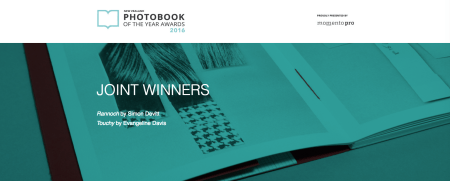
NzPOTY Website
The travelling exhibition of the POTY winners and finalists

A&NZ Photobooks of the Year 2015 @ Maud Gallery in Brisbane PHOTO: Doug Spowart
STAGE 5. In each country visitors to the AuNzPOTY exhibitions in Melbourne, Sydney and Brisbane are invited to vote for their favourite book, and the winner receives $500 cash + $2,000 printing credit with Momento Pro. The winner will be announced via a Photobook of the Year Awards email later in the year. Subscribe at awards@photobookoftheyear.com.au.
Some personal observations and comments about the judging
As a witness to one of the judgings (AuPOTY), and a participant judge in the other (NzPOTY) I have reflected on the process and the salient issues, topics and well-discussed points and prepared this comment piece. I might add that these are based on my recollections of the proceedings as well as my personal thoughts gained from my involvement.
1
The universal definition of what is a photobook remains illusive. What judges think, what the entrants or others may think is a photobook may never be resolved. Although the perception of what a photobook might be does effect every aspect of the awards influencing who might enter and what their expectations of the award may be.
Also what is the nature of the selected finalists, and what book wins the awards, sends out a message to the broad range of people interested in photobooks to confirm or challenge their idea of what a photobook is.
2
Who made the book? Is it self-published? Or was it trade published? Was it a collaboration – did it involve a single photographer or multiple photographers with editor/s, publisher and designer/s? As all have a bearing on the book as a creative product or a commercial outcome.
3
What was the purpose for the book…? Is it for general consumers, niche markets or a personal record bound in book form?
4
Much discussion centred around concepts relating to design style, tricks of printing and binding, different papers, round fore edge corners, trendy layouts, typography, embellishments and packaging. Some books were considered derivative as certain features were part of last year’s trend or were recognised as being influenced by/taken/copied/borrowed from a recent well-known successful book. Therefore books with original concepts were held in higher esteem.
The question begs to be asked… at what point do any of these ‘derivative’ features become recognised as a visual style/form or narrative effect that contributes to the book communiqué?
5
The meaning and implications of collaboration.
6
Artist’s statements were often poorly written, or overtly academic ‘artspeak’.
7
One important consideration was that the book was as a total package where all of its components; concept, content, design, production values and binding were seen as creating a total creative entity.
8
Some common phrases from the judges were:
- Fabric of construction
- Economical
- I wish I’d made that…
- If only I could have had those images to edit…
In conclusion:
The Patrons for Australian and New Zealand Photobook of the Year Awards are Libby Jeffery and Geoff Hunt of MomentoPro. They have funded prizes, coordinating the judging process: including judge selection, announcement events and exhibitions. Partners in the awards include Heidi Romano from Unless You Will, Photography Studies College Melbourne and in New Zealand f11 Online magazine. Over 6 years these awards have championed photobook publishing activity and discourse and as such created a record of contemporary photobook practice in the antipodes.
The Australian and New Zealand Photobook of the Year 2016 will tour nationally in 2017… Visit the Photobook of the Year website for details.
Dr Doug Spowart
.
.
.
TEXT: ©2017 Doug Spowart
PHOTOs: ©2017 Doug Spowart (unless indicated otherwise)
COVERING: The 2016 Libris Artists’ Book Award
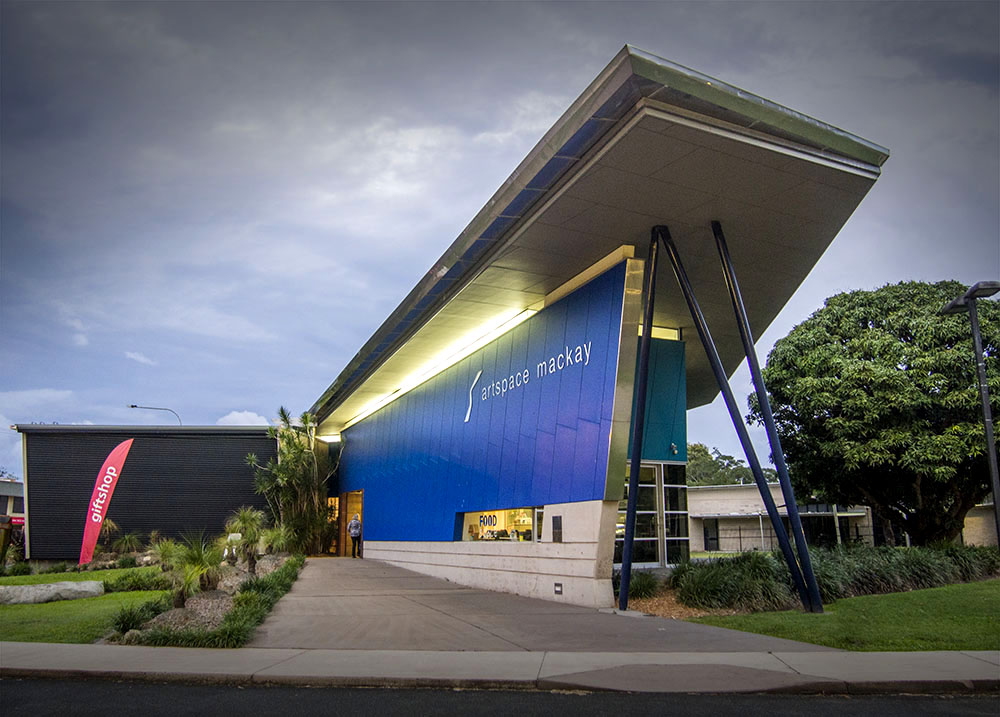
Artspace Mackay
A COMMENT ON THE 2016 LIBRIS ARTISTS’ BOOK AWARDS
In his announcement speech for the 2016 Libris Awards at Artspace Mackay judge Sasha Grishin makes the observation that: ‘The contemporary artists book is characterised by boundless freedom’, and adds that: ‘… it has absorbed many conceptual frameworks, many art mediums and technologies and goes across the spectrum of the senses.’
Visitors to Artspace and the Libris Awards encounter an open space with islands of book presentation devices. Plinths of all sizes – some encased, others at floor level, there are shelves on walls, books as mobile installations hung from the ceiling and other books with ‘pages’ covering large expanses of wall. This is not an easy walk-through exhibition as each work beckons, siren-like, calling for the extended gaze of the reader.

The Artspace Libris exhibition
.
On this occasion the winners were:
- Dalrymple Bay Coal Terminal National Artists Book Award $10,000 Acquisitive Award went to George Matoulas and Angela Cavalieri, with the text by Antoni Jach, for Europa to Oceania.*
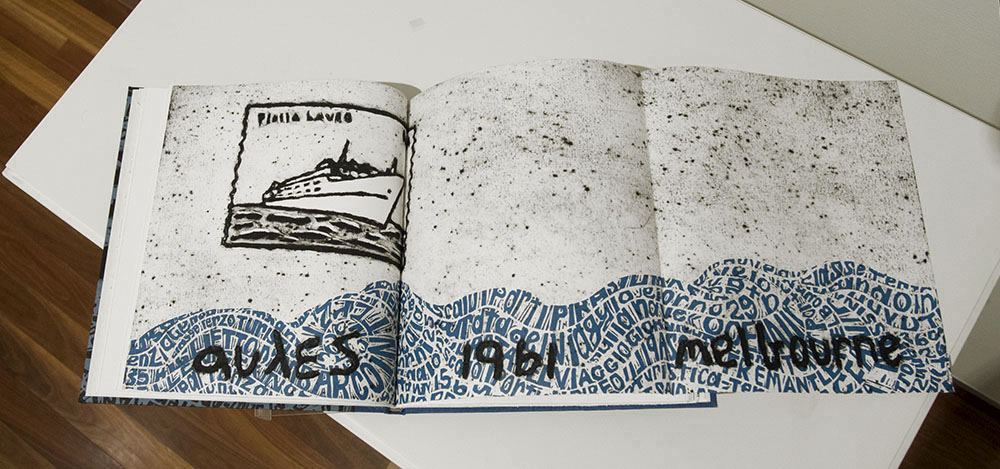
George Matoulas & Angela Cavalieri, with the text by Antoni Jach, Europa to Oceania
Grishin’s comments about the work were:
After much soulsearching I decided to allot the winning entry for the major prize to a collaborative and fabulous artists book by two Melbourne‐based artists, George Matoulas and Angela Cavalieri, with the text by the novelist and playwright Antoni Jach, titled Europa to Oceania. The three linocuts are by Angela, the three collographs are by George and there are another two collaborative foldout prints. The two artists, one of Greek extraction, the other from Calabria in Italy, with wit, profundity and beauty explore the migrant experience at a time when the Australian social fabric is under stress with the question of refugees and migration.
Highly commended in this award were:
Gracia Haby and Louise Jennison’s Closer to Natural
Monica Oppen’s Metropolis
Tim Moseley’s Kange pholu wandaPeter Lyssiotis’ Blind Spot
- Mackay Regional Council Regional Artists Book Award for a local artist went to May‐Britt Mosshamer for Tapping the knowledge.*
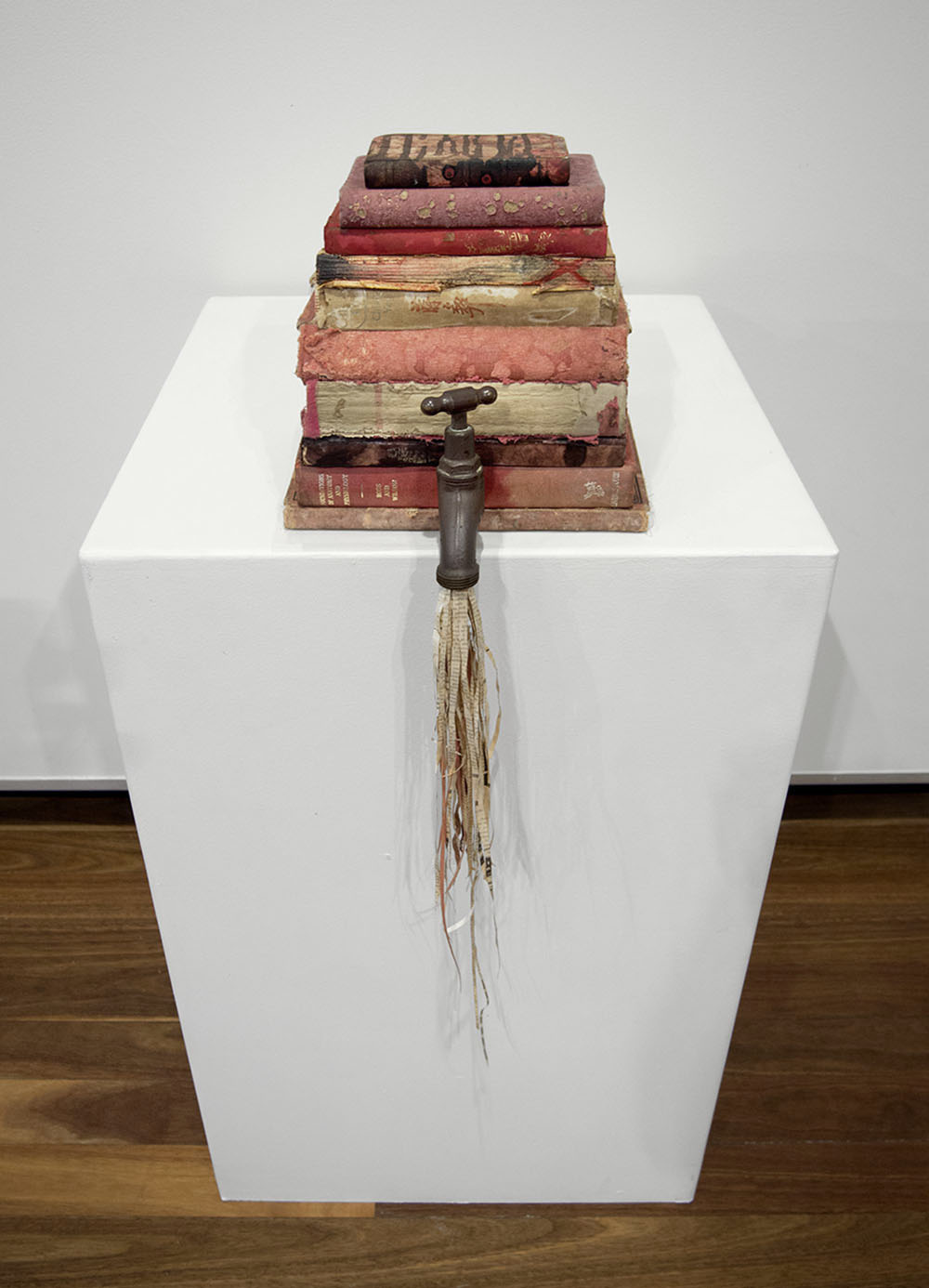
May‐Britt Mosshamer Tapping the knowledge.*
Grishin’s comments about the work were:
As much as one fought the temptation, the $2,500 award had to go to the local artist, May‐Britt Mosshamer and her effective piece Tapping the knowledge. In art you can say very important things with a bit of humour in your back pocket. This work is all about the flood of information and the drought in knowledge.
The highly commended, or runner‐up entries in this category were:
Denise Vanderlugt’s I used to wrap rainbows
Jo Mitchell’s For Mary
- Artspace Mackay Foundation Youth and Student Artists Book Award (under 26years), went to Brooke Ferguson and her The Small Garden (for M.S.).*
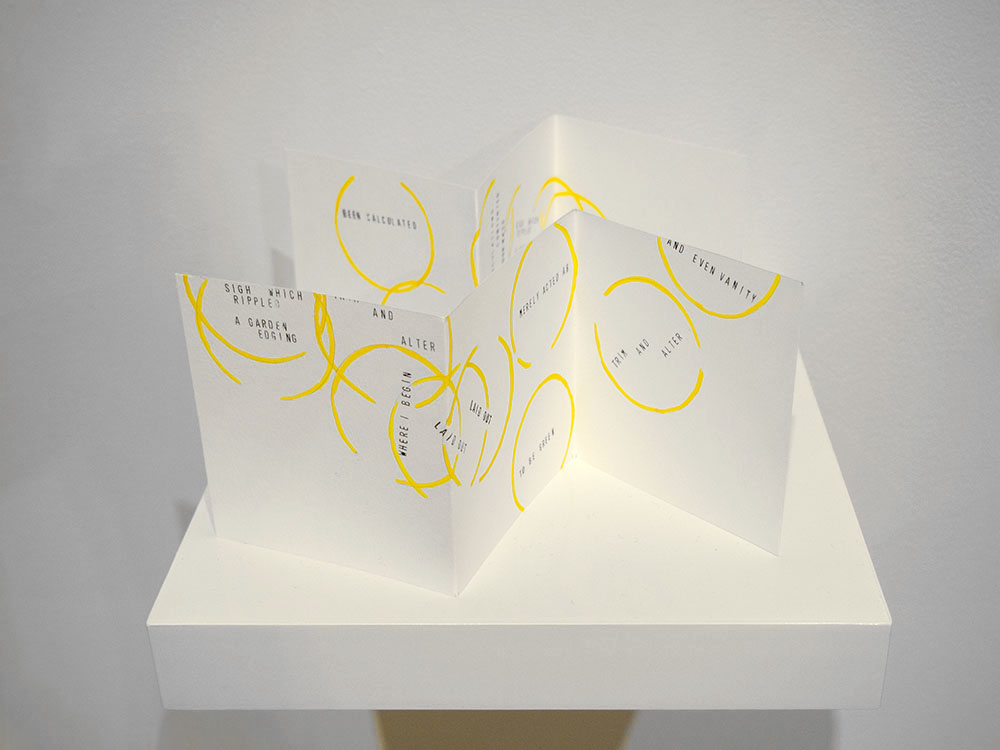
Brooke Ferguson The Small Garden (for M.S.).
Judge Grishin’s comment on the work:
This is an award that is about taking risks, a punt and choosing the unexpected, the promising and the challenging. It is literally a once in a lifetime opportunity for an emerging artist to gain national recognition plus a handy fistful of dollars. I selected the work by the 25‐year‐old Brisbane‐based artist, Brooke Ferguson and her The Small Garden (for M.S.) The MS stands for the wonderful veteran artist, Madonna Staunton, where young Brooke Ferguson was inspired by a poem by Staunton and with gouache, pen and ink and pencil has created a fragile concertina – a beautiful sensibility from a promising young artist.
.
In my opinion some books call for special mention. Caren Florance’s Pleasure demolition is transfixing. The suspended brown paper sheets with a hand printed letterpress phrases from poetry by Angela Gardner are animated by the flow of air and movement in the space. Forever moving, the oscillation of the pages becomes a machine for the generation of concrete poetry… phrases twirl and merge, poetic moments where new meaningful/less messages materialise.
.
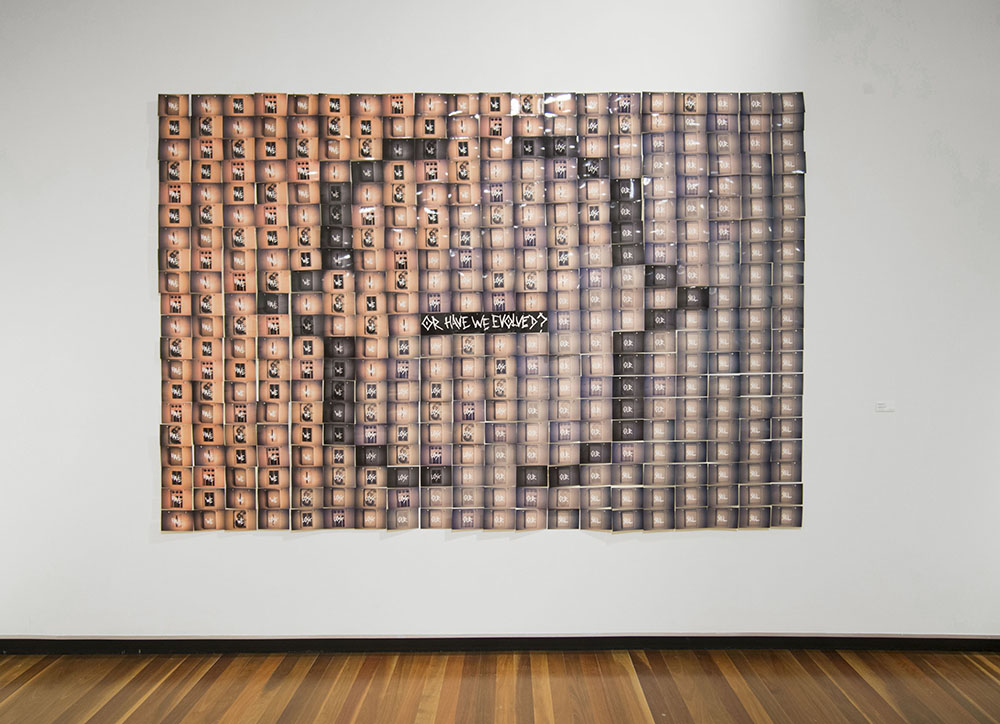
Jamian Stayt’s Soulless evolution
The individual pages of Jamian Stayt’s Soulless evolution are pinned to the wall making what may seem like a vast wallpaper pattern. However, Stayt’s work invites a closer reading of the cipher hidden within the layers of the image. He presents some big questions where contemporary notions of tradition are challenged and rapidly changing technology has intertwined agency in the evolutionary pathway for humanity.
.
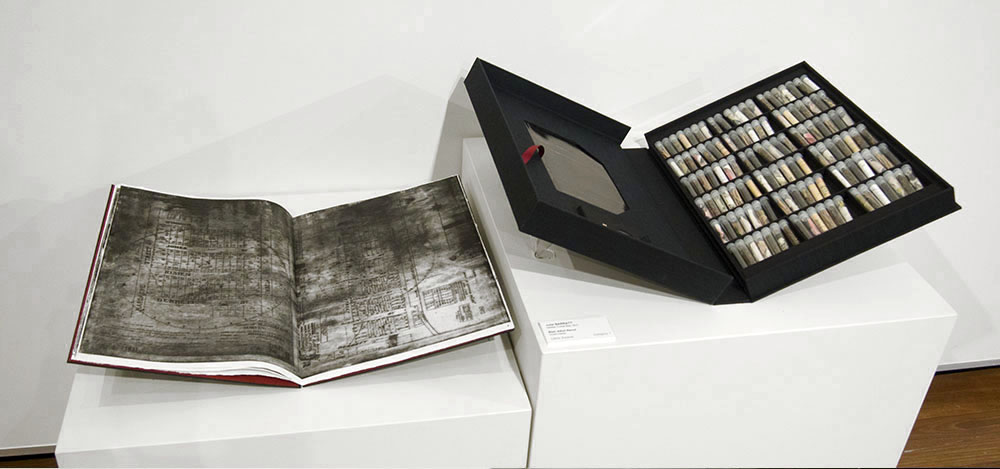
Julie Barratt Blair Athol recut
Julie Barratt’s Blair Athol recut refers to Solastalgia: a theory on the contemporary human condition for a deep loss of place. In one part of the installation there is a book of dark photolithographs where maps are encroached upon by black inks. For the reader this growing blackness evokes a gloomy absence. Facing the dark pages in the clamshell container are vials of coloured soils, plant fragments and found objects. Although collected from this disturbed place, these samples are vibrant and alive – perhaps they are the vestiges of childhood memories that recall a different time before the destruction of the physical place by coal mining.
.
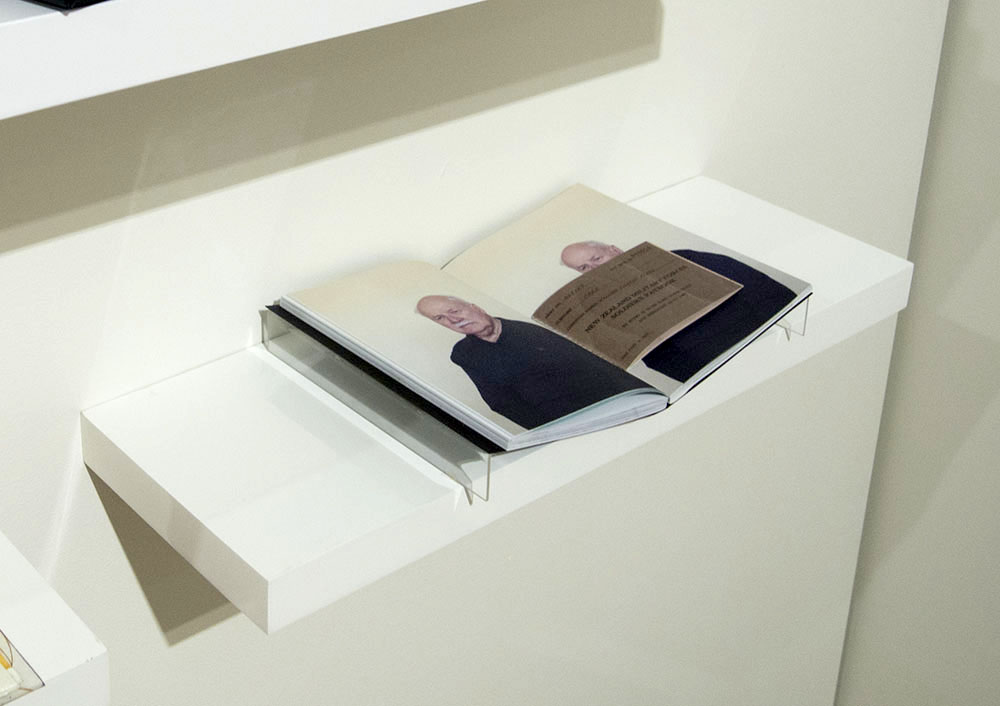
Ana Paula Estrada Memorandum
Many books feature photographs as the primary carrier of the narrative. Ana Paula Estrada’s Memorandum employs the medium to document elderly people and their connection with life through personal photographs and how their memories are re-lived through viewing these photos. The book, conceived and made through the Siganto Foundation Creative Fellowship in the Australian Library of Art at the State Library of Queensland, is a complex assemblage of contemporary portraits, photo-glimpses from family albums and a narrative conveyed through the turning of pages.
.

Exhibition view
.
As usual the artists’ book as exhibition defies direct touch and the turning of pages for narratives to be revealed and for the book to speak of what it has allowed the artist to create. But for the 72 books in the exhibition to be read the visitor would need to stay for the duration of the exhibition, working through the night with white gloves and torchlight. The exhibition reconnects and continues the significant contribution of the Artspace Mackay’s Libris Award to inspire artists and create a space discourse on the book in all its forms. In doing so the assembled exhibition represents cutting edge survey of Australian artists’ book practice.
Some works will become part of the Artspace Mackay collection; others will be re-packaged and returned to their makers. While the exhibition is dispersed its spirit will continue in the form of the gallery’s excellent illustrated catalogue, the text of Grishin’s speech, reviews, videos and other commentaries such as this, as well as the memories of the readers who viewed the show.
In two years time – the next iteration of this important event in the Australian artists’ book calendar will take place again. Wouldn’t it be nice if the whole collection could be purchased and held in perpetuity as a record of the discipline? Until then …
Dr Doug Spowart
16 October 2016

DOWNLOAD THE CATALOGUE: 2016-librisawards_illustratedlistofworks
Click to access 2016LibrisAwards_IllustratedListofWorks.pdf
.
A VIDEO FLY-THRU OF THE EXHIBITION
OTHER BOOKS FROM THE EXHIBITION

Denise Vanderlugt with her highly commended bookwork I used to wrap rainbows
Peter LYSSIOTIS Blind spot
Martha BOWMAN You could have sent an email or a text
Jamian Stayt’s Soulless evolution (Detail)
Bernard APPASSAMY Constellation of endearment (Detail)

Deanna HITTI Assimilated museum

Gracia HABY and Louise JENNISON Closer to natural
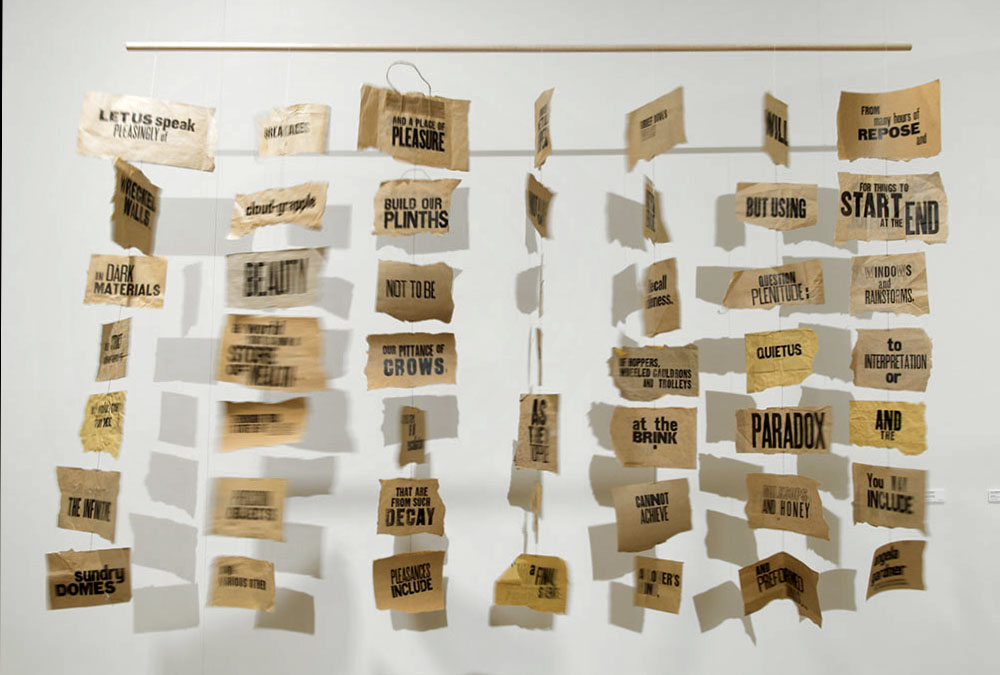
Caren Florance’s Pleasure demolition
.
.
All photographs and videos ©2015 Doug Spowart. Main text (except Judge Sasha Grishin’s words) ©2016 Doug Spowart With thanks to Victoria Cooper for her suggestions and edits.
.
.
DOUG’s Photobook Research: NLA FELLOWSHIP SHORTLISTING
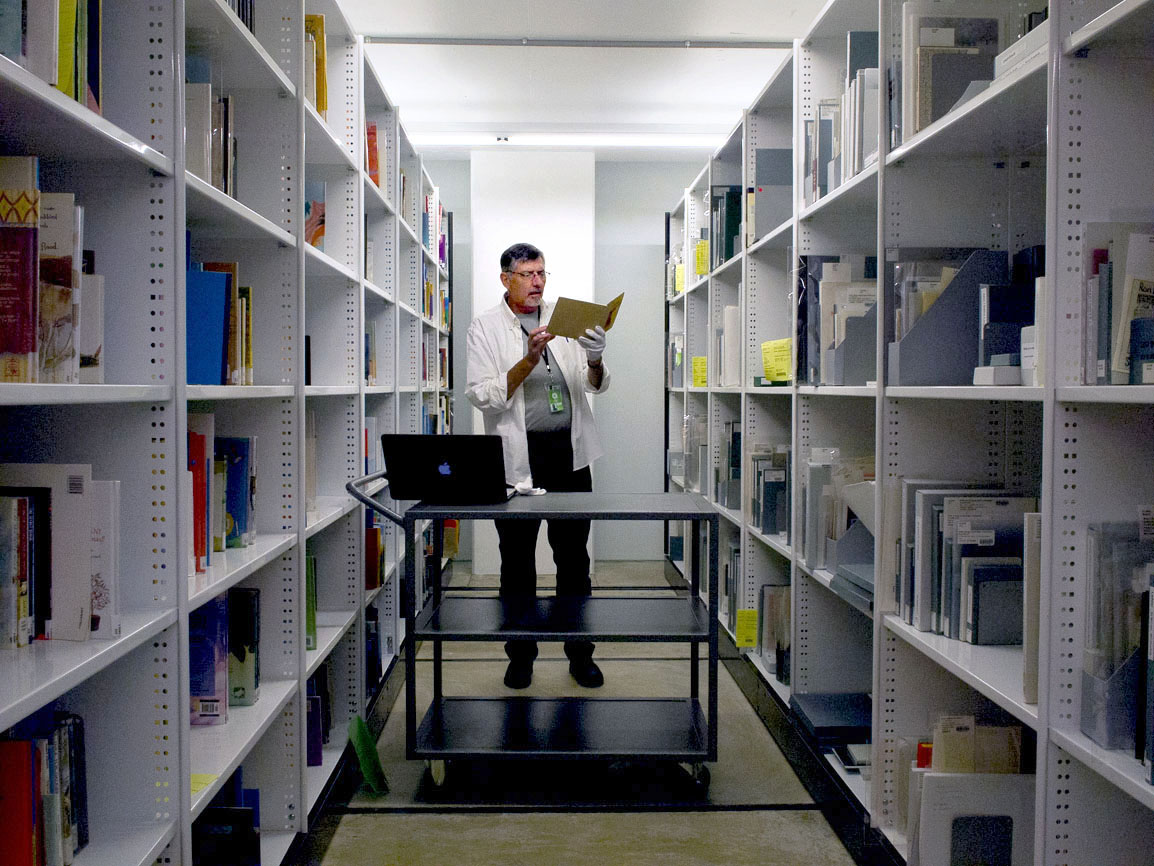
Doug Spowart: researcher in the Repository of the State Library of Queensland
I’VE BEEN HOLDING MY BREATH FOR MANY WEEKS – waiting for an email about an amazing research opportunity at the National Library of Australia that I’d applied for and had heard, unofficially, that I had been shortlisted. A 3-month research Fellowship with access to the Library’s extensive resources, remuneration and living expenses was a possibility that was tantalisingly close. Importantly, the Fellowship would enable me to significantly enhance and create some conclusion to years of independently funded study in my chosen field of photobooks – particularly Australian photobooks.
A couple of days ago I received the email…
Dear Dr Spowart
Thank you for applying for a National Library of Australia Fellowship. I regret to inform you that your application on this occasion was unsuccessful. There was a large field of highly competitive applications from both established and early career researchers and from independent scholars, making selection a challenging task for the Library’s Fellowships Advisory Committee.
For your information I have included some components of my NLA Fellowship application.
TITLE: Looking into a mirror – The Australian Photobook 1970-2000
When we look into an Australian photobook and we see our history, our culture and ourselves. Although interest in the photobook internationally in the last 10-15 years has sparked academic research and the publication of numerous histories this has not been reflected in the Australian scene.
In 2011 NLA Harold White Fellow Dr Martyn Jolly conducted research that covered broad aspects of Australian photobook publishing with a concentration on the rise of the photographically illustrated book in the 1960s. He stated that this era: ‘…set the stage for Australia’s much better known ‘photography boom’ of the 1970s’.
This research Fellowship will address the need for research, critique and commentary to discuss the Australian form of the photobook. The resulting presentations and publications are intended to celebrate the photobooks’ special ability to provide a time capsule snapshot of political, environmental and social movements beyond Jolly’s 1960s research.
As a visual communication medium the photobook becomes a mirror to the nation through which we can see not only ourselves, but also how we present our country to the world. This research will ‘look into the mirror’, and reveal the valuable contribution that photobooks, through image and design, made in telling Australian stories.
The need for the research
In Australia the main focus of published research in photography has been of the photograph itself with scant recognition for the photographically illustrated book. This is despite the fact that the photobook, although considered as being primarily about photography, by default, also represents Australian graphic design history. Photobooks then are a collaborative product where the photograph and graphic design synergistically merge to create a sophisticated communiqué.
Dr Martyn Jolly noted in a paper published in the History of Photography journal that: The role of the photobook has been unjustly neglected in the various histories of Australian photography. However, books primarily illustrated with photographs and celebrating various aspects of Australian life and landscape – ‘Australiana’ photobooks – have been a fundamental part of the nation’s publishing industry since the 1920s.
Recently, the Art Gallery of New South Wales’ exhibition The Photograph and Australia was acclaimed as one of the largest collection of historical photographic images in Australia, and yet only only showed five photobooks. In the exhibition’s catalogue introduction Curator Judy Annear, makes no apology for what may seem as the marginalisation of the photobook but rather acknowledges that there is so much more to be done. She states in the concluding sentence that: The history of the photograph and its relationship to Australia remains tantalisingly partial; the ever-burgeoning archives await further excavation.
The research
My research will cover the date range from 1970 to 2000 and will follow on from Dr Martyn Jolly’s Harold White Fellowship area of review.
As a result of PhD research and post-doctoral work on the intersection of artists’ books and photobooks I am well positioned to review and comment on the twin perspectives of photography and book design.
The Aims of the research
The aim of my proposed research at the NLA will be to:
- Provide a structural framework for the discussion of Australian photobook in the era 1970-2000;
- Identify aspects of the Australian photobook including graphic design and narrative expression that contribute to its own unique identity in an international context;
- Seek opportunities to identify and give prominence to photobooks and their makers; and
- Elevate the stature of the photobook in contemporary photography and design discourse in Australia.
Aspects of the research
Aspects of the research include:
- The presence and influence of design trends in photobooks of the era;
- Circumstances where the photographer may have been the designer of the book as is the case with many Mark Strizic books;
- The emergence of the artists’ book based on photography such as Peter Lyssiotis’ photomontage works;
- Art photography and its exploration of photographic representation in the form of the book;
- Photobooks exploring themes of Feminism;
- Landscape photography and its alliance with environmentalism; and
- Evidence of the emergence of land rights and Aboriginal activism through photobooks.
Other details of the application followed…
.
I will apply again and for the moment continue my personally funded research.
.
Until next time, the researcher awaits an opportunity…
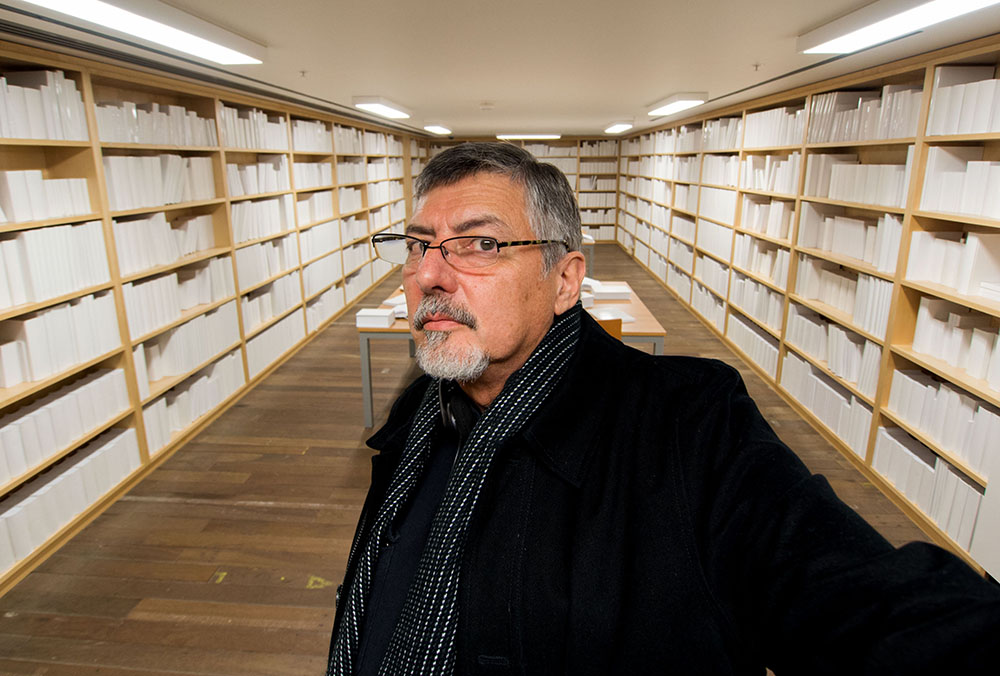
Portrait of the author in Wilfredo Prieto’s ‘Untitled’ (White Library) at MONA
VICTORIA COOPER: Shortlisted for National Library Creative Fellowship
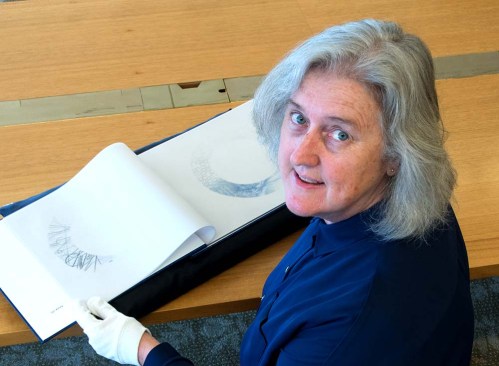
Victoria Cooper researching artists books
I was recently shortlisted for a Creative Fellowship at the National Library of Australia. Even though I was not successful in receiving the fellowship, this level of recognition for my project is very exciting. For a long time I have been dreaming about a project in which I can unleash the bunyip from its exile within the contemporary narrative of children’s books. Muzzled by anthropomorphism, this chimera of the dark swampy corners of Australia may seem to be docile and quaint, but I believe there is still a sublime wildness within–waiting to surface…..
This was my proposal for the National Library of Australia’s Creative Fellowship
The bunyip was once a feared monster of Australian waterways and swamps. In this project I ask: Where is this chimera of Indigenous and early colonial storytelling and myth to be found in contemporary life? Has this fearsome spirit been tamed through parody or clichéd as the mythical swamp creature found only in children’s storybooks or travel brochures?
Perhaps as Henry Rankine, of the Ngarrindjeri tribe in South Australia, proposes in Robert Holden’s 2001 book ‘Bunyips, Australia’s Folklore of Fear’:
‘So the Bunyip (the Mulgewongk) he is still in our Dreamings. He is still there today, just like we have fast jets in the sky, we still have got that fellow in the river’.
Through the opportunity provided by the Creative Fellowship, I had hoped to build upon preliminary research highlighted in my PhD[i] by engaging with the National Library’s substantial collection of material on the bunyip. I had intended to build a visual and textual resource to underpin my development of an alternative concept of the bunyip.
Ultimately this work would form the basis of creative visual narratives that are intended to challenge, re-imagine and re-establish a sense of wonder and respect for this arcane, sublime phenomenon.

Victoria Cooper’s artists book “Koolunga Bunyip” 2007 collected by the National Library
The Project Continues:
Strongly guided by the contemporary theory of Solastalgia[ii], both Doug and I plan to continue this research as an integral part of our individual and collaborative practice. Our Nocturne Projects and many bookworks are created in response to the current issues of living with this transforming human/nature relationship.
[i] My research project, I have witnessed a strange river, can be found online at James Cook University research online site: http://researchonline.jcu.edu.au/31799/
[ii] Solastalgia: the distress caused by environmental change
Glenn Albrecht , Gina-Maree Sartore, Linda Connor, Nick Higginbotham, Sonia Freeman, Brian Kelly, Helen Stain, Anne Tonna, Georgia Pollard Australasian Psychiatry Vol. 15, Iss. sup1, 2007
PERFORMING the BOOK @ SLQ – Siganto Artists Book Seminar
The Siganto Artists’ Books Seminar 2015
On June 20+21 the 2015 The Siganto Artists’ Books Seminar took place at the State Library of Queensland. Attendees were presented with a one–day series of lectures, performances and a forum addressing the diversity of the artists’ book and importantly visual and creative research being undertaken by Fellowships supported by the Siganto Foundation.
State Librarian Janette Wright welcomes attendees to the seminar
The State Librarian Jeanette, introduced by MC Christene Drewe, spoke of the Library’s Artists’ Book Collection. This was followed by Dr Marie Siganto from the Siganto Foundation who spoke enthusiastically about the Foundation’s support of the Artists’ Book Collection.
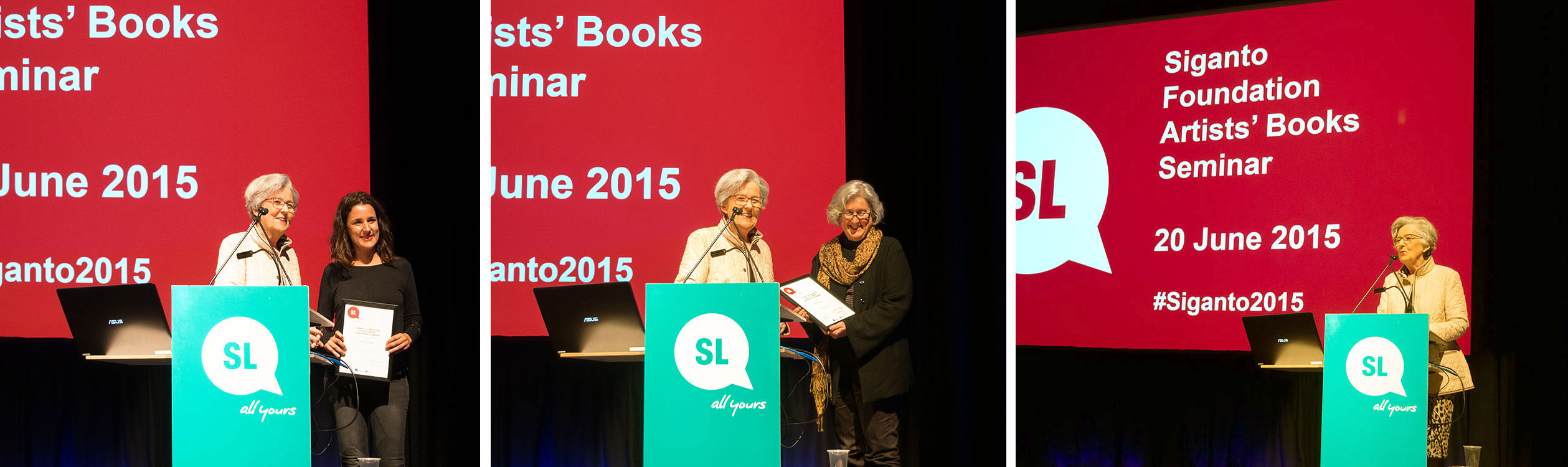
Dr Marie Siganto makes a presentation to the attendees of the seminar and presents 2015 Fellowships
A significant theme of this years’ event was based around the idea of artists’ books as performance. Brazilian artist, performer and academic Amir Brito Cadôr’s presented his keynote address The Book as Performance – he also performed a book reading of Momento Vital by Brazilian artist Vera Chaves Barcellos.
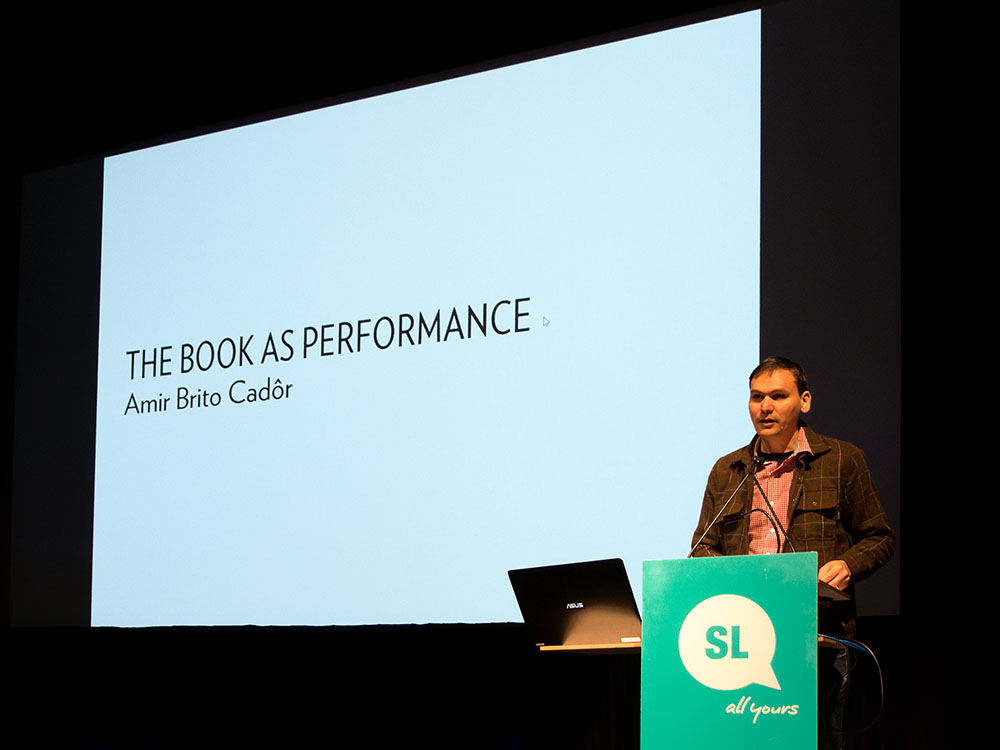
Amir Brito Cadôr makes his keynote presentation
In the morning session 2015 Siganto Foundation Artists’ Books Fellows Clyde McGill and Julie Barratt presented progress reports on their research projects. Jan Davis discussed her 2014 Creative Fellowship and presented the completed artists’ book to the Library. The book was entitled Drawing on the ground and referenced the historical aspects of work and toil on Queensland farms. Reference material for Jan’s book came from diaries, books and documents held by the Library. Her artists’ book features text fragments and line sketches – the book was bound by Fred Pohlman and the cover was styled to resemble an old station journal.
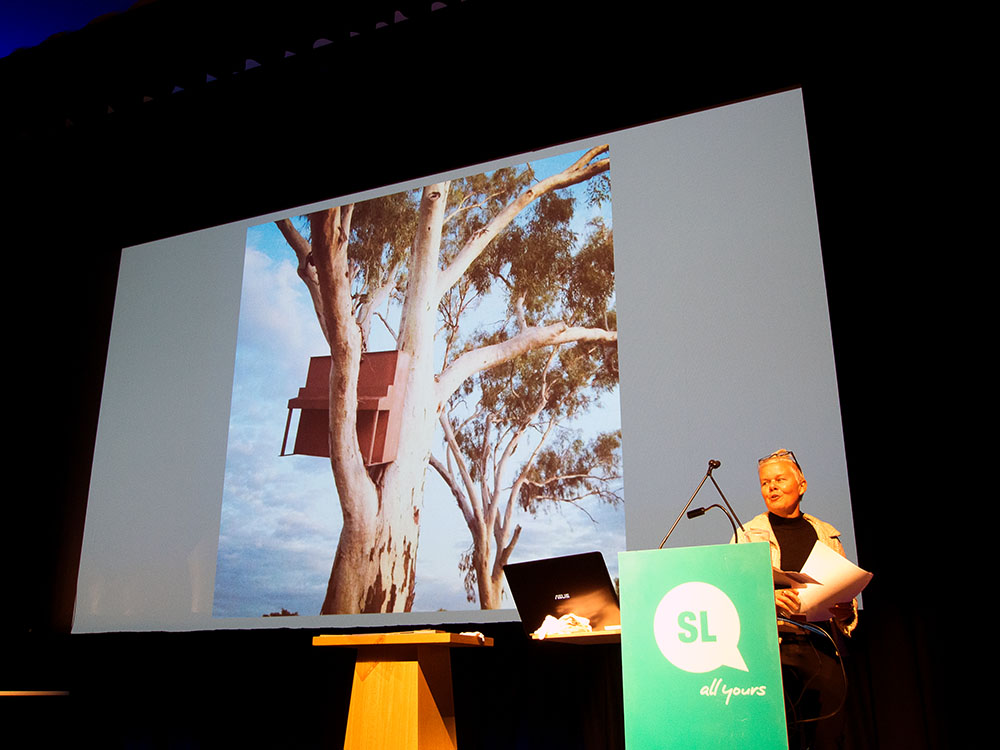
Julie Barratt discusses her Siganto Creative Fellowship
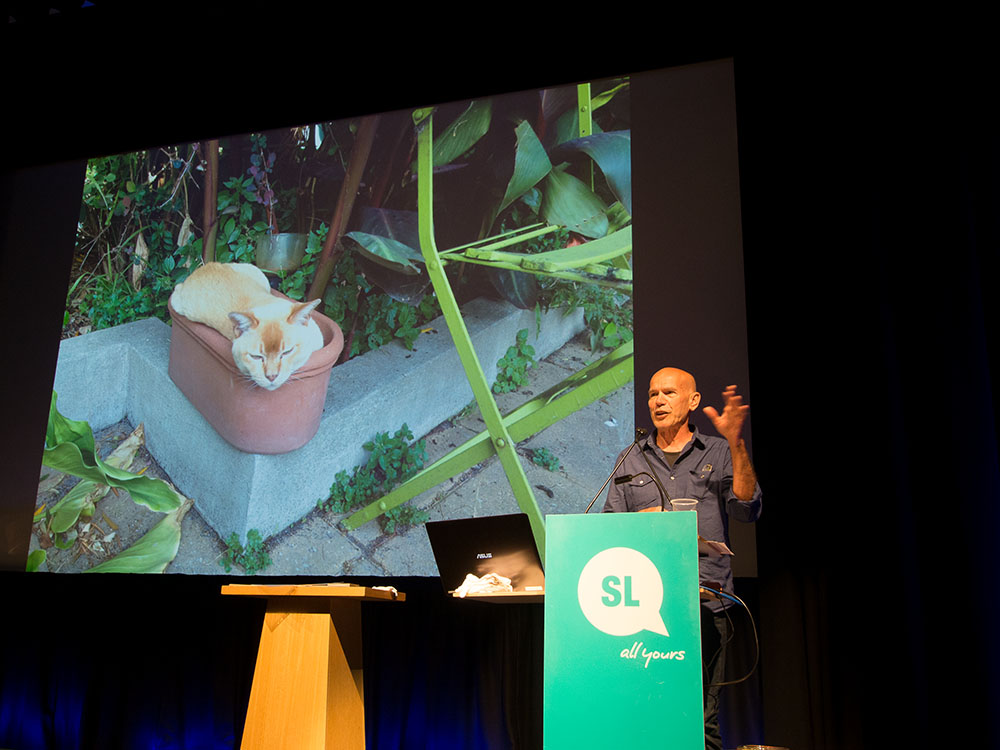
Clyde McGill discusses his Siganto Artists’ Book Creative Fellowship
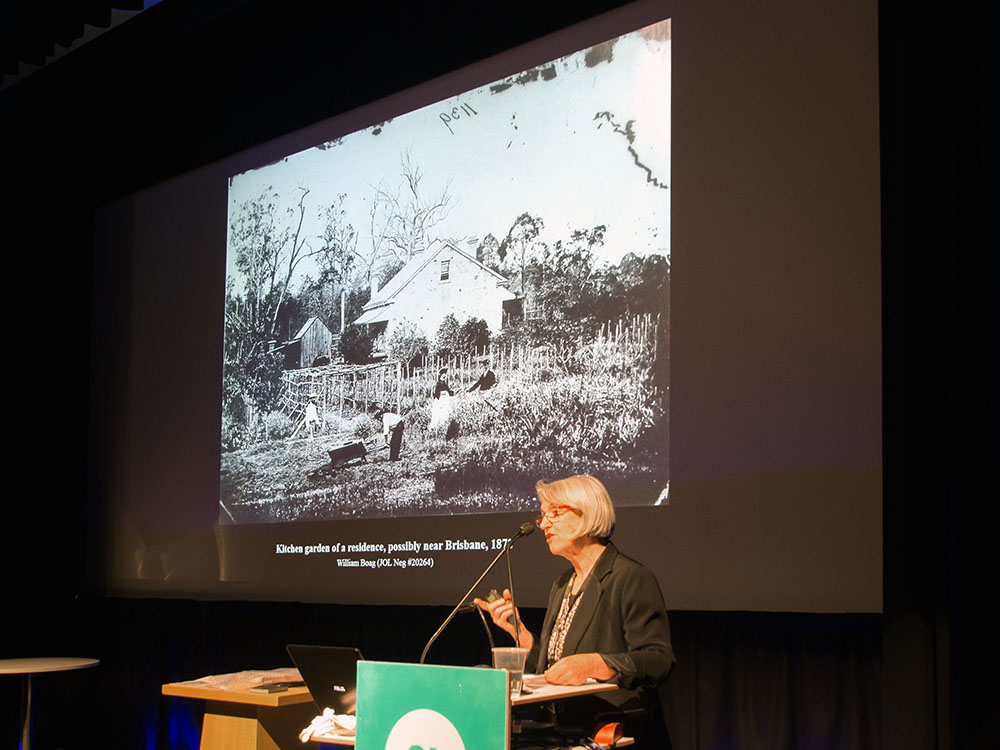
Jan Davis discusses Drawing on the ground, her Siganto Artists’ Book Creative Fellowship
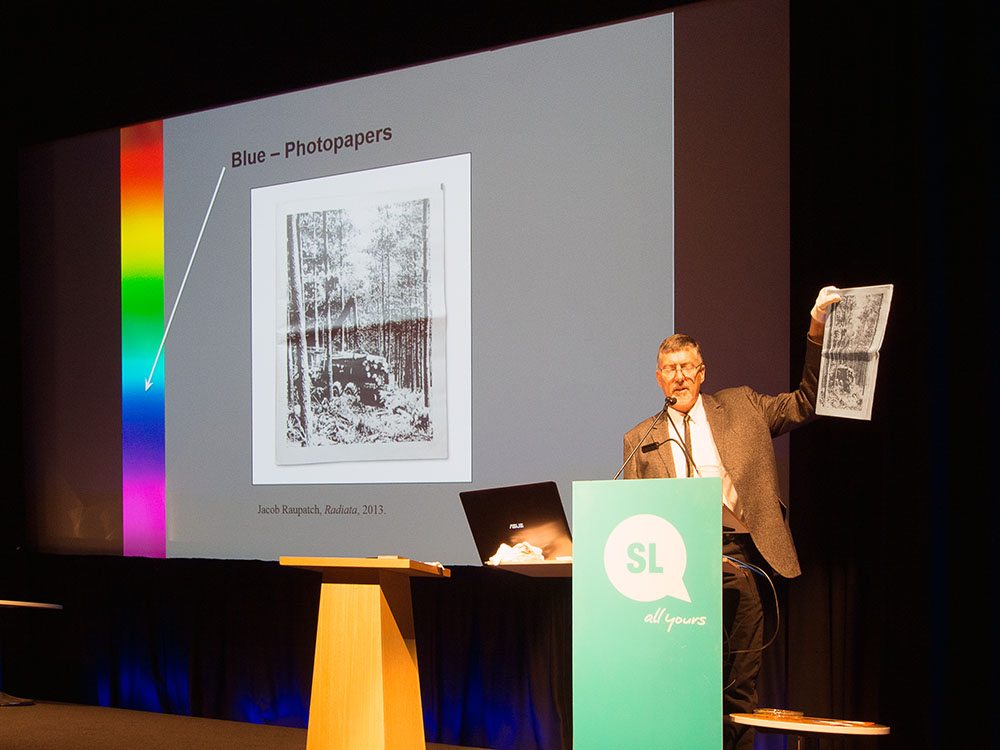
Doug Spowart discusses Jacob Raupach’s Radiata
As the 2014 Siganto Artists’ Books Research Fellow I presented an illustrated lecture on my experiences as a researcher of the Australian Library of Art, a selection of the range of books I encountered that employed photography from very minor references in text to conceptual pieces based on photographs. This list included:
Anne Wilson in, Tock 01-01-2000, 2000
Codex Event: Darren Bryant .. [et al.], Wild Cherry Tin Mine, 2006.
Vince Dziekian, Blooms Books, 1993-4.
Barbara Davidson, Different moods of the Opera House, 2001.
Felipe Ehrenberg, Generacion 1973
Peter Kingston, The Blue Mountains, 1987.
Michael Buhler, Oblique Lines, 19-.
William Copley Notes on a Project for a Dictionary of Rediculous Images, 1972.
Adam Broomberg + Oliver Chanarin, Holy Bible, 2013.
Judy Barrass, Eden-Monaro in Summer, 2001.
Juli Haas, The oyster book of lessons from the memory room, 2007.
Jihad Muhammad aka John Armstrong, Ten menhirs at Plouharnel, Carnac, Morbihan, Bretagne, France, 1982.
Angela Callanan, 7 Signs of Absence, 2010.
Susan King, Photo bio, 2011.
Malcolm Enright, Western Wisdom, 1998.
Pierre Cavalan, Artists Book, 1998.
Compiled by Kay Faulkner Indulge, 2006.
Debra Gibson, Kamikaze, 2004.
Dick Jewell, Found Photos, 1977.
Julie Barratt, Collateral damage, 2008.
Alison Knowles, Bread and Water, 2004.
David King, Raw deal, 1997.
Valerie Keenan HY1, 2001.
Tim Johnson, Fittings, 1972.
Christian Boltanski, Scratch, 2002.
Amanda Watson-Will, Judy and the Jacaranda, 2010.
Phillip Zimmerman, High tension, 1993.
Jan Davis, Solomon, 1995.
I then disclosed the principal research product the paper: The artists’ book, the photobook and the photo-a spectral approach, as well as recommendations to the Library for photobooks to be relocated from the General collection into places that reflected the significance of these books in the history of photography and the photobook. I also supplied Photobook Publishers and Info URLs that could be used by anyone wanting to keep up with new photobook releases an purchasing opportunities. I particularly noted that the Library held no Trent Parke books and provided, as an example, his book Dream Life that could have been purchased in 2000 for around $60 is now sold for $1,000+. Highlighting the need for the SLQ to be pro-active in purchasing contemporary book for modest outlay – rather than waiting until they are nearly unaffordable. I also highlighted the need for institutions to engage with and maintain links with artists’ book and photobook self-publishers as they exist outside of the usual publishing structures. I quoted Des Cowley, the State Library of Victoria’s History of the Book Manager from a statement made by him in his presentation at the ‘Other Photobook’ forum at Photobook Melbourne. He said:
… It is therefore incumbent upon staff in these institutions to build networks and relationships with the communities creating this work in order to be informed about what is being produced, and to ensure this material is acquired and preserved for future researchers.
My presentation concluded with two quotes from book artist and mail art aficionado Ulises Carrion that I felt related to the contemporary artists’ book and photobook. Carrion states:
I include books in the category of
living creatures … : they grow, reproduce, change colour, become ill and finally die.
At this moment we are witnessing the final stage of this process.
… if books are to survive they have to change. And [artists’] bookworks is the real possibility that books have for survival.
Schraenen, G. (1992). Ulises Carrion : We have won! Haven’t we?
.
HERE IS THE SLQ VIDEO OF THE SIGANTO FELLOW’S PRESENTATIONS
.
Other artists’ book performances included: Virginia and Julie Barratt’s The Morning After, one by Clyde McGill and a performance by QUT drama students of the three-part book Robert Bringhurst’s artist’s book New World Suite number three: a poem in four movements for three voices. The performers were Thomas Yaxley, Emily Weir and Meghan Clarke and was directed by QUT lecturer Floyd Kennedy.
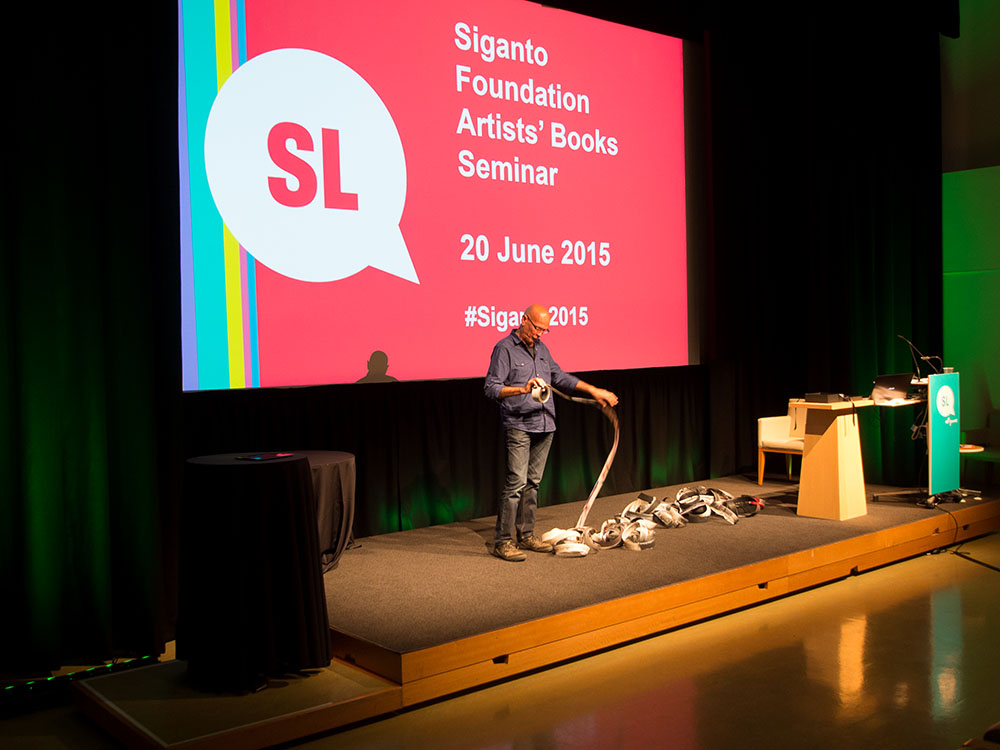
Clyde McGill performs his book
The afternoon concluded with a forum moderated by Louise Martin-Chew on the topic of collaboration. The forum participants were Clyde McGill, Julie Barratt and Doug Spowart. Each participant discussed a project that involved collaboration and questions were posed by Louise to bring out important points from each panelist. The most interesting aspect of this forum was when questions from the floor created heated debate around the idea of the physical book and its experience verses the virtual online experience.
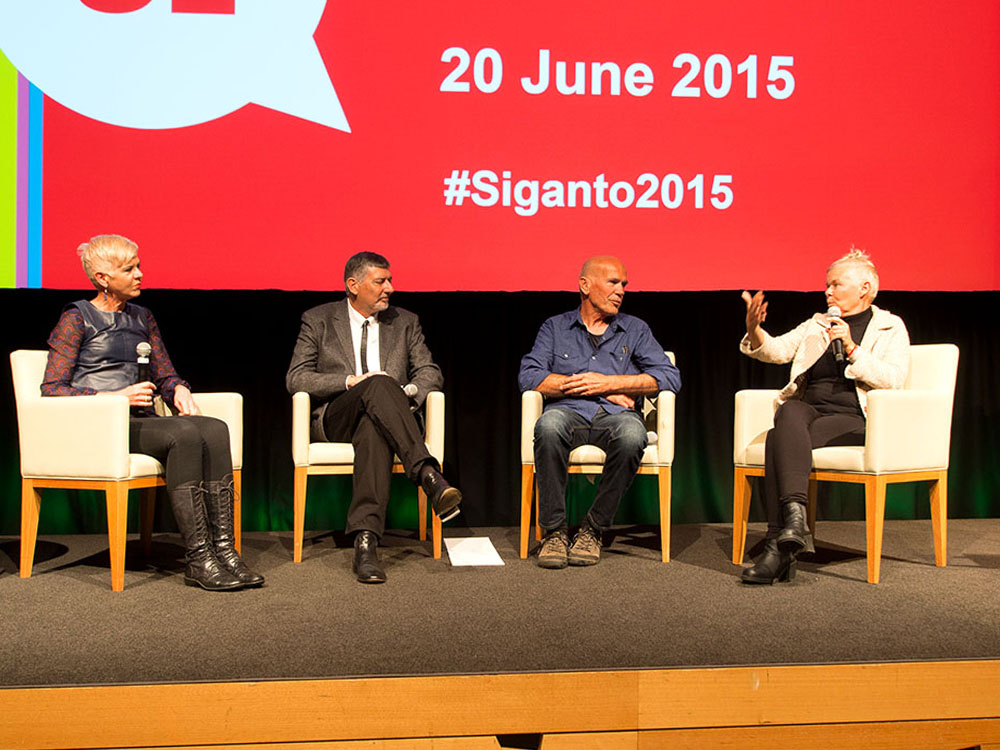
Julie answers a question in the collaboration forum
On Sunday many local and interstate stallholders presented their work for an Artists’ Book Fair in the Knowledge Walk at the SLQ. Tours of selected artists’ books from State Library’s Artists’ Book Collection were well attended and provide rare access to special books from the Australian Library of Art Collection. The two-day event was significant for the opportunity for artists’ book aficiandos, makers, collectors and readers to engage with the physicality of not only the books but also to touch with the extensive community of the book. Our thanks must go to the SLQ, particularly Christene Drewe and Helen Cole, and to the Dr Marie Siganto and the Siganto Foundation for their continued support of the artists’ book collection of the Australian Library of Art and events such as these. Doug Spowart
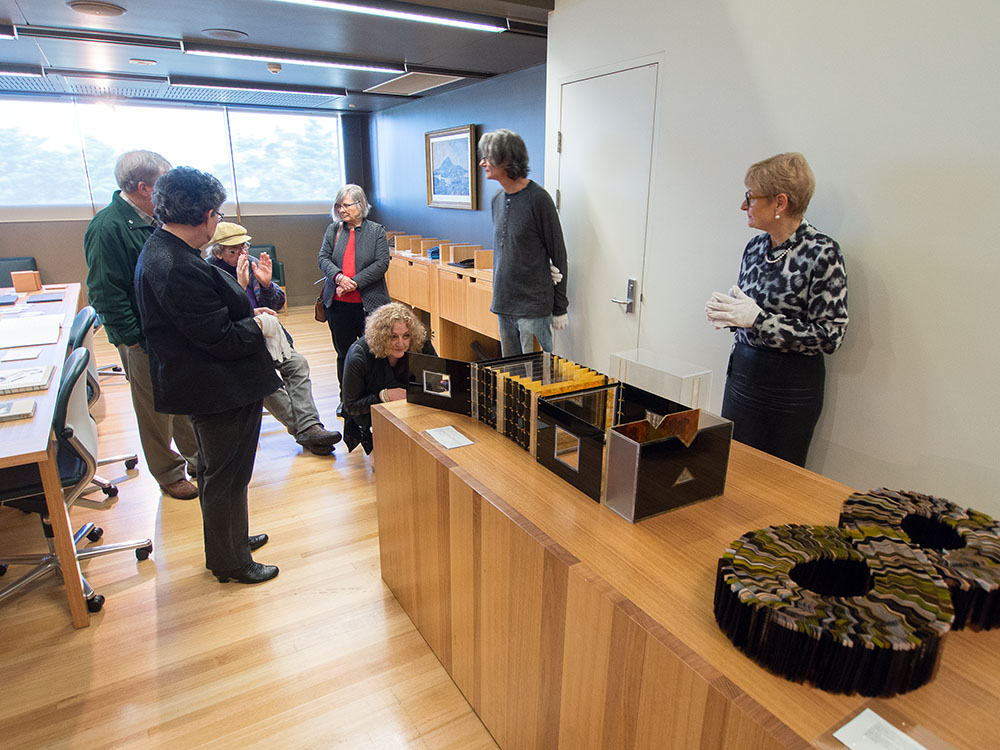
State Librarian, Janette Wright views a tunnel book by Wim de Voss
What follows are a range of images from the Seminar and Artists’ Book Fair
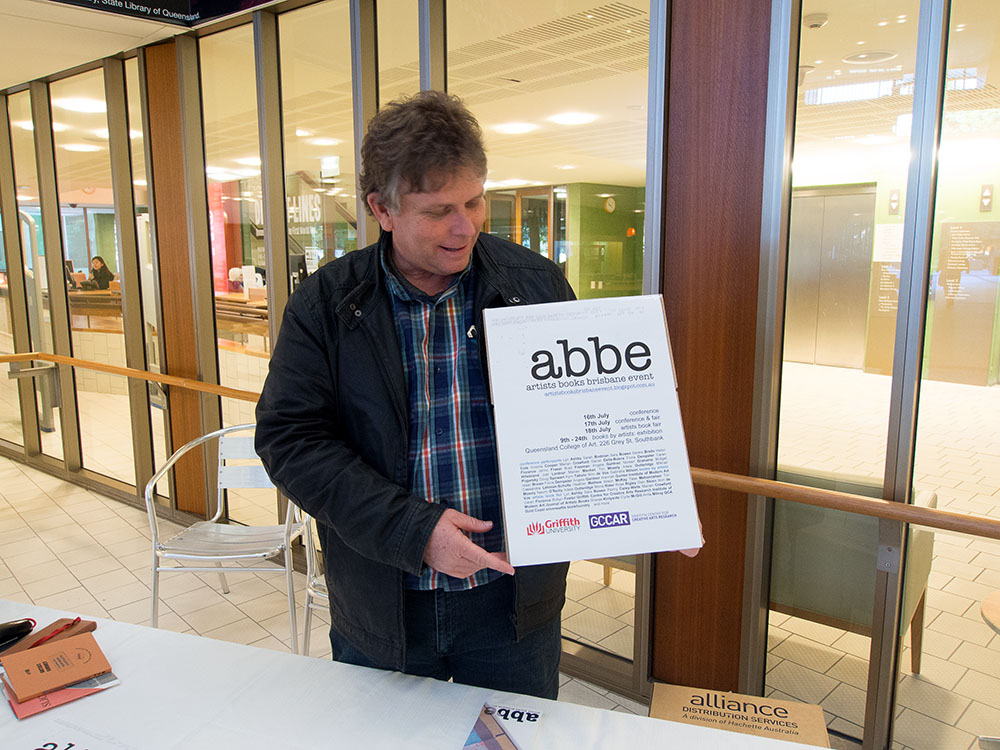
Tim Mosely promotes the ABBE Conference @ QCA in July
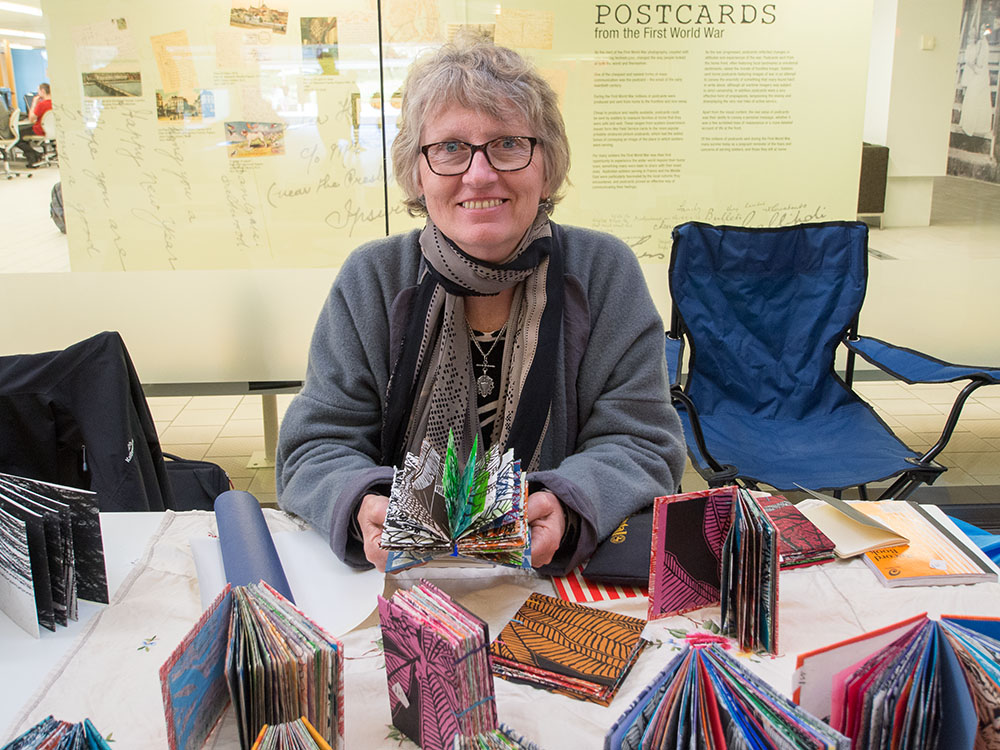
Sue Poggioli at the Artists’ Book Fair
Amir and Noreen Grahame
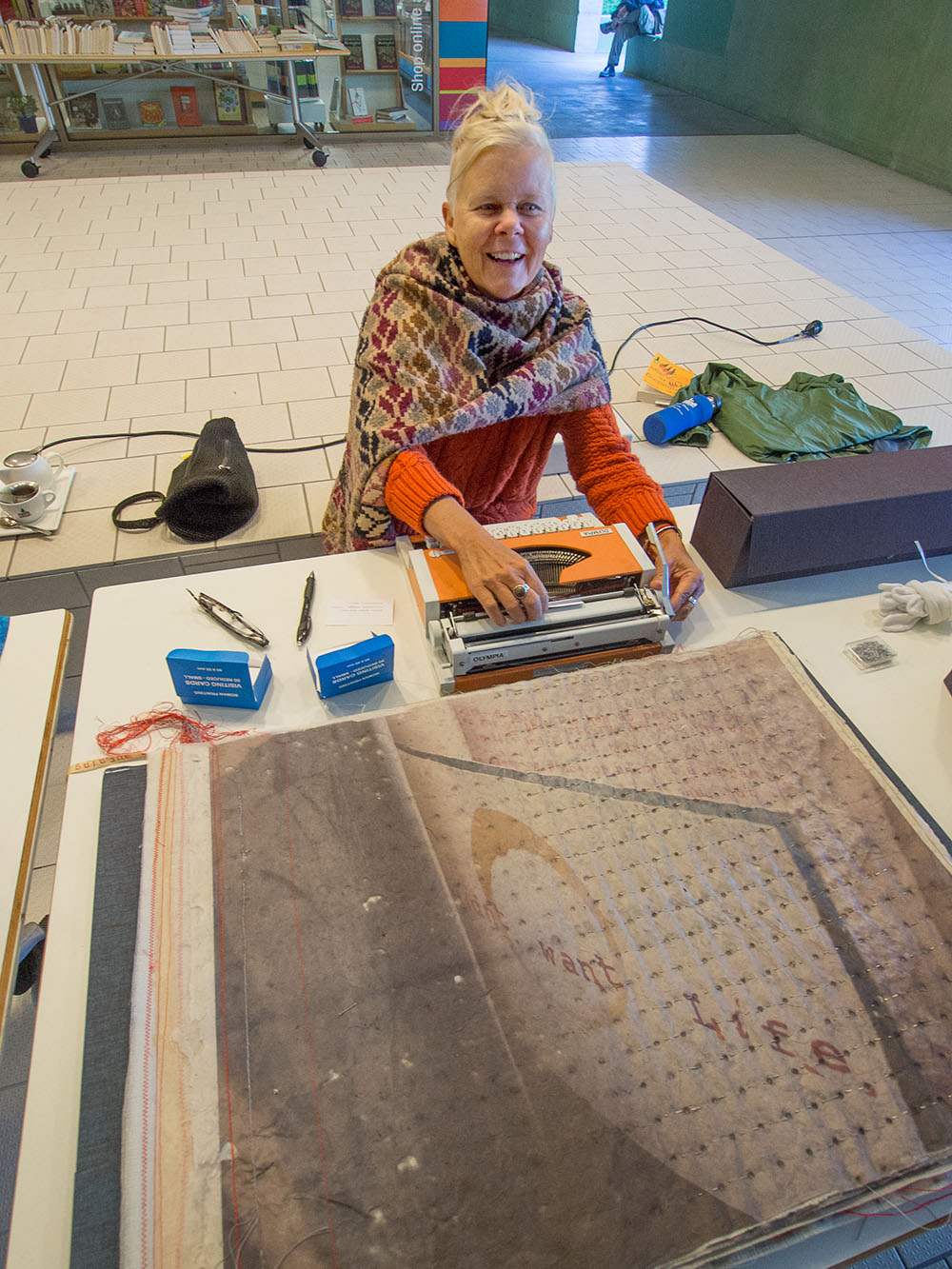
Julie Barratt at the Artists’ Book Fair
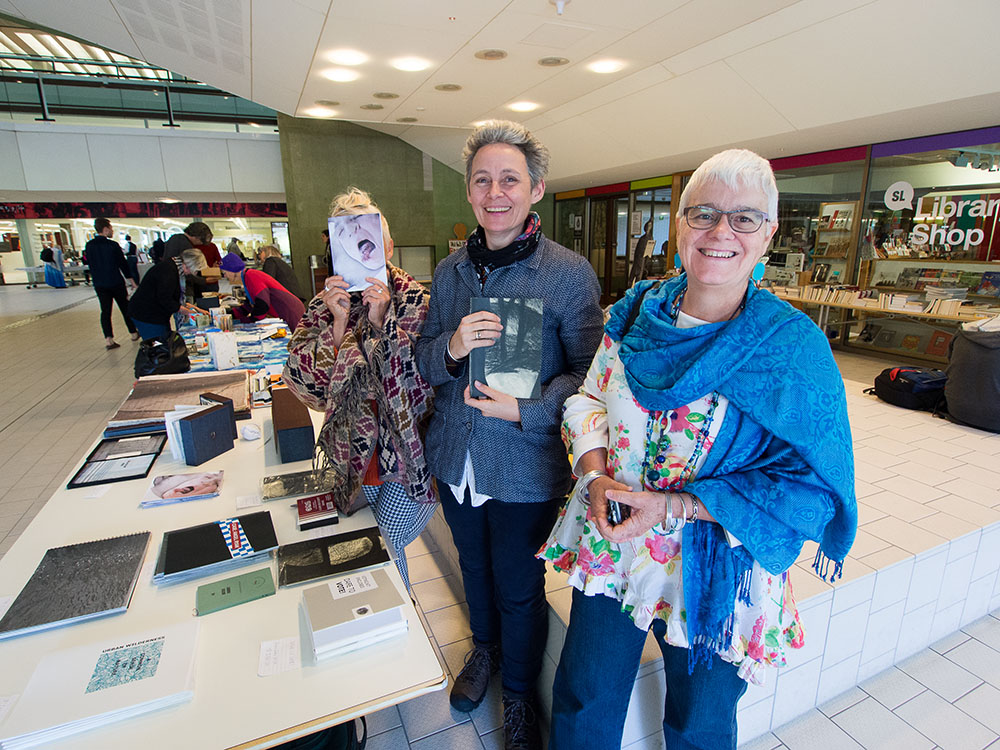
Julie Barratt, Monica Oppen and Helen Cole Artists’ Book Fair
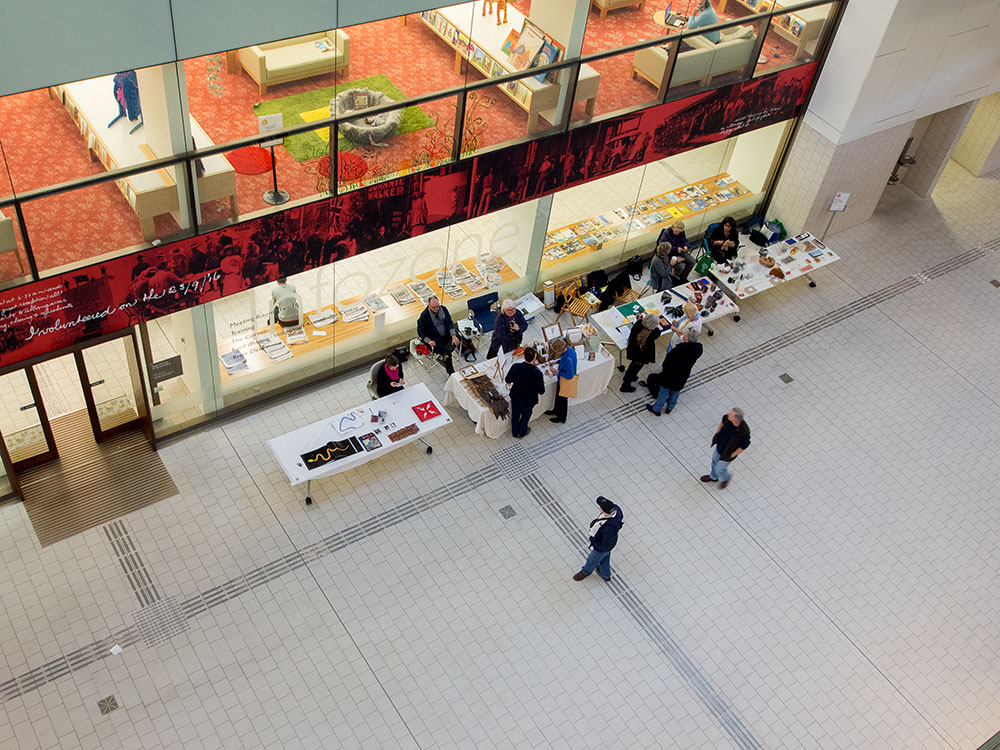
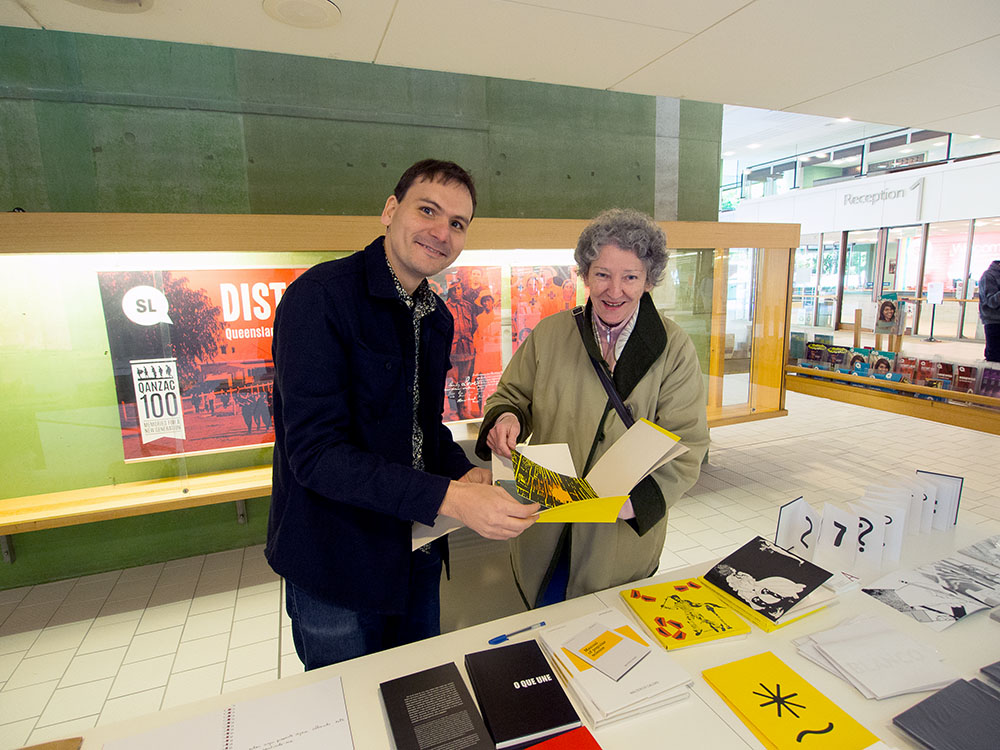
A section of the Artists’ Book Fair at the SLQ
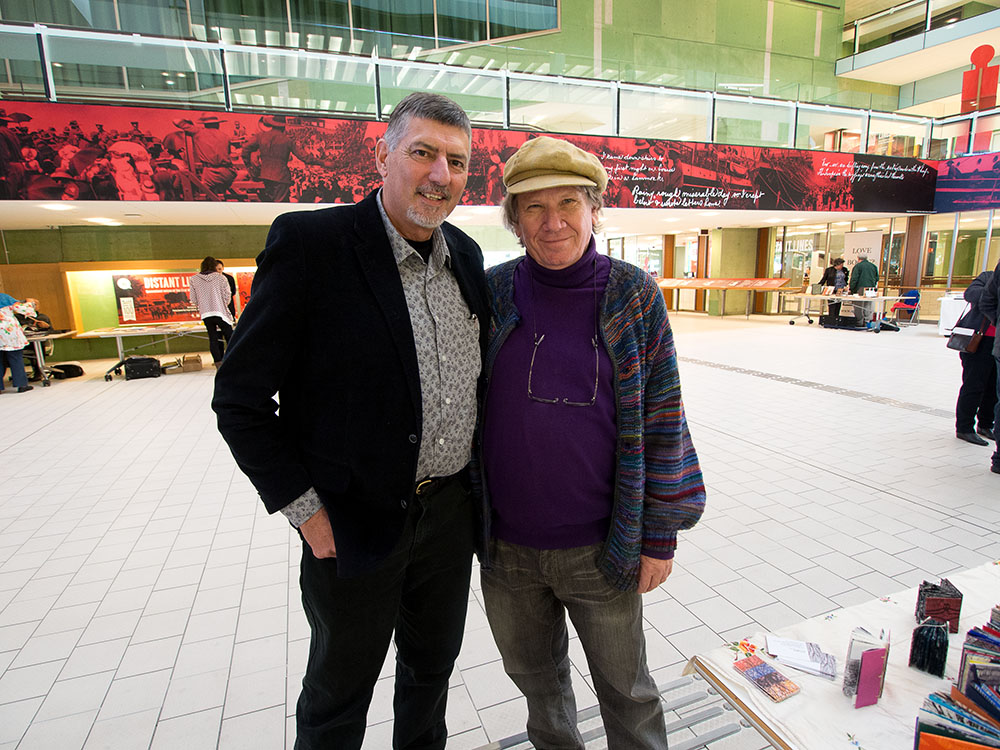
Doug Spowart and Wim de Voss
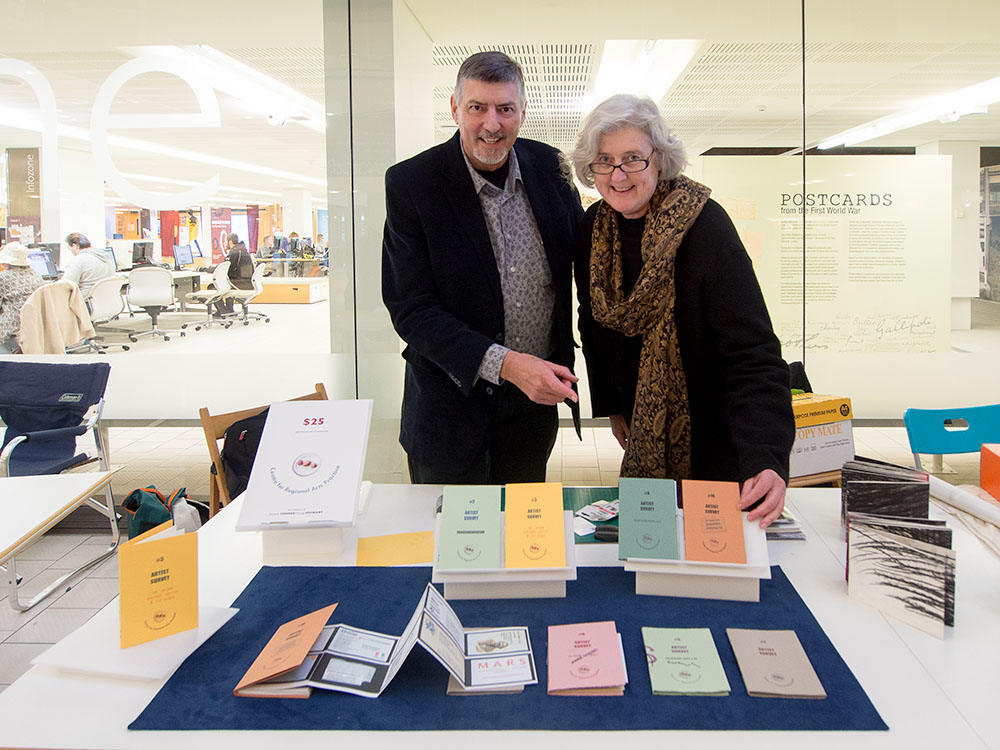
Doug Spowart and Victoria Cooper and their C.R.A.P. display
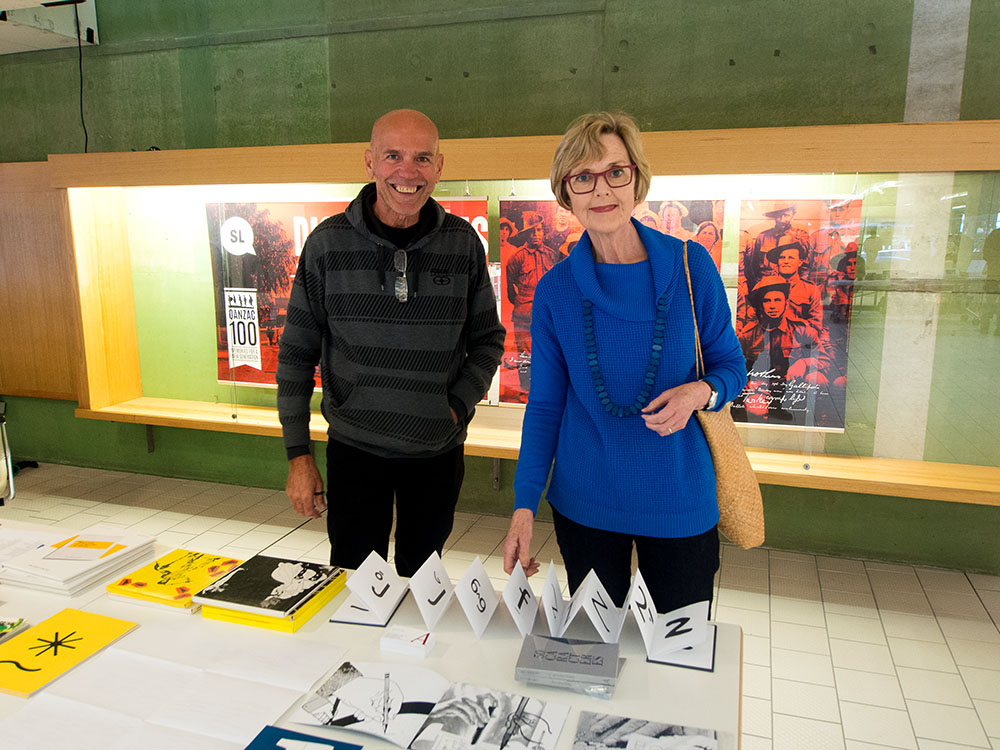
Clyde McGill and Anne Kirker
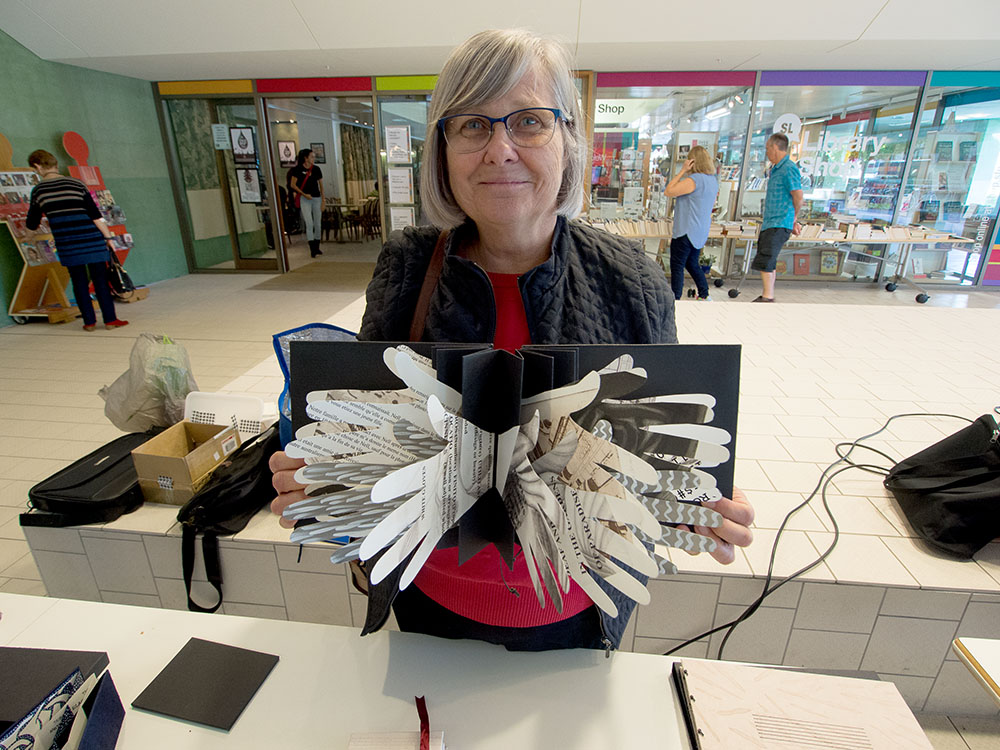
Helen Malone at the Artists’ Book Fair
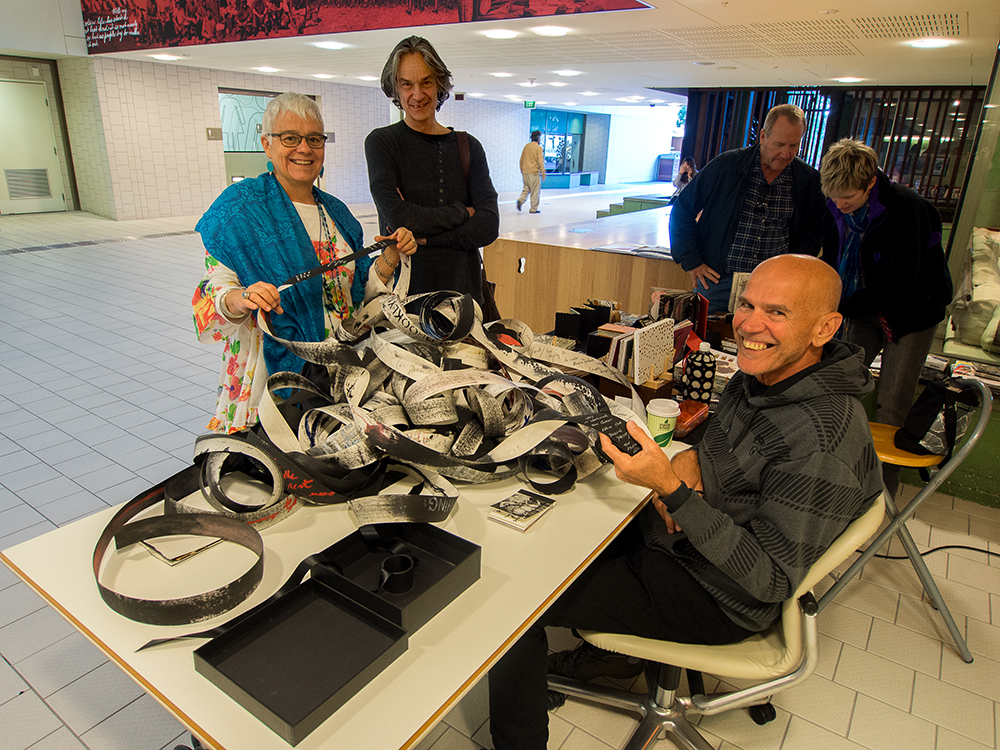
Helen Cole, Michael Wardell and Clyde McGill at the Artists’ Book Fair
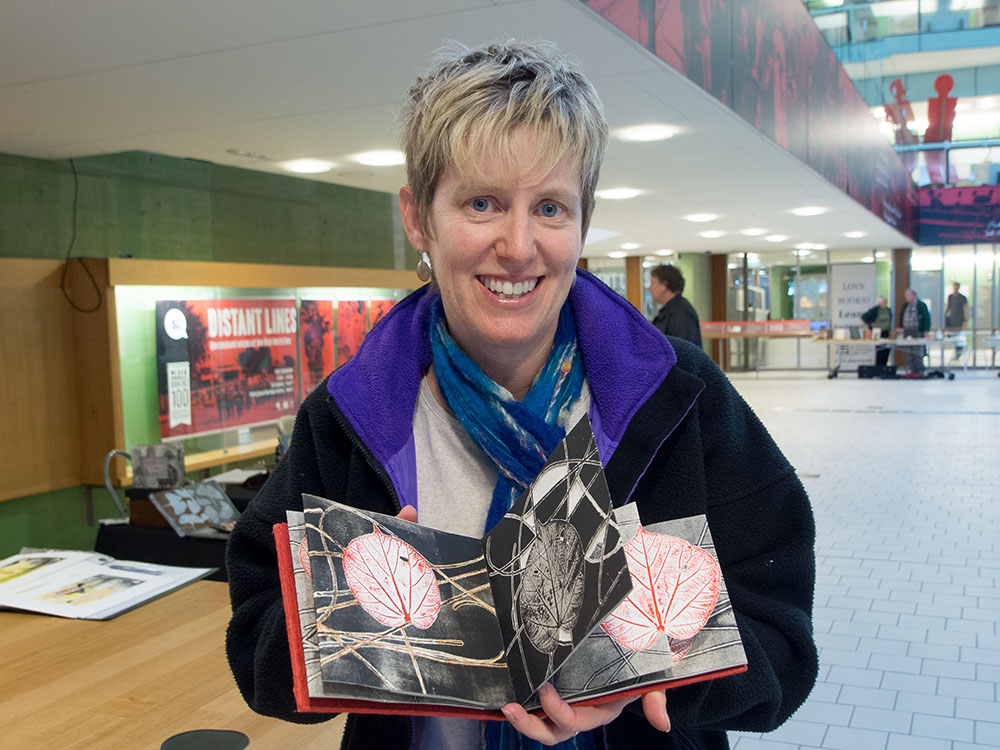
Sandra Pearce at the Artists’ Book Fair
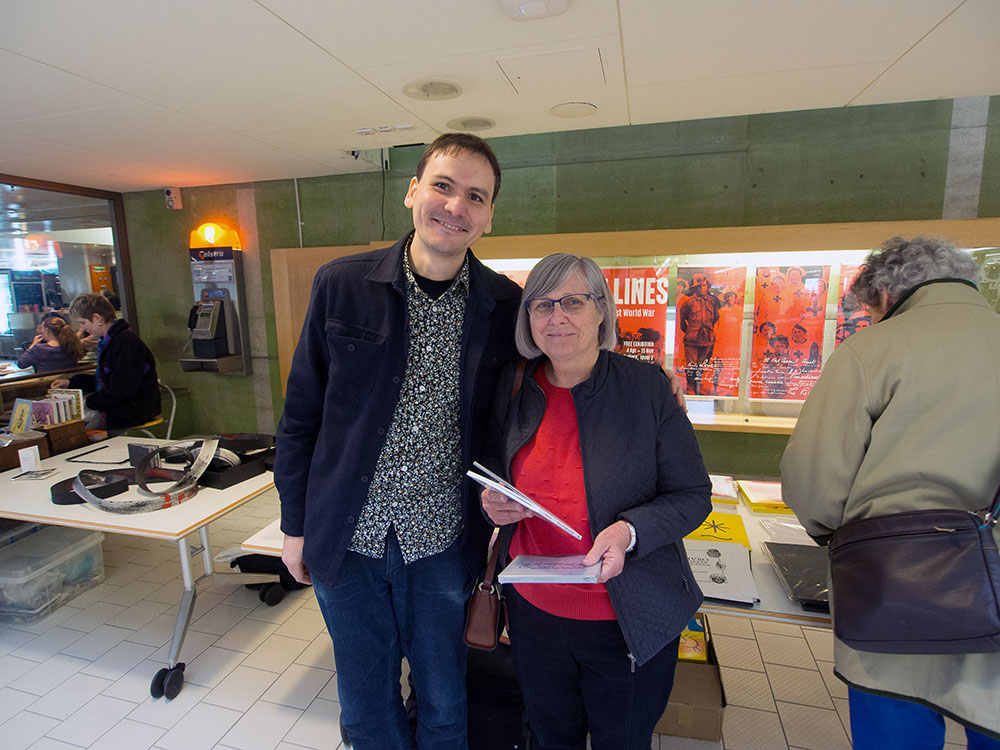
Amir Brito Cadôr with Helen Malone
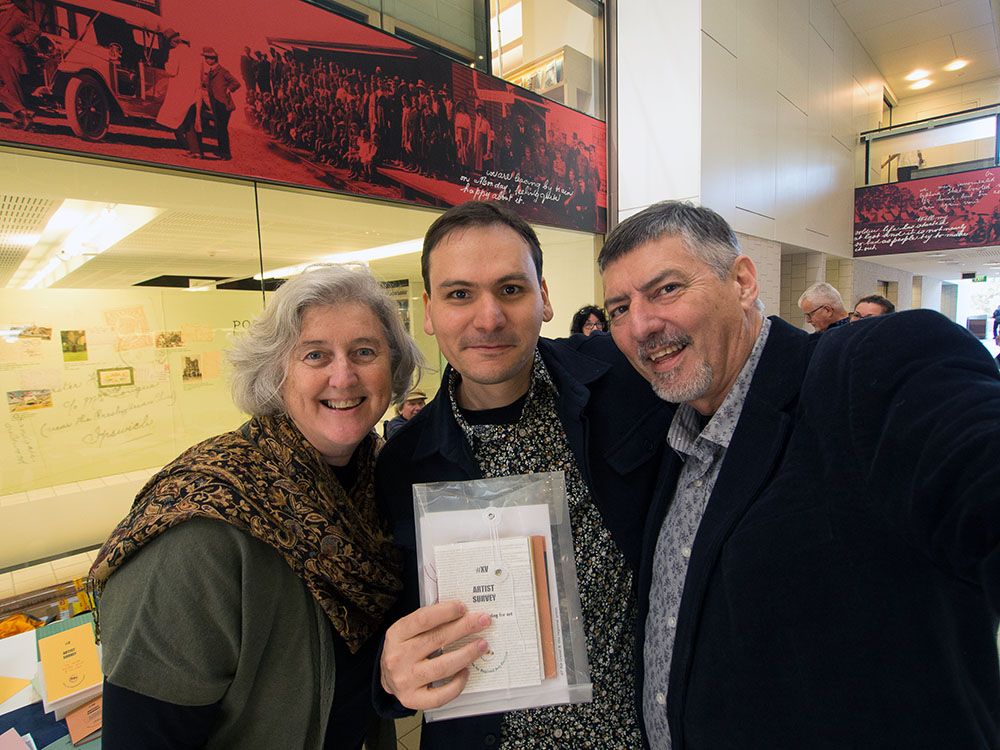
Amir Brito Cadôr with Victoria Cooper and Doug Spowart
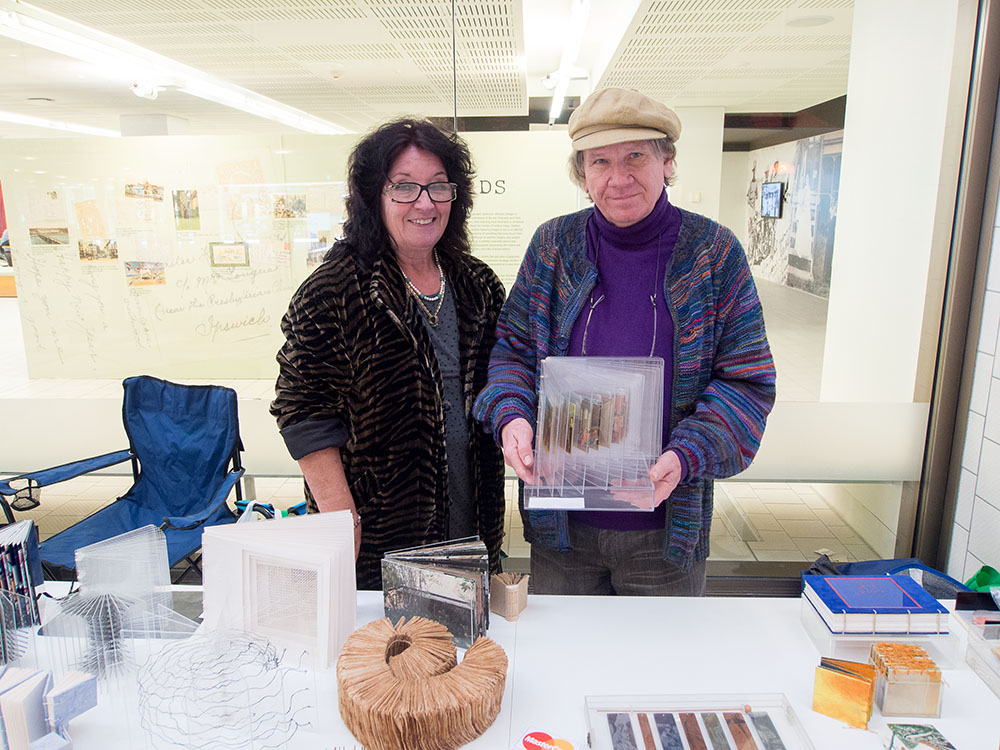
Adele Outteridge and Wim de Voss
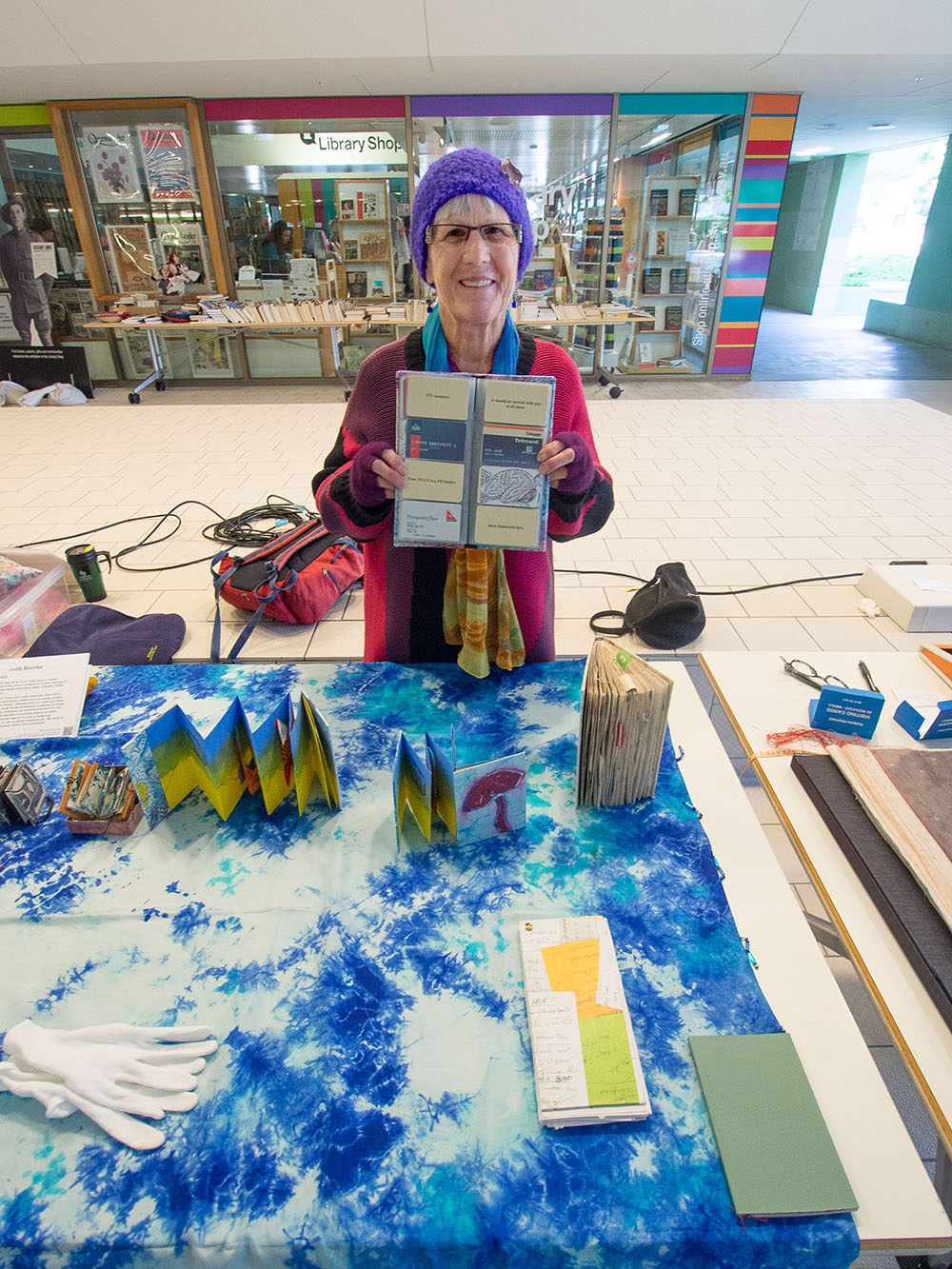
Judy Bourke at the Artists’ Book Fair
Presented by SLQ with the generous support of the Siganto Foundation. All photos and text ©2015 Doug Spowart
BOOKEND: Photobook Melbourne — what a read?
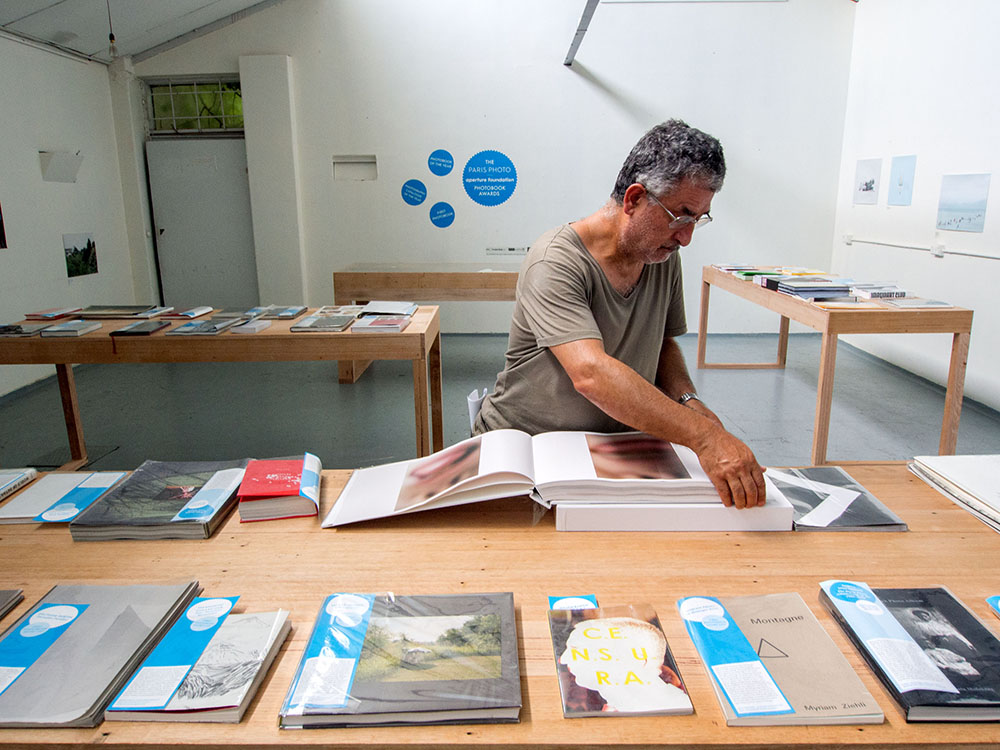
Photobook Melbourne: Peter Lyssiotis looking at an Aperture Books
We all know that feeling when you are really getting into a book, its narrative and flow, and then you reach the point where, as the last page is turned, you wish it could go on, and on… Photobook Melbourne (PM) was something of that kind of experience. The books seen, perhaps around 300, the exhibitions seen, and the people met now all vividly reside in memory and digital capture code.
The Photobook Melbourne event took place between February 12 to 22 it was coordinated by Heidi Romano and Daniel Boetker-Smith. It was always an ambitious undertaking. Its vision was to connect international photobook world with makers and lovers of the book from around Australia… and New Zealand. This was achieved through numerous exhibitions, library displays, photobook awards, forums and workshops.
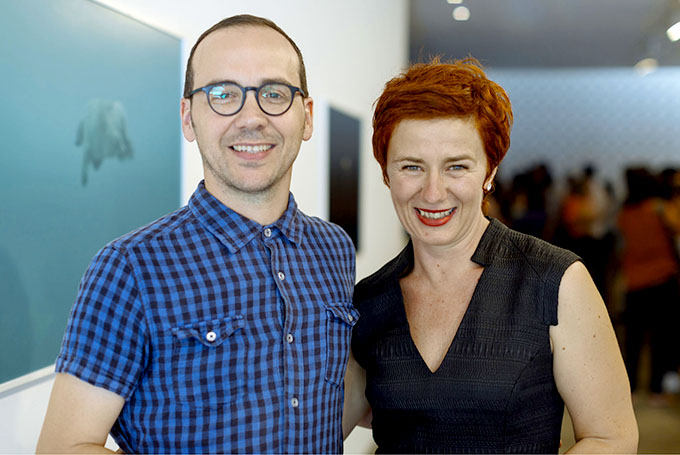
Daniel Boetker-Smith + Heidi Romano PHOTO: Courtesy of Lauren Dunn www.artdocumentation.com.au
Photobook Melbourne can only be described as a massive success. The photobook community of practice needs events like these so they can band together to affirm their interest and belief in the importance and creative power of the photobook. For once, the world of photobooks has come to us, or at least Melbourne, and for that we are a stronger and more informed cohort of makers, readers, collectors and lovers of photobooks.


Some of the attendees have responded to a request for comments – others are posts from Blogs and Facebook posts…
FROM JACOB RAUPACH: Photobook Melbourne was an amazing week full of a genuinely insightful mix of talks, exhibitions and book exhibitions, with the fair during the first weekend proving to be a great networking point for the rest of the week that followed. … I felt that the inaugural festival set an amazing benchmark for the following years! Looking forward to 2016.
FROM HARVEY BENGE‘s BLOG: On a zero to ten scale I’d give the festival a ten! Visit his site for more commentaries about photobook
FROM CHRIS BOWES: For someone naïve to the world of photobooks, Photobook Melbourne was an eye opening experience. Although coming in as a virtual outsider to this rapidly expanding art scene, I sank my teeth into as many of the talks, exhibitions and book collections I could manage, and came away a lot more informed than I was going in. Personal favourites were the Paris Photo – Aperture Foundation Photobook Awards exhibition, where the content of the books was engaging and the calibre unmatched, and ‘The Other Photobook Forum’, where in particular Gracia Haby and Louise Jennison showed that with a little creativity and business sense one can make a buck and do what they love.
FROM LIBBY JEFFERY – Momento Pro: The number of participants, visitors, books and buyers at Photobook Melbourne were fantastic and they confirmed that small press and self publishing is alive and well in Australia. The Awards and Book Fair also proved that a selection of high standard work is being created here, but a collaborative promotion and showcase of Australian photo books to the global market would benefit everyone.
FROM: ANGEL LUIS GONZALEZ FERNANDEZ Facebook Comment Back in Dublin after an amazing first edition of PHOTOBOOK MELBOURNE, having discovered tons of new work and books from Australia, New Zealand, and more -and having met a truckload of awesome people.
FROM KELVIN SKEWES: As someone that attended almost all of the events that were part of Photobook Melbourne I can only describe it as a tour de force for lovers of the Photobook. The festival opened on February 12th at the Centre for Contemporary Photography with Robert Zhao Renhui’s exhibition
A Guide To The Flora And Fauna Of The World and with a smoking ceremony by the traditional owners to welcome the festival to their land. Also announced on the opening night was the Australian Photobook of the year which was won by Raphaela Rosella for her unpublished book ‘We Met a Little Early But I Get to Love You Longer’ and I was humbled to be the runner up with my newspaper as photobook ‘Nauru: What was taken and what was given’. …
The main event for the first weekend of the festival was the Photobook Melbourne Book fair at CCP an event at was full of frenetic energy and far too many photobooks to browse let alone buy; amongst the many booksellers highlights included the infatigable Perimeter book with titles from Mack and Spector books and Anita Totha from Remote books who is doing to sterling job promoting photobooks from New Zealand. …
Great thanks are due to the entire Photobook Melbourne team so thank you Heidi Romeo, Daniel Boetker-Smith, esteemed guests Ángel Luis González Fernández, Ron Jude and the Dysturb Photo Collective, festival partners and sponsors Momento Pro, Photography Studies College, Copyright Agency and venues CCP, MGA, Strange Neighbour, Colour Factory, Neo Space, Baron Said and James Makin Gallery and to all the volunteers without whom this could not have happened so thanks to Felix Wilson, Kate Robinson, Bella Capezio, Katrin Koenning and countless others.
See you next year!
MORE COMMENTS WILL BE ADDED AS THEY BECOME AVAILABLE…
WHAT FOLLOWS IS A PERSONAL DIARY OF PHOTOBOOK MELBOURNE
Our arrival on the first weekend was delayed by my recent medical incursion so we fly into Melbourne on Wednesday. Through a friend we were able to stay in an apartment right in the middle of the city and our journeys out and about were by tram, train and lifts given by friends.
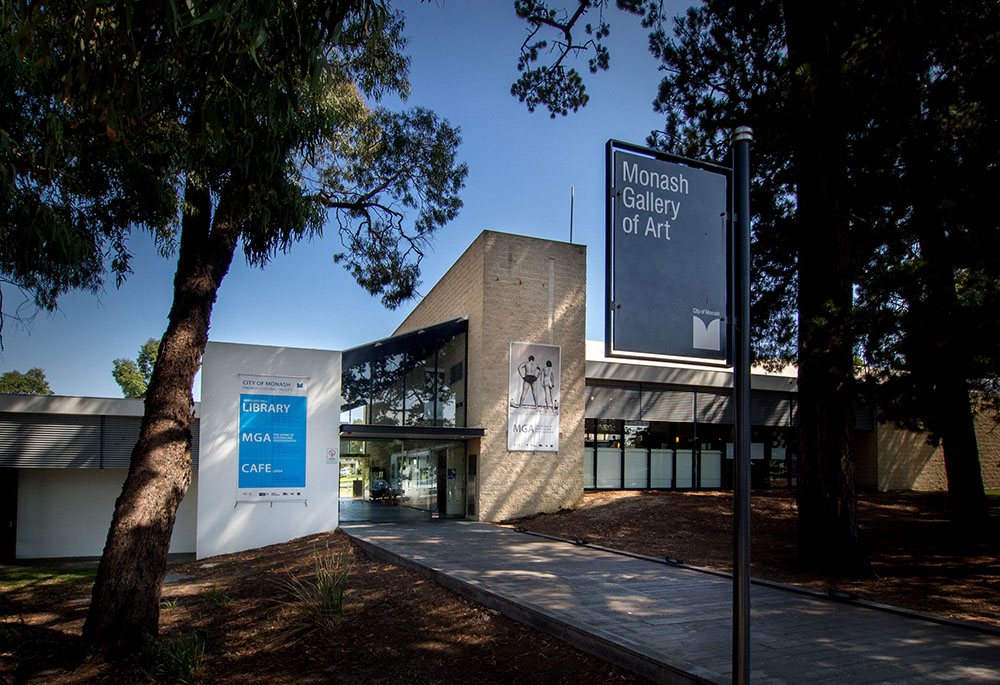
The MGA – The Home of Australian Photography
THURSDAY: We attended two book related exhibitions at the Monash Gallery of Art. Badged as the ‘Home of Australian Photography’ the gallery presented two photobook exhibitions, one of images from the collection that featured the theme of books and reading and was entitled ‘Light Reading’. The other was The Natural Collection an assemblage of books by The Photobook Club’s Matt Johnston and co-curated by Lucy Johnson. The Natural Collection brings together photobooks that explore “the harmony, tension and play” that occurs in the human relationship with nature and the natural landscape.
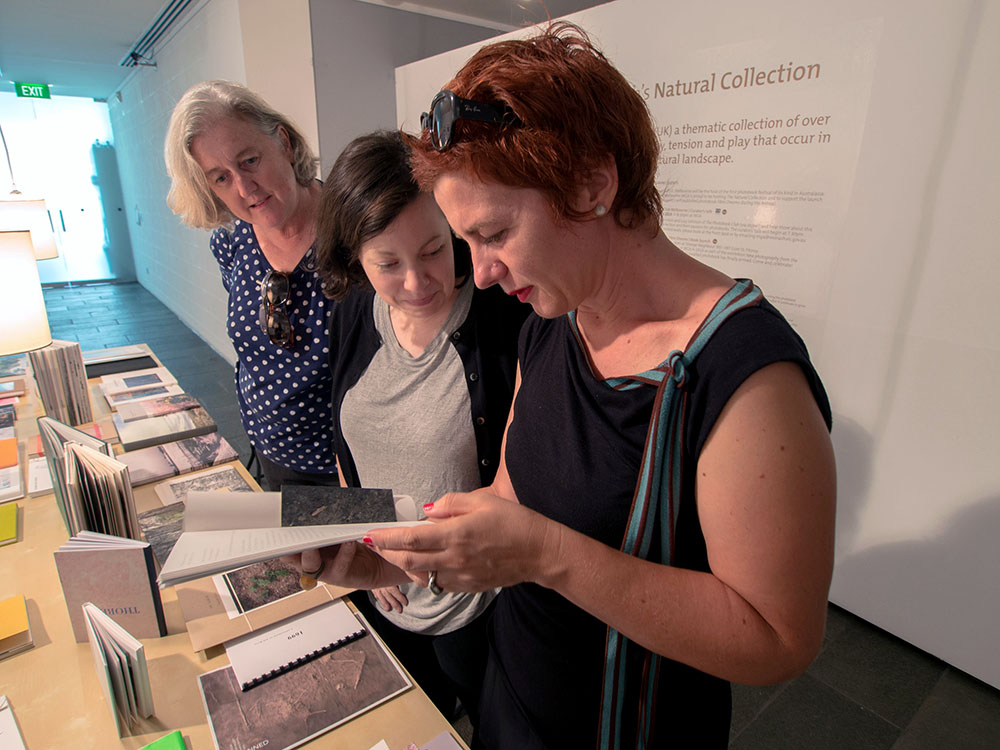
Heidi, Steph and Vicky discussing a book
The exhibition space was setup for readers to sit and work their way through a most interesting selection of Euro/American centric responses to the theme. Grand trade books sat next to simple fold ‘n’ staple zine-like booklets. We were there with Heidi Romano, Simone Rosenbauer from Sydney and MGA Gallery’s Education and Public Programs officer Stephanie Richter. We engaged in a spirited debate about book design; production methods and how to evaluate books.
That evening we attend a dinner for PM speakers, contributors, supporters and sponsors. By this stage it was acknowledged that the PM had been an enormous success so congratulatory statements were announced and a great feeling of an Australian photobook community being well and truly launched by this event.
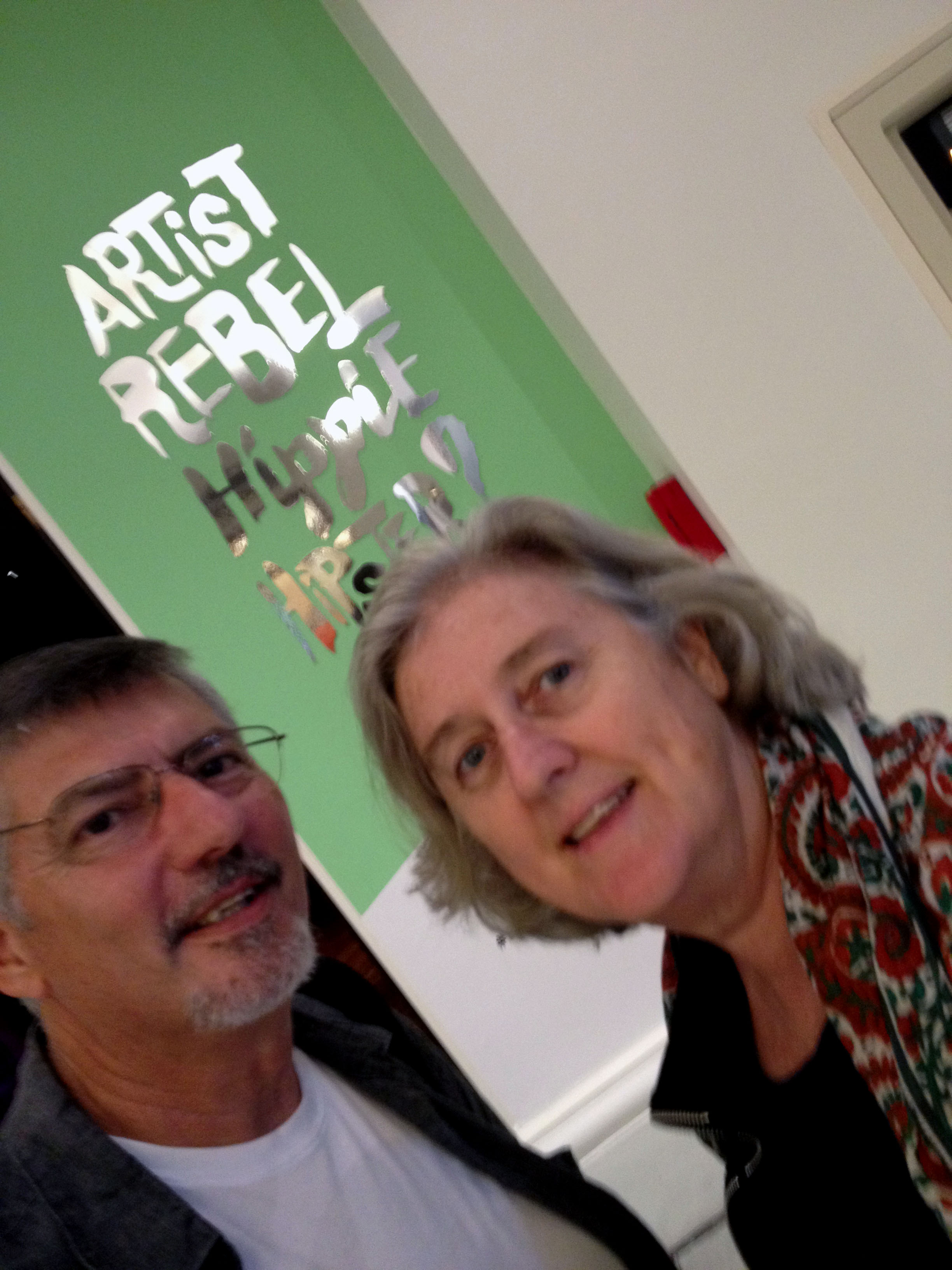
Bohemian Vicky+Doug
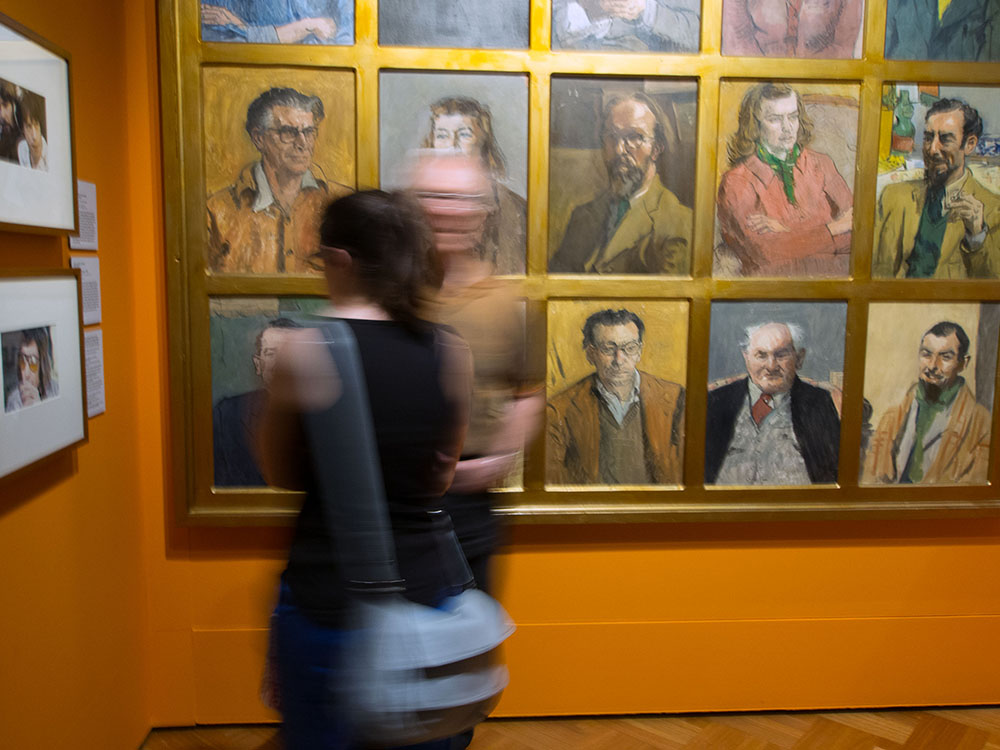
Bohemian Melbourne portrait wall
Bohemian Melbourne
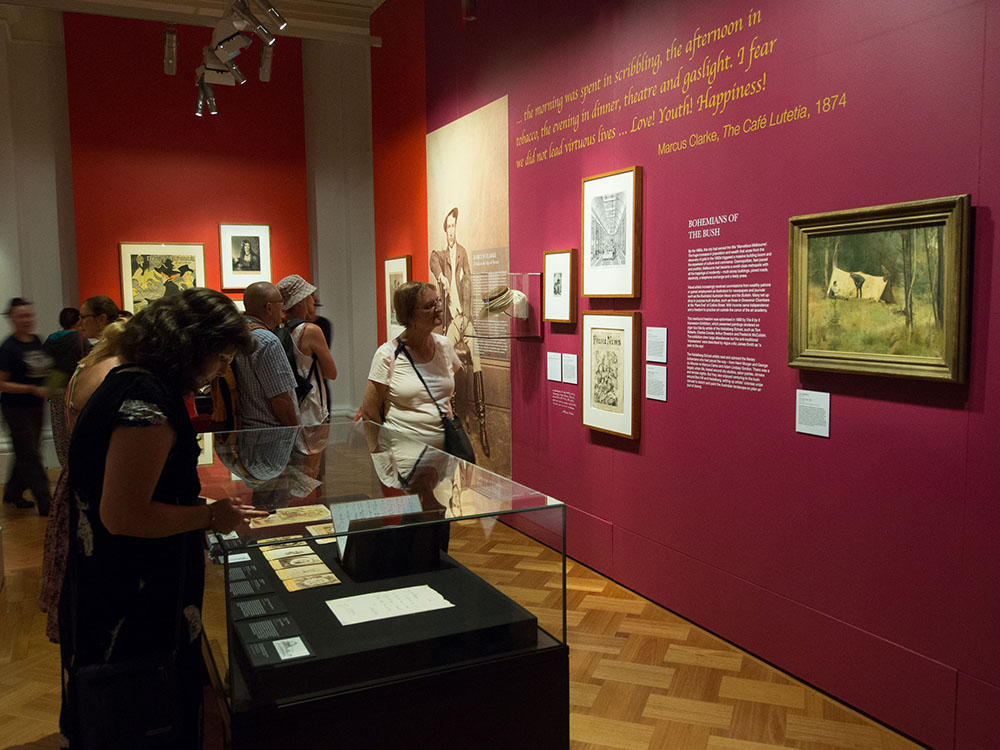
FRIDAY MORNING: A breakfast of avocado, bacon and relish was partaken at a suburban street café while being interviewed by Australian Photography contributor Anthony McKee for a feature on photobooks. Morning tea with Robert Heather and Des Cowley at the State Library of Victoria and a visit to the SLV exhibition Bohemian Melbourne – a fascinating reflection on the creative, musical and arty sub-culture of Melbourne. Rennie Ellis’ photos contributed much to this history as well as poster art, paintings and the ephemera and memorabilia of the different eras represented by the theme.
The Library Project @ PSC
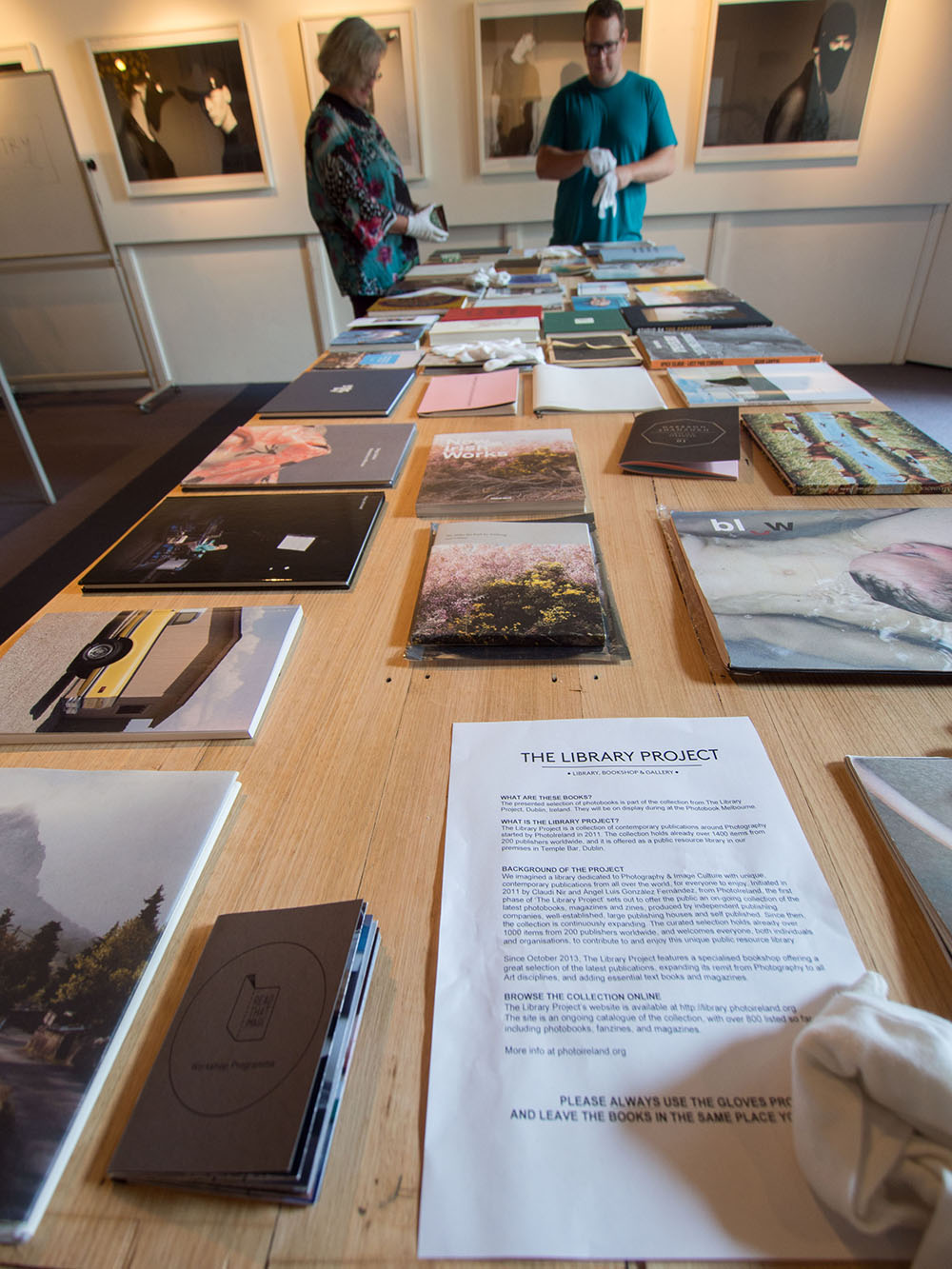
FRIDAY AFTERNOON: We visited Photography Studies College to view ‘The Library Project’, a collection of photobooks brought to PM by Ángel Luis González Fernández from PhotoIreland. ‘The Library Project’ aim is to collect contemporary publications based on photography to create a public resource library. We viewed many books that are not easily available to see in Australia including Cristina de Middel’s Afronauts.
The ‘OTHER’ Photobook Forum – a question from the floor
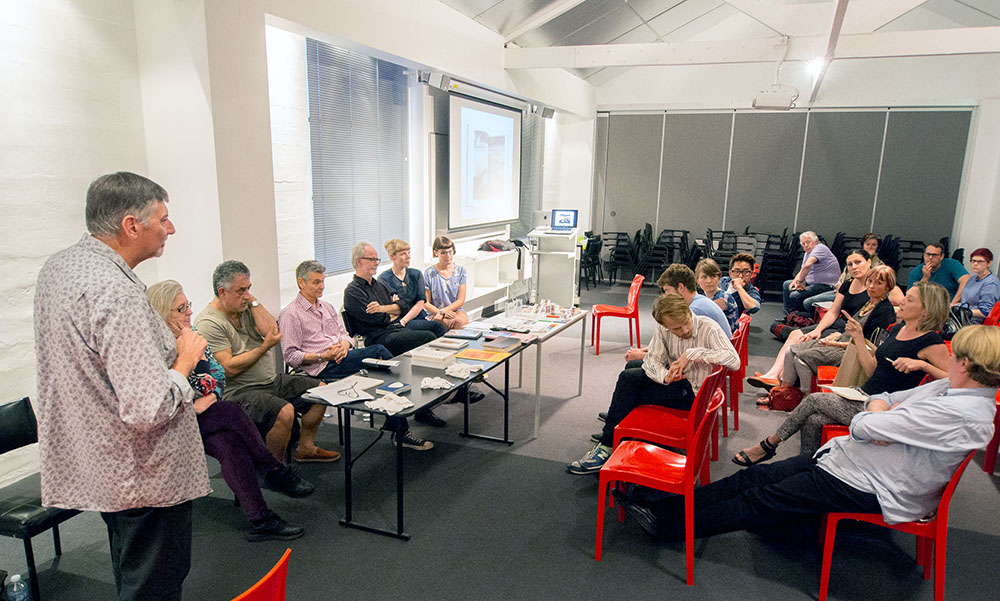
FRIDAY EVENING: Later that evening we were involved with The ‘OTHER’ Photobook Forum – Artists’ Books, Zinesters and the Photobook took place. We have been working on this project for a couple of months now and we were able to bring together key practitioners from these ‘other’ photobook disciplines who discussed and provided commentary on their use of the photo in the book. The participants included photomonteur Peter Lyssiotis, zinesters Gracia Haby and Louise Jennison, artists’ book maker Dr Lyn Ashby, Des Cowley from the State Library of Victoria and Victoria Cooper who stood in for Georgia Hutchison who was unable to attend due to extenuating family issues.
It was an event that stirred much interest with artists like Deanna Hitti and Theo Strasser attending as well as Momento Pros’ Libby Jeffery, and photobook makers Kelvin Skewes, Daniel Boetker-Smith and Chris Bowes.
Jacob Raupach @ CCP
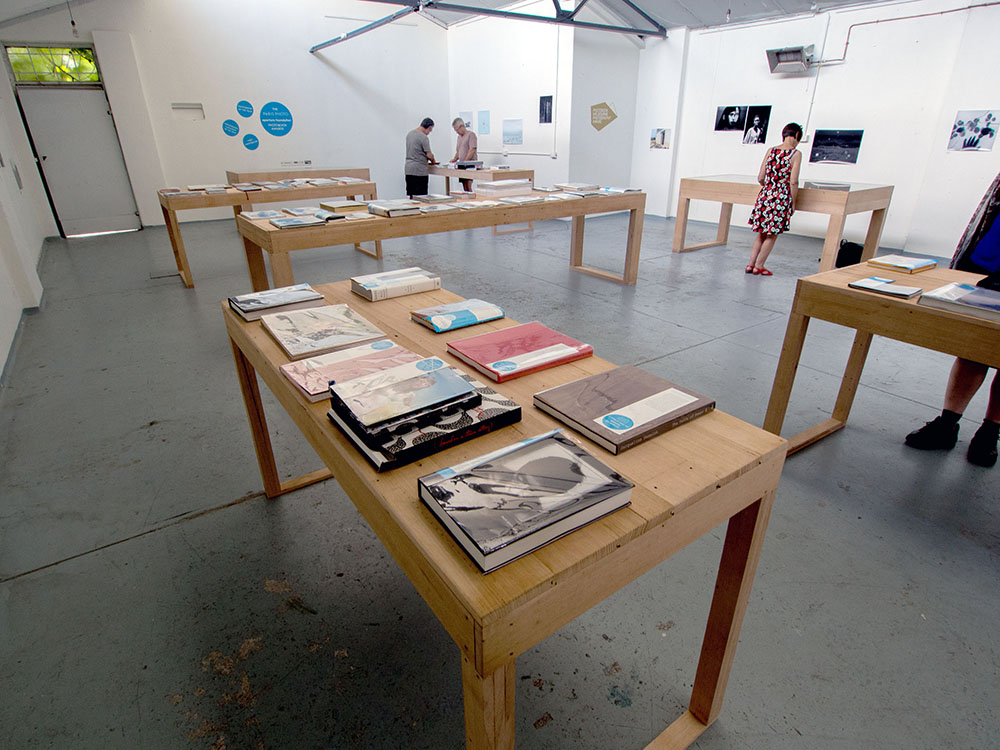
Aperture Books on display @ The Baron Said
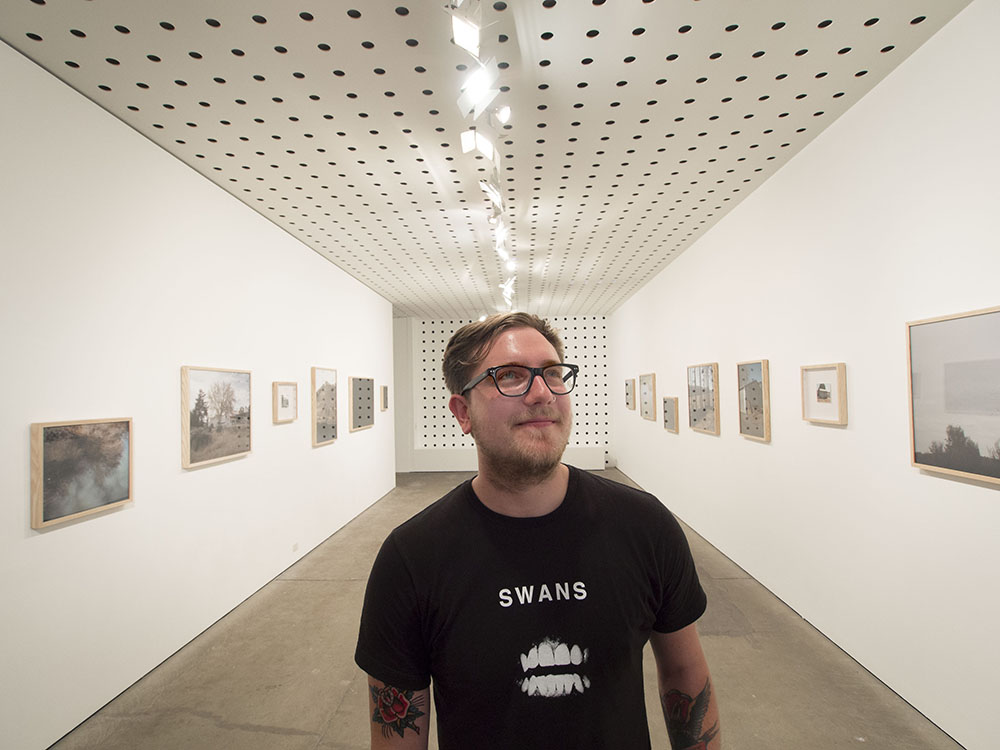
SATURDAY: A day to attend artists talks at the Centre for Creative Photography by, amongst others photobookmaker Jacob Raupach and the exhibition FELL – Bought a copy of his latest book WEALTH. Following up with visits to the Momento Pro Australian Photo Book of the Year Award at the Asia Pacific Photobook Archive and the Aperture Photobook exhibition @ The Baron Said and a stimulating lunch with Peter and Tess Lyssiotis @Babkah.
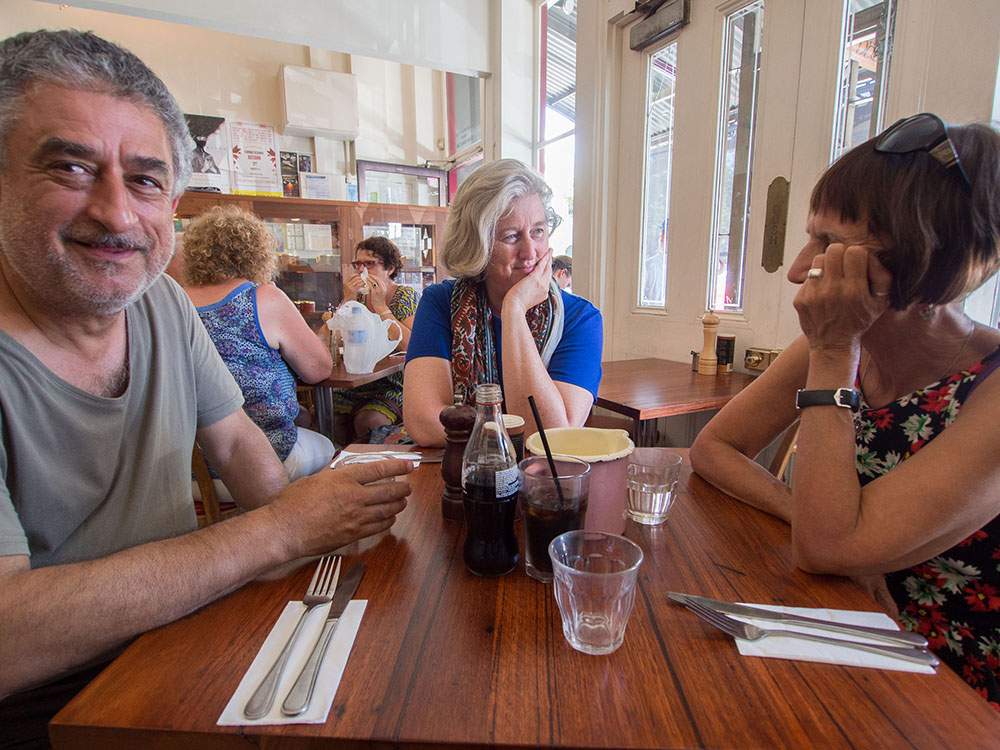
Lunch with Tess + Peter
Photobooked-out we headed back to the city by tram and had a chance meeting with Lismore artist and Siganto Artists Book Fellow Jan Davis who was attending a Print Council meeting – Only in Melbourne could strange intersections like that could happen.


SATURDAY EVENING: Melbourne White Night event
450,000 Melbournians took over the streets of the CBD – everything stayed open and performances and projections, bands and music were everywhere. Amongst other things we went to see the projections in the Dome at the State Library of Victoria at 10.30 at night – queued in line for 30 minutes with 1000s of others what a night…!
SUNDAY
A day of traveling home to cyclone weather drenched Brisbane.
UNTIL NEXT TIME —- For PHOTOBOOK MELBOURNE 2nd EDITION….

 wotwedid