Archive for the ‘Artists Books’ Category
REGIONAL ART AWARD: Our entry
 .
.
NOTE: VOTING IS NOW CLOSED
One of our Artists Survey Books has been uploaded on the Queensland Regional Art Awards website.
The ‘People’s Choice’ judging is based on an online viewing and voting system. For those unfamiliar with these little books they present a humorous and ironic view of the challenging issues facing regional artists. This book deals with issues associated with being a regional artist during the current extractive mining boom.
.
SO – Please check out the book as described in this post.
THEN, go to the website – at the link below – scroll down the artists name list on the right-hand side of the website. We are under “V” for Victoria at the very bottom of the list.
Here is the link: NOTE: VOTING IS NOW CLOSED-THE LINK IS STILL ACTIVE AND SHOWS THE ENTRIES
http://www.flyingarts.org.au/QRAA-2012-Gallery-The-Essential-Character-of-Queensland-ga2543.html.
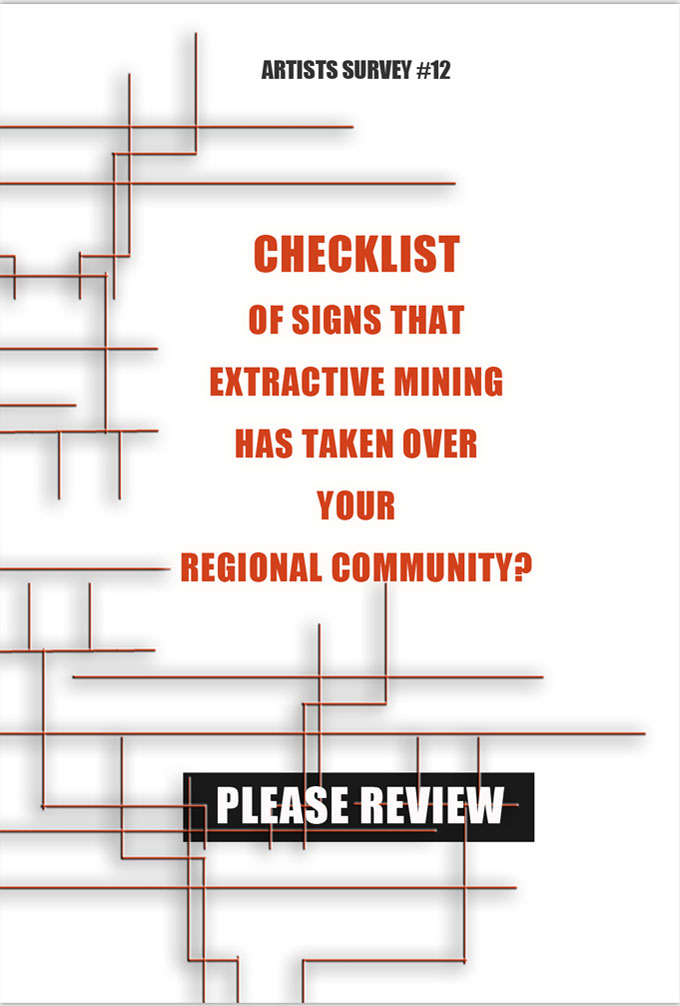
The cover of the Artists Survey book
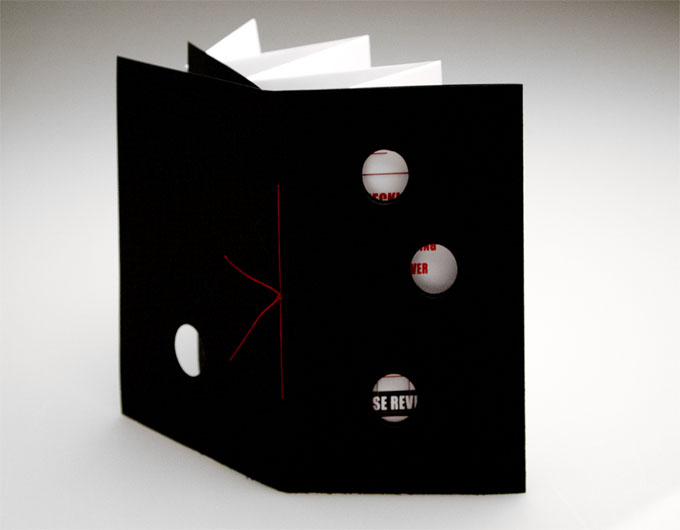
The book cover with exploration ‘holes’
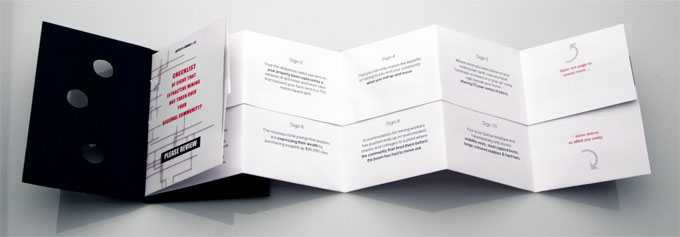
Open text pages showing comments on mining and the community
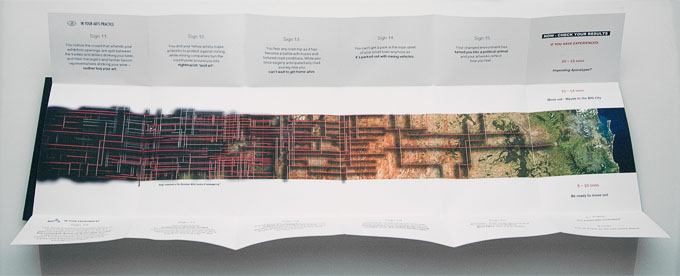
Unfolded showing texts and illustration of extractive industries effect on southern Queensland
Some of the texts, there are 20 in all, are as follows:
- Instead of Weetbix or Cocoa Pops and milk for breakfast you have coal grits.
- When you can’t afford your power bill you cook using coal spill gleaned from railway lines and roads.
- Your farming friends can’t ship their produce to cities and ports as all freight options are biased towards the year-round transport of coal.
- Your art exhibitions opening crowds are split between the tradies and the drillers drinking your beer and their managers drinking your wine – neither buy your art.
- All of your rustic old community pubs have been remodeled into nite clubs and commodious verandahs enclosed to stop drunks throwing up – tossing bottles – or falling off onto the pavement below.
- The occasional distant thunder that you once may have thought be an approaching storm now turns out to be the constant thunder of B-Double trucks shipping coal.
LIFE’S JOURNEY: Artists’ Book Exhibition, Redland Art Gallery
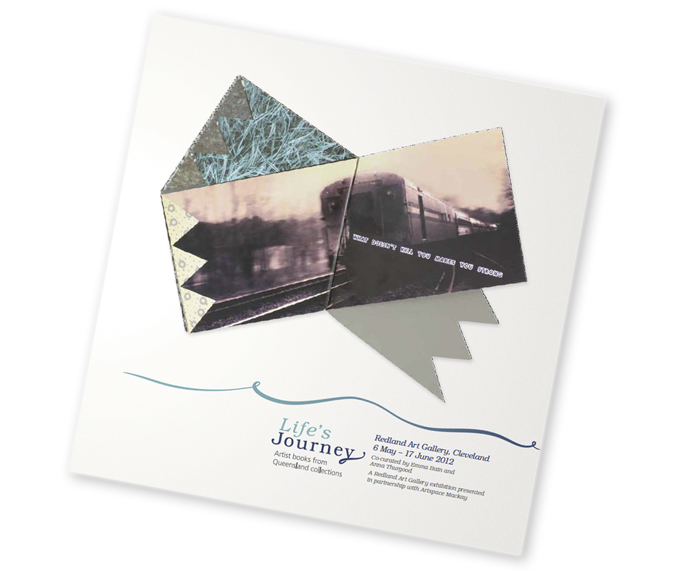
Life’s Journeys exhibition catalogue cover Redland Art Gallery
Judging a book by its cover a page
The artists’ book is usually sequestered away in library stacks and drawers in their neat little custom made archival cardboard boxes and plastic bags. In specialised library and private collections these are treasured objects; their owners become the custodian of the physical object of the book and the story is revealed in the site-specific act of reading within these spaces. But … sometimes they escape. On occasion artists’ books escape en-mass from their natural home of the library or private collection, and this is exactly the case with the exhibition Life’s Journey recently presented at the Redland Art Gallery, Cleveland.
Co-curated by Emma Bain Director of Redland Art Gallery and Anna Thurgood Acting Director of Artspace Mackay, the exhibition assembles books drawn from the significant, perhaps one could say—international quality, collections found in Queensland; Artspace Mackay (AM), grahame gallies + editions (gg+e), the State Library of Queensland (SLQ) and Studio West End (SWE). The exhibition’s themes, as highlighted in the catalogue essay by Louise Martin-Chew claim that they are intended to seek ‘out universal truths in individual journeys’, ‘the personal and individual’, …and ‘artist narratives with memoir-like threads’.
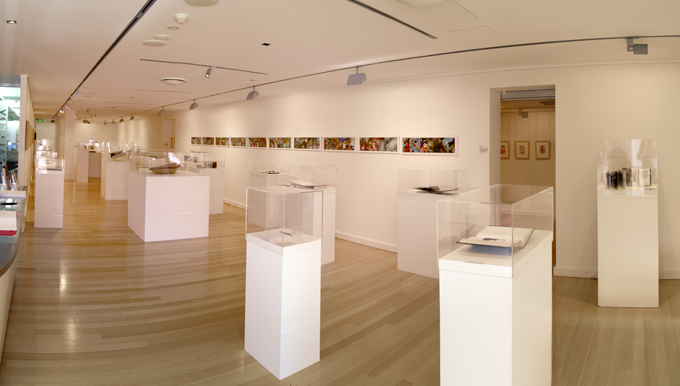
Life’s Journey exhibition @ Redland Art Gallery, Cleveland Photo: Doug Spowart
The viewer entering the gallery to see the Life’s Journeys books may not have read the catalogue, or have an understanding of the artists’ book discipline, but what they are to encounter in the white cube of the gallery space will be unusual. The Redland Gallery’s main room a literal forest of fourteen or more acrylic topped display cases. Inside each case resides the book, open to a page and resting on a stand or pillow. Some books don’t seem like books at all, they look more like 3D sculpture, or jewellery forms, or even things just fastened or bound together by threads. Other ‘books’ are in frames or on panels on the wall—one is even a projected image. It’s here where the viewer becomes acquainted with the ‘non-standard’ nature of the artists’ book—but there is more… The viewer can look at the narrative segment presented by the open page, or the expanded story presented in the wall-mounted works, or books that are of the concertina form. While being visually entertained by the titillating ‘sample’ view, the visitor may probably enjoy the encounter and will leave feeling a sense of discovering something interesting and unusual. But I would suggest that this is only part of the experience that the artists who made the books expected or wanted for those who see their books.
I know that this sounds like the continuing debate about the gallery exhibition of books where the sequential narrative that artists’ books require is neutered by single page views. But there is an issue, and for me a redeeming feature for shows like this, and that is that the display of artists’ books will encourage and excite people to hunt down these books in their usual library-sited storage spaces.
What I have written about before,* and what I will restate is, that these exhibitions are ‘tasters’ only. The exhibition strategy needs to include ways by which viewers can identify books of interest, understand how to access them, and then go-see, handle, read and fully encounter the artist’s communiqué. What is needed for the gallery viewer is a catalogue of the books and their source collections, how to access these collections, online references (maybe even flip-books of the works), perhaps even initiated within the exhibition space by QR codes or augmented reality clips. Using this concept the exhibition becomes an invitation for those who wish to take up the offer to handle and read the books in their site-specific habitat.
Now that’s off my chest, I have to say what an amazing collection of artists’ books the curators have pulled together. Seeing this cherry-picked selection in this context is far more interesting for me than looking through an online catalogue—here there is a sense of discovery. It’s a bit like going to a second-hand bookshop and just wandering through the stacks picking up whatever takes your fancy. Wandering through Life’s Journey was indeed an encounter with an eclectic bunch of artists’ books. Some of my favourites were there.

Adele Outteridge’s God Bless America Photo courtesy of Adele Outteridge
This included Adele Outteridge’s Teabag Book (2005) from SWE – just how many cups of tea were consumed to make this book? And another of Adele’s books, God Bless America (2003?) also from SWE, makes a political statement that can be read in different ways depending on the reader’s point of view of American society or foreign policy.
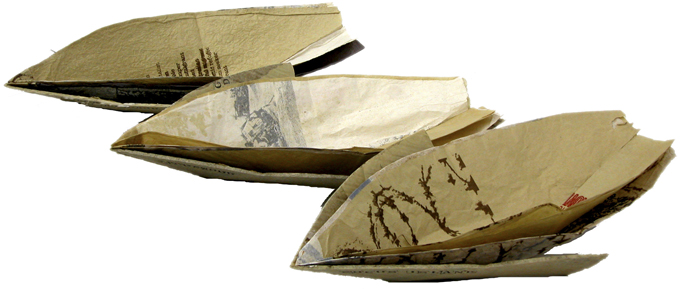
Books from the Codex Event 4 of which Naru is one (for reference only) Image courtesy of Tim Mosely
Another book Naru (2007), from the SLQ, was constructed from paper to form a 3D vessel—the book as a metaphor for a boat. The work was the result of a collaborative project entitled Codex Event 4 coordinated by Tim Mosely at Southern Cross University. Naru and the other books that were created by the team have an overtly political statement contained within their shape and the titling. These works comment on idea of the freedom that many people seek as they cross borders as refugees and how this conflicts with the Australian Government’s immigration policies.
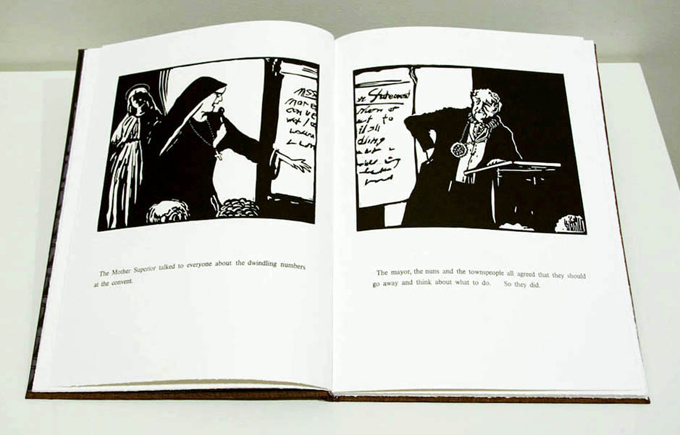
Sheree Kinlyside’s ‘The reluctant nun” (2009) @ 2010 Libris Artist Book Awards. Photo Doug Spowart
A fine press/printmakers book is represented by Sheree Kinlyside’s The reluctant nun (2009) from AM. The book was the winner of the Regional Artists Book Award at the 2010 Libris Artist Book Awards.
A book of a different shape, five sides(!) by American book artist Philip Zimmerman High Tension (1993), from gg+e, deals with a humorous look at contemporary society. The book is intentionally over-designed, montaging graphic elements and text with image narrative to make it an immensely interesting book—you want to pick it up and read through.
In the display of another book, Judy Watson’s Under the Act (2007) from gg+e, each page is framed and the work extends across one complete wall of the gallery. The folio single-sheet form of this book enables its reconfiguration to the wall possible. The work describes a personal narrative, a life’s journey, through the impact of oppressive white bureaucracy applied to Aboriginal peoples living in Queensland not that long ago.
Peter Lyssiotis and Noga Freiburg’s collaborative book Homeland (2003) from AM presents personal narratives of the authors, one a Greek Cypriot—the other an Israeli, about the way lines are drawn across maps to divide communities. The book invokes the story concept by using texts, family photographs and photomontages all bisected by a green line that divides the two communities.
One final book that I’ve always been inspired by is Scott McCarney’s Memory Loss (1988) from AM which deals with a medical condition that afficted his sibling. McCarney was recently in Brisbane with partner Keith Smith presenting an artists’ book workshop at the State Library of Queensland. This two-sided accordion structure book is replete with information from numerous sources including medical literature, personal photographs and correspondence. For me Scott’s book had truly escaped from the cases and was presented, sans protective acrylic lid, atop a plinth where viewing of one side was unobstructed. I think in terms of Scott’s politically subversive work that he would’ve liked that…
Life’s Journeys is a significant showing of what artists’ books can be and it puts the book firmly within the art gallery display environment. But none-the-less, with all the problems of display and the expectations that this commentator may have, the books do need to get out and about. They assert by their presence in the gallery that they exist and can be encountered by a diverse range of the art-interested public. And, perhaps is the case with any gallery exhibition, the viewer experience is something that develops and is enhanced by continued reflection after the viewing. The importance of the exhibition Life’s Journey, the accompanying exhibition Mind Mapping by local artist and bookmaker Jack Oudyn, and the associated workshops is that they will create much needed interest, scholarship and activity in the artists’ book genre. …. And hopefully inspire some viewers to become readers by pursuing the fuller of the artists’ book communiqué by engaging more fully with them when the books return to their respective collection homes.
Doug Spowart June 9, 2012
Please note: The links that I’ve selected to provide a visual connection with the text have been sourced from Google images and may not be the exact book presented for display in this show. I have found it interesting to discover how so many artists’ books are poorly, if at all, represented in the online domain.
KEITH SMITH + SCOTT McCARNEY @ SLQ
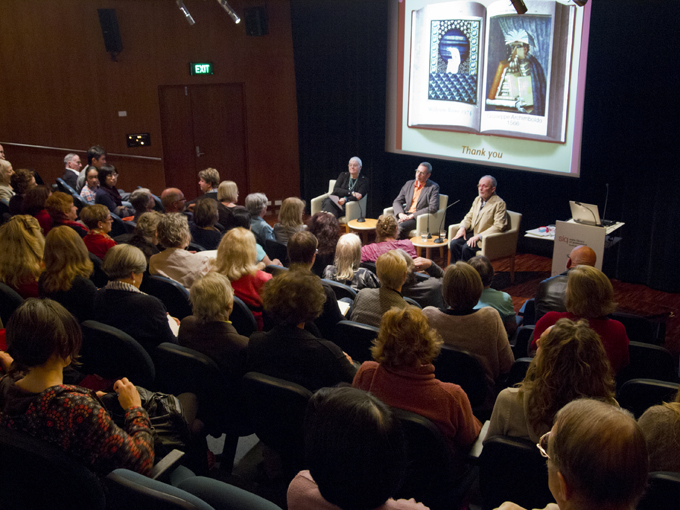
Please note: This post is derived from personal notes made at the event – They may contain some inconsistencies that are a result of my interpretation.
AUDIO NOW AVAILABLE @ http://enc.slq.qld.gov.au/audio/slq/pp/mp3/artdesign/Artistsbooks.mp3
In what looks like the one highlight in the Queensland artists’ book calendar for 2012 Keith Smith and Scott McCarney are visiting the State Library of Queensland to present a lecture about their work and to conduct a five-day workshop. Unable to attend the workshop due to teaching commitments I attended the talk at the SLQ today. I was not alone and the smaller SLQ auditorium was full of interested attendees — including some notables like Sarah Bowen, Adele Outteridge, Madonna Staunton, Wim deVos, Anne Marie Hunter and Lorelei Clark. The visit to SLQ by Scott and Keith is supported by the Siganto Foundation and members of the family were in attendance at the lecture.
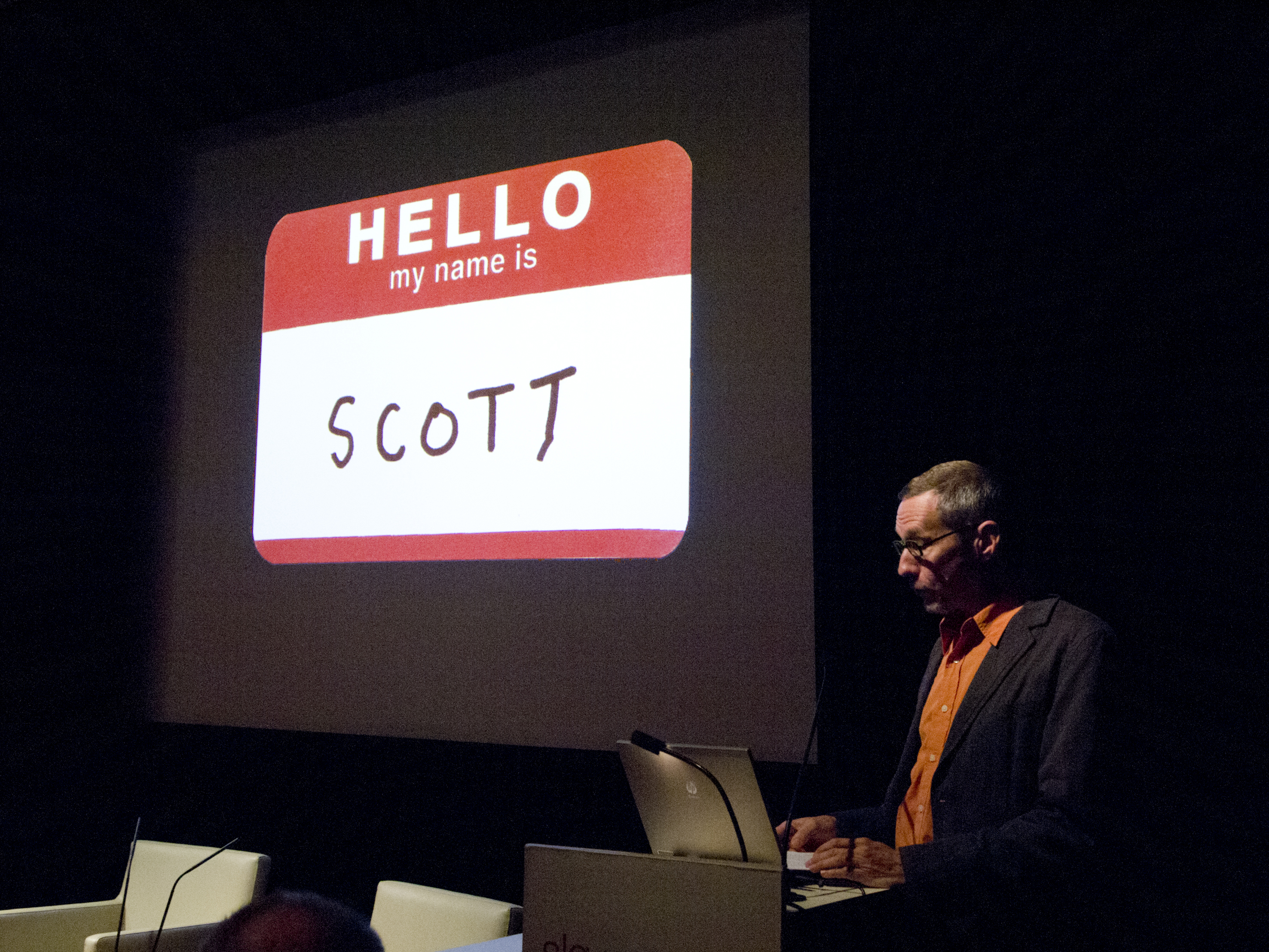
‘HELLO’ Scott!
After and introduction by SLQ Artists’ Bookie Helen Cole, Scott began his presentation by talking about the nature of the book in the digital age. He seemed to lament that libraries were beginning to change into Wi-Fi coffee houses — that’s not a problem for him as he believes the book, as a physical thing, will go beyond the electronic age.
He sees a real discussion about the future of the book is all about ‘display’. This remains a contentious issue for the artists’ book as they are difficult to handle and read as in exhibitions they are usually displayed frozen and ‘under glass’. Some of Scott’s work has been about presenting books as sculptural forms (Hanging Index) so the viewer does not really need to turn the pages to engage with the work.
Scott spoke in detail about his Autobiography series. He described how he couldn’t throw anything away and that he makes collections from things like name badges, rejection letters from galleries and grant applications, to-do lists and mud maps. This body of work provides an insight into the trivia and ephemera of life that escapes disposal through its transformation into his art. Connecting with the Internet world Scott’s Google Vanitas begun on Christmas Day last year represents the search results for his own name.
Scott showed many examples of works with where he cut through various pages within books to subvert the content of the book.
In a homage to Ed Ruscha Scott has taken Ruscha’s 1964 book Various small fires and milk and made his own take on the subject — Scott’s fires are those of riots and the curious inclusion of a glass of milk in Ruscha’s book is shortened to MLK, standing for Martin Luther King whose portrait appears in the book. l
A recent project by Scott was to participate in the al-Mutanabbi Street Coalition’s response to the car bombing of this street in Bagdad which was home to many of the city’s booksellers. Scott’s work Material Meditation on Mending Al Mutanabbi Street comprises fifteen two-sided loose-leaf prints made from collages made from remnants of found books, rubbings from bookbindings and photographs.
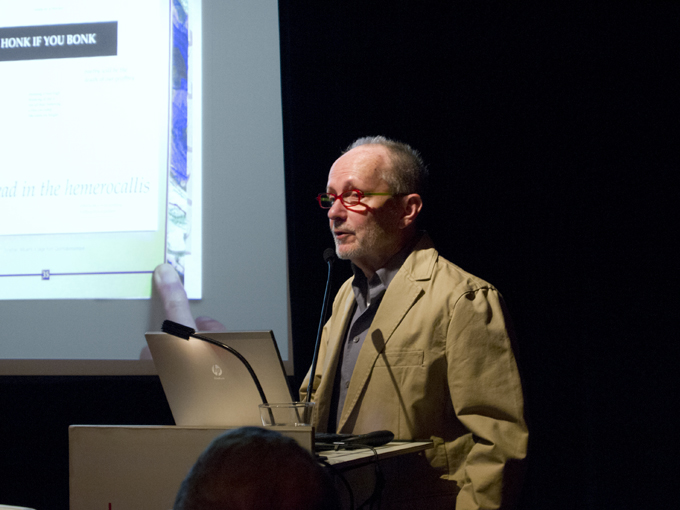
Keith Smith speaks
Scott then handed over to Keith who comments that he is now up into the 280s on his ever increasing list of books. He spoke of a number of book projects dealing with subjects like re-contextualisation of paintings of Saint Sebastian into Smith’s own painted backgrounds. Many variations on this theme have been created from an amassed collection of source paintings — he intimated that he was even working on a book as he was preparing to travel to Australia.
He spoke of his connection with the computer and digital book Bobby made as early as 1984 with an early Macintosh computer using MacPaint and MacWrite. In his latest work he has re-formatted the book and re-jigged the content. The new Bobby has been supersized to one of Smith’s biggest ever books.
One of Keith’s trademarks is the digitally created multi-layered photomontage and his rainbow borders and edges. He states that when using Photoshop he may be working with between 12 and 24 layers of colour. Pages for the book Seminal were shown as examples.
Book number 283 is Struggling to see deals with Smith’s continuing fascination with text and image. The book is dedicated to Nathan Lyons whose own books and image sequencing presents Smith with a constant source of challenge. Smith acknowledged Lyon’s mastery of organising images in a book in a way where the message of the book is spoken ‘between the pages’.
Question time yielded perennial questions to do with inkjet printers, papers, the ‘archivalness’ of the technology and editioning.
One questioner spoke of how books can be made by anyone via print on demand technologies …
Another question dealt with the montage …
Keith commented that the book tells him where to go …
A comment made by one participant was that they were coming to understand that with all the standardization of the book through language and form and that that is where the psychology of the artists’ book really kicks-in to say something else that we were not ready for…
A question about the eBook and where it fits in contemporary practice. Scott answered that with eBooks one must learn the tools and understand that they are about text in a multi-media platform and that translating work into digital form you need to recognise that it is married to the content.
Keith’s response was that was something for the younger generation, ‘I’m too old ….’ Perhaps it is, for him, that the eBook is not a tactile medium that you cut, fold, touch and be touched by — although it may be something else?
Doug Spowart May 28, 2012
NOTE: The SLQ will be posting this lecture online in the near future
AIPP ON THE LOUNGE: SQIT Toowoomba April 11, 2012

- AIPP – On the lounge SQIT, Website invite
On this evening the SQIT Photoimaging team hosted two events for visiting AIPP members and invited guests. The visit began with a ‘High Tea’ catered for by the SQIT Hospitality team – sumptuous treats were accompanied by tea and coffee. Those attending settled down to conversation with each other in the convivial atmosphere of the ‘Futures’ Restaurant. Coffee Shop
At 5.30 stage two of the visit began with the open of an exhibition of photobooks and artists’ books made by SQIT Photo students over the last 5 years. The show was opened by Queensland Division President Jan Ramsay, who as a past student of an art photography unit, and also part of the end-of-year professional assessment team at SQIT, had experienced the Toowoomba TAFE Photo team at work.

Doug thanks Jan Ramsay for opening the ‘Brought to Book’ show
The books on show ranged from Shanea Rossiter’s ‘Inspiring Women’ book of portraits to Cathy Smith’s book ‘Junked’, a documentary comment on our disposable society and Lorraine Seipel’s political message in the book ‘Song for the future’. The exhibition was curated by Victoria Cooper and Doug Spowart for the Queensland Festival of Photography.
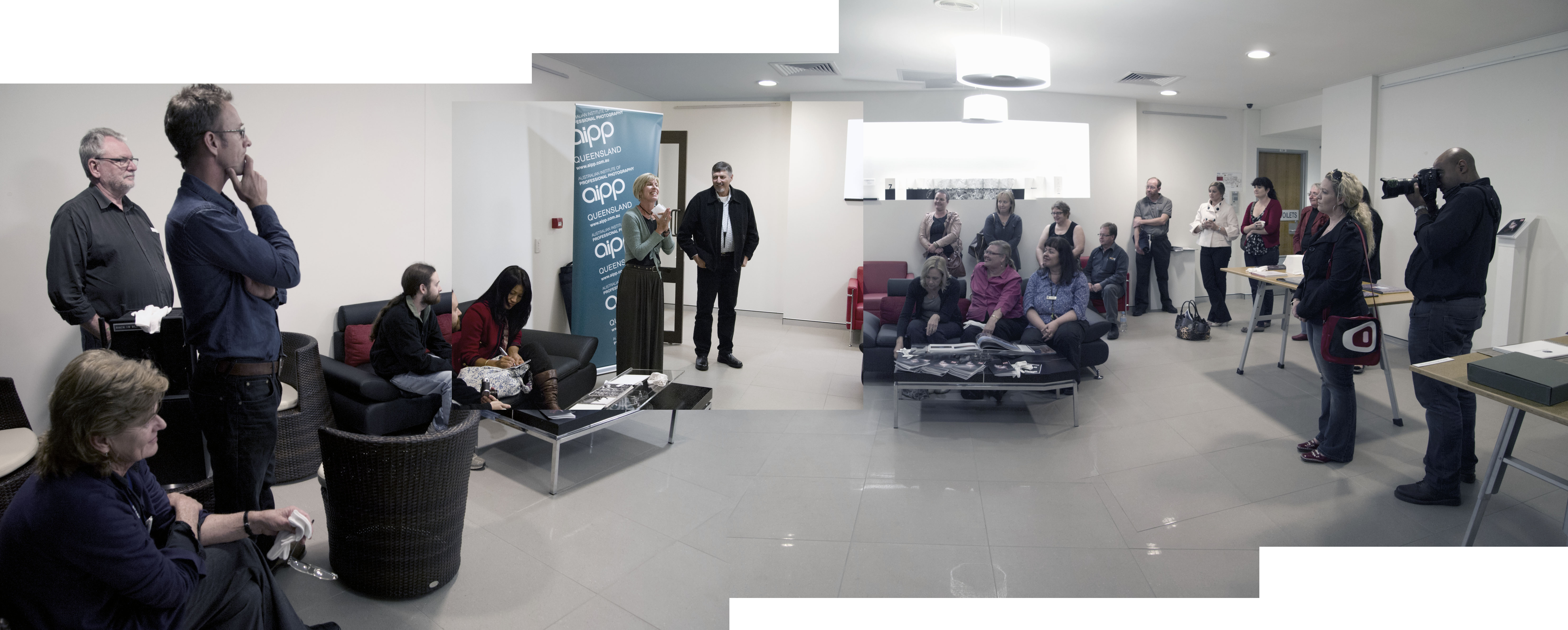
‘Brought to Book’ opening @ Futures Gallery SQIT Toowoomba
The third stage of the program included presentations by the three full-time staff of the photo team – Rachel Susa, Alison Ahlhaus and Doug Spowart. Each spoke of their connection with photography from both the personal and professional context. Doug spoke of the 20-year history of the photo Diploma and Certificate courses at SQIT and the Photoimaging teaching methodology.
The session concluded with a PowerPoint show presenting a selection of images and comments from past students. It was interesting to hear of the experiences of these past students about studying at SQT as well as their achievement in photography. The past students included: AIPP Chairman of the Board Alice Bennett, Nicola Poole, Katie Finn, Lisa Mattiazzi – National Gallery of Australia imaging specialist, Lydia Shaw who works in many areas including photography and teaching in Dubai, nationally acclaimed commercial photographer Damien Bredberg, Sue Lewis – APPA Team Manager and recent graduate Shanea Rossiter who is establishing a business in Warwick.
The Past Students PowerPoint show (PPS) can be downloaded from the www.cooperandspowart.com.au website – It’s a 30.9 mb download but presents an interesting overview of where SQIT students go to and the amazing achievements that they have. CLICK <http://www.cooperandspowart.com.au/2_PLACES/OtherBooks/index.html> Then select the PowerPoint AIPP OTL picture.
The evening concluded with the video fusion show “Dance-on’ by 2011 SQIT Diploma Student of the Year. “Lindsey’s video represents the future of photography” said Doug, and added, “that the stilled image is dead!” The point was not debated, but in the context of an industry that has gone from wet darkrooms to light rooms and digital output in the last ten years everyone left knowing that anything is possible.
Cheers Doug
COOPER+SPOWART: ‘Contact Zone’ exhibition
Featuring the photo-based artist’s books and photobooks of Victoria Cooper and Doug Spowart
March 21 ~ April 5
Cooper and Spowart are influenced by the context and the consequences of living within a constantly changing relationship with the landscape. Contact Zone connects the viewer/reader with “place” relationships through the photobook, both physically and metaphorically.
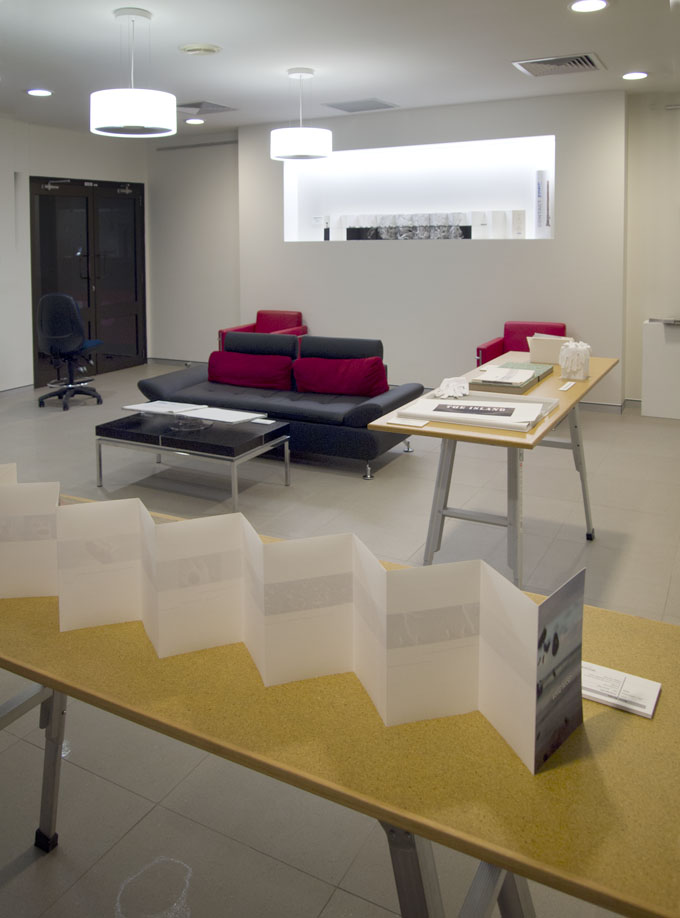
Contact Zone installation - Cooper+Spowart @ Futures Gallery, Toowoomba
Part of the 2012 QCP Queensland Festival of Photography
TIM MOSELY: An Eskimo climbing to a plateau
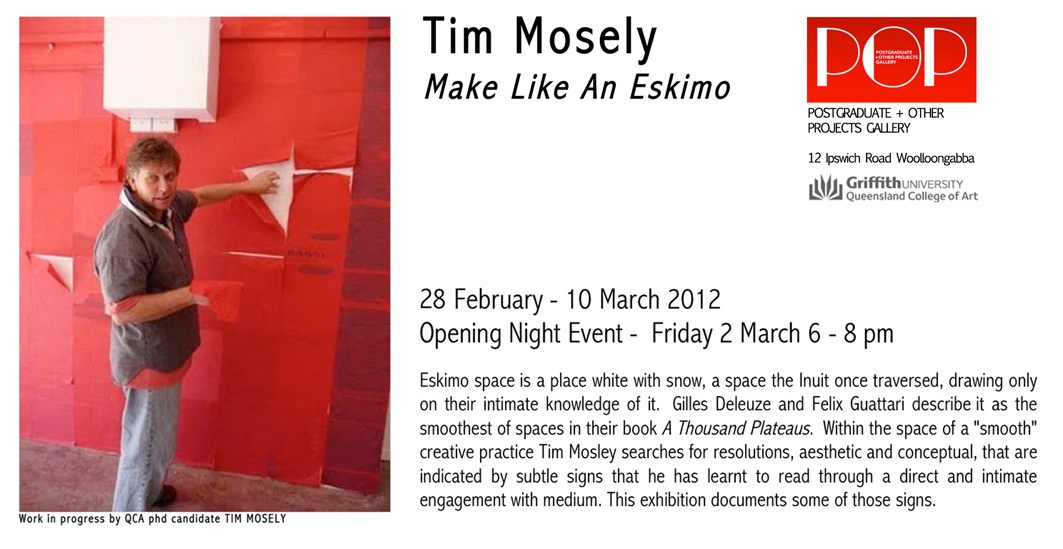
Make like an Eskimo – Invite
Tim Mosely is a PhD candidate at the Queensland College of Art. He is working through the research processes that students engage in to position their academic imprimatur on some aspect of human knowledge. Mosely over the years has developed a significant international practice in artists’ books, handmade paper and the book experience as one in which the tactile senses are evoked.
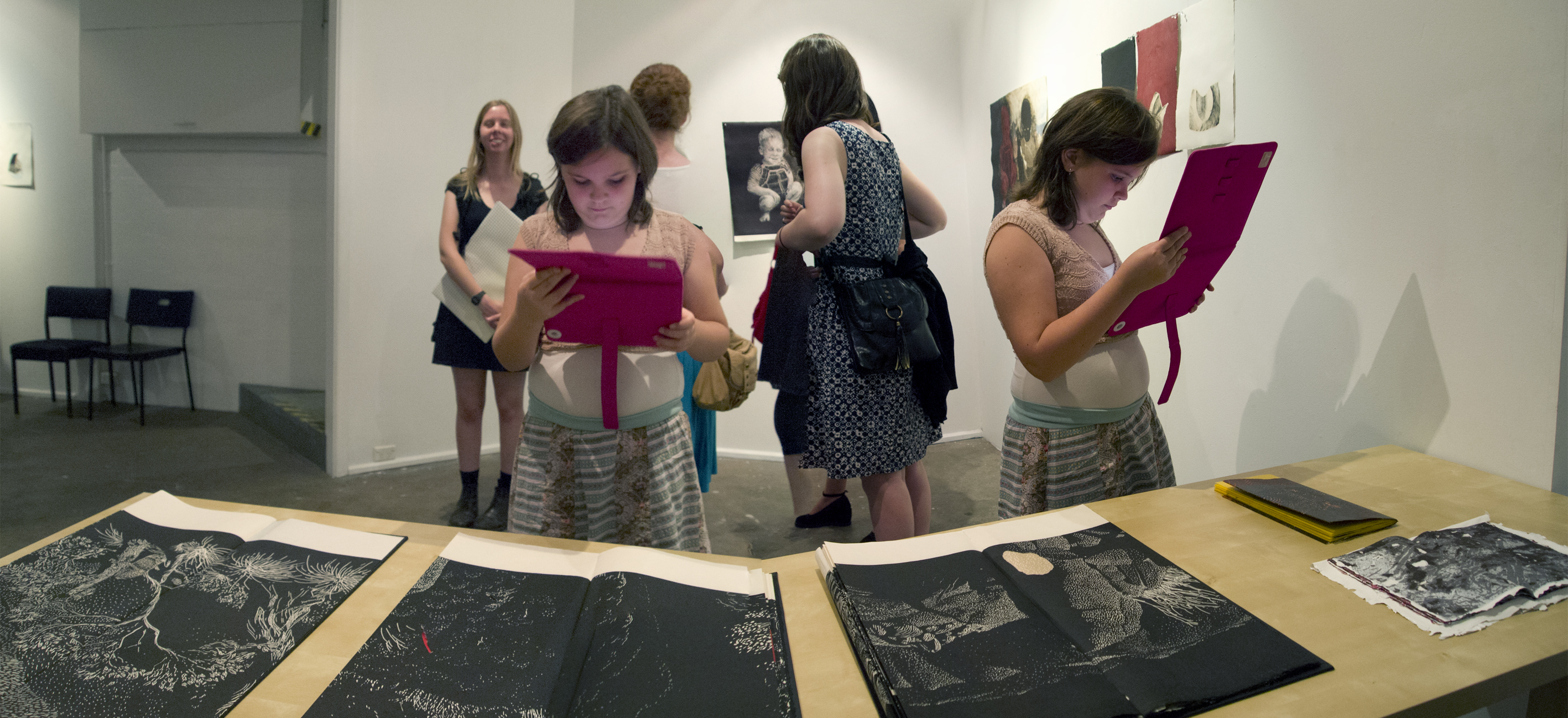
Tim Mosely – Make Like An Eskimo. POP Gallery Brisbane
Make like An Eskimo, at first appears as a mixed exhibition originating from many individual artists as each body of work teases out an idea, a gesture, a memory – blurred, or a theme. These are experiments, the research level is PhD so we do expect something that presents a challenge, or expresses a cathartic moment or even a line of questioning that leads … nowhere. This work does not leave this viewer wanting. The stones have been turned over and what has emerged are things that show Mosely’s Inuit traverse of the smooth white space where he has drawn on his intimate knowledge of printmaking medium, of his personal semiotics and his dreams.
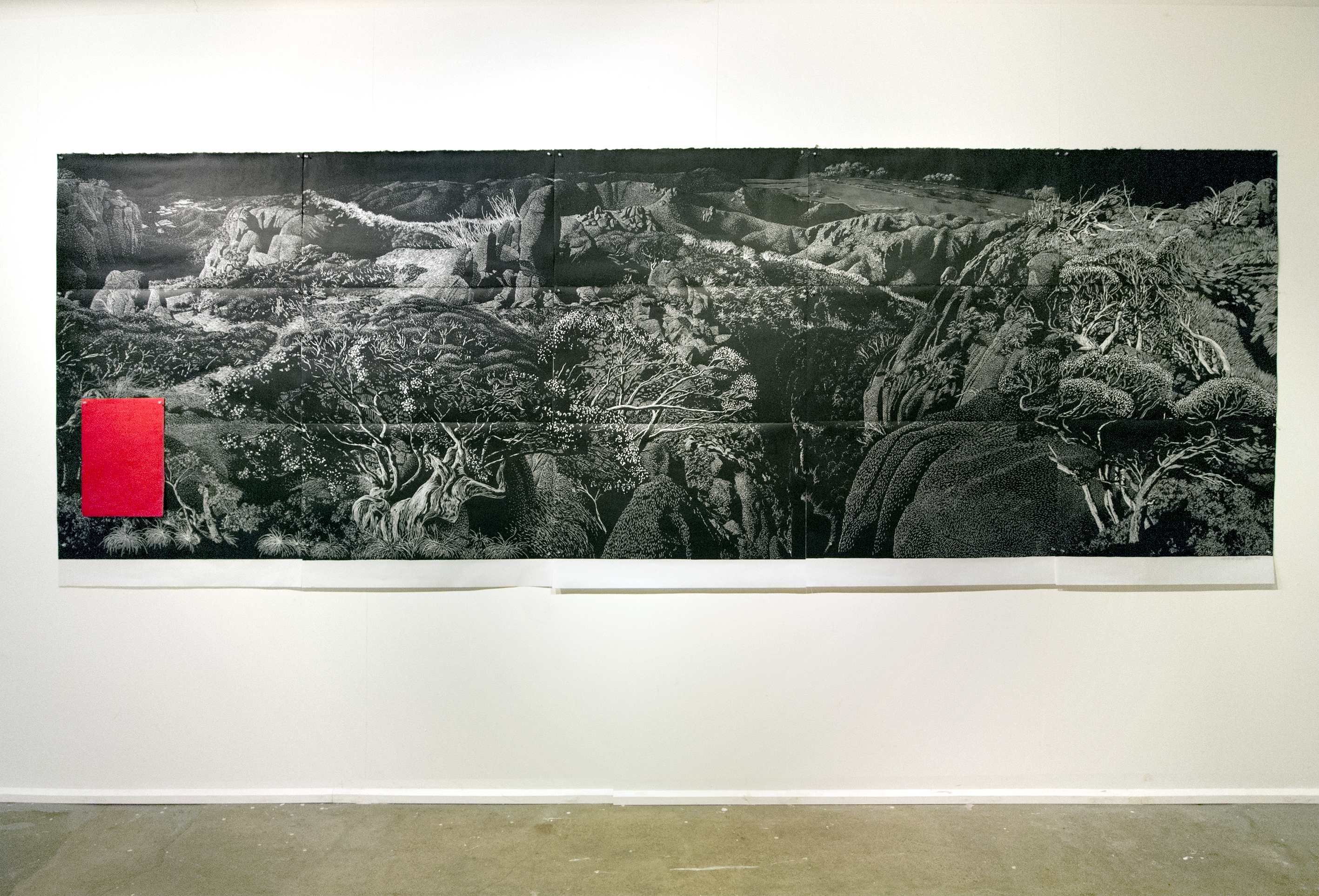
Tim Mosely – ‘imagining mt giluwe‘ a multi-sheet linocut
One monumental piece explodes from the wall – imagining mt giluwe. It’s a multi-sheet linocut – dark and brooding with markings made by Mosely’s tools that resemble some kind of tribal scarification. The wild landscape overpowers the smooth white gallery wall and entices the viewer to move in close. There is a hidden map implied by the transecting vertical and horizontal lines of the individual printed sheets. Is it a map of the physical, the metaphysical or is it just mere tactile experience – for touching with the eyes? There is a movement through the monochrome surface and a red rectangle of paper overlays a part of the image – is this order implied over chaos? Colonial blood over Nature? Or could it hide a didactic code with its intention to perplex the viewer – or maybe it is there to just hide the fact that no code exists?
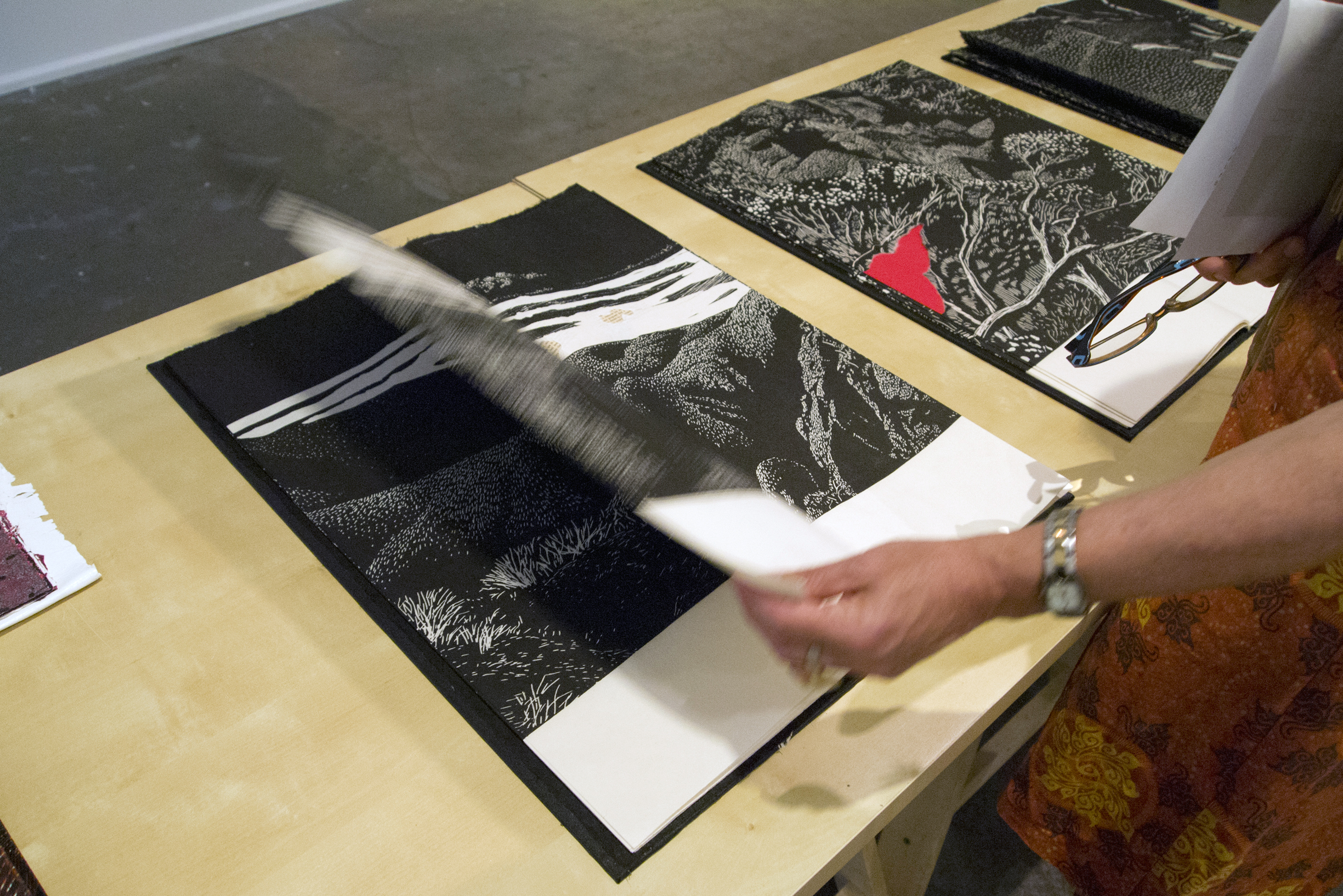
Tim Mosely – Make Like An Eskimo books
Another work, a series of books attempts to contain the big lino imagining mt giluwe. It is in fact, books made from pages of the large work. Once again there is a calling to explore and this time it is easier as the dividing and sectioning of the work into book form creates a path through the act of page turning. Some pages have been slashed and red paper shows through the jagged shapes implying similar questions as the red rectangle in the larger work. I am comfortable with this work, and perhaps Mosely is as well, as it is derivative of the language that he has employed in the past.
As I reflect on the experience of the POP Gallery I can confirm that Mosely is interrogating his practice, his experience of life and what it means to be an artist. What stands out is his haptic encounter in the making of his artworks and the profound need that he has for that vital energy to be infused into the art. And in that I think he is not alone – the materials seem to respond to his interaction. Here I am reminded of a discussion that Barbara Bolt has about a mode of thinking informed by Martin Heidegger’s techne and Paul Carter’s ‘material thinking’, where she states,
‘In the place of an instrumentalist understanding of our tools and material, this mode of thinking suggests that in the artistic process, objects have agency and it is through the establishing conjunctions with other contributing elements in the art that humans are co-responsible for letting art emerge.’ (Bolt 2007:1)
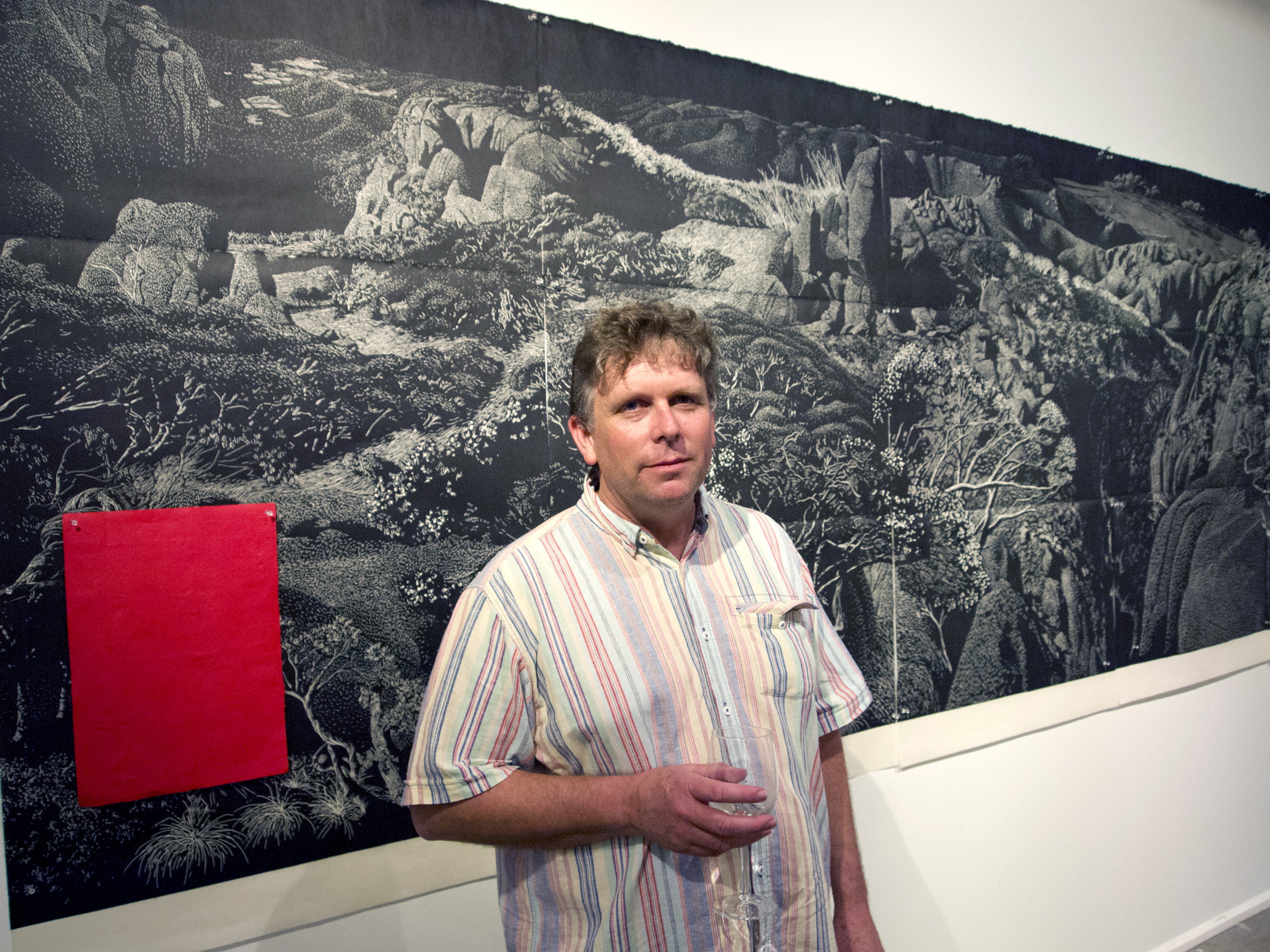
Tim Mosely in the exhibition Make Like An Eskimo
Mosely’s work and the materials in his work do emerge to present the viewer with communiqués that are enriched not only by what is embedded in them but also what they invoke in the mind of those who encounter them. We wish him well in the ascent to his academic plateau.
Doug Spowart
FLOOD DONATION: ‘Toowoomba Water’ book to SLQ
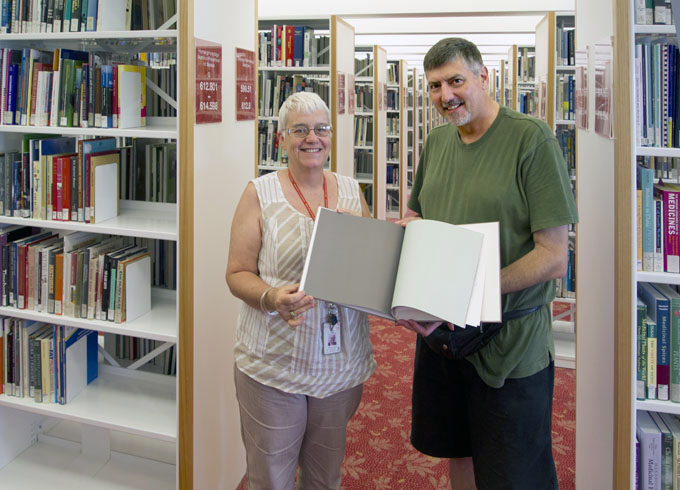
Helen Cole + Doug with the book 'Toowoomba Water'
At a time when all Queenslanders were reflecting on the first anniversary of the devastating floods of January 2011 it was fitting that I was able to make a presentation of the book Toowoomba Water to the Australian Library of Art at the State Library of Queensland.
The book features a response to flooding in Toowoomba that took place on January 10th. The book was designed to be output using Australia’s premier print-on-demand supplier – AsukaBook using their Book Bound Hard Cover 10″x10″ format.
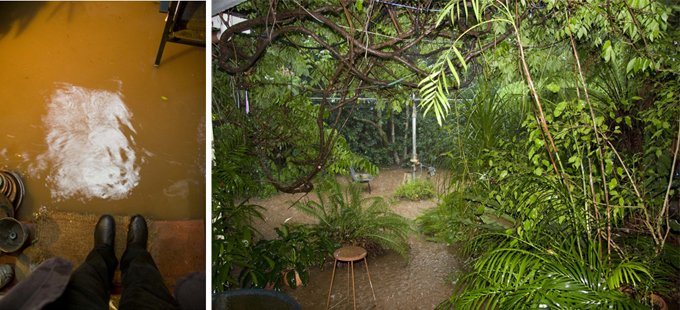
On the studio step + our 'rainforest' backyard
Water came within 20cm of our studio and a brown torrent flowed into our garden and under the house. At the bottom of our street a massive flow of water along East Creek took the lives of two people.
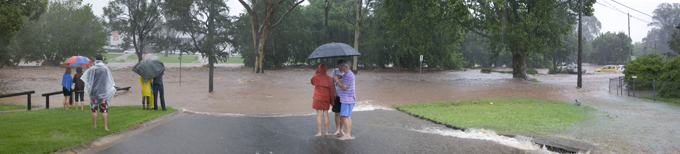
East Creek in flood at the bottom of Burns Street
The book makes a commentary on the flood by responding to an aspect of the event that was ‘sampled’ and then brought together to form the book – it is an unusual approach to the documentation of place. Reference for this methodology comes from the work of Marcel Duchamp‘s Paris 1919, Sol LeWitt’s colour grids and Bruce Nauman‘s L.A. Air.
The donation was accepted by Helen Cole, Senior Librarian, Australian Library of Art, State Library of Queensland.
SEE THE BOOK: http://www.cooperandspowart.com.au/2_PLACES/OtherBooks/Twba_Water_Flip/TwbaWater-Flip.html (Note: This link is to a Flash Flipbook that may not play on all viewing devices)
VISIT: Georgia Hutchison & Beverley Bloxham – daughter & mother artists/designers
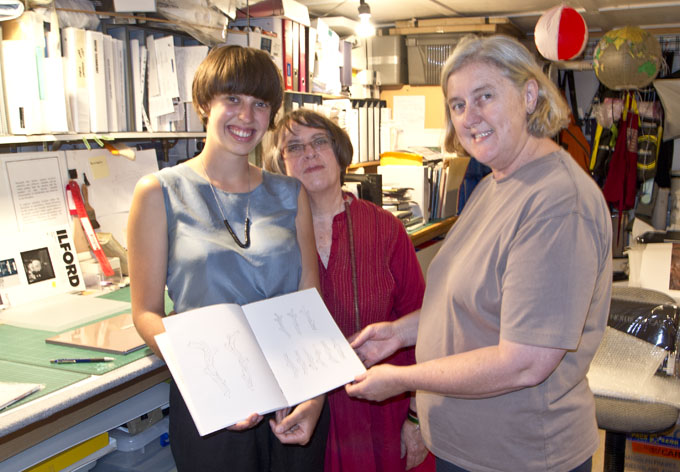
Georgia, Beverley and Victoria with the book
We had a visit from Beverley and Georgia, we shared ideas and methods and secret knowledges on the art of simple binding for handmade books, referencing the notable texts and work of Keith Smith. Georgia showed us her submission for her degree in Bachelor of Design, Industrial Design at RMIT, which she had only recently been awarded as First Class Honours. This unique state handmade book , Wild Order was beautifully designed – its simplicity belied the complexity of the content. Georgia utilized, Riso print, to produce monochrome images, diagrams and texts: black and white some were pale shade of colour eg yellow or green. These delicate and grainy images were astutely placed with texts and diagrams to tell the narrative of the major project the Georgia produced. See www.georgiacharlotte.net
Beverley, is an artist, designer and curator of note and substantial experience you can check her work on http://www.behance.net/BFBloxham She has worked hard to establish local community arts organizations and networks and is now working with others to establishing online presence for an NGO community in India.
July 23 : BIZOO ZINE BOOK LAUNCH
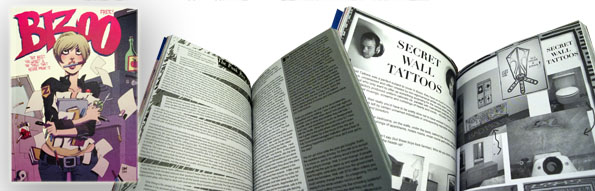
Launch of the BIZOO Book at the Toowoomba Regional Art Gallery
“Bizoo: The Best, The Worst and The Trash That Never Made It” Bizoo was a street culture zine which gave a voice to the young people of Toowoomba from early in 2000 until 2006.
Its story and success lies in the needs that brought about the fanzine world-wide publishing phenomena over the last 20 years. Essentially it’s a response to the fact that the world is controlled by the media and those who control the media pretty well control everything. To combat the communication gulf those from outside the mainstream formed collectives and groups that collated the stories, prose and poems, lyrics, interviews, gig guides, critiques, rants, rude stuff and commentaries about their end of society.
These self-published newspapers/newsletters featured simple layouts, rough illustration and were usually output by photocopiers. Those making contributions did so under various tags and pseudonyms and distribution was made through coffee shops and venues where like-minded people hung out. Copies of the zine were free.
Ultimately the zine became respectable and these days many resemble ephemeral artists’ book styled products. Real names appear and the practice is studied and commented on by university academics – all a far cry from the anonymous gonzo street journalists of the early days.
Somehow, perhaps, the future of communication that was once carried in print by fanzines like Bizoo is gradually being eroded by Blogs (like this one), Facebook, texting and youTube.
But what is important is that the self-published zine created a voice for the stories that were not able to find a vehicle for communication. Now, with the publishing of BIZOO these chronicles of street-life in Toowoomba in the first half of the 21st century will pass into the history of our times. Something that the zinesters, now that their grown up a little, got or getting reliable work, having kids and getting on with life, will find an important and amusing part of their lives. The publication was supported by a grants from the Australian Government’s Regional Arts Fund and the Queensland Government’s RADF.
Make your own zine today ….
Cheers, Doug
SEE the following for more ….
The best place around to find zines – ElouiseQ at http://smellslikezines.com/
JOHN ELLIOTT’s YouTube video and interviews http://www.youtube.com/watch?v=mkZV5Mg16vQ
THE CHRONICLE Newspaper’s story http://www.thechronicle.com.au/
WHAT’S HAPPENING – Workshops, events, gigs etc. www.bizoo.com.au

 wotwedid
ReNEWSing the Newspaper: A group exhibition @ Futures Gallery
leave a comment »
An exhibition in which the local newspaper has been reinterpreted by 5 artists and reconstituted as a statement of a regional community in Australia.
The ‘ReNEWSing’ exhibition panorama @ Futures Gallery
Bev Lacey discusses one of the books
Artists: Kylie Noakes, Bev Lacey, Jess Martin, Yseult Taylor, Angela Moar and Doug Spowart
Exhibition visitors: Tina Wilson and Sue Lostroh
Sandy Pottinger, Bev Lacey + Victoria Cooper
Doug + the book ‘Have you got your Chronicle today’
.
BEV LACEY’S OPENING REMARKS
Each day the focus of my time in the office is spent on production of images for the next edition.
Or as in recent times, the production of images and video, for immediate release online and also for the printed edition.
The process is more in keeping with what other people’s expectations are and what they envisage as the final product.
This attention to a set formula – i.e. go to job, get back, quickly download and move onto next job – often narrows the thinking.
In the past when I have browsed through the work produced by the art students taking The Chronicle and creating an artist book, and this is an exciting interpretive assignment, I have been amazed, inspired, envious and a little in awe of the works produced.
I am always in awe of “the artists mind” the ability to see, the ability to transform often unobscure pieces into works of art that I cannot draw away from.
So I thought, taking about the works would not be a challenge at all. But in an attempt to say something worth hearing I am at a loss.
No not really……….
THE BOOKS – an artist book for me needs to be a tactile experience……
As I looked through the books on YouTube I found myself longing to turn the pages and feel the textures.
Does that make your books successful?? that I want to touch them, and experience more than flipping through them on a computer screen – yes I think so.
Yseult Taylor:
Sadly I found the interpretation on what was published on May 10, similar to what a lot of people think that The Chronicle is about; depressing stories about loss of life, jobs and accidents. We, the media do have a tendency to focus on the negative and in creating a book about what was published in the paper on that day May 10 – yes ….you have successfully captured the essence of our storytelling in that edition.
In saying that though, a new perspective was put to the viewer – a rather blunt and interesting division between the headline and advertising.
Jess Martin:
The constant, barrage of text and information which we all have in our lives at the moment,
Information – some useful most not.
Entering though the door of the commercial world, being given light relief , in cartoons and then the barrage again.
The page that I found most fascinating is the blank one – it stopped me in my tracks and you can feel your whole body just breathe out that sigh of relief – time out from the information overload.
Angela Moar:
As a reader , certain words or phrases mean more to one person than another, I found your isolation of the phrases that affected you, an interesting concept.
It make me think of how even in conversation; each individual’s interpretation of even, what I am saying here tonight, can be perceived differently.
Each person hears on a different level of understanding, all totally dependent on our individual life experiences , personal circumstances, and what we think of the person retelling the story.
And the stick men, the little soldiers that represent whom we all are, representing a formula, a set idea of what is news and the storyteller.
Klyie Noakes:
Kylie has isolated happier moments; selecting from the social pages. The moment in time, often totally set up where a photographer captures a moment in a social event.
The quotation, the who am I really, the what is that person thinking at that precise moment is often lost on the viewer as the person is represented, flat – not whole in three dimensional perspective, but as a “happy snap” of people out and about enjoying a moment .
But their real lives are still there, their thoughts their own we just don’t see beyond the smile, a mistake we make even when meeting other people.
Doug Spowart:
The multi layering effect of what is “The Chronicle” is I am sure what Doug is telling us.
A more sceptical self – realises the focus on advertising of cheap deals could be the reality.
But no – I am convinced Doug’s layering, is about a more in depth view of how production of a newspaper happens. The many people, the many processes, the many facets of a life in the office that create a product.
Overall:
Each of the books has that wonderful inviting appeal.
that “what is the artist trying to say to me, what was the artist thinking at the time of creating” ,
and I believe the success of these books lies simply in that – the questions that it asks the viewer, the simple fact that the viewer will ponder the questions, and the answers they themselves come up with – long after they put the books down.
Share this:
Written by Cooper+Spowart
September 5, 2012 at 7:09 pm
Posted in Artists Books, Doug Spowart, Exhibitions, Meeting People
Tagged with Artists Books, Bev Lacey, social commentary, The Chronicle, Toowoomba