Author Archive
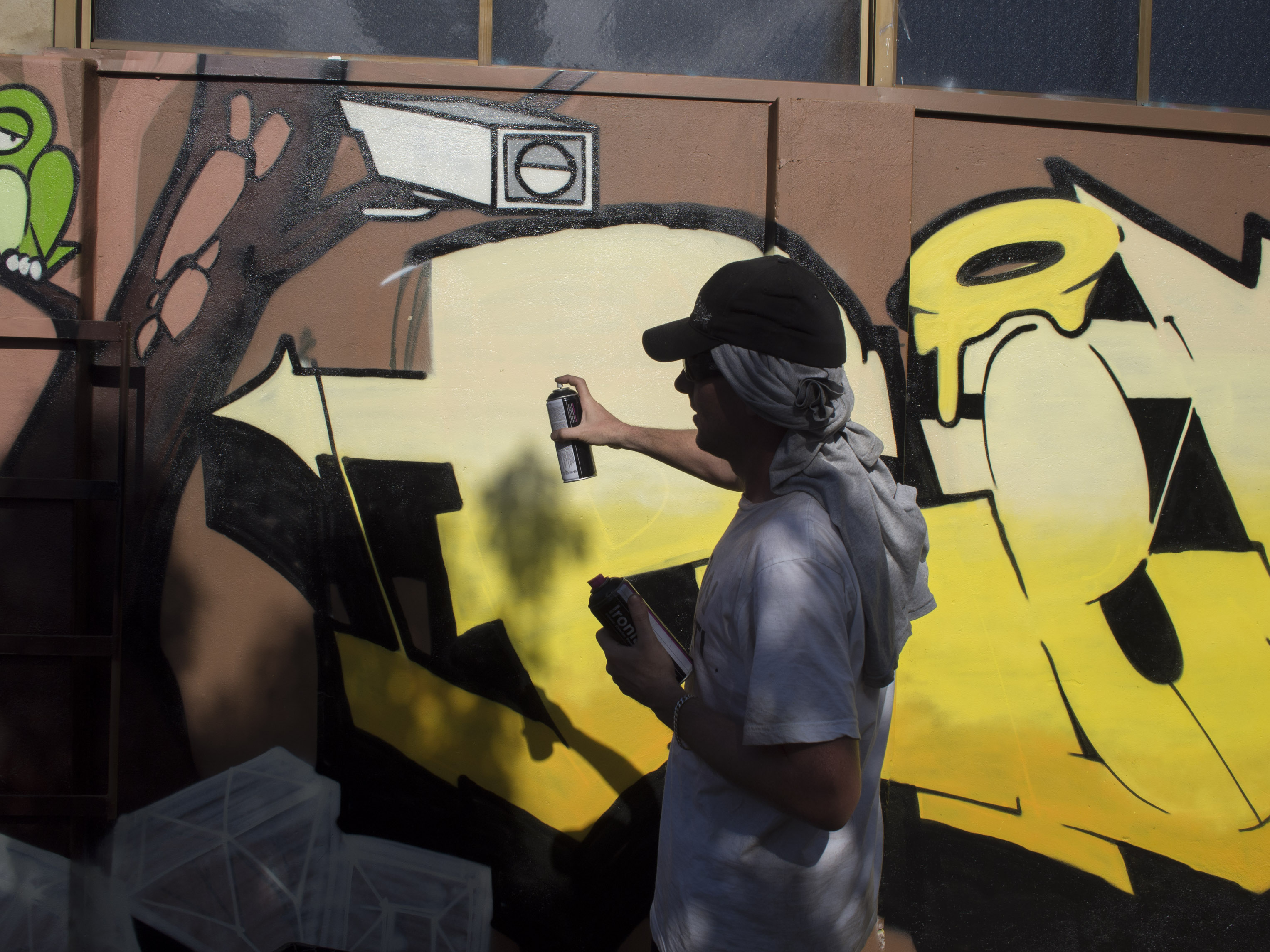
Buildings with tattoos: First Coat Street Art Festival
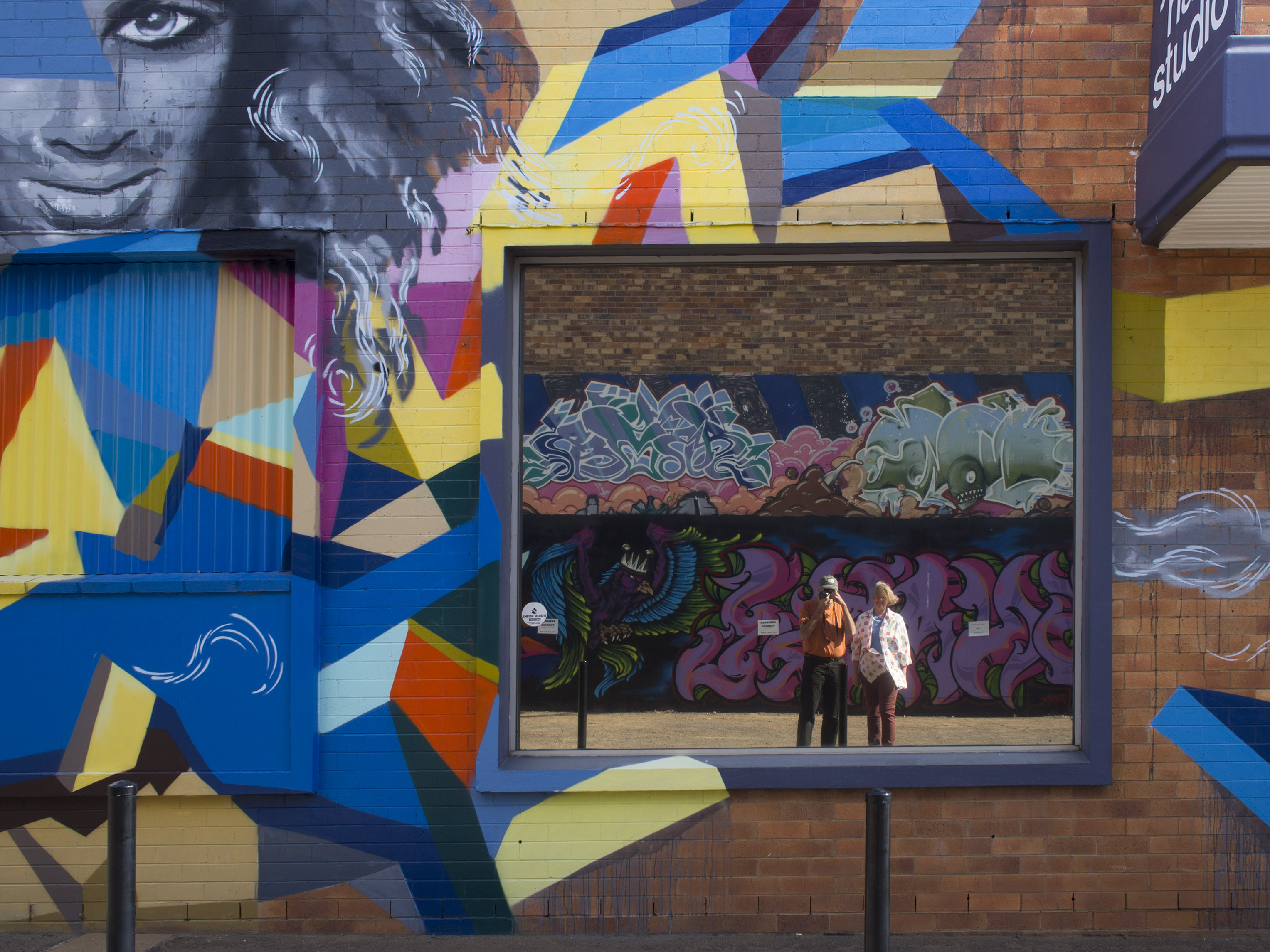
Off Duggan St
.
THE FIRST COAT STREET ARTS FESTIVAL
.
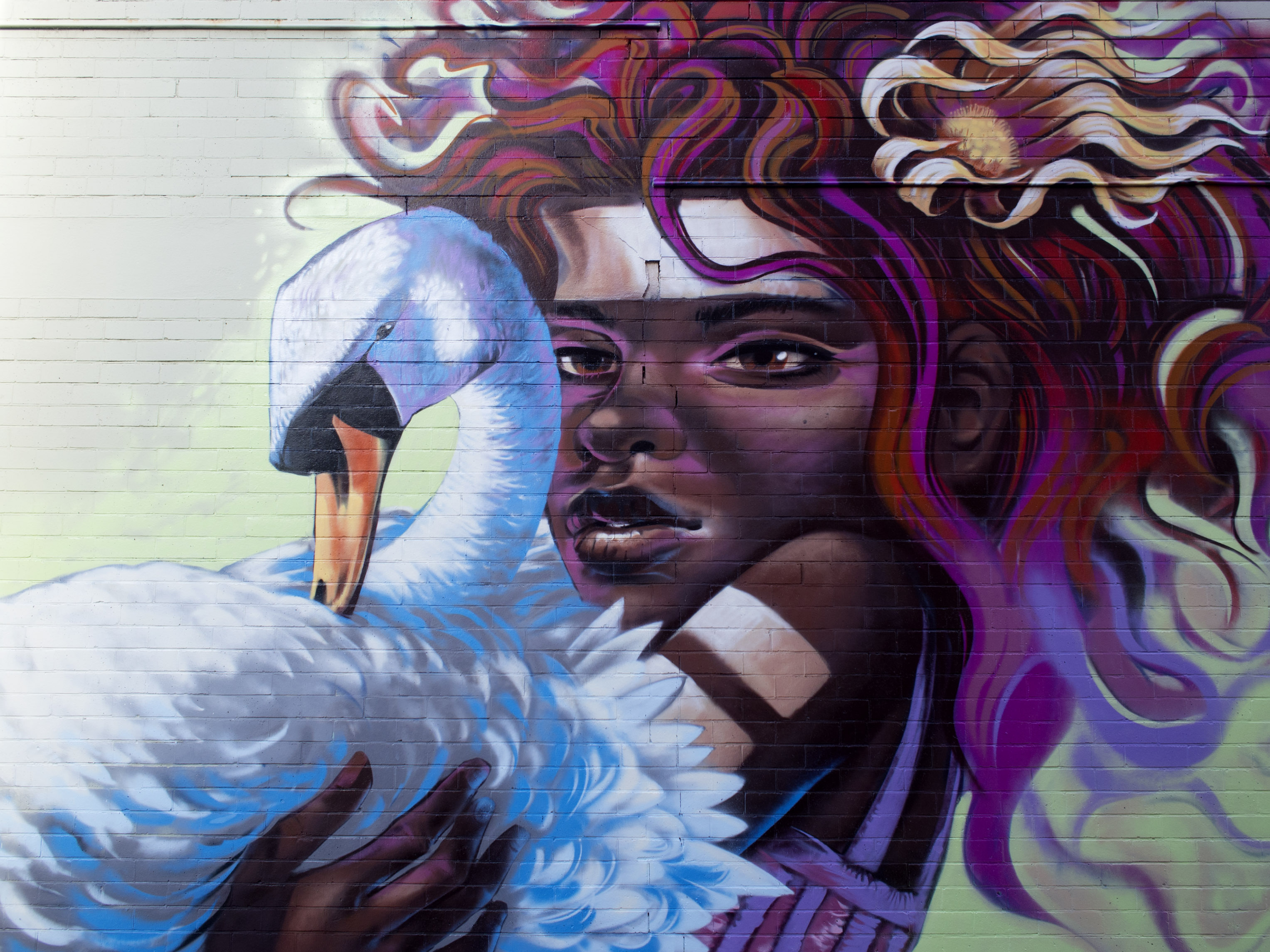
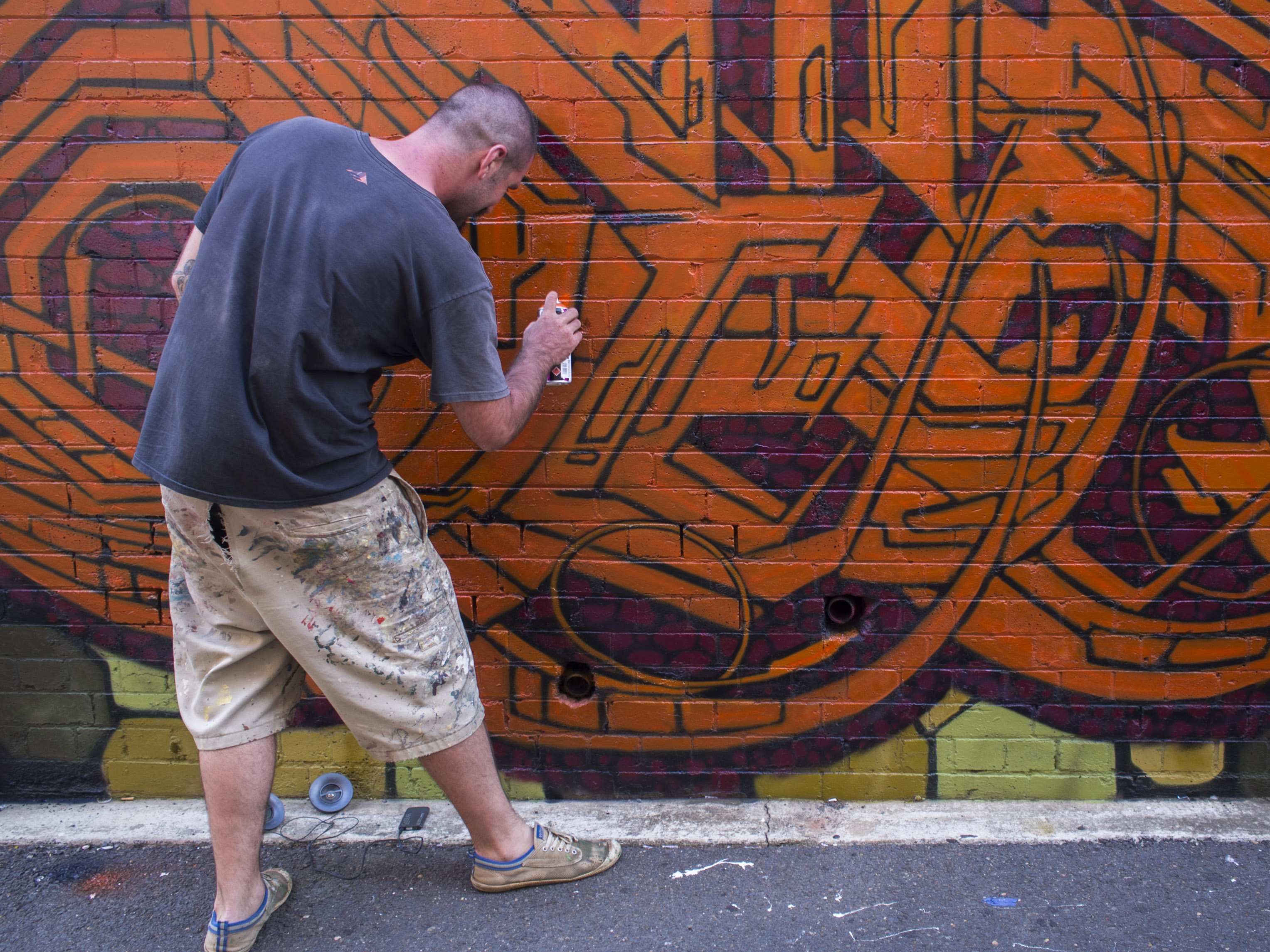
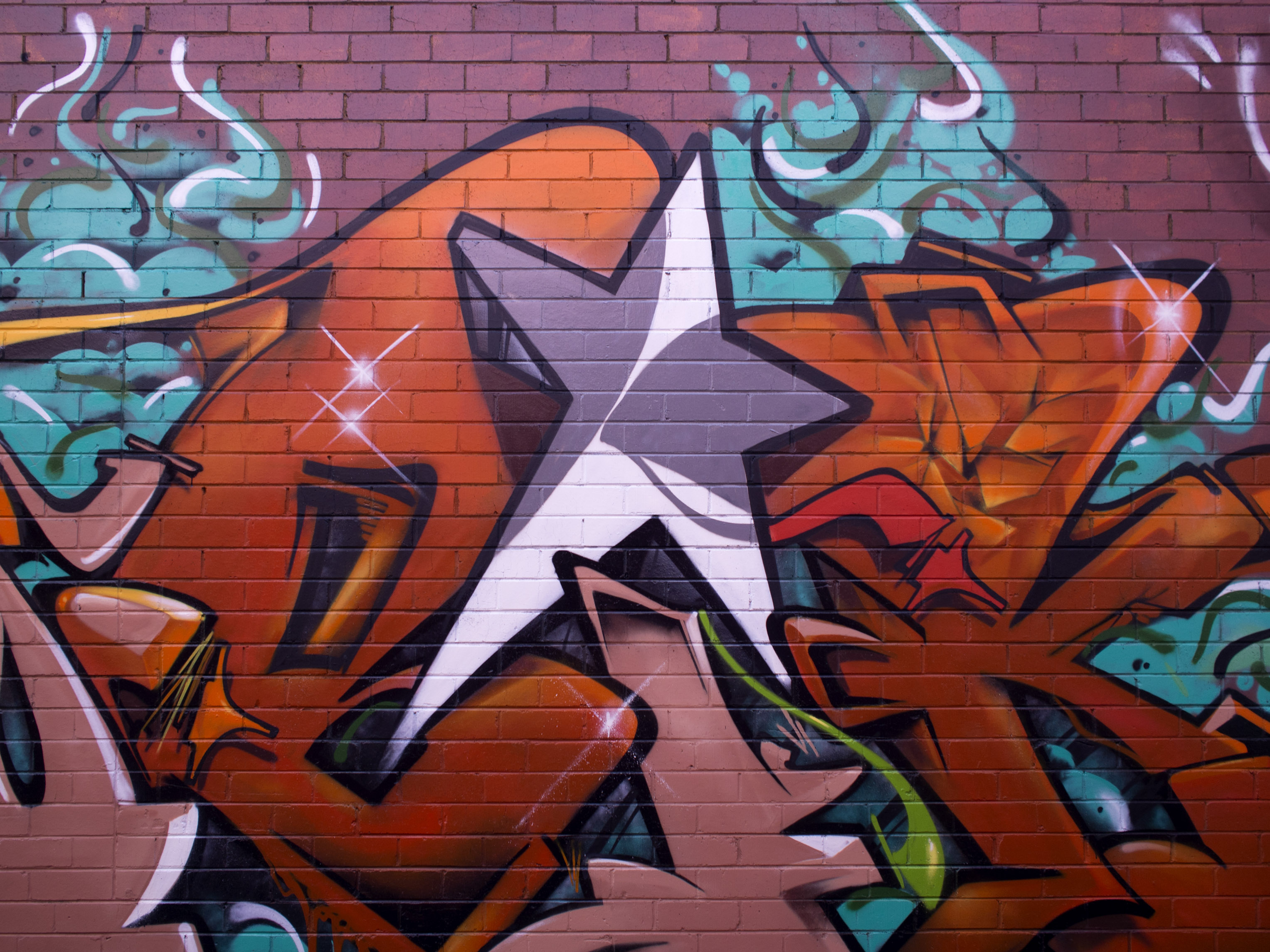
The regional town of Toowoomba has been transformed over the weekend of the 21, 22 and 23 of February by a band of international, national and local artists, converting lane way walls into places of street art. Now dingy or dilapidated back lanes are the place where one can encounter art – or – has the art has come to us?
Street art or graffiti, whatever you call it was illegal with significant fines and community service being awarded those who were caught – perhaps even jail! Not being caught in the act as well as being outrageously brave in the places where work was to be placed and what it would say was what it was all about. Graffiti gave a kind of voice to a youth dispossessed by any means of being able to express how they felt or the creativity, perhaps even beauty, that can come from the nozzle of a spray can and a creative mind.
.
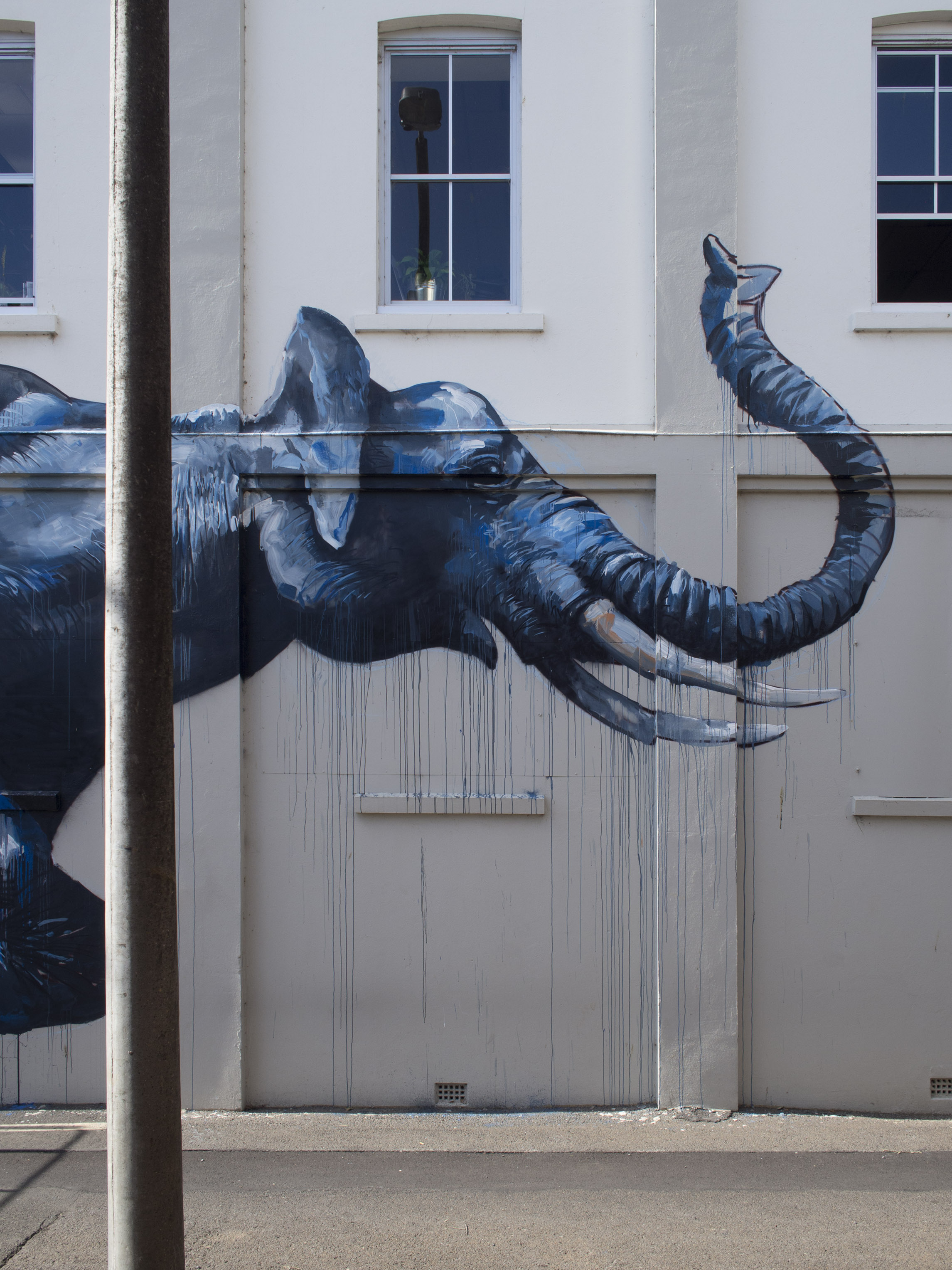
Fintan Magee: 492 Ruthven Street
Fintan Magee: 492 Ruthven Street
.
For years the domain of reckless and angry youth, the quickspray ‘tags’ adorned many buildings in public spaces. In time railway rolling stock became a moveable target for adornment. And while in the past, crews of official graffiti ‘strippers’ would attempt to remove these forms of creative expression it seems today that they have just given up–it’s far more interesting now to ‘graffiti-spot’ (like train spotting), at the train level crossings than ever before.
Working mainly in stencils the UK artist Banksy added to the genre’s acceptance in mainstream culture by his often ironic, humorous and insightful commentary. In his nocturnal art practice Banksy has maintained his anonymity and his works have passed into cult status.
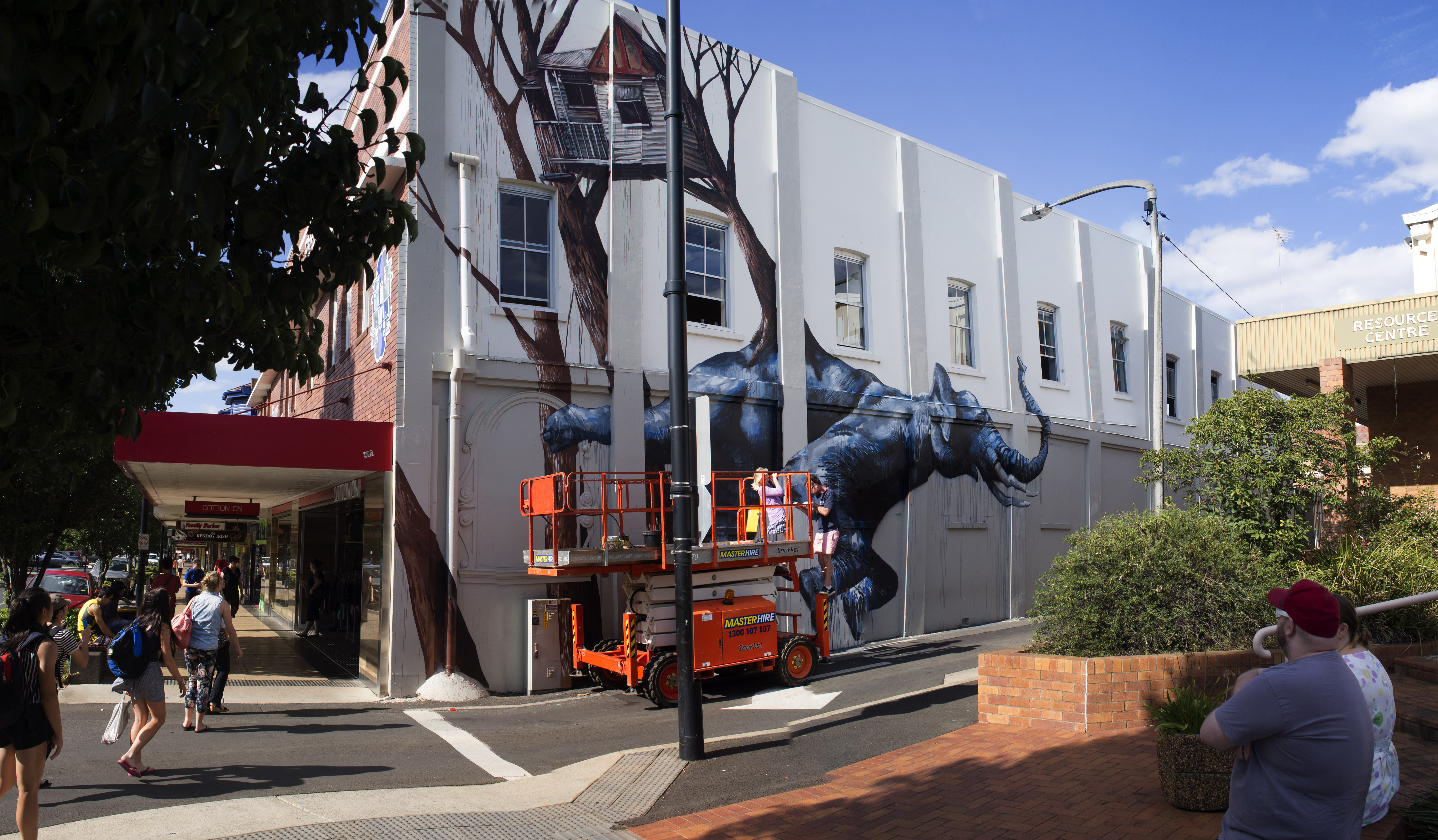
Gone today it seems is the night work, gone too are dark clothes and a knap sack with a few cans–the limited palette of the graffiti criminal. Now, it’s all done in the light of day with the luxury of ladders, scissor lifts, fume masks and adoring fans. Most importantly is the visibility of the architectural canvasses being offered these artists.
.
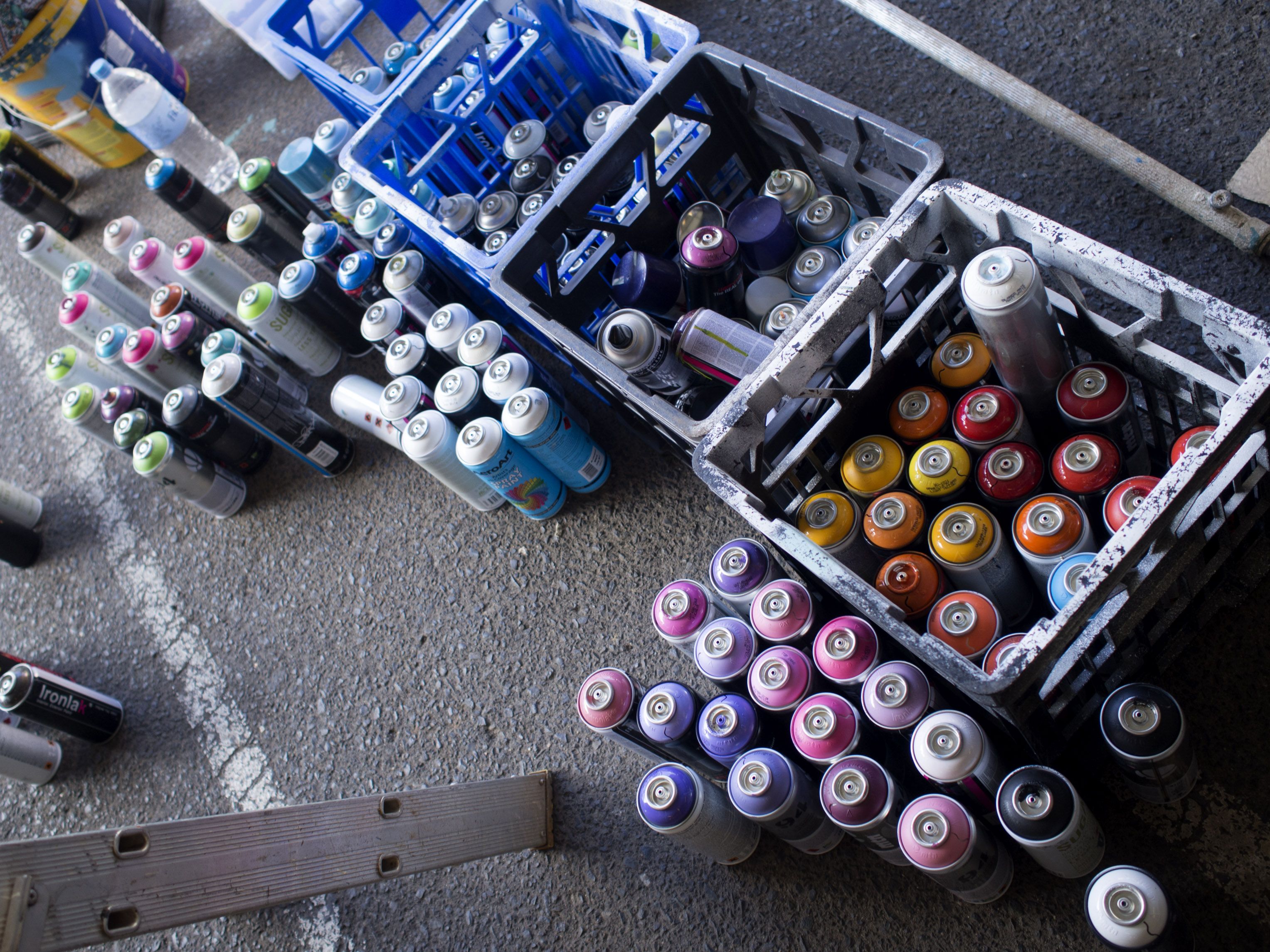
Liam Dibb’s cans
.
National awareness, at least in Australia, arose through the acceptance and support of Melbourne’s laneway graffiti to the point where it has become a marketable tourist destination and has brought about the repossession of these once deserted grungy rear access thoroughfares.
Toowoomba’s ‘First Coat’ Street Art Festival has certainly left its mark on the town. Judging by the number of people walking around on the final day of the event, the media coverage and the deluge of Facebook posts by local residents it has captured the imagination of the community.
What remains is an assessment of the longer value of a project like this. Does the work look derivative of other places were this artform has been sanctioned? Will our children be doing graffiti workshops? – they are being offered in Toowoomba now, and will every wall become a tattoo-esque picture canvas? Will Toowoomba’s street art express community issues, concerns, icons and symbolism? Does the new street art become neutered in meaning becoming art entertainment, sanitised by its newfound sponsor – civil society and layers of government? Does any of this matter?
I’d like to think that out there somewhere – an angry young kid is expressing their life, concerns and messages to us by continuing in the foot-prints or sneaker-prints, and in the dark of night of those that have gone before…
Doug Spowart
24 February 2014.
.
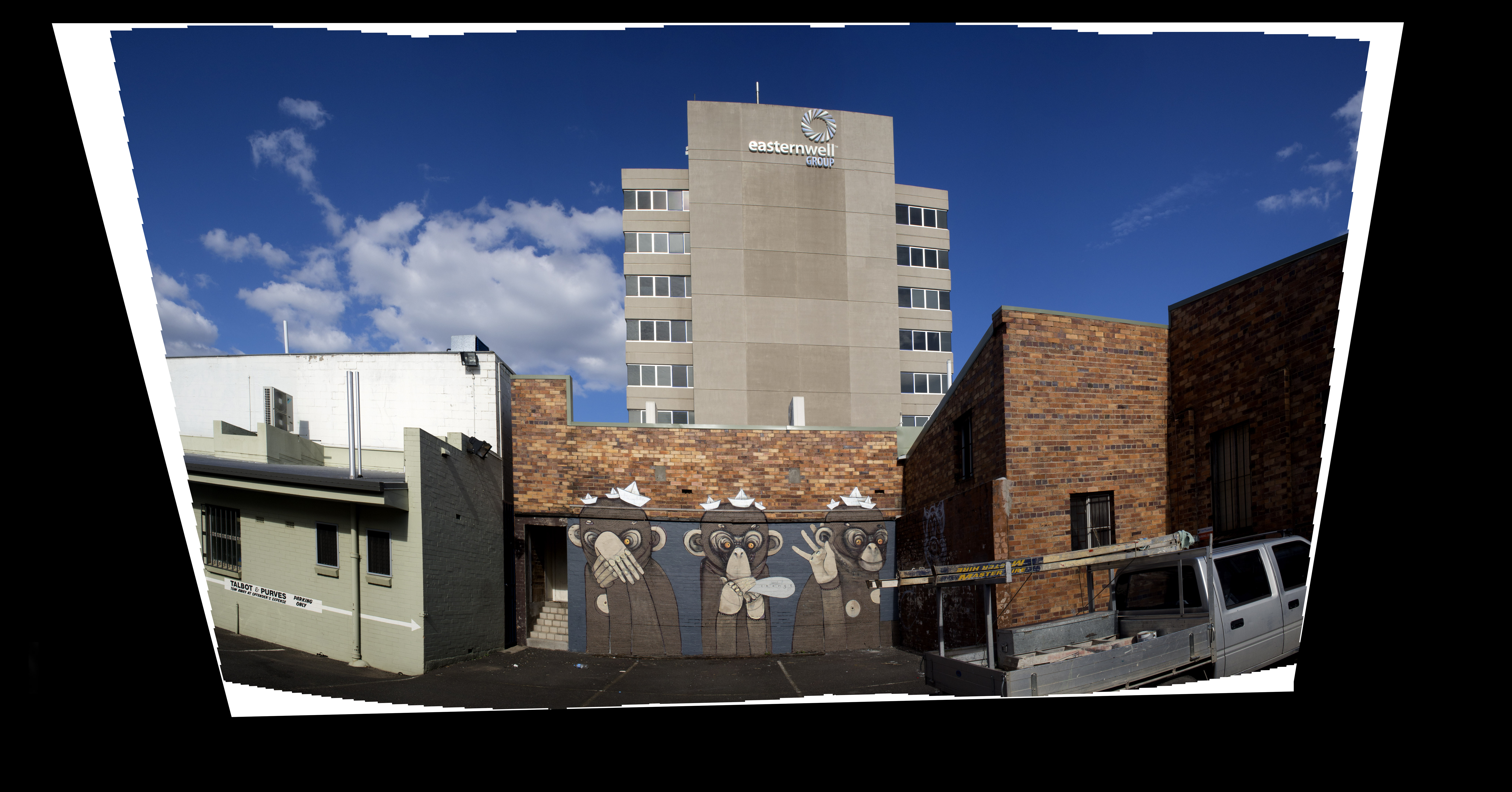
PANORAMA: Damien Kamholtz – 3 Bank Lane
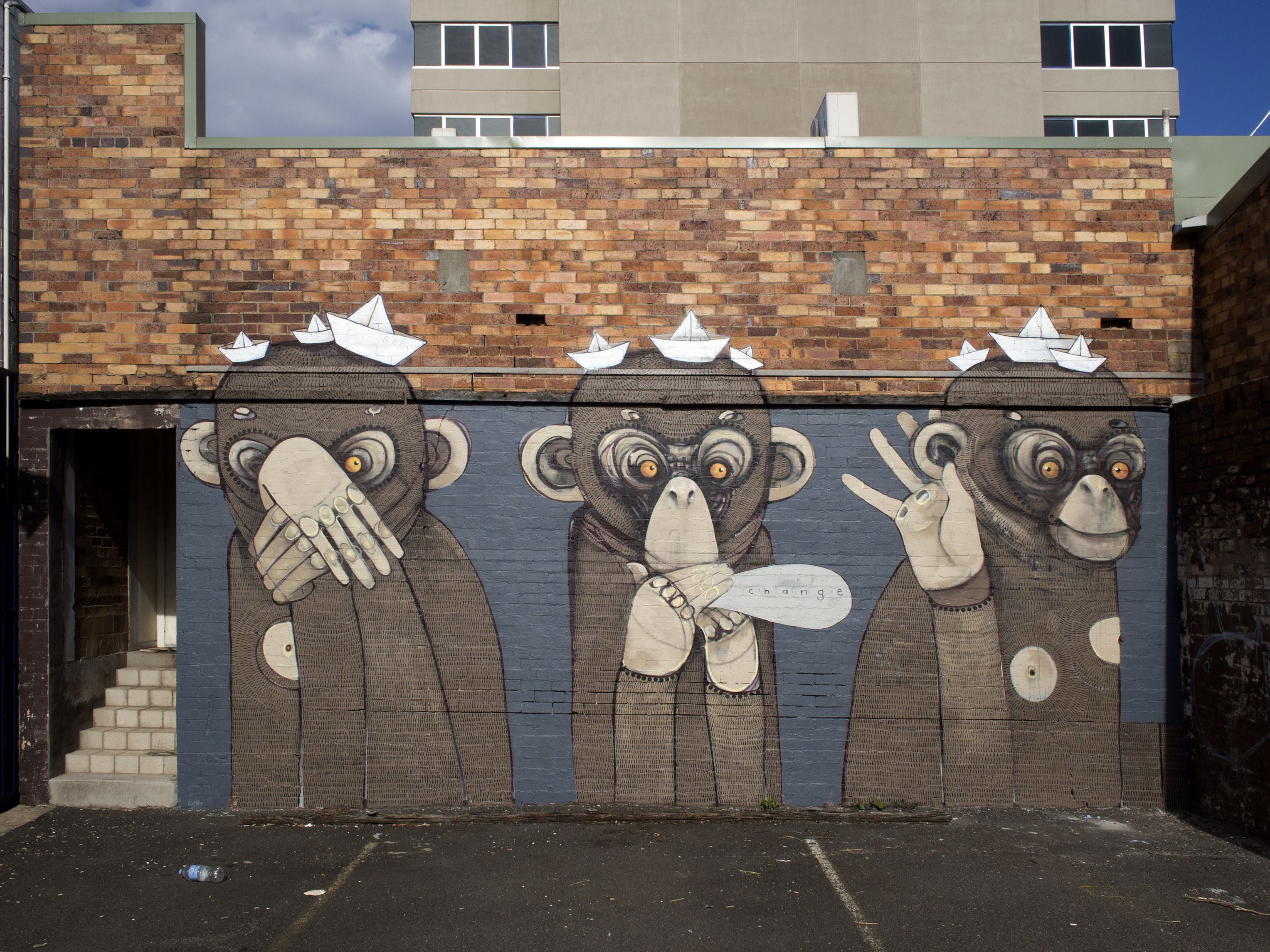
Damien Kamholtz – 3 Bank Lane
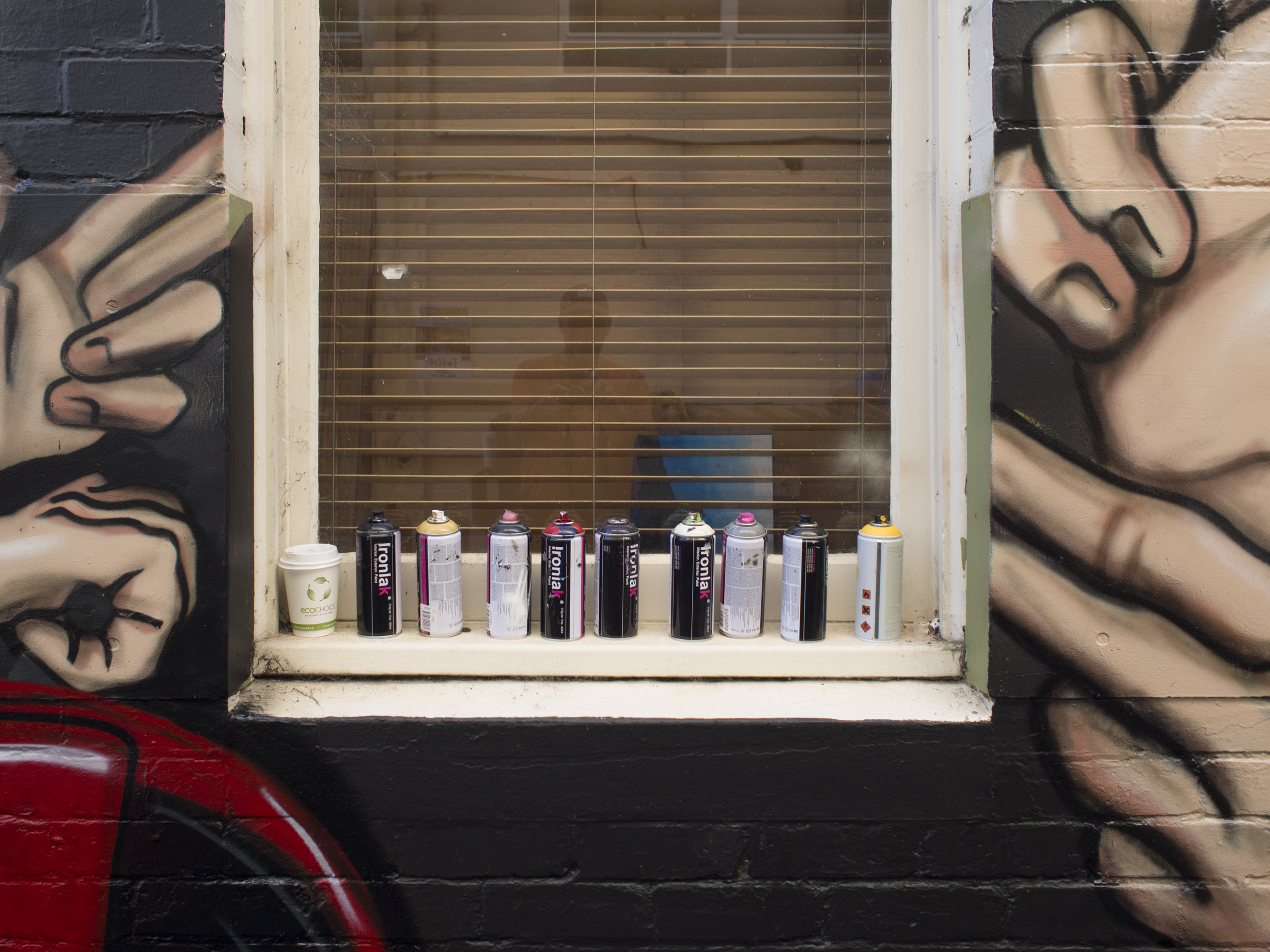
Alice Weinthal – 239 Margaret St.
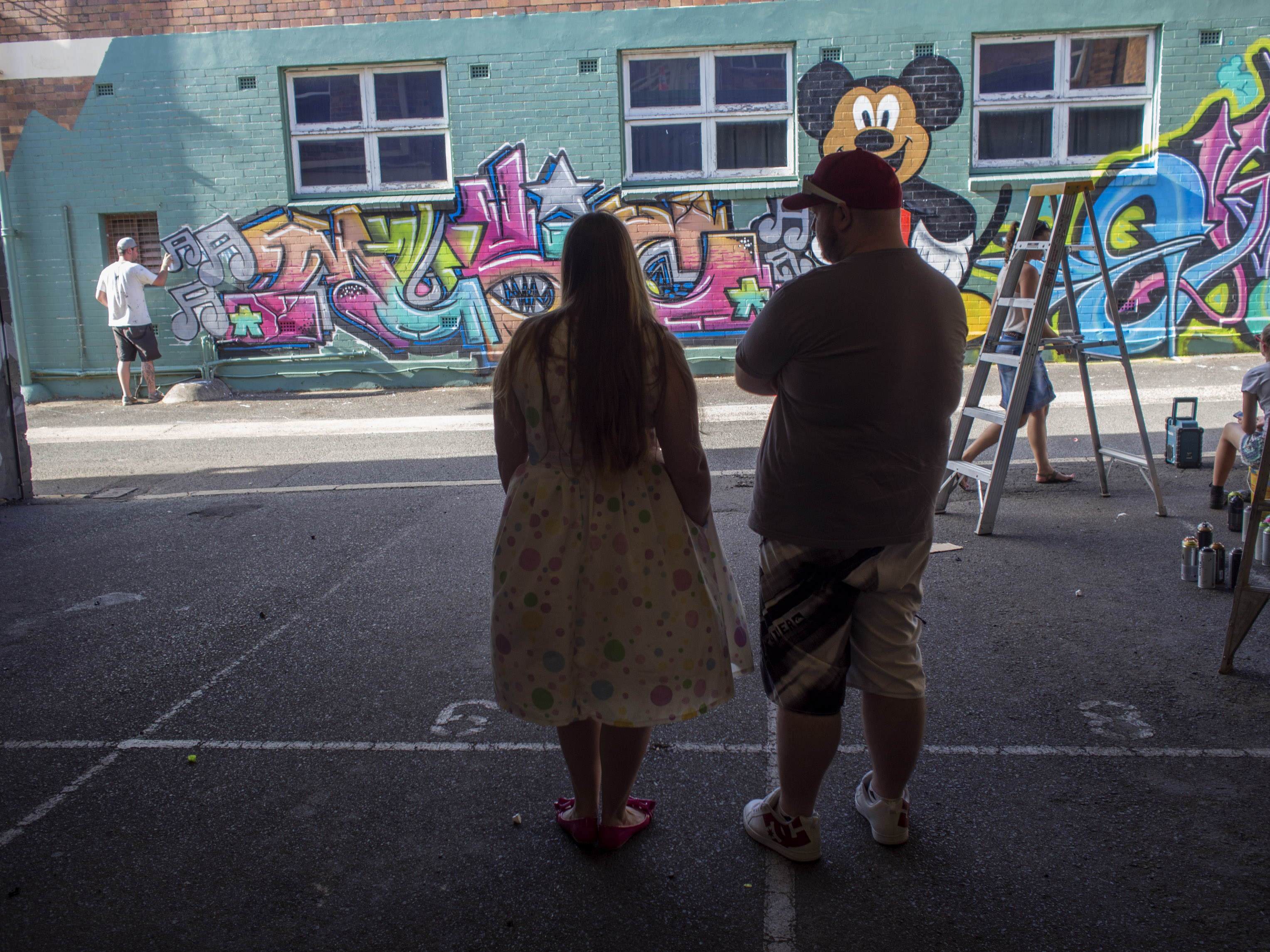
Liam Dibb at work – Mark Lane
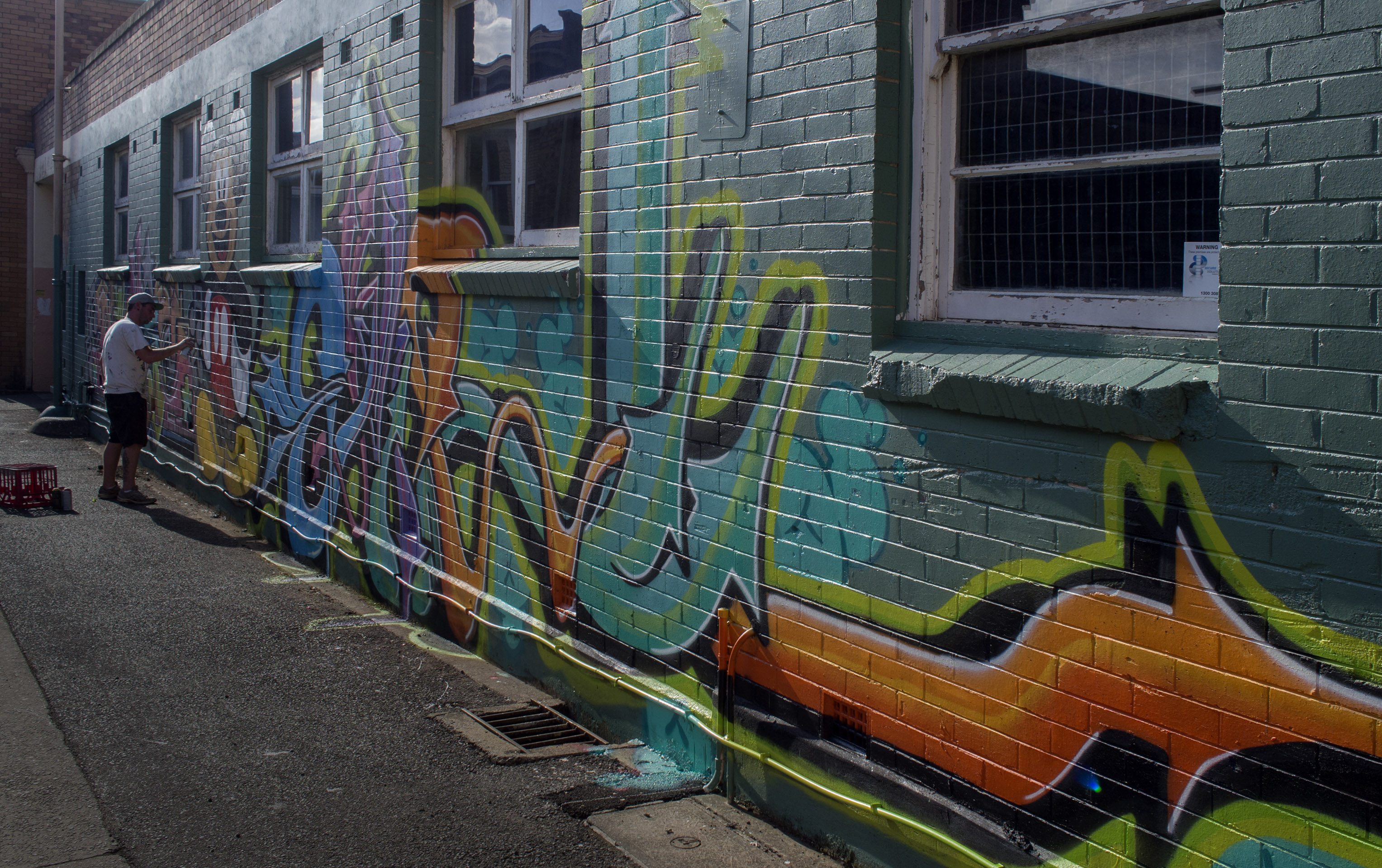
Liam Dibb at work – Mark Lane
Gimiks Born: Bank Lane
In Bank Lane
In Mark Lane
Pic 1 Bell Street
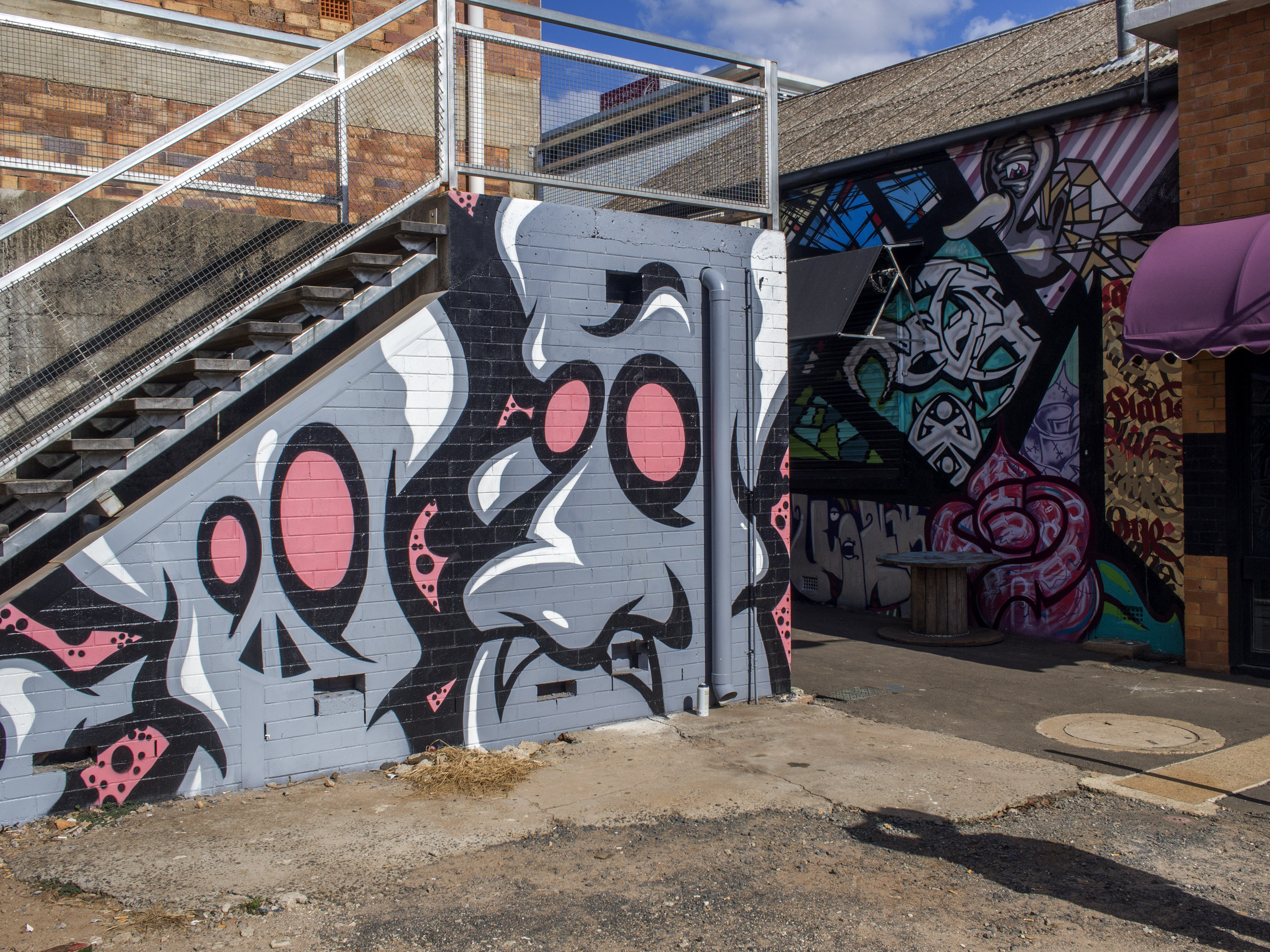
Duggan St
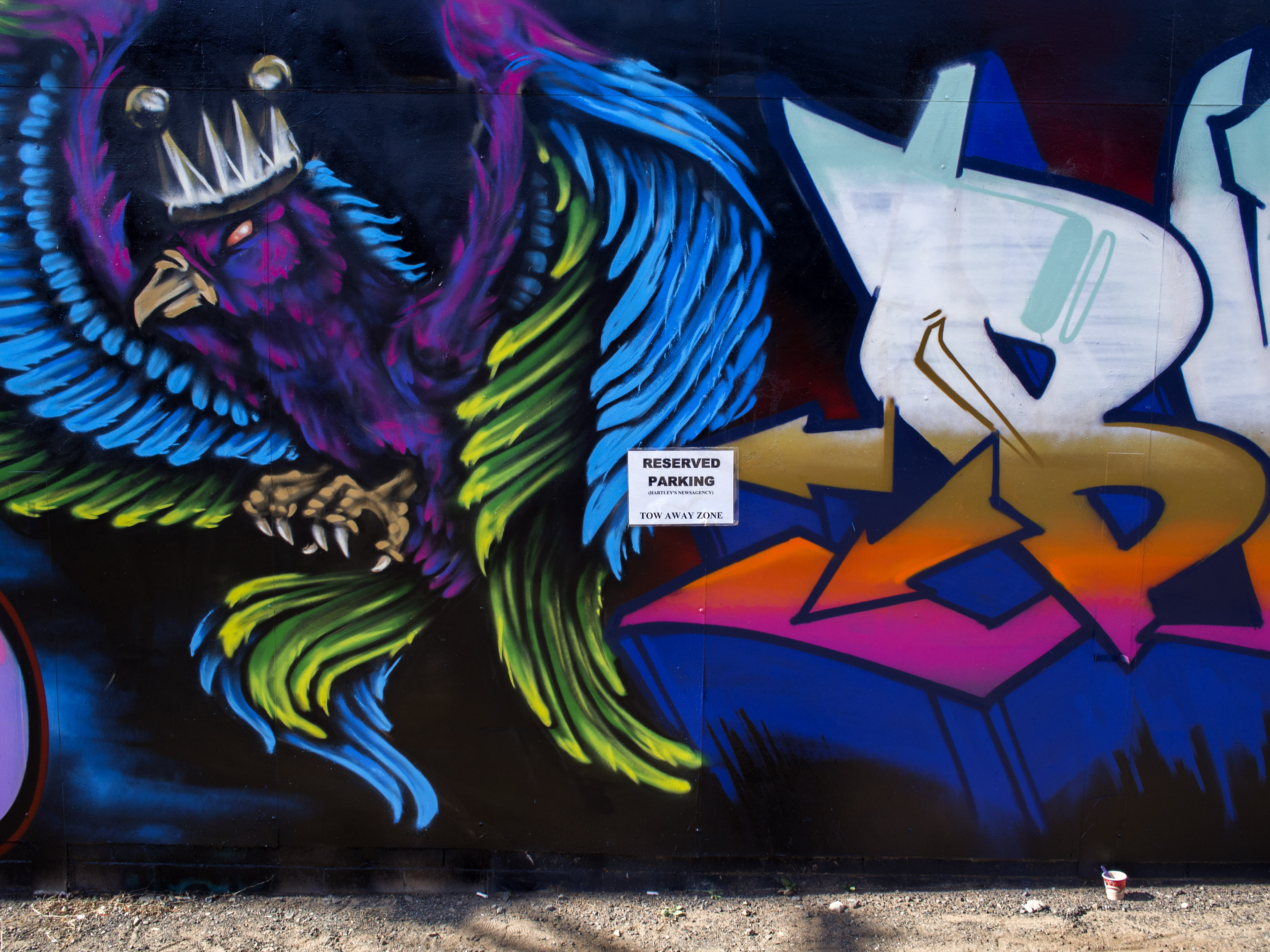
Duggan St
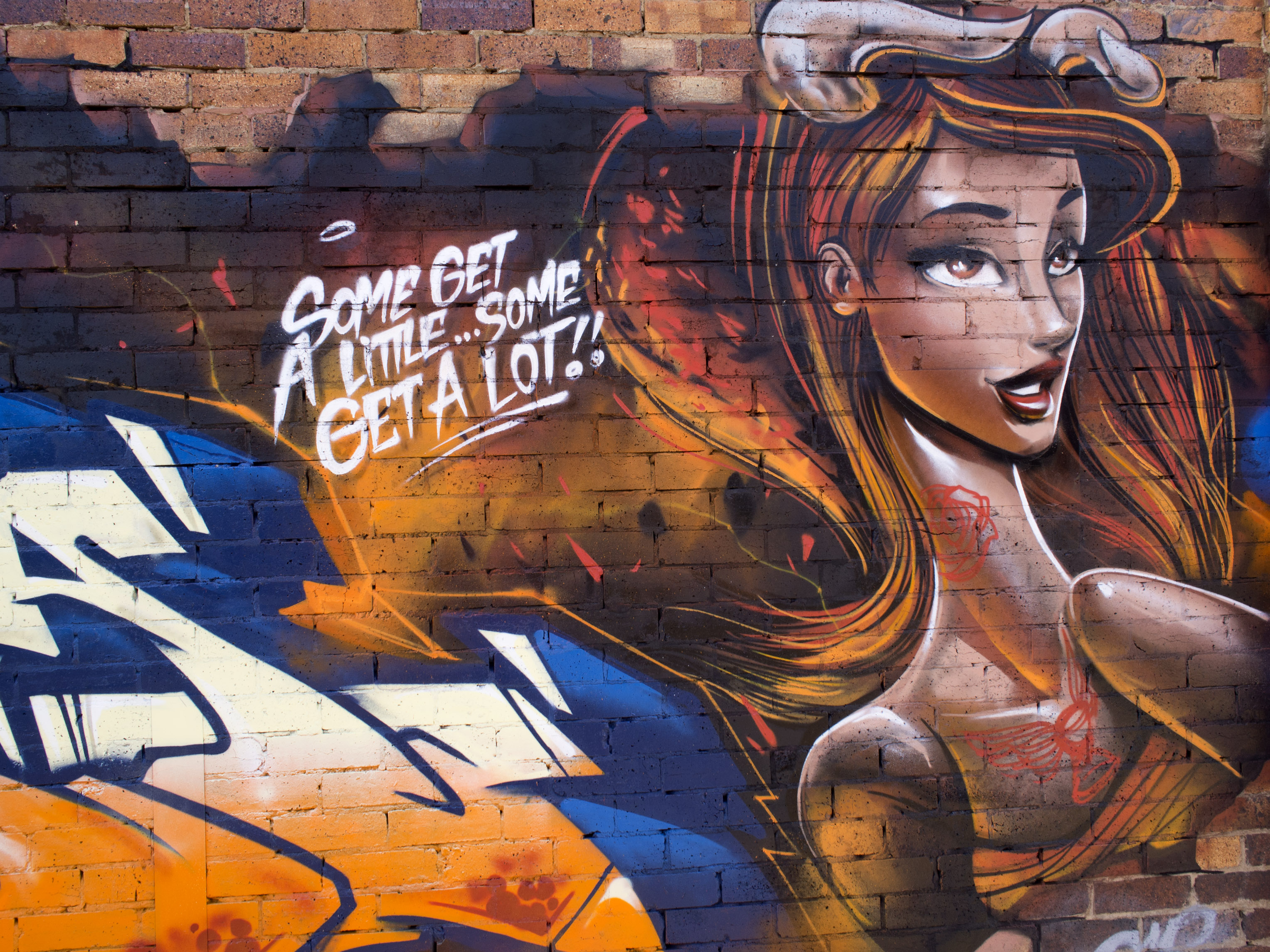
Duggan St
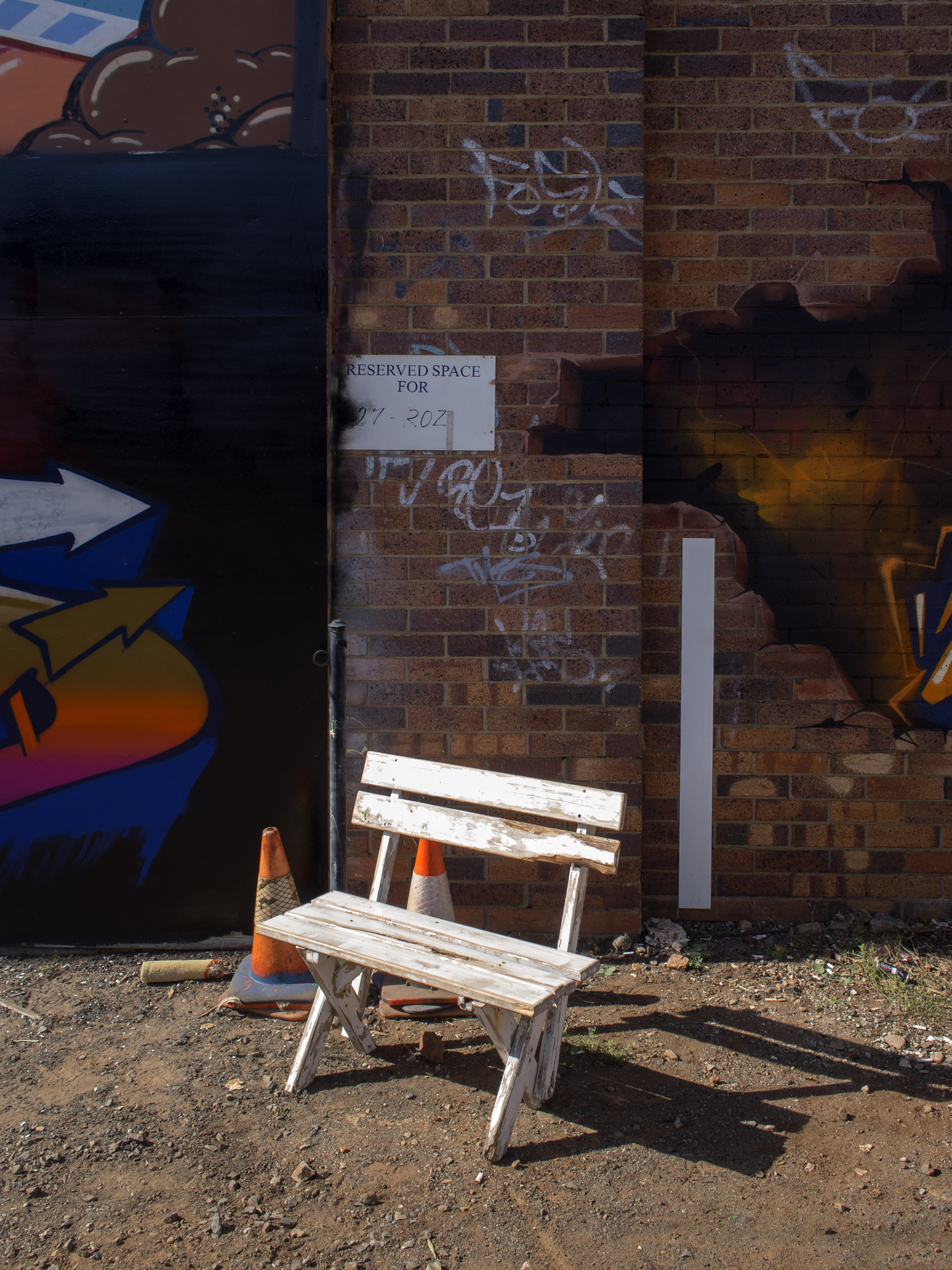
Duggan ST
.
LINK TO ABC Open + Toowoomba Chronicle pics+vids
http://www.abc.net.au/local/photos/2014/02/23/3950646.htm
http://www.thechronicle.com.au/videos/gimiks-born-first-coat/21759/
.
About First Coat:
Toowoomba’s CBD – 19 artists – 17 walls – 1 weekend
21st – 23rd February 2014
First Coat is a street art festival brought to by Toowoomba Regional Council and GraffitiSTOP, in partnership with Toowoomba Youth Service & Kontraband Studios.
Over 3 days, First Coat artists completed multiple large scale murals being painted, a Stupid Krap exhibition and artist talks were presented by Analogue Digital.
Locations:
2 Station St, 16 Duggan St, 12 Little St, 488 Ruthven St, 296 Ruthven St, 6 Laurel St,
2 Mark Lane, 9 Bowen St, 86 Russell St, 5 Mark Lane, 239 Margaret St, 70 Russell St, 80 Russell St
.
Proudly supported by:
Ironlak
Analogue Digital Creative Conference
Master Hire
40/40 Creative
Dulux
Coopers
ALL artworks © of the artists.
Photographic interpretations of the works ©Doug Spowart – Contact me if you were an artist and I will send images to you.
.

My photographs and words are licensed under a Creative Commons Attribution-NonCommercial-NoDerivs 3.0 Unported License.
http://creativecommons.org/licenses/by-nc-sa/2.5/au/
.
.
.
MARIS RUSIS: ORIGINAL PHOTOGRAPHS @ Gallery Frenzy, Brisbane
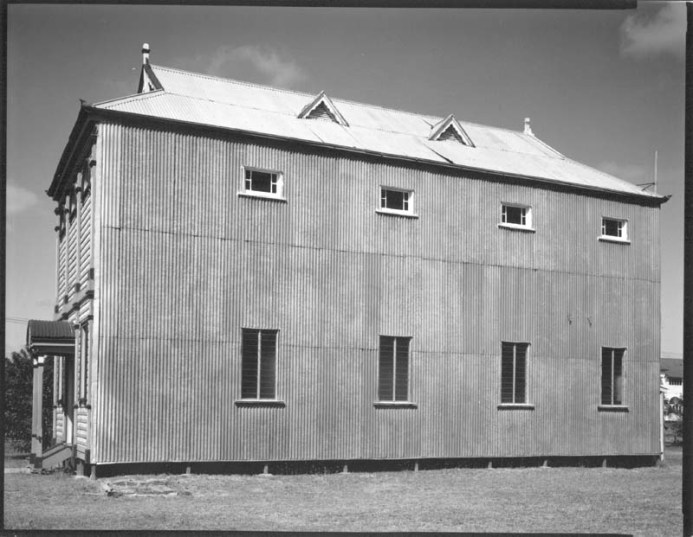
Masonic Hall, Barcaldine
.
The very nature of humanity is that each one who looks will see something different. So in these words, in this speech to open this exhibition, I’m in the privileged position to share what interests me about Maris Rusis’ original photographs. For a time I too was a disciple of the large format photography ‘zone’ – system discipline. I strove to develop what I’d call three skills: the conceptual – to see or previsualise; the technical to operate cameras and control chemistry; and the physical to lug the camera, all 50 kilos of it, to the place or subject of its use.
I found the romance of large format fieldwork is followed by the trial of the darkroom and the creation of a print reality – a manifestation of the subject as perceived by the photographer, at the time of capture. Chemistry, contact frames, darkness and the contemplative attention to time, temperature and agitation are an integral part of the process. So is, dare I say–image manipulation, dodging and burning-in to refine the distribution of tone, density and how these shape perception and direct the viewers eye as it rests on the image.
To bring an Australian light to the large format photograph Maris and I set out on a road trip from Brisbane to Canberra, Kosciuszko and Suggan Buggan in the late 1980’s. On this journey we shared rooms in cheap motels and backpackers, red wine and erudite conversation. Loading large format film holders in the cramped spaces of motel wardrobes and borrowed darkrooms we ventured into the high country and along roadsides. Photographing in the field was in part an endurance in the sweltering heat of mid-summer’s noon-day sun under the focussing cloth, and the privations of only being able to make 6-8 photographs a day – but each image was unique… a triumphant moment… a personal vision of light.
.

Maris and I in a granite field with cameras in 1989
.
Part of our large format journey included special access to the vaults of the National Gallery of Australia’s photography collection. On opening, the light entered each solander box and we peered into the contents. We held prints by Weston – Brett included, Adams (Ansel–not Robert), Minor White, Emmet Gowan and others. These were the masters whose works we could generally only encounter on the pages of books usually at reduced size. I remember at the end of that day we stood on the exit parapet of the NGA, as it was in the old days, and you commented: “From today we can view the masters of large format photography with a new kind of arrogance”. Meaning that what we were achieving technically and conceptually matched anything we saw in the gallery’s collection. In reflection we did this in Australian light and of Australian subjects far removed from the well-trodden ground of the American tradition.
While I continued into the early 1990s hunting photographs with the SINAR 10×8 in the field, I was seduced to explore an expanding frontier of photography with Diana, pinholes and ultimately digital. Maris remained true to attitudes, values and approaches to photographic process and image quality that are the essence of the thing itself. Light-lens-silver – a direct and simple transference through photonics guided at every increment by the photographer and their vision for the subject before them. The plunge of the image-making world into digital technologies usurped and liberalised the terminology, in particular the words ‘photographer’ and ‘photograph’. Subsequently, it seems now with the emancipation of imaging anyone can be a photographer and anyone can photograph – it’s that easy.
There was a time when I, like many, thought a photograph was infinitely reproducible and that the darkroom was a machine for making multiples – but each was a little different. The speed and repeatability of digital imaging became the ‘machine’ where each print is identical. Now we can value each gelatine silver photographic print as a bespoke unique state object – a handcrafted image where as two can be identical. Maris once postulated a theory that the photographer, in printing their photographs – in particular with dodging and burning-in, created two images. The finished print is a secondary image of the subject before the camera – the first image being the negative, and as the photographer uses their hands to do shadowy light work they create a self-portrait primary image.
.
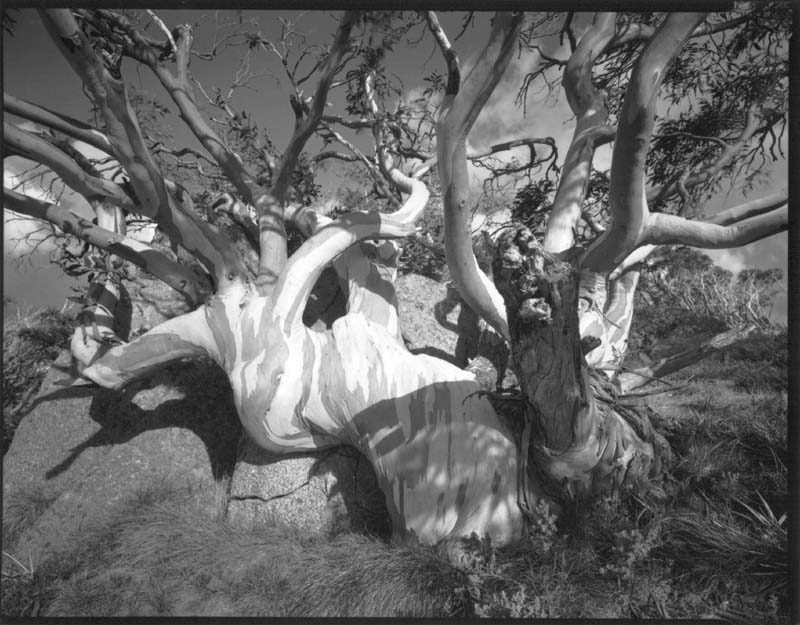
Views of Snow Gums, number 4
.
This evening, through the photographs that hang on these walls, an experience is shared. The title of the exhibition ‘Original Photographs’ may be exactly what they are. Our viewing position for this work as stated, is located in the digital age – where contemporary technology and process is arguably antithetical to the exulted practice that created these original photographic objects before us. Now I ask – should the provenance of these framed works make a difference to how we look at and think about these photographic prints? Should there be a precondition to viewing this work that requires a study of the technique, the myth, the challenges, incentives and the rewards of those who work this way, and how we as viewers should respond? Or should there be nothing of that. A photograph is before us – look, connect, interpret, respond … then, cast your view to the next.
What then of these photographs? Some may think that these prints may well be from a dinosaurian photographic tradition. For me their existence proves that the ritual continues and that the photographer’s vision and the seductive quality of the photographic prints that emerge from the photographer’s toil are still valuable contributions to the art. And therein lies the importance of Maris Rusis and his work. Few have walked his path in the sunshine of single-mindedness, about living one’s life totally absorbed, at whatever cost – family, friends, poverty and pleasure, all secondary to the pursuit of personal photographic nirvana, usually of the real large format kind. Edward Weston once stated: ‘My true program is summed up in one word: life. I expect to photograph anything suggested by that word which appeals to me.’ Maris Rusis and Weston have many things in common.
.
Doug Spowart
Written @ Girraween February 1, 2014.
.
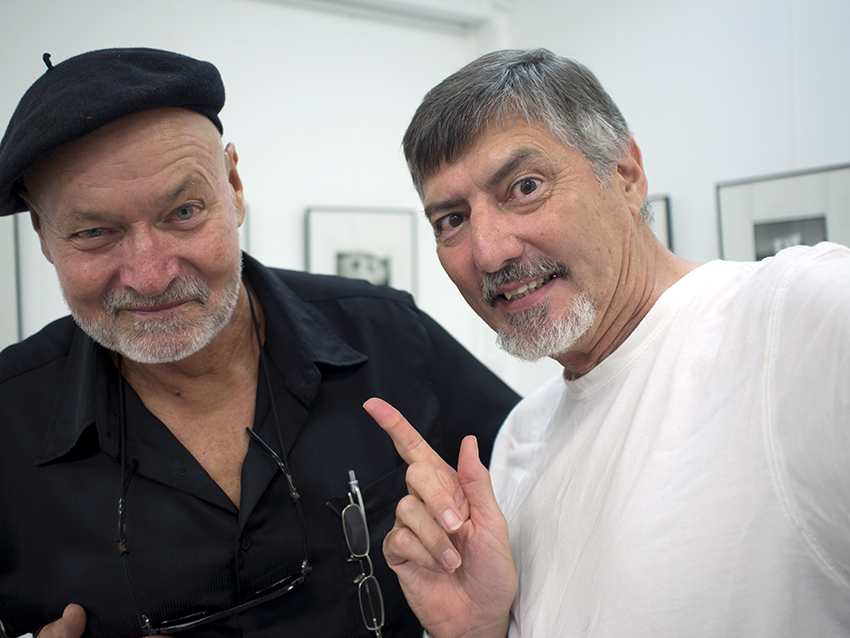
Maris and Doug ‘Selfie’ at the exhibition opening
.

.
Maris has written a reply to this post that adds to this commentary of his work:
.
It is an uncommon thing to invest some decades of effort in making pictures by one particular medium to the exclusion of all others. And an explanation is perhaps merited.
Firstly, everything Doug Spowart has covered in his blog is true and revalatory. It sets out key moments that propelled me in my committment to photography. And I thank Doug for the good start he gave me. But to keep going I had to support the conviction that my chosen medium has valuable properties that are not obtained or replicated by alternative means. I still continue to make pictures out of light-sensitive materials and offer by way of flagrant self justification the following essay:
In Defence of Light-Sensitive Materials.
The word photography was invented to describe what light-sensitive materials deliver: pictures that offer a different class of imaging from painting, drawing, or digital methods.
These “light-sensitive” pictures are photographs and the content of such pictures is the visible trace of a direct physical process. This is sharply different to painting, drawing, and digital imaging where picture content is the visible output of processed data. Some other imaging methods that do not process data include life casts, death masks, brass rubbings, wax impressions, coal peels, papier-maché moulds, and footprints.
There is a general idleness of thought that assumes any picture beginning with a camera is a photograph. Most casual references to digital pictures as photographs are motivated not by deceit but rather by the innocent and uncritical acceptance of the jargon “digital photography”; a saying which has become so banal and familiar that it largely passes unchallenged; except perhaps here, now, and by me.
I use light sensitive substances to make pictures because of the special relationship between such pictures and their subject matter. The wonder of this special relationship is also available to the aware viewer. Making realistic looking pictures long pre-dates photography. Old and new techniques include photo-realist painting, mezzotint, graphite drawing, gravure, and offset printing. Recently analogue and digital electronic techniques can deliver the appearance of abundant realism at trivial effort and cost . But although these pictures may mimic photographs but they do not invoke the unique one-step material bond between a subject and its photograph.
The physical and non-virtual genesis of pictures made from light-sensitive substances has far-reaching consequences:
Light sensitive materials are utterly powerless in depicting subject matter that does not exist. A true photograph of a thing is an absolute certificate for the existence of that thing; an existence proof at the level of physical evidence. Quite differently, data-based pictures at best approximate testimony under oath rather than evidence.
Light-made pictures require that the subject and the substances that will ultimately depict it have to be in each other’s presence at the same moment. True photographs cannot recreate times past. The future is similarly inaccessible. Since true photographs can only begin their existence in the fleeting present they constitute an absolute certificate that a particular moment in time actually existed.
Light-sensitive materials are blind to the imaginary, the topography of dreams, and the shape of hallucinatory visions. The option of making a picture from light sensitive materials offers an infallible way of distinguishing delusion from reality. A true photograph authenticates the proposition that the camera really did see something.
Light-sensitive substances neither selectively edit nor augment picture content. There is a one to one correspondence between points in a true photograph and places in real-world subject matter. This correspondence, also known as a transfer function, is immutable for all subject matter changes.
The sole energy input for a true photograph comes from an illuminated subject. The pre-existing internal chemical potential energy of the light-sensitive substances is sufficient to generate all the marks of which a photograph is composed. Other external energy inputs are not required. Remember, photography was invented in, described in, and works perfectly in a world without electricity.
Pictures made from light sensitive materials are different to paintings, drawings, and digital confections in that their authority to describe subject matter comes not from resemblance but from direct physical causation.
It is these unique qualities of true photography, its limitations and its profound certainties, that keep me committed to the medium as an integral and original form.
My light-generated pictures are produced one at a time, start to finish, and in full by my own hand. The work flow is mine. No part of it is down to assistants or back-room people toiling to flatter my skills so I will feel good about paying their fee. I will continue to make pictures out of light-sensitive substances even if it comes to the point where I have to synthesise those substances myself.
.
MORE IMAGES FROM THE SHOW:
.
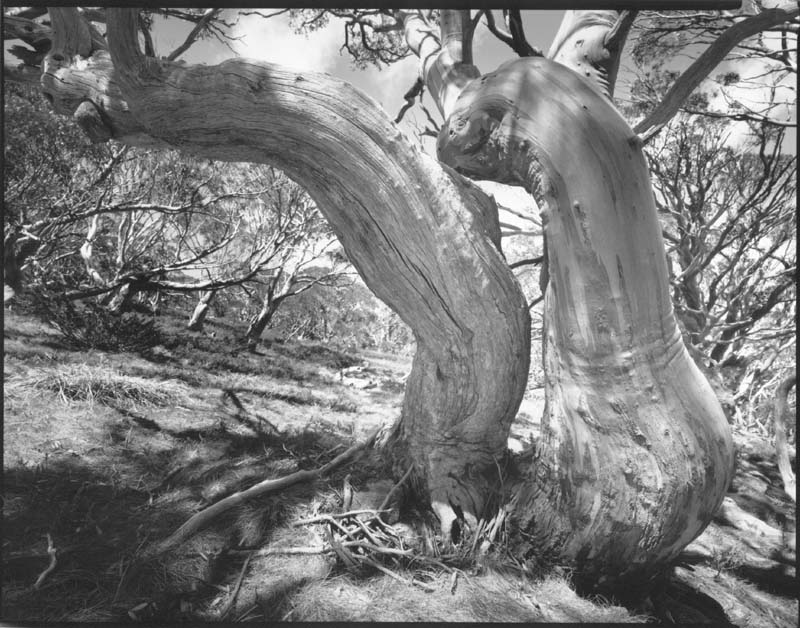
Views of Snow Gums, number 38
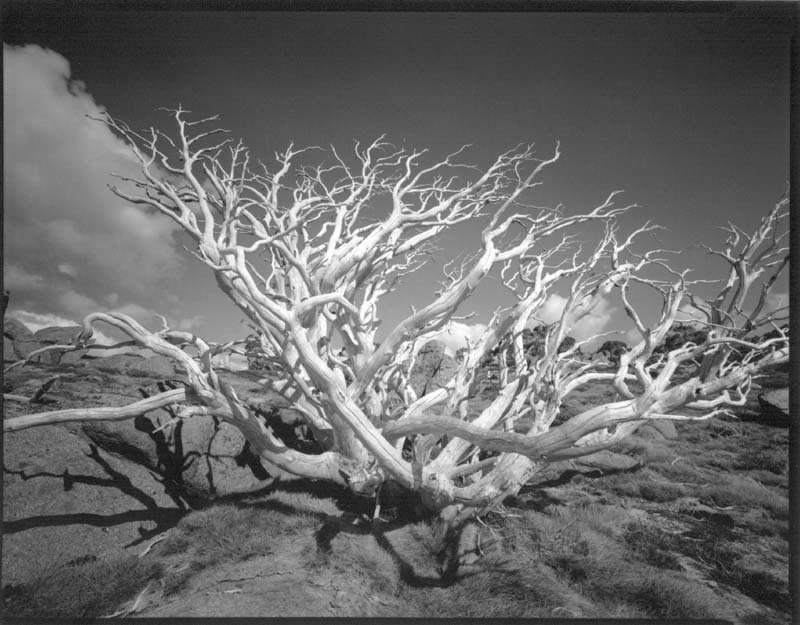
Views of Snow Gums, number 40
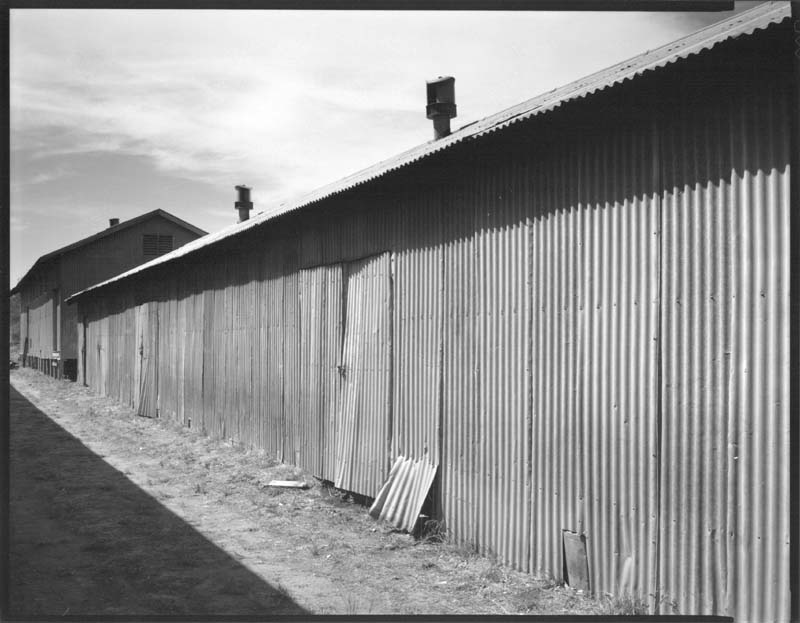
Laneway, Winton

Open Air Cinema Fence, Winton
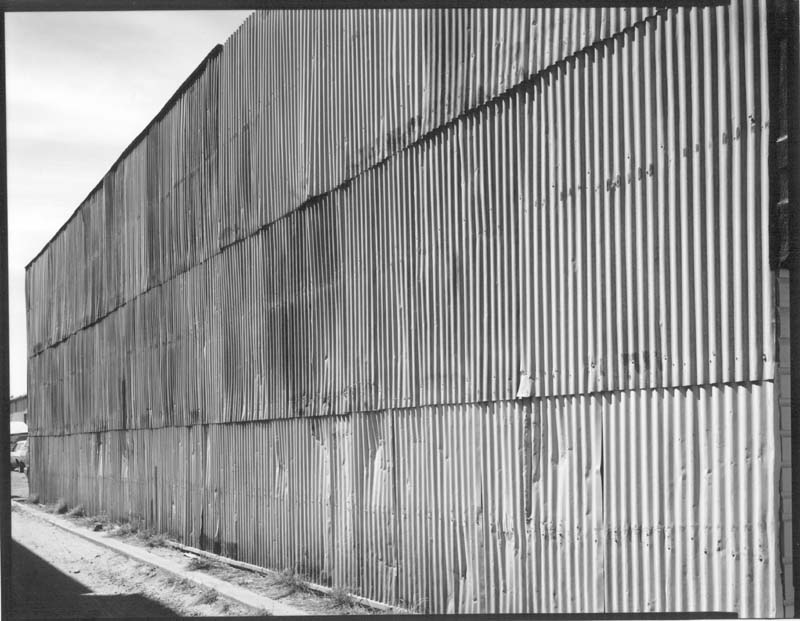
Shop Wall, Winton
Views of Snow Gums, number 4
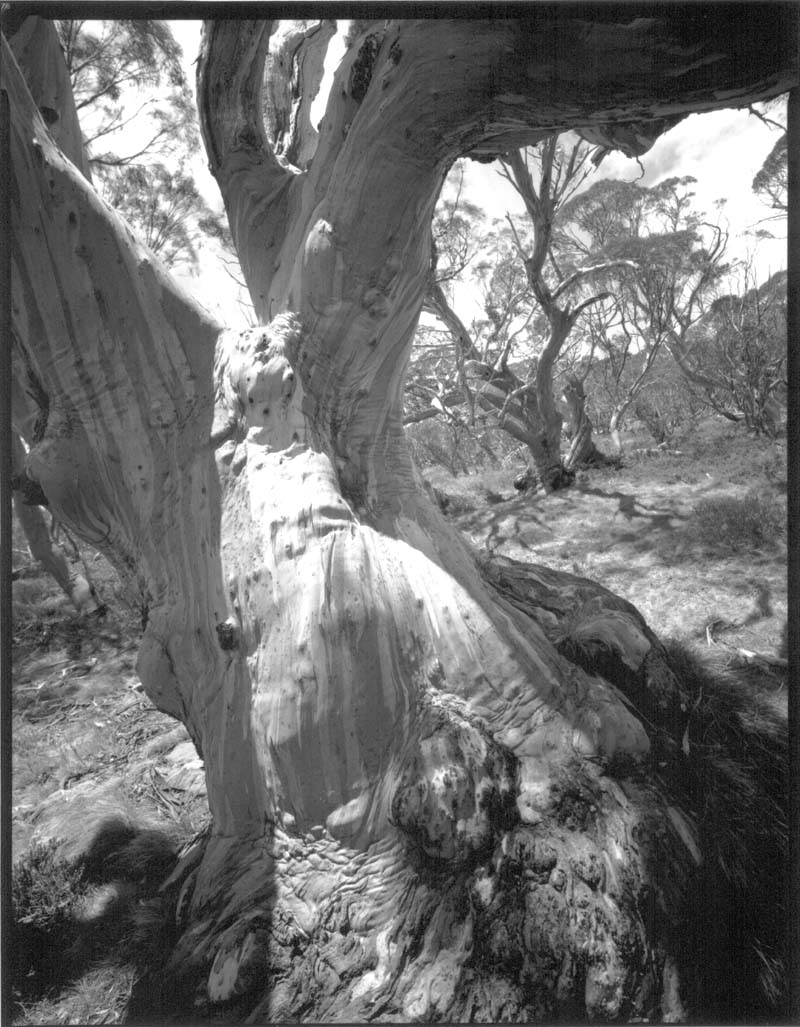
Views of Snow Gums, number 11
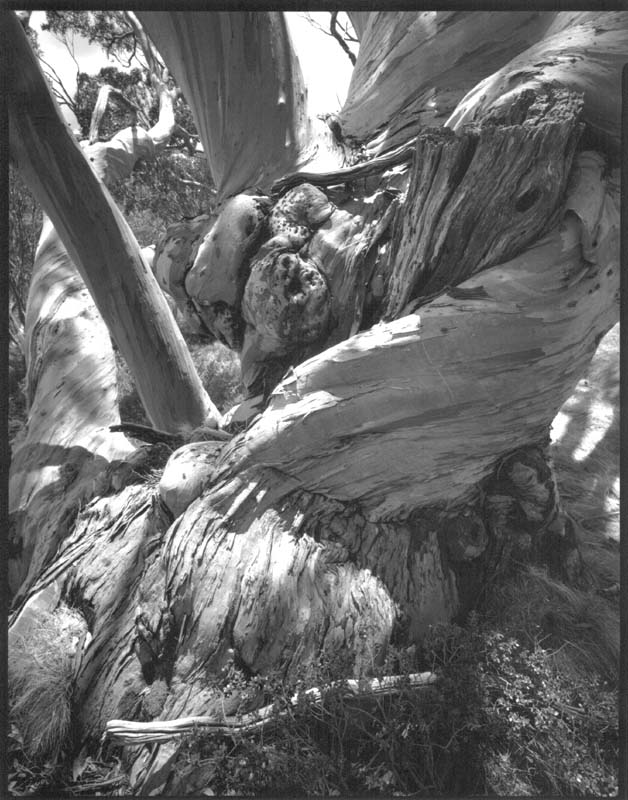
Views of Snow Gums, number 31
.
All photographs © Maris Rusis. Photograph of the two photographers ©Maris Ruusis and Doug Spowart.
.
.
BOX of BOOKS Event – Toowoomba!
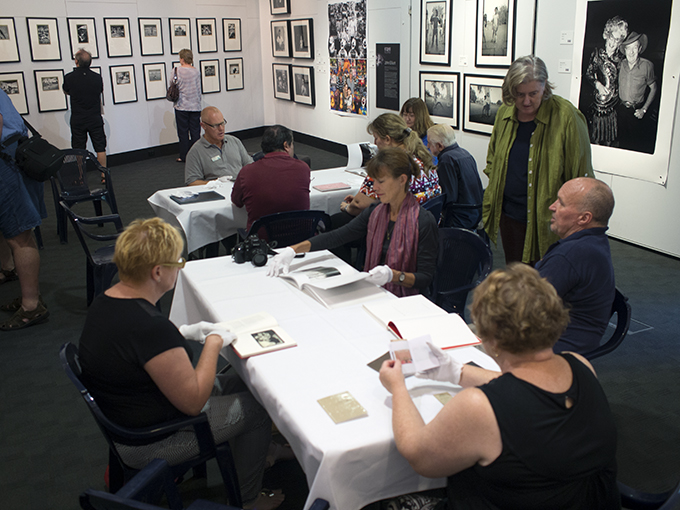
Looking at the books – Cobb+Co Museum, Toowoomba
.
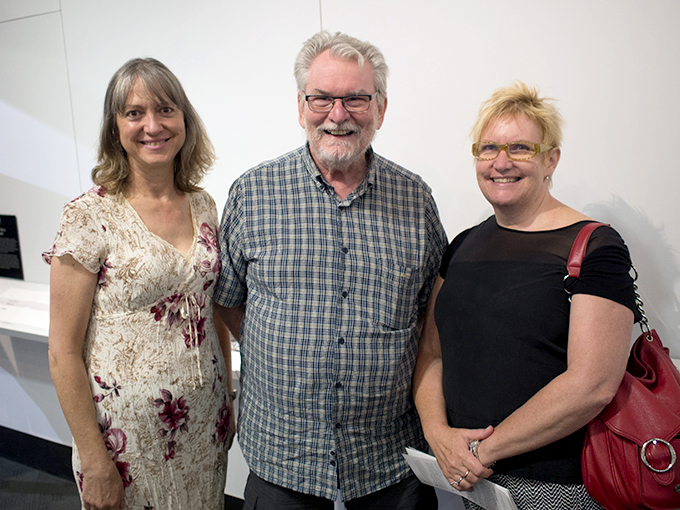
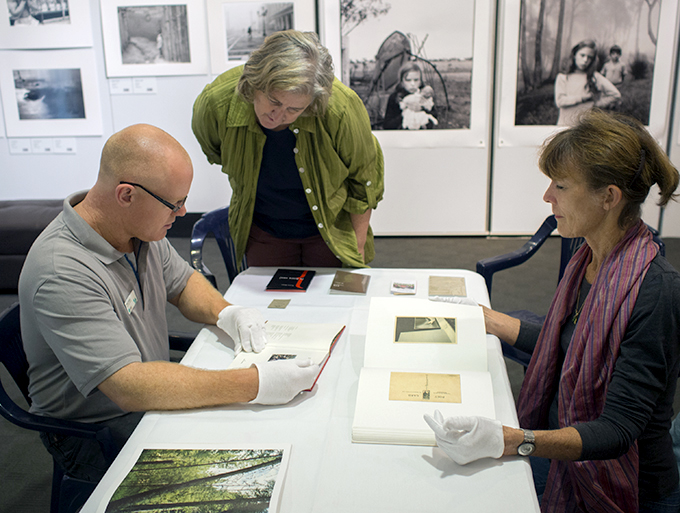
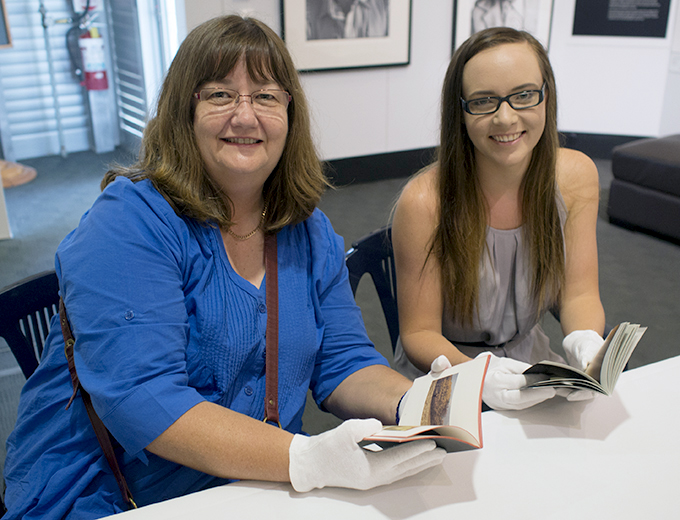
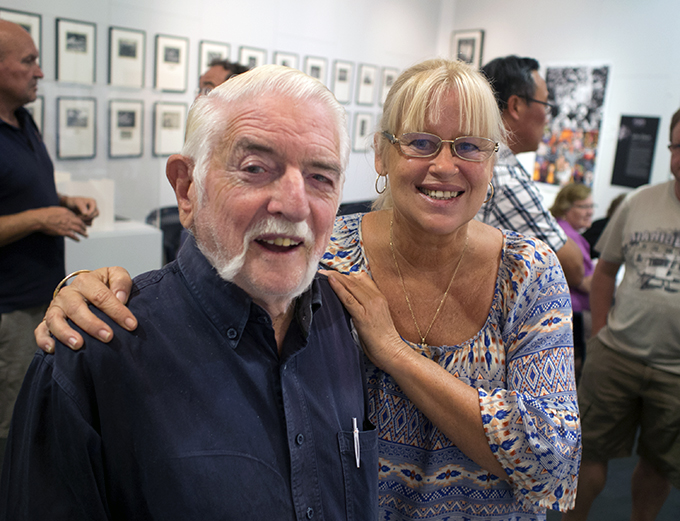
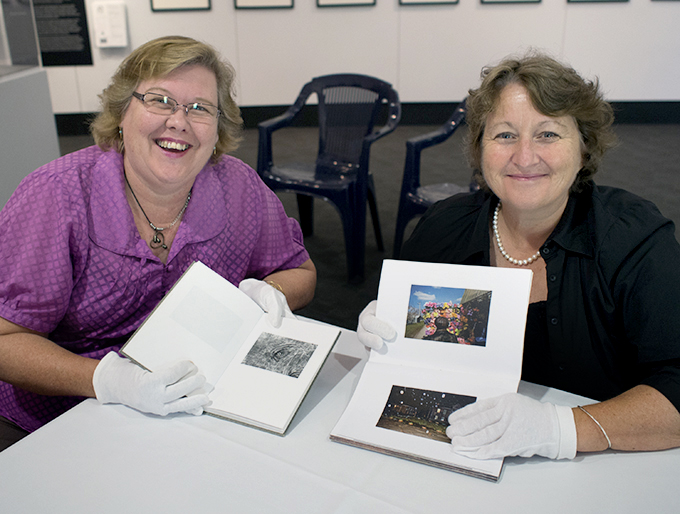
Around 35 photobook enthusiasts gathered at the Cobb+Co Museum on January 27 to view the Photobook Club’s Box of Books and talk about photobooks. The event brought together local photo identities John Elliott, Graham Burstow, David Seeto and Victoria Cooper. Eric Victor, Ian Poole and Qld College of Art Masters student Maureen Trainor came from the Brisbane side of the Range. The meeting took place in the gallery space of the ICON on ICONS photographic exhibition that also concluded on that day.
.
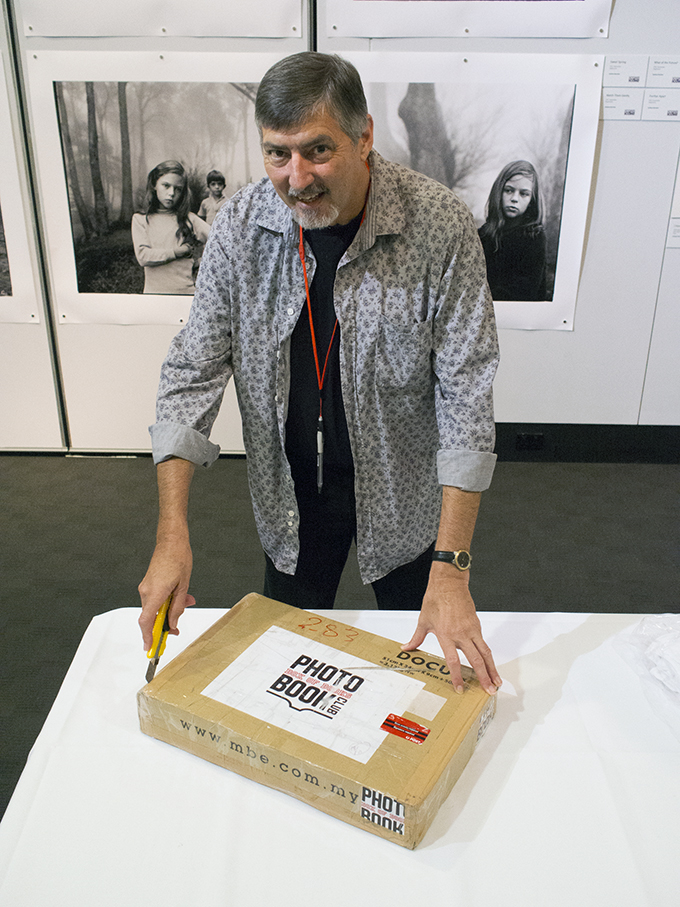
Convener of the event Doug Spowart opens the Box of Books
.
The seven books were viewed and discussed at length. Comments about the books included the following:
“Each book is a very personal communiqué”
“The books demand viewing at many different levels – the narrative, the design, the production, the conceptual nature of the work…”
“This is a very Eurocentric view – I wonder what the American view would look like?”
“How do these books compare with the Australian photobook scene?”
A great deal of discussion took place over the comment – “Where are the captions … the works that help me to understand what the photographer is trying to say?” One respondent commented on Roland Barthes’ concept of ‘The death of the author and the birth of the reader’ – meaning that the reader needs to connect with the images and draw on their own life experiences.
.
Donald Webber’s Interrogations drew quite a few comments – tension and the power of the portraits made in such a circumstance.
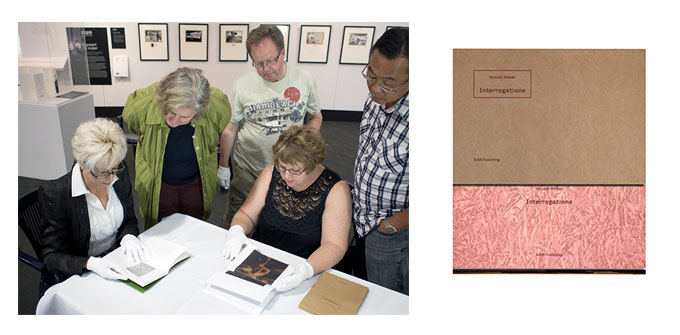
Linda Seeto, Victoria Cooper, Hardy and Alison Ahlhaus looking at Webber’s Interrogations
.
The crowd favourite was Anne Sophie Merryman’s Mrs. Merryman’s Collection … a superb design, delicate paper, the see-through of texts and the amazingly bizarre collection of post card photographs and comments.
.
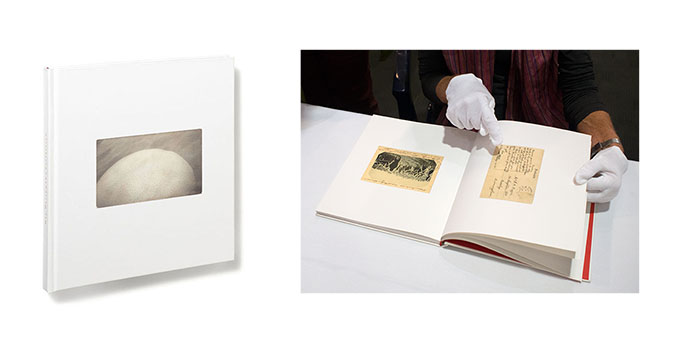
Mrs. Merryman’s Collection
.
Paul Graham’s The Present and its gate-fold format presented a viewing challenge as each image or group of images needed to be revealed by folding-out the page – an extended haptic experience, and considering the size of the book, it slowed down the read and brought the busy street scenes to a slowed motion.
.
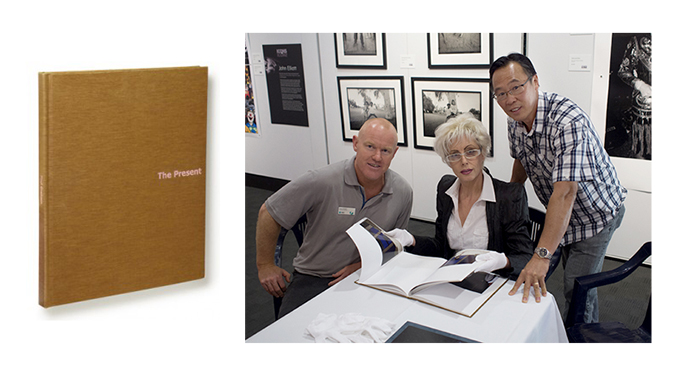
Tony Coonan, Linda and David Seeto look at Paul Graham’s book
.
The Box of Books will be in Brisbane on Monday the 3rd of February and then be off to New Zealand for the next stage in its journey.
Thanks to the Cobb+Co Museum for providing the venue. The Photobook Club and the publishers who donated the books for the opportunity for us to see, touch, and read these books.
Until the next Photobook Club event in our area….
.
This Photobook Club BOX OF BOOKS event was coordinated by Doug Spowart and Victoria Cooper of the Centre for Regional Arts Practice.
.
Other images from the event…
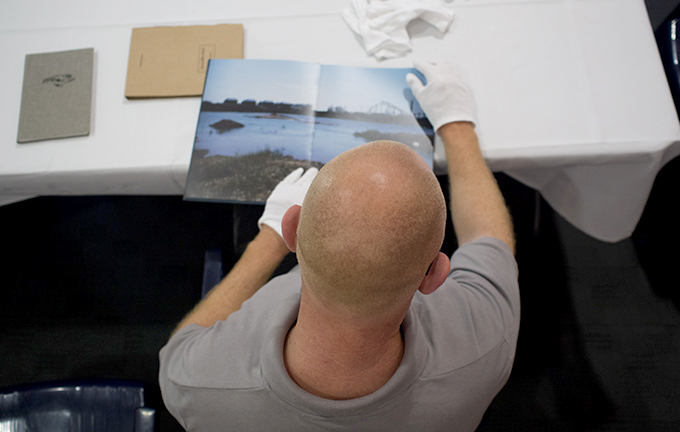
Looking at a book…
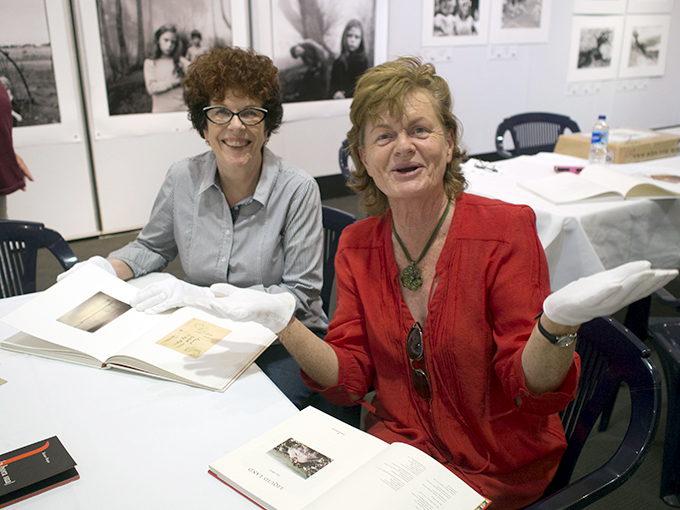
Ann Alcock and Bev Lacey
Toula, Ian Poole and Louise
Tony Coonan, Victoria Cooper and Anne Howard
Judi Neuman and Phillipa Hodges
Graham Burstow and Maureen Trainor
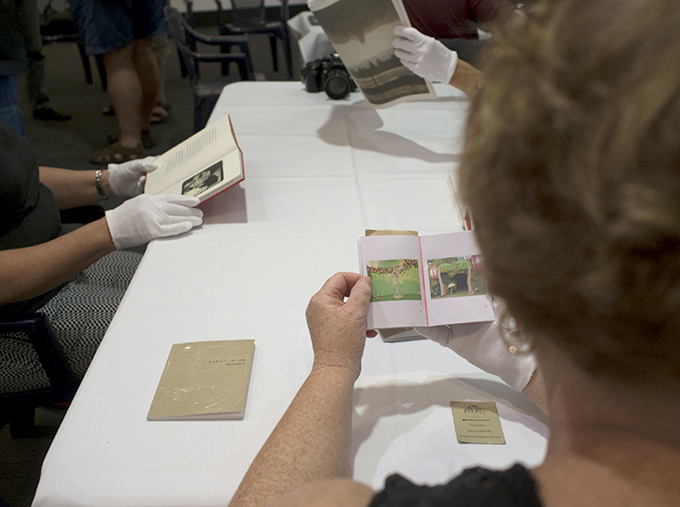
Looking at some of the ephemera from the Box of Books
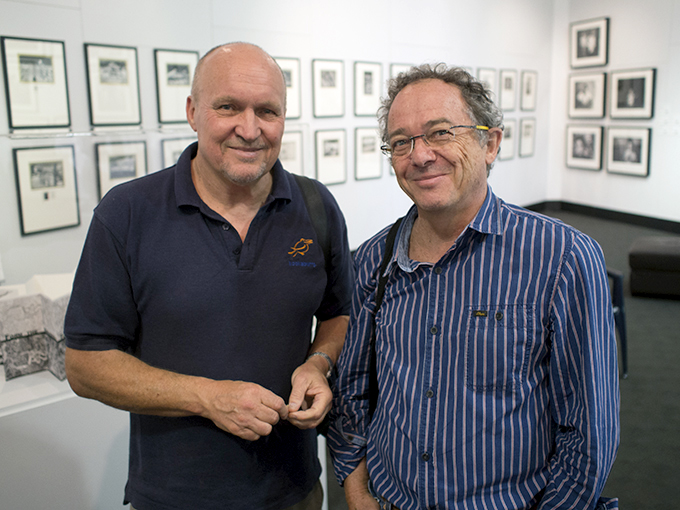
John Elliott and Eric Victor
Helen Gibbs and Lucy Robertson-Cunninghame
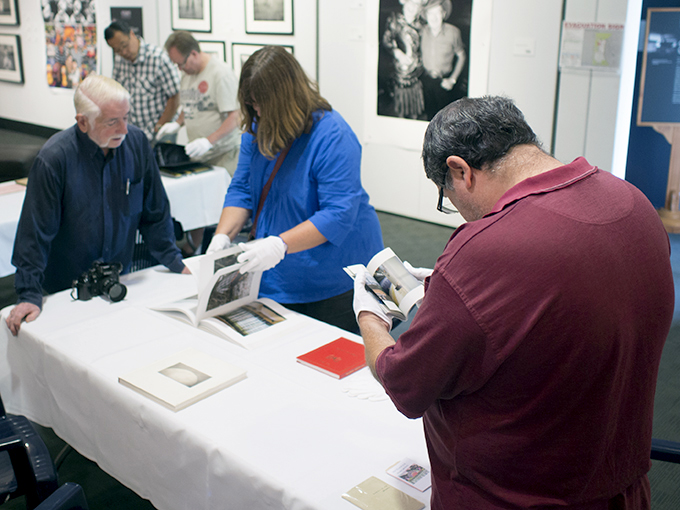
Gerry Saide looking closely at a book
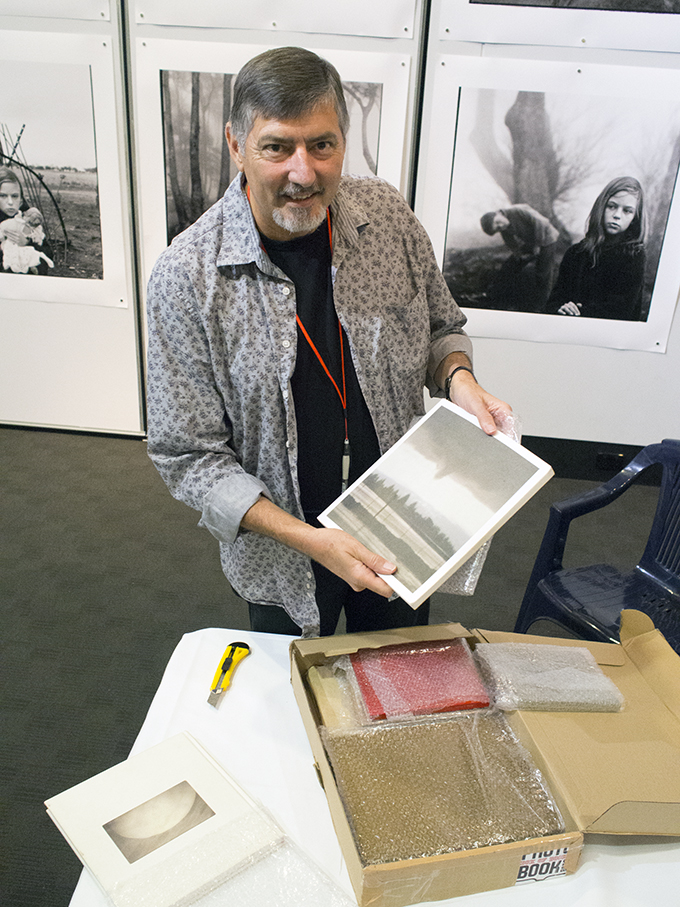
Doug Spowart opens the box
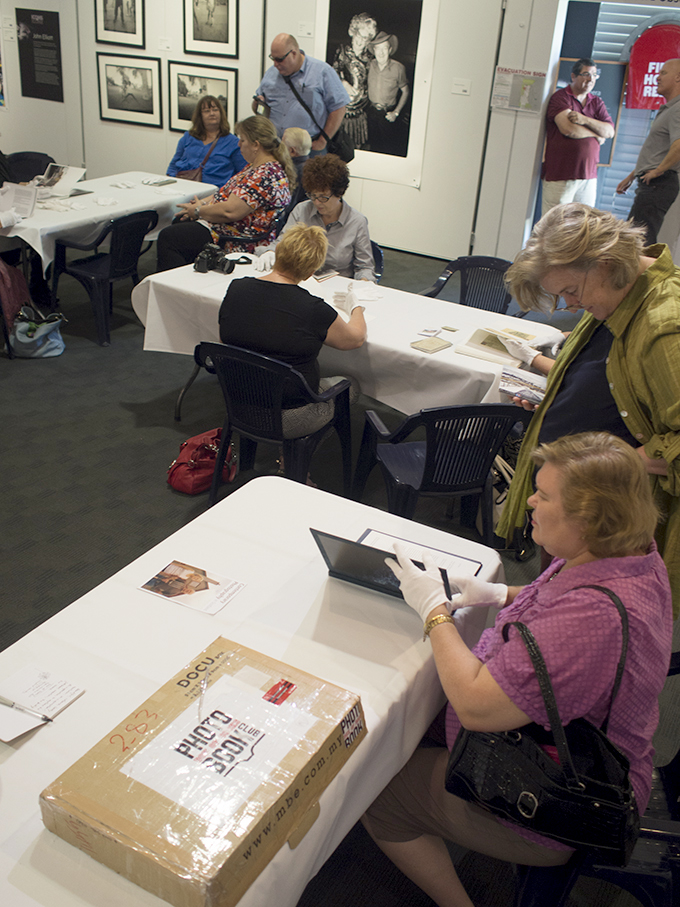
Room view at the Cobb+Co Museum
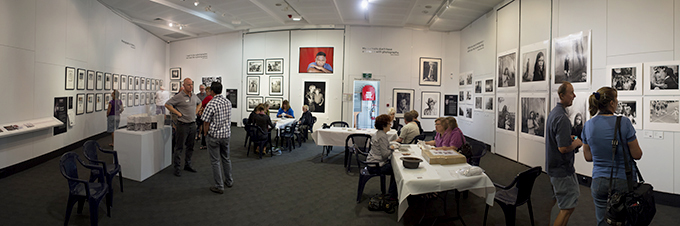
The Cobb+Co Museum panorama
.
.
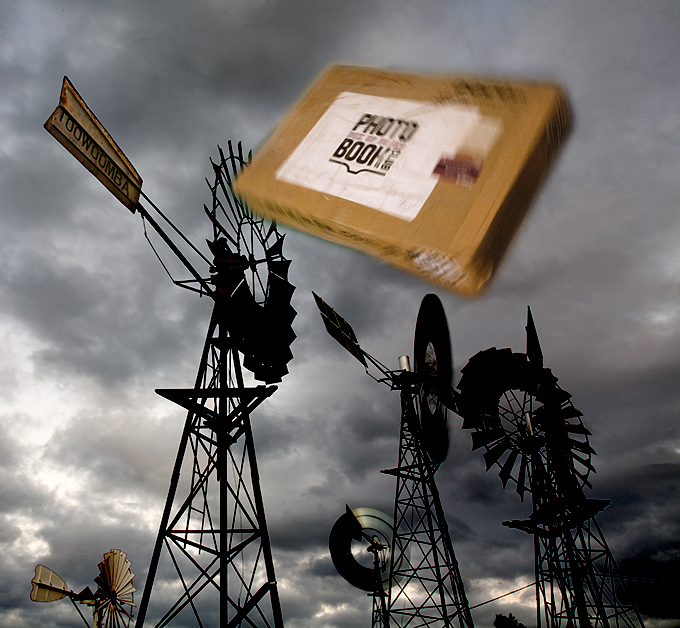
The Photobook Club’s BOX of BOOKS in Toowoomba
.
.
.
.
A BOOK for AUSTRALIA DAY, January 26, 2014
.
It’s Australia Day!! We have a photobook on display in the Two Doors Gallery in 85 George Street the ‘Rocks’, Sydney that is a commentary on Australia Day, that we created on Australia Day in 2010.
.
The collaborative book, called Australian Banquet, January 25/26, 1788 (variant #5), is a double-sided broadsheet cyanotype in rice paper, 37.6x77cm. There are 7 unique state variants of this work.
.
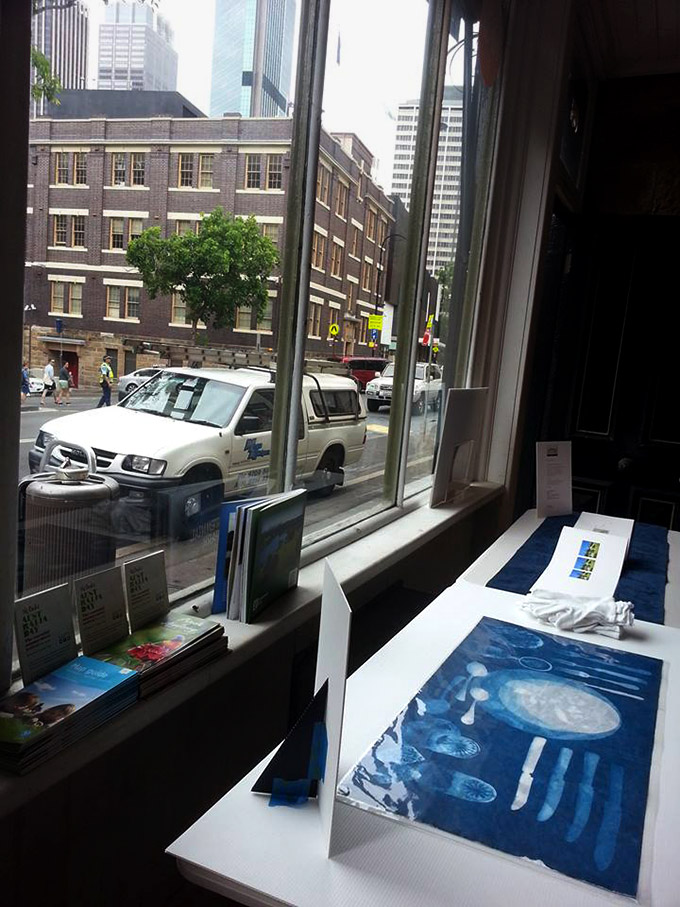
The Australian Banquet in the window @ Two Doors … Photo: Dawne Fahey
.
The artists’ statement for the work is as follows:
.
Across Australia on January 26, people consume food in celebration of a free and dynamic Australian culture. This work comments on the ‘turning of the page’ in Australian history that Australia Day represents. One day — January 25th 1788, Indigenous people feasted on a diverse banquet of bush tucker (as they had for thousands of years). The next day —a new paradigm arrived with the table setting of the First Fleet. Australia Day importantly is a time to re-examine the status of the Indigenous perspective and their knowing of land, culture and history and how it underpins all that is celebrated in the diversity and identity of post-colonial Australia.
.
.
How the work is to be viewed/read
1. At a tabletop setting view and contemplate the 25th of January side of the broadsheet.
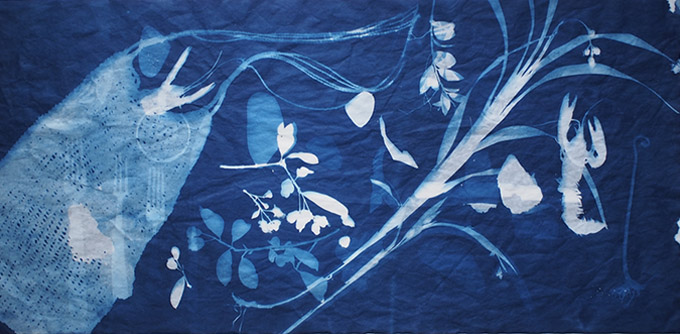
January 25, 1788
.
2. Then, pickup the broadsheet and turn it over as if reading a book – Contemplate.
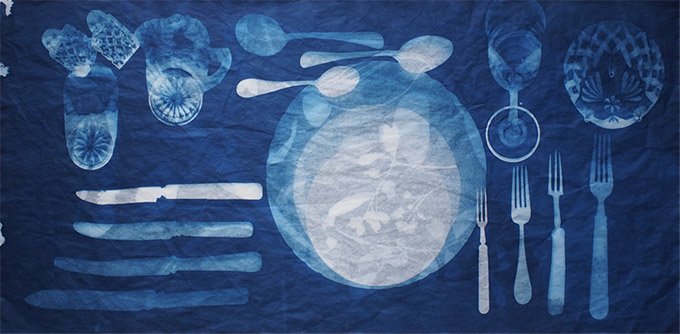
January 26, 1788
.
3. Finally hold the broadsheet up to a light thus enabling the interrelationship between the two
images to be considered. (Image shows variant #4)
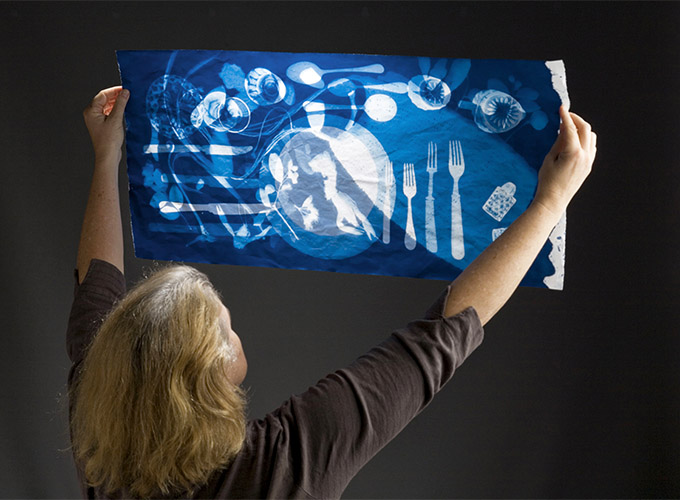
January 25+26,1788 (combined) –Today’s view
.
Drop in to the gallery if you’re in Sydney.
If you happen to be in ‘The Rocks’ on Monday 27th, the public holiday come along to Two Doors and see Picturing the Orchestral Family – and a selection of photographs by Dawne Fahey – and hear the Carreon Family Quartet performance – Tango from 2 – 3. They will also perform February 2nd – same time. Performing daily @ 5.30 pm is flautist Chloe Chung – Two Doors is very lucky to have these young people from Sydney Youth Orchestras helping us celebrate this exhibition !
Have a Great Australia Day…!
.
© 2014 Dawne Fahey (gallery image) and ©2012 Doug Spowart+Victoria Cooper.
.
This work is licensed under a Creative Commons Attribution-NonCommercial-NoDerivs 3.0 Unported License.
http://creativecommons.org/licenses/by-nc-sa/2.5/au/
.
.
.
THE PHOTOBOOK CLUB: Box of Books Event – Toowoomba!
The Photobook Club’s BOX of BOOKS arrives in Toowoomba
.
In 2013, and now in 2014, a box of photobooks will be traveling over 30,000 miles, stopping off at each of the Photobook Club branches around the world in order to promote discussion of the physical photobook.
..
Now, The Box of Books is in Toowoomba —- Queensland, Australia.
As part of the LAST DAY of the ICONS on ICONS show at the Cobb+Co Museum in Toowoomba featuring the work of John Elliott, Graham Burstow, David Seeto Victoria Cooper (photobooks) and Doug Spowart – a special viewing of the THE PHOTOBOOK CLUB’s BOX of BOOKS will be made available. Come and sit with some of the world’s best photobooks and turn the pages – and release the narrative that each book contains.
THE DATE: Between 1 – 3pm, January 27 – The AUSTRALIA DAY Holiday
THE VENUE: The Cobb+Co Museum, 27 Lindsay Street, Toowoomba.
.
A small charge of $5 is being made to cover postage to the Boxes’ next destination in Auckland New Zealand.
.
The book viewing and discussions will take place between 1-3pm. The Museum’s coffee shop is open for lunch as well as drinks and snacks throughout the afternoon until 4pm.
Take a road trip into the country – Visitors to the Cobb+Co Museum from outside the Toowoomba Region will gain FREE admittance if they advise that they are attending this special event.
This Photobook Club BOX OF BOOKS event is coordinated by Doug Spowart and Victoria Cooper of the Centre for Regional Arts Practice.
.
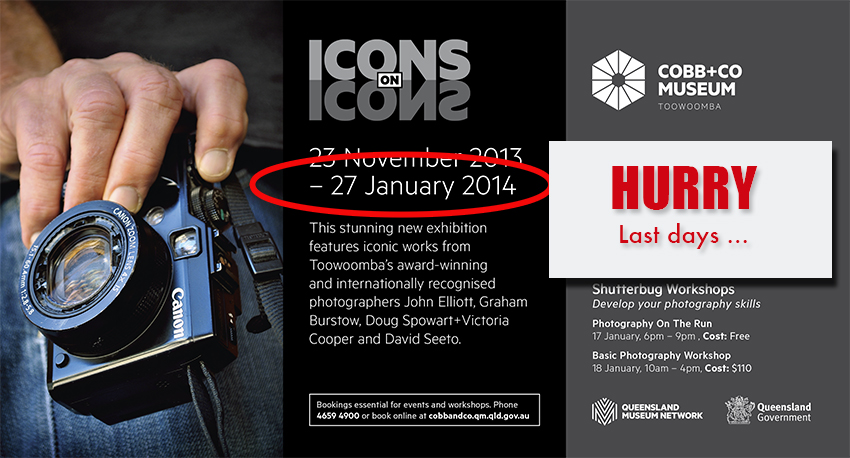
Cobb+Co Museum – Icons on Icons events
.
What’s in the Box?
A big thanks to Mack Books (London), Schilt Publishing (Amsterdam) and also to Filipe Casaca who have all contributed books to this project. If you are a publisher or photographer who would like a book to be included in ‘Box of Books #2′ then please get in touch. The following books were chosen for the discussions of content, narrative and physical properties that I hope they will encourage – Matt from the Photobook Club
Another Language
Mårten Lange
(Mack, 2012)

The blurb: Combining images of flora, fauna and natural phenomena in an intimate and beautifully crafted book, Lange teases out a subtle narrative – a meteor crashes, a landmass is visible and a distant planet occupies the final page – but the book is more akin to the workings of a scientist collecting specimens. Together the photographs create a cryptic and heterogeneous index of nature, with recurring shapes, patterns and texture, where the clarity and simplicity of the individual photographs contrasts with the enigmatic whole.
………………………………………………………………………………………..
Blue Mud Swamp
Filipe Casaca
(Self published, 2012)

The blurb: (Filipe Casaca) Blue Mud Swamp. The shoreline, hot and humid, is a postcard that attracts and invites Men to settle where the land meets the Yellow Sea. However, the reality is dissonant. Although surrounded by natural beauty, beaches and entertainment facilities, the city and its urban spaces transmits, as a whole, a feeling of artificiality. In some cases the abundance created a certain degradation and abandonment. With a splendor that takes us back to a recent past, a certain melancholy is present, as happens with all that was new, colorful and perfect but perished with time.
………………………………………………………………………………………..
Interrogations
Donald Webber
(Schilt, 2012)

The blurb: Interrogations is the result of [Webber’s] personal quest to uncover the hidden meaning of the bloody 20th Century. In dialogue with writer Larry Frolick – whose own ancestors had been decimated in the final months of WW II – Weber insistently and provocatively addresses his questions both to the living survivors and to the ghosts of the State’s innumerable victims, resurrecting their final hours by taking their point of view, and performing a kind of incantatory meditation over their private encounters with Power.
………………………………………………………………………………………..
Lick Creek Line
Ron Jude
(Mack, 2012)

The blurb: Ron Jude’s new book, Lick Creek Line, extends and amplifies his ongoing fascination with the vagaries of photographic empiricism, and the gray area between documentation and fiction. In a sequential narrative punctuated by contrasting moments of violence and beauty, Jude follows the rambling journey of a fur trapper, methodically checking his trap line in a remote area of Idaho in the Western United States. Through converging pictures of landscapes, architecture, an encroaching resort community, and the solitary, secretive process of trapping pine marten for their pelts, Lick Creek Line underscores the murky and culturally arbitrary nature of moral critique.
………………………………………………………………………………………..
Liquid Land
Rena Effendi
(Schilt, 2012)

The blurb: (Rena Effendi) Next to my father’s dead but iridescent butterflies, my photographs show life in some of the world’s most polluted areas, near Baku, where I was born and grew up. In my mind, the contrasting images gravitate towards each other – as I have to my father. Since working on this book I have gotten to know him much better than when he was alive. Salty Waters is the translation from Persian of the ‘Ab-sheuran’ Peninsula; in and around Baku, its main city, the earth is breathing with petroleum fumes, as oil oozes to the surface, turning it liquid. The Caspian Sea hugs the eagle-beak shaped land, salting its gas-pocked soil.
………………………………………………………………………………………..
Mrs. Merryman’s Collection
Anne Sophie Merryman
(Mack, 2012)

The blurb: The book, Mrs. Merryman’s Collection, presents the postcards which together form the story of two intertwined lives – one life lived travelling the world through the postcard images, the other a child and then adult whose life and relationship to her own history and her future were influenced by the collection. While Anne-Marie and Anne Sophie never met, both their lives were inspired by the postcard collection – a relationship that was born, and continues to flourish, in the realms of the imagination.
………………………………………………………………………………………..
The Present
Paul Graham
(Mack, 2012)

The blurb: The Present is Paul Graham’s contribution to this legacy. The images in this book come unbidden from the streets of New York, but are not quite what we might expect, for each moment is brought to us with its double – two images taken from the same location, separated only by the briefest fraction of time. We find ourselves in sibling worlds, where a businessman with an eye patch becomes, an instant later, a man with an exaggerated wink; a woman eating a banana walks towards us, and a small focus shift reveals the blind man right behind her.
.
Also in the box are other items that add to the idea and object of the photobook.
.
A small charge of $5 is being made to cover postage to the Boxes’ next destination in Auckland New Zealand.
.
.
BUNDABERG: A New Nocturne Community Project


.
NOCTURNE BUNDABERG: Stage One of a new community project concept
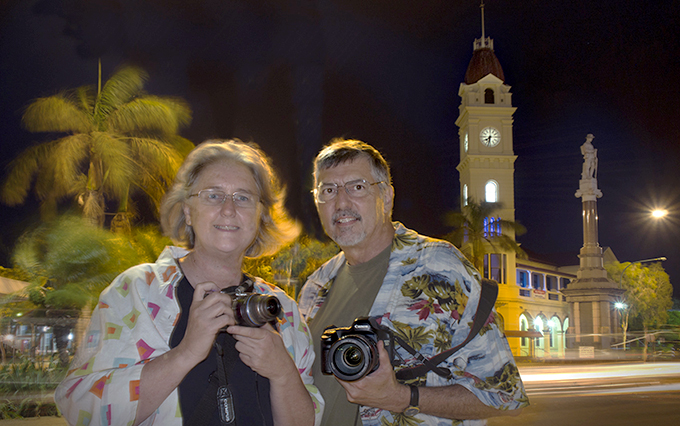
Vicky and Doug go tropical (shirts anyway) in Bundaberg
.
We’ve been in Bundaberg this week (January 5-12)doing preliminary work on a new concept in our nocturne work. Here is the overview of the project:
.
In April 2014 Bundaberg Regional Galleries will be hosting an artist in residency program with artists Victoria Cooper and Doug Spowart. An exhibition of their Nocturne work including new images from this region will be on show at CHARTS Gallery at Childers during April in conjunction with the Queensland Festival of Photography 5. The artists will be also working on their next Nocturne photodocumentary project, entitled Nocturne Bundaberg Region. As with the previous Nocturne Muswellborook and Nocturne Grafton projects the photographs they make will be posted on the Nocturne Bundaberg Region Facebook page so that communities can connect with the project, and importantly, share their stories about each place.
.
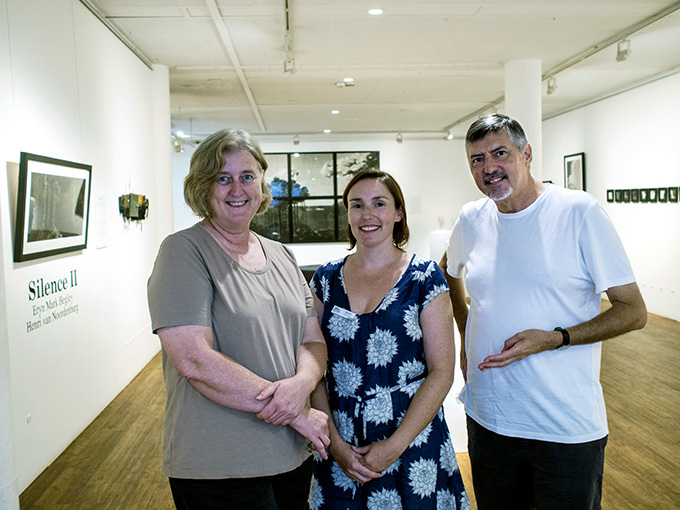
Talking with Trudie Leigo – Exhibitions Officer @ Bundaberg Regional
.
To extend the community’s connection with the project, Victoria and Doug will be working with a small group of photographers from across the Bundaberg Regional Council area to be contributors to the image-making part of the project. The participants will be selected using an EOI process that will be launched on the project’s Facebook page by the end of the month. Successful applicants will be advised in mid-March and they’ll attend a workshop in specialist aspects of nocturnal photography, image enhancement and the safety considerations for this work. After attending the workshop the local photographers will have an opportunity to add their images to the project’s Facebook page. Preferably, applicants should be 18 or over. Other community members may be invited to post images as well.
Any community member or person who has stories inspired by the photographs can post comments to the Facebook page..
.
The Nocturne Bundaberg Region’s Facebook page images, as well as the community conversation derived from the project, may be incorporated in other outcomes including exhibitions or publications associated with the project. A selection of images may go into the Picture Bundaberg Archive.
.

Nocturne Bundaberg Logo
.
All photographs © 2014 Cooper+Spowart for the Nocturne Bundaberg community documentation project
.
.
This work is licensed under a Creative Commons Attribution-NonCommercial-NoDerivs 3.0 Unported License.
http://creativecommons.org/licenses/by-nc-sa/2.5/au/
.
.
.
‘Our Home on the Range’ exhibition @ QCP
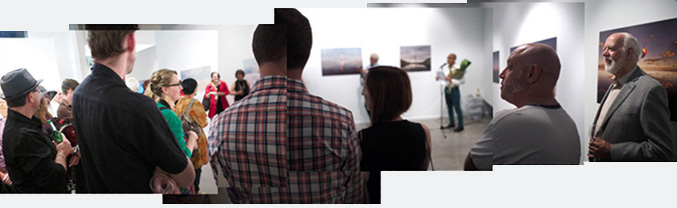
Maurice Ortega opens the QCP Exhibition – November 30, 2013 … PHOTO: Doug Spowart
.
DOUG CURATES QCP STUDENT EXHIBITION: “Our Home on the Range”
Southern Queensland Institute of TAFE Certificate IV in Photoimaging students recently presented their work in Brisbane as part of the Queensland Centre for Photography’s Undergraduate Bridging Program. The images in the series “Our Home on the Range” are indicative of the intention for the program to allow students to develop both creative and personal directions in their studies. Throughout 2013 the exhibiting photographers have worked with teachers Alison Ahlhaus, Sheryleigh Burns, Bev Lacey, Rachel Susa and Doug Spowart. The exhibition was curated by Doug Spowart.
The QCP Undergraduate Photo Media Bridging Program profiles the work of emerging artists who are currently studying photo media at an Australian higher learning institution. The program provides a bridge between higher learning institutions, students and the QCP, providing an insight into work currently being produced by undergraduates recognising the outstanding cultural investment made by institutions and lecturers across Australia.
.
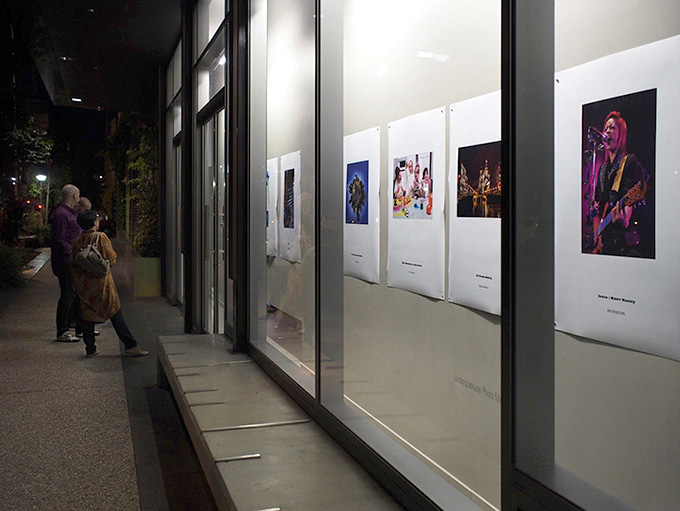
The Our Home on the Range exhibition @ QCP ….PHOTO: Doug Spowart

A ‘selfie’ with Kirsten Butters and her work ….PHOTO: Doug Spowart
.
Here is a gallery of the Our Home on the Range photographs …
.
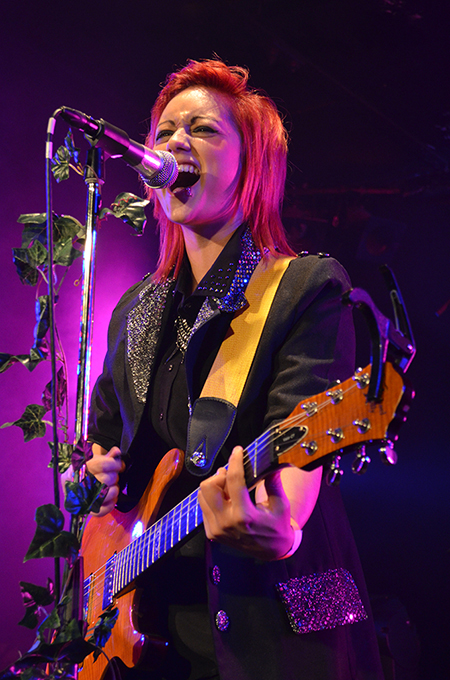
Jesse – Rawr Vanity by Kirsten Butters
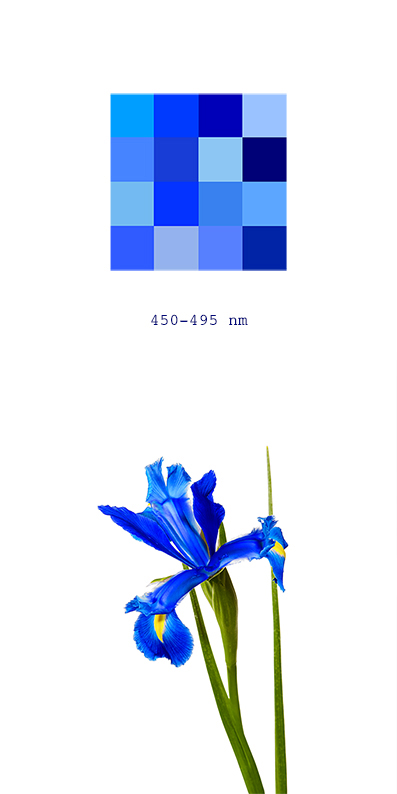
The Colours of Light by Craig Seibel
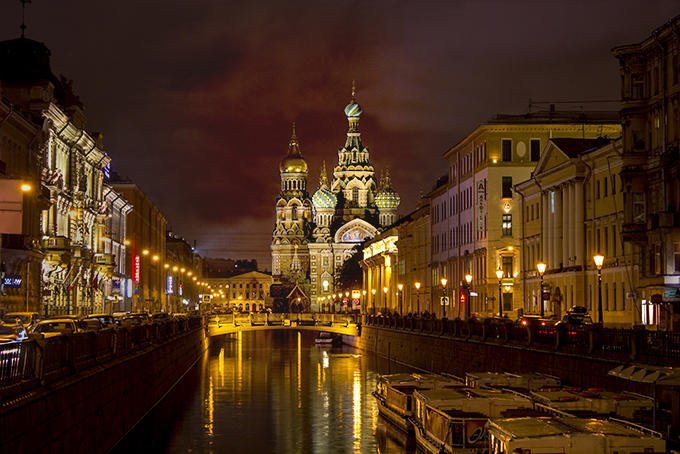
St Petersburg by Carolyn Johnson

A chemistry experiment by Perri Hammond
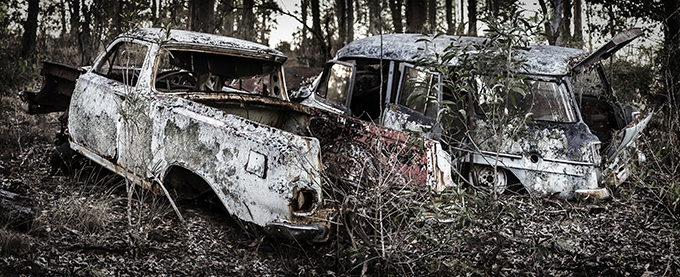
Rest in Pieces by Anna Schwenke

The Planet of Garden by Linsey Walker

Shoot ‘Em Up by Rhianen Dodd

The colours of tranquiity by Sandra McEwan

A Lone Man by Riry Foran
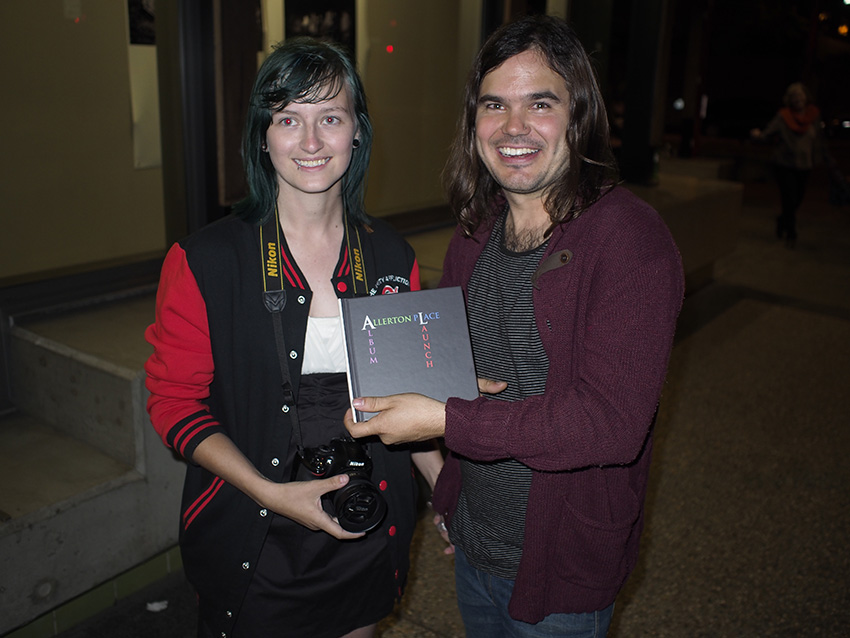
Kirsten showing work to Rock+Roll photographer and publisher Dane Beesley ….PHOTO: Doug Spowart
.

Toowoomba’s Mail Story about the exhibition
.
QCP Logo
Thank you to the Queensland Centre for Photography for the support to these emerging photographers.
.
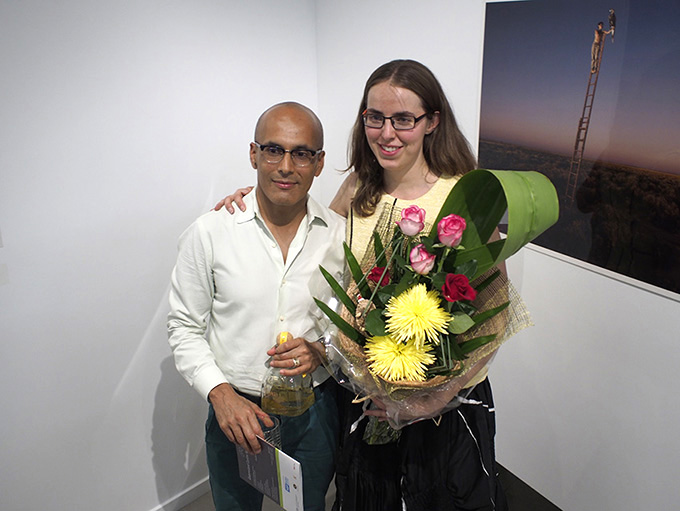
QCP Director Maurice Ortega and Deputy Camilla Birkeland at the opening
.
Copyright in the photographs remains with the the photographers.
THE EXPO 88 PHOTO SHOW – 25 years on
.
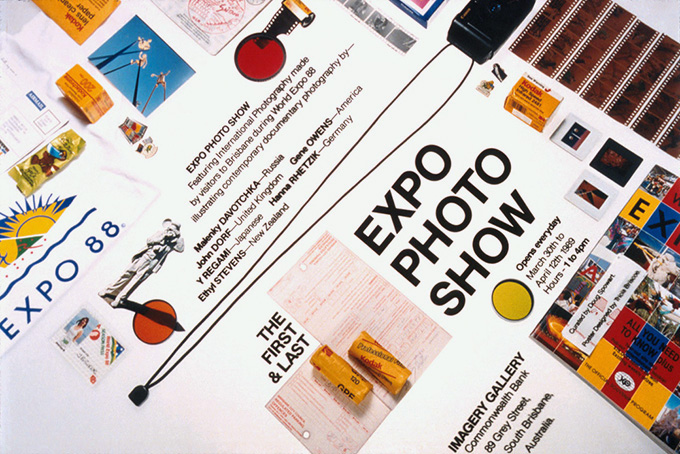
First & Last EXPO PHOTO SHOW Poster
.
EXPO’88 – A conceptual photographer’s document
.
At this time twenty-five years ago, January 1989 – the people of Brisbane were beginning to lament the passing of EXPO’88. While the six-month adventure opportunity to encounter the world and its cultures and cuisine was to form lasting memories for some, others may have recollections of the crush of interstate and overseas visitors, the nightly flamboyant fireworks displays and the inevitable queuing to visit everything from food stalls, to exhibitions and toilets. EXPO’88 is often seen as a watershed in the transformation of Brisbane as a sleepy backwater into a vibrant cosmopolitan city of the world and, most certainly part of the 21st Century.
I had a season pass for EXPO’88 and created a personal body of work as a response to my experience of the event.
.
Here is the back-story behind my 1988 project … The First & Last EXPO PHOTO SHOW
.
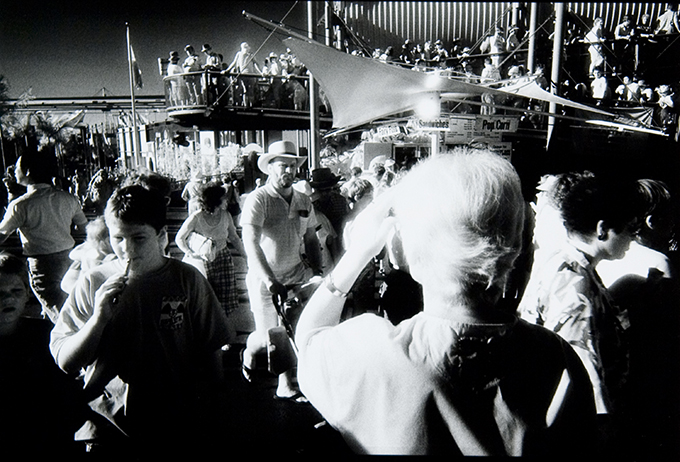
EXPO 88 Crowd Crush ………..PHOTO: Ethyl Stevens aka Doug Spowart
.
In the EXPO’88 event I recognised an opportunity for the creation of a new body of work investigating emerging approaches to my work methodology. For varied reasons I had introduced to my practice the creation of alias identities to which my work was attributed. These identities were quite complete in that they had refined working styles, subject matter, presentation forms, a photographic portrait, signatures and artists statements. As a gallery director it was easy to slip the work of these ‘photographers’ into group shows for commentary and critical acclaim. These personae enable me to play a little game on a system that at times, from my perspective at times, was biased, exclusive, nepotistic and overly critical. It also enabled me to explore ideas and concepts relating to my photography and the presentation of photographs.
.
When EXPO offered season passes I attended the passport portrait session with pair of fake glasses and a fictitious name, Eugene Xavier Pelham Owens, the initials and the signature spelled ‘EXPO’. The deception had begun. In time this project grew into an extensive body of work from 5 different personae all representing their manufactured personal responses to the EXPO experience. The exhibition was opened on April 1st 1989 (April Fools Day), it was reviewed positively in the Courier Mail and sales of work resulted from people who found the photographs reconnecting them with their experience of the event. The deception went undetected and after the exhibition the body of work passed into obscurity, as do so many exhibitions of photographs, and was slipped into archive storage boxes in my studio.
Whilst, at the time of the fieldwork on this project I called myself a ‘conceptual photographer’ as I felt that my work was driven by the overarching idea of personal experience documents rather than the photodocumentary reportage principles of truth and reality. I was aware of the term ‘conceptual artist’ and recognized that it had all kinds of baggage attached to it based on art theory and movements, however my work as a photographer at this time has simpatico with Sol Lewitt’s 1967 manifesto on conceptual art. He states:
In conceptual art the idea or concept is the most important aspect of the work. When an artist uses a conceptual form of art, it means that all of the planning and decisions are made beforehand and the execution is a perfunctory affair. The idea becomes a machine that makes the art. (Lewitt 1967)
Recently Melissa Miles has discussed the term ‘Conceptual Documentary’ in her 2010 paper The Drive to Archive: Conceptual Documentary Photobook Design. The discusses in reviewing the photobooks of Stephen Gill, Mathieu Pernot and Matthew Sleeth. She asserts that this mode of photography is based on a theory that photographers want to collect and respond to a kind of ‘archive impulse’, making and arranging image sequences of daily life into photobooks. What appeals to me is that, as a Conceptual Documentary photographer I, as Miles defines, ‘seek[s] out and frame[s] their subjects according to a pre-determined idea or scheme. Processes of repetition and categorization are central to Conceptual Documentary’ (Miles 2010:50). For me, what I was engaged in was to make a commentary from a personal viewpoint and to create a contemporary record for public presentation and, ultimately archiving. While Miles’ contemporary Conceptual Documentary practitioner including the likes of Martin Parr freely publish their photobooks in the 1980s trade published productions were beyond the reach of most photographers including myself.
What I find interesting now is that the 1980s was a particularly productive period for me as I created a trilogy of exhibitions: Tourists Facts, Acts, Rituals and Relics, Icons & Revered Australiana and The First & Last Photo Expo Show. These were essentially social documentary projects based on a personal directorial premise. I found that the limited opportunities for presentation of the framed exhibition format of these shows led me to initial experiments with boxed sets of images and ultimately to self-published photobooks, the first of which was completed in 1992.
These days I’m not so concerned about any tag as my work is often so interdiciplinarian it is hard to define. What for me is interesting is that at the time I made work that may now be able to be defined and categorized using contemporary terms and definitions. What is also important now is that the EXPO’88 photographs, some 5,000 of them, exist as an archive not necessarily as a document of the place but rather as a personal, conceptual documentary photographer’s response to the EXPO’88 experience.
Doug Spowart December 26, 2013
.
Lewitt, S. (1967). Paragraphs on Conceptual Art. Artforum 5: 8.
Miles, M. (2010) “The Drive to Archive: Conceptual Documentary Photobook Design.” Photographies 3, 49-68.
.
HERE IS A SELECTION OF WORKS FROM MY EXPO’88 PSEUDONYMS
.
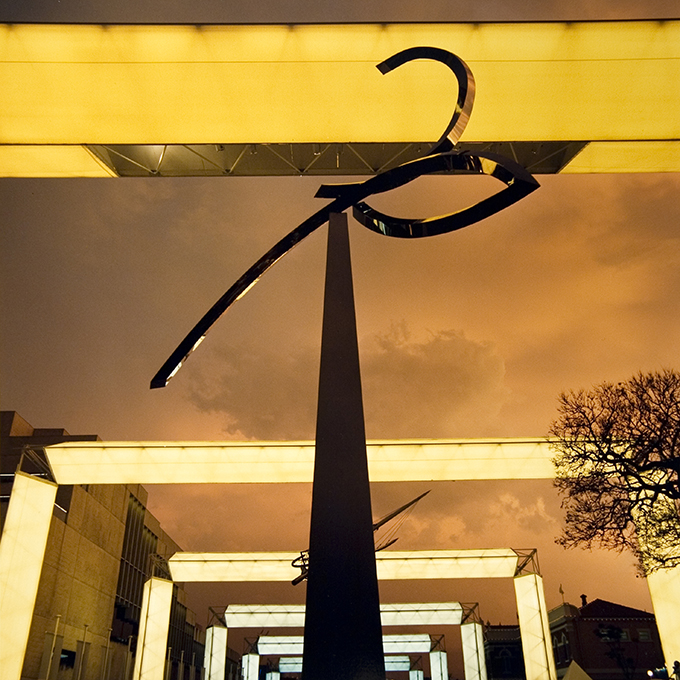
John (Jack) Dorf ………(United Kingdom)

John (Jack) Dorf ………(United Kingdom)
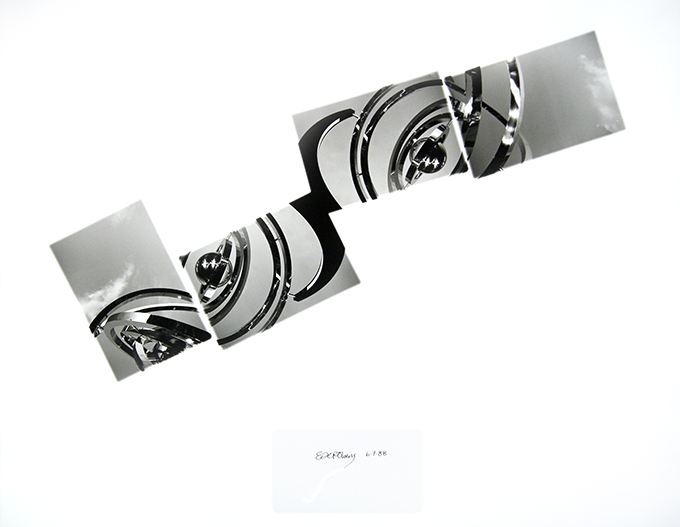
Eugene Owens …….(USA)
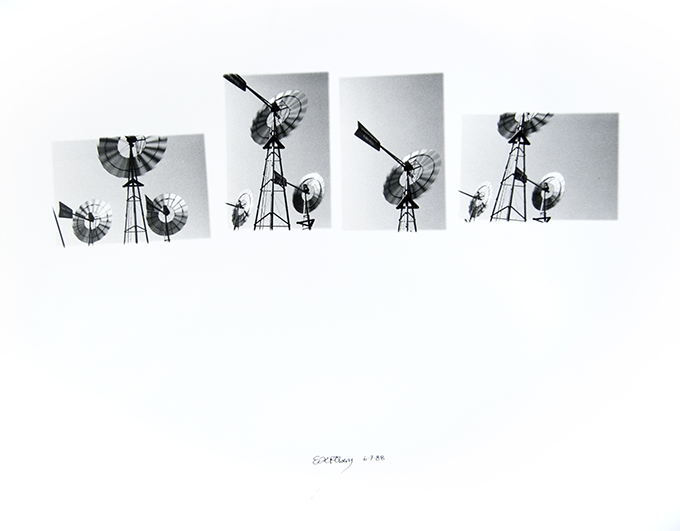
Eugene Owens …….(USA)
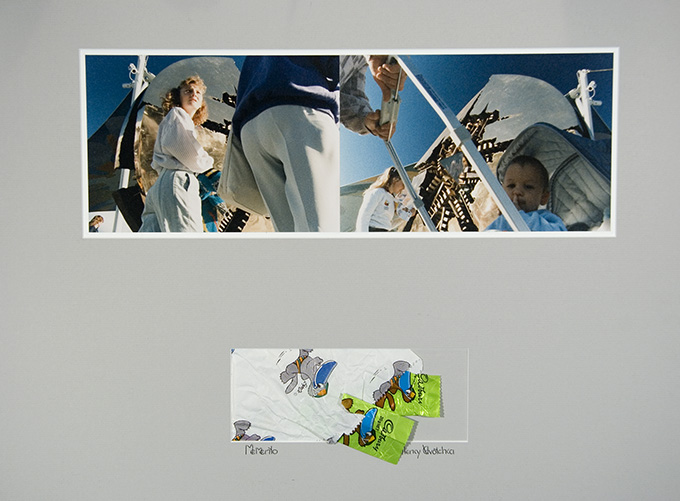
Malenky Davotchka ……. (Russia)
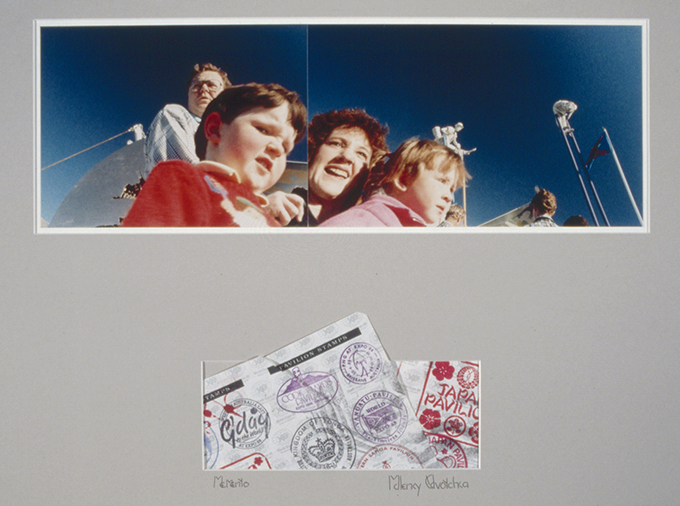
Malenky Davotchka …….(Russia)
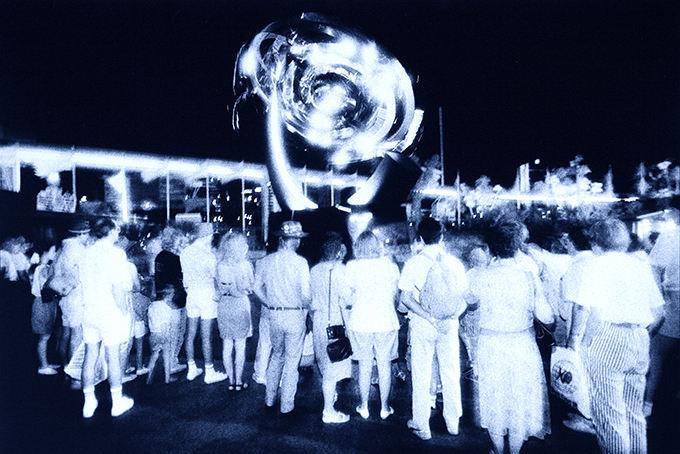
Y Regami ……(Japan)
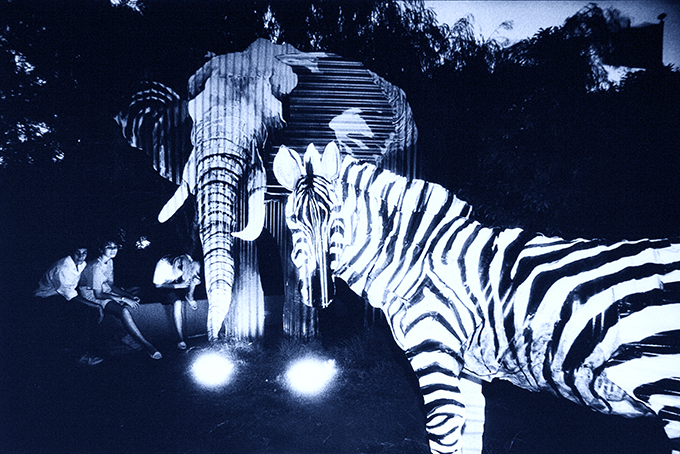
Y Regami ……. (Japan)
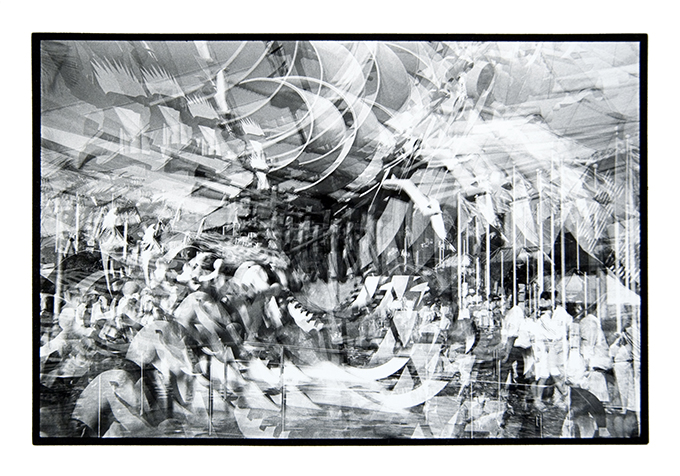
Hanna Rhetzik …….(Czechoslovakia)
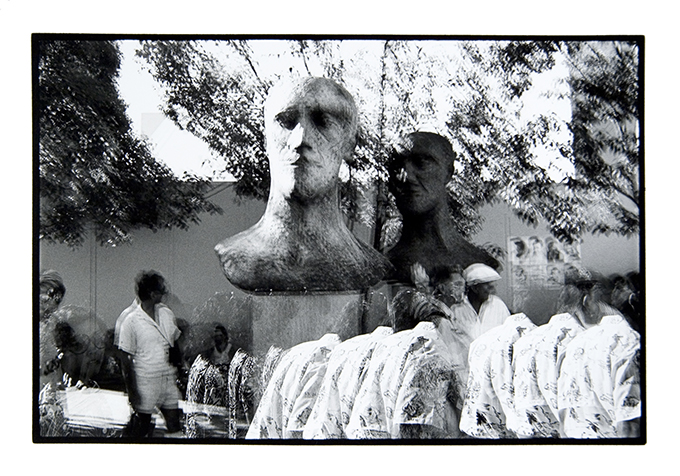
Hanna Rhetzik ……(Czechoslovakia)
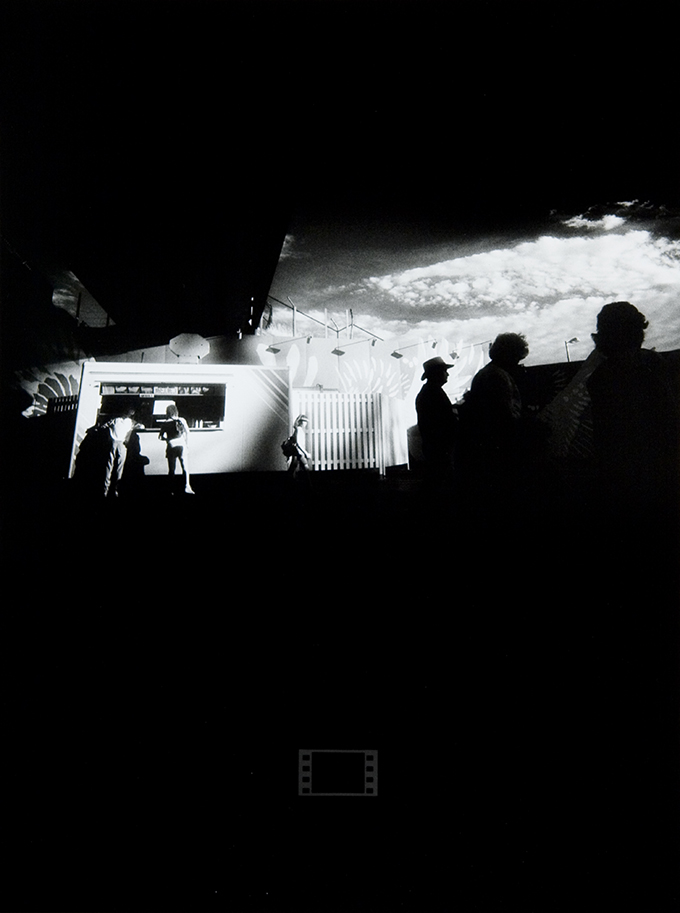
Ethyl Stevens …….(USA)
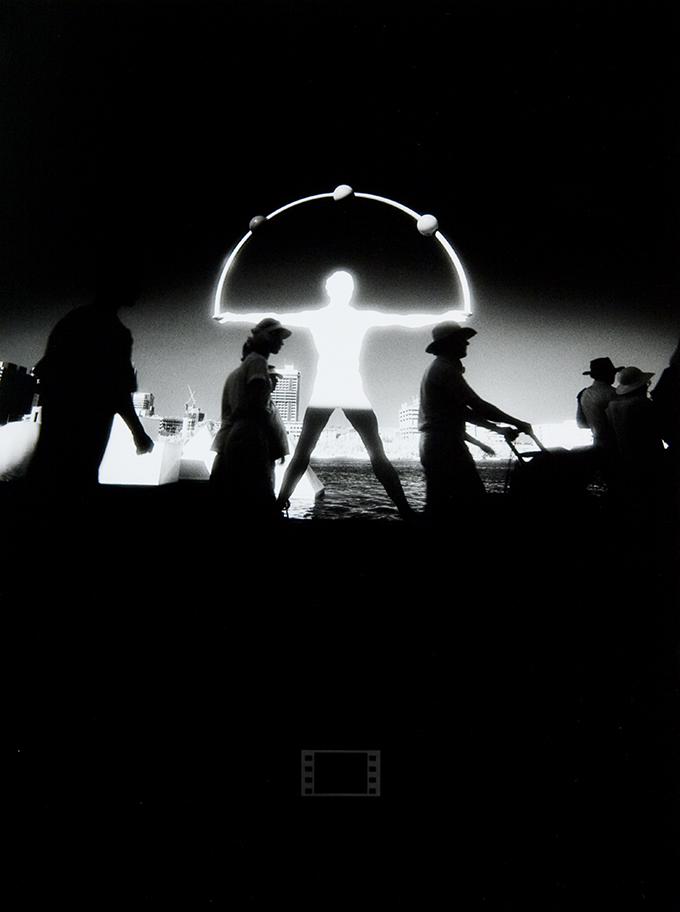
Ethyl Stevens …….(USA)
.
A PDF PRESENTATION CONTAINING MORE IMAGES IS AVAILABLE HERE: EXPO-SPOWART-v3
.
First & Last EXPO PHOTO SHOW Poster
.
.
Images and text © Doug Spowart Design of the Poster: Trish Briscoe
From the Doug Spowart Personal Art Archive 1953-2014
..
.
This work is licensed under a Creative Commons Attribution-NonCommercial-NoDerivs 3.0 Unported License.
.
2013-14 NEW YEARS EVE FIREWORKS: Frogs Hollow – Toowoomba
.
NEW YEAR’s EVE – A time for freedom from order — a time for fun.
.
So we left the big cameras at home and went out with the little Olympus Pens point-n-shoot. No tripod – no big plans – “Bulb” setting, watch, mingle, be a part of the ‘BANG’, ‘Crackle’, ‘POP’ and the gasps and murmur of the crowd.
.
These are truly experiments in capturing the experience and essence of a fireworks display in regional Australia … Enjoy!
And all the very best to you for the New Year!
.
Click on any image for it to enlarge …
.


.
.
© 2014 Victoria Cooper and Doug Spowart
.
This work is licensed under a Creative Commons Attribution-NonCommercial-NoDerivs 3.0 Unported License.
.
.
WOTWEDID Blog: 2013 in review
The WordPress.com stats helper monkeys prepared a 2013 annual report for this blog.  Here’s an excerpt:
The concert hall at the Sydney Opera House holds 2,700 people. This blog was viewed about 18,000 times in 2013. If it were a concert at Sydney Opera House, it would take about 7 sold-out performances for that many people to see it.
Click here to see the complete report.
.
.
.
.

 wotwedid