Posts Tagged ‘State Library of Queensland’
SLQ Siganto Seminar: The trouble with artists’ books
AT THIS TIME THE BLOG WILL FEATURE IMAGES OF THE EVENT
We are happy to receive comments and dialogue arising from the seminar and will post selected feedback. Please leave a comment on this blog for consideration by us for posting.
The podcast is available at http://www.slq.qld.gov.au/audio-video/webcasts/recent-webcasts/siganto-seminar
Cheers Doug+Victoria
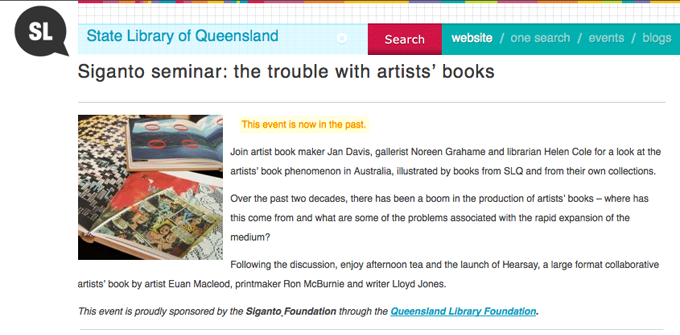
From the SLQ website – Promo for the evnt
.
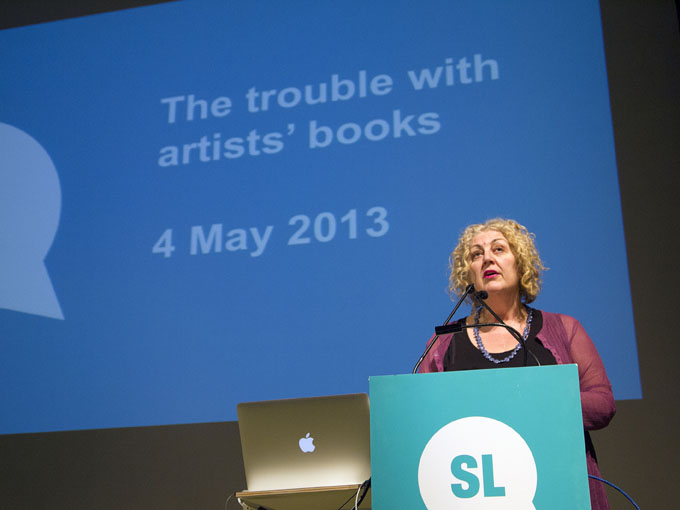
The State Librarian Jeanette Wright opens proceedings
.
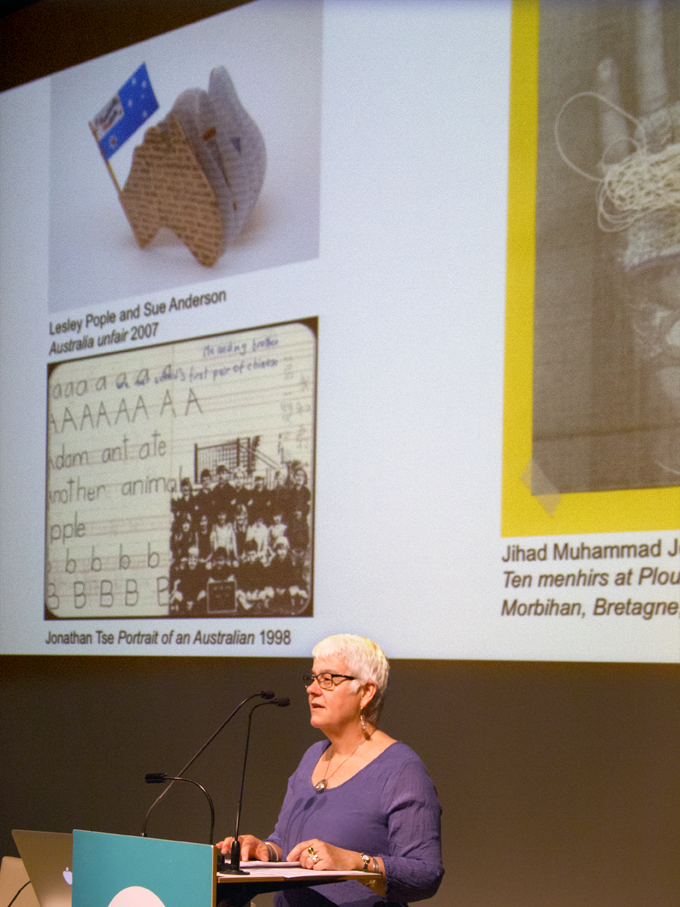
Helen Cole presents the Librarian’s view
.
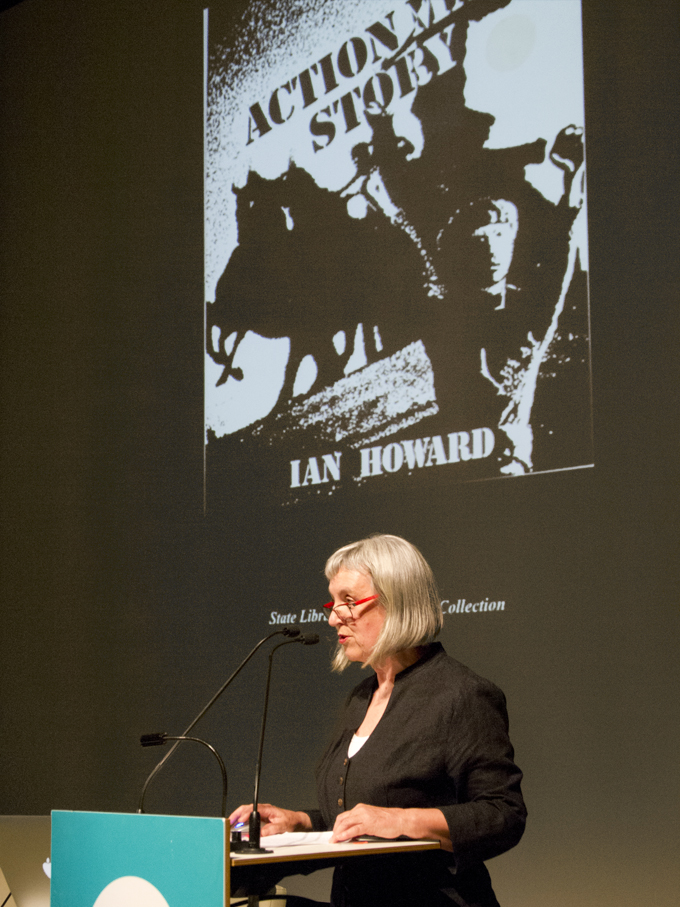
Jan Davis presents the Artist’s view
.
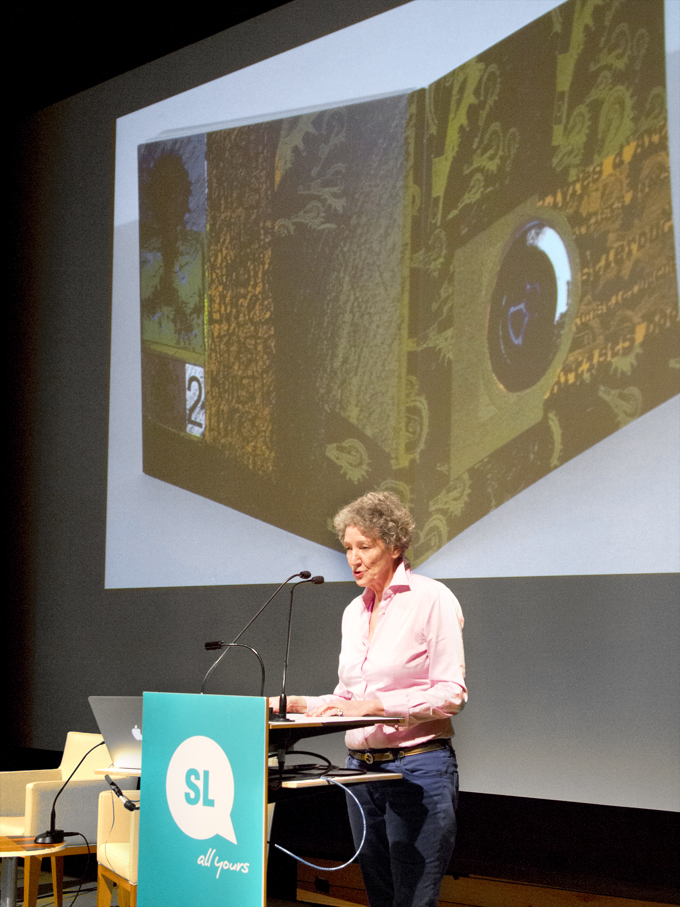
Noreen Grahame presents the Gallerist’s view
.
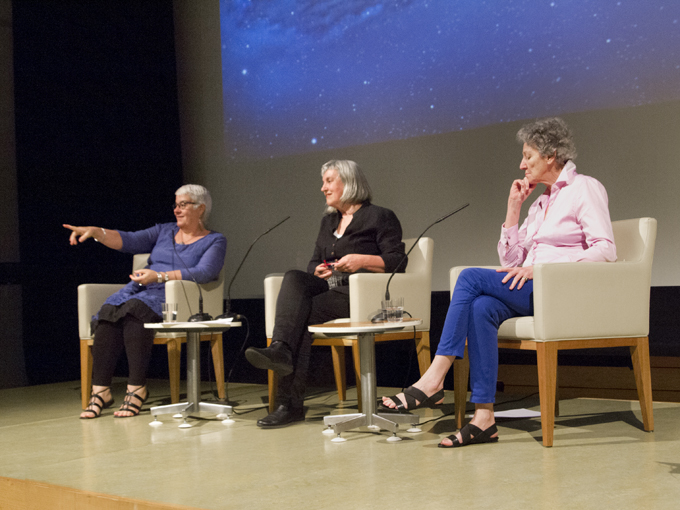
Helen Cole chairing the Question and Answer session
.
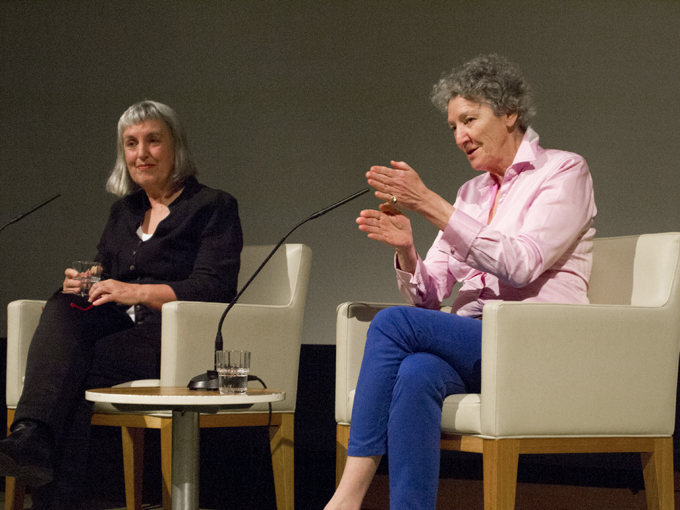
Noreen Grahame answers a question
.
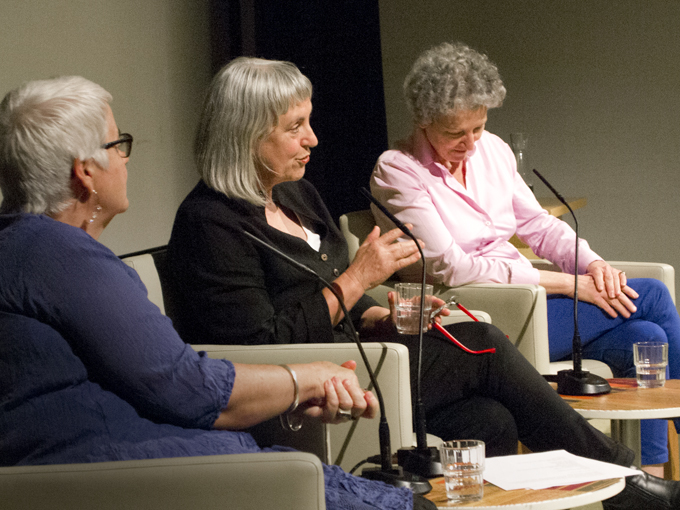
Jan Davis answers a question
.
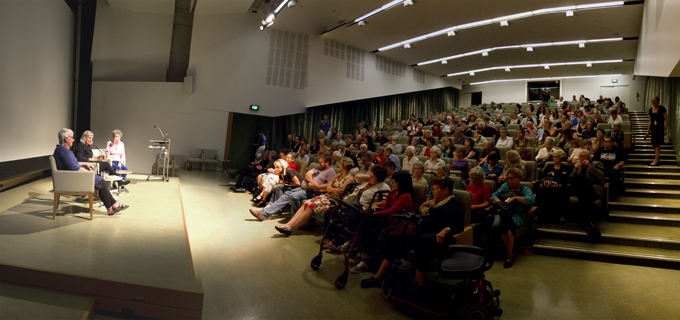
The Auditorium crowd
.
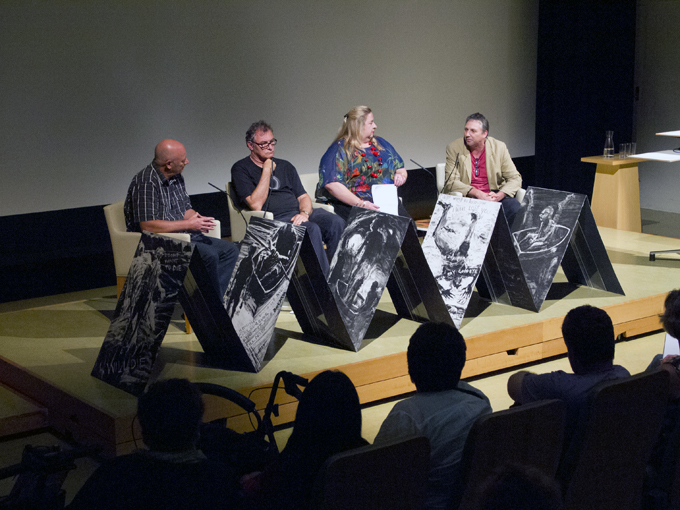
The Hearsay team members discuss the project
.
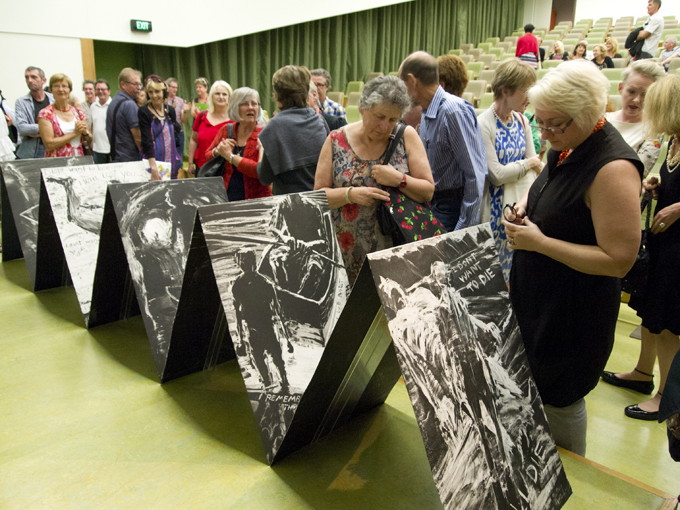
Attendees viewing the Hearsay book
BLOGPOSTS ABOUT THE EVENT ARE AVAILABLE AT THE FOLLOWING:
Judy Barrass ‘Critical mass Blog’ http://www.criticalmassblog.net/2012/?p=2568
.
All photographs © Doug Spowart 2013.

This work is licensed under a Creative Commons Attribution-NonCommercial-NoDerivs 3.0 Unported License.
COOPER SCROLLS @ Toowoomba Regional Art Gallery
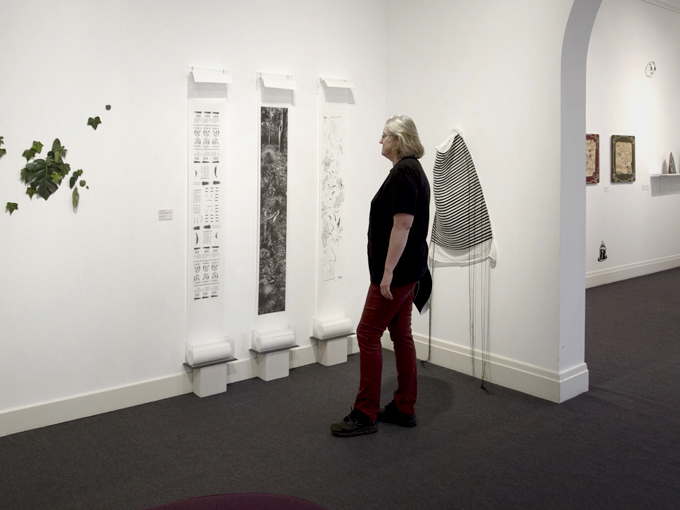
Victoria Cooper in the Off The Wall installation of three scrolls from the series of five
.
ABOUT ‘THE STORIES OF THE GORGE’ ON SHOW @ TRAG
Victoria Cooper’s digital montage Stories from the Gorge scrolls, made over ten years ago were included in Toowoomba Regional Art Gallery show. The exhibition was entitled Off the wall and was on show in Gallery 2 and Amos Gallery in May 2013.
The information about the exhibition that follows comes from the exhibition room sheet prepared at the time by Toowoomba Regional Art Gallery Exhibitions Officer, Ashleigh Bunter:
The works in the exhibition have been selected from the Toowoomba Regional Art Gallery’s City Collection. They have been placed simply together due to their three-dimensional nature and to highlight their derivation from the traditional two-dimensional picture plane.
This exhibition demonstrates the way that artists manipulate physical depth within their works which can often create a greater engagement between the object and the viewer. Interestingly, many of the works in this exhibition focus upon environment, whether it is the natural, public or the domestic environment. Materiality is also a common consideration. Throughout this exhibition one can see the influence of ‘the collector’, artists who gather images or common materials, reusing and reinterpreting them to create their art.
Victoria Cooper’s Stories from the Gorge: Order, chaos and the story of the hillside is a Chinese-landscape-scroll inspired series that represents “the last bastion of a natural chaos and order, an anti-culture, occurring on the fringes of agriculture.”[i] Human effects on the natural environment are central to Cooper’s practice and her prints and artists’ books in various formations lead the view from a flat two dimensional plane into the landscapes she investigates. These printed scrolls rise up from handmade acrylic boxes like the tall gum trees on their surfaces.
Other artists in the Off The Wall show include; Michael Schlitz, Marieke Dench, Tiffany Shafran, Judith Kentish, and Brigid Cole-Adams and the exhibition will be on the wall until May 26, 2013.
.
PRIZES AND AWARDS
2001 The Gorge was purchased by Australian Library of Art at the State Library of Queensland
2001 – Photographer and gallery director Sandy Edwards awarded The Gorge, First Prize in the Muswellbrook Photography Award
2001 – MCA Director Elizabeth Ann Macgregor awarded The Cliff, First Prize for Works on Paper, Martin Hanson Memorial Art Awards, Gladstone Regional Art Gallery and Museum
2002 – Five Stories from the Gorge was a Finalist in the 2002 Josephine Ulrick & Win Schubert Foundation for the Arts Photography Award at the Gold Coast City Art Gallery was selected by Isobel Crombie Curator at the National Gallery of Victoria
2002 –The triptych was acquired during its showing in the Toowoomba Biennial Acquisitive Award selected by Julie Ewington, then Curator at the Queensland Art Gallery..
.
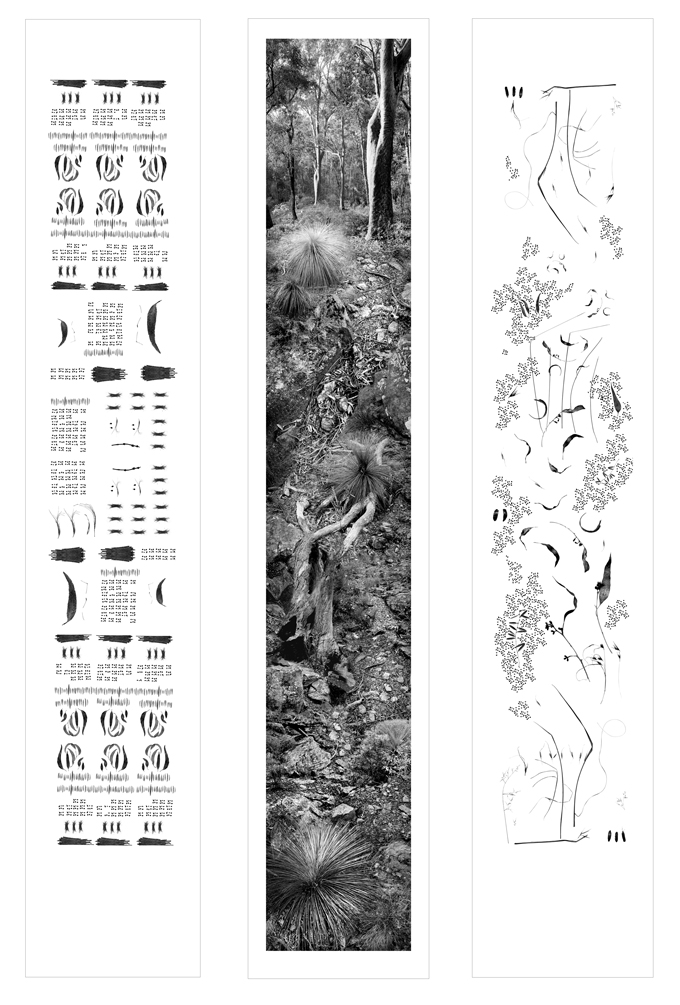
Three images of the Stories from the Gorge triptych as presented @TRAG
.
THE BACKSTORY OF THE SCROLLS AND THE SERIES OF 5 WORKS
Cooper’s scrolls were presented for the TRAG exhibition as a triptych, however in the original exhibition, entitled Searching for the Sublime, there were five scrolls. Searching for the Sublime was a collaborative project with sculptor Jim Roberts, fellow artist Doug Spowart and curator Deborah Godfrey. The inspiration for the project was a wilderness area in the Helidon Hills a mere 20 kilometres north-east of Toowoomba. Supported by an RADF Grant, the show featured Roberts’ sculptures, Spowart’s abstract water photographs, and Cooper’s scrolls and was shown at 62 Robertson Gallery in Brisbane in August 2001.
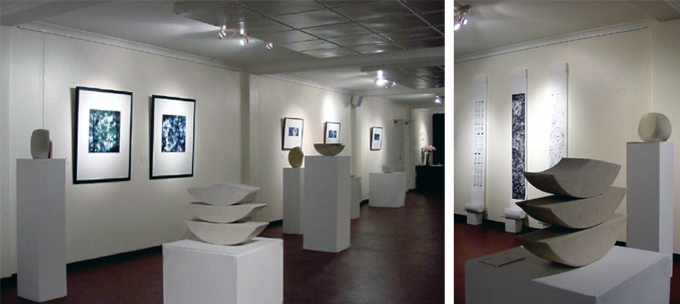
Searching for the Sublime @ Gallery 62 Robinson PHOTO: Courtesy of 62 Robertson
.
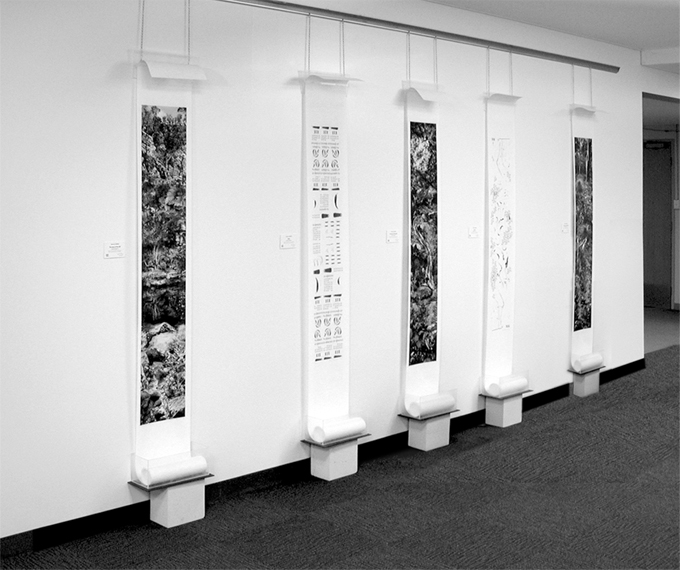
Five Stories from the Gorge installation at SQIT Gallery
.
The images were assembled as a photomontage in the tiny, by current sizes, Blueberry iMac computer. At times Victoria juggled 200 layers in one Adobe Photoshop document to create the fiction panoramas. Seeing the whole image was a problem as most of the time Cooper’s view was no bigger than the iMac screen requiring her to ‘scroll’ the image up and down–just as you will do in looking at the images in this post. Saving the files took 20-30 minutes and the system often crashed. The images were printed in pigment inks on an Ilford Novajet printer onto Hahnemühle Japan ‘rice paper’ by IMT on the Gold Coast. Victoria worked with artist Wim de Vos to design the bespoke handmade acrylic boxes. The design featured the ability for the box to not only serve as a container, but also act as a device to display the scrolls.
The complete set of scrolls, Five Stories from the Gorge, was shown in many venues and awards (see prize list at the end of this post), including Photospace at National Art School, Australian National University, Canberra. Canberra Times arts reviewer Myra McIntyre commented that Cooper’s works are:
Most elegant and fascinating photographic objects are Landscape stories, a series of five Asian-inspired scrolls. Cooper crawls, wanders and flies through the Australian landscape gathering hundreds of objects, patterns, and perspectives that she digitally intertwines, creating a continuum of almost imperceptibly diverse perspectives and a physical sense of vertigo in the viewer.
Review, Canberra Times, May 10, 2002
In 2002 the triptych was acquired during its showing in the Toowoomba Biennial Acquisitive Award selected by Julie Ewington, then Curator at the Queensland Art Gallery. Interestingly the rules of the competition at the time restricted entries to work that had not previously won an art award–as such only the three scrolls The Story of the Hillside, Chaos and Order were entered. When purchased the two other scrolls were orphaned from the set.
So here in this blog, we reunite the Five Stories from the Gorge presented in a form for you to scroll/stroll through … Enjoy.
.
By Doug Spowart
.

Story of the Cliff
.

Story of the Gorge
.

Story of the Hillside
.
This work is licensed under a Creative Commons Attribution-NonCommercial-NoDerivs 3.0 Unported License.
LIFE’S JOURNEY: Artists’ Book Exhibition, Redland Art Gallery
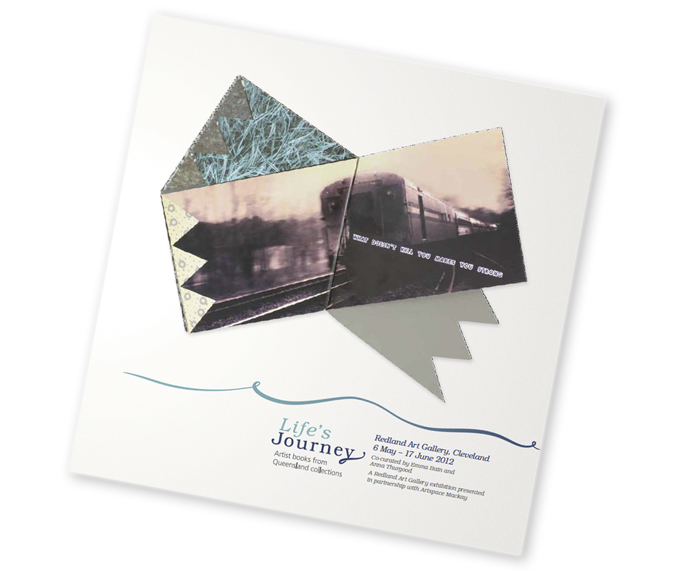
Life’s Journeys exhibition catalogue cover Redland Art Gallery
Judging a book by its cover a page
The artists’ book is usually sequestered away in library stacks and drawers in their neat little custom made archival cardboard boxes and plastic bags. In specialised library and private collections these are treasured objects; their owners become the custodian of the physical object of the book and the story is revealed in the site-specific act of reading within these spaces. But … sometimes they escape. On occasion artists’ books escape en-mass from their natural home of the library or private collection, and this is exactly the case with the exhibition Life’s Journey recently presented at the Redland Art Gallery, Cleveland.
Co-curated by Emma Bain Director of Redland Art Gallery and Anna Thurgood Acting Director of Artspace Mackay, the exhibition assembles books drawn from the significant, perhaps one could say—international quality, collections found in Queensland; Artspace Mackay (AM), grahame gallies + editions (gg+e), the State Library of Queensland (SLQ) and Studio West End (SWE). The exhibition’s themes, as highlighted in the catalogue essay by Louise Martin-Chew claim that they are intended to seek ‘out universal truths in individual journeys’, ‘the personal and individual’, …and ‘artist narratives with memoir-like threads’.
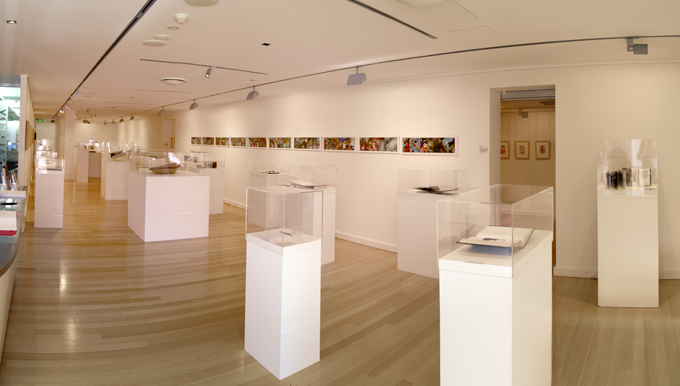
Life’s Journey exhibition @ Redland Art Gallery, Cleveland Photo: Doug Spowart
The viewer entering the gallery to see the Life’s Journeys books may not have read the catalogue, or have an understanding of the artists’ book discipline, but what they are to encounter in the white cube of the gallery space will be unusual. The Redland Gallery’s main room a literal forest of fourteen or more acrylic topped display cases. Inside each case resides the book, open to a page and resting on a stand or pillow. Some books don’t seem like books at all, they look more like 3D sculpture, or jewellery forms, or even things just fastened or bound together by threads. Other ‘books’ are in frames or on panels on the wall—one is even a projected image. It’s here where the viewer becomes acquainted with the ‘non-standard’ nature of the artists’ book—but there is more… The viewer can look at the narrative segment presented by the open page, or the expanded story presented in the wall-mounted works, or books that are of the concertina form. While being visually entertained by the titillating ‘sample’ view, the visitor may probably enjoy the encounter and will leave feeling a sense of discovering something interesting and unusual. But I would suggest that this is only part of the experience that the artists who made the books expected or wanted for those who see their books.
I know that this sounds like the continuing debate about the gallery exhibition of books where the sequential narrative that artists’ books require is neutered by single page views. But there is an issue, and for me a redeeming feature for shows like this, and that is that the display of artists’ books will encourage and excite people to hunt down these books in their usual library-sited storage spaces.
What I have written about before,* and what I will restate is, that these exhibitions are ‘tasters’ only. The exhibition strategy needs to include ways by which viewers can identify books of interest, understand how to access them, and then go-see, handle, read and fully encounter the artist’s communiqué. What is needed for the gallery viewer is a catalogue of the books and their source collections, how to access these collections, online references (maybe even flip-books of the works), perhaps even initiated within the exhibition space by QR codes or augmented reality clips. Using this concept the exhibition becomes an invitation for those who wish to take up the offer to handle and read the books in their site-specific habitat.
Now that’s off my chest, I have to say what an amazing collection of artists’ books the curators have pulled together. Seeing this cherry-picked selection in this context is far more interesting for me than looking through an online catalogue—here there is a sense of discovery. It’s a bit like going to a second-hand bookshop and just wandering through the stacks picking up whatever takes your fancy. Wandering through Life’s Journey was indeed an encounter with an eclectic bunch of artists’ books. Some of my favourites were there.

Adele Outteridge’s God Bless America Photo courtesy of Adele Outteridge
This included Adele Outteridge’s Teabag Book (2005) from SWE – just how many cups of tea were consumed to make this book? And another of Adele’s books, God Bless America (2003?) also from SWE, makes a political statement that can be read in different ways depending on the reader’s point of view of American society or foreign policy.
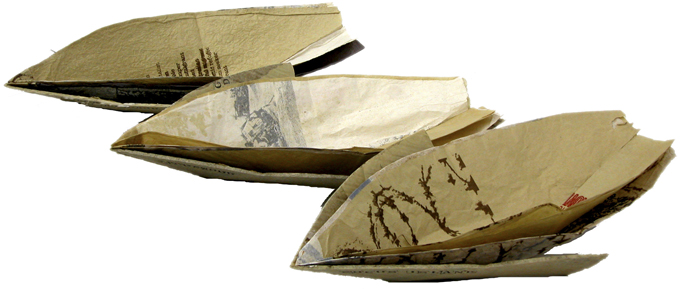
Books from the Codex Event 4 of which Naru is one (for reference only) Image courtesy of Tim Mosely
Another book Naru (2007), from the SLQ, was constructed from paper to form a 3D vessel—the book as a metaphor for a boat. The work was the result of a collaborative project entitled Codex Event 4 coordinated by Tim Mosely at Southern Cross University. Naru and the other books that were created by the team have an overtly political statement contained within their shape and the titling. These works comment on idea of the freedom that many people seek as they cross borders as refugees and how this conflicts with the Australian Government’s immigration policies.
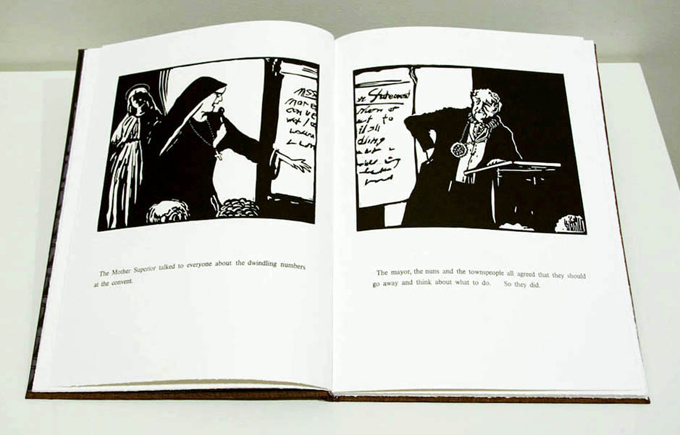
Sheree Kinlyside’s ‘The reluctant nun” (2009) @ 2010 Libris Artist Book Awards. Photo Doug Spowart
A fine press/printmakers book is represented by Sheree Kinlyside’s The reluctant nun (2009) from AM. The book was the winner of the Regional Artists Book Award at the 2010 Libris Artist Book Awards.
A book of a different shape, five sides(!) by American book artist Philip Zimmerman High Tension (1993), from gg+e, deals with a humorous look at contemporary society. The book is intentionally over-designed, montaging graphic elements and text with image narrative to make it an immensely interesting book—you want to pick it up and read through.
In the display of another book, Judy Watson’s Under the Act (2007) from gg+e, each page is framed and the work extends across one complete wall of the gallery. The folio single-sheet form of this book enables its reconfiguration to the wall possible. The work describes a personal narrative, a life’s journey, through the impact of oppressive white bureaucracy applied to Aboriginal peoples living in Queensland not that long ago.
Peter Lyssiotis and Noga Freiburg’s collaborative book Homeland (2003) from AM presents personal narratives of the authors, one a Greek Cypriot—the other an Israeli, about the way lines are drawn across maps to divide communities. The book invokes the story concept by using texts, family photographs and photomontages all bisected by a green line that divides the two communities.
One final book that I’ve always been inspired by is Scott McCarney’s Memory Loss (1988) from AM which deals with a medical condition that afficted his sibling. McCarney was recently in Brisbane with partner Keith Smith presenting an artists’ book workshop at the State Library of Queensland. This two-sided accordion structure book is replete with information from numerous sources including medical literature, personal photographs and correspondence. For me Scott’s book had truly escaped from the cases and was presented, sans protective acrylic lid, atop a plinth where viewing of one side was unobstructed. I think in terms of Scott’s politically subversive work that he would’ve liked that…
Life’s Journeys is a significant showing of what artists’ books can be and it puts the book firmly within the art gallery display environment. But none-the-less, with all the problems of display and the expectations that this commentator may have, the books do need to get out and about. They assert by their presence in the gallery that they exist and can be encountered by a diverse range of the art-interested public. And, perhaps is the case with any gallery exhibition, the viewer experience is something that develops and is enhanced by continued reflection after the viewing. The importance of the exhibition Life’s Journey, the accompanying exhibition Mind Mapping by local artist and bookmaker Jack Oudyn, and the associated workshops is that they will create much needed interest, scholarship and activity in the artists’ book genre. …. And hopefully inspire some viewers to become readers by pursuing the fuller of the artists’ book communiqué by engaging more fully with them when the books return to their respective collection homes.
Doug Spowart June 9, 2012
Please note: The links that I’ve selected to provide a visual connection with the text have been sourced from Google images and may not be the exact book presented for display in this show. I have found it interesting to discover how so many artists’ books are poorly, if at all, represented in the online domain.
KEITH SMITH + SCOTT McCARNEY @ SLQ
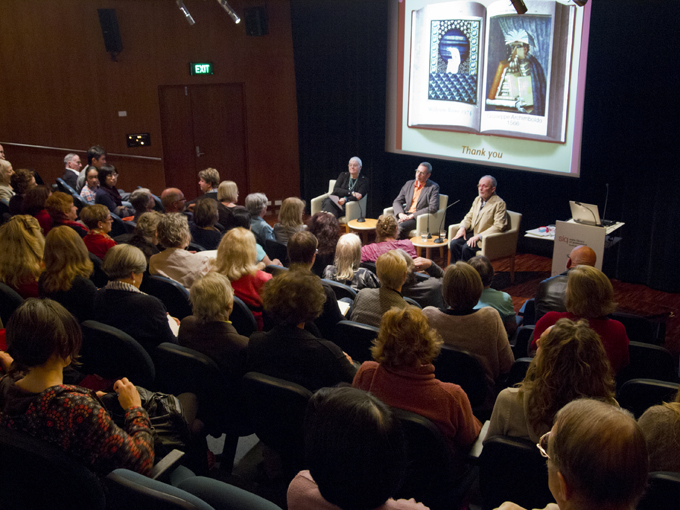
Please note: This post is derived from personal notes made at the event – They may contain some inconsistencies that are a result of my interpretation.
AUDIO NOW AVAILABLE @ http://enc.slq.qld.gov.au/audio/slq/pp/mp3/artdesign/Artistsbooks.mp3
In what looks like the one highlight in the Queensland artists’ book calendar for 2012 Keith Smith and Scott McCarney are visiting the State Library of Queensland to present a lecture about their work and to conduct a five-day workshop. Unable to attend the workshop due to teaching commitments I attended the talk at the SLQ today. I was not alone and the smaller SLQ auditorium was full of interested attendees — including some notables like Sarah Bowen, Adele Outteridge, Madonna Staunton, Wim deVos, Anne Marie Hunter and Lorelei Clark. The visit to SLQ by Scott and Keith is supported by the Siganto Foundation and members of the family were in attendance at the lecture.
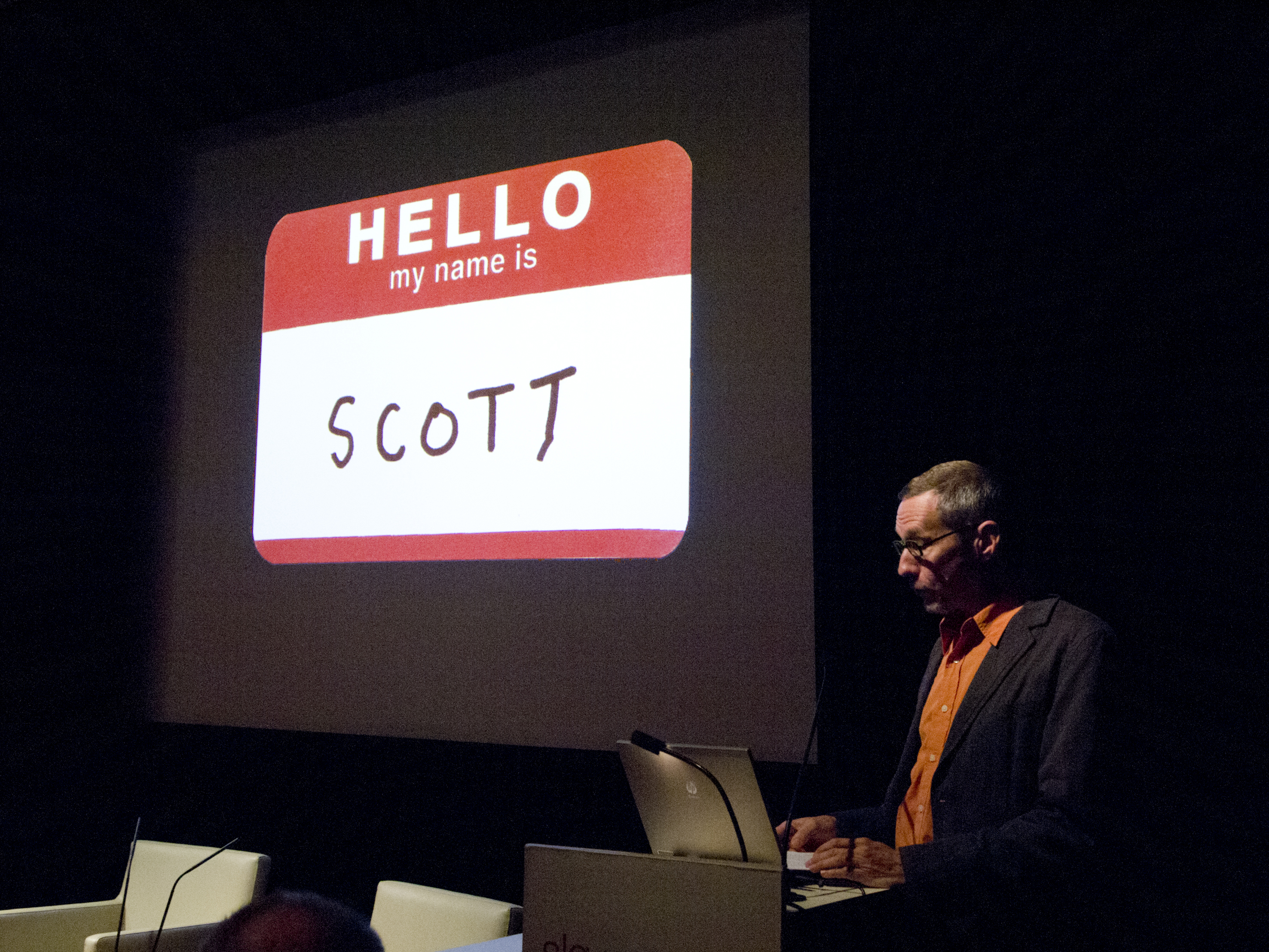
‘HELLO’ Scott!
After and introduction by SLQ Artists’ Bookie Helen Cole, Scott began his presentation by talking about the nature of the book in the digital age. He seemed to lament that libraries were beginning to change into Wi-Fi coffee houses — that’s not a problem for him as he believes the book, as a physical thing, will go beyond the electronic age.
He sees a real discussion about the future of the book is all about ‘display’. This remains a contentious issue for the artists’ book as they are difficult to handle and read as in exhibitions they are usually displayed frozen and ‘under glass’. Some of Scott’s work has been about presenting books as sculptural forms (Hanging Index) so the viewer does not really need to turn the pages to engage with the work.
Scott spoke in detail about his Autobiography series. He described how he couldn’t throw anything away and that he makes collections from things like name badges, rejection letters from galleries and grant applications, to-do lists and mud maps. This body of work provides an insight into the trivia and ephemera of life that escapes disposal through its transformation into his art. Connecting with the Internet world Scott’s Google Vanitas begun on Christmas Day last year represents the search results for his own name.
Scott showed many examples of works with where he cut through various pages within books to subvert the content of the book.
In a homage to Ed Ruscha Scott has taken Ruscha’s 1964 book Various small fires and milk and made his own take on the subject — Scott’s fires are those of riots and the curious inclusion of a glass of milk in Ruscha’s book is shortened to MLK, standing for Martin Luther King whose portrait appears in the book. l
A recent project by Scott was to participate in the al-Mutanabbi Street Coalition’s response to the car bombing of this street in Bagdad which was home to many of the city’s booksellers. Scott’s work Material Meditation on Mending Al Mutanabbi Street comprises fifteen two-sided loose-leaf prints made from collages made from remnants of found books, rubbings from bookbindings and photographs.
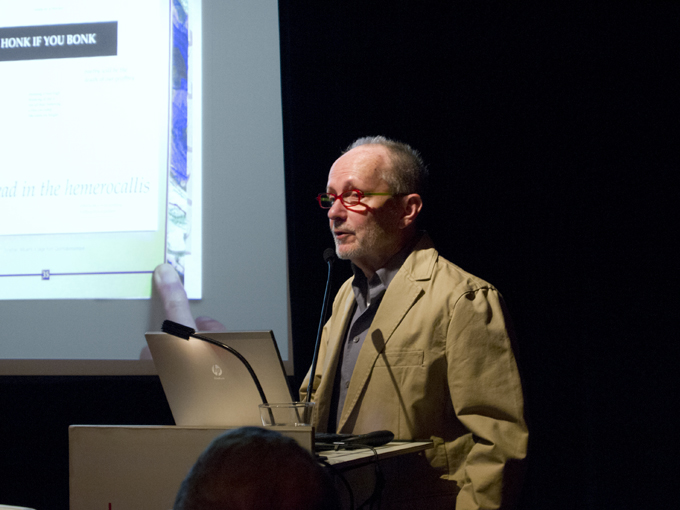
Keith Smith speaks
Scott then handed over to Keith who comments that he is now up into the 280s on his ever increasing list of books. He spoke of a number of book projects dealing with subjects like re-contextualisation of paintings of Saint Sebastian into Smith’s own painted backgrounds. Many variations on this theme have been created from an amassed collection of source paintings — he intimated that he was even working on a book as he was preparing to travel to Australia.
He spoke of his connection with the computer and digital book Bobby made as early as 1984 with an early Macintosh computer using MacPaint and MacWrite. In his latest work he has re-formatted the book and re-jigged the content. The new Bobby has been supersized to one of Smith’s biggest ever books.
One of Keith’s trademarks is the digitally created multi-layered photomontage and his rainbow borders and edges. He states that when using Photoshop he may be working with between 12 and 24 layers of colour. Pages for the book Seminal were shown as examples.
Book number 283 is Struggling to see deals with Smith’s continuing fascination with text and image. The book is dedicated to Nathan Lyons whose own books and image sequencing presents Smith with a constant source of challenge. Smith acknowledged Lyon’s mastery of organising images in a book in a way where the message of the book is spoken ‘between the pages’.
Question time yielded perennial questions to do with inkjet printers, papers, the ‘archivalness’ of the technology and editioning.
One questioner spoke of how books can be made by anyone via print on demand technologies …
Another question dealt with the montage …
Keith commented that the book tells him where to go …
A comment made by one participant was that they were coming to understand that with all the standardization of the book through language and form and that that is where the psychology of the artists’ book really kicks-in to say something else that we were not ready for…
A question about the eBook and where it fits in contemporary practice. Scott answered that with eBooks one must learn the tools and understand that they are about text in a multi-media platform and that translating work into digital form you need to recognise that it is married to the content.
Keith’s response was that was something for the younger generation, ‘I’m too old ….’ Perhaps it is, for him, that the eBook is not a tactile medium that you cut, fold, touch and be touched by — although it may be something else?
Doug Spowart May 28, 2012
NOTE: The SLQ will be posting this lecture online in the near future
FLOOD DONATION: ‘Toowoomba Water’ book to SLQ
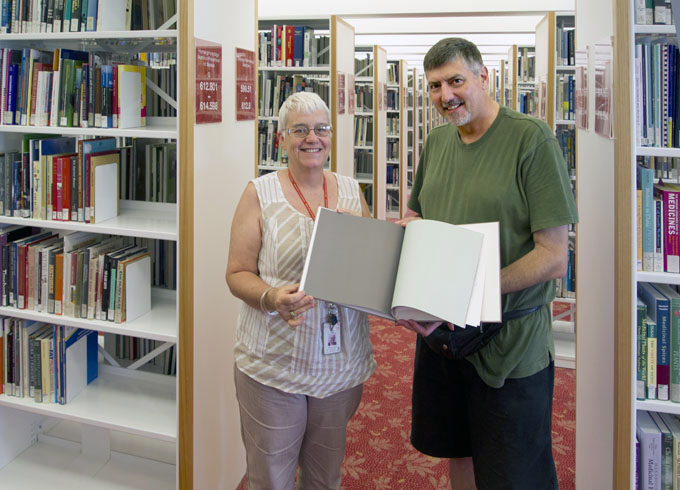
Helen Cole + Doug with the book 'Toowoomba Water'
At a time when all Queenslanders were reflecting on the first anniversary of the devastating floods of January 2011 it was fitting that I was able to make a presentation of the book Toowoomba Water to the Australian Library of Art at the State Library of Queensland.
The book features a response to flooding in Toowoomba that took place on January 10th. The book was designed to be output using Australia’s premier print-on-demand supplier – AsukaBook using their Book Bound Hard Cover 10″x10″ format.
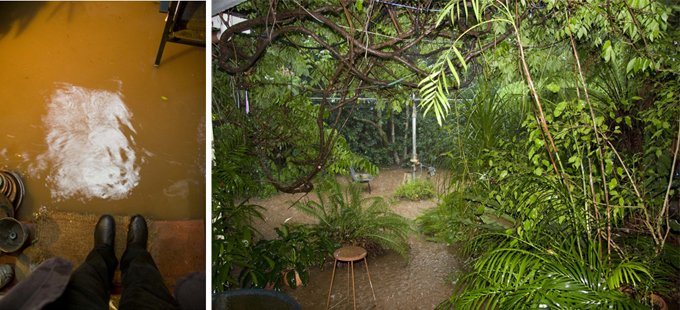
On the studio step + our 'rainforest' backyard
Water came within 20cm of our studio and a brown torrent flowed into our garden and under the house. At the bottom of our street a massive flow of water along East Creek took the lives of two people.
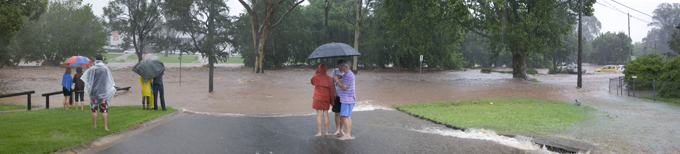
East Creek in flood at the bottom of Burns Street
The book makes a commentary on the flood by responding to an aspect of the event that was ‘sampled’ and then brought together to form the book – it is an unusual approach to the documentation of place. Reference for this methodology comes from the work of Marcel Duchamp‘s Paris 1919, Sol LeWitt’s colour grids and Bruce Nauman‘s L.A. Air.
The donation was accepted by Helen Cole, Senior Librarian, Australian Library of Art, State Library of Queensland.
SEE THE BOOK: http://www.cooperandspowart.com.au/2_PLACES/OtherBooks/Twba_Water_Flip/TwbaWater-Flip.html (Note: This link is to a Flash Flipbook that may not play on all viewing devices)
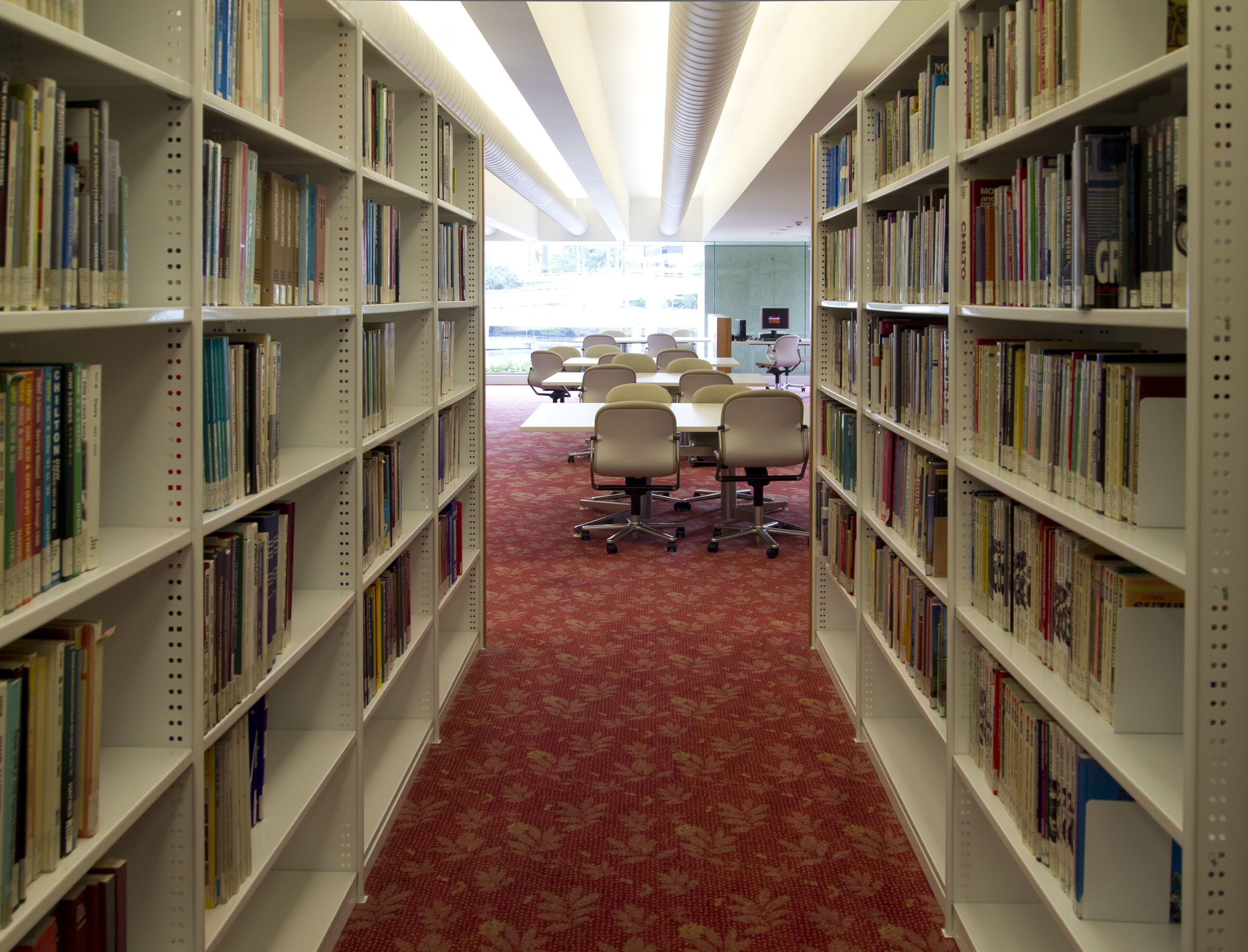
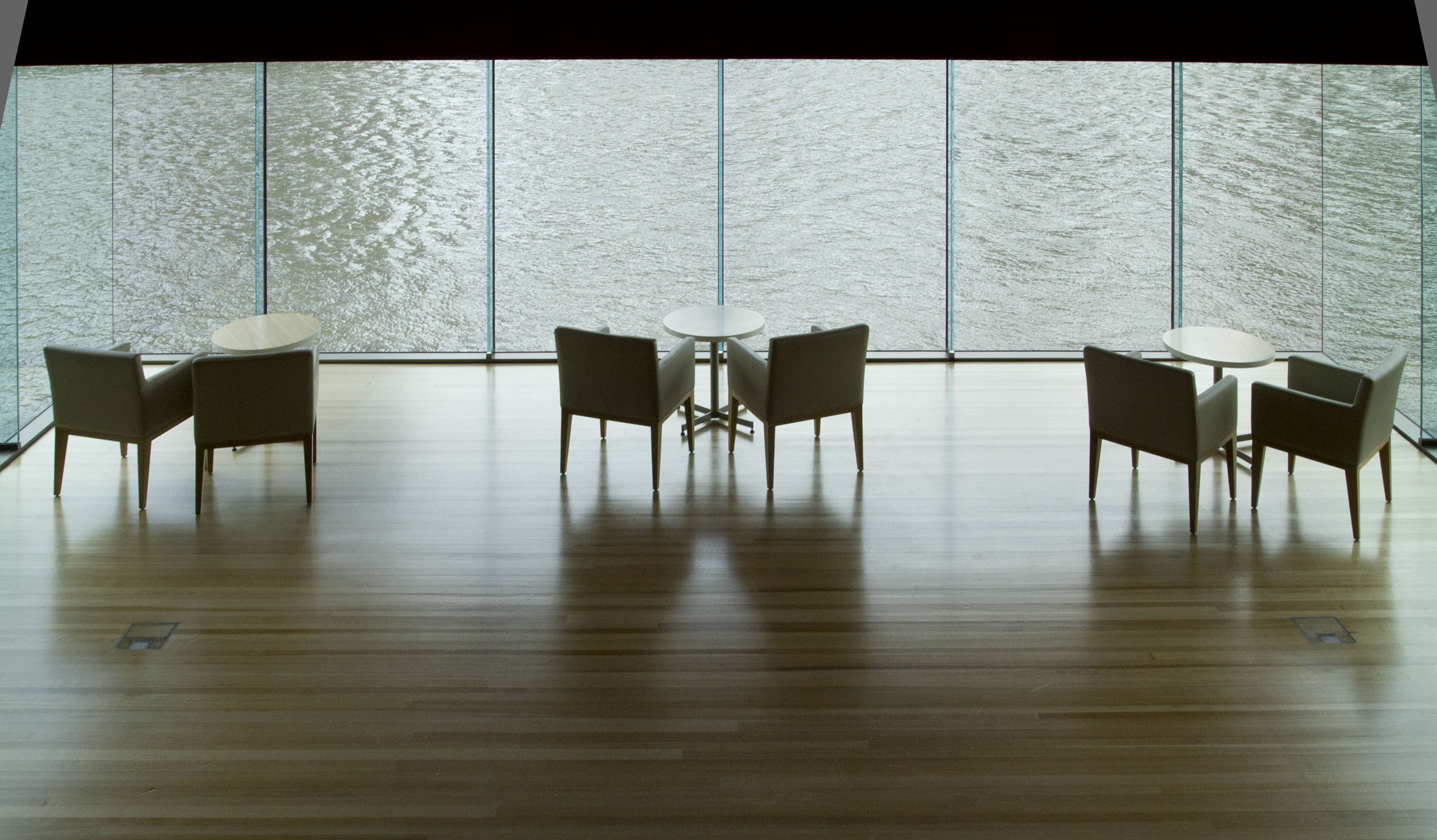
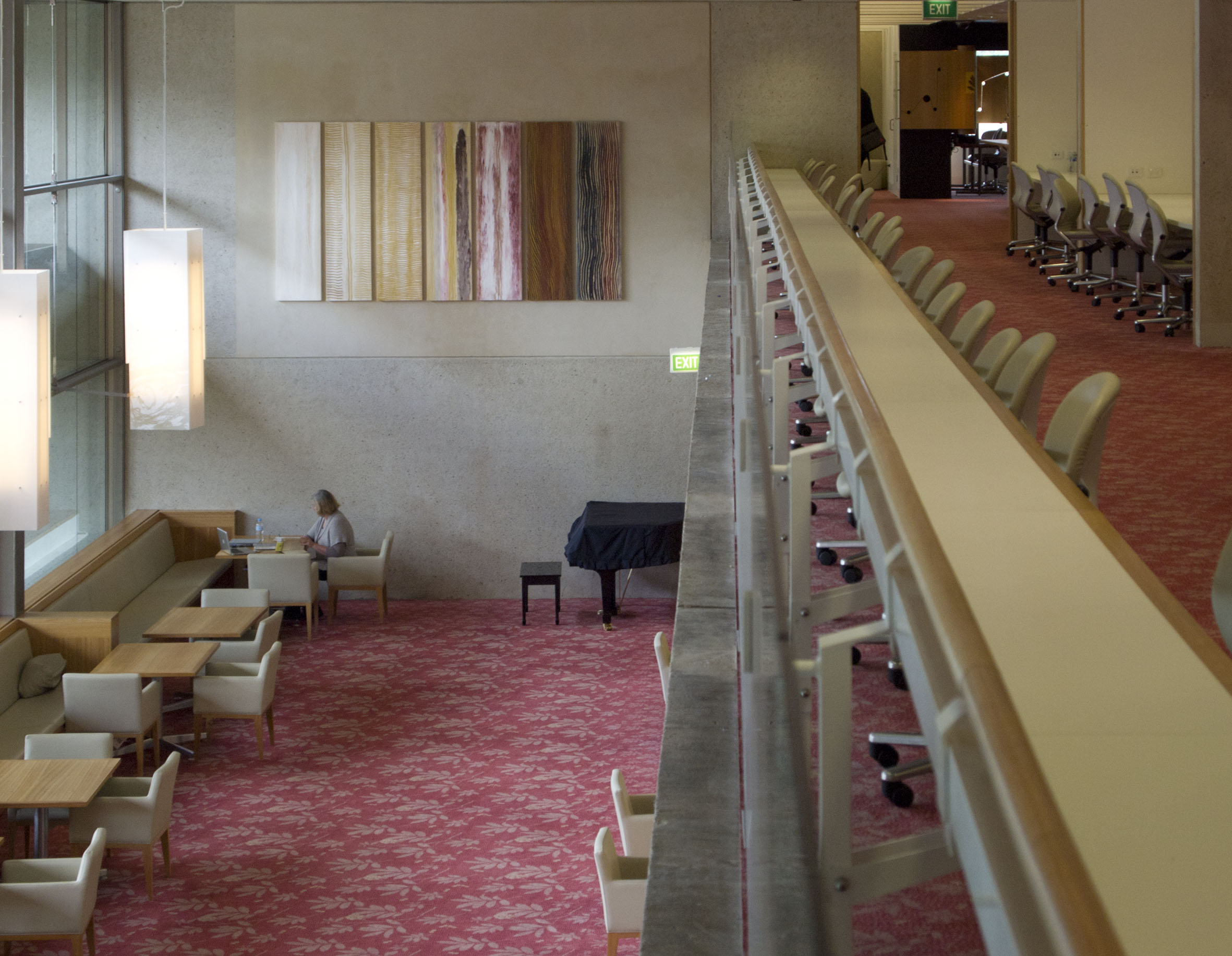
26 November: The last student @ the State Library of Qld
The academic year is nearly over and students don’t need to be at the State Library of Queensland researching and studying – the place is empty, no-one is in the stacks. But then again – look closely …
.
.
.
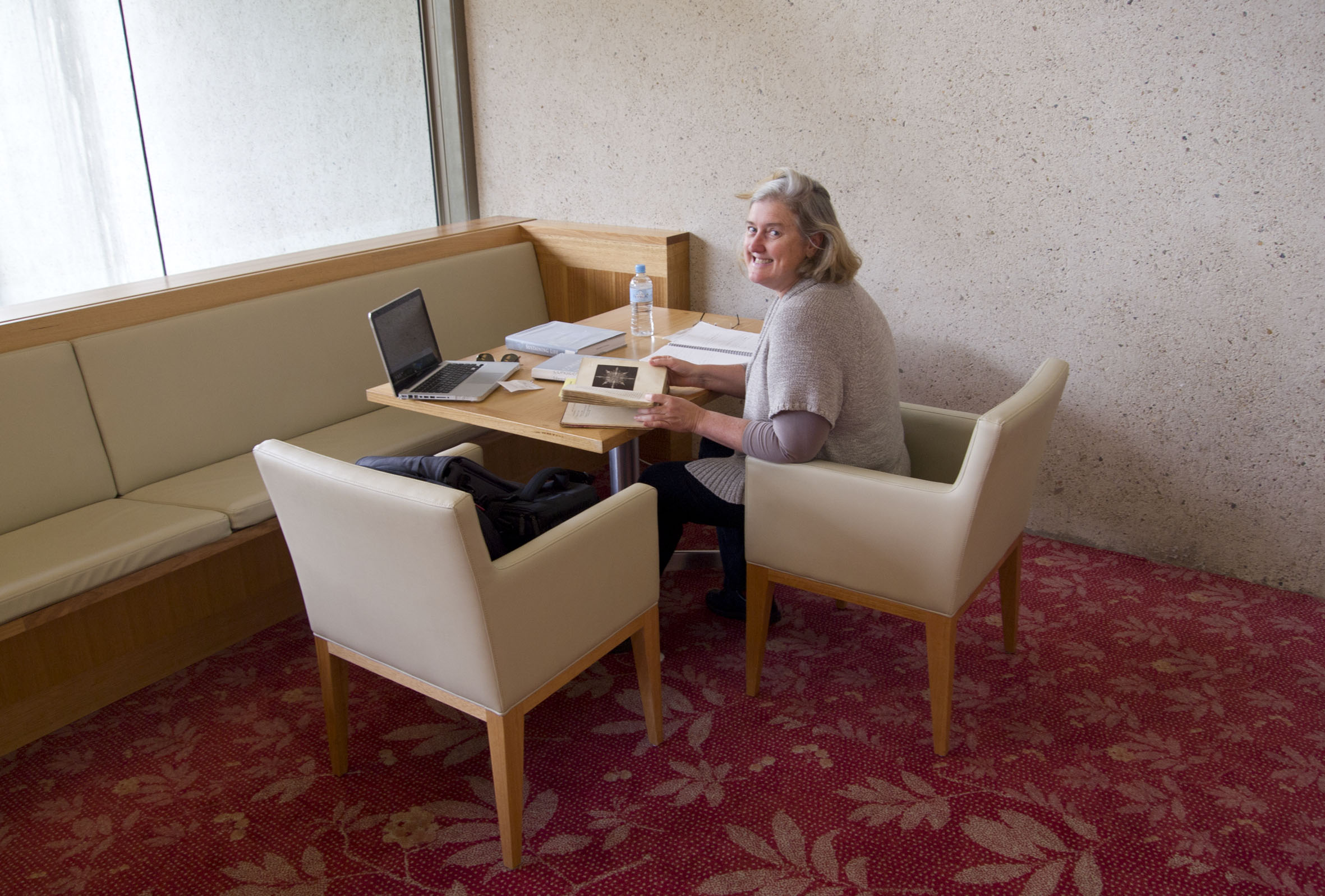
The dedicated student still at work!!

 wotwedid
COMMENTARIES: ARTISTS BOOKS … AS POPULAR AS TATOOs!
leave a comment »
The wide view
COMMENTARIES ARISING FROM THE SLQ SIGANTO FOUNDATION SEMINAR
The trouble with artists’ books
State Library of Queensland – May 4, 2013
.
The quote “artists’ books … as popular as tatoos” was an opening remark by gallerist Noreen Grahame
.
In Volume 7 of the Bonefolder e-journal I reported on the dual artists book events of the 2010 Artspace Mackay Focus on Artists Book V, event and the 3rd Libris Awards. In this report I commented on the speaker’s presentations and reviewed the artists book award. I then concluded that these events were integral to the development and maintenance of a community of practice for those who make artists books in this country. Three years on the energy and enthusiasm for artists’ books remains however the Mackay Focus event has been abandoned and some awards events have slipped from their usual place in the yearly/bi-yearly calendar.
We are indeed indebted to the Siganto Foundation and the SLQ who in 2012 made possible the Keith Smith and Scott McCarney workshop and seminar, and this year the The trouble with artists’ books seminar. It seems to me that artists book community in this country has a great appetite for information, connecting with the heroes and heroines of the discipline, learning about methods and techniques as well as participating in camaraderie with their peers. My concluding words in the Bonefolder report recognised the importance of events such as Artspace’s Focus on Artists Books and the Libris Awards as they invigorate the discipline and the art of artists books … The significant response to this seminar indicates that the pace and frequency of artists book events should not slacken – we want more!
The Bonefolder report concluding comments were:
Awareness of the origins of the discipline of artists’ books and the Australian context as well as issues of contemporary and emergent practice is a unique outcome for FOAB. Where else in Australia this year would one be able to experience, or participate in a program where issues as diverse as Avatars making books in their second life, the death of the book/author, wild books and zoo viewing of books, propositions for new perceptive literature, mail art and the products of psychometry being resolved as artists’ books? Perhaps attendees should be warned of the ride that they would encounter.
Central to need for the FOAB, as an event, is its ability to pull together artists’ book interested people and provide a forum for them to be a part of something bigger than themselves. Artists’ bookmakers are individual artists, sometimes collaborators, librarians, academics, gallerists and collectors are isolated as islands of interest in their usual place of activity. But at FOAB they meet, greet, mingle, chat, discuss, argue and get down to the flensing-out of ideas, polemics and concerns about practice and the book as a work of art. This blend of interested parties forms the nucleus, the hub, of the discipline within this country – without it, there would only be individual soliloquies in the wilderness
.
Julie Barratt
Julie Barratt – Artist
I guess really briefly what I got from ‘the trouble with artist book ‘ talk if I was going to quote is ” it seems the trouble with artist books is that there are too many to love!!!” On a more serious note I guess for me it always comes down to how we talk about/define an artist book, as an ongoing discussion.
Almost on a daily basis when I had the gallery (I always had at lead a few artist books on display) people would ask what these books are! How to define them without quoting Johanna Drucker? Should there be categories i.e. Sculptural, digital etc etc. How do we expect the audience to understand them if we as practitioners have difficulty talking about them? But how do we agree on a definition?
That’s what I imagined the forum to be about because ‘isn’t that the trouble with artist books’? Having said that I thoroughly enjoyed the forum and think there need to be many many more of them when in fact there seem to be less (Mackay forum? ) so that the discussion can continue….
Its always a pleasure to catch up with the artist book community, feels like a reunion every time!
Julie
.
Maureen Trainor
Maureen Trainor – Photographer and QCA Masters student
I found these presentations to be very informative and inspiring.
The content and sequence of the presentations were dynamic.
By breaking down the delivery into the three different viewpoints the three Keynote speakers were engaging and thought provoking.
Starting with Helen Cole presenting ‘the Librarian’s view’, Noreen Grahame presenting ‘the Gallerist’s view’, Jan Davis presenting ‘the Artist’s view’ and ending with an interactive audience time for ‘questions and answers’ was right on target with information.
The Hearsay team discussing their project was fantastic. Combined with humour and wit they certainly kept the attention of a diverse audience.
I truly enjoyed the afternoon and felt I could of stayed into the night with more speakers and presentations.
Maureen
.
Monica Oppen
Monica Oppen – Artist and collector
The Trouble with Artists’ Books (and the Libris Awards)
Coming away from the SLQ seminar where the attendance was so strong and having attended the opening and announcement of the Libris Award at Artspace Mackay the conviction that has risen strongly in my mind is that there is a real need for events such as the SLQ Siganto Seminar. The strong attendance not only indicates a real interest in the topic but a desire of artists to reconnect with others working in the field. As Helen writes in her post about the Libris Awards, and I can vouch for it, there were very, very few artists there but also no other significant persons from the institutions who have an ongoing interest and involvement in artists’ books were there. The tyranny of distance and the associated costs of travel and accommodation will only be overcome by creating an event that is worth travelling for.
The topic The Trouble with Artists Books is pertinent and complex and was way too big to handle in one afternoon; a multi-day conference could have been structure around this topic. Time restrictions meant that Jan Davis and Noreen Grahame could only touch on, hint at and introduce the work/books from which a broader discussion could have expanded. The sense that there is a need for these seminars (judging from the attendance numbers) also hopefully indicates a need for more rigorous, mature critical discourse around the genre, a breadth of conversation and argument. Does the constant discussion of definition and the non-committal responses from ‘those who should know’ arise from this lack of discourse? I don’t consider the definition ‘if the artist calls it a book, it is a book’ to be an adequate, exciting nor empowering definition unless some force is allowed to work in opposition to it, that demands a justification, demands some critical analysis. The lines will always be blurry but this could be an energizing force and contribute a dynamism to the genre. By not taking a stand are we in fact leaving definitions to the gallery? Surely the gallery as a medium is the antithesis of the (artists’) book. The gallery is exposed and extraverted; the book is enclosed and introverted. Always it comes up, the problem with exhibiting artists books— this is because books are not meant to be exhibited, they are meant to be read. What are the implications for the genre if books are only viewed in the gallery, and more seriously if the gallery maintains a ‘no touch’ policy? Ironically, making a (artist’s) book was originally about abandoning the gallery; about the subversion of the commercialism of the art object. The book was meant to be a free-floating object in wider society. Where is that rebel spirit?
A hundred more questions could be asked. I hope the SLQ seminar is not a one-off but gives an impetus to more symposiums throughout the country.
Monica Oppen 14/5/13
.
Judy Barrass
Judy Barrass – Artist
THIS COMMENTARY COMES FROM JUDY’s BLOG – ‘Critical Mass’ http://www.criticalmassblog.net/2012/?p=2568
No one can agree on what they are, or even where the apostrophe should be placed, but a seminar on artists’ books at the State Library on Saturday drew a crowd.
It was a rare get-together of artist book makers and officianados, with attendees travelling from other states and regional Queensland just to attend the two-and-a-half-hour seminar and catch up with old friends.
According to the speakers, librarian Helen Cole, gallerist Noreen Grahame, and artist book maker and academic Jan Davis, artist books are problematic. That’s not just because no one seems to be able to agree on a definition, but also because they are hard to store, hard to display, and are not usually included in mainstream collections or exhibitions. They attract mostly a smallish group of makers and collectors and don’t sell in large numbers. Despite this, artists’ books draw a passionate audience of makers and supporters whenever they are on show (or whenever there’s a seminar).
Queensland has been a leader in the artist book phenomenon. The Queensland State Library is a significant collector, and Grahame Galleries took an early leading role. Artspace Mackay and Noosa Regional Gallery added public gallery support to exhibitions and collecting.
Someone suggested that it’s an inbred audience made up almost entirely of artist book makers, but a show of hands in the crowd on Saturday debunked this myth since at least half the attendees were not makers. Still, as Noreen Grahame remarked, artist books are a sort of ‘underground’ movement outside the mainstream.
I can’t help wondering if this is merely a question of naming. By calling these artworks ‘books’ they are relegated to the collections of libraries rather than art galleries, or they exist in a no man’s land between library and gallery. Nonetheless I have seen many works in public art gallery collections that could (or perhaps should) be called artist books. The boundaries are thin and flexible, and this was evident at the seminar. The mantra seems to be that if the artist calls it a book then it is a book.
One of the more interesting questions on the day was about the growing number of artist books that exist only in digital format. Helen Cole said the library was considering how these books might be collected and preserved, but indicated it was extremely difficult, particularly as technology changes so rapidly and formats and software become obsolete. Noreen Grahame solved the problem by referring to digital books as ‘ephemera’, and Jan Davis thought the number of artists working in the digital realm was small.
Following the discussion, a very chatty audience enjoyed a scrumptious afternoon tea and the launch of Hearsay, a large format collaborative artists’ book by artist Euan Macleod, printmaker Ron McBurnie, and writer Lloyd Jones. They apparently didn’t worry too much whether or not their work was or was not an artist book, but have sensibly hedged their bets by also producing the pages as a portfolio of unbound prints (in case anyone thought it wasn’t art, or more probably because the portfolio might be more saleable than an artist book ).
The seminar ‘The Trouble with Artist Books’ was sponsored by the Siganto Foundation through the Queensland Library Foundation.
The State Library artist book collection is part of the Australian Library of Art.
(Thank you Judy for allowing this re-posting in this blog)
.
.
Wim de Vos
Wim de Vos – Artist
‘The Trouble with Artists Books’
The lecture sponsored by the Siganto Foundation was very well attended by a large audience of art practitioners, administrators, and lovers of Artists Books, and was introduced by the new head of the State Library, Janette Wright. The speakers were Helen Cole, Senior Librarian of Special Collections at the Library; Noreen Grahame, Gallerist and long time respected promoter of the Artist Books within Australia and Internationally; and Jan Davis, Academic, and practitioner of Artists Books at Southern Cross University, Lismore, NSW.
Technically the lecture was informative, ran smoothly and was very well presented.
It was great to see so many practitioners (well over half the audience) and the general public, as this event facilitated a forum – to share, and some time to catch up with friends and colleagues. This has over the last few years become non-existent with the loss of the Art Space Mackay Artist Book Forum. Also the Noosa Regional Gallery’s ‘demise’ of the Artists Book annual exhibition was a sad occurrence. In addition, both venues offered successful workshops with renowned National and International Practitioners in the Visual Arts to nurture the visual arts and the book.
Many aspects of the development of Artists Books were addressed. Helen Cole addressed the ‘Trouble with Artists Books’ from a Librarian’s point of view, in that, because they were ‘Artists Books’ and diverse in so many ways, the logistics of preservation, cataloguing and storage were ‘Troublesome’. Furthermore, it was stated that the ‘Galleries’ had passed the Artists Books onto Libraries to display and make use of them, and by making Libraries the custodians of the ever-growing phenomenon of the Artists Book.
The concept of Artists Books is generally not an easy topic to present. It is in fact generally not understood at all. A friend recently pointed out, ‘I didn’t even know that an artist book existed, but as I have learnt through the language of art over time, I can say, I view this process as Book Works by Artists.’ A major exhibition of books of this nature: DAS BUCH was presented at the Queensland Art Gallery in association with the Museum of Contemporary Art in Sydney and the Goethe Institut in Germany during 1992. This was, I’m sure, a huge influence on art practitioners and the public. At the time, it placed an emphasis on the ‘Book as Object’ in a context never before experienced in the Antipodes. There has been no major exhibition of this type in a public gallery in this State, since.
As I am a practising artist and maker of prints, paintings, and sculpture, and work with a wide variety of materials, the book as object comes naturally as a medium to extend my practice. It has in fact tied together all my processes of making art, including text, giving me the freedom of story telling on many levels.
I observed, as the afternoon progressed, that in the presentation not all aspects of Artists Books practice was being fully covered and explored by the presenters. This became, indeed, troublesome. There is actually content within books, books with text, images and text, objects and materials, and so on. There was very little mentioned on the subject of the Sculptural Book or the Photo Book. A visual list WAS presented with images of the types of books that were in the collection of the Library. But no further elaboration was offered to those in the audience that were not already ‘in the know’. The State Library of Queensland has one of the largest collections of Creative & Historical books in the southern hemisphere.
Let it be said that we can be proud of a comprehensive, diverse, eclectic and public collection of books – particularly in the collection of Contemporary Art practice in Queensland and beyond. It is promoted that it ‘may be visited at any time, by appointment’.
I recognise that there is not time to cover everything fully. This made duplication and repetition even more irritating. Time may have been used more productively.
The lecture continued with the history of the Artists Book and it’s growth within Australia over the last 30 odd years. This painted an impressive picture of collections and practise over that time. Artists were mentioned who were instrumental in its development, but presenters did not go far enough on this issue, and failed to mention key motivators: artists both local and international. There was a ‘flow of words’ promoting a few artists over and over again. When the presentation of ‘Favourite Artists Books’ was introduced the theme of the lecture was totally abandoned. We were presented with a self-indulgent diversion as to what the book may mean only to the ‘literate Artists Book fans’ present.
It would have been more useful to give the audience an indication of how they may wish to learn more about Artist Books through the public and private system. There was enough talent and experience behind the microphone to impart this information. It seemed much of this lecture was preaching to the converted.
Afternoon tea on the terrace was followed by the launch of a collaboration of an Artist Book created by two well-known visual artists: Ewan McCloud and Ron McBurnie, and the writer Lloyd Jones. This was a very good presentation chaired by Suzi Muddiman: Director of the Murwillumbah Regional Art Gallery in NSW. This gave the opportunity for the layperson to experience the processes of collaboration in art making.
As there are no indications of any follow-up lecture or activities relating to Artist Books, it would be worthwhile to plan something on the promotion and educational aspects of Artists Books. I am sure it would be a great success.
A ‘large bouquet’ to Helen Cole in particular, and the State Library, for organising this generally informative and pleasant afternoon. We look forward to a more expansive event in the future.
Wim de Vos
.
.
Peter Lyssiotis
Peter Lyssiotis – Artists book-maker and photomonteur
Peter’s letter
.
A vodcast for the event is available at http://www.slq.qld.gov.au/audio-video/webcasts/recent-webcasts/siganto-seminar
.
Cheers Doug+Victoria
.
.
© Of all texts resides with the authors
Photograph of the SLQ Theatre, Julie Barratt, Monica Oppen, Wim de Vos © Doug Spowart 2013. Self-portrait of Maureen Trainor ©2013. Judy Barrass portrait supplied by Judy.
This work is licensed under a Creative Commons Attribution-NonCommercial-NoDerivs 3.0 Unported License.
.
.
.
Share this:
Written by Cooper+Spowart
June 3, 2013 at 1:56 pm
Posted in Artists Books, Meeting People, Reviews, Wot happened on this day
Tagged with Artists Books, artists' books in Australia, Artspace Mackay, Bonefolder e-journal, commentary on artists books, communities of practice, communities of practice artists books, Focus on Artists' Books, Helen Cole, Judy Barrass, Julie Barratt, Libris Awards, Maureen Trainor, Monica Oppen, Peter Lyssiotis, Siganto Foundation, State Library of Queensland, the trouble with artists' books, Wim de Vos