Posts Tagged ‘David Dellafiora’
ARTISTS BOOKS IN AUSTRALIA: The People+Events
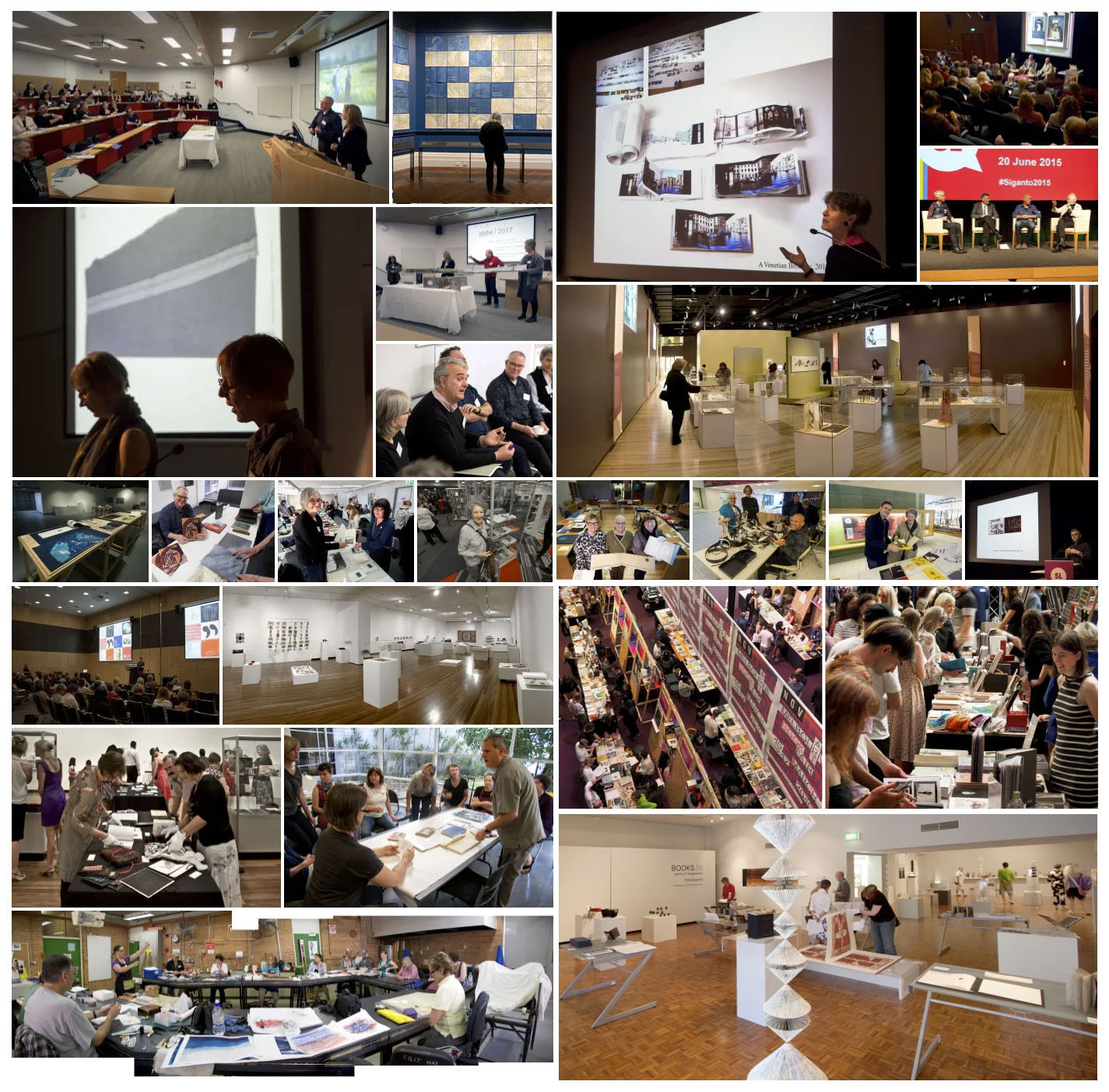
Doug Spowart’s ARTISTS BOOK FAMILY Mosaic
.
In July the artists book symposium ABBE 2025 took place at Artspace Mackay. A key theme of this event was the ‘mapping Australia’s artists book histories’ and in the extended brief for the conference there was the lament that while artists books in Australia had been broad and active there was a scant record of the history the discipline.
.
Reference was made to the understated history of the two main texts Gary Catalano’s The Bandaged Image (1983) and Alex Selenitsch’s NGA published Australian Artists Books 2008, conferences such as those coordinated by Artspace Mackay, many unpublished PhD thesis and the ‘valiant attempts by journals’ that burn out after a few years.
‘Bring your stories, your artifacts, and your memories’ they said so I put forward a submission consisting of aspects of the visual record that I have been making over 22 years of the artists book scene. My submission was to be an illustrated presentation consisting of approximately 200 portraits of the people of the artists book discipline as well as a few events.
.
Here is my submission rationale:
AN ARTISTS BOOK FAMILY ALBUM – A ‘paper’ by Dr Doug Spowart
“A family’s photograph album is generally about the extended family
and, often, is all that remains of it.”
Susan Sontag in On Photography 1977
Family archives are a profound thread connecting past, present, and future, serving as repositories of memory, identity, and history.
Photography is more than just a medium for capturing pictures—it is a lens through which we view and understand history. Its ability to document, provoke, and preserve moments in time has made it an indispensable tool for both personal and collective memory.
In this way photographs hold the power to evoke vivid recollections, introducing us to lost relatives and forgotten stories while anchoring us within a broader familial narrative. Yet, the fragility of these archives is striking — images tucked away on devices or in drawers risk being lost to time, their stories untold.
The passing of key family members often deepens this void, as context and meaning tied to people and events can vanish. Establishing and preserving a family archive becomes not just an act of personal curation but a legacy-building effort, ensuring that these visual fragments of memory remain accessible to future generations.
In an era where countless photos are taken but rarely saved, the challenge lies in collecting and annotating these fleeting moments. A taking them into lasting archives for some to have as a touchtone for memory, and for others to review and research. Maybe to tell the story for future eyes and minds of the books that were made, what events happened and who was there…
This paper will present an illustrated fragment of photographs of the artists book family taken by the author over a 20 years period.
Dr Doug Spowart
.
.
This submission was accepted, and the presentation offered to attendees of the symposium, and later online as a movie via the Artspace website.
.
.
A LINK TO THE YOUTUBE VIDEO ON DOUG SPOWART’s Channel: “CLICK IMAGE”
For BEST viewing quality select HD quality in the SETTINGS menu. NOTE: The full video is 12 minutes long.
.
.
.
.
PRESENTER’S COMMENT from Doug Spowart
In curating these photographs I have focussed on selecting images from the broad artists book community and have not included many photographs from my collaborative practice with Victoria Cooper.
Every attempt has been made to ensure correct captions – Please advise of any errors or omissions. Thanks to Caren Florance, Helen Cole, Robert Heather and Adele Outteridge for their assistance with captions.
Victoria and I have provided commentary about the artists book and photobook disciplines for many years in our Blog, journals, events coordinated and lecture presentations.
.
.
.
All photographs are Copyright Doug Spowart (Some by Victoria Cooper). The subject pictured, after contacting the copyright owner, may be able to use the portrait of themselves for non-commercial applications. Other usage may require negotiation of a fee.
.
.
.
.
.
WHAT FOLLOWS IS A LIST OF ALL CAPTIONS IN THE VIDEO
.
MABF 2017 National Gallery of Victoria
Deanna Hitti and Deidre Brollo @ MABF 2017 National Gallery of Victoria
‘Life’s Journey’ exhibition @ Redland Art Gallery, Cleveland 2012
Julie Barratt in her gallery at Alstonville 2011
Dianne Longley in her exhibition ‘Navigations’ at Barrett Galleries 2008
Tim Mosely in his exhibition Make Like An Eskimo 2012
grahame galleries opening of Lessons in History Vol. II – Democracy 2012
Heather Matthew and Stephen Spurrier @ grahame galleries opening of Lessons in History Vol. II – Democracy 2012
Monica Oppen and Jan Davis @ grahame galleries opening of Lessons in History Vol. II – Democracy 2012
Volume Art Book Fair, Artspace, Woolloomooloo, Sydney 2017
Helen Cole chairs presentations by Keith Smith and Scott McCarney State Library of Queensland 2012
Siganto Seminar: The Trouble with Artists’ Books SLQ 2013
Helen Cole –Siganto Seminar: The Trouble with Artists’ Books SLQ 2013
Noreen Graeme and Jan Davis – Siganto Seminar: The Trouble with Artists’ Books SLQ 2013
Hearsay book launch with Euan Mcleod, Ron McBurnie, Susi Muddiman & Lloyd Jones SLQ 2013
Jo Kambourian at Artists Books Flash Mob Survey Book event Grafton 2013
Catherine McCue Boes Books as art: 30 years in the making Bundaberg Regional Gallery 2014
George Paton Gallery, Artist’s Books (reprised) University of Melbourne 2014
International speaker Sarah Bodman presents a paper – Abbe 2015 Griffith University
International speaker Brad Freeman – Abbe 2015 Griffith University
Lyn Ashby – Abbe 2015 Griffith University
Convener Tim Mosely presenting – Abbe 2015 Griffith University
Books By Artists exhibition – Abbe 2015 Griffith University
Sue Anderson + Gwen Harrison Abbe 2015 Griffith University
Deidre Brollo with Christene Drewe + Helen Cole and Marian Crawford with Sarah Bodman
Abbe 2015 Griffith University
Penny Carey-Wells and Caren Florance Abbe 2015 Griffith University
Robyn Foster + Fiona Dempster and Angela Gardner Abbe 2015 Griffith University
Sheree Kinlyside and Impress Printmakers: Sue Poggioli + Jennifer Stuerzl Abbe 2015 Griffith University
Tim Mosely and Heather Matthew Abbe 2015 Griffith University
Adele Outteridge + Wim de Vos – Abbe 2015 Griffith University
Jo Kambourian and Darren Bryant at Lismore Art Space 2014
The SLQ White Gloves team Christene Drewe, Helen Cole and Jeanette Garrard for Abbe 2015
State Librarian Janette Wright welcomes attendees SLQ 2015
Brazillian artist Amir Brito Cadôr keynote presentation Siganto Foundation Artists’ Book Seminar 2015
Julie Barratt and Clyde McGill discusse their Siganto Foundation Creative Fellowship 2015
Jan Davis and Doug Spowart discuss their Siganto Foundation Creative Fellowship 2015
A forum on collaboration – Siganto Foundation Artists’ Book Seminar 2015
Judy Bourke and Adele Outteridge+Wim de Vos at the Siganto Foundation Artists’ Book Fair SLQ 2015
Clyde McGill and Anne Kirker and Sue Poggioli at the Siganto Foundation Artists’ Book Fair SLQ 2015
Helen Malone and Sandra Pearce at the Siganto Foundation Artists’ Book Fair SLQ 2015
Amir Brito Cadôr with Noreen Grahame & Helen Malone at the Siganto Foundation Artists’ Book Fair SLQ 2015
Helen Cole, Michael Wardell & Clyde McGill at the Siganto Foundation Artists’ Book Fair SLQ 2015
Dr Marie Siganto makes a presentation to Ana Paula Estrada and Victoria Cooper
PAPER CONTEMPORARY – Sydney Contemporary 2015
Grahame Galleries stand with Ron + Jonathan McBurnie at Paper Contemporary – Sydney Contemporary 2015
Victoria Cooper, Jan Davis and Trent Walter at Paper Contemporary – Sydney Contemporary 2015
Sue Anderson + Gwen Harrison and Brigita Oppen at Paper Contemporary – Sydney Contemporary 2015
Helen Cole, Akky van Ogtrop, Robyn Berkeley from Berkeley Editions and Victoria Cooper at
Paper Contemporary – Sydney Contemporary 2015
Fellow Travellers a book by William Kelly, SLV Creative Fellow and Baldessin Press Studio Residency recipient
Personal Histories International Artist Book Exhibition Uni of NSW Canberra 2015
Robyn Foster (Curator), Judy Bourke, Selena Griffith, Tracie Toohey, Rachel Hunter, Lisa Morisset –
Personal Histories International Artist Book Exhibition Uni of NSW Canberra 2015
Christene Drewe introduces UK artist Guy Begbie – The Siganto Foundation Fellowship artist book series 2016 SLQ
Guy Begbie presents his keynote address – The Siganto Foundation Fellowship artist book series 2016 SLQ
Victoria Cooper and Lyn Ashby presentations – The Siganto Foundation Fellowship artist book series 2016-7 SLQ
Helen Douglas presents her keynote address – The Siganto Foundation Fellowship artist book series 2017 SLQ
Clyde McGill performs his book and a White Gloves presentation of artists books
– The Siganto Foundation Fellowship artist book series 2016 SLQ
Freestyle Books exhibition curated by Helen Cole at the State Library of Queensland 2008
Freestyle Books Symposium with Ron McBurnie, Peter Lyssiotis, Judy Watson, Jonathon Tse and others
at the State Library of Queensland 2008
At the launch of Ana Paula Estrada’s book MEMORANDUM – Ana Paula with Louis Lim and Annette Green 2016
Visiting Wim de Vos and Adele Outteridge at Studio West End Brisbane 2017
Visiting the 2017 Festival of the Photocopier Zine Fair – Melbourne
David Dellafiora and Gracia Haby + Louise Jennison at the
2017 Festival of the Photocopier Zine Fair – Melbourne
Ulrike Stoltz & Uta Schneider international presenters at Artists book Brisbane Event Griffith University 2017
A K Milroy + Brad Freeman – presenters at Artists Book Brisbane Event Griffith University 2017
Marian Crawford and Ana Paula Estrada presents their papers
Artists Book Brisbane Event Griffith University 2017
Marian Macken presents at Artists Book Brisbane Event Griffith University 2017
Wim de Vos at Artists Book Brisbane Event Griffith University 2017
A plenary session on artists books at Artists Book Brisbane Event Griffith University 2017
Noreen Grahame in her curated exhibition “… & So” – Artists Book Brisbane Event Griffith University 2017
Barbara Davidson and Caren Florance at Artists Book Brisbane Event Griffith University 2017
Sue Poggioli and Anne-Maree Hunter at Artists Book Brisbane Event Griffith University 2017
Brad Freeman and Anita Milroy – Artists Book Brisbane Event Griffith University 2017
Lyn Ashby and Sue Anderson at Artists Book Brisbane Event Griffith University 2017
Anna Welch, Des Cowley and Madeleine Say at Ballarat International Foto Biennale
World Photobook Day Book Fair 2019
Helen Cole presents and a floortalk – The First Focus of Artists Books and the Libris Awards at Artspace Mackay 2004
Looking at books and the opening crowd – Focus of Artists Books and the Libris Awards at Artspace Mackay 2004
Bruno Leti workshop – Focus of Artists Books and the Libris Awards at Artspace Mackay 2004
Focus of Artists Books and the Libris Awards at Artspace Mackay 2005
Caren Florance, Sasha Grishin and Dianne Fogwell in the ANU exhibition at FOAB 2005
Unknown lady, Adele Outteridge, Madonna Staunton and Wim de Vos and Sasha Grishin FOAB 2005
Focus of Artists Books and the Libris Awards at Artspace Mackay 2006
Robert Heather welcomes attendees + Marshall Weber presents Focus of Artists Books at Artspace Mackay 2006
Katherine Nix workshop – Focus of Artists Books at Artspace Mackay 2006
The installation view of the 2008 Libris Awards
Michael Wardell welcomes attendees and a Forum at the 4th Focus on Artists Books event and
Judge Michael Desmon presents his address to the 2008 Libris Award
Clyde McGill’s foyer artwork FOAB 2028
Michael Desmond presents his lecture in the 4th Focus on Artists Books event
2008 FOAB some of the presenters McGill, Fogwell, Florance and Cooper
Focus on Artists Books V and the 5th Libris Awards 2010
Michael Wardell addresses the attendees – 2010 Libris Awards and 5th Focus on Artists Book event
2010 FOAB Deanna Hitti in her exhibition ‘Bint Trembucky (daughter of the drum)’
Caren Florance and David Dellafiora in their workshops – 5th Focus on Artists Book
Victoria Cooper with Judy Barrass and Linda Douglas – 5th Focus on Artists Book
Barbara Davidson and Caren Florance with Sheree Kinlyside of Red Rag Press – 5th Focus on Artists Book
Victoria Cooper with Monica Oppen and Sara Bowen (Book Art Object), Julie Barratt and Caren Florance
Visiting the 2016 Libris Artists Book Award
Visiting the 2016 Libris Artists Book Award
Denise Vanderlugt with her highly commended bookwork I used to wrap rainbows and Jamian Stayt’s
Soulless evolution 2016 Libris Artists Book Award
graeme galleries’ 5th Artists’ Books + Multiples Fair in the Dell Gallery Griffith University 2007
Monica Oppen and Michael Wardell with Doug Spowart
at graeme galleries’ 5th Artists’ Books + Multiples Fair in the Dell Gallery Griffith University
Helen Cole + Dianne Fogwell and Stephen Spurrier + Normana White
at graeme galleries’ 5th Artists’ Books + Multiples Fair in the Dell Gallery Griffith University
Victoria Cooper with Dianne Longley and Anne-Maree Hunter
at graeme galleries’ 5th Artists’ Books + Multiples Fair in the Dell Gallery Griffith University
12th Edition Noosa Artists Book event ‘Back to Basics’ 2008
Southern Cross University Acquisitive Artists Book Award 2006
Southern Cross University Acquisitive Artists Book Award 2007
Southern Cross University Acquisitive Artists Book Award judged by Robert Heather 2008
Judge Tara O’Brien announces the winner – Southern Cross University Acquisitive Artists Book Award 2009
Southern Cross University Acquisitive Artists Book Award 2011 – Judge Ross Woodrow
Peter Lyssiotis is his studio 2014
Ana Paula Estrada presenting her Mexican photobook collection in Maud Gallery, Brisbane 2017
Keith Smith and Scott McCarney in a workshop at West End Studios Brisbane 2006
Deanna Hitti’s exhibition of the book ‘A is for Alam (pen)’ at the State Library of Victoria 2022
.
.
Any RSS reposting from this Blog without permission represents a breach of Copyright.
.
.
.
.
.
OUR 2019 FIELD STUDY Submission: Tidal fire debris
Each year artists from around the world submit 100 copies of an artwork and mail them to an address in Geelong, Australia. Coordinator of the Field Study International mail art project David Dellafiora works with a team to collate and assemble the A5 sized artworks into books. Copies of the Field Study International are sold to collectors and institutional libraries around the world to raise funds for the workshop and to cover project costs. Contributing artists are also sent a copy.
.
This has been a great yearly project for us for over 10 years. What follows is the story of our submission for 2019. At the end of the post there’s a brief story about Dellafiora’s Field Study Projects. David is also involved in many other mail art projects… LOOK HERE
.
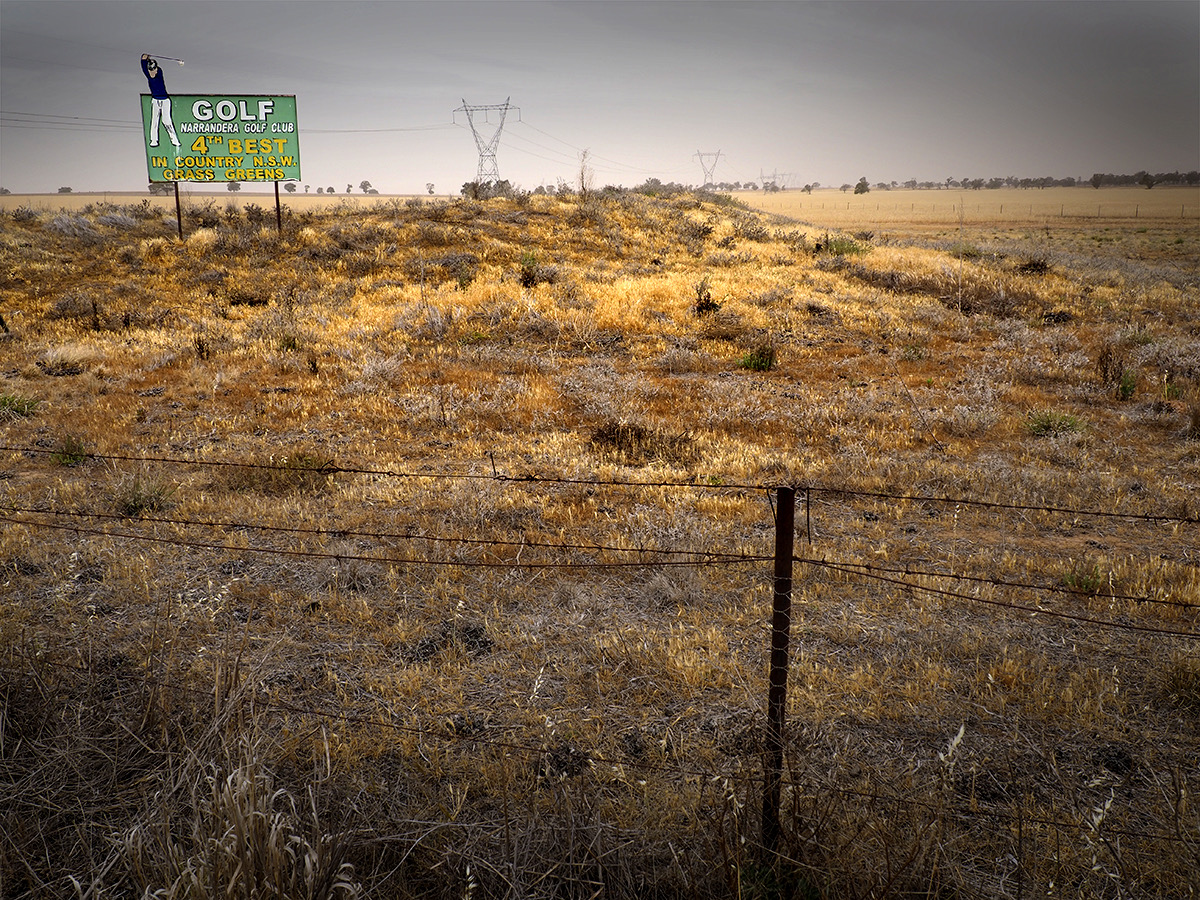
Narrabri roadside PHOTO: © Doug Spowart
.
Surrounded by fire
Recently we drove through central western New South Wales and southern Queensland. The country was dry and hot with willy-willies and dust storms lifting and moving the precious soil across the landscape. There was little or no green and the dams were dry- even rivers that would normally have some water were just sand and dry dirt. Travelling on further we witnessed the great Brigalow forests of southern Queensland seemingly quivering under the heat of the summer sun.
.
Overall the country was brittle and broken from the endless dry. Not even summer there was a concern for the future as country towns not used to running out of water were in dire situations. Coastal areas where fire is a part of environmental regeneration there was also widespread concern for this now unusual extended periods of dry. This was not a normal cycle… The country was about to explode… all it takes is a dry thunderstorm with lightning, a careless smoker driving past or sadly a deliberate act from criminals.
So then the fires started so much earlier than expected… the many brave souls rallied to fight for their community. But these were not just the normal local bush fires… They grew and joined to form huge firestorms, the fighters used all they could find from buckets to the fire fighting trucks… But much of the land was inaccessible and many areas of forest could not be saved from the onslaught of wind and heat… Some forests that had survived through the millennia without fire in unique and protected ecosystems were now potentially changed forever.
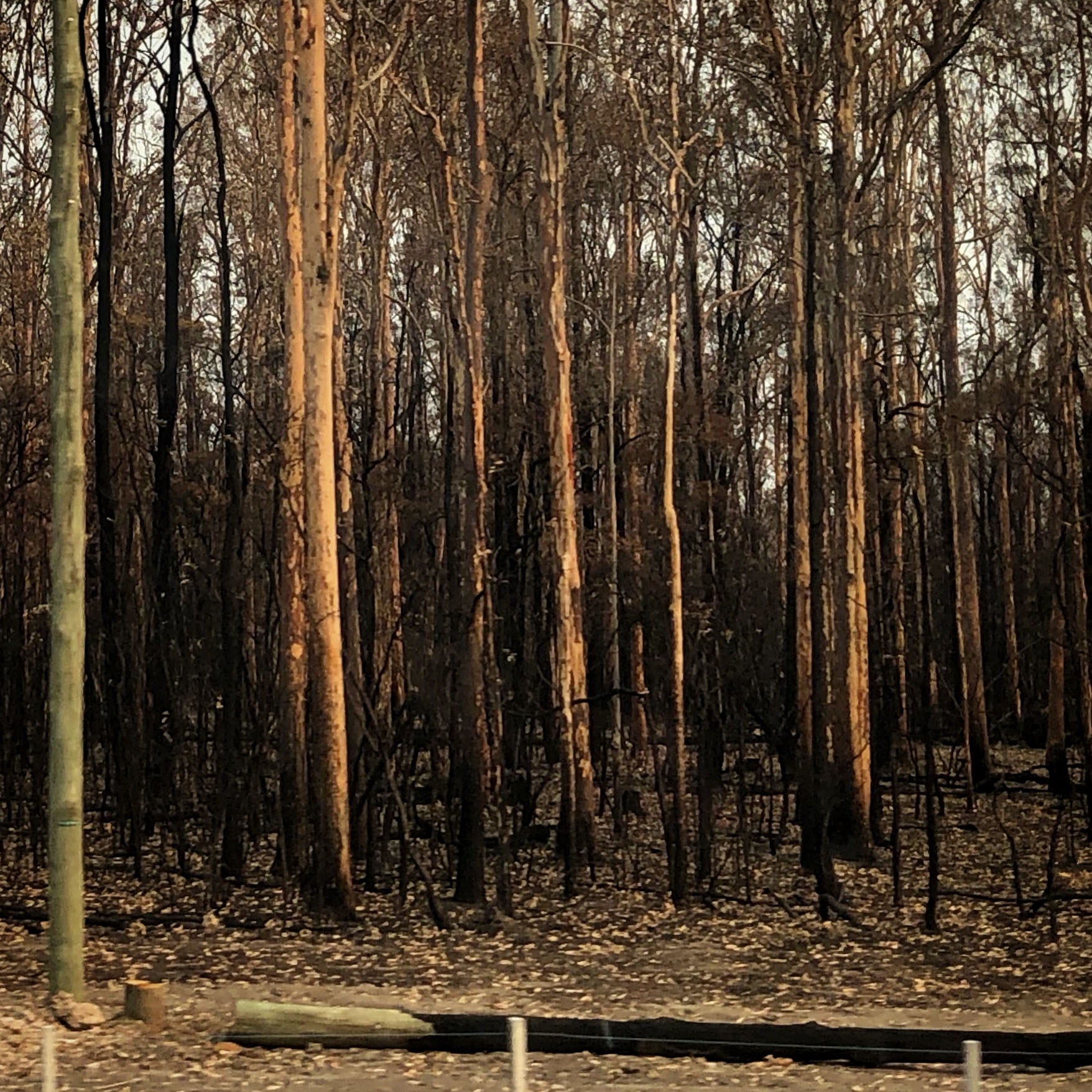
Fired forest near New Italy, northern NSW PHOTO: Victoria Cooper ©
We then came to stay at a friend’s family retreat on the coast of Northern NSW… The road to this place passes through huge areas of swamp and eucalypt forest that rarely burns as it is usually has good rain. But now we drove past kilometres and kilometres of burnt and dry country… We soon found that the regional area where our destination is located was surrounded by blackened country. The atmosphere, as with most of the coast in NSW was chocking with smoke and dust.
Even though we were assured that our town was safe these were not usual times and we felt uneasy and depressed by the enormity of this disaster.
We decided to dedicate our field report work to record this devastation. Our dismay was deepened when we walked along the beach and witnessed lines of leaves and twigs and other blackened material washed up with the tide .. like the dead bodies of victims discarded by criminals. Down the length of the entire coast of NSW where other fires raged, these waves of blackened and broken forests were appearing – the sea has returned the evidence to the place of the crime.
We began by gathering small samples of the material as symbolic references to vast amount of evidence left behind from these black tides. This Field Report is our first response as part of future substantive work on the contemporary condition of indifference, arrogance and ignorance towards a deteriorating environment.
Victoria Cooper
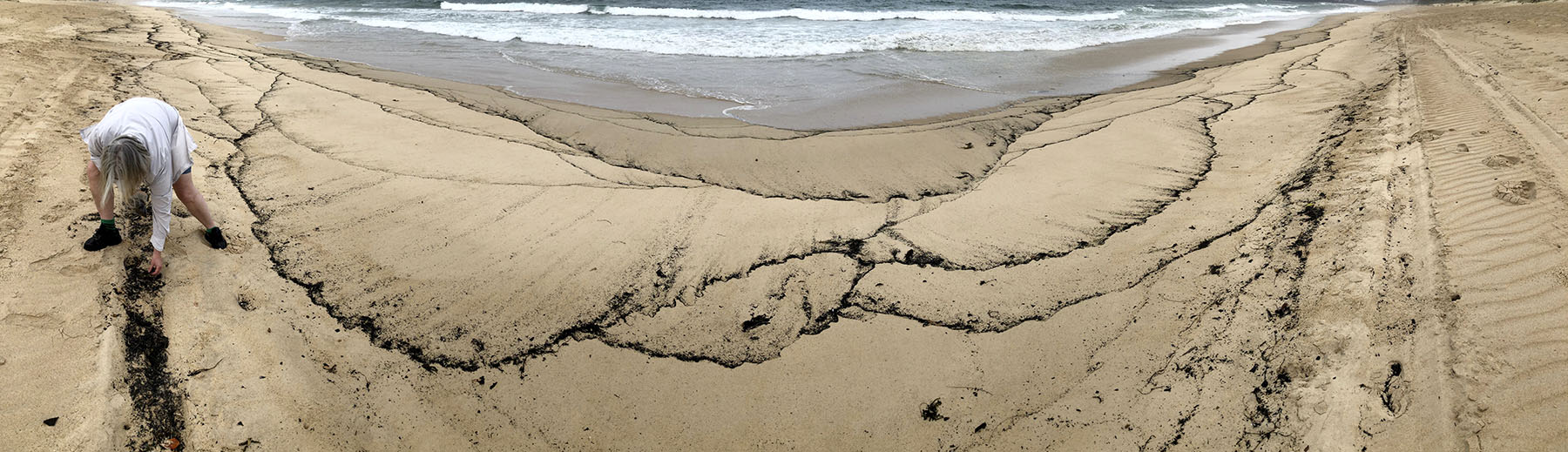
Ashed beach, Wooli northern NSW PHOTO: Doug Spowart ©
OUR SUBMISSION
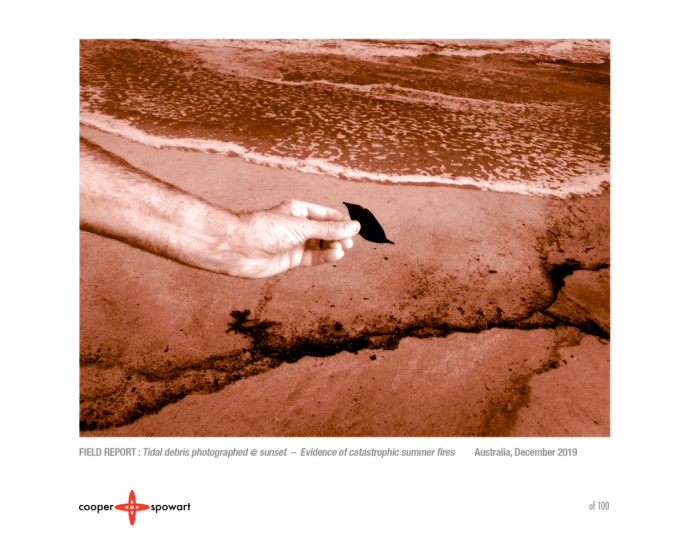
COOPER+SPOWART 2019 Field Study submission
Signing the 100 prints…
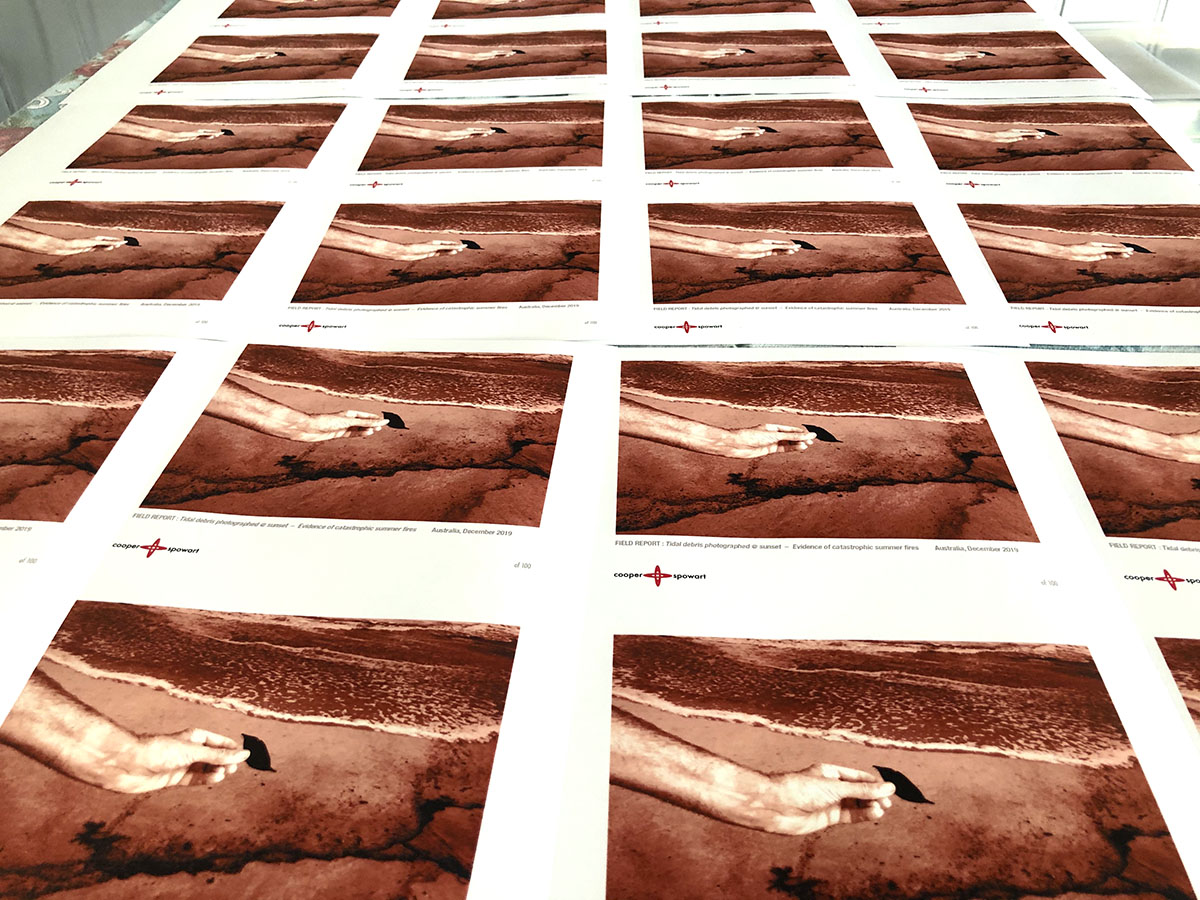
100 prints…
.
SOME BACKGROUND TO FIELD STUDY REPORT
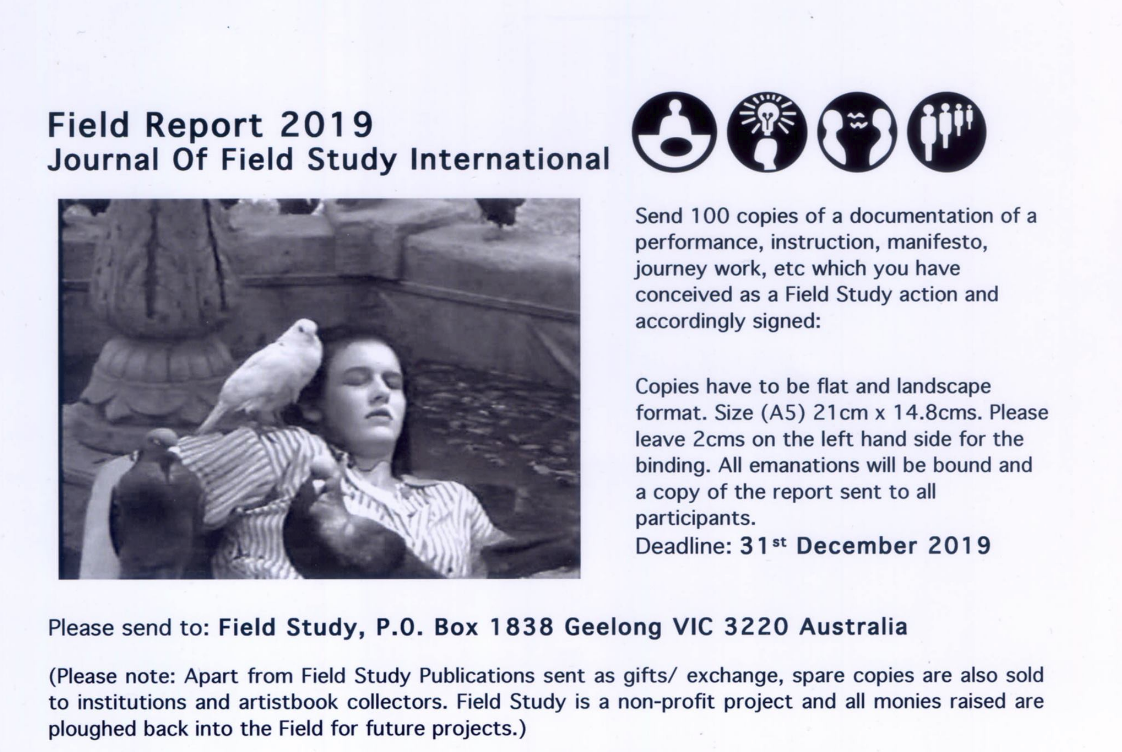
Field Study International 2019 Call for Entries
.
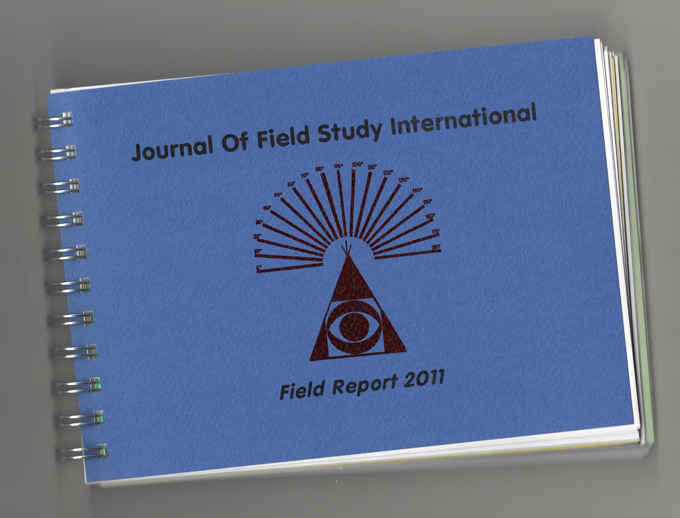
2011 Field Report cover
.
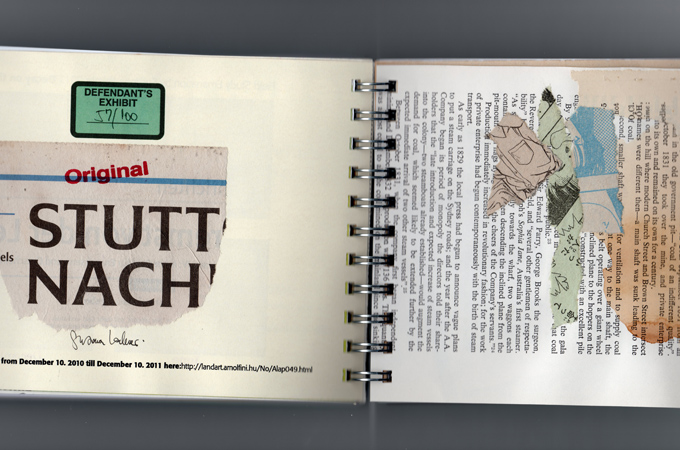
2011 Field Report pages
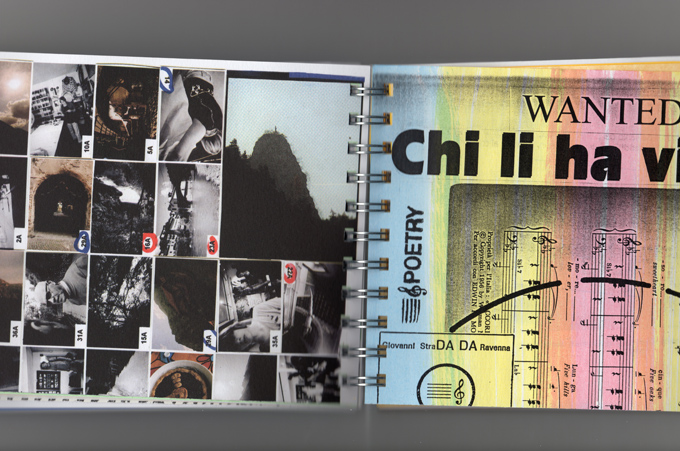
2011 Field Report
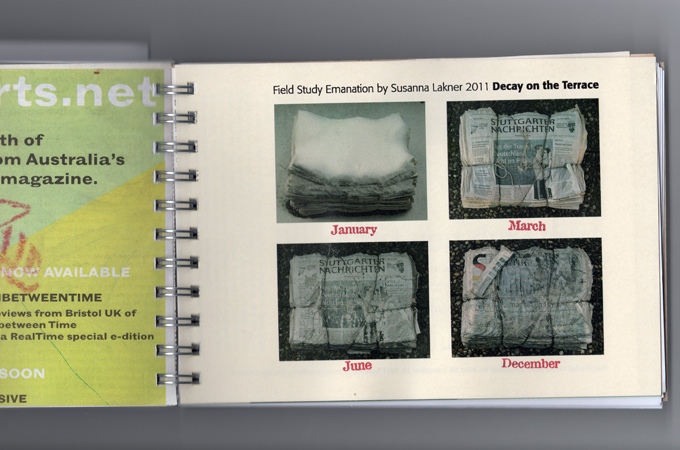
2011 Field Report pages
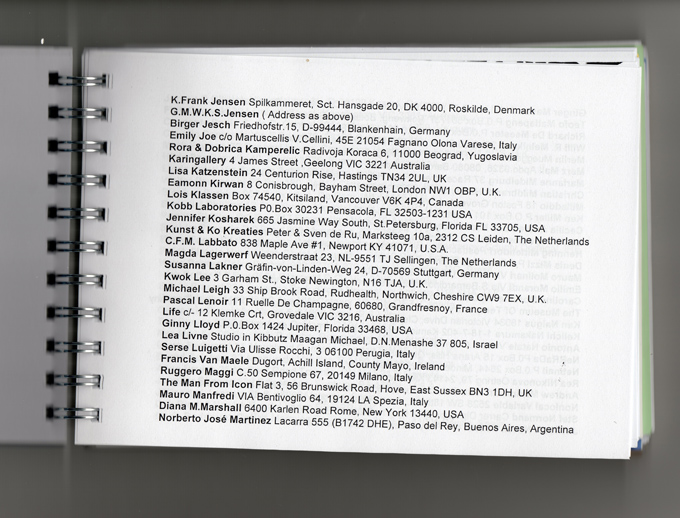
A page of participants – 2011 Field Report
.
.
Look out for the 2020 Call for Submissions …
.
.
.
2018 FIELD STUDIES: CAMERA OBSCURA FERRY PORTHOLE – Bass Straight waves over the Spirit of Tasmania
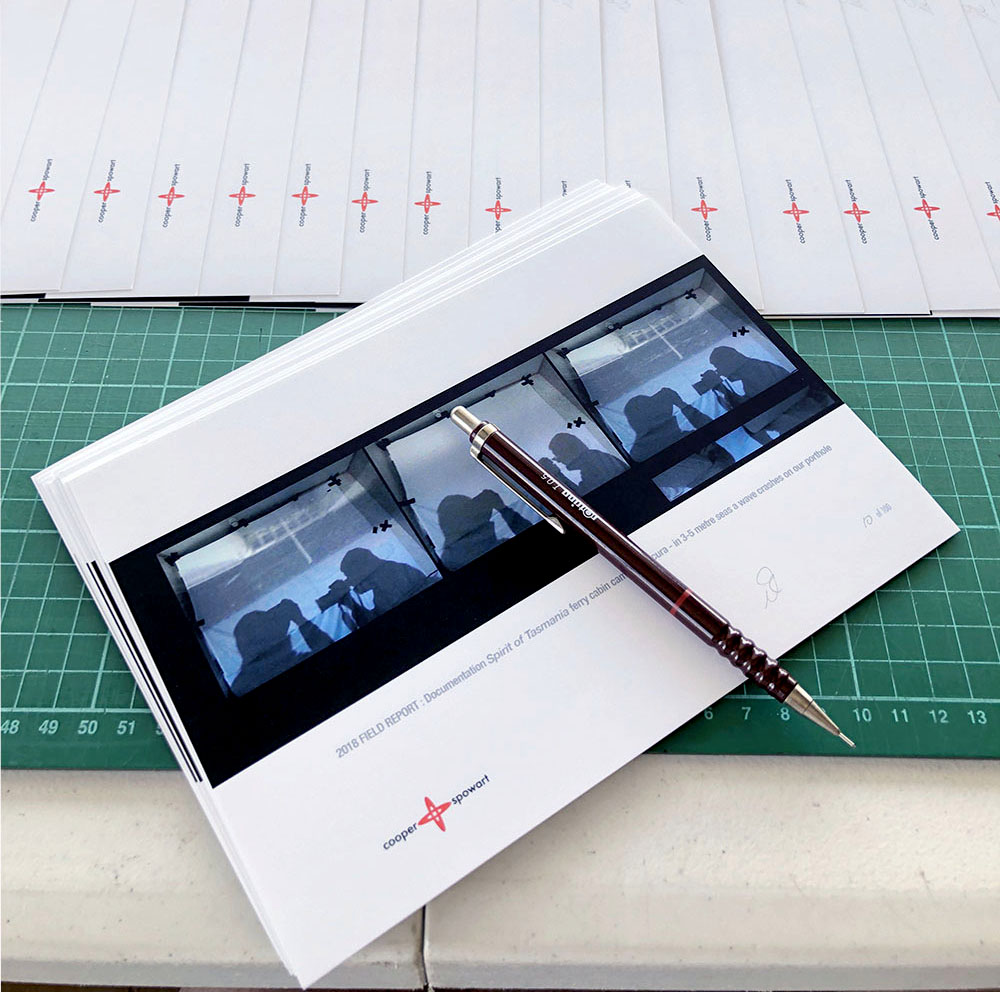
Our 2018 Field Studies submission of 100 artworks
As an important end of year ritual, we have once again prepared our submission to the ‘FIELD STUDIES INTERNATIONAL’ collaborative mail art project organised by David Dellafiora. Artists from around the world contribute to this project by mailing to David 100 artworks of any process and printed media made to A5 size. He then works with a team to collate all the submissions and assemble 100 copies of the collaborative book. After each participant receives one of these books, a number are then sold to private and institutional collectors to fund the project. We have contributed to the Field Studies for the last 10 years. Some links to the previous submissions are provided at the end of this post.
Here’s the story of our 2018 Field Studies report…
In 2000, we began a series of site-specific camera obscura projects that is a continuing body of work… This year we made two attempts to construct a cabin camera obscura. The second attempt proved more successful and so in this blog we present this recent work – Through a porthole in 3-5metre seas on the The Spirit of Tasmania.
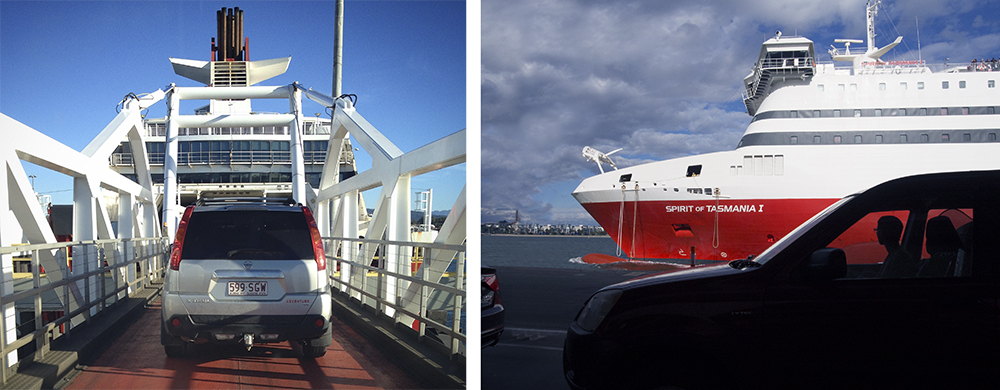
The Spirit of Tasmania
On the morning of the 3rd of November we boarded the Spirit of Tasmania and checked in to our cabin for the nine-hour day crossing. We had booked months earlier and had requested a porthole cabin with the idea of making a camera obscura.
Earlier in 2018 we had tried unsuccessfully to make camera obscura images on an overnight crossing figuring that by the time we boarded the ship we would have a brief period of sunlight – alas, that would not be the case it was dark by the time we had boarded and checked into our cabin. This second time we worked it differently with a day crossing and a porthole cabin… we then prepared for a full day of camera obscura work.
You can imagine our excitement to find that our cabin was in the middle at the front of the boat with a view over the flagpole on the prow of the ferry to the sea beyond. So we set to work with a mini camera obscura tool kit had been prepared for the preparation of the darkroom:
- A quantity of heavy-duty black garbage bags
- Gaffa tape
- Scissors
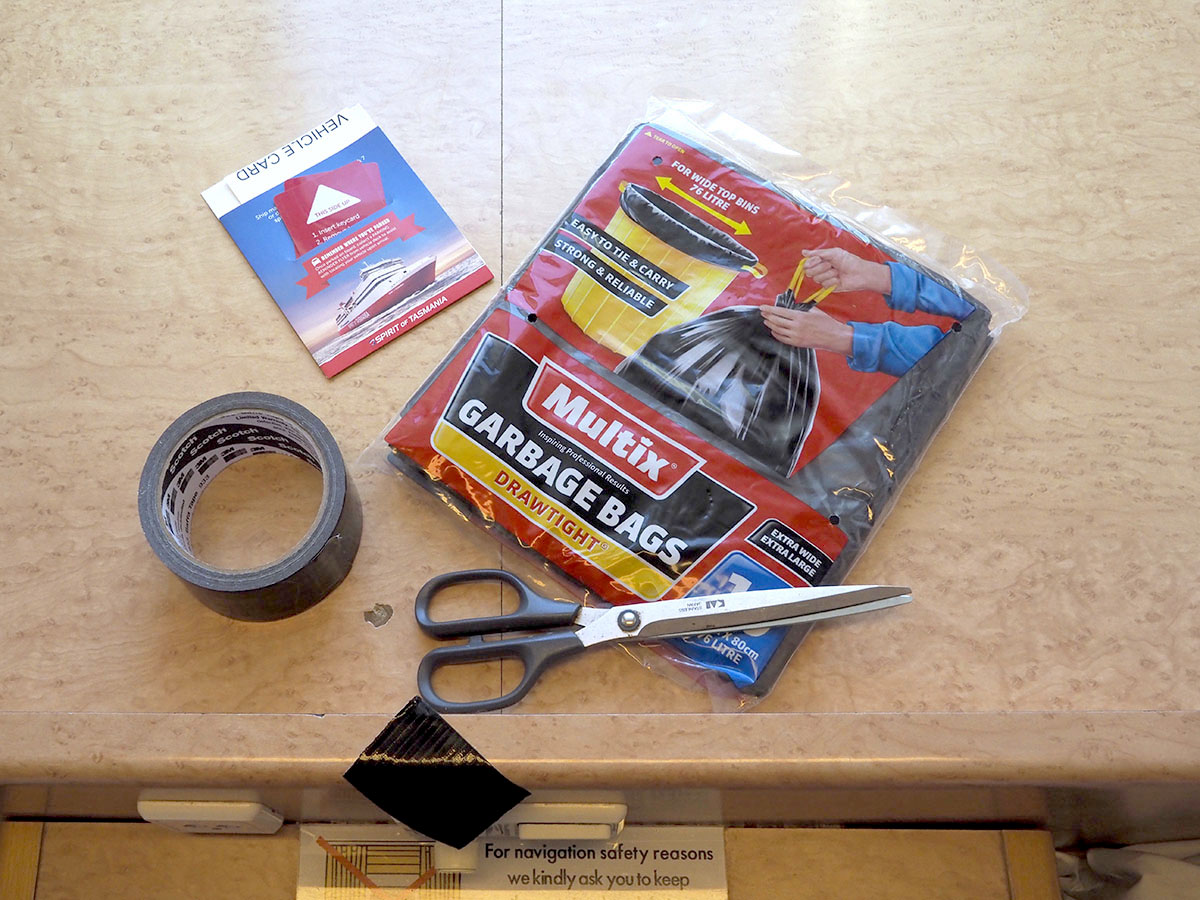
A camera obscura tool kit
Vicky documented Doug as he negotiated the space beyond the bunks to tape the black bags over the window. Progressively the room got darker and glimpses of the features outside our little cabin imaged themselves on the walls of the cabin. One problem was the darkening down of the central image area caused by depth of the room and a mirror on the reverse of the door. We decided that to create an observable image we needed re-purposed two white doona covers as a screen by taping them to the ceiling and walls with the gaffa tape. To recreate the theatrical space of the cabin camera obscura, we combined a series of images of the cabin walls and the screen at different stages of the journey. We also found our humble Olympus Pen camera set at ISO25,000 the best option as it fitted the small space and enabled hand-held exposures.


The Spirit of Tasmania left Devonport port and headed out into Bass Straight. For us this was a challenging crossing as there were strong westerly winds and huge 3-5 metre waves for most of the day. It wasn’t long before we began to experience the ‘bang’ and ‘splash’ of waves over our porthole… we were on one of the upper decks – deck 8!!! Kwells (anti-seasickness pills) were taken and to take our minds off the thump and roll we got active documenting the CO crossing.
Two composite images were constructed from our work that day that we entitled Through a porthole in 3-5 metre seas on the The Spirit of Tasmania. The first is a panorama that shows Vicky on her bunk looking at the projected camera obscura image. On the right-hand side the shadow of the camera held aloft is imaged. The final panorama is made of 4 images.

Vicky observing the panorama camera obscura image
The second image is a triptych of the projected image on the screen showing a series of three photographs made by Vicky as the boat rocked with the centre image documenting a whiteout as a wave crashes on the window.
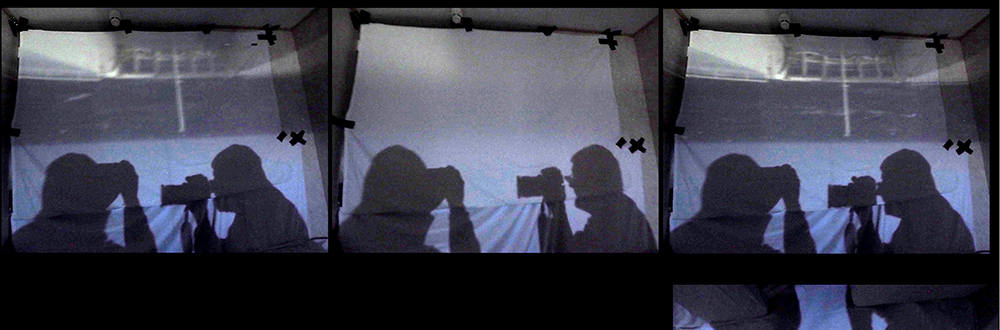
Camera obscura: a 3-5 metre wave crashes against our porthole (inverted)
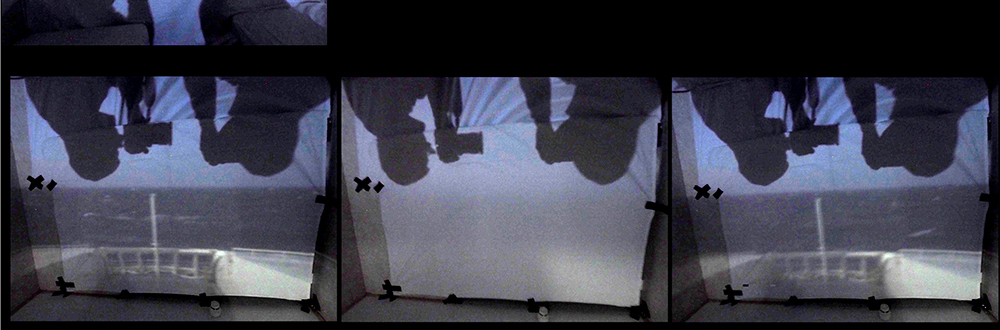
Camera obscura: a 3-5 metre wave crashes against our porthole
We left the camera obscura setup until we docked. Midway across Bass Straight the images described above we assembled and optimised as the ‘bang’ and ‘whoosh’ of the waves on the boat continued incessantly. At one stage we ventured out to see how those brave souls in the public areas of the ferry were managing… they all looked pretty green–some not well at all, and many finding any horizontal space they could to find some comfort.
When the Spirit docked we dismantled the CO and disembarked, glad to be on terra firma again.
.
.
.
To see a post about the FIELD STUDIES INTERNATIONAL and other of our Field Studies submissions
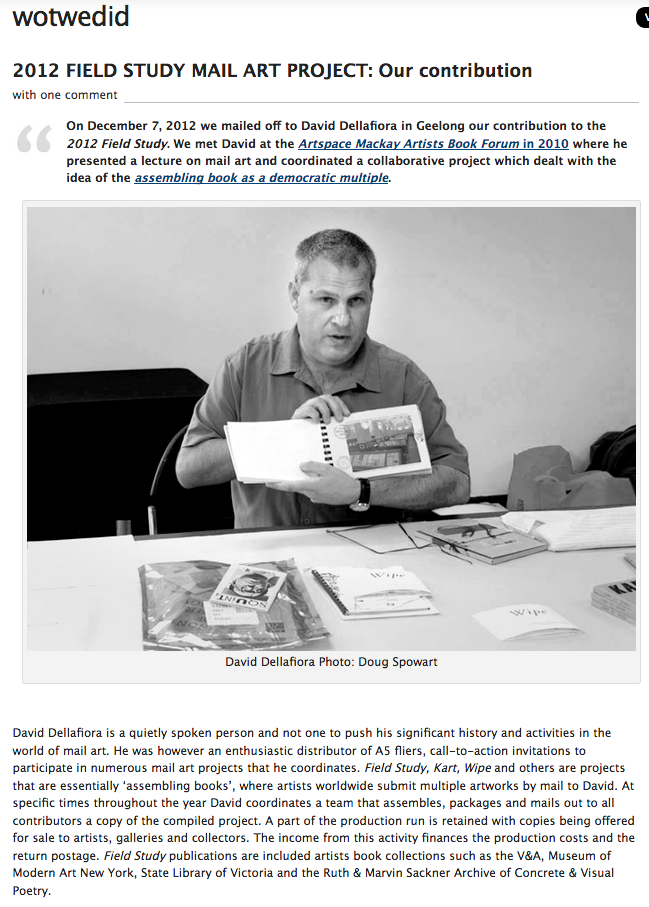
About David Dellafiora and Field Studies International
https://wotwedid.com/2013/01/05/field-study-international-our-contribution/
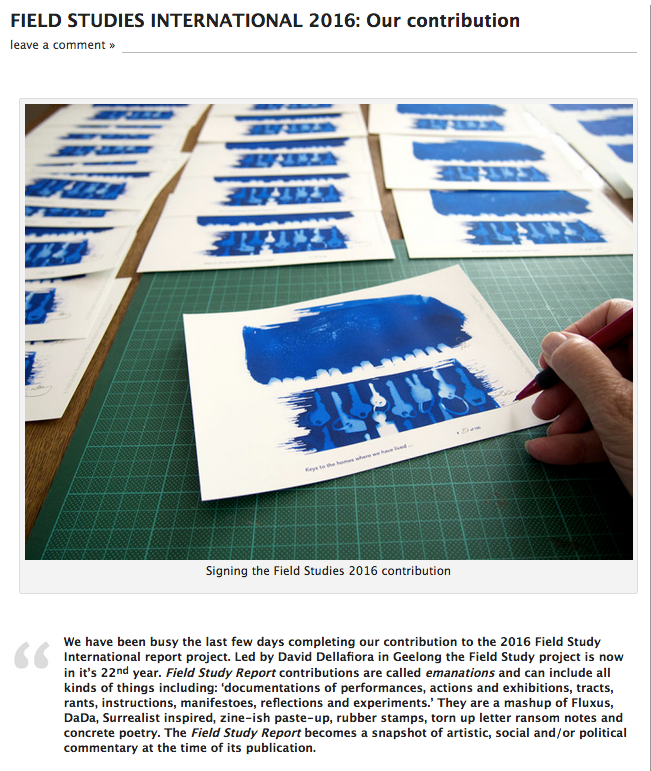
Our 2016 Field Studies International submission
https://wotwedid.com/2017/01/17/field-studies-international-2016-our-contribution/
.
.
.
.
.
FIELD STUDIES INTERNATIONAL 2016: Our contribution
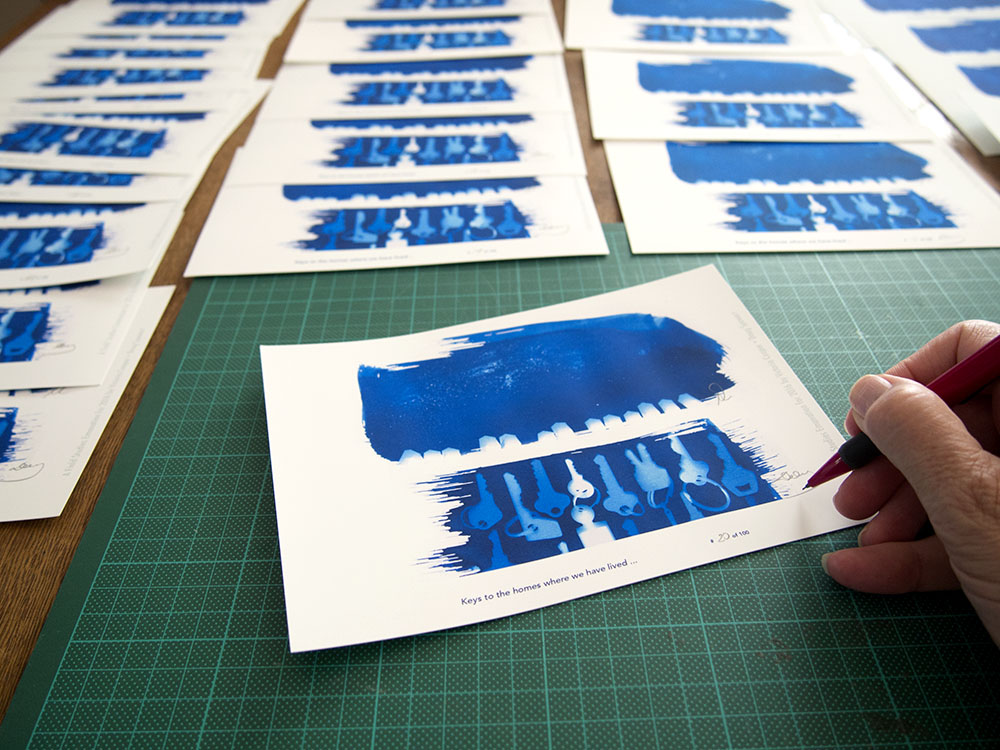
Signing the Field Studies 2016 contribution
We have been busy the last few days completing our contribution to the 2016 Field Study International report project. Led by David Dellafiora in Geelong the Field Study project is now in it’s 22nd year. Field Study Report contributions are called emanations and can include all kinds of things including: ‘documentations of performances, actions and exhibitions, tracts, rants, instructions, manifestoes, reflections and experiments.’ They are a mashup of Fluxus, DaDa, Surrealist inspired, zine-ish paste-up, rubber stamps, torn up letter ransom notes and concrete poetry. The Field Study Report becomes a snapshot of artistic, social and/or political commentary at the time of its publication.
Our submission for 2016 is a commentary on our present nomadic lifestyle. Since moving from Toowoomba 2½ years ago we have been house-sitting, doing artists in residence projects, staying with friends and renting – we have lived in approximately 15 places.
For our submission we made a diptych of original cyanotype images recently while staying on the beach at Wooli. One print represents a starry night above a line of houses. The other print is a selection of of different keys –referencing all the houses we have stayed in. The two cyanotype prints were copied, scaled and arranged on the one sheet with the captions: ‘Keys to the homes where we have lived …’ and, ‘A Field Study Emanation for 2016 by Victoria Cooper + Doug Spowart’.
Each A5 print is numbered and signed and the edition is 100. Each contributor gets a copy of the assembled works and some copies are sold to support the project and the group that helps make it happen.
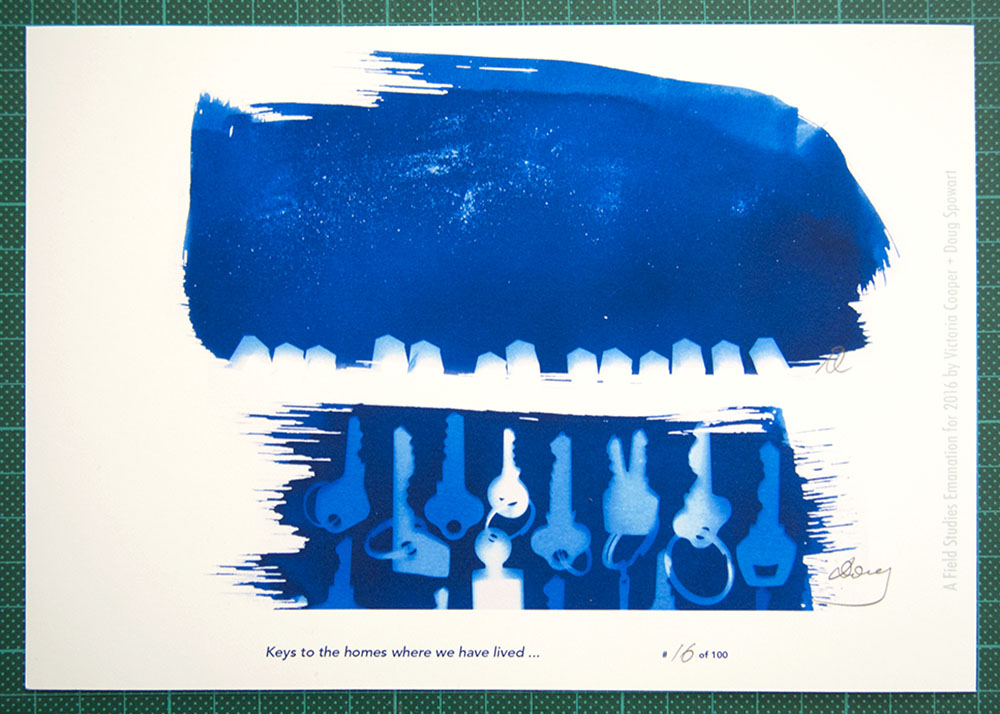
Cooper+Spowart Field Study 2016 contribution
Submissions for 2016 are now closed however, get ready for 2017. For more information about Field Study and other projects see: https://daviddellafiora.blogspot.com.au/
About Field Study:
Field Study began in 1993 as a way of reclaiming the negative spaces between art and life. Activities stemming from Field Study are emanations and group emanations are manifestations. Field Study sees each work as a manifestation of a collective spirit. Everyone is welcome to become a member of Field Study, irrespective of their arts practice, and contribute to the Field Report. Field Study also produces the assembling publications WIPE and ReSite, and, in collaboration with Karingal, KART.
An earlier WOTWEDID Blog post has more detail… Check it out:
https://wotwedid.com/2013/01/05/field-study-international-our-contribution/
.
.
.
GEORGE PATON GALLERY: Artist’s Books (reprised) Exhibition
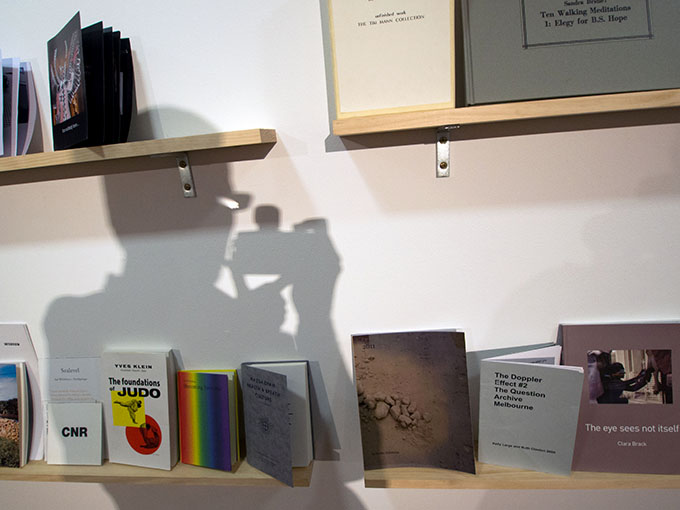
Artists’ Book Selfie
.
Digging in the archive: past and present
Artist’s Books (reprised) [artists’ books 1978-2014]: George Paton Gallery, University of Melbourne
Dates: 26 August to 5 September
A recent show entitled, George Paton Gallery, Artist’s Books (reprised), promoted that it would be showing “four decades of investigation into the possibilities and limitations of the artists’ book form.” Whilst the exhibition as presented had some gaps in the chronology, it did live up to its claim of presenting a significant collection of contemporary works alongside a carefully curated group of seminal artists’ book works from shows presented at the George Paton Gallery in the 1970s and 80s.
.
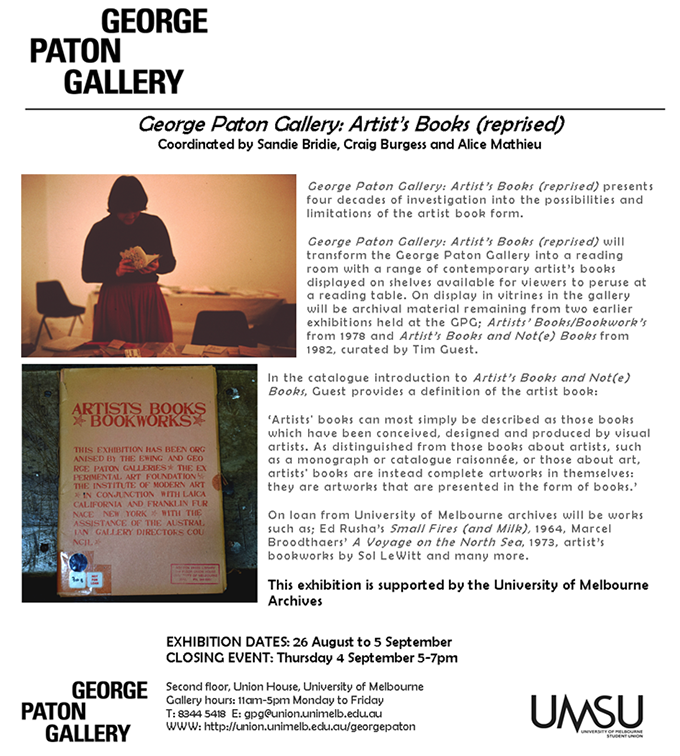
George Paton Gallery Website notice
.
Visitors to the gallery encountered a space resembling a reading room with trestle tables and bookshelves presenting the contemporary books for viewing, handling and reading. Some books were marked as ‘white-gloved’ handling whilst the majority was available for direct tactile experience. Enclosed in vitrines were the historical books on loan from the University of Melbourne archives. Interestingly during the 1970s and 80s these books would have only cost a few dollars to buy but now they attract significant values. Included in this prized collection of books are: Ed Ruscha’s Small Flres and Milk; 1964; Marcel Broodthaers’ A Voyage on the North Sea; 1973; Sol LeWitt’s Grids – using all combinations of straight, not- straight and broken lines; 1975; Richard Long’s The North Woods, 1977 and Dieter Roth’s, Gesammelte Werke, Band 7, 1974. These books were sourced from past exhibitions held by the George Paton Galley: Artists’ Books/Bookworks from 1978 and Artist’s Books and Not (e) Book! from 1982, the latter curated by Canadian Tim Guest.
.
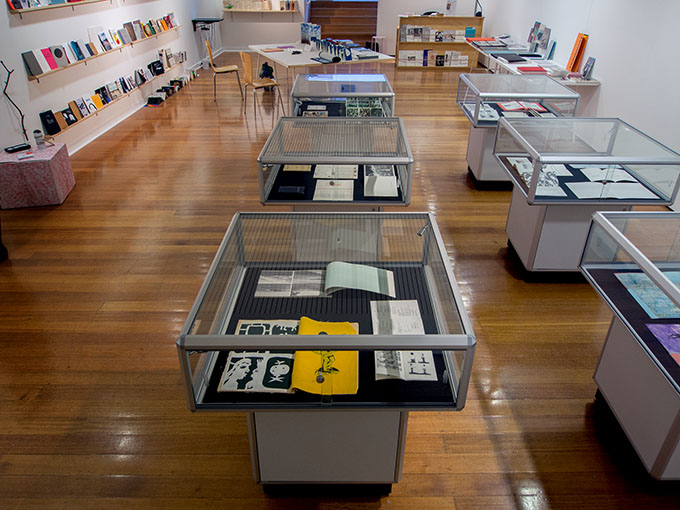
George Paton Gallery
In all just over 100 books were available for viewing essentially coming from a ‘call out’ for artists book makers to present work for the show. There were some interesting names; Peter Lyssiotis, Theo Strasser, Sandra Bridie, mail artist David Dellafiora, zinesters Gracia Haby and Louise Jennison, and photo-newspaper publisher Jacob Raupach. Anyone with a preconceived idea of what an artists’ book is, or should be, may have been challenged by some of the works in the show – but what an experience it was to be challenged in that way. It was a rare opportunity to view and compare such a diverse and historical collection of artists’ books.
.
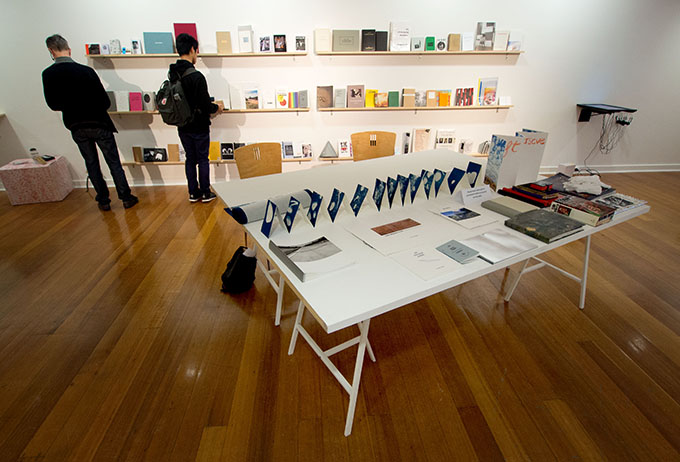
Exhibition installation
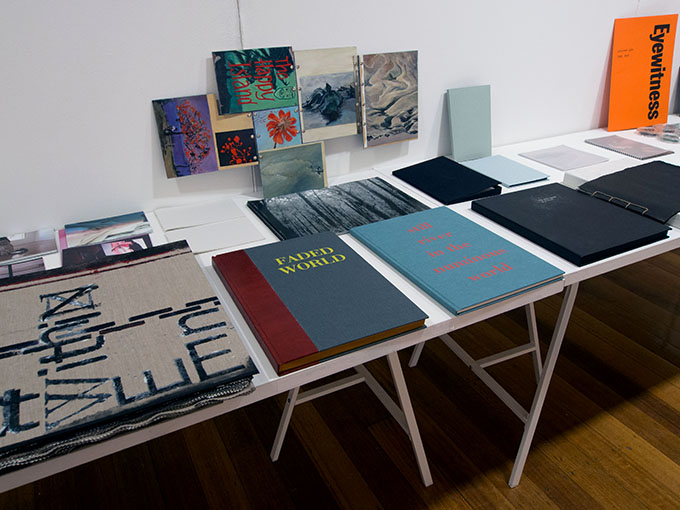
Antoni Jach’s Faded World and books by other artists
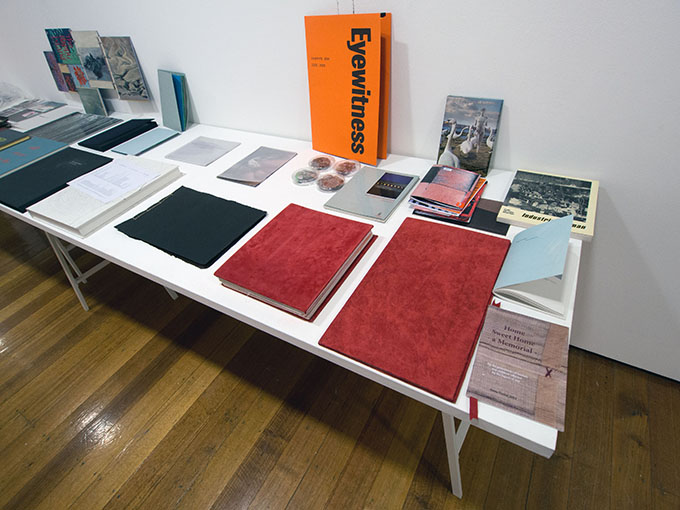
Books by Peter Lyssiotis, Theo Strasser and others
After spending a couple of hours in the exhibition space I searched for a way of describing the show. Then I found a text that offered a perceptive critical evaluation of the artists’ book genre. Some relevant passages from this text follow…
.
Artists’ books can most simply be described as those books which have been conceived, designed and produced by visual artists. As distinguished from those books about artists, such as a monograph of catalogue raisonee, or about art, artists’ books are instead complete artworks in themselves: they are artworks that are presented in the form of books.
Since about 1960 a distinct genre of artists’ books has appeared. These are by artists who are self-consciously exploring the possibilities of printed books: the social dynamics of a reproducible vs. a unique art object; the aesthetics of the mass print media vs. fine art prints or deluxe editions.
The contemporary genre of artists’ books is now a widespread phenomenon. Practically every significant development in western art has been reflected in the ongoing publication of artists’ books. There are books coming out of the movements of pop art, minimalism, arte povera, performance art, fluxus, happenings, and new image painting. Conceptual artists of the 1960’s and 70’s in particular, utilized the book form as a method of realizing artworks. We can regard these books now as a vein which runs through many areas of contemporary art and includes diverse movements, interests and preoccupations.
Or have the interests been so diverse? Pop art, minimalism, performance art, arts provera, were all movements distinct from (even antagonistic to) one another, yet they all belonged to a general tendency towards “non-objective” art… Briefly, this tendency has been reflected in a desire on the part of artists to explore new media, in an attempt to abandon the traditional (modernist) disciplines of painting and sculpture. It was/is in favour of the widened scope of the flux and flow of a multi-disciplinary approach. For example, an artist may be involved in sculpture as easily as film, performance, video, photography and/or books. Perhaps most significantly there has been a conscious determination to undercut the reification of artworks – society’s valuation of art – by concentrating on the non-objective. This has meant, for instance, producing works from common industrial or throw away materials (art povera, fluxus), works constructed only in theory (conceptual art, language art), imagery stolen from the banal repertoire of mass media (pop art) ….. All this seems to have been more successful as an ideal than as an actual practice. Minimal sculpture in the late 60’s was quite successful in the art marketplace. Conceptual art has been immensely influential, popular, and saleable. As much as these artworks were determined in opposition to the bourgeoise reification of art they were inevitably complicit with it. That is because capitalism is a social system which seems to embrace new ideas but in fact appropriates and establishes a commercial value for then.
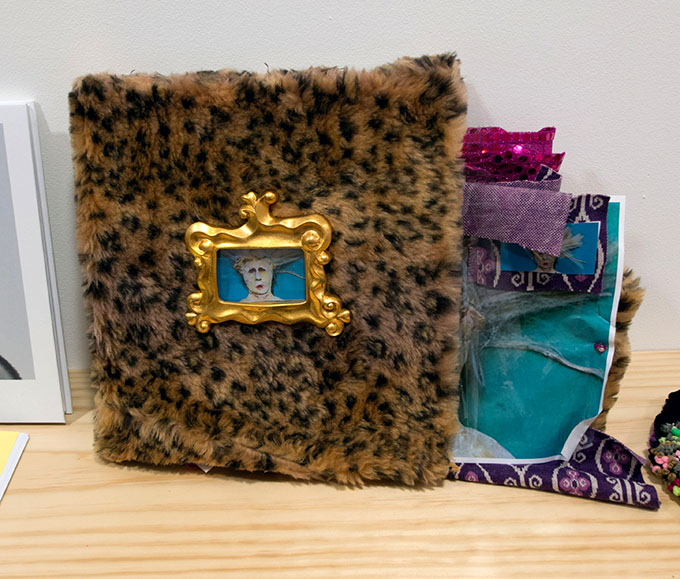
A book by Dianne Dickson
Artists’ books typify this interest in non-objectivity and reflect the internal contradictions of such an ideal in a particular way. In contrast to the traditional “livre d’artistes” of deluxe editions, artists’ books are usually inexpensively produced and sold. They are affordable, accessible and as plebeian as an art object can be. In fact they are almost too exemplary of the non-objective ideal.
As books they are not commercially viable simply because they defy the expectations of a mass market by presenting avant-garde information. Yet they have few patrons in the art world because their affordability to the public represents a low profit for a dealer. Also, books can not [sic] be viewed in the same way as other art objects; they must be held in one’s own hands and read. It is remarkable then that despite the contradictions and foils of art’s survival, artists’ books have become such a highly evolved genre of contemporary art, as evidenced by the works in this exhibition.
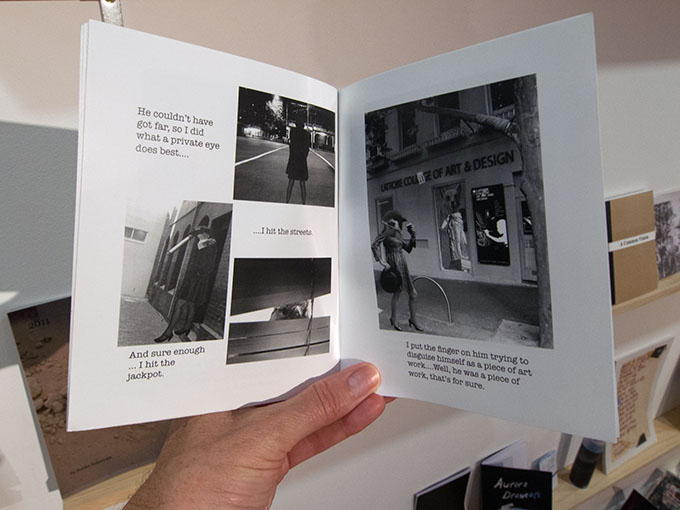
Suzannah Griffith’s While The City Sleeps
.
To illustrate means to make something clear by example, or to adorn a book with pictures. Within a publication, an illustration can be a picture, a drawing, a photograph, a design, or an ornament. Illustration is, of course, a prominent element in all mass media publishing. To consider all illustrations as a single genre is, in a way, quite boggling. It means imagining all magazines in the world and all the printed pictures.
With this imagining I try to analyze these pictures but have only an individual response to guide me. In principle my inquiries and suggestions are all subjective, my curiosity is intuitive, my critical remarks are speculative. These habits of mind and predilections constitute the trail of my argument. Because illustration operates as such an enormous social phenomenon, it is difficult to grasp its total meaning as a genre. It is too huge a concept. Yet paradoxically, all is intimately familiar.
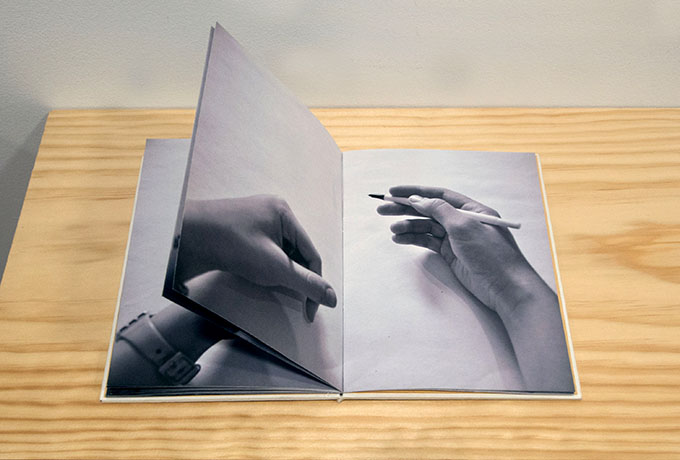
Sarah McConnell’s 29 2011
Practically everyone looks through magazines, sees the pictures, knows what they mean. But try to separate yourself from a simple recognition of the picture and examine the picture as a conceptual model and you may understand how difficult it can be. An illustration is not simply a picture of an object or thing. In that object’s absence a picture is a way of visualizing it, recalling it or conjuring it. Then all together the medium of illustration is a way of visualizing the world. As illustration is a mass medium, it is certainly a very powerful and influential instrument of ideas. As a conceptual model, a picture is showing us how to think and what to think about.
Art characteristically departs from conventions. In leading the way from these conventions and artists can end up revealing and/or inventing upon a given culture, popular or otherwise. Furthermore, the artists’ books in this exhibition occupy a middle ground between the hermetic region of high art and the mass culture of popular illustration. They also embody a comparison between the two; they have been produced as a way of participating (in theory at least) in the mainstream of popular culture at the same time as they are an extension of art, extending beyond galleries and museums, and outside of the realm of the rarified art object.
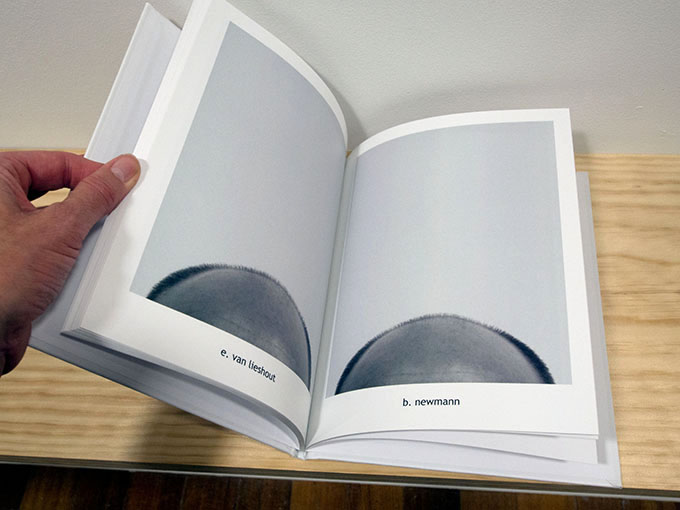
Jon Hewitt’s feel the confidence 2011
It may be noted that the photo works included in the exhibition are not photography books in the usual sense. For example in some books, the artist has exchanged the customary fine detail and high quality printing found in most art photography books for the flat, grainy, aesthetic of newswire or snapshot photographs, with all their vernacular associations. In other books the artist may manipulate the photographic frame by cropping it tightly to draw attention to narrative details or expanding it to the edge of the page for a window effect. Some books here constitute a repertoire of personalities through a wide array of photographic self-portraits. Others are collections of images specific thematic subject matter which suggests an interpretation of the complex meanings of culture and its institutions through the examination of its artifacts.
.
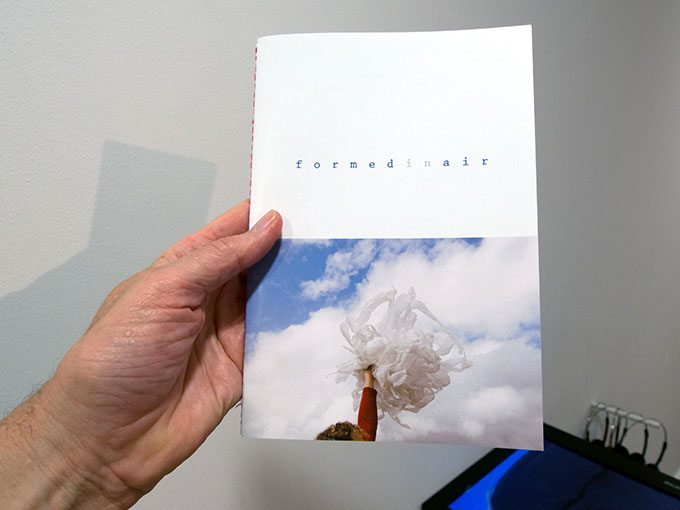
Yasmin Heisler’s formed in air 2014
In opposition to the conventions of art photography, which dictate an aesthetic around the “integrity” of an individual print, these photo books, to some extent, are each engaged with the qualities inherent in reproduction by offset and other printing processes. The artists represented in this exhibition are utilizing photographs as something other than a clear, well-composed picture. In their books they manipulate the “natural reality” of photographs and so inform our recognition of photographic images with their mannered inventiveness.
There are also a few books included here which are constructed sculpturally to introduce a tactile sensation to the fingertips and so expand the act of reading illustrations into the field of sensory awareness.
.
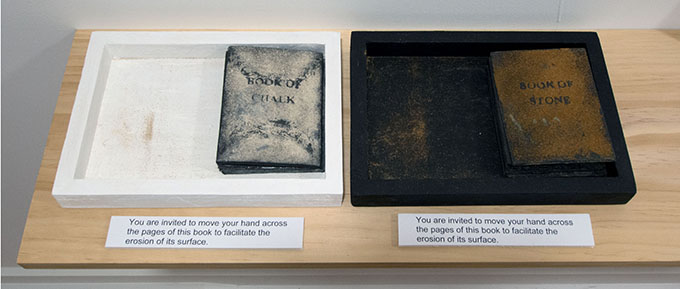
Bridget Hillebrand’s Book of Chalk 2014 and Book of Stone 2014
Finally, just as the works in this exhibition are included towards an exploration of the social and aesthetic attributes of illustration, they also demonstrate a way of looking at and experiencing the world. Theses artist’s books reveal and embody a way of reading deeply into they dimensions of contemporary culture. As much as they foster an incipient consciousness they ask for sensitivity on the part of the reader.
.
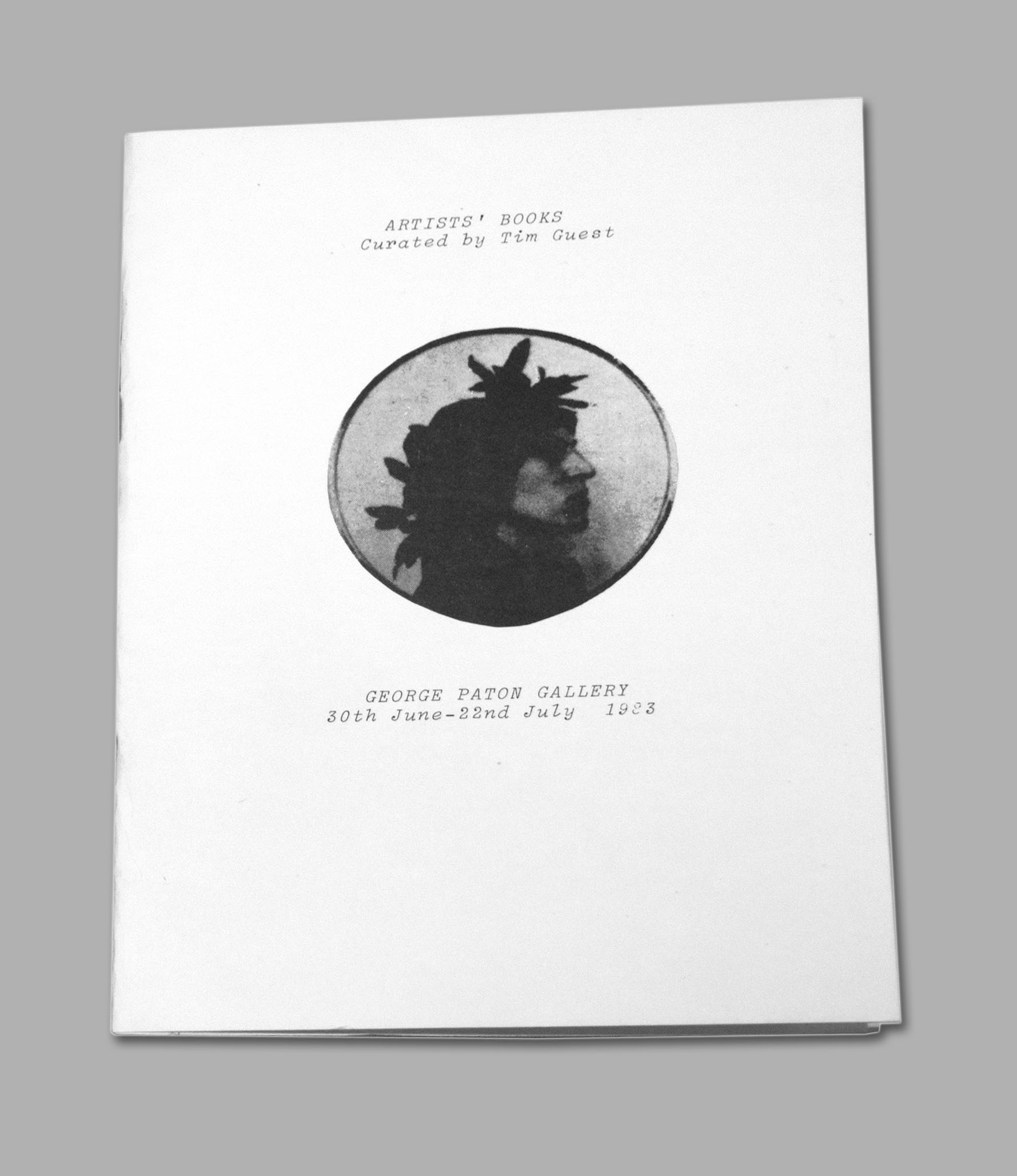
Tim Guest, the catalogue for the 1982 George Paton Gallery Artist’s Books and Not (e) Book!
These words come from Tim Guest, the curator for the 1982 George Paton Gallery Artist’s Books and Not (e) Book! A copy of his catalogue for the show was made available at the exhibition. Guest’s commentary is as relevant today as it was in the early 1980s, and while we have moved on, and now view the artists’ book works of that time with a degree of comfort and acceptance, the new artists’ book works continue, as Guest points out to, ‘demonstrate a way of looking at and experiencing the world’. For me it emphatically confirms that artists’ book are still ‘edgy’ and still pushing limits.
Doug Spowart
September 5, 2014
DOWNLOAD the contemporary list of artists’ books gpg artists books list of works
DOWNLOAD the books on loan from the University of Melbourne ArtistsBooksloanselectionGPG2014 docx
.
.
Part of the associated activity for the show – an artists’ book making event outside the gallery led by Michele and Laine. It was a a sunny and warm late winter’s day in Melbourne.
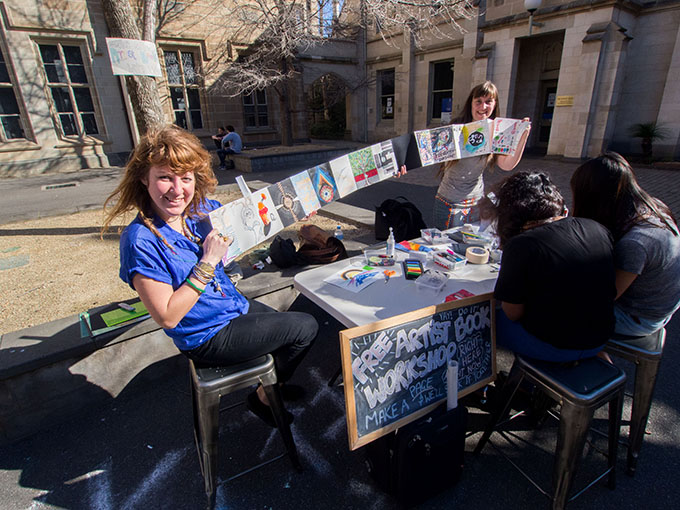
Michele Grimston and Laine Stewart and their Free Artist’s Book activity
.
.
.
.
2012 FIELD STUDY MAIL ART PROJECT: Our contribution
On December 7, 2012 we mailed off to David Dellafiora in Geelong our contribution to the 2012 Field Study. We met David at the Artspace Mackay Artists Book Forum in 2010 where he presented a lecture on mail art and coordinated a collaborative project which dealt with the idea of the assembling book as a democratic multiple.
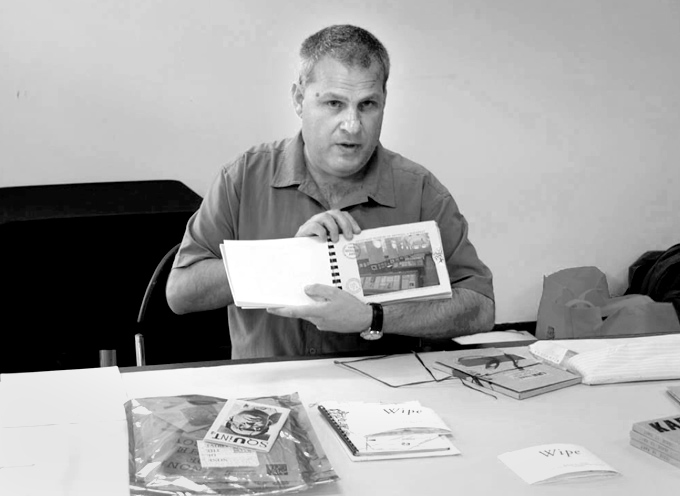
David Dellafiora Photo: Doug Spowart
.
David Dellafiora is a quietly spoken person and not one to push his significant history and activities in the world of mail art. He was however an enthusiastic distributor of A5 fliers, call-to-action invitations to participate in numerous mail art projects that he coordinates. Field Study, Kart, Wipe and others are projects that are essentially ‘assembling books’, where artists worldwide submit multiple artworks by mail to David. At specific times throughout the year David coordinates a team that assembles, packages and mails out to all contributors a copy of the compiled project. A part of the production run is retained with copies being offered for sale to artists, galleries and collectors. The income from this activity finances the production costs and the return postage. Field Study publications are included artists book collections such as the V&A, Museum of Modern Art New York, State Library of Victoria and the Ruth & Marvin Sackner Archive of Concrete & Visual Poetry.
The Field Study contributions are called emanations and can include all kinds of things including: ‘documentations of performances, actions and exhibitions, tracts, rants, instructions, manifestoes, reflections and experiments.’ A selection of pages can be seen in the illustrations from last year’s report at the end of this post. They are a mashup of Fluxus, DaDa, Surrealist inspired, zine-ish paste-up, rubber stamps, torn up letter ransom notes and concrete poetry. In its assembled form the power of Field Report is apparent as it becomes a snapshot of artistic, social and/or political commentary on the times that are current at the time of its publication.
.
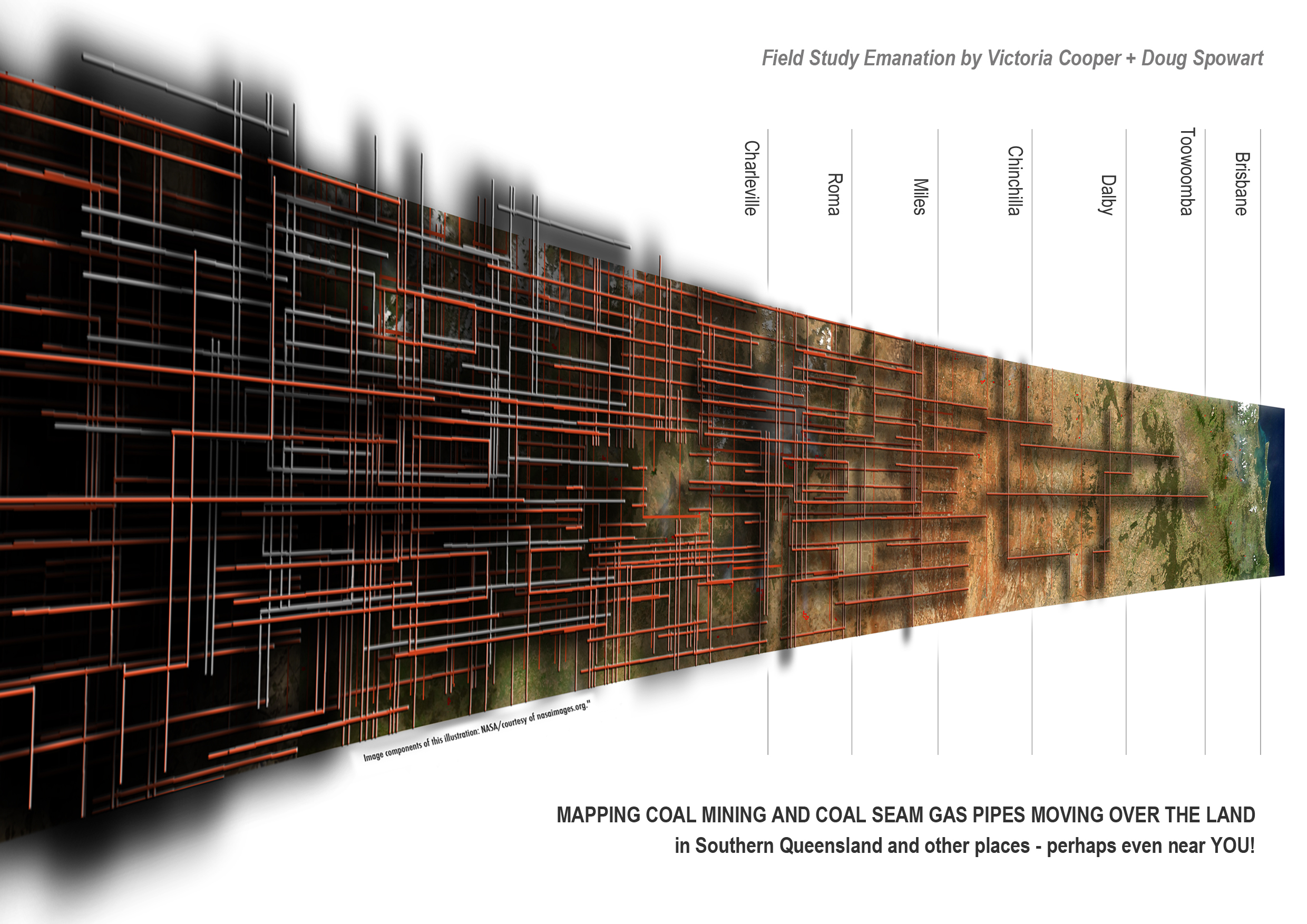
Our Field Study infographic about extractive mining industries in the Surat Basin
.
This year we contributed a piece that related to our commentary on extractive mining industries overtaking our regional communities. This is a variant to the Artists’ Survey Book #12 that has featured in past WOTWEDID posts. The page was printed using a high quality photocopier and each page, 100 in all, were signed and numbered by both of us. It was remarkable to see our workbench covered with the repeating pattern of 100 pages taking up an area of about 3 square metres.
.
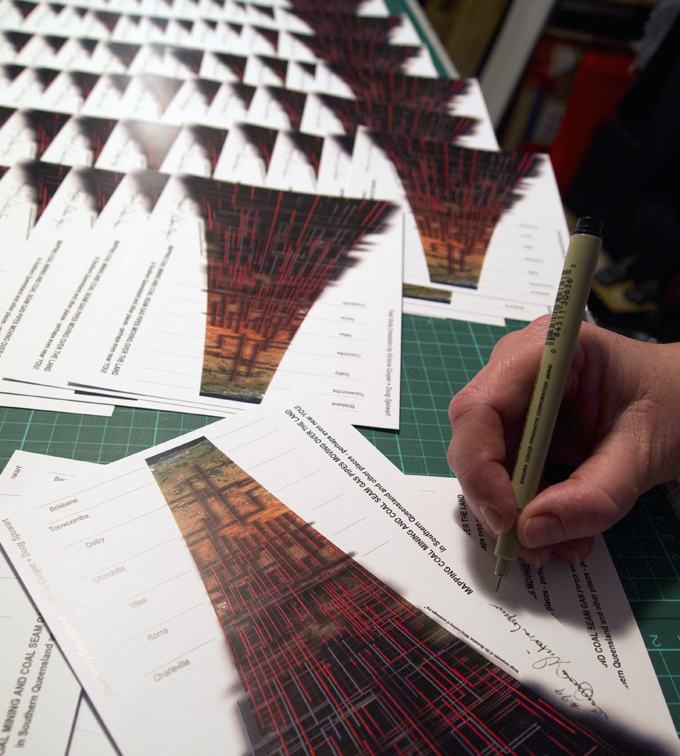
Signing our contribution
.
We look forward to receiving a package from Field Study International later on this year. And, for anyone interested in future Field Study projects, check out the Field Study Blog or review some of the accompanying documents that follow in this blog post.
Cheerio
Doug
.
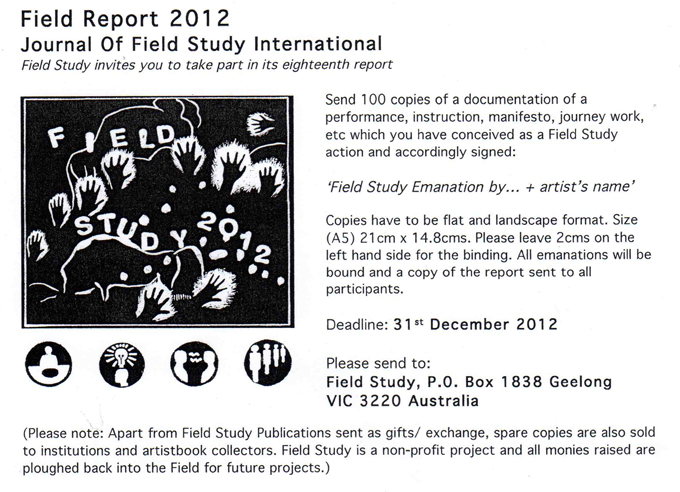
The call for 2012 contributions
.
2011 Field Report cover
.
2011 Field Report pages
2011 Field Report
2011 Field Report pages
A page of participants – 2011 Field Report
.
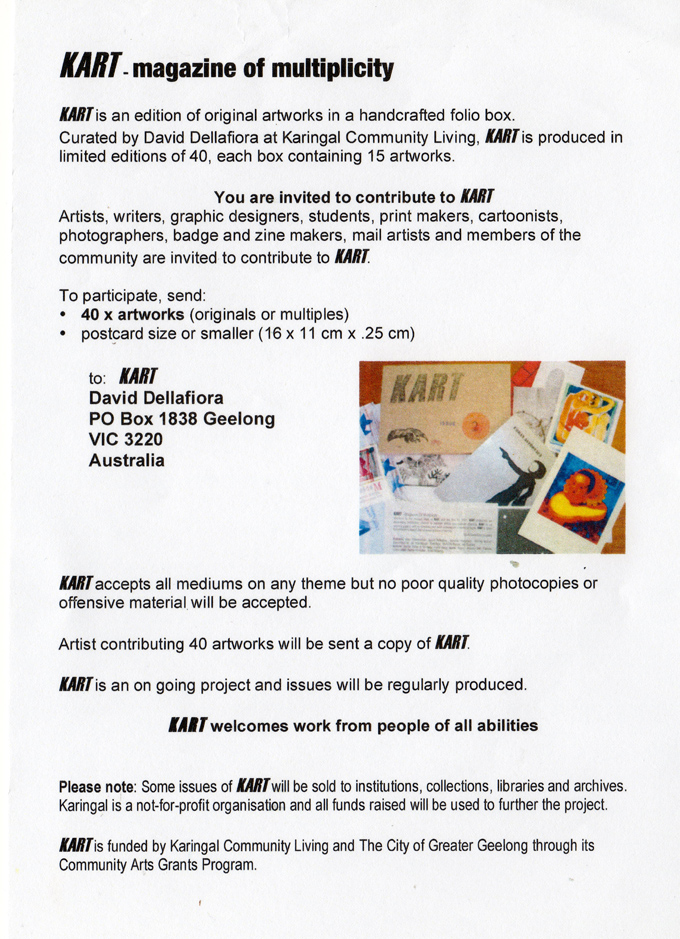
Kart Mail Art Project
.

 wotwedid