75 Years: Toowoomba Regional Art Gallery
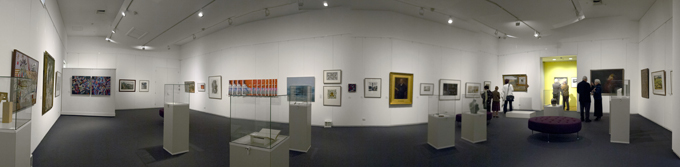
Toowoomba Regional Art Gallery Panorama
Toowoomba Regional Art Gallery, the oldest regional art gallery in Queensland, this month celebrated its 75th year of operation. When we consider that Queensland only recently celebrated its sesquicentennial therefore the gallery is half the age of Queensland itself! Other interesting dates; the Toowoomba region was settled in the 1840s and was proclaimed a city in 1904 The Toowoomba Show Society recently achieved a milestone of 142 years of shows in agriculture and industry and the Empire theatre celebrated its 100th birthday last year. It seems that the Toowoomba region was well and truly fired up as a community and perhaps overdue for an art gallery that was finally established in 1937.
The records show that various Governors of Queensland were associated with TRAG over the years and this association continues to this day with the current Governor Her Excellency Ms Penelope Wensley opening the 75th exhibition on July 2, 2012. In an impressively researched speech Governor Wensley recounted newspaper reports of the day relating to the gallery’s foundation. The 75th opening was attended by around 100 members of the local community including Mayor Paul Antonio, various councillors and members of the trustees or families of significant donors to the gallery.

Gallery Curator Di Baker with Governor Wensley discussing artworks
The exhibition features 75 individual artworks from the gallery’s collection—one for each of the 75 years. Standing in the middle of the main exhibition area one sees a diverse range of visual material. Paintings of bygone and contemporary eras by some very prominent artists, there are ceramics, fine jewellery (from the gallery’s principle collection media—contemporary wearables), and finally photographs and prints complete the veritable visual cornucopia on show. When I came to testing my recollection of the artwork’s titles and artists I was stumped, as the artwork didactics bore none of that information. This presented some confusion until I became aware the curatorial strategy for the show. The 75 works were selected on the basis of the year and the work’s conceptual connection with significant social, political or historical aspects of that year. The key to the sometimes quirky and idiosyncratic curatorial selection is the exhibition catalogue in which the rationale for the selection is linked with the title, media and the artist’s name.
While at first this seems a little strange my reflection on the concept confirms, for me at least, that the strategy is conceptually stimulating. The usual gallery exhibition is about artists and their art—this show IS about the gallery, its PLACE in the community and TIME, or rather the passage of time—75 years in fact. In this exhibition the gallery then assumes the position of ‘artist’ and were the ‘artwork’ is the curatorial team’s strategy.
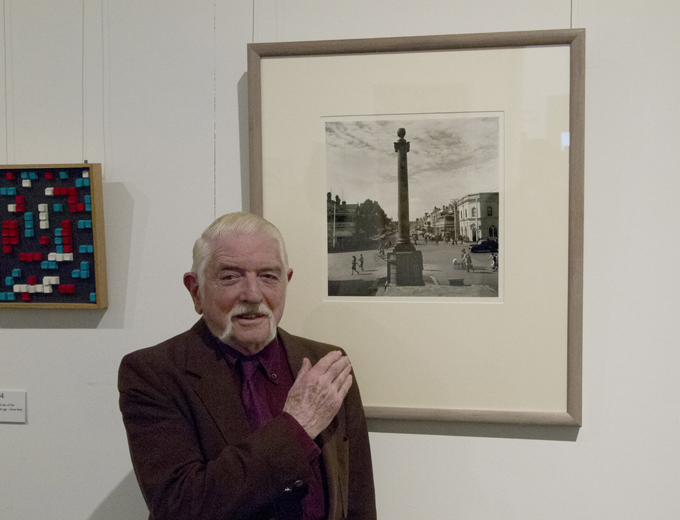
Doyen of Toowoomba’s photo scene Graham Burstow with a Max Dupain photograph in the exhibition
Bravo to the Toowoomba Regional Art Gallery and the team for bringing to us an exhibition featuring the gems of art from its collection that can tell these multiple stories. One, which is about the assiduous collection by the gallery of art stimulated by and/or created by the regional community. And secondly, this show provides recognition of significant art from outside Toowoomba that has been generously donated by benefactors over the years. Through the gallery display of these artworks the local community is able to connect with these wonderful touchstones of artists’ creative practice.
A visit to TRAG to see this show will require much more engagement than usual walk-through, so do plan for extended visits while the 75th year celebration show is on.
SEE more info Toowoomba Regional Council website
Doug Spowart 8 July 2012
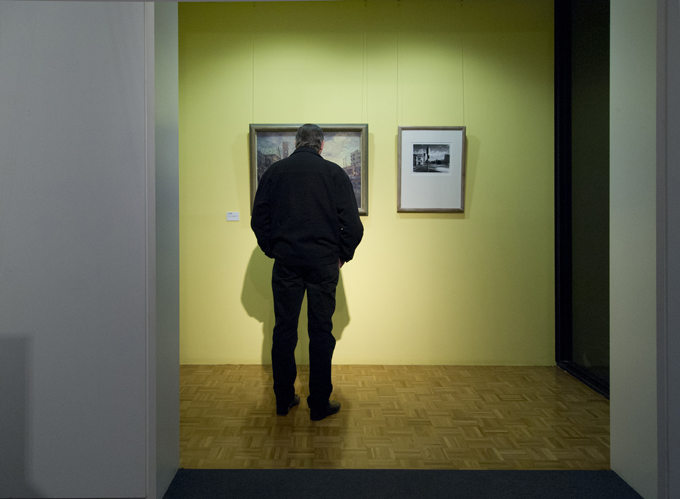
Doug next to his photograph of Ruthven Street selected for the exhibition
RUBY SPOWART: Artist Talk @ Queensland AIPP
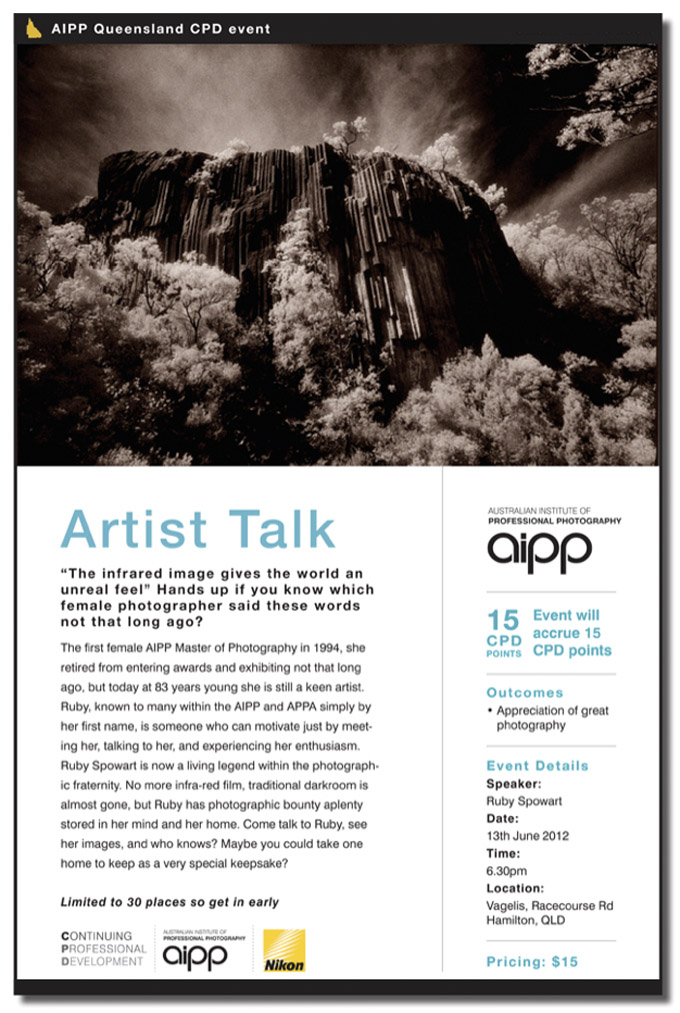
RUBY SPOWART: Art Photographer
Around 30 photographers gathered to hear about the life and photographic art of Ruby Spowart in Brisbane on June 13th. Now in her mid 80s, Ruby has over the years participated in a range of photographic pursuits that have led to some quite substantial achievements. She is a triple Master of Photography, Fellow and Honorary Fellow of the Australian Institute of Professional Photography; in her academic studies she has achieved a Certificate in Art from the Queensland College of Art and also an Associate Diploma of Visual Art from QUT. Recognised for her contribution in visual art she was awarded a Don Fraser Fellowship of QUT and, earlier in her career in the camera club movement she was awarded both an SSAPS and an APR Medal by the Australian Photographic Society. She co-founded Imagery Gallery in Brisbane that showed exhibitions of photography for fifteen years from 1980-1995. Her photographs have won major art photography awards in the 1980s and 90s including the Muswellbrook Photographic Award and the McGregor Prize for Photography and is held in major regional art collections and the Queensland Art Gallery and the National Gallery of Australia.
SEE Ruby’s curriculum vitae
Ruby has created an immense body of work in the following techniques:
- Polaroid 10”x8” colour photograms (1980s)
- Polaroid SX-70 multi-image (joiner-style works) (1980s)
- Massive pseudo-panorama landscapes (1980s & 90s)
- Camera toss mosaics (1980s & 90s)
- Large-scale photo mosaics (1980s & 90s)
- Artists’ books and photobooks (2000-2012)
Her most recognisable works, particularly from the AIPP APP Awards successes, comes from her work with Kodak High Speed Infrared film and a Leica M2. The images are usually of outback Australian landscapes and are heavily sepia toned. SEE a folio of works in Ruby’s Behance Folio

Jan Ramsay introduces Ruby and Marianne
Queensland AIPP President Jan Ramsay enthusiastically introduced Ruby and Marianne Irvine (recently awarded AIPP Honorary Life Membership) who, we learned was to interview Ruby as part of the evening’s presentation. At first Ruby discussed her life and touched upon the following points;
- Her mother was a keen artist who painted in oils
- Her schooling was cut short by World War II, as she had to help out on the farm as her brothers had enlisted
- She had always done things with art-making; enamelling, ceramics, china painting, drawing
- Ruby joined the Numurkah Camera Club (in Victoria) and the Australian Photographic Society in the mid-1960s
- Had served as National Membership Officer in the APS
- Had participated in all levels of the camera club movement in Queensland in the 1980s
- Founded Imagery Gallery with son Doug in 1980 and was a director until the gallery closed its doors in 1995
- Exhibited extensively throughout the 1980s and 90s
- Founded Imagery Gallery Tours with Doug in 1982 and over 17 years undertook around 40 outback safari tours around Australia, as well as tours to New Zealand, Africa and South-Western USA. It was noted that Imagery Gallery Tours may well be the Australia’s first Photo Tour business.
- Ruby became involved with the AIPP and the APP Awards in the early 1990s and served as the administrator for many years
- In the early 2000s Ruby cared for her husband who was in ill health and she moved to the Gold Coast on his passing in 2006.
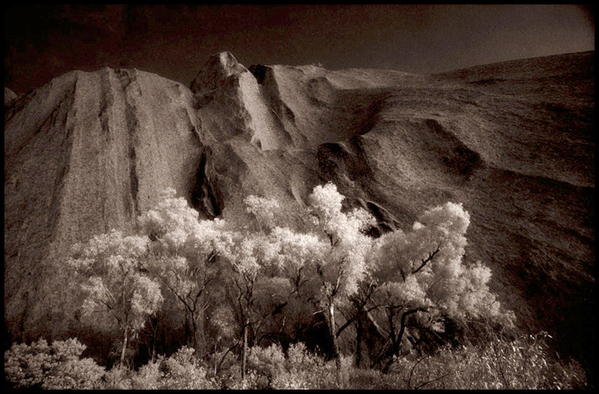
‘Uluru elevation’ – Infrared film image by Ruby Spowart
This presentation was illustrated by examples of artworks and personal images from these recollections. Marianne Irvine then led a lively discussion around the infrared work and travelling in the Australian outback. The concept of taking photographs with film was commented on as many in the audience did not have a significant connection with infrared film, processing, fine print making on fibre papers and the variations of the toning processes that were employed by Doug, who had printed most of Ruby’s work—although she did hold up for the audience to see an image that she announced as her last APPA Gold awarded print, and said that she, ‘had printed that one!’
Doug explained the infrared film process as it existed 20 years ago and connected his knowledge and skill in the darkroom with the prints before the audience. SEE: Doug Spowart’s infrared film ‘How To’
Ian Poole interjected that the images were masterworks made by the photographer Ruby, and the printer Doug, and that the APPA print scores and labels on the print backs provided a wonderful provenance for the work as high quality ‘vintage’ prints.
When asked about her beginnings in art photography Ruby explained the creative space that was created by Imagery Gallery’s presence within the Brisbane photography scene. During its 15 years of operation Imagery Ruby and Doug showed over 200 exhibitions of photography, they curated major exhibitions of Queensland photographers work, some of which were shown in China, New Zealand and Noumea. She had found, as she believed many others had as well, that Imagery Gallery had provided inspiration for new ideas and directions of photography, exploration of themes and the presentation of photography within the gallery context. SEE: IMAGERY GALLERY Biog
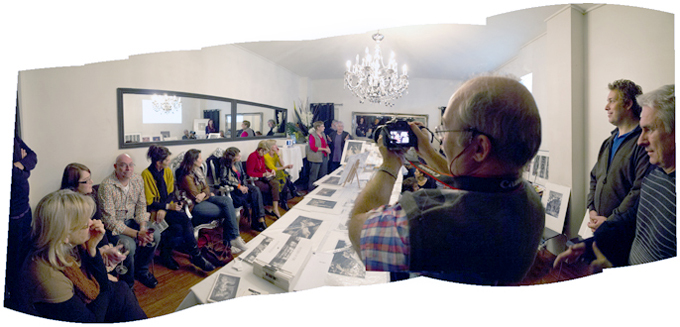
Marianne asks Ruby a question …
Questions from the floor enabled other insights into Ruby’s process and workflow to be revealed. The presentation concluded with everyone being presented with the Patterns in Time catalogue of Ruby’s work and an invitation to visit her on the Gold Coast to see more work from her extensive practice. Ruby advised that she was making her work available to interested purchasers and many attendees eagerly approached her at the conclusion of her presentation.
It’s not often that we can gather together and meet with photographers who have been a part of the recent history of the discipline and who in some way may have helped create that space and opportunities that we enjoy today—this occasion was certainly one of these. Thank you to Ruby for sharing her story and her art, to Marianne for her chairing the meeting, thanks also the AIPP Queensland Division and in particular Jan Ramsay for coordinating this and other events for the benefit of AIPP members and those interested in photography.
.
Doug Spowart with contributions from Vicky
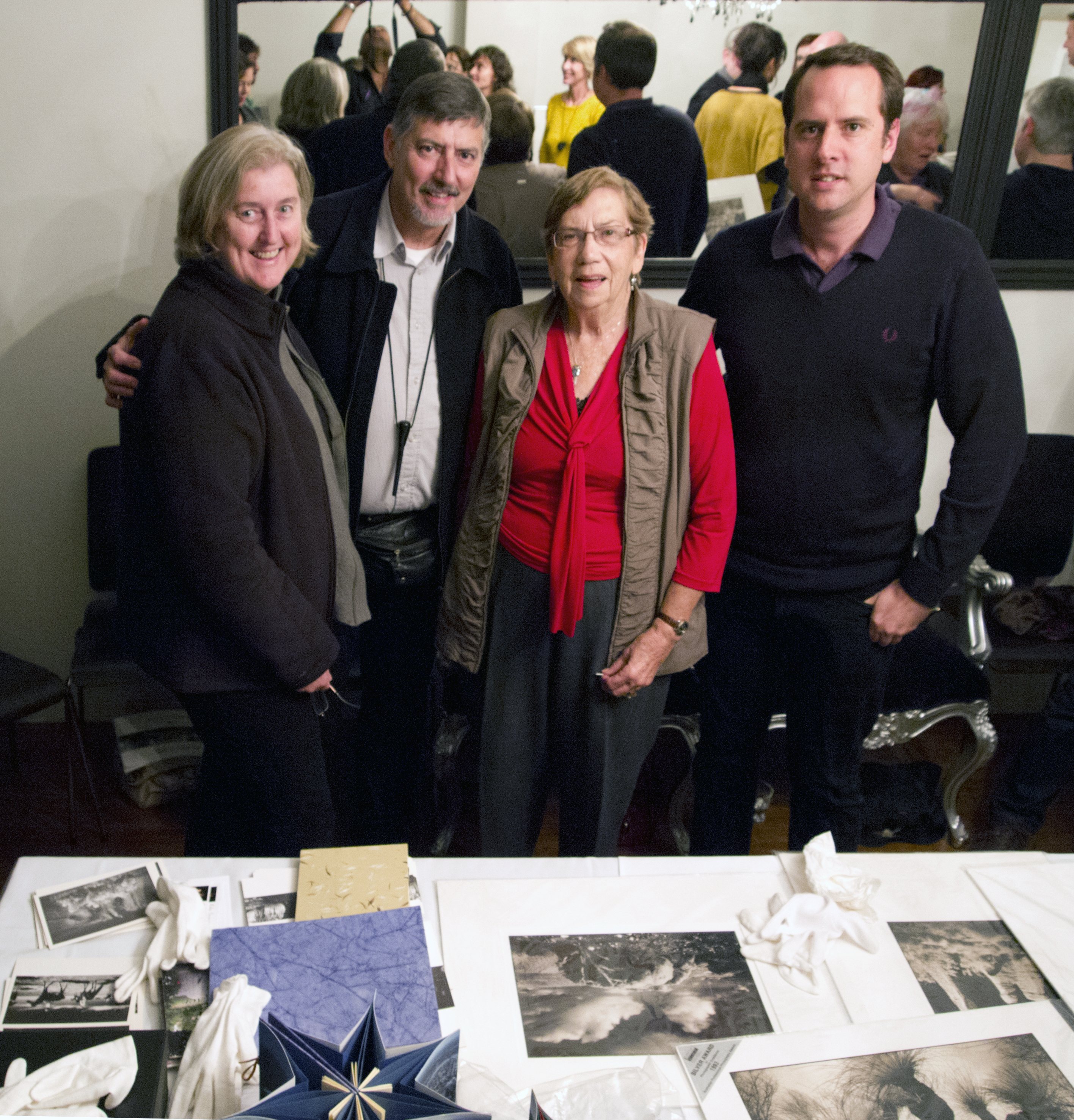
The Spowarts: Vicky, Doug, Ruby and grandson Ted. Photo: Mark Schoemann
LIFE’S JOURNEY: Artists’ Book Exhibition, Redland Art Gallery
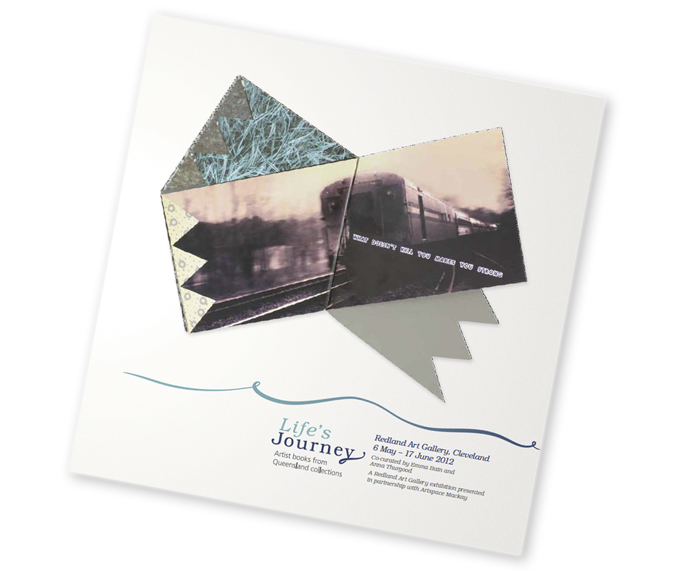
Life’s Journeys exhibition catalogue cover Redland Art Gallery
Judging a book by its cover a page
The artists’ book is usually sequestered away in library stacks and drawers in their neat little custom made archival cardboard boxes and plastic bags. In specialised library and private collections these are treasured objects; their owners become the custodian of the physical object of the book and the story is revealed in the site-specific act of reading within these spaces. But … sometimes they escape. On occasion artists’ books escape en-mass from their natural home of the library or private collection, and this is exactly the case with the exhibition Life’s Journey recently presented at the Redland Art Gallery, Cleveland.
Co-curated by Emma Bain Director of Redland Art Gallery and Anna Thurgood Acting Director of Artspace Mackay, the exhibition assembles books drawn from the significant, perhaps one could say—international quality, collections found in Queensland; Artspace Mackay (AM), grahame gallies + editions (gg+e), the State Library of Queensland (SLQ) and Studio West End (SWE). The exhibition’s themes, as highlighted in the catalogue essay by Louise Martin-Chew claim that they are intended to seek ‘out universal truths in individual journeys’, ‘the personal and individual’, …and ‘artist narratives with memoir-like threads’.
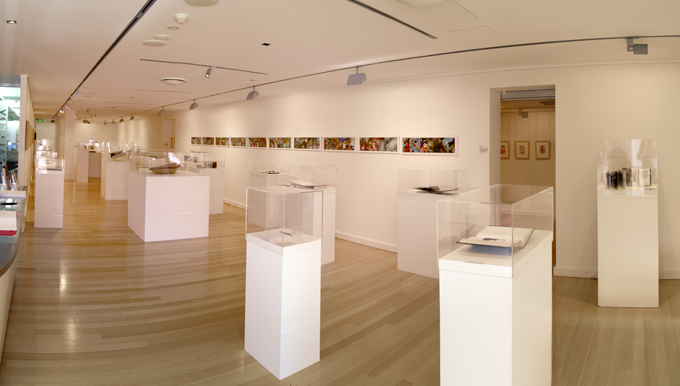
Life’s Journey exhibition @ Redland Art Gallery, Cleveland Photo: Doug Spowart
The viewer entering the gallery to see the Life’s Journeys books may not have read the catalogue, or have an understanding of the artists’ book discipline, but what they are to encounter in the white cube of the gallery space will be unusual. The Redland Gallery’s main room a literal forest of fourteen or more acrylic topped display cases. Inside each case resides the book, open to a page and resting on a stand or pillow. Some books don’t seem like books at all, they look more like 3D sculpture, or jewellery forms, or even things just fastened or bound together by threads. Other ‘books’ are in frames or on panels on the wall—one is even a projected image. It’s here where the viewer becomes acquainted with the ‘non-standard’ nature of the artists’ book—but there is more… The viewer can look at the narrative segment presented by the open page, or the expanded story presented in the wall-mounted works, or books that are of the concertina form. While being visually entertained by the titillating ‘sample’ view, the visitor may probably enjoy the encounter and will leave feeling a sense of discovering something interesting and unusual. But I would suggest that this is only part of the experience that the artists who made the books expected or wanted for those who see their books.
I know that this sounds like the continuing debate about the gallery exhibition of books where the sequential narrative that artists’ books require is neutered by single page views. But there is an issue, and for me a redeeming feature for shows like this, and that is that the display of artists’ books will encourage and excite people to hunt down these books in their usual library-sited storage spaces.
What I have written about before,* and what I will restate is, that these exhibitions are ‘tasters’ only. The exhibition strategy needs to include ways by which viewers can identify books of interest, understand how to access them, and then go-see, handle, read and fully encounter the artist’s communiqué. What is needed for the gallery viewer is a catalogue of the books and their source collections, how to access these collections, online references (maybe even flip-books of the works), perhaps even initiated within the exhibition space by QR codes or augmented reality clips. Using this concept the exhibition becomes an invitation for those who wish to take up the offer to handle and read the books in their site-specific habitat.
Now that’s off my chest, I have to say what an amazing collection of artists’ books the curators have pulled together. Seeing this cherry-picked selection in this context is far more interesting for me than looking through an online catalogue—here there is a sense of discovery. It’s a bit like going to a second-hand bookshop and just wandering through the stacks picking up whatever takes your fancy. Wandering through Life’s Journey was indeed an encounter with an eclectic bunch of artists’ books. Some of my favourites were there.

Adele Outteridge’s God Bless America Photo courtesy of Adele Outteridge
This included Adele Outteridge’s Teabag Book (2005) from SWE – just how many cups of tea were consumed to make this book? And another of Adele’s books, God Bless America (2003?) also from SWE, makes a political statement that can be read in different ways depending on the reader’s point of view of American society or foreign policy.
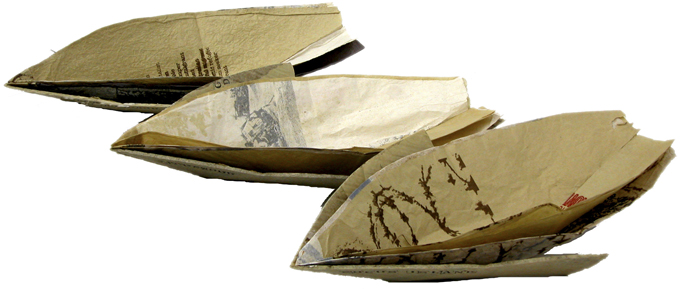
Books from the Codex Event 4 of which Naru is one (for reference only) Image courtesy of Tim Mosely
Another book Naru (2007), from the SLQ, was constructed from paper to form a 3D vessel—the book as a metaphor for a boat. The work was the result of a collaborative project entitled Codex Event 4 coordinated by Tim Mosely at Southern Cross University. Naru and the other books that were created by the team have an overtly political statement contained within their shape and the titling. These works comment on idea of the freedom that many people seek as they cross borders as refugees and how this conflicts with the Australian Government’s immigration policies.
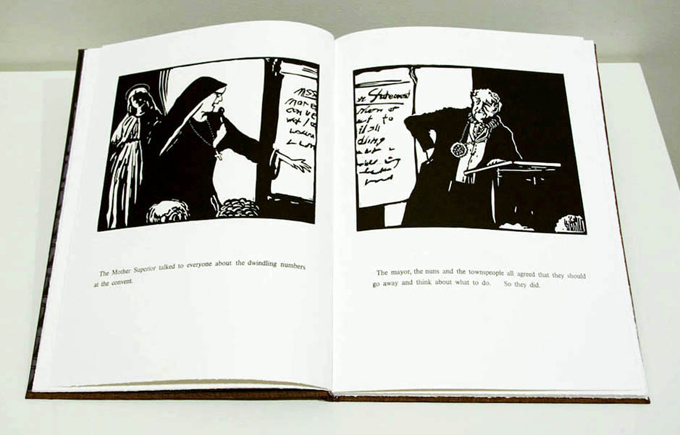
Sheree Kinlyside’s ‘The reluctant nun” (2009) @ 2010 Libris Artist Book Awards. Photo Doug Spowart
A fine press/printmakers book is represented by Sheree Kinlyside’s The reluctant nun (2009) from AM. The book was the winner of the Regional Artists Book Award at the 2010 Libris Artist Book Awards.
A book of a different shape, five sides(!) by American book artist Philip Zimmerman High Tension (1993), from gg+e, deals with a humorous look at contemporary society. The book is intentionally over-designed, montaging graphic elements and text with image narrative to make it an immensely interesting book—you want to pick it up and read through.
In the display of another book, Judy Watson’s Under the Act (2007) from gg+e, each page is framed and the work extends across one complete wall of the gallery. The folio single-sheet form of this book enables its reconfiguration to the wall possible. The work describes a personal narrative, a life’s journey, through the impact of oppressive white bureaucracy applied to Aboriginal peoples living in Queensland not that long ago.
Peter Lyssiotis and Noga Freiburg’s collaborative book Homeland (2003) from AM presents personal narratives of the authors, one a Greek Cypriot—the other an Israeli, about the way lines are drawn across maps to divide communities. The book invokes the story concept by using texts, family photographs and photomontages all bisected by a green line that divides the two communities.
One final book that I’ve always been inspired by is Scott McCarney’s Memory Loss (1988) from AM which deals with a medical condition that afficted his sibling. McCarney was recently in Brisbane with partner Keith Smith presenting an artists’ book workshop at the State Library of Queensland. This two-sided accordion structure book is replete with information from numerous sources including medical literature, personal photographs and correspondence. For me Scott’s book had truly escaped from the cases and was presented, sans protective acrylic lid, atop a plinth where viewing of one side was unobstructed. I think in terms of Scott’s politically subversive work that he would’ve liked that…
Life’s Journeys is a significant showing of what artists’ books can be and it puts the book firmly within the art gallery display environment. But none-the-less, with all the problems of display and the expectations that this commentator may have, the books do need to get out and about. They assert by their presence in the gallery that they exist and can be encountered by a diverse range of the art-interested public. And, perhaps is the case with any gallery exhibition, the viewer experience is something that develops and is enhanced by continued reflection after the viewing. The importance of the exhibition Life’s Journey, the accompanying exhibition Mind Mapping by local artist and bookmaker Jack Oudyn, and the associated workshops is that they will create much needed interest, scholarship and activity in the artists’ book genre. …. And hopefully inspire some viewers to become readers by pursuing the fuller of the artists’ book communiqué by engaging more fully with them when the books return to their respective collection homes.
Doug Spowart June 9, 2012
Please note: The links that I’ve selected to provide a visual connection with the text have been sourced from Google images and may not be the exact book presented for display in this show. I have found it interesting to discover how so many artists’ books are poorly, if at all, represented in the online domain.
PRESS THIS!!! Peter Wallis – Press Photographer

Peter Wallis with Vicky + Doug in Toowoomba (iPhone image)
We had a call today from Peter Wallis today to say he was in town and wanted to have yarn. Peter was a photography student of mine at Southern Queensland Institute of TAFE in the mid 1990s. For quite a while he has been one of the main shooters for Brisbane’s Courier Mail newspaper—mainly specialising in sports. As we sat sipping coffee Peter cradled in his hands an advanced production model from a well-known DSLR manufacturer that was being trialled by the newspaper. That seemed fitting as Peter always had a fetish for the latest and best camera technologies.
Peter Wallis was one of those people who truly loved photography and was a lot of fun in classroom and darkroom. One day he found our Canon 50~350mm zoom (white lens) and probably had it on permanent loan for most of the second year of his associate diploma studies. The lens went to the Birdsville races, to sporting events and places I daren’t ask about. His end of study folio was an impressive generalist photographer with a strong bias to media photojournalism.
On graduating from TAFE Peter fell into newspaper photography in the regional papers in towns like Bundaberg and Gladstone. His break came in the early 2000s when he was shortlisted for a position at the Courier. He and his fellow shortlisted applicant had to work at the paper for a few days to show how they would handle the job. At the end of their trial they were interviewed by the Pictorial Editor—they were both asked what they considered was their BEST picture. Apparently the other candidate pointed out their best shot from the folio laid out on the table—Peter was to tell me later that he’d remembered something I had spoken about during his study years, about the idea of thinking that the BEST picture ‘is the next one I’m going to take!’ He felt that way about his work and used that statement and got the job.
In the nine years since Peter has amassed a significant body of work in the newspaper genre as well as undertaken personal projects in India and Nepal. He is currently documenting the Brisbane Firebirds basketball team. In our conversation we discussed aspects of his industry over his 15 years or practice. He commented, ‘My first newspaper had a darkroom, then we shot colour film, processed it and scanned the images, and then finally we were presented with digital cameras.’
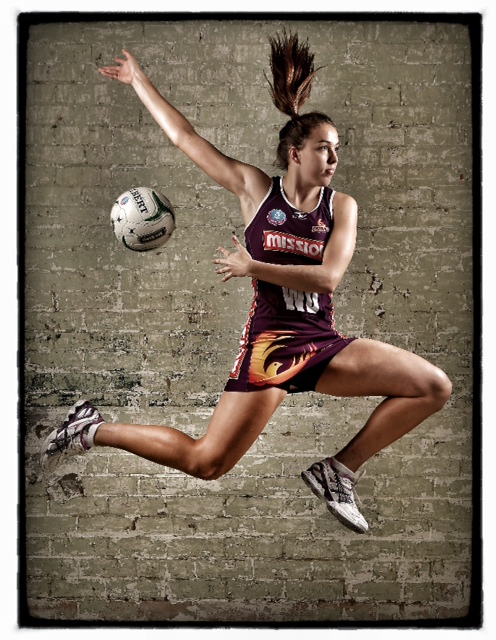
Firebird Shannon Eagland Photo: Peter Wallis
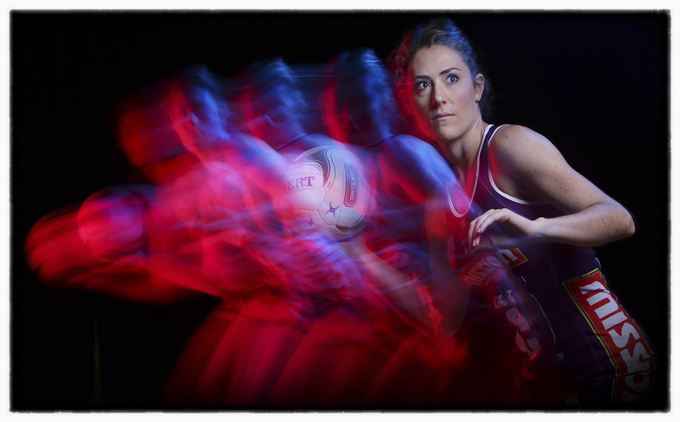
Firebird Elissa Maclead Photo: Peter Wallis
.
He continues commenting on how the picture got to the back to the paper. Film was straight forward as its physical nature meant that you travelled with it and lovingly processed it. Instant digital capture led to instant transmission. ‘We used to send our images back to the Courier Mail via a satellite dish, then laptop and phone—recently I travelled with Bligh on the election and didn’t even open a laptop. Sent everything back via an iPad. And now we shoot DSLR video and send that back as well’.

A grab shot – On the hustings with Bligh and Newman Photo: Peter Wallis
.
We spoke of concerns for the newspaper industry and the current challenge for the on-line 24-hour update and how images are syndicated through agencies like Getty. Peter has concerns about the future—but right now he’s living the dream that most photographers have that have a love of the challenge of being told by the editor to ‘go here … see the man … and make a bloody great image that I can publish’.

Sporting shadows Photos: Peter Wallis
Open any Courier Mail or Sunday Mail and on most days you’ll see a Peter Wallis picture and most probably it will be an amazing sporting peak action image or an editorial styled image with some kind of visual twist that captures your attention. As mentioned earlier most newspapers today are struggling to maintain print readership and their attempt to transition to online subscription is forcing a hybrid text, still image and video presentation. At this time Peter’s ability to conceptualise and create visually interesting images on the fly is as valuable as ever and stridently makes the claim that photos made by photographers are as important as ever in telling a news story in a moment, on the page, or … on the screen.
Doug Spowart
http://peterwallisphotographer.blogspot.com.au
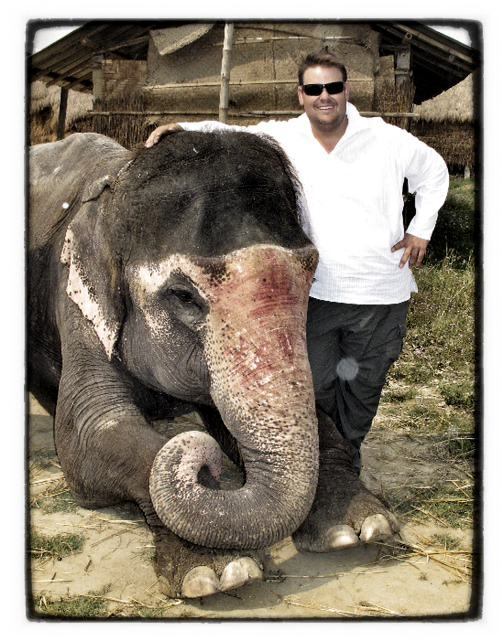
Pater Wallis with elephant
REGIONAL ARTISTS DOING IT FOR THEMSELVES
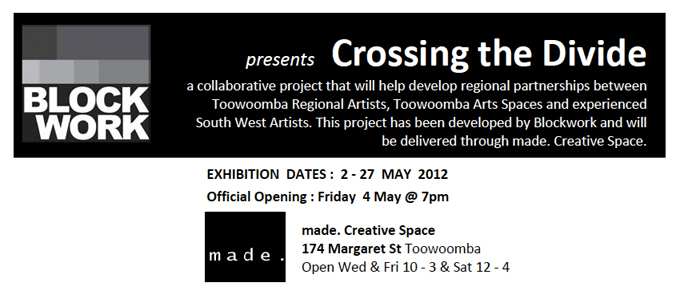
CRISS-CROSSING THE DIVIDE
Living west of the Great Dividing Range places regional artists far from the arts hubs of the capital cities where the opportunities for exhibition, audience and critical review abound. And whilst most regional artists crave the benefits of urban proximity they may be overlooking plenty of career and professional development opportunities within their own regions.
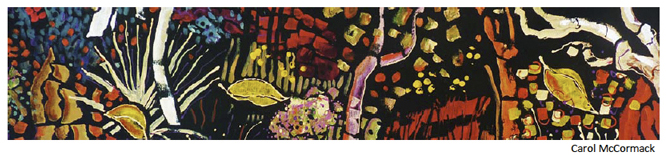
For that reason Sally Johnson, Director of Blockwork Gallery in Toowoomba, encourages regional artists to seek opportunities within their home boundaries. To show and share her ideas of what may exist for regional artists, she has curated an exhibition called Crossing the Divide at made.Creative Space, that featured paintings by Patricia Hinz, Carol McCormack and Catherine Rose.
The exhibition opening was well attended and the made gallery directors Alex Stalling and Elysha Gould provided a commentary about the exhibitions that were to open that evening—they also announced the imminent closure of the gallery and the new ‘pop-up’ exhibition strategy that they will be introducing, as well as Elysha’s new position in Miles as a ‘manager’ (?) of the Dogwood Crossing Gallery.
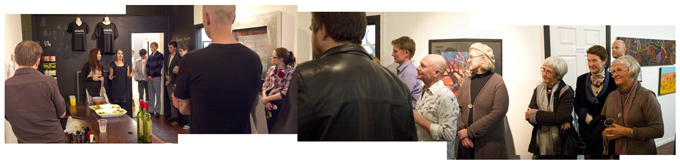
Attached to the exhibition was a workshop in which the featured artists participated in a discussion led by Sally that looked at the range of exhibition venues throughout the South West region. Emerging and mid‐career Toowoomba Artists were encouraged to expand their careers by considering exhibitions at the venues mentioned.
The artists represented in the Crossing the Divide show, Pat, Carol and Catherine then discussed the nature and history of their arts practice. Each had really interesting backgrounds in art-making and exhibition with experiences that included working with Mervyn Moriarty in the early days of Flying Arts, having exhibitions in New York and being driven on outback roads with a canvas spread out across the dashboard—painting.
A lively question and answer discussion ensued that connected the ideas and experiences of the three visiting artists with those from the local scene.
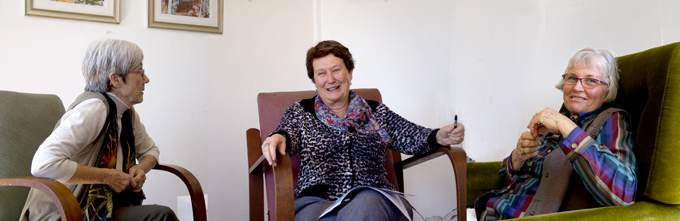
Carol McCormack, Patricia Hinz and Catherine Rose
Sally announced that this project will also include a managed interactive online forum that will allow for a continued engagement process beyond the workshop. It is intended that this forum will have the potential to act as a platform by which Toowoomba and South West artists can connect more broadly.
The workshop and forum received support from the Regional Arts Development Fund—a Queensland Government and Toowoomba Regional Council partnership to support local arts and culture.
For more information on the exhibition and the online forum contact, sally@blockwork.com.au or 0418 227 784.
Words: Doug
KEITH SMITH + SCOTT McCARNEY @ SLQ
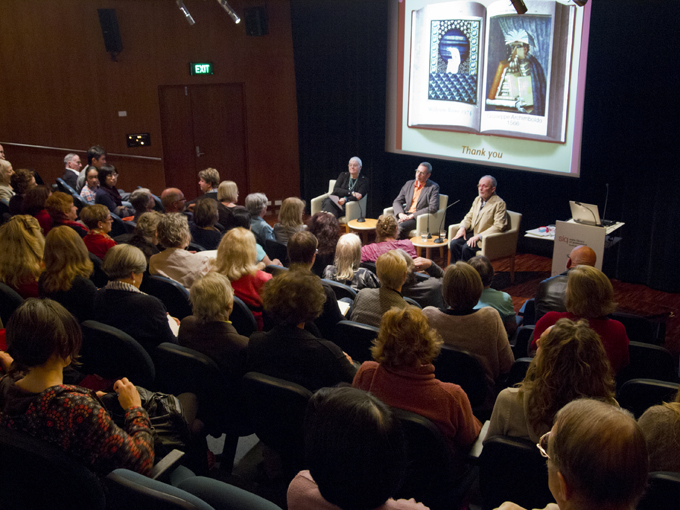
Please note: This post is derived from personal notes made at the event – They may contain some inconsistencies that are a result of my interpretation.
AUDIO NOW AVAILABLE @ http://enc.slq.qld.gov.au/audio/slq/pp/mp3/artdesign/Artistsbooks.mp3
In what looks like the one highlight in the Queensland artists’ book calendar for 2012 Keith Smith and Scott McCarney are visiting the State Library of Queensland to present a lecture about their work and to conduct a five-day workshop. Unable to attend the workshop due to teaching commitments I attended the talk at the SLQ today. I was not alone and the smaller SLQ auditorium was full of interested attendees — including some notables like Sarah Bowen, Adele Outteridge, Madonna Staunton, Wim deVos, Anne Marie Hunter and Lorelei Clark. The visit to SLQ by Scott and Keith is supported by the Siganto Foundation and members of the family were in attendance at the lecture.
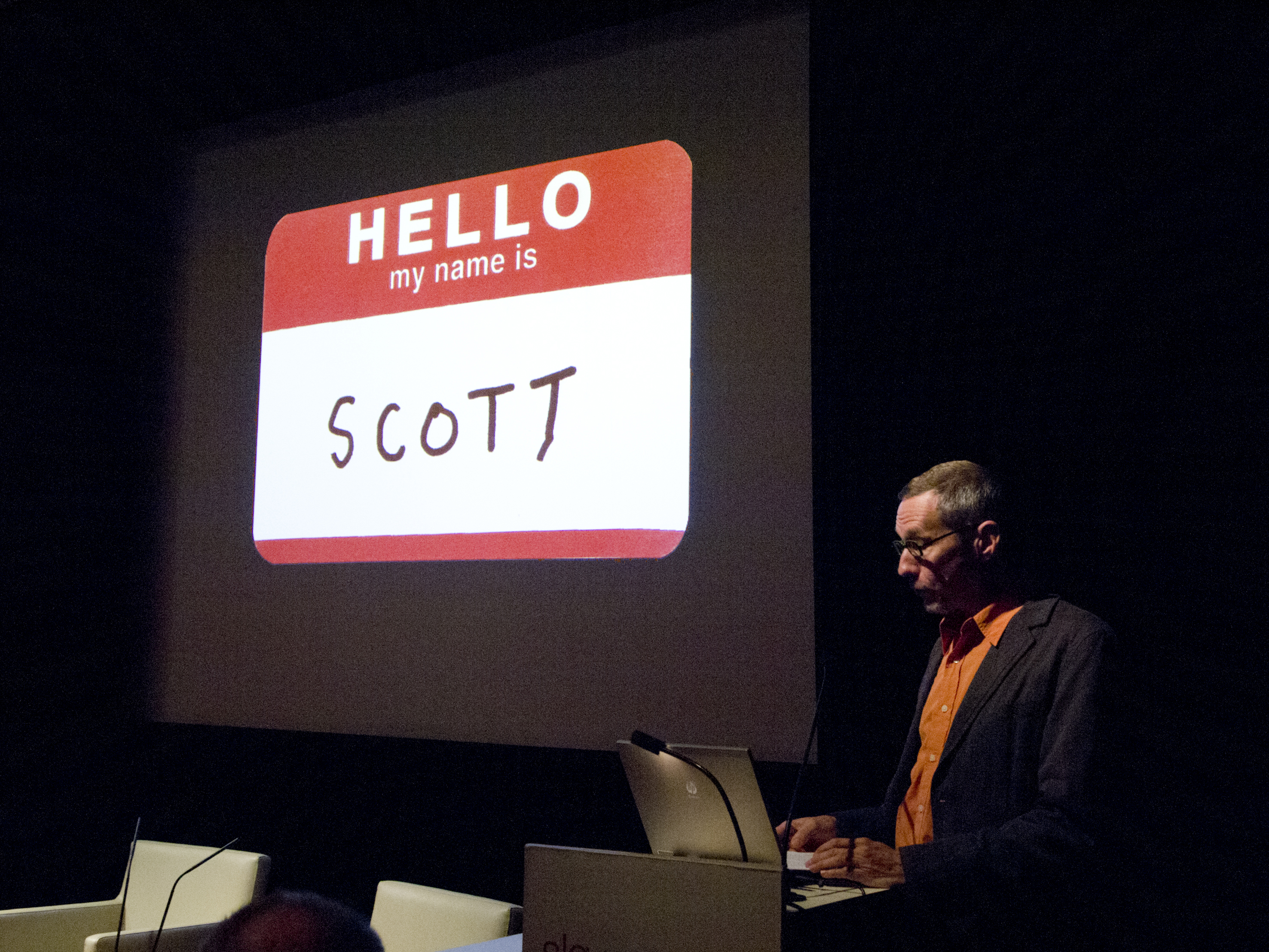
‘HELLO’ Scott!
After and introduction by SLQ Artists’ Bookie Helen Cole, Scott began his presentation by talking about the nature of the book in the digital age. He seemed to lament that libraries were beginning to change into Wi-Fi coffee houses — that’s not a problem for him as he believes the book, as a physical thing, will go beyond the electronic age.
He sees a real discussion about the future of the book is all about ‘display’. This remains a contentious issue for the artists’ book as they are difficult to handle and read as in exhibitions they are usually displayed frozen and ‘under glass’. Some of Scott’s work has been about presenting books as sculptural forms (Hanging Index) so the viewer does not really need to turn the pages to engage with the work.
Scott spoke in detail about his Autobiography series. He described how he couldn’t throw anything away and that he makes collections from things like name badges, rejection letters from galleries and grant applications, to-do lists and mud maps. This body of work provides an insight into the trivia and ephemera of life that escapes disposal through its transformation into his art. Connecting with the Internet world Scott’s Google Vanitas begun on Christmas Day last year represents the search results for his own name.
Scott showed many examples of works with where he cut through various pages within books to subvert the content of the book.
In a homage to Ed Ruscha Scott has taken Ruscha’s 1964 book Various small fires and milk and made his own take on the subject — Scott’s fires are those of riots and the curious inclusion of a glass of milk in Ruscha’s book is shortened to MLK, standing for Martin Luther King whose portrait appears in the book. l
A recent project by Scott was to participate in the al-Mutanabbi Street Coalition’s response to the car bombing of this street in Bagdad which was home to many of the city’s booksellers. Scott’s work Material Meditation on Mending Al Mutanabbi Street comprises fifteen two-sided loose-leaf prints made from collages made from remnants of found books, rubbings from bookbindings and photographs.
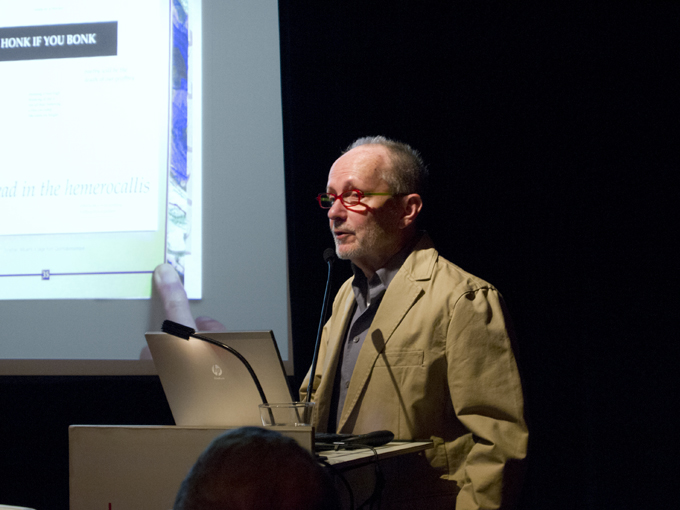
Keith Smith speaks
Scott then handed over to Keith who comments that he is now up into the 280s on his ever increasing list of books. He spoke of a number of book projects dealing with subjects like re-contextualisation of paintings of Saint Sebastian into Smith’s own painted backgrounds. Many variations on this theme have been created from an amassed collection of source paintings — he intimated that he was even working on a book as he was preparing to travel to Australia.
He spoke of his connection with the computer and digital book Bobby made as early as 1984 with an early Macintosh computer using MacPaint and MacWrite. In his latest work he has re-formatted the book and re-jigged the content. The new Bobby has been supersized to one of Smith’s biggest ever books.
One of Keith’s trademarks is the digitally created multi-layered photomontage and his rainbow borders and edges. He states that when using Photoshop he may be working with between 12 and 24 layers of colour. Pages for the book Seminal were shown as examples.
Book number 283 is Struggling to see deals with Smith’s continuing fascination with text and image. The book is dedicated to Nathan Lyons whose own books and image sequencing presents Smith with a constant source of challenge. Smith acknowledged Lyon’s mastery of organising images in a book in a way where the message of the book is spoken ‘between the pages’.
Question time yielded perennial questions to do with inkjet printers, papers, the ‘archivalness’ of the technology and editioning.
One questioner spoke of how books can be made by anyone via print on demand technologies …
Another question dealt with the montage …
Keith commented that the book tells him where to go …
A comment made by one participant was that they were coming to understand that with all the standardization of the book through language and form and that that is where the psychology of the artists’ book really kicks-in to say something else that we were not ready for…
A question about the eBook and where it fits in contemporary practice. Scott answered that with eBooks one must learn the tools and understand that they are about text in a multi-media platform and that translating work into digital form you need to recognise that it is married to the content.
Keith’s response was that was something for the younger generation, ‘I’m too old ….’ Perhaps it is, for him, that the eBook is not a tactile medium that you cut, fold, touch and be touched by — although it may be something else?
Doug Spowart May 28, 2012
NOTE: The SLQ will be posting this lecture online in the near future
JOHN ELLIOTT’s ‘GIFTED COUNTRY’

An image of the ballad of country and western

As a photographer attempting to communicate personal experiences and my, at least I think, special view of life and the world, occasionally I have thoughts that if I wanted to connect en mass I should have been into music! When I look at what music does to I see participants who will slap, tap, hum, whistle, laugh, tear up and even cry. Music sure beats the visual arts hands down as a way of creating a connected audience response. But an exhibition of photographs at the Caboolture Regional Art Gallery, just a few kilometres north of Brisbane, may just win some points back for the visual artist.
Gifted Country is a photographic exhibition of the doyens of the world of country and western music by Toowoomba photographer John Elliott. As a follower of the music industry for over 30 years Elliott has amassed a collection of the latest top hits and the golden oldies. On the walls of the gallery the faces of C&W music stare out at the viewer — frozen and mute. Elliott has reduced them to an eye-only sensory experience. The only sounds permeating the space are the shuffle of footsteps of other gallery viewers and the muffled voices of local community members returning books to the library next door.
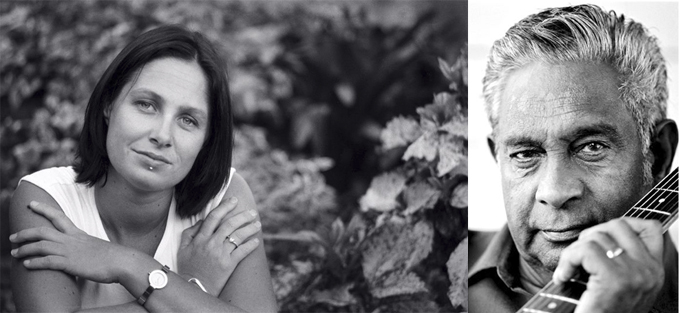
Casey Chambers + Jimmy Little
Before you get the feeling that the show is a little underwhelming there are other things to consider. Firstly the music and photography industry do share some similarities. Apart from practitioners at the most visible pinnacle of the discipline, those who make the sound and the image – the photographer behind the camera, the songwriter, the muso behind the lead singer and the mixer at the sound deck — are faceless. Only the products of their creative efforts are known to us. Okay, we can all recognise a Slim Dusty, Casey Chambers and Keith Urban from across the room. And that is perhaps because photographers like Elliott have made their image, apart from their music, famous. A reflective Jimmy Little leaning on a guitar neck (the one Little’s family selected as the ‘hero’ image for his recent funeral service), Lee Kernaghan stridently stands sky-pointing before a dramatic theatrically lit stage and a wide-eyed Chad Morgan’s face pokes out from his trade-mark safety-pinned hat. Once you’ve cherry-picked a few of the icons you are left with portraits of haggard faced, guitar holding middle-aged men, sweet smiling young girls and longhaired youths that crowd the rectangle photo frame.
What Elliott’s efforts bring to us is the human face of the extended country and western industry. These faces could be those of the waitress, the farm hand, the rodeo queen and the Big Mack truck mechanic. To help make the connection for the viewer Elliott pairs the portrait with the carefully chosen words of a biography that makes visible the musical provenance that we may share with the subject. Additionally a website links to interviews, commentaries and music to enliven the interest of those with a passion for C&W music.
What is remarkable is that over the years John Elliott has worked to amass this body of work. And this is not his sole interest — there are landscapes, urban vistas, other portraits and the personal and intimate moments of life. But this body of work has a quality and magnitude that sets it aside from the usual music documentary record.
This exhibition will be of great interest to the country and western dilettante, the music maker and the photographer alike. For this is a unique assemblage that is testimony to value of photography as record that is at once about history and the present — becoming history. The John Elliott Gifted Country performance will continue until June 23, and then, hopefully, will in the tradition of C&W — go on the road …
Doug Spowart May 26, 2012.
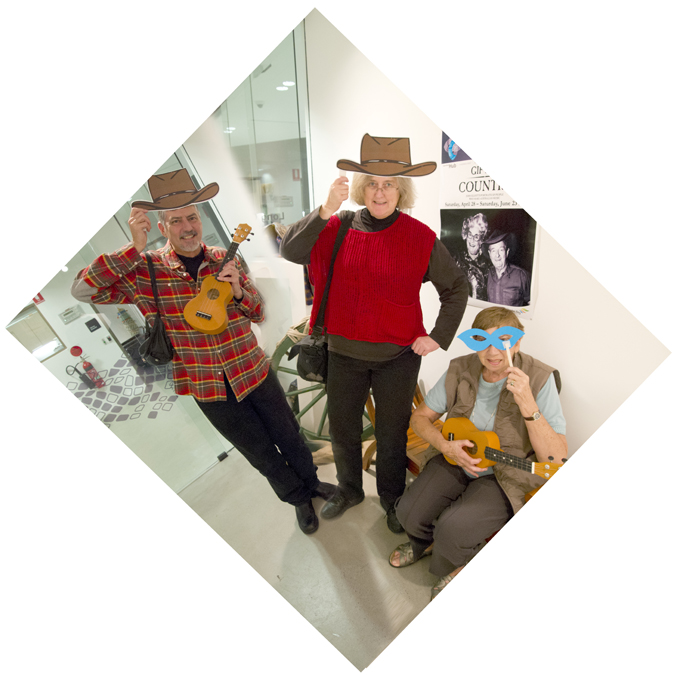
Also @ the Gifted Country show is a C&W PHOTO BOOTH – we had a bit of fun there …
What is this thing called art photography?
Visiting the 2012 Josephine Ulrick and Win Schubert Photography Award
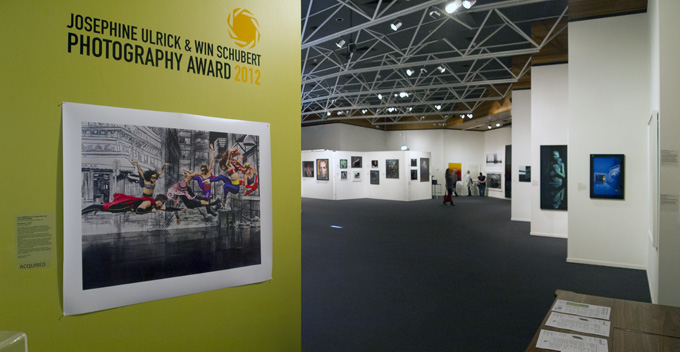
2012 Josephine Ulrick and Win Schubert Photography Award
What is this thing called art photography? Can it be nailed down and quantified? Each year across the country institutions and the judges they select attempt to do just that. Do they succeed? And is everyone happy about these events? A comment in the visitors book of 2012 Josephine Ulrich and Win Schubert Photographic Award at the Gold Coast Art Gallery makes the observation, something like “How high was the judge when he made that selection?” Well you can’t please everyone, and these awards with their huge prize purses do ultimately end up making one person ecstatic at winning and a few others happy by having their work purchased.
I for one am thoroughly excited by the depth and breadth of art photography that this award unearths each year. Although not an entrant for a few years my work, and collaborative works with Victoria Cooper have been displayed as finalists on 4 or 5 occasions, the exhibition continues to be a motivation for pushing our own work forward.
This year’s judge was Kon Gouriotis – Director, Australian Centre for Photography and the winner was Vestiges #3 by Sydney based artist Eugenia Raskopoulos. A press release about the award can be accessed HERE
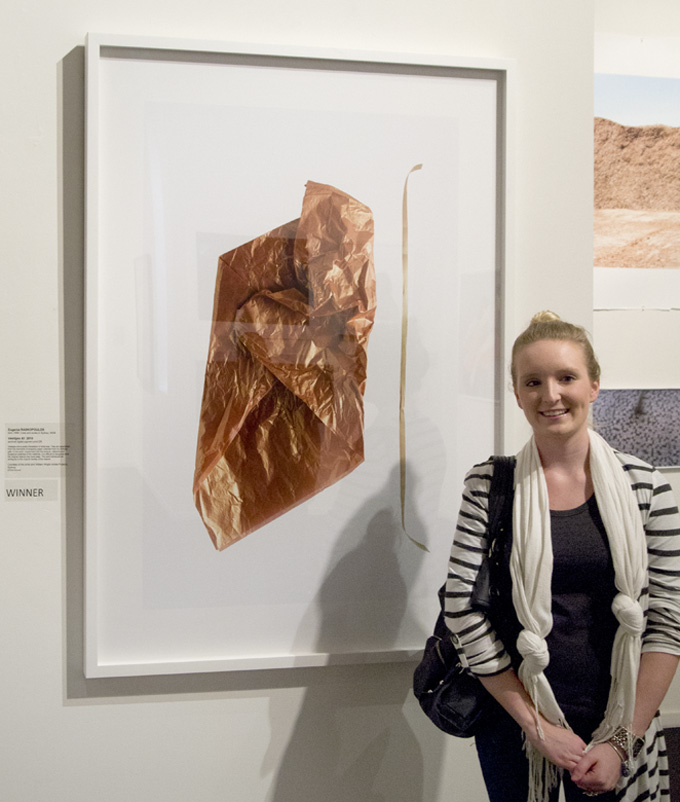
‘Vestiges #3’ by Eugenia Raskopoulos – with gallery visitor Tamekka
Over the years the Ulrich Award has gradually moved into increasingly large sized, huge framed or pinned to the wall works. This year 75 works were selected and this created what must have been an installation challenge. Double hanging of many photographs shoe-horned them into the space although due to this strategy some photographs suffer viewability problems.
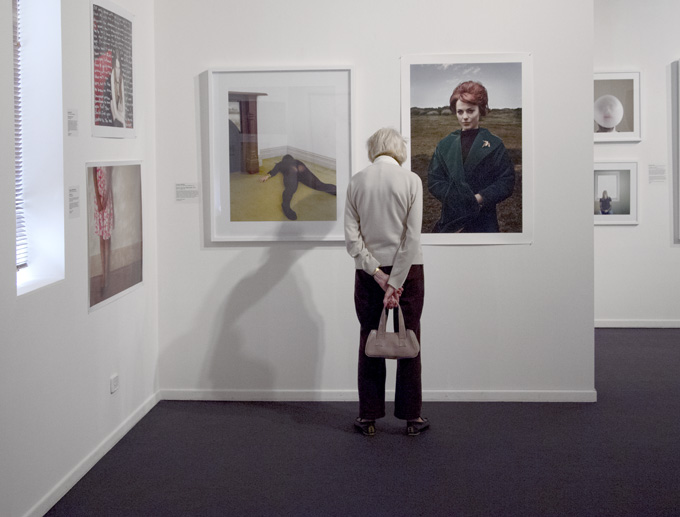
The gallery space
A new sophistication in artist’s statements on didactic panels heralds an increasing reliance from artists to attempt to direct the viewer into seeing the meaning of a work through a narrow, and perhaps confusingly worded sometimes pseudo-intellectual window. Robert Adams writes in his book Why people photograph that said that artists should not attempt to describe their work. He states that, ‘Words are proof that the vision they [the photographer] had is not … fully there in the picture.’
Anyway, be that as it may, one artist not only out does everyone else in square metres of wallspace but also presents an insightful statement that addresses the current photographic art scene. Hedy Ritterman’s Bollard 2011, for me was the standout conceptual piece for the show – the artist’s statement is well worth reading:
I abandon the idea of a photograph as a “window to the world” – instead I embrace the materiality of the surface itself. The highgloss, large scale photographic paper, with its fragility exposed, acts as a distorting mirror capturing the changing surrounds and highlighting its sculptural form. The distinction between the image in the photograph and the object of the photograph is underscored here. The subject of the photograph, a huge analogue negative of the museums’ people barrier, stands in direct opposition to the seductive invitation of the surface.
My work explores the complex relationship between the contemporary photo-artist, the collecting institution and the viewer. As photography shifts away from the print to the screen its status as object is being challenged. As photography shifts into the realm of the museum its object status is being valued.
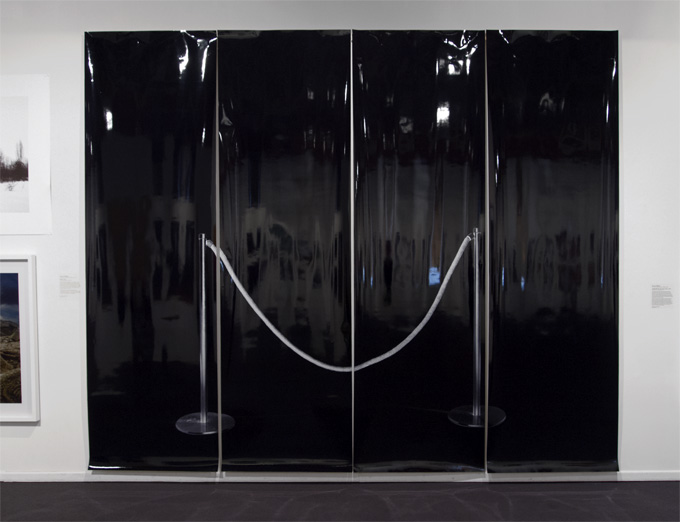
Hedy Ritterman’s ‘Bollard’ 2011
As a viewer what I like about the exhibition is the intellectual and visual calisthenics that I’m engaged in while walking through the space. Whether I, or you, agree with the judge’s decision or not, the exhibition still remains a celebration of contemporary photographic art that continues to challenge and reward the photographic and broader arts communities.
Doug Spowart
JENNY SAGES: Paths to Portraiture @ TRAG
A travelling exhibition from the National Portrait Gallery
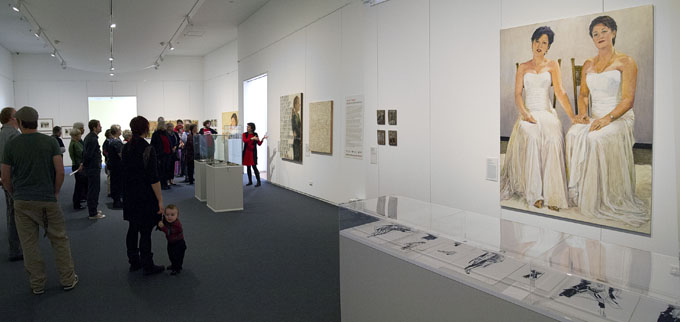
Christine Clark presenting a floor talk – ‘Jenny Sages: Paths to Portraiture’
A painted portrait, to be authentic, must be more than a visual transcription of the subject. A couple of years ago Christopher Allen, in writing a review of a photographic portraiture exhibition at the National Portrait Gallery made the statement that ‘humans are not ultimately machine-readable’. (Allen 2010) He claims that portraits by any group of ‘reasonably able’ painters do the task of portraiture much better than photographers as, ‘Every mark is significant, and records something seen and felt; intellect and intuition are one and become simultaneous with making.’
In encountering Jenny Sages’ Paths to Portraiture exhibition at the Toowoomba Regional Art Gallery Allen’s dictum is profoundly proved. The portrait works are layered with an expression of the artist’s relationship with the subject – Sages needs to develop a friendship with the subject, to share the space and moment and the ‘other’ sense-stuff that makes a portrait more than a likeness.
The exhibition Jenny Sages: Paths to Portraiture was curated by Christine Clark, Manager of Exhibitions from the National Portrait Gallery, Canberra. The show’s premise was to present more than a collection of Sages’ portrait work, but as the title of the show alludes to – the path the artist takes in making a portrait. Included with the finished portraits are reference drawings, ephemera, and objects referential to the subject that informed the painted portrait. For the student of painting and for members of the public who wish to understand more of the artist’s process these elements provide an insight that is not usually part of the experience we have of finished artworks.
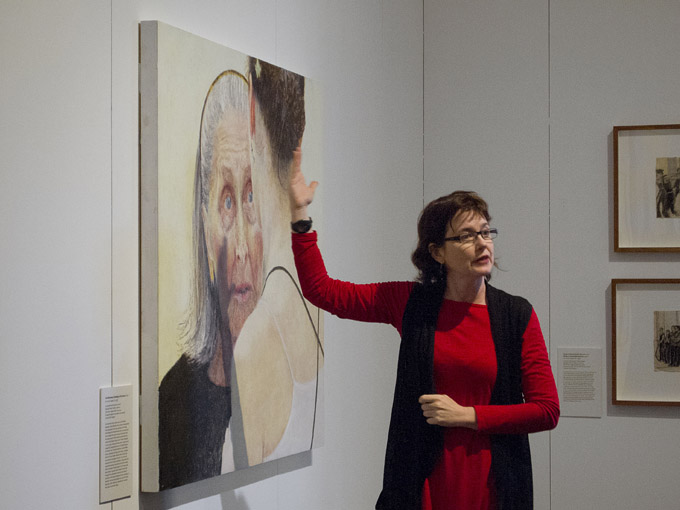
Christine Clark talking about Sages’ work
To compliment the exhibition Christine Clark presented a floor talk on the exhibition for around forty attendees from the Toowoomba art scene. Clark’s talk provided special insights into Sages’ background and the story of the paintings. She linked these stories with the displayed preliminary sketches, drawings and other objects making the experience of the art and Sages’ process rich and alive. Clark, through her enthusiasm for the artwork and her expressive gesture and discussion, took all present at the floor talk to a higher understanding and respect for the work before them. Thank you to the NPG, TRAG, Christine Clark and Jenny Sages for the opportunity to see and hear about this artist’s work in portraiture.
Doug Spowart 20 May 2012
Allen, C 2010, ‘Through a lens darkly’, The Australian, July 3, p. 11-2.
IAN POOLE: AIPP On the Lounge

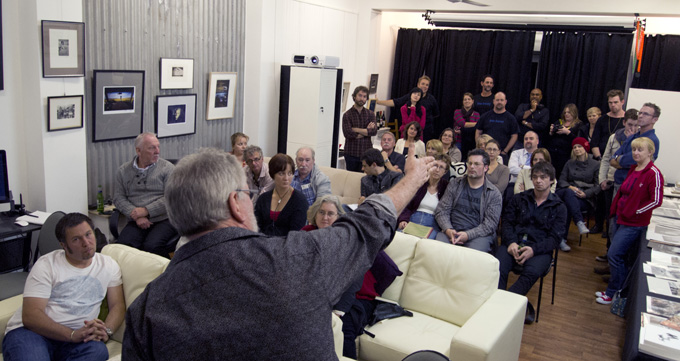
Ian Poole addressing the audience @ Photo Frenzy
Ian Poole is well placed to have an opinion about fine art photography and collecting photographs. He has been a major player in professional photography in Brisbane for nearly 40 years and is a respected AIPP judge with yearly invitations to also judge the New Zealand Institute of Professional Photography awards. Despite his professional photography connection he has been a part of a sector of the Queensland photographic art scene that extends from the early 1980s with Imagery Gallery, later with the Photographer’s Gallery and more recently with the Queensland Centre for Photography. He has completed a Graduate Diploma in Visual Arts from the Queensland College of Art and has been awarded an Australia Council residency in Tokyo. Adding to this he has curated photographic exhibitions in Japan (of Queensland photographers) and exhibitions in Australia (of local and Japanese photographers).
So when Poole offers commentary on aspects of the photographic art world of Brisbane and Queensland it should be something of an opportunity to connect with his extensive knowledge of the genre. Recently as part of the AIPP ‘On the Lounge’ lecture series Ian Poole presented to an assembled audience of around 40 a dissertation entitled, ‘Have you ever wanted to collect photographic art, or be collected as a photographic artist?’

Ian – getting his message across with passion
Ian Poole began his presentation by reviewing recent art auction records for photographic artworks including those by Adams, Sexton and Dupain. Thousands, hundreds of thousands and even millions will change hands for well-known and rare works. The recent phenomena of Nick Brandt’s African work,which had been shown only weeks earlier in Brisbane, attracted some discussion. Perhaps some in the audience felt a little inspired by the possibility that, if they could enter the fine art field, that there was recognition and the possibility for a significant income to be made.
Poole introduced his collection of images that were hung on the walls and laid out on tables before the audience and discussed their histories and stories. For him the concept of ‘provenance’ elevated the importance of each work. A small Dupain image of the interior of the National Gallery in Canberra made during its construction was linked to his encounter with the work in a Brisbane gallery where it was purchased for a few hundred dollars. His most exuberant discussion related to a Joachim Froese diptych acquired when he swapped it with Joachim for a 4×5 enlarger. An expanded provenance trail led to it being loaned back to Joachim so that it could be displayed a QUT exhibition of his work.
A long-term friendship with north Queensland photographer Glen O’Malley presented some interesting provenance stories. O’Malley is not fully recognised for the significance of his practice in Queensland – he could probably claim to have had the first ‘photographic art’ exhibition in this state in the mid 1970s. Poole presented to the audience an image from O’Malley made as part of the Queensland Art Gallery’s 1988 Journeys North commission. The 20×24” black and white photograph showed a scene in Poole’s home where the O’Malleys were having dinner. The image was part of the accepted images for the Journeys North show and was subsequently published. Somehow Poole’s own life had become art photography itself.
Another photography collaborator presented by Poole was John Elliott. Well known for his documentation of country and western music and its heroes and doyens including Slim Dusty, Chad Morgan and Jimmy Little, Elliott is an enigmatic character of the photography scene. Ian spoke of John’s most recent show Gifted Country at the Caboolture Regional Art Gallery and his photobook publishing ventures. A recent journey to Townsville that Poole had shared with another of Queensland’s enigmatic photographers, Maris Rusis, resulted in a body of work by Rusis that dealt with the décor of budget north Queensland motel rooms. These small and fine gelatin silver fibre B&W prints presented to the audience the fact that traditional values remain key to some workers who continue to practice analogue photography in a digital world.
Question time brought up some difficult truths – Why does the Queensland Art Gallery/GOMA not seem to be collecting photography generated within this state? Did they ever collect? Some discussion related to the archival needs for conservation framing and presentation.
As a conclusion to the presentation Poole spoke of the way in which he and his photography acquaintances swapped and shared their works, and how much of his collection was built around the generosity of fellow photographers and their desire to share. He held a bundle of his own gelatin silver images up before the audience and made an offer that ‘you can have one of my prints this evening – and send a print to me as a swap. Start your collection this evening …’
While Ian Poole began his presentation with a review of the overtly mercantile auction scene, it seemed that his passion about photography, photographs, friends, shared experiences and the meaningfulness of the provenance of the works, that these things could not be commodified. He spoke of his collection of photos, books and ephemera as being an entity that would be bequeathed to his daughter Nicola, also a photographer and present at the talk. Through the audience he directed to Nicola to ‘treasure and look after these things … they were important, valuable – not only as the stories they depicted through their image on the front-side of the print, but also of the back-story of their origin and collection.’
There is no doubt that Ian Poole’s passion for photography and his understanding of how it operates at a personal and cultural level is something that was shared and communicated on this evening. And those present will be inspired to develop a new appreciation of what photographs are and what they can say about the human condition.
Doug Spowart May 20, 2012
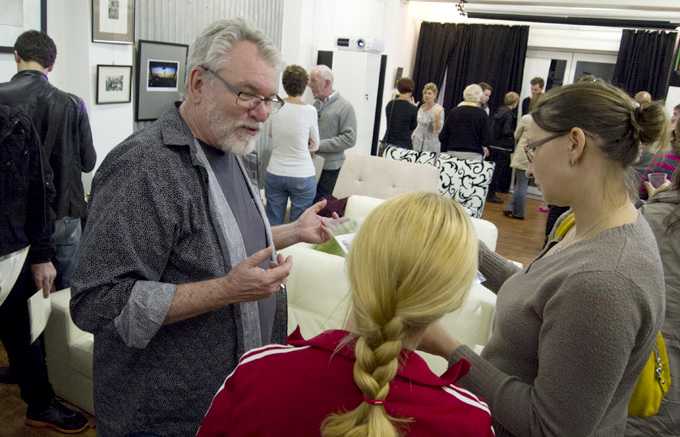
Ian talking with OTL attendees at the end of his presentation
An unusual meeting – Face-to-Face with an early portrait of one’s self – circa 1982 found in Poole’s collection


 wotwedid