MEETING JULIE BARRATT@Grafton Regional Art Gallery
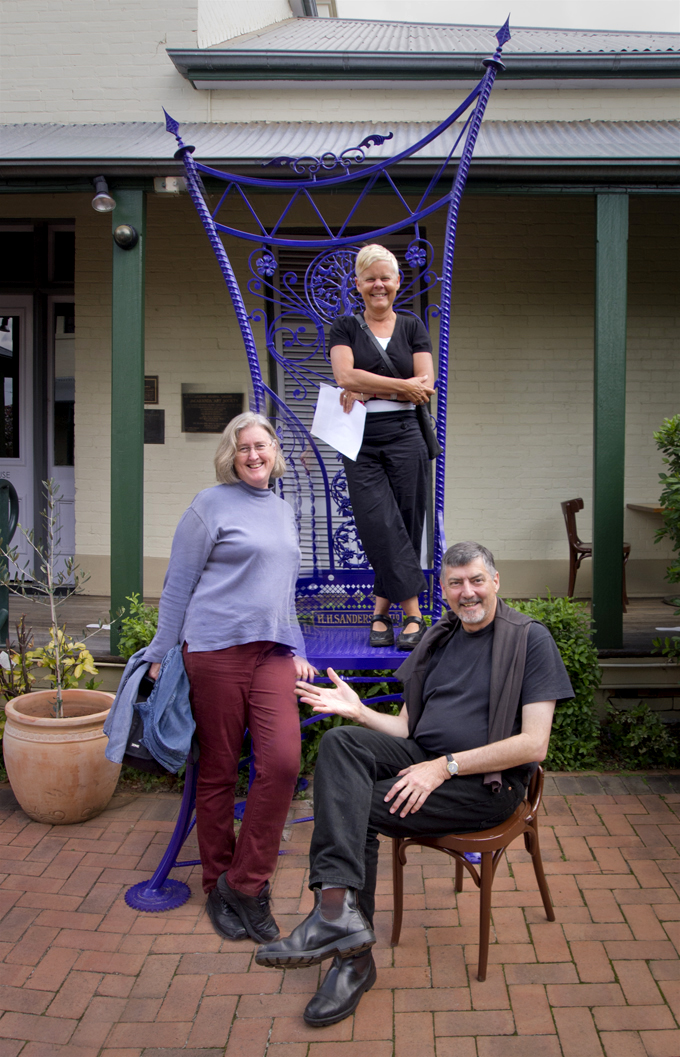
Julie Barrett on the Big Chair @ Grafton Regional Art Gallery with Victoria+Doug
As part of her role as Arts and Disability Manager for AccessibleARTS Julie was visiting GRAG to review proposals for an exhibition that is designed to cater for people with a disability. The exhibition, scheduled for later this year will feature works from the gallery’s collection that will be reinterpreted by local artists with the twist being that the new works need to be ‘viewable’ by visually impaired people—sounds like an interesting project.
We did lunch at the gallery and discussed a range of topics—it has been a while since we’d connected (SEE Wotwedid post JUNE 2011). We shared updates on our art projects; Julie spoke of another amazing project working with Aboriginal women from Central Queensland working with textiles and print techniques on silk that stretch for many metres. She is curating a show of this work at the Rockhampton Regional Art Gallery. Julie has a work in the upcoming Democracy exhibition @ Grahame Galleries in Brisbane and recently she was the recipient of the Alumni Award for the Arts and Social Sciences Faculty at Southern Cross University.
Julie was presented with a copy of our most recent Artists Survey book that deals with the encroachment of mining on farming lands in Queensland. She opened our booklet, read a few of the ‘signs’, appreciated the irony of the text and put it aside to review at length later. She then recounted the story of her childhood in North Queensland where the family owned the Blair Athol Station. Well, the property and the school that she attended were mined, disappeared—a huge open cut mine. At school the students were warned of blasting by a siren. They would then go and press against the library shelves to stop the books being vibrated out onto the floor. This and other memories of this mining encroachment are still strong for her and are being somewhat relived by CSG activities that are gaining ground in Northern NSW.
She needs to make art about it. Maybe we all need to whether or not it will change anything. We’ve recently come across a quote from Gerhard Richter that alludes to the circumstances of being an artist—the words may have resonance for any artist in any medium. He states,
“Painting is consequentially an almost blind, desperate effort, like that of a person abandoned, helpless, in totally incomprehensible surroundings—like that of a person who possesses a given set of tools, materials and abilities and has the urgent desire to build something useful which is not allowed to be a house a chair or anything else that has a name; who therefore hacks away in the vague hope that by working in a proper, professional way he will ultimately turn out something proper and meaningful.”
Gerhard Richter Notes1985 in The daily Practice of Painting edited by Han-Ulrich Obrist and translated by David Britt. London, 1985 p121 (note from 18.5.1985).
Imagine you know: Emerging artists in your community
Imaging you know, the 2012 Toowoomba Biennial Emerging Artists’ Award
Awardees names and works are listed at the end of this post…
September 16 – October 14, 2012
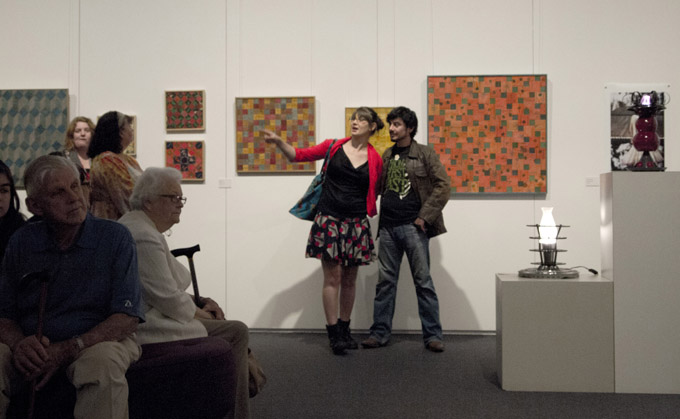
At the Biennial Emerging Artist’s Award
It is hard to measure the vitality of a community’s emerging art practice. For Toowoomba, the Biennial Emerging Artists’ Award provides a survey creates an opportunity to see the artists and their work. And from this year’s exhibition it appears that Toowoomba’s art scene is truly alive and vibrant. Eighteen artists were selected as finalists and at the award opening 11 artists had 20 of their works selected for purchase by the Toowoomba Regional Art Gallery.
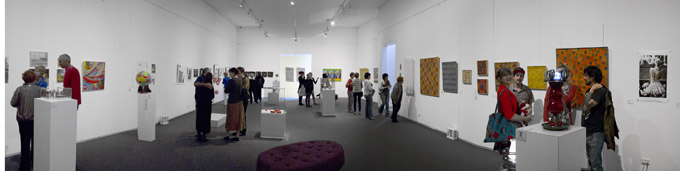
TRAG – Emerging Artist Award panorama
The title ‘emerging’ implies the younger artists however this show provides evidence of the ‘older emerging’ artist.
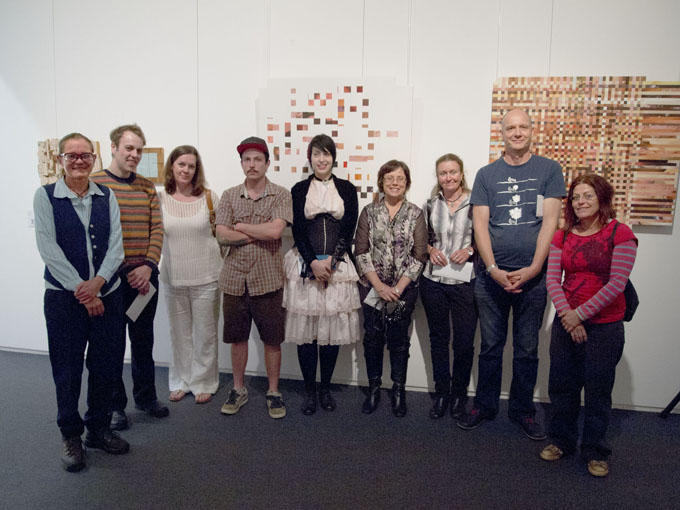
9 of the awarded artists
A detailed catalogue accompanies the show with an essay by Sue Lostroh and artist’s statements and images. From my point of view considering the ubiquitous nature of photography that few photographs were in the show. The selected works will form part of a travelling exhibition that tours the region under the title of Crates on Wheels Travelling Schools Exhibition.
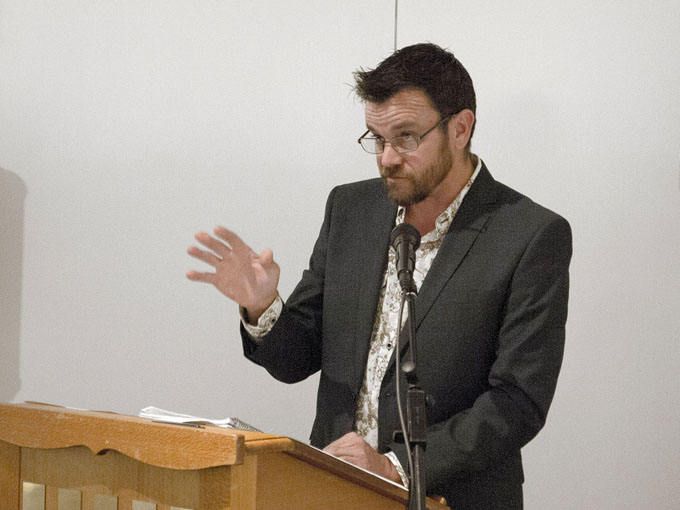
Evan Hollis opens the Awards
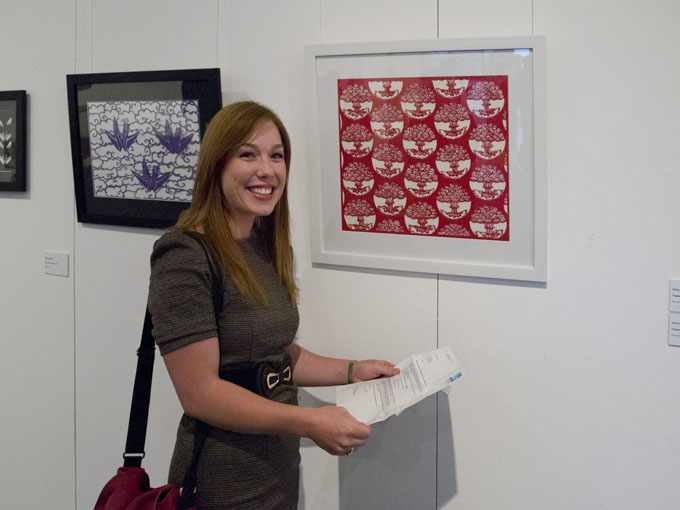
Elysha Gould with Award letter
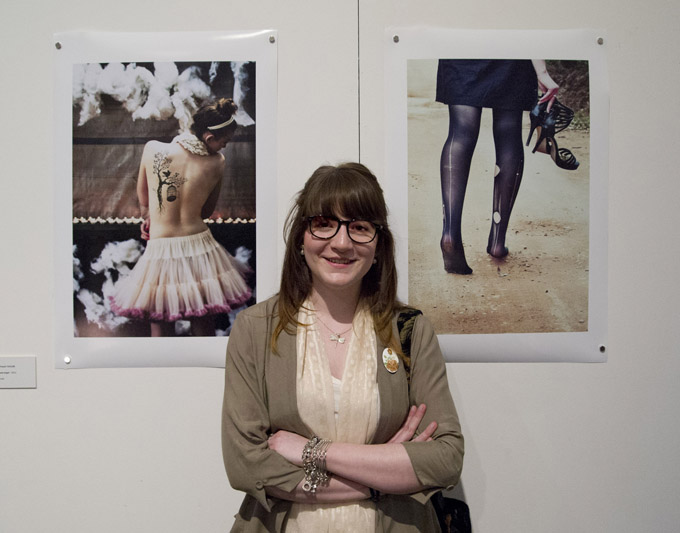
Yseult Taylor with her selected photographs
Ultimately, what is exciting about the award is the diversity of approach to the process, media and visual communication that art is and can be. Significant to this is the role that the Toowoomba Regional Art Gallery plays in providing the vehicle by which this work can be given a space for it’s appreciation and enjoyment.
.
Doug Spowart
17 September, 2012
Eleven Artists and twenty works selected for the Crates on Wheels Travelling Schools Exhibition in 2013.
(Information supplied by TRAG)
Miles ALLEN 2 works
Marrakech 4
Stacking carrots
Elissa BELLERT 1 work
Red elephant
Elysha GOULD 1 work
Nuclear power plants
Sandra JARRETT 3 works
Objects of worship series 1
Shifting sands #1 and #2
Nicki LAWS 3 works
A rich industrial past
When the mining boom ends
Old buildings are full of stories
Ian McCALLUM 1 work
Beyond seeing
Kelly-Marie McEWAN 3 works
Fairy-ring, Emergence part 1, part 3 and part 5
Tarn McLEAN 2 works
Topography #9
Topography #9—Globe
Chelle McINTYRE 1 work
Rash analogy
Donna MOODIE 1 work
Heartwood
Danish QUAPOOR (The Alter ego of Daniel Qualifchefski) 2 works
i am my hair
hanging by a moment
‘TAKE 3’ @ Block Work Gallery (Toowoomba)
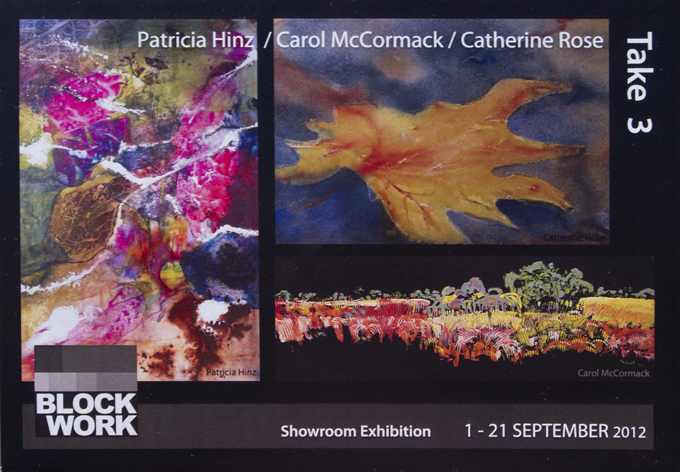
Block Work Gallery – Take 3 Invite
We visited the Block Work Gallery on Saturday for the opening of the exhibition TAKE 3 featuring paintings from three Western Downs artists – Carol McCormack, Catherine Rose & Patricia Hinz. The gallery’s ‘white box’ walls were laden with the colours of the landscape, abstract forms and quirky stuff that artists just happen to see and then share with us through their work. The gallery was filled with supporters and well-wishers, and hopefully a few interested in purchasing work.
Gallery Director Sally Johnston has once again shown her gallery’s support for the regional artist and their vision – congratulations on a great show.
Here are some images of the event, the artists and their work…
.
.
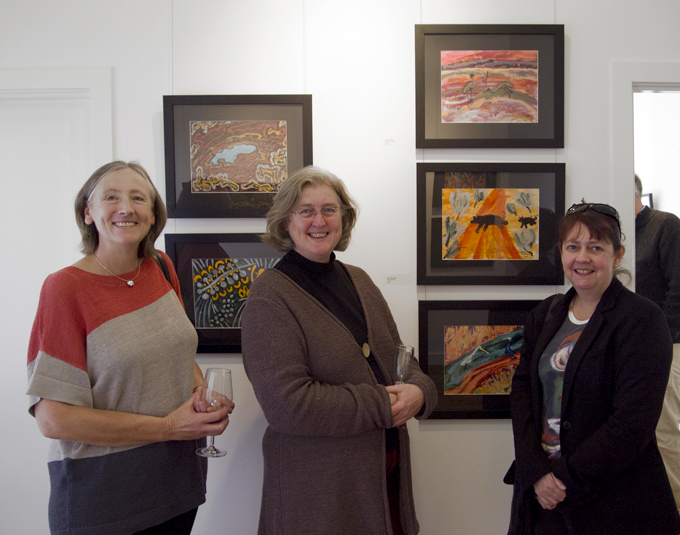
Felicity Rea, Victoria Cooper and Deb Beaumont @ Take 3
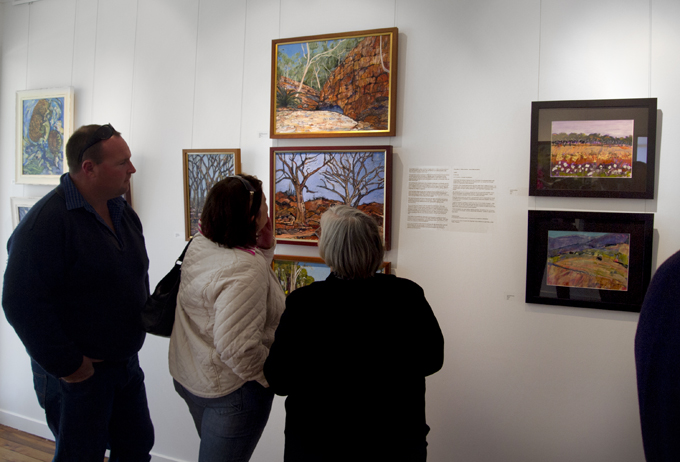
Take 3 exhibition, Block Work Gallery
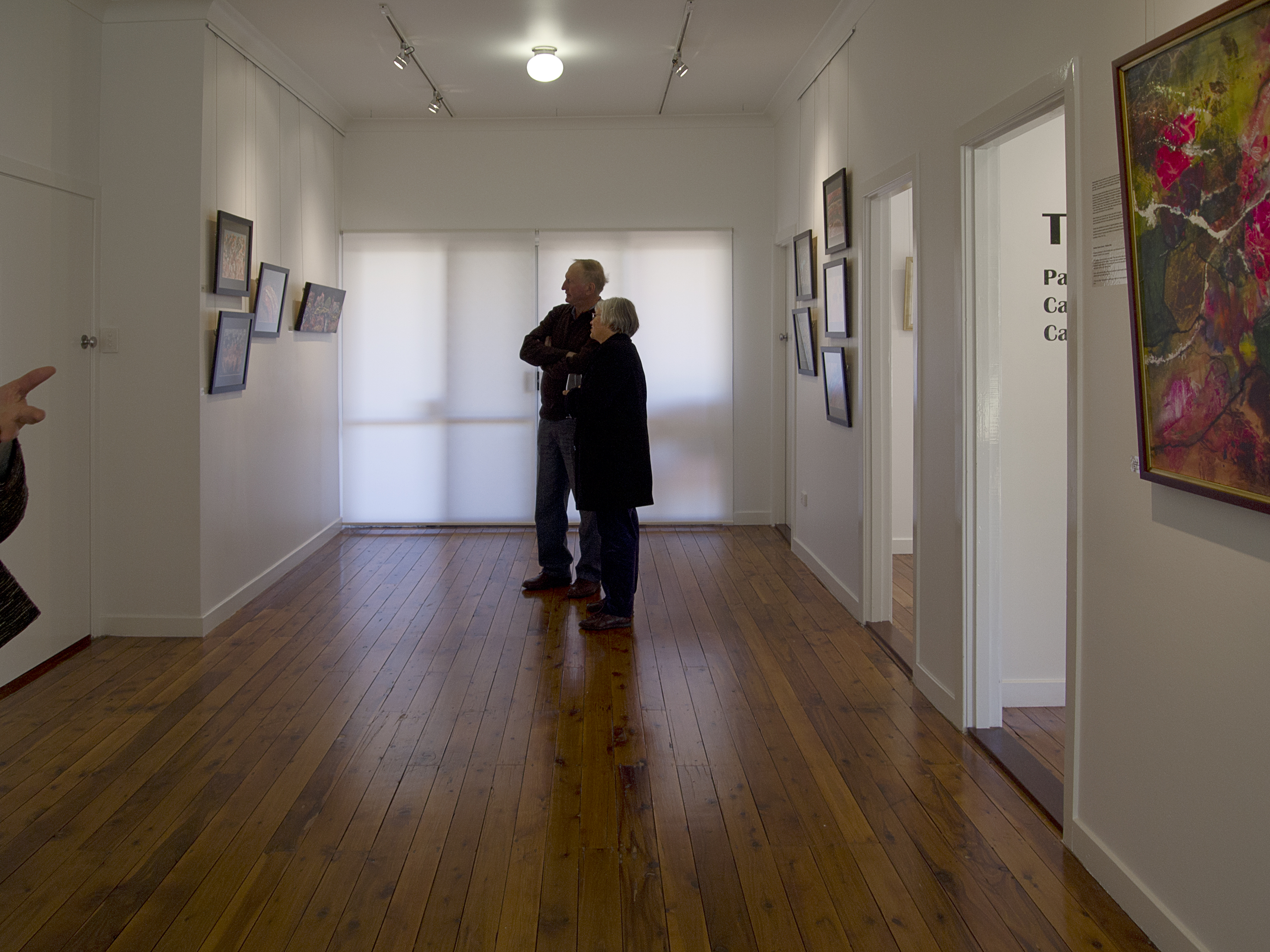
Take 3 exhibition Block Work Gallery
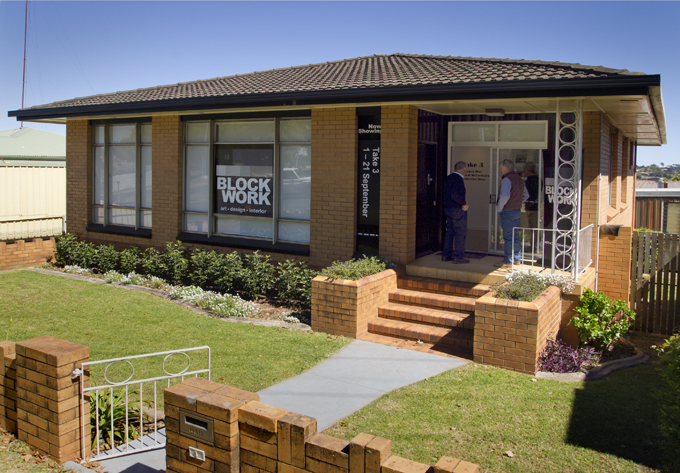
Block Work Gallery IMAGE: Doug Spowart
FROM TOOWOOMBA TO SPAIN AND BACK AGAIN – IN 24 HOURS!
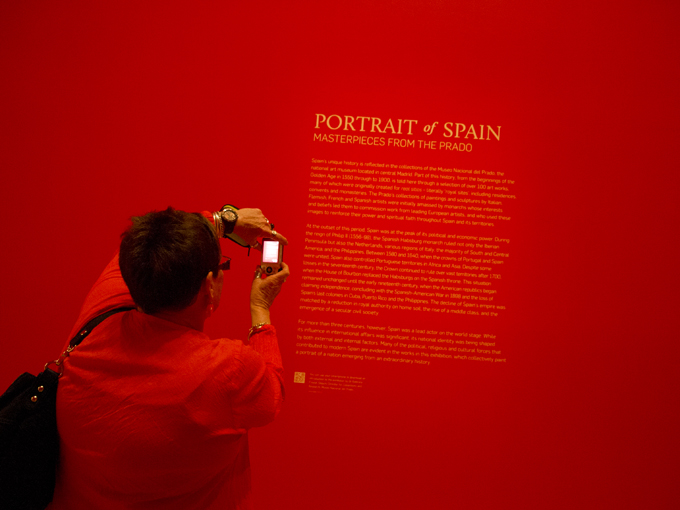
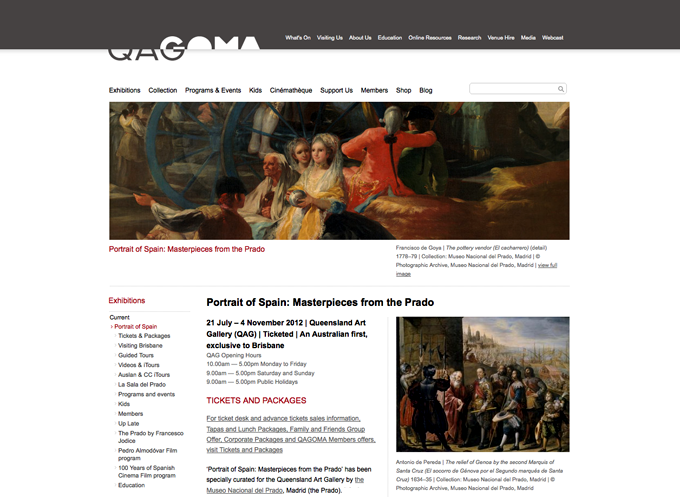
The fastest way for a Toowoomba person to get to Spain is to visit the Portrait of Spain—Masterpieces from the Prado exhibition at the Queensland Art Gallery. 100 paintings and prints are on loan from the Museo Nacional del Prado, Madrid. The QAG walls have been re-painted red and the gallery has been converted into a little Spanish culture experience.
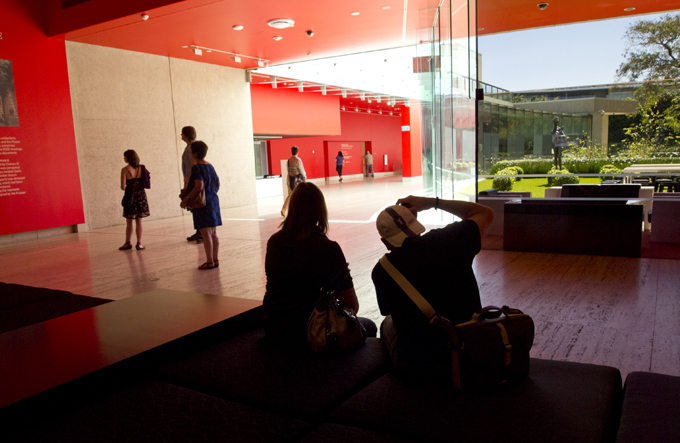
We visited the show last Saturday and participated in what was offered to the viewer/attendee.

Vicky and Doug @ Prado trompe l’oeil
The paintings were magnificent examples of oil painting from the 16th-19th century. Spanish aristocracy, royalty, religious iconography, decorative still-life and court-life. There were no nude or clothed Majas, no Meninas nor swirling clouded El Greco landscapes however there were a few of the famous work to stir the interest. One work of huge scale and interest was Pereda’s The Relief of Genoa.
The exhibition is extended over many rooms and is broken into eras and subject matter. Didactic panels and QR coded prompts help the visitor to discover the curator’s spin on what they are seeing.
All in all the Spanish portraits seem a pretty interesting lot. Fine clothing, porcelain skin, mustashes (even on some women), dogs, horses drawfs and aloof expressions abound. Then you enter the Goya’s Disasters of War series—It’s a reminder that for much of the duration of time that this exhibition covers the Spanish were at war with most of Europe at one time or another and were exercising colonial power and plunder in Central America, the Phillipines and other places.
The last room of the exhibition features the 19th century—some predictible landscapes, one entitled ‘Landscape with sheep’, our own QAG Picasso La Belle Hollandaise and some works which didn’t seem to add to the narrative of Spain in the context of the emerging trends in world art at the time.
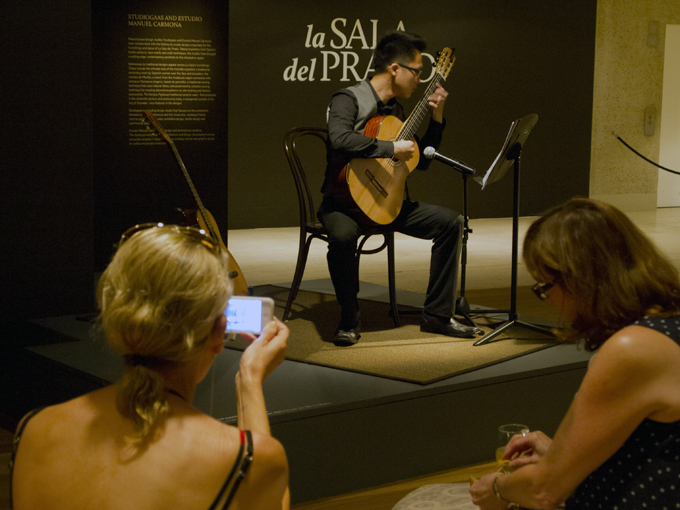
We breezed through the exhibition shop and were drawn to the Tapas Bar for lunch after which we were enticed to play with the ‘DIY interactive portrait photobooths’ and the still-life drawing stations accompanied by a Spanish guitar performance.
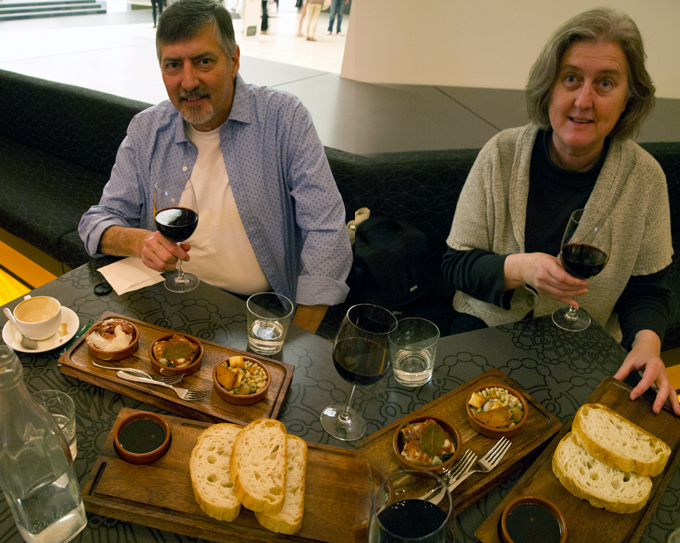
Seeing the exhibition is one thing but now, in the contemporary manifestation of gallery, we experienced a little more; Spanish culture, the work practice of the artist and other entertainment. We went to see a art exhibition and came away with so much more …
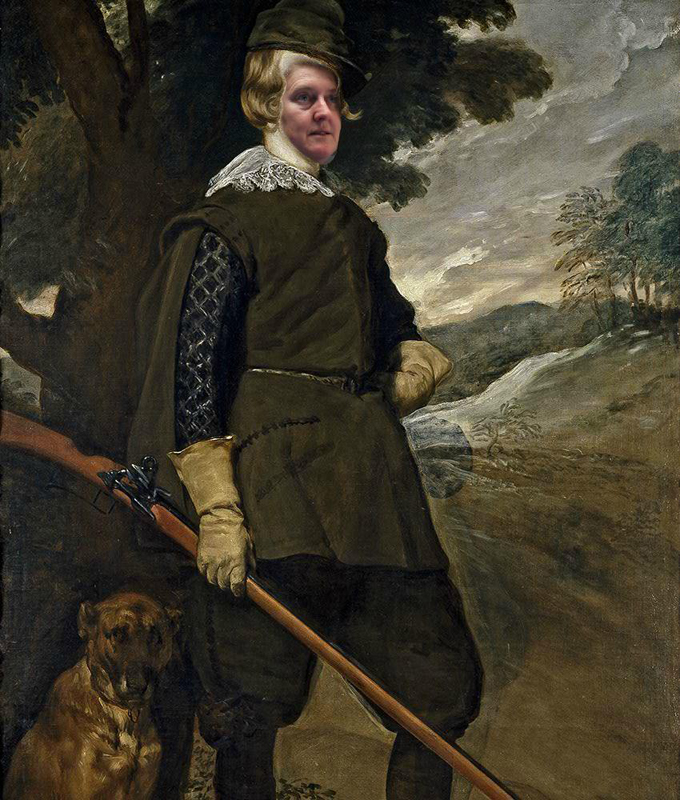
King Victoria
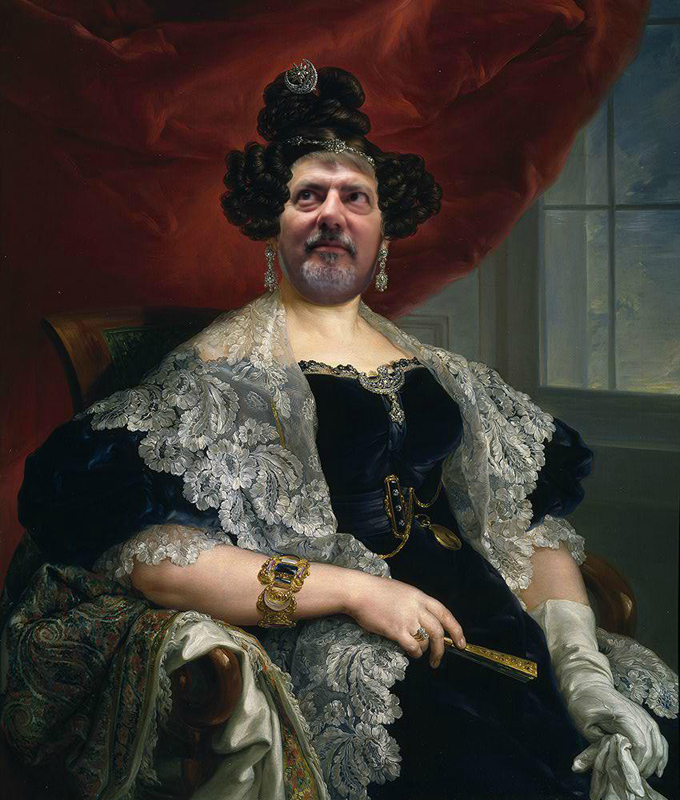
Doug posing as a moustached lady
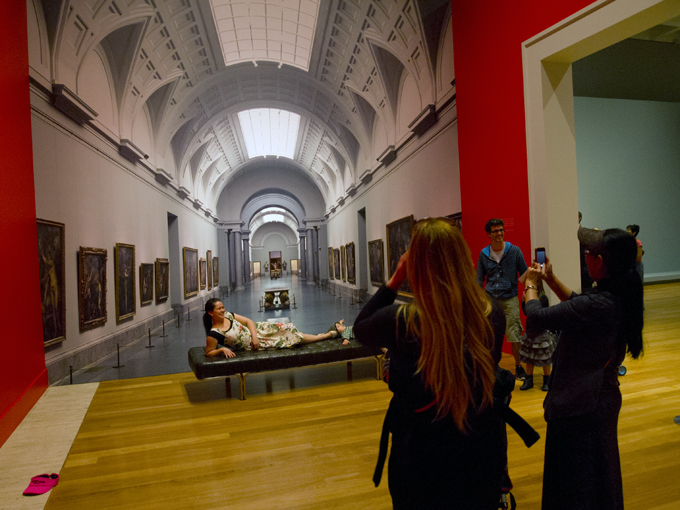
A visitor poses as the ‘Clothed Maja'(?) before the trompe l’oeil
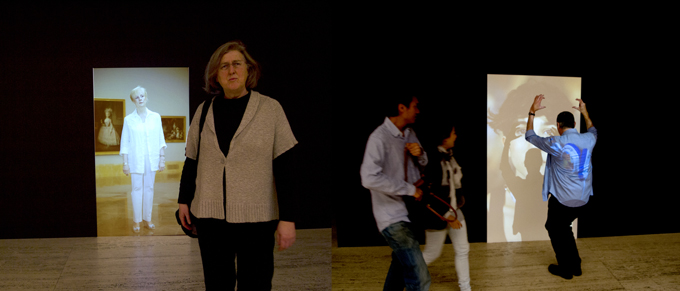
Playing with projected images of Prado visitors
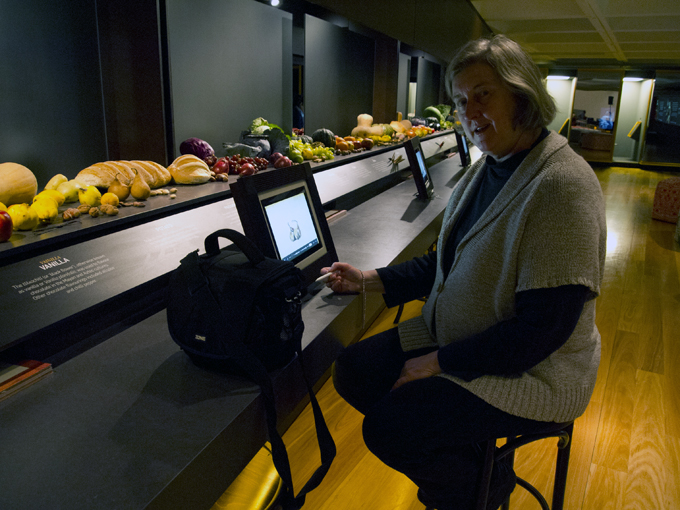
Vicky @ still-life drawing station
REGIONAL ART AWARD: Our entry
 .
.
NOTE: VOTING IS NOW CLOSED
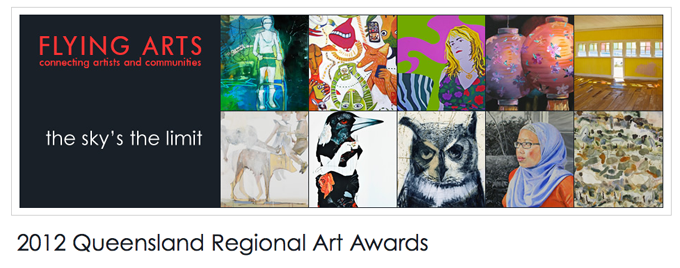
One of our Artists Survey Books has been uploaded on the Queensland Regional Art Awards website.
The ‘People’s Choice’ judging is based on an online viewing and voting system. For those unfamiliar with these little books they present a humorous and ironic view of the challenging issues facing regional artists. This book deals with issues associated with being a regional artist during the current extractive mining boom.
.
SO – Please check out the book as described in this post.
THEN, go to the website – at the link below – scroll down the artists name list on the right-hand side of the website. We are under “V” for Victoria at the very bottom of the list.
Here is the link: NOTE: VOTING IS NOW CLOSED-THE LINK IS STILL ACTIVE AND SHOWS THE ENTRIES
http://www.flyingarts.org.au/QRAA-2012-Gallery-The-Essential-Character-of-Queensland-ga2543.html.
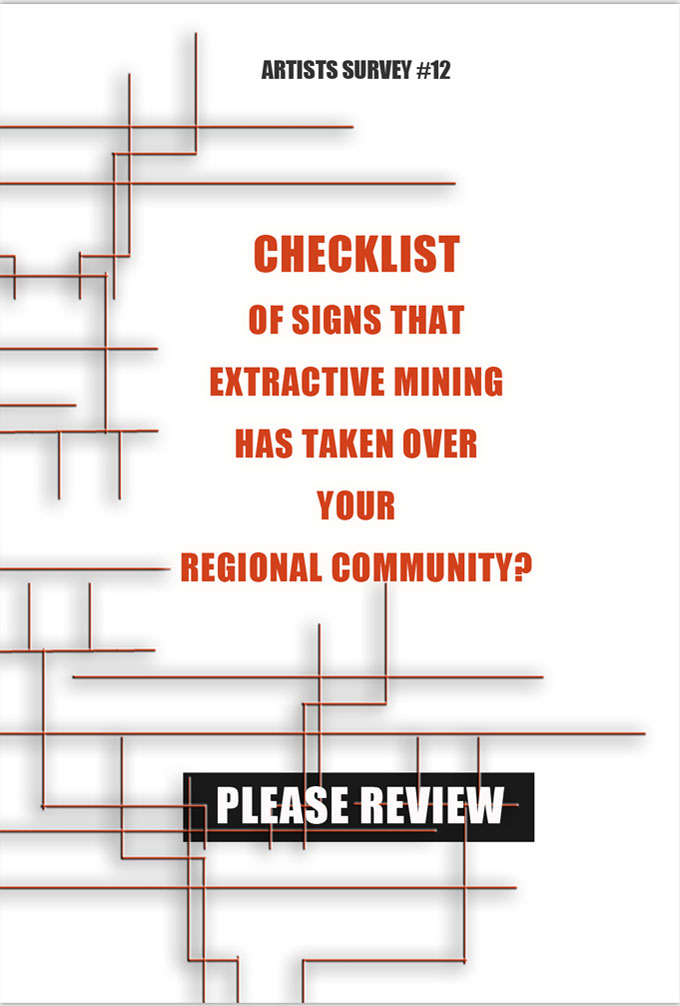
The cover of the Artists Survey book
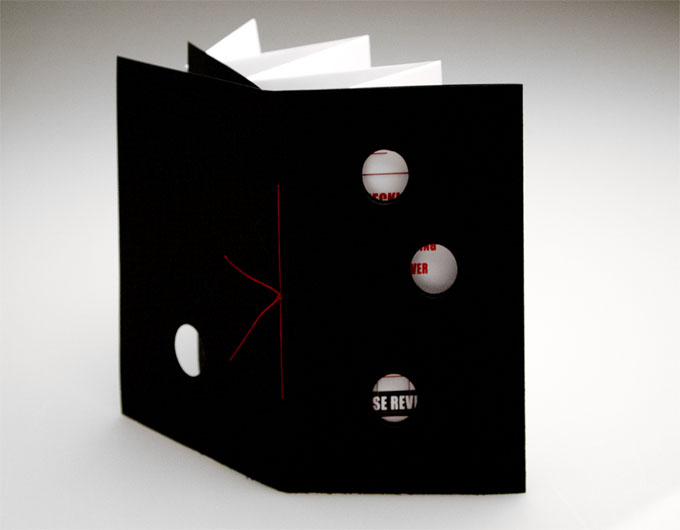
The book cover with exploration ‘holes’
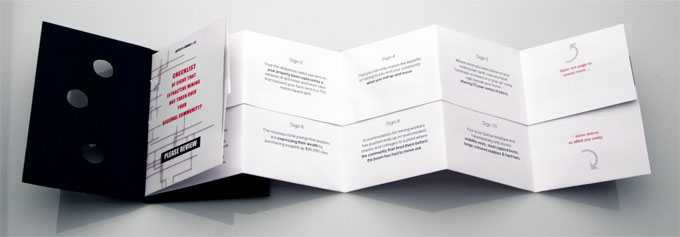
Open text pages showing comments on mining and the community
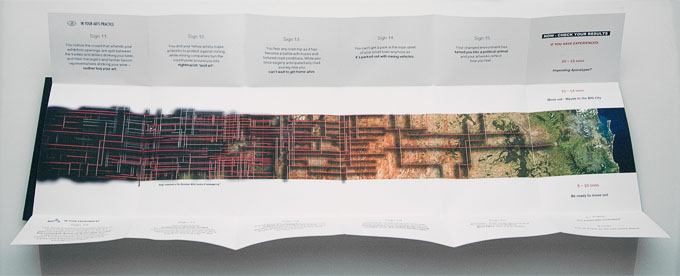
Unfolded showing texts and illustration of extractive industries effect on southern Queensland
Some of the texts, there are 20 in all, are as follows:
- Instead of Weetbix or Cocoa Pops and milk for breakfast you have coal grits.
- When you can’t afford your power bill you cook using coal spill gleaned from railway lines and roads.
- Your farming friends can’t ship their produce to cities and ports as all freight options are biased towards the year-round transport of coal.
- Your art exhibitions opening crowds are split between the tradies and the drillers drinking your beer and their managers drinking your wine – neither buy your art.
- All of your rustic old community pubs have been remodeled into nite clubs and commodious verandahs enclosed to stop drunks throwing up – tossing bottles – or falling off onto the pavement below.
- The occasional distant thunder that you once may have thought be an approaching storm now turns out to be the constant thunder of B-Double trucks shipping coal.
THE REGIONAL ARTS COMMUNITY & THE MINING BOOM
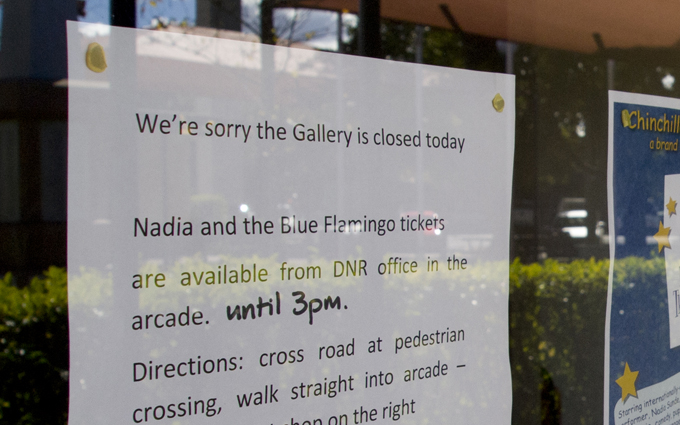
Recently we traveled along the Warrego Highway to Roma stopping at a couple of major towns along the way. There was hive-like activity infecting the once quiet pastoral landscape of these towns. These regional centres have been transformed by the explosion of commercial opportunities presented by a contemporary “gold rush” boom in the proclaimed “climate friendly” energy resource mining industries.
The cultural life of these once mainly farming communities relied heavily upon the blood, sweat and heart of the local artists and volunteers? Now these small numbers of volunteers work even harder to bring a depth of cultural life and meaning to everyday life in these towns. Some towns superficially appear to be thriving but a visit to the gallery unable to open due to the paucity of volunteer numbers may be the indicator of a larger issue. Can they still provide, with limited resources, a quality cultural program under the pressure of this exponential invasion of their social structure? To continue requires the commitment to and interactive involvement in these activities by those benefiting from the ‘boom’.
Opinions are various and some – deeply passionate -regarding the potential benefits or problems that will be the legacy for each community. It appears that important support and funding has come to ensure cultural activities are seen to be valued. But can this financial support, generous as it may be, replace the energy and lifelong commitment of volunteers. These are the people that form the vital fabric supporting strong and diverse communities. Certainly Miles has the energy injected by the employment of cultural professionals at Dogwood Crossing gallery and the associated library, which eases the pressure on this community’s volunteers. But what will happen with Dalby, Chinchilla and Roma—all major communities driving the mining boom?
One of the critical issues facing these community structures and the individuals that support them is the lack of affordable housing and accommodation options. Unless you are employed in the mining industry, living in these towns has become a privilege that few can now afford. So many of these long-term locals are leaving. Who then is replacing these people? Do the temporarily located mining population have time to be involved in the cultural history and exchange of their new surroundings?
Temporariness and dislocation now dominate the social and cultural landscape of these once grounded communities. Perhaps there needs to be effective provision for and importantly, an everyday involvement in, the altruistic act of volunteering by those who benefit from the mining of this landscape. Although they inhabit the periphery, these transient populations rely upon a functioning ‘heart’ at the centre of these communities. Conceivably any meaningful and creative interaction, between each section of these evolving communities, could have only have beneficial implications for both.
.
Victoria Cooper
STELARC: New York, Berlin, Melbourne, Tokyo – and now Toowoomba!
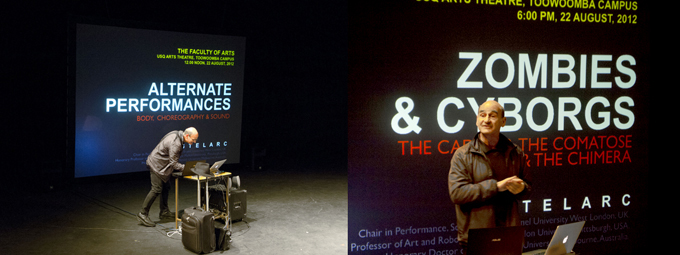
Stelarc @ University of Southern Queensland
On Wednesday August 22, 2012 Stelarc presented two lectures about performance art at the University of Southern Queensland. Local USQ students and lecturers, TAFE students and teachers as well as members of the extended Toowoomba arts community reveled in the opportunity to see and hear an artist of Stelarc’s stature in their own town. Usually they would need to travel to the above mentioned big city locations to even come close to a Stelarc event.
The opportunity for Stelarc came about as he visited local friend Michael Cook, an offer was made to connect with the local community and USQ was approached to provide a venue. Amazingly no charge was made for those to attend and the Uni supplied a light supper for attendees to the evening presentation. Thank you to Stelarc, Michael and USQ for their respective generosities.
What follows is a montage of images by Doug and text by Vicky as a record and reflection on the event.
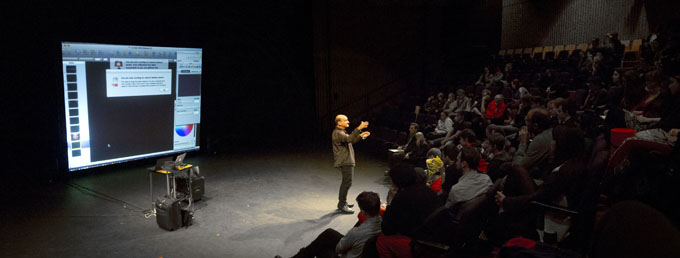
Stelarc speaking @ USQ
STELARC: Present/Future
Stelarc immersed the audience in the intellectual discourse and unsettling condition of the technological age. As an internationally respected artist, he has sustained a significant investigation on what it means to be a human. In his performance/lectures, Stelarc recounted technological advances, including the organ printer, advanced robotics and AI, that drive his philosophical and artistic enquiry. Through this visual and philosophical presentation, we were confronted with the concept of our emergent post-human state.
Should we consider that we are now monsters? Are we breaking free from the human certainty of mortality—evolving into an early form of immortality? Could we just ‘be’ a digital database—an artificial consciousness made up of memories, emotions and ideas that are supported by the promise of replacement parts and eternal connectivity? This discussion may seem to be in the domain of philosophers, ethicists and scientists. But everyday there are new technological and medical procedures that intervene on, or replace our human-ness.
As we consider our future in this post-human condition, Stelarc’s “contested futures” opens up the possibilities for a number of agencies to direct the evolving human narrative. I ponder the historical human exploitation of ‘natural’ machines and knowledge since the Renaissance. What contingencies would Charles Darwin have envisaged in the event that his biological evolution had incorporated machines? Perhaps also the believers of Intelligent Design may also now need to consider the agency of their God in this evolution of the post-human? As we all benefit from machine interventions and technology in some way we cannot escape from this present future.
Sharing this history, there are ‘others’. Our bodies and our environment are constituted by these “other”, non-artificial, nonhumans. They are totally unaware of our post-human evolutionary path. Their existence is in many ways linked to human existence. In their place in the world these nonhumans arguably have acquired ‘intelligence’. Unavoidably they will be actors/actants in the milieu of humanity’s “contested futures”.
Thanks Stelarc, for your memorable and stimulating lecture/performances. Your line of inquiry evokes more and more questions. In a metaphorical way perhaps we are all stripped bare and suspended in the gravity of time, space and place as we, the ‘audience’, consider and are challenged by, our own concept of humanity.
.
Victoria Cooper
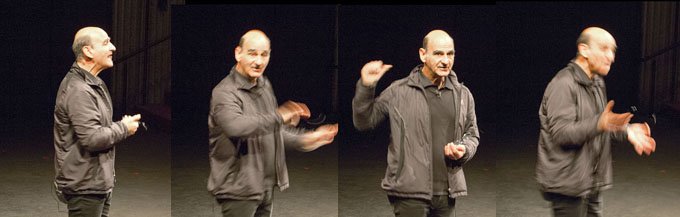
Stelarc in animated lecture mode
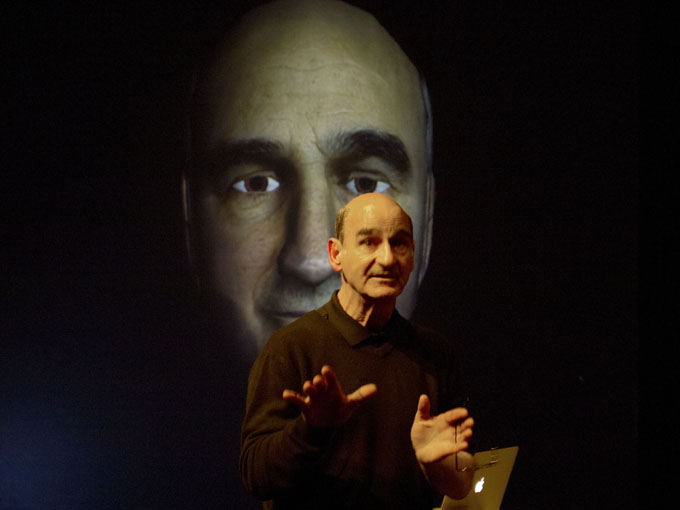
Stelarc and Prosthetic Head
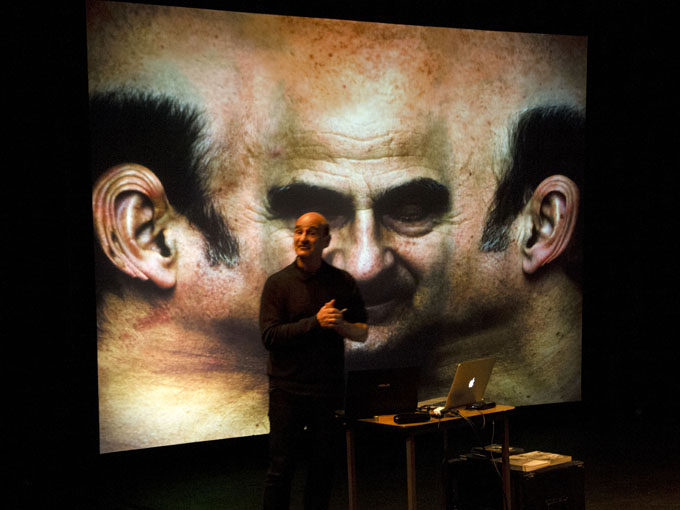
Stelarc with flattened and floating face portrait
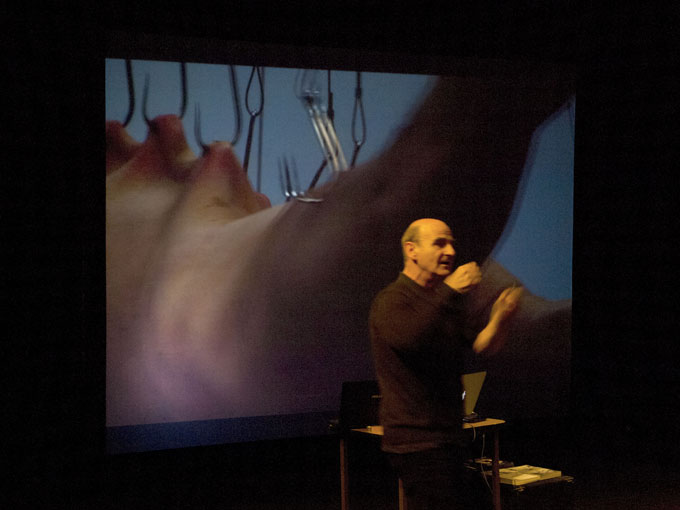
Stelarc discusses his suspension work
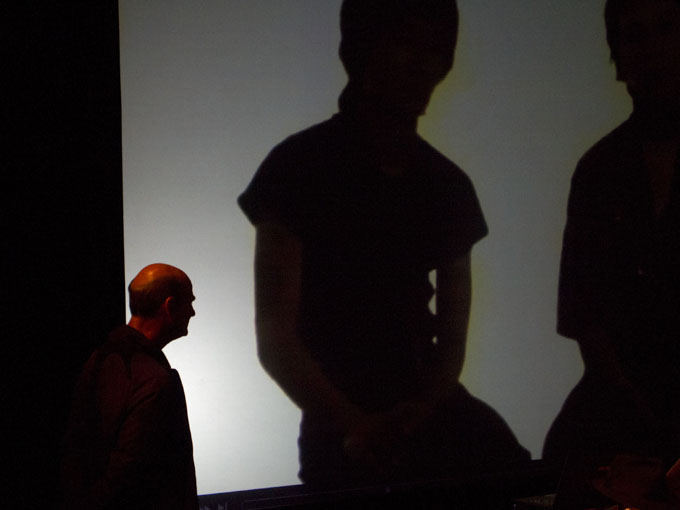
Stelarc watching Hsieh and Montano video
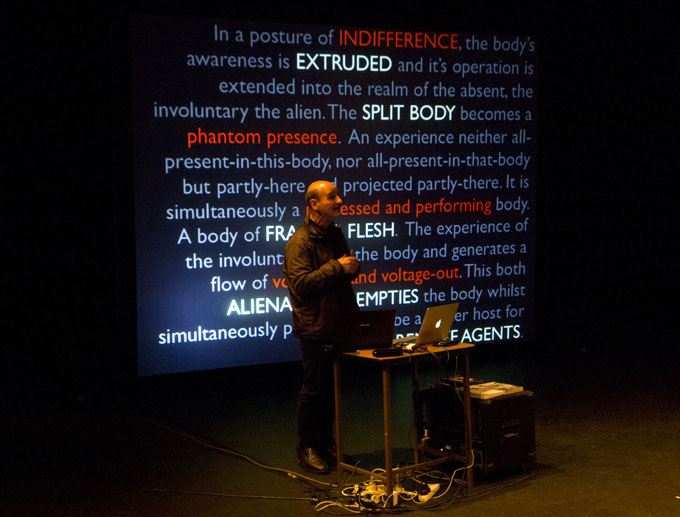
Stelarc and manifesto texts
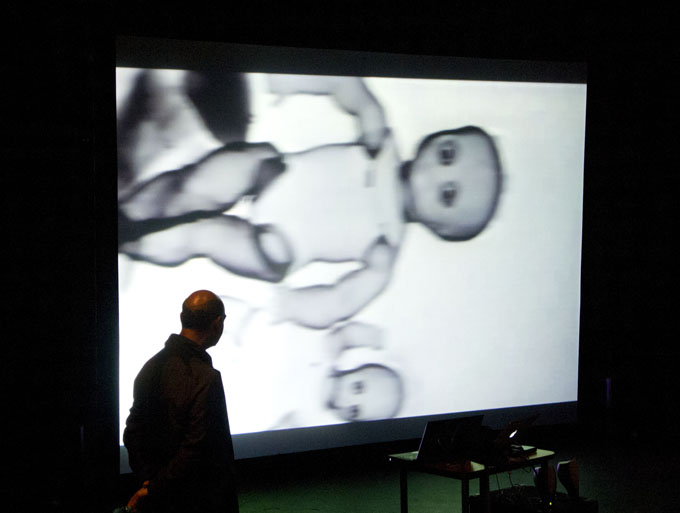
Stelarc watching Queen music film clip
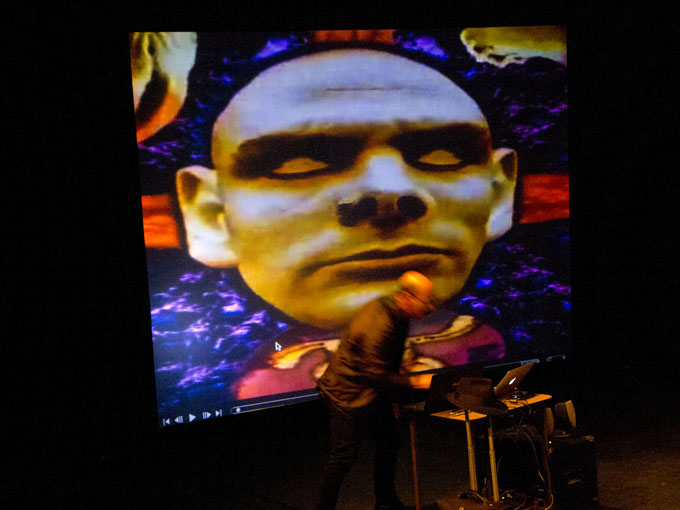
Stelarc and Marcelli video
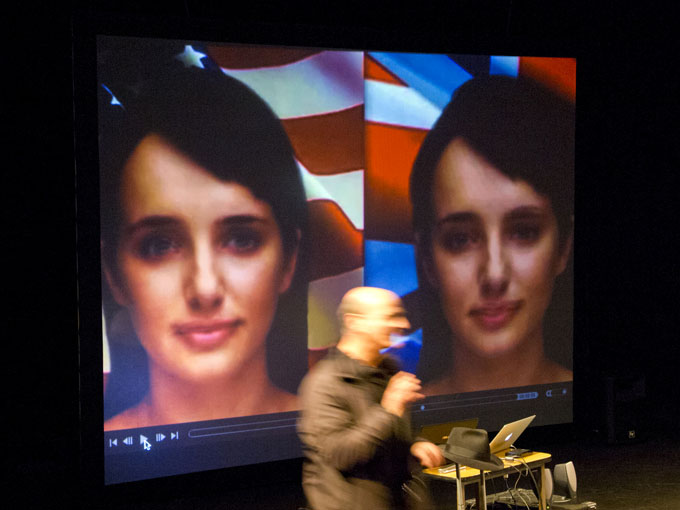
Stelarc discussing chatting heads
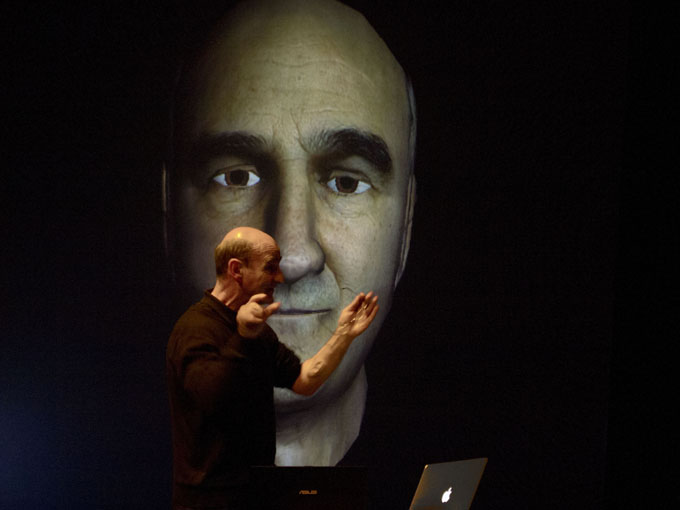
Stelarc and ear/arm @ University of Southern Queensland
SHOOTING STRAIGHT: Regional Artists as Provocateurs
Shoot Straight You Bastards, Bungil Gallery, Roma, Queensland. 6 July-12 August, 2012
.
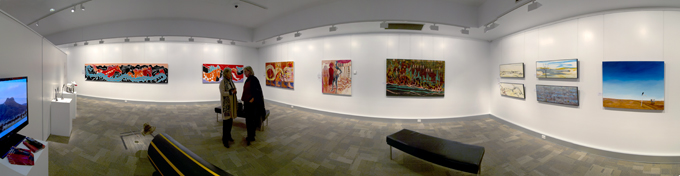
Shoot Straight You Bastards, Bungil Gallery, Roma
In her book The Lure of the Local (1997) Lucy R. Lippard states that ‘Artists can be very good at exposing the layers of emotional and aesthetic resonance in our relationships to place.’ (Lippard 1997:286) She also defines an ‘ethic’ for ‘art governed by place’ which includes the expectation, amongst others, that the work should be, ‘Provocative and Critical enough to make people think about the issues beyond the scope of the work, to call into question superficial assumptions about place, its history and its use.’ (Lippard 1997:287)
An exhibition at the Bungil Gallery in Roma, Shoot Straight You Bastards, by artists who collectively call themselves, the 6 artists from out of nowhere, creates a powerful document about relationships to place which are, as Lippard demands, ‘provocative and critical enough to make people think.’ These artists are from the Bowen Basin area around Central Southern Queensland that is currently the centre of a mining boom driven by the world’s need for cheap energy. In the enthusiastic push for profits to bolster shareholder’s returns and to reduce budget deficits, both the mining industry and the government have grasped the opportunity. While it may seem perfectly logical to develop a resource and capitalise upon it, there are many who oppose it. The principle concerns shared by many of these local communities are the threats to the farming and grazing productivity of the land, and the potential risk for long term damage to the quality of underground water across the region where mining and gas extraction is undertaken. The transformative effect on the communities and the landscape should not be underestimated.
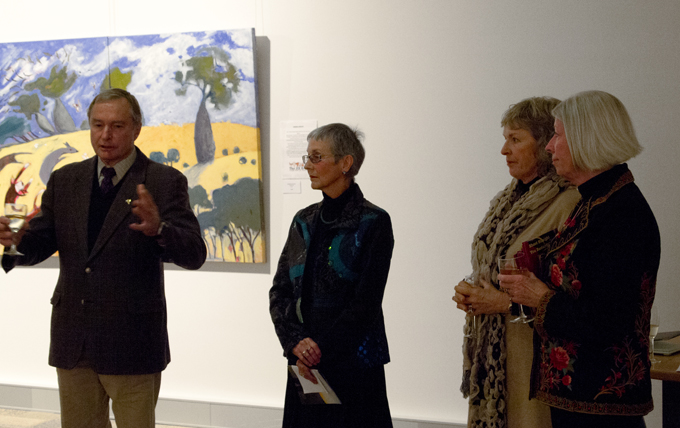
Howard Hobbs MP for Warrego opens the Shoot Straight You Bastards exhibition with 3 of the artists
The six artists are, Sandra Allen, Anne Cameron, Elizabeth Corfe, Barbara Hancock, Helen and Wally Peart. These artists and their families live on and work within this landscape as farmers and graziers. Time spent creating their artwork has to ‘fit in’ with the demands of daily living and working on the land. In their bios, the artists reference the many challenges of making art on a working farming property, as three of the artists reveal:
Anne Cameron, As with all women on the land, her artistic aspirations had to be subjugated to the needs of the property and the family,
Barbara Hancock, … the urge to paint often saw her running from paint brush to breast feeding the latest baby, and
Elizabeth Corfe’s life, has been shaped by a lifetime immersed in the highs and lows of making a living off the land.
Even though there have been obstacles they remain dedicated to their art and when possible have engaged in art training through a range of opportunities including academic study, Flying Arts and the Roma Art Group. Their works are technically and conceptually strident—quite distinct from the stereotypic pastoral ‘windmill in the sunset’ and ‘gum tree lined billabong’ paintings that art aesthetes may consider regional artists make.
These artists have amassed a large body of work expressing their concern for the land and, what they see as its impending demise. The title for the exhibition, Shoot Straight You Bastards originates from the last words of Breaker Morant as he stood before the firing squad. The six have chosen this phrase as their catch cry and they apply it to their current situation—shoot straight implies that the proponents; mining companies and governments present honest and accurate information and manage this development ethically and fairly. Their poem manifesto <http://www.sixartists.com.au/exhibitions.htm>(Link broken July 2016) questions the speed of resource development and the potential damage to air, water, earth, flora, fauna and people that this boom may have. In their impassioned plea they lament,
Why not look after Australia
For our country
For our people
For our future
In dry Australia, without artesian water we die.
Words on a website may be one avenue for activism but concepts expressed through art can also be a powerful way to evoke commentary and debate on broad social issues. Nicholas Croggan in an essay on Bonita Ely’s ecological work claims,
… the current state of ecological crisis will soon replace globalisation as the dominant cultural condition. In contrast to globalisation, which emphasises the invisible and the infinite, the state of environmental crisis drags us back to earth to contemplate the material and the finite. It demands that artists and non-artists alike reassess the way in which they engage with the natural world—both at a real and an imaginary level. (Croggan 2010:47)
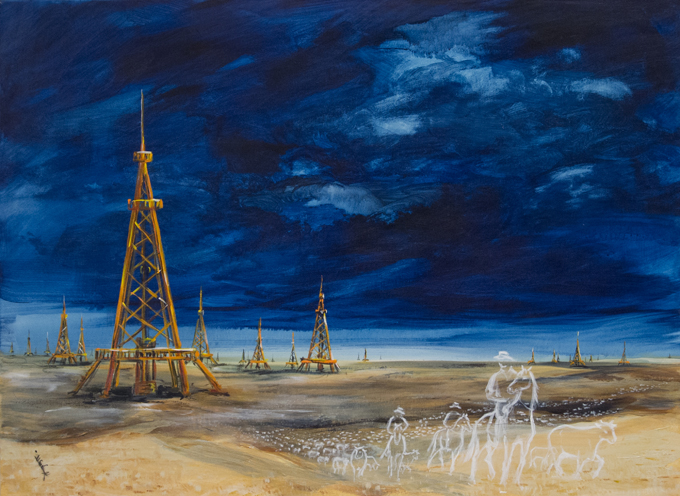
Banished by Elizabeth Corfe
The work of these artists does bring us ‘back to earth’ in ‘real’ and ‘imaginary’ ways. In the work Banished, Elizabeth Corfe presents a landscape of drilling rigs against blue sky and beige earth—ghostly forms of men on horseback tend phantom flocks and herds that may no longer exist. An expansive piece entitled Sucked in by Barbara Hancock depicts a vortex of change ‘sucking in’ the landscape and its inhabitants—several figures inside the central maelstrom mimic the expression of the subject in Edvard Munch’s The Scream. In Sandra Allen’s Once there were horses a snake-like chimerical (Chinese) dragon with $ signs for eyes scares horses to take flight. Refer to their website for more examples.
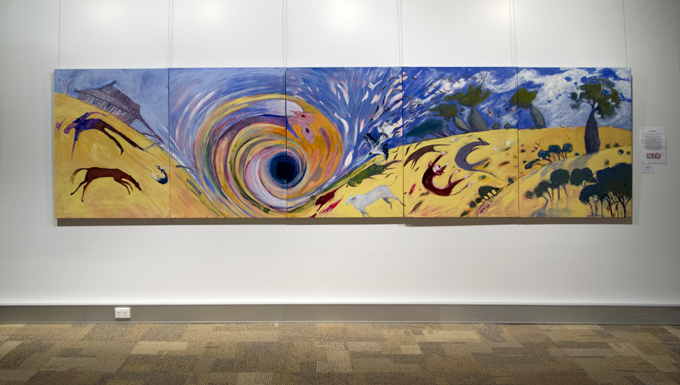
Sucked in by Barbara Hancock
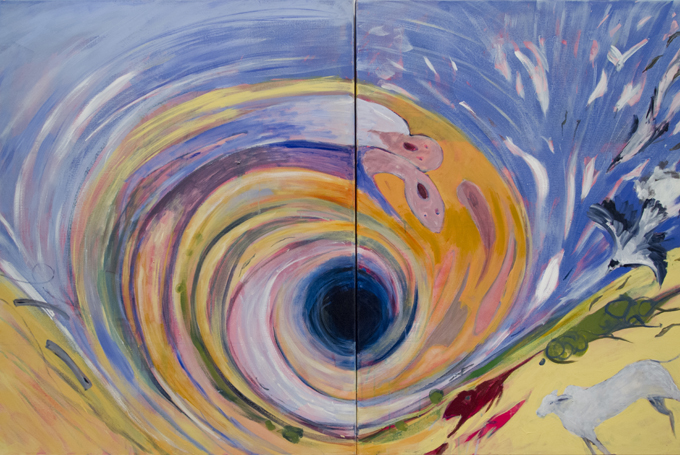
Sucked in by Barbara Hancock (detail)
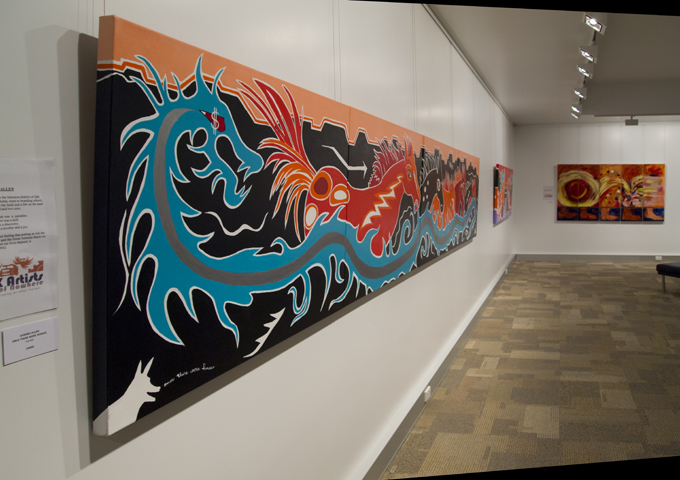
Once there were horses by Sandra Allen
The Shoot Straight You Bastards exhibition has already travelled to outback regions and is set to open in Wondoan in the next month, then on to Brisbane at the White Canvas Gallery in November.
These artists are empowered in the face of this inexorable transformation—as their voices can be heard through the making, presentation and communication of their art. In 2007, Lucy Lippard curated the exhibition Weather Report: Art and Climate Change. In her catalogue essay she spoke of the artist as a commentator, communicator and as one who acts as a provocateur. In the closing remark of her essay Lippard proposes, ‘… it is the artist’s job to teach us how to see.’ (Lippard 2007:11)
Artists do ‘teach us to see’ and it is commendable that these six artists work hard to engage their communities in issues that are important. Ultimately art is a considered and authentic vision of the world and ideas. Perhaps through the dissemination and connection with others these artists’ vision may bridge a gap and change perceptions.
Curator Stephanie Smith, in the catalogue for Weather Report: Art and Climate Change (2007), presents a call to arms where she states that as artists,
… we need occasional pauses to reflect on the ever-changing and sometimes inscrutable interrelationships in which we are all embroiled … And then we need to get up from that perch … and act on the insights derived from these critical, reflective pauses. We need to get into the fray … (Smith, 2007:15)
The 6 artists from out of nowhere are certainly getting ‘into the fray’.
Dr Doug Spowart July 29, 2012
Croggan, N 2010, ‘Bonita Ely’s art of ecology’, Art & Australia, vol. 48, no. 1, Spring 2010.
Lippard, LR 2007, ‘Weather Report: Expecting the Unexpected’, in K Gerdes (ed.), Weather Report: Art and Climate Change, Boulder Museum of Contemporary Art, Boulder, Colorado, USA.
Lippard, LR 1997, The Lure of the Local: Sense of Place in a Multicentered Society, The New Press, New York.
Smith, S 2007, ‘Weather Systems: Questions About Art and Climate Change’, in K Gerdes (ed.), Weather Report: Art and Climate Change, Boulder Museum of Contemporary Art, Boulder, Colorado, USA.
SOME ART GALLERIES OF WESTERN QUEENSLAND
This post offers a pictorial view of 6 regional art galleries of western Queensland visited during an 800 klms journey from Toowoomba to Roma, Surat and return.
Weblinks for the galleries are included for further information.
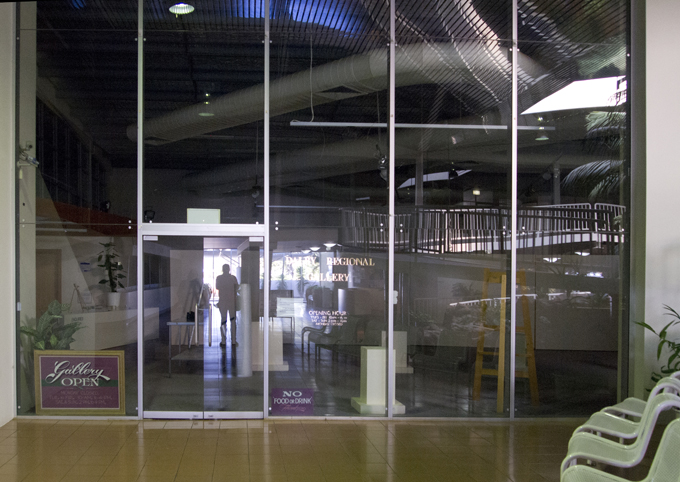
Dalby Gallery: Closed at the time of visit, 6 July 2012
http://www.dalby.info/news/autumn09_art.asp
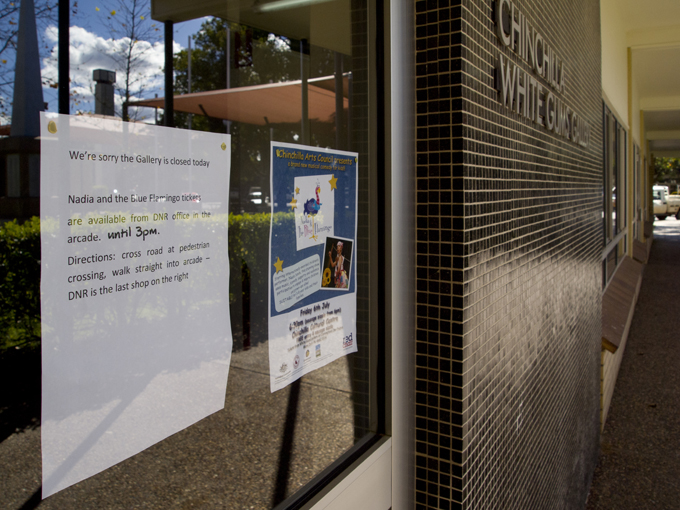
Chinchilla White Gums Gallery: Closed at the time of visit, 6 July 2012
http://www.rgaq.org.au/Chinchilla.html
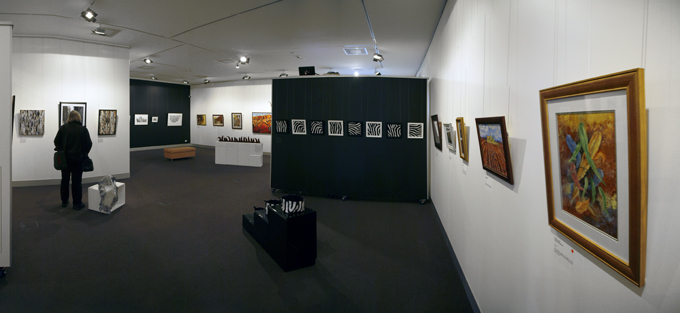
Dogwood Crossing, John Mullins Memorial Art Gallery: Patterns in Nature
http://www.dogwoodcrossing.com
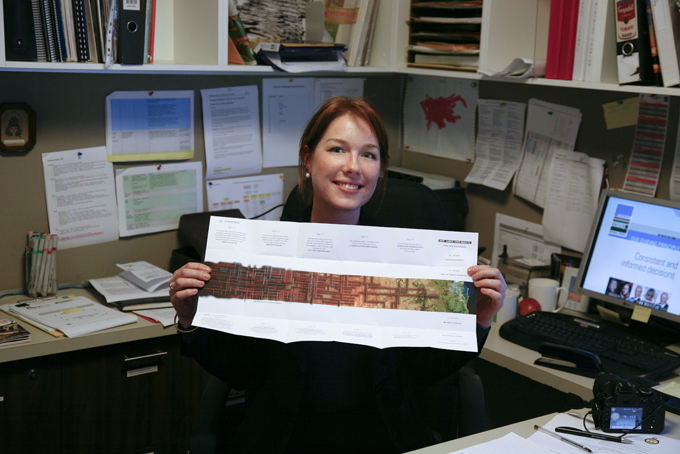
Elysha Gould Gallery Supervisor in her office @ Dogwood Crossing
.
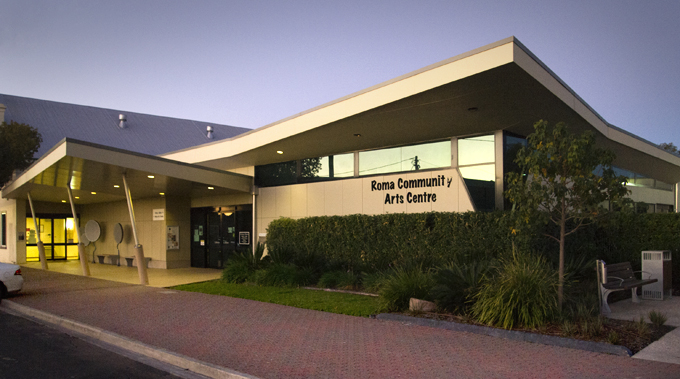
Bungil Art Gallery, Roma
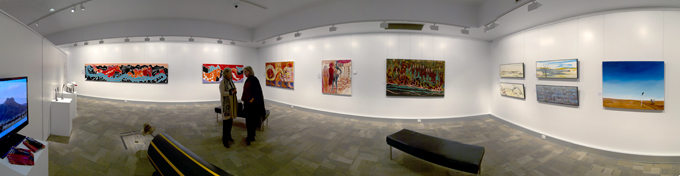
Bungil Art Gallery @ Roma: 6 July 2012: Shoot Straight You Bastards exhibition
http://www.romaonbungil.com.au
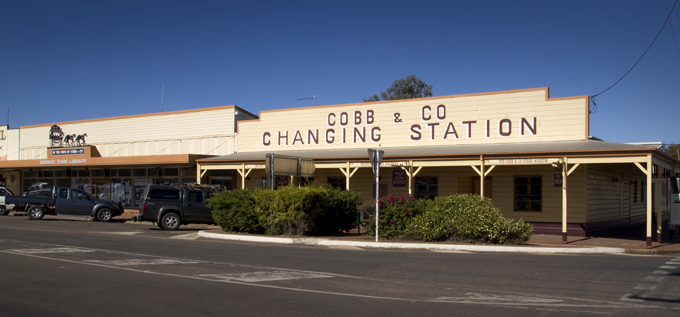
Cobb & Co Changing Station, Balonne River Art Gallery: Open 7 July 2012
http://www.rgaq.org.au/Balonne%20River%20Gallery.html
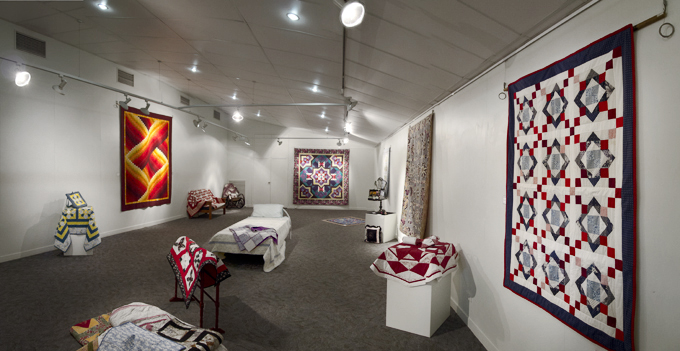
Cobb & Co Changing Station, Balonne River Art Gallery: Exhibition – Debbie Weinert Quilter
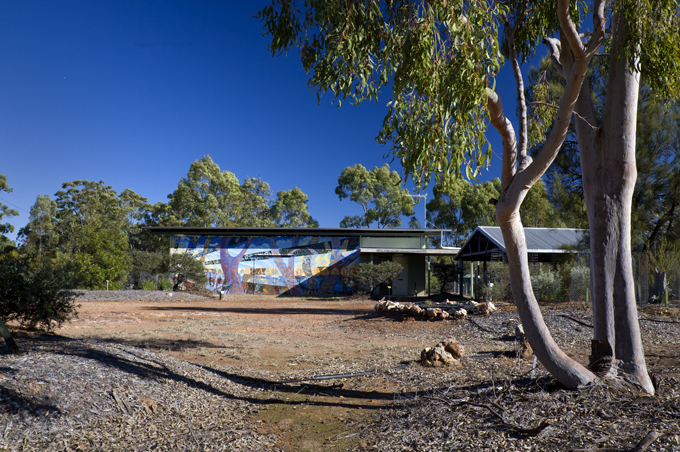
Myall Park Botanic Gardens Art Gallery
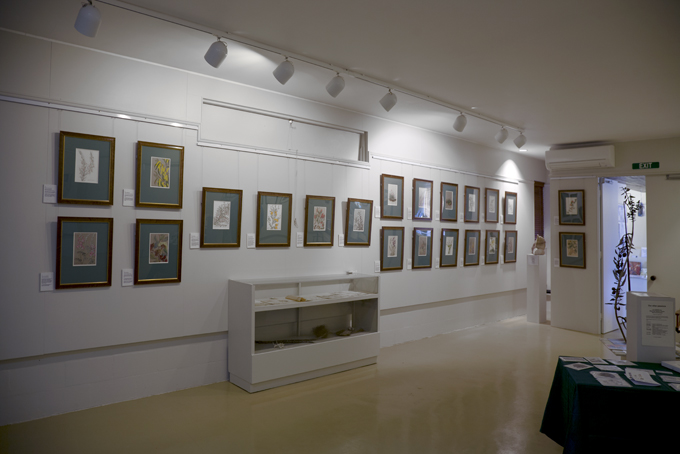
Myall Park Botanic Garden: Dorothy Gordon’s botanic paintings
http://www.myallparkbotanicgarden.org.au/gallery.htm
JOURNEY COMPLETED BY VICTORIA AND DOUG : ALL PHOTOS BY DOUG

 wotwedid
ReNEWSing the Newspaper: A group exhibition @ Futures Gallery
leave a comment »
An exhibition in which the local newspaper has been reinterpreted by 5 artists and reconstituted as a statement of a regional community in Australia.
The ‘ReNEWSing’ exhibition panorama @ Futures Gallery
Bev Lacey discusses one of the books
Artists: Kylie Noakes, Bev Lacey, Jess Martin, Yseult Taylor, Angela Moar and Doug Spowart
Exhibition visitors: Tina Wilson and Sue Lostroh
Sandy Pottinger, Bev Lacey + Victoria Cooper
Doug + the book ‘Have you got your Chronicle today’
.
BEV LACEY’S OPENING REMARKS
Each day the focus of my time in the office is spent on production of images for the next edition.
Or as in recent times, the production of images and video, for immediate release online and also for the printed edition.
The process is more in keeping with what other people’s expectations are and what they envisage as the final product.
This attention to a set formula – i.e. go to job, get back, quickly download and move onto next job – often narrows the thinking.
In the past when I have browsed through the work produced by the art students taking The Chronicle and creating an artist book, and this is an exciting interpretive assignment, I have been amazed, inspired, envious and a little in awe of the works produced.
I am always in awe of “the artists mind” the ability to see, the ability to transform often unobscure pieces into works of art that I cannot draw away from.
So I thought, taking about the works would not be a challenge at all. But in an attempt to say something worth hearing I am at a loss.
No not really……….
THE BOOKS – an artist book for me needs to be a tactile experience……
As I looked through the books on YouTube I found myself longing to turn the pages and feel the textures.
Does that make your books successful?? that I want to touch them, and experience more than flipping through them on a computer screen – yes I think so.
Yseult Taylor:
Sadly I found the interpretation on what was published on May 10, similar to what a lot of people think that The Chronicle is about; depressing stories about loss of life, jobs and accidents. We, the media do have a tendency to focus on the negative and in creating a book about what was published in the paper on that day May 10 – yes ….you have successfully captured the essence of our storytelling in that edition.
In saying that though, a new perspective was put to the viewer – a rather blunt and interesting division between the headline and advertising.
Jess Martin:
The constant, barrage of text and information which we all have in our lives at the moment,
Information – some useful most not.
Entering though the door of the commercial world, being given light relief , in cartoons and then the barrage again.
The page that I found most fascinating is the blank one – it stopped me in my tracks and you can feel your whole body just breathe out that sigh of relief – time out from the information overload.
Angela Moar:
As a reader , certain words or phrases mean more to one person than another, I found your isolation of the phrases that affected you, an interesting concept.
It make me think of how even in conversation; each individual’s interpretation of even, what I am saying here tonight, can be perceived differently.
Each person hears on a different level of understanding, all totally dependent on our individual life experiences , personal circumstances, and what we think of the person retelling the story.
And the stick men, the little soldiers that represent whom we all are, representing a formula, a set idea of what is news and the storyteller.
Klyie Noakes:
Kylie has isolated happier moments; selecting from the social pages. The moment in time, often totally set up where a photographer captures a moment in a social event.
The quotation, the who am I really, the what is that person thinking at that precise moment is often lost on the viewer as the person is represented, flat – not whole in three dimensional perspective, but as a “happy snap” of people out and about enjoying a moment .
But their real lives are still there, their thoughts their own we just don’t see beyond the smile, a mistake we make even when meeting other people.
Doug Spowart:
The multi layering effect of what is “The Chronicle” is I am sure what Doug is telling us.
A more sceptical self – realises the focus on advertising of cheap deals could be the reality.
But no – I am convinced Doug’s layering, is about a more in depth view of how production of a newspaper happens. The many people, the many processes, the many facets of a life in the office that create a product.
Overall:
Each of the books has that wonderful inviting appeal.
that “what is the artist trying to say to me, what was the artist thinking at the time of creating” ,
and I believe the success of these books lies simply in that – the questions that it asks the viewer, the simple fact that the viewer will ponder the questions, and the answers they themselves come up with – long after they put the books down.
Share this:
Written by Cooper+Spowart
September 5, 2012 at 7:09 pm
Posted in Artists Books, Doug Spowart, Exhibitions, Meeting People
Tagged with Artists Books, Bev Lacey, social commentary, The Chronicle, Toowoomba