Archive for the ‘Regional arts’ Category
PHOTO EXHIBITIONS @ The Ballarat Int’l Foto Biennale
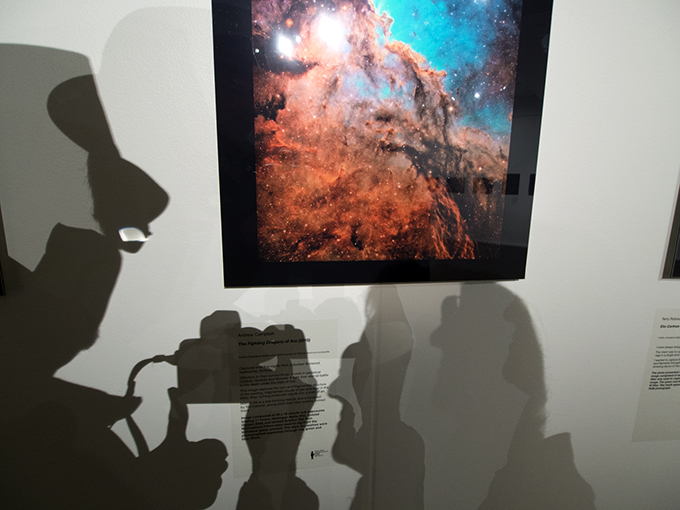
Looking at Andrew Campbell’s astro worlds
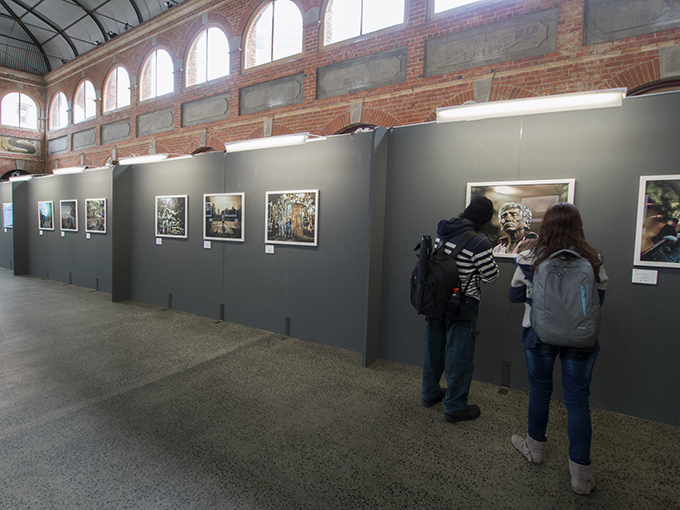
When visiting the Ballarat International Foto Biennale you very quickly find out that photography is a diverse and amazing communicative medium for storytelling, information transfer and as interior decoration. The 100 or more exhibitions cover walls in and around Ballarat in places as austere as the Ballarat Art Gallery, to classic Victorian halls and buildings and boutique coffee shops. Most exhibition spaces are within walking distance of the centre of town so the visitor becomes a foto flaneur…
This was out 3rd BIFB, in 2009 we were part of the Core Program with our Borderlines exhibition at the Post Office Gallery, so it was easy for us to slip into the exhibition walking process. I might say, it rained – or drizzled, as usual. It was cold, as usual. But people encountered along the way – old friends, new acquaintances were past of the ‘as usual’ BIFB experience.
Presented below are some images from the streets of Ballarat. What follows are some images of exhibitions seen. Occasional and brief comments about the shows, (some from the program), will be given as well as a link to the BIFB Program. Get there if you can —- there’s still weeks to go with workshops, talks and tours to add to the exhibitions.
A wrap-up report posted by the BIFB Committee is available HERE
CHECK OUT THE PROGRAM BIFB Program
BALLARAT: the view from the street
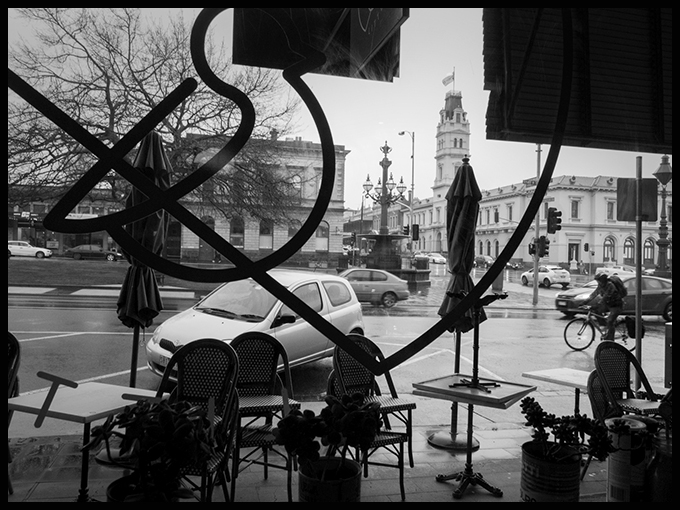
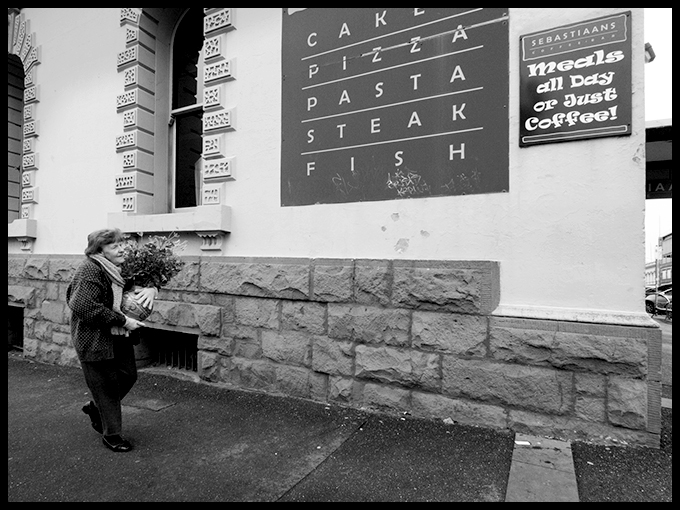
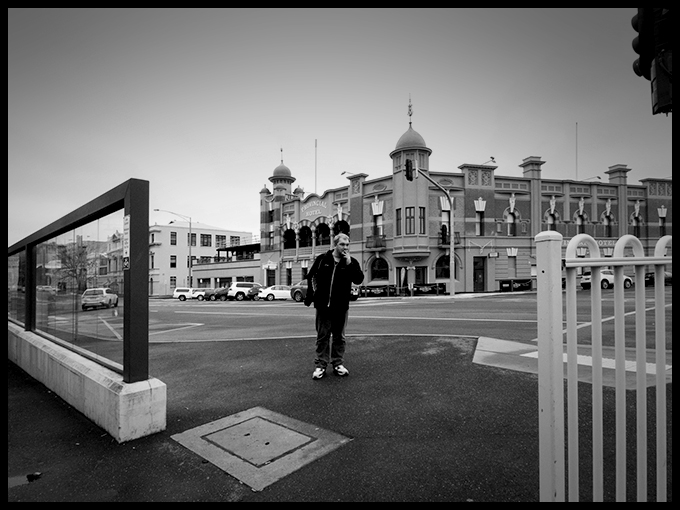
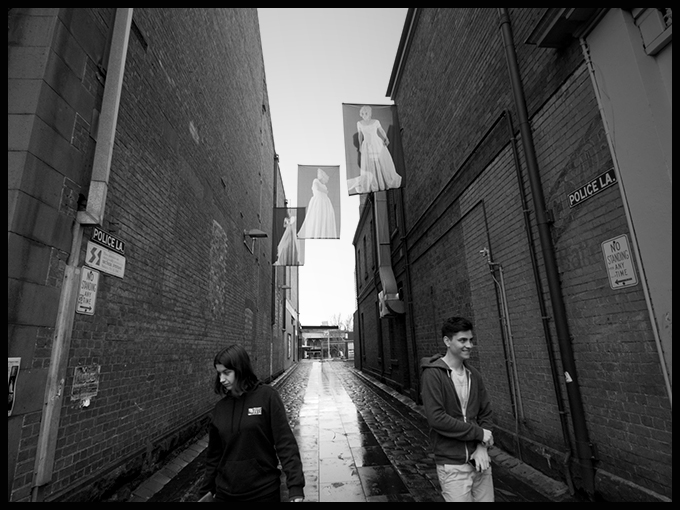
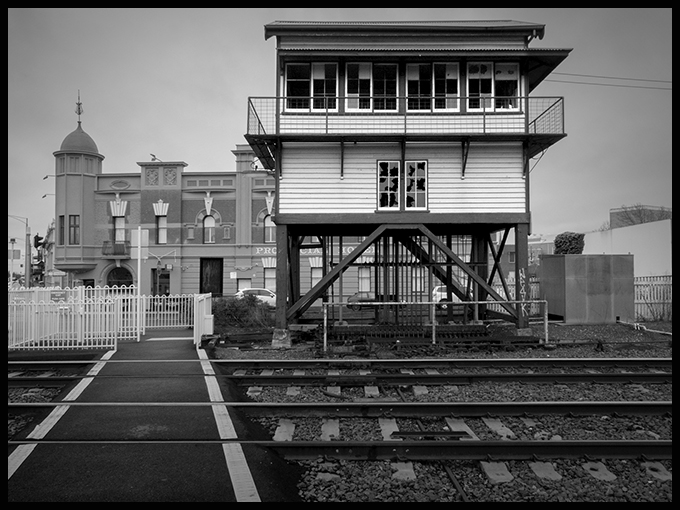
We began @ Sam Harris’ exhibition – The Middle of Somewhere
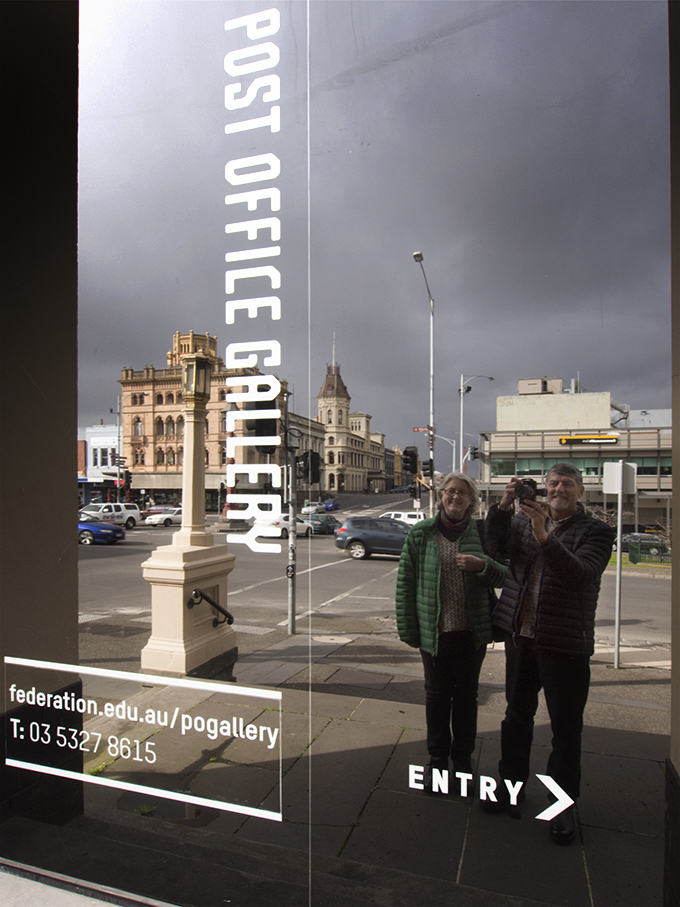
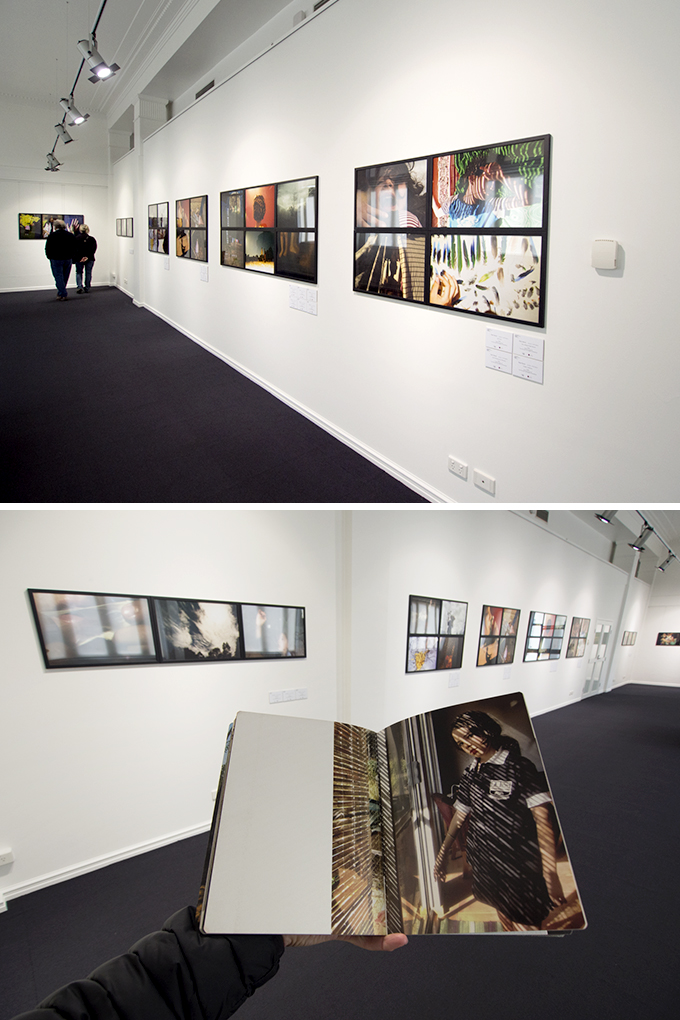
Sam Harris’ ‘The Middle of Somewhere’ Post Office Gallery
It was interesting to see the translation of book images into the space of the white walled gallery.
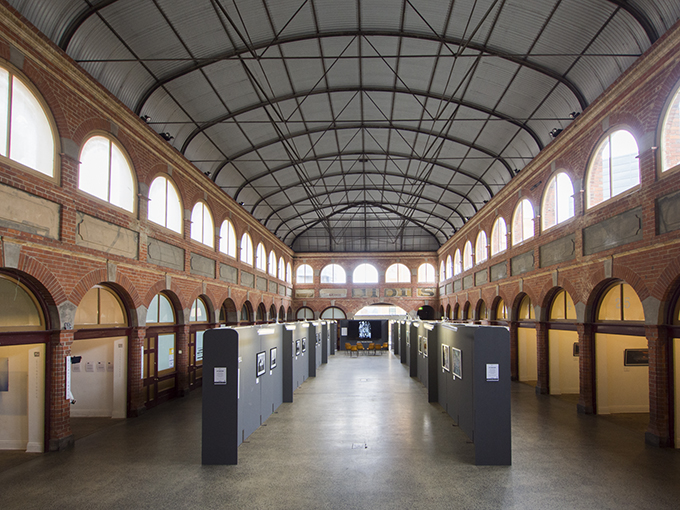
The Mining Exchange exhibition area – @ a very quiet time…
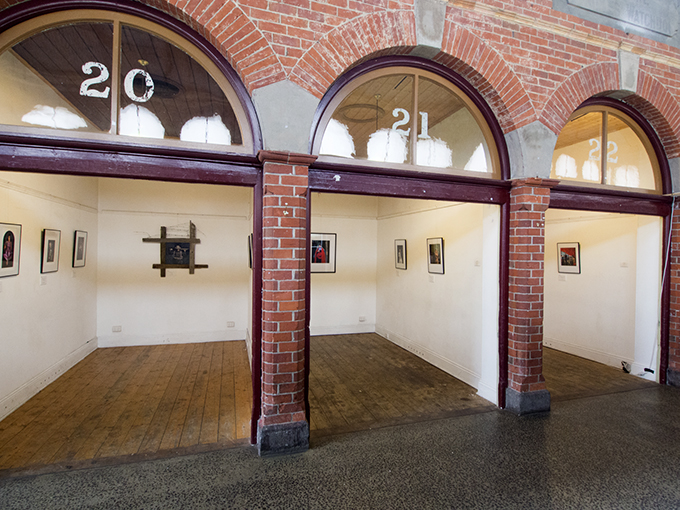
Part of David Williams’ exhibition alcoves
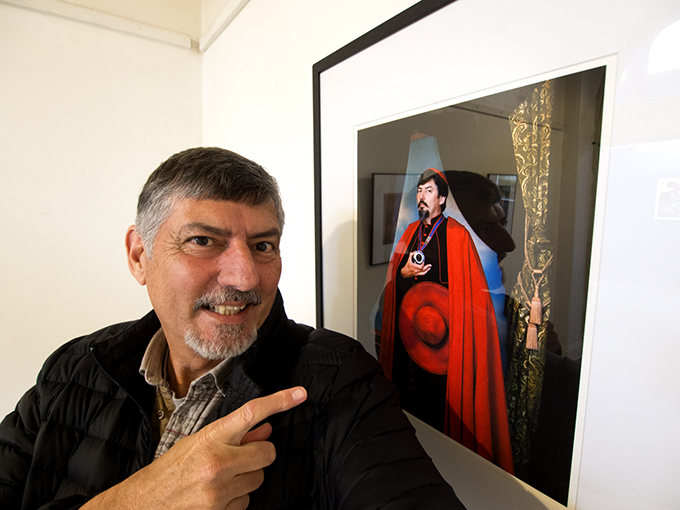
A portrait of me made by David in the 1990s as ‘The Cardinal’
Some great conceptual portrait work by a true master of portraits – David Williams
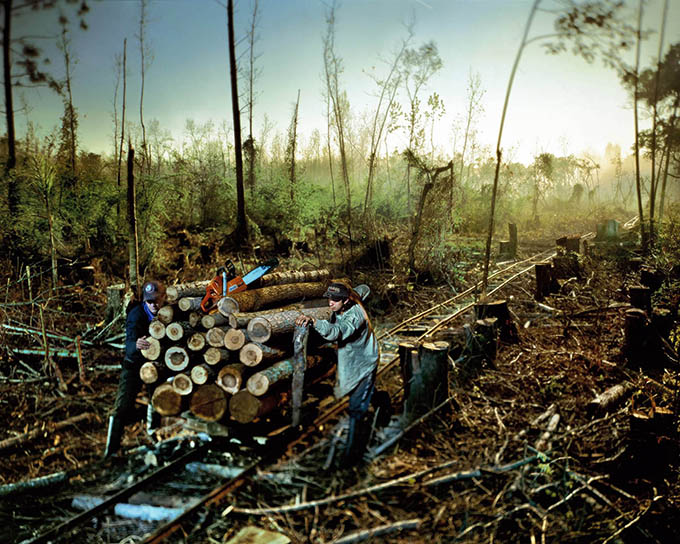
Alejandro Chaskielberg’s ‘La Creciente’
Alejandro Chaskielberg’s ‘La Creciente’
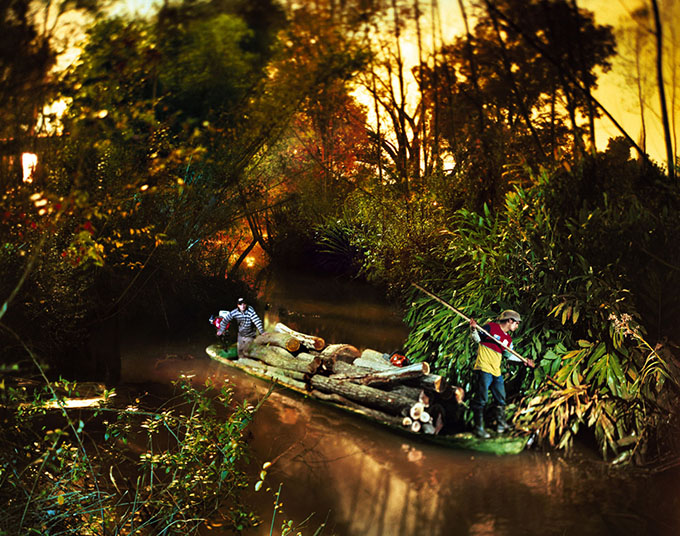
A Paraguayan immigrant travels together with an Argentinian islander, who is his employer. They are loading 3 tons of Willows, taking them to the principal port of the Delta in order to sell the wood.
An amazing exhibition of large format photography with images taken under moonlight conditions. Although the photographer claims that no flash or other lighting is used in his work …
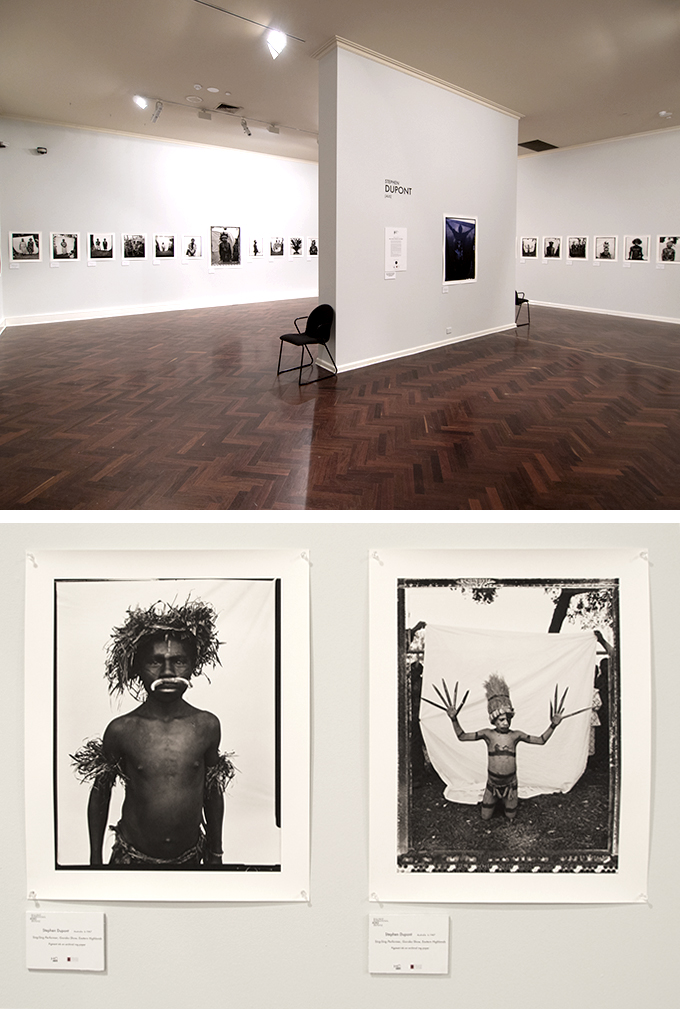
Stephen Dupont’s ‘Piksa Niugini : Portraits and Diaries’
Dupont covers the walls of the gallery with a panoramic portrait of New Gineau tribes men and women. His ‘hold up the sheet’ separates the subject from the background which would imply a purely ethnographic recording. Now the subjects become art…
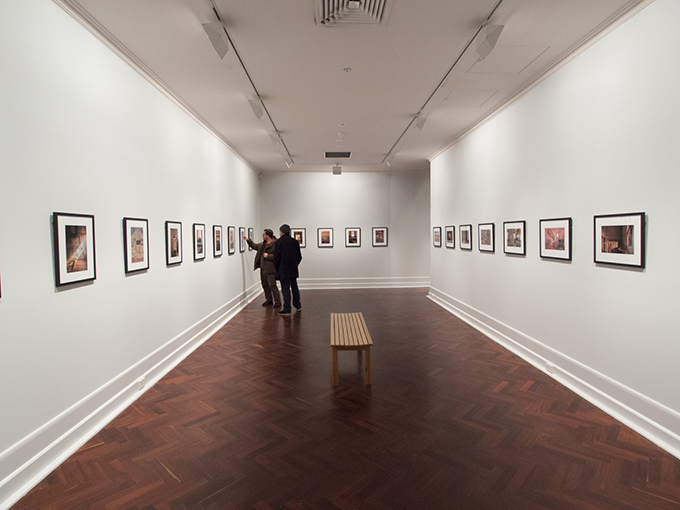
Leon Bird ‘Mrs Patronis Guest House’
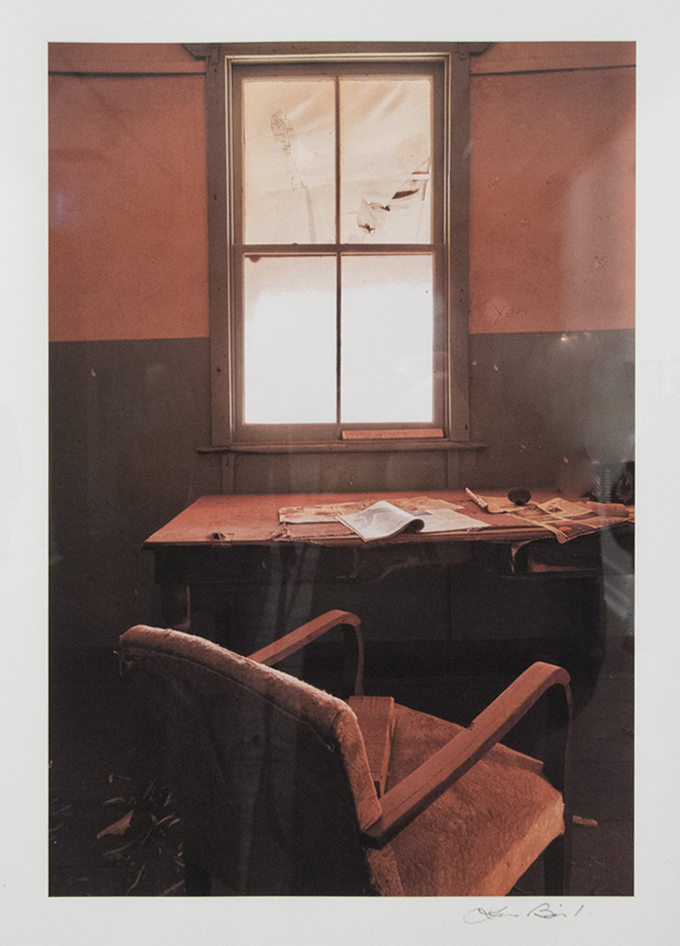
Leon Bird
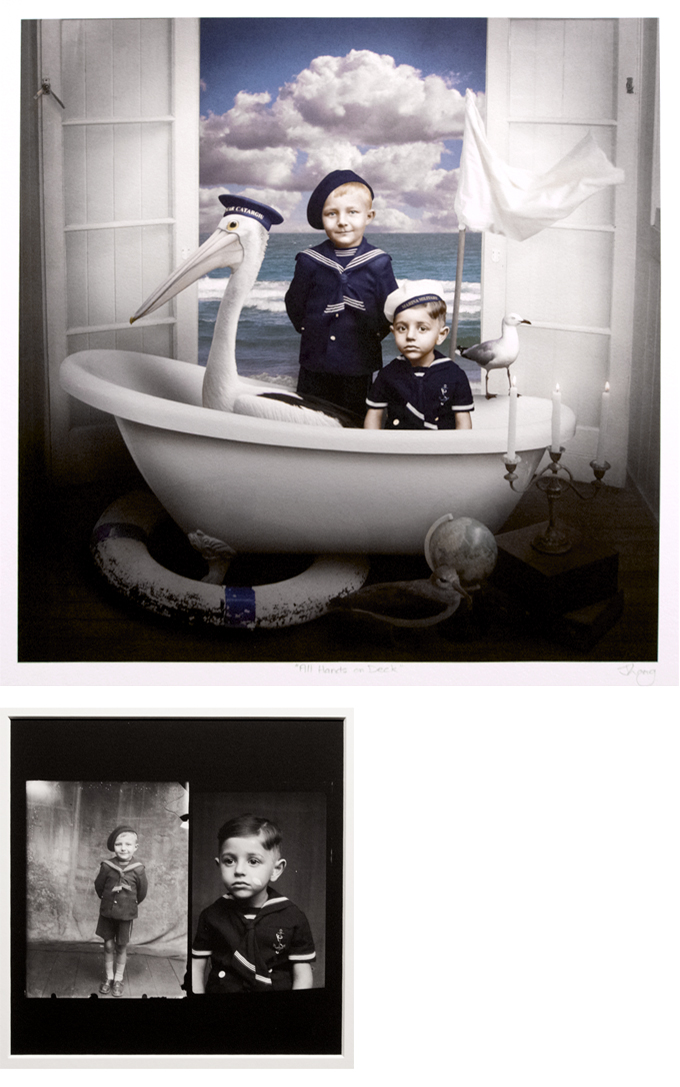
Jane Long’s
‘Dancing With Costica’
The Dancing with Costica series initially came about when I decided to brush up on my retouching skills. After finding the Costica Acsinte Archive on Flickr I became fascinated with the images and their subjects. I wanted to bring them to life. But more than that I wanted to give them a story (from the catalogue).
AN amazing exhibition of not just Photoshop technique but more importantly the conceptual construction of narratives and haunting places for these subjects to inhabit and live on…
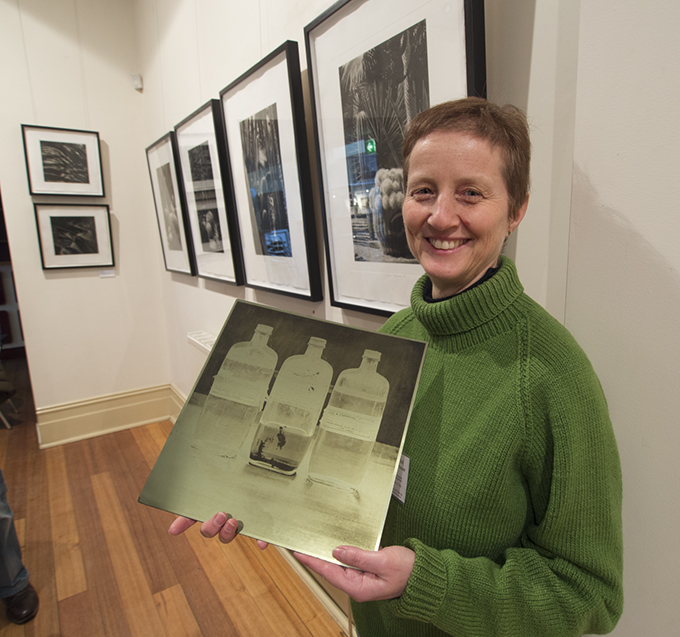
Silvi Glattauer holding a gravure plate of an image from ‘Organic Balance’
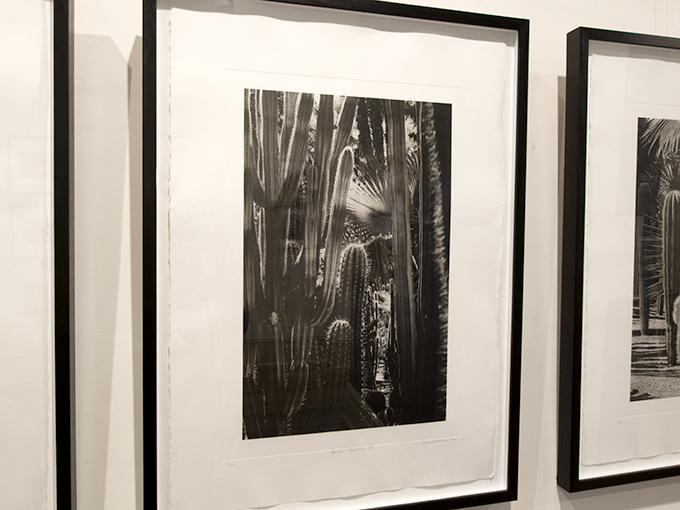
One of Silvi’s gravures
Some beautiful images enhanced by the best way to make photographic images – Gravure…!
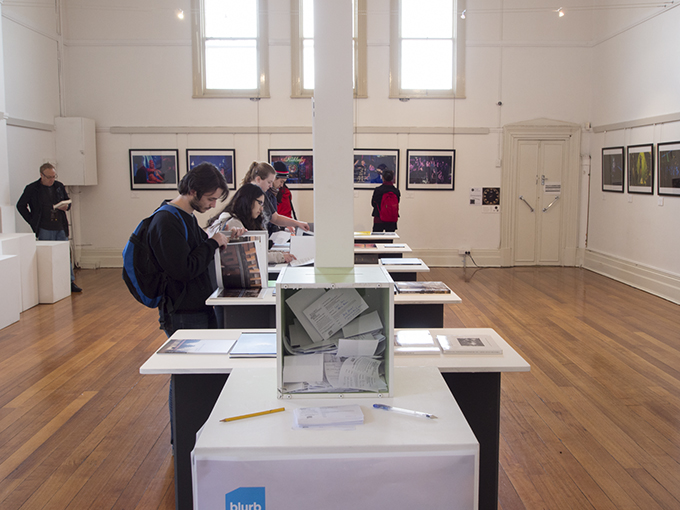
BLURB’s ‘One for the book’ Photobook Award display in Trades Hall
20 Books from around the world were selected as finalists for this award – some interesting works including one of my own… It’s a public vote to select a winner —Vote for mine!!!
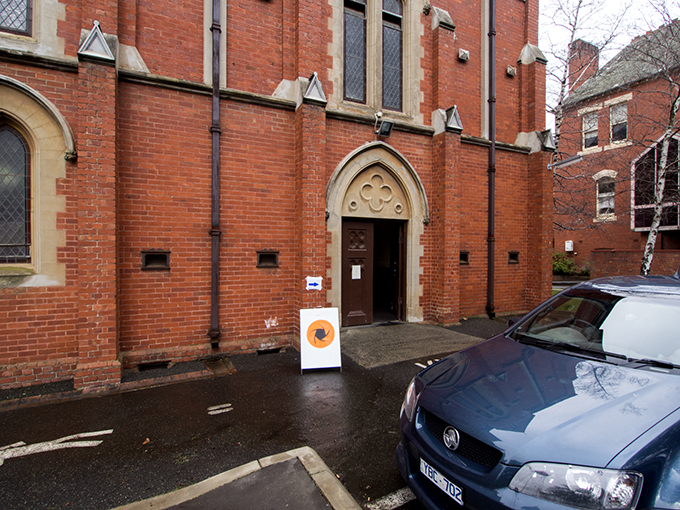
The St Patricks exhibition hall
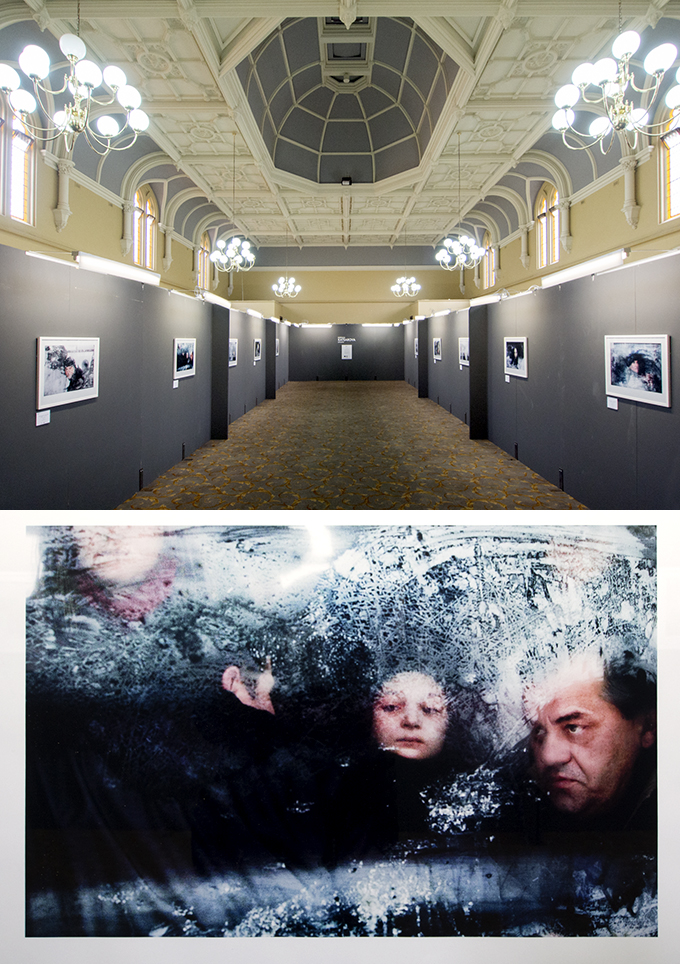
Boryana Katsorova’s
‘Freezing’
The exceptionally cold weather and snowstorms that hit Europe in February 2012, caused traffic chaos, road closures, straining emergency services, grounding flights and pushing the death toll past 300 people and left entire villages cut off. I have documented this event in my series ‘Freezing’ capturing the distant stares of passengers (from the catalogue).
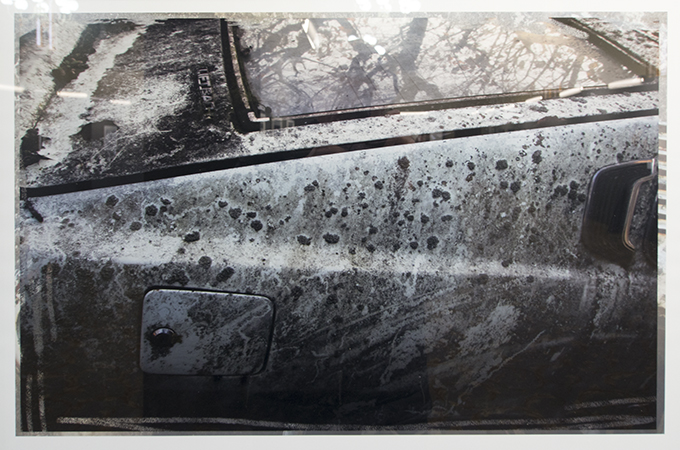
Michelle Vannier’s
‘Car Graveyard’
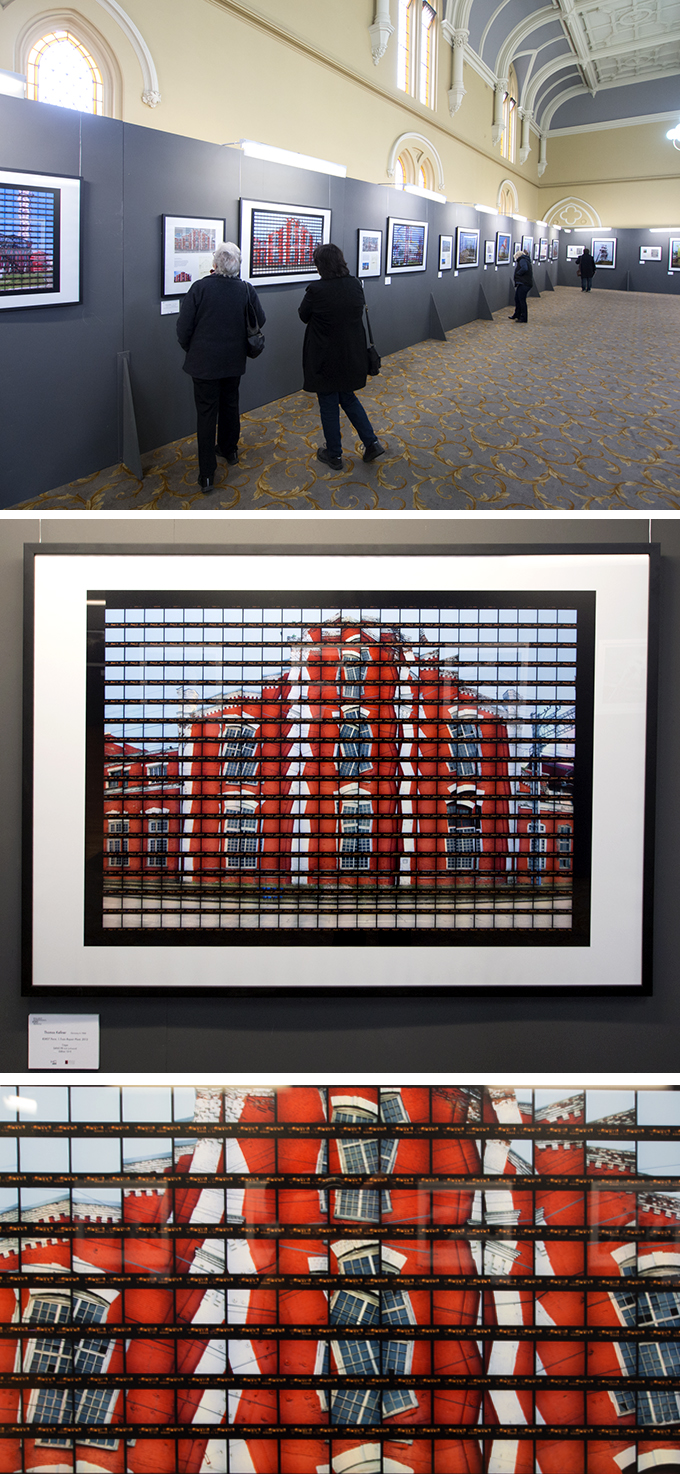
Thomas Kellner
‘Genius Loci – Two German Gentlemen of Siegen in the Land of the Tsars’
Film-based mosaics – each full width of the subject being a 24 exposure film. Individual frames are ‘wiggled’ to deconstruct the real subject. A detailled plan of each image’s deconstruction is shown alongside the finished work.
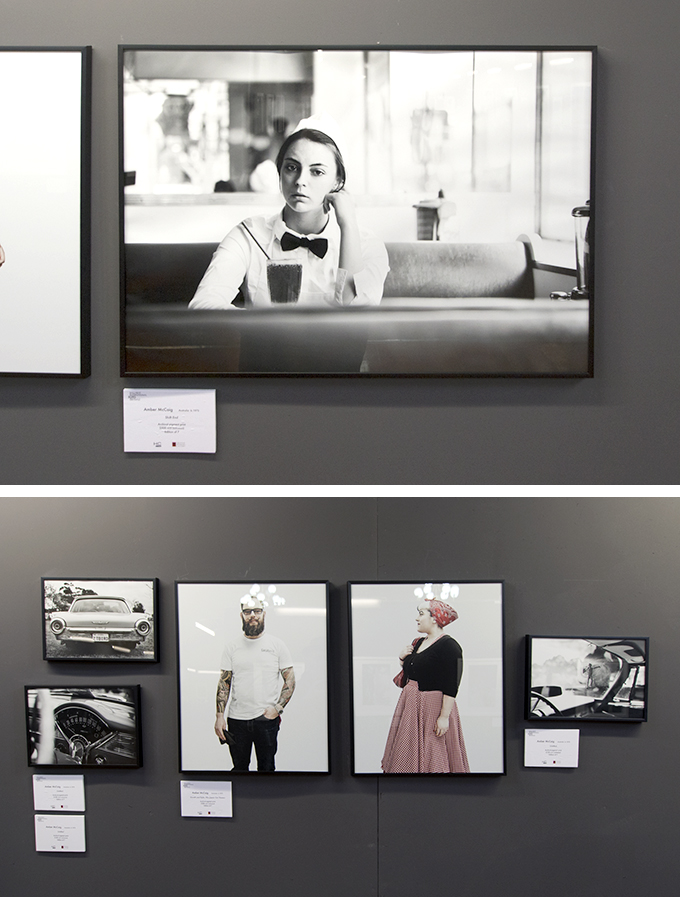
Amber McCraig’s ‘Americana Now’
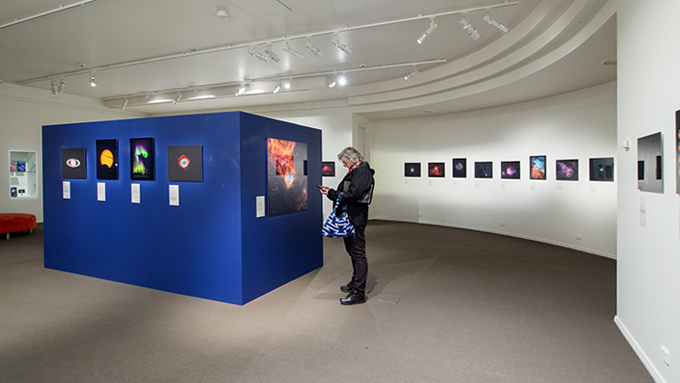
Astronomical Society of Victoria’s
‘Wonders of the Universe Exposed’
A stellar exhibition by the astronomers with cameras – Include work by our telescope here Andrew Campbell.
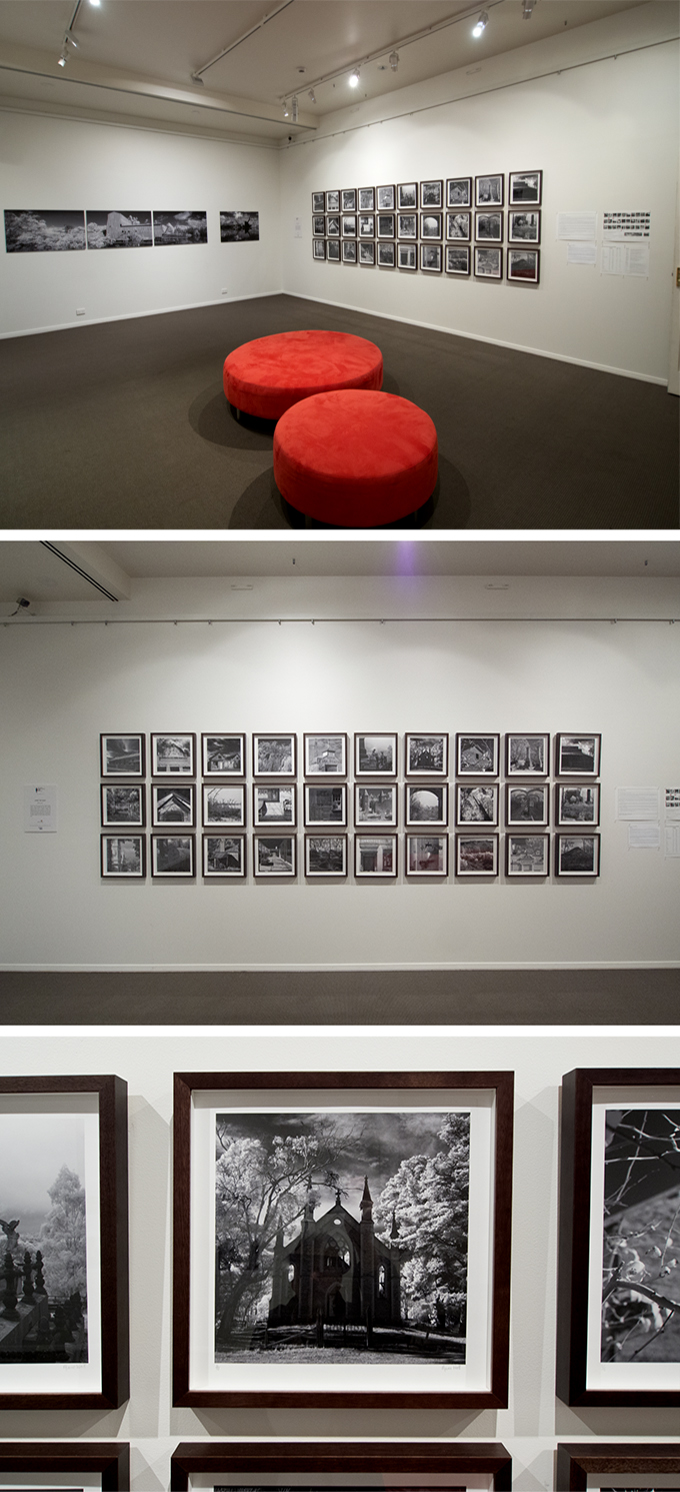
Marie Watt ‘After the Rush’
Marie Watt’s series After the Rush uses infrared photography to emphasise the atmospheric solitude of the lesser known gold rush sites – in a bid to remind us of a wider vibrant, though harsher, past (from the catalogue).
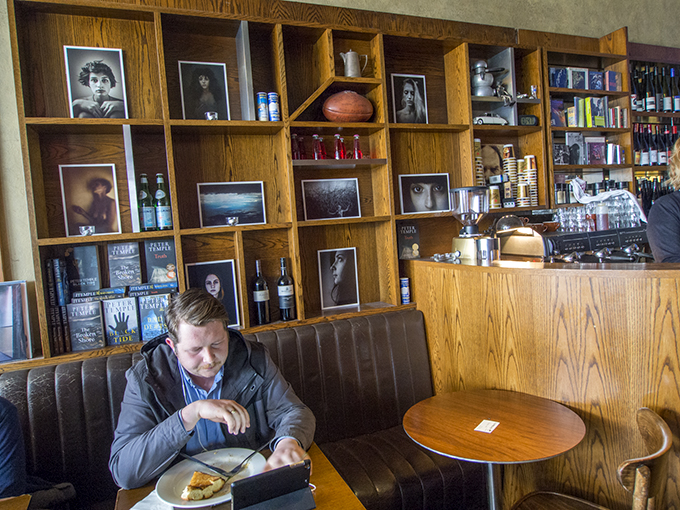
An exhibition in a coffee shop…
OH!! It was such a busy couple of days…
COOPER+SPOWART NOCTURNE MUSWELLBROOK – Revisitied
.
.
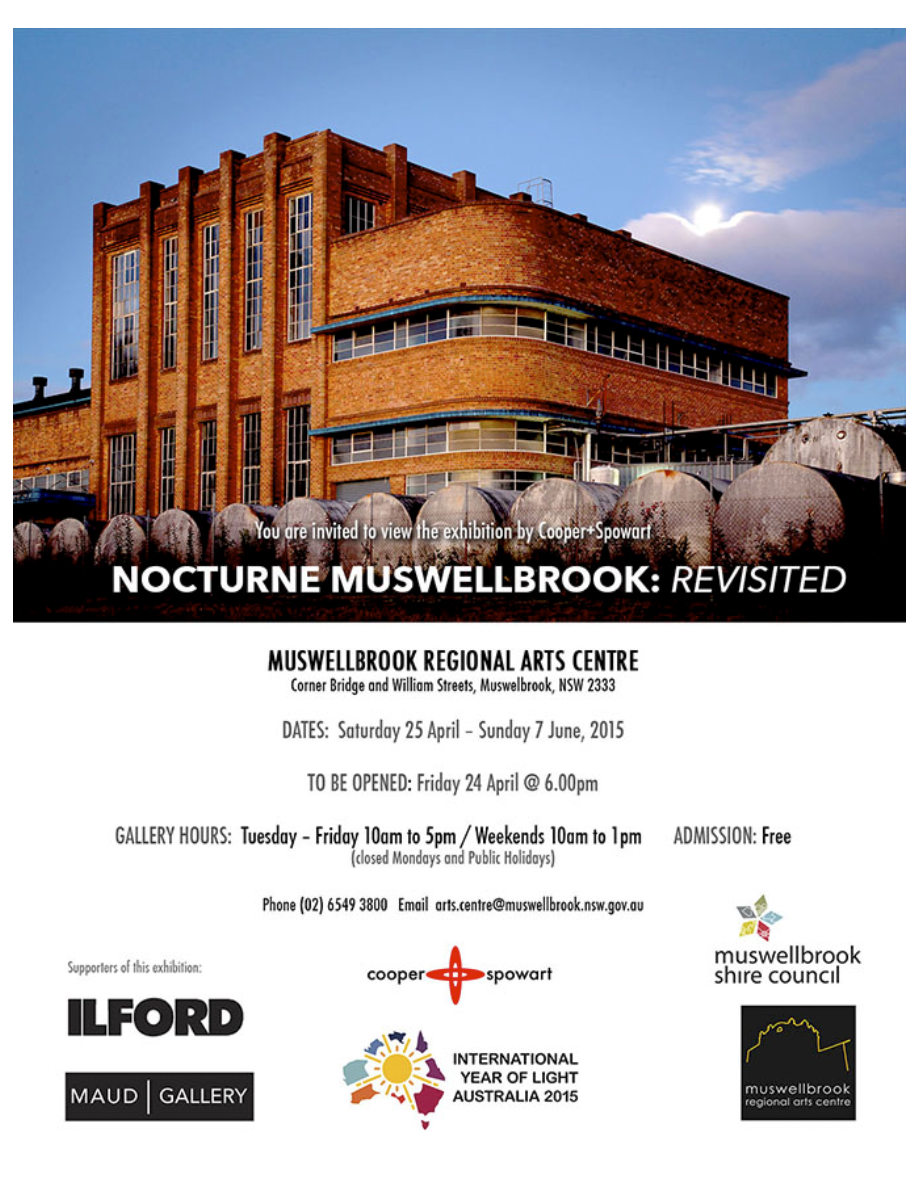
2015 was the INTERNATIONAL YEAR OF LIGHT – Our Nocturne projects celebrate light and to celebrate we presented a major exhibition entitled NOCTURNE MUSWELLBROOK: Revisited at the Muswellbrook Regional Arts Centre.
.
Nocturne Muswellbrook: Reflections on Light
As the sun goes down and the last light fades–cars pass by with commuters heading home for respite at the end of a days work or others just embarking on a nights work. Trucks move through the town with little thought for the places they pass through. People meet and have a conversation…. The street lights come on one by one up the street. The illuminated advertising signage lights the buildings along with the internal lights of the building.
This transition from daylight to night is rhythmical–a diurnal phenomenon–but one that is also pervaded with the uncanny or un-homely sense of place. At nocturne and into the night everyday places change, becoming mysterious as the shadows replace familiar surrounds. A sense of melancholy also grows with the passing of the day–a lament born from the relentlessness of change.
Yet these ephemeral moments can also be seductive and evocative, experiencing the aesthetics of the nocturne can inspire new imaginings of everyday places. The colour and chiaroscuro compositions of light and shadow replace the tired and indifferent prose of daily life. A magical narrative evolves from the personal memories of a shared living history in these laneways, streets, buildings and spaces.
.
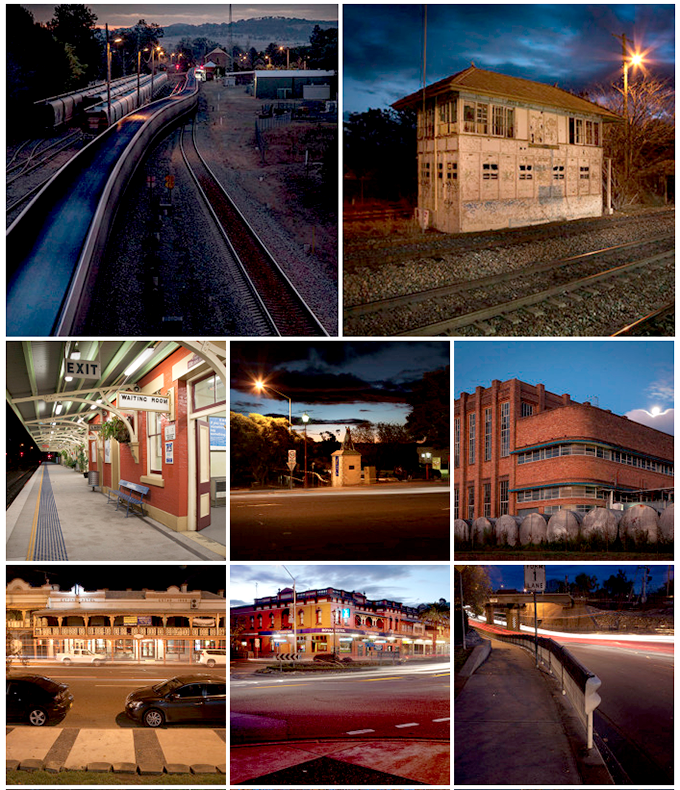
A selection of Nocturne Muswellbrook: Revisited images
.
COOPER+SPOWART NOCTURNE PROJECTS
Cooper+Spowart Nocturne shadow
For many years we have engaged in nocturne projects. These have included artists in residency programs in the regional galleries of Muswellbrook, Grafton, Bundaberg and Miles as well as self-funded projects across east coast Australia. The Artist in Residence (AIR) projects are associated with a Facebook page to connect the community with the photographs and evoke stories about the places photographed.
A sample of community Facebook responses can be seen here:
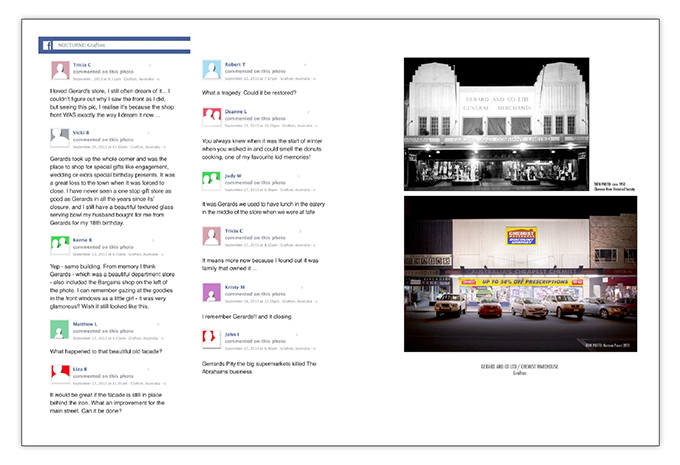
Catalogue-Comments-interact-FP3
.
Nocturne AIR Projects include workshops, mentoring in photography, image enhancement, social media as well as photobook and zine making. Future Nocturne Projects are in the planning stage and we seek expressions of interest from communities looking to participating in a Nocturne light project.
.
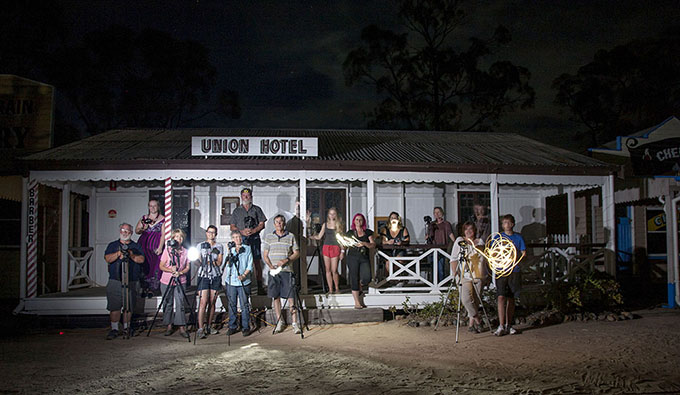
Participating community members from the Nocturne Miles Project
.
A link to a collective of NOCTURNE PROJECTS can be found: HERE
.
THE BACK STORY: Nocturne Muswellbrook
The Nocturne Muswellbrook Facebook page was launched in June 2013
From 23rd June we began a 2week Artist in Residence in Muswellbrook. Our studio was a vacant shop in the Campbell’s Corner building fronting onto the main street, Bridge Street
.
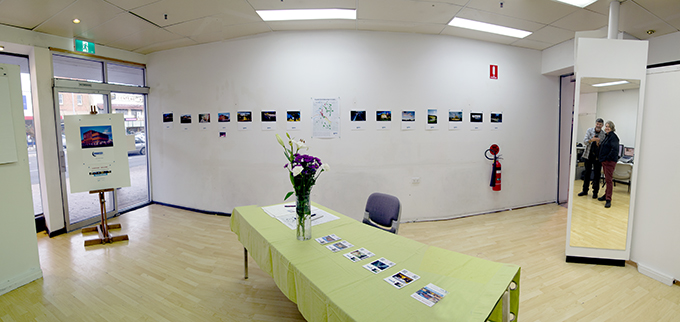
Our gallery and workspace
We set up our digital studio workspace to:
- Master the nocturne photographs for the Facebook page
- Print out the mastered images for a small display in the shop
- Greet anyone that wanted to come by and share their story about Muswellbrook
- Prepare for the evening’s shooting around the town
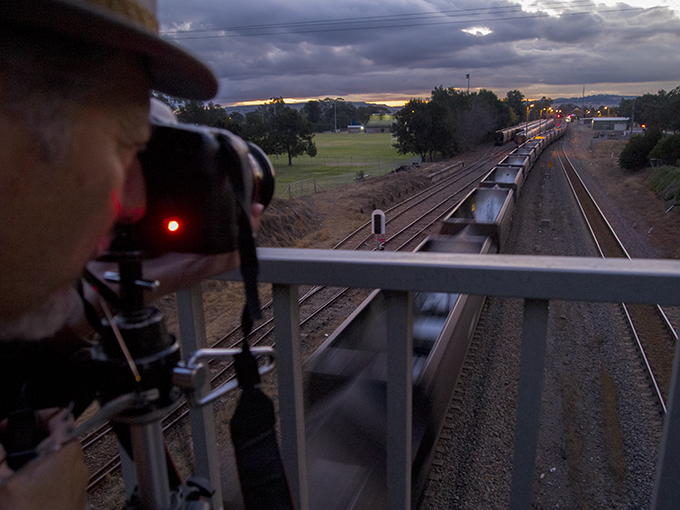
Photographing a coal train from the Bell Street bridge
Each night and day, once the images were uploaded onto the Nocturne Muswellbrook page we invited everyone to tell their stories about each place photographed. We were excited to engage with the community and a deeper knowledge and experience of Muswellbrook through this process.
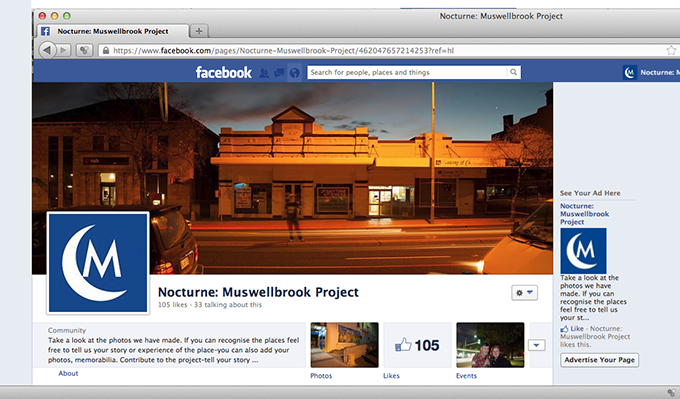
An early FB Cover
Many people that visited the page were once residents of Muswellbrook but now live in other parts of Australia and some were international expats. The number of ‘Page LIKES’ grew quickly – today the number stands @ 620. There was a pride and a melancholy for this once rural town. Some stories were full of humour and the irony of the Aussie yarn. While others shared poignant moments of their lives from the memories evoked by the photographs.
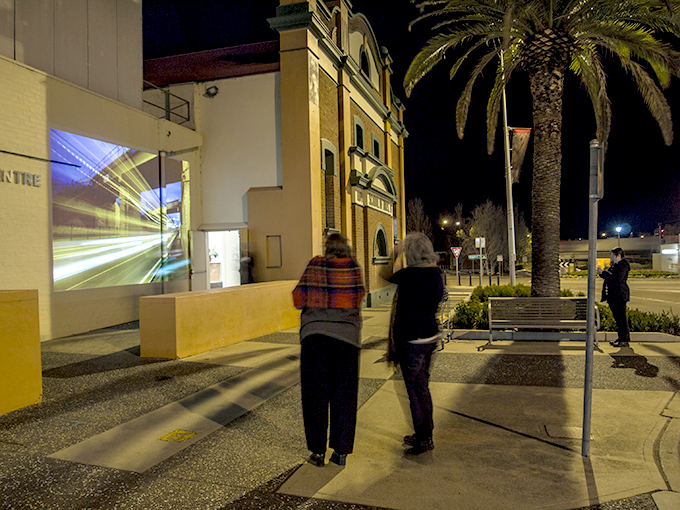
Video projection on MRAC wall
We also created a Youtube video that was uploaded and premiered at our artists talk held in the Muswellbrook Regional Arts Centre on the July 5. In evening we projected our images as a visual performance on the outside of the Gallery for public viewing and to extend the experience of the nocturne project.
Even though our 2 weeks in residence had come to an end on July 6, we still continued to connect with the Facebook page: uploading images and connecting them with the community’s stories.
SETTING UP THE EXHIBITION
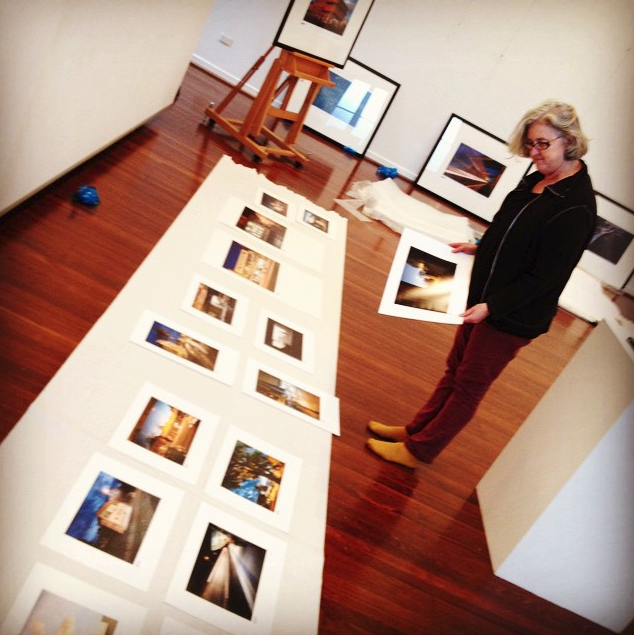
Vicky arranging the hang
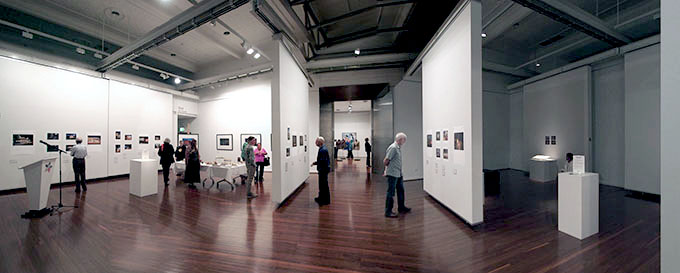
The MRAC exhibition space
In 2015 we came back to show an exhibition of the work on the walls of the Gallery. The Sunday after the opening we presented a workshop for participants wanted to upskill or engage with how we captured and mastered these nocturnal images.
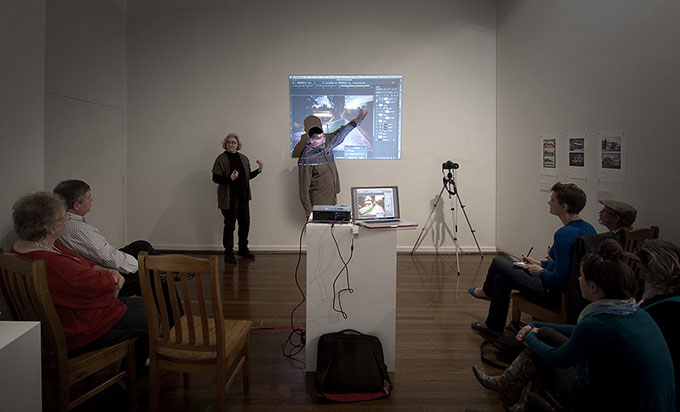
Workshop at the MRAC
Now the works are on the wall for all to come and see… and we are inviting anyone who visits to write down their story and place on the wall next to the image. The gallery is now a physical “Facebook page”. We look forward to seeing your written stories on the walls of the gallery.
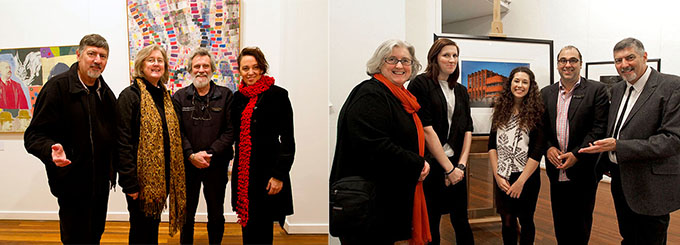
2013: with Silvana & Roger Skinner – MRAC AIR Coordinator – 2015 with Elissa, Jade and MRAC Director Brad Franks
.
We want to express our thanks to the MRAC Team, Roger Skinner, ILFORD papers and Maud Gallery.

.
2015 is the INTERNATIONAL YEAR OF LIGHT – Our Nocturne projects celebrate light and this year at the Muswellbrook Regional Arts Centre we are showing a major exhibition entitled NOCTURNE MUSWELLBROOK: Revisited.
Nocturne Muswellbrook: Reflections on Light
As the sun goes down and the last light fades–cars pass by with commuters heading home for respite at the end of a days work or others just embarking on a nights work. Trucks move through the town with little thought for the places they pass through. People meet and have a conversation…. The street lights come on one by one up the street. The illuminated advertising signage lights the buildings along with the internal lights of the building.
This transition from daylight to night is rhythmical–a diurnal phenomenon–but one that is also pervaded with the uncanny or un-homely sense of place. At nocturne and into the night everyday places change, becoming mysterious as the shadows replace familiar surrounds. A sense of melancholy also grows with the passing of the day–a lament born from the relentlessness of change.
Yet these ephemeral moments can also be seductive and evocative, experiencing the aesthetics of the nocturne can inspire new imaginings of everyday places. The colour and chiaroscuro compositions of light and shadow replace the tired and indifferent prose of daily life. A magical narrative evolves from the personal memories of a shared living history in these laneways, streets, buildings and spaces.
.
A selection of Nocturne Muswellbrook: Revisited images
.
COOPER+SPOWART NOCTURNE PROJECTS
Cooper+Spowart Nocturne shadow
For many years we have engaged in nocturne projects. These have included artists in residency programs in the regional galleries of Muswellbrook, Grafton, Bundaberg and Miles as well as self-funded projects across east coast Australia. The Artist in Residence (AIR) projects are associated with a Facebook page to connect the community with the photographs and evoke stories about the places photographed.
A sample of community Facebook responses can be seen here:
Catalogue-Comments-interact-FP3
.
Nocturne AIR Projects include workshops, mentoring in photography, image enhancement, social media as well as photobook and zine making. Future Nocturne Projects are in the planning stage and we seek expressions of interest from communities looking to participating in a Nocturne light project.
.
Participating community members from the Nocturne Miles Project
.
A link to a collective of NOCTURNE PROJECTS can be found: HERE
.
THE BACK STORY: Nocturne Muswellbrook
The Nocturne Muswellbrook Facebook page was launched in June 2013
From 23rd June we began a 2week Artist in Residence in Muswellbrook. Our studio was a vacant shop in the Campbell’s Corner building fronting onto the main street, Bridge Street
.
Our gallery and workspace
We set up our digital studio workspace to:
- Master the nocturne photographs for the Facebook page
- Print out the mastered images for a small display in the shop
- Greet anyone that wanted to come by and share their story about Muswellbrook
- Prepare for the evening’s shooting around the town
Photographing a coal train from the Bell Street bridge
Each night and day, once the images were uploaded onto the Nocturne Muswellbrook page we invited everyone to tell their stories about each place photographed. We were excited to engage with the community and a deeper knowledge and experience of Muswellbrook through this process.
An early FB Cover
Many people that visited the page were once residents of Muswellbrook but now live in other parts of Australia and some were international expats. The number of ‘Page LIKES’ grew quickly – today the number stands @ 620. There was a pride and a melancholy for this once rural town. Some stories were full of humour and the irony of the Aussie yarn. While others shared poignant moments of their lives from the memories evoked by the photographs.
Video projection on MRAC wall
We also created a Youtube video that was uploaded and premiered at our artists talk held in the Muswellbrook Regional Arts Centre on the July 5. In evening we projected our images as a visual performance on the outside of the Gallery for public viewing and to extend the experience of the nocturne project.
Even though our 2 weeks in residence had come to an end on July 6, we still continued to connect with the Facebook page: uploading images and connecting them with the community’s stories.
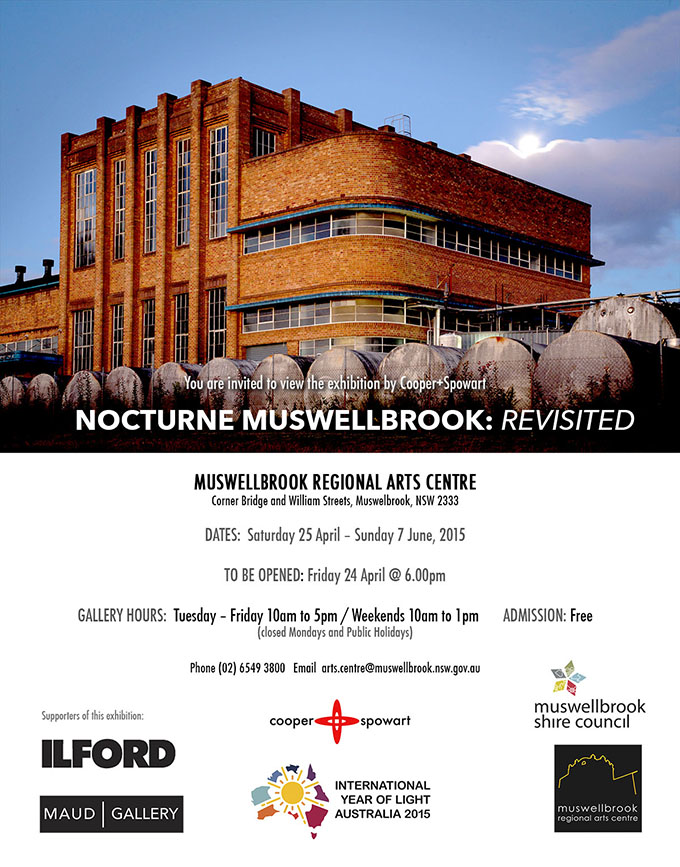
Exhibition invite
Vicky arranging the hang
The MRAC exhibition space
In 2015 we came back to show an exhibition of the work on the walls of the Gallery. The Sunday after the opening we presented a workshop for participants wanted to upskill or engage with how we captured and mastered these nocturnal images.
Workshop at the MRAC
Now the works are on the wall for all to come and see… and we are inviting anyone who visits to write down their story and place on the wall next to the image. The gallery is now a physical “Facebook page”. We look forward to seeing your written stories on the walls of the gallery.
2013: with Silvana & Roger-MRAC AIR Coordinator ….. 2015 with Elissa, Jade and MRAC Director Brad…………………..
.
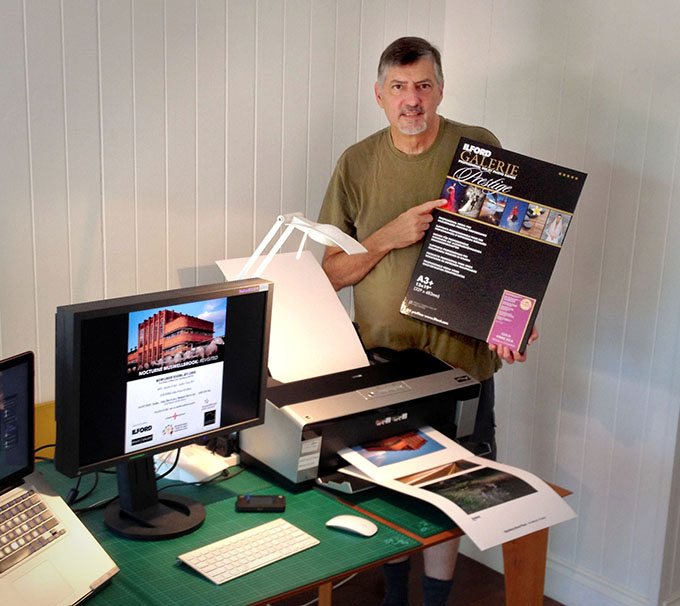
Printing with ILFORD Galerie GOLD SILK papers
.
We want to express our thanks to the MRAC Team, Roger Skinner, ILFORD papers and Maud Gallery.
.
2015 is the INTERNATIONAL YEAR OF LIGHT – Our Nocturne projects celebrate light and this year at the Muswellbrook Regional Arts Centre we are showing a major exhibition entitled NOCTURNE MUSWELLBROOK: Revisited.
Nocturne Muswellbrook: Reflections on Light
As the sun goes down and the last light fades–cars pass by with commuters heading home for respite at the end of a days work or others just embarking on a nights work. Trucks move through the town with little thought for the places they pass through. People meet and have a conversation…. The street lights come on one by one up the street. The illuminated advertising signage lights the buildings along with the internal lights of the building.
This transition from daylight to night is rhythmical–a diurnal phenomenon–but one that is also pervaded with the uncanny or un-homely sense of place. At nocturne and into the night everyday places change, becoming mysterious as the shadows replace familiar surrounds. A sense of melancholy also grows with the passing of the day–a lament born from the relentlessness of change.
Yet these ephemeral moments can also be seductive and evocative, experiencing the aesthetics of the nocturne can inspire new imaginings of everyday places. The colour and chiaroscuro compositions of light and shadow replace the tired and indifferent prose of daily life. A magical narrative evolves from the personal memories of a shared living history in these laneways, streets, buildings and spaces.
.
A selection of Nocturne Muswellbrook: Revisited images
.
COOPER+SPOWART NOCTURNE PROJECTS
Cooper+Spowart Nocturne shadow
For many years we have engaged in nocturne projects. These have included artists in residency programs in the regional galleries of Muswellbrook, Grafton, Bundaberg and Miles as well as self-funded projects across east coast Australia. The Artist in Residence (AIR) projects are associated with a Facebook page to connect the community with the photographs and evoke stories about the places photographed.
A sample of community Facebook responses can be seen here:
Catalogue-Comments-interact-FP3
.
Nocturne AIR Projects include workshops, mentoring in photography, image enhancement, social media as well as photobook and zine making. Future Nocturne Projects are in the planning stage and we seek expressions of interest from communities looking to participating in a Nocturne light project.
.
Participating community members from the Nocturne Miles Project
.
A link to a collective of NOCTURNE PROJECTS can be found: HERE
.
THE BACK STORY: Nocturne Muswellbrook
The Nocturne Muswellbrook Facebook page was launched in June 2013
From 23rd June we began a 2week Artist in Residence in Muswellbrook. Our studio was a vacant shop in the Campbell’s Corner building fronting onto the main street, Bridge Street
.
Our gallery and workspace
We set up our digital studio workspace to:
- Master the nocturne photographs for the Facebook page
- Print out the mastered images for a small display in the shop
- Greet anyone that wanted to come by and share their story about Muswellbrook
- Prepare for the evening’s shooting around the town
Photographing a coal train from the Bell Street bridge
Each night and day, once the images were uploaded onto the Nocturne Muswellbrook page we invited everyone to tell their stories about each place photographed. We were excited to engage with the community and a deeper knowledge and experience of Muswellbrook through this process.
An early FB Cover
Many people that visited the page were once residents of Muswellbrook but now live in other parts of Australia and some were international expats. The number of ‘Page LIKES’ grew quickly – today the number stands @ 620. There was a pride and a melancholy for this once rural town. Some stories were full of humour and the irony of the Aussie yarn. While others shared poignant moments of their lives from the memories evoked by the photographs.
Video projection on MRAC wall
We also created a Youtube video that was uploaded and premiered at our artists talk held in the Muswellbrook Regional Arts Centre on the July 5. In evening we projected our images as a visual performance on the outside of the Gallery for public viewing and to extend the experience of the nocturne project.
Even though our 2 weeks in residence had come to an end on July 6, we still continued to connect with the Facebook page: uploading images and connecting them with the community’s stories.
Exhibition invite
Vicky arranging the hang
The MRAC exhibition space
In 2015 we came back to show an exhibition of the work on the walls of the Gallery. The Sunday after the opening we presented a workshop for participants wanted to upskill or engage with how we captured and mastered these nocturnal images.
Workshop at the MRAC
Now the works are on the wall for all to come and see… and we are inviting anyone who visits to write down their story and place on the wall next to the image. The gallery is now a physical “Facebook page”. We look forward to seeing your written stories on the walls of the gallery.
2013: with Silvana & Roger-MRAC AIR Coordinator ….. 2015 with Elissa, Jade and MRAC Director Brad…………………..
.
Printing with ILFORD Galerie GOLD SILK papers
.
We want to express our thanks to the MRAC Team, Roger Skinner, ILFORD papers and Maud Gallery.
.
2015 is the INTERNATIONAL YEAR OF LIGHT – Our Nocturne projects celebrate light and this year at the Muswellbrook Regional Arts Centre we are showing a major exhibition entitled NOCTURNE MUSWELLBROOK: Revisited.
Nocturne Muswellbrook: Reflections on Light
As the sun goes down and the last light fades–cars pass by with commuters heading home for respite at the end of a days work or others just embarking on a nights work. Trucks move through the town with little thought for the places they pass through. People meet and have a conversation…. The street lights come on one by one up the street. The illuminated advertising signage lights the buildings along with the internal lights of the building.
This transition from daylight to night is rhythmical–a diurnal phenomenon–but one that is also pervaded with the uncanny or un-homely sense of place. At nocturne and into the night everyday places change, becoming mysterious as the shadows replace familiar surrounds. A sense of melancholy also grows with the passing of the day–a lament born from the relentlessness of change.
Yet these ephemeral moments can also be seductive and evocative, experiencing the aesthetics of the nocturne can inspire new imaginings of everyday places. The colour and chiaroscuro compositions of light and shadow replace the tired and indifferent prose of daily life. A magical narrative evolves from the personal memories of a shared living history in these laneways, streets, buildings and spaces.
.
A selection of Nocturne Muswellbrook: Revisited images
.
COOPER+SPOWART NOCTURNE PROJECTS
Cooper+Spowart Nocturne shadow
For many years we have engaged in nocturne projects. These have included artists in residency programs in the regional galleries of Muswellbrook, Grafton, Bundaberg and Miles as well as self-funded projects across east coast Australia. The Artist in Residence (AIR) projects are associated with a Facebook page to connect the community with the photographs and evoke stories about the places photographed.
A sample of community Facebook responses can be seen here:
Catalogue-Comments-interact-FP3
.
Nocturne AIR Projects include workshops, mentoring in photography, image enhancement, social media as well as photobook and zine making. Future Nocturne Projects are in the planning stage and we seek expressions of interest from communities looking to participating in a Nocturne light project.
.
Participating community members from the Nocturne Miles Project
.
A link to a collective of NOCTURNE PROJECTS can be found: HERE
.
THE BACK STORY: Nocturne Muswellbrook
The Nocturne Muswellbrook Facebook page was launched in June 2013
From 23rd June we began a 2week Artist in Residence in Muswellbrook. Our studio was a vacant shop in the Campbell’s Corner building fronting onto the main street, Bridge Street
.
Our gallery and workspace
We set up our digital studio workspace to:
- Master the nocturne photographs for the Facebook page
- Print out the mastered images for a small display in the shop
- Greet anyone that wanted to come by and share their story about Muswellbrook
- Prepare for the evening’s shooting around the town
Photographing a coal train from the Bell Street bridge
Each night and day, once the images were uploaded onto the Nocturne Muswellbrook page we invited everyone to tell their stories about each place photographed. We were excited to engage with the community and a deeper knowledge and experience of Muswellbrook through this process.
An early FB Cover
Many people that visited the page were once residents of Muswellbrook but now live in other parts of Australia and some were international expats. The number of ‘Page LIKES’ grew quickly – today the number stands @ 620. There was a pride and a melancholy for this once rural town. Some stories were full of humour and the irony of the Aussie yarn. While others shared poignant moments of their lives from the memories evoked by the photographs.
Video projection on MRAC wall
We also created a Youtube video that was uploaded and premiered at our artists talk held in the Muswellbrook Regional Arts Centre on the July 5. In evening we projected our images as a visual performance on the outside of the Gallery for public viewing and to extend the experience of the nocturne project.
Even though our 2 weeks in residence had come to an end on July 6, we still continued to connect with the Facebook page: uploading images and connecting them with the community’s stories.
Exhibition invite
Vicky arranging the hang
The MRAC exhibition space
In 2015 we came back to show an exhibition of the work on the walls of the Gallery. The Sunday after the opening we presented a workshop for participants wanted to upskill or engage with how we captured and mastered these nocturnal images.
Workshop at the MRAC
Now the works are on the wall for all to come and see… and we are inviting anyone who visits to write down their story and place on the wall next to the image. The gallery is now a physical “Facebook page”. We look forward to seeing your written stories on the walls of the gallery.
2013: with Silvana & Roger – MRAC AIR Coordinator ….. 2015 with Elissa, Jade and MRAC Director Brad Franks…………………..
.
.
We want to express our thanks to the MRAC Team, Roger Skinner, ILFORD papers and Maud Gallery.
APRIL 26–WORLDWIDE PINHOLE DAY: Our Contributions for 2015
.
Round the [w]hole world on the 26th of April pinholers were out having fun – Making their images for the 2015 WPD. Far away from the darkroom we once had we’ve once again fitted a pin-prick in a piece of aluminium fitted to a body cap of our Olympus Pen EP-5 camera.
This is the 11th year we have made pinhole images to support the WPD project! The other submissions are listed at the end of this post.
.
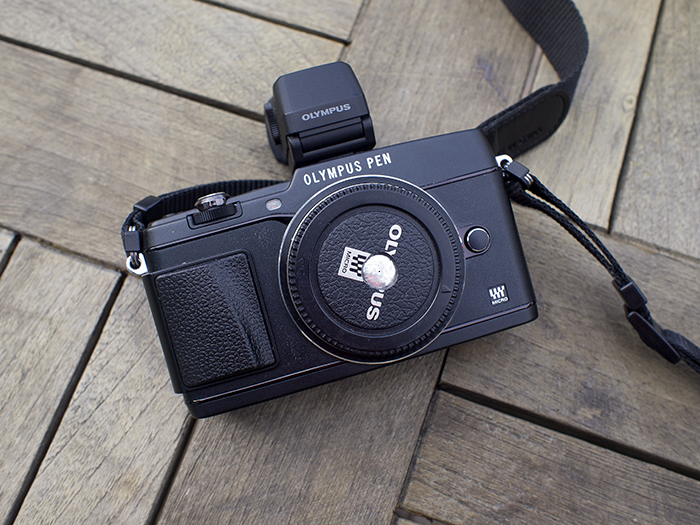
Olympus Pen with hand pierced aluminum foil hole, Auto exposure mode, ISO 1600.
.
VICKY’s Submission:
Great to take this image of a moving subject – I used a digital camera with a pinhole to make this possible.
.
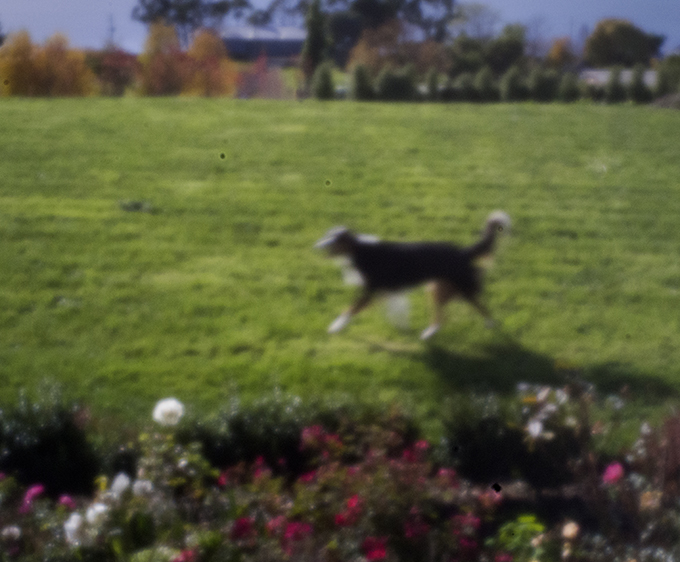
Charlie chasing a ball … 1/45th of a second @ 1,600 ISO
.
DOUG’s Submission:
I have made pinhole photos with all kinds of technology from tin cans to cars but what I like the most is how direct sunlight splashes a rainbow onto the image. It’s Autumn in Australia s the two ephemeralities – light and autumn leaves were an ideal subject for pinhole investigation.
.
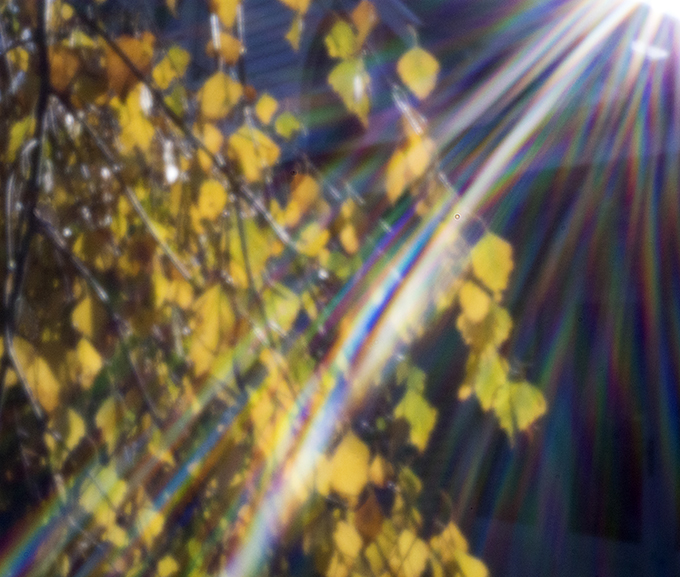
Autumn rainbow splash … 1/45th of a second @ 1,600 ISO
.
Vist the WPD Site for other contributors: http://www.pinholeday.org/gallery/2015/
.
Our Past WPD images:
2014 Vicky’s http://pinholeday.org/gallery/2014/index.php?id=1810&City=Toowoomba
2014 Doug’s http://pinholeday.org/gallery/2014/index.php?id=1811&City=Toowoomba
2013 https://wotwedid.com/2013/04/29/world-pinhole-photography-day-our-contribution/
2012 http://www.pinholeday.org/gallery/2012/index.php?id=1937&searchStr=spowart
2011 http://www.pinholeday.org/gallery/2011/index.php?id=924
HERE IS THE LINK to the 2011 pinhole video http://www.youtube.com/watch?v=Yk4vnbzTqOU
2010 http://www.pinholeday.org/gallery/2010/index.php?id=2464&Country=Australia&searchStr=spowart
2006 http://www.pinholeday.org/gallery/2006/index.php?id=1636&Country=Australia&searchStr=cooper
2004 Vicky http://www.pinholeday.org/gallery/2004/index.php?id=1553&Country=Australia&searchStr=cooper
2004 Doug http://www.pinholeday.org/gallery/2004/index.php?id=1552&Country=Australia&searchStr=spowart
2003 http://www.pinholeday.org/gallery/2003/index.php?id=615&Country=Australia&searchStr=spowart
2002 http://www.pinholeday.org/gallery/2002/index.php?id=826&Country=Australia&searchStr=spowart
.
.

PHOTOBOOK INDEPENDENT: Our books in Hollywood – thanks to QCP
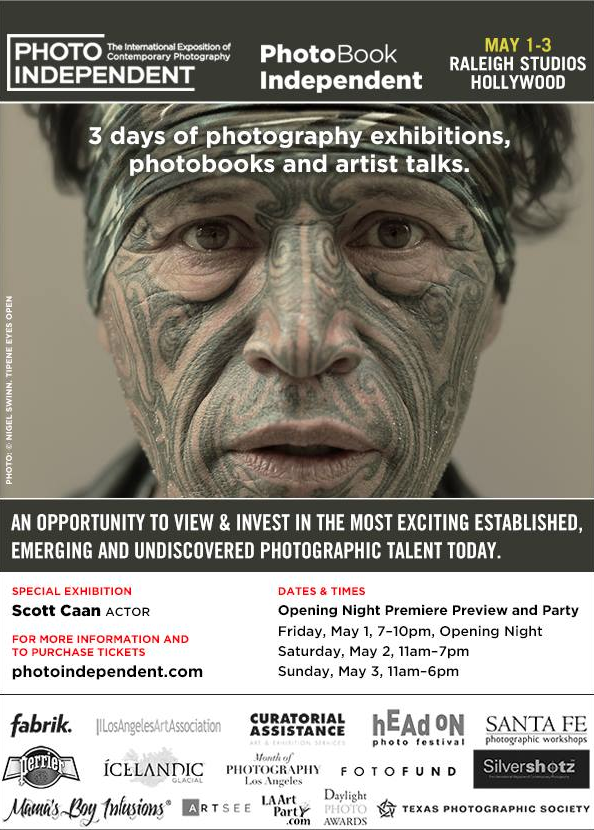
Photo Independent poster
.
As part of its international activities for Queensland and Australian photographers the Queensland Centre for Photography participated in the inaugural Photo Independent art fair at Raleigh Studios, Los Angeles 1–3 May, 2015. The main Australian contingent consists of the wall images of 12 photomedia artists. They are Anna Carey, Belinda Kochanowska, Chris Bowes, David La Roche, Henri van Noordenburg, Kim Demuth, Kelly Hussey-Smith & Alan Hill, Katelyn-Jane Dunn, Lynette Letic, Michael Cook and Marian Drew.
.
An additional aspect of Photo Independent is one dedicated to the recognition of photographers who work in the book format. Called Photobook Independent the QCP curated a selection of 16 Australian photo publishers to present in the L.A. event.
In QCP media about these two events the following statement was made:
The QCP is excited to be part of this ground-breaking event as the world of photography will set its focus on Los Angeles 1–3 May, 2015 for a weekend celebrating international photography and the most talented image-makers across various genres of the medium. Numerous high profile art fairs including Paris Photo Los Angeles, Photo Contemporary, Photo Independent and PhotoBook Independent will launch their annual editions in Hollywood with additional special photography exhibitions throughout Los Angeles. The weekend promises to offer the enthusiastic art patron a plethora of opportunities to experience photography at its highest calibre.
The photobook publishers were: Ingvar Kenne, Dane Beesley, Anne Ferran, Lindsay Varvari, Rohan Hutchinson, Julie Shiels, Prudence Murphy, Christopher Young, Paul Batt, Ian Tippett, Doug Spowart, Victoria Cooper, Gemma Avery, Michelle Powell, Mathias Heng and Christopher Köller.
Interviews with the artists and photobook makers can be found on the LUCIDA Site: http://lucidamagazine.com/
Biogs on the photobook participants can be seen here: http://qcpinternational.com/portfolios/photo-book-independent-2015/
.
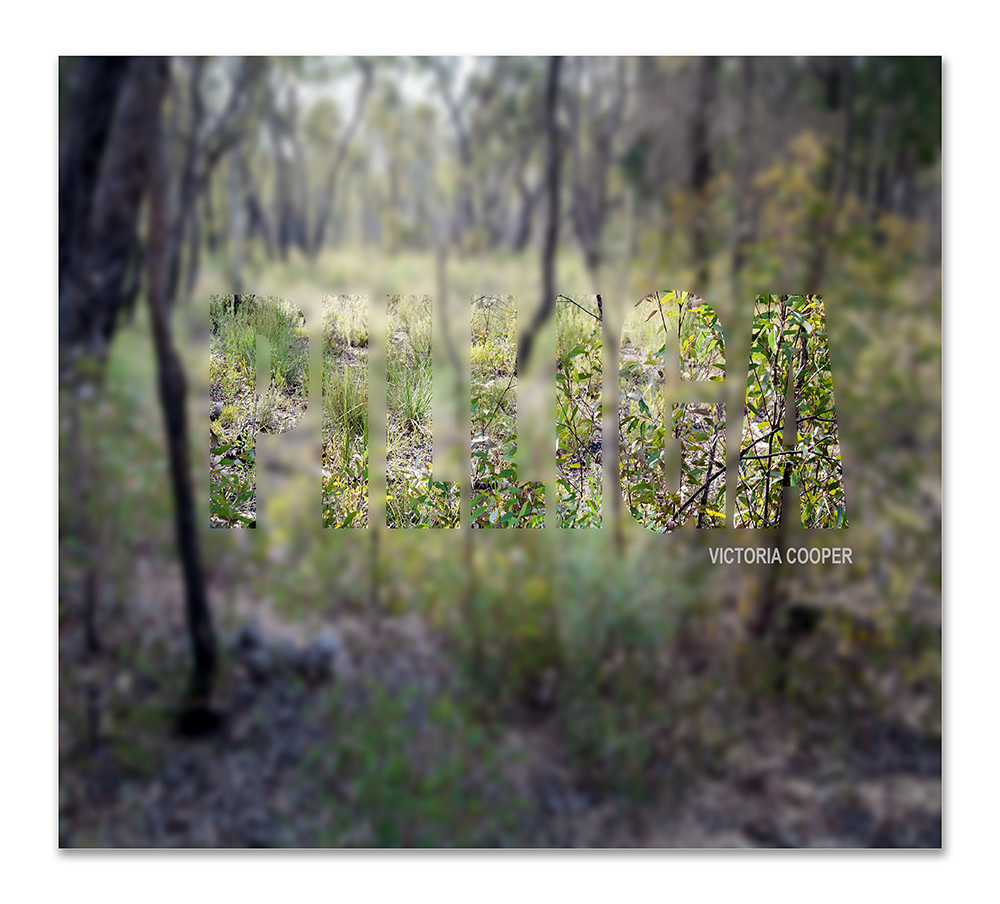
Victoria Cooper’s PILLIGA
.
About Victoria’s Book: PILLIGA
Pilliga is the culmination of 10 years work. It is informed by the many physical, psychological and metaphorical journeys through this enigmatic place during the decade of its creation.
This book is not a topographic depiction of the Pilliga Scrub, a remote location in the Australian Bush. Rather it is a human story of lurking deep anxiety manifested as a destructive invisible entity feeding on fears of the unknown and unknowable.
A PDF of the book can be seen here:PILLIGA-redsmr
The book can be purchased from BLURB here: http://blur.by/1Q9cGhh
.
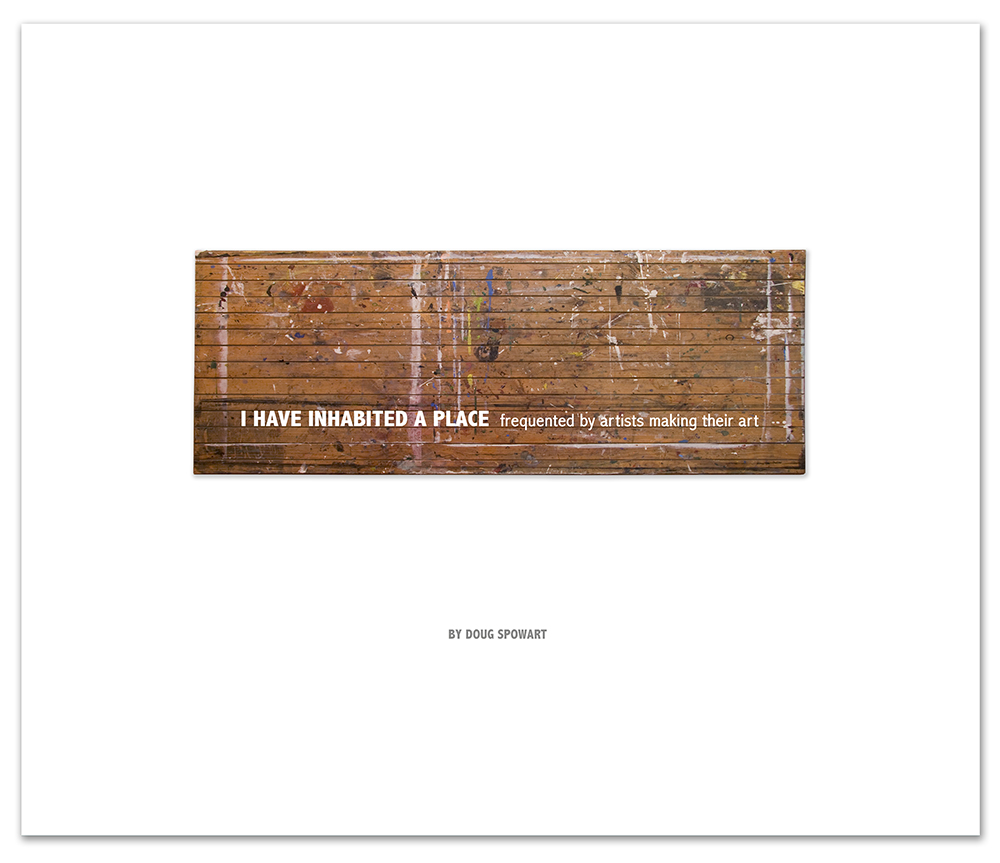
Doug Spowart’s I have inhabited a place …
About Doug’s Book: I HAVE INHABITED A PLACE FREQUENTED BY ARTISTS MAKING THEIR ART …
This book relates to the experience of being a documentary photographer within the world. The subject, a deserted artist’s studio, becomes an immersive landscape for investigation. This photobook expresses a personal narrative about loss, absence, place, and concepts around the relationship between the non-human and the working practices of artists.
A PDF of the book can be seen here: I have inhabited a place …red2
The book can be purchased from AMAZON here: http://blur.by/1K65dMu
.
.
.
Regional Selfies: Communities and Self-Documentation
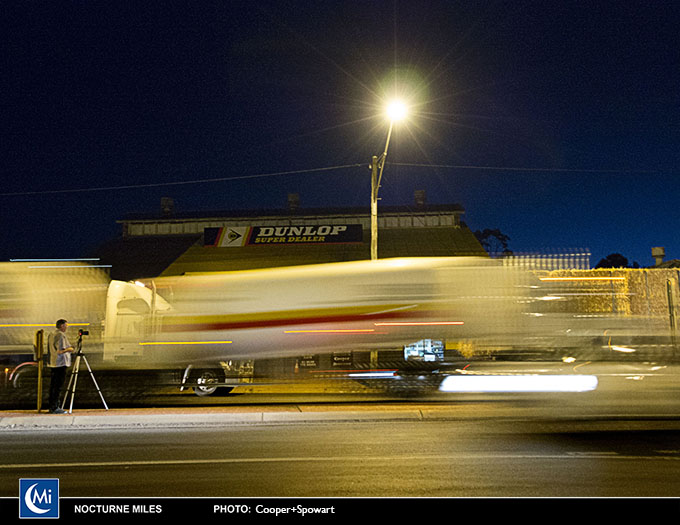
Through documentary photography and social media Victoria Cooper and Doug Spowart have explored connections with Place in urban and regional communities in Queensland, New South Wales and Victoria. The purpose of these Nocturne Projects is to capture everyday scenes of each community in nocturnal light, dusk and dawn. These images are then posted on a Nocturne project Facebook page to evoke stories, memories and shared experiences from the community.
In each project Spowart and Cooper found different ways to include community participation. In 2014, they were invited to work in Miles, a major town of the Western Downs Region of Queensland. The Nocturne Miles Community Documentary project sought to engage with the broader public to undertake self-documentation projects and skill development in nocturne photography. Both local and temporary residents who enjoy taking photos, as well as those more skilled in photography were all invited to participate. After an initial workshop, Spowart and Cooper mentored the 18 participants to create images for the project including self-portraits and daily assignments and produce Facebook reports and a zine.
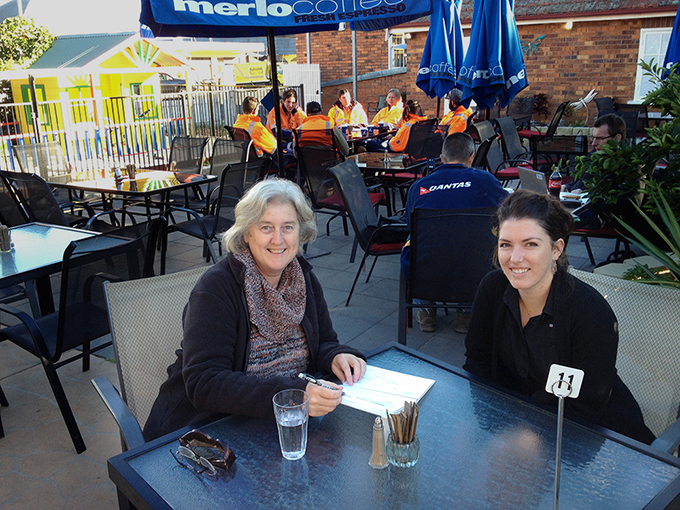
Vicky and Ashleigh Campbell in a pre-event planning meeting
To begin the project consultations were undertaken with staff from the Western Downs Regional Council’s Cultural Development team Ashleigh Campbell and Anne Keam at Dogwood Crossing to refine the project to match the needs of their community. Then centre staff sought out members of the community who could be interested in the project. Possible candidates then completed an Expressions of Interest form to provide some information on their experience and the photography tools they had access to e.g. DSLR camera, point and shoot camera, mobile phone or tablet cameras. Another important consideration was that the applicants were going to be in the region during the project to participate in briefings, workshops and shootouts as well as the final day’s zine making activity.
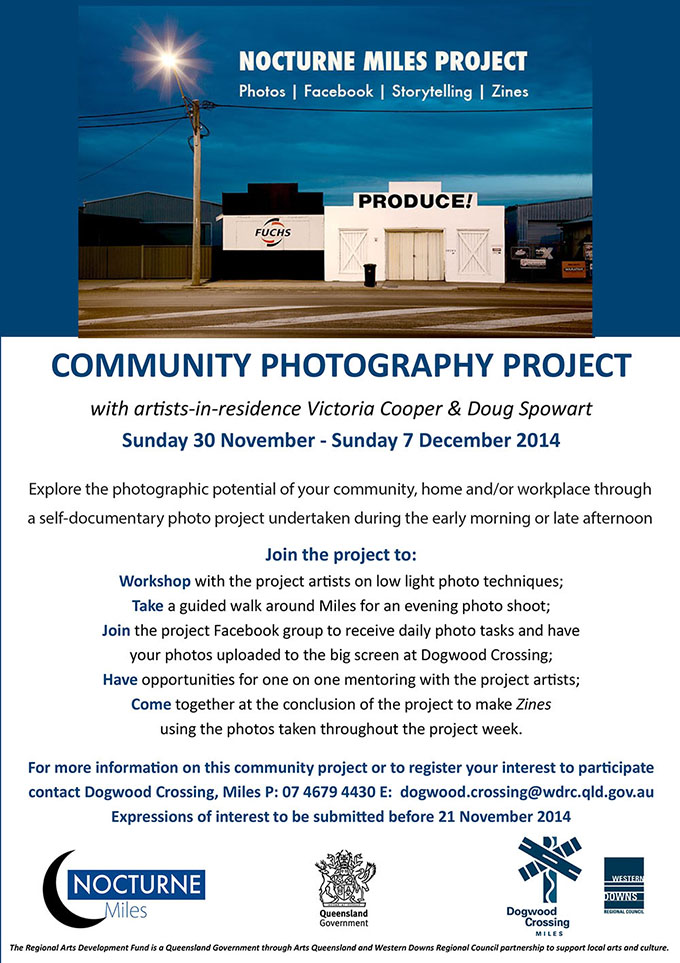
Project Flyer – Nocturne Miles
While numbers were limited there was a desire by the artists and Dogwood Crossing that the project accessible to as many participants and be as inclusive as possible. The one proviso was that project participants needed to live and/or work in or near Miles including the smaller surrounding towns or on properties/work camps in the Miles district.
The participants engaged with the project in a variety of different ways including:
- An initial introduction to the project and skill development workshop;
- Guided evening photography shoot-outs in the main Street of Miles as well as at the Miles Historic Village;
- Daily photo tasks over the week of the project assigned through a project Facebook group;
- Optional mentoring sessions, where required, to enable images to be prepared and uploaded for the project;
- Display of participants photos to a digital screen at Dogwood Crossing; and
- A practical ‘zine’ making workshop.

Doug doing a briefing
The project began on Sunday November 30 with an introductory workshop, briefing and a shootout. Progressively images were collated and uploaded to the Nocturne Miles Community Facebook page. Each day a new topic was presented a challenge and their interpretation formed into a photocollage. Communication with the participants was made through a private Facebook group page that enabled hear 24hour contact with participants and Cooper+Spowart. Some participants came into Dogwood Crossing with their photos or with requests for support in making and/or optimising better photographs. On Wednesday evening special access was provided to the Miles Historical Village for group to experiment with ‘painting with light’ and ‘projection’ techniques.
The Nocturne Miles participants at Miles Historical Village
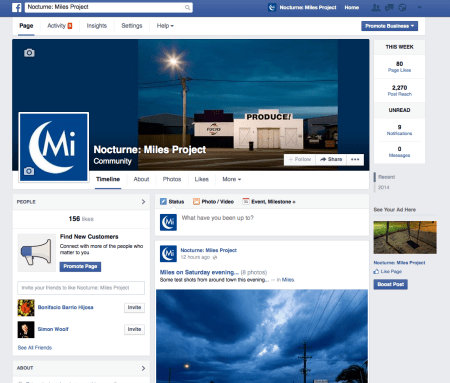
Facebook page
Cooper and Spowart added their images to the Facebook page as well and some visitors to the page posted stories about the places pictured. By the project’s end the page had 241 Page Likes, 60 Posts and the Total Reach was 17,771. Both the group page and the community page are still active.

Vicky and Doug in the Dogwood Crossing foyer
Some of the photocollages that formed the 8 page Zines that were made using the Dogwood Crossing’s A3 colour photocopier. These were cut and folded into zines that were inserted into a red and yellow special edition of the Centre for Regional Arts Practice’s Artists Survey Books.
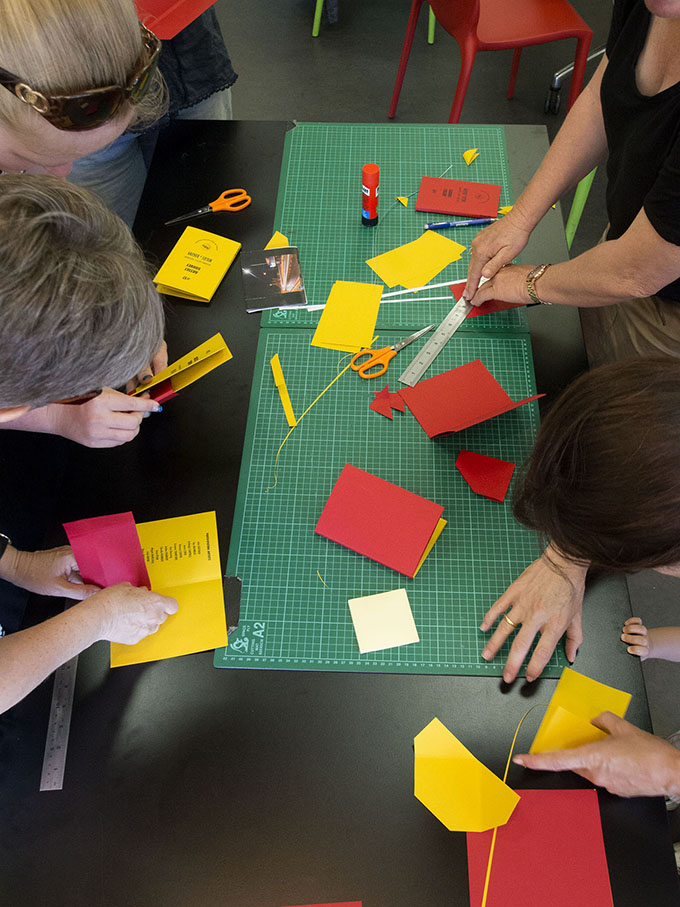
Nocturne Miles Zine making workshop
Some of the Photocollages
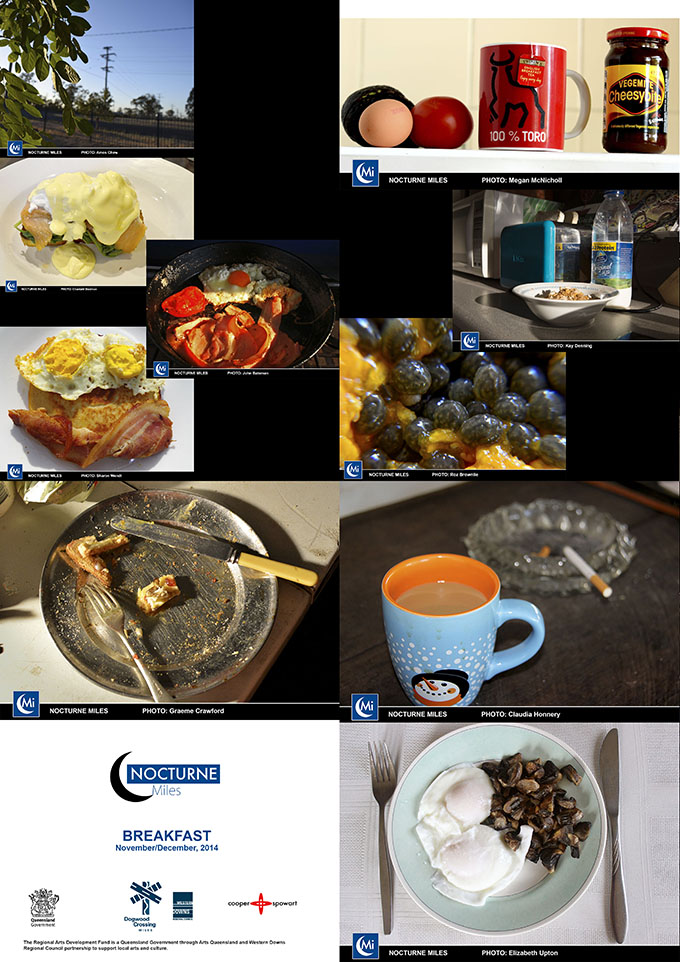
Breakfast – Nocturne Miles
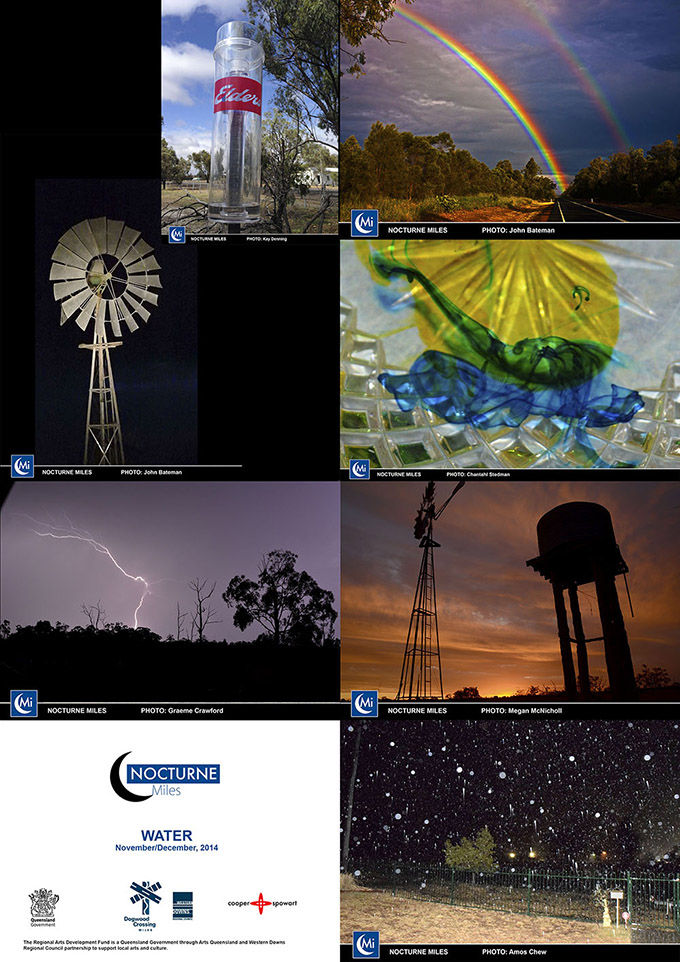
Water – Nocturne Miles

Miles Historical Villiage – Nocturne Miles
The photocollages presented here are examples of the image sets created by the participants. It is interesting to note that the original images may have emanated from all camera formats fro iPhone, simple digital point-n-shoot to sophisticated DSLRs.
We hear a lot about documentary photographers and student photographers travelling out into the country to create documents of life outside of the metropolis. Once on the ground these photographers seek out subjects to pursue and photograph. In this way significant documents are created of these outlying communities. However, the subject of the of the photographer’s gaze, and what is photographed, is based on the view of ‘outsiders’. The photographs they make may match preconceived ideas, and mythologised opinions, that they bring with them rather than how the people who inhabit these places feel about how and where they live.
What the Nocturne Miles project shows is perhaps that in an age where everyone can be a photographer what is important is the photograph itself. What then stands out the most is the link between the photograph and it’s authenticity. With this in mind these photographs are actual fragments of the lives of local people, whether they are from the farm, or people engaged in extractive industries, or those who work in administration roles or students at school, their voice in this conversation adds another view we can have of our regional communities.
The project was undertaken between November 21 and December 7 2014 and was overseen by Western Downs Regional Council’s Cultural Development Coordinator Ashleigh Campbell and Cultural Development Officer Anne Keam. The success of the project was also made possible by the enthusiastic support of the WDRC team at Dogwood Crossing.
What follows are more photocollages and individual images from the project
More images are on the Surat Basin.com.au website HERE
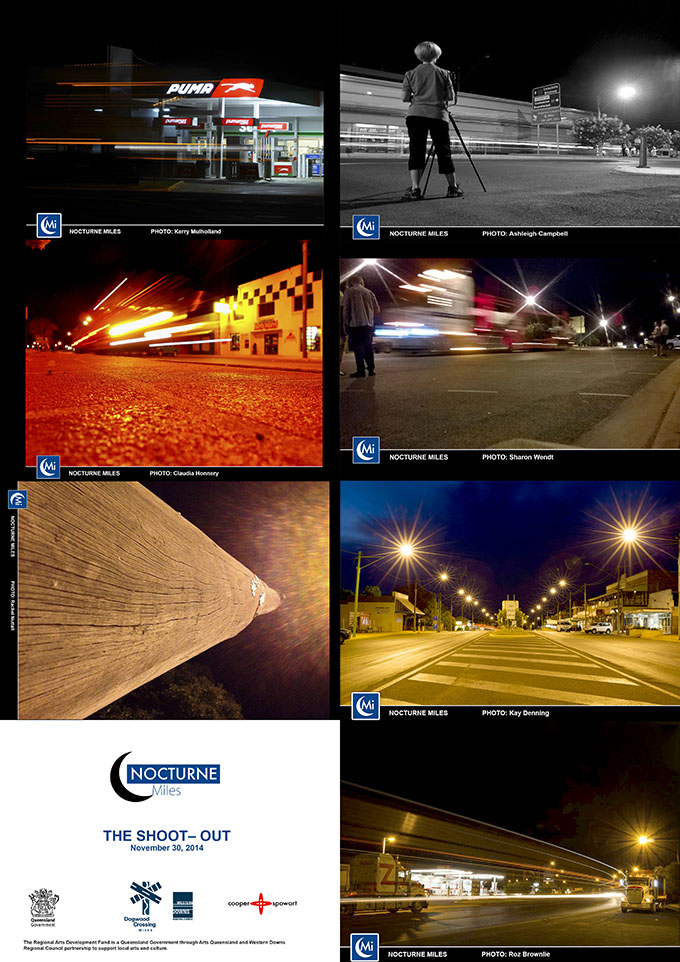
Murlilla Street – Nocturne Miles
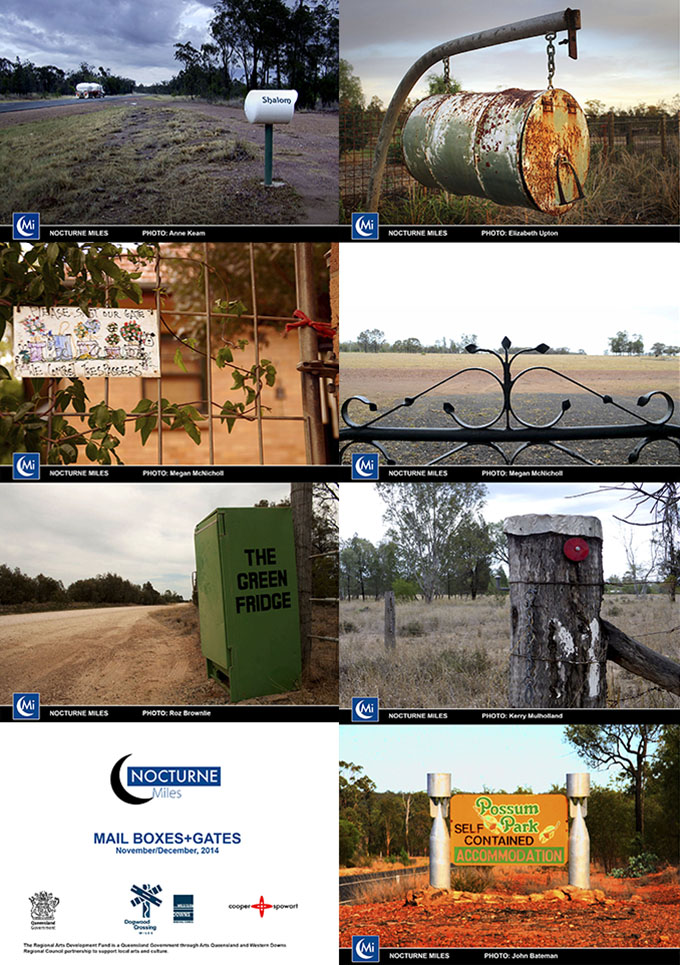
The front gate – Nocturne Miles
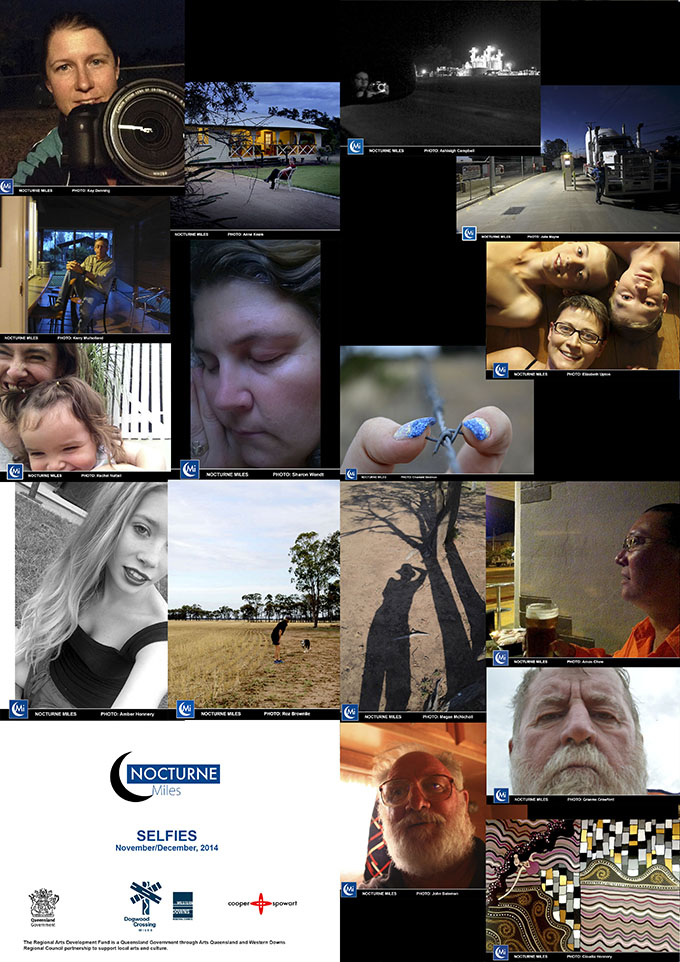
Selfies – Nocturne Miles
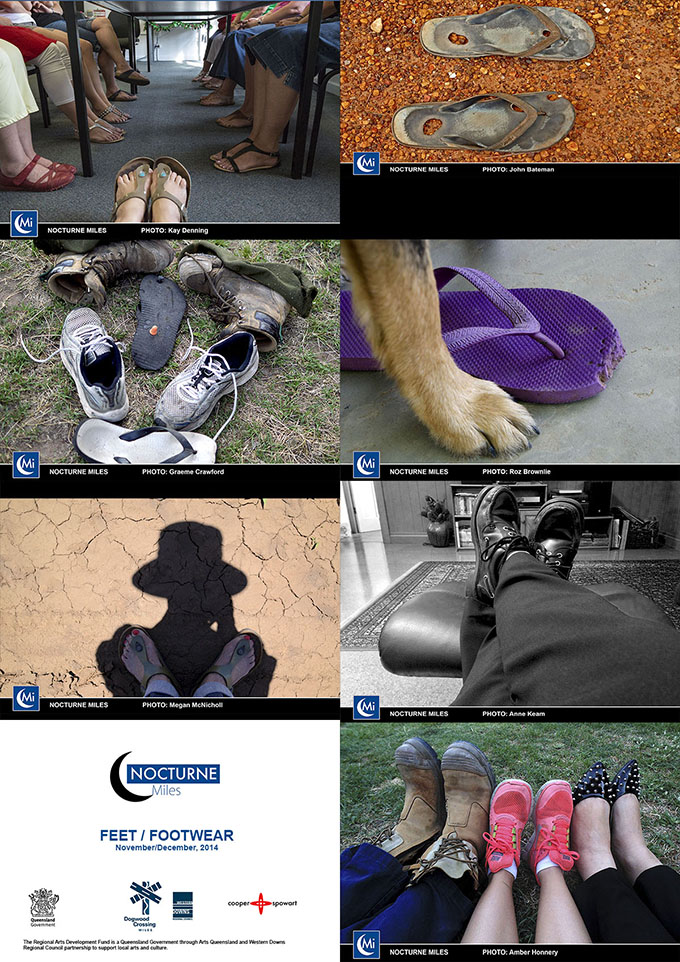
Footwear – Nocturne Miles
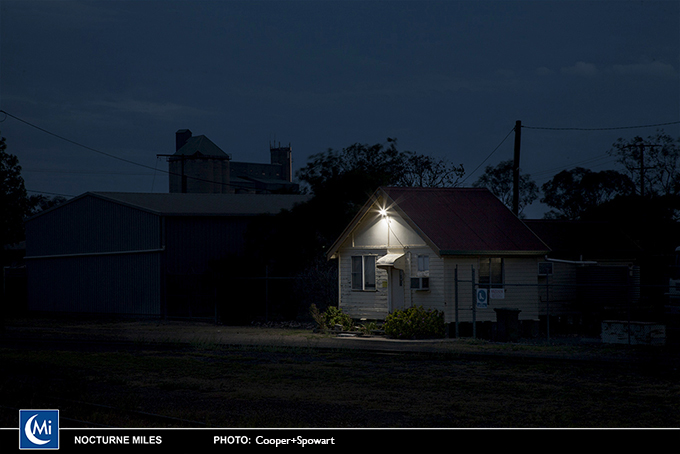
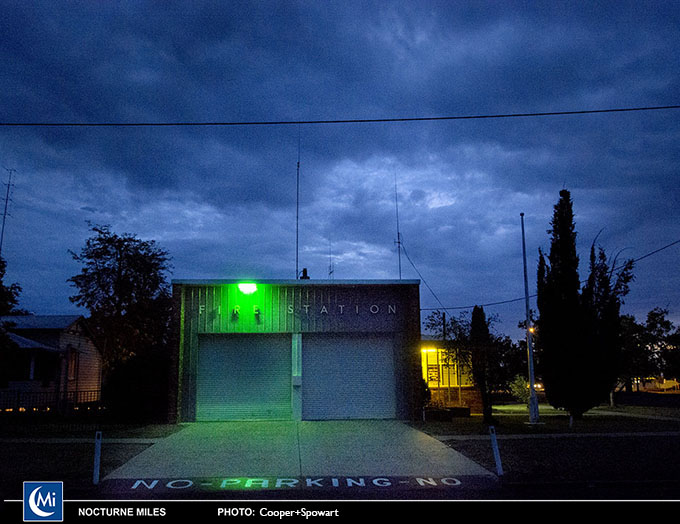
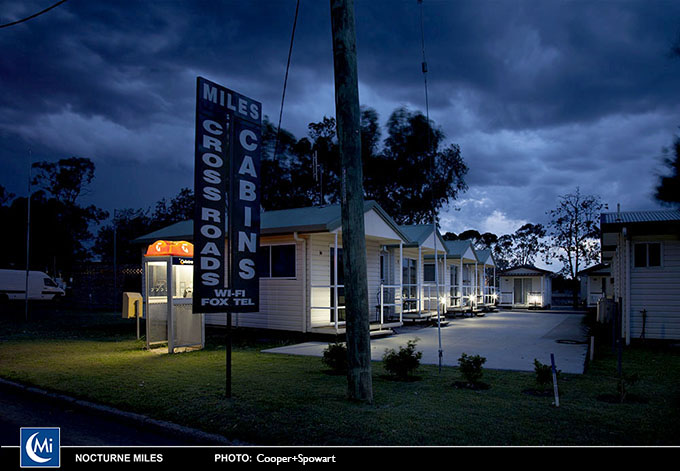

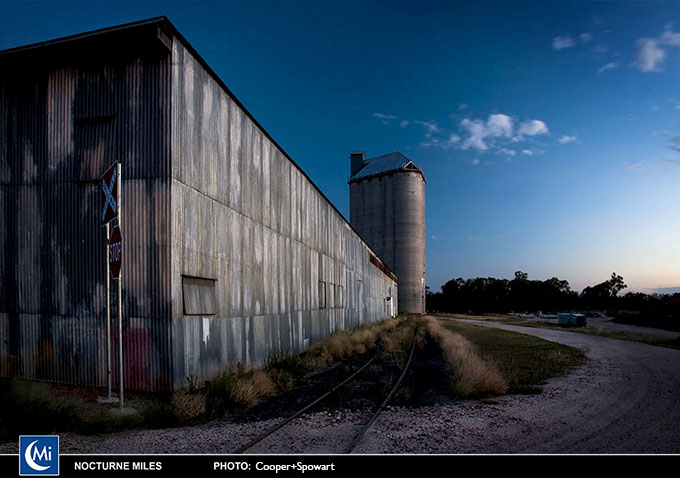
Text and photos unless otherwise accredited are Copyright ©2014 Victoria Cooper+Doug Spowart
HABITAT OUT WEST: Environmental Art of the Darling Downs Exhibition
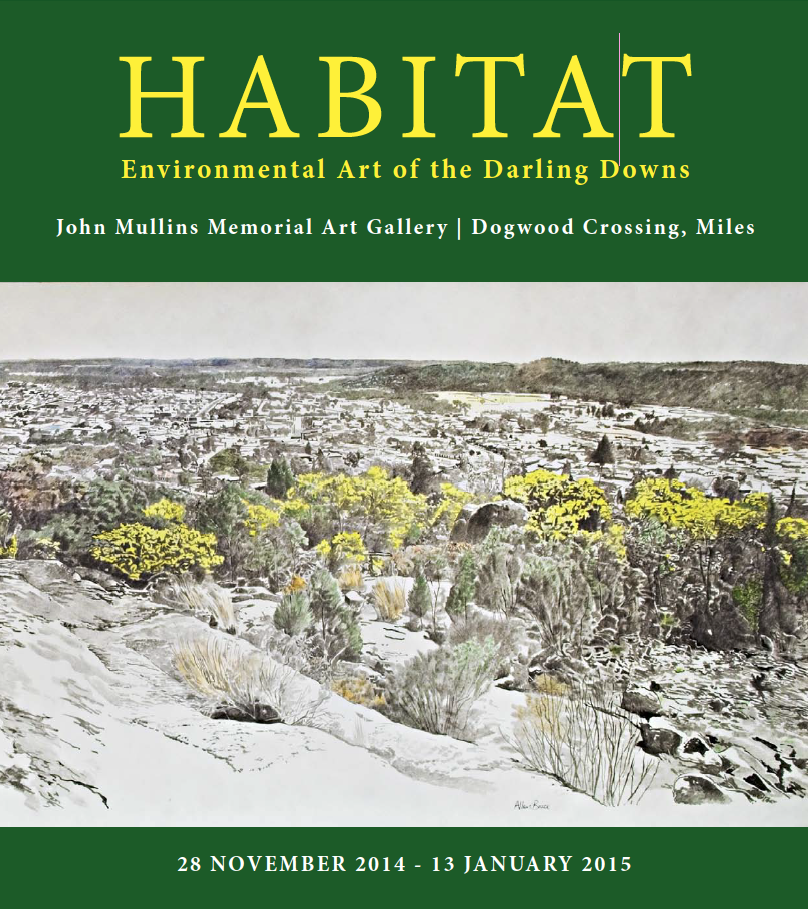
Curated by Ashleigh Campbell and Anne Keam.
When, how, and why did the locality Darling Downs come to be known as the Surat Basin? This question informed the exhibition curators Ashleigh Campbell and Anne Keam and with it came the recognition that such a shift was deeply important to the region’s connections and perceptions of their place.
.
Habitat is a word that accommodates the presence of life beyond the human shaped and perceived landscape. In any given habitat the living and the nonliving interact to the rhythms of the earth and the cosmos. As both observers and inhabitants, artists and scientists help shape human perceptions of and relations with the broader global environment. This includes the economy of the earth’s resources that supports humanity.
Campbell and Keam researched a broad range of influences including the natural and human habitat of the Darling Downs from colonial history to present. Through the eyes and minds of the region’s colonial and post-colonial artists, along with some scientific documentation and social artifacts, they sought to reflect on shift and its implications on the regions environment.
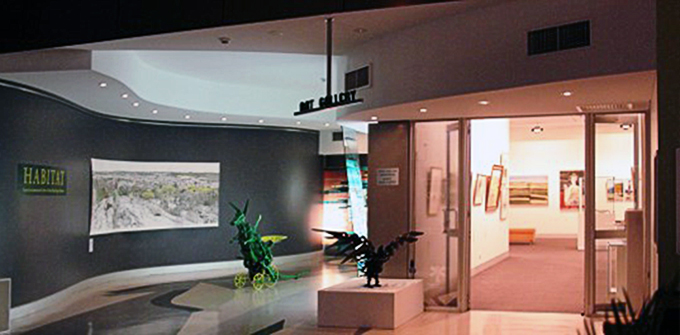
John Mullins Memorial Art Gallery entry – Dogwood Crossing, Miles.
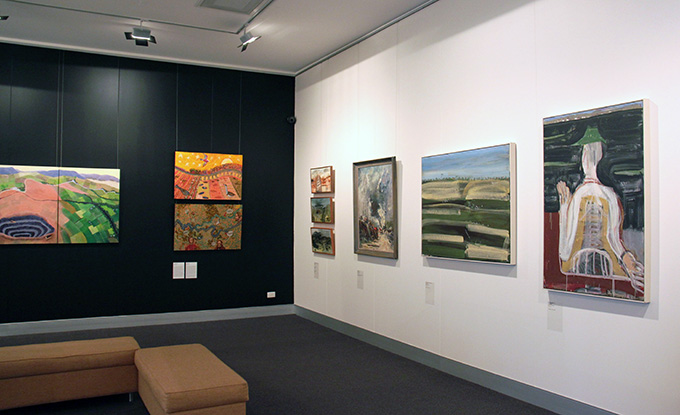
John Mullins Memorial Art Gallery interior
.
This exhibition brought together a diverse collection of works including: prehistoric fossils and other historical artifacts, references and narratives of the pastoralists struggle with the invasion of prickly pear cactus and other pests, floods and droughts. The artists represented in the show came from many disciplines. Paintings representing this landscape covered a range of movements and styles from romantic colonial pastoral period to impressionism, abstraction and modernism. Well known artists names: Kenneth Macqueen, Sam Fullbrook and Joe Furlonger are representative of the depth of creative work in this exhibition.
.
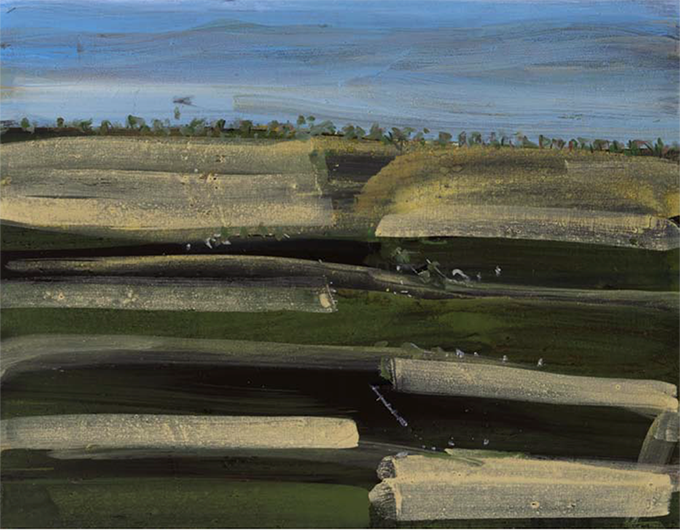
Joseph Furlonger Round Up Ready Field, near Dalby 2012 Acrylic bound pigment 91 x 122 cm Courtesy of The Hughes Gallery, Sydney
.
Some artists reflected on living with the natural environment as found in small corners of Patricia Hinz’s back yard in the work, Sanctuary (2014). Palpable in the drawing of Allan Bruce’s Stanthorpe, Late Winter (2008) is the feeling of being in the grand sun-soaked landscape of the Downs, and the relationship of small towns with the surrounding country. Bruce observes: “Stanthorpe is one of those towns where the natural and built environment coalesces almost seamlessly.”[1] The inventiveness and creativity that pervades every farmer’s shed and bushman’s camp is embodied in the sculptural work of Dion Cross’ Grass Harvester (2014), that highlights the competition for pasture between man and animal during periods of drought. The fine drawings of flowers and fungi by botanical artists and illustrators through scientific documentation reveal a deep understanding and investigation of the natural life forms found in this region.
.
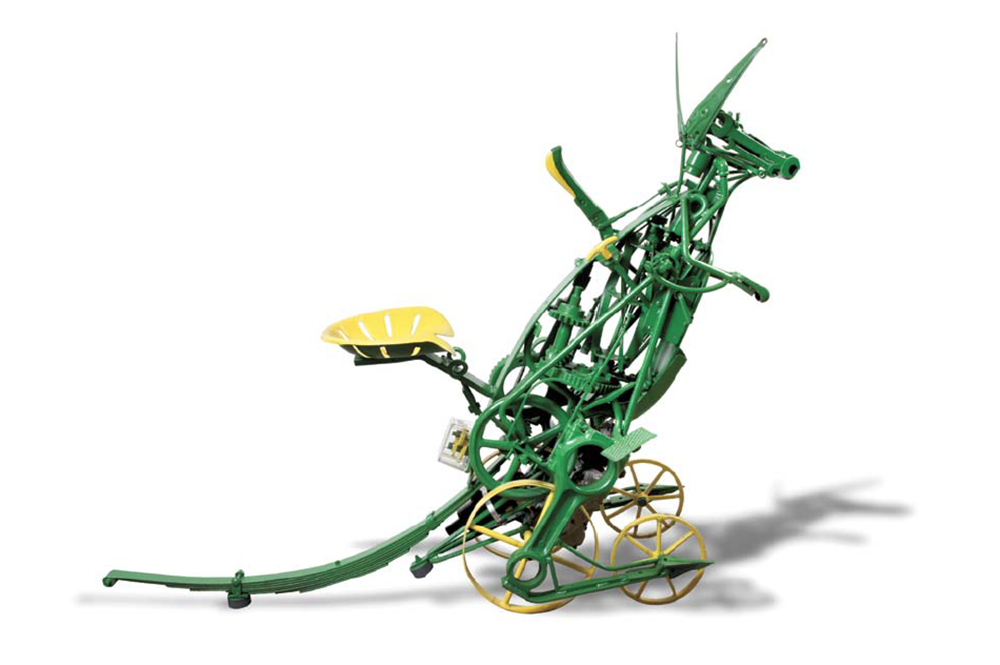
Dion Cross Grass Harvester 2014 Steel sculpture 150 x 60 x 180 cm Courtesy of the artist Image: Spowart + Cooper
.
Phil Bazzo’s painting, Miles: At the Crossroads (Triptych, 2008) presented two concepts: the physical nature of the intersections of roads in Miles including the dynamics of heavy road vehicles and the metaphor of crossroads to infer change and concerns for the future. Both found natural and manmade objects and materials were also utilized as the visual language of protest. This was evident in the mixed media works of Jennifer Wright (Summers): Searching for Life in the Anthropocene 1 (2014), using tea bags, feathers, fabric pen & ink, watercolour and Anthropocene Nest (2014), that was made from plastic bags and pelican bone. Nicki Laws’ Habitat Gone (2014) collaged and embroidered the materials found in the fluoro safety barriers widely used in the industries found in the region.
.
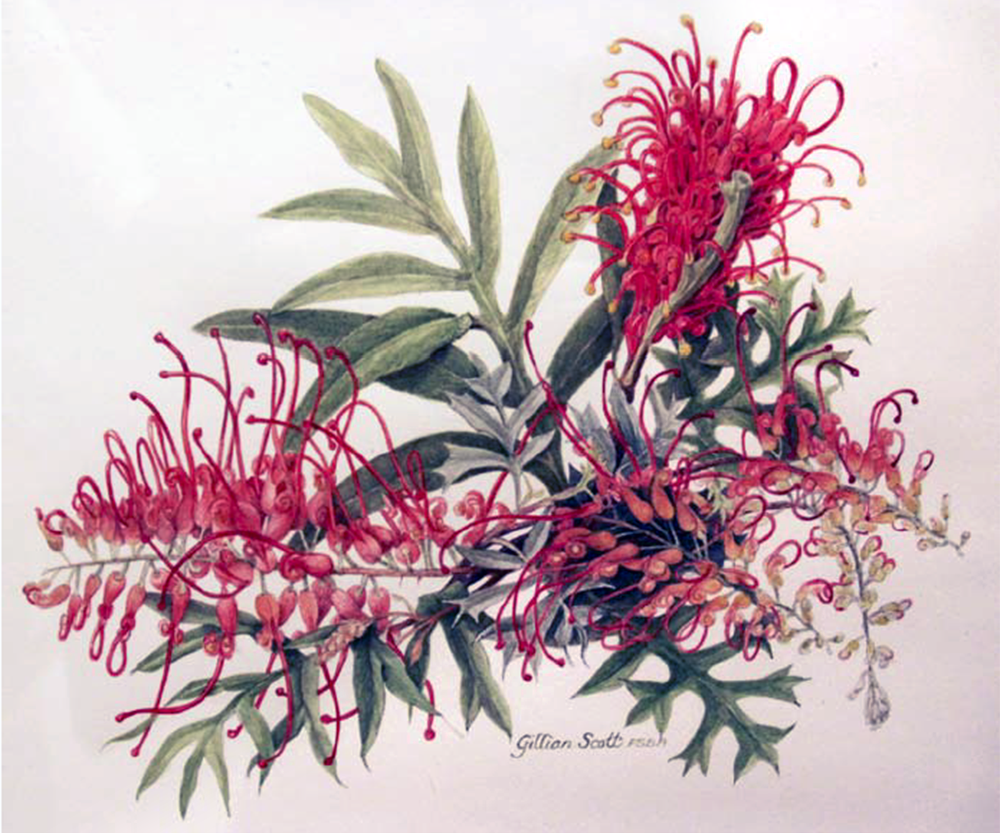
Gillian Scott Grevillea x ‘Robyn Gordon’ 1993 Watercolour on paper 25 x 35 cm Courtesy of the artist
.
The solastalgic plea for a balance with man and the land was also deeply felt when viewing the work of Barbara Hancock’s Brigalow Landscape (2014). Working with the land, technology and energy needs was also strongly referenced in the work of Sylvia Secomb (Mann), Synergism – Towards Regeneration I (2010), but also reflects on the question “What will we be leaving for those who come after?”[2]
.
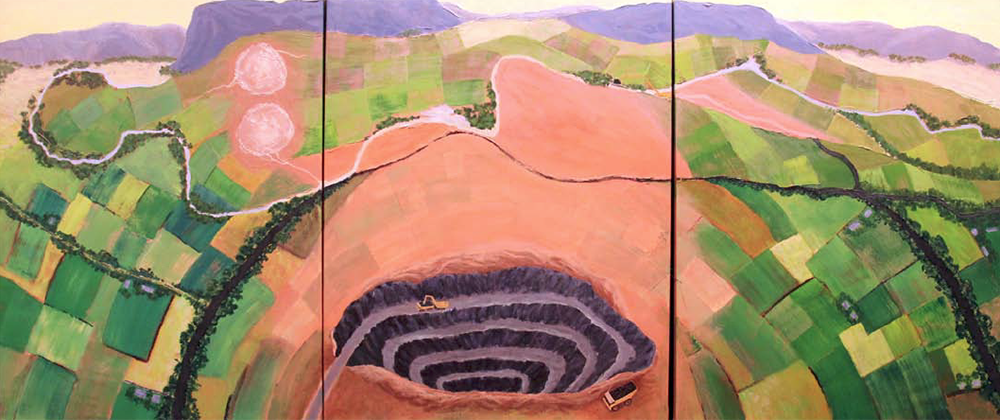
Sylvia Secomb (Mann) Synergism – Towards Regeneration I 2010 Acrylic and medium on canvas 91 x 213 cm Courtesy of the artist
.
For the city viewer who ventures out into the region to connect with this show, there is a unique experience: to be in the space and place of the exhibition, Dogwood Crossing, Miles, within the Habitat it references. This site-specific exhibition presents rare opportunity to engage with the historical and contemporary issues of living with the land through the creative energy and perception of those who chose to live and work in this region. The curators have also published an extensive and informative online catalogue to accompany the exhibition: Habitat_Catalogue or online at http://issuu.com/ourwesterndowns/docs/catalogue/1
Beyond the facts and information, the presence of a growing connection and love of the Australian environment pervaded strongly throughout this extraordinary show. Through visual story telling and lived experience, the artists and the curators have constructed a layered topology of the Darling Downs. A telling image of how the effects of a changing human condition: technology, energy and food production can be identified and chronicled through the artist’s vision.
.
Victoria Cooper
I am also privileged to have my work, 7 Gates (two forms: artists’ book, 2009; digital media presentation 2014), included in Habitat.
[1] Page 11, ibid.
[2] Page 21, Habitat: Environmental Art of the Darling Downs, 2014. The online catalogue for the show of the same name. See http://issuu.com/ourwesterndowns/docs/catalogue/1
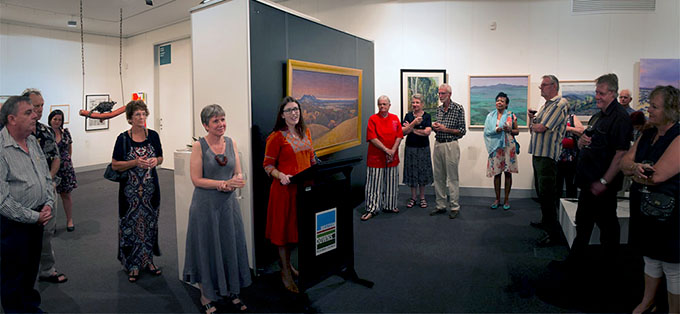
Anne Keam and Ashleigh Campbell at the opening.
DRAWING @ 2014 Jacaranda Acquisitive Drawing Award

Vicky disappearing into Wooli Escarpment 2014 by Andrew Tompkins
Jacaranda Acquisitive Drawing Award 2014
ENTRY DETAILS FOR THE 2016 AWARD can be downloaded HERE
Grafton Regional Gallery 18 October – 7 December 2014
The judge for 2014 was art critic and historian John McDonald.
Paul Klee is credited with stating that ‘drawing was taking a line for a walk’, and on viewing the current Jacaranda Acquisitive Drawing Award at the Grafton Regional Gallery one would come to the conclusion that the line meanders down a very wide path. What is on offer to viewers of the exhibition is an opportunity to engage with the many ways of telling a story through the medium of drawing. The media of drawing, as presented in the show, can be lead pencil, charcoal, brush strokes, hot wires, swipes of pigments, resin glossed over marker pen, fine paper cuts, inkjet applied lines and lines engraved in Perspex and yet there’s much more that that.

Part of the gallery installation of the JADA show
A drawing can emulate the camera’s slice of focus, and ability to capture a shape, a form or an association of elements. It can also be part of a process to unlock alternative or new ways of seeing or considering a subject. It may be the result of an artist’s doodle emanating from an unconscious experience. Some see drawing as a lesser art as it is usually a preliminary to the art making. In this space however, drawing in all its varied forms represents the strength of the discipline and easily dispels any challenges to it being an autonomous finished artwork.
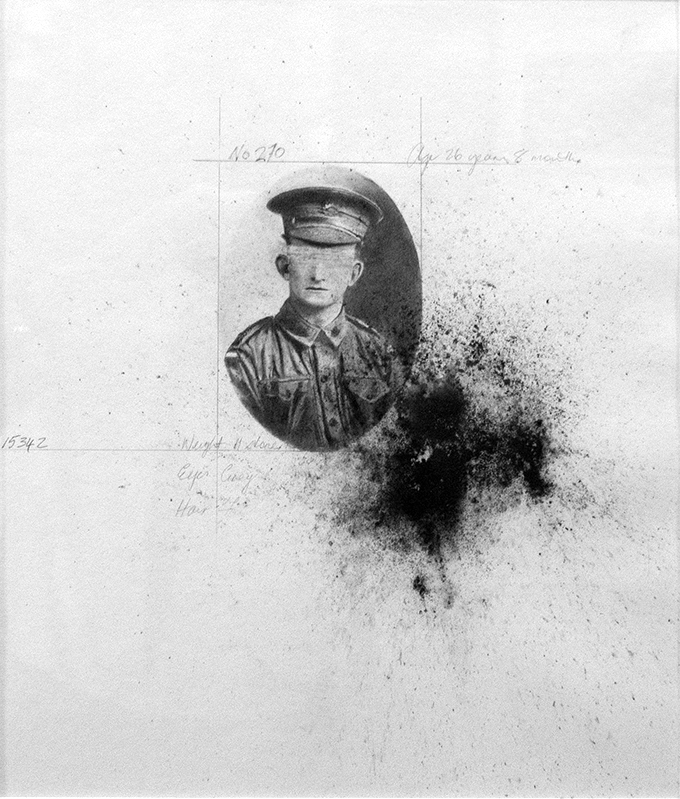
Christine Wilcocks’ Fit for Duty 2014
Some viewers may have an expectation that drawing relies on evidence of draughtsmanship will expect to see works exhibiting that skill. But just drawing to exactly mimic reality is not the way of the artist. In work entitled ‘Fit for Duty’ 2014* by Christine Wilcocks takes the direct transcript of a subject to another level in a portrait of a World War I soldier. The work comments on the man’s physical examination prior to being admitted to the army. The portrait’s eyes are covered by blankness and textual elements and an aggressive inkblot form provides the viewer with a reflection on the artist’s idea of the work.
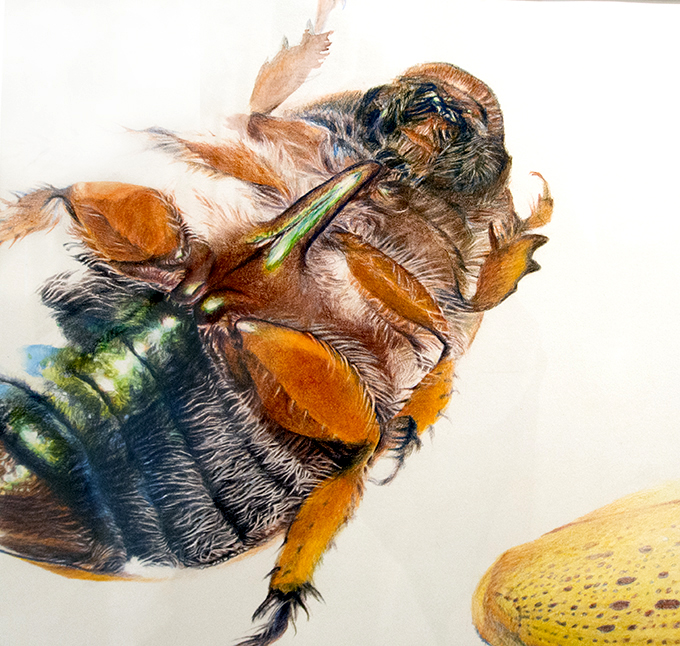
Petrina Seale’s Home Studies in Nature II 2014 (Detail)
A work about documentation is a study of a beetle by Petrina Seale entitled ‘Home Studies in Nature II’ 2014 uses coloured pencils on a white paper ground – the truncated composition to draws attention to the of the subject.
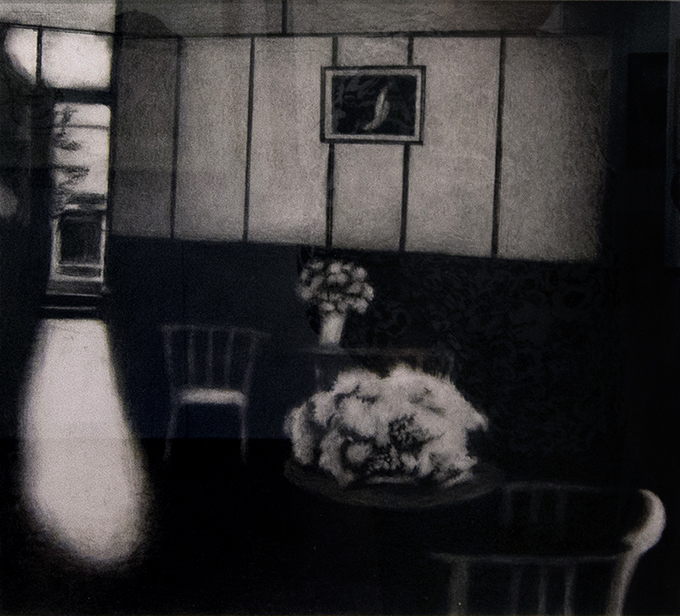
Matt Foley’s Hotel Lake Eacham 2014
In another work by Matt Foley entitled ‘Hotel Lake Eacham’ 2014 the artist has created a study in light of a dreamlike space, a vignette of a place imbued with a darkness and depth of black pigment that is the stuff of half remembered recollections.

Bruno Leti Ashes to Ashes 2013-2014
Four large framed pieces by Bruno Leti entitled ‘Ashes to Ashes’ 2013-2014 is a textural surface of the paper, abstracted, patterned, colourless with blurred edged shapes like fragments of memories. The work comments on the artist’s personal experience of the destruction of places of personal significance by fire. The work itself is partly pigmented by the charcoal retrieved from the fire.
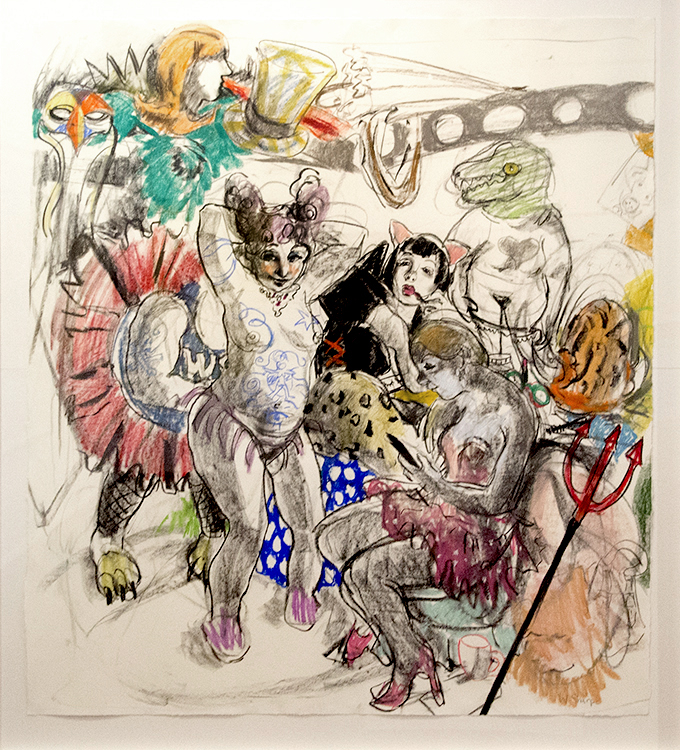
Wendy Sharpe’s Backstage Burlesque with Venetian Mask 2013
Klee’s line was taken for a dance into a seedy bohemian den by Wendy Sharpe in her work ‘Backstage Burlesque with Venetian Mask’ 2013*. A female figure being dressed presents an impish grin towards the viewer – provocatively displaying the comfort of her nakedness. Brightly coloured pastel gestures define other figures surround this main subject all preparing for the stage performance. Close viewing reveals squiggly lines that allude to other stories within the work.
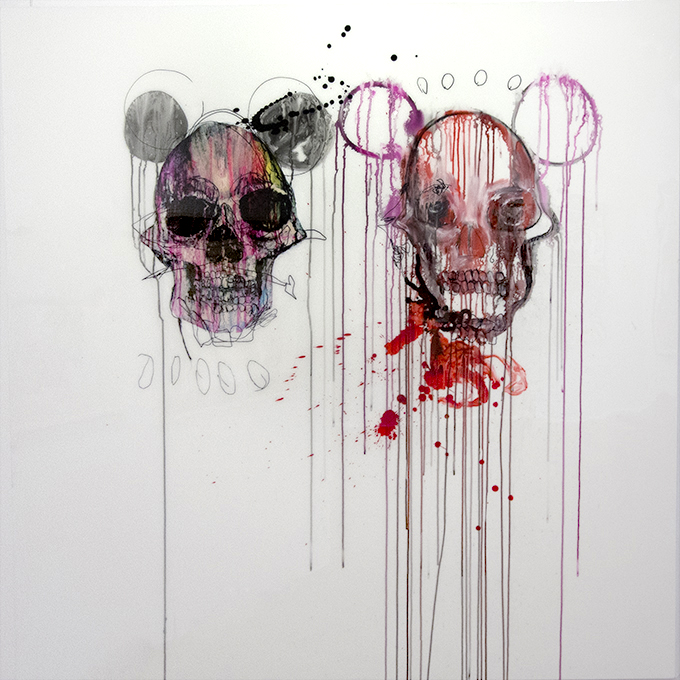
Anthony Bennett’s e pluribus anus – a portrait of tony abbott 2014
Anthony Bennett’s ‘e pluribus anus – a portrait of tony abbott’ 2014 makes a political statement about his subject. A skull with Micky Mouse ears is repeated twice on a white ground made glisteningly hard by its shiny resin coating. One of the skulls is in the process of de-colouring and the pigments dribble down the large-scale work. Bennett’s drawing has all the freneticism of a hastily sketched graffiti work interrupted by a police car coming around the corner.
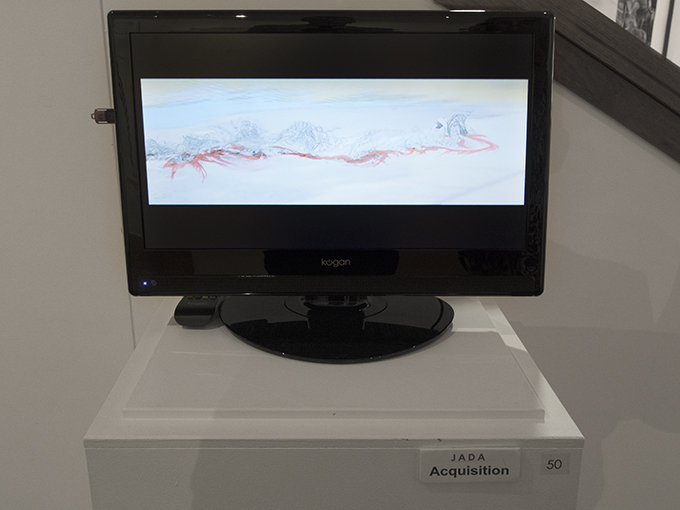
Todd Fuller’s A Dance for Paul Klee 2014
.Todd Fuller’s work ‘A Dance for Paul Klee’ 2014* celebrates Klee’s metaphor for drawing. The digitally presented artwork is of a choreographed dance performance that has its origin in a movie. The film has been overlaid by gestural line work positioned based on the movement of the dancer. Flourishes of colour, most noticeably red, follow and trace the subject’s animation across the screen.
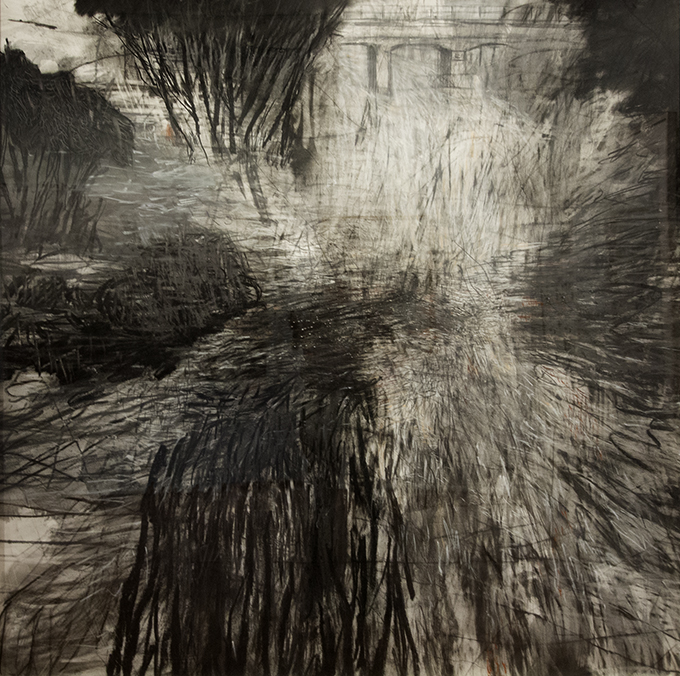
Emma Walker’s Keys Bridge in Flood 2014
.
The overall winner of the $20,000 prize was ‘Keys Bridge in Flood’ 2014* by Emma Walker. The work is 150 x 150cm and represents the movement of water through a flooded landscape. Gazing longer at the work the viewer is captured by the vitality, rush and flow of the graphite, charcoal, pencil and pastel marks on the paper. These marks become the substance of the artist’s inspiration – they are the water, they are the flood, they are the emotions that come from the artist to us. All of these things are in that drawing….
.
.
Doug Spowart
15 November 2014
.
.
* Denotes work was acquired
Other works acquired include:
- Michael Cusack ‘Vista’ 2014
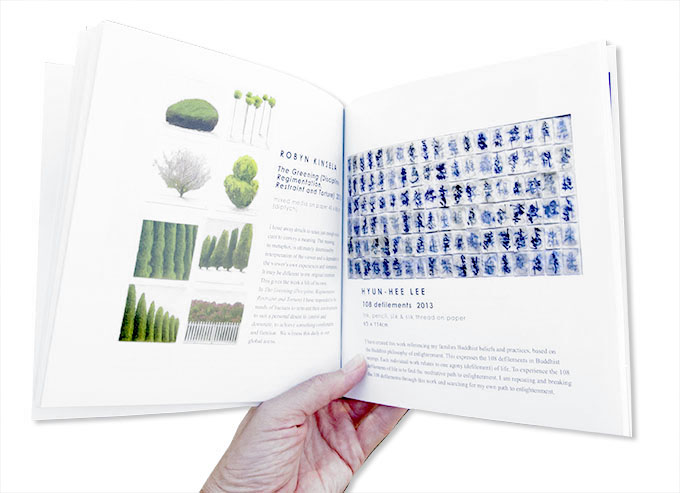
- Lee Hyun-Hee ‘108 defilements’ 2013.
.
The 2014 JADA will travel to seven venues over the next two years including; Manning Regional Gallery, Cowra Regional Art Gallery, the University of the Sunshine Coast Gallery, Glasshouse Port Macquarie, Redcliffe City Gallery, the Broken Hill Regional Art Gallery and the Tamworth Regional Art Gallery.

catalogue
ooo
A catalogue for the show contains an introduction by GRG Director Jude McBean, artists’ statements and images of the works.
For details contact:
.
Please note: Photographs of artworks are the copyright of the artist. All images were made by the author in the gallery space and may have elements of reflection and lighting variations that are not part of the original artwork.
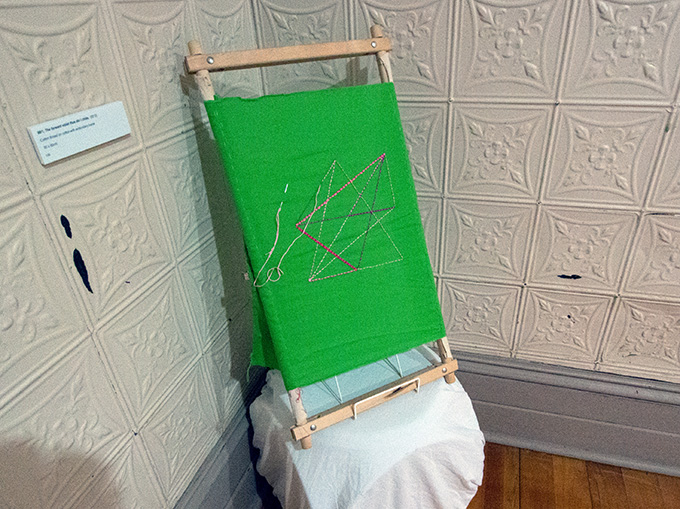
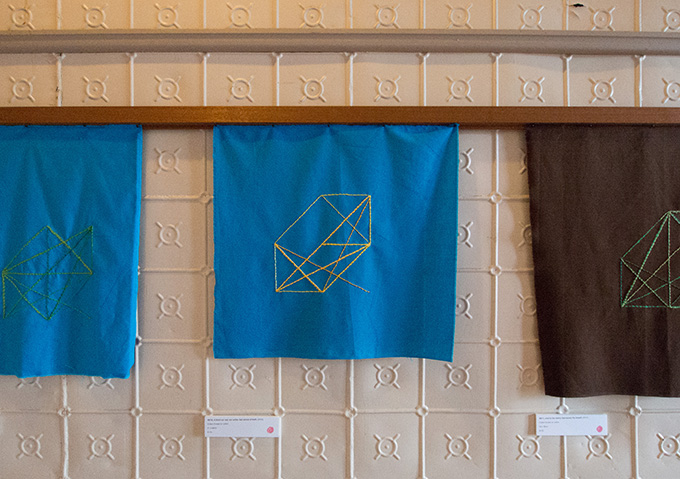
ALEX STALLING’s PORTRAITS [part two]
.
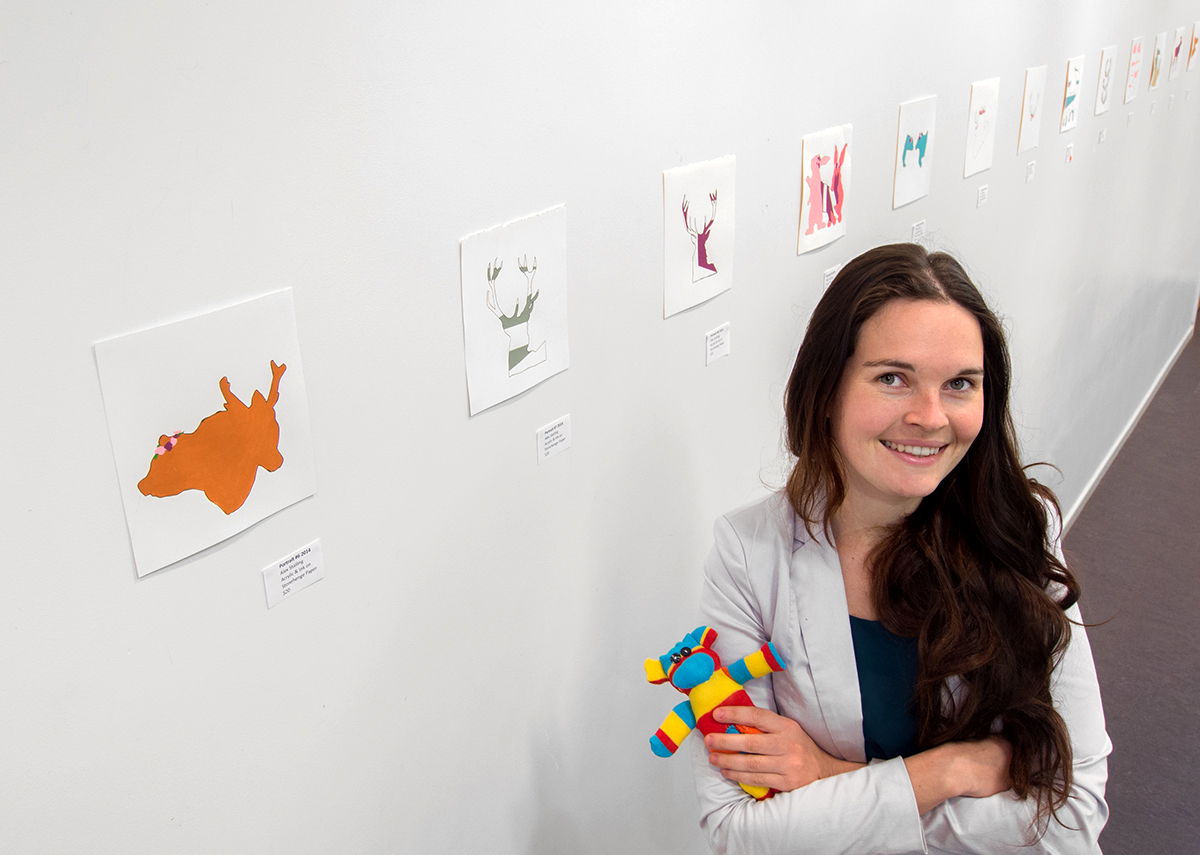
Alex Stalling in her Portrait exhibition
.
Portraits: Layers of Meaning
Portraits [part two] An exhibition by Alex Stalling at Culliford Gallery, Toowoomba. July 28 – August 24, 2014
.
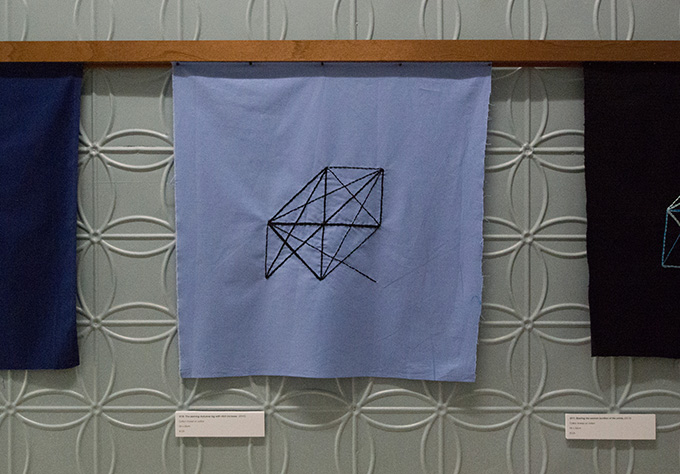
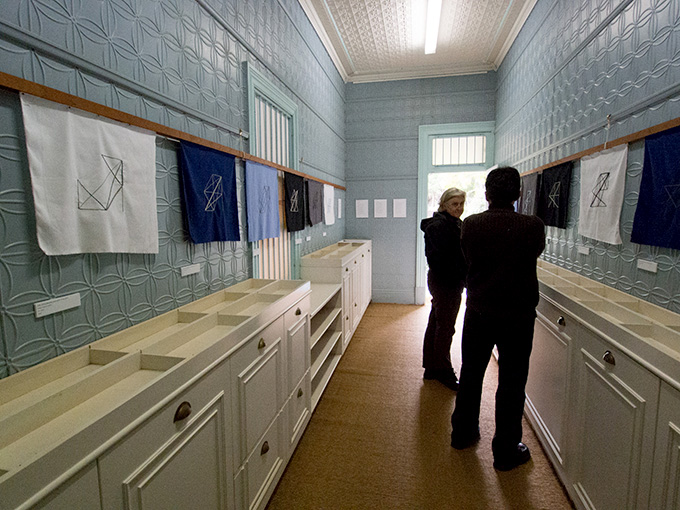
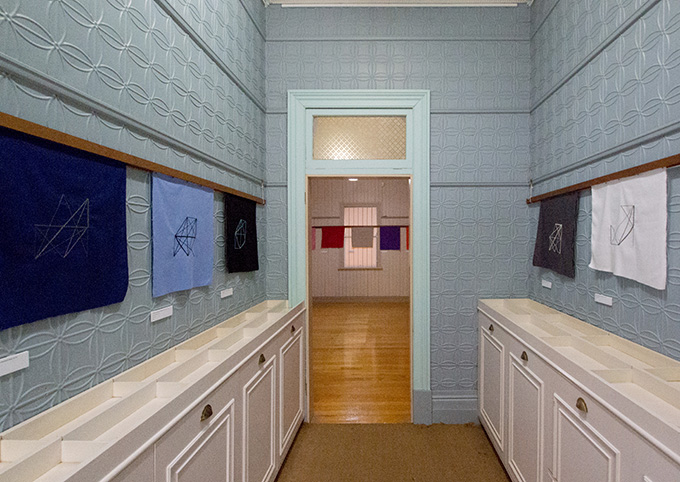
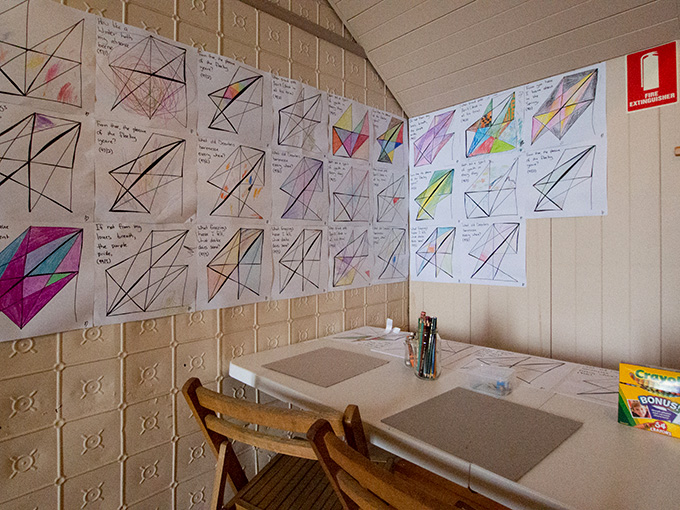
Alex Stalling’s latest exhibition Portraits [Part Two] will certainly challenge the idea we might have of what a portrait can be. The bare white walls of the Toowoomba Art Society’s Culliford House Gallery, are punctuated by 20cm square pieces of white art paper onto which the artist has meticulously drawn and painted a ‘portrait’. Now these portraits are not of people we might know, someone famous, auntie Ethel, a sleeping child or a happy couple – they are … of animals – meta animals!
.
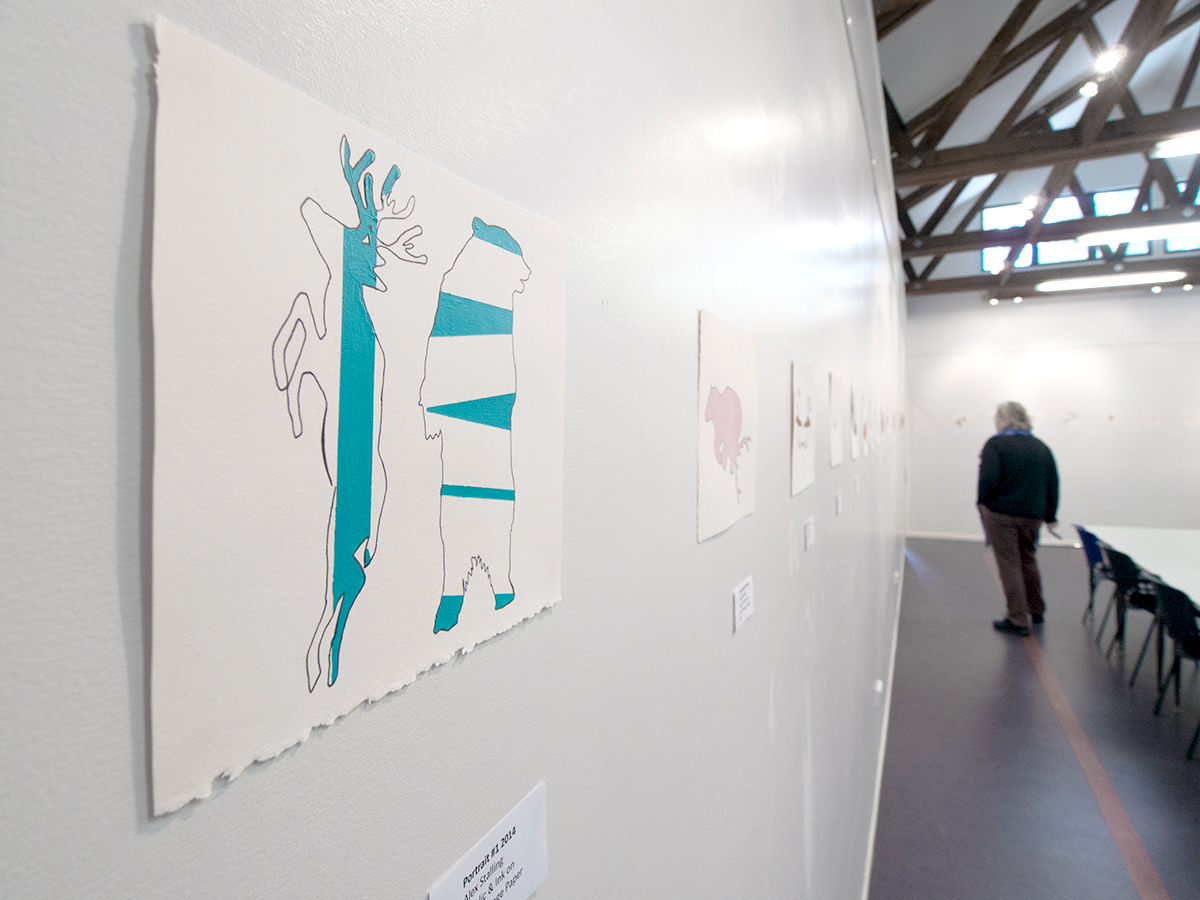
Alex Stalling’s Portrait exhibition
.
Stalling has essentially created works made up of the shape or outlines of different animals. The animals sometimes morph and overlap – other times they are juxtaposed to suggest associations. A deer’s head and antlers adjoin a similar shape at 180o to form what looks like tree roots. A prancing deer dances with the outline of a upright bear. A moose stands on top of another, and a doe stands yet again on top! These works are like Mr Squiggle drawings gone wrong, or prints where the paper has jammed in the printer.
.
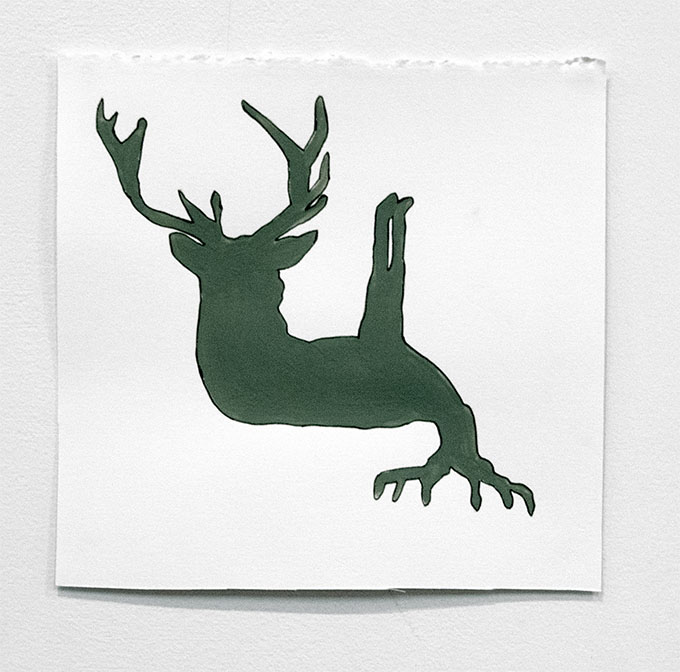
Portrait #5
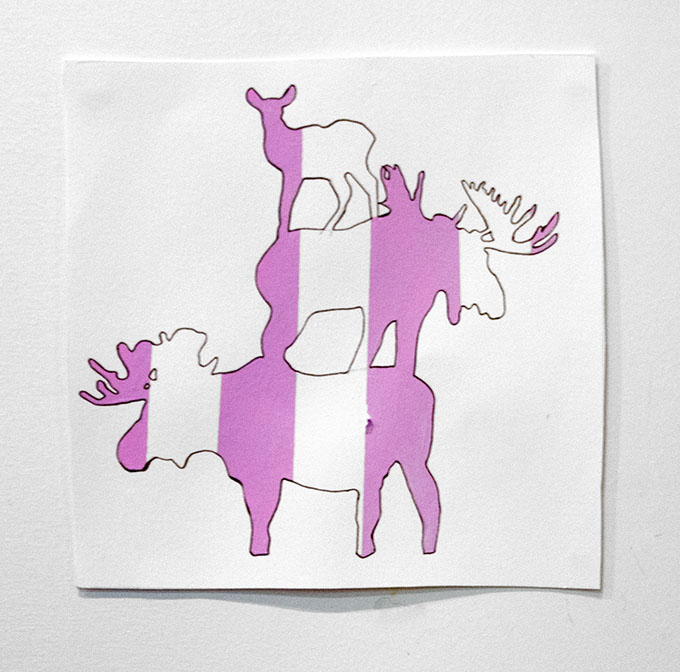
Portrait #36
.
Many animals are bedecked with garlands of pink and orange flowers. This decorative element links individual artworks in the exhibition. A limited palette of flat colours of brown, orange, bright blue, pink and dark green also provides a cohesive aspect to the show.
The confusion of meaning continues. As if to create a cryptic challenge to the viewer – the animal outlines are partially filled-in often with bright and fluoro colours, but not in ways that help identification. The colouring implies another shapes or patternings which are partially obscured by the outlined edge of the animal. It is as though the animal outline has been cut out to reveal the abstract flat colour shape below on a background sheet.
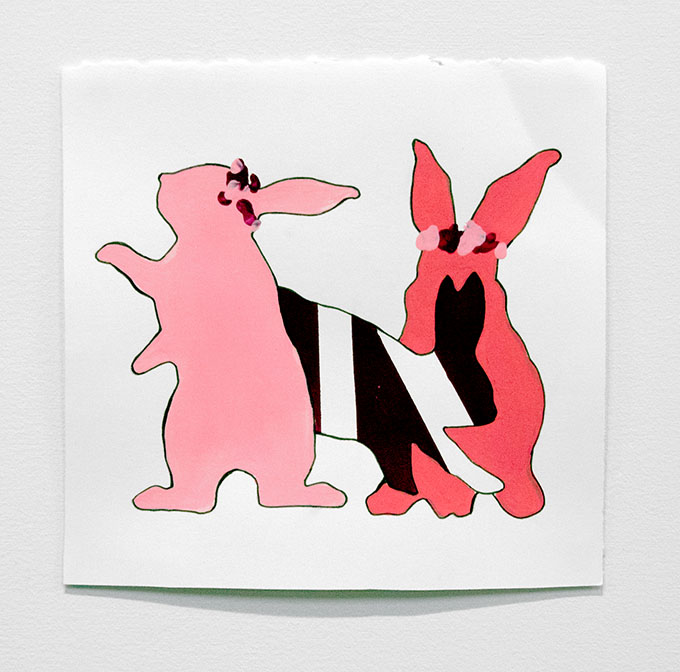
Portrait #9
.
From a distance the outlines and colour shapes may appear to the gallery visitors as maps of continents, countries or localities. The colours perhaps define boundaries within those spaces. Moving up-close the another interpretation emerges – but it too, as discussed, is puzzling. Every image becomes a game, a riddle of confused meaning, a mind recognition trick, something that can amuse, entertain or stimulate the viewer to action.
Just who are these animal motifs a portrait of? The artist? A thought? And idea? A dream or muse, or influence? Or all of these…
The strength of Alex Stalling’s Portrait works is that they are not unchallenging easy-lookers, but rather works that demand the viewer to seek within themselves a resolution to a visual challenge – there, maybe they will find their ‘portrait’, and the meaning within the artworks.
Perhaps too, when an artist does a portrait, it also becomes a self-portrait of the artist themselves …
.
Doug Spowart
August 12, 2014
.
MORE INFORMATION
THIS SUNDAY in the exhibition space:

https://www.facebook.com/bespokemarkets
.
.
Text and installation photos ©2014 Doug Spowart All artworks ©2014 Alex Stalling
.

 wotwedid
WORKING WITH “ACT WATERWAYS” A community art project
with one comment
ACT Logo
The artists involved in the project had responded to the theme in diverse and inventive ways producing artworks that engaged the public and caused them to consider places and creeks that previously they may have just walked or driven past.
Our task was to manage and coordinate the documentation of the 11 art projects and the Facebook social media. In our activities we closely linked with the project leader, and then President of the Arts Council Toowoomba, Jennifer Wright (Summers), and the design coordinator Mary-Kate Khoo – both energetic, creative artists themselves and hard workers for the artists within our region.
.
Doug in a pre-planning meeting with Jennifer and Mary-Kate
To extend the opportunities for an extended learning experience for media photography students from the TAFE South-West Photoimaging department. We provided them with mentor support and professional practice skills to satisfy the demands of the project through a Facebook closed group as well as face-to-face location work.
The Facebook presence enabled a community connection with the project, activities that were taking place as well as a forum for comments and feedback. While the Facebook page was most active during the event it is still viewable as a record of the event and the creativity of the artists of our region and how the Arts Council Toowoomba provides leadership in arts projects. <https://www.facebook.com/toowoombawaterways>
FROM A PROJECT PRESS RELEASE:
A FLOW OF ART … Artists and water in our community
.
After the floods in 2011 another Arts Council Toowoomba project enabled artists to tell the community’s story. The project was called Splashing back mosaic trail. At the opening Assistant Commissioner Fire and Emergency services Tom Dawson stressed the importance of greater awareness of where and how water flows through Toowoomba.
Now our Arts Council Toowoomba volunteer team and our creative artists have been working hard again and their latest venture, ACT Waterways addresses this aspect of Toowoomba’s water systems. Soon ten artists will be installing works across Toowoomba that tell new stories about our local waterways, with works ready for viewing by 19 September 2014. For those wanting to connect with this exciting and creative project there is a map of the ACT Waterways project and a program of events featuring musical performances at each of the sites.
ACT President Jennifer Wright (Summers) said: ‘We really hope members of the public and visitors enjoy the installations and free events. Working on this project has made us more aware of the wonderful waterways in our city. I was surprised to find yabbies, turtles and waterbirds in the CBD where I am installing bird sculptures.’ Residents and visitors are invited to visit the sites, come to daily performances, and learn about life in our waterways and the history of the Waterbird Habitat.
We invite everyone to share their stories and photos of Toowoomba’s East and West Creeks and to visit the ACT Waterways Facebook page
<https://www.facebook.com/toowoombawaterways>.
.
So, over a two-week period we worked with the artists and students documenting the project and uploading images to the Facebook page and managing the social media aspects of the project. The TAFE students did a fantastic job in taking photographs of the artists and their artworks, and also in complying with the professional demands and workflows that we required for the project.
.
.
WHAT FOLLOWS ARE EXAMPLES OF THE TAFE STUDENTS AND SOME MORE OF OUR PHOTOGRAPHS
.
Share this:
Written by Cooper+Spowart
January 9, 2015 at 11:41 am
Posted in Meeting People, Place-Projects, Regional arts
Tagged with ACT Waterways Project, artists commenting about water and place, Jennifer Wright (Summers), regional artists, Regional arts