Archive for the ‘Post-Doctoral research’ Category
REPORT on SIGANTO ARTISTS’ BOOK RESEARCH FELLOWSHIP @ SLQ
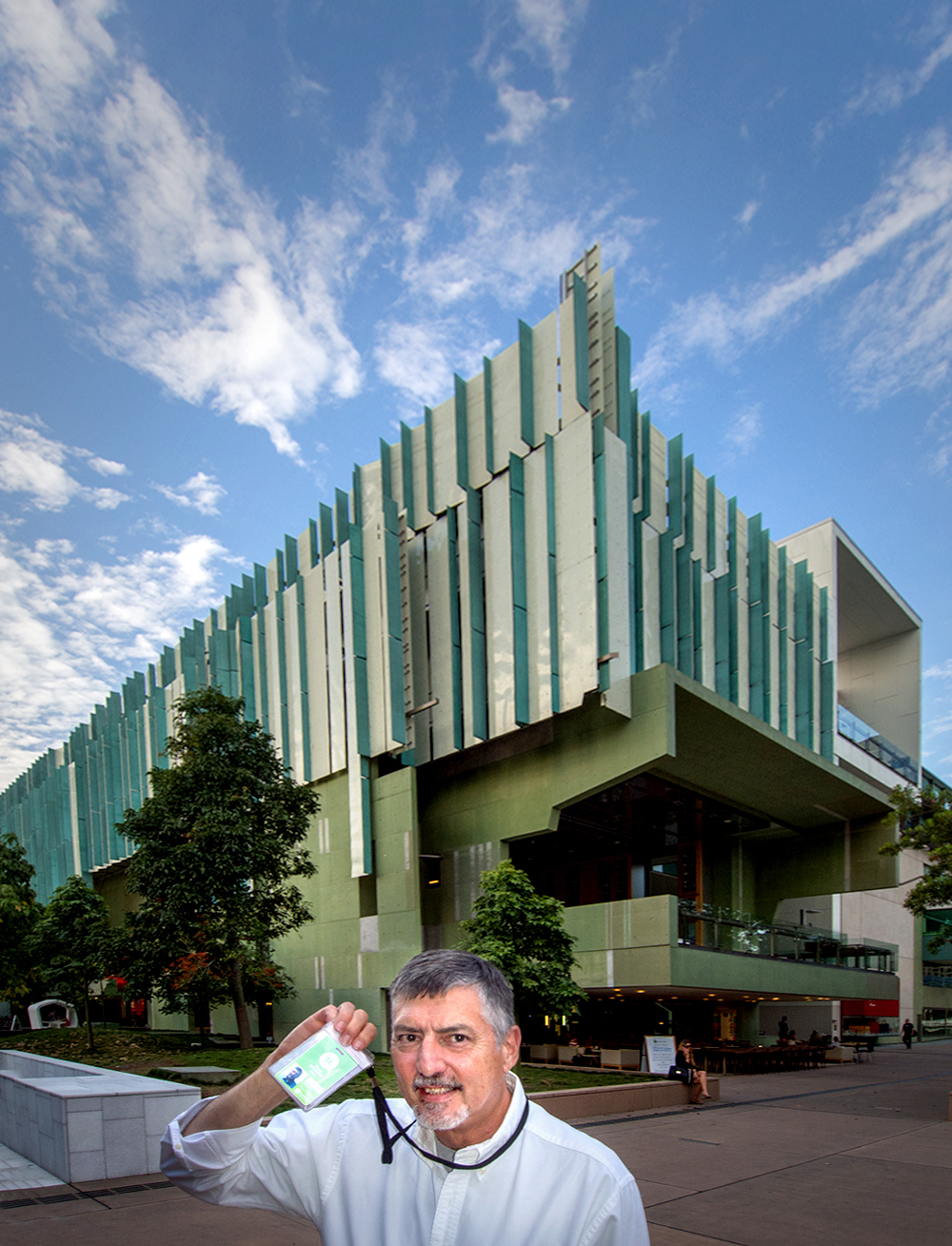
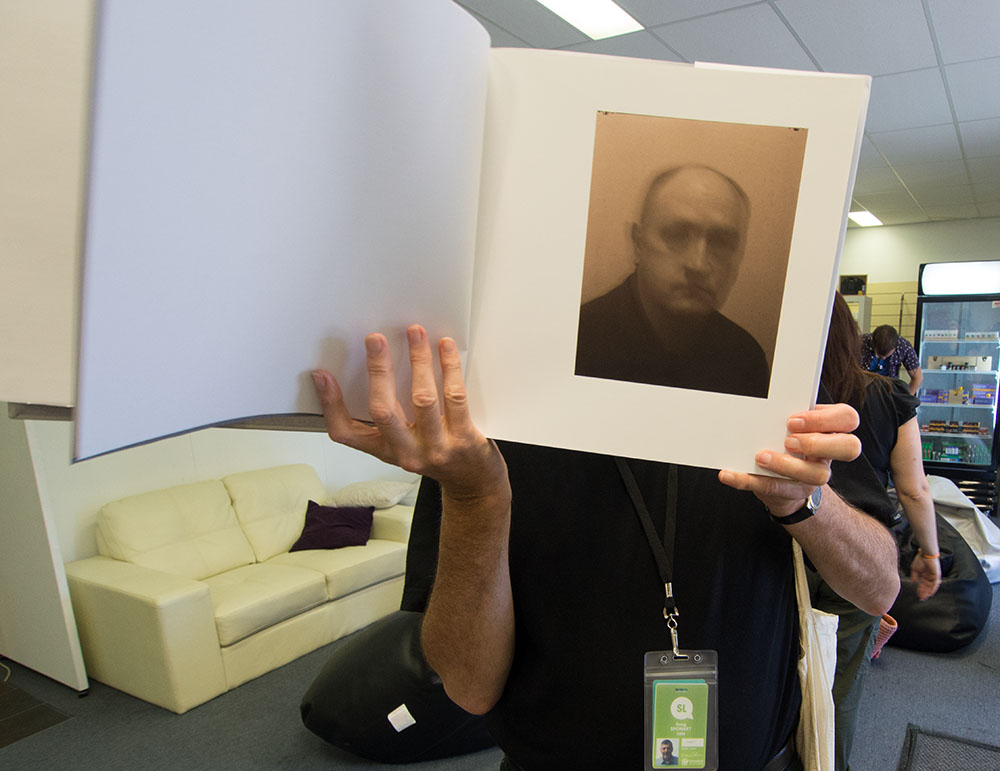
Doug Spowart at the SLQ with his Security pass
.
A PHOTO OPPORTUNITY: Looking for photos in the Australian Library of Art
As the inaugural Siganto Artists’ Book Research Fellow I have had an opportunity to access the State Library of Queensland’s resources including the significant artists’ book collection held in the Australian Library of Art. During the Fellowship I have engaged in specific research related to my proposal and in doing so it has enabled the creation of a much-needed critique on photography and the artists’ book. It has enhanced my understanding of the photography and artists’ book creative products and has placed me in a position of knowledge of these disciplines, the nature of these creative works, their collection and description.
.
In this research my particular interest is in the intersection of photography and the artists’ book. Over a four-month period from October to January in 2014-5 I worked in the Fellows Room and in the Repository at the SLQ. During this time I engaged in a variety of activities that related to my proposed research activities. These included:
- A review of artists’ books in the Australian Library of Art collection looking for the presence of photography
- Creating and using a spreadsheet in which the review was logged
- Documentation of books containing photography
- Selected books were considered for critical evaluation
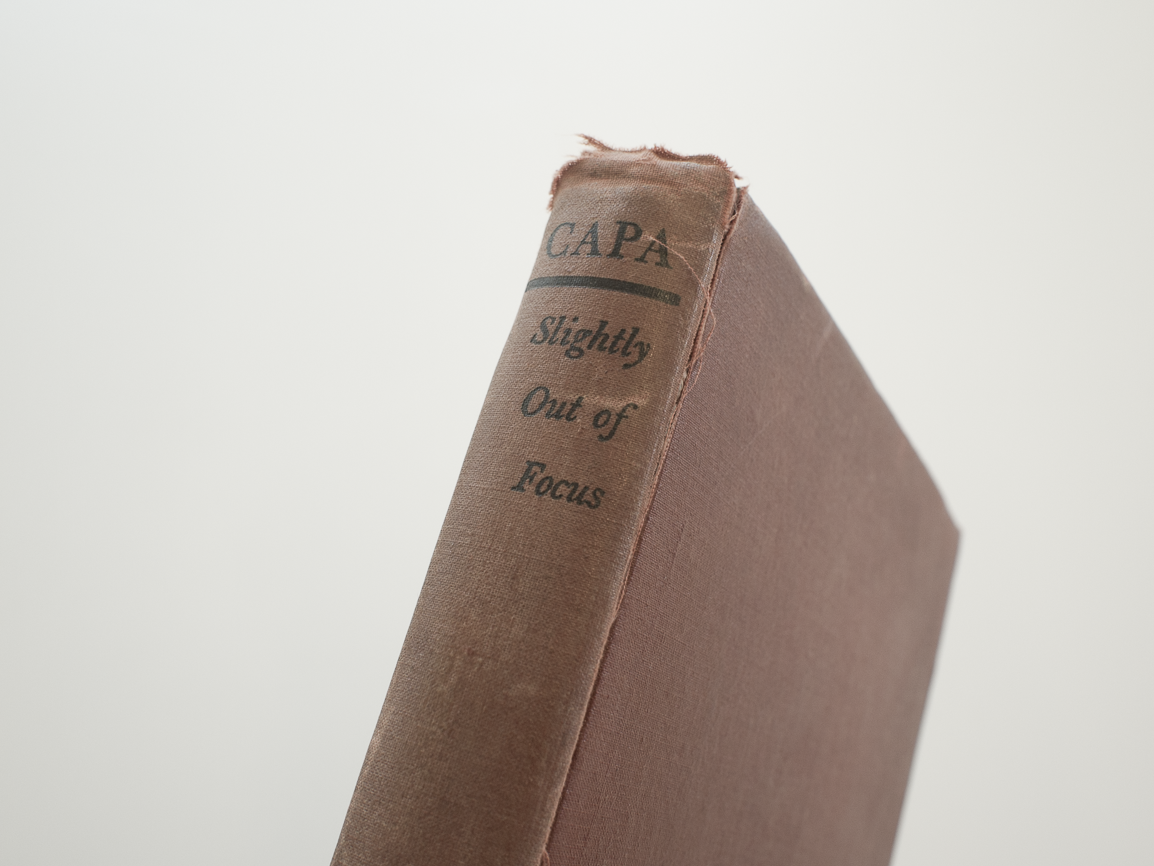
Robert Capa’s ‘Slightly out of focus’
I was also interested in books that have emerged as being significant in the newly documented history of the photobook and also the ALA’s acquisition of contemporary photobooks. I found in the library’s general collection many key seminal photobooks like Robert Capa’s 1947 Slightly out of focus: [the story of a war photographer], Henri Cartier-Bresson’s 1952 The decisive moment, and Richard Avedon’s 1976 Portraits. While some of these books are difficult to find, expensive to buy, and have been re-released in modern printings the original book is an important touchstone for those interested in photographic history. The ALA collection also revealed surprises with my discovery of a Japanese ‘Provoke era’ book from the 1960s and Broomberg and Chanarin’s ‘The Holy Bible’ from 2013 – both books representative of key approaches to the photobook and the use of photographs in creative book publishing.
.
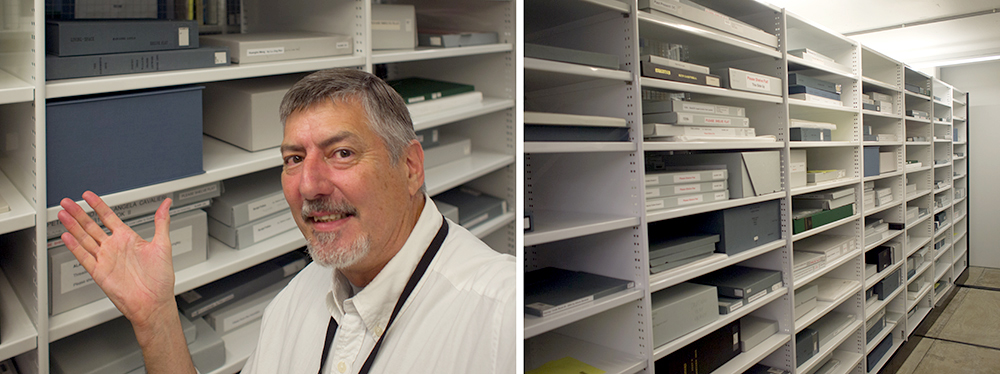
Doug Spowart in the SLQ Repository
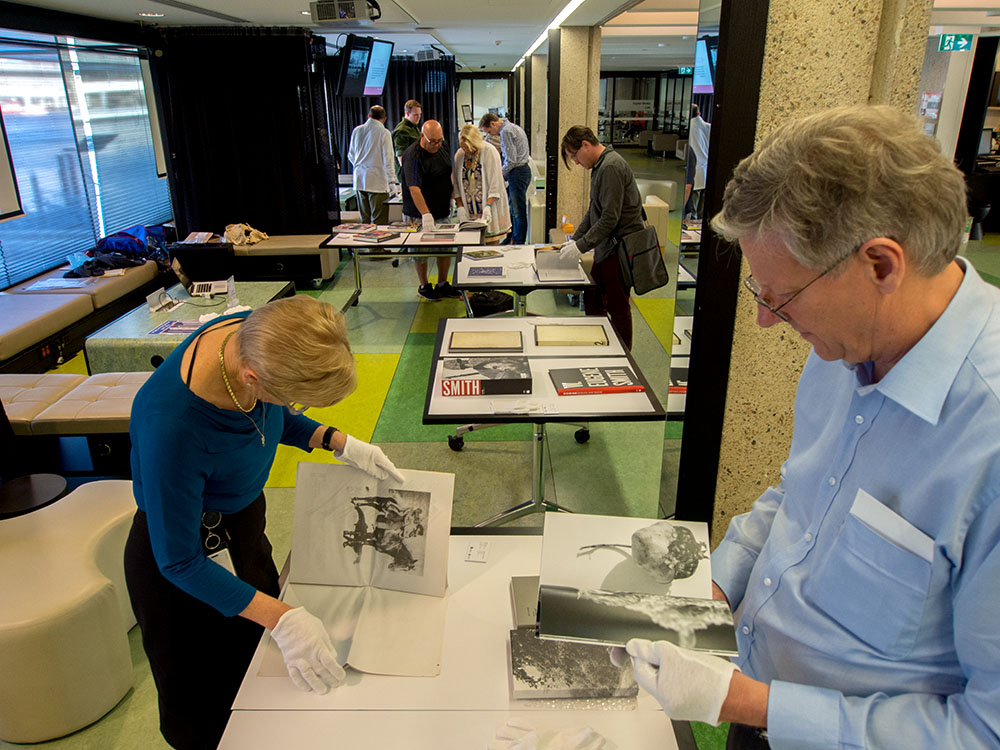
I attended the library usually 4-5 days per week. After an initial settling-in and establishment of my methodology for work I began near-daily research in the Repository. I usually worked on a 3-hour time limit per session during which I viewed and reviewed as many books as possible. My methodology involved direct contact with the book and an engagement with the physical and the metaphysical. I held each book, I turned each page, I read each word (where text existed), I made my assessment and logged the results of the appraisal on my spreadsheet and photographically documented the book. It was a slow and intense process that has resulted in a significant resource which has the possibility to reveal interesting facts about the photo in the artists’ book.
An integral aspect of the review process was the haptic experience of encountering the book, opening its enclosure, clamshell or paper wrap, and sensing the book’s activation by this act. I found that these books were entities to themselves, a containers for sharing the artists’ vision, idea or narrative. Some perhaps were being read for the first time in a while. And in the quietness of the Repository the books revealed themselves to me… At the end of each 3-hour session I was quite exhausted. Although the ALA staff were always interested to hear my report of the favourite ‘book of the day’.
What intrigued me was the diversity of the media and the message that artists place in the creative vessel of the artists’ book. I found myself seduced as much by books of abstract, textural or other non-photo print forms as I was with books with photographs in them.
Working through the library’s catalogue I often found myself looking up obscure books, different editions of books, photographers, topics and references allied to my research interests. I would request these items and they would be delivered to me. I would stack and categorise these books relating to different research interests. Subsequently, as my desk grew with more and more books, I requested a printout of my personal loans. The librarian assisting me looked surprised as the printer spat out around 50 items. One of my life follys is collecting books and there came a time when this personal library-in-the-library would need to be returned, as I was to exceed my loan limit.
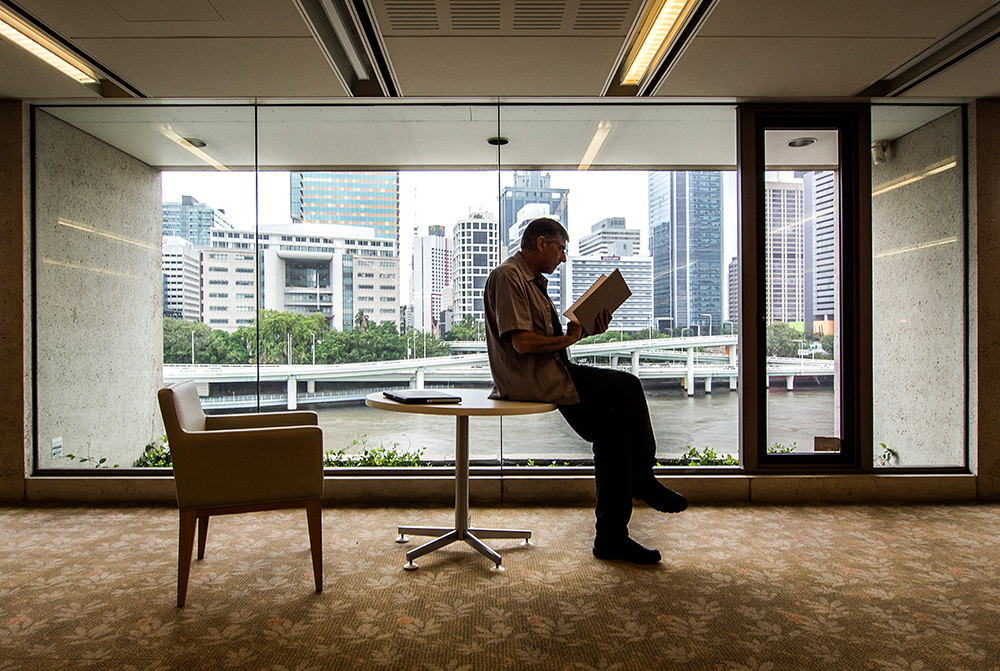
Doug Spowart reading a book at the SLQ
During my Fellowship I was able to develop and complete a significant paper outlining a way of categorising the presence of the photograph in the creative book production genres of artists’ books and photobooks. Entitled, A Photo Spectrum: Book genres and photography, it encompasses the limited edition livre d’artiste through artists’ books, zines, self-published photobooks, designer photobooks and limited edition deluxe photobooks. This paper is presently being held by an American publisher to be included in a book on the contemporary photobook. I intend to discuss this outcome in the seminar. Another paper about contemporary photobooks written during the Fellowship entitled, Everyone a publisher, was published in the recent special issue on artists’ books in the State Library of Victoria’s La Trobe journal. I also coordinated and chaired a forum on The OTHER Photobook – Artists’ books and Zines at the Photobook Melbourne event in February, and in May I spoke on Encountering a photobook at the Talking Culture Symposium of the Auckland Photo Festival. The Siganto Fellowship assisted in providing me with time and a place where my activities could be dedicated in the pursuance of my research.
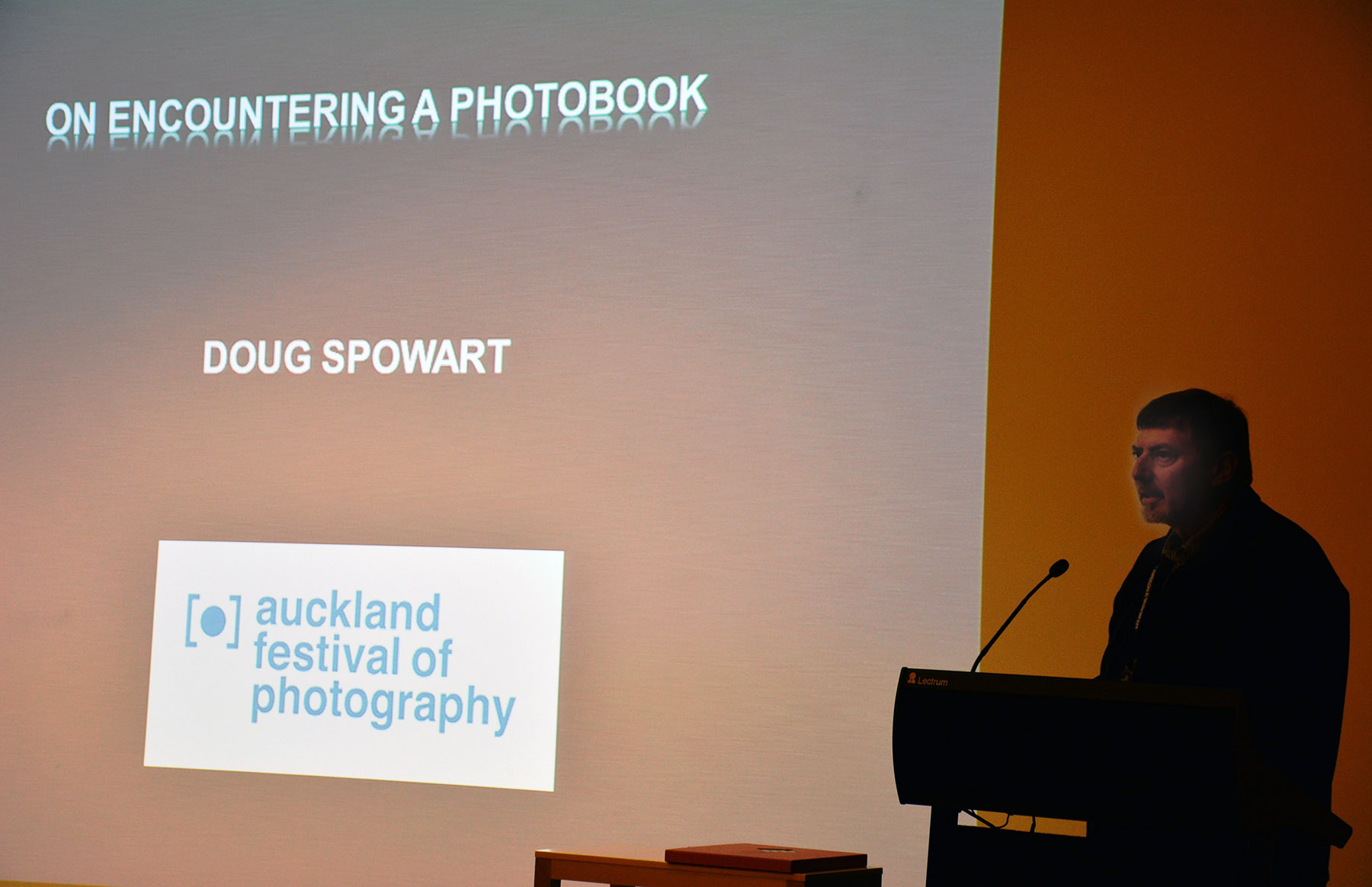
Doug speaking at the Auckland Festival of Photography
As a result of the Fellowship I am working on projects that include the presentation to the SLQ of a strategy for the continuing purchase and collection of contemporary photobooks in the ALA. Still in development is the preparation and design of a book of selected works from the ALA collection that were fundamental to my research thesis on the photo in the book.
At the Siganto Artists’ Book Seminar (Click here for the Blog post) I will present a paper outlining the curious and interesting aspects of my ALA review including amazing books that need to be seen, held, and pages turned so that they can share the maker’s communiqué, and stimulate the reader to encounter … the photo in the book.
Dr Doug Spowart
2014 Siganto Artists’ Book Research Fellow
PHOTOBOOKS: everyone a publisher – The LA TROBE Journal
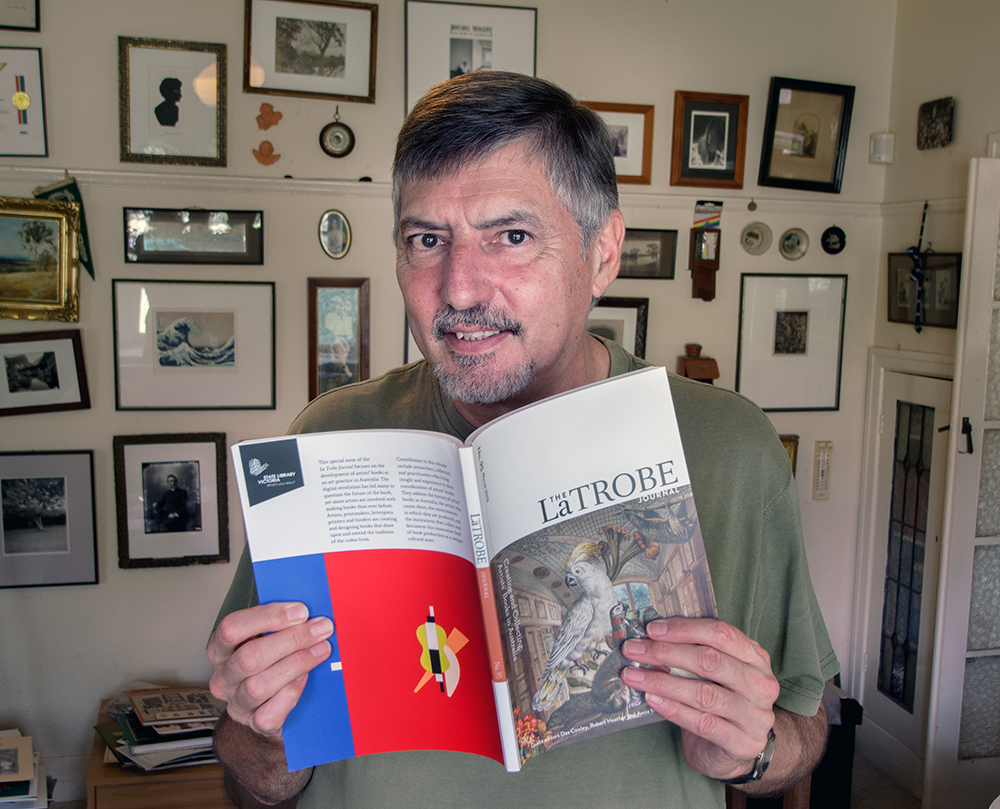
Doug Spowart with the La Trobe journal
.
I’m particularly excited to announce that a copy of my essay on Photobooks published in the State Library of Victoria’s La Trobe journal is now available as a free download. Here are some details and links
.
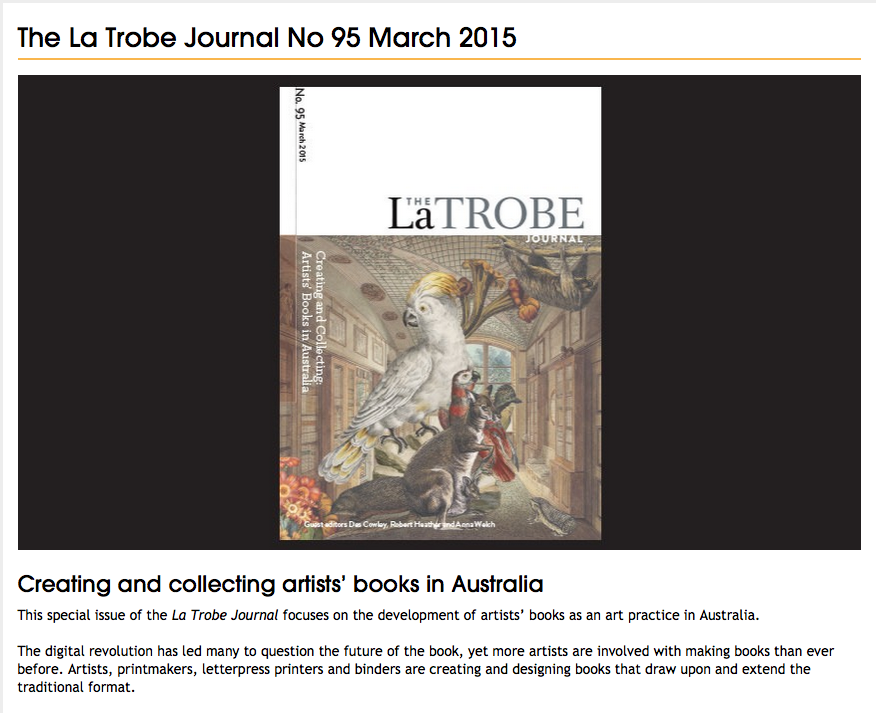
The La Trobe journal with the great Gracia & Louise cover
TITLE:
The photobook: everyone a publisher?
ABSTRACT:
Digital technology, indie DIY and print-on-demand photobooks have transformed contemporary photography book publishing, however the creative and innovative influence that graphic designers have brought to the artists’ book is now extending into the photobook artform.
FIRST PARAGRAPH:
Over recent years the photographically illustrated book has undergone a massive makeover, in effect freeing it from traditional publisher controls. Digital technologies have been the major cause of this paradigm shift due to the democratisation of photography, new production technologies, and new funding and marketing platforms. The 19th-century polymath Henry Fox Talbot, inventor of the positive/negative process for photography, was so enthusiastic about the potential for his discovery that he made a prediction for a future where: ‘Every man [would be] his own printer and publisher’. It would now seem that Talbot’s prediction has come to pass. Increased public access to book publishing is particularly important for those photographers and artists who employ the camera and the photograph in their art practices.
Topic headings:
- Photographers desire books
- A new term emerges
- A new critique forms for the photobook
- A new accessibility to book production
- The happy self-publisher
- The artist book and self-publishing
- A new challenge emerges: design my book
- In conclusion
Features a commentary on Ying Ang’s Gold Coast and photos of books by Louis Porter, Lloyd Stubber and Mimmo Cozzolino.
CLICK THE LINK BELOW TO DOUG SPOWART’s ESSAY DOWNLOAD
http://www.slv.vic.gov.au/sites/default/files/La-Trobe-Journal-95-Doug-Spowart.pdf
LINKS TO OTHER DOWNLOADS
- [Front matter] (pdf,276.52 KB)
- · Des Cowley, Robert Heather & Anna Welch – Editors’ introduction (pdf,105.18 KB)
- · Helen Cole – Public collections of artists’ books in Australia (pdf,617.45 KB)
- · Andrew Schuller – A history of the Croft Press (pdf,859.45 KB)
- · Sasha Grishin – Books in the Canberra region: the golden years (pdf,1011.85 KB)
- · Steven Tonkin – A defining decade: Australian artists’ books in the 1970s (pdf,461.45 KB)
- · Artists’ books from the State Library of Victoria: a photo essay (pdf,5.3 MB)
- · Caren Florance – The changing face of contemporary letterpress in Australia (pdf,493.65 KB)
- · Peter Anderson – Conceptual and perceptual: the early artists’ books of Robert Jacks (pdf,503.25 KB)
- · Marian Macken – Reading time: the book as an alternative architectural practice (pdf,1.28 MB)
- · Doug Spowart – The photobook: everyone a publisher? (pdf,523.78 KB)
- · [Back matter] (pdf,274.28 KB)
.
.
.
PHOTOBOOK INDEPENDENT: Our books in Hollywood – thanks to QCP
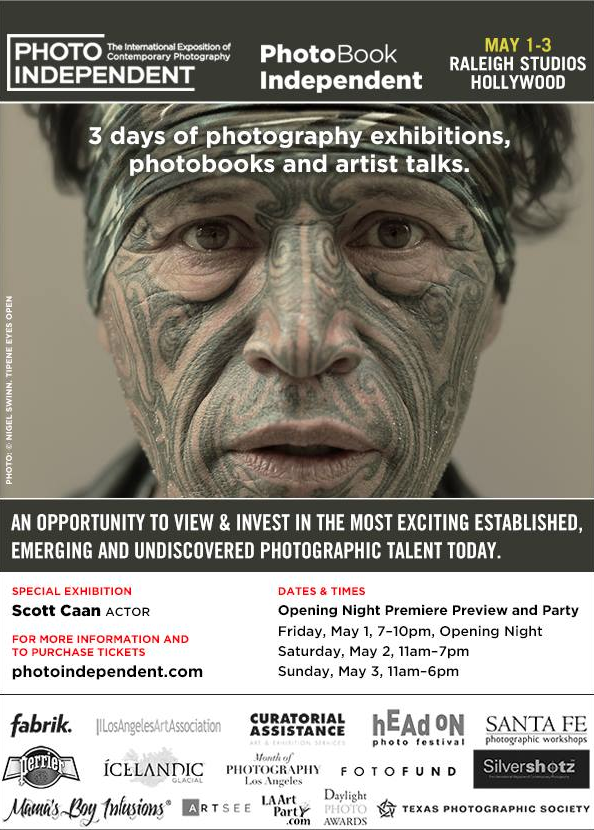
Photo Independent poster
.
As part of its international activities for Queensland and Australian photographers the Queensland Centre for Photography participated in the inaugural Photo Independent art fair at Raleigh Studios, Los Angeles 1–3 May, 2015. The main Australian contingent consists of the wall images of 12 photomedia artists. They are Anna Carey, Belinda Kochanowska, Chris Bowes, David La Roche, Henri van Noordenburg, Kim Demuth, Kelly Hussey-Smith & Alan Hill, Katelyn-Jane Dunn, Lynette Letic, Michael Cook and Marian Drew.
.
An additional aspect of Photo Independent is one dedicated to the recognition of photographers who work in the book format. Called Photobook Independent the QCP curated a selection of 16 Australian photo publishers to present in the L.A. event.
In QCP media about these two events the following statement was made:
The QCP is excited to be part of this ground-breaking event as the world of photography will set its focus on Los Angeles 1–3 May, 2015 for a weekend celebrating international photography and the most talented image-makers across various genres of the medium. Numerous high profile art fairs including Paris Photo Los Angeles, Photo Contemporary, Photo Independent and PhotoBook Independent will launch their annual editions in Hollywood with additional special photography exhibitions throughout Los Angeles. The weekend promises to offer the enthusiastic art patron a plethora of opportunities to experience photography at its highest calibre.
The photobook publishers were: Ingvar Kenne, Dane Beesley, Anne Ferran, Lindsay Varvari, Rohan Hutchinson, Julie Shiels, Prudence Murphy, Christopher Young, Paul Batt, Ian Tippett, Doug Spowart, Victoria Cooper, Gemma Avery, Michelle Powell, Mathias Heng and Christopher Köller.
Interviews with the artists and photobook makers can be found on the LUCIDA Site: http://lucidamagazine.com/
Biogs on the photobook participants can be seen here: http://qcpinternational.com/portfolios/photo-book-independent-2015/
.
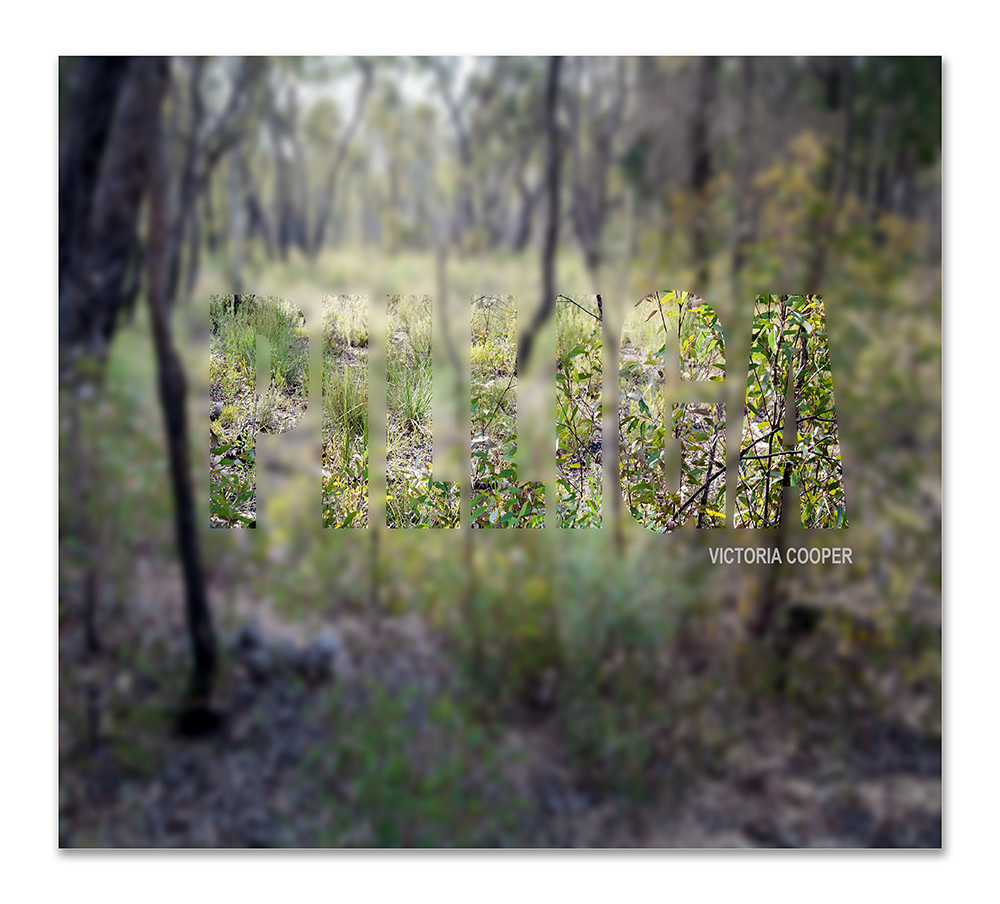
Victoria Cooper’s PILLIGA
.
About Victoria’s Book: PILLIGA
Pilliga is the culmination of 10 years work. It is informed by the many physical, psychological and metaphorical journeys through this enigmatic place during the decade of its creation.
This book is not a topographic depiction of the Pilliga Scrub, a remote location in the Australian Bush. Rather it is a human story of lurking deep anxiety manifested as a destructive invisible entity feeding on fears of the unknown and unknowable.
A PDF of the book can be seen here:PILLIGA-redsmr
The book can be purchased from BLURB here: http://blur.by/1Q9cGhh
.
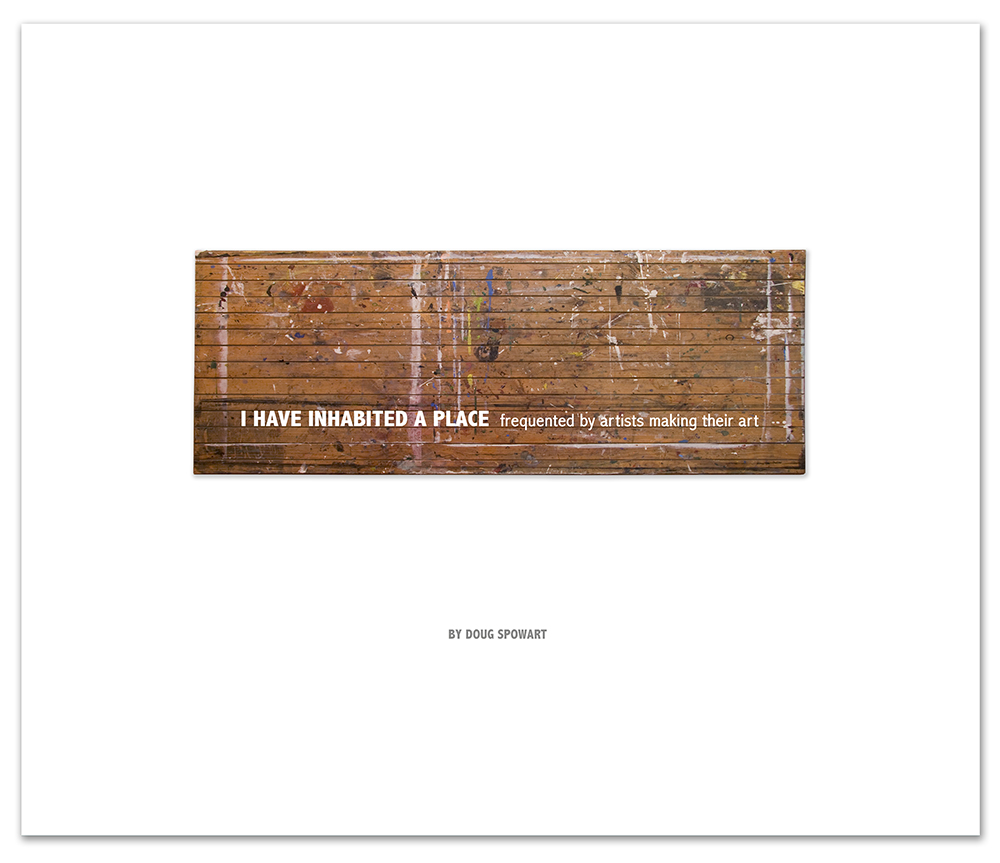
Doug Spowart’s I have inhabited a place …
About Doug’s Book: I HAVE INHABITED A PLACE FREQUENTED BY ARTISTS MAKING THEIR ART …
This book relates to the experience of being a documentary photographer within the world. The subject, a deserted artist’s studio, becomes an immersive landscape for investigation. This photobook expresses a personal narrative about loss, absence, place, and concepts around the relationship between the non-human and the working practices of artists.
A PDF of the book can be seen here: I have inhabited a place …red2
The book can be purchased from AMAZON here: http://blur.by/1K65dMu
.
.
.
WOTWEDID BLOG: 2014 in review – interesting facts + stats
The WordPress.com stats people prepared a 2014 annual report for our WOTWEDID blog.

Here’s an excerpt:
The concert hall at the Sydney Opera House holds 2,700 people. This blog was viewed about 13,000 times in 2014. If it were a concert at Sydney Opera House, it would take about 5 sold-out performances for that many people to see it.
WORLD PHOTOBOOK DAY – The Photobook Club Brisbane events
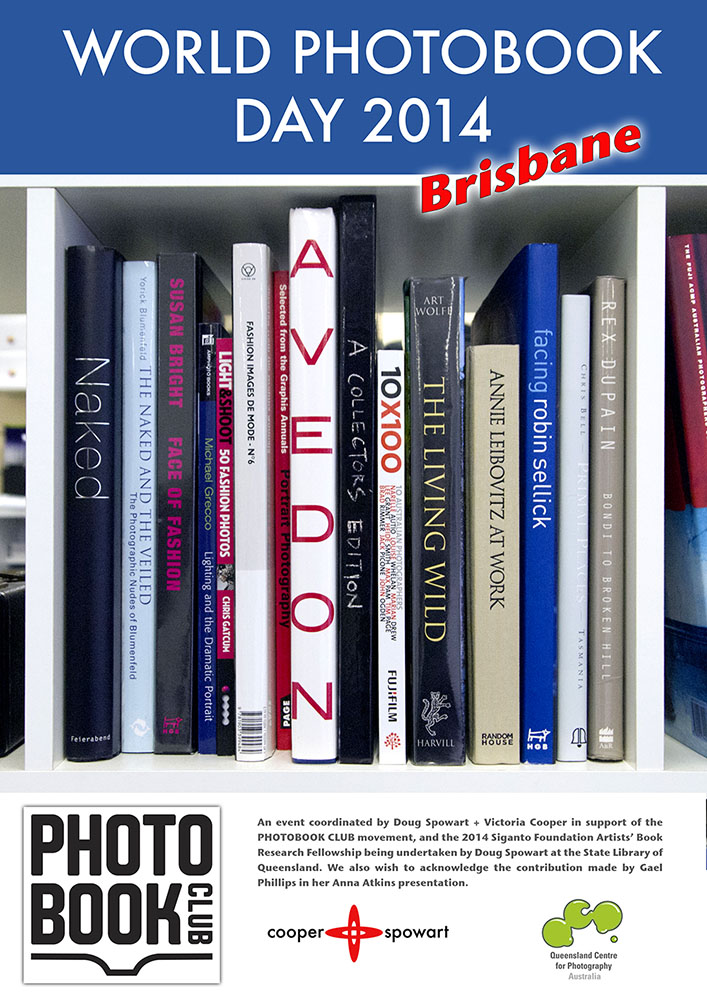
WPD Poster
.
For photobook people the 14th of October is World Photobook Day (WPD) and celebrations worldwide are coordinated through the Photobook Club group. On this day in 1843, the British Library catalogued Photographs of British Algae: Cyanotype Impressions by Anna Atkins, and is therefore considered historically significant as the first official record of a published photobook. In 2013 Victoria Cooper and I organised an event in Toowoomba. This year as part of my Siganto Foundation Artists’ Book Research Fellowship we arranged two events to take place at The Edge facility that is part of the SLQ.
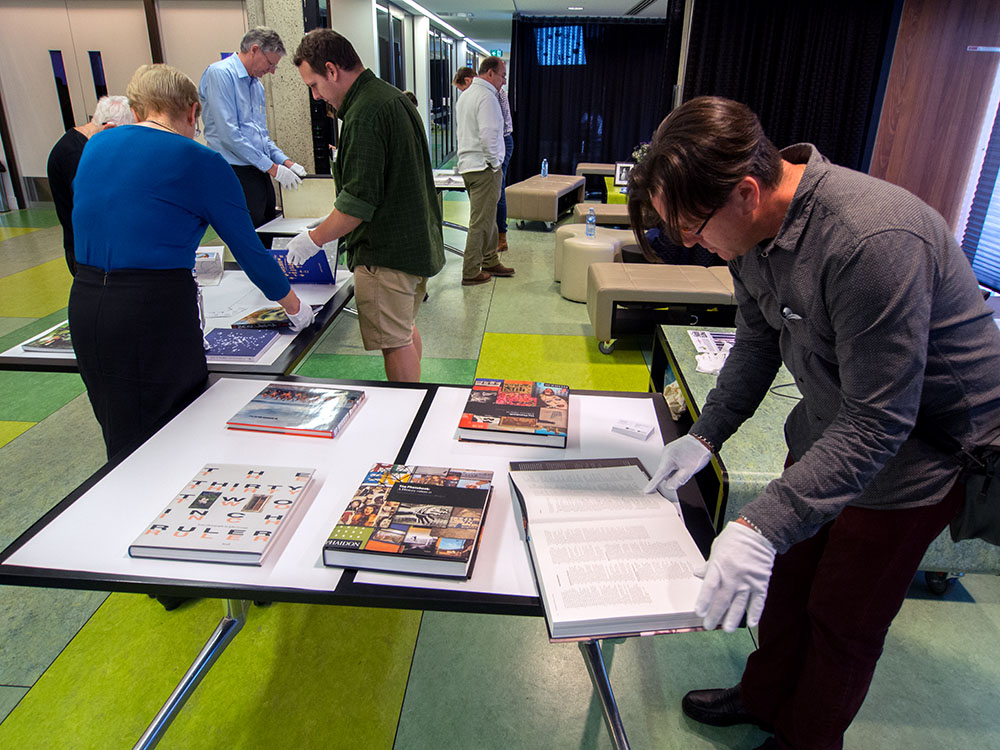
The QCP WPB event
.
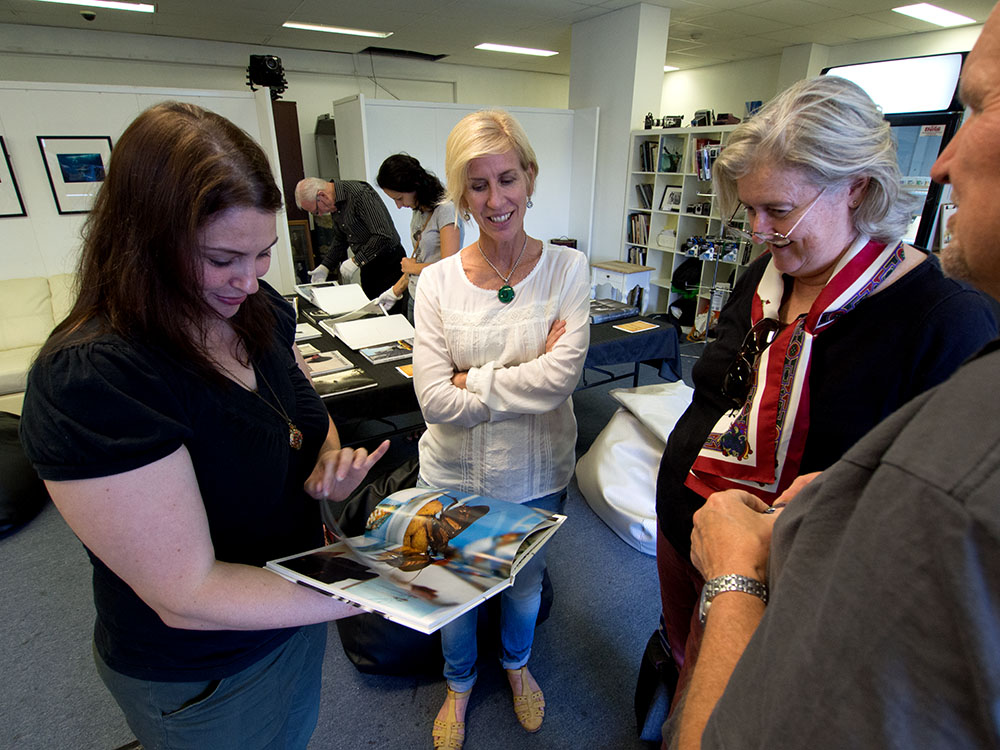
The first event was arranged for Queensland Centre for Photography members to view contemporary photobooks, artists’ books, photo-zines and photo-papers from our collection. Around 30 publications, mainly by Australian photographers and artists, were presented to a group of around 18 participants. This selection included two books, Ying Ang’s Gold Coast and John Elliott’s Ju Raku En, which were launched only in the last few weeks. Staff members from the Australian Library of Art attended this opportunity to view examples of this emergent book genre.
.
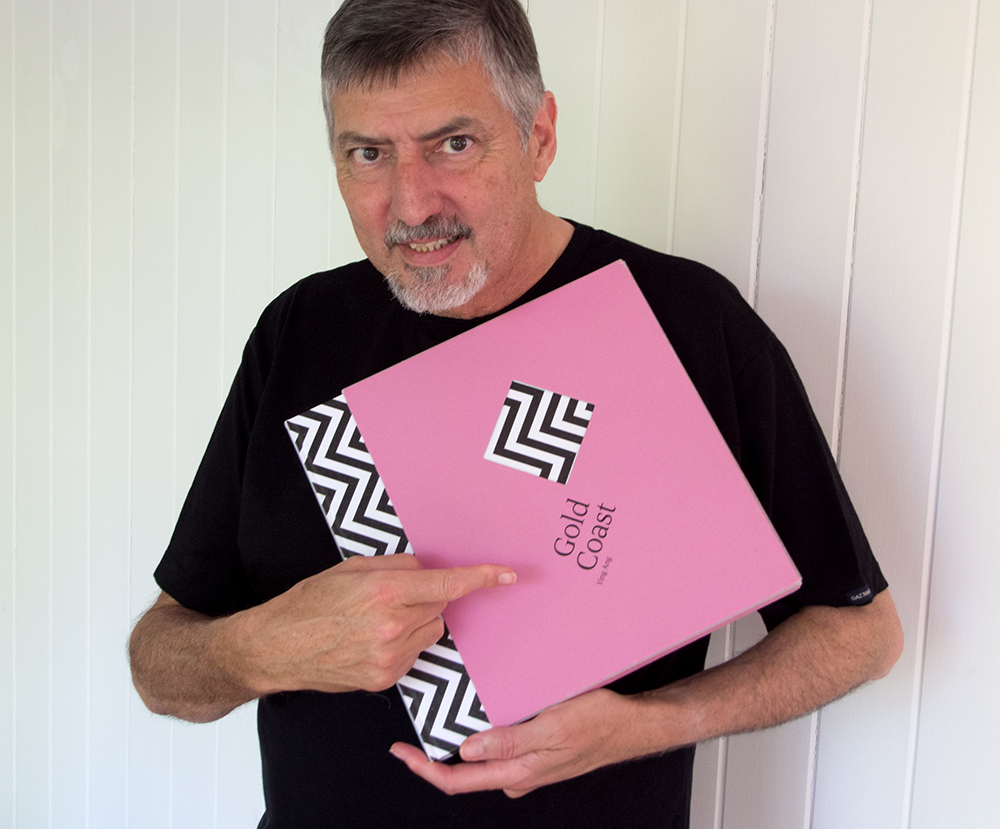
With Ying Ang’s Gold Coast
.
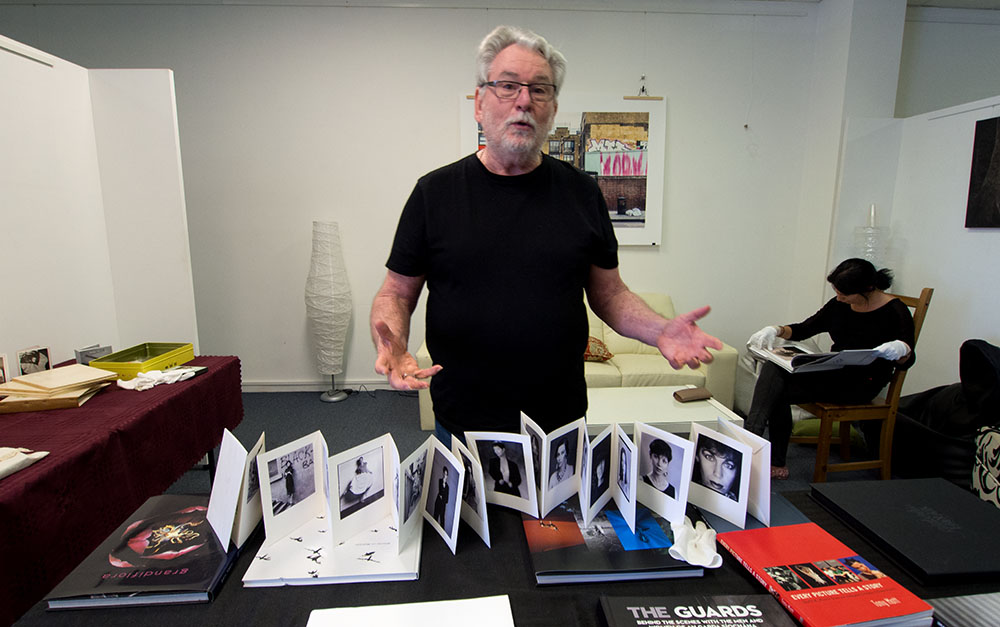
The main Photobook Club WPD event took place in the evening and was attended by around 24 participants. Each brought along their favourite photobook to share and discuss with their fellow attendees. The oldest book presented was a photographic portrait book from the 1860s, and the more recent books included, W Eugene Smith’s The BIG Book, Spada’s Gomorrah Girl, and Spottorno’s PIGS. Many participants contributed their own print on demand books, or bespoke handmade artists’ books thereby representing the spectrum of the photo and the book.
A special part of the evening WPD event was a presentation by Dr Gael E. Phillips about Anna Atkins, her family and motivations for her cyanotype work. Phillips, a local Brisbane resident, is a distant cousin of Atkins shared her extensive research of this significant family connection. The assembled group were presented with the fascinating story of Anna Atkins (‘Anna Children’ – her maiden name), her father – George, relatives and networks in photography, science and society in nineteenth century England. Two attendees Dr Marcel Saffier and Sandy Barrie both significant photo historians showed a strong interest in Phillip’s research and talk.
.
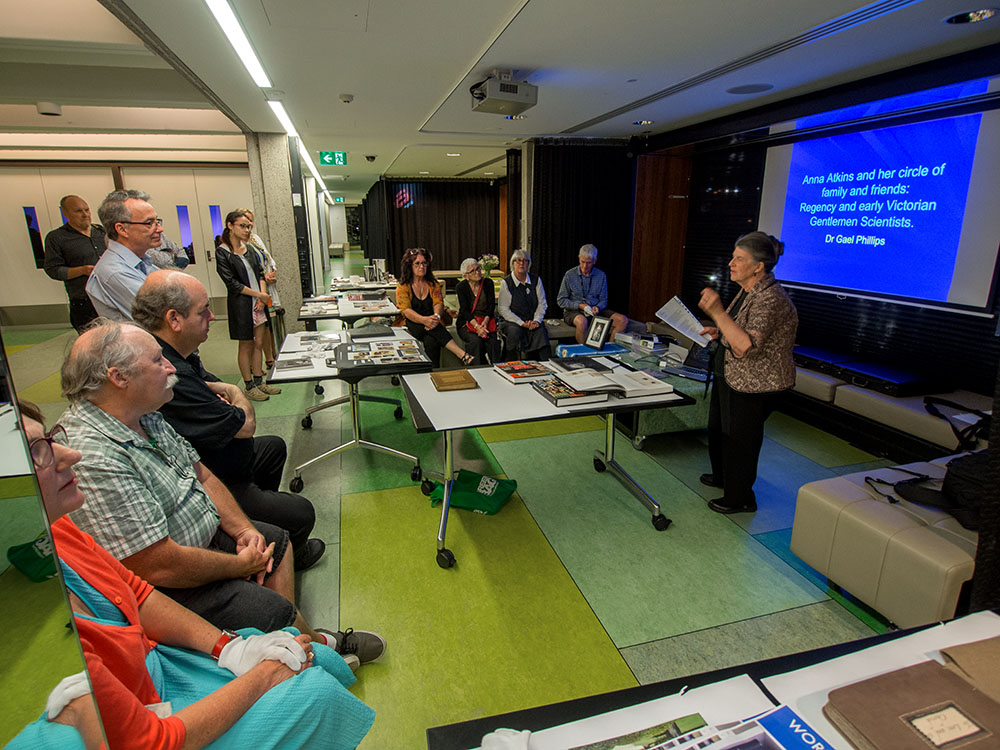
Gael makes her Anna Atkins presentation
.
Apart from the two events we curated this year, two new South-East Queensland organisers also presented WPD events. This provides evidence that there is a strong interest in seeing, talking about, publishing and collecting photobooks.
As part of my Fellowship activities I’m scheduling further events to keep the interest in his research growing, and to promote a greater awareness of the significant resource of ‘the photograph and the book’ held by the State Library of Queensland.
Keep in touch… Doug Spowart.
.
.
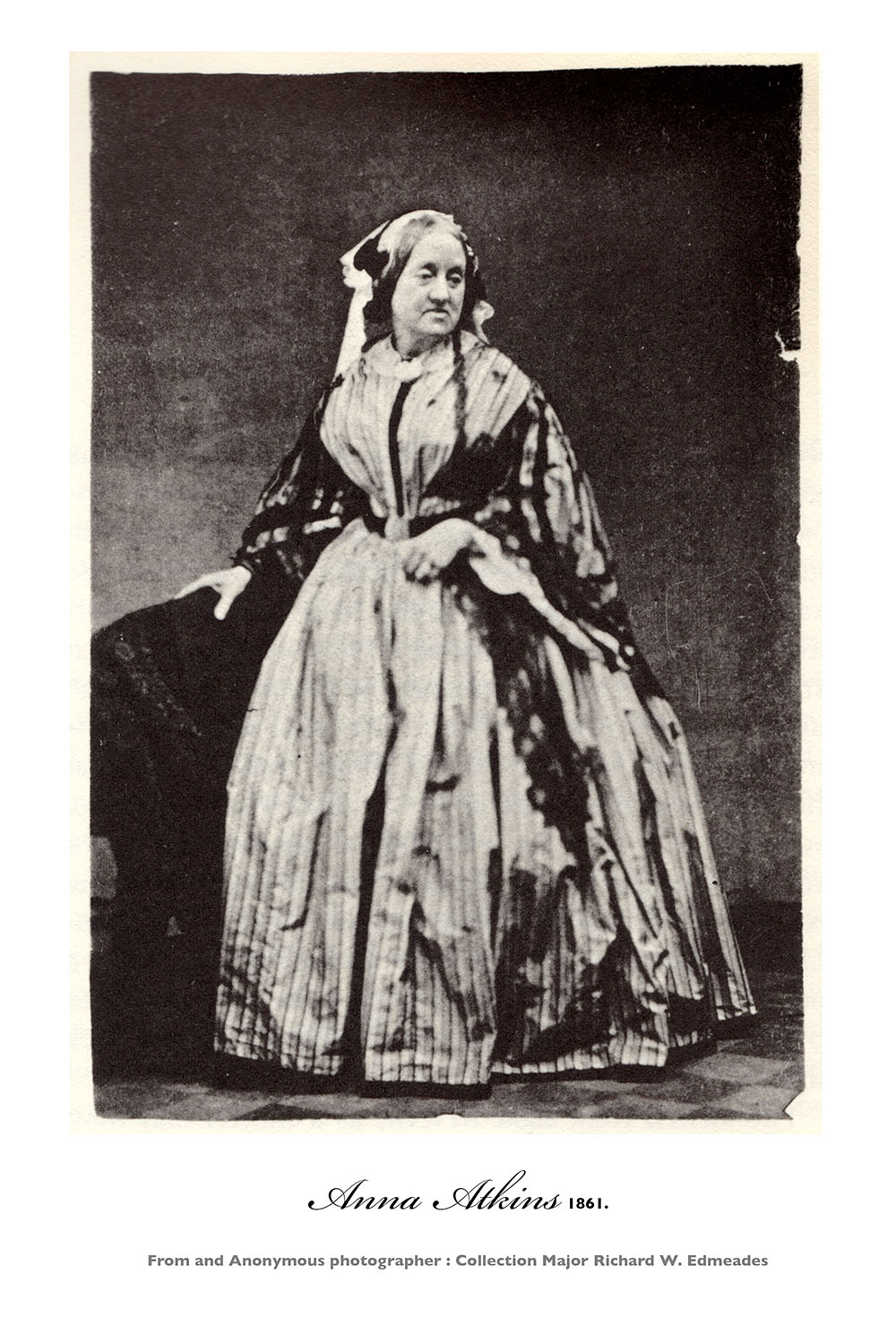
Anna Atkins-Portrait 1861
.
What follows is a precis of Dr Phillips’ presentation:
Anna Atkins (1799-1871) is now recognised as being the first person to publish a book using a photographic technique. This recognition has come late but is, I think, largely due to the work of Prof Larry Schaaf. My cousins, Jean Doggett, Elizabeth Parkes and I were also doing similar research at the same time because of a family link with the Children family. The Children family have been long established in Kent and trace their family back to Simon a Children in 1370.
Anna Atkins was born, Anna Children, her mother dying when she was a few months old, but she grew up in a wealthy household surrounded by family friends who included many of the great Gentlemen Scientists of the Regency period and later. These included Sir Humphry Davy, Dr W H Wollaston, Sir Joseph Banks, the Herschels and William Henry Fox Talbot. Her father, John George Children, was a well known scientist in the first half of the nineteenth century and his publications include descriptions of the largest electrical battery ever built, which he and his father constructed in their own laboratory at their home, Ferox Hall, in Tonbridge.
Following the failure of the Tonbridge Bank, George Children, Anna’s grandfather, was bankrupted. His properties were sold to pay the creditors of the bank. His son, John George Children, obtained a position at the British Museum, and appears in the painting of the Temporary Elgin Marble Room in 1819. Initially in the Antiquities Department, he later became the Keeper of Minerals and then the Keeper of Zoology.
Anna Children illustrated Lamarck’s ‘Genera of Shells’ which her father had translated. In 1825 Anna married John Pelly Atkins JP, and they made their home at Halstead Place. Mr Atkins was made High Sheriff of Kent for 1847.
In 1841 a Manual on British Algae was published. Anna used the Cyanotype process, newly invented by a close family friend, Sir John Herschel, to make numerous images of British seaweeds. The first volume appeared in 1843 and pre-dated William Henry Fox Talbot’s ‘Pencil of Nature’.
Anna’s father acted as an intermediary in her scientific endeavours, writing to Hooker at Kew Gardens about the progress of the imaging of the algae and Hooker, in turn, instructed Anna in botany. Her father’s chemical knowledge was invaluable in the production of the cyanotypes. Father and daughter had a very close relationship and when her father died on the first day of January 1852 she was grief stricken. Her Memoir of J G Children, privately published in 1853, was modestly signed AA, as were her volumes of cyanotypes of British seaweeds. The memoir includes poetry written by her grandfather, George, her father, John George and also poetry she herself wrote.
We celebrate the anniversary of the accessioning of the first of her volumes of cyanotypes into the Library of the British Museum. Anna Atkins, nee Children was an artist – she drew, she did lithography and was an author, writing poetry and the memoir of her father. She was also a scientific illustrator as well as being the first woman to produce a photo book and, many believe, the first woman photographer. She has no descendants but is memorialised in a beautiful mollusc, Anna Children’s lucine, Miltha childreni (Gray 1824). Her father is also memorialised in a number of animals, including molluscs and insects and the mineral Childrenite.
Gael E Phillips.
14 October 2014
.
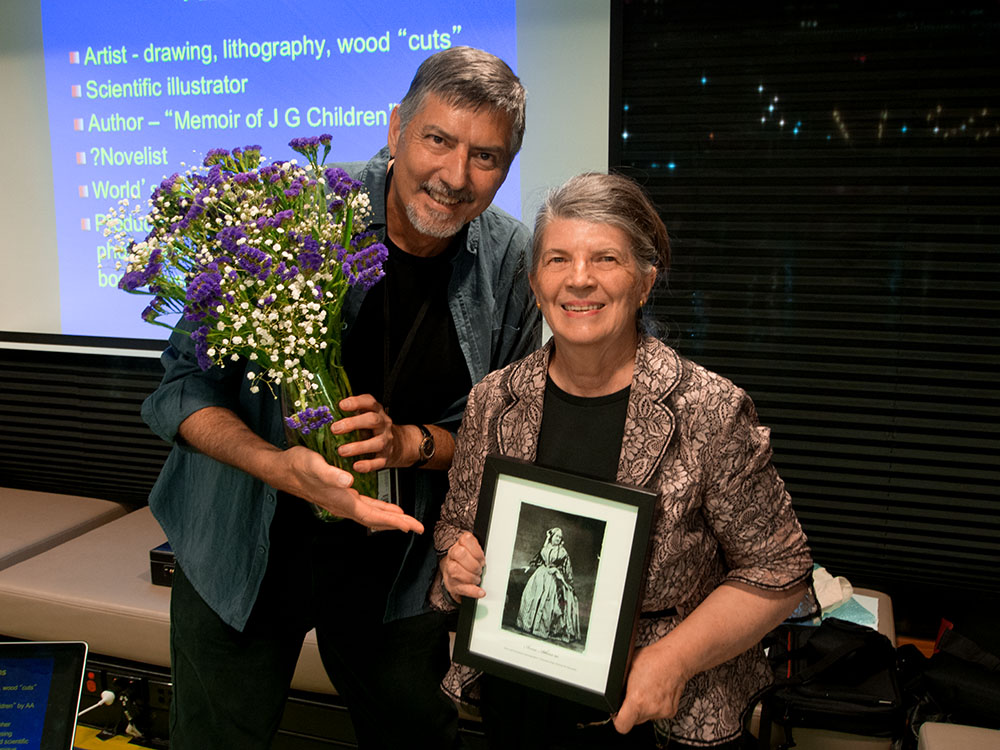
Doug makes a thankyou presentation to Gael
.
.
Other images from the events…
.
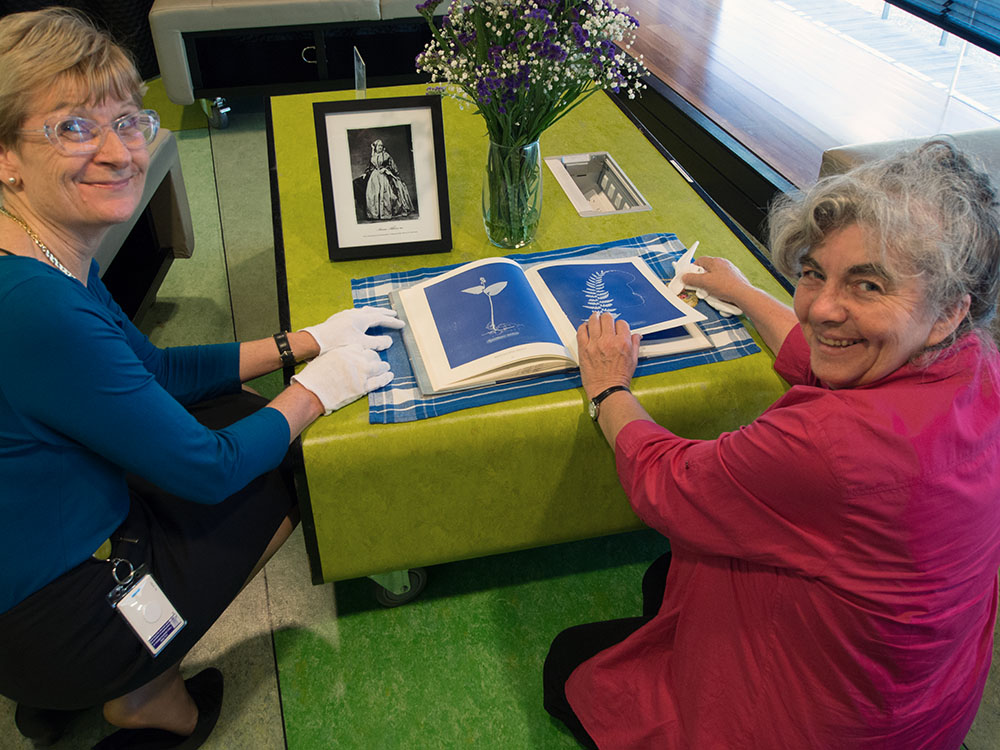
The Anna Atkins ‘memorial’ with Larry J Schaaf’s book Sun Gardens
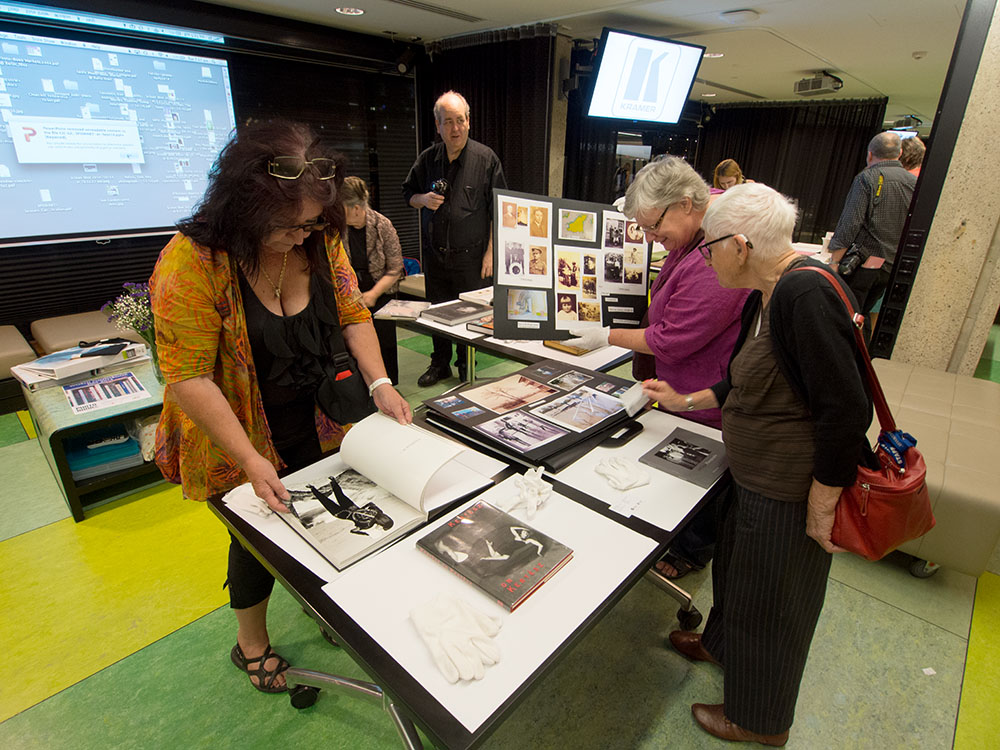
Looking at the books brought to the event
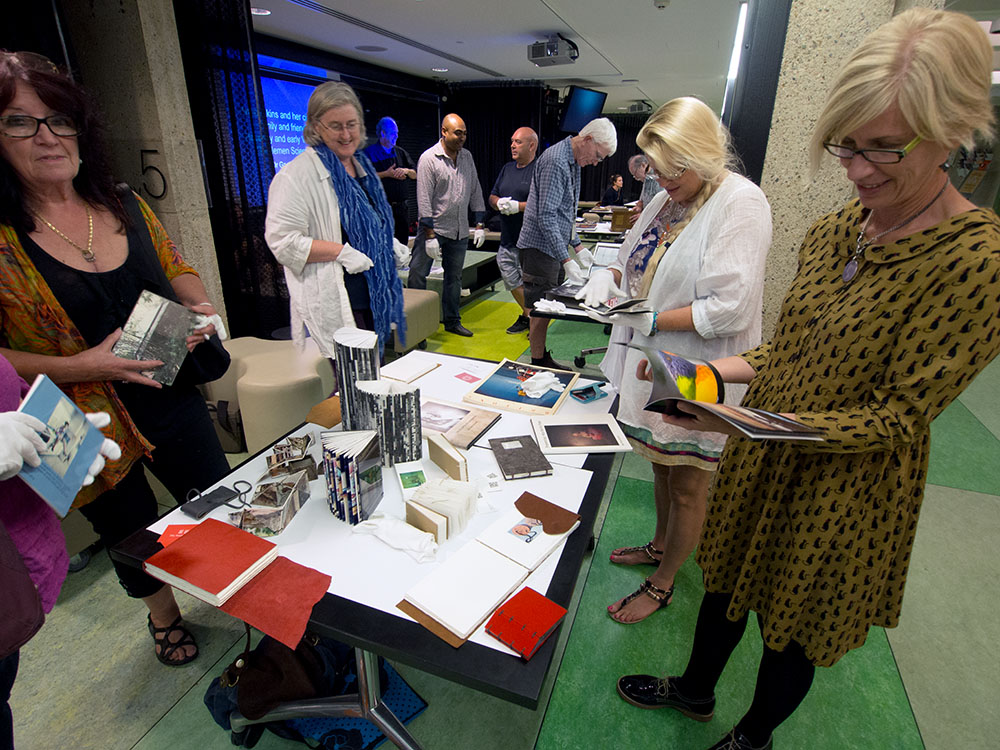
The artists’ photobook end of the books brought along by Adele Outeridge, Mel Brackstone and Jan Ramsay
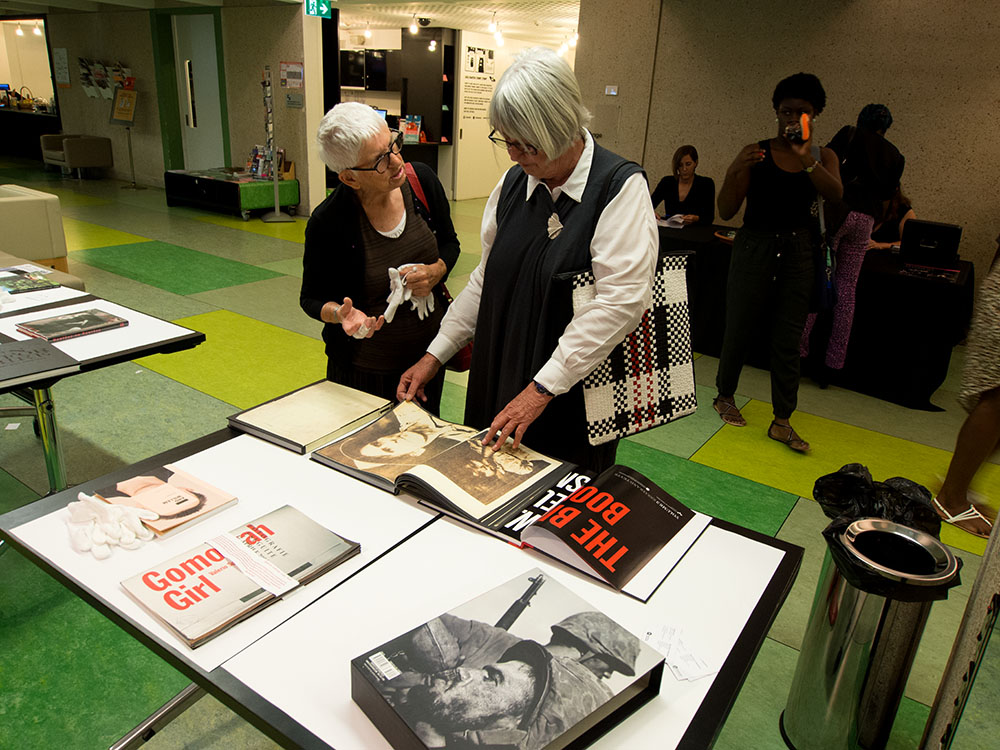
Looking at W Eugene Smith’s BIG BOOK.
Checking out Jacob Raupatch’s newspaper
FOTO FRENZY’S WPD Event
With Doc Ross’ book 37 @ the Foto Frenzy WPD event
Ian Poole @ the Foto Frenzy WPD event
@ the Foto Frenzy WPD event
.
Until next year….
.

PBC logo
.
BEING [photo]BOOKED @ QLD COLLEGE OF ART
Heather introduces Doug’s lecture…
.
Last week we were guest presenters at the Queensland College of Art on the Gold Coast. We worked with photo media and digital media students and their lecturer Heather Faulkner discussing the topic of the contemporary photobook.
.
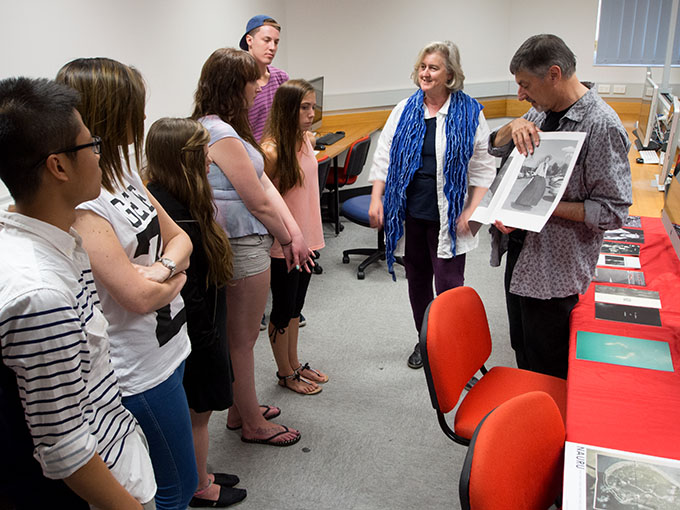
Victoria Cooper and Doug Spowart talking about photobooks….PHOTO: Heather Faulkner
.
Doug presented a lecture on the history of the photobook and brought students up to date with the contemporary photobook including Ying Ang’s latest book ‘Gold Coast’. Students then were given an opportunity to hold, handle and view a range of contemporary photobooks from Australia and overseas including books by, Alec Soth and Brad Zellar, Martin Parr, Garry Trinh, Daniel Milnor, George Voulgaropoulos, Jacob Raupach, Lloyd Stubber, Emma Phillips, Kelvin Skewes, Joachim Schmid, James Mollison, Paul Graham, Gracia and Louise as well as a selection of zines from the Sticky Institute. We also presented a selection of our own photobooks and artists’ books. Of particular interest to the students was the structure, construction, printing and binding of photobooks.
.
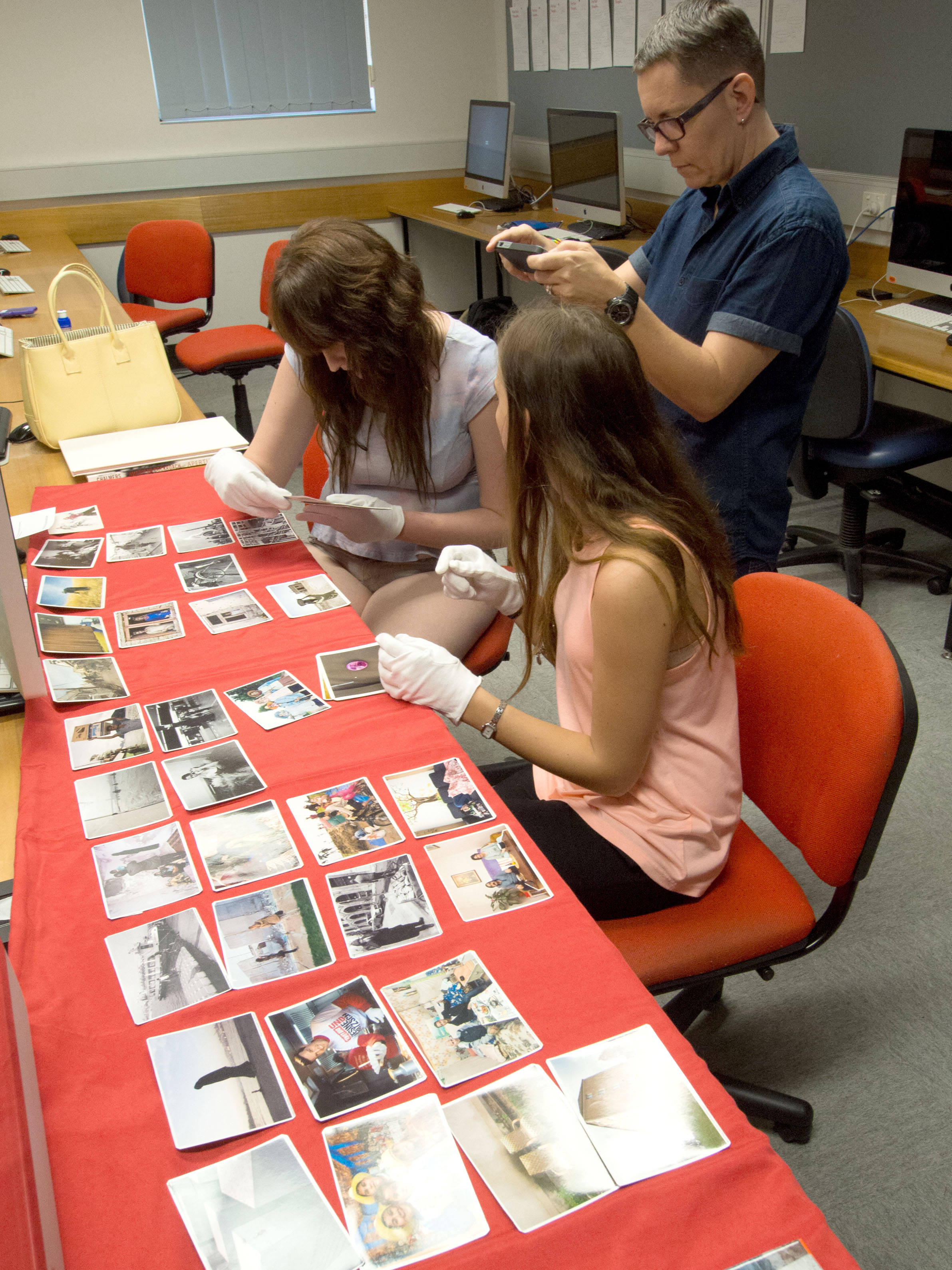
Students working on a sequencing task with Heather Faulkner
An important part of an accompanying tutorial covered ideas around the sequencing of images in photobooks and the ways in which narrative could be expressed. Students were then tasked to work with a series of images using unusual sequencing strategies that we suggested.
.
We enjoyed the opportunity to engage with these students and discuss one of our favourite topics and share amazing books from our photobook library. Thank you Heather Faulkner for arranging this event…
.
.
.
.
SELECTING AN APPA PHOTOBOOK DISPLAY
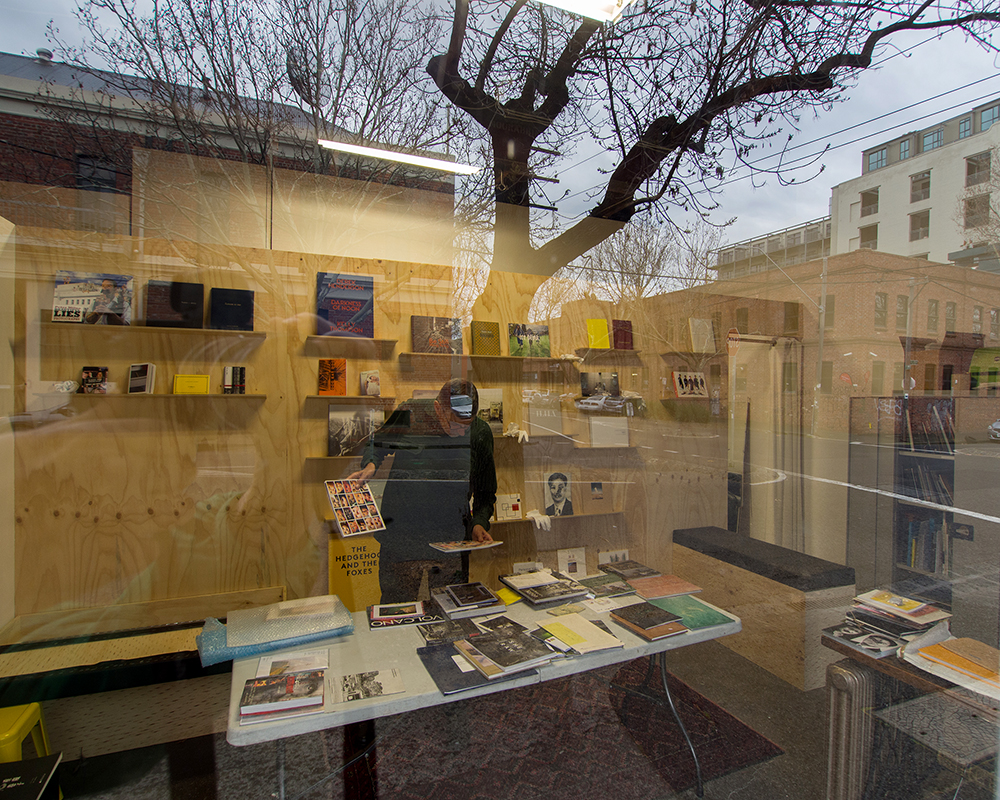
Doug in the APPA space working thru the books on a cold Melbourne winter’s day PHOTO: Victoria Cooper
.
Selecting photobooks @ APPA: A methodology and the list.
I was recently given the opportunity to select books from the Asia Pacific Photobook Archive for their wall display over the next month. While selecting a book to look at and buy in a bookshop can be a challenging enough, the task to review the archive and select around 30 books was daunting. I figured that I needed a methodology.
.
After some thought I put my ideas to Victoria Cooper, photomonteur Peter Lyssiotis, and APPA Director Daniel Boetker-Smith – here’s what we came up with:
- that I’d attempt to make a book array that mirrors the Asia Pacific geographical region
- that I’d select work that was reasonably contemporary
- that the names of the book makers would not unnecessarily bias my selection (interestingly the photographers of books from locations like China, Japan and south east Asia were quite unknown to me)
- that where possible I would select photographers working on their subject matter relating to their own country (the books of some localities were made by visiting photographers).
I wasn’t just going to look at books. As I reached out for, and held each book, I’d consider it as an object, feel its presence and weight, the tactile and sensory experience of the thing. Then I’d engage with its mechanical properties of turning the pages and becoming acquainted with it as a communicative device. In this the following would be considered:
- layout
- typography
- images and their sequencing
- paper, production and binding methods
- it as a narrative form.
In the final moments of engagement with the book I’d need to make a judgment call – was it successful? Whatever that may be? I am a firm believer in Roland Barthes’ proposition that the moment a written piece, I would say a book, is passed to others to read/view that the ‘author dies’ and that the ‘reader is born’. So, as the reader, I was to make the following decisions. I should note that towards the final stages of geographical assemblage I called upon Daniel and his extensive knowledge, to suggest books from, or about specific areas to be considered by me for inclusion.
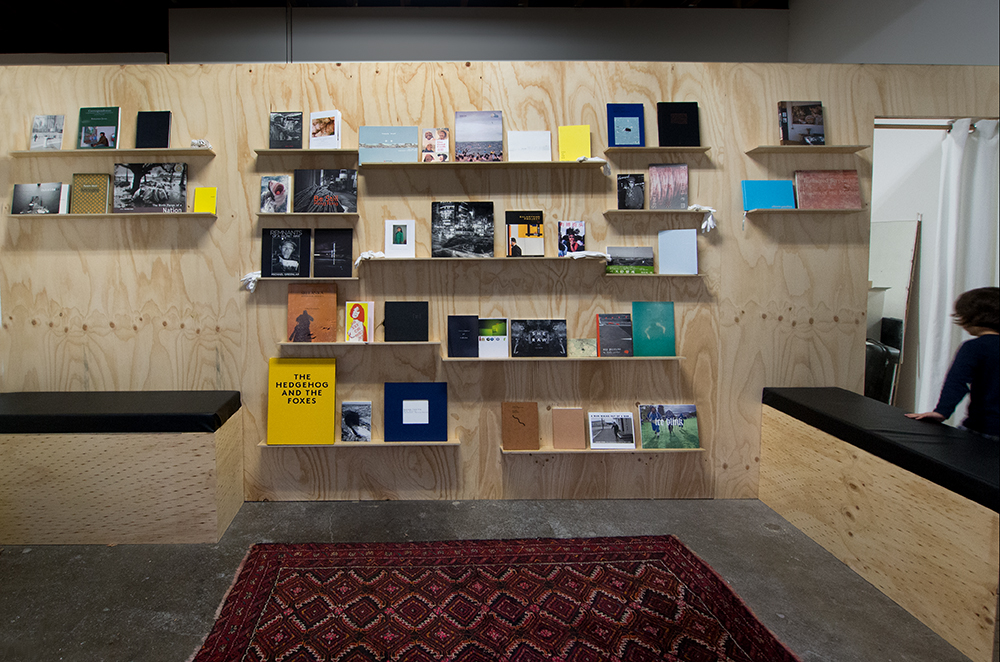
The Doug Spowart APPA Selection
.
.
Here is selection of the geographic locations, their makers and the titles:
Dubai/Surfers Paradise – Sean Fennessy ‘Gold’
Iran/Australia – Katayoun Javan ‘Correspondences: A photographic journey between past/Iran & present/Australia’
India – Munem Wasif ‘Belonging’
India – Pablo Bartholomew ‘Outside In’
Bangladesh – Shahidul Alam ‘The Birth Pangs of a Nation’
.
.
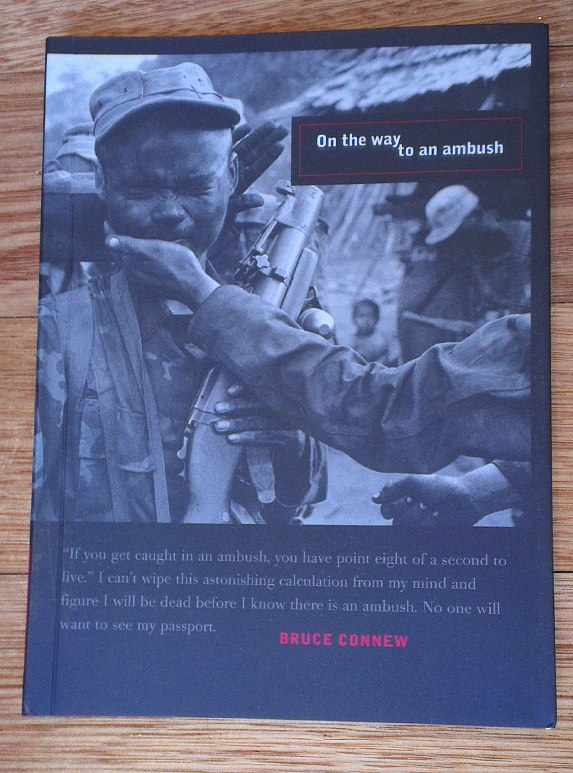
Burma – Bruce Connew ‘On the way to an ambush’
Cambodia – Isabella Capzio ‘Where the water once was: Boeung Kat Lake Phnom Penh
Thailand – Hiro Imai ‘Bangkok’
Thailand – Miti Ruangkritya ‘Thai Politics no.2’
Laos – Michael Greenlar ‘Remnants of a secret war’
Malaysia – Welan Chong ‘Please mind the gap: Singapore’
Hong Kong – Douglas Khoo ‘Be Still Hong Kong’
Sri Lanka – Nihal Fernando ‘Sri Lanka: A personal Journey’
China – Huang Qingjun & Ma Hongjie ‘Family Stuff’
.
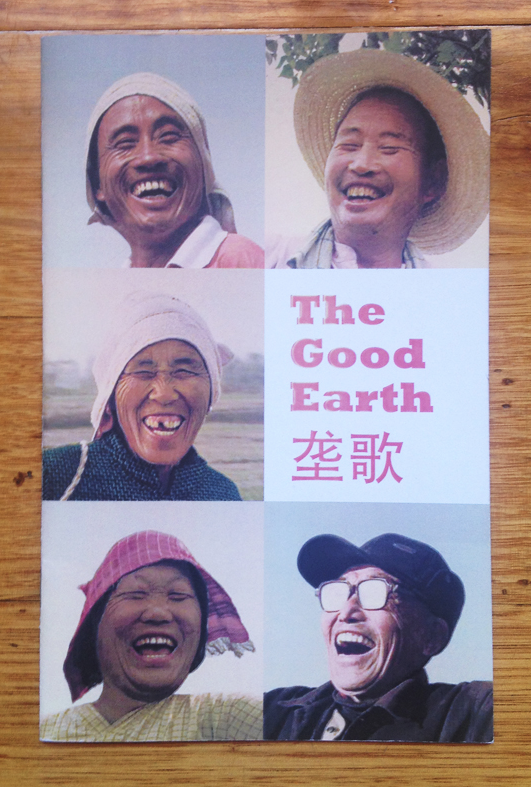
China – Li Kejun ‘The Good Earth’
China – Zhang Xiao ‘Coastline’ (?)
China – ‘Lens on Wesi Lake’
China – Vincci Huang ‘Eyes in the air’
.
.
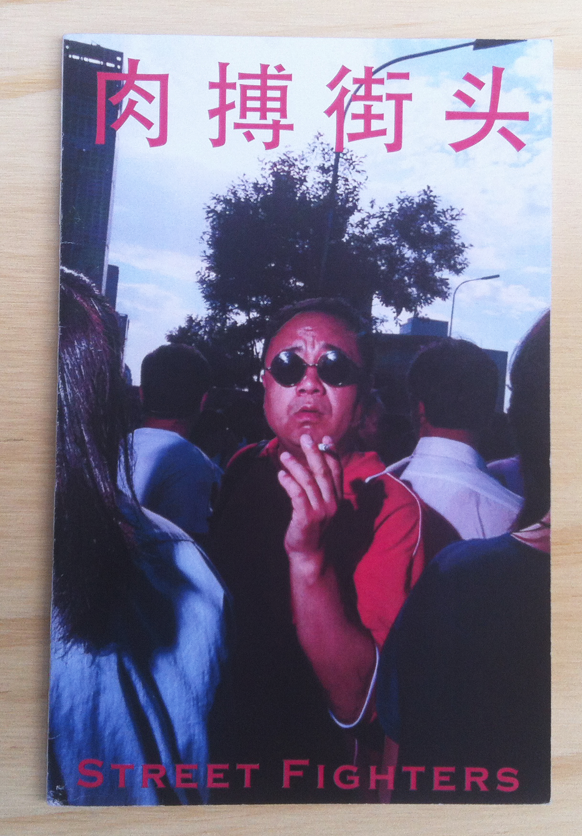
China – Wu Chenghuan ‘Street Fighters’ Beijing
Taiwan – Paul Koolher ‘Political Chaos’
Japan – Bruno Quinquet ‘Salaryman Project: Business Schedule’
Japan – Chie Murakami ‘Japanese Girl’
Japan – Sun Yanchu ‘Obsessed’
Japan – Big book Japanese cities
Japan – Saori Ninomiya ‘Requiem’.
.
.
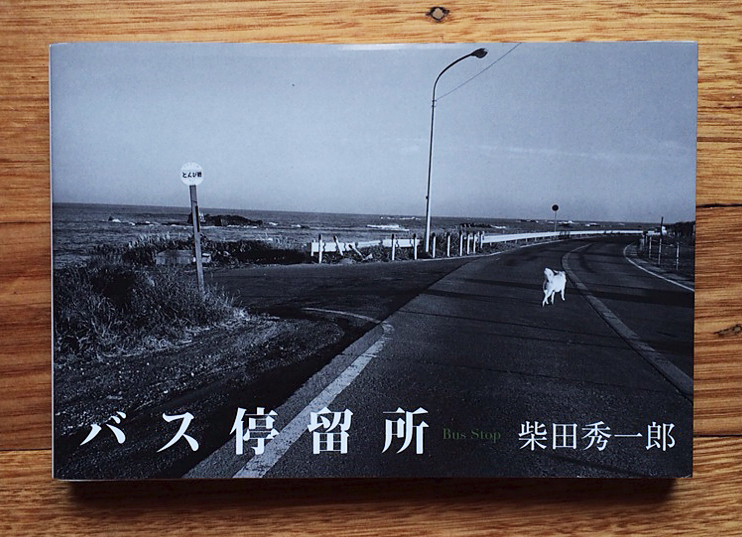
Japan – Shuichiro Shibata ‘Bus Stop’
Japan – Zhao Renbui & Satoshi Katnoku ‘The whiteness of a whale: a project with The Institute of Critical Zoologists’
West Coast American book
Canadian book
Philippines – Dina Gadia ‘Buxxxom Grind’
South Pacific region – Monini Chandra ‘Album Pacifica’
Mexico – Isabella Capezio ‘Feathered Serpents & Visions of the Mother’
Australia – George Voulgaropoulos ‘Children of Auburn’
Australia – [n]
Australia – Emma Phillips ‘Volcán’ (Variant ?)
Australia – Lilli Waters ‘She Raw’
Australia – Ingvar Kenne ‘The Hedgehog and the Foxes’
Australia – Melissa Deerson (Coordinated) ‘Docklands Field Trip’ Melbourne
.
.
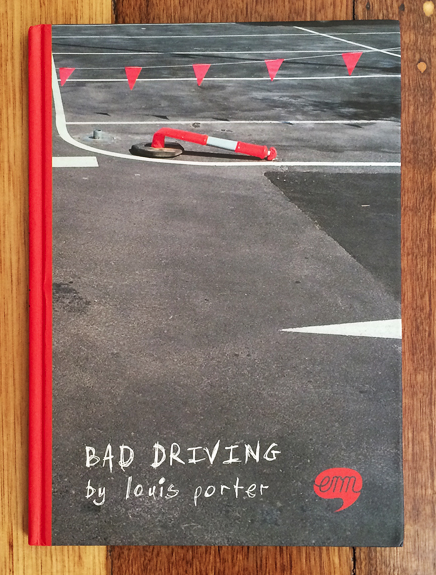
Australia – Louis Porter ‘Bad Driving’
New Zealand – David Cook, Wiramu Puke and Jenty Valentine ‘River–Road: Journeys Through Ecology’
New Zealand – Solomon Mortimer ‘Solomon’s Travels: Volume One 2012’
New Zealand – Lucien Rizos ‘A man walks out of a bar: New Zealand photographs 1979-1982’
.
.
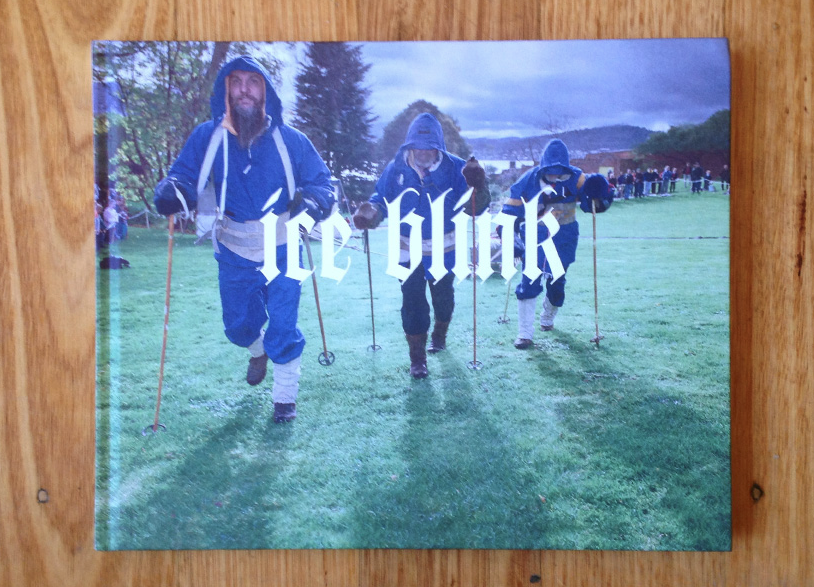
Antarctica – Ann Noble ‘Ice Blink’
END OF LIST (Some books are not listed here…)
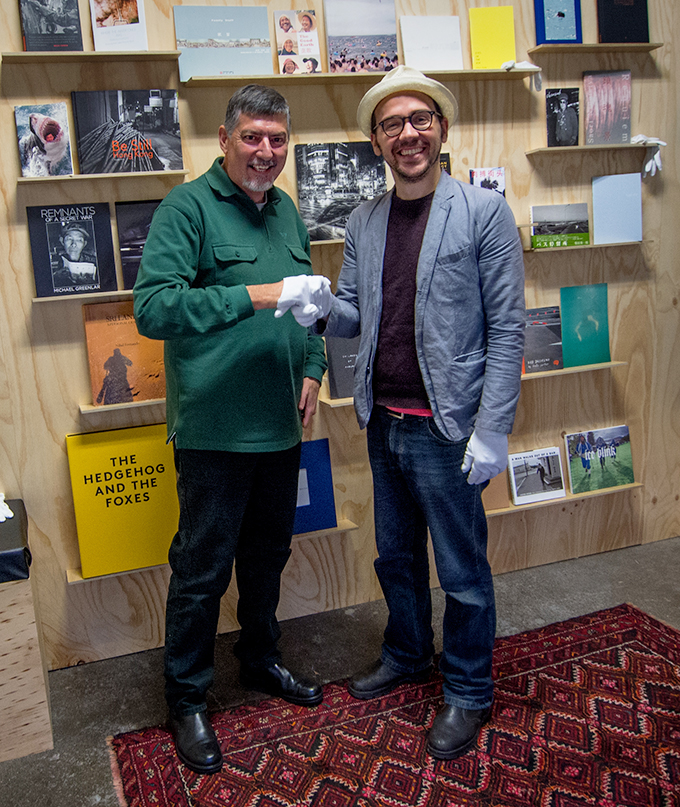
Doug and APPA Director Daniel Boetker-Smith PHOTO: Victoria Cooper
.
Thanks must go to Daniel’s ongoing support of this project and making this resource available for us all — And also thanks to the photographers for contributing to the archive.
Cheers Doug
.
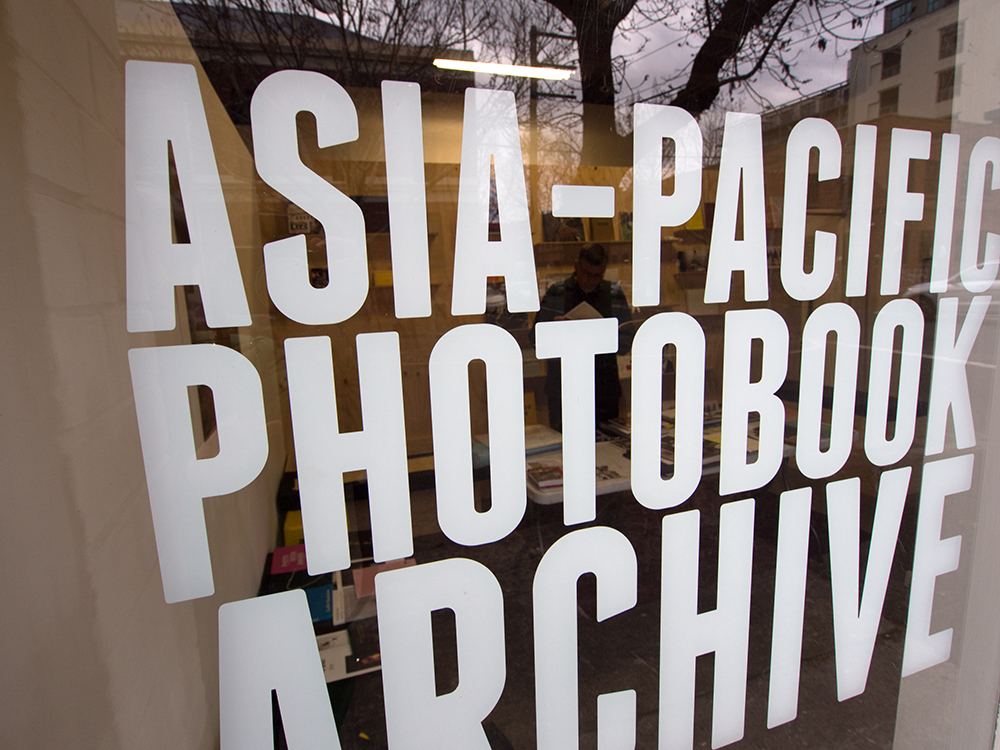
APPA Sign
COOPER+SPOWART EXHIBITION: Speaking About Place
.

Speaking About Place gallery layout
Speaking About Place: the Nocturne Project
Victoria Cooper & Doug Spowart
Cam Robertson Gallery, Toowoomba Regional Art Gallery, 19 July – 17 August 2014
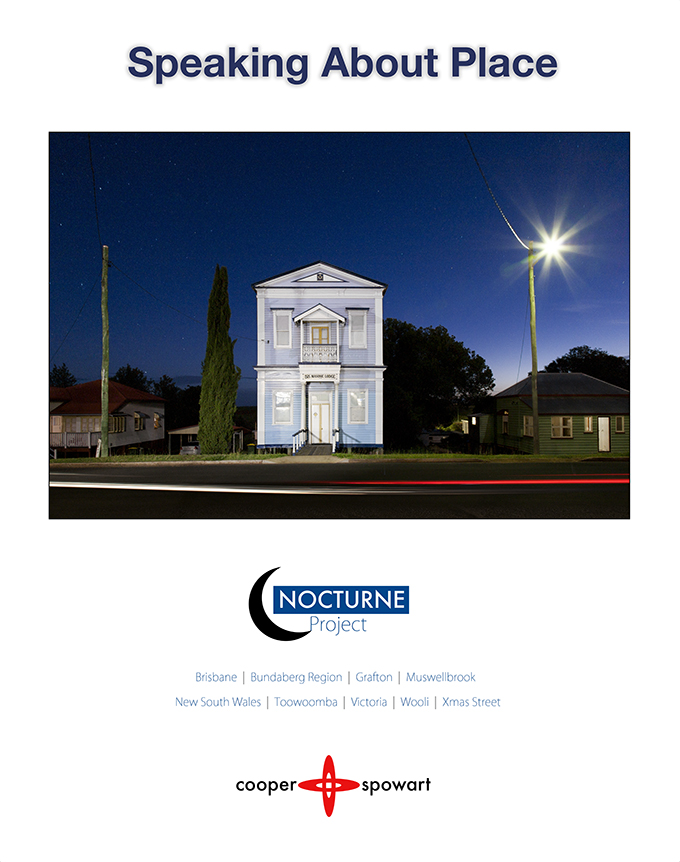
Our arts practice is informed by our ongoing and evolving connection with Place. Our Place-Projects are influenced by the context and the consequences of living within a constantly changing landscape. We work with a range of photographic concepts and techniques, from the camera obscura, through analogue processes to the digital forms of the medium. Our work is presented as visual narratives in artists’ books, photobooks, exhibition images and, more recently, blogs and social media.
Through our Nocturne documentary photography and Facebook social media projects, we have explored connections with Place in urban and regional communities throughout Queensland, New South Wales and Victoria. For us the phenomenon of nocturnal light transforms these everyday spaces. Buildings, busy street corners, quiet alleyways all become filled with the dramatic light of a movie scene. In 2013 and 2014 we were given the opportunity, through funded Artists-in-Residence (AIR) programmes, to undertake Nocturne projects in the regional communities of Muswellbrook, Grafton and Bundaberg.
In this exhibition we present a selection of images from three years of our Nocturne Projects. The work shown here adds to the recent Childers Art Gallery exhibition of this project, by the inclusion of social media elements. Therefore in this gallery we invite viewers to connect with the work in a forum outside the virtual space of Facebook. To enable this connection to take place we have created folios that contain transcripts of Facebook/Place/Storytelling from each of the three AIRs.
.
About the photographs
We photograph in the early evening nocturnal light, a time of day where the afterglow of sunset and the glow of streetlights transform the everyday experience of place for the viewer. Images created at this time require long camera exposures and therefore produce photographs that can capture blurred movement of people and vehicles. Another important aspect of the Nocturne aesthetic is the effect of colour and the juxtaposition of coloured lights in the different situations of ambient daylight, artificial lighting, car head and taillights.
.
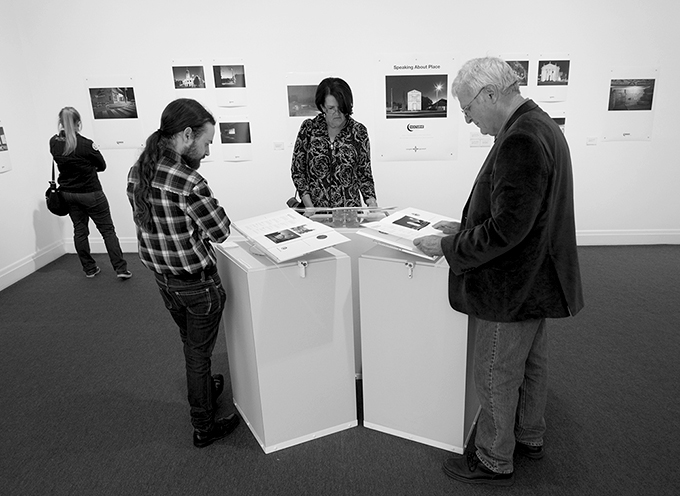
Exhibition viewers reading Facebook responses
.
More than photographs
The photographs in themselves have no intrinsic meaning – it is the viewer, with their experience and memory that brings life to the image. In this moment of connection they may recount a personal narrative or connect with the historical significance of the place. This collaboration between photograph and viewer is exciting and vibrant – expanding the potential for the documentary image to go beyond the vision of the photographer.
As the Nocturne project has evolved, we have discovered the importance of sharing place stories through images, words, in person and online. Through Speaking about Place we have extended the potential for this project to share the transformative nature of lived experience and everyday life in each community.
The Western Downs town of Miles is scheduled for a social media Nocturne project later this year.
.
CLICK HERE To download a PDF of some of the Facebook narratives Catalogue-Comments-interact-FP3
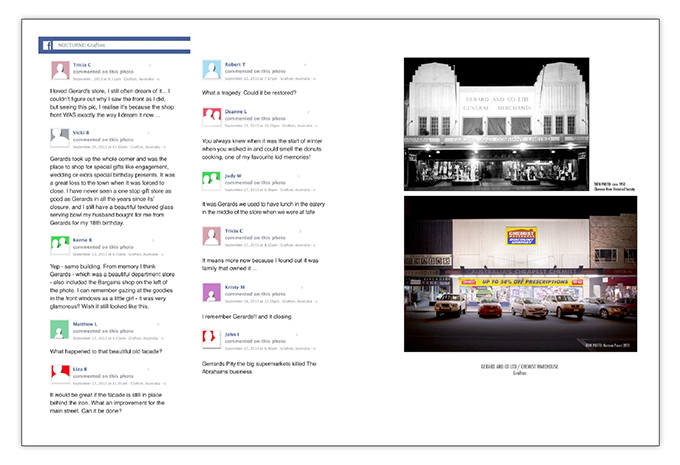
Community comments about the photographs on Facebook
The online Nocturne Projects can be accessed at http://nocturnelink.com
.
Link to The Toowoomba Chronicle online news story:
http://www.thechronicle.com.au/news/showing-cities-in-a-new-light/2323064/
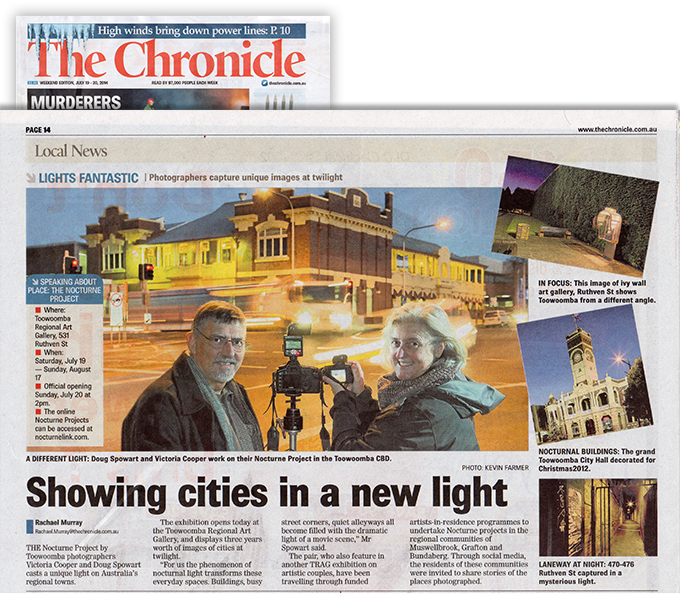
.
A selection of images from the opening and associated events
.
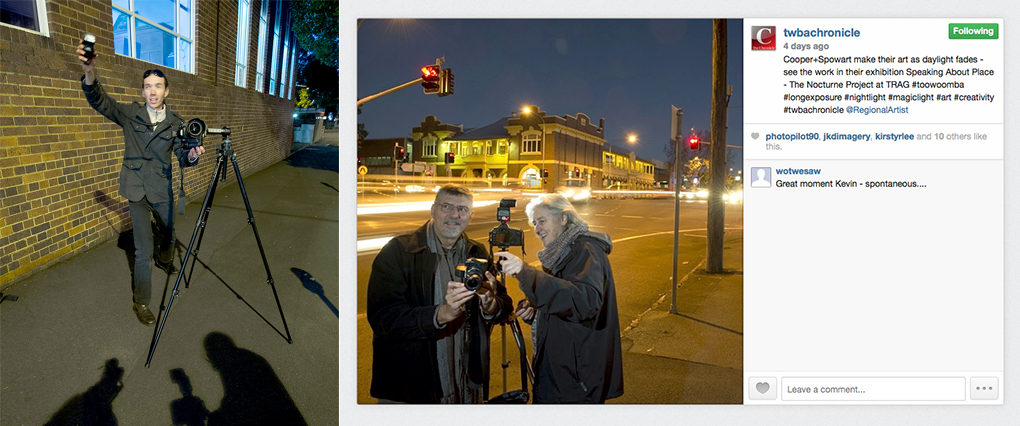
Toowoomba Chronicle photographer Kevin Farmer gets a Nocturne reverse-photo with us – From The Chronicle Instagram feed
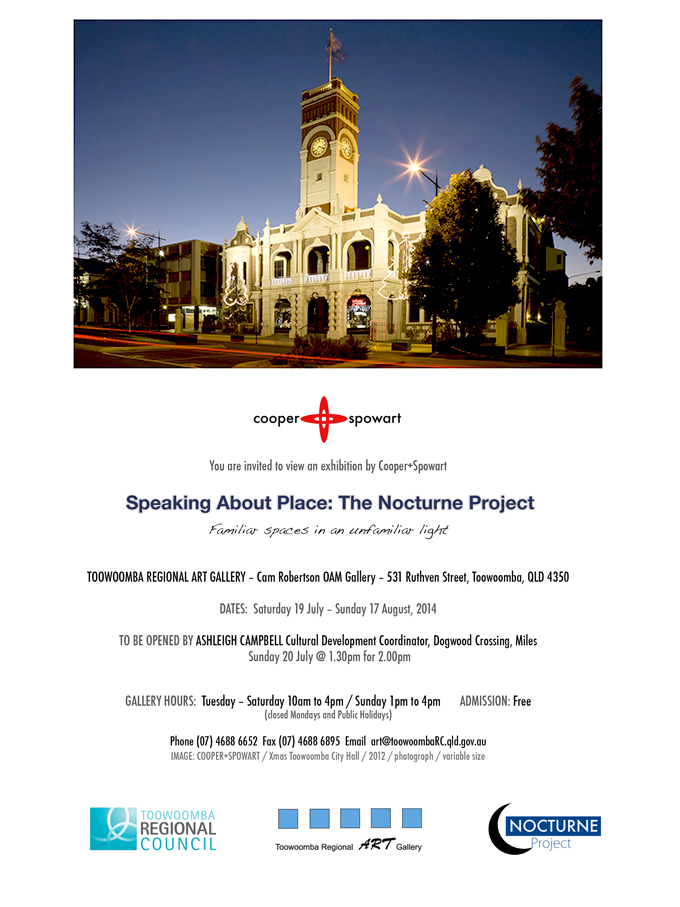
Exhibition invitation featuring the Toowoomba Town Hall Xmas 2012
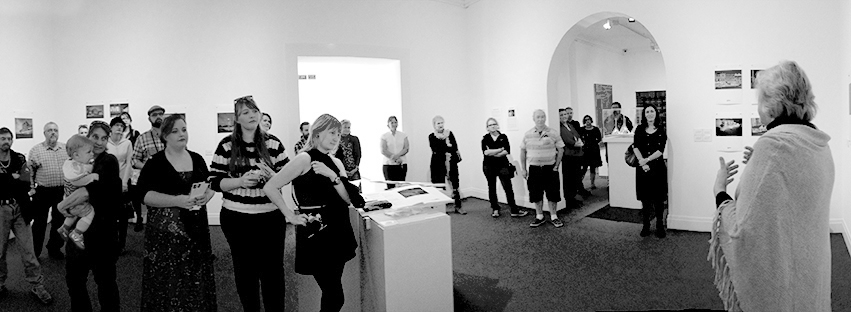
The opening of ‘Speaking About Place by Ashleigh Campbell
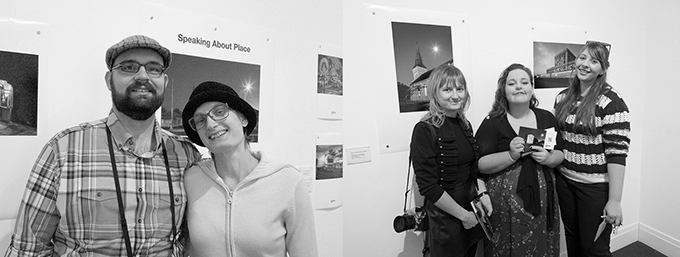
Some attendees at the opening
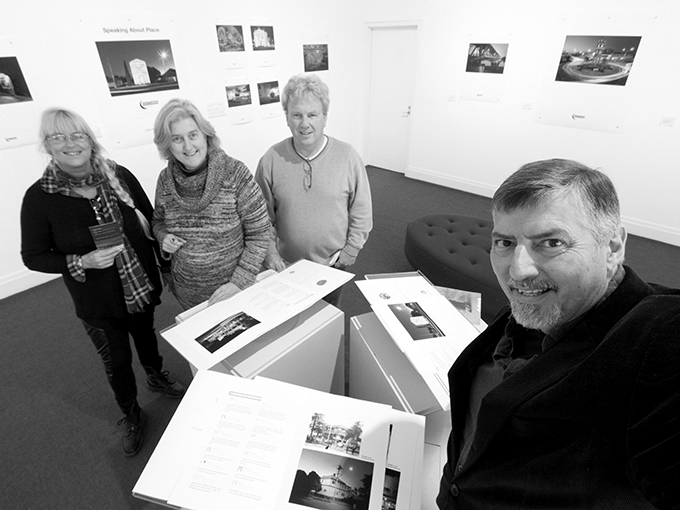
Maureen Trainor and Kevin Scattergood visit the show
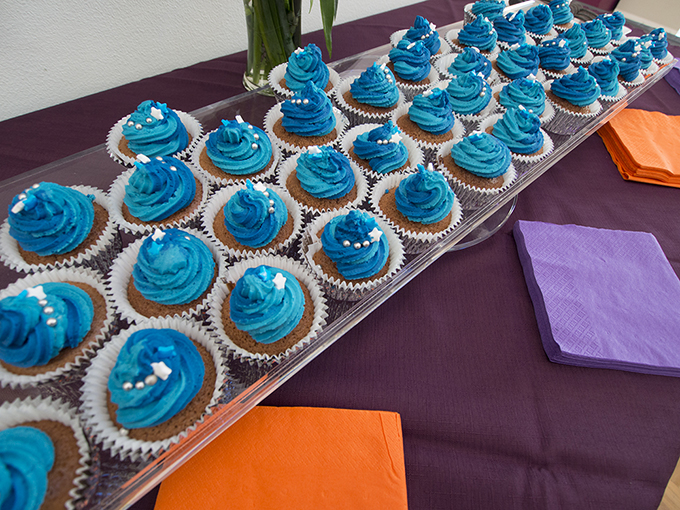
Jess Martin’s Nocturne Cup Cakes…
.
.
Visit http://nocturnelink.com to connect with our Nocturne Projects
..
.
.
.
Installation photos and documentation of the artworks and text ©Doug Spowart
Instagram photo and news story © The Toowoomba Chronicle and Kevin Farmer
.

My photographs and words are licensed under a Creative Commons Attribution-NonCommercial-NoDerivs 3.0 Unported License.
http://creativecommons.org/licenses/by-nc-sa/2.5/au/
.
.
DOUG is 2014 Siganto Foundation Artists’ Book Research Fellow
.
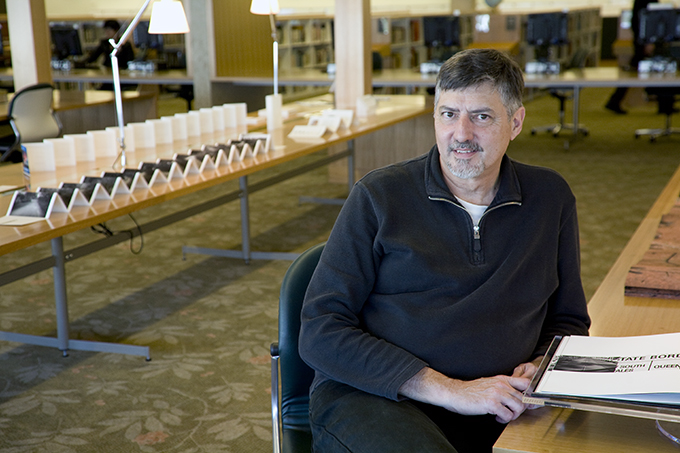
Doug Spowart @ the State Library of Queensland
.
About the 2014 Siganto Foundation Artists’ Book Research Fellowship from the application details:
The Siganto Foundation Artists’ Books Research Fellowship, proudly supported by the Siganto Foundation, is to be used by an individual to undertake original research on one aspect of artists’ book practice, theory or history, making use of the resources contained within the collections of the State Library of Queensland’s Australian Library of Art. Subject to this general consideration, State Library allows the Fellow to determine expenditure of the funds and may require the Fellow to account for the funds awarded.
About the research that I intend to undertake:
Today photographic expression is evolving to pervade all kinds of books by artists, artists–photographers, photographers and photographer-artists. Collections such as the Australian Library of Art at the State Library of Queensland become repositories for selected or exemplar works. In the Research Fellowship I intend to review the field of creative book production that utilises the photograph and consider what has been created to date and in the SLQ collection, as well as identify emergent trends.
As a significant repository of artists’ books, the State Library of Queensland’s Australian Library of Art is a pre-eminent location to carry out the proposed research. Additionally access to books contained in the State Library of Queensland’s general library collection and Zine collections will considerably add to the research.
Importantly the collection contains artists’ books created over a great number of years by a range of practitioners representing a broad range of practice. These books may encompass the full gamut of photograph usage in the book including approaches to the narrative carried by the book, the physical form of the book and the integration of the photograph into design, typographic and textural components.
This proposed research will define a process by which the uses of photography in the creative productions of artists’ books and photobooks can be defined and compared. In my recently completed PhD research on the topic of the artists’ book and the photobook, I identified the need for scholarly research on this evolving phenomenon.
My aims in this research are to create an approach to the development of a flexible and dynamic nomenclature for the photo and the book. This preliminary strategy will provide a way in which books from a variety of makers, media, structures and motivations can be compared. Ultimately this research will produce outcomes that approach a broader and topical view of artists’ books and photobooks to stimulate dialogue and debate.
The Fellowship will include blog posts on the SLQ site and an illustrated presentation at the 2015 Siganto Artists’ Books Seminar.
I am looking forward to the opportunity to research my favourite topic – books!
The Siganto Foundation Artists’ Books Creative Fellowship has been awarded to Jan Davis. Her project One thing becoming another: labour-infused artist’s books which investigate lives of toil in nineteenth and early twentieth century rural Queensland.
For more details see http://blogs.slq.qld.gov.au/ala/2014/07/18/2014-siganto-foundation-fellowships/
.
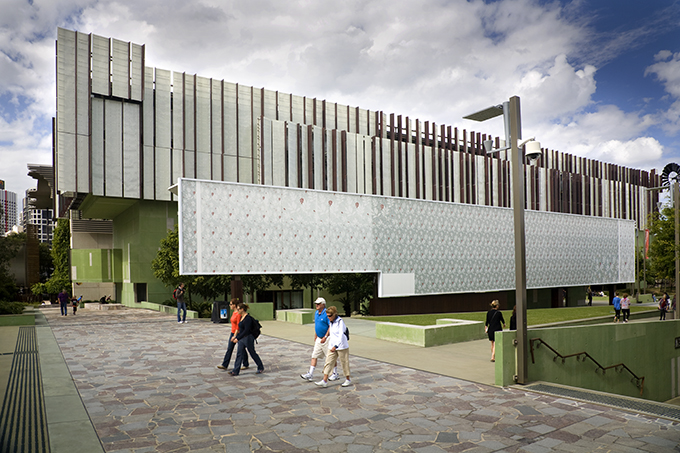
The State Library of Queensland Photo: ©2011 Doug Spowart
.
.
Cafe Scientifique: The Secret Life of Water – Vicky Speaks
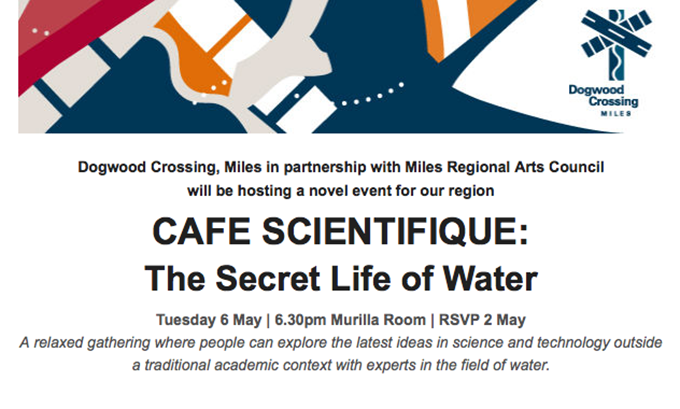
Cafe Scientifique invite
.
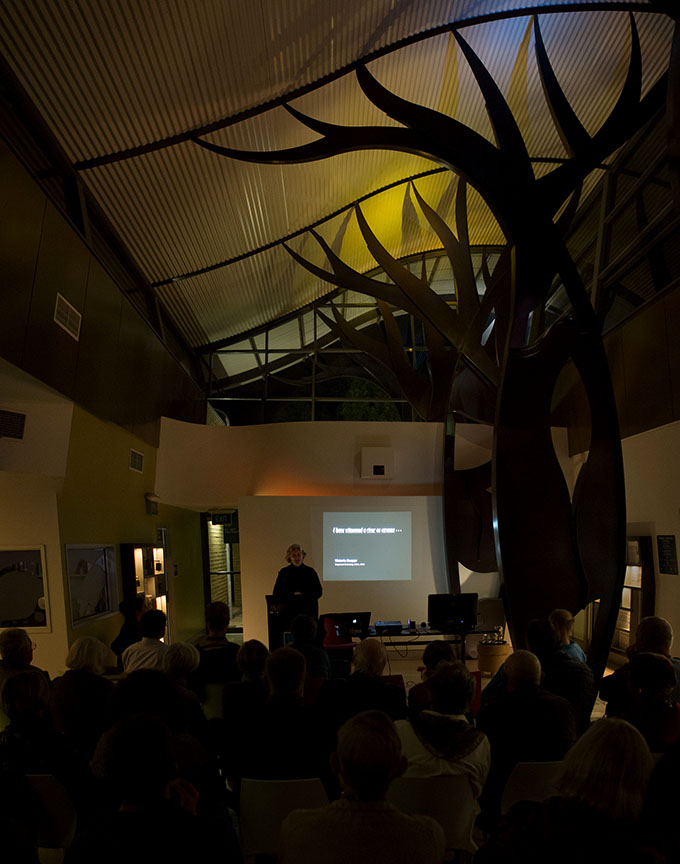
Inside the Dogwood Crossing presentation space (Murilla Room with bottle tree structural forms)
.
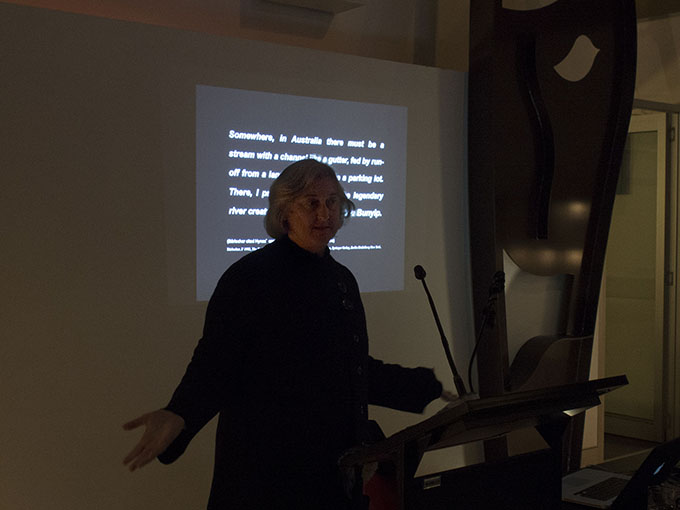
Vicky discusses and performs her books
.
Victoria Cooper
I Have Witnessed A Strange River says Cooper invited us to engage with a journey through the depths of water. She guided us through an unfamiliar place inter-twined with our daily lives where we witnessed the relentless cycle of life and death. Deep below the water’s reflecting surface, she showed us that a place primordial and alien yet intrinsic to us all, exists.
A SEGMENT OF VICKY’S PRESENTATION IS VIEWABLE HERE as a video
.
.’
BIO: Victoria Cooper is an artist with a PhD in Visual Arts researching the intersections of art and science. This interdisciplinary research is informed and inspired by her previous career in Human and Plant Pathology along with current interest in local and regional issues of land and water. During her 23-year arts career she has also worked across many forms of photographic technology–analogue to digital imaging; site specific documentation of performance; and artists’ books. In a collaborative practice with Dr Doug Spowart, she explores the post technological paradigm of photography as a cultural communication and a site-specific visual medium. This multi-methodological approach is applied in their current Place Project work in many regional communities. Cooper has exhibited in Australia and internationally and her work has been published in the Pinhole Resource Journal, the Le Stenope issue of French Photo Poche series and with Doug was included in the publication LOOK, Contemporary Australian Photography since 1980. Cooper’s artists’ books are held in national and private collections including the rare books and manuscript collections of the National Library of Australia and the State Library of Queensland.
.
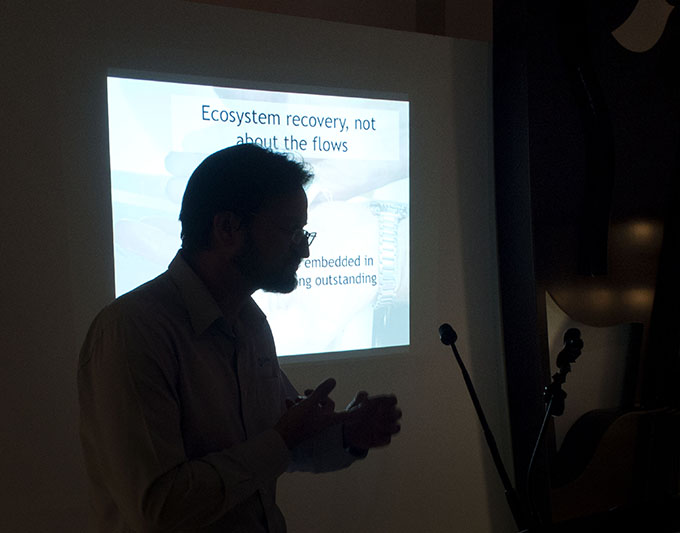
Carl – Condamine Alliance speaks
.
Carl Mitchell
This is a Story About Water Too* The quality and supply of water is one of most important issues of our time. Water quality scientist Carl Mitchell from the Condamine Alliance discussed the quality of water in our waterways and the health of our aquatic systems – vital indicators of how well we are doing as a society. The waterways in the Condamine catchment are a precious resource for the communities in the region. They provide many benefits to support the economy, society and environment of the region. Due to extensive development across a number of sectors, the quality of waters in most of the catchment areas is poor. Studies and models predict that without appropriate additional management responses the region will be unable to meet the social and economic needs of the community while maintaining the ecological integrity of the natural systems supporting these needs. Carl discussed the state of the waters and what actions are needed in the future.
BIO: Carl is a water quality scientist, aquatic ecologist and integrated water resource management specialist with a passion for the water and the waterways of the Condamine Catchment in the headwaters of the Murray Darling Basin. Carl strongly believes that the quality of water in our waterways and the health of our aquatic systems is an indicator of how well we are doing as a society. This drives him to strive for clean water for the Condamine and healthy aquatic ecosystems for the Murray Darling headwaters. Carl’s work in the Condamine has focussed on restoring the iconic Condamine river and Carl has lead the team that won 3 prestigious national awards for the Condamine in 2012-2013. Carl has a history in Natural Resource Management in Queensland having worked for Reef Catchments in Mackay for 11 years as Waterwatch coordinator, Healthy Waterways Coordinator and Water Manager. In the Water Manager role at Reef Catchments Carl spent 2 years coordinating the Paddock to Reef program across the 6 reef regional bodies, before moving to the Condamine in 2011. Carl has been an Australian Youth Ambassador for Development in the Philippines, implementing Waterwatch and Landcare programs.
.
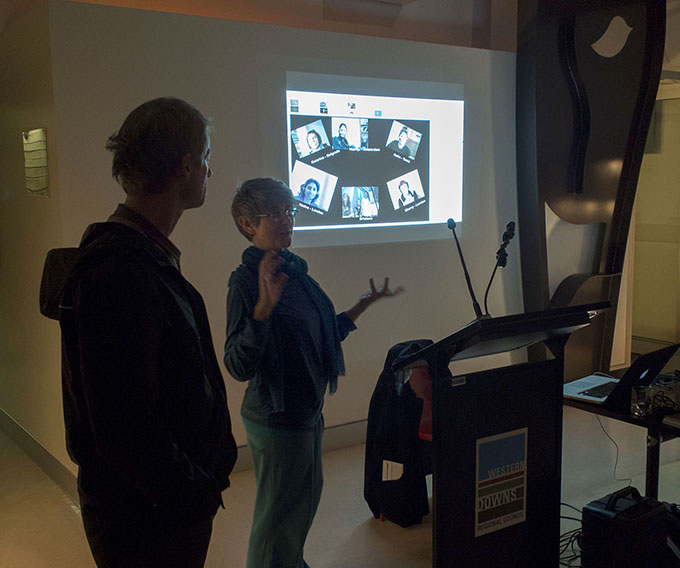
James and Suzon talk about the ‘Waterwheel Project’
.
Igneous: James Cunningham and Suzon Fuks
The Igneous team shared its explorations of water as a topic and metaphor. They explained how Waterwheel is an interactive, collaborative platform for sharing media and ideas, performance and presentation. Attendees witnessed how Waterwheel investigates and celebrates this constant yet volatile global resource, fundamental element, environmental issue, political dilemma, universal theme and symbol of life. We were encouraged to explore and discover, share and collaborate, contribute and participate in their project and local activities.
Igneous presented Waterwheel as well as the FLUIDATA project supported by Arts Queensland, and introduced the audience to FLUIDATA workshop that we offered there.
BIOS: Igneous received funding from Brisbane City Council and Arts Queensland towards the development of the platform and it’s incorporation in the Waterwheel Installation Performance and associated residency at the Judith Wright Centre of Performing Arts, Brisbane. Igneous is a partnership between Cunningham and Fuks who have both given lectures, workshops, master-classes and labs in Australia, USA, Europe, India and Indonesia, in tertiary institutions, cultural venues and community contexts.
James Cunningham is a performance, movement and video artist, and the co-Artistic Director, along with Suzon Fuks, of Igneous Inc., (www.igneous.org.au) a Brisbane-based multimedia and performance company established in 1997 that has presented solo and ensemble stage shows, performance-installations, video-dance works and networked/online performances in Australia, Europe (Belgium, France, Switzerland, Germany, Poland), UK, Canada and India.
Suzon Fuks is an intermedia artist, choreographer and director, exploring the integration and interaction of the body and moving image through performance, screen, installation and online work (http://suzonfuks.net). During an Australia Council for the Arts Fellowship (2009-12), she initiated and co-founded Waterwheel, following which she has been a Copeland Fellow and an Associate Researcher at the Five Colleges in Massachusetts, continuing to focus her research on water and gender issues, and networked performance, as well as coordinating activities on Waterwheel.
* The Secret Life of Water Book Title by Masaru Emoto
* This is a Story About Water Too. Poem Title by Jayne Fenton Keane
Texts sourced from Dogwood Crossing material. Photos: Doug Spowart ©2014
.
.

 wotwedid