Archive for the ‘Place-Projects’ Category
July 24 Allan Bruce Floor Talk
Allan Bruce talks about his exhibition Panoramic Drawings at Toowoomba Regional Art Gallery
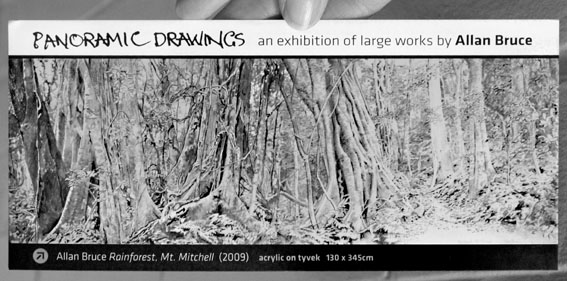
Invitation: Panoramic Drawings
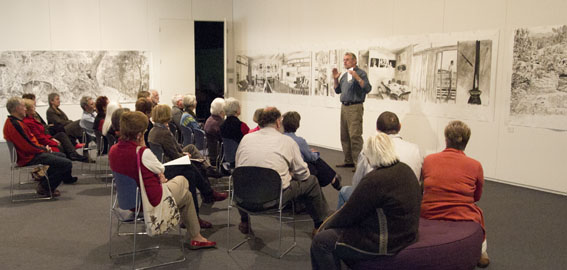
Allan Bruce floor talk in the exhibition space
Walking into Gallery 1 at the Toowoomba Regional Art Gallery, one expects to see large wall works to fill this large space – Allan Bruce’s impressive black and white occidental inspired works are no exception.
In the exhibition, Panoramic Drawings, Bruce presents urban and natural landscapes and room interiors as seamlessly blended composite images where each work: “while recognizable, tends to be an evocation rather than an absolutely literal statement of place”[1]. As with oriental scrolls these works allow the viewer a multi-perspective journey through the spaces that have captured Bruce’s attention and inspiration.
Bruce utilizes ‘in situ’ documentation (photos, video and sketches) and memory to reconfigure the essentials of being in each place. The viewer of this work maybe drawn to the detail and textures of the subject captured within the brushwork of the shadows but the absence of detail in the highlights energizes the work and provides a space for the imagination.
1. From the room sheet for the exhibition
Words: Victoria Cooper
Panoramic Drawings is on at Toowoomba Regional Art Gallery from June 30 to August 7.
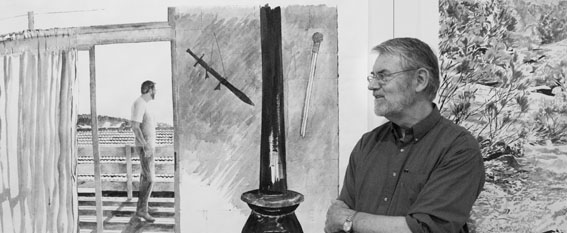
Portrait of Allan Bruce with work by Victoria Cooper
For more info on Allan Bruce see:
July 23 : BIZOO ZINE BOOK LAUNCH
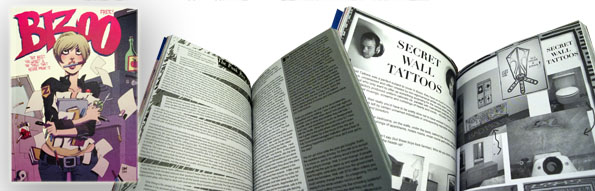
Launch of the BIZOO Book at the Toowoomba Regional Art Gallery
“Bizoo: The Best, The Worst and The Trash That Never Made It” Bizoo was a street culture zine which gave a voice to the young people of Toowoomba from early in 2000 until 2006.
Its story and success lies in the needs that brought about the fanzine world-wide publishing phenomena over the last 20 years. Essentially it’s a response to the fact that the world is controlled by the media and those who control the media pretty well control everything. To combat the communication gulf those from outside the mainstream formed collectives and groups that collated the stories, prose and poems, lyrics, interviews, gig guides, critiques, rants, rude stuff and commentaries about their end of society.
These self-published newspapers/newsletters featured simple layouts, rough illustration and were usually output by photocopiers. Those making contributions did so under various tags and pseudonyms and distribution was made through coffee shops and venues where like-minded people hung out. Copies of the zine were free.
Ultimately the zine became respectable and these days many resemble ephemeral artists’ book styled products. Real names appear and the practice is studied and commented on by university academics – all a far cry from the anonymous gonzo street journalists of the early days.
Somehow, perhaps, the future of communication that was once carried in print by fanzines like Bizoo is gradually being eroded by Blogs (like this one), Facebook, texting and youTube.
But what is important is that the self-published zine created a voice for the stories that were not able to find a vehicle for communication. Now, with the publishing of BIZOO these chronicles of street-life in Toowoomba in the first half of the 21st century will pass into the history of our times. Something that the zinesters, now that their grown up a little, got or getting reliable work, having kids and getting on with life, will find an important and amusing part of their lives. The publication was supported by a grants from the Australian Government’s Regional Arts Fund and the Queensland Government’s RADF.
Make your own zine today ….
Cheers, Doug
SEE the following for more ….
The best place around to find zines – ElouiseQ at http://smellslikezines.com/
JOHN ELLIOTT’s YouTube video and interviews http://www.youtube.com/watch?v=mkZV5Mg16vQ
THE CHRONICLE Newspaper’s story http://www.thechronicle.com.au/
WHAT’S HAPPENING – Workshops, events, gigs etc. www.bizoo.com.au
July 1 – Diggers Rest for Lunch
Doing lots of thesis writing right now – can’t you see?
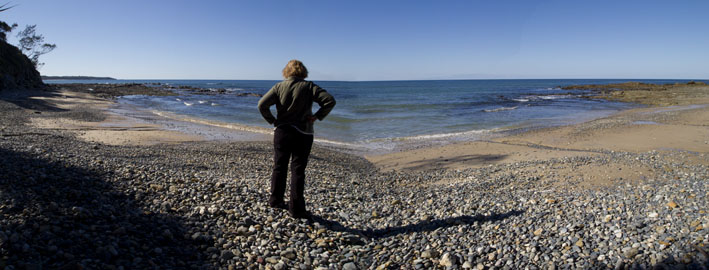
Vicky - looking for a suitable reference
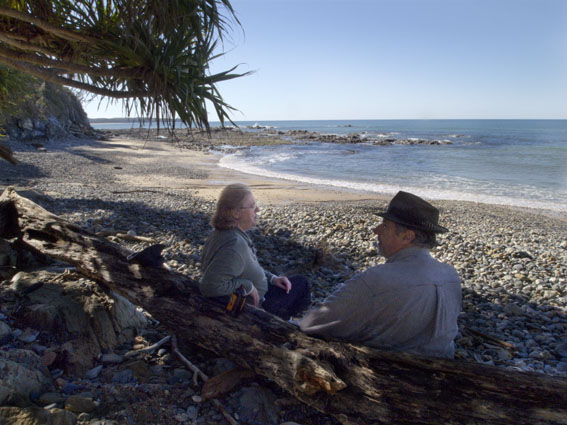
A working lunch under the pandanus
Other research work were Doug almost looses it: See the YouTube video
http://www.youtube.com/watch?v=qo1IiDDVcoc
ODE TO A PENULTIMATE DRAFT
I MUST GET BACK TO MY WRITING AGAIN
. . . but it’s a beautiful day at the beach!
I MUST GET BACK TO MY WRITING AGAIN
. . . but the washing machine needs fixing!
I MUST GET BACK TO MY WRITING AGAIN
. . . but I have a review to write!
I MUST GET BACK TO MY WRITING AGAIN
. . . but I think I need a little midday nap!
I MUST GET BACK TO MY WRITING AGAIN
. . . but’s lunch time!
I MUST GET BACK TO MY WRITING AGAIN
. . . but I should check if the shop has fresh oysters!
I MUST GET BACK TO MY WRITING AGAIN
. . . but the waves are telling me – – – – something!
I MUST GET BACK TO MY WRITING AGAIN
. . . but I still need to read last weekends newspapers!
I MUST GET BACK TO MY WRITING AGAIN
. . . again writing my to back get must I
I MUST GET BACK TO MY WRITING
. . . writing my to back get must I
I MUST GET BACK TO MY WRITING
. . . my to back get must I
I MUST GET BACK TO MY
. . . to back get must I
I MUST GET BACK TO
. . . back get must I
I MUST GET BACK
. . . get must I
I MUST GET
. . . must I
I MUST . . . I
June – SQIT Photo Student mosaic for Empire Theatre’s 100th
Students help celebrate the Empire’s 100th Anniversary
Students from my Commercial Photography class recently spent a couple of hours documenting Toowoomba’s Empire Theatre. The images were integrated by me into a 2.1 metre-long trans-luminated mosaic image. The work was integrated into the exhibition ‘100 years Empire Theatre: Historical items from the Theatre’s collection‘ at the Toowoomba Regional Art Gallery.
The Empire Theatre is well-known for the Art Deco architectural structure and decorative elements that were part of its 1930s reconstruction. The building is a photographer’s delight as at every turn there are new views and design elements that can create great abstract forms.
After photography the images were optimised by students and passed over for integration into the triptich’s 70 x 210cm design.
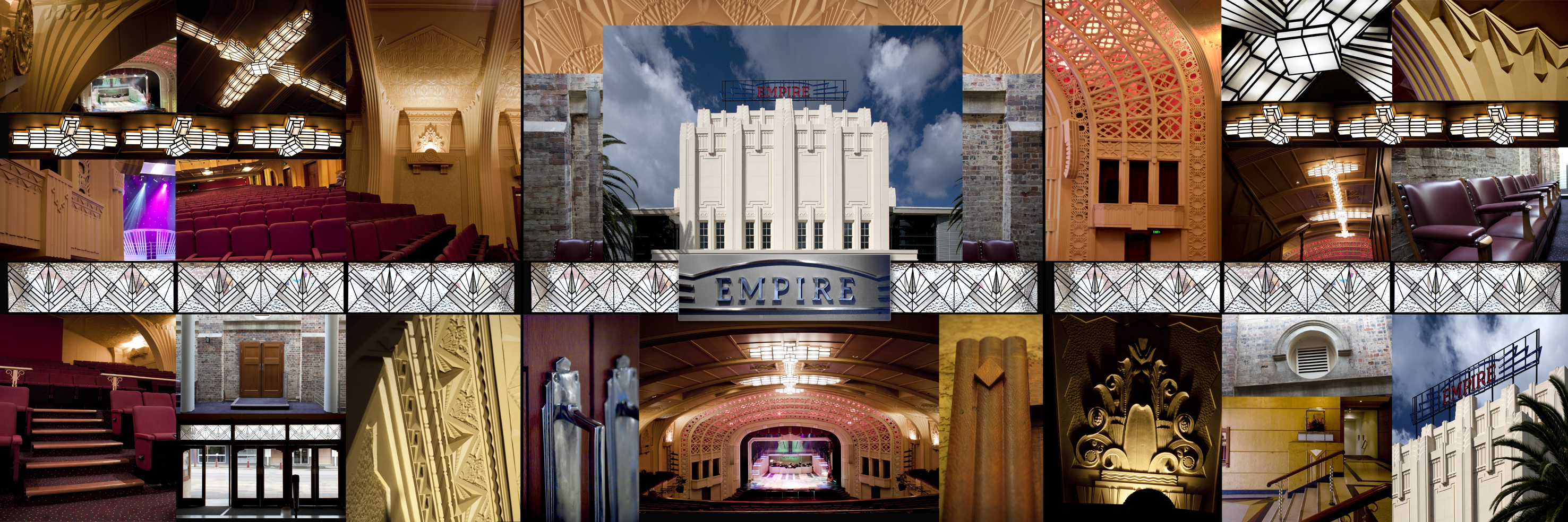
The EMPIRE image mosaic by SQIT students
SEE the Toowoomba Chronicle details http://www.thechronicle.com.au/story/2011/05/17/evolution-empire-toowoomba/

The exhibition @ the Toowoomba Regional Art Gallery
The exhibition at the Toowoomba Regional Art Gallery includes a photographic exhibition of the reconstruction of the Empire that was undertaken in 1996-7. The photographer was Lucy Robertson-Cuninghame and the images were completed at the time as part of her Associate Diploma of Photography work.
SEE the Chronicle story for details http://www.thechronicle.com.au/story/2011/05/23/theatres-rich-history-on-show/
June 13 – Speakers@PSQ Convention, Goondiwindi
PSQ Goondiwindi Logo
Victoria’s topic was “Our home : emoh ruO” which dealt with re- visualizing local neighbourhoods, landscapes and familiar places with personal narratives and perspectives.
She says that, “We all have experienced disaster and change within our own “back yard”. We have been flooded repeatedly by images of this destruction and it’s traumatic effects on humanity. Is it now time, rather than yearning for the exotic travel photo experience, to re-discover our everyday environments and invent new ways of visualizing ourselves and the land we inhabit? Victoria Cooper will be discussing her work in this area and how places can be transformed by bringing together knowledge and personal experience to build creative visual stories.”

Vicky speaks at the convention
Doug’s topic was “LANDSCAPE: Between the covers” in which he spoke about making photobooks of the landscape. His lecture dealt with the idea of the extended narrative of the book and how the ‘artists’ book’ can inform contemporary photobook making. His talk was illustrated by examples and his own work in the form of the hand-made (home-made) book. Ideas about the print-on-demand book and the do-it-yourself monograph were covered. He said “Ken Duncan and Steve Parish did it – You can do it too — Self publish and have Fun!”

Attendees viewing Cooper+Spowart books
The PSQ Convention program speakers program included the photodocumentary photographer John Elliott, Somalia hostage Nigel Brennan and large format guru Richard White.
More details of the event may be available on the website:
http://psqgoeswest2011.weebly.com/
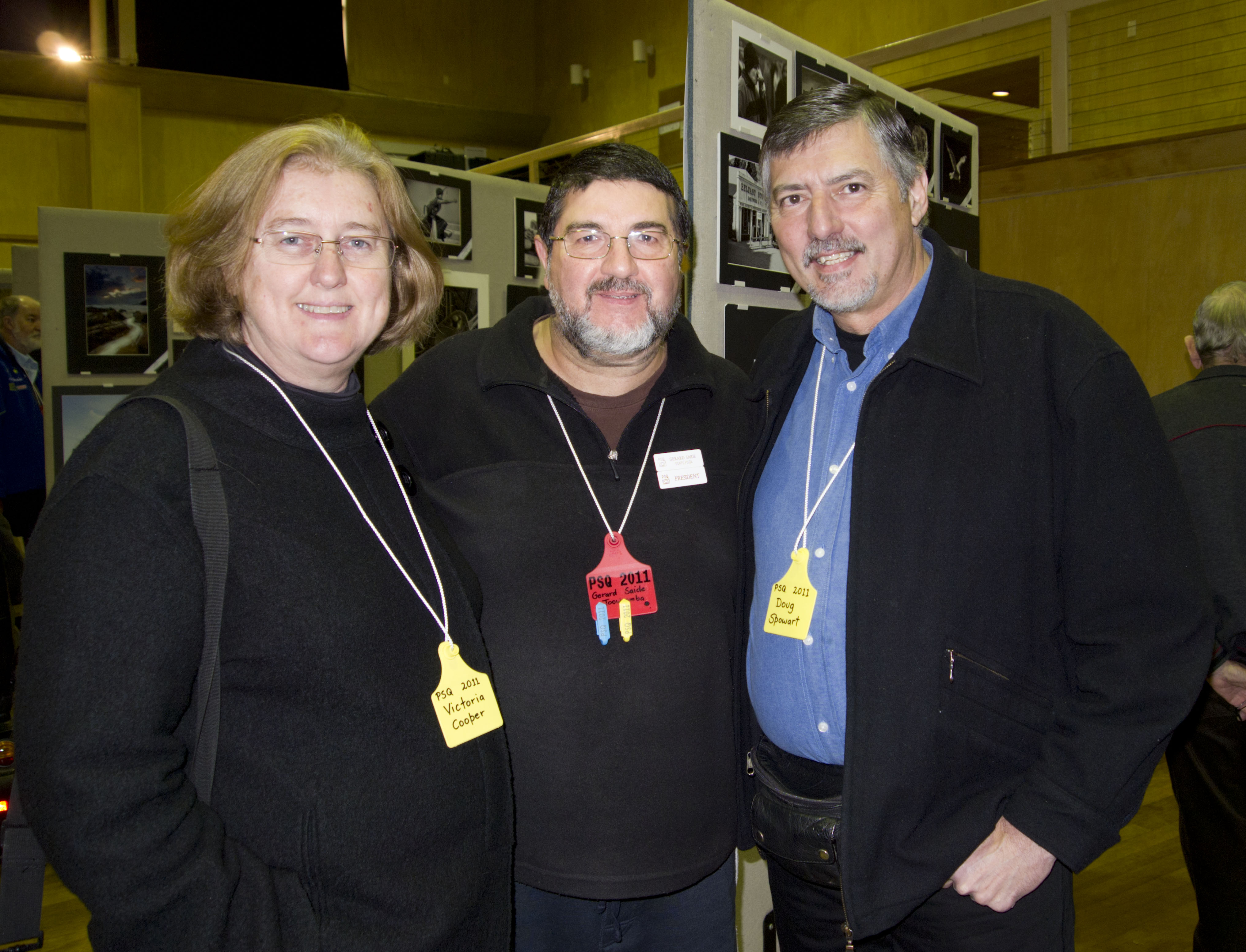
Vicky+Doug with PSQ President Gerry Saide
May 7, 2011 ALT Exhibition opens @ Qld Centre for Photography
SEE TWO NEW EXHIBITIONS @ QCP – Our video work “CARCAMERA” is on show
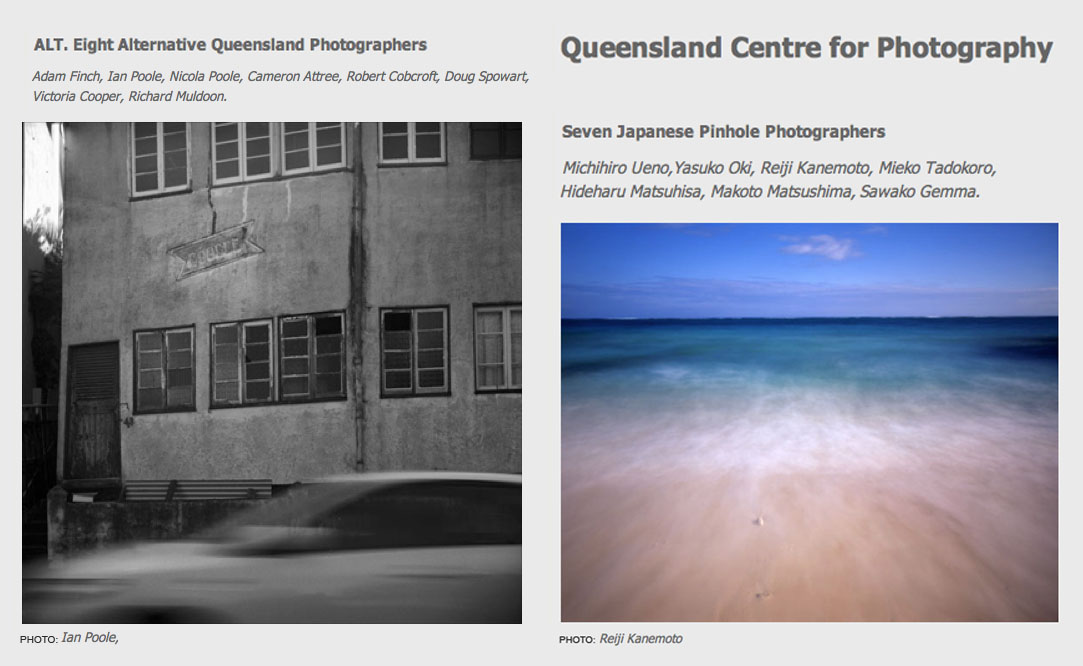
SEE <http://www.qcp.org.au/exhibitions/current/album-603/28>
SEE OUR VIDEO <https://www.youtube.com/watch?v=Wg8zdvr1nfY&feature=mfu_in_order&list=UL>
.
We wrote the exhibition catalogue text – See below
.
Somewhere between the making, the idea and dreaming: Post-technology Photography
Ban lenses and viewfinders. Ban your auto-wind buzzy-flashing built in obsolescence jewellery.
Give up aspiring to the conventional. Play with light, rediscover your vision and party.
Justin Quinnell[1] talking about pinhole photography
Who would have thought that age old processes along with out dated technology would have any relevance in the seamless slick technological digital image world. Or even that the latest digital technology could become hijacked as a mere emulator of the appearance of old time photos. With its arcane history of chemicals, darkrooms and focussing cloths photography is now morphing into a brave new emancipated world where everything old can be new again and anything goes.
Many photographers find this review of processes and technologies liberating—providing an alternative avenue for exploring photography often resulting in the excitement of discovering new visions. A recent popular photobook on the Holga[2] camera illustrates a kaleidoscope of visual imagery created with this simple plastic camera. In the introduction to the book Adam Scott exemplifies this method of working, “I had already been shooting for many years with single lens reflex cameras and was beginning to get bored of photography, but the Holga reopened my eyes and injected me with new love, I felt as though I had discovered a new sense or a new colour.”[3]
Into this argument steps curator Ian Poole with this exhibition entitled ALT. Photographers in this show are similarly enamored by this technological tinkering as Scott and dust off old junk cameras like the Russian Lubitel or dislocate a Diana lens and relocate it onto a DSLR sensor. Some photographers may use new technology like the ubiquitous iPhone as creative stimulation for follow-up imaging. But is it the technology that lubricates creativity in these photographers work? As in Justin Quinnell’s challenge in the opening quote “give up aspiring to the conventional” these image makers aim to subvert the ‘conventional’ and reinvent photography for and by themselves.
The images made by photographers in the ALT exhibition exalt and capitalise on the vagaries and flaws arising from technology, uncontrolled serendipitous moments and the slowing of time. All of these questionable qualities are commonly regarded as poor technique from faulty and inadequate equipment. Through their experimentation these photo-rebels appear to be reacting against technological control by preferring the serendipity and imperfections of real human experience.
It seems that these processes allow a space for pure wonderment much like that of children at play. Here the photographer’s imagination is stimulated by ‘tinkering’ with technology and the conventions of photographic practice from which new approaches to subjects and concepts arise. Critically the act of making, discovery and reflexive action is fundamental throughout the process. In other words the photographer makes the photograph—not the technology.
Pinhole photography is another malleable medium for the tinkerer. The exhibition, Seven Japanese Pinhole Photographers, brought together by Hideharu Matsuhisa a respected graphic designer and pinhole photographer, shows the diversity and commonalities of the pinhole experience. In the catalogue specially produced by Matsuhisa for this show, Reiji Kanemoto comments, “These pinhole views of restless waves show me the passage of time, condensed into a single moment that lives forever.” This is an experience that is common to many pinhole photographers as long exposures are inherent in the process. In a recent exhibition of Matsuhisa’s pinhole photography at Caloundra Regional Gallery, the Director, John Waldron referred to pinhole photography as “part of the Slow Revolution”[4]
Slow cameras: slow photography—creates a kind of image making approach that is just as satisfying and as good for you as slow food. For some Japanese pinhole photographers the work is meditative as Michihiro Ueno finds when working with pinhole cameras that, “I’m made to be more conscious to face time and objects.”[5] Alternatively Yasuko Oki is motivated by the pure wonderment of capturing unseen visual phenomena as she photographs fluids in glasses (water, juice and beer) that she drinks everyday.
As the camera, the lens and the darkroom/computer are increasingly open to subversion, the photograph maybe now free from connection to a specific technological time and place and it’s associated obsolescence. Although there has always been a cult following for the “alternative” in photography, what we see strongly from this exhibition series, and more broadly in the electronic medium, is that photographers are well equipped and ready to grasp, shape and fiddle with any means to extract images. Is this the sign of the onset of a post technology condition? Has the “alternative” contagion gone viral? Can technology or iPhone apps keep pace with the imagination and the inventive nature of the photographer? Certainly, photography has loosened up. Rather than being the keeper of secret knowledge and technological proficiency, the photographer is now more . . .
Victoria Cooper and Doug Spowart
Victoria Cooper and Doug Spowart are visual artists working in the fields of photoimaging, artists’ books and photo education. Victoria and Doug have collaborated on many art projects and exhibitions including pinhole, projections, the room and car camera obscura. Their images and artists’ books are included in major national collections.
[1] The World through a pinhole (catalogue) curated by Diane Stoppard and Ellie Smith, Wellington, New Zealand, 1998.
[2] Lomographic Society International (ed), 2006. Holga, The world through a plastic lens, compiled by the Lomographic Society International and Adam Scott. Lomographic Society International, Vienna, Austria.
[3] Introduction by Adam Scott, Holga, The world through a plastic lens, Page 17.
[5] See catalogue, Japanese Seven Pinhole Photographers, by Hideharu Matsuhisa
WORLD PINHOLE DAY: April 24, 2011
‘Round the [w]hole world today pinholers were out having fun – Making their images for the 2011 WPD.
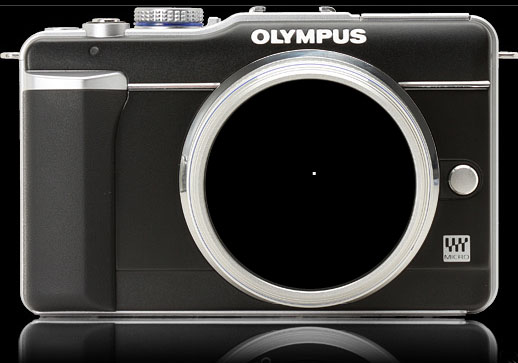
We have just purchased an OLYMPUS EPL1 a Micro Four Thirds digital camera. It features interchangeable lenses, 12 megapixel capture and HD Video – It’s not the latest and greatest but it is very reasonably priced @ around $450 at JB-HiFi or Harvey Norman.
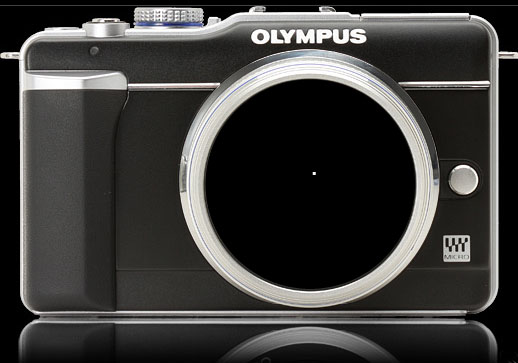
What is exciting is we drilled out the body cover – put about a 10mm hole in the middle and stuck an old home-made pinhole into it and made pictures. In ‘LiveView’ mode you can even see what you are shooting and, better still, we are shooting pinhole movies!!! In fact out 2011 WPD offering will feature a ‘stilled’ image (SEE Below) with a link to a YouTube video.
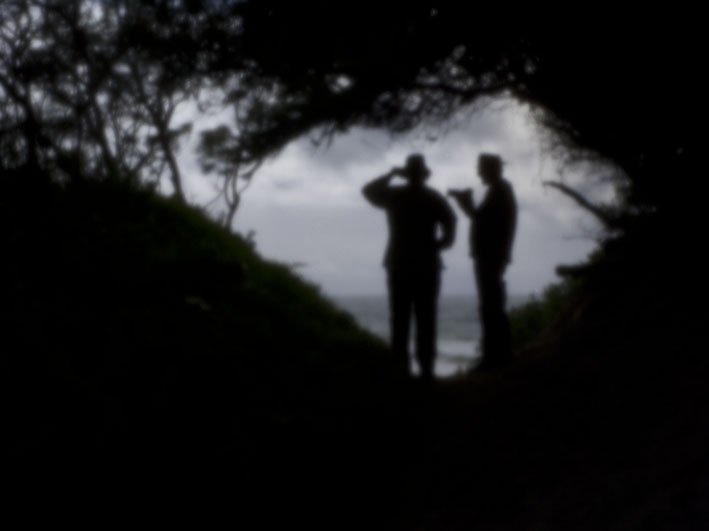
Still from the Pinhole Movie: "Being There . . ."
HERE IS THE LINK http://www.youtube.com/watch?v=Yk4vnbzTqOU
Vist the WPD Site for other contributors: http://www.pinholeday.org/gallery/2011/
Our WPD images:
2011 http://www.pinholeday.org/gallery/2011/index.php?id=924
2010 http://www.pinholeday.org/gallery/2010/index.php?id=2464&Country=Australia&searchStr=spowart
2006 http://www.pinholeday.org/gallery/2006/index.php?id=1636&Country=Australia&searchStr=cooper
2004 Vicky http://www.pinholeday.org/gallery/2004/index.php?id=1553&Country=Australia&searchStr=cooper
2004 Doug http://www.pinholeday.org/gallery/2004/index.php?id=1552&Country=Australia&searchStr=spowart
2003 http://www.pinholeday.org/gallery/2003/index.php?id=615&Country=Australia&searchStr=spowart
2002 http://www.pinholeday.org/gallery/2002/index.php?id=826&Country=Australia&searchStr=spowart
EASTER 2011 – At the Beach: WOOLI
Well Easter has come and gone – WOT DID YOU DO? Did it rain? Were you able to get away? Did you mow the lawn? Did you get to the Beach? Did you do things that you’ve been hanging out to do?
Well, Here’s what we did . . . .
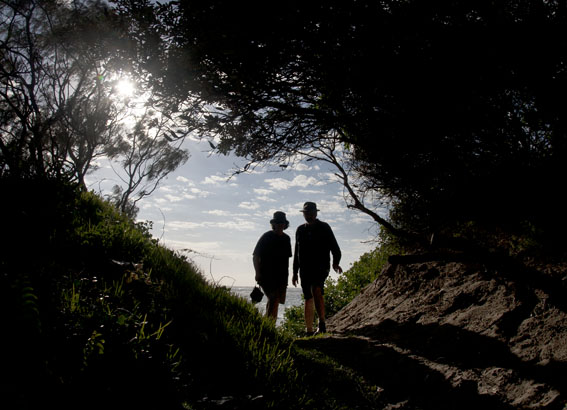
Entering the Sunlight: Entering the darkness

'White Shadows' The Book: On Wooli Beach
SEE: Other Wooli Books on our website
http://www.cooperandspowart.com.au/2_PLACES/WOOLIflipBOOKS/index.html
SEE: An introductory WOOLI BEACH video on YouTUBE
GIRRAWEEN National Park Weekend, March 25, 26 & 27
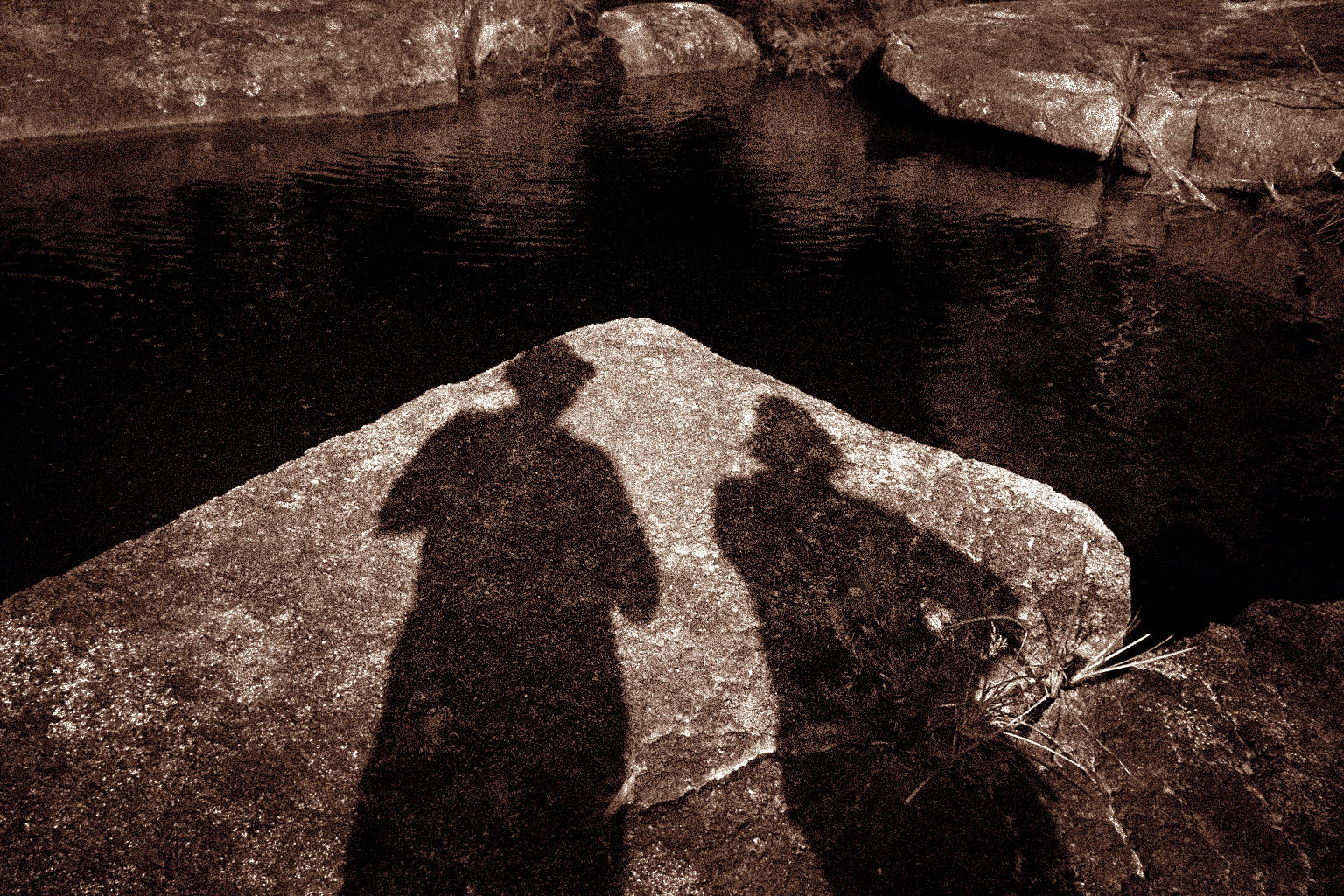
Back on granite @ Girraween
I wonder if our shadows are still there
when we return I will check the rock and let you know.
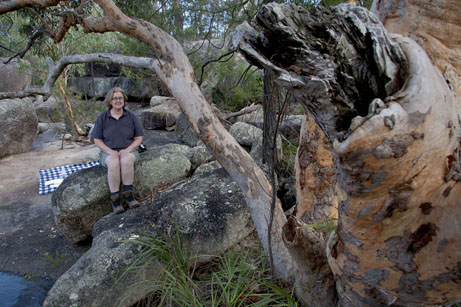
Vicky under the picnic tree
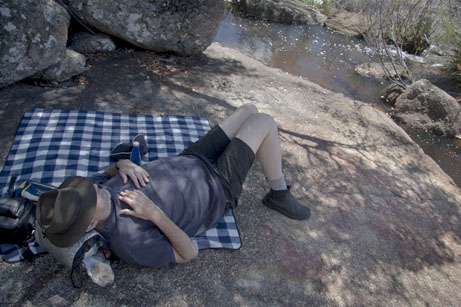
Doug taking a break

 wotwedid