Archive for the ‘Exhibitions’ Category
BOOKS AS ART: 30 YEARS IN THE MAKING – Catherine McCue Boes
BOOKS AS ART: 30 YEARS IN THE MAKING by Catherine McCue Boes
Bundaberg Regional Art Gallery – 14 May – June 29, 2014
.
An observation of artists and artmaking in the regions…
.
Artmaking and artists from the regions are constantly sidelined by the power of proximity that pervades these ‘blessed’ centres of art and culture. People who make ‘real art’, it seems, come from places where populations are concentrated, like ‘big cities’ or localities where a place of learning (university) or an uber vibrant arts community exists. In Australia the place names of Sydney, Melbourne, Adelaide, Hobart and perhaps Bris-vey-gas, are part of a roll call of significantly charged places for artmaking, presentation, commentary and critique. *[Note: artists’ books have a wider community of practice that is more inclusive due to the fact that regional centres tend to present events, awards and workshops that bring the city and country together. SEE https://wotwedid.com/2013/05/13/2013-libris-awards-the-judges-view/]
.
With this in mind, then consider my surprise when I recently encountered an exhibition of artists books at the Bundaberg Regional Art Gallery. The main gallery held one of the largest exhibitions of artists books I’ve seen for some time. The show was more impressive because it was essentially the book works of one person with additional books by others coming from the artist’s collection. The exhibition, entitled Book as art: 30 years in the making, was by Catherine McCue Boes a local Bundaberg artist. As the title implies the exhibition encompasses a significant period of time and the life of the artist.
.
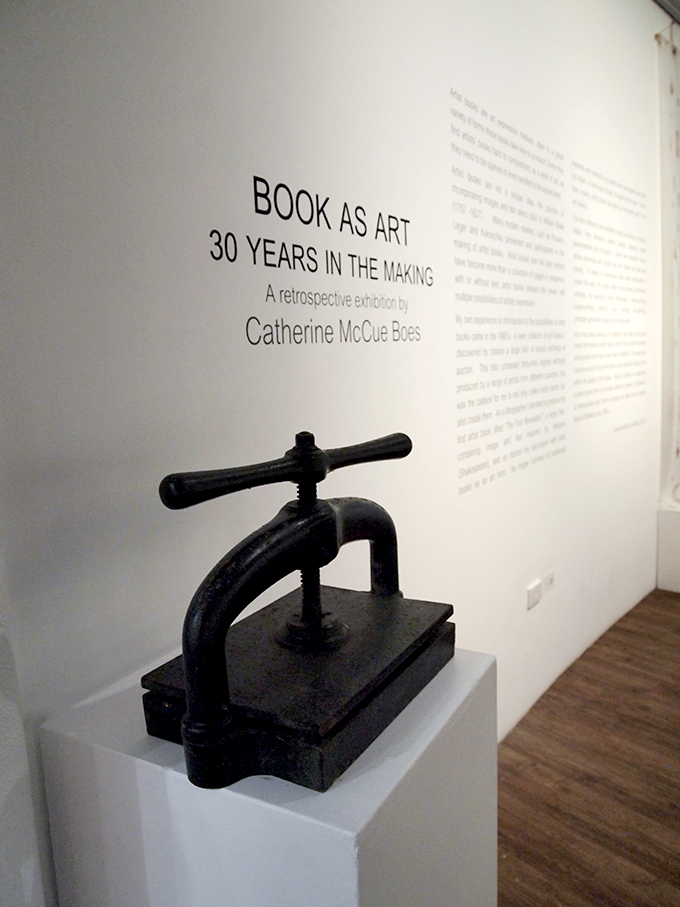
Exhibition frontpiece
.
Engaging with the artists books on display was a challenge – I walked around the space, glancing at and visually grazing the works on display. In keeping with the gallery display norm for artists book display the books were not for touching with many in vitrine glassed cages. Many books were the concertina form that allowed for easy reading and connection with the narrative. The artist also presented alongside the books wall works to give the reader an idea of the contents of the book.
.

Exhibition installation of Books as art: 30 years in the making
.
After my initial viewing, the sheer volume of the work on display and the demands that such a volume of complex and at times conceptually dense places on the viewer, I had to go away and come back to the gallery for a second viewing.
On my return I was drawn to a number of the accessible concertina books. The first of was, In Paris 2012, which dealt with the artist’s personal experience of walking in Paris and the extraordinary things experienced. The book’s plain white paper surface is inscribed with diaristic jottings, a quick unfinished drawing of the Eiffel Tower, a textural pattern element, and deep-etched monochrome photographs of sculptures and architectural details. A pink abstracted form with a pigment-bled edge repeats over many pages – is it a memory of a figure walking in the rain with an umbrella or is it a self-portrait?
.
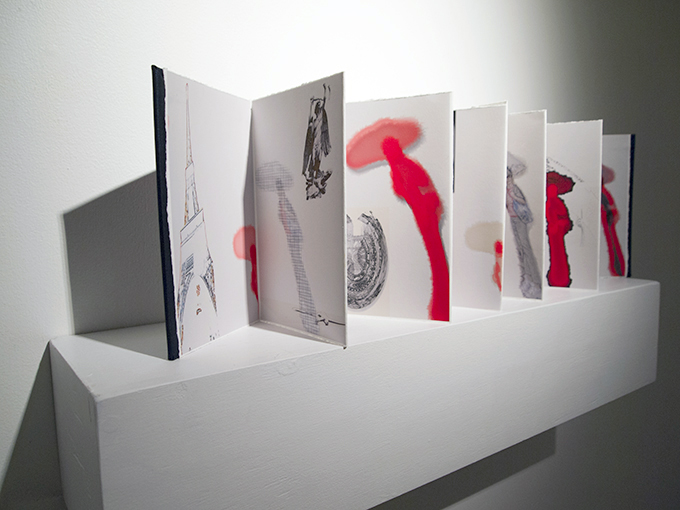
In Paris 2012, Catherine McCue Boes
.
In another work, Preserved in Australia, an old Kodak folding camera has the concertina bellows extended ready for use. Spilling from the rear of the camera explodes a concertina of 20 or so images attached to the viewing hood. The book is derived from a period of time where the artist worked in Roebourne in Australia’s north west. The photos are from the early 1900s, loaned by their owners – residents from Roebourne as well as from the local Historical Museum. McCue Boes has metamorphosed the camera and it’s image legacy into a device for viewing history.
.
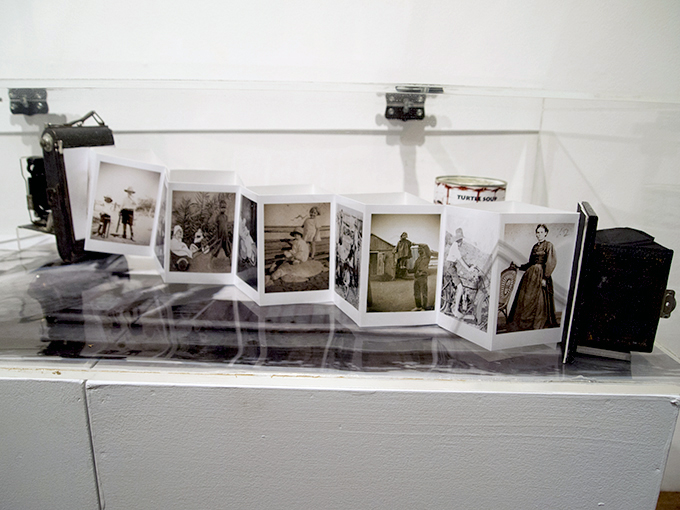
Preserved in Australia, Catherine McCue Boes
.
An early book, First Revolution (Macbeth) Lithographs 1989, represents the artist’s reference to the Shakespearian theatrical character of the same name. These stone lithographs are accompanied by screen-printed texts on the verso page. In the style of the livre d’artist this large format book with it’s thick deck-edged pages and codex binding make it a strident piece of work. Whilst the book is firmly enclosed in a vitrine and opened to one page only, individual prints from other pages of the book are presented as a framed artworks on the wall.
The First Revolution is also referential to the artist’s major influence, an 1800s book of rococo etchings she discovered in the 1980s and bought at an auction. She states in the exhibition materials that: ‘this was the catalyst for me to not only collect artist books but also create them’. The binding, its construction, materials and its red covering are echoed in many works.
.
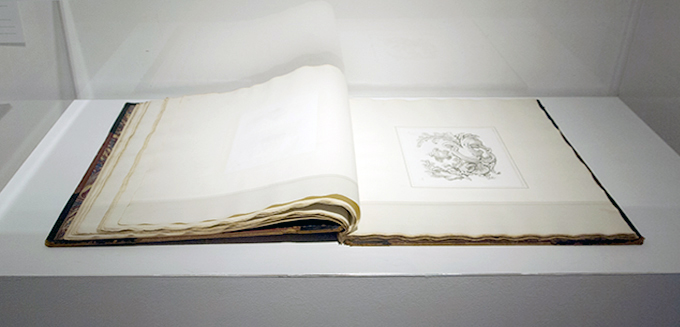
A New Book of Shields 1770-1800
.
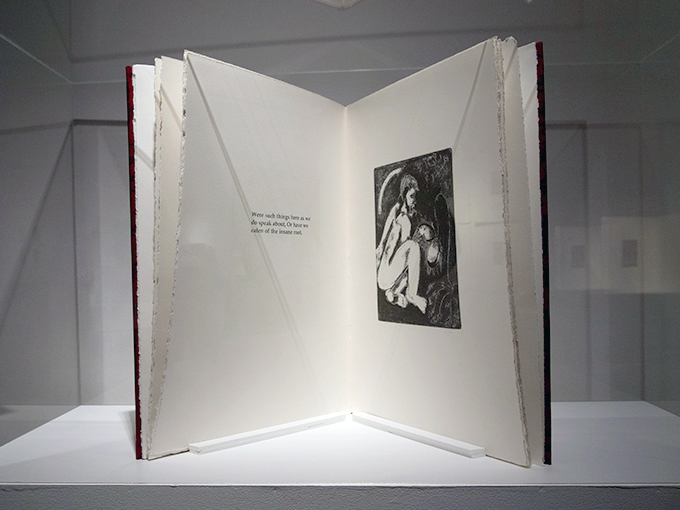
First Revolution (Macbeth) Lithographs 1989, Catherine McCue Boes
The hybrid mix of traditional printmaking and digital techniques creates an opportunity for McCue Boes to extend the artist’s vision and the nature of the outcome. In the 2005 book The Red Shoes, Mark 3 the artist references the Hans Christian Anderson children’s story of the same title. Seven linocuts have been enhanced through scanning into the computer, being redrawn and with text added – the result is a blending of the tradition of print with the graphic elements of typography to convey the story.
Catherine McCue Boes works with other artists in international mail art projects that are presented in another section of the exhibition. A collaborative work curated by the artist, entitled, Life Line, Flood project 2014, brings us back to the idea of the artist’s work being affected by the places they come from. In 2013 devastating floods inundated Bundaberg and upper reaches of the Burnett River. The swollen river gouged out land, animals, houses, trees and farms and significantly affected the land and people of the whole region. McCue Boes curated a collection of photos and texts from friends and assembled a concertina book that carries the sentiments of the contributors. The book is a narrative of many voices with text and image carrying the emotion and the spirit of the contributors. Art often has a dual role, that of the healing catharsis and also to present accounts that can inform those who did not witness the grief first-hand. While this work may be a little uneven in its attempt to blend the individual contributions it is profoundly successful in its purpose and outcome.
Working around to other books in the show a persistent source of inspiration is the artist’s surroundings and environment. I’m reminded of Lucy Lippard’s statement that: ‘Everybody comes from someplace, and the places we come from–cherished or rejected–inevitably affect our work[i]’. This is most notable in a body of work arranged on an island-like plinth towards the rear of the gallery. Assembled is a collection of books that relate to mining environments. McCue Boes works with photographic images, irony and conceptual play to present a variety of book forms and commentaries.
The book, Inspiration from the Artificial Environment 2012, consists of 16 photographic images and borders printed on canvas that are presented in a form that mimics wallpaper, soft furnishing and curtain material sample books. The patterns are photo elements flipped and flopped to form plausible, although somewhat 1960s dated looking designs for decorating your home. The reality of the source images is that they are the detritus of mining workspaces and consist of rusting drums, cable, pipes waste and pondage.
.
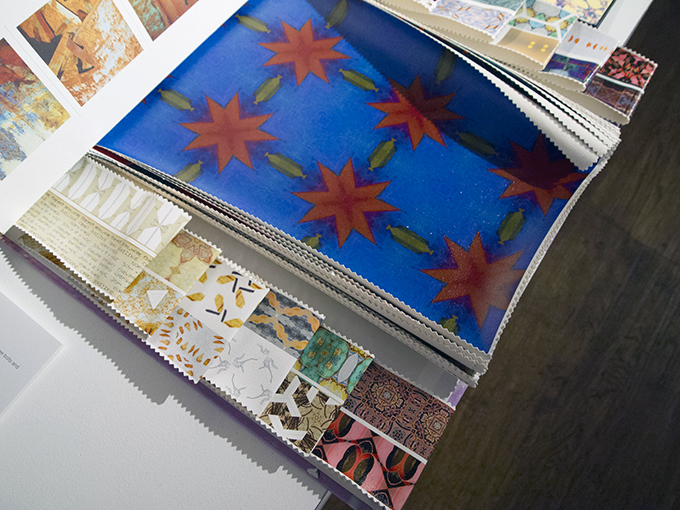
Inspiration from the Artificial Environment 2012, Catherine McCue Boes
.
Other books, some that are more book-like sculptural forms, are part of this body of work. Presentation includes commercial boxes, simulated strips of black and white negatives, abstracted photographs and industrial labels – one stating, ‘Danger – This energy source has been LOCKED-OUT’.
.
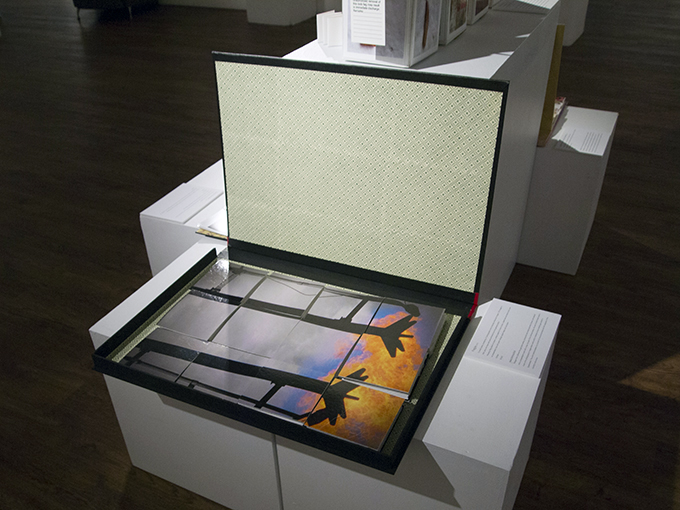
Fragile 2012, Catherine McCue Boes
.A major contribution to this environmentally themed piece is the book/s, Fragile 2012, which is a collection of 12 small concertina books each containing 10 photographs. When assembled the covers create a full-sized image of flaming torch-like structures. The unsuspecting viewer may encounter these little photobooks as a pleasant visual wander through shapes, forms and colours. However the artist has seductively blind-sighted the viewer – these are not pretty and benign subjects. The accompanying didactic explains the photographs were made while participating in an artist in residence in a gas mining plant in Queensland. The artist adds to the didactic that: ‘The work demonstrates my concern for the environment and the depletion of the country’s resources.’
A position pervades many works in the show and I’m reminded of Lucy Lippard’s closing comment in the catalogue for the exhibition Weather Report: Art and Climate Change, where she speaks of the artist as a commentator, communicator and as one who acts as a provocateur. Lippard proposes, ‘… it is the artist’s job to teach us how to see.’ (Lippard 2007:11) Through these works McCue Boes is as an artist ‘teaching us to see’. The strength of her communiqué in these political works is achieved through with irony and humour, and the association with reality of the photographic image.
Books as Art: 30 years in the making is not an exhibition about art, or about making, or even about books. It is an exhibition about the very stuff of life and the human experience of the world – an experience that needs to be shared.
.

Portrait: Catherine McCue-Bowes
.
I’ve made a note also about the importance of proximity in regional centres as well – the ‘big city’ should come visiting sometime. They may be amazed!
Doug Spowart
July 28, 2014
VISIT CATHERINE McCUE BOES Website: http://catherinemccue.blogspot.com.au/
.
Reference:
[i] Lippard, L. R. (1997). The Lure of the Local: Sense of Place in a Multicentered Society. New York, The New Press. P36.
.
Review text © 2014 Doug Spowart
All photographs © 2014 Doug Spowart
.

This work is licensed under a Creative Commons Attribution-NonCommercial-NoDerivs 3.0 Unported License.
.
.
COOPER+SPOWART EXHIBITION: Speaking About Place
.

Speaking About Place gallery layout
Speaking About Place: the Nocturne Project
Victoria Cooper & Doug Spowart
Cam Robertson Gallery, Toowoomba Regional Art Gallery, 19 July – 17 August 2014
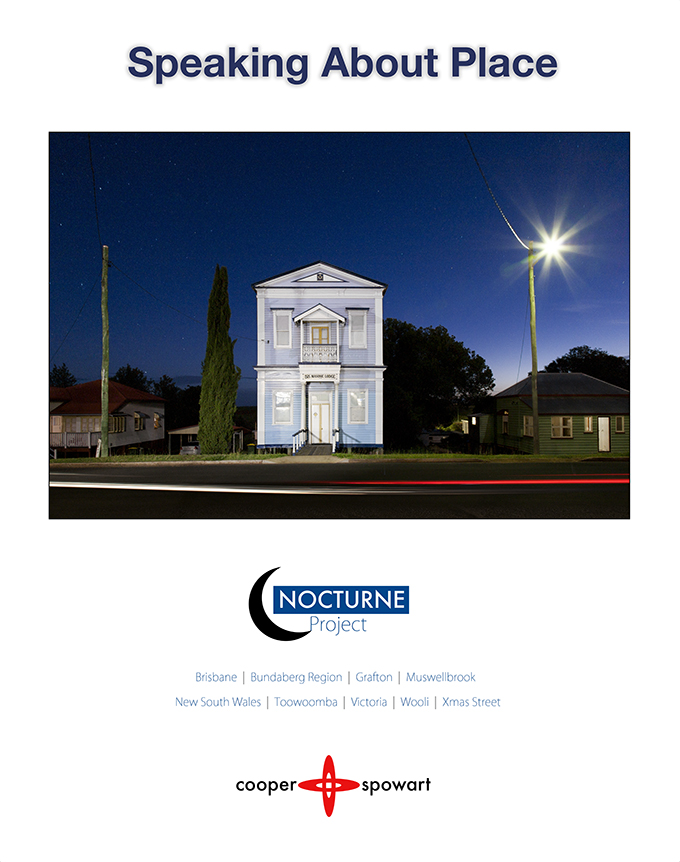
Our arts practice is informed by our ongoing and evolving connection with Place. Our Place-Projects are influenced by the context and the consequences of living within a constantly changing landscape. We work with a range of photographic concepts and techniques, from the camera obscura, through analogue processes to the digital forms of the medium. Our work is presented as visual narratives in artists’ books, photobooks, exhibition images and, more recently, blogs and social media.
Through our Nocturne documentary photography and Facebook social media projects, we have explored connections with Place in urban and regional communities throughout Queensland, New South Wales and Victoria. For us the phenomenon of nocturnal light transforms these everyday spaces. Buildings, busy street corners, quiet alleyways all become filled with the dramatic light of a movie scene. In 2013 and 2014 we were given the opportunity, through funded Artists-in-Residence (AIR) programmes, to undertake Nocturne projects in the regional communities of Muswellbrook, Grafton and Bundaberg.
In this exhibition we present a selection of images from three years of our Nocturne Projects. The work shown here adds to the recent Childers Art Gallery exhibition of this project, by the inclusion of social media elements. Therefore in this gallery we invite viewers to connect with the work in a forum outside the virtual space of Facebook. To enable this connection to take place we have created folios that contain transcripts of Facebook/Place/Storytelling from each of the three AIRs.
.
About the photographs
We photograph in the early evening nocturnal light, a time of day where the afterglow of sunset and the glow of streetlights transform the everyday experience of place for the viewer. Images created at this time require long camera exposures and therefore produce photographs that can capture blurred movement of people and vehicles. Another important aspect of the Nocturne aesthetic is the effect of colour and the juxtaposition of coloured lights in the different situations of ambient daylight, artificial lighting, car head and taillights.
.
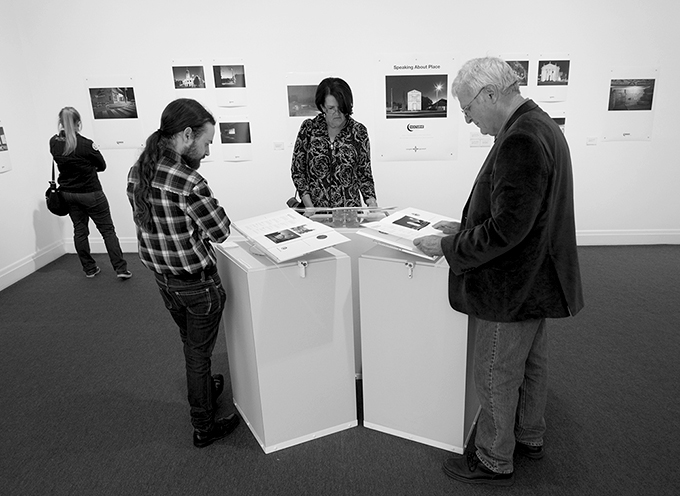
Exhibition viewers reading Facebook responses
.
More than photographs
The photographs in themselves have no intrinsic meaning – it is the viewer, with their experience and memory that brings life to the image. In this moment of connection they may recount a personal narrative or connect with the historical significance of the place. This collaboration between photograph and viewer is exciting and vibrant – expanding the potential for the documentary image to go beyond the vision of the photographer.
As the Nocturne project has evolved, we have discovered the importance of sharing place stories through images, words, in person and online. Through Speaking about Place we have extended the potential for this project to share the transformative nature of lived experience and everyday life in each community.
The Western Downs town of Miles is scheduled for a social media Nocturne project later this year.
.
CLICK HERE To download a PDF of some of the Facebook narratives Catalogue-Comments-interact-FP3
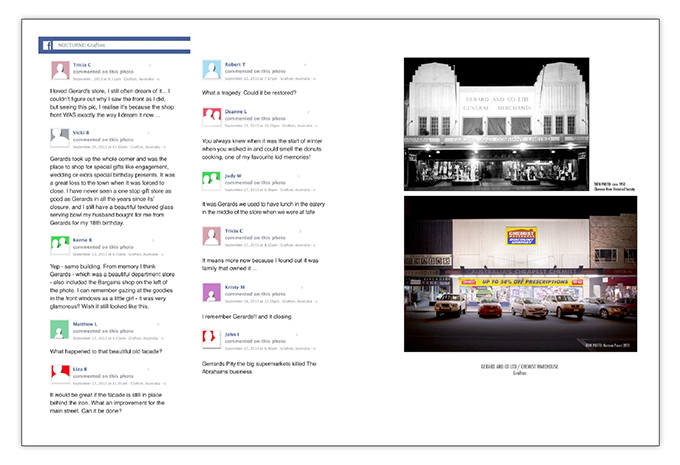
Community comments about the photographs on Facebook
The online Nocturne Projects can be accessed at http://nocturnelink.com
.
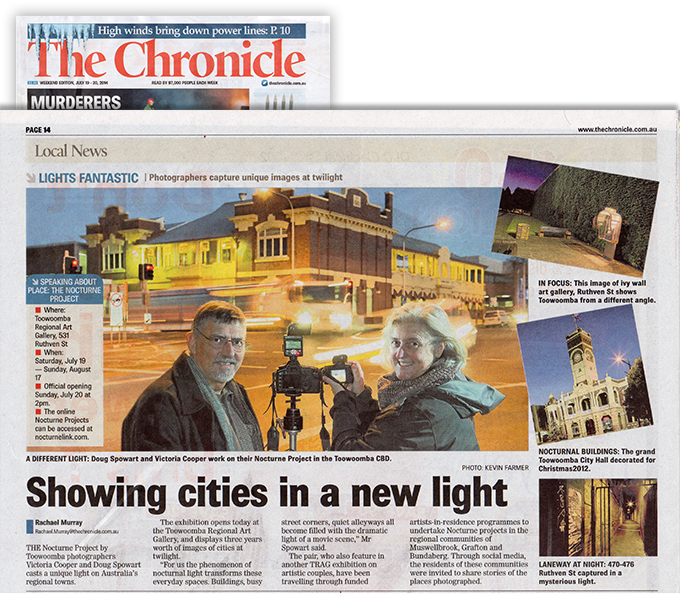
Link to The Toowoomba Chronicle online news story:
http://www.thechronicle.com.au/news/showing-cities-in-a-new-light/2323064/
.
A selection of images from the opening and associated events
.
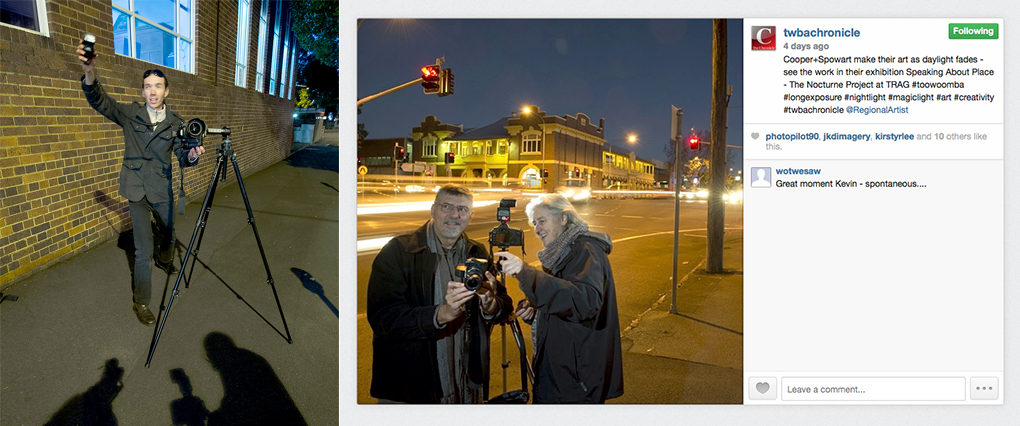
Toowoomba Chronicle photographer Kevin Farmer gets a Nocturne reverse-photo with us – From The Chronicle Instagram feed
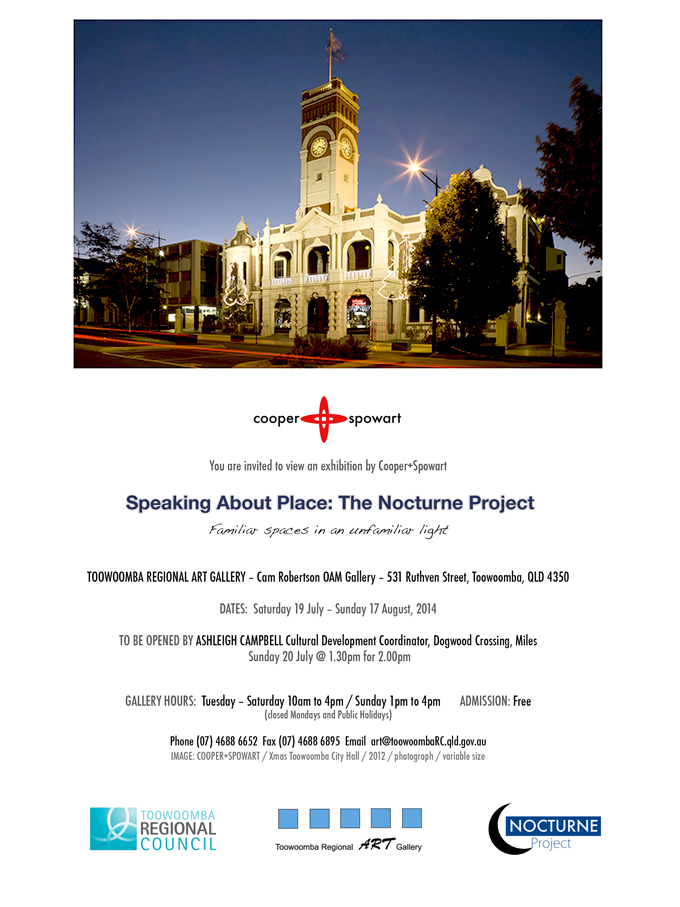
Exhibition invitation featuring the Toowoomba Town Hall Xmas 2012
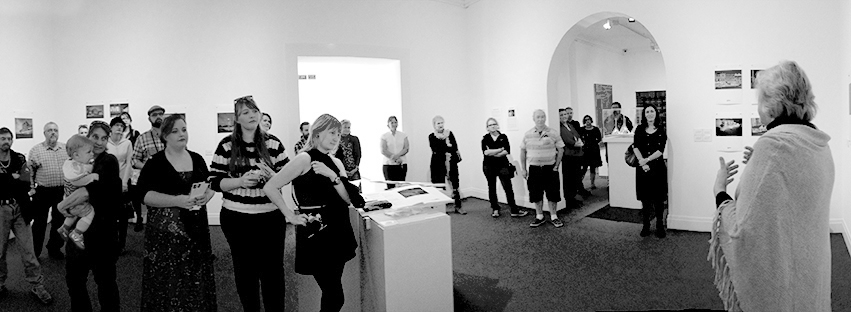
The opening of ‘Speaking About Place by Ashleigh Campbell
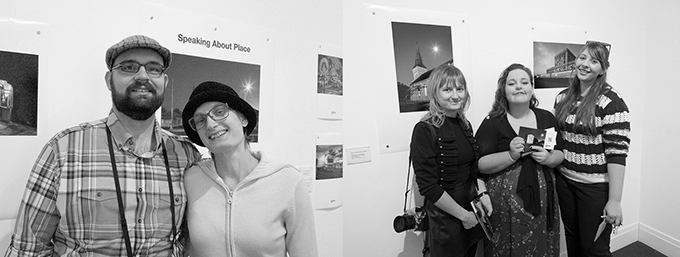
Some attendees at the opening
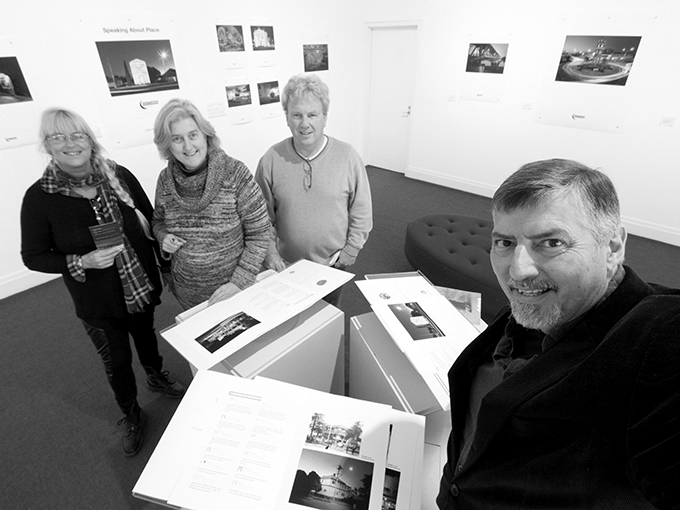
Maureen Trainor and Kevin Scattergood visit the show
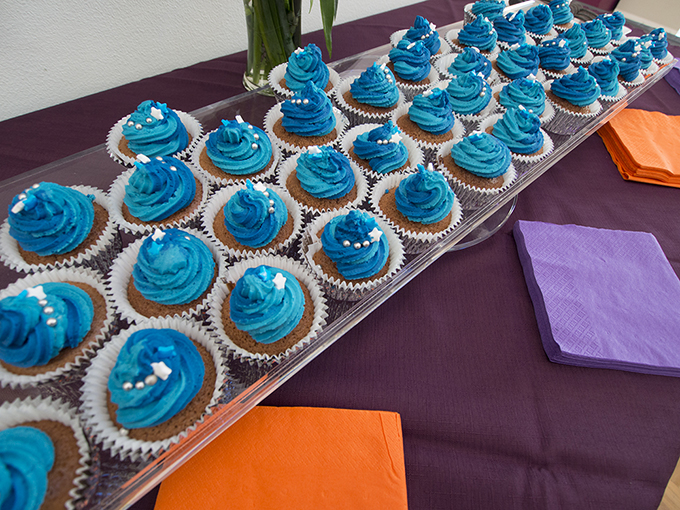
Jess Martin’s Nocturne Cup Cakes…
.
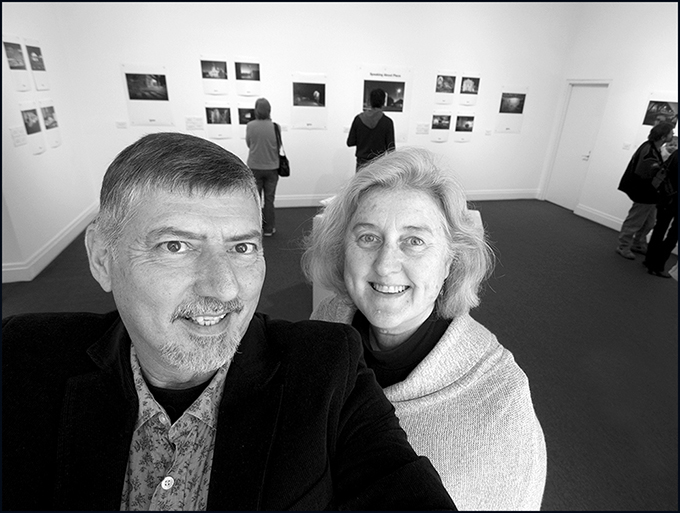
.
Visit http://nocturnelink.com to connect with our Nocturne Projects
..
.

.
.
Installation photos and documentation of the artworks and text ©Doug Spowart
Instagram photo and news story © The Toowoomba Chronicle and Kevin Farmer
.
My photographs and words are licensed under a Creative Commons Attribution-NonCommercial-NoDerivs 3.0 Unported License.
http://creativecommons.org/licenses/by-nc-sa/2.5/au/
.
.
MAUD GALLERY: TRANSLUCENCE: Jacqui Dean’s Xrayograms
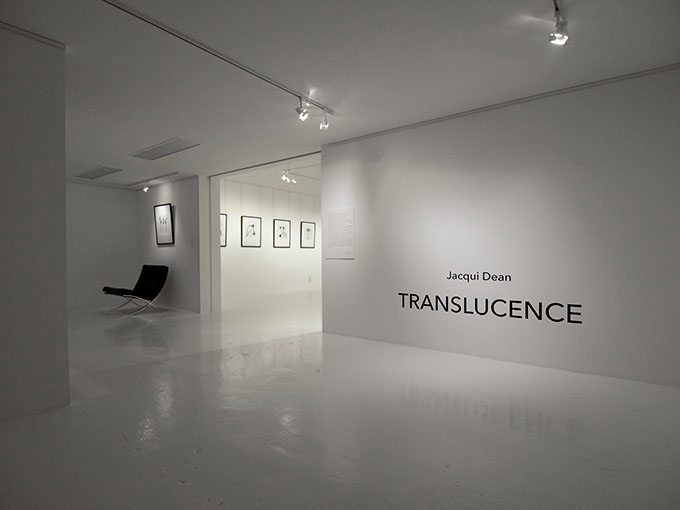
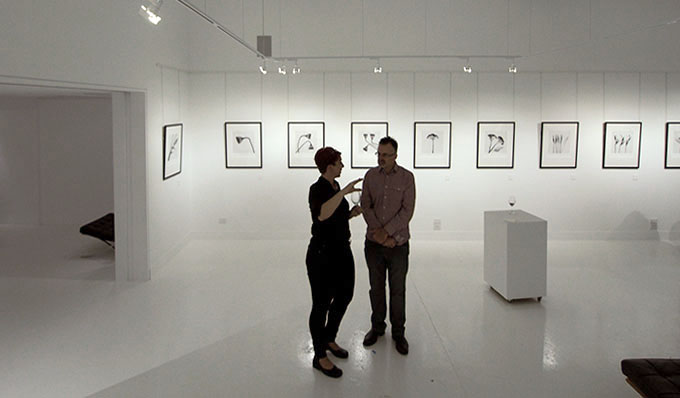
Jacqui Dean’s TRANSLUCENCE @ Maud Gallery, Brisbane Photo: Doug Spowart
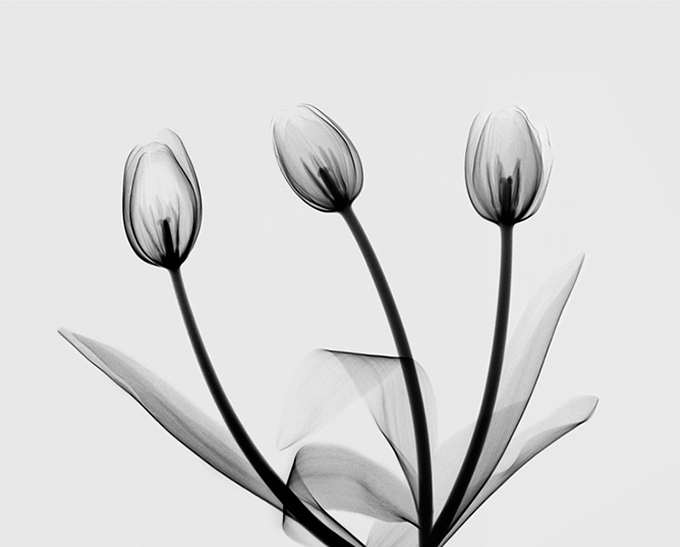
An image of tulips from the Translucence exhibition
.
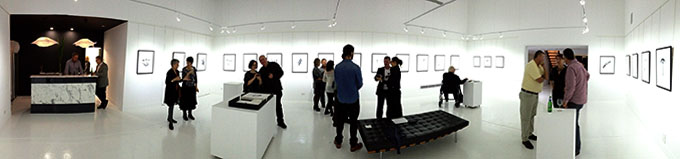
Translucence @ Maud Gallery, Brisbane. . iPhone Photo: Doug Spowart
.
TRANSLUCENCE: Jacqui Dean’s Xrayograms
Maud Creative Gallery June 18th – July 19th, 2014
6 Maud Street Newstead, QLD 4006
Ph 07 32161727
www.maud-creative.com
.
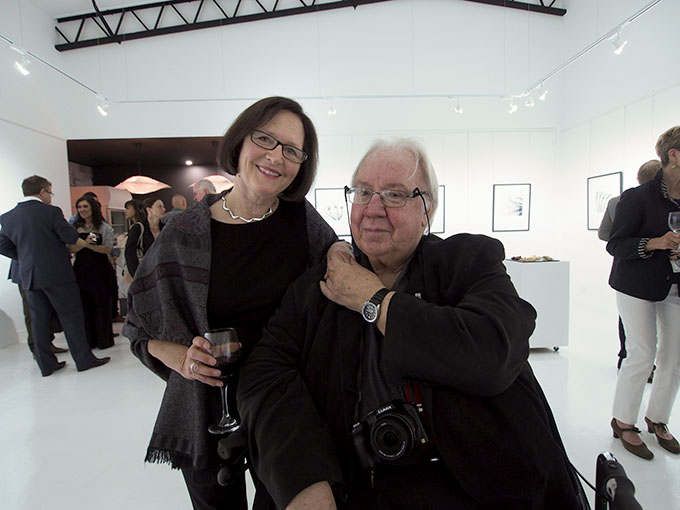
Jacqui Dean + Robert MacFarlane Photo: Doug Spowart
.
A comment about the work by the exhibition speaker Robert McFalane
In TRANSLUCENCE, photographic artist Jacqui Dean reveals Australia’s flora, both native and introduced – in radically new ways. Dean’s searching vision reduces flowers to their essential, sculptural shapes, translating them into exquisite, archival black and white prints. Calla lilies are seen as never before – with their curved flowers resembling the shape and texture of a crystal goblet. Dean’s delicate images of roses, through composition and digital magic, reveal interlaced petals that mimic the textures of a Tulle bridal veil.
Dean’s delicate, dancing images in TRANSLUCENCE mirror the elegance of Nature while resonating deeply with the work of artists as disparate as photographic pioneer William Henry Fox Talbot (1800-1877) and the affectionate, intricate drawings of Nature by Albrecht Durer. (1471-1528)
Jacqui Dean is a talented Sydney architectural, corporate and fine-art photographer known for her rigourous sense of composition and peerless black and white printmaking skills. Twenty seven prints will be on display at Maud Creative Gallery during this first Brisbane exhibition of TRANSLUCENCE.
“Look deep into nature, and then you will understand everything better.”
ALBERT EINSTEIN (1879 – 1955)
‘Another Universe’ a review by Victoria Cooper
.
From the late 19th, and into the early 20th century there was a growing movement in the sciences and the arts that associated with Nature’s inherent resonance of form and structure from the microscopic to the cosmic. These new vistas and universes were recorded not only by the scientists’ hand but also by new developments in technology, notably the invention of the photographic process. Visual communication through imaging technologies continues to be an important tool in scientific research. But these images were not just useful as scientific evidence they were and continue to be inspiration for the creative work of artists and designers.
One noted exemplar utilising this visual medium was Karl Blossfeldt (1865-1932), a sculptor, metal craftsman and teacher. Blossfeldt began taking photographs of botanical specimens to use in his classes as ideas for students to create design forms from nature. But Blossfeldt’s work became very influential in the art, craft and design movement that popularised natural forms as templates for architecture, sculpture and 3D design work. His photographic documentation revealed abstract views of humble everyday roadside plants as visually interesting structural and aesthetic forms. As a result, Blossfeldt’s photographs also became renowned as works of fine art.
Jacqui Dean’s exhibition Translucence, at 2 Danks Street Gallery, Sydney, and now at Maud Gallery in Brisbane, is the result of artistic curiosity and visual investigation natural forms through the phenomenon of Xrays. Art in this respect is the revelation of the unseen, the beholding of the essence within ordinary objects or a transforming perception of the everyday experience. The photograph, or in this case ‘xrayograph’, seals the object within the frame safe from the changes and inevitable decay over time. At first glance these images could appeal to the naturalist or perhaps a student of design (after Blossfeldt). Yet a deeper – more poetic vision immanent in nature is also suggested through a more contemplative viewing of these images.
Some may argue that this is an uncomfortable clash between the modernist and the romantic, or the objectivity of scientific evidence and the subjective imagination. But could this work identify with a need to embrace a sense of wonder rarely seen within a super-hyped, virtual digital-image society? Dean’s work in Translucence is informed by the poetry of music and her life’s experiences and her prodigious professional practice in photography. However the rewards for the thoughtful viewer will be to share in her wonder of the natural world that surrounds and nourishes our everyday life.
Victoria Cooper . . . June 9, 2013.
.
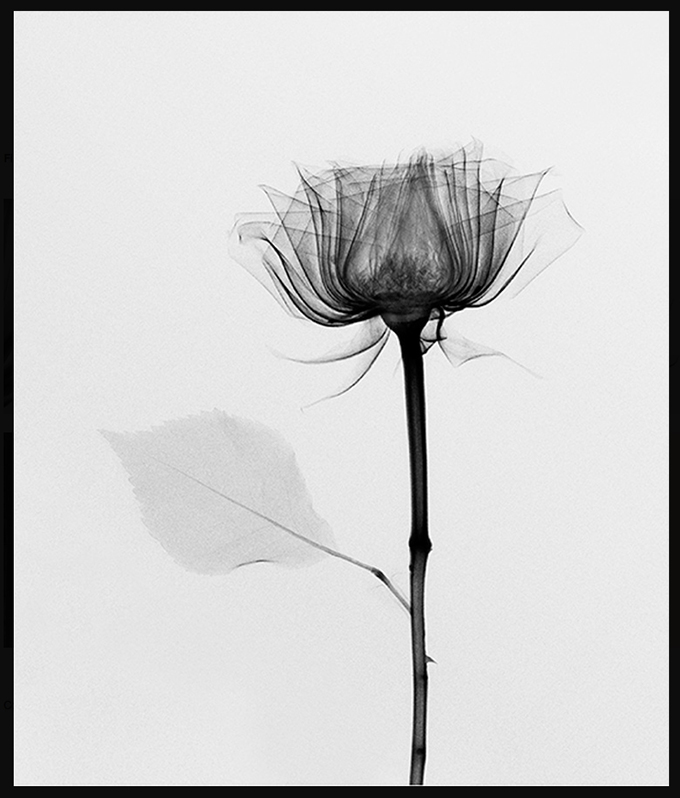
Rose Xrayogram by Jacqui Dean
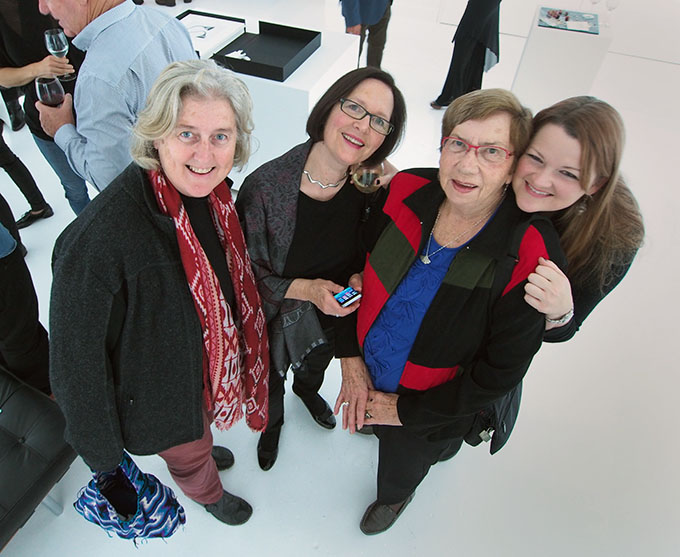
Victoria Cooper, Jacqui Dean, Ruby Spowart & Mel Anderson Photo:Doug Spowart
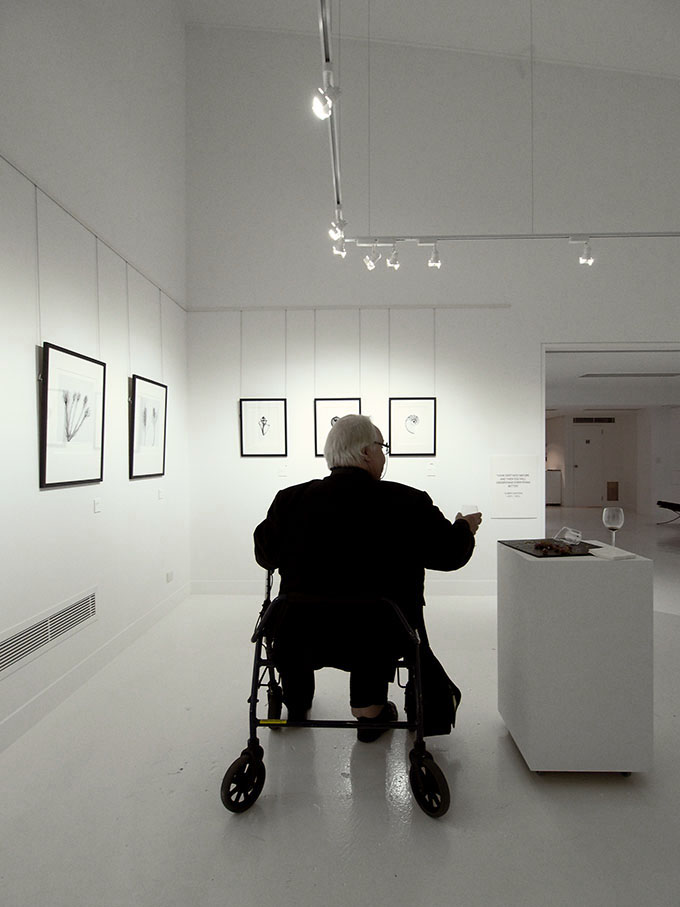
Robert takes a drink — Photo: Doug Spowart+Steve Jones
Bibiana Stanfield and Neil Burton @ Maud Gallery
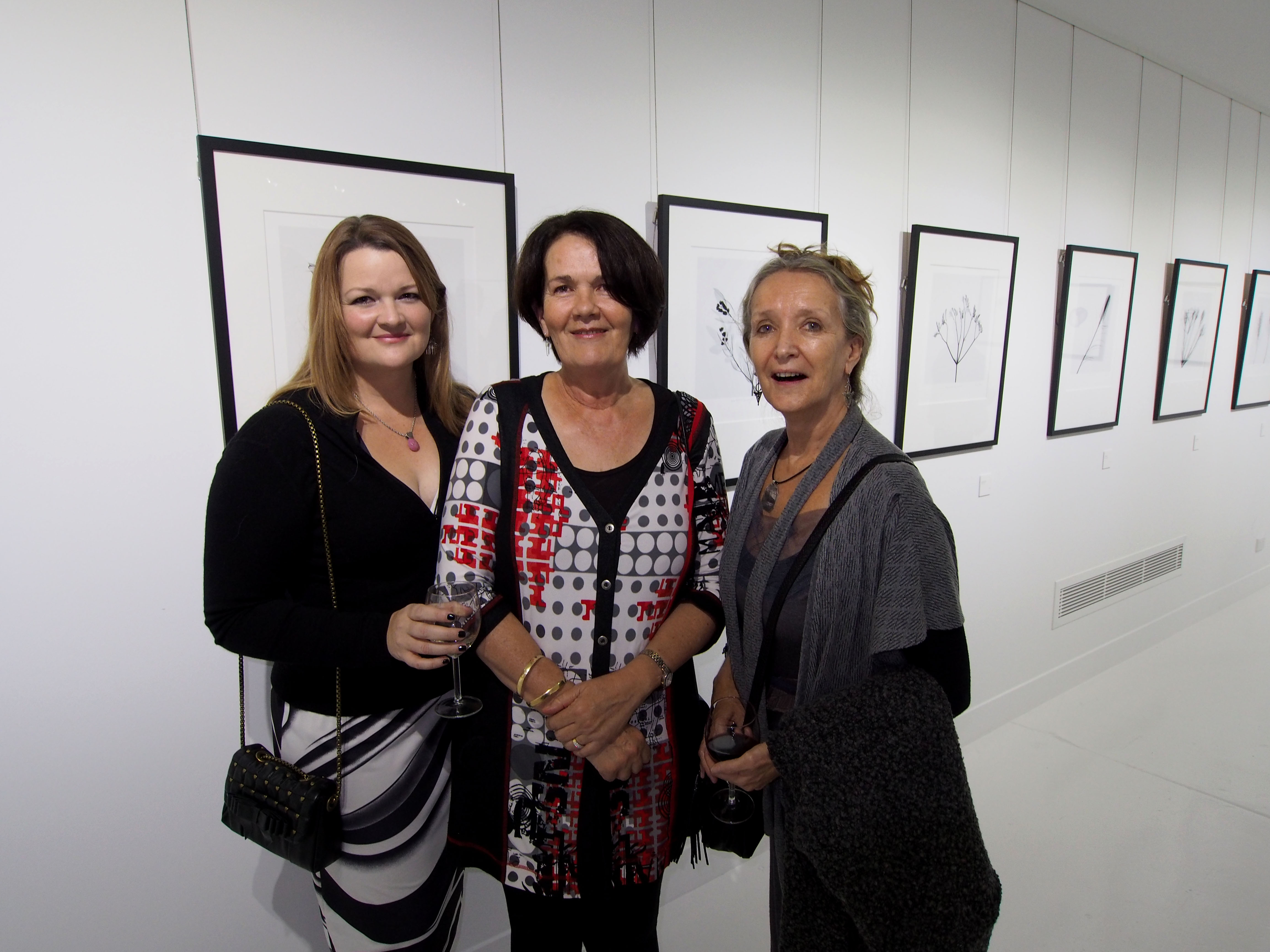
Mel Anderson, Ros Stakes and Lesle Downie @ the opening Maud Gallery Photo: Doug Spowart
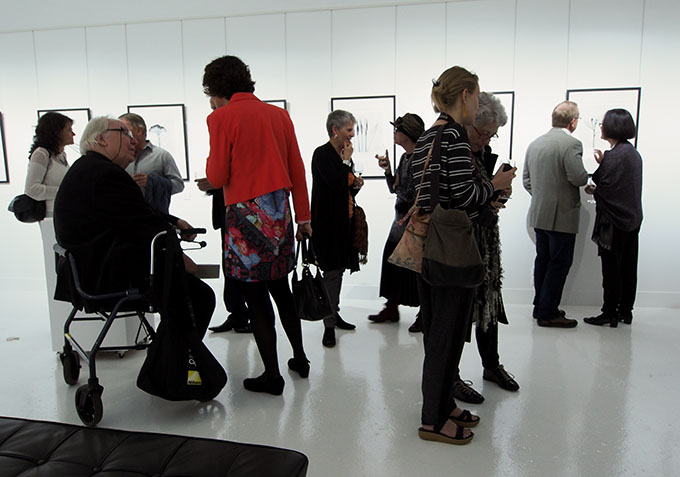
Guests at the Translucence opening Maud Gallery Photo: Doug Spowart
.
MORE INFORMATION:
Jacqui Dean’s Website: http://deanphotographics.com.au/fine-art/
Interview by Gemma Piali of FBi Radio, Sydney: http://fbiradio.com/interview-jacqui-dean-on-translucence/
.
Xrayograms: © Jacqui Dean
Review text © 2013 Victoria Cooper
All exhibition opening photographs © 2014 Doug Spowart
.
This work is licensed under a Creative Commons Attribution-NonCommercial-NoDerivs 3.0 Unported License.
.
.
HeadOn–AddOn: Cooper+Spowart invited to participate
This year we were invited to participate in the 2014 HeadOn – AddOn event: Here are the details behind the event from the HeadOn Website…
.
.h
AND HERE ARE OUR IMAGES …
.
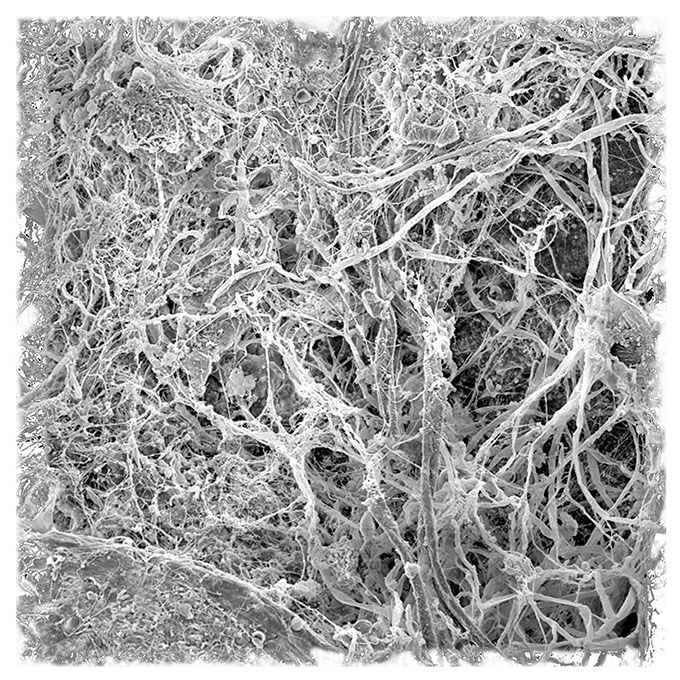
Victoria COOPER’s – Detail from Home 2011–2014
.
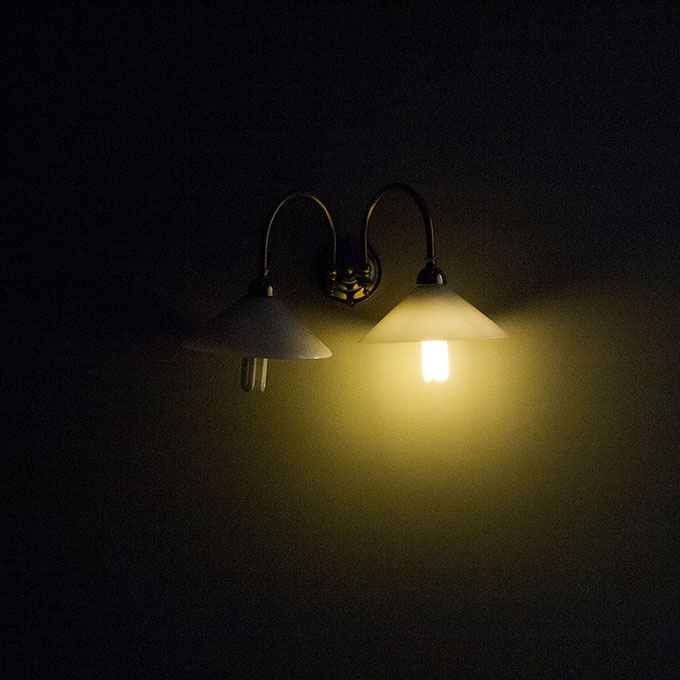
Doug SPOWART’s – Half-light
.
Part of the 2014 programme of:
HeadOn logo
.
.
© 2014 Cooper+Spowart
.
LANDSCAPE PHOTOGRAPHS ARE HISTORY: A book forward
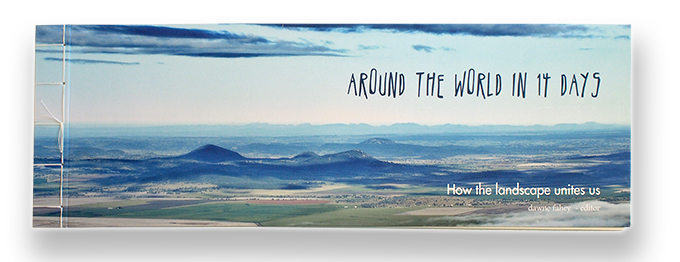
The book Around the world in 14 days
.
Recently I was asked to write an introduction for a limited edition book to compliment an exhibition of landscape photography entitled, Around the World in 14 Days: how the landscape unites us. The project featured seven contemporary Australian and international photographers, and was coordinated by Dawne Fahey of the FIER Institute with Sandy Edwards contributing to the image selection. The assembled body of work presented insights into how photographers ‘read the landscape, both visually and psychologically through their images.’
..
The photographs, created in Australia, Asia, New Zealand, USA and Colombia are intended to inspire viewers to consider how ‘elements effecting the landscape unite us, regardless of our differences or the distances that occur between us.’ Through the photographs there is also an intention that the ‘poetic fragments presented by the work will connect with the viewer’s own memories, experience, or sense of place.’
The exhibiting photographers are: Ann Vardanega (Australia), April Ward (Australia), Beatriz Vargas (Colombia), Gavin Brown (Australia), Michael Knapstein (USA), Robyn Hills (Australia) and Pauline Neilson (New Zealand) and the exhibition and book are on show at Pine Street Gallery, 64 Pine Street, Chippendale, Sydney until May 31, 2014.
See more at: http://www.pinestreet.com.au and http://fier.photium.com/around-the-world-in-14 – sthash.QPto0nz4.dpuf
The exhibition and book launch took place on May 20, 2014 at the gallery.
My essay discusses issues that relate to the premise of the exhibition as well as some personal observations of the idea of the photographer in the landscape. The essay is presented here and at the end of the post I have included a selection of images and installation photographs of the exhibition.
.
.
All landscape photographs are history
It is vain to dream of a wildness
distant from ourselves. There is none such.
In the bog of our brains and bowels, the
primitive vigor of Nature is in us, that inspires
that dream.
Henry David Thoreau, journal, August 30, 1856 [i]
Around sunset, Northern Territory time, a gathering of photographers will assemble in the central Australian desert and witness the now iconic sunset at Uluru. What they encounter will be a lived experience and there can be no doubt that cameras, both with and without telephony capability, will record the moment. Their images will bear metadata of the shutter speed, aperture, camera brand and model, the time, date and perhaps even its geolocation. These images will be cast into the Internet as evidence for friends and family to see – a private experience shared and made transferrable by technology.
What then of the subject of their gaze and activity – the landscape? For this rock in the desert, the next day will be a repeat of this photo ritual, and each day after, it will be repeated again and again. Does Uluru wait for its activation at each sunset and each shutter’s click? This landscape has experienced a few hundred million years of sunsets and its current fame as a photo celebrity, is a mere blip in its history. Every day will be different and thousands of days, well, not much change. However, today’s photograph, even a split second after its capture, is history.
For a number of years I have cultured the belief which was informed by a statement attributed to photographer Minor White: ‘No matter how slow the film, Spirit always stands still long enough for the photographer it has chosen.’[ii] My variation is that that landscape reveals itself to the photographer of its choosing. Writer and critic John Berger adds to this discussion by proposing that there is a ‘modern illusion concerning painting … is that the artist is a creator. Rather he is a receiver. What seems like creation is the act of giving form to what he has received.’[iii] Could it be then that the landscape is the director and commissioner of the image that the painter or the photographer makes, and that the photographer – the right photographer – is merely the vehicle for the landscape’s transformation of itself into an image?
Like portraits that have been made since the beginning of photography, and the documents of human endeavour, commerce, existence and experience – time, or rather the passage of time, has granted then their relegation to past. Each photograph in this book is then a history image. The moment and space depicted wrenched from the continuum of time by whatever forces brought together the photographer and the landscape. A landscape image at that moment of capture is at once the subject photographed and also a time machine. Viewed on its own by its maker the photograph can be a comfortable aide memoir, and operate just as a photo of a loved one or a family wedding would do in its frame on the mantelpiece – the photo exists, and so too the remembrance of subject it represents.
But photographs are more than things; they are experiences. Photographer Ansel Adams attributed special values and meaning to his landscape photographs and sought to represent the landscape as being more than what it was physically. Simon Schama in his book Landscape and Memory cites Adams as commenting that: ‘Half Dome [in Yosemite National Park] is just a piece of rock … There is some deep personal distillation of spirit and concept which moulds these earthy facts into some transcendental emotional and spiritual experience.’[iv] Adams inspired the American nation and created a tradition of environmentalism and black and white photography that continues today.
For Australian wilderness photographers Adams’ ‘emotion and spiritual’ connection with the landscape is salient. In the book Photography in Australia Helen Ennis discusses how photographers of this genre engage with their landscape subjects. She quotes Tasmanian photographer Peter Dombrovskis entering a ‘state of grace’ on bushwalks when, ‘days away from “civilization”, he felt what he described as, “a sense of spiritual connection with all around – from widest landscape to the smallest detail”’.[v] Ennis also comments that wilderness photographers use a range of techniques to ‘lift the experiences of viewing the photographs into a realm that goes beyond the human exigencies of normal daily life.’[vi]
In a book such as this, as we turn the pages, what is presented to us is the photographer’s concept or story encoded in visual form. As with Berger this may constitute the next generation of ‘giving and receiving’. They may have made the photograph/s with a specific objective in mind – a narrative angle, the idea of showing something that stirred them that they wanted to share – or – from the earlier discussion, what the subject wanted revealed. But in the space between the giver (the photographer and this book), and the receiver (you, the viewer), another hybrid narrative emerges. The photograph acts as a stimulus on the viewer and an idiosyncratic response is generated. Roland Barthes uses the term ‘detonate’ to describe being in front of a photograph. In Camera Lucida he comments that: ‘The photograph itself is no way animated, … but it animates me: this is what creates every adventure.’[vii]
In photographs we are not so much connected or united with the landscape, but rather the experience of the landscape and the trees, rivers, blades of grass and rocks that are represented in images. In effect we are united by the landscape of photography and the gift that we can share through it. We can then, through photographs enter into a Barthesian adventure. Perhaps these landscape photographs are more than history – they are: an experience shared, an unexpected encounter, an adventure. In your turning the pages – then pausing to view each group of images, to contemplate and consider the communiqué stimulated by them, these photographs become part of your history, your experience, and your adventure as well …
Dr Doug Spowart April 17, 2014
[i] Schama, S. (1995). Landscape and Memory. London, HarperCollins, epigraph, n.p.
[ii] http://www.johnpaulcaponigro.com/blog/12041/22-quotes-by-photographer-minor-white/
[iii] Berger, J. (2002). The Shape of a Pocket. London, Bloomsbury Publishing Plc, p.18.
[iv] Schama, S. (1995). Landscape and Memory. London, HarperCollins, p.9.
[v] Ennis, H. (2007). Exposures: Photography and Australia. London UK, Reaktion Books Ltd, p.68.
[vi] ibid.
[vii] Barthes, R. (1984). Camera Lucida. London, UK, Fontana Paperbacks, p.20.
.
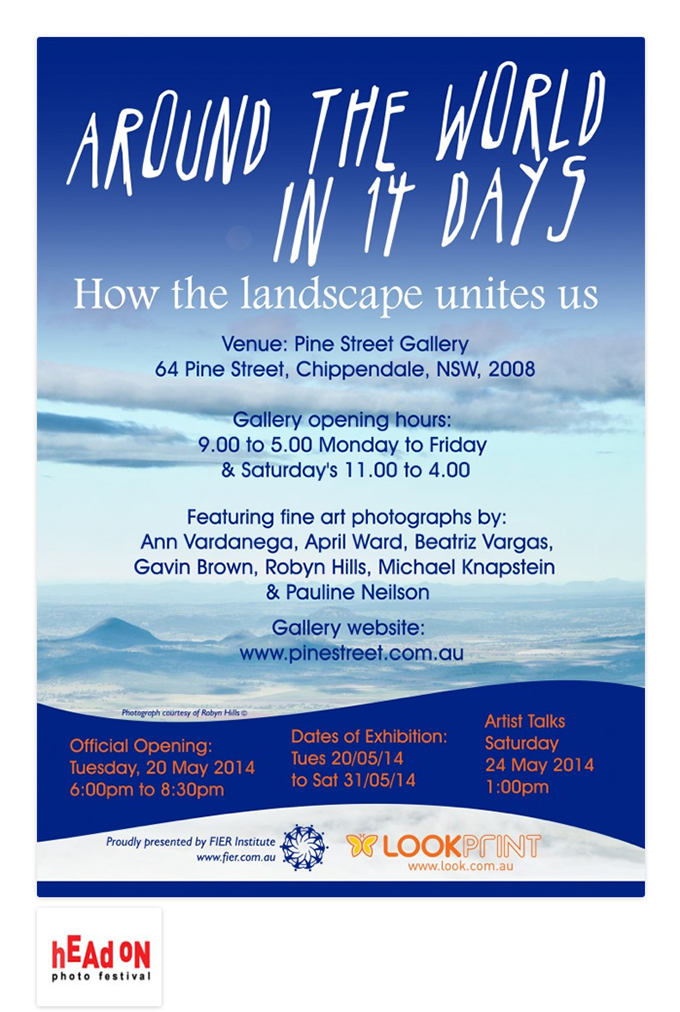
The exhibition invitation
.
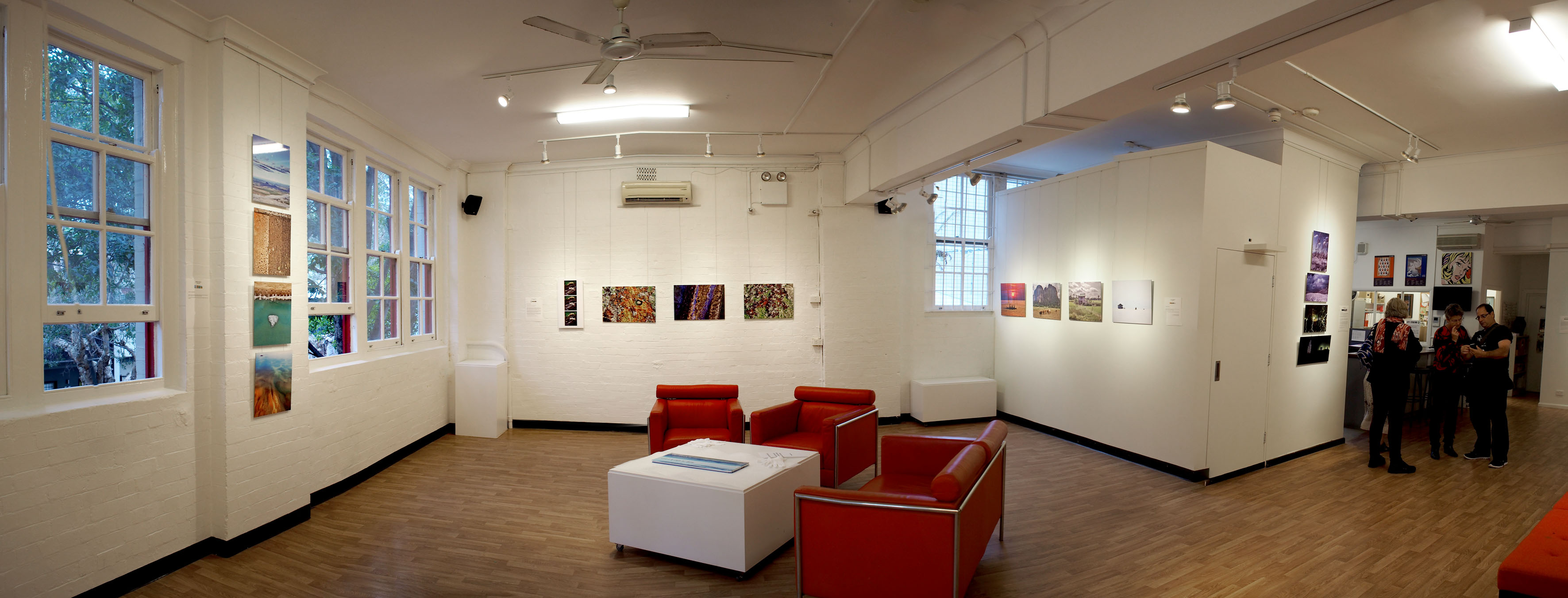
The exhibition in the Pine Street Gallery
.
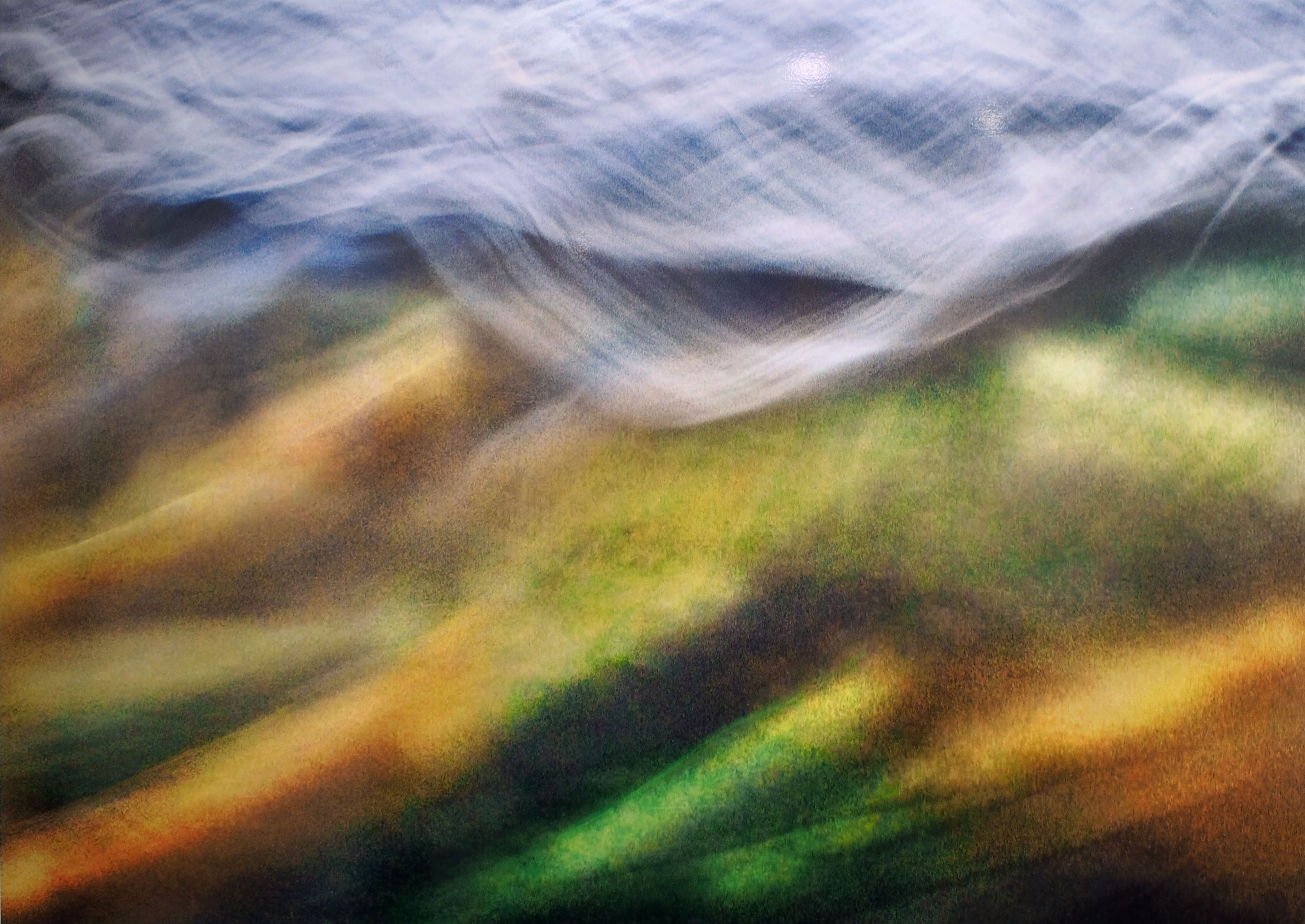
A photograph by Pauline Neilsen
.
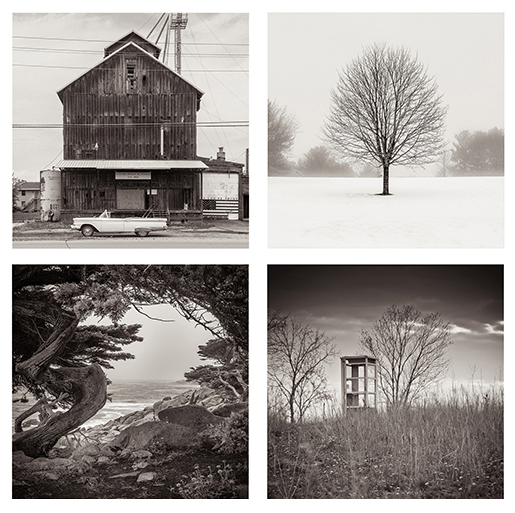
Four photographs by Michael Knapstein
.
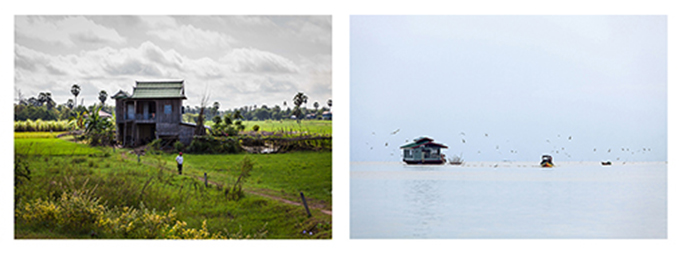
Two photographs by Gavin Brown
.
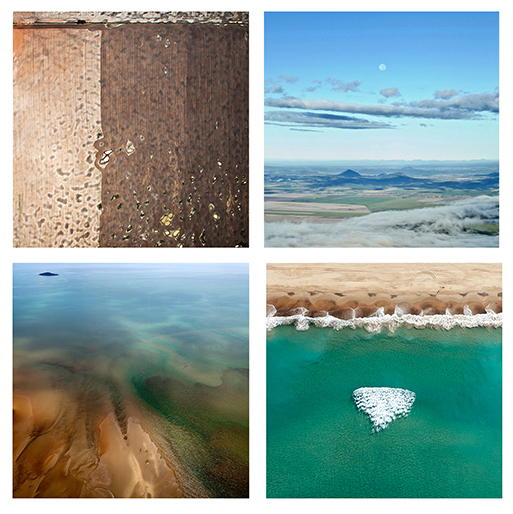
Four photographs by Robyn Hills
.
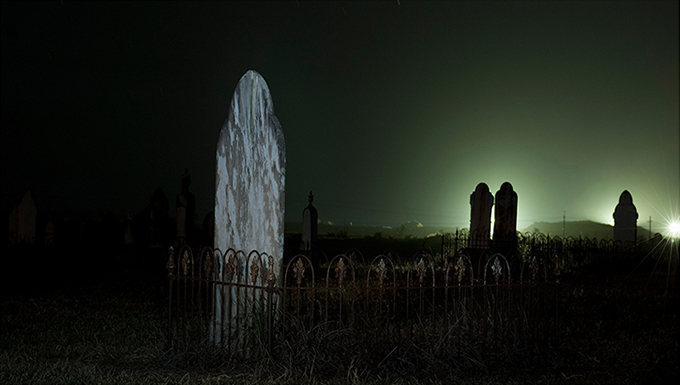
A photograph by Ann Vardanega
.
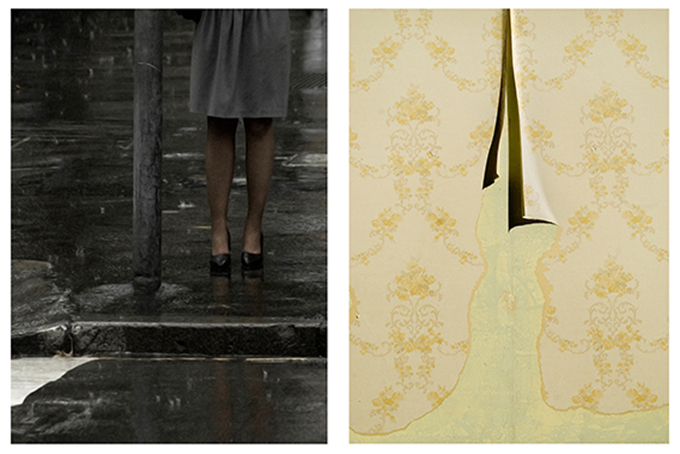
Two photographs by April Ward
.
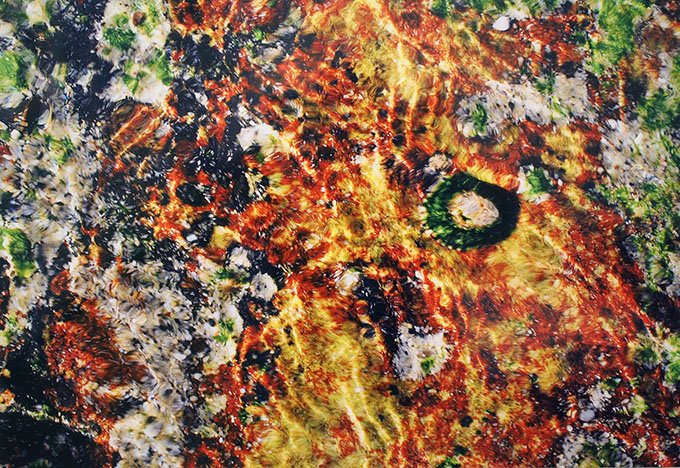
A photograph by Beatriz Vargas
.
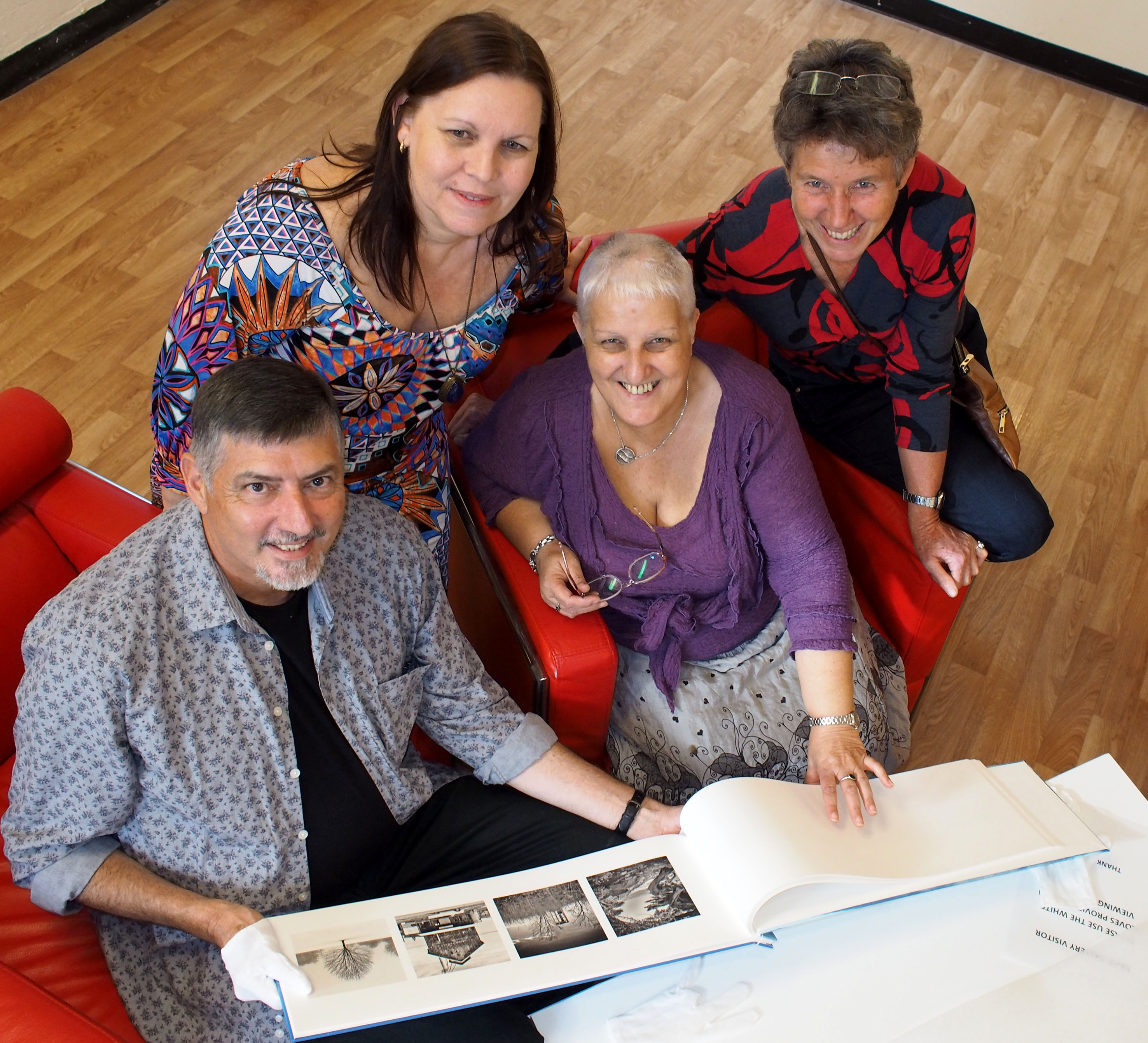
Doug Spowart with Ann Vardanega, Dawne Fahey and Pauline Neilsen
.
.
.
.
The photographers retain all copyright in their photographs. Some texts are derived from exhibition documents. Text and installation photographs © 2014 Doug Spowart and Victoria Cooper
.
.
.
CAN ART BRING CLOSURE TO COMMUNITY TRAGEDY?
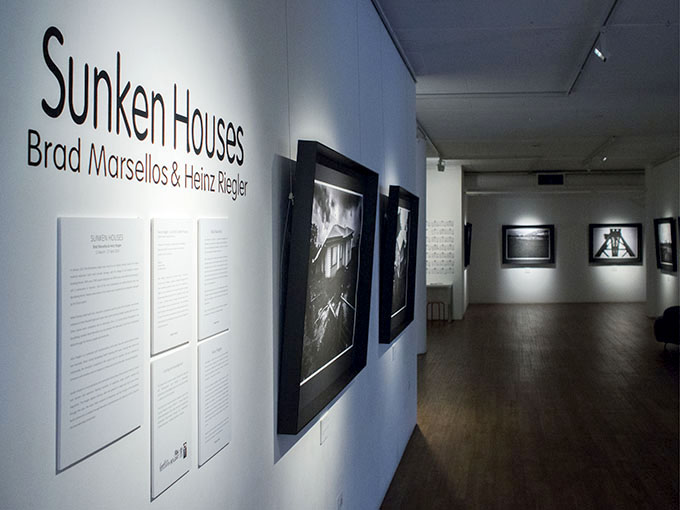
Sunken Houses Didactic panels
.
CAN ART BRING CLOSURE TO COMMUNITY TRAGEDY?
The exhibition SUNKEN HOUSES by Brad Marsellos and Heinz Riegler, Bundaberg Regional Art Gallery, March 12 – April 27, 2014
I’m standing in a dimly lit gallery surrounded by large-framed dark black and white photographic images. A somber soundtrack plays echoing the mood of the visual imagery. From outside the sound of rain pelting down enters the space and mingles with the exhibition’s audio. Rain is a sound that may normally not present a concern, particularly in a country frequently in drought, however the exhibition before me represents the effect that significant rain and runoff can have on our communities.
.

Gallery installation
.
Just over twelve months ago, after days of torrential rain, the Burnett River at Bundaberg broke its banks submerging residential and commercial properties across the town. River cities historically deal with these events, however on this occasion the power of the river, and the duration of the flood, meant that after the water’s subsidence a significant area of urban space was obliterated. North Bundaberg suffered the most with houses washed off stumps, crashed into other homes and disappeared. What was left was utter devastation and a community dislocated, angry and in shock. The flood torrent had taken homes, belongings and also the sense of place and comfort that one feels in ‘being at home’.
Over those days the town had its heart wrenched from its foundations. Recovery, rebuild and move-on are the common expectations that usually follow such calamities. Government agencies and support groups rally in an attempt to facilitate the renewal and regeneration. However underlying the good works there still lingers memories, emotions and an all pervading the sense of loss.
When a community hurts the artist also shares that feeling and they may be called into service to make sense of, and perhaps through their art, help heal their community. So for local photographer Brad Marsellos, the story of the flood and the community became a 12-month project. Motivated to document and track the community’s response to the calamity Marsellos states he has: “… a strong passion for people and narrating lives, [and] believes photography allows the viewer to glance a moment in time and have the image take you on a journey.[i]”
The exhibition Sunken Houses, at the Bundaberg Regional Art Gallery, is the public presentation of Marsellos’ commitment to his community and this documentary project. In the gallery large black and white photographs are presented in wide bordered black frames. The photographs capture a sense of impending doom through dark dramatic light, and often-stormy clouds.
.

March – It happened months ago
.
The curatorship and gallery craft involved in this show intentionally creates a space for contemplation of, and connection with, images of a community still in the shadow of the flood. All lighting in the gallery is subdued with the images spot lit creating islands of light. The accompanying soundtrack is described by the artists as ‘an immersive and emotive score’, and pervades the senses of the viewer. The composer was Heinz Riegler, a multidisciplinary artist who lives and works between Europe and Australia. The musical score was designed by Riegler to not only compliment the photographs, but to also represent his personal response to the stories and emotions of the Bundaberg community.
.
.
Marsellos’ images go beyond the plethora of documentary and news images that were broadcast during the event and in its aftermath. These photographs, their presentation, and the musical score, work to touch directly with deeply etched memories of the flood. Writer and intellectual Susan Sontag in her book Considering the Pain of Others[ii], makes the observation that ‘pictures allow us to remember’. She adds that:
Harrowing photographs do not inevitably lose their power to shock. But they are not much help if the task is to understand. Narratives can make us understand. Photographs do something else: they haunt us.
.
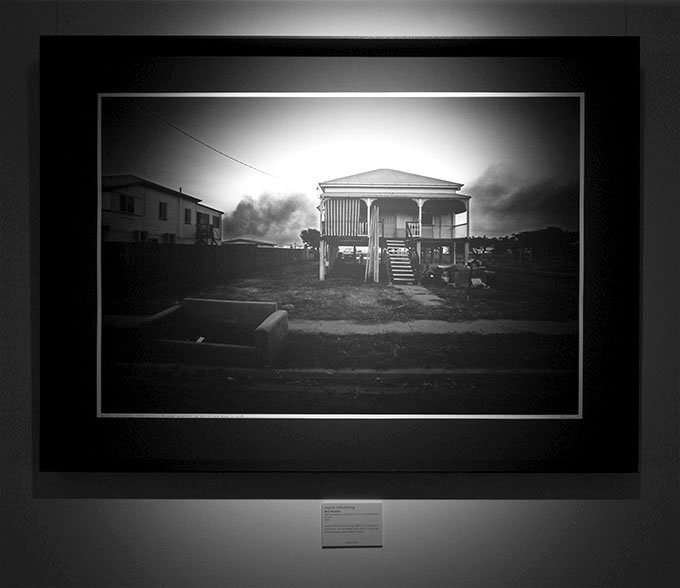
August – Still cleaning
.
On their own these photographs may haunt and shock. Usually the viewer would leave the room taking with them the emotional state that was created in the gallery space. But this exhibition is different, there is a ‘message wall’ set aside in the gallery for visitors to tell their story – to express and share how they feel. Visitors either added to the wall or paused to read the cards and reflect upon the comments already posted. Perhaps this is evidence of the relevance that, ‘narratives can make us understand’, as Sontag suggests.
.

Message wall
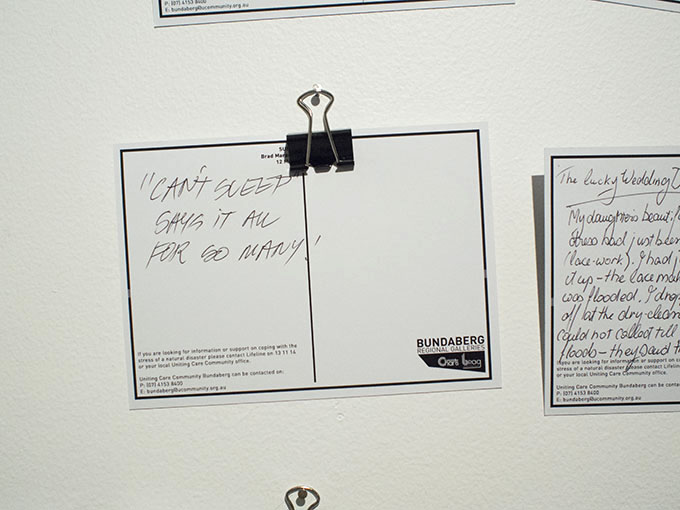
Comment card ‘Can’t Sleep’
.
While the curation of the images, space and the musical score drench the gallery with a sense of tragedy and loss, the ‘message wall’ gives a release to the emotive tension. The combinative effect then of the exhibition is to create an overpoweringly emotional cathartic experience. First proposed by Aristotle, later by others including Freud, catharsis is considered as a psychotherapeutic treatment. Aristotle defined catharsis as: ‘purging of the spirit of morbid and base ideas or emotions by witnessing the playing out of such emotions or ideas on stage.’[iii] An exhibition like Sunken Houses may re-connect the community with memories and their experience of the event and through that connection provide much needed emotional healing.
Does the exhibition then function in a cathartic way? A Bundaberg News Mail report on April 16, 2014 published online, reported that the exhibition attendance had at that time broken all gallery records and stood at 2,500 visitors. In the article Brad Marsellos made a number of comments relating to the response of locals and out-of-towners to the exhibition and their reaction to the show.
“Every time I visit the space I read the many stories, messages of hope, recovery and continued struggles by members of our town that have been touched by this natural disaster.”[iv]
“Everyone has an experience of the floods and tornados – whether it be as an observer from afar, a flood affected resident or someone who is still rebuilding both physically and emotionally today and I’m honoured to think this exhibition is assisting some with their recovery process.”[v]
At a time when it seems that the importance of art and artists in the community is being downgraded by government defunding of art agencies, grants and opportunities for art education, it is humbling to see the effect that art can have on the community such as this. While the images may live on in the memories of those who witnessed the Bundaberg floods of 2013, the sensory experience of image and sound through the art of Marsellos and Riegler, will represent a compassionate and empathetic contribution – one that made a positive difference.
.
Doug Spowart
20 April 2014
[i] Gallery didactic panel
[ii] Sontag, S. (2003). Regarding the Pain of Others. New York, USA, Picador, p.89
[iii] McKeon, R., Ed. (2001). The basic works of Aristotle. New York, Modern Library, p.1458
[iv] NewsMail. (2014). “Sunken Houses exhibition draws a crowd.” Online. Retrieved April 16, 2014, 2014, from http://www.news-mail.com.au/news/sunken-houses-exhibition-draws-crowd/2231539/.
[v] Ibid
.

Gallery visitor photographing the wall mural
.
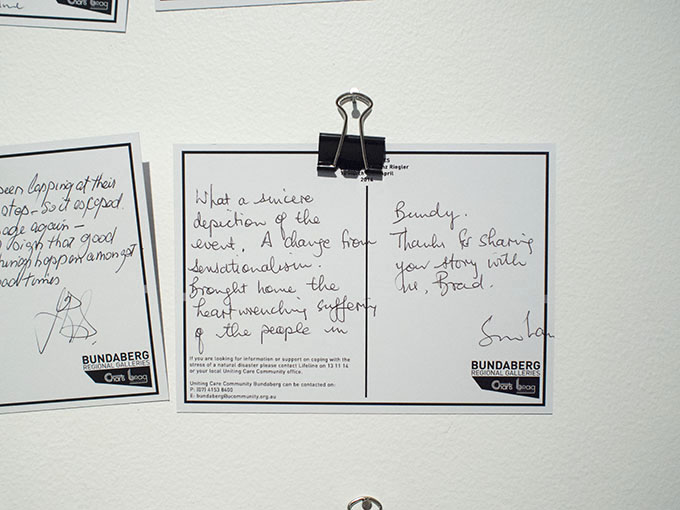
Comment card
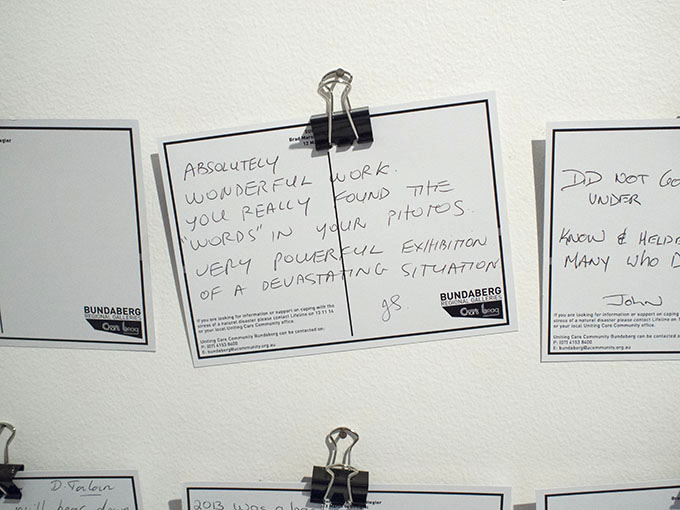
Comment card
.
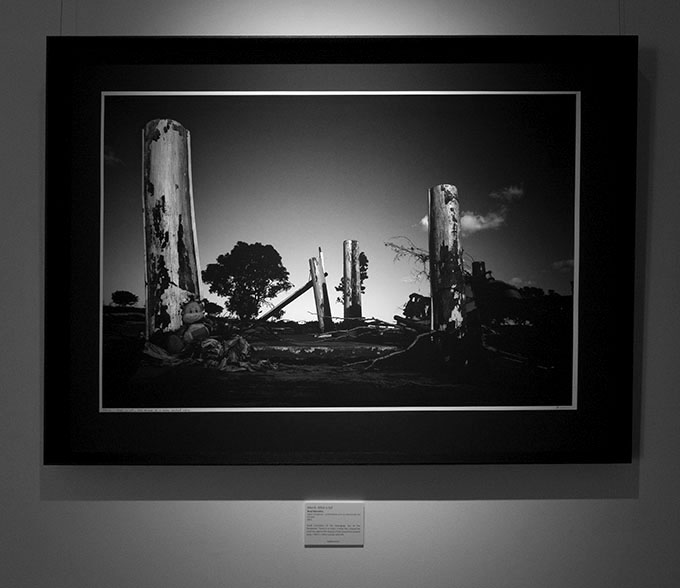
March – Is what it left

March – Anger
.
.
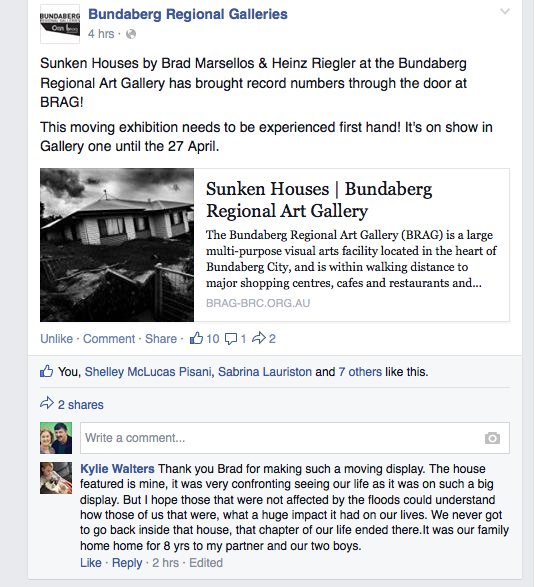
A Facebook Comment about Sunken Homes
.
.
OTHER LINKS:
http://www.news-mail.com.au/news/sunken-houses-exhibition-draws-crowd/2231539/
Sunken Houses photographs © Brad Marsellos © soundtrack Heinz Reigler.
Installation photos and documentation of the artworks and review text ©Doug Spowart
.
My photographs and words are licensed under a Creative Commons Attribution-NonCommercial-NoDerivs 3.0 Unported License.
http://creativecommons.org/licenses/by-nc-sa/2.5/au/
.
.
.
.
.
NOCTURNE BUNDABERG: A new community Facebook project
.
.
.
.
THE BUNDABERG COMMUNITY NOCTURNE
.
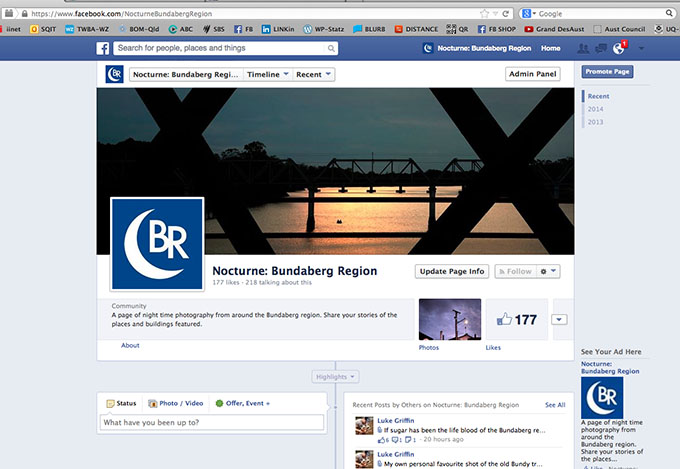
Nocturne Bundaberg Facebook Page
LINK TO FACEBOOK ‘Bundaberg Nocturne’
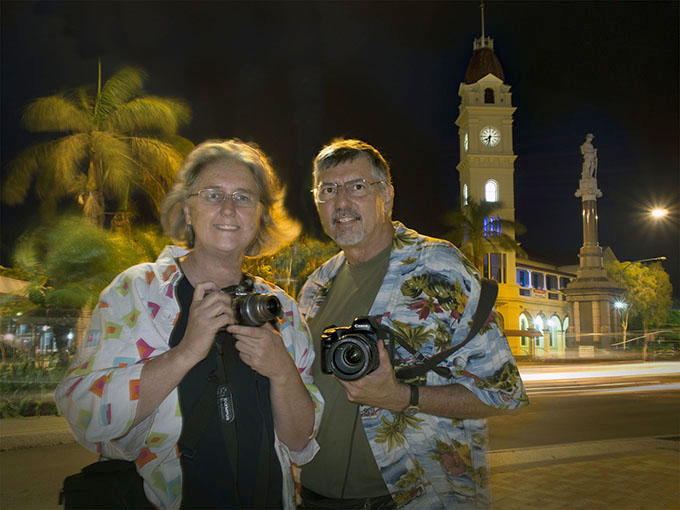
Cooper+Spowart in Bundaberg
.
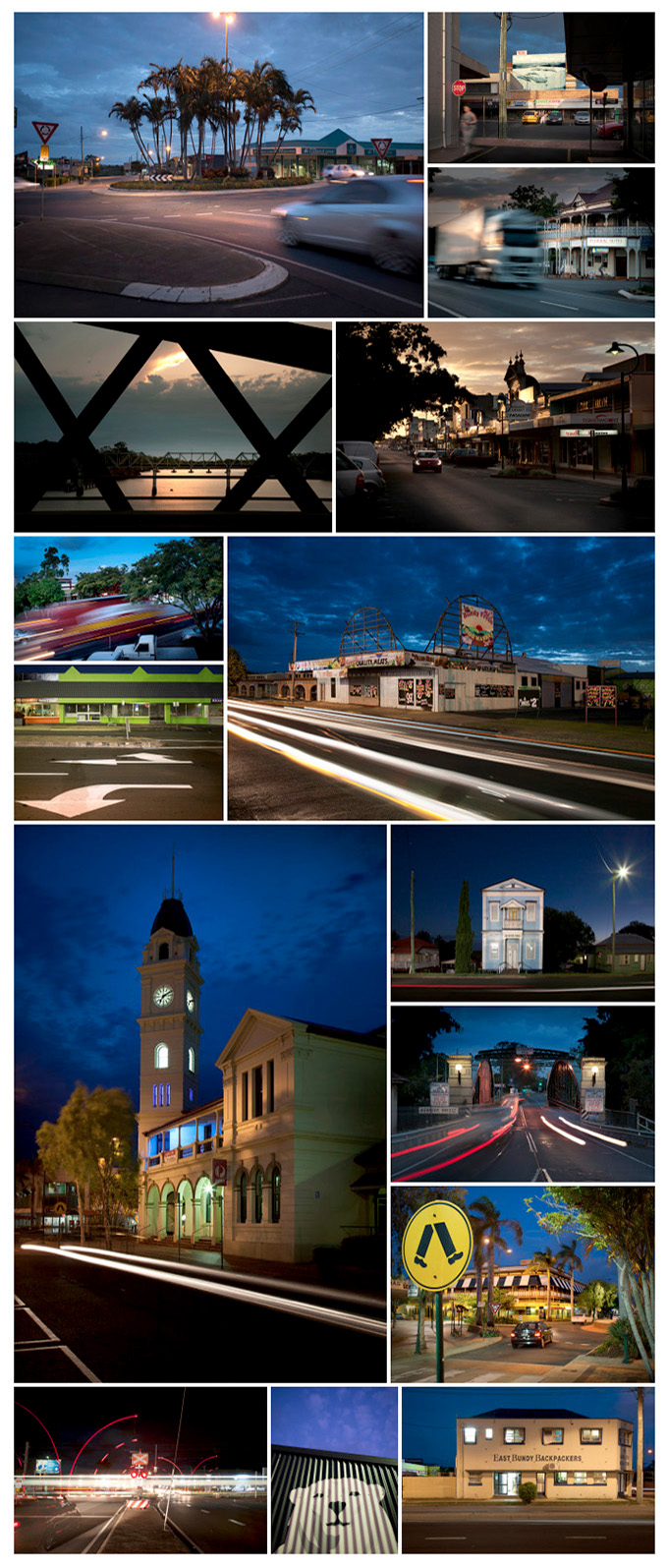
In our past Nocturne Artist in Residency projects in Grafton and Muswellbrook we were the photographers selecting and documenting place in the nocturnal light and then uploading the images of Facebook for community to see and comment. As part of the Queensland Festival of Photography 5 we were approached to undertake an Artist in Residency in the central Queensland’s Wide-Bay Burnett region. Centred on Bundaberg, Childers and local coastal towns, the project included an exhibition of our Nocturne works and a Facebook documentary project. On this occasion we decided to connect with local photographers to collaborate with us in the documentary project.
.
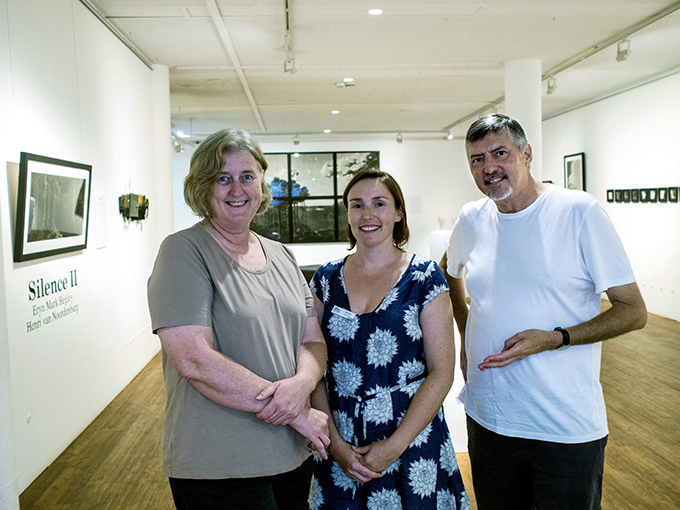
With Tudie Leigo BRAG Exhibitions Officer
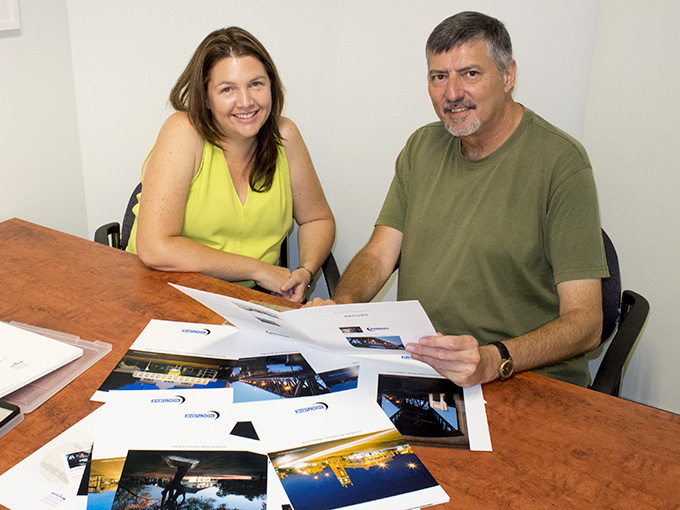
Talking about the project with Creative Region’s Shelley Pisani
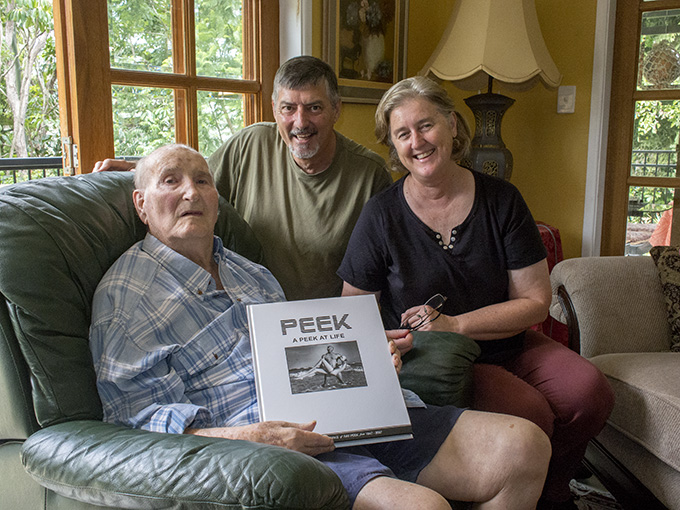
With Ray Peek
.
As a preliminary to the project we visited Bundaberg in early January and began initial documentary work. In the 1980s Doug had a significant connection with amateur photographers from the camera club movement in Bundaberg. For some time he had contact with the region’s photo guru Ray Peek so a visit to the hero of the Bundaberg’s photography scene was a necessity. So too was a connection with Shelley Pisani from Creative Regions and key people from the Bundaberg Regional Galleries including exhibitions Officer Trudie Leigo. The Facebook site was established, initial images were uploaded and ‘Page Likes’ attracted.
.
.
On our return in April we met with the group of Bundy photographers that applied to work with us through a formal Expressions of Interest process. A special Nocturne photography introductory workshop was conducted at which techniques and workflows were discussed and demonstrated. Of particular concern were issues to do with personal safety and security. Then the photographers were set loose to shoot subjects of personal interest, optimise them and upload to the Nocturne Bundaberg Region Facebook page. Within a few days the Facebook page had 180 ‘Likes’, numerous comments, shares and 3,500 views. Via an online group photographer participants were provided with support, feedback and mentoring to enhance their photoimaging skills. Although many are accomplished photographers, we were happy to work with those that required assistance or to review work when requested.
.
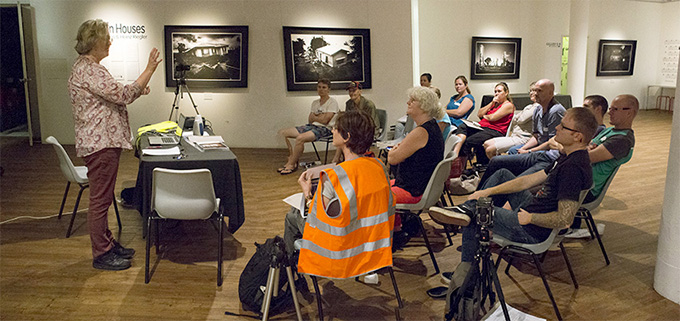
A briefing with the local photographers
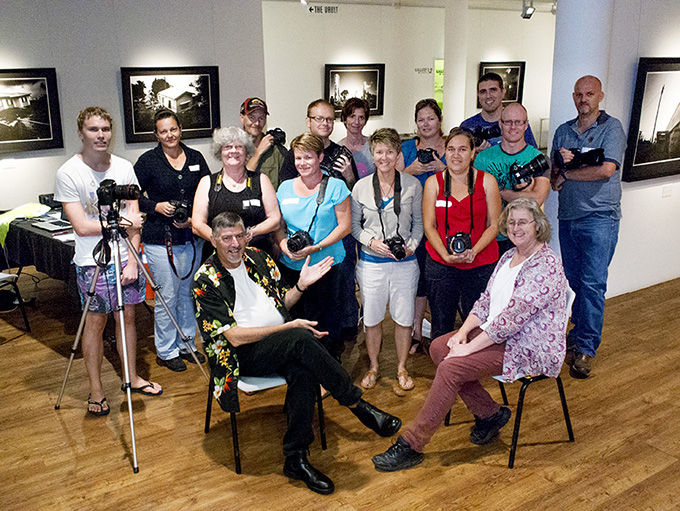
The local photographers
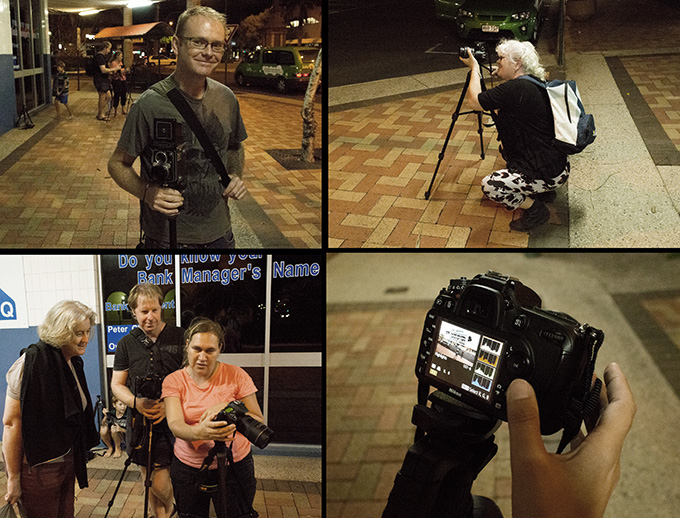
Some of the local photographers on a shoot out
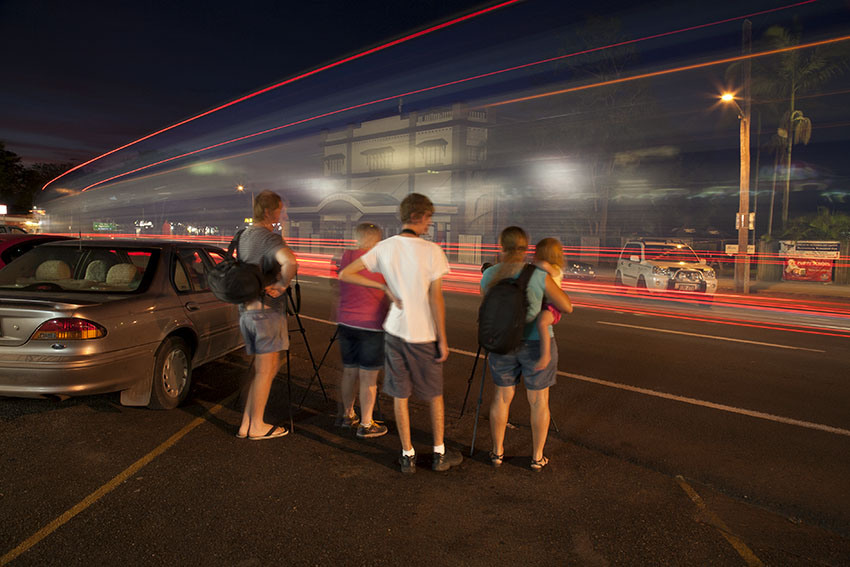
Project photographers working with us at Childers
.
On Saturday the 12th of April our exhibition ‘Speaking About Place’ was opened at CHARTS gallery in Childers and the Bundaberg Regional community was fully engaged in the project. Over the next few weeks the addition of new photographs will continue and the community will be invited to begin a new dialogue about the region. They will, through the Nocturne Bundaberg Region project, be ‘Speaking About Place’.
.
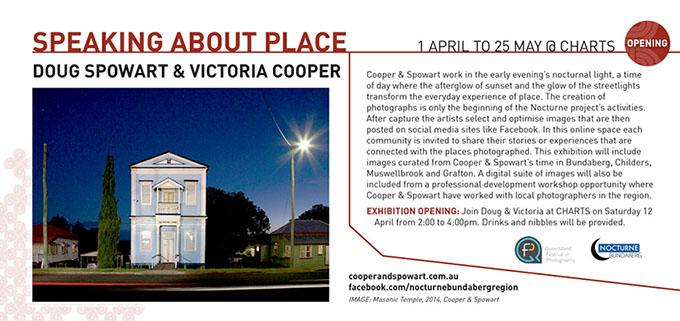
“Speaking About Place’ invitation
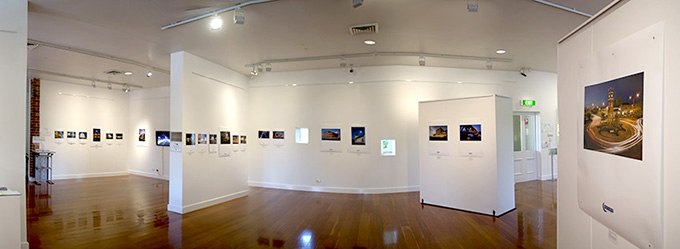
CHARTS Gallery installation
.
The project will continue as a Facebook page and from this community resource may emerge exhibitions, books and other online opportunities. It is envisaged that many of the local photographers will make available images to the ‘Picture Bundaberg’ Archive, which is administered by the Bundaberg Regional Libraries.
.
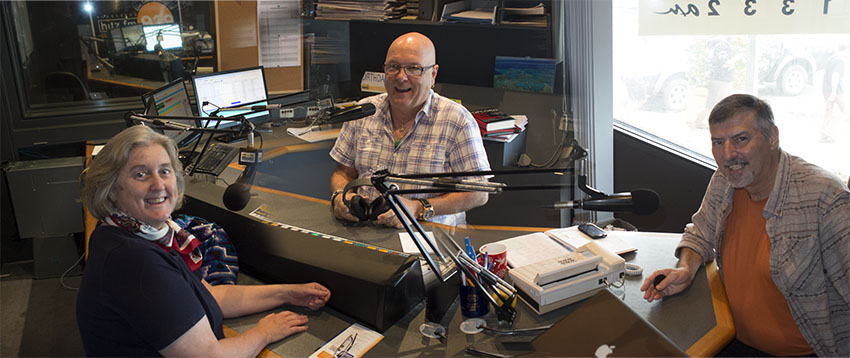
Talking about or project on air with Billy Healy at radio 4BU
The Nocturne Bundaberg Region Media Release follows:
.
Speaking About Place: The Nocturne Project
Speaking About Place – an exhibition of collected images from The Nocturne Projects from Muswellbrook to Grafton as well as images from the Bundaberg region. Nocturne Projects showcase a variety of photographs highlighting the beauty of the early evening and its nocturnal light. Speaking About Place will be on show at the Childers Art Space (CHARTS) on Saturday 12 April in conjunction with the Queensland Festival of Photography 5.
Toowoomba-based photographers Doug Spowart and Victoria Cooper work in the early evening’s nocturnal light, a time of day where the afterglow of sunset and the glow of streetlights transform the everyday experience of place into something magical. Photographs created at this time require long camera exposures and therefore produce images that can capture blurred movement of people and vehicles.
“An important aspect of the Nocturne aesthetic is the affect of colour in different light conditions: ambient daylight, artificial lighting, car head and tail light trails. These images create a sense of drama, something that you’d generally see in a setting for a movie scene. It’s a place where stories could be told or evoked” Mr Spowart explained.
Spowart and Cooper initially visited Bundaberg early January to commence stage one of their Artist in Residence at the Bundaberg Regional Gallery. As part of the Speaking About Place exhibition, Nocturne Project: Bundaberg Region has selected 21 photographers from across the region to work alongside Spowart and Cooper through April. Photographers will have the opportunity to gain invaluable nocturnal photography skills from two leading artists. After the initial capture the artists select and optimize images that are then posted on social media sites like Facebook. Selected images will also be digitally displayed during the Speaking About Place exhibition.
“If a picture is worth a thousand words, how do you gather the thousand words from a community by showing them pictures of where they live? We aim to extend the experience and ultimately perception of place in the Bundaberg region. These are just some of the questions we’ll be exploring with the local photographers” Ms Cooper said.
Speaking About Place will be officially opened by the artists Doug Spowart and Victoria Cooper on Saturday 12 April at 2:00pm at Childers Art Space (CHARTS).
The exhibition will be on show from 1 April to 25 May and more information can be found via www.brag-brc.org.au, www.nocturnelink.com, and the Nocturne: Bundaberg Region project page on Facebook: www.facebook.com/NocturneBundabergRegion
.
A Queensland Festival of Photography 5 exhibition and project

QFP logo
SWITCHING LANES: A new art show @ Uni of Southern Qld Gallery
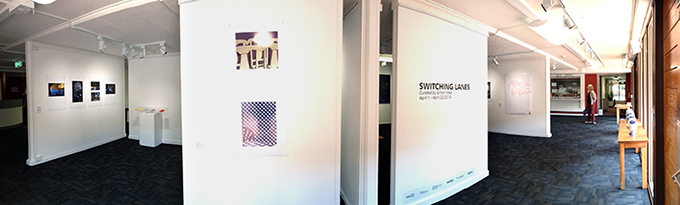
‘Switching Lanes’ at the USQ Arts Gallery – Entry showing works by Cooper+Spowart and Rachel Susa
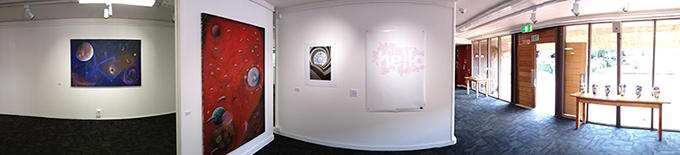
Works by Stephen Spurrier Alison Ahlhaus and Kristy Elliott
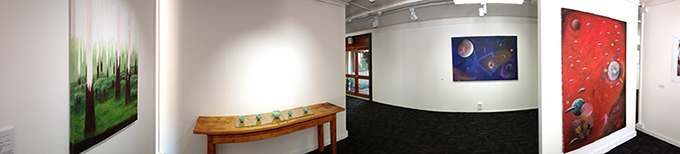
Works by Cathy Tame and Stephen Spurrier
.
Our camera obscura work and Centre for Regional Arts Practice Survey Books are included in this show.
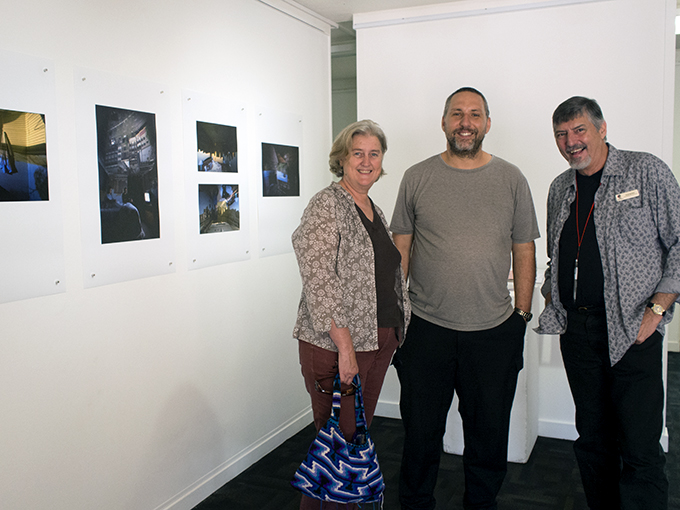
Curator Simon Mee and Vicky & Me PHOTO: Annie Mack
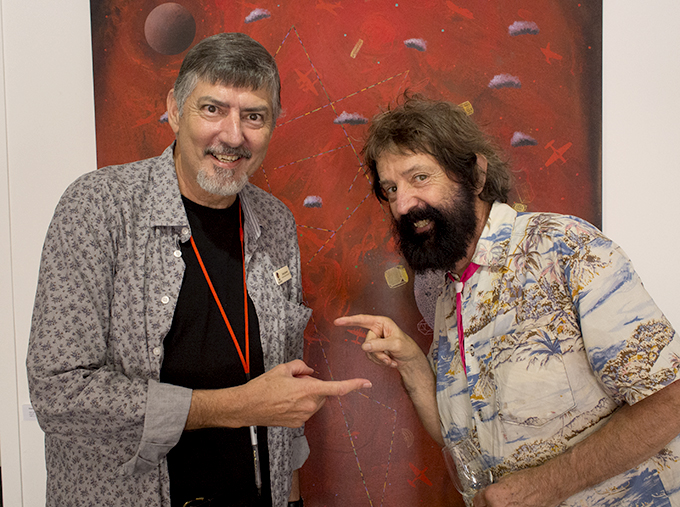
Stephen Spurrier + Me … PHOTO: Bev Lacey
USQ MEDIA RELEASE: Shining a light on the art behind the teachers
WE KNOW they must be good at their craft, right? After all, they are the ones responsible for teaching tertiary students in this region all about sculpture and painting and drawing and photography and graphic design and ceramics. They are the best in their fields. But all too often the artistic endeavours of our local educators is not seen by audiences because they are simply too busy to exhibit, or reluctant to sing their own praises, or far too focused on the raising the profile of their students’ work instead of their own. That’s where Simon Mee – Associate Lecturer (Collections Curator and Arts Management) at University of Southern Queensland steps in.He is curating an annual series of exhibitions featuring the artist behind the teacher.
Last year it was the work of local high school teachers that was showcased in an exhibition called “Not Just A Day Job”; this year the light will be shone on our tertiary educators in the “Switching Lanes” exhibition opening in the USQ Arts Gallery on April 1. “I don’t think we always get to see the art behind the educator,” Mr Mee said. “But an exhibition series like this allows teachers in the area to engage with each other and support the value of what we all do. “It’s also good to flip things over and show students what teachers can do and let the teachers lead by example.”
The “Switching Lanes” exhibition does not have a theme – artistic educators from USQ, the Bremer and Southern Queensland Institutes of TAFE were given carte blanche to create what they want. This approach guarantees enjoyment for audiences – there may be a few surprises amongst the artworks – but also provide the greatest learning opportunities for students.
“The upside for students is that they get to see artists push and play with their craft,” Mr Mee said. “It’s living practice, – it will have a raw edge – and if it’s a disaster, then students will learn from seeing that as well. Art is not about creating a product, but about taking risks and growing. It’s all about doing what you love.”
Switching Lanes will open at the USQ Arts Gallery on April 1, and run from 9am to 5pm, Monday to Friday, until April 23. Entry is free.
.
.
.
SPOWART: One of Bill Henson’s ‘WILDCARDS’
.
The exhibition WILDCARDS at the Monash Gallery of Art closed today. I was wanting to prepare a post that gave some backstory to my work that was selected by Henson to be in the show. I’ve been very busy, so I have not been able to prepare the full story. Later …
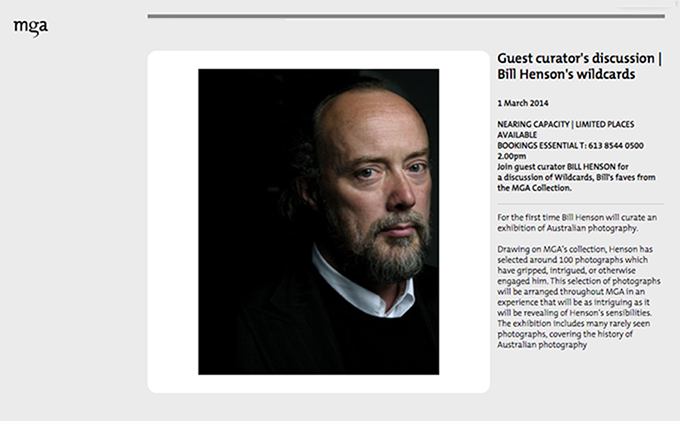
For the first time Bill Henson curated an exhibition of Australian photography.
Drawing on MGA’s collection, Henson selected around 100 photographs which have gripped, intrigued, or otherwise engaged him. This selection of photographs was arranged throughout MGA in an experience that will be as intriguing as it will be revealing of Henson’s sensibilities. The exhibition includes many rarely seen photographs, covering the history of Australian photography.
.
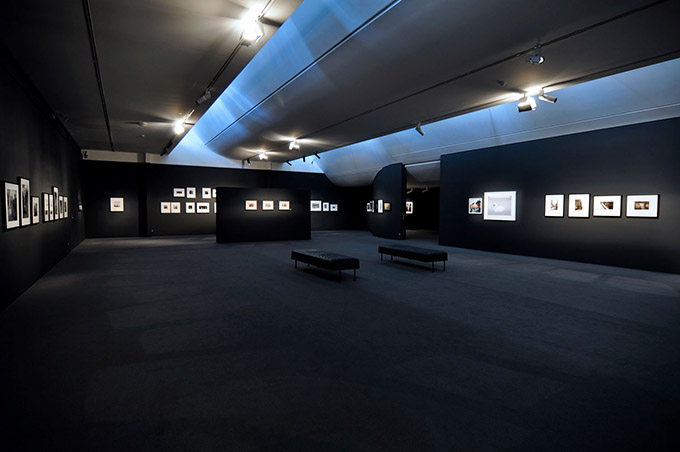
The Monash Gallery of Art WILDCARDS Exhibition – The walls were painted black!
”All environments are immersive and so my intention, in so far as I am able, is to simply modulate the space, including changing the wall colour, the lighting and, of course, the placement of works so that enough ‘sympathetic’ space opens up for an unexpected intimacy to develop and, ideally, for the experience for others to be one which is powerfully apprehended but not necessarily fully understood.” Bill Henson about WILDCARDS.
.
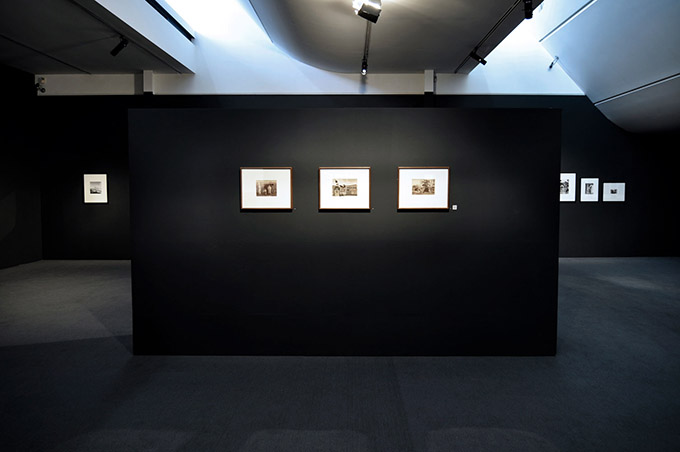
My work between two 1880s Fred Kruger photographs from the outback of Indigenous people.
My photograph …
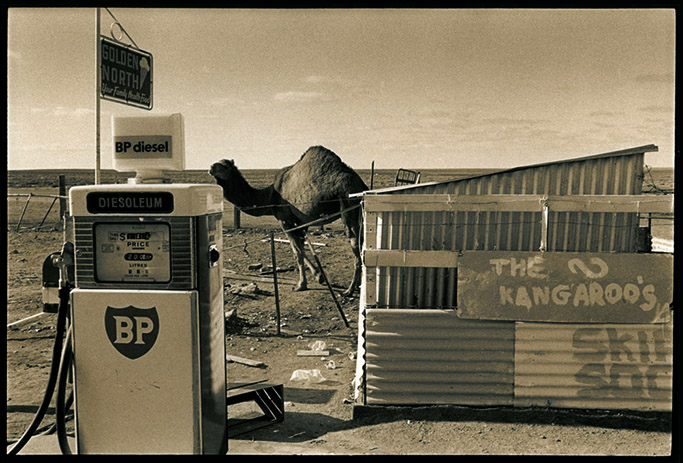
Doug Spowart photograph
.
South of the border, Woomera 1983
sepia-toned gelatin silver print, printed 1986
Monash Gallery of Art, City of Monash Collection
acquired 1986
MGA 1986.44
.
Hensons WILDCARD List of works
.
Images: Courtesy of the Monash Gallery of ArtP. Photographs: Katie Tremschnig
.
.
.
.
ROAD RAGE ART: 6 Artists from out of Nowhere
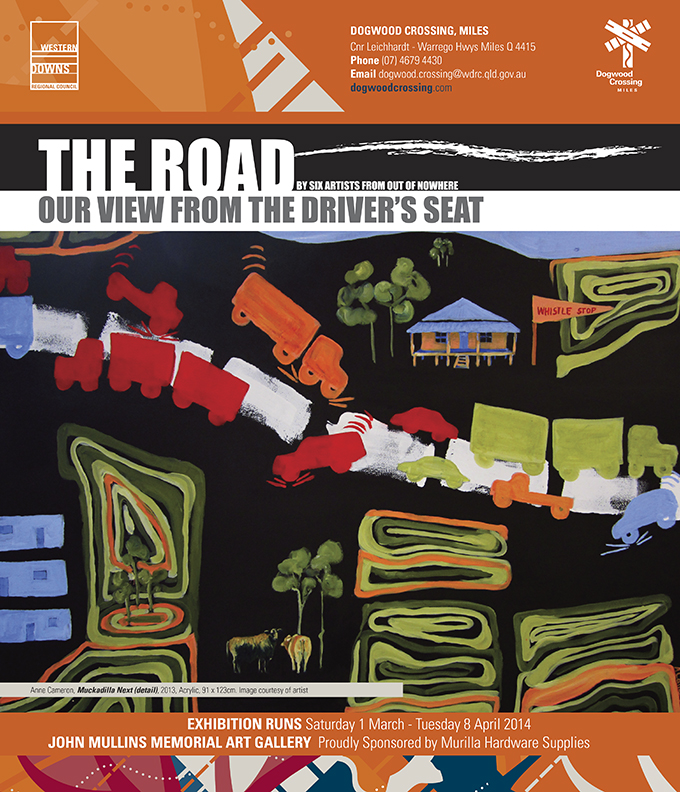
The Road: The veiw from the driver’s seat Poster
.
THE ROAD: Our view from the driver’s seat
Dogwood Crossing Gallery, Miles, March 1 – April 8, 2014
.
“Nothing behind me, everything ahead of me, as is ever so on the road.”
Jack Kerouac, On the Road
.
Roads are places where the past is viewed in the rear vision mirror and the future viewed through the windscreen. But what is that future? And how far can we see into it? An exhibition at the Dogwood Crossing Gallery presents a view from ‘the driver’s seat’ of the Warrego Highway in southern Queensland and it seems like a pretty hopeless place looking either from the windscreen or the rear-view mirror for that matter.
.
Created by the activist art group 6 Artists From out of Nowhere the place specific artwork snakes and curves its way along the gallery wall with sections of the painting that vary much like the way road surfaces change from shire to shire or road contractor to road contractor. For readers who are not conversant with the nature of Queensland roads: the Warrego Highway passes through the Darling Downs, was once an artery of transportation between the city and the country. Now it has become a congested, clogged and rubbish-strewn vein due to the expansion of the Surat Basin’s extractive mining projects. Everyday masses of material, pipes, personnel and machines use this highway.
Massive flooding that occurred over recent years and the abuse of heavy transport has meant many sections of the road are under constant start-stop traffic controls systems while being patched, repaired and upgraded.
The 6 Artists from out of Nowhere are country people connected to the land. Their lives and livelihoods are being challenged, by the demands of mining to access and transform land use and also transform the once familiar and reliable road systems. The artists are not happy with this situation. They state: ‘the highway has become so busy and so dangerous that we felt compelled to comment in paint.’ The exhibition is simultaneously a report and a shout for an improvement to the circumstances of those who no other option than to use this thoroughfare.
.
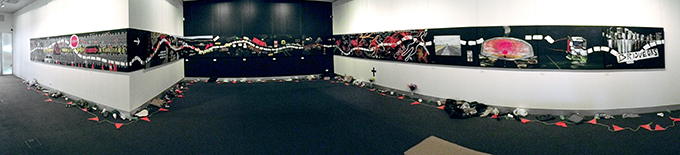
The ‘Road’ installation in the Dogwood Crossing Gallery
.
On a plinth in the middle of the gallery floor the sculptural forms of two trucks by Wally Peart pass each other on a highway. One carries pipes for the coal seam gas corporations, the other carries products on the land – their paths cross only millimetres from each other and yet the narrative of each is something that is shared only by the presence of the road.
.
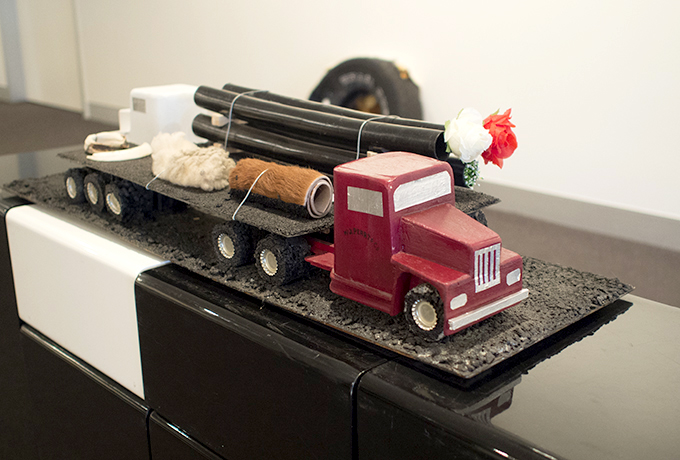
Wally Peart’s sculpture
.
As the gallery visitor travels along the highway artwork, familiar symbols, signs and fleeting glances of things that flit past one’s eyes when travelling at 100 kilometres per hour emerge. The artist Barbara Hancock has painted an endless line of lollypop stop-go men and women who demand your courtesy waive or salute ‘thanks’ as you allowed to proceed. Traffic lights enable a quick drink, or a check of phone text messages, or just time to contemplate the journey. While in the rear-view mirror a shimmering chrome grille and bull-bar of the huge road train rumbles behind you in the queue. Orange-capped witches hats sit comfortably along the edge of the road, in this case the canvas, and a police car decked out in harlequin waits and waits … Stop, DETOUR, STOP!
.
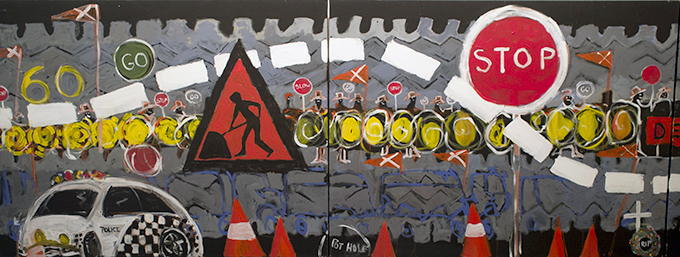
Barbara Hancock (Detail)
.
A transition to the next road section by artist Anne Cameron presents a line of colourful truck silhouettes traversing a landscape of contour-ploughed primary producing farmland that is paired with a crop-like grid of dongas – accommodation boxes for the weary miners. An occasional car or tuck slips off the road, an old farmhouse and a lonely fisherman by a stream appear oblivious to the processionary caterpillar grub road activity.
.
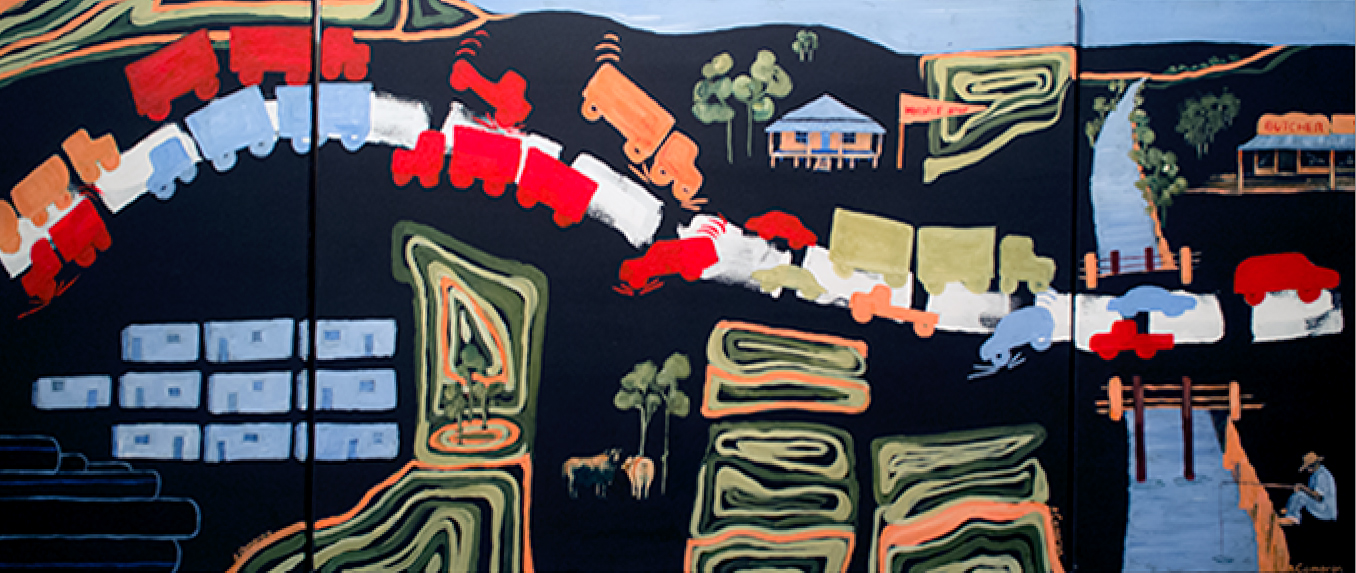
Anne Cameron (Detail)
.
Elizabeth Corfe introduces her section with road signs of all kinds errected for the safety of all road travellers. The classic Australian house name ‘Emoh Ruo’ (our home) is being subjected to a clearing sale and the spirit-like form of a dead kangaroo hangs from a forked tree branch.
.
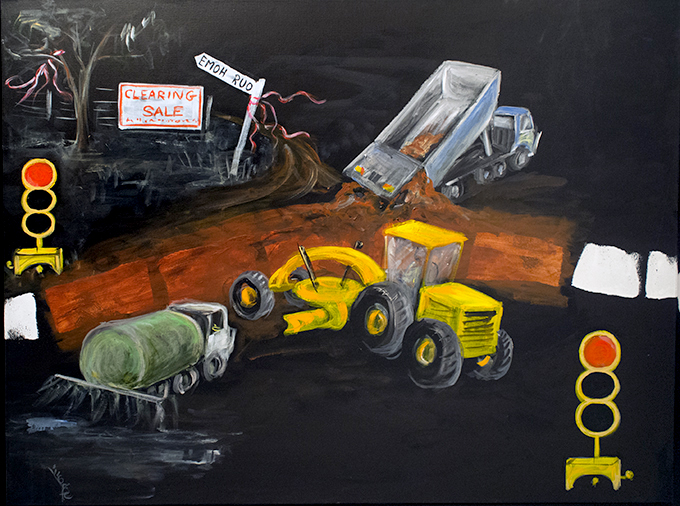
Elizabeth Corfe (Detail)
.
The road goes on to artist Sandra Allen’s section. Amongst the black bitumen and red dirt of the road wrecking and making machinery are blood red splashes of road kill and the white chalk outlines of police markings around human road fatalities. Messages cite the author’s claim that: ‘city engineers build country roads … disaster’ and, ‘city drivers in the country cause accidents by tailgating’. The text ‘your next’ accompanies an arrow pointing menacingly at an anthropomorphised kangaroo with joey in her pouch, and the vehicle names of Toyota, Avis and Kawasaki are the perpetrators.
.
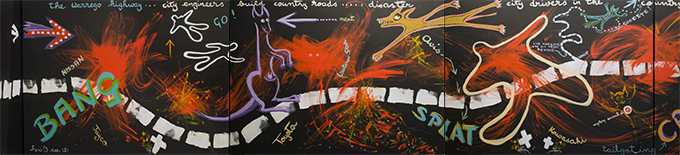
Sandra Allen (Detail)
.
The road goes on to artist Sandra Allen’s section. Amongst the black bitumen and red dirt of the road wrecking and making machinery are blood red splashes of road kill and the white chalk outlines of police markings around human road fatalities. Messages cite the author’s claim that: ‘city engineers build country roads … disaster’ and, ‘city drivers in the country cause accidents by tailgating’. The text ‘your next’ accompanies an arrow pointing menacingly at an anthropomorphised kangaroo with joey in her pouch, and the vehicle names of Toyota, Avis and Kawasaki are the perpetrators.
.
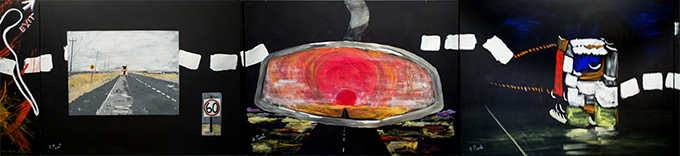
Helen Peart (3 panels)
.
Allen’s bold and provocative canvas road ends at Helen Peart’s simple high key painting of a road view. The limited yellow and grey palette contrast the black and red of the last section – the speed sign says 60kpm and a sunset in the west viewed from the rear-view mirror ends the day. The dark night follows where the bright light chimera of a truck’s of lights zooms past. We are nearly at the end of the road and the reflected lights of the big city, entitled BRISVEGAS, seem almost placid in comparison with what has been experienced in the gallery journey. Is the big city aware of the struggle and the price paid … would they care?
.
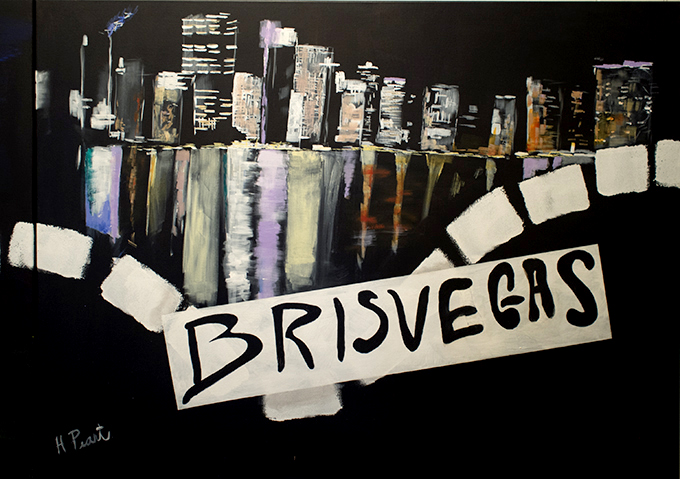
Helen Peart (Detail)
.
The lights maybe bright and welcoming and the 6 artists have got us safely to the city –––– but what about the return to our beloved Darling Downs? Can we ever go back … that may be another story? Perhaps as Kerouac comments in On the Road ‘There’s nothing behind, everything is ahead …’
.
Doug Spowart
12 March 2014
.
SEE the previous exhibition by the 6 Artists from out of Nowhere: https://wotwedid.com/2012/07/30/shooting-straight-regional-artists-as-provocateurs/
.
The artists retain all copyright in their artworks. Text and installation photographs © 2014 Doug Spowart
.

 wotwedid