Archive for the ‘Awards’ Category
DOING IT BY THE BOOK: Judging the 2015 Momento Pro Australian Photo Book Awards
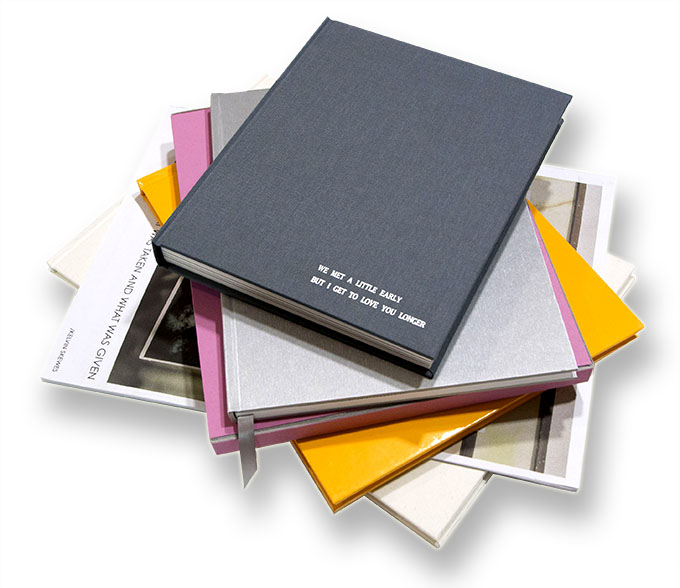
The 2014 Australian Photobook of the Year Finalists stack
On the 30th of January six identities from the Australian publishing and photography scene gathered in Sydney to review a selection of the best photo books from Australian authors and to select a recipient for the title Momento Pro Australian Photo Book of the Year. Prior to this event 100 books had been submitted in the award by Australian photographers working in a wide range of book forms that employ photography.
The judges for the award were: Shaune Lakin (Curator of Photography @ National Gallery Of Australia), Diana Hill [Publisher @ Murdoch Books), Sonya Jeffery (Books at Manic), Kim Hungerford (Art and Design Consultant and Buyer @ Kinokuniya), Michael Howard (Joint Art Director @ Sydney Morning Herald) and Doug Spowart (Research Fellow – Australian Library of Art, State Library of Queensland).
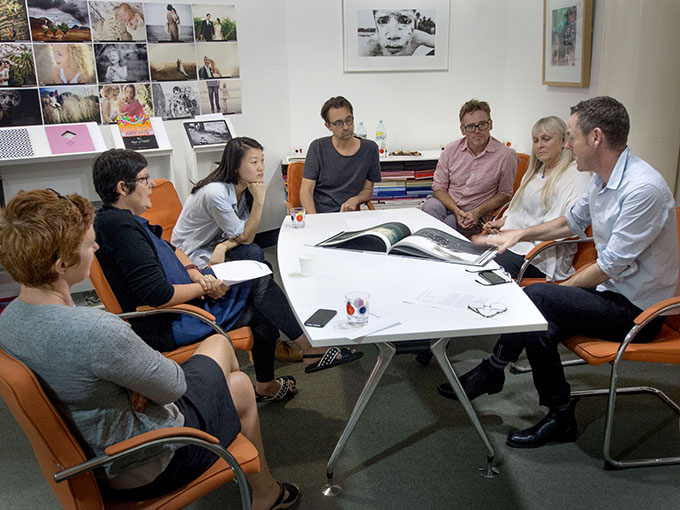
The judges deliberating PHOTO: Doug Spowart
The process started 10 days earlier when the judges were sent a USB drive containing the 100 PDF files. Within a few days the judges were to review the files and select their top 12 books. These results where then collated by the Momento Pro team to give 15 finalists. They were:
- Gold Coast Ying Ang
- Nonna to Nana Jessie + Jacqueline DiBlasi
- Typhoon Stephen Dupont
- Better Half Jackson Eaton
- Lover of Home Odette England
- The Beginning Brendan Esposito
- The Kings of KKH Andrea Francolini
- Bedrooms of the Fallen Ashley Gilbertson
- Tribal PNG David Kirkland
- In the Folds of Hills Kristian Laemmle-Ruff
- Don’t Just Tell Them, Show Them Jesse Marlow
- SALT Emma Phillips
- Nauru: What was taken and what was given Kelvin Skewes
- We Met a Little Early But I Get to Love You Longer Raphaela Rosella.
- Fibro Dreams Glenn Sloggett
Of these finalists, one book was published by an academic institution, three were published through an independent publisher and two were unpublished – the remaining books were self-published. The diversity of subject matter covered by the books included a portraiture and documentary cookbook, ethnographic documentary, social documentary, conceptual projects about human relationships of place and memory, books about irony and humour or glimpsed juxtapositions of subjects seen and photographed in the street. The books mainly fitted the conventional codex model and were trade printed and bound. One ‘photo book’ was a newspaper styled publication, and another was a deluxe artists’ book laparello of an exceptionally large size.
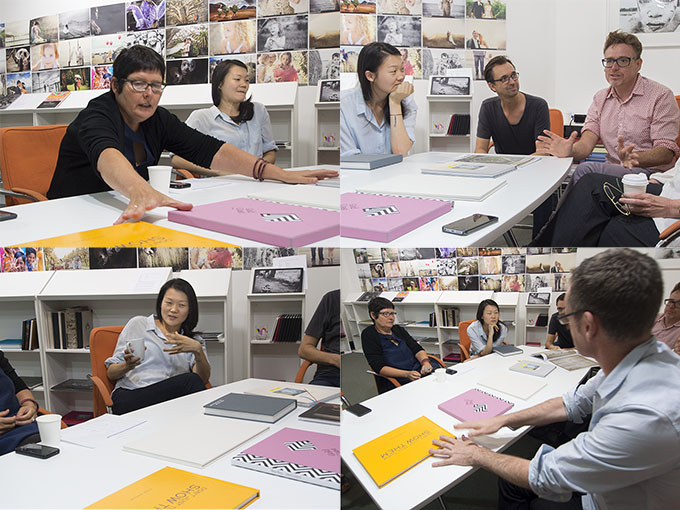
More debating … PHOTOS: Doug Spowart
As the judges came together at the Momento Pro facility in Chippendale they introduced themselves and participated in briefings conducted by Chairman of Jurors Heidi Romano, Director of Photo Book Melbourne and Libby Jeffery from the award sponsor Momento Pro. Then each judge engaged with the books – turning pages, cracking spines, smelling paper and inks, looking, reading, touching and connecting with the narrative and the experience that each book may contain. As all books were originally seen as digital images on screen there were some surprises as the digital version presented quite different experience to the physical printed book.
At this time individual conversations took place, ideas and responses to books shared. Opinions about photo books expressed and probed. Some of the key discussion points related to questions like ‘What is a photo book?’, and the validity of certain book topics and forms like cookbooks, newspapers, grand artists’ book productions – were they able to be considered as photo books? This part of the process was useful as it enabled a range of ideas to emerge from the broad views and experience of the judging panel.
The six judges then gathered around a large table – each book was presented for discussion at the end of which a vote was made as to whether it would be held-over in a ‘for further consideration’ stack or not. The discussions enabled each judge to express their experience of the book, opinions about narrative, sequencing, design and typography, production values as well as how the books ‘fitted’ with the idea of the photo book. One interesting consideration was the suitability of the book’s format, design and structure as a container to hold and present the narrative.
Some of the other discussion points that emerged included:
- A trend which is emerging where the cover of the book has no photograph on it or minimal text to identify it;
- The absence of the author’s name on the cover of the book;
- The length of the book – many books the judges felt were just too long;
- The editing and sequencing of images – many judges felt that they’d like to have done a review of the book to give an opportunity for the great photos and story to be more effectively told;
- Texts within books need quality editing as well;
- Aspects of book size and binding – a concern was ‘whether the physical nature of the book gets in the way of its storytelling potential’;
- Design features that do not support the narrative; and
- Ethics in documentary photography in relation to what level of personal information about the subject is OK to disclose in a book.
As a result of this judging segment the 15 finalists were reduced to six books. These books were interrogated further with particular attention being paid to the expectation that a great photo book should create, as it is activated by the viewer/reader, a moment where the book’s design, photographs, texts, layout, sequencing all combine to express a powerful statement, narrative or emotional response.
Of these six books selected Heidi Romano was to comment that ‘they were equal to any of the world’s current great photo books’. One final review and discussion needed to follow to select the ultimate title winner. This was preceded with discussion regarding the message that awards like these make to the photo book community about what constitutes exemplary work. The participating judges recognized the importance of this aspect of the final award selection. Ultimately all of the books were given highly commended awards with Kelvin Skewes’ Nauru: What was taken and what was given being awarded the title of Runner Up. First prize was awarded to Raphaela Rosella’s We Met a Little Early But I Get to Love You Longer book. Although unpublished the book had been printed and bound by the Momento Pro team to the author’s specifications. It featured personal narratives written by young mothers, the design and page-turning/text sequencing, powerful imagery and the inclusion of personal notes and letters extended the story and loaded the emotional response potential for the viewer.
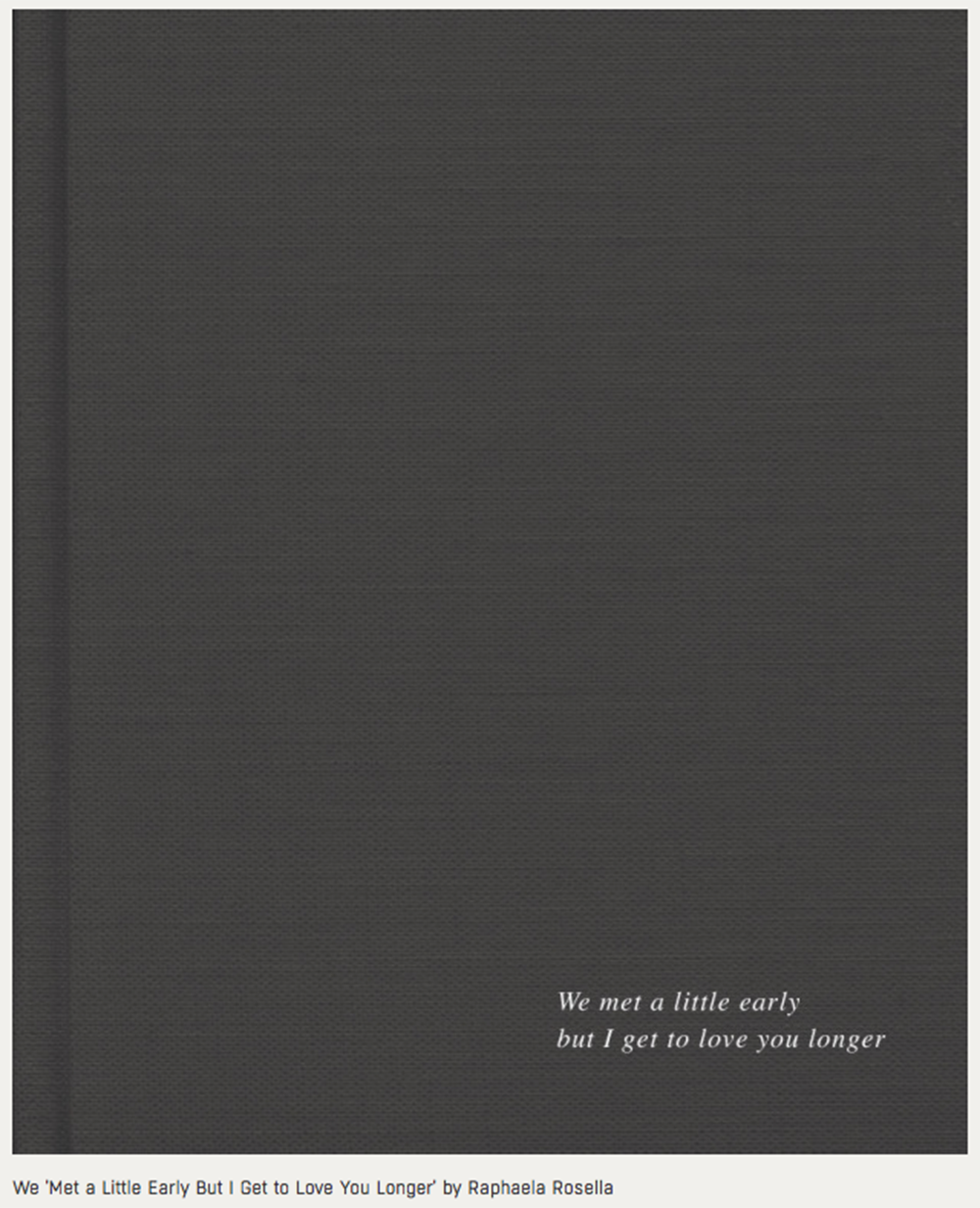
We Met a Little Early But I Get to Love You Longer Raphaela Rosella
Images and words from this book are available HERE: RAPHAELA_ROSELLA-We_met_Book
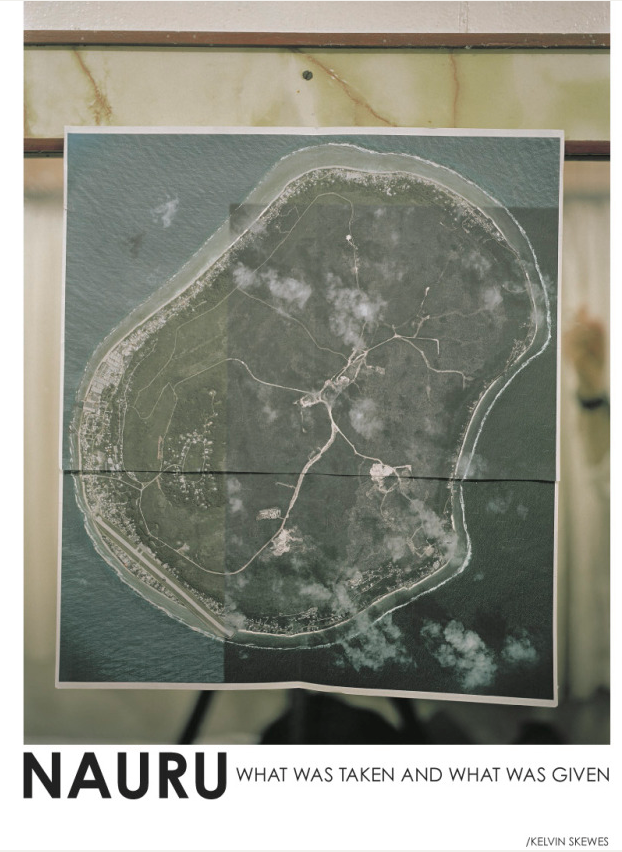
Nauru: What was taken and what was given Kelvin Skewes
The details of this book are available HERE
MORE DETAILS ABOUT THE BOOKS AND JUDGES COMMENTS ARE AVAILABLE HERE
The award winners receive:
Winner – $1,500 cash + $8,000 Momento Pro credit
Runner Up – $1,500 Momento Pro credit
People’s Choice – $500 Momento Pro credit
An additional award will be the ‘peoples choice’ from votes received during the exhibition of the books at the Asia Pacific Photobook Archive at the Photo Book Melbourne event.
This award helps to define what great Australian photobooks can be is and has rewarded great Australian photobooks. Additionally it will continue to fuel commentary and debate around the nature of the practice in Australia and serve to extend interest in and recognition of the discipline and the practitioners of the discipline in Australia.
Doug Spowart
February 12, 2015
DRAWING @ 2014 Jacaranda Acquisitive Drawing Award

Vicky disappearing into Wooli Escarpment 2014 by Andrew Tompkins
Jacaranda Acquisitive Drawing Award 2014
ENTRY DETAILS FOR THE 2016 AWARD can be downloaded HERE
Grafton Regional Gallery 18 October – 7 December 2014
The judge for 2014 was art critic and historian John McDonald.
Paul Klee is credited with stating that ‘drawing was taking a line for a walk’, and on viewing the current Jacaranda Acquisitive Drawing Award at the Grafton Regional Gallery one would come to the conclusion that the line meanders down a very wide path. What is on offer to viewers of the exhibition is an opportunity to engage with the many ways of telling a story through the medium of drawing. The media of drawing, as presented in the show, can be lead pencil, charcoal, brush strokes, hot wires, swipes of pigments, resin glossed over marker pen, fine paper cuts, inkjet applied lines and lines engraved in Perspex and yet there’s much more that that.

Part of the gallery installation of the JADA show
A drawing can emulate the camera’s slice of focus, and ability to capture a shape, a form or an association of elements. It can also be part of a process to unlock alternative or new ways of seeing or considering a subject. It may be the result of an artist’s doodle emanating from an unconscious experience. Some see drawing as a lesser art as it is usually a preliminary to the art making. In this space however, drawing in all its varied forms represents the strength of the discipline and easily dispels any challenges to it being an autonomous finished artwork.
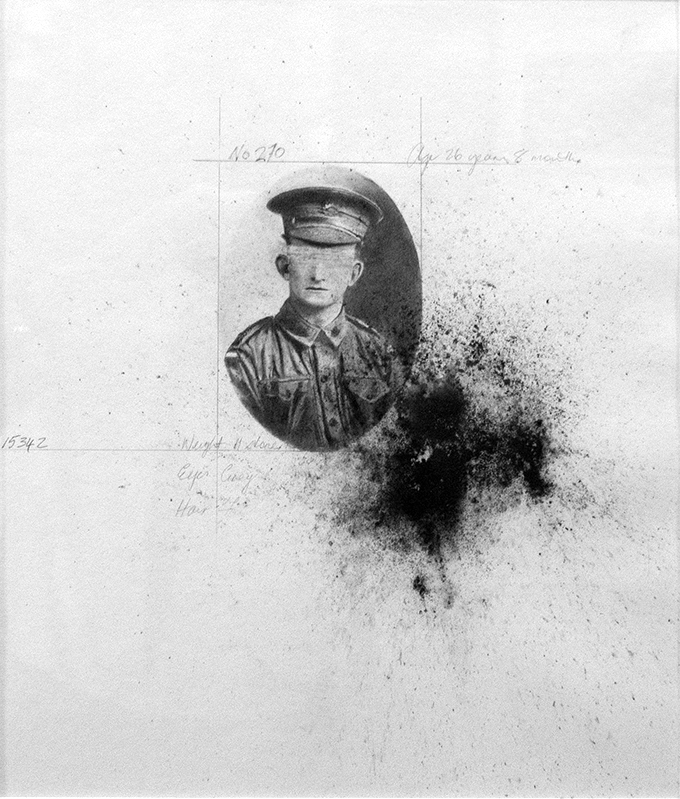
Christine Wilcocks’ Fit for Duty 2014
Some viewers may have an expectation that drawing relies on evidence of draughtsmanship will expect to see works exhibiting that skill. But just drawing to exactly mimic reality is not the way of the artist. In work entitled ‘Fit for Duty’ 2014* by Christine Wilcocks takes the direct transcript of a subject to another level in a portrait of a World War I soldier. The work comments on the man’s physical examination prior to being admitted to the army. The portrait’s eyes are covered by blankness and textual elements and an aggressive inkblot form provides the viewer with a reflection on the artist’s idea of the work.
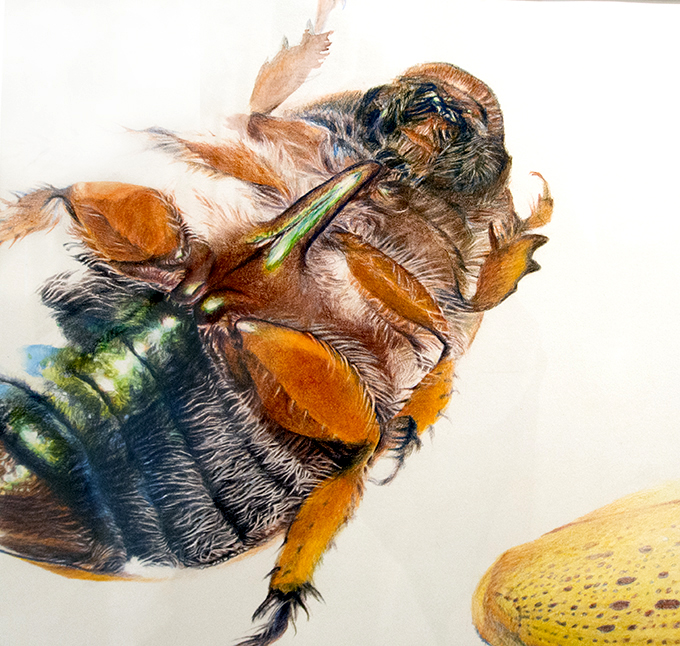
Petrina Seale’s Home Studies in Nature II 2014 (Detail)
A work about documentation is a study of a beetle by Petrina Seale entitled ‘Home Studies in Nature II’ 2014 uses coloured pencils on a white paper ground – the truncated composition to draws attention to the of the subject.
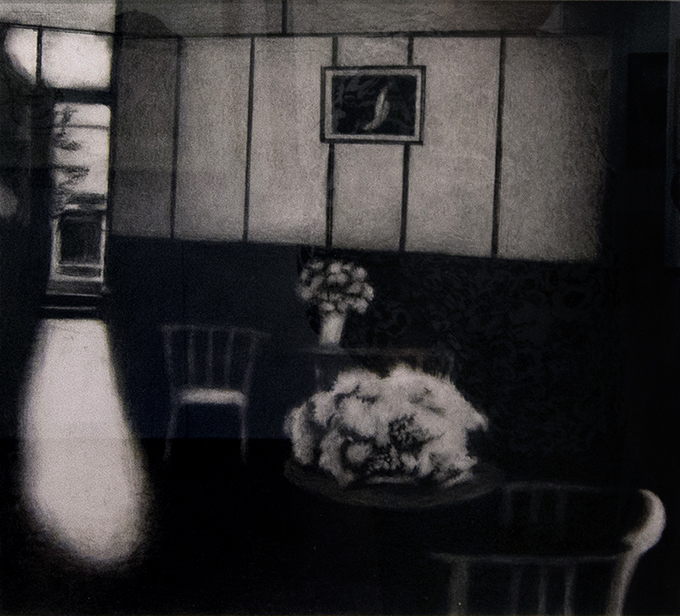
Matt Foley’s Hotel Lake Eacham 2014
In another work by Matt Foley entitled ‘Hotel Lake Eacham’ 2014 the artist has created a study in light of a dreamlike space, a vignette of a place imbued with a darkness and depth of black pigment that is the stuff of half remembered recollections.

Bruno Leti Ashes to Ashes 2013-2014
Four large framed pieces by Bruno Leti entitled ‘Ashes to Ashes’ 2013-2014 is a textural surface of the paper, abstracted, patterned, colourless with blurred edged shapes like fragments of memories. The work comments on the artist’s personal experience of the destruction of places of personal significance by fire. The work itself is partly pigmented by the charcoal retrieved from the fire.
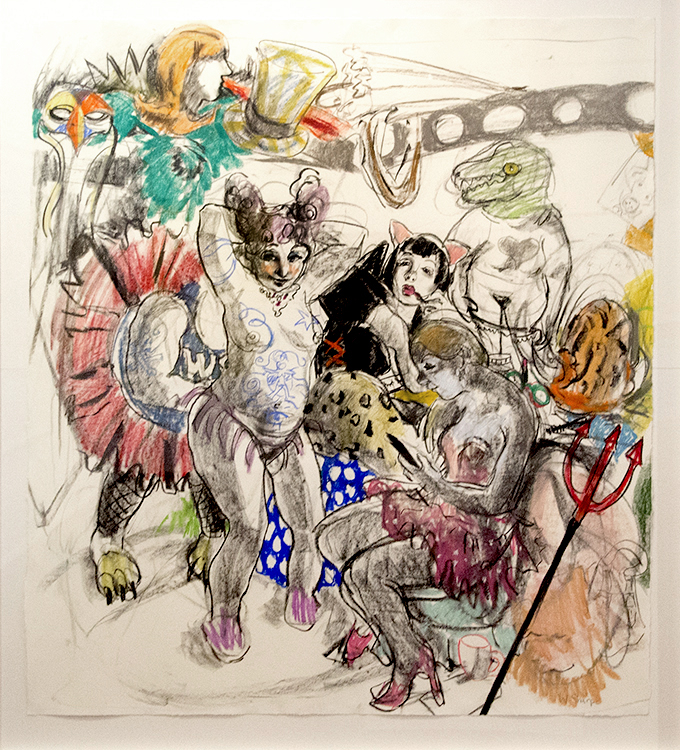
Wendy Sharpe’s Backstage Burlesque with Venetian Mask 2013
Klee’s line was taken for a dance into a seedy bohemian den by Wendy Sharpe in her work ‘Backstage Burlesque with Venetian Mask’ 2013*. A female figure being dressed presents an impish grin towards the viewer – provocatively displaying the comfort of her nakedness. Brightly coloured pastel gestures define other figures surround this main subject all preparing for the stage performance. Close viewing reveals squiggly lines that allude to other stories within the work.
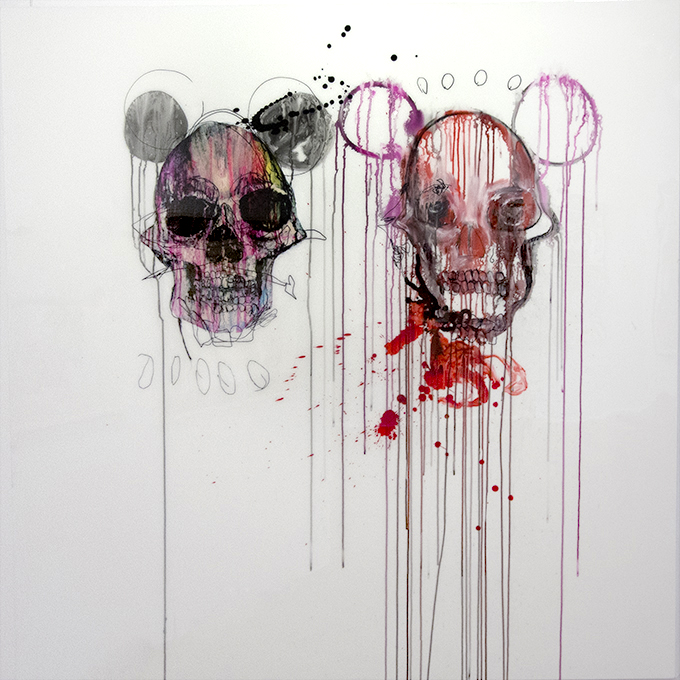
Anthony Bennett’s e pluribus anus – a portrait of tony abbott 2014
Anthony Bennett’s ‘e pluribus anus – a portrait of tony abbott’ 2014 makes a political statement about his subject. A skull with Micky Mouse ears is repeated twice on a white ground made glisteningly hard by its shiny resin coating. One of the skulls is in the process of de-colouring and the pigments dribble down the large-scale work. Bennett’s drawing has all the freneticism of a hastily sketched graffiti work interrupted by a police car coming around the corner.
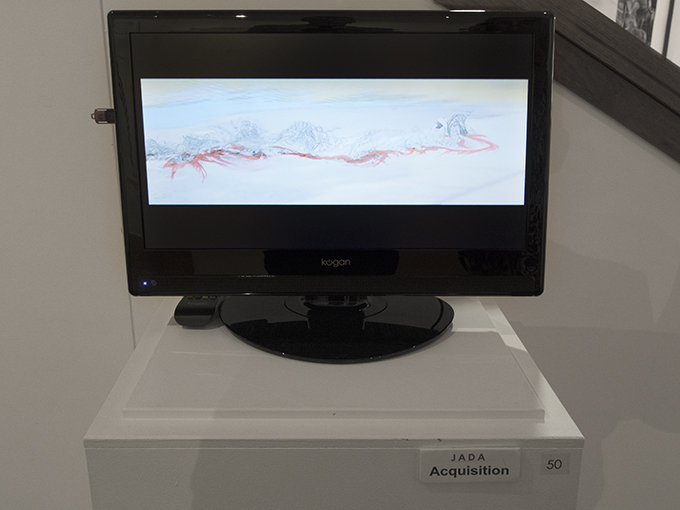
Todd Fuller’s A Dance for Paul Klee 2014
.Todd Fuller’s work ‘A Dance for Paul Klee’ 2014* celebrates Klee’s metaphor for drawing. The digitally presented artwork is of a choreographed dance performance that has its origin in a movie. The film has been overlaid by gestural line work positioned based on the movement of the dancer. Flourishes of colour, most noticeably red, follow and trace the subject’s animation across the screen.
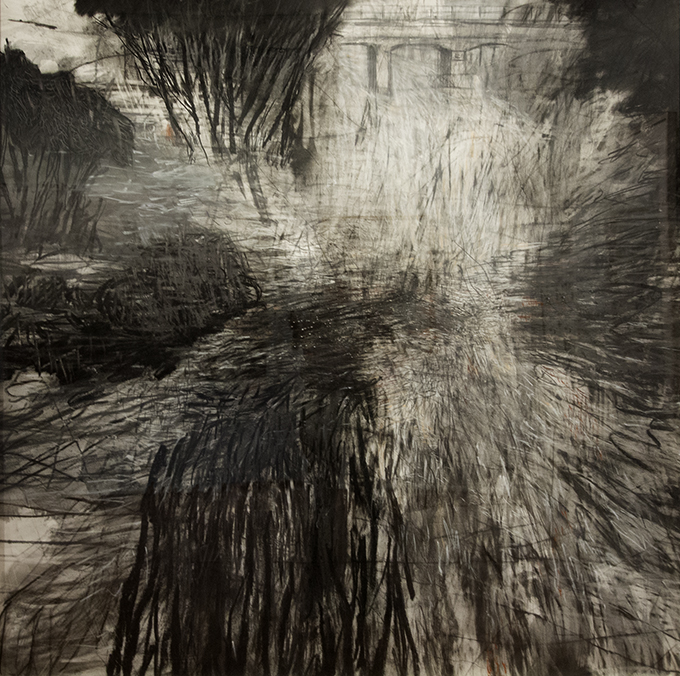
Emma Walker’s Keys Bridge in Flood 2014
.
The overall winner of the $20,000 prize was ‘Keys Bridge in Flood’ 2014* by Emma Walker. The work is 150 x 150cm and represents the movement of water through a flooded landscape. Gazing longer at the work the viewer is captured by the vitality, rush and flow of the graphite, charcoal, pencil and pastel marks on the paper. These marks become the substance of the artist’s inspiration – they are the water, they are the flood, they are the emotions that come from the artist to us. All of these things are in that drawing….
.
.
Doug Spowart
15 November 2014
.
.
* Denotes work was acquired
Other works acquired include:
- Michael Cusack ‘Vista’ 2014
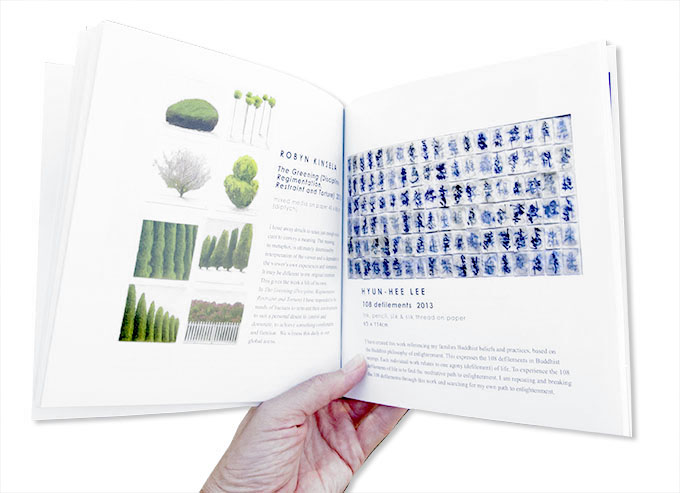
- Lee Hyun-Hee ‘108 defilements’ 2013.
.
The 2014 JADA will travel to seven venues over the next two years including; Manning Regional Gallery, Cowra Regional Art Gallery, the University of the Sunshine Coast Gallery, Glasshouse Port Macquarie, Redcliffe City Gallery, the Broken Hill Regional Art Gallery and the Tamworth Regional Art Gallery.

catalogue
ooo
A catalogue for the show contains an introduction by GRG Director Jude McBean, artists’ statements and images of the works.
For details contact:
.
Please note: Photographs of artworks are the copyright of the artist. All images were made by the author in the gallery space and may have elements of reflection and lighting variations that are not part of the original artwork.
DOUG’S PHOTOBOOK @ Phoenix Art Museum Self-Published Show
In Focus – banner
.
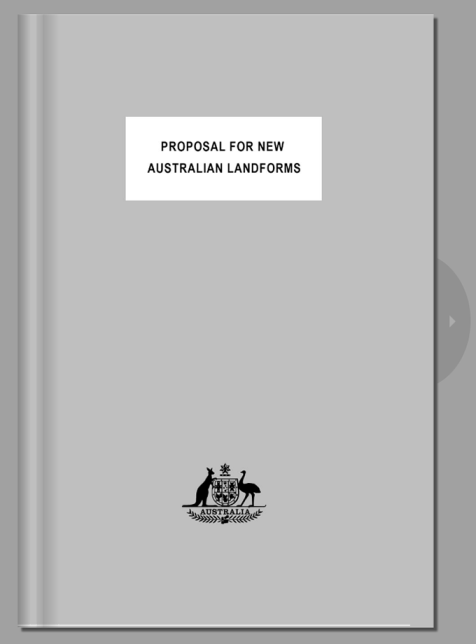
Doug’s Blurb book ‘Proposal for New Australian Landforms’ has been accepted in to the INFOCUS: Juried Exhibition of Self-Published Photobooks at the Phoenix Art Museum in the United States. The exhibition will be on show from August 23 to September 28, 2014 in the Doris and John Norton Gallery for the Center for Creative Photography. The information that follows in this post comes from the Phoenix Art Museum’s site. http://infocus-phxart.org/photobooks/
.
About this Exhibition (From the Phoenix Art Gallery’s website)
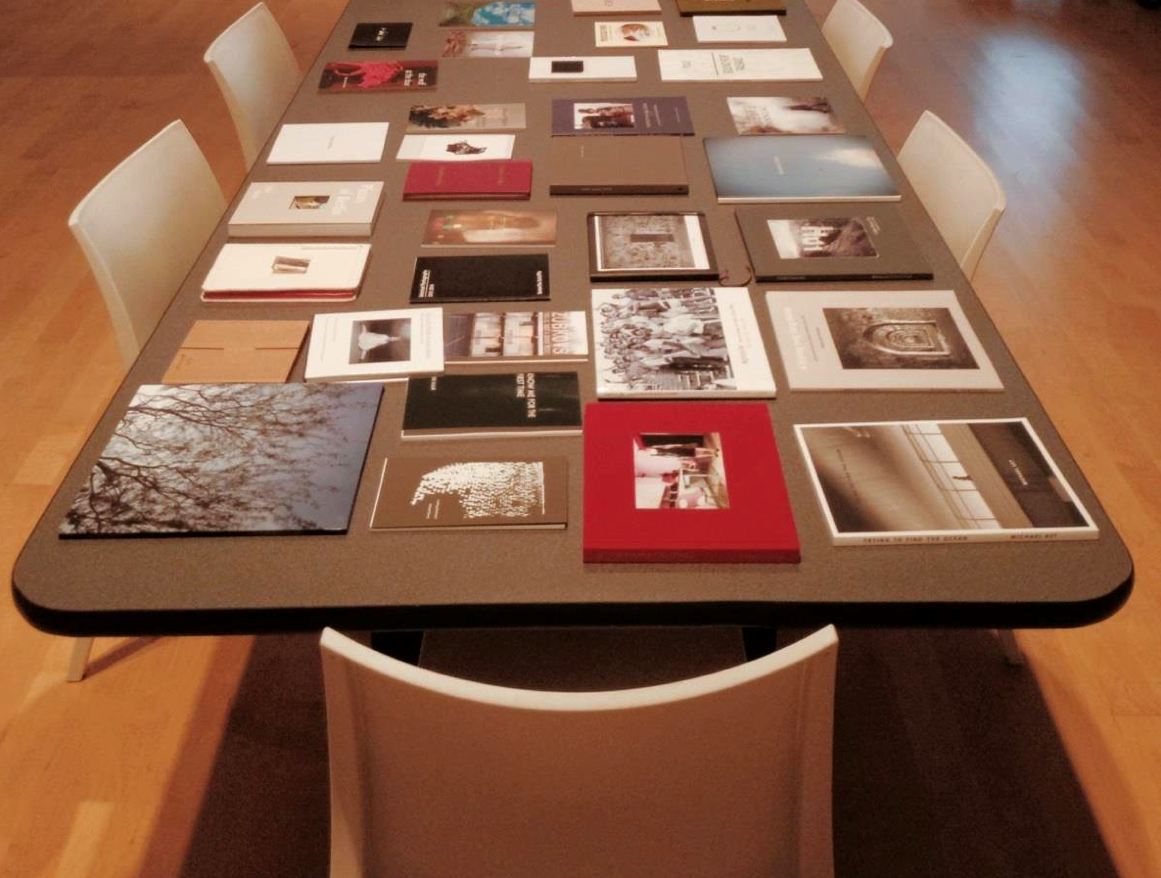
Earlier this year INFOCUS, the Photography Support Organization of Phoenix Art Museum, called photographers to send examples of their self-published photobooks. The purpose of the exhibition is to explore the range of ways that artists are using newly available commercial technologies in order to express themselves. A jury, made up of seven industry professionals including, Founder, Indie Photobook Library – Larissa Leclair and authors of Publish Your Photography Book Mary Virginia Swanson and Darius Himes, reviewed 271 submissions from 15 countries in the Americas, Europe, Asia and Australia. The exhibition represents the 151 books they chose, as examples of the wide range of photobooks being produced today.
We asked for books of any subject including retrospective, project-based, souvenir albums, fictional narrative, exhibition catalogues, poetic, biographical, or children’s books, and welcomed collaborative or collective books in addition to those by a single author. We found that in a well-crafted book, the artist considers every element of the book’s design, and uses each to enhance the finished product. Among the selections are noteworthy selection of paper weight and surface; cover material; printing method and reproduction quality; font style, color and size; text placement and justification (centered, aligned to the right or left); endpaper and title page design; binding (spiral bound, hard bound, paperback); size and placement of the images; sequence of the images; and inclusion (or exclusion) of and placement of the caption information.
INFOCUS – Photobook display (from the INFOCUS page)
.
Read a few words from the curator, Rebecca Senf
From the earliest years of the medium’s history, photographers have embraced the book form as a way to present, organize and disseminate their work.
Books allow photographers to expand their reach to a much larger audience and to control the presentation of their work. Publishing a body of work also increases prestige and permanence; by creating books, artists know that their printed volume, in libraries and private collections, will long outlive them. Within the art field, there exists a reverence for books, a reverence that acknowledges the care and attention that went in to producing them.
Publishing photographic books has rapidly changed over the last twenty years, with the impact of technology on book publishing and photography. Costs of paper, printing and binding have increased and profit margins for traditional publishers are narrowing, creating a risk-averse climate in which unknown artists have difficulty getting books published by existing presses. The bookstores where we once browsed and purchased books are being replaced by online retailers, which in turn, changes our patterns of buying and the way products are marketed. Furthermore, many types of reading (including news, correspondence, and recreational fiction) have moved away from sheets of paper and bound books to digital displays of various kinds.
Despite these massive shifts in how they are made, the desire to produce photographic books is only increasing. Young photographers want their artwork to be presented as a book, and photographic books continue to be produced, discussed, admired, coveted, collected, and sold.
“The Process and the Page: Developing Photographic Books,” on view at Phoenix Art Museum from March 29 to August 17, 2014, presented book-making materials from the archival collections of the Center for Creative Photography, to show how photographers have participated in the creation of their photographic books over the course of the last 100 years. Now, with the INFOCUS Juried Exhibition of Self-Published Photobooks, we can shed light on an important new phase in the story of photographic books – the ability of photographers world-wide to produce high-quality books of their work through self-publishing.
.
The Jury
The photobooks in this exhibition were selected by:
Abigail Nersesian – Librarian, Phoenix Art Museum
Jennifer Barnella – Retail Sales Manager, Phoenix Art Museum
Joshua Chuang – Chief Curator, Center for Creative Photography
Becky Senf – Norton Family Curator, Center for Creative Photography
and Phoenix Art Museum
Mary Virginia Swanson – Co-author, Publish Your Photography Book
Darius Himes – Co-author, Publish Your Photography Book
Larissa Leclair – Founder, Indie Photobook Library
.
..
Doug’s Book
.
My book deals with the political scene and is a parody of the potential for government agencies and politicians to do absurd things for, as they call it, ‘the good of the people’.
SEE THE BLURB PREVIEW HERE: Doug’s Book.
.
CLICK the link below for a list of the accepted entries and links to the books
INFOCUS Photobook Exhibition list
..
.
.
DOUG is 2014 Siganto Foundation Artists’ Book Research Fellow
.
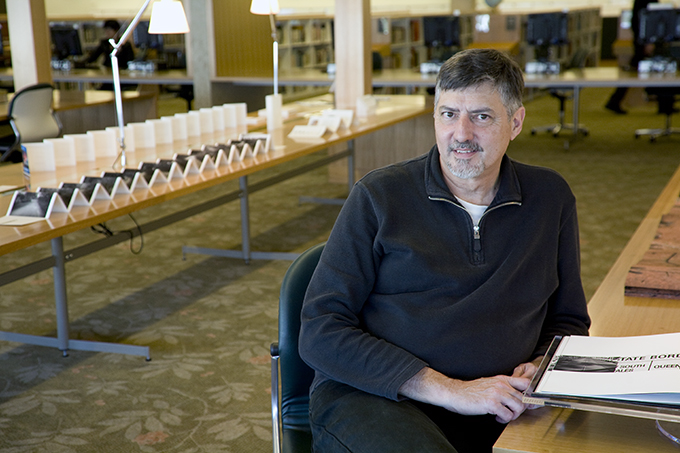
Doug Spowart @ the State Library of Queensland
.
About the 2014 Siganto Foundation Artists’ Book Research Fellowship from the application details:
The Siganto Foundation Artists’ Books Research Fellowship, proudly supported by the Siganto Foundation, is to be used by an individual to undertake original research on one aspect of artists’ book practice, theory or history, making use of the resources contained within the collections of the State Library of Queensland’s Australian Library of Art. Subject to this general consideration, State Library allows the Fellow to determine expenditure of the funds and may require the Fellow to account for the funds awarded.
About the research that I intend to undertake:
Today photographic expression is evolving to pervade all kinds of books by artists, artists–photographers, photographers and photographer-artists. Collections such as the Australian Library of Art at the State Library of Queensland become repositories for selected or exemplar works. In the Research Fellowship I intend to review the field of creative book production that utilises the photograph and consider what has been created to date and in the SLQ collection, as well as identify emergent trends.
As a significant repository of artists’ books, the State Library of Queensland’s Australian Library of Art is a pre-eminent location to carry out the proposed research. Additionally access to books contained in the State Library of Queensland’s general library collection and Zine collections will considerably add to the research.
Importantly the collection contains artists’ books created over a great number of years by a range of practitioners representing a broad range of practice. These books may encompass the full gamut of photograph usage in the book including approaches to the narrative carried by the book, the physical form of the book and the integration of the photograph into design, typographic and textural components.
This proposed research will define a process by which the uses of photography in the creative productions of artists’ books and photobooks can be defined and compared. In my recently completed PhD research on the topic of the artists’ book and the photobook, I identified the need for scholarly research on this evolving phenomenon.
My aims in this research are to create an approach to the development of a flexible and dynamic nomenclature for the photo and the book. This preliminary strategy will provide a way in which books from a variety of makers, media, structures and motivations can be compared. Ultimately this research will produce outcomes that approach a broader and topical view of artists’ books and photobooks to stimulate dialogue and debate.
The Fellowship will include blog posts on the SLQ site and an illustrated presentation at the 2015 Siganto Artists’ Books Seminar.
I am looking forward to the opportunity to research my favourite topic – books!
The Siganto Foundation Artists’ Books Creative Fellowship has been awarded to Jan Davis. Her project One thing becoming another: labour-infused artist’s books which investigate lives of toil in nineteenth and early twentieth century rural Queensland.
For more details see http://blogs.slq.qld.gov.au/ala/2014/07/18/2014-siganto-foundation-fellowships/
.
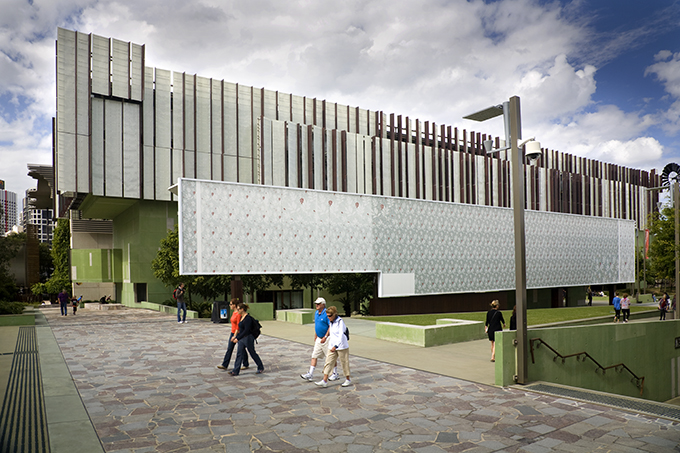
The State Library of Queensland Photo: ©2011 Doug Spowart
.
.
FACING FACES: Judging the photographic portrait
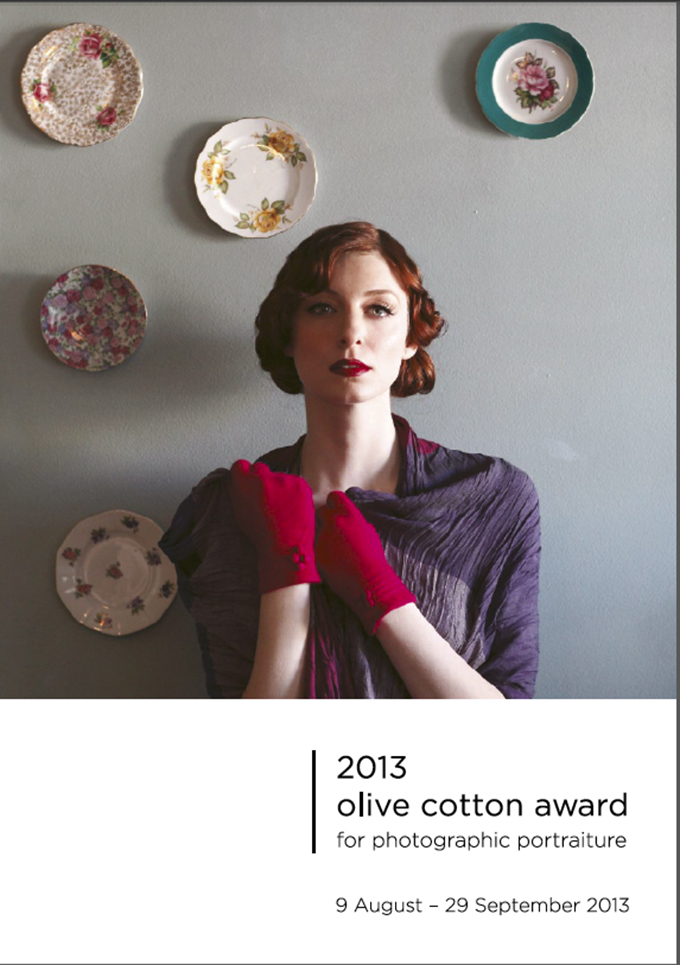
OCA Catalogue Cover
.
Olive Cotton Award Floortalk, Tweed River Art Gallery
.
On September 15 about 30 people attended a floortalk in the exhibition space of the 2013 Olive Cotton Photography Award (OCA). In my preparation I reflected on the demands of a floortalk. Over the years I have given quite a few floortalks about my own as well as the work of others, including one at a previous Olive Cotton Award. I have also attended presentations by others. In this years OCA award I wanted to create an inclusive space for the audience. Rather than taking centre stage, I wanted to empower the attendees in a kind of role reversal–to bring to the discussion their approaches to looking at, and responding to, the photographic portrait.
.
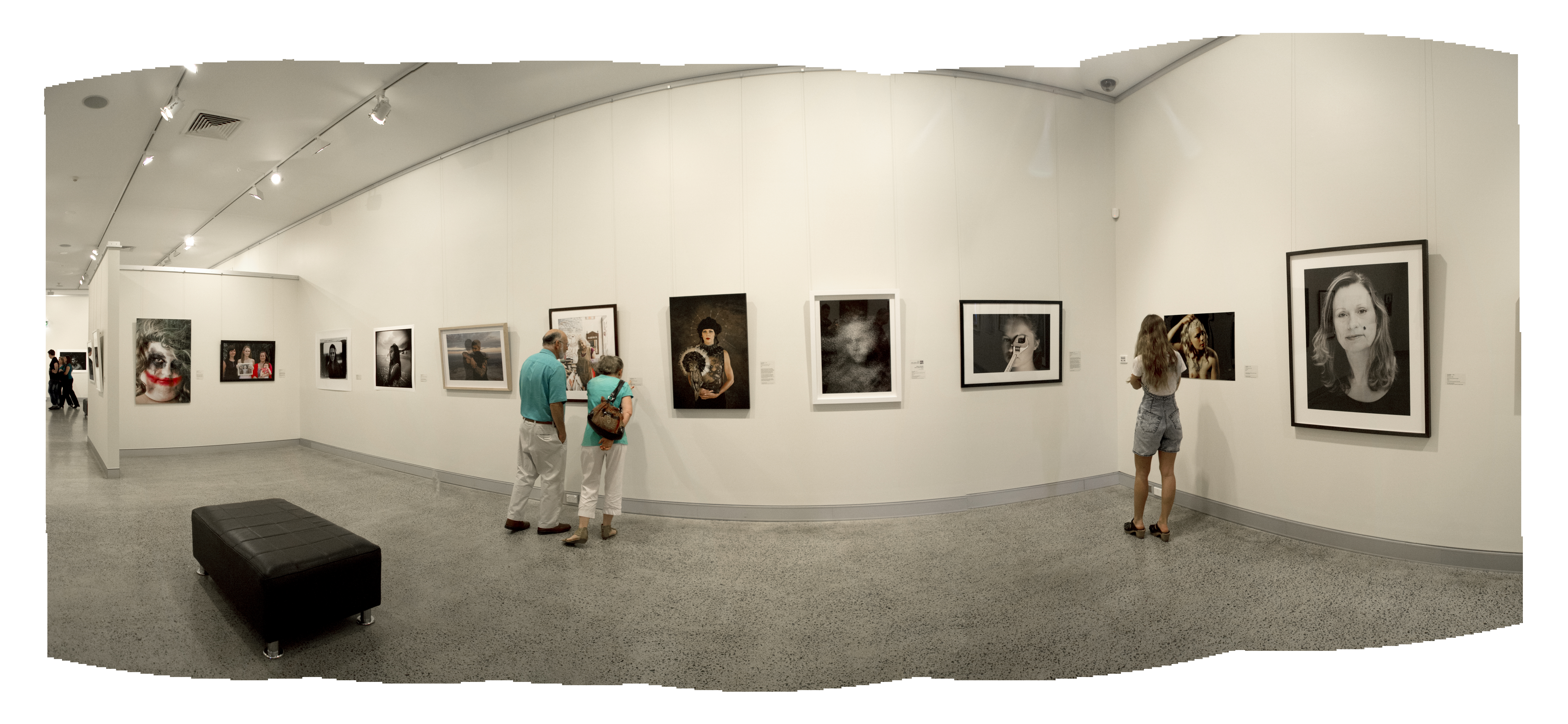
Olive Cotton Award installation at Tweed River Art Gallery
I introduced a concept for viewing and interpreting photographs that I call ‘positioning’. It relates to the interaction that takes place when looking at a photograph – particularly a portrait. It is what reaches into our emotions lived experience and solicits our response. The premise of this floortalk format draws upon the notion that everyone is a judge and is also informed by Roland Barthes’ concept of the ‘death of the author’. I am interested in how the viewer’s interpretation relates to their own life’s experience rather than a direct connection with the author’s intent for the communication. After all, I as the floortalk presenter, can only offer an opinion based on my personal experience and knowledge.
What follows is a conversational précis of the floortalk and the concepts covered relating to portrait photography and the OCA. After a formal introduction by Tweed River Art Gallery’s Public Programs Curator and Coordinator of the Award Anouk Beck, I addressed the group.
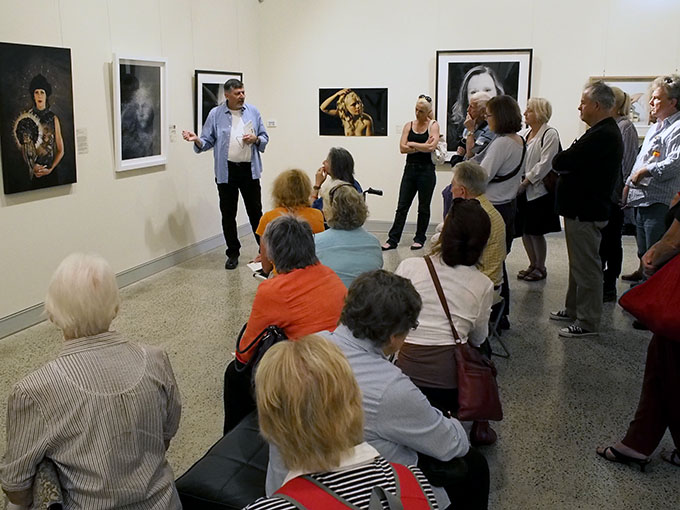
Doug Spowart presenting the floortalk
.
We stand this morning in a gallery exhibition dedicated to the most photographed subject of all – the human face! The floor talk today will explore the idea of the photographic portrait and how we reflect on the success of this visual communication.
There is an old saying that you can tell a great portrait because the eyes follow you around the room – Well any portrait, even a painting, where the subject is represented looking toward the photographer’s/artist’s viewpoint will capture the subject in a way that will enable this ‘phenomenon’ to be observed. So this method for assessing a portrait will not successfully operate here.
Another way of knowing what great portraits look like is to ask an expert, whomever they may be, to make a decision. Awards such as the Olive Cotton Award use this principle and over the years an impressive list of pre-eminent photographers and/or critics and commentators on photography have been commissioned for the task. I must acknowledge the judge for this year’s award – Helen Ennis. I cannot think of anyone who would be as knowledgeable of the ideas, thoughts and working methods of Olive Cotton than Helen Ennis. In her connection with Olive Cotton, Ennis has written several books and catalogues, selected works and curated exhibitions and is in the process of writing Cotton’s biography. Ennis has provided for us all a greater understanding of Cotton’s work and prominent position within the history of Australian photography.
Now, let us think about portraiture and the act, as we find ourselves today, looking at and evaluating portraits. It is interesting to note that although the portrait is at the top of the list of photographic subjects, we can see in this award there is no standard approach. As we look around this gallery space today no two portraits look the same – I’m not referring to the diversity of subject’s portrayed, but rather the way the photographer has created and presented the subject to us. The photographs range from snapshots of unplanned spontaneous moments to documentary reportage and illustrative magazine styled images, and then to the overtly staged theatrical tableaux. Some images are derivative – that is that the approach to the image replicates time honoured, and sometimes perhaps over used or common, techniques, styles or treatments. Other images may represent subject and styles in ways that are vibrant and fresh.
When a portrait is made the photographer makes personal decisions relating to equipment selected, technique, style, lighting, posing, gesture and subject expression. They make a portrait that satisfies their personal urge to tell a story. This story is usually firmly related to the subject; although it can be a theme the photographer is investigating or be based on something from the photographer’s own life experience. The photographer may want or even demand that viewers take from the work a particular and specific meaning. The artist’s statement accompanying exhibited works can support and signpost and influence the readings that a photographer may want to pass on.
However, I would suggest to you, that once the image leaves the photographer and is presented publically a new paradigm exists. Writer and commentator on photography Roland Barthes wrote ‘… the birth of the reader must be at the cost of the death of the Author.’ (Barthes 1977:148). In this instance I propose that the photographer is the author – the reader is the viewer. When looking at photographs the viewer connects their life experience to what the work presents, and the narrative or meaning that emerges can no longer be the photographers alone – it is a hybrid born by the activation of the viewer.
We are all judges in a way and each of us has a unique experience of the world that directs and supports our response to images that we view. We will no doubt encounter portraits here today that are universally powerful and profound yet there will be other images that may reach individuals amongst us in the most direct and personal ways. What this means is that each of us is a kind of judge, and that our individual responses may be just as profound as those experienced by Helen Ennis five or so weeks ago.
Today then, I invite you all to be the judge and what we will be doing is engaging with selected works from the exhibition to discuss and review – and I will be asking you to contribute to the conversation. To assist you with this I’d like to pass on the concept that may help us with this process – it’s essentially about what I will call ‘positioning’. Your response to a portrait photograph, or perhaps in another context any photograph or work of art, is informed by your personal background as we have already discussed. Your ‘position’ can be informed by the synergies of your life experiences that may include; physical, ideological, religious, gender, specific demographic, life experience of birth, death, love, illness, war or personal achievement or tragedy. So when we talk about a portrait please consider your position…
[What followed in the floortalk was a conversation by the participants moderated through my involvement. The audience contributed some interesting responses and ideas about portraits that included; Tamara Dean’s ‘Brothers’ 2013, Russell Shakespeare’s ‘Bob Katter’ MP 2011, Tina Fiveash’s ‘Twin Spirits’ 2013, Imogen Hall’s ‘Barry Jones and the ancestor’ 2012. At times there were powerful and emotional connections made by particular participants which were then shared through this floortalk conversational strategy.
.
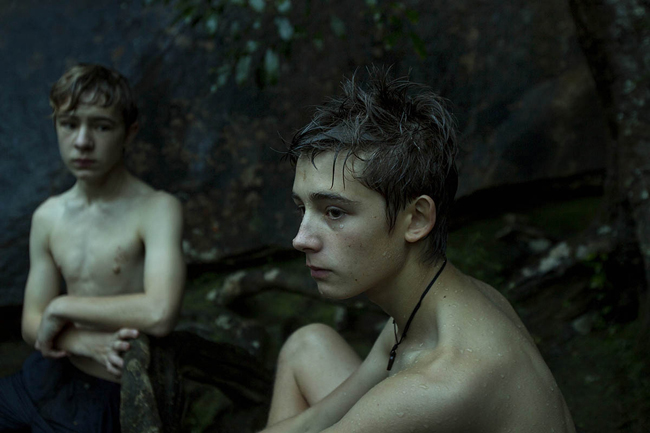
Tamara Dean’s Brothers
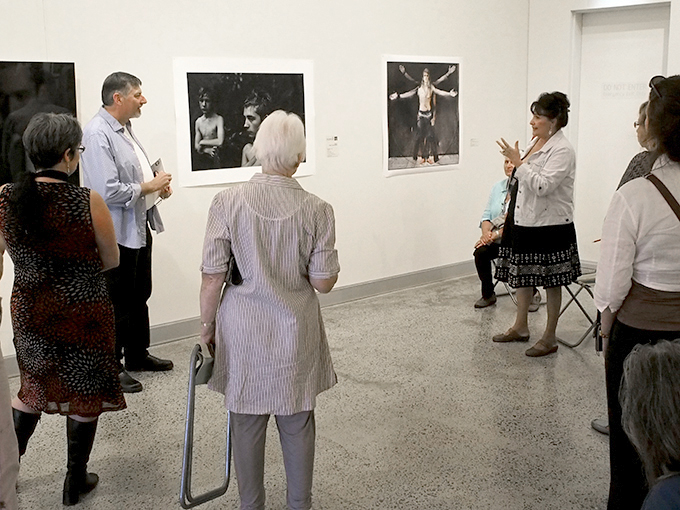
Participants discussing their position and response to a portrait
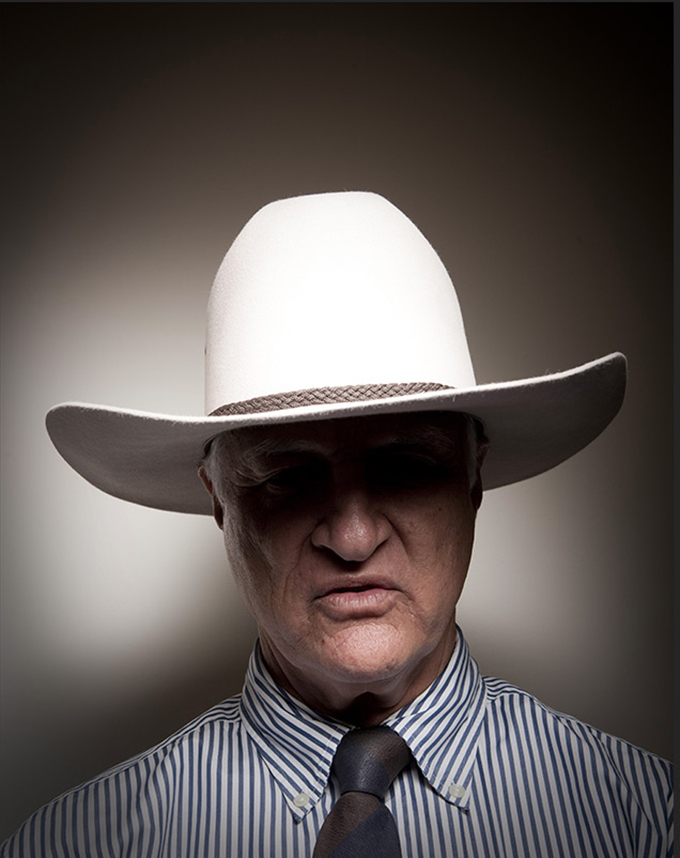
Russell Shakespeare’s Bob Katter MP
.
I was asked to give my position on the winning photograph – Trent Parke’s ‘Candid portrait of a woman on a street corner’ 2013. Many attendees did not –or– could not find a ‘position’, that would enable them to understand the reason behind its selection. I spoke from my position informed by my background in the art and professional practice of photography and many years dedicated to the education and critique of this medium – I knew from comments made by the judge on announcing the award that she found Parke’s image something that she at first didn’t standout as so many images do – but she kept coming back to it. My position on the image was as follows…]
.
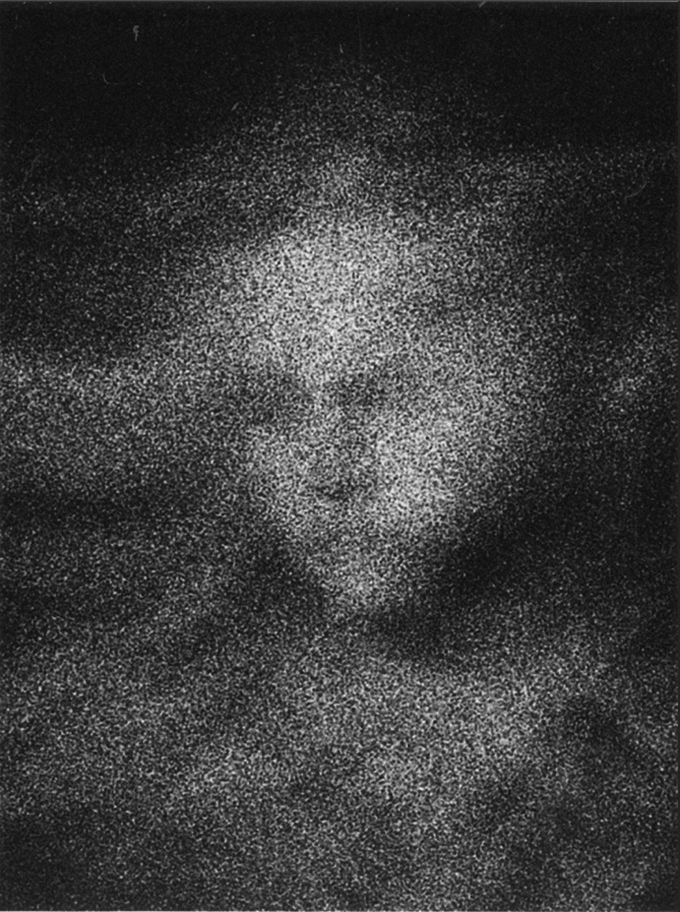
Trent Parke’s Candid portrait of a woman on a street corner
.
On first encountering Parke’s image it does not give us much – it initially appears as a field of greatly magnified monochrome film grain, which hides the delicate structure of a female face. A closer view reveals less, and interestingly, the further away you move the ‘sharper’ the image. Parke’s portrait demands more of the viewer to find meaning – it challenges, it questions, it’s not a specific person, unlike every other portrait in this award, but more the generic form. For me it also comments about the romance of film and ‘humanness’ in the digital age. At the beginning of this floortalk I suggested that much of portraiture can be derivative – but this image has no provenance in contemporary portraiture – it stands alone, perhaps signalling that there is room for new and exciting representations of the human visage yet to come…
[The floortalk concluded and attendees continued viewing other portraits in the show from their newfound critical ‘position’. The outcomes and exchanges resulting from my floortalk strategy was, for me, personally enlightening and rewarding. A number of participants came up after the talk to say how much they had enjoyed and appreciated the opportunity to discuss work and have their ideas, opinions and experiences shared in that way.
From their participation and responses today one could perhaps say that the author is dead – and many readers have been born …]
.
Dr Doug Spowart 3 October 2013
.
A PDF catalogue of the Olive Cotton Award is available here 2013 OCA catalogue for web_screen
.
Barthes, R. (1977). Image Music Text. London, Fontana Press.
,
Photographs of the floortalk © 2013 Victoria Cooper. All other images are the copyright of the photographer.
.

This work is licensed under a Creative Commons Attribution-NonCommercial-NoDerivs 3.0 Unported License.
.
INVITATION: OLIVE COTTON AWARD–Public Programs
We are presenting two special presentation to compliment the 2013 Olive cotton Awards @ the Tween River Art Gallery, Murwillumbah.
A floortalk and discussion on contemporary Australian photographic portraiture based on the photographs is the award – AND – A look at the artist and social media, for making connections and making art.
SEE THE INVITATION BELOW:
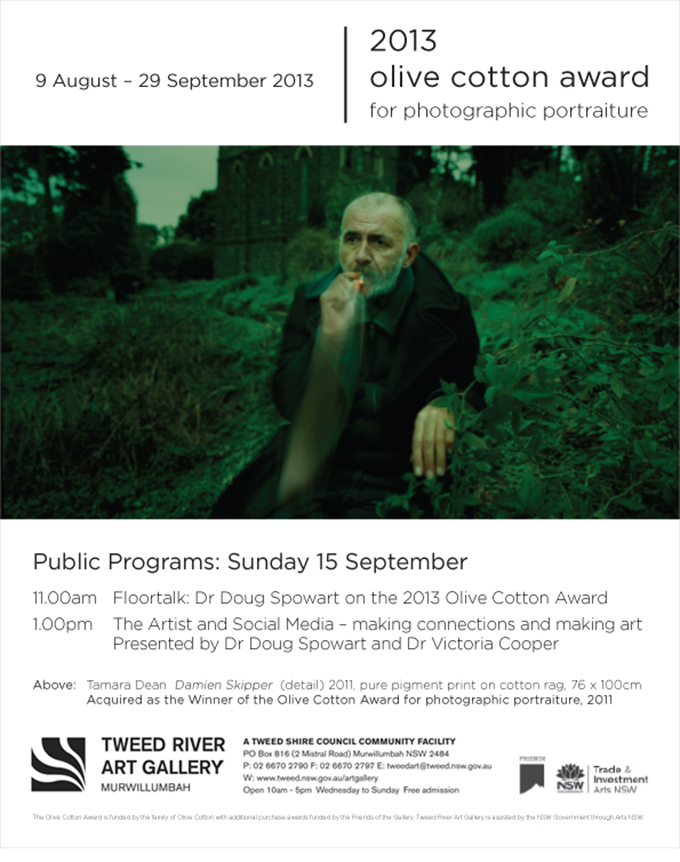
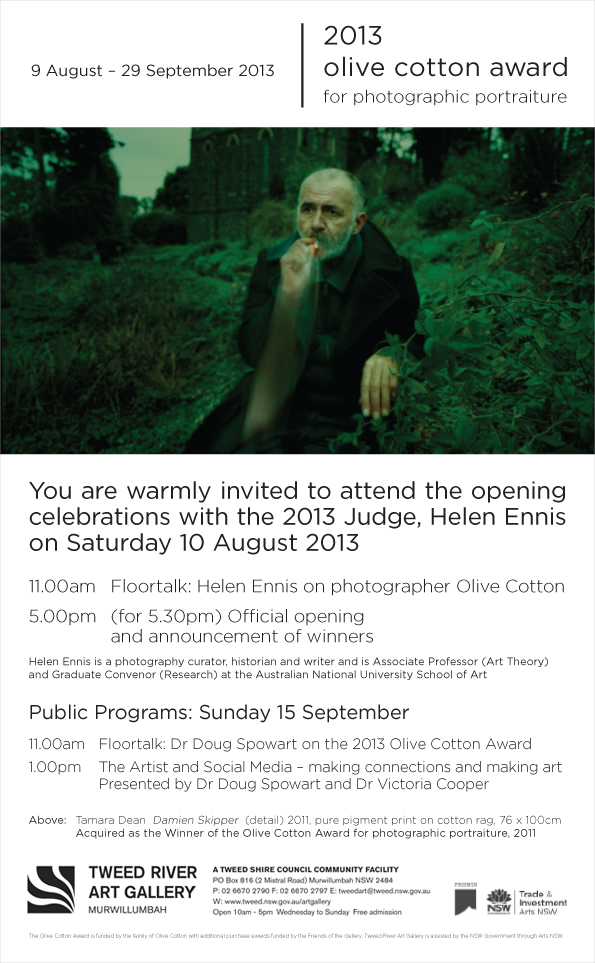
Olive Cotton Awards Public Programs
.
For any extra details call the gallery on (02) 66702790.
.
.
ONE FOR THE BOOK – THE 2013 BLURB BIFB BOOK AWARD

.
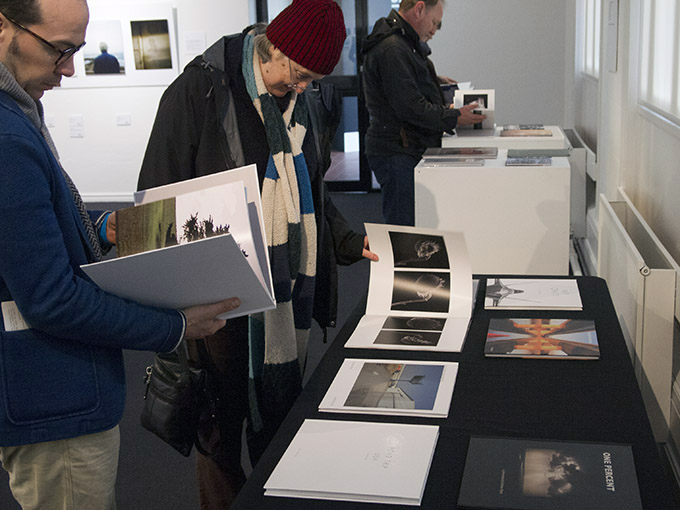
BIFB visitors checking out the book award entries
.
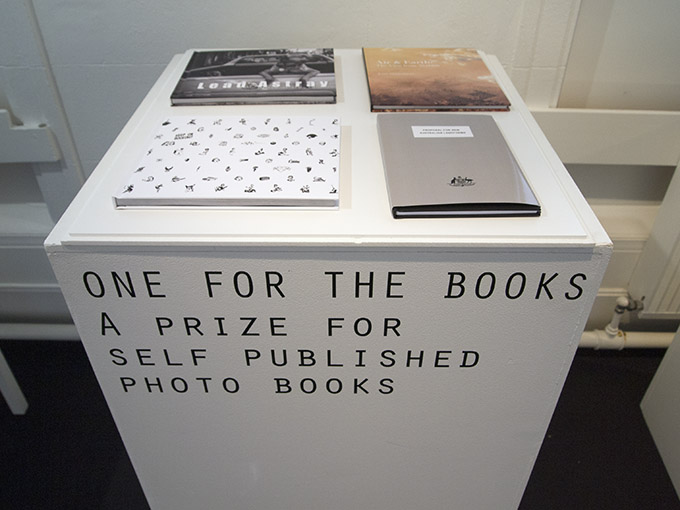
Doug’s book – front right
ONE FOR THE BOOKS
A display of some of the best self-published photobooks in the country are being exhibited at the 2013 Ballarat International Foto Biennale.
A PRIZE FOR SELF PUBLISHED PHOTOGRAPHY BOOKS proudly sponsored by Blurb
The Ballarat International Foto Biennale with major sponsor Blurb, present ‘One for the Books’ an exciting new prize celebrating the book as an innovative and contemporary format for presenting photography in a creative and narrative form. This prize is specifically for self publish, print on demand books. Books previously published by a traditional publishing house are not eligible for entry.
WHO COULD ENTER
The 2013 ‘One for the Books’ Prize will accept submissions for two categories; Professional and Amateur. Winners will be announced at on Monday 19th August 2013 at the Post Office Gallery, Ballarat. Entrants must be Australian residents. Around 100 books were submitted for the judging and 20 finalists were selected.
THE FINALISTS WERE …
The finalists [professional category]
Rhiannon HOPLEY NSW
Charles KLEIN SA
Darren MARTIN NSW
Garry MOORE VIC
Gary SHEPPARD NSW
Doug SPOWART QLD
Andrew STY AN NSW
Peter WHYTE TAS
The finalists [amateur category]
John Paul AZIZ & Shaun DUNCAN VIC
Michael DAVISON VIC
Lidia D’OPERA WA
Grant HUNT QLD
Paul JURAK ACT
Erin STONESTREET ACT
Scott VINEY QLD
.
AND THE WINNERS WERE …
At a special event on Monday August 19th the announcement of the winners of the inauguaral One for the books prize was announced.
.
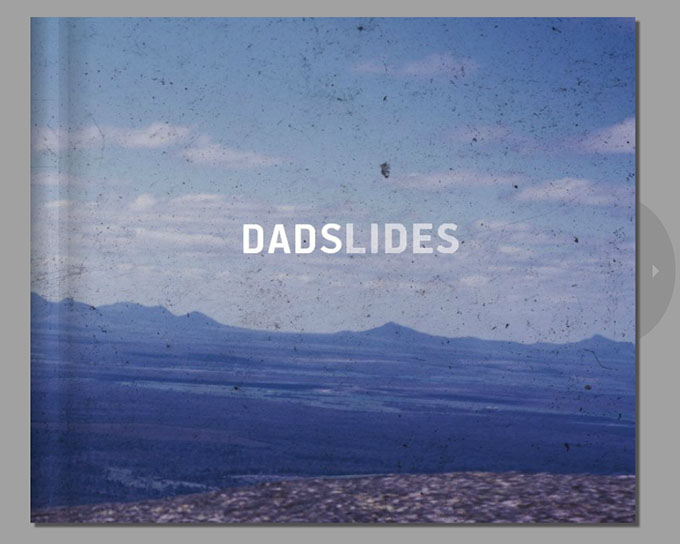
Charles Klein’s Awarded Book – Professional Category
Dadslides is a book dealing with a personal sense of nostalgia in the discovery of one’s own family photographs after the passing of a loved one. Klein’s book consisted of his father’s slides made between 1950 and 1981. The photos were scanned and sequenced within the book to create a document of a family growing up, going on holidays, messing around in the back yard and the other things that symbolise Australian life in this era. Strangely, whilst the book is about Charles Klein’s family, it strikes a resonance with us all and therein lies the beauty and the power of its narrative.
SEE THE BLURB REVIEW HERE: Charles Klein’s Awarded book
.
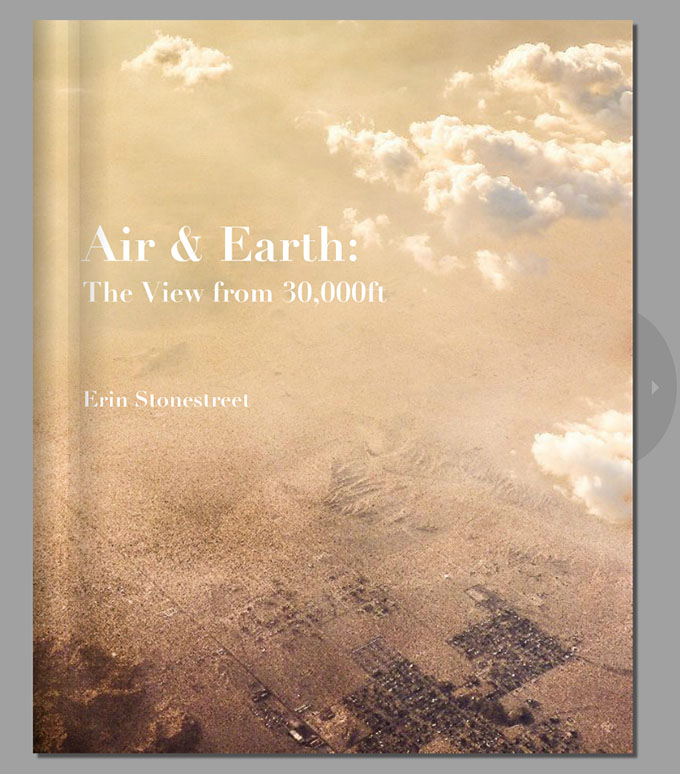
Erin Stonestreet’s Awarded Book – Amateur Category
Air & Earth: The view from 30,000 ft is a book that deals with the aerial view of the earth. The rich colours and image juxtaposition create for the viewer an abstract view – all scale is abandoned and the images take on a sense of the magical, and perhaps even for some, a spiritual meaning.
SEE THE BLURB REVIEW HERE: Erin Stonestreet’s book
.
I was excited to be a finalist in the award – Here is my book…
..
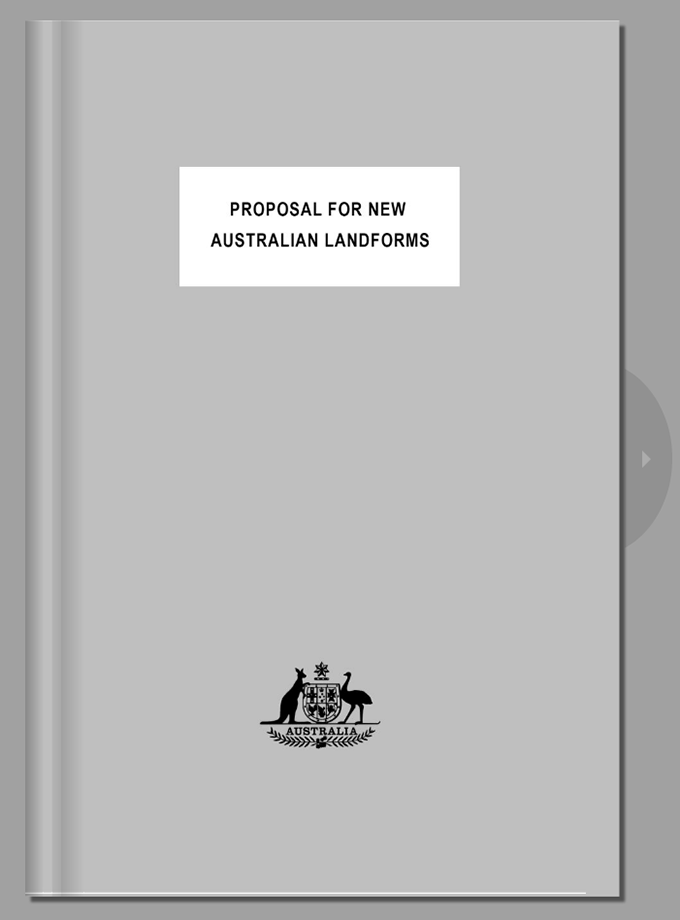
Doug’s Finalists Book
My book deals with the political scene and is a parody of the potential for government agencies and politicians to do absurd things for, as they call it, ‘the good of the people’.
.
SEE THE BLURB PREVIEW HERE: Doug’s Book.
.
PLEASE ENJOY – And do get to Ballarat to see these amazing books in person …
And join in on the photobook print-on-demand revolution.
.
.
Olive Cotton Award Winner Announced
PRESS RELEASE FROM THE GALLERY – August 10, 2013
$20,000 winner of Olive Cotton Award announced
Magnum Photographer takes out prize money for intriguing portrait
Saturday, 10 August 2013
Photographers, Olive Cotton Award entrants, and the general public filled the foyer of the Tweed River Art Gallery tonight eager to hear who had won the 2013 Olive Cotton Award. The exhibition features the work of 91 finalists from all Australian states and territories. The exhibition features entries from emerging and established photographers selected from 381 entries Australian wide.
The judge, Helen Ennis, Head at the School of Art, Australian National University was delighted to judge the Olive Cotton Award, having a particular connection to Olive, as her biographer. The award is funded by Olive Cotton’s family in memory of one of Australia’s leading twentieth century photographers. In deciding the winner Ennis shortlisted a selection of works awarding four Highly Commended awards to works which held her attention due to the “clarity of the photographers’ approaches to portraiture and the different kinds of relationships they had with their subjects”. These award were made to:
Petrina Hicks from Sydney for Ornament – “a haunting image of a young woman from another realm, rendered in muted colour”.
Tamara Dean from Sydney for Brothers – “a very moody and memorable image of teenage brothers photographed in a gloomy bush setting”.
Lee Grant from Canberra for Kristy – “a slightly awkward portrait of a young actress who belongs emphatically to the present time”.
Narelle Munro of Sydney for David– “a very sympathetic close-up portrait of the New York based Australian artist David Rankin”.
The winner of the $20,000 acquisitive prize is Trent Parke, one of Australia’s best known documentary photographers and the first Australian to join the prestigious Magnum Photos collective. Of his entry Candid portrait of a woman on a street corner Ennis said it is “a very unusual work, the subject isn’t immediately visible and so our notions of portraiture are challenged. The viewer is invited to actively work with the image in order for the face of this unknown woman to become apparent”.
Award Co-ordinator Anouk Beck said “Trent Parke was elated at the news and to receive an award for this work which marks a new direction for him and his first foray into portraiture”.
Through the generosity of the Friends of the Gallery Inc. Director Susi Muddiman selected four works for purchase for the Gallery’s permanent collection. Her selections were:
Self portrait with cactus and telephone 2013 by Raimond de Weerdt of Lismore;
Bob Kattar MP 2011 by Russell Shakespeare of Currumnin Qld;
Barry Jones and the ancestor 2012 by Imogen Hall of Melbourne;
And Noah 2013, a portrait of actor Noah Taylor by Sahlan Hayes of Kangaloon and Sydney;
On Sunday 15 September, at 11.00am, Dr Doug Spowart will present a floortalk on the Olive Cotton Award 2013 exhibition. Spowart’s reviews have been published in publications such as Art Monthly and the popular magazine Better Photography. All are welcome to attend.
At 1.00pm on Sunday 15 September Doug Spowart and Dr Victoria Cooper will be discussing The Artist and Social Media – making connections and making art. Victoria and Doug are interdisciplinary visual artists who have adopted social media and blogs as a medium an integral part of their contemporary arts practice. Using social media platforms they post reviews, profiles, opinions and collected writing about issues in the broader arts community which are then accessible and invite dialogue from a wide online community. Both have lectured nationally and their work has been acquired for the artists’ books, rare book and manuscript collections in Artspace Mackay, State Libraries of Queensland and Victoria, the National Library of Australia and in the Carleton College Collection in the USA.
Complementing the 2013 Award is the ABC Open digital exhibition 100 Faces, the best of ABC
Open’s Snapped: Faces. This is a small selection from over 1000 portraits, captured by amateur and professional photographers throughout regional Australia, for the ABC Open June photography
challenge SNAPPED: FACES.
The exhibition continues until Sunday 29 September. The Gallery and Gallery Cafe are open Wednesday to Sunday 10am-5pm.
A bonus – A PDF of the exhibition catalogue (Note images have been cropped square for design purposes) Go see the exhibition
SEE earlier post for details …
Click Here: 2013 OCA catalogue for web_screen
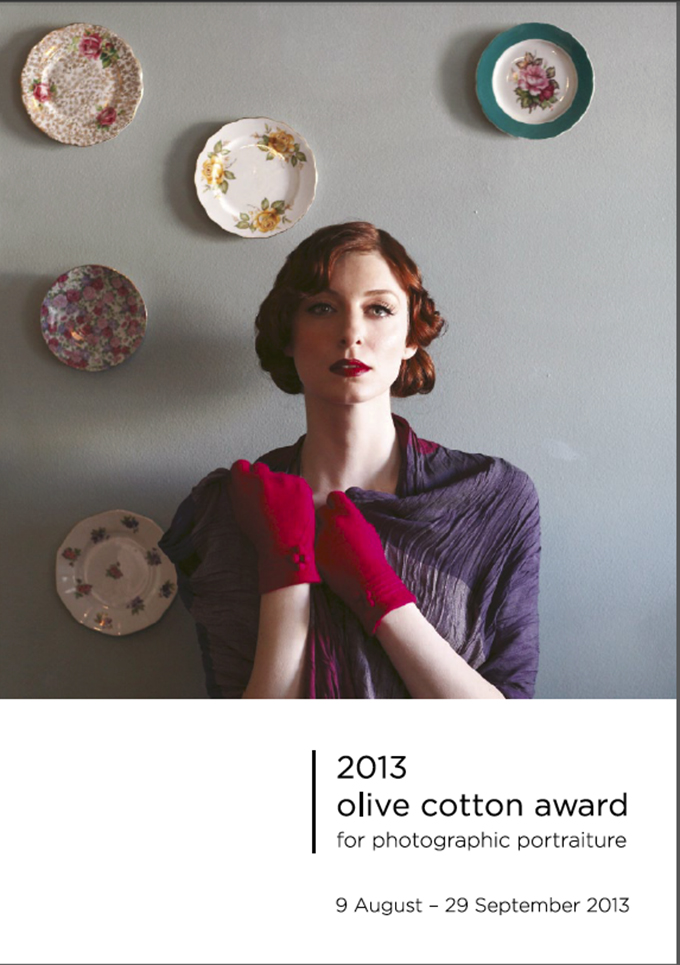
OLIVE COTTON AWARDS ANNOUNCEMENT + GALLERY TALKS
ADVANCE NOTICE: OLIVE COTTON AWARD ANNOUNCEMENT/OPENING & FLOORTALKS
The biennial Olive Cotton Award for photographic portraiture is once again on show at the Tweed River Art Gallery Murwillumbah. Each time this award is offered the best and most diverse collection of contemporary Australian photographic portraiture is assembled for public viewing and appreciation. This year’s judge is Associate Professor Helen Ennis from the Australian National University School of Art. A list of the finalists is available here: 2013 Olive Cotton Award_list of finalists
.
Details about the Tweed River Art Gallery are available here: http://www.tweed.nsw.gov.au/artgallery
This Gallery has the most beautiful view of Mt Warning and the Tweed Valley caldera – Equally as inspiring as the photographic art that it contains.
.
This year we will be presenting a floortalk about contemporary portraiture as well as a presentation about The Artist and Social Media.
2013 LIBRIS AWARDS: THE JUDGE’S VIEW
As a departure from our usual format of WOT WE DID, we invited a Guest Blogger – eminently qualified Helen Cole, to comment on an event that we were unable to attend. Helen was the judge for the 2013 Libris Artists Book Awards and in this post she talks about WOT SHE DID, and provides insights into the awards and selects artists books to add to her commentary:
.
Artspace Mackay Libris Artists Book awards… some thoughts
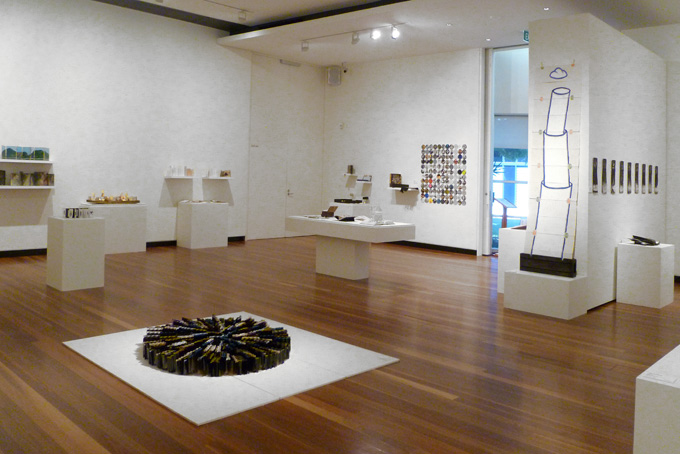
2013 Libris Awards installation ………Photo: Helen Cole
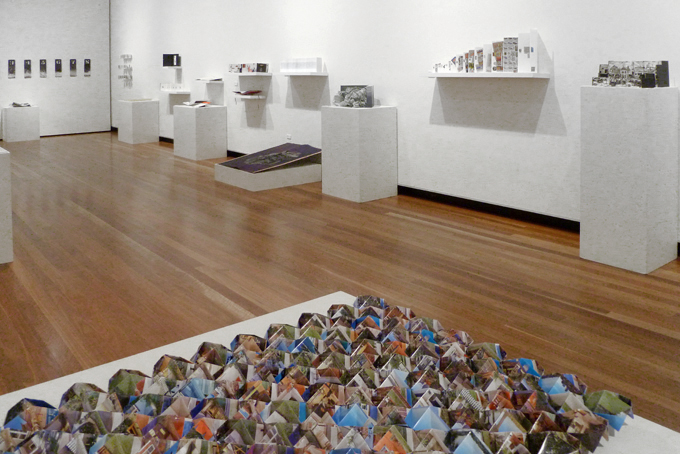
2013 Libris Awards installation ………Photo: Helen Cole
.
The Libris exhibition, as always, looks fantastic in the Artspace gallery. The works are very varied, from codexes, scrolls, altered books, and boxes to woven and sculptural pieces.
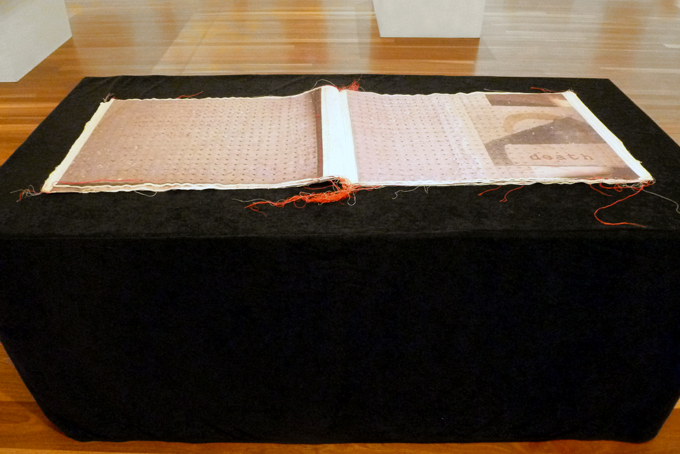
Julie Barrett: The mourning after …….Photo: Helen Cole.
.
The first thing that struck me when presented with the ninety books for the judging of the Libris Awards at Artspace Mackay was something that came up in our Trouble with artists’ books seminar last week- the inadequacy of the digital surrogate. Anna Thurgood, Director of Artspace Mackay had sent me images of each of the entries. Seeing them in the flesh mad me realize I had wildly mis-imagined the size of some of the works. For example, Julie Barratt’s The mourning after, perhaps 50 x 70 cm, I had imagined as a small hand-sized book. Conversely Julie Bookless’ (interesting name for a bookmaker and a potential title for her book as it had neither image nor text but was still a very interesting work) Audrey was a tiny 10 cm tall when I imagined it to be at least octavo size. Size does matter and it does have an effect on the impact of a book.
.
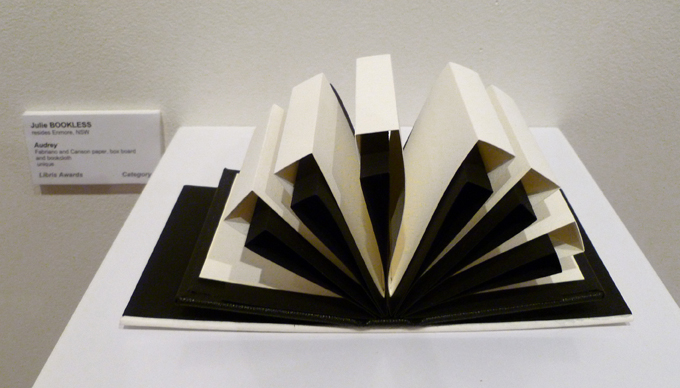
Julie Bookless: Audrey ……..Photo Helen Cole
.
A noticeable difference between this and past awards was that, because there was no associated forum, very few of the artists who had entered attended the announcement of the award. This connection of the artists’ book community was such a wonderful part of the previous Mackay events and is perhaps the reason we had such a large attendance at The trouble with artists’ books seminar.
.
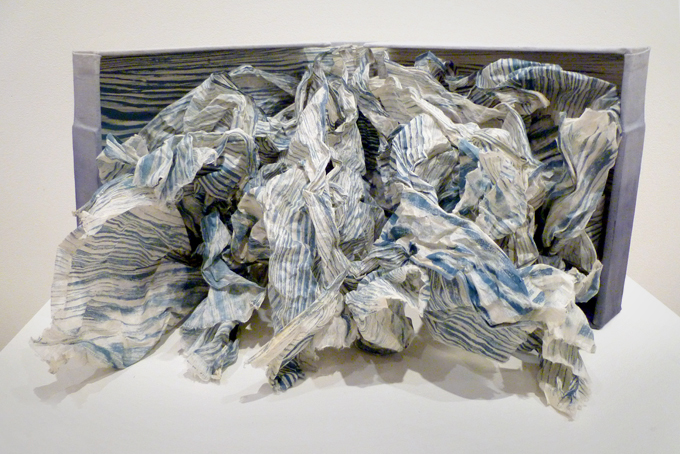
WINNER Category 1. $10,000 Dalrymple Bay Coal Terminal National Artists Book Award,
Michele Skelton, Wave form, woodblock print, unique. …….Photo: Helen Cole
.
The quality of the entries this year was very high and any of a dozen works could have won the major prize. The winner Wave form by Michele Skelton looks simple (in a photo) but as I said a photo can be deceiving; the book is deeply thought out and faultlessly constructed. It appears sculptural but is actually a traditional codex form with spine, cover and pages. The cover represents the calm of the sea and the shore when the book is closed and when it is opened the pages sewn into the spine spill out as waves which can be arranged and twisted to represent a raging sea. The choice of paper is perfect to allow this. The waves are printed from a woodblock and this choice of technique works beautifully with the colour and subject to evoke the classic Hokusai image The great wave. It has the advantage that it is an artist’s book that can be seen as a whole while on display without handling.
.
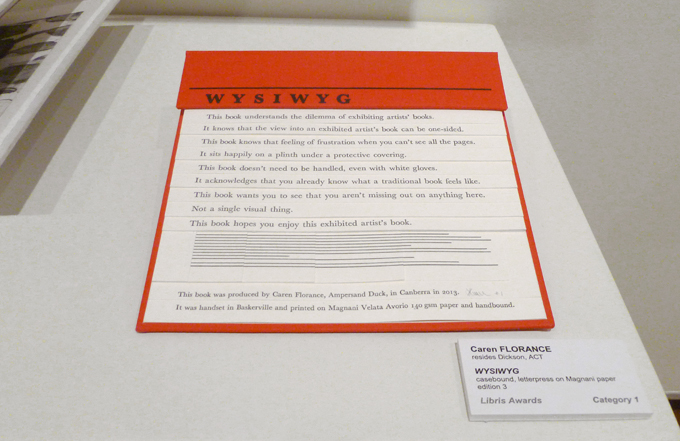
Caren Florance: WYSIWYG ………Photo: Helen Cole
.
Another work that does that is Caren Florance’s clever WYSIWYG (What you see is what you get). To enable the viewer to see the whole book without having to touch it, Caren letterpress printed a sheet multiple times then cut and bound the pages so that one line from each page is visible. They build up to a witty text written to the reader from the book’s point of view, stating that it understands the viewer’s problem and hopes it has solved it. And it has.
.
Helen Cole … Coordinator, Australian Library of Art, State Library of Queensland
.
Thank you Helen for this commentary
.
SEE THE OFFICIAL AWARD WINNERS AND IMAGES OF THE OPENING AND THE BOOKS FROM THE ARTSPACE MACKAY WEBSITE:
http://www.artspacemackay.com.au/whats_on/news/libris_awards_photo_gallery
http://www.artspacemackay.com.au/whats_on/news/and_the_winner_is…
.
SEE ANOTHER BLOG WITH ENTRY PICS AND LINKS TO ARTIST’S PAGES.
http://moreidlethoughts.wordpress.com/2013/05/17/more-from-the-libris-awards/
.
All photographs © Helen Cole 2013. Copyright in the artworks resides with the artists.
This work is licensed under a Creative Commons Attribution-NonCommercial-NoDerivs 3.0 Unported License.
.

 wotwedid