Posts Tagged ‘Toowoomba Regional Art Gallery’
JENNY SAGES: Paths to Portraiture @ TRAG
A travelling exhibition from the National Portrait Gallery
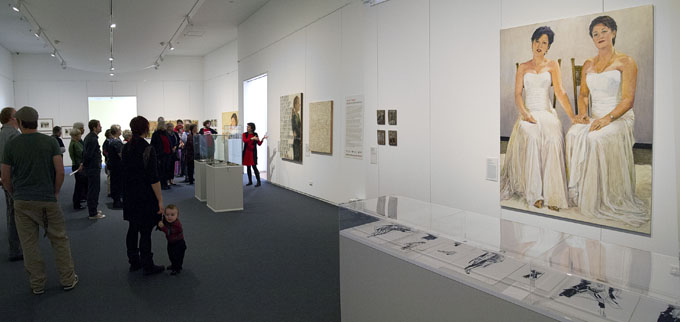
Christine Clark presenting a floor talk – ‘Jenny Sages: Paths to Portraiture’
A painted portrait, to be authentic, must be more than a visual transcription of the subject. A couple of years ago Christopher Allen, in writing a review of a photographic portraiture exhibition at the National Portrait Gallery made the statement that ‘humans are not ultimately machine-readable’. (Allen 2010) He claims that portraits by any group of ‘reasonably able’ painters do the task of portraiture much better than photographers as, ‘Every mark is significant, and records something seen and felt; intellect and intuition are one and become simultaneous with making.’
In encountering Jenny Sages’ Paths to Portraiture exhibition at the Toowoomba Regional Art Gallery Allen’s dictum is profoundly proved. The portrait works are layered with an expression of the artist’s relationship with the subject – Sages needs to develop a friendship with the subject, to share the space and moment and the ‘other’ sense-stuff that makes a portrait more than a likeness.
The exhibition Jenny Sages: Paths to Portraiture was curated by Christine Clark, Manager of Exhibitions from the National Portrait Gallery, Canberra. The show’s premise was to present more than a collection of Sages’ portrait work, but as the title of the show alludes to – the path the artist takes in making a portrait. Included with the finished portraits are reference drawings, ephemera, and objects referential to the subject that informed the painted portrait. For the student of painting and for members of the public who wish to understand more of the artist’s process these elements provide an insight that is not usually part of the experience we have of finished artworks.
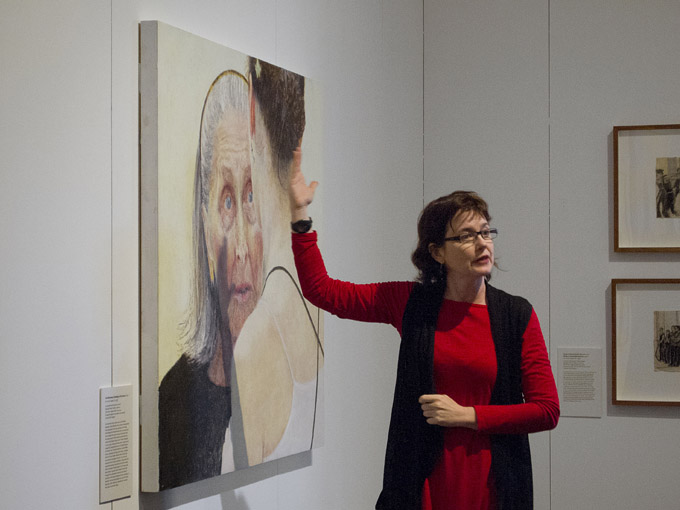
Christine Clark talking about Sages’ work
To compliment the exhibition Christine Clark presented a floor talk on the exhibition for around forty attendees from the Toowoomba art scene. Clark’s talk provided special insights into Sages’ background and the story of the paintings. She linked these stories with the displayed preliminary sketches, drawings and other objects making the experience of the art and Sages’ process rich and alive. Clark, through her enthusiasm for the artwork and her expressive gesture and discussion, took all present at the floor talk to a higher understanding and respect for the work before them. Thank you to the NPG, TRAG, Christine Clark and Jenny Sages for the opportunity to see and hear about this artist’s work in portraiture.
Doug Spowart 20 May 2012
Allen, C 2010, ‘Through a lens darkly’, The Australian, July 3, p. 11-2.
DOUG SPEAKS: Qld Festival of Photography, Toowoomba Forum
FRIDAY 27 APRIL – TOOWOOMBA REGIONAL ART GALLERY
1.30 – 3.00 pm: Panel discussion: Contemporary Photography
Panel: Marian Drew, Ray Cook, Henri van Noordenburg, Doug Spowart and Maurice Ortega
Topic:
Photography is going through major changes due to digital technologies and the explosion of images used through the internet. This panel questions new and emerging practices in photography and presents visual examples of these developments.
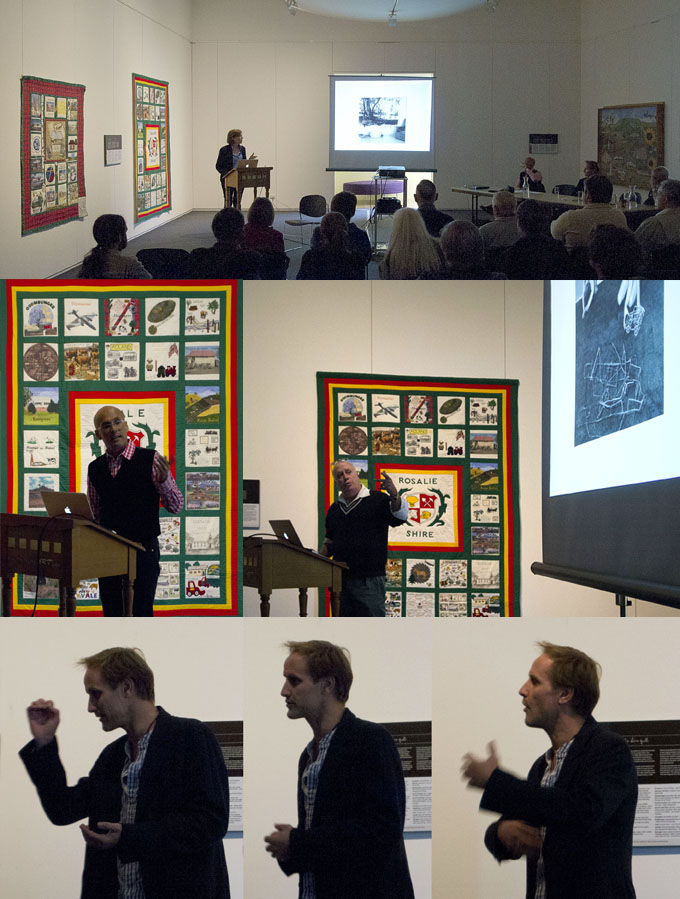
Marian Drew (top), Maurice Ortega, Ray Cook (centre), Henri van Noordenburg (bottom)
An audience of about 45 drawn from the local photography community attended the forum. Each speaker spoke of the aspects of contemporary art photography that informs their work. Marian discussed works by Camilla Birkland, Deb Mansfield, Kate Bernauer, Jenny Carter White; Ray’s hero was Roger Ballin and he spoke of his experience of the ongoing issues of minority groups like gays in society, Henri spoke of his close work transforming the surface of the image and works by Shirin Neshat, Sebastiaan Bremer. Finally Maurice discussed the international scene and the rise of the constructed image – what I’d call faux-photo or photo-fictions. Question time was led by a fired-up John Elliott challenging the blandness and the falseness of contemporary art photography and the lack of space given the ‘still vibrant’ documentary scene.

Doug Spowart speaking @ the QCP FORUM @ TRAG
My contribution to the forum was a paper that discussed the idea that emergent technologies in production and distribution of photography has made everyone a photographer. For those interested in this commentary on contemporary photography the text is published below…
(formatting is a little changed in WordPress)
.
EVERYONE A PHOTOGRAPHER
At this time, as we find ourselves within the 200th anniversary of the photographic experiments of Wedgewood, Davies, Neipce and, if Geoffrey Batchen is right, a host of other inventors, we are witnessing a transfer of the power of photography from the chosen few to the masses – everyone is now a photographer and the camera-made image synonymous with life itself.
In the 1930s Lazlo Maholy-Nagy saw it coming in his prediction that, ‘a knowledge of photography is just as important as that of the alphabet. The illiterate of the future will be ignorant of the use of the camera and pen alike.’ (Moholy-Nagy 1936:32) Although in the text Moholy-Nagy was discussing the photographic sequence and the emerging moving image, his comments allude to our times and how images have replaced words.
In the 1980s the instant imaging giant Polaroid took the concept further by pronouncing in their advertising that we all needed to, ‘learn to speak Polaroid’ – that is, use images to express ideas and concepts, not words. They suggested the we take a Polaroid SX70 image; it will only take a minute to develop before our eyes, to show the time on a clock, the creama of a freshly expressoed coffee or the smile on a child’s face.
Maholy-Nagy was talking about the way images operate in society, and Polaroid was certainly selling their product to the masses, but in the eras in which these statements were made the photographer was a professional imaging technologist. Sure, making photographs had a wide range of users – vernacular photography was well established, George Eastman and Kodak had ensured that, and amateurs and dilettantes banded together to form camera clubs and societies to pursue pictorial beauty. But ‘real’ photography was carried out by specialists who acted with the passion and pain of religious zealots.
Photographers and their colluding commentators created a pantheon of masters and masterworks. They protected their secret knowledges, skills and dark workings within the fields of optics, chemistry and their cumbersome technologies. In their work they excised meaning from the chaos of time and space, and they served and informed the societies in which they lived. They did something that others could not – they made photographs and had access to the media of newspaper, magazines and books through which their images could be communicated to a mass audience.
We may consider digital technology as a major disruption for photography, however the process of photography has always been challenged and transformed by waves of new technologies as part of its liaison with science and art; photographs on silvered metal mirrors, negatives on glass and paper, celluloid and plastic, monochrome, colour transparency/movies/prints … and most recently, electronic files. Cameras of wood and brass, bellows and focusing cloth, tripod-fixed and handheld, carved from solid metal blocks, molded in carbon fibre and plastic …
What is different about the technology of digital photography today is that instead of maintaining the technological barrier between photographers and other users, it has dissolved and democratised image-making.
Other underlying factors drive the march of digital by satisfying some rather basic human needs. Photography historian and commentator Geoffrey Batchen defines photography as being, ‘a persistent economy of photographic desires and concepts’. He lists within this economy concepts like, ‘nature, knowledge, representation, time, space, observing subject, and the observed object.’ For Batchen photography is about, ‘the desire, conscious or not, to orchestrate a particular set of relationships between these various concepts.’ (Batchen 1999:213) I have no doubt that everyone wants to ‘orchestrate’ an image collection of experiences that are important to them and digital imaging has facilitated just that.
Another commentator on this concept adds to this broader human need to photograph, philosopher Vilem Flusser claims that the,
‘Photographer’s intensions are to inform others and through their photographs to immortalise themselves in the memory of others. For photographers, their concepts (and the ideas signified by these concepts) are the main raisons d’être for taking photographs, and the camera’s program is in the service of these raison d’être.’ (Flusser 2002:46)
Now, with digital technologies everyone can access these opportunities ascribed to the photographer and the image. And this process starts in the making of images using a range of newly developed capture technologies. In the Australian Newspaper of January 29 and 30, 2011, journalist Ross Bilton states, ‘Anyone with an iPhone, and a good eye, can claim to be one of an emerging breed of photographic artist: an [iPhonographer.]’ (Bilton 2011:7)
Once the image is made cheap and easy to use enhancement apps can be employed to make the image look like whatever the photographer wants. These mobile apps ape professional-grade software with the advantage that in one-or-two ‘clicks’ the image can be transformed beyond its optical reality into an aesthetic, esoteric or just plain funny photo. Immediate distribution of the image via phone, tablet or later by computer is so easy.
The nature of the photograph in technical and design aesthetic terms has changed as well. The random carefree snapshot, once the domain of documentary photographers, is now part of the vernacular imaging toolbox. In the hands of the nouveaux digital photographer the snapshot has come to be as seductive and as slick as the advertising photograph of old.
As everyone is now a photographer anyone can be a revered as a master, mentor or critic. As a teacher of photography I have encountered the demise of the history of the process. Now students are more likely to seek feedback from Facebook friends and inspiration from peers encountered online. The tradition and the myth of the discipline have little inspiration for a generation of image-makers hell-bent on making what the can from their experience of life. As with any revolution, some will regress to retro-technology: pinhole, Holgas and Dianas and even Hasselblads and large format – if you can still get film.
Everyone now is an exhibitor through the online technologies of Flickr, Facebook, Instagram, blogs, web galleries and Pinterest. The screen of the computer is the gallery wall leaving ‘bricks and mortar’ spaces, perhaps even like this one, to being white cubed mausoleums to the art of the past. Or, to survive, high visitation galleries have become converted into the kind of experience once found in funparks, with slippery-slides, art playgrounds, interactive content – even allowing visitors to use cameras and coffee shops with iPads and everywhere, noisy spaces.
Online downloads brought the music distribution cartels to their knees and expanded opportunities for emerging bands to have an active presence on the world stage. The same is happening now with books and publishing as any photographer can self-publish and self-market using the online services of companies like Blurb and LuLu. In using these technologies photographers are leaving behind the gatekeeping machinery of publishers, distributors and bookshops.
The promulgation of the image through informal independent channels of all forms emancipates both makers and viewers from the control of politicians, commerce and religion. And everyday new opportunities are emerging. In 2011 Magnum photographer Christopher Anderson re-published his documentary book Capitolio in an eBook form and sold copies for tablets and eReaders for a few dollars. In an interview with Nathan Lee Bush, he proposed that it was an experiment in the dual media of the physical book and its virtual ‘equivalent’. He states, ‘I do like the idea of this being a potential model for new media. Time will tell.’ (Bush 2011)
In proposing a philosophy of photography Vilem Flusser put forward many propositions of how and why photography operates. One concept he introduces is that it provides the ‘possibility of freedom’. He states,
‘… in a world dominated by apparatuses; to reflect upon the way in which, despite everything, it is possible for human beings to give significance to their lives in the face of the chance necessity of death. Such a philosophy is necessary because it is the only form of revolution left open to us.’ (Flusser 2000)
Perhaps digital imaging is part of that revolution and we are all contributing to it.
.
Doug Spowart 27 April, 2012
.
Batchen, G 1999, Burning with desire : the conception of photography, Massachusetts Institute of Technology, Massachusetts.
Bilton, R 2011, ‘iPhoneography’, The Weekend Australian, 29-30 January, 2011.
Bush, NL 2011, Through the looking glass | A pro Photo/Video Blog, Interview: Magnum Photographer Publishes Photobook for iPad, Adorama Rentals, viewed March 31 2011, <http://arcrental.wordpress.com/2011/03/30/interview-magnum-photographer-publishes-photobook-for-ipad/>.
Flusser, V 2000, Towards a philosophy of photography, Reaktion Books Ltd., London.
—- 2002, Writings, vol. 6, Electronic Mediations, University of Minnesota Press, Minneapolis.
Moholy-Nagy, L 1936, ‘From Pigment to Light’, in Telehor, vol. 1, pp. 32-36.
IAN SMITH: “On and Off the Road” in Toowoomba Regional Gallery
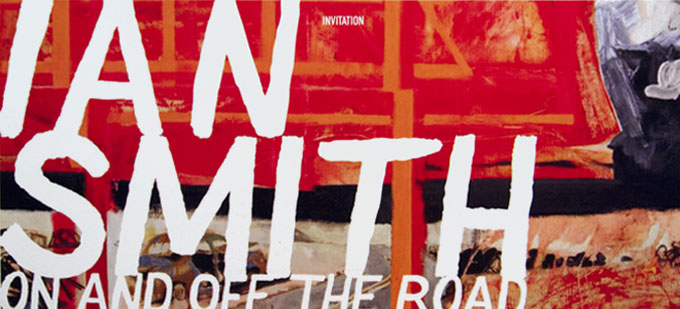
On Sunday January 8, Ian Smith presented an artist’s talk to accompany his exhibition On and Off The Road, a travelling exhibition from the Gold Coast Art Gallery, at the Toowoomba Regional Art Gallery. Attended by around 60 local and visiting artists from the McGregor Summer Schools, Smith spoke about his life and work. The follow are a few comments and observations inspired by the man and his talk.
Ian Smith is like the Australian version of one of those characters straight out of Jack Kerouac’s 1950’s trans-American crossing, On the Road. He is the kind of person who would give you a lift as a hitch-hiker and keep you amused with every kind of story you can imagine, embellished with obtuse observations of life, art and doin’ what you need to. And if the narrative about Smith can stretch that far, his art is as big and crammed full of life and insightful opinion. Just by standing before it you can have a conversation with it where it tells you its story and you will not get a word in yourself.
Smith was born a brought up in Cairns. He didn’t ‘discover and fall in love’ with north Queensland as so many artists have. He is a self-confessed ‘Tropicale snob’ and wears his regional slant on things with all the swagger of a true regional artist. Smith is a figurative painter but somehow landscape gets in the way, although these landscapes have figures and life-signs of humanity.
VIEW THE ALEX CHOMICZ VIDEO of the exhibition and the artist: Ian Smith Paintings On and Off the Road
http://www.youtube.com/watch?v=W1kZi1ZHIGw.
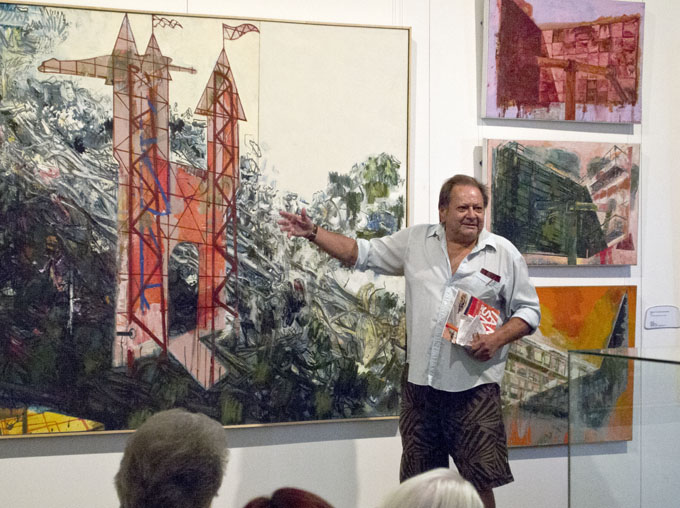
Ian Smith presenting an artist's talk @ the Toowoomba Regional Art Gallery 8 Jan 2012
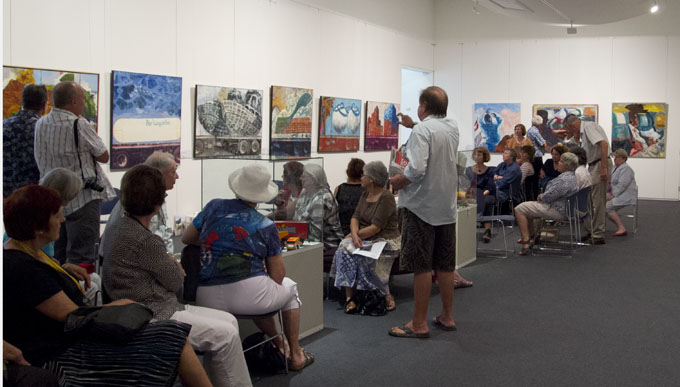
Ian Smith and crowd @ Toowoomba Regional Art Gallery
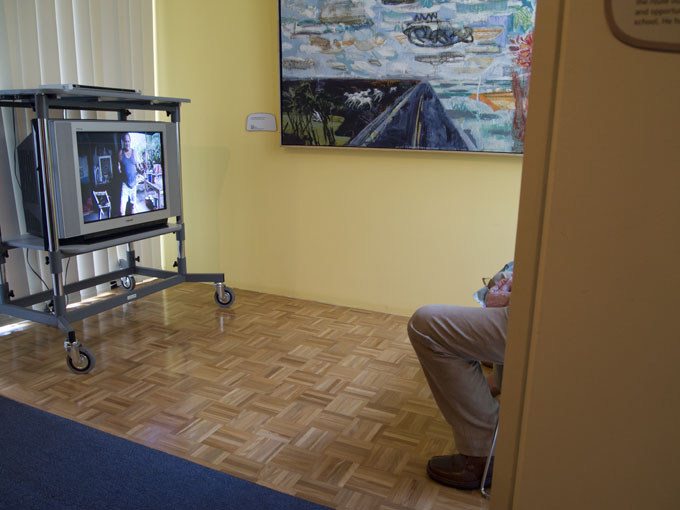
Watching the Alex Chomicz video "Ian Smith Paintings On and Off the Road"
Ian and I had some connections from the past – He exhibited in my Gallery (Imagery Gallery) in Brisbane in the 1980s and we shared teaching experiences at the Queensland College of Art in the 1970s and friendship with North Queensland photographer Glen O’Malley. So he came over home to my garden for a few beers (Ian) and coffees (Vicky and I) and a chat.
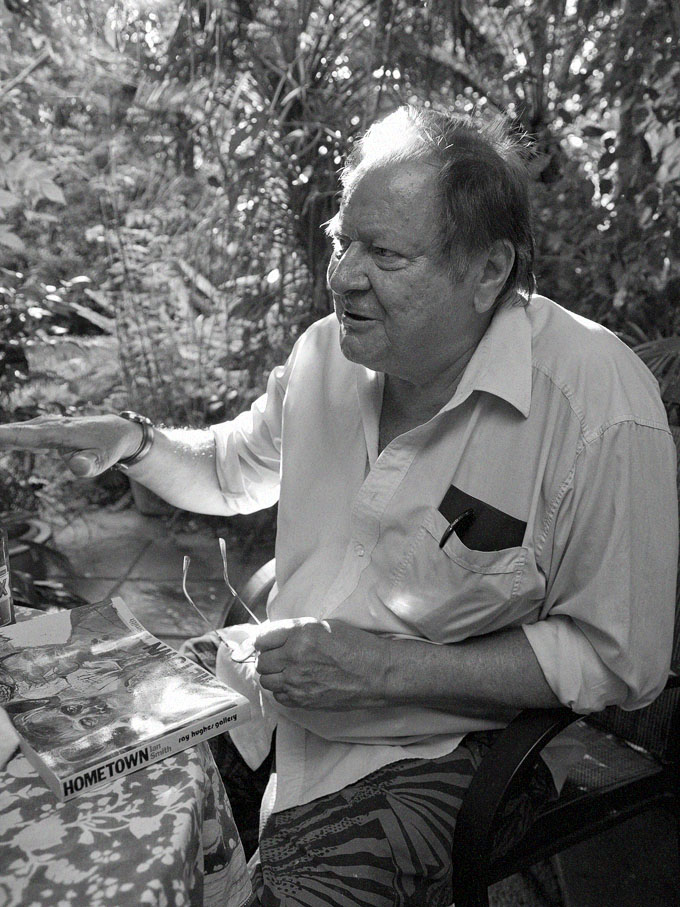
Ian Smith talking
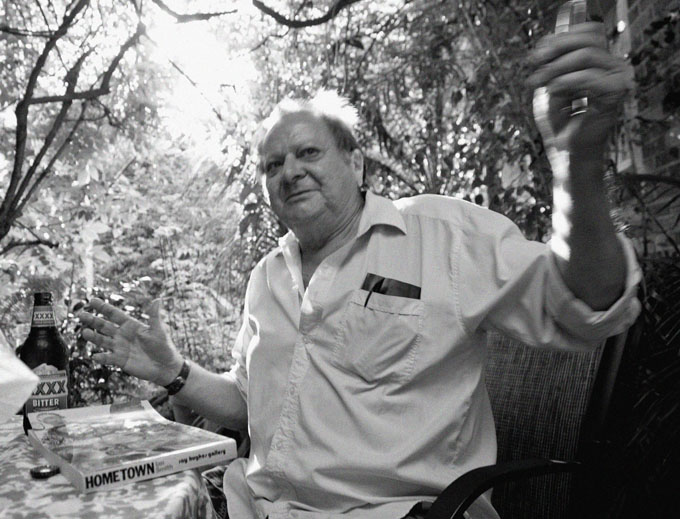
An animated Ian Smith makes his point!
July 24 Allan Bruce Floor Talk
Allan Bruce talks about his exhibition Panoramic Drawings at Toowoomba Regional Art Gallery
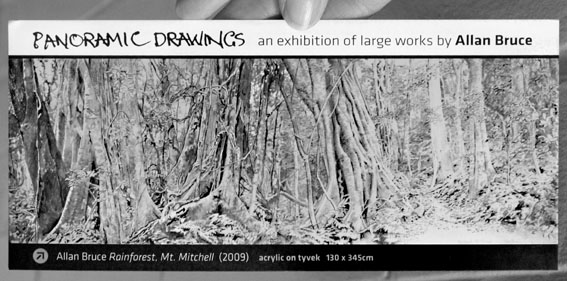
Invitation: Panoramic Drawings
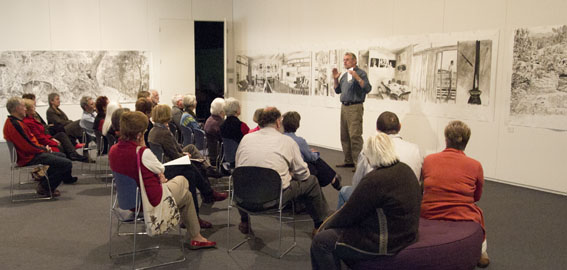
Allan Bruce floor talk in the exhibition space
Walking into Gallery 1 at the Toowoomba Regional Art Gallery, one expects to see large wall works to fill this large space – Allan Bruce’s impressive black and white occidental inspired works are no exception.
In the exhibition, Panoramic Drawings, Bruce presents urban and natural landscapes and room interiors as seamlessly blended composite images where each work: “while recognizable, tends to be an evocation rather than an absolutely literal statement of place”[1]. As with oriental scrolls these works allow the viewer a multi-perspective journey through the spaces that have captured Bruce’s attention and inspiration.
Bruce utilizes ‘in situ’ documentation (photos, video and sketches) and memory to reconfigure the essentials of being in each place. The viewer of this work maybe drawn to the detail and textures of the subject captured within the brushwork of the shadows but the absence of detail in the highlights energizes the work and provides a space for the imagination.
1. From the room sheet for the exhibition
Words: Victoria Cooper
Panoramic Drawings is on at Toowoomba Regional Art Gallery from June 30 to August 7.
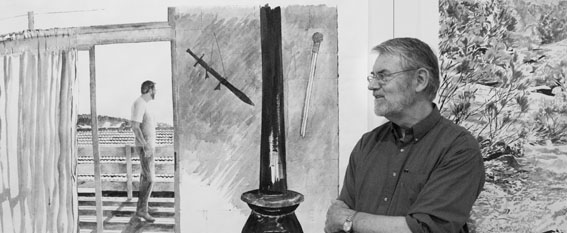
Portrait of Allan Bruce with work by Victoria Cooper
For more info on Allan Bruce see:

 wotwedid