LAUNCH: WOTWEDO.COM – the Cooper+Spowart workshops
For over 30 years Doug Spowart and 20 years for Victoria Cooper, have participated in training for creatives including artists and photographers. The pair has lectured in art and photography at TAFE colleges, universities, workshops, conferences and seminars for students, amateurs and professionals alike. Now, during April, May and June, through WOTWEDO.COM @ Brisbane’s Foto Frenzy, they offer a range of specialised & bespoke training and consultation services.
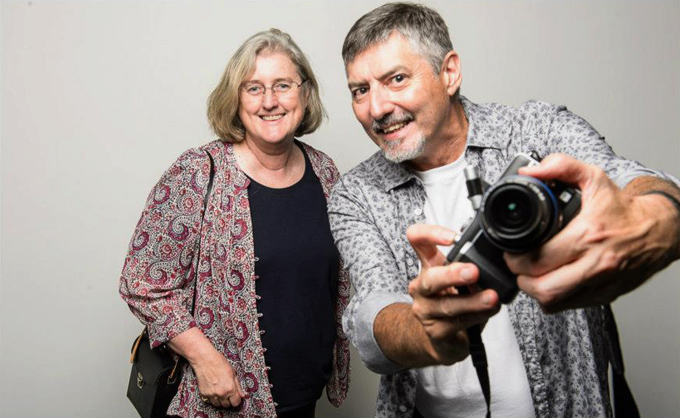
Both Doug and Victoria are Masters of Photography and Honourary Fellows of the Australian Institute of Professional Photography (AIPP). Throughout most of the 1990s Doug was the Chairperson of the AIPP Professional Photography Awards. In the mid 2000s both Vicky and Doug were involved as AIPP representatives in writing national photography TAFE level curriculum for Certificate and Diploma of Photography programs. In the last 10 years Victoria and Doug have engaged in part-time university study in photography and the world of artists books and art.
in 2013 Doug and Victoria are taking a sabbatical from TAFE teaching to pursue post-doctoral research and to re-engage with their arts practice. These workshops are part of their ‘Leap of Faith’ initiative that was introduced in their earlier blog post.
Do review their WOTWEDO workshop program and see WOT-THEY-CAN-DO for YOU!
.
THE WORKSHOPS
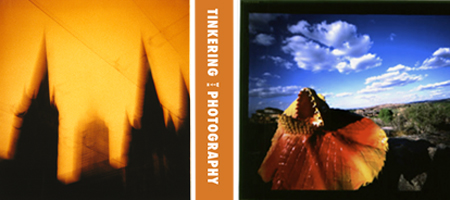
SERIES 1: TINKERING WITH PHOTOGRAPHY
Is your photography becoming formulaic (predictable) and more about digital technology and post-production than about the hands-on experience of taking photographs? Do you want to investigate possibilities of making a personal style beyond Instagram, Lomography and Hipstamatic filters?
This series is crammed full of projects and ideas that will present you with challenges, weird stuff, things you’ve heard about but never had the chance to try, and things that require a rush of the creative thought juices. Use this workshop to reconnect with your love of photography.
Dates (Tentative) 6 Sessions: Monday, April 15, 22, 29 and May 6, 13 & 20, 2013.
.
SERIES 2: LOOKING GOOD IN PRINT–PHOTOBOOKS
By now everyone has made a photobook and in many ways current technology makes it easy to make one. But a photobook can be so much more – it can be a hand-made artwork or a super-slick prestige trade styled publication.
The Looking Good in Print: Photobook introductory session and workshop series will connect participants with concepts and techniques on how to personalize and create photo-stories in the form of the bespoke self-published photobook.
The range of options for making photobooks will be discussed and samples of hand-made, inkjet printed and hand-bound artists’ books, print-on-demand books will be available for viewing.
Dates (Tentative) 5 Sessions: Wednesday, April 10, 24, and May 1, 8 & 15, 2013.
.

SERIES 3: INTEGRATED SOCIAL MEDIA
When you Google yourself, or your business, what kind of response do you get? Is your online presence a bit thin or based on content from Facebook, a website maybe, and a few social mentions?
This introductory session and workshop series is designed to help you to start developing an integrated online presence. It will illustrate how an integrated approach to using platforms like Linkedin, WordPress Blogs, YouTube and Behance Folios can create a ‘wall’ of search engine locatable, quality references and social media mentions as to who you are and what you do.
Dates (Tentative) 5 Sessions: Tuesday, May 21, 28, and June 4, 11 & 25, 2013.
.
MORE INFORMATION & BOOKINGS
VISIT <www.wotwedo.com> for further details and bookings or contact Doug and Victoria by email info@cooperandspowart.com.au
Bookings through:

.
.

This work is licensed under a Creative Commons Attribution-NonCommercial-NoDerivs 3.0 Unported License.
GETTING iPAD’ed’ for the future of education
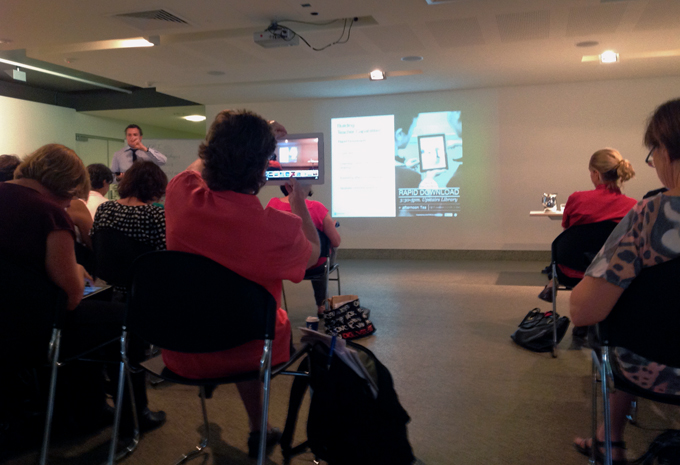
Over the last two weeks we have attended free Apple iPad lectures and demonstrations at the State Library of Queensland. Offered as part of their Digital Skills workshops the SLQ run them in partnership with presenters from the Apple Distinguished Educators program.
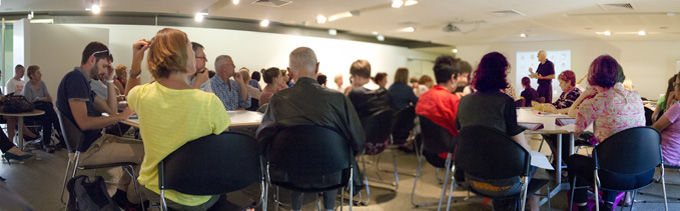
Attending the first session of the SLQ Digital Skills workshop, February 20, 2013 …Photo: Doug Spowart
Whilst I’ve been around classrooms in the higher education area for most of my life, I now see an edu-game changing revolution emerging, based on opportunities provided by emergent digital technologies–most significantly the Apple iPad. Once we sat in front of desktop screens and towers enslaved by the size and weight of the technology. This scenario morphed into a mini, almost-mobile laptop phase where function and use usually mimicked its larger desktop brother. Now small portable tablets, in particular iPads, are replacing the computer behemoths of the past, and seem to be filling gaps in technology, social and human behaviour, centred on education.
It’s not just the iPad that’s made this possible, as it is merely the machine that acts a stage for the action. Everything about accessibility and functionality with the iPad ultimately comes down to apps. While we are familiar with conventional computer software and the near monopoly on applications for purpose, and their attached expense, apps are often free or modestly priced from $2~$10. And there are literally 1,000s and 1,000s of them, essentially an app for whatever you may want to do. This is why the iPad has such an intoxicating effect in the education interface of student and, perhaps also, those who teach.

There are other considerations. The realm of education is essentially a place of youth, they want to subvert existing paradigms and most importantly they want to play games. The now ubiquitous iPad has transformed the learning space from chalk ‘n’ talk, and cursor ‘n’ mouse, into a gamified experience. Gamification, as Wikipaedia suggests, ‘is the use of game-thinking and game mechanics in a non-game context in order to engage users and solve problems.’ The iPad provides a rich ‘game-like’ experience for users and much like a Trojan horse, it acts as the ‘hidden’ carrier of a teaching strategy for knowledge, skill acquisition, problem solving, creative expression and communication. Finally we teachers have found out that we can let kids have fun in the classroom.
The SLQ Digital Skills workshops and the presentations by the Apple Distinguished Educators have for me clarified this concept. The edu-evangelistic approach of the presenters and their vision for the future, has inspired me to get on board the iPad education facilitated experience, for both my students and I – we ‘wanna have fun’ …
Dr Doug Spowart
.
More information of upcoming sessions:
SLQ’s Digital Skills workshop series is presented in partnership with Apple Distinguished Educators.
.
This work is licensed under a Creative Commons Attribution-NonCommercial-NoDerivs 3.0 Unported License.
GIRRAWEEN National Park in the rain
Or: When the Bureau of Meteorology says it ‘might’ rain it probably will!!
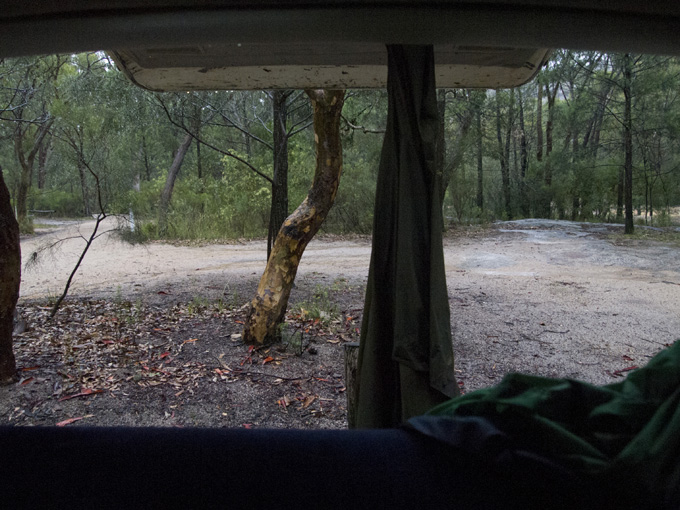
Girraween in the rain – Rear view from the Tarago
.
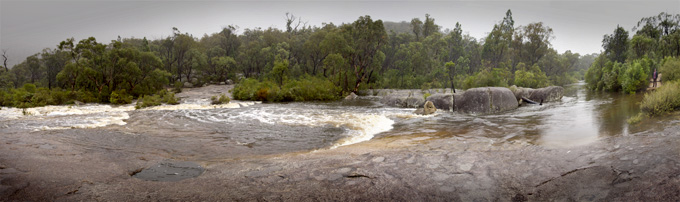
Bald Rock Creek in minor flood the next morning
.
Camping in the rain at Girraween
.
We shouldn’t have – but – we did . . .
We were celebrating our sabbatical
Girraween our place for such rituals
So we put the tent up, set up the camp and fire
And settled in for a quiet night in the bush.
A couple of raindrops signaled what was to come.
As it gradually increased to a steady drizzle
We retreated to the car.
Our Tarago has sheltered and transported us for over 550,000kms
Through droughted landscapes of searing heat and bull dust
In driving rain and along flooded roadsides
Across vast and lonely country roads
The car is our inspiration, our ‘think-tank’ even our camera.
It has dodged kangaroos by travelling at snails pace
Avoided destination fixated drivers and their death defying maneuvers
Now again we are avoiding the soaking rain in the warm and comfort of this legendary vehicle
From the car we planned and prepared our evening meal
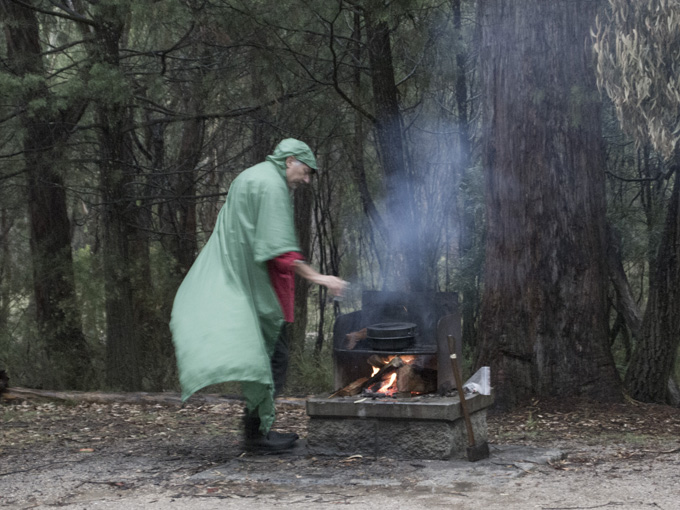
Doug tends the fire in the rain in preparation for the cooking of a roast chicken dinner in a Bedourie Oven
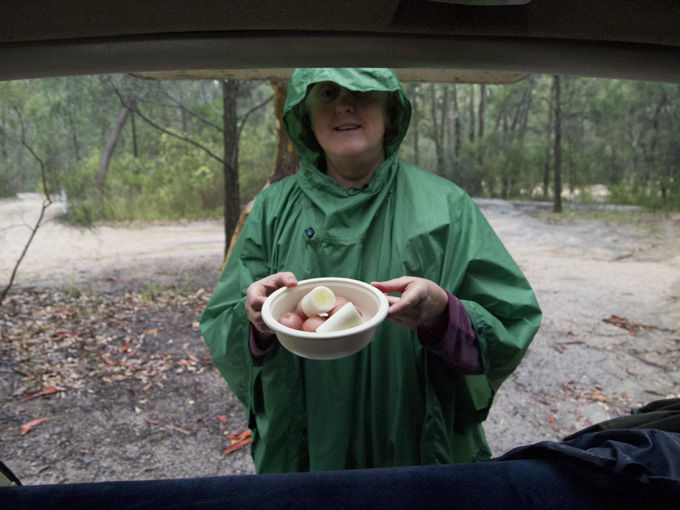
Vicky prepares the spuds and leeks at the rear of the Tarago
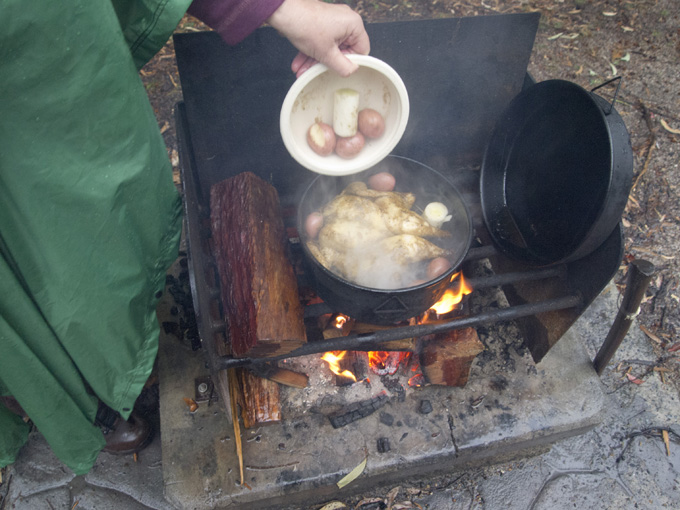
Adding the spuds and leeks to the chicken in the Bedourie Oven – Yep! It’s raining…
Doug started the fire in the rain
A job he has done more than once
And we put our chicken in the Bedourie oven to slowly roast
Added leeks and potatoes a little later
We watched the fire cook from the car
The rain still steadily increasing
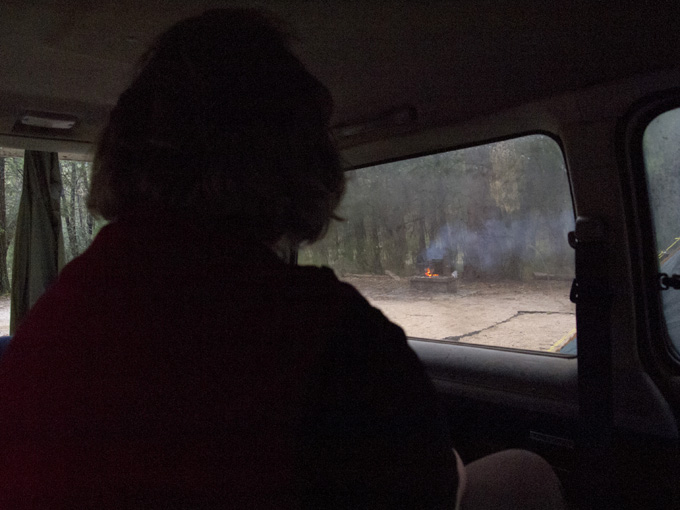
Watching the cooking from the driest space – the Tarago
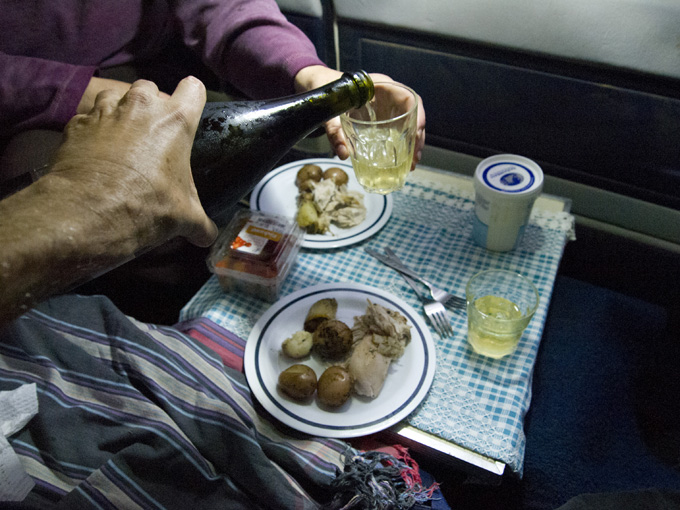
A camper’s roast dinner prepared and eaten in the Tarago
.
Finally our dinner was ready
A bottle of celebratory Brown Brothers Patricia
In our dry and warm car
Life is pretty good …
.
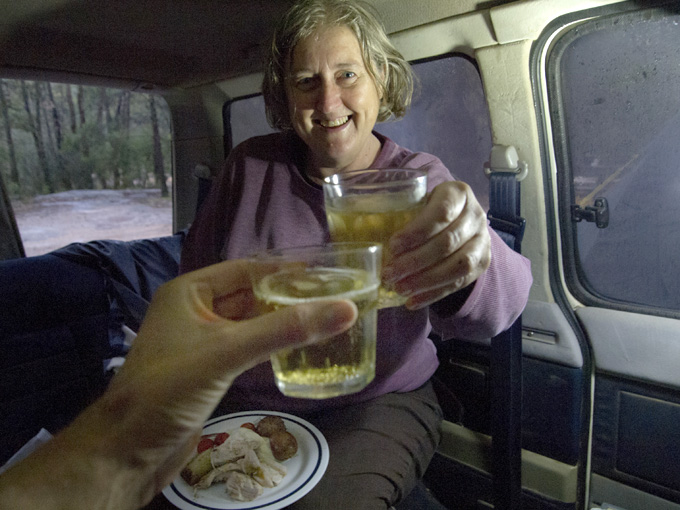
We’re excited, a toast (Brown Brothers Bubbly) to the roast dinner – cooked in the rain ….
.
Words: Victoria Cooper ….≥≥………Images: Doug Spowart
.
.
The regional gallery that advertises on highway billboards
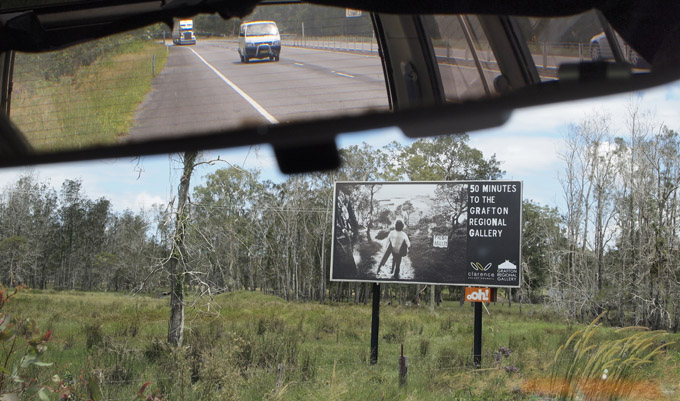
Grafton Art Gallery – Highway Billboard Photo: Doug Spowart
The concept of cultural tourism is often cited as the justification for local council support of regional arts infrastructure that may include, cultural policy, gallery facility and staffing, education or interpretive or developmental officers, local arts workers, regional grant administration and auspicing. What interests us as we travel around the country is the quality of regional arts practice and the entrepreneurial activities that are taking place that tend to be lost in the white noise of the big city hype of blockbusters and art heroes.
The Grafton Regional Gallery is well known for its Jacaranda trees and the Jacaranda Acquisitive Drawing Prize. But there are other things, for example how many regional galleries participate in highway billboard advertising? —GRG does. Another aspect is the diversity of shows presented include curated exhibitions from works in their collection, shows by local artists and travelling exhibitions—recently the Archibald Prize,.
On this occasion two exhibitions attracted our interest, The Art of Sound, a GRG collaboration with the National Film and Sound Archive and Garlugun.gi by local ceramicist Bevan Skinner.
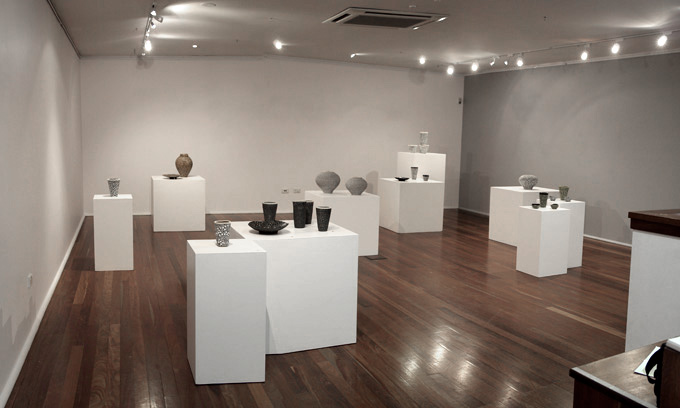
Bevan Skinner’s Garlugun.gi
Skinner’s work is informed by his indigenous heritage. A Gumbaygan man he states in the detailed catalogue accompanying the show that: ‘my work always revolves around my culture, my identity and my spirit.’ While any artist could claim the same provenance for their art Skinner’s work is a deliberate and profound blending of the earth of his country (clays, oxides and pigments), and culture (mark making, tradition and storytelling). While the dot technique of the desert artists is apparent in this work Skinner’s use of the motif is to represent stars in the sky and the meaningfulness that they have for him as a way to connect and remember loved ones passed away and now appearing as stars in the night sky. These works are part of a larger series Winda-bin Waluurrgundi – Stars of The Valley.
Bevan Skinner’s work is presented in a multi-plinthed exhibition space with groups of pots and plates resonating. Some time ago I remember a comment by David Hockney in which he said something around the idea that the time the artist takes in making a work is matched by how it will engage with the viewer. There is something of this in Skinner’s work, for me each piece is a vessel that holds in the artist’s communiqué and the viewer’s gaze activates the message.
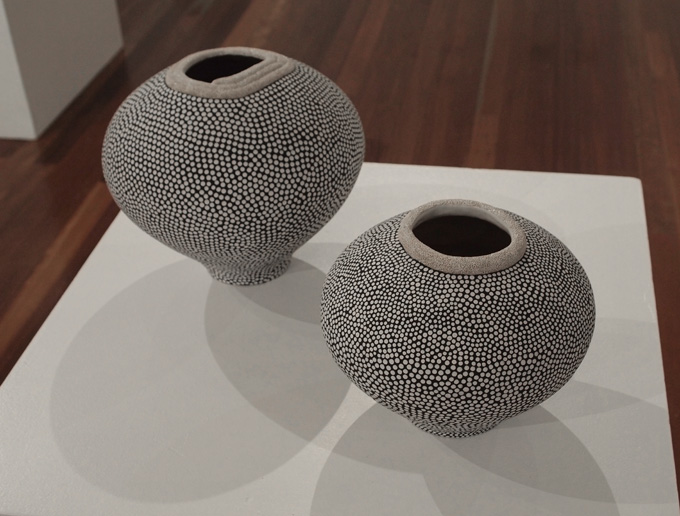
Winda-bin Waluurrgundi – Stars of The Valley Series 1 2008 (foreground)
One side issue emerging from Bevan Skinner’s biography is Associate Diploma in Ceramics training he completed at TAFE in the early 1990s with art teachers who assisted with his development as an artist. I can only exhibit trepidation about the future of artists like Skinner who early in their career ‘found themselves’ through TAFE, now that in NSW art training has been dropped from all TAFE colleges.
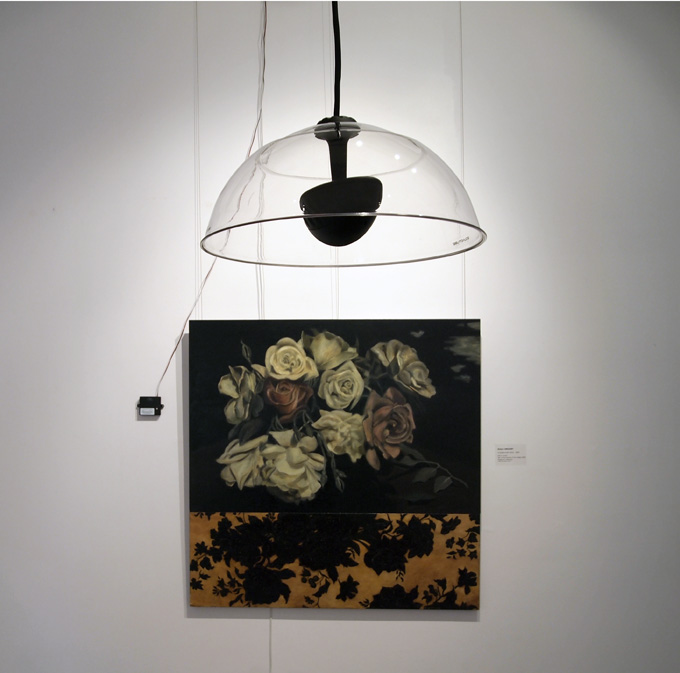
Robyn Sweaney A passionate affair (2003)+ Country Garden audio
The Art of Sound offers a new way of presenting visual art in a gallery space. The concept is to pair works from the GAG collection with audio material supplied from the National Film and Sound Archive so that the viewer of an artwork has a sight and sound experience of the art. On entering the gallery space the visitor is immediately met with the usual artworks on the wall but something is different—each has some kind of parabolic Perspex dish suspended above or headphones nearby. These sonic devices deliver, in a fairly localised way, music or audio to compliment the work. Composer and sound/artist designer James Hurley undertook the installation of the audio apparatus at GAG.
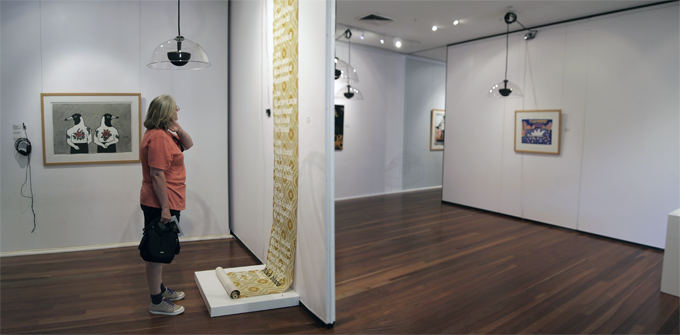
The Art of Sound installation
Gallery Director Jude McBean does not provide answers in her didactic panel statement but rather asks some provocative questions:
‘I wonder how long the effect of linking a particular sound with an artwork will last and how much will the sound determine or change perceptions of the work. These questions also apply to the linking of an artwork to a sound. How long will the participant recall the artwork when hearing that sound outside of the gallery and will the artwork determine or change the experience of the sound or not? The answers are eagerly anticipated over the duration of the project and in later years.’
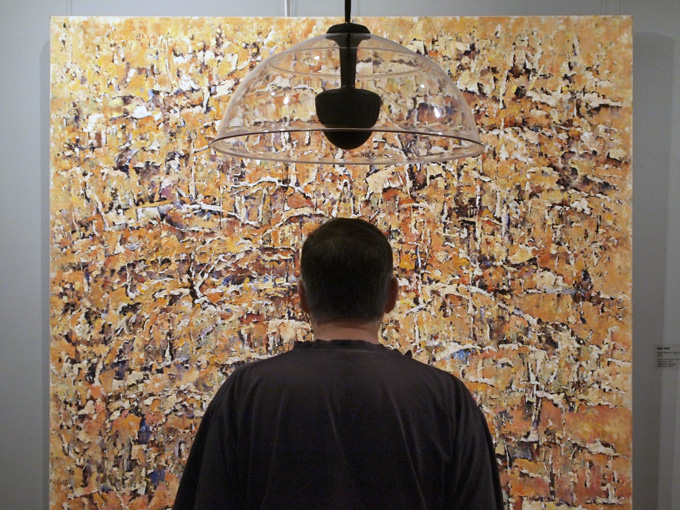
Mike Riley Stock Reserve near Grafton (2010) + AMATA audio PHOTO: Victoria Cooper
What I found was that sometimes the audio triggered personal recollections of time and place and that these could be used as a kind of reference for the visual experience of the art. Music, for example, has a broad dissemination across a generation. Take for example the ‘Happy Little Vegemites’ 1954 advertisement. However the artist’s work is very limited in its distribution so the audio conjures up a familiar personal response through which the image is viewed for its concurrency. On other occasions like with Mike Riley’s Stock Reserve near Grafton (2010) and indigenous folk music by AMATA (2007) where the piece of music or audio was unknown as was the artwork a new experience was created. A profound work for me was the Judy Cassab, Mothers Love (2004), J W Lindt pair of 1870s photographs of local Aboriginal people with children synergised by the traditional Indigenous singing by BUMA (2008) a song about crying babies who will go to sleep when fed. Could it be that mine was the predictable response that the curators and their pairing of visual and audio stimulus wished to create?
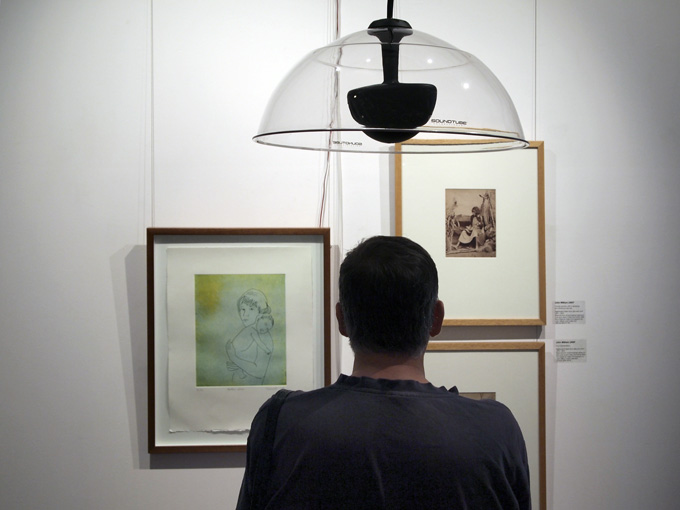
Judy Cassab Mothers Love (2004), JW Lindt photographs (1870s)+BUMA audio PHOTO: Victoria Cooper
Another, perhaps subversive experiment that I undertook in the space was to attempt to activate as many sound sources as possible and listen to the montage of sounds whilst moving about the artworks—somehow it created an experience of life itself …
Thank you to the GAG and to other regional galleries around the country who through ingenuity, creativity, entrepreneurship and cunning do as much for their communities as they do for the rest of the country in presenting contemporary art.
.
Dr Doug Spowart
Photos by Doug and Victoria Cooper
WAITING, Waiting, waiting for the examiner’s report on PhD thesis
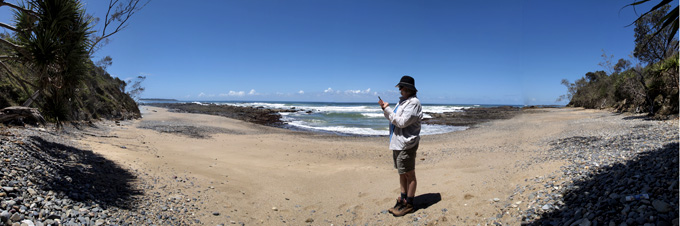
Checking to see if the examiners have gotten back…
The thesis (exegesis) was submitted in late November. I was thinking that the examiners would probably have gone on Christmas break before the taking the time to review the thesis so I wasn’t expecting anything in January. By Early February I began to occasionally check my university email for any news … With the iPhone I could even do that at the beach.
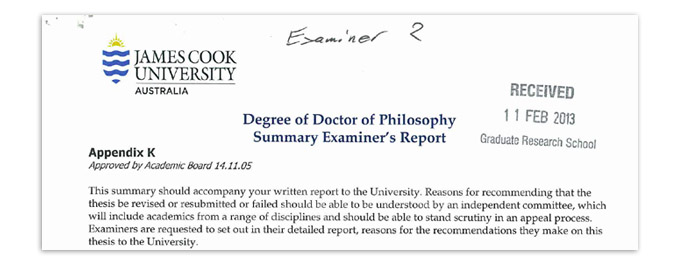
Monday 11, 2013: The email and report arrived – One examiner gave the thesis the ‘all clear’. The other examiner required review of some aspects of the thesis. So, the final hurdle is some corrections and then some more university bureaucratic documentation and I’m done!!! Dr Stephen Naylor my supervisor is excited as well…
Victoria Cooper
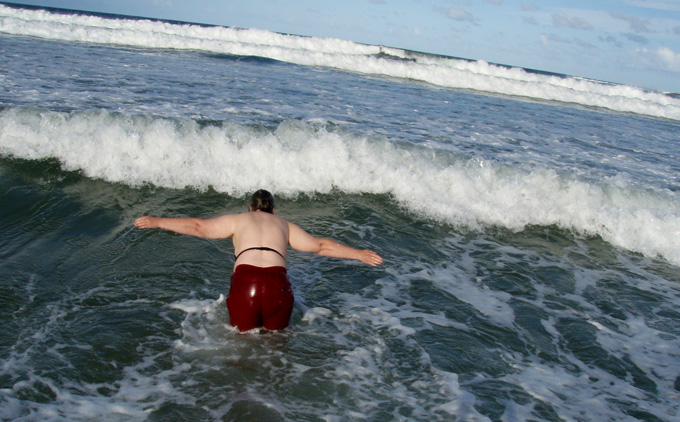
diving into the final stages of a PhD
QAGOMA: THE ART GALLERY + The Photographer
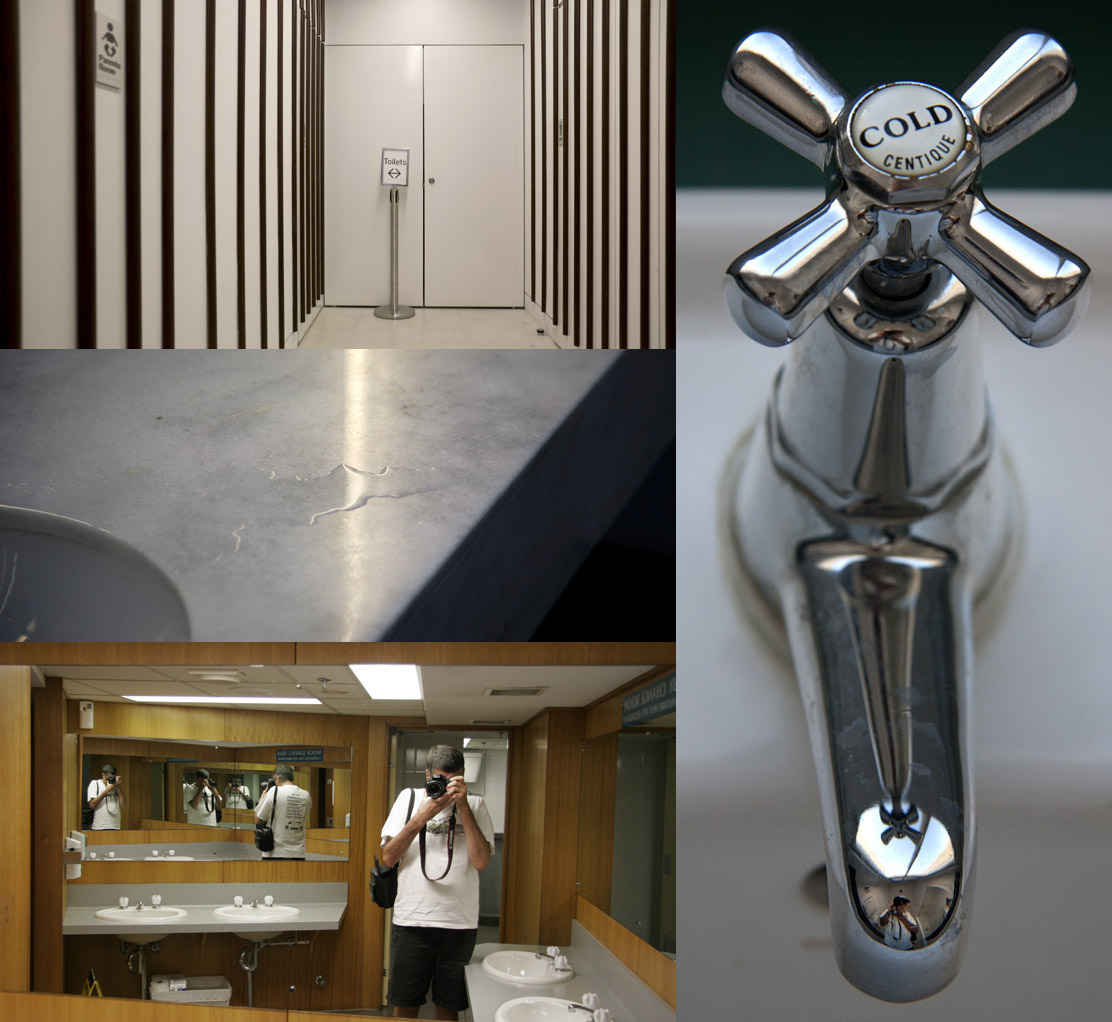
My interest in the world I engage with has led me to be a photographer, sometimes more specifically, a photodocumentary photographer. In my life, art and the space of the gallery, has been a constant companion to my every present desire to encounter both the idea, and the ideas of artists. Linking the two: the gallery and photographic documentation can create problems. This means that I observe and can receive a trigger, a response to make images. I have had to control this impulse to comply with the prevailing gallery institutional morays around photography in their controlled public spaces. Although, for around twenty years to subvert this bureaucratic impost I have photographed where no security could observe and intercept image making—I’ve photographed art gallery dunnies![i] Sometimes I still steal a photograph or two in the gallery: the call of the architectural space, the art in situ and the interaction of fellow patrons is far too strong. And sometimes I get cautioned and asked ‘not to photograph’ by art gallery attendants.
But that has all changed, most significantly in QAGOMA in Brisbane. Now, gallery photography (except in loaned exhibitions where copyright issues preclude photography), has been democratised as every visitor now has an iPhone, a point-and-shoot camera or a DSLR and they are not afraid to use their devices to document artwork, the gallery itself or their interaction with both. This liaison between the camera toting gallery patron and the gallery is a concession that may have arisen from the gallery’s recognition of a changing expectation of the gallery by art viewers. Before taking up a new position as Director of the National Gallery of Victoria the then QAGOMA Gallery Director Tony Ellwood stated in an interview in the Australian Newspaper that: ‘As a director, you continue to reinvent an institution as audience trends and expectations evolve.’[ii] This relaxed attitude to photography seems to be popular as is the revised approach to the ‘quiet as a library’ noise etiquette gallery maxim of the past.
Visitors to galleries do want to encounter art and they want to be rewarded by their engagement with it. Whether this is educative, informative or experiential the act of personal documentation for future reflection and sharing with others is important. In some ways the act of photography is a signifier of the meaningfulness of the art or the experience of that moment for the person with the camera. When images and personal reflection is posted in social media, Facebook and Blogs, the artist/artwork, the exhibition and the gallery become an extended space. But there is also something of the theme park in the nouveau gallery visitor’s expectations, and that is that they want to be entertained, and be seen in that mode of behavior.
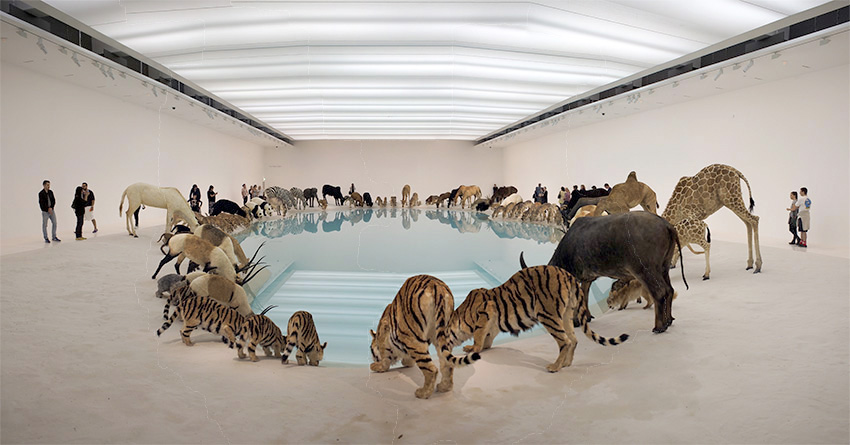
Cai Guo-Qiang: Heritage 2013, GOMA. Photo: Doug Spowart
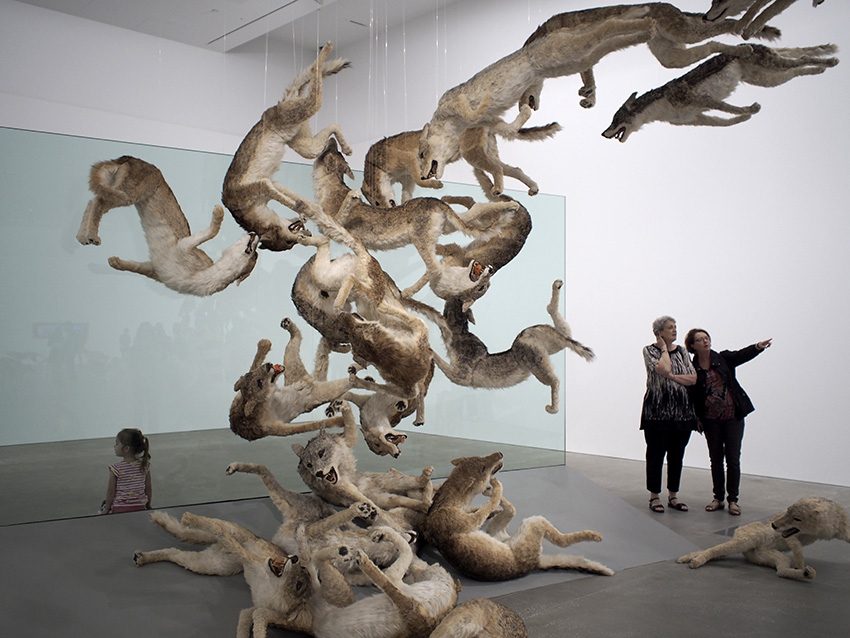
Cai Guo-Qiang: Head on 2006, GOMA. Photo: Doug Spowart
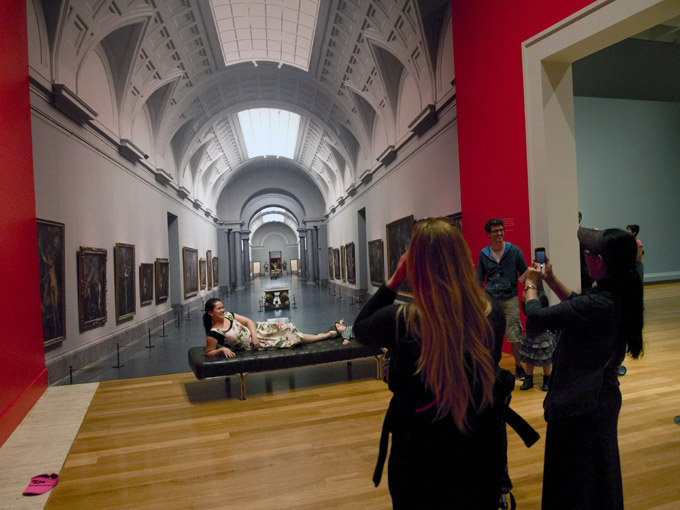
A patron as a clothed Maja ……..Portrait of Spain: Masterpieces from the Prado
QAGOMA’s huge visitor numbers, the highest in Australia at 1.8 million last year, acknowledge the success of catering for this emerging visitor expectation and it would appear that Director Ellwood has brought changes like these into the mix. David Walsh the entrepreneur behind Hobart’s MONA in the Age Newspaper comments that Ellwood: ‘… crosses the boundaries between high art and fun.’[iii]
To enlarge upon the gallery’s audience development strategies QAGOMA Acting Director Suhanya Raffel’s wrote, in the foreword for ‘The 7th Asia Pacific Triennial of Contemporary Art’ publication a claim that: ‘This Gallery is renowned for its inclusive and innovative public programs’ and that the APT has been seminal to the Gallery’s awareness of the importance in, ‘developing interactive art works with contemporary artists and creating meaningful ways for audiences to engage with contemporary art.’[iv]
While it may seem that it’s logical for a gallery to do all it can to attract visitors it seems that there is a political expectation for the gallery to do just that. The Honourable Campbell Newman, Premier of Queensland, in the press release announcement of Chris Saines as the new QAGOMA Director appointee, that ‘I’m confident he [Saines] will fulfil [sic] the brief to provide an accessible and engaging art experience to audiences, while enhancing QAGOMA’s reputation as an art museum of international standing, and Queensland’s reputation as a culturally dynamic state.’[v]
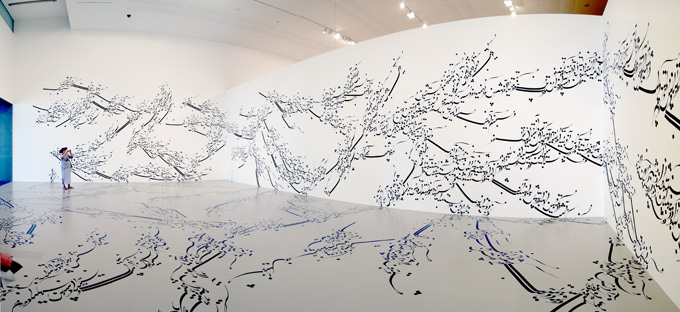
A visitor photographs Parastou Forouhar’s Written room 1999–ongoing
.
As a photographer I am not alone in my interest in photographing in the gallery and making images of gallery patrons viewing artworks. Thomas Struth[vi] is well known for his close-up views of visitor’s expressions made in the world’s swankiest galleries. Elliott Erwitt’s[vii] photographs exhibit his wry humour and the juxtaposition of subject and situation. The gallery inspired work of both photographers has been famously published in exhibitions and books. While my style sometimes has a kinship with Erwitt’s humour the work I do is more about the incongruities presented by a peopled vibrant space full of large and small-scale objects, fames, architectural forms and 3D experiential rooms.
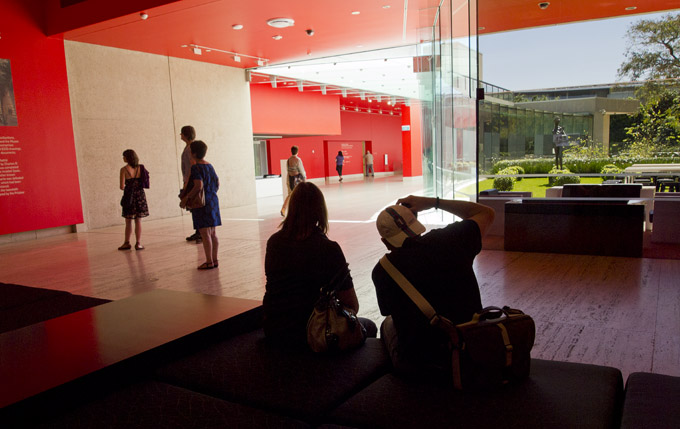
A gallery visitor photographing ……Portrait of Spain: Masterpieces from the Prado
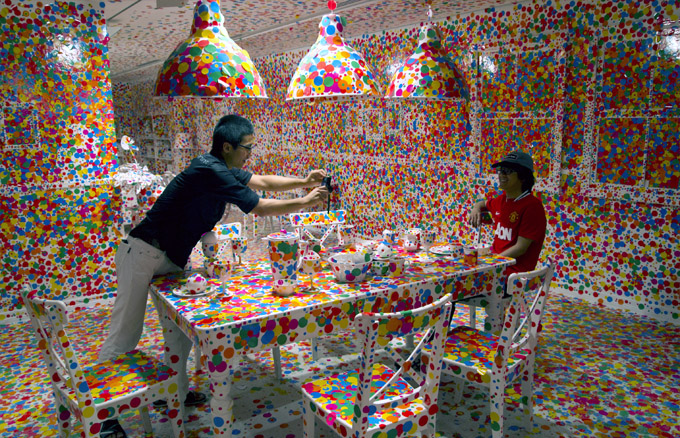
Yayoi Kusama’s The obliteration room
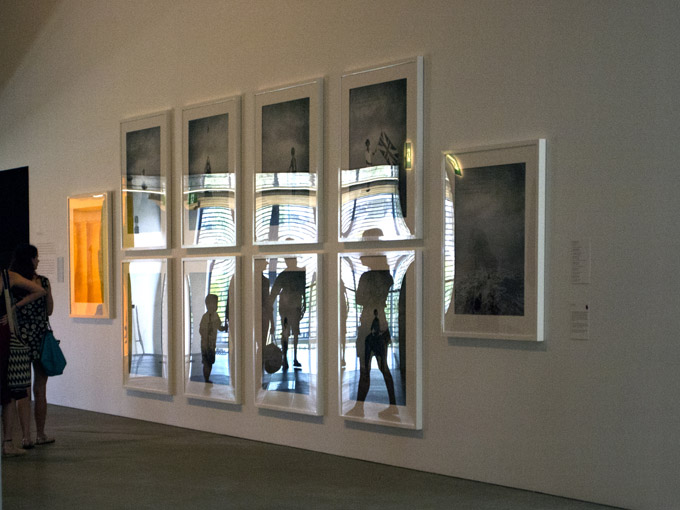
APT frame reflections
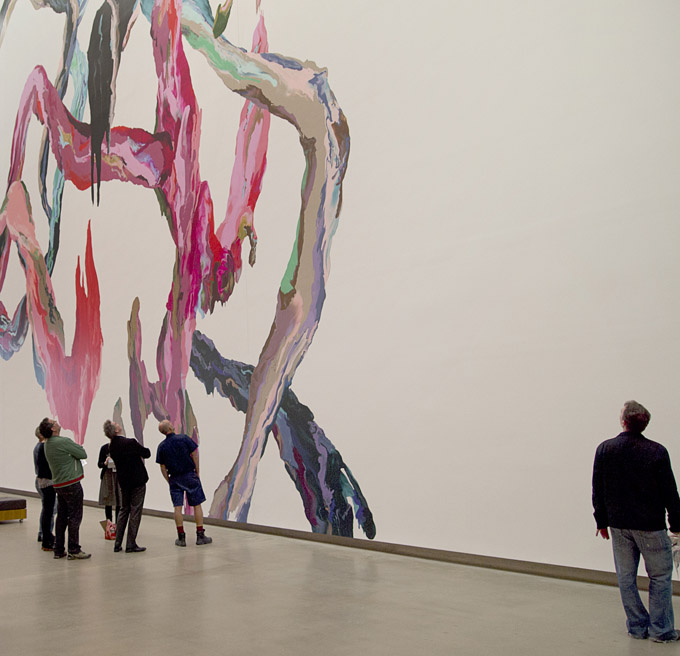
Noël Skrzypczak’s Jungle 2012
As gallery patrons move within these spaces and spontaneously respond to what they encounter—my objective is to observe and record moments in which a synergy exists between the subject, the place, maybe the artwork and a sense of order that the photographer in me needs resolved. These are unpredictable and fluid moments where intuition and patience contribute to a desired outcome. Work in the space of the gallery I do so cautiously not wanting my presence or activity to impede or influence my fellow visitors. Often the camera is turned on my partner Victoria and myself, as we experience the gallery. As always, in this space the viewer becomes the viewed, and I in turn I am also viewed, by the now benevolent gallery attendants.
Every visit to QAGOMA is now not only an opportunity to connect with the artworks on show but also to document fellow visitors and their experience of art—often themselves being compelled by the same impetus as mine, to photograph and inter-react with the gallery and the art presented within.
.
Dr Doug Spowart
Many of my gallery photography exploits are posted, with commentaries, on the blog <wotwedid.wordpress.com>
[i] I made an artists book entitled Places of quiet introspection in 2006 that features some of these surreptitiously made art gallery dunny photographs. A copy of the book was purchased by the State Library of Queensland’s for inclusion in their Artists Book collection.
[ii] http://www.theaustralian.com.au/news/features/tony-ellwood-44-national-gallery-of-victoria-director/story-e6frg8h6-1226464781363
[iii] http://www.theage.com.au/entertainment/art-and-design/big-task-for-new-gallery-director-20120229-1u3jg.html
[vii] Amazon.com book description for Erwitt’s Museum Watching. <http://www.amazon.com/Elliott-Erwitt-Museum-Watching-Photographs/dp/0714863114>
WEIRD SILENCE in Toowoomba: TC Oswald aftermath
MONDAY JANUARY 28 2013, an eerie silence has fallen over Toowoomba. The howling wind, driving rain and the bumping of things on the roof and around the place has gone after being ever present for three days. I strain to hear something—ah! There’s a birdcall or two (have not heard them for days), a car drives down the street … and then there’s nothing again.
The s-s-plash emptying the rain gauge is a very benign sound, and then I realise what the difference is … there is none of the constant noise of the B-Double trucks, the 8,000 of them that grind through Toowoomba every day. Every highway in-or-out of town is closed.
I hear more birds and sun is coming out—there is something of a Toowoomba experience of the past, a kind of déjà vu, perhaps even nostalgia for a time before trucks took over this town.
From Doug
UPDATE: January 29 – the ‘noise’ has started again…
.

Truck noise PHOTO: Victoria Cooper
OSWALD AFTERMATH: TOOWOOMBA – January 2013
Emptying the rain gauge for the third time since Friday – Another 120mm – I didn’t empty it on Sunday as the outside weather conditions were too nasty.
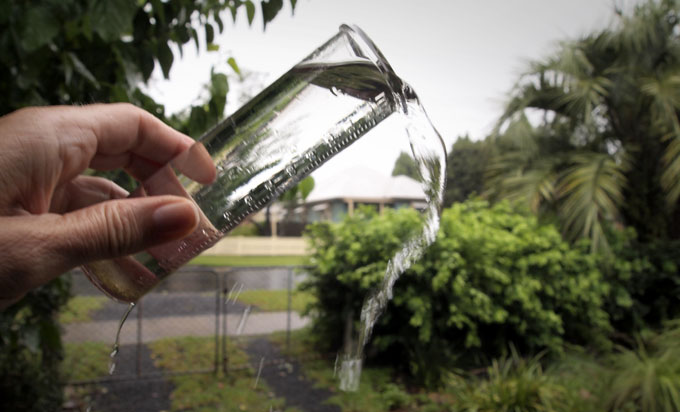
Tipping out the rain guage again PHOTO: Doug Spowart
We went out just now after being cooped up by the weather. Lots of bits of trees, occasional branches, eroded footpaths and water running everywhere. East Creek at the bottom of our street is fairly tame and seems to have contained itself throughout the deluge—nothing like January 10, 2011. (SEE the image below)
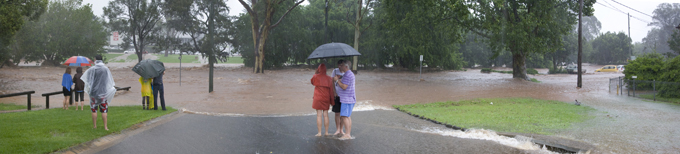
2011 FLOOD – Burns St Toowoomba PHOTO: Doug Spowart
Our thoughts are with friends, acquaintances and people who we don’t know at this time who are experiencing significant hardship as a result of ex-cyclone Oswald.
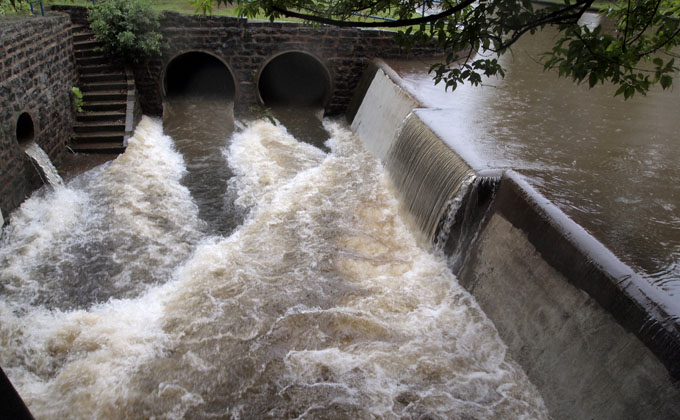
Drains East Creek near Margaret St, Toowoomba Photo: Doug Spowart
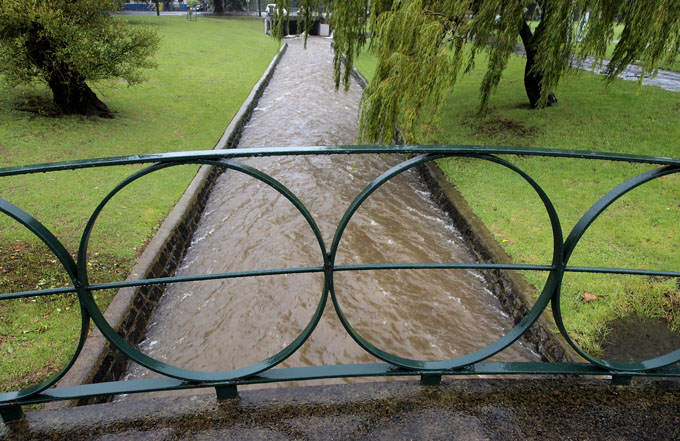
East Creek Toowoomba near Queens Park Photo: Doug Spowart
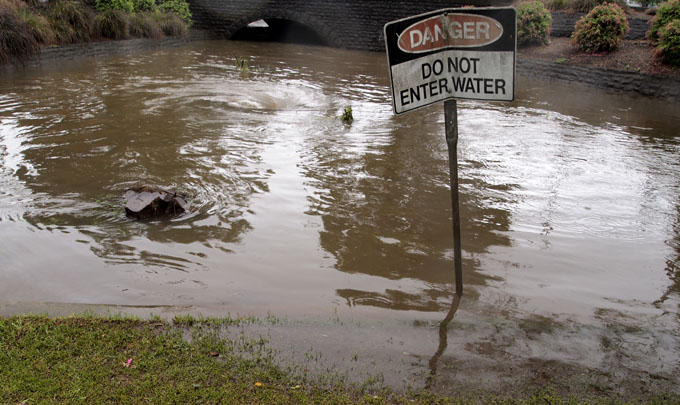
East Creek whirlpool near Herries St Toowoomba Photo: Doug Spowart
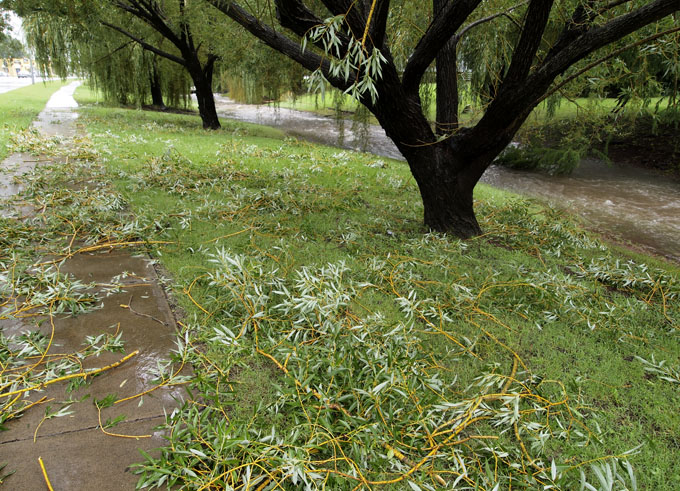
East Creek along Kitchener St Toowoomba Photo: Doug Spowart
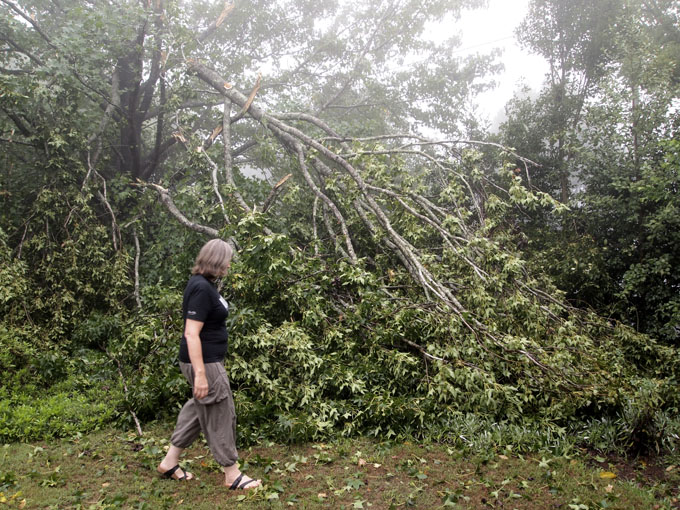
Fallen tree Margaret Street residence PHOTO: Doug Spowart
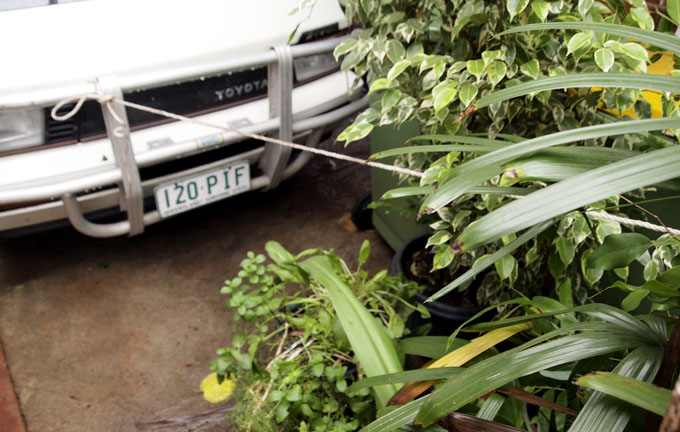
Tethered pot plants in the garage to stop them blowing away PHOTO: Doug Spowart
More stories Toowoomba Chronicle – Click HERE
Stay Safe ….
Doug + Vicky
PHOTOGRAPHER’S NIGHTMARE: Client returns faded wedding album after nearly 40 years!!
Not many people would pick me as a wedding photographer – Well, I’ve been to many, shot a few and even been employed as the wedding photographer. One of my photographs was the highest scoring wedding photograph at the AIPP Awards in 1991, and in the mid 1990s, I won the award ‘Queensland Innovative Wedding Photographer of the Year’ on two occasions. Masquerading as a wedding album, one of my artists books is even held in the State Library of Queensland’s rare books collection. SEE: http://srlopac.slq.qld.gov.au/cgi-bin/Pwebrecon.cgi?BBID=1381161
My wedding photography ‘career’ began auspiciously, as I guess most photographers do – with a family wedding. I was a naive 18 year old studying photography part-time at the College of Art in Brisbane. At the time I was working with an old Mamiya C33 and an M3 Leica with a Metz 202 flash, and the idea of shooting a wedding an adventure. At the time I was working at Kodak and some of my clients helped me out with advice and the ‘slip your prints in’ album that was the final outcome for the project.
All went to plan – I did the bride in the mirror at home, in the church during the ceremony with flash, the bride and groom walking up the isle, a quasi-documentary bride ‘n’ groom outside the church, family groups, bride and groom in the rear window of the car and the cake cutting. My brother Garry did marry Sheridan Draisey at All Saints Church and I had the photos to prove it.
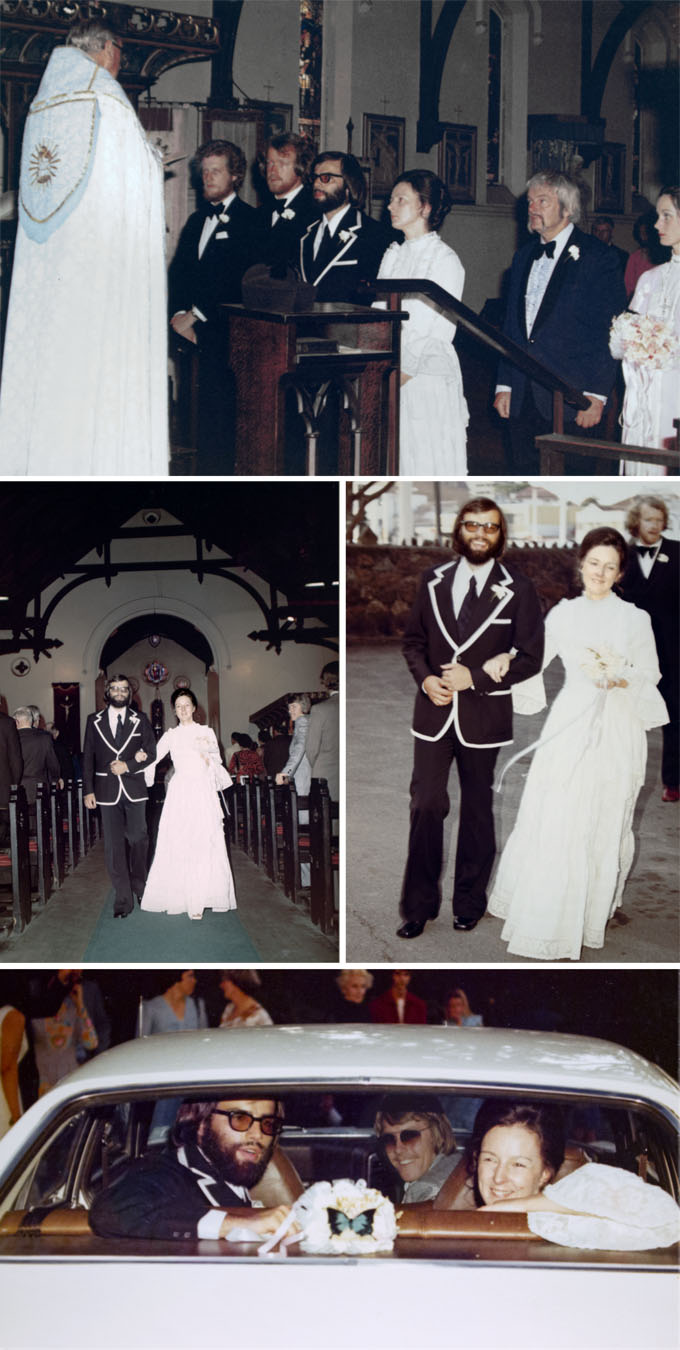
Wedding mosaic
Kodak printed the images; probably at their colour lab in Sydney as the Brisbane lab was still doing black and white processing exclusively. The prints were slipped into the pages and passed on to the happy couple.
Time passes…
A few years ago I heard through the family grapevine that the album was falling apart and that images were fading. I wonder how many photographers experience this fear of whether their goods and services will last and the possibility of the disgruntled client appearing from the past with faded, leuco-cyan (reddish) or yellowed prints and the grunge of time coating everything? Eventually I was reunited with the album and its sorry condition. What to do?
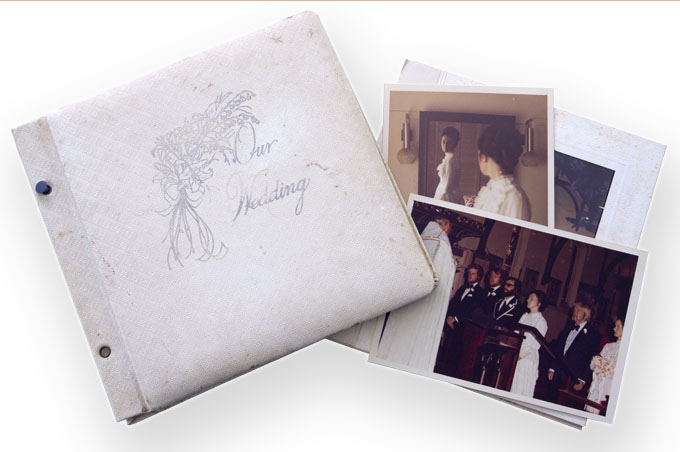
The original album
I scanned the images and used simple Adobe Photoshop techniques to remove casts and reconstitute faded colours. All images were reprinted on inkjet pigments and archival papers and the pages fitted into a new album cover. A CD-Rom was included loaded with the restored jpeg images. The original album was assembled as best as possible, wrapped archivally and inserted into a container for safe keeping and the new album similarly presented.
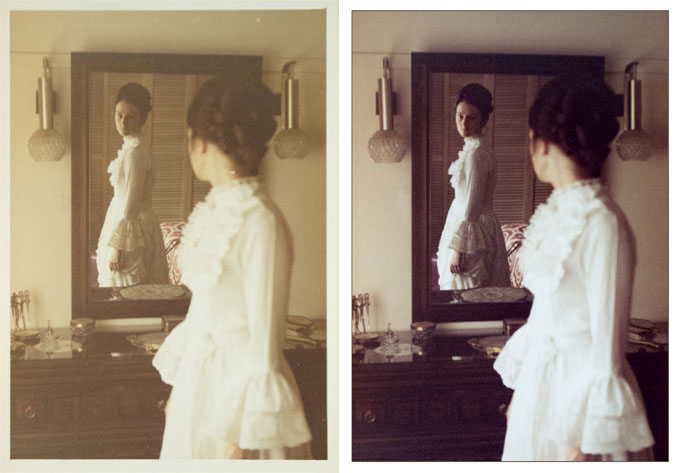
Before & after Adobe Photoshop restoration
On the next convenient occasion the album was represented to the client (my sister-in-law). She excitedly reviewed the album and recounted the wedding, and the stories of those in the group photos were updated – even perhaps made alive by their remembrance and telling.
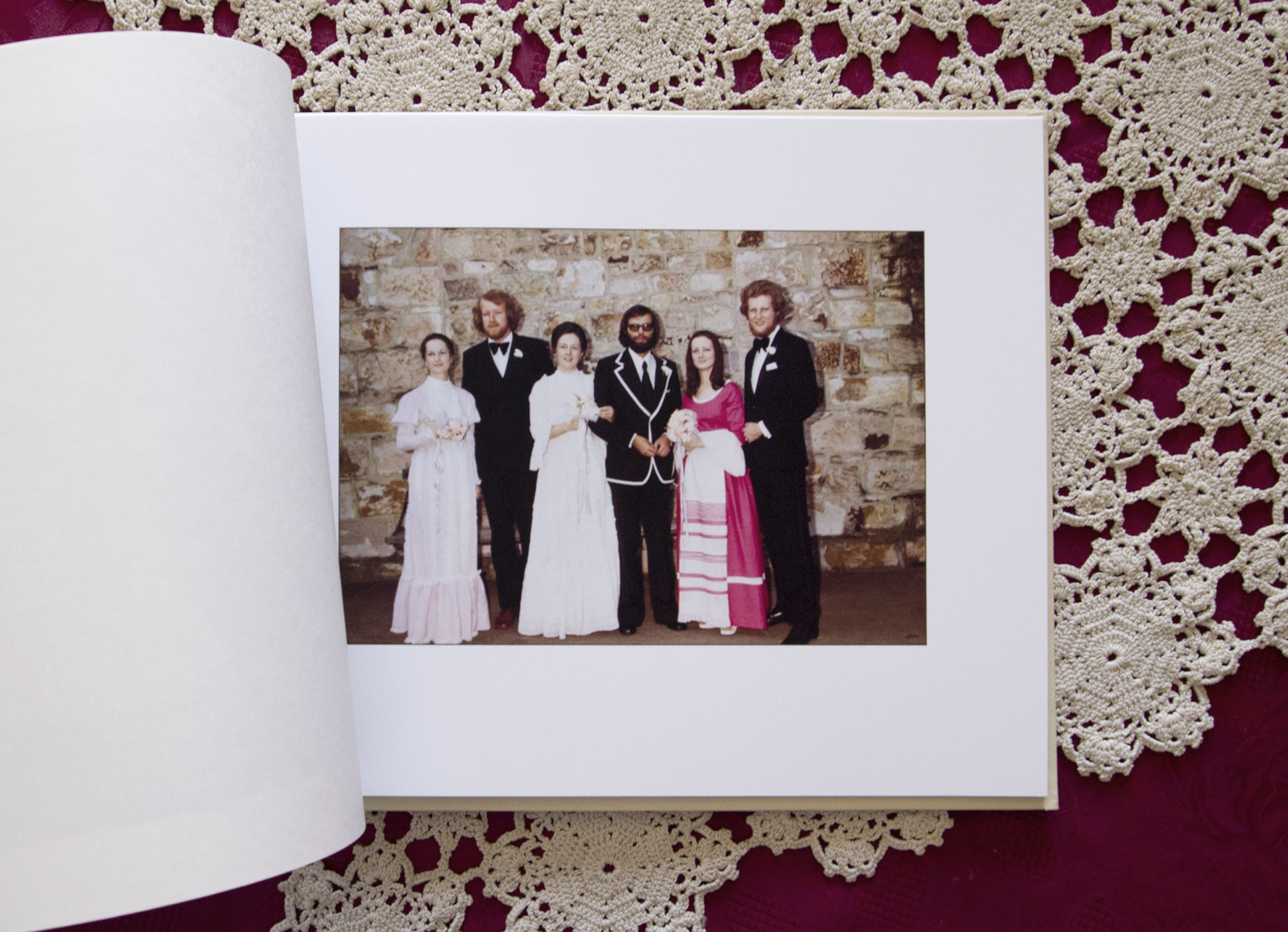
The New Album
My experience made me think about how photographers constantly push ‘photo memories’ as a selling point for choosing a professional photographer for important events. And I wondered how often the pro photographer’s images may, as in this case, not last as well as everyone might have expected. I came to also reflect upon how memories are recreated through photographs and how important the photograph of times past is for people – particularly as they age.
As the photographer and re-creator of the album I was rewarded by the experience and how many a faded image may be restored to its memorable potential by Adobe Photoshop. It is interesting how digital imaging was once touted as being the death of photography – it may very well be its salvation.
Doug Spowart
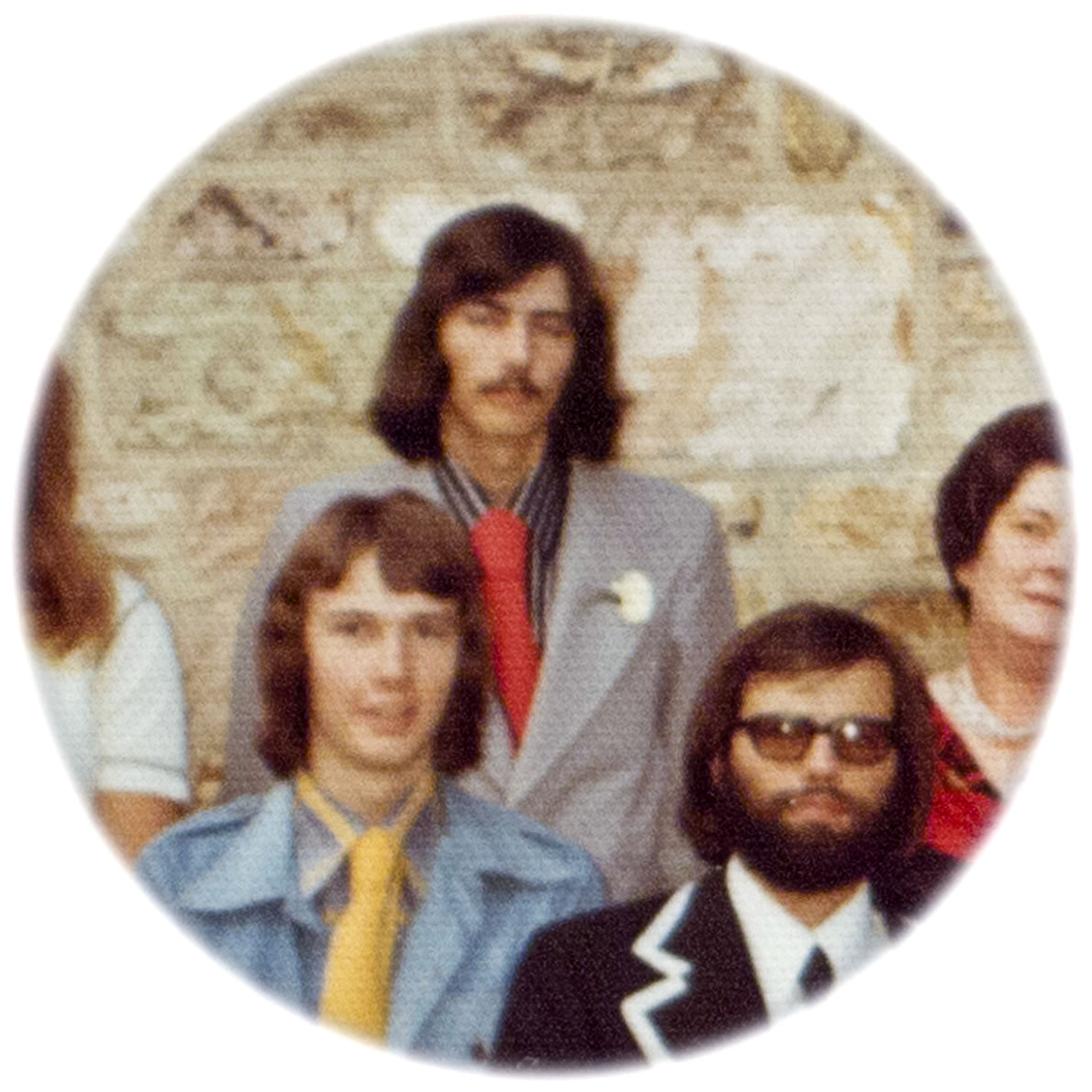
The photographer in the wedding group with brothers Garry and Peter
WHIPPING UP A FOTO FRENZY
Dr Doug opens the FOTO FRENZY Photographic Centre in Brisbane
The much awaited reopening of the expanded FOTO FRENZY Photographic Centre in Coorparoo took place on Friday, January 18, 2013. Attended by a crowd of around 100 well-wishers the event heralded a new beginning for dilettantes of a wide range of photography interests including:
- photography workshops
- photographic gallery
- fine art printing, mounting and framing
- photographic darkroom hire
- studio hire
- one-on-one consultations

Mark photographs the Foto Frenzy Team PHOTO: Victoria Cooper
The FOTO FRENZY space is shared with BRISBANE CAMERA HIRE, specialist in providing a range of photographic gear and unusual accessories.
The Foto Frenzy team includes Brisbane photo identities Ian Poole, Cam Attree, Tony Holden and Darren Jew. All four are photographers and have specialist areas of activity from photography as art, to location and underwater photography, nude and glamour photography and photography as personal expression. Darren Jew is well known in photo workshop circles for the ‘Faces and Places’ workshop that he established with Jim McKitrick in the late 1980s.
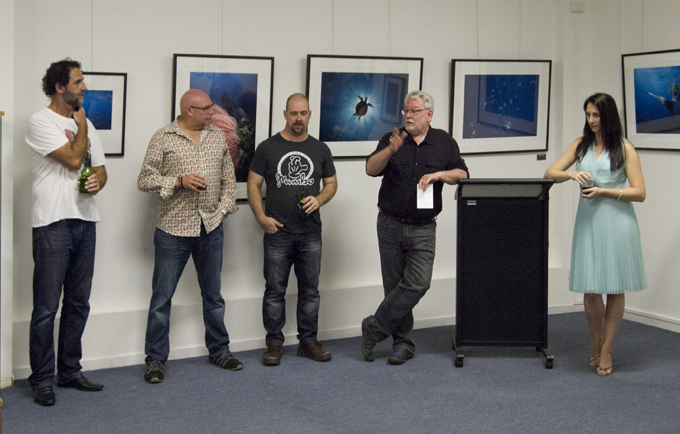
The team l-r Darren Jew, Tony Holden, Cam Attreee, Ian Poole and Susan BCH PHOTO: Victoria Cooper
The Foto Frenzy team have been together for twelve months in a modest facility just a short distance away from the new home. Now with the larger facility and the linkup with Susan & Jacob and Brisbane Camera Hire new and amazing opportunities for the business and the clients that they service are available.
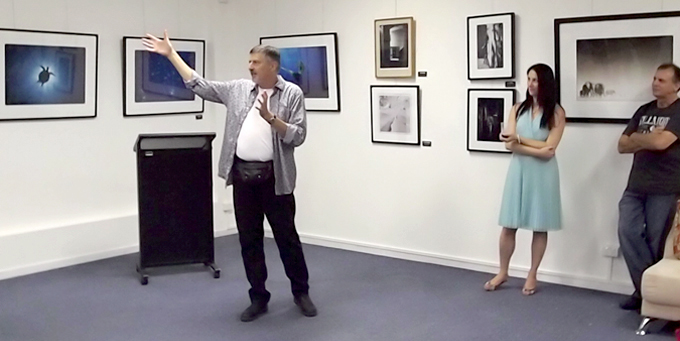
Doug Spowart opens Foto Frenzy PHOTO: Victoria Cooper
As someone with a history in photography that connects with most of the Foto Frenzy team, as well as being a former Director of the photo gallery and workshop—Imagery Gallery, (that operated in Brisbane from 1980-1995), I was asked to open the new Foto Frenzy Photographic Centre. Some of my comments in the opening speech were…
The other day I was made aware of a TIME magazine article in which the claim was made that 10% of all the photographs ever made in the over 170 year history of photography were made in 2012!! This statement is evidence that with digital photography, including the now ubiquitous mobile phone, means that anyone can take photographs—But does that mean that everyone IS a photographer? My opinion is no—Because there is something special in the blood of the photographer that enables them, or demands of them, that just seeing and snapping isn’t enough.
True photographers want to ‘craft’ and create images that are about significant visual communication. Sometimes powerful, sometimes sublime, sometimes nonsensical or humorous and sometimes, perhaps even bland and boring. We know of these kinds of photographs because they tell us about beauty in the world, of atrocity, of feast, famine and of love and the human condition. These images inspire us and drive us, perhaps even spur us on to be better photographers ourselves—and this is where we encounter the need for networking, training, nurturing support, guidance and technology support. This is where the Foto Frenzy suite of services will link with our lives.
I congratulate the Foto Frenzy team and Brisbane Camera Hire for their vision, entrepreneurship and financial commitment in establishing this photographic centre. And what I see are the great opportunities for those of us interested in being a part of what photography is, and where it is going—to have a place that will be a hub, or should I say, a frenzied hive of activity.
It is with great pleasure that I declare the Foto Frenzy centre open….
Ian Poole in his thank you advised the attendees that Cooper and Spowart were to be, in a couple of months, the Foto Frenzy’s first Artists in Residence.
SPECIAL NOTE: We will be conducting a range of workshops @ Foto Frenzy over the following months. The topics of our workshops and consultations will include aspects of our PhD research into photobooks, creative photography practice, narrative and story telling in the photo sequence and aspects of social media, in particular Linkedin, Blogs and YouTube. We will also be available for one-on-one project/concept development.
To let us know you would like to be advised of the workshops when they become available
Contact us <Greatdivide@a1.com.au>
.
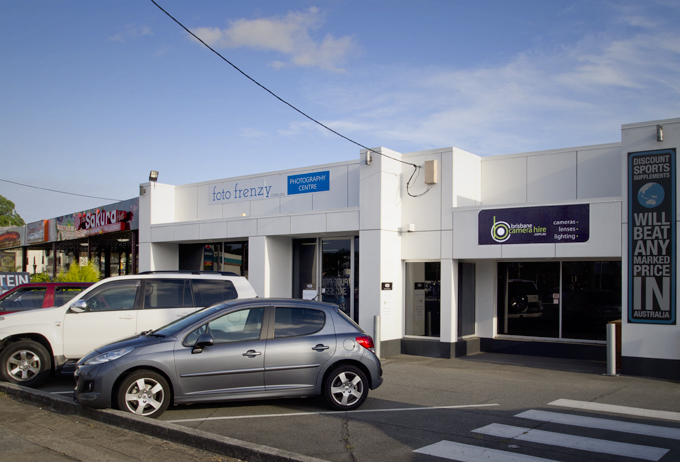
Foto Frenzy @ Corparoo, cnr Old Cleveland & Bennets Rds PHOTO: Doug Spowart

The Foto Frenzy Gallery PHOTO: Victoria Cooper
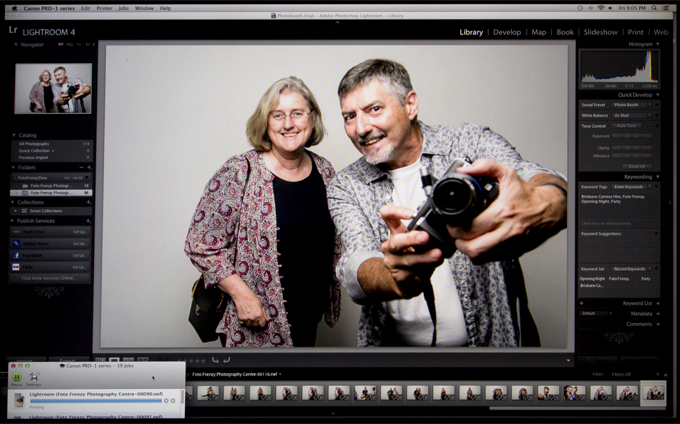
Doug Spowart and Victoria Cooper in the Foto Frenzy Photobooth
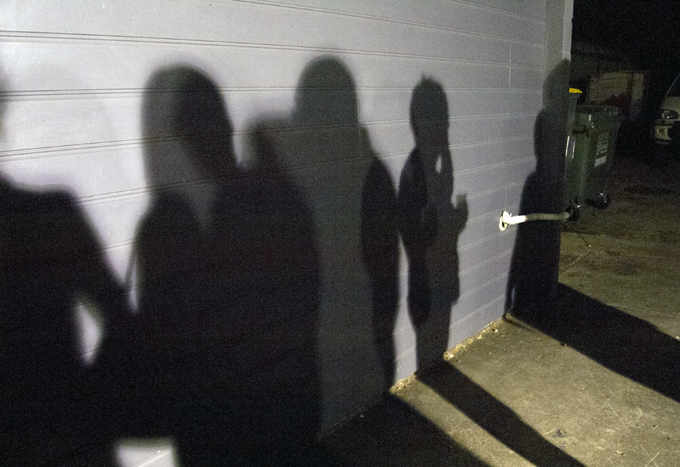
Foto Frenzy opening shadows PHOTO: Doug Spowart
Cheers Doug and Victoria

 wotwedid