Damien Kamholtz: ‘My Icarus’ @ TRAG the VIDEO
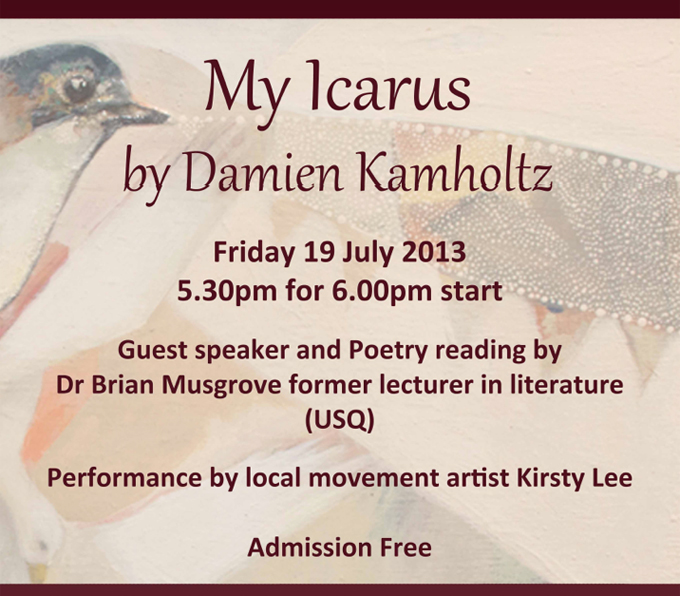
My Icarus invitation
.
FROM THE ART GALLERY WEBSITE:
‘My Icarus’ is a culmination of one painting, one sculpture and one film. These three interrelated works delve into poetry and mythology and showcase the Gallery’s recent acquisition of Mr Kamholtz’s painting, ‘The Spit that Joins the Magic Together’.
The exhibition title refers to the artist’s fascination with Greek mythological figures, Icarus and Daedalus, and the works of 19th Century French poet Arthur Rimbaud.
Additional creative ‘spittle’ for the performance was delivered in verse by guest speaker and former USQ lecturer in literature Dr Brian Musgrove with a simultaneous performance by Toowoomba movement artist Kirsty Lee.
The exhibition works include the recently acquired painting, an assemblage and a collaborative film produced by Mr Kamholtz, Jason Nash, Kirsty Lee and Craig Allen.
..
.
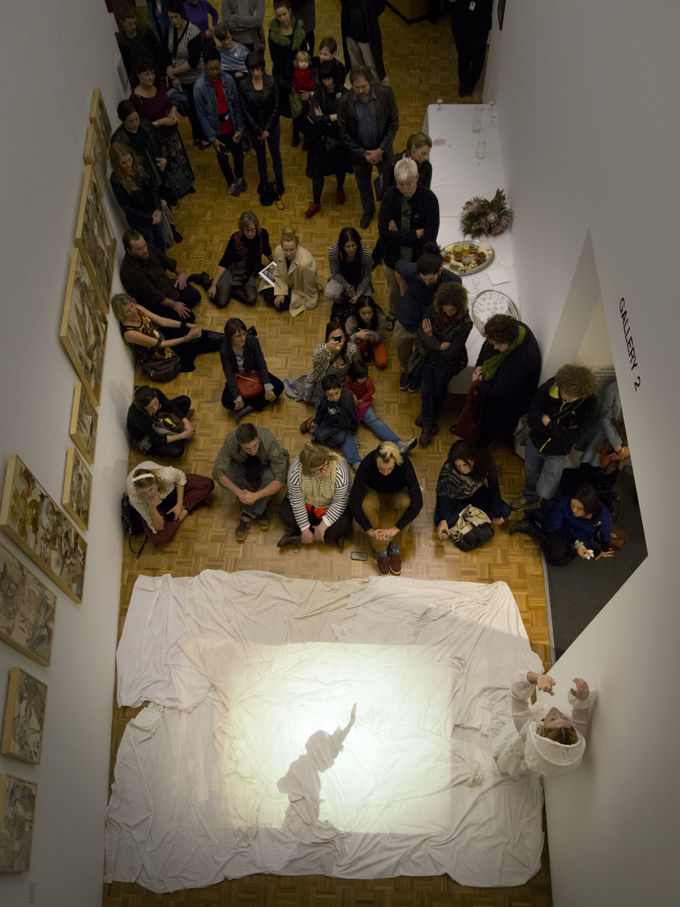
Toowoomba Regional Art Gallery attendees witnessing the event
.
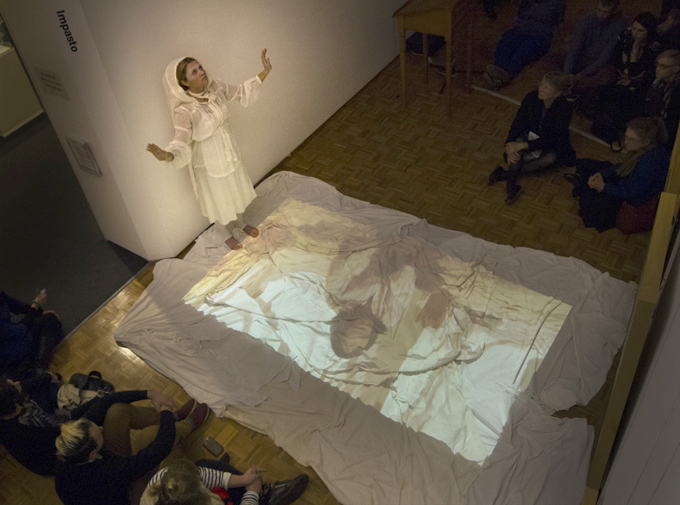
Kirsty Lee in performance
.
Photos and Video © 2013 Doug Spowart
.

This work is licensed under a Creative Commons Attribution-NonCommercial-NoDerivs 3.0 Unported License.
.
A BOOK WARMING: Ross Burnett Bookshop Uralla
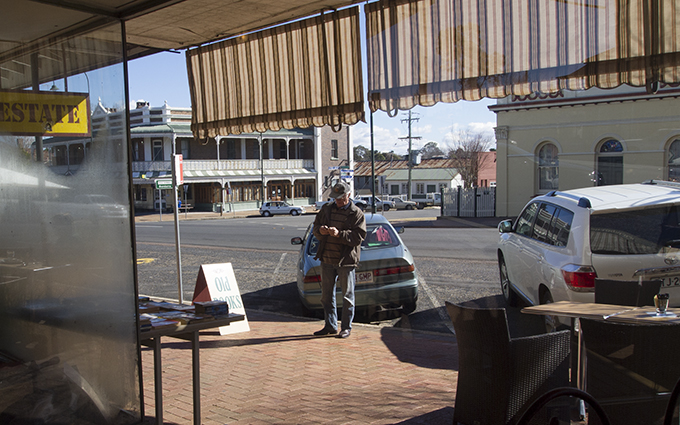
The main street of Uralla as seen from Burnett’s cafe
A cold winters day – we head down towards our AIR in Muswellbrook after over-nighting in chilly Glen Innes. The sun weakly lights the landscape in the highlands of Northern NSW.
Arriving in Uralla we head for the Ross Burnett Bookshop. Whenever we have come through this way this has been an important destination for us. For to peruse the shelves of his second-hand and rare books is a journey of a different kind. Burnett’s ephemera collection is also worth a shuffle through.
We entered the shop and made our way past tall shelves of interesting books to the centre of the building. There surrounded by philosophy, art, Australiana, Literary Criticism, Poetry we some welcoming lounge chairs and a log fire . . .
What else could one need to warm the mind and the body!
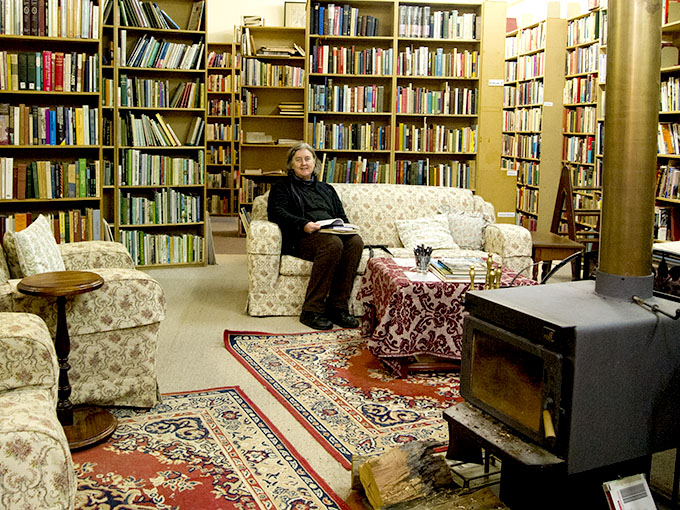
Vicky in book Nirvana
To complete the sensorial and intellectual experience we had lunch in Burnett’s adjacent café. Also warmed by a fire, we treated ourselves with the minestrone soup with fresh bread. All this was a far cry from the normal on the road lunch stop: a pie, maybe a Coke and a quick walk down the main street.
Reluctantly we had to return to our journey south. But we will be back when you return Ross. . . !
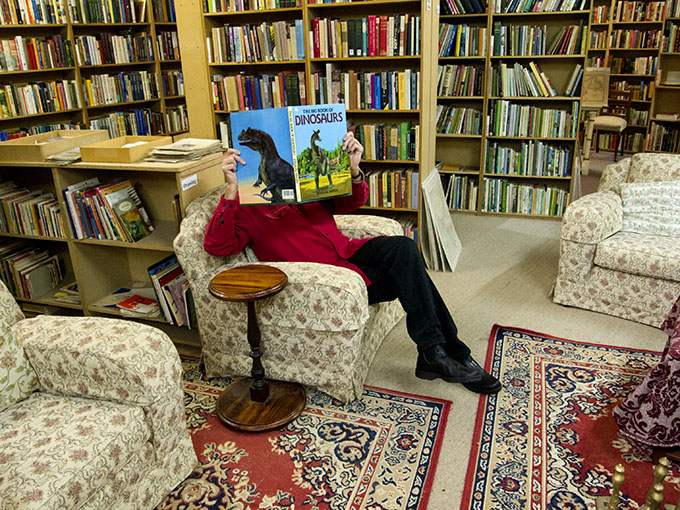
Doug finds a book …
UPDATE: Nocturne Muswellbrook
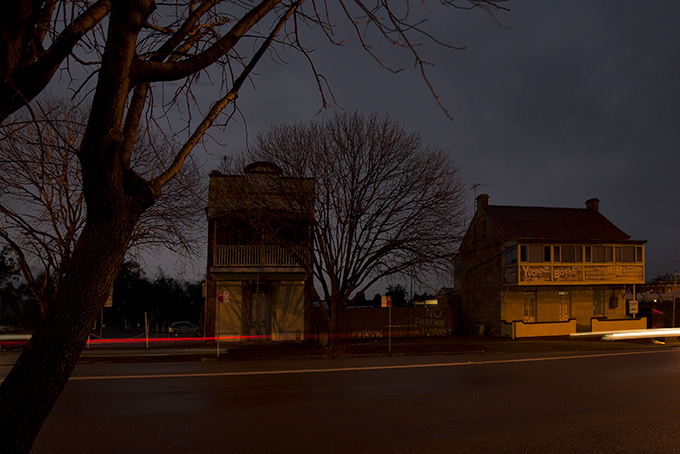
Intersection of Sydney & Haydon Streets
..
We’ve been busy in the Nocturne Muswellbrook project – Here is an update …
.
A NEWSPAPER STORY
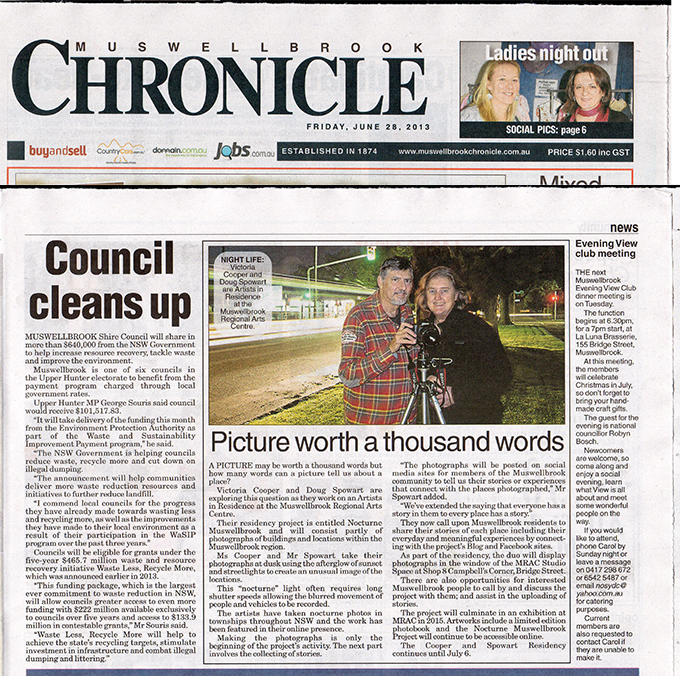
Chronicle News story: 28 June 2013
.
Our Gallery
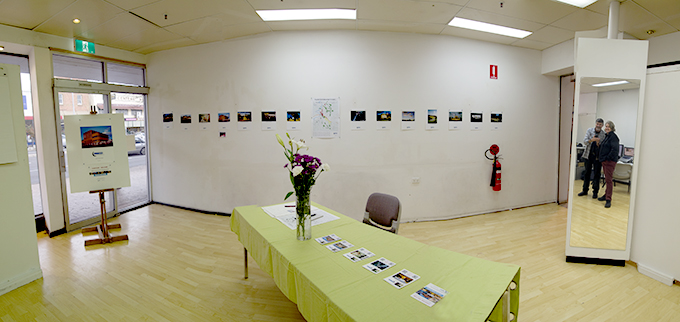
The Nocturne Gallery in SHop 8 Campbell’s Corner
.
An ABC Radio interview
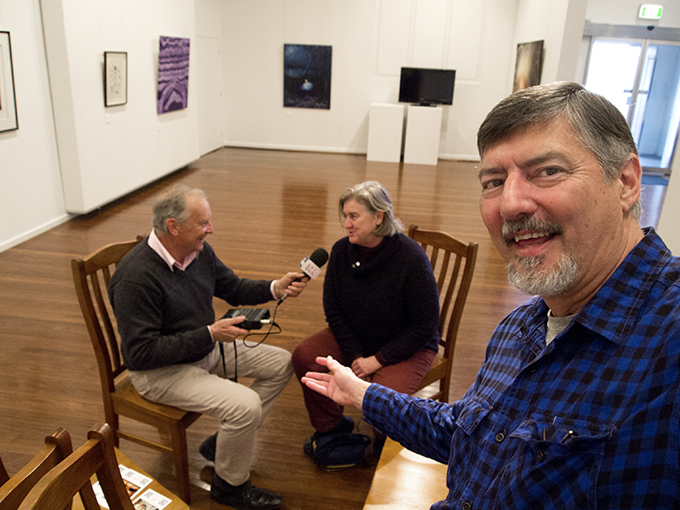
Mike Pritchard from ABC Radio interview
.
A presentation to the local Camera Club
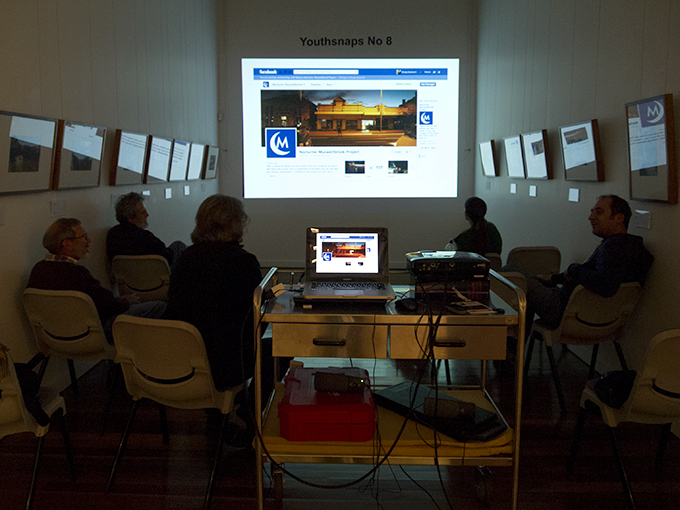
Muswellbrook & District Camera Club
.
Working in the rain – nearly every night lately …
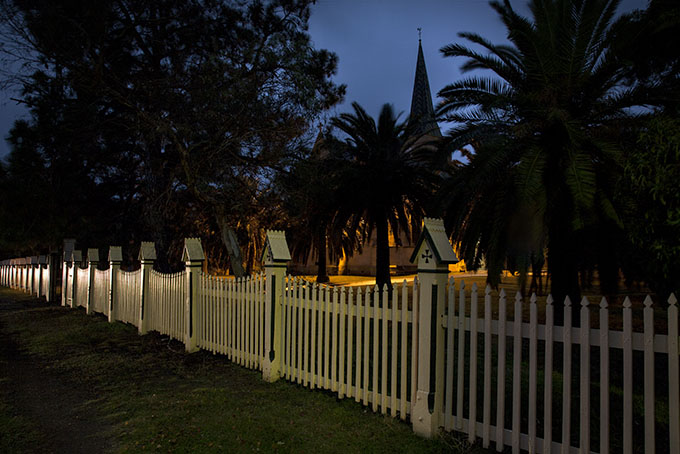
St Alban’s Anglican Church
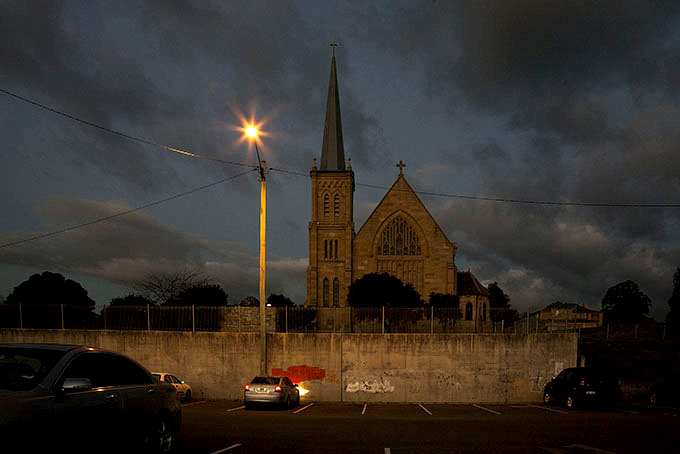
St James’ Catholic Church
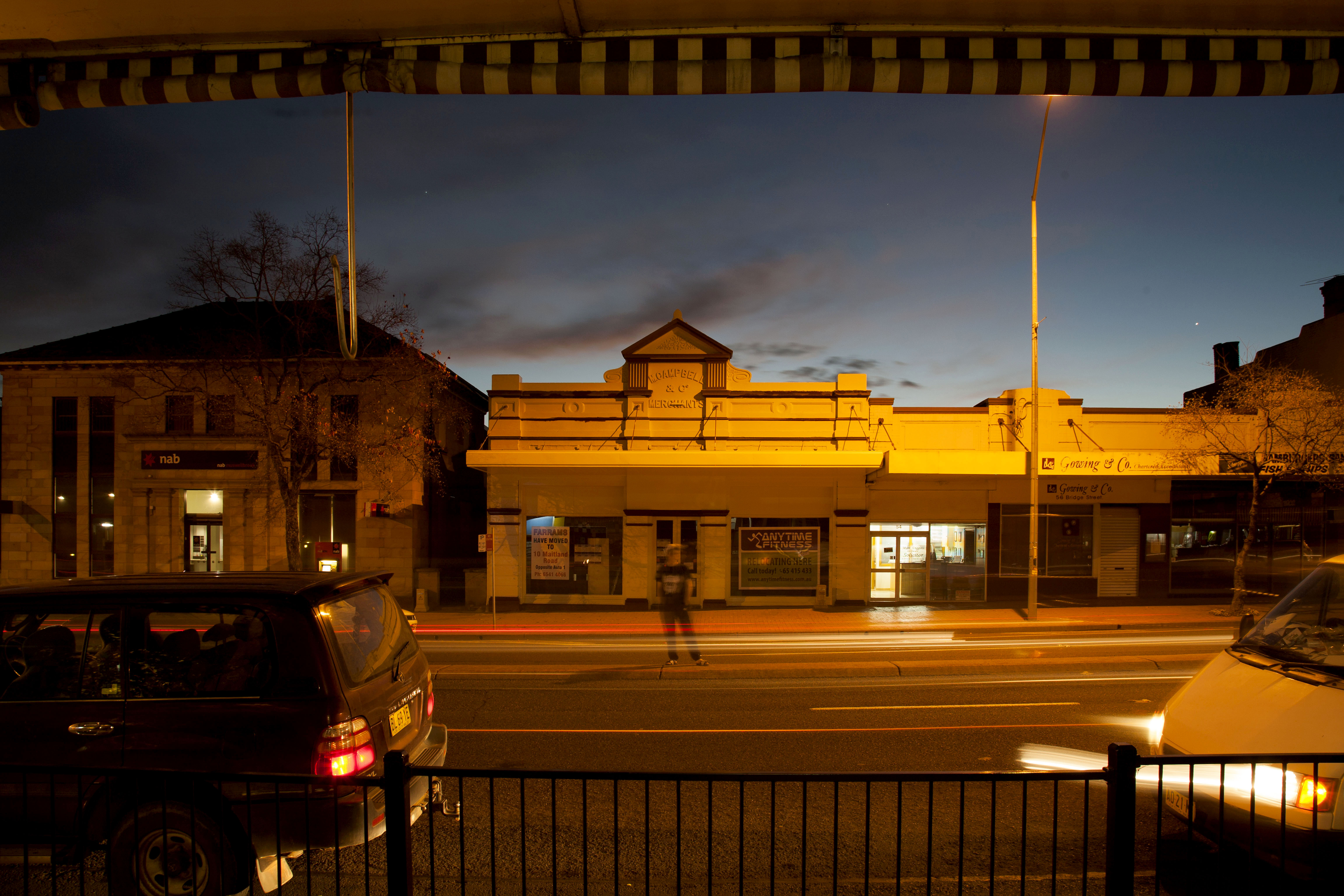
56 Bridge Street
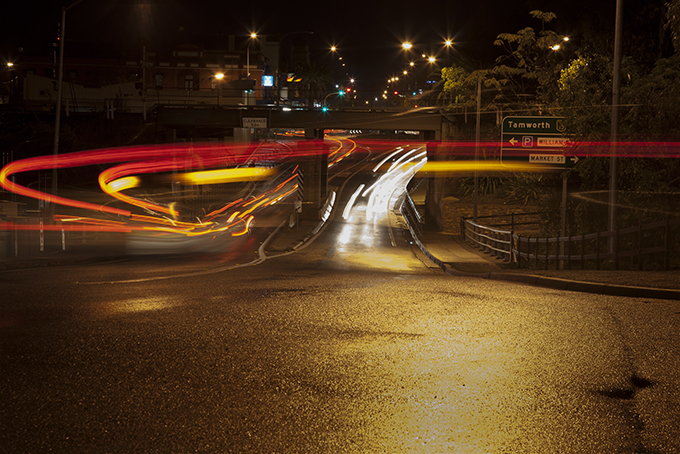
Southern end of the Subway
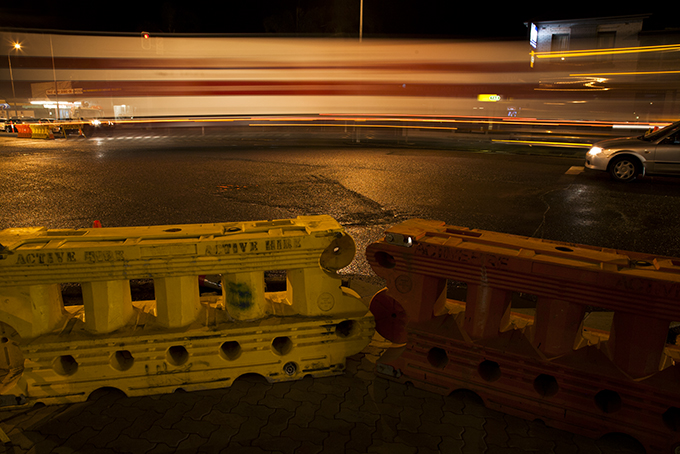
Corner Sydney Street and Maitland Road
.
SEE MORE IMAGES AND TO ALSO MAKE A PERSONAL COMMENT ON THE POSTS about your experience of ‘PLACE’ or stories evoked by the subjects we have photographed:
.
https://www.facebook.com/pages/Nocturne-Muswellbrook-Project/462047657214253.
AND
The Blog: www.nocturnemuswellbrook.org
.

Comment Now …
..
To Follow us on FACEBOOK ‘Tick’ GET NOTIFICATIONS and ALL UPDATES

.
© 2013 Victoria Cooper and Doug Spowart for The Nocturne Muswellbrook Project
.
This work is licensed under a Creative Commons Attribution-NonCommercial-NoDerivs 3.0 Unported License.
.
.
.
ARTIST IN RESIDENCE: Muswellbrook Nocturne
.

Nocturne Muswellbrook
.
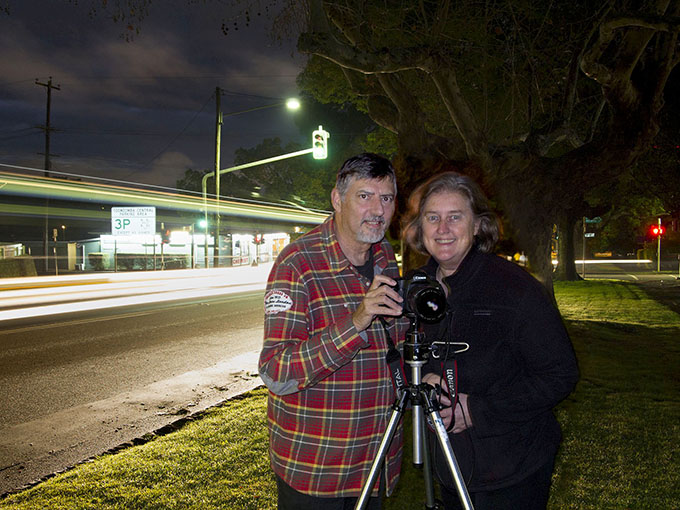
Victoria Cooper and Doug Spowart
For those of you who have been following our nocturne work over the last twelve months at WOOLI and in XMAS STREET we are now working on a new project in the Hunter Region of New South Wales. We are Artists in Residence at the Muswellbrook Regional Arts Centre and are now making nocturne photographs at dusk using the afterglow of sunset and streetlights documenting the town of Muswellbrook.
Nocturne light creates a sense of drama or a setting for a movie scene – a place where stories can be evoked and told. In this work we explore of the idiosyncratic nature of the architecture and street scenes of country and regional towns. The prosaic nature of these towns, when photographed in the dusk light, becomes part of a found aesthetic–a site-specific sculpture of light, colour and form. But there is also a visual narrative, isolated and exhumed by this light, one that has evolved from the activity of everyday life—yet the familiarity rendered it invisible.
Making the photographs is only the beginning of the project’s activity; the next part involves making a space for the telling of stories. Therefore the photographs are being posted on social media sites, a blog and Facebook to attract comments.
We now call upon the Muswellbrook community to share their stories of each place including their everyday and meaningful experiences by connecting with the project’s Blog and Facebook sites. We also invite other participants to comment if the photographic subject invokes the recollection of an experience or story.
The Blog: www.nocturnemuswellbrook.org
and Facebook
https://www.facebook.com/pages/Nocturne-Muswellbrook-Project/462047657214253
.


…
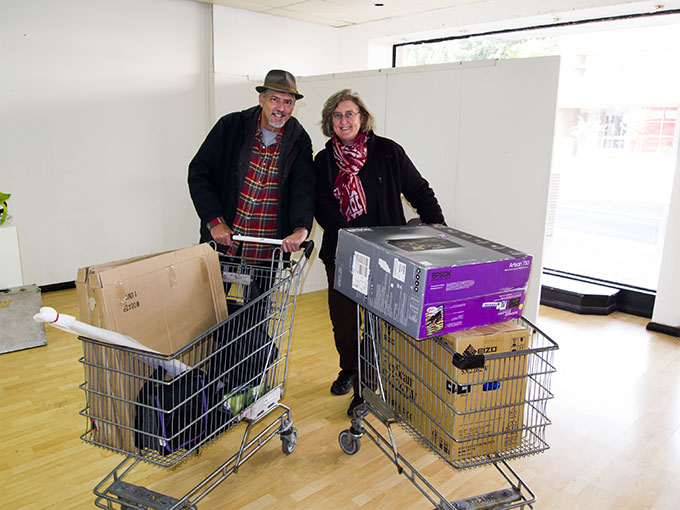
Doug+Vicky moving in to the Artists in Residence Studio
.
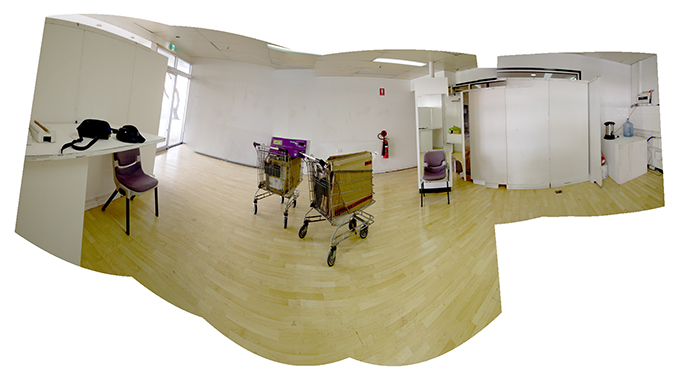
The Residence Studio
.
Comment Now …
..
To Follow us on FACEBOOK ‘Tick’ GET NOTIFICATIONS and ALL UPDATES
.
© 2013 Victoria Cooper and Doug Spowart for The Nocturne Muswellbrook Project
.
This work is licensed under a Creative Commons Attribution-NonCommercial-NoDerivs 3.0 Unported License.
.
.
.
DOUG Has article on Photobooks in BETTER PHOTOGRAPHY
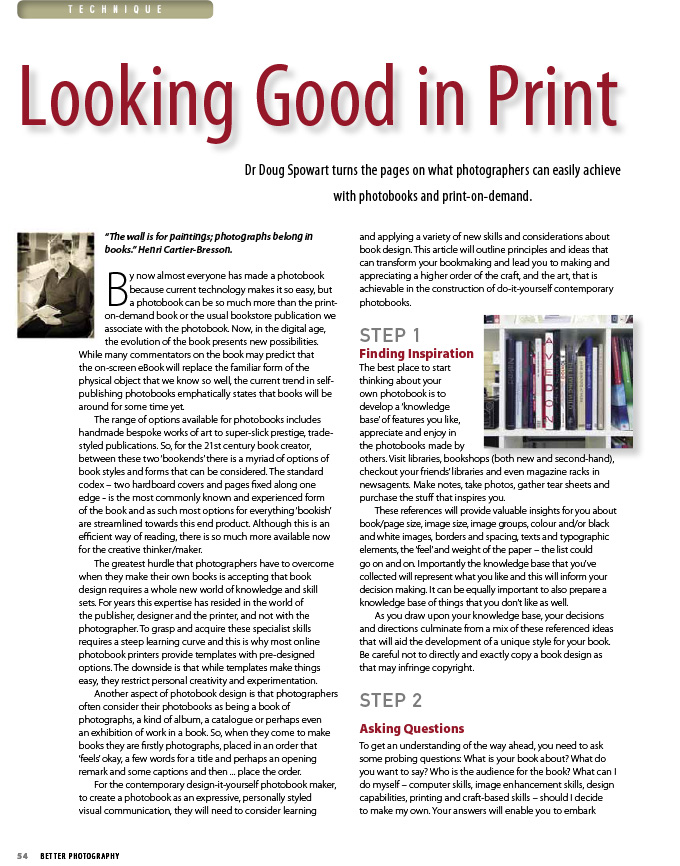
The winter edition of Peter Eastway’s BETTER PHOTOGRAPHY includes an article by Doug on Photobooks. The piece covers a step-by-step discussion on making your own photobooks from concept to output, either by DIY or Print-on-demand.
.
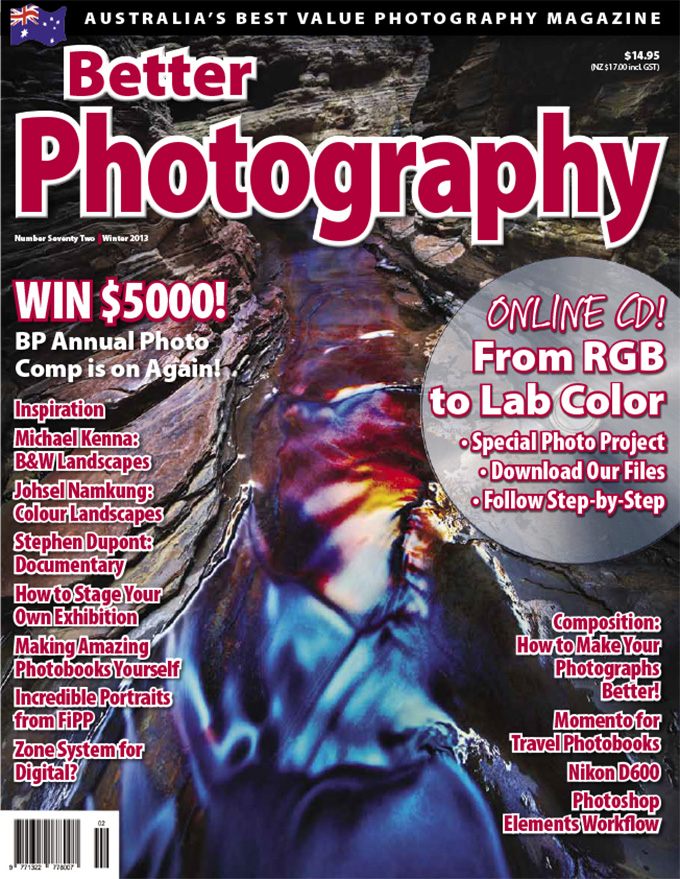
.
Here’s page one of the article …
.
.
DOWNLOAD A PDF of the article here: SPOWART-Photobooks-Better_Photography
.
AND – Do buy the magazine for the other great stories and prizes!!
.
.
.
.
MEMORY COLLECTIVE: A performance documentary project
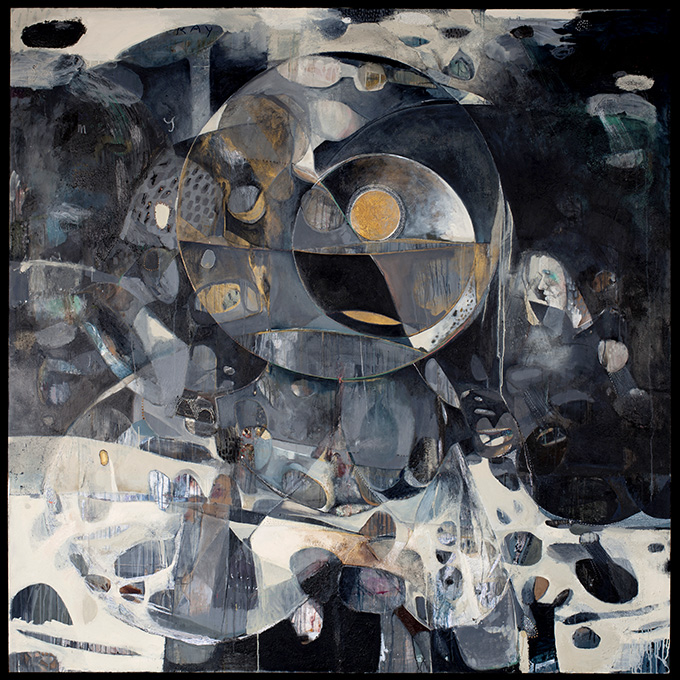
The Memory Collective painting by Damien Kamholtz
.
The Memory Collective is a multi-disciplinary collaboration orchestrated by artist Damien Kamholtz. Kamholtz states: The Memory Collective Project is a creative collaboration between 12 artists across eight artistic disciplines exploring concepts and themes relating to the human condition such as change, constants, history, refection and memory. The artworks created during the project will make up an exhibition to be held at the Toowoomba Regional Art Gallery in September 2013.
There are different stages to the project. First Kamholtz created a large 2.2 metre square painting, while sculptor, Jessie Wright constructed the large vessel to hold the water. Kamholtz’s painting is embedded with personal meaning in the form of fragments of his past art, the ashes of diaries. In the presence of this artwork we are drawn into a poetic landscape where faces emerge; symbols and totems slip from passive dark spaces and come into conscious awareness.
The second stage of the work was the performance in the form of 9 responses to the painting by Kristy Lee. The painting and the pool created the reflective and reflexive performative space and the transformative process of the original painting then began. Integral to the space were David Usher’s delicate pots; these vessels contained the pallet of shades that then shrouded and clouded the memory of the work. Over the course of the day the painting’s physical form was transformed into something different loosing its current visual form as only a memory.
Our part of the collaboration was to witness, respond and record the transformation of the work over the day. The next stage of the Memory Collective’s work will continue over the next month our component will be to create 9 large collaged photograph memory states of the work for the show in September. Works by others include; a video art piece, a documentary video, a soundscape, interviews, prose and poems. It is a significant project and is being funded by the RADF and supported through the exhibition at the Toowoomba Regional Art Gallery.
.
A fragment of photographic memories made by us for the MEMORY COLLECTIVE…
.
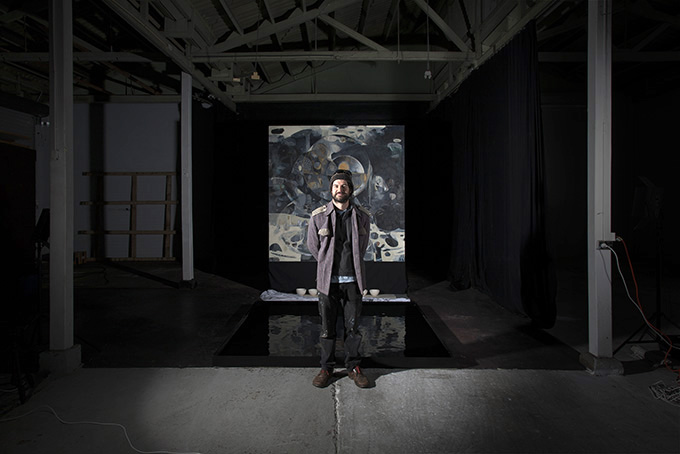
Damien Kamholtz in the performance space with the painting and pool
.
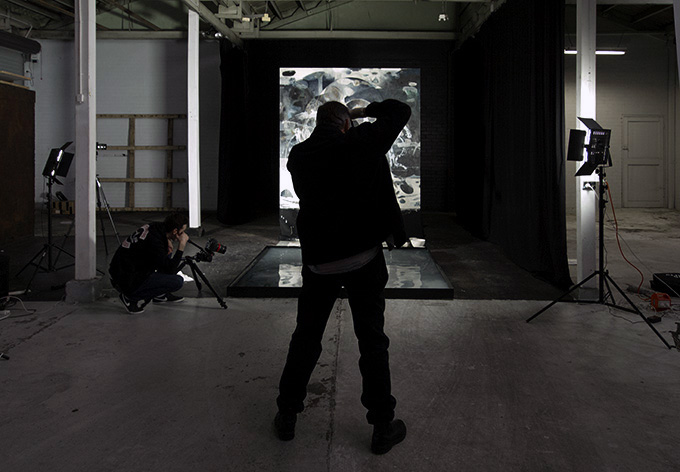
Doug documents the space …… Photo: Victoria Cooper
.

Kirsty and painting – in the early state…
…
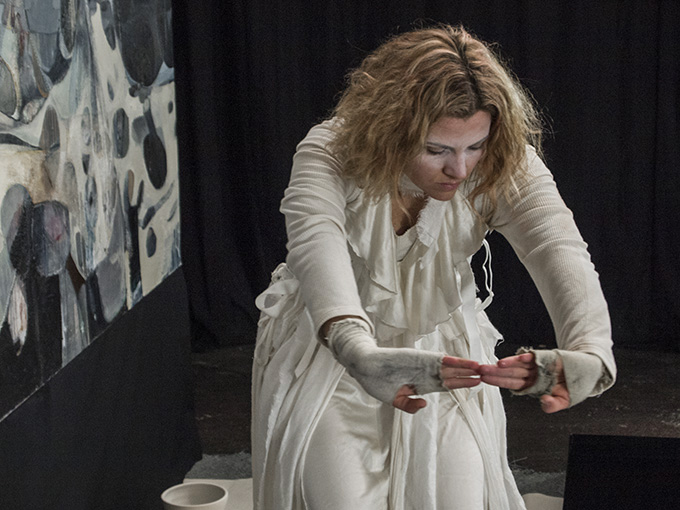
Kirsty Lee performs before the painting
.
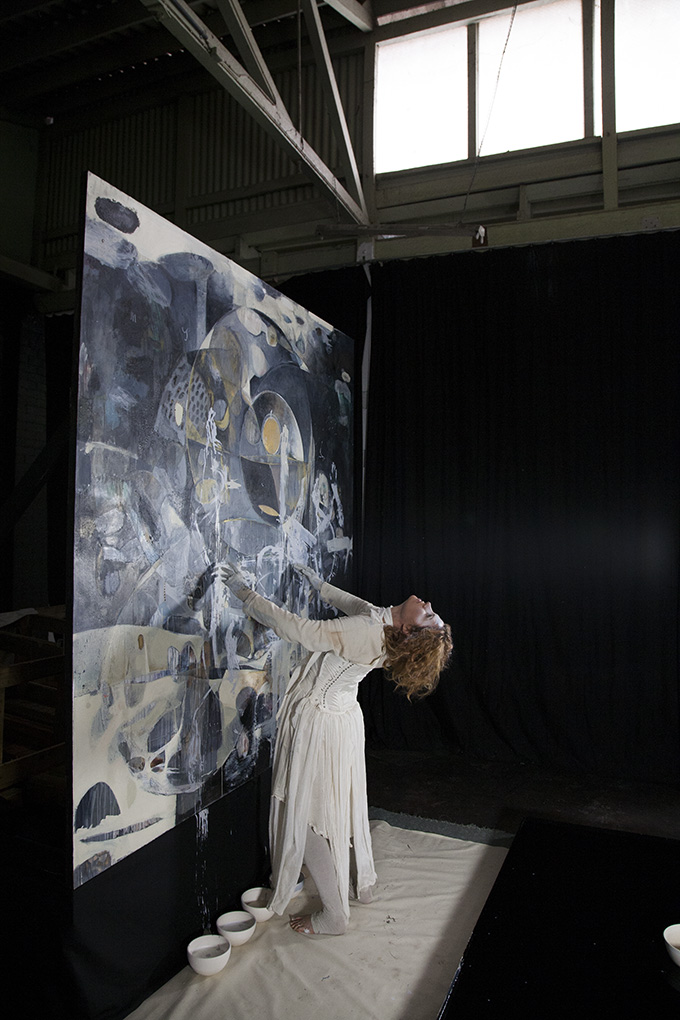
State 3 Kirsty applies paint to the paining…
.
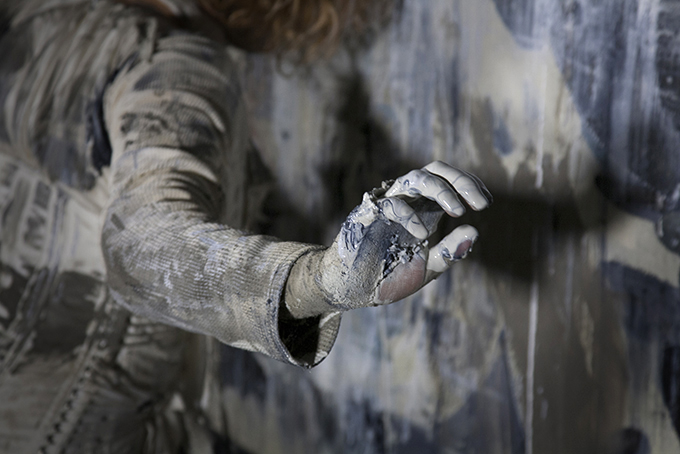
Hand paint
.

Kirsty Lee and her interaction with the painting … around Stage 6
.
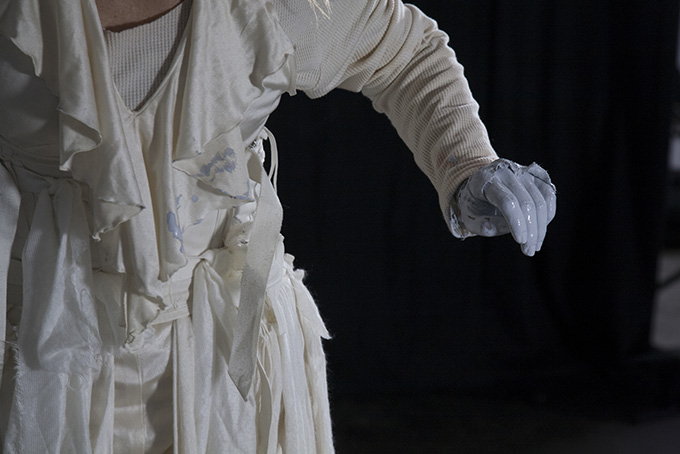
Blue hand…
.
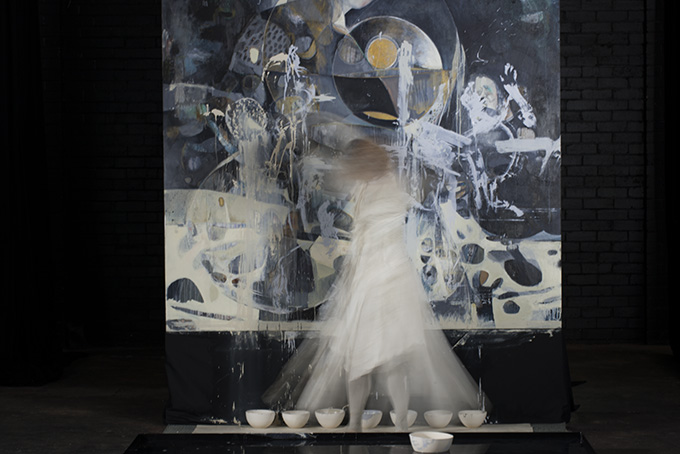
Kirsty Lee in a frenetic stage…
.
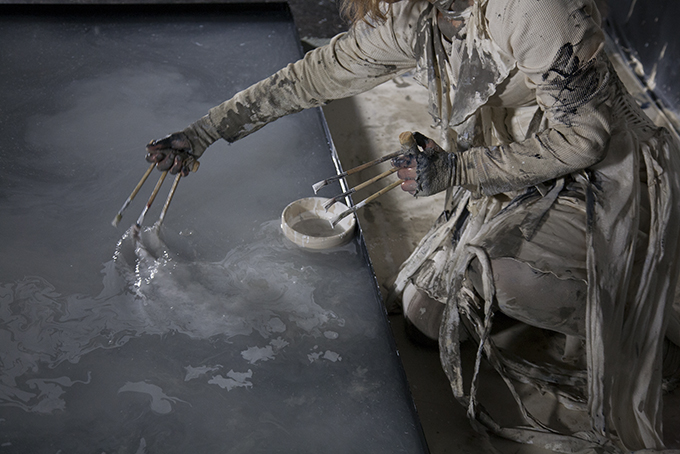
Kirsty and brushes before the pool
.
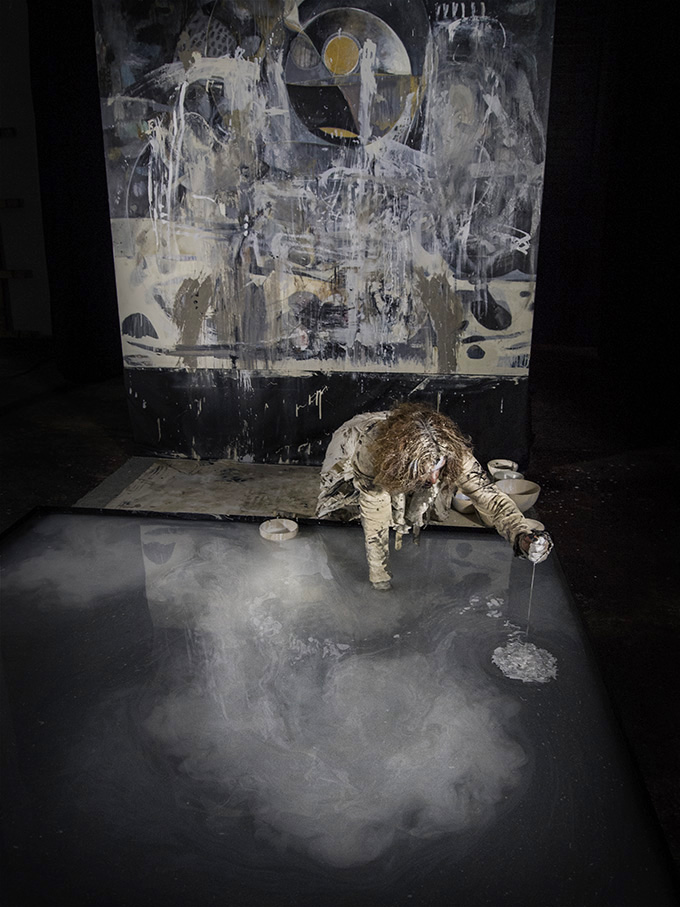
Paint fluid in the pool…
.

Towards the final state…
.
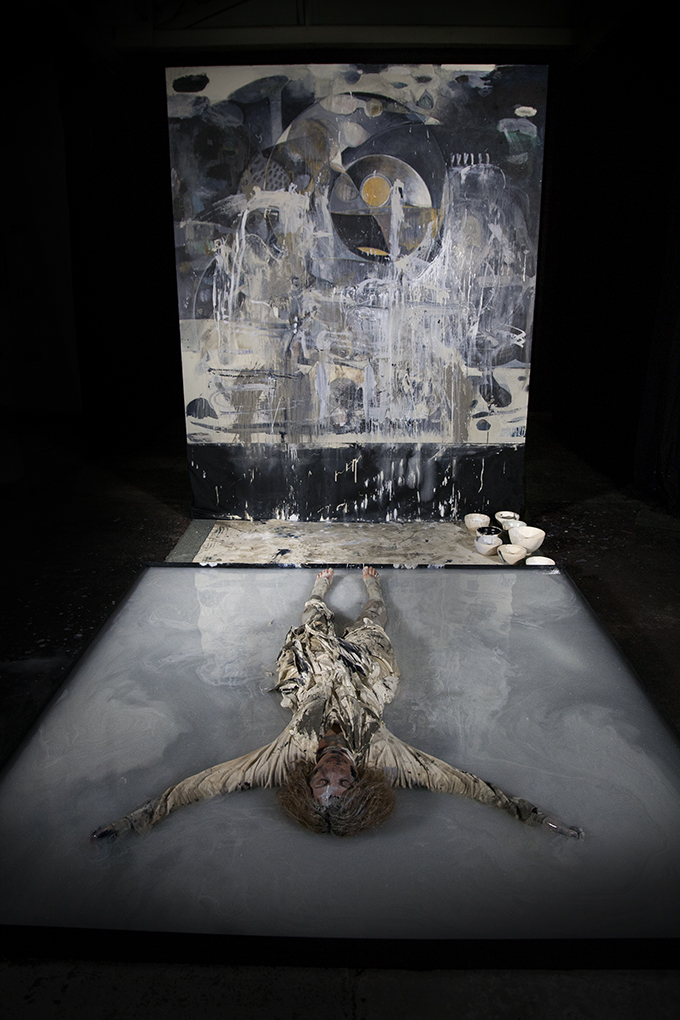
The final state …
…
.
 .
.
.
/.

Damien discussing movement with Kirsty
.
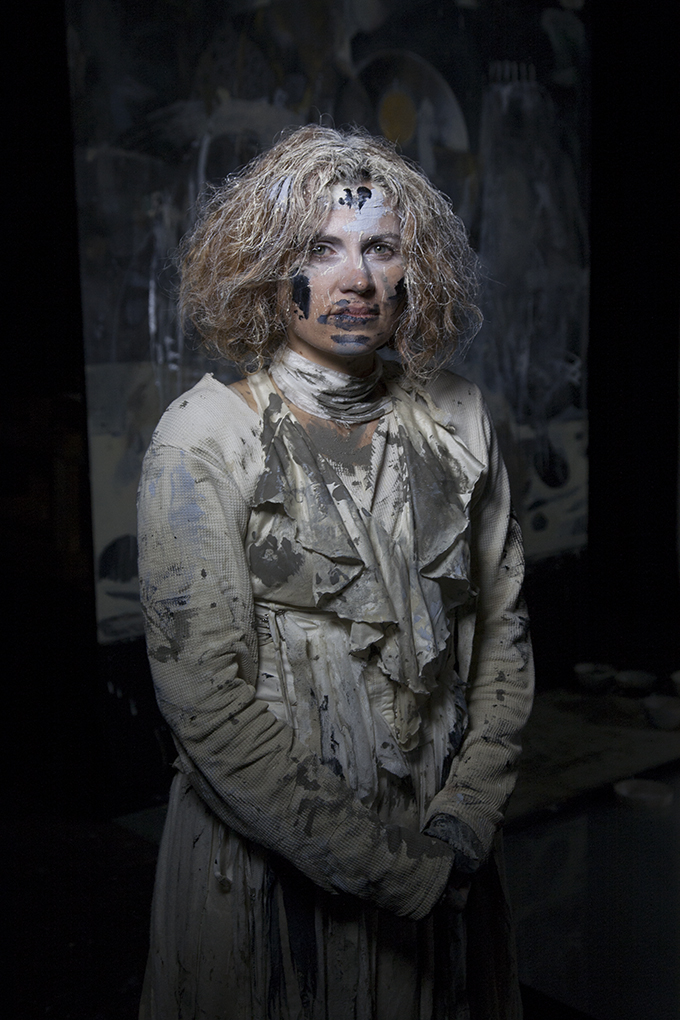
Kirsty Lee towards the end of the performance
.
Another creative work from the performance by Jason Nash…
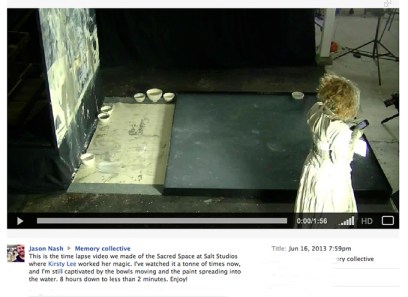
Jason Nash – Time lapse video
CLICK HERE to see Jason Nash’s ‘Memory Collective’ time-lapse video
.
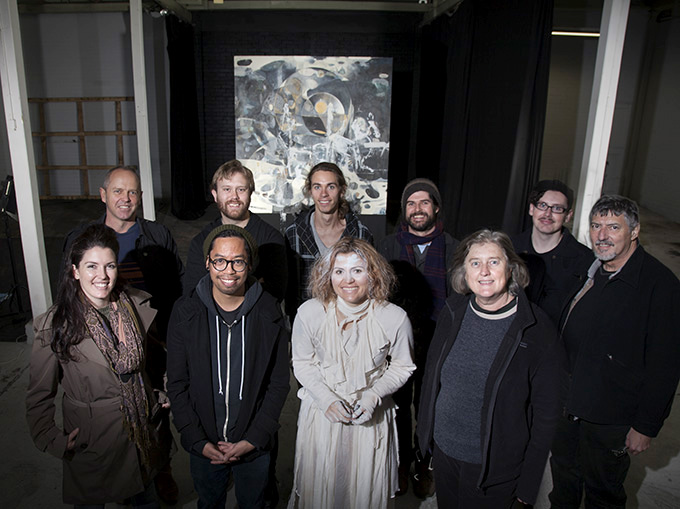
The Team: Front Ashleigh Campbell, Julio Dunlop, Kirsty Lee, Victoria Cooper, Doug Spowart
Back: David Usher, Jason Nash, Jesse Wright, Damien Kamholtz, Zac Rowling ( weakling).
Not present: Craig Allen & Jake Hickey
.
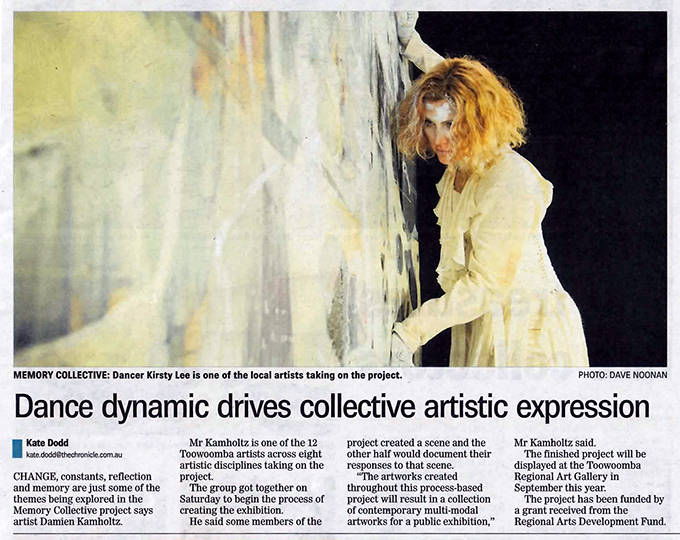
Toowoomba Chronicle 17 June, 2013 by Kate Dodd PHOTO: Dave Noonan
.
..
 .
.
© 2013 Victoria Cooper and Doug Spowart for The Memory Collective
.
This work is licensed under a Creative Commons Attribution-NonCommercial-NoDerivs 3.0 Unported License.
.
.
SUPPORT THIS PROJECT: Retake Melbourne App
In the opening paragraph of a review of John Elliott’s rephotography exhibition The Last Show and Re-shoot that was published in Art Monthly (#240 June 2011) I made the following comment:
Part of the mystique bestowed upon photography is the notion that a photograph captures a moment of time that enables a viewer to reconnect with or gain insights into the subject portrayed. Since its inception photographers have utilised photography’s inherent connection with time and place by reimaging the original subject days, months and years after the originating photographic ‘moment’. One notable re-photography project began in the 1970s by Mark Klett and his team in the United States with the Second View: The Rephotographic Survey Project, and continues with the recent Third views, second sights: a rephotographic survey of the American West. These projects draw upon the concept that comparative images over time extend the narrative of the single image, and that the differences and similarities observed tell a larger story – that of time and change.
I am excited by rephotography projects and from the early 1980s I have undertaken many myself. Now I have encountered news of an exciting project in Melbourne that will make this specialised photographic activity available to anyone with a smart phone or imaging device . Entitled Retake Melbourne the project will do two significant things; firstly, it will create an APP where earlier photographs of Melbourne can be located and aligned for the contemporary photographer to image the exact same view; and secondly, the source images will be from the the Sate Library of Victoria’s extensive Mark Strizic photography collection.
The project is being ‘floated’ via Pozible crowd sourcing, and time is running out to ensure this project gets the support to make it happen. I would ask you to review the project details that follow – login to Pozible, and make a pledge to support this valid and innovative project.
Thanking You
Doug Spowart
.
Here are the details … From the POZIBLE Project page
..
.
.
POZIBLE – Project Title: Retake Melbourne
Overview:
We Melburnians jealously defend our city as the ‘most live-able’; a cultured grande dame with a creative dash, anti-establishment street art, a larrikin love of football and lots of delicious secrets.
To participate in this project will be to illuminate and contrast her hidden past with her contemporary face.
Key to this is the mine of visual data in the State Library of Victoria’s collection, in particular immigrant Australian photographer Mark Strizic’s 5000 half-century-old negatives, colour transparencies and slides, acquired in 2007.
Aims:
When associate Greg Neville saw this archive, he envisaged a repeat photography project based on Strizic’s images which would uncover the glorious Melbourne buildings of his childhood memories.
We’d like to share this chance to retake Melbourne’s past. But re-photography is technically demanding. I realised that a mobile app would make the process accessible to everyone.

Image: © Mark Strizic: Melbourne GPO, 1950s

Mobile App mockup: © Strizic image overlay enables user to compose their own version accurately

A finished ‘re-photograph’ accurately duplicating Strizic photograph angle of view
By tapping the ‘crowd’ we can include you in this project. Your images might become valuable records, as Strizic’s are now, to researchers in the still further future! They will compare your view with Mark’s to see how the city has changed. You can be in on the birth of Melbourne’s first comparative photographic research project.
But first we need the tech to do it; a photography app that contributors will be first to use!
Background:
Close associate of architects Robyn Boyd and David Saunders, Strizic’s love of architecture and his European eye provoked his condemnation of the ugliness he saw invading Australian city-scapes during the 1960s when architecture of the Gold Rush era coexisted with, and was being demolished for, Modernist curtain-glass high-rise office buildings.

LHS Image: © Mark Strizic: Russell Street Melbourne, 1950s
RHS image: Greg Neville: Russell Street Melbourne, 2013

Image: © Mark Strizic: Melbourne Museum and State Library, 1950s
Outcomes:
By contributing to the development of our crowd-funded app, you will create the means to contribute accurate repeat photography of the locations of Strizic’s thirty-to-fifty year-old images of architecture, street-scenes and pedestrians, and to uncover the layers of history.
Historical and Creative results
Re-photography is studied and recognised for its value for historical, scientific, geographic, geologic and social science research; this use of crowd sourced material will be innovative.
Rather than being slavish copies of old photos, yours will be interpretations of Strizic’s originals which will build a picture of how a city has changed, and is in turn transforming us. There is a creative dimension in the ratio of interpretation to replication each contributor will employ in this process, that will add to value of their artefact. Their resultant contribution may be incorporated in the SLV online collection for comparison, by these and future researchers, with Strizic’s original.
The Mobile App:
With this app, members of the public can find locations photographed by Strizic on a map, orient their device’s camera closely to the angle, orientation and framing that he used using a transparent overlay of his image, downloaded from the SLV online collection, over their screen image.
This app will simplify the repeat photography exercise and enable you to produce a comparative image which will match or contrast existing conditions and features with those in his original image.
Contribute to our shared archive:
The State Library of Victoria‘s huge archive opens up a rich resource for Victorians online; now that everyone can access it; they can also interact with it. This crowd-sourced project will give the archive more exposure and contribute new resources.
Provide a resource for future research:
The Strizic archive forms a reference for participants who will be asked to repeat the making of the images in the same location. In doing so they will record a contemporary street scene peopled with pedestrians who may regard, occupy and use the city of Melbourne in very different ways now.
Increase your own knowledge of Melbourne and Photography:
Part of the durable, interactive and updatable project outcomes is that participants will make a substantial contribution, they in turn will benefit from the exercise of finding the locations in coming to understand at first hand the operation of the forces of change on the city, the influences of crowd behaviour on the city, and its power to change us and our societal interactions. You too can become a ‘re-photographer’!
- What will your contribution do?
Level of funding sought: $6,000 – $10,000
A huge volume of photographic contributions will be required to enable worthwhile comparison of the old and new images to show how Melbourne’s buildings and streets have shaped, and are shaped by, its populace and its society. Achieving the necessary quantity and accuracy will require $6,000 base funding for the development and distribution of a mobile-device app.
$6000 will pay for six months of the developer’s time in building the app.
Researcher Dr James McArdle, will contribute $12,000 in-kind support; for research into the State Library collection and mapping of locations of Strizic images for GPS locator in the app.
*Reaching $10,000:
will enable us to map significantly more locations and to pinpoint the date/time of capture for more Strizic photographs as a guide to the re-photographers.
Twitter: JamesmMcArdle
Content on this page is licensed under

DOCUMENT MAKING IN METROPOLIS

.
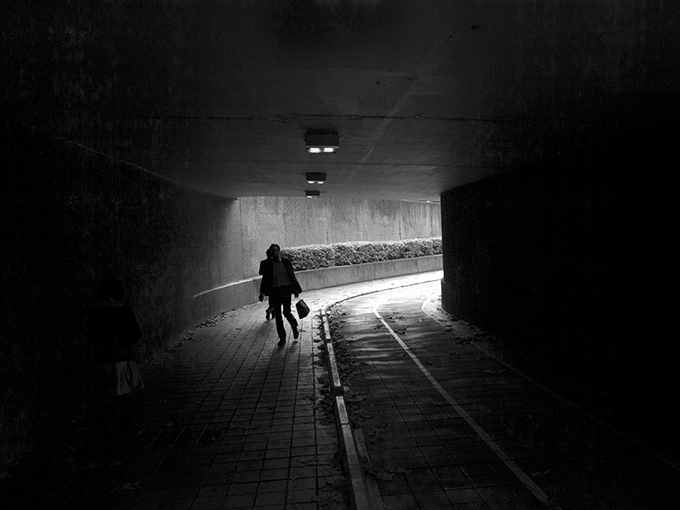
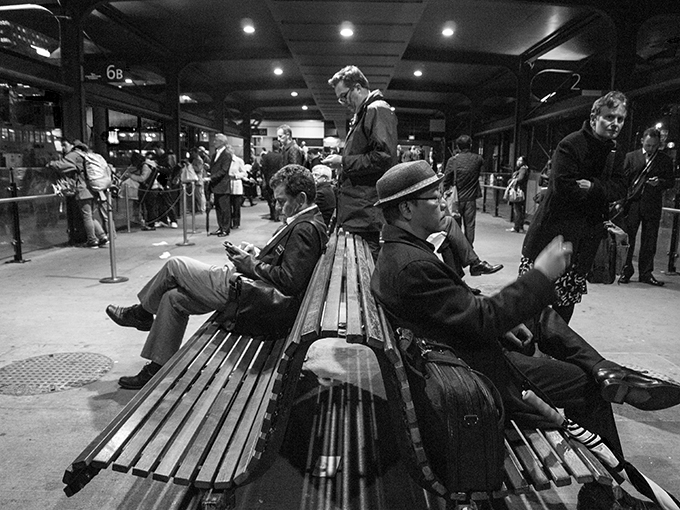
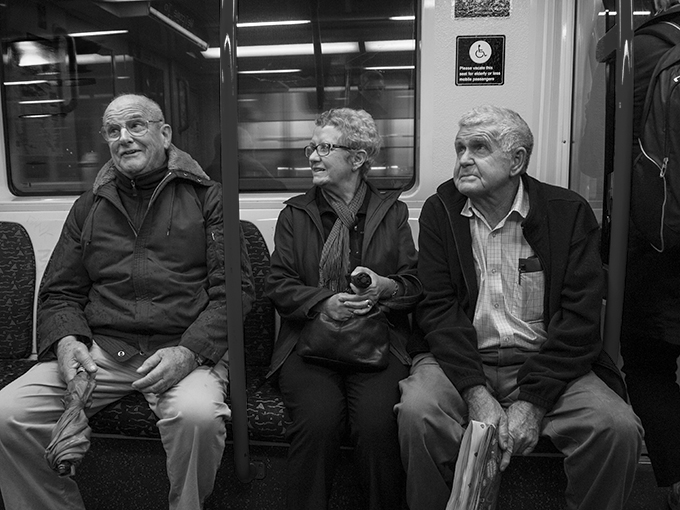
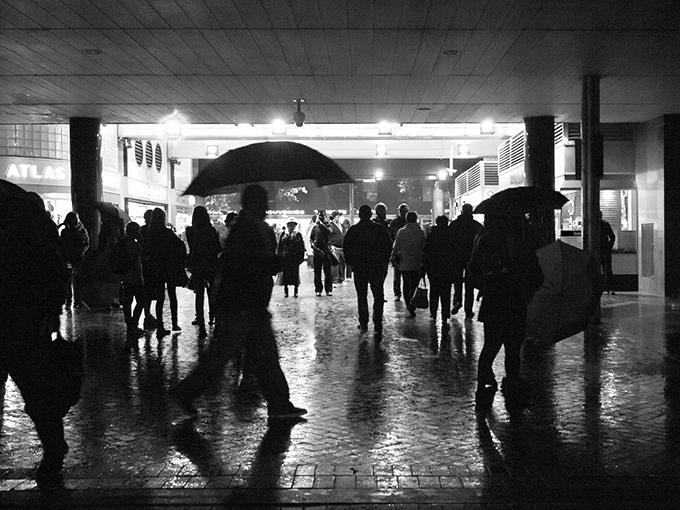
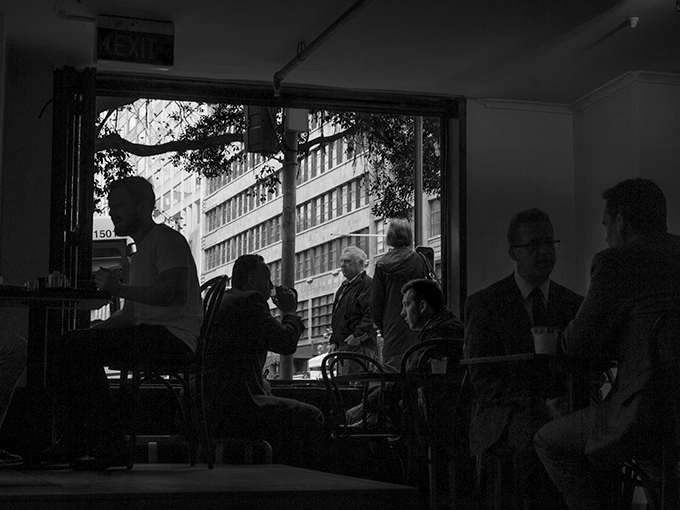
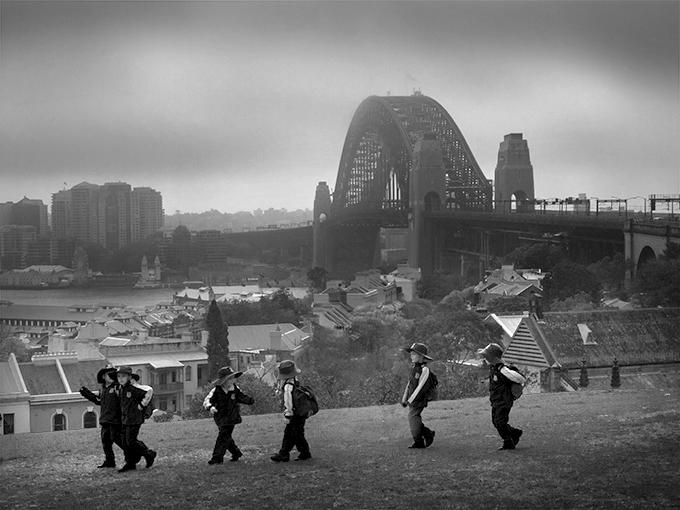
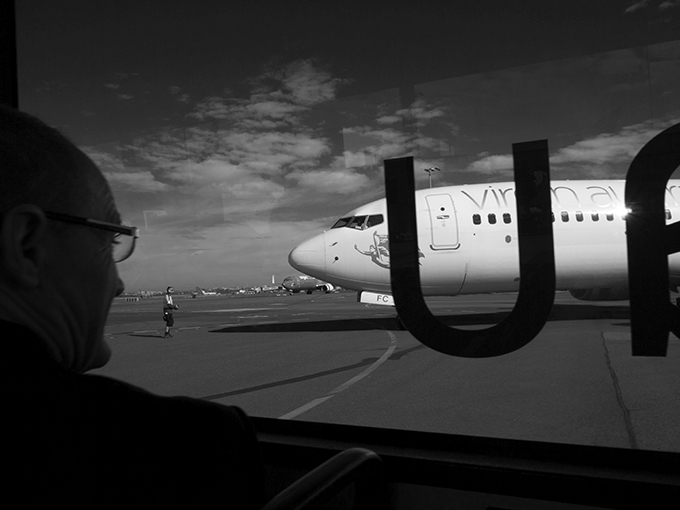
Vicky and I were in Sydney last week. It is a Big city, lots of things to see and do, festivals; Vivid, Headon and Reportage, people everywhere with phones, iPads and DSLRs shooting. We joined in the photo foray that is Sydney and found in ourselves – and in our subjects, a connection with Australian documentary photography that threaded from Parke’s glowing ghost-light, to Dupain and Moore’s modernist clean lines and then all the way back to Cazneaux’s warm pictorialist pictures. These connections with the history of photography were warm and fuzzy for me and gave a feeling of confidence, comfort and purpose for my engagement with image making.
.
I began to think about photography and photographers today, particularly the often cited us and them divide between those who have a significant history, both professional and academic in photography, and those who pick up a camera, or use their smart imaging device and just take pictures.
Questions arose – I’ll use the terms vernacular and serious to distinguish my discussion of these two groups:
- Does a sense of history and experience in photography really make a difference to the ‘quality’ of the resulting image?
- There is a lot of hype and acceptance of the snapshot ethic within photography circles – so what is the difference when between a serious and a vernacular snapshot photo?
- Is the general public today more astute about image design, content, moment of capture than serious photographers choose to give them credit for?
- Is there any difference in the workflow between serious photographers and those ubiquitous vernacular snappers? Isn’t photography still about; having access to imaging technology>looking/seeing/experiencing the world>responding to visual triggers>readying the imaging device>considering it in the viewscreen>take the picture at a selected time/timing> and then doing something with it?
- Does it make a difference if the vernacular photographer engages in a spontaneous act of self-documentation and the serious photographer engages in the process with a methodology that which is informed by a past lived in photography and the appreciation of the underpinning awareness of the photoimaging process, technology, visual literacy and human sociology?
- Are both the vernacular and the serious photographer’s images ultimately the result of the assimilation of every studied or subliminal idea and visual influence that they have encountered?
On these days in Sydney I made my photographs, as did thousands of other photographers who shared my interest in using the photograph, or the very act of photography, to ‘still’ a moment in time. But are there other synergies at play? The philosopher Wilém Flusser might an alternate view on what photographer, vernacular and serious alike. In his book, Towards a Philosophy of Photography (2000) Flusser proposes that everyone using photography is essentially being seduced by the camera and its ‘program’. He states:
Both those taking snaps and documentary photographers, however, have not understood ‘information.’ What they produce are camera memories, not information, and the better they do it, the more they prove the victory of the camera over the human being. (Flusser 2000:59)
Perhaps then, if Flusser is right, we have no say in the process at all and that we are merely slaves to the technology. With that in mind, I guess I’ll just continue to make ‘camera memories’ so that the camera and I can connect with the times, and the places, that we shared together …
Doug Spowart 8 June 2013
.
.
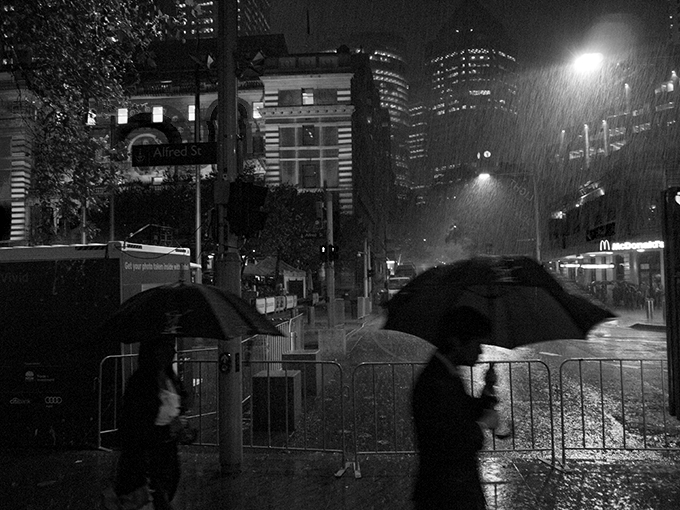
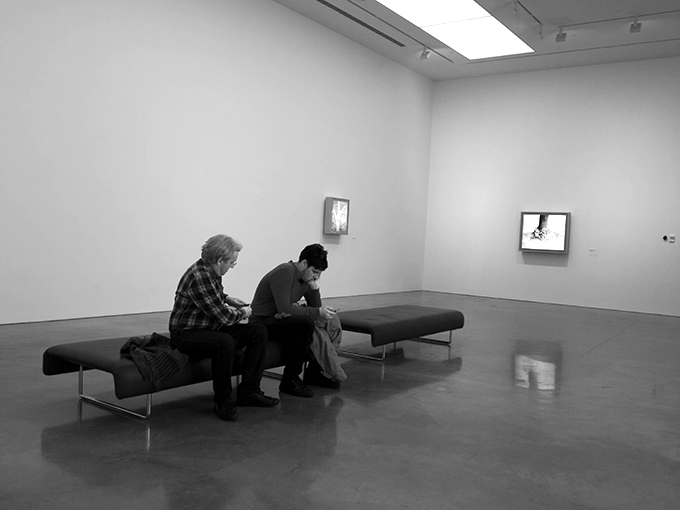
SOME CAMERA MEMORIES OF THE METROPOLIS
My Olympus Pen & me: May 27-30, 2013
.



.
.
All photographs by my Olympus Pen whose ‘program’ made me take the photos….
© Doug Spowart 2013.
.
This work is licensed under a Creative Commons Attribution-NonCommercial-NoDerivs 3.0 Unported License.
.
.
TRANSLUCENCE: Jacqui Dean’s Xrayograms
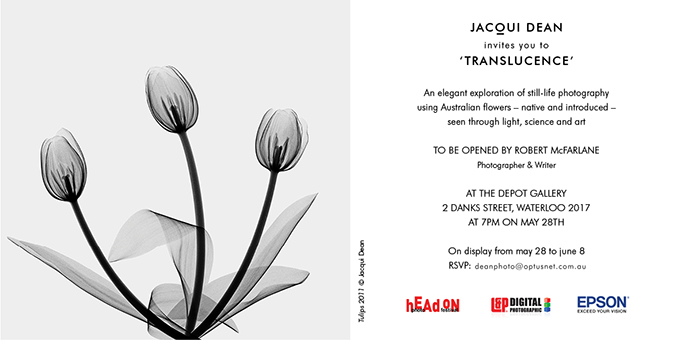
Translucence invitation
.
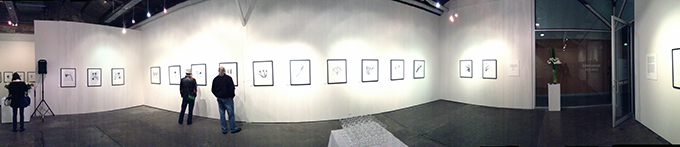
Translucence @ 2 Danks Street Gallery . . iPhone Photo: Doug Spowart
.
Another Universe
.
From the late 19th, and into the early 20th century there was a growing movement in the sciences and the arts that associated with Nature’s inherent resonance of form and structure from the microscopic to the cosmic. These new vistas and universes were recorded not only by the scientists’ hand but also by new developments in technology, notably the invention of the photographic process. Visual communication through imaging technologies continues to be an important tool in scientific research. But these images were not just useful as scientific evidence they were and continue to be inspiration for the creative work of artists and designers.
One noted exemplar utilising this visual medium was Karl Blossfeldt (1865-1932), a sculptor, metal craftsman and teacher. Blossfeldt began taking photographs of botanical specimens to use in his classes as ideas for students to create design forms from nature. But Blossfeldt’s work became very influential in the art, craft and design movement that popularised natural forms as templates for architecture, sculpture and 3D design work. His photographic documentation revealed abstract views of humble everyday roadside plants as visually interesting structural and aesthetic forms. As a result, Blossfeldt’s photographs also became renowned as works of fine art.
Jacqui Dean’s exhibition Translucence, at 2 Danks Street Gallery, Sydney, is the result of artistic curiosity and visual investigation natural forms through the phenomenon of Xrays. Art in this respect is the revelation of the unseen, the beholding of the essence within ordinary objects or a transforming perception of the everyday experience. The photograph, or in this case ‘xrayograph’, seals the object within the frame safe from the changes and inevitable decay over time. At first glance these images could appeal to the naturalist or perhaps a student of design (after Blossfeldt). Yet a deeper – more poetic vision immanent in nature is also suggested through a more contemplative viewing of these images.
Some may argue that this is an uncomfortable clash between the modernist and the romantic, or the objectivity of scientific evidence and the subjective imagination. But could this work identify with a need to embrace a sense of wonder rarely seen within a super-hyped, virtual digital-image society? Dean’s work in Translucence is informed by the poetry of music and her life’s experiences and her prodigious professional practice in photography. However the rewards for the thoughtful viewer will be to share in her wonder of the natural world that surrounds and nourishes our everyday life.
Victoria Cooper . . . June 9, 2013.
.
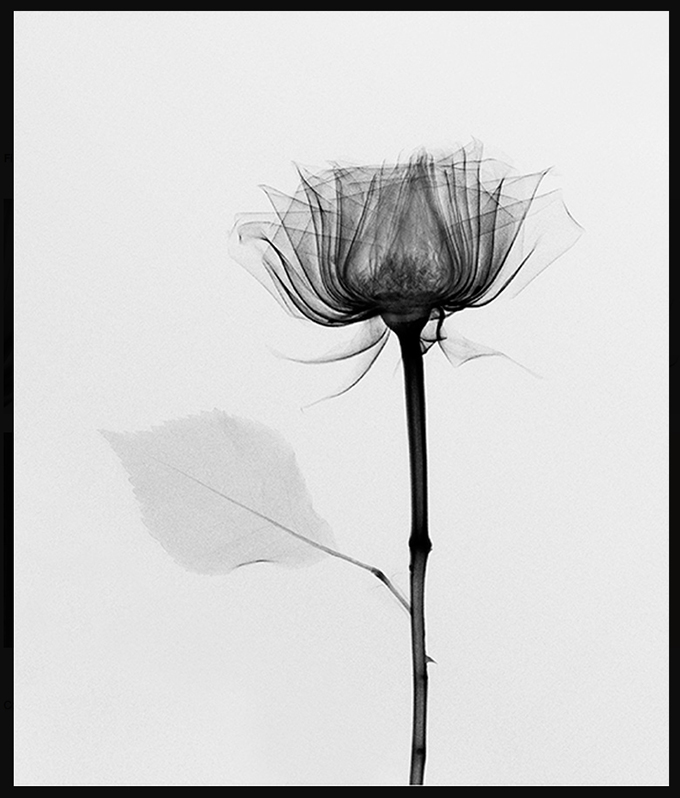
Rose Xrayogram by Jacqui Dean
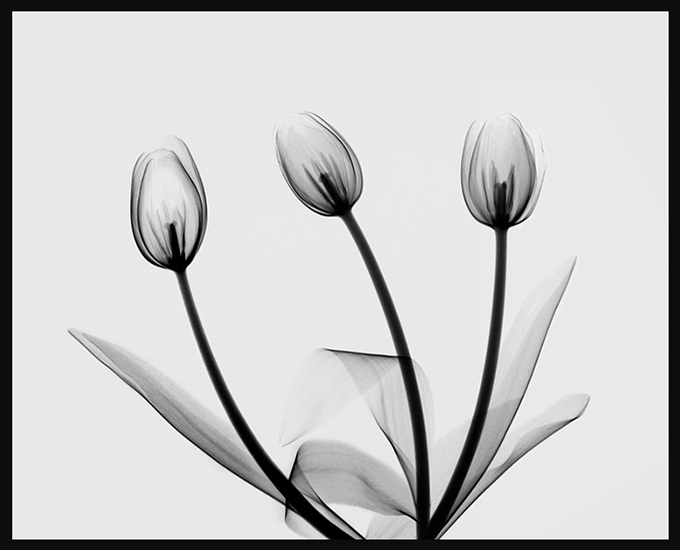
Tulips Xrayogram by Jacqui Dean
.
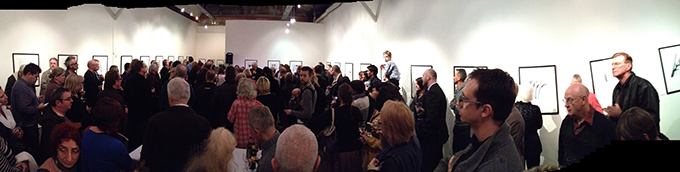
Translucence Opening Crowd . . iPhone Pano: Doug Spowart
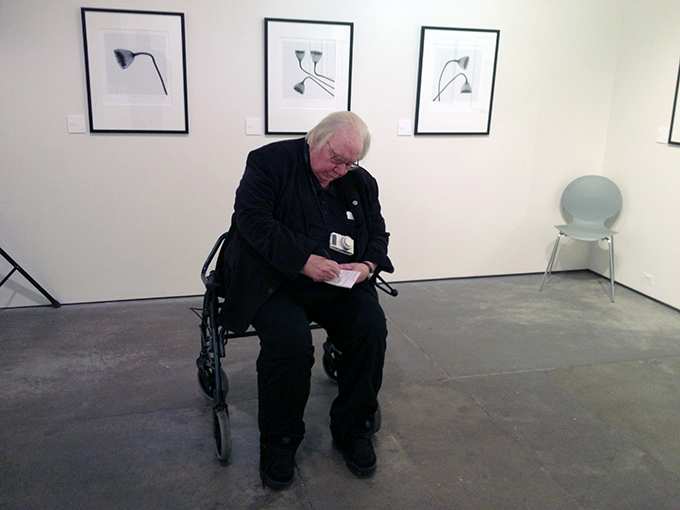
Robert McFarlane preparing his opening remarks . . iPhone Photo: Doug Spowart.
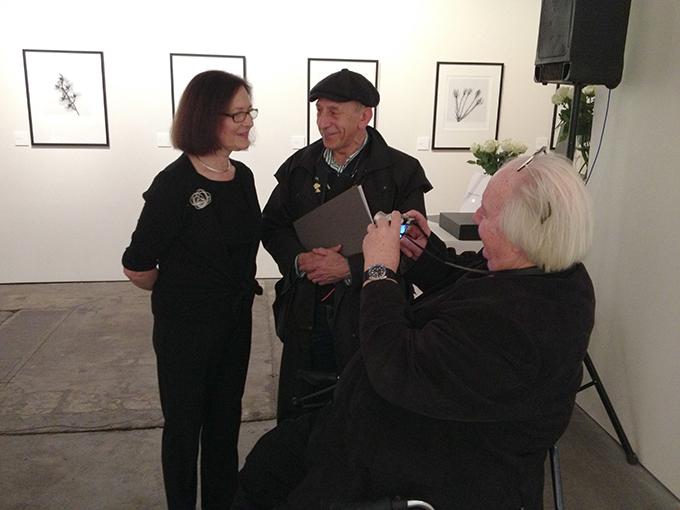
Jacqui, Josef Lebovic and Robert McFarlane . . iPhone Photo: Doug Spowart
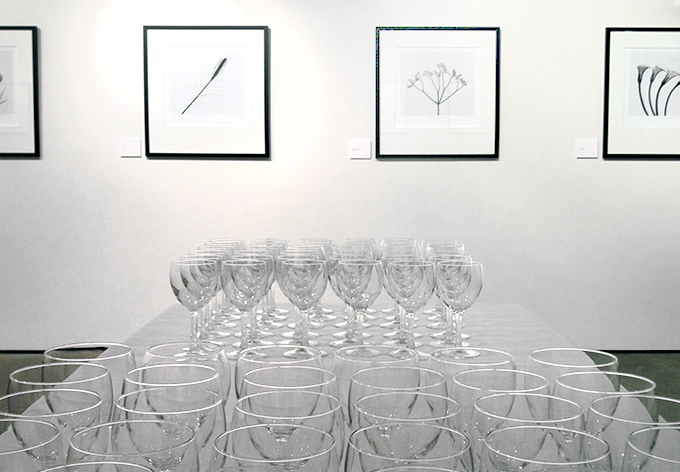
More Translucence. . iPhone Photo: Doug Spowart
.
MORE INFORMATION:
.
Jacqui Dean’s Website: http://deanphotographics.com.au/fine-art/
Interview by Gemma Piali of FBi Radio, Sydney: http://fbiradio.com/interview-jacqui-dean-on-translucence/
Review from Simone Whelton ABC702 http://www.abc.net.au/local/stories/2013/05/31/3659500.htm
“Translucence: Jacqui Dean – A jam packed opening on a Tuesday night meant it was a little hard to see some of the stunning black and white prints that Jacqui Dean has featured in her new exhibition Translucence but I pushed my way through the crowds and was delighted at the little moments of gentle quiet that descended on me as I stared at each picture, delicately constructed. This is spectacular still life photography featuring mainly Australian flowers (orchids and native flowers) and using a combination of x-ray and digital imaging. Tucked away towards the back of the exhibition is a series of photos of beautiful shells. Known for her photographs of architecture (interiors and landscape), this exhibition is part of Head On. Take a few minutes to pop in and enjoy the works! When and where: on at The Depot, 2 Danks Street, Waterloo now until June 8.”
.
Xrayograms: © Jacqui Dean
Review text © 2013 Victoria Cooper
All iPhone photographs © 2013 Doug Spowart
.
This work is licensed under a Creative Commons Attribution-NonCommercial-NoDerivs 3.0 Unported License.
.
.


COMMENTARIES: ARTISTS BOOKS … AS POPULAR AS TATOOs!
leave a comment »
The wide view
COMMENTARIES ARISING FROM THE SLQ SIGANTO FOUNDATION SEMINAR
The trouble with artists’ books
State Library of Queensland – May 4, 2013
.
The quote “artists’ books … as popular as tatoos” was an opening remark by gallerist Noreen Grahame
.
In Volume 7 of the Bonefolder e-journal I reported on the dual artists book events of the 2010 Artspace Mackay Focus on Artists Book V, event and the 3rd Libris Awards. In this report I commented on the speaker’s presentations and reviewed the artists book award. I then concluded that these events were integral to the development and maintenance of a community of practice for those who make artists books in this country. Three years on the energy and enthusiasm for artists’ books remains however the Mackay Focus event has been abandoned and some awards events have slipped from their usual place in the yearly/bi-yearly calendar.
We are indeed indebted to the Siganto Foundation and the SLQ who in 2012 made possible the Keith Smith and Scott McCarney workshop and seminar, and this year the The trouble with artists’ books seminar. It seems to me that artists book community in this country has a great appetite for information, connecting with the heroes and heroines of the discipline, learning about methods and techniques as well as participating in camaraderie with their peers. My concluding words in the Bonefolder report recognised the importance of events such as Artspace’s Focus on Artists Books and the Libris Awards as they invigorate the discipline and the art of artists books … The significant response to this seminar indicates that the pace and frequency of artists book events should not slacken – we want more!
The Bonefolder report concluding comments were:
Awareness of the origins of the discipline of artists’ books and the Australian context as well as issues of contemporary and emergent practice is a unique outcome for FOAB. Where else in Australia this year would one be able to experience, or participate in a program where issues as diverse as Avatars making books in their second life, the death of the book/author, wild books and zoo viewing of books, propositions for new perceptive literature, mail art and the products of psychometry being resolved as artists’ books? Perhaps attendees should be warned of the ride that they would encounter.
Central to need for the FOAB, as an event, is its ability to pull together artists’ book interested people and provide a forum for them to be a part of something bigger than themselves. Artists’ bookmakers are individual artists, sometimes collaborators, librarians, academics, gallerists and collectors are isolated as islands of interest in their usual place of activity. But at FOAB they meet, greet, mingle, chat, discuss, argue and get down to the flensing-out of ideas, polemics and concerns about practice and the book as a work of art. This blend of interested parties forms the nucleus, the hub, of the discipline within this country – without it, there would only be individual soliloquies in the wilderness
.
Julie Barratt
Julie Barratt – Artist
I guess really briefly what I got from ‘the trouble with artist book ‘ talk if I was going to quote is ” it seems the trouble with artist books is that there are too many to love!!!” On a more serious note I guess for me it always comes down to how we talk about/define an artist book, as an ongoing discussion.
Almost on a daily basis when I had the gallery (I always had at lead a few artist books on display) people would ask what these books are! How to define them without quoting Johanna Drucker? Should there be categories i.e. Sculptural, digital etc etc. How do we expect the audience to understand them if we as practitioners have difficulty talking about them? But how do we agree on a definition?
That’s what I imagined the forum to be about because ‘isn’t that the trouble with artist books’? Having said that I thoroughly enjoyed the forum and think there need to be many many more of them when in fact there seem to be less (Mackay forum? ) so that the discussion can continue….
Its always a pleasure to catch up with the artist book community, feels like a reunion every time!
Julie
.
Maureen Trainor
Maureen Trainor – Photographer and QCA Masters student
I found these presentations to be very informative and inspiring.
The content and sequence of the presentations were dynamic.
By breaking down the delivery into the three different viewpoints the three Keynote speakers were engaging and thought provoking.
Starting with Helen Cole presenting ‘the Librarian’s view’, Noreen Grahame presenting ‘the Gallerist’s view’, Jan Davis presenting ‘the Artist’s view’ and ending with an interactive audience time for ‘questions and answers’ was right on target with information.
The Hearsay team discussing their project was fantastic. Combined with humour and wit they certainly kept the attention of a diverse audience.
I truly enjoyed the afternoon and felt I could of stayed into the night with more speakers and presentations.
Maureen
.
Monica Oppen
Monica Oppen – Artist and collector
The Trouble with Artists’ Books (and the Libris Awards)
Coming away from the SLQ seminar where the attendance was so strong and having attended the opening and announcement of the Libris Award at Artspace Mackay the conviction that has risen strongly in my mind is that there is a real need for events such as the SLQ Siganto Seminar. The strong attendance not only indicates a real interest in the topic but a desire of artists to reconnect with others working in the field. As Helen writes in her post about the Libris Awards, and I can vouch for it, there were very, very few artists there but also no other significant persons from the institutions who have an ongoing interest and involvement in artists’ books were there. The tyranny of distance and the associated costs of travel and accommodation will only be overcome by creating an event that is worth travelling for.
The topic The Trouble with Artists Books is pertinent and complex and was way too big to handle in one afternoon; a multi-day conference could have been structure around this topic. Time restrictions meant that Jan Davis and Noreen Grahame could only touch on, hint at and introduce the work/books from which a broader discussion could have expanded. The sense that there is a need for these seminars (judging from the attendance numbers) also hopefully indicates a need for more rigorous, mature critical discourse around the genre, a breadth of conversation and argument. Does the constant discussion of definition and the non-committal responses from ‘those who should know’ arise from this lack of discourse? I don’t consider the definition ‘if the artist calls it a book, it is a book’ to be an adequate, exciting nor empowering definition unless some force is allowed to work in opposition to it, that demands a justification, demands some critical analysis. The lines will always be blurry but this could be an energizing force and contribute a dynamism to the genre. By not taking a stand are we in fact leaving definitions to the gallery? Surely the gallery as a medium is the antithesis of the (artists’) book. The gallery is exposed and extraverted; the book is enclosed and introverted. Always it comes up, the problem with exhibiting artists books— this is because books are not meant to be exhibited, they are meant to be read. What are the implications for the genre if books are only viewed in the gallery, and more seriously if the gallery maintains a ‘no touch’ policy? Ironically, making a (artist’s) book was originally about abandoning the gallery; about the subversion of the commercialism of the art object. The book was meant to be a free-floating object in wider society. Where is that rebel spirit?
A hundred more questions could be asked. I hope the SLQ seminar is not a one-off but gives an impetus to more symposiums throughout the country.
Monica Oppen 14/5/13
.
Judy Barrass
Judy Barrass – Artist
THIS COMMENTARY COMES FROM JUDY’s BLOG – ‘Critical Mass’ http://www.criticalmassblog.net/2012/?p=2568
No one can agree on what they are, or even where the apostrophe should be placed, but a seminar on artists’ books at the State Library on Saturday drew a crowd.
It was a rare get-together of artist book makers and officianados, with attendees travelling from other states and regional Queensland just to attend the two-and-a-half-hour seminar and catch up with old friends.
According to the speakers, librarian Helen Cole, gallerist Noreen Grahame, and artist book maker and academic Jan Davis, artist books are problematic. That’s not just because no one seems to be able to agree on a definition, but also because they are hard to store, hard to display, and are not usually included in mainstream collections or exhibitions. They attract mostly a smallish group of makers and collectors and don’t sell in large numbers. Despite this, artists’ books draw a passionate audience of makers and supporters whenever they are on show (or whenever there’s a seminar).
Queensland has been a leader in the artist book phenomenon. The Queensland State Library is a significant collector, and Grahame Galleries took an early leading role. Artspace Mackay and Noosa Regional Gallery added public gallery support to exhibitions and collecting.
Someone suggested that it’s an inbred audience made up almost entirely of artist book makers, but a show of hands in the crowd on Saturday debunked this myth since at least half the attendees were not makers. Still, as Noreen Grahame remarked, artist books are a sort of ‘underground’ movement outside the mainstream.
I can’t help wondering if this is merely a question of naming. By calling these artworks ‘books’ they are relegated to the collections of libraries rather than art galleries, or they exist in a no man’s land between library and gallery. Nonetheless I have seen many works in public art gallery collections that could (or perhaps should) be called artist books. The boundaries are thin and flexible, and this was evident at the seminar. The mantra seems to be that if the artist calls it a book then it is a book.
One of the more interesting questions on the day was about the growing number of artist books that exist only in digital format. Helen Cole said the library was considering how these books might be collected and preserved, but indicated it was extremely difficult, particularly as technology changes so rapidly and formats and software become obsolete. Noreen Grahame solved the problem by referring to digital books as ‘ephemera’, and Jan Davis thought the number of artists working in the digital realm was small.
Following the discussion, a very chatty audience enjoyed a scrumptious afternoon tea and the launch of Hearsay, a large format collaborative artists’ book by artist Euan Macleod, printmaker Ron McBurnie, and writer Lloyd Jones. They apparently didn’t worry too much whether or not their work was or was not an artist book, but have sensibly hedged their bets by also producing the pages as a portfolio of unbound prints (in case anyone thought it wasn’t art, or more probably because the portfolio might be more saleable than an artist book ).
The seminar ‘The Trouble with Artist Books’ was sponsored by the Siganto Foundation through the Queensland Library Foundation.
The State Library artist book collection is part of the Australian Library of Art.
(Thank you Judy for allowing this re-posting in this blog)
.
.
Wim de Vos
Wim de Vos – Artist
‘The Trouble with Artists Books’
The lecture sponsored by the Siganto Foundation was very well attended by a large audience of art practitioners, administrators, and lovers of Artists Books, and was introduced by the new head of the State Library, Janette Wright. The speakers were Helen Cole, Senior Librarian of Special Collections at the Library; Noreen Grahame, Gallerist and long time respected promoter of the Artist Books within Australia and Internationally; and Jan Davis, Academic, and practitioner of Artists Books at Southern Cross University, Lismore, NSW.
Technically the lecture was informative, ran smoothly and was very well presented.
It was great to see so many practitioners (well over half the audience) and the general public, as this event facilitated a forum – to share, and some time to catch up with friends and colleagues. This has over the last few years become non-existent with the loss of the Art Space Mackay Artist Book Forum. Also the Noosa Regional Gallery’s ‘demise’ of the Artists Book annual exhibition was a sad occurrence. In addition, both venues offered successful workshops with renowned National and International Practitioners in the Visual Arts to nurture the visual arts and the book.
Many aspects of the development of Artists Books were addressed. Helen Cole addressed the ‘Trouble with Artists Books’ from a Librarian’s point of view, in that, because they were ‘Artists Books’ and diverse in so many ways, the logistics of preservation, cataloguing and storage were ‘Troublesome’. Furthermore, it was stated that the ‘Galleries’ had passed the Artists Books onto Libraries to display and make use of them, and by making Libraries the custodians of the ever-growing phenomenon of the Artists Book.
The concept of Artists Books is generally not an easy topic to present. It is in fact generally not understood at all. A friend recently pointed out, ‘I didn’t even know that an artist book existed, but as I have learnt through the language of art over time, I can say, I view this process as Book Works by Artists.’ A major exhibition of books of this nature: DAS BUCH was presented at the Queensland Art Gallery in association with the Museum of Contemporary Art in Sydney and the Goethe Institut in Germany during 1992. This was, I’m sure, a huge influence on art practitioners and the public. At the time, it placed an emphasis on the ‘Book as Object’ in a context never before experienced in the Antipodes. There has been no major exhibition of this type in a public gallery in this State, since.
As I am a practising artist and maker of prints, paintings, and sculpture, and work with a wide variety of materials, the book as object comes naturally as a medium to extend my practice. It has in fact tied together all my processes of making art, including text, giving me the freedom of story telling on many levels.
I observed, as the afternoon progressed, that in the presentation not all aspects of Artists Books practice was being fully covered and explored by the presenters. This became, indeed, troublesome. There is actually content within books, books with text, images and text, objects and materials, and so on. There was very little mentioned on the subject of the Sculptural Book or the Photo Book. A visual list WAS presented with images of the types of books that were in the collection of the Library. But no further elaboration was offered to those in the audience that were not already ‘in the know’. The State Library of Queensland has one of the largest collections of Creative & Historical books in the southern hemisphere.
Let it be said that we can be proud of a comprehensive, diverse, eclectic and public collection of books – particularly in the collection of Contemporary Art practice in Queensland and beyond. It is promoted that it ‘may be visited at any time, by appointment’.
I recognise that there is not time to cover everything fully. This made duplication and repetition even more irritating. Time may have been used more productively.
The lecture continued with the history of the Artists Book and it’s growth within Australia over the last 30 odd years. This painted an impressive picture of collections and practise over that time. Artists were mentioned who were instrumental in its development, but presenters did not go far enough on this issue, and failed to mention key motivators: artists both local and international. There was a ‘flow of words’ promoting a few artists over and over again. When the presentation of ‘Favourite Artists Books’ was introduced the theme of the lecture was totally abandoned. We were presented with a self-indulgent diversion as to what the book may mean only to the ‘literate Artists Book fans’ present.
It would have been more useful to give the audience an indication of how they may wish to learn more about Artist Books through the public and private system. There was enough talent and experience behind the microphone to impart this information. It seemed much of this lecture was preaching to the converted.
Afternoon tea on the terrace was followed by the launch of a collaboration of an Artist Book created by two well-known visual artists: Ewan McCloud and Ron McBurnie, and the writer Lloyd Jones. This was a very good presentation chaired by Suzi Muddiman: Director of the Murwillumbah Regional Art Gallery in NSW. This gave the opportunity for the layperson to experience the processes of collaboration in art making.
As there are no indications of any follow-up lecture or activities relating to Artist Books, it would be worthwhile to plan something on the promotion and educational aspects of Artists Books. I am sure it would be a great success.
A ‘large bouquet’ to Helen Cole in particular, and the State Library, for organising this generally informative and pleasant afternoon. We look forward to a more expansive event in the future.
Wim de Vos
.
.
Peter Lyssiotis
Peter Lyssiotis – Artists book-maker and photomonteur
Peter’s letter
.
A vodcast for the event is available at http://www.slq.qld.gov.au/audio-video/webcasts/recent-webcasts/siganto-seminar
.
Cheers Doug+Victoria
.
.
© Of all texts resides with the authors
Photograph of the SLQ Theatre, Julie Barratt, Monica Oppen, Wim de Vos © Doug Spowart 2013. Self-portrait of Maureen Trainor ©2013. Judy Barrass portrait supplied by Judy.
This work is licensed under a Creative Commons Attribution-NonCommercial-NoDerivs 3.0 Unported License.
.
.
.
Share this:
Written by Cooper+Spowart
June 3, 2013 at 1:56 pm
Posted in Artists Books, Meeting People, Reviews, Wot happened on this day
Tagged with Artists Books, artists' books in Australia, Artspace Mackay, Bonefolder e-journal, commentary on artists books, communities of practice, communities of practice artists books, Focus on Artists' Books, Helen Cole, Judy Barrass, Julie Barratt, Libris Awards, Maureen Trainor, Monica Oppen, Peter Lyssiotis, Siganto Foundation, State Library of Queensland, the trouble with artists' books, Wim de Vos