Archive for the ‘Reviews’ Category
MAUD GALLERY: TRANSLUCENCE: Jacqui Dean’s Xrayograms
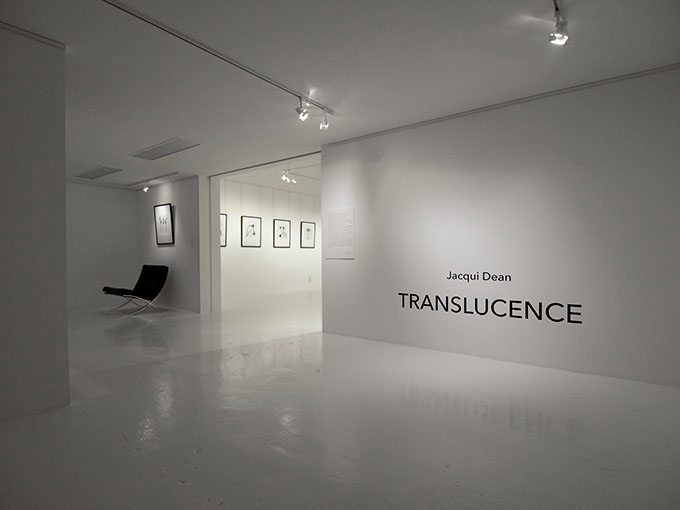
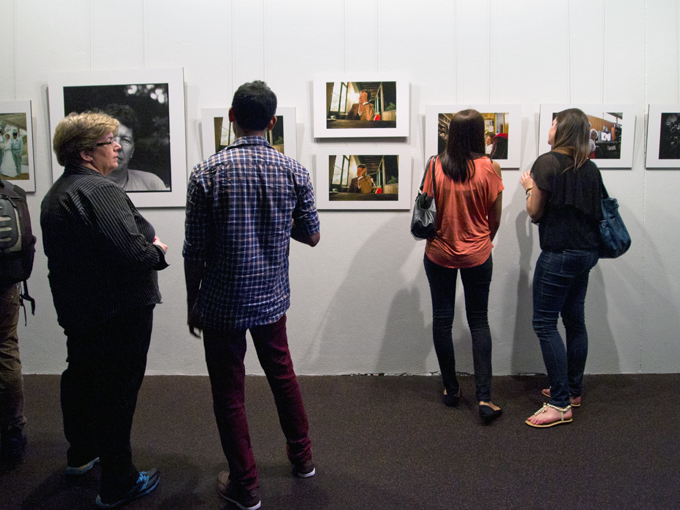
Jacqui Dean’s TRANSLUCENCE @ Maud Gallery, Brisbane Photo: Doug Spowart
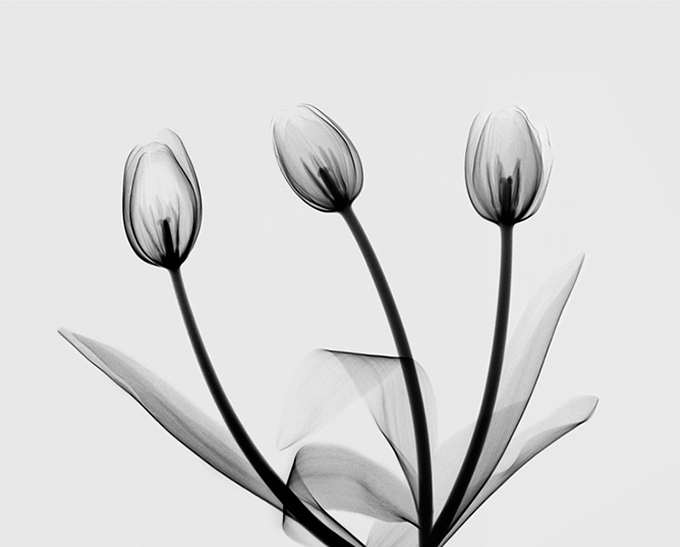
An image of tulips from the Translucence exhibition
.
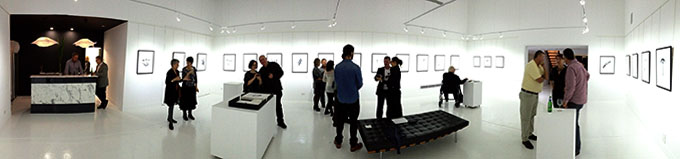
Translucence @ Maud Gallery, Brisbane. . iPhone Photo: Doug Spowart
.
TRANSLUCENCE: Jacqui Dean’s Xrayograms
Maud Creative Gallery June 18th – July 19th, 2014
6 Maud Street Newstead, QLD 4006
Ph 07 32161727
www.maud-creative.com
.
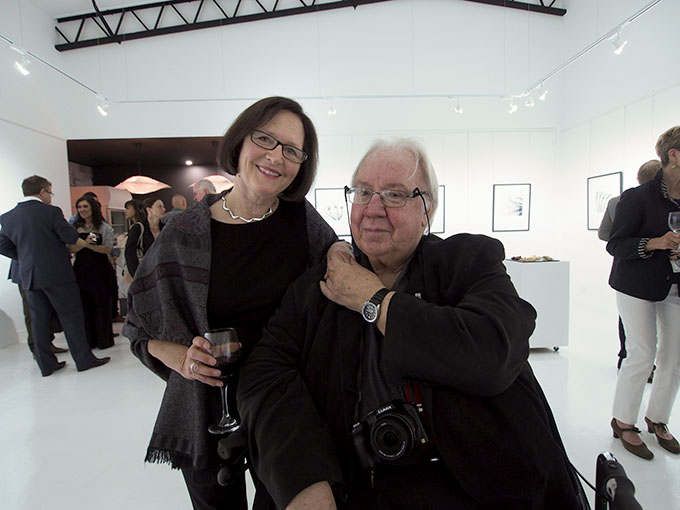
Jacqui Dean + Robert MacFarlane Photo: Doug Spowart
.
A comment about the work by the exhibition speaker Robert McFalane
In TRANSLUCENCE, photographic artist Jacqui Dean reveals Australia’s flora, both native and introduced – in radically new ways. Dean’s searching vision reduces flowers to their essential, sculptural shapes, translating them into exquisite, archival black and white prints. Calla lilies are seen as never before – with their curved flowers resembling the shape and texture of a crystal goblet. Dean’s delicate images of roses, through composition and digital magic, reveal interlaced petals that mimic the textures of a Tulle bridal veil.
Dean’s delicate, dancing images in TRANSLUCENCE mirror the elegance of Nature while resonating deeply with the work of artists as disparate as photographic pioneer William Henry Fox Talbot (1800-1877) and the affectionate, intricate drawings of Nature by Albrecht Durer. (1471-1528)
Jacqui Dean is a talented Sydney architectural, corporate and fine-art photographer known for her rigourous sense of composition and peerless black and white printmaking skills. Twenty seven prints will be on display at Maud Creative Gallery during this first Brisbane exhibition of TRANSLUCENCE.
“Look deep into nature, and then you will understand everything better.”
ALBERT EINSTEIN (1879 – 1955)
‘Another Universe’ a review by Victoria Cooper
.
From the late 19th, and into the early 20th century there was a growing movement in the sciences and the arts that associated with Nature’s inherent resonance of form and structure from the microscopic to the cosmic. These new vistas and universes were recorded not only by the scientists’ hand but also by new developments in technology, notably the invention of the photographic process. Visual communication through imaging technologies continues to be an important tool in scientific research. But these images were not just useful as scientific evidence they were and continue to be inspiration for the creative work of artists and designers.
One noted exemplar utilising this visual medium was Karl Blossfeldt (1865-1932), a sculptor, metal craftsman and teacher. Blossfeldt began taking photographs of botanical specimens to use in his classes as ideas for students to create design forms from nature. But Blossfeldt’s work became very influential in the art, craft and design movement that popularised natural forms as templates for architecture, sculpture and 3D design work. His photographic documentation revealed abstract views of humble everyday roadside plants as visually interesting structural and aesthetic forms. As a result, Blossfeldt’s photographs also became renowned as works of fine art.
Jacqui Dean’s exhibition Translucence, at 2 Danks Street Gallery, Sydney, and now at Maud Gallery in Brisbane, is the result of artistic curiosity and visual investigation natural forms through the phenomenon of Xrays. Art in this respect is the revelation of the unseen, the beholding of the essence within ordinary objects or a transforming perception of the everyday experience. The photograph, or in this case ‘xrayograph’, seals the object within the frame safe from the changes and inevitable decay over time. At first glance these images could appeal to the naturalist or perhaps a student of design (after Blossfeldt). Yet a deeper – more poetic vision immanent in nature is also suggested through a more contemplative viewing of these images.
Some may argue that this is an uncomfortable clash between the modernist and the romantic, or the objectivity of scientific evidence and the subjective imagination. But could this work identify with a need to embrace a sense of wonder rarely seen within a super-hyped, virtual digital-image society? Dean’s work in Translucence is informed by the poetry of music and her life’s experiences and her prodigious professional practice in photography. However the rewards for the thoughtful viewer will be to share in her wonder of the natural world that surrounds and nourishes our everyday life.
Victoria Cooper . . . June 9, 2013.
.
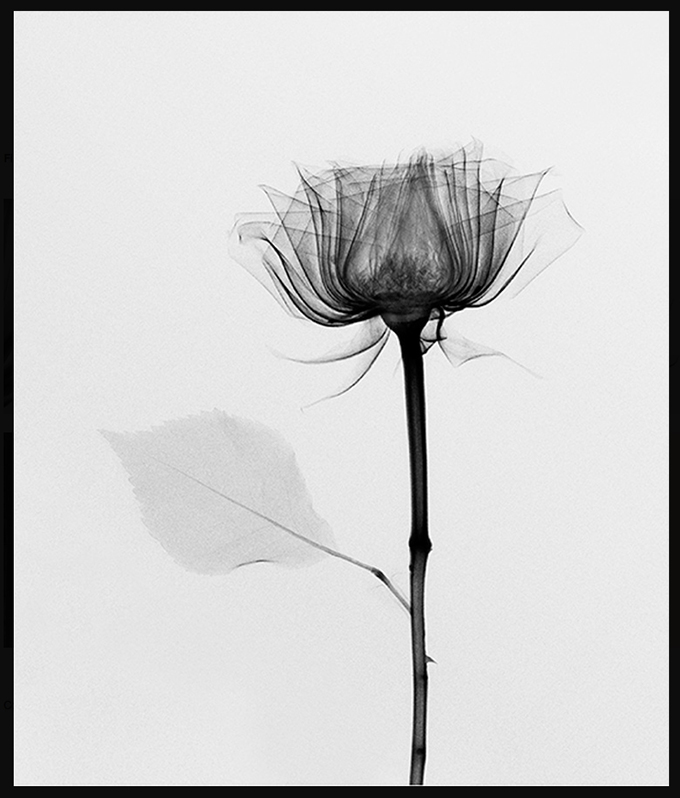
Rose Xrayogram by Jacqui Dean
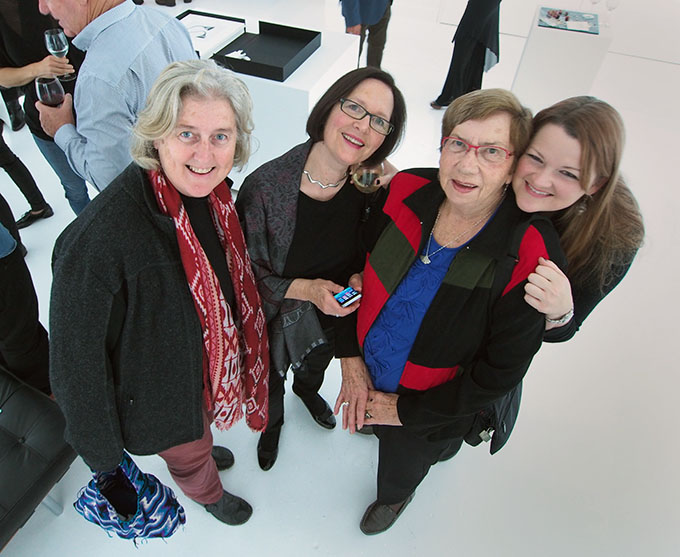
Victoria Cooper, Jacqui Dean, Ruby Spowart & Mel Anderson Photo:Doug Spowart
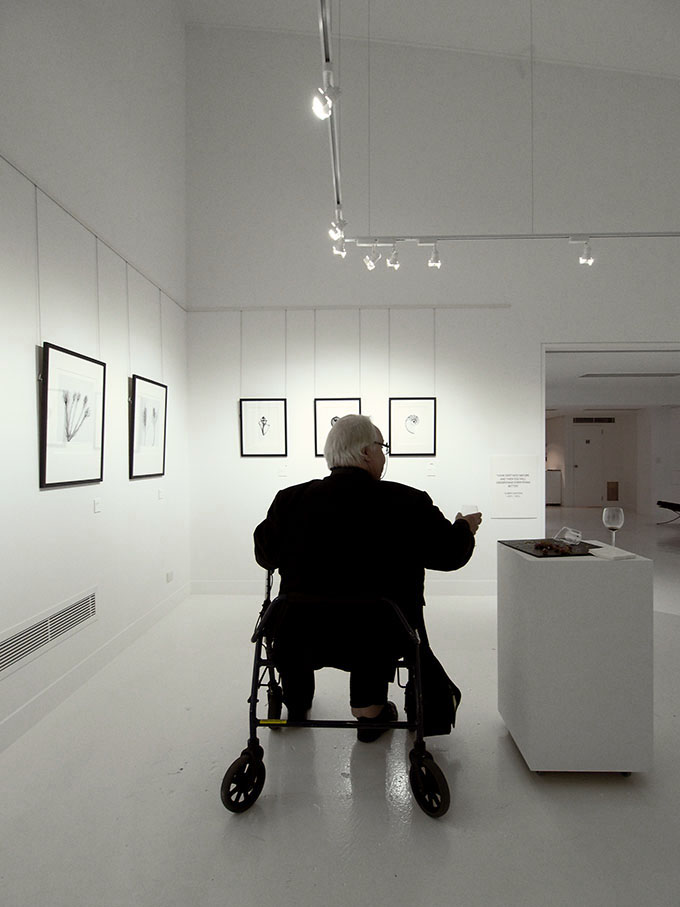
Robert takes a drink — Photo: Doug Spowart+Steve Jones
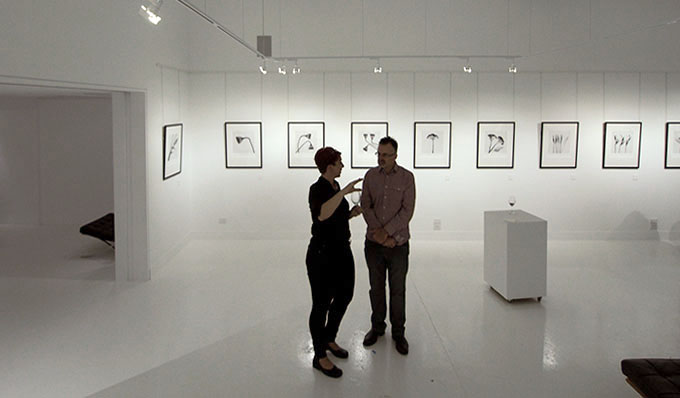
Bibiana Stanfield and Neil Burton @ Maud Gallery
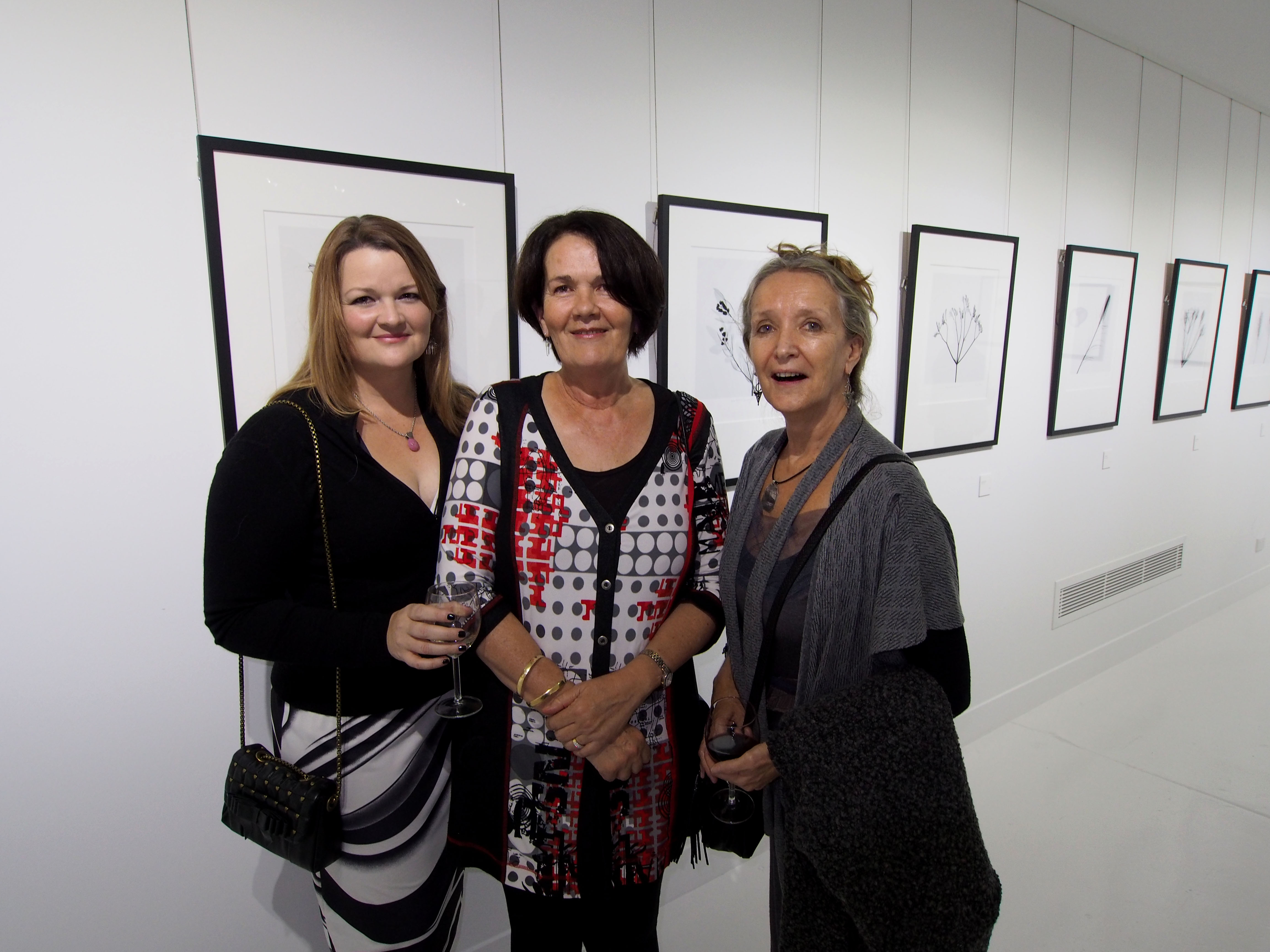
Mel Anderson, Ros Stakes and Lesle Downie @ the opening Maud Gallery Photo: Doug Spowart
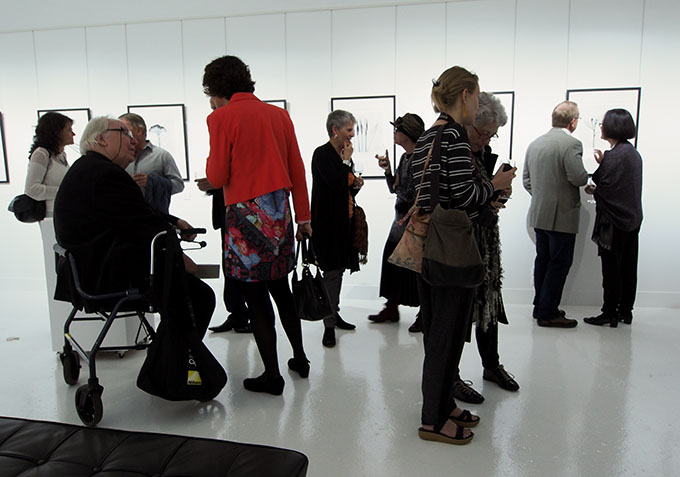
Guests at the Translucence opening Maud Gallery Photo: Doug Spowart
.
MORE INFORMATION:
Jacqui Dean’s Website: http://deanphotographics.com.au/fine-art/
Interview by Gemma Piali of FBi Radio, Sydney: http://fbiradio.com/interview-jacqui-dean-on-translucence/
.
Xrayograms: © Jacqui Dean
Review text © 2013 Victoria Cooper
All exhibition opening photographs © 2014 Doug Spowart
.

This work is licensed under a Creative Commons Attribution-NonCommercial-NoDerivs 3.0 Unported License.
.
.
LANDSCAPE PHOTOGRAPHS ARE HISTORY: A book forward
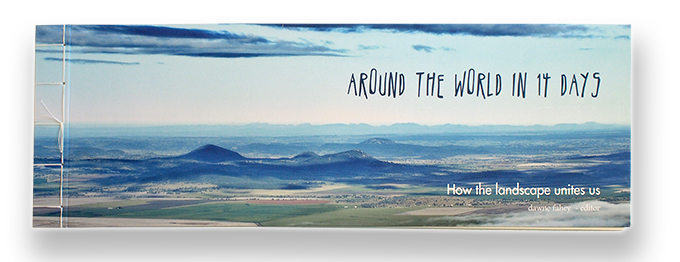
The book Around the world in 14 days
.
Recently I was asked to write an introduction for a limited edition book to compliment an exhibition of landscape photography entitled, Around the World in 14 Days: how the landscape unites us. The project featured seven contemporary Australian and international photographers, and was coordinated by Dawne Fahey of the FIER Institute with Sandy Edwards contributing to the image selection. The assembled body of work presented insights into how photographers ‘read the landscape, both visually and psychologically through their images.’
..
The photographs, created in Australia, Asia, New Zealand, USA and Colombia are intended to inspire viewers to consider how ‘elements effecting the landscape unite us, regardless of our differences or the distances that occur between us.’ Through the photographs there is also an intention that the ‘poetic fragments presented by the work will connect with the viewer’s own memories, experience, or sense of place.’
The exhibiting photographers are: Ann Vardanega (Australia), April Ward (Australia), Beatriz Vargas (Colombia), Gavin Brown (Australia), Michael Knapstein (USA), Robyn Hills (Australia) and Pauline Neilson (New Zealand) and the exhibition and book are on show at Pine Street Gallery, 64 Pine Street, Chippendale, Sydney until May 31, 2014.
See more at: http://www.pinestreet.com.au and http://fier.photium.com/around-the-world-in-14 – sthash.QPto0nz4.dpuf
The exhibition and book launch took place on May 20, 2014 at the gallery.
My essay discusses issues that relate to the premise of the exhibition as well as some personal observations of the idea of the photographer in the landscape. The essay is presented here and at the end of the post I have included a selection of images and installation photographs of the exhibition.
.
.
All landscape photographs are history
It is vain to dream of a wildness
distant from ourselves. There is none such.
In the bog of our brains and bowels, the
primitive vigor of Nature is in us, that inspires
that dream.
Henry David Thoreau, journal, August 30, 1856 [i]
Around sunset, Northern Territory time, a gathering of photographers will assemble in the central Australian desert and witness the now iconic sunset at Uluru. What they encounter will be a lived experience and there can be no doubt that cameras, both with and without telephony capability, will record the moment. Their images will bear metadata of the shutter speed, aperture, camera brand and model, the time, date and perhaps even its geolocation. These images will be cast into the Internet as evidence for friends and family to see – a private experience shared and made transferrable by technology.
What then of the subject of their gaze and activity – the landscape? For this rock in the desert, the next day will be a repeat of this photo ritual, and each day after, it will be repeated again and again. Does Uluru wait for its activation at each sunset and each shutter’s click? This landscape has experienced a few hundred million years of sunsets and its current fame as a photo celebrity, is a mere blip in its history. Every day will be different and thousands of days, well, not much change. However, today’s photograph, even a split second after its capture, is history.
For a number of years I have cultured the belief which was informed by a statement attributed to photographer Minor White: ‘No matter how slow the film, Spirit always stands still long enough for the photographer it has chosen.’[ii] My variation is that that landscape reveals itself to the photographer of its choosing. Writer and critic John Berger adds to this discussion by proposing that there is a ‘modern illusion concerning painting … is that the artist is a creator. Rather he is a receiver. What seems like creation is the act of giving form to what he has received.’[iii] Could it be then that the landscape is the director and commissioner of the image that the painter or the photographer makes, and that the photographer – the right photographer – is merely the vehicle for the landscape’s transformation of itself into an image?
Like portraits that have been made since the beginning of photography, and the documents of human endeavour, commerce, existence and experience – time, or rather the passage of time, has granted then their relegation to past. Each photograph in this book is then a history image. The moment and space depicted wrenched from the continuum of time by whatever forces brought together the photographer and the landscape. A landscape image at that moment of capture is at once the subject photographed and also a time machine. Viewed on its own by its maker the photograph can be a comfortable aide memoir, and operate just as a photo of a loved one or a family wedding would do in its frame on the mantelpiece – the photo exists, and so too the remembrance of subject it represents.
But photographs are more than things; they are experiences. Photographer Ansel Adams attributed special values and meaning to his landscape photographs and sought to represent the landscape as being more than what it was physically. Simon Schama in his book Landscape and Memory cites Adams as commenting that: ‘Half Dome [in Yosemite National Park] is just a piece of rock … There is some deep personal distillation of spirit and concept which moulds these earthy facts into some transcendental emotional and spiritual experience.’[iv] Adams inspired the American nation and created a tradition of environmentalism and black and white photography that continues today.
For Australian wilderness photographers Adams’ ‘emotion and spiritual’ connection with the landscape is salient. In the book Photography in Australia Helen Ennis discusses how photographers of this genre engage with their landscape subjects. She quotes Tasmanian photographer Peter Dombrovskis entering a ‘state of grace’ on bushwalks when, ‘days away from “civilization”, he felt what he described as, “a sense of spiritual connection with all around – from widest landscape to the smallest detail”’.[v] Ennis also comments that wilderness photographers use a range of techniques to ‘lift the experiences of viewing the photographs into a realm that goes beyond the human exigencies of normal daily life.’[vi]
In a book such as this, as we turn the pages, what is presented to us is the photographer’s concept or story encoded in visual form. As with Berger this may constitute the next generation of ‘giving and receiving’. They may have made the photograph/s with a specific objective in mind – a narrative angle, the idea of showing something that stirred them that they wanted to share – or – from the earlier discussion, what the subject wanted revealed. But in the space between the giver (the photographer and this book), and the receiver (you, the viewer), another hybrid narrative emerges. The photograph acts as a stimulus on the viewer and an idiosyncratic response is generated. Roland Barthes uses the term ‘detonate’ to describe being in front of a photograph. In Camera Lucida he comments that: ‘The photograph itself is no way animated, … but it animates me: this is what creates every adventure.’[vii]
In photographs we are not so much connected or united with the landscape, but rather the experience of the landscape and the trees, rivers, blades of grass and rocks that are represented in images. In effect we are united by the landscape of photography and the gift that we can share through it. We can then, through photographs enter into a Barthesian adventure. Perhaps these landscape photographs are more than history – they are: an experience shared, an unexpected encounter, an adventure. In your turning the pages – then pausing to view each group of images, to contemplate and consider the communiqué stimulated by them, these photographs become part of your history, your experience, and your adventure as well …
Dr Doug Spowart April 17, 2014
[i] Schama, S. (1995). Landscape and Memory. London, HarperCollins, epigraph, n.p.
[ii] http://www.johnpaulcaponigro.com/blog/12041/22-quotes-by-photographer-minor-white/
[iii] Berger, J. (2002). The Shape of a Pocket. London, Bloomsbury Publishing Plc, p.18.
[iv] Schama, S. (1995). Landscape and Memory. London, HarperCollins, p.9.
[v] Ennis, H. (2007). Exposures: Photography and Australia. London UK, Reaktion Books Ltd, p.68.
[vi] ibid.
[vii] Barthes, R. (1984). Camera Lucida. London, UK, Fontana Paperbacks, p.20.
.
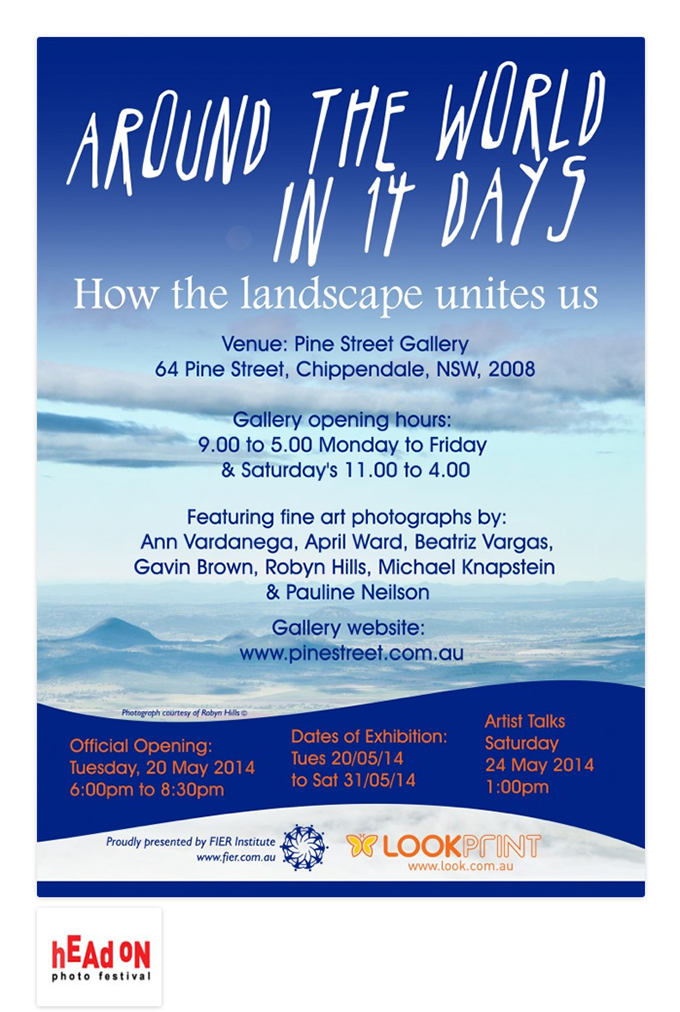
The exhibition invitation
.
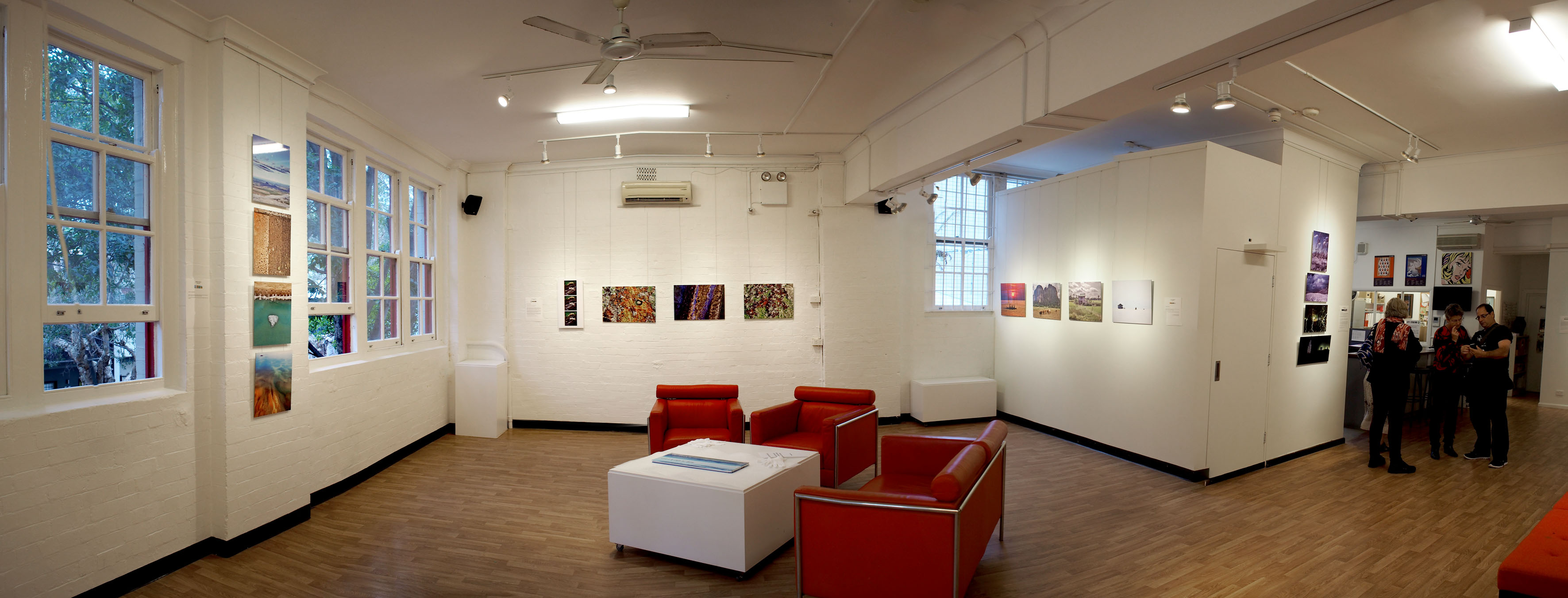
The exhibition in the Pine Street Gallery
.
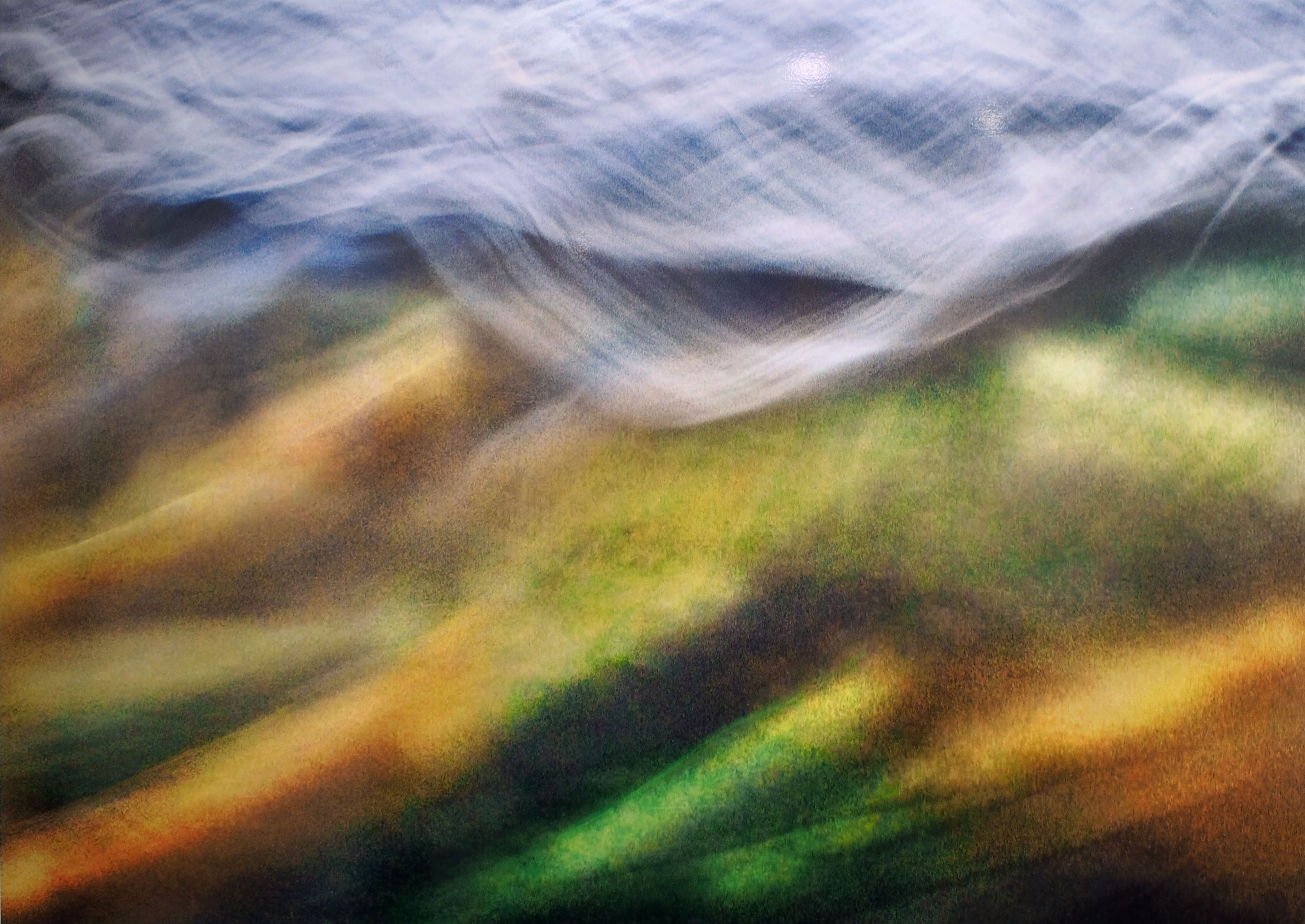
A photograph by Pauline Neilsen
.
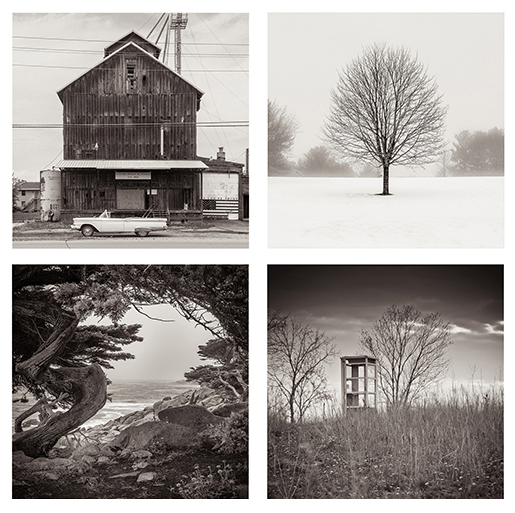
Four photographs by Michael Knapstein
.
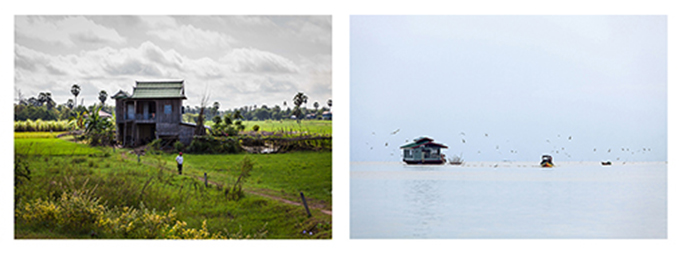
Two photographs by Gavin Brown
.
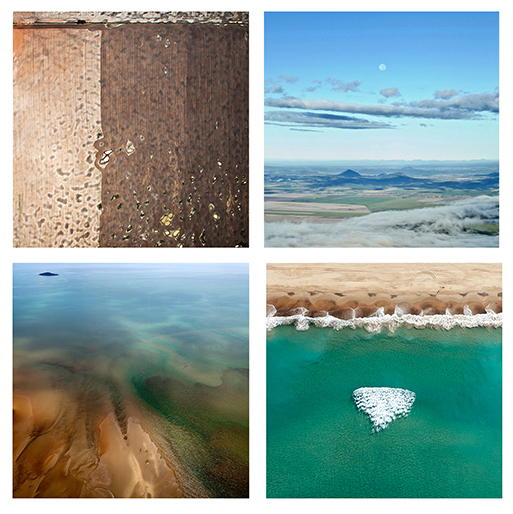
Four photographs by Robyn Hills
.
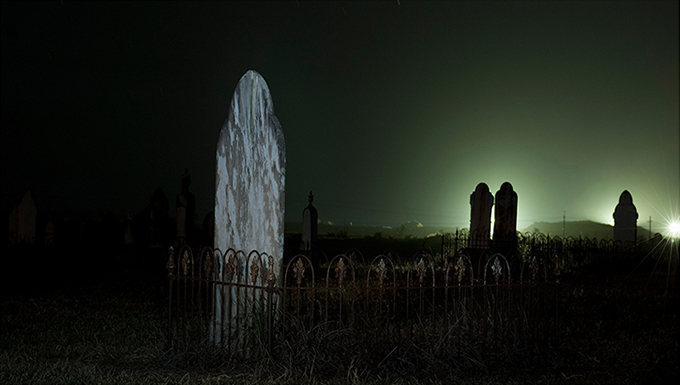
A photograph by Ann Vardanega
.
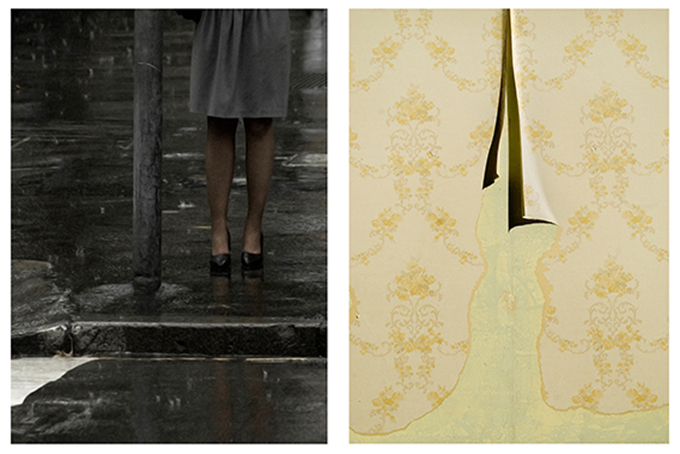
Two photographs by April Ward
.
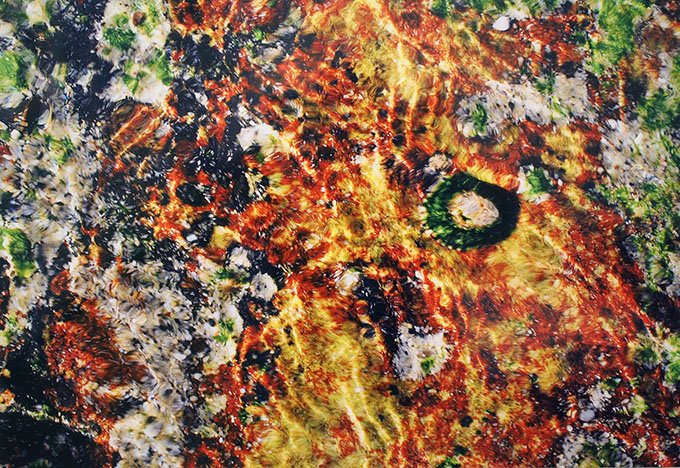
A photograph by Beatriz Vargas
.
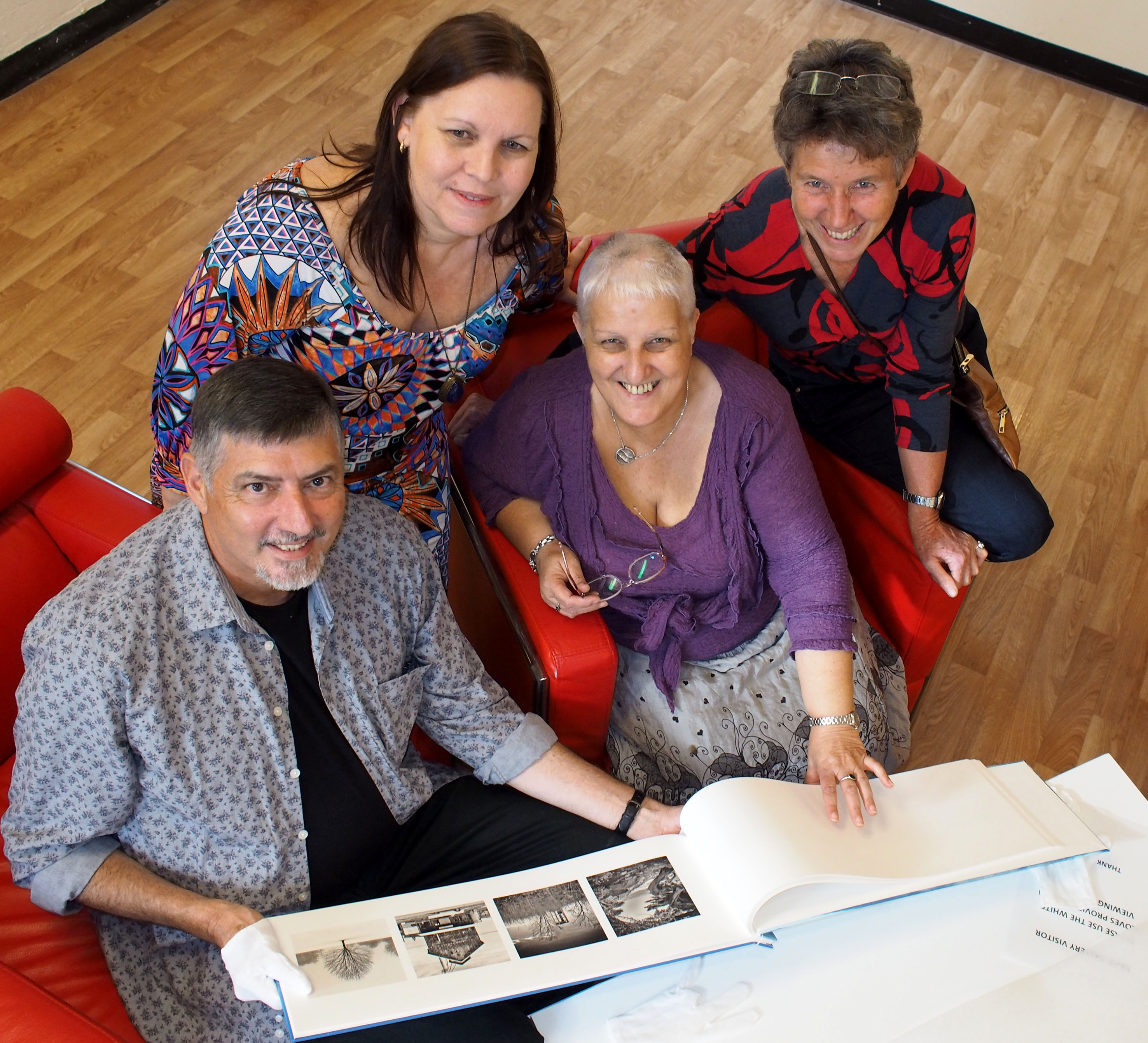
Doug Spowart with Ann Vardanega, Dawne Fahey and Pauline Neilsen
.

.
.
.
The photographers retain all copyright in their photographs. Some texts are derived from exhibition documents. Text and installation photographs © 2014 Doug Spowart and Victoria Cooper
.
.
.
PERV: Jess Martin does an iPhone Cloud @ MARS Gallery
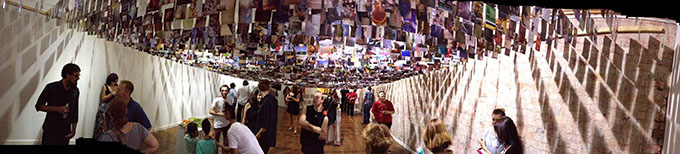
The Mars Gallery with the Perv exhibition photo ‘cloud’
.
In 1936, the one-time Bauhaus teacher Làzlò Moholy-Nagy, described his idea of the ‘photographic series’, and he spoke of it as being ‘the logical culmination of photography’. In his discussion he states that the ‘picture loses its identity as such and becomes a detail of assembly, an essential structural element of the whole which is the thing itself.’
.
An exhibition, entitled Perv, by Toowoomba artist Jess Martin on show at MARS Gallery would no doubt excite Mohly-Nagy in that she has taken the idea of a photo sequence and turned it into a sculptural form to express her view of contemporary life and photography. Martin has for two years been collecting iPhone images of her life. Last year she exhibited at Futures Gallery in Toowoomba a mosaic of 2,000 of these images in three 1 square metre murals. The theme was her life as a photographer, curious about the visual nature of the world and the access to quick imaging via the mobile phone.
Perv takes the idea further by expanding it to encompass iPhone image submissions sent to her via Facebook social media from friends and their friends …. Deciding to take the concept off the gallery wall where it’s just glanced at by the viewer Martin has constructed a 3-Dimensional space to mirror the image overload of modern life. What’s more, is that the images are suspended the full length and breadth of the Mars space – some 5×10 metres creating a cloud of photo images.
.
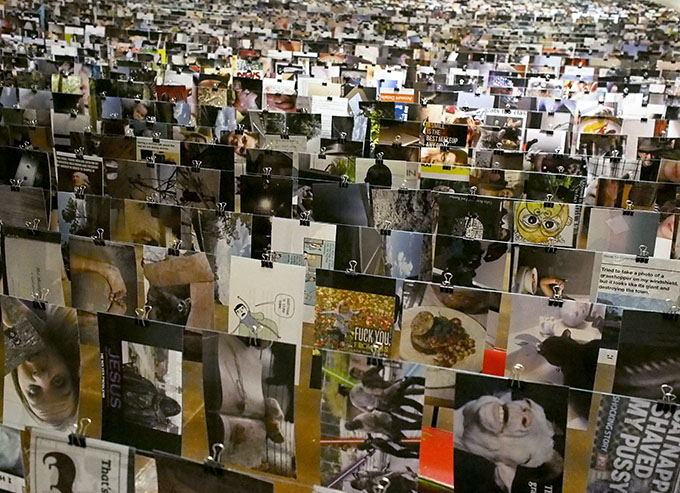
The view from above
.
Who knows how many thousand images are here… who cares? Who measures our daily dose of images anyway? So while this exhibition is confrontational it is also indicative of the prevalence, pervasiveness and proliferation of vernacular photography today. Viewers encountering this sky-load of images will need to search far if they are looking for classic pictorial beauty, or even well crafted documentary images. These pics are rapid snaps — faces, places, events, Facebook trivia, the weird and wonderful, rude and humorous. In a few seconds you can find photos of cats and dogs doing amazing things, food being devoured, over-flashed close-up faces and obviously candid and personal moments between lovers, family and friends.
.
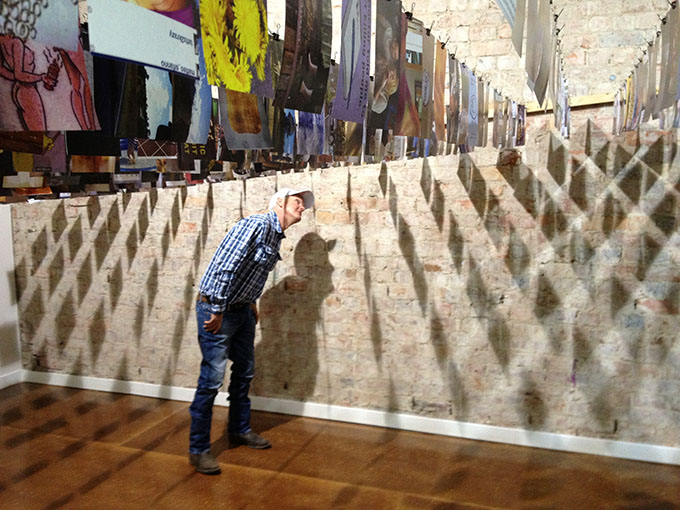
Looking at Perv’s pics
.
Billions of photographs are made and Perv‘s several thousand may be the equivalent of a grain of sand in all the beaches of the world however within this space we have an opportunity to connect with the contemporary reality of the photo today and the use of this once specialist human activity.
In coming back to Moholy-Nagy again there is something else to ponder that this exhibition celebrates and that is, in Nagy’s words; ‘its separate but inseparable parts a photographic series inspired by a definite purpose can become at once the most potent weapon and the tenderest lyric.’
The exhibition remains on show at Mars Gallery until December 6, 2013.
.
Words and photos: Doug Spowart
.
Moholy-Nagy, L. (1936). From Pigment to Light. Telehor. 1: 32-36.
Vicky, Jess and Doug
Jess is a past student from Doug’s SQIT Art Photography class. We have mentored her during this project however Jess’ creativity, innovation and hard work has transformed this exhibition into a significant outcome – Congratulations Jess!
It should also be acknowledged that this exhibition has been supported by the Queensland Government through an RADF Arts Queensland Grant.
.
This work is licensed under a Creative Commons Attribution-NonCommercial-NoDerivs 3.0 Unported License.
.
.
FACING FACES: Judging the photographic portrait
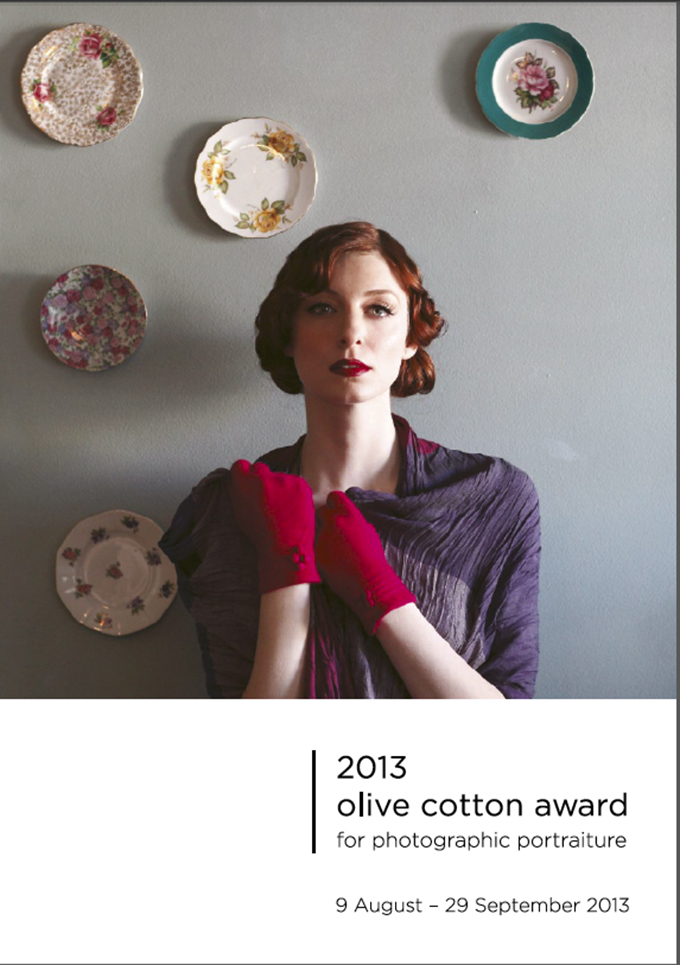
OCA Catalogue Cover
.
Olive Cotton Award Floortalk, Tweed River Art Gallery
.
On September 15 about 30 people attended a floortalk in the exhibition space of the 2013 Olive Cotton Photography Award (OCA). In my preparation I reflected on the demands of a floortalk. Over the years I have given quite a few floortalks about my own as well as the work of others, including one at a previous Olive Cotton Award. I have also attended presentations by others. In this years OCA award I wanted to create an inclusive space for the audience. Rather than taking centre stage, I wanted to empower the attendees in a kind of role reversal–to bring to the discussion their approaches to looking at, and responding to, the photographic portrait.
.
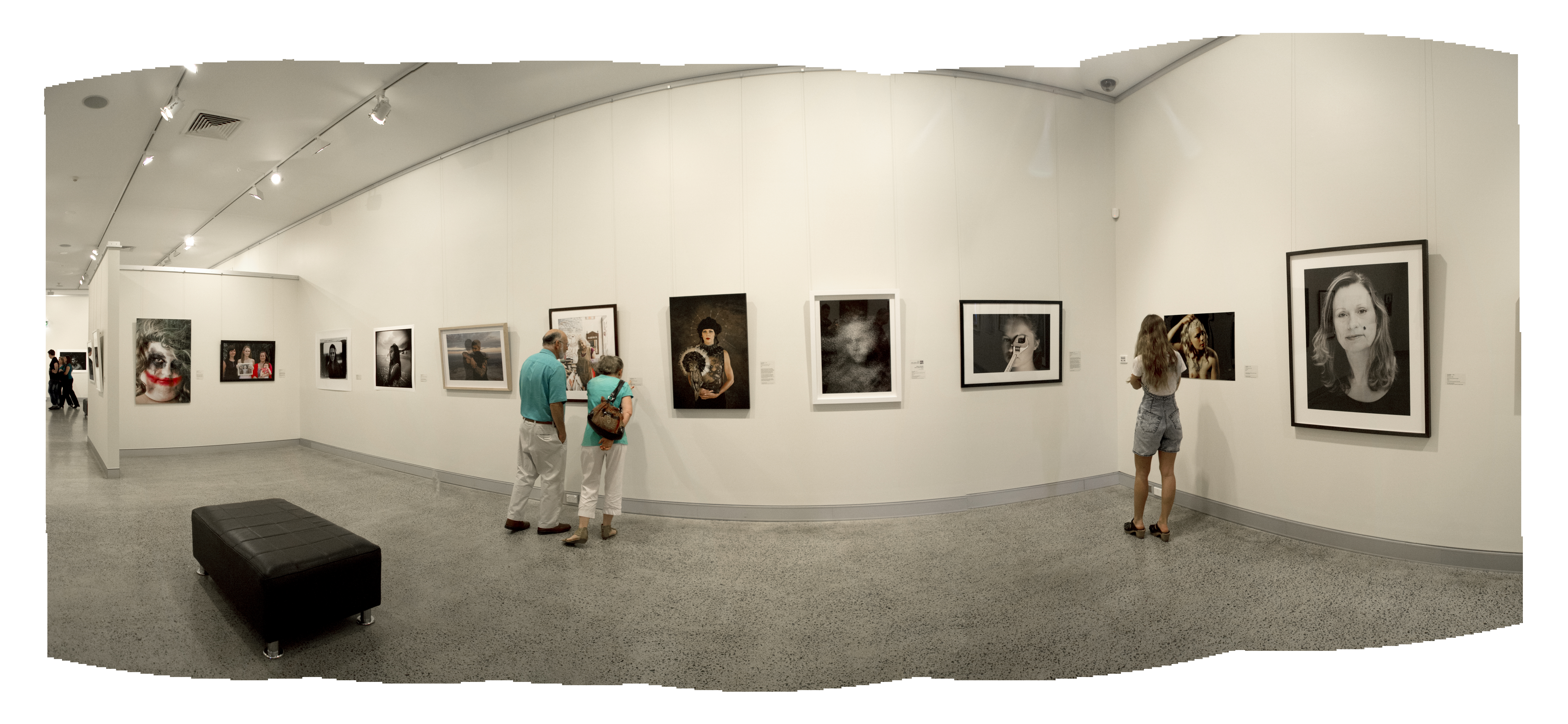
Olive Cotton Award installation at Tweed River Art Gallery
I introduced a concept for viewing and interpreting photographs that I call ‘positioning’. It relates to the interaction that takes place when looking at a photograph – particularly a portrait. It is what reaches into our emotions lived experience and solicits our response. The premise of this floortalk format draws upon the notion that everyone is a judge and is also informed by Roland Barthes’ concept of the ‘death of the author’. I am interested in how the viewer’s interpretation relates to their own life’s experience rather than a direct connection with the author’s intent for the communication. After all, I as the floortalk presenter, can only offer an opinion based on my personal experience and knowledge.
What follows is a conversational précis of the floortalk and the concepts covered relating to portrait photography and the OCA. After a formal introduction by Tweed River Art Gallery’s Public Programs Curator and Coordinator of the Award Anouk Beck, I addressed the group.
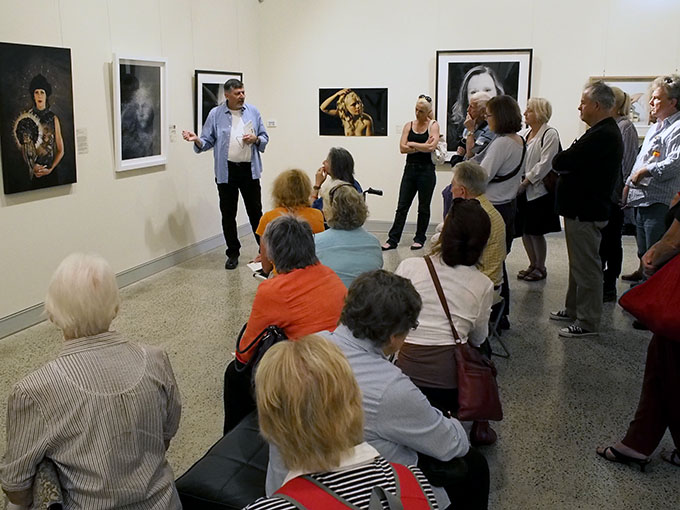
Doug Spowart presenting the floortalk
.
We stand this morning in a gallery exhibition dedicated to the most photographed subject of all – the human face! The floor talk today will explore the idea of the photographic portrait and how we reflect on the success of this visual communication.
There is an old saying that you can tell a great portrait because the eyes follow you around the room – Well any portrait, even a painting, where the subject is represented looking toward the photographer’s/artist’s viewpoint will capture the subject in a way that will enable this ‘phenomenon’ to be observed. So this method for assessing a portrait will not successfully operate here.
Another way of knowing what great portraits look like is to ask an expert, whomever they may be, to make a decision. Awards such as the Olive Cotton Award use this principle and over the years an impressive list of pre-eminent photographers and/or critics and commentators on photography have been commissioned for the task. I must acknowledge the judge for this year’s award – Helen Ennis. I cannot think of anyone who would be as knowledgeable of the ideas, thoughts and working methods of Olive Cotton than Helen Ennis. In her connection with Olive Cotton, Ennis has written several books and catalogues, selected works and curated exhibitions and is in the process of writing Cotton’s biography. Ennis has provided for us all a greater understanding of Cotton’s work and prominent position within the history of Australian photography.
Now, let us think about portraiture and the act, as we find ourselves today, looking at and evaluating portraits. It is interesting to note that although the portrait is at the top of the list of photographic subjects, we can see in this award there is no standard approach. As we look around this gallery space today no two portraits look the same – I’m not referring to the diversity of subject’s portrayed, but rather the way the photographer has created and presented the subject to us. The photographs range from snapshots of unplanned spontaneous moments to documentary reportage and illustrative magazine styled images, and then to the overtly staged theatrical tableaux. Some images are derivative – that is that the approach to the image replicates time honoured, and sometimes perhaps over used or common, techniques, styles or treatments. Other images may represent subject and styles in ways that are vibrant and fresh.
When a portrait is made the photographer makes personal decisions relating to equipment selected, technique, style, lighting, posing, gesture and subject expression. They make a portrait that satisfies their personal urge to tell a story. This story is usually firmly related to the subject; although it can be a theme the photographer is investigating or be based on something from the photographer’s own life experience. The photographer may want or even demand that viewers take from the work a particular and specific meaning. The artist’s statement accompanying exhibited works can support and signpost and influence the readings that a photographer may want to pass on.
However, I would suggest to you, that once the image leaves the photographer and is presented publically a new paradigm exists. Writer and commentator on photography Roland Barthes wrote ‘… the birth of the reader must be at the cost of the death of the Author.’ (Barthes 1977:148). In this instance I propose that the photographer is the author – the reader is the viewer. When looking at photographs the viewer connects their life experience to what the work presents, and the narrative or meaning that emerges can no longer be the photographers alone – it is a hybrid born by the activation of the viewer.
We are all judges in a way and each of us has a unique experience of the world that directs and supports our response to images that we view. We will no doubt encounter portraits here today that are universally powerful and profound yet there will be other images that may reach individuals amongst us in the most direct and personal ways. What this means is that each of us is a kind of judge, and that our individual responses may be just as profound as those experienced by Helen Ennis five or so weeks ago.
Today then, I invite you all to be the judge and what we will be doing is engaging with selected works from the exhibition to discuss and review – and I will be asking you to contribute to the conversation. To assist you with this I’d like to pass on the concept that may help us with this process – it’s essentially about what I will call ‘positioning’. Your response to a portrait photograph, or perhaps in another context any photograph or work of art, is informed by your personal background as we have already discussed. Your ‘position’ can be informed by the synergies of your life experiences that may include; physical, ideological, religious, gender, specific demographic, life experience of birth, death, love, illness, war or personal achievement or tragedy. So when we talk about a portrait please consider your position…
[What followed in the floortalk was a conversation by the participants moderated through my involvement. The audience contributed some interesting responses and ideas about portraits that included; Tamara Dean’s ‘Brothers’ 2013, Russell Shakespeare’s ‘Bob Katter’ MP 2011, Tina Fiveash’s ‘Twin Spirits’ 2013, Imogen Hall’s ‘Barry Jones and the ancestor’ 2012. At times there were powerful and emotional connections made by particular participants which were then shared through this floortalk conversational strategy.
.
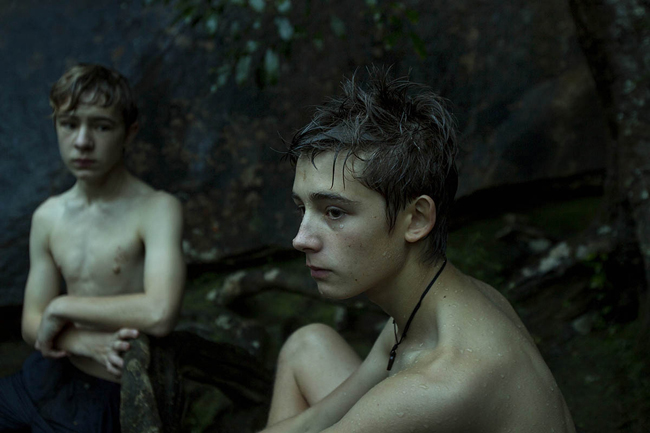
Tamara Dean’s Brothers
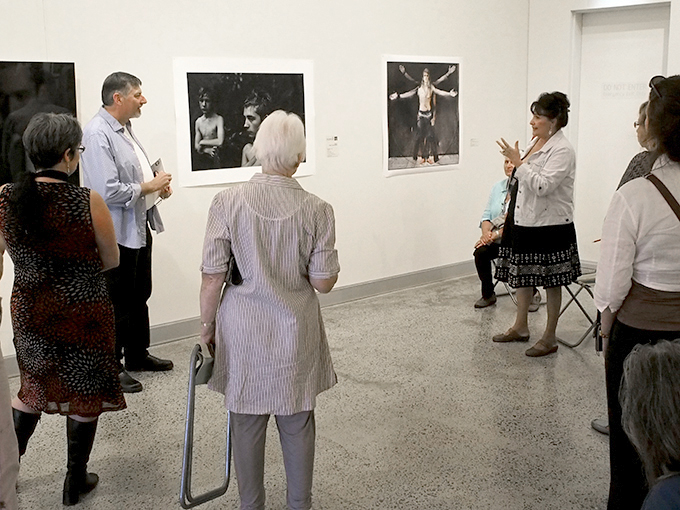
Participants discussing their position and response to a portrait
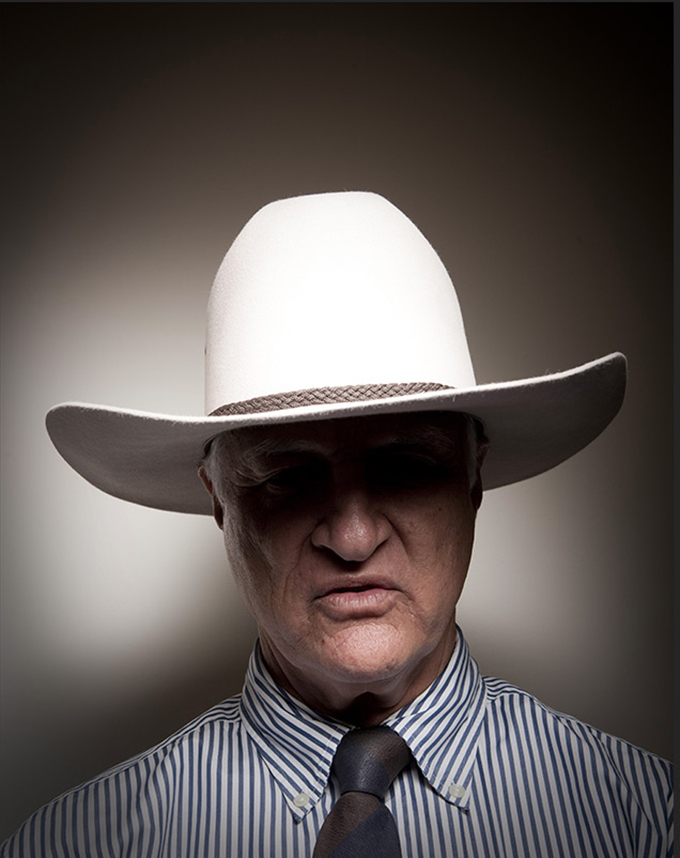
Russell Shakespeare’s Bob Katter MP
.
I was asked to give my position on the winning photograph – Trent Parke’s ‘Candid portrait of a woman on a street corner’ 2013. Many attendees did not –or– could not find a ‘position’, that would enable them to understand the reason behind its selection. I spoke from my position informed by my background in the art and professional practice of photography and many years dedicated to the education and critique of this medium – I knew from comments made by the judge on announcing the award that she found Parke’s image something that she at first didn’t standout as so many images do – but she kept coming back to it. My position on the image was as follows…]
.
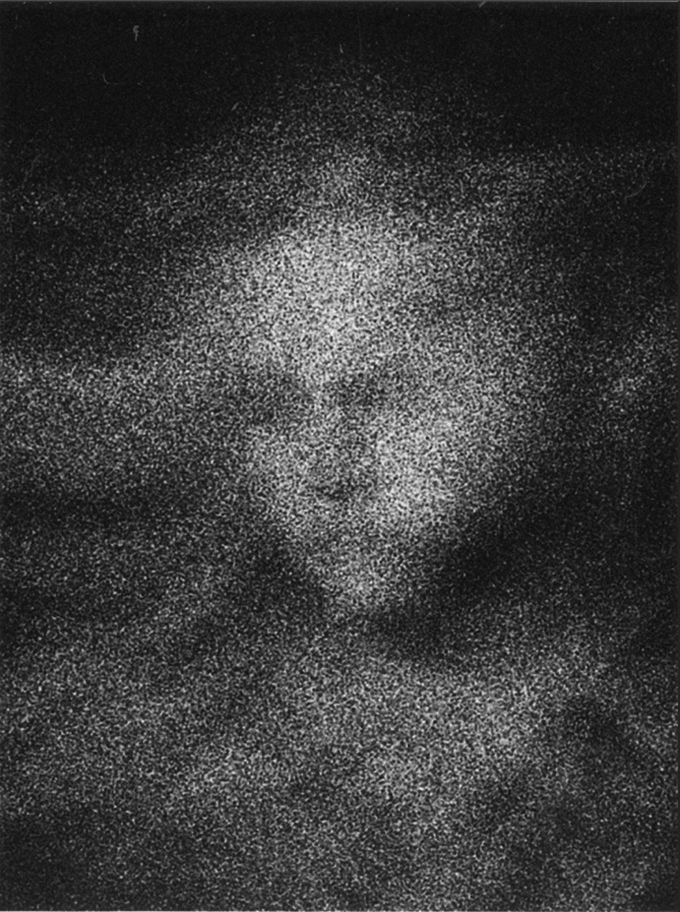
Trent Parke’s Candid portrait of a woman on a street corner
.
On first encountering Parke’s image it does not give us much – it initially appears as a field of greatly magnified monochrome film grain, which hides the delicate structure of a female face. A closer view reveals less, and interestingly, the further away you move the ‘sharper’ the image. Parke’s portrait demands more of the viewer to find meaning – it challenges, it questions, it’s not a specific person, unlike every other portrait in this award, but more the generic form. For me it also comments about the romance of film and ‘humanness’ in the digital age. At the beginning of this floortalk I suggested that much of portraiture can be derivative – but this image has no provenance in contemporary portraiture – it stands alone, perhaps signalling that there is room for new and exciting representations of the human visage yet to come…
[The floortalk concluded and attendees continued viewing other portraits in the show from their newfound critical ‘position’. The outcomes and exchanges resulting from my floortalk strategy was, for me, personally enlightening and rewarding. A number of participants came up after the talk to say how much they had enjoyed and appreciated the opportunity to discuss work and have their ideas, opinions and experiences shared in that way.
From their participation and responses today one could perhaps say that the author is dead – and many readers have been born …]
.
Dr Doug Spowart 3 October 2013
.
A PDF catalogue of the Olive Cotton Award is available here 2013 OCA catalogue for web_screen
.
Barthes, R. (1977). Image Music Text. London, Fontana Press.
,
Photographs of the floortalk © 2013 Victoria Cooper. All other images are the copyright of the photographer.
.
This work is licensed under a Creative Commons Attribution-NonCommercial-NoDerivs 3.0 Unported License.
.
JACKIE RANKEN @ BIFB: Doug’s catalogue essay
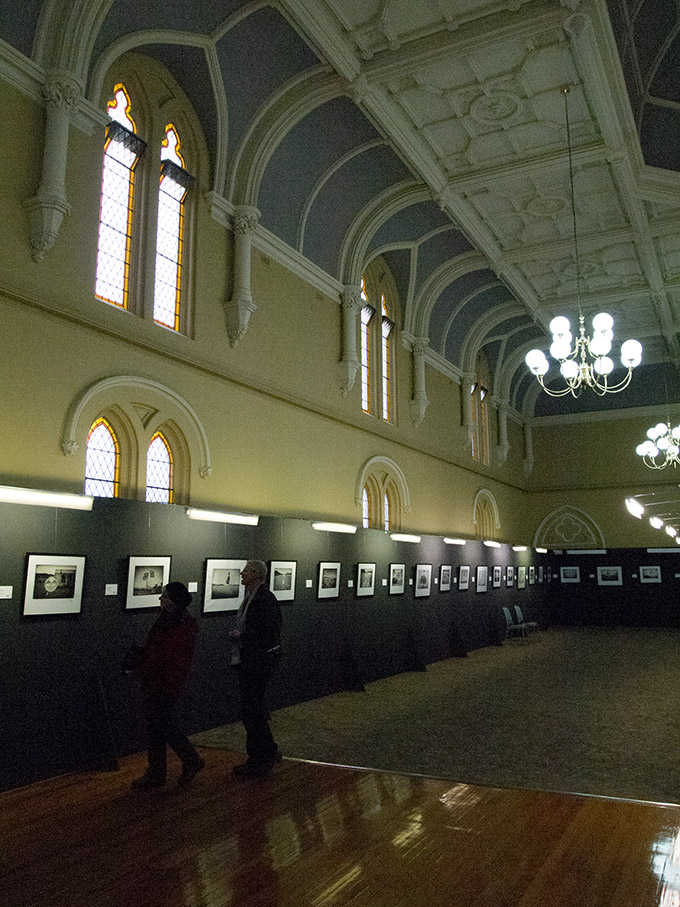
Jackie Ranken’s BIFB show
.
Jackie Ranken has a huge show at the 2013 Ballarat International Foto Biennale –
I was privileged to write the catalogue essay …
..
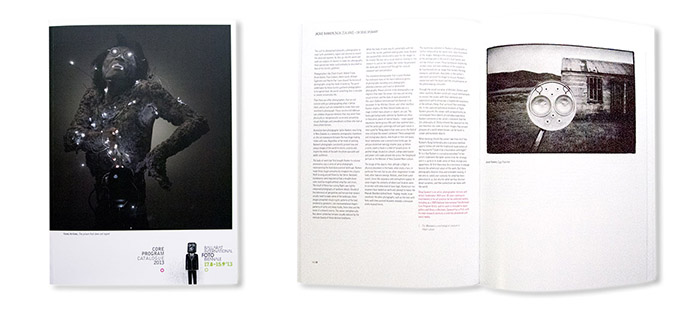
Jackie’s BIFB Catalogue pages
.
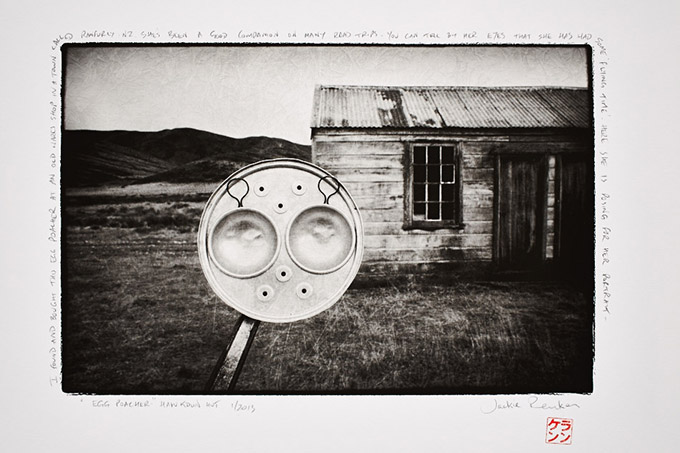
Egg Poacher
.
THE ESSAY
Jackie Ranken: far-flung – home and away
The call to photograph demands a photographer to react with spontaneity, vigour and intuition to record the observed moment. As they go into the world and seek out subjects of interest to make into photographs their operational mode could probably be described as that of the hunter-gatherer. Photographers like Elliott Erwitt, Robert Frank, Ansel Adams, Faye Godwin, Helen Levitt, William Eggleston and Martin Parr have shaped the history of photography using this mode of working. The quest undertaken by these hunter-gatherer photographers is to capture from the world something that is invisible or unseen in everyday life.
Then there are other photographers that are not content with just photographing what is before them, and as such are compelled to create their own realities to photograph. These constructed tableaux can combine disparate elements that may never have physically or metaphorically co-existed, presenting visual challenges and conundrums to those who look at these photo-fictions.
Australian born photographer Jackie Ranken, now living in New Zealand, is somewhat a photographic chameleon as she can manoeuvre between the two image-making styles with ease. Regardless of her mode of working Ranken’s photographs consistently present new and unique images of the world to inform, surprise and inspire the minds of the both the photo-specialist and public audiences.
The body of work that first brought Jackie Ranken to national prominence was a series of aerial photographs reinterpreting the Australian pastoral landscape. Ranken made these images precariously strapped into a Gypsy Moth bi-wing aircraft flown by her father. Aerobatic manoeuvres were required so that a straight-down view could be imaged without wing tips and struts. The result of these hair-raising flights was tightly composed photographs of landform details. Devoid of the references of perspective and horizon that viewers usually need to make sense of the landscape, these images presented visual cryptic patterns of the land rendered as geometric, non-representational shapes–patterns of cattle and sheep tracks, fence lines and the twist of a stream’s course. The viewer metaphorically flies above unfamiliar terrains visually seduced by the intricate beauty of these abstract landforms.
While this body of work may fit comfortably with the idea of the hunter-gatherer photographic mode, Ranken also purposefully constructed a space for her images to be created. She was not a casual observer waiting for the moment to capture her subject, but rather she provoked the landscape to reveal itself through her unusual viewpoint and representation.
The chameleon photographer that is Jackie Ranken has embraced many of the more traditional genres of photography including press photography, photodocumentary and travel or destination photography. Always present in her photography is an edginess that takes the viewer into new and exciting visual territory and the body of work presented in this year’s Ballarat International Foto Biennale is no exception. In her Kitchen Stories and other realities Ranken employs the New Zealand landscape as a stage in which many players or objects are cast. The landscape backgrounds selected by Ranken are often in themselves places of natural beauty – snow-capped mountains, barren grassy hills and clear watered lakes … until the landscape’s seemingly still and quiet nature is interrupted by flying objects that come across the field of view and grab the viewer’s attention. These unexpected and incongruous objects, now frozen in time and space, hover motionless over a monochrome landscape. An antique aluminium two-egg steamer pops up before a rustic country shack in field of tussock grass. In another image, located on a beach a drop-sided toaster and power cord snake serpent-like across the foreground perhaps as the Manaia[1] of New Zealand Māori culture.
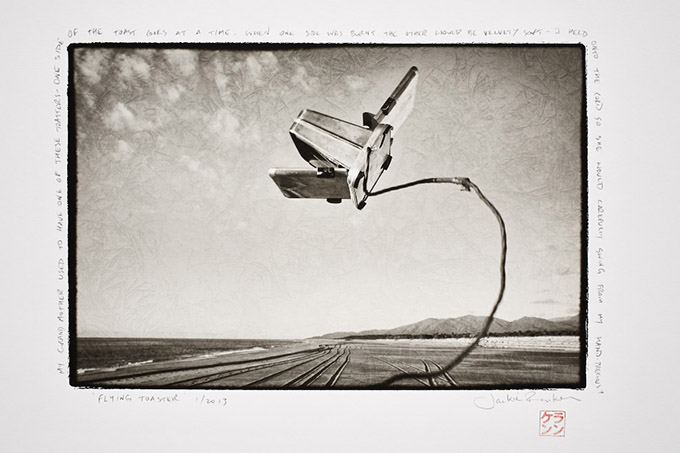
Flying Toaster
.
The design of the objects, their attitude in flight or physical placement in the frame, often imply a face in particular–the eyes, but as you allow imagination to take hold other features emerge. Robotic, alien (from outer space), drone-like apparatus and contraptions appear. In some images the similarity of object and location seem to connect with some kind of loose logic. Aluminium rice steamers have landed on earth and attempt to mimic the Moeraki Boulders behind them–hoping, maybe, to go unnoticed. Yet in other photographs, such as ones in which forks, with tines pointed skyward, emulate a miniature steely massed forest.
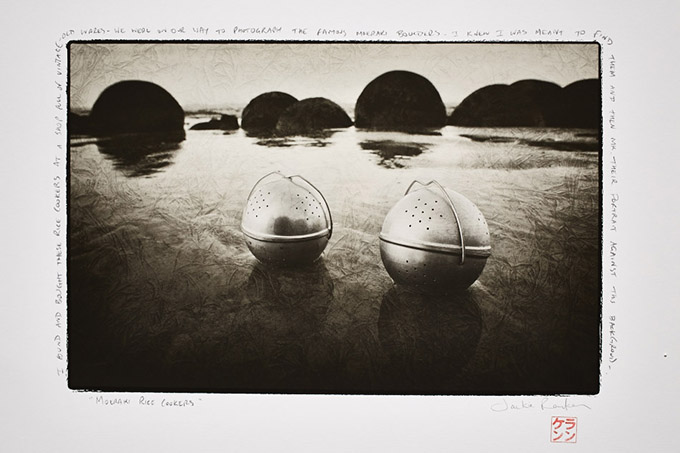
Moeraki Rice Cookers
.
The mysterious presence in Ranken’s photographs is further enhanced by her warm tone, sepia treatment of the images. Adding to the visual presentation of the photographs is the use of a dark border and veil-like texture screen. These techniques enable the normal colour and tone rendition of the subject to be transformed into an image that invokes fleeting memories and dreams. Anecdotes in the author’s own hand surround the image to recount Ranken’s connection with the object and the circumstances of the photo-making encounter.
Through the visual narrative of Kitchen Stories and other realities, Ranken constructs visual communiqués to connect the viewer with their memories and experiences and to encourage a heightened awareness of the ordinary things that surround their everyday life. In the captured ephemeral moments of flight Ranken presents the viewer with an opportunity to contemplate these objects of everyday experience. Ranken comments in her artist’s statement, that the Zen philosophy of Shibui informs her approach to life, and therefore she seeks to create images that present glimpses of a world where beauty can be found in simple and mundane objects.
What meaning should the viewer take from this? Are Ranken’s flung kitchenalia also a personal rebellion against homecraft and the traditional expectations of the housewife? Could it be a fascination with flight? Or is it that Ranken is a visual provocateur? In her artist’s statement the latter seems to be her strategy and it’s up to us to make sense of these incongruous apparitions. At first there may be a resistance to engage beyond the whimsical nature of the work. But these photographs deserve close and extended viewing, if not only to satisfy our curiosity for what has been presented to us, but also for what we may discover about ourselves, and the connections we make with the world.
.
Dr Doug Spowart
[1] http://en.wikipedia.org/wiki/Manaia_%28mythological_creature%29
BIOG: Doug Spowart is an artist, photographer, lecturer and artists’ bookmaker. With over 30 years continuous involvement in his art practice he has exhibited widely and his work is included in major gallery and library collections. Spowart has a PhD with his main research interests in both the photobook and social media.
.
Photos © 2013 Jackie Ranken and Doug Spowart, installation photo
.
This text is licensed under a Creative Commons Attribution-NonCommercial-NoDerivs 3.0 Unported License.
.
TRANSLUCENCE: Jacqui Dean’s Xrayograms
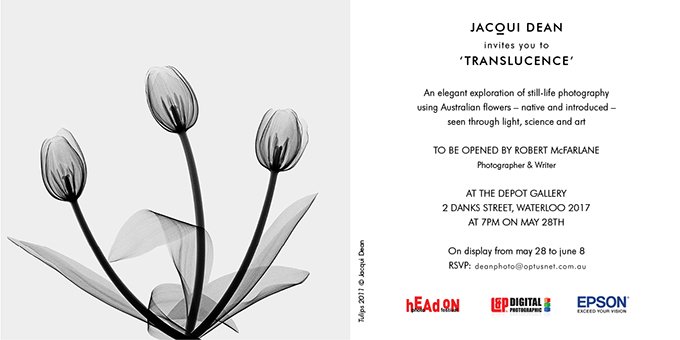
Translucence invitation
.
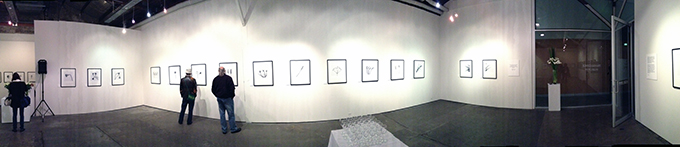
Translucence @ 2 Danks Street Gallery . . iPhone Photo: Doug Spowart
.
Another Universe
.
From the late 19th, and into the early 20th century there was a growing movement in the sciences and the arts that associated with Nature’s inherent resonance of form and structure from the microscopic to the cosmic. These new vistas and universes were recorded not only by the scientists’ hand but also by new developments in technology, notably the invention of the photographic process. Visual communication through imaging technologies continues to be an important tool in scientific research. But these images were not just useful as scientific evidence they were and continue to be inspiration for the creative work of artists and designers.
One noted exemplar utilising this visual medium was Karl Blossfeldt (1865-1932), a sculptor, metal craftsman and teacher. Blossfeldt began taking photographs of botanical specimens to use in his classes as ideas for students to create design forms from nature. But Blossfeldt’s work became very influential in the art, craft and design movement that popularised natural forms as templates for architecture, sculpture and 3D design work. His photographic documentation revealed abstract views of humble everyday roadside plants as visually interesting structural and aesthetic forms. As a result, Blossfeldt’s photographs also became renowned as works of fine art.
Jacqui Dean’s exhibition Translucence, at 2 Danks Street Gallery, Sydney, is the result of artistic curiosity and visual investigation natural forms through the phenomenon of Xrays. Art in this respect is the revelation of the unseen, the beholding of the essence within ordinary objects or a transforming perception of the everyday experience. The photograph, or in this case ‘xrayograph’, seals the object within the frame safe from the changes and inevitable decay over time. At first glance these images could appeal to the naturalist or perhaps a student of design (after Blossfeldt). Yet a deeper – more poetic vision immanent in nature is also suggested through a more contemplative viewing of these images.
Some may argue that this is an uncomfortable clash between the modernist and the romantic, or the objectivity of scientific evidence and the subjective imagination. But could this work identify with a need to embrace a sense of wonder rarely seen within a super-hyped, virtual digital-image society? Dean’s work in Translucence is informed by the poetry of music and her life’s experiences and her prodigious professional practice in photography. However the rewards for the thoughtful viewer will be to share in her wonder of the natural world that surrounds and nourishes our everyday life.
Victoria Cooper . . . June 9, 2013.
.
Rose Xrayogram by Jacqui Dean
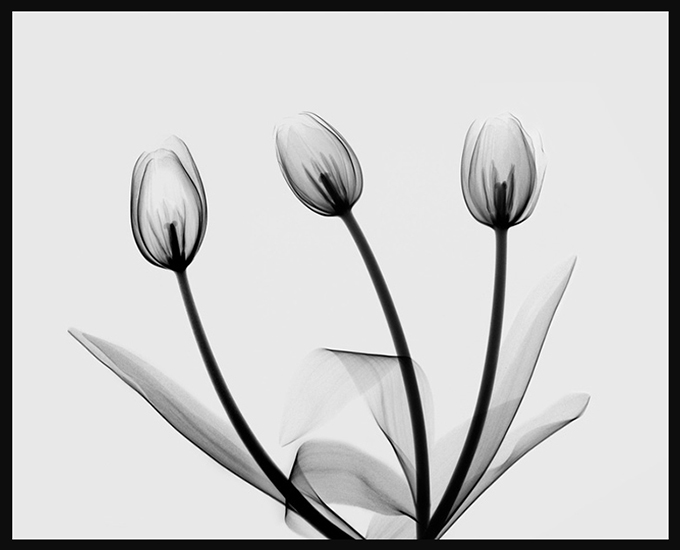
Tulips Xrayogram by Jacqui Dean
.
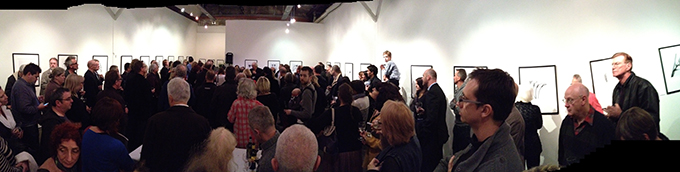
Translucence Opening Crowd . . iPhone Pano: Doug Spowart
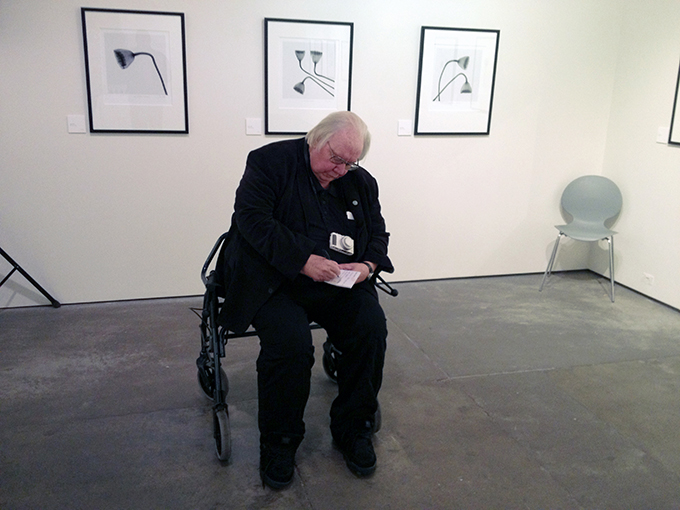
Robert McFarlane preparing his opening remarks . . iPhone Photo: Doug Spowart.
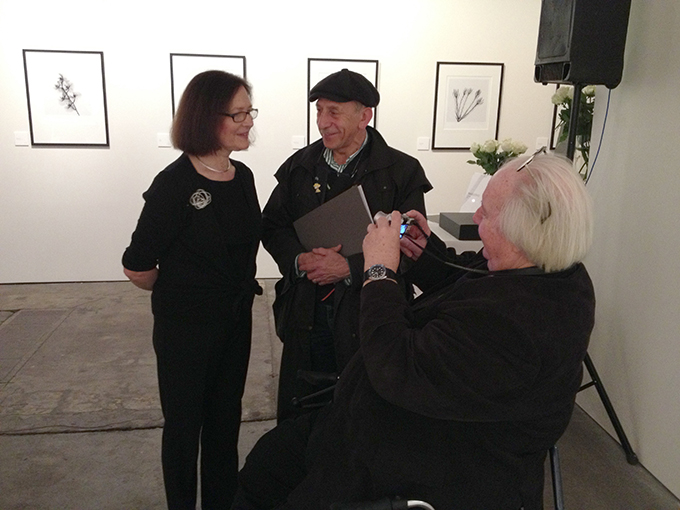
Jacqui, Josef Lebovic and Robert McFarlane . . iPhone Photo: Doug Spowart
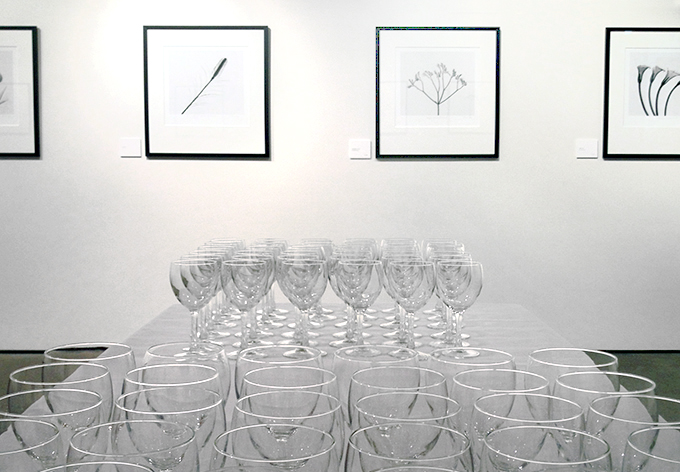
More Translucence. . iPhone Photo: Doug Spowart
.
MORE INFORMATION:
.
Jacqui Dean’s Website: http://deanphotographics.com.au/fine-art/
Interview by Gemma Piali of FBi Radio, Sydney: http://fbiradio.com/interview-jacqui-dean-on-translucence/
Review from Simone Whelton ABC702 http://www.abc.net.au/local/stories/2013/05/31/3659500.htm
“Translucence: Jacqui Dean – A jam packed opening on a Tuesday night meant it was a little hard to see some of the stunning black and white prints that Jacqui Dean has featured in her new exhibition Translucence but I pushed my way through the crowds and was delighted at the little moments of gentle quiet that descended on me as I stared at each picture, delicately constructed. This is spectacular still life photography featuring mainly Australian flowers (orchids and native flowers) and using a combination of x-ray and digital imaging. Tucked away towards the back of the exhibition is a series of photos of beautiful shells. Known for her photographs of architecture (interiors and landscape), this exhibition is part of Head On. Take a few minutes to pop in and enjoy the works! When and where: on at The Depot, 2 Danks Street, Waterloo now until June 8.”
.
Xrayograms: © Jacqui Dean
Review text © 2013 Victoria Cooper
All iPhone photographs © 2013 Doug Spowart
.
This work is licensed under a Creative Commons Attribution-NonCommercial-NoDerivs 3.0 Unported License.
.
.
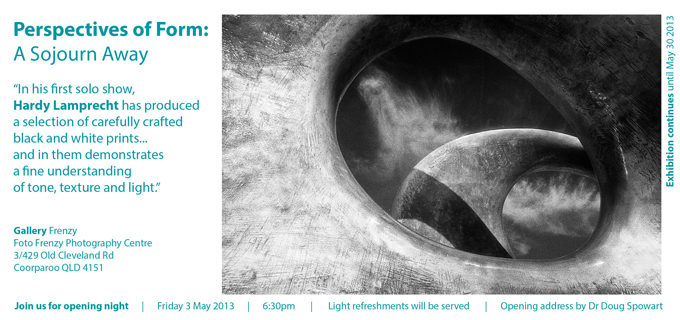
HARDY LAMPRECHT: Solo Photo Exhibition @ Gallery Frenzy, Brisbane
 .
.
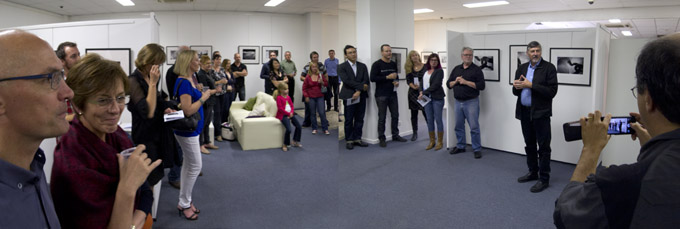
. . Excerpts from an opening address: Hardy Lamprecht | Perspectives of Form: A Sojourn Away
.
. .
.
I’ve known Hardy Lamprecht for over 20 years. He embraced the larger formats of photography and the darkroom with gusto and passion. He enjoyed the landscape and made photography sojourns to the granite tors of Girraween National Park in Queensland, to the shifting sand dunes of Lancelin in Western Australia.
He has also spent a considerable amount of time in the United Kingdom working in his principle career, that has a lot to do with sight and seeing, but the tug of the landscape sent him out on weekends to misty moors, rugged cliffs and into dramatic urban and sculptural spaces.
Time passes and anyone with twenty years experience in photography recognises the need to make the transition of the wet darkroom into the dry digital workspace. While in the past once the films were processed Hardy would venture into the darkroom for extended periods to resolve the lived experience of the shoot as fine art black and white prints. These images would then be presented for exhibition to share his vision with others. Although many photographers of Hardy’s ilk lament the passing of the darkroom and, whenever a sympathetic ear is around, talk of the ‘good old days’ – but not Hardy. He assimilated digital technologies into his workflow by scanning negatives, optimising them in Adobe Lightroom and the printing them on fine art Canson digital papers. What we see on the walls now is the same attention to detail and creativity but within a contemporary medium.
So what this exhibition represents is not only one photographer’s journey in the landscape but also another journey from the traditional black metallic silver specs of the wet darkroom to the emergent digital space of pixels and ink on paper. I believe this work challenges the notion that high quality fine art photographs can only result from the wet darkroom. Should there be any question, I would present to them this body of work where: I’d talk with them about deep rich blacks and clean clear whites, I’d point out the both employ the same baryta paper base, I’d then discuss the dynamic tonal range represented in the prints and theories I have about every photographer today working in digital, is emulating the aspirations of the very few Zone System dilettantes of the past.
Once through with the technical stuff that pervades the discipline of photography and printmaking and much critical dialogue, I would challenge them to see beyond superficial technique to the more sublime nature of these photographs. I would elucidate on aspects of the photographs design–of abstraction, perspective and scale–of chiaroscuro and emotion. This work is the result of seeing and capturing a personal vision and empathy of the subject before the camera–a moment in time of place.
Ultimately Hardy Lamprecht’s images are about what he saw and was inspired by in the continuum of his lived experience. He then captured on film a kind of referential trace extracting a new visual interpretation or meaning of the original subject. In the digital space, aided by software, he reflects on his wet darkroom image interpretation skills and techniques and applies them to the modern tool of the computer. In doing this he achieves something that can be shared, as he did before, with us as viewers. As a result of that we can, in the space of this gallery, transcend time, space and photographic technology and encounter the world in the lens of your own memory.
Hardy, I take great pleasure in declaring this exhibition open … Doug Spowart May 3, 2013

Vicky, Hardy and Doug @ the opening
Selected images from the show….

Threesome
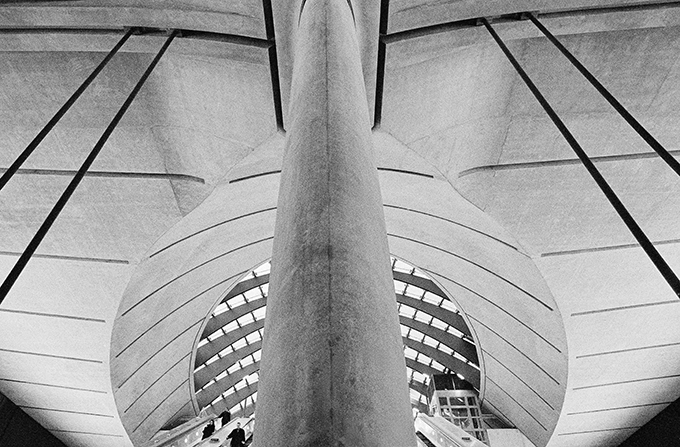
Subterranean Symmetry

Large Reclining Figure by Henry Moore
Going Under
The Sorcerer’s Apprentice
Orbits

Double Ovals by Henry Moore
.
Exhibition photographs ©2013 Hardy Lamprecht, additional photography by Cooper+Spowart
Essay ©2013 Doug Spowart
. This work is licensed under a Creative Commons Attribution-NonCommercial-NoDerivs 3.0 Unported License. . .
PHOTO TREASURE: The QCPs ‘Treasures: The art of collecting’
 .
.
REVIEW: Treasures: The art of collecting
.
I’m an obsessive collector. It’s a big problem because I’m finding it difficult to store everything …
Martin Parr talking about his book collection 1.
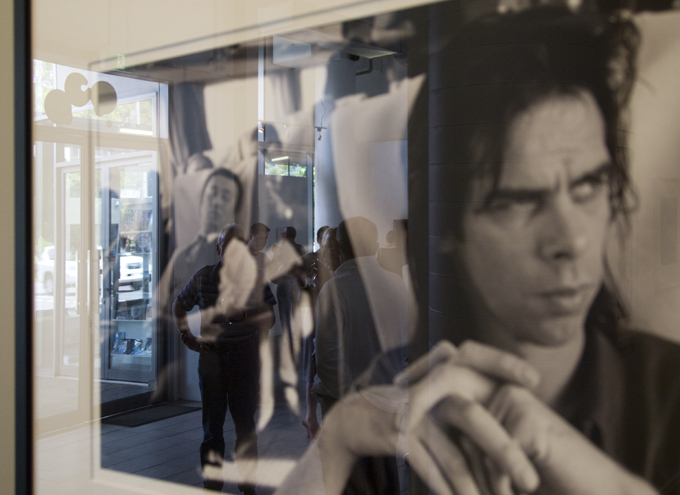
Peter Milne’s portrait of Nick Cave reflects visitors to the Treasures show
Collecting photographs and collecting collections is the subject of the current exhibition at the Queensland Centre of Photography. 72 photographic works on loan from 23 collections both significant and personal, fill the exhibition space. The works represent a wide selection of the history of the medium, the range of themes pursued by photographers and the stuff that collectors collect.
The exhibition was curated by QCP Director Maurice Ortega and was drawn from the contacts, colleagues and members of the QCP fraternity. Works from significant collectors like Daryl Hewson and Fred Hunt were prominently featured in the show. Other works came from the QCP’s own collection, many of which have interesting provenance, were gifts to the Centre, or to members of QCP photography fair delegations travelling overseas.
Each work has a unique story not only of the photograph’s making but also of the collector’s possession and the story of ownership. To pass on these dual narratives each work is accompanied by a comprehensive didactic panel that provides a connection with why the work was collected and its meaningfulness for the collector.
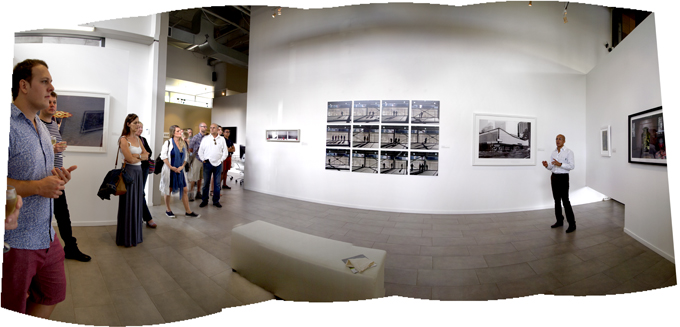
QCP floor talk by Director Maurice Ortega
.
On Sunday 14th April Maurice Ortega gave a floor talk about the Treasures. He discussed the idea and practice of collecting generally and then walked through the space drawing attention to selected works–their owners and any special stories around their provenance.
Ortega spoke of the importance of collectors and how they can support artists at all levels of their careers. He noted that in Australia so many art photographers make a fine start in their professional practice but so often slip from view due to the inability for them to derive sufficient income to survive. He lamented the lack of a passion for collecting within Australia citing the success of the American scene. A video presentation in the gallery shows, as an example, the collection of Steven Reinstein and it’s presentation within a home. It is a grand statement about how ‘amazing’ the personal accumulation of art can be.

QCP floor talk by Director Maurice Ortega
In Ortega’s catalogue statement he pays great respect to the collector by stating that:
… collectors of every kind should be celebrated and emulated; first for directly supporting the artist, second for maintaining cultural diversity and thirdly for keeping art thoroughly democratic by keeping it grounded on its domestic domain, that of everyday life.
The Treasures exhibition may be a significant look into the art of collecting but it has many other valuable outcomes. It presents to visitors an array of photographic materials, techniques, themes and makers, the like of which has not been shown in this region for some time. It highlights the importance of collection and possession and the link that it provides for a supporting structure within art photography. And it must also surprise the viewer of the exhibition with the spectacular range of art photography that exists out in the wilds of the private collector.
Furthermore this exhibition is a curatorial tour de force and is an example of the significant role that the QCP plays within Queensland–perhaps even Australia, in the provision of true and relevant exhibitions of what the art of photography is, and what can be…
.
Dr Doug Spowart
For images and more details of the exhibition SEE http://www.qcp.org.au/exhibitions/current/album-791/28
A personal postscript: Like Martin Parr I’m an obsessive collector of photographs, photographica, photobooks and photo ephemera. I was asked by Maurice for a piece from my collection for the Treasures show–I selected a calotype print made from a Henry Fox Talbot negative c1843. Printed by author, historian and Kodak Museum Curator Brian Coe in 1976. The provenance of the photograph was that it was an award won by me in the Kodak International of Photography in that year. Due to difficult display requirements it was decided not to include the work in the Treasures show.
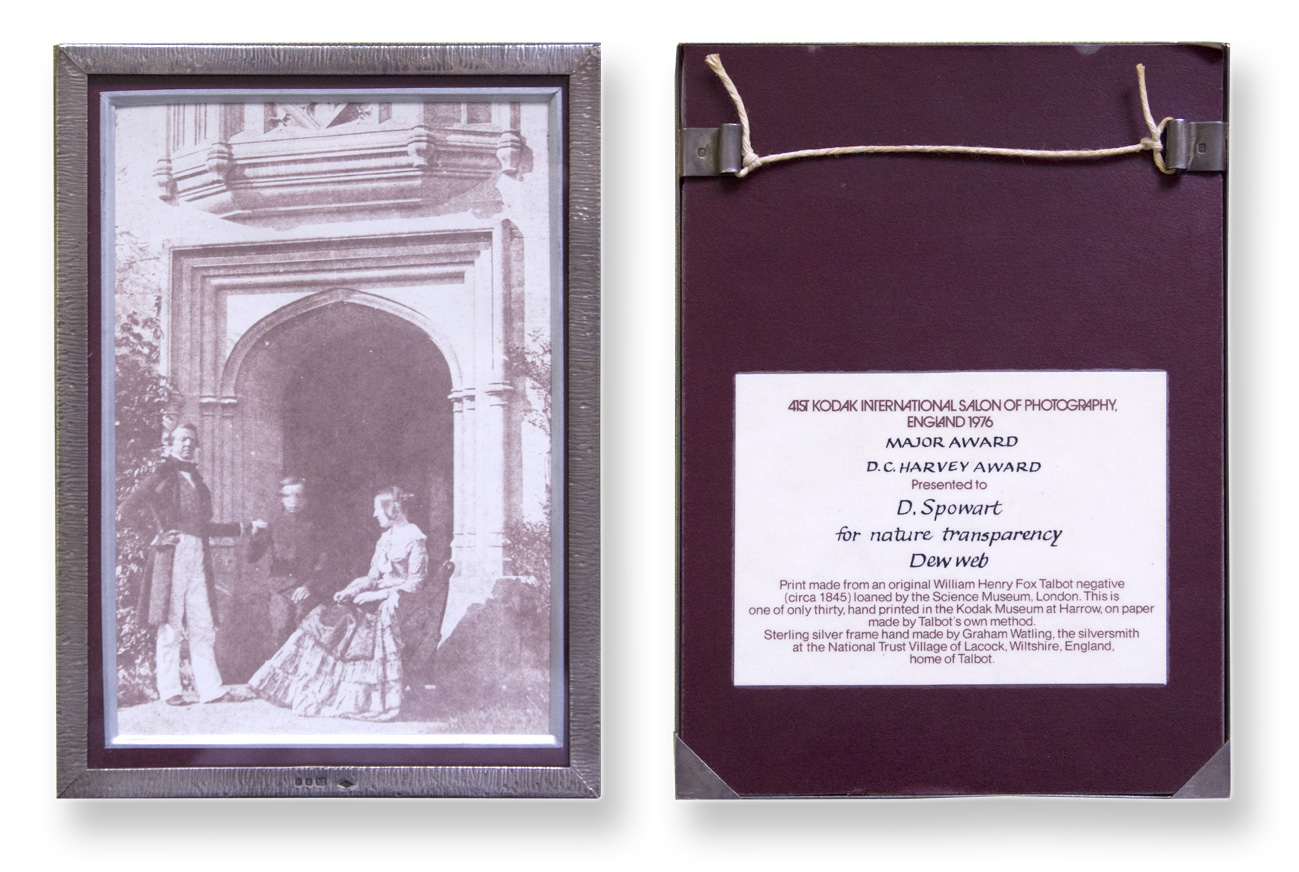 .
.
1. Badger, G 2003, Collecting Photography, Mitchell Beazley Ltd., London.
.
Images of the exhibition installation and text by Doug Spowart .
This work is licensed under a Creative Commons Attribution-NonCommercial-NoDerivs 3.0 Unported License.
.
HEATHER FAULKNER’s ‘A Matter of Time’ Exhibition

In Heather Faulkner’s exhibition A Matter of Time
A Matter of Time – Heather Faulkner, Brisbane Powerhouse 26 March–28 April 2013.
Today everyone possesses a camera so by association everyone is a photographer and everyone takes photographs. Evidence of this activity is in all kinds of spaces we inhabit, but of course it is most prevalent in the pervasive and immediate space of online social media. Andy Warhol once exhorted that: ‘In the future, everyone will be world-famous for 15 minutes’, and perhaps the proliferation of photography in Facebook, Pinterest and Instagram has indeed made everyone famous, as some purport, ‘for 15 people’1. The extension of this euphemism could be that ‘everyone may be famous for 15 online photographs.’
But what has all this to do with an exhibition of documentary photographs in suburban Brisbane? Well … for me ‘photography’ in the hands of casual shooters, responding spontaneously to their lives, represents only a segment of the world’s daily dose of photography. Documentary photographers for example, use photography as visual research to inform and create understanding for others. These photographers are usually directed by passion for a particular issue, and driven by the need to tell stories of others and maybe even–of themselves. In this context the act and product of photography transcends the milieu of images and provides us with a deeper connection through the communication of the narrative. This exhibition is from one such photographer.
Heather Faulkner’s exhibition A Matter of Time, at the Brisbane Powerhouse, is a charged and evocative statement about the circumstances, situations and legacies of lesbian women living in the state of Queensland. Faulkner documented the lives of eight women and their significant lived experience of the political and social regimes that existed and, as claimed in the exhibition statements, still exists today.
Faulkner’s images take on two separate forms: large format black and white full frame portraits, and colour images of a more documentary nature. In the large portraits the subject’s stare is direct to camera capturing the viewer’s attention in what Faulkner describes as the ‘oppositional gaze’2. They are assertive and declare ‘this is me’. Placed alongside these portraits is the biography and backstory of each woman. For the viewer/reader in this juxtaposition the text and the image creates a silent dialogue. As in the examples of Faulkner’s presentation of Carol Lloyd’s story shown here.
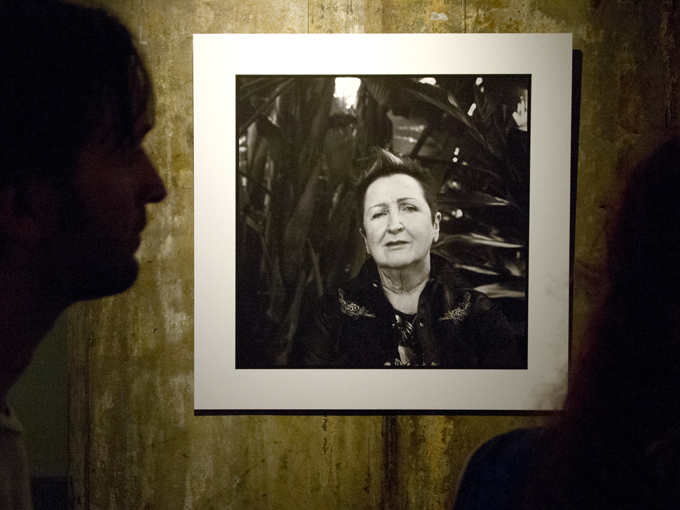
Carol Lloyd – the large portrait. Heather Faulkner’s exhibition A Matter of Time
.
The colour images are extremely intimate and distinctly banal, perhaps exhibiting the photographer’s light touch to aesthetically intervene in the narrative. The subject is imaged engaging in life’s everyday activities: cuddling a family pet, on the couch watching TV, talking with others, arranging things on a bed. The photographic treatment of these photographs is not the sensationalised grainy monochrome, extreme perspective depth and overtly dramatic composition that so often pervades the modern photojournalistic genre. There is a sense of the view being derived from ‘hanging out with friends’, and of the camera as an invisible witness. For me this approach results in authentic and genuine documents.

Carol Lloyd in a reflective moment – Heather Faulkner’s exhibition A Matter of Time

Carol Lloyd as performer – Heather Faulkner’s exhibition A Matter of Time
.
The exhibition also includes historical family snapshots that are presented alongside the recent images. A young child smiles back at the viewer, faded and colour-casted prints and wedding group photographs all add to the story of each subject. To protect the anonymity of people in these images black bands have been placed across faces to prevent recognition. The integration of these photographs extends the exhibition beyond just being about photographs and into the realm of a more complete and provocative social documentary statement.

Carol Lloyd’s personal image history in Heather Faulkner’s exhibition A Matter of Time
.
Ultimately everyone will draw their own conclusions about the women portrayed and the lives that they have lived, or should I say, endured. Faulkner states in exhibition materials that a research report suggests that: ‘Queensland is the most homophobic state in Australia’3. Facilitated through Faulkner’s photographs, exhibition strategies and other products resulting from this work, the stories told here engage with the human face of the weary struggle, of these women’s resilience, and the strength gained by the rewards of living an authentic life.
.
Dr Doug Spowart with a contribution from Victoria Cooper
More on Heather Faulkner: http://heatherfaulkner.com.au/
1 Bell Hooks (1992) The Oppositional Gaze in Black Looks: Race and Representation, Boston: South End Press.
2 http://web.archive.org/web/20061214124420/http://www.hyperorg.com/blogger/mtarchive/004264.html
3 Faulkner’s Artist’s Statement cites Roy Morgan Research (2008-2010)

Heather Faulkner @ the opening
Heather Faulkner’s exhibition A Matter of Time
All exhibition photographs © Heather Faulkner 2013.
Images of the exhibition installation and text by Doug Spowart .
This work is licensed under a Creative Commons Attribution-NonCommercial-NoDerivs 3.0 Unported License.

 wotwedid
COMMENTARIES: ARTISTS BOOKS … AS POPULAR AS TATOOs!
leave a comment »
The wide view
COMMENTARIES ARISING FROM THE SLQ SIGANTO FOUNDATION SEMINAR
The trouble with artists’ books
State Library of Queensland – May 4, 2013
.
The quote “artists’ books … as popular as tatoos” was an opening remark by gallerist Noreen Grahame
.
In Volume 7 of the Bonefolder e-journal I reported on the dual artists book events of the 2010 Artspace Mackay Focus on Artists Book V, event and the 3rd Libris Awards. In this report I commented on the speaker’s presentations and reviewed the artists book award. I then concluded that these events were integral to the development and maintenance of a community of practice for those who make artists books in this country. Three years on the energy and enthusiasm for artists’ books remains however the Mackay Focus event has been abandoned and some awards events have slipped from their usual place in the yearly/bi-yearly calendar.
We are indeed indebted to the Siganto Foundation and the SLQ who in 2012 made possible the Keith Smith and Scott McCarney workshop and seminar, and this year the The trouble with artists’ books seminar. It seems to me that artists book community in this country has a great appetite for information, connecting with the heroes and heroines of the discipline, learning about methods and techniques as well as participating in camaraderie with their peers. My concluding words in the Bonefolder report recognised the importance of events such as Artspace’s Focus on Artists Books and the Libris Awards as they invigorate the discipline and the art of artists books … The significant response to this seminar indicates that the pace and frequency of artists book events should not slacken – we want more!
The Bonefolder report concluding comments were:
Awareness of the origins of the discipline of artists’ books and the Australian context as well as issues of contemporary and emergent practice is a unique outcome for FOAB. Where else in Australia this year would one be able to experience, or participate in a program where issues as diverse as Avatars making books in their second life, the death of the book/author, wild books and zoo viewing of books, propositions for new perceptive literature, mail art and the products of psychometry being resolved as artists’ books? Perhaps attendees should be warned of the ride that they would encounter.
Central to need for the FOAB, as an event, is its ability to pull together artists’ book interested people and provide a forum for them to be a part of something bigger than themselves. Artists’ bookmakers are individual artists, sometimes collaborators, librarians, academics, gallerists and collectors are isolated as islands of interest in their usual place of activity. But at FOAB they meet, greet, mingle, chat, discuss, argue and get down to the flensing-out of ideas, polemics and concerns about practice and the book as a work of art. This blend of interested parties forms the nucleus, the hub, of the discipline within this country – without it, there would only be individual soliloquies in the wilderness
.
Julie Barratt
Julie Barratt – Artist
I guess really briefly what I got from ‘the trouble with artist book ‘ talk if I was going to quote is ” it seems the trouble with artist books is that there are too many to love!!!” On a more serious note I guess for me it always comes down to how we talk about/define an artist book, as an ongoing discussion.
Almost on a daily basis when I had the gallery (I always had at lead a few artist books on display) people would ask what these books are! How to define them without quoting Johanna Drucker? Should there be categories i.e. Sculptural, digital etc etc. How do we expect the audience to understand them if we as practitioners have difficulty talking about them? But how do we agree on a definition?
That’s what I imagined the forum to be about because ‘isn’t that the trouble with artist books’? Having said that I thoroughly enjoyed the forum and think there need to be many many more of them when in fact there seem to be less (Mackay forum? ) so that the discussion can continue….
Its always a pleasure to catch up with the artist book community, feels like a reunion every time!
Julie
.
Maureen Trainor
Maureen Trainor – Photographer and QCA Masters student
I found these presentations to be very informative and inspiring.
The content and sequence of the presentations were dynamic.
By breaking down the delivery into the three different viewpoints the three Keynote speakers were engaging and thought provoking.
Starting with Helen Cole presenting ‘the Librarian’s view’, Noreen Grahame presenting ‘the Gallerist’s view’, Jan Davis presenting ‘the Artist’s view’ and ending with an interactive audience time for ‘questions and answers’ was right on target with information.
The Hearsay team discussing their project was fantastic. Combined with humour and wit they certainly kept the attention of a diverse audience.
I truly enjoyed the afternoon and felt I could of stayed into the night with more speakers and presentations.
Maureen
.
Monica Oppen
Monica Oppen – Artist and collector
The Trouble with Artists’ Books (and the Libris Awards)
Coming away from the SLQ seminar where the attendance was so strong and having attended the opening and announcement of the Libris Award at Artspace Mackay the conviction that has risen strongly in my mind is that there is a real need for events such as the SLQ Siganto Seminar. The strong attendance not only indicates a real interest in the topic but a desire of artists to reconnect with others working in the field. As Helen writes in her post about the Libris Awards, and I can vouch for it, there were very, very few artists there but also no other significant persons from the institutions who have an ongoing interest and involvement in artists’ books were there. The tyranny of distance and the associated costs of travel and accommodation will only be overcome by creating an event that is worth travelling for.
The topic The Trouble with Artists Books is pertinent and complex and was way too big to handle in one afternoon; a multi-day conference could have been structure around this topic. Time restrictions meant that Jan Davis and Noreen Grahame could only touch on, hint at and introduce the work/books from which a broader discussion could have expanded. The sense that there is a need for these seminars (judging from the attendance numbers) also hopefully indicates a need for more rigorous, mature critical discourse around the genre, a breadth of conversation and argument. Does the constant discussion of definition and the non-committal responses from ‘those who should know’ arise from this lack of discourse? I don’t consider the definition ‘if the artist calls it a book, it is a book’ to be an adequate, exciting nor empowering definition unless some force is allowed to work in opposition to it, that demands a justification, demands some critical analysis. The lines will always be blurry but this could be an energizing force and contribute a dynamism to the genre. By not taking a stand are we in fact leaving definitions to the gallery? Surely the gallery as a medium is the antithesis of the (artists’) book. The gallery is exposed and extraverted; the book is enclosed and introverted. Always it comes up, the problem with exhibiting artists books— this is because books are not meant to be exhibited, they are meant to be read. What are the implications for the genre if books are only viewed in the gallery, and more seriously if the gallery maintains a ‘no touch’ policy? Ironically, making a (artist’s) book was originally about abandoning the gallery; about the subversion of the commercialism of the art object. The book was meant to be a free-floating object in wider society. Where is that rebel spirit?
A hundred more questions could be asked. I hope the SLQ seminar is not a one-off but gives an impetus to more symposiums throughout the country.
Monica Oppen 14/5/13
.
Judy Barrass
Judy Barrass – Artist
THIS COMMENTARY COMES FROM JUDY’s BLOG – ‘Critical Mass’ http://www.criticalmassblog.net/2012/?p=2568
No one can agree on what they are, or even where the apostrophe should be placed, but a seminar on artists’ books at the State Library on Saturday drew a crowd.
It was a rare get-together of artist book makers and officianados, with attendees travelling from other states and regional Queensland just to attend the two-and-a-half-hour seminar and catch up with old friends.
According to the speakers, librarian Helen Cole, gallerist Noreen Grahame, and artist book maker and academic Jan Davis, artist books are problematic. That’s not just because no one seems to be able to agree on a definition, but also because they are hard to store, hard to display, and are not usually included in mainstream collections or exhibitions. They attract mostly a smallish group of makers and collectors and don’t sell in large numbers. Despite this, artists’ books draw a passionate audience of makers and supporters whenever they are on show (or whenever there’s a seminar).
Queensland has been a leader in the artist book phenomenon. The Queensland State Library is a significant collector, and Grahame Galleries took an early leading role. Artspace Mackay and Noosa Regional Gallery added public gallery support to exhibitions and collecting.
Someone suggested that it’s an inbred audience made up almost entirely of artist book makers, but a show of hands in the crowd on Saturday debunked this myth since at least half the attendees were not makers. Still, as Noreen Grahame remarked, artist books are a sort of ‘underground’ movement outside the mainstream.
I can’t help wondering if this is merely a question of naming. By calling these artworks ‘books’ they are relegated to the collections of libraries rather than art galleries, or they exist in a no man’s land between library and gallery. Nonetheless I have seen many works in public art gallery collections that could (or perhaps should) be called artist books. The boundaries are thin and flexible, and this was evident at the seminar. The mantra seems to be that if the artist calls it a book then it is a book.
One of the more interesting questions on the day was about the growing number of artist books that exist only in digital format. Helen Cole said the library was considering how these books might be collected and preserved, but indicated it was extremely difficult, particularly as technology changes so rapidly and formats and software become obsolete. Noreen Grahame solved the problem by referring to digital books as ‘ephemera’, and Jan Davis thought the number of artists working in the digital realm was small.
Following the discussion, a very chatty audience enjoyed a scrumptious afternoon tea and the launch of Hearsay, a large format collaborative artists’ book by artist Euan Macleod, printmaker Ron McBurnie, and writer Lloyd Jones. They apparently didn’t worry too much whether or not their work was or was not an artist book, but have sensibly hedged their bets by also producing the pages as a portfolio of unbound prints (in case anyone thought it wasn’t art, or more probably because the portfolio might be more saleable than an artist book ).
The seminar ‘The Trouble with Artist Books’ was sponsored by the Siganto Foundation through the Queensland Library Foundation.
The State Library artist book collection is part of the Australian Library of Art.
(Thank you Judy for allowing this re-posting in this blog)
.
.
Wim de Vos
Wim de Vos – Artist
‘The Trouble with Artists Books’
The lecture sponsored by the Siganto Foundation was very well attended by a large audience of art practitioners, administrators, and lovers of Artists Books, and was introduced by the new head of the State Library, Janette Wright. The speakers were Helen Cole, Senior Librarian of Special Collections at the Library; Noreen Grahame, Gallerist and long time respected promoter of the Artist Books within Australia and Internationally; and Jan Davis, Academic, and practitioner of Artists Books at Southern Cross University, Lismore, NSW.
Technically the lecture was informative, ran smoothly and was very well presented.
It was great to see so many practitioners (well over half the audience) and the general public, as this event facilitated a forum – to share, and some time to catch up with friends and colleagues. This has over the last few years become non-existent with the loss of the Art Space Mackay Artist Book Forum. Also the Noosa Regional Gallery’s ‘demise’ of the Artists Book annual exhibition was a sad occurrence. In addition, both venues offered successful workshops with renowned National and International Practitioners in the Visual Arts to nurture the visual arts and the book.
Many aspects of the development of Artists Books were addressed. Helen Cole addressed the ‘Trouble with Artists Books’ from a Librarian’s point of view, in that, because they were ‘Artists Books’ and diverse in so many ways, the logistics of preservation, cataloguing and storage were ‘Troublesome’. Furthermore, it was stated that the ‘Galleries’ had passed the Artists Books onto Libraries to display and make use of them, and by making Libraries the custodians of the ever-growing phenomenon of the Artists Book.
The concept of Artists Books is generally not an easy topic to present. It is in fact generally not understood at all. A friend recently pointed out, ‘I didn’t even know that an artist book existed, but as I have learnt through the language of art over time, I can say, I view this process as Book Works by Artists.’ A major exhibition of books of this nature: DAS BUCH was presented at the Queensland Art Gallery in association with the Museum of Contemporary Art in Sydney and the Goethe Institut in Germany during 1992. This was, I’m sure, a huge influence on art practitioners and the public. At the time, it placed an emphasis on the ‘Book as Object’ in a context never before experienced in the Antipodes. There has been no major exhibition of this type in a public gallery in this State, since.
As I am a practising artist and maker of prints, paintings, and sculpture, and work with a wide variety of materials, the book as object comes naturally as a medium to extend my practice. It has in fact tied together all my processes of making art, including text, giving me the freedom of story telling on many levels.
I observed, as the afternoon progressed, that in the presentation not all aspects of Artists Books practice was being fully covered and explored by the presenters. This became, indeed, troublesome. There is actually content within books, books with text, images and text, objects and materials, and so on. There was very little mentioned on the subject of the Sculptural Book or the Photo Book. A visual list WAS presented with images of the types of books that were in the collection of the Library. But no further elaboration was offered to those in the audience that were not already ‘in the know’. The State Library of Queensland has one of the largest collections of Creative & Historical books in the southern hemisphere.
Let it be said that we can be proud of a comprehensive, diverse, eclectic and public collection of books – particularly in the collection of Contemporary Art practice in Queensland and beyond. It is promoted that it ‘may be visited at any time, by appointment’.
I recognise that there is not time to cover everything fully. This made duplication and repetition even more irritating. Time may have been used more productively.
The lecture continued with the history of the Artists Book and it’s growth within Australia over the last 30 odd years. This painted an impressive picture of collections and practise over that time. Artists were mentioned who were instrumental in its development, but presenters did not go far enough on this issue, and failed to mention key motivators: artists both local and international. There was a ‘flow of words’ promoting a few artists over and over again. When the presentation of ‘Favourite Artists Books’ was introduced the theme of the lecture was totally abandoned. We were presented with a self-indulgent diversion as to what the book may mean only to the ‘literate Artists Book fans’ present.
It would have been more useful to give the audience an indication of how they may wish to learn more about Artist Books through the public and private system. There was enough talent and experience behind the microphone to impart this information. It seemed much of this lecture was preaching to the converted.
Afternoon tea on the terrace was followed by the launch of a collaboration of an Artist Book created by two well-known visual artists: Ewan McCloud and Ron McBurnie, and the writer Lloyd Jones. This was a very good presentation chaired by Suzi Muddiman: Director of the Murwillumbah Regional Art Gallery in NSW. This gave the opportunity for the layperson to experience the processes of collaboration in art making.
As there are no indications of any follow-up lecture or activities relating to Artist Books, it would be worthwhile to plan something on the promotion and educational aspects of Artists Books. I am sure it would be a great success.
A ‘large bouquet’ to Helen Cole in particular, and the State Library, for organising this generally informative and pleasant afternoon. We look forward to a more expansive event in the future.
Wim de Vos
.
.
Peter Lyssiotis
Peter Lyssiotis – Artists book-maker and photomonteur
Peter’s letter
.
A vodcast for the event is available at http://www.slq.qld.gov.au/audio-video/webcasts/recent-webcasts/siganto-seminar
.
Cheers Doug+Victoria
.
.
© Of all texts resides with the authors
Photograph of the SLQ Theatre, Julie Barratt, Monica Oppen, Wim de Vos © Doug Spowart 2013. Self-portrait of Maureen Trainor ©2013. Judy Barrass portrait supplied by Judy.
This work is licensed under a Creative Commons Attribution-NonCommercial-NoDerivs 3.0 Unported License.
.
.
.
Share this:
Written by Cooper+Spowart
June 3, 2013 at 1:56 pm
Posted in Artists Books, Meeting People, Reviews, Wot happened on this day
Tagged with Artists Books, artists' books in Australia, Artspace Mackay, Bonefolder e-journal, commentary on artists books, communities of practice, communities of practice artists books, Focus on Artists' Books, Helen Cole, Judy Barrass, Julie Barratt, Libris Awards, Maureen Trainor, Monica Oppen, Peter Lyssiotis, Siganto Foundation, State Library of Queensland, the trouble with artists' books, Wim de Vos