Archive for the ‘Post-Doctoral research’ Category
LIGHT READINGS: the photograph and the book – An SLQ White Gloves event
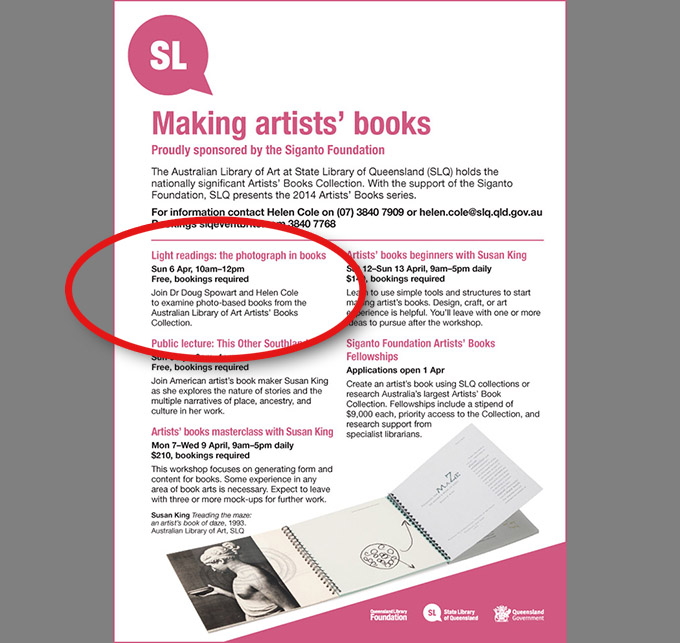
Flyer for the event
.
Light Readings: The photograph in books from the SLQ Artists’ Book Collection and the Spowart+Cooper Photobook Collection
.
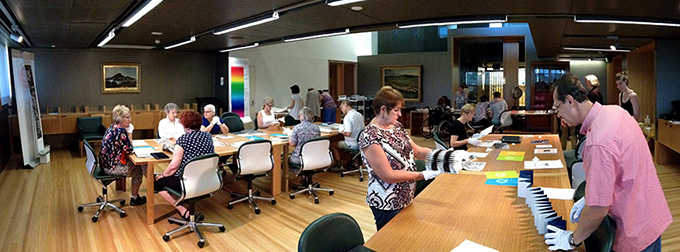
On Sunday April 6 a group of around 25 artists book and photobook dillettantes attended a special ‘White Gloves’ event at the State Library of Queesnland. Assembled in the viewing room on level 4 was a selection of artists books and photobooks that addressed the topic of the photograph and the book. The 43 books were drawn from the SLQ’s Australian Library of Art Artists’ Book collection, the SLQ General Library, supplemented by books from the Spowart+Cooper Photobook Collection. The book’s selection was curated by SLQ Senior Librarian Helen Cole and Doug Spowart. Those attending the event were given a presentation by Doug Spowart to introduce the rationale for the selection. A discussion paper by Spowart is included in this blog post along with a bibliography of the selected books.
.
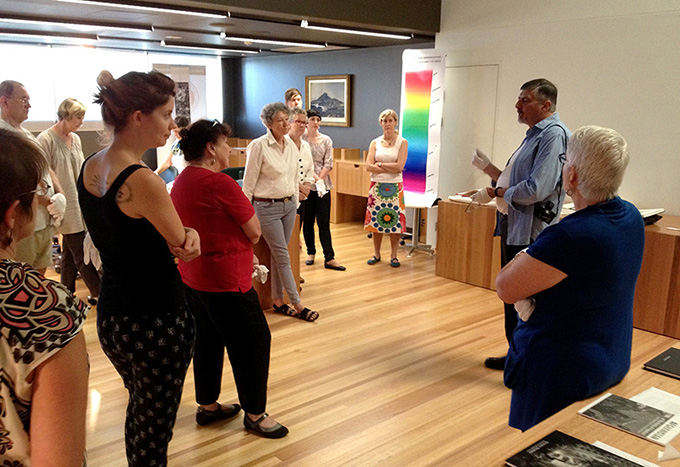
Doug Spowart presents an introduction …….PHOTO: Victoria Cooper
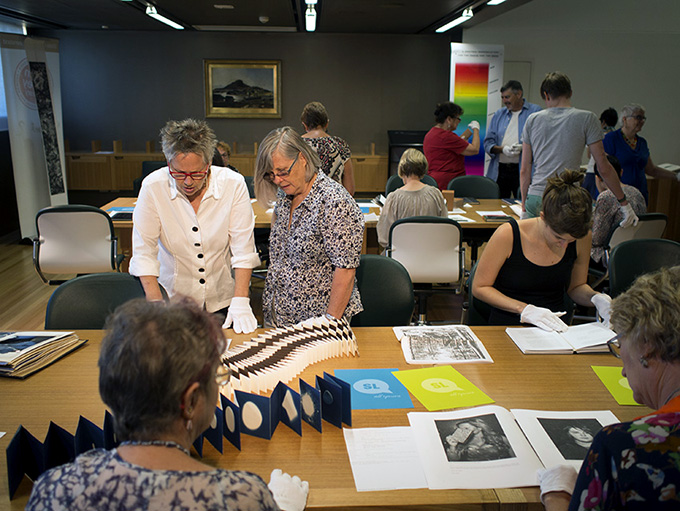
SLQ White Gloves event – Attendees viewing books
Doug Spowart’s discussion inspired by the ‘Light Readings’ event: A nomenclature for photos in books
For one hundred and fifty years the making of ‘quality’ photographs had been almost exclusively the domain of the professional practitioner. Outside of the professional photography scene vernacular photography, made popular due to the enabling technologies of ‘you press the button – we do the rest’ companies like Kodak, usually produced results that were of an inferior standard. There were of course exceptions – ‘prosumers’, as we would call them today, image-makers from the camera club movement, dilettantes and artists whose visual acutance and mastery of process suited photography.
Today digital technology has interceded and now anyone can make photographs. From a range of informed sources it is easy to predict that nearly a trillion photographs will be made in 2014. These images from phone camera snaps to video grabs, from high-end pro digital cameras to surveillance satellites, as well as a plethora of straight and enhanced images will be made and used for a range of outcomes. It seems that now anyone can make a photograph and almost anything can be done with it.
Like photography the publishing of books was once a closed world, as it required specialist processes, skilled artisans and financial entrepreneurship. But this powerful structure of gatekeepers too has also been dissolved by the empowering digital technologies of computers, software, computer-to-press and print on demand workflows. Making books has never been easier. Photographers particularly have embraced the opportunity and launched a revolution creating all kinds of photobooks to extend the bland form of the traditional photobook. Bruno Ceshel, founder of the photobook publishing and promotion enterprise Self-Publish Be Happy, comments that:
From the stapled fanzine assembled in a student bedroom to the traditionally printed photobook, these publications not only reshape our understanding of the medium but offer exciting and sometimes radical ideas. (Ceschel 2011)
.
Whilst photographers have embraced this new found direct publishing paradigm artists have made books with photos in them for decades. For them the processes of printmaking and multiples that they employ, along with access to printing press technology, is accessible and ‘doable’. Additionally artists have experimented with communication concepts that included the democratic multiple publications. Artists employ a range of media and the photograph was just another tool that they could access to create their art.
A significant connection between photography and the artists book is discussed by Anne Thurmann-Jajes and Martin Hellmold in their 2002 exhibition and catalogue ars photographica. They state that: ‘In very general terms, it is possible to say that half of all artists’ books produced to date have been based on photographs.’(Thurmann-Jajes and Hellmold 2002:19). It is interesting to note that the first book of the modern American artists book genre is Ed Ruscha’s book of photographs entitled Twenty-six Gasoline Stations.
The artist’s use of photography has created a degree of frisson. A point of contention for photographers was their ownership over the term ‘photographer’. Essentially photographers claimed that while artists may have made photographs, only photographers made ‘real’ photographs – artists just took photographs. Ruscha provocatively denounced the preciousness of the fine art photography movement that came out of the 1960s and announced that all he wanted out of photography was ‘facts, facts, facts.’ (Rowell 2006:24)
Thurmann-Jajes and Hellmold go further in that they propose differences between the artist and the photographer in the conceptual aspects of making a book based on photographs:
The authors of photo books followed photographic tradition, according to which the photograph as such was decisive, becoming the bearer of meaning. … By contrast to the photo book, the artists’ book is not the bearer, but the medium of the artistic message. (Thurmann-Jajes and Hellmold 2002:20)
.
Interestingly, the photobook and the artists book share a lost history that Johanna Drucker discusses in her 1995 book, The Century of Artists’ Books. She states that:
The photographic book became a standard of artists’ book activity, and its history belongs to the early 20th century in which the concept of the book as an artistic form was taking on a new, vital identity. (Drucker 2004:63)
.
Drucker adds:
These were works which were considered avant-garde, experimental, and innovative when they were made; they broke with the formal conventions of earlier book production, establishing new parameters for visual, verbal, graphic, photographic, and synthetic conceptualization of the book as a work of art … they were part of a history which was temporarily forgotten at the time artists’ book emerged in the 1960s. (Drucker 2004:63-4)
.
Despite these shared histories and theories of ‘differences’ the nature of the creative process, the disciplines of artist and photographer may present an interesting conundrum. Nancy Foote, for example, may question the ‘us and them’ argument by her observation in a 1976 article in Artforum, The Anti-Photographers that: ‘For every photographer who clamors to make it as an artist, there is an artist running a grave risk of turning into a photographer.’ (Foote 1976:46)
Today the photograph continues to pervade all kinds of books by artists, artists–photographers, photographers and photographer-artists in collections like the Australian Library of Art at the State Library of Queensland. At this time it is important to review the field of creative book production that utilises the photograph and consider what has been created to date and in the SLQ collection, as well as look for emergent trends.
In this research project Senior Librarian Helen Cole and I have collaborated to bring together a selection of books to survey the nature of the photo and the book. Whilst most books have been sourced from the SLQ Artists’ Book collection some books have come from the SLQ general area and some, mainly emergent photobooks have been drawn from my personal collection. In bringing these 43 books together in the one ‘white gloves’ space there has been an ability to create come kind of order from the divergent practice.
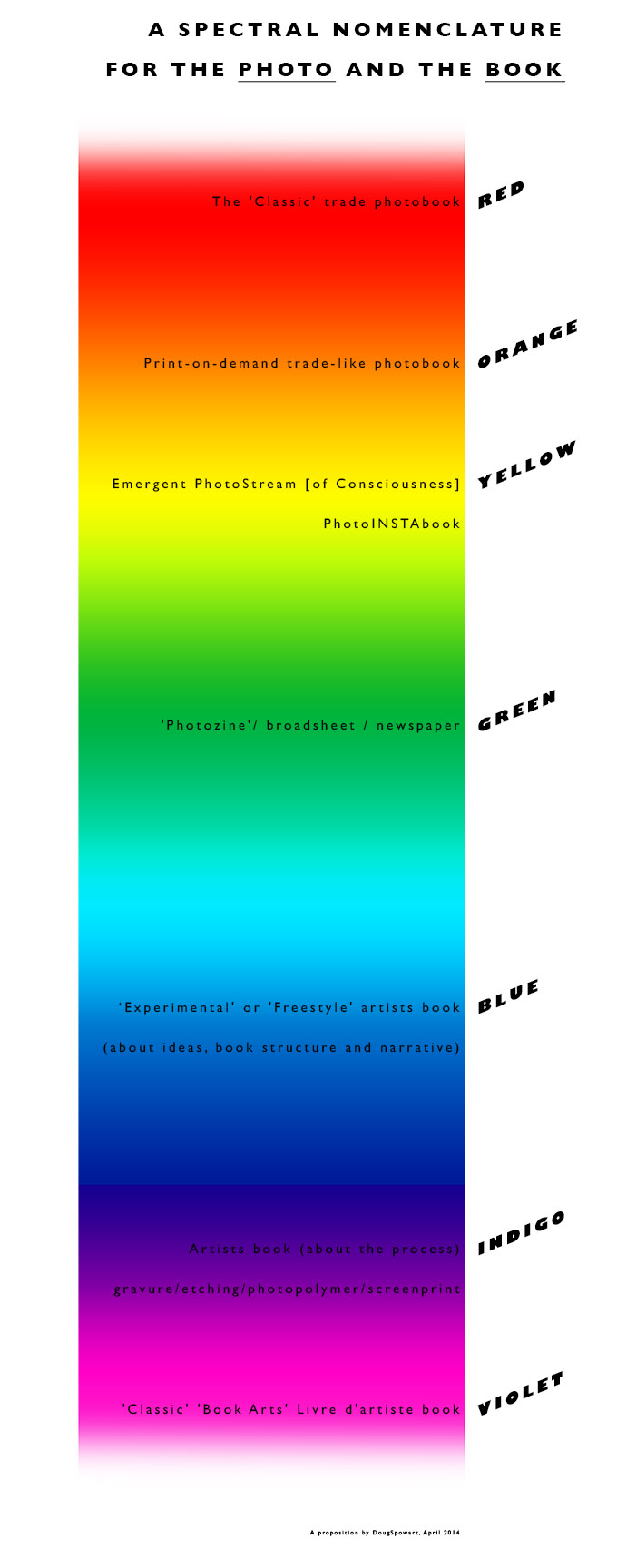
It would take a courageous and brave commentator to propose a definition or a canon for the photo and the book. Instead I will suggest a spectrum of activity and assign some characteristics that may aid those interested in the topic to compare, sample and discuss. I will use the term nomenclature as it best describes the devising or choosing of names for things in this type of discussion.
As the visible light spectrum has a rainbow of seven main colours this discussion has seven as well. Each has a specific characteristics and terms associated with it – although, at times certain books may challenge attempts to place them within this spectrum. The 7 colours are:
1. Red – The ‘Classic’ trade photobook
2. Orange – Print on demand trade-like photobook
3. Yellow – Emergent – PhotoStream* [of Consciousness] or Insta-photobook*
4. Green – Photozine*/ broadsheet / newspaper
5. Blue – Experimental’ or ‘Freestyle’ artists book
6. Indigo – Artists book
7. Violet – ‘Classic’, ‘Book Arts’, Livre d’artiste book
*Names I have considered to best describe these emergent forms
.
This spectral approach accepts the notion that the use of the photograph may be by either photographer or artist, and the nature of their creative products may enable their books to reside in generic areas. In many ways the transition of the rainbow metaphor from red to violet could represent the pure book forms of the photographer at one end and the purest artist form at the other at the other. This suggests that 1-4 would be photobooks conceived and produced by photographers. And those books in 4-7 would be principally books made by artists using photography. And at times the nature and form of the book may defy this nomenclature and be in a grey area, or a tint or shade, or even a blend of colour opposites!
Just as Johanna Drucker found when she attempted to define the artists book my categorising the practitioner’s discipline and the type or style of a book that they make also may be challenging. Drucker came under fire even though she predicted that her proposition would ‘… cause strife, competition, [and] set up a hierarchy, make people feel they are either included or excluded’ (Drucker 2005:3). More recently, in 2010, Sarah Bodman and Tom Sowden from the Centre for Fine Print Research at the University of the West of England sought to define the canon for the artists book in the 21st century. They did this by creating a survey of world practitioners of book making by artists in every conceivable outcome, including the emergent eBook. They found that the heirarical form of a tree diagram was ‘too rigid and too concerned with process’ (Bodman and Sowdon 2010:5). They discovered that their respondents wanted to alter the diagram to satisfy the, ‘cross-pollination that is often required by artists’ and added in, ‘connectors across, up and down to bring seemingly disparate disciplines together.’ (Bodman and Sowdon 2010:5)
Rather than a rigid definitive structure, I present this spectral organization a guide where we can bring some concepts into a critical debate that will extend the ideas, and the motivations, behind those who create these communicative devices. Ultimately researchers, and those interested in engaging with and exploring the nature of the photo in the book, will add their voices to the conversation. Then new dialogue, scholarship and opportunities for thought on the topic will advance understanding of the book that carries its message with the photograph.
At the end of this blog post I have included the bibliography of selected books for the ‘Light Readings’ event.
Dr Doug Spowart April 14, 2014
References:
Bodman, S. and T. Sowdon (2010). A Manifesto for the Book: What will be the canon for the artist’s book in the 21st Century? A Manifesto for the Book: What will be the canon for the artist’s book in the 21st Century? T. S. Sarah Bodman. Bristol, England, Impact Press, The Centre for Fine Print Research, University of the West of England, Bristol.
Ceschel, B. (2011). “The Best Books of 2010.” Retrieved June 6, 2011, from http://www.photoeye.com/magazine_admin/index.cfm/bestbooks.2010.list/author_id/68/.
Drucker, J. (2004). The Century of Artists’ Books. New York, Granary Books.
Drucker, J. (2005). “Critical Issues / Exemplary Works.” The Bonefolder: An e-journal for the bookbinder and book artist 1(2): 3-15.
Foote, N. (1976). “The Anti-Photographers.” Artforum September: 46-54.
Rowell, M. (2006). Ed Ruscha Photographer. Gottingen, Steidl Publishers.
Thurmann-Jajes, A. and M. Hellmold, Eds. (2002). ars photographica: Fotografie und Künstlerbücher. Weserburg, Bremen, Neues Museum
A SPECTRAL NOMENCLATURE FOR THE PHOTO AND THE BOOK
.
A Bibliography of the selected books
From the Artists’ Book Collection of the Australian Library of Art, State Library of Queensland and the Spowart+Cooper Photobook Collection
Red – The ‘Classic’ trade photobook
American Cockroach
Photographs by Catherine Chalmers
Essays by Steve Baker, Garry Marvin, and Lyall Watson
Aperture, 2004
(Spowart+Cooper Photobook Collection)
Afghanistan, or, The perils of freedom
Stephen Dupont 1967- ; Jacques Menasche 1964-; Stephen C Pinson; New York Public Library : 2008
Steam : India’s last steam trains
Stephen Dupont 1967- ; Mark Tully
Stockport : Dewi Lewis :1999
Foundphotos / DickJewell
Dick Jewell
London : s. n. :1977
FromMontelucotoSpoleto : December1976
Sol LeWitt 1928-2007.
Eindhoven Netherlands : Van Abbemuseum ; Weesp Netherlands : Openbaar Kunstbezit :1984
Journey of a wise electron
Peter Lyssiotis 1949- ; PeterLyssiotis 1949-.; PeterLyssiotis 1949-.
Prahan, Vic. : Champion Books :1981
Eat : Jan-Mar 2001
Jo Pursey
Sydney, N.S.W. : J. Pursey :2001
Tour of duty : winning hearts and minds in East Timor
Matthew Sleeth 1972- ; Paul James (Paul Warren), 1958-
South Yarra, Vic. : Hardie Grant Books in association with M.33 :2002
Signs of Australia
Richard Tipping 1949-
Ringwood, Vic. : Penguin Books :1982
Intimations : with selected poetic responses by Michele Morgan
Gordon Undy
Surry Hills, NSW. : Point Light :2004
Orange – Print on demand trade-like photobook
Various fires and MLK
Scott L. McCarney 1954-
Rochester, N. Y. : VisualBooks :2010
Reportage : a retrospective 1999-2009.
Robert McFarlane 1942-; Jacqui Vicario; StephenDupont 1967-; National Art School (Australia); Momento Pro.
Bondi Junction, N.S.W. : Reportage :2010
Flashback : SE Queensland flood event January 2011
Julie White
Strawberry Hills, N.S.W. : Momento :2011
Yellow – Emergent PhotoStream* [of Consciousness] or InstaPhotoBook*
Iris Garden
Wiliam Gedney
Designed by Hans Seeger
Little Brown Mushroom, 2013
(Spowart+Cooper Photobook Collection)
Moved Objects
Georgia Hutchison and Arini Byng
Perimeter Editions
Melbourne, Australia, 2013
(Spowart+Cooper Photobook Collection)
Lost horizons
Scott L. McCarney 1954-,
Rochester, NY : ScottMcCarney/Visual Books :2008
Call of the wild
Matthew Sleeth 1972- ; Josef Lebovic Gallery.
Sydney N.S.W. : Published by Josef Lebovic Gallery :2004
Signed up : 22 postcards
Richard Tipping 1949-
Newcastle, N.S.W. : Artpoem :c2010
Green – Photozine*/ broadsheet / newspaper
Radiata, 2013
Jacob Raupach
(Spowart+Cooper Photobook Collection)
.
LBM Dispatch #6: Texas Triangle
Alec Soth and Brad Zellar
Little Brown Mushroom, 2013
Edition of 2000
(Spowart+Cooper Photobook Collection)
Blue – Experimental’ or ‘Freestyle’ artists book
Ten menhirs at Plouharnel, Carnac, Morbihan, Bretagne, France
Jihad Muhammad aka John Armstrong 1948-
Hobart Tas. : J. Armstrong :1982
Detour ; Kõrvaltee
Christiane Baumgartner 1967- ; Lucy Harrison 1974-; Grahame Galleries + Editions.
Leipzig, Germany : C. Baumgartner & L. Harrison :2004
No diving II : evidence
Peter E. Charuk
Hazelbrook, N.S.W. : P.E. Charuk :2005
The story of the gorge
Victoria Cooper 1957-
Toowoomba, Qld. : V. Cooper :2001
Supernova
Victoria Cooper 1957- ; Photographers of the Great Divide.
Toowoomba, Qld. : Photographers of the Great Divide :2005?
Space + Time
Ken Leslie ; Grahame Galleries + Editions.
Atlanta, Ga. : Nexus Press :2002
The river city : eyewitness document
Helen Malone 1948-
Yeronga, Qld : H. Malone :2011
Tonguey
Ron McBurnie 1957-
Townsville, Qld. : R. McBurnie :1996?
Portrait of an Australian
Jonathan Tse 1967-
Robertson, Qld. : J. Tse :1998
[Eleven]
Marshall Weber 1960- ; Christopher Wilde; Sara Parkel; Alison E Williams; Isabelle Weber; Booklyn Artists Alliance.
New York : Booklyn :c2002
Posted
Normana Wight 1936- ; Numero Uno Publications.
Milton, Qld. : Numero Uno Publications :2009
High tension
Philip Zimmermann ; Montage 93 : International Festival of the Image (Rochester, N.Y.)
Rochester, NY : the author :1993
Indigo – Artists book (Inkjet – gravure – photopolymer – screenprint)
Lost and found : a bookwork
Lyn Ashby 1953-
Vic. : ThisTooPress :2007?
The ten thousand things
LynAshby 1953-
Victoria : Lyn Ashby, Thistoopress :2010
Solomon
JanDavis 1952-
Lismore : J. Davis :c1995
Limes
Tommaso Durante 1956- ; Chris Wallace-Crabbe 1934-; Elke Ahokas
North Warrandyte, Vic. : Tommaso Durante :2011
Terra Australis
Tommaso Durante 1956- ; Kay Aldenhoven
Warrandyte, Vic. : TommasoDurante :2003
Homeland
Noga Freiberg 1962- ; Peter Lyssiotis 1949-.; Masterthief Enterprises
Burwood, Vic. : Masterthief :2003
Deeply honoured
Fred Hagstrom ; Densho Digital Archive.; Carleton College (Northfield, Minn.). Archives.
Saint Paul, Minn. : Strong Silent Type Press :2010
Cars of the fifties : book number 247
Keith A. Smith 1938-
Rochester, N.Y. : KeithSmith :2006
Violet – ‘Classic’ ‘Book Arts’ Livre d’artiste book
Through closed doors : 7 paraclausithyra
Susan J. Allix 1943-
London : S. Allix :2005
A gardener at midnight : travels in the Holy Land ; from drawings made on the spot by Yabez Al-Kitab
Peter Lyssiotis 1949- ; Brian Castro 1950-; David Roberts 1796-1864.; Nick Doslov; David Pidgeon; State Library of Victoria.; Masterthief Enterprises.; Renaissance Bookbinding.
Melbourne : Masterthief :2004
New branches on an old tree
Susan Purdy ; Blue Moon Press.
Melbourne : Blue Moon Press :2006
List concludes.
.
SLQ White Gloves event – Attendees viewing books
.
.

This work is licensed under a Creative Commons Attribution-NonCommercial-NoDerivs 3.0 Unported License.
.
.
Text: © 2014 Dr Doug Spowart Photos: ©2014 Victoria Cooper and Doug Spowart
.
.
.
.
BOX of BOOKS Event – Toowoomba!
Looking at the books – Cobb+Co Museum, Toowoomba
.
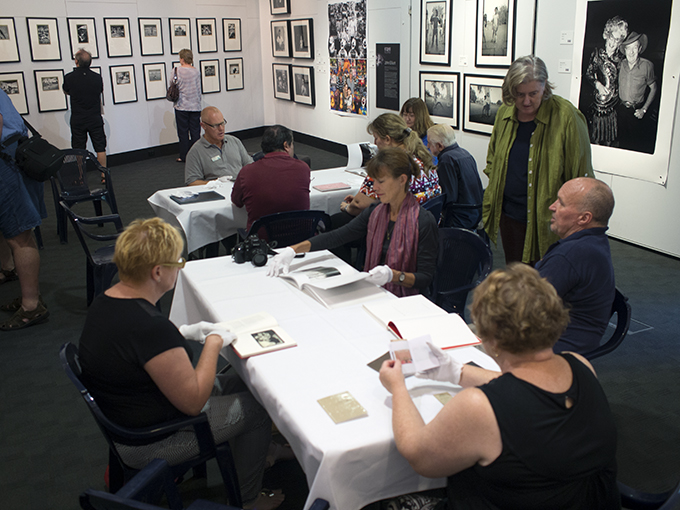
Around 35 photobook enthusiasts gathered at the Cobb+Co Museum on January 27 to view the Photobook Club’s Box of Books and talk about photobooks. The event brought together local photo identities John Elliott, Graham Burstow, David Seeto and Victoria Cooper. Eric Victor, Ian Poole and Qld College of Art Masters student Maureen Trainor came from the Brisbane side of the Range. The meeting took place in the gallery space of the ICON on ICONS photographic exhibition that also concluded on that day.
.
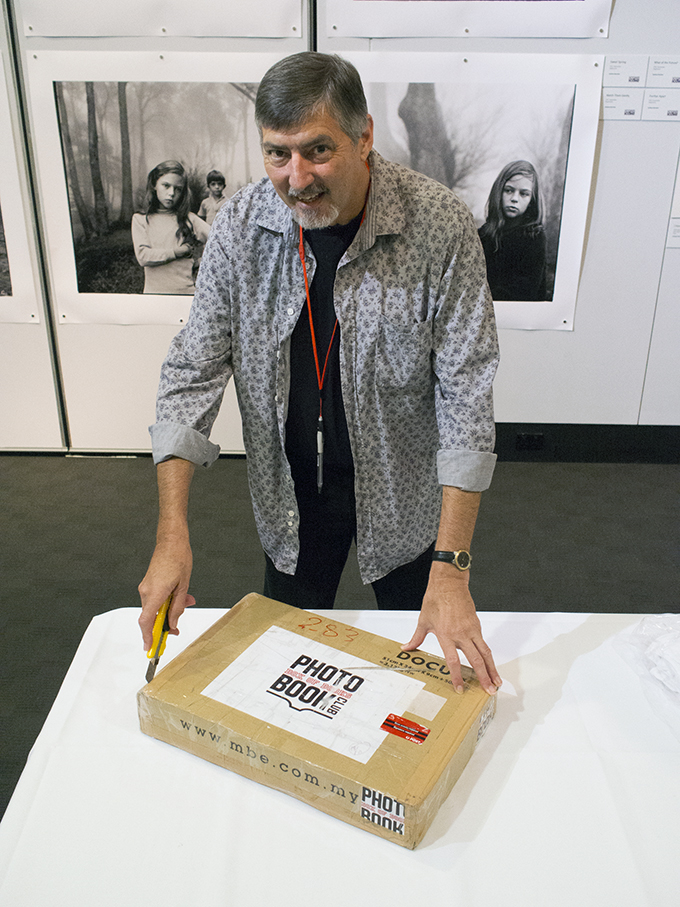
Convener of the event Doug Spowart opens the Box of Books
.
The seven books were viewed and discussed at length. Comments about the books included the following:
“Each book is a very personal communiqué”
“The books demand viewing at many different levels – the narrative, the design, the production, the conceptual nature of the work…”
“This is a very Eurocentric view – I wonder what the American view would look like?”
“How do these books compare with the Australian photobook scene?”
A great deal of discussion took place over the comment – “Where are the captions … the works that help me to understand what the photographer is trying to say?” One respondent commented on Roland Barthes’ concept of ‘The death of the author and the birth of the reader’ – meaning that the reader needs to connect with the images and draw on their own life experiences.
.
Donald Webber’s Interrogations drew quite a few comments – tension and the power of the portraits made in such a circumstance.
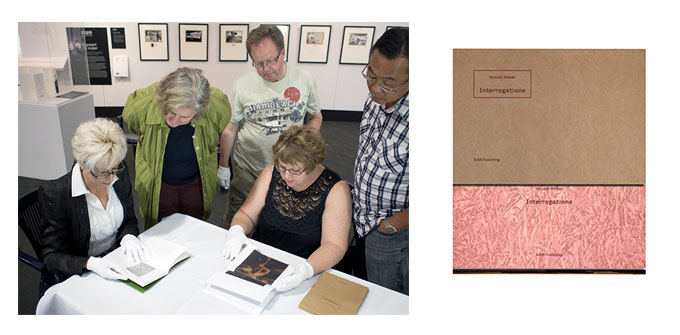
Linda Seeto, Victoria Cooper, Hardy and Alison Ahlhaus looking at Webber’s Interrogations
.
The crowd favourite was Anne Sophie Merryman’s Mrs. Merryman’s Collection … a superb design, delicate paper, the see-through of texts and the amazingly bizarre collection of post card photographs and comments.
.
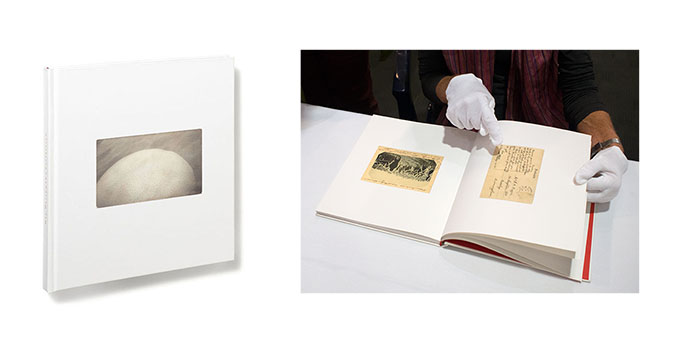
Mrs. Merryman’s Collection
.
Paul Graham’s The Present and its gate-fold format presented a viewing challenge as each image or group of images needed to be revealed by folding-out the page – an extended haptic experience, and considering the size of the book, it slowed down the read and brought the busy street scenes to a slowed motion.
.
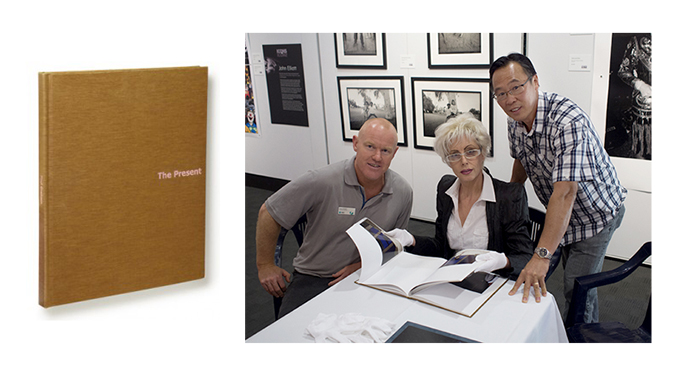
Tony Coonan, Linda and David Seeto look at Paul Graham’s book
.
The Box of Books will be in Brisbane on Monday the 3rd of February and then be off to New Zealand for the next stage in its journey.
Thanks to the Cobb+Co Museum for providing the venue. The Photobook Club and the publishers who donated the books for the opportunity for us to see, touch, and read these books.
Until the next Photobook Club event in our area….
.
This Photobook Club BOX OF BOOKS event was coordinated by Doug Spowart and Victoria Cooper of the Centre for Regional Arts Practice.
.
Other images from the event…
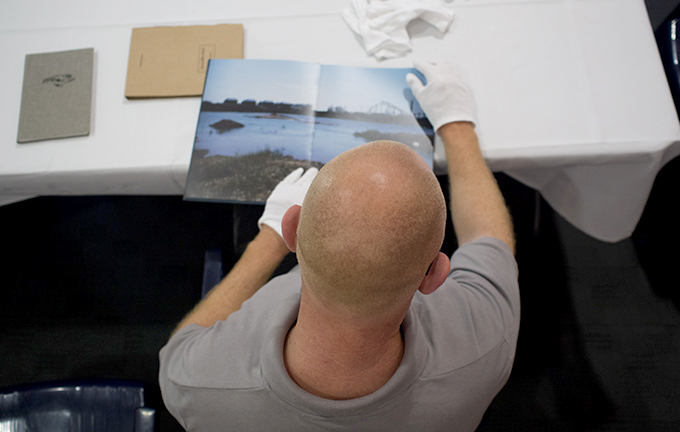
Looking at a book…
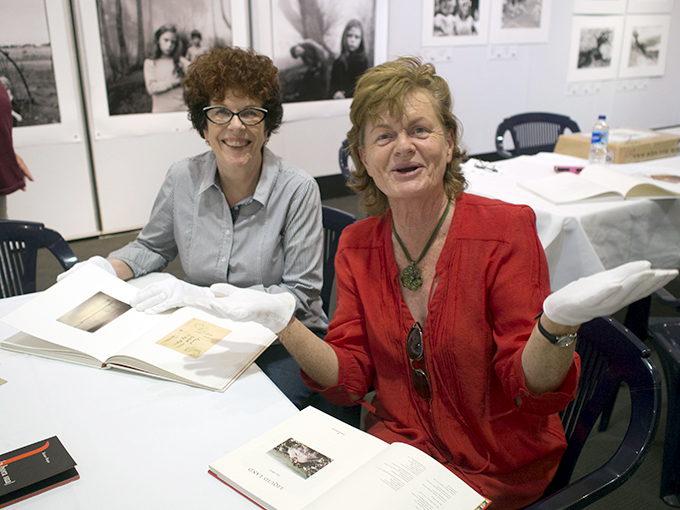
Ann Alcock and Bev Lacey
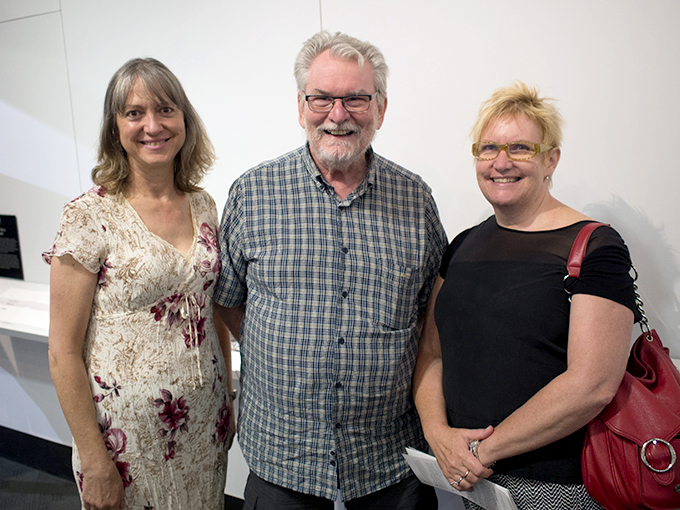
Toula, Ian Poole and Louise
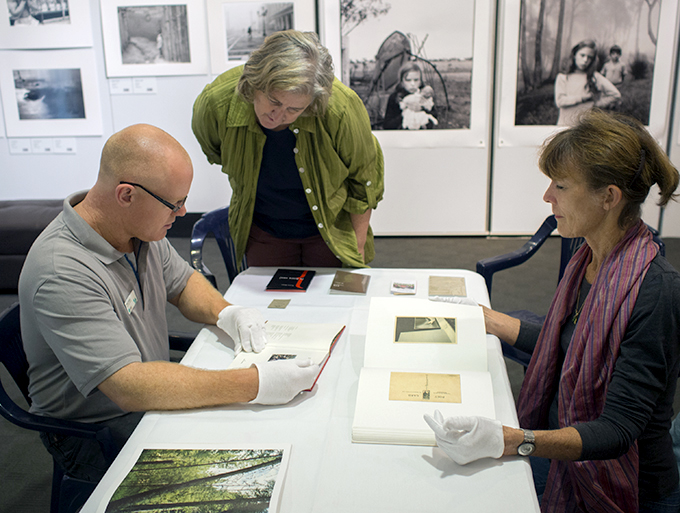
Tony Coonan, Victoria Cooper and Anne Howard
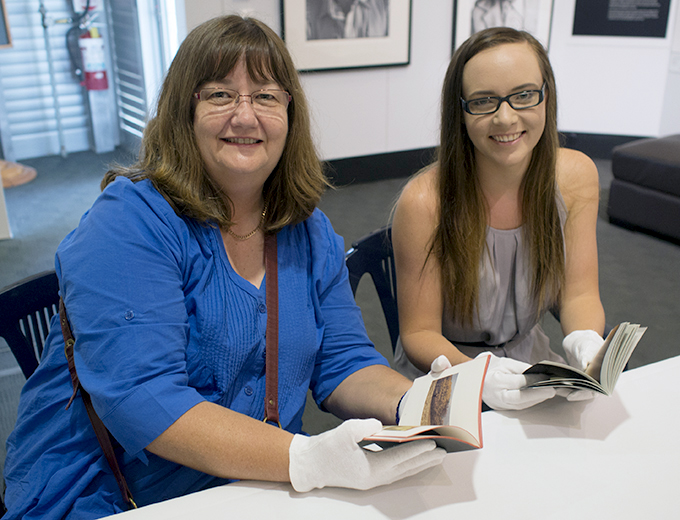
Judi Neuman and Phillipa Hodges
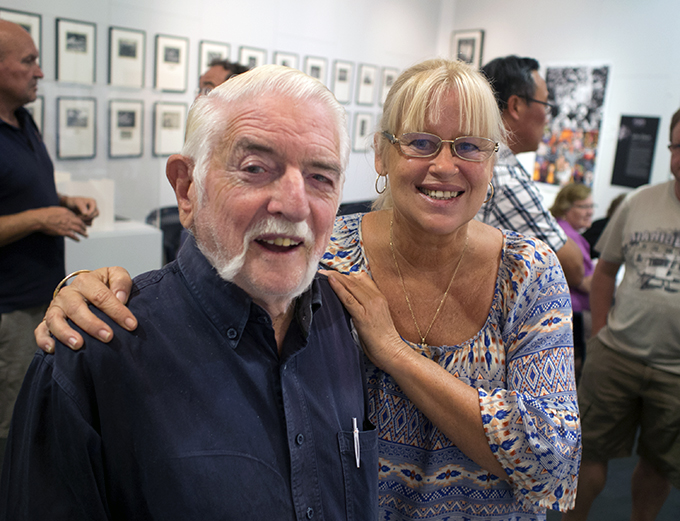
Graham Burstow and Maureen Trainor
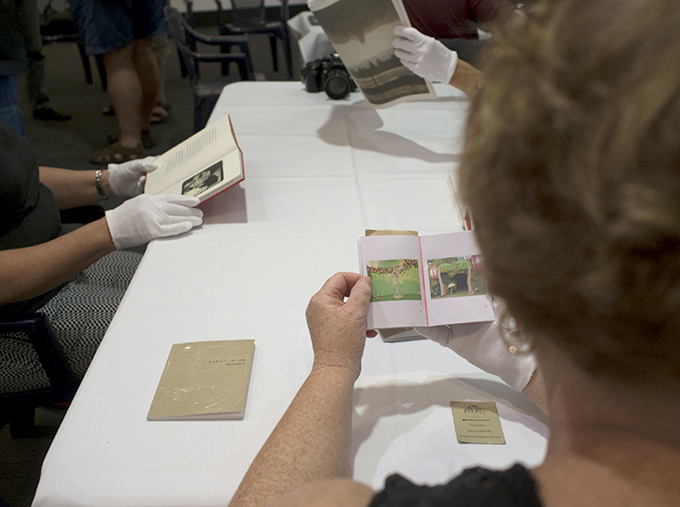
Looking at some of the ephemera from the Box of Books
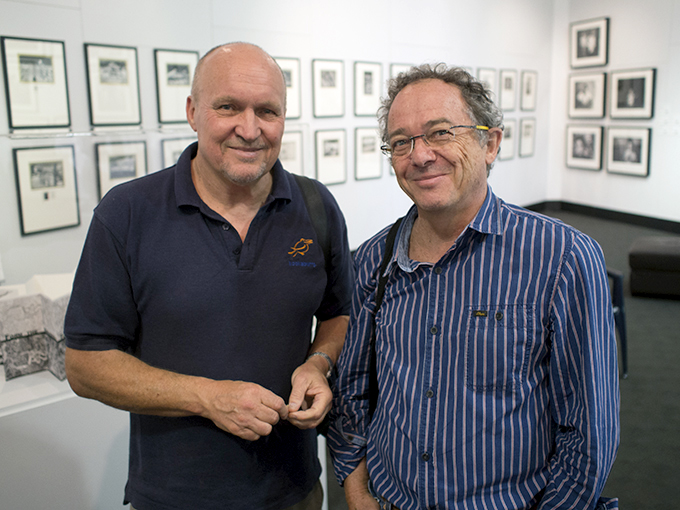
John Elliott and Eric Victor
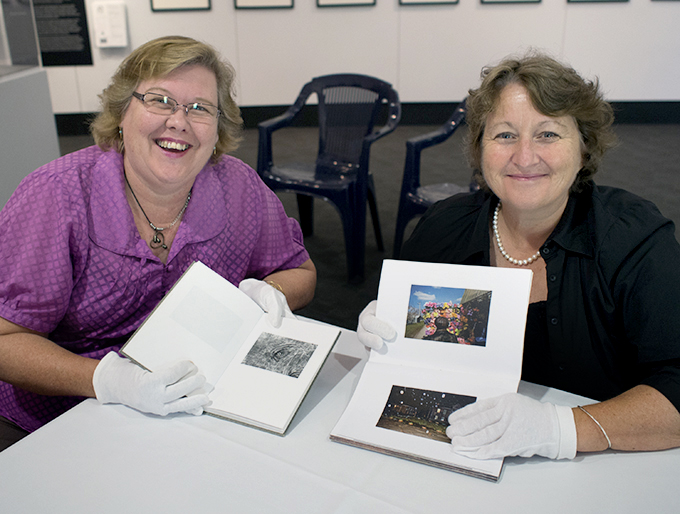
Helen Gibbs and Lucy Robertson-Cunninghame
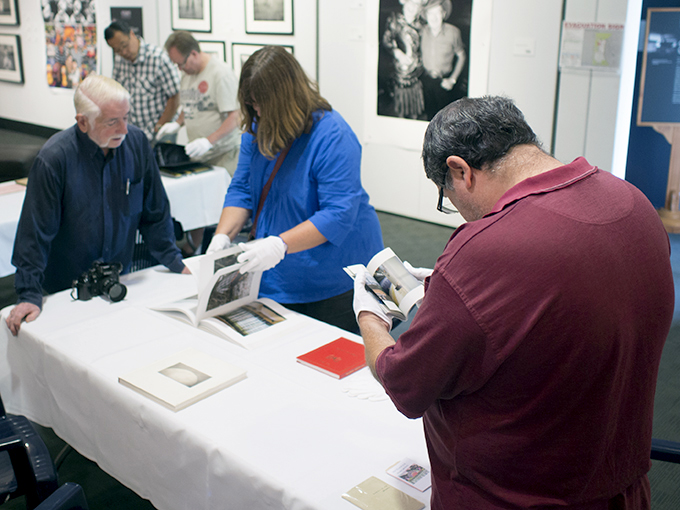
Gerry Saide looking closely at a book
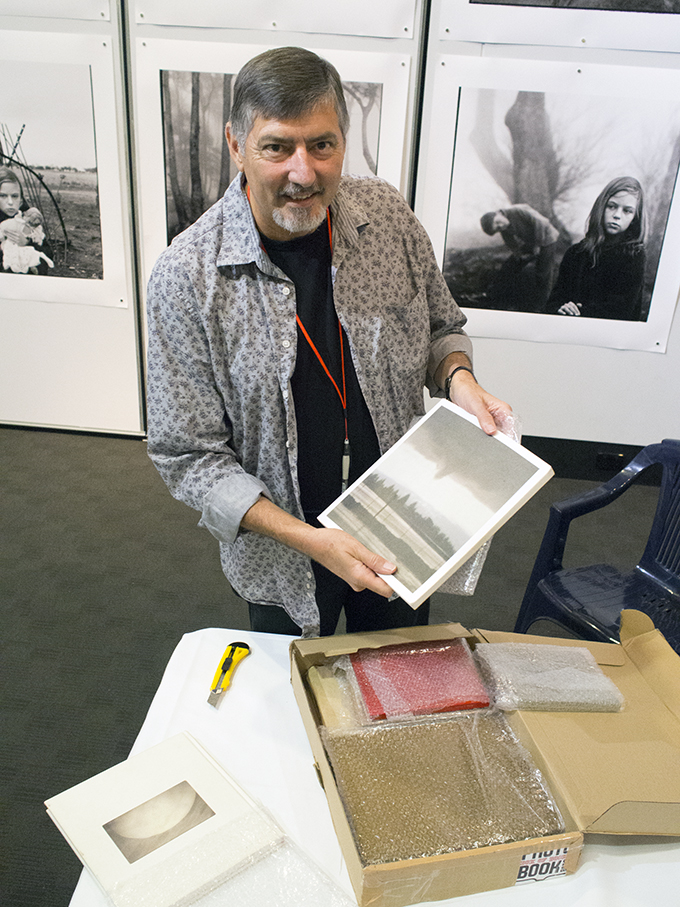
Doug Spowart opens the box
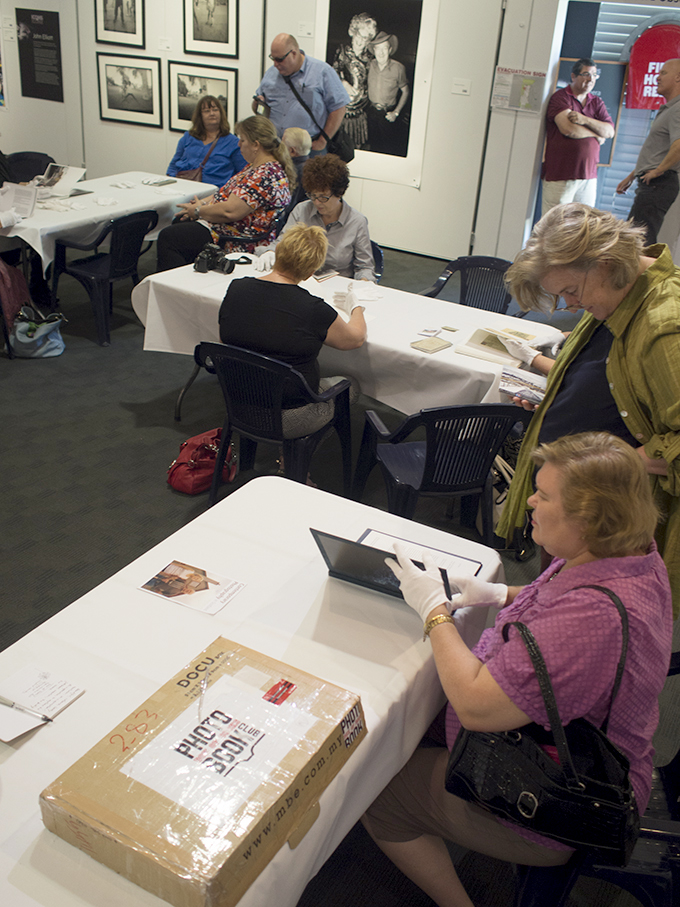
Room view at the Cobb+Co Museum
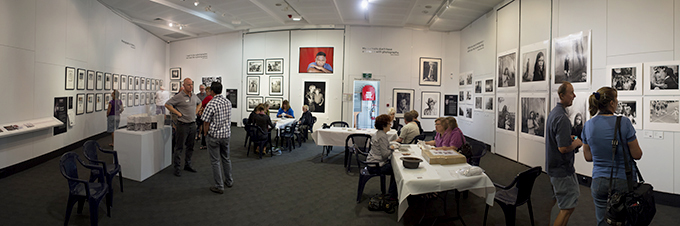
The Cobb+Co Museum panorama
.
.
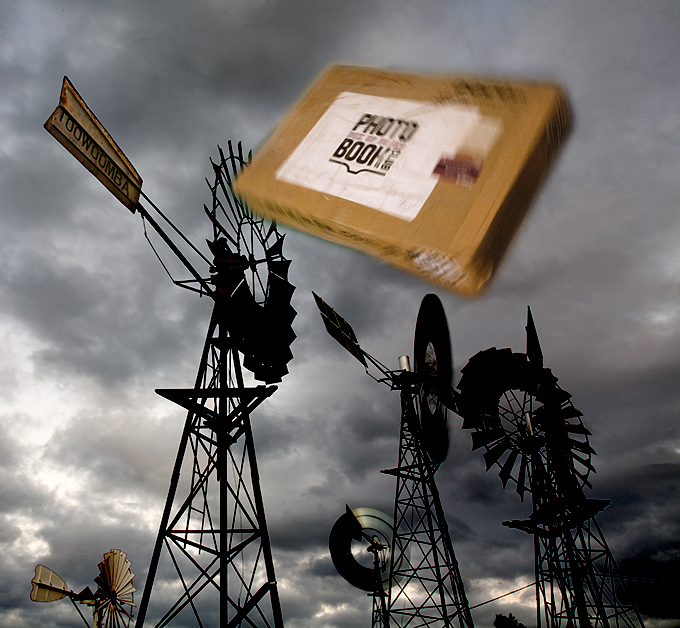
The Photobook Club’s BOX of BOOKS in Toowoomba
.
.
.
.
THE PHOTOBOOK CLUB: Box of Books Event – Toowoomba!
The Photobook Club’s BOX of BOOKS arrives in Toowoomba
.
In 2013, and now in 2014, a box of photobooks will be traveling over 30,000 miles, stopping off at each of the Photobook Club branches around the world in order to promote discussion of the physical photobook.
..
Now, The Box of Books is in Toowoomba —- Queensland, Australia.
As part of the LAST DAY of the ICONS on ICONS show at the Cobb+Co Museum in Toowoomba featuring the work of John Elliott, Graham Burstow, David Seeto Victoria Cooper (photobooks) and Doug Spowart – a special viewing of the THE PHOTOBOOK CLUB’s BOX of BOOKS will be made available. Come and sit with some of the world’s best photobooks and turn the pages – and release the narrative that each book contains.
THE DATE: Between 1 – 3pm, January 27 – The AUSTRALIA DAY Holiday
THE VENUE: The Cobb+Co Museum, 27 Lindsay Street, Toowoomba.
.
A small charge of $5 is being made to cover postage to the Boxes’ next destination in Auckland New Zealand.
.
The book viewing and discussions will take place between 1-3pm. The Museum’s coffee shop is open for lunch as well as drinks and snacks throughout the afternoon until 4pm.
Take a road trip into the country – Visitors to the Cobb+Co Museum from outside the Toowoomba Region will gain FREE admittance if they advise that they are attending this special event.
This Photobook Club BOX OF BOOKS event is coordinated by Doug Spowart and Victoria Cooper of the Centre for Regional Arts Practice.
.
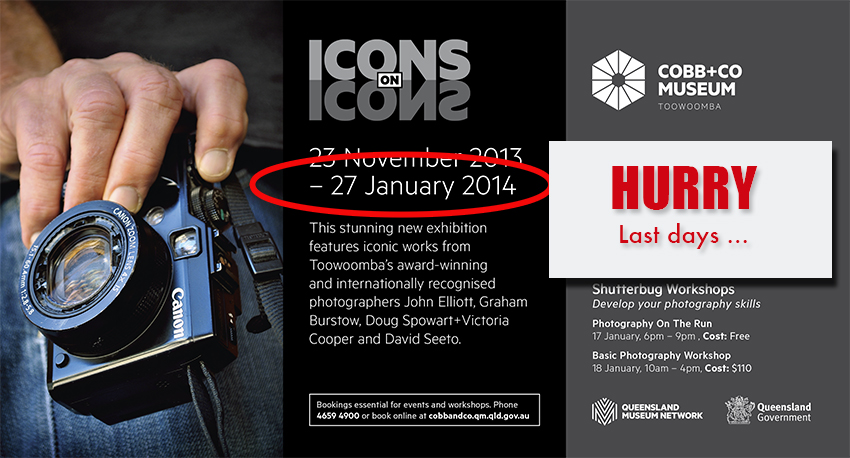
Cobb+Co Museum – Icons on Icons events
.
What’s in the Box?
A big thanks to Mack Books (London), Schilt Publishing (Amsterdam) and also to Filipe Casaca who have all contributed books to this project. If you are a publisher or photographer who would like a book to be included in ‘Box of Books #2′ then please get in touch. The following books were chosen for the discussions of content, narrative and physical properties that I hope they will encourage – Matt from the Photobook Club
Another Language
Mårten Lange
(Mack, 2012)

The blurb: Combining images of flora, fauna and natural phenomena in an intimate and beautifully crafted book, Lange teases out a subtle narrative – a meteor crashes, a landmass is visible and a distant planet occupies the final page – but the book is more akin to the workings of a scientist collecting specimens. Together the photographs create a cryptic and heterogeneous index of nature, with recurring shapes, patterns and texture, where the clarity and simplicity of the individual photographs contrasts with the enigmatic whole.
………………………………………………………………………………………..
Blue Mud Swamp
Filipe Casaca
(Self published, 2012)

The blurb: (Filipe Casaca) Blue Mud Swamp. The shoreline, hot and humid, is a postcard that attracts and invites Men to settle where the land meets the Yellow Sea. However, the reality is dissonant. Although surrounded by natural beauty, beaches and entertainment facilities, the city and its urban spaces transmits, as a whole, a feeling of artificiality. In some cases the abundance created a certain degradation and abandonment. With a splendor that takes us back to a recent past, a certain melancholy is present, as happens with all that was new, colorful and perfect but perished with time.
………………………………………………………………………………………..
Interrogations
Donald Webber
(Schilt, 2012)

The blurb: Interrogations is the result of [Webber’s] personal quest to uncover the hidden meaning of the bloody 20th Century. In dialogue with writer Larry Frolick – whose own ancestors had been decimated in the final months of WW II – Weber insistently and provocatively addresses his questions both to the living survivors and to the ghosts of the State’s innumerable victims, resurrecting their final hours by taking their point of view, and performing a kind of incantatory meditation over their private encounters with Power.
………………………………………………………………………………………..
Lick Creek Line
Ron Jude
(Mack, 2012)

The blurb: Ron Jude’s new book, Lick Creek Line, extends and amplifies his ongoing fascination with the vagaries of photographic empiricism, and the gray area between documentation and fiction. In a sequential narrative punctuated by contrasting moments of violence and beauty, Jude follows the rambling journey of a fur trapper, methodically checking his trap line in a remote area of Idaho in the Western United States. Through converging pictures of landscapes, architecture, an encroaching resort community, and the solitary, secretive process of trapping pine marten for their pelts, Lick Creek Line underscores the murky and culturally arbitrary nature of moral critique.
………………………………………………………………………………………..
Liquid Land
Rena Effendi
(Schilt, 2012)

The blurb: (Rena Effendi) Next to my father’s dead but iridescent butterflies, my photographs show life in some of the world’s most polluted areas, near Baku, where I was born and grew up. In my mind, the contrasting images gravitate towards each other – as I have to my father. Since working on this book I have gotten to know him much better than when he was alive. Salty Waters is the translation from Persian of the ‘Ab-sheuran’ Peninsula; in and around Baku, its main city, the earth is breathing with petroleum fumes, as oil oozes to the surface, turning it liquid. The Caspian Sea hugs the eagle-beak shaped land, salting its gas-pocked soil.
………………………………………………………………………………………..
Mrs. Merryman’s Collection
Anne Sophie Merryman
(Mack, 2012)

The blurb: The book, Mrs. Merryman’s Collection, presents the postcards which together form the story of two intertwined lives – one life lived travelling the world through the postcard images, the other a child and then adult whose life and relationship to her own history and her future were influenced by the collection. While Anne-Marie and Anne Sophie never met, both their lives were inspired by the postcard collection – a relationship that was born, and continues to flourish, in the realms of the imagination.
………………………………………………………………………………………..
The Present
Paul Graham
(Mack, 2012)

The blurb: The Present is Paul Graham’s contribution to this legacy. The images in this book come unbidden from the streets of New York, but are not quite what we might expect, for each moment is brought to us with its double – two images taken from the same location, separated only by the briefest fraction of time. We find ourselves in sibling worlds, where a businessman with an eye patch becomes, an instant later, a man with an exaggerated wink; a woman eating a banana walks towards us, and a small focus shift reveals the blind man right behind her.
.
Also in the box are other items that add to the idea and object of the photobook.
.
A small charge of $5 is being made to cover postage to the Boxes’ next destination in Auckland New Zealand.
.
.
BUNDABERG: A New Nocturne Community Project


.
NOCTURNE BUNDABERG: Stage One of a new community project concept
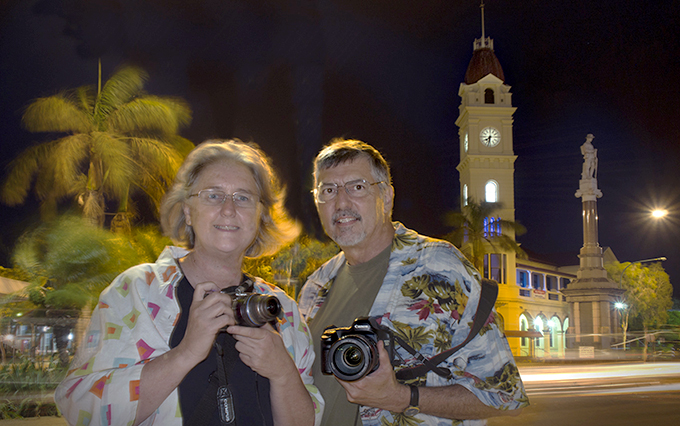
Vicky and Doug go tropical (shirts anyway) in Bundaberg
.
We’ve been in Bundaberg this week (January 5-12)doing preliminary work on a new concept in our nocturne work. Here is the overview of the project:
.
In April 2014 Bundaberg Regional Galleries will be hosting an artist in residency program with artists Victoria Cooper and Doug Spowart. An exhibition of their Nocturne work including new images from this region will be on show at CHARTS Gallery at Childers during April in conjunction with the Queensland Festival of Photography 5. The artists will be also working on their next Nocturne photodocumentary project, entitled Nocturne Bundaberg Region. As with the previous Nocturne Muswellborook and Nocturne Grafton projects the photographs they make will be posted on the Nocturne Bundaberg Region Facebook page so that communities can connect with the project, and importantly, share their stories about each place.
.
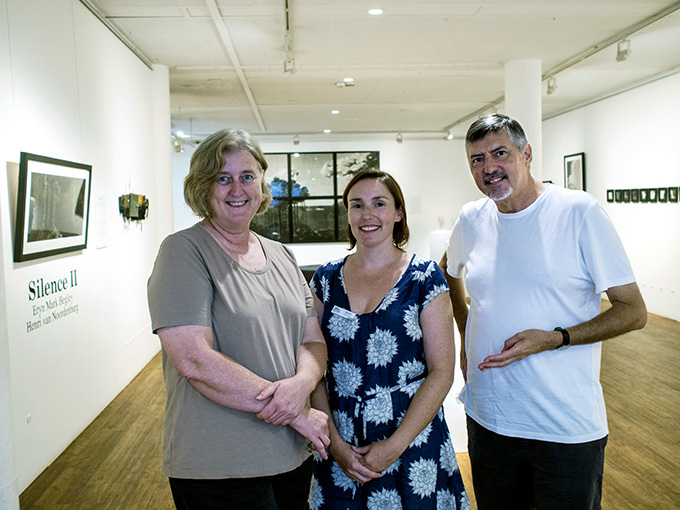
Talking with Trudie Leigo – Exhibitions Officer @ Bundaberg Regional
.
To extend the community’s connection with the project, Victoria and Doug will be working with a small group of photographers from across the Bundaberg Regional Council area to be contributors to the image-making part of the project. The participants will be selected using an EOI process that will be launched on the project’s Facebook page by the end of the month. Successful applicants will be advised in mid-March and they’ll attend a workshop in specialist aspects of nocturnal photography, image enhancement and the safety considerations for this work. After attending the workshop the local photographers will have an opportunity to add their images to the project’s Facebook page. Preferably, applicants should be 18 or over. Other community members may be invited to post images as well.
Any community member or person who has stories inspired by the photographs can post comments to the Facebook page..
.
The Nocturne Bundaberg Region’s Facebook page images, as well as the community conversation derived from the project, may be incorporated in other outcomes including exhibitions or publications associated with the project. A selection of images may go into the Picture Bundaberg Archive.
.

Nocturne Bundaberg Logo
.
All photographs © 2014 Cooper+Spowart for the Nocturne Bundaberg community documentation project
.
.
This work is licensed under a Creative Commons Attribution-NonCommercial-NoDerivs 3.0 Unported License.
http://creativecommons.org/licenses/by-nc-sa/2.5/au/
.
.
.
WORLD PHOTOBOOK DAY: Toowoomba Oct 14, 2013
.
WORLD PHOTOBOOK DAY – CELEBRATED IN AUSTRALIA
.
.
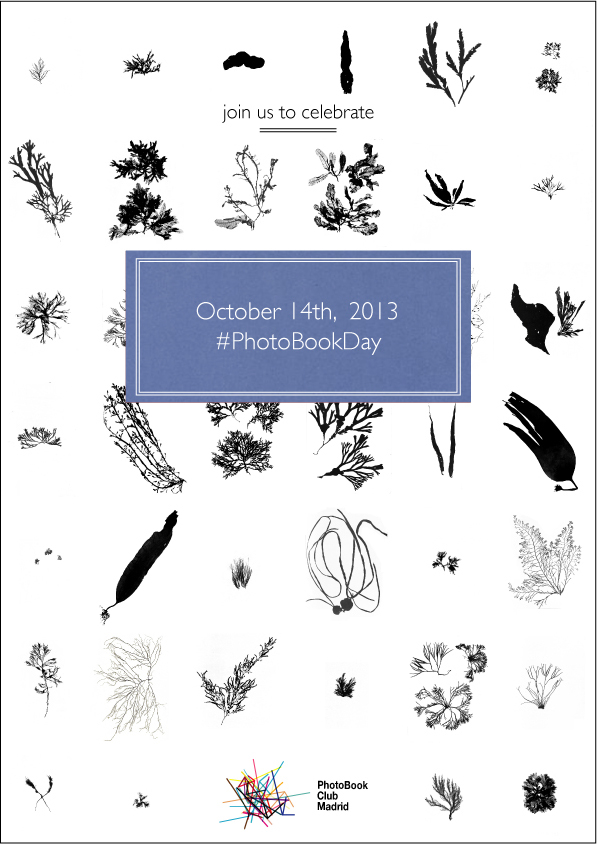
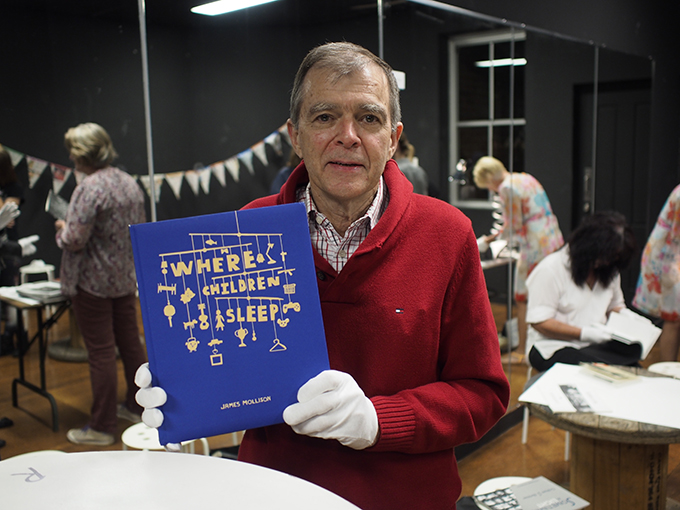
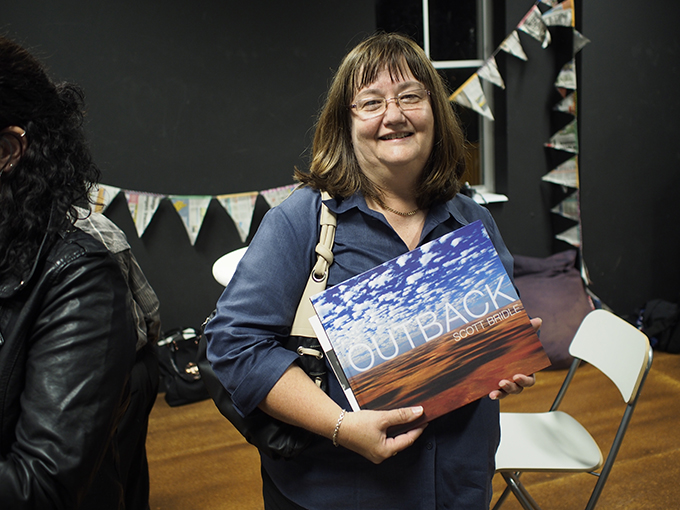
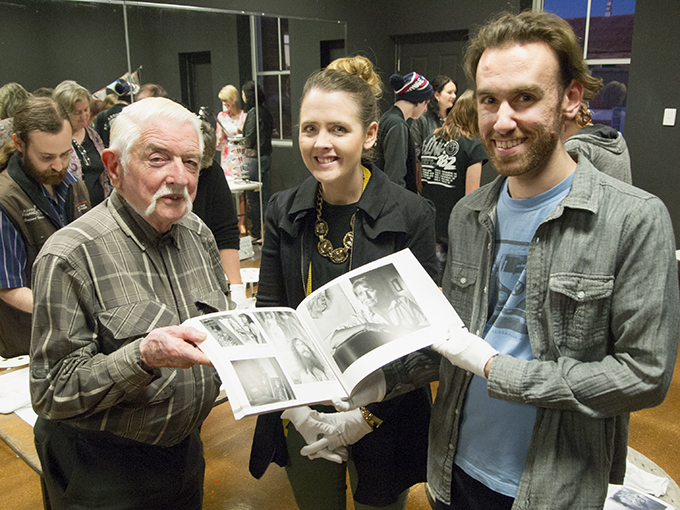
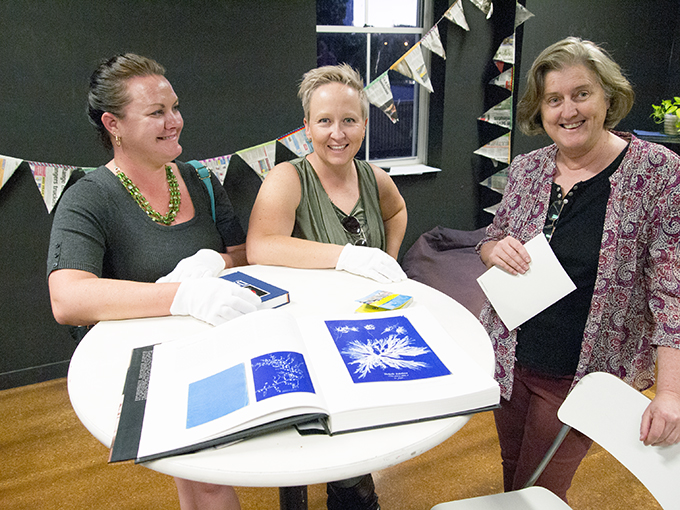
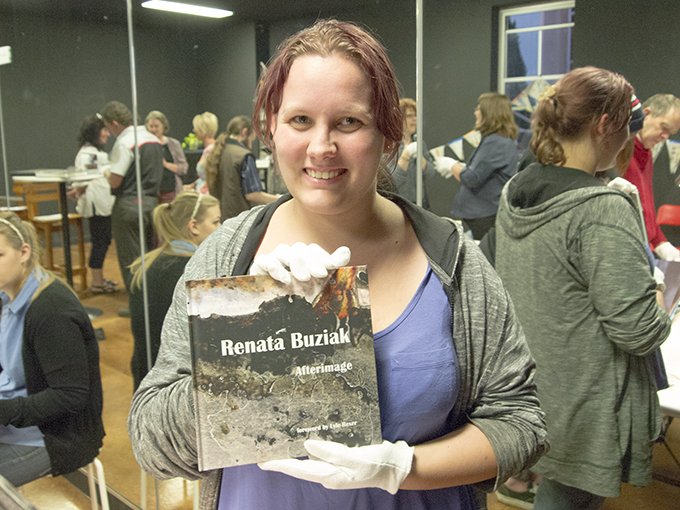
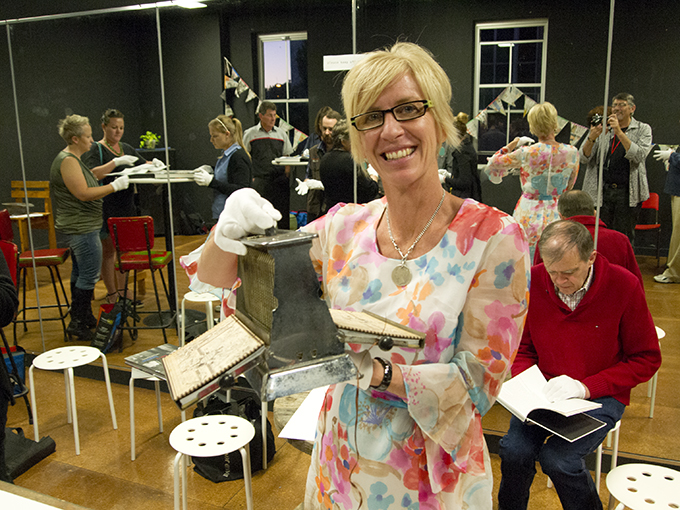
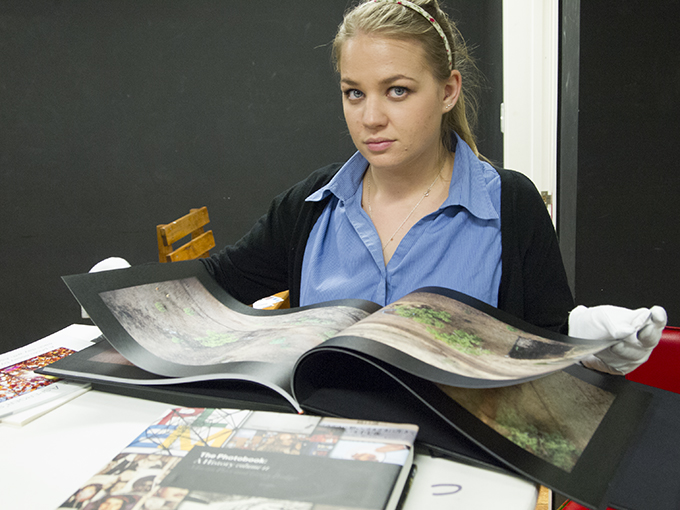
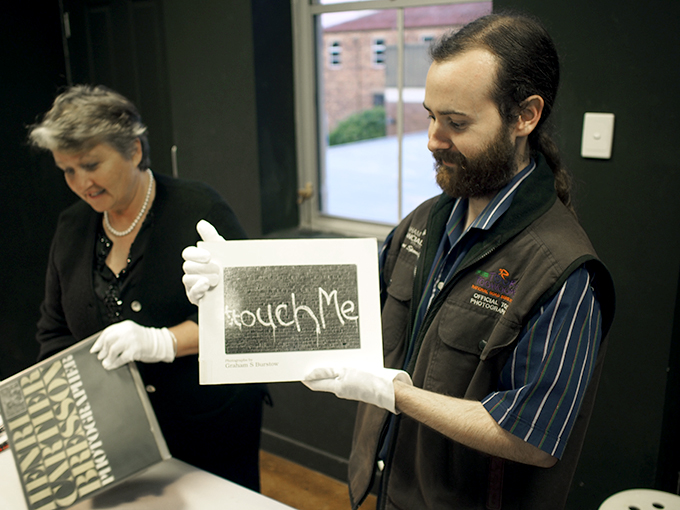
The city of Toowoomba in Queensland Australia celebrated World Photobook Day with a group of around thirty attending a Photo Book Club meeting. The event was held at TheGRID: Hybrid Arts Collective. The participants were from a wide range of photographically interested people: some from the local TAFE college, The Toowoomba Photographic Society, professional photographers, artists and academics. Each brought with them a favourite photobook to share and talk over with others. There were some precious books, some funky contemporary publications, and some of the more traditional coffee table tomes.
.
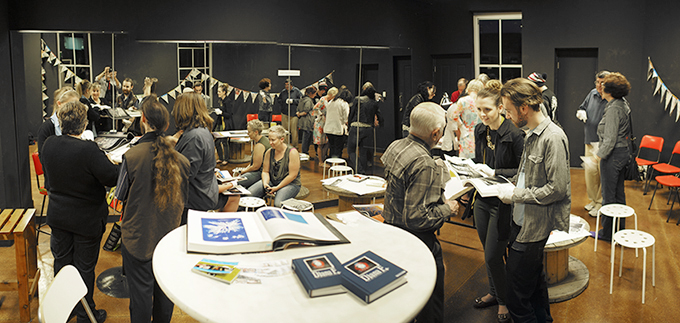
Toowoomba Celebrates World Photobook Day
.
Event coordinator Doug Spowart welcomed the group and gave some background on the history of the photobook and the amazing place that Anna Atkins has within that history. On hand was the Badger and Parr The Photobook: A History Vol1 opened to the page of the Atkins Algae of the British Isles. Doug announced that an acquaintance of he and Victoria Cooper’s – Gael Phillips, was a distant relative of Anna Atkins and that whilst be unable to attend she has provided a commentary on the times, life and family. Gaels words are as follows…
… I thought I might give you a few details of the family of Anna Atkins, nee Children, which may help to explain the setting in which she produced the world’s first photographic book. My cousins, Elizabeth Parkes and Jean Doggett, with input from other family members, have published an account of our family which includes chapters on the Children family. At their family home, “Ferox Hall”, in Tonbridge, Kent, John George Children, Anna’s father and George Children, her grandfather, had built the largest electric battery the world has ever seen at their private laboratory. They were collaborating with Sir Humphry Davy on electrical experiments. It was because of her family’s experience with battery technology and electrochemistry, and almost certainly with the help of her father, that Anna would have had access to sufficient ferric ammonium citrate to produce cyanotypes. Her publication of “Photographs of British Algae” first appeared in October 1843 – British Algae – Cyanotype Impressions. Fox Talbot, a friend of the family, and from whom Anna had obtained her first camera, published “Pencil of Nature” between 1844 and 1846, in several parts. In 1979 Professor Larry Schaaf brought the attention of the world to the fact that the author of the world’s first photo book, AA, was Anna Atkins.
Anna Atkins, nee Children, was born in 1799. Her mother, Hester Anna Children, nee Holwell, was the grand-daughter of Governor Hollwell, one of the survivors of the Black Hole of Calcutta in 1756. Hester never recovered from the birth of Anna and died in 1800.
Anna also wrote a biography of her father, partly concealing her authorship under the initials, “AA”, as she did with her “Photographs of British Algae”.
.
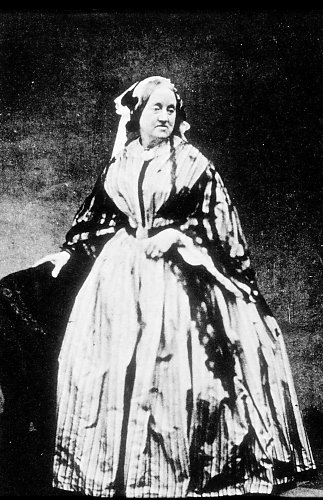
Anna Atkins 1861 [Source Wikipedia}
Anna and her husband, John Pelly Atkins, had no children of their own. Anna died in 1871 and her husband a year later. Their home, “Halstead Place”‘ has since been demolished.
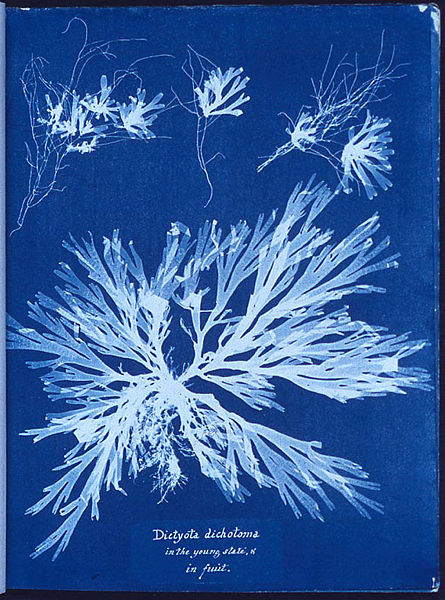
A photogram of Algae, made by Anna Atkins as part of her 1843 book, Photographs of British Algae: Cyanotype Impressions. Courtesy of The New York Public Library http://www.nypl.org.
.
Naturally my favourite photo book (or books, because the Cyanotypes of British Algae by AA run to three volumes) – “Photographs of British Algae – Cyanotype Impressions” by Anna Atkins, my distant cousin. In 1992 I had the great privilege to view copies of the volumes at the Library of the Royal Society in London. The edition ran from between 10 to 12 copies and a few of the plates from one of the copies are held in the National Gallery of Australia in Canberra.
I wish you all well for this celebration of the world’s first photo book by Anna Atkins.
Doug thanked Gael for her insight into the lady whose premier photographic pursuit we celebrate today.
Guests were then invited to continue their looking and talking about books, photography and other worthy matters. It was a remarkable event and one which will no doubt repeated in the future –– but it will be sooner than the next time we gather, once again, to celebrate WORLD PHOTOBOOK DAY.
..A PHOTOBOOK CLUB EVENT
.
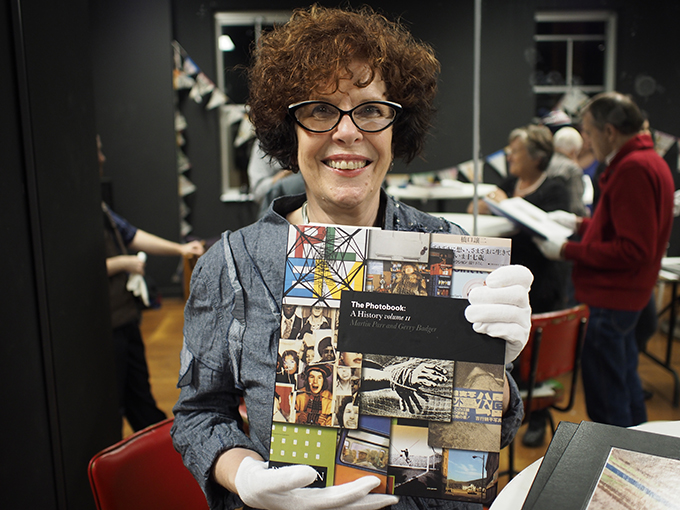
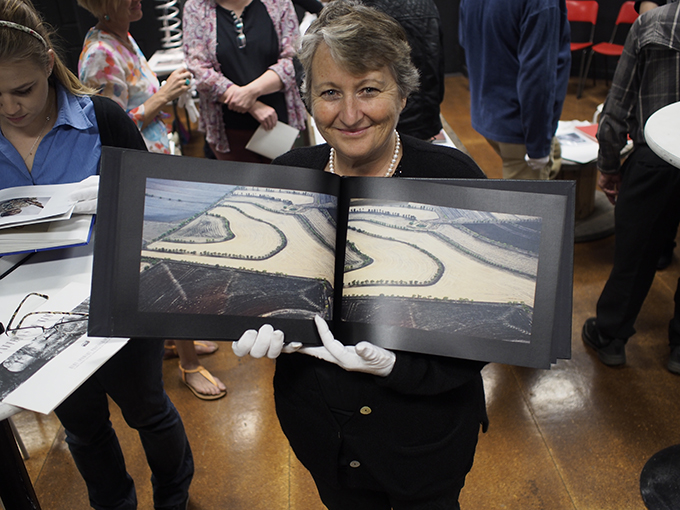
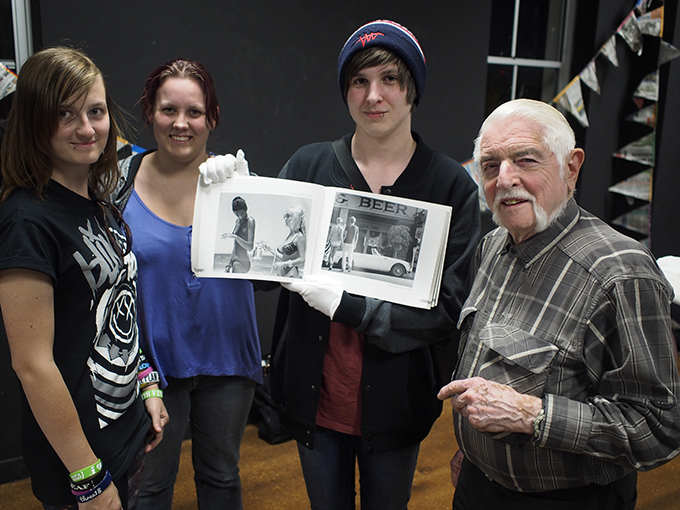
HERE SOME IMAGES OF ATTENDEES AND BOOKS … A detailed list of books presented for viewing and other contributions submitted online will be added to this post in the near future.
.
Report and photographs: ©2013 Doug Spowart. Anna Atkins’ story © Gael Phillips. Images of Anna Atkins sourced from Wikipedia and acknowledged appropriately.
.
.
NOCTURNE GRAFTON PROJECT: Fieldwork Concludes
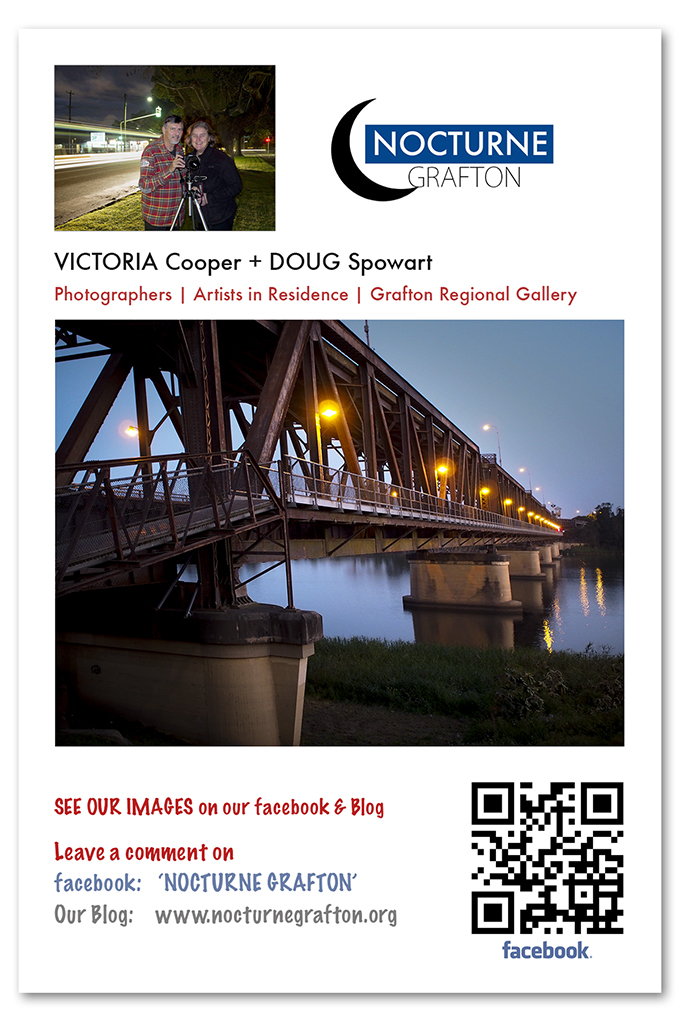
Promotional Card
.
We have just finished our artists-in-residence at the Grafton Regional Gallery. It was an amazing month and a wonderful opportunity to engage with the community and create art!
Artists in Residency programmes are an important opportunity to break out of the home/studio/teaching role routine to exchange or explore new ideas in a totally different environment. We consider our time in these residencies as essential to our practice; it transforms how we work and brings fresh ideas into our work. Integral to our projects is the immersion in each place and connecting with community and local narratives of place. Our time in Grafton was a remarkable: the community, its everyday stories and the imposing presence of the Clarence River all contributed inspiration for our creative work.
.
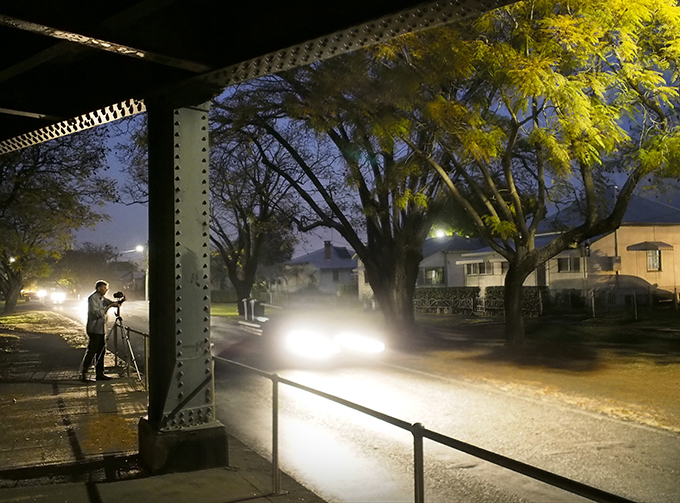
Doug photographing under the Pound Street viaduct
.
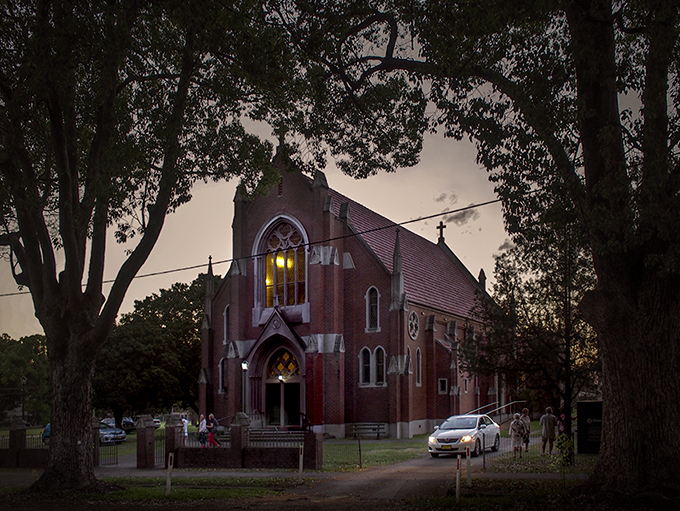

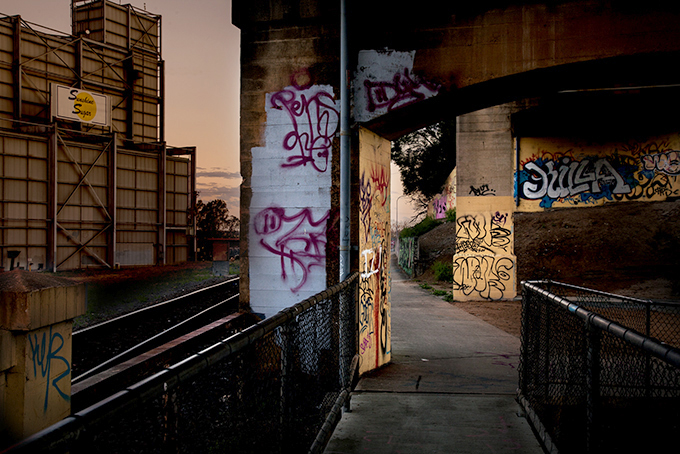
.
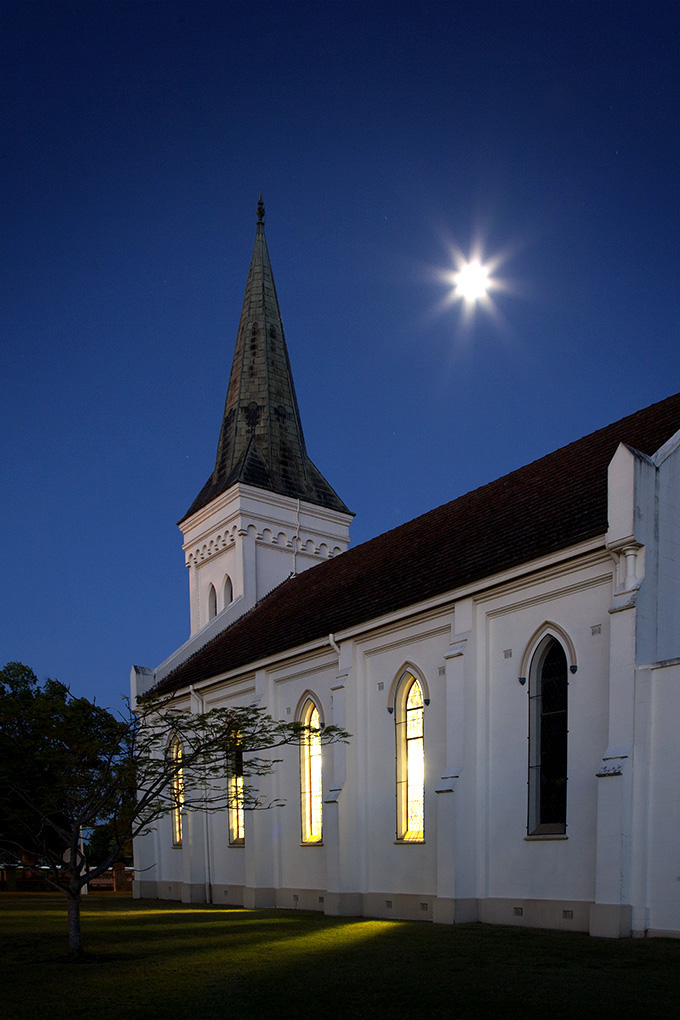
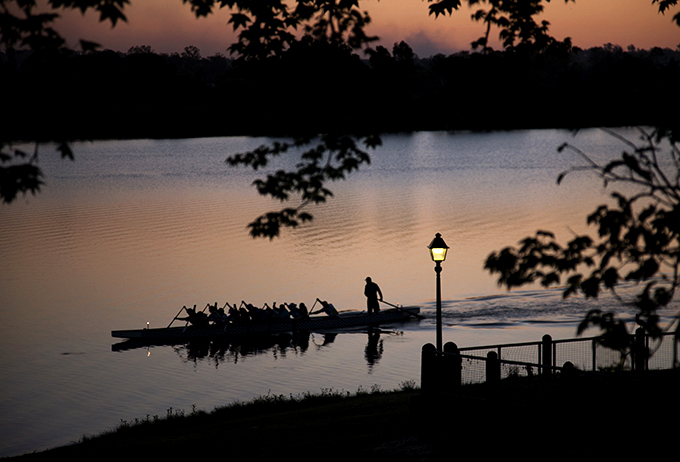
Our project was to create images of local places that to us visually evoked a narrative. The places were selected from our exploration of the town, researching local knowledge, and conversations with people we met. We sought places that were best illuminated by nocturnal light (late afternoon and early evening light). This light only lasts around 30 to 60 minutes, but its transformation of everyday places can be powerfully evocative. Our work in this time is intense and our awareness of the visual qualities of different spaces is deepened. The history and lived experience embedded in each place seems to ‘speak’ and we ‘listen’.
.
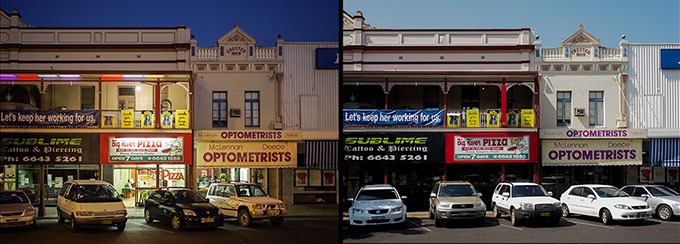
A comparison – Nocturne and daylight of the same subject
.
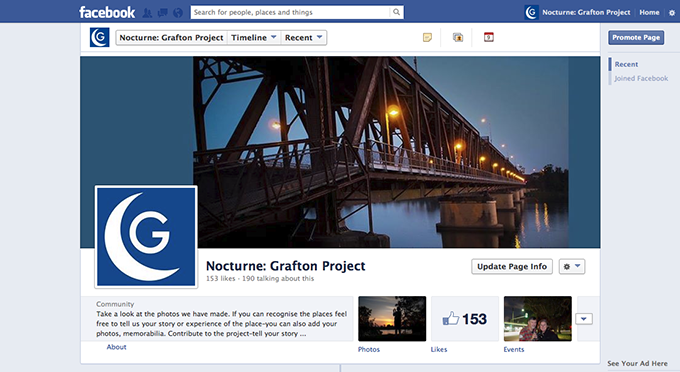
Facebook page
.
After each shoot we return to our residence to reflect, select and optimize our visual reconnaissance of nocturnal Grafton to then upload and ‘share’ online through Facebook and a blog. Through this sharing of our work we connected with a community and their stories in each place. Personal and historical accounts of these places brought our images to life. For us, this is where the art that exists – between our initial inspiration and local lived experiences.
.
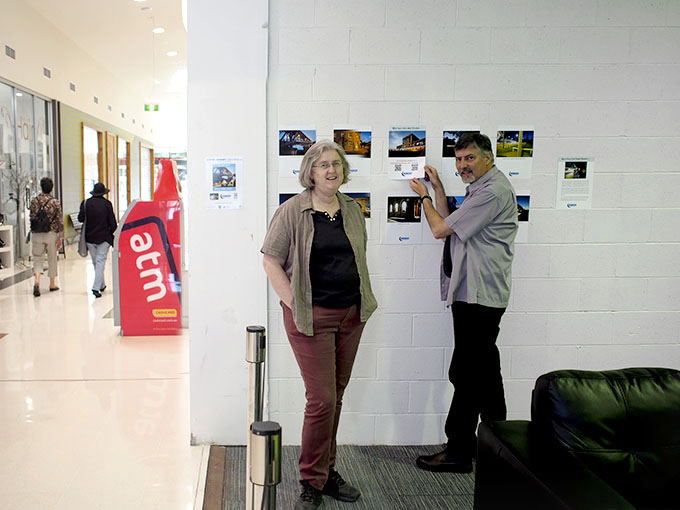
The LINK Shoppingworld gallery
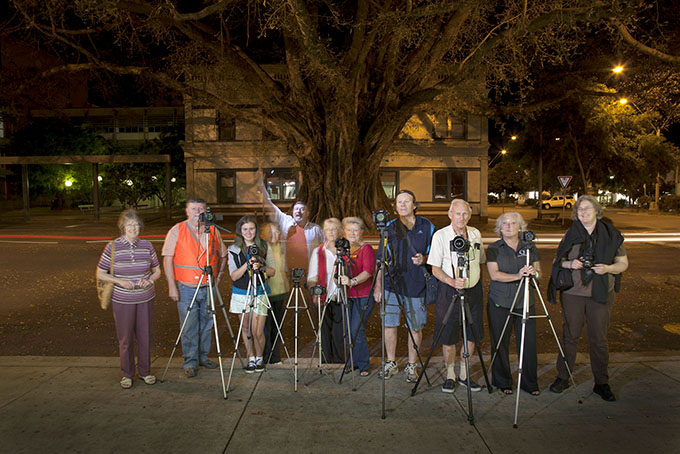
A nocturne shoot-out with the Grafton Camera Club
.
To extend the exchange that was integral to our project we also were involved in artists’ talks for schools, and other visitors to the Grafton Regional Gallery. We set up and attended two small displays of our ongoing work: one in the gallery and another in a vacant shop at the LINK arcade in the main shopping precinct. Doug and I had a very dear friend, Charlie Snook, who was a strong supporter and participant of the local camera club. So it was important for us to be able to connect with this enthusiastic group of photographers. We gave an evening talk, shared two of our nocturne shoots as photographic outings and judged their current assignment work. It was privilege to be invited to their 50th anniversary dinner held on the last weekend of our residency and a great way to finish our time in Grafton.
.

The C.R.A.P.y artist book team
.
We organized an activity to involve local and regional artists as well as a Brisbane arts professional in a collaborative artists’ book project. Under the auspices of the Centre for Regional Arts Practice, an organization created and coodinated by us, we held an activity over the weekend of September 21and 22. This collaborative event produced 60 copies of the C.R.A.P. Artist’s Survey Number 15, the theme of this survey was ‘the regional arts worker as a nomad’. Copies were shared amongst the participants while some were then set aside for donation to major collections including: The Grafton Regional Gallery and the State Library of Queensland.
.
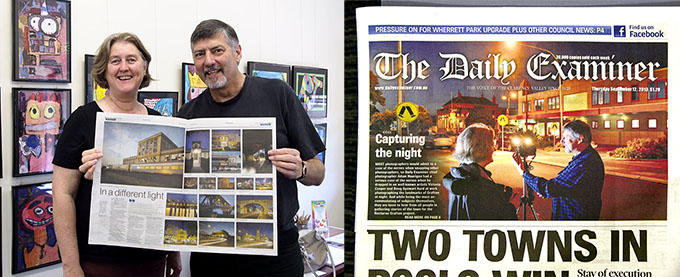
The Daily Examiner newspaper coverage
.
We were excited by the considerable support of and interest in our project from Grafton’s newspaper, The Daily Examiner, publishing separate stories, a front-page photograph and a weekend feature. Support also came from Senator Ursula Stephens shared the page and added ‘Grafton is the great Jacaranda city on the NSW north coast and the Nocturne Project is a wonderful example of celebrating local landmarks and building community identity. Love it!’ – was also an unexpected acknowledgement of our project. We visited the Grafton Historical Society and found a treasure of knowledge and information together with a willingness to assist in our research.
.
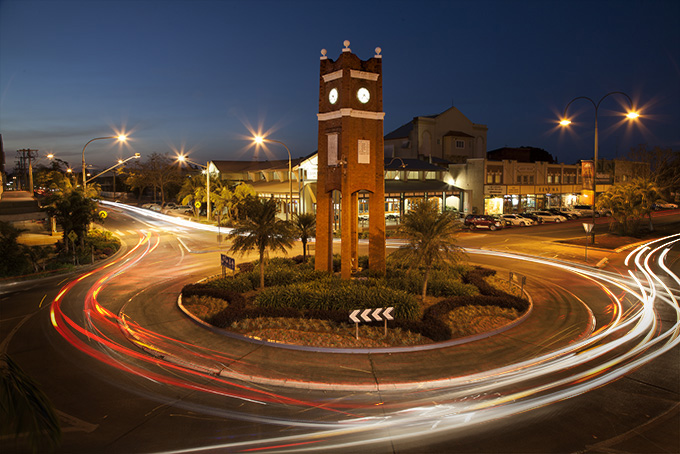
The Roundabout Clocktower from Weiley’s Hotel balcony
.
Some information on the Facebook component of the project: www.facebook.com/nocturnegrafton
During the month of September the project had 410 page ‘Likes’ and achieved a total viral reach of around 65,000 people. 65% of the Nocturne Grafton fan base were women (the Facebook average is 46%). The main engaged age group were women 25-34 years @ 17% of the total (the FB Average is 12%). The most popular post was the Clocktower roundabout from Weiley’s Balcony, which attracted 4,500 views and 274 likes, 37 comments and 44 shares (some of the reach was boosted). Interpretation of Facebook analytics is an interesting task and one that we will be reviewing over the next few weeks. We will maintain the Facebook page as a place for continued conversation.
.
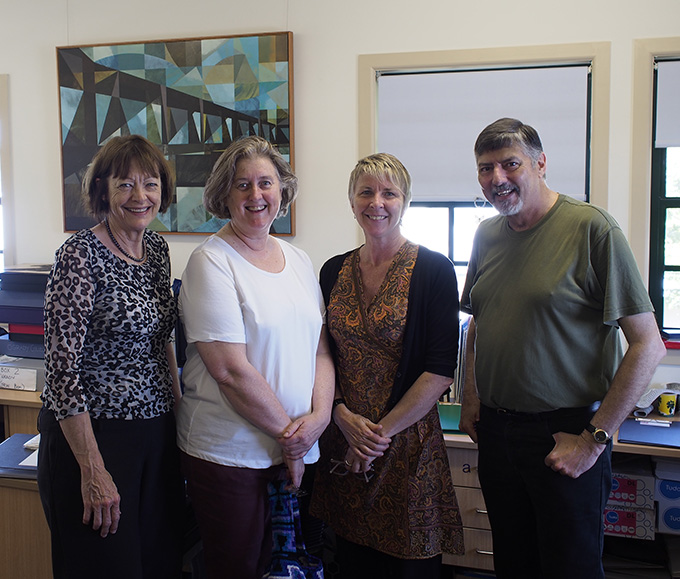
Jude McBean, Vicky, Cher Breeze & Doug
.
At all times during our residency an energetic and professional team, Jude McBean GRG Director, Cher Breeze, Avron Thompson and many dedicated volunteers at the Grafton Art Gallery provided valuable assistance, advice and stories. With the vision and support of the Gallery the residency was for us a transforming experience and our time at Grafton Art Gallery was highly productive.
And a BIG thank you to all our Facebook Friends who supported the project by their ‘Likes’, ‘Comments’ and ‘Shares’.
The final visual outcome for the project will be in the form of the continued online presence, artists/photo books and exhibition of image work. These artworks will reflect on the collaboration between our photographs, the social media project and the Grafton community.
.
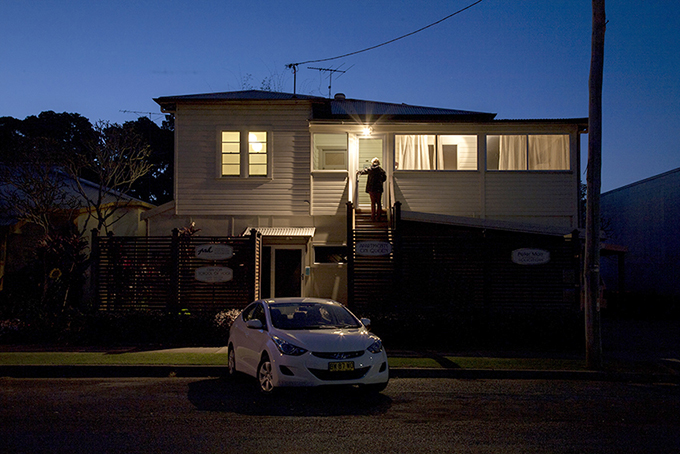
Going home on the last night of the residency…
Some comments from our Facebook friends at the conclusion of the project:
Peter Hunter OAM, ARPS, AFIAP: Victoria and Doug. I am really impressed with your photographs of Grafton at dusk. Your very impressive skill at taking a very ordinary subject and creating a great photo from it by using super composition, creative evening light and long exposure has resulted in a wonderful collection. I hope that they will be archived for posterity.
Marlene Szepsy: I have really enjoyed your way of sharing and bringing art to the community. A great artists in residence project. Thank you.
Louise Kirby: You have been wonderful AIR’s and I am so glad you came and shared your beautiful photography, your skills and your enthusiasm …
Adam Hourigan: pleasure meeting you guys. The photos make Facebook a much brighter place
Vanessa Collins: thanks for the way you have shown our beautiful town, can’t wait for the exhibition and the book
Stephanie Haines: Thank you for the beautiful photos… they made us all look at our town in a new way.
.
© 2013 Victoria Cooper and Doug Spowart for The Nocturne Grafton Project
..
.
This work is licensed under a Creative Commons Attribution-NonCommercial-NoDerivs 3.0 Unported License.
.
.
A PhD Conferred ‘in absentia’: And other PhD stories from Victoria Cooper
O.
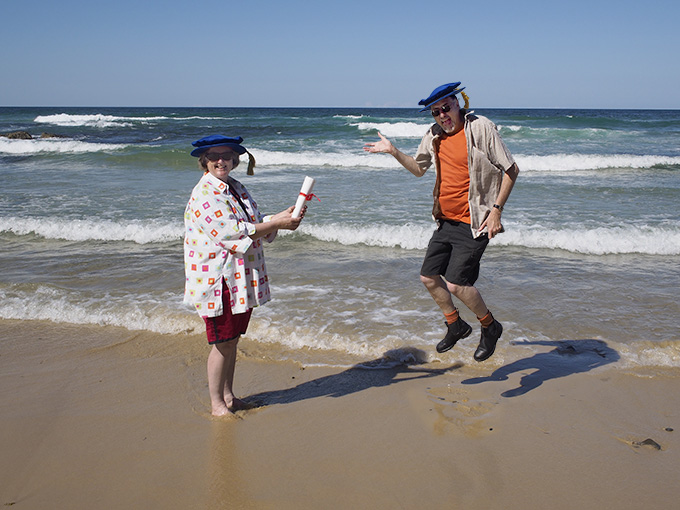
Vicky receives her testamur in absentia (a place near Diggers Rest – Grafton) …..Doug — Jumps for joy!
.
Vicky has her testamur at last! Doug is very happy as he can celebrate with Vicky their PhD awards!
We reckon that Diggers’ Rest has never seen such crazy head gear…..and that it should be considered that PhD conferral ceremonies should all be like this.
.
OTHER PhD POSTS ABOUT VICKY’S STUDY CAN BE FOUND HERE
THE WOOLI STUDY CENTRE:
https://wotwedid.wordpress.com/2012/04/01/easter-wooli-study-and-research-centre/
THE PENULTIMATE DRAFT + 5 FOOD ANTIDOTES:
https://wotwedid.wordpress.com/2012/10/31/the-phd-penultimate-draft-and-5-food-antidotes/
WAITING FOR THE EXAMINERS REPORT:
.
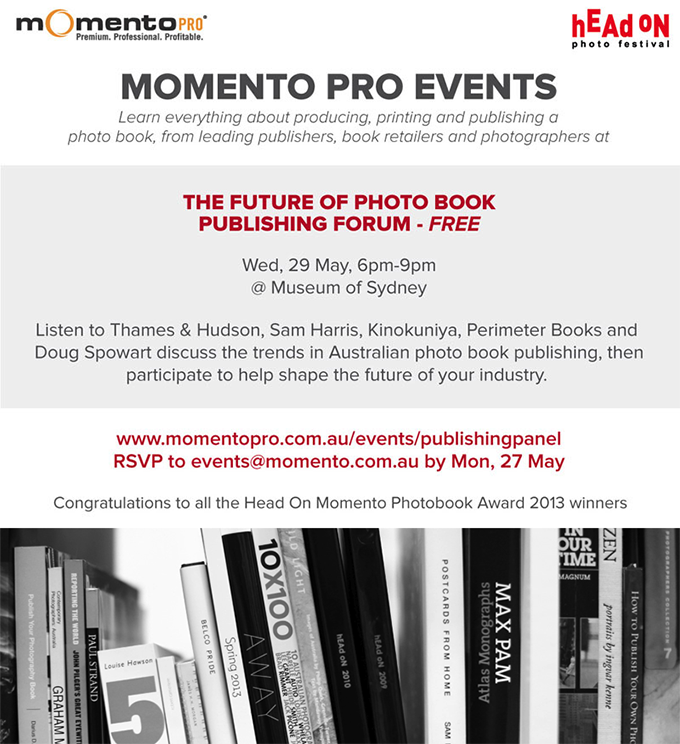
hEADoN into THE FUTURE OF PHOTOBOOK PUBLISHING
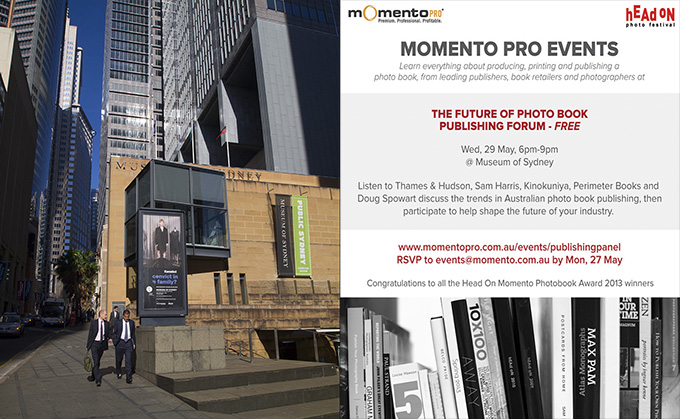
Invite and MOS

The Future of the Photo Book Forum ……Photo: Victoria Cooper
.
RUNSHEET & OVERVIEW:
Momento Pro/HEADON Event: The Future of Photo Book Publishing
.
6.00 pm Panellists arrive on stage
6.10 pm Doug Spowart: Welcome and good evening.
Photographers and those who make photobooks are storytellers – and – with this in mind – I would like to acknowledge and pay respect to the traditional owners and story-tellers of this land on which we meet; the Gadigal people of the Eora Nation.
This evening we will discuss the photobook and consider the opportunities for its future in Australia.
My name is Doug Spowart, I make artists books, photobooks and I have a research interest in photography and the form of the photobook.
This evening I’m joined by an eminent panel of book people with a wide range of knowledge and expertise on the topic.
The order of this evening will begin with an overview by me about the photobook. Then each of the panellists will discuss their involvement within the book and photobook world. Following that the panel will be presented with a range of questions – some sent in from attendees. Towards the end of the forum we have set aside time for your questions and comments to the panel. The forum will close and be followed by refreshments and networking opportunities …
At this juncture I would like to thank our Sponsor Momento Pro and the Organizers of the HeadOn Photo Festival, and the Museum of Sydney for this opportunity to engage in dialogue about this growing and evolving medium …
.
AN OVERVIEW OF THE PHOTOBOOK
.
Photobook luminary Martin Parr states:
… that photography and the book were just meant for each other; they always have been. It’s the perfect medium for photography: it’s printed, it’s reproducible and it travels well. (Parr in Lane 2006:15)
The photobook is indeed the ‘perfect medium’ for photography and its history, the history of photography are inextricably linked with that of publishing. In fact some of the earliest experiments in photography made by Hércules Florence (1804 -1879), Nicéphore Niépce (1765 -1833) and Henry Fox Talbot (1800 -1877) were to discover methods and processes that would enable the copying and printing of texts or designs by capturing and fixing camera obscura images.
![William Henry Fox Talbot, by John Moffat, 1864 By Michael Maggs [Public domain], via Wikimedia Commons](https://wotwedid.com/wp-content/uploads/2013/06/william_henry_fox_talbot_by_john_moffat_1864-by-michaelmaggs-public-domain-via-wikimedia-commons.jpg)
William Henry Fox Talbot, by John Moffat, 1864
By Michael Maggs [Public domain], via Wikimedia Commons
Books illustrated by photographs as a genre of the publishing industry flourished. The photographic image could operate as a storyteller, a precise document of truth, a device to entertain and, at times, a carrier of propaganda. Early photography book works consisted of travel, geographical and military expeditions, trade catalogues, scientific and ethnographic documentation.
Although some photographers, like Talbot, may have established their own publishing ventures, usually the photographer was a supplier of images for a publication that was commissioned by someone else – a publisher, benefactor or government agency. The publishing of a book was, and still is, a task requiring the specialized skills, the entrepreneurship and financial acumen found in the worlds of publishing, marketing and bookselling. Books are created for a purchasing audience: it is a mercantile process where return on the investment in a publishing project is a necessary outcome.
What is it about photographers and their need for photobooks?
Martin Parr describes the influence that photobooks had on his own practice by stating that:
I’m a photographer and I need to inform myself about what’s going on in the world photographically. Books have taught me more about photography and photographers than anything else I can think of. (Parr in Badger 2003:54)
Parr is not alone. The publishing house Aperture – a well established international publisher of contemporary and historical photographic essays and monographs – acknowledges in their organization’s credo that:
Every photographer who is a master of his [sic] medium has evolved a philosophy from such experiences; and whether we agree or not, his thoughts act like a catalyst upon our own — he has contributed to dynamic ideas of our time. Only rarely do such concepts get written down clearly and in a form where photographers scattered all over the earth may see and look at the photographs that are the ultimate expression. (in Craven 2002:13)
Library
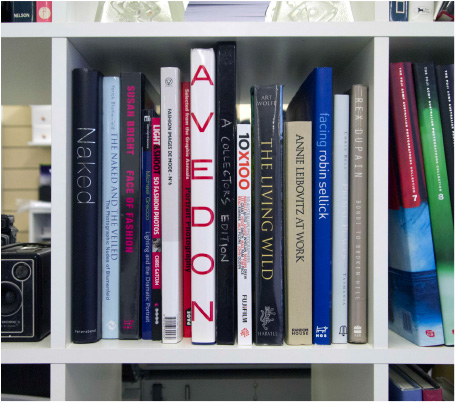
So photographers seek inspiration for their work by building their own reference libraries: have you ever visited a photographer and not had discussions about books or been invited to see their library? It then makes sense that photographers will want a book of their own. Photobook publisher Dewi Lewis exclaims: ‘I have yet to meet a photographer who doesn’t want to see their work in book form.’ (Lewis and Ward 1992:7).
Photobook commentators and publishers of the book Publish Your Photography Book, Darius Himes and Mary Virginia Swanson claim that this need is universal and emotive:
It almost goes without saying that every photographer wants a book of his or her work. It’s a major milestone, an indicator of success and recognition, and a chance to place a selection of one’s work in the hands of hundreds, if not thousands, of people. Plus it is just plain exciting to hold a book of your photographs! (Himes and Swanson 2011:26)
It seems that this ‘rite of passage’ is an important step of professional recognition as photographer, photobook maker and writer – Robert Adams – makes the following statement in his book Why people photograph:
I know of no first-rate photographer who has come of age in the past twenty-five years who has found the audience that he or she deserves without publishing such a book. (Adams 1994:44-5)
Does it then follow that every photographer of note or the creator of a significant body of work deserves a book?
It is not that easy. Amongst others the photobook publisher Dewi Lewis argues that the market for photobooks is limited – where he identifies that: ‘photographers themselves are the largest purchasers of photobooks’ (Lewis and Ward 1992).
Ultimately unsold books are remaindered – something even Magnum photographer Martin Parr experienced. His first book Bad Weather (1982) sold poorly and was remaindered at 40p. In an essay on photobook publishing Peter Metelerkamp reports that:
Parr himself bought in as many copies as he could at that price (very much below the cost of production) (Metelerkamp circa 2004:7).
But while remaindered books can be a great way to acquire a low priced library they represent a loss to the publisher, who may then be wary of undertaking future photobook ventures.
The photographers who are successfully trade-published are usually either well known and/or are those who produce work that is of interest to a broad audience. Most notably in Australia this has included celebrated photographers such as Harold Cazneaux (1878-1953), Frank Hurley (1885 -1962), Max Dupain (1911-1992), Jeff Carter (1928-2010), David Moore (1927-2003), Peter Dombrovskis (1945 -1996), Rennie Ellis (1940-2003).
In contemporary times other avenues of photobook publishing as a documentary/art project have emerged and include photobooks by Tracey Moffatt (1960- ), Max Pam (1949- ), Matthew Sleeth (1972- ), Stephen Dupont (1967- ), Trent Parke (1971- ) Michael Coyne (1945- ) and Wesley Stacey (1941- ) and many others. The field of contemporary pictorial photobook books could be represented by the likes of Ken Duncan (1954 – ), Peter Lik (1959 – ) and Steve Parish (1945 – ). Then there are so many more …
So what about the photographer doing it for themselves?
Historically, the self-publishing of photobooks was a huge investment of time and money – an individual photographer’s access to the required production and printing facilities was a major barrier. Also those who have financed their own publishing exploits generally lacked the distribution and marketing connections that were attached to the major publishing houses.
Access to printing facilities were overcome by the photographer having contacts in or working in the printing industry such as American photobook-maker Ed Ruscha did with books like Twenty-six Gasoline Stations (1963). In Australia Peter Lyssiotis was able to produce: Journey of a Wise Electron (1981) and other books by participating in a co-operative that accessed a commercial printing press during down time or on weekends. But these access points were not available for everyone who wanted to publish a book.
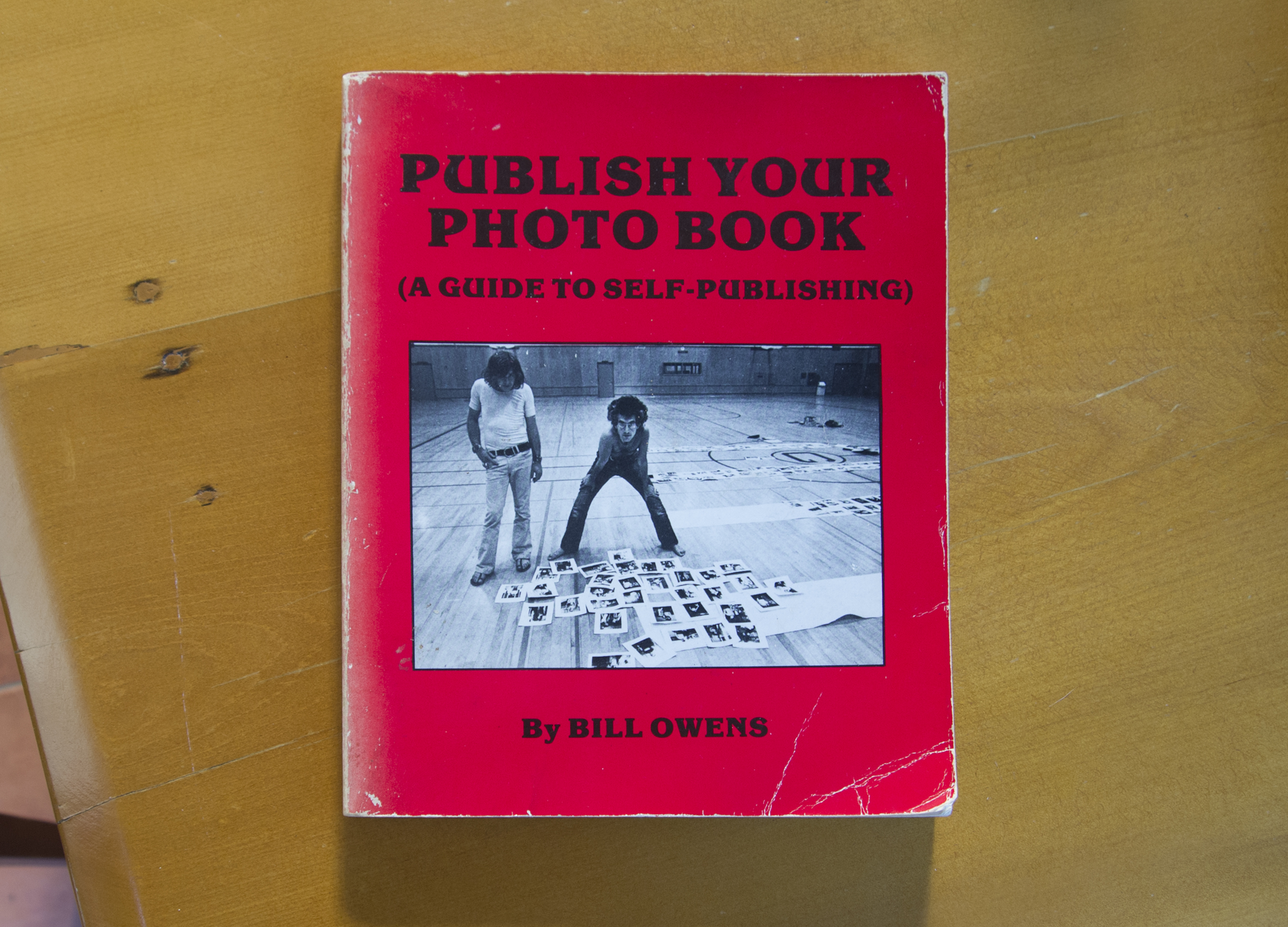
Bill Owen’s book
Nearly 35 years ago American photographer Bill Owens, publisher of Suburbia (1972) and other books made the following introductory statement to his info-guide – Publish Your Photo Book (1979) – a statement that may resonate with the experience of today’s photobook publishers:
Had my photographic books made lots of money I would not have written this book. I wouldn’t need to because I would be part of the establishment and enjoying its privileges. (Owens 1979:3)
It has been a long time coming, but 175 years later with digital technologies including DIY book design software, print-on-demand presses like HP Indigo, the self-published photobook is fulfilling Talbot’s prediction. It’s never been easier for anyone to make a photobooks.
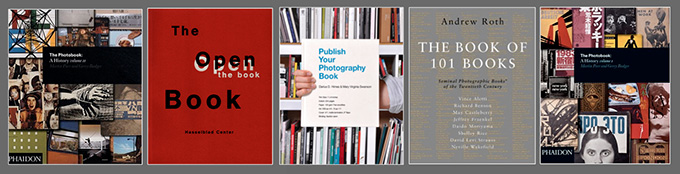
Some seminal photobook texts
The photobook discipline now has commentators and critics, there are awards, linkages with the artists book, supporting independent groups like Self Publish Be Happy, The Photo Book Club and the Indie Photo Book Library.
However just making a book, even your own, does not guarantee success – whatever that might be. But at this time, what are the barriers and opportunities that we in Australia need to consider and respond to as this boom in photobooks continues?
What ideas, social and political mechanisms and appropriate structures do we need to create to nurture and support this emerging publishing paradigm?
Let us now pose some questions to the panel …
.
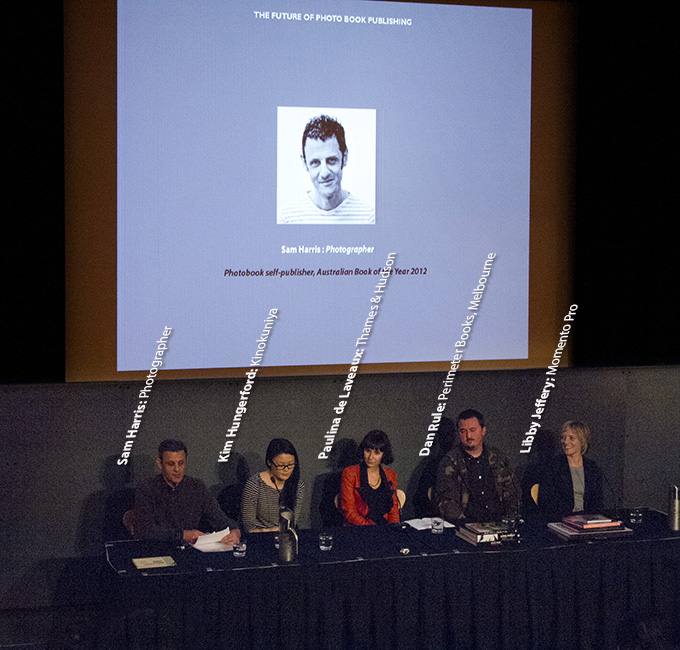
INTRODUCTION OF THE PANELISTS
See invitation blog post for bios http://wp.me/p1tT11-MT
.
.
A SELECTION OF THE QUESTIONS POSED TO THE PANEL
- What is the recipe for the perfect commercially viable photo book?
- Are Awards/Fairs/Festivals/Exhibitions important to or essential for photo book sales and marketing?
- It’s often stated that the basic market for the photo book is photographers themselves – how can this market be expanded so that the photo book can become more popular for a broader audience?
- Is the Australian photo book consumer more interested in Euro/USA content than homegrown books?
- Is there a market for Australian photo books overseas? Are there mechanisms in pace to support photo books as export? Are our photo books internationally competitive?
- If, as a publisher, you were approached by a photographer with a photo book idea – What would you expect them to bring to your meeting with them.
- What kinds of books/themes or content would an independent or niche publisher take on that a mainstream publisher wouldn’t?
- In the photo book genre, as with other special interest low volume publication sales, will print on demand publishing become a viable option – thereby doing away with the practice of remaindering?
- How can we nurture, inspire and develop the Australian photo book market?
.
A SYNOPSIS OF THE DISCUSSION WILL BE POSTED SEPARATELY:
.
In conclusion … I’d like to see, and I guess you would as well, that the photobook break from the publishing paradigm that Bill Owens spoke of before.
Let’s hope that as a result of, or perhaps more modestly, that this forum will contribute to a future where photographers and their photobooks will be recognized, revered and financially rewarded for their contribution to telling their stories, our stories and the stories of humanity and of life on this planet and beyond.
Once again thank you to our panelists …
Our sponsor – Momento Pro
The HeadOn Photo Festival
And to you all —–
You are now most welcome to join us for some refreshments and networking
8.15 pm Close…..
.
.
Bibliography for Doug’s Overview
Adams, R. (1994). Why People Photograph. New York, USA, Aperture Foundation.
Badger, G. (2003). Collecting Photography. London, Mitchell Beazley Ltd.
Craven, R. H. (2002). Photography past forward: Aperture at 50. New York, Aperture Foundation Inc.
Himes, D. D. and M. V. Swanson (2011). Publish Your Photography Book. New York, Princetown Architectural Press.
Lane, G. (2006). “Interview: Photography from the Photographer’s Viewpoint. Guy Lane interviews Martin Parr.” The Art Book 13(4): 15-16.
Lewis, D. and A. Ward (1992). Publishing Photography. Manchester, Conerhouse Publishing.
Metelerkamp, P. (2004). “The Photographer, the Publisher, and the Photographer’s Book.” Retrieved 12 March 2009, from http://www.petermet.com/writing/photobook.html.
Owens, B. (1979). Publish your Photo Book (A Guide to Self-Publishing). Livermore, California, USA, Bill Owens.
Talbot, W. H. F. (1839). Letter to Sir John Herschel, HS/17/289. The Royal Society. S. J. Herschel. London, UK, The Royal Society: HS/17/289.
.
.
.
All photographs © 2013 Victoria Cooper & Doug Spowart
Texts an Overview (except references as cited) © 2013 Doug Spowart
.
This work is licensed under a Creative Commons Attribution-NonCommercial-NoDerivs 3.0 Unported License.
.
.
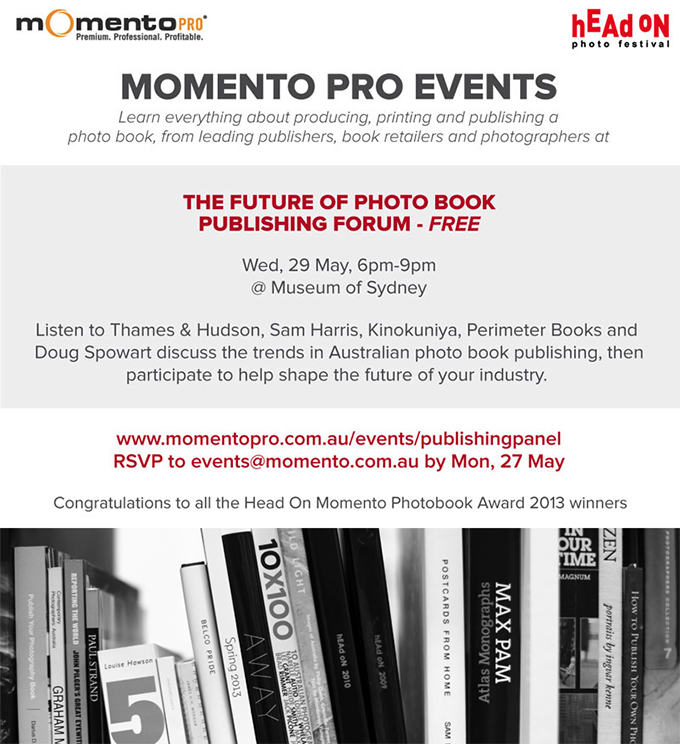
hEAdoN/Sydney: Doug to moderate panel on Photobooks
 .
.
.
THE FUTURE OF PHOTO BOOK PUBLISHING FORUM
Presented by Momento Pro http://www.momentopro.com.au/events/publishingpanel
A Head On Photo Festival Event
Wed, 29 May, 6.00 – 9.00pm
@ The Museum of Sydney
Admission is free but please RSVP to events@momento.com.au by 25 May
Join panelists and guests from the photography, publishing, print, book retail and creative industries to discuss local and international trends in photographic book publishing, and contribute to shaping its future. The panel discussion will conclude with open questions from the audience, followed by refreshments and networking.
Should you wish to submit questions for consideration please email events@momento.com.au.
THE PANEL
.

Doug Spowart …..Moderator
Photographer & Academic
Dr Doug Spowart has been extensively involved in creative media areas for over 40 years — his practice includes: artists books, photobooks, artist, critic, judge, writer and teacher. He has completed a Doctorate of Philosophy at James Cook University researching issues of the contemporary photobook. Spowart’s work, as well as collaborative work with Victoria Cooper has found its way into many private, regional and state public galleries, national and international photography and artists’ book collections. Spowart’s photobooks have won the AIPP Queensland Photographic Book of the year on two occasions and he has twice been Runner-up to the national AIPP photobook award.
.
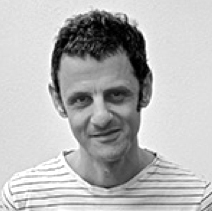
Sam Harris / Photographer
Sam Harris has been a passionate photographer and educator for more than 20 years. He started freelancing in the London music industry making album sleeve art then went on to shoot editorial portraits and documentary features for leading publications including The Sunday Times Magazine, Esquire, GQ and Ray Gun (USA).
In 2002 he re-evaluated his lifestyle to travel the globe with his family, until he settled in the forests of South Western Australia in 2008 where he shoots his on-going family diary, lectures photography, runs workshops and creates photographic books. His book Postcards from Home has received multiple awards including the publishing industry’s Galley Club Book of the Year and Australian Book of the Year Award 2012.
.

Kim Hungerford
Kinokuniya / Art & Design Department Manager
Kinokuniya stocks an extensive collection of graphic novels, art, design and travel books and also features an instore Art Gallery which exhibits works from creative artists to help them develop their careers. As Art & Design Manager, Kim is versed in the distribution, sales, marketing and financials of art and photographic book publishing, the different publishing options available and the differences in reception from book consumers, critics and collectors.
.
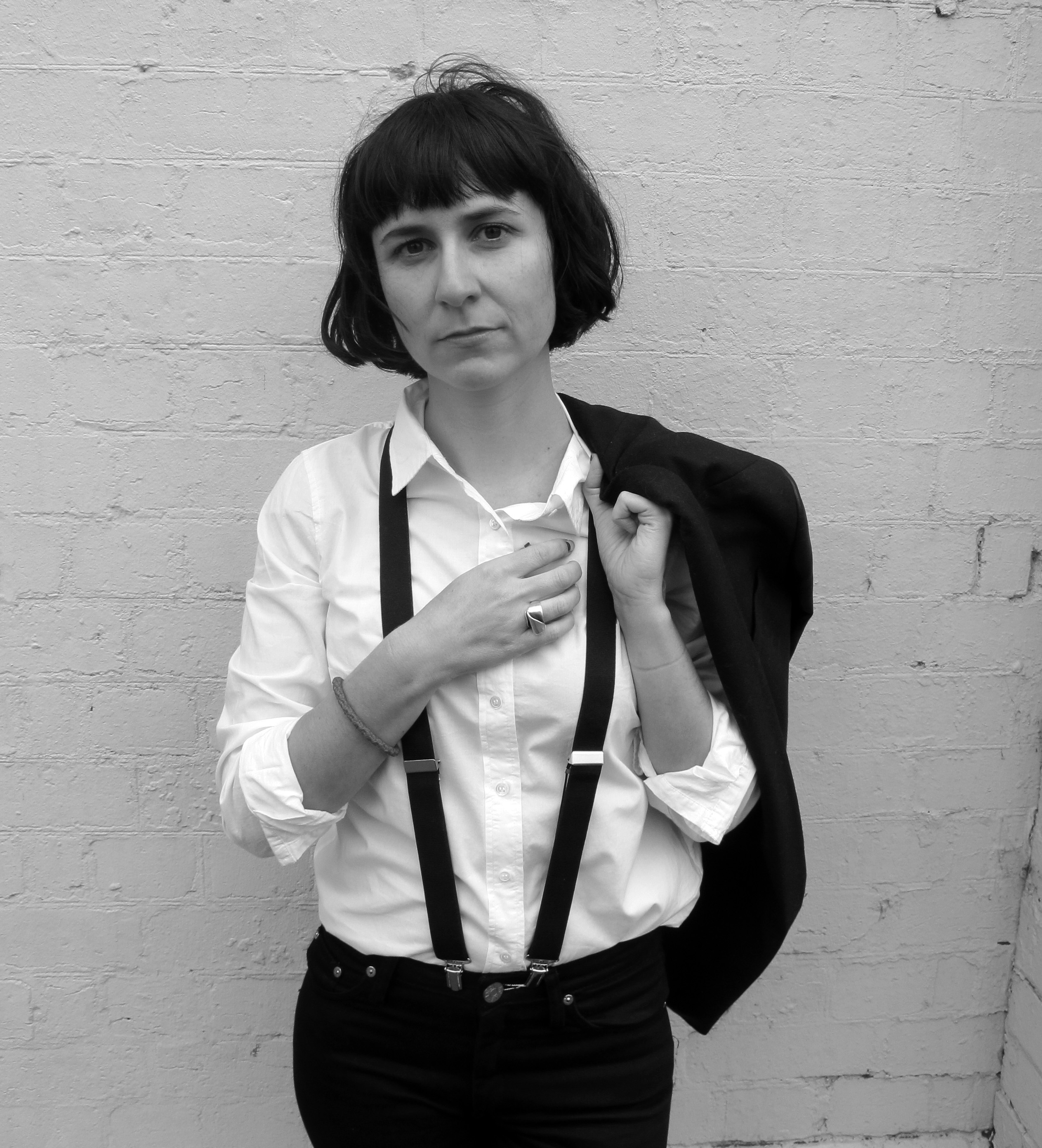
Paulina DeLaveaux
Thames & Hudson / Publishing Manager
Paulina de Laveaux is Publishing Manager of Thames & Hudson Australia specialising in illustrated books on art, architecture, design, photography, fashion and other creative fields.
Paulina is passionate about books, and familiar with what makes a photographic book artistically and commercially successful, what is popular with the mainstream consumer verse the cultural consumer, and has also been a judge for the Head On Momento Photobook Awards 2013 and the Most Beautiful Books Awards
.

Dan Rule
Perimeter Editions / Director
Dan Rule is a writer, critic, editor and publisher from Melbourne, Australia. He is the co-director of Perimeter Books, Perimeter Editions and Perimeter Distribution, the co-publisher of Erm Books and an editor of Composite Journal.
He is also a weekly art critic and columnist for The Saturday Age, contributing editor and senior writer at Broadsheet Media and has written on art, photography, music and culture for The Sydney Morning Herald, Dazed & Confused, Oyster, Vault, Art Guide, Australian Art Collector and countless others.
.

Libby Jeffery
Co-founder and Communications Manager @ Momento
Libby has enjoyed studying and working in communications and media production since undertaking a B.A. Communications at UTS and volunteering with interactive CD-ROM producer Pacific Advanced Media Studios in 1994. Since then her career has revolved around communications, events coordination and media production for creative industry pioneers including OzEmail, the Australian Interactive Media Industry Association (AIMIA), IPR Systems and most recently the Chippendale Creative Precinct.
Following her role in 1999 as Project Manager for the Australian Society of Authors’ e-publishing and digital rights management experiment, OzAuthors, she, partner Geoff Hunt, and colleague James Whitwell founded Momento in 2004. Momento was Australia’s first print-on-demand photo book service and the proprietary Momento layout software, lets anyone design their own coffee-table photo book easily, ready for printing. Momento remains the ‘finest’ service provider in Australia today, celebrating photography and photographers in all forms
.

.
.
DOUG HAS FEATURED POST: State Library of Qld DESIGN ONLINE Blog
Recently I was commissioned to write a piece for the State Library of Queensland’s Design Online Blog.
I chose to write a commentary on the proliferation of images on social media and connect it with the Andy Warhol statement about everyone having 15 minutes of fame.
The Design Online blog has as its mission the following proposition:
Every idea, thought, or position has an origin, and often this origin exists in the ideas, thoughts and positions of others. Design Online creates a shared environment for the design community to come together in the creation of new knowledge centred around design in the Asia Pacific.

.
If you are interested in fame, social media and photography today please view the design online site an consider the idea I’ve posted … CLICK THE PICTURE
.
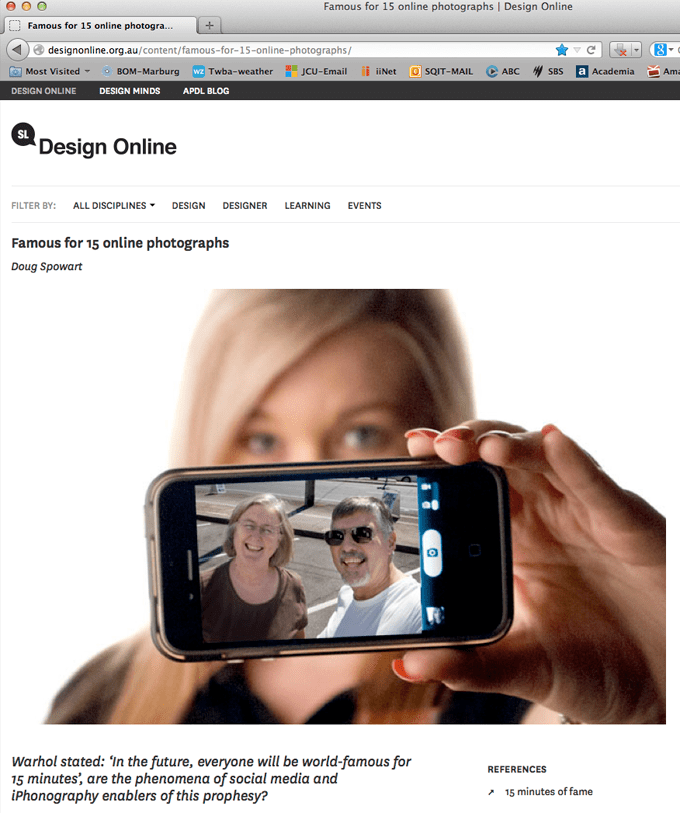
Doug Spowart post SLQ Designonline Blog
Thanks to Design Online for the opportunity to post the idea and to model Tash Armit for helping out with the photo header image.
.
Photography and Essay ©2013 Doug Spowart
. This work is licensed under a Creative Commons Attribution-NonCommercial-NoDerivs 3.0 Unported License. . .

 wotwedid