Archive for the ‘Place-Projects’ Category
POETICS OF LIGHT: Pinhole Book and our work
.
It’s not everyday that you wander into an art gallery bookshop and you stumble across a book with your work in it…! A favourite gallery bookshop for me is the QAGOMA bookshops in Brisbane – it’s always worth spending a little time there to see the latest books, to do a little in-store pre-reading, and to check out the ‘Specials’ table where the unaffordable book often becomes affordable.
The other day I’d escaped from some research work at the State Library of Queensland by walking through the preparations in QAGOMA for the 8th Asia Pacific Triennial to drop by the gallery bookshop. I held and flicked through a few books when a large volume entitled Poetics of Light with a big white reduced price label – $99.95 to $59.95. The title seemed familiar to me – then I saw the sub-title Contemporary Pinhole Photography, ‘yes, I remember that’, I thought to myself.
.
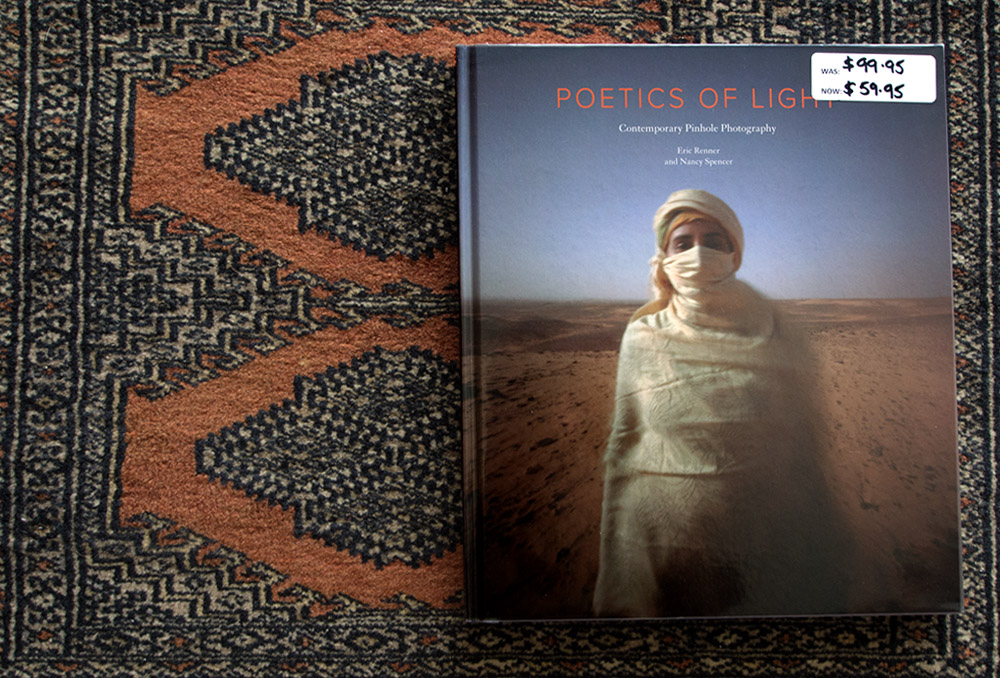
The book Poetics of Light
.
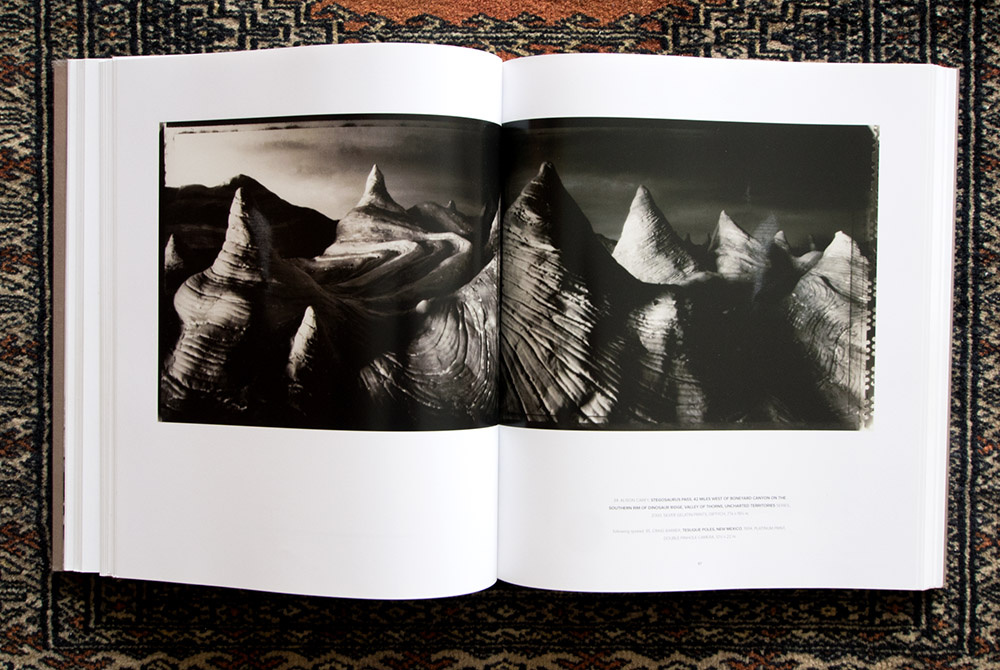
I flicked a few pages at the front of the book and one of my pinhole/zoneplate photos … a few pages on there was one of Vicky’s … I kept turning pages and I witnessed a compendium of amazing lensless imagery …
.

Doug’s ‘The Sentinel’ page

Vicky’s Banksia lineup


.
The last couple of years for us have been full of life-changing experiences and dealing with the issues of the moment, my being made redundant at TAFE and the subsequent time spent job searching, selling our house, lecture and writing commitments and amazing house-sit opportunities for friends – I’d completely lost track of this book and the exhibition that it compliments.
The Poetics of Life exhibition and book celebrates the donation of the pre-eminent Pinhole Resource Collection to the New Mexico History Museum (NMHM). The Pinhole Resource was founded by Eric Renner in 1984 and became the world’s centre for all things pinhole. Through personal research, workshops, networking and publishing Renner led the resurgence in pinhole photography, its techniques, images and its discourse. In 1989 Renner was joined by Nancy Spencer as a co-director of Pinhole Resource and co-editor of the Pinhole Resource journal.
.

The Poetics of Light Exhibition
.
Over the years Renner and Spencer amassed a unique collection of pinhole and camera obscura images, cameras both old and contemporary and texts, books and references about the art and practice of pinhole photography. Much of this material was donated by practitioners as a way of contributing to the ‘Resource’.
The Pinhole Resource Collection became part of the permanent collection of the Photo Archives of the New Mexico History Museum in 2012. This research archive is has the largest collection of pinhole photography and paraphernalia in the world with over 6,000 photographs, cameras, documents and books, as well as an entire run of Pinhole Journal. The NMHM has a website with images available to be searched by author’s/artist’s name, and also includes education resources and a blog.
So what is it about the pinhole image – why would anyone want to make photographs with a lens-less camera…? Renner and Spencer, in the book comment that: ‘describing the mystery of pinhole images is difficult, the concepts of soul, depth, yearning, timelessness, and archetypal feeling all contribute to the kind of visual reality produced, one perhaps only seen in a dreamlike state.’
We both felt privileged to have been selected for this book and exhibition and felt excitement at the opportunity to be recognised for our long practice in this worldwide movement.
Whilst much of our contemporary work centres on the camera obscura each year we participate in the yearly World Pinhole Day in late April – SEE our 2015-submission post HERE.
In the late 1990s I (Doug Spowart) was to state that: “pinholing creates images by simplicity, there is no techno-pretence; the images speak as murmurings, incantations of nostalgia, of mystique and memory; they are incisive and nebulous simultaneously; the process is an enigma.”
.

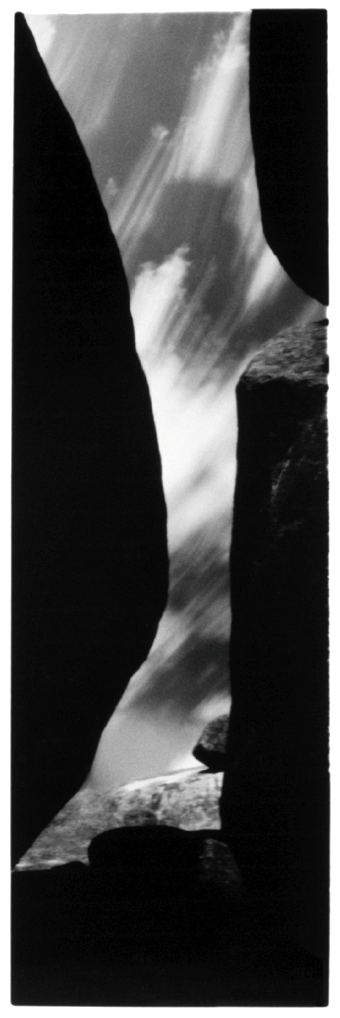
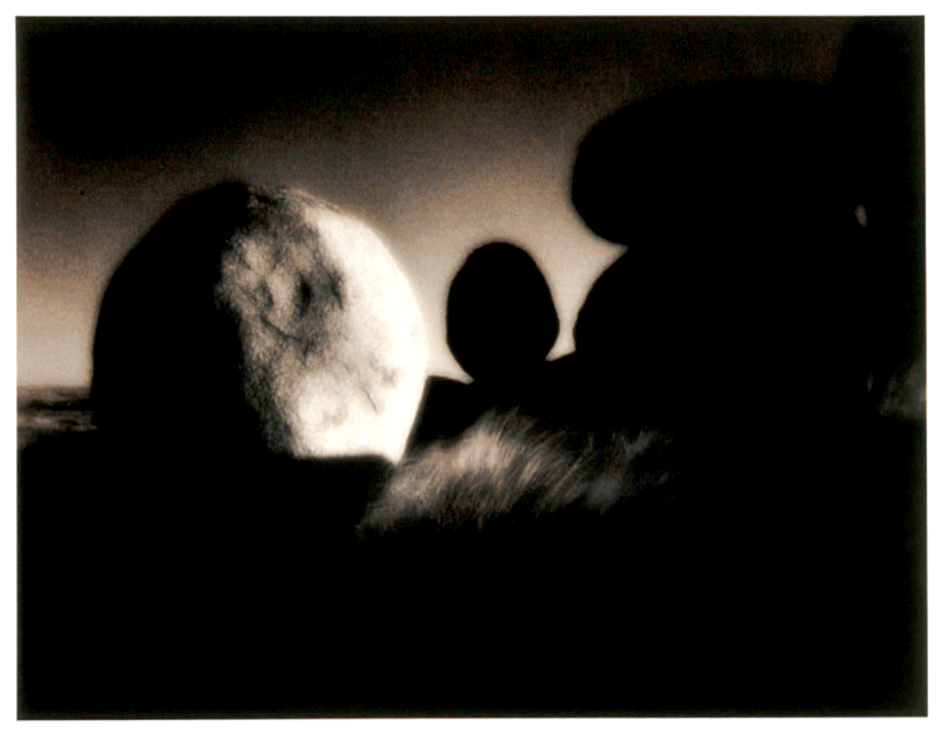
My pinhole (zoneplate) image from the Poetic of Light exhibition and book was taken at The Sentinel at Mt Buffalo using a modified 4×5 Graflex camera. In 1999 ILFORD featured the image in a PROPHOTO Magazine feature on my work. A story about the image is featured on our old website HERE
In a statement about the body of work, The Rocks of Ages, Victoria Cooper discusses her view that image is a result of the connection of technology, process, photographer and subject in the space/time of pinhole photography.
“These images formed part of an ongoing documentation of my corporeal and psychological experiences with the land. They were created using an ancient imaging device, the Pinhole, and analogue photographic materials. Each handcrafted image was then selectively toned to identify with memories other than the eidetic captured within the film. This process is slow and considered – the subject’s light remains on the photographic paper as not a direct document but rather as a visual exegesis of a time and place.”
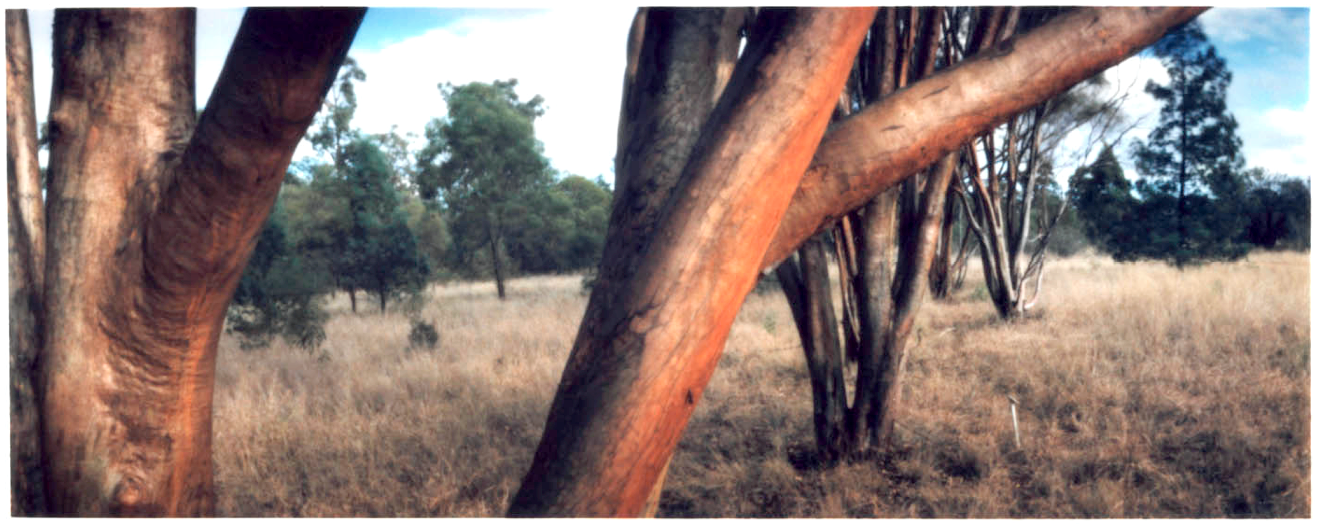
What follows is a selection of pinhole images made by Cooper+Spowart

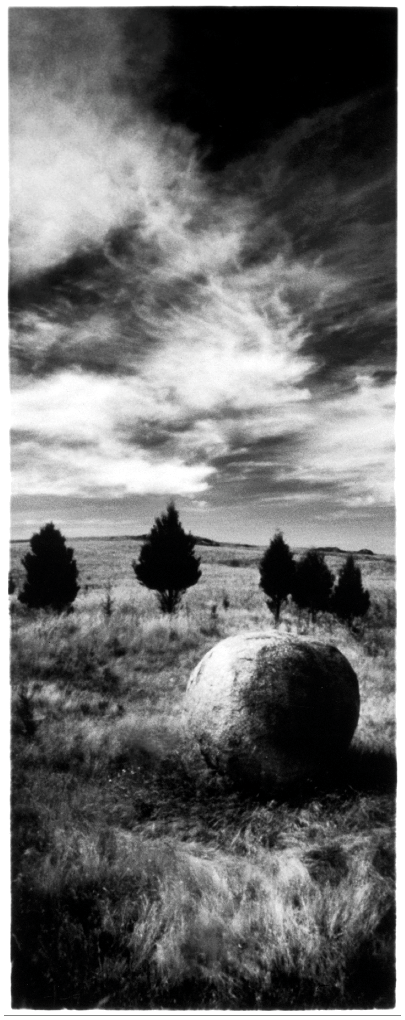
Vicky’s shortbread biscuit tin 6x17cm panorama roll film

.
Other pinhole works by Vicky from film boxes and other cameras …

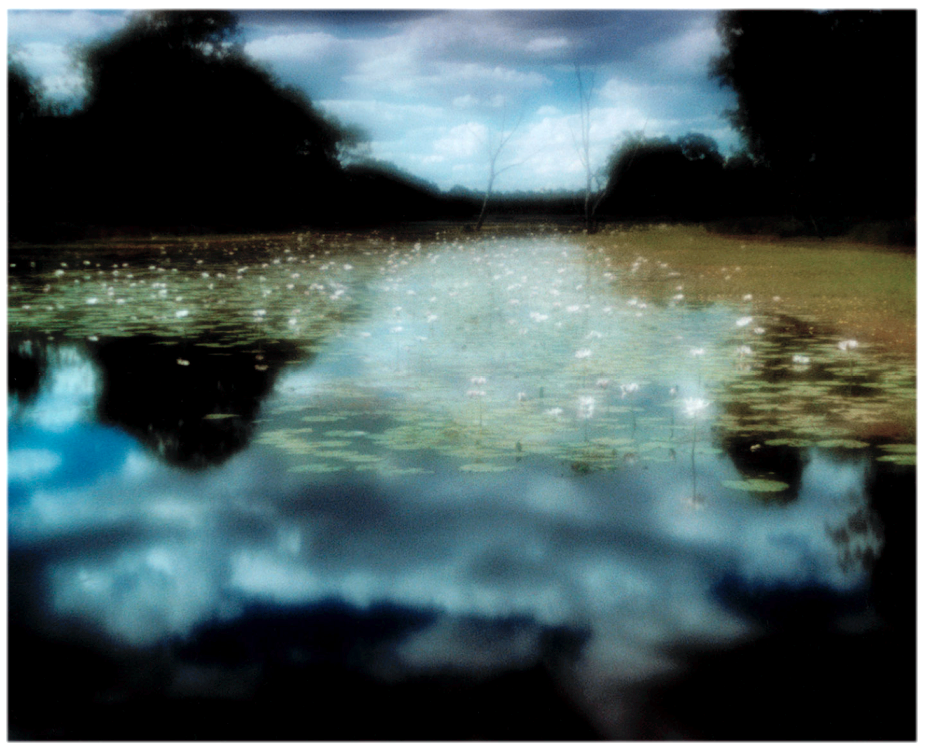

4×5 Chrome film exposed in a film box
.
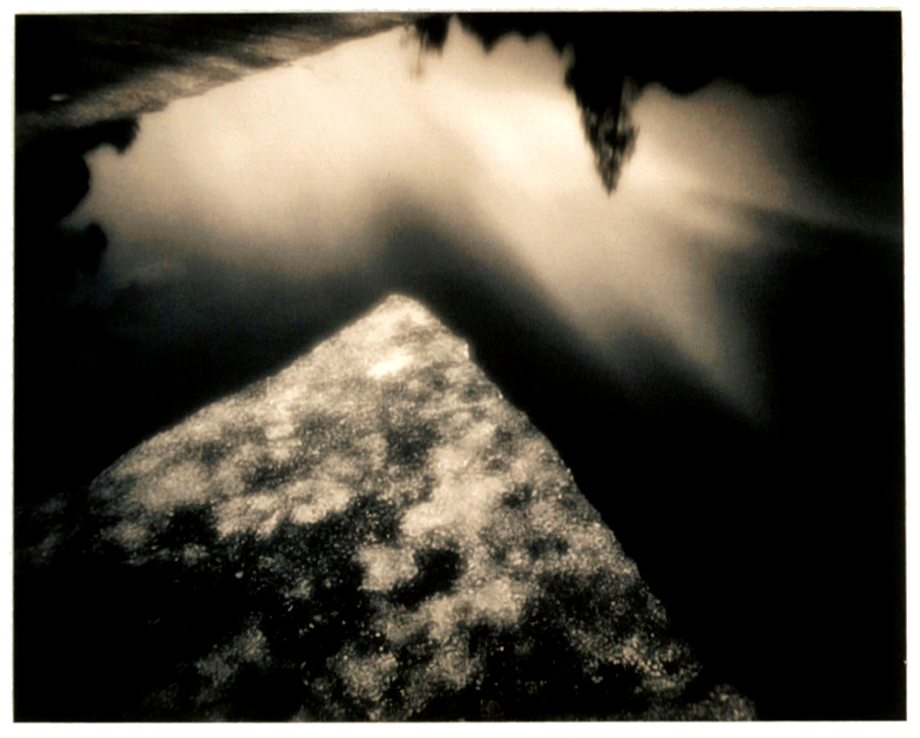
Doug’s pinhole/zoneplate work from the 1990s

Doug’s Graflex 4×5 fitted with a zone plate

.
The CarCamera
From 2000-2008 we converted our Toyota Tarago into a travelling camera obscura and completed a transcontinental crossing from Adelaide to Darwin in what we called our CarCamera Obscura. Here is a small selection of work from this project…
.

The CarCamera in the field
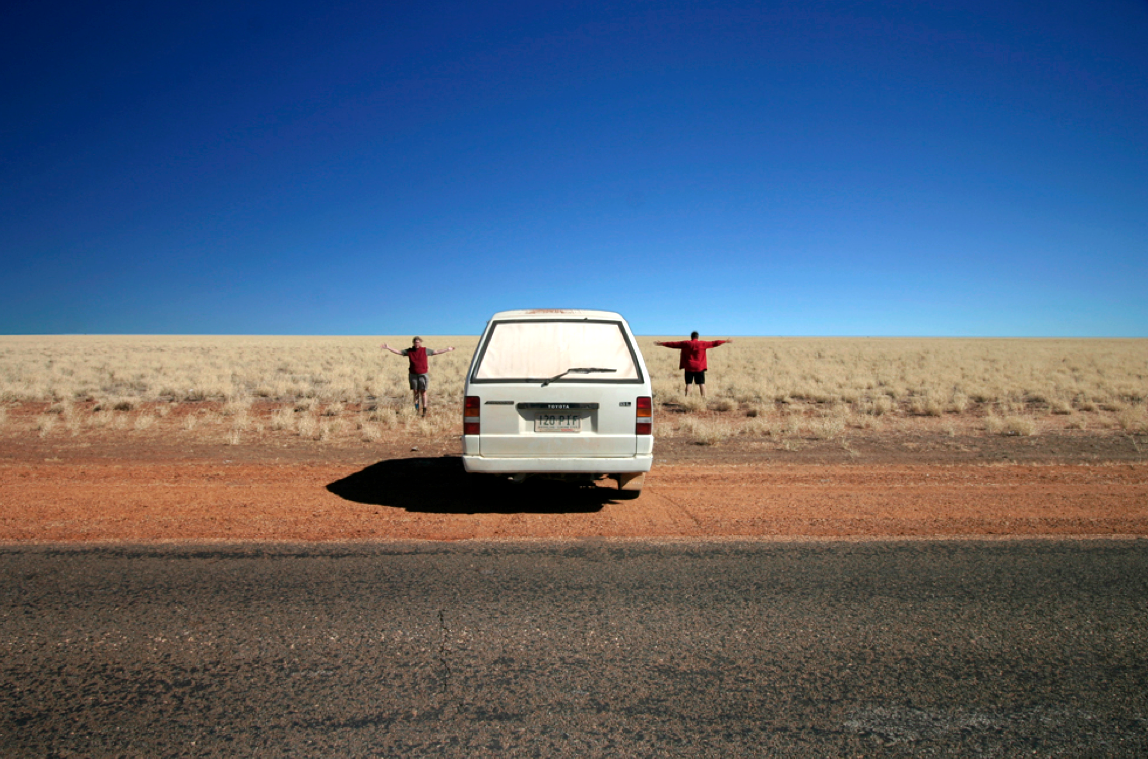
The CarCamera on the Barkly Tableands during the transcontinental crossing
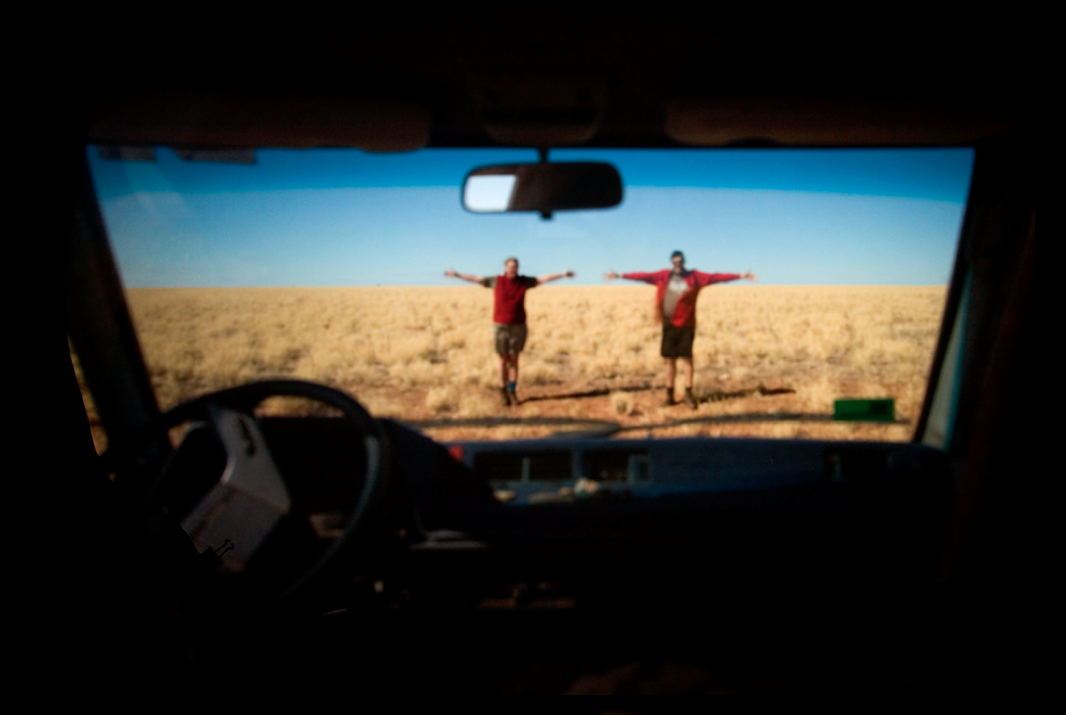
VIEW A DIGITAL MEDIA PRESENTATION OF CARCAMERA IMAGES
.
In a time where digital photography has impacted upon old analogue technologies we saw digital as just another opportunity to explore. When we were loaned a Fuji S1 Pro camera in the later part of 2000 we fitted a pinhole and made images…
.

A pinhole digital photo made with a Fuji S1 Pro camera in late 2000.
.
There are still more challenges … photography has some more to give, and, be discovered …
Oh!! And I bought the book too …
.
.
.
.
.
All images (except the NMHM exhibition instalation) © Doug Spowart and Victoria Cooper
A DAY @ BALDESSIN PRESS STUDIO WITH SLV CREATIVE FELLOWS
.
A day at Baldessin Press Studio: The State Library of Victoria’s Creative Fellowships
.
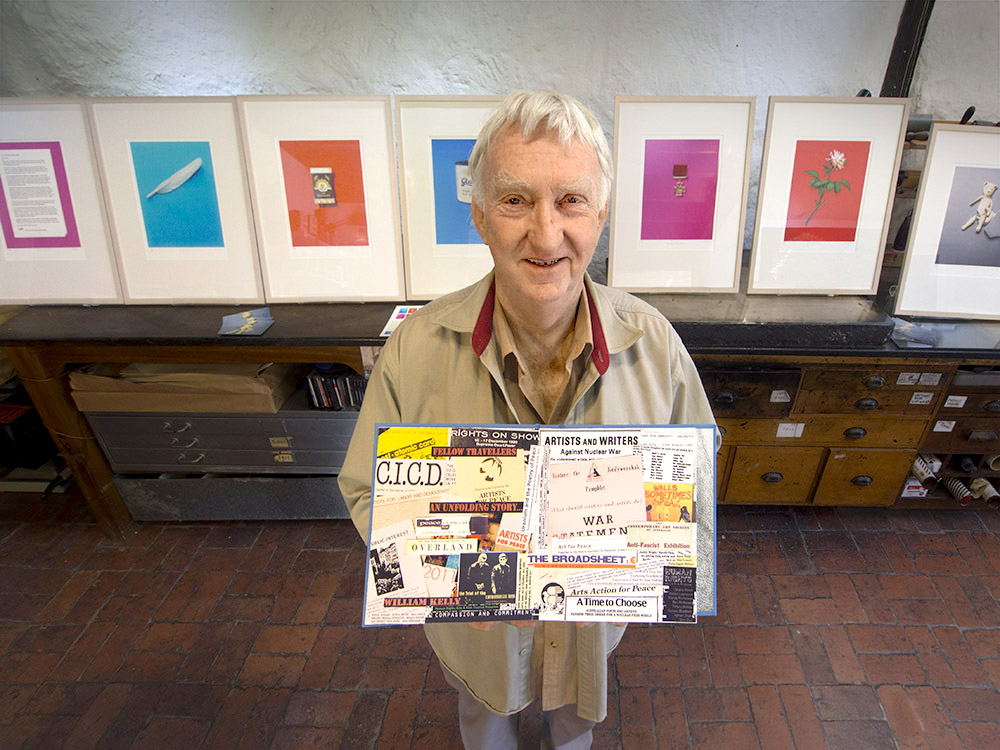
William Kelly, SLV Creative Fellow and Baldessin Press Studio Residency recipient
.
On September 27 a special event took place at the Baldessin Press Studio , St Andrews just northeast of Melbourne. The studio was built by George Baldessin who was a charismatic figure in the history of Australian art, especially in Melbourne in the 1970s. He had a brilliant career as a sculptor and printmaker, and was already considered an important figure in the history of Australian art at the time of his tragic accidental death in 1978 at the age of 39. The studio is situated in a bushland setting and is accompanied by a house and several buildings built by Baldessin and his wife Tess assisted by others including the Hails brothers.*
.
Baldessin’s passing put activity in the studio on hold for some years until Tess returned in 2001. Since then she has worked to re-ignite the creative potential of the place in George’s memory so that artists may continue to create in this special place and perpetuate his generous spirit.
Part of the program of the Press includes the State Library of Victoria’s The Baldessin Press Studio Residency that gives one of the SLV’s Creative Fellowship recipients working in any field the opportunity to create a body of work. The Residency may include accommodation, printmaking tuition, living expenses and some materials. The recipient will also have the opportunity to participate in a ‘Bon a Tirer’ event during the year to present their project to the Library, public, partners and other supporters. Artist Rick Amor generously supports the Baldessin Press Studio Residency.
.
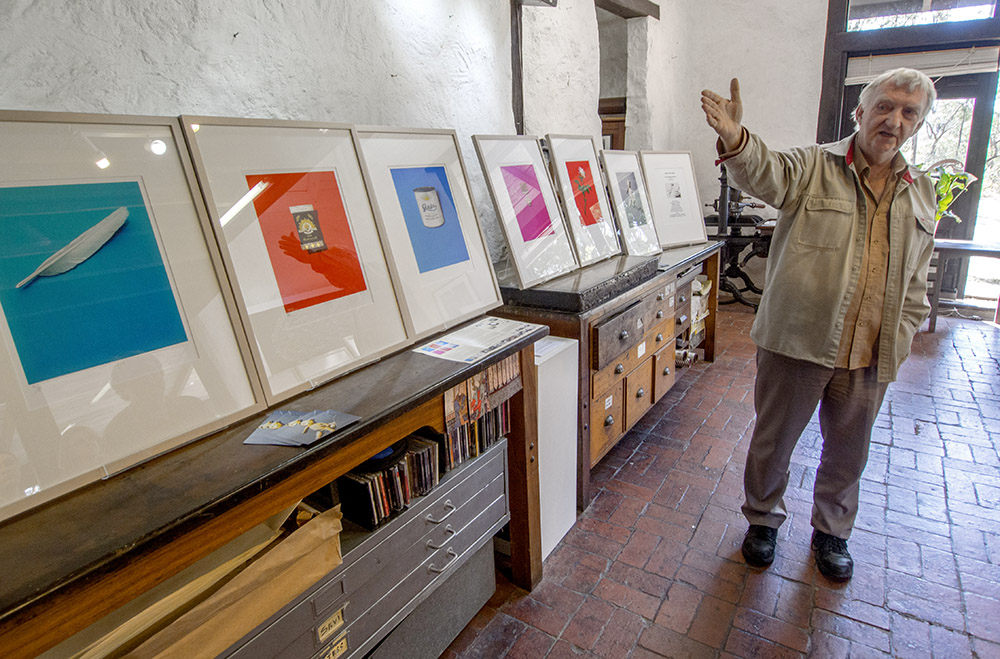
William Kelly, 2015 SLV Creative Fellow and Baldessin Press Studio Residency recipient
.
The 2015 Residency recipient was leading Victorian artist William Kelly a former Fulbright Fellow and Dean of the Victorian College of the Arts from 1975–82. His SLV research project dealt with Australian visual artists practicing between World War I and today, whose works have been informed by their beliefs about war and peace. His intention was to create an ‘accordion’ artist’s book – literally an unfolding story – that celebrated and connected the work of these artists*. In a comment about the body of creative work made as a result of the Baldessin Press Studio Residency Kelly was to say:
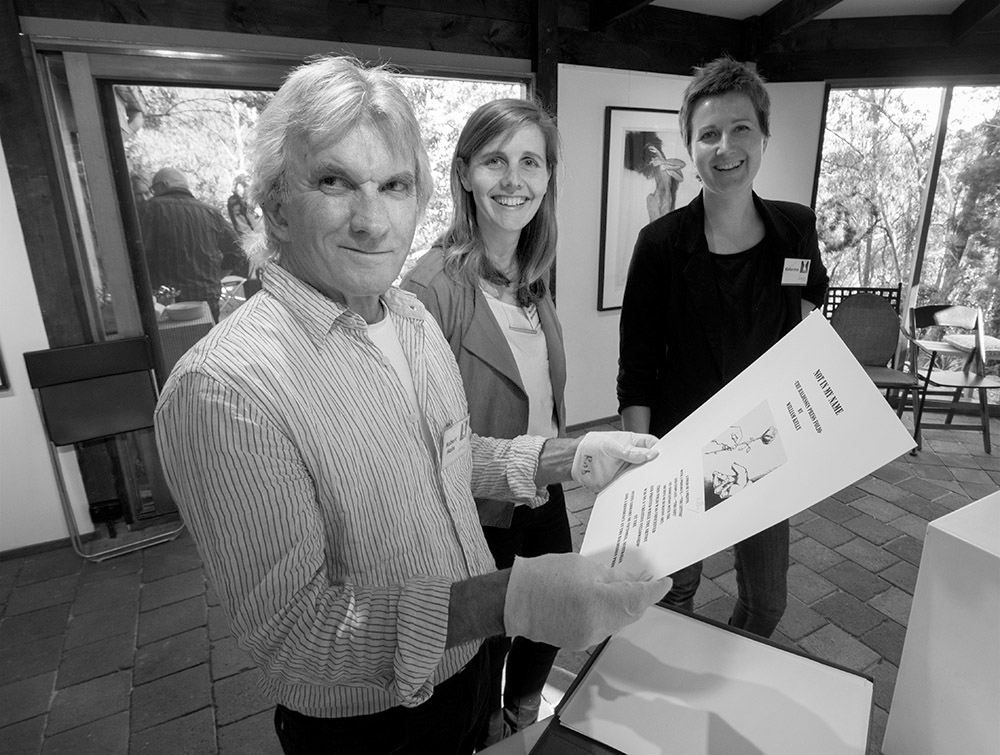
I have a profound belief that we can make this world be a better place but I don’t delude myself that it will, in any way, be easy. Art can play a part in this and artists can contribute to the larger debates about our future. I’ve been quoted as saying, “a painting will never stop a bullet but a painting (print, photograph, novel…) can stop a bullet from being fired”. These works, the “Baldessin Press Folio: Not in My Name” and the artist book “Fellow Travellers: An Unfolding Story” are testament to my belief in the power of the image. The first “Not in My Name” has images that refer to the ideas of courage, loss, innocence and unequivocally taking a stand.
.
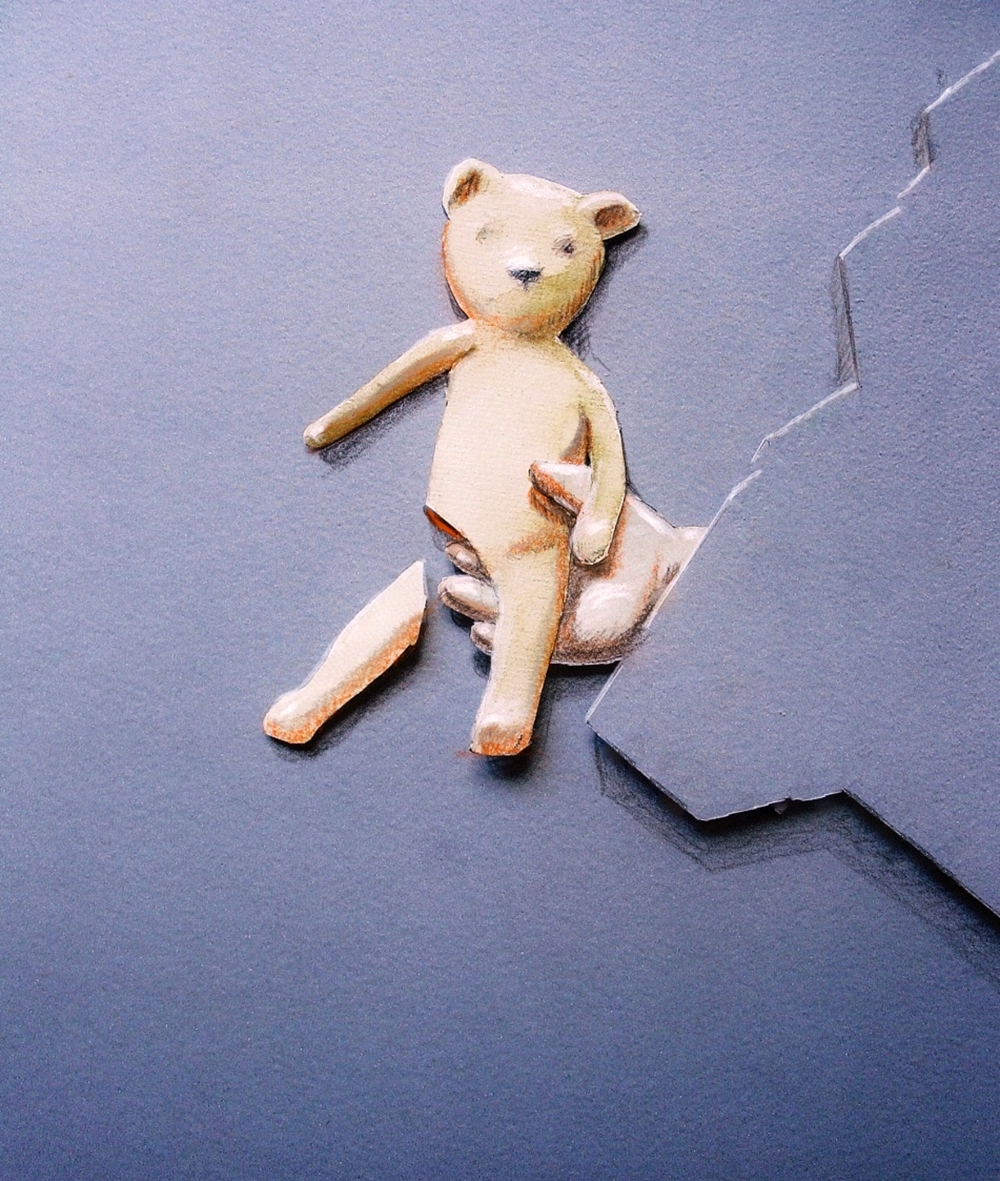
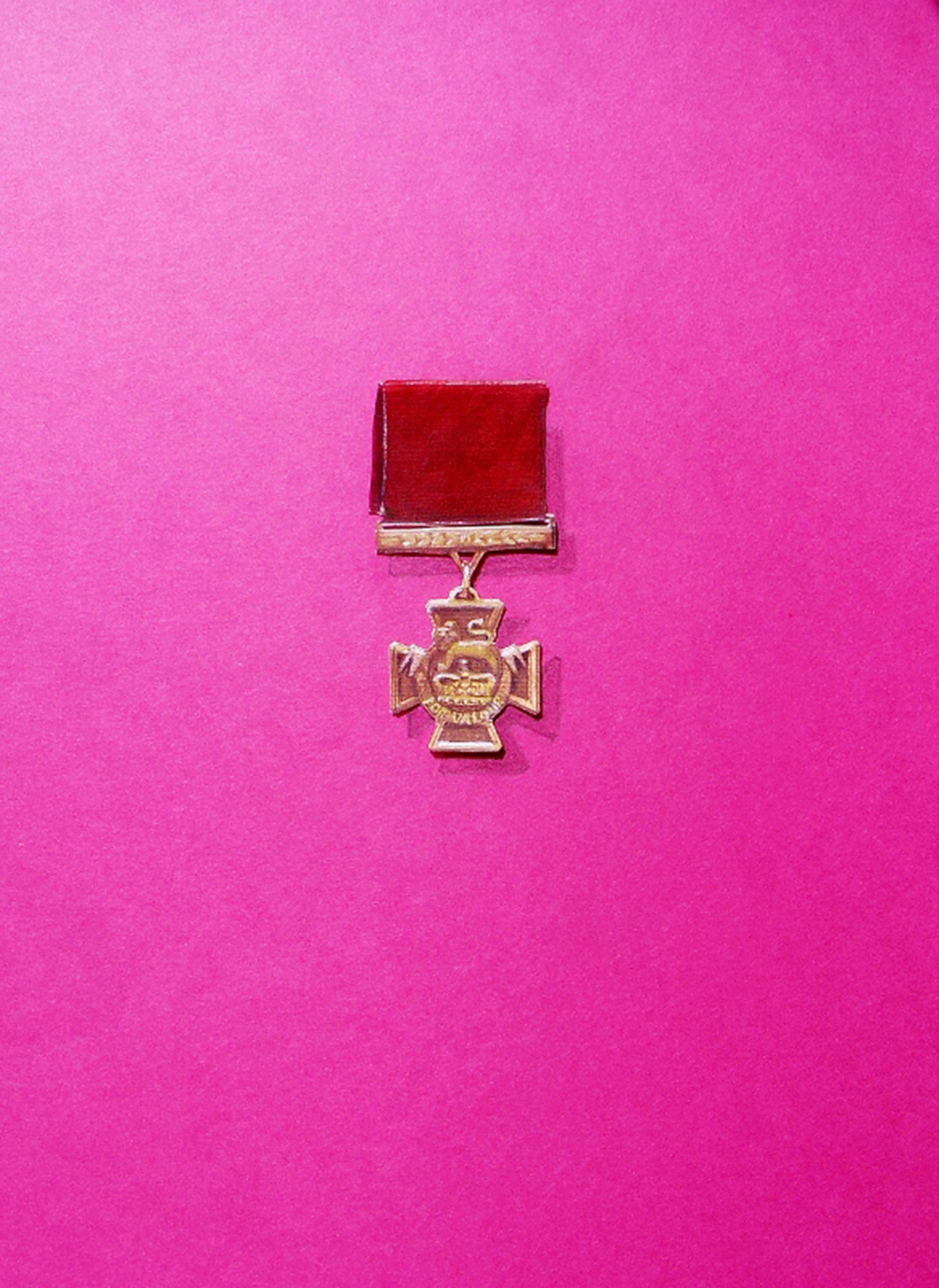
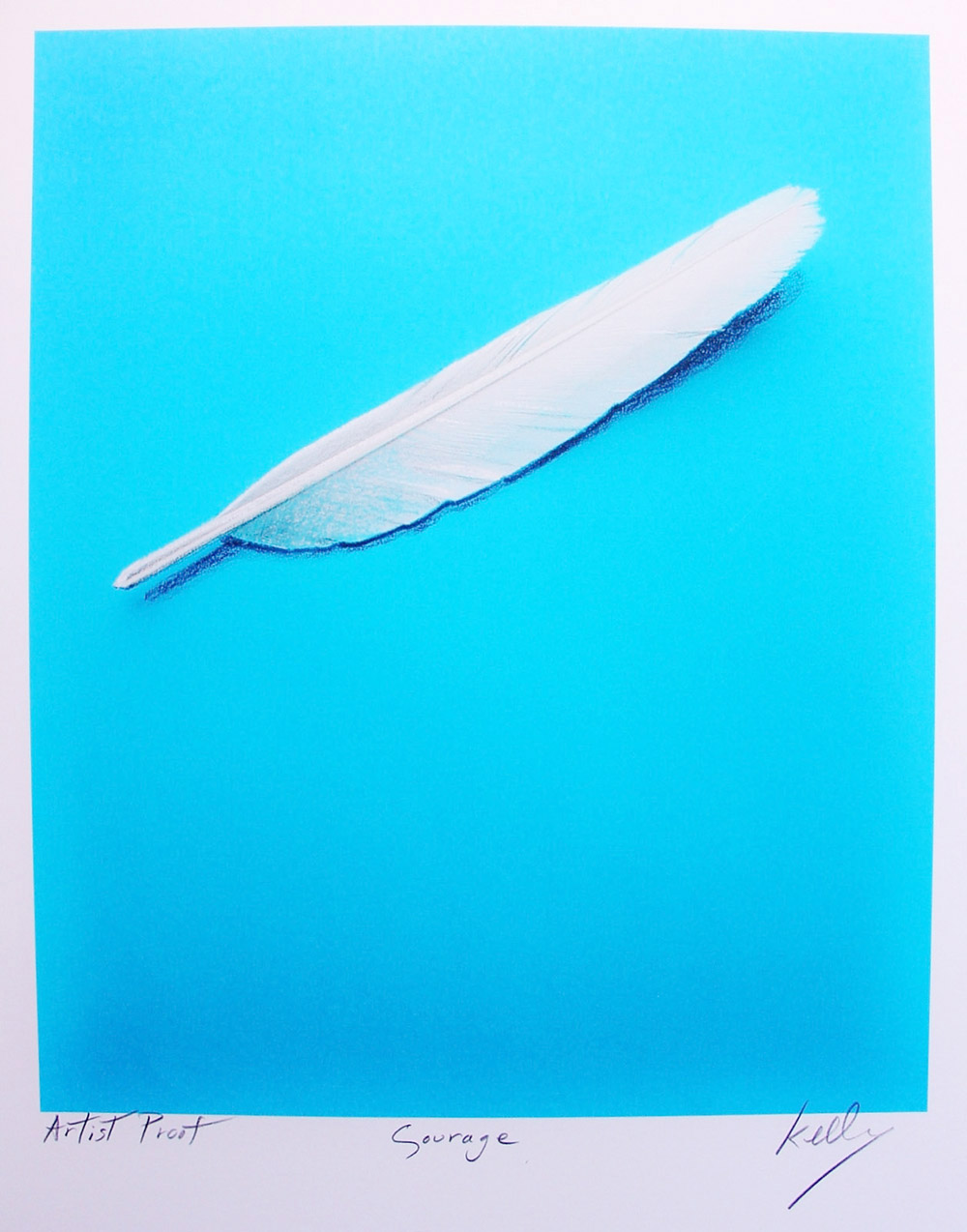
The second “Fellow Travellers…” is something of a tribute to those Australian artists, writers, filmmakers who, over the past 100 years (from WW1 to today) have publicly stood by their beliefs. It references many significant artist/activists from Noel Counihan to Arthur Boyd to those who took a stance against the Transfield Sculpture exhibition (as a result of Transfield’s role in detention centres). Those who are on this journey are, for me, ‘fellow travellers’ and as this list is nowhere near complete and increasing numbers of artists are becoming known for their position on peace, human rights, reconciliation and social justice it is an “unfolding story”.
.
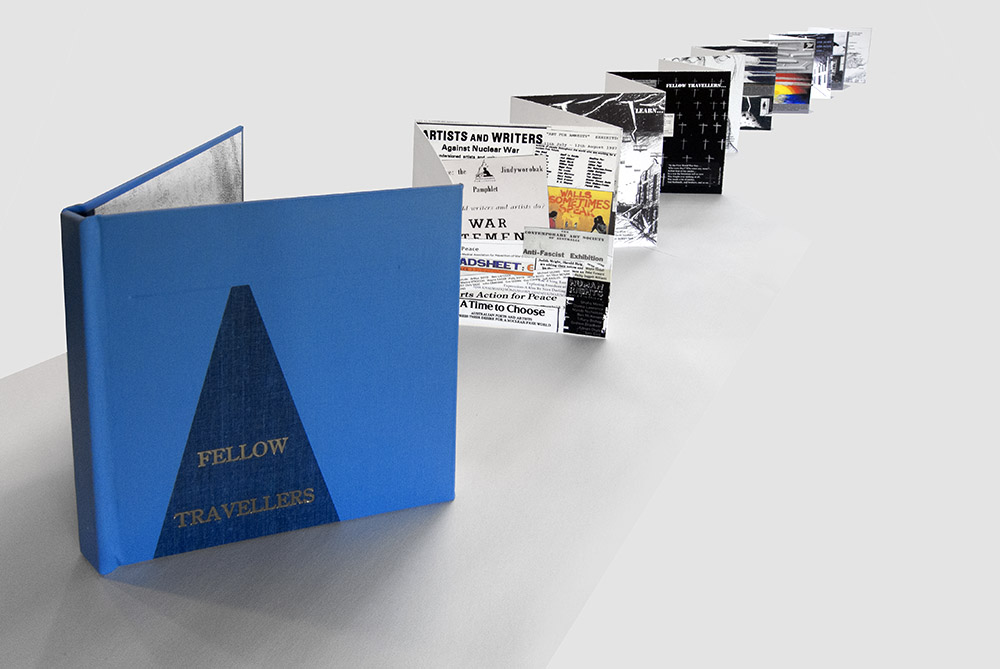
William Kelly’s Fellow Travellers
.
VIDEO: William Kelly discusses his Baldessin Press Studio Residency works
.
At the event the 2016 Baldessin Press Studio Residency recipient was announced. The recipient is Nicola Stairmand who works as an independent heritage consultant, curator and designer, combining her skills to research and interpret places of significance. She is currently employed at TarraWarra Museum of Art, where she assists with research and exhibition design.*
.
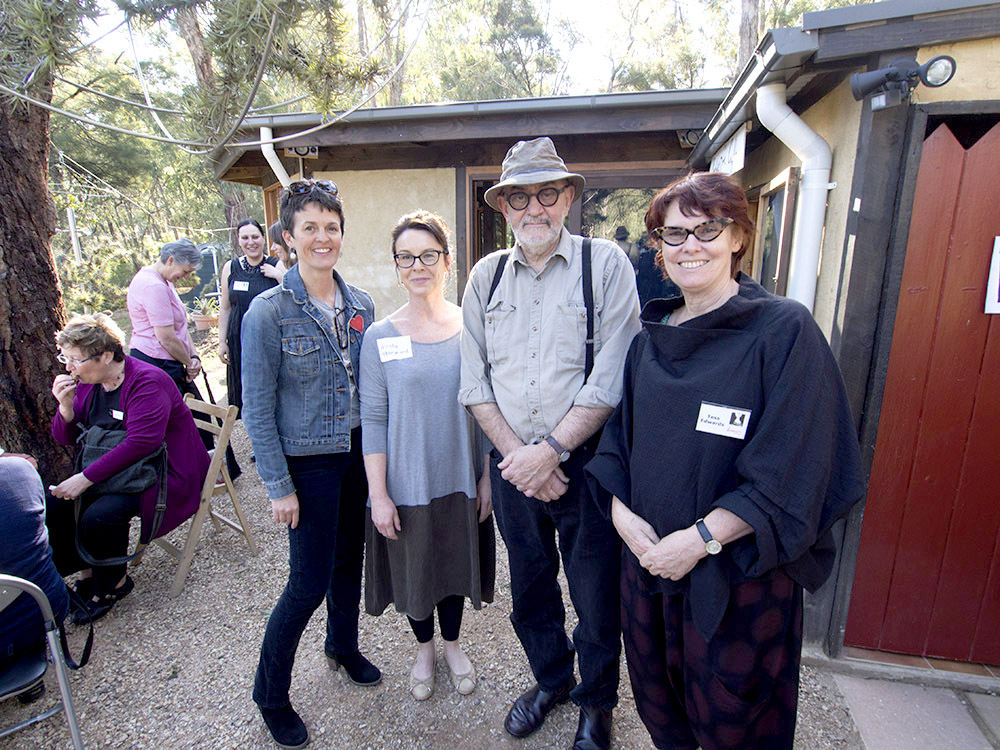
Indra Kurzeme SLV, Nicola Stairmand, Ric Amor and Tess Edwards
.
Stairmand’s project will seek to describe everyday life at Coranderrk Aboriginal Station, established in 1863 and closed in 1924, contributing to a greater understanding of its history. Using the State Library’s photographic and documentary collections, Nicola will research and produce a series of illustrative maps supported by images and descriptions.*
The formal proceedings took place on a bright and sunny spring afternoon with a kind of conviviality and informality that occurs when friends and community gather to share and celebrate important events. George Baldessin would certainly approve of this SLV Creative Fellowship and the part the press plays in bringing about new work.
.
.
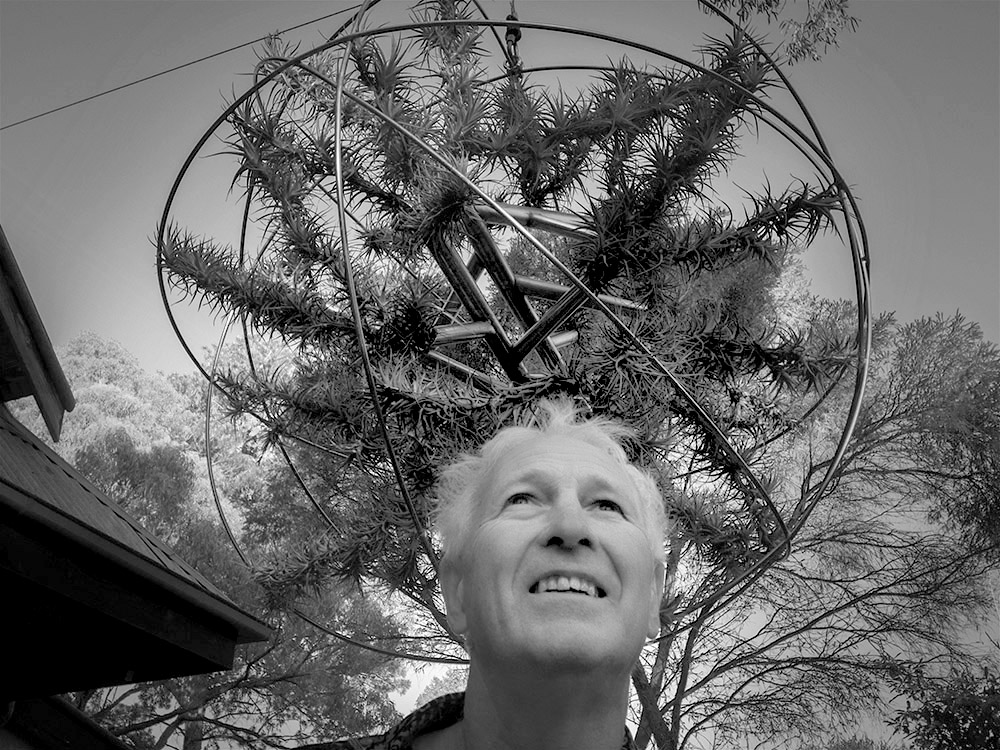
The Baldessin Press Studio Team
Click on their names to go to the Baldessin Press Studio Biogs…
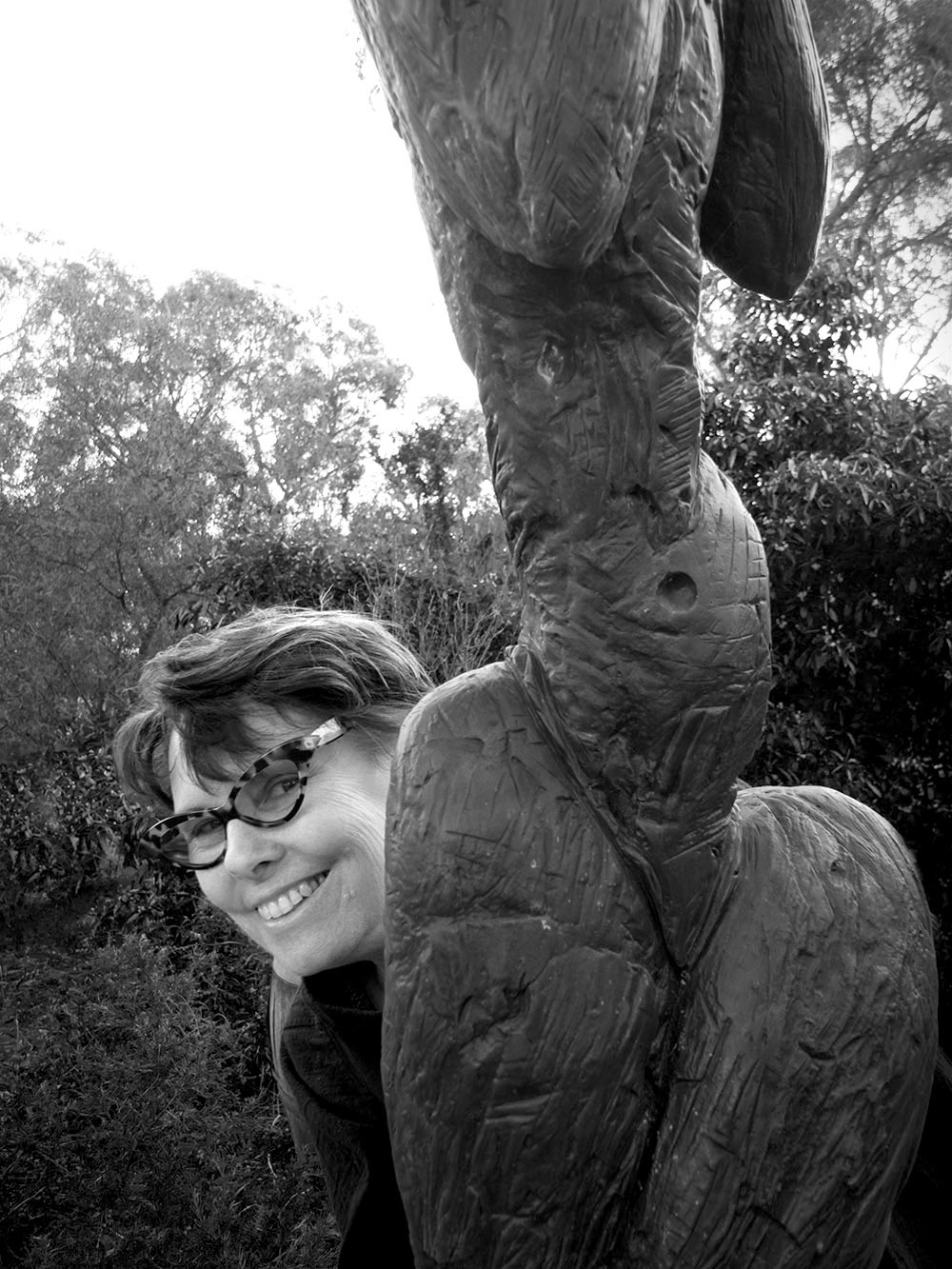
Tess Edwards (Baldessin)
.
.
.

.
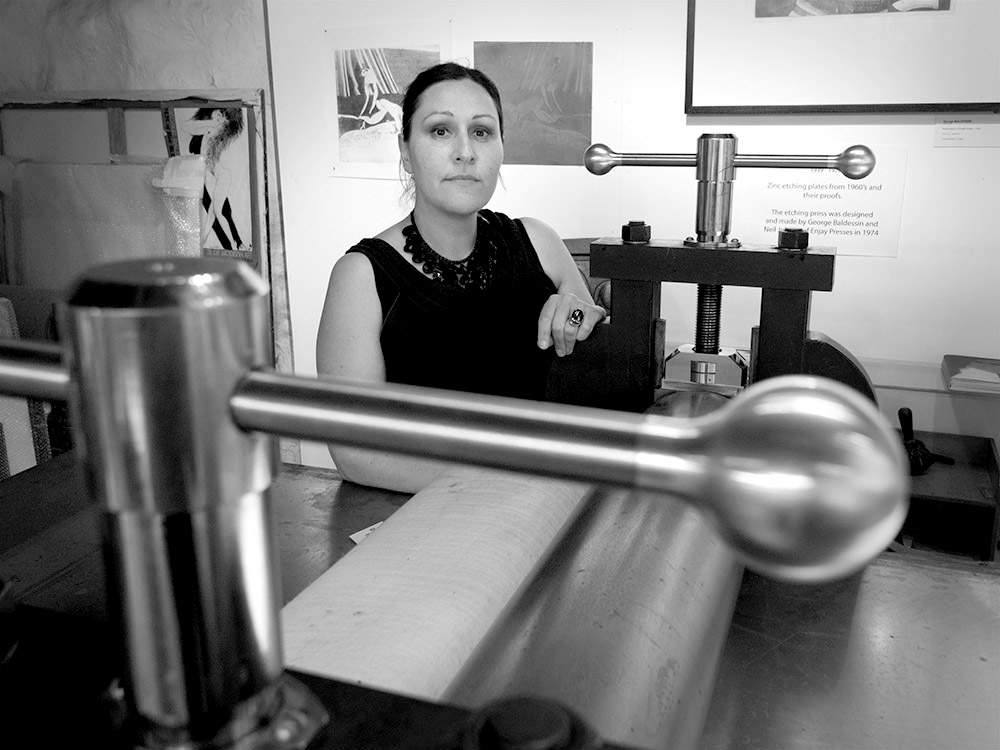
Deanna Hitti (Baldessin’s master printer)
.
.
.
All photographs and video ©2015 Doug Spowart.
*Some texts paraphrased from SLV & Baldessin Press Studio websites. William Kelly artworks and text ©2015 William Kelly.
.
.
WORLD PHOTOBOOK DAY @ Brisbane’s Maud Creative
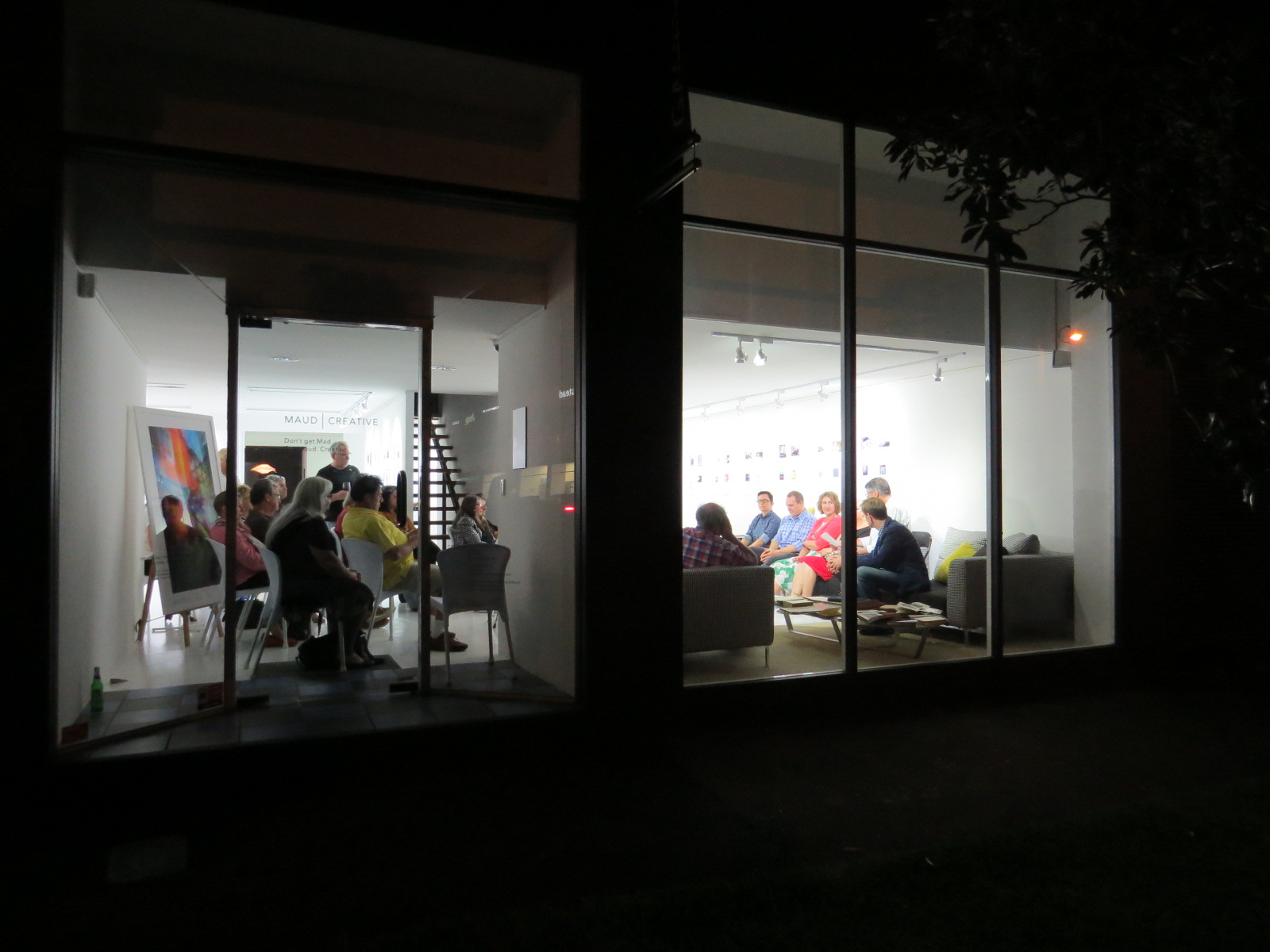
World Photobook Day at Maud Creative Gallery Photo Robert Gray
.
A survey project about those who read photobooks
My Favourite Photobook – Brisbane World Photobook Day
World Photobook Day (WPBD) in Brisbane Australia at Brisbane’s Maud Creative Gallery was celebrated with a survey project highlighting photographers and their photobooks curated by Victoria Cooper and Doug Spowart.
The international WPBD team chose this day in recognition of the British Library’s the acquisition of Anna Atkins’ Photographs of British Algae: Cyanotype impressions on October 14 in 1843. Atkins’ cyanotype book is arguably considered as the world’s first photobook as both image and text are printed simultaneously printed on the same page. It was some time before the photograph and text could be co-printed, so books that included photographic illustrations, were usually printed with text by letterpress processes and photographs ‘tipped-in’ as original prints. WPBD activities are supported through the PhotoBook Club, a worldwide network of groups interesting in photobooks.
The Cooper+Spowart survey asked photographers to submit a photograph of themselves reading their favourite photobook and comment on why they like their chosen book. Sixty-five photographers responded to the request. Working on tight timelines Cooper and Spowart printed the photographer’s submissions including: their self-portraits while reading, their chosen book and a comment about why they had chosen the book. This work was presented for viewing on the gallery wall.
.
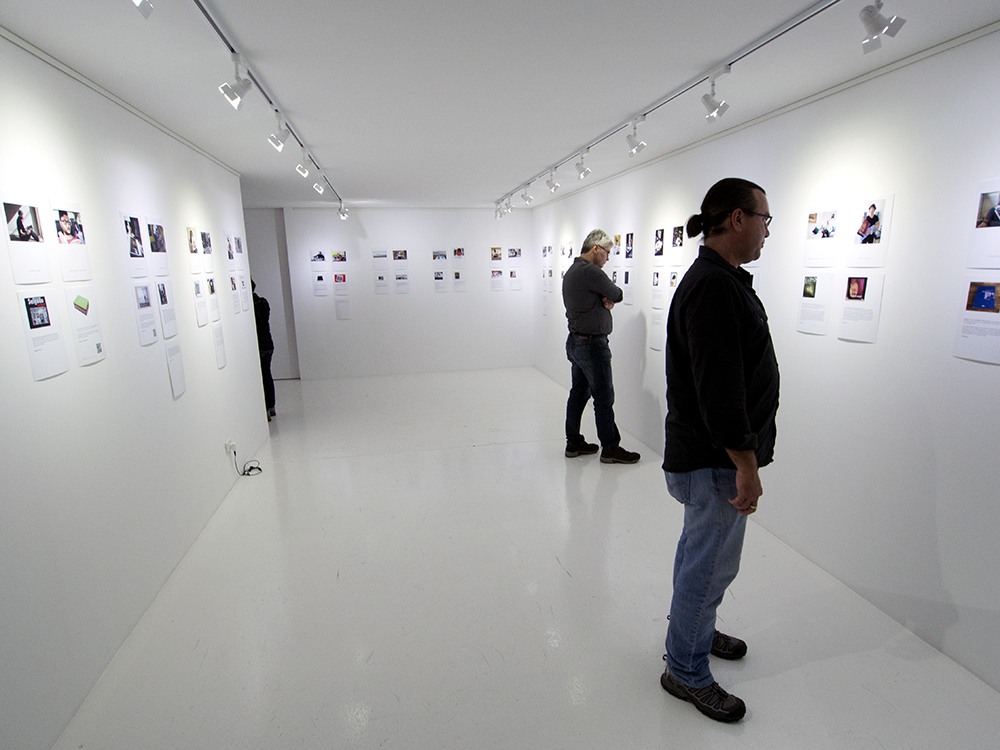
Brisbane World Photobook Day, Maud Gallery Photo Doug Spowart
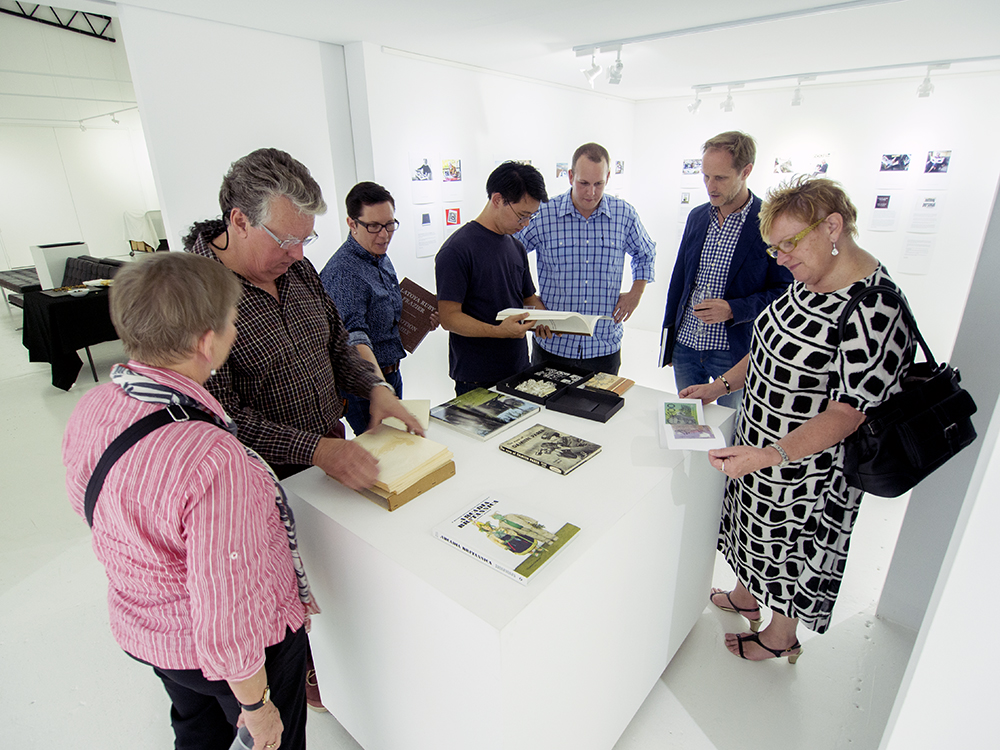
Looking at books – WPBD, Maud Gallery Photo Doug Spowart
.
The event was also attended by photographica collector and historian Sandy Barrie who presented a selection of photographically illustrated books from the 19th century. These books include the 1846 Art Union journal that contained an essay by Henry Fox Talbot and an original calotype print.
.
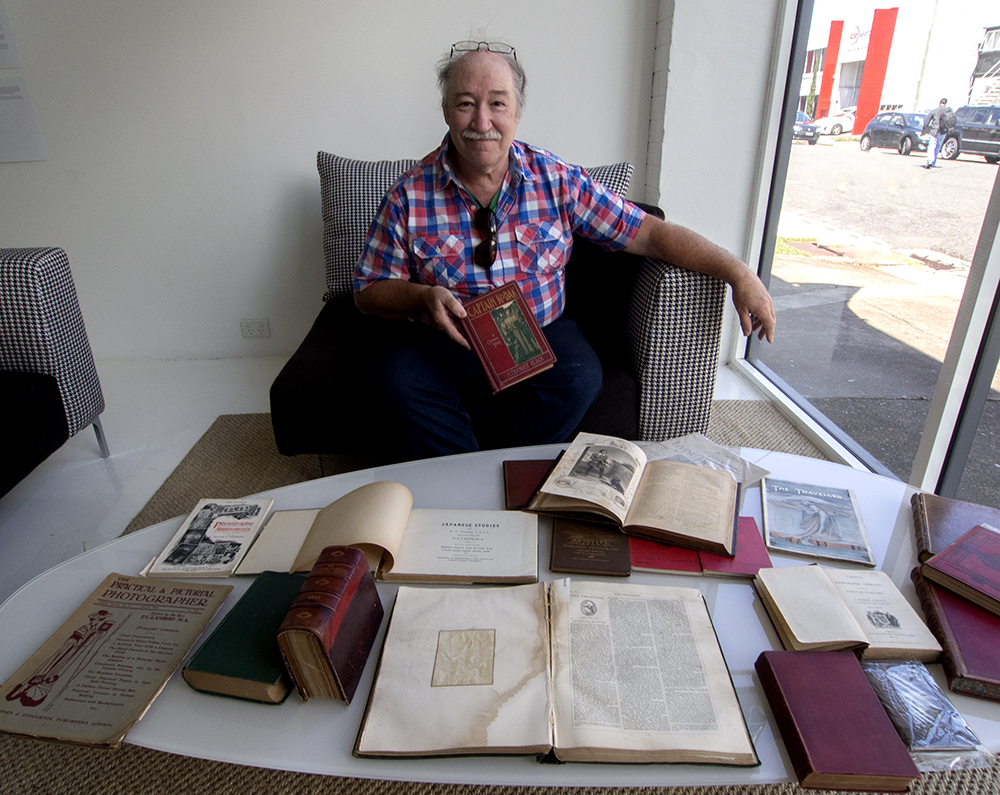
Sandy Barrie and the Art Union journal Photo: Doug Spowart
.
Early in the evening a ‘fly-through’ video was made of the installation with some guests present.
.
In the evening around 35 photobook enthusiasts attended a forum with panellists including Dr Heather Faulkner documentary transmedia practitioner and lecturer at the Queensland College of Art (Gold Coast), Chris Bowes artist and bookmaker, Julie Ann Sutton documentary photographer and collector, Helen Cole Senior Librarian and Coordinator of the Australian Library of Art at the State Library of Queensland, and Henri van Noordenberg artist and bookmaker. The forum was convened by Doug Spowart who in a Q&A format led discussion and a range of photobook issues including:
- Collecting books
- Possession and ownership
- Borrowing and loaning of books
- Adding bookplates and marginalia to books
- Letting children handle books
- The future of photobooks
.
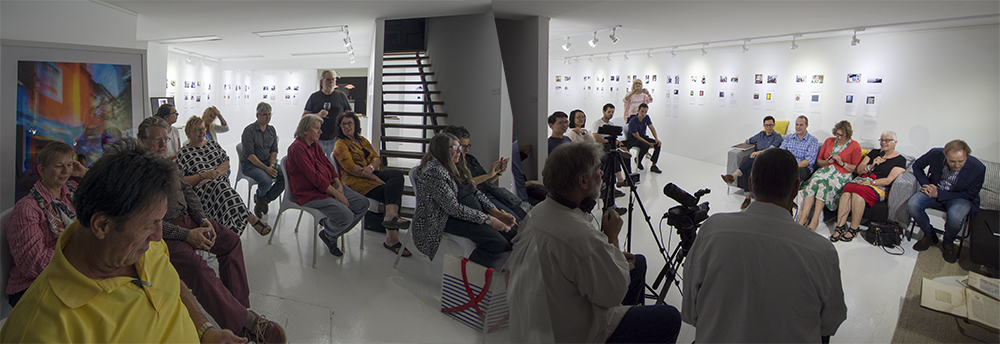
WPBD Forum Photo Daniel Groneberg
.
The last poignant comment came from Heather Faulkner when speaking of the future printed book. In her statement she referred to the recent changes to privacy laws giving government agencies access and scrutiny over all of our online metadata. Faulkner’s prediction is that the physical book, as it has been in the past, will be the place for personal and provocative commentary on contemporary life and politics.
.
Cooper+Spowart wish to acknowledge the following supporters of this project:
- The creative from Maud Gallery: Irena Prikryl, Teri Ducheck and Peter Pescell – videographer;
- Matt Johnston – The Photobook Club;
- Tony Holden and Ilford for the inkjet printing paper;
- Sandy Barrie;
- The forum panelists – Heather, Chris, Julie Ann, Helen and Henri;
- The installation team Maureen Trainor, Rene Thalmann, Mel Brackstone and Daniel Groneberg;
- And, of course, all the participants.
.
To celebrate the Brisbane WPBD event BLURB Australia has offered a discount voucher for participants in the Brisbane event. The code and conditions are: WPBD2015, expires 30 November 2015. Must pay with Australian dollars. Maximum discount per book is AUD$150. Each customer can use the code 1 time.
SEE a few of the photographers and their favourite books in this download:
.
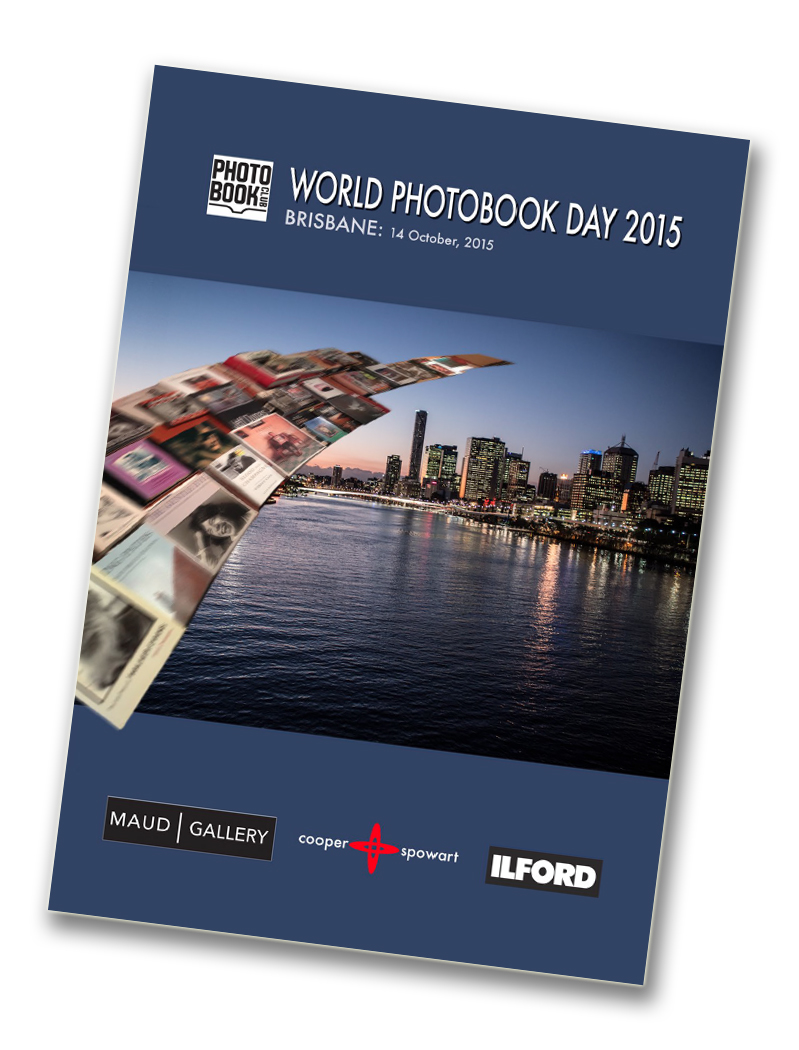
DOWNLOAD A PDF SELECTION: WPBD-Selected_Submissions
.
THE PROJECT WILL CONTINUE… Stay tuned.
.
Previous WPBD events coordinated by Cooper+Spowart 2013 and 2014.
.
.
The 67 participating photographers and their books were:
Peter Adams: Passage – Irving Penn
Melissa Anderson: Shooting Back – Jim Hubbard
Ying Ang: Sabine – Jacob Aue Sobol
Sandy Barrie: Art Union Journal, 1 June 1846 – Henry Fox Talbot essay
Chris Bowes: Tokyo Compression – Michael Wolf
Isaac Brown: Ray’s a Laugh – Richard Billingham
Harvey Benge: Blumen – Collier Schorr’s book
Camilla Birkeland: Mike and Doug Starn – Andy Grundberg
Daniel Boetker-Smith: In Flagrante – Chris Killip
Mel Brackstone: Melbourne and Me (a work in progress) – Adrian Donoghue
Helen Cole: Booked – Peter Lyssiotis
Victoria Cooper: Domesday Book – Peter Kennard
Michael Coyne: Workers -Sebastião Salgado
Judith Crispin: da Sud a Nord (from South to North) – Sabine Korth
Sean Davey: William Eggleston Paris
Jacqui Dean: Peter Adams – A Few of the Legends
John Elliott: Richard Avedon Portraits
Dawne Fahey: Julia Margaret Cameron – Marta Weiss
Heather Faulkner: The Notion of Family – La Toya Ruby Frazier
Liss Fenwick: Outland – Roger Ballen
Juno Gemes: Nothing Personal – Richard Avedon and text by James Baldwin
Kate Golding: Fig. – Adam Broomberg & Oliver Chanarin
Philip Gostelow: Thank You – Robert Frank
Robert Gray: Max Yavno
Daniel Groneberg: Los Alamos – William Eggleston
Sam Harris: Café Lehmitz – Anders Petersen
Tony Hewitt: 50 Landscapes – Charlie Waite
Douglas Holleley: Man and His Symbols – Carl Jung
Kelly Hussey-Smith: On the Sixth Day – Alessandra Sanguinette
Libby Jeffery: Inferno – James Nachtwey
Matt Johnston: Touch – Peter Dekens
Larissa Leclair: Moisés – Mariela Sancari
Louis Lim: Blind – Sophie Calle
James McArdle: Love on the left bank – Ed van der Elsken
Paul McNamara: The Terrible Boredom of Paradise – Derek Henderson
Henri van Noordenberg: Cinci Lei – Joost Vandebrug
Gael Newton: By the sea – CR White
Glen O’Malley: A Modern Photography Annual 1974
Thomas Oliver: Common Sense – Martin Parr
Maurice Ortega: The Apollo Prophecies – Kahn and Selesnick
Adele Outteridge: Pompeii – Amedeo Maiuri
Polixeni Papapetrou: Diane Arbus
Martin Parr: Bye, Bye Photography – Daido Moriyama
Gael Phillips: Arcadia Britannica, A Modern British Folklore Portrait – Henry Bourne
Louis Porter: Looking Forward to Being Attacked – Lieutenant Jim Bullard
Imogen Prus: The Whale’s Eyelash, A Play in Five Parts – Timothy Prus
Jack Picone: Exiles – Josef Koudelka
Ian Poole: White Play – Takuya Tsukahara
Irena Prikryl: Cyclops – Albert Watson
Susan Purdy: nagi no hira, fragments of calm – Suda Issei
Jan Ramsay: AraName – Bir Ara Güler Kitabi
Jacob Raupach: The Family Album of Lucybelle Crater – Ralph Eugene Meatyard
Felicity Rea: Pandanus – Victoria Cooper
Mark Shoeman: Me We, Love Humanity and Us
Roger Skinner: Third Continent – Self-published
Doug Spowart: The Research Library, National Gallery of Australia
Tim Steele: The Earth From The Air – Yann Arthus-Bertrand
Alison Stieven Taylor: Strange Friends – Bojan Brecelj
Julie Ann Sutton: Katherine Avenue – Larry Sultan
Maureen Trainor: Sequences – Duane Michals
Garry Trinh: Period of Juvenile Prosperity – Mike Brodie
Ann Vardanega: Loretta Lux
George Voulgaropoulos: A shimmer of possibility – Paul Graham
Marshall Weber: Street Our Street – Dana Smith & Marshall Weber
David A Williams: Avedon Fashion
Konrad Winkler: Emmet Gowin the new Aperture book
Simon Woolf: F Lennard Casbolt Retrospective Exhibition Catalogue
.
.
All photographs and texts remain the copyright of the submitting photographers.
COOPER+SPOWART NOCTURNE MUSWELLBROOK – Revisitied
.
.
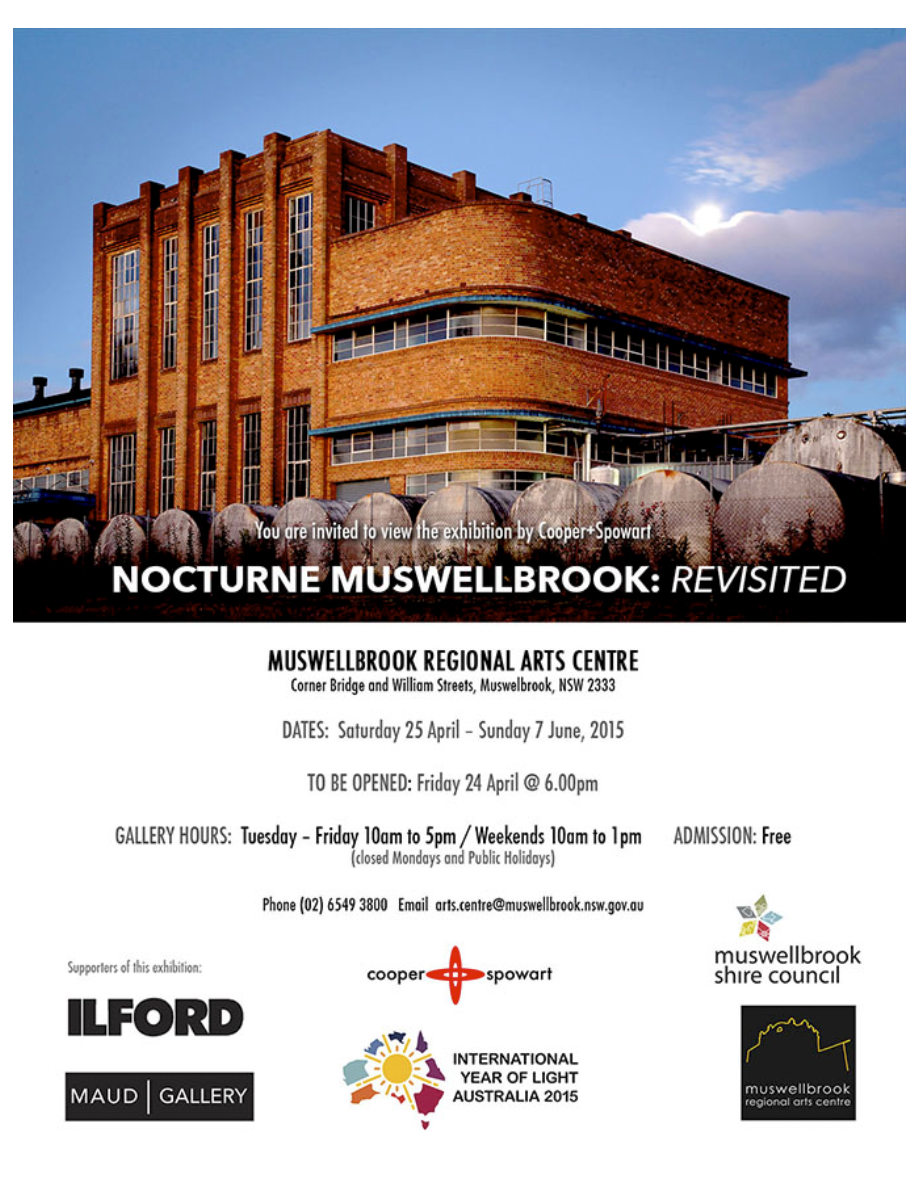
2015 was the INTERNATIONAL YEAR OF LIGHT – Our Nocturne projects celebrate light and to celebrate we presented a major exhibition entitled NOCTURNE MUSWELLBROOK: Revisited at the Muswellbrook Regional Arts Centre.
.
Nocturne Muswellbrook: Reflections on Light
As the sun goes down and the last light fades–cars pass by with commuters heading home for respite at the end of a days work or others just embarking on a nights work. Trucks move through the town with little thought for the places they pass through. People meet and have a conversation…. The street lights come on one by one up the street. The illuminated advertising signage lights the buildings along with the internal lights of the building.
This transition from daylight to night is rhythmical–a diurnal phenomenon–but one that is also pervaded with the uncanny or un-homely sense of place. At nocturne and into the night everyday places change, becoming mysterious as the shadows replace familiar surrounds. A sense of melancholy also grows with the passing of the day–a lament born from the relentlessness of change.
Yet these ephemeral moments can also be seductive and evocative, experiencing the aesthetics of the nocturne can inspire new imaginings of everyday places. The colour and chiaroscuro compositions of light and shadow replace the tired and indifferent prose of daily life. A magical narrative evolves from the personal memories of a shared living history in these laneways, streets, buildings and spaces.
.
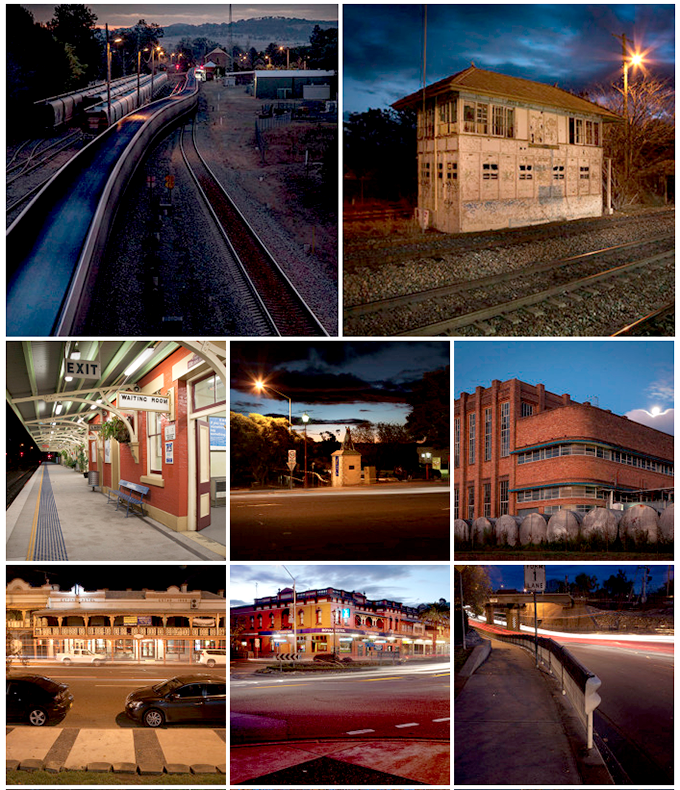
A selection of Nocturne Muswellbrook: Revisited images
.
COOPER+SPOWART NOCTURNE PROJECTS
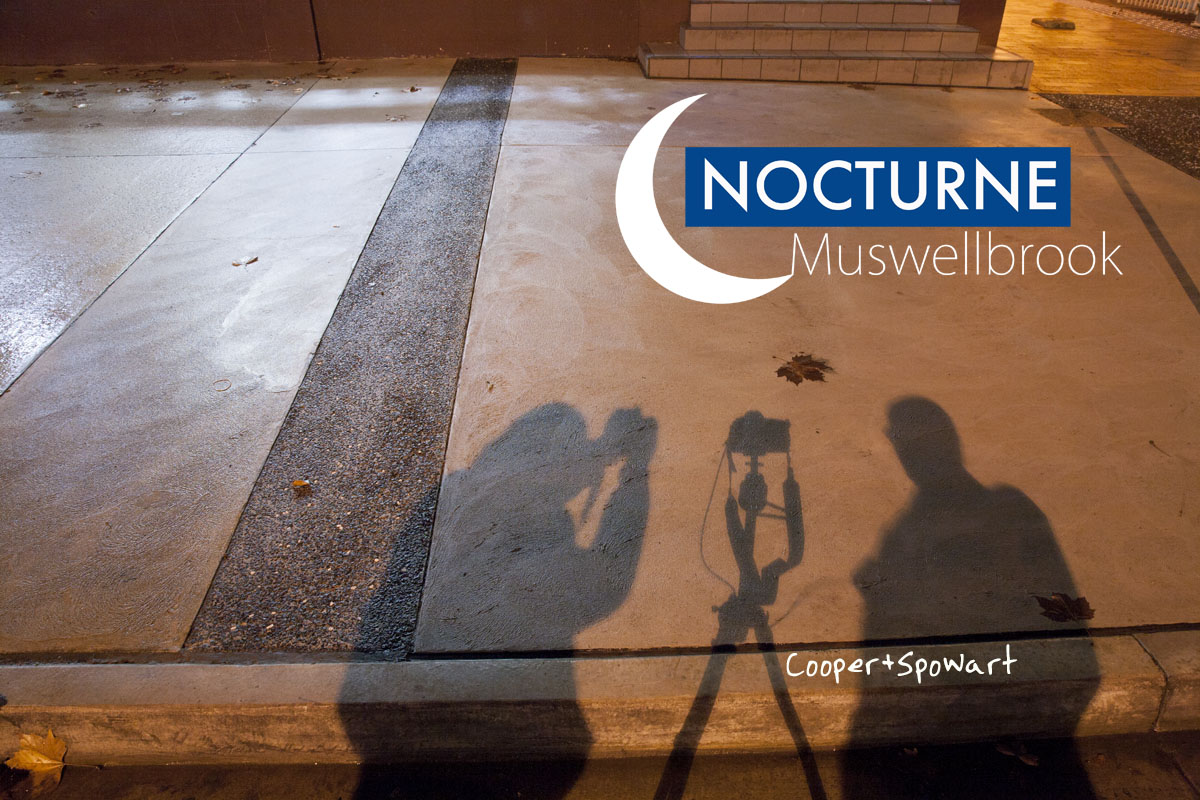
Cooper+Spowart Nocturne shadow
For many years we have engaged in nocturne projects. These have included artists in residency programs in the regional galleries of Muswellbrook, Grafton, Bundaberg and Miles as well as self-funded projects across east coast Australia. The Artist in Residence (AIR) projects are associated with a Facebook page to connect the community with the photographs and evoke stories about the places photographed.
A sample of community Facebook responses can be seen here:
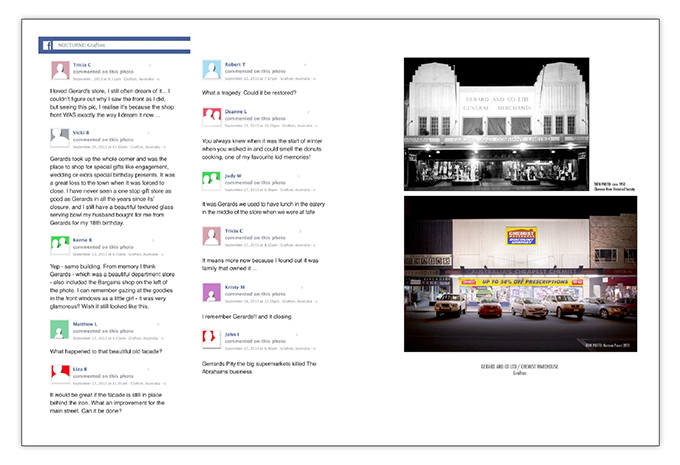
Catalogue-Comments-interact-FP3
.
Nocturne AIR Projects include workshops, mentoring in photography, image enhancement, social media as well as photobook and zine making. Future Nocturne Projects are in the planning stage and we seek expressions of interest from communities looking to participating in a Nocturne light project.
.
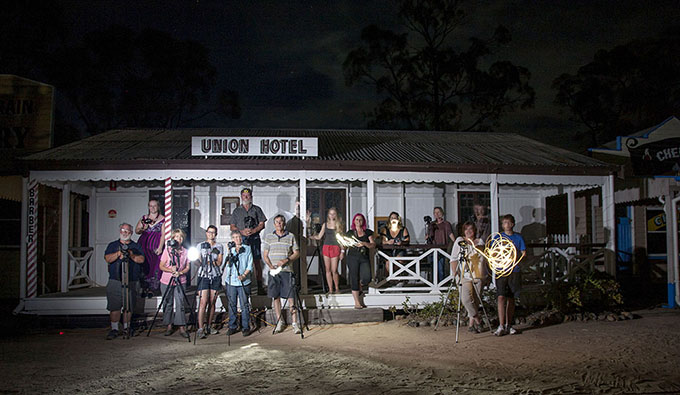
Participating community members from the Nocturne Miles Project
.
A link to a collective of NOCTURNE PROJECTS can be found: HERE
.
THE BACK STORY: Nocturne Muswellbrook
The Nocturne Muswellbrook Facebook page was launched in June 2013
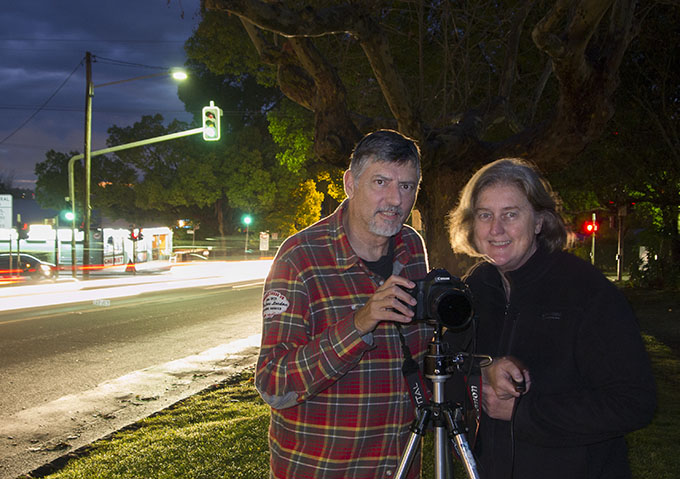
From 23rd June we began a 2week Artist in Residence in Muswellbrook. Our studio was a vacant shop in the Campbell’s Corner building fronting onto the main street, Bridge Street
.
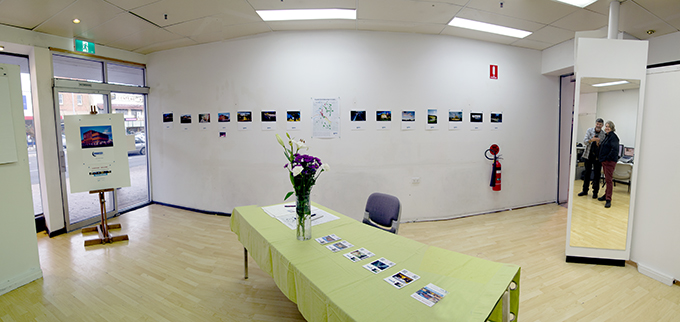
Our gallery and workspace
We set up our digital studio workspace to:
- Master the nocturne photographs for the Facebook page
- Print out the mastered images for a small display in the shop
- Greet anyone that wanted to come by and share their story about Muswellbrook
- Prepare for the evening’s shooting around the town
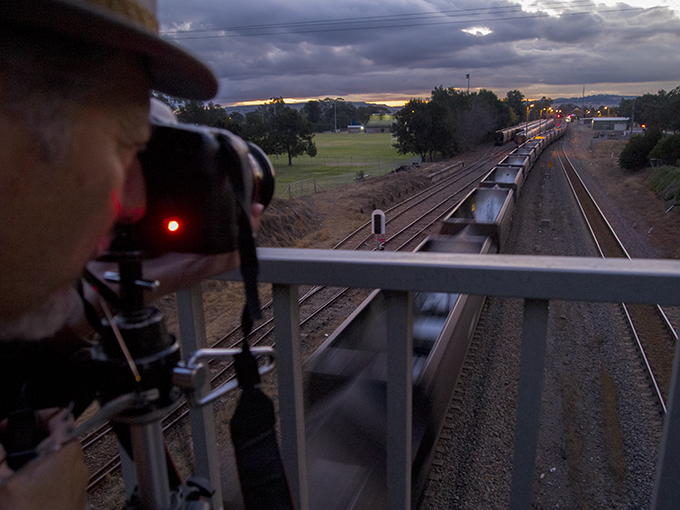
Photographing a coal train from the Bell Street bridge
Each night and day, once the images were uploaded onto the Nocturne Muswellbrook page we invited everyone to tell their stories about each place photographed. We were excited to engage with the community and a deeper knowledge and experience of Muswellbrook through this process.
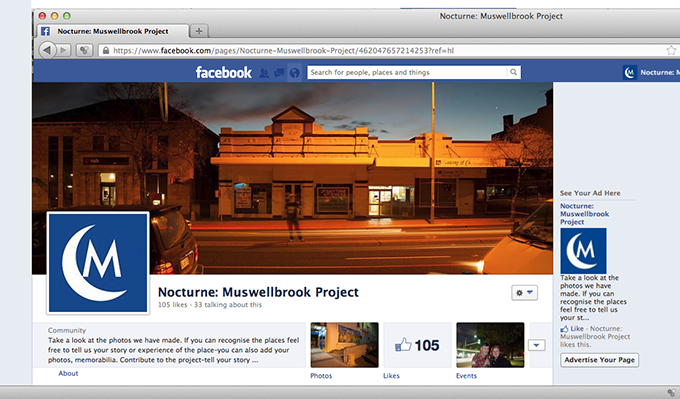
An early FB Cover
Many people that visited the page were once residents of Muswellbrook but now live in other parts of Australia and some were international expats. The number of ‘Page LIKES’ grew quickly – today the number stands @ 620. There was a pride and a melancholy for this once rural town. Some stories were full of humour and the irony of the Aussie yarn. While others shared poignant moments of their lives from the memories evoked by the photographs.
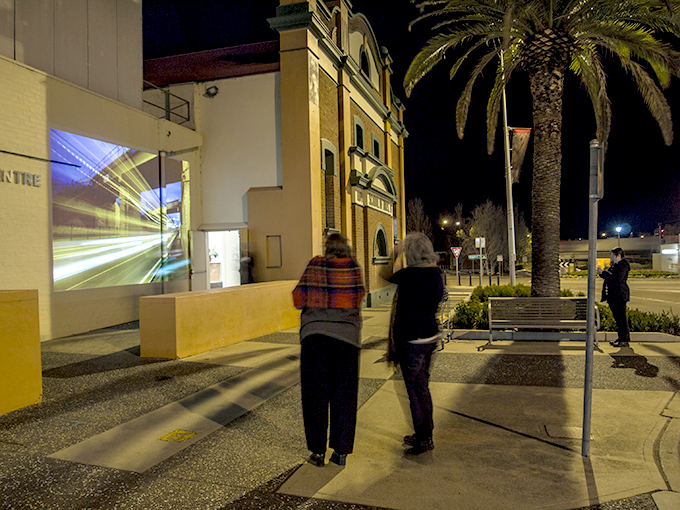
Video projection on MRAC wall
We also created a Youtube video that was uploaded and premiered at our artists talk held in the Muswellbrook Regional Arts Centre on the July 5. In evening we projected our images as a visual performance on the outside of the Gallery for public viewing and to extend the experience of the nocturne project.
Even though our 2 weeks in residence had come to an end on July 6, we still continued to connect with the Facebook page: uploading images and connecting them with the community’s stories.
SETTING UP THE EXHIBITION
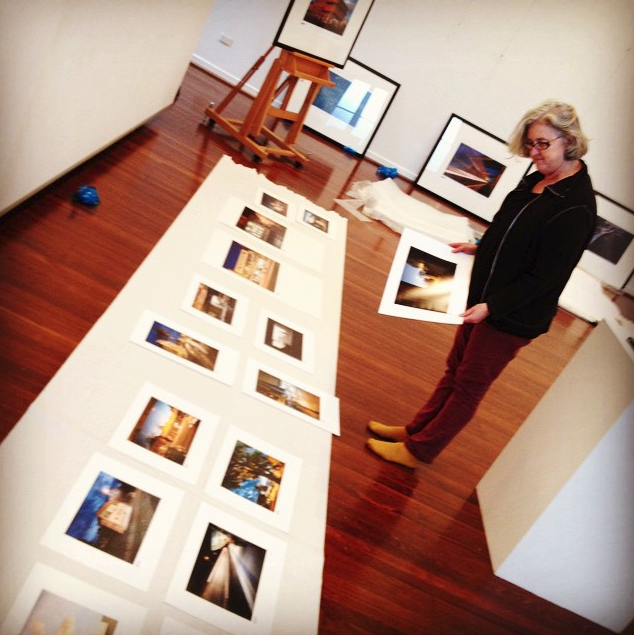
Vicky arranging the hang
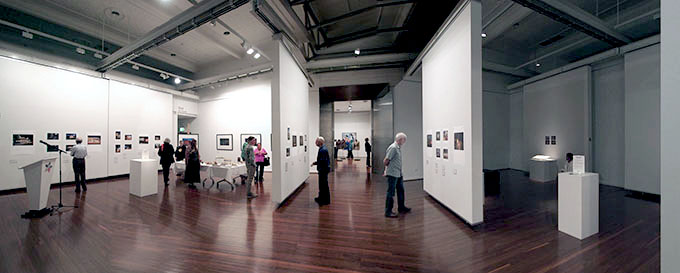
The MRAC exhibition space
In 2015 we came back to show an exhibition of the work on the walls of the Gallery. The Sunday after the opening we presented a workshop for participants wanted to upskill or engage with how we captured and mastered these nocturnal images.
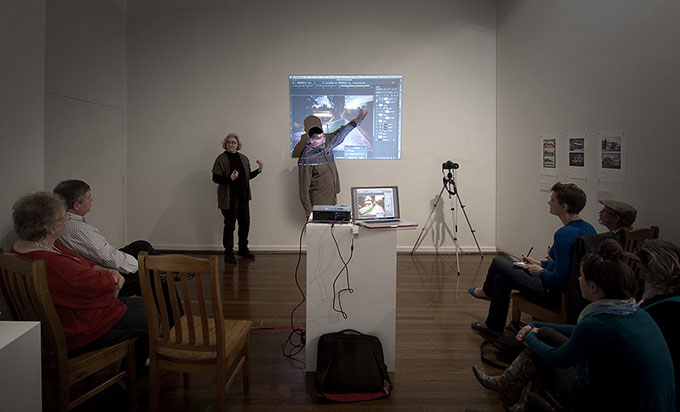
Workshop at the MRAC
Now the works are on the wall for all to come and see… and we are inviting anyone who visits to write down their story and place on the wall next to the image. The gallery is now a physical “Facebook page”. We look forward to seeing your written stories on the walls of the gallery.
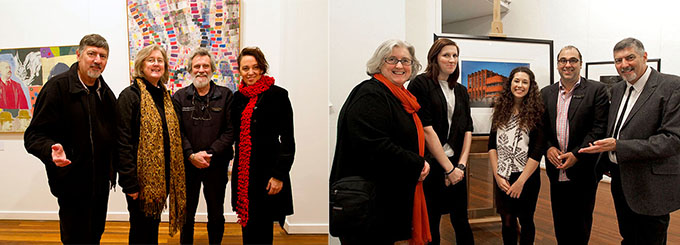
2013: with Silvana & Roger Skinner – MRAC AIR Coordinator – 2015 with Elissa, Jade and MRAC Director Brad Franks
.
We want to express our thanks to the MRAC Team, Roger Skinner, ILFORD papers and Maud Gallery.

.
2015 is the INTERNATIONAL YEAR OF LIGHT – Our Nocturne projects celebrate light and this year at the Muswellbrook Regional Arts Centre we are showing a major exhibition entitled NOCTURNE MUSWELLBROOK: Revisited.
Nocturne Muswellbrook: Reflections on Light
As the sun goes down and the last light fades–cars pass by with commuters heading home for respite at the end of a days work or others just embarking on a nights work. Trucks move through the town with little thought for the places they pass through. People meet and have a conversation…. The street lights come on one by one up the street. The illuminated advertising signage lights the buildings along with the internal lights of the building.
This transition from daylight to night is rhythmical–a diurnal phenomenon–but one that is also pervaded with the uncanny or un-homely sense of place. At nocturne and into the night everyday places change, becoming mysterious as the shadows replace familiar surrounds. A sense of melancholy also grows with the passing of the day–a lament born from the relentlessness of change.
Yet these ephemeral moments can also be seductive and evocative, experiencing the aesthetics of the nocturne can inspire new imaginings of everyday places. The colour and chiaroscuro compositions of light and shadow replace the tired and indifferent prose of daily life. A magical narrative evolves from the personal memories of a shared living history in these laneways, streets, buildings and spaces.
.
A selection of Nocturne Muswellbrook: Revisited images
.
COOPER+SPOWART NOCTURNE PROJECTS
Cooper+Spowart Nocturne shadow
For many years we have engaged in nocturne projects. These have included artists in residency programs in the regional galleries of Muswellbrook, Grafton, Bundaberg and Miles as well as self-funded projects across east coast Australia. The Artist in Residence (AIR) projects are associated with a Facebook page to connect the community with the photographs and evoke stories about the places photographed.
A sample of community Facebook responses can be seen here:
Catalogue-Comments-interact-FP3
.
Nocturne AIR Projects include workshops, mentoring in photography, image enhancement, social media as well as photobook and zine making. Future Nocturne Projects are in the planning stage and we seek expressions of interest from communities looking to participating in a Nocturne light project.
.
Participating community members from the Nocturne Miles Project
.
A link to a collective of NOCTURNE PROJECTS can be found: HERE
.
THE BACK STORY: Nocturne Muswellbrook
The Nocturne Muswellbrook Facebook page was launched in June 2013
From 23rd June we began a 2week Artist in Residence in Muswellbrook. Our studio was a vacant shop in the Campbell’s Corner building fronting onto the main street, Bridge Street
.
Our gallery and workspace
We set up our digital studio workspace to:
- Master the nocturne photographs for the Facebook page
- Print out the mastered images for a small display in the shop
- Greet anyone that wanted to come by and share their story about Muswellbrook
- Prepare for the evening’s shooting around the town
Photographing a coal train from the Bell Street bridge
Each night and day, once the images were uploaded onto the Nocturne Muswellbrook page we invited everyone to tell their stories about each place photographed. We were excited to engage with the community and a deeper knowledge and experience of Muswellbrook through this process.
An early FB Cover
Many people that visited the page were once residents of Muswellbrook but now live in other parts of Australia and some were international expats. The number of ‘Page LIKES’ grew quickly – today the number stands @ 620. There was a pride and a melancholy for this once rural town. Some stories were full of humour and the irony of the Aussie yarn. While others shared poignant moments of their lives from the memories evoked by the photographs.
Video projection on MRAC wall
We also created a Youtube video that was uploaded and premiered at our artists talk held in the Muswellbrook Regional Arts Centre on the July 5. In evening we projected our images as a visual performance on the outside of the Gallery for public viewing and to extend the experience of the nocturne project.
Even though our 2 weeks in residence had come to an end on July 6, we still continued to connect with the Facebook page: uploading images and connecting them with the community’s stories.
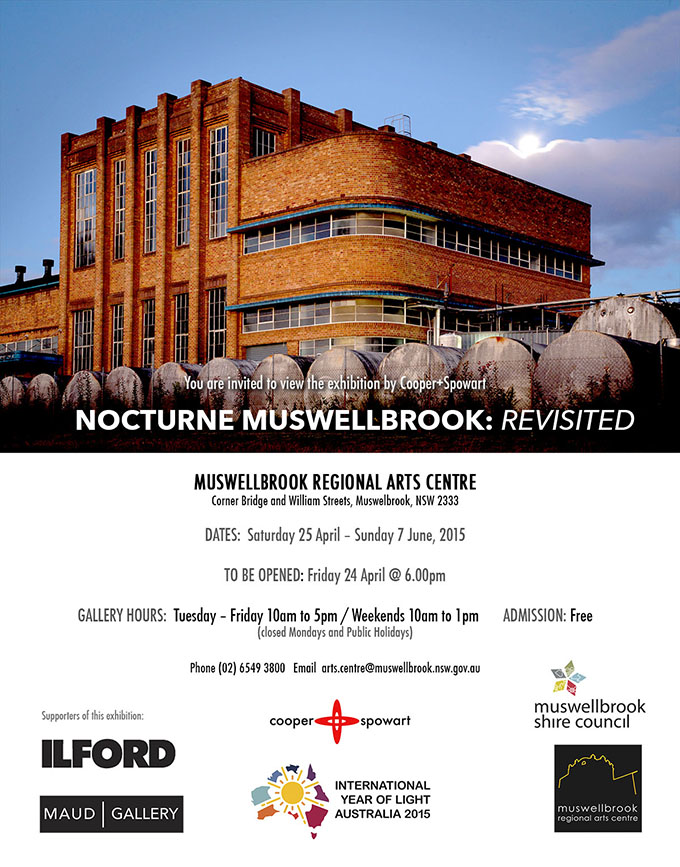
Exhibition invite
Vicky arranging the hang
The MRAC exhibition space
In 2015 we came back to show an exhibition of the work on the walls of the Gallery. The Sunday after the opening we presented a workshop for participants wanted to upskill or engage with how we captured and mastered these nocturnal images.
Workshop at the MRAC
Now the works are on the wall for all to come and see… and we are inviting anyone who visits to write down their story and place on the wall next to the image. The gallery is now a physical “Facebook page”. We look forward to seeing your written stories on the walls of the gallery.
2013: with Silvana & Roger-MRAC AIR Coordinator ….. 2015 with Elissa, Jade and MRAC Director Brad…………………..
.
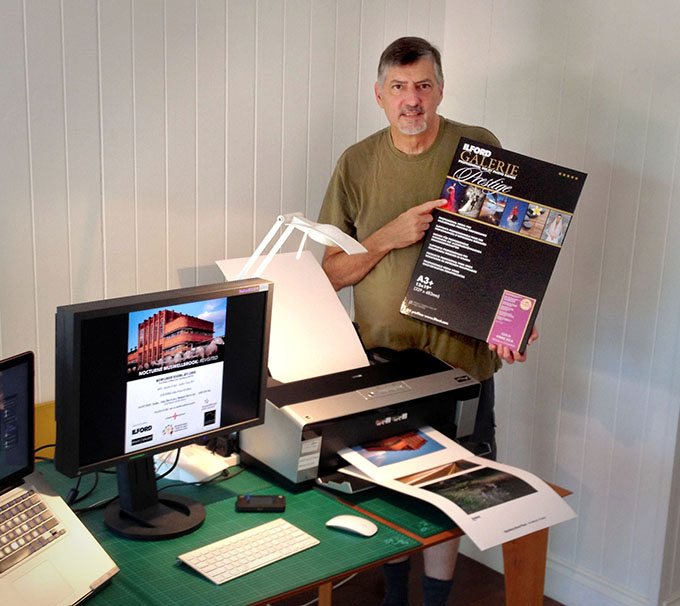
Printing with ILFORD Galerie GOLD SILK papers
.
We want to express our thanks to the MRAC Team, Roger Skinner, ILFORD papers and Maud Gallery.
.
2015 is the INTERNATIONAL YEAR OF LIGHT – Our Nocturne projects celebrate light and this year at the Muswellbrook Regional Arts Centre we are showing a major exhibition entitled NOCTURNE MUSWELLBROOK: Revisited.
Nocturne Muswellbrook: Reflections on Light
As the sun goes down and the last light fades–cars pass by with commuters heading home for respite at the end of a days work or others just embarking on a nights work. Trucks move through the town with little thought for the places they pass through. People meet and have a conversation…. The street lights come on one by one up the street. The illuminated advertising signage lights the buildings along with the internal lights of the building.
This transition from daylight to night is rhythmical–a diurnal phenomenon–but one that is also pervaded with the uncanny or un-homely sense of place. At nocturne and into the night everyday places change, becoming mysterious as the shadows replace familiar surrounds. A sense of melancholy also grows with the passing of the day–a lament born from the relentlessness of change.
Yet these ephemeral moments can also be seductive and evocative, experiencing the aesthetics of the nocturne can inspire new imaginings of everyday places. The colour and chiaroscuro compositions of light and shadow replace the tired and indifferent prose of daily life. A magical narrative evolves from the personal memories of a shared living history in these laneways, streets, buildings and spaces.
.
A selection of Nocturne Muswellbrook: Revisited images
.
COOPER+SPOWART NOCTURNE PROJECTS
Cooper+Spowart Nocturne shadow
For many years we have engaged in nocturne projects. These have included artists in residency programs in the regional galleries of Muswellbrook, Grafton, Bundaberg and Miles as well as self-funded projects across east coast Australia. The Artist in Residence (AIR) projects are associated with a Facebook page to connect the community with the photographs and evoke stories about the places photographed.
A sample of community Facebook responses can be seen here:
Catalogue-Comments-interact-FP3
.
Nocturne AIR Projects include workshops, mentoring in photography, image enhancement, social media as well as photobook and zine making. Future Nocturne Projects are in the planning stage and we seek expressions of interest from communities looking to participating in a Nocturne light project.
.
Participating community members from the Nocturne Miles Project
.
A link to a collective of NOCTURNE PROJECTS can be found: HERE
.
THE BACK STORY: Nocturne Muswellbrook
The Nocturne Muswellbrook Facebook page was launched in June 2013
From 23rd June we began a 2week Artist in Residence in Muswellbrook. Our studio was a vacant shop in the Campbell’s Corner building fronting onto the main street, Bridge Street
.
Our gallery and workspace
We set up our digital studio workspace to:
- Master the nocturne photographs for the Facebook page
- Print out the mastered images for a small display in the shop
- Greet anyone that wanted to come by and share their story about Muswellbrook
- Prepare for the evening’s shooting around the town
Photographing a coal train from the Bell Street bridge
Each night and day, once the images were uploaded onto the Nocturne Muswellbrook page we invited everyone to tell their stories about each place photographed. We were excited to engage with the community and a deeper knowledge and experience of Muswellbrook through this process.
An early FB Cover
Many people that visited the page were once residents of Muswellbrook but now live in other parts of Australia and some were international expats. The number of ‘Page LIKES’ grew quickly – today the number stands @ 620. There was a pride and a melancholy for this once rural town. Some stories were full of humour and the irony of the Aussie yarn. While others shared poignant moments of their lives from the memories evoked by the photographs.
Video projection on MRAC wall
We also created a Youtube video that was uploaded and premiered at our artists talk held in the Muswellbrook Regional Arts Centre on the July 5. In evening we projected our images as a visual performance on the outside of the Gallery for public viewing and to extend the experience of the nocturne project.
Even though our 2 weeks in residence had come to an end on July 6, we still continued to connect with the Facebook page: uploading images and connecting them with the community’s stories.
Exhibition invite
Vicky arranging the hang
The MRAC exhibition space
In 2015 we came back to show an exhibition of the work on the walls of the Gallery. The Sunday after the opening we presented a workshop for participants wanted to upskill or engage with how we captured and mastered these nocturnal images.
Workshop at the MRAC
Now the works are on the wall for all to come and see… and we are inviting anyone who visits to write down their story and place on the wall next to the image. The gallery is now a physical “Facebook page”. We look forward to seeing your written stories on the walls of the gallery.
2013: with Silvana & Roger-MRAC AIR Coordinator ….. 2015 with Elissa, Jade and MRAC Director Brad…………………..
.
Printing with ILFORD Galerie GOLD SILK papers
.
We want to express our thanks to the MRAC Team, Roger Skinner, ILFORD papers and Maud Gallery.
.
2015 is the INTERNATIONAL YEAR OF LIGHT – Our Nocturne projects celebrate light and this year at the Muswellbrook Regional Arts Centre we are showing a major exhibition entitled NOCTURNE MUSWELLBROOK: Revisited.
Nocturne Muswellbrook: Reflections on Light
As the sun goes down and the last light fades–cars pass by with commuters heading home for respite at the end of a days work or others just embarking on a nights work. Trucks move through the town with little thought for the places they pass through. People meet and have a conversation…. The street lights come on one by one up the street. The illuminated advertising signage lights the buildings along with the internal lights of the building.
This transition from daylight to night is rhythmical–a diurnal phenomenon–but one that is also pervaded with the uncanny or un-homely sense of place. At nocturne and into the night everyday places change, becoming mysterious as the shadows replace familiar surrounds. A sense of melancholy also grows with the passing of the day–a lament born from the relentlessness of change.
Yet these ephemeral moments can also be seductive and evocative, experiencing the aesthetics of the nocturne can inspire new imaginings of everyday places. The colour and chiaroscuro compositions of light and shadow replace the tired and indifferent prose of daily life. A magical narrative evolves from the personal memories of a shared living history in these laneways, streets, buildings and spaces.
.
A selection of Nocturne Muswellbrook: Revisited images
.
COOPER+SPOWART NOCTURNE PROJECTS
Cooper+Spowart Nocturne shadow
For many years we have engaged in nocturne projects. These have included artists in residency programs in the regional galleries of Muswellbrook, Grafton, Bundaberg and Miles as well as self-funded projects across east coast Australia. The Artist in Residence (AIR) projects are associated with a Facebook page to connect the community with the photographs and evoke stories about the places photographed.
A sample of community Facebook responses can be seen here:
Catalogue-Comments-interact-FP3
.
Nocturne AIR Projects include workshops, mentoring in photography, image enhancement, social media as well as photobook and zine making. Future Nocturne Projects are in the planning stage and we seek expressions of interest from communities looking to participating in a Nocturne light project.
.
Participating community members from the Nocturne Miles Project
.
A link to a collective of NOCTURNE PROJECTS can be found: HERE
.
THE BACK STORY: Nocturne Muswellbrook
The Nocturne Muswellbrook Facebook page was launched in June 2013
From 23rd June we began a 2week Artist in Residence in Muswellbrook. Our studio was a vacant shop in the Campbell’s Corner building fronting onto the main street, Bridge Street
.
Our gallery and workspace
We set up our digital studio workspace to:
- Master the nocturne photographs for the Facebook page
- Print out the mastered images for a small display in the shop
- Greet anyone that wanted to come by and share their story about Muswellbrook
- Prepare for the evening’s shooting around the town
Photographing a coal train from the Bell Street bridge
Each night and day, once the images were uploaded onto the Nocturne Muswellbrook page we invited everyone to tell their stories about each place photographed. We were excited to engage with the community and a deeper knowledge and experience of Muswellbrook through this process.
An early FB Cover
Many people that visited the page were once residents of Muswellbrook but now live in other parts of Australia and some were international expats. The number of ‘Page LIKES’ grew quickly – today the number stands @ 620. There was a pride and a melancholy for this once rural town. Some stories were full of humour and the irony of the Aussie yarn. While others shared poignant moments of their lives from the memories evoked by the photographs.
Video projection on MRAC wall
We also created a Youtube video that was uploaded and premiered at our artists talk held in the Muswellbrook Regional Arts Centre on the July 5. In evening we projected our images as a visual performance on the outside of the Gallery for public viewing and to extend the experience of the nocturne project.
Even though our 2 weeks in residence had come to an end on July 6, we still continued to connect with the Facebook page: uploading images and connecting them with the community’s stories.
Exhibition invite
Vicky arranging the hang
The MRAC exhibition space
In 2015 we came back to show an exhibition of the work on the walls of the Gallery. The Sunday after the opening we presented a workshop for participants wanted to upskill or engage with how we captured and mastered these nocturnal images.
Workshop at the MRAC
Now the works are on the wall for all to come and see… and we are inviting anyone who visits to write down their story and place on the wall next to the image. The gallery is now a physical “Facebook page”. We look forward to seeing your written stories on the walls of the gallery.
2013: with Silvana & Roger – MRAC AIR Coordinator ….. 2015 with Elissa, Jade and MRAC Director Brad Franks…………………..
.
.
We want to express our thanks to the MRAC Team, Roger Skinner, ILFORD papers and Maud Gallery.
APRIL 26–WORLDWIDE PINHOLE DAY: Our Contributions for 2015
.
Round the [w]hole world on the 26th of April pinholers were out having fun – Making their images for the 2015 WPD. Far away from the darkroom we once had we’ve once again fitted a pin-prick in a piece of aluminium fitted to a body cap of our Olympus Pen EP-5 camera.
This is the 11th year we have made pinhole images to support the WPD project! The other submissions are listed at the end of this post.
.
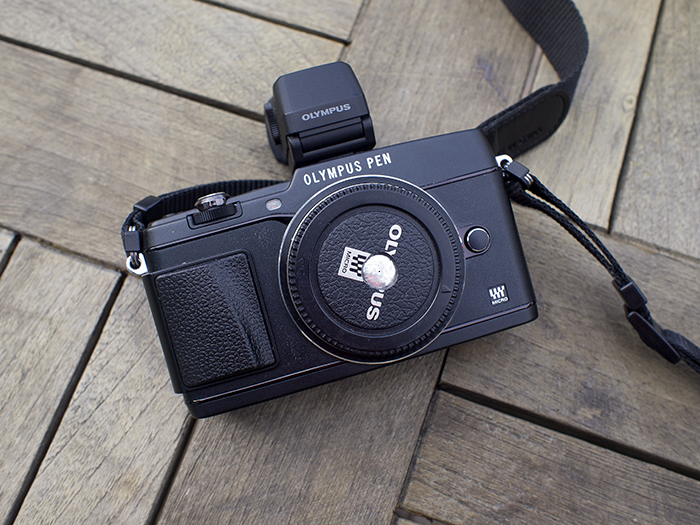
Olympus Pen with hand pierced aluminum foil hole, Auto exposure mode, ISO 1600.
.
VICKY’s Submission:
Great to take this image of a moving subject – I used a digital camera with a pinhole to make this possible.
.
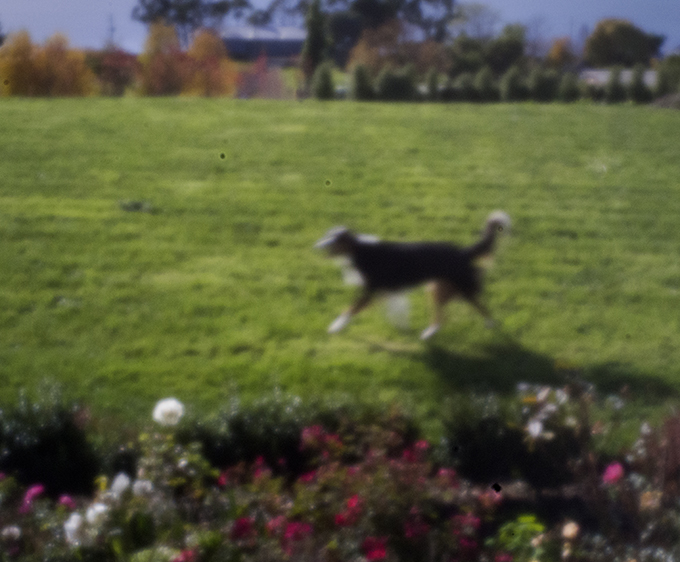
Charlie chasing a ball … 1/45th of a second @ 1,600 ISO
.
DOUG’s Submission:
I have made pinhole photos with all kinds of technology from tin cans to cars but what I like the most is how direct sunlight splashes a rainbow onto the image. It’s Autumn in Australia s the two ephemeralities – light and autumn leaves were an ideal subject for pinhole investigation.
.
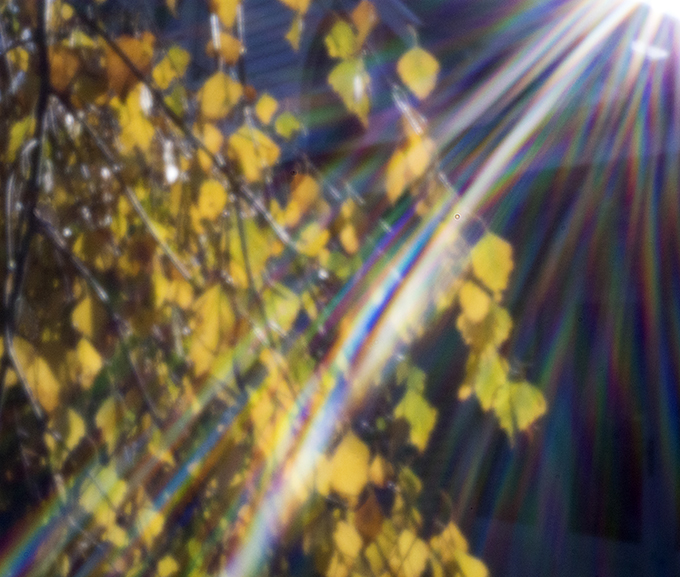
Autumn rainbow splash … 1/45th of a second @ 1,600 ISO
.
Vist the WPD Site for other contributors: http://www.pinholeday.org/gallery/2015/
.
Our Past WPD images:
2014 Vicky’s http://pinholeday.org/gallery/2014/index.php?id=1810&City=Toowoomba
2014 Doug’s http://pinholeday.org/gallery/2014/index.php?id=1811&City=Toowoomba
2013 https://wotwedid.com/2013/04/29/world-pinhole-photography-day-our-contribution/
2012 http://www.pinholeday.org/gallery/2012/index.php?id=1937&searchStr=spowart
2011 http://www.pinholeday.org/gallery/2011/index.php?id=924
HERE IS THE LINK to the 2011 pinhole video http://www.youtube.com/watch?v=Yk4vnbzTqOU
2010 http://www.pinholeday.org/gallery/2010/index.php?id=2464&Country=Australia&searchStr=spowart
2006 http://www.pinholeday.org/gallery/2006/index.php?id=1636&Country=Australia&searchStr=cooper
2004 Vicky http://www.pinholeday.org/gallery/2004/index.php?id=1553&Country=Australia&searchStr=cooper
2004 Doug http://www.pinholeday.org/gallery/2004/index.php?id=1552&Country=Australia&searchStr=spowart
2003 http://www.pinholeday.org/gallery/2003/index.php?id=615&Country=Australia&searchStr=spowart
2002 http://www.pinholeday.org/gallery/2002/index.php?id=826&Country=Australia&searchStr=spowart
.
.

BOOKEND: Photobook Melbourne — what a read?
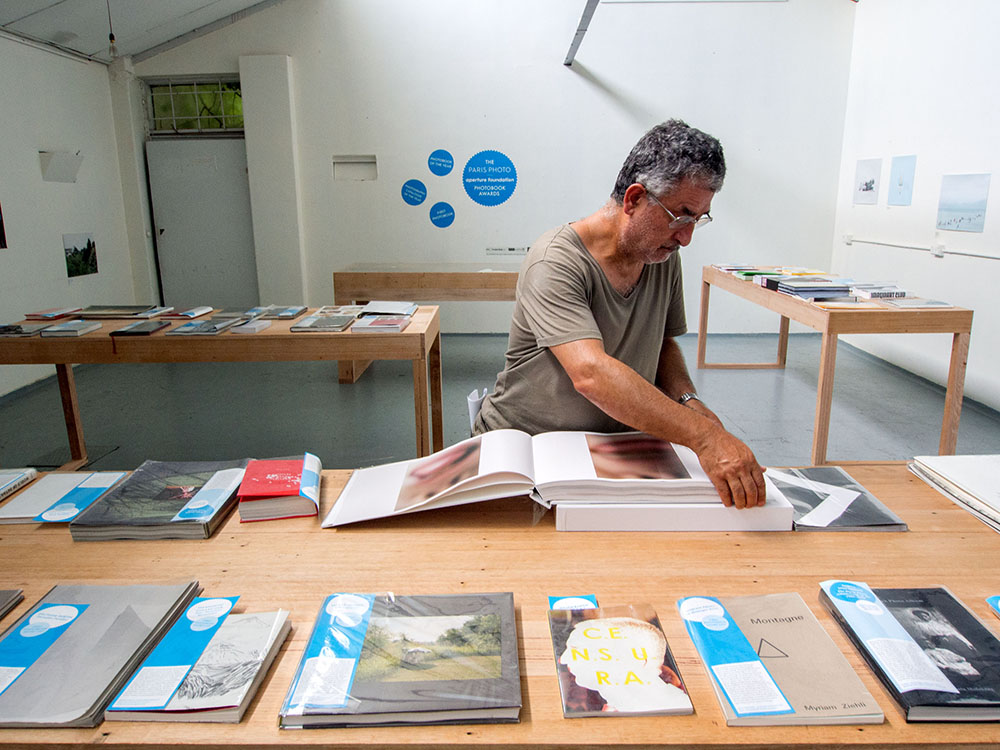
Photobook Melbourne: Peter Lyssiotis looking at an Aperture Books
We all know that feeling when you are really getting into a book, its narrative and flow, and then you reach the point where, as the last page is turned, you wish it could go on, and on… Photobook Melbourne (PM) was something of that kind of experience. The books seen, perhaps around 300, the exhibitions seen, and the people met now all vividly reside in memory and digital capture code.
The Photobook Melbourne event took place between February 12 to 22 it was coordinated by Heidi Romano and Daniel Boetker-Smith. It was always an ambitious undertaking. Its vision was to connect international photobook world with makers and lovers of the book from around Australia… and New Zealand. This was achieved through numerous exhibitions, library displays, photobook awards, forums and workshops.
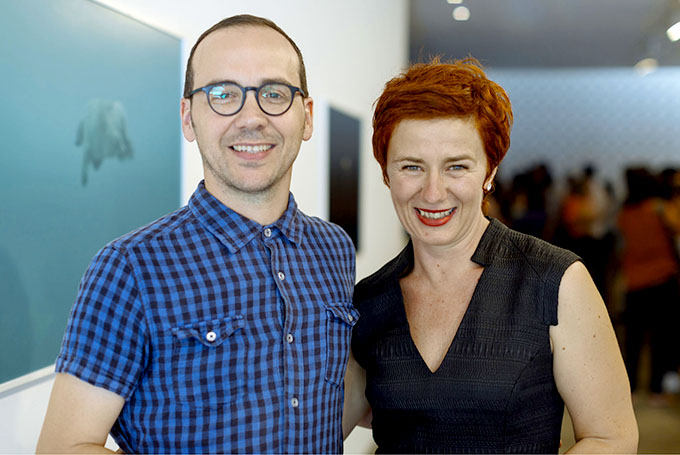
Daniel Boetker-Smith + Heidi Romano PHOTO: Courtesy of Lauren Dunn www.artdocumentation.com.au
Photobook Melbourne can only be described as a massive success. The photobook community of practice needs events like these so they can band together to affirm their interest and belief in the importance and creative power of the photobook. For once, the world of photobooks has come to us, or at least Melbourne, and for that we are a stronger and more informed cohort of makers, readers, collectors and lovers of photobooks.


Some of the attendees have responded to a request for comments – others are posts from Blogs and Facebook posts…
FROM JACOB RAUPACH: Photobook Melbourne was an amazing week full of a genuinely insightful mix of talks, exhibitions and book exhibitions, with the fair during the first weekend proving to be a great networking point for the rest of the week that followed. … I felt that the inaugural festival set an amazing benchmark for the following years! Looking forward to 2016.
FROM HARVEY BENGE‘s BLOG: On a zero to ten scale I’d give the festival a ten! Visit his site for more commentaries about photobook
FROM CHRIS BOWES: For someone naïve to the world of photobooks, Photobook Melbourne was an eye opening experience. Although coming in as a virtual outsider to this rapidly expanding art scene, I sank my teeth into as many of the talks, exhibitions and book collections I could manage, and came away a lot more informed than I was going in. Personal favourites were the Paris Photo – Aperture Foundation Photobook Awards exhibition, where the content of the books was engaging and the calibre unmatched, and ‘The Other Photobook Forum’, where in particular Gracia Haby and Louise Jennison showed that with a little creativity and business sense one can make a buck and do what they love.
FROM LIBBY JEFFERY – Momento Pro: The number of participants, visitors, books and buyers at Photobook Melbourne were fantastic and they confirmed that small press and self publishing is alive and well in Australia. The Awards and Book Fair also proved that a selection of high standard work is being created here, but a collaborative promotion and showcase of Australian photo books to the global market would benefit everyone.
FROM: ANGEL LUIS GONZALEZ FERNANDEZ Facebook Comment Back in Dublin after an amazing first edition of PHOTOBOOK MELBOURNE, having discovered tons of new work and books from Australia, New Zealand, and more -and having met a truckload of awesome people.
FROM KELVIN SKEWES: As someone that attended almost all of the events that were part of Photobook Melbourne I can only describe it as a tour de force for lovers of the Photobook. The festival opened on February 12th at the Centre for Contemporary Photography with Robert Zhao Renhui’s exhibition
A Guide To The Flora And Fauna Of The World and with a smoking ceremony by the traditional owners to welcome the festival to their land. Also announced on the opening night was the Australian Photobook of the year which was won by Raphaela Rosella for her unpublished book ‘We Met a Little Early But I Get to Love You Longer’ and I was humbled to be the runner up with my newspaper as photobook ‘Nauru: What was taken and what was given’. …
The main event for the first weekend of the festival was the Photobook Melbourne Book fair at CCP an event at was full of frenetic energy and far too many photobooks to browse let alone buy; amongst the many booksellers highlights included the infatigable Perimeter book with titles from Mack and Spector books and Anita Totha from Remote books who is doing to sterling job promoting photobooks from New Zealand. …
Great thanks are due to the entire Photobook Melbourne team so thank you Heidi Romeo, Daniel Boetker-Smith, esteemed guests Ángel Luis González Fernández, Ron Jude and the Dysturb Photo Collective, festival partners and sponsors Momento Pro, Photography Studies College, Copyright Agency and venues CCP, MGA, Strange Neighbour, Colour Factory, Neo Space, Baron Said and James Makin Gallery and to all the volunteers without whom this could not have happened so thanks to Felix Wilson, Kate Robinson, Bella Capezio, Katrin Koenning and countless others.
See you next year!
MORE COMMENTS WILL BE ADDED AS THEY BECOME AVAILABLE…
WHAT FOLLOWS IS A PERSONAL DIARY OF PHOTOBOOK MELBOURNE
Our arrival on the first weekend was delayed by my recent medical incursion so we fly into Melbourne on Wednesday. Through a friend we were able to stay in an apartment right in the middle of the city and our journeys out and about were by tram, train and lifts given by friends.
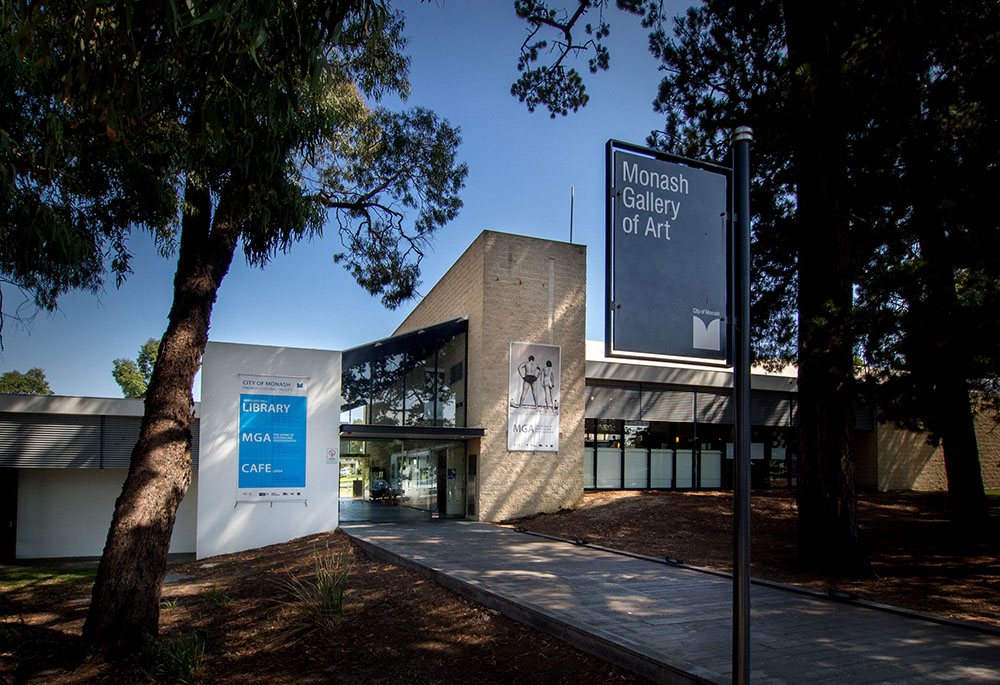
The MGA – The Home of Australian Photography
THURSDAY: We attended two book related exhibitions at the Monash Gallery of Art. Badged as the ‘Home of Australian Photography’ the gallery presented two photobook exhibitions, one of images from the collection that featured the theme of books and reading and was entitled ‘Light Reading’. The other was The Natural Collection an assemblage of books by The Photobook Club’s Matt Johnston and co-curated by Lucy Johnson. The Natural Collection brings together photobooks that explore “the harmony, tension and play” that occurs in the human relationship with nature and the natural landscape.
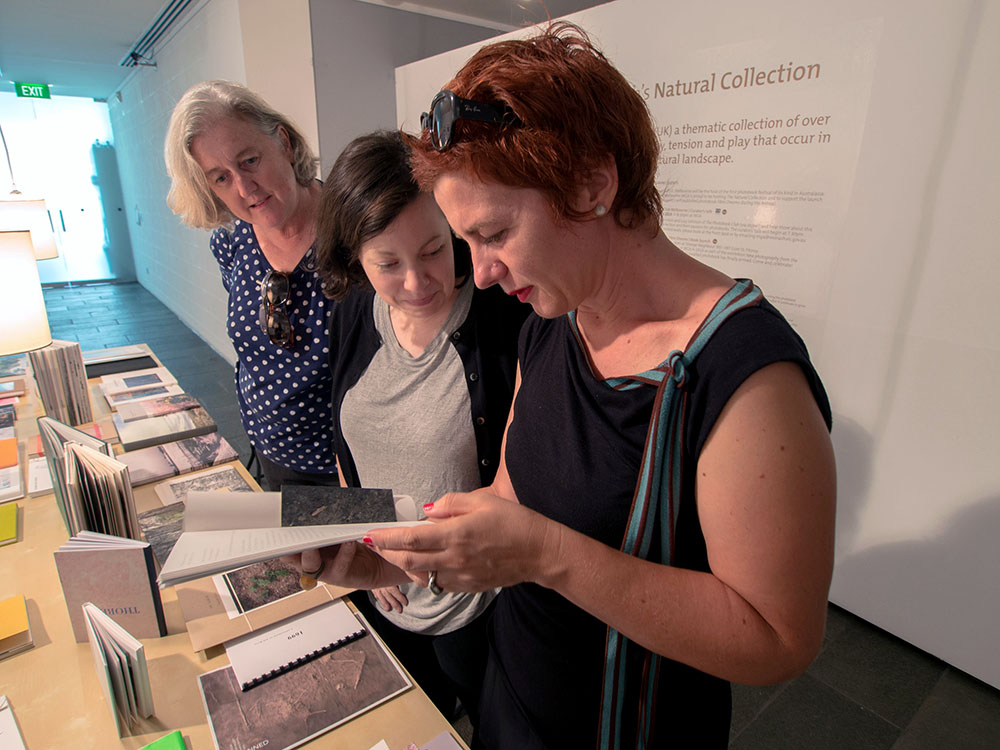
Heidi, Steph and Vicky discussing a book
The exhibition space was setup for readers to sit and work their way through a most interesting selection of Euro/American centric responses to the theme. Grand trade books sat next to simple fold ‘n’ staple zine-like booklets. We were there with Heidi Romano, Simone Rosenbauer from Sydney and MGA Gallery’s Education and Public Programs officer Stephanie Richter. We engaged in a spirited debate about book design; production methods and how to evaluate books.
That evening we attend a dinner for PM speakers, contributors, supporters and sponsors. By this stage it was acknowledged that the PM had been an enormous success so congratulatory statements were announced and a great feeling of an Australian photobook community being well and truly launched by this event.
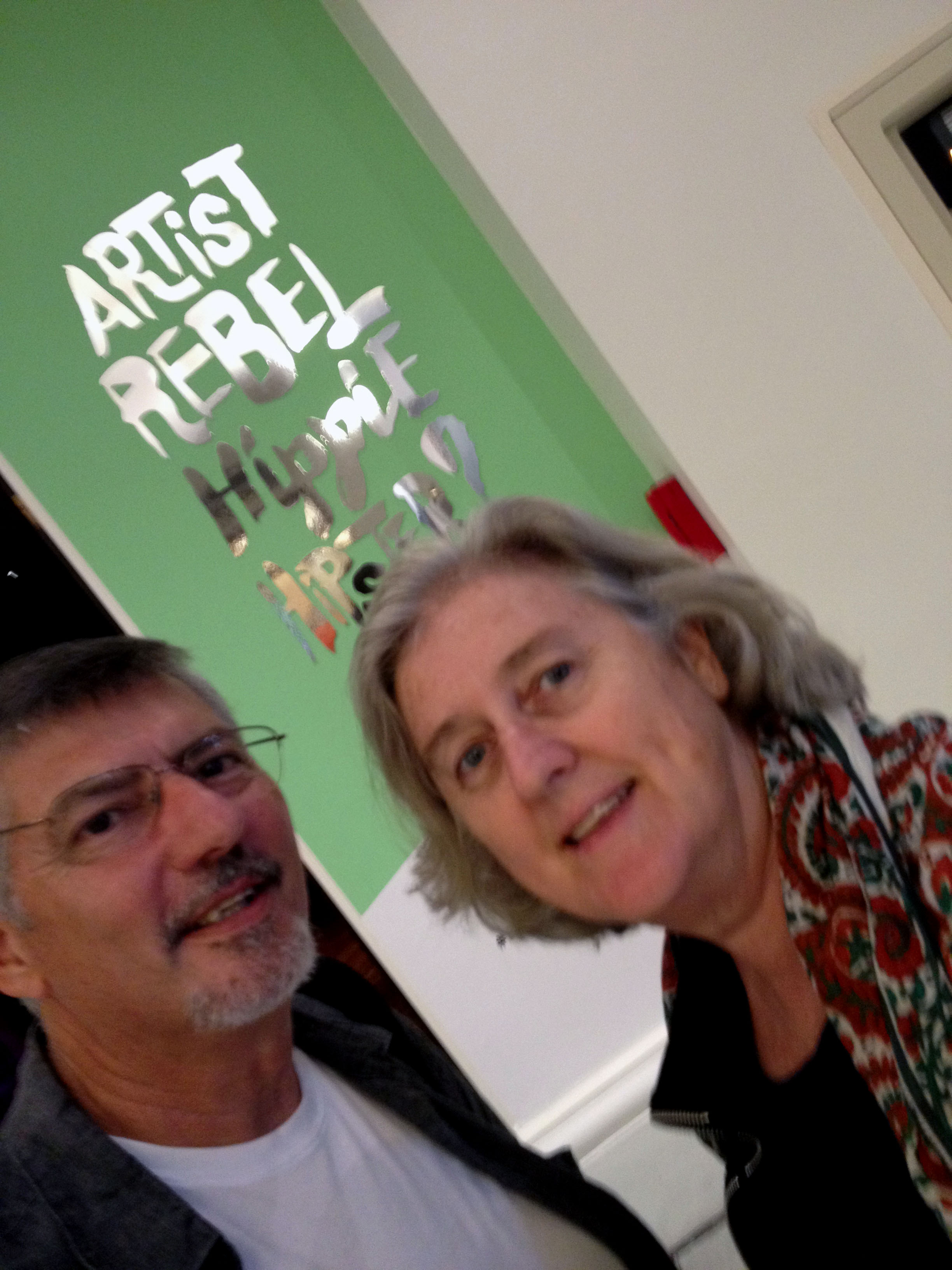
Bohemian Vicky+Doug
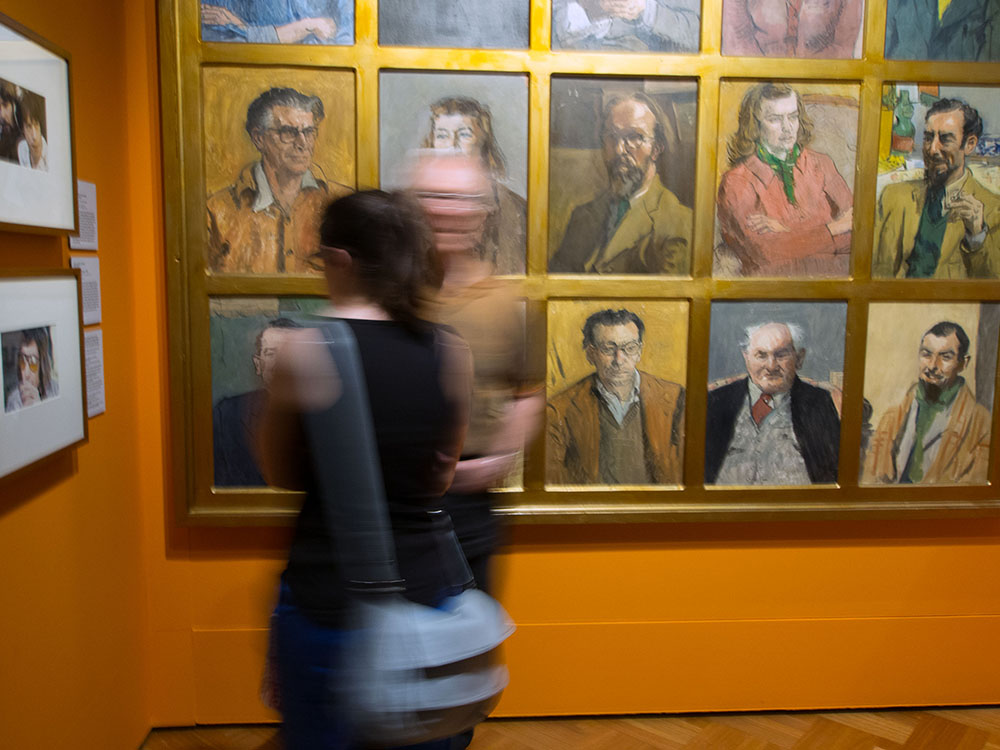
Bohemian Melbourne portrait wall
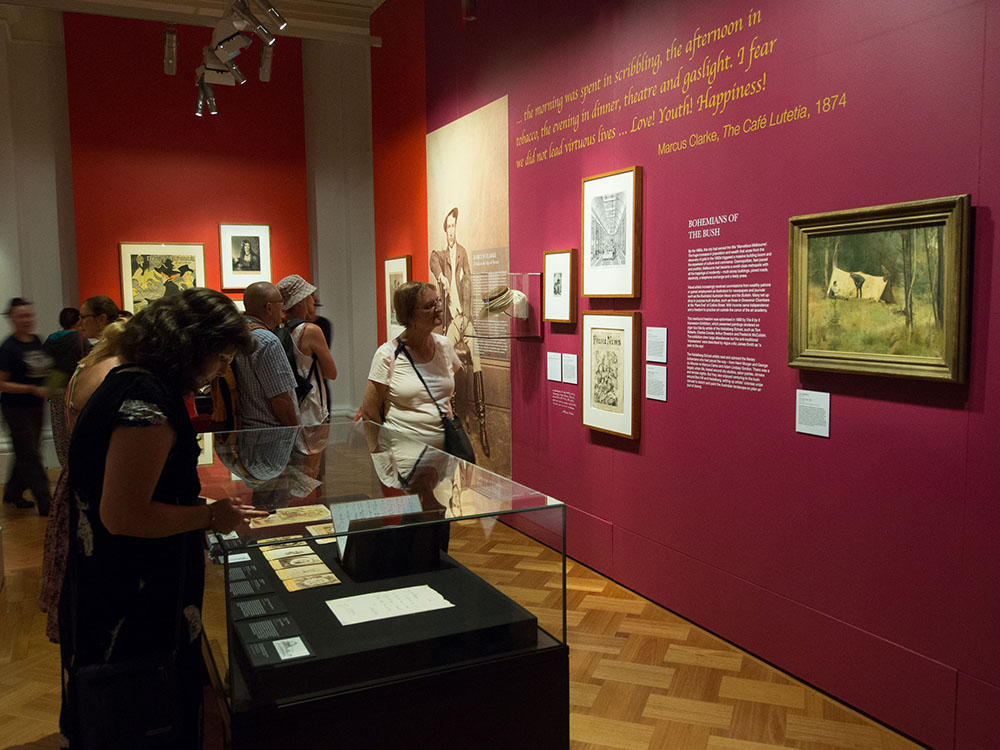
Bohemian Melbourne
FRIDAY MORNING: A breakfast of avocado, bacon and relish was partaken at a suburban street café while being interviewed by Australian Photography contributor Anthony McKee for a feature on photobooks. Morning tea with Robert Heather and Des Cowley at the State Library of Victoria and a visit to the SLV exhibition Bohemian Melbourne – a fascinating reflection on the creative, musical and arty sub-culture of Melbourne. Rennie Ellis’ photos contributed much to this history as well as poster art, paintings and the ephemera and memorabilia of the different eras represented by the theme.
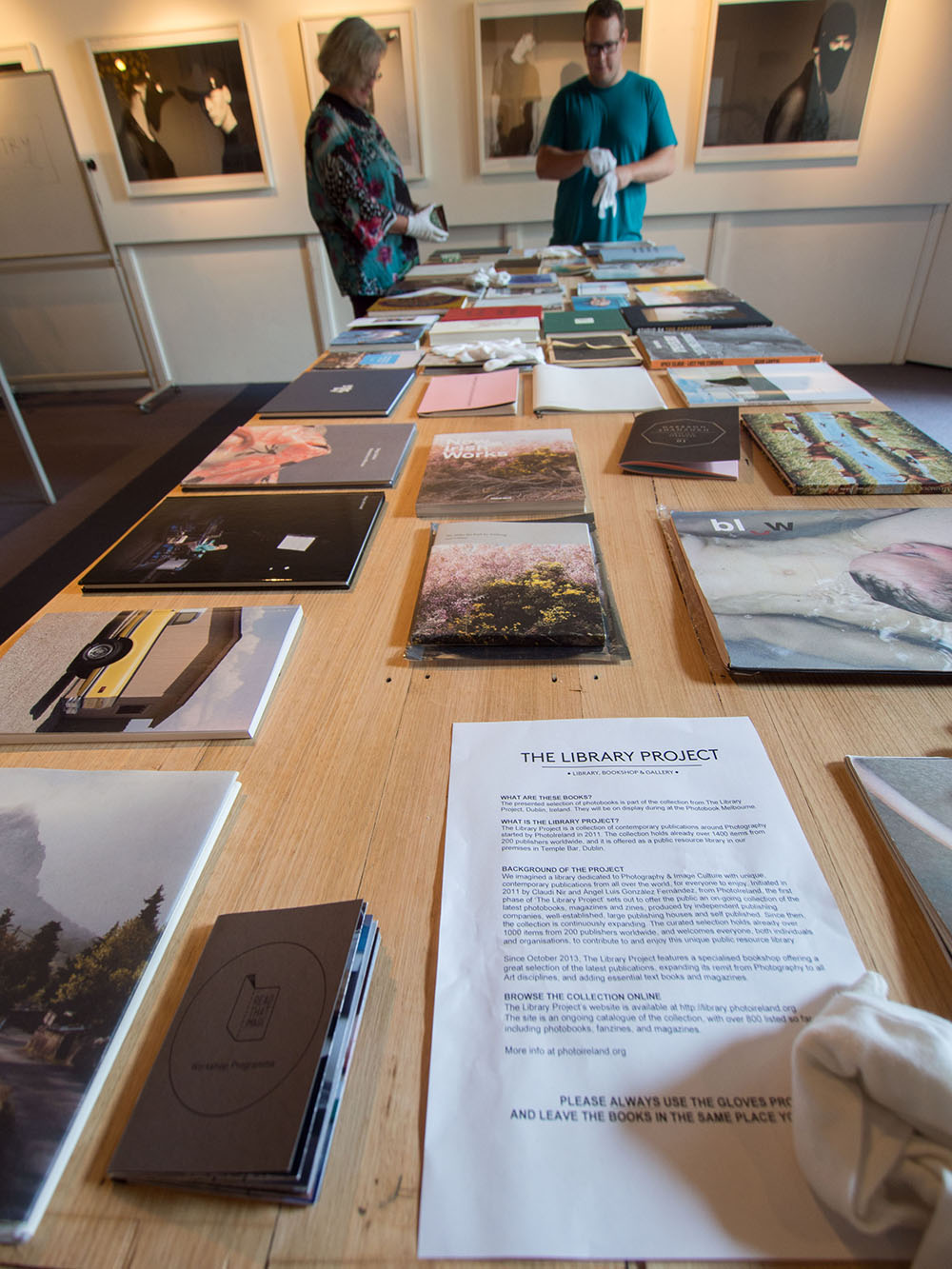
The Library Project @ PSC
FRIDAY AFTERNOON: We visited Photography Studies College to view ‘The Library Project’, a collection of photobooks brought to PM by Ángel Luis González Fernández from PhotoIreland. ‘The Library Project’ aim is to collect contemporary publications based on photography to create a public resource library. We viewed many books that are not easily available to see in Australia including Cristina de Middel’s Afronauts.
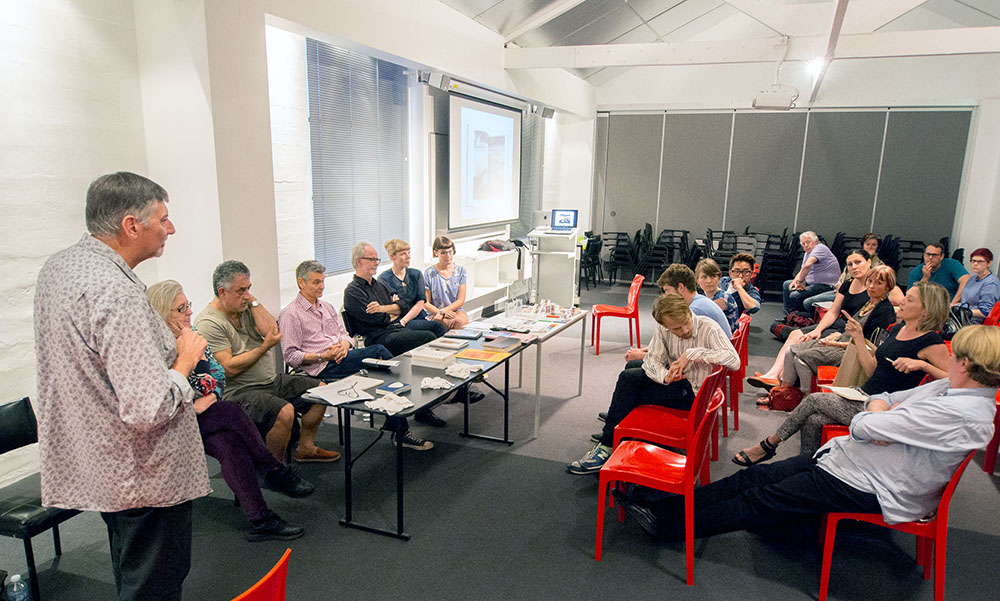
The ‘OTHER’ Photobook Forum – a question from the floor
FRIDAY EVENING: Later that evening we were involved with The ‘OTHER’ Photobook Forum – Artists’ Books, Zinesters and the Photobook took place. We have been working on this project for a couple of months now and we were able to bring together key practitioners from these ‘other’ photobook disciplines who discussed and provided commentary on their use of the photo in the book. The participants included photomonteur Peter Lyssiotis, zinesters Gracia Haby and Louise Jennison, artists’ book maker Dr Lyn Ashby, Des Cowley from the State Library of Victoria and Victoria Cooper who stood in for Georgia Hutchison who was unable to attend due to extenuating family issues.
It was an event that stirred much interest with artists like Deanna Hitti and Theo Strasser attending as well as Momento Pros’ Libby Jeffery, and photobook makers Kelvin Skewes, Daniel Boetker-Smith and Chris Bowes.
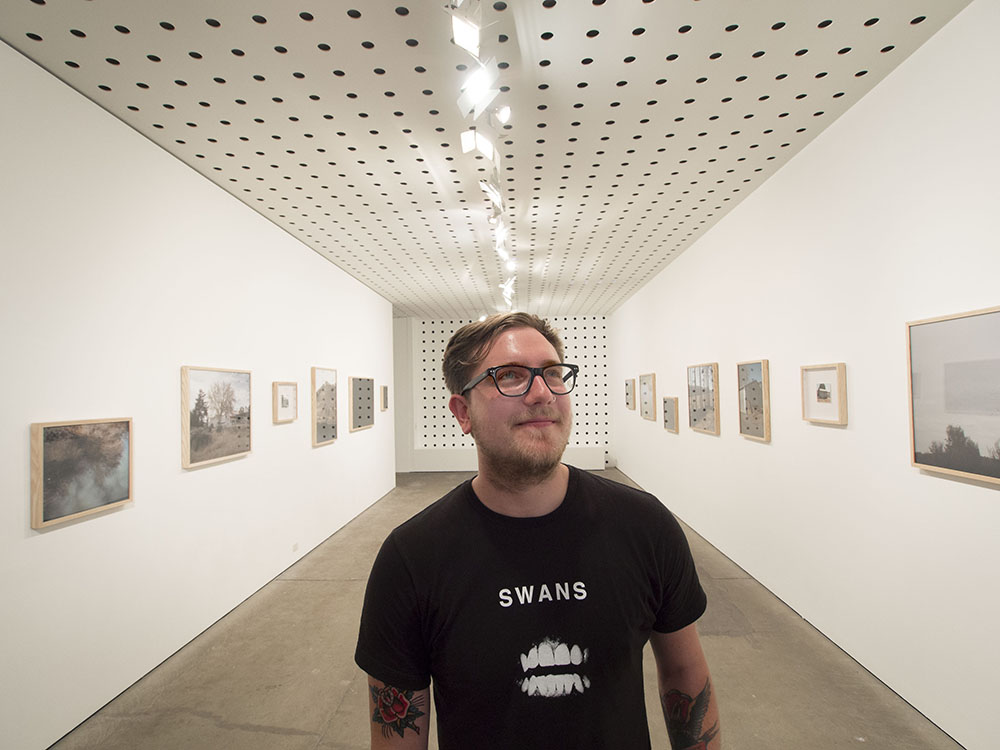
Jacob Raupach @ CCP
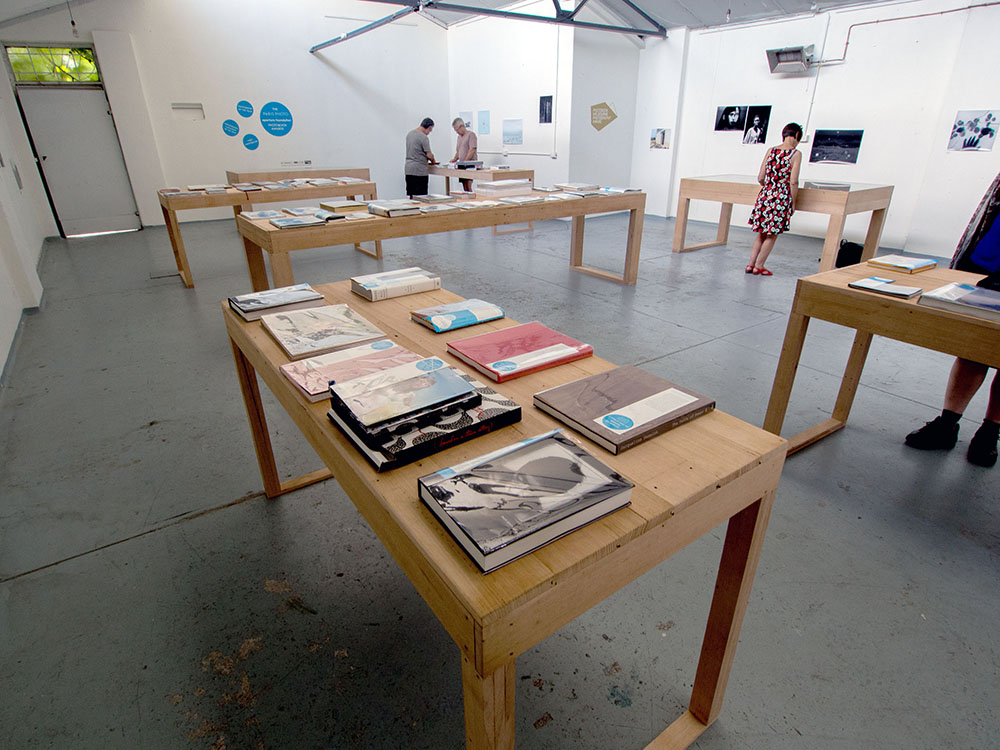
Aperture Books on display @ The Baron Said
SATURDAY: A day to attend artists talks at the Centre for Creative Photography by, amongst others photobookmaker Jacob Raupach and the exhibition FELL – Bought a copy of his latest book WEALTH. Following up with visits to the Momento Pro Australian Photo Book of the Year Award at the Asia Pacific Photobook Archive and the Aperture Photobook exhibition @ The Baron Said and a stimulating lunch with Peter and Tess Lyssiotis @Babkah.
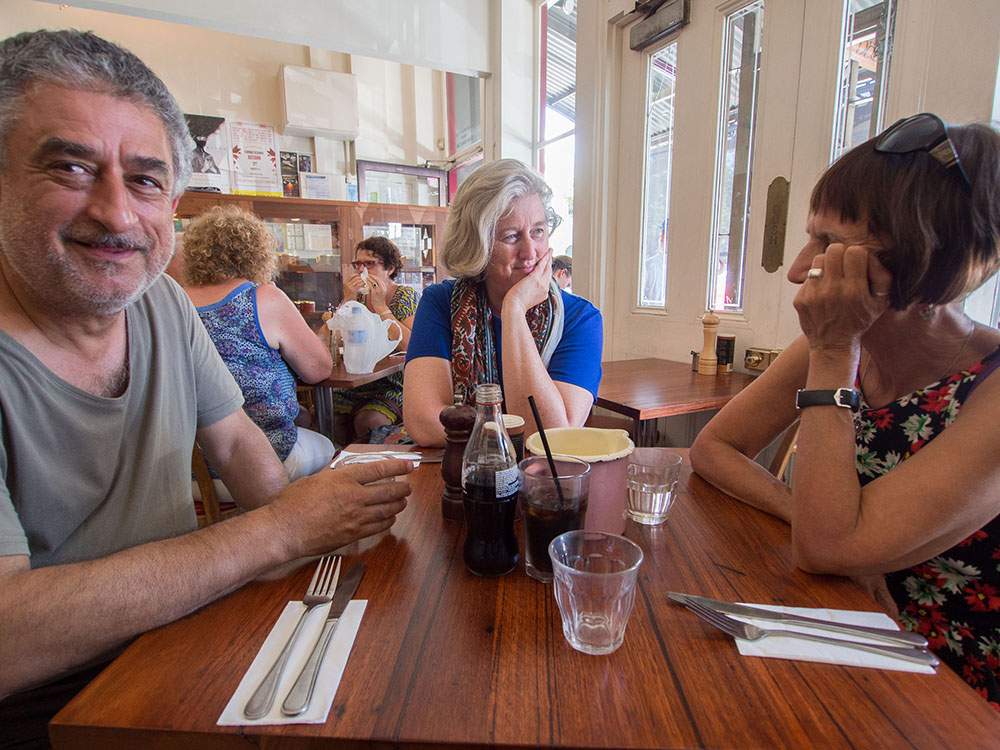
Lunch with Tess + Peter
Photobooked-out we headed back to the city by tram and had a chance meeting with Lismore artist and Siganto Artists Book Fellow Jan Davis who was attending a Print Council meeting – Only in Melbourne could strange intersections like that could happen.


SATURDAY EVENING: Melbourne White Night event
450,000 Melbournians took over the streets of the CBD – everything stayed open and performances and projections, bands and music were everywhere. Amongst other things we went to see the projections in the Dome at the State Library of Victoria at 10.30 at night – queued in line for 30 minutes with 1000s of others what a night…!
SUNDAY
A day of traveling home to cyclone weather drenched Brisbane.
UNTIL NEXT TIME —- For PHOTOBOOK MELBOURNE 2nd EDITION….
Regional Selfies: Communities and Self-Documentation
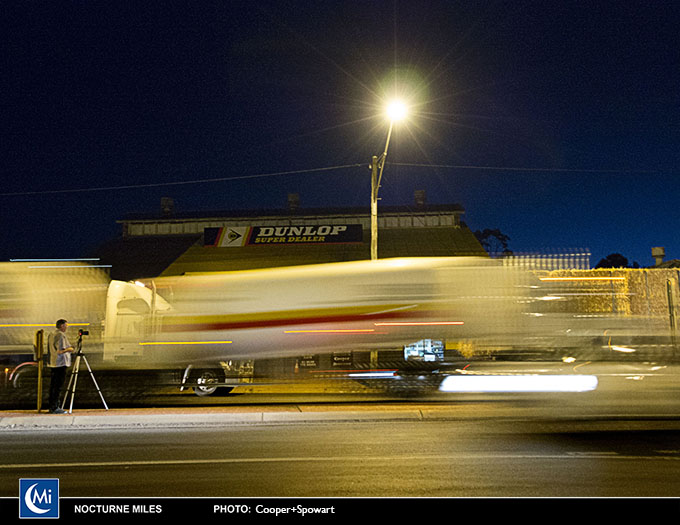
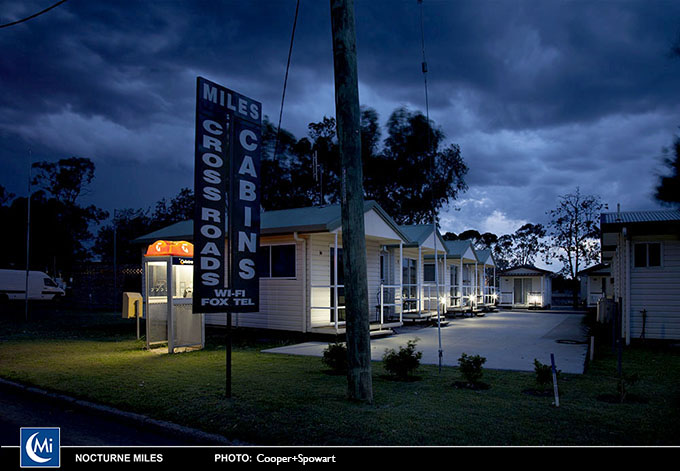
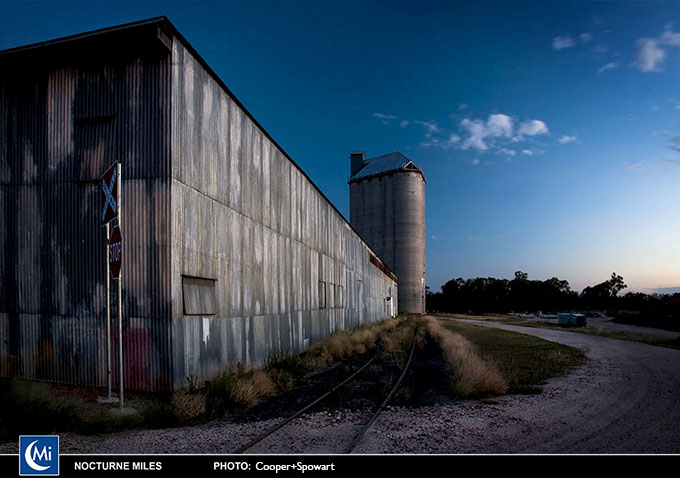
Through documentary photography and social media Victoria Cooper and Doug Spowart have explored connections with Place in urban and regional communities in Queensland, New South Wales and Victoria. The purpose of these Nocturne Projects is to capture everyday scenes of each community in nocturnal light, dusk and dawn. These images are then posted on a Nocturne project Facebook page to evoke stories, memories and shared experiences from the community.
In each project Spowart and Cooper found different ways to include community participation. In 2014, they were invited to work in Miles, a major town of the Western Downs Region of Queensland. The Nocturne Miles Community Documentary project sought to engage with the broader public to undertake self-documentation projects and skill development in nocturne photography. Both local and temporary residents who enjoy taking photos, as well as those more skilled in photography were all invited to participate. After an initial workshop, Spowart and Cooper mentored the 18 participants to create images for the project including self-portraits and daily assignments and produce Facebook reports and a zine.
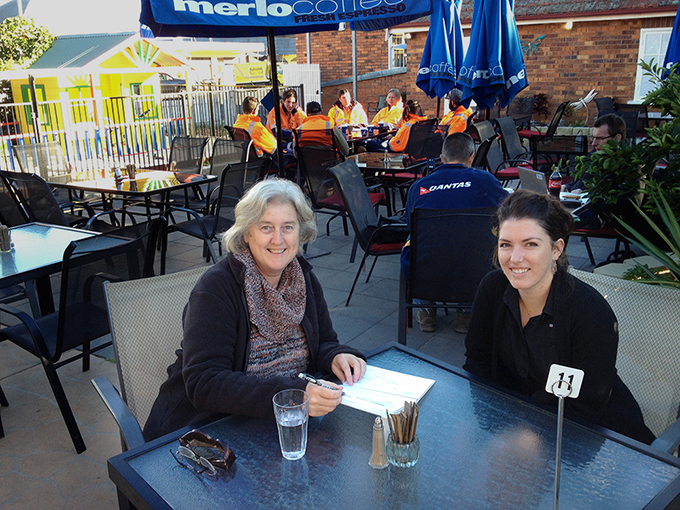
Vicky and Ashleigh Campbell in a pre-event planning meeting
To begin the project consultations were undertaken with staff from the Western Downs Regional Council’s Cultural Development team Ashleigh Campbell and Anne Keam at Dogwood Crossing to refine the project to match the needs of their community. Then centre staff sought out members of the community who could be interested in the project. Possible candidates then completed an Expressions of Interest form to provide some information on their experience and the photography tools they had access to e.g. DSLR camera, point and shoot camera, mobile phone or tablet cameras. Another important consideration was that the applicants were going to be in the region during the project to participate in briefings, workshops and shootouts as well as the final day’s zine making activity.
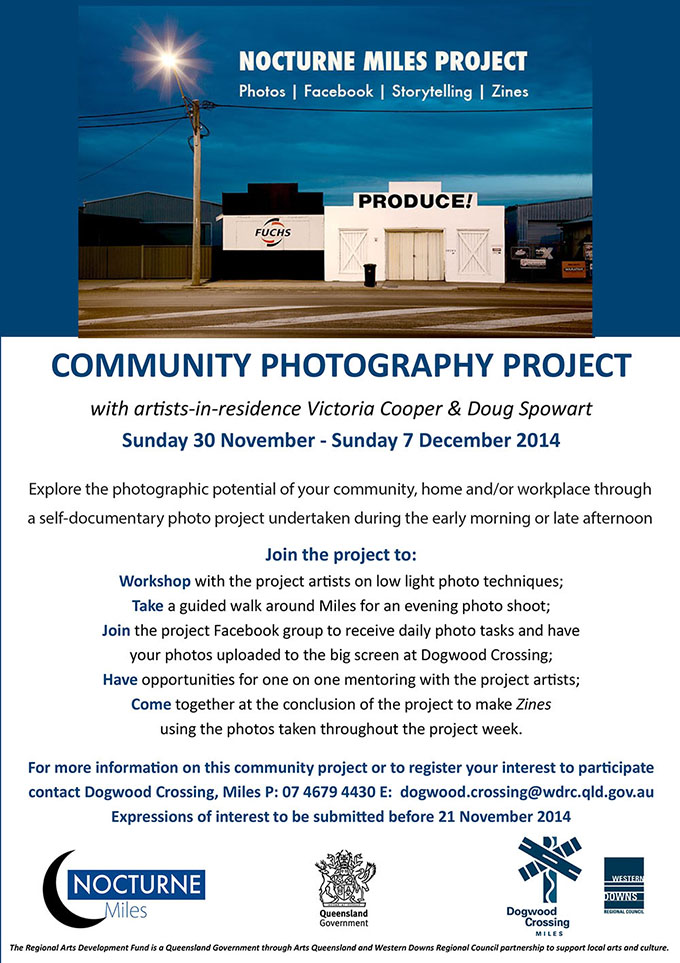
Project Flyer – Nocturne Miles
While numbers were limited there was a desire by the artists and Dogwood Crossing that the project accessible to as many participants and be as inclusive as possible. The one proviso was that project participants needed to live and/or work in or near Miles including the smaller surrounding towns or on properties/work camps in the Miles district.
The participants engaged with the project in a variety of different ways including:
- An initial introduction to the project and skill development workshop;
- Guided evening photography shoot-outs in the main Street of Miles as well as at the Miles Historic Village;
- Daily photo tasks over the week of the project assigned through a project Facebook group;
- Optional mentoring sessions, where required, to enable images to be prepared and uploaded for the project;
- Display of participants photos to a digital screen at Dogwood Crossing; and
- A practical ‘zine’ making workshop.

Doug doing a briefing
The project began on Sunday November 30 with an introductory workshop, briefing and a shootout. Progressively images were collated and uploaded to the Nocturne Miles Community Facebook page. Each day a new topic was presented a challenge and their interpretation formed into a photocollage. Communication with the participants was made through a private Facebook group page that enabled hear 24hour contact with participants and Cooper+Spowart. Some participants came into Dogwood Crossing with their photos or with requests for support in making and/or optimising better photographs. On Wednesday evening special access was provided to the Miles Historical Village for group to experiment with ‘painting with light’ and ‘projection’ techniques.
The Nocturne Miles participants at Miles Historical Village
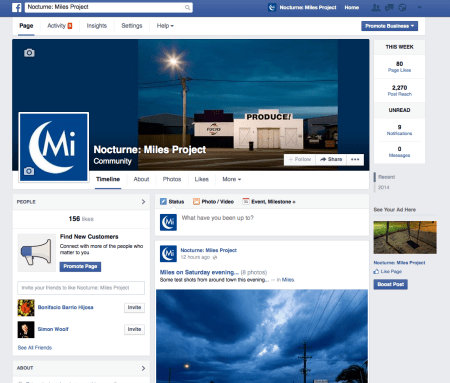
Facebook page
Cooper and Spowart added their images to the Facebook page as well and some visitors to the page posted stories about the places pictured. By the project’s end the page had 241 Page Likes, 60 Posts and the Total Reach was 17,771. Both the group page and the community page are still active.

Vicky and Doug in the Dogwood Crossing foyer
Some of the photocollages that formed the 8 page Zines that were made using the Dogwood Crossing’s A3 colour photocopier. These were cut and folded into zines that were inserted into a red and yellow special edition of the Centre for Regional Arts Practice’s Artists Survey Books.
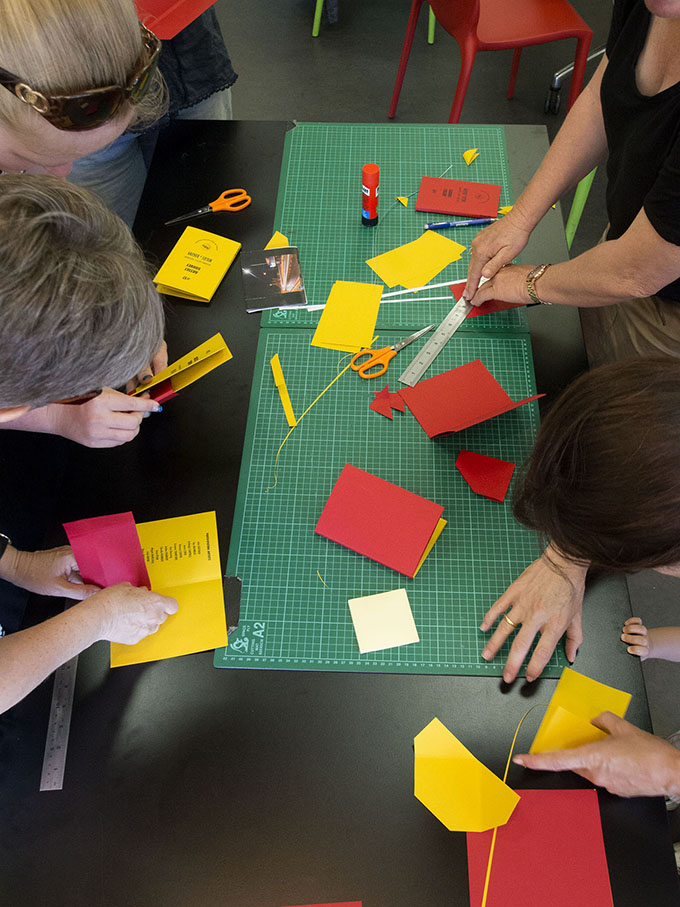
Nocturne Miles Zine making workshop
Some of the Photocollages
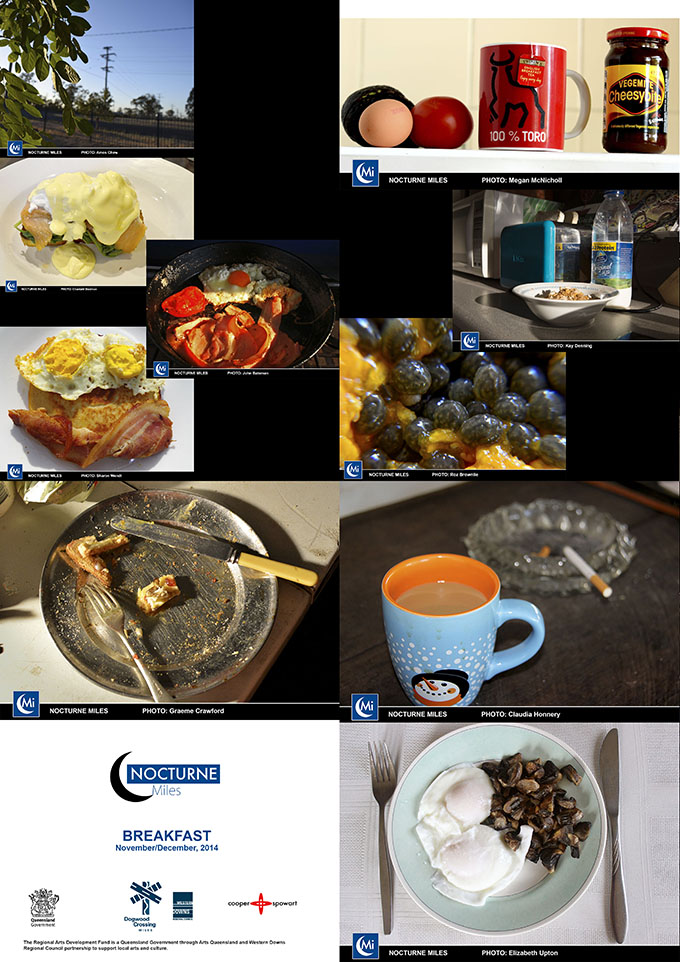
Breakfast – Nocturne Miles
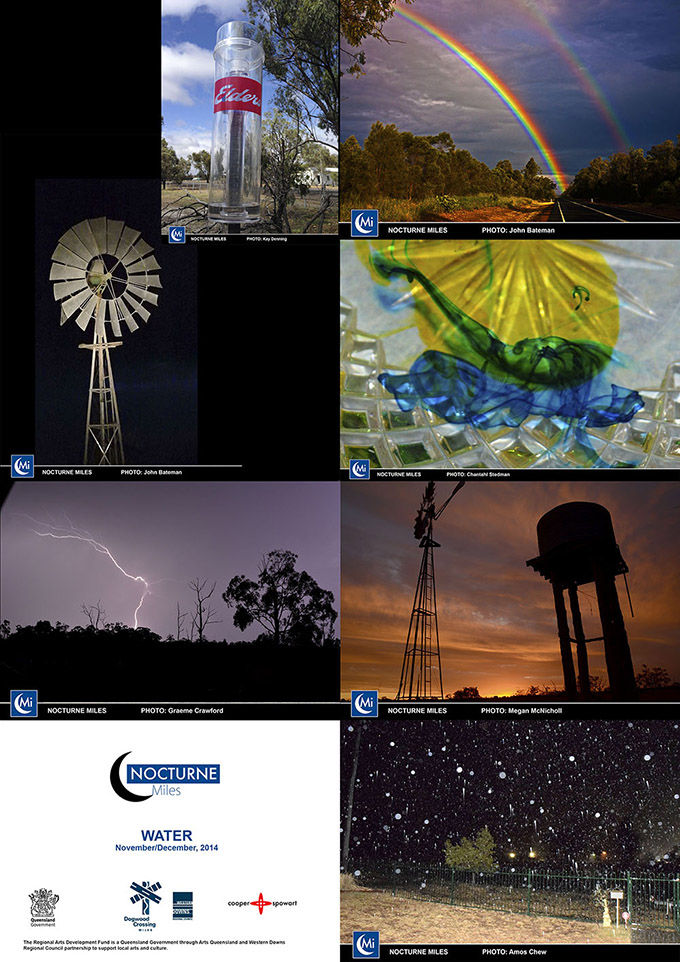
Water – Nocturne Miles

Miles Historical Villiage – Nocturne Miles
The photocollages presented here are examples of the image sets created by the participants. It is interesting to note that the original images may have emanated from all camera formats fro iPhone, simple digital point-n-shoot to sophisticated DSLRs.
We hear a lot about documentary photographers and student photographers travelling out into the country to create documents of life outside of the metropolis. Once on the ground these photographers seek out subjects to pursue and photograph. In this way significant documents are created of these outlying communities. However, the subject of the of the photographer’s gaze, and what is photographed, is based on the view of ‘outsiders’. The photographs they make may match preconceived ideas, and mythologised opinions, that they bring with them rather than how the people who inhabit these places feel about how and where they live.
What the Nocturne Miles project shows is perhaps that in an age where everyone can be a photographer what is important is the photograph itself. What then stands out the most is the link between the photograph and it’s authenticity. With this in mind these photographs are actual fragments of the lives of local people, whether they are from the farm, or people engaged in extractive industries, or those who work in administration roles or students at school, their voice in this conversation adds another view we can have of our regional communities.
The project was undertaken between November 21 and December 7 2014 and was overseen by Western Downs Regional Council’s Cultural Development Coordinator Ashleigh Campbell and Cultural Development Officer Anne Keam. The success of the project was also made possible by the enthusiastic support of the WDRC team at Dogwood Crossing.
What follows are more photocollages and individual images from the project
More images are on the Surat Basin.com.au website HERE
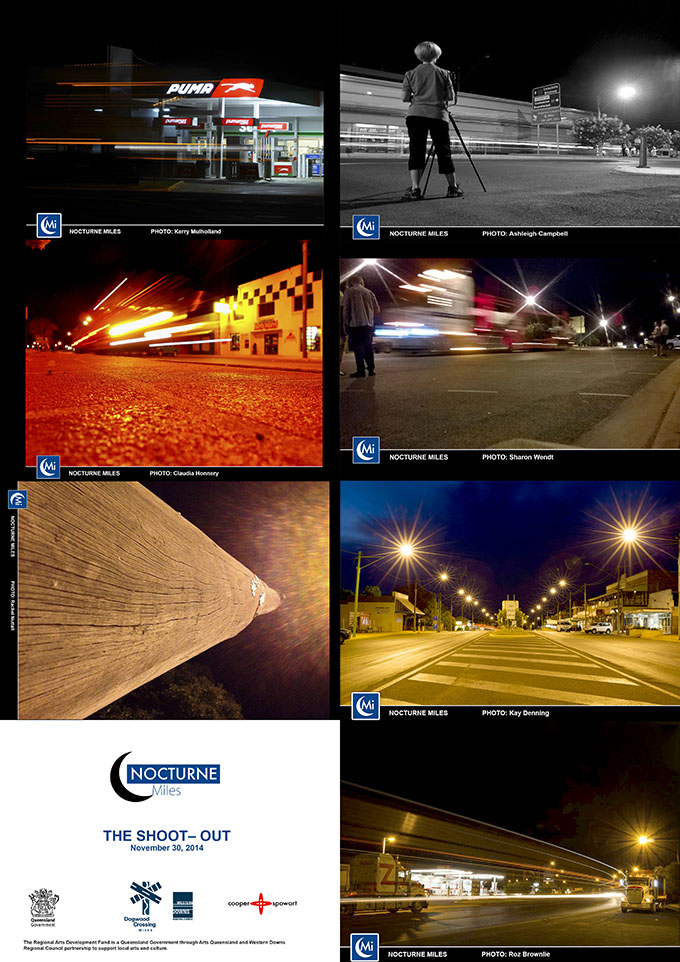
Murlilla Street – Nocturne Miles
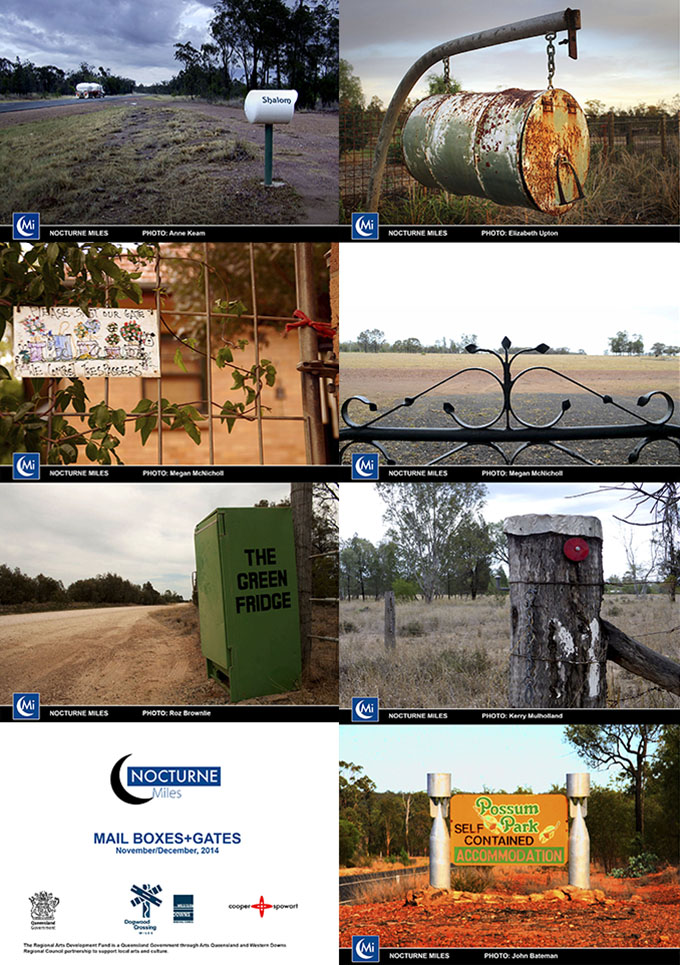
The front gate – Nocturne Miles
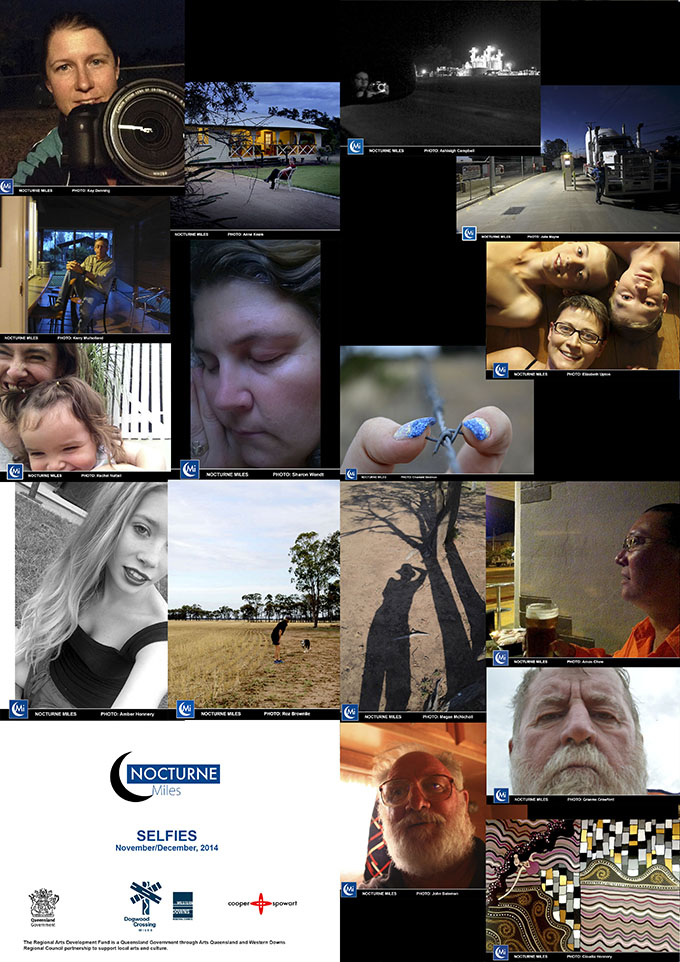
Selfies – Nocturne Miles
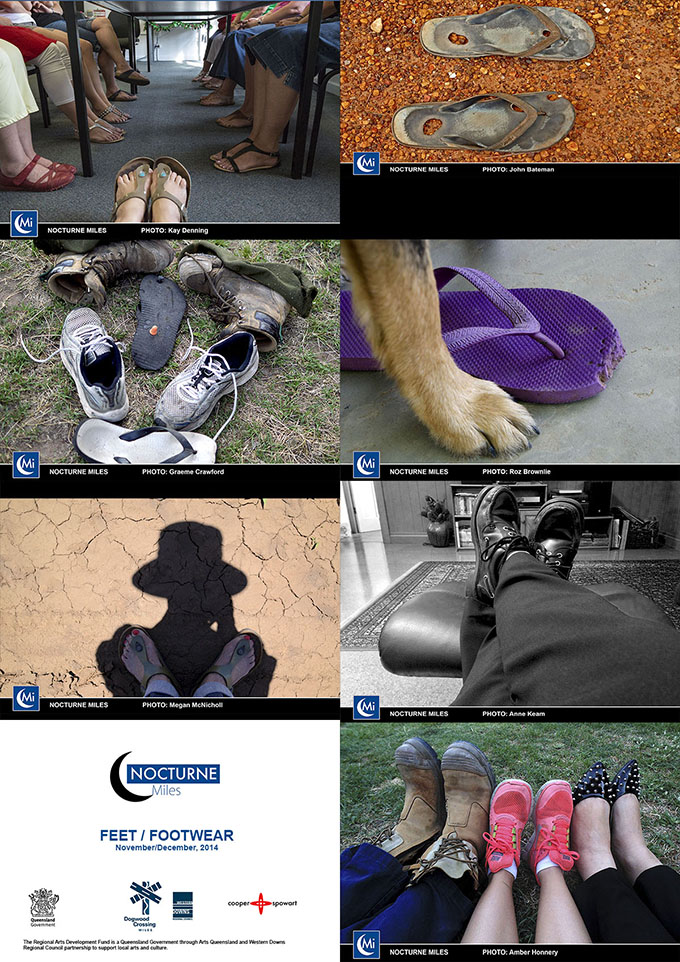
Footwear – Nocturne Miles
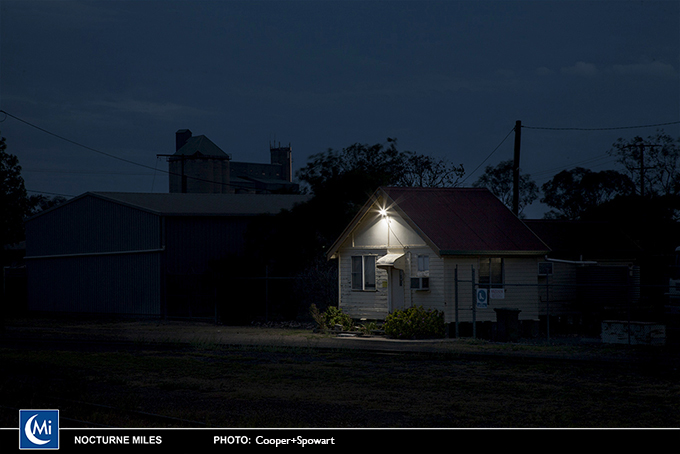
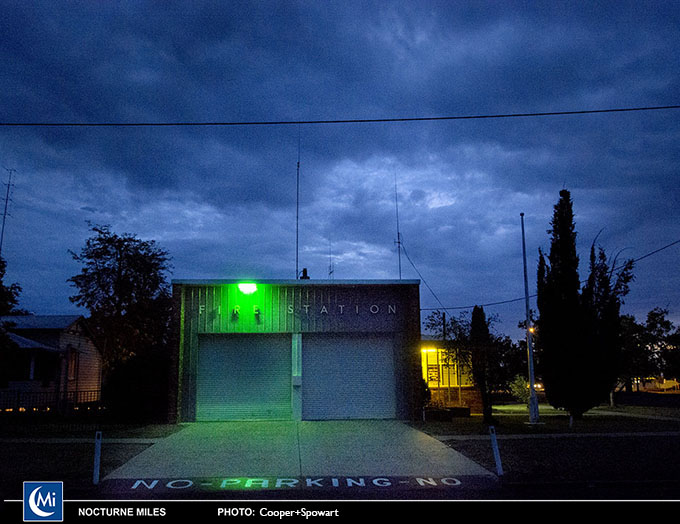

Text and photos unless otherwise accredited are Copyright ©2014 Victoria Cooper+Doug Spowart
WOTWEDID BLOG: 2014 in review – interesting facts + stats
The WordPress.com stats people prepared a 2014 annual report for our WOTWEDID blog.

Here’s an excerpt:
The concert hall at the Sydney Opera House holds 2,700 people. This blog was viewed about 13,000 times in 2014. If it were a concert at Sydney Opera House, it would take about 5 sold-out performances for that many people to see it.
HABITAT OUT WEST: Environmental Art of the Darling Downs Exhibition
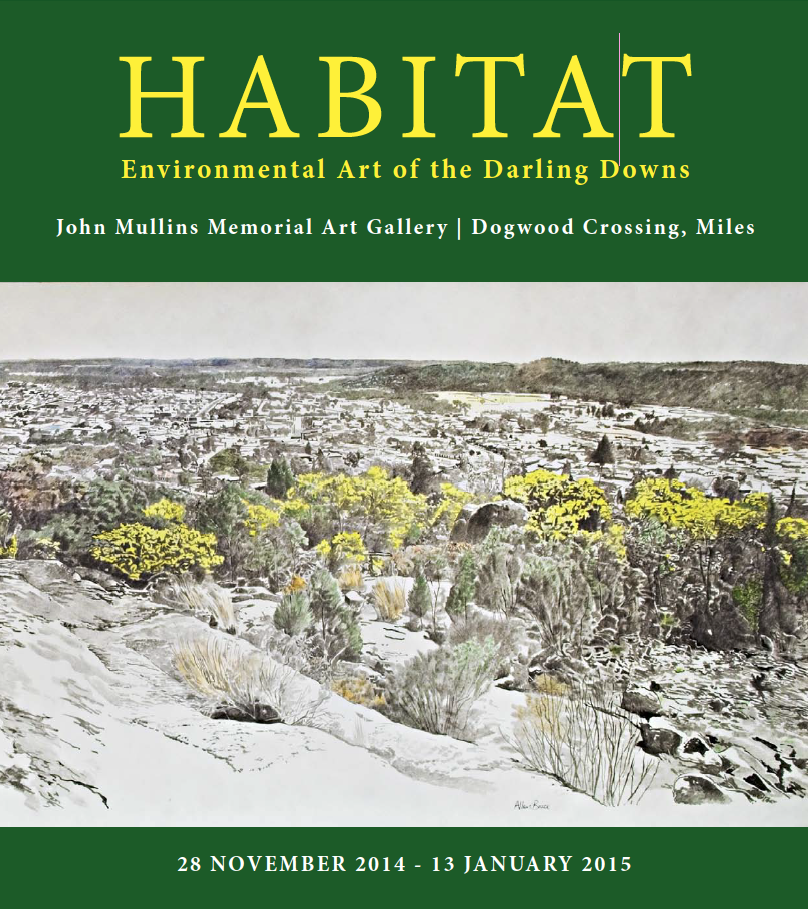
Curated by Ashleigh Campbell and Anne Keam.
When, how, and why did the locality Darling Downs come to be known as the Surat Basin? This question informed the exhibition curators Ashleigh Campbell and Anne Keam and with it came the recognition that such a shift was deeply important to the region’s connections and perceptions of their place.
.
Habitat is a word that accommodates the presence of life beyond the human shaped and perceived landscape. In any given habitat the living and the nonliving interact to the rhythms of the earth and the cosmos. As both observers and inhabitants, artists and scientists help shape human perceptions of and relations with the broader global environment. This includes the economy of the earth’s resources that supports humanity.
Campbell and Keam researched a broad range of influences including the natural and human habitat of the Darling Downs from colonial history to present. Through the eyes and minds of the region’s colonial and post-colonial artists, along with some scientific documentation and social artifacts, they sought to reflect on shift and its implications on the regions environment.
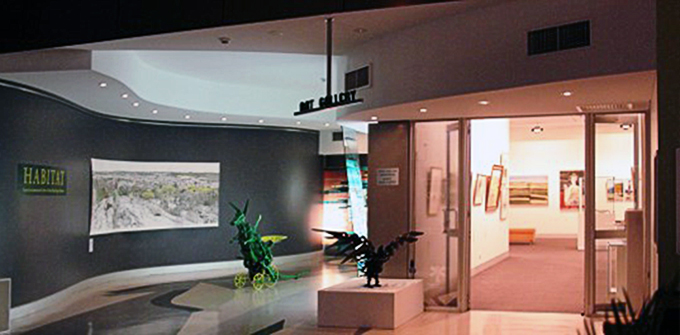
John Mullins Memorial Art Gallery entry – Dogwood Crossing, Miles.
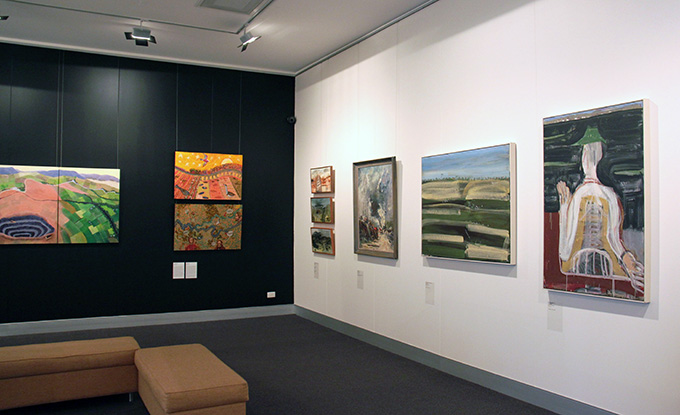
John Mullins Memorial Art Gallery interior
.
This exhibition brought together a diverse collection of works including: prehistoric fossils and other historical artifacts, references and narratives of the pastoralists struggle with the invasion of prickly pear cactus and other pests, floods and droughts. The artists represented in the show came from many disciplines. Paintings representing this landscape covered a range of movements and styles from romantic colonial pastoral period to impressionism, abstraction and modernism. Well known artists names: Kenneth Macqueen, Sam Fullbrook and Joe Furlonger are representative of the depth of creative work in this exhibition.
.
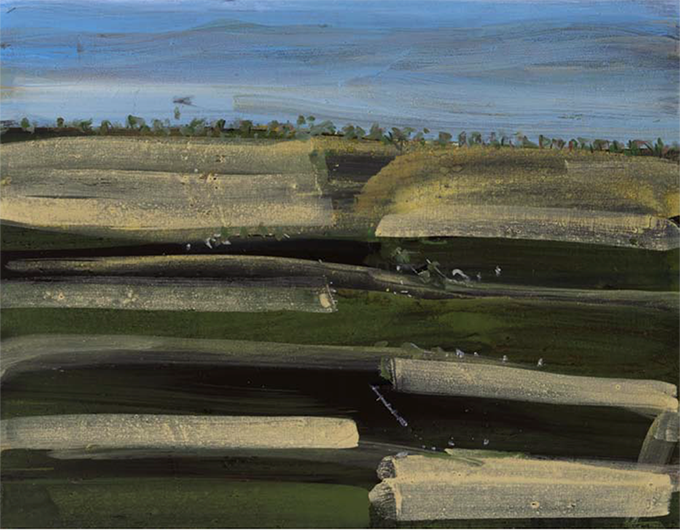
Joseph Furlonger Round Up Ready Field, near Dalby 2012 Acrylic bound pigment 91 x 122 cm Courtesy of The Hughes Gallery, Sydney
.
Some artists reflected on living with the natural environment as found in small corners of Patricia Hinz’s back yard in the work, Sanctuary (2014). Palpable in the drawing of Allan Bruce’s Stanthorpe, Late Winter (2008) is the feeling of being in the grand sun-soaked landscape of the Downs, and the relationship of small towns with the surrounding country. Bruce observes: “Stanthorpe is one of those towns where the natural and built environment coalesces almost seamlessly.”[1] The inventiveness and creativity that pervades every farmer’s shed and bushman’s camp is embodied in the sculptural work of Dion Cross’ Grass Harvester (2014), that highlights the competition for pasture between man and animal during periods of drought. The fine drawings of flowers and fungi by botanical artists and illustrators through scientific documentation reveal a deep understanding and investigation of the natural life forms found in this region.
.
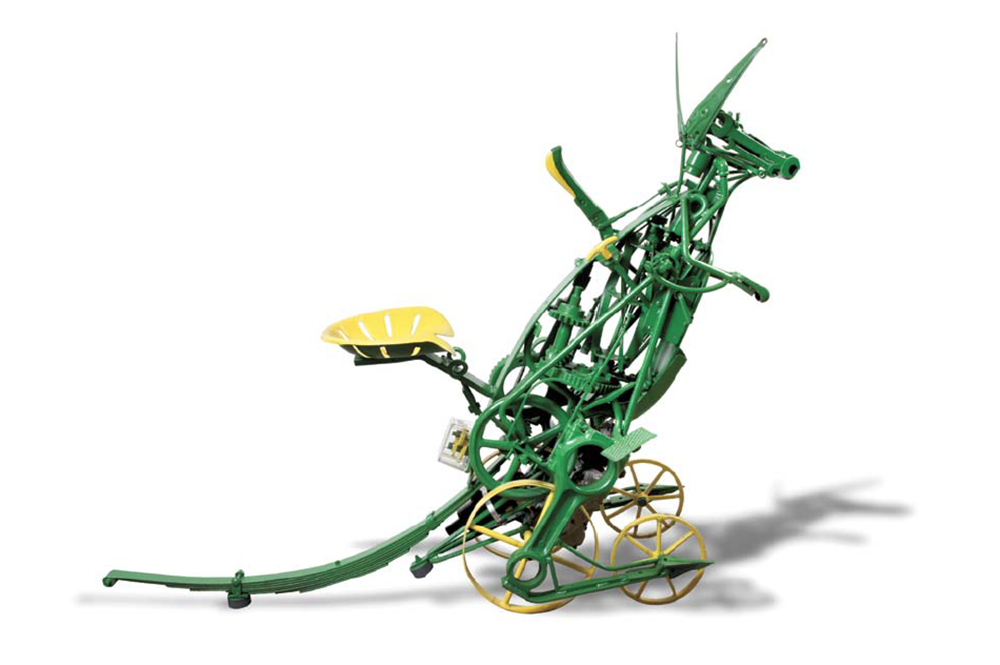
Dion Cross Grass Harvester 2014 Steel sculpture 150 x 60 x 180 cm Courtesy of the artist Image: Spowart + Cooper
.
Phil Bazzo’s painting, Miles: At the Crossroads (Triptych, 2008) presented two concepts: the physical nature of the intersections of roads in Miles including the dynamics of heavy road vehicles and the metaphor of crossroads to infer change and concerns for the future. Both found natural and manmade objects and materials were also utilized as the visual language of protest. This was evident in the mixed media works of Jennifer Wright (Summers): Searching for Life in the Anthropocene 1 (2014), using tea bags, feathers, fabric pen & ink, watercolour and Anthropocene Nest (2014), that was made from plastic bags and pelican bone. Nicki Laws’ Habitat Gone (2014) collaged and embroidered the materials found in the fluoro safety barriers widely used in the industries found in the region.
.
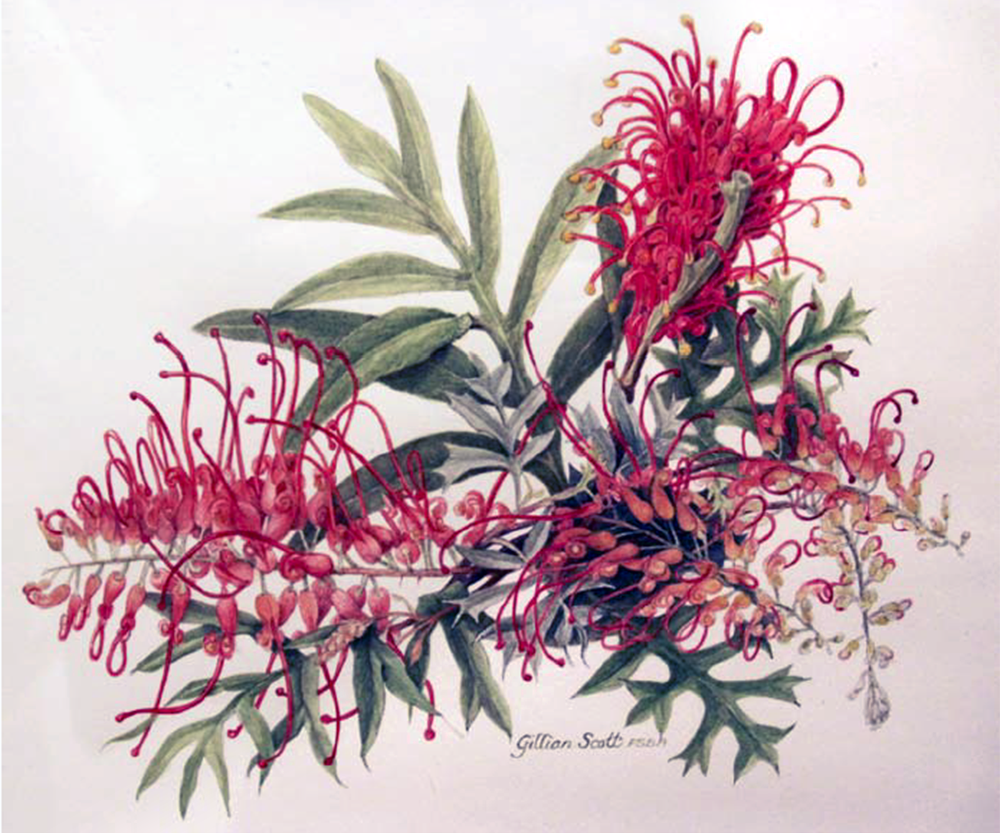
Gillian Scott Grevillea x ‘Robyn Gordon’ 1993 Watercolour on paper 25 x 35 cm Courtesy of the artist
.
The solastalgic plea for a balance with man and the land was also deeply felt when viewing the work of Barbara Hancock’s Brigalow Landscape (2014). Working with the land, technology and energy needs was also strongly referenced in the work of Sylvia Secomb (Mann), Synergism – Towards Regeneration I (2010), but also reflects on the question “What will we be leaving for those who come after?”[2]
.
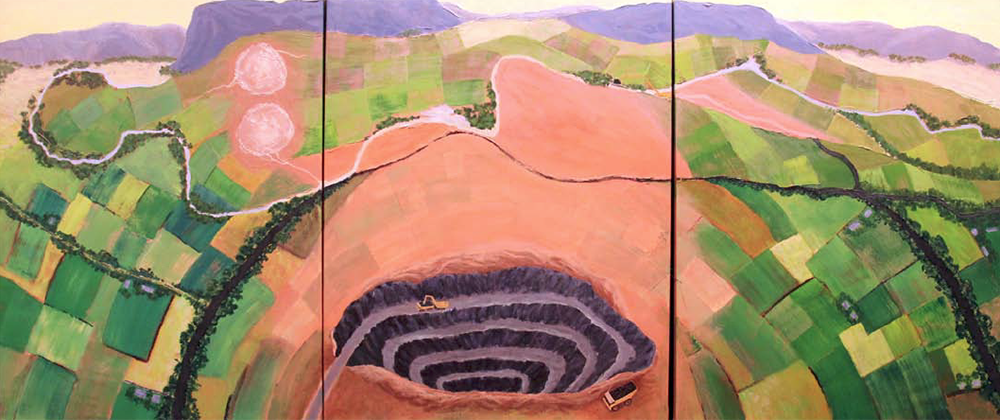
Sylvia Secomb (Mann) Synergism – Towards Regeneration I 2010 Acrylic and medium on canvas 91 x 213 cm Courtesy of the artist
.
For the city viewer who ventures out into the region to connect with this show, there is a unique experience: to be in the space and place of the exhibition, Dogwood Crossing, Miles, within the Habitat it references. This site-specific exhibition presents rare opportunity to engage with the historical and contemporary issues of living with the land through the creative energy and perception of those who chose to live and work in this region. The curators have also published an extensive and informative online catalogue to accompany the exhibition: Habitat_Catalogue or online at http://issuu.com/ourwesterndowns/docs/catalogue/1
Beyond the facts and information, the presence of a growing connection and love of the Australian environment pervaded strongly throughout this extraordinary show. Through visual story telling and lived experience, the artists and the curators have constructed a layered topology of the Darling Downs. A telling image of how the effects of a changing human condition: technology, energy and food production can be identified and chronicled through the artist’s vision.
.
Victoria Cooper
I am also privileged to have my work, 7 Gates (two forms: artists’ book, 2009; digital media presentation 2014), included in Habitat.
[1] Page 11, ibid.
[2] Page 21, Habitat: Environmental Art of the Darling Downs, 2014. The online catalogue for the show of the same name. See http://issuu.com/ourwesterndowns/docs/catalogue/1
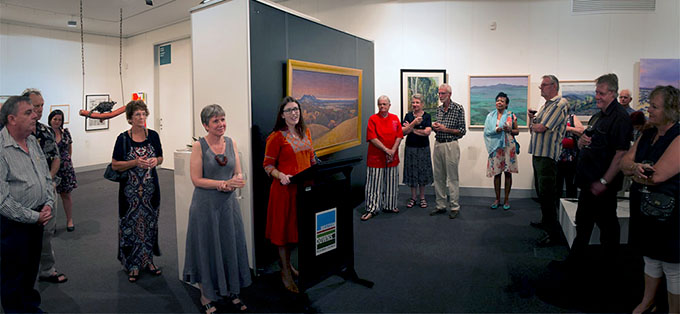
Anne Keam and Ashleigh Campbell at the opening.

 wotwedid
WORKING WITH “ACT WATERWAYS” A community art project
with one comment
ACT Logo
The artists involved in the project had responded to the theme in diverse and inventive ways producing artworks that engaged the public and caused them to consider places and creeks that previously they may have just walked or driven past.
Our task was to manage and coordinate the documentation of the 11 art projects and the Facebook social media. In our activities we closely linked with the project leader, and then President of the Arts Council Toowoomba, Jennifer Wright (Summers), and the design coordinator Mary-Kate Khoo – both energetic, creative artists themselves and hard workers for the artists within our region.
.
Doug in a pre-planning meeting with Jennifer and Mary-Kate
To extend the opportunities for an extended learning experience for media photography students from the TAFE South-West Photoimaging department. We provided them with mentor support and professional practice skills to satisfy the demands of the project through a Facebook closed group as well as face-to-face location work.
The Facebook presence enabled a community connection with the project, activities that were taking place as well as a forum for comments and feedback. While the Facebook page was most active during the event it is still viewable as a record of the event and the creativity of the artists of our region and how the Arts Council Toowoomba provides leadership in arts projects. <https://www.facebook.com/toowoombawaterways>
FROM A PROJECT PRESS RELEASE:
A FLOW OF ART … Artists and water in our community
.
After the floods in 2011 another Arts Council Toowoomba project enabled artists to tell the community’s story. The project was called Splashing back mosaic trail. At the opening Assistant Commissioner Fire and Emergency services Tom Dawson stressed the importance of greater awareness of where and how water flows through Toowoomba.
Now our Arts Council Toowoomba volunteer team and our creative artists have been working hard again and their latest venture, ACT Waterways addresses this aspect of Toowoomba’s water systems. Soon ten artists will be installing works across Toowoomba that tell new stories about our local waterways, with works ready for viewing by 19 September 2014. For those wanting to connect with this exciting and creative project there is a map of the ACT Waterways project and a program of events featuring musical performances at each of the sites.
ACT President Jennifer Wright (Summers) said: ‘We really hope members of the public and visitors enjoy the installations and free events. Working on this project has made us more aware of the wonderful waterways in our city. I was surprised to find yabbies, turtles and waterbirds in the CBD where I am installing bird sculptures.’ Residents and visitors are invited to visit the sites, come to daily performances, and learn about life in our waterways and the history of the Waterbird Habitat.
We invite everyone to share their stories and photos of Toowoomba’s East and West Creeks and to visit the ACT Waterways Facebook page
<https://www.facebook.com/toowoombawaterways>.
.
So, over a two-week period we worked with the artists and students documenting the project and uploading images to the Facebook page and managing the social media aspects of the project. The TAFE students did a fantastic job in taking photographs of the artists and their artworks, and also in complying with the professional demands and workflows that we required for the project.
.
.
WHAT FOLLOWS ARE EXAMPLES OF THE TAFE STUDENTS AND SOME MORE OF OUR PHOTOGRAPHS
.
Share this:
Written by Cooper+Spowart
January 9, 2015 at 11:41 am
Posted in Meeting People, Place-Projects, Regional arts
Tagged with ACT Waterways Project, artists commenting about water and place, Jennifer Wright (Summers), regional artists, Regional arts