Archive for the ‘Photobooks’ Category
Cafe Scientifique: The Secret Life of Water – Vicky Speaks
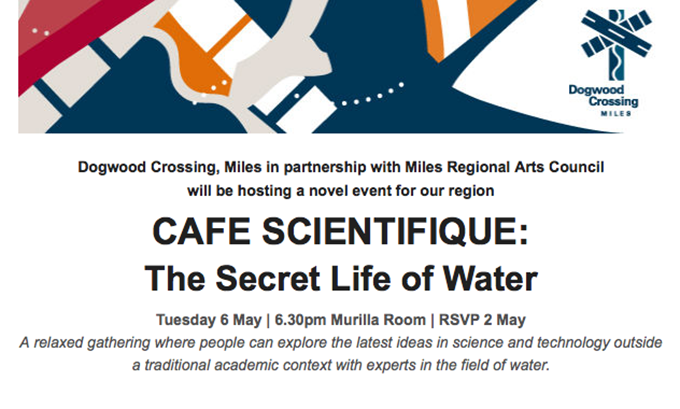
Cafe Scientifique invite
.
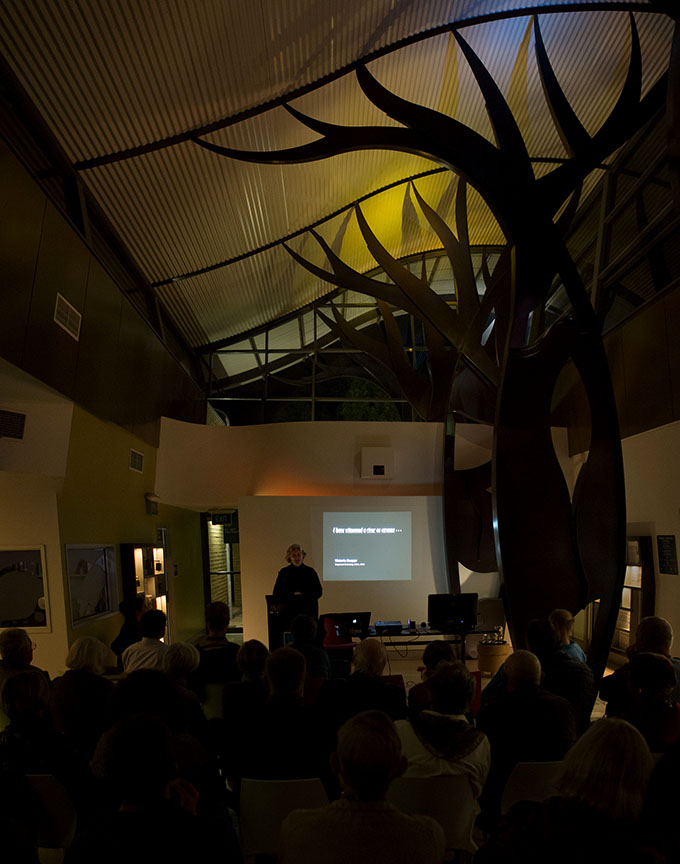
Inside the Dogwood Crossing presentation space (Murilla Room with bottle tree structural forms)
.
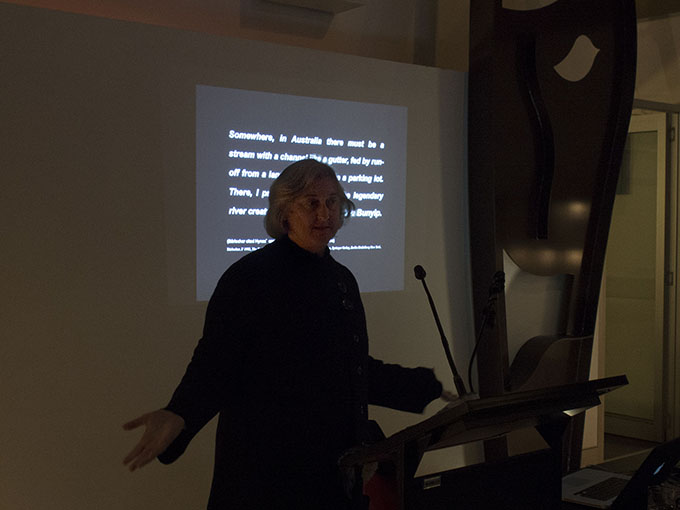
Vicky discusses and performs her books
.
Victoria Cooper
I Have Witnessed A Strange River says Cooper invited us to engage with a journey through the depths of water. She guided us through an unfamiliar place inter-twined with our daily lives where we witnessed the relentless cycle of life and death. Deep below the water’s reflecting surface, she showed us that a place primordial and alien yet intrinsic to us all, exists.
A SEGMENT OF VICKY’S PRESENTATION IS VIEWABLE HERE as a video
.
.’
BIO: Victoria Cooper is an artist with a PhD in Visual Arts researching the intersections of art and science. This interdisciplinary research is informed and inspired by her previous career in Human and Plant Pathology along with current interest in local and regional issues of land and water. During her 23-year arts career she has also worked across many forms of photographic technology–analogue to digital imaging; site specific documentation of performance; and artists’ books. In a collaborative practice with Dr Doug Spowart, she explores the post technological paradigm of photography as a cultural communication and a site-specific visual medium. This multi-methodological approach is applied in their current Place Project work in many regional communities. Cooper has exhibited in Australia and internationally and her work has been published in the Pinhole Resource Journal, the Le Stenope issue of French Photo Poche series and with Doug was included in the publication LOOK, Contemporary Australian Photography since 1980. Cooper’s artists’ books are held in national and private collections including the rare books and manuscript collections of the National Library of Australia and the State Library of Queensland.
.
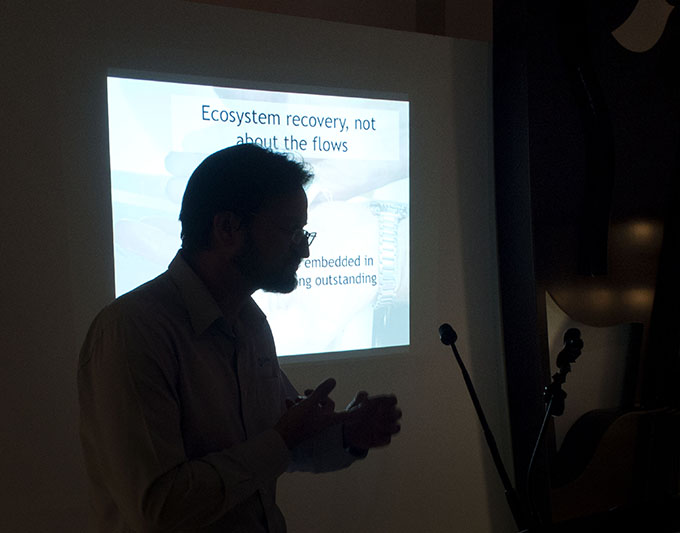
Carl – Condamine Alliance speaks
.
Carl Mitchell
This is a Story About Water Too* The quality and supply of water is one of most important issues of our time. Water quality scientist Carl Mitchell from the Condamine Alliance discussed the quality of water in our waterways and the health of our aquatic systems – vital indicators of how well we are doing as a society. The waterways in the Condamine catchment are a precious resource for the communities in the region. They provide many benefits to support the economy, society and environment of the region. Due to extensive development across a number of sectors, the quality of waters in most of the catchment areas is poor. Studies and models predict that without appropriate additional management responses the region will be unable to meet the social and economic needs of the community while maintaining the ecological integrity of the natural systems supporting these needs. Carl discussed the state of the waters and what actions are needed in the future.
BIO: Carl is a water quality scientist, aquatic ecologist and integrated water resource management specialist with a passion for the water and the waterways of the Condamine Catchment in the headwaters of the Murray Darling Basin. Carl strongly believes that the quality of water in our waterways and the health of our aquatic systems is an indicator of how well we are doing as a society. This drives him to strive for clean water for the Condamine and healthy aquatic ecosystems for the Murray Darling headwaters. Carl’s work in the Condamine has focussed on restoring the iconic Condamine river and Carl has lead the team that won 3 prestigious national awards for the Condamine in 2012-2013. Carl has a history in Natural Resource Management in Queensland having worked for Reef Catchments in Mackay for 11 years as Waterwatch coordinator, Healthy Waterways Coordinator and Water Manager. In the Water Manager role at Reef Catchments Carl spent 2 years coordinating the Paddock to Reef program across the 6 reef regional bodies, before moving to the Condamine in 2011. Carl has been an Australian Youth Ambassador for Development in the Philippines, implementing Waterwatch and Landcare programs.
.
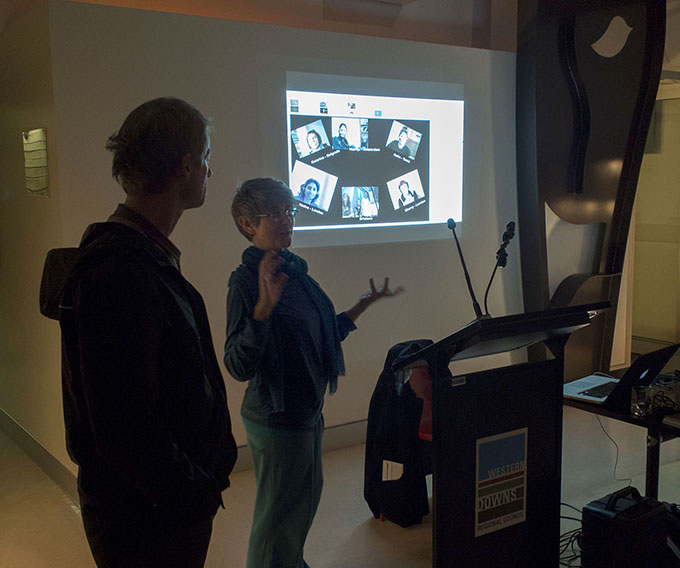
James and Suzon talk about the ‘Waterwheel Project’
.
Igneous: James Cunningham and Suzon Fuks
The Igneous team shared its explorations of water as a topic and metaphor. They explained how Waterwheel is an interactive, collaborative platform for sharing media and ideas, performance and presentation. Attendees witnessed how Waterwheel investigates and celebrates this constant yet volatile global resource, fundamental element, environmental issue, political dilemma, universal theme and symbol of life. We were encouraged to explore and discover, share and collaborate, contribute and participate in their project and local activities.
Igneous presented Waterwheel as well as the FLUIDATA project supported by Arts Queensland, and introduced the audience to FLUIDATA workshop that we offered there.
BIOS: Igneous received funding from Brisbane City Council and Arts Queensland towards the development of the platform and it’s incorporation in the Waterwheel Installation Performance and associated residency at the Judith Wright Centre of Performing Arts, Brisbane. Igneous is a partnership between Cunningham and Fuks who have both given lectures, workshops, master-classes and labs in Australia, USA, Europe, India and Indonesia, in tertiary institutions, cultural venues and community contexts.
James Cunningham is a performance, movement and video artist, and the co-Artistic Director, along with Suzon Fuks, of Igneous Inc., (www.igneous.org.au) a Brisbane-based multimedia and performance company established in 1997 that has presented solo and ensemble stage shows, performance-installations, video-dance works and networked/online performances in Australia, Europe (Belgium, France, Switzerland, Germany, Poland), UK, Canada and India.
Suzon Fuks is an intermedia artist, choreographer and director, exploring the integration and interaction of the body and moving image through performance, screen, installation and online work (http://suzonfuks.net). During an Australia Council for the Arts Fellowship (2009-12), she initiated and co-founded Waterwheel, following which she has been a Copeland Fellow and an Associate Researcher at the Five Colleges in Massachusetts, continuing to focus her research on water and gender issues, and networked performance, as well as coordinating activities on Waterwheel.
* The Secret Life of Water Book Title by Masaru Emoto
* This is a Story About Water Too. Poem Title by Jayne Fenton Keane
Texts sourced from Dogwood Crossing material. Photos: Doug Spowart ©2014
.
.
LIGHT READINGS: the photograph and the book – An SLQ White Gloves event
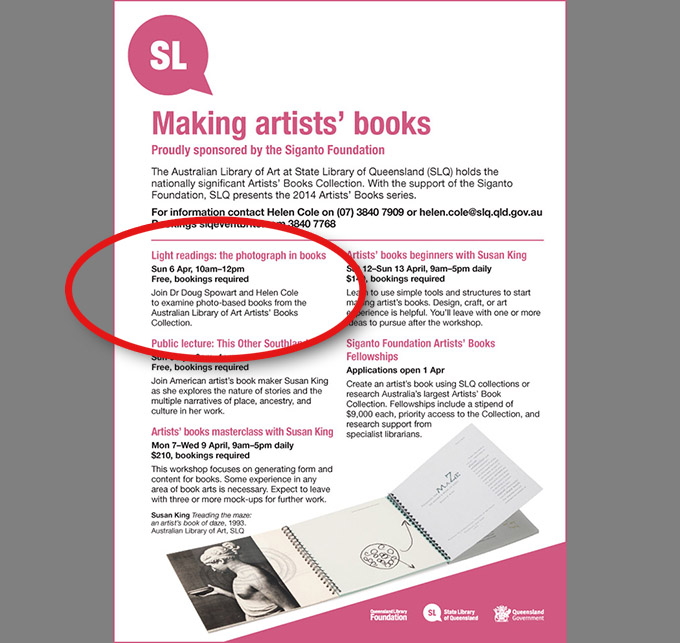
Flyer for the event
.
Light Readings: The photograph in books from the SLQ Artists’ Book Collection and the Spowart+Cooper Photobook Collection
.
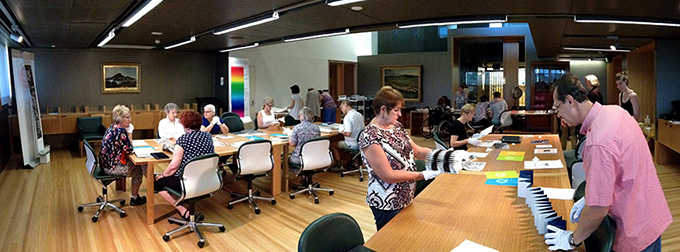
On Sunday April 6 a group of around 25 artists book and photobook dillettantes attended a special ‘White Gloves’ event at the State Library of Queesnland. Assembled in the viewing room on level 4 was a selection of artists books and photobooks that addressed the topic of the photograph and the book. The 43 books were drawn from the SLQ’s Australian Library of Art Artists’ Book collection, the SLQ General Library, supplemented by books from the Spowart+Cooper Photobook Collection. The book’s selection was curated by SLQ Senior Librarian Helen Cole and Doug Spowart. Those attending the event were given a presentation by Doug Spowart to introduce the rationale for the selection. A discussion paper by Spowart is included in this blog post along with a bibliography of the selected books.
.
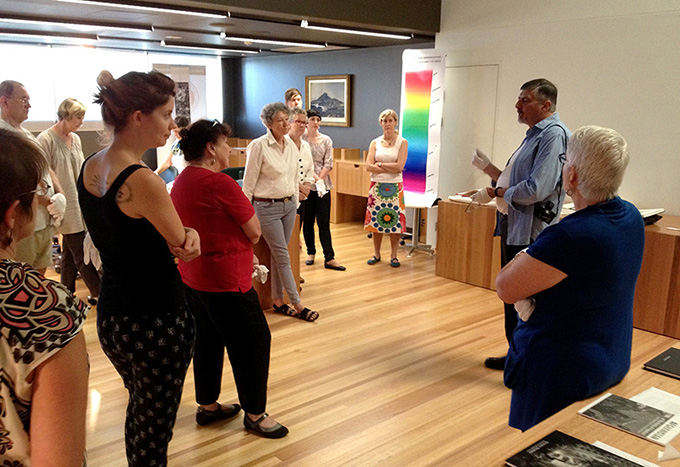
Doug Spowart presents an introduction …….PHOTO: Victoria Cooper
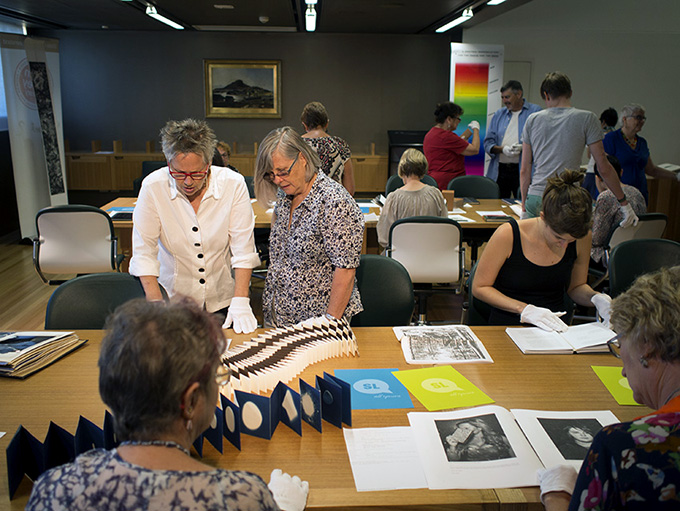
SLQ White Gloves event – Attendees viewing books
Doug Spowart’s discussion inspired by the ‘Light Readings’ event: A nomenclature for photos in books
For one hundred and fifty years the making of ‘quality’ photographs had been almost exclusively the domain of the professional practitioner. Outside of the professional photography scene vernacular photography, made popular due to the enabling technologies of ‘you press the button – we do the rest’ companies like Kodak, usually produced results that were of an inferior standard. There were of course exceptions – ‘prosumers’, as we would call them today, image-makers from the camera club movement, dilettantes and artists whose visual acutance and mastery of process suited photography.
Today digital technology has interceded and now anyone can make photographs. From a range of informed sources it is easy to predict that nearly a trillion photographs will be made in 2014. These images from phone camera snaps to video grabs, from high-end pro digital cameras to surveillance satellites, as well as a plethora of straight and enhanced images will be made and used for a range of outcomes. It seems that now anyone can make a photograph and almost anything can be done with it.
Like photography the publishing of books was once a closed world, as it required specialist processes, skilled artisans and financial entrepreneurship. But this powerful structure of gatekeepers too has also been dissolved by the empowering digital technologies of computers, software, computer-to-press and print on demand workflows. Making books has never been easier. Photographers particularly have embraced the opportunity and launched a revolution creating all kinds of photobooks to extend the bland form of the traditional photobook. Bruno Ceshel, founder of the photobook publishing and promotion enterprise Self-Publish Be Happy, comments that:
From the stapled fanzine assembled in a student bedroom to the traditionally printed photobook, these publications not only reshape our understanding of the medium but offer exciting and sometimes radical ideas. (Ceschel 2011)
.
Whilst photographers have embraced this new found direct publishing paradigm artists have made books with photos in them for decades. For them the processes of printmaking and multiples that they employ, along with access to printing press technology, is accessible and ‘doable’. Additionally artists have experimented with communication concepts that included the democratic multiple publications. Artists employ a range of media and the photograph was just another tool that they could access to create their art.
A significant connection between photography and the artists book is discussed by Anne Thurmann-Jajes and Martin Hellmold in their 2002 exhibition and catalogue ars photographica. They state that: ‘In very general terms, it is possible to say that half of all artists’ books produced to date have been based on photographs.’(Thurmann-Jajes and Hellmold 2002:19). It is interesting to note that the first book of the modern American artists book genre is Ed Ruscha’s book of photographs entitled Twenty-six Gasoline Stations.
The artist’s use of photography has created a degree of frisson. A point of contention for photographers was their ownership over the term ‘photographer’. Essentially photographers claimed that while artists may have made photographs, only photographers made ‘real’ photographs – artists just took photographs. Ruscha provocatively denounced the preciousness of the fine art photography movement that came out of the 1960s and announced that all he wanted out of photography was ‘facts, facts, facts.’ (Rowell 2006:24)
Thurmann-Jajes and Hellmold go further in that they propose differences between the artist and the photographer in the conceptual aspects of making a book based on photographs:
The authors of photo books followed photographic tradition, according to which the photograph as such was decisive, becoming the bearer of meaning. … By contrast to the photo book, the artists’ book is not the bearer, but the medium of the artistic message. (Thurmann-Jajes and Hellmold 2002:20)
.
Interestingly, the photobook and the artists book share a lost history that Johanna Drucker discusses in her 1995 book, The Century of Artists’ Books. She states that:
The photographic book became a standard of artists’ book activity, and its history belongs to the early 20th century in which the concept of the book as an artistic form was taking on a new, vital identity. (Drucker 2004:63)
.
Drucker adds:
These were works which were considered avant-garde, experimental, and innovative when they were made; they broke with the formal conventions of earlier book production, establishing new parameters for visual, verbal, graphic, photographic, and synthetic conceptualization of the book as a work of art … they were part of a history which was temporarily forgotten at the time artists’ book emerged in the 1960s. (Drucker 2004:63-4)
.
Despite these shared histories and theories of ‘differences’ the nature of the creative process, the disciplines of artist and photographer may present an interesting conundrum. Nancy Foote, for example, may question the ‘us and them’ argument by her observation in a 1976 article in Artforum, The Anti-Photographers that: ‘For every photographer who clamors to make it as an artist, there is an artist running a grave risk of turning into a photographer.’ (Foote 1976:46)
Today the photograph continues to pervade all kinds of books by artists, artists–photographers, photographers and photographer-artists in collections like the Australian Library of Art at the State Library of Queensland. At this time it is important to review the field of creative book production that utilises the photograph and consider what has been created to date and in the SLQ collection, as well as look for emergent trends.
In this research project Senior Librarian Helen Cole and I have collaborated to bring together a selection of books to survey the nature of the photo and the book. Whilst most books have been sourced from the SLQ Artists’ Book collection some books have come from the SLQ general area and some, mainly emergent photobooks have been drawn from my personal collection. In bringing these 43 books together in the one ‘white gloves’ space there has been an ability to create come kind of order from the divergent practice.
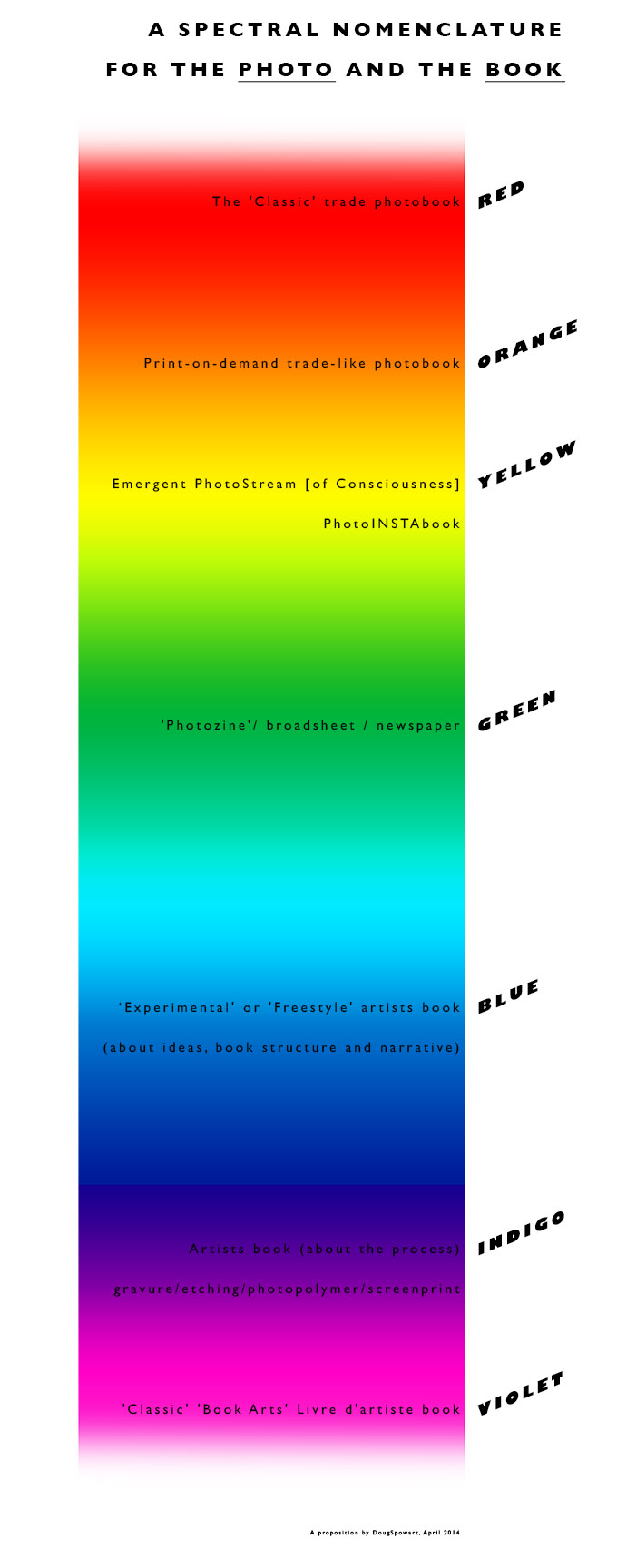
It would take a courageous and brave commentator to propose a definition or a canon for the photo and the book. Instead I will suggest a spectrum of activity and assign some characteristics that may aid those interested in the topic to compare, sample and discuss. I will use the term nomenclature as it best describes the devising or choosing of names for things in this type of discussion.
As the visible light spectrum has a rainbow of seven main colours this discussion has seven as well. Each has a specific characteristics and terms associated with it – although, at times certain books may challenge attempts to place them within this spectrum. The 7 colours are:
1. Red – The ‘Classic’ trade photobook
2. Orange – Print on demand trade-like photobook
3. Yellow – Emergent – PhotoStream* [of Consciousness] or Insta-photobook*
4. Green – Photozine*/ broadsheet / newspaper
5. Blue – Experimental’ or ‘Freestyle’ artists book
6. Indigo – Artists book
7. Violet – ‘Classic’, ‘Book Arts’, Livre d’artiste book
*Names I have considered to best describe these emergent forms
.
This spectral approach accepts the notion that the use of the photograph may be by either photographer or artist, and the nature of their creative products may enable their books to reside in generic areas. In many ways the transition of the rainbow metaphor from red to violet could represent the pure book forms of the photographer at one end and the purest artist form at the other at the other. This suggests that 1-4 would be photobooks conceived and produced by photographers. And those books in 4-7 would be principally books made by artists using photography. And at times the nature and form of the book may defy this nomenclature and be in a grey area, or a tint or shade, or even a blend of colour opposites!
Just as Johanna Drucker found when she attempted to define the artists book my categorising the practitioner’s discipline and the type or style of a book that they make also may be challenging. Drucker came under fire even though she predicted that her proposition would ‘… cause strife, competition, [and] set up a hierarchy, make people feel they are either included or excluded’ (Drucker 2005:3). More recently, in 2010, Sarah Bodman and Tom Sowden from the Centre for Fine Print Research at the University of the West of England sought to define the canon for the artists book in the 21st century. They did this by creating a survey of world practitioners of book making by artists in every conceivable outcome, including the emergent eBook. They found that the heirarical form of a tree diagram was ‘too rigid and too concerned with process’ (Bodman and Sowdon 2010:5). They discovered that their respondents wanted to alter the diagram to satisfy the, ‘cross-pollination that is often required by artists’ and added in, ‘connectors across, up and down to bring seemingly disparate disciplines together.’ (Bodman and Sowdon 2010:5)
Rather than a rigid definitive structure, I present this spectral organization a guide where we can bring some concepts into a critical debate that will extend the ideas, and the motivations, behind those who create these communicative devices. Ultimately researchers, and those interested in engaging with and exploring the nature of the photo in the book, will add their voices to the conversation. Then new dialogue, scholarship and opportunities for thought on the topic will advance understanding of the book that carries its message with the photograph.
At the end of this blog post I have included the bibliography of selected books for the ‘Light Readings’ event.
Dr Doug Spowart April 14, 2014
References:
Bodman, S. and T. Sowdon (2010). A Manifesto for the Book: What will be the canon for the artist’s book in the 21st Century? A Manifesto for the Book: What will be the canon for the artist’s book in the 21st Century? T. S. Sarah Bodman. Bristol, England, Impact Press, The Centre for Fine Print Research, University of the West of England, Bristol.
Ceschel, B. (2011). “The Best Books of 2010.” Retrieved June 6, 2011, from http://www.photoeye.com/magazine_admin/index.cfm/bestbooks.2010.list/author_id/68/.
Drucker, J. (2004). The Century of Artists’ Books. New York, Granary Books.
Drucker, J. (2005). “Critical Issues / Exemplary Works.” The Bonefolder: An e-journal for the bookbinder and book artist 1(2): 3-15.
Foote, N. (1976). “The Anti-Photographers.” Artforum September: 46-54.
Rowell, M. (2006). Ed Ruscha Photographer. Gottingen, Steidl Publishers.
Thurmann-Jajes, A. and M. Hellmold, Eds. (2002). ars photographica: Fotografie und Künstlerbücher. Weserburg, Bremen, Neues Museum
A SPECTRAL NOMENCLATURE FOR THE PHOTO AND THE BOOK
.
A Bibliography of the selected books
From the Artists’ Book Collection of the Australian Library of Art, State Library of Queensland and the Spowart+Cooper Photobook Collection
Red – The ‘Classic’ trade photobook
American Cockroach
Photographs by Catherine Chalmers
Essays by Steve Baker, Garry Marvin, and Lyall Watson
Aperture, 2004
(Spowart+Cooper Photobook Collection)
Afghanistan, or, The perils of freedom
Stephen Dupont 1967- ; Jacques Menasche 1964-; Stephen C Pinson; New York Public Library : 2008
Steam : India’s last steam trains
Stephen Dupont 1967- ; Mark Tully
Stockport : Dewi Lewis :1999
Foundphotos / DickJewell
Dick Jewell
London : s. n. :1977
FromMontelucotoSpoleto : December1976
Sol LeWitt 1928-2007.
Eindhoven Netherlands : Van Abbemuseum ; Weesp Netherlands : Openbaar Kunstbezit :1984
Journey of a wise electron
Peter Lyssiotis 1949- ; PeterLyssiotis 1949-.; PeterLyssiotis 1949-.
Prahan, Vic. : Champion Books :1981
Eat : Jan-Mar 2001
Jo Pursey
Sydney, N.S.W. : J. Pursey :2001
Tour of duty : winning hearts and minds in East Timor
Matthew Sleeth 1972- ; Paul James (Paul Warren), 1958-
South Yarra, Vic. : Hardie Grant Books in association with M.33 :2002
Signs of Australia
Richard Tipping 1949-
Ringwood, Vic. : Penguin Books :1982
Intimations : with selected poetic responses by Michele Morgan
Gordon Undy
Surry Hills, NSW. : Point Light :2004
Orange – Print on demand trade-like photobook
Various fires and MLK
Scott L. McCarney 1954-
Rochester, N. Y. : VisualBooks :2010
Reportage : a retrospective 1999-2009.
Robert McFarlane 1942-; Jacqui Vicario; StephenDupont 1967-; National Art School (Australia); Momento Pro.
Bondi Junction, N.S.W. : Reportage :2010
Flashback : SE Queensland flood event January 2011
Julie White
Strawberry Hills, N.S.W. : Momento :2011
Yellow – Emergent PhotoStream* [of Consciousness] or InstaPhotoBook*
Iris Garden
Wiliam Gedney
Designed by Hans Seeger
Little Brown Mushroom, 2013
(Spowart+Cooper Photobook Collection)
Moved Objects
Georgia Hutchison and Arini Byng
Perimeter Editions
Melbourne, Australia, 2013
(Spowart+Cooper Photobook Collection)
Lost horizons
Scott L. McCarney 1954-,
Rochester, NY : ScottMcCarney/Visual Books :2008
Call of the wild
Matthew Sleeth 1972- ; Josef Lebovic Gallery.
Sydney N.S.W. : Published by Josef Lebovic Gallery :2004
Signed up : 22 postcards
Richard Tipping 1949-
Newcastle, N.S.W. : Artpoem :c2010
Green – Photozine*/ broadsheet / newspaper
Radiata, 2013
Jacob Raupach
(Spowart+Cooper Photobook Collection)
.
LBM Dispatch #6: Texas Triangle
Alec Soth and Brad Zellar
Little Brown Mushroom, 2013
Edition of 2000
(Spowart+Cooper Photobook Collection)
Blue – Experimental’ or ‘Freestyle’ artists book
Ten menhirs at Plouharnel, Carnac, Morbihan, Bretagne, France
Jihad Muhammad aka John Armstrong 1948-
Hobart Tas. : J. Armstrong :1982
Detour ; Kõrvaltee
Christiane Baumgartner 1967- ; Lucy Harrison 1974-; Grahame Galleries + Editions.
Leipzig, Germany : C. Baumgartner & L. Harrison :2004
No diving II : evidence
Peter E. Charuk
Hazelbrook, N.S.W. : P.E. Charuk :2005
The story of the gorge
Victoria Cooper 1957-
Toowoomba, Qld. : V. Cooper :2001
Supernova
Victoria Cooper 1957- ; Photographers of the Great Divide.
Toowoomba, Qld. : Photographers of the Great Divide :2005?
Space + Time
Ken Leslie ; Grahame Galleries + Editions.
Atlanta, Ga. : Nexus Press :2002
The river city : eyewitness document
Helen Malone 1948-
Yeronga, Qld : H. Malone :2011
Tonguey
Ron McBurnie 1957-
Townsville, Qld. : R. McBurnie :1996?
Portrait of an Australian
Jonathan Tse 1967-
Robertson, Qld. : J. Tse :1998
[Eleven]
Marshall Weber 1960- ; Christopher Wilde; Sara Parkel; Alison E Williams; Isabelle Weber; Booklyn Artists Alliance.
New York : Booklyn :c2002
Posted
Normana Wight 1936- ; Numero Uno Publications.
Milton, Qld. : Numero Uno Publications :2009
High tension
Philip Zimmermann ; Montage 93 : International Festival of the Image (Rochester, N.Y.)
Rochester, NY : the author :1993
Indigo – Artists book (Inkjet – gravure – photopolymer – screenprint)
Lost and found : a bookwork
Lyn Ashby 1953-
Vic. : ThisTooPress :2007?
The ten thousand things
LynAshby 1953-
Victoria : Lyn Ashby, Thistoopress :2010
Solomon
JanDavis 1952-
Lismore : J. Davis :c1995
Limes
Tommaso Durante 1956- ; Chris Wallace-Crabbe 1934-; Elke Ahokas
North Warrandyte, Vic. : Tommaso Durante :2011
Terra Australis
Tommaso Durante 1956- ; Kay Aldenhoven
Warrandyte, Vic. : TommasoDurante :2003
Homeland
Noga Freiberg 1962- ; Peter Lyssiotis 1949-.; Masterthief Enterprises
Burwood, Vic. : Masterthief :2003
Deeply honoured
Fred Hagstrom ; Densho Digital Archive.; Carleton College (Northfield, Minn.). Archives.
Saint Paul, Minn. : Strong Silent Type Press :2010
Cars of the fifties : book number 247
Keith A. Smith 1938-
Rochester, N.Y. : KeithSmith :2006
Violet – ‘Classic’ ‘Book Arts’ Livre d’artiste book
Through closed doors : 7 paraclausithyra
Susan J. Allix 1943-
London : S. Allix :2005
A gardener at midnight : travels in the Holy Land ; from drawings made on the spot by Yabez Al-Kitab
Peter Lyssiotis 1949- ; Brian Castro 1950-; David Roberts 1796-1864.; Nick Doslov; David Pidgeon; State Library of Victoria.; Masterthief Enterprises.; Renaissance Bookbinding.
Melbourne : Masterthief :2004
New branches on an old tree
Susan Purdy ; Blue Moon Press.
Melbourne : Blue Moon Press :2006
List concludes.
.
SLQ White Gloves event – Attendees viewing books
.
.

This work is licensed under a Creative Commons Attribution-NonCommercial-NoDerivs 3.0 Unported License.
.
.
Text: © 2014 Dr Doug Spowart Photos: ©2014 Victoria Cooper and Doug Spowart
.
.
.
.
BOX of BOOKS Event – Toowoomba!
Looking at the books – Cobb+Co Museum, Toowoomba
.
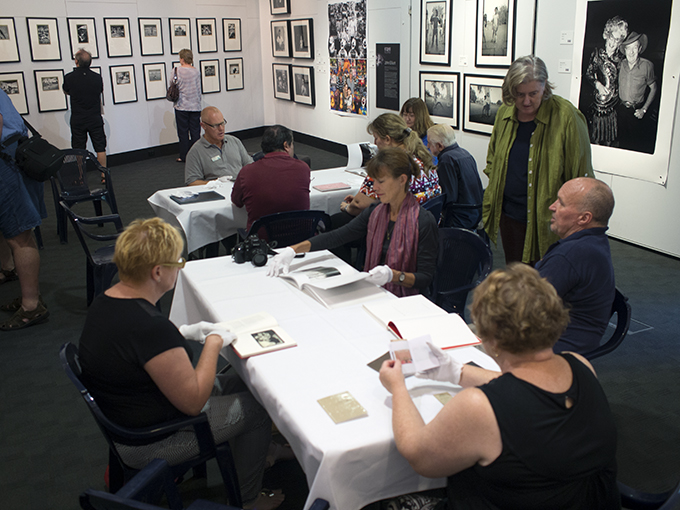
Around 35 photobook enthusiasts gathered at the Cobb+Co Museum on January 27 to view the Photobook Club’s Box of Books and talk about photobooks. The event brought together local photo identities John Elliott, Graham Burstow, David Seeto and Victoria Cooper. Eric Victor, Ian Poole and Qld College of Art Masters student Maureen Trainor came from the Brisbane side of the Range. The meeting took place in the gallery space of the ICON on ICONS photographic exhibition that also concluded on that day.
.
Convener of the event Doug Spowart opens the Box of Books
.
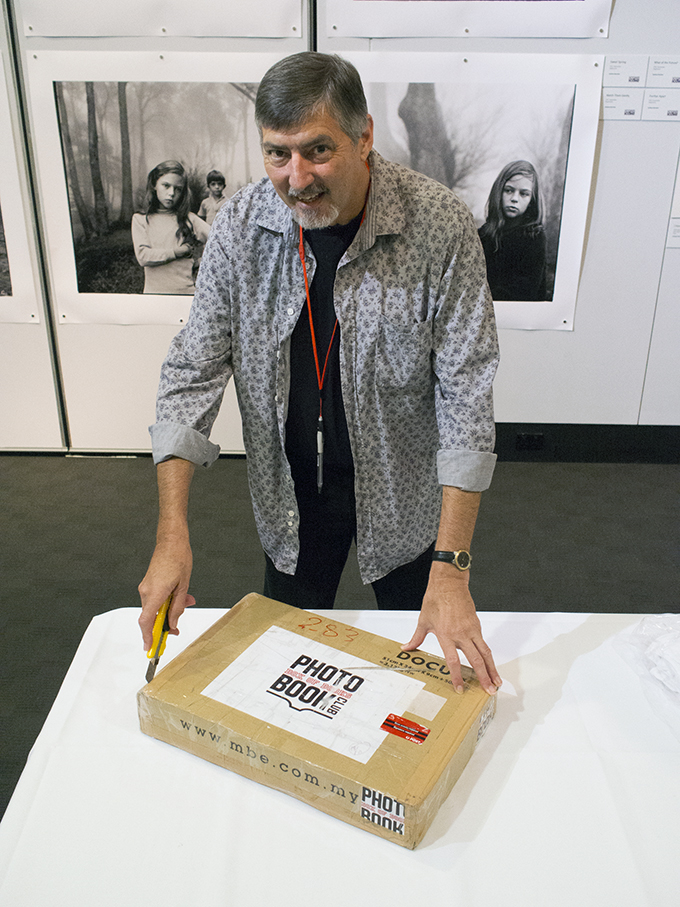
The seven books were viewed and discussed at length. Comments about the books included the following:
“Each book is a very personal communiqué”
“The books demand viewing at many different levels – the narrative, the design, the production, the conceptual nature of the work…”
“This is a very Eurocentric view – I wonder what the American view would look like?”
“How do these books compare with the Australian photobook scene?”
A great deal of discussion took place over the comment – “Where are the captions … the works that help me to understand what the photographer is trying to say?” One respondent commented on Roland Barthes’ concept of ‘The death of the author and the birth of the reader’ – meaning that the reader needs to connect with the images and draw on their own life experiences.
.
Donald Webber’s Interrogations drew quite a few comments – tension and the power of the portraits made in such a circumstance.
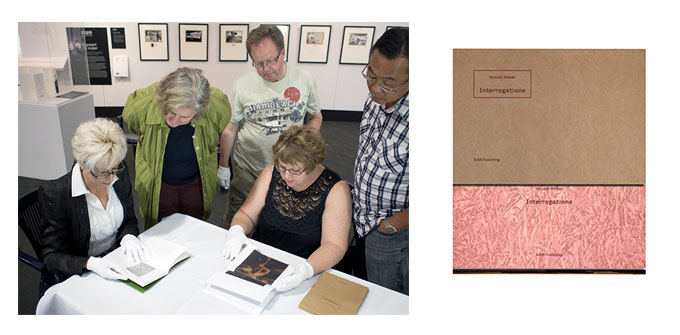
Linda Seeto, Victoria Cooper, Hardy and Alison Ahlhaus looking at Webber’s Interrogations
.
The crowd favourite was Anne Sophie Merryman’s Mrs. Merryman’s Collection … a superb design, delicate paper, the see-through of texts and the amazingly bizarre collection of post card photographs and comments.
.
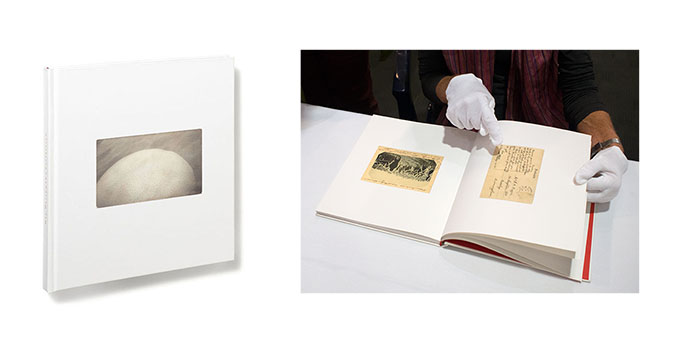
Mrs. Merryman’s Collection
.
Paul Graham’s The Present and its gate-fold format presented a viewing challenge as each image or group of images needed to be revealed by folding-out the page – an extended haptic experience, and considering the size of the book, it slowed down the read and brought the busy street scenes to a slowed motion.
.
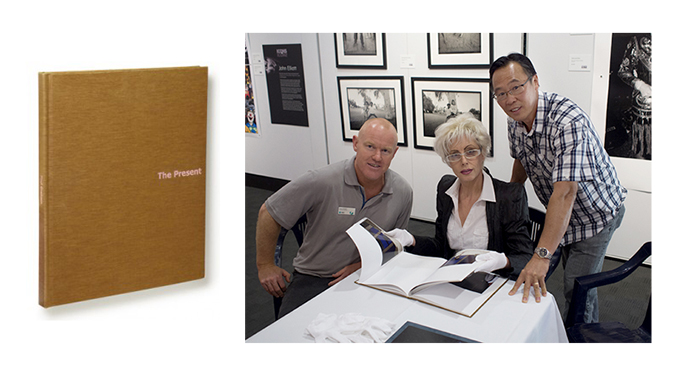
Tony Coonan, Linda and David Seeto look at Paul Graham’s book
.
The Box of Books will be in Brisbane on Monday the 3rd of February and then be off to New Zealand for the next stage in its journey.
Thanks to the Cobb+Co Museum for providing the venue. The Photobook Club and the publishers who donated the books for the opportunity for us to see, touch, and read these books.
Until the next Photobook Club event in our area….
.
This Photobook Club BOX OF BOOKS event was coordinated by Doug Spowart and Victoria Cooper of the Centre for Regional Arts Practice.
.
Other images from the event…
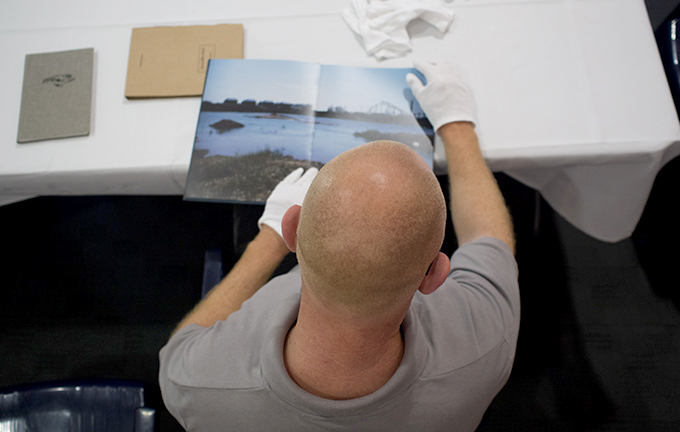
Looking at a book…
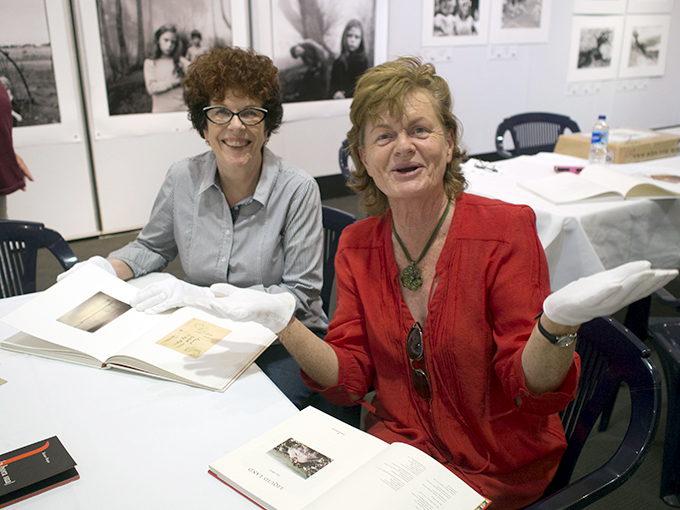
Ann Alcock and Bev Lacey
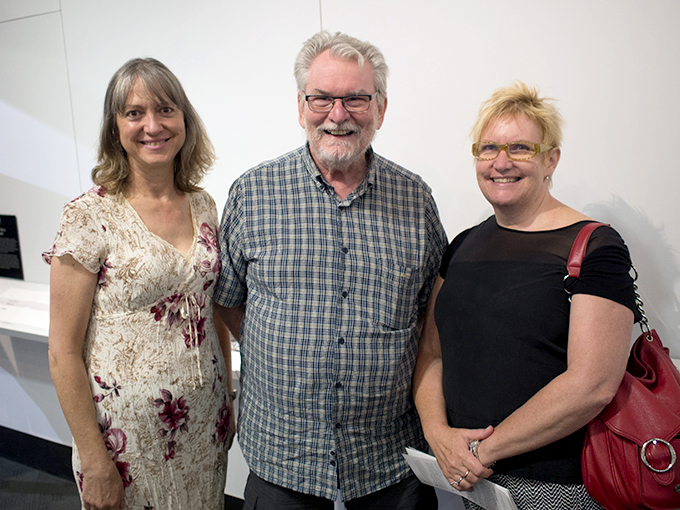
Toula, Ian Poole and Louise
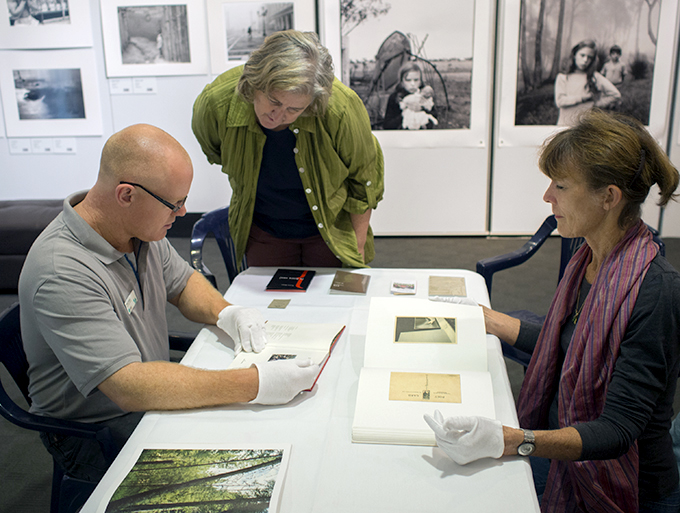
Tony Coonan, Victoria Cooper and Anne Howard
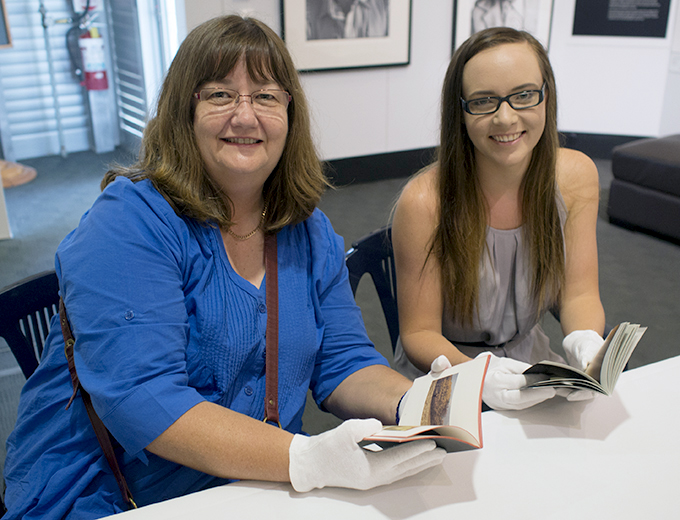
Judi Neuman and Phillipa Hodges
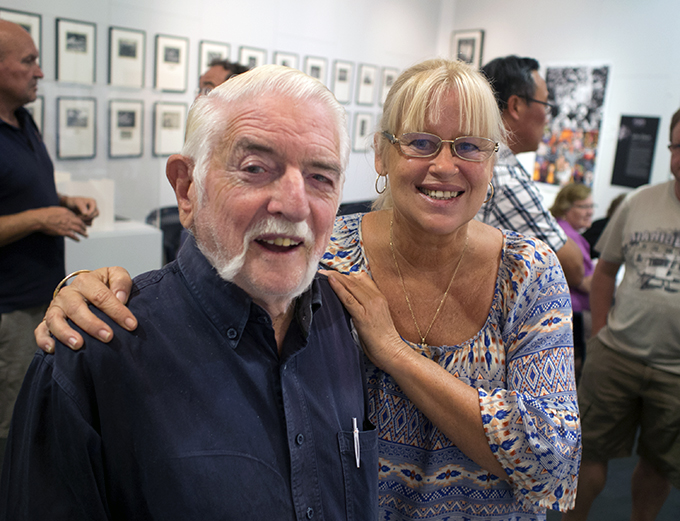
Graham Burstow and Maureen Trainor
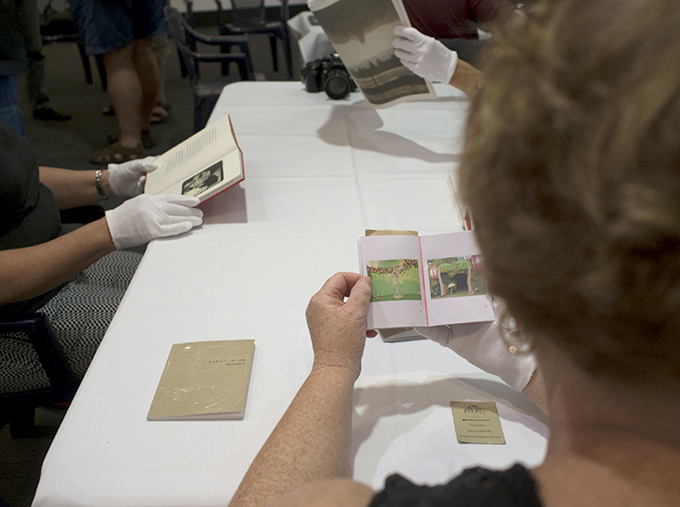
Looking at some of the ephemera from the Box of Books
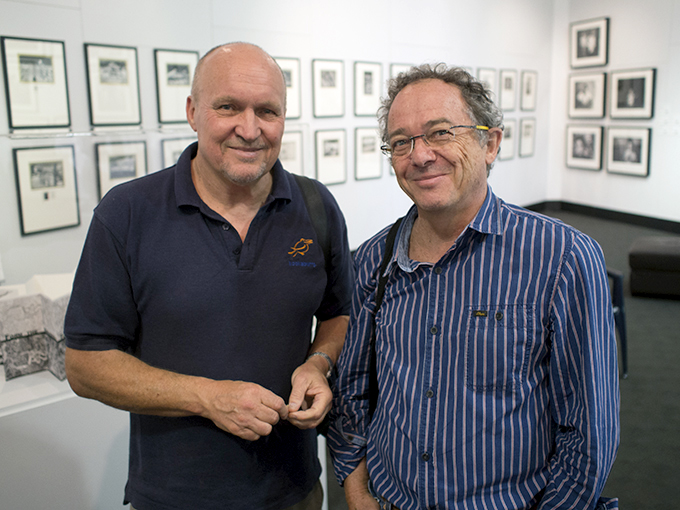
John Elliott and Eric Victor
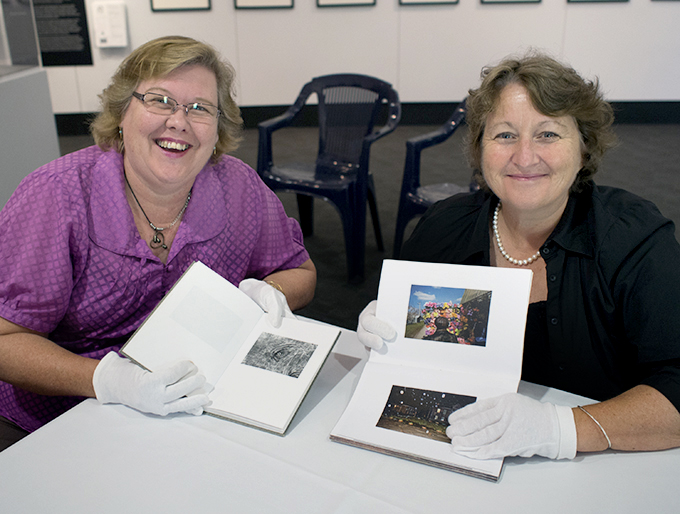
Helen Gibbs and Lucy Robertson-Cunninghame
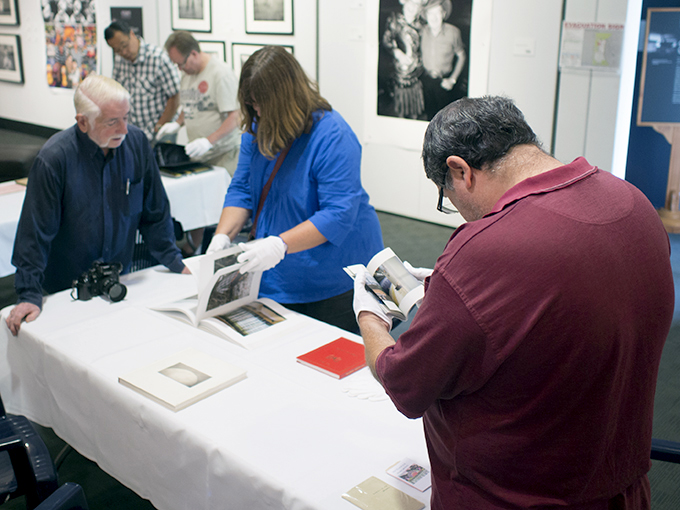
Gerry Saide looking closely at a book
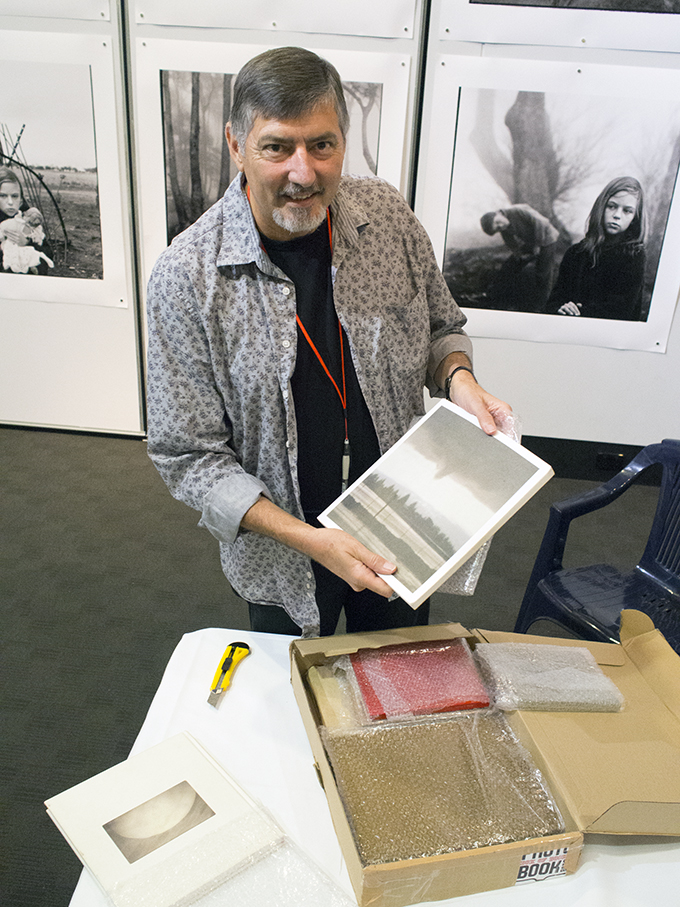
Doug Spowart opens the box
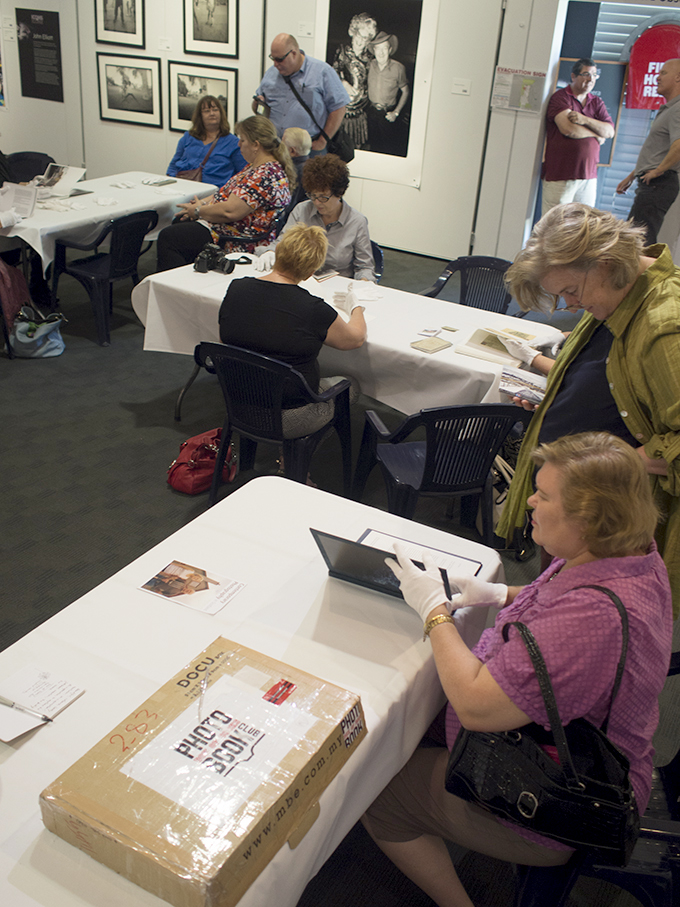
Room view at the Cobb+Co Museum
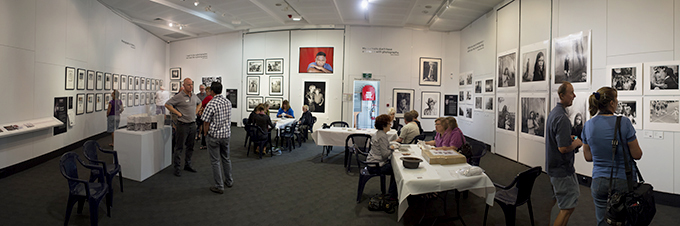
The Cobb+Co Museum panorama
.
.
The Photobook Club’s BOX of BOOKS in Toowoomba
.
.
.
.
A BOOK for AUSTRALIA DAY, January 26, 2014
.
It’s Australia Day!! We have a photobook on display in the Two Doors Gallery in 85 George Street the ‘Rocks’, Sydney that is a commentary on Australia Day, that we created on Australia Day in 2010.
.
The collaborative book, called Australian Banquet, January 25/26, 1788 (variant #5), is a double-sided broadsheet cyanotype in rice paper, 37.6x77cm. There are 7 unique state variants of this work.
.
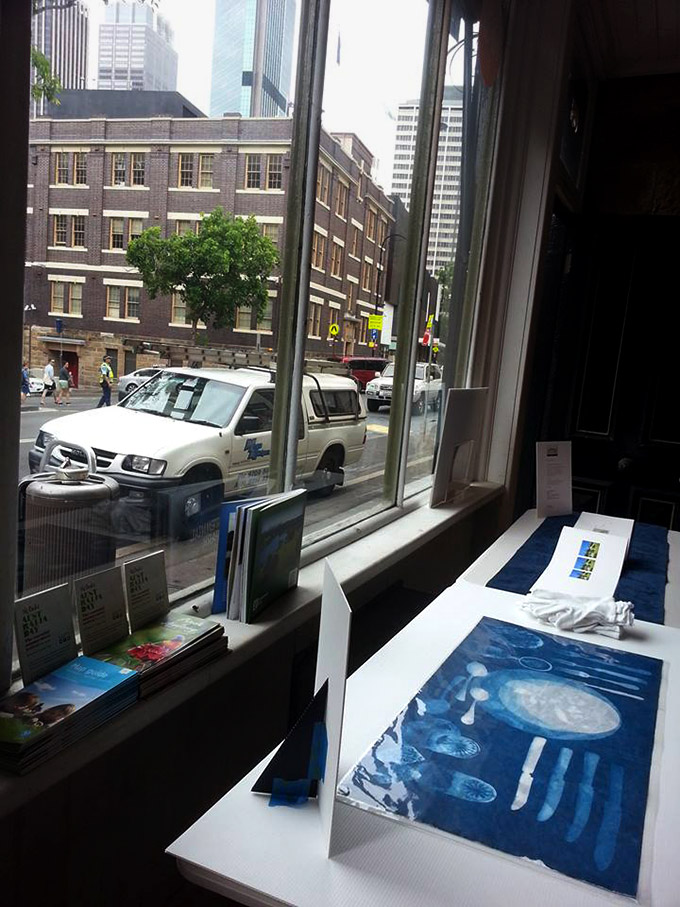
The Australian Banquet in the window @ Two Doors … Photo: Dawne Fahey
.
The artists’ statement for the work is as follows:
.
Across Australia on January 26, people consume food in celebration of a free and dynamic Australian culture. This work comments on the ‘turning of the page’ in Australian history that Australia Day represents. One day — January 25th 1788, Indigenous people feasted on a diverse banquet of bush tucker (as they had for thousands of years). The next day —a new paradigm arrived with the table setting of the First Fleet. Australia Day importantly is a time to re-examine the status of the Indigenous perspective and their knowing of land, culture and history and how it underpins all that is celebrated in the diversity and identity of post-colonial Australia.
.
.
How the work is to be viewed/read
1. At a tabletop setting view and contemplate the 25th of January side of the broadsheet.
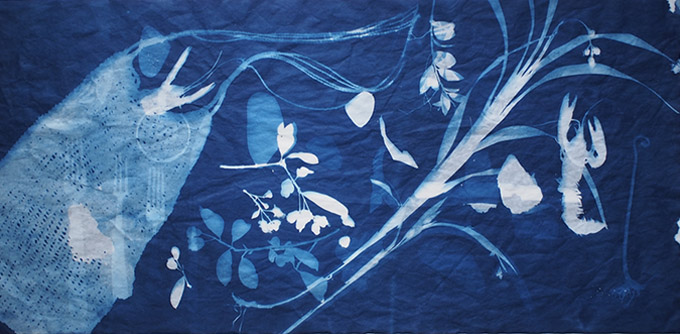
January 25, 1788
.
2. Then, pickup the broadsheet and turn it over as if reading a book – Contemplate.
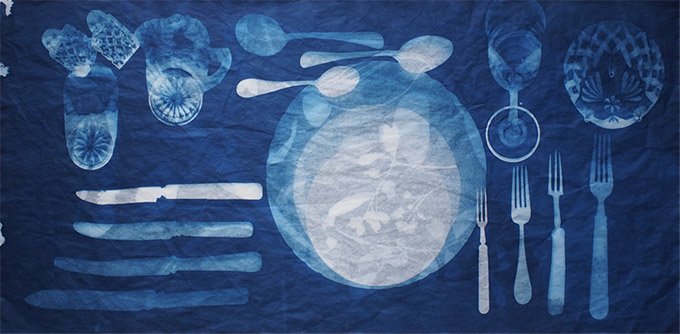
January 26, 1788
.
3. Finally hold the broadsheet up to a light thus enabling the interrelationship between the two
images to be considered. (Image shows variant #4)
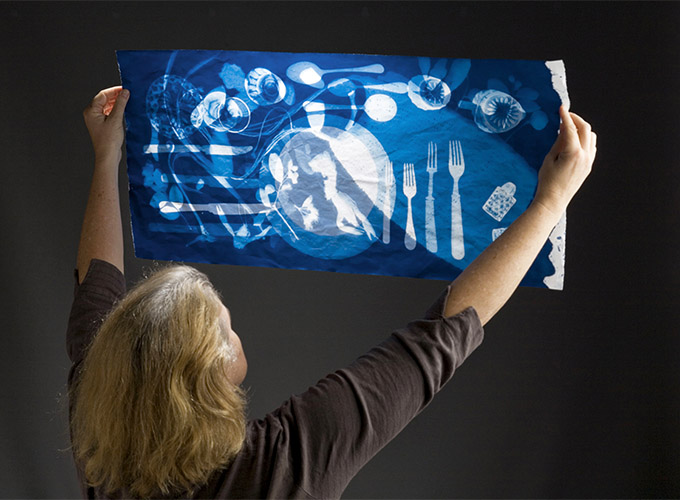
January 25+26,1788 (combined) –Today’s view
.
Drop in to the gallery if you’re in Sydney.
If you happen to be in ‘The Rocks’ on Monday 27th, the public holiday come along to Two Doors and see Picturing the Orchestral Family – and a selection of photographs by Dawne Fahey – and hear the Carreon Family Quartet performance – Tango from 2 – 3. They will also perform February 2nd – same time. Performing daily @ 5.30 pm is flautist Chloe Chung – Two Doors is very lucky to have these young people from Sydney Youth Orchestras helping us celebrate this exhibition !
Have a Great Australia Day…!
.
© 2014 Dawne Fahey (gallery image) and ©2012 Doug Spowart+Victoria Cooper.
.
This work is licensed under a Creative Commons Attribution-NonCommercial-NoDerivs 3.0 Unported License.
http://creativecommons.org/licenses/by-nc-sa/2.5/au/
.
.
.
THE PHOTOBOOK CLUB: Box of Books Event – Toowoomba!
The Photobook Club’s BOX of BOOKS arrives in Toowoomba
.
In 2013, and now in 2014, a box of photobooks will be traveling over 30,000 miles, stopping off at each of the Photobook Club branches around the world in order to promote discussion of the physical photobook.
..
Now, The Box of Books is in Toowoomba —- Queensland, Australia.
As part of the LAST DAY of the ICONS on ICONS show at the Cobb+Co Museum in Toowoomba featuring the work of John Elliott, Graham Burstow, David Seeto Victoria Cooper (photobooks) and Doug Spowart – a special viewing of the THE PHOTOBOOK CLUB’s BOX of BOOKS will be made available. Come and sit with some of the world’s best photobooks and turn the pages – and release the narrative that each book contains.
THE DATE: Between 1 – 3pm, January 27 – The AUSTRALIA DAY Holiday
THE VENUE: The Cobb+Co Museum, 27 Lindsay Street, Toowoomba.
.
A small charge of $5 is being made to cover postage to the Boxes’ next destination in Auckland New Zealand.
.
The book viewing and discussions will take place between 1-3pm. The Museum’s coffee shop is open for lunch as well as drinks and snacks throughout the afternoon until 4pm.
Take a road trip into the country – Visitors to the Cobb+Co Museum from outside the Toowoomba Region will gain FREE admittance if they advise that they are attending this special event.
This Photobook Club BOX OF BOOKS event is coordinated by Doug Spowart and Victoria Cooper of the Centre for Regional Arts Practice.
.
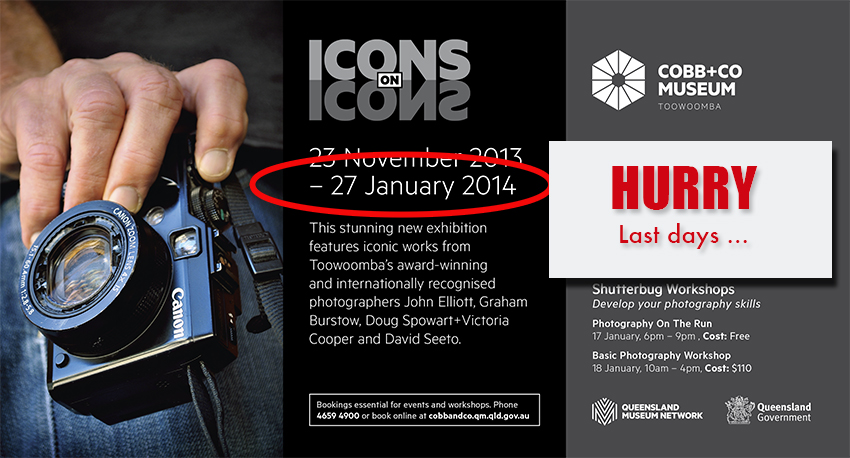
Cobb+Co Museum – Icons on Icons events
.
What’s in the Box?
A big thanks to Mack Books (London), Schilt Publishing (Amsterdam) and also to Filipe Casaca who have all contributed books to this project. If you are a publisher or photographer who would like a book to be included in ‘Box of Books #2′ then please get in touch. The following books were chosen for the discussions of content, narrative and physical properties that I hope they will encourage – Matt from the Photobook Club
Another Language
Mårten Lange
(Mack, 2012)

The blurb: Combining images of flora, fauna and natural phenomena in an intimate and beautifully crafted book, Lange teases out a subtle narrative – a meteor crashes, a landmass is visible and a distant planet occupies the final page – but the book is more akin to the workings of a scientist collecting specimens. Together the photographs create a cryptic and heterogeneous index of nature, with recurring shapes, patterns and texture, where the clarity and simplicity of the individual photographs contrasts with the enigmatic whole.
………………………………………………………………………………………..
Blue Mud Swamp
Filipe Casaca
(Self published, 2012)

The blurb: (Filipe Casaca) Blue Mud Swamp. The shoreline, hot and humid, is a postcard that attracts and invites Men to settle where the land meets the Yellow Sea. However, the reality is dissonant. Although surrounded by natural beauty, beaches and entertainment facilities, the city and its urban spaces transmits, as a whole, a feeling of artificiality. In some cases the abundance created a certain degradation and abandonment. With a splendor that takes us back to a recent past, a certain melancholy is present, as happens with all that was new, colorful and perfect but perished with time.
………………………………………………………………………………………..
Interrogations
Donald Webber
(Schilt, 2012)

The blurb: Interrogations is the result of [Webber’s] personal quest to uncover the hidden meaning of the bloody 20th Century. In dialogue with writer Larry Frolick – whose own ancestors had been decimated in the final months of WW II – Weber insistently and provocatively addresses his questions both to the living survivors and to the ghosts of the State’s innumerable victims, resurrecting their final hours by taking their point of view, and performing a kind of incantatory meditation over their private encounters with Power.
………………………………………………………………………………………..
Lick Creek Line
Ron Jude
(Mack, 2012)

The blurb: Ron Jude’s new book, Lick Creek Line, extends and amplifies his ongoing fascination with the vagaries of photographic empiricism, and the gray area between documentation and fiction. In a sequential narrative punctuated by contrasting moments of violence and beauty, Jude follows the rambling journey of a fur trapper, methodically checking his trap line in a remote area of Idaho in the Western United States. Through converging pictures of landscapes, architecture, an encroaching resort community, and the solitary, secretive process of trapping pine marten for their pelts, Lick Creek Line underscores the murky and culturally arbitrary nature of moral critique.
………………………………………………………………………………………..
Liquid Land
Rena Effendi
(Schilt, 2012)

The blurb: (Rena Effendi) Next to my father’s dead but iridescent butterflies, my photographs show life in some of the world’s most polluted areas, near Baku, where I was born and grew up. In my mind, the contrasting images gravitate towards each other – as I have to my father. Since working on this book I have gotten to know him much better than when he was alive. Salty Waters is the translation from Persian of the ‘Ab-sheuran’ Peninsula; in and around Baku, its main city, the earth is breathing with petroleum fumes, as oil oozes to the surface, turning it liquid. The Caspian Sea hugs the eagle-beak shaped land, salting its gas-pocked soil.
………………………………………………………………………………………..
Mrs. Merryman’s Collection
Anne Sophie Merryman
(Mack, 2012)

The blurb: The book, Mrs. Merryman’s Collection, presents the postcards which together form the story of two intertwined lives – one life lived travelling the world through the postcard images, the other a child and then adult whose life and relationship to her own history and her future were influenced by the collection. While Anne-Marie and Anne Sophie never met, both their lives were inspired by the postcard collection – a relationship that was born, and continues to flourish, in the realms of the imagination.
………………………………………………………………………………………..
The Present
Paul Graham
(Mack, 2012)

The blurb: The Present is Paul Graham’s contribution to this legacy. The images in this book come unbidden from the streets of New York, but are not quite what we might expect, for each moment is brought to us with its double – two images taken from the same location, separated only by the briefest fraction of time. We find ourselves in sibling worlds, where a businessman with an eye patch becomes, an instant later, a man with an exaggerated wink; a woman eating a banana walks towards us, and a small focus shift reveals the blind man right behind her.
.
Also in the box are other items that add to the idea and object of the photobook.
.
A small charge of $5 is being made to cover postage to the Boxes’ next destination in Auckland New Zealand.
.
.
THE EXPO 88 PHOTO SHOW – 25 years on
.
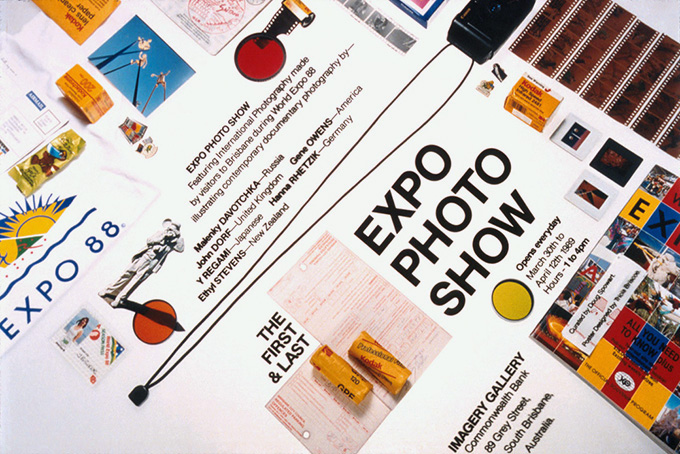
First & Last EXPO PHOTO SHOW Poster
.
EXPO’88 – A conceptual photographer’s document
.
At this time twenty-five years ago, January 1989 – the people of Brisbane were beginning to lament the passing of EXPO’88. While the six-month adventure opportunity to encounter the world and its cultures and cuisine was to form lasting memories for some, others may have recollections of the crush of interstate and overseas visitors, the nightly flamboyant fireworks displays and the inevitable queuing to visit everything from food stalls, to exhibitions and toilets. EXPO’88 is often seen as a watershed in the transformation of Brisbane as a sleepy backwater into a vibrant cosmopolitan city of the world and, most certainly part of the 21st Century.
I had a season pass for EXPO’88 and created a personal body of work as a response to my experience of the event.
.
Here is the back-story behind my 1988 project … The First & Last EXPO PHOTO SHOW
.
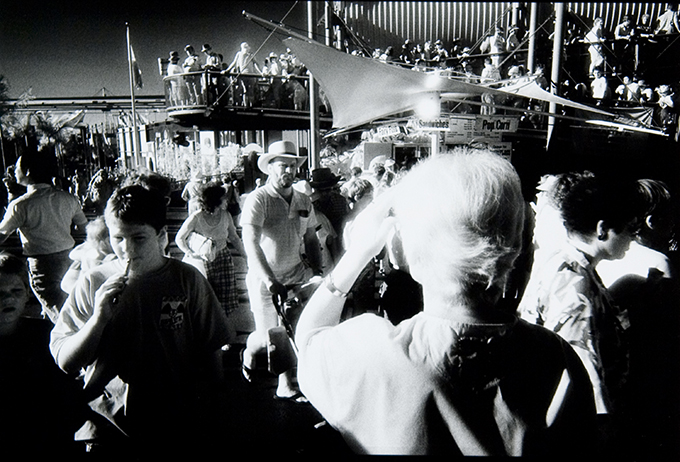
EXPO 88 Crowd Crush ………..PHOTO: Ethyl Stevens aka Doug Spowart
.
In the EXPO’88 event I recognised an opportunity for the creation of a new body of work investigating emerging approaches to my work methodology. For varied reasons I had introduced to my practice the creation of alias identities to which my work was attributed. These identities were quite complete in that they had refined working styles, subject matter, presentation forms, a photographic portrait, signatures and artists statements. As a gallery director it was easy to slip the work of these ‘photographers’ into group shows for commentary and critical acclaim. These personae enable me to play a little game on a system that at times, from my perspective at times, was biased, exclusive, nepotistic and overly critical. It also enabled me to explore ideas and concepts relating to my photography and the presentation of photographs.
.
When EXPO offered season passes I attended the passport portrait session with pair of fake glasses and a fictitious name, Eugene Xavier Pelham Owens, the initials and the signature spelled ‘EXPO’. The deception had begun. In time this project grew into an extensive body of work from 5 different personae all representing their manufactured personal responses to the EXPO experience. The exhibition was opened on April 1st 1989 (April Fools Day), it was reviewed positively in the Courier Mail and sales of work resulted from people who found the photographs reconnecting them with their experience of the event. The deception went undetected and after the exhibition the body of work passed into obscurity, as do so many exhibitions of photographs, and was slipped into archive storage boxes in my studio.
Whilst, at the time of the fieldwork on this project I called myself a ‘conceptual photographer’ as I felt that my work was driven by the overarching idea of personal experience documents rather than the photodocumentary reportage principles of truth and reality. I was aware of the term ‘conceptual artist’ and recognized that it had all kinds of baggage attached to it based on art theory and movements, however my work as a photographer at this time has simpatico with Sol Lewitt’s 1967 manifesto on conceptual art. He states:
In conceptual art the idea or concept is the most important aspect of the work. When an artist uses a conceptual form of art, it means that all of the planning and decisions are made beforehand and the execution is a perfunctory affair. The idea becomes a machine that makes the art. (Lewitt 1967)
Recently Melissa Miles has discussed the term ‘Conceptual Documentary’ in her 2010 paper The Drive to Archive: Conceptual Documentary Photobook Design. The discusses in reviewing the photobooks of Stephen Gill, Mathieu Pernot and Matthew Sleeth. She asserts that this mode of photography is based on a theory that photographers want to collect and respond to a kind of ‘archive impulse’, making and arranging image sequences of daily life into photobooks. What appeals to me is that, as a Conceptual Documentary photographer I, as Miles defines, ‘seek[s] out and frame[s] their subjects according to a pre-determined idea or scheme. Processes of repetition and categorization are central to Conceptual Documentary’ (Miles 2010:50). For me, what I was engaged in was to make a commentary from a personal viewpoint and to create a contemporary record for public presentation and, ultimately archiving. While Miles’ contemporary Conceptual Documentary practitioner including the likes of Martin Parr freely publish their photobooks in the 1980s trade published productions were beyond the reach of most photographers including myself.
What I find interesting now is that the 1980s was a particularly productive period for me as I created a trilogy of exhibitions: Tourists Facts, Acts, Rituals and Relics, Icons & Revered Australiana and The First & Last Photo Expo Show. These were essentially social documentary projects based on a personal directorial premise. I found that the limited opportunities for presentation of the framed exhibition format of these shows led me to initial experiments with boxed sets of images and ultimately to self-published photobooks, the first of which was completed in 1992.
These days I’m not so concerned about any tag as my work is often so interdiciplinarian it is hard to define. What for me is interesting is that at the time I made work that may now be able to be defined and categorized using contemporary terms and definitions. What is also important now is that the EXPO’88 photographs, some 5,000 of them, exist as an archive not necessarily as a document of the place but rather as a personal, conceptual documentary photographer’s response to the EXPO’88 experience.
Doug Spowart December 26, 2013
.
Lewitt, S. (1967). Paragraphs on Conceptual Art. Artforum 5: 8.
Miles, M. (2010) “The Drive to Archive: Conceptual Documentary Photobook Design.” Photographies 3, 49-68.
.
HERE IS A SELECTION OF WORKS FROM MY EXPO’88 PSEUDONYMS
.
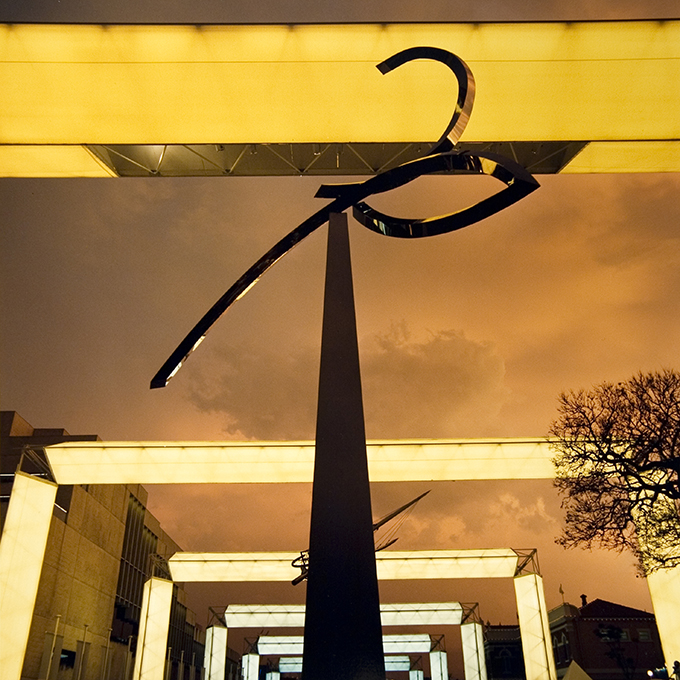
John (Jack) Dorf ………(United Kingdom)

John (Jack) Dorf ………(United Kingdom)
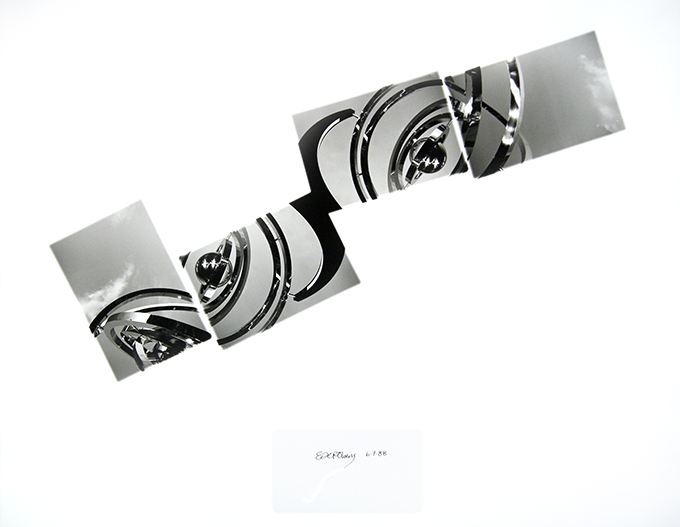
Eugene Owens …….(USA)
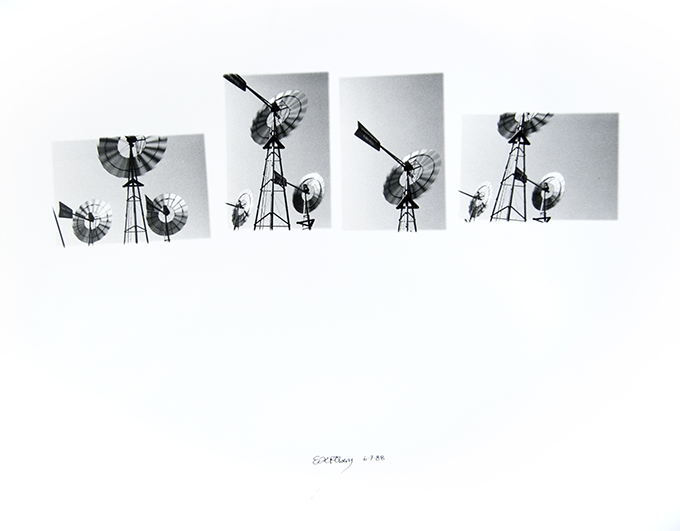
Eugene Owens …….(USA)
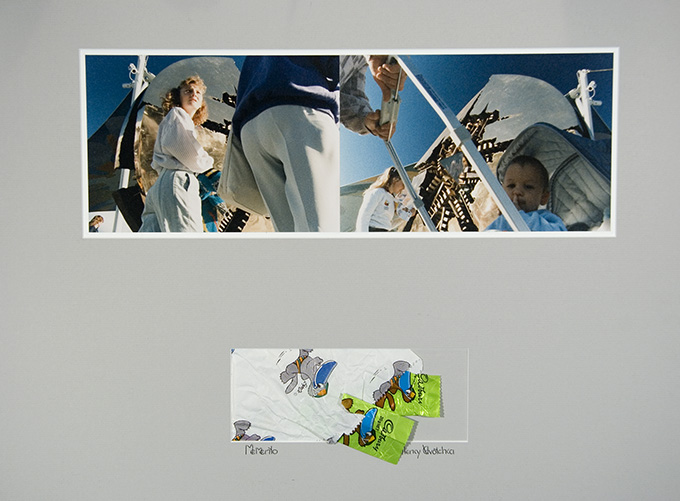
Malenky Davotchka ……. (Russia)
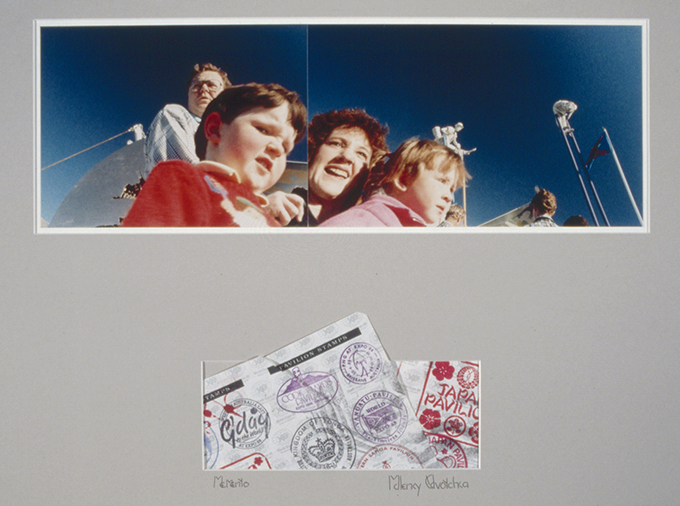
Malenky Davotchka …….(Russia)
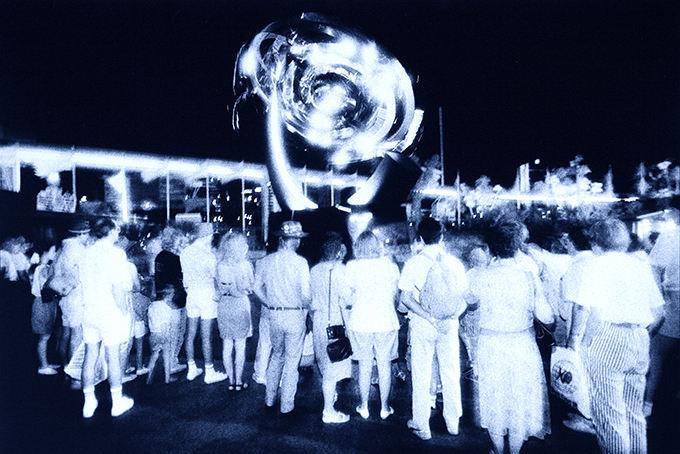
Y Regami ……(Japan)
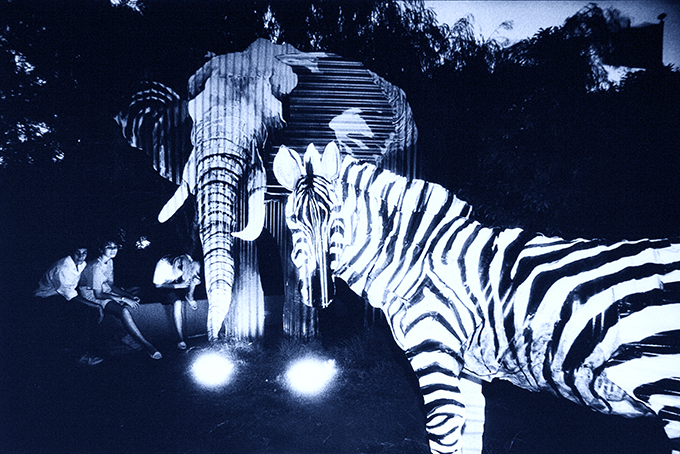
Y Regami ……. (Japan)
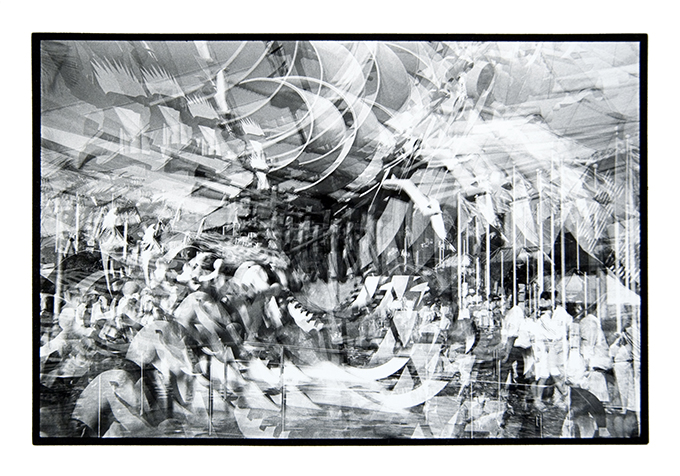
Hanna Rhetzik …….(Czechoslovakia)
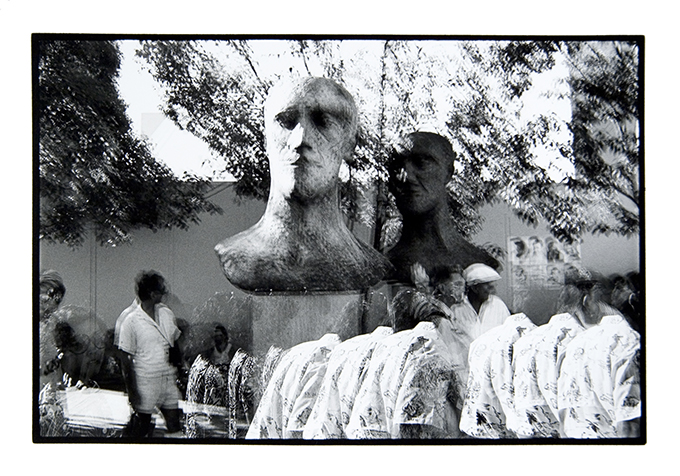
Hanna Rhetzik ……(Czechoslovakia)
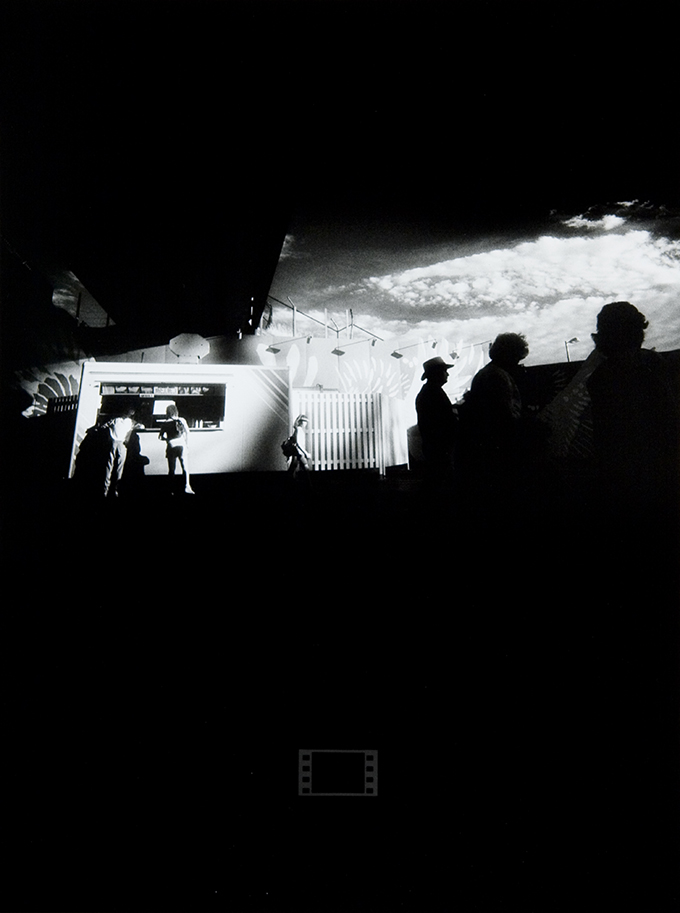
Ethyl Stevens …….(USA)
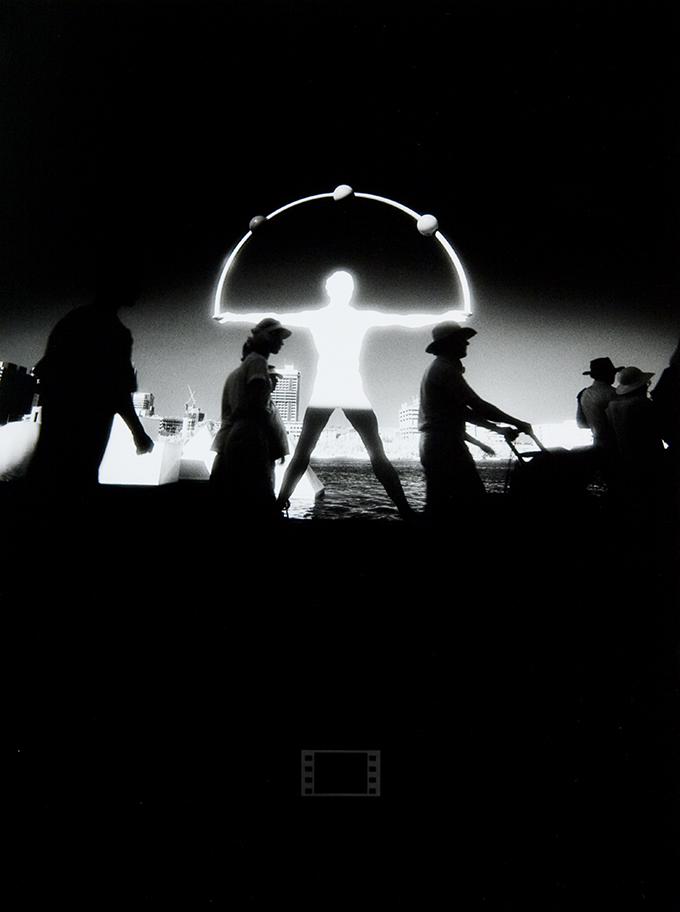
Ethyl Stevens …….(USA)
.
A PDF PRESENTATION CONTAINING MORE IMAGES IS AVAILABLE HERE: EXPO-SPOWART-v3
.
First & Last EXPO PHOTO SHOW Poster
.
.
Images and text © Doug Spowart Design of the Poster: Trish Briscoe
From the Doug Spowart Personal Art Archive 1953-2014
..
.
This work is licensed under a Creative Commons Attribution-NonCommercial-NoDerivs 3.0 Unported License.
.
WORLD PHOTOBOOK DAY: Toowoomba Oct 14, 2013
.
WORLD PHOTOBOOK DAY – CELEBRATED IN AUSTRALIA
.
.
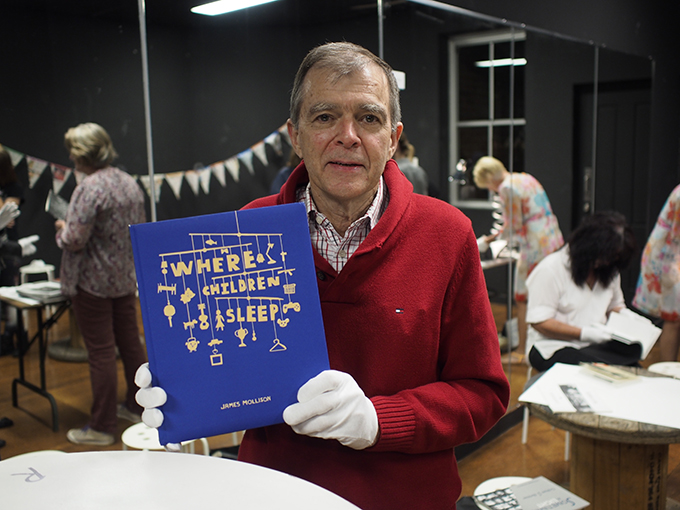
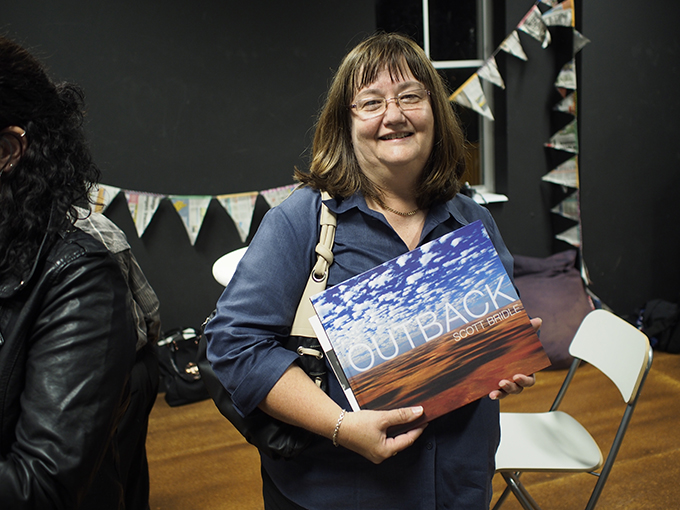
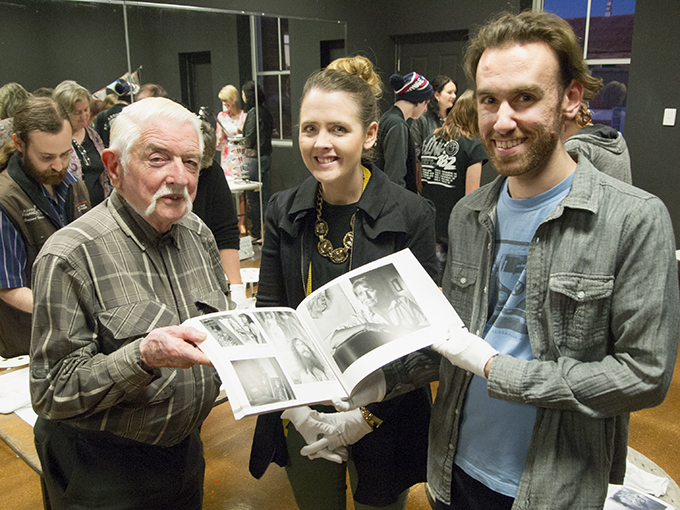
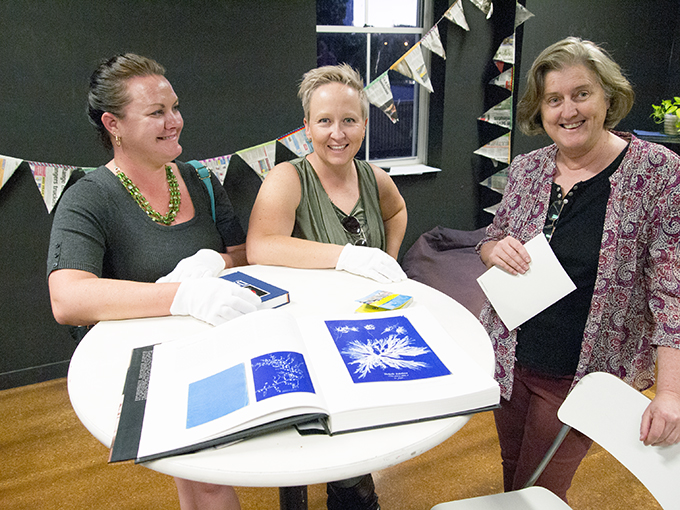
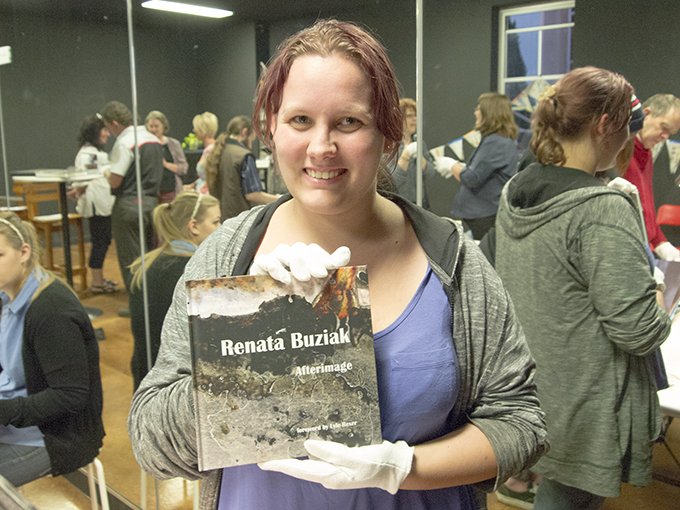
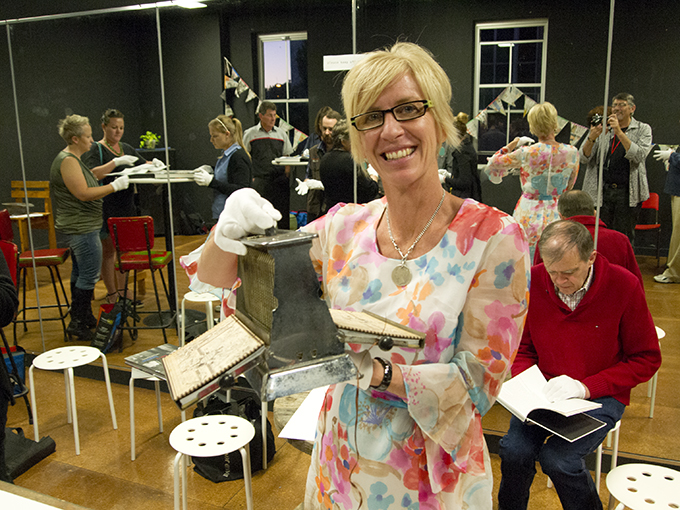
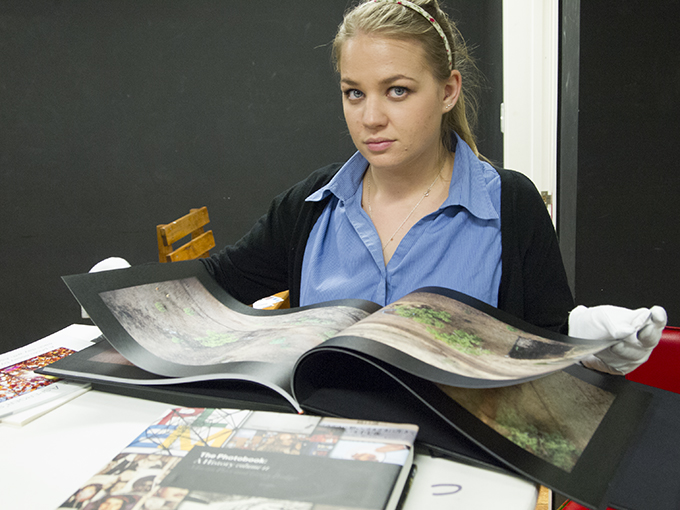
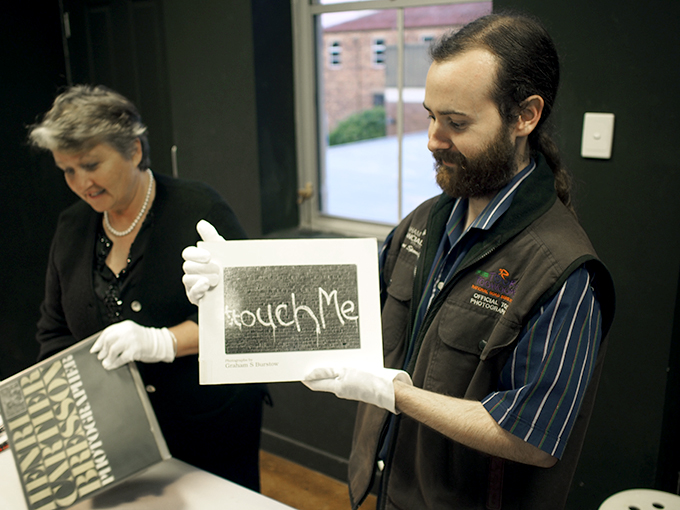
The city of Toowoomba in Queensland Australia celebrated World Photobook Day with a group of around thirty attending a Photo Book Club meeting. The event was held at TheGRID: Hybrid Arts Collective. The participants were from a wide range of photographically interested people: some from the local TAFE college, The Toowoomba Photographic Society, professional photographers, artists and academics. Each brought with them a favourite photobook to share and talk over with others. There were some precious books, some funky contemporary publications, and some of the more traditional coffee table tomes.
.
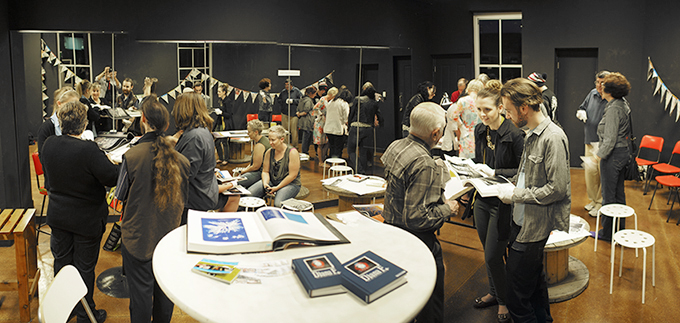
Toowoomba Celebrates World Photobook Day
.
Event coordinator Doug Spowart welcomed the group and gave some background on the history of the photobook and the amazing place that Anna Atkins has within that history. On hand was the Badger and Parr The Photobook: A History Vol1 opened to the page of the Atkins Algae of the British Isles. Doug announced that an acquaintance of he and Victoria Cooper’s – Gael Phillips, was a distant relative of Anna Atkins and that whilst be unable to attend she has provided a commentary on the times, life and family. Gaels words are as follows…
… I thought I might give you a few details of the family of Anna Atkins, nee Children, which may help to explain the setting in which she produced the world’s first photographic book. My cousins, Elizabeth Parkes and Jean Doggett, with input from other family members, have published an account of our family which includes chapters on the Children family. At their family home, “Ferox Hall”, in Tonbridge, Kent, John George Children, Anna’s father and George Children, her grandfather, had built the largest electric battery the world has ever seen at their private laboratory. They were collaborating with Sir Humphry Davy on electrical experiments. It was because of her family’s experience with battery technology and electrochemistry, and almost certainly with the help of her father, that Anna would have had access to sufficient ferric ammonium citrate to produce cyanotypes. Her publication of “Photographs of British Algae” first appeared in October 1843 – British Algae – Cyanotype Impressions. Fox Talbot, a friend of the family, and from whom Anna had obtained her first camera, published “Pencil of Nature” between 1844 and 1846, in several parts. In 1979 Professor Larry Schaaf brought the attention of the world to the fact that the author of the world’s first photo book, AA, was Anna Atkins.
Anna Atkins, nee Children, was born in 1799. Her mother, Hester Anna Children, nee Holwell, was the grand-daughter of Governor Hollwell, one of the survivors of the Black Hole of Calcutta in 1756. Hester never recovered from the birth of Anna and died in 1800.
Anna also wrote a biography of her father, partly concealing her authorship under the initials, “AA”, as she did with her “Photographs of British Algae”.
.
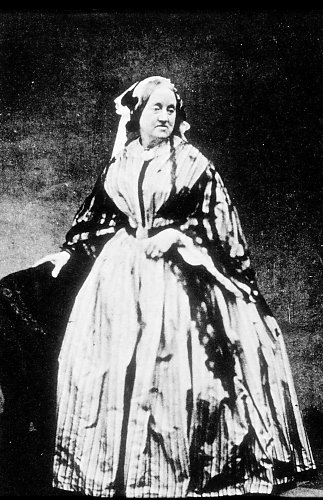
Anna Atkins 1861 [Source Wikipedia}
Anna and her husband, John Pelly Atkins, had no children of their own. Anna died in 1871 and her husband a year later. Their home, “Halstead Place”‘ has since been demolished.
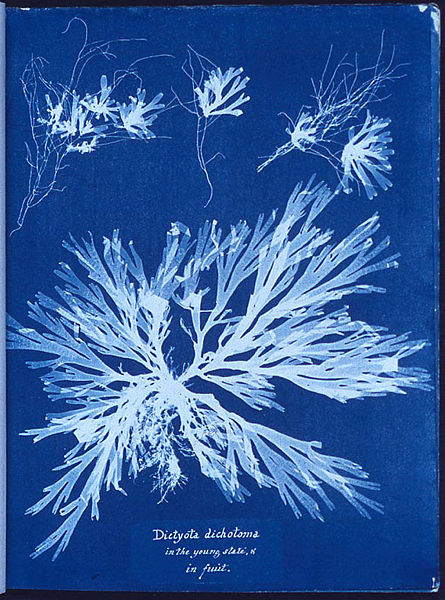
A photogram of Algae, made by Anna Atkins as part of her 1843 book, Photographs of British Algae: Cyanotype Impressions. Courtesy of The New York Public Library http://www.nypl.org.
.
Naturally my favourite photo book (or books, because the Cyanotypes of British Algae by AA run to three volumes) – “Photographs of British Algae – Cyanotype Impressions” by Anna Atkins, my distant cousin. In 1992 I had the great privilege to view copies of the volumes at the Library of the Royal Society in London. The edition ran from between 10 to 12 copies and a few of the plates from one of the copies are held in the National Gallery of Australia in Canberra.
I wish you all well for this celebration of the world’s first photo book by Anna Atkins.
Doug thanked Gael for her insight into the lady whose premier photographic pursuit we celebrate today.
Guests were then invited to continue their looking and talking about books, photography and other worthy matters. It was a remarkable event and one which will no doubt repeated in the future –– but it will be sooner than the next time we gather, once again, to celebrate WORLD PHOTOBOOK DAY.
..A PHOTOBOOK CLUB EVENT
.
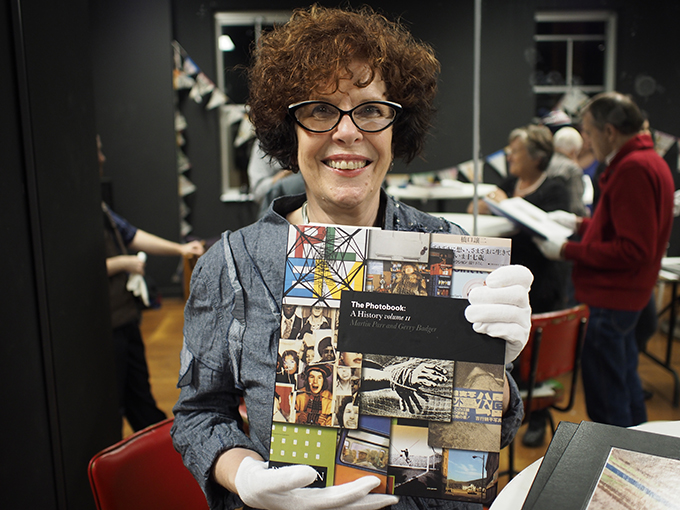
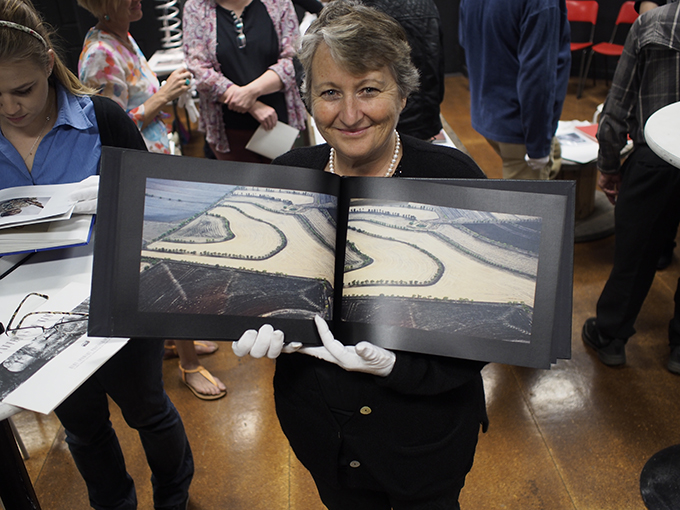
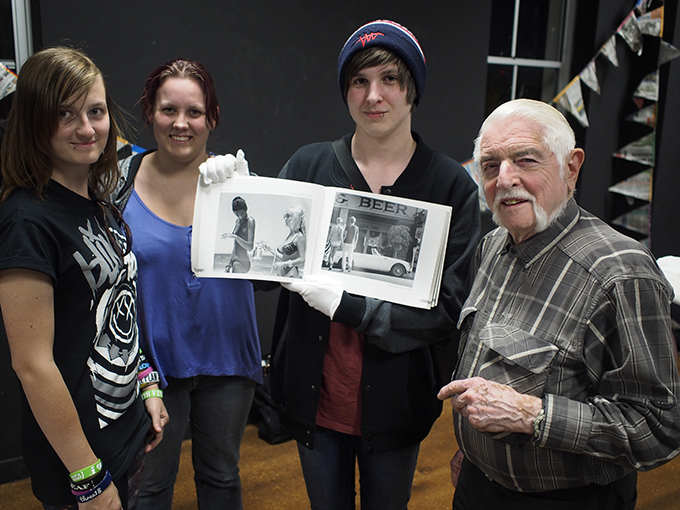
HERE SOME IMAGES OF ATTENDEES AND BOOKS … A detailed list of books presented for viewing and other contributions submitted online will be added to this post in the near future.
.
Report and photographs: ©2013 Doug Spowart. Anna Atkins’ story © Gael Phillips. Images of Anna Atkins sourced from Wikipedia and acknowledged appropriately.
.
.
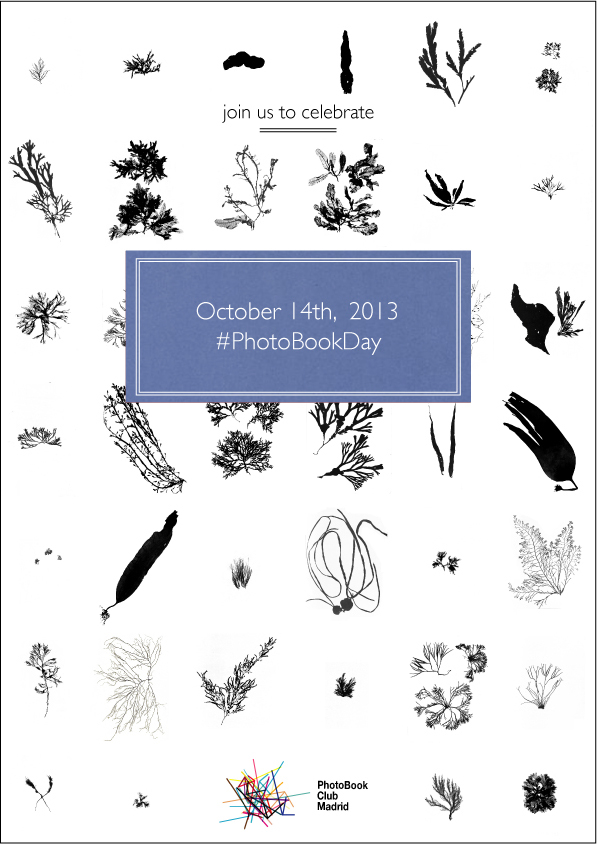
WORLD PHOTOBOOK DAY EVENT: October 14, Toowoomba – INVITE
.
THIS IS THE INVITATION TO THE EVENT — TO SEE THE REPORT – Click
.
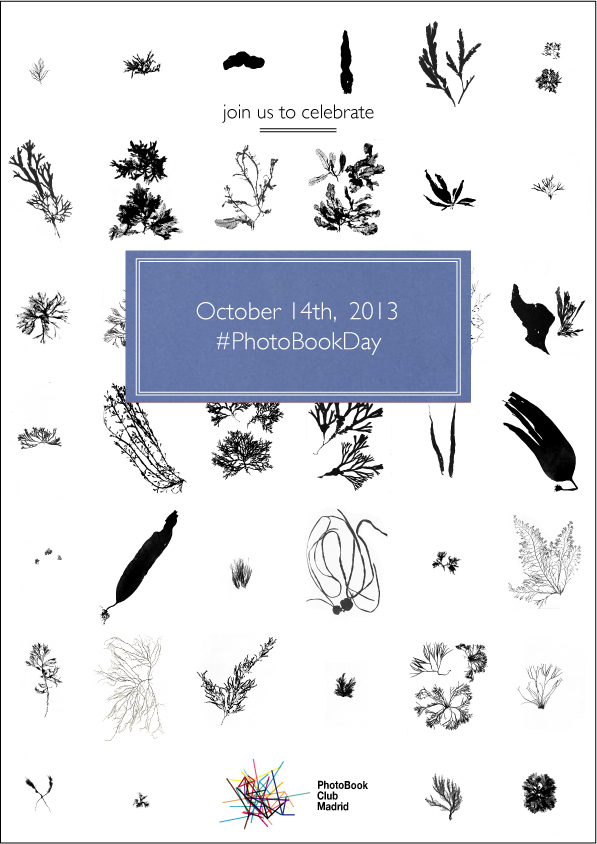
World PhotoBook Day – PhotoBook Club Madrid
Inspired by the PhotoBook Club of Madrid’s proclamation of October 14th being World PhotoBook Day, Vicky and I are organising and event in Toowoomba. We wish to revere the history and celebrate this, most enduring and important aspect of photography – the PhotoBook.
.
To participate:
- Bring: Your favourite Photobook
- Be prepared: To look at books and talk about Photobooks
- Bring: Your white gloves – save you fingerpint DNA for your own library
- Bring $5 to assist with the room hire
.
The event will take place on Monday, October 14, between 5.30-7.00pm at the MARS Gallery – The Grid: Hybrid Arts Collective, 488 Ruthven Street Toowoomba.
PLEASE RSVP – A Facebook Event Page will be posted shortly.
.
If you are unable to attend but are interested in contributing, email us <greatdivide@a1.com.au> a photo or scan of your favourite photobook’s cover with 40 words about your book – we will post these after the event.
.
FOR MORE DETAILS or ANSWERS TO YOUR QUESTIONS: Respond to this Blog/Facebook/Email/Phone us…
.
MORE INFO ON WORLD PHOTOBOOK DAY is available World PhotoBook Day | World Photobook Day
.
NOW AN INTERNATIONAL PHOTO BOOK CLUB EVENT
.
.
.
.
ONE FOR THE BOOK – THE 2013 BLURB BIFB BOOK AWARD

.
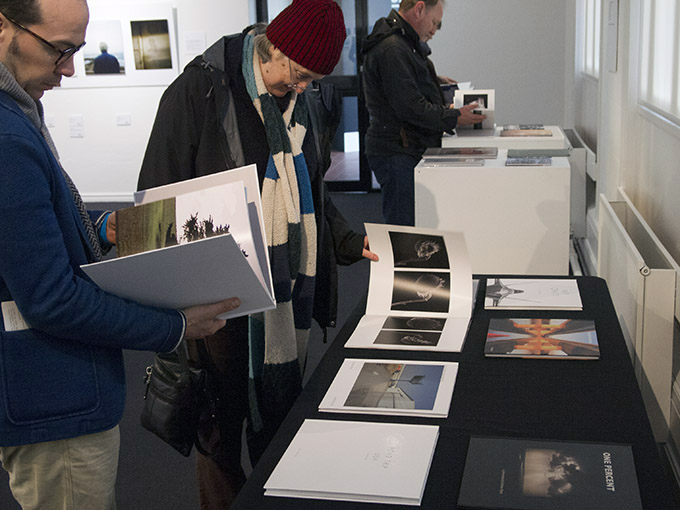
BIFB visitors checking out the book award entries
.
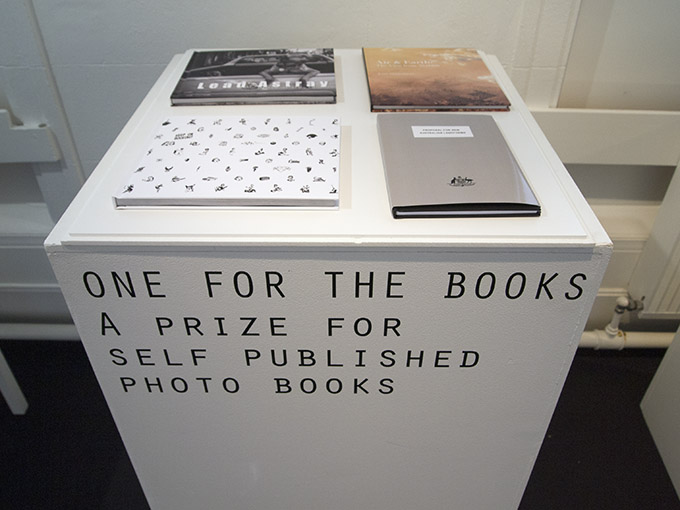
Doug’s book – front right
ONE FOR THE BOOKS
A display of some of the best self-published photobooks in the country are being exhibited at the 2013 Ballarat International Foto Biennale.
A PRIZE FOR SELF PUBLISHED PHOTOGRAPHY BOOKS proudly sponsored by Blurb
The Ballarat International Foto Biennale with major sponsor Blurb, present ‘One for the Books’ an exciting new prize celebrating the book as an innovative and contemporary format for presenting photography in a creative and narrative form. This prize is specifically for self publish, print on demand books. Books previously published by a traditional publishing house are not eligible for entry.
WHO COULD ENTER
The 2013 ‘One for the Books’ Prize will accept submissions for two categories; Professional and Amateur. Winners will be announced at on Monday 19th August 2013 at the Post Office Gallery, Ballarat. Entrants must be Australian residents. Around 100 books were submitted for the judging and 20 finalists were selected.
THE FINALISTS WERE …
The finalists [professional category]
Rhiannon HOPLEY NSW
Charles KLEIN SA
Darren MARTIN NSW
Garry MOORE VIC
Gary SHEPPARD NSW
Doug SPOWART QLD
Andrew STY AN NSW
Peter WHYTE TAS
The finalists [amateur category]
John Paul AZIZ & Shaun DUNCAN VIC
Michael DAVISON VIC
Lidia D’OPERA WA
Grant HUNT QLD
Paul JURAK ACT
Erin STONESTREET ACT
Scott VINEY QLD
.
AND THE WINNERS WERE …
At a special event on Monday August 19th the announcement of the winners of the inauguaral One for the books prize was announced.
.
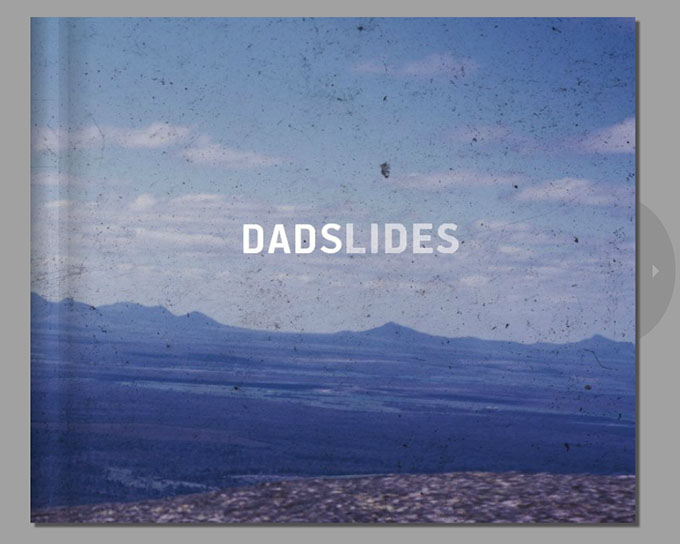
Charles Klein’s Awarded Book – Professional Category
Dadslides is a book dealing with a personal sense of nostalgia in the discovery of one’s own family photographs after the passing of a loved one. Klein’s book consisted of his father’s slides made between 1950 and 1981. The photos were scanned and sequenced within the book to create a document of a family growing up, going on holidays, messing around in the back yard and the other things that symbolise Australian life in this era. Strangely, whilst the book is about Charles Klein’s family, it strikes a resonance with us all and therein lies the beauty and the power of its narrative.
SEE THE BLURB REVIEW HERE: Charles Klein’s Awarded book
.
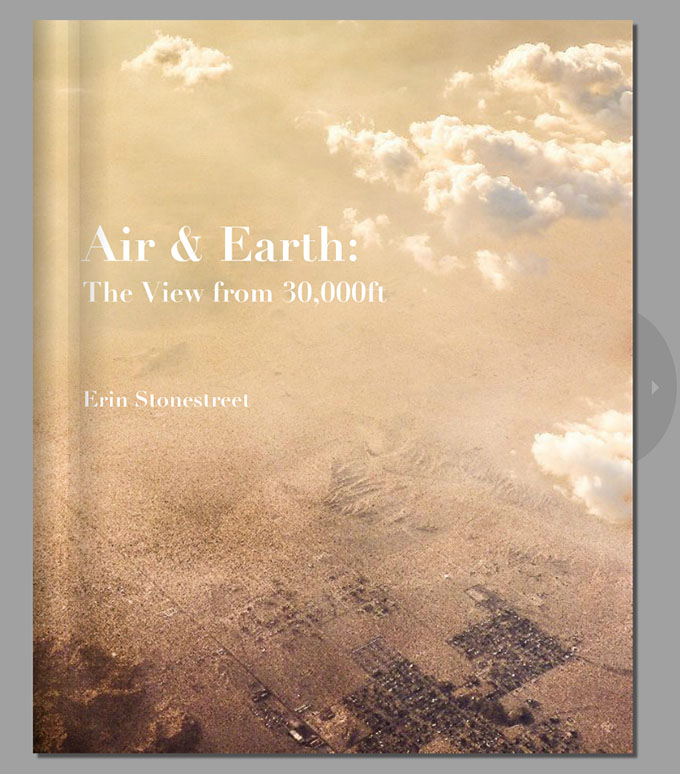
Erin Stonestreet’s Awarded Book – Amateur Category
Air & Earth: The view from 30,000 ft is a book that deals with the aerial view of the earth. The rich colours and image juxtaposition create for the viewer an abstract view – all scale is abandoned and the images take on a sense of the magical, and perhaps even for some, a spiritual meaning.
SEE THE BLURB REVIEW HERE: Erin Stonestreet’s book
.
I was excited to be a finalist in the award – Here is my book…
..
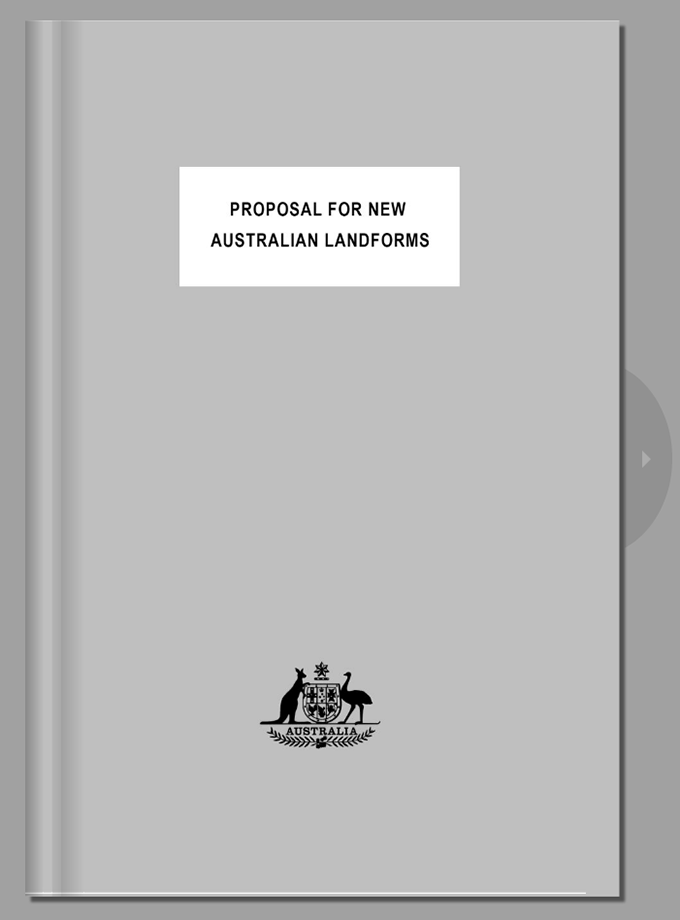
Doug’s Finalists Book
My book deals with the political scene and is a parody of the potential for government agencies and politicians to do absurd things for, as they call it, ‘the good of the people’.
.
SEE THE BLURB PREVIEW HERE: Doug’s Book.
.
PLEASE ENJOY – And do get to Ballarat to see these amazing books in person …
And join in on the photobook print-on-demand revolution.
.
.
A BOOK WARMING: Ross Burnett Bookshop Uralla
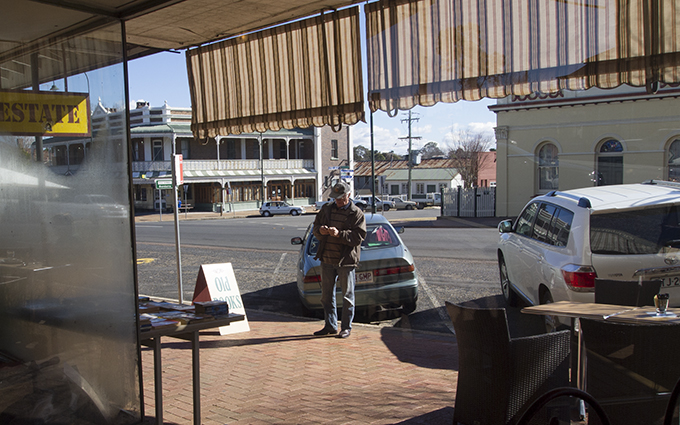
The main street of Uralla as seen from Burnett’s cafe
A cold winters day – we head down towards our AIR in Muswellbrook after over-nighting in chilly Glen Innes. The sun weakly lights the landscape in the highlands of Northern NSW.
Arriving in Uralla we head for the Ross Burnett Bookshop. Whenever we have come through this way this has been an important destination for us. For to peruse the shelves of his second-hand and rare books is a journey of a different kind. Burnett’s ephemera collection is also worth a shuffle through.
We entered the shop and made our way past tall shelves of interesting books to the centre of the building. There surrounded by philosophy, art, Australiana, Literary Criticism, Poetry we some welcoming lounge chairs and a log fire . . .
What else could one need to warm the mind and the body!
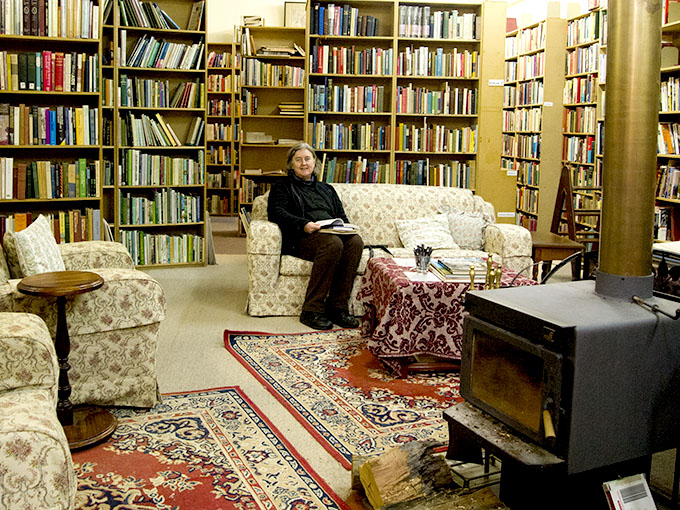
Vicky in book Nirvana
To complete the sensorial and intellectual experience we had lunch in Burnett’s adjacent café. Also warmed by a fire, we treated ourselves with the minestrone soup with fresh bread. All this was a far cry from the normal on the road lunch stop: a pie, maybe a Coke and a quick walk down the main street.
Reluctantly we had to return to our journey south. But we will be back when you return Ross. . . !
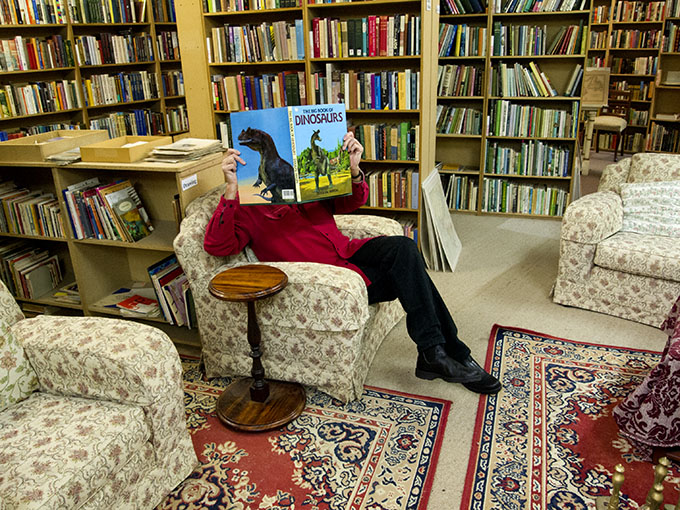
Doug finds a book …

 wotwedid