Archive for the ‘Leap of Faith 2013’ Category
hEADoN into THE FUTURE OF PHOTOBOOK PUBLISHING
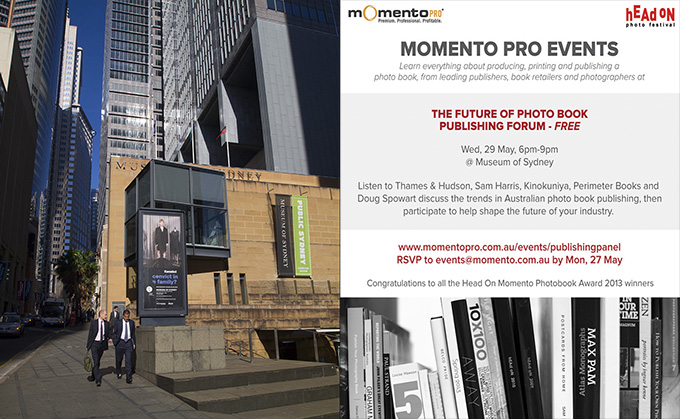
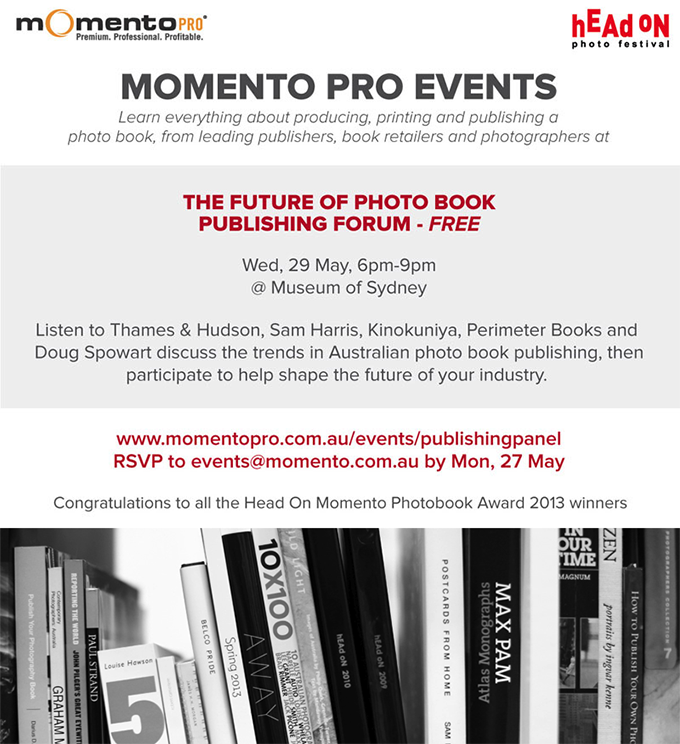
Invite and MOS

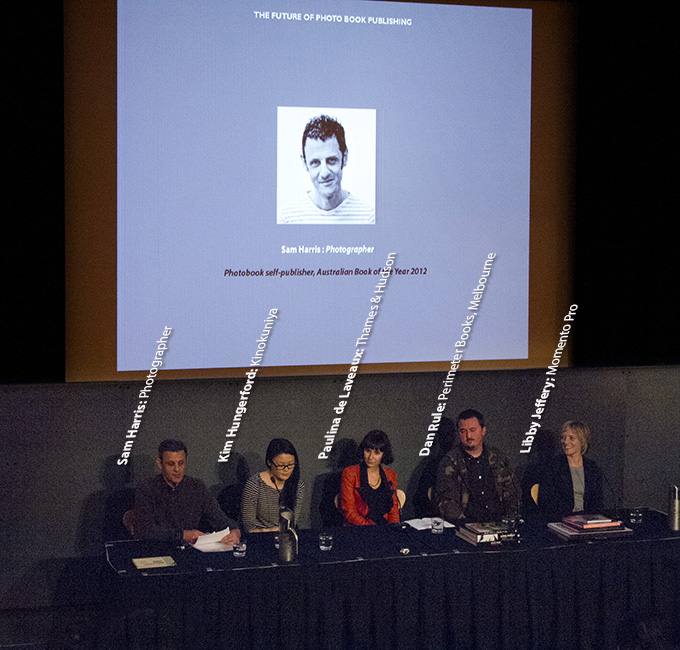
The Future of the Photo Book Forum ……Photo: Victoria Cooper
.
RUNSHEET & OVERVIEW:
Momento Pro/HEADON Event: The Future of Photo Book Publishing
.
6.00 pm Panellists arrive on stage
6.10 pm Doug Spowart: Welcome and good evening.
Photographers and those who make photobooks are storytellers – and – with this in mind – I would like to acknowledge and pay respect to the traditional owners and story-tellers of this land on which we meet; the Gadigal people of the Eora Nation.
This evening we will discuss the photobook and consider the opportunities for its future in Australia.
My name is Doug Spowart, I make artists books, photobooks and I have a research interest in photography and the form of the photobook.
This evening I’m joined by an eminent panel of book people with a wide range of knowledge and expertise on the topic.
The order of this evening will begin with an overview by me about the photobook. Then each of the panellists will discuss their involvement within the book and photobook world. Following that the panel will be presented with a range of questions – some sent in from attendees. Towards the end of the forum we have set aside time for your questions and comments to the panel. The forum will close and be followed by refreshments and networking opportunities …
At this juncture I would like to thank our Sponsor Momento Pro and the Organizers of the HeadOn Photo Festival, and the Museum of Sydney for this opportunity to engage in dialogue about this growing and evolving medium …
.
AN OVERVIEW OF THE PHOTOBOOK
.
Photobook luminary Martin Parr states:
… that photography and the book were just meant for each other; they always have been. It’s the perfect medium for photography: it’s printed, it’s reproducible and it travels well. (Parr in Lane 2006:15)
The photobook is indeed the ‘perfect medium’ for photography and its history, the history of photography are inextricably linked with that of publishing. In fact some of the earliest experiments in photography made by Hércules Florence (1804 -1879), Nicéphore Niépce (1765 -1833) and Henry Fox Talbot (1800 -1877) were to discover methods and processes that would enable the copying and printing of texts or designs by capturing and fixing camera obscura images.
![William Henry Fox Talbot, by John Moffat, 1864 By Michael Maggs [Public domain], via Wikimedia Commons](https://wotwedid.com/wp-content/uploads/2013/06/william_henry_fox_talbot_by_john_moffat_1864-by-michaelmaggs-public-domain-via-wikimedia-commons.jpg)
William Henry Fox Talbot, by John Moffat, 1864
By Michael Maggs [Public domain], via Wikimedia Commons
Books illustrated by photographs as a genre of the publishing industry flourished. The photographic image could operate as a storyteller, a precise document of truth, a device to entertain and, at times, a carrier of propaganda. Early photography book works consisted of travel, geographical and military expeditions, trade catalogues, scientific and ethnographic documentation.
Although some photographers, like Talbot, may have established their own publishing ventures, usually the photographer was a supplier of images for a publication that was commissioned by someone else – a publisher, benefactor or government agency. The publishing of a book was, and still is, a task requiring the specialized skills, the entrepreneurship and financial acumen found in the worlds of publishing, marketing and bookselling. Books are created for a purchasing audience: it is a mercantile process where return on the investment in a publishing project is a necessary outcome.
What is it about photographers and their need for photobooks?
Martin Parr describes the influence that photobooks had on his own practice by stating that:
I’m a photographer and I need to inform myself about what’s going on in the world photographically. Books have taught me more about photography and photographers than anything else I can think of. (Parr in Badger 2003:54)
Parr is not alone. The publishing house Aperture – a well established international publisher of contemporary and historical photographic essays and monographs – acknowledges in their organization’s credo that:
Every photographer who is a master of his [sic] medium has evolved a philosophy from such experiences; and whether we agree or not, his thoughts act like a catalyst upon our own — he has contributed to dynamic ideas of our time. Only rarely do such concepts get written down clearly and in a form where photographers scattered all over the earth may see and look at the photographs that are the ultimate expression. (in Craven 2002:13)
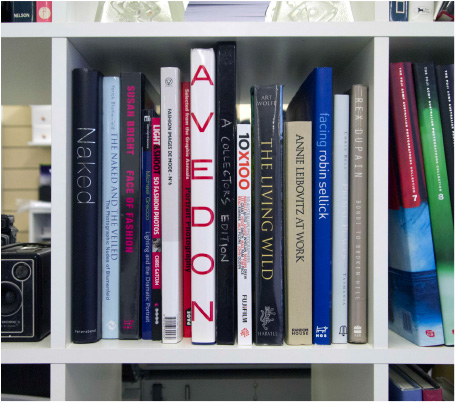
Library
So photographers seek inspiration for their work by building their own reference libraries: have you ever visited a photographer and not had discussions about books or been invited to see their library? It then makes sense that photographers will want a book of their own. Photobook publisher Dewi Lewis exclaims: ‘I have yet to meet a photographer who doesn’t want to see their work in book form.’ (Lewis and Ward 1992:7).
Photobook commentators and publishers of the book Publish Your Photography Book, Darius Himes and Mary Virginia Swanson claim that this need is universal and emotive:
It almost goes without saying that every photographer wants a book of his or her work. It’s a major milestone, an indicator of success and recognition, and a chance to place a selection of one’s work in the hands of hundreds, if not thousands, of people. Plus it is just plain exciting to hold a book of your photographs! (Himes and Swanson 2011:26)
It seems that this ‘rite of passage’ is an important step of professional recognition as photographer, photobook maker and writer – Robert Adams – makes the following statement in his book Why people photograph:
I know of no first-rate photographer who has come of age in the past twenty-five years who has found the audience that he or she deserves without publishing such a book. (Adams 1994:44-5)
Does it then follow that every photographer of note or the creator of a significant body of work deserves a book?
It is not that easy. Amongst others the photobook publisher Dewi Lewis argues that the market for photobooks is limited – where he identifies that: ‘photographers themselves are the largest purchasers of photobooks’ (Lewis and Ward 1992).
Ultimately unsold books are remaindered – something even Magnum photographer Martin Parr experienced. His first book Bad Weather (1982) sold poorly and was remaindered at 40p. In an essay on photobook publishing Peter Metelerkamp reports that:
Parr himself bought in as many copies as he could at that price (very much below the cost of production) (Metelerkamp circa 2004:7).
But while remaindered books can be a great way to acquire a low priced library they represent a loss to the publisher, who may then be wary of undertaking future photobook ventures.
The photographers who are successfully trade-published are usually either well known and/or are those who produce work that is of interest to a broad audience. Most notably in Australia this has included celebrated photographers such as Harold Cazneaux (1878-1953), Frank Hurley (1885 -1962), Max Dupain (1911-1992), Jeff Carter (1928-2010), David Moore (1927-2003), Peter Dombrovskis (1945 -1996), Rennie Ellis (1940-2003).
In contemporary times other avenues of photobook publishing as a documentary/art project have emerged and include photobooks by Tracey Moffatt (1960- ), Max Pam (1949- ), Matthew Sleeth (1972- ), Stephen Dupont (1967- ), Trent Parke (1971- ) Michael Coyne (1945- ) and Wesley Stacey (1941- ) and many others. The field of contemporary pictorial photobook books could be represented by the likes of Ken Duncan (1954 – ), Peter Lik (1959 – ) and Steve Parish (1945 – ). Then there are so many more …
So what about the photographer doing it for themselves?
Historically, the self-publishing of photobooks was a huge investment of time and money – an individual photographer’s access to the required production and printing facilities was a major barrier. Also those who have financed their own publishing exploits generally lacked the distribution and marketing connections that were attached to the major publishing houses.
Access to printing facilities were overcome by the photographer having contacts in or working in the printing industry such as American photobook-maker Ed Ruscha did with books like Twenty-six Gasoline Stations (1963). In Australia Peter Lyssiotis was able to produce: Journey of a Wise Electron (1981) and other books by participating in a co-operative that accessed a commercial printing press during down time or on weekends. But these access points were not available for everyone who wanted to publish a book.
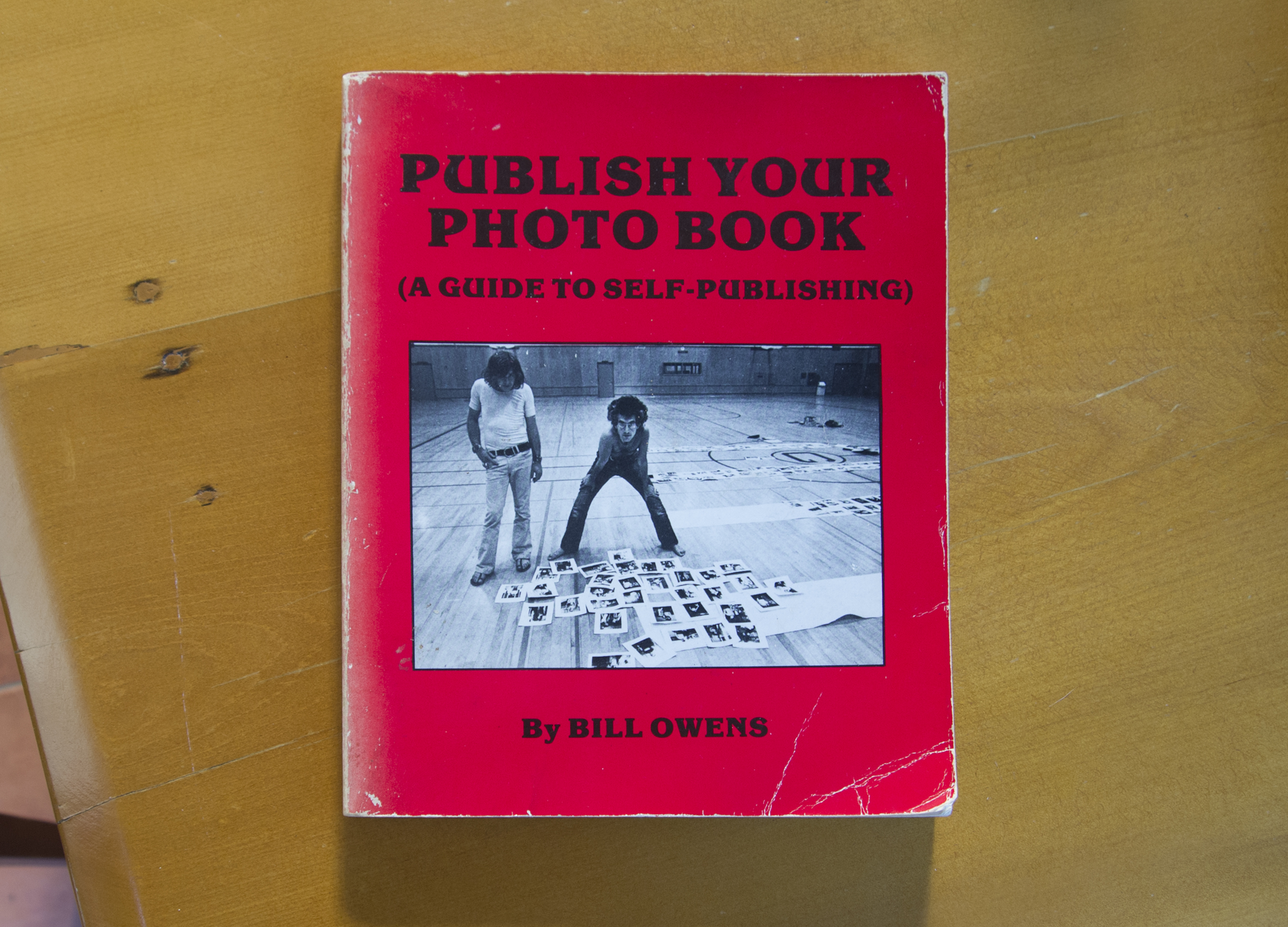
Bill Owen’s book
Nearly 35 years ago American photographer Bill Owens, publisher of Suburbia (1972) and other books made the following introductory statement to his info-guide – Publish Your Photo Book (1979) – a statement that may resonate with the experience of today’s photobook publishers:
Had my photographic books made lots of money I would not have written this book. I wouldn’t need to because I would be part of the establishment and enjoying its privileges. (Owens 1979:3)
It has been a long time coming, but 175 years later with digital technologies including DIY book design software, print-on-demand presses like HP Indigo, the self-published photobook is fulfilling Talbot’s prediction. It’s never been easier for anyone to make a photobooks.
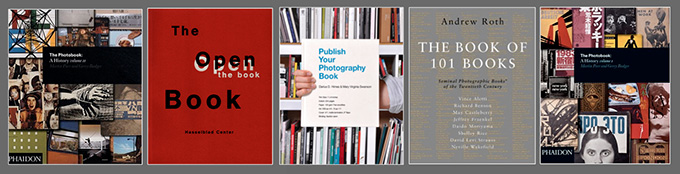
Some seminal photobook texts
The photobook discipline now has commentators and critics, there are awards, linkages with the artists book, supporting independent groups like Self Publish Be Happy, The Photo Book Club and the Indie Photo Book Library.
However just making a book, even your own, does not guarantee success – whatever that might be. But at this time, what are the barriers and opportunities that we in Australia need to consider and respond to as this boom in photobooks continues?
What ideas, social and political mechanisms and appropriate structures do we need to create to nurture and support this emerging publishing paradigm?
Let us now pose some questions to the panel …
.
INTRODUCTION OF THE PANELISTS
See invitation blog post for bios http://wp.me/p1tT11-MT
.
.
A SELECTION OF THE QUESTIONS POSED TO THE PANEL
- What is the recipe for the perfect commercially viable photo book?
- Are Awards/Fairs/Festivals/Exhibitions important to or essential for photo book sales and marketing?
- It’s often stated that the basic market for the photo book is photographers themselves – how can this market be expanded so that the photo book can become more popular for a broader audience?
- Is the Australian photo book consumer more interested in Euro/USA content than homegrown books?
- Is there a market for Australian photo books overseas? Are there mechanisms in pace to support photo books as export? Are our photo books internationally competitive?
- If, as a publisher, you were approached by a photographer with a photo book idea – What would you expect them to bring to your meeting with them.
- What kinds of books/themes or content would an independent or niche publisher take on that a mainstream publisher wouldn’t?
- In the photo book genre, as with other special interest low volume publication sales, will print on demand publishing become a viable option – thereby doing away with the practice of remaindering?
- How can we nurture, inspire and develop the Australian photo book market?
.
A SYNOPSIS OF THE DISCUSSION WILL BE POSTED SEPARATELY:
.
In conclusion … I’d like to see, and I guess you would as well, that the photobook break from the publishing paradigm that Bill Owens spoke of before.
Let’s hope that as a result of, or perhaps more modestly, that this forum will contribute to a future where photographers and their photobooks will be recognized, revered and financially rewarded for their contribution to telling their stories, our stories and the stories of humanity and of life on this planet and beyond.
Once again thank you to our panelists …
Our sponsor – Momento Pro
The HeadOn Photo Festival
And to you all —–
You are now most welcome to join us for some refreshments and networking
8.15 pm Close…..
.
.
Bibliography for Doug’s Overview
Adams, R. (1994). Why People Photograph. New York, USA, Aperture Foundation.
Badger, G. (2003). Collecting Photography. London, Mitchell Beazley Ltd.
Craven, R. H. (2002). Photography past forward: Aperture at 50. New York, Aperture Foundation Inc.
Himes, D. D. and M. V. Swanson (2011). Publish Your Photography Book. New York, Princetown Architectural Press.
Lane, G. (2006). “Interview: Photography from the Photographer’s Viewpoint. Guy Lane interviews Martin Parr.” The Art Book 13(4): 15-16.
Lewis, D. and A. Ward (1992). Publishing Photography. Manchester, Conerhouse Publishing.
Metelerkamp, P. (2004). “The Photographer, the Publisher, and the Photographer’s Book.” Retrieved 12 March 2009, from http://www.petermet.com/writing/photobook.html.
Owens, B. (1979). Publish your Photo Book (A Guide to Self-Publishing). Livermore, California, USA, Bill Owens.
Talbot, W. H. F. (1839). Letter to Sir John Herschel, HS/17/289. The Royal Society. S. J. Herschel. London, UK, The Royal Society: HS/17/289.
.
.
.
All photographs © 2013 Victoria Cooper & Doug Spowart
Texts an Overview (except references as cited) © 2013 Doug Spowart
.

This work is licensed under a Creative Commons Attribution-NonCommercial-NoDerivs 3.0 Unported License.
.
.
OUR ZINE @ MCA ZINE FAIR Sunday 26th May, 2013
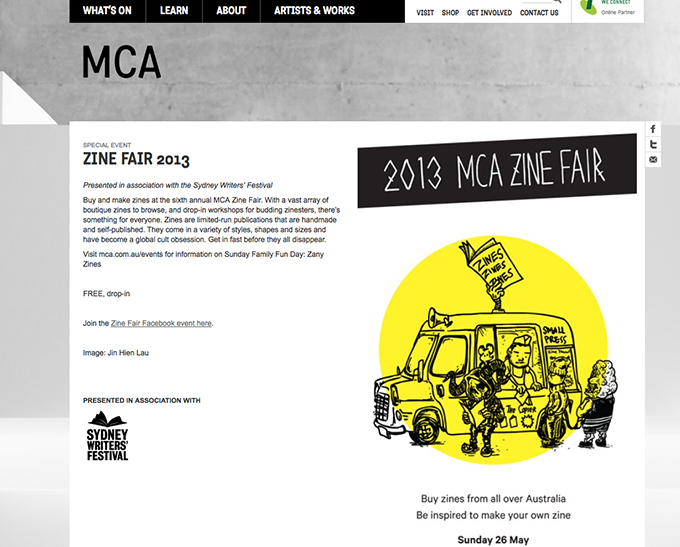
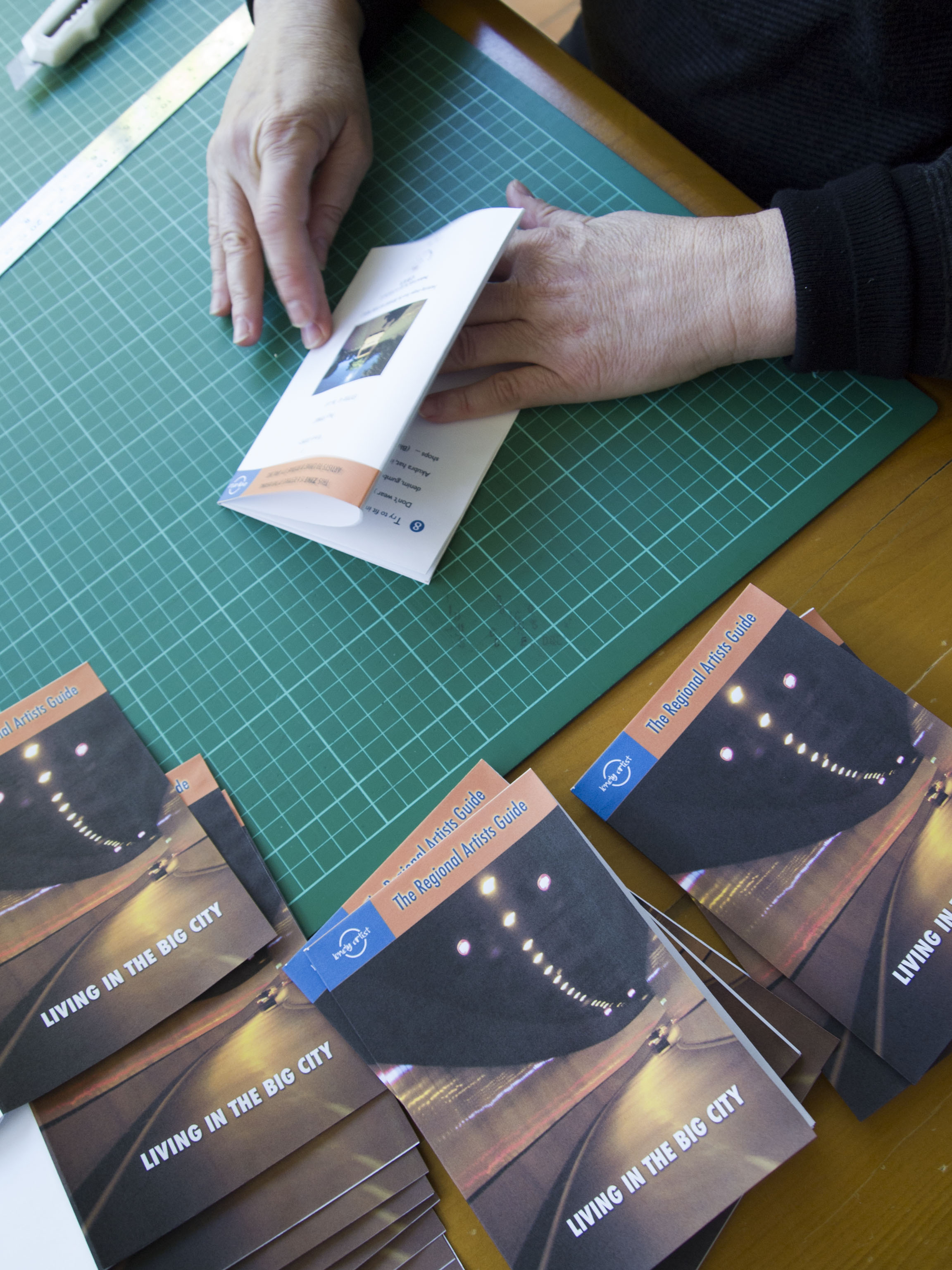
Thanks to Jo Kambourian of Lismore’s MS Browns Lounge a special edition of our Centre for Regional Arts Practice Artists Surveys will be presented as a zine for the event at the Sydney Writers Festival, Museum of Contemporary Art’s Zine Fair. Entitled The Lonely Artists Guide to Living in the Big City it presents a commentary of two artists and their experiences living in Brisbane for the month of April 2013.
A REPORT FROM JO IS AVAILABLE HERE http://msbrownslounge.com.au/unpacking-the-zine-fair/
The zine is an 8 page fancy fold and we made them up as an edition of 40 over the last few weeks. Here is what it looks like …
.
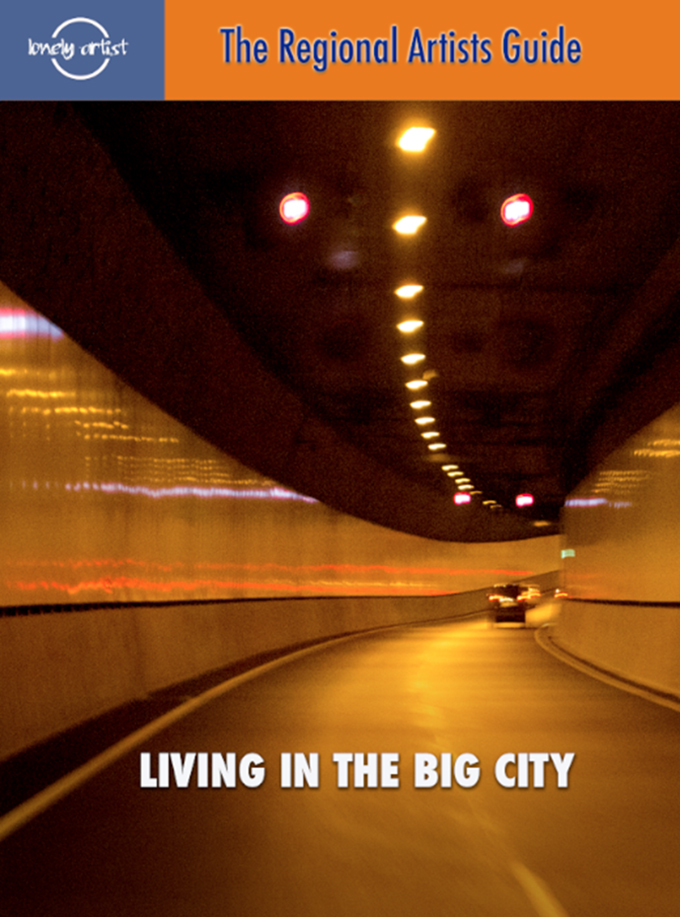
Zine Cover
.
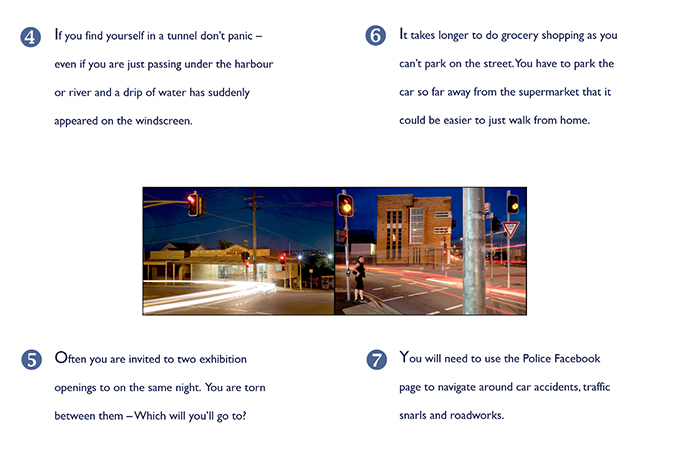
Observations 4 to 7: Living in the BIG City
Handmade in Print. The MCA Zine Fair is back tomorrow from 11.00am (via Broadsheet Sydney)
Join the Facebook event here -> http://on.fb.me/13rY3P1
Presented in association with the Sydney Writers’ Festival
..
All photographs © Doug Spowart 2013.
This work is licensed under a Creative Commons Attribution-NonCommercial-NoDerivs 3.0 Unported License.
.
.
.
COOPER+SPOWART TALK ABOUT PHOTOBOOKS
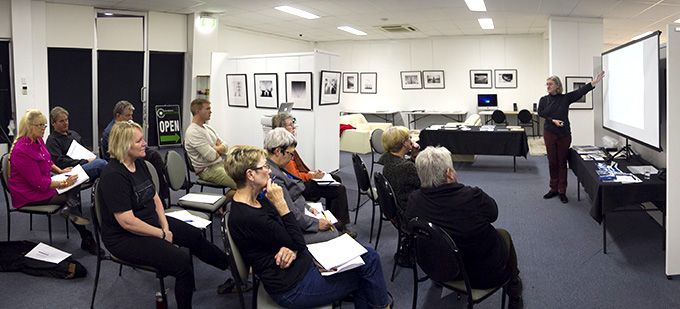
Victoria Cooper talking about photobooks @ Foto Frenzy
On the evening of May 21 Victoria + Doug presented a talk and showing of their self-published photobooks and artists books. Entitled LOOKING GOOD IN PRINT: PHOTOBOOK, the talk connected participants with concepts and techniques on how to personalize and create photo-stories in the form of the bespoke self-published book.
Participants engaged in a lecture presentation that helped them to develop a broader understanding of what a photobook can be—extending them beyond just a collection of photos into a resolved personal narrative of high technical and aesthetic values.
The range of options for making photobooks was discussed and samples of hand-made, inkjet printed and hand-bound artists’ books, as well as print-on-demand books were available for viewing and handling.
The Intro Session included an overview of the following topics:
- Simple and advanced forms and structures of books
- The creative influence of artists books
- The image, sequence and the narrative flow
- Production and design issues for handmade/print-on-demand book
- Computer processing of the book
- Simple bindings for the handmade book
.
.
.
Location:
Unit 3/429 Old Cleveland Road, Camp Hill, QLD 4152.
Time + Date: 6.00 – 8.30pm, Tuesday May 21, 2013.
THE FEE: $ 75.
Bookings were made through:

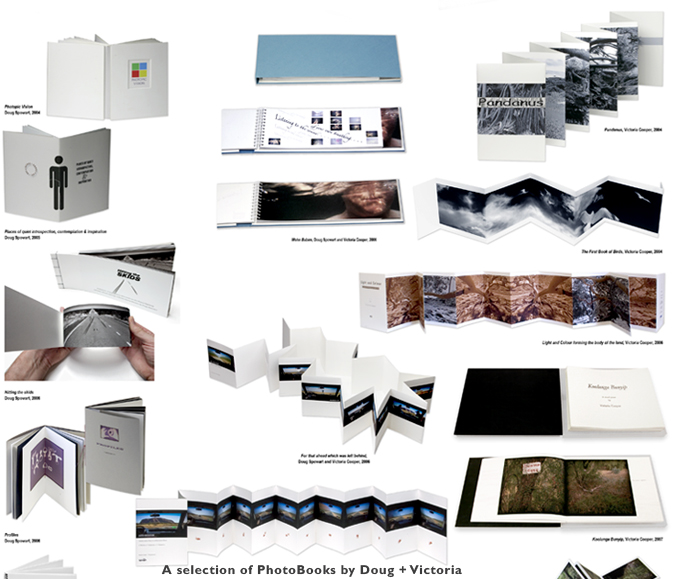
.
.
All photographs + text © Doug Spowart 2013.
This work is licensed under a Creative Commons Attribution-NonCommercial-NoDerivs 3.0 Unported License.
DOUG HAS FEATURED POST: State Library of Qld DESIGN ONLINE Blog
Recently I was commissioned to write a piece for the State Library of Queensland’s Design Online Blog.
I chose to write a commentary on the proliferation of images on social media and connect it with the Andy Warhol statement about everyone having 15 minutes of fame.
The Design Online blog has as its mission the following proposition:
Every idea, thought, or position has an origin, and often this origin exists in the ideas, thoughts and positions of others. Design Online creates a shared environment for the design community to come together in the creation of new knowledge centred around design in the Asia Pacific.

.
If you are interested in fame, social media and photography today please view the design online site an consider the idea I’ve posted … CLICK THE PICTURE
.
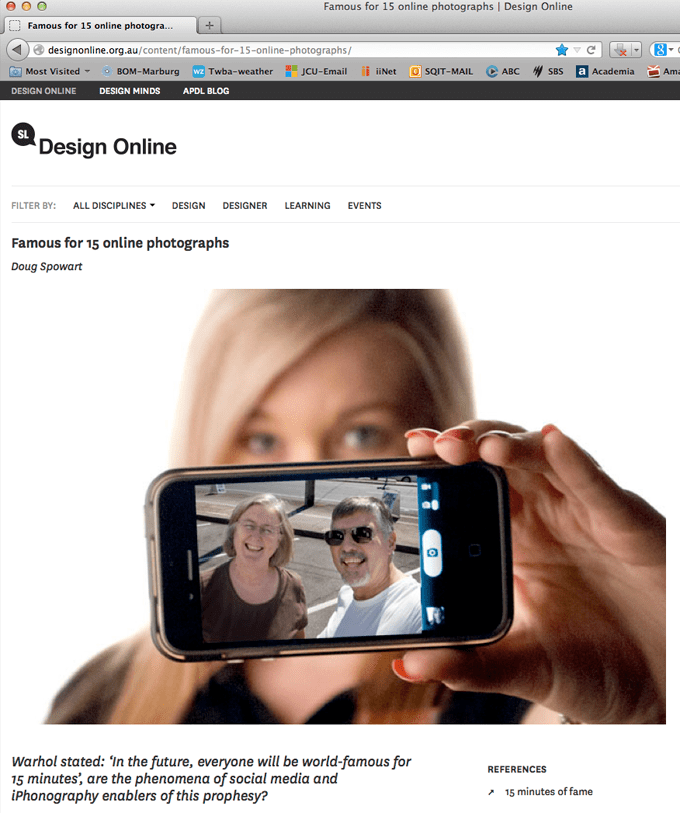
Doug Spowart post SLQ Designonline Blog
Thanks to Design Online for the opportunity to post the idea and to model Tash Armit for helping out with the photo header image.
.
Photography and Essay ©2013 Doug Spowart
. This work is licensed under a Creative Commons Attribution-NonCommercial-NoDerivs 3.0 Unported License. . .
VISITING ARTISTS: Foto Frenzy ‘Exploring Photography’ Workshop @ Mt Barney Lodge
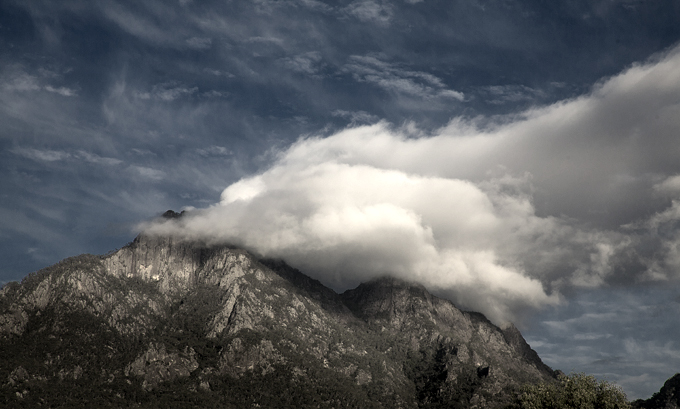
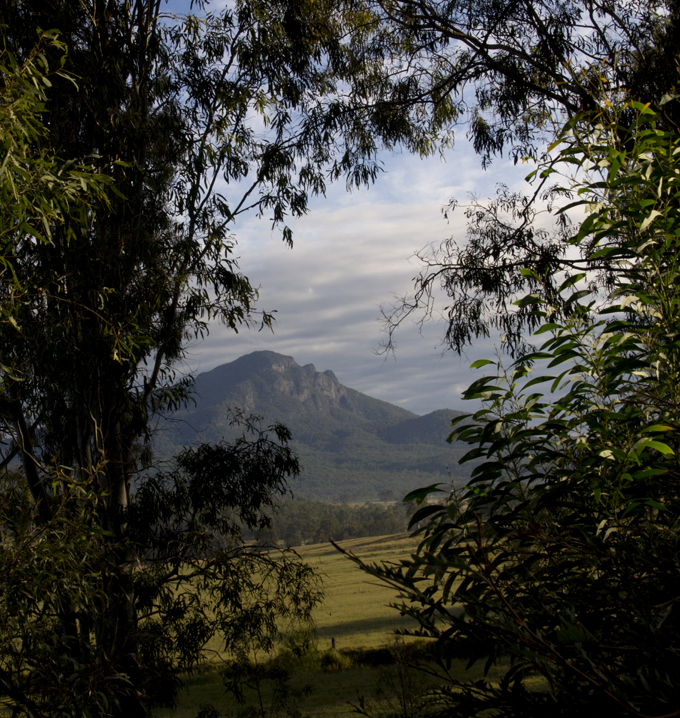
Mt Barney soon after dawn
.
Last weekend we participated in a Foto Frenzy workshop at Mt Barney Lodge in South-East Queensland’s World Heritage listed Scenic Rim.
This bushland retreat is nestled in a valley only a few kilometres from the rugged Mt Barney peak alongside the upper reaches of the Logan River. The location for the workshop is ideally suited for photographers as there are views of both pastoral and rugged natural landscapes in abundance.
.
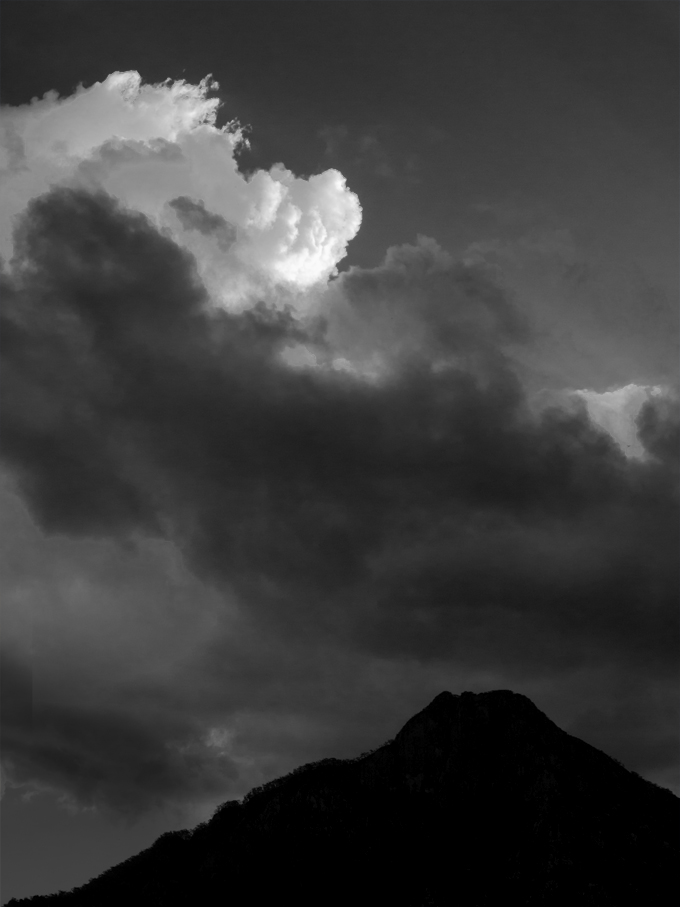
Late afternoon clouds over the Mt Barney peak

An early morning encounter
A nearby peak
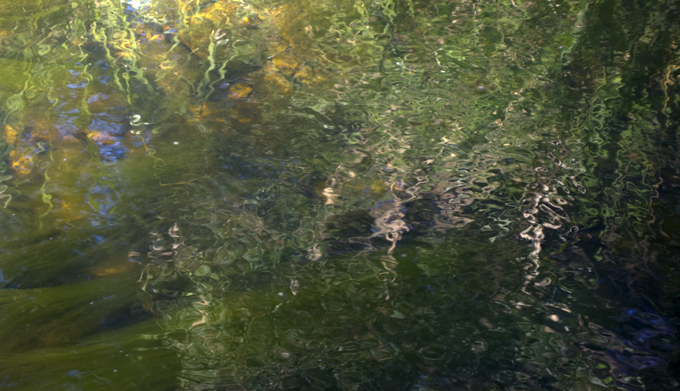
Reflections on the upper Logan River
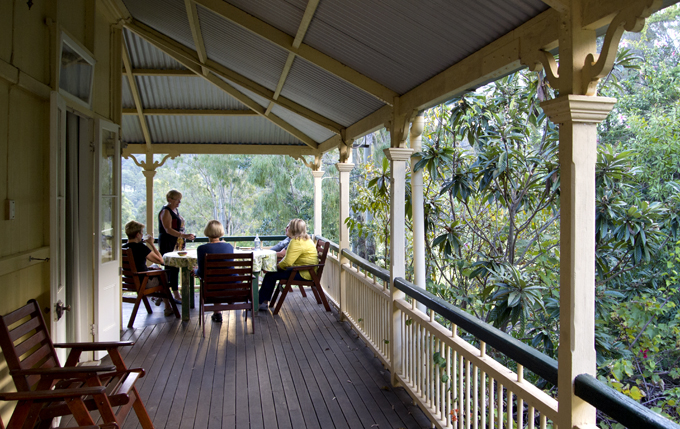
Workshop participants relaxing in their accommodation @ Moringararah Homestead, Mt Barney Lodge
.
Workshop lecturer Darren Jew links opportunities for photography with a hands-on computer set-up with a fine art printing facility. Participants start with an inspirational introductory session followed by colour management induction and calibration of their monitors to ensure quality output.
The keen photographers assembled pre-dawn on Saturday to witness and photograph the setting full moon behind the Mt Barney summit and a cloud-streaked sunrise.
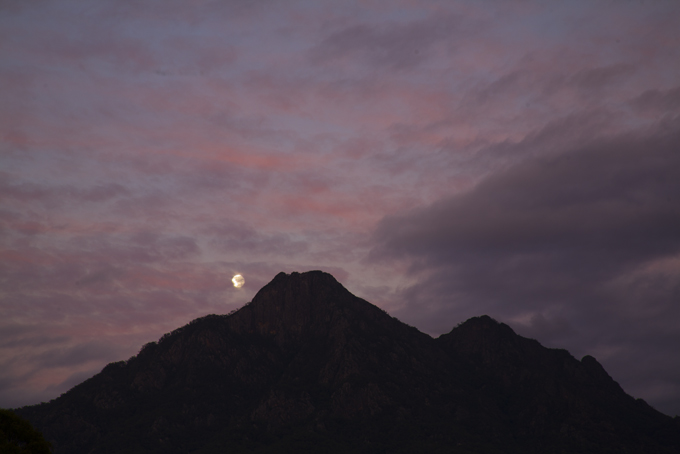
The setting moon over Mt Barney
.
Darren, assisted by Vicky and I, worked with the photographers to ensure that they made full use of the photographic opportunities provided. Breakfast followed and the work of editing and optimising files was carried out with tutorials presented by Darren.
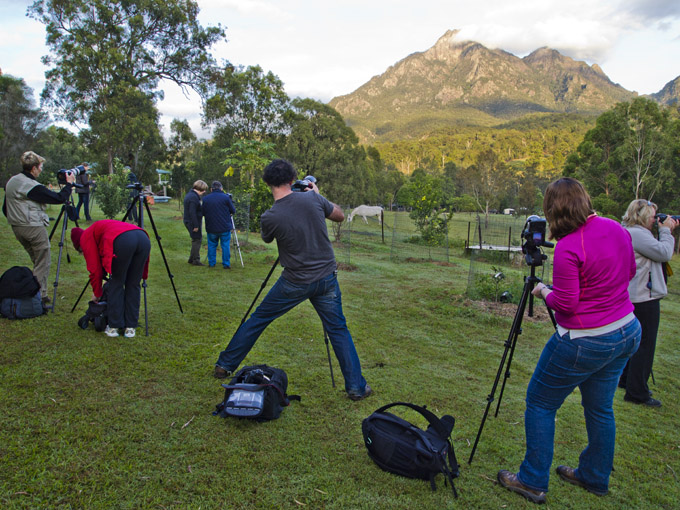
Darren working with participants @ dawn
.
As part of our visiting artists program we worked with the participants offering suggestions and ideas for image enhancement. Other projects undertaken with the group included the setting-up of a camera obscura in Boolamoola Homestead and a ‘projection and light painting’ on Saturday evening.
For many years we have created images of place by combining projected images with electronic flash light painting on outdoor subjects and buildings. These Projections or light sculptures are constructed from individual exposures to make a composite photograph. The final image or series of images presents the viewer with a visual story that is drawn from our exploration of, and empathy with, each place.
On Saturday night we included the participants to witness and make their own photos of the projection work around and on the Moringararah Homestead. The capture of separate elements for the final image was presented by Doug as a performance of how we work in these situations. First we projected a dawn image of Mt Barney over the front of the house for an initial exposure. Next, the internal house lights were switched on to create an exposure for the windows. Finally, additional flash work illuminated aspects of the garden surrounding the house–on this occasion the time exposure for the light painting enabled the ambient moonlight to create a glow in the sky.
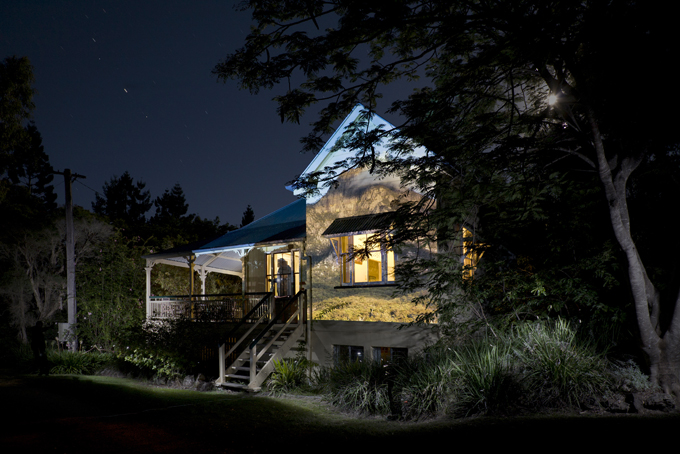
Moringararah Homestead projection and light paint
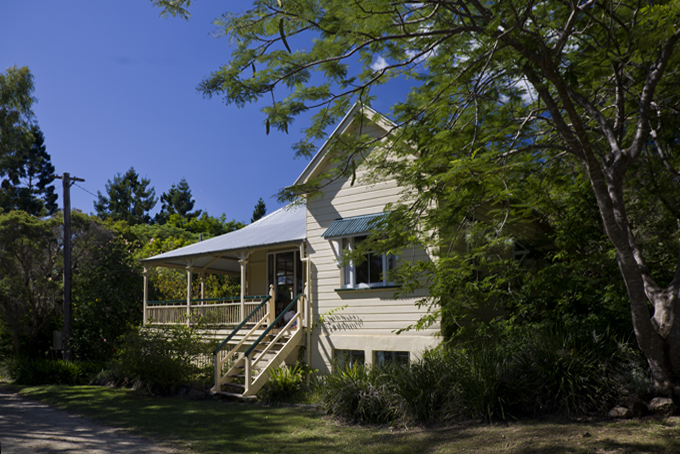
Moringararah Homestead in daylight
.
After this there was another ‘painting with light’ performance and photography opportunity for the participants in a sheoak grove by the small stream at the entrance to the Lodge. Each of the photographers present was given an opportunity to photograph the performance of the projection and light sculpting work.
.
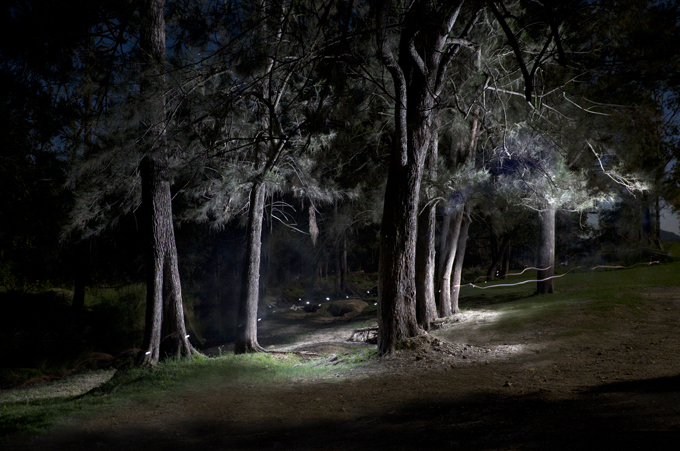
Sheoak grove light paint
.
On Sunday 28th April students were assisted in taking photographs for World Pinhole Photography Day using pinhole devices made at the workshop and fitted to their DSLR cameras. The Boolamoola camera obscura was also available to the students a subject to document or just experience..
The workshop concluded with a frenzy of fine art printing of student work overseen by Darren.
.
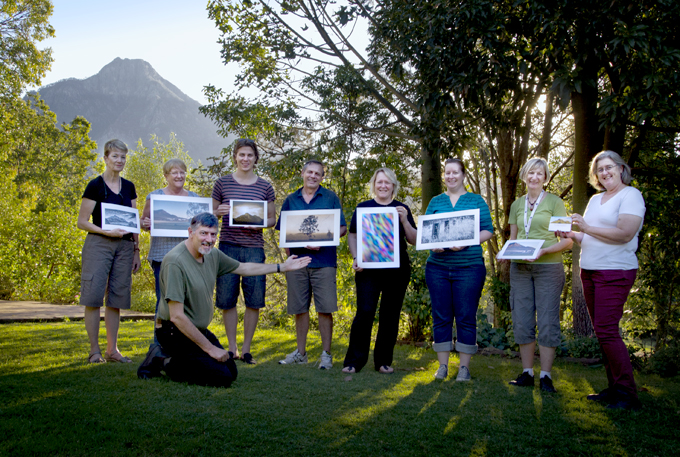
Student group Photo: Darren Jew
.
The natural location of Mt Barney Lodge, the facilities and catering provided by the owners Innes and Tracy Larkin helped to make the workshop a great success. The Lodge provides access to this remote and rugged part of South East Queensland. For accommodation and camping information see their website HERE
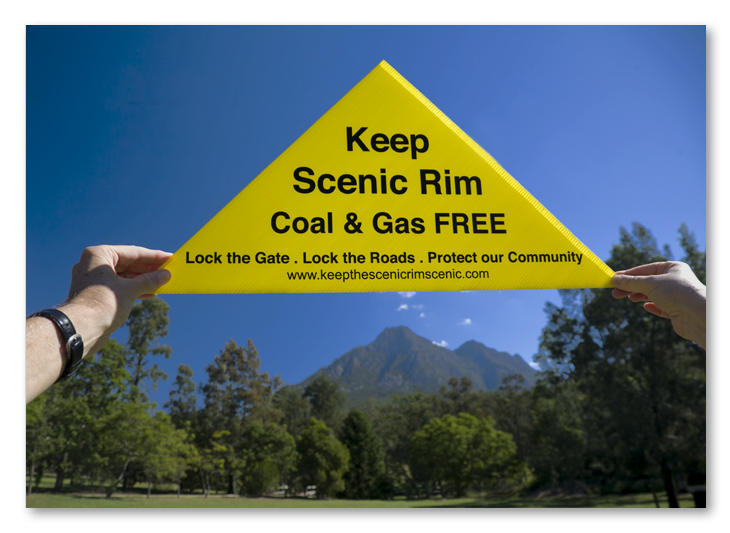
This region, alongwith most of Queensland and other Australian places of natural beauty and agricultural importance, is under threat of Coal Seam Gas extraction and open cut mining – Being in this place makes you realise the need for care and consideration of the natural places in this energy hungry, development crazy world. For details of CSG and mining in the Scenic Rim click HERE
.
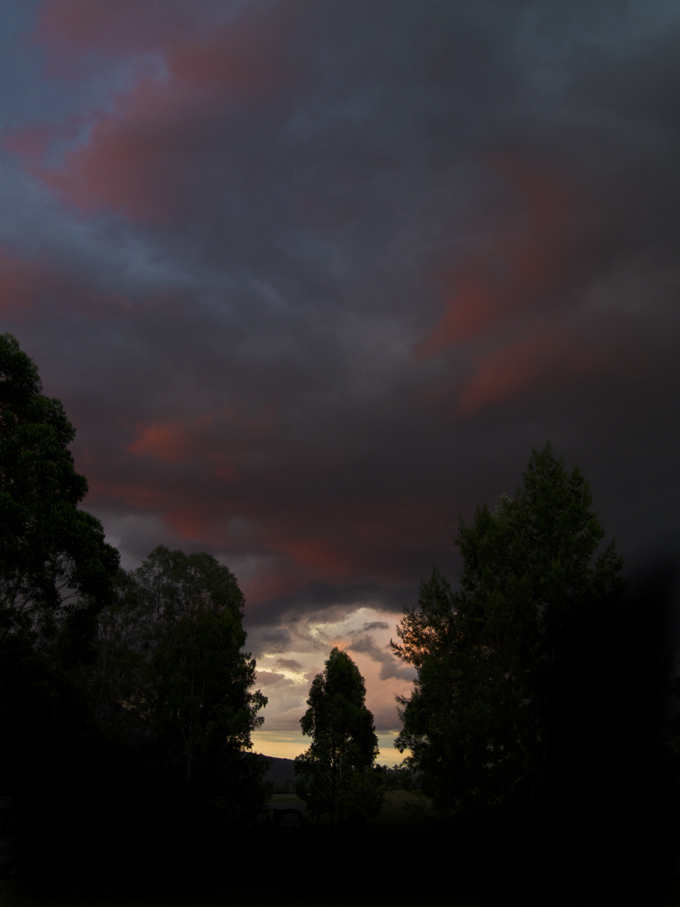
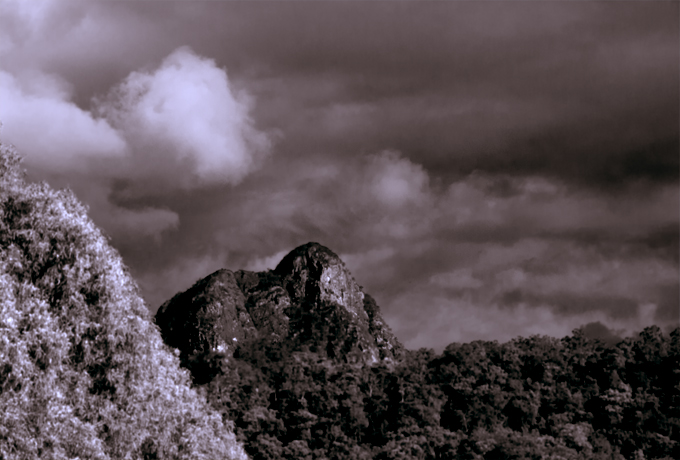
OTHER IMAGES FROM THE WORKSHOP FOLLOW


.
All photographs and texts © of the authors 2013.
This work is licensed under a Creative Commons Attribution-NonCommercial-NoDerivs 3.0 Unported License.
.
.
WORLD PINHOLE PHOTOGRAPHY DAY: Our Contribution
We were working with Darren Jew on a Foto Frenzy ‘Exploring Photography’ workshop @ Mt Barney Lodge, a bushland retreat in South-East Queensland’s World Listed Scenic Rim.
We briefed workshop participants on pinhole photography and helped them make pinholes for their DSLR cameras, and everyone joined in the activity of ‘pinholing’.
On Saturday we blacked-out a store room of about 3 x 3 metres square in the rear of the Boolamoola Homestead using plastic and curtain material in readiness for the big WPPD on Sunday.

Boolamoola Homestead – store room window at upper left

The room before set-up
While the others sat outside eating lunch on Sunday (World Pinhole Photography Day) we sneaked into the Camera Obscura and made our image of our lunch time. The ‘pinhole’ was around 8mm. Exposure of the image was by lensed (focal length=16mm) DSLR using f8 200 ISO and time exposure of 30 seconds.
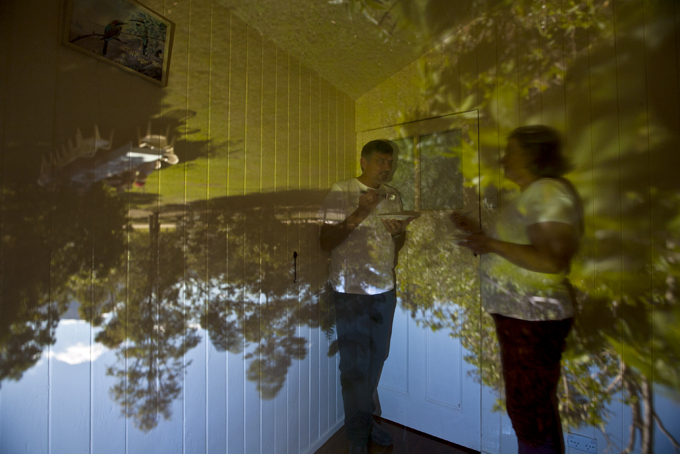
Lunchtime Camera Obscura Mt Barney Lodge
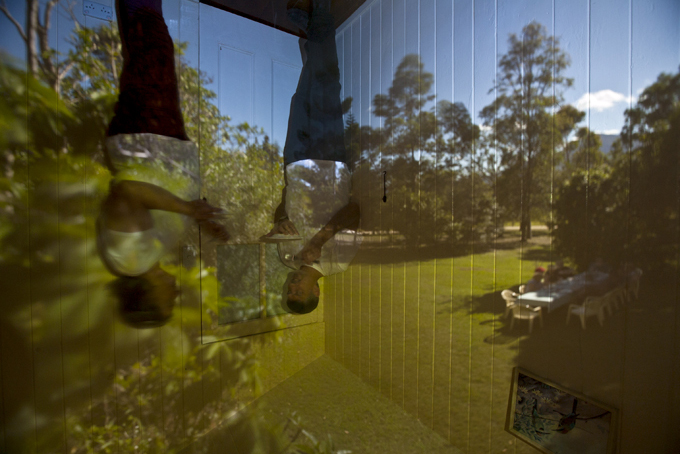
The other way ’round
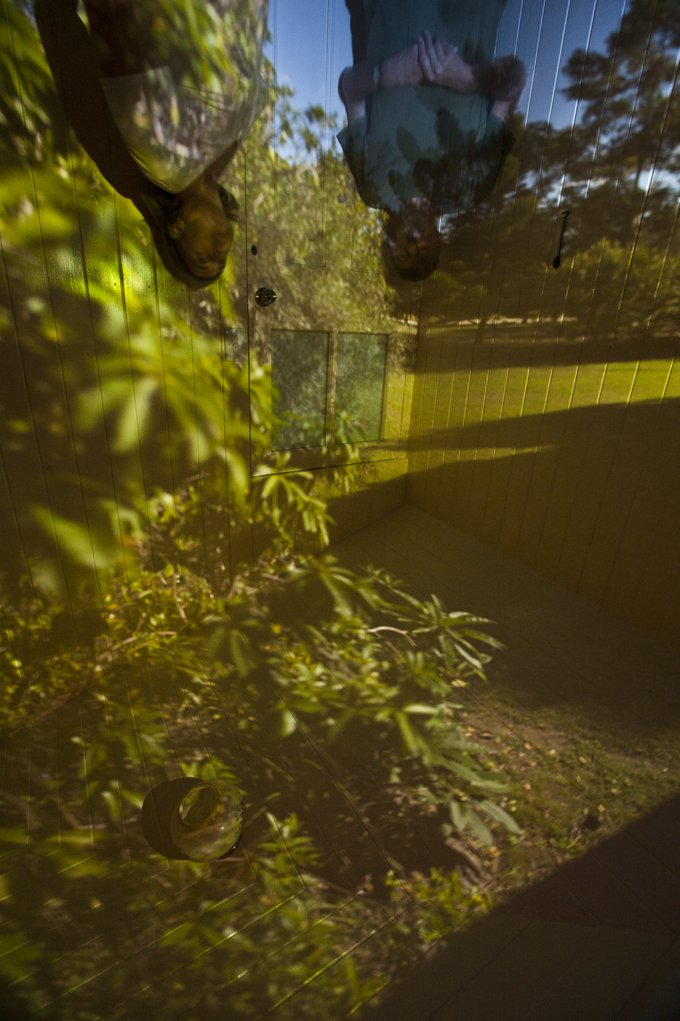
Looking up to the ceiling – Camera Obscura Mt Barney Lodge
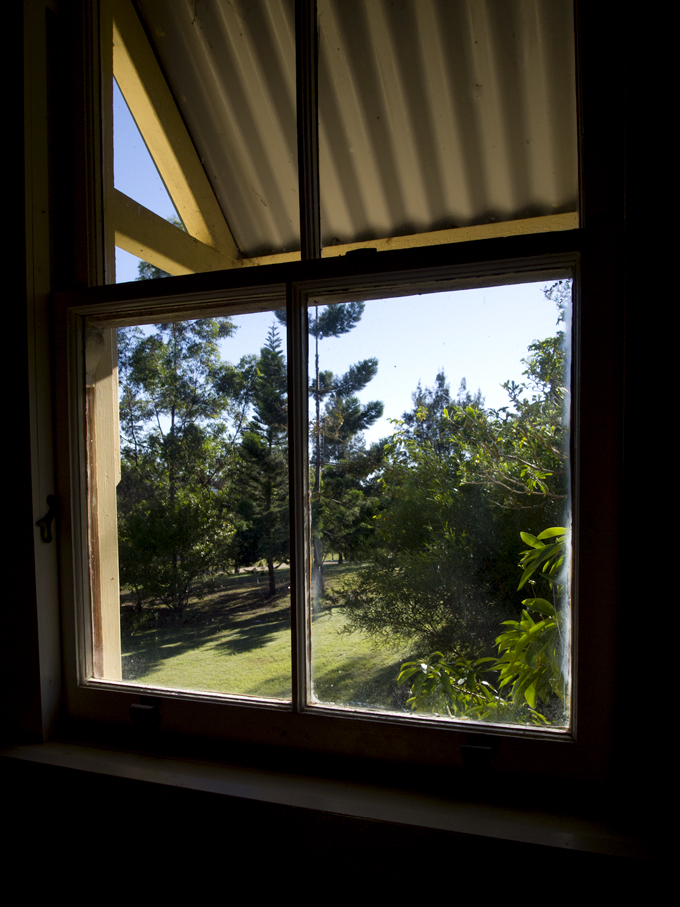
View from the window
 .
.
VISIT THE GALLERY OF IMAGES http://www.pinholeday.org/gallery/
.
All photographs and texts © of the authors 2013.
This work is licensed under a Creative Commons Attribution-NonCommercial-NoDerivs 3.0 Unported License.
.
CAMERA OBSCURA + Pinhole Event @ Foto Frenzy: A Report

Since the year 2000 we have been making large-scale room camera obscuras. These have been made as part of visual research for our Place Projects. Usually we document the process and the images form a narrative for inclusion in photobooks and exhibitions. In 2009 we launched WINDOW/s, a limited edition photobook of 9 copies, along with an exhibition of the 9 camera obscura images @ the Queensland Centre for Photography.
SEE the book as an Adobe Flash Pageflip HERE
In our Place Project work we have found that the camera obscura connects us directly with the place or site that we are working in. We have found that anyone witnessing the place-specific camera obscura responds enthusiastically this natural phenomenon. Time spent inside the camera obscura evokes a sharing of different perceptions: of the visual, of memory and of experiences in the lives of each visitor. So we decided that we should create a camera obscura as part of our Foto Frenzy artist in residence.
As a result of a conversation with a past QCA student of Doug’s from the 1980s, photographer John Pryke, through some great research on the internet, found that not far down the road was the site of an historical camera obscura on Whites Hill.
.
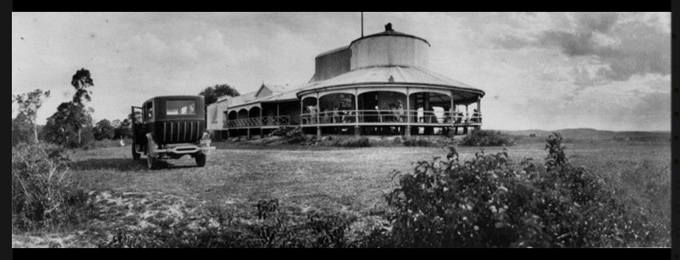
The Whites Hill Camera Obscura c1924 from the ‘Lost Brisbane’ Project site
.
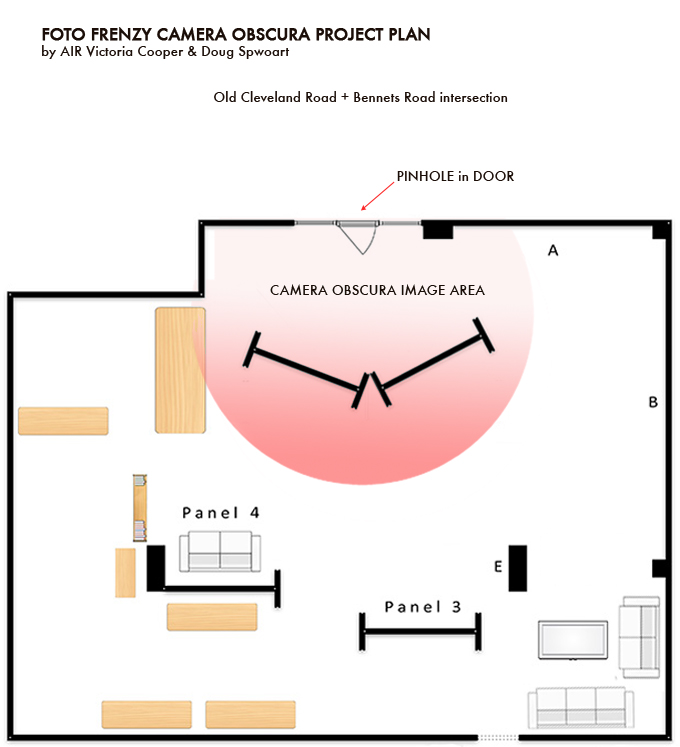
The view from the front entry of Foto Frenzy was selected as its outlook is of the defining feature of this place – the major intersection of Bennetts and Old Cleveland Roads Coorparoo. A plan was created, the room blacked out with thick black agricultural plastic, a light admitting hole of around 12 mm was made and fitted in the door of the building, and screens arranged inside onto which the image could be projected.
.
Saturday the 20th of April was a bright sunny day with occasional clouds and the 40 or so visitors witnessed the wonders of this simple device. Many brought cameras with them to make images, some brought family members including children – all, as we hoped, were taken by the visual experience of being ‘IN’ a camera, one which did not even require a lens.
As artists in residence working with the Foto Frenzy / Brisbane Camera Hire Team, we were around some amazing technology and people with special knowledge. Director Darren Jew produced his Canon EOS 1D and a high speed 12mm lens for the cover image of this post. If you’ve not been in a ‘lensless’ camera obscura you will not be aware of how dark the images is – usually it takes several minutes for your eyes to adjust to see what is going on, it is that dark. There are perhaps only a few movies of camera obscura images that have ever been made as it requires specialized cameras and equipment. Darren Jew offered to wind up the ISO of his latest camera and at 40,000 ISO we were able to create a movie of the impromptu performance of our antics outside the building as – ‘Vicky and Doug do a Selfie’.
SEE the movie here ….
.
What fascinated us was the excitement and enthusiasm for the project, much of which was posted on Facebook soon after the event. With the permission of the respondents we have posted some of their images and words in the screen grabs that follow …
.

Megan Rizzo and family visit and photograph the camera obscura
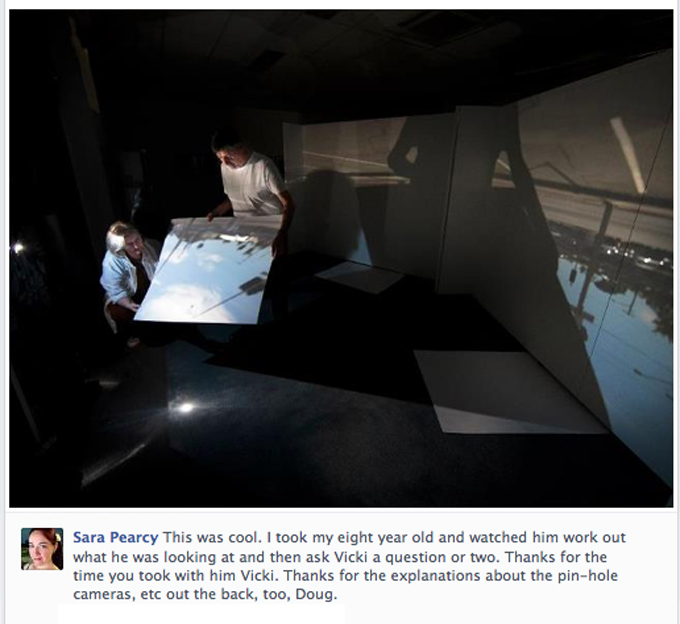
Sara Pearcy comments on her experience with son Nicholas in the camera obscura
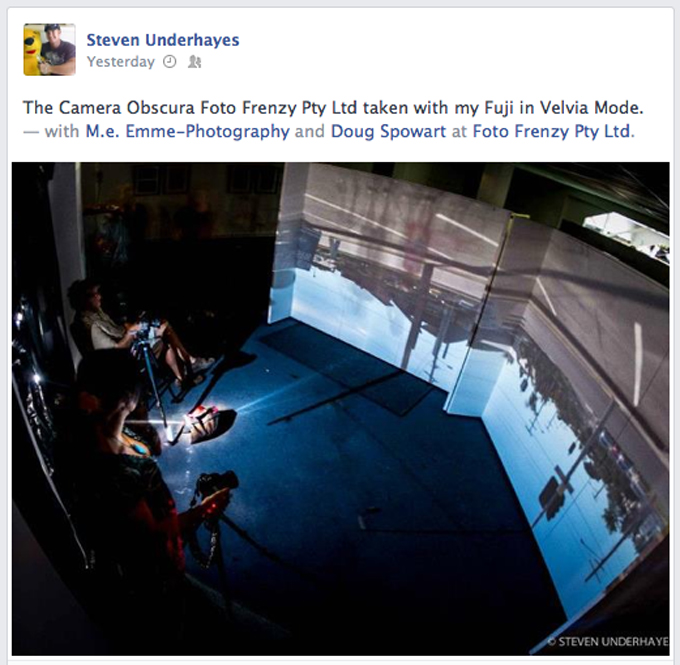
Steven Underhayes’ terrific camera obscura image

John Pryke does a ‘Selfie’ in the camera obscura
SEE more of John’s photographs on his blog: <http://johnprykephoto.blogspot.com.au/2013/04/camera-obscura.html>..
.Additionally the event included a presentation of some of our pinhole cameras, pinhole making techniques, and discussions about how to make pinhole images with SLR and DSLR cameras. Most importantly we encouraged participants to make and enter photos made on April 28 in the 2013 World Pinhole Photography Day event.
Thank you to the participants, the Foto Frenzy / Brisbane Camera Hire team, in particular Darren Jew and Jacob Schneider, for helping to make this a successful event
.
All photographs and texts © of the authors 2013.
This work is licensed under a Creative Commons Attribution-NonCommercial-NoDerivs 3.0 Unported License.
.
NICOLA POOLE’s ‘Lost Girls’ @ Gallery Frenzy, Brisbane
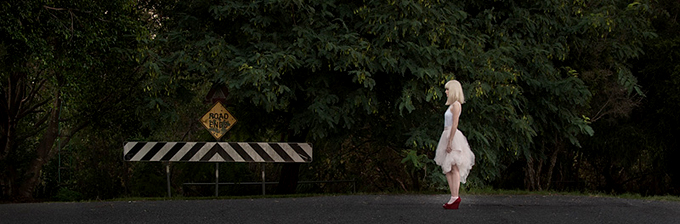
Lost Girls by Nicola Poole @ Gallery Frenzy, Brisbane.

Image from Nicola Poole’s Lost Girls exhibition
.
Excerpts from my opening address:
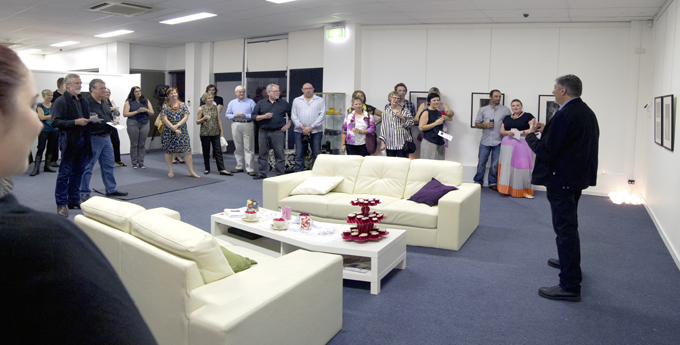
Doug Spowart opens Nicola Poole’s ‘Lost Girls’ exhibition
This morning on checking my Facebook news feed, there was a message from Darren Jew, of Brisbane’s Foto Frenzy Photography Centre, in which he described the ‘Oh My God’ moment at the age of 12, that inspired his life in photography. That moment was watching a black and white print develop in a tray in a darkroom. I was reminded of my same experience. From other posts there seemed to be quite a few others who were also seduced by the darkroom’s red safelight and its mysterious stinky chemicals.
I posted back to Darren posing the question: ‘how many 12 year olds are out there making digi images today and missing out on that OMG darkroom moment?’ Later, during a conversation with my partner Victoria, we made the interesting observation that in the old darkroom days we ‘MADE’ photographs in every sense of the word. Film was handled in darkness and loaded into tanks–chemicals added, agitation, water washes, hanging up to dry–negatives placed in the enlarger carrier, paper touched and slid into the easel, exposed to light, paper slipped into chemicals, trays rocked… etc. Photography was something that extended well after the shutter was fired. It took time and trouble for an image or two to emerge–made–from the process.
We thought that today with digital photography we just TAKE images–with rapidity and ease. Just click, add a filter effect or two and share. And we may take many, many images. In contemporary image taking the picture has a very transient and superficial value. Quickly taken and distributed they are even consumed faster on social media and quickly lost from view–particularly if you have lots of friends who post with the rapidity of a machine-gun. What is missing today is the time spent with an image realising it as a physical object. Digital imaging is like visual ‘fast food’. We, as consumers, end up fat, lazy and with pixelated indigestion.
What excites me about Nicola Poole’s Lost Girls exhibition is that Nicola has assembled a collection of cohesive thematic image work and formed it into a physical and tangible MADE thing. Over the last week at Foto Frenzy I have witnessed her making this show. Photographs handled, selected and compared, prints emerging line by line from the printer, matted/mounted/framed, placed in the gallery space shuffled–moved, re-ordered and hung. I know that selecting, preparing and presenting work in an exhibition is complex and demanding. The artist embeds their energy and time in it and we the viewers are rewarded in proportion to the care and effort expended in its making.
I congratulate Nicola Poole and applaud her energy, enthusiasm and vision. As a younger girl herself, it is appropriate that she should make photographs the comment on her own experiences and on her generation. As we engage with these photographs questions might emerge: are the subjects looking into memories of the past, or are they facing an uncertain future? These images evoke a sense of, or a time of, waiting–a kind of anxiety or anticipation for something or someone. As viewers we may ponder and be drawn into the narrative.
As to the Lost Girls–What I do know is that in the making of this exhibition, somehow they have all been ‘FOUND’.
And, as Nicola’s first solo exhibition, it is indeed my please to formally announce it open …
Dr Doug Spowart

Nicola Poole and Me

Image from Nicola Poole’s Lost Girls exhibition
.
This work is licensed under a Creative Commons Attribution-NonCommercial-NoDerivs 3.0 Unported License.
.
SPOWART Artists Book Shortlisted for LIBRIS AWARD
The artists book Have you got your Chronicle Today? has been shortlisted for the 2013 Libris Awards – The Australian Artists Book Prize.
.
The Libris Awards are Australia’s premier national artist’s book prize. An intitiative of the Mackay Regional Council through Artspace Mackay, these biennial awards seek to develop awareness of council’s significant collection of artists’ books and to develop the collection further through the acquisition of new works by leading Australian artists working in this field. (from the Artspace Mackay website)
My book Have you got your Chronicle today? makes comment on how the tabloid newspaper is reliant on the advertising dollar to support the necessary communication of the daily news. This artists book is a mashup of the news with advertising. The collaged elements comment on content and the way the reader is directed by the newspaper design through the placement of advertisements, journalism texts, photography, community notices and sport. After deconstructing the newspaper, the book’s form changed as new associations of text/image/graphics determined the new structure. The flow through the book matches the newspaper it parodies as it also can also be folded flat for post-reading storage. Details and images of the book and its construction follow – Enjoy … Doug
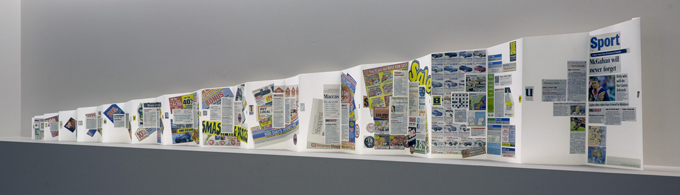
Have you got your Chronicle today? installation
View a video performance of the book – Click the YouTube image
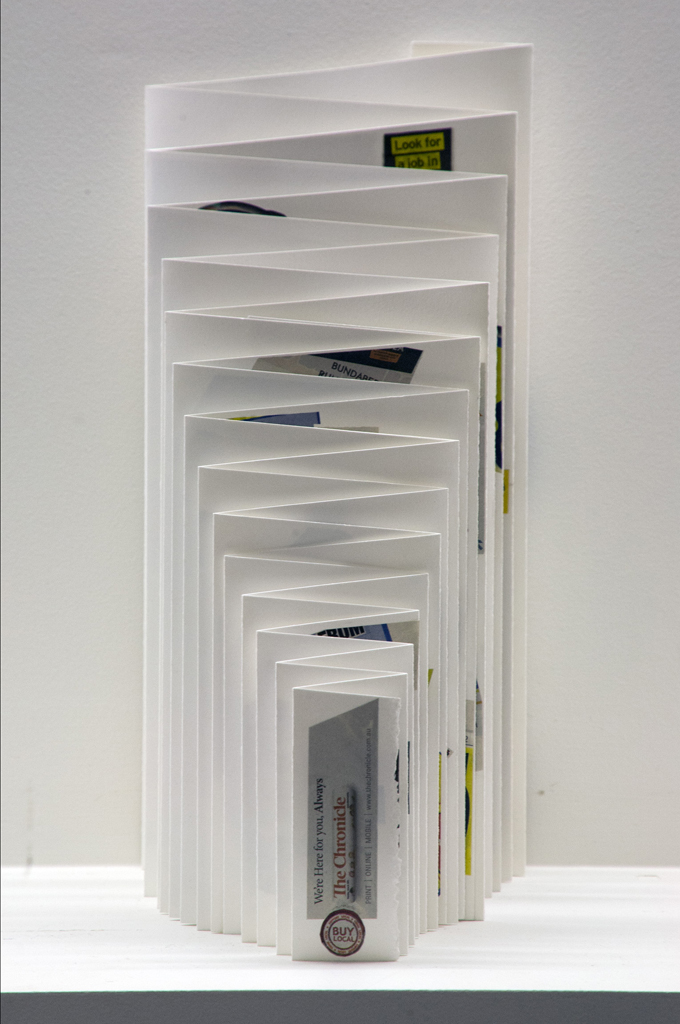
Have you got your Chronicle today? closed
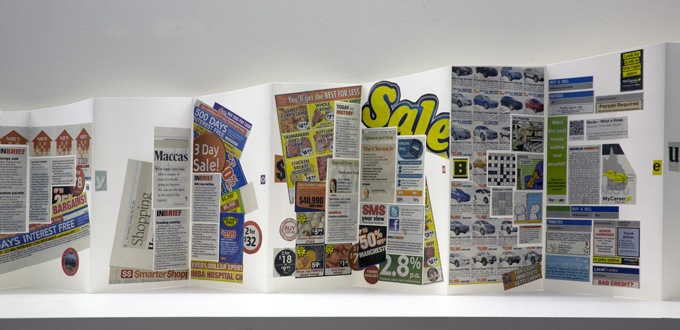
Have you got your Chronicle today? detail
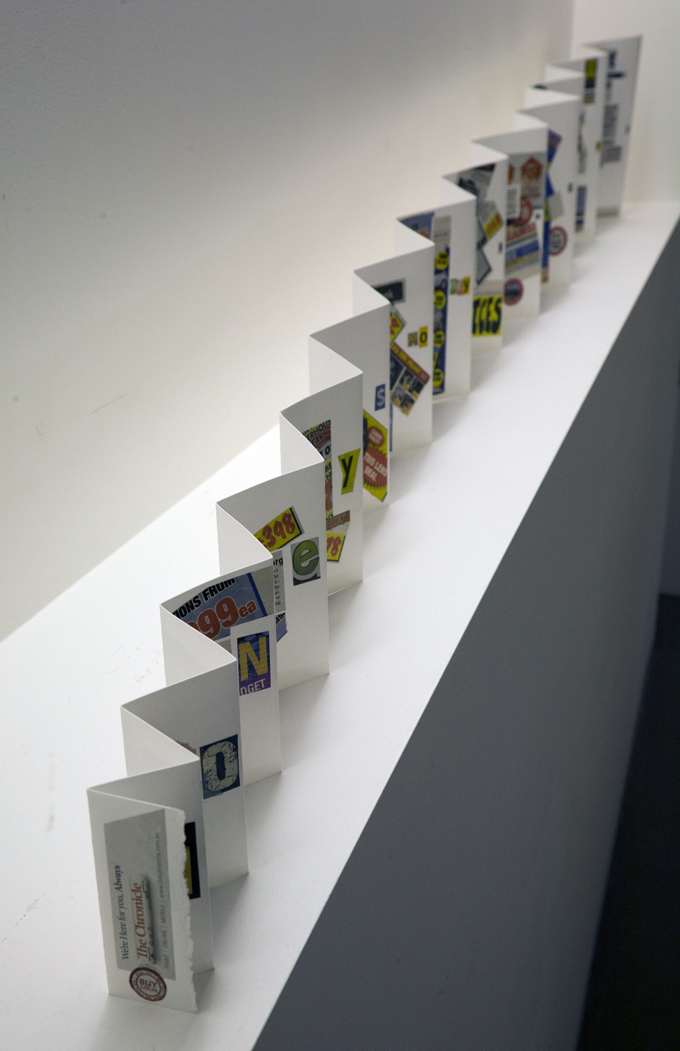
Have you got your Chronicle today? oblique view
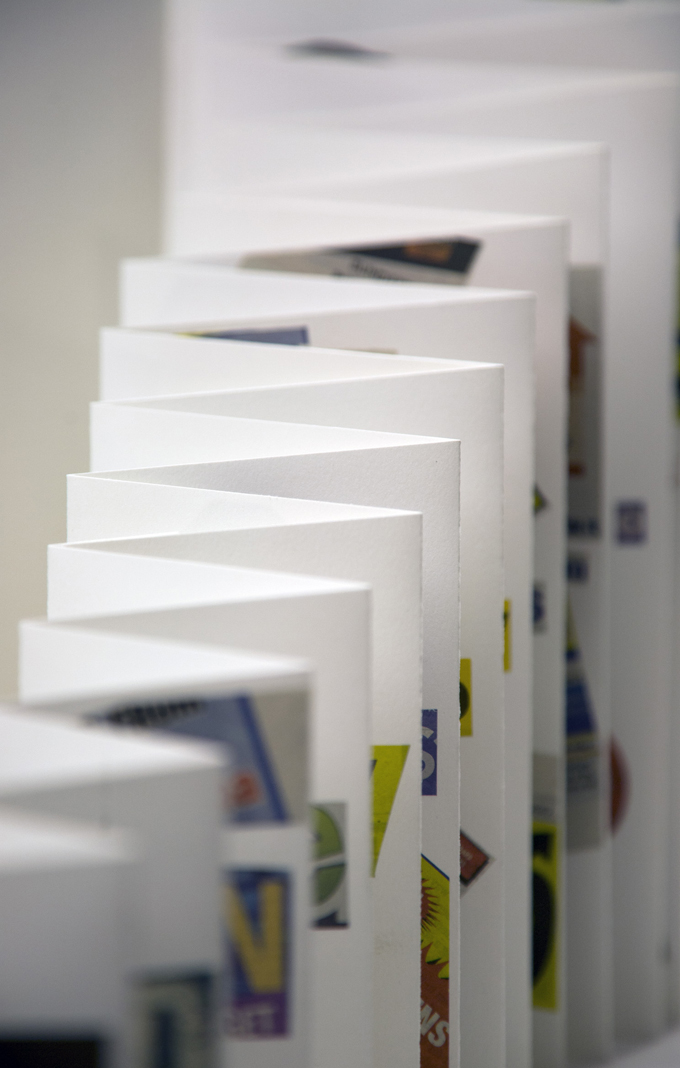
Have you got your Chronicle today? detail
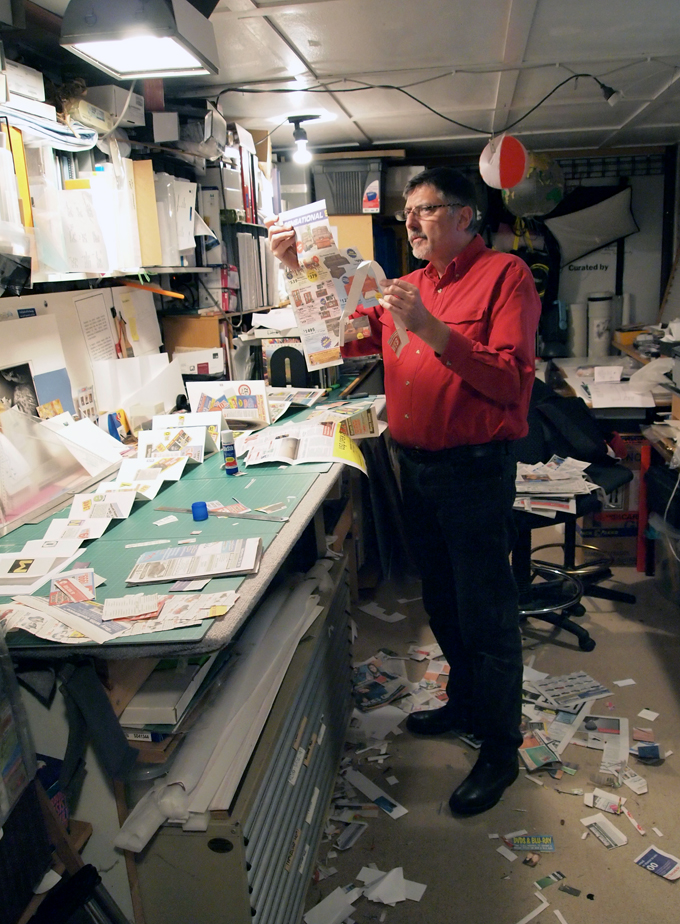
Doug in his atelier making the book
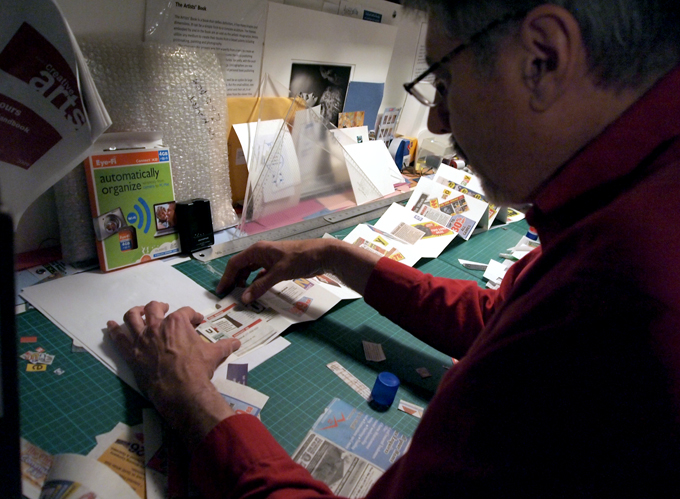
Doug in his atelier making the book

The mess when making a collage
The list of other Finalists is available HERE
.
This work is licensed under a Creative Commons Attribution-NonCommercial-NoDerivs 3.0 Unported License.
.
FRENZIED A.I.R. ‘PoPuP’ Exhibition @ Brisbane’s GALLERY FRENZY
We are now in Brisbane participating in an Artist in Residence @ Foto Frenzy in Coorparoo.
On Wednesday evening we presented an artist’s talk about our previous residencies and our approach to ‘Place Projects’. The event was attended by around 40 photographers, artists and students.
The exhibition will be on show on Easter Monday April 1st and Tuesday 2nd of April – We will be in attendance at the gallery between 11.00 am and 4.00 pm on those days.
GALLERY FRENZY is in the Foto Frenzy Photography Centre
Unit 3/429 Old Cleveland Rd, Coorparoo QLD 4151
We are also presenting a series of workshops @ Foto Frenzy–for details visit the website WWW.WOTWEDO.COM.
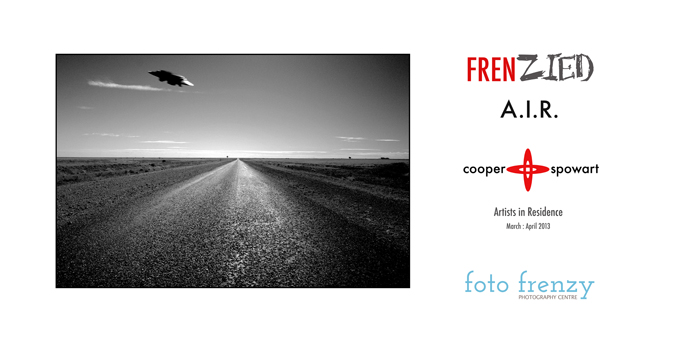
FRENzied A.I.R. Poster

Ian Poole, a Director of Foto Frenzy, opens the exhibition.
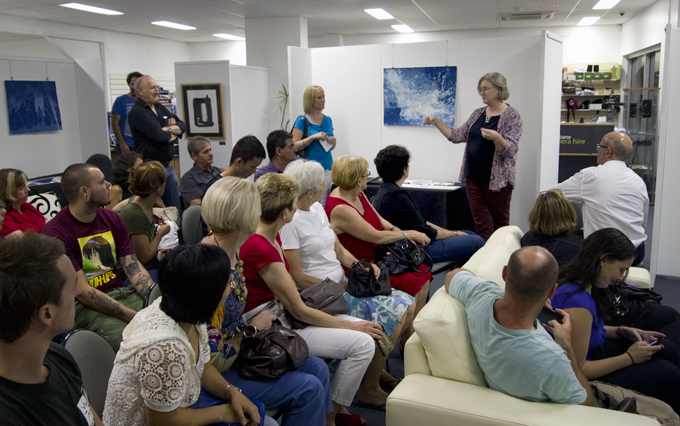
Vicky talking about her work

Selfie with Ian Poole
.
SOME OF THE WORK ON SHOW …
The exhibition features a selection of Camera Obscura works, Projections, cyanotypes and artists’ book and photobook works.

CarCamera concertina book
.
PLAY A VIDEO OF SOME OF THE CARCAMERA WORK

The ‘Hitting the Skids’ flipbook
.
PLAY A VIDEO OF THE FLIPBOOK
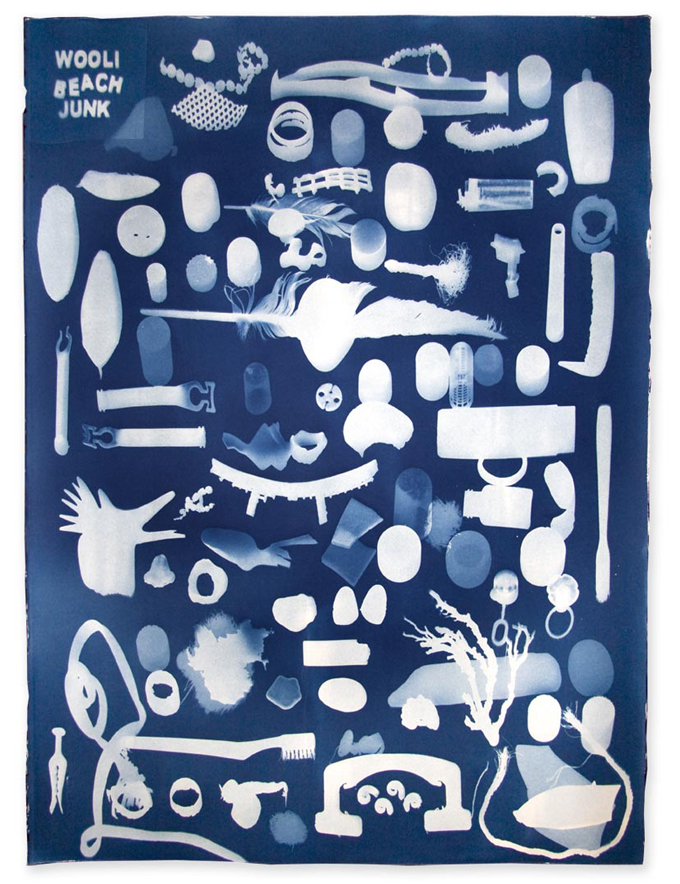
‘A cyanotype by Doug Spowart ‘Wooli Beach Junk’
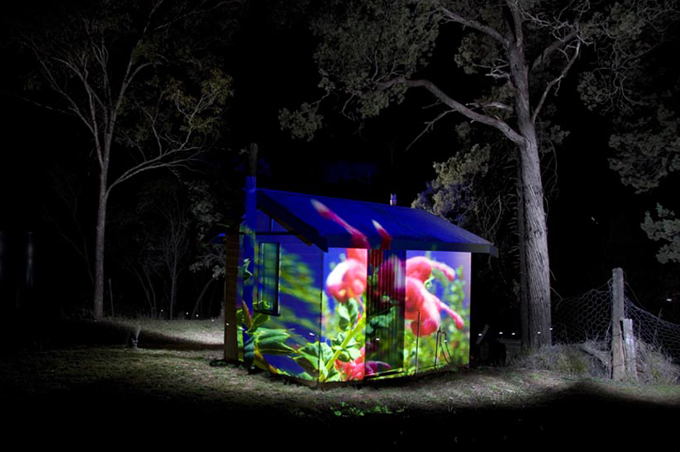
Projection – Myall Park Botanic Gardens
.
This work is licensed under a Creative Commons Attribution-NonCommercial-NoDerivs 3.0 Unported License.
.
.

 wotwedid