Archive for the ‘Awards’ Category
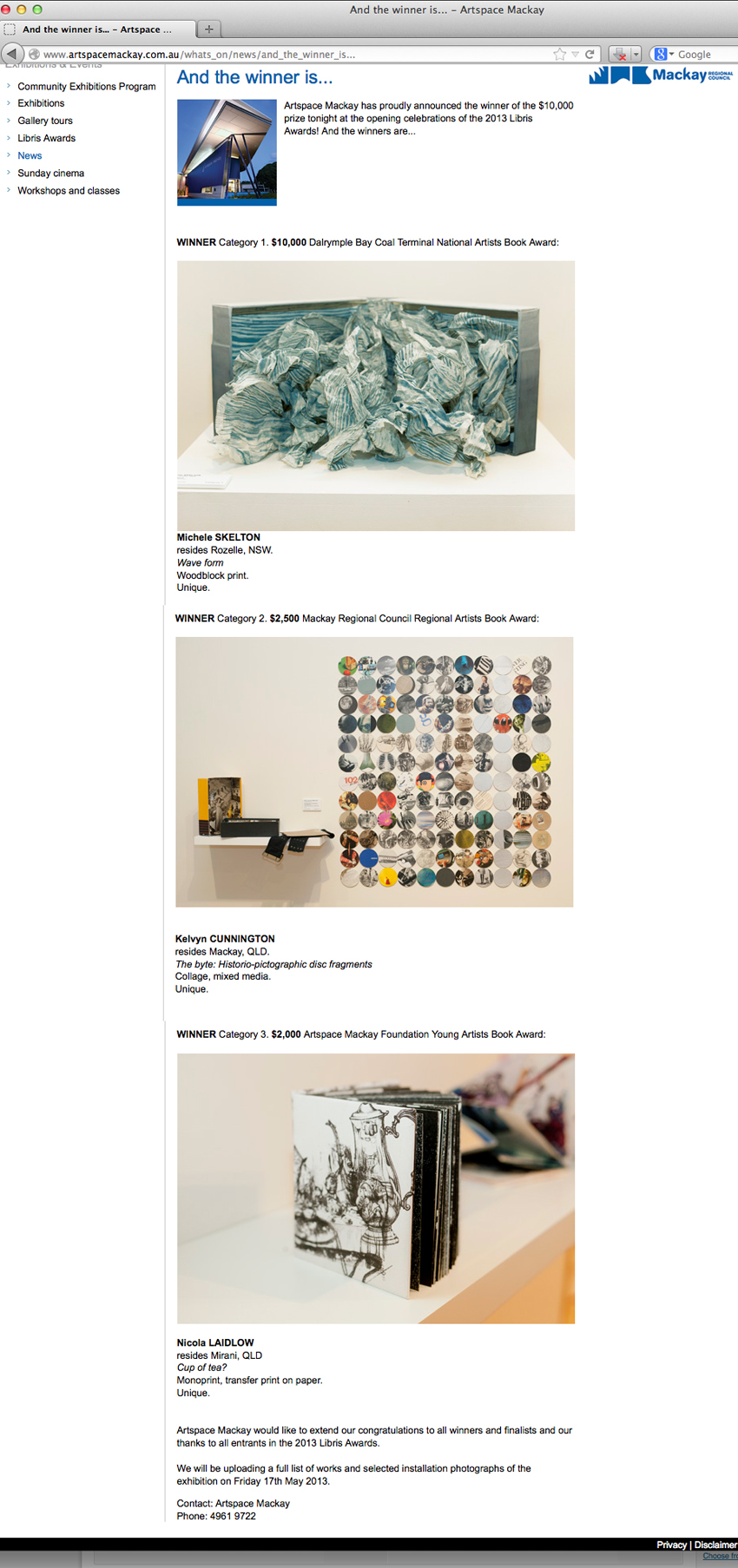
2013 LIBRIS AWARD WINNERS ANNOUNCED
FROM THE ARTSPACE MACKAY WEBSITE: http://www.artspacemackay.com.au/whats_on/news/and_the_winner_is…
JUDGING THE SHOW: Photography @ the Goondiwindi P&A Show
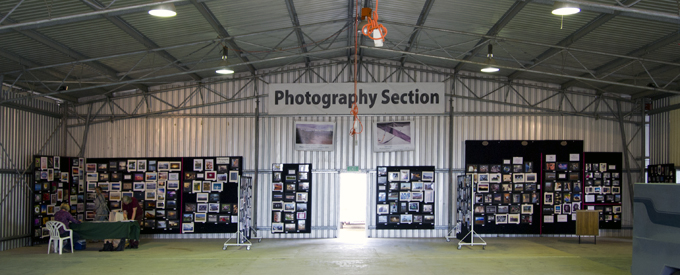
Goondiwindi Photo Section Display
We have been to Goondiwindi before as their local camera club hosted the South East Queensland Association of Camera Club’s conference in 2011 for passionate amateurs to connect and learn about their chosen hobby. This time we were at ‘Gundy’ to judge the P&A Show Society’s 2013 Photography Section. The organizing team are an energetic, cheerful and professional group of people who carry out their duties as a service to the local community.
When we arrived all 424 images were already installed on the portable screens. A welcoming cup of tea and Janet’s delicious homemade orange cake refreshed us after our two-hour drive from Toowoomba. Then all we had to do was to judge the 14 categories, the grand champions and the encouragement award winners. This was an enjoyable task as the images were delightful mix of landscapes, action, animals, humour, travel, poetic and abstract images.
.

Goondiwindi Photo Section Entry Details
.
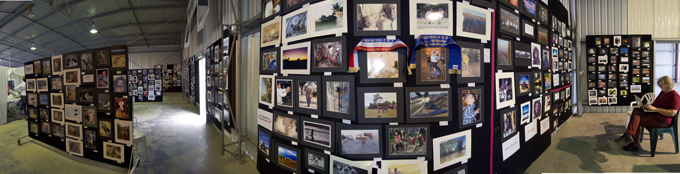
Goondiwindi Photo Section panorama
.
Although there were interesting images of travel, urban spaces, people and places some of the strongest images were found in the sections landscape, ‘a picture tells a thousand words’ and the youth categories. Images taken of their own environment, local people and animals communicated the desire to share and record their own stories. This made our task challenging but more rewarding as we encountered these images.
Some images were amazing: a fish, firmly grasped by a cormorant bites on its captors neck, a young girl fires-off a shotgun, old blokes sit on a park bench in the sun, a huge irrigation sprinkler glistens backlit by the morning sun and a young girl kneels before a poppy studded war memorial. There is a visual calisthenics required to be a judge in this competition. What was evident was a passion for photography and a quality, both technical and conceptual, that would match anything seen from their city cousins.
.
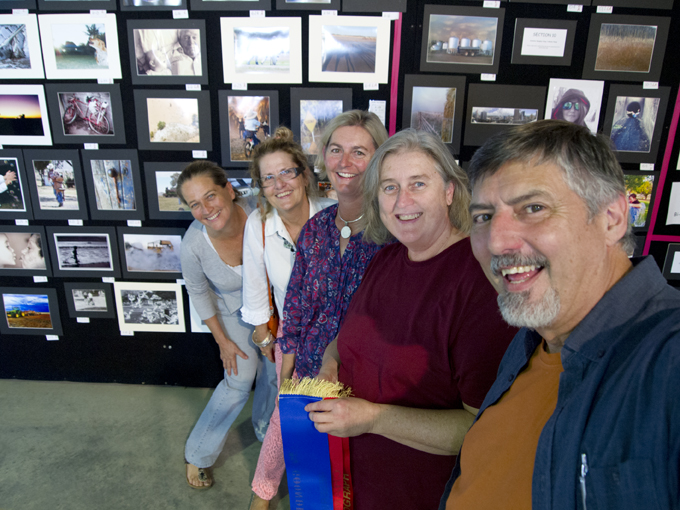
Photo Section Team: Mandie O’Shea, Michelle Kearney, Janet Doyle, Vicky & Doug
.
The Grand Champion photograph was by Rick Kearney and was entitled Flood victims. The photo was made from a helicopter during the floods and shows an island surrounded by water on which 80 or more kangaroos had taken refuge–the helicopter has startled the mob and they have taken off in all directions. The photograph captures this frenzied dash from these isolated animals.
.
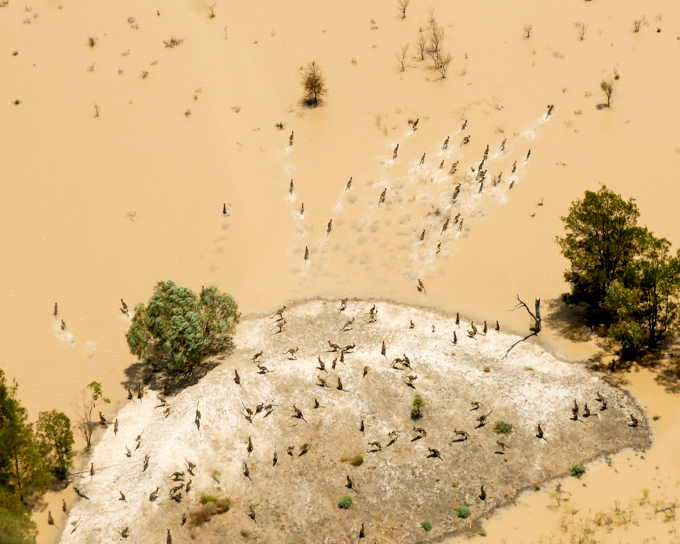
The Grand Champion Print: Flood victims by Rick Kearney
.
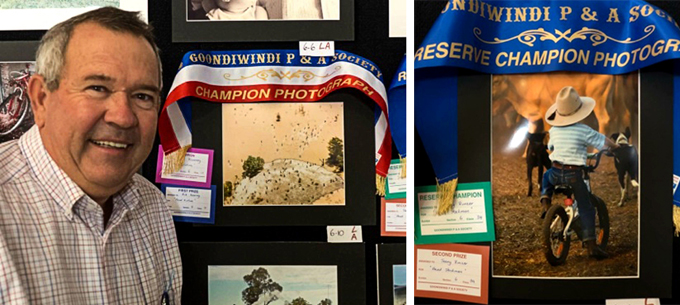
Rick Kearney’s Flood victims+Reserve Champion Teeny Runzer’s Head Stockman. Photo: Michelle Kearney
.
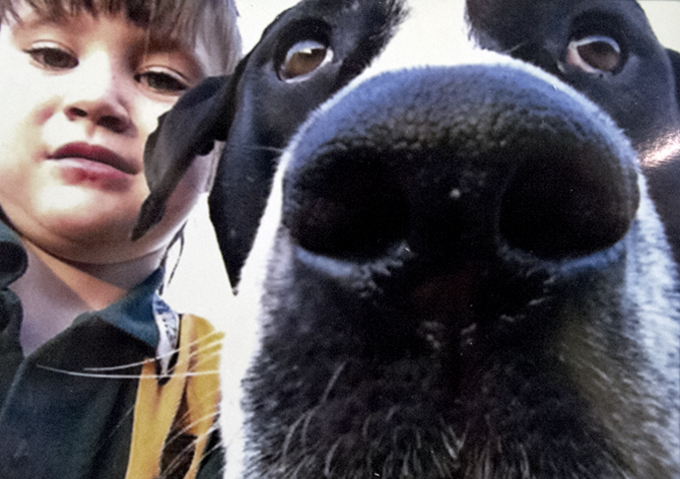
Equal First Prize – Primary Hot Shots: Jenna McCall for Selfie
.
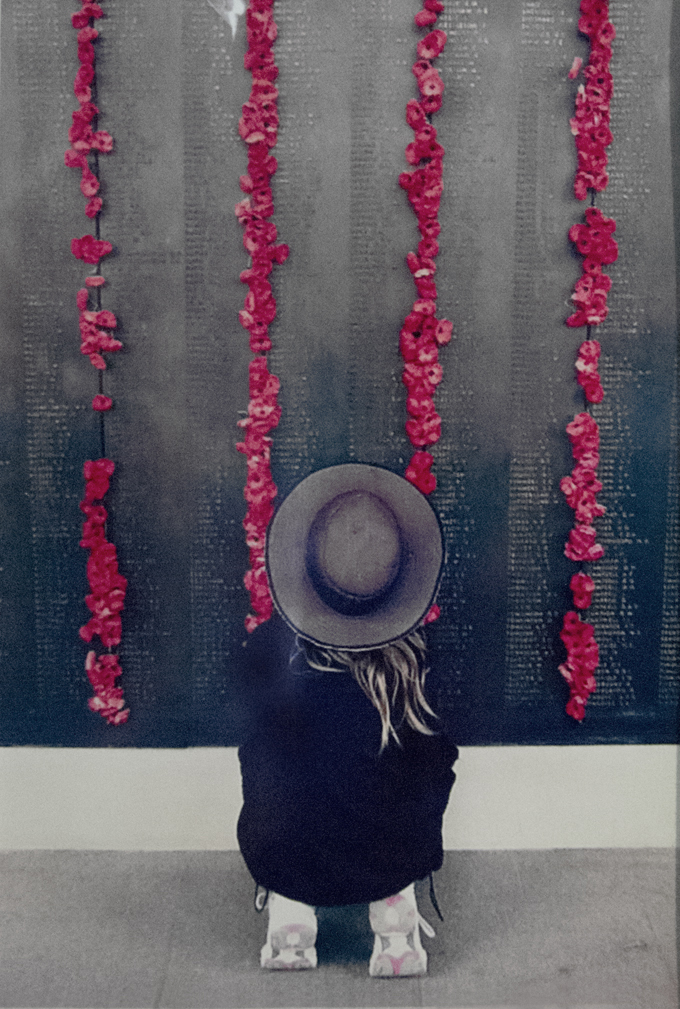
Junior Champion and Equal First Prize – Primary Hot Shots : Bethany Buckle for Poppies
.
Thanks to the Goondiwindi team of Janet, Michelle and Mandie and the photography community for sharing their creativity and vision with us and the hospitality extended to us during our visit.
.
Victoria Cooper and Doug Spowart.
.
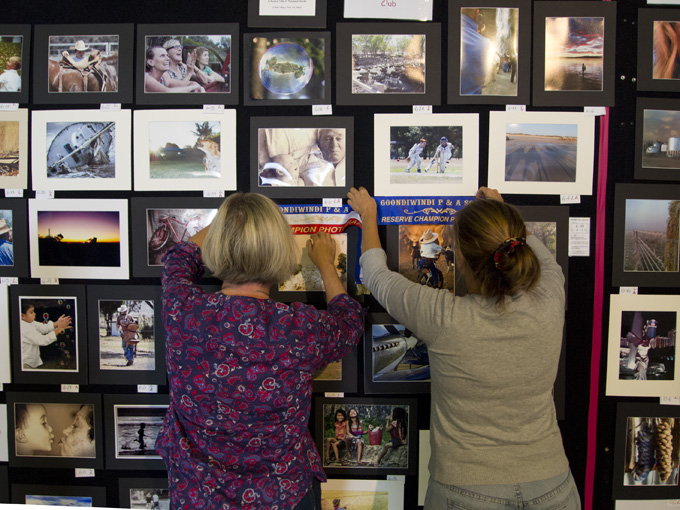
Janet and Mandie place the Champion Ribbons
.
.
Images of the exhibition installation © Doug Spowart, Text © Victoria Cooper, Photo of Rick and Reserve Champion Michelle, © in all other works the photographers credited in the caption
..

This work is licensed under a Creative Commons Attribution-NonCommercial-NoDerivs 3.0 Unported License.
.
SPOWART Artists Book Shortlisted for LIBRIS AWARD
The artists book Have you got your Chronicle Today? has been shortlisted for the 2013 Libris Awards – The Australian Artists Book Prize.
.
The Libris Awards are Australia’s premier national artist’s book prize. An intitiative of the Mackay Regional Council through Artspace Mackay, these biennial awards seek to develop awareness of council’s significant collection of artists’ books and to develop the collection further through the acquisition of new works by leading Australian artists working in this field. (from the Artspace Mackay website)
My book Have you got your Chronicle today? makes comment on how the tabloid newspaper is reliant on the advertising dollar to support the necessary communication of the daily news. This artists book is a mashup of the news with advertising. The collaged elements comment on content and the way the reader is directed by the newspaper design through the placement of advertisements, journalism texts, photography, community notices and sport. After deconstructing the newspaper, the book’s form changed as new associations of text/image/graphics determined the new structure. The flow through the book matches the newspaper it parodies as it also can also be folded flat for post-reading storage. Details and images of the book and its construction follow – Enjoy … Doug
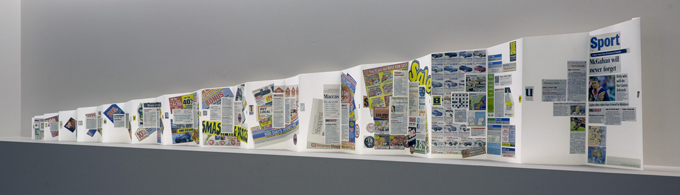
Have you got your Chronicle today? installation
View a video performance of the book – Click the YouTube image
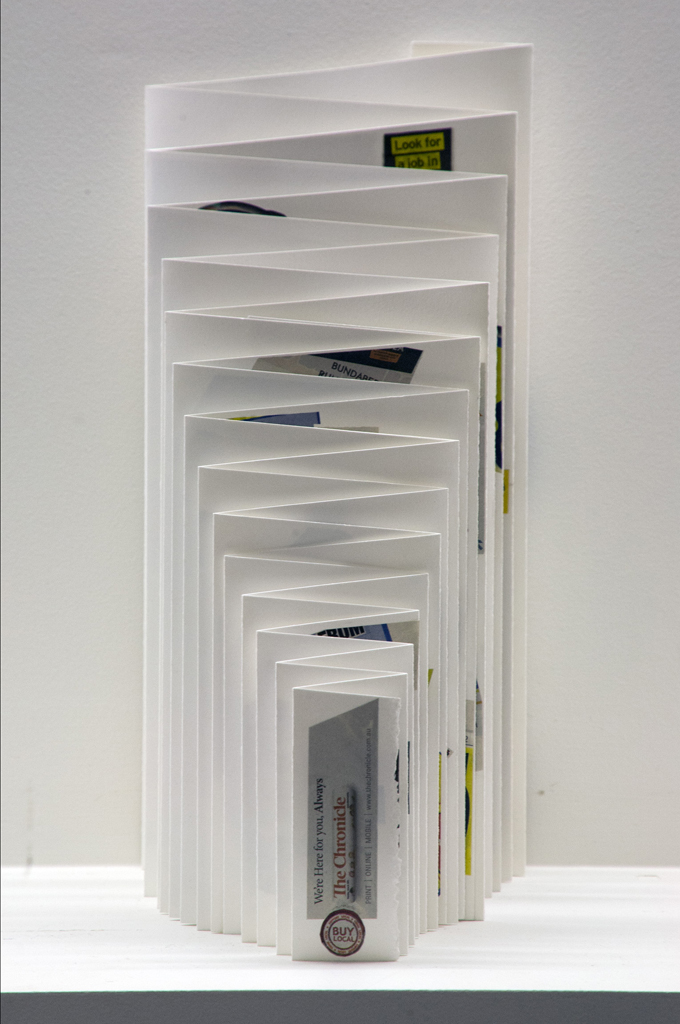
Have you got your Chronicle today? closed
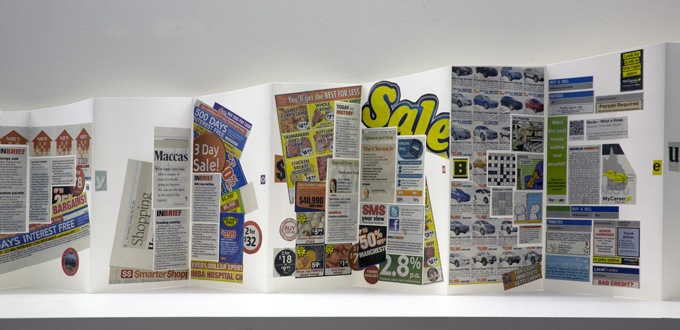
Have you got your Chronicle today? detail
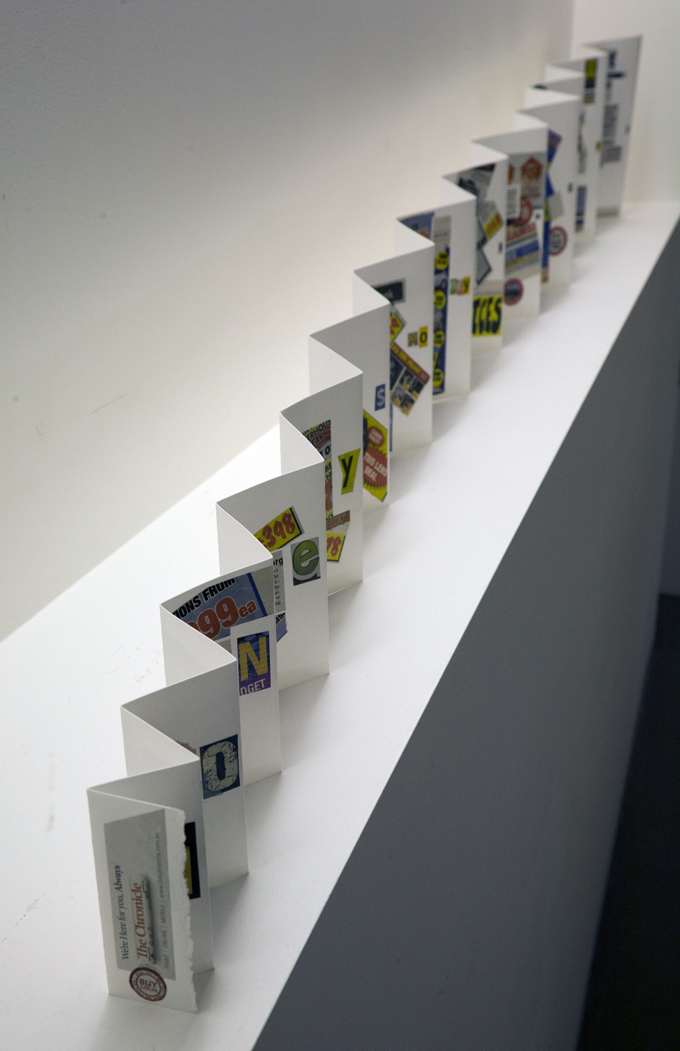
Have you got your Chronicle today? oblique view

Have you got your Chronicle today? detail
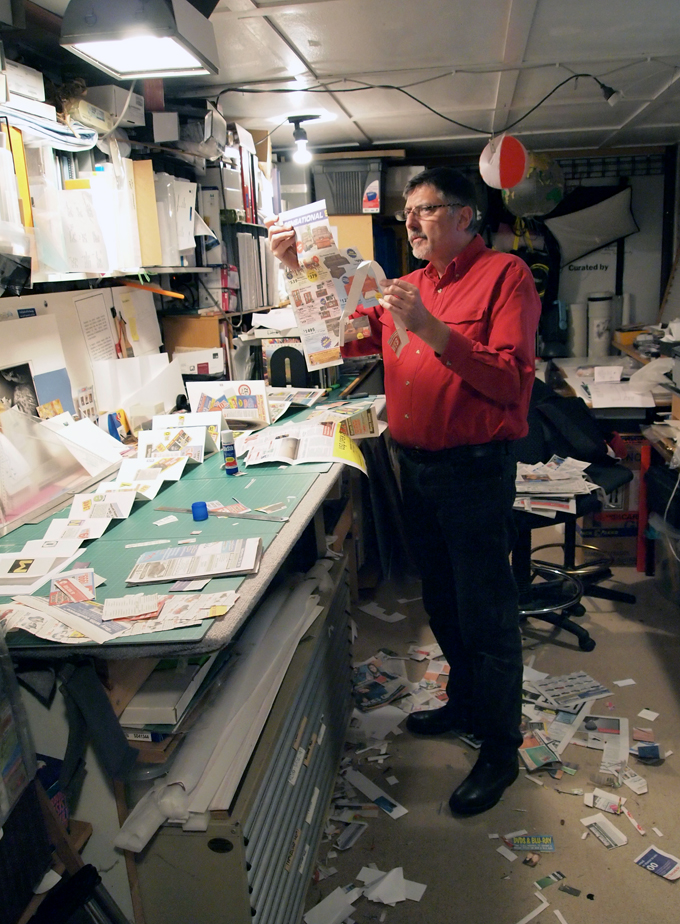
Doug in his atelier making the book
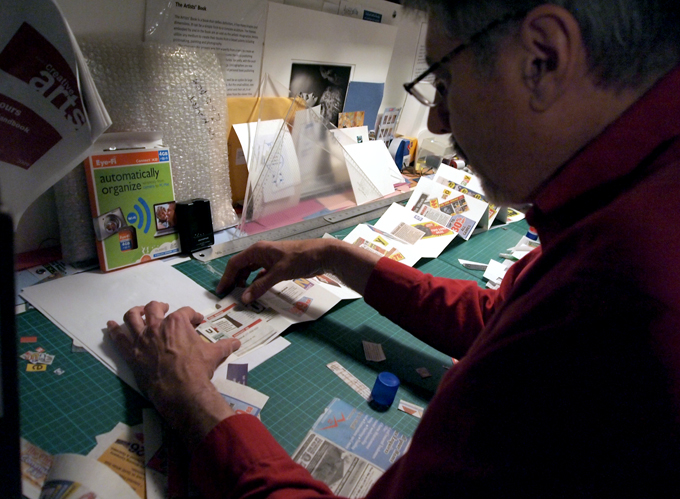
Doug in his atelier making the book

The mess when making a collage
The list of other Finalists is available HERE
.
This work is licensed under a Creative Commons Attribution-NonCommercial-NoDerivs 3.0 Unported License.
.
COOPER SCROLLS @ Toowoomba Regional Art Gallery
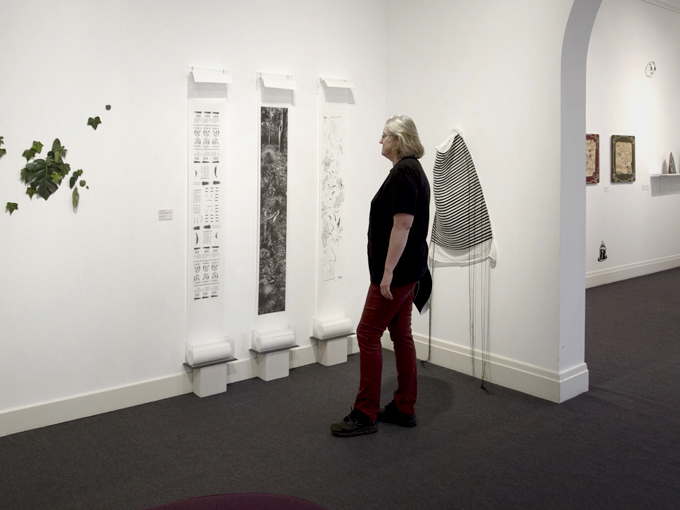
Victoria Cooper in the Off The Wall installation of three scrolls from the series of five
.
ABOUT ‘THE STORIES OF THE GORGE’ ON SHOW @ TRAG
Victoria Cooper’s digital montage Stories from the Gorge scrolls, made over ten years ago were included in Toowoomba Regional Art Gallery show. The exhibition was entitled Off the wall and was on show in Gallery 2 and Amos Gallery in May 2013.
The information about the exhibition that follows comes from the exhibition room sheet prepared at the time by Toowoomba Regional Art Gallery Exhibitions Officer, Ashleigh Bunter:
The works in the exhibition have been selected from the Toowoomba Regional Art Gallery’s City Collection. They have been placed simply together due to their three-dimensional nature and to highlight their derivation from the traditional two-dimensional picture plane.
This exhibition demonstrates the way that artists manipulate physical depth within their works which can often create a greater engagement between the object and the viewer. Interestingly, many of the works in this exhibition focus upon environment, whether it is the natural, public or the domestic environment. Materiality is also a common consideration. Throughout this exhibition one can see the influence of ‘the collector’, artists who gather images or common materials, reusing and reinterpreting them to create their art.
Victoria Cooper’s Stories from the Gorge: Order, chaos and the story of the hillside is a Chinese-landscape-scroll inspired series that represents “the last bastion of a natural chaos and order, an anti-culture, occurring on the fringes of agriculture.”[i] Human effects on the natural environment are central to Cooper’s practice and her prints and artists’ books in various formations lead the view from a flat two dimensional plane into the landscapes she investigates. These printed scrolls rise up from handmade acrylic boxes like the tall gum trees on their surfaces.
Other artists in the Off The Wall show include; Michael Schlitz, Marieke Dench, Tiffany Shafran, Judith Kentish, and Brigid Cole-Adams and the exhibition will be on the wall until May 26, 2013.
.
PRIZES AND AWARDS
2001 The Gorge was purchased by Australian Library of Art at the State Library of Queensland
2001 – Photographer and gallery director Sandy Edwards awarded The Gorge, First Prize in the Muswellbrook Photography Award
2001 – MCA Director Elizabeth Ann Macgregor awarded The Cliff, First Prize for Works on Paper, Martin Hanson Memorial Art Awards, Gladstone Regional Art Gallery and Museum
2002 – Five Stories from the Gorge was a Finalist in the 2002 Josephine Ulrick & Win Schubert Foundation for the Arts Photography Award at the Gold Coast City Art Gallery was selected by Isobel Crombie Curator at the National Gallery of Victoria
2002 –The triptych was acquired during its showing in the Toowoomba Biennial Acquisitive Award selected by Julie Ewington, then Curator at the Queensland Art Gallery..
.
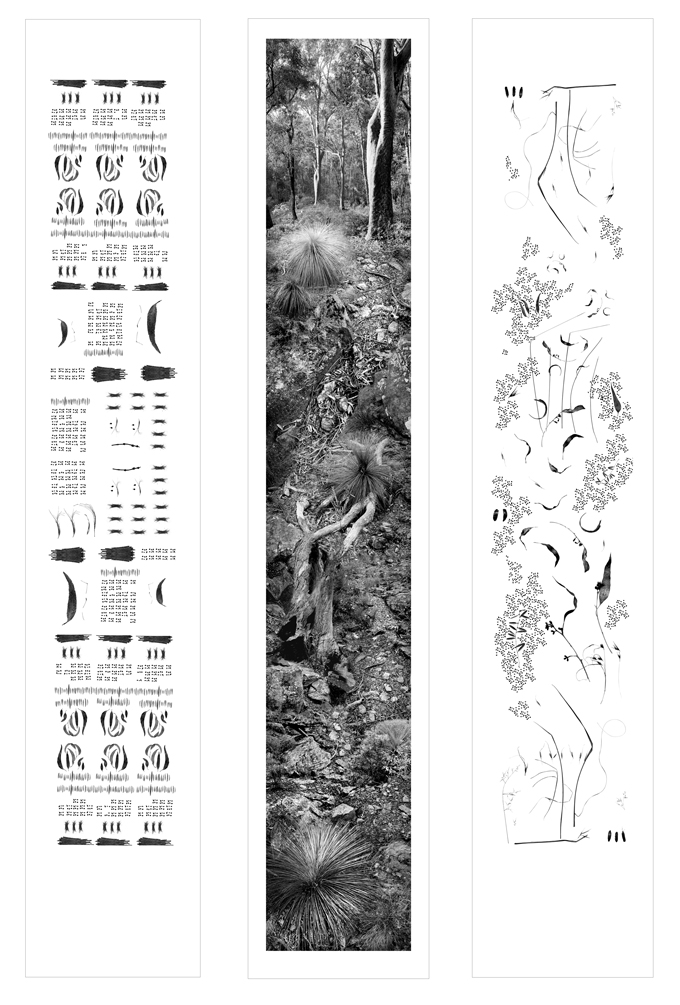
Three images of the Stories from the Gorge triptych as presented @TRAG
.
THE BACKSTORY OF THE SCROLLS AND THE SERIES OF 5 WORKS
Cooper’s scrolls were presented for the TRAG exhibition as a triptych, however in the original exhibition, entitled Searching for the Sublime, there were five scrolls. Searching for the Sublime was a collaborative project with sculptor Jim Roberts, fellow artist Doug Spowart and curator Deborah Godfrey. The inspiration for the project was a wilderness area in the Helidon Hills a mere 20 kilometres north-east of Toowoomba. Supported by an RADF Grant, the show featured Roberts’ sculptures, Spowart’s abstract water photographs, and Cooper’s scrolls and was shown at 62 Robertson Gallery in Brisbane in August 2001.
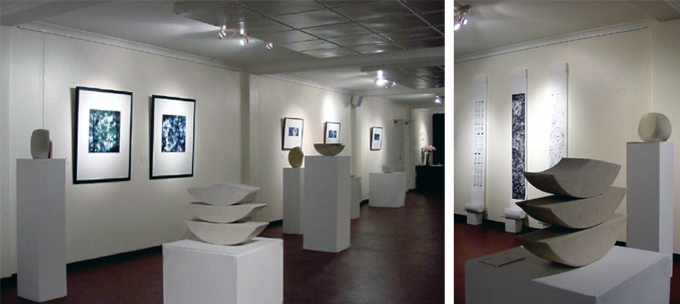
Searching for the Sublime @ Gallery 62 Robinson PHOTO: Courtesy of 62 Robertson
.
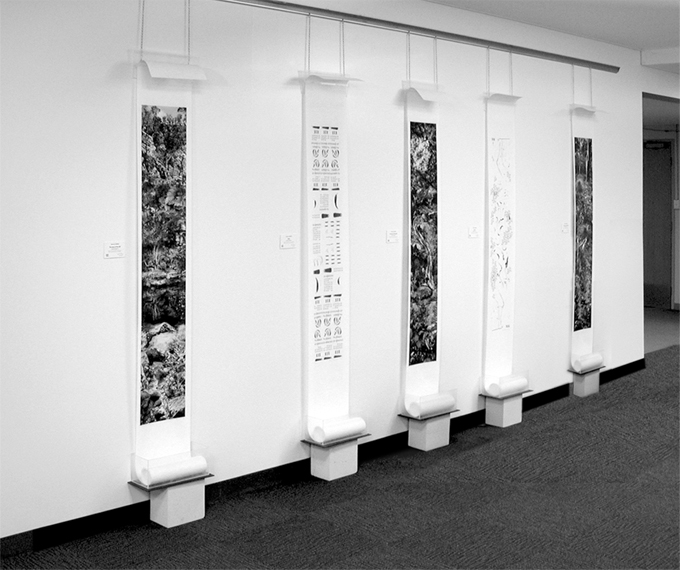
Five Stories from the Gorge installation at SQIT Gallery
.
The images were assembled as a photomontage in the tiny, by current sizes, Blueberry iMac computer. At times Victoria juggled 200 layers in one Adobe Photoshop document to create the fiction panoramas. Seeing the whole image was a problem as most of the time Cooper’s view was no bigger than the iMac screen requiring her to ‘scroll’ the image up and down–just as you will do in looking at the images in this post. Saving the files took 20-30 minutes and the system often crashed. The images were printed in pigment inks on an Ilford Novajet printer onto Hahnemühle Japan ‘rice paper’ by IMT on the Gold Coast. Victoria worked with artist Wim de Vos to design the bespoke handmade acrylic boxes. The design featured the ability for the box to not only serve as a container, but also act as a device to display the scrolls.
The complete set of scrolls, Five Stories from the Gorge, was shown in many venues and awards (see prize list at the end of this post), including Photospace at National Art School, Australian National University, Canberra. Canberra Times arts reviewer Myra McIntyre commented that Cooper’s works are:
Most elegant and fascinating photographic objects are Landscape stories, a series of five Asian-inspired scrolls. Cooper crawls, wanders and flies through the Australian landscape gathering hundreds of objects, patterns, and perspectives that she digitally intertwines, creating a continuum of almost imperceptibly diverse perspectives and a physical sense of vertigo in the viewer.
Review, Canberra Times, May 10, 2002
In 2002 the triptych was acquired during its showing in the Toowoomba Biennial Acquisitive Award selected by Julie Ewington, then Curator at the Queensland Art Gallery. Interestingly the rules of the competition at the time restricted entries to work that had not previously won an art award–as such only the three scrolls The Story of the Hillside, Chaos and Order were entered. When purchased the two other scrolls were orphaned from the set.
So here in this blog, we reunite the Five Stories from the Gorge presented in a form for you to scroll/stroll through … Enjoy.
.
By Doug Spowart
.

Story of the Cliff
.

Story of the Gorge
.

Story of the Hillside
.
This work is licensed under a Creative Commons Attribution-NonCommercial-NoDerivs 3.0 Unported License.
2013 SABBATICAL for Doug+Victoria: A ‘Leap of Faith’
A NEW YEARS MESSAGE FROM COOPER+SPOWART
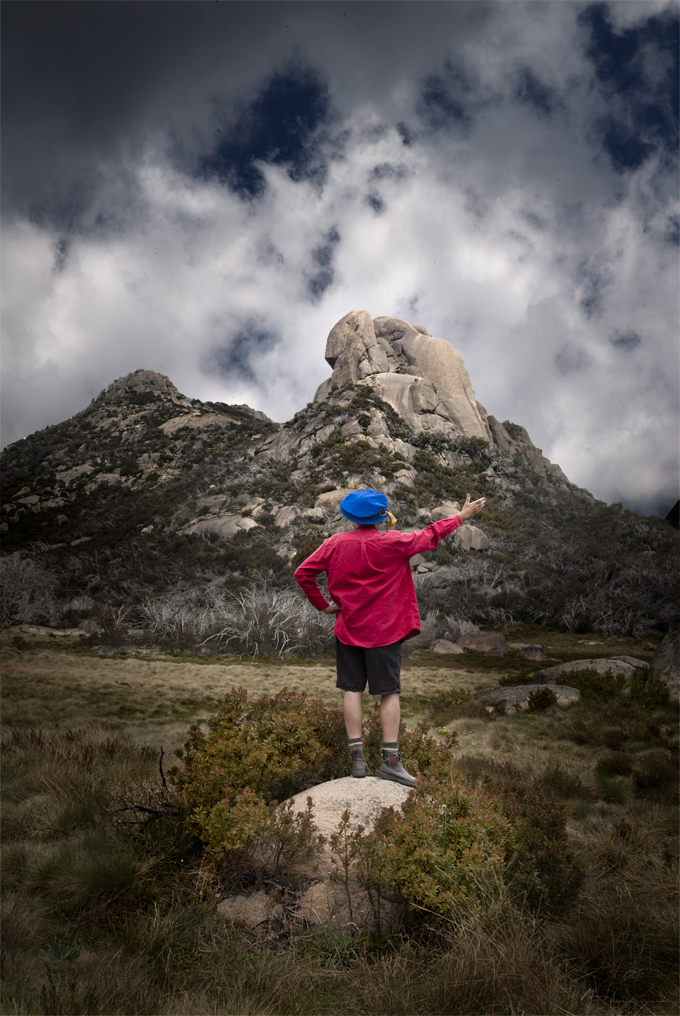
Dr Doug consulting Casper David Friedrichs re 2013 sabbatical, The Cathedral, Mt Buffalo.
In the year 2000 we began our involvement in higher academic study at Monash University in Post Graduate Diploma study. Since then, except for a small break in 2003, we continued our university research and art practice. Throughout this period we maintained both our arts practice and working at TAFE where Doug was full-time employed as a teacher and Victoria worked as a sessional teacher. All holidays and long service leave was consumed by the demands of study, research and at times a busy exhibition and private lecture programme. The hard work and study culminated last year (2012) with Doug being awarded Doctor of Philosophy at James Cook University in May, and Victoria submitting her PhD for final examination in late November.
Now, as we head into 2013, we are taking time out to pursue our post-doctorial research interests, opportunities to present and share our specialist knowledge and skills and to re-connect with our professional practice as artists and commentators on contemporary issues. It is a ‘self-funded sabbatical’. To finance this venture we intend to generate opportunities that may include ‘cloud funded projects’, artists in residencies, specialist workshops, seminars and consultancies, and sessional teaching or lecturing. We are also open to projects that may become available through our connections.
To up date you on our current interests and professional activities we include the following:
Doug: Social media and its applications within creative practice and personal communication; assembling and writing a critical commentary about Australian photobooks from 1900-2000; the narrative form of the hybrid photobook and the elevation of the print-on-demand photobook into a higher order of visual communication.
Victoria: Maintain a review of contemporary science/art interdisciplinary research as an accepted practice in academic institutions. Special interest in: the scientist, the artist and intuition; the historical use of visual art practice as information within scientific publications; Montage Thinking, as a mode for visual thinking and intellectual discourse through visual and non-visual information.
This adventure is somewhat a ‘leap of faith’ and as such we have created a blog onto which we will post sabbatical related content – we will invite to view this site when it comes online. This WOTWEDID blog will continue as our broader commentary platform – on occasion dual postings may occur. Other special research interest blogs will also emerge and you will be advised of opportunities to connect with their content.
Please contact us if you see any opportunities to support our ‘leap of faith’ sabbatical.
We wish you all an exciting 2013 New Year and look forward to perhaps connecting with you, and also connecting you with, commentaries about the issues of our shared interests.
Cheerio
Victoria and Doug
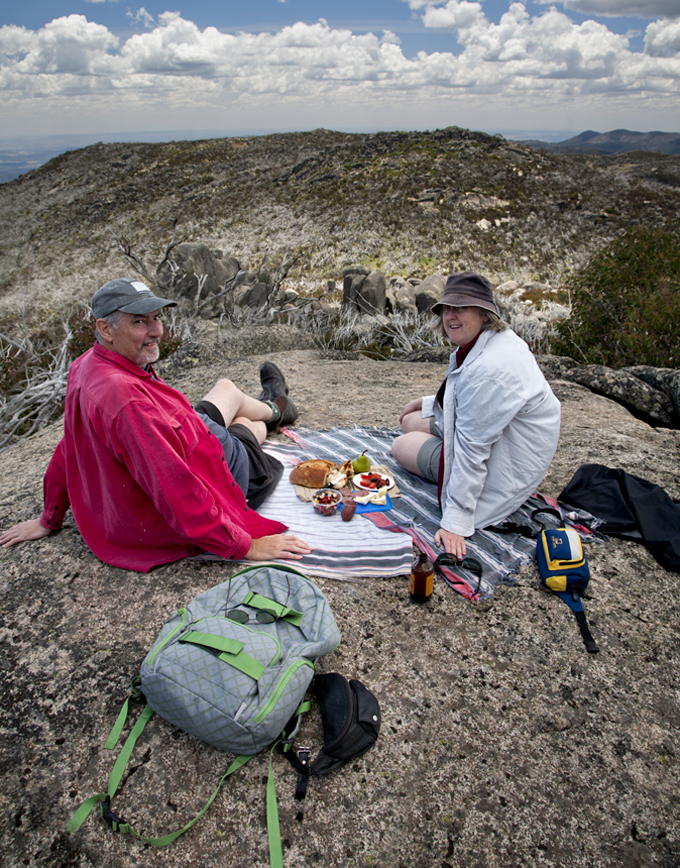
A 2013 lunch planning meeting at The Horn @ Mt Buffalo on 12.12.12
PHOTO GRADUATION 2012 SQIT
The 2012 SQIT Photoimaging Graduation event took place on November 26 in the college theatre. Around 80 family, friends and local photography identities attended the two-hour event. The Graduation is a student project overseen by teacher Rachel Susa and her first year students and is a mix of celebration, reflection and fun. Each year a guest speaker provides an insight into the photographic industry – this year David Seeto addressed the audience with his life experiences in photography. His early film-based work with complex sets, large format film and tricky lighting situations made the students thankful for the ability they have to use digital techniques and Adobe Photoshop to assemble images now – easily. David discussed his documentary work over many years with outback legend R. M. Williams.
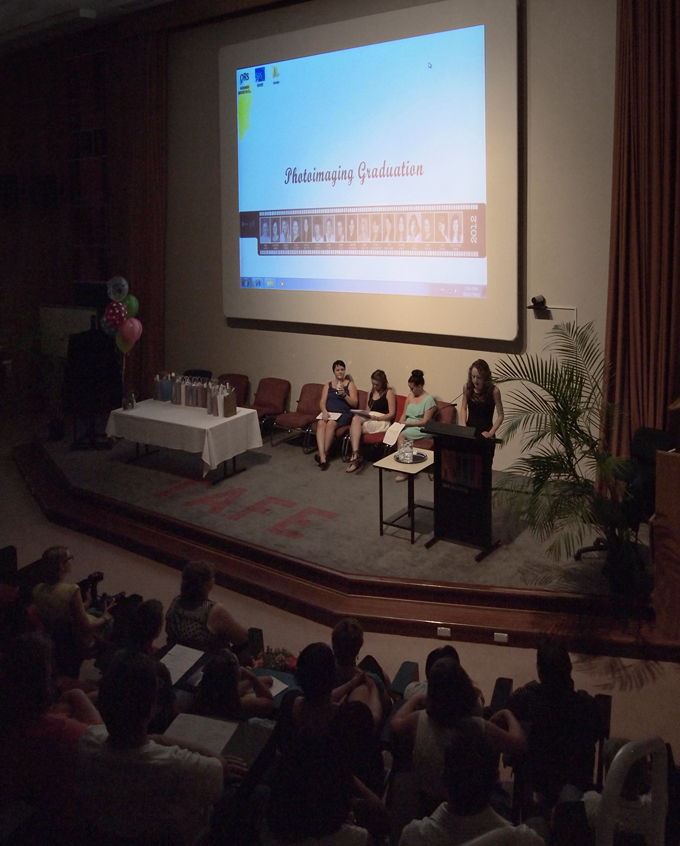
The SQIT Photoimaging Graduation 2012
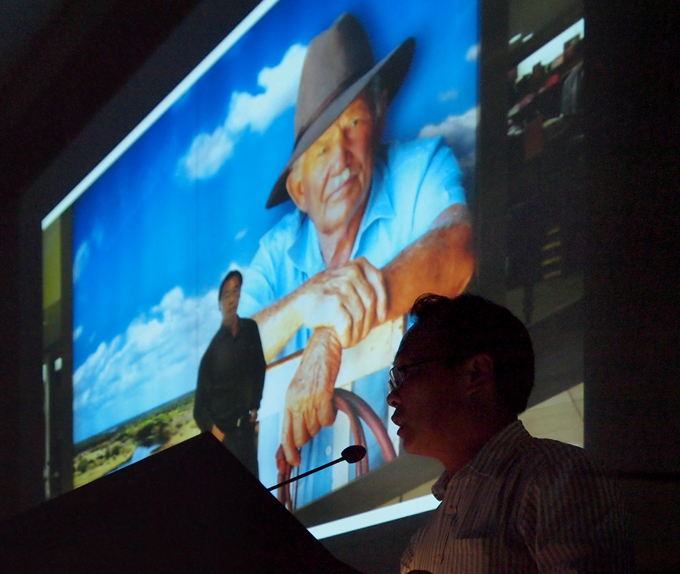
David Seeto presents the keynote address
At the Graduation event the SQIT Photoimaging Awards are announced. This year’s Syd Owen Graduating Student of the Year is Abby Dennien. Her award recognises the significant contribution made by Syd Owen Senior in the formation of the Institute of Australian Photography (now the AIPP) in the 1960s and his support of professional photography in this country. As part of her award Abby has the opportunity to gain extra experience as a part-time employee of Owen Studios for the next 6 months The Photobook of the year was awarded to Christine Ivanov for a book about night travel along local highways.
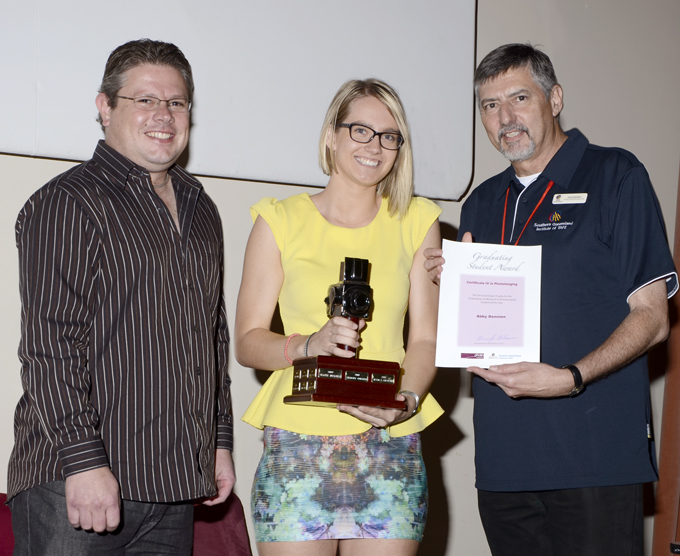
Raymond Keyworth from Owens Studios with Abby Dennien and Doug PHOTO: Alison Ahlhaus
The Graduating students take the stage at the end of the night and a celebration poster is unveiled which features a portrait of the students and teachers. Then it’s all over — until next year!
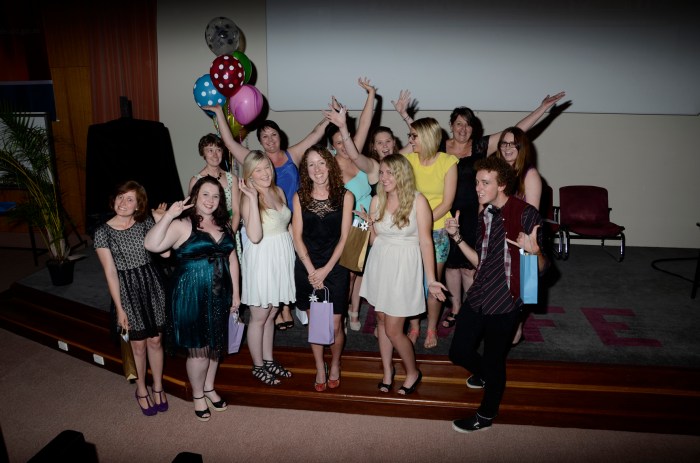
Certificate IV in Photoimaging Graduation Group PHOTO: Alison Ahlhaus
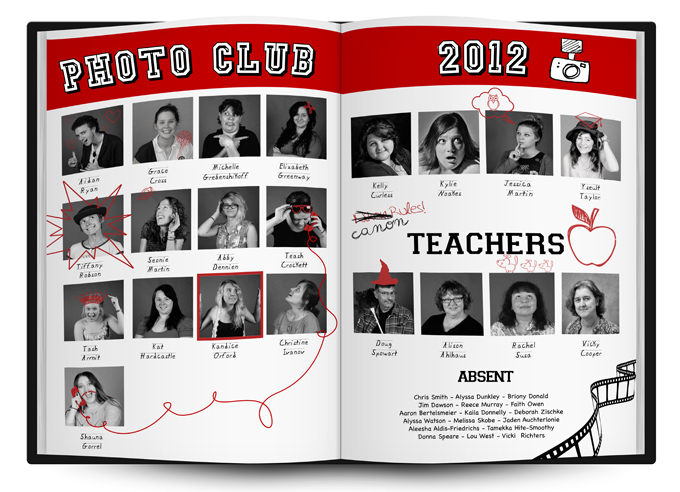
The 2012 Student Board
REGIONAL ART AWARD: Our entry
 .
.
NOTE: VOTING IS NOW CLOSED
One of our Artists Survey Books has been uploaded on the Queensland Regional Art Awards website.
The ‘People’s Choice’ judging is based on an online viewing and voting system. For those unfamiliar with these little books they present a humorous and ironic view of the challenging issues facing regional artists. This book deals with issues associated with being a regional artist during the current extractive mining boom.
.
SO – Please check out the book as described in this post.
THEN, go to the website – at the link below – scroll down the artists name list on the right-hand side of the website. We are under “V” for Victoria at the very bottom of the list.
Here is the link: NOTE: VOTING IS NOW CLOSED-THE LINK IS STILL ACTIVE AND SHOWS THE ENTRIES
http://www.flyingarts.org.au/QRAA-2012-Gallery-The-Essential-Character-of-Queensland-ga2543.html.

The cover of the Artists Survey book
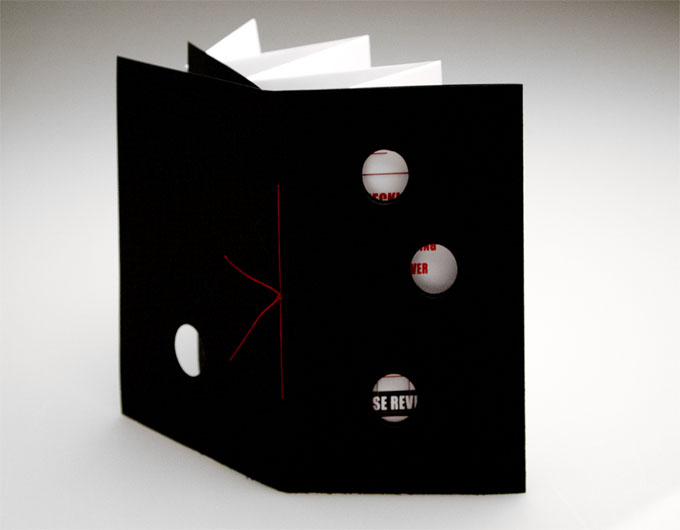
The book cover with exploration ‘holes’
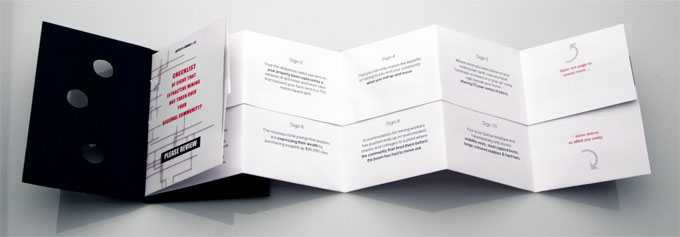
Open text pages showing comments on mining and the community
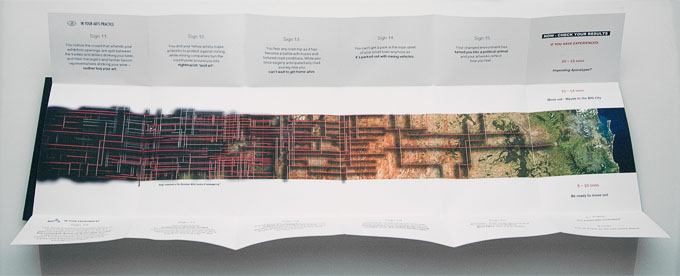
Unfolded showing texts and illustration of extractive industries effect on southern Queensland
Some of the texts, there are 20 in all, are as follows:
- Instead of Weetbix or Cocoa Pops and milk for breakfast you have coal grits.
- When you can’t afford your power bill you cook using coal spill gleaned from railway lines and roads.
- Your farming friends can’t ship their produce to cities and ports as all freight options are biased towards the year-round transport of coal.
- Your art exhibitions opening crowds are split between the tradies and the drillers drinking your beer and their managers drinking your wine – neither buy your art.
- All of your rustic old community pubs have been remodeled into nite clubs and commodious verandahs enclosed to stop drunks throwing up – tossing bottles – or falling off onto the pavement below.
- The occasional distant thunder that you once may have thought be an approaching storm now turns out to be the constant thunder of B-Double trucks shipping coal.
What is this thing called art photography?
Visiting the 2012 Josephine Ulrick and Win Schubert Photography Award
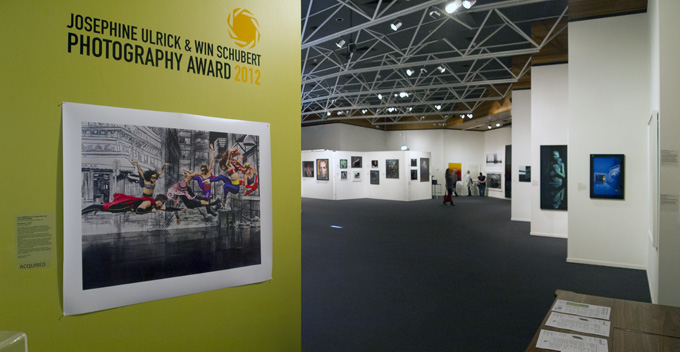
2012 Josephine Ulrick and Win Schubert Photography Award
What is this thing called art photography? Can it be nailed down and quantified? Each year across the country institutions and the judges they select attempt to do just that. Do they succeed? And is everyone happy about these events? A comment in the visitors book of 2012 Josephine Ulrich and Win Schubert Photographic Award at the Gold Coast Art Gallery makes the observation, something like “How high was the judge when he made that selection?” Well you can’t please everyone, and these awards with their huge prize purses do ultimately end up making one person ecstatic at winning and a few others happy by having their work purchased.
I for one am thoroughly excited by the depth and breadth of art photography that this award unearths each year. Although not an entrant for a few years my work, and collaborative works with Victoria Cooper have been displayed as finalists on 4 or 5 occasions, the exhibition continues to be a motivation for pushing our own work forward.
This year’s judge was Kon Gouriotis – Director, Australian Centre for Photography and the winner was Vestiges #3 by Sydney based artist Eugenia Raskopoulos. A press release about the award can be accessed HERE
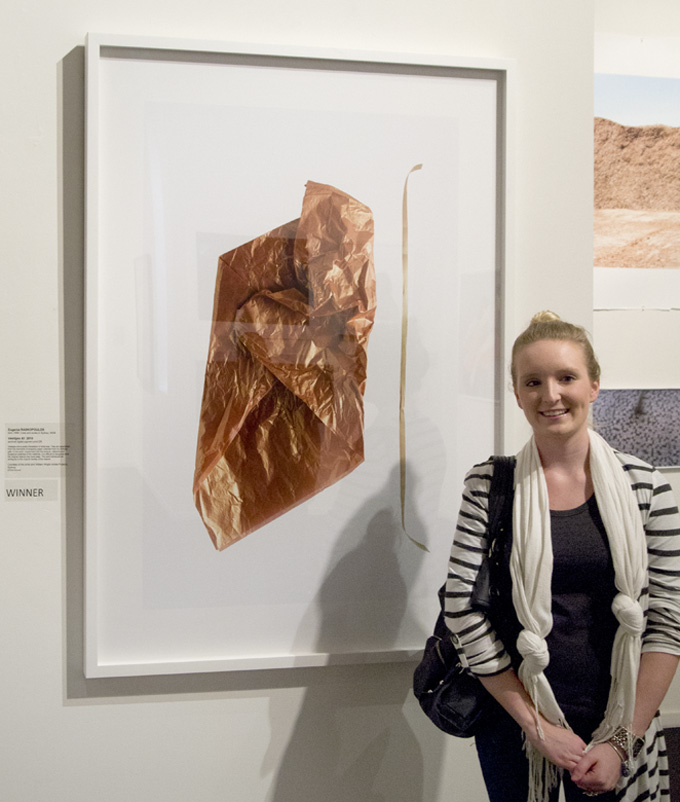
‘Vestiges #3’ by Eugenia Raskopoulos – with gallery visitor Tamekka
Over the years the Ulrich Award has gradually moved into increasingly large sized, huge framed or pinned to the wall works. This year 75 works were selected and this created what must have been an installation challenge. Double hanging of many photographs shoe-horned them into the space although due to this strategy some photographs suffer viewability problems.
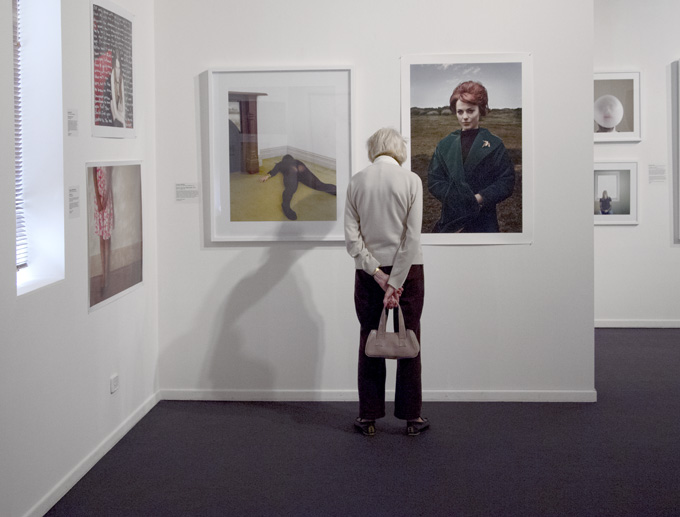
The gallery space
A new sophistication in artist’s statements on didactic panels heralds an increasing reliance from artists to attempt to direct the viewer into seeing the meaning of a work through a narrow, and perhaps confusingly worded sometimes pseudo-intellectual window. Robert Adams writes in his book Why people photograph that said that artists should not attempt to describe their work. He states that, ‘Words are proof that the vision they [the photographer] had is not … fully there in the picture.’
Anyway, be that as it may, one artist not only out does everyone else in square metres of wallspace but also presents an insightful statement that addresses the current photographic art scene. Hedy Ritterman’s Bollard 2011, for me was the standout conceptual piece for the show – the artist’s statement is well worth reading:
I abandon the idea of a photograph as a “window to the world” – instead I embrace the materiality of the surface itself. The highgloss, large scale photographic paper, with its fragility exposed, acts as a distorting mirror capturing the changing surrounds and highlighting its sculptural form. The distinction between the image in the photograph and the object of the photograph is underscored here. The subject of the photograph, a huge analogue negative of the museums’ people barrier, stands in direct opposition to the seductive invitation of the surface.
My work explores the complex relationship between the contemporary photo-artist, the collecting institution and the viewer. As photography shifts away from the print to the screen its status as object is being challenged. As photography shifts into the realm of the museum its object status is being valued.
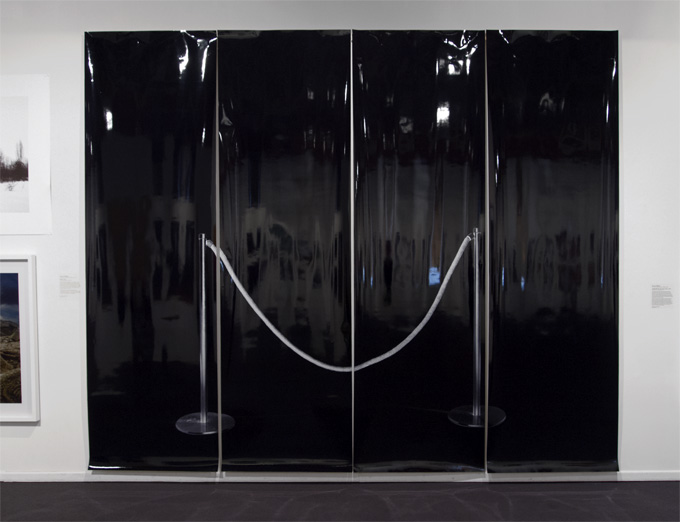
Hedy Ritterman’s ‘Bollard’ 2011
As a viewer what I like about the exhibition is the intellectual and visual calisthenics that I’m engaged in while walking through the space. Whether I, or you, agree with the judge’s decision or not, the exhibition still remains a celebration of contemporary photographic art that continues to challenge and reward the photographic and broader arts communities.
Doug Spowart
Judging professional photography: MSIT, Brisbane, March 24&25
The 2012 AIPP Queensland Professional Photography Awards.
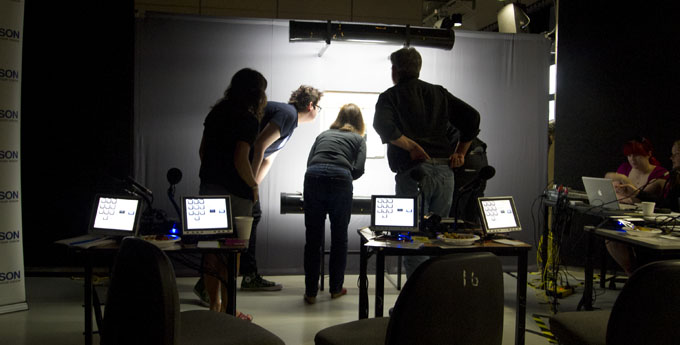
Queensland AIPP Professional Photography Awards judging
I’m sitting on judging panels for the landscape and documentary panels of the 2012 AIPP Queensland PPY Awards. The work is challenging and diverse and the judging panel capable and opinionated. My mind wanders to thoughts about photography, its assessment and critique.
The social scientist Pierre Bourdieu wrote many things about photography. Many photographers would take particular exception to his essay on ‘Photography: A Middle-Brow Art.’ But some of what he says bears a strong and salient connection with the way photographer’s debate, discuss and judge their work. Bourdieu states,
” It is no accident that passionate photographers are always obliged to develop the aesthetic theory of their practice, to justify their existence as photographers by justifying the existence of photography as a true art.” (Bourdieu 1996:98)
Whilst his statement may relate to all kinds of photography from the camera club to the teaching institution it connects, to my mind, most directly to professional photography. Shortly after the time he wrote the original French text (early 1990s) I was not only a fervent participant in all kinds of photography competitions but also the chairperson of the AIPP Australian Professional Photography Awards. I witnessed and perhaps even guided the transition of the APPA, as it became known as, into the form that it now takes.
Founded in 1977 The AIPP National Print Awards were judged with an interest in the work being suitable and relevant to professional products for clients. Prints were glorious colour, 16”x20” flush mounted and were a celebration of technique as well as saleability. Each year 300~500 prints would be judged by the doyens of the industry and a few rising stars. In 1984 I sat on one of these judging panels alongside the big names of professional photography at the time – I felt quite small.
By the end of the 1980s new influences were invading the professional scene. John Whitfield-King and others of his persuasion were creating a space for documentary approaches to wedding photography informed by Henri Cartier-Bresson and Elliott Erwitt. Areas of photographic practice such as illustrative and landscape were emerging and along with them was a recognition of art photography from the American scene by practitioners like Ansel Adams, Harry Callahan, Lee Friedlander, Arnold Newman et al. Black and white prints with Leica-esque full-frame black fuzzy borders became the emergent trend and prints became small and fine on white mount boards. Along with Paul Griggs, Jeff Moorfoot, Lyn Whitfield-King, Peter Adams and Robert Billington, I also was also one of this new guard.
Photographers began to present images from their own personal photographic exploration – subjects that excited and invigorated their practice. These were photographs made by photographers – for photographers. The judges were excited by this work as well and awards were made that celebrated inspirational photography. Each year new work became more and more detached from the previous client-based assessment, and the new paradigm became the engine room for photographers to experiment and push ideas about what professional photography could be and also what clients may want. All this change was not without its detractors. The photo press and newsletters published the laments by some about the loss of industry and the self-indulgence of those engaged in it.
Despite this, professional photographers did embrace the awards process with such enthusiasm that larger entries necessitated extra judging rooms, days of judging and an army of judges and event team volunteers. Early in my chairmanship I undertook a national judge training program with the intension of filling the judging ranks with new judges, and in particular, evening up the gender balance of such panels. The term ‘judge training’ implies some kind of conditioning process where the participant is shown how to spot and reward certain standards. This was not the route that I chose. My philosophy was related to the recognition that all candidates start with a significant understanding of photography and that what they needed was to (1) understand the APPA judging system of team-based scoring and debates, (2) come to know and practice discussion and debate techniques, and (3) grow through the process accepting it as not only one which is about making judgements, but also its educative nature for the judge and the entrant alike.
In time we achieved much of what we set out to do. The judging team became more representative of membership – gender balanced, younger, from the regions as well as the city. APPA as a system during my time as chair cautiously welcomed-in digital output, imaging and image enhancement – something we take for granted now but an area of significant consternation in the mid 1990s. Not to mention each year’s crop of award winners that are celebrated in the prestigious form of the Awards Book. Additionally we should not forget that the APPAs were originally, and still are an accreditation system to recognise and reward the professional photography skills of AIPP members through the awarding of APPA Associate, Master and Grand Master honours. At one time you could count the number of APPA Masters on the fingers of two hands – they were a rare-breed indeed. Now the AIPP is replete with masters and Grand Masters may need more than two hands to count. In my opinion what it takes to be a Master is no less now than it was 20 years ago – it’s just that the general standard of professional photography as an innovative and expressive form of communication has grown exponentially.
Over time the APPAs have grown beyond our imaginings of the 1990s into the mega event it is today. States such as Queensland have their local awards judgings that have entry numbers exceeding the national entry only 20 years ago. Professional photography practitioners from this country have, for over ten years, won every major international award, had top ten listings in numerous disciplines and travel extensively as guest speakers and leaders of the industry internationally. Some of this acclaim comes from the spark that was set by the team that was APPAs in the 1990s. Most of the names and contribution that these people made have now gone. I think of David Puddefoot, Mike Woods, Ian Hawthorne, the ‘godfather’ Ian McKenzie, Malcolm Mathieson, Jeff Moorfoot, Ruby Spowart, Victoria Cooper and the current Chair David Paterson. We owe these individuals and a host of other committee members of that era including Paul Griggs, Robyn Hills, William Long, Ian Poole, for the foundation that they helped make so that APPA, and the state events could be what they are today.
It has been some time since I have judged at an APPA style event. As I sat on the judging panel I reflected on the history that has brought us to this moment. It felt good – and I was able to contribute to great discussion about some amazing imagery. Photographers have embraced the theory and aesthetics of their art and justify it through the most interesting and informative processes.
.
Doug Spowart
.
Bourdieu, P 1996, The Rules of Art: Genesis and Structure of the Literary Field, Stanford University Press.
JUDGING: ALLORA SHOW PHOTOGRAPHY SECTION
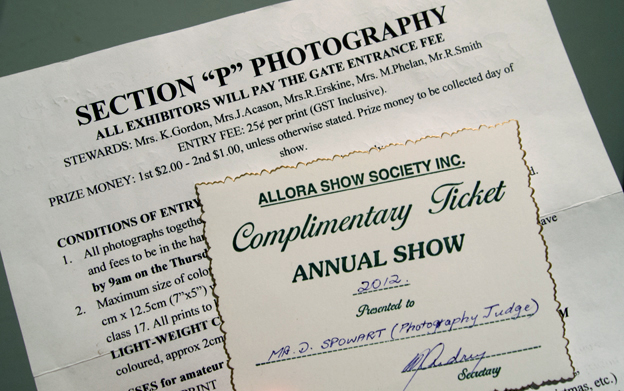
Most photographers and commentators of photography discuss endlessly the biggest and the ‘best’ photo competitions around the country. It would appear that competitions are considered a most important aspect of the genre. But photo competitions come in many forms, some of which come in under the radar. Recently I judged the Allora Show Society’s Section “P” Photography, and the experience connected me with the grass roots of the world of photo competitions.
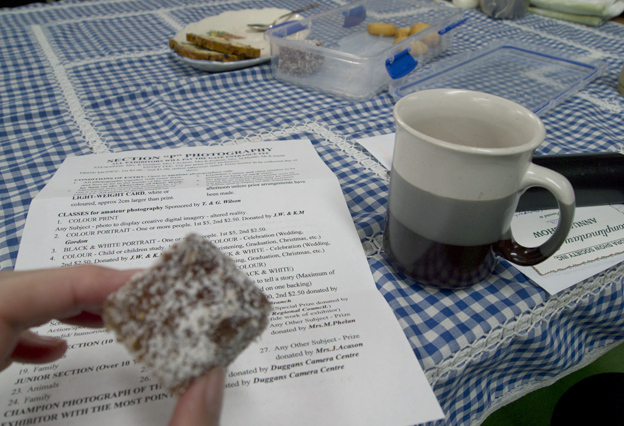
At the Allora Show photography stands alongside a diverse collection of arts, crafts and skills from needlework, baking, woodworking and scrapbooking, to painting, big pumpkin growing and cut flowers. My task was to work through the submitted entries in the 27 categories and select the winners. But first, on Vicky’s and my arrival we took a moment to take tea with the stewards, Kate Gordon, Judy Acason and Margaret Phelan. The tea was made from hot water brought in a thermos by Judy and was accompanied by home-baked fruit slice and butter and mini-lamingtons. Conversations over tea discussed the pros and cons of organising and presenting photographic competitions. Whether we were talking about the event we were about to participate in, or the big capital city extravaganzas of the AIPP Professional Photography Awards, the concerns and issues are the same.
We began the judging of class 1 – First and Second prizes were awarded as well as appropriate Highly Commendeds. Then the next, and the next category – working our way through the adult sections to the Junior sections. I was taken by the nature of the community document that the photographs represented. The ‘quality’, if you can call it that, was uneven at times, but the purpose and the honesty of each image as an authentic representation of an experience encountered and recorded is no different to those of the major national competitions.
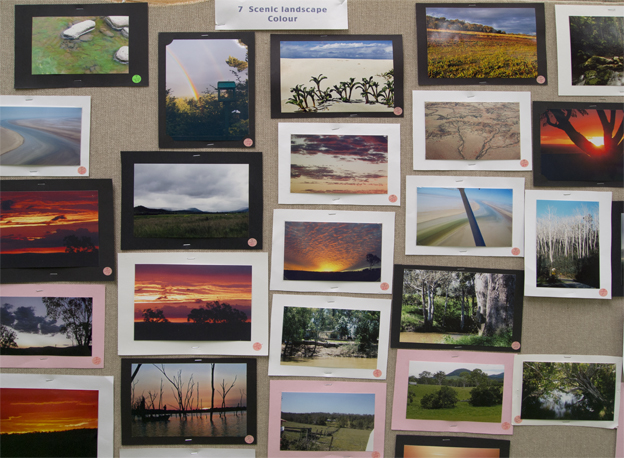
Allora Show Photography judging - Landscape Section
Subject matter included; flowers, pets, family portraits, bugs, birds, frogs, lots of sunsets, people doing stuff, pictorial landscapes, sporting moments and vignettes of rural life. And the number of categories enabled specialist areas a chance to have comparisons between similar works. An interesting category was one in which a set of images were required to tell a story.
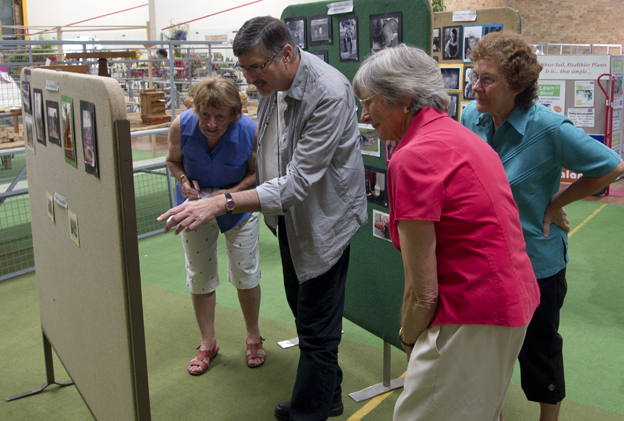
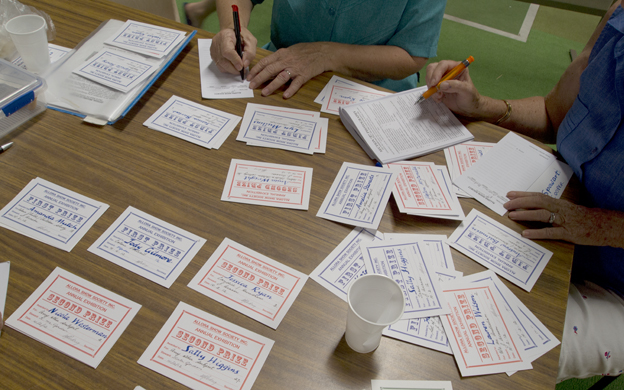
In the end a Champion Photograph of the show was chosen and for me the task was at an end. Vicky and I wandered off to view equestrian events, other displays of competitive work and lunch. When we returned the volunteer steward team was hard at it hand annotating the 80 or so award cards that had been made. I felt that maybe I should have held back on some of the Highly Commendeds. Participating in this event was just as important to me as any other I have had the honour to judge.
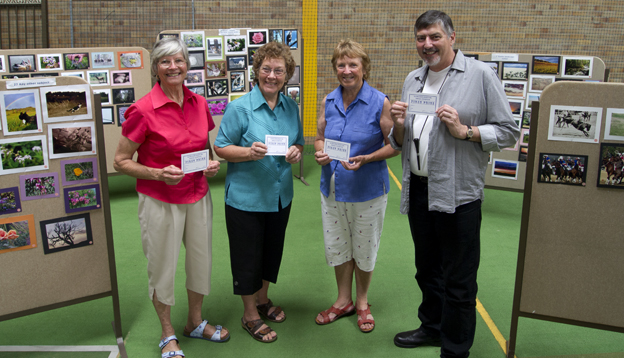
Stewards; Judy, Margaret, Kate and judge Doug
Words: Doug Photos: Vicky + Doug

 wotwedid