Archive for the ‘Artists Books’ Category
BEING [photo]BOOKED @ QLD COLLEGE OF ART
Heather introduces Doug’s lecture…
.
Last week we were guest presenters at the Queensland College of Art on the Gold Coast. We worked with photo media and digital media students and their lecturer Heather Faulkner discussing the topic of the contemporary photobook.
.
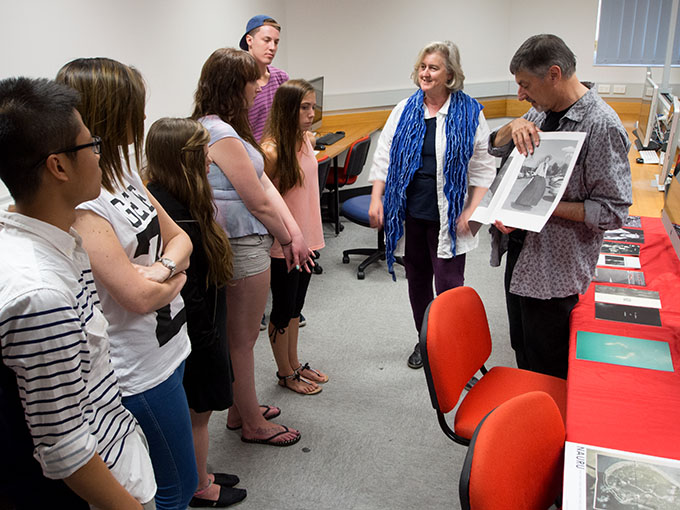
Victoria Cooper and Doug Spowart talking about photobooks….PHOTO: Heather Faulkner
.
Doug presented a lecture on the history of the photobook and brought students up to date with the contemporary photobook including Ying Ang’s latest book ‘Gold Coast’. Students then were given an opportunity to hold, handle and view a range of contemporary photobooks from Australia and overseas including books by, Alec Soth and Brad Zellar, Martin Parr, Garry Trinh, Daniel Milnor, George Voulgaropoulos, Jacob Raupach, Lloyd Stubber, Emma Phillips, Kelvin Skewes, Joachim Schmid, James Mollison, Paul Graham, Gracia and Louise as well as a selection of zines from the Sticky Institute. We also presented a selection of our own photobooks and artists’ books. Of particular interest to the students was the structure, construction, printing and binding of photobooks.
.
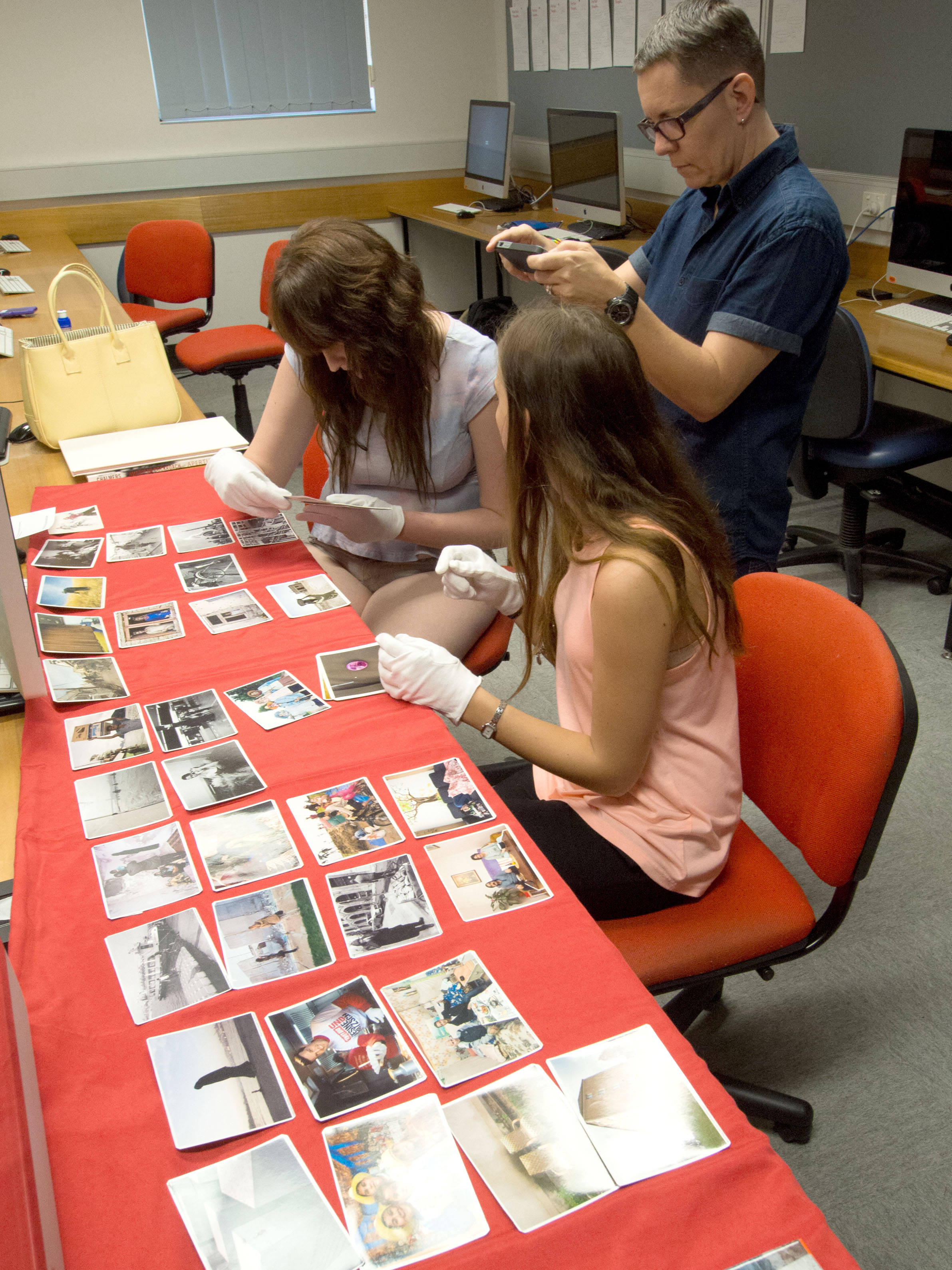
Students working on a sequencing task with Heather Faulkner
An important part of an accompanying tutorial covered ideas around the sequencing of images in photobooks and the ways in which narrative could be expressed. Students were then tasked to work with a series of images using unusual sequencing strategies that we suggested.
.
We enjoyed the opportunity to engage with these students and discuss one of our favourite topics and share amazing books from our photobook library. Thank you Heather Faulkner for arranging this event…
.
.
.
.
GEORGE PATON GALLERY: Artist’s Books (reprised) Exhibition
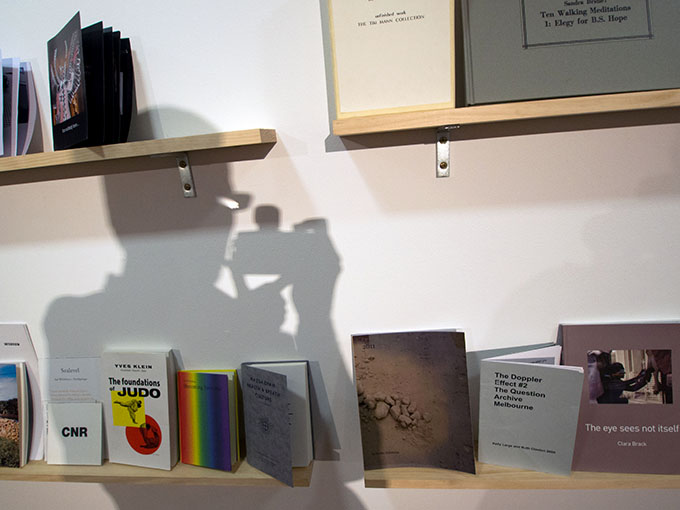
Artists’ Book Selfie
.
Digging in the archive: past and present
Artist’s Books (reprised) [artists’ books 1978-2014]: George Paton Gallery, University of Melbourne
Dates: 26 August to 5 September
A recent show entitled, George Paton Gallery, Artist’s Books (reprised), promoted that it would be showing “four decades of investigation into the possibilities and limitations of the artists’ book form.” Whilst the exhibition as presented had some gaps in the chronology, it did live up to its claim of presenting a significant collection of contemporary works alongside a carefully curated group of seminal artists’ book works from shows presented at the George Paton Gallery in the 1970s and 80s.
.
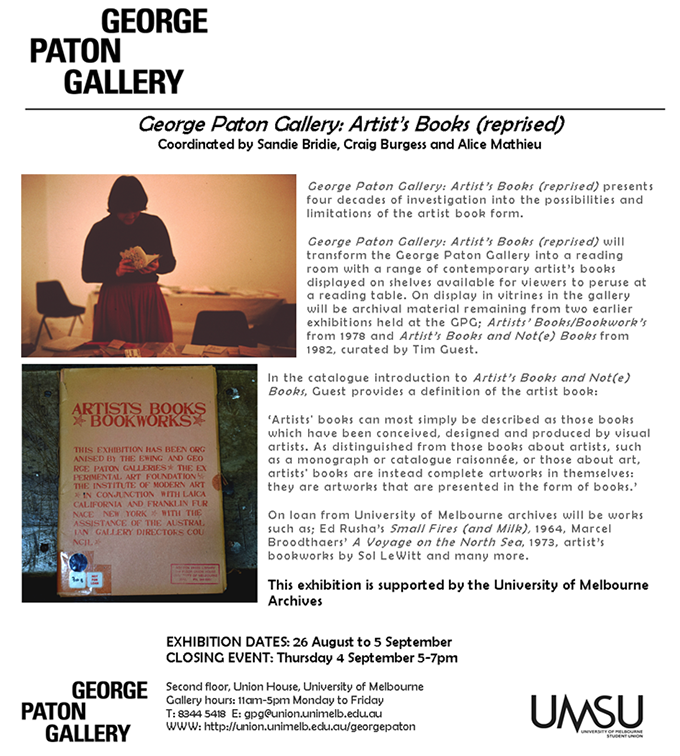
George Paton Gallery Website notice
.
Visitors to the gallery encountered a space resembling a reading room with trestle tables and bookshelves presenting the contemporary books for viewing, handling and reading. Some books were marked as ‘white-gloved’ handling whilst the majority was available for direct tactile experience. Enclosed in vitrines were the historical books on loan from the University of Melbourne archives. Interestingly during the 1970s and 80s these books would have only cost a few dollars to buy but now they attract significant values. Included in this prized collection of books are: Ed Ruscha’s Small Flres and Milk; 1964; Marcel Broodthaers’ A Voyage on the North Sea; 1973; Sol LeWitt’s Grids – using all combinations of straight, not- straight and broken lines; 1975; Richard Long’s The North Woods, 1977 and Dieter Roth’s, Gesammelte Werke, Band 7, 1974. These books were sourced from past exhibitions held by the George Paton Galley: Artists’ Books/Bookworks from 1978 and Artist’s Books and Not (e) Book! from 1982, the latter curated by Canadian Tim Guest.
.
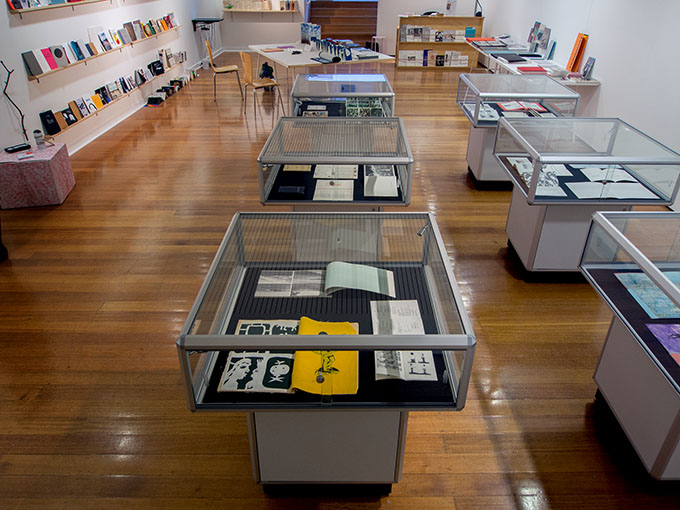
George Paton Gallery
In all just over 100 books were available for viewing essentially coming from a ‘call out’ for artists book makers to present work for the show. There were some interesting names; Peter Lyssiotis, Theo Strasser, Sandra Bridie, mail artist David Dellafiora, zinesters Gracia Haby and Louise Jennison, and photo-newspaper publisher Jacob Raupach. Anyone with a preconceived idea of what an artists’ book is, or should be, may have been challenged by some of the works in the show – but what an experience it was to be challenged in that way. It was a rare opportunity to view and compare such a diverse and historical collection of artists’ books.
.
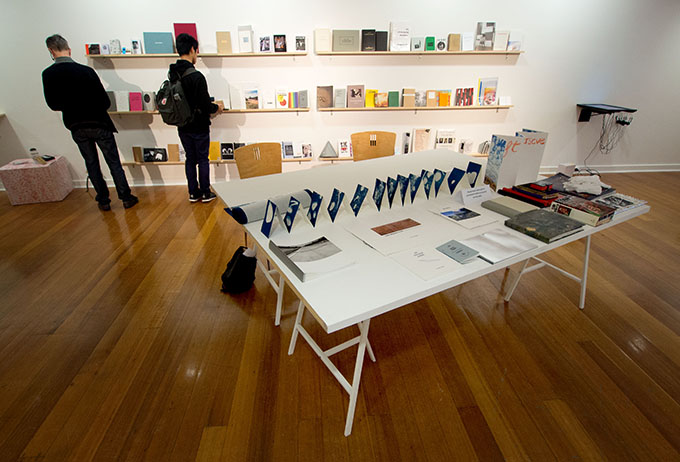
Exhibition installation
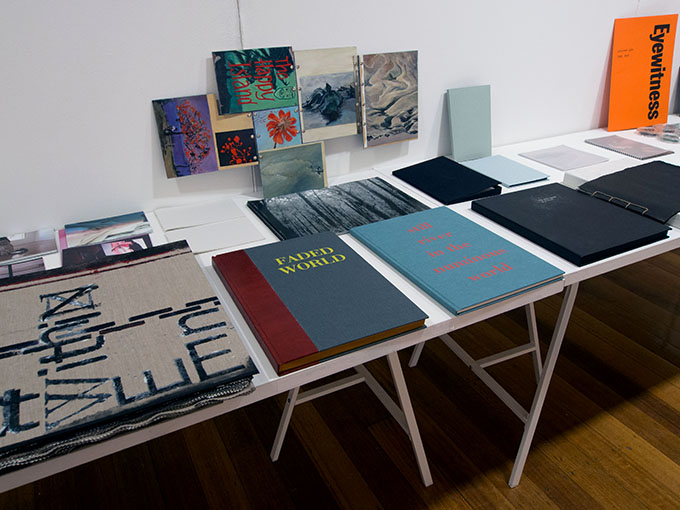
Antoni Jach’s Faded World and books by other artists
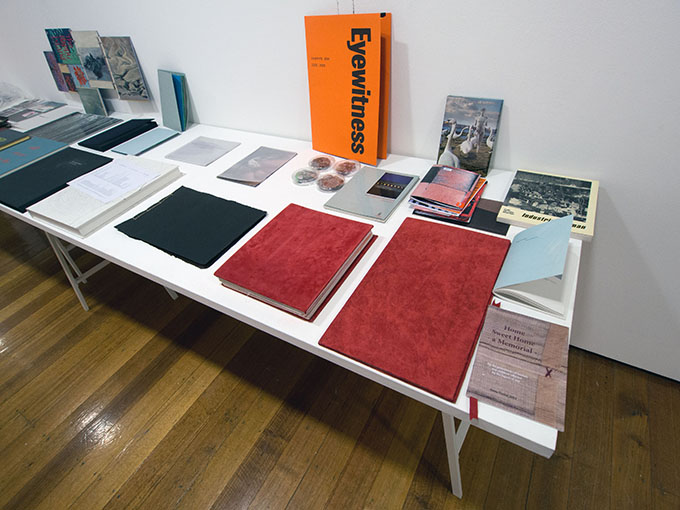
Books by Peter Lyssiotis, Theo Strasser and others
After spending a couple of hours in the exhibition space I searched for a way of describing the show. Then I found a text that offered a perceptive critical evaluation of the artists’ book genre. Some relevant passages from this text follow…
.
Artists’ books can most simply be described as those books which have been conceived, designed and produced by visual artists. As distinguished from those books about artists, such as a monograph of catalogue raisonee, or about art, artists’ books are instead complete artworks in themselves: they are artworks that are presented in the form of books.
Since about 1960 a distinct genre of artists’ books has appeared. These are by artists who are self-consciously exploring the possibilities of printed books: the social dynamics of a reproducible vs. a unique art object; the aesthetics of the mass print media vs. fine art prints or deluxe editions.
The contemporary genre of artists’ books is now a widespread phenomenon. Practically every significant development in western art has been reflected in the ongoing publication of artists’ books. There are books coming out of the movements of pop art, minimalism, arte povera, performance art, fluxus, happenings, and new image painting. Conceptual artists of the 1960’s and 70’s in particular, utilized the book form as a method of realizing artworks. We can regard these books now as a vein which runs through many areas of contemporary art and includes diverse movements, interests and preoccupations.
Or have the interests been so diverse? Pop art, minimalism, performance art, arts provera, were all movements distinct from (even antagonistic to) one another, yet they all belonged to a general tendency towards “non-objective” art… Briefly, this tendency has been reflected in a desire on the part of artists to explore new media, in an attempt to abandon the traditional (modernist) disciplines of painting and sculpture. It was/is in favour of the widened scope of the flux and flow of a multi-disciplinary approach. For example, an artist may be involved in sculpture as easily as film, performance, video, photography and/or books. Perhaps most significantly there has been a conscious determination to undercut the reification of artworks – society’s valuation of art – by concentrating on the non-objective. This has meant, for instance, producing works from common industrial or throw away materials (art povera, fluxus), works constructed only in theory (conceptual art, language art), imagery stolen from the banal repertoire of mass media (pop art) ….. All this seems to have been more successful as an ideal than as an actual practice. Minimal sculpture in the late 60’s was quite successful in the art marketplace. Conceptual art has been immensely influential, popular, and saleable. As much as these artworks were determined in opposition to the bourgeoise reification of art they were inevitably complicit with it. That is because capitalism is a social system which seems to embrace new ideas but in fact appropriates and establishes a commercial value for then.
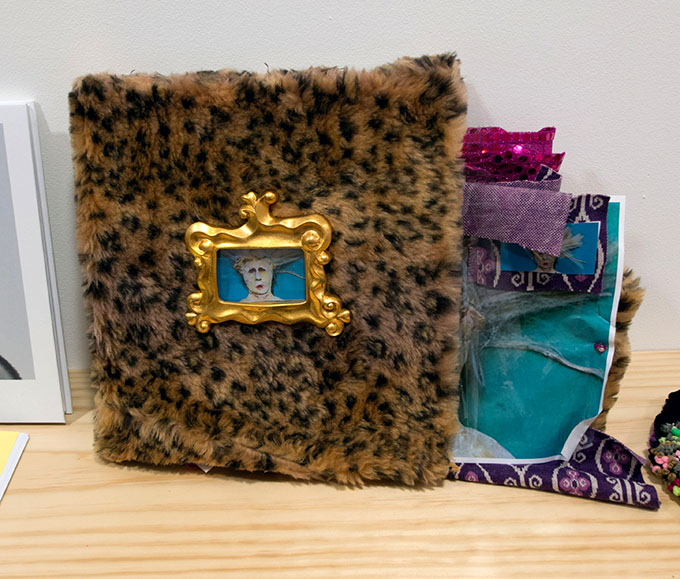
A book by Dianne Dickson
Artists’ books typify this interest in non-objectivity and reflect the internal contradictions of such an ideal in a particular way. In contrast to the traditional “livre d’artistes” of deluxe editions, artists’ books are usually inexpensively produced and sold. They are affordable, accessible and as plebeian as an art object can be. In fact they are almost too exemplary of the non-objective ideal.
As books they are not commercially viable simply because they defy the expectations of a mass market by presenting avant-garde information. Yet they have few patrons in the art world because their affordability to the public represents a low profit for a dealer. Also, books can not [sic] be viewed in the same way as other art objects; they must be held in one’s own hands and read. It is remarkable then that despite the contradictions and foils of art’s survival, artists’ books have become such a highly evolved genre of contemporary art, as evidenced by the works in this exhibition.
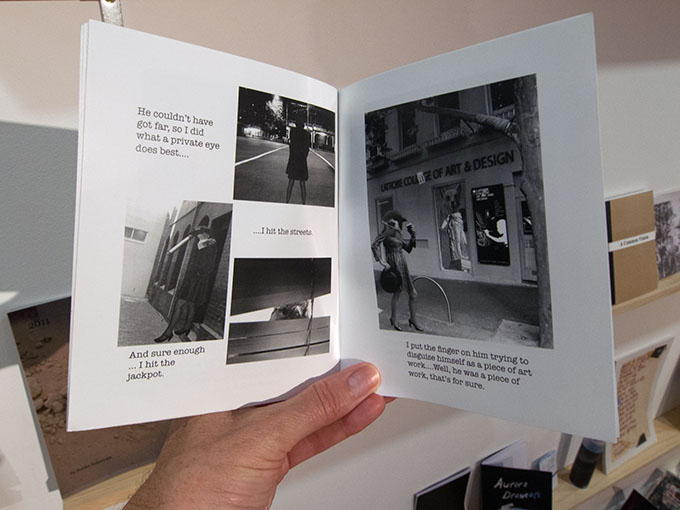
Suzannah Griffith’s While The City Sleeps
.
To illustrate means to make something clear by example, or to adorn a book with pictures. Within a publication, an illustration can be a picture, a drawing, a photograph, a design, or an ornament. Illustration is, of course, a prominent element in all mass media publishing. To consider all illustrations as a single genre is, in a way, quite boggling. It means imagining all magazines in the world and all the printed pictures.
With this imagining I try to analyze these pictures but have only an individual response to guide me. In principle my inquiries and suggestions are all subjective, my curiosity is intuitive, my critical remarks are speculative. These habits of mind and predilections constitute the trail of my argument. Because illustration operates as such an enormous social phenomenon, it is difficult to grasp its total meaning as a genre. It is too huge a concept. Yet paradoxically, all is intimately familiar.
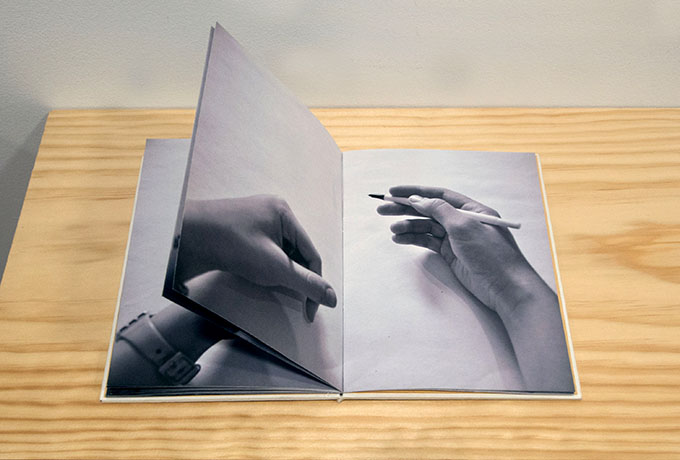
Sarah McConnell’s 29 2011
Practically everyone looks through magazines, sees the pictures, knows what they mean. But try to separate yourself from a simple recognition of the picture and examine the picture as a conceptual model and you may understand how difficult it can be. An illustration is not simply a picture of an object or thing. In that object’s absence a picture is a way of visualizing it, recalling it or conjuring it. Then all together the medium of illustration is a way of visualizing the world. As illustration is a mass medium, it is certainly a very powerful and influential instrument of ideas. As a conceptual model, a picture is showing us how to think and what to think about.
Art characteristically departs from conventions. In leading the way from these conventions and artists can end up revealing and/or inventing upon a given culture, popular or otherwise. Furthermore, the artists’ books in this exhibition occupy a middle ground between the hermetic region of high art and the mass culture of popular illustration. They also embody a comparison between the two; they have been produced as a way of participating (in theory at least) in the mainstream of popular culture at the same time as they are an extension of art, extending beyond galleries and museums, and outside of the realm of the rarified art object.
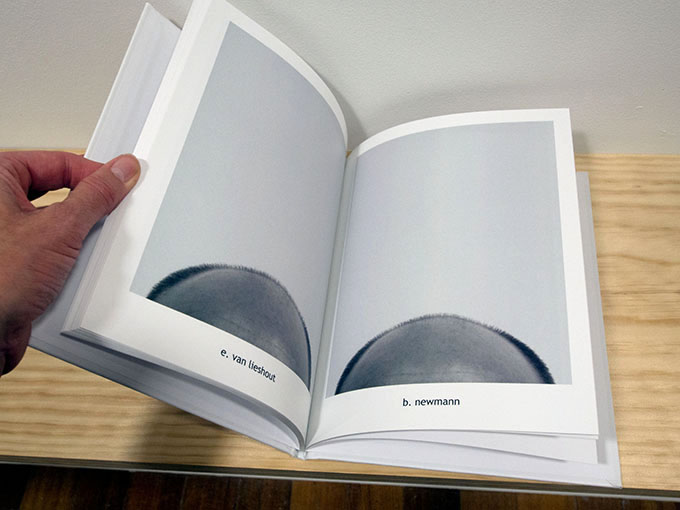
Jon Hewitt’s feel the confidence 2011
It may be noted that the photo works included in the exhibition are not photography books in the usual sense. For example in some books, the artist has exchanged the customary fine detail and high quality printing found in most art photography books for the flat, grainy, aesthetic of newswire or snapshot photographs, with all their vernacular associations. In other books the artist may manipulate the photographic frame by cropping it tightly to draw attention to narrative details or expanding it to the edge of the page for a window effect. Some books here constitute a repertoire of personalities through a wide array of photographic self-portraits. Others are collections of images specific thematic subject matter which suggests an interpretation of the complex meanings of culture and its institutions through the examination of its artifacts.
.
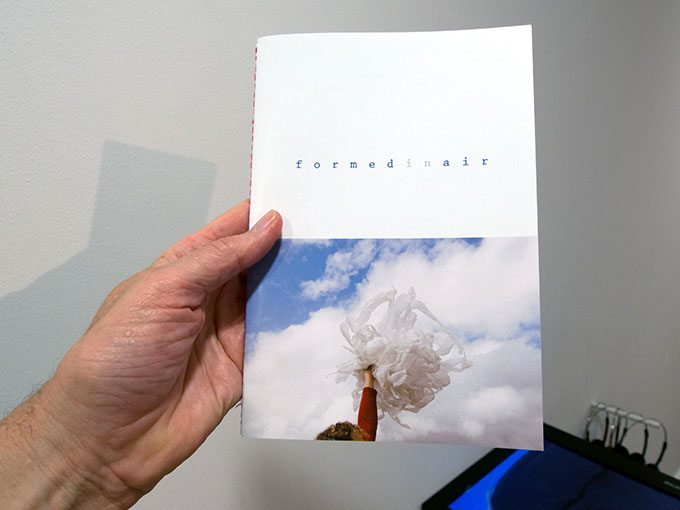
Yasmin Heisler’s formed in air 2014
In opposition to the conventions of art photography, which dictate an aesthetic around the “integrity” of an individual print, these photo books, to some extent, are each engaged with the qualities inherent in reproduction by offset and other printing processes. The artists represented in this exhibition are utilizing photographs as something other than a clear, well-composed picture. In their books they manipulate the “natural reality” of photographs and so inform our recognition of photographic images with their mannered inventiveness.
There are also a few books included here which are constructed sculpturally to introduce a tactile sensation to the fingertips and so expand the act of reading illustrations into the field of sensory awareness.
.
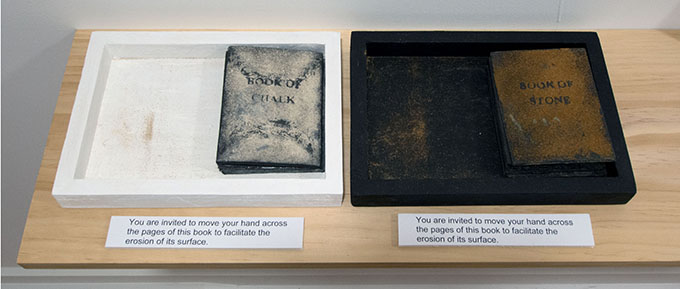
Bridget Hillebrand’s Book of Chalk 2014 and Book of Stone 2014
Finally, just as the works in this exhibition are included towards an exploration of the social and aesthetic attributes of illustration, they also demonstrate a way of looking at and experiencing the world. Theses artist’s books reveal and embody a way of reading deeply into they dimensions of contemporary culture. As much as they foster an incipient consciousness they ask for sensitivity on the part of the reader.
.
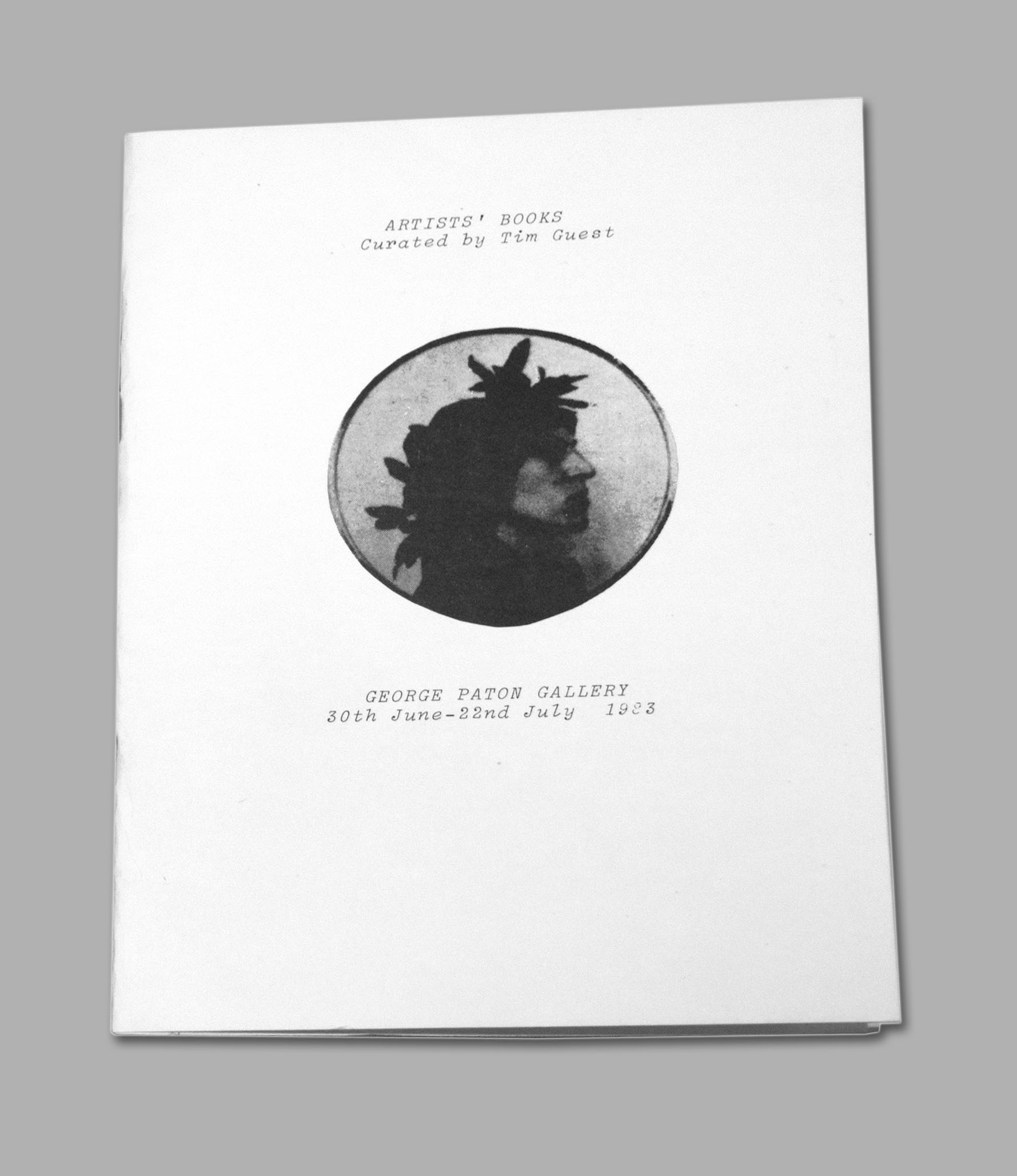
Tim Guest, the catalogue for the 1982 George Paton Gallery Artist’s Books and Not (e) Book!
These words come from Tim Guest, the curator for the 1982 George Paton Gallery Artist’s Books and Not (e) Book! A copy of his catalogue for the show was made available at the exhibition. Guest’s commentary is as relevant today as it was in the early 1980s, and while we have moved on, and now view the artists’ book works of that time with a degree of comfort and acceptance, the new artists’ book works continue, as Guest points out to, ‘demonstrate a way of looking at and experiencing the world’. For me it emphatically confirms that artists’ book are still ‘edgy’ and still pushing limits.
Doug Spowart
September 5, 2014
DOWNLOAD the contemporary list of artists’ books gpg artists books list of works
DOWNLOAD the books on loan from the University of Melbourne ArtistsBooksloanselectionGPG2014 docx
.
.
Part of the associated activity for the show – an artists’ book making event outside the gallery led by Michele and Laine. It was a a sunny and warm late winter’s day in Melbourne.
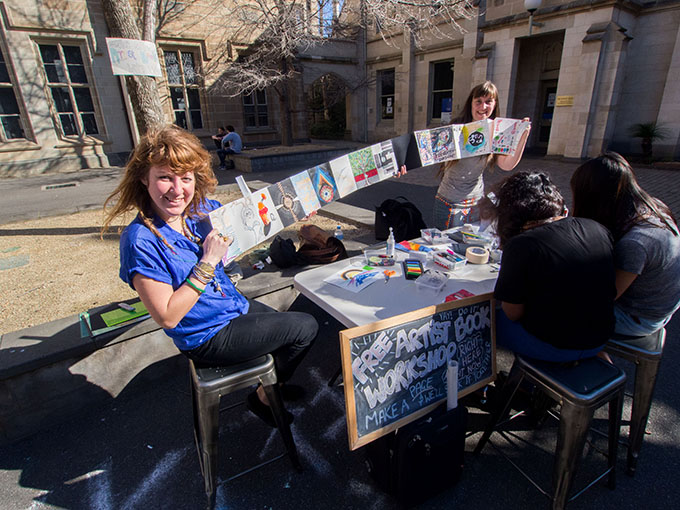
Michele Grimston and Laine Stewart and their Free Artist’s Book activity
.
.
.
.
SELECTING AN APPA PHOTOBOOK DISPLAY
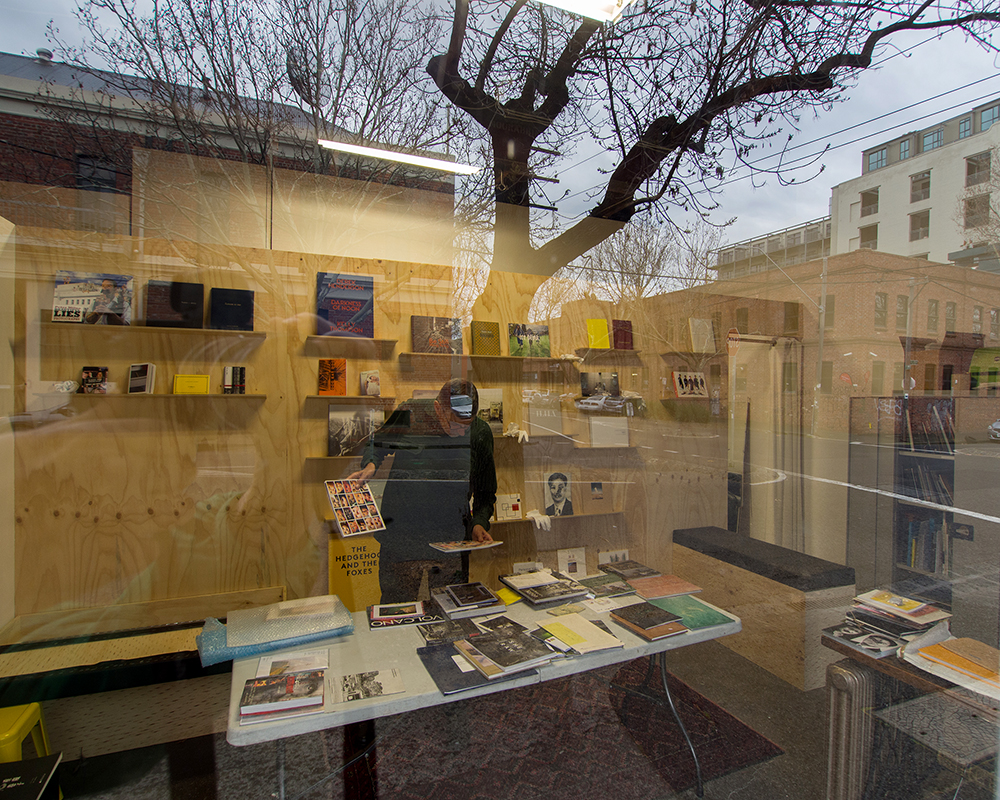
Doug in the APPA space working thru the books on a cold Melbourne winter’s day PHOTO: Victoria Cooper
.
Selecting photobooks @ APPA: A methodology and the list.
I was recently given the opportunity to select books from the Asia Pacific Photobook Archive for their wall display over the next month. While selecting a book to look at and buy in a bookshop can be a challenging enough, the task to review the archive and select around 30 books was daunting. I figured that I needed a methodology.
.
After some thought I put my ideas to Victoria Cooper, photomonteur Peter Lyssiotis, and APPA Director Daniel Boetker-Smith – here’s what we came up with:
- that I’d attempt to make a book array that mirrors the Asia Pacific geographical region
- that I’d select work that was reasonably contemporary
- that the names of the book makers would not unnecessarily bias my selection (interestingly the photographers of books from locations like China, Japan and south east Asia were quite unknown to me)
- that where possible I would select photographers working on their subject matter relating to their own country (the books of some localities were made by visiting photographers).
I wasn’t just going to look at books. As I reached out for, and held each book, I’d consider it as an object, feel its presence and weight, the tactile and sensory experience of the thing. Then I’d engage with its mechanical properties of turning the pages and becoming acquainted with it as a communicative device. In this the following would be considered:
- layout
- typography
- images and their sequencing
- paper, production and binding methods
- it as a narrative form.
In the final moments of engagement with the book I’d need to make a judgment call – was it successful? Whatever that may be? I am a firm believer in Roland Barthes’ proposition that the moment a written piece, I would say a book, is passed to others to read/view that the ‘author dies’ and that the ‘reader is born’. So, as the reader, I was to make the following decisions. I should note that towards the final stages of geographical assemblage I called upon Daniel and his extensive knowledge, to suggest books from, or about specific areas to be considered by me for inclusion.
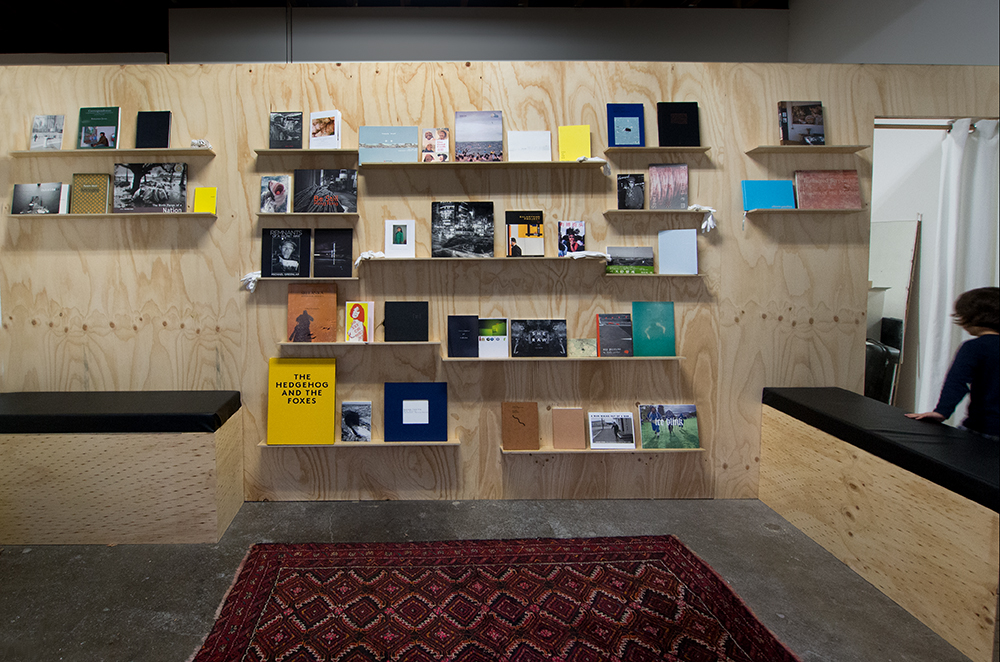
The Doug Spowart APPA Selection
.
.
Here is selection of the geographic locations, their makers and the titles:
Dubai/Surfers Paradise – Sean Fennessy ‘Gold’
Iran/Australia – Katayoun Javan ‘Correspondences: A photographic journey between past/Iran & present/Australia’
India – Munem Wasif ‘Belonging’
India – Pablo Bartholomew ‘Outside In’
Bangladesh – Shahidul Alam ‘The Birth Pangs of a Nation’
.
.
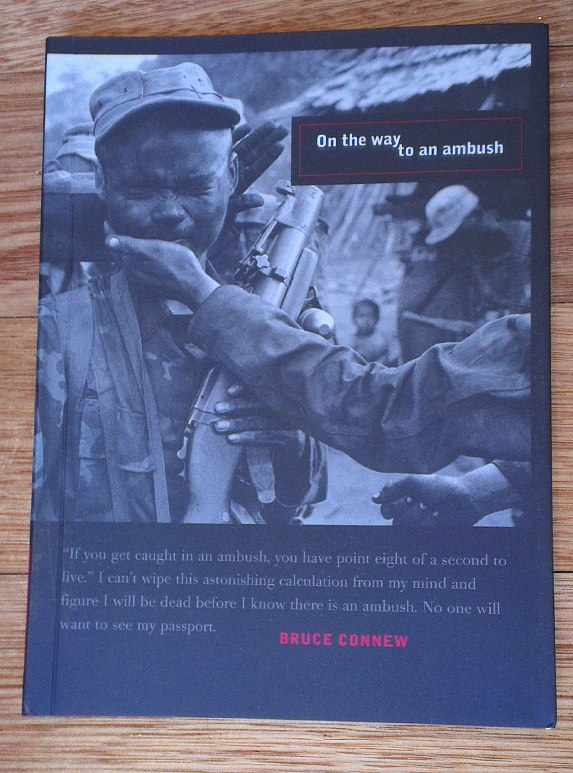
Burma – Bruce Connew ‘On the way to an ambush’
Cambodia – Isabella Capzio ‘Where the water once was: Boeung Kat Lake Phnom Penh
Thailand – Hiro Imai ‘Bangkok’
Thailand – Miti Ruangkritya ‘Thai Politics no.2’
Laos – Michael Greenlar ‘Remnants of a secret war’
Malaysia – Welan Chong ‘Please mind the gap: Singapore’
Hong Kong – Douglas Khoo ‘Be Still Hong Kong’
Sri Lanka – Nihal Fernando ‘Sri Lanka: A personal Journey’
China – Huang Qingjun & Ma Hongjie ‘Family Stuff’
.
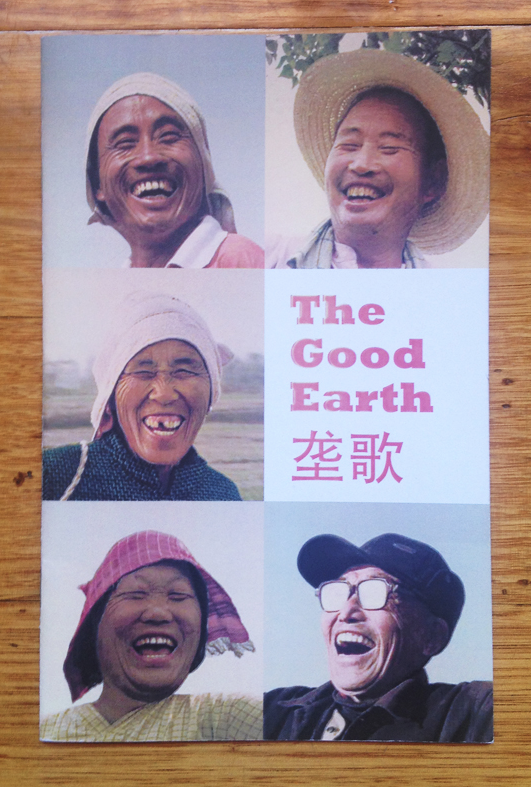
China – Li Kejun ‘The Good Earth’
China – Zhang Xiao ‘Coastline’ (?)
China – ‘Lens on Wesi Lake’
China – Vincci Huang ‘Eyes in the air’
.
.
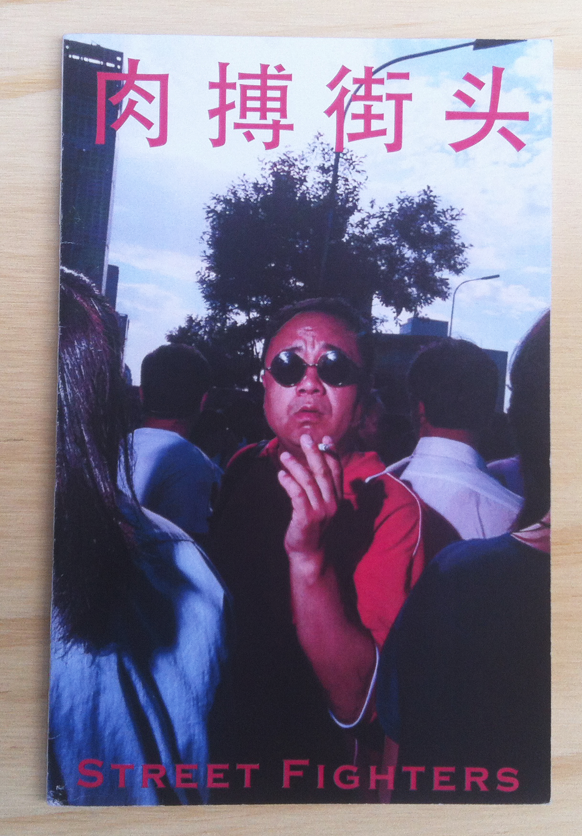
China – Wu Chenghuan ‘Street Fighters’ Beijing
Taiwan – Paul Koolher ‘Political Chaos’
Japan – Bruno Quinquet ‘Salaryman Project: Business Schedule’
Japan – Chie Murakami ‘Japanese Girl’
Japan – Sun Yanchu ‘Obsessed’
Japan – Big book Japanese cities
Japan – Saori Ninomiya ‘Requiem’.
.
.
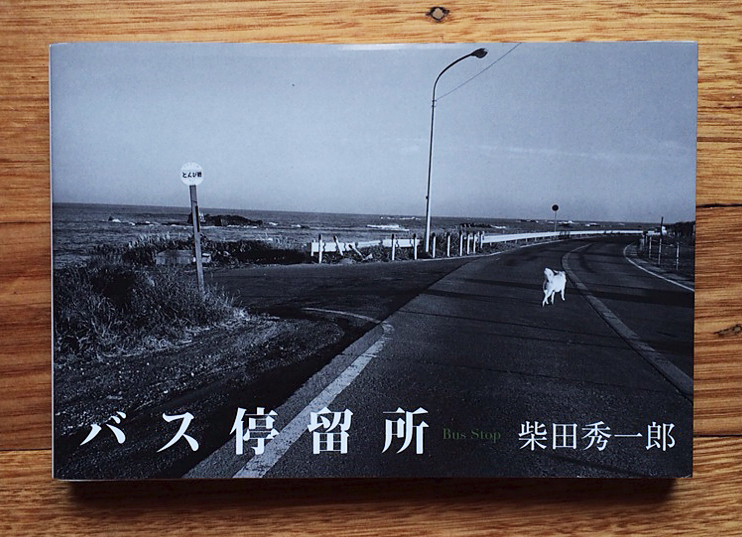
Japan – Shuichiro Shibata ‘Bus Stop’
Japan – Zhao Renbui & Satoshi Katnoku ‘The whiteness of a whale: a project with The Institute of Critical Zoologists’
West Coast American book
Canadian book
Philippines – Dina Gadia ‘Buxxxom Grind’
South Pacific region – Monini Chandra ‘Album Pacifica’
Mexico – Isabella Capezio ‘Feathered Serpents & Visions of the Mother’
Australia – George Voulgaropoulos ‘Children of Auburn’
Australia – [n]
Australia – Emma Phillips ‘Volcán’ (Variant ?)
Australia – Lilli Waters ‘She Raw’
Australia – Ingvar Kenne ‘The Hedgehog and the Foxes’
Australia – Melissa Deerson (Coordinated) ‘Docklands Field Trip’ Melbourne
.
.
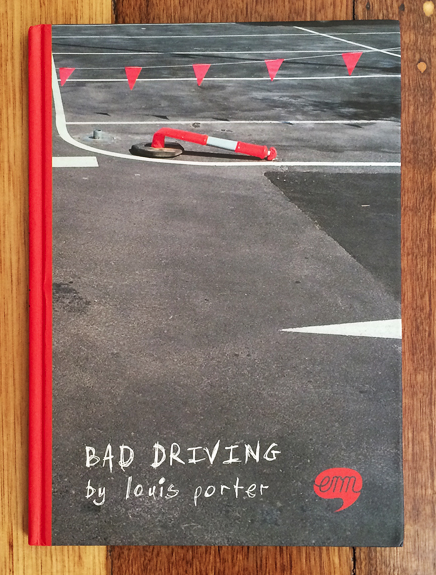
Australia – Louis Porter ‘Bad Driving’
New Zealand – David Cook, Wiramu Puke and Jenty Valentine ‘River–Road: Journeys Through Ecology’
New Zealand – Solomon Mortimer ‘Solomon’s Travels: Volume One 2012’
New Zealand – Lucien Rizos ‘A man walks out of a bar: New Zealand photographs 1979-1982’
.
.
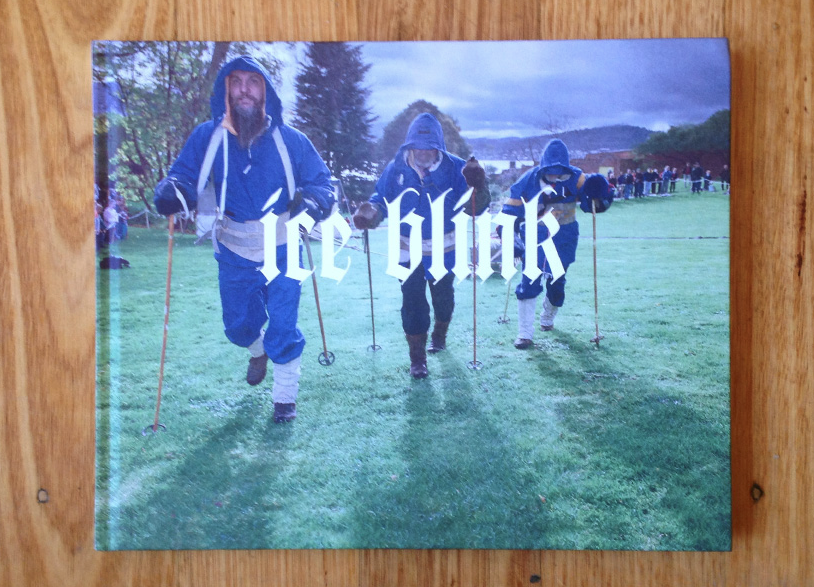
Antarctica – Ann Noble ‘Ice Blink’
END OF LIST (Some books are not listed here…)
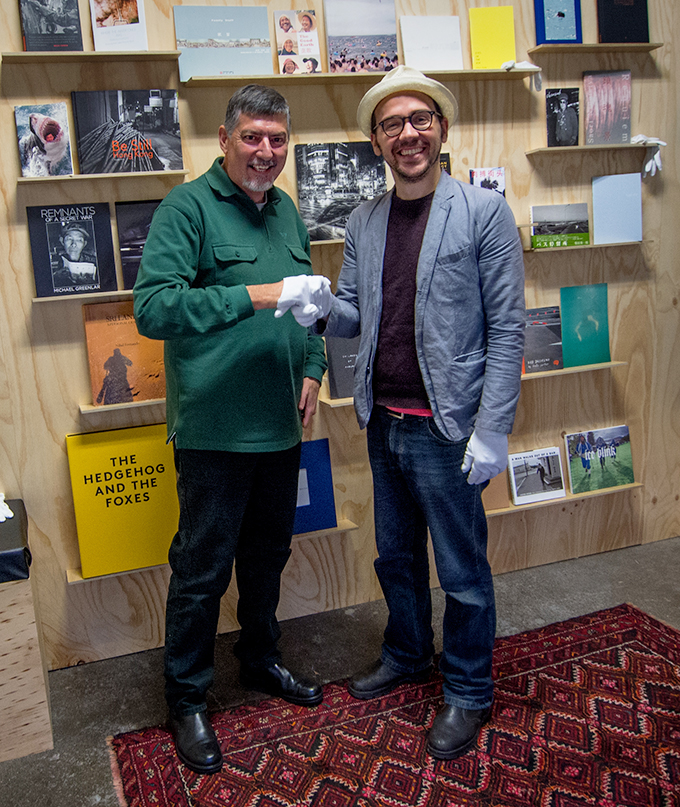
Doug and APPA Director Daniel Boetker-Smith PHOTO: Victoria Cooper
.
Thanks must go to Daniel’s ongoing support of this project and making this resource available for us all — And also thanks to the photographers for contributing to the archive.
Cheers Doug
.
APPA Sign
BOOKS AS ART: 30 YEARS IN THE MAKING – Catherine McCue Boes
BOOKS AS ART: 30 YEARS IN THE MAKING by Catherine McCue Boes
Bundaberg Regional Art Gallery – 14 May – June 29, 2014
.
An observation of artists and artmaking in the regions…
.
Artmaking and artists from the regions are constantly sidelined by the power of proximity that pervades these ‘blessed’ centres of art and culture. People who make ‘real art’, it seems, come from places where populations are concentrated, like ‘big cities’ or localities where a place of learning (university) or an uber vibrant arts community exists. In Australia the place names of Sydney, Melbourne, Adelaide, Hobart and perhaps Bris-vey-gas, are part of a roll call of significantly charged places for artmaking, presentation, commentary and critique. *[Note: artists’ books have a wider community of practice that is more inclusive due to the fact that regional centres tend to present events, awards and workshops that bring the city and country together. SEE https://wotwedid.com/2013/05/13/2013-libris-awards-the-judges-view/]
.
With this in mind, then consider my surprise when I recently encountered an exhibition of artists books at the Bundaberg Regional Art Gallery. The main gallery held one of the largest exhibitions of artists books I’ve seen for some time. The show was more impressive because it was essentially the book works of one person with additional books by others coming from the artist’s collection. The exhibition, entitled Book as art: 30 years in the making, was by Catherine McCue Boes a local Bundaberg artist. As the title implies the exhibition encompasses a significant period of time and the life of the artist.
.
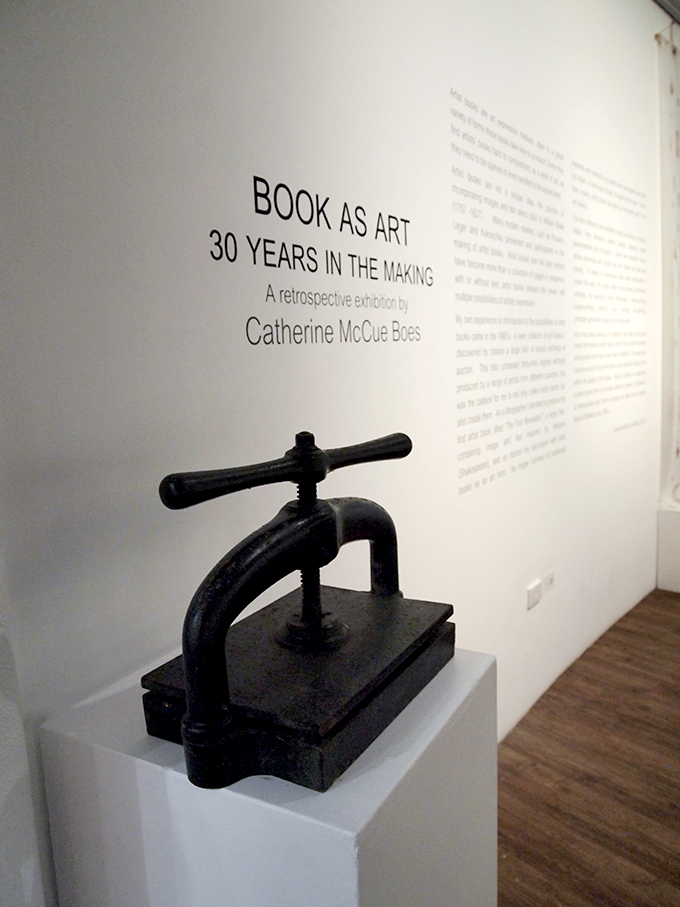
Exhibition frontpiece
.
Engaging with the artists books on display was a challenge – I walked around the space, glancing at and visually grazing the works on display. In keeping with the gallery display norm for artists book display the books were not for touching with many in vitrine glassed cages. Many books were the concertina form that allowed for easy reading and connection with the narrative. The artist also presented alongside the books wall works to give the reader an idea of the contents of the book.
.

Exhibition installation of Books as art: 30 years in the making
.
After my initial viewing, the sheer volume of the work on display and the demands that such a volume of complex and at times conceptually dense places on the viewer, I had to go away and come back to the gallery for a second viewing.
On my return I was drawn to a number of the accessible concertina books. The first of was, In Paris 2012, which dealt with the artist’s personal experience of walking in Paris and the extraordinary things experienced. The book’s plain white paper surface is inscribed with diaristic jottings, a quick unfinished drawing of the Eiffel Tower, a textural pattern element, and deep-etched monochrome photographs of sculptures and architectural details. A pink abstracted form with a pigment-bled edge repeats over many pages – is it a memory of a figure walking in the rain with an umbrella or is it a self-portrait?
.
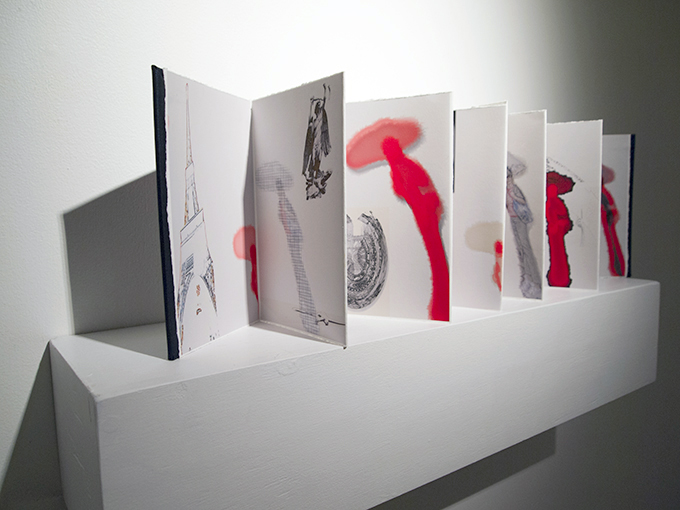
In Paris 2012, Catherine McCue Boes
.
In another work, Preserved in Australia, an old Kodak folding camera has the concertina bellows extended ready for use. Spilling from the rear of the camera explodes a concertina of 20 or so images attached to the viewing hood. The book is derived from a period of time where the artist worked in Roebourne in Australia’s north west. The photos are from the early 1900s, loaned by their owners – residents from Roebourne as well as from the local Historical Museum. McCue Boes has metamorphosed the camera and it’s image legacy into a device for viewing history.
.
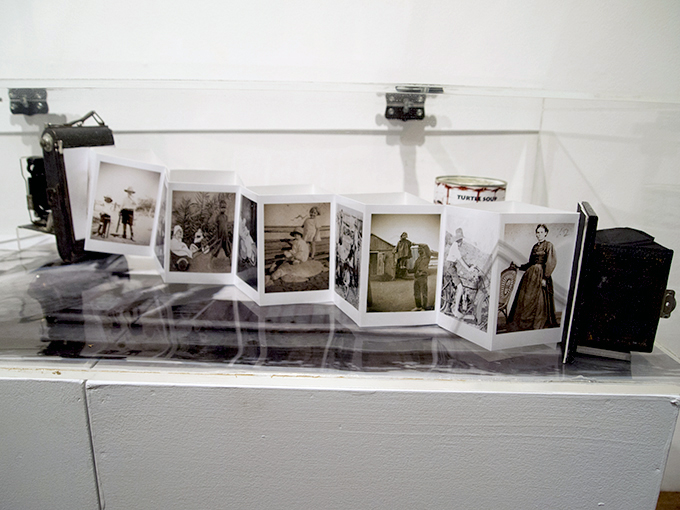
Preserved in Australia, Catherine McCue Boes
.
An early book, First Revolution (Macbeth) Lithographs 1989, represents the artist’s reference to the Shakespearian theatrical character of the same name. These stone lithographs are accompanied by screen-printed texts on the verso page. In the style of the livre d’artist this large format book with it’s thick deck-edged pages and codex binding make it a strident piece of work. Whilst the book is firmly enclosed in a vitrine and opened to one page only, individual prints from other pages of the book are presented as a framed artworks on the wall.
The First Revolution is also referential to the artist’s major influence, an 1800s book of rococo etchings she discovered in the 1980s and bought at an auction. She states in the exhibition materials that: ‘this was the catalyst for me to not only collect artist books but also create them’. The binding, its construction, materials and its red covering are echoed in many works.
.
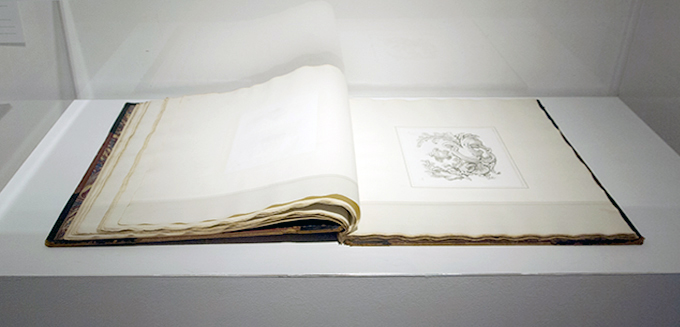
A New Book of Shields 1770-1800
.
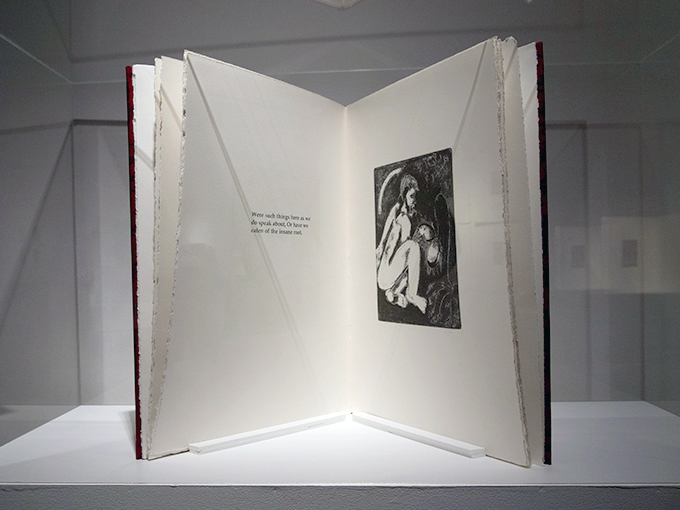
First Revolution (Macbeth) Lithographs 1989, Catherine McCue Boes
The hybrid mix of traditional printmaking and digital techniques creates an opportunity for McCue Boes to extend the artist’s vision and the nature of the outcome. In the 2005 book The Red Shoes, Mark 3 the artist references the Hans Christian Anderson children’s story of the same title. Seven linocuts have been enhanced through scanning into the computer, being redrawn and with text added – the result is a blending of the tradition of print with the graphic elements of typography to convey the story.
Catherine McCue Boes works with other artists in international mail art projects that are presented in another section of the exhibition. A collaborative work curated by the artist, entitled, Life Line, Flood project 2014, brings us back to the idea of the artist’s work being affected by the places they come from. In 2013 devastating floods inundated Bundaberg and upper reaches of the Burnett River. The swollen river gouged out land, animals, houses, trees and farms and significantly affected the land and people of the whole region. McCue Boes curated a collection of photos and texts from friends and assembled a concertina book that carries the sentiments of the contributors. The book is a narrative of many voices with text and image carrying the emotion and the spirit of the contributors. Art often has a dual role, that of the healing catharsis and also to present accounts that can inform those who did not witness the grief first-hand. While this work may be a little uneven in its attempt to blend the individual contributions it is profoundly successful in its purpose and outcome.
Working around to other books in the show a persistent source of inspiration is the artist’s surroundings and environment. I’m reminded of Lucy Lippard’s statement that: ‘Everybody comes from someplace, and the places we come from–cherished or rejected–inevitably affect our work[i]’. This is most notable in a body of work arranged on an island-like plinth towards the rear of the gallery. Assembled is a collection of books that relate to mining environments. McCue Boes works with photographic images, irony and conceptual play to present a variety of book forms and commentaries.
The book, Inspiration from the Artificial Environment 2012, consists of 16 photographic images and borders printed on canvas that are presented in a form that mimics wallpaper, soft furnishing and curtain material sample books. The patterns are photo elements flipped and flopped to form plausible, although somewhat 1960s dated looking designs for decorating your home. The reality of the source images is that they are the detritus of mining workspaces and consist of rusting drums, cable, pipes waste and pondage.
.
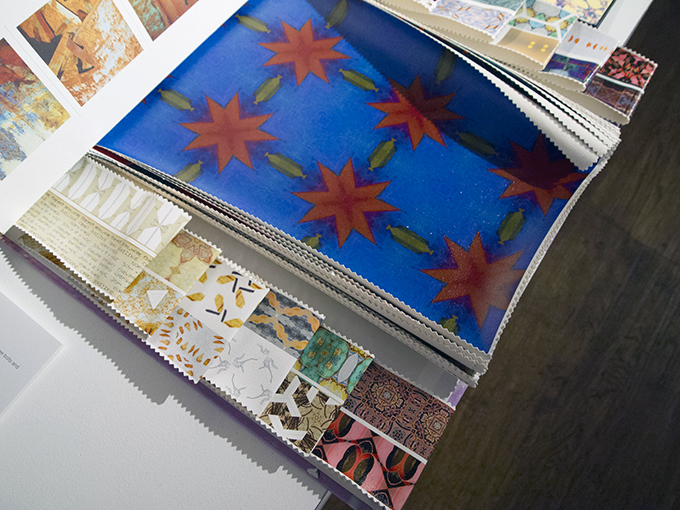
Inspiration from the Artificial Environment 2012, Catherine McCue Boes
.
Other books, some that are more book-like sculptural forms, are part of this body of work. Presentation includes commercial boxes, simulated strips of black and white negatives, abstracted photographs and industrial labels – one stating, ‘Danger – This energy source has been LOCKED-OUT’.
.
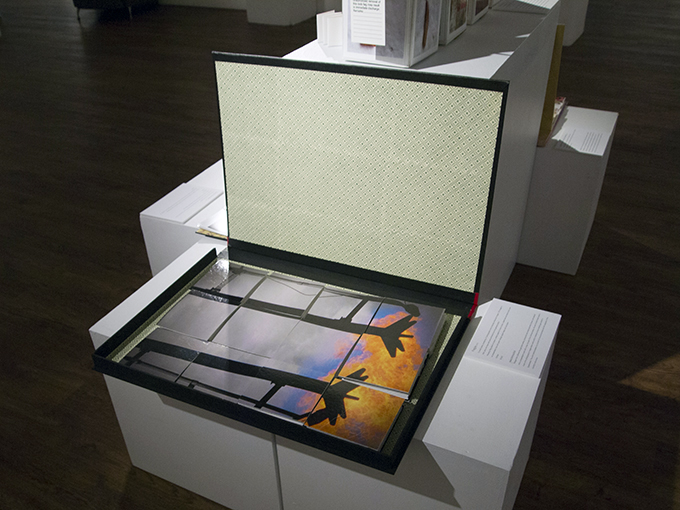
Fragile 2012, Catherine McCue Boes
.A major contribution to this environmentally themed piece is the book/s, Fragile 2012, which is a collection of 12 small concertina books each containing 10 photographs. When assembled the covers create a full-sized image of flaming torch-like structures. The unsuspecting viewer may encounter these little photobooks as a pleasant visual wander through shapes, forms and colours. However the artist has seductively blind-sighted the viewer – these are not pretty and benign subjects. The accompanying didactic explains the photographs were made while participating in an artist in residence in a gas mining plant in Queensland. The artist adds to the didactic that: ‘The work demonstrates my concern for the environment and the depletion of the country’s resources.’
A position pervades many works in the show and I’m reminded of Lucy Lippard’s closing comment in the catalogue for the exhibition Weather Report: Art and Climate Change, where she speaks of the artist as a commentator, communicator and as one who acts as a provocateur. Lippard proposes, ‘… it is the artist’s job to teach us how to see.’ (Lippard 2007:11) Through these works McCue Boes is as an artist ‘teaching us to see’. The strength of her communiqué in these political works is achieved through with irony and humour, and the association with reality of the photographic image.
Books as Art: 30 years in the making is not an exhibition about art, or about making, or even about books. It is an exhibition about the very stuff of life and the human experience of the world – an experience that needs to be shared.
.

Portrait: Catherine McCue-Bowes
.
I’ve made a note also about the importance of proximity in regional centres as well – the ‘big city’ should come visiting sometime. They may be amazed!
Doug Spowart
July 28, 2014
VISIT CATHERINE McCUE BOES Website: http://catherinemccue.blogspot.com.au/
.
Reference:
[i] Lippard, L. R. (1997). The Lure of the Local: Sense of Place in a Multicentered Society. New York, The New Press. P36.
.
Review text © 2014 Doug Spowart
All photographs © 2014 Doug Spowart
.

This work is licensed under a Creative Commons Attribution-NonCommercial-NoDerivs 3.0 Unported License.
.
.
DOUG is 2014 Siganto Foundation Artists’ Book Research Fellow
.
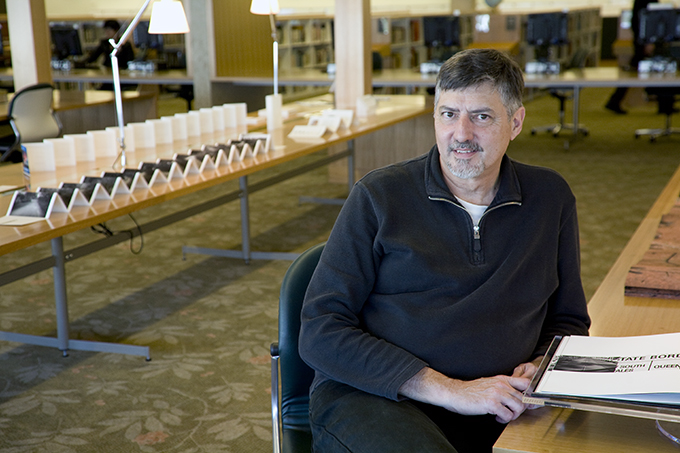
Doug Spowart @ the State Library of Queensland
.
About the 2014 Siganto Foundation Artists’ Book Research Fellowship from the application details:
The Siganto Foundation Artists’ Books Research Fellowship, proudly supported by the Siganto Foundation, is to be used by an individual to undertake original research on one aspect of artists’ book practice, theory or history, making use of the resources contained within the collections of the State Library of Queensland’s Australian Library of Art. Subject to this general consideration, State Library allows the Fellow to determine expenditure of the funds and may require the Fellow to account for the funds awarded.
About the research that I intend to undertake:
Today photographic expression is evolving to pervade all kinds of books by artists, artists–photographers, photographers and photographer-artists. Collections such as the Australian Library of Art at the State Library of Queensland become repositories for selected or exemplar works. In the Research Fellowship I intend to review the field of creative book production that utilises the photograph and consider what has been created to date and in the SLQ collection, as well as identify emergent trends.
As a significant repository of artists’ books, the State Library of Queensland’s Australian Library of Art is a pre-eminent location to carry out the proposed research. Additionally access to books contained in the State Library of Queensland’s general library collection and Zine collections will considerably add to the research.
Importantly the collection contains artists’ books created over a great number of years by a range of practitioners representing a broad range of practice. These books may encompass the full gamut of photograph usage in the book including approaches to the narrative carried by the book, the physical form of the book and the integration of the photograph into design, typographic and textural components.
This proposed research will define a process by which the uses of photography in the creative productions of artists’ books and photobooks can be defined and compared. In my recently completed PhD research on the topic of the artists’ book and the photobook, I identified the need for scholarly research on this evolving phenomenon.
My aims in this research are to create an approach to the development of a flexible and dynamic nomenclature for the photo and the book. This preliminary strategy will provide a way in which books from a variety of makers, media, structures and motivations can be compared. Ultimately this research will produce outcomes that approach a broader and topical view of artists’ books and photobooks to stimulate dialogue and debate.
The Fellowship will include blog posts on the SLQ site and an illustrated presentation at the 2015 Siganto Artists’ Books Seminar.
I am looking forward to the opportunity to research my favourite topic – books!
The Siganto Foundation Artists’ Books Creative Fellowship has been awarded to Jan Davis. Her project One thing becoming another: labour-infused artist’s books which investigate lives of toil in nineteenth and early twentieth century rural Queensland.
For more details see http://blogs.slq.qld.gov.au/ala/2014/07/18/2014-siganto-foundation-fellowships/
.
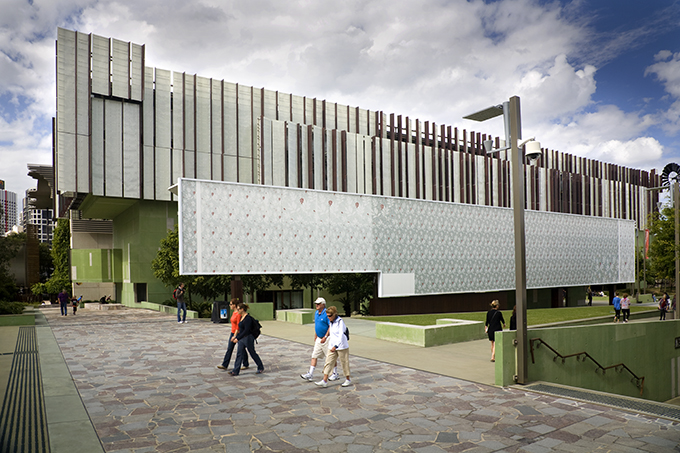
The State Library of Queensland Photo: ©2011 Doug Spowart
.
.
LANDSCAPE PHOTOGRAPHS ARE HISTORY: A book forward
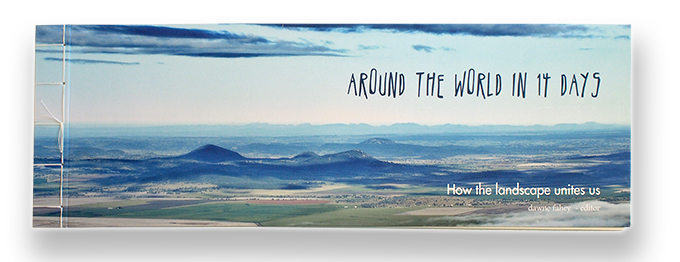
The book Around the world in 14 days
.
Recently I was asked to write an introduction for a limited edition book to compliment an exhibition of landscape photography entitled, Around the World in 14 Days: how the landscape unites us. The project featured seven contemporary Australian and international photographers, and was coordinated by Dawne Fahey of the FIER Institute with Sandy Edwards contributing to the image selection. The assembled body of work presented insights into how photographers ‘read the landscape, both visually and psychologically through their images.’
..
The photographs, created in Australia, Asia, New Zealand, USA and Colombia are intended to inspire viewers to consider how ‘elements effecting the landscape unite us, regardless of our differences or the distances that occur between us.’ Through the photographs there is also an intention that the ‘poetic fragments presented by the work will connect with the viewer’s own memories, experience, or sense of place.’
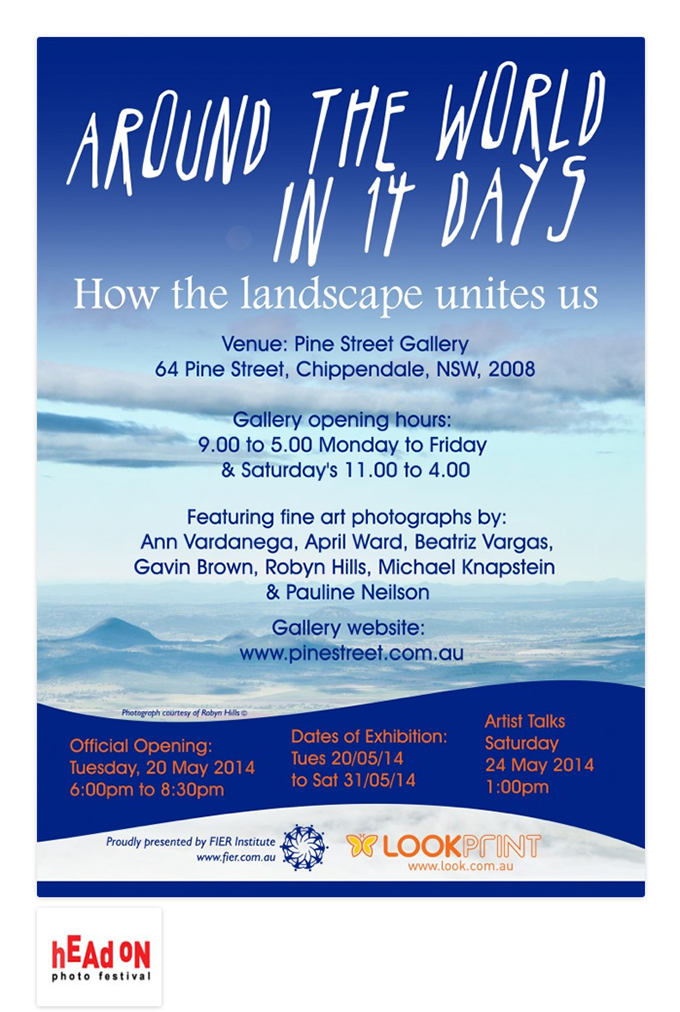
The exhibiting photographers are: Ann Vardanega (Australia), April Ward (Australia), Beatriz Vargas (Colombia), Gavin Brown (Australia), Michael Knapstein (USA), Robyn Hills (Australia) and Pauline Neilson (New Zealand) and the exhibition and book are on show at Pine Street Gallery, 64 Pine Street, Chippendale, Sydney until May 31, 2014.
See more at: http://www.pinestreet.com.au and http://fier.photium.com/around-the-world-in-14 – sthash.QPto0nz4.dpuf
The exhibition and book launch took place on May 20, 2014 at the gallery.
My essay discusses issues that relate to the premise of the exhibition as well as some personal observations of the idea of the photographer in the landscape. The essay is presented here and at the end of the post I have included a selection of images and installation photographs of the exhibition.
.
.
All landscape photographs are history
It is vain to dream of a wildness
distant from ourselves. There is none such.
In the bog of our brains and bowels, the
primitive vigor of Nature is in us, that inspires
that dream.
Henry David Thoreau, journal, August 30, 1856 [i]
Around sunset, Northern Territory time, a gathering of photographers will assemble in the central Australian desert and witness the now iconic sunset at Uluru. What they encounter will be a lived experience and there can be no doubt that cameras, both with and without telephony capability, will record the moment. Their images will bear metadata of the shutter speed, aperture, camera brand and model, the time, date and perhaps even its geolocation. These images will be cast into the Internet as evidence for friends and family to see – a private experience shared and made transferrable by technology.
What then of the subject of their gaze and activity – the landscape? For this rock in the desert, the next day will be a repeat of this photo ritual, and each day after, it will be repeated again and again. Does Uluru wait for its activation at each sunset and each shutter’s click? This landscape has experienced a few hundred million years of sunsets and its current fame as a photo celebrity, is a mere blip in its history. Every day will be different and thousands of days, well, not much change. However, today’s photograph, even a split second after its capture, is history.
For a number of years I have cultured the belief which was informed by a statement attributed to photographer Minor White: ‘No matter how slow the film, Spirit always stands still long enough for the photographer it has chosen.’[ii] My variation is that that landscape reveals itself to the photographer of its choosing. Writer and critic John Berger adds to this discussion by proposing that there is a ‘modern illusion concerning painting … is that the artist is a creator. Rather he is a receiver. What seems like creation is the act of giving form to what he has received.’[iii] Could it be then that the landscape is the director and commissioner of the image that the painter or the photographer makes, and that the photographer – the right photographer – is merely the vehicle for the landscape’s transformation of itself into an image?
Like portraits that have been made since the beginning of photography, and the documents of human endeavour, commerce, existence and experience – time, or rather the passage of time, has granted then their relegation to past. Each photograph in this book is then a history image. The moment and space depicted wrenched from the continuum of time by whatever forces brought together the photographer and the landscape. A landscape image at that moment of capture is at once the subject photographed and also a time machine. Viewed on its own by its maker the photograph can be a comfortable aide memoir, and operate just as a photo of a loved one or a family wedding would do in its frame on the mantelpiece – the photo exists, and so too the remembrance of subject it represents.
But photographs are more than things; they are experiences. Photographer Ansel Adams attributed special values and meaning to his landscape photographs and sought to represent the landscape as being more than what it was physically. Simon Schama in his book Landscape and Memory cites Adams as commenting that: ‘Half Dome [in Yosemite National Park] is just a piece of rock … There is some deep personal distillation of spirit and concept which moulds these earthy facts into some transcendental emotional and spiritual experience.’[iv] Adams inspired the American nation and created a tradition of environmentalism and black and white photography that continues today.
For Australian wilderness photographers Adams’ ‘emotion and spiritual’ connection with the landscape is salient. In the book Photography in Australia Helen Ennis discusses how photographers of this genre engage with their landscape subjects. She quotes Tasmanian photographer Peter Dombrovskis entering a ‘state of grace’ on bushwalks when, ‘days away from “civilization”, he felt what he described as, “a sense of spiritual connection with all around – from widest landscape to the smallest detail”’.[v] Ennis also comments that wilderness photographers use a range of techniques to ‘lift the experiences of viewing the photographs into a realm that goes beyond the human exigencies of normal daily life.’[vi]
In a book such as this, as we turn the pages, what is presented to us is the photographer’s concept or story encoded in visual form. As with Berger this may constitute the next generation of ‘giving and receiving’. They may have made the photograph/s with a specific objective in mind – a narrative angle, the idea of showing something that stirred them that they wanted to share – or – from the earlier discussion, what the subject wanted revealed. But in the space between the giver (the photographer and this book), and the receiver (you, the viewer), another hybrid narrative emerges. The photograph acts as a stimulus on the viewer and an idiosyncratic response is generated. Roland Barthes uses the term ‘detonate’ to describe being in front of a photograph. In Camera Lucida he comments that: ‘The photograph itself is no way animated, … but it animates me: this is what creates every adventure.’[vii]
In photographs we are not so much connected or united with the landscape, but rather the experience of the landscape and the trees, rivers, blades of grass and rocks that are represented in images. In effect we are united by the landscape of photography and the gift that we can share through it. We can then, through photographs enter into a Barthesian adventure. Perhaps these landscape photographs are more than history – they are: an experience shared, an unexpected encounter, an adventure. In your turning the pages – then pausing to view each group of images, to contemplate and consider the communiqué stimulated by them, these photographs become part of your history, your experience, and your adventure as well …
Dr Doug Spowart April 17, 2014
[i] Schama, S. (1995). Landscape and Memory. London, HarperCollins, epigraph, n.p.
[ii] http://www.johnpaulcaponigro.com/blog/12041/22-quotes-by-photographer-minor-white/
[iii] Berger, J. (2002). The Shape of a Pocket. London, Bloomsbury Publishing Plc, p.18.
[iv] Schama, S. (1995). Landscape and Memory. London, HarperCollins, p.9.
[v] Ennis, H. (2007). Exposures: Photography and Australia. London UK, Reaktion Books Ltd, p.68.
[vi] ibid.
[vii] Barthes, R. (1984). Camera Lucida. London, UK, Fontana Paperbacks, p.20.
.
The exhibition invitation
.
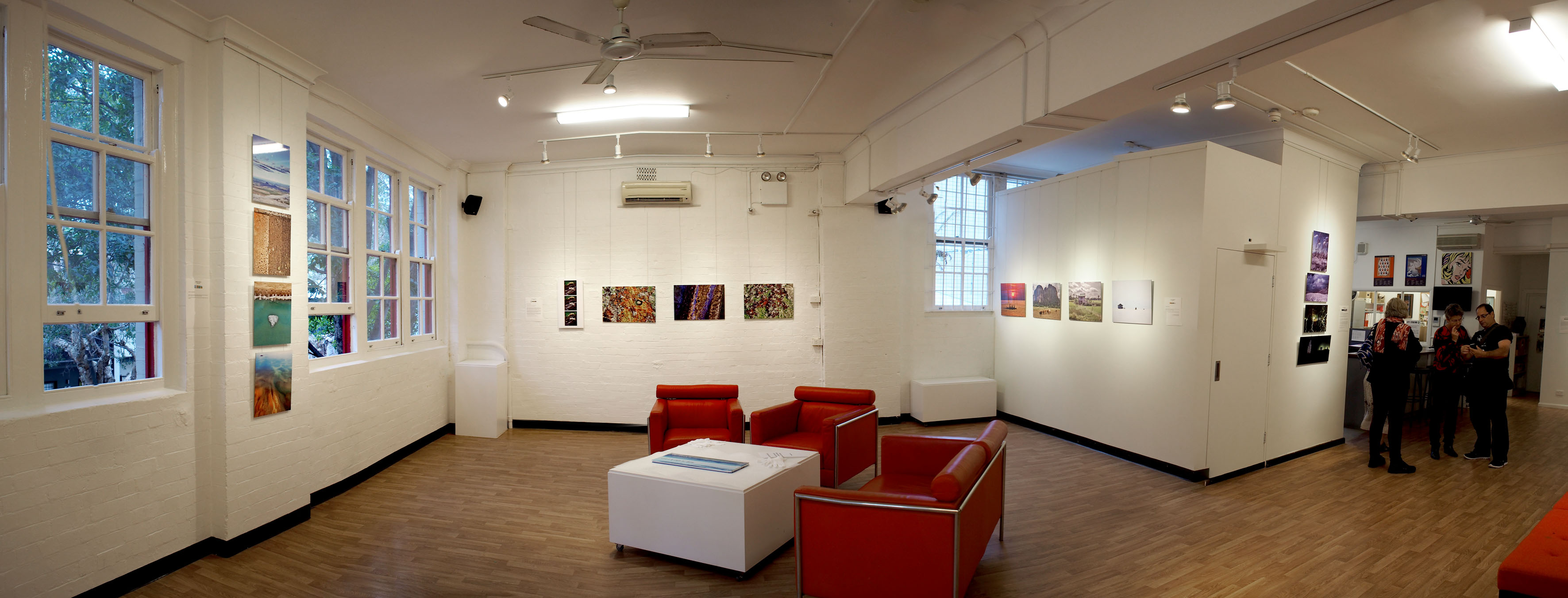
The exhibition in the Pine Street Gallery
.
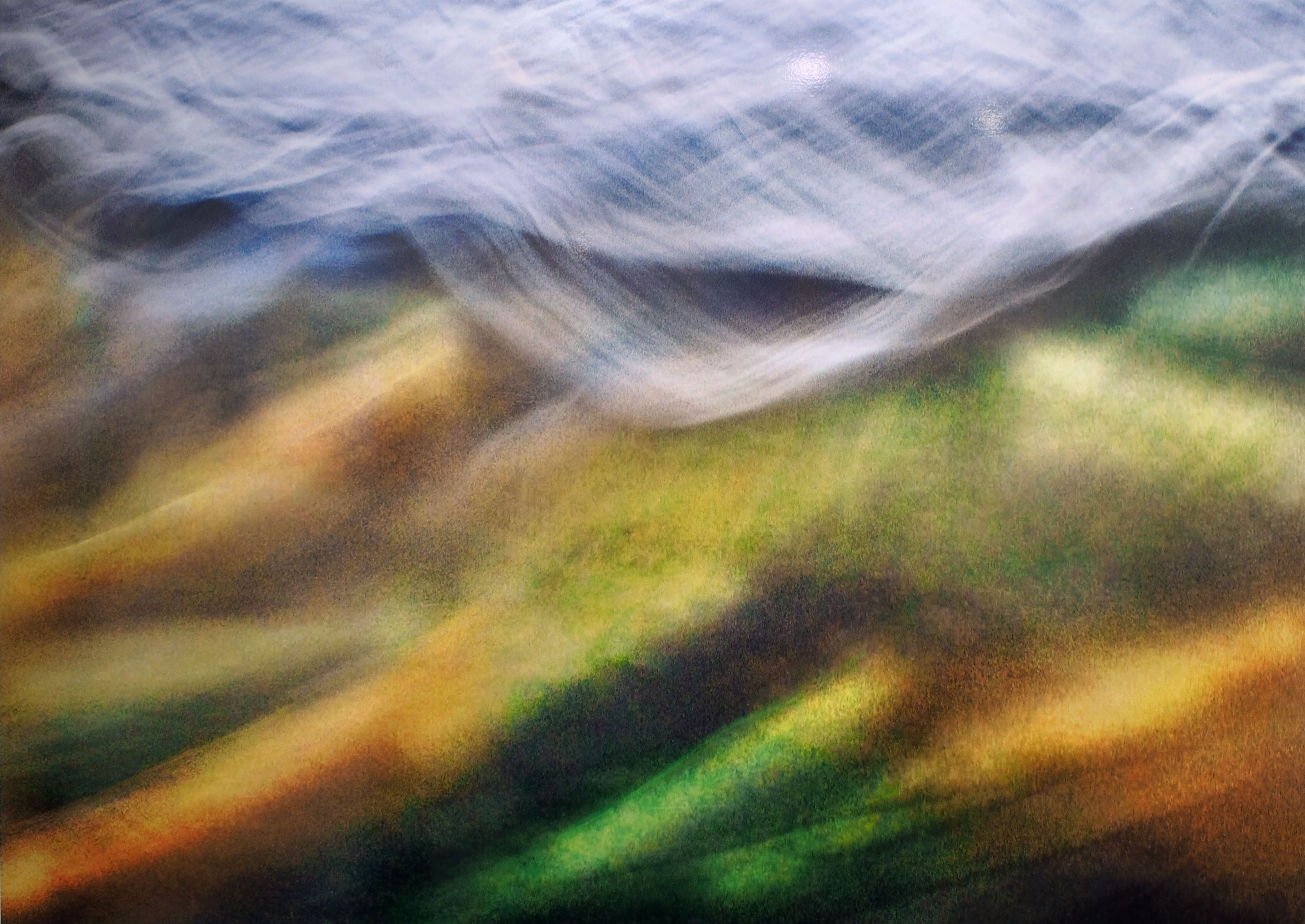
A photograph by Pauline Neilsen
.
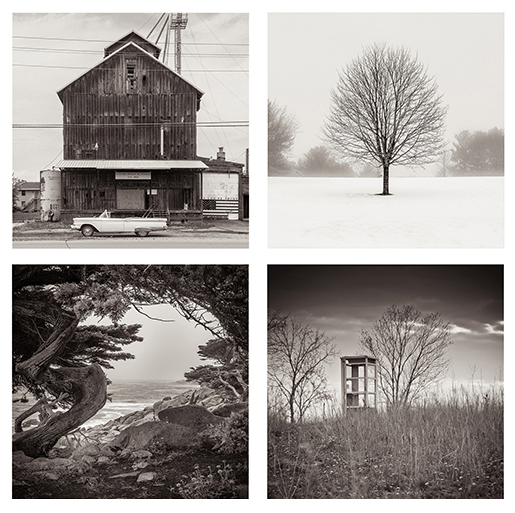
Four photographs by Michael Knapstein
.
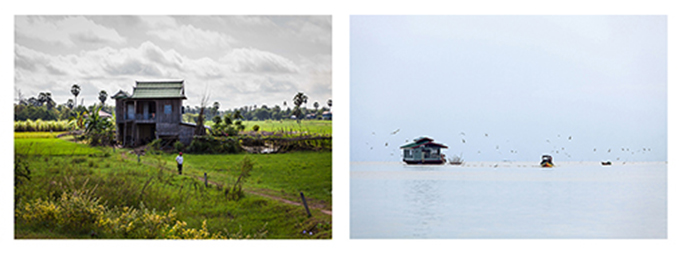
Two photographs by Gavin Brown
.
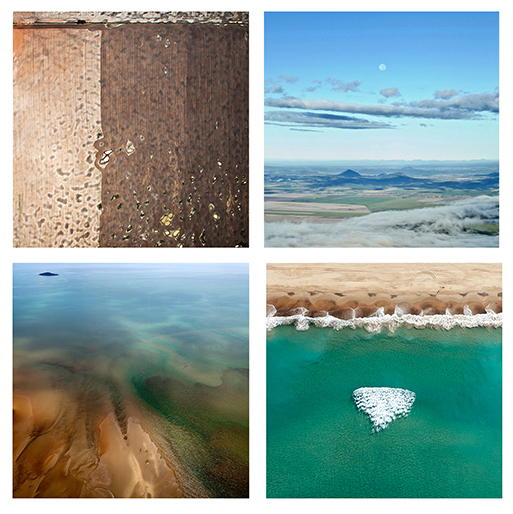
Four photographs by Robyn Hills
.
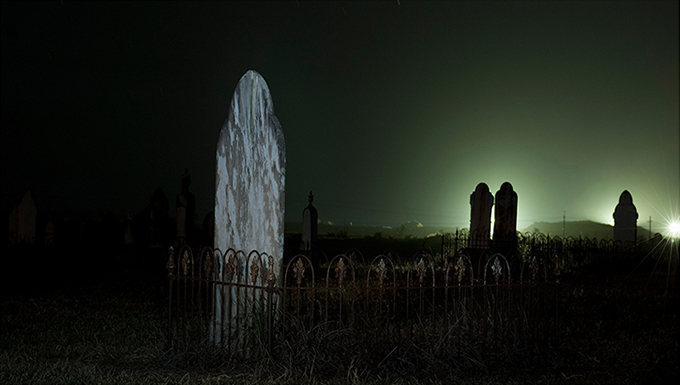
A photograph by Ann Vardanega
.
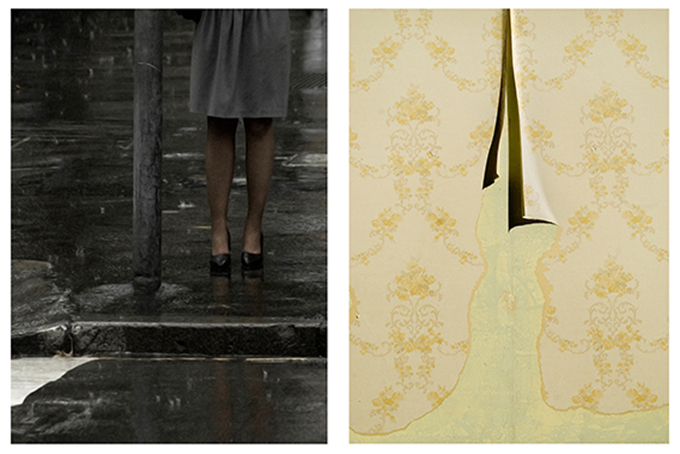
Two photographs by April Ward
.
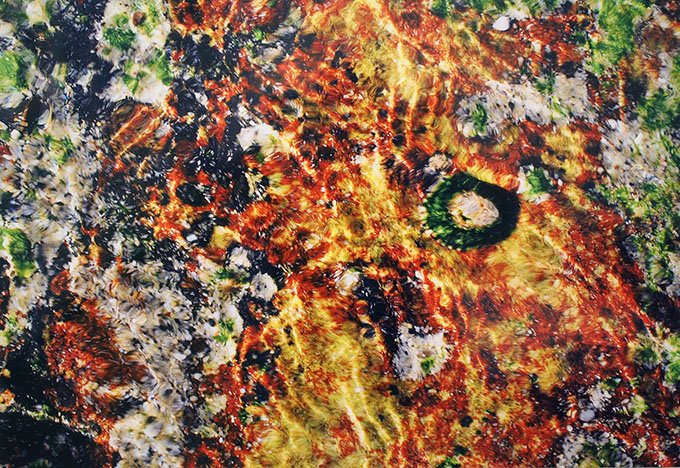
A photograph by Beatriz Vargas
.
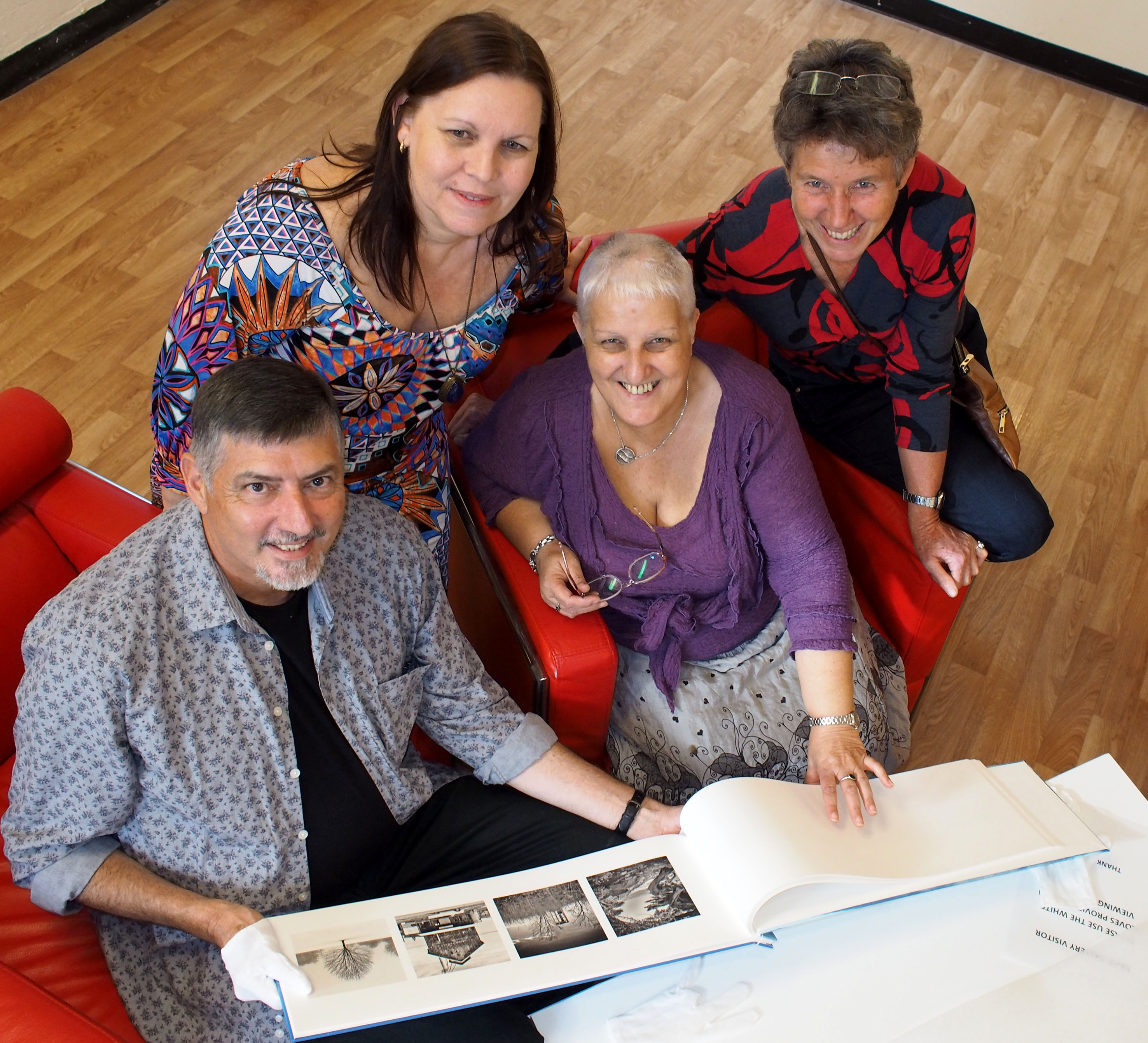
Doug Spowart with Ann Vardanega, Dawne Fahey and Pauline Neilsen
.
.
.
.
The photographers retain all copyright in their photographs. Some texts are derived from exhibition documents. Text and installation photographs © 2014 Doug Spowart and Victoria Cooper
.
.
.
Cafe Scientifique: The Secret Life of Water – Vicky Speaks
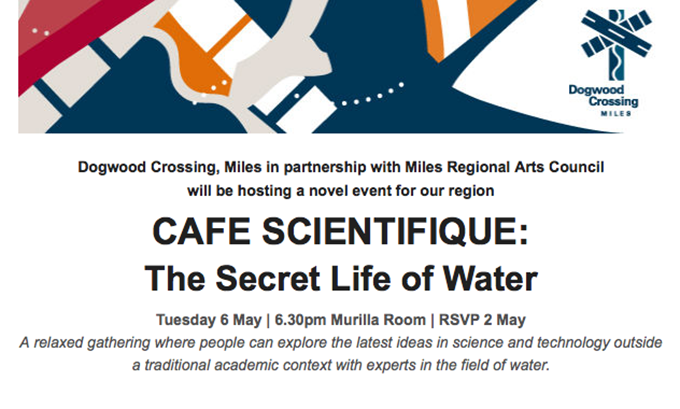
Cafe Scientifique invite
.
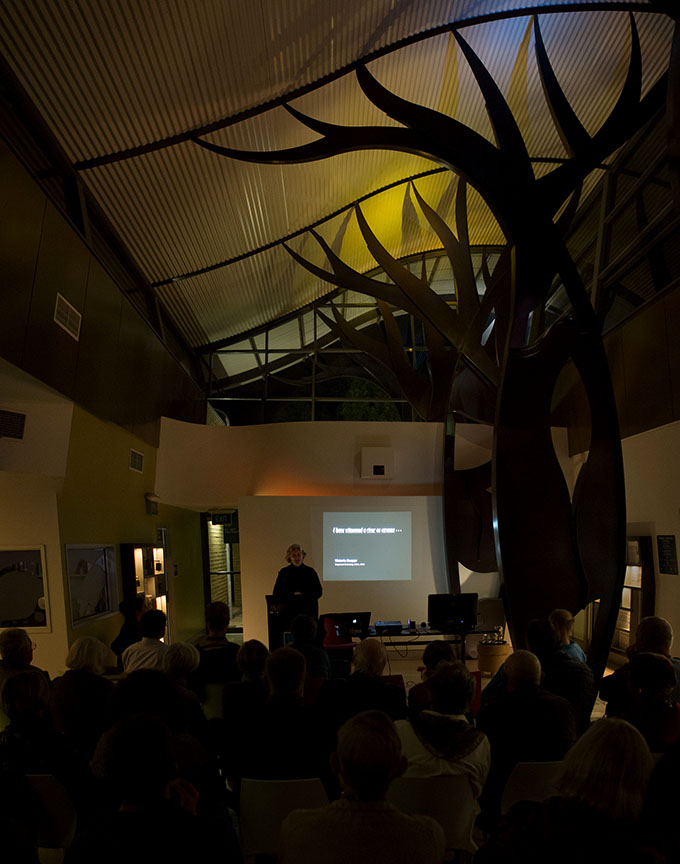
Inside the Dogwood Crossing presentation space (Murilla Room with bottle tree structural forms)
.
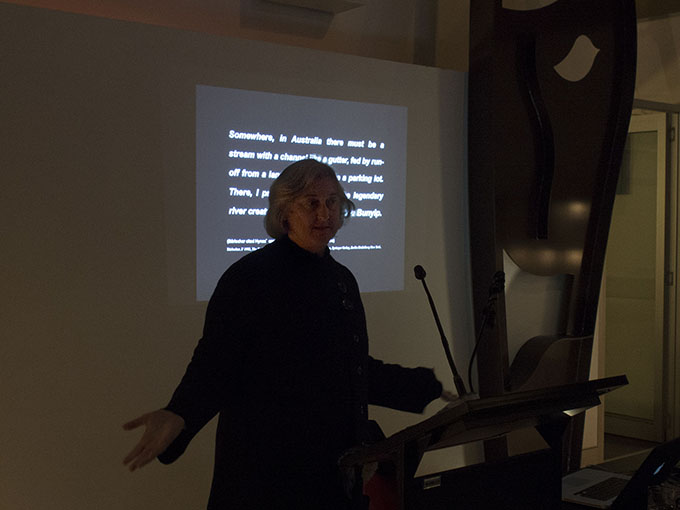
Vicky discusses and performs her books
.
Victoria Cooper
I Have Witnessed A Strange River says Cooper invited us to engage with a journey through the depths of water. She guided us through an unfamiliar place inter-twined with our daily lives where we witnessed the relentless cycle of life and death. Deep below the water’s reflecting surface, she showed us that a place primordial and alien yet intrinsic to us all, exists.
A SEGMENT OF VICKY’S PRESENTATION IS VIEWABLE HERE as a video
.
.’
BIO: Victoria Cooper is an artist with a PhD in Visual Arts researching the intersections of art and science. This interdisciplinary research is informed and inspired by her previous career in Human and Plant Pathology along with current interest in local and regional issues of land and water. During her 23-year arts career she has also worked across many forms of photographic technology–analogue to digital imaging; site specific documentation of performance; and artists’ books. In a collaborative practice with Dr Doug Spowart, she explores the post technological paradigm of photography as a cultural communication and a site-specific visual medium. This multi-methodological approach is applied in their current Place Project work in many regional communities. Cooper has exhibited in Australia and internationally and her work has been published in the Pinhole Resource Journal, the Le Stenope issue of French Photo Poche series and with Doug was included in the publication LOOK, Contemporary Australian Photography since 1980. Cooper’s artists’ books are held in national and private collections including the rare books and manuscript collections of the National Library of Australia and the State Library of Queensland.
.
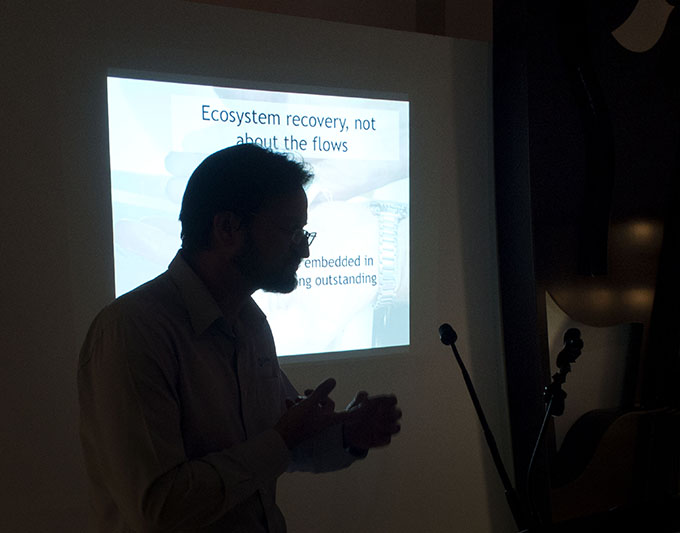
Carl – Condamine Alliance speaks
.
Carl Mitchell
This is a Story About Water Too* The quality and supply of water is one of most important issues of our time. Water quality scientist Carl Mitchell from the Condamine Alliance discussed the quality of water in our waterways and the health of our aquatic systems – vital indicators of how well we are doing as a society. The waterways in the Condamine catchment are a precious resource for the communities in the region. They provide many benefits to support the economy, society and environment of the region. Due to extensive development across a number of sectors, the quality of waters in most of the catchment areas is poor. Studies and models predict that without appropriate additional management responses the region will be unable to meet the social and economic needs of the community while maintaining the ecological integrity of the natural systems supporting these needs. Carl discussed the state of the waters and what actions are needed in the future.
BIO: Carl is a water quality scientist, aquatic ecologist and integrated water resource management specialist with a passion for the water and the waterways of the Condamine Catchment in the headwaters of the Murray Darling Basin. Carl strongly believes that the quality of water in our waterways and the health of our aquatic systems is an indicator of how well we are doing as a society. This drives him to strive for clean water for the Condamine and healthy aquatic ecosystems for the Murray Darling headwaters. Carl’s work in the Condamine has focussed on restoring the iconic Condamine river and Carl has lead the team that won 3 prestigious national awards for the Condamine in 2012-2013. Carl has a history in Natural Resource Management in Queensland having worked for Reef Catchments in Mackay for 11 years as Waterwatch coordinator, Healthy Waterways Coordinator and Water Manager. In the Water Manager role at Reef Catchments Carl spent 2 years coordinating the Paddock to Reef program across the 6 reef regional bodies, before moving to the Condamine in 2011. Carl has been an Australian Youth Ambassador for Development in the Philippines, implementing Waterwatch and Landcare programs.
.
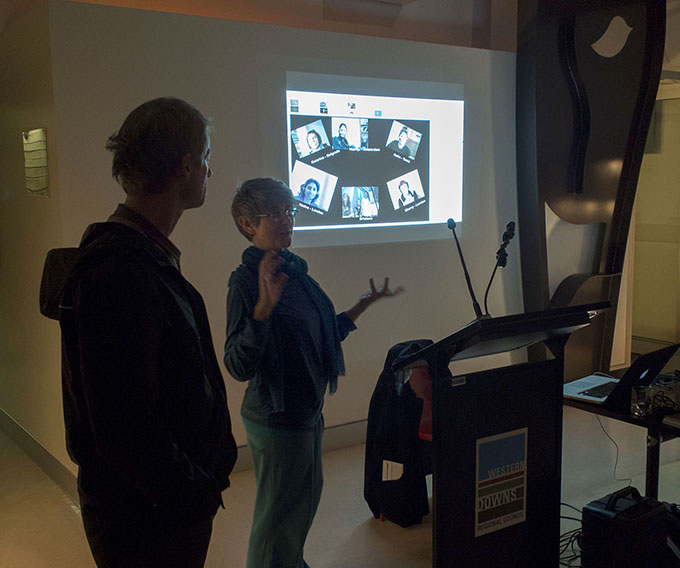
James and Suzon talk about the ‘Waterwheel Project’
.
Igneous: James Cunningham and Suzon Fuks
The Igneous team shared its explorations of water as a topic and metaphor. They explained how Waterwheel is an interactive, collaborative platform for sharing media and ideas, performance and presentation. Attendees witnessed how Waterwheel investigates and celebrates this constant yet volatile global resource, fundamental element, environmental issue, political dilemma, universal theme and symbol of life. We were encouraged to explore and discover, share and collaborate, contribute and participate in their project and local activities.
Igneous presented Waterwheel as well as the FLUIDATA project supported by Arts Queensland, and introduced the audience to FLUIDATA workshop that we offered there.
BIOS: Igneous received funding from Brisbane City Council and Arts Queensland towards the development of the platform and it’s incorporation in the Waterwheel Installation Performance and associated residency at the Judith Wright Centre of Performing Arts, Brisbane. Igneous is a partnership between Cunningham and Fuks who have both given lectures, workshops, master-classes and labs in Australia, USA, Europe, India and Indonesia, in tertiary institutions, cultural venues and community contexts.
James Cunningham is a performance, movement and video artist, and the co-Artistic Director, along with Suzon Fuks, of Igneous Inc., (www.igneous.org.au) a Brisbane-based multimedia and performance company established in 1997 that has presented solo and ensemble stage shows, performance-installations, video-dance works and networked/online performances in Australia, Europe (Belgium, France, Switzerland, Germany, Poland), UK, Canada and India.
Suzon Fuks is an intermedia artist, choreographer and director, exploring the integration and interaction of the body and moving image through performance, screen, installation and online work (http://suzonfuks.net). During an Australia Council for the Arts Fellowship (2009-12), she initiated and co-founded Waterwheel, following which she has been a Copeland Fellow and an Associate Researcher at the Five Colleges in Massachusetts, continuing to focus her research on water and gender issues, and networked performance, as well as coordinating activities on Waterwheel.
* The Secret Life of Water Book Title by Masaru Emoto
* This is a Story About Water Too. Poem Title by Jayne Fenton Keane
Texts sourced from Dogwood Crossing material. Photos: Doug Spowart ©2014
.
.
LIGHT READINGS: the photograph and the book – An SLQ White Gloves event
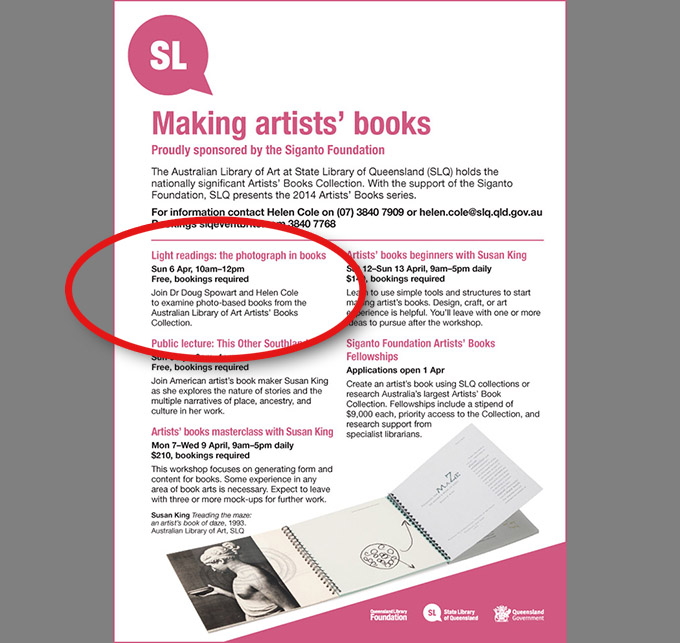
Flyer for the event
.
Light Readings: The photograph in books from the SLQ Artists’ Book Collection and the Spowart+Cooper Photobook Collection
.
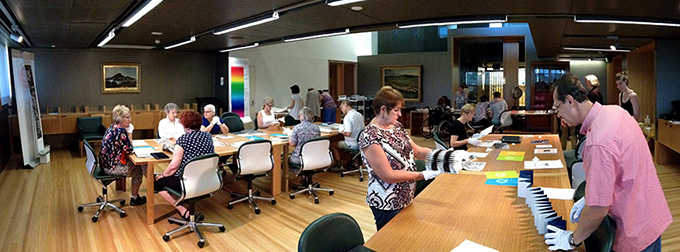
On Sunday April 6 a group of around 25 artists book and photobook dillettantes attended a special ‘White Gloves’ event at the State Library of Queesnland. Assembled in the viewing room on level 4 was a selection of artists books and photobooks that addressed the topic of the photograph and the book. The 43 books were drawn from the SLQ’s Australian Library of Art Artists’ Book collection, the SLQ General Library, supplemented by books from the Spowart+Cooper Photobook Collection. The book’s selection was curated by SLQ Senior Librarian Helen Cole and Doug Spowart. Those attending the event were given a presentation by Doug Spowart to introduce the rationale for the selection. A discussion paper by Spowart is included in this blog post along with a bibliography of the selected books.
.
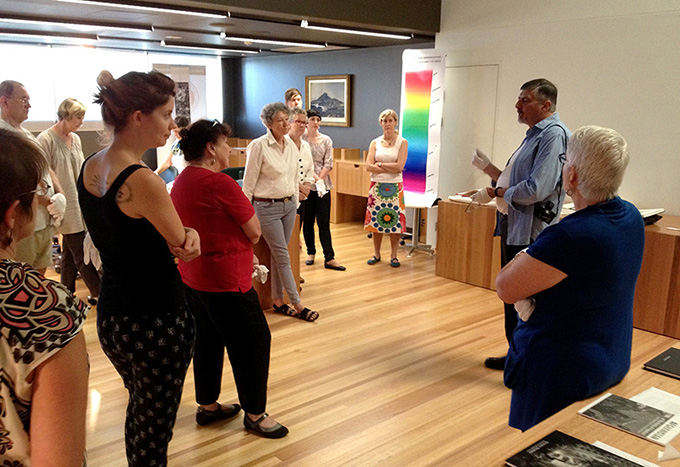
Doug Spowart presents an introduction …….PHOTO: Victoria Cooper
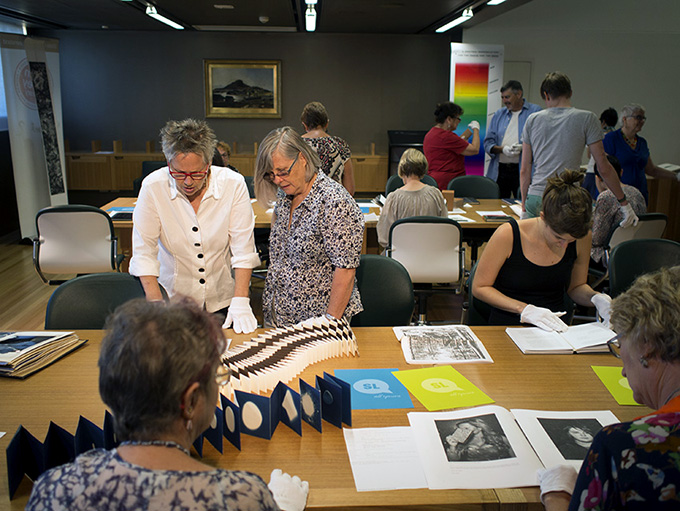
SLQ White Gloves event – Attendees viewing books
Doug Spowart’s discussion inspired by the ‘Light Readings’ event: A nomenclature for photos in books
For one hundred and fifty years the making of ‘quality’ photographs had been almost exclusively the domain of the professional practitioner. Outside of the professional photography scene vernacular photography, made popular due to the enabling technologies of ‘you press the button – we do the rest’ companies like Kodak, usually produced results that were of an inferior standard. There were of course exceptions – ‘prosumers’, as we would call them today, image-makers from the camera club movement, dilettantes and artists whose visual acutance and mastery of process suited photography.
Today digital technology has interceded and now anyone can make photographs. From a range of informed sources it is easy to predict that nearly a trillion photographs will be made in 2014. These images from phone camera snaps to video grabs, from high-end pro digital cameras to surveillance satellites, as well as a plethora of straight and enhanced images will be made and used for a range of outcomes. It seems that now anyone can make a photograph and almost anything can be done with it.
Like photography the publishing of books was once a closed world, as it required specialist processes, skilled artisans and financial entrepreneurship. But this powerful structure of gatekeepers too has also been dissolved by the empowering digital technologies of computers, software, computer-to-press and print on demand workflows. Making books has never been easier. Photographers particularly have embraced the opportunity and launched a revolution creating all kinds of photobooks to extend the bland form of the traditional photobook. Bruno Ceshel, founder of the photobook publishing and promotion enterprise Self-Publish Be Happy, comments that:
From the stapled fanzine assembled in a student bedroom to the traditionally printed photobook, these publications not only reshape our understanding of the medium but offer exciting and sometimes radical ideas. (Ceschel 2011)
.
Whilst photographers have embraced this new found direct publishing paradigm artists have made books with photos in them for decades. For them the processes of printmaking and multiples that they employ, along with access to printing press technology, is accessible and ‘doable’. Additionally artists have experimented with communication concepts that included the democratic multiple publications. Artists employ a range of media and the photograph was just another tool that they could access to create their art.
A significant connection between photography and the artists book is discussed by Anne Thurmann-Jajes and Martin Hellmold in their 2002 exhibition and catalogue ars photographica. They state that: ‘In very general terms, it is possible to say that half of all artists’ books produced to date have been based on photographs.’(Thurmann-Jajes and Hellmold 2002:19). It is interesting to note that the first book of the modern American artists book genre is Ed Ruscha’s book of photographs entitled Twenty-six Gasoline Stations.
The artist’s use of photography has created a degree of frisson. A point of contention for photographers was their ownership over the term ‘photographer’. Essentially photographers claimed that while artists may have made photographs, only photographers made ‘real’ photographs – artists just took photographs. Ruscha provocatively denounced the preciousness of the fine art photography movement that came out of the 1960s and announced that all he wanted out of photography was ‘facts, facts, facts.’ (Rowell 2006:24)
Thurmann-Jajes and Hellmold go further in that they propose differences between the artist and the photographer in the conceptual aspects of making a book based on photographs:
The authors of photo books followed photographic tradition, according to which the photograph as such was decisive, becoming the bearer of meaning. … By contrast to the photo book, the artists’ book is not the bearer, but the medium of the artistic message. (Thurmann-Jajes and Hellmold 2002:20)
.
Interestingly, the photobook and the artists book share a lost history that Johanna Drucker discusses in her 1995 book, The Century of Artists’ Books. She states that:
The photographic book became a standard of artists’ book activity, and its history belongs to the early 20th century in which the concept of the book as an artistic form was taking on a new, vital identity. (Drucker 2004:63)
.
Drucker adds:
These were works which were considered avant-garde, experimental, and innovative when they were made; they broke with the formal conventions of earlier book production, establishing new parameters for visual, verbal, graphic, photographic, and synthetic conceptualization of the book as a work of art … they were part of a history which was temporarily forgotten at the time artists’ book emerged in the 1960s. (Drucker 2004:63-4)
.
Despite these shared histories and theories of ‘differences’ the nature of the creative process, the disciplines of artist and photographer may present an interesting conundrum. Nancy Foote, for example, may question the ‘us and them’ argument by her observation in a 1976 article in Artforum, The Anti-Photographers that: ‘For every photographer who clamors to make it as an artist, there is an artist running a grave risk of turning into a photographer.’ (Foote 1976:46)
Today the photograph continues to pervade all kinds of books by artists, artists–photographers, photographers and photographer-artists in collections like the Australian Library of Art at the State Library of Queensland. At this time it is important to review the field of creative book production that utilises the photograph and consider what has been created to date and in the SLQ collection, as well as look for emergent trends.
In this research project Senior Librarian Helen Cole and I have collaborated to bring together a selection of books to survey the nature of the photo and the book. Whilst most books have been sourced from the SLQ Artists’ Book collection some books have come from the SLQ general area and some, mainly emergent photobooks have been drawn from my personal collection. In bringing these 43 books together in the one ‘white gloves’ space there has been an ability to create come kind of order from the divergent practice.
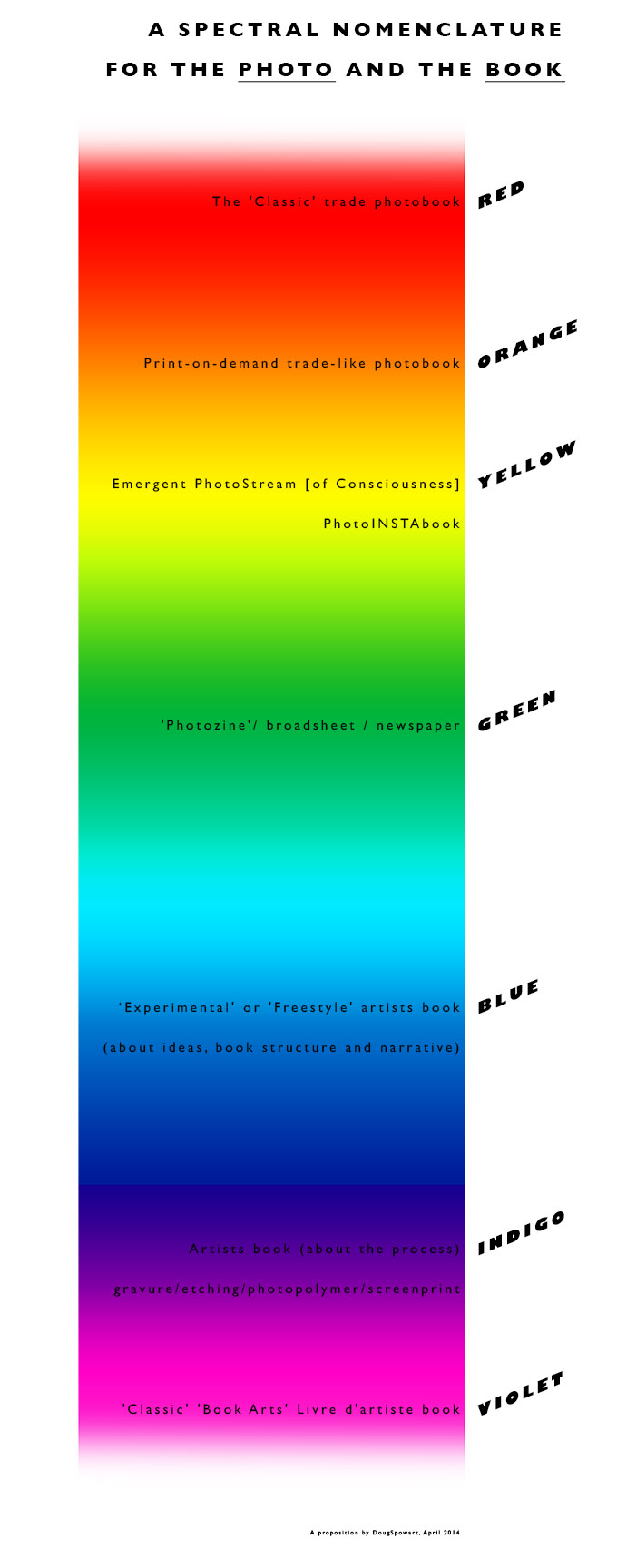
It would take a courageous and brave commentator to propose a definition or a canon for the photo and the book. Instead I will suggest a spectrum of activity and assign some characteristics that may aid those interested in the topic to compare, sample and discuss. I will use the term nomenclature as it best describes the devising or choosing of names for things in this type of discussion.
As the visible light spectrum has a rainbow of seven main colours this discussion has seven as well. Each has a specific characteristics and terms associated with it – although, at times certain books may challenge attempts to place them within this spectrum. The 7 colours are:
1. Red – The ‘Classic’ trade photobook
2. Orange – Print on demand trade-like photobook
3. Yellow – Emergent – PhotoStream* [of Consciousness] or Insta-photobook*
4. Green – Photozine*/ broadsheet / newspaper
5. Blue – Experimental’ or ‘Freestyle’ artists book
6. Indigo – Artists book
7. Violet – ‘Classic’, ‘Book Arts’, Livre d’artiste book
*Names I have considered to best describe these emergent forms
.
This spectral approach accepts the notion that the use of the photograph may be by either photographer or artist, and the nature of their creative products may enable their books to reside in generic areas. In many ways the transition of the rainbow metaphor from red to violet could represent the pure book forms of the photographer at one end and the purest artist form at the other at the other. This suggests that 1-4 would be photobooks conceived and produced by photographers. And those books in 4-7 would be principally books made by artists using photography. And at times the nature and form of the book may defy this nomenclature and be in a grey area, or a tint or shade, or even a blend of colour opposites!
Just as Johanna Drucker found when she attempted to define the artists book my categorising the practitioner’s discipline and the type or style of a book that they make also may be challenging. Drucker came under fire even though she predicted that her proposition would ‘… cause strife, competition, [and] set up a hierarchy, make people feel they are either included or excluded’ (Drucker 2005:3). More recently, in 2010, Sarah Bodman and Tom Sowden from the Centre for Fine Print Research at the University of the West of England sought to define the canon for the artists book in the 21st century. They did this by creating a survey of world practitioners of book making by artists in every conceivable outcome, including the emergent eBook. They found that the heirarical form of a tree diagram was ‘too rigid and too concerned with process’ (Bodman and Sowdon 2010:5). They discovered that their respondents wanted to alter the diagram to satisfy the, ‘cross-pollination that is often required by artists’ and added in, ‘connectors across, up and down to bring seemingly disparate disciplines together.’ (Bodman and Sowdon 2010:5)
Rather than a rigid definitive structure, I present this spectral organization a guide where we can bring some concepts into a critical debate that will extend the ideas, and the motivations, behind those who create these communicative devices. Ultimately researchers, and those interested in engaging with and exploring the nature of the photo in the book, will add their voices to the conversation. Then new dialogue, scholarship and opportunities for thought on the topic will advance understanding of the book that carries its message with the photograph.
At the end of this blog post I have included the bibliography of selected books for the ‘Light Readings’ event.
Dr Doug Spowart April 14, 2014
References:
Bodman, S. and T. Sowdon (2010). A Manifesto for the Book: What will be the canon for the artist’s book in the 21st Century? A Manifesto for the Book: What will be the canon for the artist’s book in the 21st Century? T. S. Sarah Bodman. Bristol, England, Impact Press, The Centre for Fine Print Research, University of the West of England, Bristol.
Ceschel, B. (2011). “The Best Books of 2010.” Retrieved June 6, 2011, from http://www.photoeye.com/magazine_admin/index.cfm/bestbooks.2010.list/author_id/68/.
Drucker, J. (2004). The Century of Artists’ Books. New York, Granary Books.
Drucker, J. (2005). “Critical Issues / Exemplary Works.” The Bonefolder: An e-journal for the bookbinder and book artist 1(2): 3-15.
Foote, N. (1976). “The Anti-Photographers.” Artforum September: 46-54.
Rowell, M. (2006). Ed Ruscha Photographer. Gottingen, Steidl Publishers.
Thurmann-Jajes, A. and M. Hellmold, Eds. (2002). ars photographica: Fotografie und Künstlerbücher. Weserburg, Bremen, Neues Museum
A SPECTRAL NOMENCLATURE FOR THE PHOTO AND THE BOOK
.
A Bibliography of the selected books
From the Artists’ Book Collection of the Australian Library of Art, State Library of Queensland and the Spowart+Cooper Photobook Collection
Red – The ‘Classic’ trade photobook
American Cockroach
Photographs by Catherine Chalmers
Essays by Steve Baker, Garry Marvin, and Lyall Watson
Aperture, 2004
(Spowart+Cooper Photobook Collection)
Afghanistan, or, The perils of freedom
Stephen Dupont 1967- ; Jacques Menasche 1964-; Stephen C Pinson; New York Public Library : 2008
Steam : India’s last steam trains
Stephen Dupont 1967- ; Mark Tully
Stockport : Dewi Lewis :1999
Foundphotos / DickJewell
Dick Jewell
London : s. n. :1977
FromMontelucotoSpoleto : December1976
Sol LeWitt 1928-2007.
Eindhoven Netherlands : Van Abbemuseum ; Weesp Netherlands : Openbaar Kunstbezit :1984
Journey of a wise electron
Peter Lyssiotis 1949- ; PeterLyssiotis 1949-.; PeterLyssiotis 1949-.
Prahan, Vic. : Champion Books :1981
Eat : Jan-Mar 2001
Jo Pursey
Sydney, N.S.W. : J. Pursey :2001
Tour of duty : winning hearts and minds in East Timor
Matthew Sleeth 1972- ; Paul James (Paul Warren), 1958-
South Yarra, Vic. : Hardie Grant Books in association with M.33 :2002
Signs of Australia
Richard Tipping 1949-
Ringwood, Vic. : Penguin Books :1982
Intimations : with selected poetic responses by Michele Morgan
Gordon Undy
Surry Hills, NSW. : Point Light :2004
Orange – Print on demand trade-like photobook
Various fires and MLK
Scott L. McCarney 1954-
Rochester, N. Y. : VisualBooks :2010
Reportage : a retrospective 1999-2009.
Robert McFarlane 1942-; Jacqui Vicario; StephenDupont 1967-; National Art School (Australia); Momento Pro.
Bondi Junction, N.S.W. : Reportage :2010
Flashback : SE Queensland flood event January 2011
Julie White
Strawberry Hills, N.S.W. : Momento :2011
Yellow – Emergent PhotoStream* [of Consciousness] or InstaPhotoBook*
Iris Garden
Wiliam Gedney
Designed by Hans Seeger
Little Brown Mushroom, 2013
(Spowart+Cooper Photobook Collection)
Moved Objects
Georgia Hutchison and Arini Byng
Perimeter Editions
Melbourne, Australia, 2013
(Spowart+Cooper Photobook Collection)
Lost horizons
Scott L. McCarney 1954-,
Rochester, NY : ScottMcCarney/Visual Books :2008
Call of the wild
Matthew Sleeth 1972- ; Josef Lebovic Gallery.
Sydney N.S.W. : Published by Josef Lebovic Gallery :2004
Signed up : 22 postcards
Richard Tipping 1949-
Newcastle, N.S.W. : Artpoem :c2010
Green – Photozine*/ broadsheet / newspaper
Radiata, 2013
Jacob Raupach
(Spowart+Cooper Photobook Collection)
.
LBM Dispatch #6: Texas Triangle
Alec Soth and Brad Zellar
Little Brown Mushroom, 2013
Edition of 2000
(Spowart+Cooper Photobook Collection)
Blue – Experimental’ or ‘Freestyle’ artists book
Ten menhirs at Plouharnel, Carnac, Morbihan, Bretagne, France
Jihad Muhammad aka John Armstrong 1948-
Hobart Tas. : J. Armstrong :1982
Detour ; Kõrvaltee
Christiane Baumgartner 1967- ; Lucy Harrison 1974-; Grahame Galleries + Editions.
Leipzig, Germany : C. Baumgartner & L. Harrison :2004
No diving II : evidence
Peter E. Charuk
Hazelbrook, N.S.W. : P.E. Charuk :2005
The story of the gorge
Victoria Cooper 1957-
Toowoomba, Qld. : V. Cooper :2001
Supernova
Victoria Cooper 1957- ; Photographers of the Great Divide.
Toowoomba, Qld. : Photographers of the Great Divide :2005?
Space + Time
Ken Leslie ; Grahame Galleries + Editions.
Atlanta, Ga. : Nexus Press :2002
The river city : eyewitness document
Helen Malone 1948-
Yeronga, Qld : H. Malone :2011
Tonguey
Ron McBurnie 1957-
Townsville, Qld. : R. McBurnie :1996?
Portrait of an Australian
Jonathan Tse 1967-
Robertson, Qld. : J. Tse :1998
[Eleven]
Marshall Weber 1960- ; Christopher Wilde; Sara Parkel; Alison E Williams; Isabelle Weber; Booklyn Artists Alliance.
New York : Booklyn :c2002
Posted
Normana Wight 1936- ; Numero Uno Publications.
Milton, Qld. : Numero Uno Publications :2009
High tension
Philip Zimmermann ; Montage 93 : International Festival of the Image (Rochester, N.Y.)
Rochester, NY : the author :1993
Indigo – Artists book (Inkjet – gravure – photopolymer – screenprint)
Lost and found : a bookwork
Lyn Ashby 1953-
Vic. : ThisTooPress :2007?
The ten thousand things
LynAshby 1953-
Victoria : Lyn Ashby, Thistoopress :2010
Solomon
JanDavis 1952-
Lismore : J. Davis :c1995
Limes
Tommaso Durante 1956- ; Chris Wallace-Crabbe 1934-; Elke Ahokas
North Warrandyte, Vic. : Tommaso Durante :2011
Terra Australis
Tommaso Durante 1956- ; Kay Aldenhoven
Warrandyte, Vic. : TommasoDurante :2003
Homeland
Noga Freiberg 1962- ; Peter Lyssiotis 1949-.; Masterthief Enterprises
Burwood, Vic. : Masterthief :2003
Deeply honoured
Fred Hagstrom ; Densho Digital Archive.; Carleton College (Northfield, Minn.). Archives.
Saint Paul, Minn. : Strong Silent Type Press :2010
Cars of the fifties : book number 247
Keith A. Smith 1938-
Rochester, N.Y. : KeithSmith :2006
Violet – ‘Classic’ ‘Book Arts’ Livre d’artiste book
Through closed doors : 7 paraclausithyra
Susan J. Allix 1943-
London : S. Allix :2005
A gardener at midnight : travels in the Holy Land ; from drawings made on the spot by Yabez Al-Kitab
Peter Lyssiotis 1949- ; Brian Castro 1950-; David Roberts 1796-1864.; Nick Doslov; David Pidgeon; State Library of Victoria.; Masterthief Enterprises.; Renaissance Bookbinding.
Melbourne : Masterthief :2004
New branches on an old tree
Susan Purdy ; Blue Moon Press.
Melbourne : Blue Moon Press :2006
List concludes.
.
SLQ White Gloves event – Attendees viewing books
.
.
This work is licensed under a Creative Commons Attribution-NonCommercial-NoDerivs 3.0 Unported License.
.
.
Text: © 2014 Dr Doug Spowart Photos: ©2014 Victoria Cooper and Doug Spowart
.
.
.
.
BOX of BOOKS Event – Toowoomba!
Looking at the books – Cobb+Co Museum, Toowoomba
.
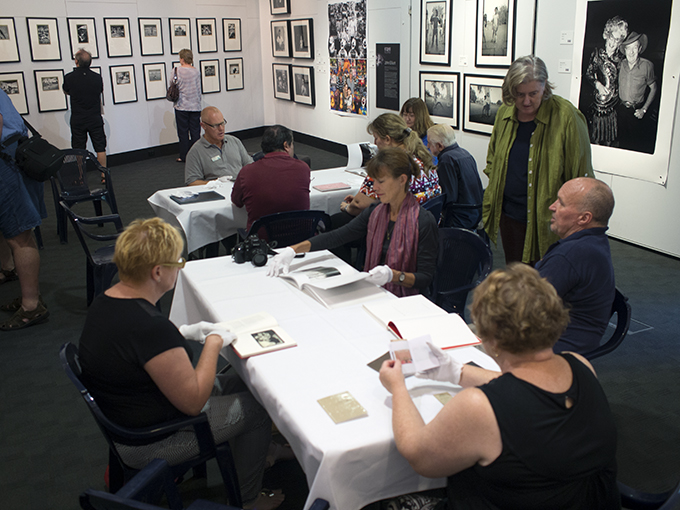
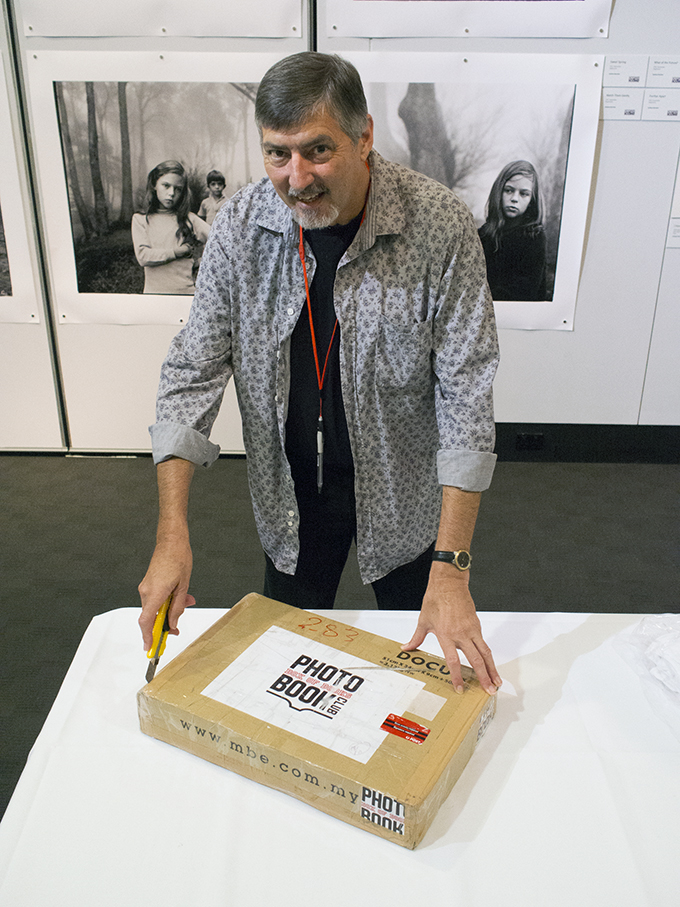
Around 35 photobook enthusiasts gathered at the Cobb+Co Museum on January 27 to view the Photobook Club’s Box of Books and talk about photobooks. The event brought together local photo identities John Elliott, Graham Burstow, David Seeto and Victoria Cooper. Eric Victor, Ian Poole and Qld College of Art Masters student Maureen Trainor came from the Brisbane side of the Range. The meeting took place in the gallery space of the ICON on ICONS photographic exhibition that also concluded on that day.
.
Convener of the event Doug Spowart opens the Box of Books
.
The seven books were viewed and discussed at length. Comments about the books included the following:
“Each book is a very personal communiqué”
“The books demand viewing at many different levels – the narrative, the design, the production, the conceptual nature of the work…”
“This is a very Eurocentric view – I wonder what the American view would look like?”
“How do these books compare with the Australian photobook scene?”
A great deal of discussion took place over the comment – “Where are the captions … the works that help me to understand what the photographer is trying to say?” One respondent commented on Roland Barthes’ concept of ‘The death of the author and the birth of the reader’ – meaning that the reader needs to connect with the images and draw on their own life experiences.
.
Donald Webber’s Interrogations drew quite a few comments – tension and the power of the portraits made in such a circumstance.
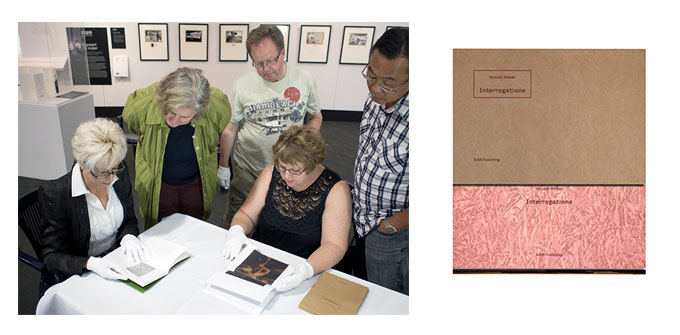
Linda Seeto, Victoria Cooper, Hardy and Alison Ahlhaus looking at Webber’s Interrogations
.
The crowd favourite was Anne Sophie Merryman’s Mrs. Merryman’s Collection … a superb design, delicate paper, the see-through of texts and the amazingly bizarre collection of post card photographs and comments.
.
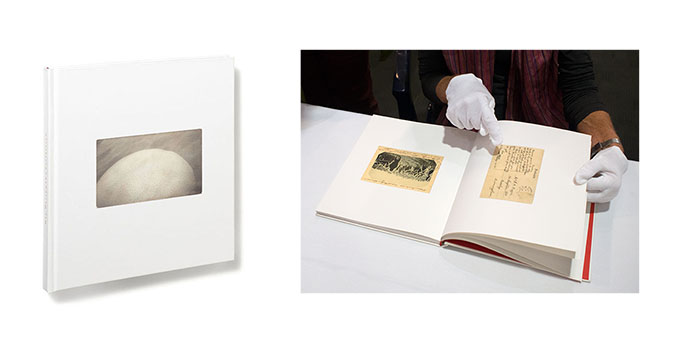
Mrs. Merryman’s Collection
.
Paul Graham’s The Present and its gate-fold format presented a viewing challenge as each image or group of images needed to be revealed by folding-out the page – an extended haptic experience, and considering the size of the book, it slowed down the read and brought the busy street scenes to a slowed motion.
.
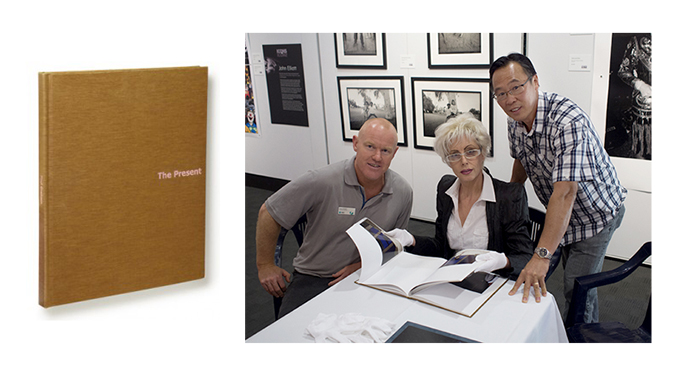
Tony Coonan, Linda and David Seeto look at Paul Graham’s book
.
The Box of Books will be in Brisbane on Monday the 3rd of February and then be off to New Zealand for the next stage in its journey.
Thanks to the Cobb+Co Museum for providing the venue. The Photobook Club and the publishers who donated the books for the opportunity for us to see, touch, and read these books.
Until the next Photobook Club event in our area….
.
This Photobook Club BOX OF BOOKS event was coordinated by Doug Spowart and Victoria Cooper of the Centre for Regional Arts Practice.
.
Other images from the event…
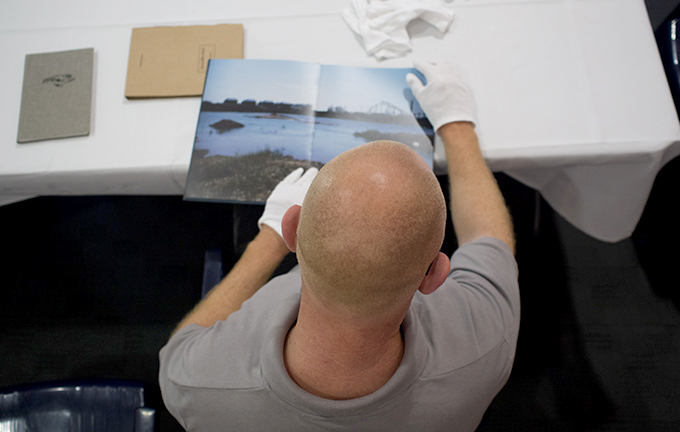
Looking at a book…
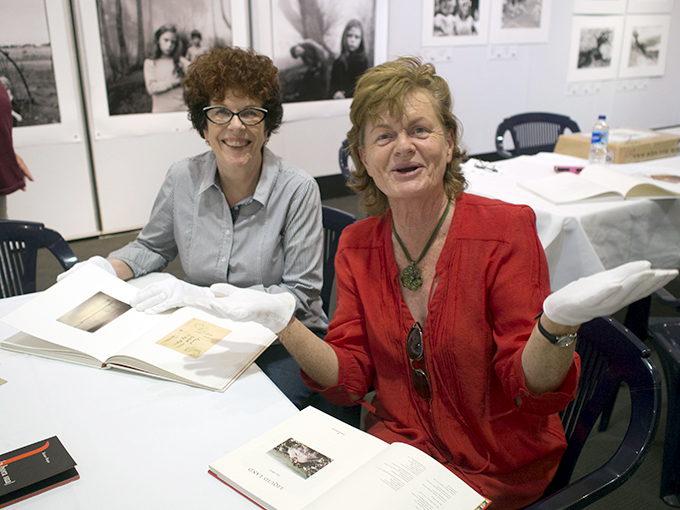
Ann Alcock and Bev Lacey
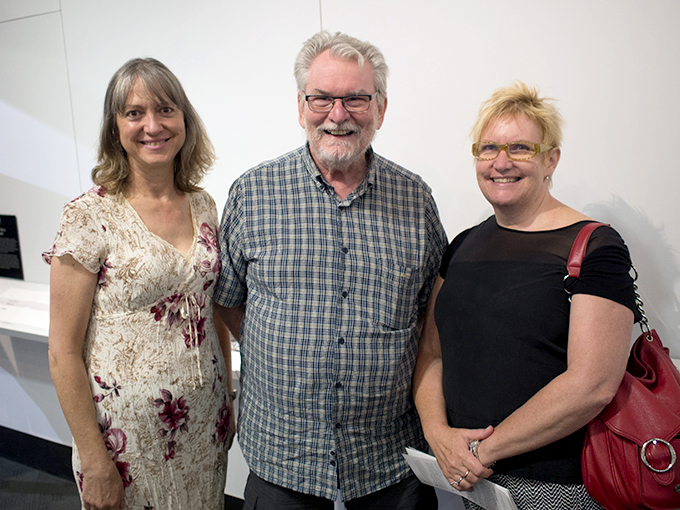
Toula, Ian Poole and Louise
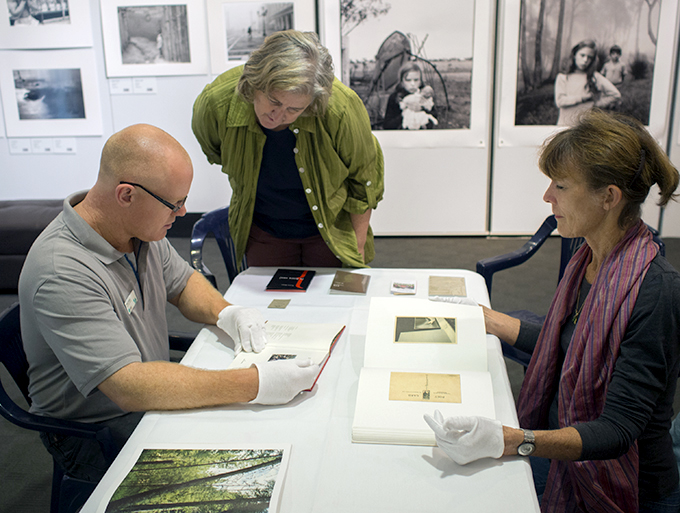
Tony Coonan, Victoria Cooper and Anne Howard
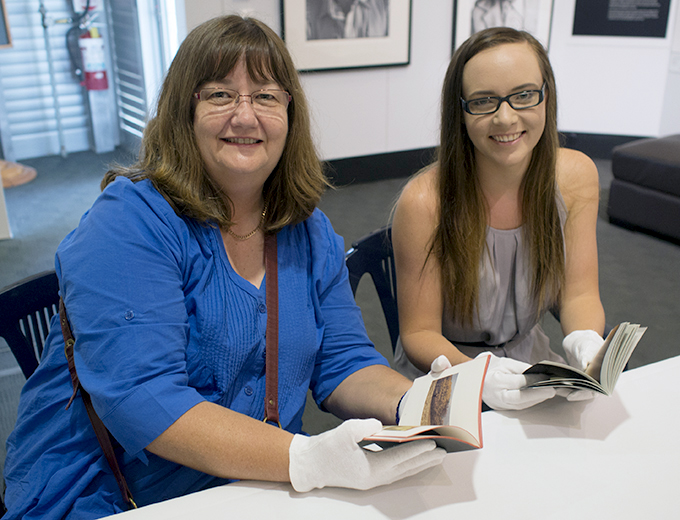
Judi Neuman and Phillipa Hodges
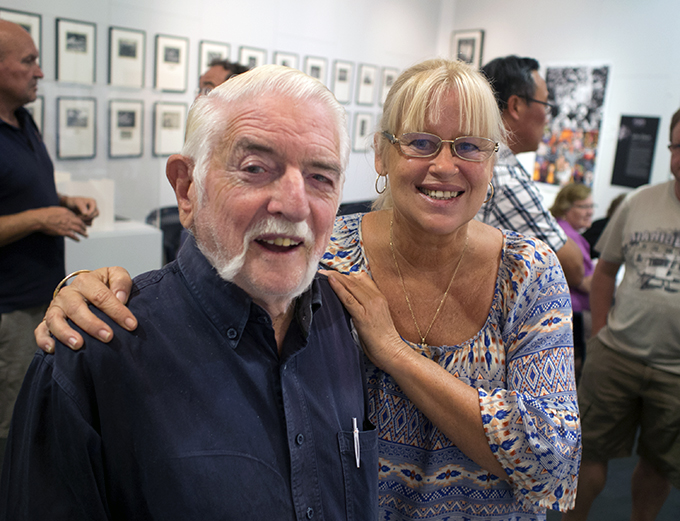
Graham Burstow and Maureen Trainor
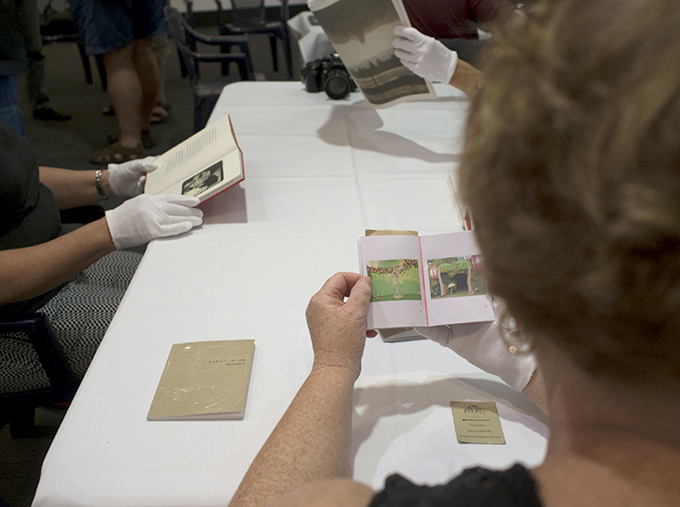
Looking at some of the ephemera from the Box of Books
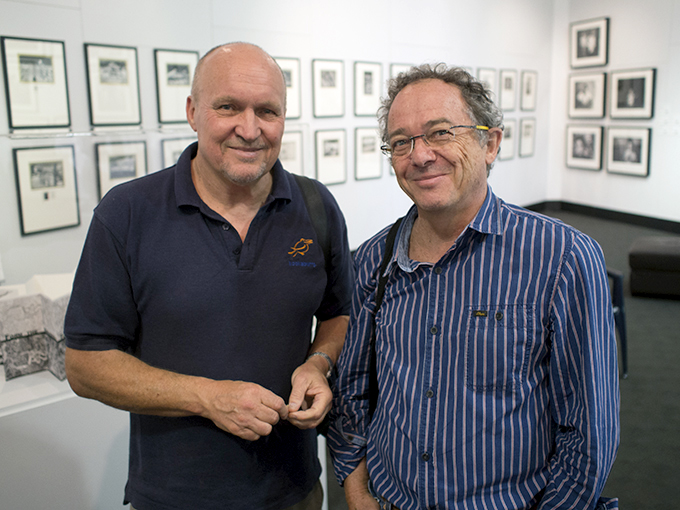
John Elliott and Eric Victor
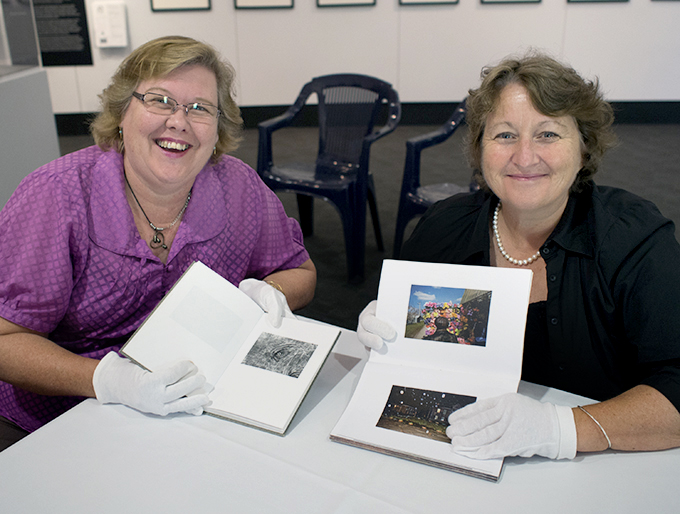
Helen Gibbs and Lucy Robertson-Cunninghame
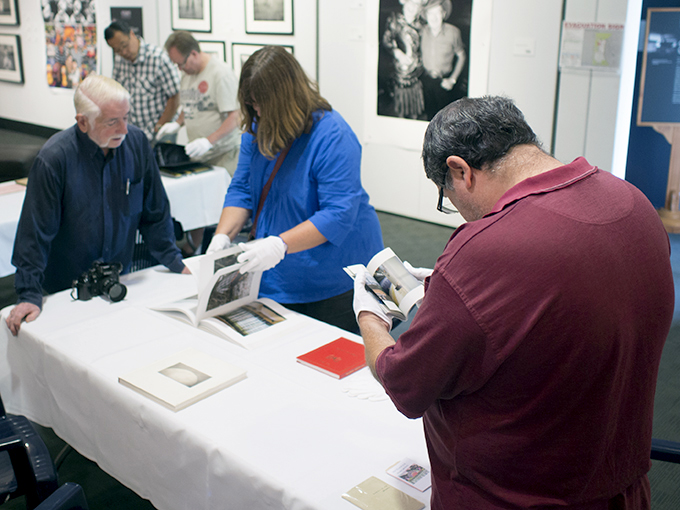
Gerry Saide looking closely at a book
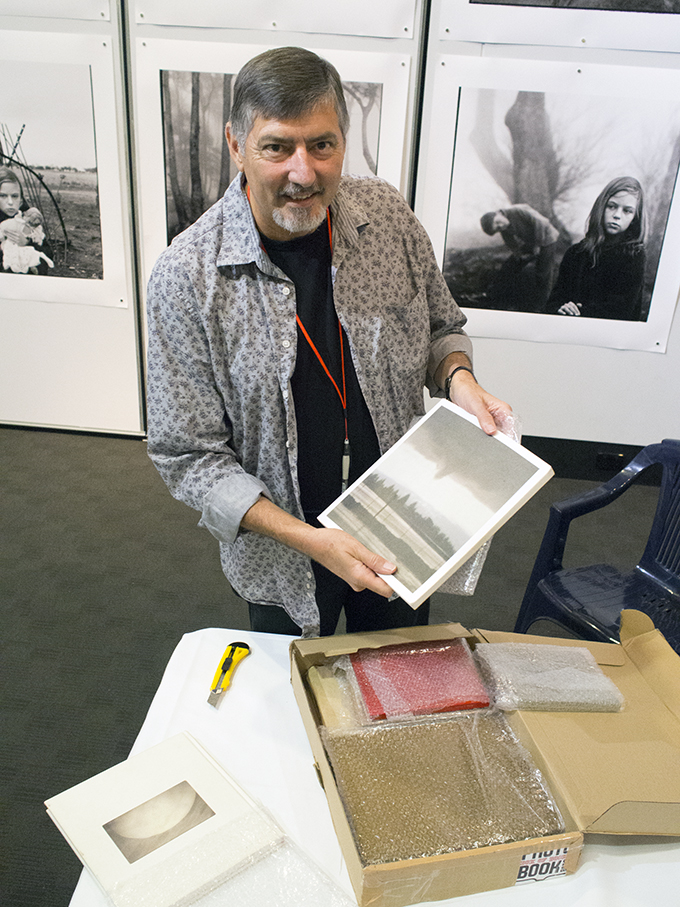
Doug Spowart opens the box
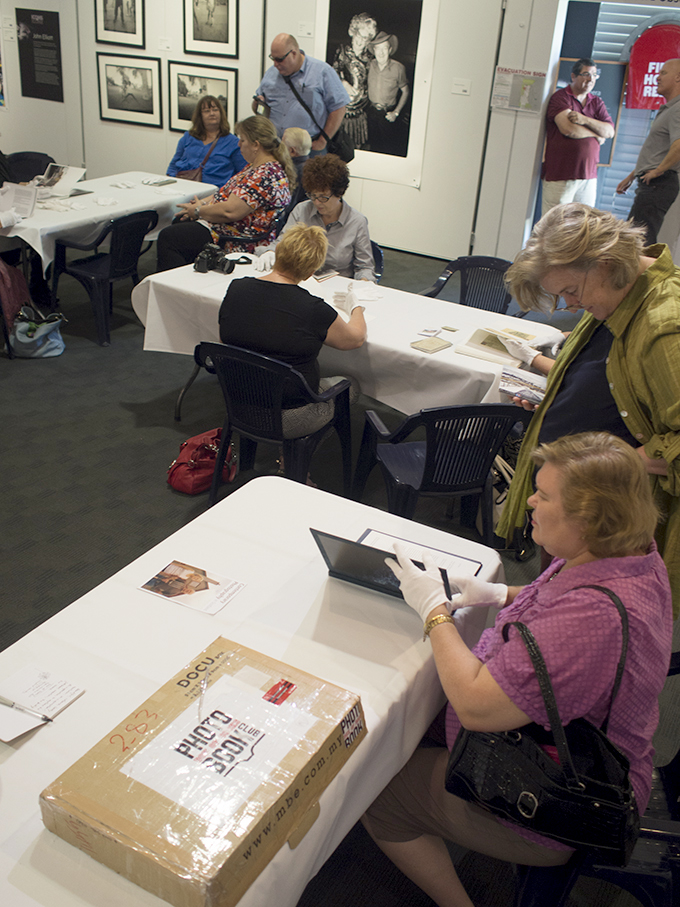
Room view at the Cobb+Co Museum
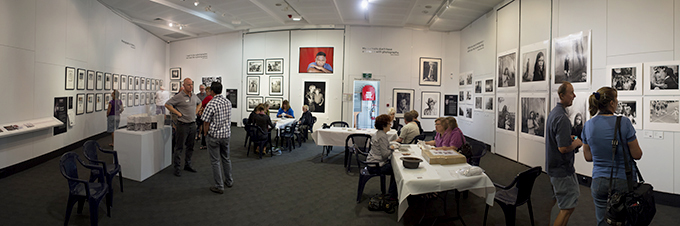
The Cobb+Co Museum panorama
.
.
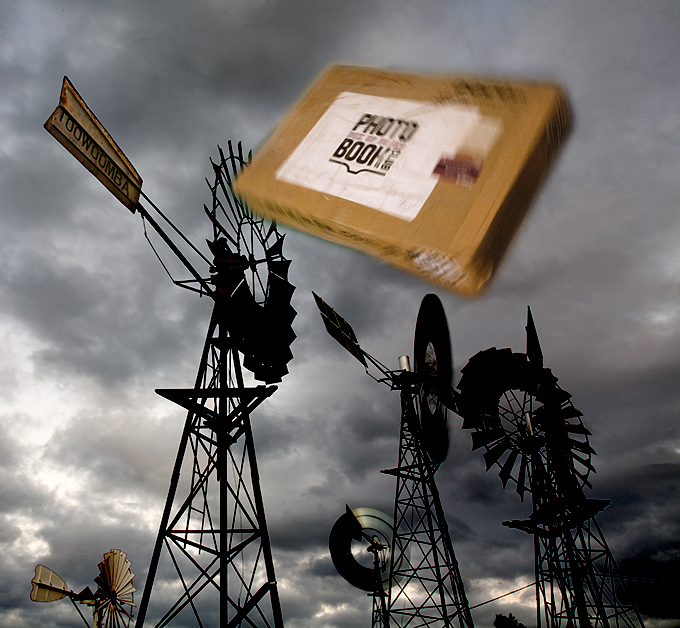
The Photobook Club’s BOX of BOOKS in Toowoomba
.
.
.
.
A BOOK for AUSTRALIA DAY, January 26, 2014
.
It’s Australia Day!! We have a photobook on display in the Two Doors Gallery in 85 George Street the ‘Rocks’, Sydney that is a commentary on Australia Day, that we created on Australia Day in 2010.
.
The collaborative book, called Australian Banquet, January 25/26, 1788 (variant #5), is a double-sided broadsheet cyanotype in rice paper, 37.6x77cm. There are 7 unique state variants of this work.
.
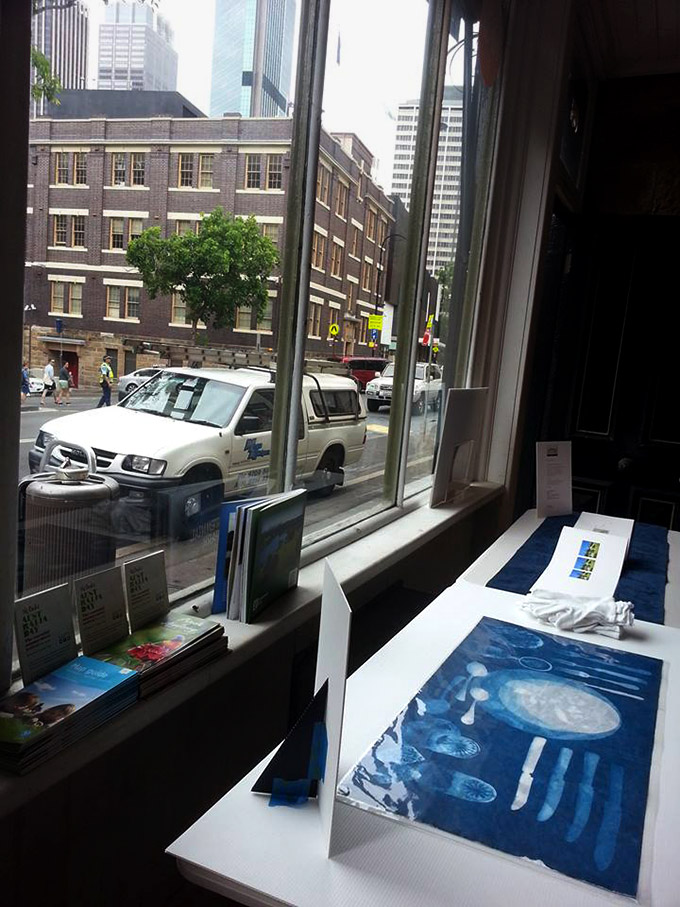
The Australian Banquet in the window @ Two Doors … Photo: Dawne Fahey
.
The artists’ statement for the work is as follows:
.
Across Australia on January 26, people consume food in celebration of a free and dynamic Australian culture. This work comments on the ‘turning of the page’ in Australian history that Australia Day represents. One day — January 25th 1788, Indigenous people feasted on a diverse banquet of bush tucker (as they had for thousands of years). The next day —a new paradigm arrived with the table setting of the First Fleet. Australia Day importantly is a time to re-examine the status of the Indigenous perspective and their knowing of land, culture and history and how it underpins all that is celebrated in the diversity and identity of post-colonial Australia.
.
.
How the work is to be viewed/read
1. At a tabletop setting view and contemplate the 25th of January side of the broadsheet.
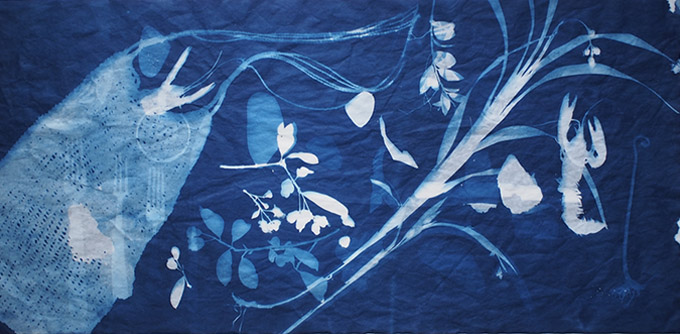
January 25, 1788
.
2. Then, pickup the broadsheet and turn it over as if reading a book – Contemplate.
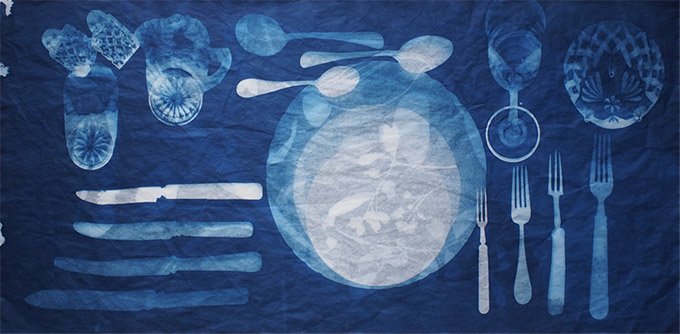
January 26, 1788
.
3. Finally hold the broadsheet up to a light thus enabling the interrelationship between the two
images to be considered. (Image shows variant #4)
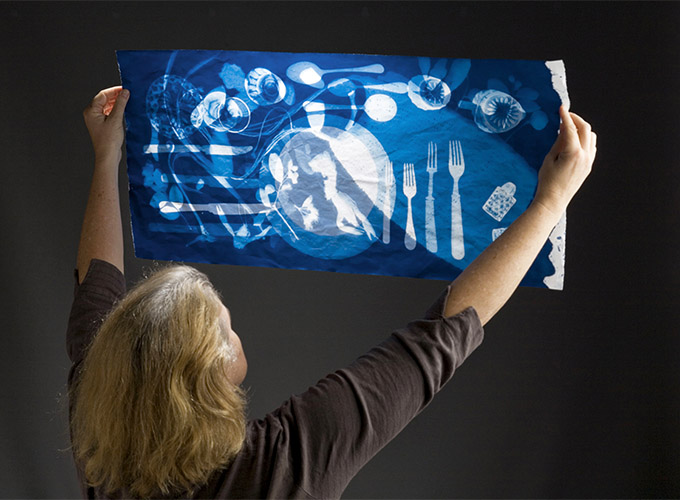
January 25+26,1788 (combined) –Today’s view
.
Drop in to the gallery if you’re in Sydney.
If you happen to be in ‘The Rocks’ on Monday 27th, the public holiday come along to Two Doors and see Picturing the Orchestral Family – and a selection of photographs by Dawne Fahey – and hear the Carreon Family Quartet performance – Tango from 2 – 3. They will also perform February 2nd – same time. Performing daily @ 5.30 pm is flautist Chloe Chung – Two Doors is very lucky to have these young people from Sydney Youth Orchestras helping us celebrate this exhibition !
Have a Great Australia Day…!
.
© 2014 Dawne Fahey (gallery image) and ©2012 Doug Spowart+Victoria Cooper.
.
This work is licensed under a Creative Commons Attribution-NonCommercial-NoDerivs 3.0 Unported License.
http://creativecommons.org/licenses/by-nc-sa/2.5/au/
.
.
.

 wotwedid