Posts Tagged ‘Theo Strasser’
HELEN COLE VISITS A PAPER UNIVERSE
..
“Artists’ books break all the rules. They stretch, fold, sculpt and reimagine the book as an object — not just something to read, but something to experience”
Curator Maria Savvidis.
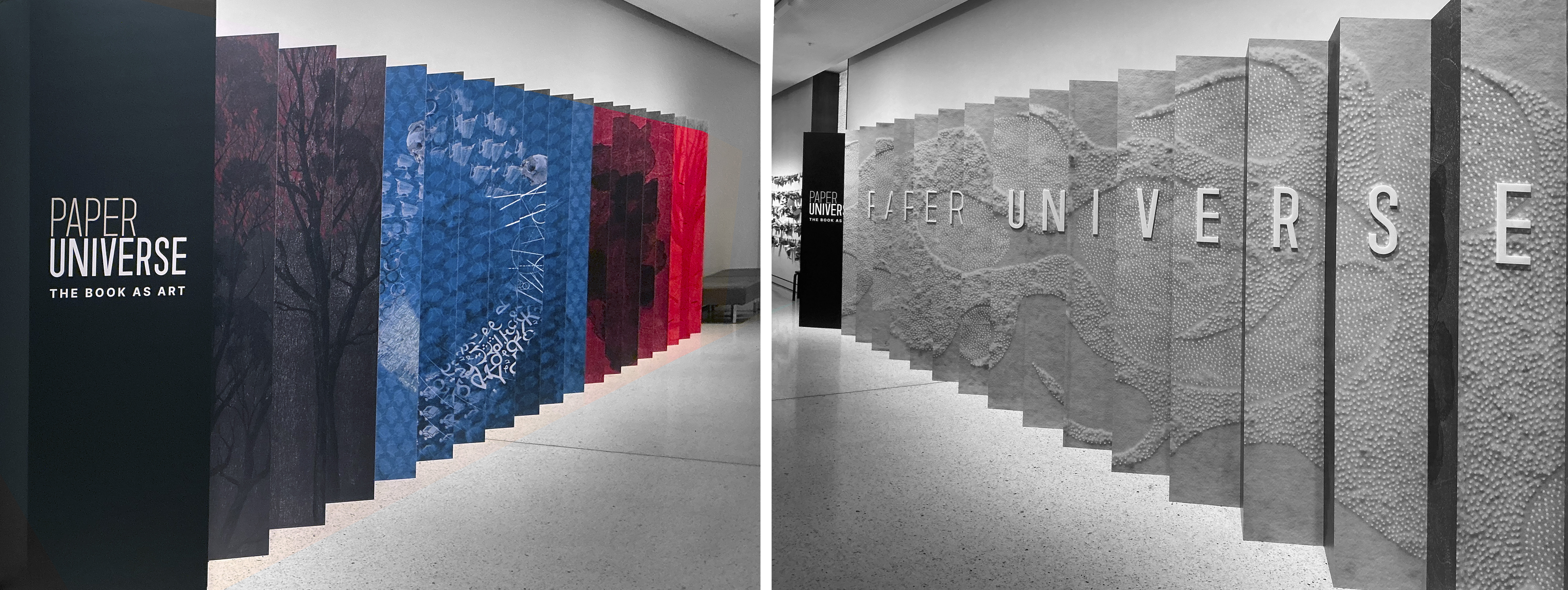
Two views of the ‘Paper Universe: The Book as Art’ entry concertina PHOTOs: Helen Cole
.
PAPER UNIVERSE: THE BOOK AS ART
A MAJOR EXHIBITION OF ARTISTS BOOKS AT THE STATE LIBRARY OF NSW
.
The exhibition press release states, ‘Paper Universe: The book as art’ showcases almost 100 rarely seen works from the State Library’s extraordinary collection of artists’ books. Featuring striking and innovative creations, the exhibition reveals how artists transform the idea of a book into works of art. According to State Librarian Dr Caroline Butler-Bowdon: “Paper Universe offers a rare chance to experience some of the most inventive, thought-provoking and surprising works in the Library’s collection – many by some of Australia’s most celebrated artists – all in the one place.”
.
Paper Universe: The book as art is a free exhibition at the State Library of NSW until 3 May 2026
.
Visiting ‘PAPER UNIVERSE’ with Helen Cole+Victoria+Doug
Towards the end of 2025 we were drawn to Sydney to encounter the seminal artists book exhibition PAPER UNIVERSE: The Book as Art. We invited our friend Helen Cole to join us and Helen was able to arrange a meeting with the curator Maria Savvides to discuss the exhibition, the books and their presentation.
After our viewing of the exhibition our reflective discussion about what we had encountered led to an invitation for Helen to write an informed essay from her significant experience and knowledge of the artists book.
What follows after a selection of images, mainly taken by Helen, is her essay and a collection of documents and a video of the exhibition.
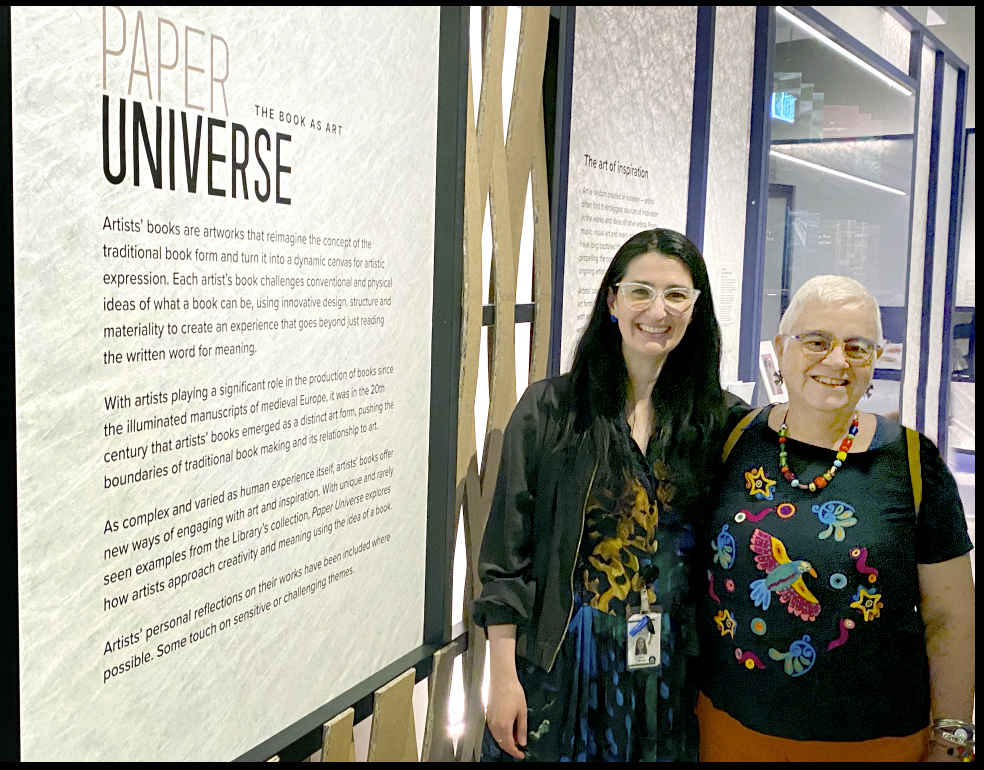
Paper Universe: The Book as Art – curator Maria Savvidis with Helen Cole PHOTO: Doug Spowart
.
HERE’S A SELECTION OF BOOKS FROM THE EXHIBITION
“Click” on the image to enlarge and see the caption.
.


.
HELEN COLE’S REFLECTIONS ON THE SHOW
When I curated the artists’ books exhibition Freestyle Books from State Library of Queensland’s artists’ books collection in 2008 it was supposed to be a mere taster before a major exhibition of the artform. That never happened. It was very gratifying to find out that State Library of New South Wales has taken up the challenge of both curation and display of this form that can be difficult to exhibit, and given it the title of Paper Universe: The book as art. The curator, librarian Maria Savvidis and her supporting team of librarians, conservators and designers have done a superb job in showcasing the richness of stories and artworks that artists books yield. They were fortunate to have five years to bring the exhibition to fruition, and this is shown by the attention to detail in its staging.
.
The exhibition is introduced in the wide corridor leading to it by a huge concertina ‘book’ with blown-up details of three distinctive works. Before you enter, the view of the concertina is a quiet white book by Nicole Hayes with a delicate texture pierced through the page from front and back with pins. As you leave the view is of colourful, forceful black, red and blue designs in linocut and digital prints from books by Dianne Fogwell and Lyn Ashby, summing up the other extreme of the books you have seen.
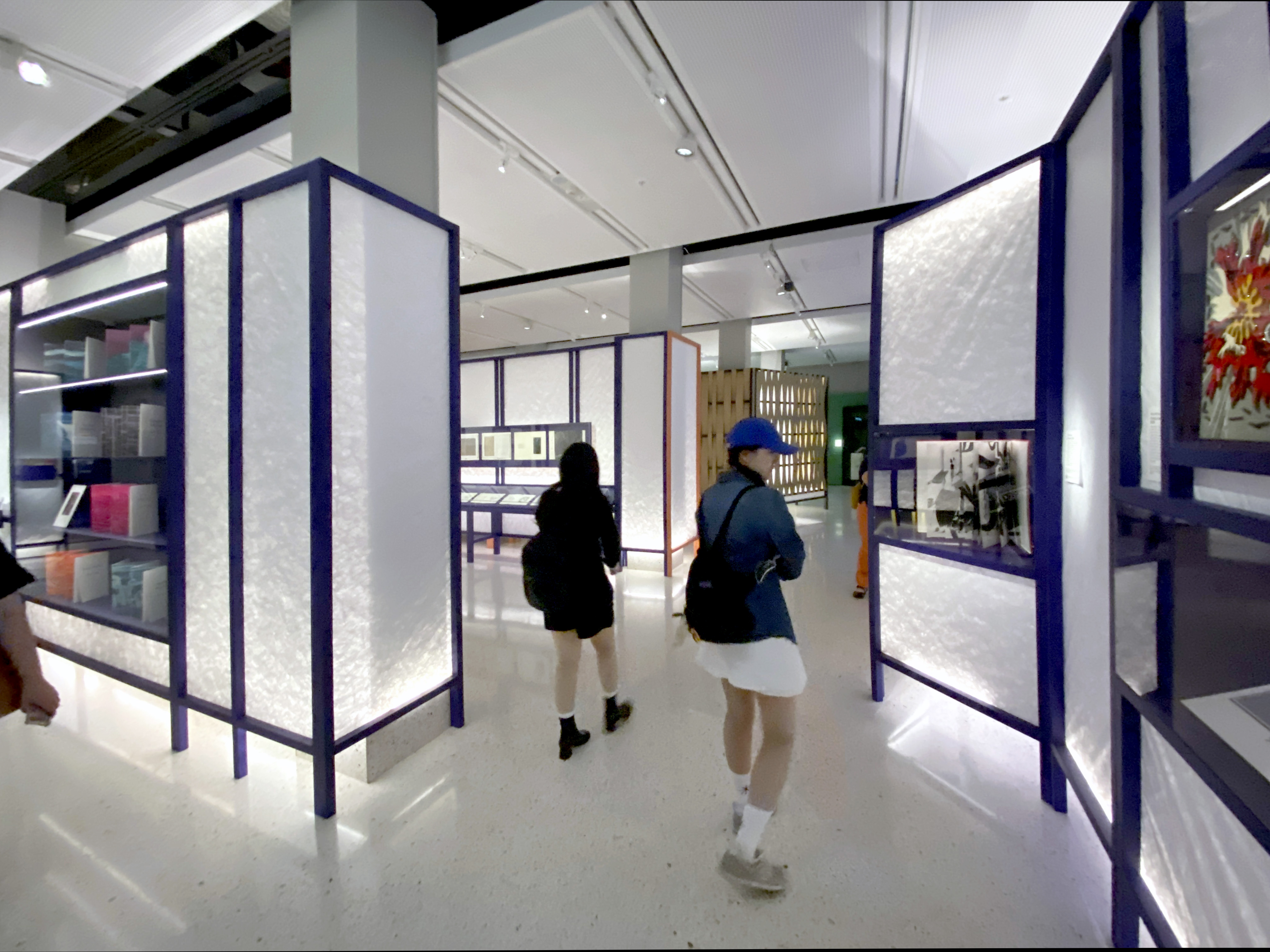
Paper Universe exhibition PHOTO: Doug Spowart
That calm entry leads into a quiet space to engage with the works in the exhibition, provided by dividers reminiscent of Japanese shoji screens. The themes around which the exhibition is woven are well chosen and enunciated in the didactics: the art of inspiration – influences and sources in other artists work; the natural world – its beauty, its power, but also its fragility; the civil condition – investigating, reflecting and challenging social issues, politics, morality and equality; unveiling identity – the shaping of personal, family, and national identities and memories; the artist’s eye – investigations into the notion of the book. Each is signified by a different colour in the surrounding exhibition architecture – walls, plinths and borders on the screens
The books are very well displayed, individually, with several strategies used to overcome the perennial problem of exhibiting artists books, that they generally cannot be fully experienced when closed or open at only one page. The most common comment about an artists’ book exhibition is “I wish I could see the whole book” and indeed it is my thought too, even knowing how difficult it is to avoid. The curator has gone to great lengths to show as many books in their entirety as possible.
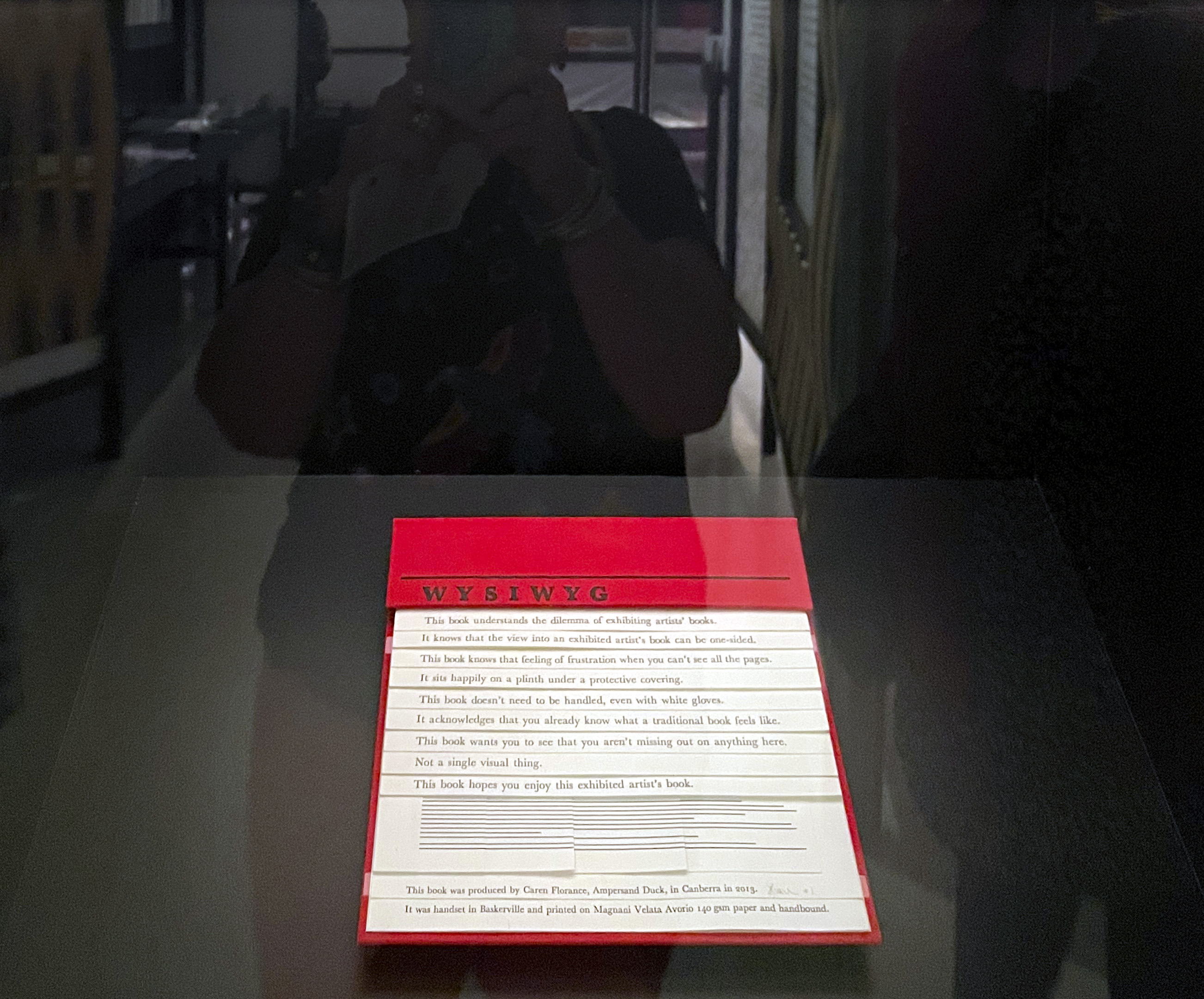
Caren Florance WYSIWYG, 2013
The first book in the exhibition, or is it the last? WYSIWYG (What you see is what you get) (2013) by Caren Florance, the curator’s own copy, was designed to be seen as a whole when the book is closed, displaying what a rarity that is. The text lines are printed on increasingly larger pages, each peeking out from the one above. Maria Savvidis wrote: “This book served as both a talisman and inside joke for me as the curator of this exhibition, years spent thinking about the paradox of exhibiting artist’s books…WYSIWYG is a wry but generous show of empathy from the artist who understands this difficulty and has shown mercy on collecting institutions tasked with the impossible.” Anne-Marie Hunter created the Tower of Babel (2006), (The Tower of Babel, Artists’ Book By Anne-Maree Hunter | State Library of Queensland) a book in the round which was exhibited in my 2008 exhibition, with the same intent.
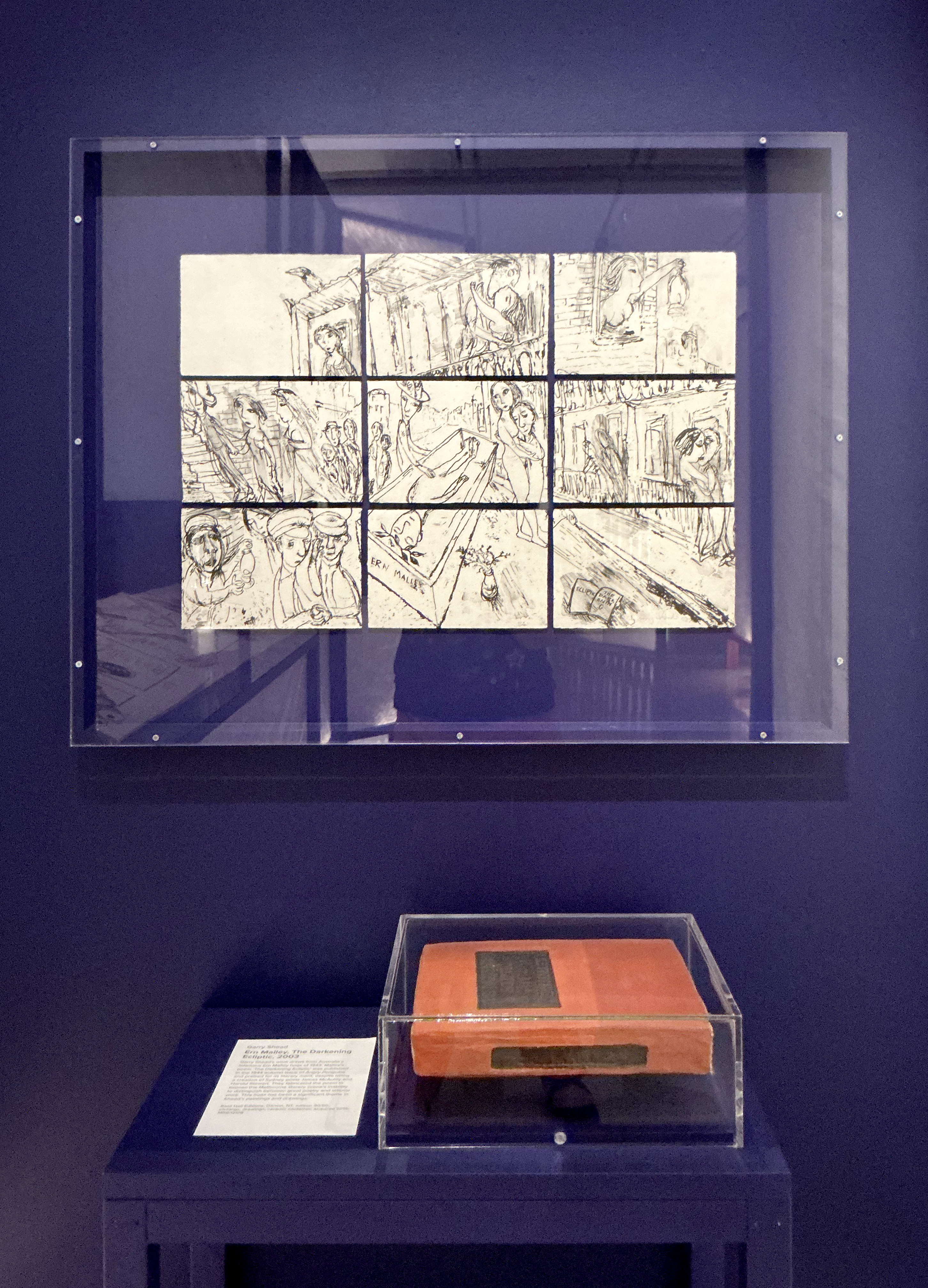
Garry Shead Ern Malley: The Darkening Ecliptic, 2003
Several of the works have been removed from their covers and are displayed, page by page, on the wall. These include Garry Shead’s Ern Malley: The darkening ecliptic (2003): a sequence of etchings, which when presented together create a single image. Along with the display of the ceramic box in which it was presented, this is possibly the best way to show this work.
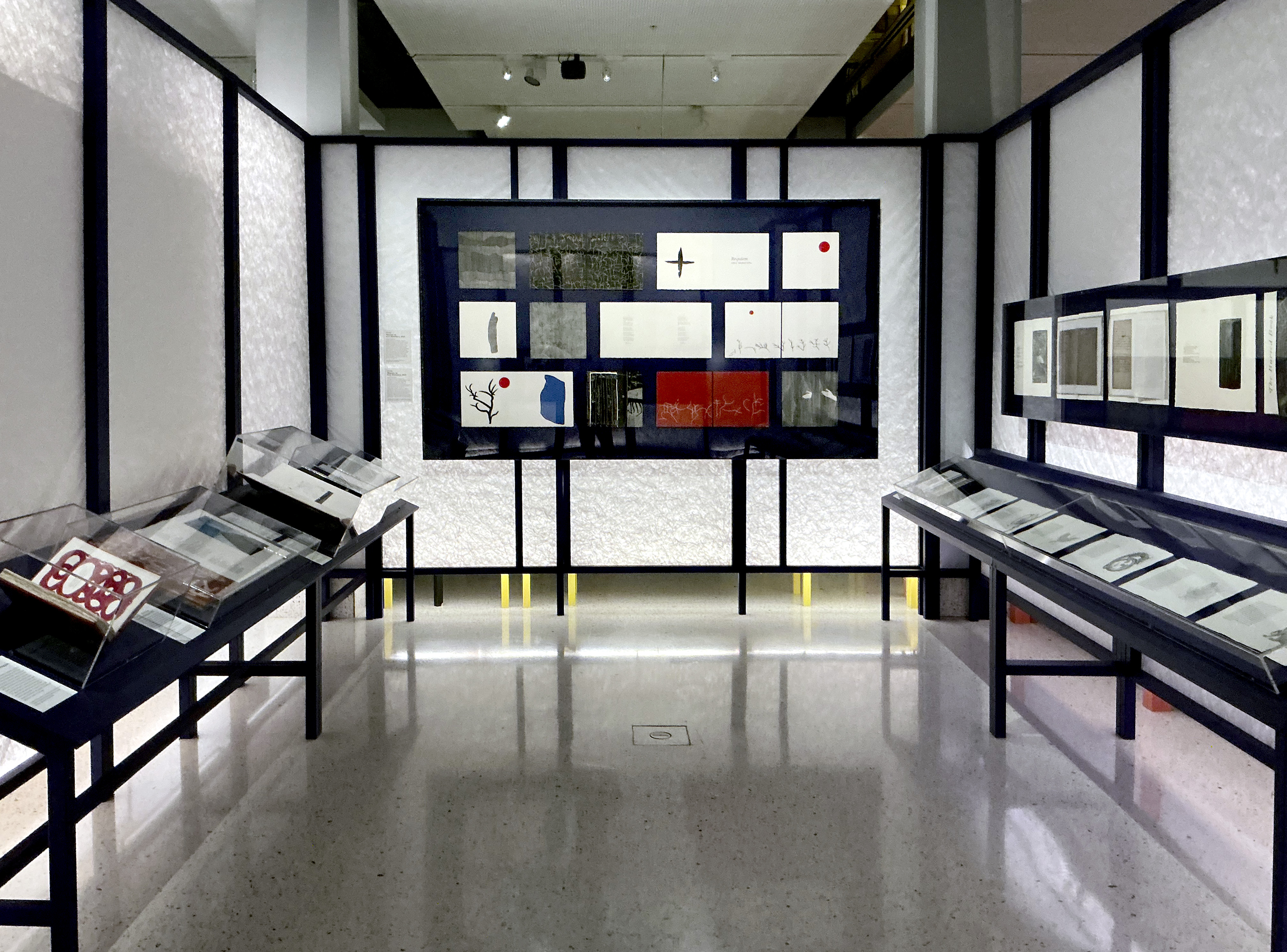
G.W. Bot Requiem by Anna Akhmatova, 2020
The pages of G.W. Bot’s superb linocuts for Requiem by Anna Ahkmatova (2020) are beautifully arranged framed on a blue background, however not all pages of the book are included so it is unfortunately a circumscribed view of the production.
Other works displayed page by page include Paul Uhlmann’s New Insecta, Queensland: AA Girault (1989), Judy Watson’s A preponderance of Aboriginal blood (2005), Peter Lyssiotis and George Matoulis’ Bridge (2021) and Glenda Orr and Kathy Boyle’s Paradise Lost : an artists’ book exploring the status of threatened & iconic plants from Australia and New Zealand collected by Daniel Solander and Joseph Banks during Captain Cook’s 1770 voyage (2020).
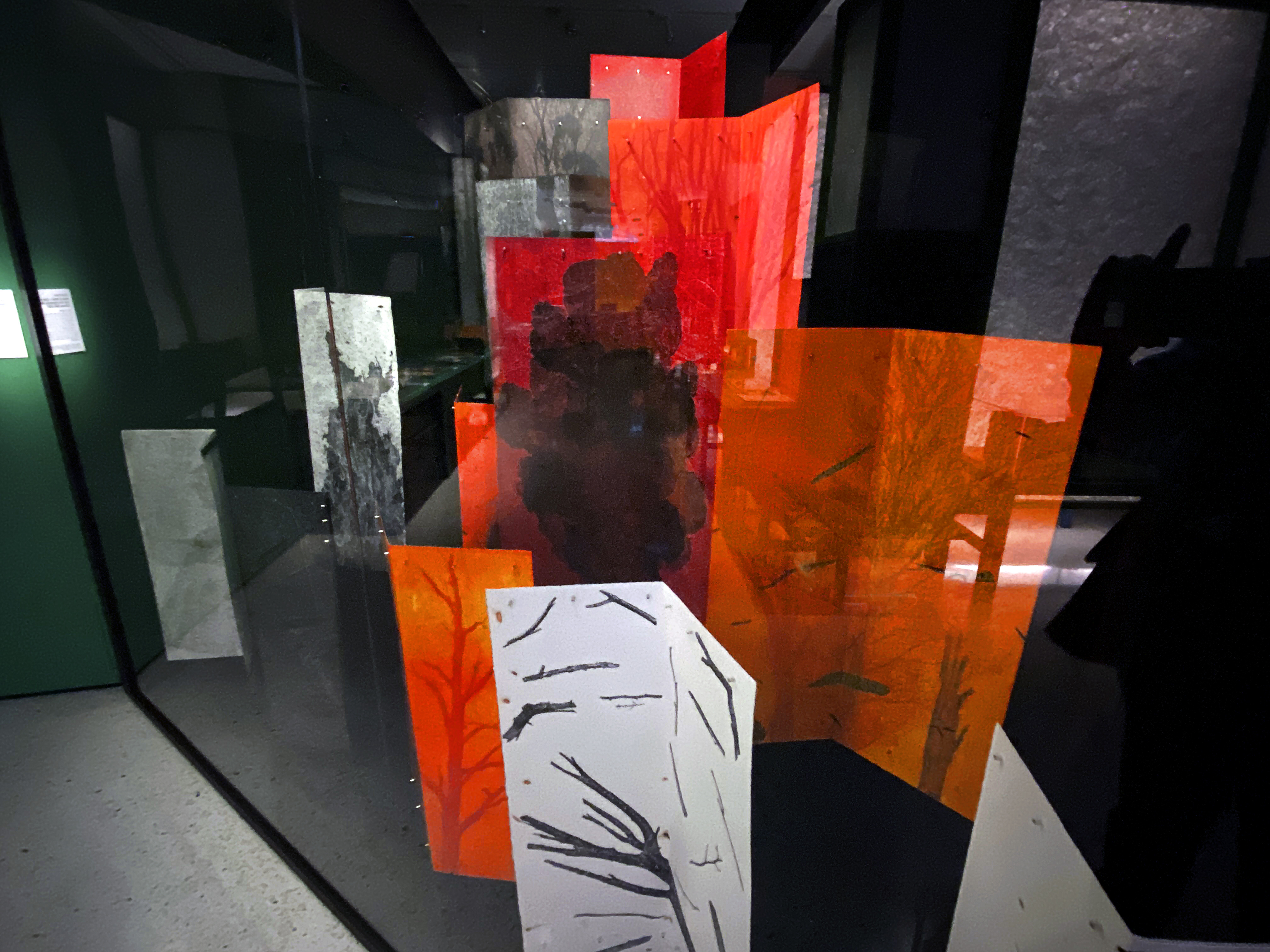
Dianne Fogwell Ashes to Ashes – Dust to Dust- Ash Wednesday 16th February 1983, (2018) PHOTO: Doug Spowart
The pages of Di Fogwell’s Ashes to ashes – dust to dust: Ash Wednesday 16th February 1983 (2018) are arranged upright to evoke the flames of the bushfire it describes. There has been some comment that this destroys the original form and order of the books, but I disagree. Some books are meant to be rearranged by the reader or at least read in any order they want. Also, the curator went to some lengths to speak to the artists and present their work as they would want. For most of the works artists’ statements are provided, along with translations of foreign language texts, where appropriate.
I don’t consider print portfolios on a single subject, often by printmaking groups, constitute successful and cohesive artists books, and there are a few in this show including Natural Collection (2017) by the Warringah Printmakers Studio. It was published to celebrate the 20th anniversary of the Studio and is based on the species and ecological communities of the Northern Beaches of Sydney that are under threat. Ten of the 29 prints that comprise the work are exhibited over three changeovers, not including the texts which accompany each print. I don’t think this work has a conceptual framework – a common subject, yes, but not enough to tie them together – as a book.
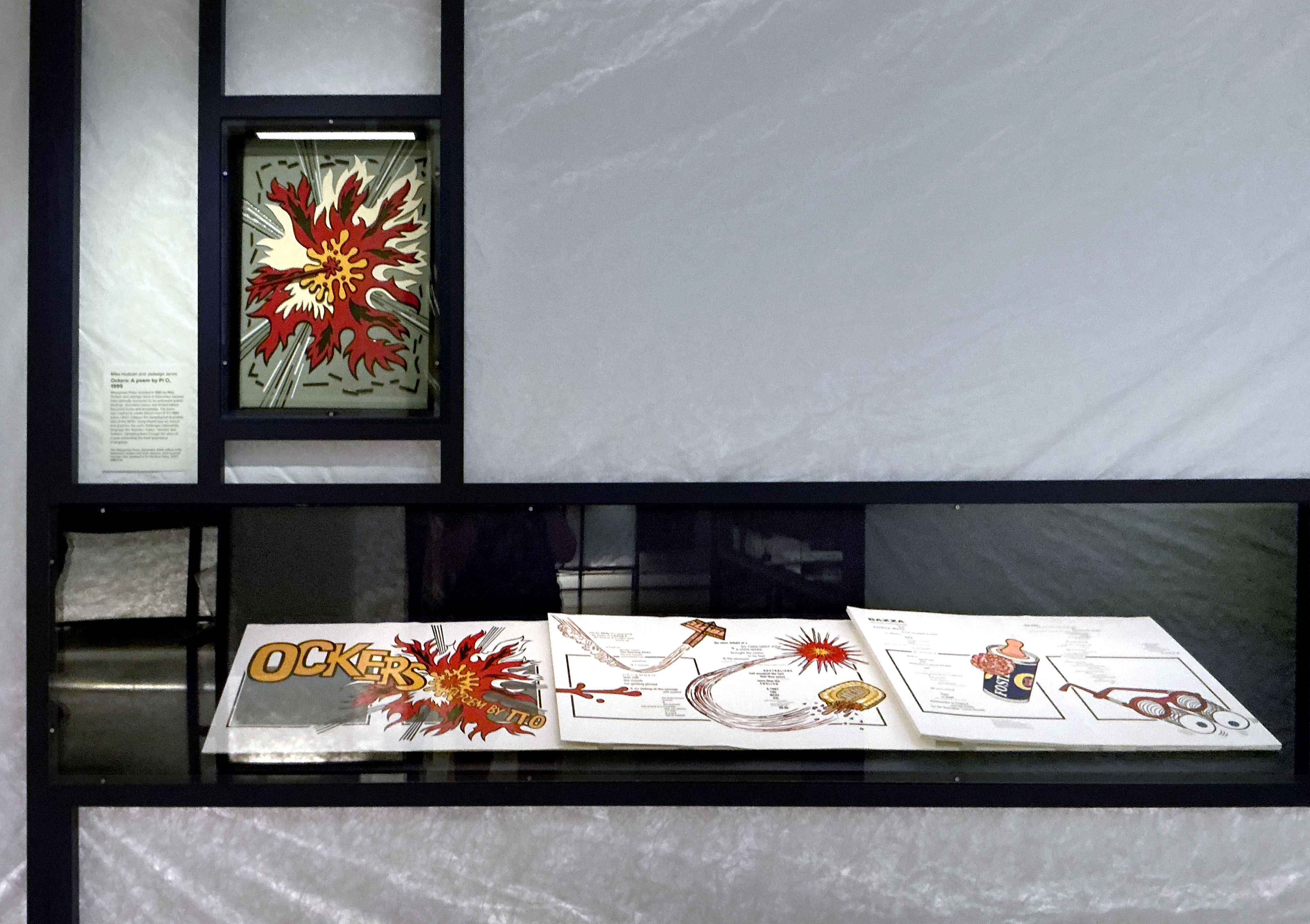
Mike Hudson & Jadwiga Jarvis Ockers: A poem by Pi O 1999
Concertina books are perfectly made for display, extended either framed on a wall or standing upright on a plinth. The bold and colourful Wayzgoose Press book Ockers: a poem by Pi O (1999) is displayed partly opened behind glass. A thoughtful work previously unknown to me was Theo Strasser’s In ecstasy, Franz Kafka (2013) in acrylic painting and collage, based on an aphorism by Kafka. Another is Lossed (2022) by Sara Bowen. Reduction lino prints of her parents, at first strong, becoming lighter as the book is opened page by page. I’m not sure if it represents her memory of them fading or their memories of each other fading through dementia, but it is a very touching work which is displayed to perfection.
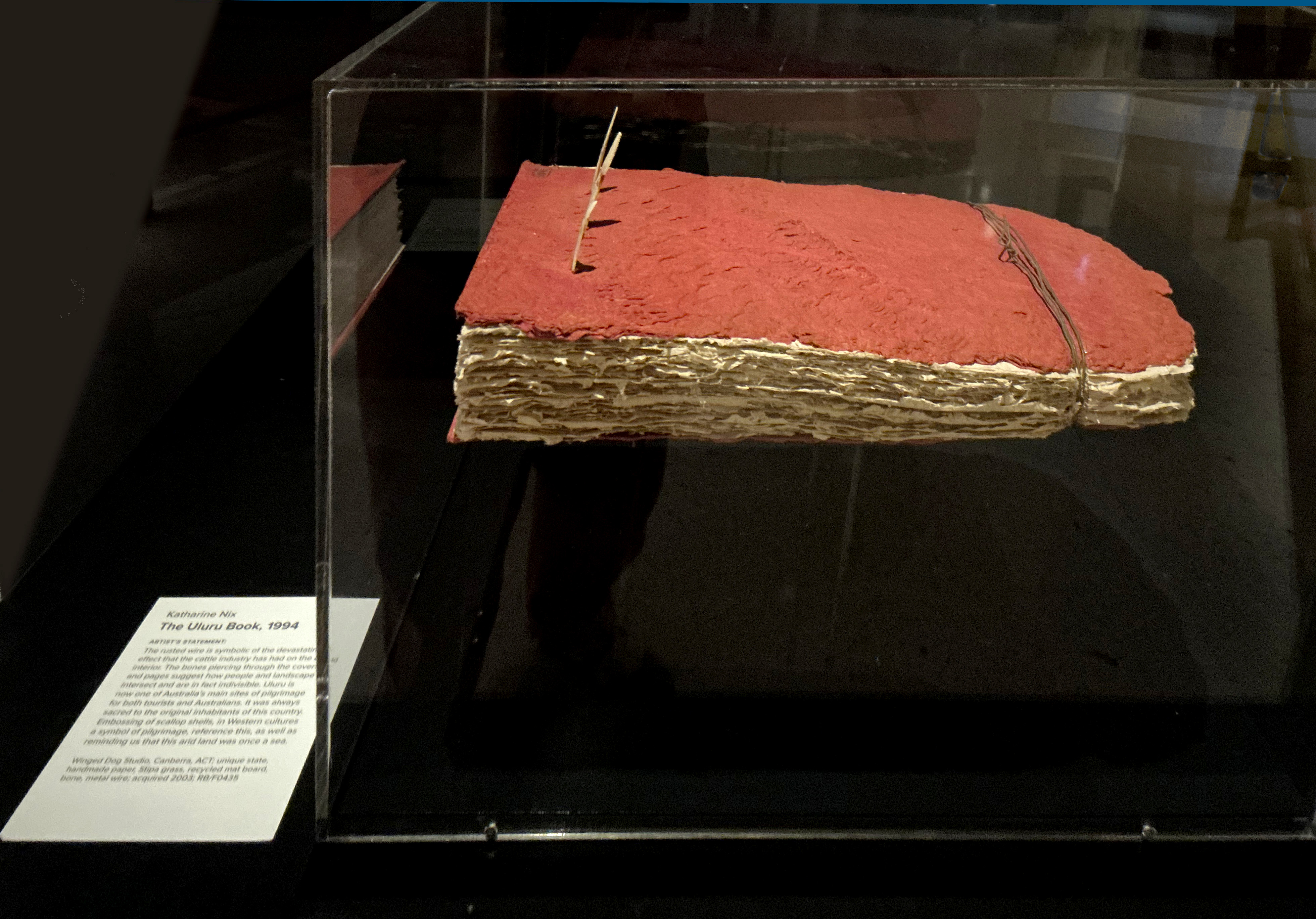
Katharine Nix The Uluru Book, 1994
Several works which could be regarded as book objects were included. The Uluru Book (1994) by Katharine Nix has an imposing physical presence; multiple layers of the hand-made paper for which she is well known, with ochre coloured covers tied with rusted wire and pierced by bones. All elements allude to the close links between the rock and its original inhabitants, and the damage done to the rock and its surrounding environment by the thousands of visitors. Teledex (1981), by Ted Hopkins is a container for poems in the form of an old-fashioned metal teledex, indexed with tabs.
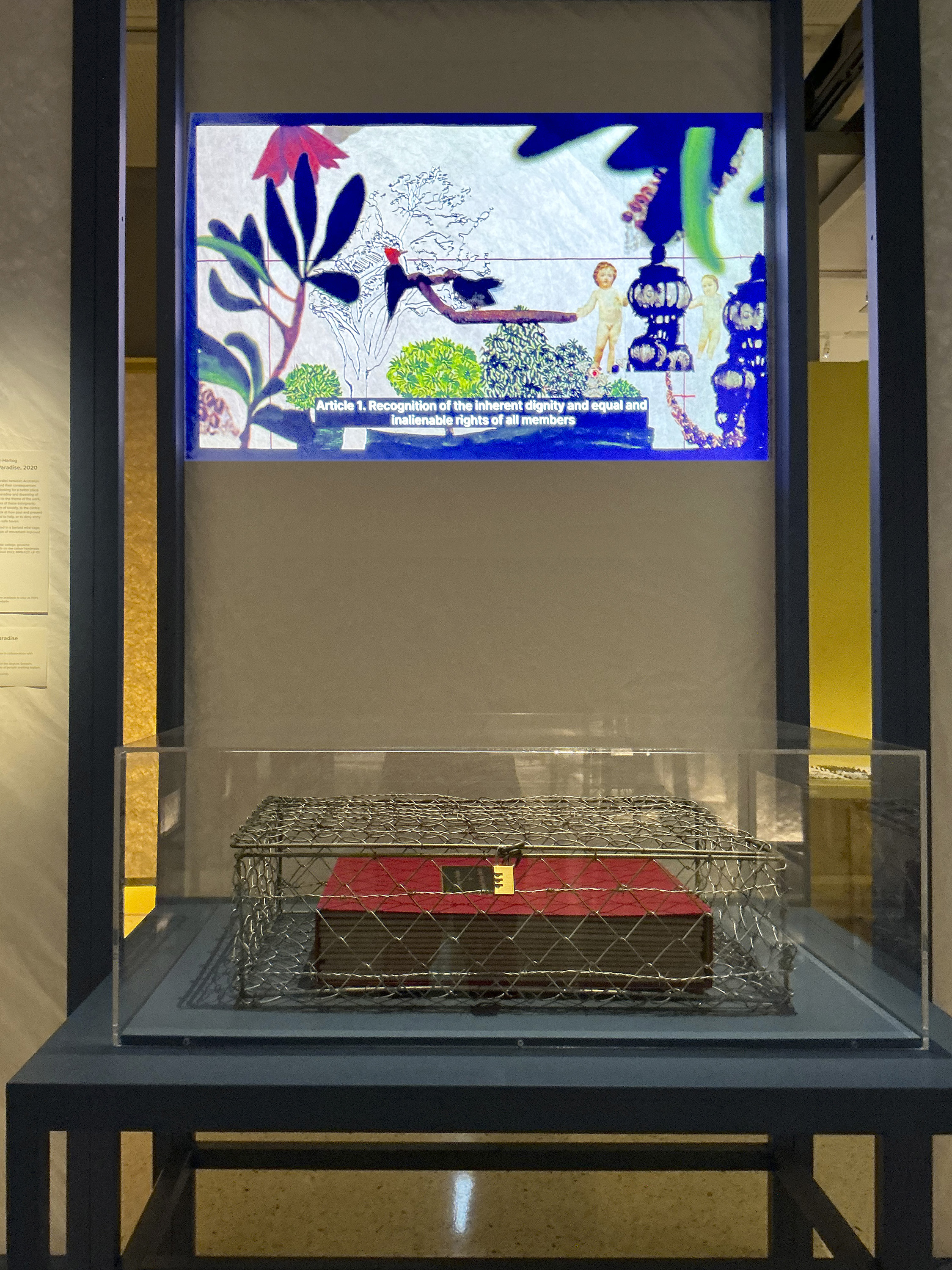
Nathalie Gautier-Hartog
Looking for Paradise, 2020 + Video a collaboration with Broken Yellow
Looking for paradise (2020) by Nathalie Gautier-Hartog, is about refugees seeking a home in Australia, but subject to Australian government policies. It is presented as 12 books inside a wire cage, further emphasizing the restrictions placed on refugees. It is noted that all of the books are available to view as PDFs on the artist’s website with a QR code linking to it displayed. There is also a clever animation based on the United Nation’s Human Rights Charter with images from the books showing in the gallery. It is also on her website. It was created in collaboration with Broken Yellow Studio and the Asylum Seekers Centre. I’m not a great fan of digitised artists books but must admit this combination of media enhances interaction and appreciation of the work.
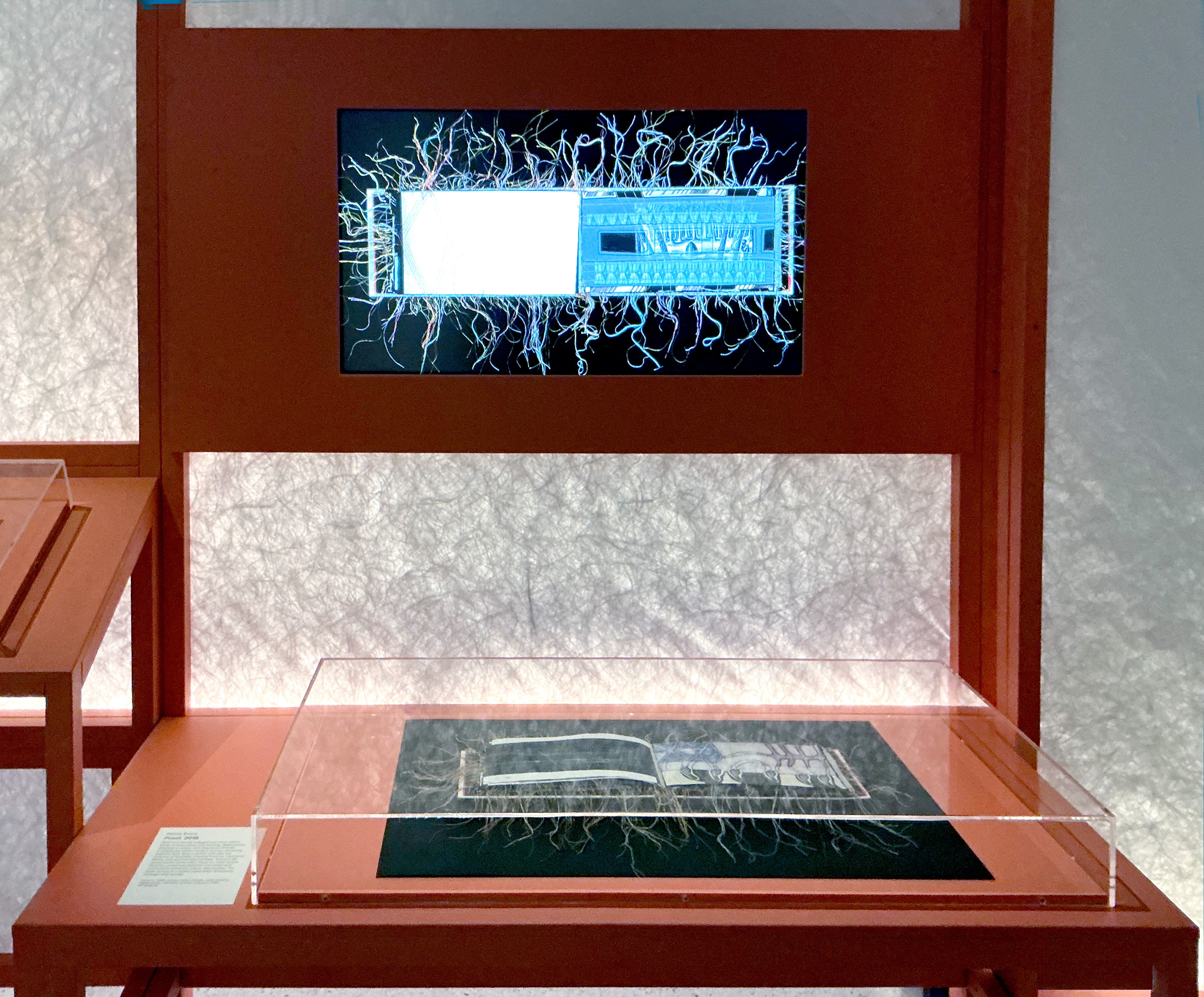
Penny Evans Proof, 2015
Relatively few First Nations artists create artists books, so it was great to see a works by Judy Watson and a work by Penny Evans, who has Gamilaroi, Welsh, Irish and German heritage using the form to examine connections between culture and country in her unique state book Proof (2015). Using collage and digital prints with stitching it was accompanied by a page-by-page video of the work.
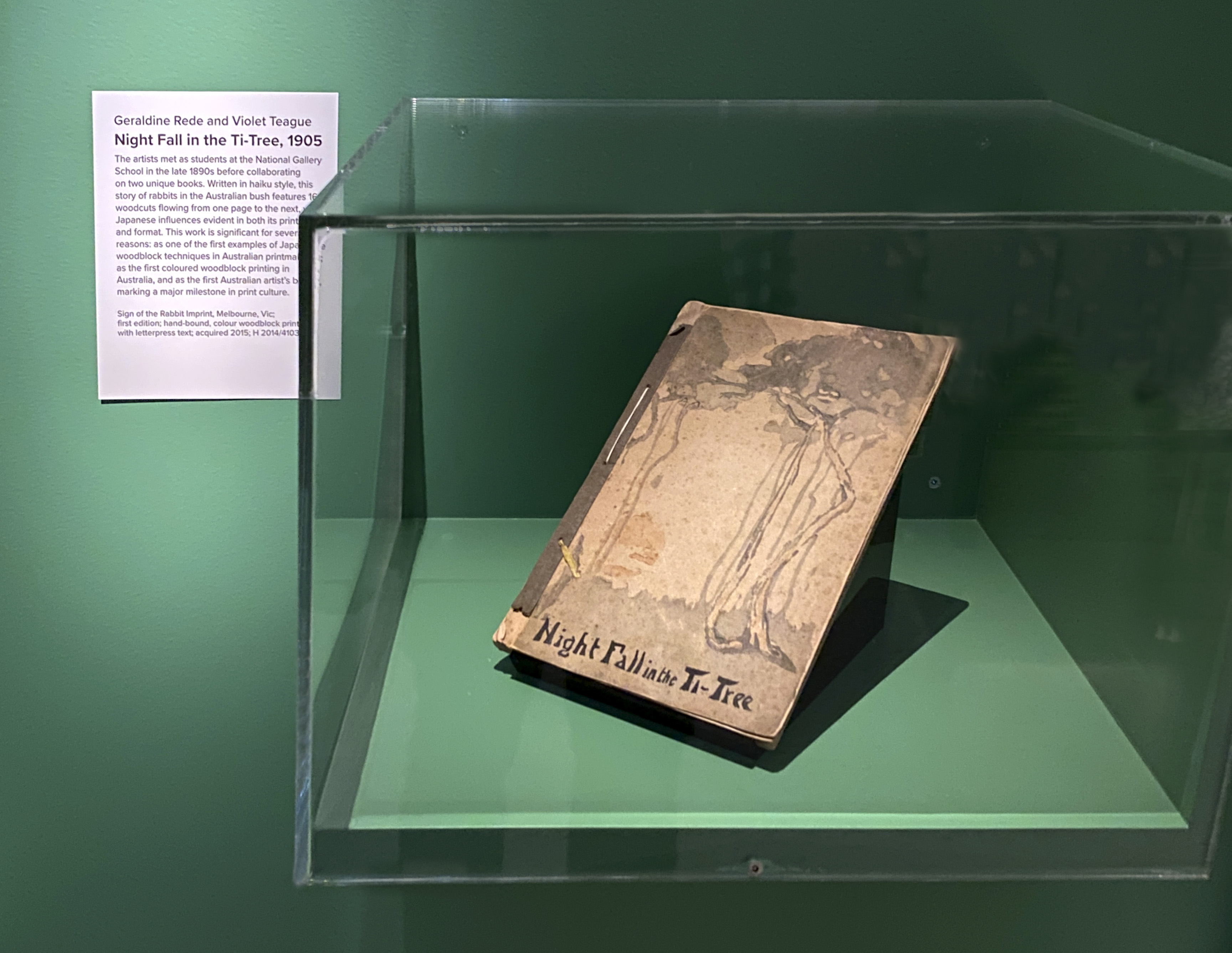
Geraldine Rede & Violet Teague Night Fall in the Ti-Tree, 1905 PHOTO: Doug Spowart
I was surprised that no works from the origins of artists books were shown: books such as those by Picasso and Bonnard published by Ambroise Vollard and Daniel-Henry Kahnweiler in Paris in the early twentieth century. It could be because the library doesn’t hold them. A quick search of the SLNSW catalogue revealed Dingo, with drypoint etchings by Pierre Bonnard published by Vollard in 1924, but few others. I was pleased to see the inclusion of Night fall in the ti-tree (1905) by Violet Teague and Geraldine Rede with its delicate woodcuts, and its acknowledgement as the first Australian artists’ book.
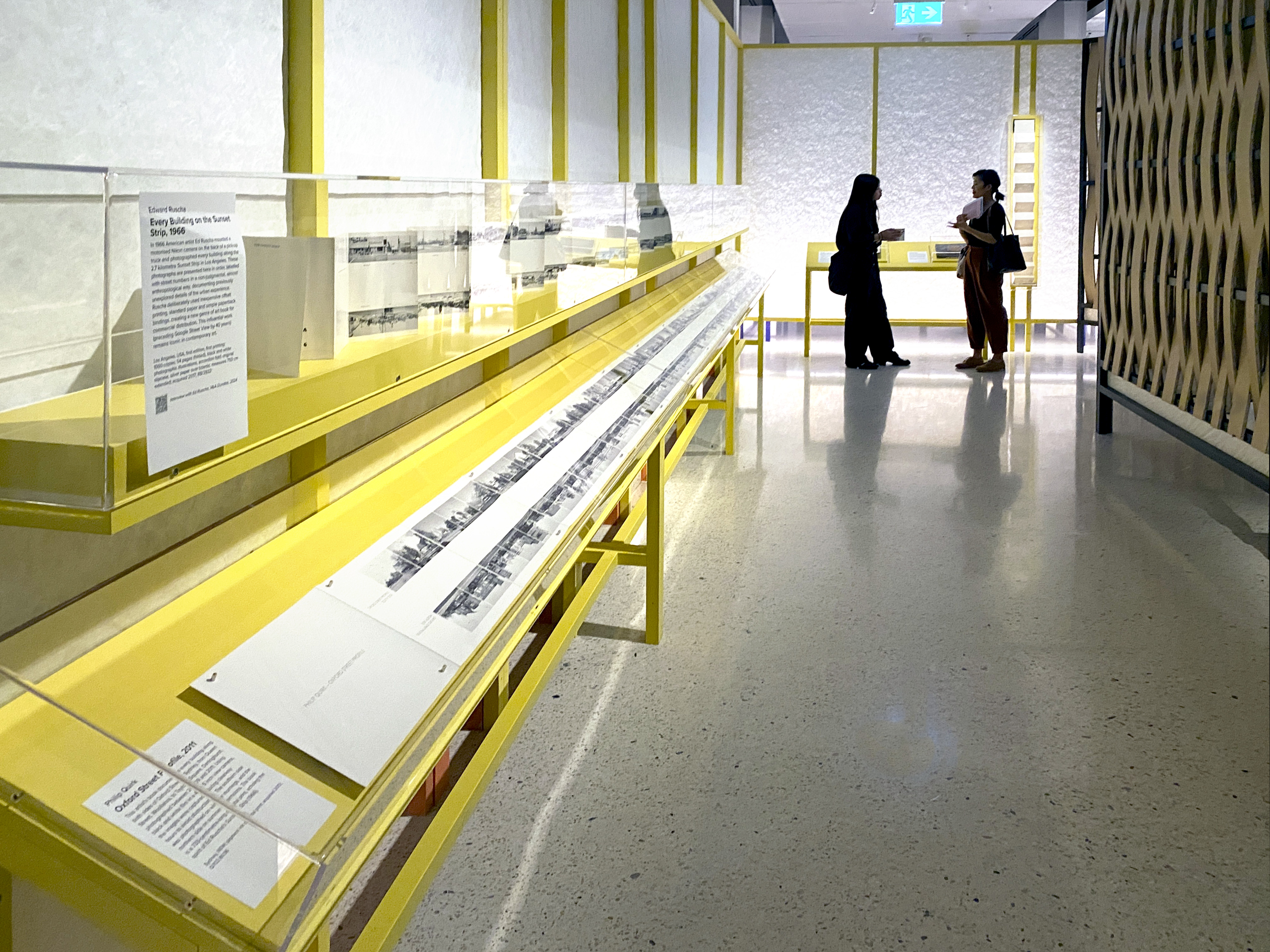
Ed Rusha Every Building on the Sunset Strip, 1966 + Philip Quirk Oxford Street Profile, 2011 PHOTO: Doug Spowart
In a small way the exhibition demonstrates the limitations of the artists’ book collection at the SLNSW, which has not concentrated on its development until relatively recently. Most of the exhibited works have been created in the twenty-first century. There are few books published overseas, one being the fabulous version of the Rubaiyat of Omar Khayyam (1973) by the British artist Susan Allix. The Rubaiyat is a very popular subject for interpretation by artists. An important artist in the history of the artist’s book is American Edward Ruscha, an early exponent of the democratic multiple. He is represented by the concertina photobook Every building on the sunset strip (1966) which has had a huge influence on other artists who continue to create similar works. In this exhibition the book is unusually displayed fully extended to 7.5 metres and is shown with Oxford Street Profile (2011) documenting Oxford Street in Sydney by Australian photographer Philip Quirk. It only stretches to 7.33 metres. It was interesting to see Micky Allan’s early (in Australian terms) artist’s book My Trip (1976). Displayed open, a full facsimile of its newspaper format is also available for closer investigation.
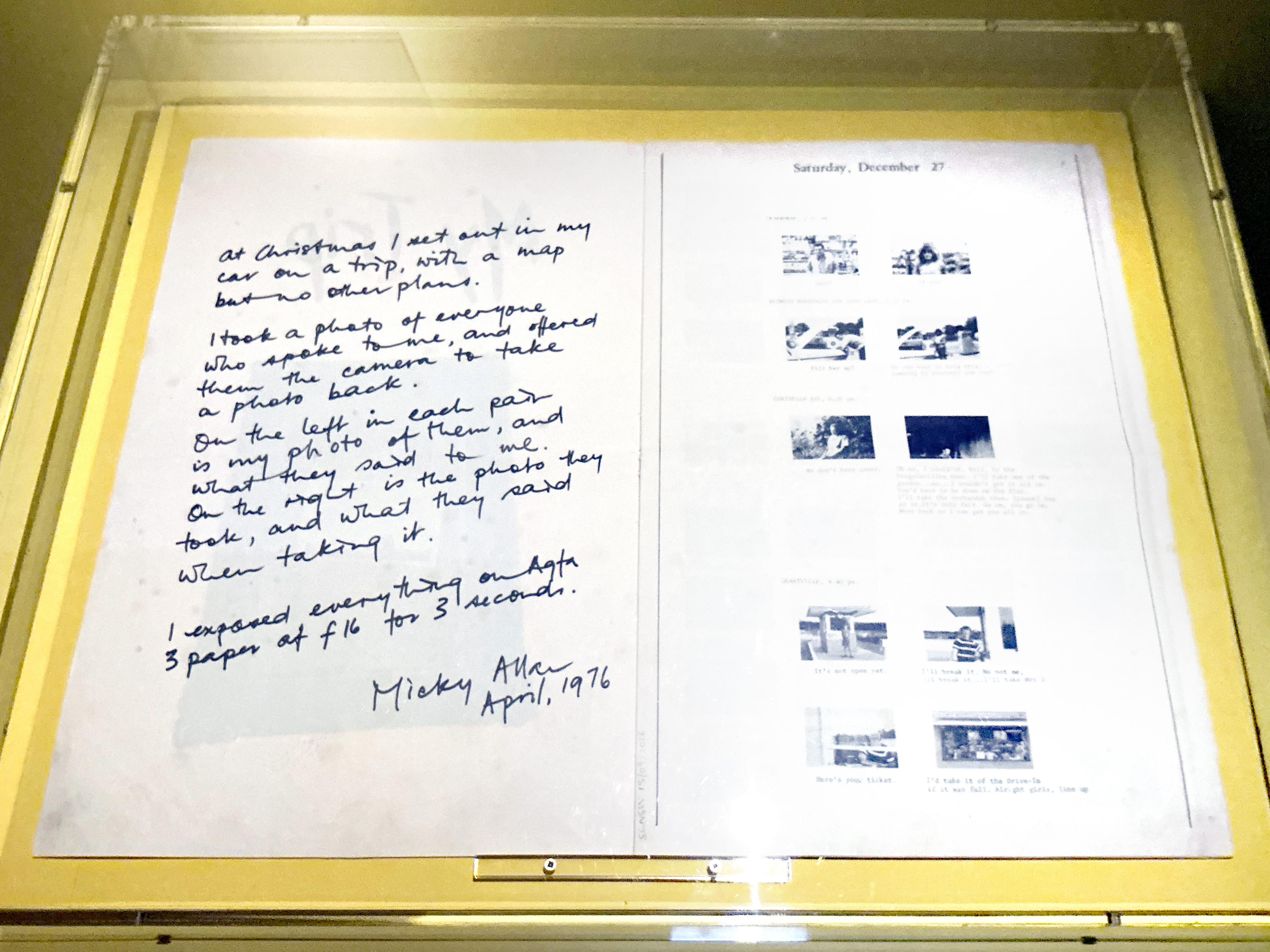
Micky Allan My Trip, 1976
Dancing Over Dark Waters (2012), Howl for a Black Cockatoo (2015), and Phantomwise Flew the Black Cockatoo (2017), by Sue Anderson and Gwen Harrison, with Peter Lyssiotis writing the text for Dancing over dark waters, very impressive books all, are very similar materially and in subject. They could have been replaced by other works expanding the breadth of vision made available in the exhibition. Similarly, several artists are represented by more than one work when other artists and their ideas could have been embraced.
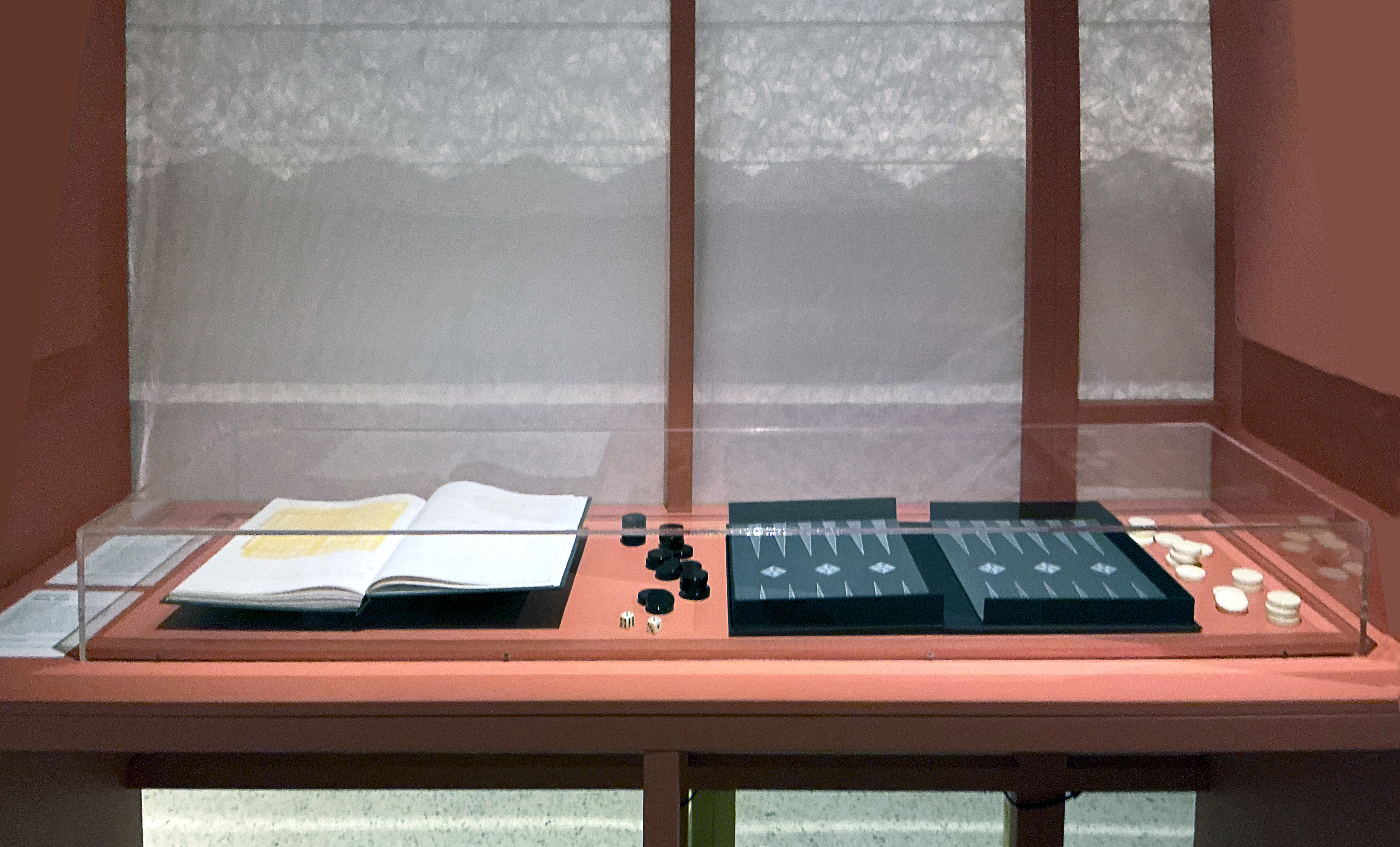
Deanna Hitti Towla, 2017
The exhibition includes some of my favourite artists books including Towla (2017) by Deanna Hitti, with the integral clamshell box creating a board for backgammon, the subject of the book. It is an intriguing book with instructions for backgammon phonetically translated using Arabic and Latin characters but with a twist. Arabic letters spell the instructions in English and Latin letters spell the instructions in Arabic. Some of the books in this exhibition have become my new favourites.
In Conclusion
Criticisms of some components of the exhibition are mere quibbles. In retrospect I could make many about my own exhibition in 2008. This is a fabulous exhibition, beautifully curated, wonderfully designed, and a rare opportunity for the public to experience the breadth and depth of the artists’ book. I hope it will introduce the magical world of artists’ books to a whole new audience in Sydney who will follow up with personal experiences with artists’ books in the library. I also hope that SLNSW will continue to support the art form in both acquisitions and exhibitions.
Helen Cole
March 14, 2026
.
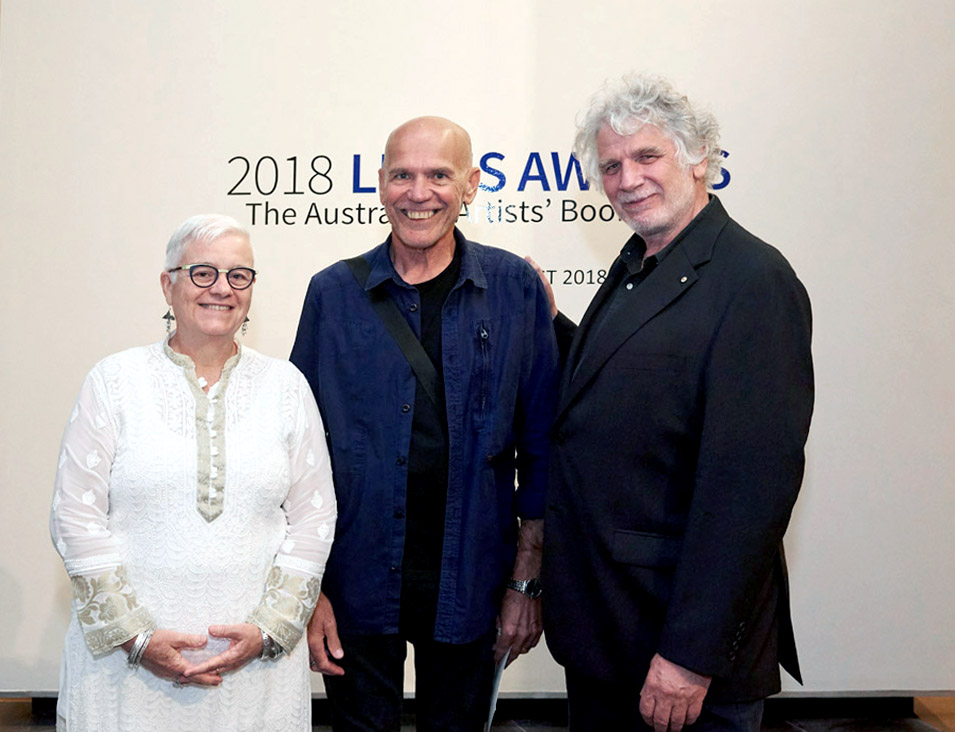
Judges: Helen Cole & Roger Butler with Clyde McGill PHOTO: Artspace Mackay
HELEN COLE: Brief Biography
Helen Cole is intimately acquainted with the world of artists’ books, including their collection and the opportunities and difficulties in presenting these artworks in a public context. Helen was the Arts and Rare Book librarian at State Library of Queensland for thirty years. During much of that time she was responsible for the development of the Library’s extensive Artists’ Books Collection. She has been significantly involved in the artists’ book discipline writing articles and making presentations at conferences. She has judged the Manly Artists Book Prize once and on two occasions judged the Libris Australian Artists’ Book Prize for Artspace Mackay. In 2008 she curated the SLQ exhibition Freestyle Books: Artists’ books from the collection. Helen also co-curated the Tales from the Lyrebird with Ron McBurnie for Artspace Mackay. Apart from her work developing public collections she has amassed a personal library of cherished books.
..
.
OTHER PAPER UNIVERSE RESOURCES
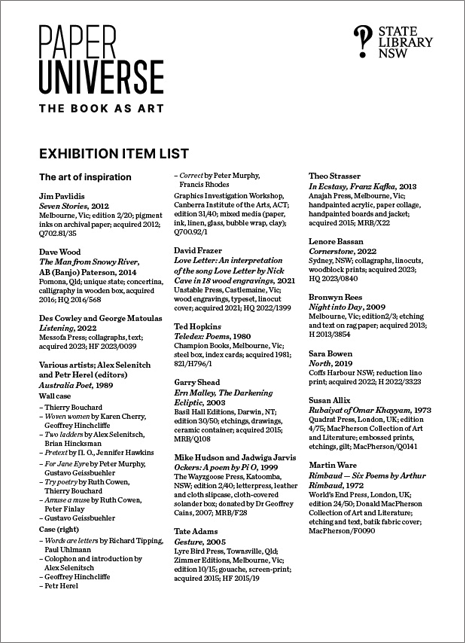
DOWNLOAD: A list of all books in Paper Universe: Paper Universe Book List
DOWNLOAD: A catalogue of Didactic Information on Each Book: Paper Universe Exhibition Captions
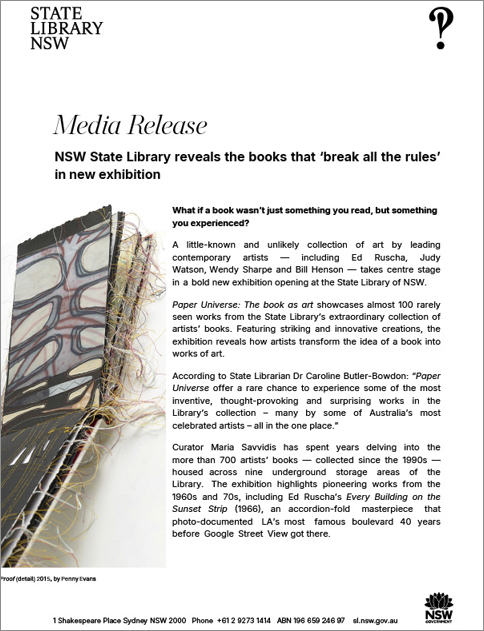
DOWNLOAD: A Press Release of the exhibition: Paper Universe Media Release
We wish to acknowledge the courtesy extended to us by curator Maria Savvidis.
The Reflection text ©2026 Helen Cole
All photographs are by Helen Cole unless otherwise credited.
© is retained by all authors
All photographs have been digitally optimised by Doug Spowart.
Two views of th ‘Paper Universe’ entry concertina PHOTO: Helen Cole
.
.
.
.
.
.
.
.
GEORGE PATON GALLERY: Artist’s Books (reprised) Exhibition
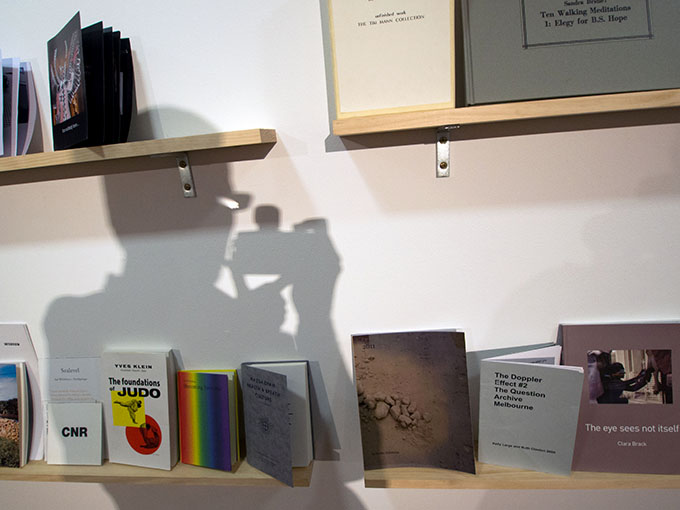
Artists’ Book Selfie
.
Digging in the archive: past and present
Artist’s Books (reprised) [artists’ books 1978-2014]: George Paton Gallery, University of Melbourne
Dates: 26 August to 5 September
A recent show entitled, George Paton Gallery, Artist’s Books (reprised), promoted that it would be showing “four decades of investigation into the possibilities and limitations of the artists’ book form.” Whilst the exhibition as presented had some gaps in the chronology, it did live up to its claim of presenting a significant collection of contemporary works alongside a carefully curated group of seminal artists’ book works from shows presented at the George Paton Gallery in the 1970s and 80s.
.
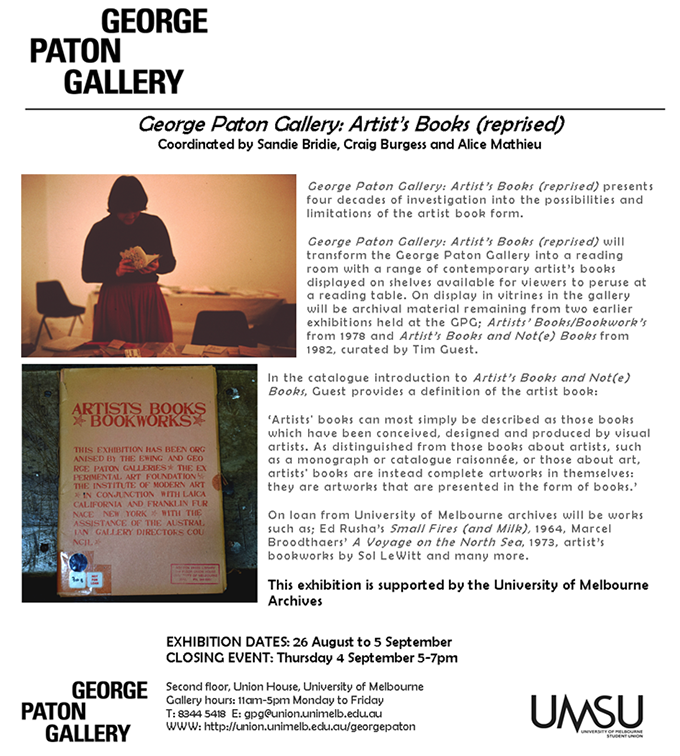
George Paton Gallery Website notice
.
Visitors to the gallery encountered a space resembling a reading room with trestle tables and bookshelves presenting the contemporary books for viewing, handling and reading. Some books were marked as ‘white-gloved’ handling whilst the majority was available for direct tactile experience. Enclosed in vitrines were the historical books on loan from the University of Melbourne archives. Interestingly during the 1970s and 80s these books would have only cost a few dollars to buy but now they attract significant values. Included in this prized collection of books are: Ed Ruscha’s Small Flres and Milk; 1964; Marcel Broodthaers’ A Voyage on the North Sea; 1973; Sol LeWitt’s Grids – using all combinations of straight, not- straight and broken lines; 1975; Richard Long’s The North Woods, 1977 and Dieter Roth’s, Gesammelte Werke, Band 7, 1974. These books were sourced from past exhibitions held by the George Paton Galley: Artists’ Books/Bookworks from 1978 and Artist’s Books and Not (e) Book! from 1982, the latter curated by Canadian Tim Guest.
.
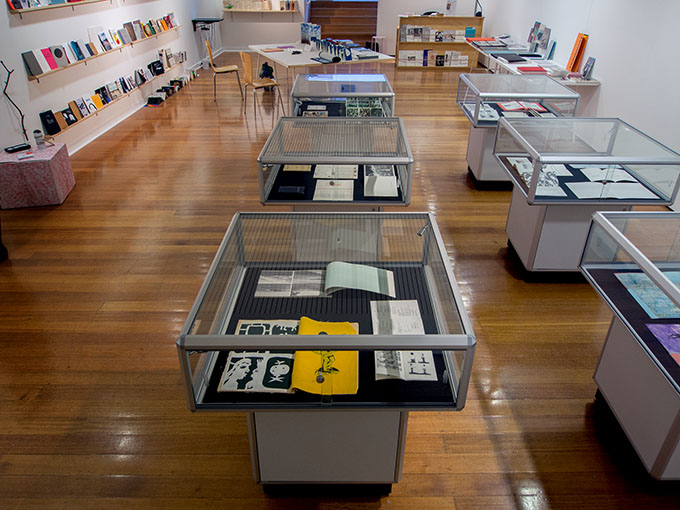
George Paton Gallery
In all just over 100 books were available for viewing essentially coming from a ‘call out’ for artists book makers to present work for the show. There were some interesting names; Peter Lyssiotis, Theo Strasser, Sandra Bridie, mail artist David Dellafiora, zinesters Gracia Haby and Louise Jennison, and photo-newspaper publisher Jacob Raupach. Anyone with a preconceived idea of what an artists’ book is, or should be, may have been challenged by some of the works in the show – but what an experience it was to be challenged in that way. It was a rare opportunity to view and compare such a diverse and historical collection of artists’ books.
.
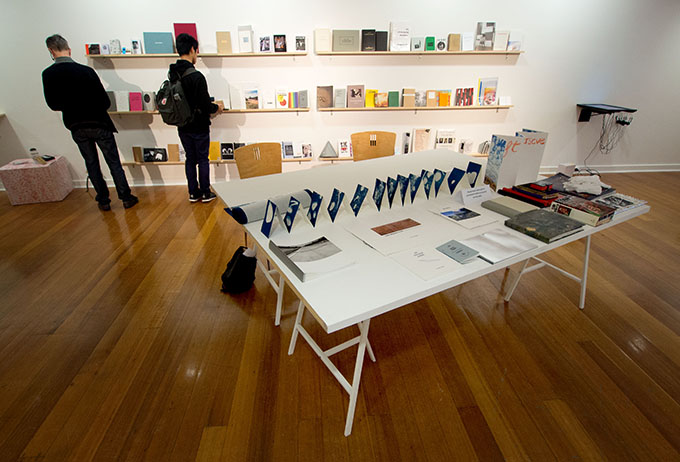
Exhibition installation
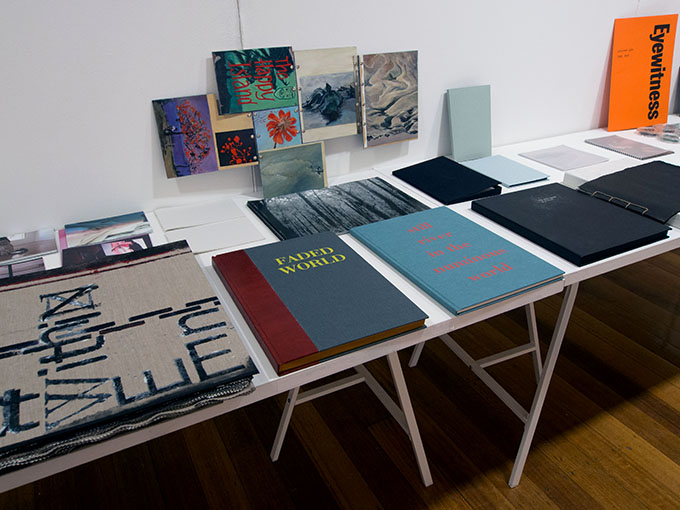
Antoni Jach’s Faded World and books by other artists
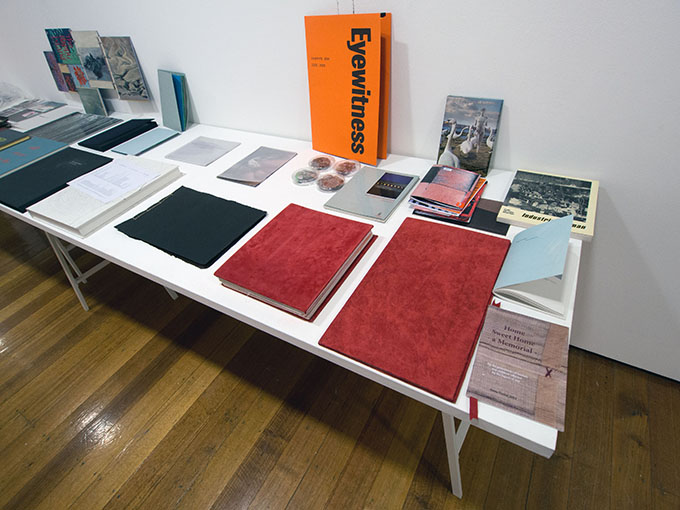
Books by Peter Lyssiotis, Theo Strasser and others
After spending a couple of hours in the exhibition space I searched for a way of describing the show. Then I found a text that offered a perceptive critical evaluation of the artists’ book genre. Some relevant passages from this text follow…
.
Artists’ books can most simply be described as those books which have been conceived, designed and produced by visual artists. As distinguished from those books about artists, such as a monograph of catalogue raisonee, or about art, artists’ books are instead complete artworks in themselves: they are artworks that are presented in the form of books.
Since about 1960 a distinct genre of artists’ books has appeared. These are by artists who are self-consciously exploring the possibilities of printed books: the social dynamics of a reproducible vs. a unique art object; the aesthetics of the mass print media vs. fine art prints or deluxe editions.
The contemporary genre of artists’ books is now a widespread phenomenon. Practically every significant development in western art has been reflected in the ongoing publication of artists’ books. There are books coming out of the movements of pop art, minimalism, arte povera, performance art, fluxus, happenings, and new image painting. Conceptual artists of the 1960’s and 70’s in particular, utilized the book form as a method of realizing artworks. We can regard these books now as a vein which runs through many areas of contemporary art and includes diverse movements, interests and preoccupations.
Or have the interests been so diverse? Pop art, minimalism, performance art, arts provera, were all movements distinct from (even antagonistic to) one another, yet they all belonged to a general tendency towards “non-objective” art… Briefly, this tendency has been reflected in a desire on the part of artists to explore new media, in an attempt to abandon the traditional (modernist) disciplines of painting and sculpture. It was/is in favour of the widened scope of the flux and flow of a multi-disciplinary approach. For example, an artist may be involved in sculpture as easily as film, performance, video, photography and/or books. Perhaps most significantly there has been a conscious determination to undercut the reification of artworks – society’s valuation of art – by concentrating on the non-objective. This has meant, for instance, producing works from common industrial or throw away materials (art povera, fluxus), works constructed only in theory (conceptual art, language art), imagery stolen from the banal repertoire of mass media (pop art) ….. All this seems to have been more successful as an ideal than as an actual practice. Minimal sculpture in the late 60’s was quite successful in the art marketplace. Conceptual art has been immensely influential, popular, and saleable. As much as these artworks were determined in opposition to the bourgeoise reification of art they were inevitably complicit with it. That is because capitalism is a social system which seems to embrace new ideas but in fact appropriates and establishes a commercial value for then.
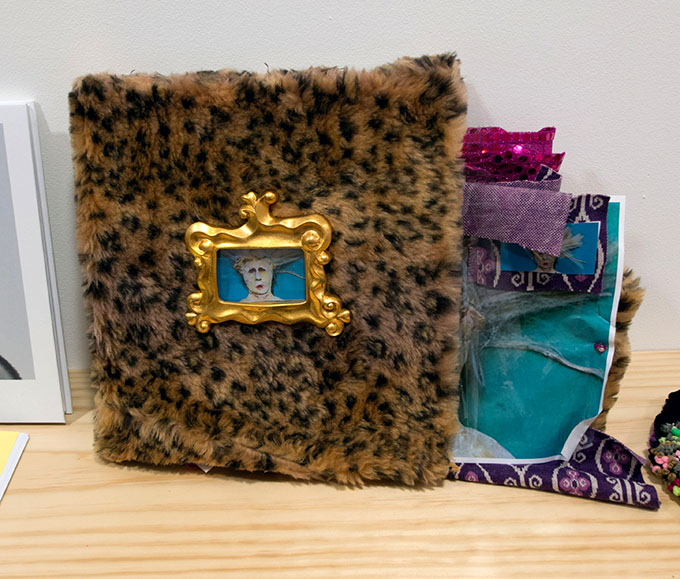
A book by Dianne Dickson
Artists’ books typify this interest in non-objectivity and reflect the internal contradictions of such an ideal in a particular way. In contrast to the traditional “livre d’artistes” of deluxe editions, artists’ books are usually inexpensively produced and sold. They are affordable, accessible and as plebeian as an art object can be. In fact they are almost too exemplary of the non-objective ideal.
As books they are not commercially viable simply because they defy the expectations of a mass market by presenting avant-garde information. Yet they have few patrons in the art world because their affordability to the public represents a low profit for a dealer. Also, books can not [sic] be viewed in the same way as other art objects; they must be held in one’s own hands and read. It is remarkable then that despite the contradictions and foils of art’s survival, artists’ books have become such a highly evolved genre of contemporary art, as evidenced by the works in this exhibition.
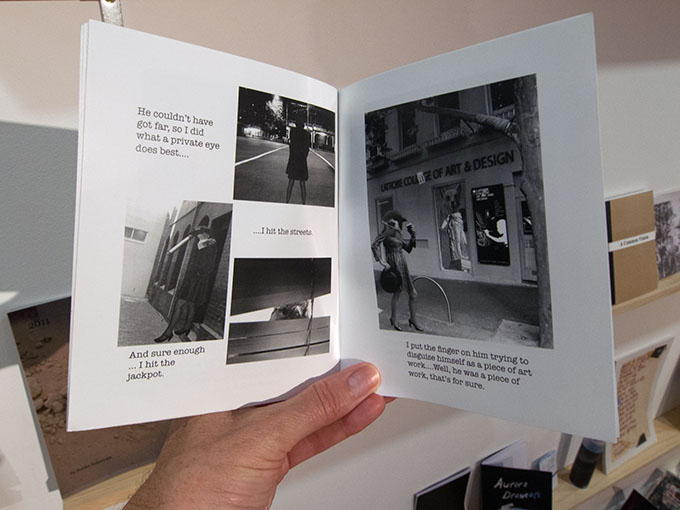
Suzannah Griffith’s While The City Sleeps
.
To illustrate means to make something clear by example, or to adorn a book with pictures. Within a publication, an illustration can be a picture, a drawing, a photograph, a design, or an ornament. Illustration is, of course, a prominent element in all mass media publishing. To consider all illustrations as a single genre is, in a way, quite boggling. It means imagining all magazines in the world and all the printed pictures.
With this imagining I try to analyze these pictures but have only an individual response to guide me. In principle my inquiries and suggestions are all subjective, my curiosity is intuitive, my critical remarks are speculative. These habits of mind and predilections constitute the trail of my argument. Because illustration operates as such an enormous social phenomenon, it is difficult to grasp its total meaning as a genre. It is too huge a concept. Yet paradoxically, all is intimately familiar.
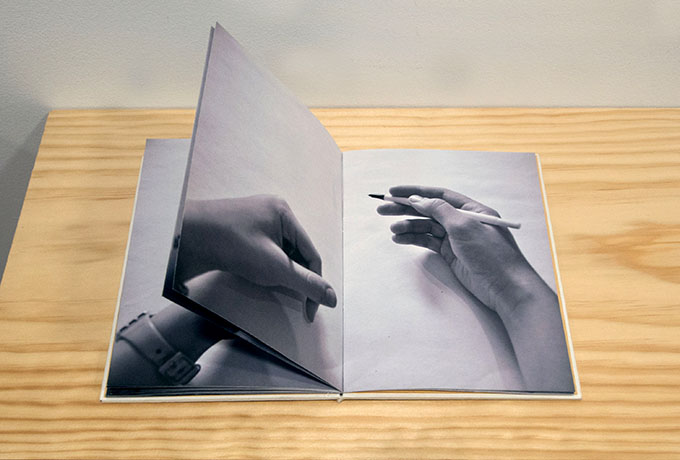
Sarah McConnell’s 29 2011
Practically everyone looks through magazines, sees the pictures, knows what they mean. But try to separate yourself from a simple recognition of the picture and examine the picture as a conceptual model and you may understand how difficult it can be. An illustration is not simply a picture of an object or thing. In that object’s absence a picture is a way of visualizing it, recalling it or conjuring it. Then all together the medium of illustration is a way of visualizing the world. As illustration is a mass medium, it is certainly a very powerful and influential instrument of ideas. As a conceptual model, a picture is showing us how to think and what to think about.
Art characteristically departs from conventions. In leading the way from these conventions and artists can end up revealing and/or inventing upon a given culture, popular or otherwise. Furthermore, the artists’ books in this exhibition occupy a middle ground between the hermetic region of high art and the mass culture of popular illustration. They also embody a comparison between the two; they have been produced as a way of participating (in theory at least) in the mainstream of popular culture at the same time as they are an extension of art, extending beyond galleries and museums, and outside of the realm of the rarified art object.
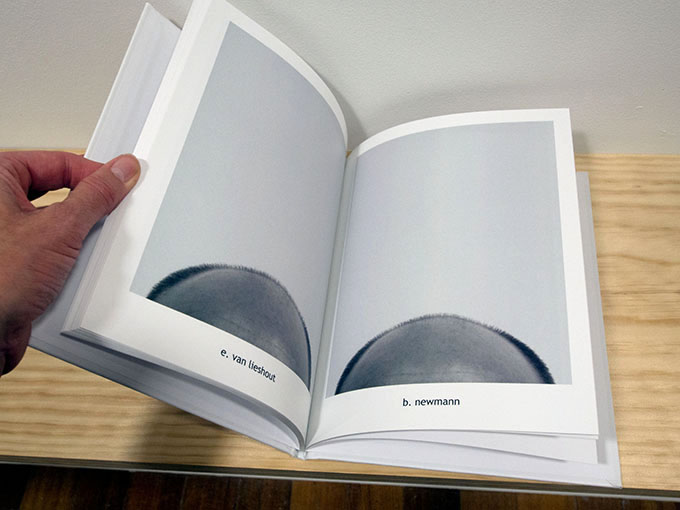
Jon Hewitt’s feel the confidence 2011
It may be noted that the photo works included in the exhibition are not photography books in the usual sense. For example in some books, the artist has exchanged the customary fine detail and high quality printing found in most art photography books for the flat, grainy, aesthetic of newswire or snapshot photographs, with all their vernacular associations. In other books the artist may manipulate the photographic frame by cropping it tightly to draw attention to narrative details or expanding it to the edge of the page for a window effect. Some books here constitute a repertoire of personalities through a wide array of photographic self-portraits. Others are collections of images specific thematic subject matter which suggests an interpretation of the complex meanings of culture and its institutions through the examination of its artifacts.
.
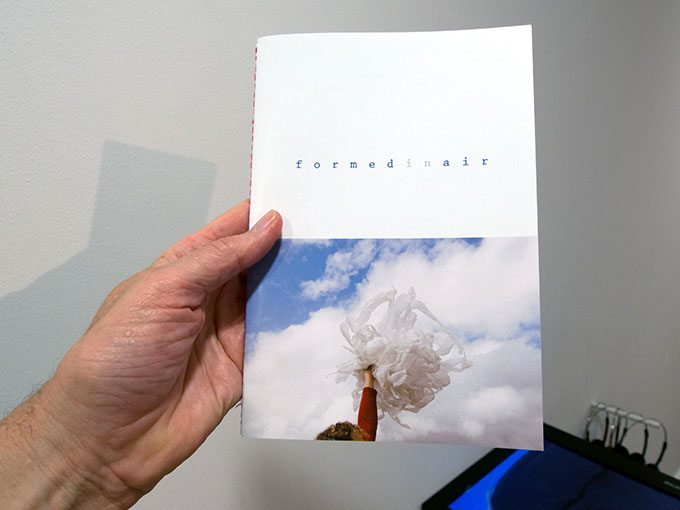
Yasmin Heisler’s formed in air 2014
In opposition to the conventions of art photography, which dictate an aesthetic around the “integrity” of an individual print, these photo books, to some extent, are each engaged with the qualities inherent in reproduction by offset and other printing processes. The artists represented in this exhibition are utilizing photographs as something other than a clear, well-composed picture. In their books they manipulate the “natural reality” of photographs and so inform our recognition of photographic images with their mannered inventiveness.
There are also a few books included here which are constructed sculpturally to introduce a tactile sensation to the fingertips and so expand the act of reading illustrations into the field of sensory awareness.
.
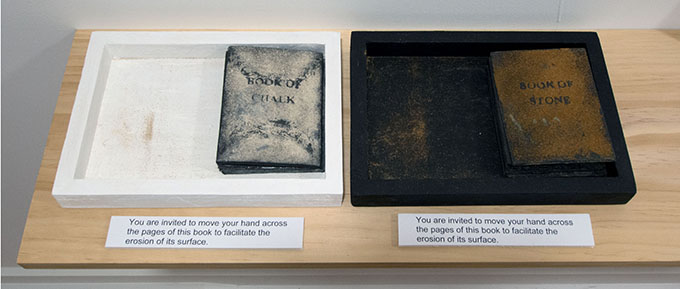
Bridget Hillebrand’s Book of Chalk 2014 and Book of Stone 2014
Finally, just as the works in this exhibition are included towards an exploration of the social and aesthetic attributes of illustration, they also demonstrate a way of looking at and experiencing the world. Theses artist’s books reveal and embody a way of reading deeply into they dimensions of contemporary culture. As much as they foster an incipient consciousness they ask for sensitivity on the part of the reader.
.
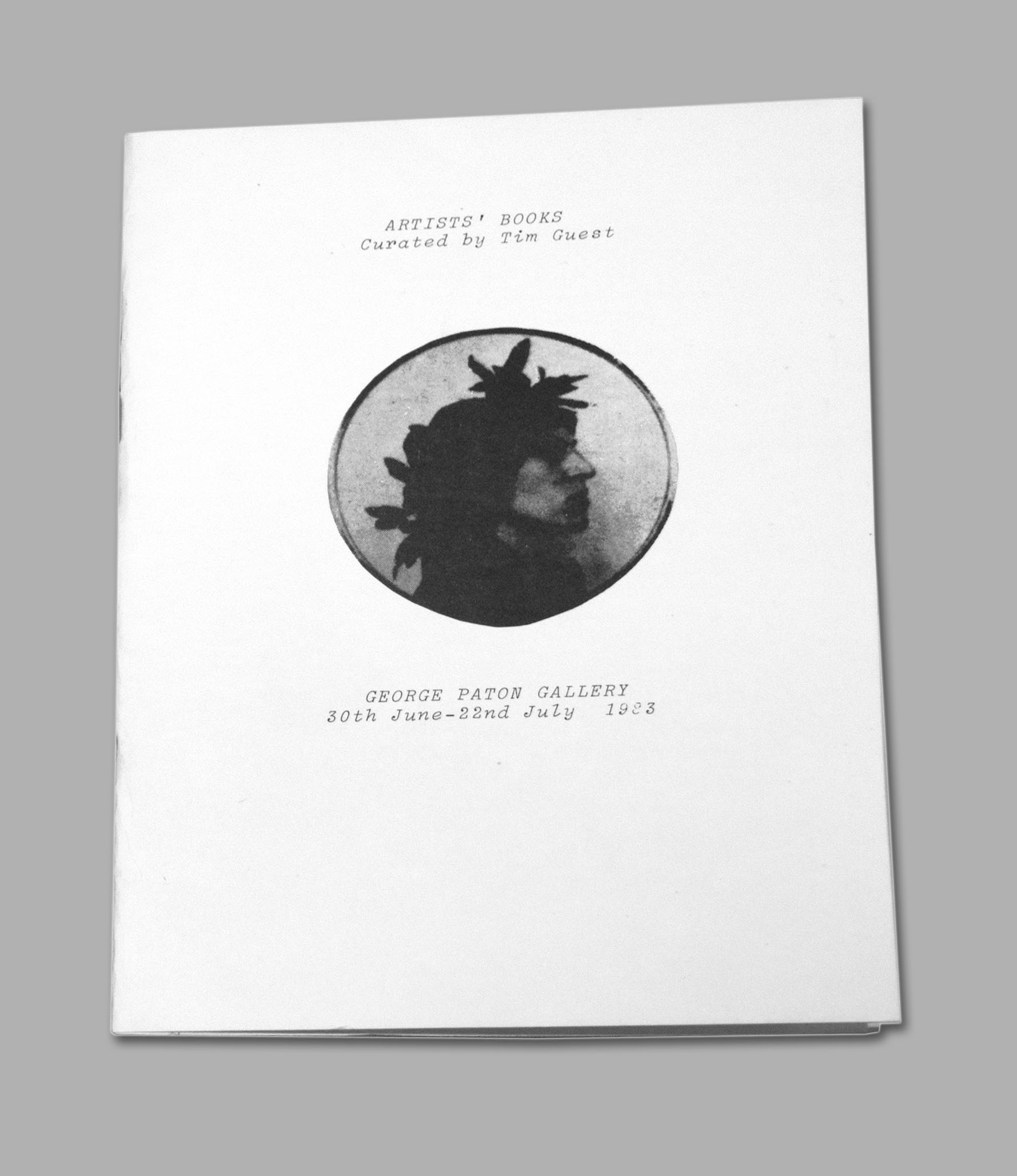
Tim Guest, the catalogue for the 1982 George Paton Gallery Artist’s Books and Not (e) Book!
These words come from Tim Guest, the curator for the 1982 George Paton Gallery Artist’s Books and Not (e) Book! A copy of his catalogue for the show was made available at the exhibition. Guest’s commentary is as relevant today as it was in the early 1980s, and while we have moved on, and now view the artists’ book works of that time with a degree of comfort and acceptance, the new artists’ book works continue, as Guest points out to, ‘demonstrate a way of looking at and experiencing the world’. For me it emphatically confirms that artists’ book are still ‘edgy’ and still pushing limits.
Doug Spowart
September 5, 2014
DOWNLOAD the contemporary list of artists’ books gpg artists books list of works
DOWNLOAD the books on loan from the University of Melbourne ArtistsBooksloanselectionGPG2014 docx
.
.
Part of the associated activity for the show – an artists’ book making event outside the gallery led by Michele and Laine. It was a a sunny and warm late winter’s day in Melbourne.
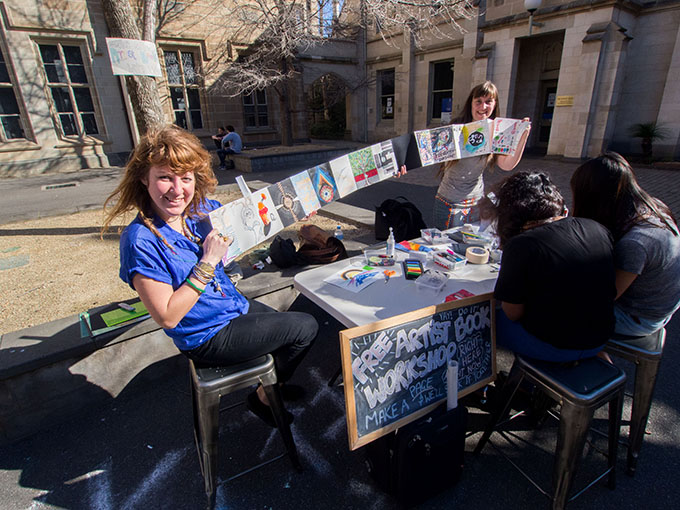
Michele Grimston and Laine Stewart and their Free Artist’s Book activity
.
.
.
.

 wotwedid