Posts Tagged ‘Doug Spowart’
75 Years: Toowoomba Regional Art Gallery
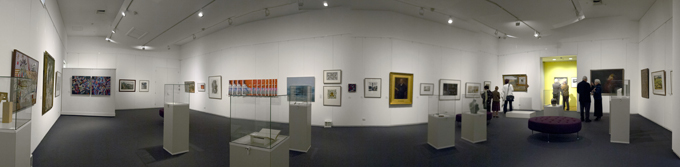
Toowoomba Regional Art Gallery Panorama
Toowoomba Regional Art Gallery, the oldest regional art gallery in Queensland, this month celebrated its 75th year of operation. When we consider that Queensland only recently celebrated its sesquicentennial therefore the gallery is half the age of Queensland itself! Other interesting dates; the Toowoomba region was settled in the 1840s and was proclaimed a city in 1904 The Toowoomba Show Society recently achieved a milestone of 142 years of shows in agriculture and industry and the Empire theatre celebrated its 100th birthday last year. It seems that the Toowoomba region was well and truly fired up as a community and perhaps overdue for an art gallery that was finally established in 1937.
The records show that various Governors of Queensland were associated with TRAG over the years and this association continues to this day with the current Governor Her Excellency Ms Penelope Wensley opening the 75th exhibition on July 2, 2012. In an impressively researched speech Governor Wensley recounted newspaper reports of the day relating to the gallery’s foundation. The 75th opening was attended by around 100 members of the local community including Mayor Paul Antonio, various councillors and members of the trustees or families of significant donors to the gallery.

Gallery Curator Di Baker with Governor Wensley discussing artworks
The exhibition features 75 individual artworks from the gallery’s collection—one for each of the 75 years. Standing in the middle of the main exhibition area one sees a diverse range of visual material. Paintings of bygone and contemporary eras by some very prominent artists, there are ceramics, fine jewellery (from the gallery’s principle collection media—contemporary wearables), and finally photographs and prints complete the veritable visual cornucopia on show. When I came to testing my recollection of the artwork’s titles and artists I was stumped, as the artwork didactics bore none of that information. This presented some confusion until I became aware the curatorial strategy for the show. The 75 works were selected on the basis of the year and the work’s conceptual connection with significant social, political or historical aspects of that year. The key to the sometimes quirky and idiosyncratic curatorial selection is the exhibition catalogue in which the rationale for the selection is linked with the title, media and the artist’s name.
While at first this seems a little strange my reflection on the concept confirms, for me at least, that the strategy is conceptually stimulating. The usual gallery exhibition is about artists and their art—this show IS about the gallery, its PLACE in the community and TIME, or rather the passage of time—75 years in fact. In this exhibition the gallery then assumes the position of ‘artist’ and were the ‘artwork’ is the curatorial team’s strategy.
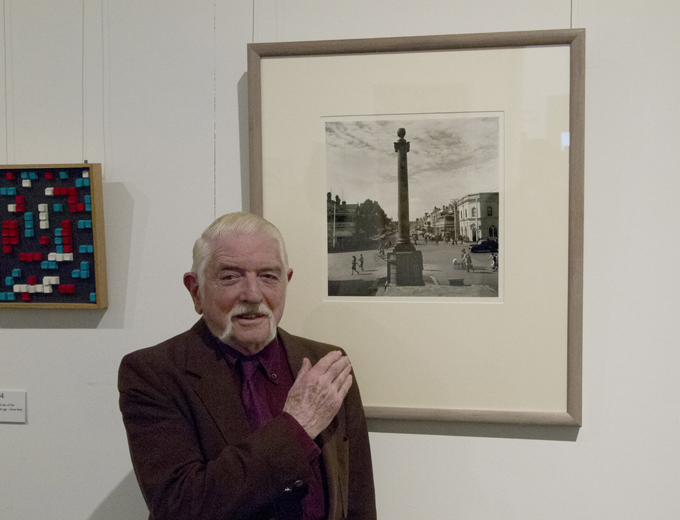
Doyen of Toowoomba’s photo scene Graham Burstow with a Max Dupain photograph in the exhibition
Bravo to the Toowoomba Regional Art Gallery and the team for bringing to us an exhibition featuring the gems of art from its collection that can tell these multiple stories. One, which is about the assiduous collection by the gallery of art stimulated by and/or created by the regional community. And secondly, this show provides recognition of significant art from outside Toowoomba that has been generously donated by benefactors over the years. Through the gallery display of these artworks the local community is able to connect with these wonderful touchstones of artists’ creative practice.
A visit to TRAG to see this show will require much more engagement than usual walk-through, so do plan for extended visits while the 75th year celebration show is on.
SEE more info Toowoomba Regional Council website
Doug Spowart 8 July 2012
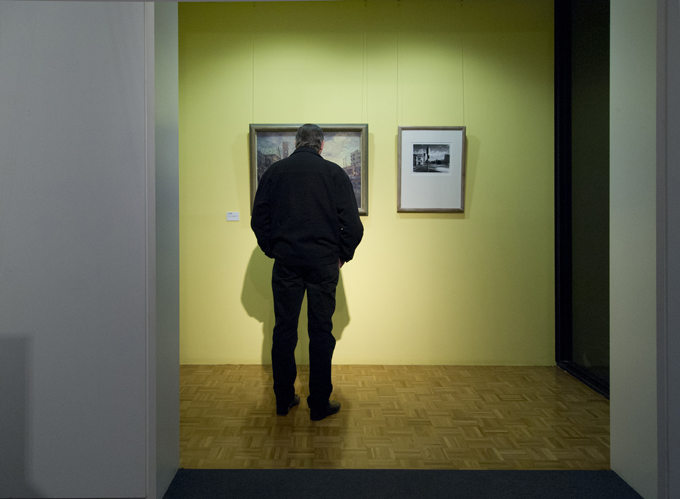
Doug next to his photograph of Ruthven Street selected for the exhibition
JOHN ELLIOTT’s ‘GIFTED COUNTRY’

An image of the ballad of country and western

As a photographer attempting to communicate personal experiences and my, at least I think, special view of life and the world, occasionally I have thoughts that if I wanted to connect en mass I should have been into music! When I look at what music does to I see participants who will slap, tap, hum, whistle, laugh, tear up and even cry. Music sure beats the visual arts hands down as a way of creating a connected audience response. But an exhibition of photographs at the Caboolture Regional Art Gallery, just a few kilometres north of Brisbane, may just win some points back for the visual artist.
Gifted Country is a photographic exhibition of the doyens of the world of country and western music by Toowoomba photographer John Elliott. As a follower of the music industry for over 30 years Elliott has amassed a collection of the latest top hits and the golden oldies. On the walls of the gallery the faces of C&W music stare out at the viewer — frozen and mute. Elliott has reduced them to an eye-only sensory experience. The only sounds permeating the space are the shuffle of footsteps of other gallery viewers and the muffled voices of local community members returning books to the library next door.
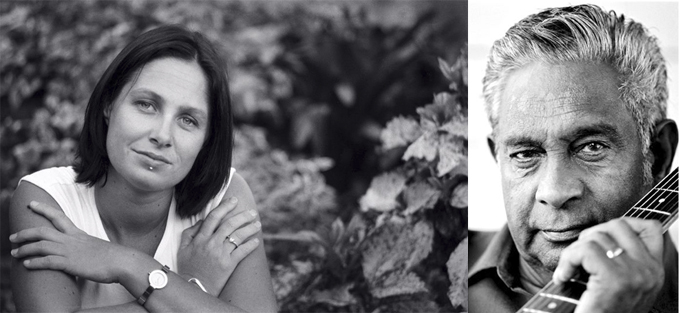
Casey Chambers + Jimmy Little
Before you get the feeling that the show is a little underwhelming there are other things to consider. Firstly the music and photography industry do share some similarities. Apart from practitioners at the most visible pinnacle of the discipline, those who make the sound and the image – the photographer behind the camera, the songwriter, the muso behind the lead singer and the mixer at the sound deck — are faceless. Only the products of their creative efforts are known to us. Okay, we can all recognise a Slim Dusty, Casey Chambers and Keith Urban from across the room. And that is perhaps because photographers like Elliott have made their image, apart from their music, famous. A reflective Jimmy Little leaning on a guitar neck (the one Little’s family selected as the ‘hero’ image for his recent funeral service), Lee Kernaghan stridently stands sky-pointing before a dramatic theatrically lit stage and a wide-eyed Chad Morgan’s face pokes out from his trade-mark safety-pinned hat. Once you’ve cherry-picked a few of the icons you are left with portraits of haggard faced, guitar holding middle-aged men, sweet smiling young girls and longhaired youths that crowd the rectangle photo frame.
What Elliott’s efforts bring to us is the human face of the extended country and western industry. These faces could be those of the waitress, the farm hand, the rodeo queen and the Big Mack truck mechanic. To help make the connection for the viewer Elliott pairs the portrait with the carefully chosen words of a biography that makes visible the musical provenance that we may share with the subject. Additionally a website links to interviews, commentaries and music to enliven the interest of those with a passion for C&W music.
What is remarkable is that over the years John Elliott has worked to amass this body of work. And this is not his sole interest — there are landscapes, urban vistas, other portraits and the personal and intimate moments of life. But this body of work has a quality and magnitude that sets it aside from the usual music documentary record.
This exhibition will be of great interest to the country and western dilettante, the music maker and the photographer alike. For this is a unique assemblage that is testimony to value of photography as record that is at once about history and the present — becoming history. The John Elliott Gifted Country performance will continue until June 23, and then, hopefully, will in the tradition of C&W — go on the road …
Doug Spowart May 26, 2012.
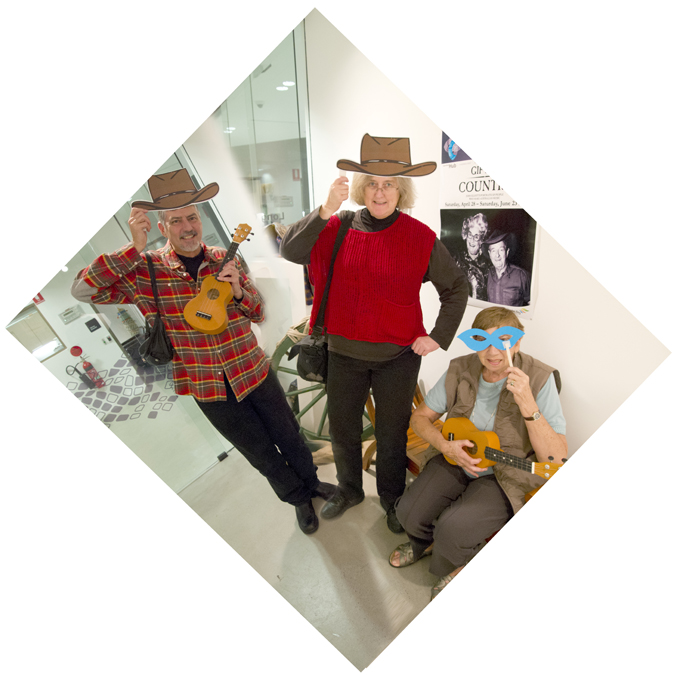
Also @ the Gifted Country show is a C&W PHOTO BOOTH – we had a bit of fun there …
DOUG SPEAKS: Qld Festival of Photography, Toowoomba Forum
FRIDAY 27 APRIL – TOOWOOMBA REGIONAL ART GALLERY
1.30 – 3.00 pm: Panel discussion: Contemporary Photography
Panel: Marian Drew, Ray Cook, Henri van Noordenburg, Doug Spowart and Maurice Ortega
Topic:
Photography is going through major changes due to digital technologies and the explosion of images used through the internet. This panel questions new and emerging practices in photography and presents visual examples of these developments.
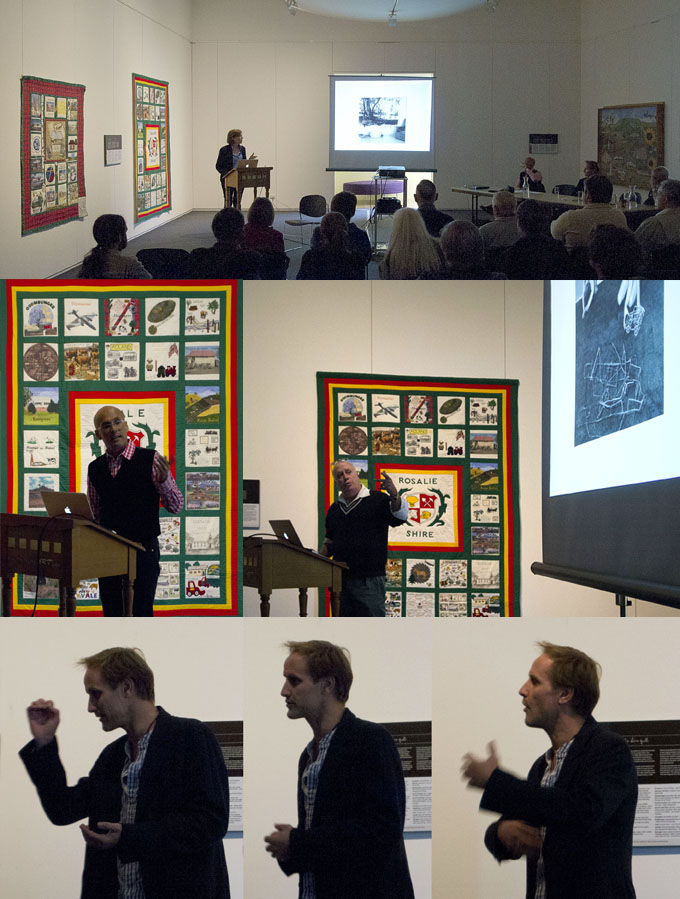
Marian Drew (top), Maurice Ortega, Ray Cook (centre), Henri van Noordenburg (bottom)
An audience of about 45 drawn from the local photography community attended the forum. Each speaker spoke of the aspects of contemporary art photography that informs their work. Marian discussed works by Camilla Birkland, Deb Mansfield, Kate Bernauer, Jenny Carter White; Ray’s hero was Roger Ballin and he spoke of his experience of the ongoing issues of minority groups like gays in society, Henri spoke of his close work transforming the surface of the image and works by Shirin Neshat, Sebastiaan Bremer. Finally Maurice discussed the international scene and the rise of the constructed image – what I’d call faux-photo or photo-fictions. Question time was led by a fired-up John Elliott challenging the blandness and the falseness of contemporary art photography and the lack of space given the ‘still vibrant’ documentary scene.

Doug Spowart speaking @ the QCP FORUM @ TRAG
My contribution to the forum was a paper that discussed the idea that emergent technologies in production and distribution of photography has made everyone a photographer. For those interested in this commentary on contemporary photography the text is published below…
(formatting is a little changed in WordPress)
.
EVERYONE A PHOTOGRAPHER
At this time, as we find ourselves within the 200th anniversary of the photographic experiments of Wedgewood, Davies, Neipce and, if Geoffrey Batchen is right, a host of other inventors, we are witnessing a transfer of the power of photography from the chosen few to the masses – everyone is now a photographer and the camera-made image synonymous with life itself.
In the 1930s Lazlo Maholy-Nagy saw it coming in his prediction that, ‘a knowledge of photography is just as important as that of the alphabet. The illiterate of the future will be ignorant of the use of the camera and pen alike.’ (Moholy-Nagy 1936:32) Although in the text Moholy-Nagy was discussing the photographic sequence and the emerging moving image, his comments allude to our times and how images have replaced words.
In the 1980s the instant imaging giant Polaroid took the concept further by pronouncing in their advertising that we all needed to, ‘learn to speak Polaroid’ – that is, use images to express ideas and concepts, not words. They suggested the we take a Polaroid SX70 image; it will only take a minute to develop before our eyes, to show the time on a clock, the creama of a freshly expressoed coffee or the smile on a child’s face.
Maholy-Nagy was talking about the way images operate in society, and Polaroid was certainly selling their product to the masses, but in the eras in which these statements were made the photographer was a professional imaging technologist. Sure, making photographs had a wide range of users – vernacular photography was well established, George Eastman and Kodak had ensured that, and amateurs and dilettantes banded together to form camera clubs and societies to pursue pictorial beauty. But ‘real’ photography was carried out by specialists who acted with the passion and pain of religious zealots.
Photographers and their colluding commentators created a pantheon of masters and masterworks. They protected their secret knowledges, skills and dark workings within the fields of optics, chemistry and their cumbersome technologies. In their work they excised meaning from the chaos of time and space, and they served and informed the societies in which they lived. They did something that others could not – they made photographs and had access to the media of newspaper, magazines and books through which their images could be communicated to a mass audience.
We may consider digital technology as a major disruption for photography, however the process of photography has always been challenged and transformed by waves of new technologies as part of its liaison with science and art; photographs on silvered metal mirrors, negatives on glass and paper, celluloid and plastic, monochrome, colour transparency/movies/prints … and most recently, electronic files. Cameras of wood and brass, bellows and focusing cloth, tripod-fixed and handheld, carved from solid metal blocks, molded in carbon fibre and plastic …
What is different about the technology of digital photography today is that instead of maintaining the technological barrier between photographers and other users, it has dissolved and democratised image-making.
Other underlying factors drive the march of digital by satisfying some rather basic human needs. Photography historian and commentator Geoffrey Batchen defines photography as being, ‘a persistent economy of photographic desires and concepts’. He lists within this economy concepts like, ‘nature, knowledge, representation, time, space, observing subject, and the observed object.’ For Batchen photography is about, ‘the desire, conscious or not, to orchestrate a particular set of relationships between these various concepts.’ (Batchen 1999:213) I have no doubt that everyone wants to ‘orchestrate’ an image collection of experiences that are important to them and digital imaging has facilitated just that.
Another commentator on this concept adds to this broader human need to photograph, philosopher Vilem Flusser claims that the,
‘Photographer’s intensions are to inform others and through their photographs to immortalise themselves in the memory of others. For photographers, their concepts (and the ideas signified by these concepts) are the main raisons d’être for taking photographs, and the camera’s program is in the service of these raison d’être.’ (Flusser 2002:46)
Now, with digital technologies everyone can access these opportunities ascribed to the photographer and the image. And this process starts in the making of images using a range of newly developed capture technologies. In the Australian Newspaper of January 29 and 30, 2011, journalist Ross Bilton states, ‘Anyone with an iPhone, and a good eye, can claim to be one of an emerging breed of photographic artist: an [iPhonographer.]’ (Bilton 2011:7)
Once the image is made cheap and easy to use enhancement apps can be employed to make the image look like whatever the photographer wants. These mobile apps ape professional-grade software with the advantage that in one-or-two ‘clicks’ the image can be transformed beyond its optical reality into an aesthetic, esoteric or just plain funny photo. Immediate distribution of the image via phone, tablet or later by computer is so easy.
The nature of the photograph in technical and design aesthetic terms has changed as well. The random carefree snapshot, once the domain of documentary photographers, is now part of the vernacular imaging toolbox. In the hands of the nouveaux digital photographer the snapshot has come to be as seductive and as slick as the advertising photograph of old.
As everyone is now a photographer anyone can be a revered as a master, mentor or critic. As a teacher of photography I have encountered the demise of the history of the process. Now students are more likely to seek feedback from Facebook friends and inspiration from peers encountered online. The tradition and the myth of the discipline have little inspiration for a generation of image-makers hell-bent on making what the can from their experience of life. As with any revolution, some will regress to retro-technology: pinhole, Holgas and Dianas and even Hasselblads and large format – if you can still get film.
Everyone now is an exhibitor through the online technologies of Flickr, Facebook, Instagram, blogs, web galleries and Pinterest. The screen of the computer is the gallery wall leaving ‘bricks and mortar’ spaces, perhaps even like this one, to being white cubed mausoleums to the art of the past. Or, to survive, high visitation galleries have become converted into the kind of experience once found in funparks, with slippery-slides, art playgrounds, interactive content – even allowing visitors to use cameras and coffee shops with iPads and everywhere, noisy spaces.
Online downloads brought the music distribution cartels to their knees and expanded opportunities for emerging bands to have an active presence on the world stage. The same is happening now with books and publishing as any photographer can self-publish and self-market using the online services of companies like Blurb and LuLu. In using these technologies photographers are leaving behind the gatekeeping machinery of publishers, distributors and bookshops.
The promulgation of the image through informal independent channels of all forms emancipates both makers and viewers from the control of politicians, commerce and religion. And everyday new opportunities are emerging. In 2011 Magnum photographer Christopher Anderson re-published his documentary book Capitolio in an eBook form and sold copies for tablets and eReaders for a few dollars. In an interview with Nathan Lee Bush, he proposed that it was an experiment in the dual media of the physical book and its virtual ‘equivalent’. He states, ‘I do like the idea of this being a potential model for new media. Time will tell.’ (Bush 2011)
In proposing a philosophy of photography Vilem Flusser put forward many propositions of how and why photography operates. One concept he introduces is that it provides the ‘possibility of freedom’. He states,
‘… in a world dominated by apparatuses; to reflect upon the way in which, despite everything, it is possible for human beings to give significance to their lives in the face of the chance necessity of death. Such a philosophy is necessary because it is the only form of revolution left open to us.’ (Flusser 2000)
Perhaps digital imaging is part of that revolution and we are all contributing to it.
.
Doug Spowart 27 April, 2012
.
Batchen, G 1999, Burning with desire : the conception of photography, Massachusetts Institute of Technology, Massachusetts.
Bilton, R 2011, ‘iPhoneography’, The Weekend Australian, 29-30 January, 2011.
Bush, NL 2011, Through the looking glass | A pro Photo/Video Blog, Interview: Magnum Photographer Publishes Photobook for iPad, Adorama Rentals, viewed March 31 2011, <http://arcrental.wordpress.com/2011/03/30/interview-magnum-photographer-publishes-photobook-for-ipad/>.
Flusser, V 2000, Towards a philosophy of photography, Reaktion Books Ltd., London.
—- 2002, Writings, vol. 6, Electronic Mediations, University of Minnesota Press, Minneapolis.
Moholy-Nagy, L 1936, ‘From Pigment to Light’, in Telehor, vol. 1, pp. 32-36.
CAMERA OBSCURA: QCCP
Later in our time in Queenstown we made another camera obscura at Jackie and Mike’s Queenstown Centre for Creative Photography. The room image featured a view up Late Wakatipu reflected in a mirror. The expanse of the glacial lake with the layered horizon of mountains seemed, for the moment, peaceful.
We sat in the background view—the picture in a ‘lensed’ camera view of the image within the room. The camera sits on a chair on the right-hand side of the image and its shadow falls into the bottom of the frame. We’ve posted a second image of this photo inverted so to external view can be more easily interpreted.
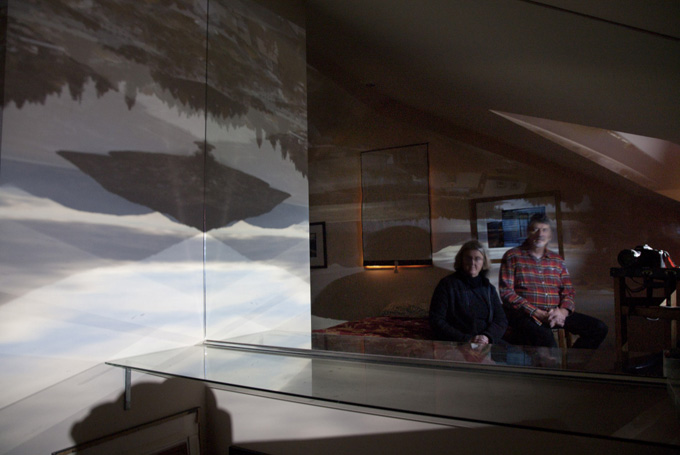
Camera Obscura: Queenstown Centre for Creative Photography
Cheers Doug and Vicky
QUEENSTOWN: Catching up with Jackie Ranken and Mike Langford
We recently visited two of the great luminaries of the Australian and New Zealand professional photography scene, Jackie Ranken and Mike Langford at their Queenstown Centre for Creative Photography. And as if the work these guys do is not amazing enough their home, in the QCCP has one of the world’s most magnificent views over the city of Queenstown, Lake Wakatipu and on to Walter Peak on one side and the Remarkables mountains on the other. It’s hard to engage in conversation with Jackie and Mike in daylight as every now and then your attention wanders to view outside — you need to excuse yourself, and grab a camera to capture the changing remarkable scenery out the window.
Between them Jackie and Mike have amassed a collection of AIPP APPAwards ‘glass eye’ trophies, NZIPP glass trophies and the AIPP New South Wales Awards antique cameras. It takes one large windowsill to show just some of the awards. Facing the lake and mountain view is a gallery of their stunning landscape and documentary works. The QCCP is an amazing and inspirational place to visit.
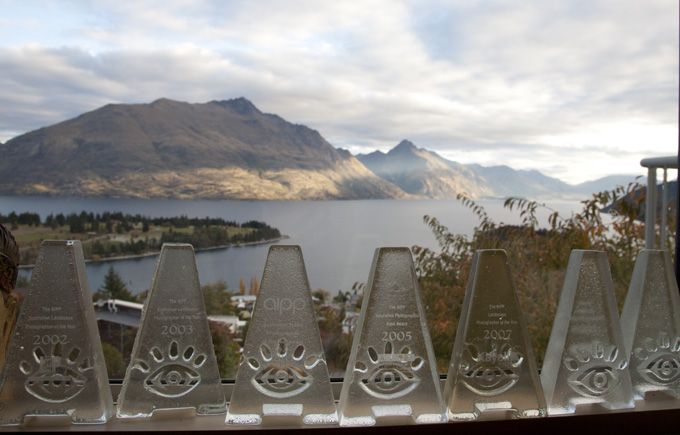
A selection of Professional Photographer of the Year trophies
After dinner we spent time talking about the issues of photography, great photographers past and present, and shared stories of places encounted and photographed. A data projector was positioned before a screen and we made presentations of recent works. One of Jackie’s projects, which we’d call ‘flying kitchenalia’, shows household items, mainly from the kitchen, being captured mid-air above various New Zealand picturesque locations. The incongruous pairing presented a completely different perspective in the photography of this already well-documented landscape. The absurd combinations in these images evoke a hilarious viewer response.
For some time the pair have travelled in Burma (sometimes called Miramar) and a presentation of Jackie’s documentary images of showed us that this is a most remarkable place for travellers, particularly those with a camera. While we recognized that Miramar is an amazing place, it is important to acknowledge Jackie’s skilled and astute photographic vision. In these images there was the poetry of a well-seen moment and yet a profound sense of place. Jackie captured poignant human moments where her subjects had unknowingly shared something special of themselves and their lives in this country. In turn this experience was shared with us. Jackie’s images are a remarkable document of a people and place that is about to change, and somehow, that’s exactly where photographers do their most profound work.
Mike’s images of Japan explored this familiar subject for him through an interesting concept of transitions referring to movie making techniques. Here Mike was looking at a more intimate and personal vision of this intriguing country. Our conversation continued well into the evening . . .
The next day was an early rise so we could catch our flight home. For breakfast Mike scrambled some eggs, toasted rustic bread and made coffee. Doug made a silhouette portrait of the pair before the picture window and then off to the airport — a bit rushed, but rich with the thoughts of the time spent together.
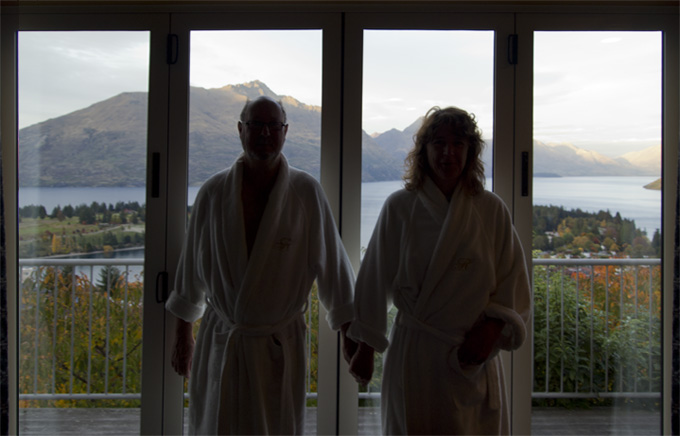
Jackie and Mike in silhouette
Thank you Jackie and Mike.
Doug and Vicky
SEE more about Mike and Jackie and the QCCP here:
PHOTOBOOK Workshop: Wanaka Autumn Art School
For the last 5 days we have been working with 13 participants in a Photobook workshop in Wanaka, New Zealand. The idea of the workshop was to enable the development of concepts and techniques for the presentation of personal photo-stories in the form of the self-published photobook. Two key aspects for the workshop were the photo-narrative and the form that a photobook can take beyond the traditional ‘pictures-in-a-book’ format.
The students were put through a steep learning curve engaging with the computer technology and software required, as many had never used Adobe Photoshop before. Sessions of intense computer activity were punctuated by practical book construction exercises.
Each student worked to develop a major personal book project during the workshop and, as tutors, we supported the conceptual and technical progress to make it happen.
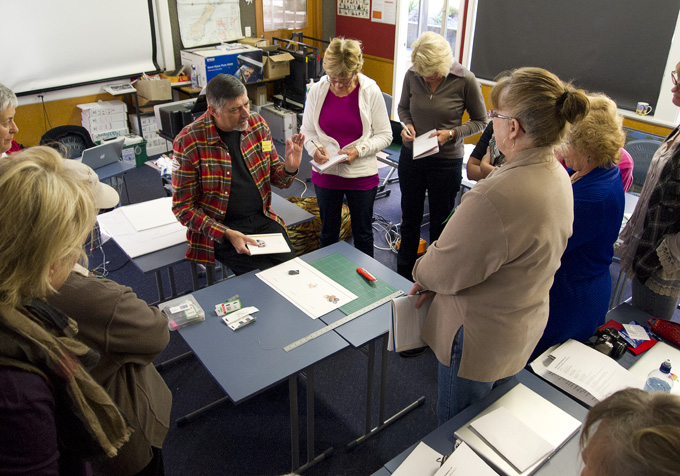
Students @ our Photobook workshop – Wanaka Autumn Art School
They were an amazing bunch of people with varied interests and backgrounds. They all shared a great sense of humour and enthusiasm to get into the process of applying acquired knowledge—some doing ‘homework’ into the wee hours.
Coordinator of the Wanaka Autumn Art School is fabric artist (quilter), Robyn van Reenen who was supported by a motivated and energetic team including her husband Gilbert the photographer of Clean Green Images fame. Robyn and her team provided the tutors, many from Australia, with a great experience and opportunity to share their skills and knowledge with the participating students and artists.
We had a great learning experience as well and ended up probably as worn out as the students by the end of the workshop.
The group shot tells the story . . .
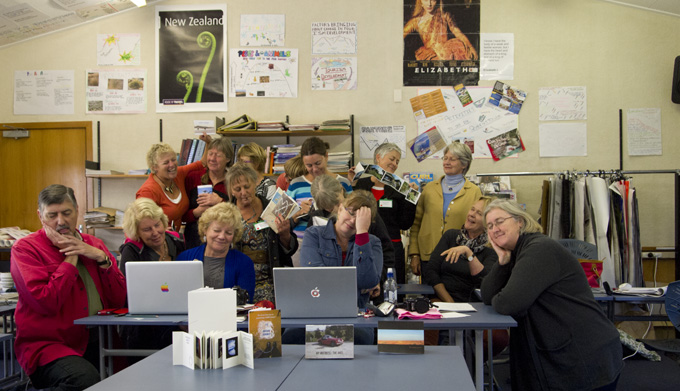
Worn out students and tutors @ Wanaka Autumn Art School
SEE a collaborative book that was made with contributions from the students;
http://www.cooperandspowart.com.au/2_PLACES/OtherBooks/WANAKA-Bk_PageFLIP/WANAKA_Flip.html
Cheers Doug + Vicky
TWO NEW ZEALAND CAMERA OBSCURAS
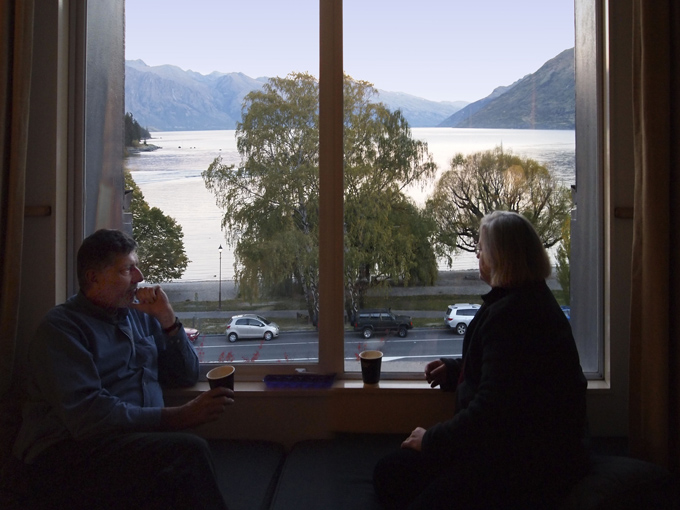
The view from our window @ Rydges Hotel overlooking Lake Wakatipu – Planning a camera obscura shoot
Rydges Hotel Camera Obscura: Queenstown + Lake Wakatipu
We checked into the Rydges on the Lake hotel at Queenstown in the late afternoon and the lake-view room demanded that a camera obscura image be made. Hotel and motel rooms are all pretty much the same—the beds, the bathroom, the table with one chair maybe two, the big mirror, the tiny bar fridge full of junk food and drink and the TV. In the room one could be anywhere and nowhere.
That evening a visit to the local 4 Square store meant that we were equipped with enough black plastic bin liners and some black electrical tape to cover the 2.5 X 3 metre window.
What we needed to complement the image potential for the picture was a beautiful clear sunny day—and that’s exactly what happened the next day. There were two sessions, one around mid-day and the other late afternoon. Blue sky, the golden leaves of poplar trees in autumn and the colours of lake and mountain filled the room.
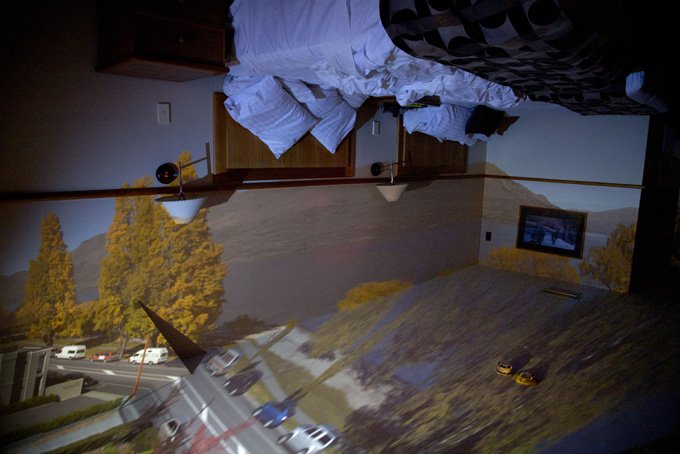
Camera Obscura image looking towards Walter Peak
In between shoots we left the ‘Do Not Disturb’ sign on the door just in case room-cleaning staff should intervene—We often wonder about what unsuspecting visitors would think when first entering the blacked-out space of the room.
Three main images were made—one of the un-made bed, a deep shot into the room, one each of the both of us—Vicky timing the one-minute exposure, the other, a simulation of Doug checking the review screen of the Olympus camera that had been used for image-making that day.
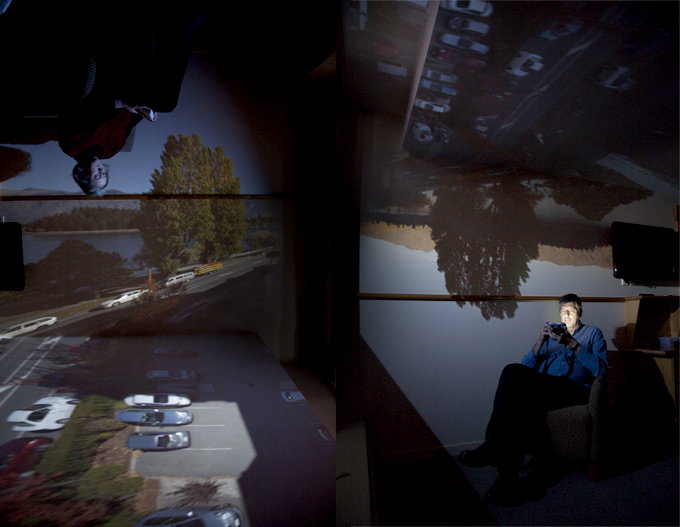
Image left: Vicky times the exposure Image right: Doug reviews images made on his camera
The ‘pinhole’ was fashioned from a postcard of Lake Wakatipu with the steamship the Earnslaw crossing the lake. The aperture was around 10mm and the exposure time around 2.5 minutes.

Victoria Cooper holding the postcard with the ‘hole’ in it
AIPP ON THE LOUNGE: SQIT Toowoomba April 11, 2012

- AIPP – On the lounge SQIT, Website invite
On this evening the SQIT Photoimaging team hosted two events for visiting AIPP members and invited guests. The visit began with a ‘High Tea’ catered for by the SQIT Hospitality team – sumptuous treats were accompanied by tea and coffee. Those attending settled down to conversation with each other in the convivial atmosphere of the ‘Futures’ Restaurant. Coffee Shop
At 5.30 stage two of the visit began with the open of an exhibition of photobooks and artists’ books made by SQIT Photo students over the last 5 years. The show was opened by Queensland Division President Jan Ramsay, who as a past student of an art photography unit, and also part of the end-of-year professional assessment team at SQIT, had experienced the Toowoomba TAFE Photo team at work.

Doug thanks Jan Ramsay for opening the ‘Brought to Book’ show
The books on show ranged from Shanea Rossiter’s ‘Inspiring Women’ book of portraits to Cathy Smith’s book ‘Junked’, a documentary comment on our disposable society and Lorraine Seipel’s political message in the book ‘Song for the future’. The exhibition was curated by Victoria Cooper and Doug Spowart for the Queensland Festival of Photography.
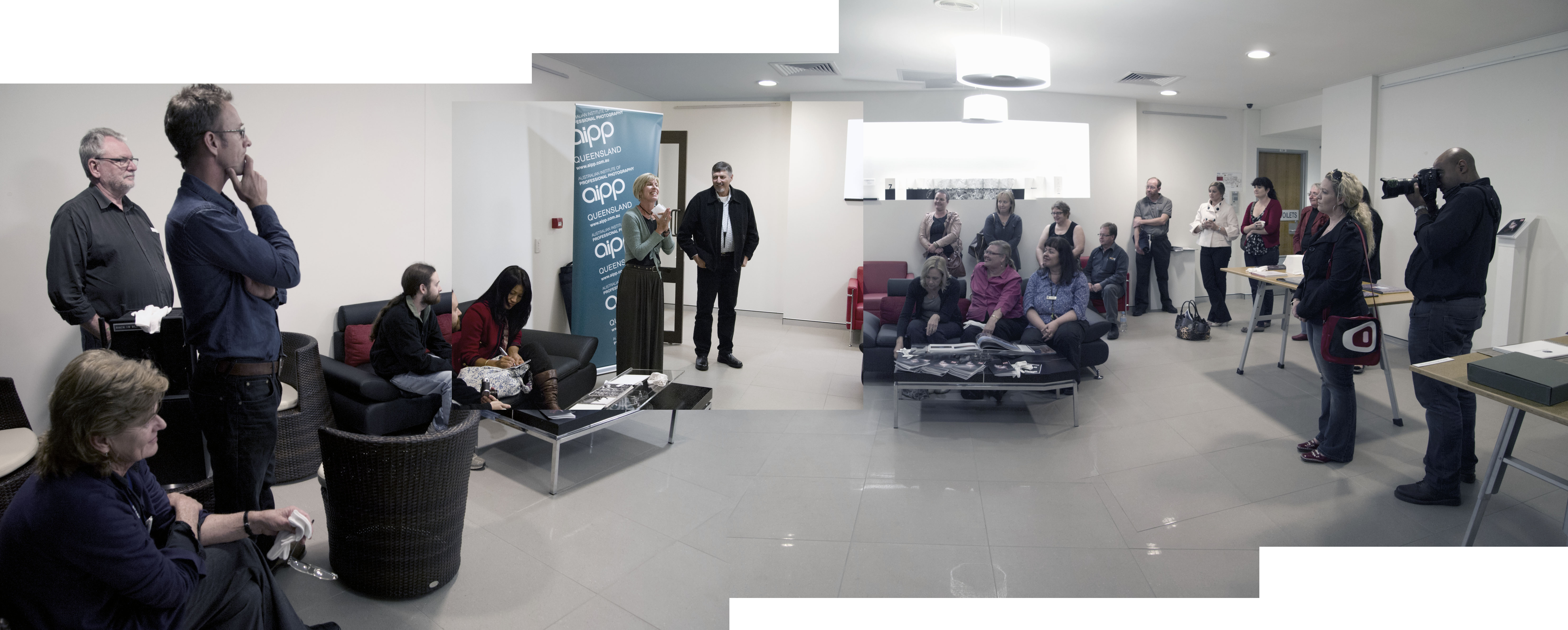
‘Brought to Book’ opening @ Futures Gallery SQIT Toowoomba
The third stage of the program included presentations by the three full-time staff of the photo team – Rachel Susa, Alison Ahlhaus and Doug Spowart. Each spoke of their connection with photography from both the personal and professional context. Doug spoke of the 20-year history of the photo Diploma and Certificate courses at SQIT and the Photoimaging teaching methodology.
The session concluded with a PowerPoint show presenting a selection of images and comments from past students. It was interesting to hear of the experiences of these past students about studying at SQT as well as their achievement in photography. The past students included: AIPP Chairman of the Board Alice Bennett, Nicola Poole, Katie Finn, Lisa Mattiazzi – National Gallery of Australia imaging specialist, Lydia Shaw who works in many areas including photography and teaching in Dubai, nationally acclaimed commercial photographer Damien Bredberg, Sue Lewis – APPA Team Manager and recent graduate Shanea Rossiter who is establishing a business in Warwick.
The Past Students PowerPoint show (PPS) can be downloaded from the www.cooperandspowart.com.au website – It’s a 30.9 mb download but presents an interesting overview of where SQIT students go to and the amazing achievements that they have. CLICK <http://www.cooperandspowart.com.au/2_PLACES/OtherBooks/index.html> Then select the PowerPoint AIPP OTL picture.
The evening concluded with the video fusion show “Dance-on’ by 2011 SQIT Diploma Student of the Year. “Lindsey’s video represents the future of photography” said Doug, and added, “that the stilled image is dead!” The point was not debated, but in the context of an industry that has gone from wet darkrooms to light rooms and digital output in the last ten years everyone left knowing that anything is possible.
Cheers Doug
Judging professional photography: MSIT, Brisbane, March 24&25
The 2012 AIPP Queensland Professional Photography Awards.
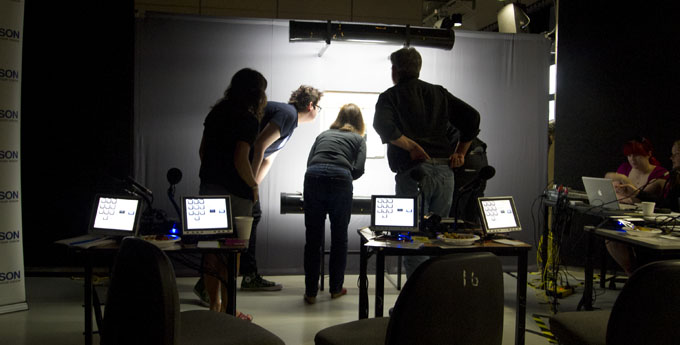
Queensland AIPP Professional Photography Awards judging
I’m sitting on judging panels for the landscape and documentary panels of the 2012 AIPP Queensland PPY Awards. The work is challenging and diverse and the judging panel capable and opinionated. My mind wanders to thoughts about photography, its assessment and critique.
The social scientist Pierre Bourdieu wrote many things about photography. Many photographers would take particular exception to his essay on ‘Photography: A Middle-Brow Art.’ But some of what he says bears a strong and salient connection with the way photographer’s debate, discuss and judge their work. Bourdieu states,
” It is no accident that passionate photographers are always obliged to develop the aesthetic theory of their practice, to justify their existence as photographers by justifying the existence of photography as a true art.” (Bourdieu 1996:98)
Whilst his statement may relate to all kinds of photography from the camera club to the teaching institution it connects, to my mind, most directly to professional photography. Shortly after the time he wrote the original French text (early 1990s) I was not only a fervent participant in all kinds of photography competitions but also the chairperson of the AIPP Australian Professional Photography Awards. I witnessed and perhaps even guided the transition of the APPA, as it became known as, into the form that it now takes.
Founded in 1977 The AIPP National Print Awards were judged with an interest in the work being suitable and relevant to professional products for clients. Prints were glorious colour, 16”x20” flush mounted and were a celebration of technique as well as saleability. Each year 300~500 prints would be judged by the doyens of the industry and a few rising stars. In 1984 I sat on one of these judging panels alongside the big names of professional photography at the time – I felt quite small.
By the end of the 1980s new influences were invading the professional scene. John Whitfield-King and others of his persuasion were creating a space for documentary approaches to wedding photography informed by Henri Cartier-Bresson and Elliott Erwitt. Areas of photographic practice such as illustrative and landscape were emerging and along with them was a recognition of art photography from the American scene by practitioners like Ansel Adams, Harry Callahan, Lee Friedlander, Arnold Newman et al. Black and white prints with Leica-esque full-frame black fuzzy borders became the emergent trend and prints became small and fine on white mount boards. Along with Paul Griggs, Jeff Moorfoot, Lyn Whitfield-King, Peter Adams and Robert Billington, I also was also one of this new guard.
Photographers began to present images from their own personal photographic exploration – subjects that excited and invigorated their practice. These were photographs made by photographers – for photographers. The judges were excited by this work as well and awards were made that celebrated inspirational photography. Each year new work became more and more detached from the previous client-based assessment, and the new paradigm became the engine room for photographers to experiment and push ideas about what professional photography could be and also what clients may want. All this change was not without its detractors. The photo press and newsletters published the laments by some about the loss of industry and the self-indulgence of those engaged in it.
Despite this, professional photographers did embrace the awards process with such enthusiasm that larger entries necessitated extra judging rooms, days of judging and an army of judges and event team volunteers. Early in my chairmanship I undertook a national judge training program with the intension of filling the judging ranks with new judges, and in particular, evening up the gender balance of such panels. The term ‘judge training’ implies some kind of conditioning process where the participant is shown how to spot and reward certain standards. This was not the route that I chose. My philosophy was related to the recognition that all candidates start with a significant understanding of photography and that what they needed was to (1) understand the APPA judging system of team-based scoring and debates, (2) come to know and practice discussion and debate techniques, and (3) grow through the process accepting it as not only one which is about making judgements, but also its educative nature for the judge and the entrant alike.
In time we achieved much of what we set out to do. The judging team became more representative of membership – gender balanced, younger, from the regions as well as the city. APPA as a system during my time as chair cautiously welcomed-in digital output, imaging and image enhancement – something we take for granted now but an area of significant consternation in the mid 1990s. Not to mention each year’s crop of award winners that are celebrated in the prestigious form of the Awards Book. Additionally we should not forget that the APPAs were originally, and still are an accreditation system to recognise and reward the professional photography skills of AIPP members through the awarding of APPA Associate, Master and Grand Master honours. At one time you could count the number of APPA Masters on the fingers of two hands – they were a rare-breed indeed. Now the AIPP is replete with masters and Grand Masters may need more than two hands to count. In my opinion what it takes to be a Master is no less now than it was 20 years ago – it’s just that the general standard of professional photography as an innovative and expressive form of communication has grown exponentially.
Over time the APPAs have grown beyond our imaginings of the 1990s into the mega event it is today. States such as Queensland have their local awards judgings that have entry numbers exceeding the national entry only 20 years ago. Professional photography practitioners from this country have, for over ten years, won every major international award, had top ten listings in numerous disciplines and travel extensively as guest speakers and leaders of the industry internationally. Some of this acclaim comes from the spark that was set by the team that was APPAs in the 1990s. Most of the names and contribution that these people made have now gone. I think of David Puddefoot, Mike Woods, Ian Hawthorne, the ‘godfather’ Ian McKenzie, Malcolm Mathieson, Jeff Moorfoot, Ruby Spowart, Victoria Cooper and the current Chair David Paterson. We owe these individuals and a host of other committee members of that era including Paul Griggs, Robyn Hills, William Long, Ian Poole, for the foundation that they helped make so that APPA, and the state events could be what they are today.
It has been some time since I have judged at an APPA style event. As I sat on the judging panel I reflected on the history that has brought us to this moment. It felt good – and I was able to contribute to great discussion about some amazing imagery. Photographers have embraced the theory and aesthetics of their art and justify it through the most interesting and informative processes.
.
Doug Spowart
.
Bourdieu, P 1996, The Rules of Art: Genesis and Structure of the Literary Field, Stanford University Press.
CHARLIE SNOOK: HIS LIKENESS RETURNS AS A PHOTO
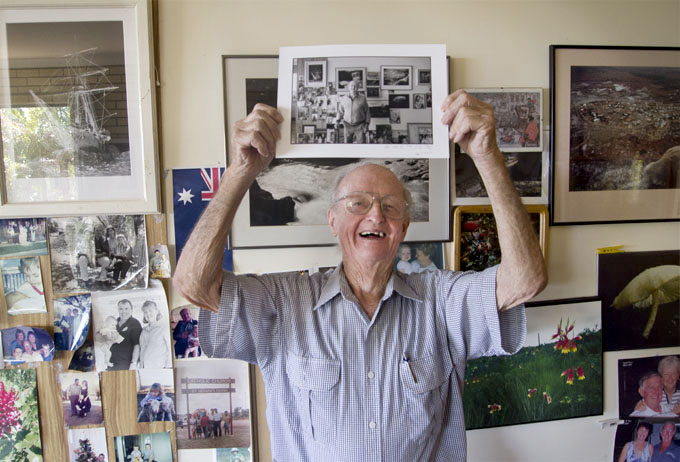
Charlie Snook + portrait by Doug Spowart
I first met Charlie Snook in 1977 when he and I were among the guest lecturer team for the Binna Burra Photo School in Lamington National Park near the Gold Coast. The weeklong event was an inspirational live-in experience for keen photographers. Day and night workshop sessions were augmented by bushwalk forays into the surrounding National Park. Darkrooms for black and white processing and even colour work were set up to provide a complete experience of ‘learn and do’ in just about everything photographic.
Other members of the lecture team included Rob Heyman, Rob Bannerman, Alec Fraser (recently departed for the big darkroom in the sky), Ansett photographer Gary Lewis and of course Tony Groom traveller and photographer the son of the founder Arthur Groom. Someone was always up to something—whether it was photography, experiencing nature or telling tall stories of travel or life or just plain joking around. Over time great photographers like Steve Parish presented workshops and added to the yearly event’s reputation.
Charlie and I struck up a friendship that connected us with the love of photography and the natural environment. Apart from the annual Photo School adventures that included the Coomera Crevice, the Shipstern decent and the Ballanjui Falls abseil, Charlie and I, assisted by his two son’s-in-law canoed the Mann and Clarence Rivers from Nymboida to Jackadgery. Later when my mother and I began of offer photo tours around Australia as part of our Imagery Gallery business activities Charlie became a regular traveller.
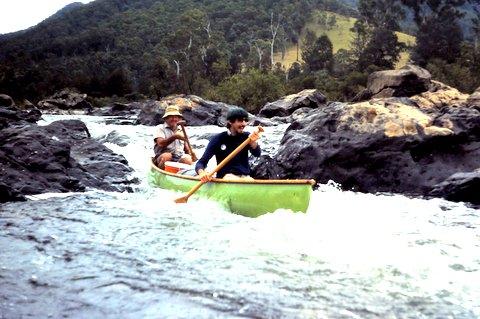
Charlie and me on the river Photo courtesy of Lesley Wall (Charlies Granddaughter)
In 1987 photographer Maris Rusis and I made a 10”x8” photographer’s journey along the east coast of Australia. We spent some time with Charlie helping to fix plasterboard panels to the ceiling of a house he was building at Minnie Waters near Grafton. A plumber by trade Charlie had worked in a variety of amazing projects including The Blue Cow tunnel in the Snowy Mountains, massive holiday resorts in Yamba and as a volunteer for the Catholic Church missions in the islands of the Pacific building community infrastructure.
In July 2011 Vicky and I visited Charlie and I made a portrait of him in front of his photo gallery. He stood proudly before his cherished image by Frank Hurley of the ship the Endurance trapped in ice in Antarctica, images from his travels and of family and friends.
Today we revisited Charlie to return his image as a black and white print—he was chuffed!!
Cheers Charlie.
POST SCRIPT: Charlie passed away peacefully in Grafton last Saturday, August 10, 2013. He will be sadly missed but his enthusiasm for photography, wilderness and Minnie Waters lives on with those who remember him.

 wotwedid