Archive for the ‘Victoria Cooper’ Category
THE REGIONAL ARTS COMMUNITY & THE MINING BOOM
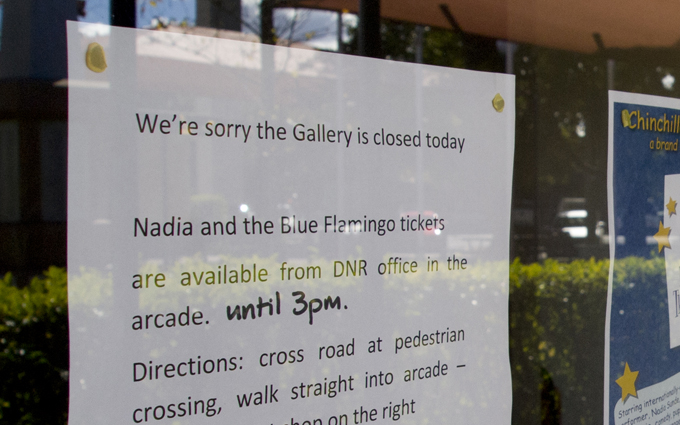
Recently we traveled along the Warrego Highway to Roma stopping at a couple of major towns along the way. There was hive-like activity infecting the once quiet pastoral landscape of these towns. These regional centres have been transformed by the explosion of commercial opportunities presented by a contemporary “gold rush” boom in the proclaimed “climate friendly” energy resource mining industries.
The cultural life of these once mainly farming communities relied heavily upon the blood, sweat and heart of the local artists and volunteers? Now these small numbers of volunteers work even harder to bring a depth of cultural life and meaning to everyday life in these towns. Some towns superficially appear to be thriving but a visit to the gallery unable to open due to the paucity of volunteer numbers may be the indicator of a larger issue. Can they still provide, with limited resources, a quality cultural program under the pressure of this exponential invasion of their social structure? To continue requires the commitment to and interactive involvement in these activities by those benefiting from the ‘boom’.
Opinions are various and some – deeply passionate -regarding the potential benefits or problems that will be the legacy for each community. It appears that important support and funding has come to ensure cultural activities are seen to be valued. But can this financial support, generous as it may be, replace the energy and lifelong commitment of volunteers. These are the people that form the vital fabric supporting strong and diverse communities. Certainly Miles has the energy injected by the employment of cultural professionals at Dogwood Crossing gallery and the associated library, which eases the pressure on this community’s volunteers. But what will happen with Dalby, Chinchilla and Roma—all major communities driving the mining boom?
One of the critical issues facing these community structures and the individuals that support them is the lack of affordable housing and accommodation options. Unless you are employed in the mining industry, living in these towns has become a privilege that few can now afford. So many of these long-term locals are leaving. Who then is replacing these people? Do the temporarily located mining population have time to be involved in the cultural history and exchange of their new surroundings?
Temporariness and dislocation now dominate the social and cultural landscape of these once grounded communities. Perhaps there needs to be effective provision for and importantly, an everyday involvement in, the altruistic act of volunteering by those who benefit from the mining of this landscape. Although they inhabit the periphery, these transient populations rely upon a functioning ‘heart’ at the centre of these communities. Conceivably any meaningful and creative interaction, between each section of these evolving communities, could have only have beneficial implications for both.
.
Victoria Cooper
KEITH SMITH + SCOTT McCARNEY @ SLQ
Please note: This post is derived from personal notes made at the event – They may contain some inconsistencies that are a result of my interpretation.
AUDIO NOW AVAILABLE @ http://enc.slq.qld.gov.au/audio/slq/pp/mp3/artdesign/Artistsbooks.mp3
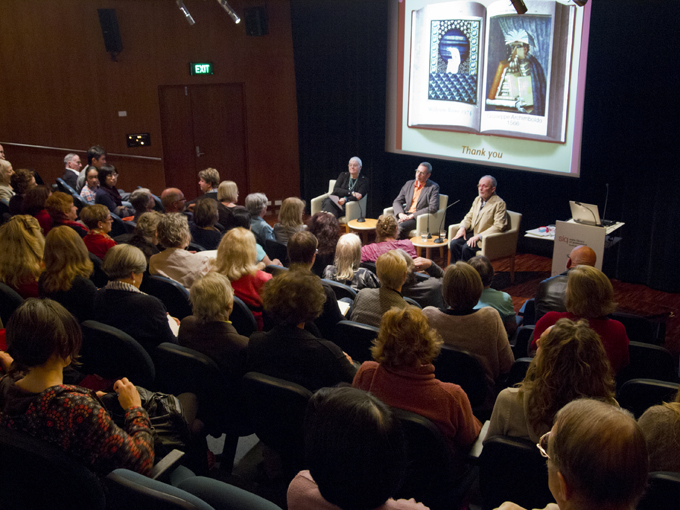
In what looks like the one highlight in the Queensland artists’ book calendar for 2012 Keith Smith and Scott McCarney are visiting the State Library of Queensland to present a lecture about their work and to conduct a five-day workshop. Unable to attend the workshop due to teaching commitments I attended the talk at the SLQ today. I was not alone and the smaller SLQ auditorium was full of interested attendees — including some notables like Sarah Bowen, Adele Outteridge, Madonna Staunton, Wim deVos, Anne Marie Hunter and Lorelei Clark. The visit to SLQ by Scott and Keith is supported by the Siganto Foundation and members of the family were in attendance at the lecture.
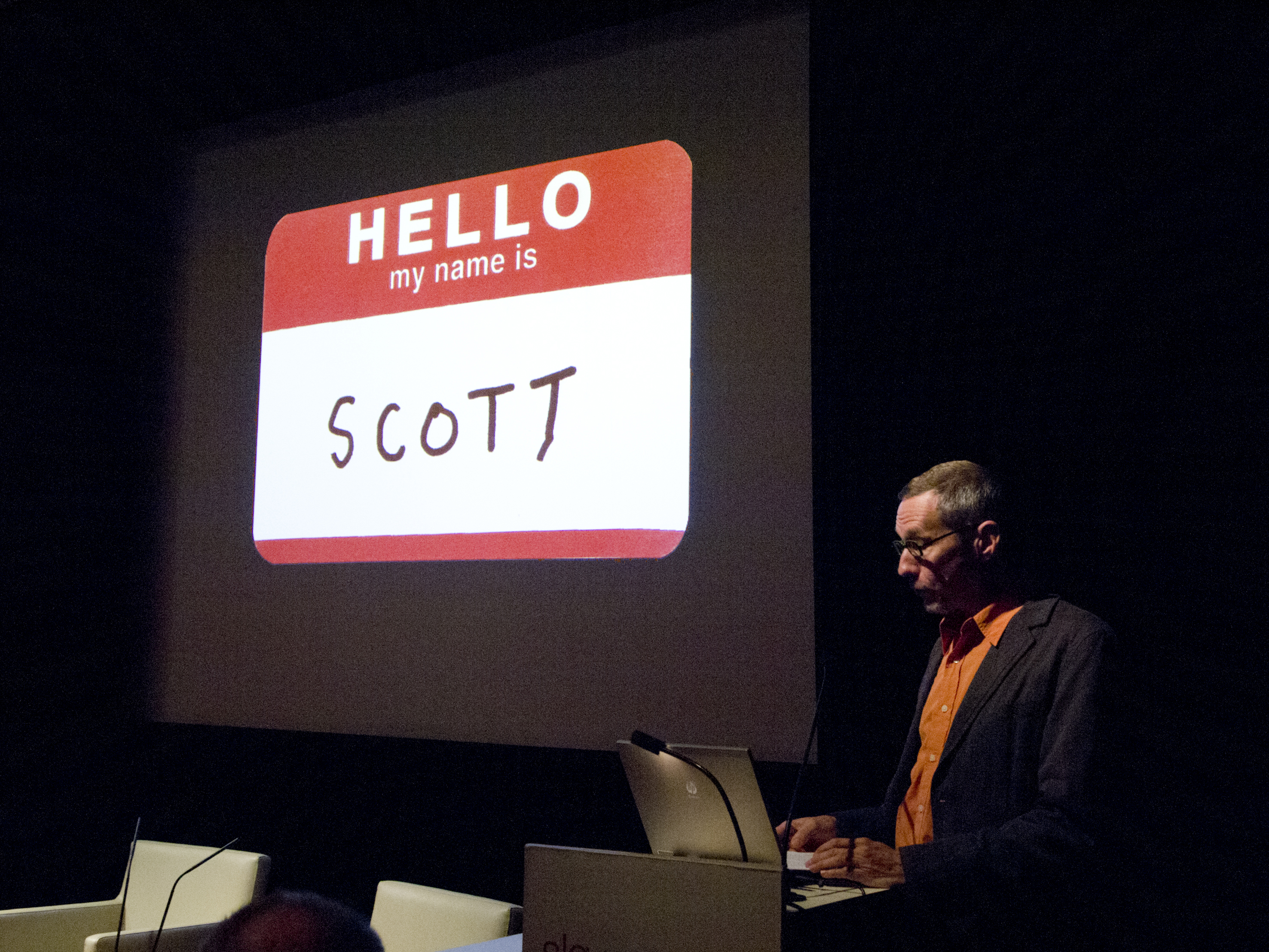
‘HELLO’ Scott!
After and introduction by SLQ Artists’ Bookie Helen Cole, Scott began his presentation by talking about the nature of the book in the digital age. He seemed to lament that libraries were beginning to change into Wi-Fi coffee houses — that’s not a problem for him as he believes the book, as a physical thing, will go beyond the electronic age.
He sees a real discussion about the future of the book is all about ‘display’. This remains a contentious issue for the artists’ book as they are difficult to handle and read as in exhibitions they are usually displayed frozen and ‘under glass’. Some of Scott’s work has been about presenting books as sculptural forms (Hanging Index) so the viewer does not really need to turn the pages to engage with the work.
Scott spoke in detail about his Autobiography series. He described how he couldn’t throw anything away and that he makes collections from things like name badges, rejection letters from galleries and grant applications, to-do lists and mud maps. This body of work provides an insight into the trivia and ephemera of life that escapes disposal through its transformation into his art. Connecting with the Internet world Scott’s Google Vanitas begun on Christmas Day last year represents the search results for his own name.
Scott showed many examples of works with where he cut through various pages within books to subvert the content of the book.
In a homage to Ed Ruscha Scott has taken Ruscha’s 1964 book Various small fires and milk and made his own take on the subject — Scott’s fires are those of riots and the curious inclusion of a glass of milk in Ruscha’s book is shortened to MLK, standing for Martin Luther King whose portrait appears in the book. l
A recent project by Scott was to participate in the al-Mutanabbi Street Coalition’s response to the car bombing of this street in Bagdad which was home to many of the city’s booksellers. Scott’s work Material Meditation on Mending Al Mutanabbi Street comprises fifteen two-sided loose-leaf prints made from collages made from remnants of found books, rubbings from bookbindings and photographs.
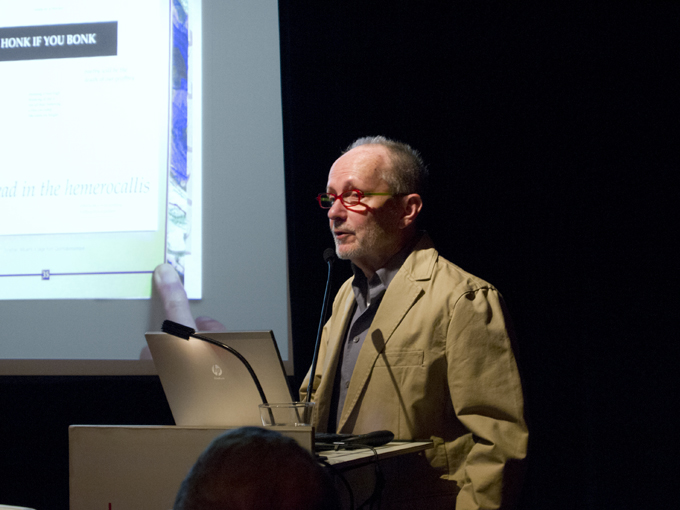
Keith Smith speaks
Scott then handed over to Keith who comments that he is now up into the 280s on his ever increasing list of books. He spoke of a number of book projects dealing with subjects like re-contextualisation of paintings of Saint Sebastian into Smith’s own painted backgrounds. Many variations on this theme have been created from an amassed collection of source paintings — he intimated that he was even working on a book as he was preparing to travel to Australia.
He spoke of his connection with the computer and digital book Bobby made as early as 1984 with an early Macintosh computer using MacPaint and MacWrite. In his latest work he has re-formatted the book and re-jigged the content. The new Bobby has been supersized to one of Smith’s biggest ever books.
One of Keith’s trademarks is the digitally created multi-layered photomontage and his rainbow borders and edges. He states that when using Photoshop he may be working with between 12 and 24 layers of colour. Pages for the book Seminal were shown as examples.
Book number 283 is Struggling to see deals with Smith’s continuing fascination with text and image. The book is dedicated to Nathan Lyons whose own books and image sequencing presents Smith with a constant source of challenge. Smith acknowledged Lyon’s mastery of organising images in a book in a way where the message of the book is spoken ‘between the pages’.
Question time yielded perennial questions to do with inkjet printers, papers, the ‘archivalness’ of the technology and editioning.
One questioner spoke of how books can be made by anyone via print on demand technologies …
Another question dealt with the montage …
Keith commented that the book tells him where to go …
A comment made by one participant was that they were coming to understand that with all the standardization of the book through language and form and that that is where the psychology of the artists’ book really kicks-in to say something else that we were not ready for…
A question about the eBook and where it fits in contemporary practice. Scott answered that with eBooks one must learn the tools and understand that they are about text in a multi-media platform and that translating work into digital form you need to recognise that it is married to the content.
Keith’s response was that was something for the younger generation, ‘I’m too old ….’ Perhaps it is, for him, that the eBook is not a tactile medium that you cut, fold, touch and be touched by — although it may be something else?
Doug Spowart May 28, 2012
NOTE: The SLQ will be posting this lecture online in the near future
CAMERA OBSCURA: QCCP
Later in our time in Queenstown we made another camera obscura at Jackie and Mike’s Queenstown Centre for Creative Photography. The room image featured a view up Late Wakatipu reflected in a mirror. The expanse of the glacial lake with the layered horizon of mountains seemed, for the moment, peaceful.
We sat in the background view—the picture in a ‘lensed’ camera view of the image within the room. The camera sits on a chair on the right-hand side of the image and its shadow falls into the bottom of the frame. We’ve posted a second image of this photo inverted so to external view can be more easily interpreted.
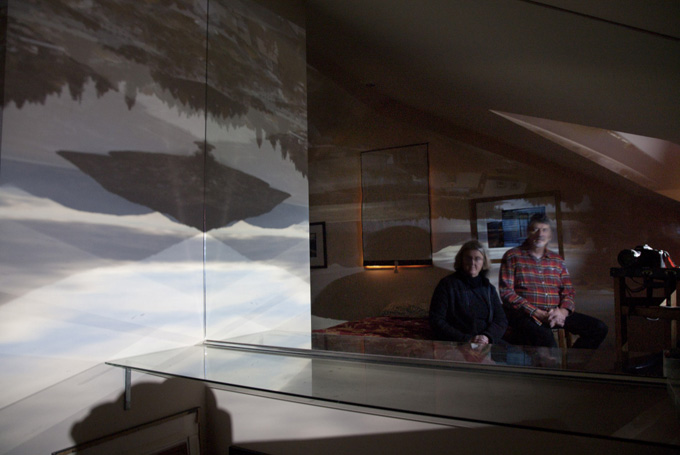
Camera Obscura: Queenstown Centre for Creative Photography
Cheers Doug and Vicky
QUEENSTOWN: Catching up with Jackie Ranken and Mike Langford
We recently visited two of the great luminaries of the Australian and New Zealand professional photography scene, Jackie Ranken and Mike Langford at their Queenstown Centre for Creative Photography. And as if the work these guys do is not amazing enough their home, in the QCCP has one of the world’s most magnificent views over the city of Queenstown, Lake Wakatipu and on to Walter Peak on one side and the Remarkables mountains on the other. It’s hard to engage in conversation with Jackie and Mike in daylight as every now and then your attention wanders to view outside — you need to excuse yourself, and grab a camera to capture the changing remarkable scenery out the window.
Between them Jackie and Mike have amassed a collection of AIPP APPAwards ‘glass eye’ trophies, NZIPP glass trophies and the AIPP New South Wales Awards antique cameras. It takes one large windowsill to show just some of the awards. Facing the lake and mountain view is a gallery of their stunning landscape and documentary works. The QCCP is an amazing and inspirational place to visit.
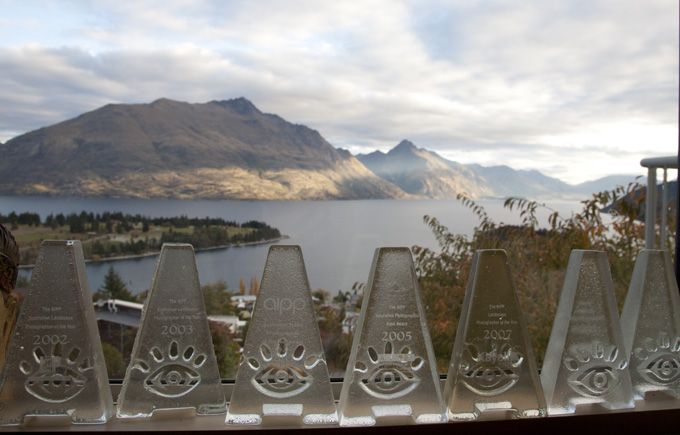
A selection of Professional Photographer of the Year trophies
After dinner we spent time talking about the issues of photography, great photographers past and present, and shared stories of places encounted and photographed. A data projector was positioned before a screen and we made presentations of recent works. One of Jackie’s projects, which we’d call ‘flying kitchenalia’, shows household items, mainly from the kitchen, being captured mid-air above various New Zealand picturesque locations. The incongruous pairing presented a completely different perspective in the photography of this already well-documented landscape. The absurd combinations in these images evoke a hilarious viewer response.
For some time the pair have travelled in Burma (sometimes called Miramar) and a presentation of Jackie’s documentary images of showed us that this is a most remarkable place for travellers, particularly those with a camera. While we recognized that Miramar is an amazing place, it is important to acknowledge Jackie’s skilled and astute photographic vision. In these images there was the poetry of a well-seen moment and yet a profound sense of place. Jackie captured poignant human moments where her subjects had unknowingly shared something special of themselves and their lives in this country. In turn this experience was shared with us. Jackie’s images are a remarkable document of a people and place that is about to change, and somehow, that’s exactly where photographers do their most profound work.
Mike’s images of Japan explored this familiar subject for him through an interesting concept of transitions referring to movie making techniques. Here Mike was looking at a more intimate and personal vision of this intriguing country. Our conversation continued well into the evening . . .
The next day was an early rise so we could catch our flight home. For breakfast Mike scrambled some eggs, toasted rustic bread and made coffee. Doug made a silhouette portrait of the pair before the picture window and then off to the airport — a bit rushed, but rich with the thoughts of the time spent together.
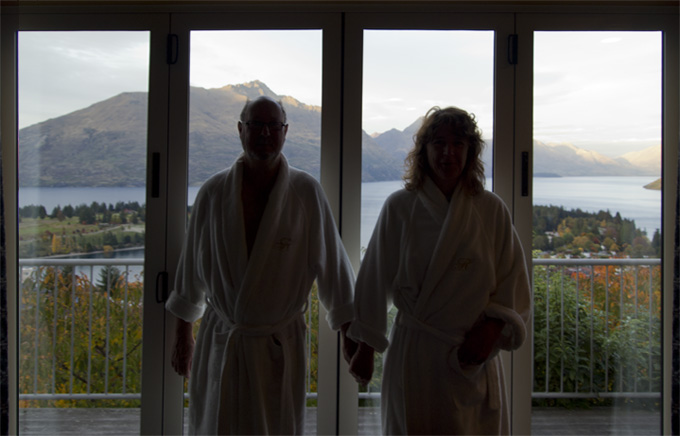
Jackie and Mike in silhouette
Thank you Jackie and Mike.
Doug and Vicky
SEE more about Mike and Jackie and the QCCP here:
PHOTOBOOK Workshop: Wanaka Autumn Art School
For the last 5 days we have been working with 13 participants in a Photobook workshop in Wanaka, New Zealand. The idea of the workshop was to enable the development of concepts and techniques for the presentation of personal photo-stories in the form of the self-published photobook. Two key aspects for the workshop were the photo-narrative and the form that a photobook can take beyond the traditional ‘pictures-in-a-book’ format.
The students were put through a steep learning curve engaging with the computer technology and software required, as many had never used Adobe Photoshop before. Sessions of intense computer activity were punctuated by practical book construction exercises.
Each student worked to develop a major personal book project during the workshop and, as tutors, we supported the conceptual and technical progress to make it happen.
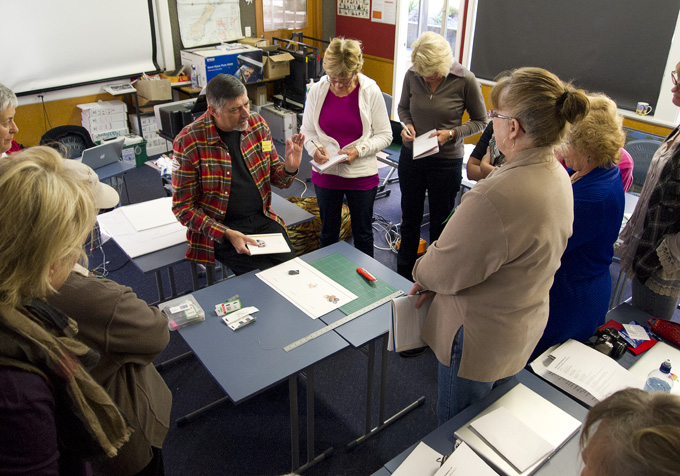
Students @ our Photobook workshop – Wanaka Autumn Art School
They were an amazing bunch of people with varied interests and backgrounds. They all shared a great sense of humour and enthusiasm to get into the process of applying acquired knowledge—some doing ‘homework’ into the wee hours.
Coordinator of the Wanaka Autumn Art School is fabric artist (quilter), Robyn van Reenen who was supported by a motivated and energetic team including her husband Gilbert the photographer of Clean Green Images fame. Robyn and her team provided the tutors, many from Australia, with a great experience and opportunity to share their skills and knowledge with the participating students and artists.
We had a great learning experience as well and ended up probably as worn out as the students by the end of the workshop.
The group shot tells the story . . .
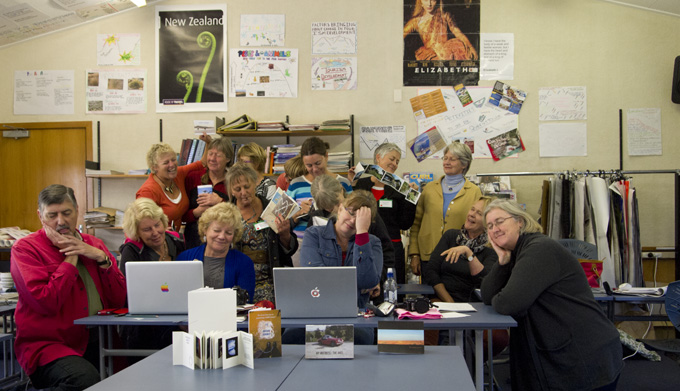
Worn out students and tutors @ Wanaka Autumn Art School
SEE a collaborative book that was made with contributions from the students;
http://www.cooperandspowart.com.au/2_PLACES/OtherBooks/WANAKA-Bk_PageFLIP/WANAKA_Flip.html
Cheers Doug + Vicky
TWO NEW ZEALAND CAMERA OBSCURAS
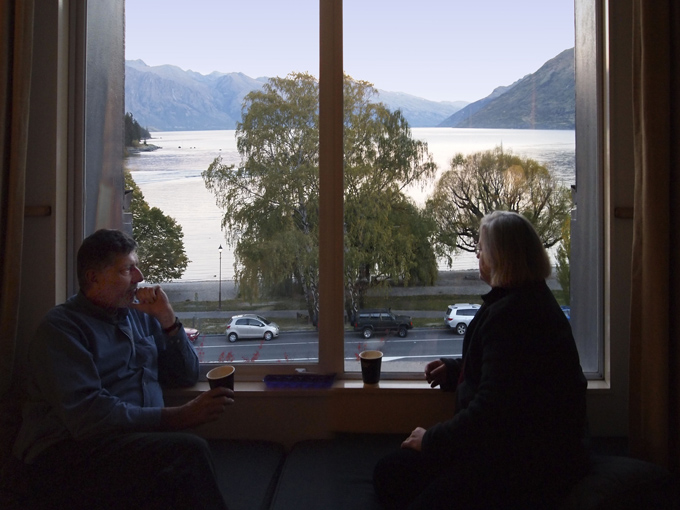
The view from our window @ Rydges Hotel overlooking Lake Wakatipu – Planning a camera obscura shoot
Rydges Hotel Camera Obscura: Queenstown + Lake Wakatipu
We checked into the Rydges on the Lake hotel at Queenstown in the late afternoon and the lake-view room demanded that a camera obscura image be made. Hotel and motel rooms are all pretty much the same—the beds, the bathroom, the table with one chair maybe two, the big mirror, the tiny bar fridge full of junk food and drink and the TV. In the room one could be anywhere and nowhere.
That evening a visit to the local 4 Square store meant that we were equipped with enough black plastic bin liners and some black electrical tape to cover the 2.5 X 3 metre window.
What we needed to complement the image potential for the picture was a beautiful clear sunny day—and that’s exactly what happened the next day. There were two sessions, one around mid-day and the other late afternoon. Blue sky, the golden leaves of poplar trees in autumn and the colours of lake and mountain filled the room.
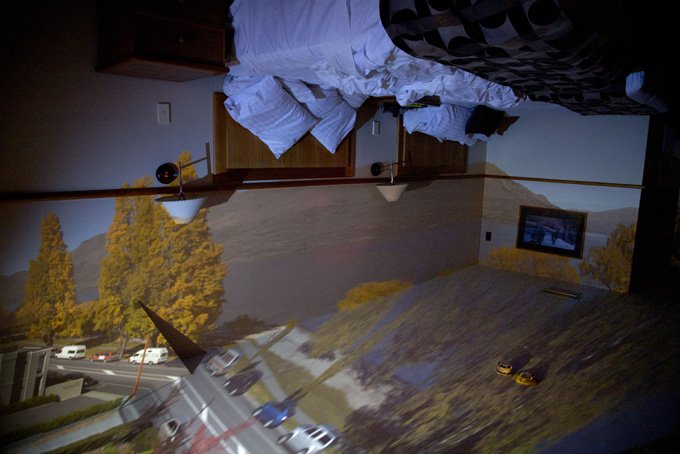
Camera Obscura image looking towards Walter Peak
In between shoots we left the ‘Do Not Disturb’ sign on the door just in case room-cleaning staff should intervene—We often wonder about what unsuspecting visitors would think when first entering the blacked-out space of the room.
Three main images were made—one of the un-made bed, a deep shot into the room, one each of the both of us—Vicky timing the one-minute exposure, the other, a simulation of Doug checking the review screen of the Olympus camera that had been used for image-making that day.
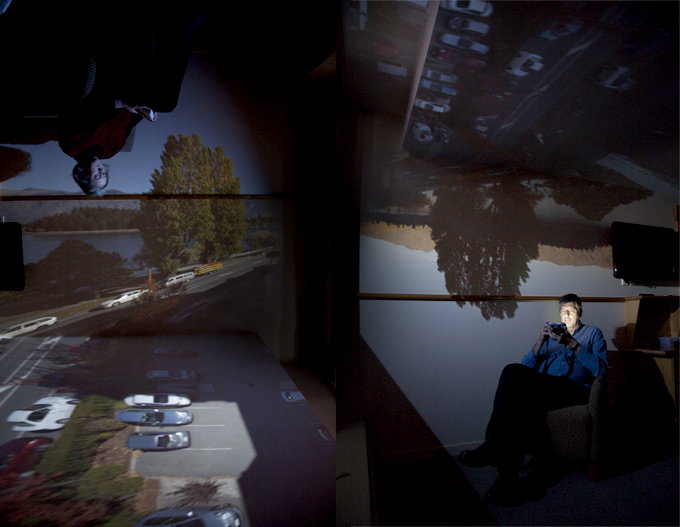
Image left: Vicky times the exposure Image right: Doug reviews images made on his camera
The ‘pinhole’ was fashioned from a postcard of Lake Wakatipu with the steamship the Earnslaw crossing the lake. The aperture was around 10mm and the exposure time around 2.5 minutes.

Victoria Cooper holding the postcard with the ‘hole’ in it
AIPP ON THE LOUNGE: SQIT Toowoomba April 11, 2012

- AIPP – On the lounge SQIT, Website invite
On this evening the SQIT Photoimaging team hosted two events for visiting AIPP members and invited guests. The visit began with a ‘High Tea’ catered for by the SQIT Hospitality team – sumptuous treats were accompanied by tea and coffee. Those attending settled down to conversation with each other in the convivial atmosphere of the ‘Futures’ Restaurant. Coffee Shop
At 5.30 stage two of the visit began with the open of an exhibition of photobooks and artists’ books made by SQIT Photo students over the last 5 years. The show was opened by Queensland Division President Jan Ramsay, who as a past student of an art photography unit, and also part of the end-of-year professional assessment team at SQIT, had experienced the Toowoomba TAFE Photo team at work.

Doug thanks Jan Ramsay for opening the ‘Brought to Book’ show
The books on show ranged from Shanea Rossiter’s ‘Inspiring Women’ book of portraits to Cathy Smith’s book ‘Junked’, a documentary comment on our disposable society and Lorraine Seipel’s political message in the book ‘Song for the future’. The exhibition was curated by Victoria Cooper and Doug Spowart for the Queensland Festival of Photography.
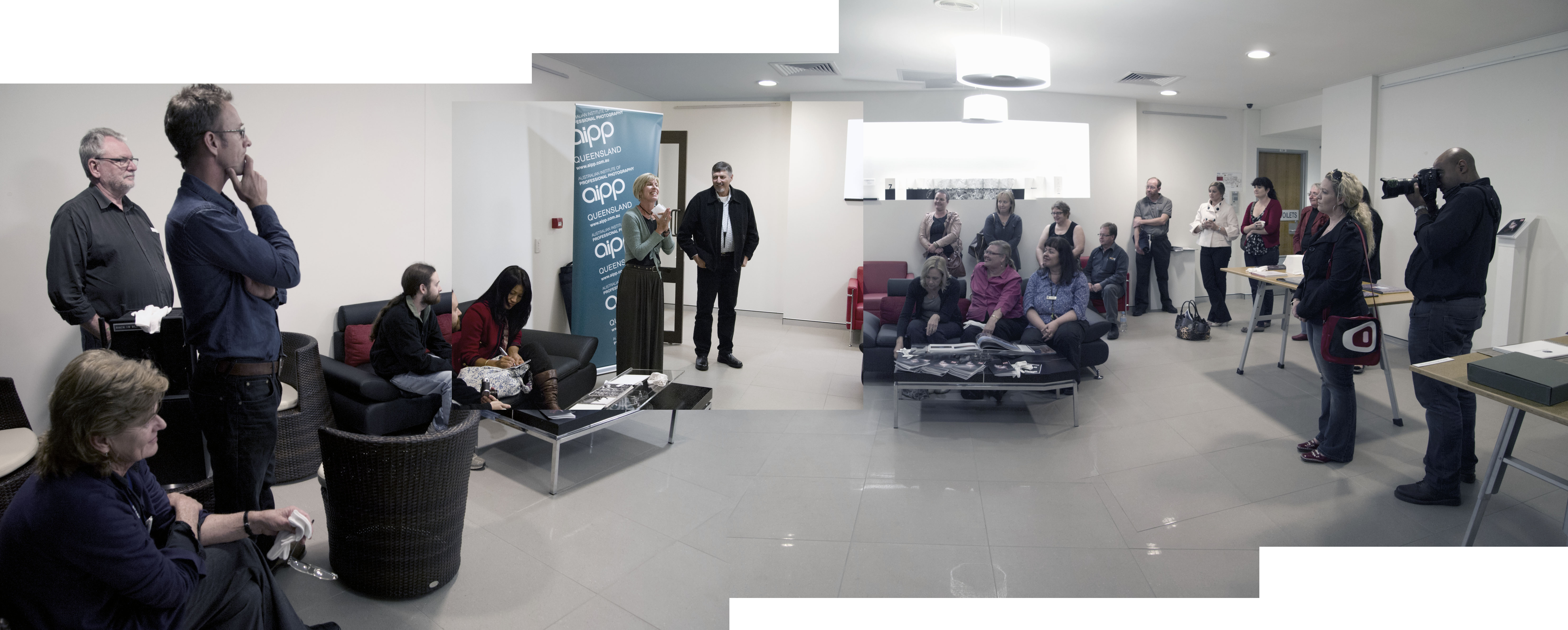
‘Brought to Book’ opening @ Futures Gallery SQIT Toowoomba
The third stage of the program included presentations by the three full-time staff of the photo team – Rachel Susa, Alison Ahlhaus and Doug Spowart. Each spoke of their connection with photography from both the personal and professional context. Doug spoke of the 20-year history of the photo Diploma and Certificate courses at SQIT and the Photoimaging teaching methodology.
The session concluded with a PowerPoint show presenting a selection of images and comments from past students. It was interesting to hear of the experiences of these past students about studying at SQT as well as their achievement in photography. The past students included: AIPP Chairman of the Board Alice Bennett, Nicola Poole, Katie Finn, Lisa Mattiazzi – National Gallery of Australia imaging specialist, Lydia Shaw who works in many areas including photography and teaching in Dubai, nationally acclaimed commercial photographer Damien Bredberg, Sue Lewis – APPA Team Manager and recent graduate Shanea Rossiter who is establishing a business in Warwick.
The Past Students PowerPoint show (PPS) can be downloaded from the www.cooperandspowart.com.au website – It’s a 30.9 mb download but presents an interesting overview of where SQIT students go to and the amazing achievements that they have. CLICK <http://www.cooperandspowart.com.au/2_PLACES/OtherBooks/index.html> Then select the PowerPoint AIPP OTL picture.
The evening concluded with the video fusion show “Dance-on’ by 2011 SQIT Diploma Student of the Year. “Lindsey’s video represents the future of photography” said Doug, and added, “that the stilled image is dead!” The point was not debated, but in the context of an industry that has gone from wet darkrooms to light rooms and digital output in the last ten years everyone left knowing that anything is possible.
Cheers Doug
CHARLIE SNOOK: HIS LIKENESS RETURNS AS A PHOTO
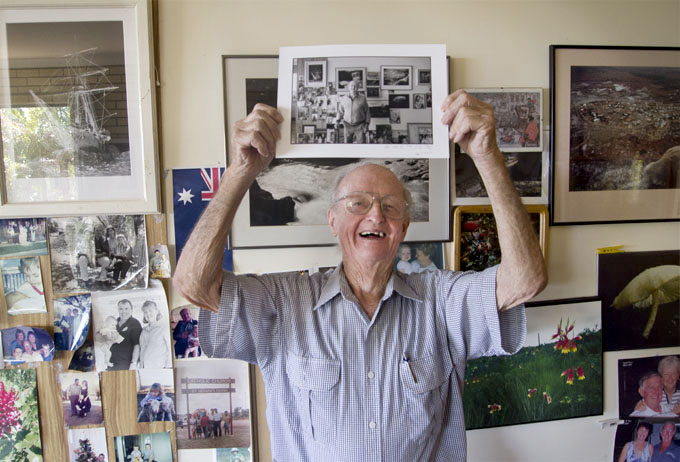
Charlie Snook + portrait by Doug Spowart
I first met Charlie Snook in 1977 when he and I were among the guest lecturer team for the Binna Burra Photo School in Lamington National Park near the Gold Coast. The weeklong event was an inspirational live-in experience for keen photographers. Day and night workshop sessions were augmented by bushwalk forays into the surrounding National Park. Darkrooms for black and white processing and even colour work were set up to provide a complete experience of ‘learn and do’ in just about everything photographic.
Other members of the lecture team included Rob Heyman, Rob Bannerman, Alec Fraser (recently departed for the big darkroom in the sky), Ansett photographer Gary Lewis and of course Tony Groom traveller and photographer the son of the founder Arthur Groom. Someone was always up to something—whether it was photography, experiencing nature or telling tall stories of travel or life or just plain joking around. Over time great photographers like Steve Parish presented workshops and added to the yearly event’s reputation.
Charlie and I struck up a friendship that connected us with the love of photography and the natural environment. Apart from the annual Photo School adventures that included the Coomera Crevice, the Shipstern decent and the Ballanjui Falls abseil, Charlie and I, assisted by his two son’s-in-law canoed the Mann and Clarence Rivers from Nymboida to Jackadgery. Later when my mother and I began of offer photo tours around Australia as part of our Imagery Gallery business activities Charlie became a regular traveller.
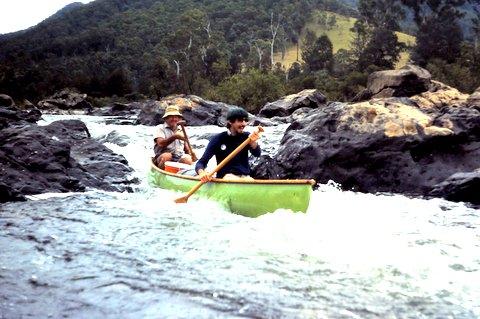
Charlie and me on the river Photo courtesy of Lesley Wall (Charlies Granddaughter)
In 1987 photographer Maris Rusis and I made a 10”x8” photographer’s journey along the east coast of Australia. We spent some time with Charlie helping to fix plasterboard panels to the ceiling of a house he was building at Minnie Waters near Grafton. A plumber by trade Charlie had worked in a variety of amazing projects including The Blue Cow tunnel in the Snowy Mountains, massive holiday resorts in Yamba and as a volunteer for the Catholic Church missions in the islands of the Pacific building community infrastructure.
In July 2011 Vicky and I visited Charlie and I made a portrait of him in front of his photo gallery. He stood proudly before his cherished image by Frank Hurley of the ship the Endurance trapped in ice in Antarctica, images from his travels and of family and friends.
Today we revisited Charlie to return his image as a black and white print—he was chuffed!!
Cheers Charlie.
POST SCRIPT: Charlie passed away peacefully in Grafton last Saturday, August 10, 2013. He will be sadly missed but his enthusiasm for photography, wilderness and Minnie Waters lives on with those who remember him.
EASTER @ The Wooli Study and Research Centre
Easter holidays, (if you can call time working on a PhD ‘holidays’), and we are at the beach at Wooli. While Vicky slogs her way thru Haraway, Latour and the non/more than-human I’m preparing the digital files for the electronic version of my thesis. Sometimes I just feel in-the-moment so much that a camera nearby gets in the act – it compels me to photograph!
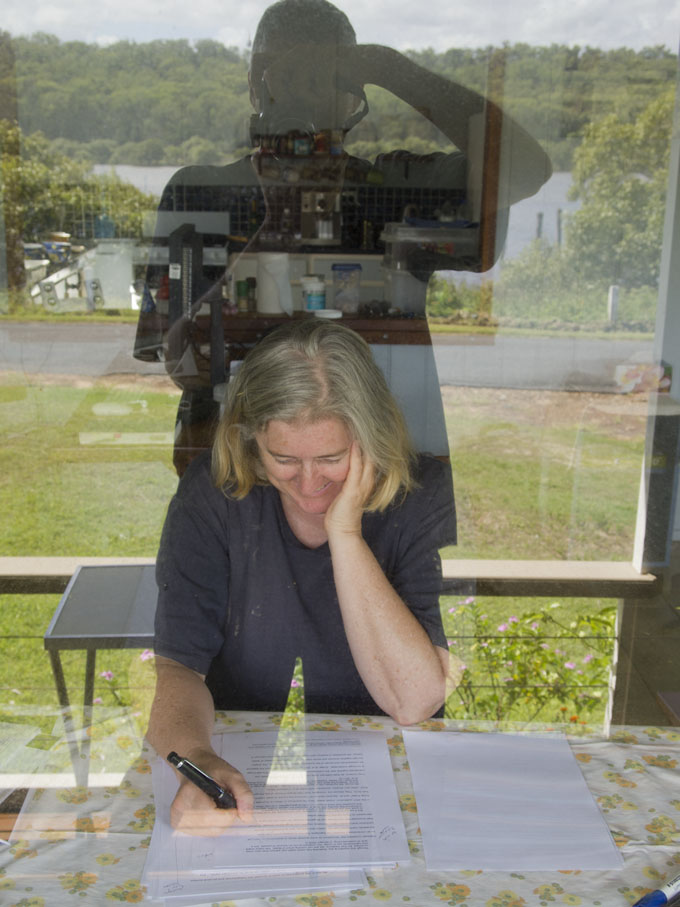
An auto-portrait – A montage of montages
SEE EXAMPLES OF WOOLI STUDY AND RESEARCH OUTPUTS Here…
http://www.cooperandspowart.com.au/2_PLACES/WOOLIflipBOOKS/index.html
http://www.youtube.com/watch?v=IupUzMv9Js0 DIGGERS BEACH
http://www.youtube.com/watch?v=Yk4vnbzTqOU&feature=channel WOOLI PINHOLE VIDEO
http://www.youtube.com/watch?v=7hldyc_p__g&feature=relmfu WOOLI – WINDY DAY
http://www.youtube.com/watch?v=qo1IiDDVcoc&feature=related WOOLI BEACH FUN
COOPER+SPOWART: ‘Contact Zone’ exhibition
Featuring the photo-based artist’s books and photobooks of Victoria Cooper and Doug Spowart
March 21 ~ April 5
Cooper and Spowart are influenced by the context and the consequences of living within a constantly changing relationship with the landscape. Contact Zone connects the viewer/reader with “place” relationships through the photobook, both physically and metaphorically.
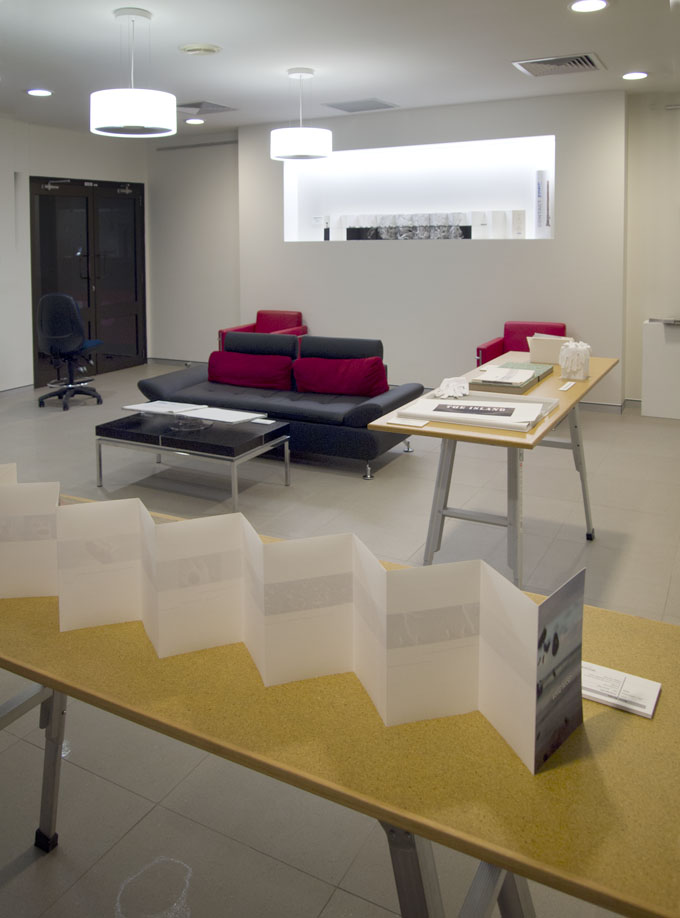
Contact Zone installation - Cooper+Spowart @ Futures Gallery, Toowoomba
Part of the 2012 QCP Queensland Festival of Photography

 wotwedid