Archive for the ‘Place-Projects’ Category
ROAD RAGE ART: 6 Artists from out of Nowhere
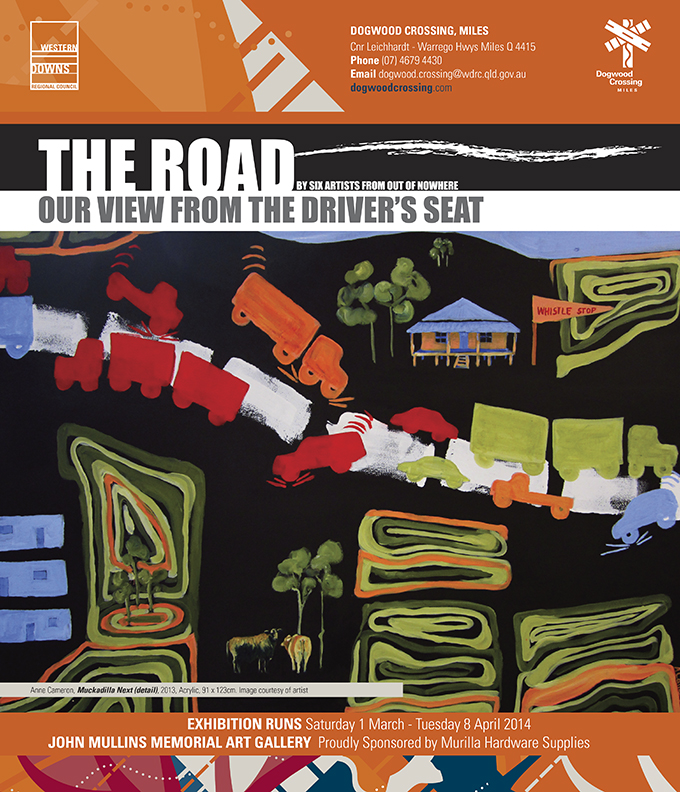
The Road: The veiw from the driver’s seat Poster
.
THE ROAD: Our view from the driver’s seat
Dogwood Crossing Gallery, Miles, March 1 – April 8, 2014
.
“Nothing behind me, everything ahead of me, as is ever so on the road.”
Jack Kerouac, On the Road
.
Roads are places where the past is viewed in the rear vision mirror and the future viewed through the windscreen. But what is that future? And how far can we see into it? An exhibition at the Dogwood Crossing Gallery presents a view from ‘the driver’s seat’ of the Warrego Highway in southern Queensland and it seems like a pretty hopeless place looking either from the windscreen or the rear-view mirror for that matter.
.
Created by the activist art group 6 Artists From out of Nowhere the place specific artwork snakes and curves its way along the gallery wall with sections of the painting that vary much like the way road surfaces change from shire to shire or road contractor to road contractor. For readers who are not conversant with the nature of Queensland roads: the Warrego Highway passes through the Darling Downs, was once an artery of transportation between the city and the country. Now it has become a congested, clogged and rubbish-strewn vein due to the expansion of the Surat Basin’s extractive mining projects. Everyday masses of material, pipes, personnel and machines use this highway.
Massive flooding that occurred over recent years and the abuse of heavy transport has meant many sections of the road are under constant start-stop traffic controls systems while being patched, repaired and upgraded.
The 6 Artists from out of Nowhere are country people connected to the land. Their lives and livelihoods are being challenged, by the demands of mining to access and transform land use and also transform the once familiar and reliable road systems. The artists are not happy with this situation. They state: ‘the highway has become so busy and so dangerous that we felt compelled to comment in paint.’ The exhibition is simultaneously a report and a shout for an improvement to the circumstances of those who no other option than to use this thoroughfare.
.
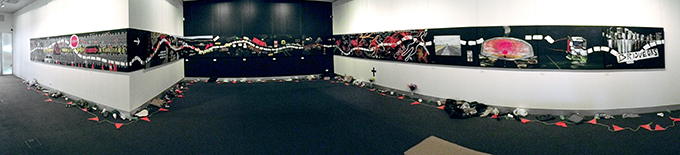
The ‘Road’ installation in the Dogwood Crossing Gallery
.
On a plinth in the middle of the gallery floor the sculptural forms of two trucks by Wally Peart pass each other on a highway. One carries pipes for the coal seam gas corporations, the other carries products on the land – their paths cross only millimetres from each other and yet the narrative of each is something that is shared only by the presence of the road.
.
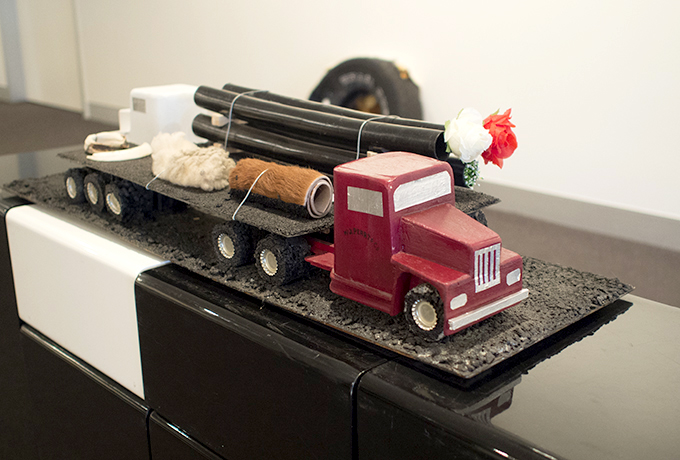
Wally Peart’s sculpture
.
As the gallery visitor travels along the highway artwork, familiar symbols, signs and fleeting glances of things that flit past one’s eyes when travelling at 100 kilometres per hour emerge. The artist Barbara Hancock has painted an endless line of lollypop stop-go men and women who demand your courtesy waive or salute ‘thanks’ as you allowed to proceed. Traffic lights enable a quick drink, or a check of phone text messages, or just time to contemplate the journey. While in the rear-view mirror a shimmering chrome grille and bull-bar of the huge road train rumbles behind you in the queue. Orange-capped witches hats sit comfortably along the edge of the road, in this case the canvas, and a police car decked out in harlequin waits and waits … Stop, DETOUR, STOP!
.
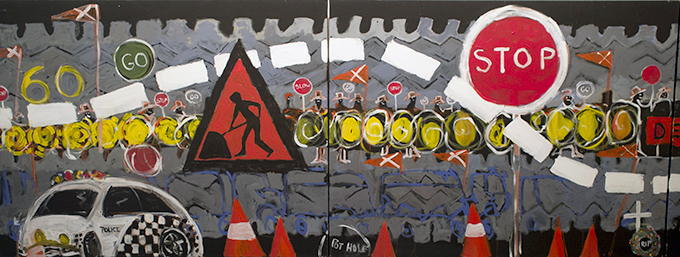
Barbara Hancock (Detail)
.
A transition to the next road section by artist Anne Cameron presents a line of colourful truck silhouettes traversing a landscape of contour-ploughed primary producing farmland that is paired with a crop-like grid of dongas – accommodation boxes for the weary miners. An occasional car or tuck slips off the road, an old farmhouse and a lonely fisherman by a stream appear oblivious to the processionary caterpillar grub road activity.
.
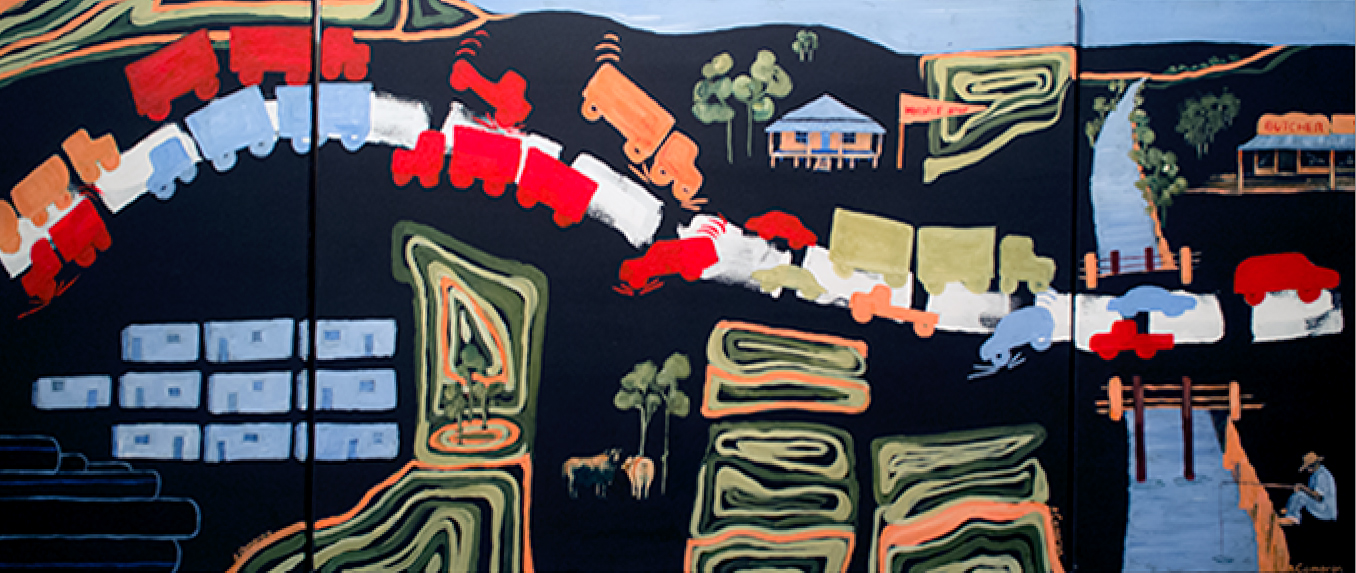
Anne Cameron (Detail)
.
Elizabeth Corfe introduces her section with road signs of all kinds errected for the safety of all road travellers. The classic Australian house name ‘Emoh Ruo’ (our home) is being subjected to a clearing sale and the spirit-like form of a dead kangaroo hangs from a forked tree branch.
.
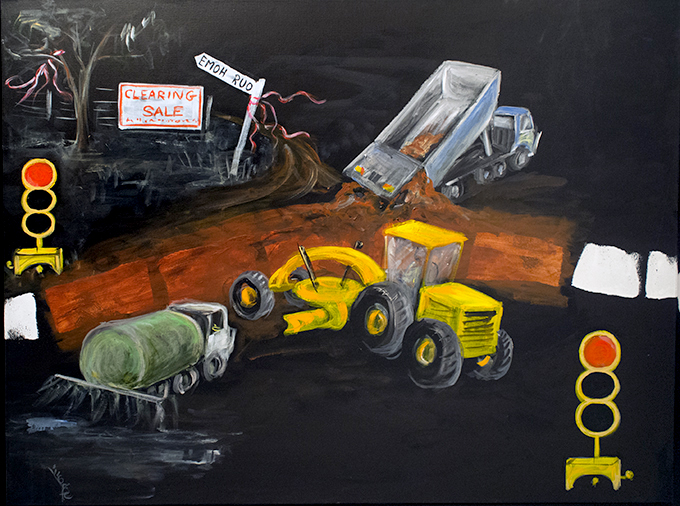
Elizabeth Corfe (Detail)
.
The road goes on to artist Sandra Allen’s section. Amongst the black bitumen and red dirt of the road wrecking and making machinery are blood red splashes of road kill and the white chalk outlines of police markings around human road fatalities. Messages cite the author’s claim that: ‘city engineers build country roads … disaster’ and, ‘city drivers in the country cause accidents by tailgating’. The text ‘your next’ accompanies an arrow pointing menacingly at an anthropomorphised kangaroo with joey in her pouch, and the vehicle names of Toyota, Avis and Kawasaki are the perpetrators.
.
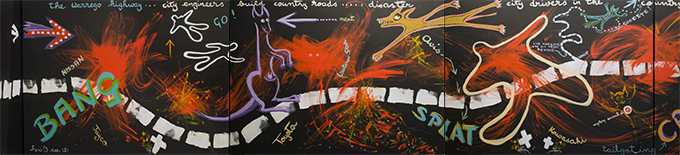
Sandra Allen (Detail)
.
The road goes on to artist Sandra Allen’s section. Amongst the black bitumen and red dirt of the road wrecking and making machinery are blood red splashes of road kill and the white chalk outlines of police markings around human road fatalities. Messages cite the author’s claim that: ‘city engineers build country roads … disaster’ and, ‘city drivers in the country cause accidents by tailgating’. The text ‘your next’ accompanies an arrow pointing menacingly at an anthropomorphised kangaroo with joey in her pouch, and the vehicle names of Toyota, Avis and Kawasaki are the perpetrators.
.
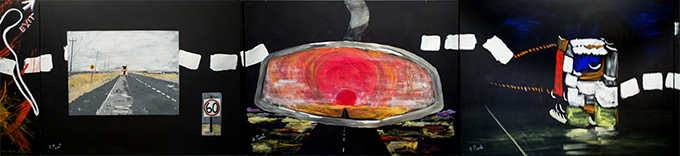
Helen Peart (3 panels)
.
Allen’s bold and provocative canvas road ends at Helen Peart’s simple high key painting of a road view. The limited yellow and grey palette contrast the black and red of the last section – the speed sign says 60kpm and a sunset in the west viewed from the rear-view mirror ends the day. The dark night follows where the bright light chimera of a truck’s of lights zooms past. We are nearly at the end of the road and the reflected lights of the big city, entitled BRISVEGAS, seem almost placid in comparison with what has been experienced in the gallery journey. Is the big city aware of the struggle and the price paid … would they care?
.
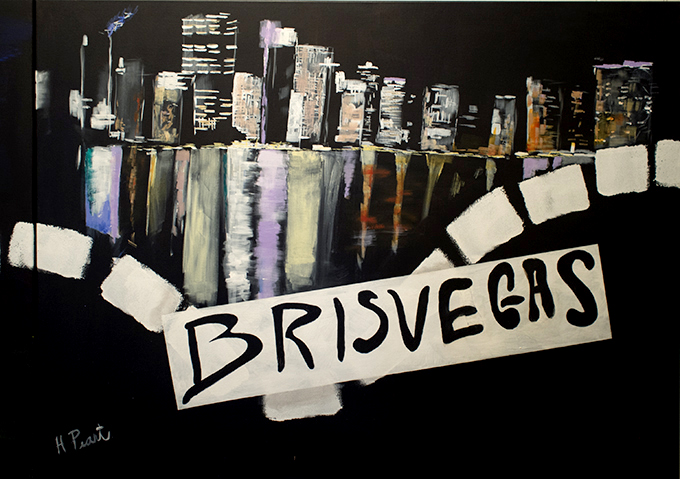
Helen Peart (Detail)
.
The lights maybe bright and welcoming and the 6 artists have got us safely to the city –––– but what about the return to our beloved Darling Downs? Can we ever go back … that may be another story? Perhaps as Kerouac comments in On the Road ‘There’s nothing behind, everything is ahead …’
.
Doug Spowart
12 March 2014
.
SEE the previous exhibition by the 6 Artists from out of Nowhere: https://wotwedid.com/2012/07/30/shooting-straight-regional-artists-as-provocateurs/
.
The artists retain all copyright in their artworks. Text and installation photographs © 2014 Doug Spowart
.
Buildings with tattoos: First Coat Street Art Festival
Off Duggan St
.
THE FIRST COAT STREET ARTS FESTIVAL
.
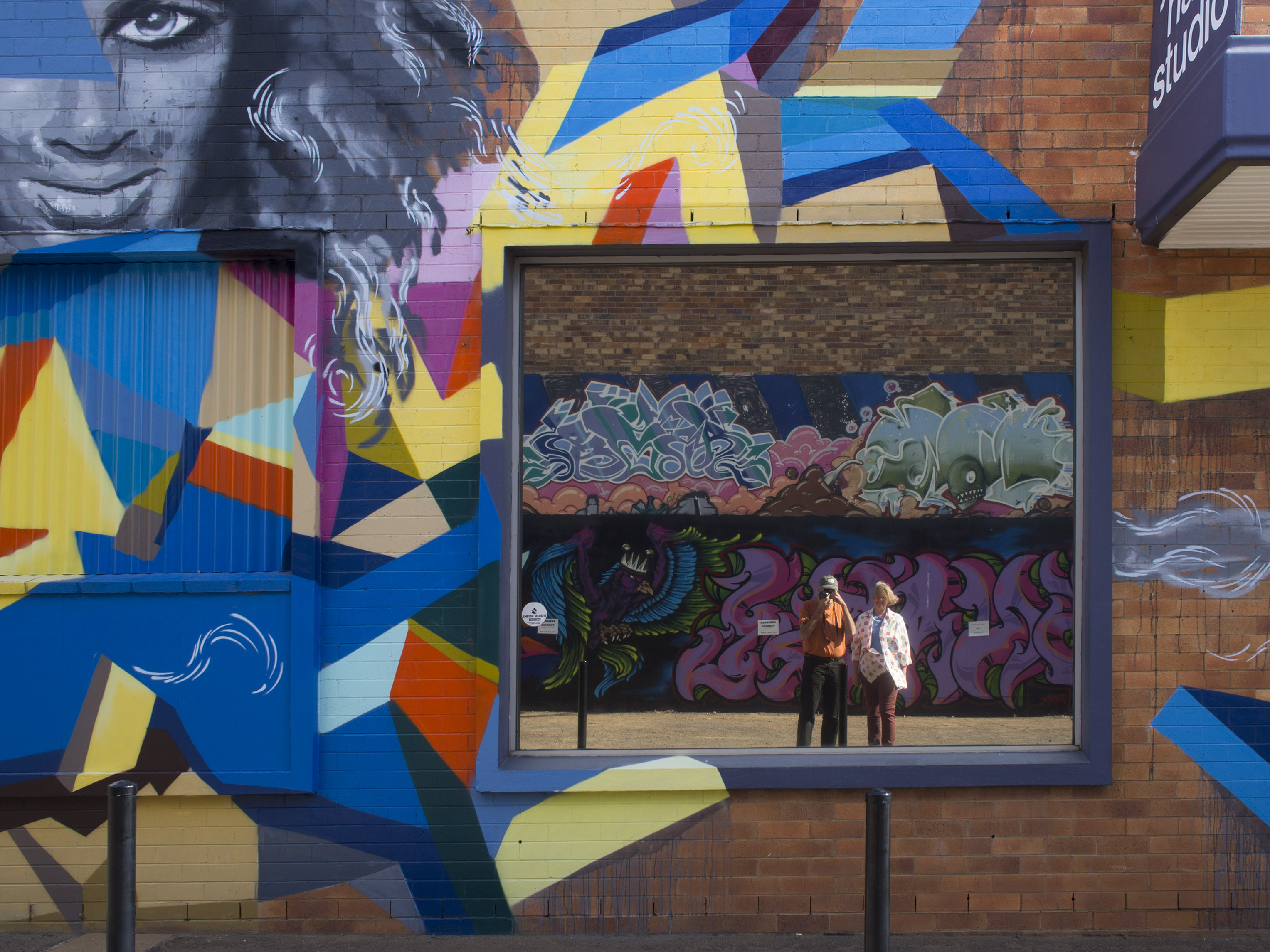
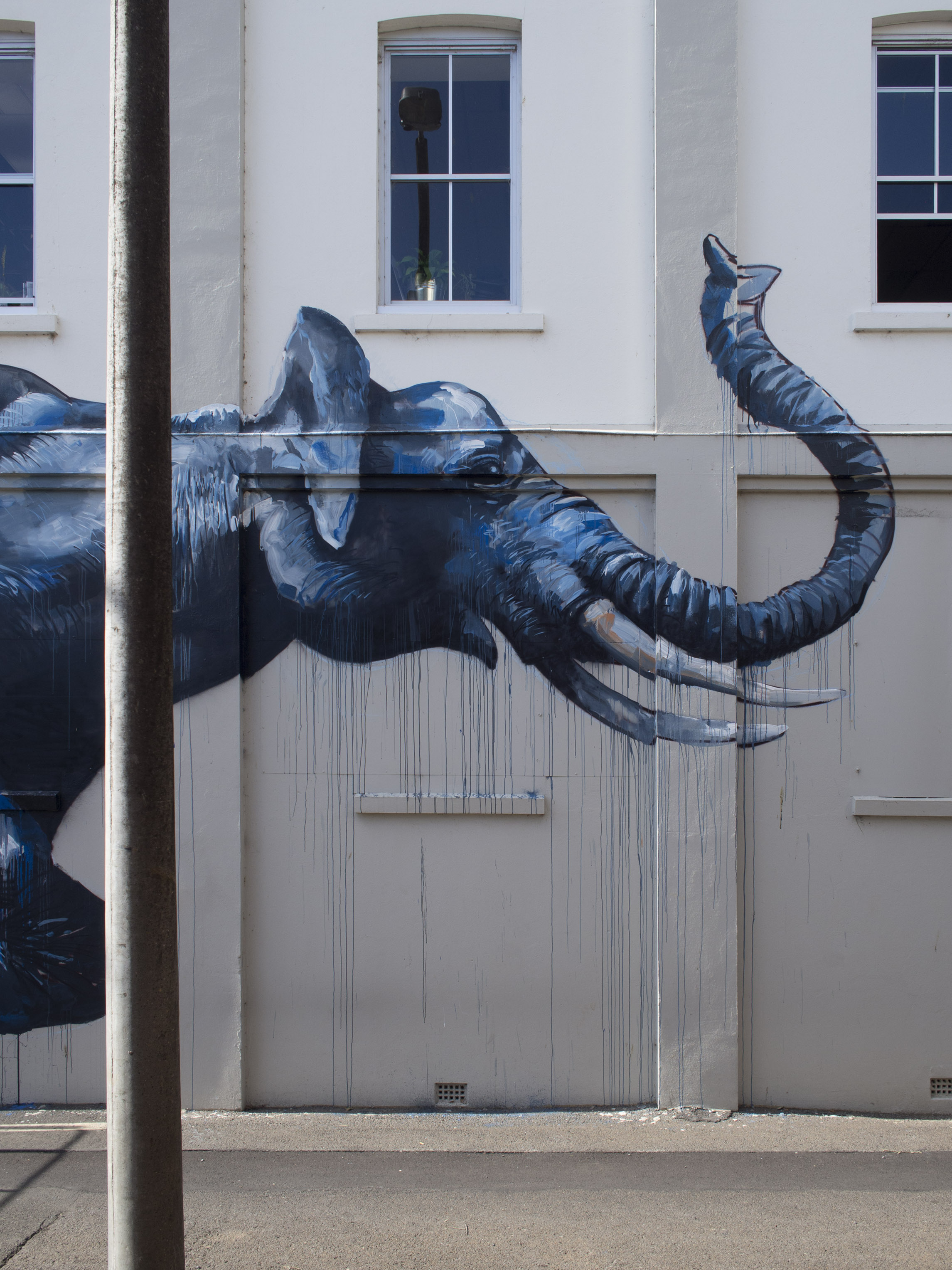
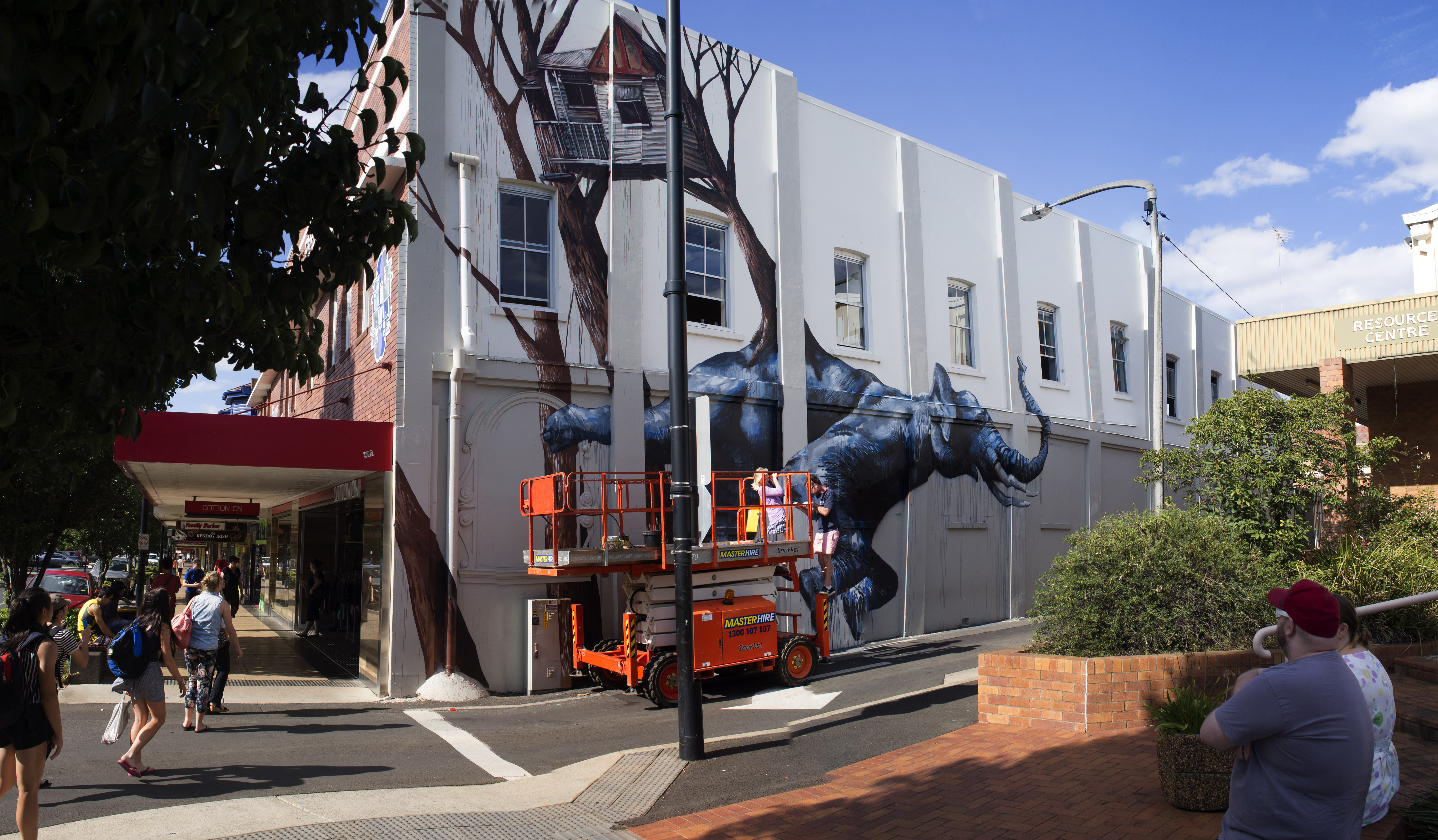
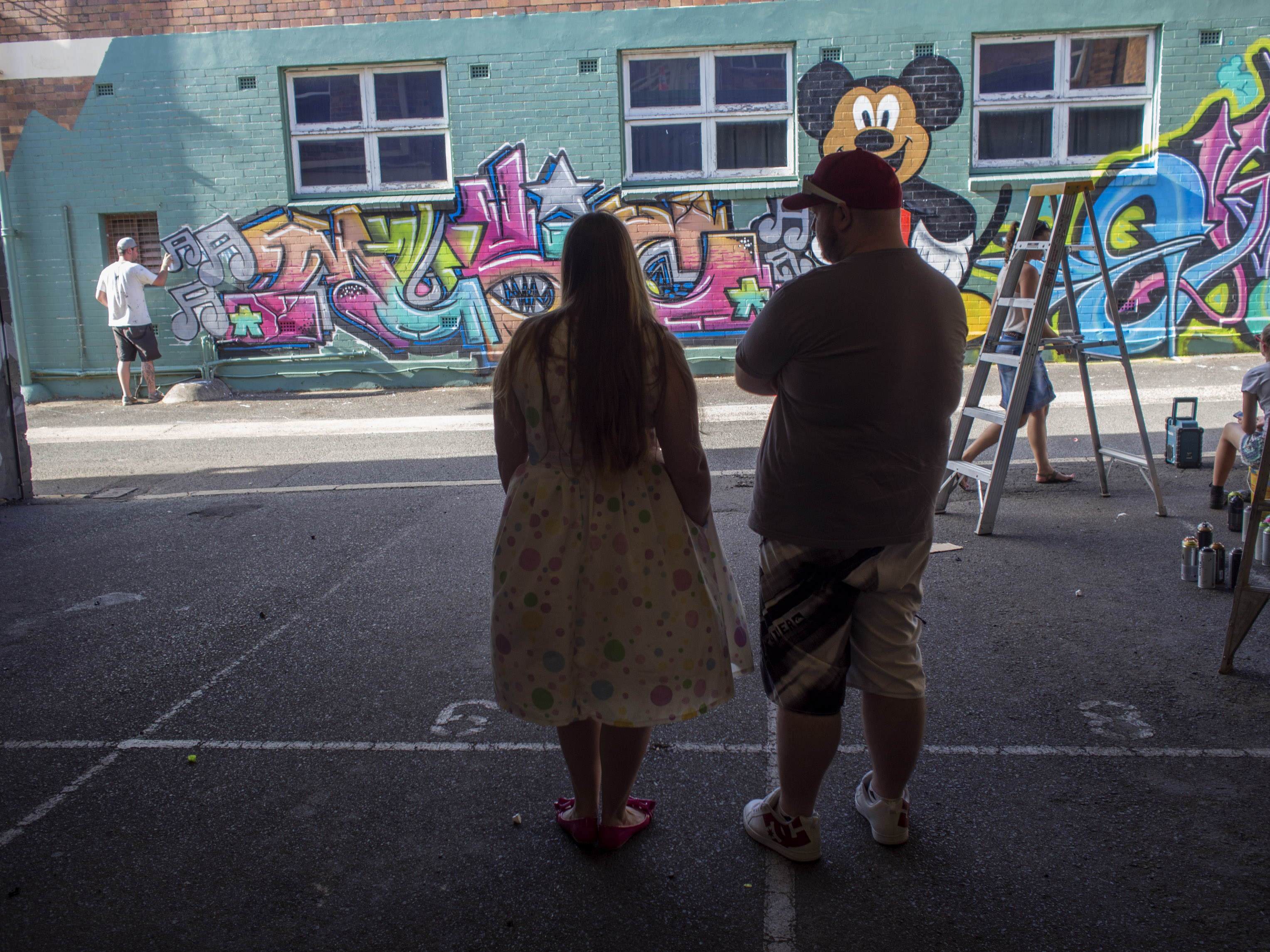
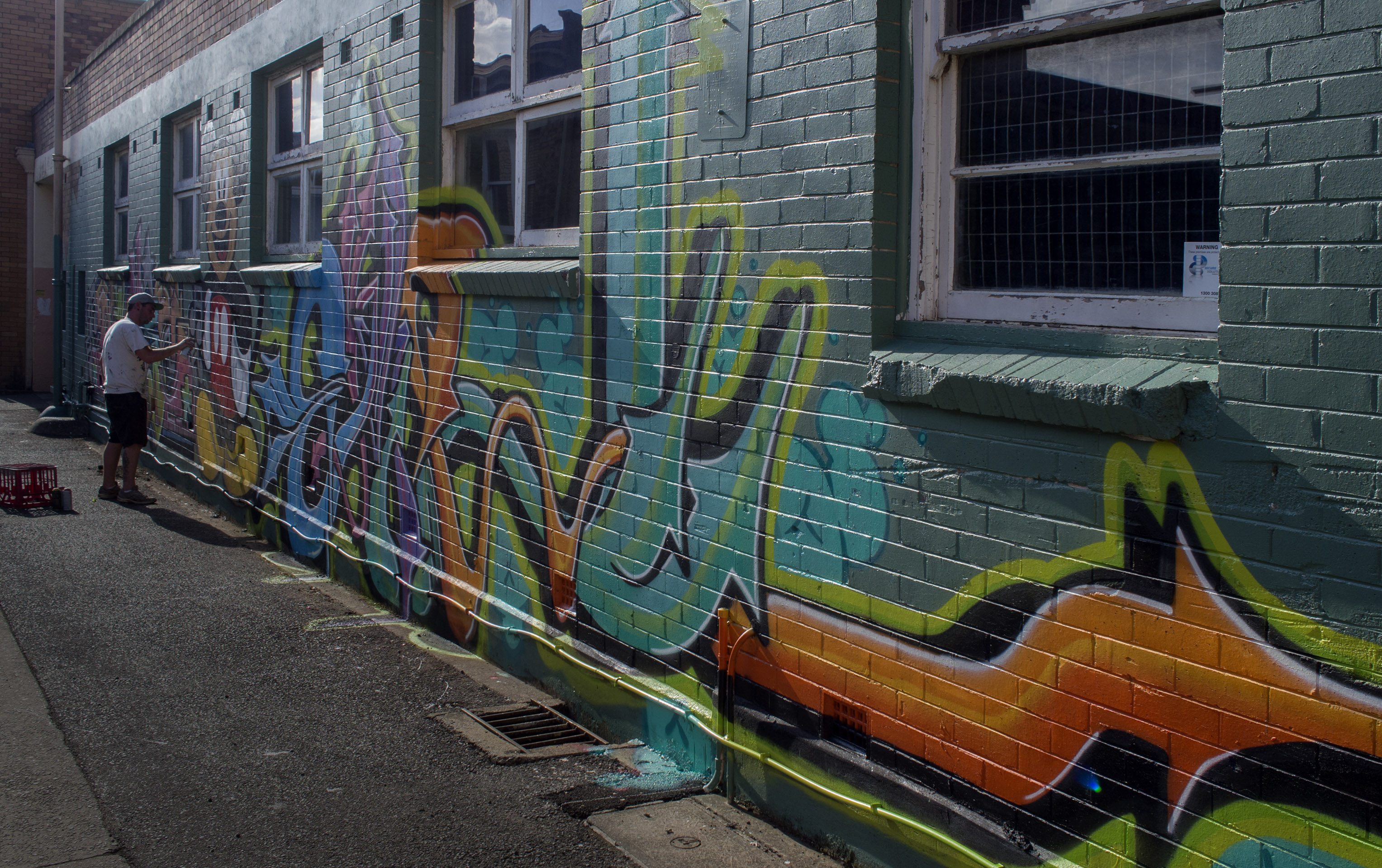
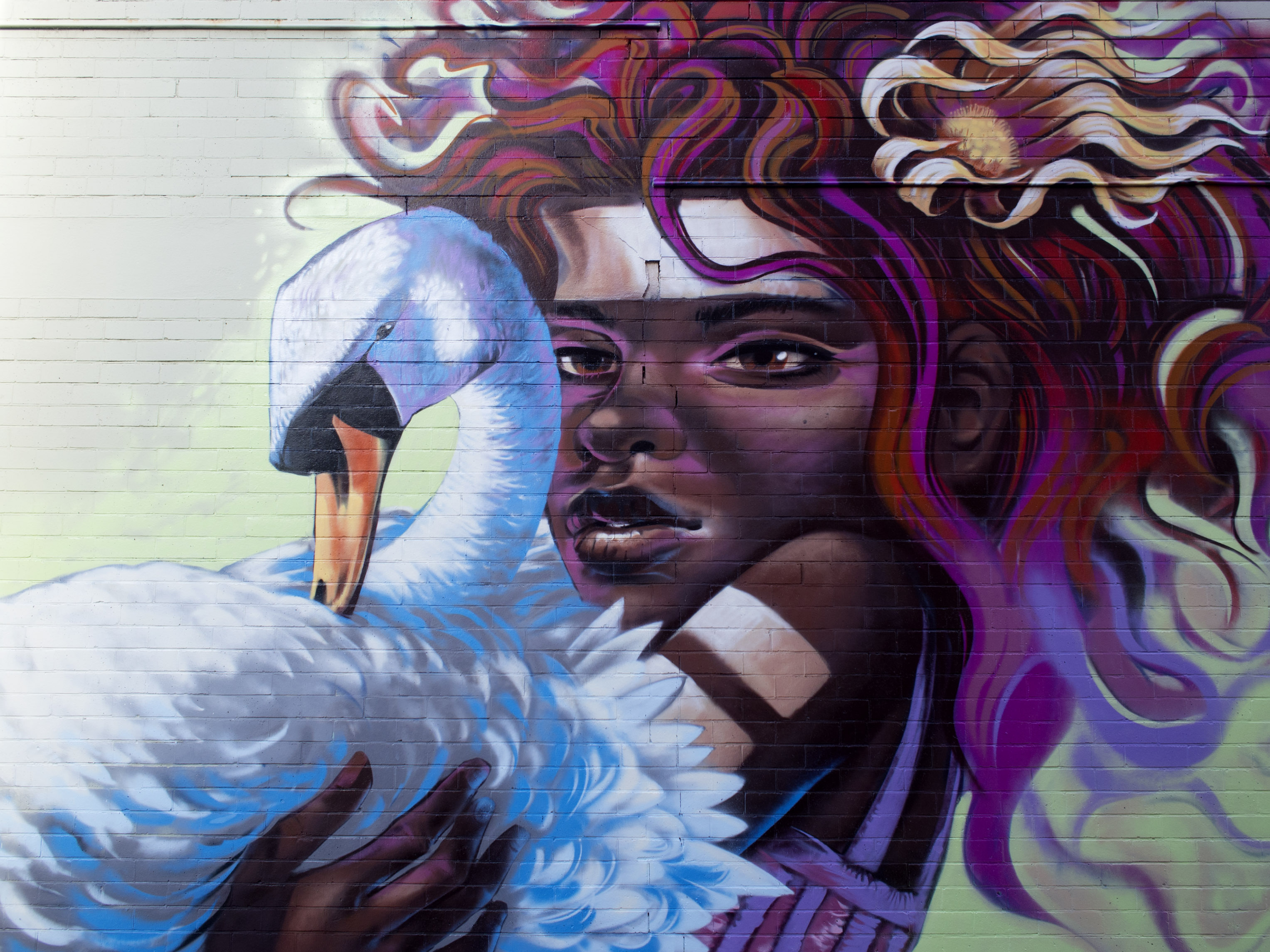
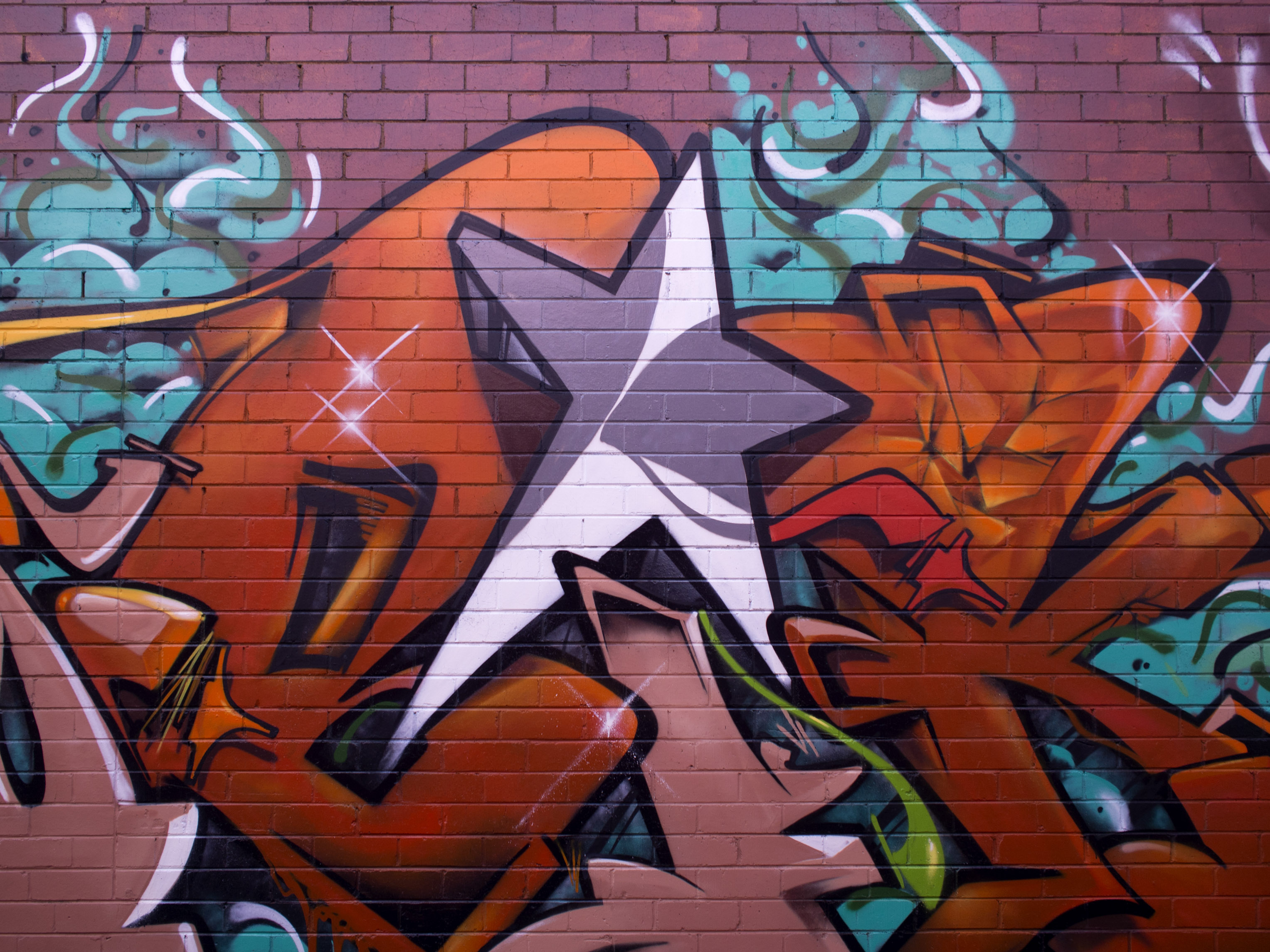
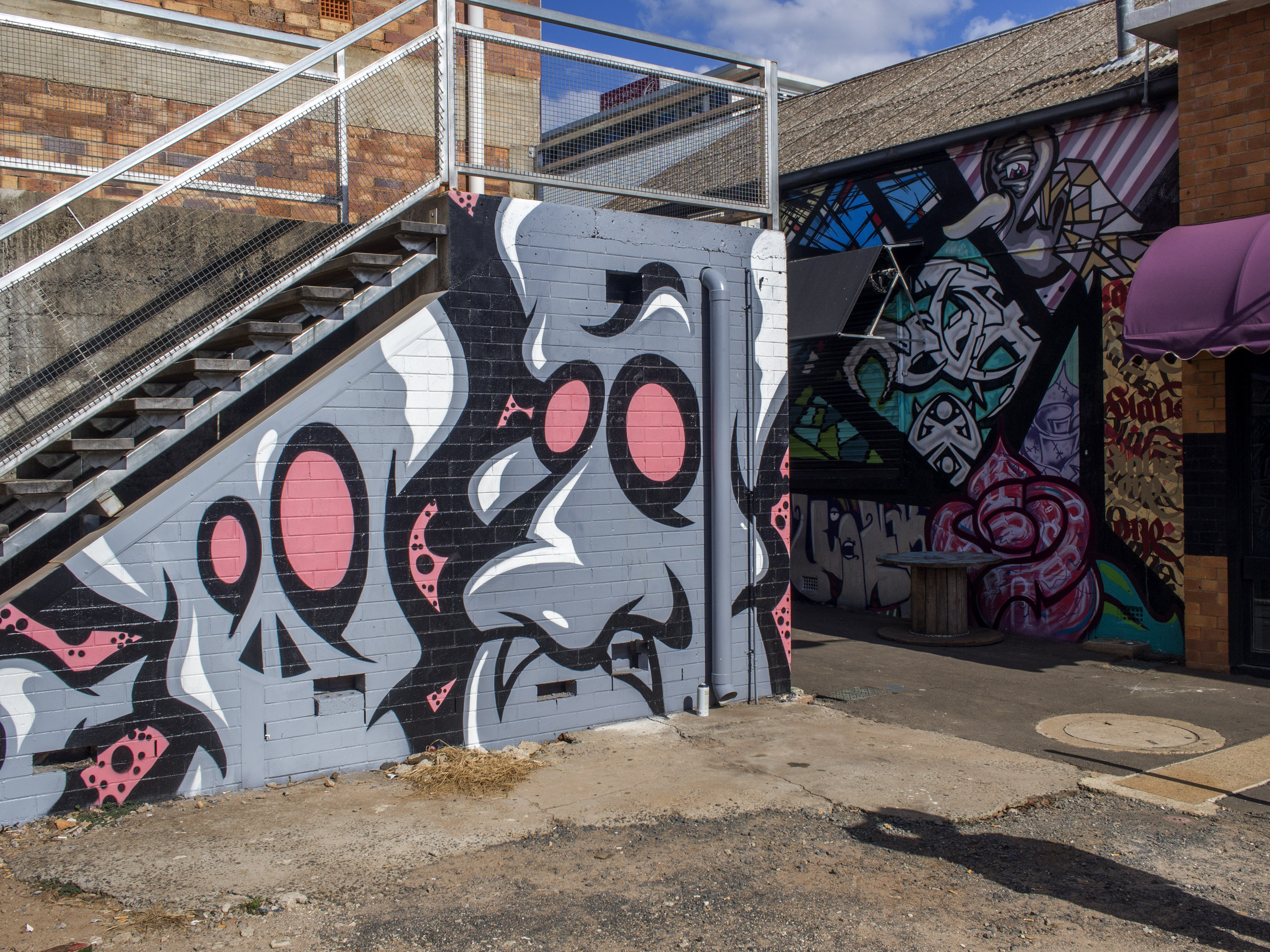
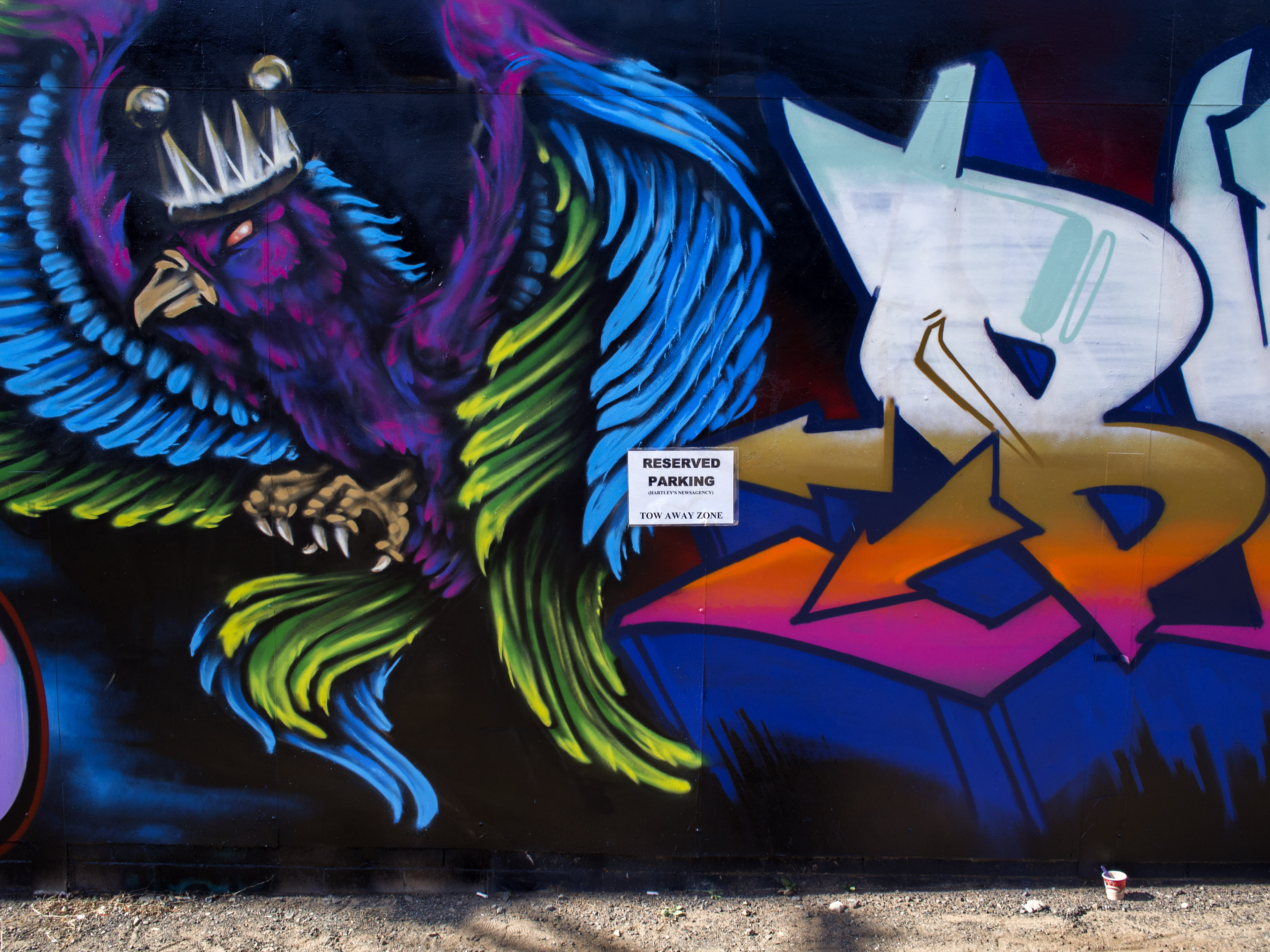
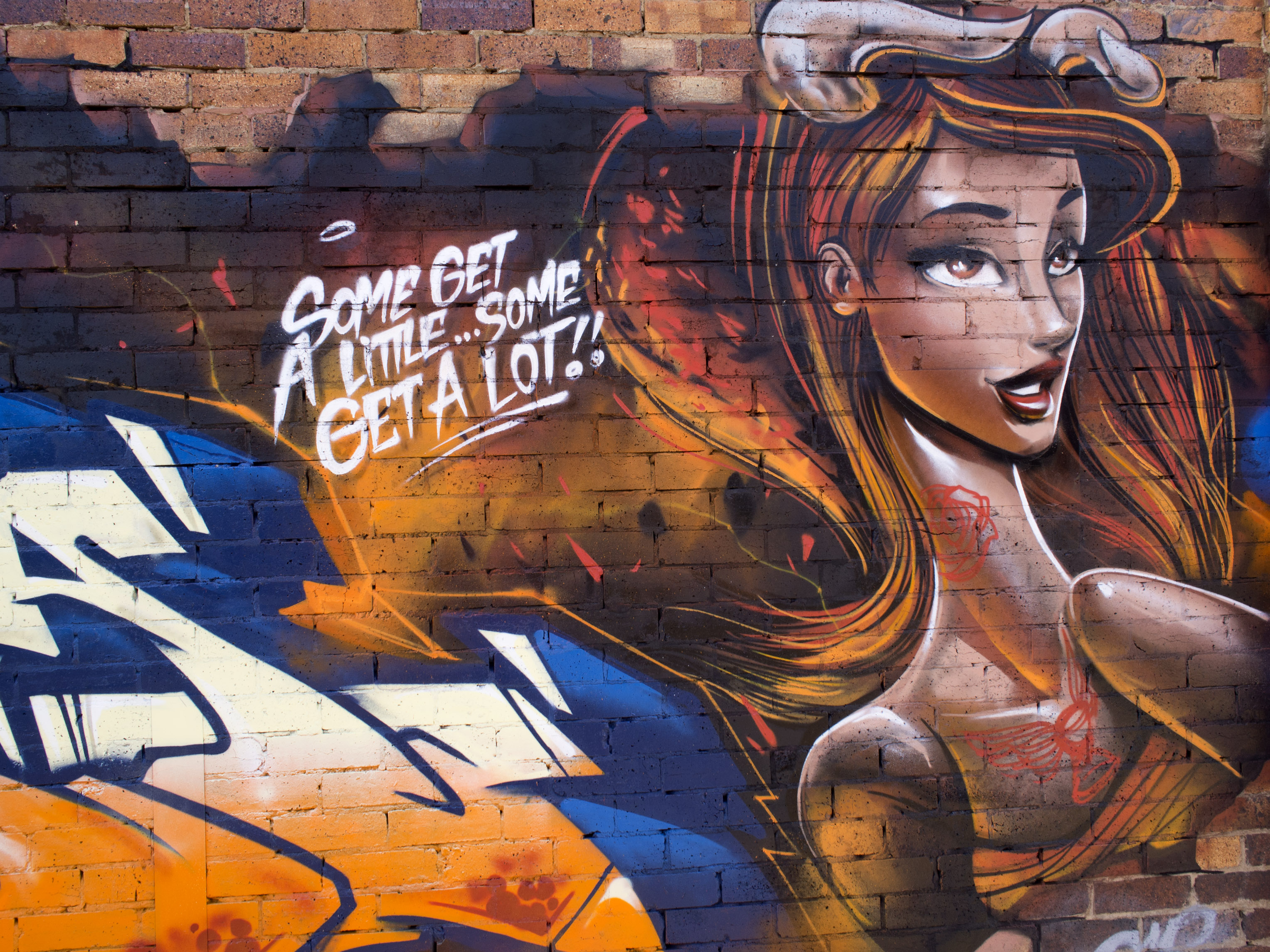
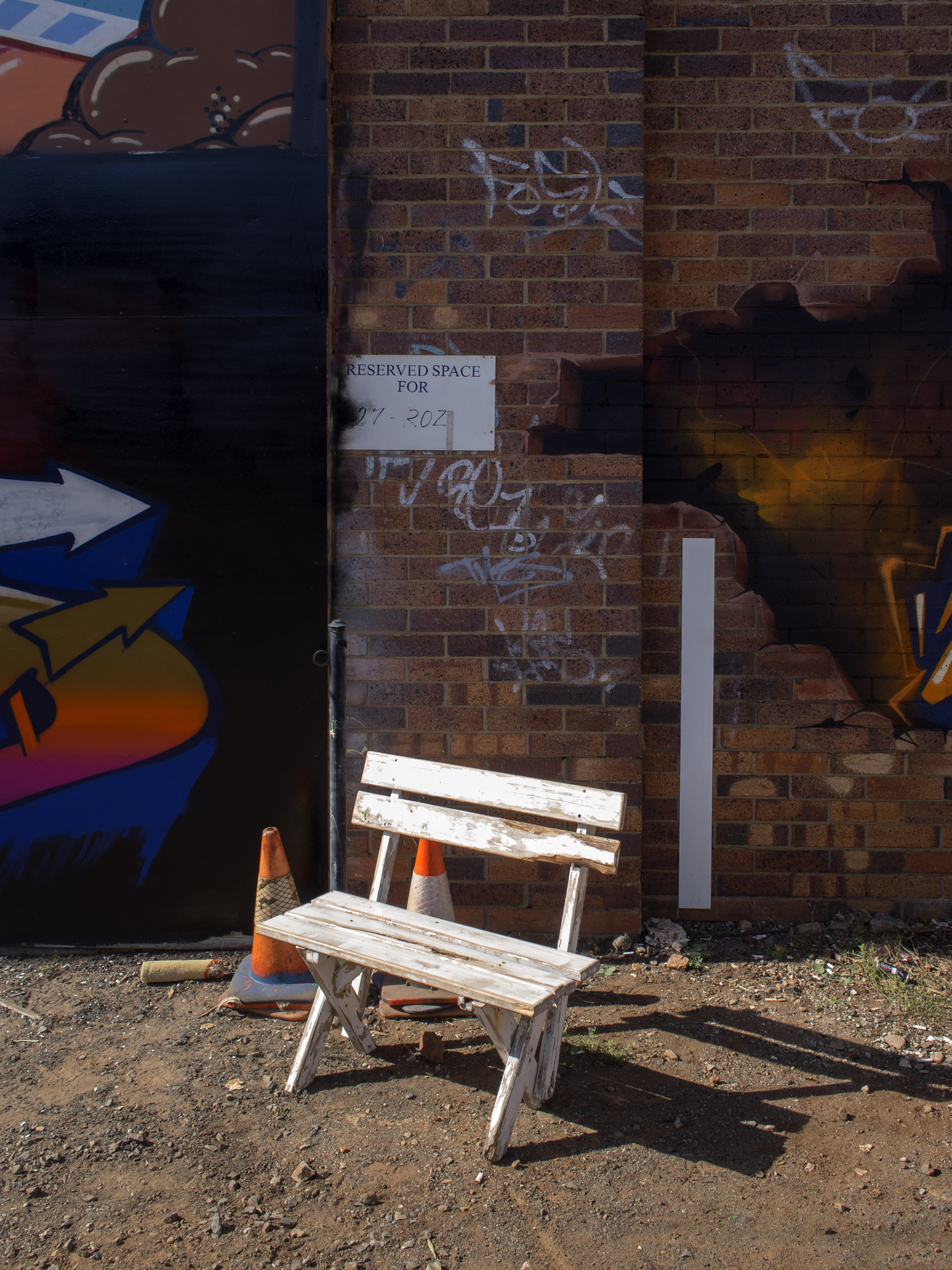
The regional town of Toowoomba has been transformed over the weekend of the 21, 22 and 23 of February by a band of international, national and local artists, converting lane way walls into places of street art. Now dingy or dilapidated back lanes are the place where one can encounter art – or – has the art has come to us?
Street art or graffiti, whatever you call it was illegal with significant fines and community service being awarded those who were caught – perhaps even jail! Not being caught in the act as well as being outrageously brave in the places where work was to be placed and what it would say was what it was all about. Graffiti gave a kind of voice to a youth dispossessed by any means of being able to express how they felt or the creativity, perhaps even beauty, that can come from the nozzle of a spray can and a creative mind.
.
Fintan Magee: 492 Ruthven Street
Fintan Magee: 492 Ruthven Street
.
For years the domain of reckless and angry youth, the quickspray ‘tags’ adorned many buildings in public spaces. In time railway rolling stock became a moveable target for adornment. And while in the past, crews of official graffiti ‘strippers’ would attempt to remove these forms of creative expression it seems today that they have just given up–it’s far more interesting now to ‘graffiti-spot’ (like train spotting), at the train level crossings than ever before.
Working mainly in stencils the UK artist Banksy added to the genre’s acceptance in mainstream culture by his often ironic, humorous and insightful commentary. In his nocturnal art practice Banksy has maintained his anonymity and his works have passed into cult status.
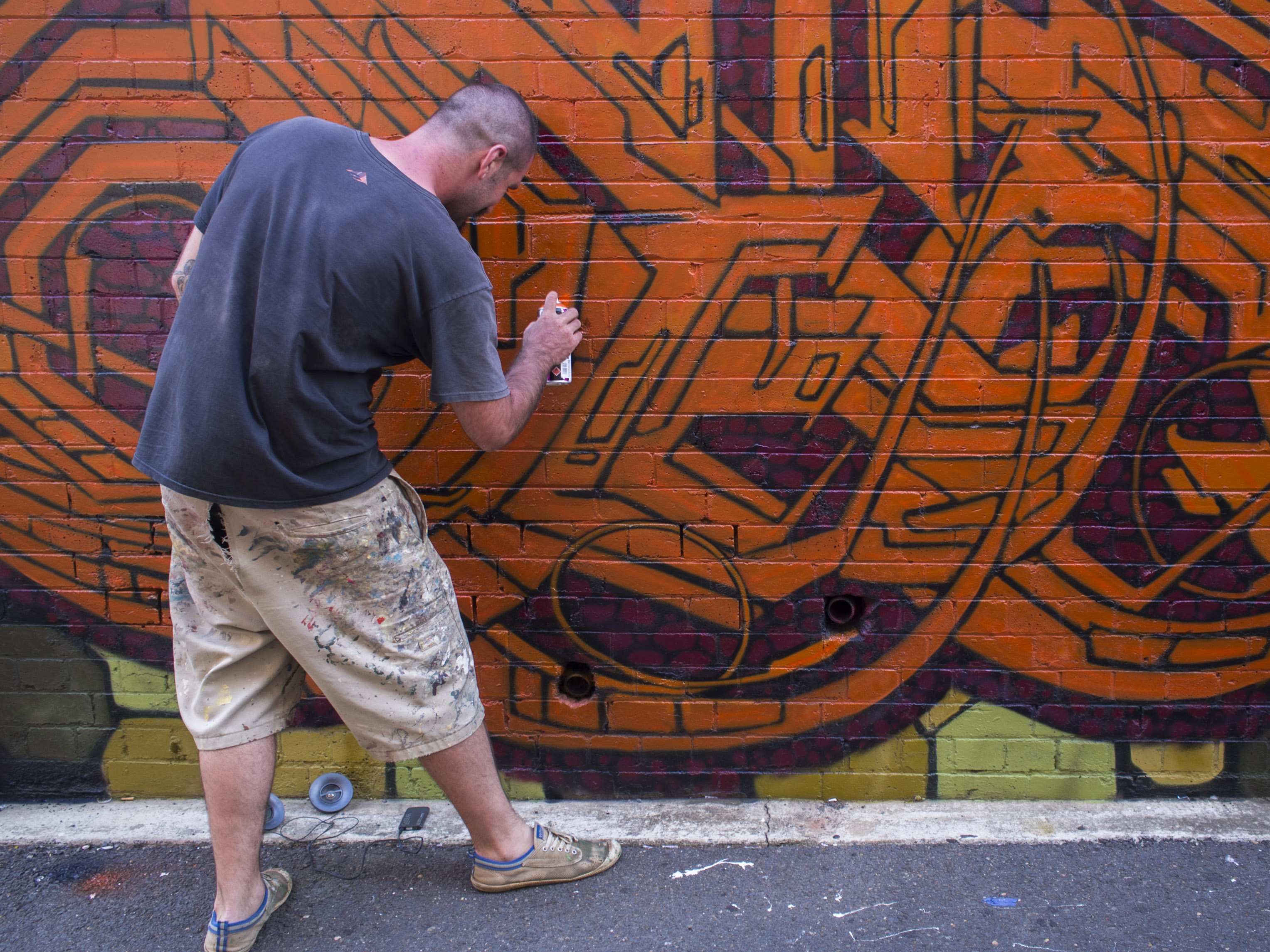
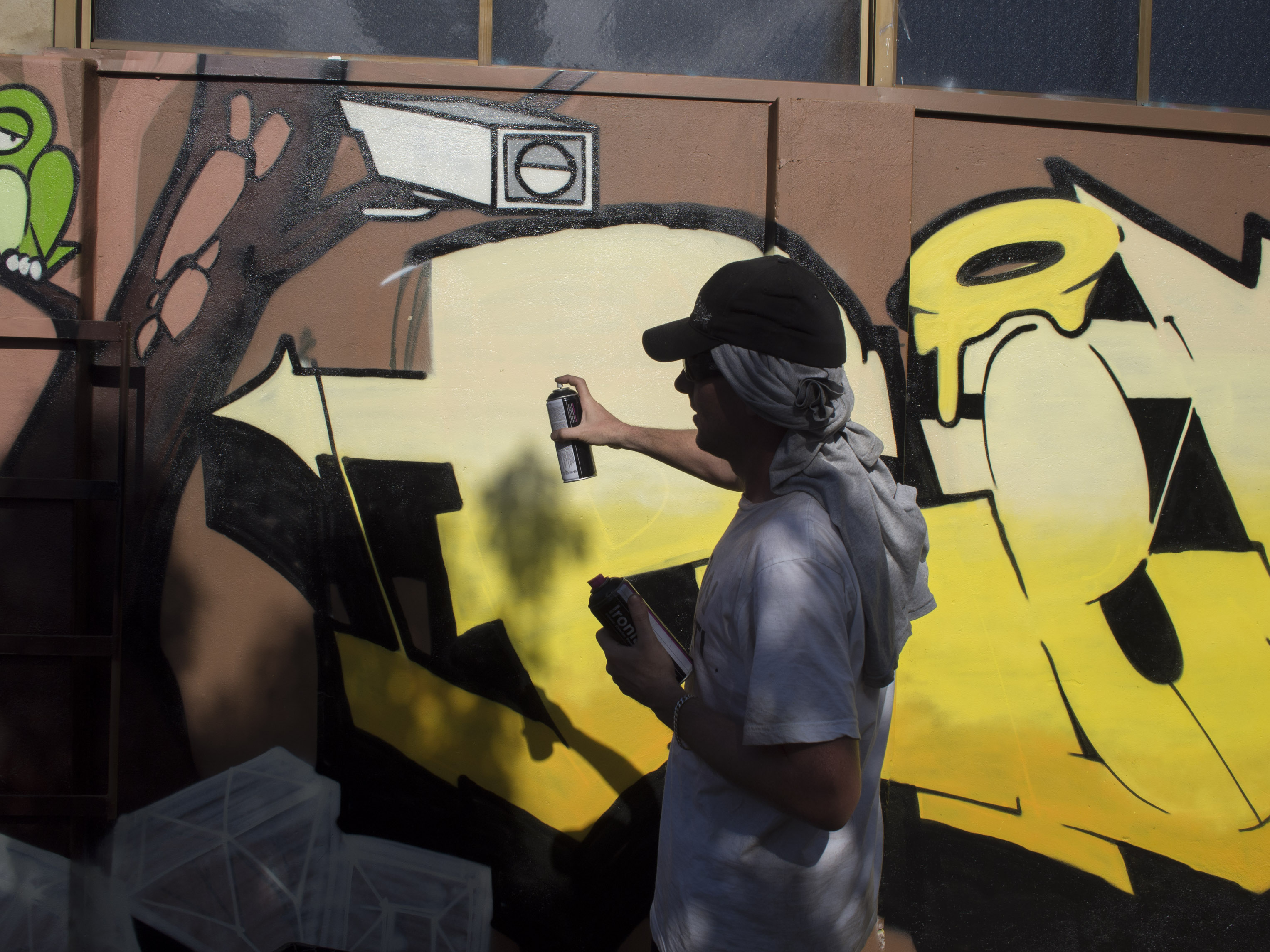
Gone today it seems is the night work, gone too are dark clothes and a knap sack with a few cans–the limited palette of the graffiti criminal. Now, it’s all done in the light of day with the luxury of ladders, scissor lifts, fume masks and adoring fans. Most importantly is the visibility of the architectural canvasses being offered these artists.
.
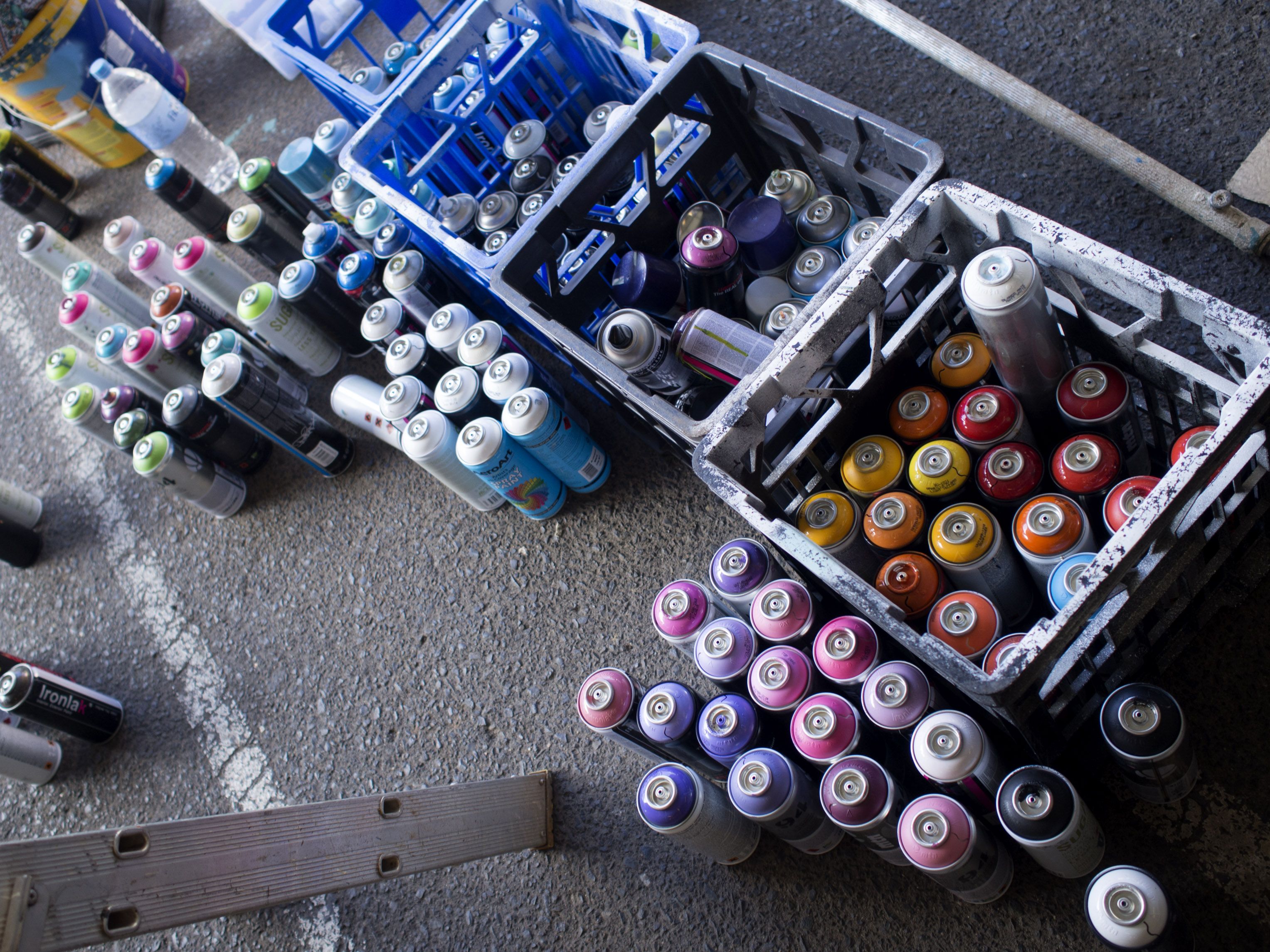
Liam Dibb’s cans
.
National awareness, at least in Australia, arose through the acceptance and support of Melbourne’s laneway graffiti to the point where it has become a marketable tourist destination and has brought about the repossession of these once deserted grungy rear access thoroughfares.
Toowoomba’s ‘First Coat’ Street Art Festival has certainly left its mark on the town. Judging by the number of people walking around on the final day of the event, the media coverage and the deluge of Facebook posts by local residents it has captured the imagination of the community.
What remains is an assessment of the longer value of a project like this. Does the work look derivative of other places were this artform has been sanctioned? Will our children be doing graffiti workshops? – they are being offered in Toowoomba now, and will every wall become a tattoo-esque picture canvas? Will Toowoomba’s street art express community issues, concerns, icons and symbolism? Does the new street art become neutered in meaning becoming art entertainment, sanitised by its newfound sponsor – civil society and layers of government? Does any of this matter?
I’d like to think that out there somewhere – an angry young kid is expressing their life, concerns and messages to us by continuing in the foot-prints or sneaker-prints, and in the dark of night of those that have gone before…
Doug Spowart
24 February 2014.
.
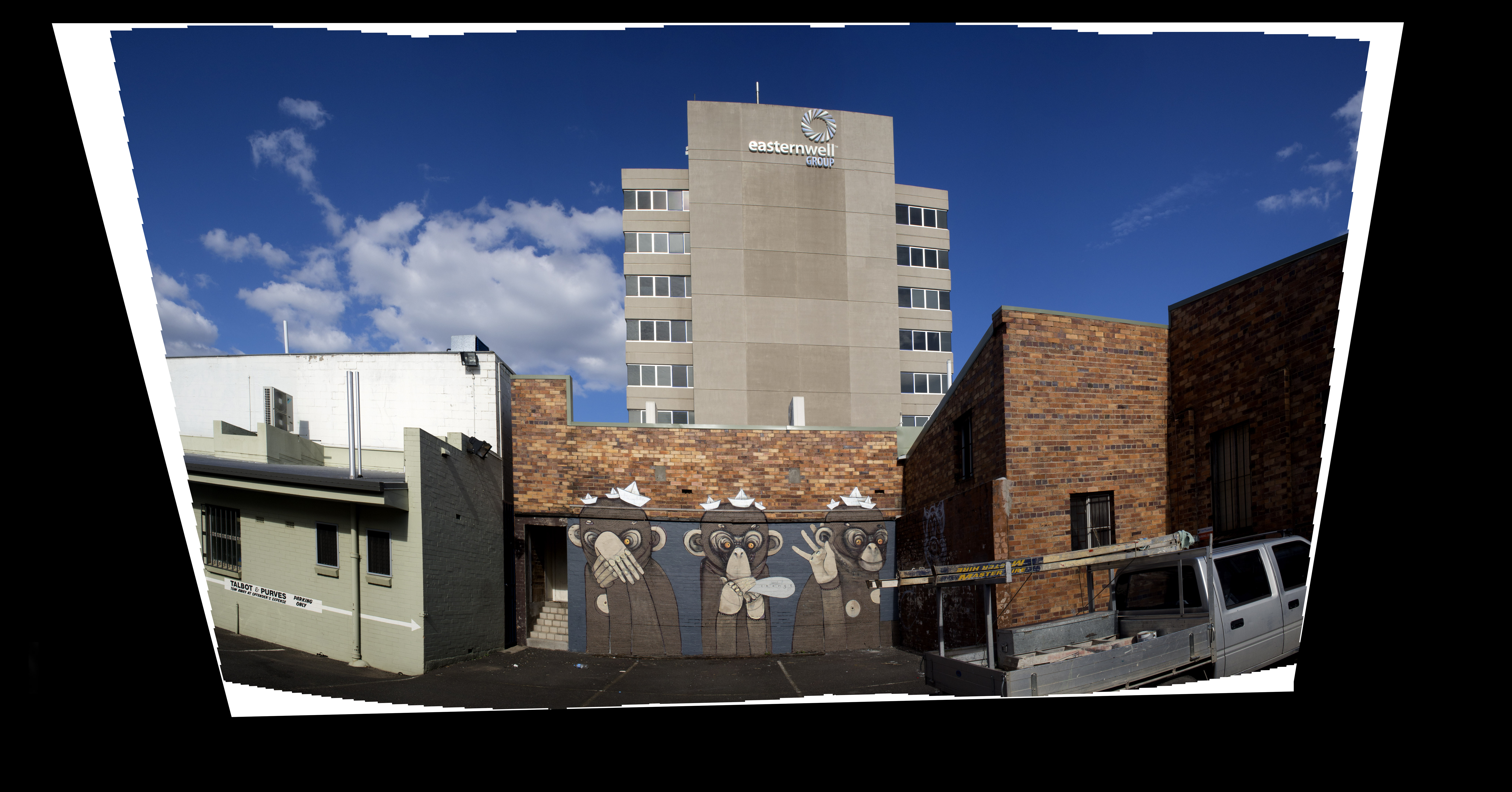
PANORAMA: Damien Kamholtz – 3 Bank Lane
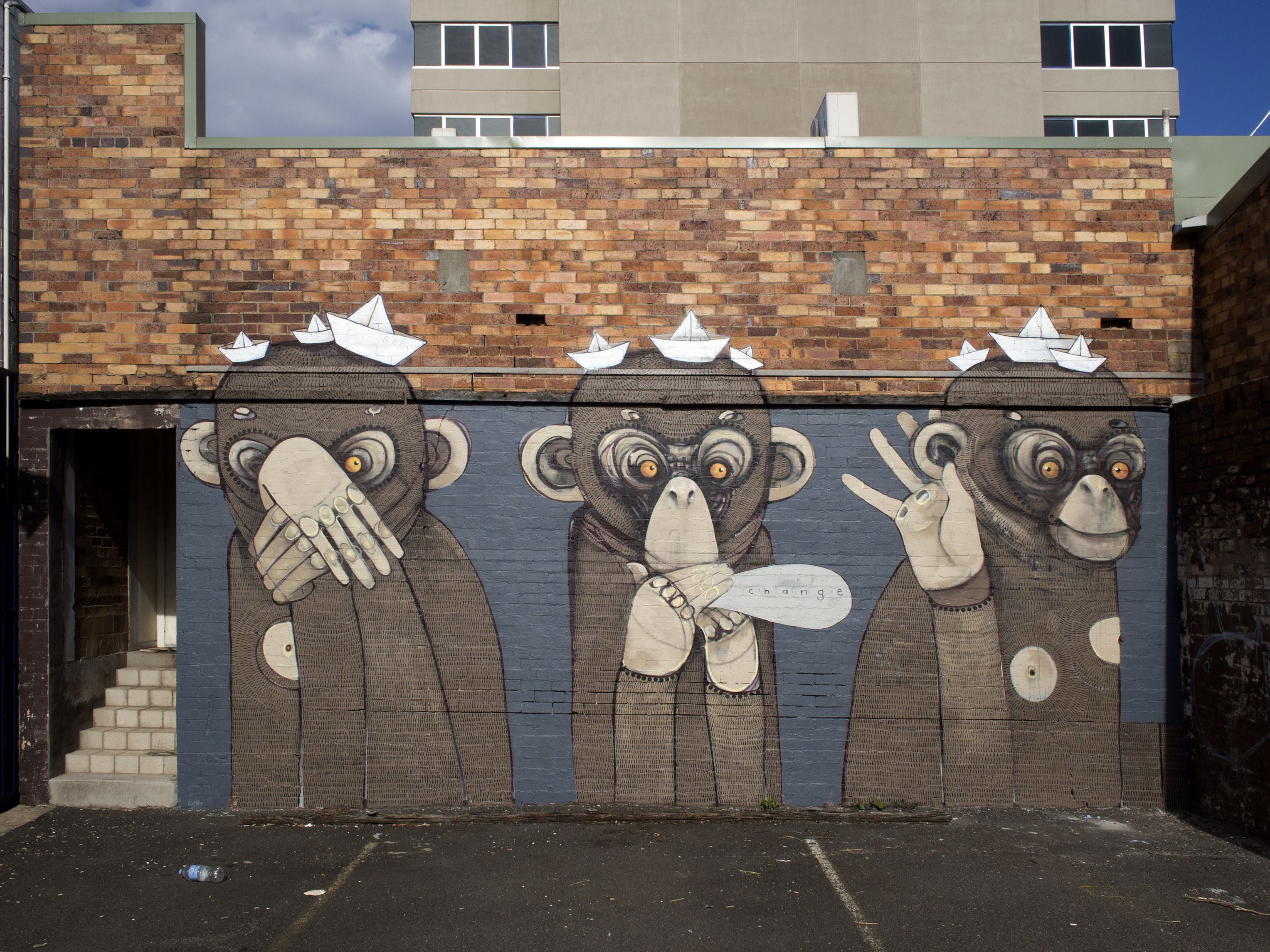
Damien Kamholtz – 3 Bank Lane
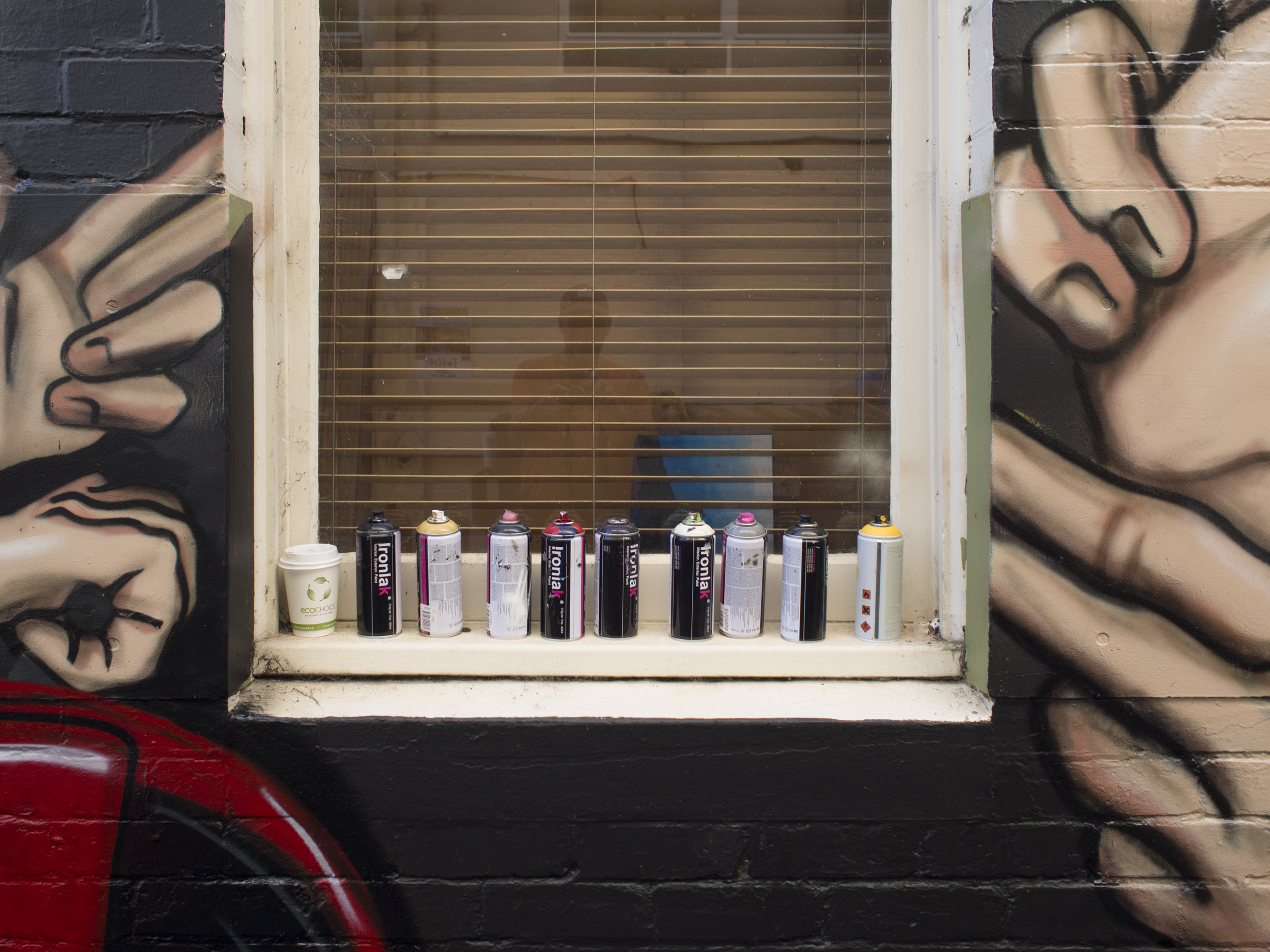
Alice Weinthal – 239 Margaret St.
Liam Dibb at work – Mark Lane
Liam Dibb at work – Mark Lane
Gimiks Born: Bank Lane
In Bank Lane
In Mark Lane
Pic 1 Bell Street
Duggan St
Duggan St
Duggan St
Duggan ST
.
LINK TO ABC Open + Toowoomba Chronicle pics+vids
http://www.abc.net.au/local/photos/2014/02/23/3950646.htm
http://www.thechronicle.com.au/videos/gimiks-born-first-coat/21759/
.
About First Coat:
Toowoomba’s CBD – 19 artists – 17 walls – 1 weekend
21st – 23rd February 2014
First Coat is a street art festival brought to by Toowoomba Regional Council and GraffitiSTOP, in partnership with Toowoomba Youth Service & Kontraband Studios.
Over 3 days, First Coat artists completed multiple large scale murals being painted, a Stupid Krap exhibition and artist talks were presented by Analogue Digital.
Locations:
2 Station St, 16 Duggan St, 12 Little St, 488 Ruthven St, 296 Ruthven St, 6 Laurel St,
2 Mark Lane, 9 Bowen St, 86 Russell St, 5 Mark Lane, 239 Margaret St, 70 Russell St, 80 Russell St
.
Proudly supported by:
Ironlak
Analogue Digital Creative Conference
Master Hire
40/40 Creative
Dulux
Coopers
ALL artworks © of the artists.
Photographic interpretations of the works ©Doug Spowart – Contact me if you were an artist and I will send images to you.
.

My photographs and words are licensed under a Creative Commons Attribution-NonCommercial-NoDerivs 3.0 Unported License.
http://creativecommons.org/licenses/by-nc-sa/2.5/au/
.
.
.
A BOOK for AUSTRALIA DAY, January 26, 2014
.
It’s Australia Day!! We have a photobook on display in the Two Doors Gallery in 85 George Street the ‘Rocks’, Sydney that is a commentary on Australia Day, that we created on Australia Day in 2010.
.
The collaborative book, called Australian Banquet, January 25/26, 1788 (variant #5), is a double-sided broadsheet cyanotype in rice paper, 37.6x77cm. There are 7 unique state variants of this work.
.
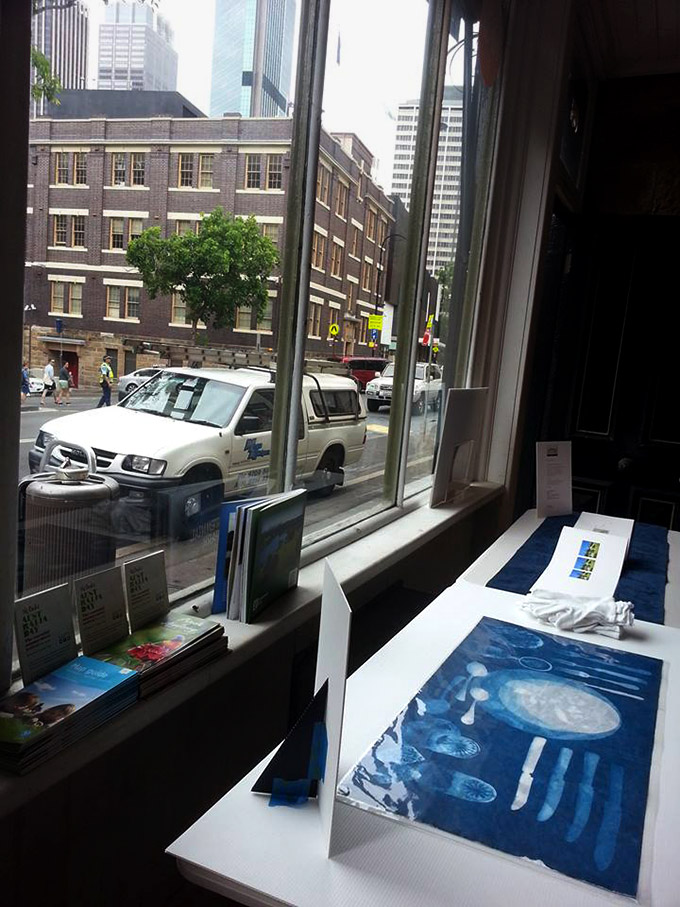
The Australian Banquet in the window @ Two Doors … Photo: Dawne Fahey
.
The artists’ statement for the work is as follows:
.
Across Australia on January 26, people consume food in celebration of a free and dynamic Australian culture. This work comments on the ‘turning of the page’ in Australian history that Australia Day represents. One day — January 25th 1788, Indigenous people feasted on a diverse banquet of bush tucker (as they had for thousands of years). The next day —a new paradigm arrived with the table setting of the First Fleet. Australia Day importantly is a time to re-examine the status of the Indigenous perspective and their knowing of land, culture and history and how it underpins all that is celebrated in the diversity and identity of post-colonial Australia.
.
.
How the work is to be viewed/read
1. At a tabletop setting view and contemplate the 25th of January side of the broadsheet.
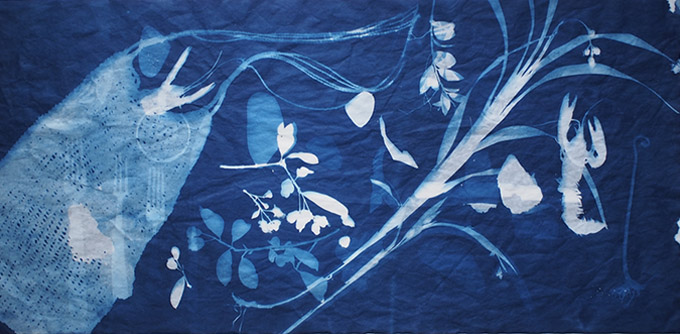
January 25, 1788
.
2. Then, pickup the broadsheet and turn it over as if reading a book – Contemplate.
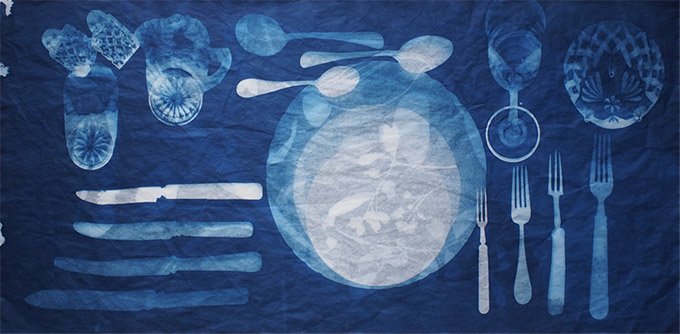
January 26, 1788
.
3. Finally hold the broadsheet up to a light thus enabling the interrelationship between the two
images to be considered. (Image shows variant #4)
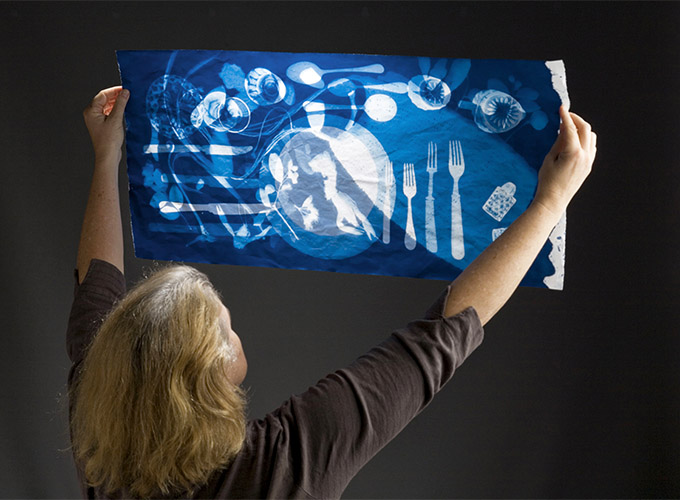
January 25+26,1788 (combined) –Today’s view
.
Drop in to the gallery if you’re in Sydney.
If you happen to be in ‘The Rocks’ on Monday 27th, the public holiday come along to Two Doors and see Picturing the Orchestral Family – and a selection of photographs by Dawne Fahey – and hear the Carreon Family Quartet performance – Tango from 2 – 3. They will also perform February 2nd – same time. Performing daily @ 5.30 pm is flautist Chloe Chung – Two Doors is very lucky to have these young people from Sydney Youth Orchestras helping us celebrate this exhibition !
Have a Great Australia Day…!
.
© 2014 Dawne Fahey (gallery image) and ©2012 Doug Spowart+Victoria Cooper.
.
This work is licensed under a Creative Commons Attribution-NonCommercial-NoDerivs 3.0 Unported License.
http://creativecommons.org/licenses/by-nc-sa/2.5/au/
.
.
.
BUNDABERG: A New Nocturne Community Project


.
NOCTURNE BUNDABERG: Stage One of a new community project concept
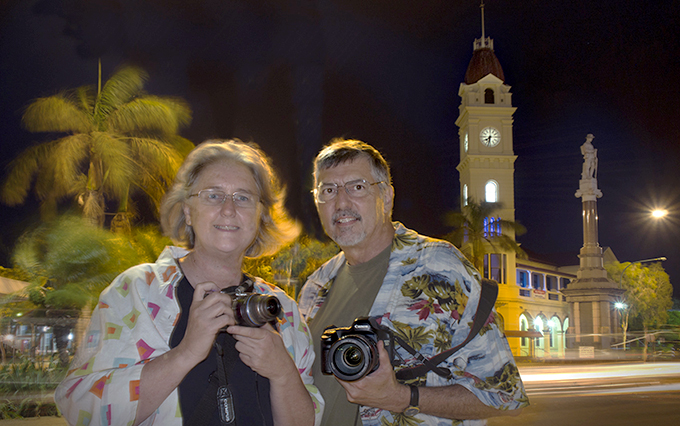
Vicky and Doug go tropical (shirts anyway) in Bundaberg
.
We’ve been in Bundaberg this week (January 5-12)doing preliminary work on a new concept in our nocturne work. Here is the overview of the project:
.
In April 2014 Bundaberg Regional Galleries will be hosting an artist in residency program with artists Victoria Cooper and Doug Spowart. An exhibition of their Nocturne work including new images from this region will be on show at CHARTS Gallery at Childers during April in conjunction with the Queensland Festival of Photography 5. The artists will be also working on their next Nocturne photodocumentary project, entitled Nocturne Bundaberg Region. As with the previous Nocturne Muswellborook and Nocturne Grafton projects the photographs they make will be posted on the Nocturne Bundaberg Region Facebook page so that communities can connect with the project, and importantly, share their stories about each place.
.
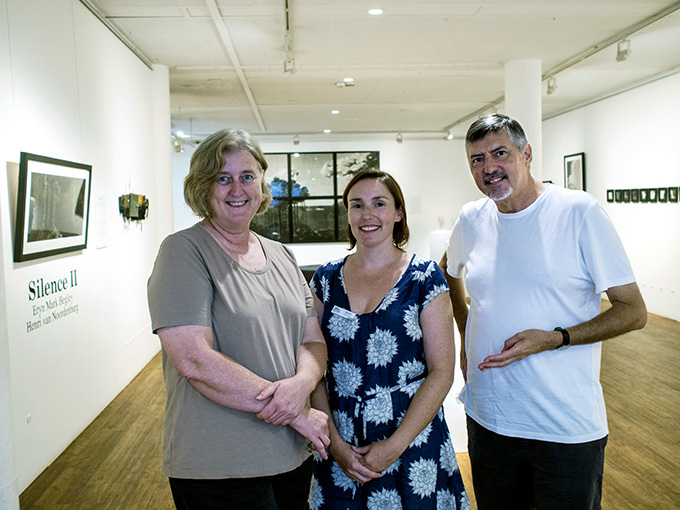
Talking with Trudie Leigo – Exhibitions Officer @ Bundaberg Regional
.
To extend the community’s connection with the project, Victoria and Doug will be working with a small group of photographers from across the Bundaberg Regional Council area to be contributors to the image-making part of the project. The participants will be selected using an EOI process that will be launched on the project’s Facebook page by the end of the month. Successful applicants will be advised in mid-March and they’ll attend a workshop in specialist aspects of nocturnal photography, image enhancement and the safety considerations for this work. After attending the workshop the local photographers will have an opportunity to add their images to the project’s Facebook page. Preferably, applicants should be 18 or over. Other community members may be invited to post images as well.
Any community member or person who has stories inspired by the photographs can post comments to the Facebook page..
.
The Nocturne Bundaberg Region’s Facebook page images, as well as the community conversation derived from the project, may be incorporated in other outcomes including exhibitions or publications associated with the project. A selection of images may go into the Picture Bundaberg Archive.
.

Nocturne Bundaberg Logo
.
All photographs © 2014 Cooper+Spowart for the Nocturne Bundaberg community documentation project
.
.
This work is licensed under a Creative Commons Attribution-NonCommercial-NoDerivs 3.0 Unported License.
http://creativecommons.org/licenses/by-nc-sa/2.5/au/
.
.
.
THE EXPO 88 PHOTO SHOW – 25 years on
.
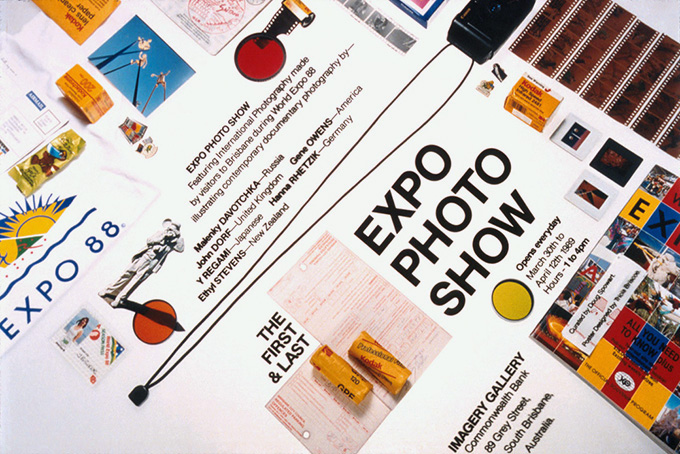
First & Last EXPO PHOTO SHOW Poster
.
EXPO’88 – A conceptual photographer’s document
.
At this time twenty-five years ago, January 1989 – the people of Brisbane were beginning to lament the passing of EXPO’88. While the six-month adventure opportunity to encounter the world and its cultures and cuisine was to form lasting memories for some, others may have recollections of the crush of interstate and overseas visitors, the nightly flamboyant fireworks displays and the inevitable queuing to visit everything from food stalls, to exhibitions and toilets. EXPO’88 is often seen as a watershed in the transformation of Brisbane as a sleepy backwater into a vibrant cosmopolitan city of the world and, most certainly part of the 21st Century.
I had a season pass for EXPO’88 and created a personal body of work as a response to my experience of the event.
.
Here is the back-story behind my 1988 project … The First & Last EXPO PHOTO SHOW
.
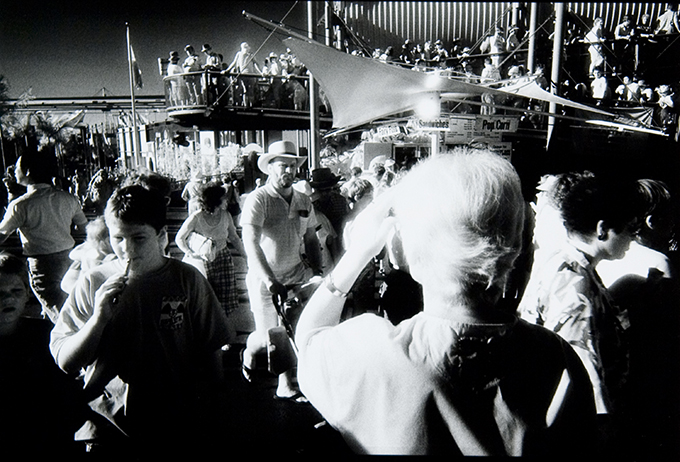
EXPO 88 Crowd Crush ………..PHOTO: Ethyl Stevens aka Doug Spowart
.
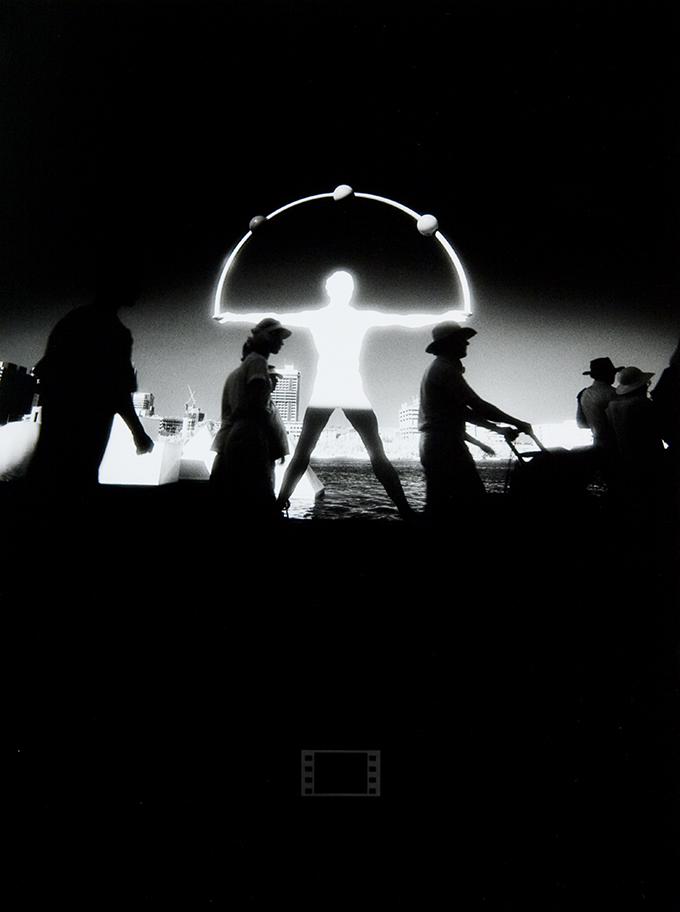
In the EXPO’88 event I recognised an opportunity for the creation of a new body of work investigating emerging approaches to my work methodology. For varied reasons I had introduced to my practice the creation of alias identities to which my work was attributed. These identities were quite complete in that they had refined working styles, subject matter, presentation forms, a photographic portrait, signatures and artists statements. As a gallery director it was easy to slip the work of these ‘photographers’ into group shows for commentary and critical acclaim. These personae enable me to play a little game on a system that at times, from my perspective at times, was biased, exclusive, nepotistic and overly critical. It also enabled me to explore ideas and concepts relating to my photography and the presentation of photographs.
.
When EXPO offered season passes I attended the passport portrait session with pair of fake glasses and a fictitious name, Eugene Xavier Pelham Owens, the initials and the signature spelled ‘EXPO’. The deception had begun. In time this project grew into an extensive body of work from 5 different personae all representing their manufactured personal responses to the EXPO experience. The exhibition was opened on April 1st 1989 (April Fools Day), it was reviewed positively in the Courier Mail and sales of work resulted from people who found the photographs reconnecting them with their experience of the event. The deception went undetected and after the exhibition the body of work passed into obscurity, as do so many exhibitions of photographs, and was slipped into archive storage boxes in my studio.
Whilst, at the time of the fieldwork on this project I called myself a ‘conceptual photographer’ as I felt that my work was driven by the overarching idea of personal experience documents rather than the photodocumentary reportage principles of truth and reality. I was aware of the term ‘conceptual artist’ and recognized that it had all kinds of baggage attached to it based on art theory and movements, however my work as a photographer at this time has simpatico with Sol Lewitt’s 1967 manifesto on conceptual art. He states:
In conceptual art the idea or concept is the most important aspect of the work. When an artist uses a conceptual form of art, it means that all of the planning and decisions are made beforehand and the execution is a perfunctory affair. The idea becomes a machine that makes the art. (Lewitt 1967)
Recently Melissa Miles has discussed the term ‘Conceptual Documentary’ in her 2010 paper The Drive to Archive: Conceptual Documentary Photobook Design. The discusses in reviewing the photobooks of Stephen Gill, Mathieu Pernot and Matthew Sleeth. She asserts that this mode of photography is based on a theory that photographers want to collect and respond to a kind of ‘archive impulse’, making and arranging image sequences of daily life into photobooks. What appeals to me is that, as a Conceptual Documentary photographer I, as Miles defines, ‘seek[s] out and frame[s] their subjects according to a pre-determined idea or scheme. Processes of repetition and categorization are central to Conceptual Documentary’ (Miles 2010:50). For me, what I was engaged in was to make a commentary from a personal viewpoint and to create a contemporary record for public presentation and, ultimately archiving. While Miles’ contemporary Conceptual Documentary practitioner including the likes of Martin Parr freely publish their photobooks in the 1980s trade published productions were beyond the reach of most photographers including myself.
What I find interesting now is that the 1980s was a particularly productive period for me as I created a trilogy of exhibitions: Tourists Facts, Acts, Rituals and Relics, Icons & Revered Australiana and The First & Last Photo Expo Show. These were essentially social documentary projects based on a personal directorial premise. I found that the limited opportunities for presentation of the framed exhibition format of these shows led me to initial experiments with boxed sets of images and ultimately to self-published photobooks, the first of which was completed in 1992.
These days I’m not so concerned about any tag as my work is often so interdiciplinarian it is hard to define. What for me is interesting is that at the time I made work that may now be able to be defined and categorized using contemporary terms and definitions. What is also important now is that the EXPO’88 photographs, some 5,000 of them, exist as an archive not necessarily as a document of the place but rather as a personal, conceptual documentary photographer’s response to the EXPO’88 experience.
Doug Spowart December 26, 2013
.
Lewitt, S. (1967). Paragraphs on Conceptual Art. Artforum 5: 8.
Miles, M. (2010) “The Drive to Archive: Conceptual Documentary Photobook Design.” Photographies 3, 49-68.
.
HERE IS A SELECTION OF WORKS FROM MY EXPO’88 PSEUDONYMS
.
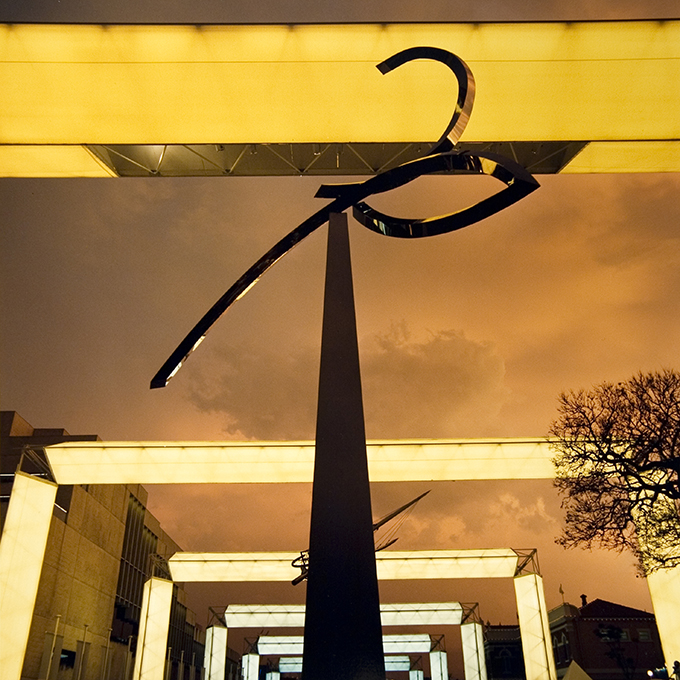
John (Jack) Dorf ………(United Kingdom)

John (Jack) Dorf ………(United Kingdom)
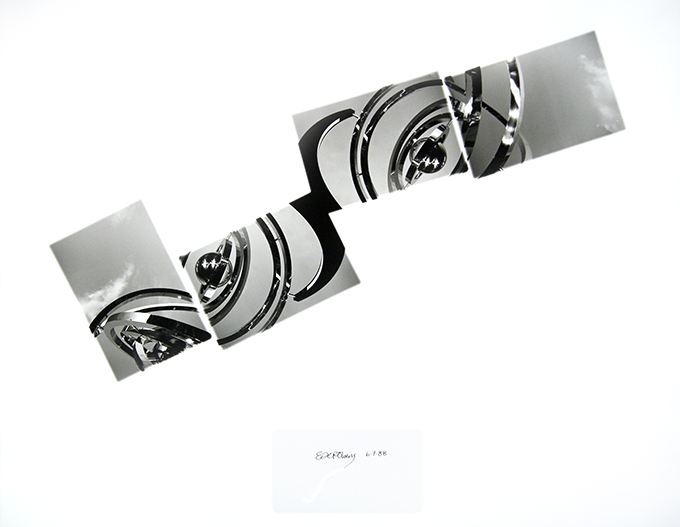
Eugene Owens …….(USA)
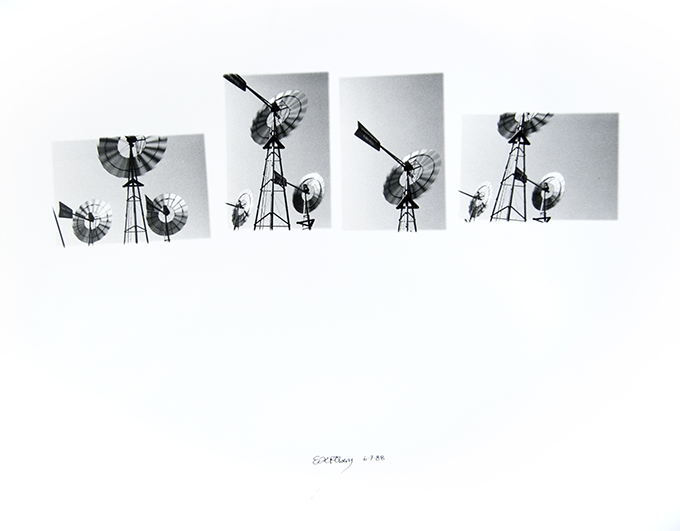
Eugene Owens …….(USA)
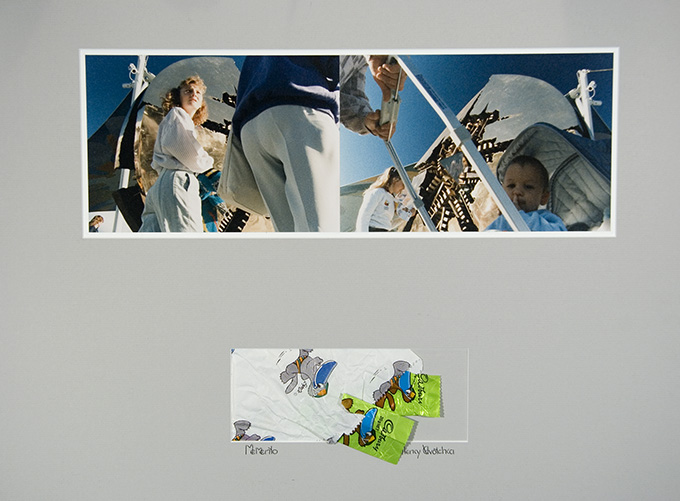
Malenky Davotchka ……. (Russia)
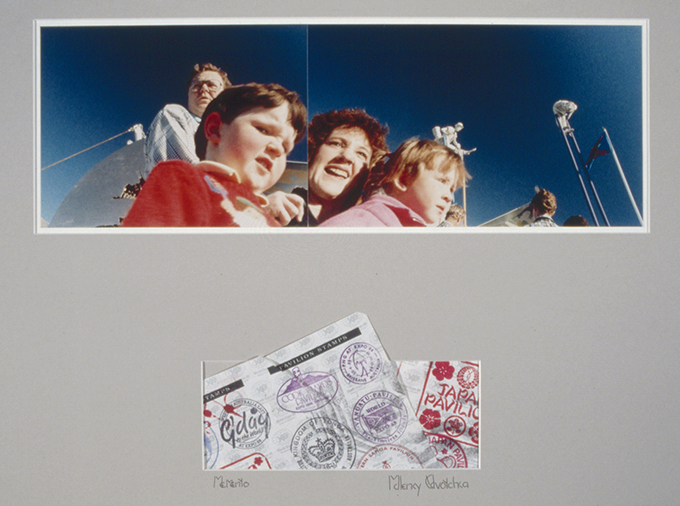
Malenky Davotchka …….(Russia)
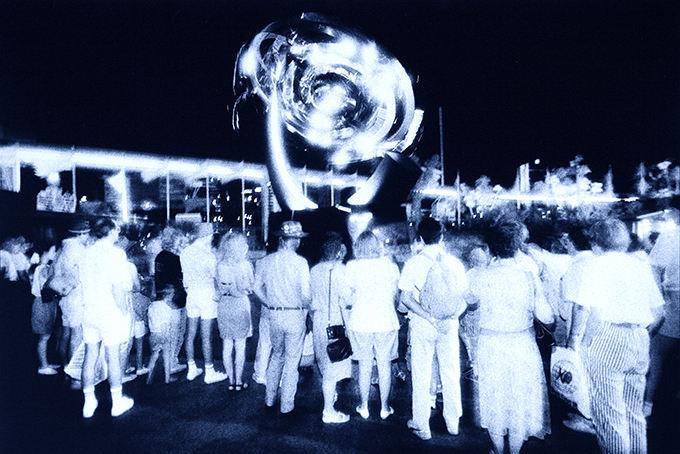
Y Regami ……(Japan)
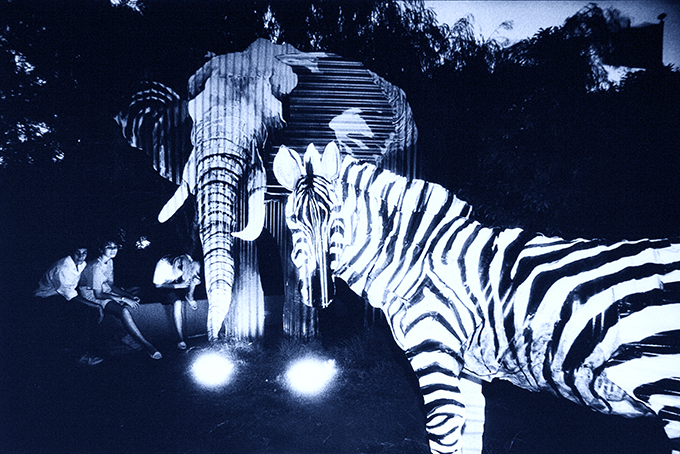
Y Regami ……. (Japan)
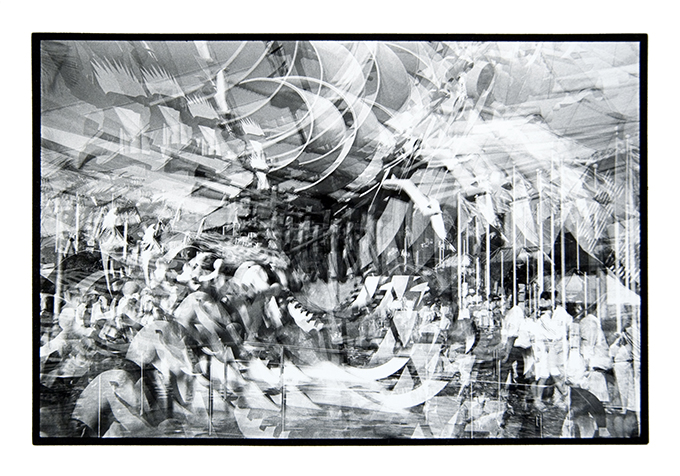
Hanna Rhetzik …….(Czechoslovakia)
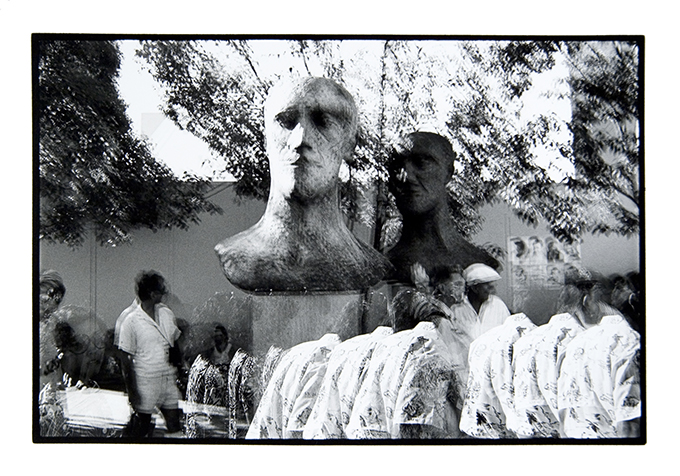
Hanna Rhetzik ……(Czechoslovakia)
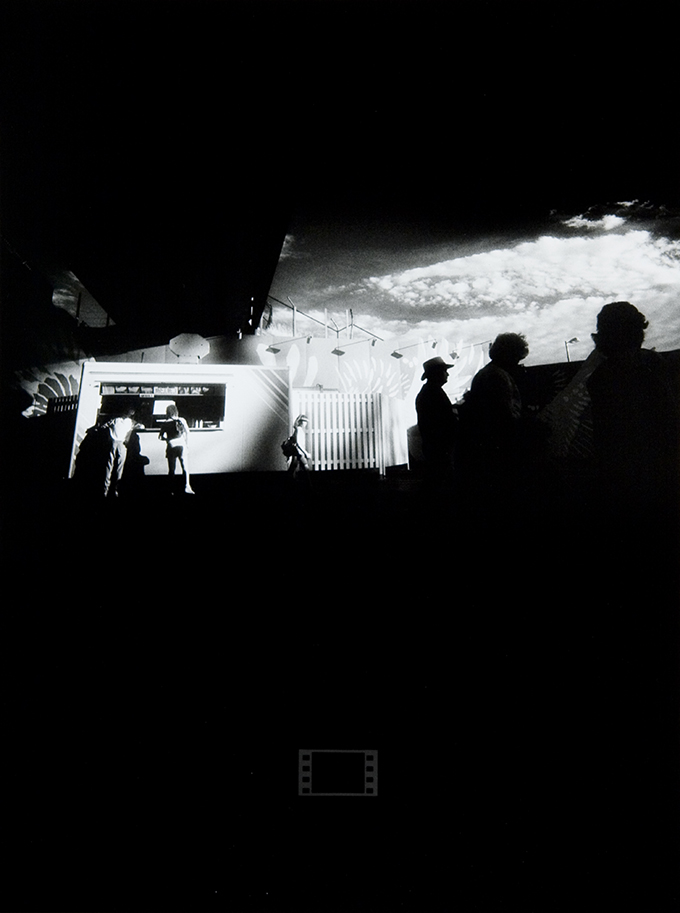
Ethyl Stevens …….(USA)
Ethyl Stevens …….(USA)
.
A PDF PRESENTATION CONTAINING MORE IMAGES IS AVAILABLE HERE: EXPO-SPOWART-v3
.
First & Last EXPO PHOTO SHOW Poster
.
.
Images and text © Doug Spowart Design of the Poster: Trish Briscoe
From the Doug Spowart Personal Art Archive 1953-2014
..
.
This work is licensed under a Creative Commons Attribution-NonCommercial-NoDerivs 3.0 Unported License.
.
2013-14 NEW YEARS EVE FIREWORKS: Frogs Hollow – Toowoomba
.
NEW YEAR’s EVE – A time for freedom from order — a time for fun.
.
So we left the big cameras at home and went out with the little Olympus Pens point-n-shoot. No tripod – no big plans – “Bulb” setting, watch, mingle, be a part of the ‘BANG’, ‘Crackle’, ‘POP’ and the gasps and murmur of the crowd.
.
These are truly experiments in capturing the experience and essence of a fireworks display in regional Australia … Enjoy!
And all the very best to you for the New Year!
.
Click on any image for it to enlarge …
.


.
.
© 2014 Victoria Cooper and Doug Spowart
.
This work is licensed under a Creative Commons Attribution-NonCommercial-NoDerivs 3.0 Unported License.
.
.
BACK STORY: The Icons & Revered Australiana Show
.

ICONS Logo
.
..
The Icons & Revered Australiana show: Twenty – Five Years On
The ICONS on ICONS exhibition at the Cobb+Co Museum in Toowoomba features 5 local photographers. For the show I have selected 26 gelatine silver photographs drawn from my archive. They were originally prepared for the Australian Bi-centennial celebrations in 1988 – 25 years have elapsed and yet the images are as fresh and evocative as ever. For me the work represents an important aspect of my photographic and photobook work – where the narrative of life and culture is expressed through a set of images and sometimes accompanied by a complimentary text.
So here is the back story of my Icons & Revered Australiana
.
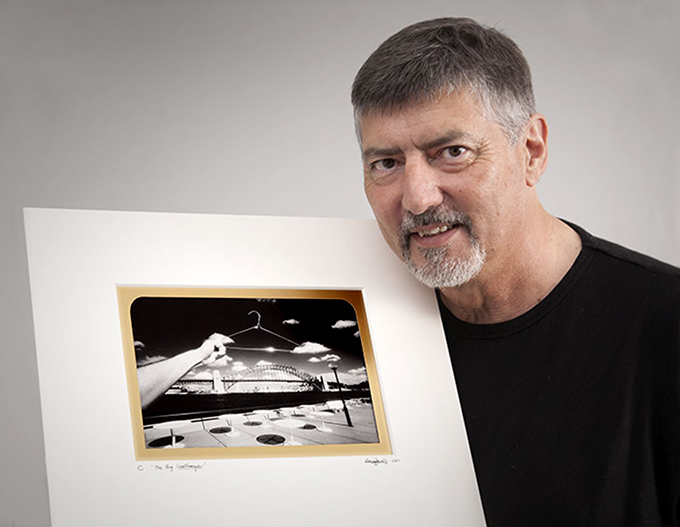
Doug Spowart
.
I have had a lifetime interest in the Australian idiom, slang and its stories. This body of work represents the culmination of a personal investigation into what are seminal identifiers of our culture and the way the Australian condition has shaped our language. In my early teenage years I read most of John O’Grady’s books like They’re a weird mob and Gone Fishin. His dictionary of Australian-isms Aussie English was a particular favourite. At that time I would encounter people, mainly older people, who spoke using the language defined by Sidney J Baker’s or what Afferbeck Lauder called Strine, (a condensation of Australian with an emphasis on the latter part of the word = STRINE).
.
.
Throughout my life I have travelled around Australia, firstly as a child with my family then later with friends and from the1980s onward as a tour leader on outback safaris. I always felt close to the land and the Australian condition and was fascinated by the stories and the vernacular language by which it was described. I met outback characters including songwriter/performer Ted Egan, before his Northern Territory Governor commission, who immortalised these Australian-isms and stories in song. I was also influenced by a library of photographers like Jeff Carter, George Farwell, Douglas Baglin and perhaps even Rennie Ellis who made photographs and told stories in their photobooks. Inspiration also came from Barry Humphreys, Walkabout magazine and the works of painters like Russell Drysdale, Hans Heysen and Sydney Nolan.
From my experiences I decided to make a selection of things Australian that I considered were so embedded in culture that they could be considered as icons and revered with a religious fervour. I resolved to call the exhibition Icons & Revered Australiana. To provide an extra personal challenge to the project I limited my selection to an A to Z list representing a range of ideas, subjects, myths and localities. I then embarked upon a 4 state and territory journey to make images. While most images were deliberate and targeted some photographs were made along the way as opportunistic discoveries. I do remember specifically driving into Sydney, putting a wire coat hanger under my arm and walking down to the Sydney Opera House to photograph the bridge.
The Icons show was presented at Imagery Gallery in March 1988 and I think, well received. However the Courier Mail critic, a friend of mine of the time, was not impressed – his headline read There’s better work to come! I did ponder the thought that there may have been a sub-plot to his review. The exhibition went on to show at another venue in Queensland and individual images, such as the BIG Coat Hanger received accolades, was published in many journals, and went on to be one of my signature images. After the show was over the exhibition was de-framed and the mounted images sequestered away in archival solander boxes.
But what of this current iteration of the Icons & Revered Australiana body of work? Twenty-five years may have elapsed and yet these pre-digital gelatine silver images are as fresh as ever – a testimony to the special nature of infrared and black+white analogue photography. In revisiting the original catalogue text, I’ve re-connected with the thread of humour, irony and pastiche that has always run through my work.
While those who knew these aspects of life, culture and language intimately, and practised it daily, may have long passed on, Icons & Revered Australiana may still resonate with contemporary audiences. I do not expect that everyone will begin to use terms like ‘Bonza’, ‘Sheila’ and ‘Wouldn’t be dead for quids’, although we do encounter this kind of vernacular language in contemporary song writing, (particularly in country and western music), prose and poetry. And for a while we enjoyed it in the wonderfully expressive Strine of Steve Irwin.
These Icons and Revered Australiana are just the tip of the great myriad of things Australian. Deep down, within us, is a kind of ‘knowing’ of our Australian-isms, and how they have defined us and continue to define us as a people and a country.
Doug Spowart
.
SO HERE THEY ARE: My ‘A to Z’ Icons & Revered Australiana
.
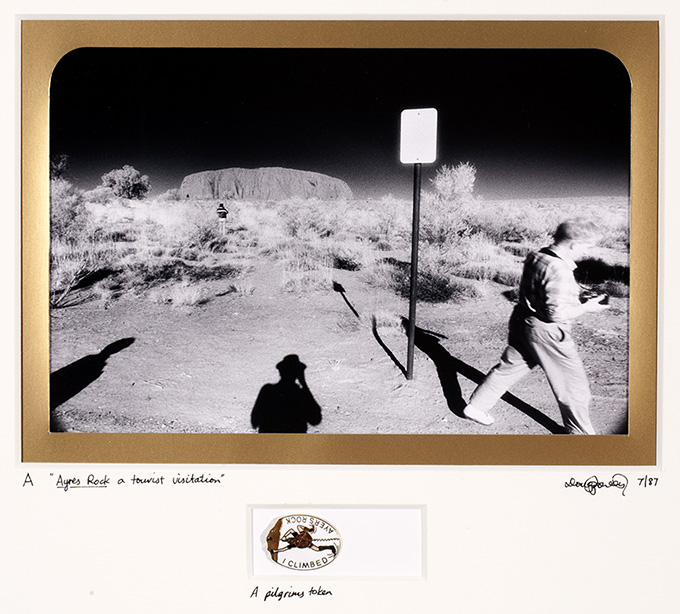
A = Ayers Rock – Revered as the largest monolith in the world, Ayers Rock is now known by its traditional Aboriginal name Uluru.
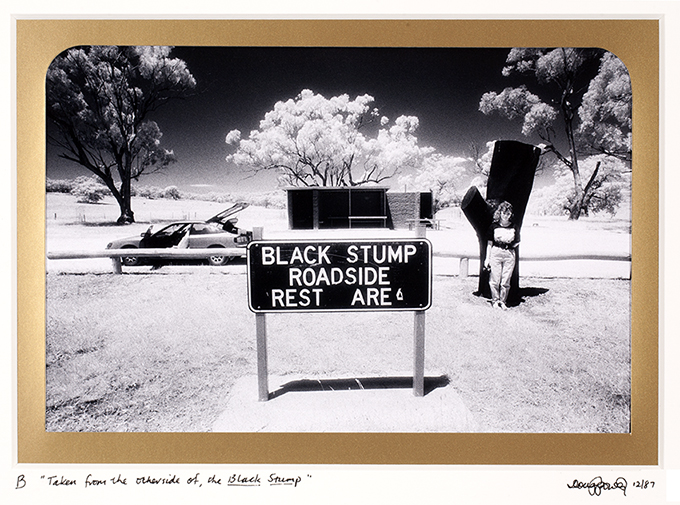
B = The Black Stump. It was once believed that the black stump was the limit of possible human habitation beyond which nothing existed but useless land and desert. Today, it’s revered by a roadside stop featuring a Black Stump storyboard and black painted stump icon, a car park, BBQ and toilet. And lots of people have come to live on ‘the other side’. Near Coolah, New South Wales.
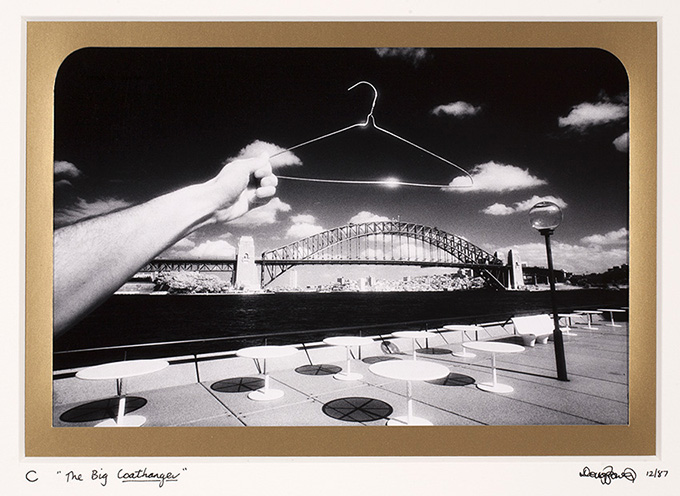
C = The Big Coat Hanger – Slang for the Sydney Harbour Bridge.
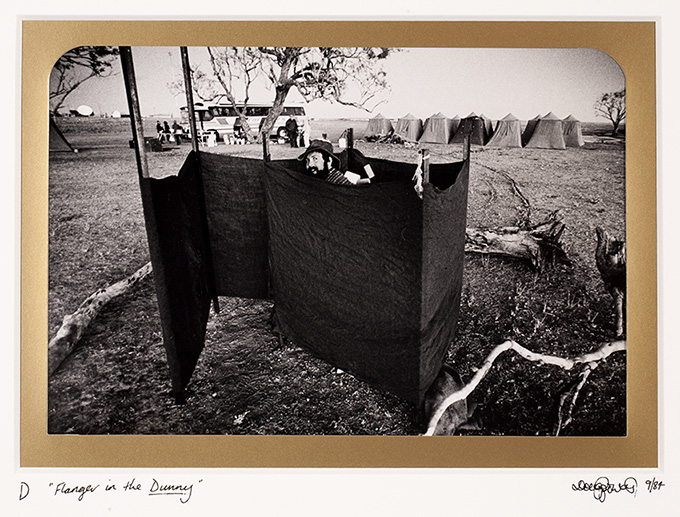
D = Dunny – The Australian out-house or toilet is affectionately known by this name.
A coach camp dunny Birdsville, Queensland.
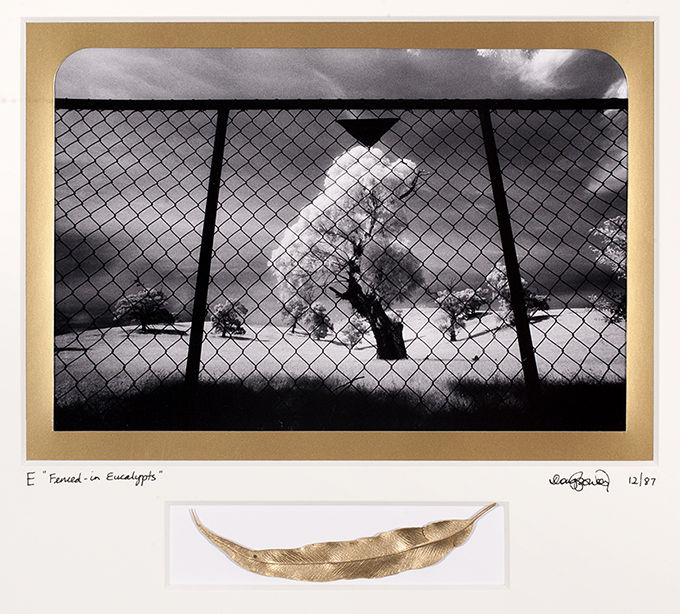
E = Eucalyptus – This is an iconic plant embedded in the Australia psyche; from the arts to the construction of our towns, and the source of therapeutic aromatic oil – a familiar memory in everyday households of Australia. On the Heysen Trail, Mount Lofty Ranges, S.A.
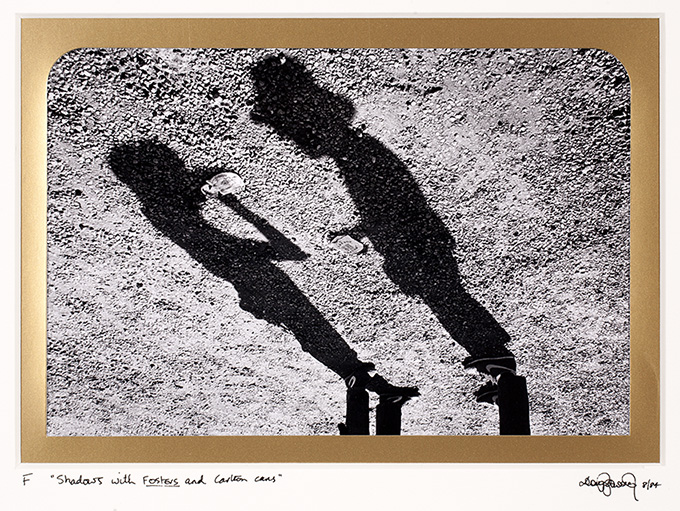
F = Fosters – An historically famous Australian beer. Barry Caves, The Northern Territory.
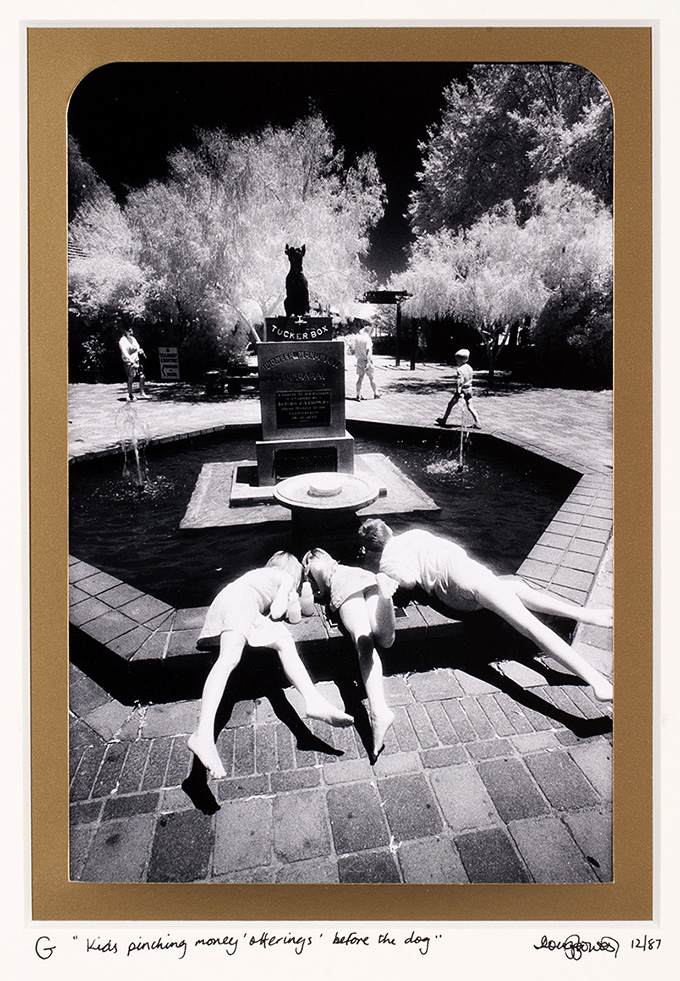
G = Gundagai – Five miles from Gundagai is the location described in the bush verse about a bullocky’s bad luck. While the popular version of this story makes a hero of the bullocky’s dog who ‘sat on’ his tucker box protecting it from harm. However anyone reading the original poem would come to the conclusion that the ultimate in bad luck had befallen the bullocky – that the dog had actually ‘shat in’ the tucker box. In this image of the tourist memorial near Gundagai a statue of the dog ‘sits’ on the tucker box while kids steal money from the wishing fountain in front.
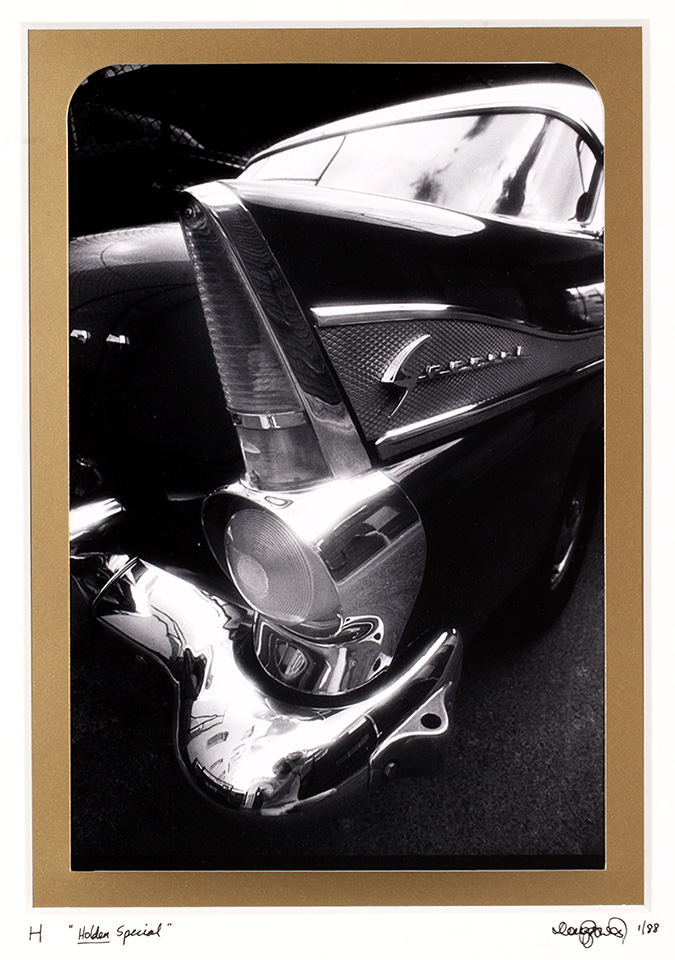
H = Holden – The quintessential Australian motor vehicle. Fish Lane, South Brisbane, Queensland.
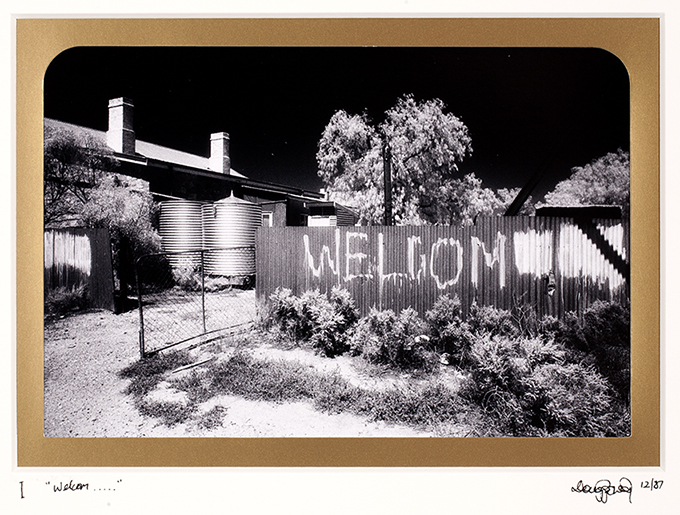
I = Iron (Corrugated) – The most common and versatile building material for outback structures. Olary, S. A.
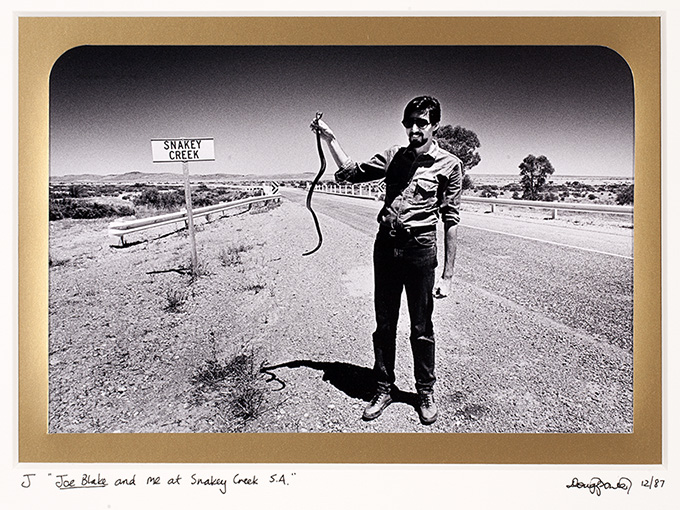
J = Joe Blake – Equals ‘snake’ in Australian rhyming slang. Mannahill, South Australia.
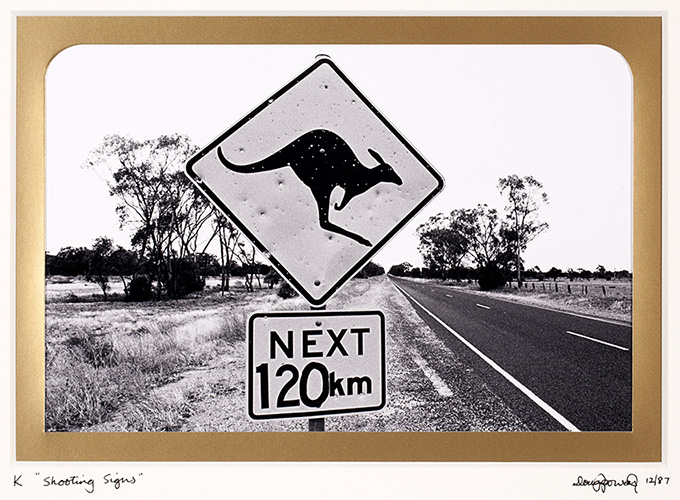
K = Kangaroo – An endemic Australian species often so prolific in number that road signs are erected to warn motorists of their presence. The signs are also useful as a test of shooters skill if a shortage of the real thing exists. Judging by this example the Roos have a fair chance. West of Nyngan, New South Wales.
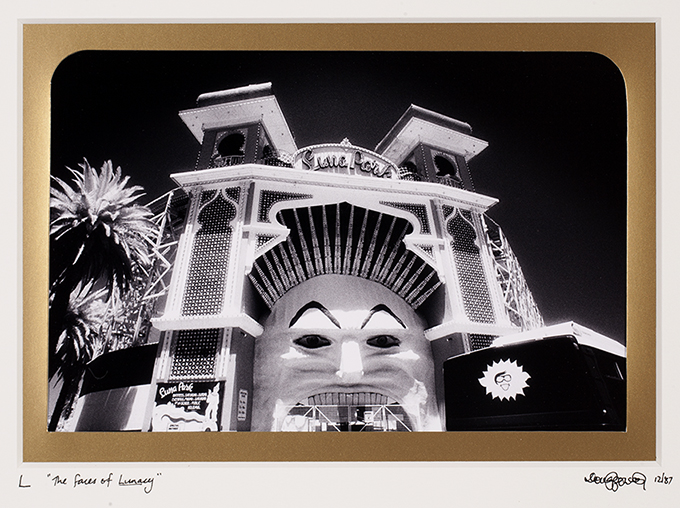
L = Luna Park – A Temple of fun, frivolity and scary rides for Sydney-siders and Melbournites. St Kilda, Melbourne, Victoria.
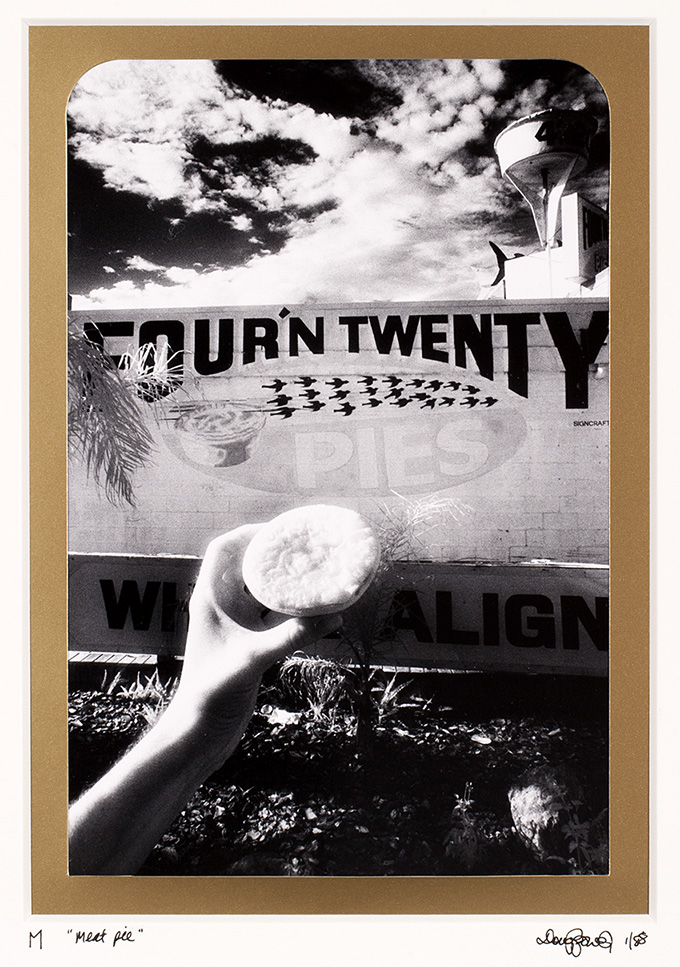
M = Meat Pie – The eating of a meat pie and tomato sauce is a celebrated Australian rite or sacrament, and if you come from Victoria the Four’n Twenty variety would have once been considered the best! Broadbeach, Queensland.
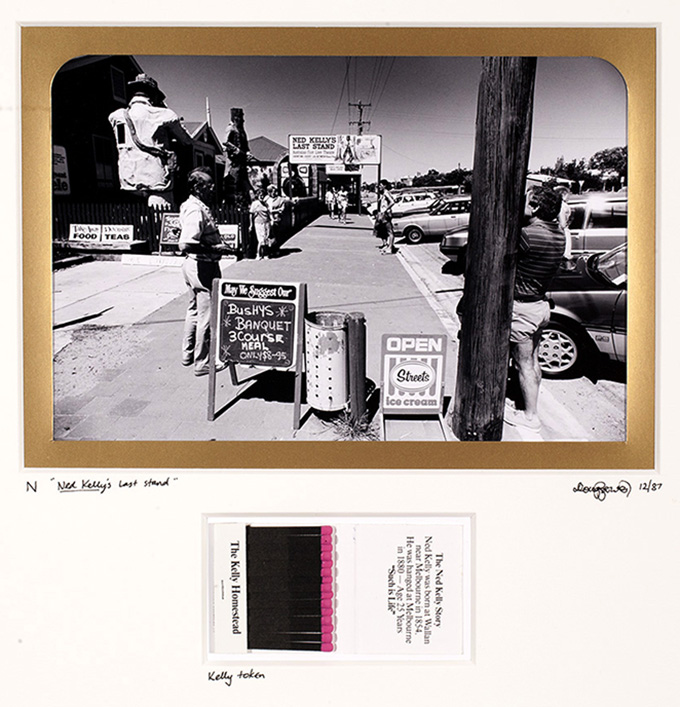
N = Ned Kelly – Located at Glenrowan this colonial sacred site is the place where the Australian folk hero Ned Kelly made his notorious last stand against the Victorian Police. Erected to enable ‘pilgrims’ to ‘revere’ the place, these modern day structures house a multitude of Ned Kelly tokens and souvenirs. Rather than recognise this as a solemn and tragic clash between authority and the underclass, these souvenirs often seem to parody the event. Here, the matches are a strange connection to the fact that the Victorian Police set fire to the Kelly gang’s refuge and burned it down to enable his capture. Glenrowan, Victoria.
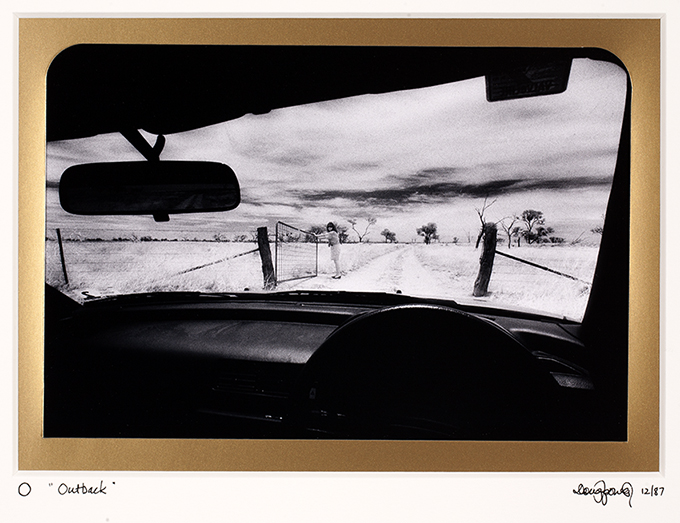
O = Outback. An open gate, and two tyre tracks pointing toward infinity best expresses the great expanse of wide-open space that is the outback. Near Scopes Range Bore Western, New South Wales.
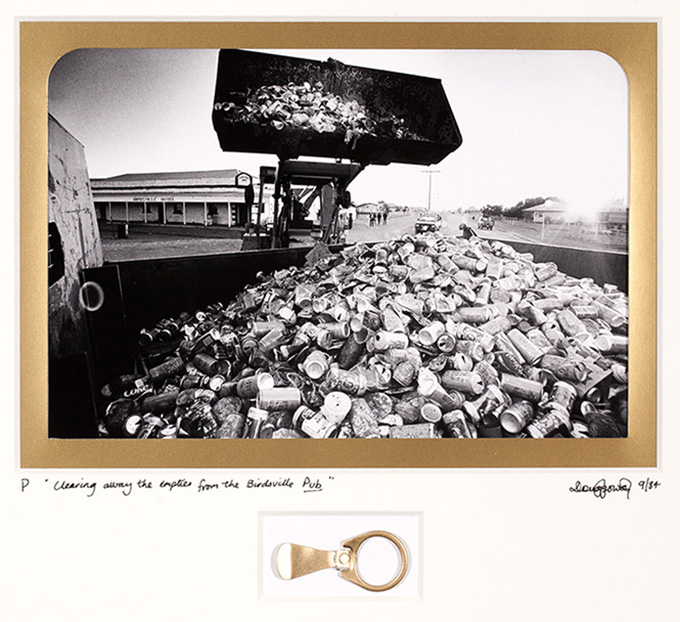
P = Pub. Revered as the typical lonely outback pub the Birdsville hotel is so inundated with visitors for the annual races that the traveller’s empty beer cans are removed each morning with a front-end loader and a tip truck. Birdsville, Western Queensland.
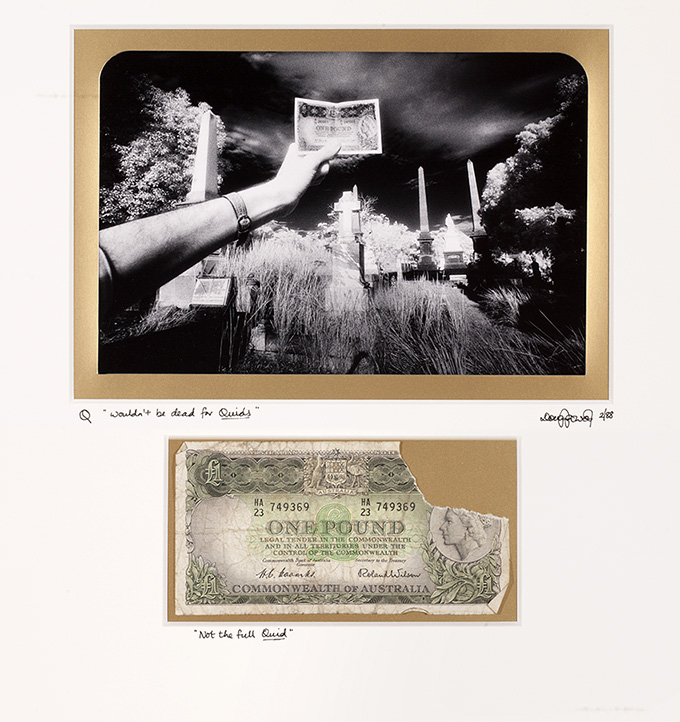
Q = Quid. The pre-decimalization equivalent of two dollars, often associated with value statements like ‘wouldn’t be dead for quids’ and, ‘not the full quid’. Toowong Cemetery, Brisbane, Queensland.
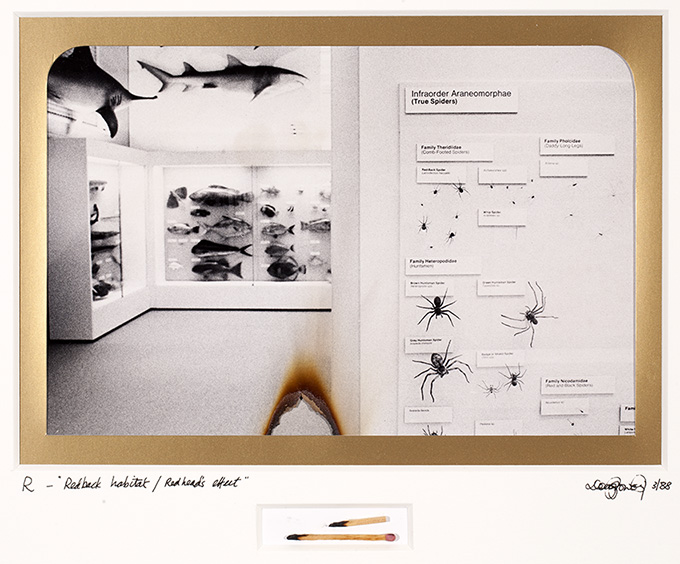
R = Red Heads & Red Backs. Both being red these two Australian items can spell danger. Queensland Museum, Brisbane.
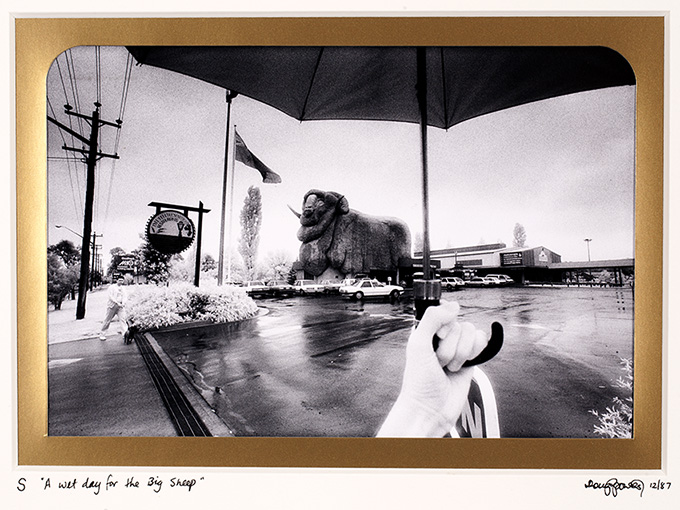
S = Sheep. The Australia economy was once described as living off the sheep’s back. Immortalized here is a giant merino variety attracting pilgrims to its past glory. Goulburn, New South Wales.
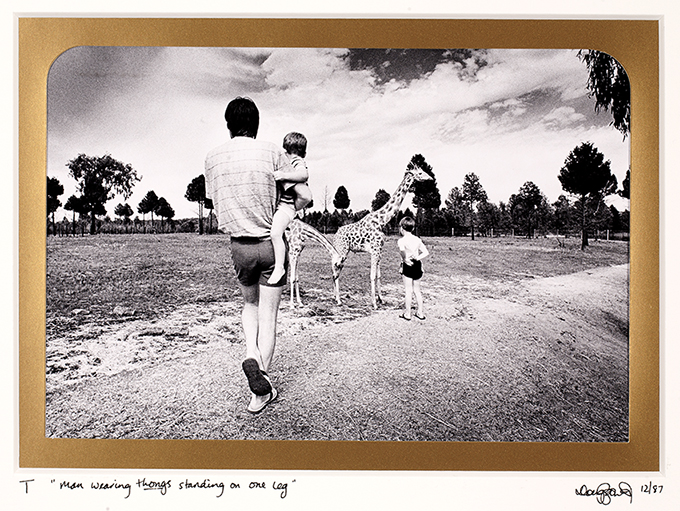
T = Thong. Casual Australian footwear. Western Pains Zoo, Dubbo, New South Wales.
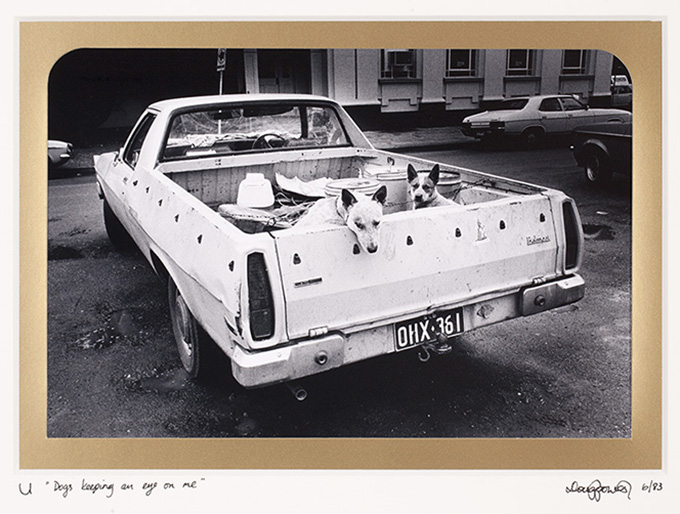
U = Ute. Invented by Australians both in concept and name. Longreach, Queensland.
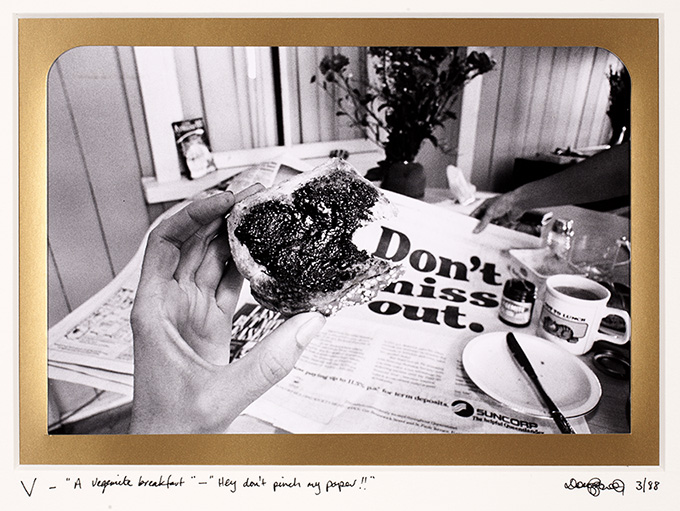
V = Vegemite. A black vegetable extract used as a spread on toast or Salada biscuits.
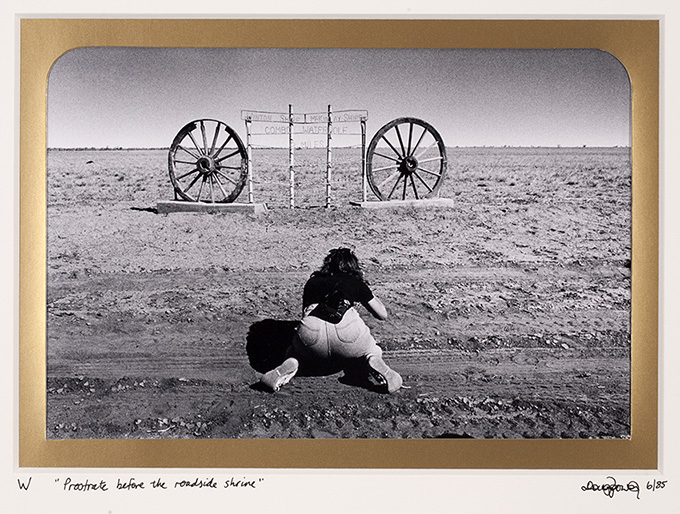
W = Waltzing Matilda. Shown here is a shrine erected by the McKinlay Shire Council to mark the location where Banjo Paterson wrote the Australian anthem about a swagman’s demise on stuffing a jumbuck (sheep) in his tuckerbag. Combo Waterhole near Kynuna, Queensland.
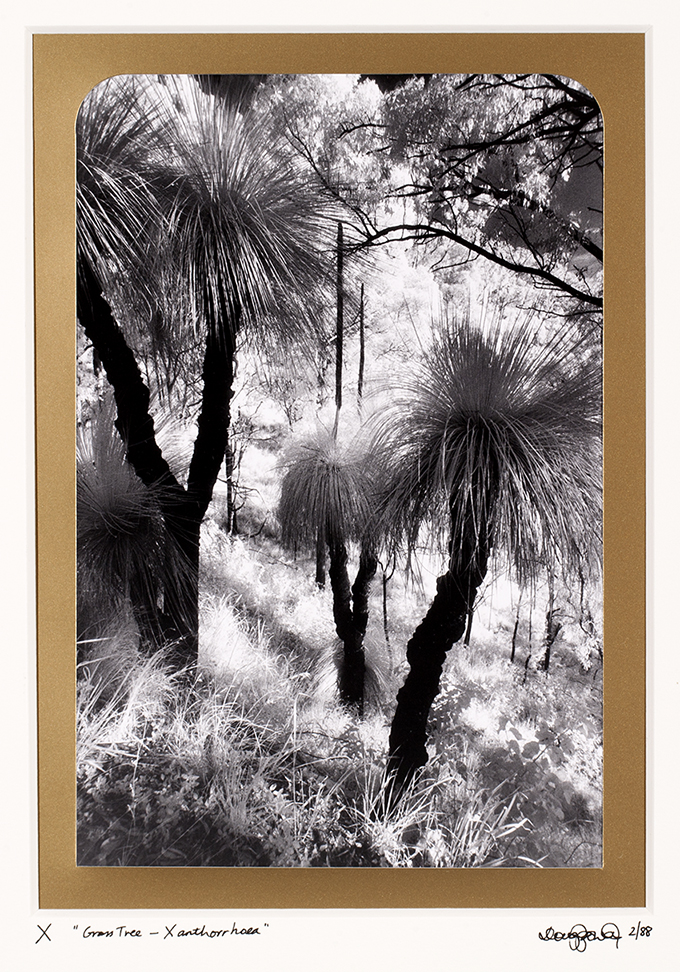
X = Xanthorrhoea. The botanical name for the Australian native plant commonly referred to as the grass tree. Near Canungra, Queensland.
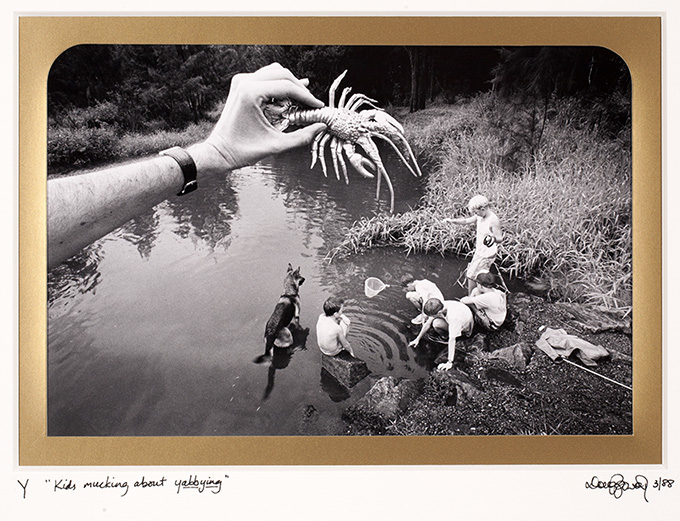
Y =Yabbie. Any form of the Australian freshwater crayfish of the genus Cherax. Yabbying or catching yabbies is a favourite pastime of Australian kids. Near Nerang, Queensland.
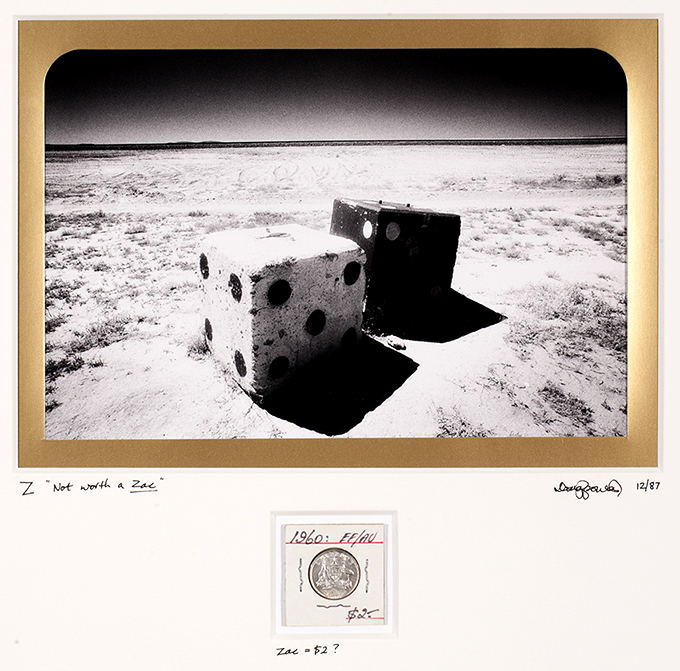
Z = Zack. The colloquial term for a pre-decimal coin with a value of 5 cents, usually associated with statements of worthless value, hence ‘not worth a zack’ – pertaining here to barren outback country. Near Yunta, South Australia.
.
This unique state complete exhibition set is available for purchase – Contact me for details
.fo.
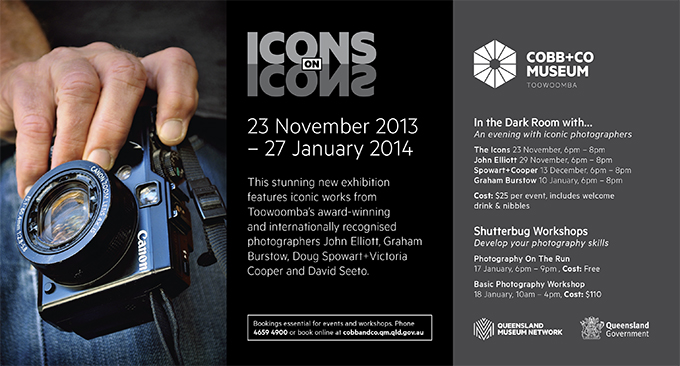
Cobb+Co Museum – Icons on Icons events
.
.
Images and text © Doug Spowart
..
.
This work is licensed under a Creative Commons Attribution-NonCommercial-NoDerivs 3.0 Unported License.
.
COOPER+SPOWART to talk @ Cobb+Co Museum Dec 13
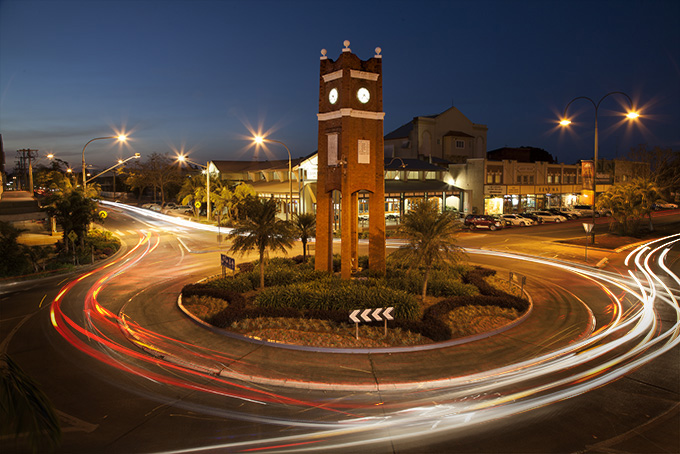
The Roundabout Clocktower from Weiley’s Hotel balcony
.
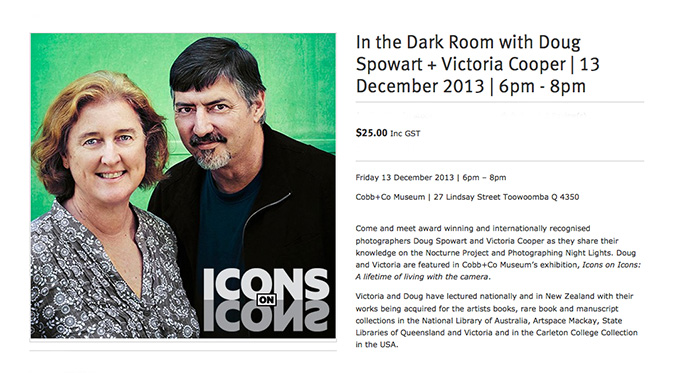
CLICK HERE TO BOOK ON THE COBB+CO WEBSITE
.
In the Dark Room with… Cooper+Spowart
In this talk we will discuss a number of topics and including:
-
A commentary on the works in the ICONS on ICONS exhibition
-
Our Nocturne residency projects around Australia
-
How to make amazing Nocturne Photographs
-
Our use of Social Media to connect art with the community.
.
Attendees may wish to conclude their night activities @ Cobb+Co with a visit to the nearby Christmas Wonderland Spectacular in Queens Park
.
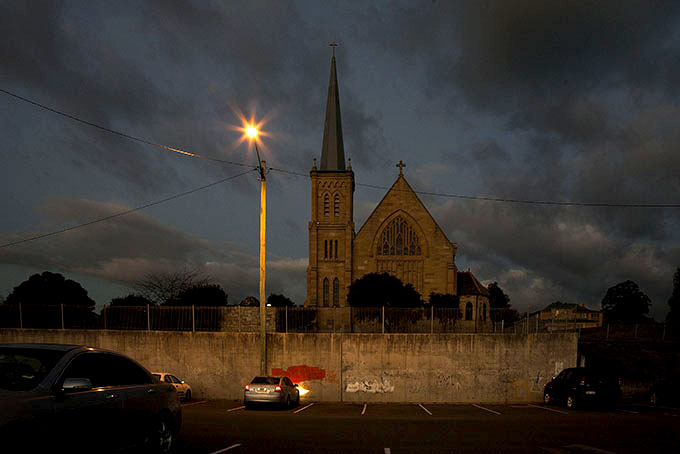
St James’ Catholic Church
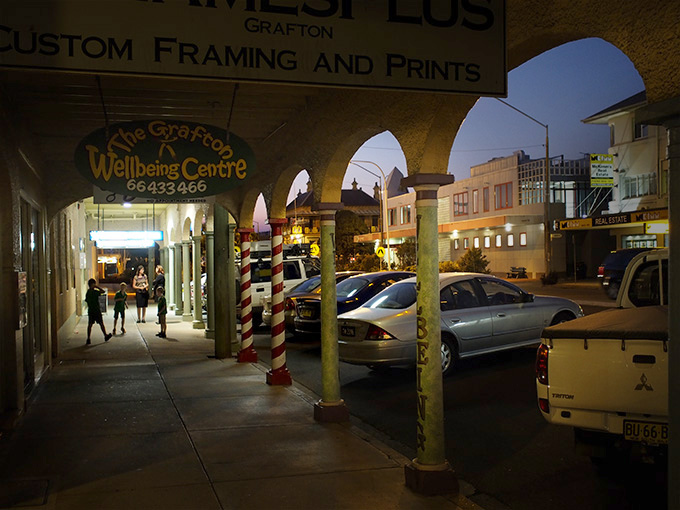
Outside the Grafton Hotel
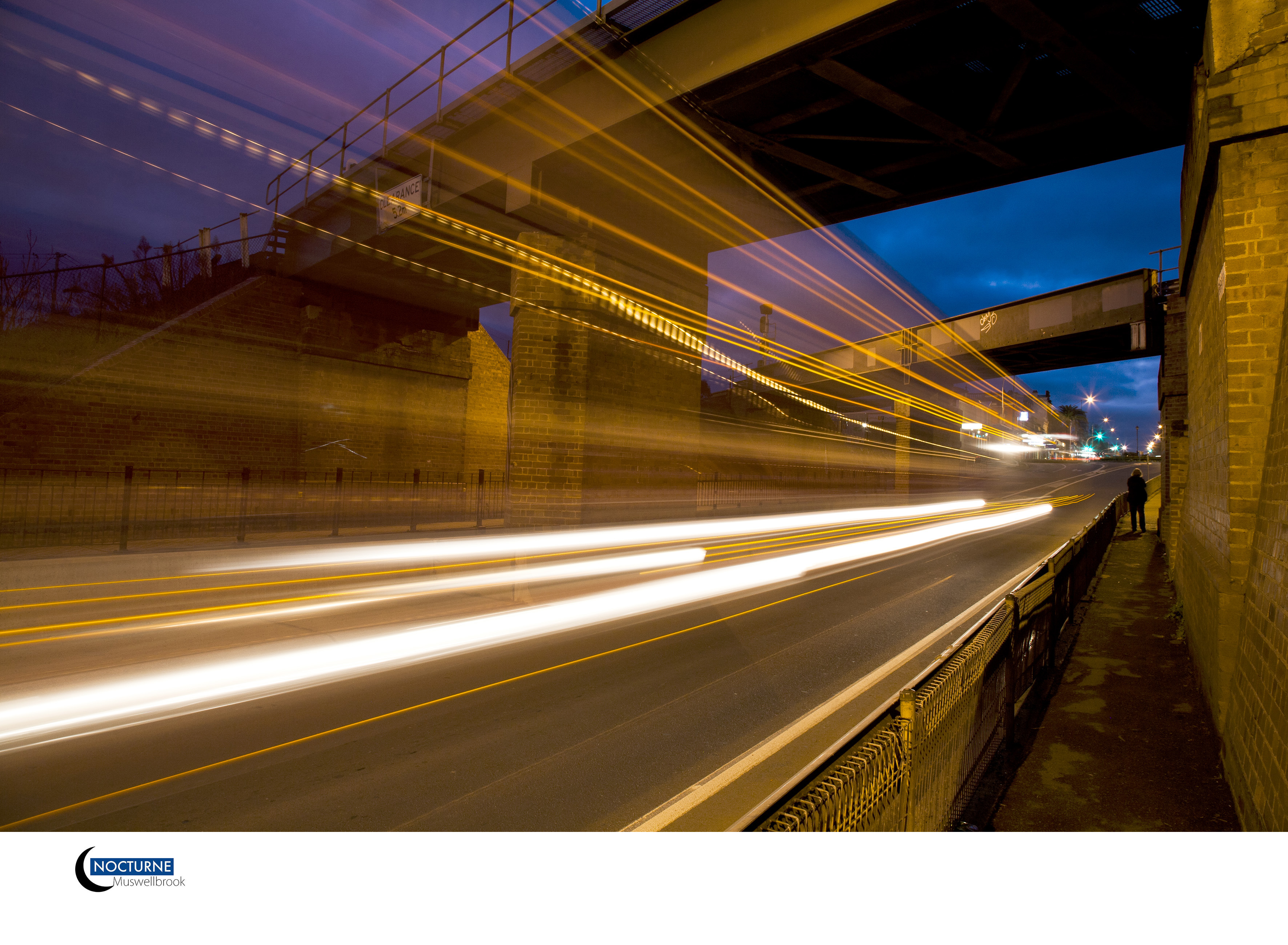
The Subway – The Nocturne Muswellbrook Project
.
VIEW A VIDEO OF THE ICONS SHOW FEATURING THE PHOTOGRAPHERS
.
.
TO BOOK THE EVENT
http://www.shop.qm.qld.gov.au/cobbandco/in-the-dark-room-with-doug-and-victoria.html
.

Cobb+Co Museum – Icons on Icons
.
.
CENTRAL QLD PROJECT: REVIEW published in Queensland Review

…
The latest issue of the journal Queensland Review features a review by us of the exhibition The Central Queensland Project that was shown at the Powerhouse Brisbane from 22 July to 18 August, 2013.
As the journal has publishing rights over their commissioned review we are unable to publish the text here. The review can be accessed from Cambridge Journals with the following links–a charge applies unless you are able to gain access through an academic institution or library.
Queensland Review, ,Volume20, Issue02, December 2013 pp 238-240
http://journals.cambridge.org/abstract_S1321816613000329
As an introduction to the piece we provide the following:
.
Queensland, its society and natural resources, has been the source of investigation by photographers for over 150 years. In the 1860s surveyor and photographer Richard Daintree created a quantitative analysis of the region’s potential for development. Associated with this record was a significant visual document in the form of photographs. In the lead up to Australia’s Bicentennial of white settlement the Queensland Art Gallery commissioned 6 photographers under the title Journeys North, to travel the state and: ‘produce a portfolio of photographs on the theme of community life in Queensland’ (Williamson 1988: p5). Now, nearly 25 years after this latest project, two photographers, Kelly Hussey-Smith and Alan Hill, have travelled north with cameras to document the current life and situations of people far away from the urbanized southeast corner.
The products of this latest documentary coverage were presented as the exhibition The Central Queensland Project (CQP) at the Powerhouse in Brisbane from July 22 to August 18, 2013. In exhibition material the photographers claim that:
Given the complexity of the modern economy, and the insularity of city life, many of us are blind to what lies beyond the city limits. Through this project we seek to gain insight into the lives, values and experiences of Central Queenslanders (Hill and Hussey-Smith 2013).
.References:
Hill, A. and K. Hussey-Smith. (2013). “About: Central Queensland Project ” Retrieved 25 July 2013, from http://centralqldproject.com/about/.
Williamson, C. (1988). Journeys North – Photographic Practice in Queensland in the 1980s: one aspect. Q. A. Gallery. Brisbane, Queensland, Queensland Art Gallery.
.
.
A selection of installation photographs as well as images and captions commented on in the review are published here courtesy of the photographers Kelly Hussey-Smith and Alan Hill:
.
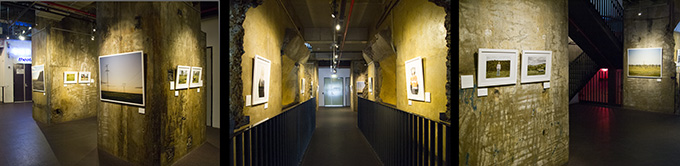
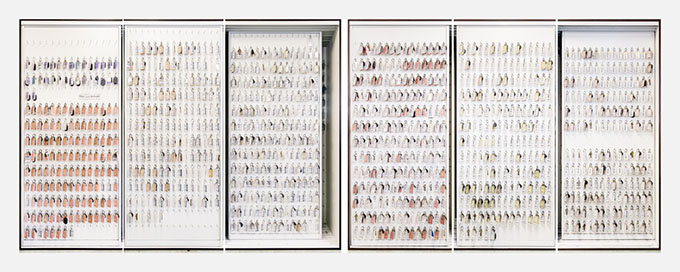
Installation triptich ….Photos: Doug Spowart
.
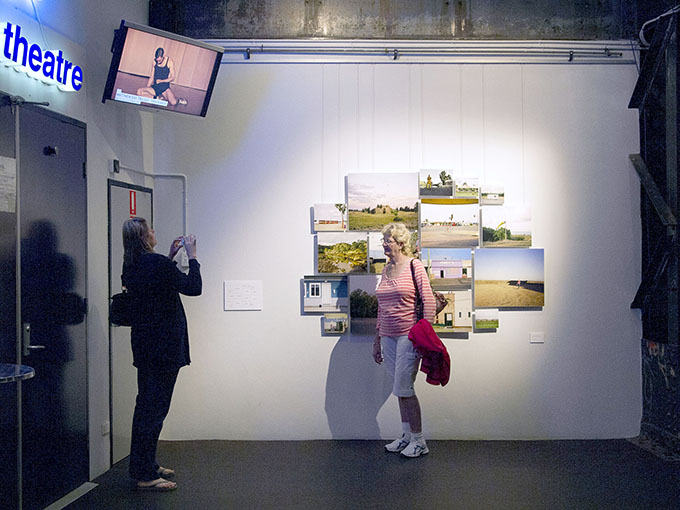
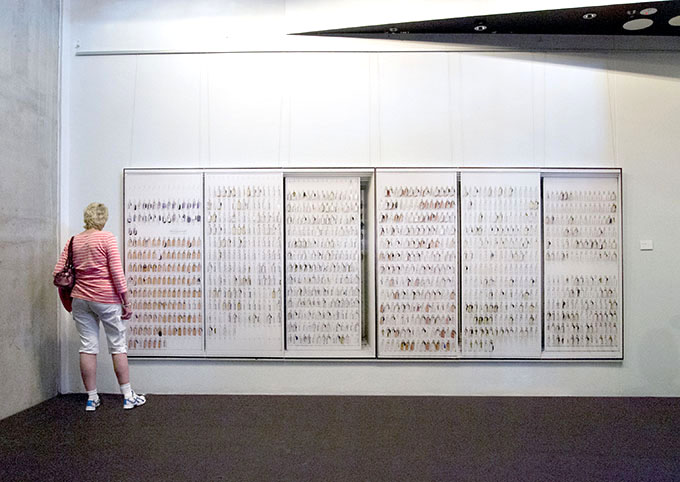
An exhibition visitor is photographed before the artwork Postcards From The Shires …Installation photo: Doug Spowart
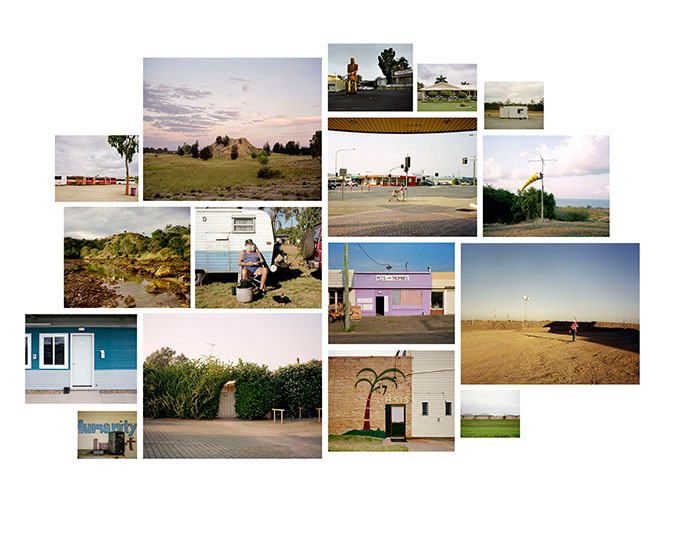
Postcards from the Shires
.
The New Village ..Installation photo: Doug Spowart
The New Village
With 3048 beds, The MAC Coppabella is one of the largest workers villages in Australia and larger than many towns in the region. Up to 1000 people will check in or out on any given day.
.
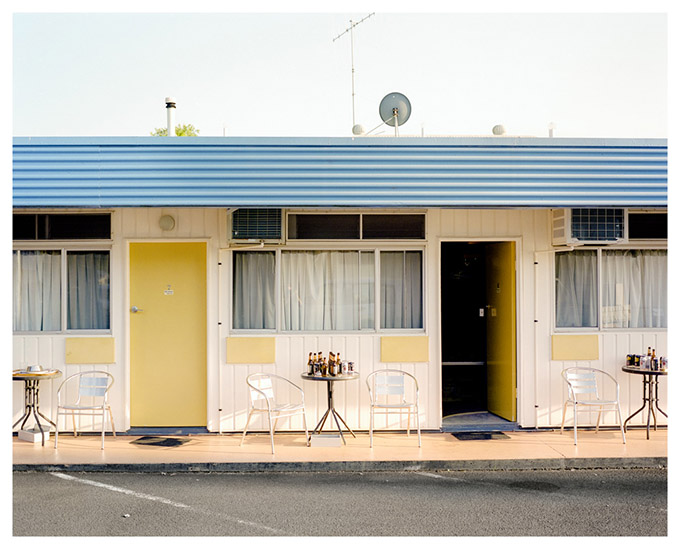
5am
Three Moon Motel, Monto. FIFO and DIDO have entered the Australian vocabulary, along with debates about their social impacts. As a result, accommodation is often difficult to find, and motels have become temporary homes for transient workers.
Caterpillar Cowboy
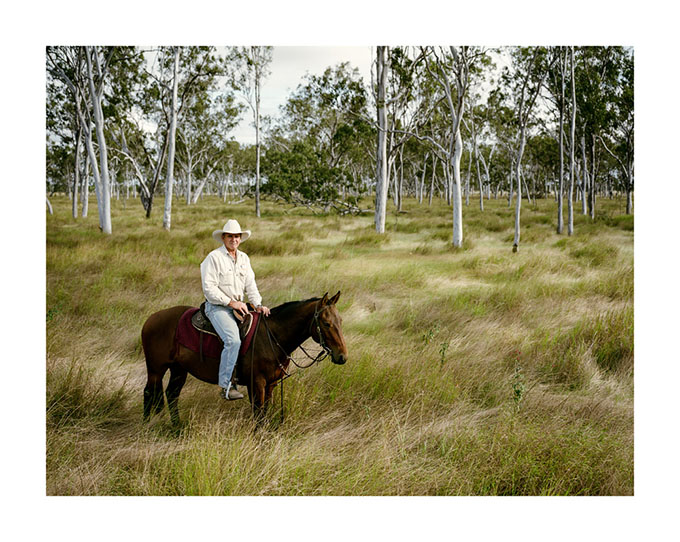
Greg Barr introduced us to the phenomena of the Caterpillar Cowboy, which he describes himself as, being a ‘Cat’ machinery operator in the mines who is really a cowboy at heart. He and his partner Debbie run a modest property where they spend half the week on the land with their crops, cattle, and horses, and the other half of the week in the mines to support their rural lifestyle.
Karlaa
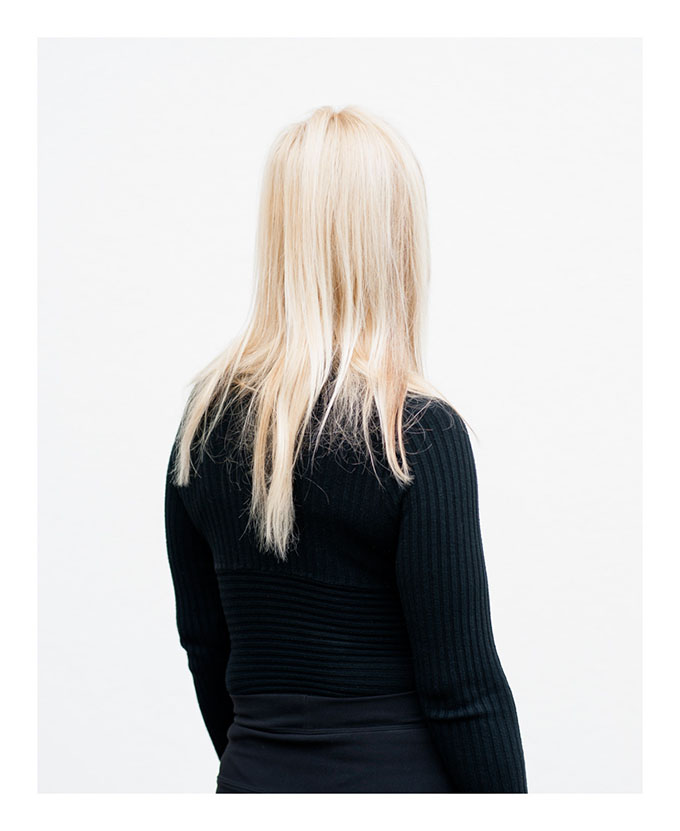
FIFO work does not just apply to mining. Karlaa works legally as a FIFO sex worker in the Central Queensland region. In 2010 Karlaa was asked not to return to a motel she had been working from discretely for two years after the proprietors realised she was a sex worker. She took the motel to court claiming discrimination on the basis of her profession. She initially lost this case, as it was found the motel did not discriminate against her because she was a sex worker, but because she was running her business from their premises. Many feared the decision would send the industry underground, resulting in unsafe working conditions and less transparency. Karlaa appealed the decision and in 2012 it was ruled that discrimination had taken place and the decision revoked. However, in November that year the Queensland Government made changes to the anti-discrimination act making it legal for moteliers and hoteliers to refuse sex workers accommodation.
Karlaa understands her profession may not appeal to everyone, but believes she has as much right as other businesses to take advantage of opportunities in the region.
From the ‘Transmission’ series
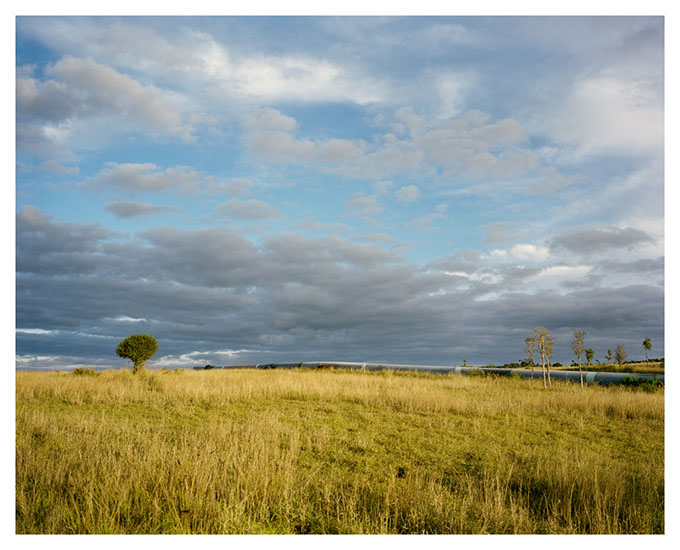
A section of the 540-kilometre long coal seam gas pipeline currently under construction crosses a property near Thangool. The pipeline stretches from southern Queensland to a liquefaction plant on Curtis Island near Gladstone.
From the ‘Extraction’ series
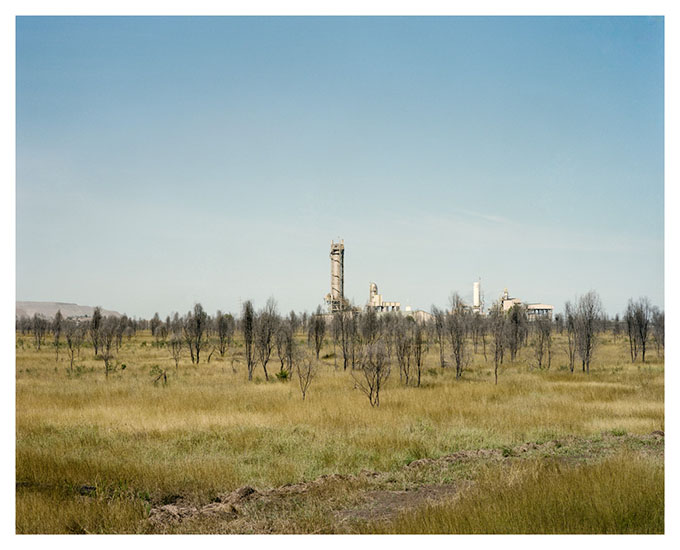
View towards Dawson Mine Complex, Moura.
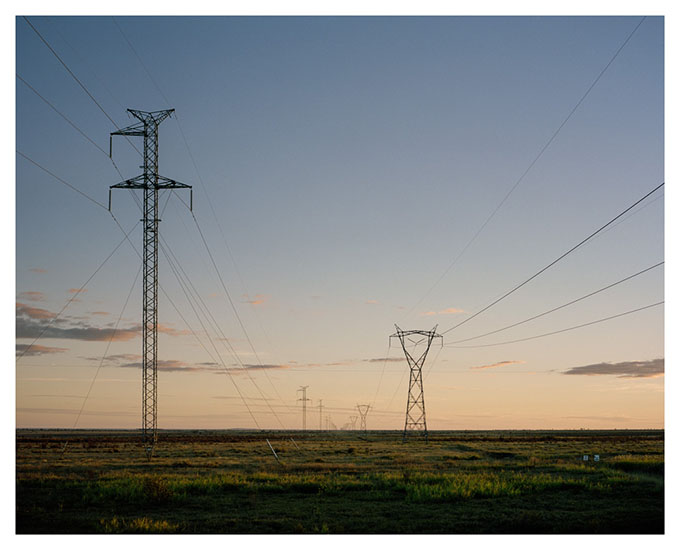
From the ‘Transmission’ series
Coal and electricity are inextricably linked. In the first half of the 20th century, Brisbane’s electricity came from power stations in the city that were fuelled by coal from Ipswich. Now Queensland is part of a complex energy network not only spanning the state and the nation, but as the world’s largest coal exporter, the globe. Powerlines outside Middlemount.
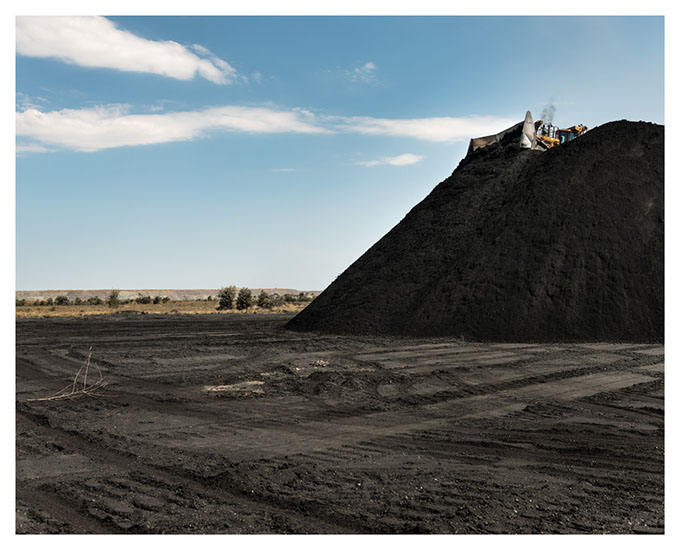
From the ‘Extraction’ series
Export ready semi-hard coking coal in a Bowen Basin coal mine.
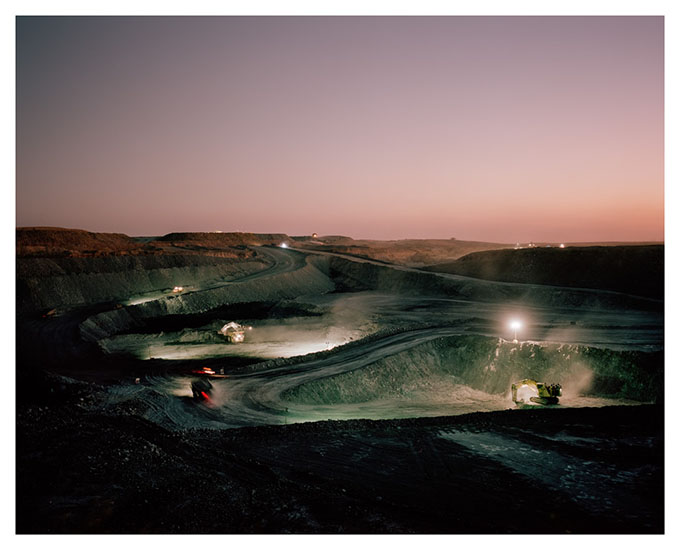
From the ‘Extraction’ series
Coal mining in the Central Queensland region is a 24-hour operation. The night shift begins in a Bowen Basin coal mine near Mooranbah.
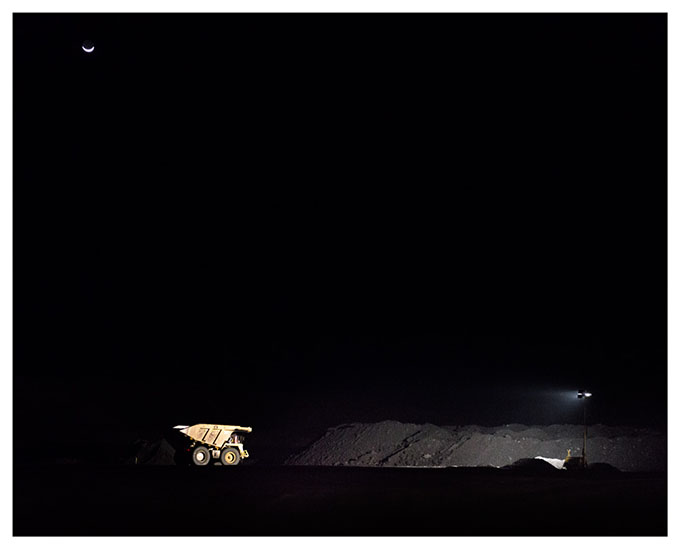
From the ‘Extraction’ series
Coal mining in the Central Queensland region is a 24-hour operation. Night shift in a Bowen Basin coal mine near Mooranbah.
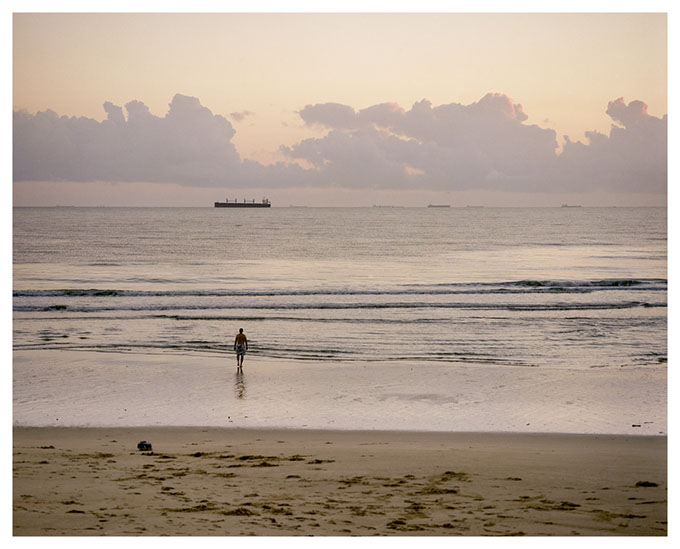
From the ‘Transmission’ series
Tannum Sands, south of Gladstone. In addition to being a major coal port, Gladstone is the destination for several major coal seam gas pipelines snaking their way through the Central Queensland landscape. The pipelines will deliver gas to three major liquefaction and export facilities currently under construction on Curtis Island.
.
Photos © 2013 The Central Queensland Project Kelly Hussey-Smith and Alan Hill and installation photos Doug Spowart.
..
.
.
.
PERV: Jess Martin does an iPhone Cloud @ MARS Gallery
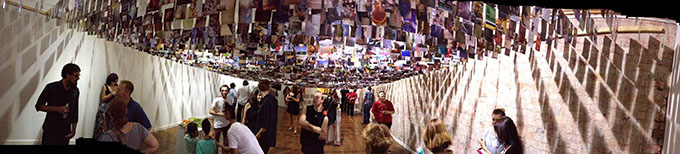
The Mars Gallery with the Perv exhibition photo ‘cloud’
.
In 1936, the one-time Bauhaus teacher Làzlò Moholy-Nagy, described his idea of the ‘photographic series’, and he spoke of it as being ‘the logical culmination of photography’. In his discussion he states that the ‘picture loses its identity as such and becomes a detail of assembly, an essential structural element of the whole which is the thing itself.’
.
An exhibition, entitled Perv, by Toowoomba artist Jess Martin on show at MARS Gallery would no doubt excite Mohly-Nagy in that she has taken the idea of a photo sequence and turned it into a sculptural form to express her view of contemporary life and photography. Martin has for two years been collecting iPhone images of her life. Last year she exhibited at Futures Gallery in Toowoomba a mosaic of 2,000 of these images in three 1 square metre murals. The theme was her life as a photographer, curious about the visual nature of the world and the access to quick imaging via the mobile phone.
Perv takes the idea further by expanding it to encompass iPhone image submissions sent to her via Facebook social media from friends and their friends …. Deciding to take the concept off the gallery wall where it’s just glanced at by the viewer Martin has constructed a 3-Dimensional space to mirror the image overload of modern life. What’s more, is that the images are suspended the full length and breadth of the Mars space – some 5×10 metres creating a cloud of photo images.
.
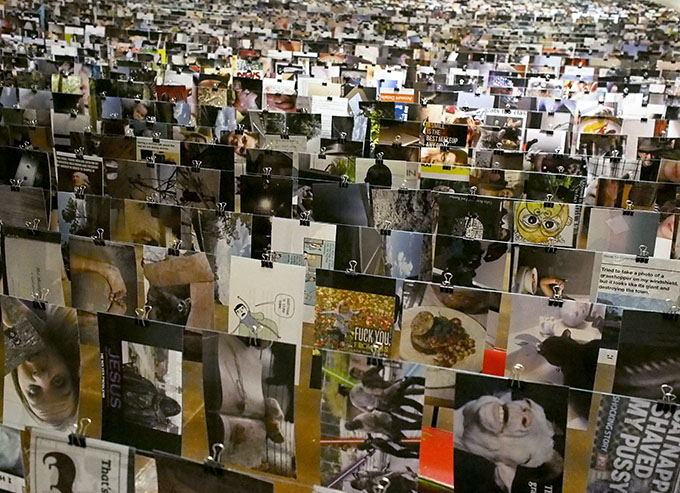
The view from above
.
Who knows how many thousand images are here… who cares? Who measures our daily dose of images anyway? So while this exhibition is confrontational it is also indicative of the prevalence, pervasiveness and proliferation of vernacular photography today. Viewers encountering this sky-load of images will need to search far if they are looking for classic pictorial beauty, or even well crafted documentary images. These pics are rapid snaps — faces, places, events, Facebook trivia, the weird and wonderful, rude and humorous. In a few seconds you can find photos of cats and dogs doing amazing things, food being devoured, over-flashed close-up faces and obviously candid and personal moments between lovers, family and friends.
.
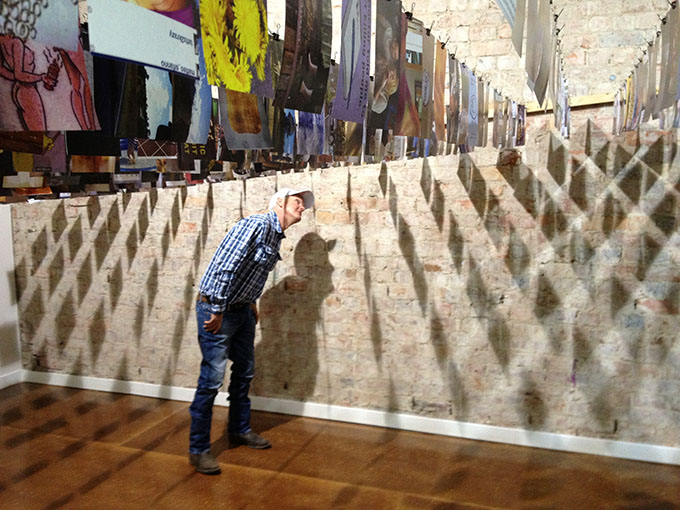
Looking at Perv’s pics
.
Billions of photographs are made and Perv‘s several thousand may be the equivalent of a grain of sand in all the beaches of the world however within this space we have an opportunity to connect with the contemporary reality of the photo today and the use of this once specialist human activity.
In coming back to Moholy-Nagy again there is something else to ponder that this exhibition celebrates and that is, in Nagy’s words; ‘its separate but inseparable parts a photographic series inspired by a definite purpose can become at once the most potent weapon and the tenderest lyric.’
The exhibition remains on show at Mars Gallery until December 6, 2013.
.
Words and photos: Doug Spowart
.
Moholy-Nagy, L. (1936). From Pigment to Light. Telehor. 1: 32-36.
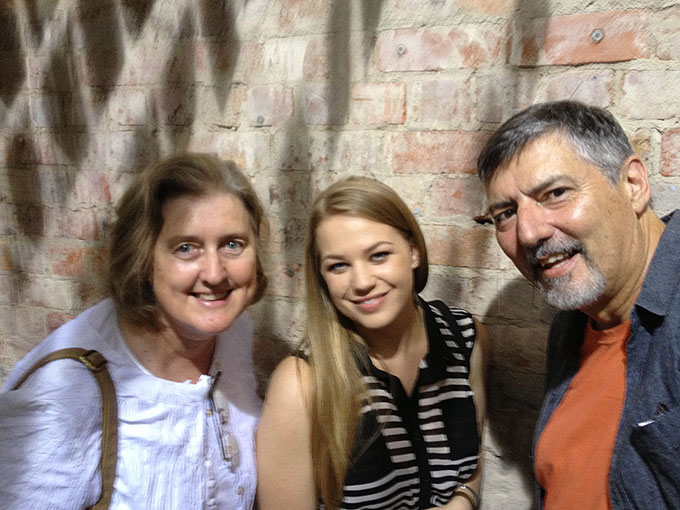
Vicky, Jess and Doug
Jess is a past student from Doug’s SQIT Art Photography class. We have mentored her during this project however Jess’ creativity, innovation and hard work has transformed this exhibition into a significant outcome – Congratulations Jess!
It should also be acknowledged that this exhibition has been supported by the Queensland Government through an RADF Arts Queensland Grant.
.
This work is licensed under a Creative Commons Attribution-NonCommercial-NoDerivs 3.0 Unported License.
.
.

 wotwedid