Archive for the ‘Meeting People’ Category
BOOKEND: Photobook Melbourne — what a read?
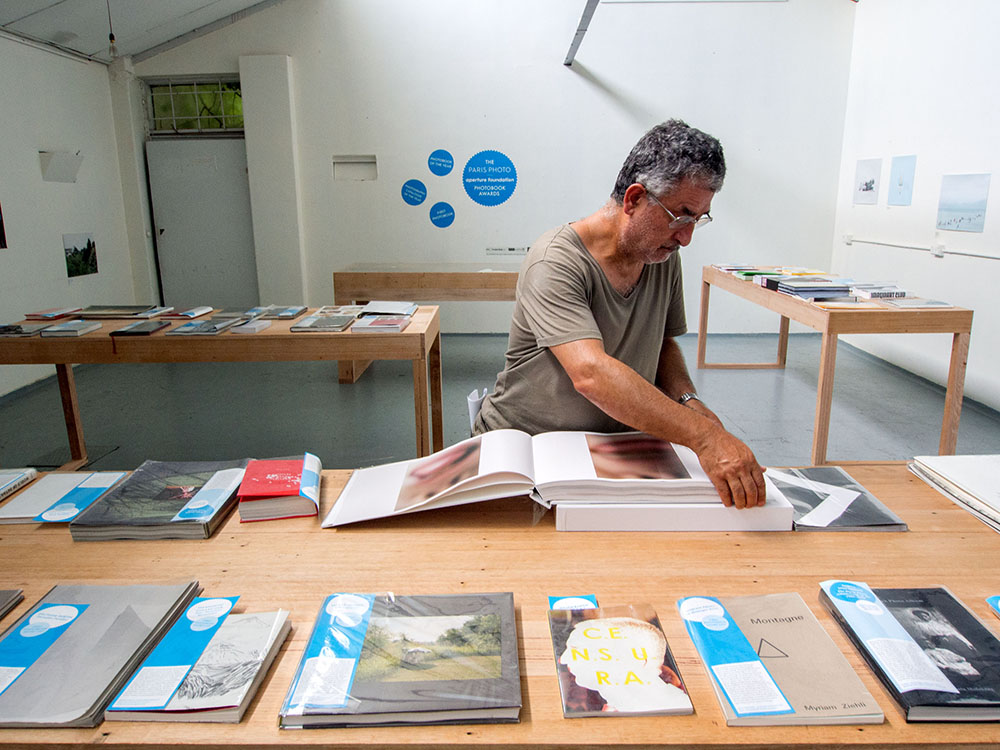
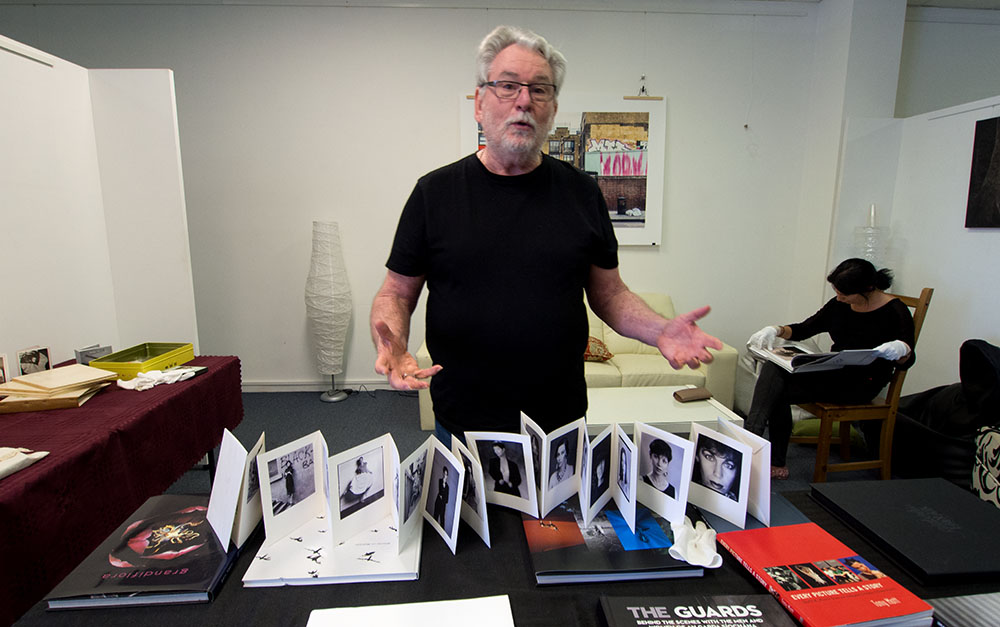
Photobook Melbourne: Peter Lyssiotis looking at an Aperture Books
We all know that feeling when you are really getting into a book, its narrative and flow, and then you reach the point where, as the last page is turned, you wish it could go on, and on… Photobook Melbourne (PM) was something of that kind of experience. The books seen, perhaps around 300, the exhibitions seen, and the people met now all vividly reside in memory and digital capture code.
The Photobook Melbourne event took place between February 12 to 22 it was coordinated by Heidi Romano and Daniel Boetker-Smith. It was always an ambitious undertaking. Its vision was to connect international photobook world with makers and lovers of the book from around Australia… and New Zealand. This was achieved through numerous exhibitions, library displays, photobook awards, forums and workshops.
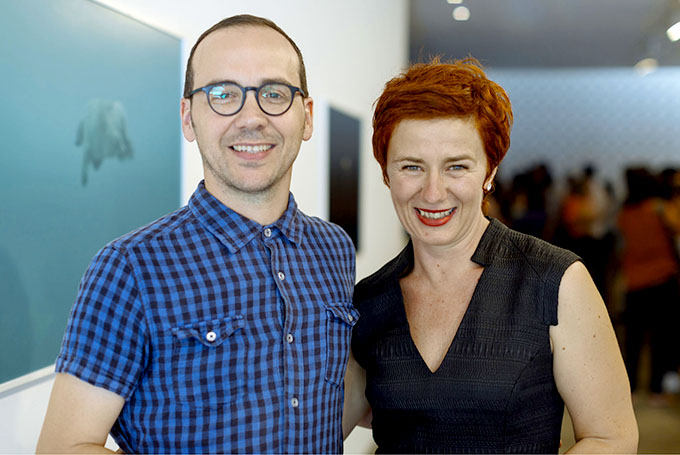
Daniel Boetker-Smith + Heidi Romano PHOTO: Courtesy of Lauren Dunn www.artdocumentation.com.au
Photobook Melbourne can only be described as a massive success. The photobook community of practice needs events like these so they can band together to affirm their interest and belief in the importance and creative power of the photobook. For once, the world of photobooks has come to us, or at least Melbourne, and for that we are a stronger and more informed cohort of makers, readers, collectors and lovers of photobooks.


Some of the attendees have responded to a request for comments – others are posts from Blogs and Facebook posts…
FROM JACOB RAUPACH: Photobook Melbourne was an amazing week full of a genuinely insightful mix of talks, exhibitions and book exhibitions, with the fair during the first weekend proving to be a great networking point for the rest of the week that followed. … I felt that the inaugural festival set an amazing benchmark for the following years! Looking forward to 2016.
FROM HARVEY BENGE‘s BLOG: On a zero to ten scale I’d give the festival a ten! Visit his site for more commentaries about photobook
FROM CHRIS BOWES: For someone naïve to the world of photobooks, Photobook Melbourne was an eye opening experience. Although coming in as a virtual outsider to this rapidly expanding art scene, I sank my teeth into as many of the talks, exhibitions and book collections I could manage, and came away a lot more informed than I was going in. Personal favourites were the Paris Photo – Aperture Foundation Photobook Awards exhibition, where the content of the books was engaging and the calibre unmatched, and ‘The Other Photobook Forum’, where in particular Gracia Haby and Louise Jennison showed that with a little creativity and business sense one can make a buck and do what they love.
FROM LIBBY JEFFERY – Momento Pro: The number of participants, visitors, books and buyers at Photobook Melbourne were fantastic and they confirmed that small press and self publishing is alive and well in Australia. The Awards and Book Fair also proved that a selection of high standard work is being created here, but a collaborative promotion and showcase of Australian photo books to the global market would benefit everyone.
FROM: ANGEL LUIS GONZALEZ FERNANDEZ Facebook Comment Back in Dublin after an amazing first edition of PHOTOBOOK MELBOURNE, having discovered tons of new work and books from Australia, New Zealand, and more -and having met a truckload of awesome people.
FROM KELVIN SKEWES: As someone that attended almost all of the events that were part of Photobook Melbourne I can only describe it as a tour de force for lovers of the Photobook. The festival opened on February 12th at the Centre for Contemporary Photography with Robert Zhao Renhui’s exhibition
A Guide To The Flora And Fauna Of The World and with a smoking ceremony by the traditional owners to welcome the festival to their land. Also announced on the opening night was the Australian Photobook of the year which was won by Raphaela Rosella for her unpublished book ‘We Met a Little Early But I Get to Love You Longer’ and I was humbled to be the runner up with my newspaper as photobook ‘Nauru: What was taken and what was given’. …
The main event for the first weekend of the festival was the Photobook Melbourne Book fair at CCP an event at was full of frenetic energy and far too many photobooks to browse let alone buy; amongst the many booksellers highlights included the infatigable Perimeter book with titles from Mack and Spector books and Anita Totha from Remote books who is doing to sterling job promoting photobooks from New Zealand. …
Great thanks are due to the entire Photobook Melbourne team so thank you Heidi Romeo, Daniel Boetker-Smith, esteemed guests Ángel Luis González Fernández, Ron Jude and the Dysturb Photo Collective, festival partners and sponsors Momento Pro, Photography Studies College, Copyright Agency and venues CCP, MGA, Strange Neighbour, Colour Factory, Neo Space, Baron Said and James Makin Gallery and to all the volunteers without whom this could not have happened so thanks to Felix Wilson, Kate Robinson, Bella Capezio, Katrin Koenning and countless others.
See you next year!
MORE COMMENTS WILL BE ADDED AS THEY BECOME AVAILABLE…
WHAT FOLLOWS IS A PERSONAL DIARY OF PHOTOBOOK MELBOURNE
Our arrival on the first weekend was delayed by my recent medical incursion so we fly into Melbourne on Wednesday. Through a friend we were able to stay in an apartment right in the middle of the city and our journeys out and about were by tram, train and lifts given by friends.
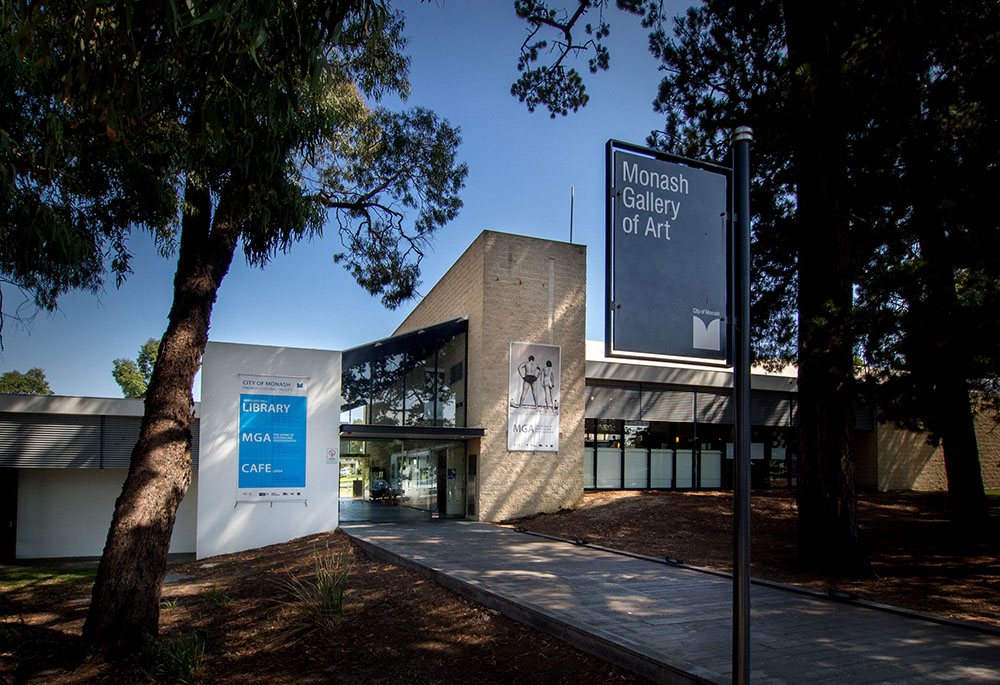
The MGA – The Home of Australian Photography
THURSDAY: We attended two book related exhibitions at the Monash Gallery of Art. Badged as the ‘Home of Australian Photography’ the gallery presented two photobook exhibitions, one of images from the collection that featured the theme of books and reading and was entitled ‘Light Reading’. The other was The Natural Collection an assemblage of books by The Photobook Club’s Matt Johnston and co-curated by Lucy Johnson. The Natural Collection brings together photobooks that explore “the harmony, tension and play” that occurs in the human relationship with nature and the natural landscape.
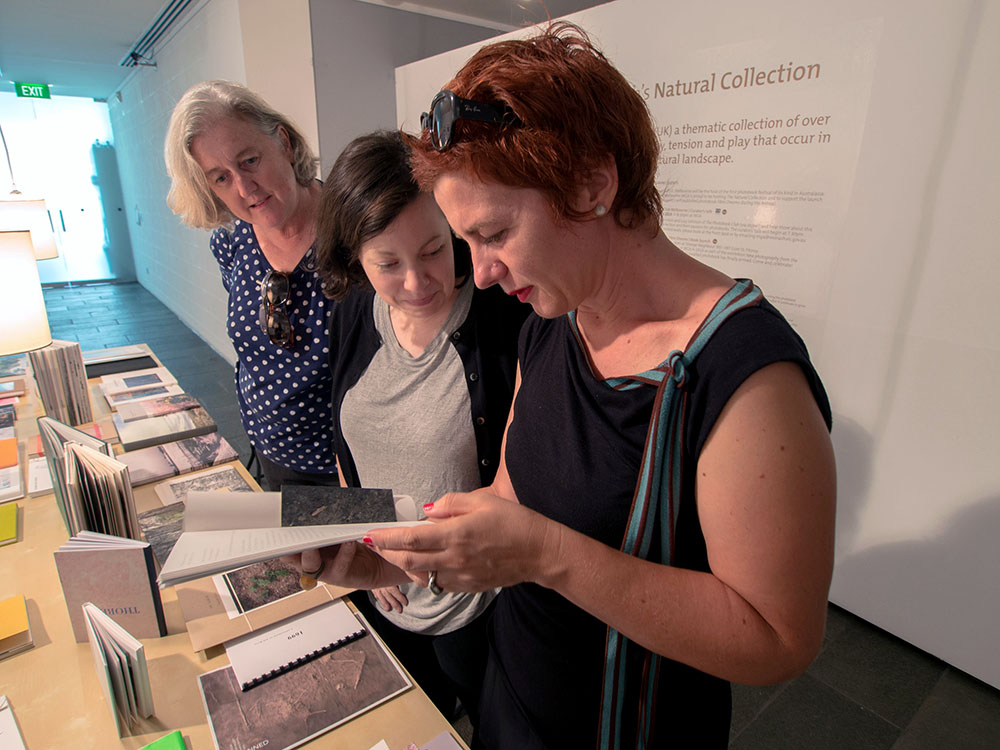
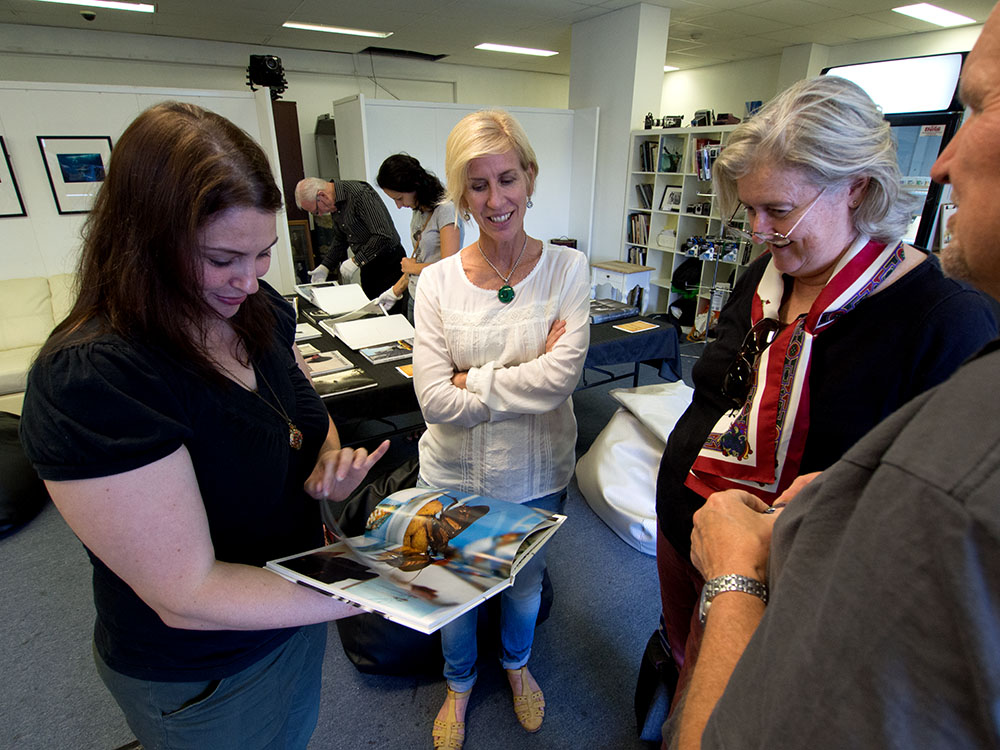
Heidi, Steph and Vicky discussing a book
The exhibition space was setup for readers to sit and work their way through a most interesting selection of Euro/American centric responses to the theme. Grand trade books sat next to simple fold ‘n’ staple zine-like booklets. We were there with Heidi Romano, Simone Rosenbauer from Sydney and MGA Gallery’s Education and Public Programs officer Stephanie Richter. We engaged in a spirited debate about book design; production methods and how to evaluate books.
That evening we attend a dinner for PM speakers, contributors, supporters and sponsors. By this stage it was acknowledged that the PM had been an enormous success so congratulatory statements were announced and a great feeling of an Australian photobook community being well and truly launched by this event.
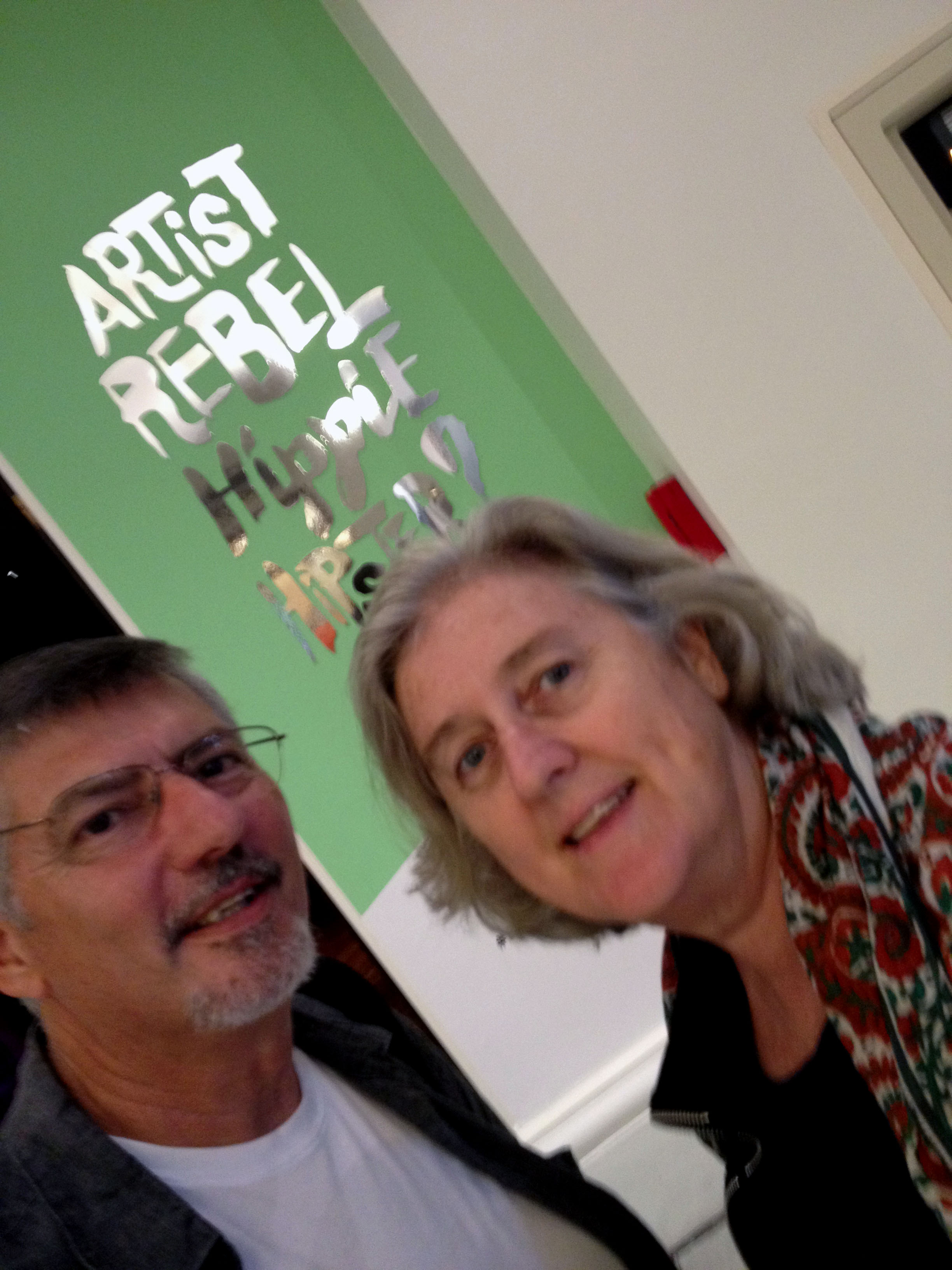
Bohemian Vicky+Doug
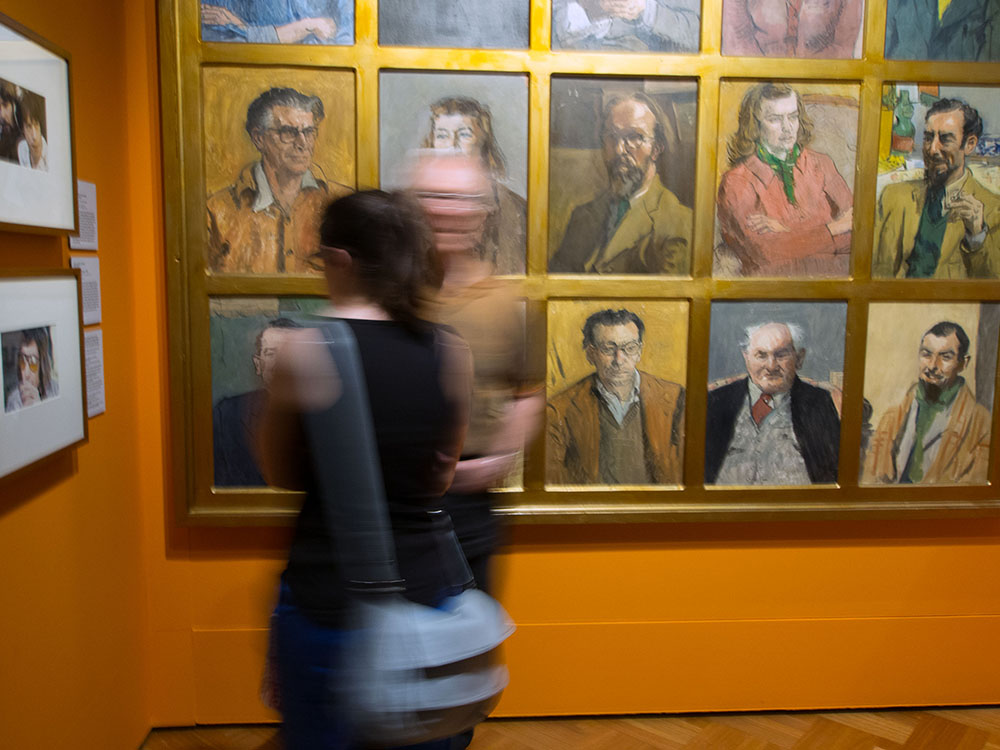
Bohemian Melbourne portrait wall
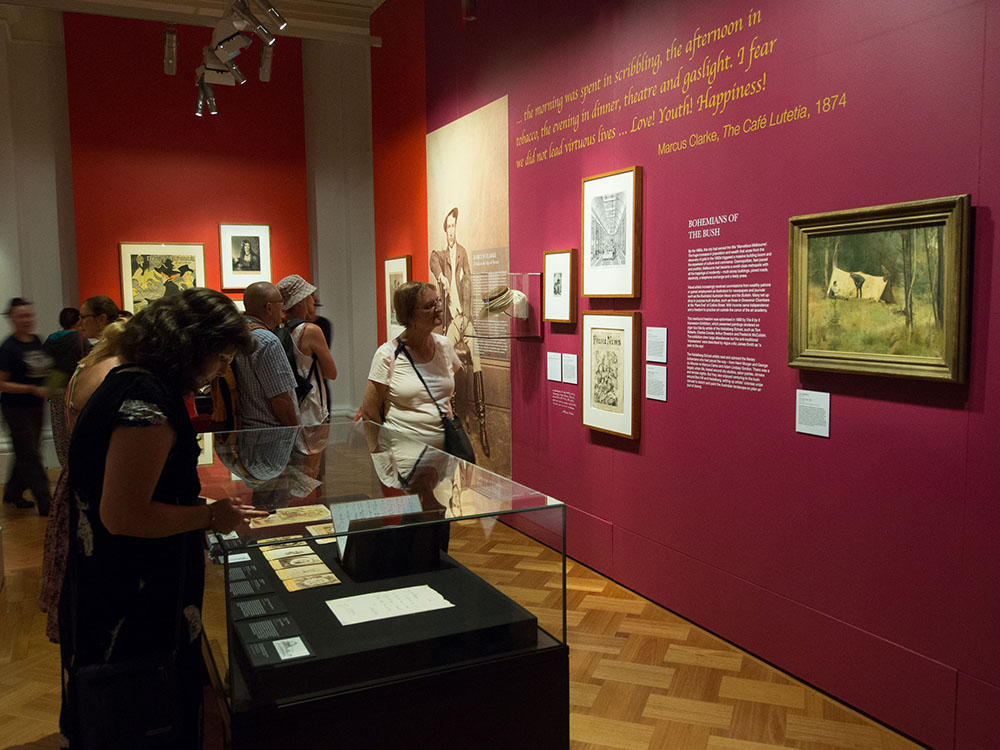
Bohemian Melbourne
FRIDAY MORNING: A breakfast of avocado, bacon and relish was partaken at a suburban street café while being interviewed by Australian Photography contributor Anthony McKee for a feature on photobooks. Morning tea with Robert Heather and Des Cowley at the State Library of Victoria and a visit to the SLV exhibition Bohemian Melbourne – a fascinating reflection on the creative, musical and arty sub-culture of Melbourne. Rennie Ellis’ photos contributed much to this history as well as poster art, paintings and the ephemera and memorabilia of the different eras represented by the theme.
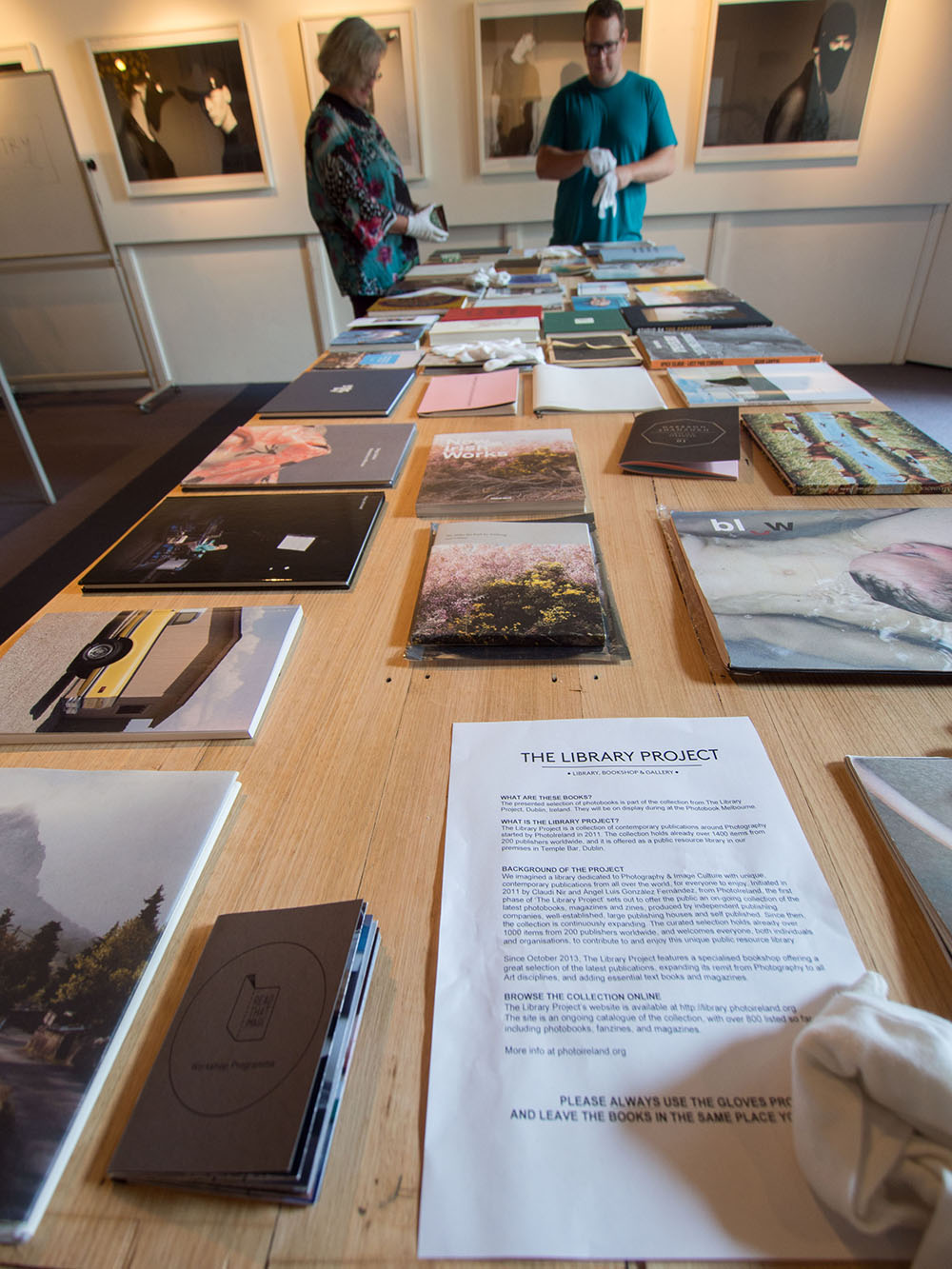
The Library Project @ PSC
FRIDAY AFTERNOON: We visited Photography Studies College to view ‘The Library Project’, a collection of photobooks brought to PM by Ángel Luis González Fernández from PhotoIreland. ‘The Library Project’ aim is to collect contemporary publications based on photography to create a public resource library. We viewed many books that are not easily available to see in Australia including Cristina de Middel’s Afronauts.
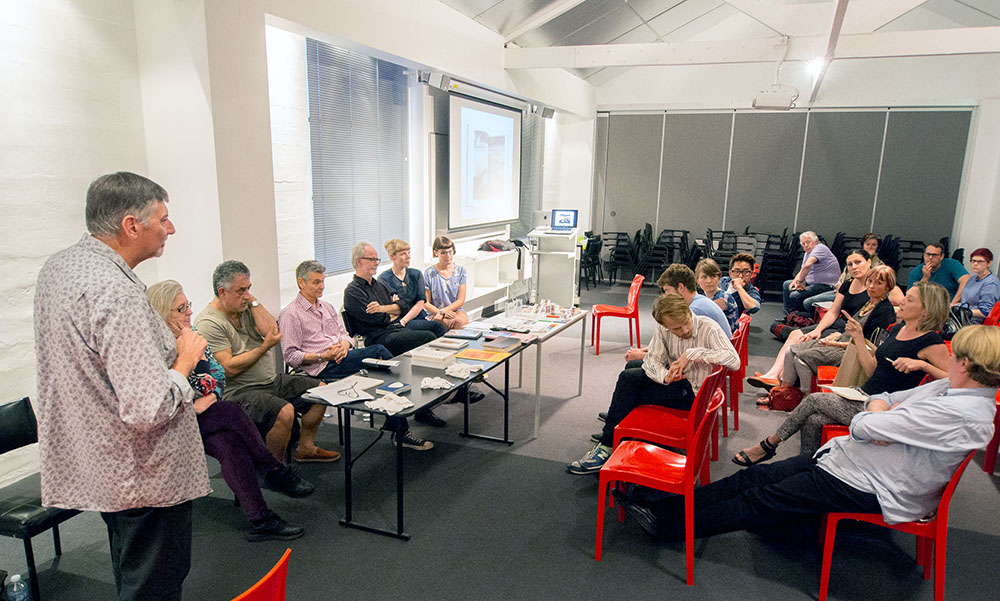
The ‘OTHER’ Photobook Forum – a question from the floor
FRIDAY EVENING: Later that evening we were involved with The ‘OTHER’ Photobook Forum – Artists’ Books, Zinesters and the Photobook took place. We have been working on this project for a couple of months now and we were able to bring together key practitioners from these ‘other’ photobook disciplines who discussed and provided commentary on their use of the photo in the book. The participants included photomonteur Peter Lyssiotis, zinesters Gracia Haby and Louise Jennison, artists’ book maker Dr Lyn Ashby, Des Cowley from the State Library of Victoria and Victoria Cooper who stood in for Georgia Hutchison who was unable to attend due to extenuating family issues.
It was an event that stirred much interest with artists like Deanna Hitti and Theo Strasser attending as well as Momento Pros’ Libby Jeffery, and photobook makers Kelvin Skewes, Daniel Boetker-Smith and Chris Bowes.
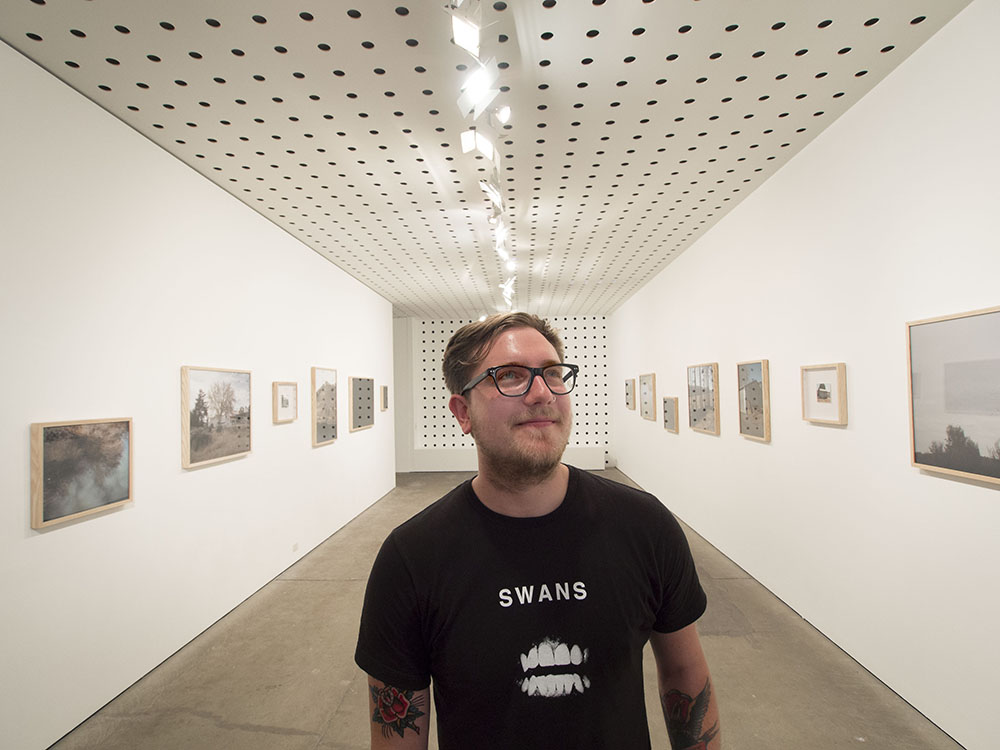
Jacob Raupach @ CCP
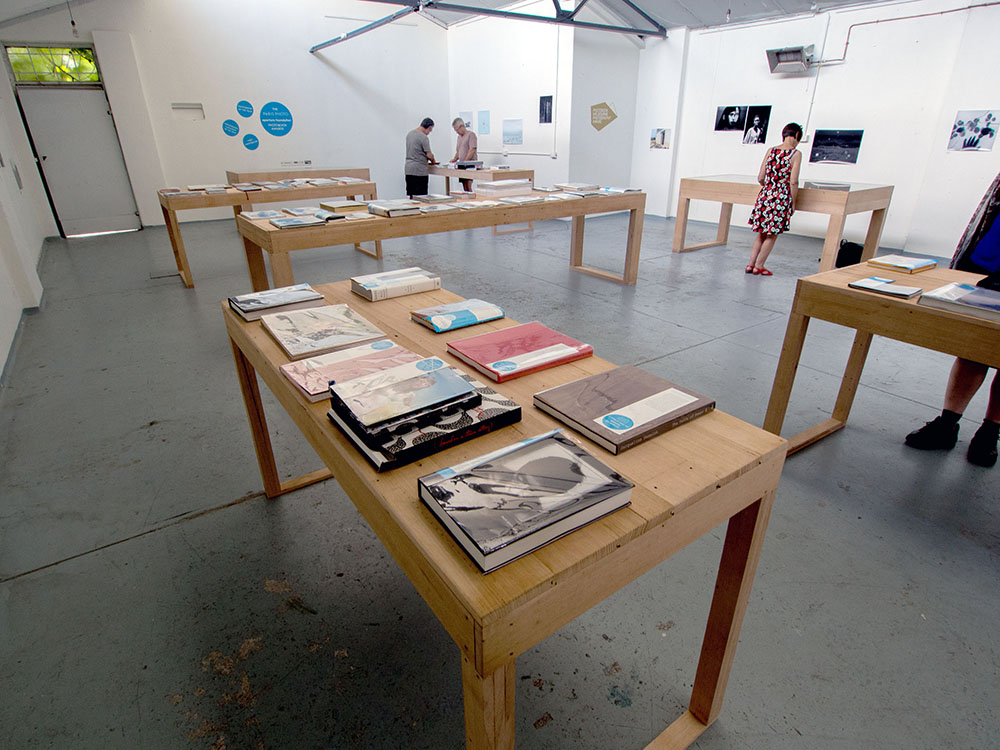
Aperture Books on display @ The Baron Said
SATURDAY: A day to attend artists talks at the Centre for Creative Photography by, amongst others photobookmaker Jacob Raupach and the exhibition FELL – Bought a copy of his latest book WEALTH. Following up with visits to the Momento Pro Australian Photo Book of the Year Award at the Asia Pacific Photobook Archive and the Aperture Photobook exhibition @ The Baron Said and a stimulating lunch with Peter and Tess Lyssiotis @Babkah.
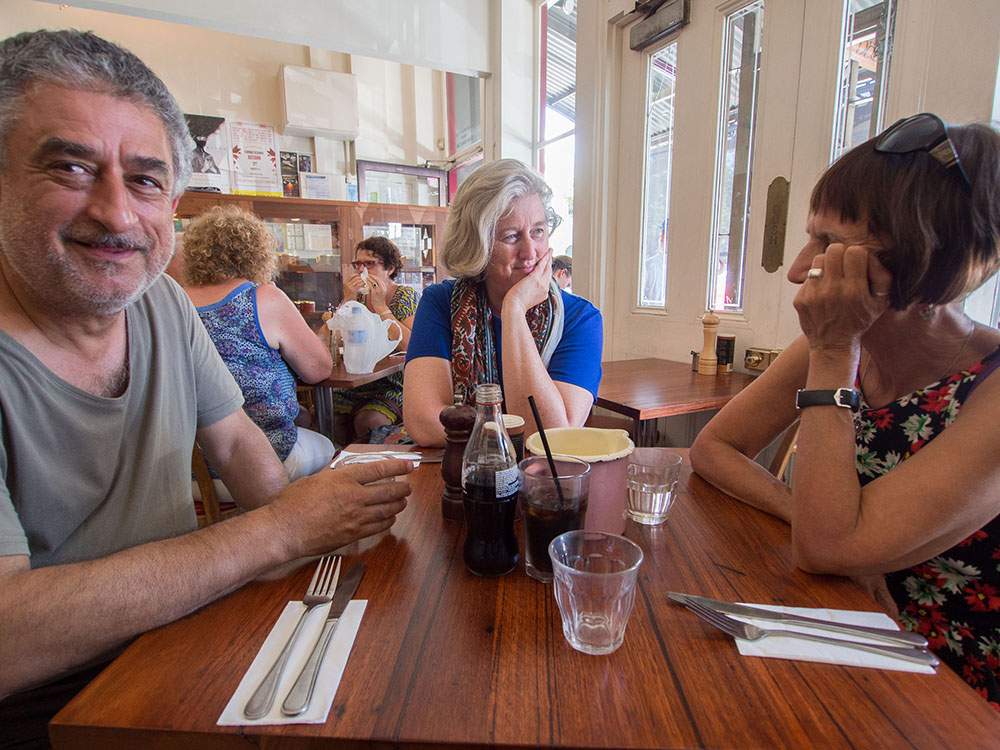
Lunch with Tess + Peter
Photobooked-out we headed back to the city by tram and had a chance meeting with Lismore artist and Siganto Artists Book Fellow Jan Davis who was attending a Print Council meeting – Only in Melbourne could strange intersections like that could happen.


SATURDAY EVENING: Melbourne White Night event
450,000 Melbournians took over the streets of the CBD – everything stayed open and performances and projections, bands and music were everywhere. Amongst other things we went to see the projections in the Dome at the State Library of Victoria at 10.30 at night – queued in line for 30 minutes with 1000s of others what a night…!
SUNDAY
A day of traveling home to cyclone weather drenched Brisbane.
UNTIL NEXT TIME —- For PHOTOBOOK MELBOURNE 2nd EDITION….
WOTWEDID BLOG: 2014 in review – interesting facts + stats
The WordPress.com stats people prepared a 2014 annual report for our WOTWEDID blog.

Here’s an excerpt:
The concert hall at the Sydney Opera House holds 2,700 people. This blog was viewed about 13,000 times in 2014. If it were a concert at Sydney Opera House, it would take about 5 sold-out performances for that many people to see it.
HABITAT OUT WEST: Environmental Art of the Darling Downs Exhibition
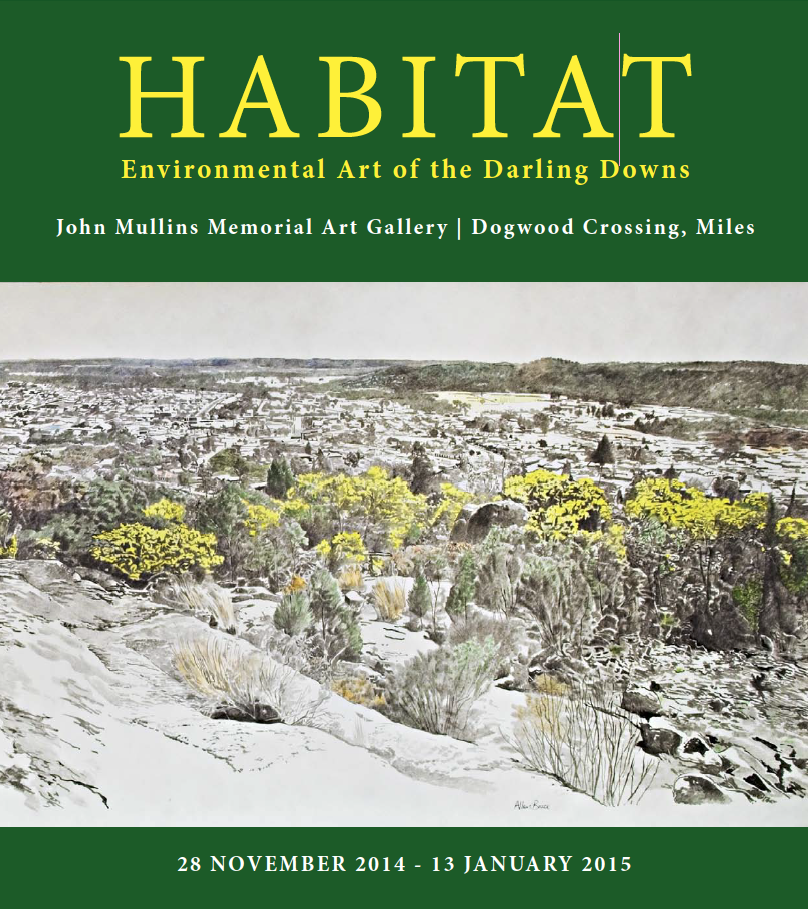
Curated by Ashleigh Campbell and Anne Keam.
When, how, and why did the locality Darling Downs come to be known as the Surat Basin? This question informed the exhibition curators Ashleigh Campbell and Anne Keam and with it came the recognition that such a shift was deeply important to the region’s connections and perceptions of their place.
.
Habitat is a word that accommodates the presence of life beyond the human shaped and perceived landscape. In any given habitat the living and the nonliving interact to the rhythms of the earth and the cosmos. As both observers and inhabitants, artists and scientists help shape human perceptions of and relations with the broader global environment. This includes the economy of the earth’s resources that supports humanity.
Campbell and Keam researched a broad range of influences including the natural and human habitat of the Darling Downs from colonial history to present. Through the eyes and minds of the region’s colonial and post-colonial artists, along with some scientific documentation and social artifacts, they sought to reflect on shift and its implications on the regions environment.
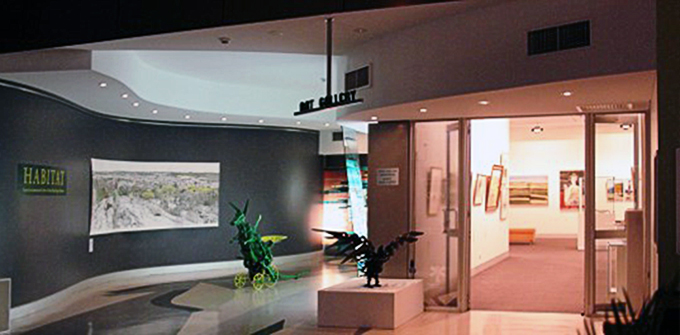
John Mullins Memorial Art Gallery entry – Dogwood Crossing, Miles.
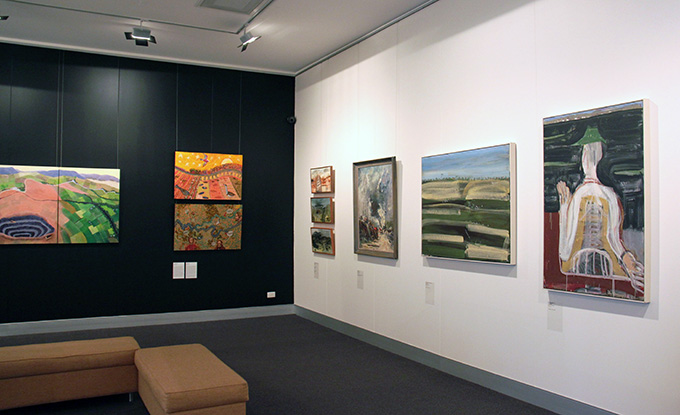
John Mullins Memorial Art Gallery interior
.
This exhibition brought together a diverse collection of works including: prehistoric fossils and other historical artifacts, references and narratives of the pastoralists struggle with the invasion of prickly pear cactus and other pests, floods and droughts. The artists represented in the show came from many disciplines. Paintings representing this landscape covered a range of movements and styles from romantic colonial pastoral period to impressionism, abstraction and modernism. Well known artists names: Kenneth Macqueen, Sam Fullbrook and Joe Furlonger are representative of the depth of creative work in this exhibition.
.
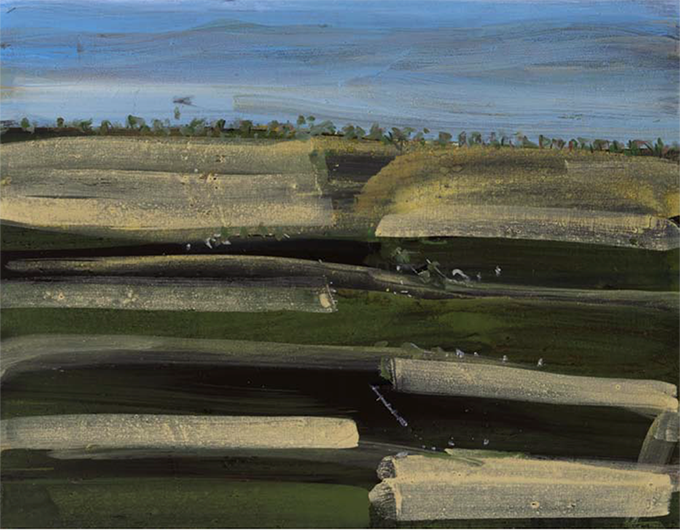
Joseph Furlonger Round Up Ready Field, near Dalby 2012 Acrylic bound pigment 91 x 122 cm Courtesy of The Hughes Gallery, Sydney
.
Some artists reflected on living with the natural environment as found in small corners of Patricia Hinz’s back yard in the work, Sanctuary (2014). Palpable in the drawing of Allan Bruce’s Stanthorpe, Late Winter (2008) is the feeling of being in the grand sun-soaked landscape of the Downs, and the relationship of small towns with the surrounding country. Bruce observes: “Stanthorpe is one of those towns where the natural and built environment coalesces almost seamlessly.”[1] The inventiveness and creativity that pervades every farmer’s shed and bushman’s camp is embodied in the sculptural work of Dion Cross’ Grass Harvester (2014), that highlights the competition for pasture between man and animal during periods of drought. The fine drawings of flowers and fungi by botanical artists and illustrators through scientific documentation reveal a deep understanding and investigation of the natural life forms found in this region.
.
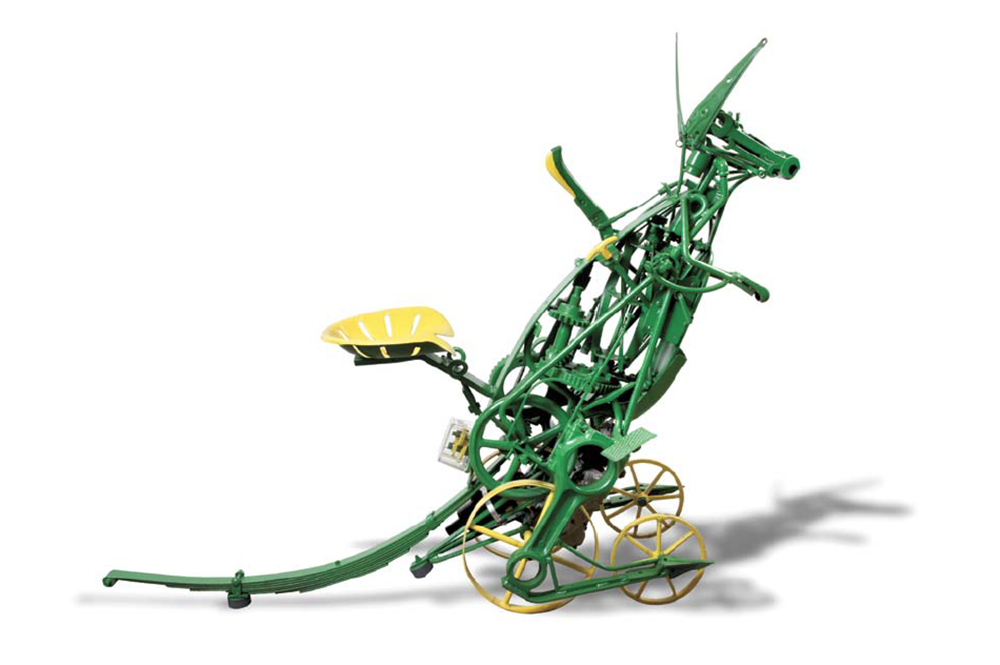
Dion Cross Grass Harvester 2014 Steel sculpture 150 x 60 x 180 cm Courtesy of the artist Image: Spowart + Cooper
.
Phil Bazzo’s painting, Miles: At the Crossroads (Triptych, 2008) presented two concepts: the physical nature of the intersections of roads in Miles including the dynamics of heavy road vehicles and the metaphor of crossroads to infer change and concerns for the future. Both found natural and manmade objects and materials were also utilized as the visual language of protest. This was evident in the mixed media works of Jennifer Wright (Summers): Searching for Life in the Anthropocene 1 (2014), using tea bags, feathers, fabric pen & ink, watercolour and Anthropocene Nest (2014), that was made from plastic bags and pelican bone. Nicki Laws’ Habitat Gone (2014) collaged and embroidered the materials found in the fluoro safety barriers widely used in the industries found in the region.
.
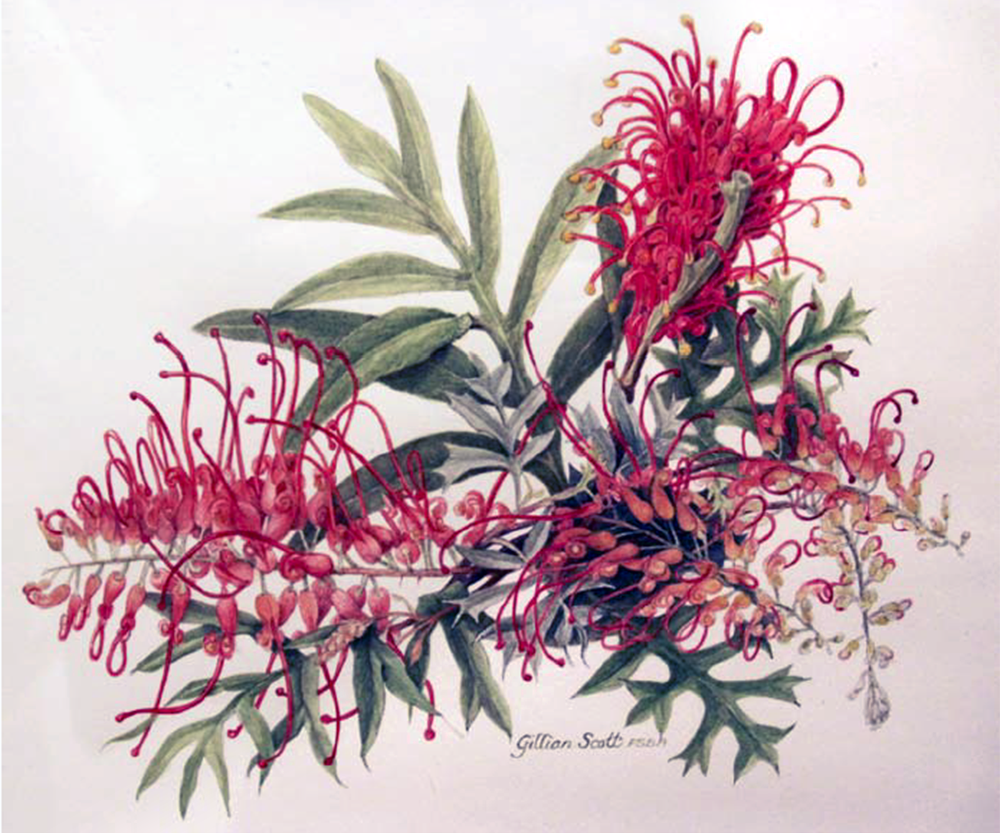
Gillian Scott Grevillea x ‘Robyn Gordon’ 1993 Watercolour on paper 25 x 35 cm Courtesy of the artist
.
The solastalgic plea for a balance with man and the land was also deeply felt when viewing the work of Barbara Hancock’s Brigalow Landscape (2014). Working with the land, technology and energy needs was also strongly referenced in the work of Sylvia Secomb (Mann), Synergism – Towards Regeneration I (2010), but also reflects on the question “What will we be leaving for those who come after?”[2]
.
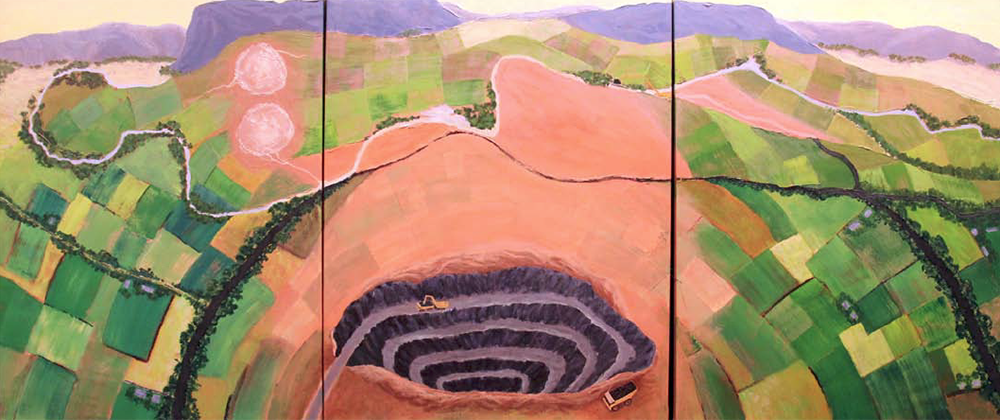
Sylvia Secomb (Mann) Synergism – Towards Regeneration I 2010 Acrylic and medium on canvas 91 x 213 cm Courtesy of the artist
.
For the city viewer who ventures out into the region to connect with this show, there is a unique experience: to be in the space and place of the exhibition, Dogwood Crossing, Miles, within the Habitat it references. This site-specific exhibition presents rare opportunity to engage with the historical and contemporary issues of living with the land through the creative energy and perception of those who chose to live and work in this region. The curators have also published an extensive and informative online catalogue to accompany the exhibition: Habitat_Catalogue or online at http://issuu.com/ourwesterndowns/docs/catalogue/1
Beyond the facts and information, the presence of a growing connection and love of the Australian environment pervaded strongly throughout this extraordinary show. Through visual story telling and lived experience, the artists and the curators have constructed a layered topology of the Darling Downs. A telling image of how the effects of a changing human condition: technology, energy and food production can be identified and chronicled through the artist’s vision.
.
Victoria Cooper
I am also privileged to have my work, 7 Gates (two forms: artists’ book, 2009; digital media presentation 2014), included in Habitat.
[1] Page 11, ibid.
[2] Page 21, Habitat: Environmental Art of the Darling Downs, 2014. The online catalogue for the show of the same name. See http://issuu.com/ourwesterndowns/docs/catalogue/1
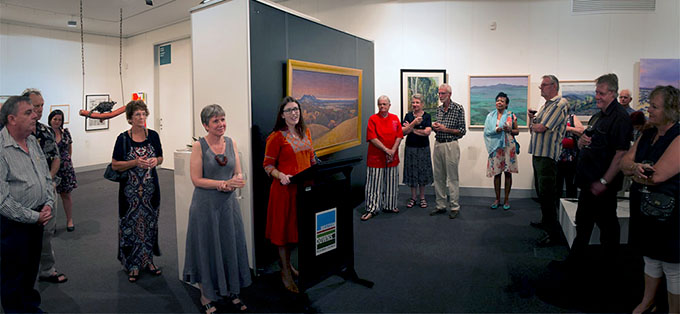
Anne Keam and Ashleigh Campbell at the opening.
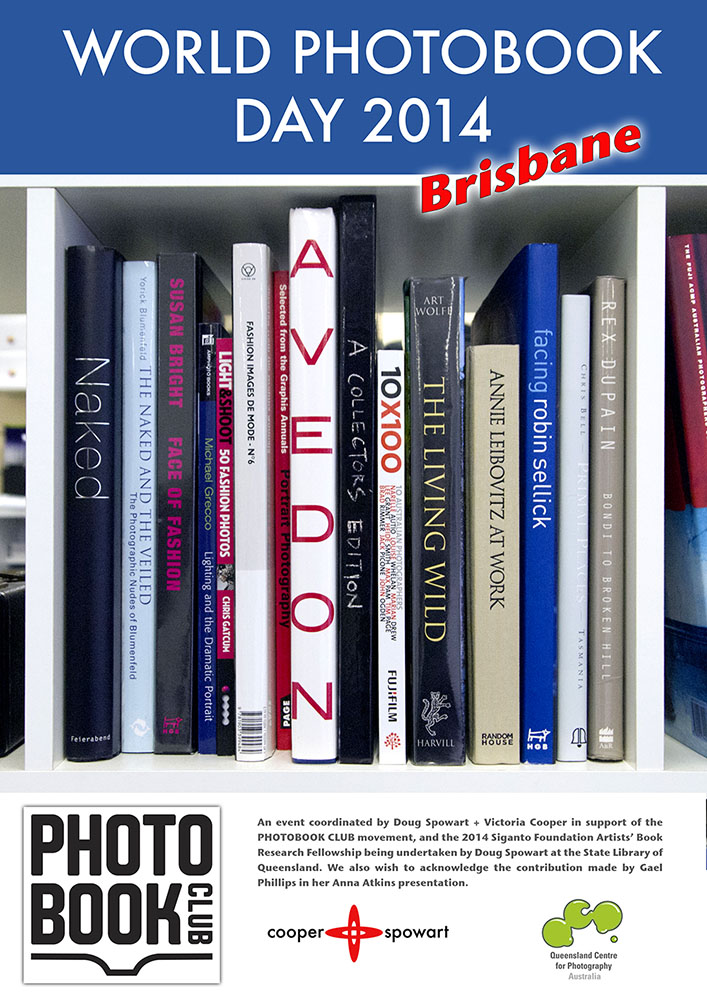
WORLD PHOTOBOOK DAY – The Photobook Club Brisbane events
WPD Poster
.
For photobook people the 14th of October is World Photobook Day (WPD) and celebrations worldwide are coordinated through the Photobook Club group. On this day in 1843, the British Library catalogued Photographs of British Algae: Cyanotype Impressions by Anna Atkins, and is therefore considered historically significant as the first official record of a published photobook. In 2013 Victoria Cooper and I organised an event in Toowoomba. This year as part of my Siganto Foundation Artists’ Book Research Fellowship we arranged two events to take place at The Edge facility that is part of the SLQ.
The QCP WPB event
.
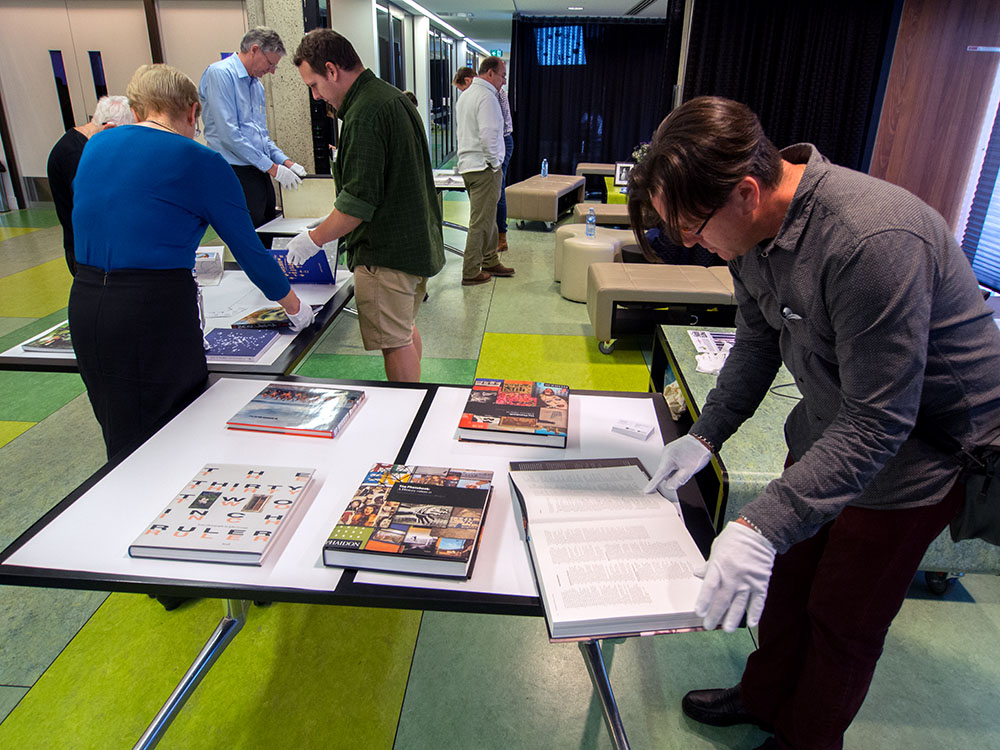
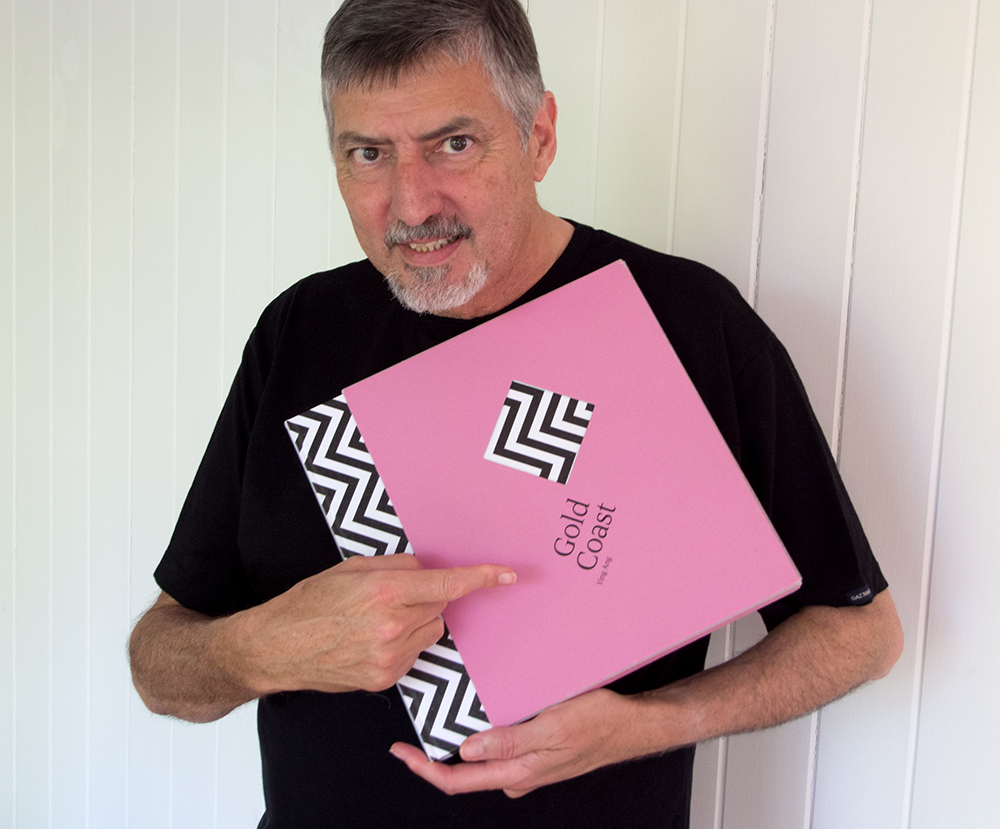
The first event was arranged for Queensland Centre for Photography members to view contemporary photobooks, artists’ books, photo-zines and photo-papers from our collection. Around 30 publications, mainly by Australian photographers and artists, were presented to a group of around 18 participants. This selection included two books, Ying Ang’s Gold Coast and John Elliott’s Ju Raku En, which were launched only in the last few weeks. Staff members from the Australian Library of Art attended this opportunity to view examples of this emergent book genre.
.
With Ying Ang’s Gold Coast
.
The main Photobook Club WPD event took place in the evening and was attended by around 24 participants. Each brought along their favourite photobook to share and discuss with their fellow attendees. The oldest book presented was a photographic portrait book from the 1860s, and the more recent books included, W Eugene Smith’s The BIG Book, Spada’s Gomorrah Girl, and Spottorno’s PIGS. Many participants contributed their own print on demand books, or bespoke handmade artists’ books thereby representing the spectrum of the photo and the book.
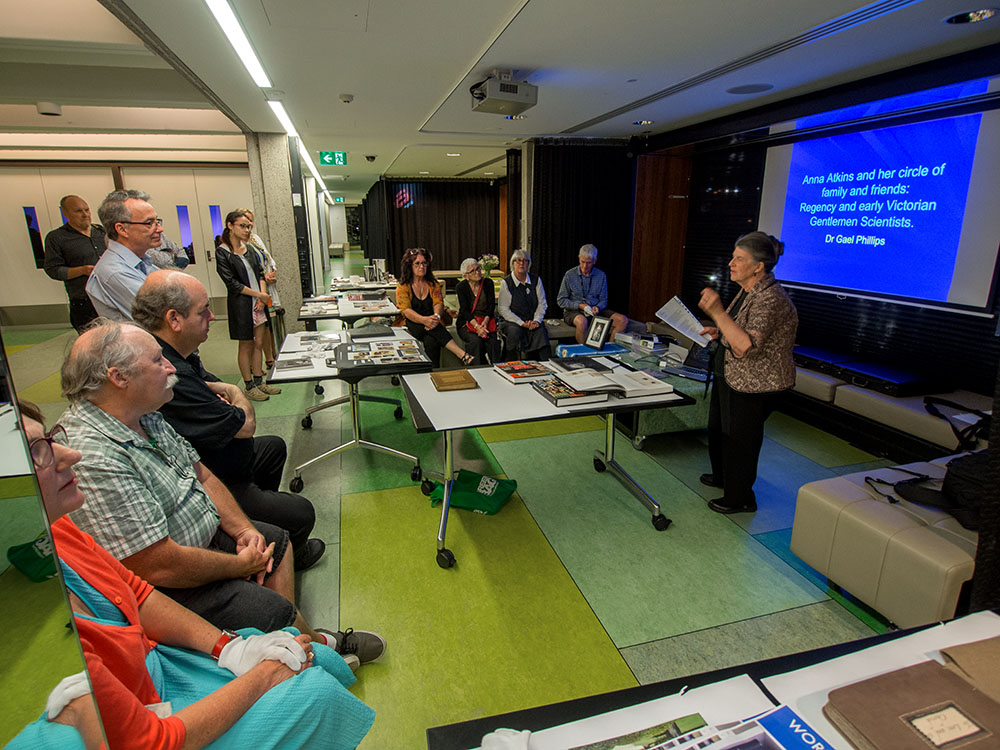
A special part of the evening WPD event was a presentation by Dr Gael E. Phillips about Anna Atkins, her family and motivations for her cyanotype work. Phillips, a local Brisbane resident, is a distant cousin of Atkins shared her extensive research of this significant family connection. The assembled group were presented with the fascinating story of Anna Atkins (‘Anna Children’ – her maiden name), her father – George, relatives and networks in photography, science and society in nineteenth century England. Two attendees Dr Marcel Saffier and Sandy Barrie both significant photo historians showed a strong interest in Phillip’s research and talk.
.
Gael makes her Anna Atkins presentation
.
Apart from the two events we curated this year, two new South-East Queensland organisers also presented WPD events. This provides evidence that there is a strong interest in seeing, talking about, publishing and collecting photobooks.
As part of my Fellowship activities I’m scheduling further events to keep the interest in his research growing, and to promote a greater awareness of the significant resource of ‘the photograph and the book’ held by the State Library of Queensland.
Keep in touch… Doug Spowart.
.
.
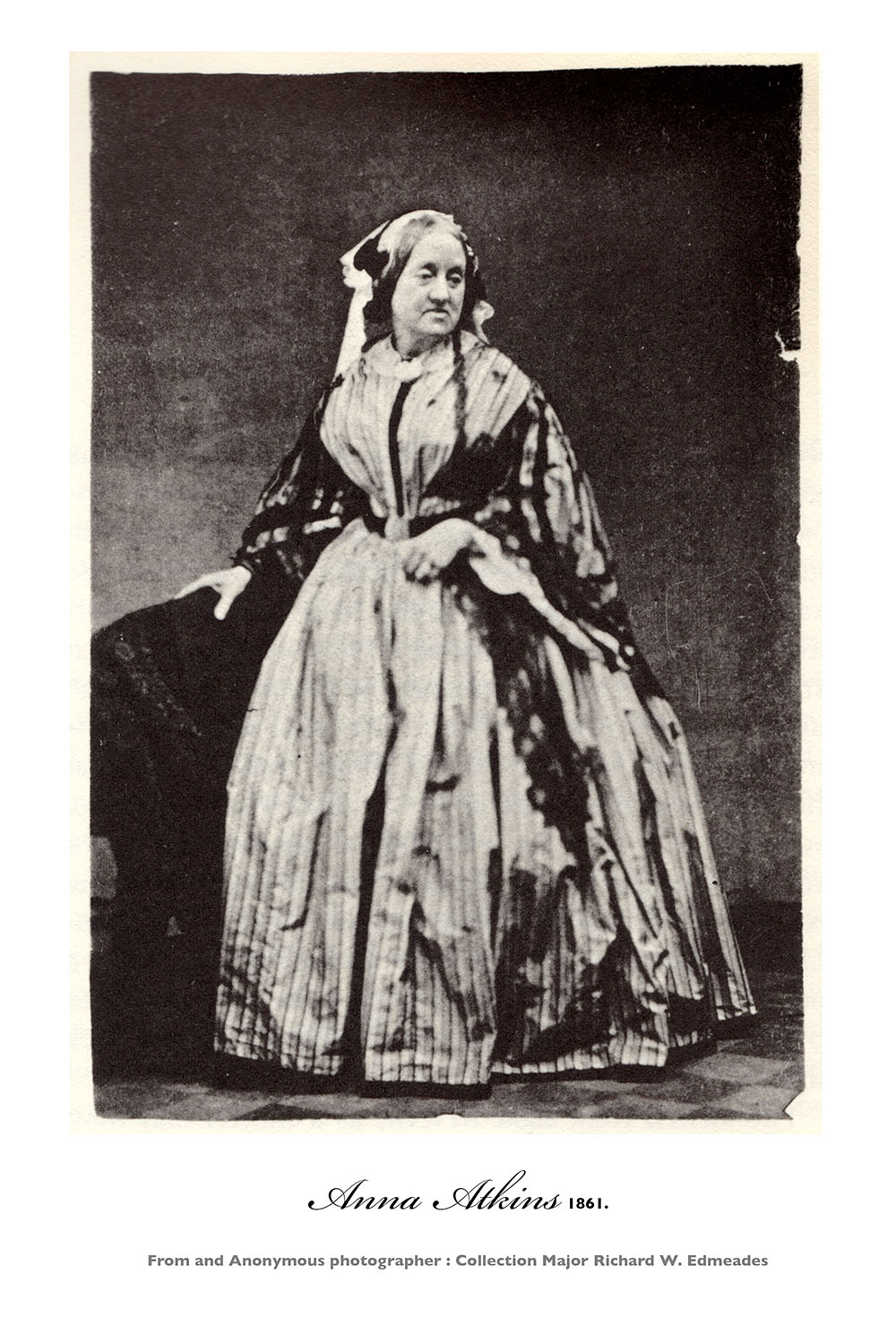
Anna Atkins-Portrait 1861
.
What follows is a precis of Dr Phillips’ presentation:
Anna Atkins (1799-1871) is now recognised as being the first person to publish a book using a photographic technique. This recognition has come late but is, I think, largely due to the work of Prof Larry Schaaf. My cousins, Jean Doggett, Elizabeth Parkes and I were also doing similar research at the same time because of a family link with the Children family. The Children family have been long established in Kent and trace their family back to Simon a Children in 1370.
Anna Atkins was born, Anna Children, her mother dying when she was a few months old, but she grew up in a wealthy household surrounded by family friends who included many of the great Gentlemen Scientists of the Regency period and later. These included Sir Humphry Davy, Dr W H Wollaston, Sir Joseph Banks, the Herschels and William Henry Fox Talbot. Her father, John George Children, was a well known scientist in the first half of the nineteenth century and his publications include descriptions of the largest electrical battery ever built, which he and his father constructed in their own laboratory at their home, Ferox Hall, in Tonbridge.
Following the failure of the Tonbridge Bank, George Children, Anna’s grandfather, was bankrupted. His properties were sold to pay the creditors of the bank. His son, John George Children, obtained a position at the British Museum, and appears in the painting of the Temporary Elgin Marble Room in 1819. Initially in the Antiquities Department, he later became the Keeper of Minerals and then the Keeper of Zoology.
Anna Children illustrated Lamarck’s ‘Genera of Shells’ which her father had translated. In 1825 Anna married John Pelly Atkins JP, and they made their home at Halstead Place. Mr Atkins was made High Sheriff of Kent for 1847.
In 1841 a Manual on British Algae was published. Anna used the Cyanotype process, newly invented by a close family friend, Sir John Herschel, to make numerous images of British seaweeds. The first volume appeared in 1843 and pre-dated William Henry Fox Talbot’s ‘Pencil of Nature’.
Anna’s father acted as an intermediary in her scientific endeavours, writing to Hooker at Kew Gardens about the progress of the imaging of the algae and Hooker, in turn, instructed Anna in botany. Her father’s chemical knowledge was invaluable in the production of the cyanotypes. Father and daughter had a very close relationship and when her father died on the first day of January 1852 she was grief stricken. Her Memoir of J G Children, privately published in 1853, was modestly signed AA, as were her volumes of cyanotypes of British seaweeds. The memoir includes poetry written by her grandfather, George, her father, John George and also poetry she herself wrote.
We celebrate the anniversary of the accessioning of the first of her volumes of cyanotypes into the Library of the British Museum. Anna Atkins, nee Children was an artist – she drew, she did lithography and was an author, writing poetry and the memoir of her father. She was also a scientific illustrator as well as being the first woman to produce a photo book and, many believe, the first woman photographer. She has no descendants but is memorialised in a beautiful mollusc, Anna Children’s lucine, Miltha childreni (Gray 1824). Her father is also memorialised in a number of animals, including molluscs and insects and the mineral Childrenite.
Gael E Phillips.
14 October 2014
.
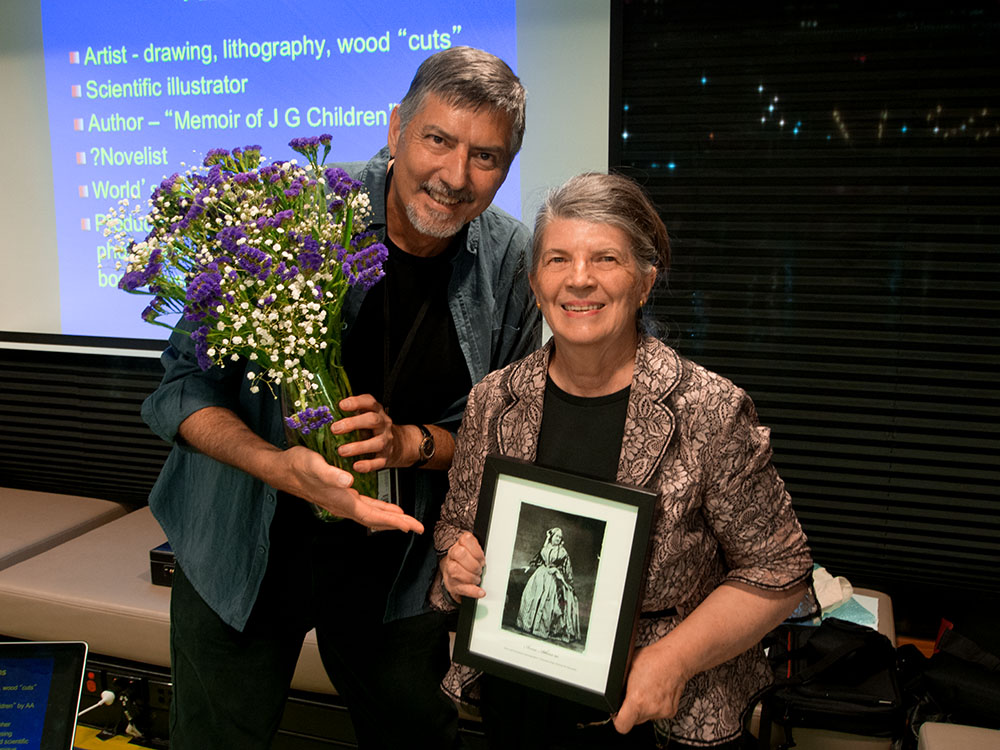
Doug makes a thankyou presentation to Gael
.
.
Other images from the events…
.
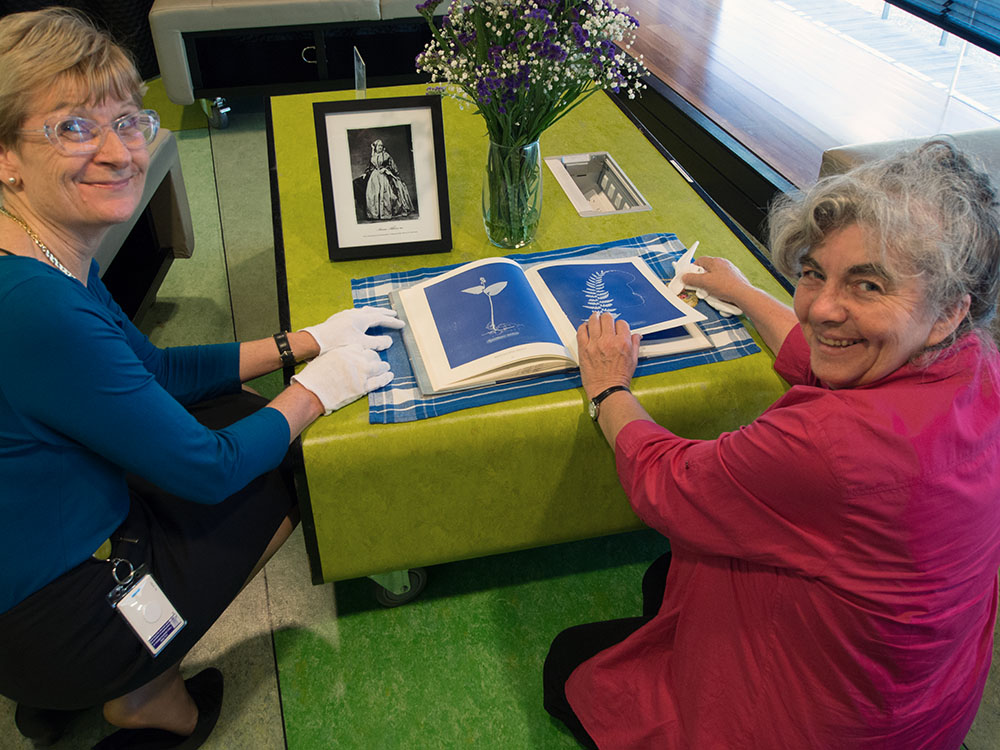
The Anna Atkins ‘memorial’ with Larry J Schaaf’s book Sun Gardens
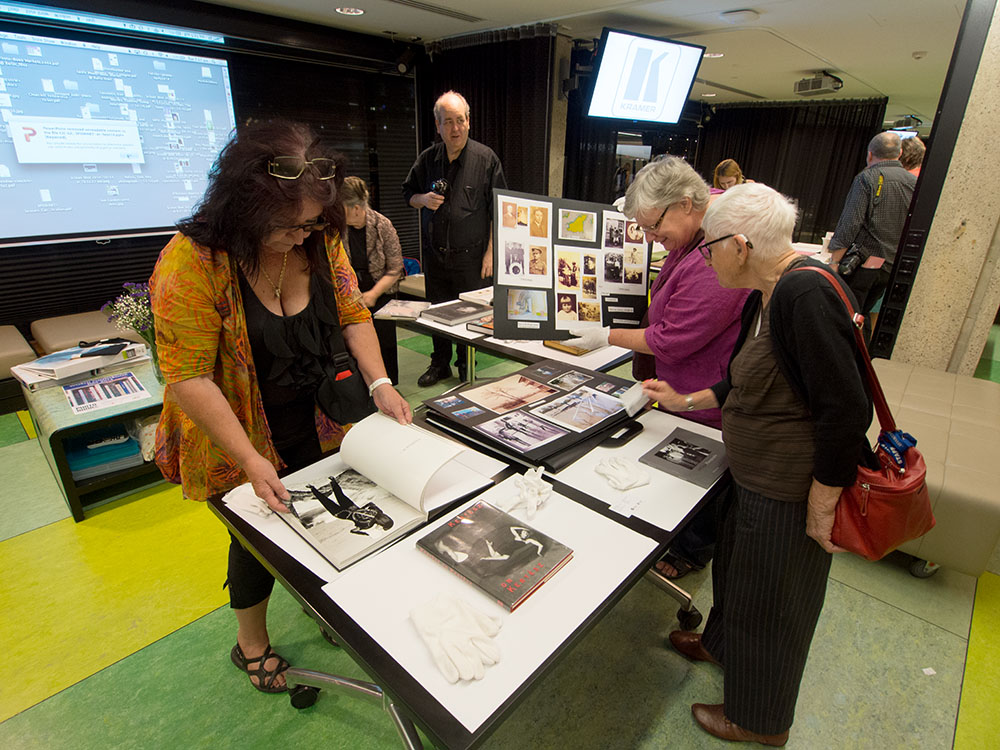
Looking at the books brought to the event
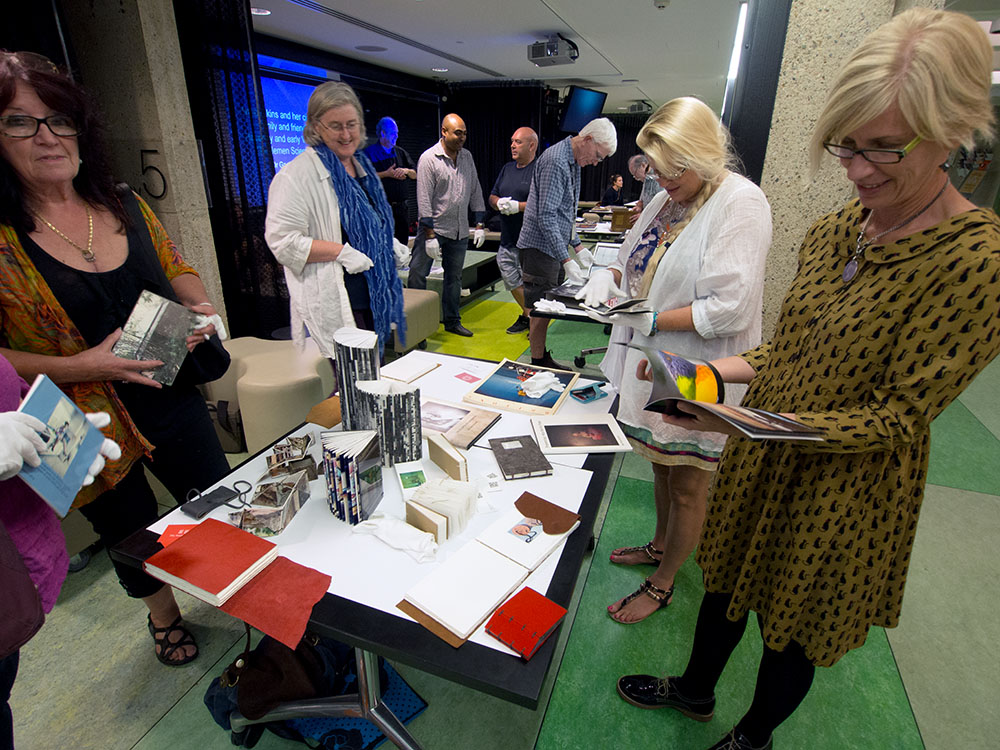
The artists’ photobook end of the books brought along by Adele Outeridge, Mel Brackstone and Jan Ramsay
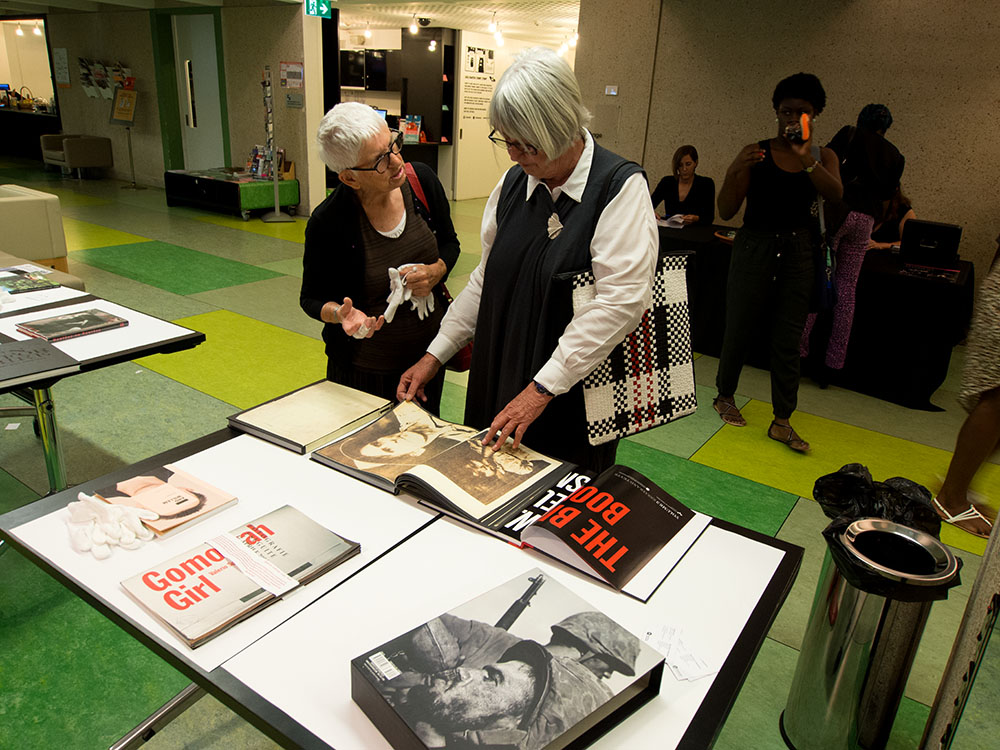
Looking at W Eugene Smith’s BIG BOOK.
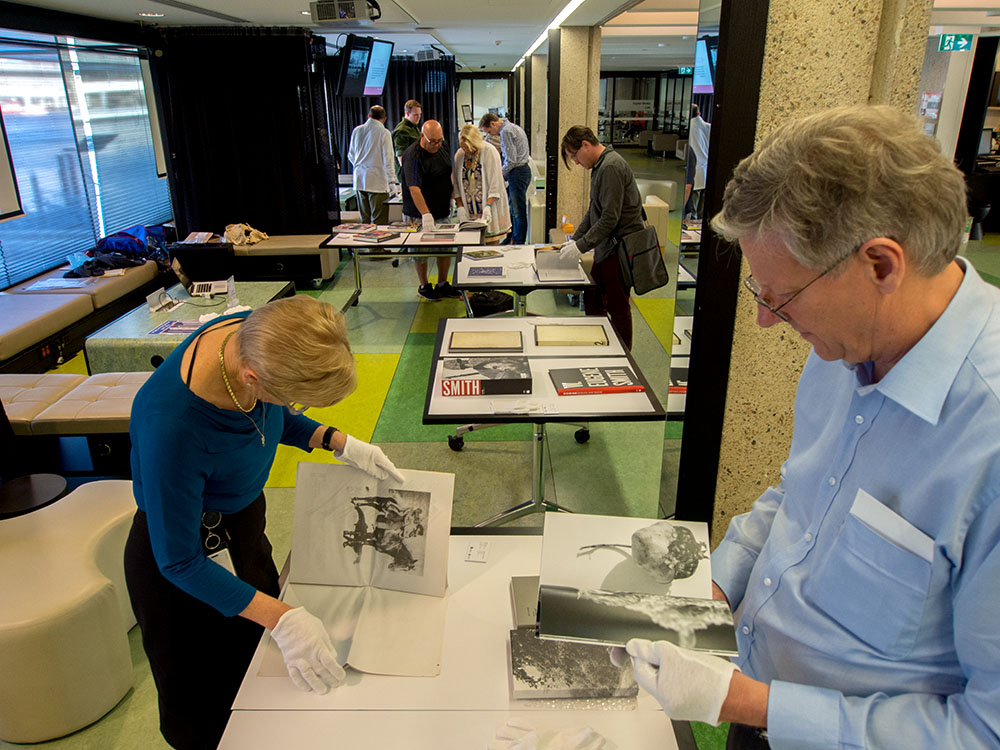
Checking out Jacob Raupatch’s newspaper
FOTO FRENZY’S WPD Event
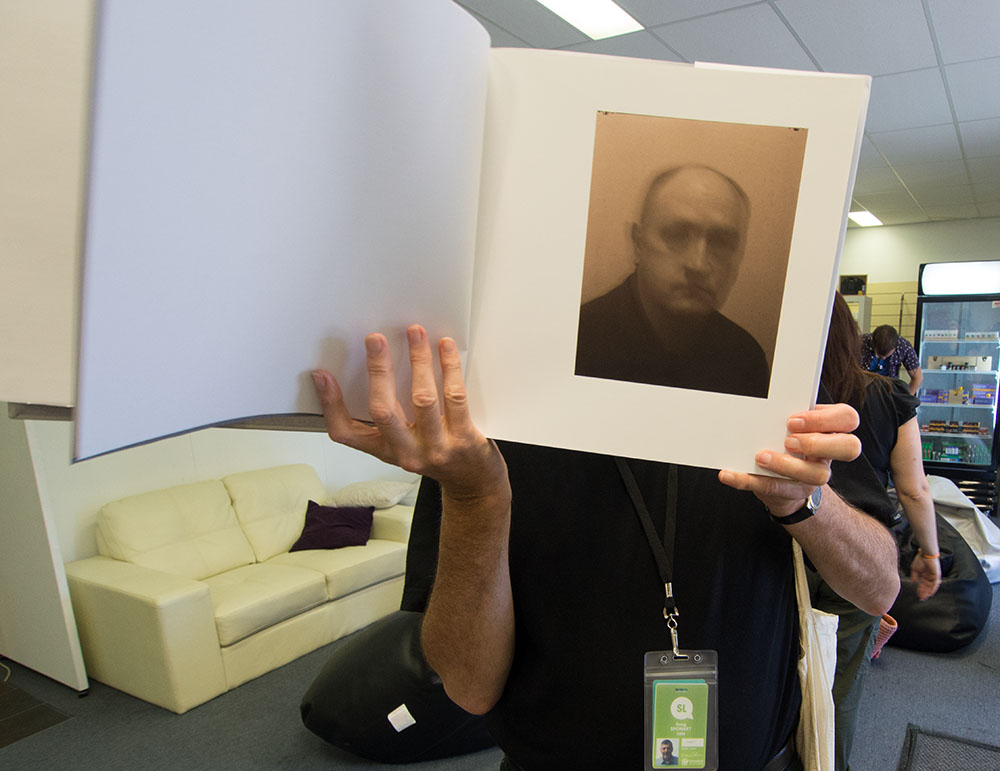
With Doc Ross’ book 37 @ the Foto Frenzy WPD event
Ian Poole @ the Foto Frenzy WPD event
@ the Foto Frenzy WPD event
.
Until next year….
.

PBC logo
.
BEING [photo]BOOKED @ QLD COLLEGE OF ART
Heather introduces Doug’s lecture…
.
Last week we were guest presenters at the Queensland College of Art on the Gold Coast. We worked with photo media and digital media students and their lecturer Heather Faulkner discussing the topic of the contemporary photobook.
.
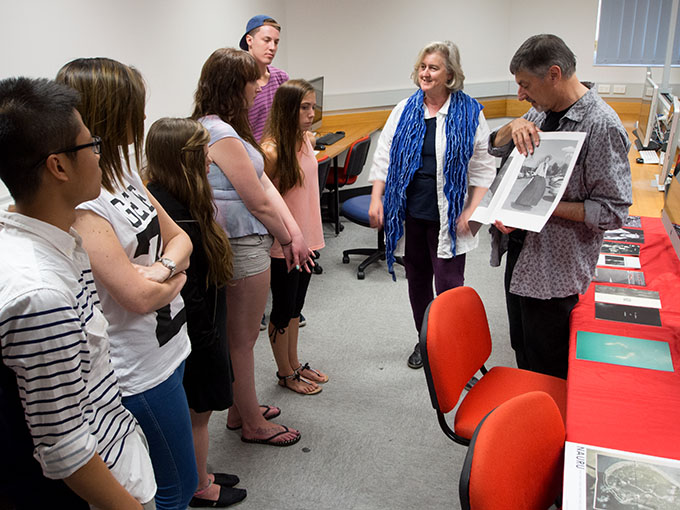
Victoria Cooper and Doug Spowart talking about photobooks….PHOTO: Heather Faulkner
.
Doug presented a lecture on the history of the photobook and brought students up to date with the contemporary photobook including Ying Ang’s latest book ‘Gold Coast’. Students then were given an opportunity to hold, handle and view a range of contemporary photobooks from Australia and overseas including books by, Alec Soth and Brad Zellar, Martin Parr, Garry Trinh, Daniel Milnor, George Voulgaropoulos, Jacob Raupach, Lloyd Stubber, Emma Phillips, Kelvin Skewes, Joachim Schmid, James Mollison, Paul Graham, Gracia and Louise as well as a selection of zines from the Sticky Institute. We also presented a selection of our own photobooks and artists’ books. Of particular interest to the students was the structure, construction, printing and binding of photobooks.
.
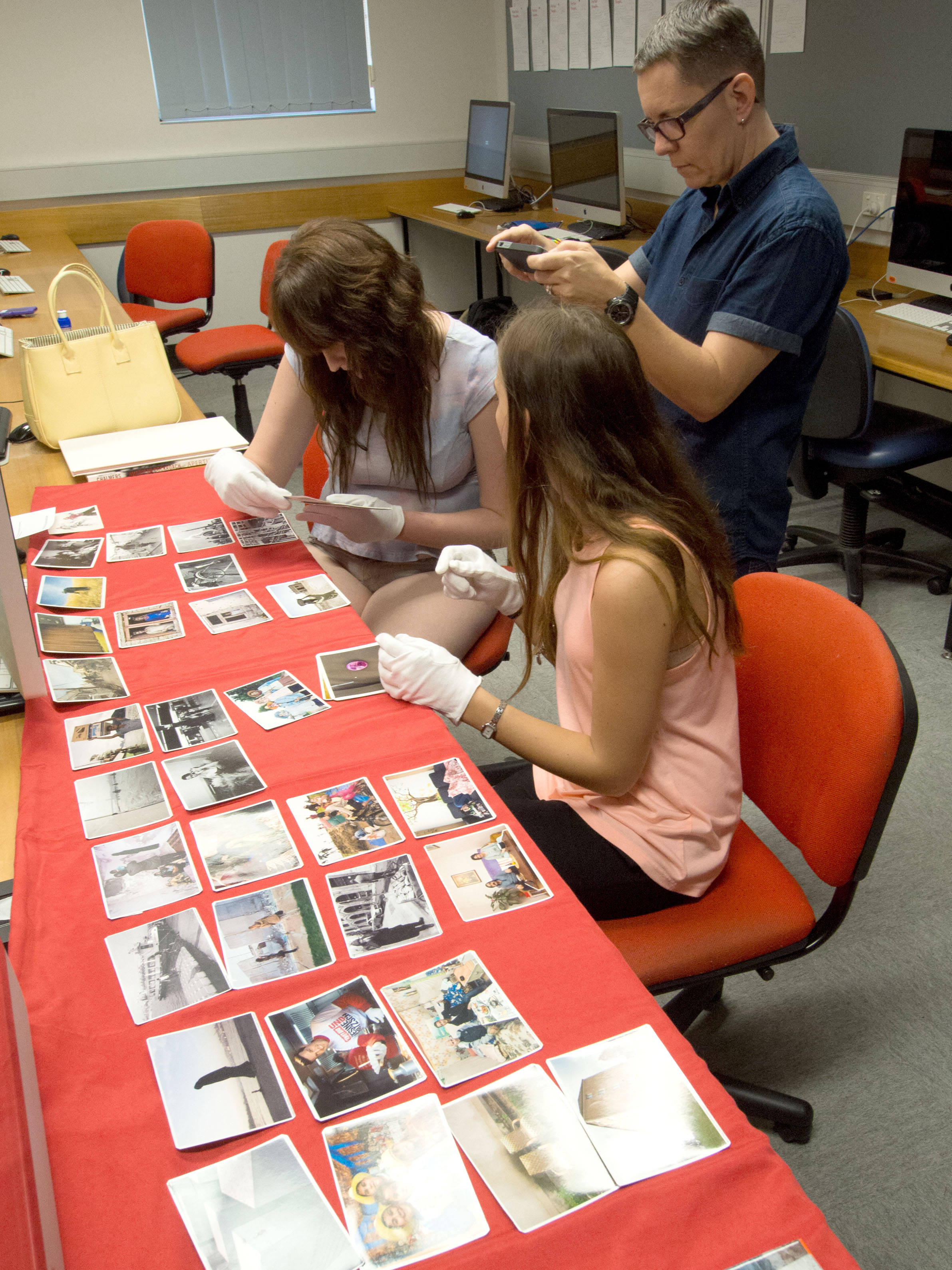
Students working on a sequencing task with Heather Faulkner
An important part of an accompanying tutorial covered ideas around the sequencing of images in photobooks and the ways in which narrative could be expressed. Students were then tasked to work with a series of images using unusual sequencing strategies that we suggested.
.
We enjoyed the opportunity to engage with these students and discuss one of our favourite topics and share amazing books from our photobook library. Thank you Heather Faulkner for arranging this event…
.
.
.
.
COOPER+SPOWART EXHIBITION: Speaking About Place
.

Speaking About Place gallery layout
Speaking About Place: the Nocturne Project
Victoria Cooper & Doug Spowart
Cam Robertson Gallery, Toowoomba Regional Art Gallery, 19 July – 17 August 2014
Our arts practice is informed by our ongoing and evolving connection with Place. Our Place-Projects are influenced by the context and the consequences of living within a constantly changing landscape. We work with a range of photographic concepts and techniques, from the camera obscura, through analogue processes to the digital forms of the medium. Our work is presented as visual narratives in artists’ books, photobooks, exhibition images and, more recently, blogs and social media.
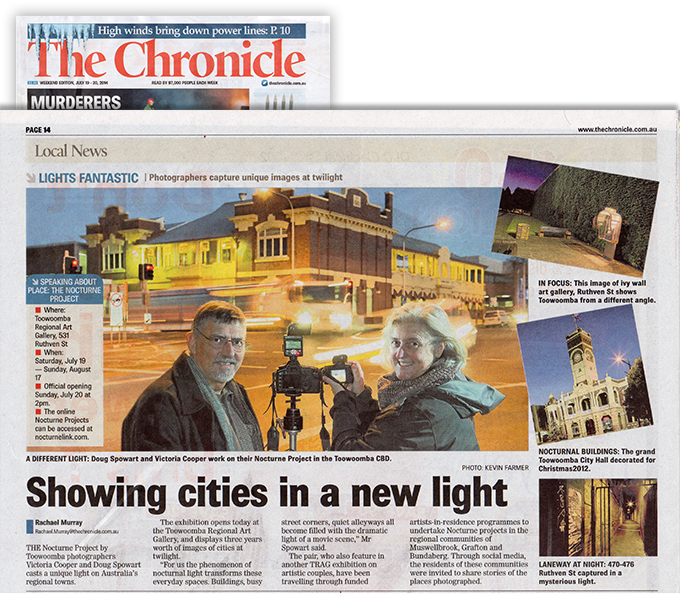
Through our Nocturne documentary photography and Facebook social media projects, we have explored connections with Place in urban and regional communities throughout Queensland, New South Wales and Victoria. For us the phenomenon of nocturnal light transforms these everyday spaces. Buildings, busy street corners, quiet alleyways all become filled with the dramatic light of a movie scene. In 2013 and 2014 we were given the opportunity, through funded Artists-in-Residence (AIR) programmes, to undertake Nocturne projects in the regional communities of Muswellbrook, Grafton and Bundaberg.
In this exhibition we present a selection of images from three years of our Nocturne Projects. The work shown here adds to the recent Childers Art Gallery exhibition of this project, by the inclusion of social media elements. Therefore in this gallery we invite viewers to connect with the work in a forum outside the virtual space of Facebook. To enable this connection to take place we have created folios that contain transcripts of Facebook/Place/Storytelling from each of the three AIRs.
.
About the photographs
We photograph in the early evening nocturnal light, a time of day where the afterglow of sunset and the glow of streetlights transform the everyday experience of place for the viewer. Images created at this time require long camera exposures and therefore produce photographs that can capture blurred movement of people and vehicles. Another important aspect of the Nocturne aesthetic is the effect of colour and the juxtaposition of coloured lights in the different situations of ambient daylight, artificial lighting, car head and taillights.
.
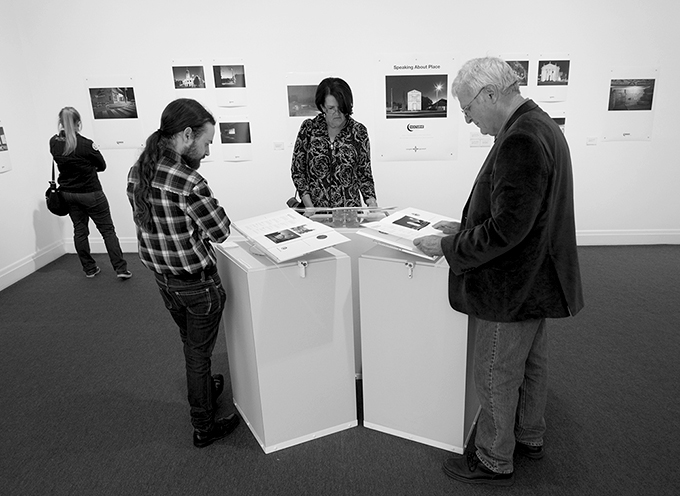
Exhibition viewers reading Facebook responses
.
More than photographs
The photographs in themselves have no intrinsic meaning – it is the viewer, with their experience and memory that brings life to the image. In this moment of connection they may recount a personal narrative or connect with the historical significance of the place. This collaboration between photograph and viewer is exciting and vibrant – expanding the potential for the documentary image to go beyond the vision of the photographer.
As the Nocturne project has evolved, we have discovered the importance of sharing place stories through images, words, in person and online. Through Speaking about Place we have extended the potential for this project to share the transformative nature of lived experience and everyday life in each community.
The Western Downs town of Miles is scheduled for a social media Nocturne project later this year.
.
CLICK HERE To download a PDF of some of the Facebook narratives Catalogue-Comments-interact-FP3
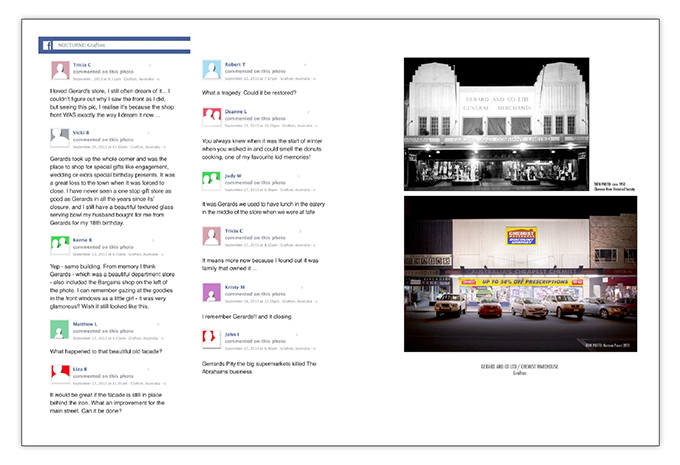
Community comments about the photographs on Facebook
The online Nocturne Projects can be accessed at http://nocturnelink.com
.
Link to The Toowoomba Chronicle online news story:
http://www.thechronicle.com.au/news/showing-cities-in-a-new-light/2323064/
.
A selection of images from the opening and associated events
.
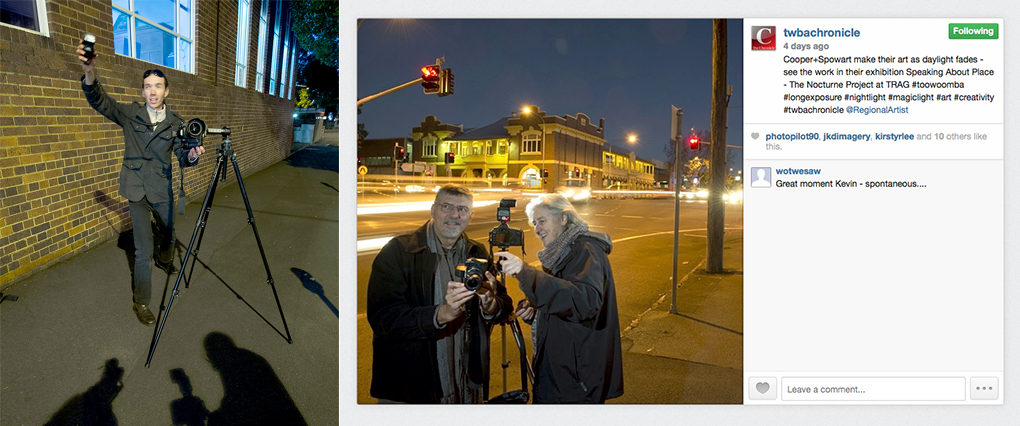
Toowoomba Chronicle photographer Kevin Farmer gets a Nocturne reverse-photo with us – From The Chronicle Instagram feed
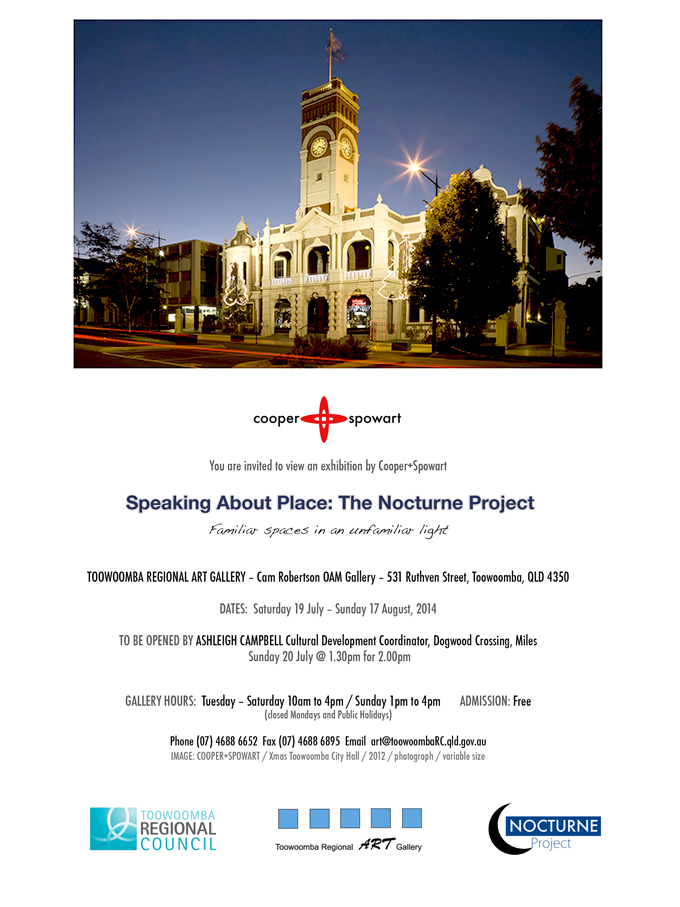
Exhibition invitation featuring the Toowoomba Town Hall Xmas 2012
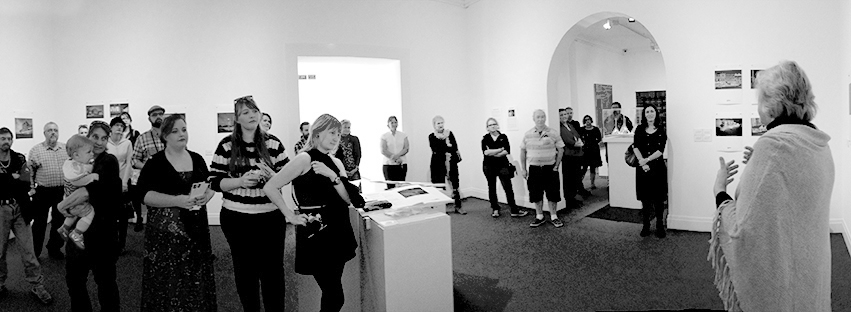
The opening of ‘Speaking About Place by Ashleigh Campbell
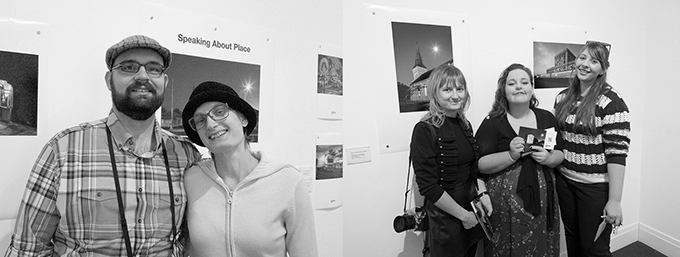
Some attendees at the opening
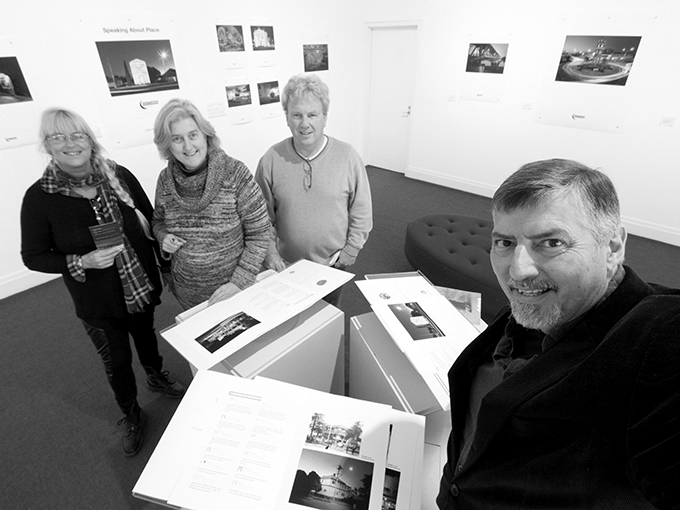
Maureen Trainor and Kevin Scattergood visit the show
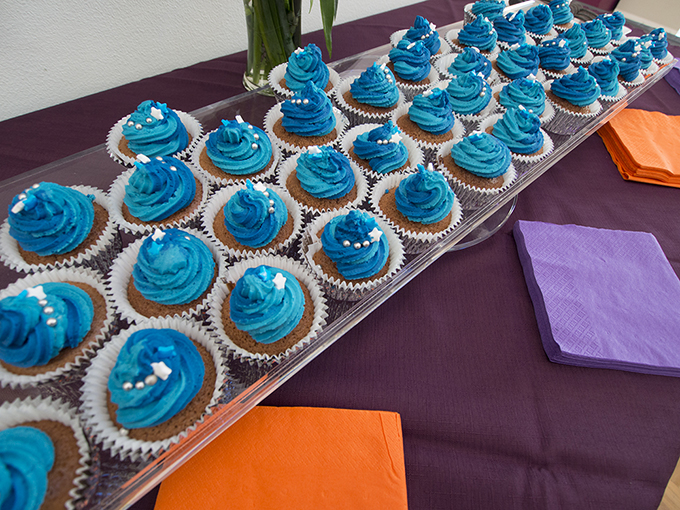
Jess Martin’s Nocturne Cup Cakes…
.
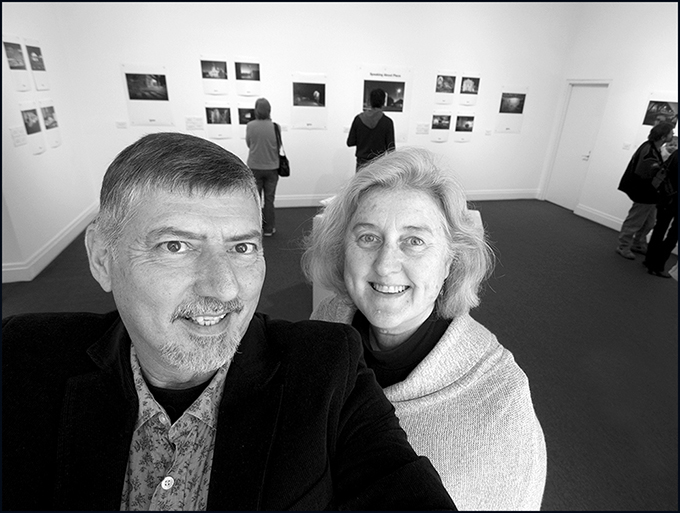
.
Visit http://nocturnelink.com to connect with our Nocturne Projects
..
.
.
.
Installation photos and documentation of the artworks and text ©Doug Spowart
Instagram photo and news story © The Toowoomba Chronicle and Kevin Farmer
.

My photographs and words are licensed under a Creative Commons Attribution-NonCommercial-NoDerivs 3.0 Unported License.
http://creativecommons.org/licenses/by-nc-sa/2.5/au/
.
.
MEMORY COLLECTIVE: Super Moon + Phoenix
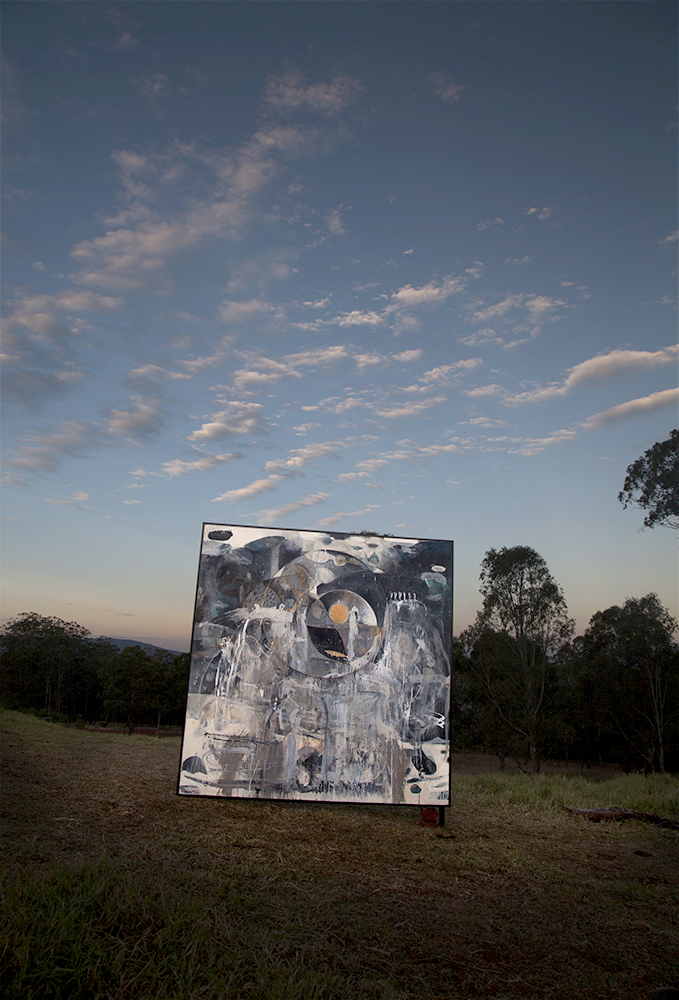
Eighteen months ago Toowoomba artist Damien Kamholtz began a project that was to bring together a team of local artists to participate in a conceptual artwork that would have many states and private and public iterations. The first public presentation of the The Memory Collective was at the Toowoomba Regional Art Gallery in August/September 2013.
.
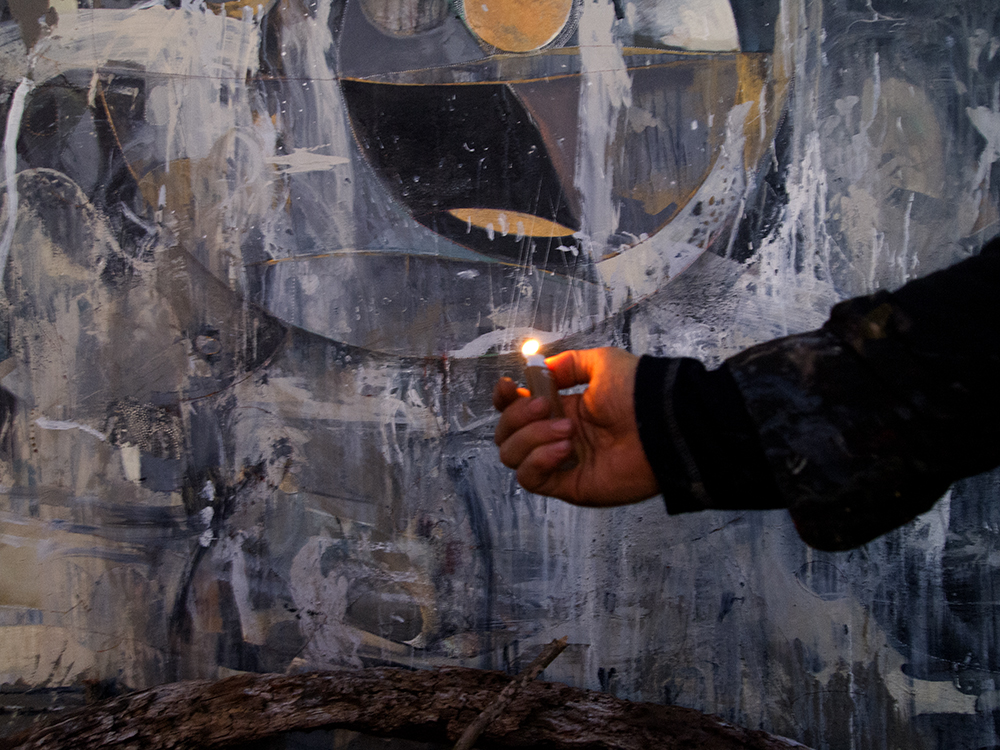
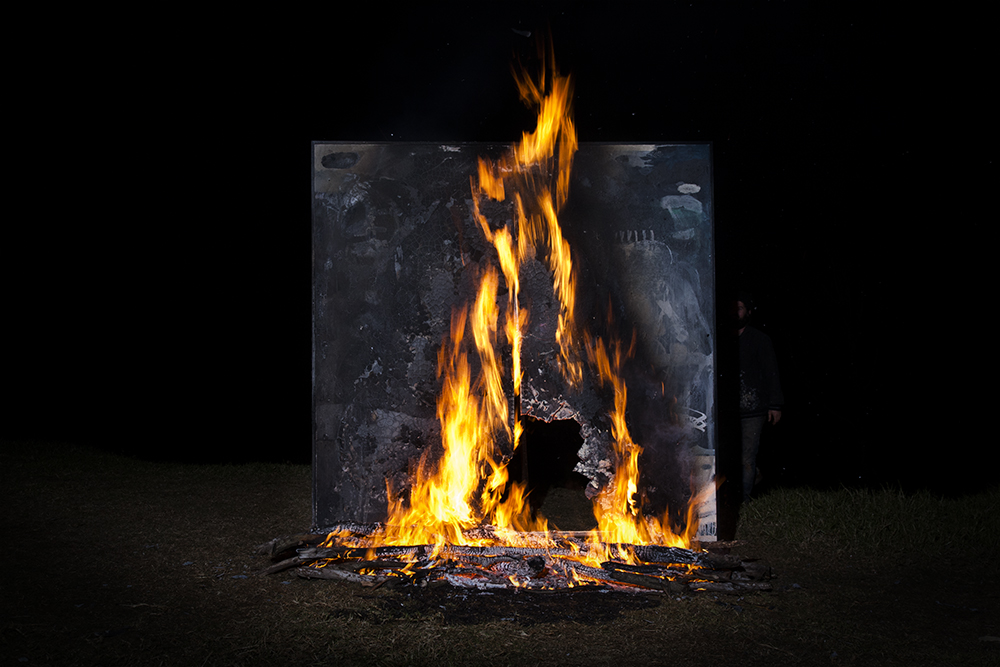
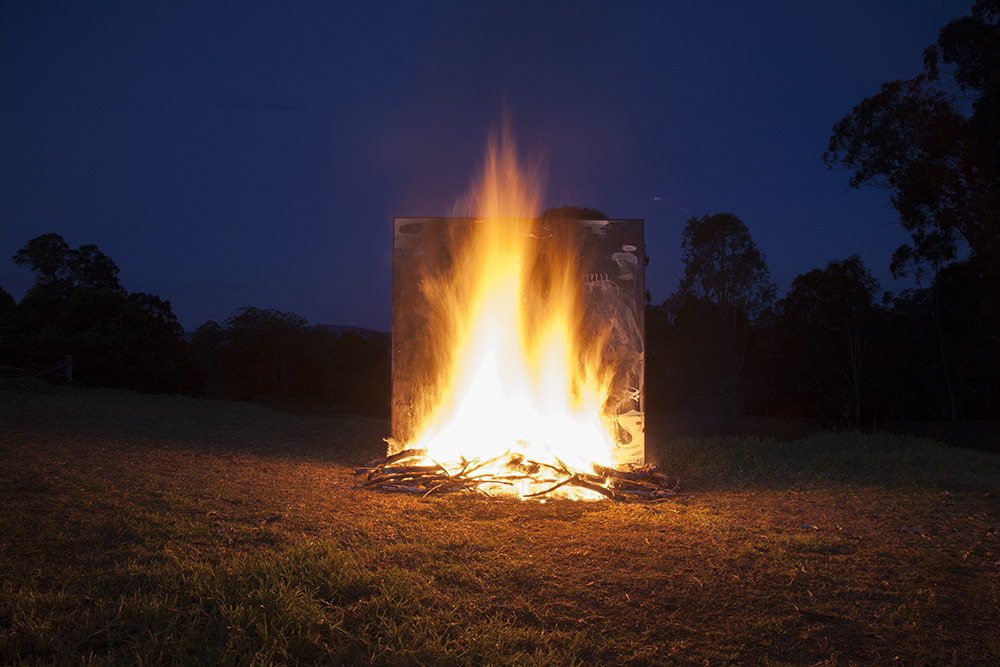
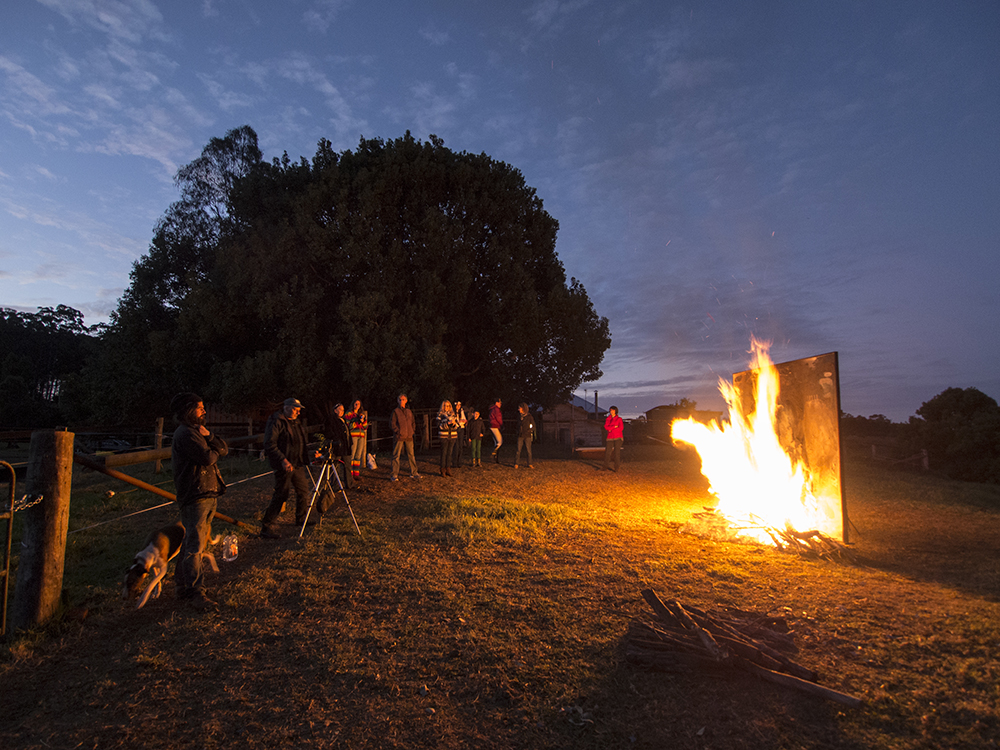
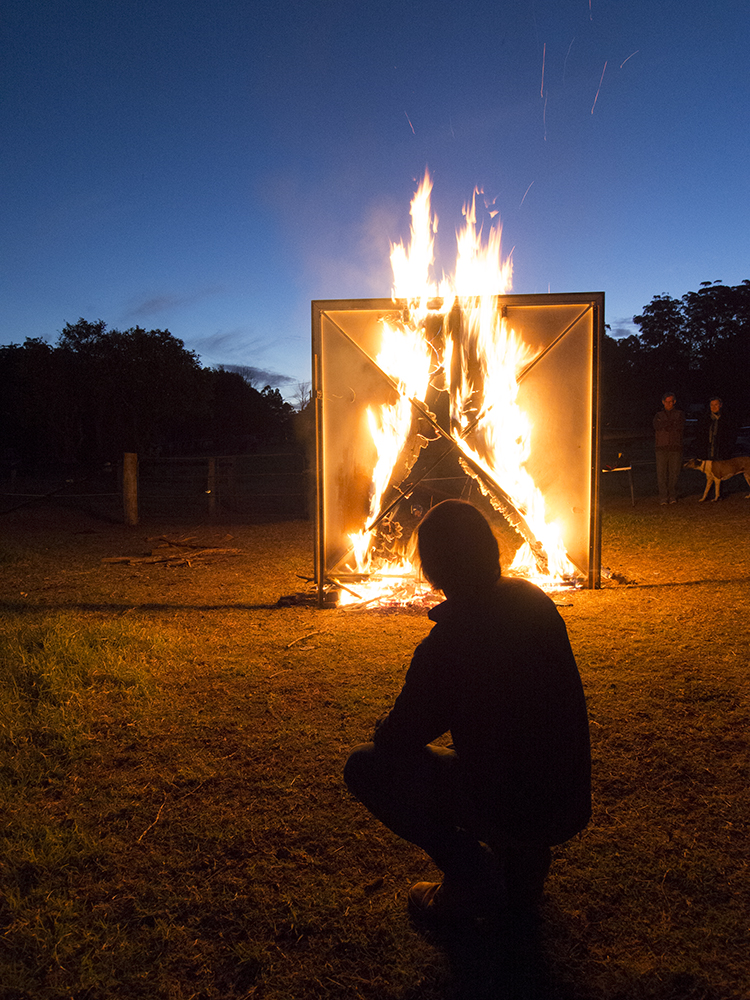
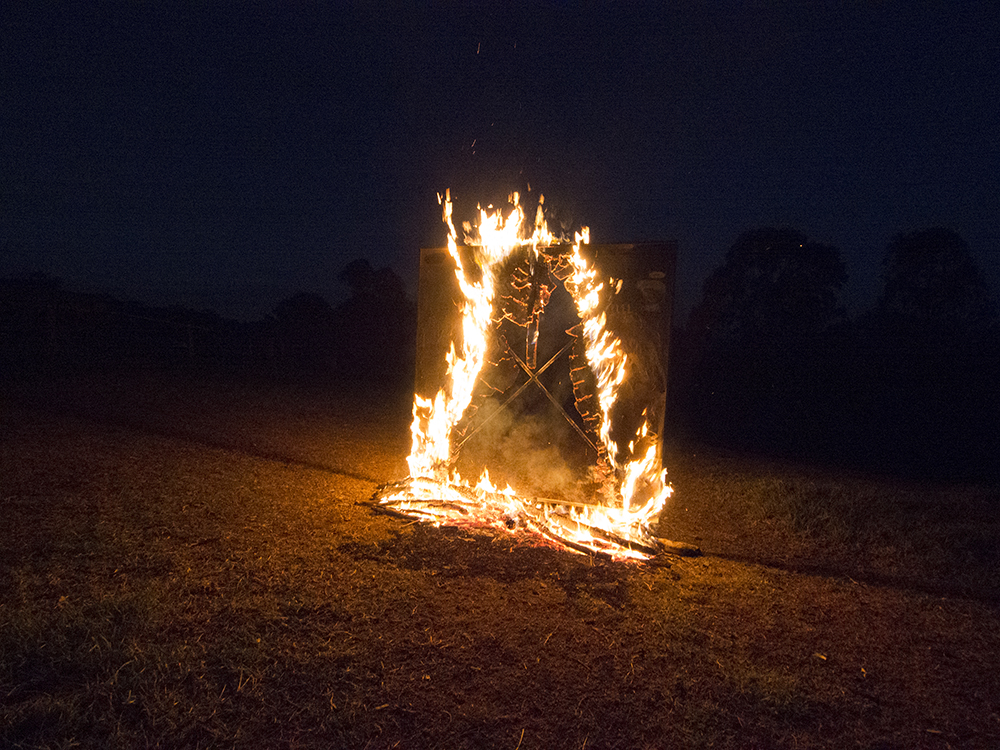
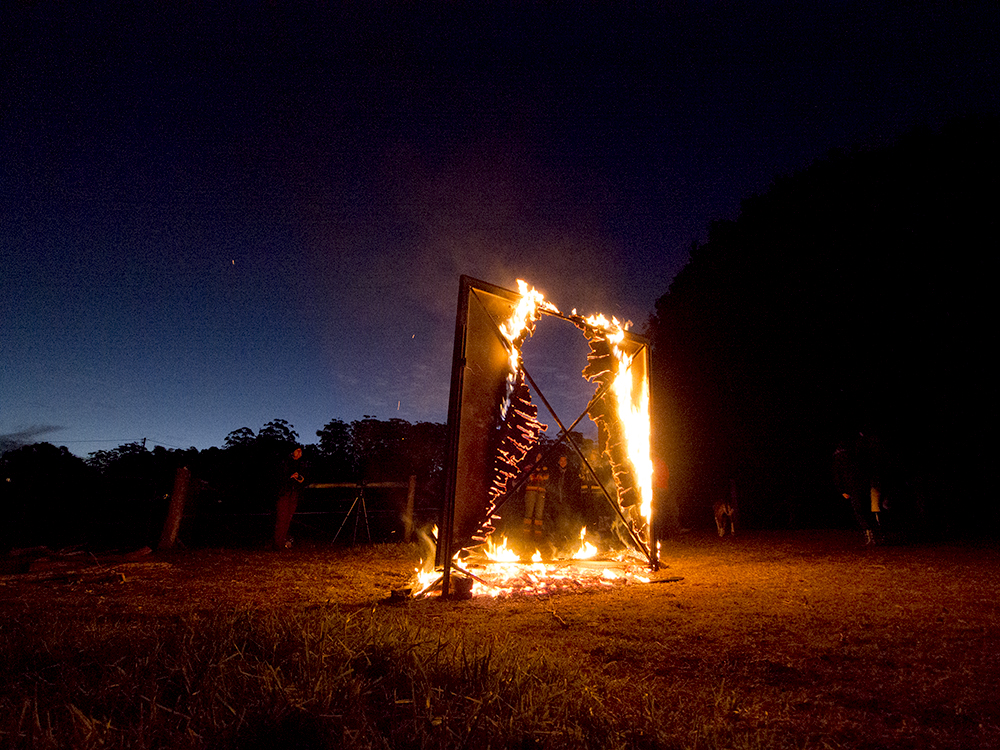
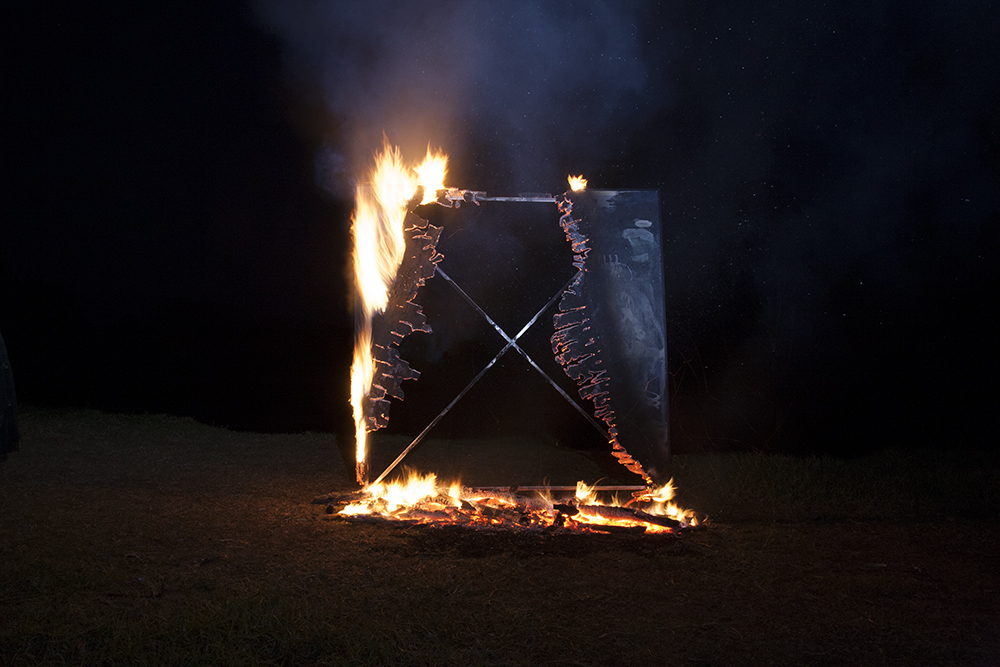
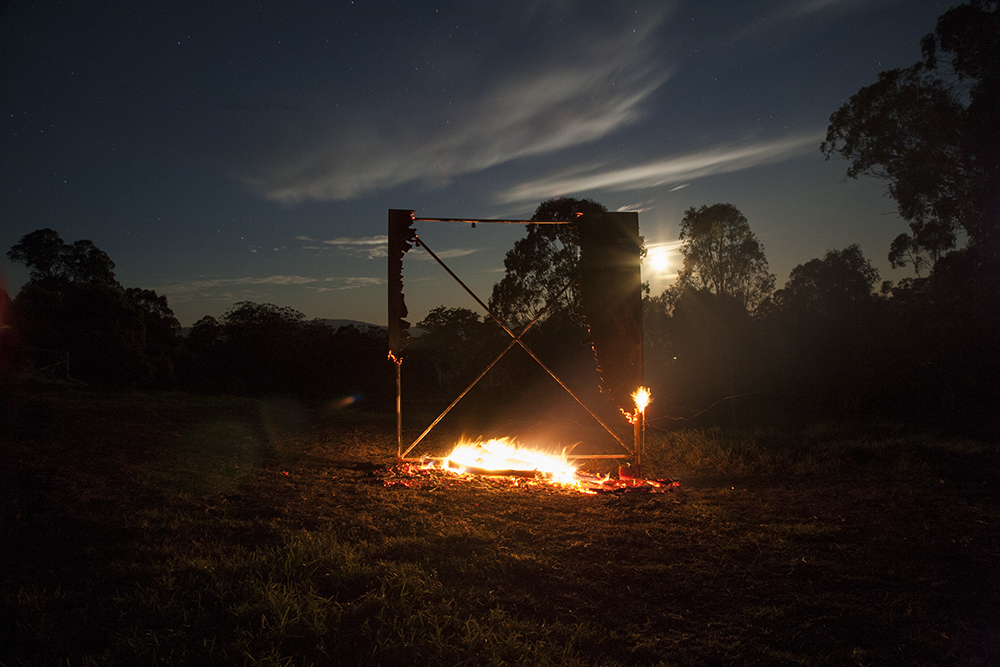
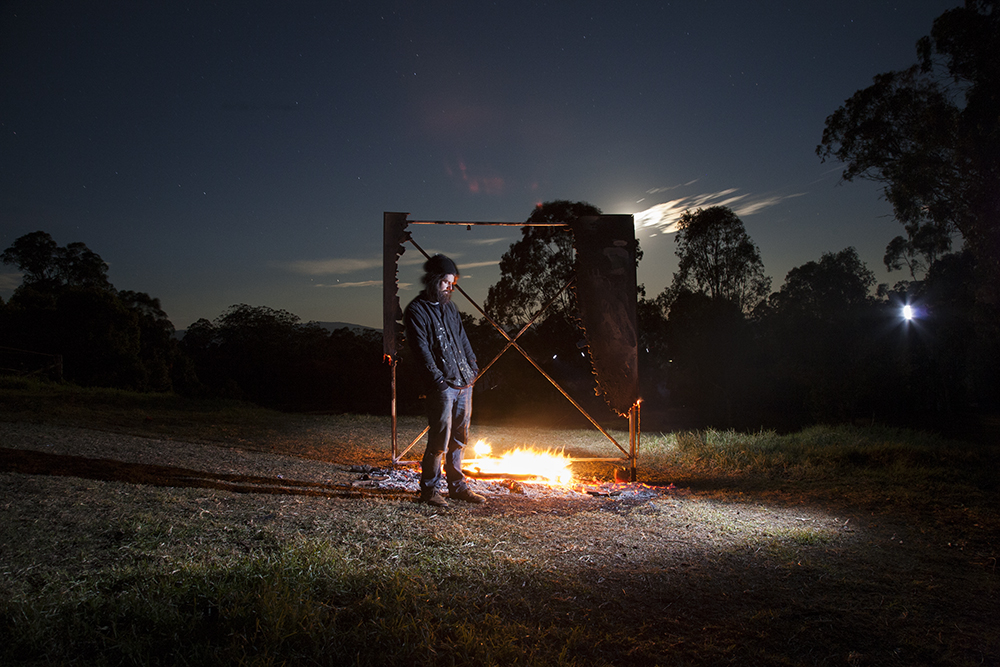
Two weeks ago a key element of The Memory Collective project was altered yet again into a new state. This took place near Cabarlah at a symbolic time for Kamholtz, the recent super moon…
.
Here is part of the document made on that July evening.
.
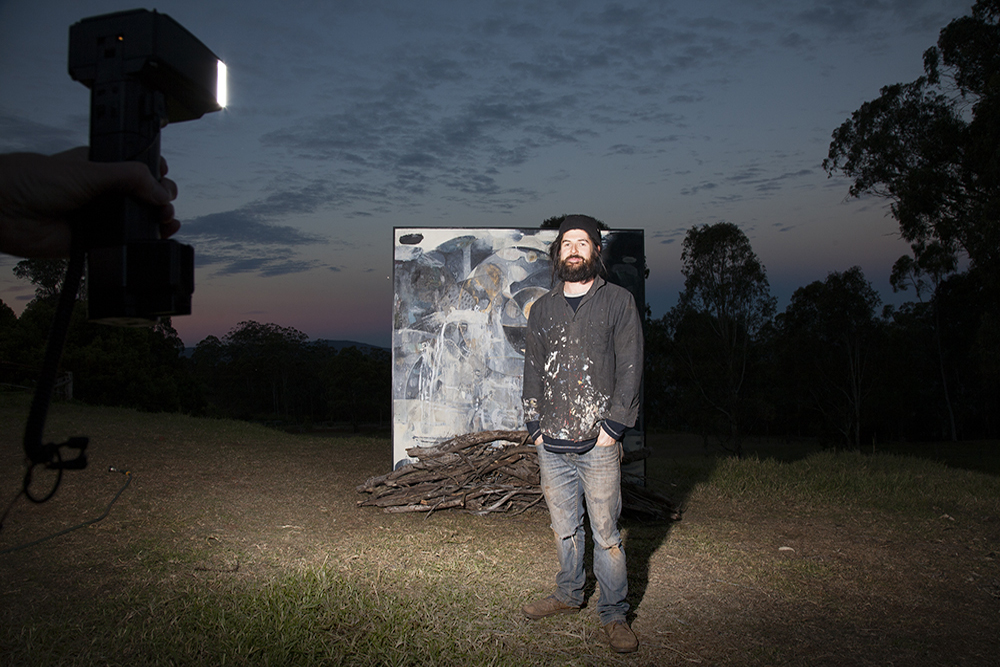
Damien Kamholtz before the burning Photo: Cooper+Spowart
.
.
.
.
.
 .
.
.
.
.
..
.
.
.
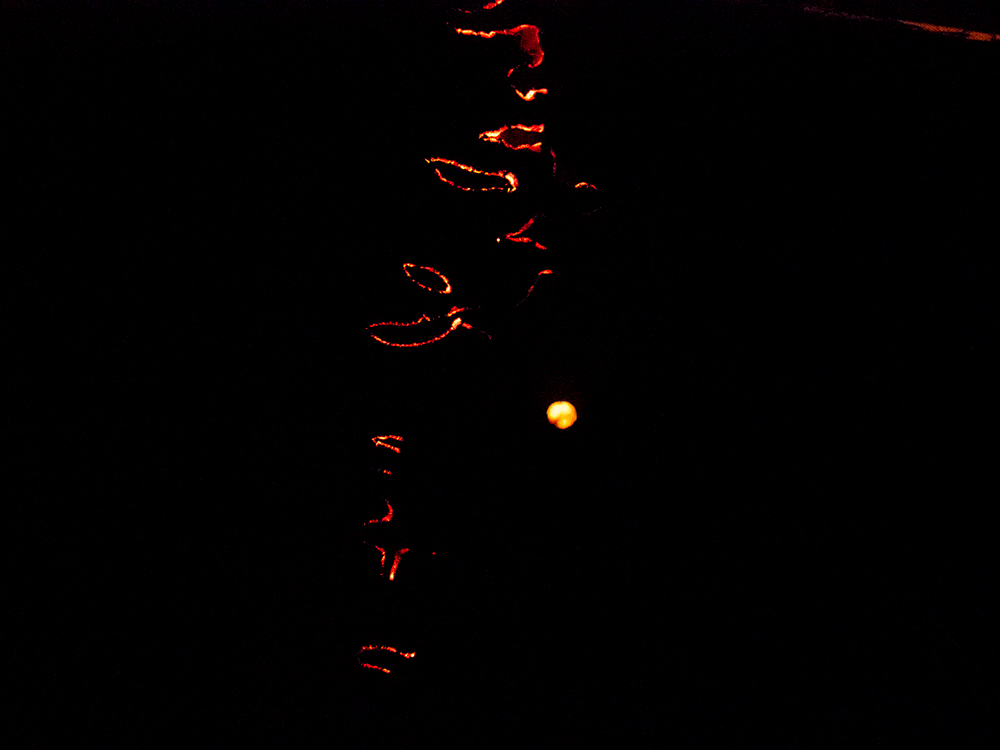
The super-moon rising and the embers of the phoenix rising
.
.
Aftermath of the fire
.
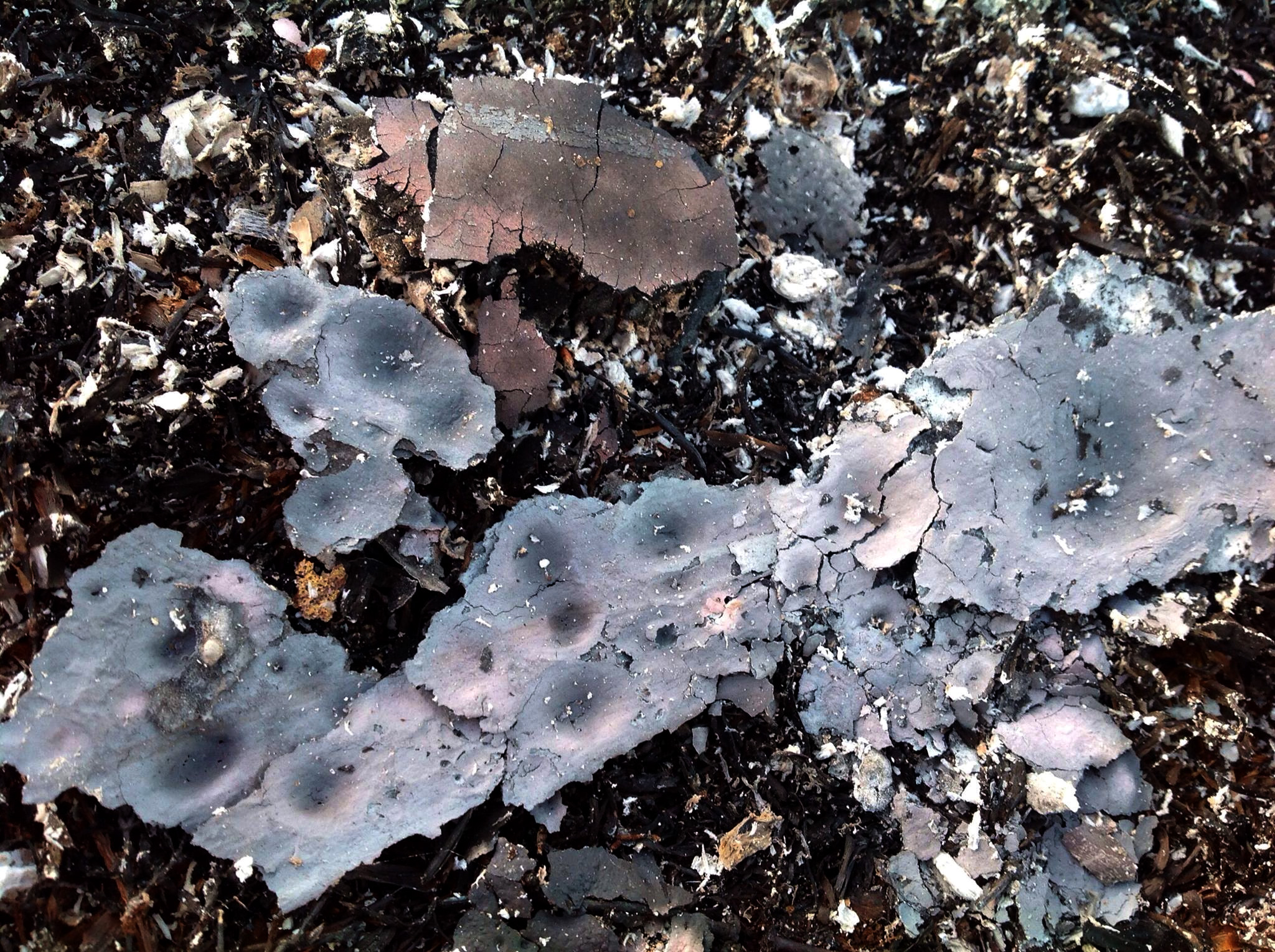
Aftermath: ashes of the painting the next morning. Photo: Damien Kamholtz
…. this is not an ending for the Memory Collective…
.
THE BACKSTORY OF THE MEMORY COLLECTION
.
An exhibition of the collaborative artwork as a singlarity
.
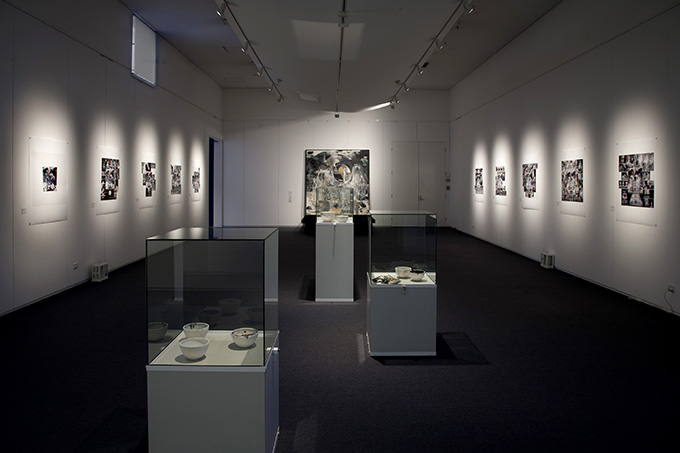
Memory Collective image from the exhibition @ Toowoomba Regional
.
A painting and a performance
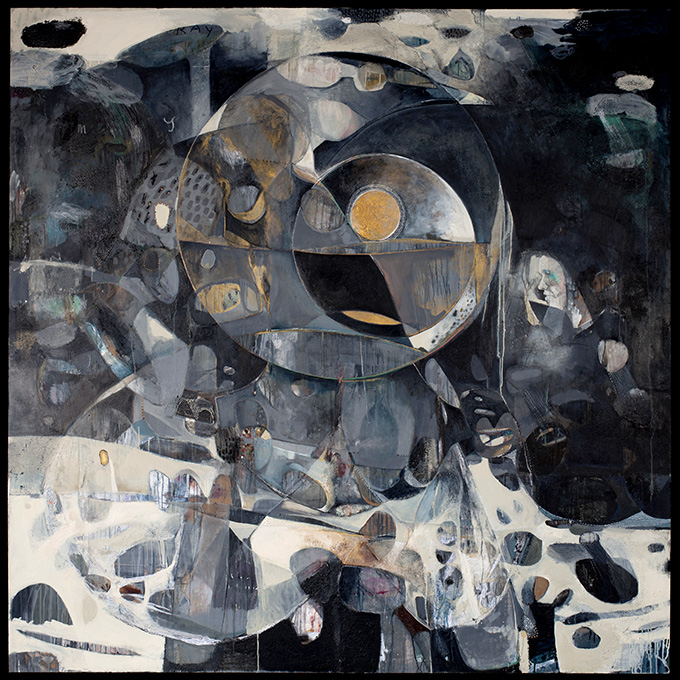
The Memory Collective painting by Damien Kamholtz
.
The Memory Collective is a multi-disciplinary collaboration orchestrated by artist Damien Kamholtz. Kamholtz states: The Memory Collective Project is a creative collaboration between 12 artists across eight artistic disciplines exploring concepts and themes relating to the human condition such as change, constants, history, refection and memory. The artworks created during the project will make up an exhibition to be held at the Toowoomba Regional Art Gallery in September 2013.
There are different stages to the project. First Kamholtz created a large 2.2 metre square painting, while sculptor, Jessie Wright constructed the large vessel to hold the water. Kamholtz’s painting is embedded with personal meaning in the form of fragments of his past art, the ashes of diaries. In the presence of this artwork we are drawn into a poetic landscape where faces emerge; symbols and totems slip from passive dark spaces and come into conscious awareness.
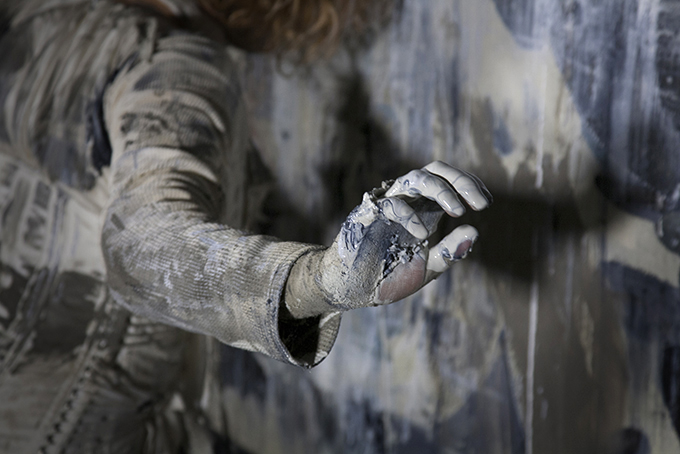
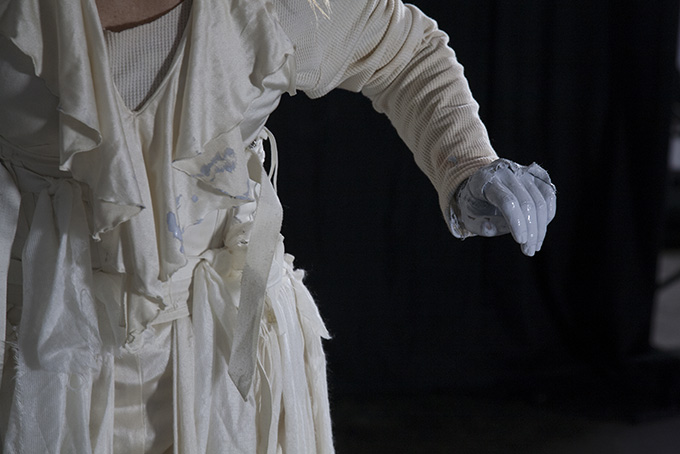
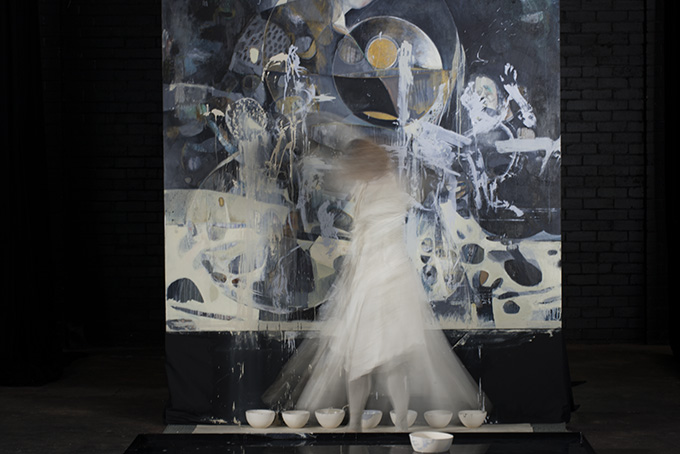
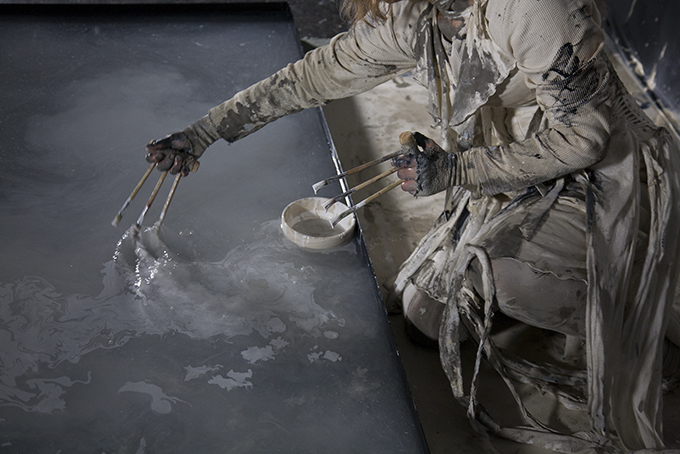
The second stage of the work was the performance in the form of 9 responses to the painting by Kristy Lee. The painting and the pool created the reflective and reflexive performative space and the transformative process of the original painting then began. Integral to the space were David Usher’s delicate pots; these vessels contained the pallet of shades that then shrouded and clouded the memory of the work. Over the course of the day the painting’s physical form was transformed into something different loosing its current visual form as only a memory.
Our part of the collaboration was to witness, respond and record the transformation of the work over the day. The next stage of the Memory Collective’s work will continue over the next month our component will be to create 9 large collaged photograph memory states of the work for the show in September. Works by others include; a video art piece, a documentary video, a soundscape, interviews, prose and poems. It is a significant project and is being funded by the RADF and supported through the exhibition at the Toowoomba Regional Art Gallery.
.
A fragment of photographic memories made by us for the MEMORY COLLECTIVE…
.
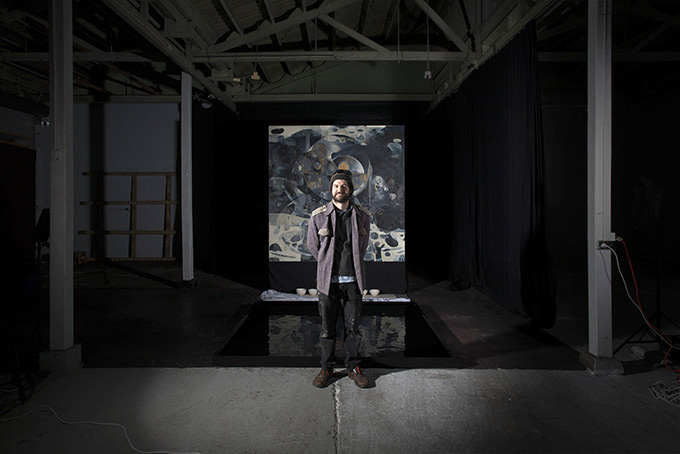
Damien Kamholtz in the performance space with the painting and pool
.
.
A performance
..

Kirsty Lee and painting – in the early state…
…
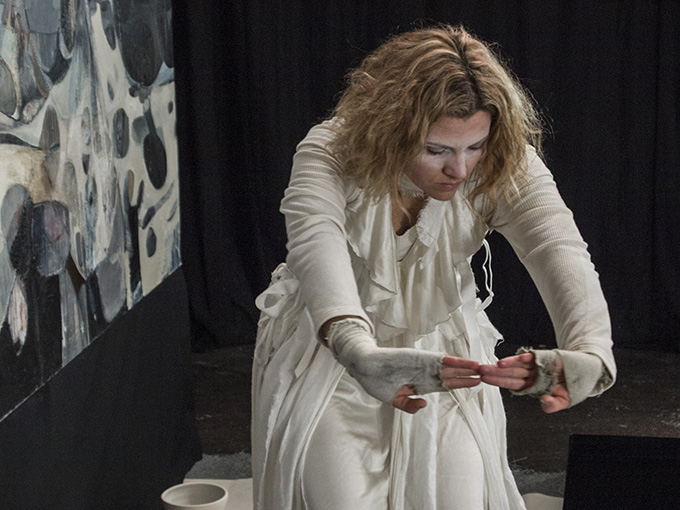
Kirsty Lee performs before the painting
.
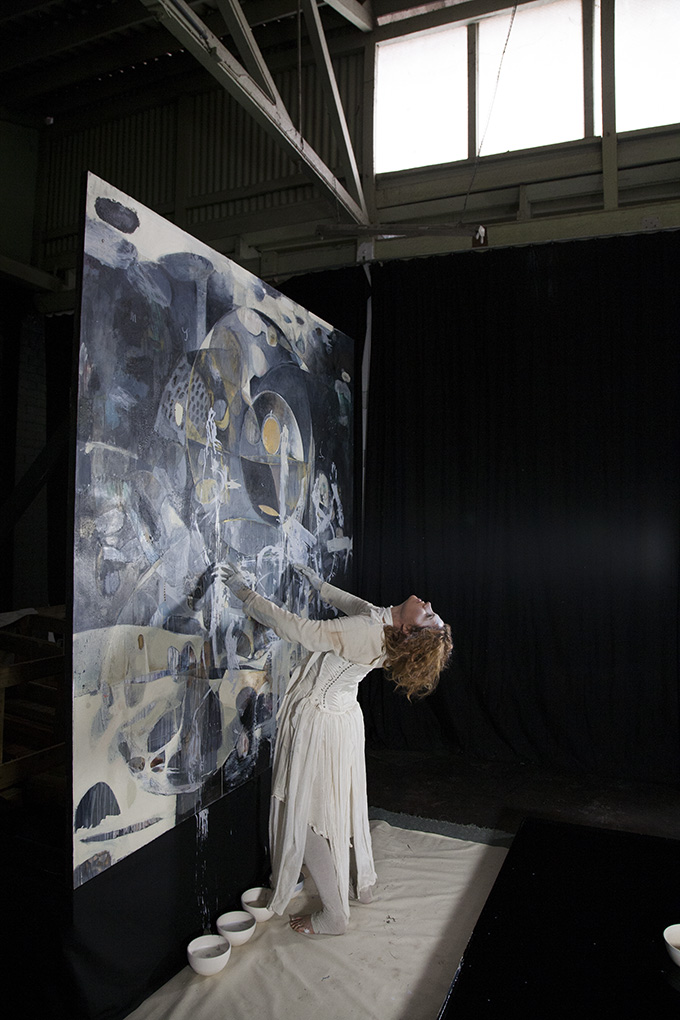
State 3 Kirsty applies paint to the paining…
.
Hand paint
.

Kirsty Lee and her interaction with the painting … around Stage 6
.
Blue hand…
.
Kirsty Lee in a frenetic stage…
.
Kirsty Lee and brushes before the pool
.
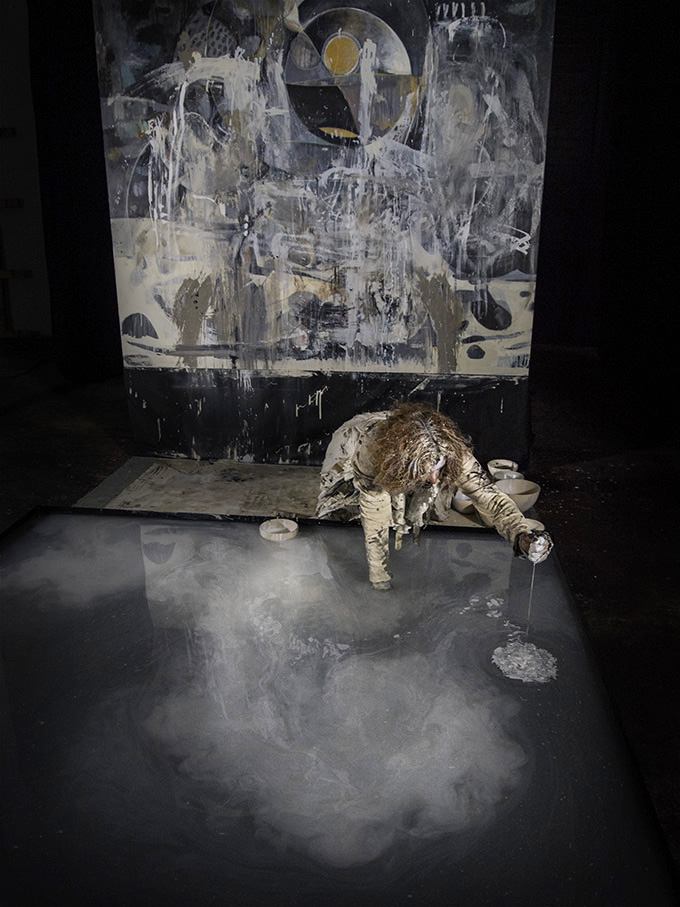
Paint fluid in the pool…
.

Towards the final state…
.
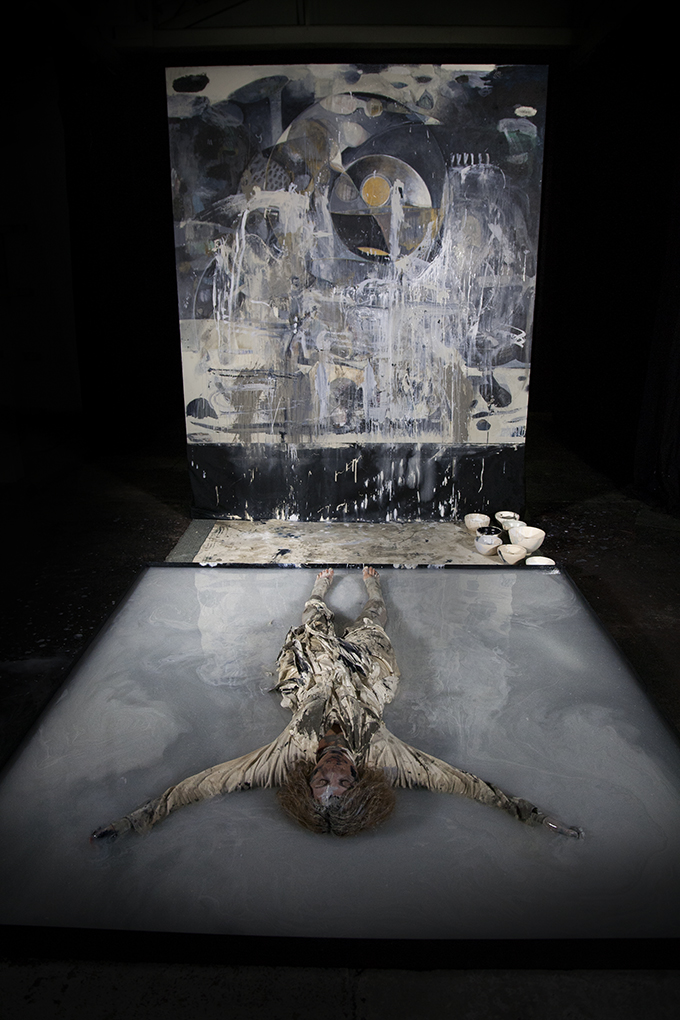
The final state …
…
.
 .
.
.
Additional material
/.

Damien discussing movement with Kirsty
.
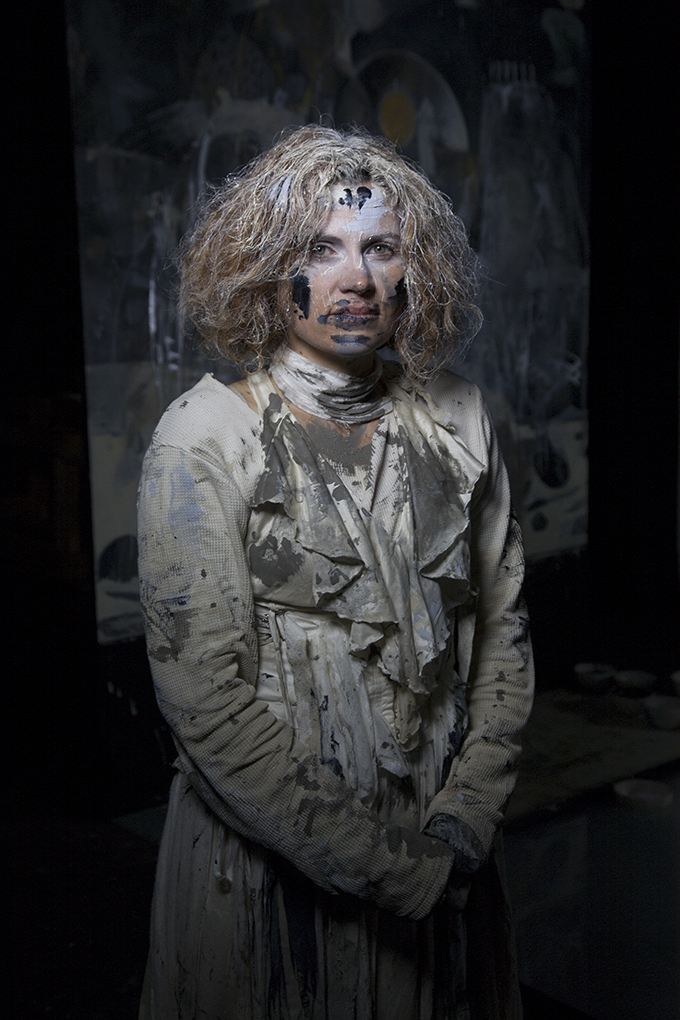
Kirsty Lee towards the end of the performance
.
Another creative work from the performance by Jason Nash…
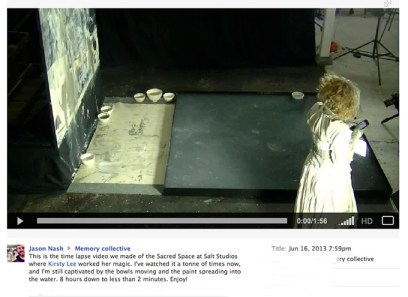
Jason Nash – Time lapse video
CLICK HERE to see Jason Nash’s ‘Memory Collective’ time-lapse video
.
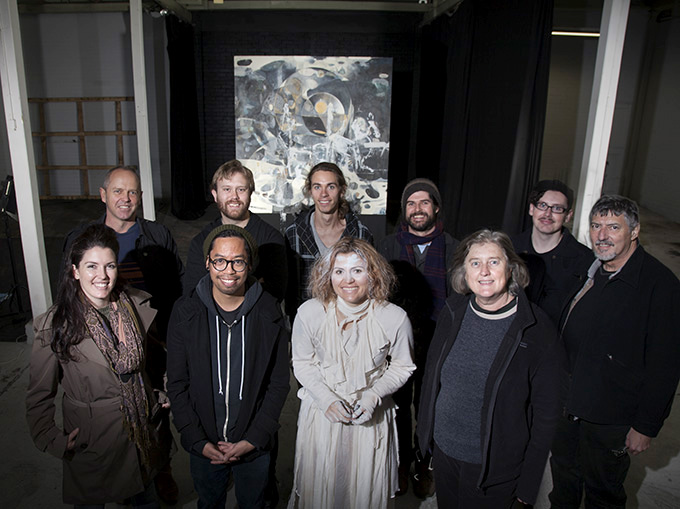
The Team: Front Ashleigh Campbell, Julio Dunlop, Kirsty Lee, Victoria Cooper, Doug Spowart
Back: David Usher, Jason Nash, Jesse Wright, Damien Kamholtz, Zac Rowling ( weakling).
Not present: Craig Allen & Jake Hickey
.
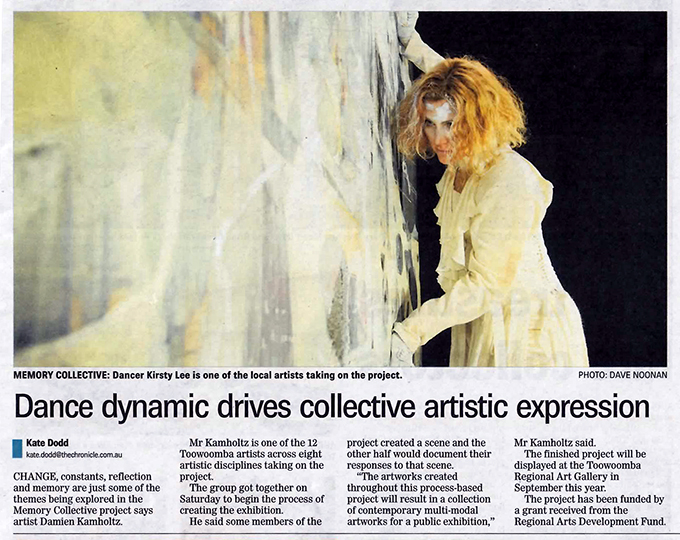
Toowoomba Chronicle 17 June, 2013 by Kate Dodd PHOTO: Dave Noonan
.
..
 .
.
.
© 2013+2014 Victoria Cooper and Doug Spowart for The Memory Collective
.
This work is licensed under a Creative Commons Attribution-NonCommercial-NoDerivs 3.0 Unported License.
.
.
MAUD GALLERY: TRANSLUCENCE: Jacqui Dean’s Xrayograms
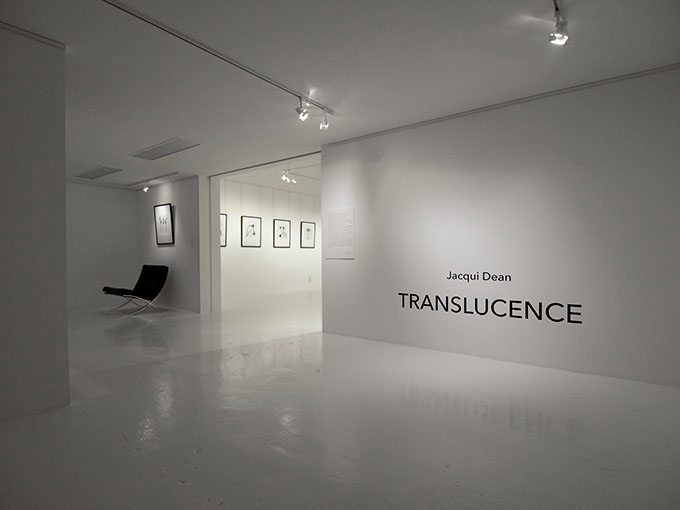
Jacqui Dean’s TRANSLUCENCE @ Maud Gallery, Brisbane Photo: Doug Spowart
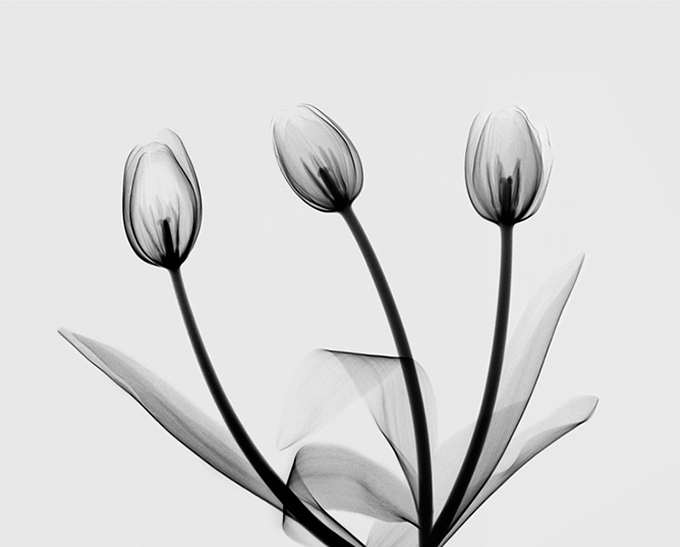
An image of tulips from the Translucence exhibition
.
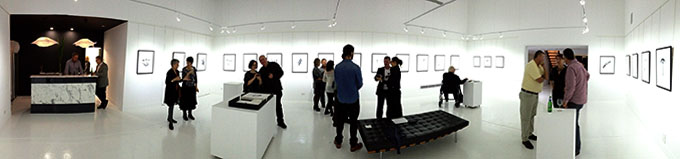
Translucence @ Maud Gallery, Brisbane. . iPhone Photo: Doug Spowart
.
TRANSLUCENCE: Jacqui Dean’s Xrayograms
Maud Creative Gallery June 18th – July 19th, 2014
6 Maud Street Newstead, QLD 4006
Ph 07 32161727
www.maud-creative.com
.
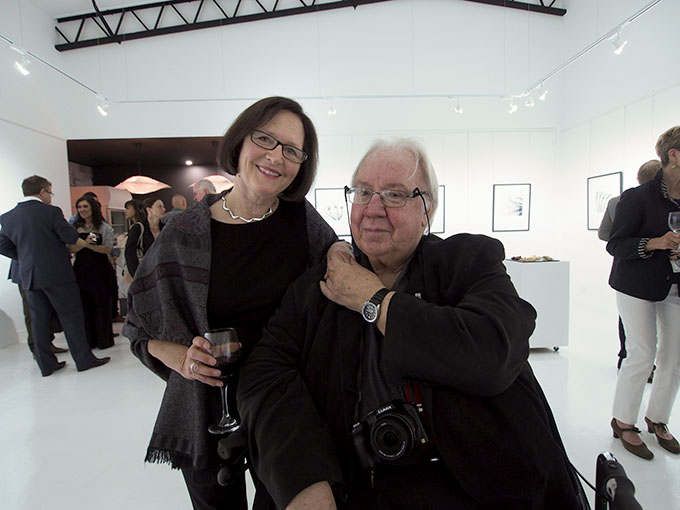
Jacqui Dean + Robert MacFarlane Photo: Doug Spowart
.
A comment about the work by the exhibition speaker Robert McFalane
In TRANSLUCENCE, photographic artist Jacqui Dean reveals Australia’s flora, both native and introduced – in radically new ways. Dean’s searching vision reduces flowers to their essential, sculptural shapes, translating them into exquisite, archival black and white prints. Calla lilies are seen as never before – with their curved flowers resembling the shape and texture of a crystal goblet. Dean’s delicate images of roses, through composition and digital magic, reveal interlaced petals that mimic the textures of a Tulle bridal veil.
Dean’s delicate, dancing images in TRANSLUCENCE mirror the elegance of Nature while resonating deeply with the work of artists as disparate as photographic pioneer William Henry Fox Talbot (1800-1877) and the affectionate, intricate drawings of Nature by Albrecht Durer. (1471-1528)
Jacqui Dean is a talented Sydney architectural, corporate and fine-art photographer known for her rigourous sense of composition and peerless black and white printmaking skills. Twenty seven prints will be on display at Maud Creative Gallery during this first Brisbane exhibition of TRANSLUCENCE.
“Look deep into nature, and then you will understand everything better.”
ALBERT EINSTEIN (1879 – 1955)
‘Another Universe’ a review by Victoria Cooper
.
From the late 19th, and into the early 20th century there was a growing movement in the sciences and the arts that associated with Nature’s inherent resonance of form and structure from the microscopic to the cosmic. These new vistas and universes were recorded not only by the scientists’ hand but also by new developments in technology, notably the invention of the photographic process. Visual communication through imaging technologies continues to be an important tool in scientific research. But these images were not just useful as scientific evidence they were and continue to be inspiration for the creative work of artists and designers.
One noted exemplar utilising this visual medium was Karl Blossfeldt (1865-1932), a sculptor, metal craftsman and teacher. Blossfeldt began taking photographs of botanical specimens to use in his classes as ideas for students to create design forms from nature. But Blossfeldt’s work became very influential in the art, craft and design movement that popularised natural forms as templates for architecture, sculpture and 3D design work. His photographic documentation revealed abstract views of humble everyday roadside plants as visually interesting structural and aesthetic forms. As a result, Blossfeldt’s photographs also became renowned as works of fine art.
Jacqui Dean’s exhibition Translucence, at 2 Danks Street Gallery, Sydney, and now at Maud Gallery in Brisbane, is the result of artistic curiosity and visual investigation natural forms through the phenomenon of Xrays. Art in this respect is the revelation of the unseen, the beholding of the essence within ordinary objects or a transforming perception of the everyday experience. The photograph, or in this case ‘xrayograph’, seals the object within the frame safe from the changes and inevitable decay over time. At first glance these images could appeal to the naturalist or perhaps a student of design (after Blossfeldt). Yet a deeper – more poetic vision immanent in nature is also suggested through a more contemplative viewing of these images.
Some may argue that this is an uncomfortable clash between the modernist and the romantic, or the objectivity of scientific evidence and the subjective imagination. But could this work identify with a need to embrace a sense of wonder rarely seen within a super-hyped, virtual digital-image society? Dean’s work in Translucence is informed by the poetry of music and her life’s experiences and her prodigious professional practice in photography. However the rewards for the thoughtful viewer will be to share in her wonder of the natural world that surrounds and nourishes our everyday life.
Victoria Cooper . . . June 9, 2013.
.
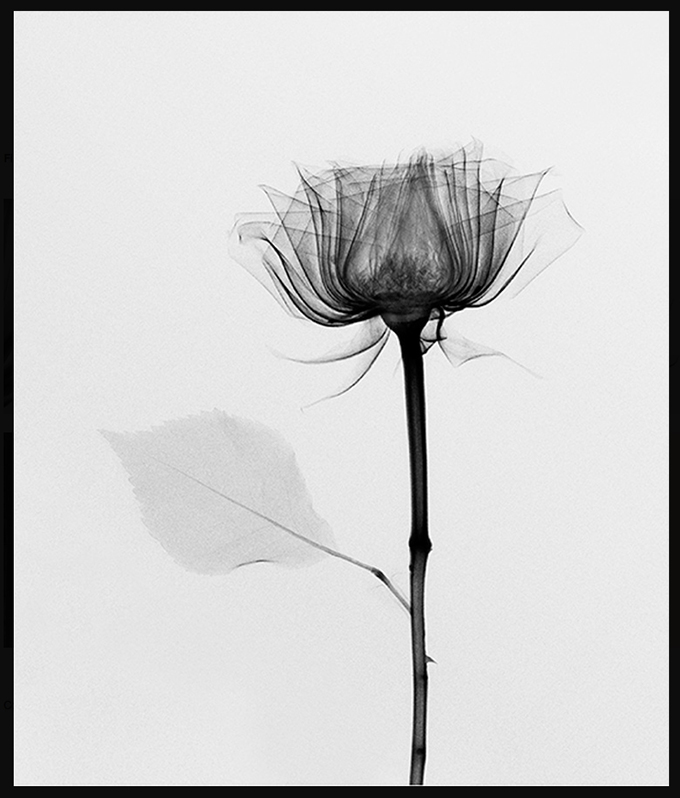
Rose Xrayogram by Jacqui Dean
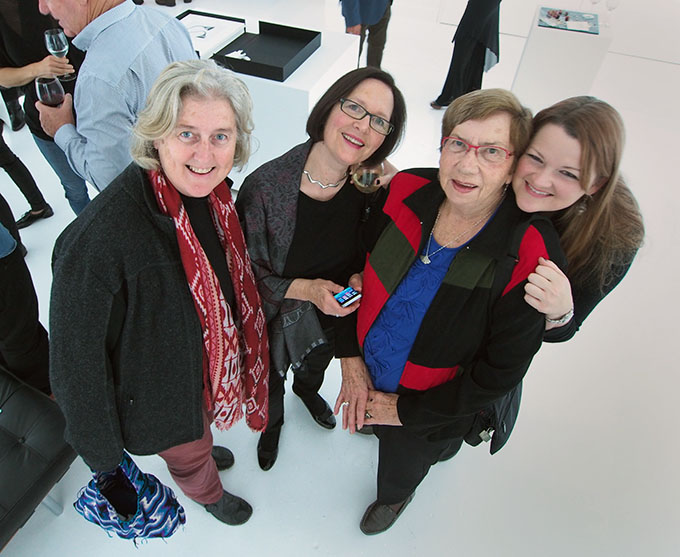
Victoria Cooper, Jacqui Dean, Ruby Spowart & Mel Anderson Photo:Doug Spowart
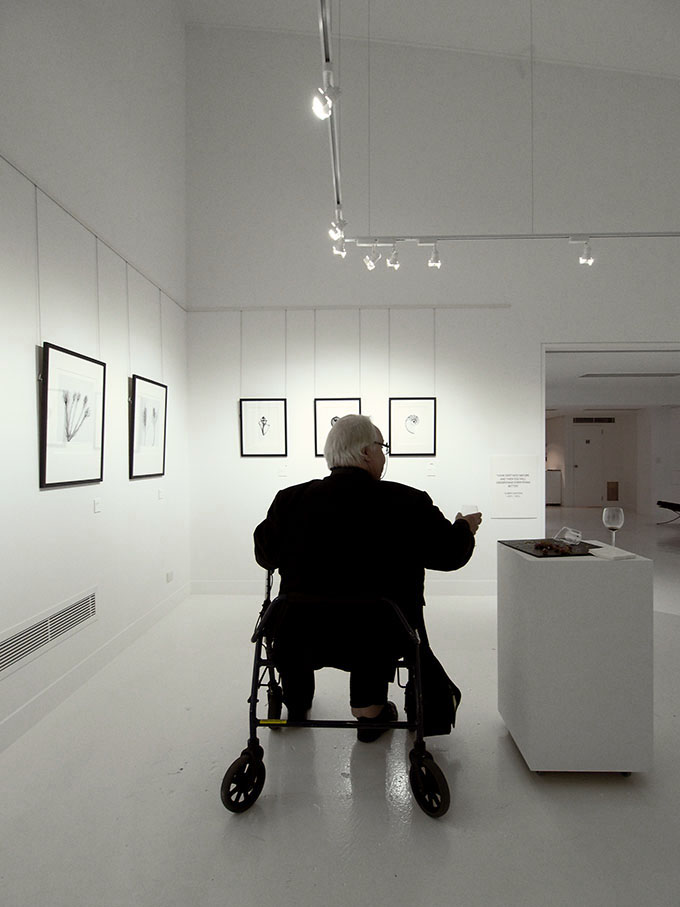
Robert takes a drink — Photo: Doug Spowart+Steve Jones
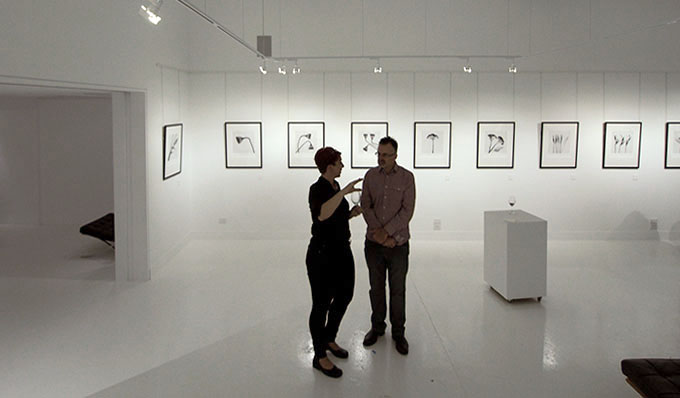
Bibiana Stanfield and Neil Burton @ Maud Gallery
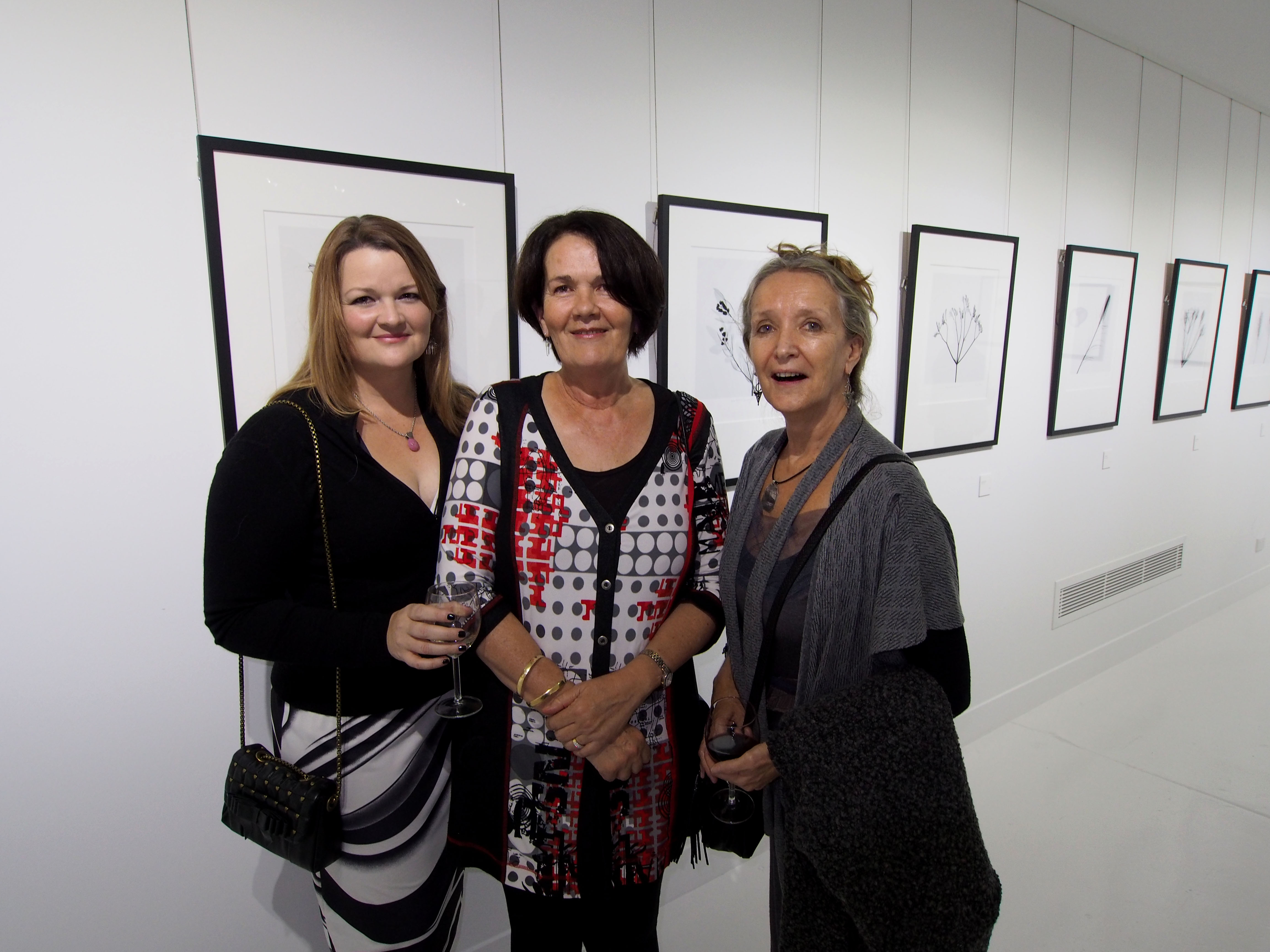
Mel Anderson, Ros Stakes and Lesle Downie @ the opening Maud Gallery Photo: Doug Spowart
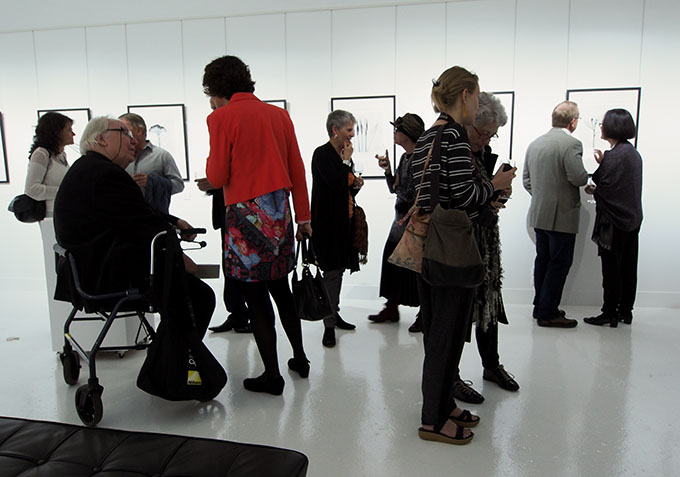
Guests at the Translucence opening Maud Gallery Photo: Doug Spowart
.
MORE INFORMATION:
Jacqui Dean’s Website: http://deanphotographics.com.au/fine-art/
Interview by Gemma Piali of FBi Radio, Sydney: http://fbiradio.com/interview-jacqui-dean-on-translucence/
.
Xrayograms: © Jacqui Dean
Review text © 2013 Victoria Cooper
All exhibition opening photographs © 2014 Doug Spowart
.
This work is licensed under a Creative Commons Attribution-NonCommercial-NoDerivs 3.0 Unported License.
.
.
IT’S ALL GREEK TO US…
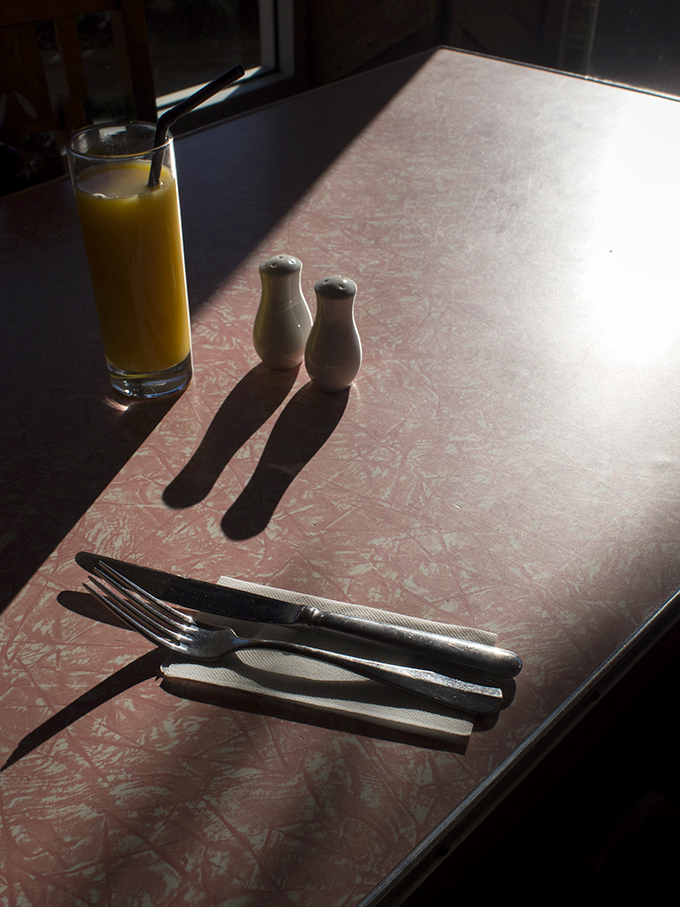
Waiting for the breakfast order: Peter’s Café, Bingara
.
The Roxy Theatre and Peter’s Café, Bingara
.
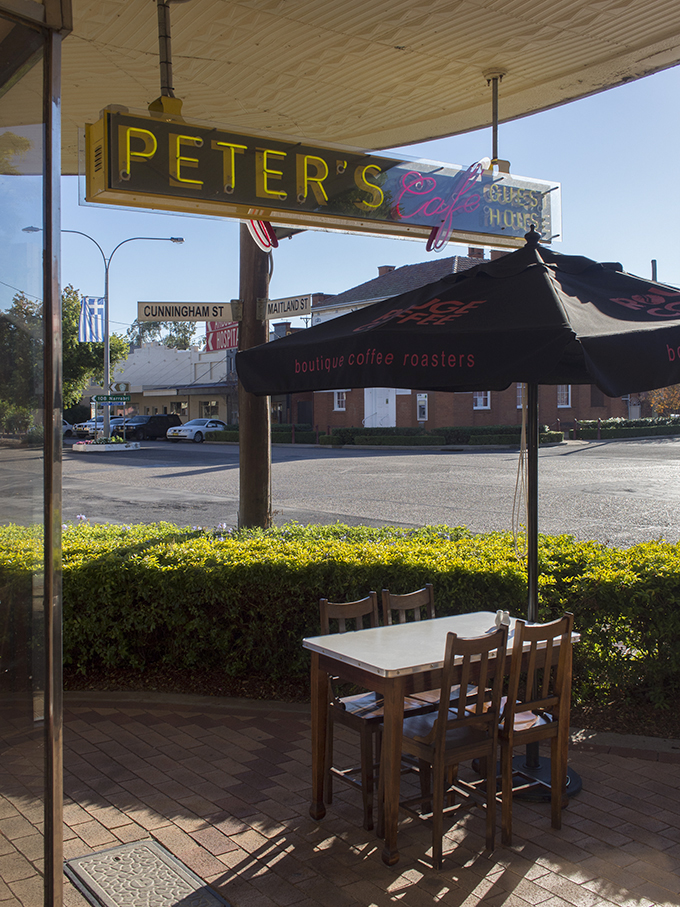
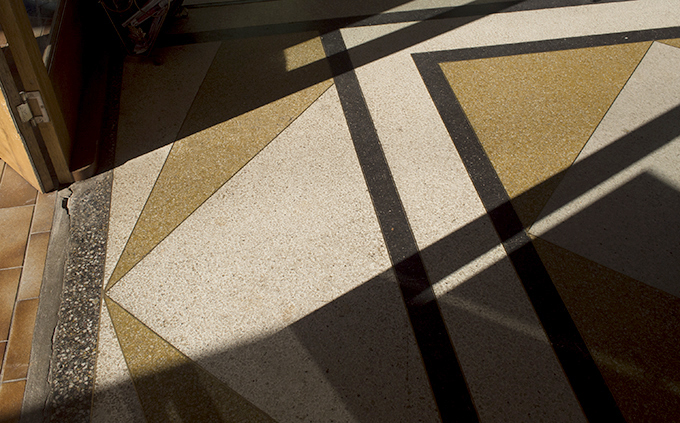
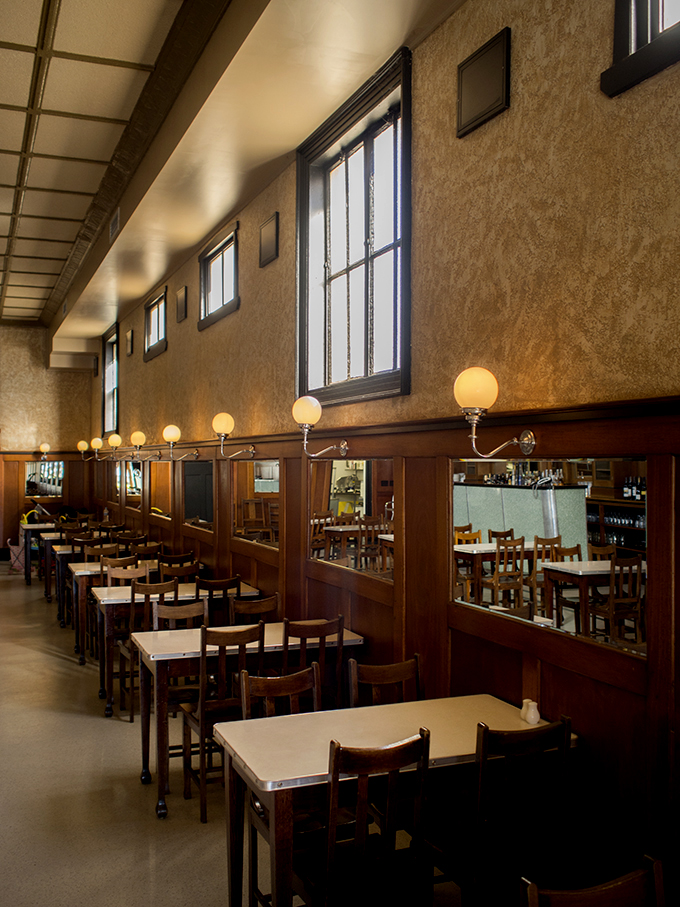
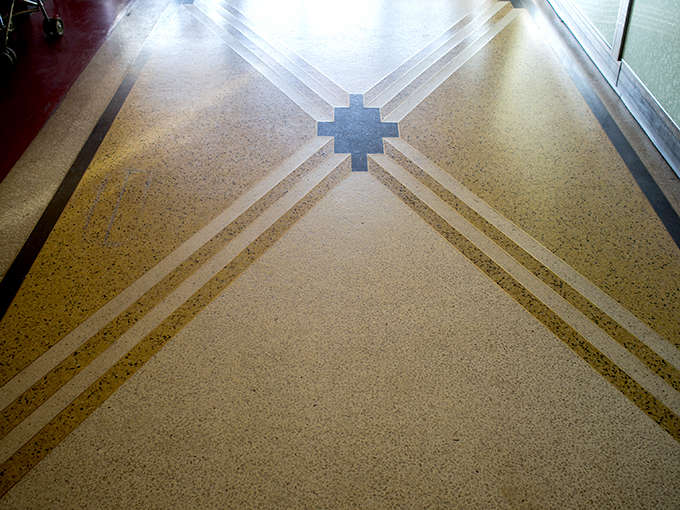
When we were young the Greek restaurant was a feature of every country town’s main street. They opened all hours, often being the first to open in the morning and the last to close in the evening. All kinds of meals and foods were served from fish ‘n’ chips to espresso coffee and cold malted milkshakes. Greek cafes often had the architectural style of the art deco palace, with its Aztec plasterwork, chrome, mirrors, aluminium-edged laminex tops, bench seats and cubicles, terrazzo floors and pendant light fittings. The welcoming and friendly staffs were usually the family and sometimes they were your schoolmates as well.
We have had a fascination with these places and in our travels we’ve often picked out a few candidates for the most authentic Greek Café experience of the past. For quite a few years we have been calling into the Niagara Café in Gundagai for lunch, breakfast or dinner. The Niagara is a survivor of the fine tradition of the Greek restaurant with an interesting connection to the Australian Labour Party. An earlier blog posts tell about this place – SEE a folio of images HERE.
.
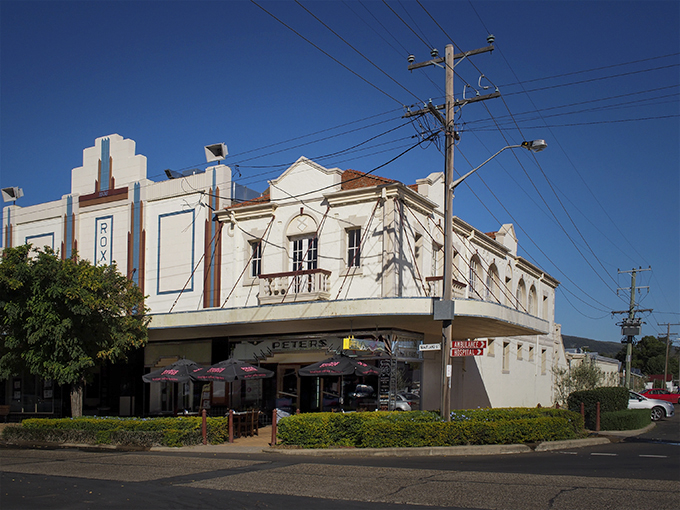
Corner of Maitland and Cunningham Streets, Bingara
Last year when doing some research into the Niagara we encountered an amazing story about another Greek restaurant called Peter’s Cafe in the central north NSW town of Bingara. Three friends Peter Feros, Emanuel Aroney and George Psaltis from the island of Kythera came to Bingara in the 1920s and formed a partnership in a range of businesses. They designed and built Peter’s Café and the adjacent Roxy Theatre. When it opened in 1936 the enterprise was a quite remarkable package: café, guest accommodation, theatre, leased shops and energetic and entrepreneurial expertise of the three partners.
.
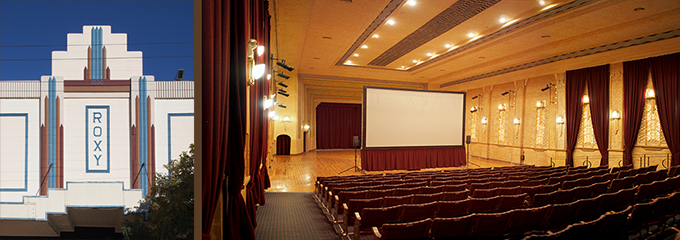
The Roxy façade and interior
But fierce competition from the local Regent Theatre meant that the Roxy could not survive in the small community and within months the three owners filed for bankruptcy. The doors of the theatre were closed and the structure protected from redevelopment – entombed. In the 1960 the café also closed and was converted into, amongst other things, a Chinese restaurant.
.
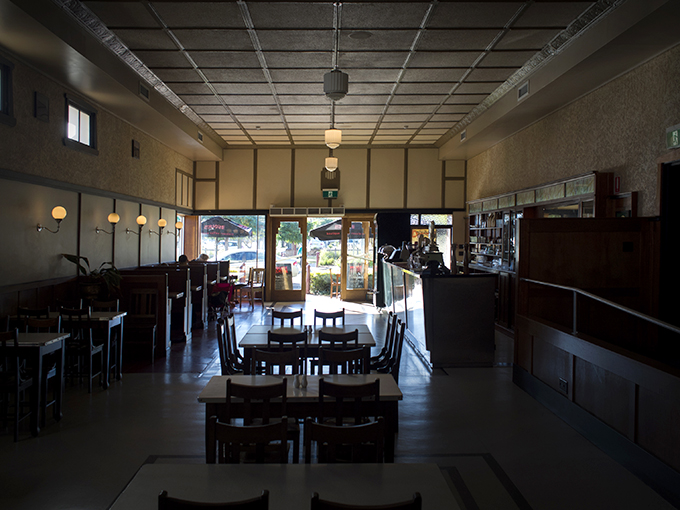
In Peter’s Café looking towards the street
In the 1990s group of dedicated community members began a process that sought support from all levels of government to reinstate the Peter’s Café and Roxy Theatre complex to its former glory. Funds were granted and the restoration work began with the re-opening in 2004. The official opening ceremony to launch the fully restored Greek cafe and the new ‘Museum of Greek settlement in Country Australia (New South Wales and Queensland)’ took place in April 2011.
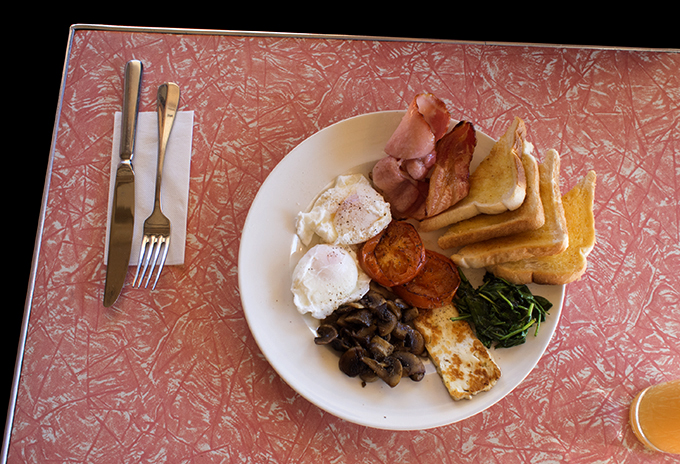
A Hercules breakfast from Peter’s Café
We had breakfast at Peter’s Café. From the menu we selected and shared a Hercules Breakfast consisting of bacon, poached eggs, haloumi, spinach, tomatoes and mushrooms cooked by the resident chef Vio. It was a great start to the day.
.
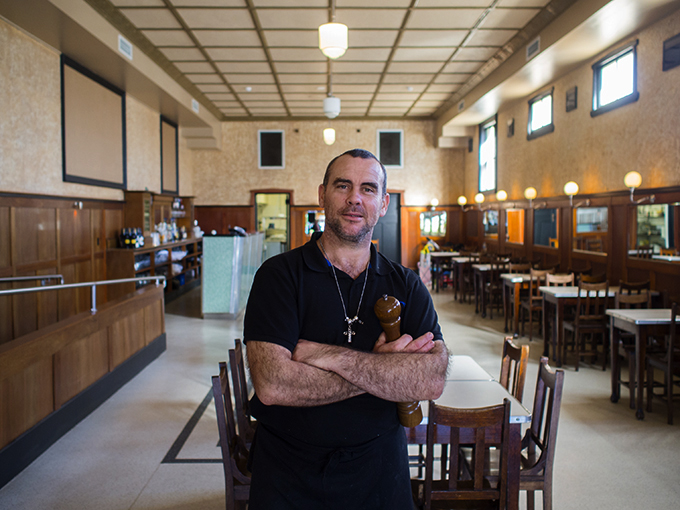
Our chef Vio at Peter’s Café
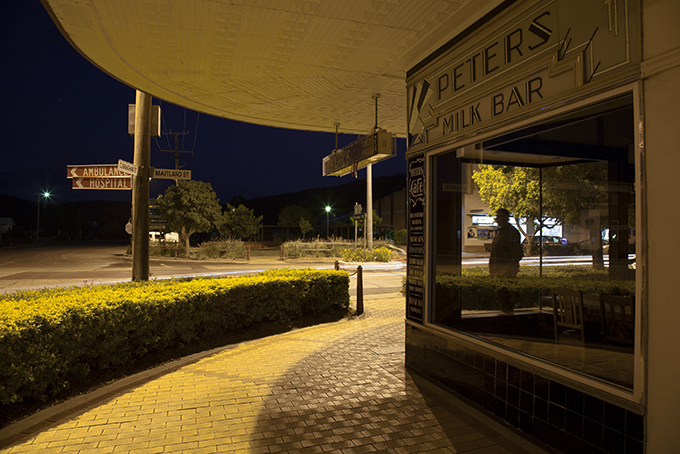
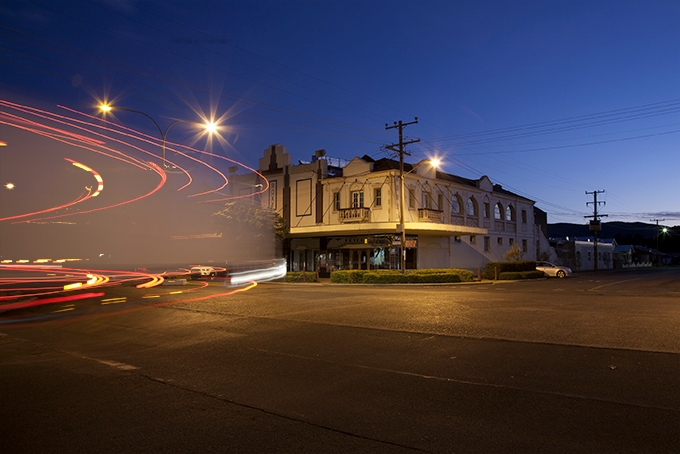
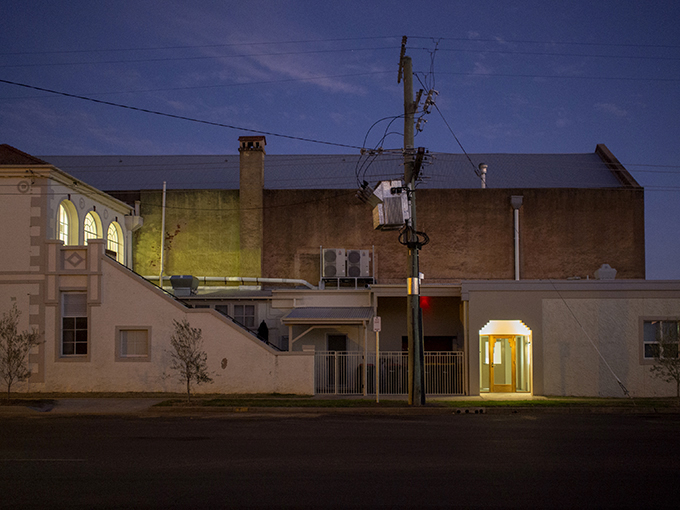
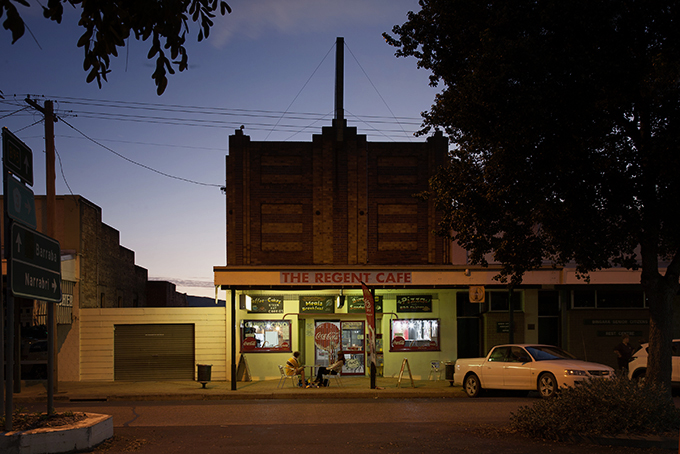
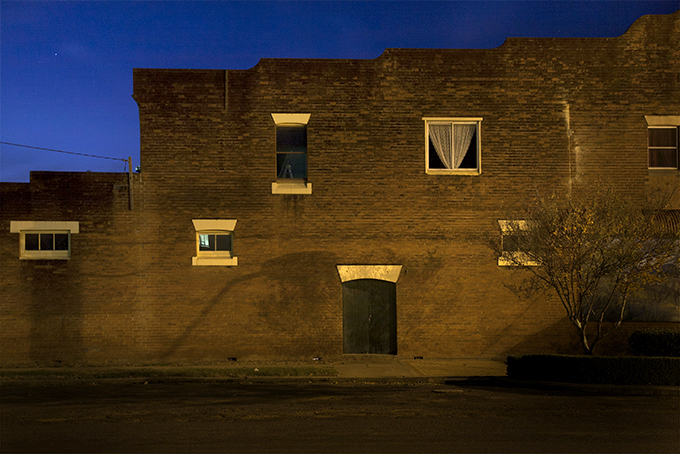
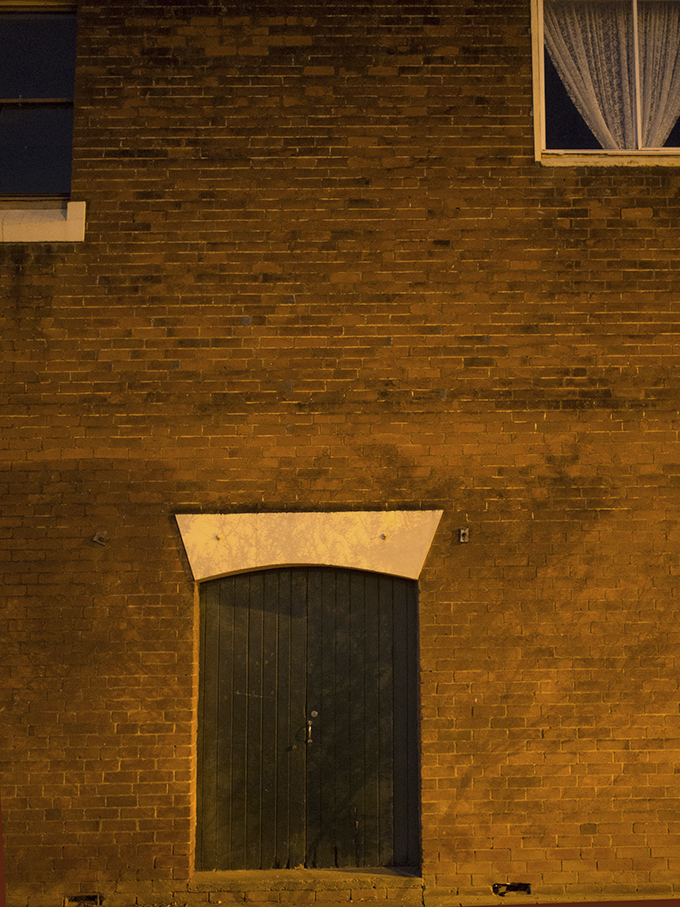
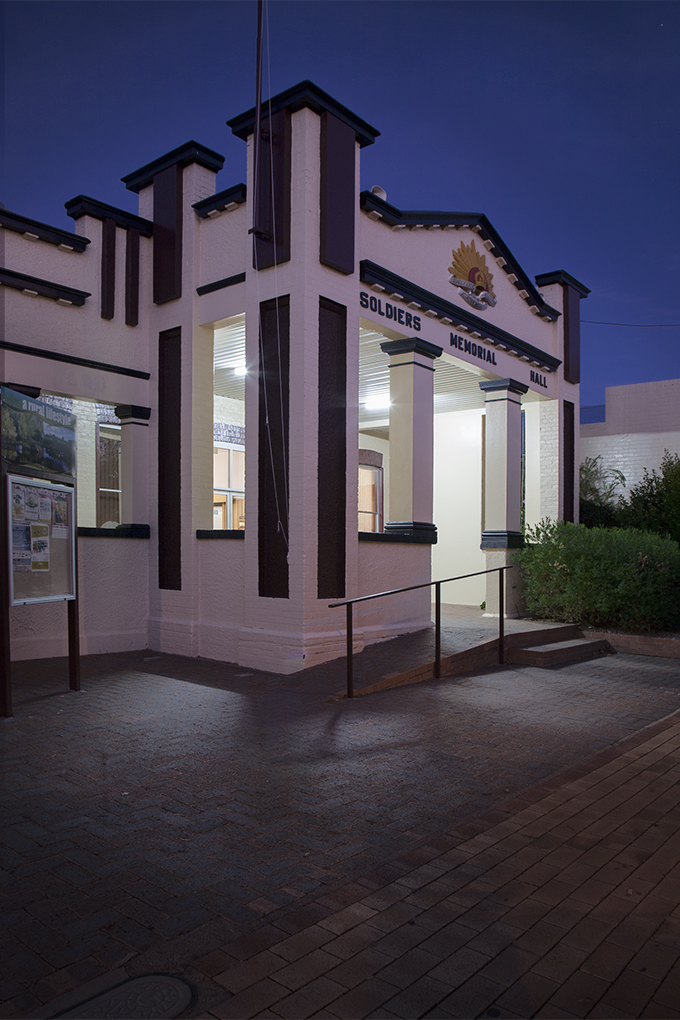
Around the town of Bingara the night before we added a few images to our Nocturne Project – some of the photographs are at the end of this post.
To find out more about this place visit the attached links to the ROXY, PETER’s CAFÉ and KYTHERA FAMILY websites for more details of this fascinating story.
.
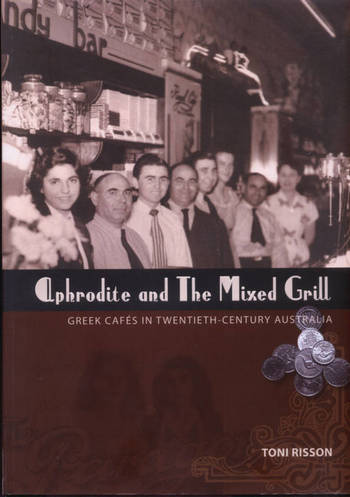
An interesting book by Toni Risson about the Greek Cafe in Australia – Aphrodite and the Mixed Grill. Greek Cafes in Twentieth Century Australia
.
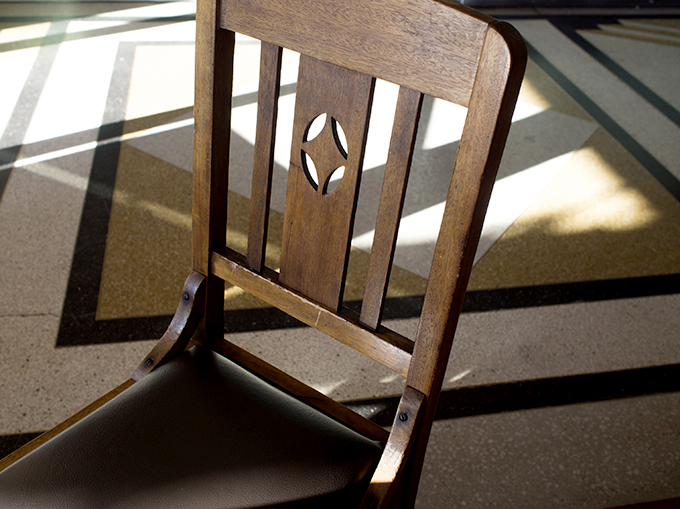
HERE ARE SOME MORE IMAGES OF PETER’S CAFE …
.
AND SOME NOCTURNE IMAGES OF BINGARA
.
.
.
.
Our photographs and words are licensed under a Creative Commons Attribution-NonCommercial-NoDerivs 3.0 Unported License.
http://creativecommons.org/licenses/by-nc-sa/2.5/au/

 wotwedid
WORKING WITH “ACT WATERWAYS” A community art project
with one comment
ACT Logo
The artists involved in the project had responded to the theme in diverse and inventive ways producing artworks that engaged the public and caused them to consider places and creeks that previously they may have just walked or driven past.
Our task was to manage and coordinate the documentation of the 11 art projects and the Facebook social media. In our activities we closely linked with the project leader, and then President of the Arts Council Toowoomba, Jennifer Wright (Summers), and the design coordinator Mary-Kate Khoo – both energetic, creative artists themselves and hard workers for the artists within our region.
.
Doug in a pre-planning meeting with Jennifer and Mary-Kate
To extend the opportunities for an extended learning experience for media photography students from the TAFE South-West Photoimaging department. We provided them with mentor support and professional practice skills to satisfy the demands of the project through a Facebook closed group as well as face-to-face location work.
The Facebook presence enabled a community connection with the project, activities that were taking place as well as a forum for comments and feedback. While the Facebook page was most active during the event it is still viewable as a record of the event and the creativity of the artists of our region and how the Arts Council Toowoomba provides leadership in arts projects. <https://www.facebook.com/toowoombawaterways>
FROM A PROJECT PRESS RELEASE:
A FLOW OF ART … Artists and water in our community
.
After the floods in 2011 another Arts Council Toowoomba project enabled artists to tell the community’s story. The project was called Splashing back mosaic trail. At the opening Assistant Commissioner Fire and Emergency services Tom Dawson stressed the importance of greater awareness of where and how water flows through Toowoomba.
Now our Arts Council Toowoomba volunteer team and our creative artists have been working hard again and their latest venture, ACT Waterways addresses this aspect of Toowoomba’s water systems. Soon ten artists will be installing works across Toowoomba that tell new stories about our local waterways, with works ready for viewing by 19 September 2014. For those wanting to connect with this exciting and creative project there is a map of the ACT Waterways project and a program of events featuring musical performances at each of the sites.
ACT President Jennifer Wright (Summers) said: ‘We really hope members of the public and visitors enjoy the installations and free events. Working on this project has made us more aware of the wonderful waterways in our city. I was surprised to find yabbies, turtles and waterbirds in the CBD where I am installing bird sculptures.’ Residents and visitors are invited to visit the sites, come to daily performances, and learn about life in our waterways and the history of the Waterbird Habitat.
We invite everyone to share their stories and photos of Toowoomba’s East and West Creeks and to visit the ACT Waterways Facebook page
<https://www.facebook.com/toowoombawaterways>.
.
So, over a two-week period we worked with the artists and students documenting the project and uploading images to the Facebook page and managing the social media aspects of the project. The TAFE students did a fantastic job in taking photographs of the artists and their artworks, and also in complying with the professional demands and workflows that we required for the project.
.
.
WHAT FOLLOWS ARE EXAMPLES OF THE TAFE STUDENTS AND SOME MORE OF OUR PHOTOGRAPHS
.
Share this:
Written by Cooper+Spowart
January 9, 2015 at 11:41 am
Posted in Meeting People, Place-Projects, Regional arts
Tagged with ACT Waterways Project, artists commenting about water and place, Jennifer Wright (Summers), regional artists, Regional arts