Archive for the ‘Leap of Faith 2013’ Category
ADVANCE NOTICE: Memory Collective Exhibition to open @ TRAG
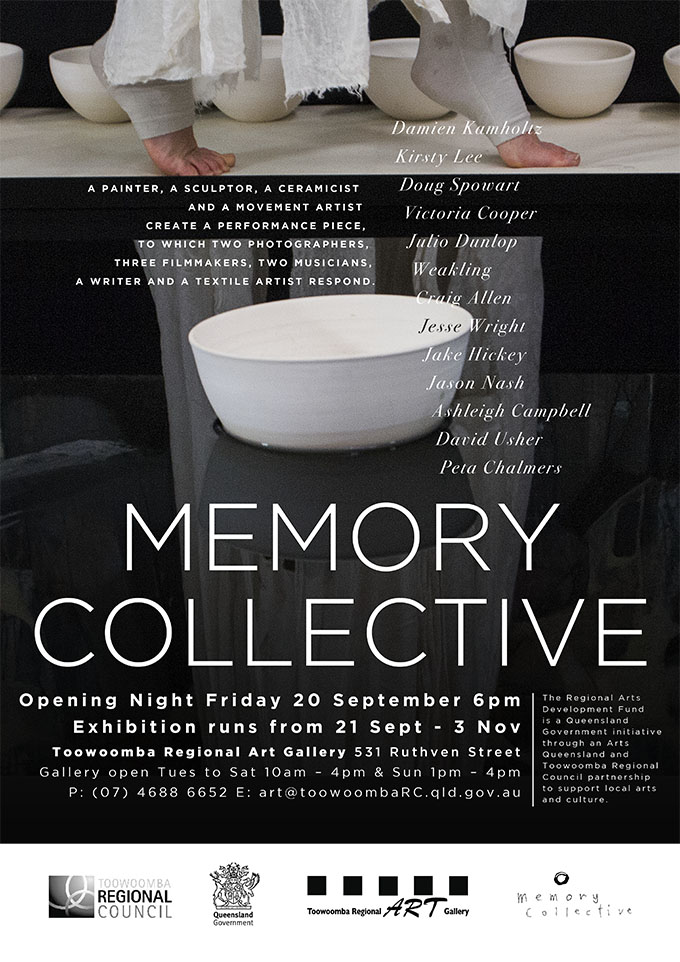
The Memory Collective Invite
.
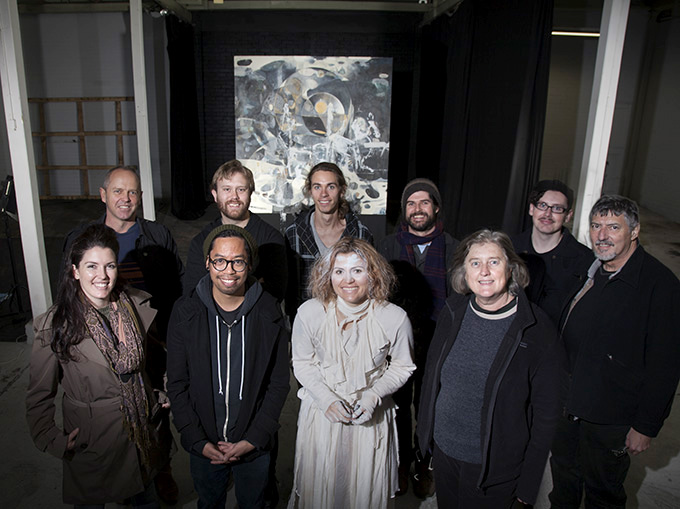
The Team: Front Ashleigh Campbell, Julio Dunlop, Kirsty Lee, Victoria Cooper, Doug Spowart
Back: David Usher, Jason Nash, Jesse Wright, Damien Kamholtz, Zac Rowling (weakling).
Not present: Peta Chalmers, Craig Allen & Jake Hickey
.
Photographer Victoria Cooper reflecting on the Memory Collective project
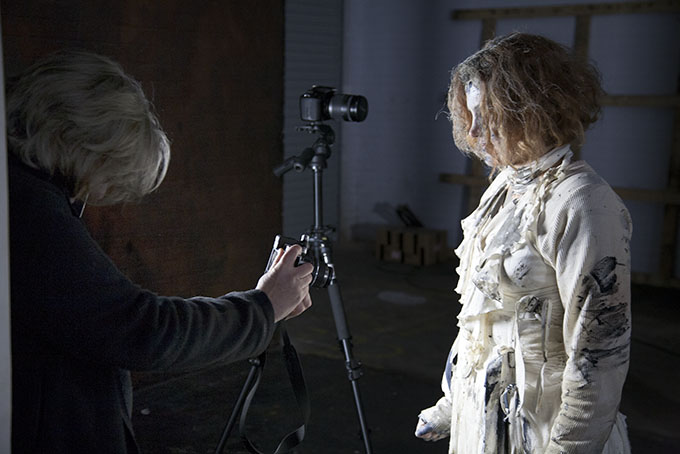
Vicky photographs Kirsty
.
Both Doug and I, familiar with collaborative projects, were excited to have the opportunity to connect with the multidisciplinary space that Damien Kamholtz was creating in the Memory Collective. So it was on one day in May, that each artist would bring to the chosen site their insights, instincts and life’s experience.
.
There was a painting – a very large painting; a sculpture filled with water, a ‘pond’ to reflect and dissolve the evolving performance; a movement artist to reconfigure the idea or memory of painting; seven white ceramic bowls to containing pigments and a singular bowl left empty to float across the dark water of the pond.
The physical space did not easily present itself at first–but as the project unfolded and discussion flowed from the practical, logistical to the intellectual, conceptual–the site itself also became a collaborator in the project: the stage, the remnants of its warehouse history, the idiosyncratic control over the method of entering the space (all us had to crawl under a jammed roller door)
Was the space asserting its role?
This day was not just a visual experience–it was a total sensory and psychological immersion.
Although a part of the documentary team, including video and still photography, I was compelled to cross beyond the voyeuristic role of witness. I was motivated by the tension created from: anxiety for the loss of the original painting with the frisson of anticipation for the evolving transformation.
The movement artist’s touch with the painting was sensual and slow.
We moved like moths; entranced by the night-light . . . circling . . . unable to land nor escape . . .
This was not a performance rather it was about life, unrehearsed and ephemeral. Only through technology were small parts recorded to be later pieced, montaged and sewn together in a kind of rich layered memory tapestry. And, like memory, there are gaps, fuzzy distortions of scale and time lines, loud visually busy moments together with quiet, serene and ethereal meditations.
I began this project with an intuition that it would be both inspiring and exhilarating to work with this creative group of Toowoomba based artists. Damien has, with delicacy and grace, enabled and cultivated a fertile collaborative space, which continues to extend the potential for the creative work.
.
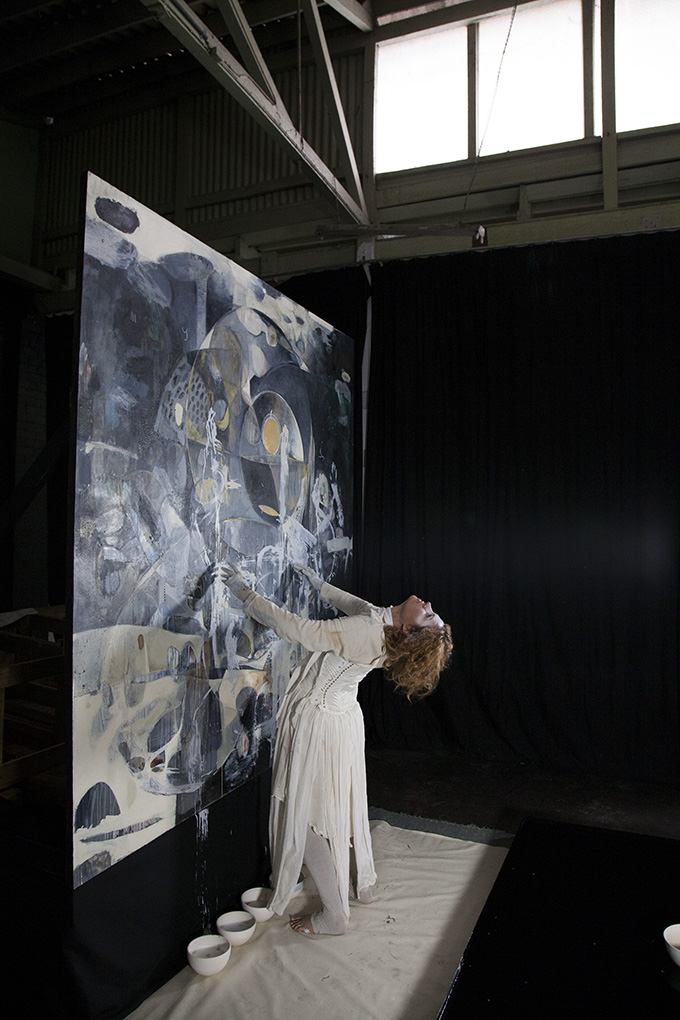
Kirsty addresses the painting in performance
.
A recollection of the MEMORY COLLECTIVE collaboration from Doug Spowart.
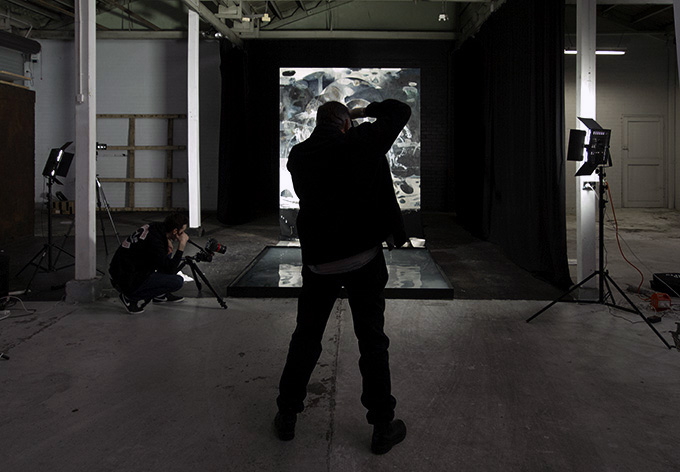
Doug photographs the performace
Working as a regional artist can be an isolating experience. Your networks are often big city based, coastal and a long way from your home on the range. I am familiar with collaborative art-making but it has usually been with my artist partner Victoria Cooper.
.
The Memory Collective was quite a different collaborative affair. As an individual artist I could never have thought up let alone coordinated, as Damien has, all of the interdisciplinary artists and artforms into one time–one space–one purpose–one artpiece. Meetings, Facebook discussions and site inspections enabled a real feeling of connection with the creativity of these fellow regional artists and their ideas, aspects of each discipline’s needs and potential for contribution.
https://wotwedid.wordpress.com/2013/06/17/memory-collective-a-performance-documentary-project/.
https://www.facebook.com/memorycollectiveproject
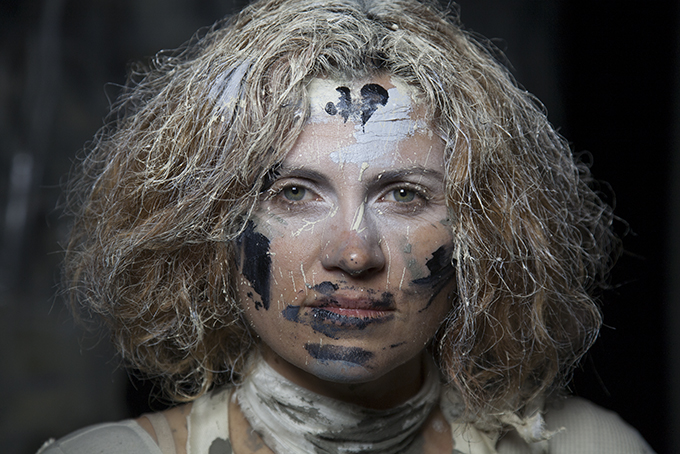
Kirsty Lee – the paint portrait
.
.
 This work is licensed under a Creative Commons Attribution-NonCommercial-NoDerivs 3.0 Unported License.
.
.
.
.
NOCTURNE GRAFTON: A new Cooper+Spowart Residency begins

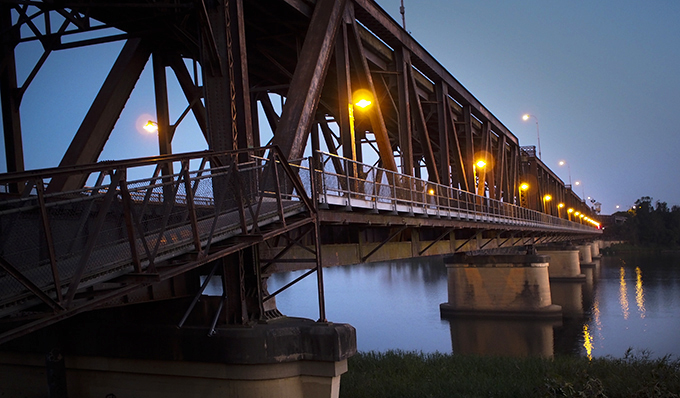
The iconic Clarence Bridge
.;..
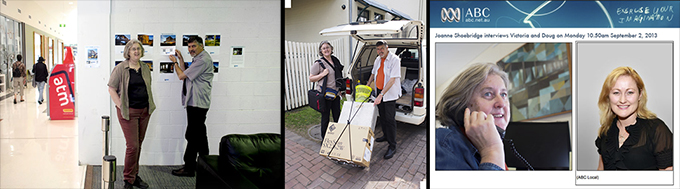
The mini gallery in the LINK Arcade – Moving in to GRG – And on ABC Radio with Jo Shoebridge
.
TELLING STORIES ABOUT PLACES
The Nocturne Grafton Project by COOPER+SPOWART: an Artist in Residence @ Grafton Regional Gallery throughout September 2013.
If a picture is worth a thousand words – how do you gather the 1,000 words from a community by showing them pictures of their town? Artists Victoria Cooper and Doug Spowart are exploring this question as they work as Artists in Residence at the Grafton Regional Gallery. Their residency project is entitled Nocturne Grafton and will consist initially of photographs of buildings and locations within the Grafton region.
The artists have made nocturne photographs in towns all over New South Wales and Victoria and the work has been featured in their Blogs and Facebook sites. In June and July this year they photographed and Facebooked the town of Muswellbrook and last year a large body of image work was created in the seaside community of Wooli.
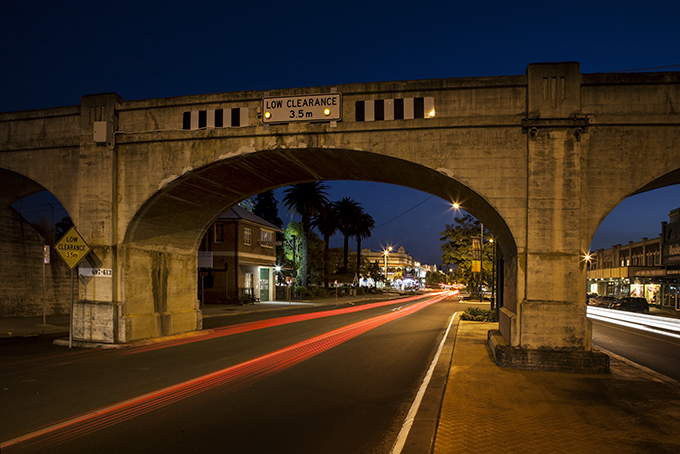
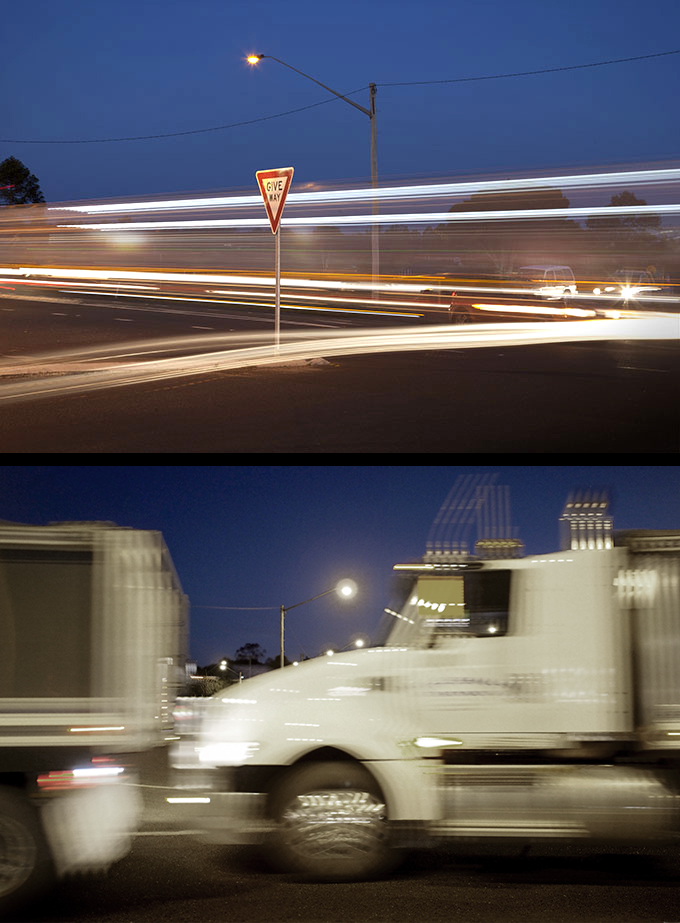
Cooper and Spowart make their photographs at dusk using the afterglow of sunset and streetlights to create an unusual image of the locations. This ‘nocturne’ light often requires long shutter speeds allowing the blurred movement of people and vehicles to be recorded. They enjoy photographing the visual effect of colours in different light conditions: ambient daylight, artificial lighting, car head and tail light trails. As artist Victoria comments, ‘in nocturne light there a sense of drama or a setting for a movie scene – a place where stories are told or evoked’.
.
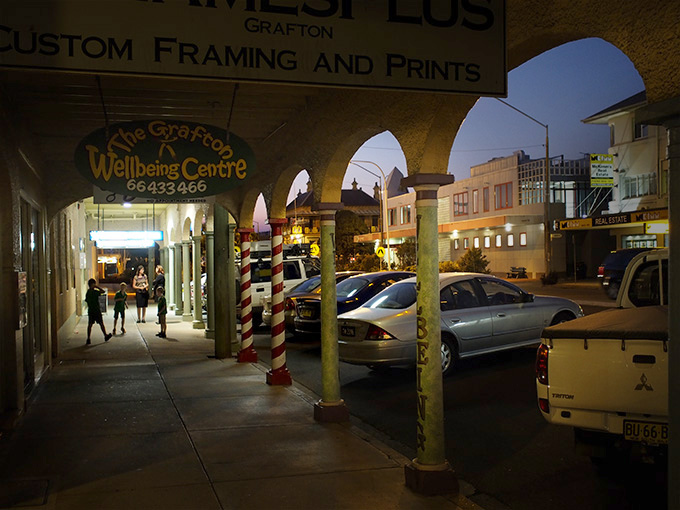
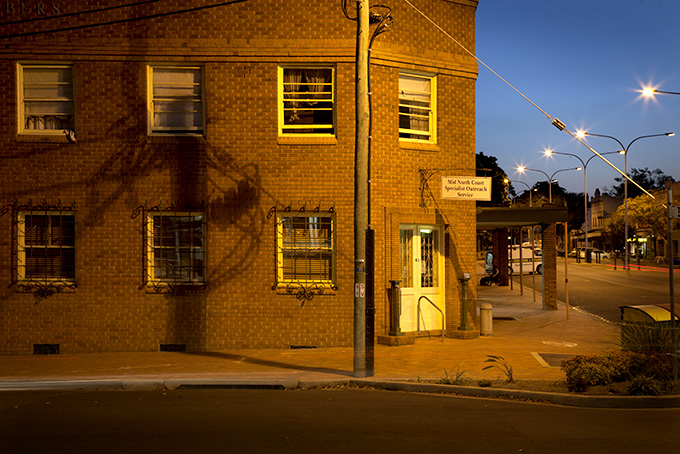
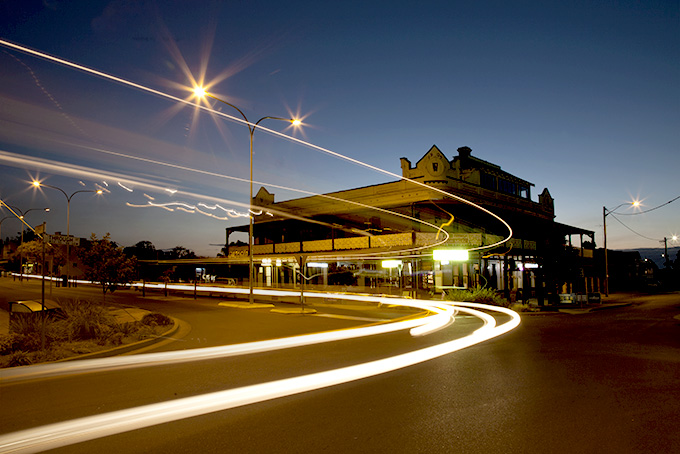
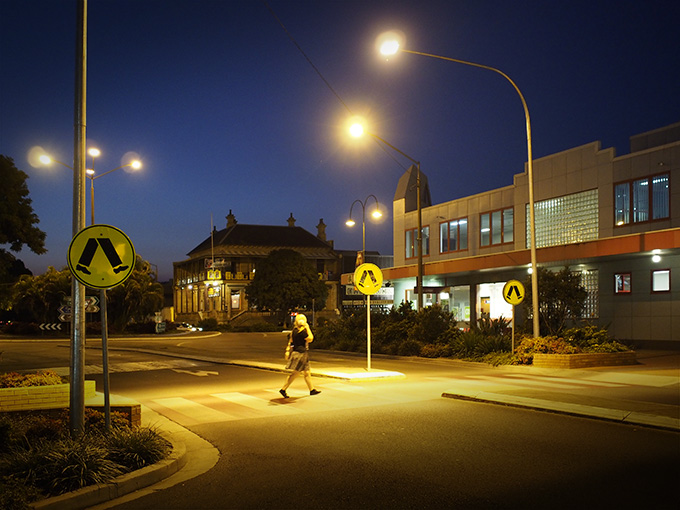
.
Making the photographs is only the beginning of the project’s activity; the next part involves the collecting of stories. As Doug Spowart explains, ‘the photographs will be posted on social media sites including Facebook for members of the Grafton community to tell us their stories or experiences that connect with the places photographed’. Victoria Cooper adds, ‘we’ve extended the saying that everyone has a story in them to every place has a story’.
.
.
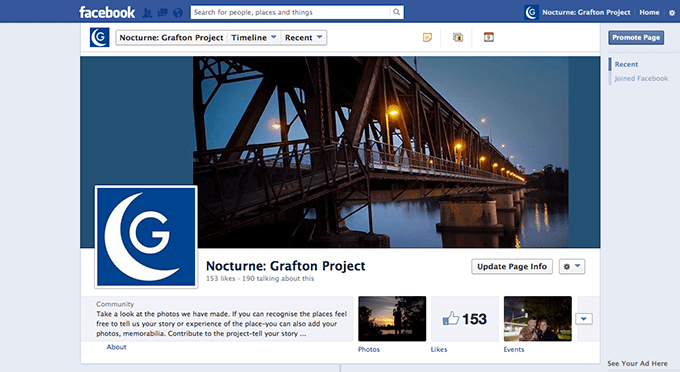
They are now calling upon the Grafton community and others with similar experiences of ‘place’ to share their stories of each place photographed including their everyday and meaningful experiences by connecting with the project’s Facebook and Blog sites. As part of the residency they will be displaying photographs in the studio space at the Grafton Regional Gallery, and there will be opportunities for interested Grafton people to call by and talk with them about the project and assist in the uploading of stories.
Cooper and Spowart will also be presenting a talk about their work at the Grafton District Camera Club on September 11th and also at the Gallery at a later date. The artists will be creating a limited edition book and the Nocturne Grafton Project will continue to be accessible online.
The Cooper and Spowart Residency began on September 1 and will extend through to September 30. The social media sites are ‘Nocturne Grafton’ on Facebook and www.nocturnegrafton.org. At the beginning of the project these sites will contain only preliminary information.
To see examples of work from earlier ‘Nocturne’ projects visit:
Nocturne: Muswellbrook – https://www.facebook.com/pages/Nocturne-Muswellbrook-Project/462047657214253
Nocturne: Wooli – http://wp.me/p1tT11-q1
.
TO SUPPORT THE PROJECT:
Log on to FACEBOOK – ‘LIKE’ the page and ‘Click’ to receive Notifications and to show in your News Feed.

.
© 2013 Victoria Cooper and Doug Spowart for The Nocturne Grafton Project
.
This work is licensed under a Creative Commons Attribution-NonCommercial-NoDerivs 3.0 Unported License.
.
.
.
INVITATION: OLIVE COTTON AWARD–Public Programs
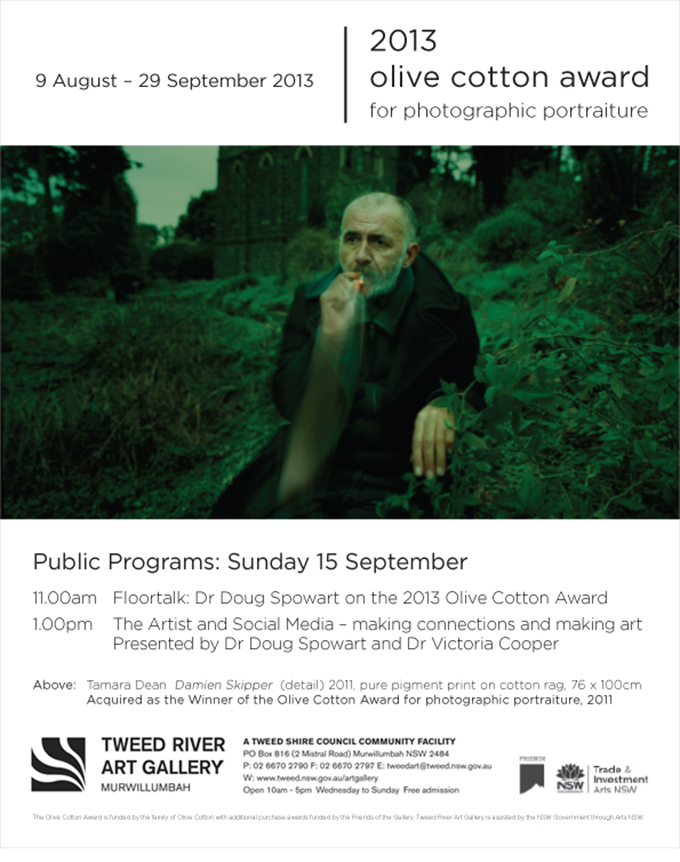
We are presenting two special presentation to compliment the 2013 Olive cotton Awards @ the Tween River Art Gallery, Murwillumbah.
A floortalk and discussion on contemporary Australian photographic portraiture based on the photographs is the award – AND – A look at the artist and social media, for making connections and making art.
SEE THE INVITATION BELOW:
Olive Cotton Awards Public Programs
.
For any extra details call the gallery on (02) 66702790.
.
.
VOTE 1: Regional Artists for Government Election
.
As Australia goes to vote we need to rally behind the artists of this country. The Centre for Regional Arts Practice has formed a faux political party and is out on the hustings alongside Tony, Clive, Kevin and Christine. It’s about time that their policy documents were made public – so here they are …
.

Cover – Artist Survey #XI Democracy
.
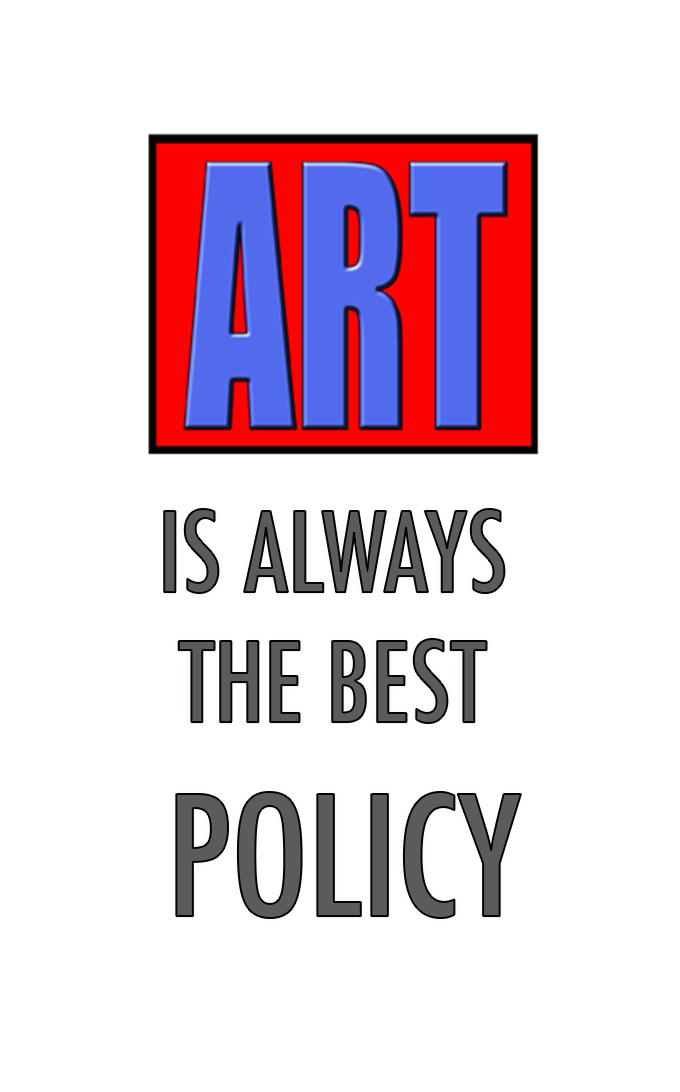
ART IS ALWAYS THE BEST POLICY
Recent democratic debate in Australian politics has been apprehended by special interest lobby groups. It is now time for artists to stand up and be vocal to capture their share of the political scene.
This policy booklet presents the Regional Artists for Government Election (R.A.G.E.) campaign and its political demands. The R.A.G.E. policies at first seem flippant and glib, however, as we have experienced in contemporary politics, the absurd can, with the right ‘spin’ and ‘media cycle’, become plausible – in fact, even highly appealing to the voters, leading to positive opinion polls and success at the ballot box.
.
SUPPORT R.A.G.E. – Join the Art Revolution Today.
..

POLICY DOCS-Pt1
.

POLICY DOCS-Pt2
.

Ballot Paper
.
The Cooper+Spowart book Art is always the best policy, was included in the grahame galleries exhibition Lesson in History Vol. II – Democracy curated by Noreen Grahame. The book is a satirical commentary on the ambivalence of contemporary politics towards art and artists, and was published as part of the Centre for Regional Arts Practice – Artists Survey book series. The edition of the book is 25 with 5 artist’s proofs. Copies of the book can be purchased from grahame galleries for $25 + packaging and post.
.
A video performance of the book is available here …
.
.
..
VOTE 1 for R.A.G.E.
.
.
Texts & Concept © 2012 Victoria Cooper+Doug Spowart,
.
The photos are licensed under a Creative Commons Attribution-NonCommercial-NoDerivs 3.0 Unported License.
.
.
JACKIE RANKEN @ BIFB: Doug’s catalogue essay
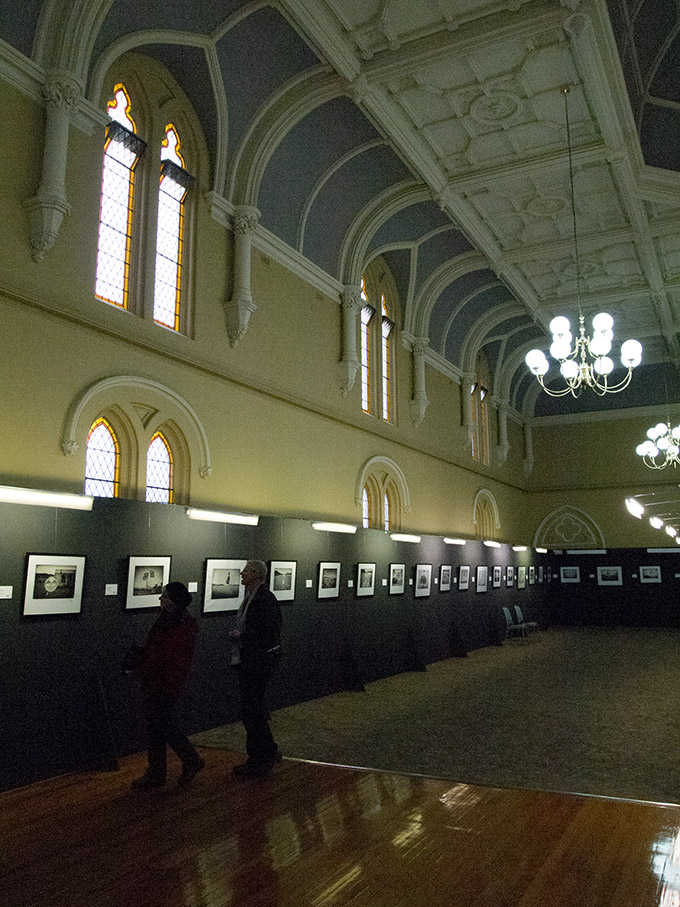
Jackie Ranken’s BIFB show
.
Jackie Ranken has a huge show at the 2013 Ballarat International Foto Biennale –
I was privileged to write the catalogue essay …
..
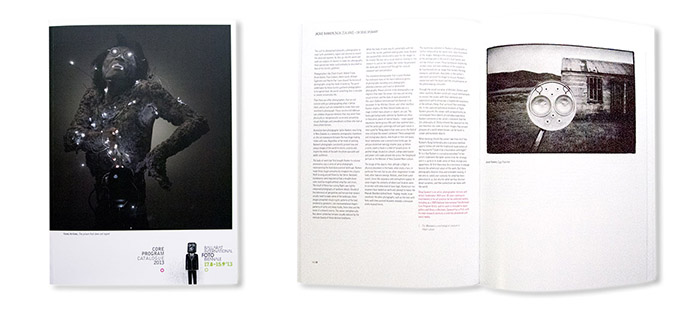
Jackie’s BIFB Catalogue pages
.
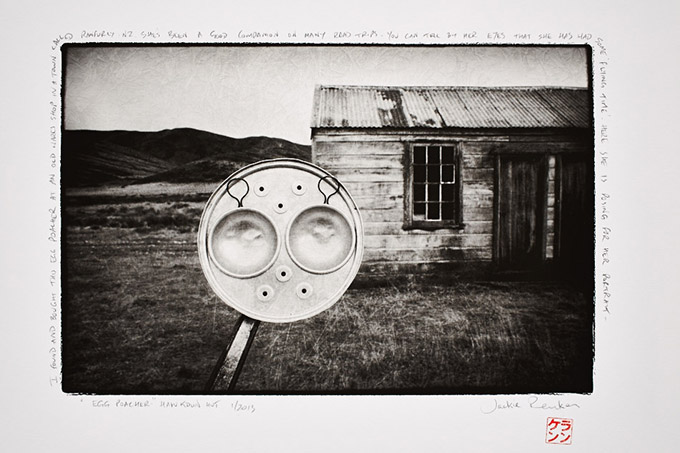
Egg Poacher
.
THE ESSAY
Jackie Ranken: far-flung – home and away
The call to photograph demands a photographer to react with spontaneity, vigour and intuition to record the observed moment. As they go into the world and seek out subjects of interest to make into photographs their operational mode could probably be described as that of the hunter-gatherer. Photographers like Elliott Erwitt, Robert Frank, Ansel Adams, Faye Godwin, Helen Levitt, William Eggleston and Martin Parr have shaped the history of photography using this mode of working. The quest undertaken by these hunter-gatherer photographers is to capture from the world something that is invisible or unseen in everyday life.
Then there are other photographers that are not content with just photographing what is before them, and as such are compelled to create their own realities to photograph. These constructed tableaux can combine disparate elements that may never have physically or metaphorically co-existed, presenting visual challenges and conundrums to those who look at these photo-fictions.
Australian born photographer Jackie Ranken, now living in New Zealand, is somewhat a photographic chameleon as she can manoeuvre between the two image-making styles with ease. Regardless of her mode of working Ranken’s photographs consistently present new and unique images of the world to inform, surprise and inspire the minds of the both the photo-specialist and public audiences.
The body of work that first brought Jackie Ranken to national prominence was a series of aerial photographs reinterpreting the Australian pastoral landscape. Ranken made these images precariously strapped into a Gypsy Moth bi-wing aircraft flown by her father. Aerobatic manoeuvres were required so that a straight-down view could be imaged without wing tips and struts. The result of these hair-raising flights was tightly composed photographs of landform details. Devoid of the references of perspective and horizon that viewers usually need to make sense of the landscape, these images presented visual cryptic patterns of the land rendered as geometric, non-representational shapes–patterns of cattle and sheep tracks, fence lines and the twist of a stream’s course. The viewer metaphorically flies above unfamiliar terrains visually seduced by the intricate beauty of these abstract landforms.
While this body of work may fit comfortably with the idea of the hunter-gatherer photographic mode, Ranken also purposefully constructed a space for her images to be created. She was not a casual observer waiting for the moment to capture her subject, but rather she provoked the landscape to reveal itself through her unusual viewpoint and representation.
The chameleon photographer that is Jackie Ranken has embraced many of the more traditional genres of photography including press photography, photodocumentary and travel or destination photography. Always present in her photography is an edginess that takes the viewer into new and exciting visual territory and the body of work presented in this year’s Ballarat International Foto Biennale is no exception. In her Kitchen Stories and other realities Ranken employs the New Zealand landscape as a stage in which many players or objects are cast. The landscape backgrounds selected by Ranken are often in themselves places of natural beauty – snow-capped mountains, barren grassy hills and clear watered lakes … until the landscape’s seemingly still and quiet nature is interrupted by flying objects that come across the field of view and grab the viewer’s attention. These unexpected and incongruous objects, now frozen in time and space, hover motionless over a monochrome landscape. An antique aluminium two-egg steamer pops up before a rustic country shack in field of tussock grass. In another image, located on a beach a drop-sided toaster and power cord snake serpent-like across the foreground perhaps as the Manaia[1] of New Zealand Māori culture.
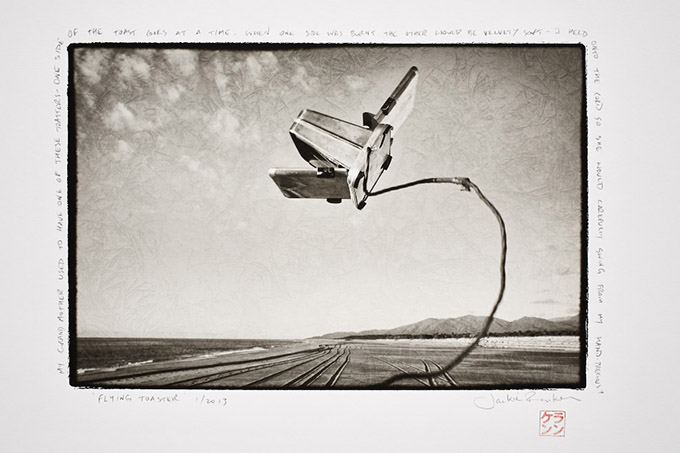
Flying Toaster
.
The design of the objects, their attitude in flight or physical placement in the frame, often imply a face in particular–the eyes, but as you allow imagination to take hold other features emerge. Robotic, alien (from outer space), drone-like apparatus and contraptions appear. In some images the similarity of object and location seem to connect with some kind of loose logic. Aluminium rice steamers have landed on earth and attempt to mimic the Moeraki Boulders behind them–hoping, maybe, to go unnoticed. Yet in other photographs, such as ones in which forks, with tines pointed skyward, emulate a miniature steely massed forest.
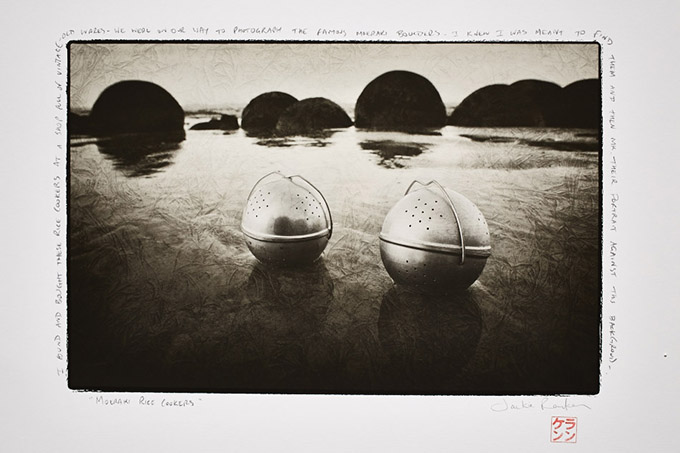
Moeraki Rice Cookers
.
The mysterious presence in Ranken’s photographs is further enhanced by her warm tone, sepia treatment of the images. Adding to the visual presentation of the photographs is the use of a dark border and veil-like texture screen. These techniques enable the normal colour and tone rendition of the subject to be transformed into an image that invokes fleeting memories and dreams. Anecdotes in the author’s own hand surround the image to recount Ranken’s connection with the object and the circumstances of the photo-making encounter.
Through the visual narrative of Kitchen Stories and other realities, Ranken constructs visual communiqués to connect the viewer with their memories and experiences and to encourage a heightened awareness of the ordinary things that surround their everyday life. In the captured ephemeral moments of flight Ranken presents the viewer with an opportunity to contemplate these objects of everyday experience. Ranken comments in her artist’s statement, that the Zen philosophy of Shibui informs her approach to life, and therefore she seeks to create images that present glimpses of a world where beauty can be found in simple and mundane objects.
What meaning should the viewer take from this? Are Ranken’s flung kitchenalia also a personal rebellion against homecraft and the traditional expectations of the housewife? Could it be a fascination with flight? Or is it that Ranken is a visual provocateur? In her artist’s statement the latter seems to be her strategy and it’s up to us to make sense of these incongruous apparitions. At first there may be a resistance to engage beyond the whimsical nature of the work. But these photographs deserve close and extended viewing, if not only to satisfy our curiosity for what has been presented to us, but also for what we may discover about ourselves, and the connections we make with the world.
.
Dr Doug Spowart
[1] http://en.wikipedia.org/wiki/Manaia_%28mythological_creature%29
BIOG: Doug Spowart is an artist, photographer, lecturer and artists’ bookmaker. With over 30 years continuous involvement in his art practice he has exhibited widely and his work is included in major gallery and library collections. Spowart has a PhD with his main research interests in both the photobook and social media.
.
Photos © 2013 Jackie Ranken and Doug Spowart, installation photo
.
This text is licensed under a Creative Commons Attribution-NonCommercial-NoDerivs 3.0 Unported License.
.
ONE FOR THE BOOK – THE 2013 BLURB BIFB BOOK AWARD

.
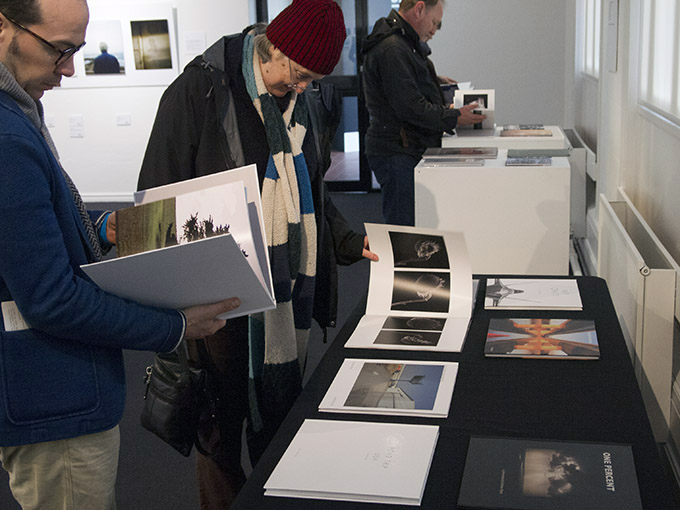
BIFB visitors checking out the book award entries
.
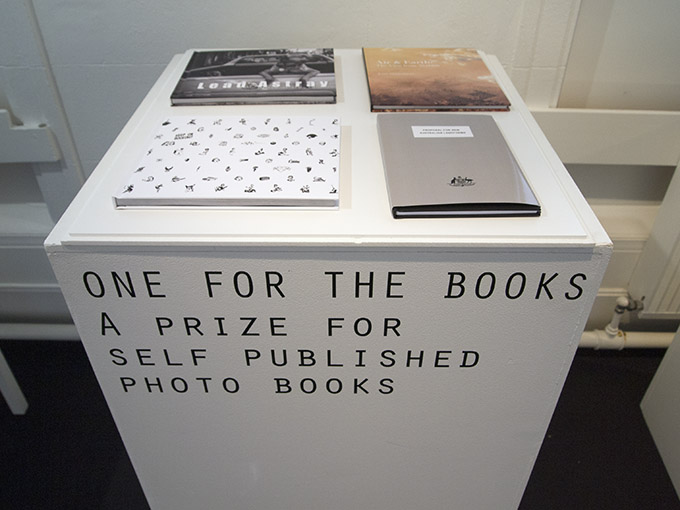
Doug’s book – front right
ONE FOR THE BOOKS
A display of some of the best self-published photobooks in the country are being exhibited at the 2013 Ballarat International Foto Biennale.
A PRIZE FOR SELF PUBLISHED PHOTOGRAPHY BOOKS proudly sponsored by Blurb
The Ballarat International Foto Biennale with major sponsor Blurb, present ‘One for the Books’ an exciting new prize celebrating the book as an innovative and contemporary format for presenting photography in a creative and narrative form. This prize is specifically for self publish, print on demand books. Books previously published by a traditional publishing house are not eligible for entry.
WHO COULD ENTER
The 2013 ‘One for the Books’ Prize will accept submissions for two categories; Professional and Amateur. Winners will be announced at on Monday 19th August 2013 at the Post Office Gallery, Ballarat. Entrants must be Australian residents. Around 100 books were submitted for the judging and 20 finalists were selected.
THE FINALISTS WERE …
The finalists [professional category]
Rhiannon HOPLEY NSW
Charles KLEIN SA
Darren MARTIN NSW
Garry MOORE VIC
Gary SHEPPARD NSW
Doug SPOWART QLD
Andrew STY AN NSW
Peter WHYTE TAS
The finalists [amateur category]
John Paul AZIZ & Shaun DUNCAN VIC
Michael DAVISON VIC
Lidia D’OPERA WA
Grant HUNT QLD
Paul JURAK ACT
Erin STONESTREET ACT
Scott VINEY QLD
.
AND THE WINNERS WERE …
At a special event on Monday August 19th the announcement of the winners of the inauguaral One for the books prize was announced.
.
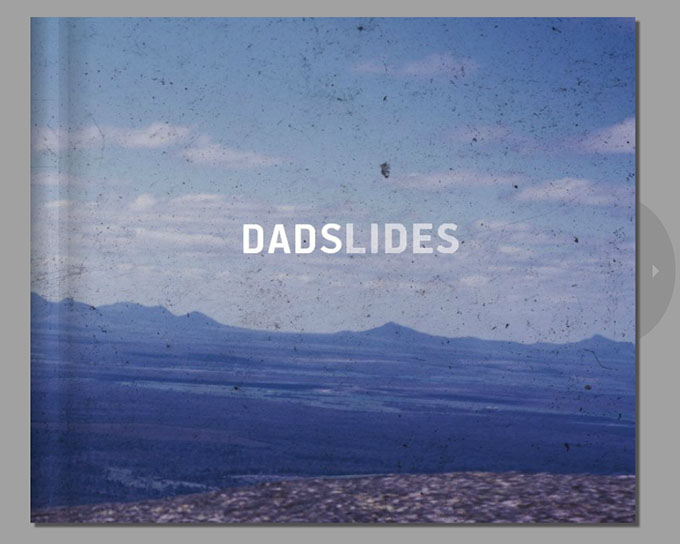
Charles Klein’s Awarded Book – Professional Category
Dadslides is a book dealing with a personal sense of nostalgia in the discovery of one’s own family photographs after the passing of a loved one. Klein’s book consisted of his father’s slides made between 1950 and 1981. The photos were scanned and sequenced within the book to create a document of a family growing up, going on holidays, messing around in the back yard and the other things that symbolise Australian life in this era. Strangely, whilst the book is about Charles Klein’s family, it strikes a resonance with us all and therein lies the beauty and the power of its narrative.
SEE THE BLURB REVIEW HERE: Charles Klein’s Awarded book
.
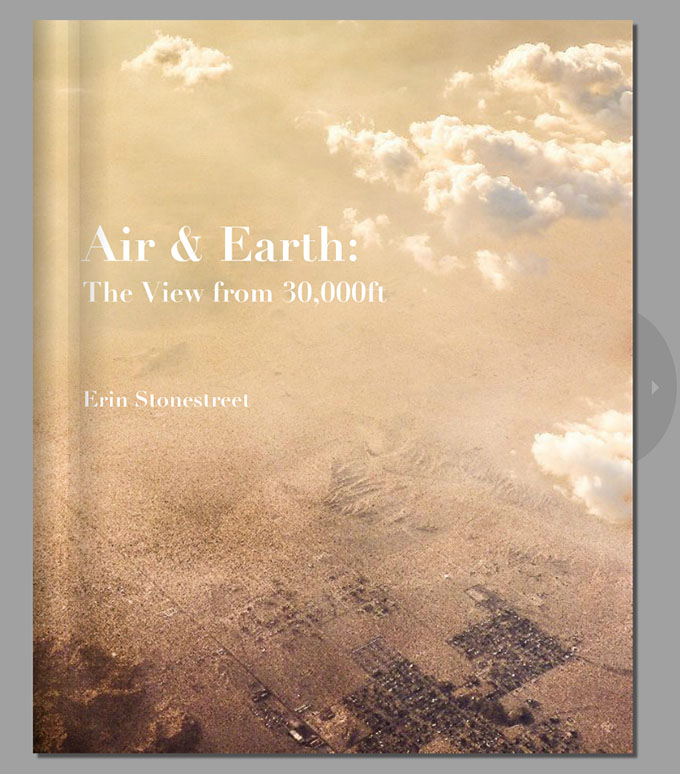
Erin Stonestreet’s Awarded Book – Amateur Category
Air & Earth: The view from 30,000 ft is a book that deals with the aerial view of the earth. The rich colours and image juxtaposition create for the viewer an abstract view – all scale is abandoned and the images take on a sense of the magical, and perhaps even for some, a spiritual meaning.
SEE THE BLURB REVIEW HERE: Erin Stonestreet’s book
.
I was excited to be a finalist in the award – Here is my book…
..

Doug’s Finalists Book
My book deals with the political scene and is a parody of the potential for government agencies and politicians to do absurd things for, as they call it, ‘the good of the people’.
.
SEE THE BLURB PREVIEW HERE: Doug’s Book.
.
PLEASE ENJOY – And do get to Ballarat to see these amazing books in person …
And join in on the photobook print-on-demand revolution.
.
.
UPDATE: Nocturne Muswellbrook
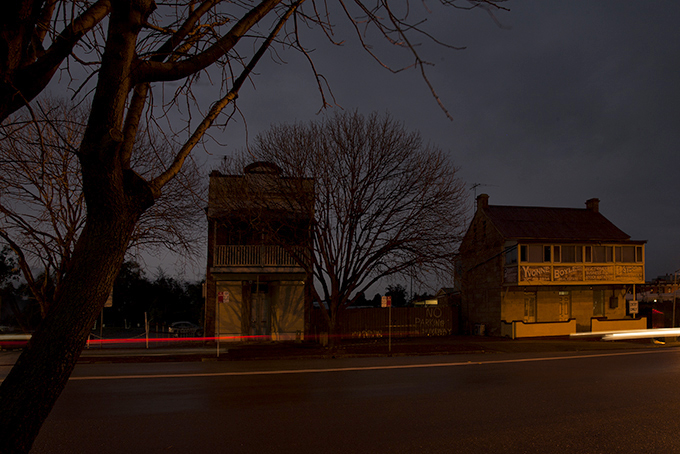
Intersection of Sydney & Haydon Streets
..
We’ve been busy in the Nocturne Muswellbrook project – Here is an update …
.
A NEWSPAPER STORY
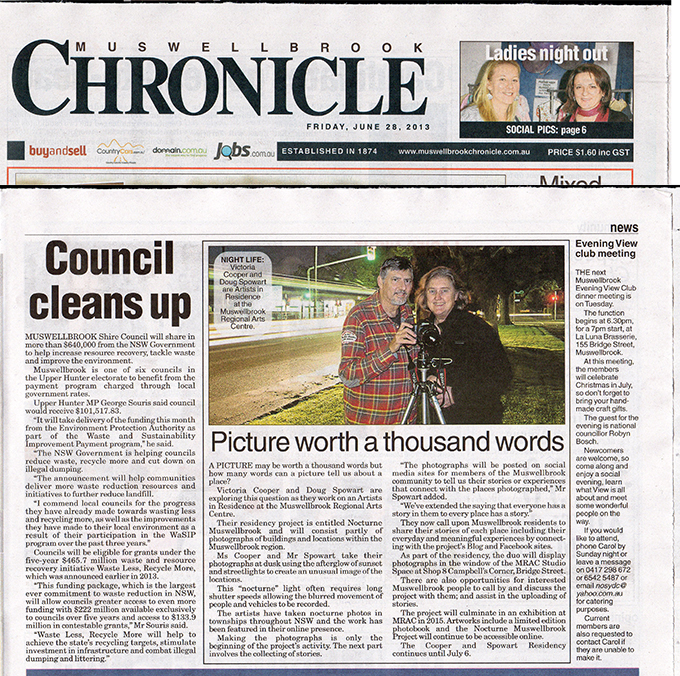
Chronicle News story: 28 June 2013
.
Our Gallery
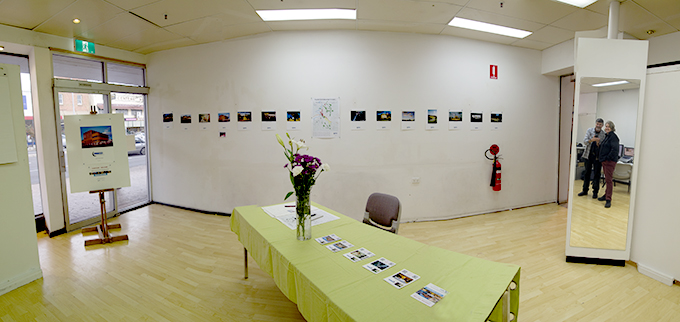
The Nocturne Gallery in SHop 8 Campbell’s Corner
.
An ABC Radio interview
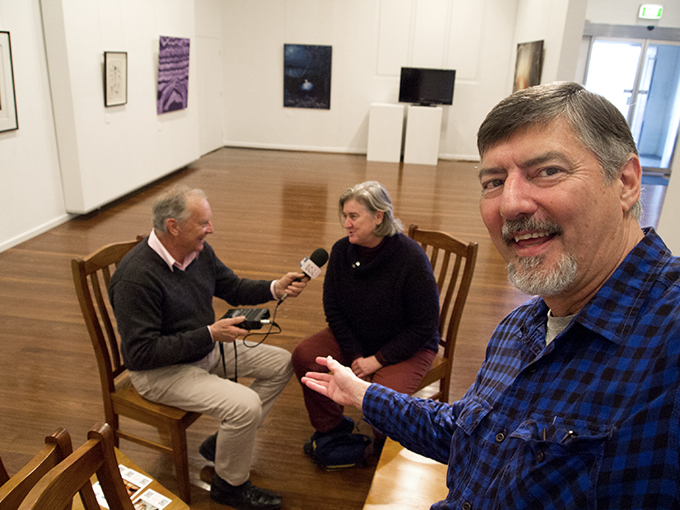
Mike Pritchard from ABC Radio interview
.
A presentation to the local Camera Club
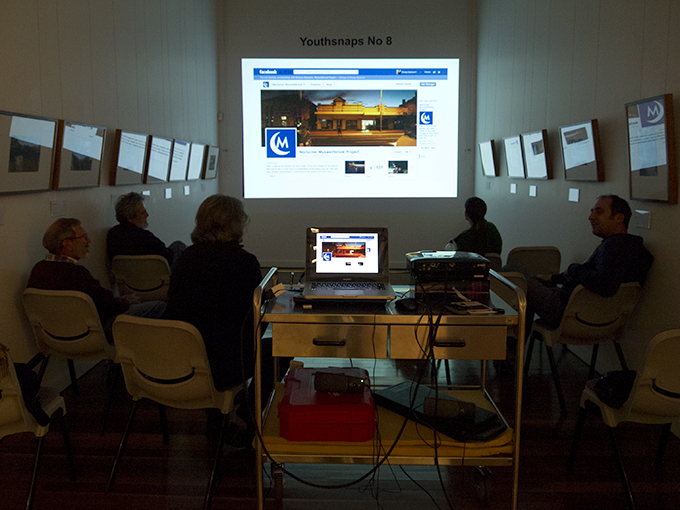
Muswellbrook & District Camera Club
.
Working in the rain – nearly every night lately …
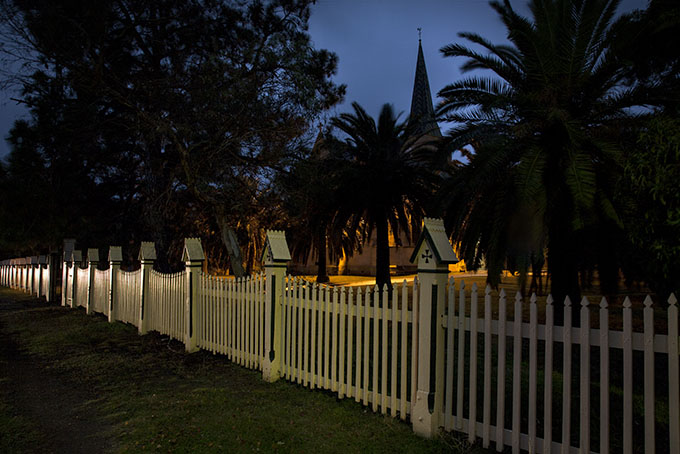
St Alban’s Anglican Church
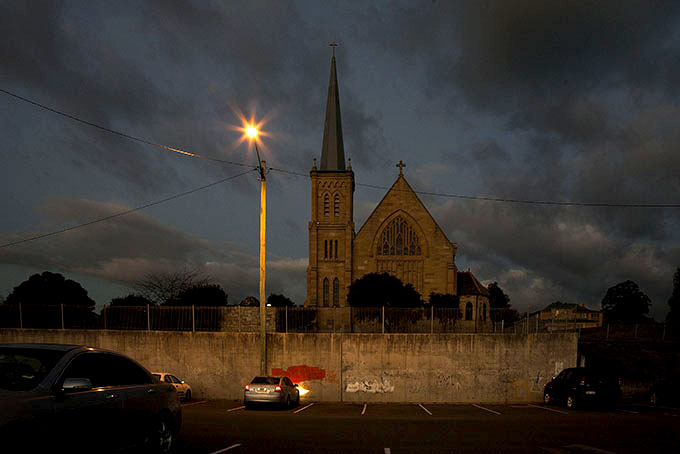
St James’ Catholic Church
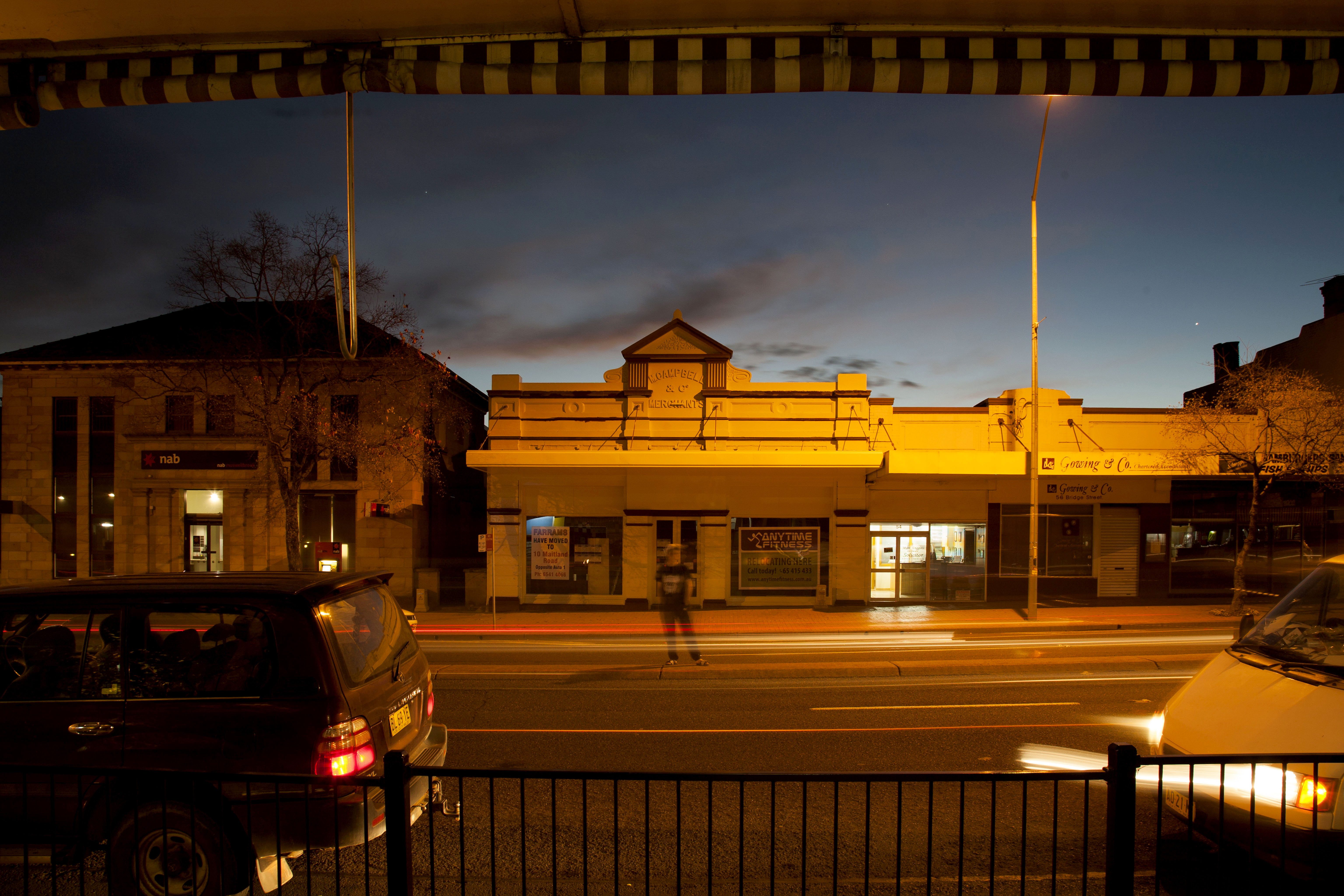
56 Bridge Street
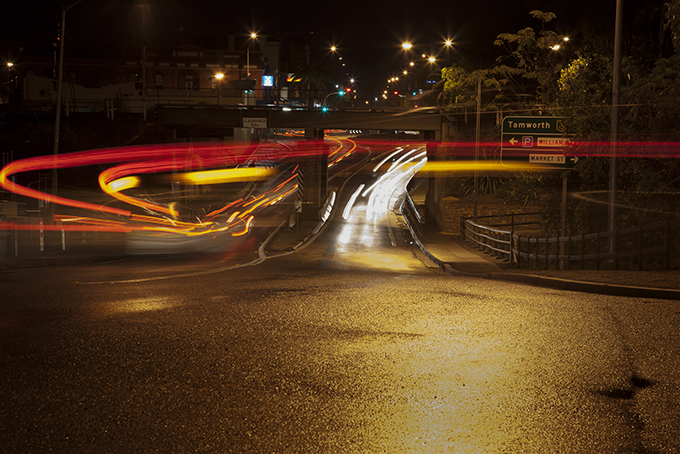
Southern end of the Subway
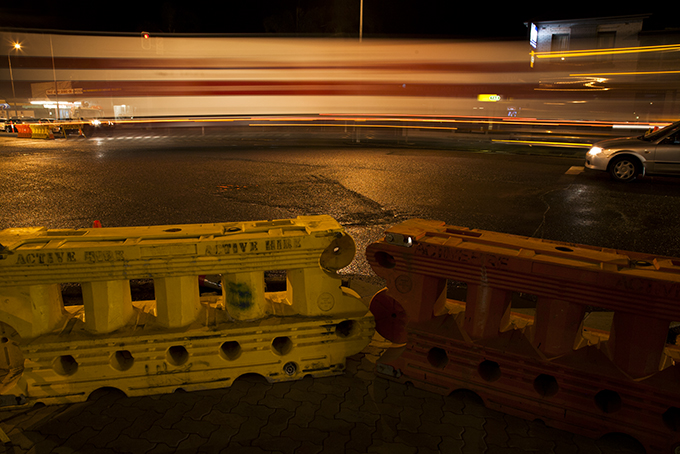
Corner Sydney Street and Maitland Road
.
SEE MORE IMAGES AND TO ALSO MAKE A PERSONAL COMMENT ON THE POSTS about your experience of ‘PLACE’ or stories evoked by the subjects we have photographed:
.
https://www.facebook.com/pages/Nocturne-Muswellbrook-Project/462047657214253.
AND
The Blog: www.nocturnemuswellbrook.org
.

Comment Now …
..
To Follow us on FACEBOOK ‘Tick’ GET NOTIFICATIONS and ALL UPDATES

.
© 2013 Victoria Cooper and Doug Spowart for The Nocturne Muswellbrook Project
.
This work is licensed under a Creative Commons Attribution-NonCommercial-NoDerivs 3.0 Unported License.
.
.
.
ARTIST IN RESIDENCE: Muswellbrook Nocturne
.

Nocturne Muswellbrook
.
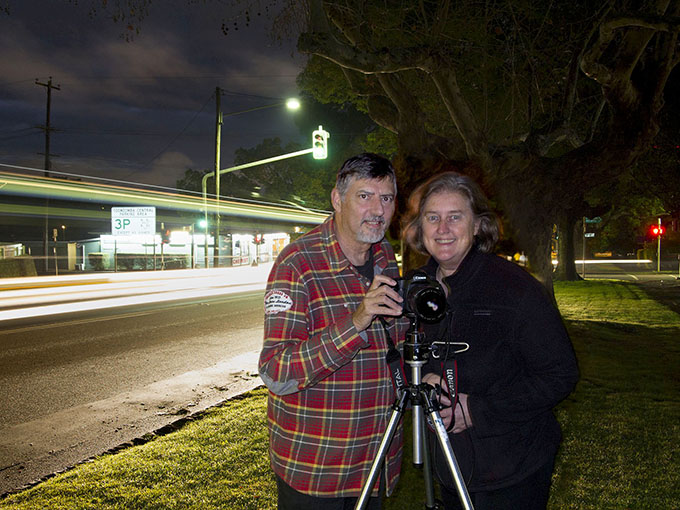
Victoria Cooper and Doug Spowart
For those of you who have been following our nocturne work over the last twelve months at WOOLI and in XMAS STREET we are now working on a new project in the Hunter Region of New South Wales. We are Artists in Residence at the Muswellbrook Regional Arts Centre and are now making nocturne photographs at dusk using the afterglow of sunset and streetlights documenting the town of Muswellbrook.
Nocturne light creates a sense of drama or a setting for a movie scene – a place where stories can be evoked and told. In this work we explore of the idiosyncratic nature of the architecture and street scenes of country and regional towns. The prosaic nature of these towns, when photographed in the dusk light, becomes part of a found aesthetic–a site-specific sculpture of light, colour and form. But there is also a visual narrative, isolated and exhumed by this light, one that has evolved from the activity of everyday life—yet the familiarity rendered it invisible.
Making the photographs is only the beginning of the project’s activity; the next part involves making a space for the telling of stories. Therefore the photographs are being posted on social media sites, a blog and Facebook to attract comments.
We now call upon the Muswellbrook community to share their stories of each place including their everyday and meaningful experiences by connecting with the project’s Blog and Facebook sites. We also invite other participants to comment if the photographic subject invokes the recollection of an experience or story.
The Blog: www.nocturnemuswellbrook.org
and Facebook
https://www.facebook.com/pages/Nocturne-Muswellbrook-Project/462047657214253
.


…
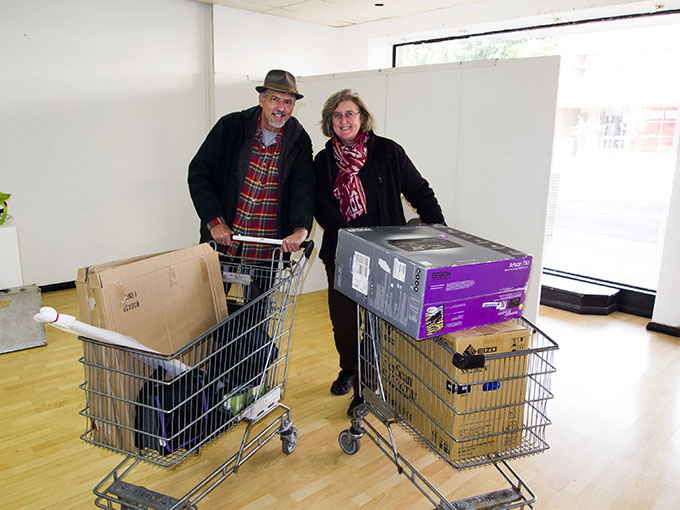
Doug+Vicky moving in to the Artists in Residence Studio
.
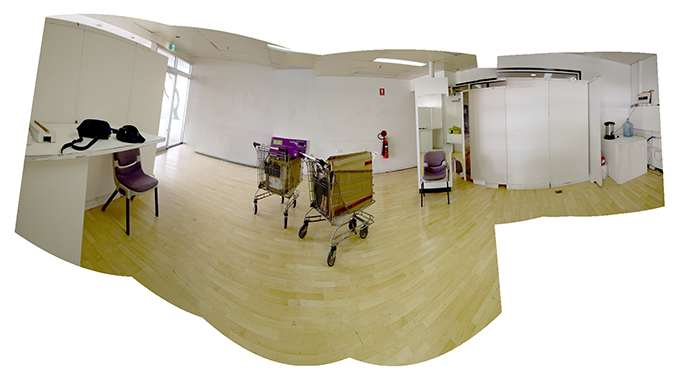
The Residence Studio
.
Comment Now …
..
To Follow us on FACEBOOK ‘Tick’ GET NOTIFICATIONS and ALL UPDATES
.
© 2013 Victoria Cooper and Doug Spowart for The Nocturne Muswellbrook Project
.
This work is licensed under a Creative Commons Attribution-NonCommercial-NoDerivs 3.0 Unported License.
.
.
.
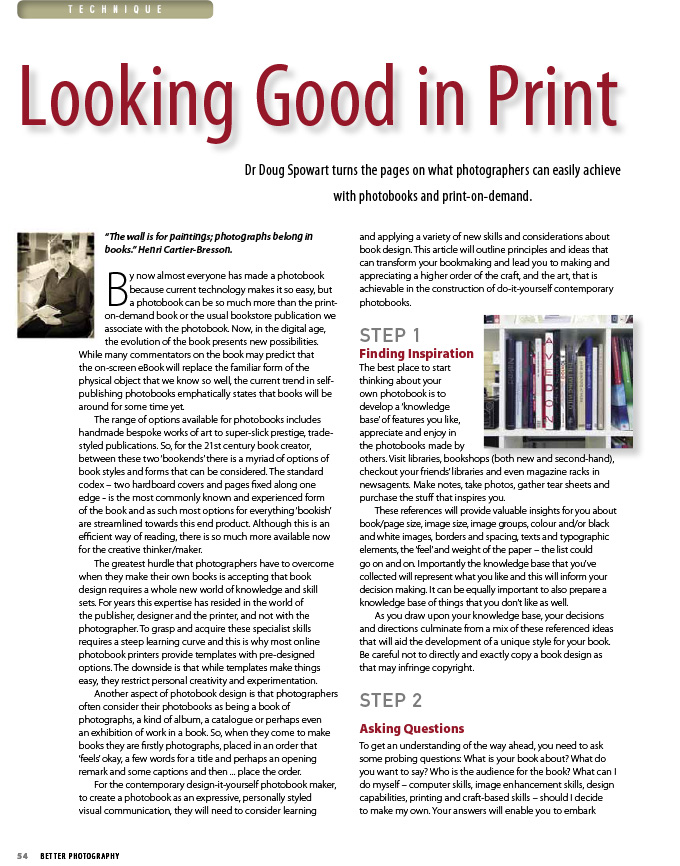
DOUG Has article on Photobooks in BETTER PHOTOGRAPHY
The winter edition of Peter Eastway’s BETTER PHOTOGRAPHY includes an article by Doug on Photobooks. The piece covers a step-by-step discussion on making your own photobooks from concept to output, either by DIY or Print-on-demand.
.

.
Here’s page one of the article …
.
.
DOWNLOAD A PDF of the article here: SPOWART-Photobooks-Better_Photography
.
AND – Do buy the magazine for the other great stories and prizes!!
.
.
.
.
MEMORY COLLECTIVE: A performance documentary project
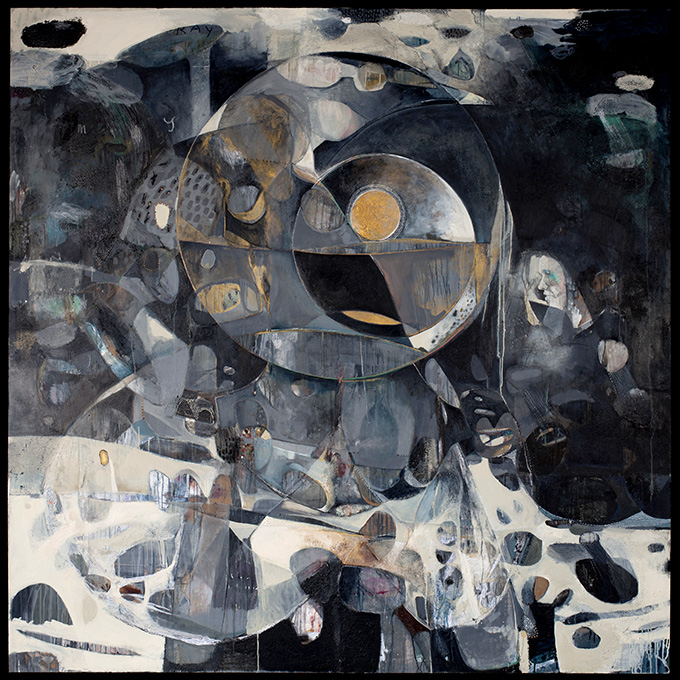
The Memory Collective painting by Damien Kamholtz
.
The Memory Collective is a multi-disciplinary collaboration orchestrated by artist Damien Kamholtz. Kamholtz states: The Memory Collective Project is a creative collaboration between 12 artists across eight artistic disciplines exploring concepts and themes relating to the human condition such as change, constants, history, refection and memory. The artworks created during the project will make up an exhibition to be held at the Toowoomba Regional Art Gallery in September 2013.
There are different stages to the project. First Kamholtz created a large 2.2 metre square painting, while sculptor, Jessie Wright constructed the large vessel to hold the water. Kamholtz’s painting is embedded with personal meaning in the form of fragments of his past art, the ashes of diaries. In the presence of this artwork we are drawn into a poetic landscape where faces emerge; symbols and totems slip from passive dark spaces and come into conscious awareness.
The second stage of the work was the performance in the form of 9 responses to the painting by Kristy Lee. The painting and the pool created the reflective and reflexive performative space and the transformative process of the original painting then began. Integral to the space were David Usher’s delicate pots; these vessels contained the pallet of shades that then shrouded and clouded the memory of the work. Over the course of the day the painting’s physical form was transformed into something different loosing its current visual form as only a memory.
Our part of the collaboration was to witness, respond and record the transformation of the work over the day. The next stage of the Memory Collective’s work will continue over the next month our component will be to create 9 large collaged photograph memory states of the work for the show in September. Works by others include; a video art piece, a documentary video, a soundscape, interviews, prose and poems. It is a significant project and is being funded by the RADF and supported through the exhibition at the Toowoomba Regional Art Gallery.
.
A fragment of photographic memories made by us for the MEMORY COLLECTIVE…
.
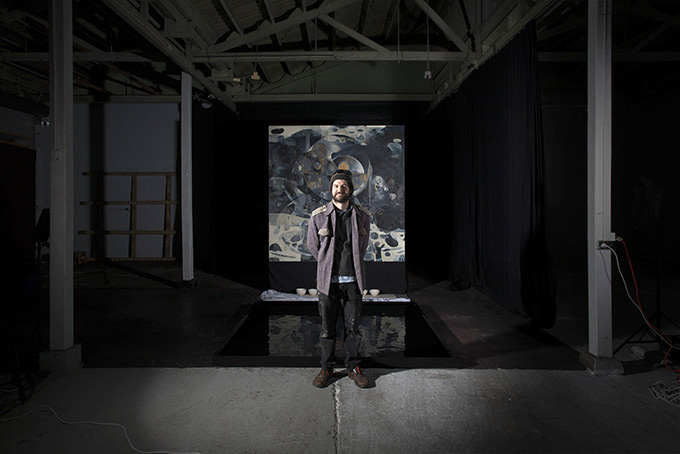
Damien Kamholtz in the performance space with the painting and pool
.
Doug documents the space …… Photo: Victoria Cooper
.

Kirsty and painting – in the early state…
…
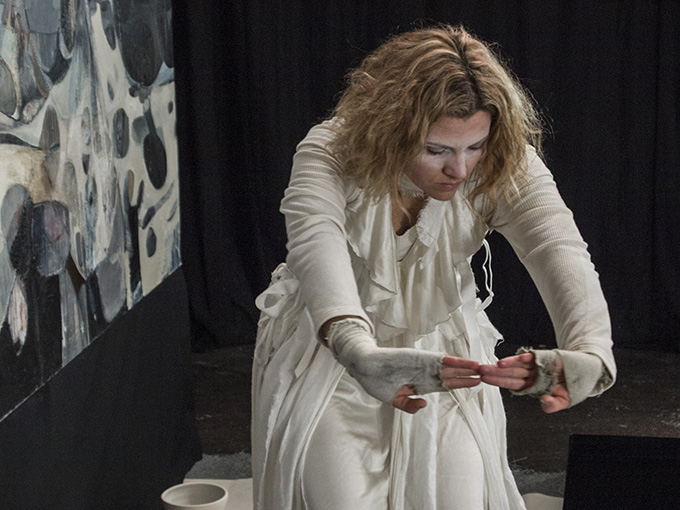
Kirsty Lee performs before the painting
.
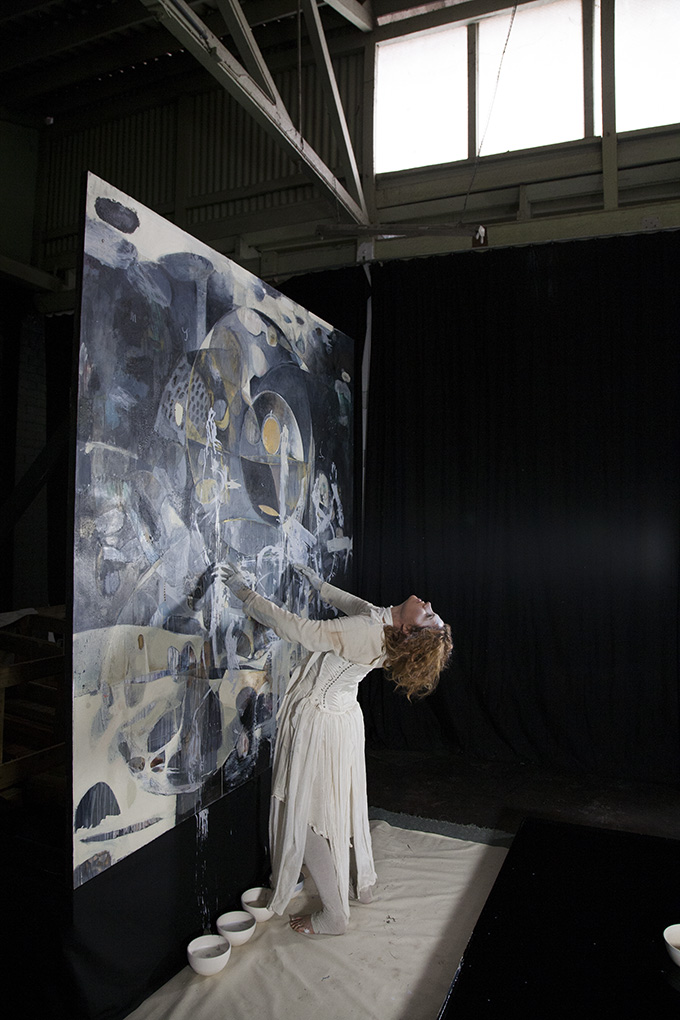
State 3 Kirsty applies paint to the paining…
.
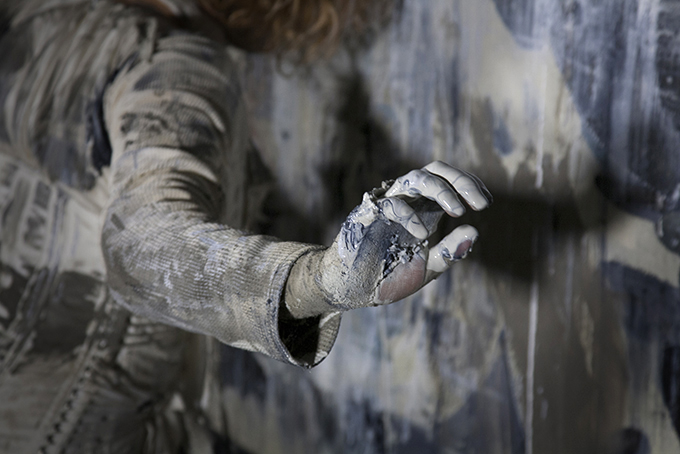
Hand paint
.

Kirsty Lee and her interaction with the painting … around Stage 6
.
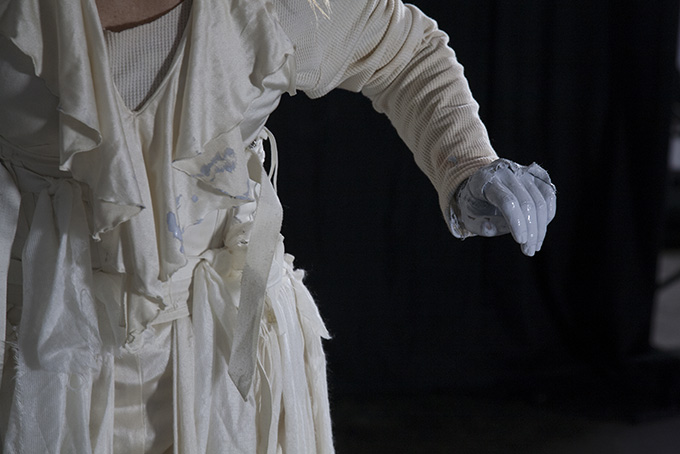
Blue hand…
.
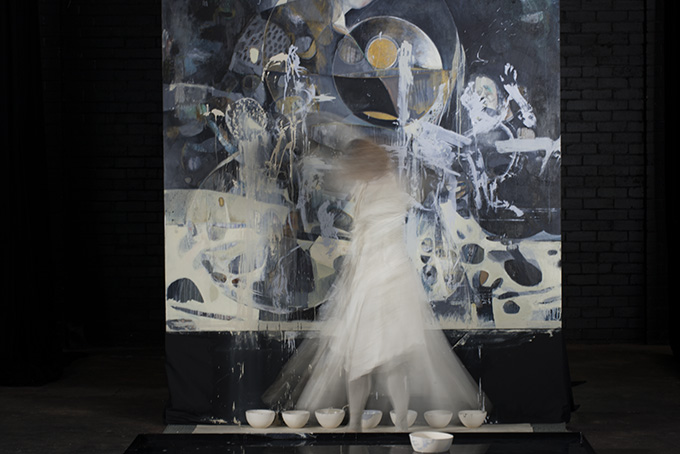
Kirsty Lee in a frenetic stage…
.
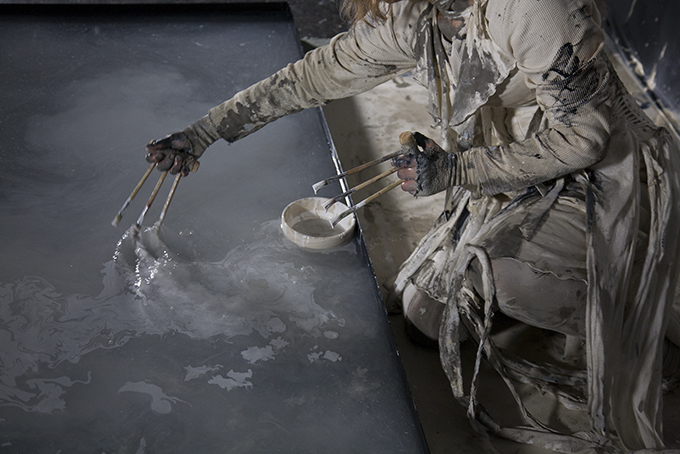
Kirsty and brushes before the pool
.
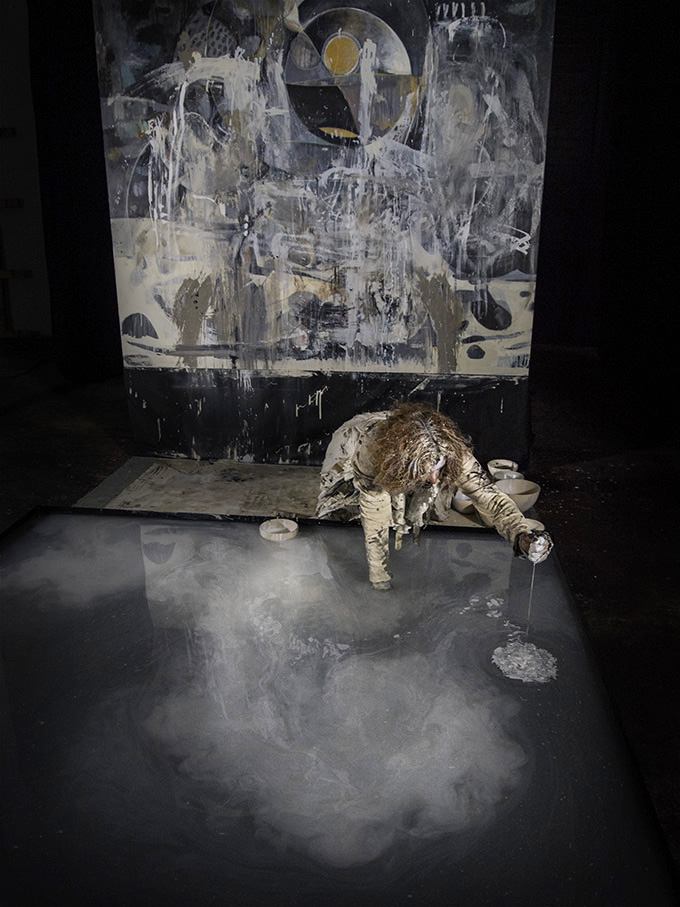
Paint fluid in the pool…
.

Towards the final state…
.
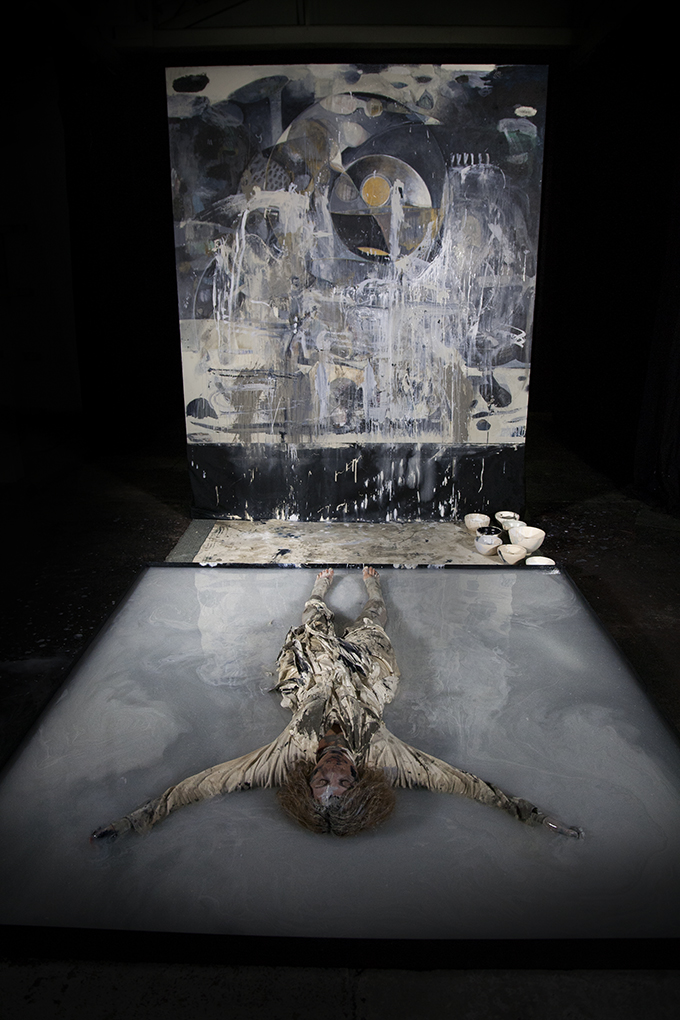
The final state …
…
.
 .
.
.
.
/.

Damien discussing movement with Kirsty
.
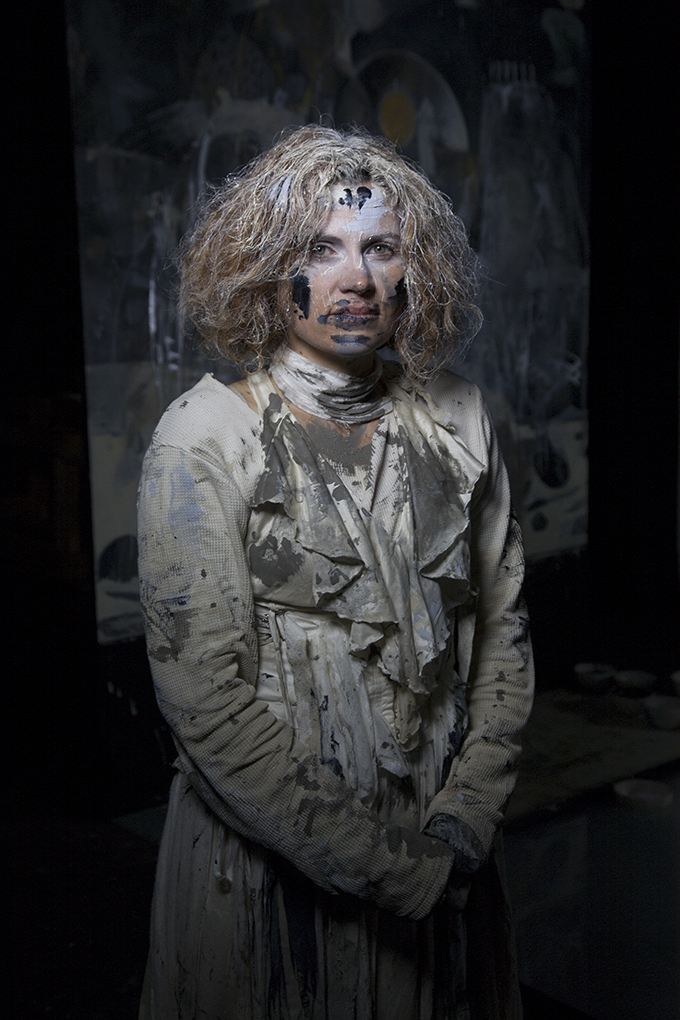
Kirsty Lee towards the end of the performance
.
Another creative work from the performance by Jason Nash…
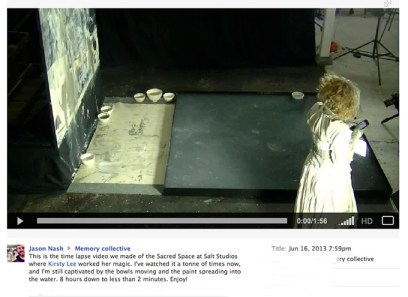
Jason Nash – Time lapse video
CLICK HERE to see Jason Nash’s ‘Memory Collective’ time-lapse video
.
The Team: Front Ashleigh Campbell, Julio Dunlop, Kirsty Lee, Victoria Cooper, Doug Spowart
Back: David Usher, Jason Nash, Jesse Wright, Damien Kamholtz, Zac Rowling ( weakling).
Not present: Craig Allen & Jake Hickey
.
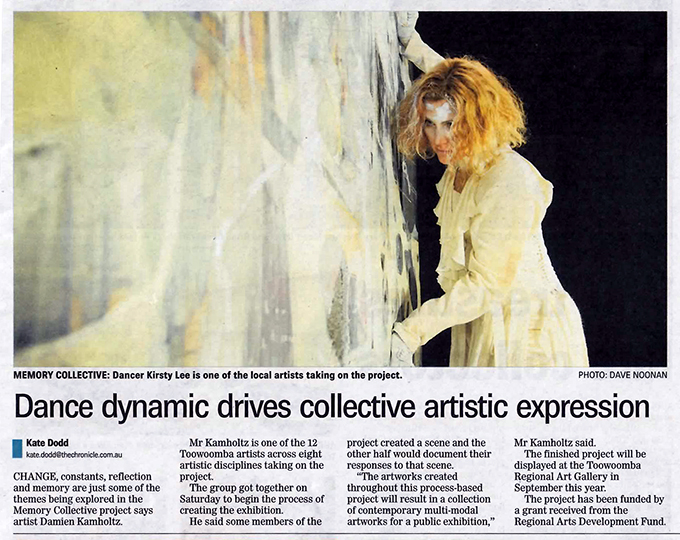
Toowoomba Chronicle 17 June, 2013 by Kate Dodd PHOTO: Dave Noonan
.
..
 .
.
.
© 2013 Victoria Cooper and Doug Spowart for The Memory Collective
.
This work is licensed under a Creative Commons Attribution-NonCommercial-NoDerivs 3.0 Unported License.
.
.

 wotwedid