Archive for the ‘Exhibitions’ Category
Olive Cotton Award Winner Announced
PRESS RELEASE FROM THE GALLERY – August 10, 2013
$20,000 winner of Olive Cotton Award announced
Magnum Photographer takes out prize money for intriguing portrait
Saturday, 10 August 2013
Photographers, Olive Cotton Award entrants, and the general public filled the foyer of the Tweed River Art Gallery tonight eager to hear who had won the 2013 Olive Cotton Award. The exhibition features the work of 91 finalists from all Australian states and territories. The exhibition features entries from emerging and established photographers selected from 381 entries Australian wide.
The judge, Helen Ennis, Head at the School of Art, Australian National University was delighted to judge the Olive Cotton Award, having a particular connection to Olive, as her biographer. The award is funded by Olive Cotton’s family in memory of one of Australia’s leading twentieth century photographers. In deciding the winner Ennis shortlisted a selection of works awarding four Highly Commended awards to works which held her attention due to the “clarity of the photographers’ approaches to portraiture and the different kinds of relationships they had with their subjects”. These award were made to:
Petrina Hicks from Sydney for Ornament – “a haunting image of a young woman from another realm, rendered in muted colour”.
Tamara Dean from Sydney for Brothers – “a very moody and memorable image of teenage brothers photographed in a gloomy bush setting”.
Lee Grant from Canberra for Kristy – “a slightly awkward portrait of a young actress who belongs emphatically to the present time”.
Narelle Munro of Sydney for David– “a very sympathetic close-up portrait of the New York based Australian artist David Rankin”.
The winner of the $20,000 acquisitive prize is Trent Parke, one of Australia’s best known documentary photographers and the first Australian to join the prestigious Magnum Photos collective. Of his entry Candid portrait of a woman on a street corner Ennis said it is “a very unusual work, the subject isn’t immediately visible and so our notions of portraiture are challenged. The viewer is invited to actively work with the image in order for the face of this unknown woman to become apparent”.
Award Co-ordinator Anouk Beck said “Trent Parke was elated at the news and to receive an award for this work which marks a new direction for him and his first foray into portraiture”.
Through the generosity of the Friends of the Gallery Inc. Director Susi Muddiman selected four works for purchase for the Gallery’s permanent collection. Her selections were:
Self portrait with cactus and telephone 2013 by Raimond de Weerdt of Lismore;
Bob Kattar MP 2011 by Russell Shakespeare of Currumnin Qld;
Barry Jones and the ancestor 2012 by Imogen Hall of Melbourne;
And Noah 2013, a portrait of actor Noah Taylor by Sahlan Hayes of Kangaloon and Sydney;
On Sunday 15 September, at 11.00am, Dr Doug Spowart will present a floortalk on the Olive Cotton Award 2013 exhibition. Spowart’s reviews have been published in publications such as Art Monthly and the popular magazine Better Photography. All are welcome to attend.
At 1.00pm on Sunday 15 September Doug Spowart and Dr Victoria Cooper will be discussing The Artist and Social Media – making connections and making art. Victoria and Doug are interdisciplinary visual artists who have adopted social media and blogs as a medium an integral part of their contemporary arts practice. Using social media platforms they post reviews, profiles, opinions and collected writing about issues in the broader arts community which are then accessible and invite dialogue from a wide online community. Both have lectured nationally and their work has been acquired for the artists’ books, rare book and manuscript collections in Artspace Mackay, State Libraries of Queensland and Victoria, the National Library of Australia and in the Carleton College Collection in the USA.
Complementing the 2013 Award is the ABC Open digital exhibition 100 Faces, the best of ABC
Open’s Snapped: Faces. This is a small selection from over 1000 portraits, captured by amateur and professional photographers throughout regional Australia, for the ABC Open June photography
challenge SNAPPED: FACES.
The exhibition continues until Sunday 29 September. The Gallery and Gallery Cafe are open Wednesday to Sunday 10am-5pm.
A bonus – A PDF of the exhibition catalogue (Note images have been cropped square for design purposes) Go see the exhibition
SEE earlier post for details …
Click Here: 2013 OCA catalogue for web_screen
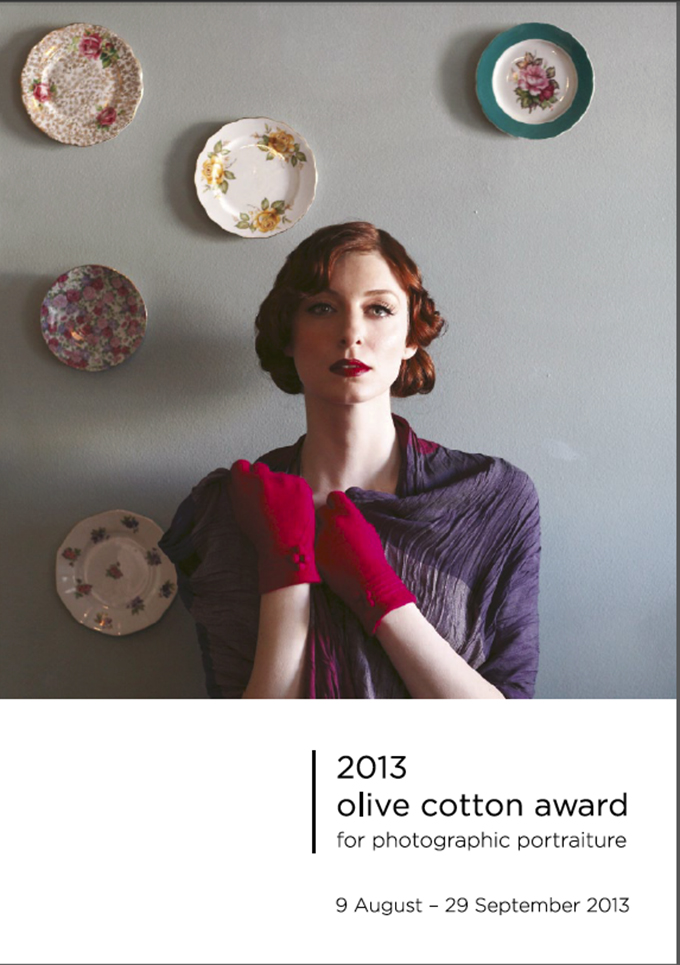
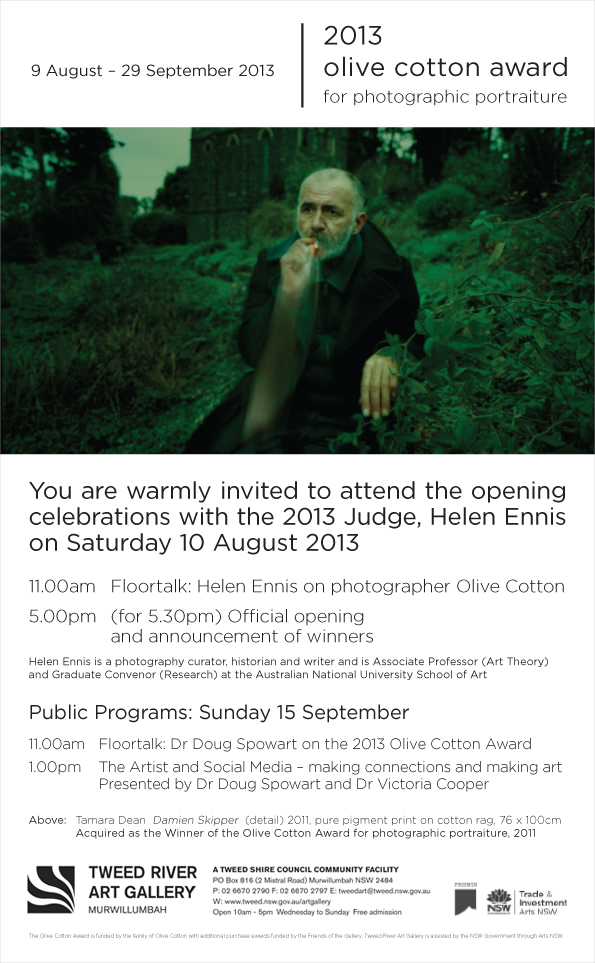
OLIVE COTTON AWARDS ANNOUNCEMENT + GALLERY TALKS
ADVANCE NOTICE: OLIVE COTTON AWARD ANNOUNCEMENT/OPENING & FLOORTALKS
The biennial Olive Cotton Award for photographic portraiture is once again on show at the Tweed River Art Gallery Murwillumbah. Each time this award is offered the best and most diverse collection of contemporary Australian photographic portraiture is assembled for public viewing and appreciation. This year’s judge is Associate Professor Helen Ennis from the Australian National University School of Art. A list of the finalists is available here: 2013 Olive Cotton Award_list of finalists
.
Details about the Tweed River Art Gallery are available here: http://www.tweed.nsw.gov.au/artgallery
This Gallery has the most beautiful view of Mt Warning and the Tweed Valley caldera – Equally as inspiring as the photographic art that it contains.
.
This year we will be presenting a floortalk about contemporary portraiture as well as a presentation about The Artist and Social Media.
Damien Kamholtz: ‘My Icarus’ @ TRAG the VIDEO
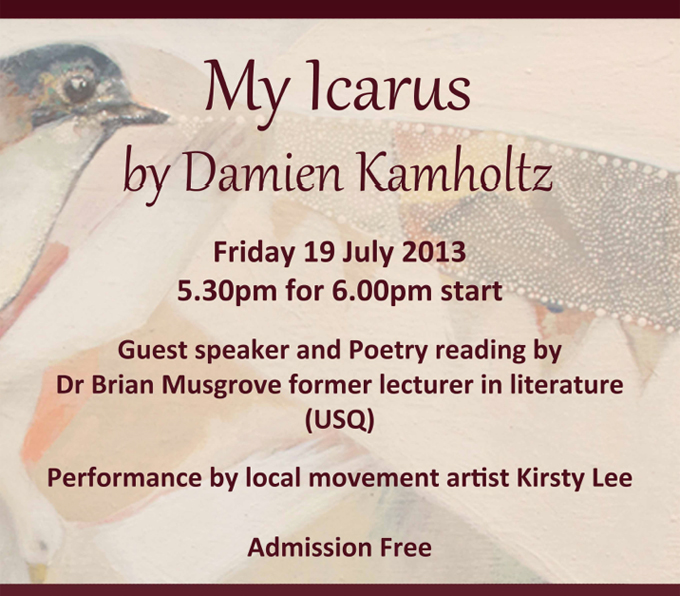
My Icarus invitation
.
FROM THE ART GALLERY WEBSITE:
‘My Icarus’ is a culmination of one painting, one sculpture and one film. These three interrelated works delve into poetry and mythology and showcase the Gallery’s recent acquisition of Mr Kamholtz’s painting, ‘The Spit that Joins the Magic Together’.
The exhibition title refers to the artist’s fascination with Greek mythological figures, Icarus and Daedalus, and the works of 19th Century French poet Arthur Rimbaud.
Additional creative ‘spittle’ for the performance was delivered in verse by guest speaker and former USQ lecturer in literature Dr Brian Musgrove with a simultaneous performance by Toowoomba movement artist Kirsty Lee.
The exhibition works include the recently acquired painting, an assemblage and a collaborative film produced by Mr Kamholtz, Jason Nash, Kirsty Lee and Craig Allen.
..
.
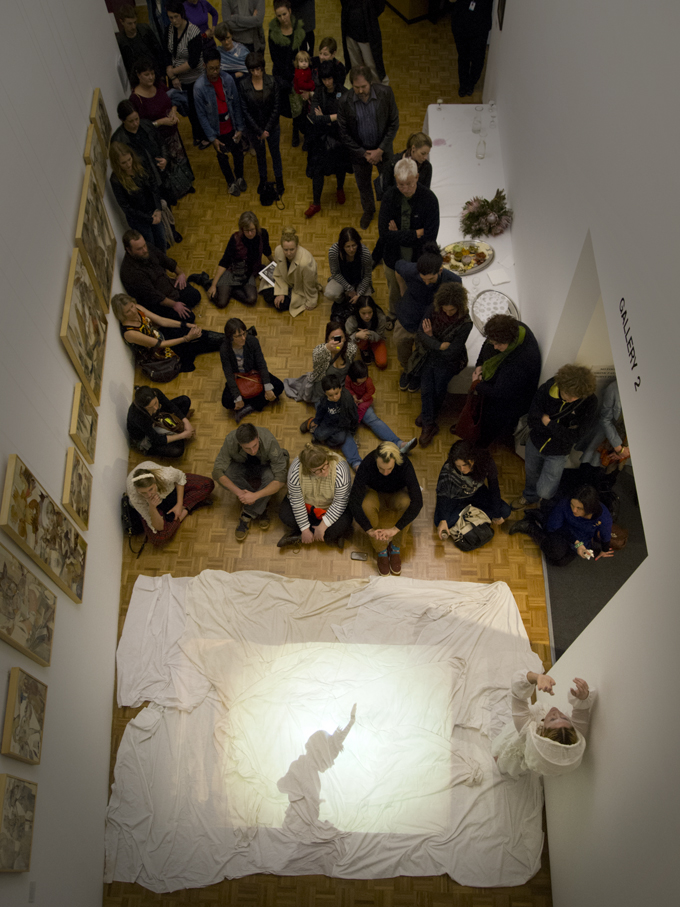
Toowoomba Regional Art Gallery attendees witnessing the event
.
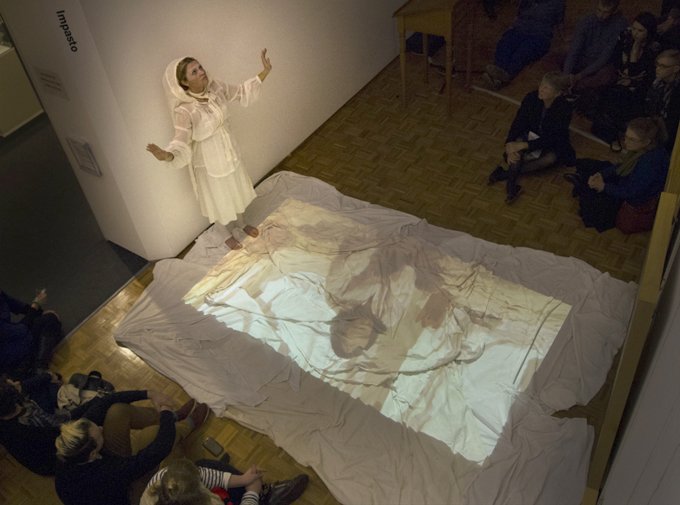
Kirsty Lee in performance
.
Photos and Video © 2013 Doug Spowart
.

This work is licensed under a Creative Commons Attribution-NonCommercial-NoDerivs 3.0 Unported License.
.
TRANSLUCENCE: Jacqui Dean’s Xrayograms
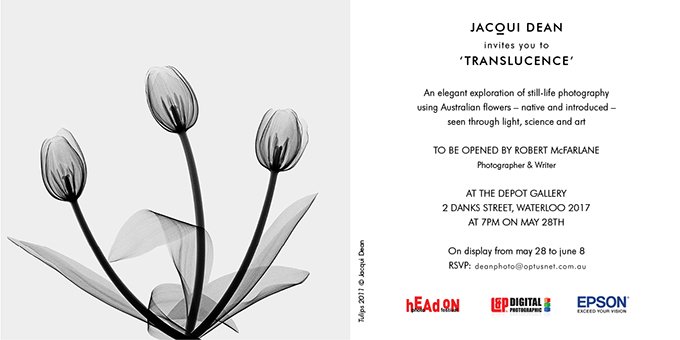
Translucence invitation
.
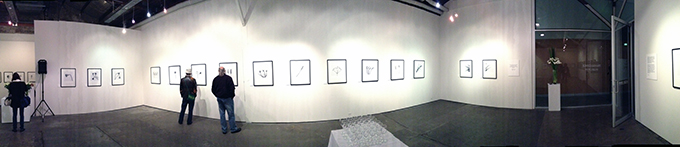
Translucence @ 2 Danks Street Gallery . . iPhone Photo: Doug Spowart
.
Another Universe
.
From the late 19th, and into the early 20th century there was a growing movement in the sciences and the arts that associated with Nature’s inherent resonance of form and structure from the microscopic to the cosmic. These new vistas and universes were recorded not only by the scientists’ hand but also by new developments in technology, notably the invention of the photographic process. Visual communication through imaging technologies continues to be an important tool in scientific research. But these images were not just useful as scientific evidence they were and continue to be inspiration for the creative work of artists and designers.
One noted exemplar utilising this visual medium was Karl Blossfeldt (1865-1932), a sculptor, metal craftsman and teacher. Blossfeldt began taking photographs of botanical specimens to use in his classes as ideas for students to create design forms from nature. But Blossfeldt’s work became very influential in the art, craft and design movement that popularised natural forms as templates for architecture, sculpture and 3D design work. His photographic documentation revealed abstract views of humble everyday roadside plants as visually interesting structural and aesthetic forms. As a result, Blossfeldt’s photographs also became renowned as works of fine art.
Jacqui Dean’s exhibition Translucence, at 2 Danks Street Gallery, Sydney, is the result of artistic curiosity and visual investigation natural forms through the phenomenon of Xrays. Art in this respect is the revelation of the unseen, the beholding of the essence within ordinary objects or a transforming perception of the everyday experience. The photograph, or in this case ‘xrayograph’, seals the object within the frame safe from the changes and inevitable decay over time. At first glance these images could appeal to the naturalist or perhaps a student of design (after Blossfeldt). Yet a deeper – more poetic vision immanent in nature is also suggested through a more contemplative viewing of these images.
Some may argue that this is an uncomfortable clash between the modernist and the romantic, or the objectivity of scientific evidence and the subjective imagination. But could this work identify with a need to embrace a sense of wonder rarely seen within a super-hyped, virtual digital-image society? Dean’s work in Translucence is informed by the poetry of music and her life’s experiences and her prodigious professional practice in photography. However the rewards for the thoughtful viewer will be to share in her wonder of the natural world that surrounds and nourishes our everyday life.
Victoria Cooper . . . June 9, 2013.
.
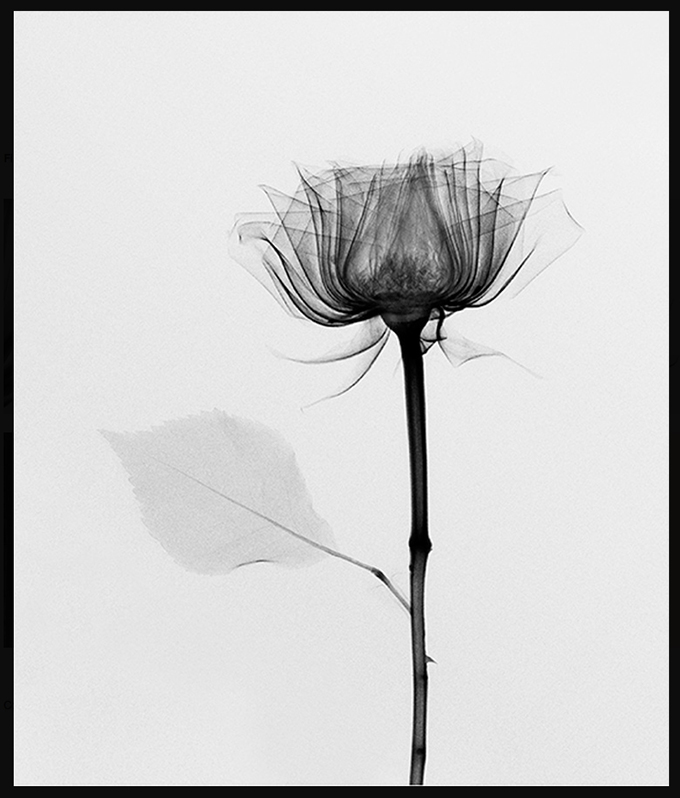
Rose Xrayogram by Jacqui Dean
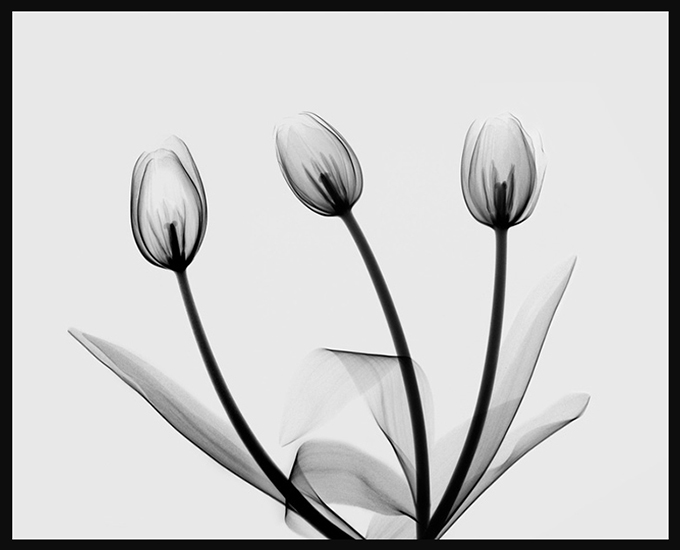
Tulips Xrayogram by Jacqui Dean
.
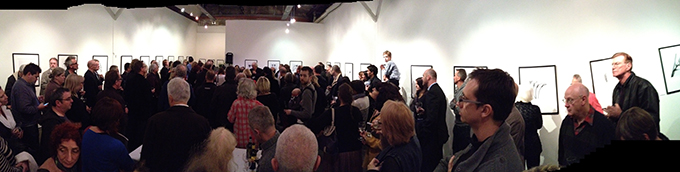
Translucence Opening Crowd . . iPhone Pano: Doug Spowart
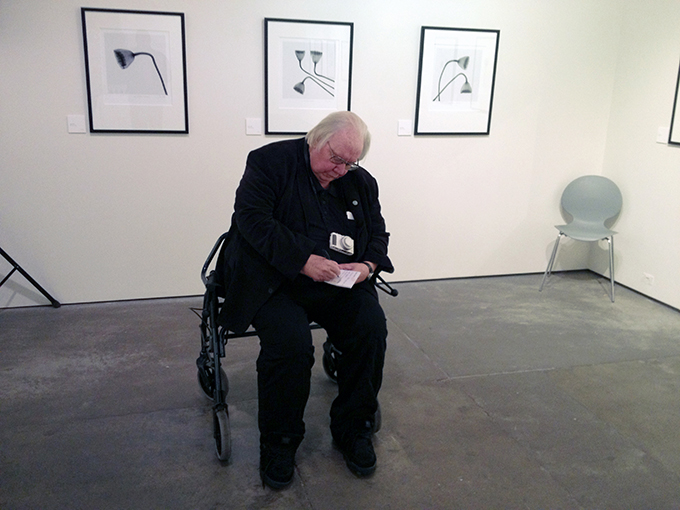
Robert McFarlane preparing his opening remarks . . iPhone Photo: Doug Spowart.
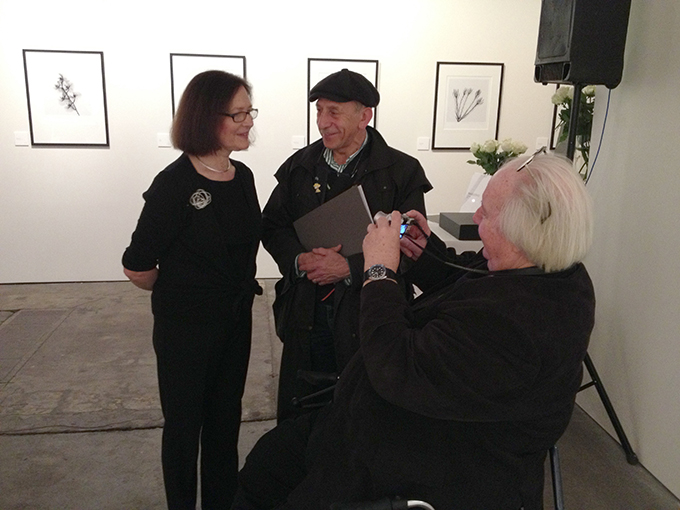
Jacqui, Josef Lebovic and Robert McFarlane . . iPhone Photo: Doug Spowart
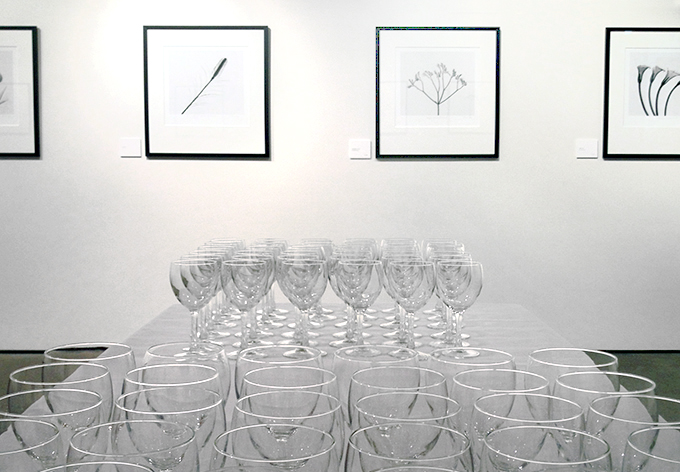
More Translucence. . iPhone Photo: Doug Spowart
.
MORE INFORMATION:
.
Jacqui Dean’s Website: http://deanphotographics.com.au/fine-art/
Interview by Gemma Piali of FBi Radio, Sydney: http://fbiradio.com/interview-jacqui-dean-on-translucence/
Review from Simone Whelton ABC702 http://www.abc.net.au/local/stories/2013/05/31/3659500.htm
“Translucence: Jacqui Dean – A jam packed opening on a Tuesday night meant it was a little hard to see some of the stunning black and white prints that Jacqui Dean has featured in her new exhibition Translucence but I pushed my way through the crowds and was delighted at the little moments of gentle quiet that descended on me as I stared at each picture, delicately constructed. This is spectacular still life photography featuring mainly Australian flowers (orchids and native flowers) and using a combination of x-ray and digital imaging. Tucked away towards the back of the exhibition is a series of photos of beautiful shells. Known for her photographs of architecture (interiors and landscape), this exhibition is part of Head On. Take a few minutes to pop in and enjoy the works! When and where: on at The Depot, 2 Danks Street, Waterloo now until June 8.”
.
Xrayograms: © Jacqui Dean
Review text © 2013 Victoria Cooper
All iPhone photographs © 2013 Doug Spowart
.
This work is licensed under a Creative Commons Attribution-NonCommercial-NoDerivs 3.0 Unported License.
.
.
2013 LIBRIS AWARDS: THE JUDGE’S VIEW
As a departure from our usual format of WOT WE DID, we invited a Guest Blogger – eminently qualified Helen Cole, to comment on an event that we were unable to attend. Helen was the judge for the 2013 Libris Artists Book Awards and in this post she talks about WOT SHE DID, and provides insights into the awards and selects artists books to add to her commentary:
.
Artspace Mackay Libris Artists Book awards… some thoughts
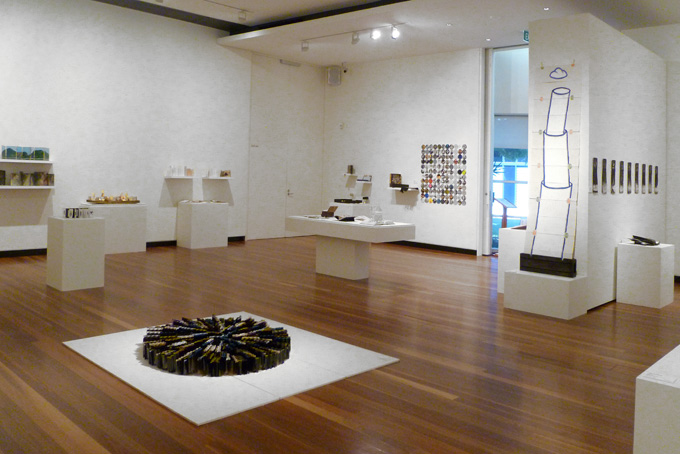
2013 Libris Awards installation ………Photo: Helen Cole
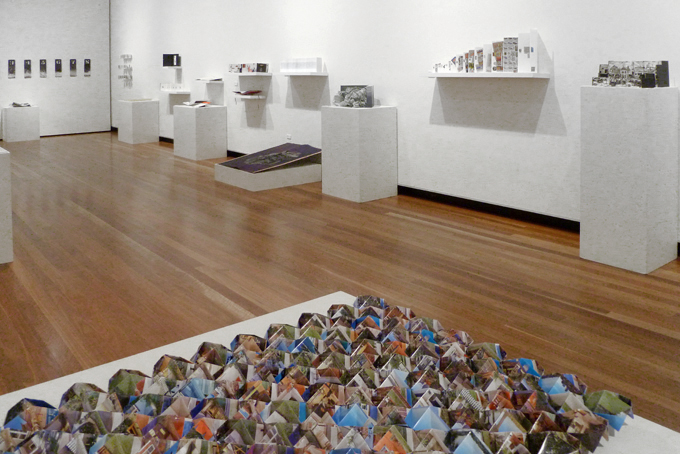
2013 Libris Awards installation ………Photo: Helen Cole
.
The Libris exhibition, as always, looks fantastic in the Artspace gallery. The works are very varied, from codexes, scrolls, altered books, and boxes to woven and sculptural pieces.
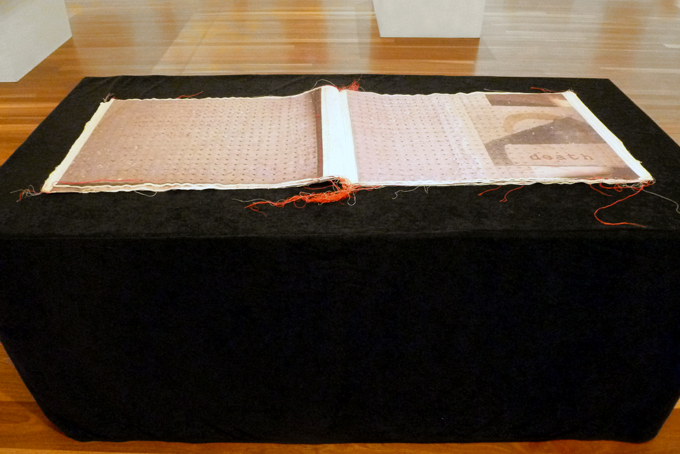
Julie Barrett: The mourning after …….Photo: Helen Cole.
.
The first thing that struck me when presented with the ninety books for the judging of the Libris Awards at Artspace Mackay was something that came up in our Trouble with artists’ books seminar last week- the inadequacy of the digital surrogate. Anna Thurgood, Director of Artspace Mackay had sent me images of each of the entries. Seeing them in the flesh mad me realize I had wildly mis-imagined the size of some of the works. For example, Julie Barratt’s The mourning after, perhaps 50 x 70 cm, I had imagined as a small hand-sized book. Conversely Julie Bookless’ (interesting name for a bookmaker and a potential title for her book as it had neither image nor text but was still a very interesting work) Audrey was a tiny 10 cm tall when I imagined it to be at least octavo size. Size does matter and it does have an effect on the impact of a book.
.
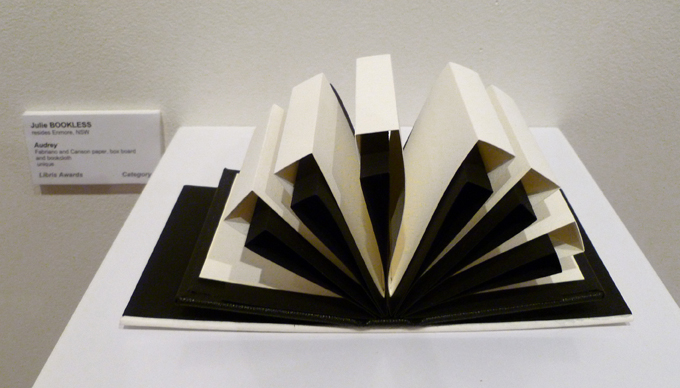
Julie Bookless: Audrey ……..Photo Helen Cole
.
A noticeable difference between this and past awards was that, because there was no associated forum, very few of the artists who had entered attended the announcement of the award. This connection of the artists’ book community was such a wonderful part of the previous Mackay events and is perhaps the reason we had such a large attendance at The trouble with artists’ books seminar.
.
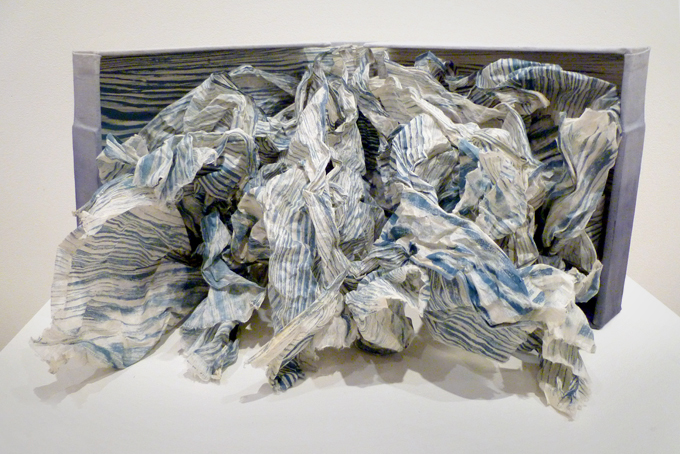
WINNER Category 1. $10,000 Dalrymple Bay Coal Terminal National Artists Book Award,
Michele Skelton, Wave form, woodblock print, unique. …….Photo: Helen Cole
.
The quality of the entries this year was very high and any of a dozen works could have won the major prize. The winner Wave form by Michele Skelton looks simple (in a photo) but as I said a photo can be deceiving; the book is deeply thought out and faultlessly constructed. It appears sculptural but is actually a traditional codex form with spine, cover and pages. The cover represents the calm of the sea and the shore when the book is closed and when it is opened the pages sewn into the spine spill out as waves which can be arranged and twisted to represent a raging sea. The choice of paper is perfect to allow this. The waves are printed from a woodblock and this choice of technique works beautifully with the colour and subject to evoke the classic Hokusai image The great wave. It has the advantage that it is an artist’s book that can be seen as a whole while on display without handling.
.
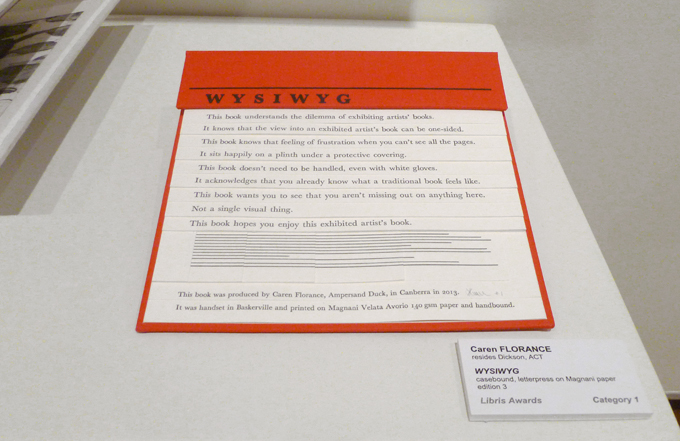
Caren Florance: WYSIWYG ………Photo: Helen Cole
.
Another work that does that is Caren Florance’s clever WYSIWYG (What you see is what you get). To enable the viewer to see the whole book without having to touch it, Caren letterpress printed a sheet multiple times then cut and bound the pages so that one line from each page is visible. They build up to a witty text written to the reader from the book’s point of view, stating that it understands the viewer’s problem and hopes it has solved it. And it has.
.
Helen Cole … Coordinator, Australian Library of Art, State Library of Queensland
.
Thank you Helen for this commentary
.
SEE THE OFFICIAL AWARD WINNERS AND IMAGES OF THE OPENING AND THE BOOKS FROM THE ARTSPACE MACKAY WEBSITE:
http://www.artspacemackay.com.au/whats_on/news/libris_awards_photo_gallery
http://www.artspacemackay.com.au/whats_on/news/and_the_winner_is…
.
SEE ANOTHER BLOG WITH ENTRY PICS AND LINKS TO ARTIST’S PAGES.
http://moreidlethoughts.wordpress.com/2013/05/17/more-from-the-libris-awards/
.
All photographs © Helen Cole 2013. Copyright in the artworks resides with the artists.
This work is licensed under a Creative Commons Attribution-NonCommercial-NoDerivs 3.0 Unported License.
.
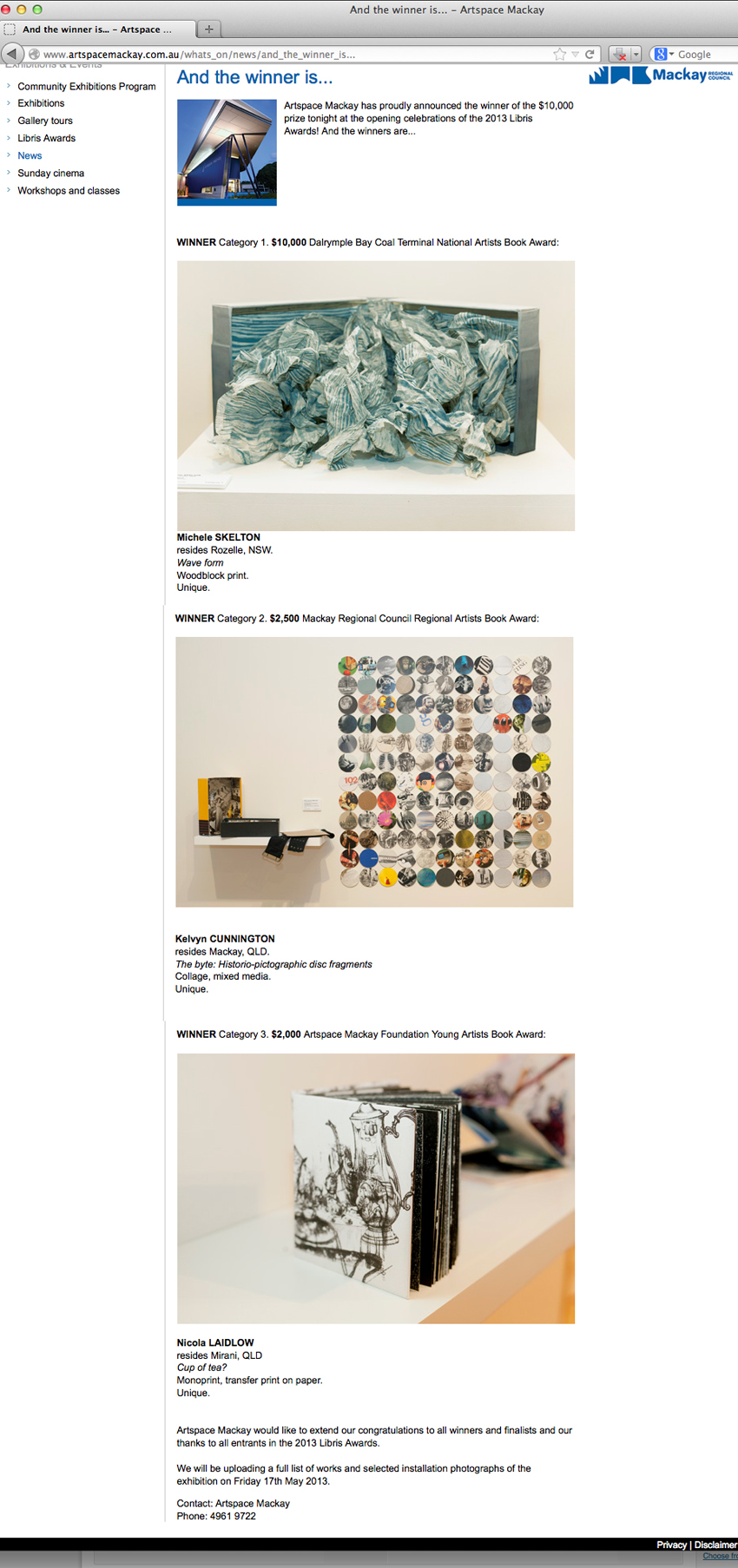
2013 LIBRIS AWARD WINNERS ANNOUNCED
FROM THE ARTSPACE MACKAY WEBSITE: http://www.artspacemackay.com.au/whats_on/news/and_the_winner_is…
JUDGING THE SHOW: Photography @ the Goondiwindi P&A Show
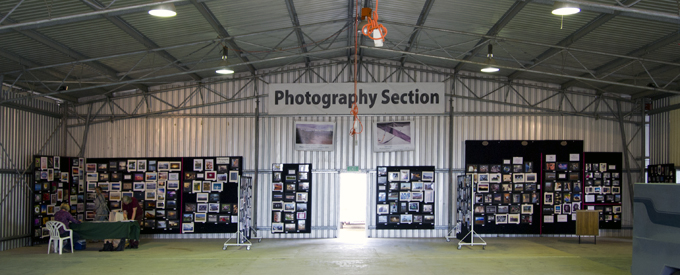
Goondiwindi Photo Section Display
We have been to Goondiwindi before as their local camera club hosted the South East Queensland Association of Camera Club’s conference in 2011 for passionate amateurs to connect and learn about their chosen hobby. This time we were at ‘Gundy’ to judge the P&A Show Society’s 2013 Photography Section. The organizing team are an energetic, cheerful and professional group of people who carry out their duties as a service to the local community.
When we arrived all 424 images were already installed on the portable screens. A welcoming cup of tea and Janet’s delicious homemade orange cake refreshed us after our two-hour drive from Toowoomba. Then all we had to do was to judge the 14 categories, the grand champions and the encouragement award winners. This was an enjoyable task as the images were delightful mix of landscapes, action, animals, humour, travel, poetic and abstract images.
.
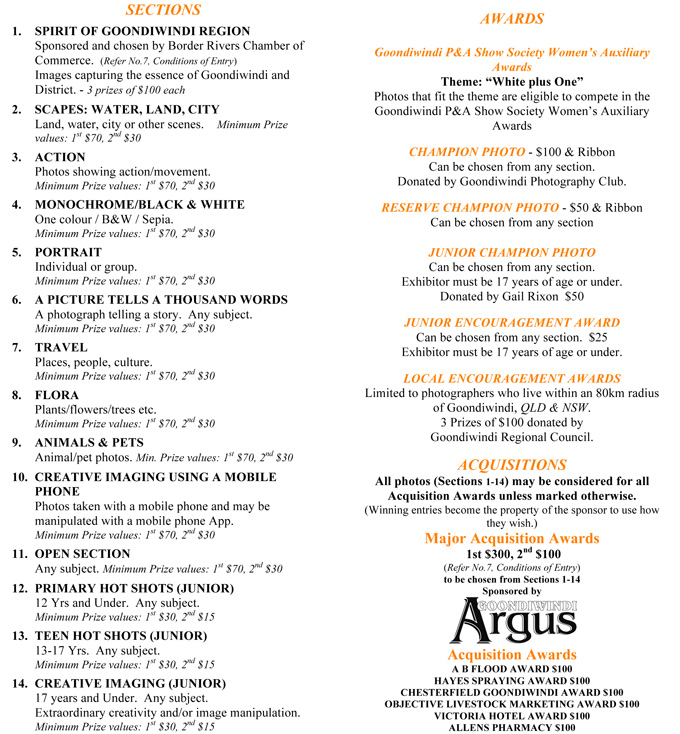
Goondiwindi Photo Section Entry Details
.
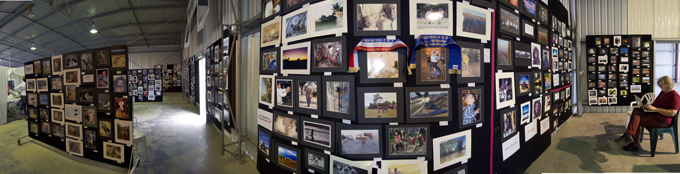
Goondiwindi Photo Section panorama
.
Although there were interesting images of travel, urban spaces, people and places some of the strongest images were found in the sections landscape, ‘a picture tells a thousand words’ and the youth categories. Images taken of their own environment, local people and animals communicated the desire to share and record their own stories. This made our task challenging but more rewarding as we encountered these images.
Some images were amazing: a fish, firmly grasped by a cormorant bites on its captors neck, a young girl fires-off a shotgun, old blokes sit on a park bench in the sun, a huge irrigation sprinkler glistens backlit by the morning sun and a young girl kneels before a poppy studded war memorial. There is a visual calisthenics required to be a judge in this competition. What was evident was a passion for photography and a quality, both technical and conceptual, that would match anything seen from their city cousins.
.
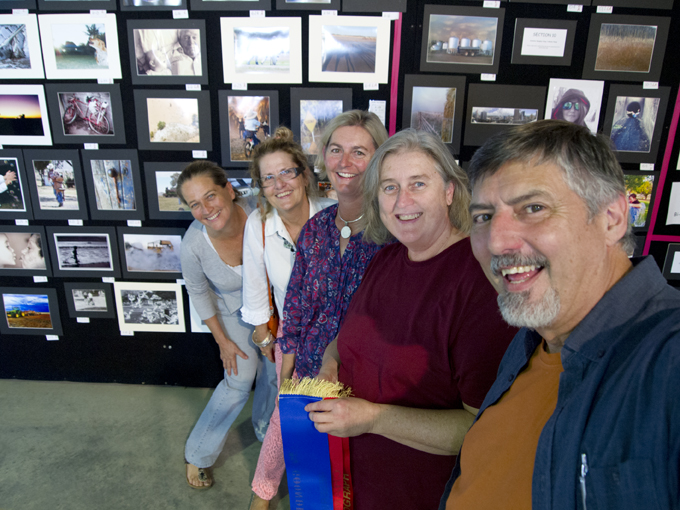
Photo Section Team: Mandie O’Shea, Michelle Kearney, Janet Doyle, Vicky & Doug
.
The Grand Champion photograph was by Rick Kearney and was entitled Flood victims. The photo was made from a helicopter during the floods and shows an island surrounded by water on which 80 or more kangaroos had taken refuge–the helicopter has startled the mob and they have taken off in all directions. The photograph captures this frenzied dash from these isolated animals.
.
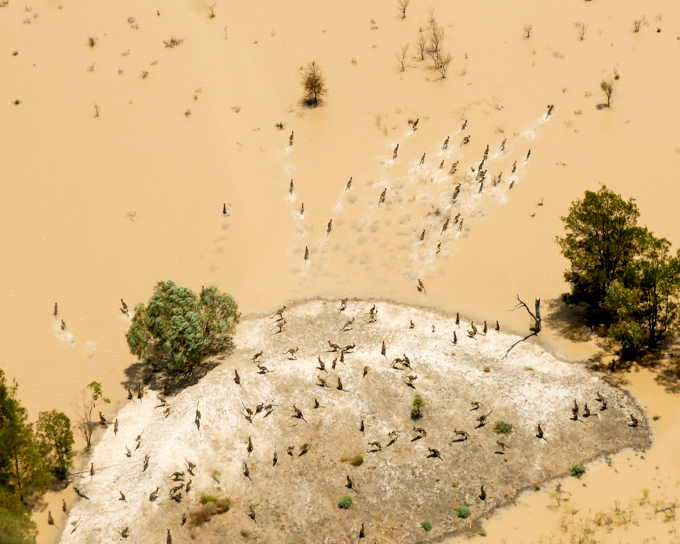
The Grand Champion Print: Flood victims by Rick Kearney
.
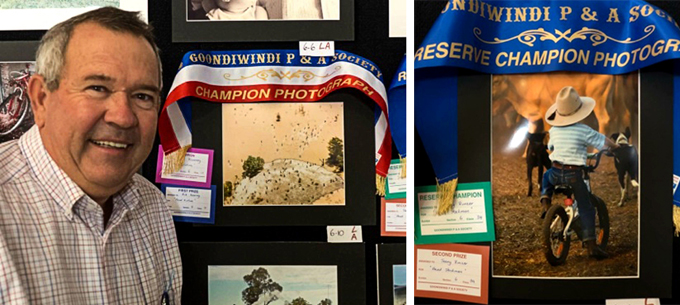
Rick Kearney’s Flood victims+Reserve Champion Teeny Runzer’s Head Stockman. Photo: Michelle Kearney
.
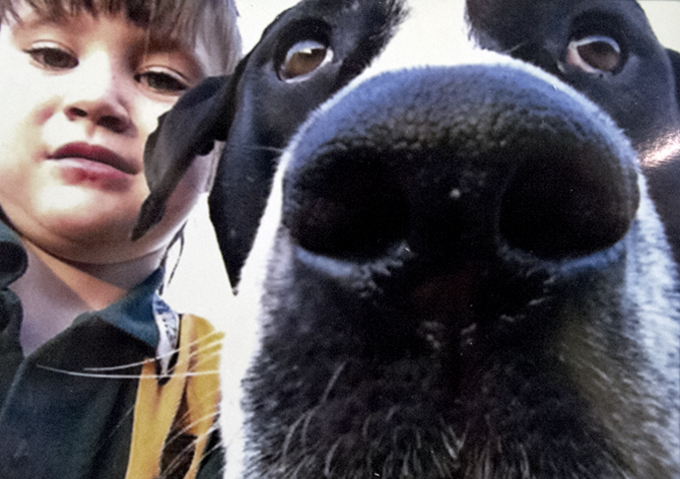
Equal First Prize – Primary Hot Shots: Jenna McCall for Selfie
.
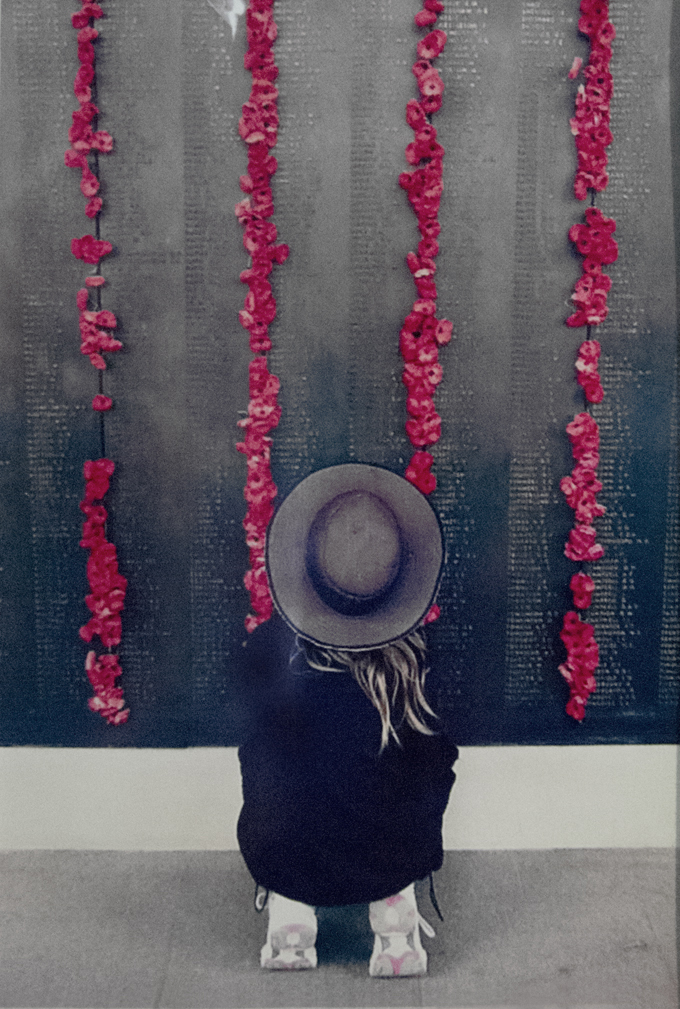
Junior Champion and Equal First Prize – Primary Hot Shots : Bethany Buckle for Poppies
.
Thanks to the Goondiwindi team of Janet, Michelle and Mandie and the photography community for sharing their creativity and vision with us and the hospitality extended to us during our visit.
.
Victoria Cooper and Doug Spowart.
.
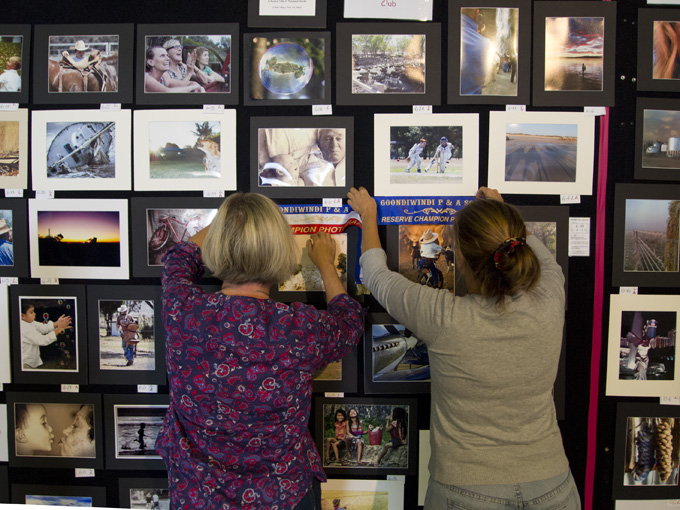
Janet and Mandie place the Champion Ribbons
.
.
Images of the exhibition installation © Doug Spowart, Text © Victoria Cooper, Photo of Rick and Reserve Champion Michelle, © in all other works the photographers credited in the caption
..
This work is licensed under a Creative Commons Attribution-NonCommercial-NoDerivs 3.0 Unported License.
.
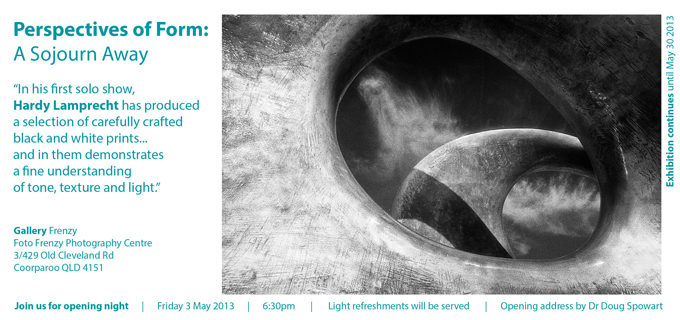
HARDY LAMPRECHT: Solo Photo Exhibition @ Gallery Frenzy, Brisbane
 .
.
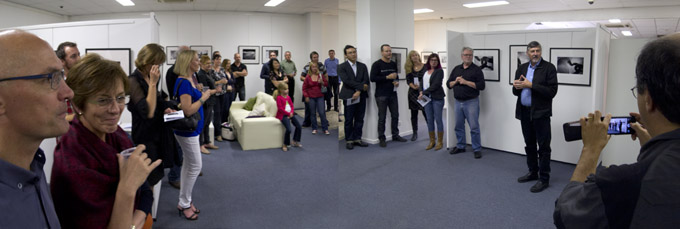
. . Excerpts from an opening address: Hardy Lamprecht | Perspectives of Form: A Sojourn Away
.
. .
.
I’ve known Hardy Lamprecht for over 20 years. He embraced the larger formats of photography and the darkroom with gusto and passion. He enjoyed the landscape and made photography sojourns to the granite tors of Girraween National Park in Queensland, to the shifting sand dunes of Lancelin in Western Australia.
He has also spent a considerable amount of time in the United Kingdom working in his principle career, that has a lot to do with sight and seeing, but the tug of the landscape sent him out on weekends to misty moors, rugged cliffs and into dramatic urban and sculptural spaces.
Time passes and anyone with twenty years experience in photography recognises the need to make the transition of the wet darkroom into the dry digital workspace. While in the past once the films were processed Hardy would venture into the darkroom for extended periods to resolve the lived experience of the shoot as fine art black and white prints. These images would then be presented for exhibition to share his vision with others. Although many photographers of Hardy’s ilk lament the passing of the darkroom and, whenever a sympathetic ear is around, talk of the ‘good old days’ – but not Hardy. He assimilated digital technologies into his workflow by scanning negatives, optimising them in Adobe Lightroom and the printing them on fine art Canson digital papers. What we see on the walls now is the same attention to detail and creativity but within a contemporary medium.
So what this exhibition represents is not only one photographer’s journey in the landscape but also another journey from the traditional black metallic silver specs of the wet darkroom to the emergent digital space of pixels and ink on paper. I believe this work challenges the notion that high quality fine art photographs can only result from the wet darkroom. Should there be any question, I would present to them this body of work where: I’d talk with them about deep rich blacks and clean clear whites, I’d point out the both employ the same baryta paper base, I’d then discuss the dynamic tonal range represented in the prints and theories I have about every photographer today working in digital, is emulating the aspirations of the very few Zone System dilettantes of the past.
Once through with the technical stuff that pervades the discipline of photography and printmaking and much critical dialogue, I would challenge them to see beyond superficial technique to the more sublime nature of these photographs. I would elucidate on aspects of the photographs design–of abstraction, perspective and scale–of chiaroscuro and emotion. This work is the result of seeing and capturing a personal vision and empathy of the subject before the camera–a moment in time of place.
Ultimately Hardy Lamprecht’s images are about what he saw and was inspired by in the continuum of his lived experience. He then captured on film a kind of referential trace extracting a new visual interpretation or meaning of the original subject. In the digital space, aided by software, he reflects on his wet darkroom image interpretation skills and techniques and applies them to the modern tool of the computer. In doing this he achieves something that can be shared, as he did before, with us as viewers. As a result of that we can, in the space of this gallery, transcend time, space and photographic technology and encounter the world in the lens of your own memory.
Hardy, I take great pleasure in declaring this exhibition open … Doug Spowart May 3, 2013

Vicky, Hardy and Doug @ the opening
Selected images from the show….

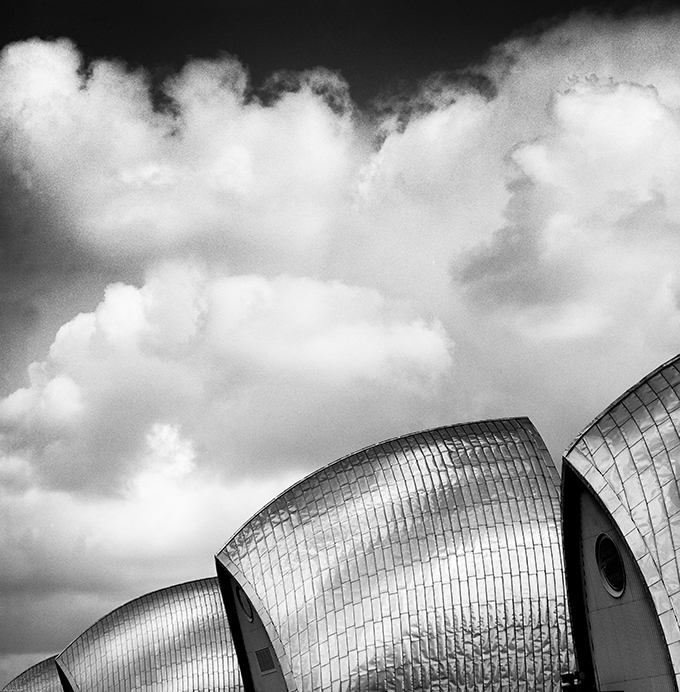
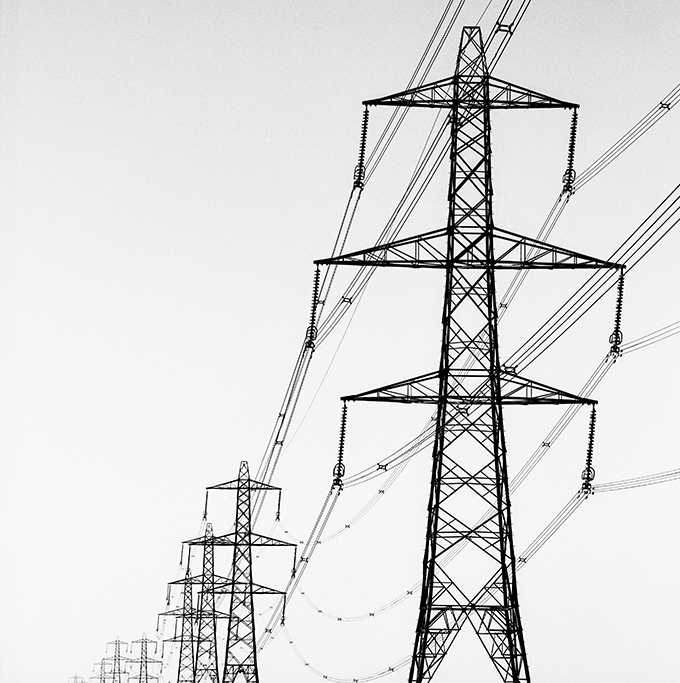
Threesome
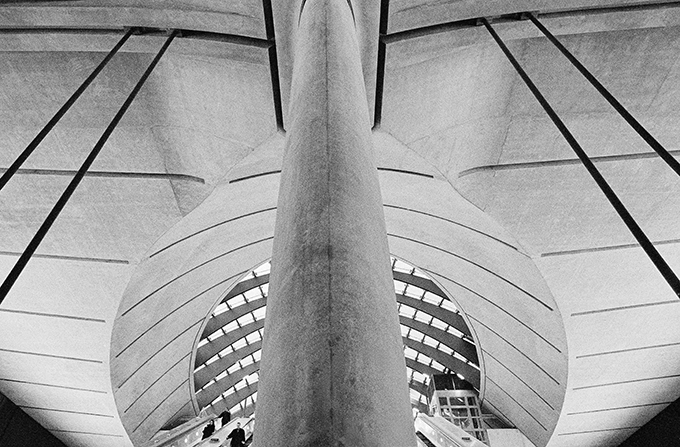
Subterranean Symmetry

Large Reclining Figure by Henry Moore
Going Under
The Sorcerer’s Apprentice
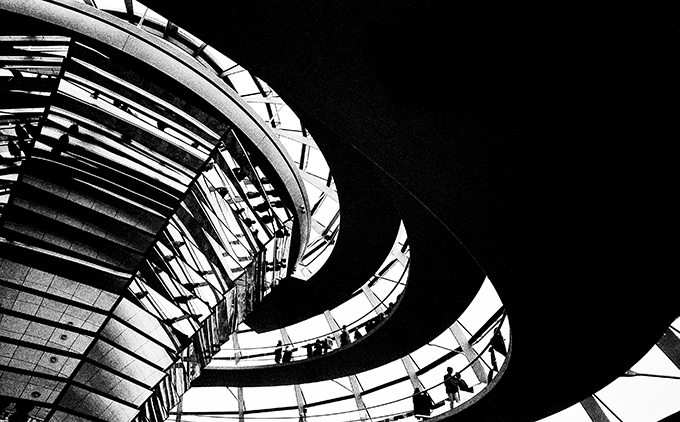
Orbits

Double Ovals by Henry Moore
.
Exhibition photographs ©2013 Hardy Lamprecht, additional photography by Cooper+Spowart
Essay ©2013 Doug Spowart
. This work is licensed under a Creative Commons Attribution-NonCommercial-NoDerivs 3.0 Unported License. . .
PHOTO TREASURE: The QCPs ‘Treasures: The art of collecting’
 .
.
REVIEW: Treasures: The art of collecting
.
I’m an obsessive collector. It’s a big problem because I’m finding it difficult to store everything …
Martin Parr talking about his book collection 1.
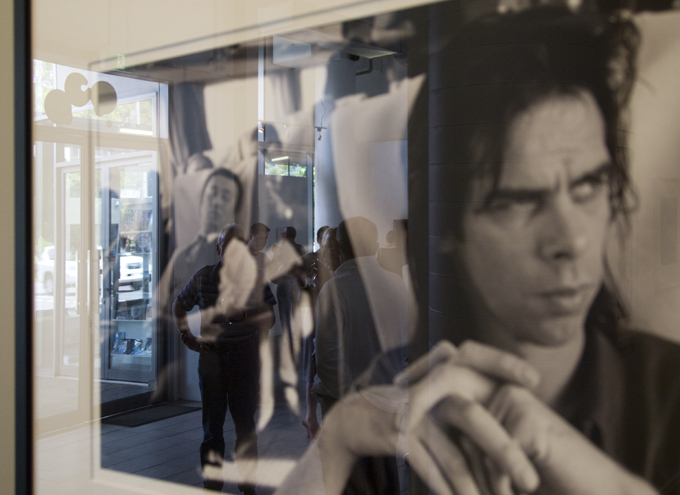
Peter Milne’s portrait of Nick Cave reflects visitors to the Treasures show
Collecting photographs and collecting collections is the subject of the current exhibition at the Queensland Centre of Photography. 72 photographic works on loan from 23 collections both significant and personal, fill the exhibition space. The works represent a wide selection of the history of the medium, the range of themes pursued by photographers and the stuff that collectors collect.
The exhibition was curated by QCP Director Maurice Ortega and was drawn from the contacts, colleagues and members of the QCP fraternity. Works from significant collectors like Daryl Hewson and Fred Hunt were prominently featured in the show. Other works came from the QCP’s own collection, many of which have interesting provenance, were gifts to the Centre, or to members of QCP photography fair delegations travelling overseas.
Each work has a unique story not only of the photograph’s making but also of the collector’s possession and the story of ownership. To pass on these dual narratives each work is accompanied by a comprehensive didactic panel that provides a connection with why the work was collected and its meaningfulness for the collector.
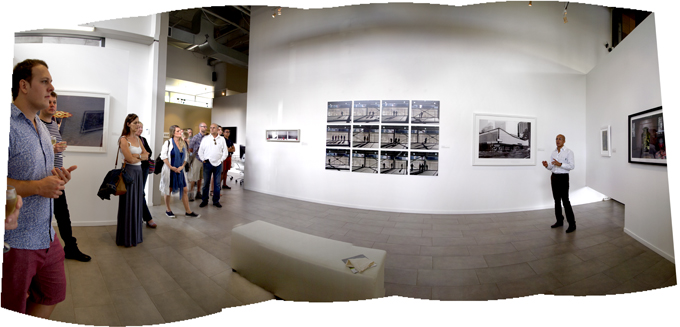
QCP floor talk by Director Maurice Ortega
.
On Sunday 14th April Maurice Ortega gave a floor talk about the Treasures. He discussed the idea and practice of collecting generally and then walked through the space drawing attention to selected works–their owners and any special stories around their provenance.
Ortega spoke of the importance of collectors and how they can support artists at all levels of their careers. He noted that in Australia so many art photographers make a fine start in their professional practice but so often slip from view due to the inability for them to derive sufficient income to survive. He lamented the lack of a passion for collecting within Australia citing the success of the American scene. A video presentation in the gallery shows, as an example, the collection of Steven Reinstein and it’s presentation within a home. It is a grand statement about how ‘amazing’ the personal accumulation of art can be.

QCP floor talk by Director Maurice Ortega
In Ortega’s catalogue statement he pays great respect to the collector by stating that:
… collectors of every kind should be celebrated and emulated; first for directly supporting the artist, second for maintaining cultural diversity and thirdly for keeping art thoroughly democratic by keeping it grounded on its domestic domain, that of everyday life.
The Treasures exhibition may be a significant look into the art of collecting but it has many other valuable outcomes. It presents to visitors an array of photographic materials, techniques, themes and makers, the like of which has not been shown in this region for some time. It highlights the importance of collection and possession and the link that it provides for a supporting structure within art photography. And it must also surprise the viewer of the exhibition with the spectacular range of art photography that exists out in the wilds of the private collector.
Furthermore this exhibition is a curatorial tour de force and is an example of the significant role that the QCP plays within Queensland–perhaps even Australia, in the provision of true and relevant exhibitions of what the art of photography is, and what can be…
.
Dr Doug Spowart
For images and more details of the exhibition SEE http://www.qcp.org.au/exhibitions/current/album-791/28
A personal postscript: Like Martin Parr I’m an obsessive collector of photographs, photographica, photobooks and photo ephemera. I was asked by Maurice for a piece from my collection for the Treasures show–I selected a calotype print made from a Henry Fox Talbot negative c1843. Printed by author, historian and Kodak Museum Curator Brian Coe in 1976. The provenance of the photograph was that it was an award won by me in the Kodak International of Photography in that year. Due to difficult display requirements it was decided not to include the work in the Treasures show.
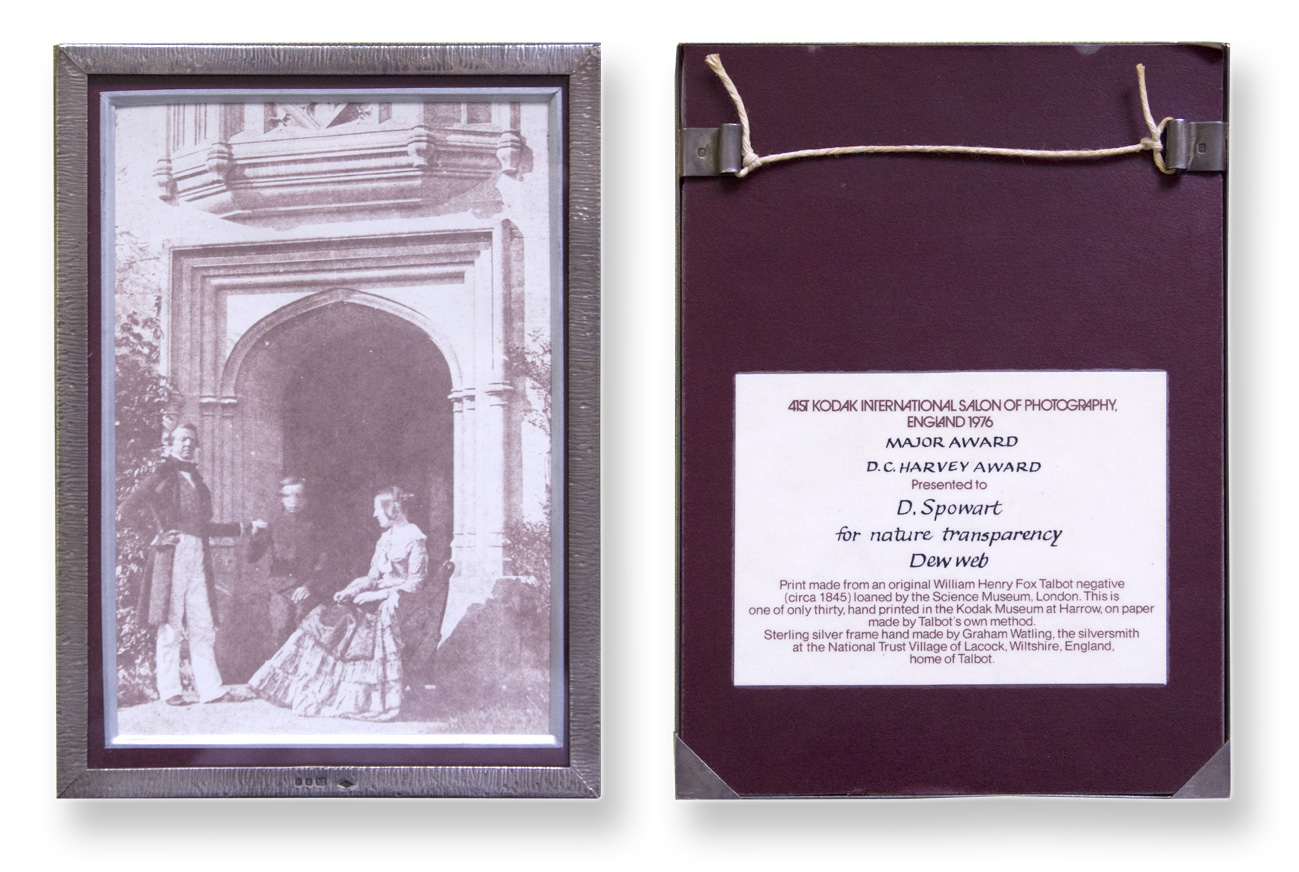 .
.
1. Badger, G 2003, Collecting Photography, Mitchell Beazley Ltd., London.
.
Images of the exhibition installation and text by Doug Spowart .
This work is licensed under a Creative Commons Attribution-NonCommercial-NoDerivs 3.0 Unported License.
.
HEATHER FAULKNER’s ‘A Matter of Time’ Exhibition

In Heather Faulkner’s exhibition A Matter of Time
A Matter of Time – Heather Faulkner, Brisbane Powerhouse 26 March–28 April 2013.
Today everyone possesses a camera so by association everyone is a photographer and everyone takes photographs. Evidence of this activity is in all kinds of spaces we inhabit, but of course it is most prevalent in the pervasive and immediate space of online social media. Andy Warhol once exhorted that: ‘In the future, everyone will be world-famous for 15 minutes’, and perhaps the proliferation of photography in Facebook, Pinterest and Instagram has indeed made everyone famous, as some purport, ‘for 15 people’1. The extension of this euphemism could be that ‘everyone may be famous for 15 online photographs.’
But what has all this to do with an exhibition of documentary photographs in suburban Brisbane? Well … for me ‘photography’ in the hands of casual shooters, responding spontaneously to their lives, represents only a segment of the world’s daily dose of photography. Documentary photographers for example, use photography as visual research to inform and create understanding for others. These photographers are usually directed by passion for a particular issue, and driven by the need to tell stories of others and maybe even–of themselves. In this context the act and product of photography transcends the milieu of images and provides us with a deeper connection through the communication of the narrative. This exhibition is from one such photographer.
Heather Faulkner’s exhibition A Matter of Time, at the Brisbane Powerhouse, is a charged and evocative statement about the circumstances, situations and legacies of lesbian women living in the state of Queensland. Faulkner documented the lives of eight women and their significant lived experience of the political and social regimes that existed and, as claimed in the exhibition statements, still exists today.
Faulkner’s images take on two separate forms: large format black and white full frame portraits, and colour images of a more documentary nature. In the large portraits the subject’s stare is direct to camera capturing the viewer’s attention in what Faulkner describes as the ‘oppositional gaze’2. They are assertive and declare ‘this is me’. Placed alongside these portraits is the biography and backstory of each woman. For the viewer/reader in this juxtaposition the text and the image creates a silent dialogue. As in the examples of Faulkner’s presentation of Carol Lloyd’s story shown here.
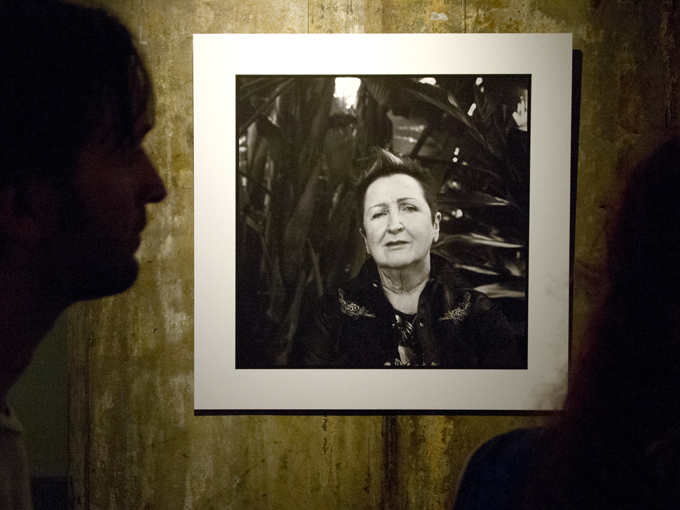
Carol Lloyd – the large portrait. Heather Faulkner’s exhibition A Matter of Time
.
The colour images are extremely intimate and distinctly banal, perhaps exhibiting the photographer’s light touch to aesthetically intervene in the narrative. The subject is imaged engaging in life’s everyday activities: cuddling a family pet, on the couch watching TV, talking with others, arranging things on a bed. The photographic treatment of these photographs is not the sensationalised grainy monochrome, extreme perspective depth and overtly dramatic composition that so often pervades the modern photojournalistic genre. There is a sense of the view being derived from ‘hanging out with friends’, and of the camera as an invisible witness. For me this approach results in authentic and genuine documents.

Carol Lloyd in a reflective moment – Heather Faulkner’s exhibition A Matter of Time

Carol Lloyd as performer – Heather Faulkner’s exhibition A Matter of Time
.
The exhibition also includes historical family snapshots that are presented alongside the recent images. A young child smiles back at the viewer, faded and colour-casted prints and wedding group photographs all add to the story of each subject. To protect the anonymity of people in these images black bands have been placed across faces to prevent recognition. The integration of these photographs extends the exhibition beyond just being about photographs and into the realm of a more complete and provocative social documentary statement.

Carol Lloyd’s personal image history in Heather Faulkner’s exhibition A Matter of Time
.
Ultimately everyone will draw their own conclusions about the women portrayed and the lives that they have lived, or should I say, endured. Faulkner states in exhibition materials that a research report suggests that: ‘Queensland is the most homophobic state in Australia’3. Facilitated through Faulkner’s photographs, exhibition strategies and other products resulting from this work, the stories told here engage with the human face of the weary struggle, of these women’s resilience, and the strength gained by the rewards of living an authentic life.
.
Dr Doug Spowart with a contribution from Victoria Cooper
More on Heather Faulkner: http://heatherfaulkner.com.au/
1 Bell Hooks (1992) The Oppositional Gaze in Black Looks: Race and Representation, Boston: South End Press.
2 http://web.archive.org/web/20061214124420/http://www.hyperorg.com/blogger/mtarchive/004264.html
3 Faulkner’s Artist’s Statement cites Roy Morgan Research (2008-2010)

Heather Faulkner @ the opening
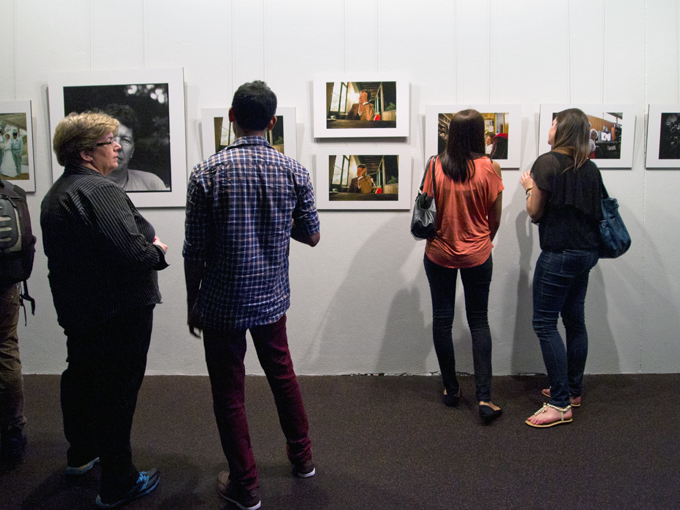
Heather Faulkner’s exhibition A Matter of Time
All exhibition photographs © Heather Faulkner 2013.
Images of the exhibition installation and text by Doug Spowart .
This work is licensed under a Creative Commons Attribution-NonCommercial-NoDerivs 3.0 Unported License.

 wotwedid