Posts Tagged ‘re-photography’
JULIE MILLOWICK’s ‘Surrounding’– Intrinsically Local

Continuing Drought El Nino year – Julie Millowick with son Christian McArdle at Crocodile Reservoir PHOTO: Courtesy of the artist
.
SURROUNDING
The beauty of Central Victoria’s landscape in tumult and recovery
.
An exhibition by Julie Millowick at Castlemaine Art Museum
CAM – Surrounding Julie Millowick
.
“Photography is my life; it is the very core of my being”
Julie Millowick
Surrounding is an exhibition by Julie Millowick surveying her lived experience over 36 years in Fryerstown, Victoria. Over time this celebrated documentary and commercial photographer, driven by a curious and creative mind, has created a photographic archive both cataloguing her visual inquiry and providing a chronicle of her life within this place. Millowick’s work is multifaceted where the poetic and psychological is interconnected with an almost scientific aesthetic thus sharing deep insights into the land that has both nourished and challenged her.
The curator, Jenny Long, has written a sensitive and informative essay for the book Surrounding that accompanies the exhibition. Long discusses Millowick’s process and conceptual thinking along with observations to provide background and framework for the viewer to consider this extensive project. Along with the book there is promotional material and didactics that proposes the exhibition will ‘show us the devastating effects of mining, drought, flood and invasive plants, but also remind us of the interconnectedness that links all parts of this ecosystem including its human occupants.’ And that there is a, ‘capacity for renewal … that offers a spark of hope for the future.’
.
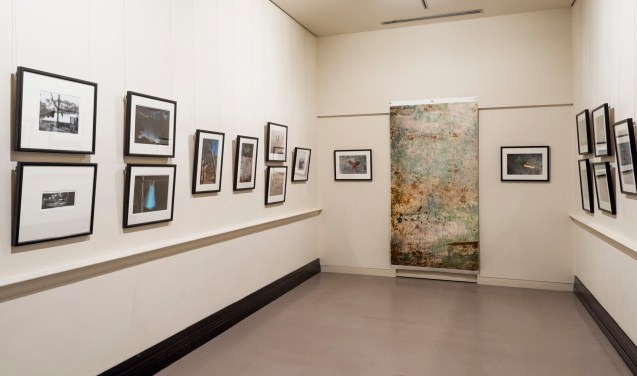
Surrounding House and domestic installation PHOTO: Supplied by the artist
.
In the first gallery space, the ‘house and domestic’ body of work is presented as twenty-three individual framed works including an 1870s photograph an original owner, Mrs King, standing outside the home. In this work Millowick’s subject matter includes botanical still-life works, images of the detritus of past inhabitants unearthed in the house grounds and there is also a large print of a section of a house wall interior etched with the marks of habitation and the patina of age. Images of washing drying on the clothesline refer to the domestic space of the past and present habitation of this home. Far from being prosaic records of domesticity, the photographs of the washing have an ethereal perhaps even ghostly appearance.
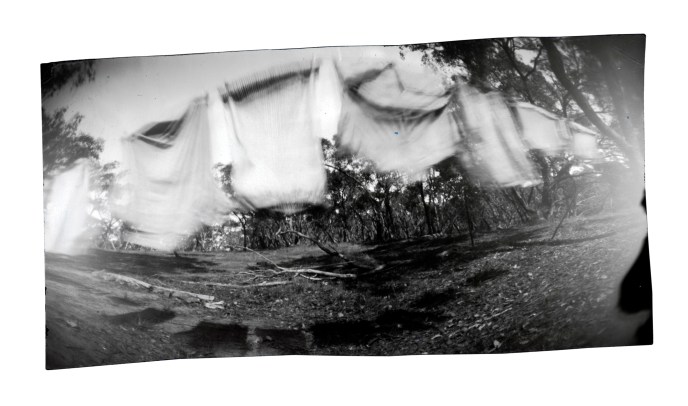
Washing in Horse Paddock pinhole image 1996 PHOTO: Courtesy of the artist
.
There is also a kind of haunting in the walls and surrounds of the house, which continues through the shadowy and dramatically lit scenes of this exhibition. The appearance of a selectively illuminated tree branch or the enchanted presence of Millowick’s horse Goldie, imbues the place with a mythical spirit that beckons the viewer to follow into the mysterious dark forest.
.


.
Contrasted with a sense of wonder and fairy tale mystery, Millowick’s work is also deeply grounded in the reality of place, which is as sharp and unadorned as the land itself. In the larger exhibition space, there are groupings of unframed images that explore both topographical and psychological aspects of specific spaces and themes including mine sites, the Castlemaine Diggings National Heritage Park, ecological thinning, the Crocodile Reservoir Drought and horse paddock. A constant subject for Millowick is her son Christian whose activities are documented in many of these themes. images within the groups are placed together to form clues and evidences that suggest larger narratives. It is also interesting to consider the installations as visual representations of the conversation between artist and curator piecing together the rich collection of work and the resonance or dissonance between images and concepts.
.
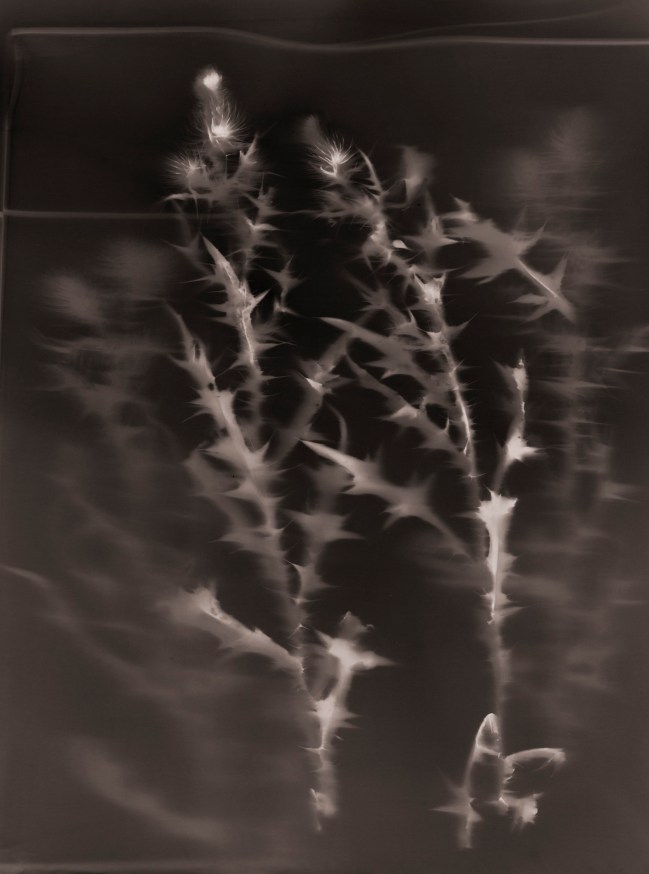
Invasive Thistles 2002 Lumen print by Julie Millowick
.
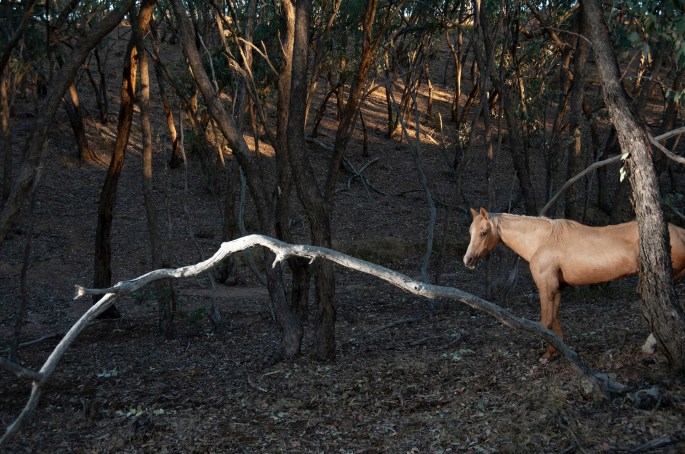
Goldie, 34 year old horse 2009 PHOTO: Julie Millowick
.
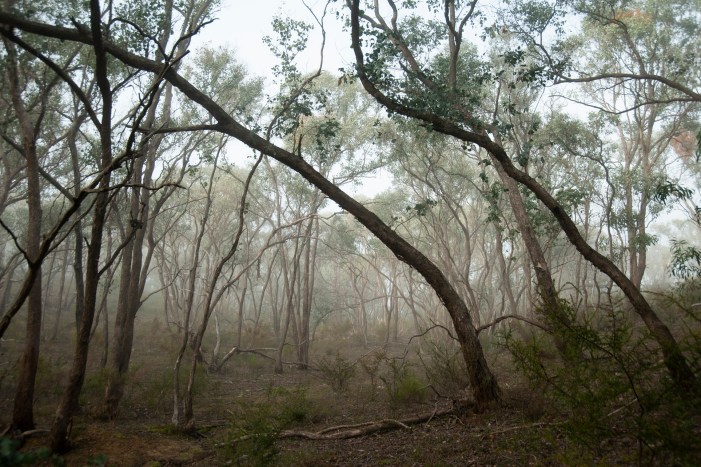
Horse Paddock Post Goldrush Uniform Regrowth PHOTO: Julie Millowick
.
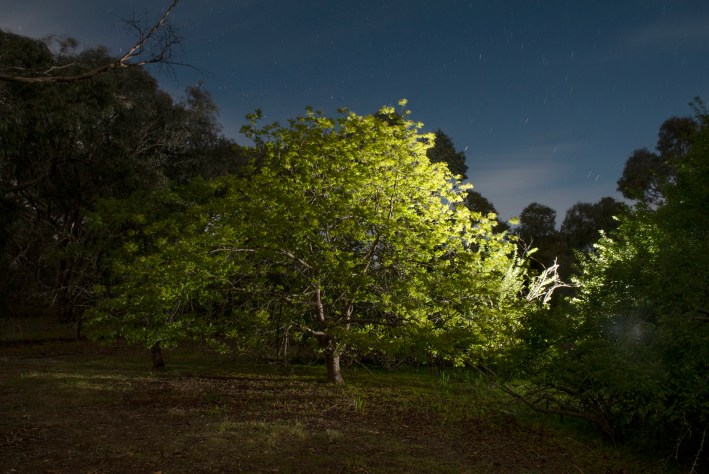
Fryerstown, Isolation, Lockdown, Orchard, Chinese Pistachiola Tree, last moments before midnight on 21 October, and first moFryerstown, Isolation, Lockdown, Orchard, Chinese Pistachiola Tree, last moments before midnight on 21 October, and first moments on 22 October PHOTO: Julie Millowick
.
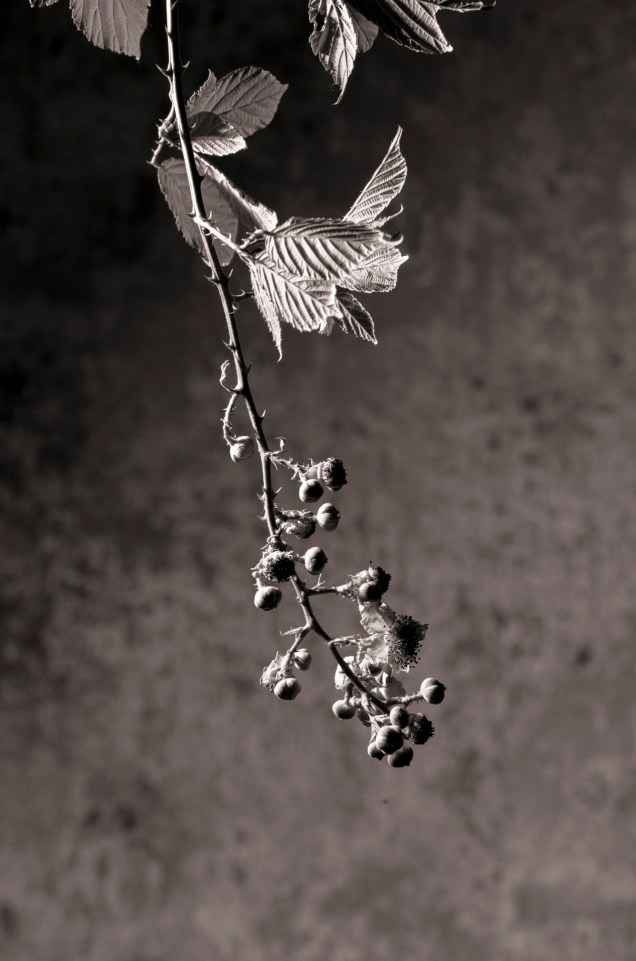
Original Cottage Wall with introduced Invasive Blackberry 2023 PHOTO: Julie Millowick
.
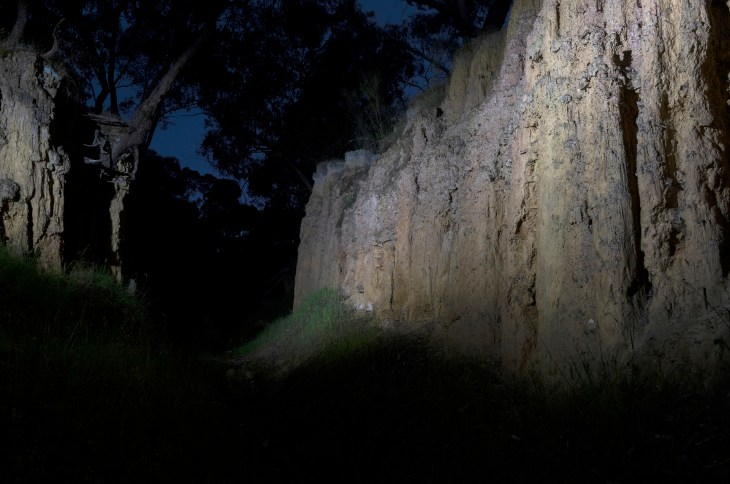
Fryers Diggings, Sluicing, Heron’s Reef 2023 PHOTO: Julie Millowick
.
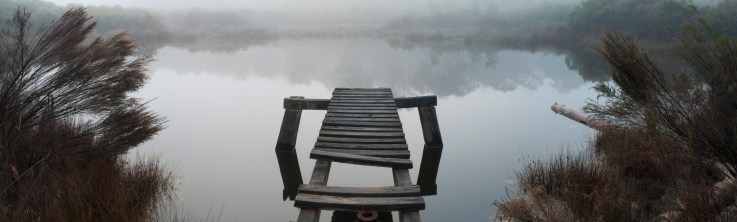
Crocodile Reservoir 2006 PHOTO: Julie Millowick
.
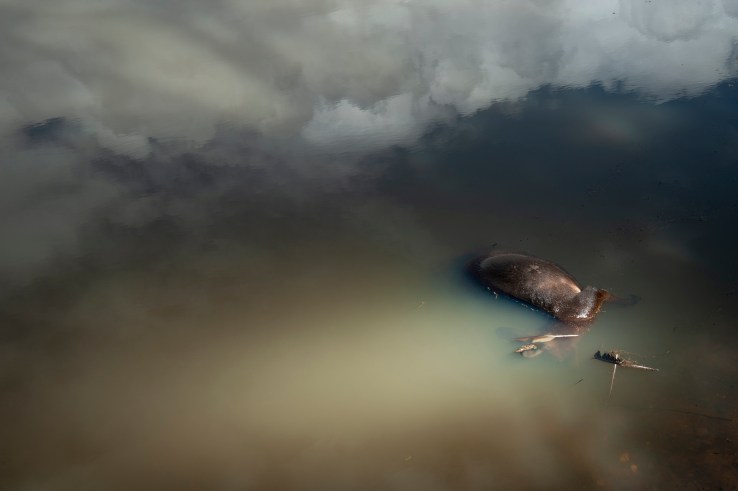
Drowned Kangaroo PHOTO: Julie Millowick
.
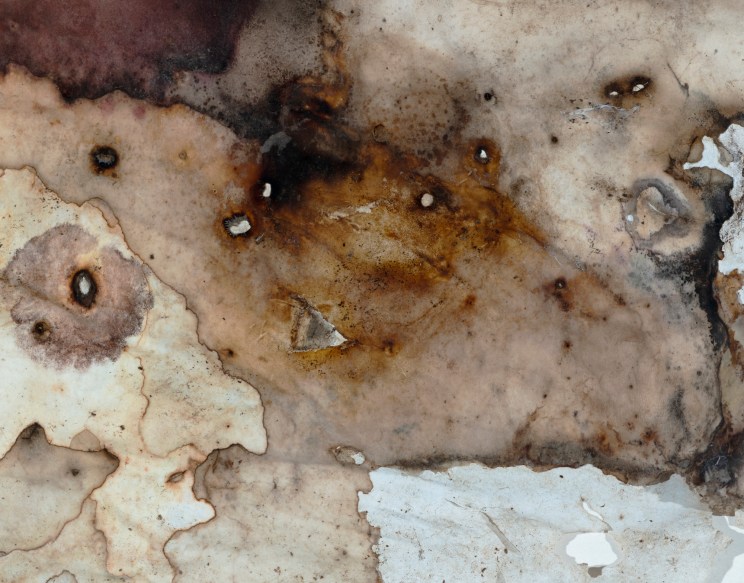
Lumen Buried Paper Under Blackberry Bush by Julie Millowick
.

Castlemaine Diggings National Heritage Park Cherry Ballart 2022 PHOTO: Julie Millowick
.
A photographer with less time moving over the space would document the superficial surface of things and create a record time-locked to when they were there. Millowick has set for herself the challenge of distilling a life of experience of time and place by using her comprehensive knowledge of photographic techniques* that, when combined with personal vision, can present to the viewer something deeper. As Millowick explores the environment or found objects, she reveals deeper layers and meanings through her experimentation with the visual language of each process and technique. The depth and complexity of this work tells of the unwavering commitment to her art, the community and the environment.
.
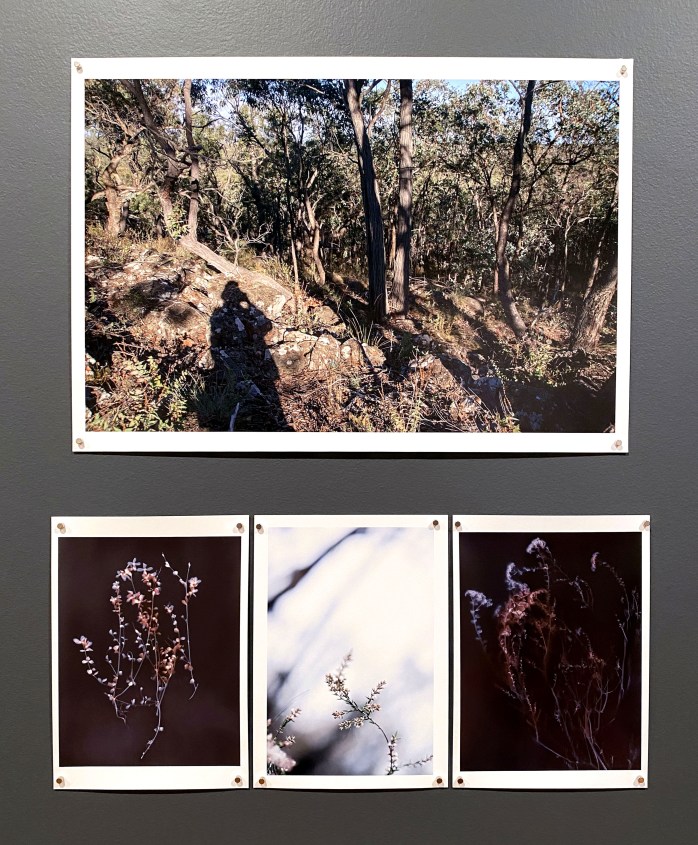
Image grouping
.
When introducing Julie Millowick at a recent artist’s talk about her exhibition the Gallery Director Naomi Cass described her as a ‘Localist’. ‘Localist’ is indeed an appropriate term not only for the work in this exhibition but also for Millowick’s continued photographic activity in the community. As a localist Millowick’s activity is part of the growing contemporary global movement for living locally and telling local stories particularly since the impacts of the Covid Pandemic. As it was 36 years in the making, this exhibition could only be just a fragment of Millowick’s creative visual documentation of her surroundings and community. Further digging or mining of her extensive archive will potentially reveal new perspectives and meanings on these powerful local stories of her place. Surrounding is just a beginning, there are so many other stories yet to be told …
.
A commentary on the exhibition by Victoria Cooper and Doug Spowart
Surrounding was part of the PHOTO2024 program
.
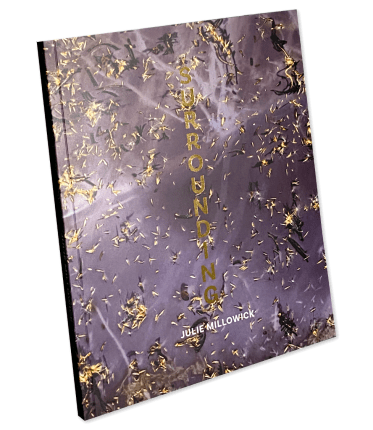
Surrounding – the book
.
P.S. The Surrounding exhibition is complemented by an illustrated book copies of which can be purchased from Castlemaine Art Museum or directly from Julie Millowick
.
IMAGES FROM THE IN CONVERSATION EVENT | Julie Millowick and Kyla McFarlane
Sunday 10 March, 11:30am — 12:30pm
.


.
* Photographic techniques that Julie Millowick employed in the exhibition include – pinhole photography, lumen printing, added lighting (painting-with-light), double exposure, cyanotypes, out-of-focus capture, re-photography, progressive sequencing, documentary and personal narrative.
We wish to thank Julie Millowick and congratulate her on the exhibition and for the images of her photographs and the exhibition installation. Photographs of the IN CONVERSATION event were by Doug Spowart.
Castlemaine Art Museum is a member of the Public Galleries Association of Victoria
.
.
.C
.
This site is archived by PANDORA, Australia National Library’s Web Archive
.
.
.
.
.
.
.
A RE-PHOTOGRAPHY PROJECT Revisited at TRAG

Doug in the exhibition space … PHOTO: Victoria Cooper
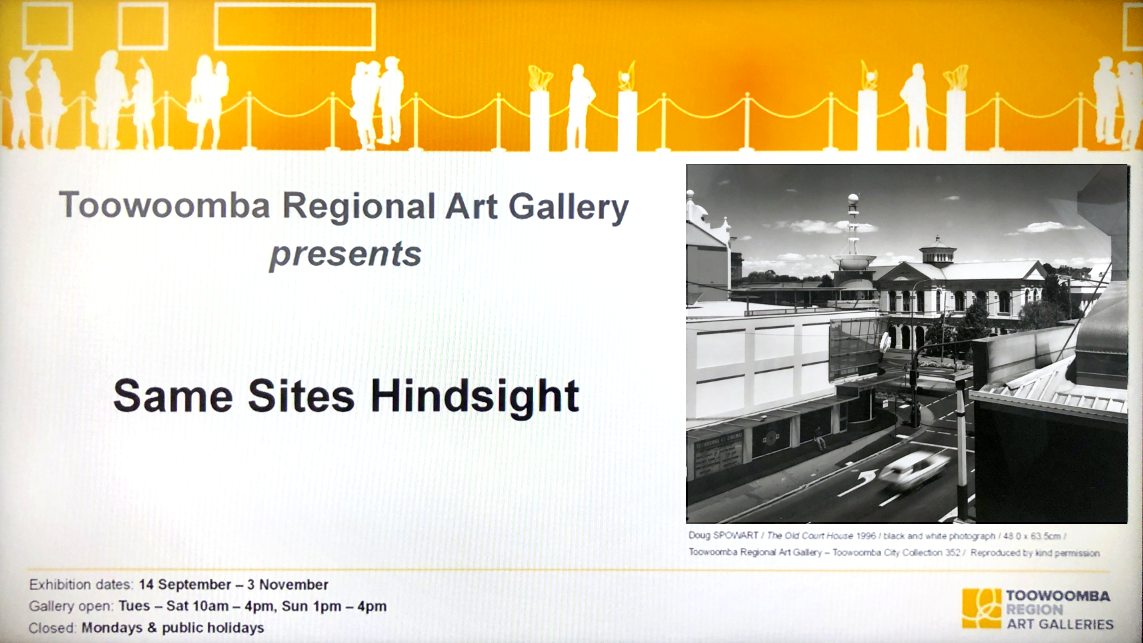
SAME SITES HINDSIGHT – Toowoomba Regional Art Gallery
For me rephotography is a way of re-viewing place and change through a comparative documentation using the perspectives of earlier photographers. I have always enjoyed the challenge to re-align the contemporary view with the past to see visual narratives of change either subtle or profound. At this time I discovered the work by Mark Klett and others published in their 1984 book Second View: The Rephotographic Survey Project. Their approach to the reimaging of the photographs of the American west by William Henry Jackson, Timothy O’Sullivan and others in the 1860s was methodical and scientific. Although I was informed by this seminal work as a record of social and historical change, in some of my work I also enjoyed questioning the notion of the original photographers as a kind of truth.
.
In the mid 1980s I rephotographed tourist postcard scenes in outback Australia and reimaged tourist camera photos placing them in the context of a wider-angled view. These projects were presented at the Araluen Art Gallery in Alice Springs in 1986 in the exhibition Tourists Facts, Acts, Rituals & Relics.
Other projects emerged including a commission from Di Baker, Director of the Toowoomba Regional Art Gallery to locate the subject matter of artworks from the Toowoomba Gallery’s collection and to re-image the subject by photography.
The artworks that were my source reference covered a range of approaches to the artist’s vision imbued with the appearance of the painting techniques that they employed. Working with Victoria we travelled around the region to find the matching locations and met with some success finding the exact location. On occasion however we were only able to create a general locational view.
I chose a 4×5 large format camera and a black and white film made by Polaroid. Called Type 55 the film gave a black and white print and also a negative that, after in-field processing could be printed in a conventional enlarger.
The 1996 the exhibition NEW SIGHTS – SAME SITES was opened at the Toowoomba Regional Art Gallery and installation of the selected artworks were paired with our photographic interpretation of the same scene.
Now 23 years later the Gallery has re-presented the work for reconsideration by a new generation of art gallery visitors.

Don Featherstone (L) Golden Tree (Corner of Kitchener and Herries Streets)1959 watercolour Spowart+Cooper (R) Corner of Kitchener and Herries Streets 1996 silver gelatin fibre print
The Gallery wall sheet for the Same Sites Hindsights exhibition states:
In 1996 photographer Doug Spowart assisted by Victoria Cooper undertook a project called New sight-Same sites which re-imaged Downs landscapes and other regional sites depicted in selected works from the Toowoomba Regional Art Gallery Toowoomba City Collection.
The project compared and contrasted the direct recording of a site using photography with the painter’s vision of the same location. One of the biggest challenges for Spowart in making these images was to replicate the painters’ viewpoints and, in some instances, even finding the locations proved problematic.
From the time of the initial recording to now, almost 25 years later, these photographs indicate constants and change. Time is transformational. In 1996, the Gallery challenged the photographer to identify these locations and in 2019 we challenge the viewer to explore Toowoomba and surrounds in response to these works.
The exhibition is on show from 14 September to November 3, 2019.
A selection from the subjects presented in the exhibition
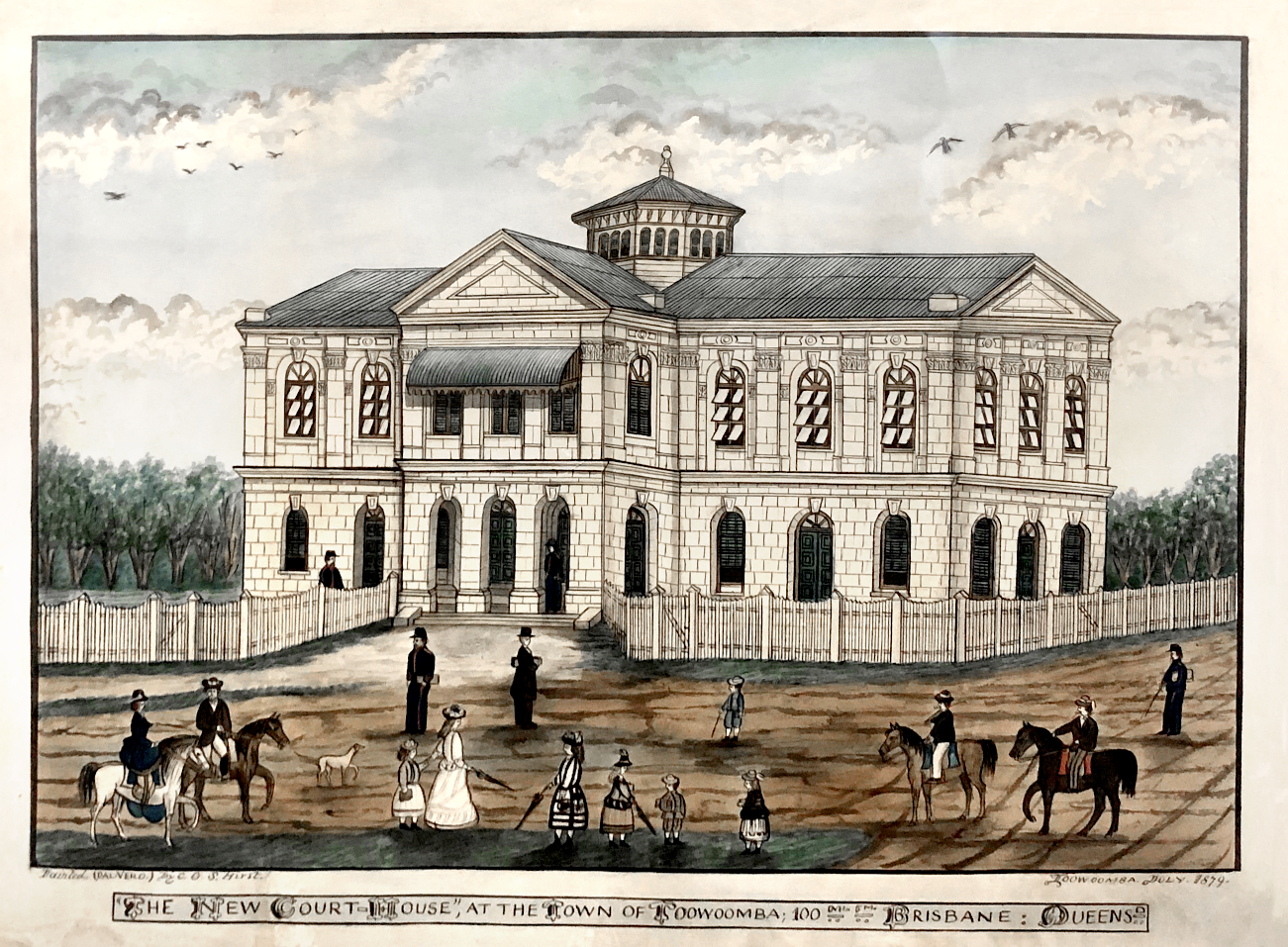
C. G. S. Hirst The New Court House 1879 watercolour and ink on paper
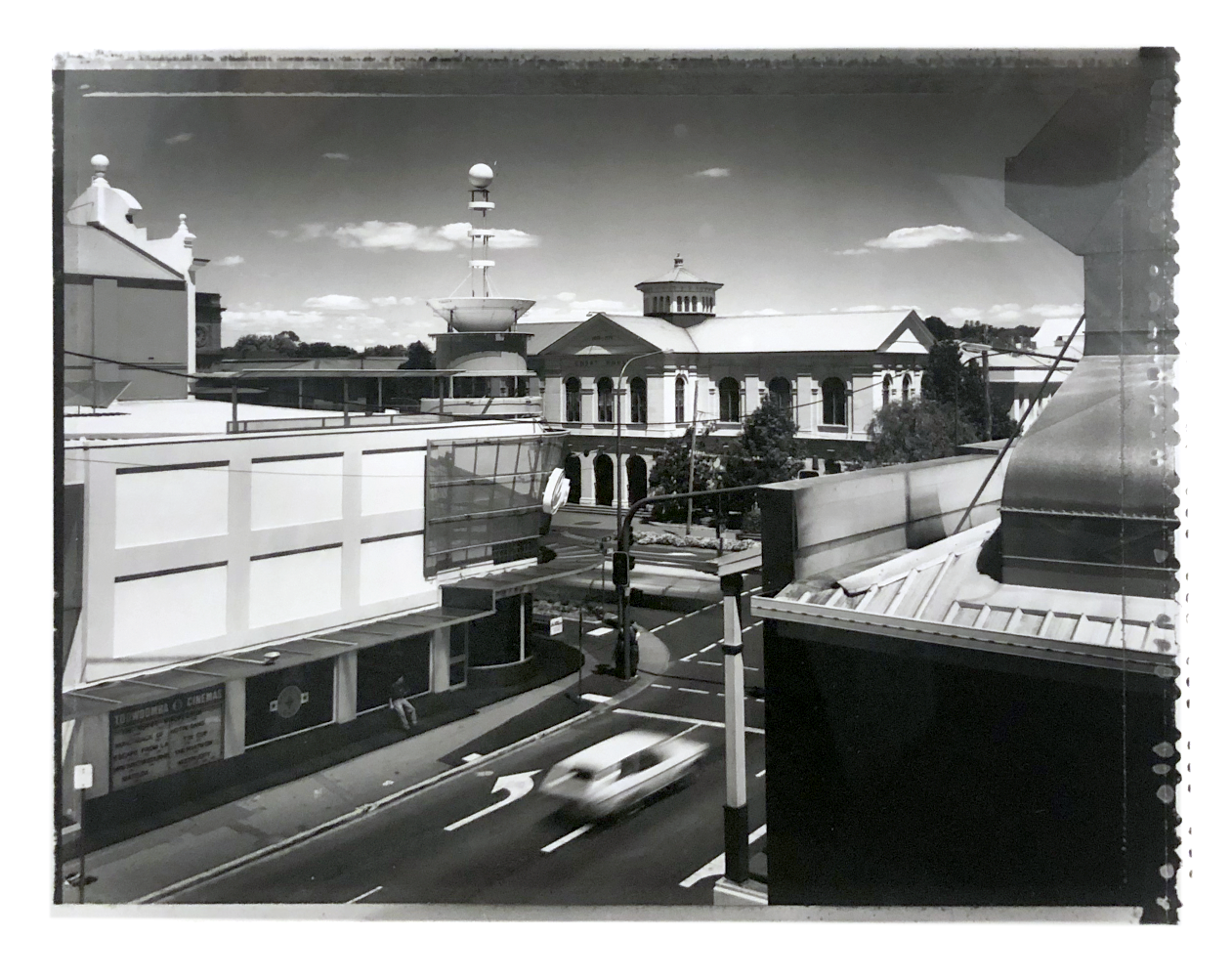
Spowart+Cooper The Old Court House 1996 silver gelatin fibre print
..
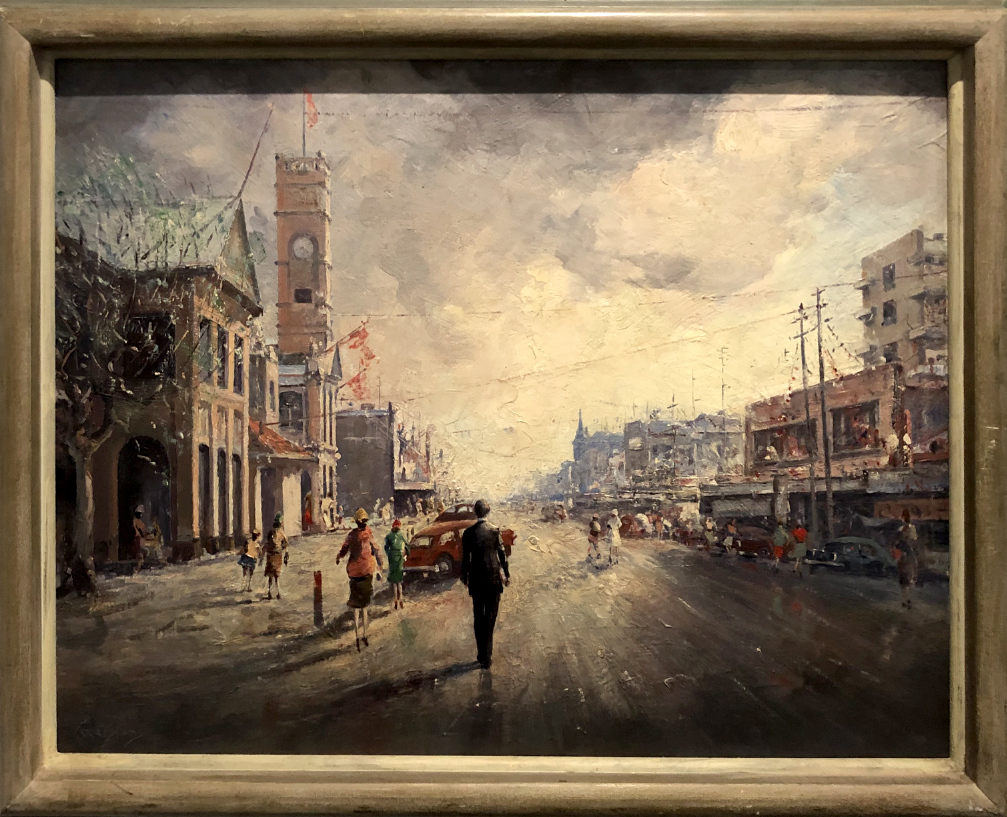
Herb Carstens Sunday Morning (Street scene Toowoomba) 1961 oil on comp board

Spowart+Cooper Sunday morning 1996 silver gelatin fibre print
.
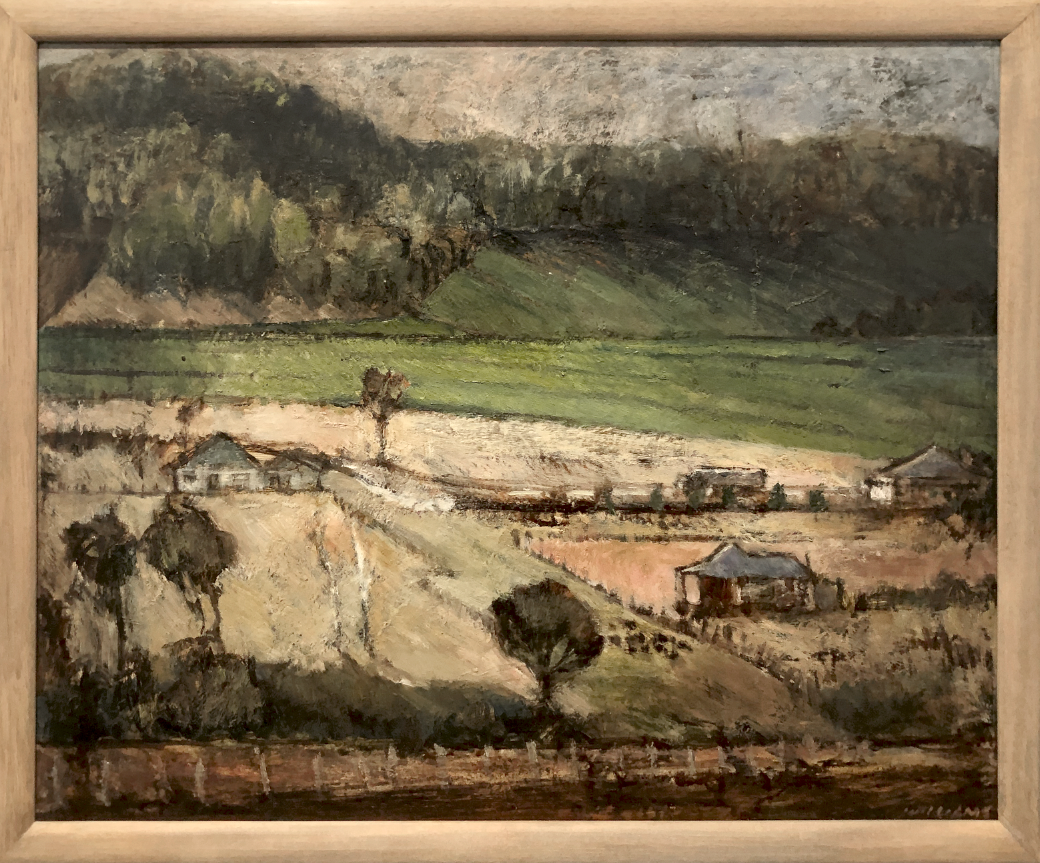
Brian Williams Near Drayton 1960 oil on comp board

Spowart+Cooper Near Drayton 1996 silver gelatin fibre print
.
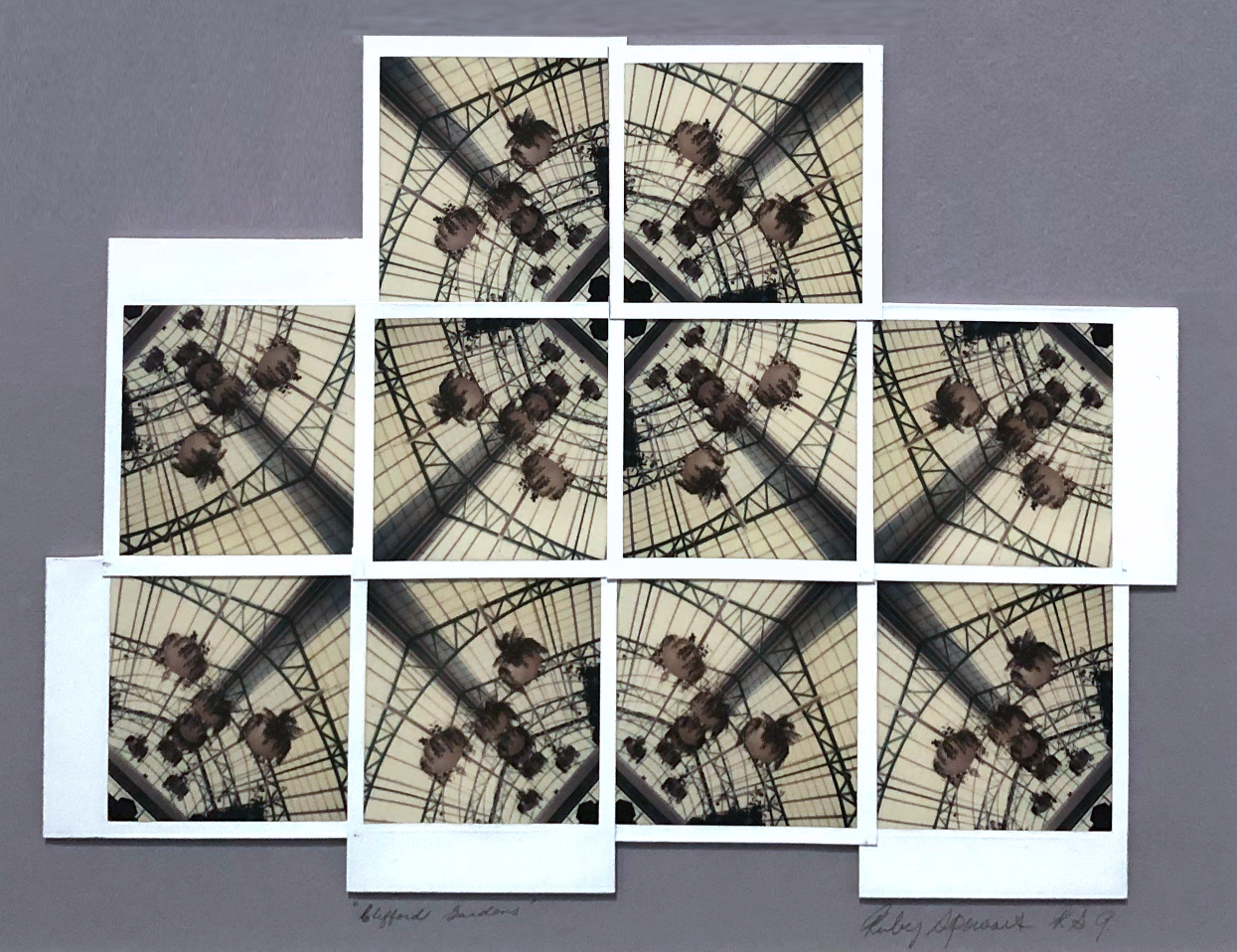
Ruby Spowart Clifford Gardens 1986 photograph Polaroid SX-70
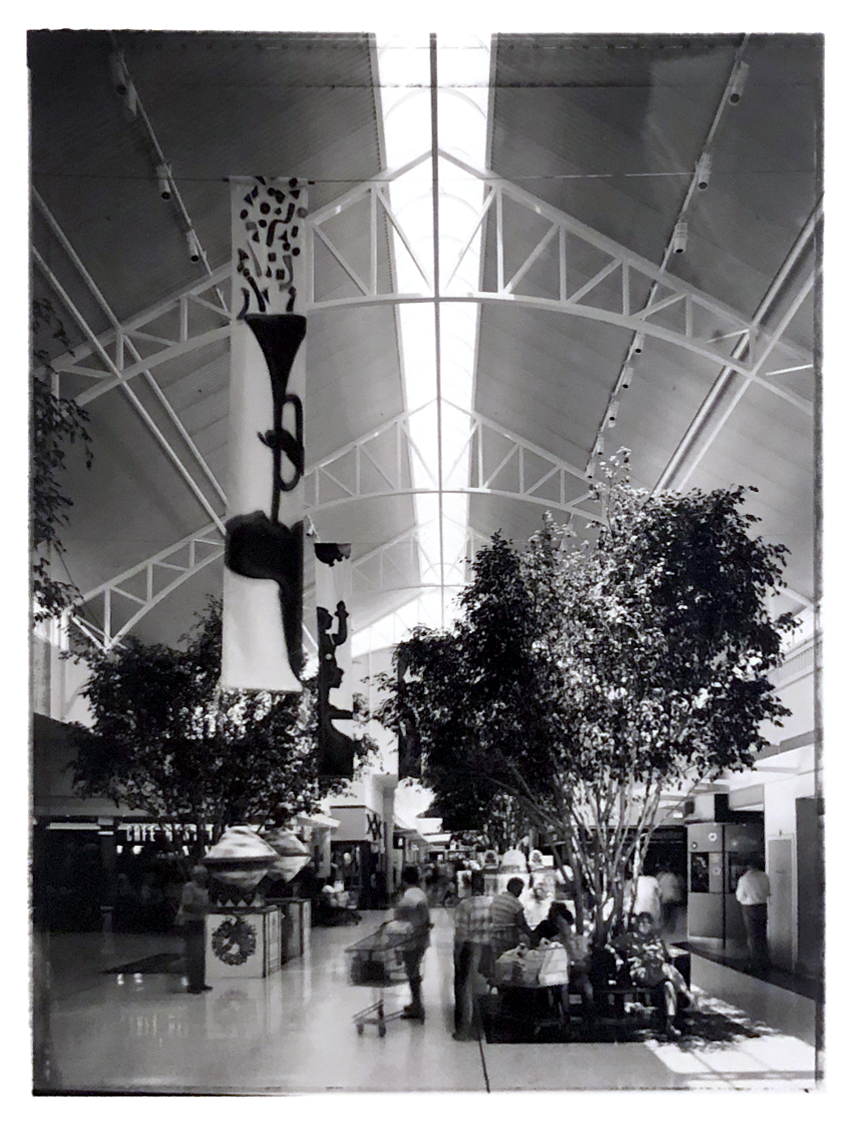
Spowart+Cooper Clifford Gardens 1996 silver gelatin fibre print
.
TRAG Display
.
OTHER REPHOTOGRAPHY PROJECTS BY Doug Spowart & COOPER+SPOWART

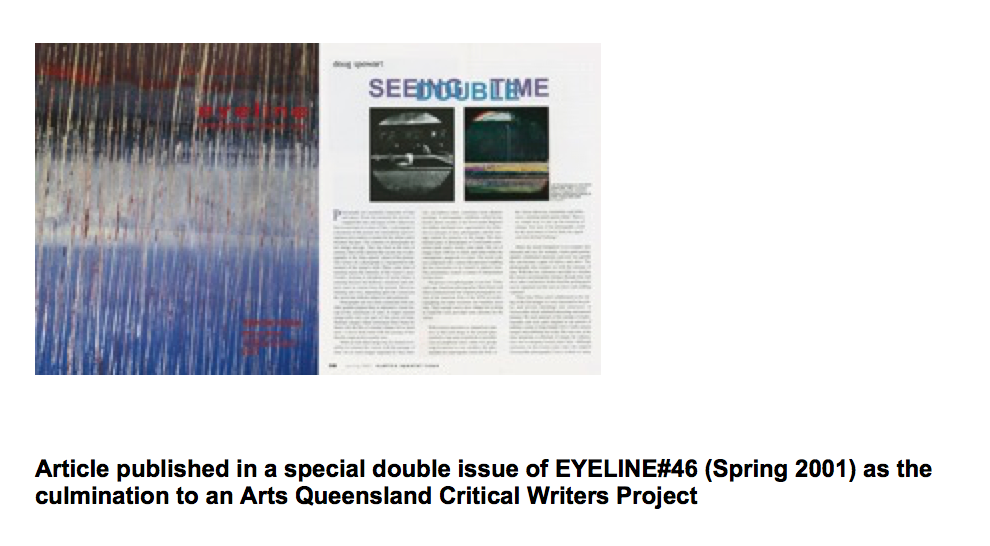
LINK: SEEING DOUBLE Toowoomba Regional Art Gallery 2001 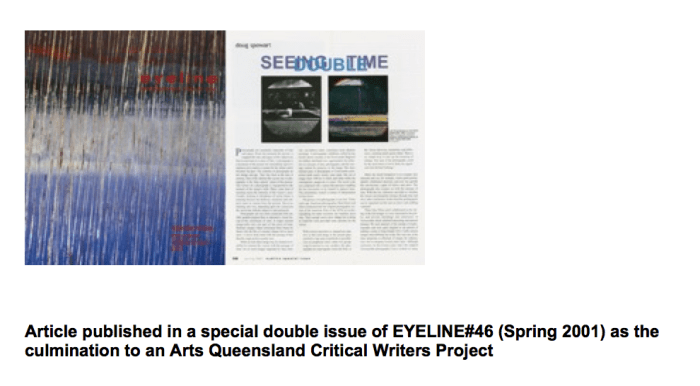
.
.
.
NOCTURNE ARMIDALE: a community photo project
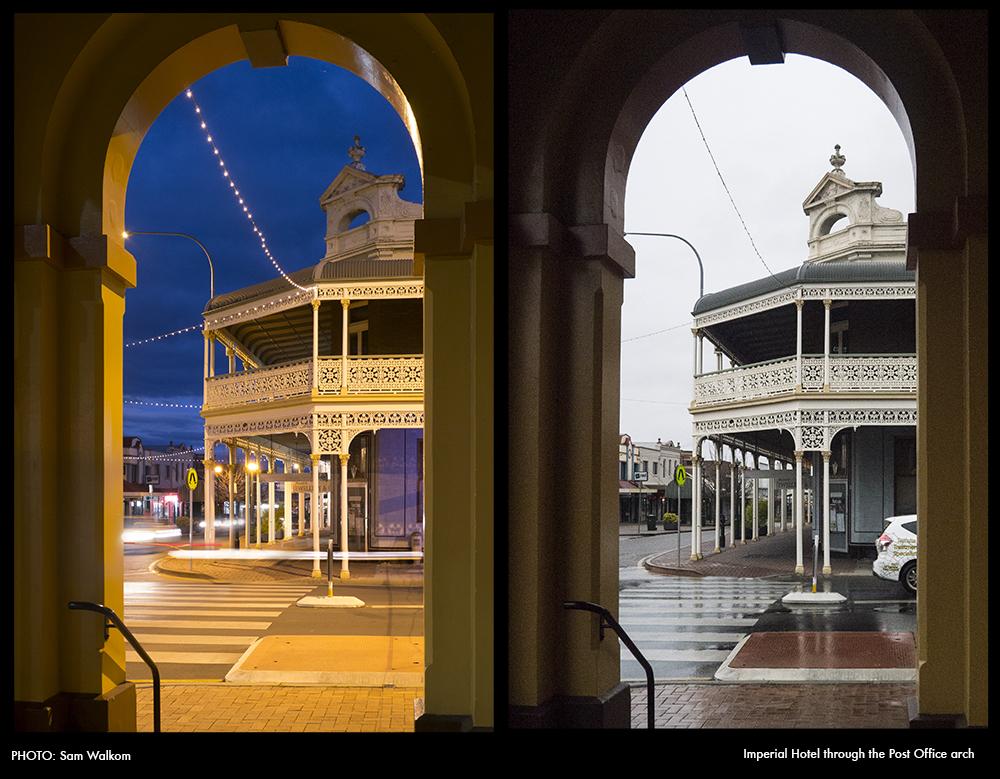
Sam Walkom’s Imperial Hotel rephotography DUO taken through the Post Office’s arches
NOCTURNE ARMIDALE: Capturing Armidale in a new light
In our latest Nocturne project we worked with a group of photographers from the Armidale region to document the change of light from day to night. The special theme we developed for the Nocturne: Armidale project was to capture the town in both the early evening’s nocturnal light with a second photograph of the subject during daylight. This ‘re-photography’ approach resulted in a comparative pairs of images revealing the evocative nature of nocturne light and how it transforms everyday places.
The project began in mid-September when we conducted a workshop at the New England Region Art Museum (NERAM) in re-photography and nocturne light capture. This included practical shoots around Armidale from which images were then optimized and uploaded to Nocturne: Armidale project Facebook page to share with the wider community. Another aspect of the project was the digital processing and optimising of nocturne photographs. This was accomplished in a mentored section of the workshop with the participant’s images.
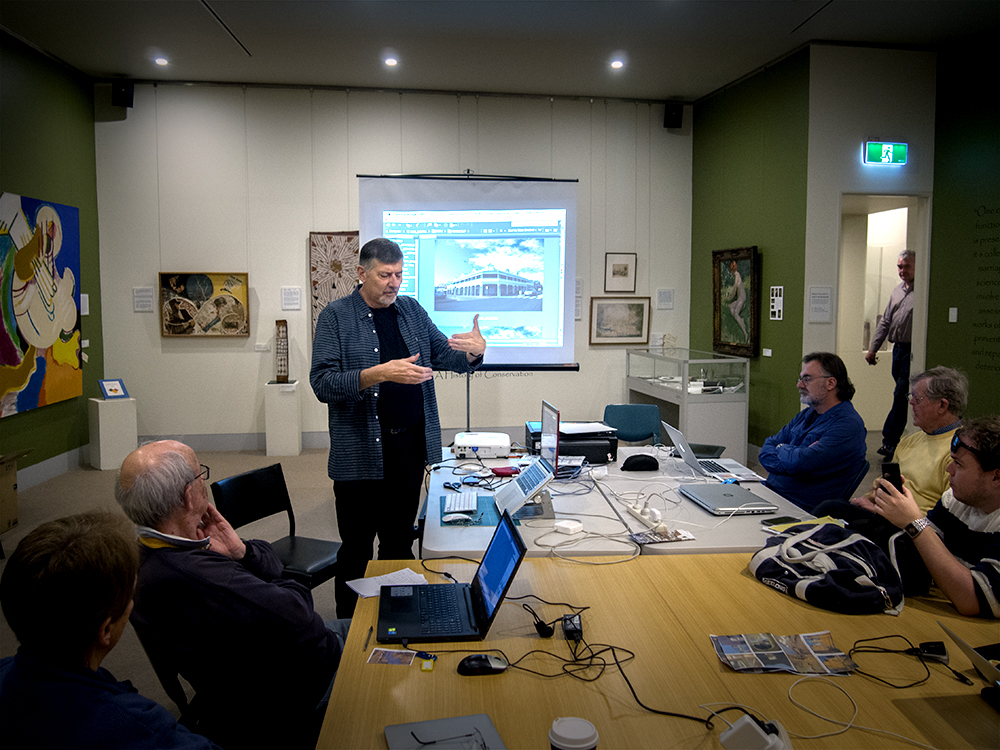
Doug presenting his workshop on file optimisation
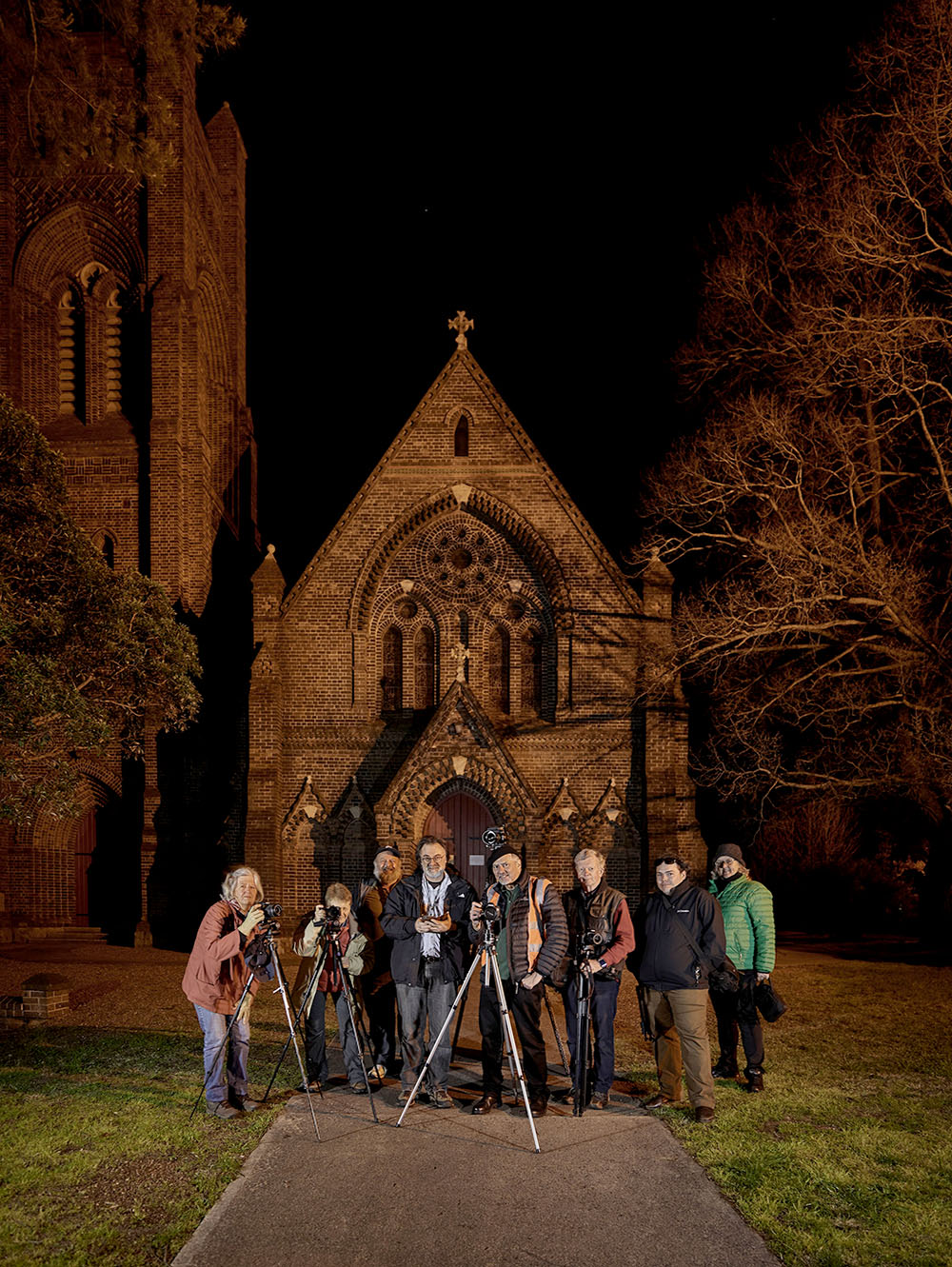
A group shot of some of the Nocturne Armidale participants PHOTO: Neil Burton
Les Davis from the National Trust Home Saumarez, provided project participants with a unique opportunity to photograph this magnificent historical homestead. Over two separate nights images were made to highlight the home’s colonial architecture.
It was suggested in our original proposal that the work produced could be at some later stage be exhibited. And during the workshop Greg from the New England Art Society Armidale Art Gallery came forward with the offer of an exhibition space in their gallery.
In the two months following the workshop we finalised the optimisation of 25 pieces from the workshop – most of them re-photography Duos, and printed them for the participants. Other print coordination took place with workshop participant Neil Burton who provided access to his wide-format printer for large images to be made. At the end of November we returned to Armidale with Neil and his partner Lindy Osbourne to hang the shows.
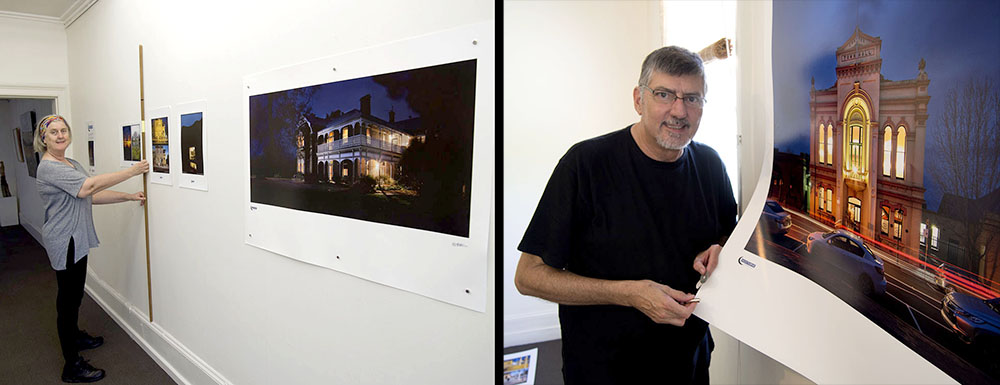
Hanging the Nocturne Armidale exhibition
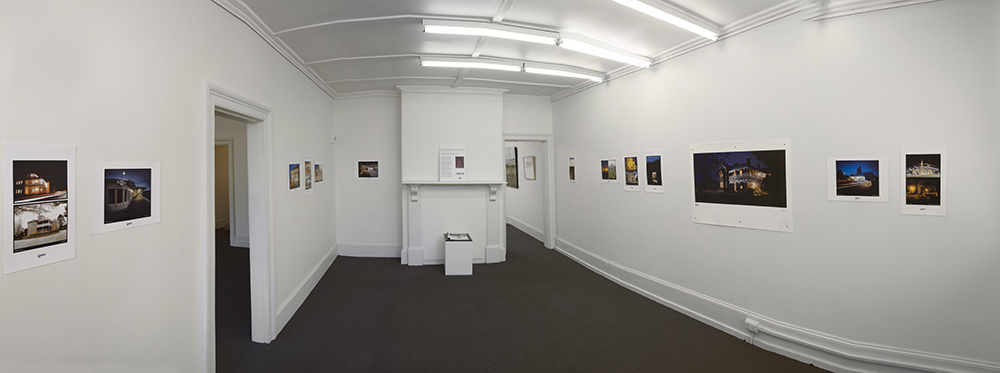
Part of the Nocturne Armidale exhibition at the Armidale Art Gallery
The project’s main exhibition was shown at the Armidale Art Gallery in Beardy Street and we presented a floortalk on December 3rd that was attended by around 25 visitors as well as most of the project’s participants. The exhibition of images from the Saumarez shoot-outs was officially opened by photographer and publisher Terry Cooke on December 2 and will remain on display at Saumarez until January 29th, 2017. A third exhibition of photographs included our images and works by Neil Burton will be on show in the Armidale Council Chambers until March 5, 2017.
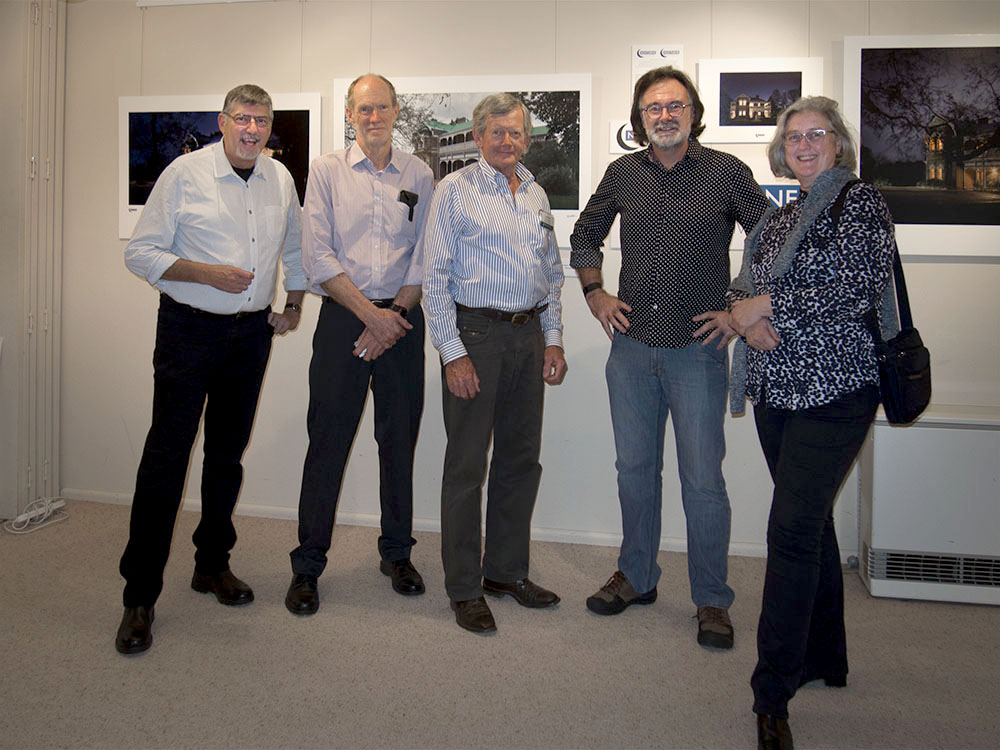
With Terry Cooke, Les Davis and Neil Burton at the opening of the Saumarez show PHOTO: Lindy Osbourne
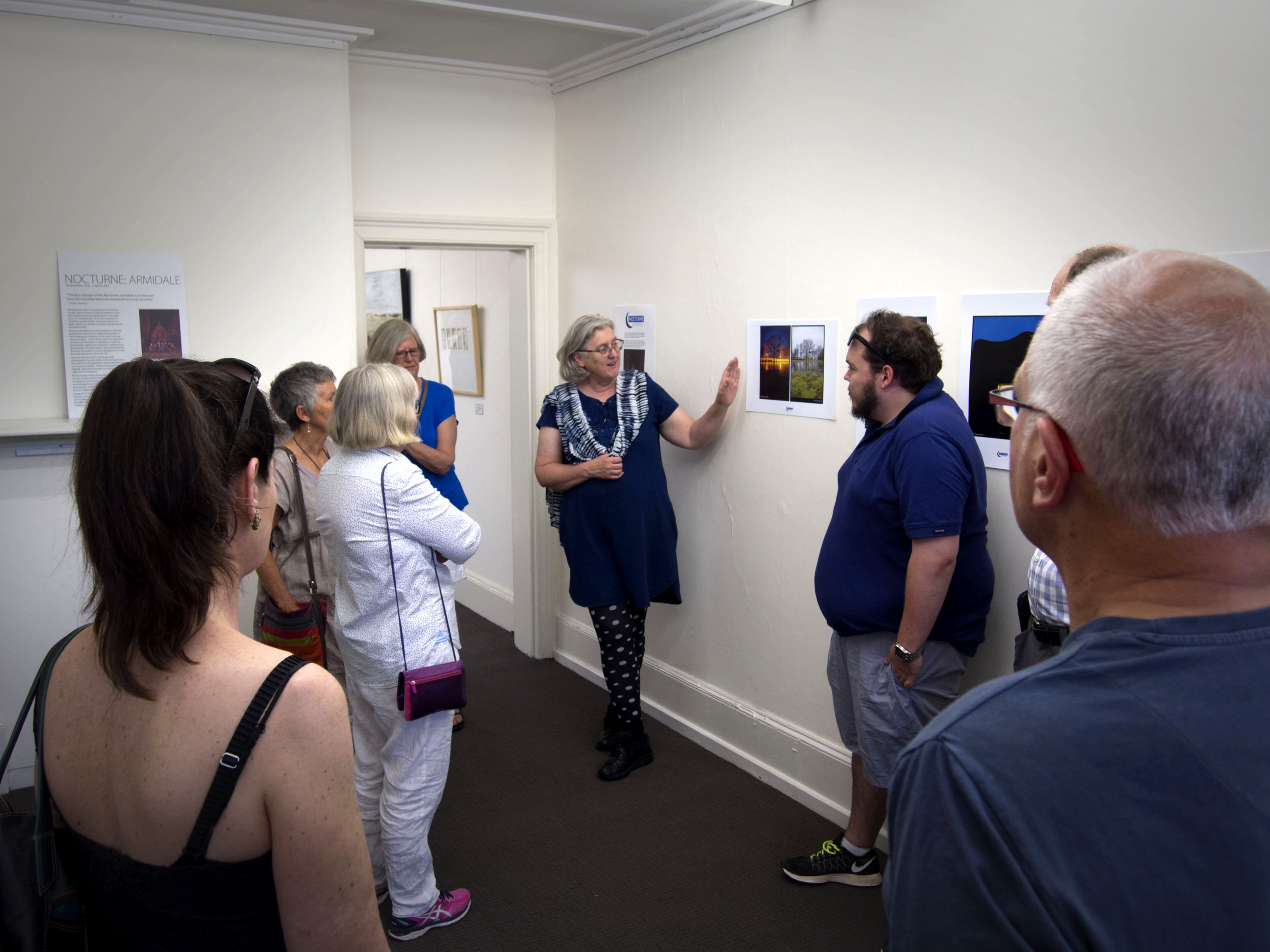
Vicky presenting a floortalk about the Nocturne show
The Nocturne: Armidale exhibitions include photographs by Paul Bayne, Sue Burgess, Neil Burton, Victoria Cooper, Les Davis, Ross Jenkins, Jeni Mackenzie, Doug Spowart, Sam Walkom and Jim Walmsley.
Here is a selection of the Nocturne Armidale project images…
Click on image to open a gallery viewer for author and subject details.


Robert Heather, the Director of NERAM described us as a ‘nomadic photographic duo’ and acknowledged that we had, with our group of local photographers, had ‘braved cold, wet and windy conditions to create some beautiful and dramatic images of places which we all know well such as the old Courthouse, Saumarez Homestead, the cathedrals, hotels and railway station.”
The New England FOCUS Magazine published a story on our work and background to the Nocturne Armidale project – Download a PDF focus-nocturnearmidale-red (20Mb)
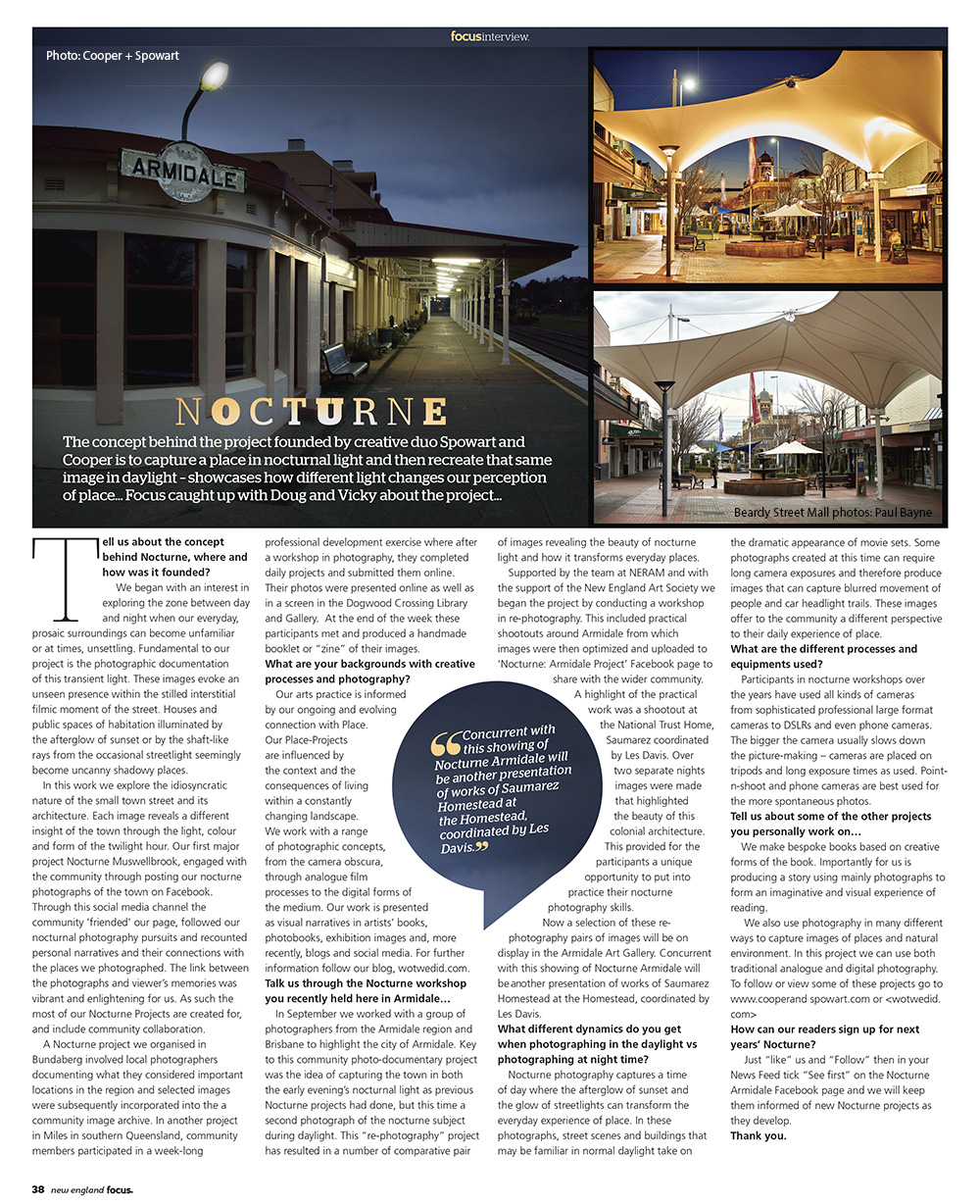
The Nocturne: Armidale project was coordinated by the New England Regional Art Museum in partnership with the New England Art Society and supported by Saumarez Homestead and Armidale Regional Council.
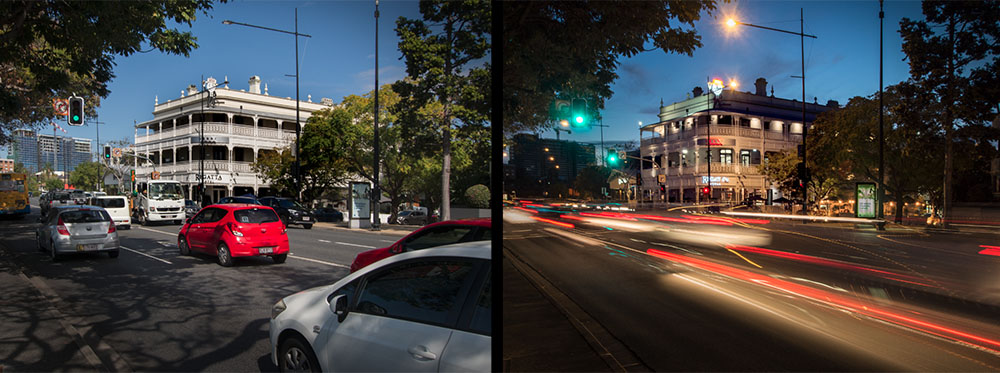
Regatta Hotel, Brisbane – Rephotography DUO
ABOUT NOCTURNE PHOTOGRAPHY
Nocturne photography captures a time of day where the afterglow of sunset and the glow of streetlights can transform the everyday experience of place. In these photographs, street scenes and buildings that may be familiar in normal daylight take on the dramatic appearance of movie sets. Some photographs created at this time can require long camera exposures and therefore produce images that can capture blurred movement of people and car headlight trails. These images offer to the community a different perspective to their daily experience of place.

Nocturne Armidale Logo
MORE ABOUT COOPER and SPOWART NOCTURNE PROJECTS
NOCTURNE: ARMIDALE, the project is part of continuing series, conducted by Victoria Cooper and Doug Spowart, across Eastern Australia including past events in Muswellbrook, Grafton, Bundaberg and Miles.
Through our Nocturne documentary photography and Facebook social media projects, we have explored connections with Place in urban and regional communities throughout Queensland, New South Wales and Victoria. For us the phenomenon of nocturnal light transforms these everyday spaces. Buildings, busy street corners, quiet alleyways all become filled with the dramatic light of a movie scene. In 2013 and 2014 we were given the opportunity, through funded Artists-in-Residence (AIR) programmes, to undertake Nocturne projects in the regional communities of Muswellbrook, Grafton and Bundaberg.
The photographs in themselves have no intrinsic meaning – it is the viewer, with their experience and memory that brings life to the image. In this moment of connection they may recount a personal narrative or connect with the historical significance of the place. This collaboration between photograph and viewer is exciting and vibrant – expanding the potential for the documentary image to go beyond the vision of the photographer.
Examples of other Nocturne Projects and Facebook responses can be found at: <www.nocturnelink.com>
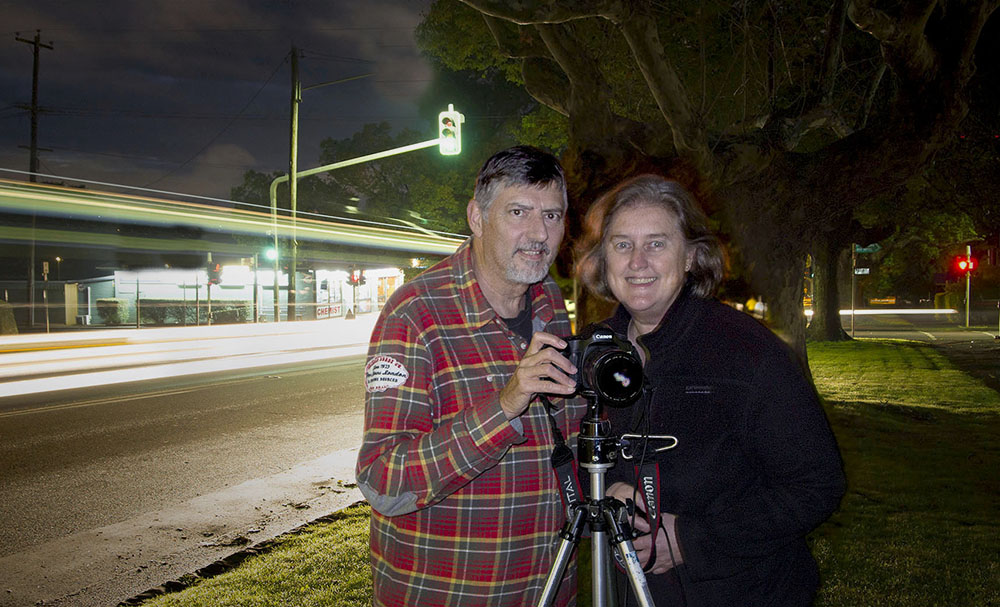
Cooper+Spowart shooting Nocturne
ABOUT COOPER+SPOWART
Our arts practice is informed by our ongoing and evolving connection with Place. Our Place-Projects are influenced by the context and the consequences of living within a constantly changing landscape. We work with a range of photographic concepts, from the camera obscura, through analogue processes to the digital forms of the medium. Our work is presented as visual narratives in artists’ books, photobooks, exhibition images and and on blogs and social media.
Logo
.
Copyright in all Nocturne Armidale project images is retained by the author – any use of these photographs must be approved by the copyright owner.
.
.
SUPPORT THIS PROJECT: Retake Melbourne App
In the opening paragraph of a review of John Elliott’s rephotography exhibition The Last Show and Re-shoot that was published in Art Monthly (#240 June 2011) I made the following comment:
Part of the mystique bestowed upon photography is the notion that a photograph captures a moment of time that enables a viewer to reconnect with or gain insights into the subject portrayed. Since its inception photographers have utilised photography’s inherent connection with time and place by reimaging the original subject days, months and years after the originating photographic ‘moment’. One notable re-photography project began in the 1970s by Mark Klett and his team in the United States with the Second View: The Rephotographic Survey Project, and continues with the recent Third views, second sights: a rephotographic survey of the American West. These projects draw upon the concept that comparative images over time extend the narrative of the single image, and that the differences and similarities observed tell a larger story – that of time and change.
I am excited by rephotography projects and from the early 1980s I have undertaken many myself. Now I have encountered news of an exciting project in Melbourne that will make this specialised photographic activity available to anyone with a smart phone or imaging device . Entitled Retake Melbourne the project will do two significant things; firstly, it will create an APP where earlier photographs of Melbourne can be located and aligned for the contemporary photographer to image the exact same view; and secondly, the source images will be from the the Sate Library of Victoria’s extensive Mark Strizic photography collection.
The project is being ‘floated’ via Pozible crowd sourcing, and time is running out to ensure this project gets the support to make it happen. I would ask you to review the project details that follow – login to Pozible, and make a pledge to support this valid and innovative project.
Thanking You
Doug Spowart
.
Here are the details … From the POZIBLE Project page
..
.
.
POZIBLE – Project Title: Retake Melbourne
Overview:
We Melburnians jealously defend our city as the ‘most live-able’; a cultured grande dame with a creative dash, anti-establishment street art, a larrikin love of football and lots of delicious secrets.
To participate in this project will be to illuminate and contrast her hidden past with her contemporary face.
Key to this is the mine of visual data in the State Library of Victoria’s collection, in particular immigrant Australian photographer Mark Strizic’s 5000 half-century-old negatives, colour transparencies and slides, acquired in 2007.
Aims:
When associate Greg Neville saw this archive, he envisaged a repeat photography project based on Strizic’s images which would uncover the glorious Melbourne buildings of his childhood memories.
We’d like to share this chance to retake Melbourne’s past. But re-photography is technically demanding. I realised that a mobile app would make the process accessible to everyone.

Image: © Mark Strizic: Melbourne GPO, 1950s

Mobile App mockup: © Strizic image overlay enables user to compose their own version accurately

A finished ‘re-photograph’ accurately duplicating Strizic photograph angle of view
By tapping the ‘crowd’ we can include you in this project. Your images might become valuable records, as Strizic’s are now, to researchers in the still further future! They will compare your view with Mark’s to see how the city has changed. You can be in on the birth of Melbourne’s first comparative photographic research project.
But first we need the tech to do it; a photography app that contributors will be first to use!
Background:
Close associate of architects Robyn Boyd and David Saunders, Strizic’s love of architecture and his European eye provoked his condemnation of the ugliness he saw invading Australian city-scapes during the 1960s when architecture of the Gold Rush era coexisted with, and was being demolished for, Modernist curtain-glass high-rise office buildings.

LHS Image: © Mark Strizic: Russell Street Melbourne, 1950s
RHS image: Greg Neville: Russell Street Melbourne, 2013

Image: © Mark Strizic: Melbourne Museum and State Library, 1950s
Outcomes:
By contributing to the development of our crowd-funded app, you will create the means to contribute accurate repeat photography of the locations of Strizic’s thirty-to-fifty year-old images of architecture, street-scenes and pedestrians, and to uncover the layers of history.
Historical and Creative results
Re-photography is studied and recognised for its value for historical, scientific, geographic, geologic and social science research; this use of crowd sourced material will be innovative.
Rather than being slavish copies of old photos, yours will be interpretations of Strizic’s originals which will build a picture of how a city has changed, and is in turn transforming us. There is a creative dimension in the ratio of interpretation to replication each contributor will employ in this process, that will add to value of their artefact. Their resultant contribution may be incorporated in the SLV online collection for comparison, by these and future researchers, with Strizic’s original.
The Mobile App:
With this app, members of the public can find locations photographed by Strizic on a map, orient their device’s camera closely to the angle, orientation and framing that he used using a transparent overlay of his image, downloaded from the SLV online collection, over their screen image.
This app will simplify the repeat photography exercise and enable you to produce a comparative image which will match or contrast existing conditions and features with those in his original image.
Contribute to our shared archive:
The State Library of Victoria‘s huge archive opens up a rich resource for Victorians online; now that everyone can access it; they can also interact with it. This crowd-sourced project will give the archive more exposure and contribute new resources.
Provide a resource for future research:
The Strizic archive forms a reference for participants who will be asked to repeat the making of the images in the same location. In doing so they will record a contemporary street scene peopled with pedestrians who may regard, occupy and use the city of Melbourne in very different ways now.
Increase your own knowledge of Melbourne and Photography:
Part of the durable, interactive and updatable project outcomes is that participants will make a substantial contribution, they in turn will benefit from the exercise of finding the locations in coming to understand at first hand the operation of the forces of change on the city, the influences of crowd behaviour on the city, and its power to change us and our societal interactions. You too can become a ‘re-photographer’!
- What will your contribution do?
Level of funding sought: $6,000 – $10,000
A huge volume of photographic contributions will be required to enable worthwhile comparison of the old and new images to show how Melbourne’s buildings and streets have shaped, and are shaped by, its populace and its society. Achieving the necessary quantity and accuracy will require $6,000 base funding for the development and distribution of a mobile-device app.
$6000 will pay for six months of the developer’s time in building the app.
Researcher Dr James McArdle, will contribute $12,000 in-kind support; for research into the State Library collection and mapping of locations of Strizic images for GPS locator in the app.
*Reaching $10,000:
will enable us to map significantly more locations and to pinpoint the date/time of capture for more Strizic photographs as a guide to the re-photographers.
Twitter: JamesmMcArdle
Content on this page is licensed under


 wotwedid