Posts Tagged ‘Julie Millowick’
JULIE MILLOWICK’s ‘Surrounding’– Intrinsically Local

Continuing Drought El Nino year – Julie Millowick with son Christian McArdle at Crocodile Reservoir PHOTO: Courtesy of the artist
.
SURROUNDING
The beauty of Central Victoria’s landscape in tumult and recovery
.
An exhibition by Julie Millowick at Castlemaine Art Museum
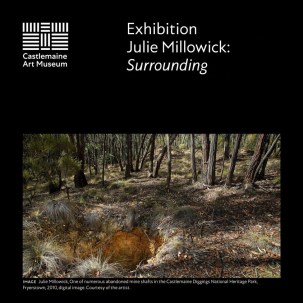
CAM – Surrounding Julie Millowick
.
“Photography is my life; it is the very core of my being”
Julie Millowick
Surrounding is an exhibition by Julie Millowick surveying her lived experience over 36 years in Fryerstown, Victoria. Over time this celebrated documentary and commercial photographer, driven by a curious and creative mind, has created a photographic archive both cataloguing her visual inquiry and providing a chronicle of her life within this place. Millowick’s work is multifaceted where the poetic and psychological is interconnected with an almost scientific aesthetic thus sharing deep insights into the land that has both nourished and challenged her.
The curator, Jenny Long, has written a sensitive and informative essay for the book Surrounding that accompanies the exhibition. Long discusses Millowick’s process and conceptual thinking along with observations to provide background and framework for the viewer to consider this extensive project. Along with the book there is promotional material and didactics that proposes the exhibition will ‘show us the devastating effects of mining, drought, flood and invasive plants, but also remind us of the interconnectedness that links all parts of this ecosystem including its human occupants.’ And that there is a, ‘capacity for renewal … that offers a spark of hope for the future.’
.
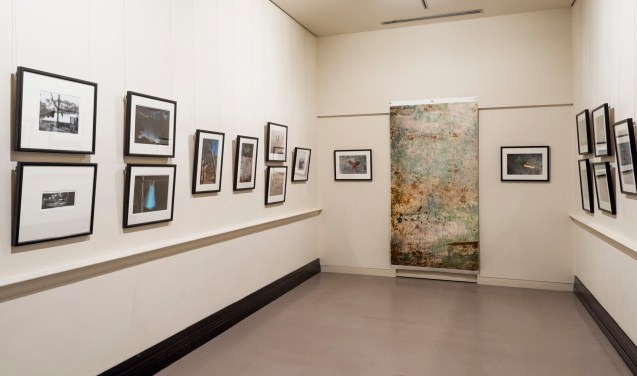
Surrounding House and domestic installation PHOTO: Supplied by the artist
.
In the first gallery space, the ‘house and domestic’ body of work is presented as twenty-three individual framed works including an 1870s photograph an original owner, Mrs King, standing outside the home. In this work Millowick’s subject matter includes botanical still-life works, images of the detritus of past inhabitants unearthed in the house grounds and there is also a large print of a section of a house wall interior etched with the marks of habitation and the patina of age. Images of washing drying on the clothesline refer to the domestic space of the past and present habitation of this home. Far from being prosaic records of domesticity, the photographs of the washing have an ethereal perhaps even ghostly appearance.
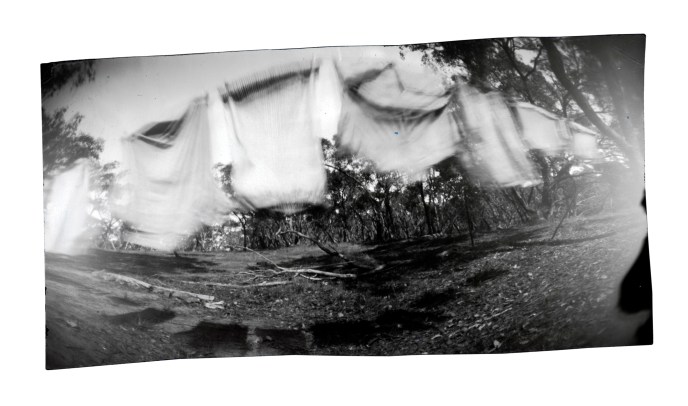
Washing in Horse Paddock pinhole image 1996 PHOTO: Courtesy of the artist
.
There is also a kind of haunting in the walls and surrounds of the house, which continues through the shadowy and dramatically lit scenes of this exhibition. The appearance of a selectively illuminated tree branch or the enchanted presence of Millowick’s horse Goldie, imbues the place with a mythical spirit that beckons the viewer to follow into the mysterious dark forest.
.


.
Contrasted with a sense of wonder and fairy tale mystery, Millowick’s work is also deeply grounded in the reality of place, which is as sharp and unadorned as the land itself. In the larger exhibition space, there are groupings of unframed images that explore both topographical and psychological aspects of specific spaces and themes including mine sites, the Castlemaine Diggings National Heritage Park, ecological thinning, the Crocodile Reservoir Drought and horse paddock. A constant subject for Millowick is her son Christian whose activities are documented in many of these themes. images within the groups are placed together to form clues and evidences that suggest larger narratives. It is also interesting to consider the installations as visual representations of the conversation between artist and curator piecing together the rich collection of work and the resonance or dissonance between images and concepts.
.
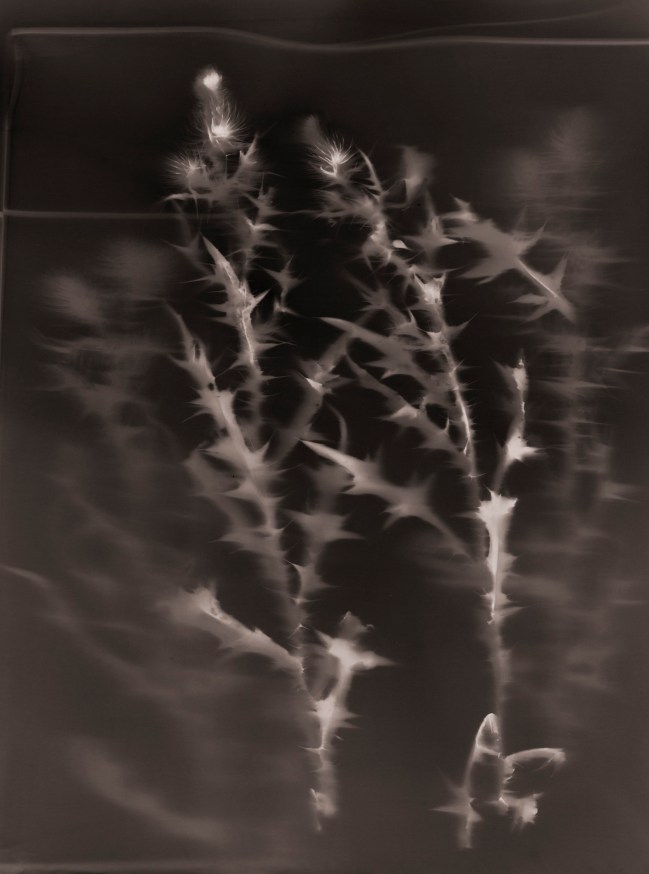
Invasive Thistles 2002 Lumen print by Julie Millowick
.
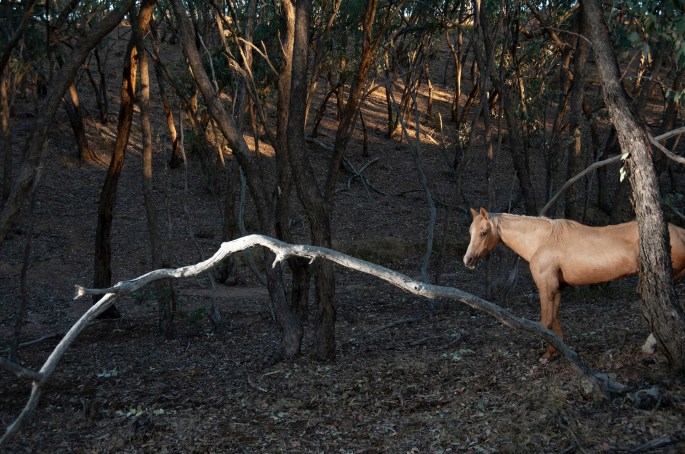
Goldie, 34 year old horse 2009 PHOTO: Julie Millowick
.
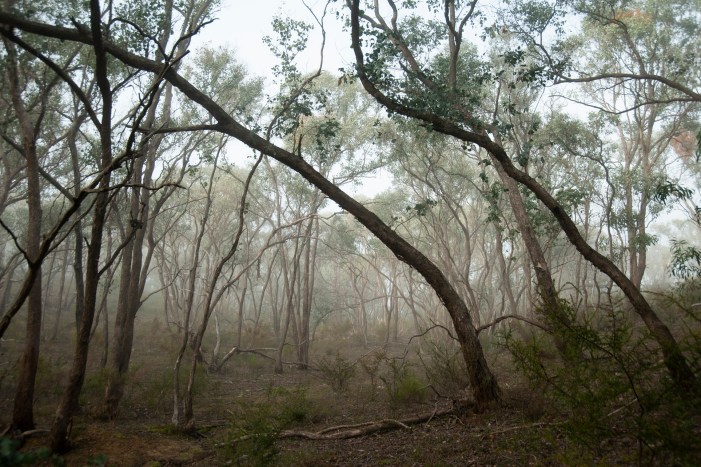
Horse Paddock Post Goldrush Uniform Regrowth PHOTO: Julie Millowick
.
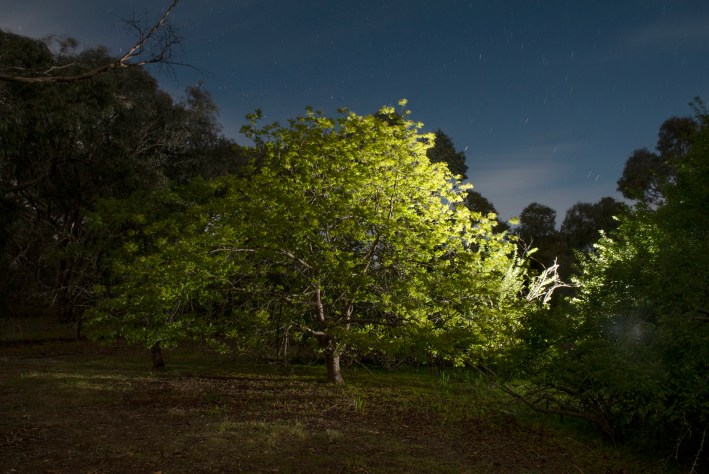
Fryerstown, Isolation, Lockdown, Orchard, Chinese Pistachiola Tree, last moments before midnight on 21 October, and first moFryerstown, Isolation, Lockdown, Orchard, Chinese Pistachiola Tree, last moments before midnight on 21 October, and first moments on 22 October PHOTO: Julie Millowick
.
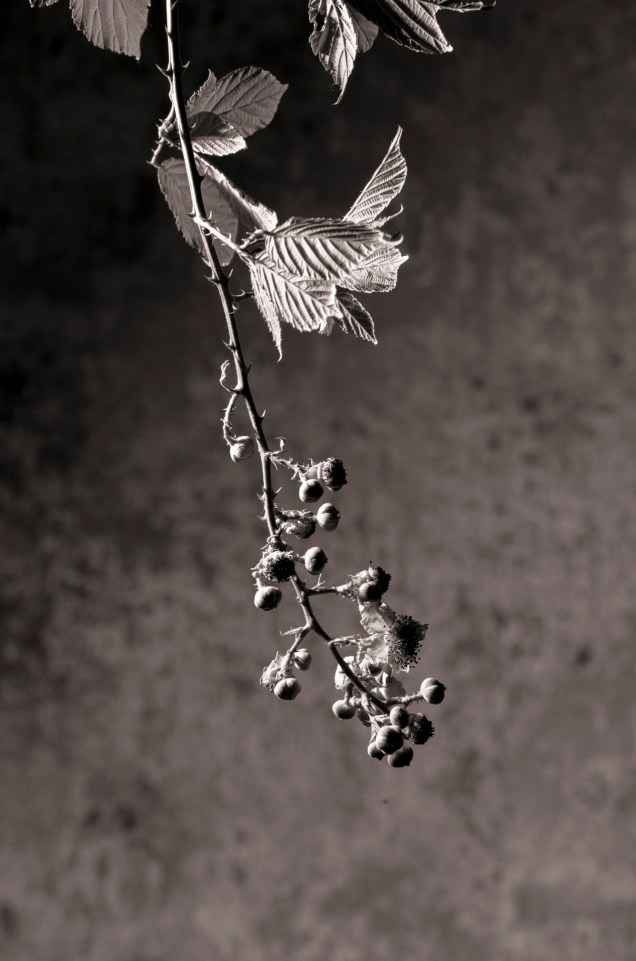
Original Cottage Wall with introduced Invasive Blackberry 2023 PHOTO: Julie Millowick
.
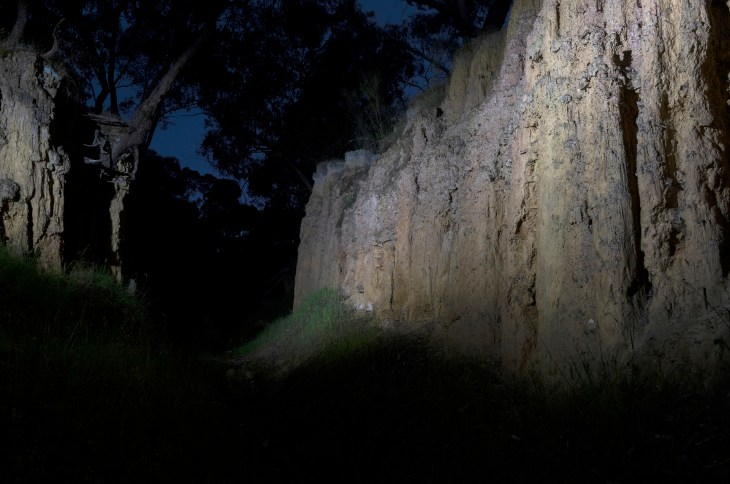
Fryers Diggings, Sluicing, Heron’s Reef 2023 PHOTO: Julie Millowick
.
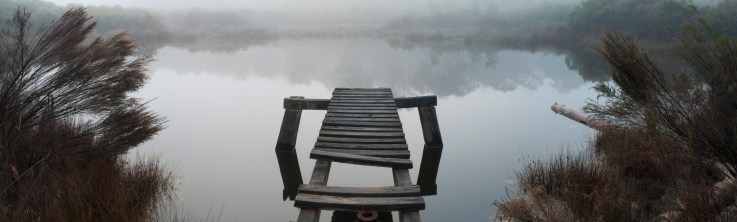
Crocodile Reservoir 2006 PHOTO: Julie Millowick
.
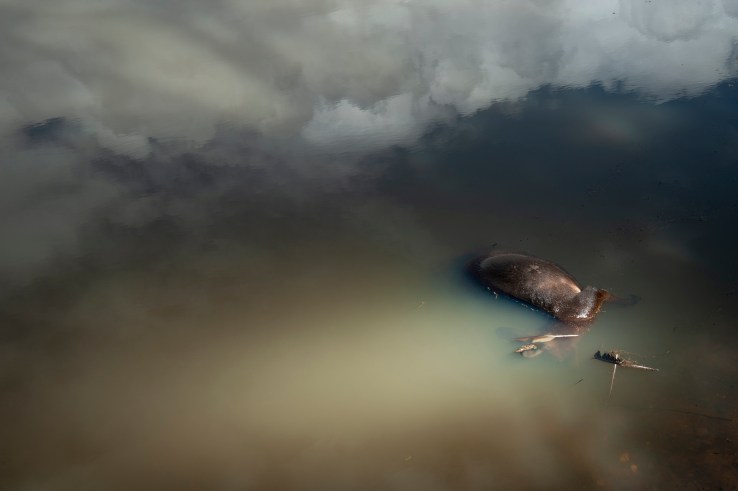
Drowned Kangaroo PHOTO: Julie Millowick
.
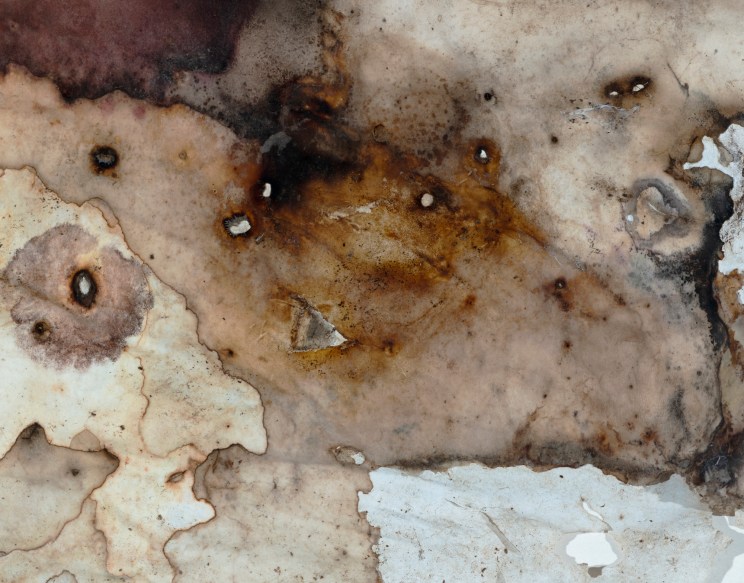
Lumen Buried Paper Under Blackberry Bush by Julie Millowick
.

Castlemaine Diggings National Heritage Park Cherry Ballart 2022 PHOTO: Julie Millowick
.
A photographer with less time moving over the space would document the superficial surface of things and create a record time-locked to when they were there. Millowick has set for herself the challenge of distilling a life of experience of time and place by using her comprehensive knowledge of photographic techniques* that, when combined with personal vision, can present to the viewer something deeper. As Millowick explores the environment or found objects, she reveals deeper layers and meanings through her experimentation with the visual language of each process and technique. The depth and complexity of this work tells of the unwavering commitment to her art, the community and the environment.
.
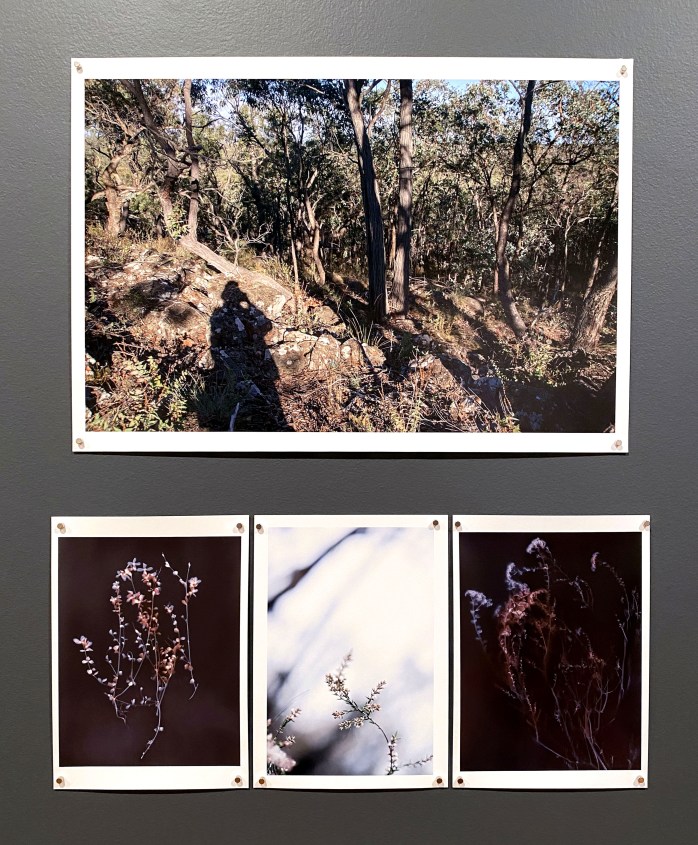
Image grouping
.
When introducing Julie Millowick at a recent artist’s talk about her exhibition the Gallery Director Naomi Cass described her as a ‘Localist’. ‘Localist’ is indeed an appropriate term not only for the work in this exhibition but also for Millowick’s continued photographic activity in the community. As a localist Millowick’s activity is part of the growing contemporary global movement for living locally and telling local stories particularly since the impacts of the Covid Pandemic. As it was 36 years in the making, this exhibition could only be just a fragment of Millowick’s creative visual documentation of her surroundings and community. Further digging or mining of her extensive archive will potentially reveal new perspectives and meanings on these powerful local stories of her place. Surrounding is just a beginning, there are so many other stories yet to be told …
.
A commentary on the exhibition by Victoria Cooper and Doug Spowart
Surrounding was part of the PHOTO2024 program
.
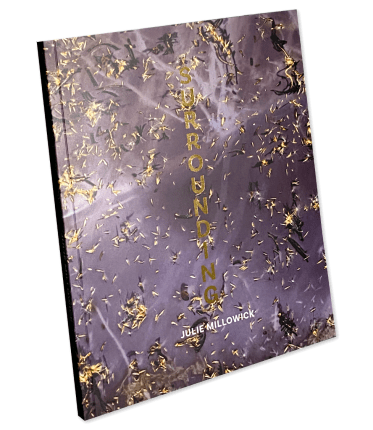
Surrounding – the book
.
P.S. The Surrounding exhibition is complemented by an illustrated book copies of which can be purchased from Castlemaine Art Museum or directly from Julie Millowick
.
IMAGES FROM THE IN CONVERSATION EVENT | Julie Millowick and Kyla McFarlane
Sunday 10 March, 11:30am — 12:30pm
.


.
* Photographic techniques that Julie Millowick employed in the exhibition include – pinhole photography, lumen printing, added lighting (painting-with-light), double exposure, cyanotypes, out-of-focus capture, re-photography, progressive sequencing, documentary and personal narrative.
We wish to thank Julie Millowick and congratulate her on the exhibition and for the images of her photographs and the exhibition installation. Photographs of the IN CONVERSATION event were by Doug Spowart.
Castlemaine Art Museum is a member of the Public Galleries Association of Victoria
.
.
.C
.
This site is archived by PANDORA, Australia National Library’s Web Archive
.
.
.
.
.
.
.
JOHN CATO Exhibition & Book Launch: Ballarat Int’l Foto Biennale
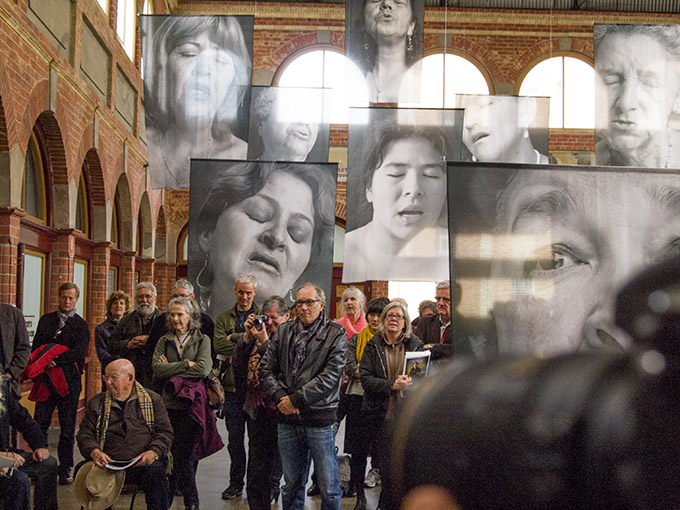
Attendees @ the John Cato exhibition opening and book launch
.
As photographers we all have special memories of those who inspired and nurtured our early interest in the medium. For some, teachers made a difference, and are forever remembered–even revered as heroes. None, or maybe only a few, have the reputation of John Cato. Working in the hallowed institution the Prahran College of Advanced Education in halcyon era of the 1970s and 80s Cato taught/mentored some of Australia’s most significant contemporary photographers. Names like Bill Henson, Nino Martinetti, Steven Lojewski, Polly Borland, Kim Corbel, James McArdle, Christopher Koller, Andrew Chapman and Julie Milowick were all Cato’s students.
.
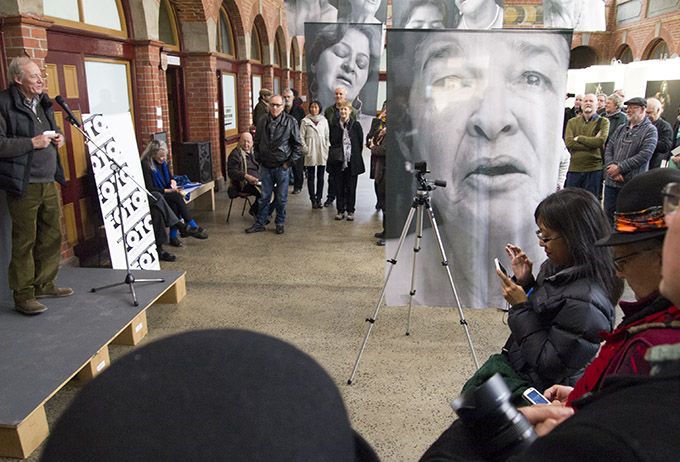
Andrew Chapman addresses the attendees
.
James McArdle, who studied at Prahran with Chapman, Henson and Milowick in 1974-76, had this to say about Cato:
… in my memory John was a teacher determined to seek out the aptitudes and endowments of each student who came before him; his teaching and mentorship involved a deep empathy with each student’s approach. He was almost clairvoyant in being able to very quickly identify one’s strengths and it was on those he would concentrate, unafraid to express criticism; but only in terms of how a certain fault might detract from a strength. Such was his positive and affirming approach to teaching, and consequently we have each been left a different and very personal perception of what he valued in photography.
At the 2013 Ballarat International Foto Biennale an exhibition and the launch of a book on Cato’s work pay respect and homage to the man. In the afternoon of the opening day of the BIFB a gathering of past students and friends participated in the formalities of the event. Key presenters included Paul Cox, Andrew Chapman and Julie Milowick who told of their experiences of Cato and eulogised the influence that he has had on their photography. Well-known Melbourne ArtBlart blogger and commentator on photography Dr Marcus Bunyan presented an opening address and lamented the lack of recognition for Cato’s work and philosophical approach to photography and teaching. These sentiments seemed to be shared by the gathered audience. Bunyan’s address is available HERE.
.
.
.
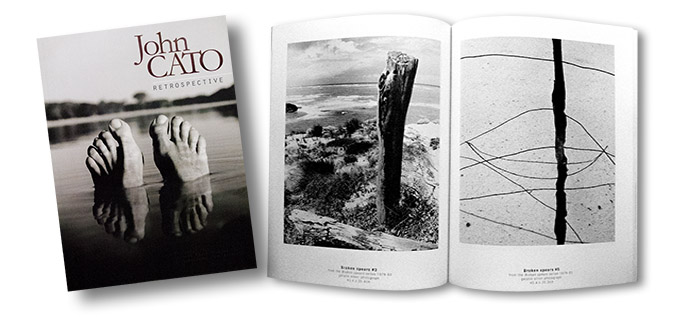
The book, John Cato Retrospective, is a significant record of the scope of Cato’s work and includes essays from a number of photographic commentators. At $20 the book is modestly priced considering the weight and value of its contents. Edited by Paul Cox and Bryan Gracey – Copies of the book can be purchased from the BIFB office or online through the publishers HERE.
.
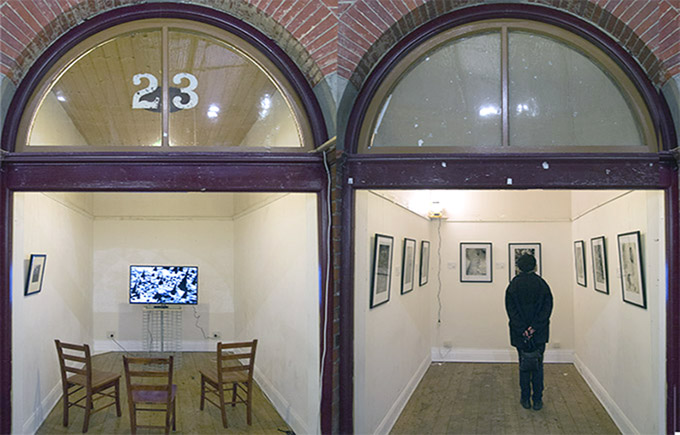
Two of the John Cato exhibition rooms @ BIFB
.
The exhibition filled a number of bays in the Ballarat Mining Exchange and included a video entitled Between Sunshine and Shadow – John Cato was produced by David Callow and Andrew Chapman and can be viewed below …
.
.
Examples of John Cato’s photographs can be viewed on the dedicated website http://www.johncato.com.au
.
The event concluded with book signings and conversations between the guests – no doubt excited about the respect paid to this significant Australian photographer and teacher of photography and life …
.
Doug Spowart
.
OTHER REPORTS AND NEWS ARTICLES ABOUT JOHN CATO
.
.
From Paul Isbel
.
Alison Stieven Taylor from: The Australian August 10, 2013
http://www.theaustralian.com.au/news/features/natures-gentle-man/story-e6frg8h6-1226692887191
.
Terry Lane from The Age August 22, 2013
http://www.theage.com.au/digital-life/cameras/john-cato-true-photographic-talent-20130821-2s9wo.html
.

.
Photos © 2013 Doug Spowart,
.

The photos are licensed under a Creative Commons Attribution-NonCommercial-NoDerivs 3.0 Unported License.
.
.
.

 wotwedid