Archive for the ‘Mail art’ Category
BOOKS AS ART: 30 YEARS IN THE MAKING – Catherine McCue Boes
BOOKS AS ART: 30 YEARS IN THE MAKING by Catherine McCue Boes
Bundaberg Regional Art Gallery – 14 May – June 29, 2014
.
An observation of artists and artmaking in the regions…
.
Artmaking and artists from the regions are constantly sidelined by the power of proximity that pervades these ‘blessed’ centres of art and culture. People who make ‘real art’, it seems, come from places where populations are concentrated, like ‘big cities’ or localities where a place of learning (university) or an uber vibrant arts community exists. In Australia the place names of Sydney, Melbourne, Adelaide, Hobart and perhaps Bris-vey-gas, are part of a roll call of significantly charged places for artmaking, presentation, commentary and critique. *[Note: artists’ books have a wider community of practice that is more inclusive due to the fact that regional centres tend to present events, awards and workshops that bring the city and country together. SEE https://wotwedid.com/2013/05/13/2013-libris-awards-the-judges-view/]
.
With this in mind, then consider my surprise when I recently encountered an exhibition of artists books at the Bundaberg Regional Art Gallery. The main gallery held one of the largest exhibitions of artists books I’ve seen for some time. The show was more impressive because it was essentially the book works of one person with additional books by others coming from the artist’s collection. The exhibition, entitled Book as art: 30 years in the making, was by Catherine McCue Boes a local Bundaberg artist. As the title implies the exhibition encompasses a significant period of time and the life of the artist.
.
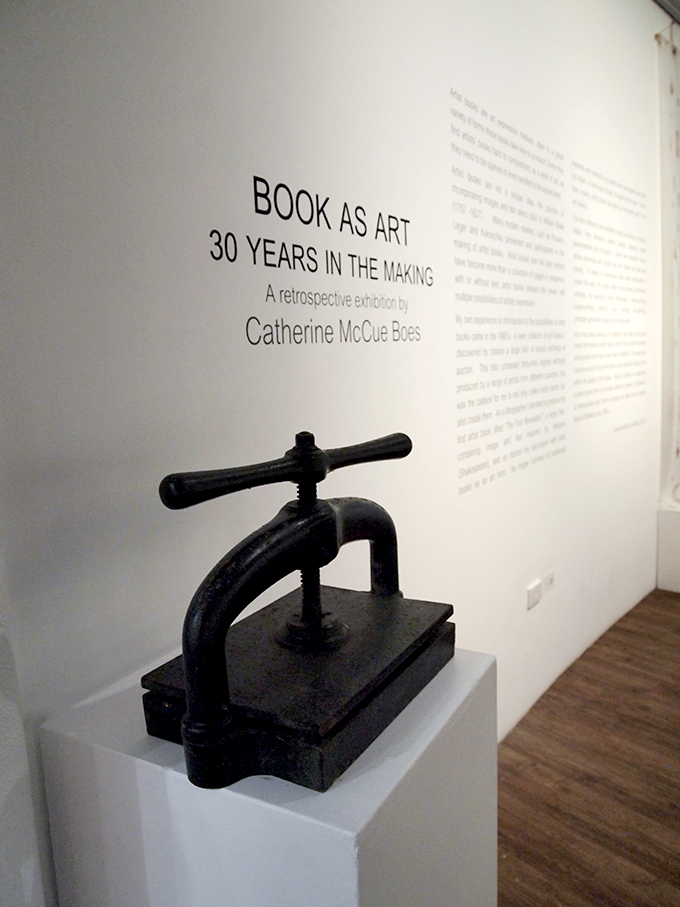
Exhibition frontpiece
.
Engaging with the artists books on display was a challenge – I walked around the space, glancing at and visually grazing the works on display. In keeping with the gallery display norm for artists book display the books were not for touching with many in vitrine glassed cages. Many books were the concertina form that allowed for easy reading and connection with the narrative. The artist also presented alongside the books wall works to give the reader an idea of the contents of the book.
.

Exhibition installation of Books as art: 30 years in the making
.
After my initial viewing, the sheer volume of the work on display and the demands that such a volume of complex and at times conceptually dense places on the viewer, I had to go away and come back to the gallery for a second viewing.
On my return I was drawn to a number of the accessible concertina books. The first of was, In Paris 2012, which dealt with the artist’s personal experience of walking in Paris and the extraordinary things experienced. The book’s plain white paper surface is inscribed with diaristic jottings, a quick unfinished drawing of the Eiffel Tower, a textural pattern element, and deep-etched monochrome photographs of sculptures and architectural details. A pink abstracted form with a pigment-bled edge repeats over many pages – is it a memory of a figure walking in the rain with an umbrella or is it a self-portrait?
.
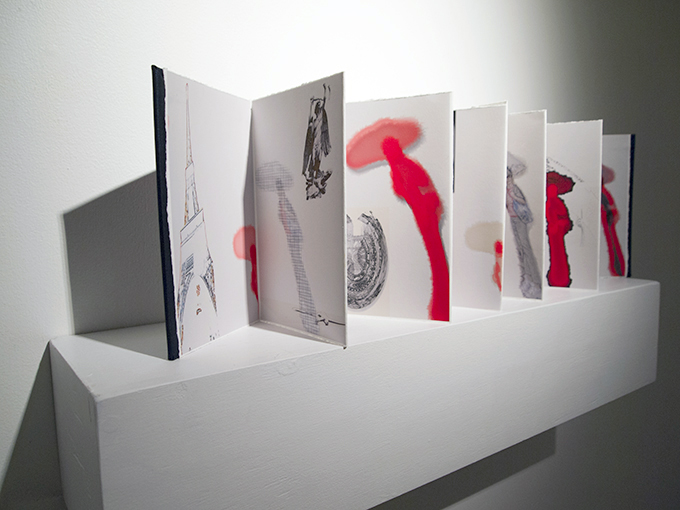
In Paris 2012, Catherine McCue Boes
.
In another work, Preserved in Australia, an old Kodak folding camera has the concertina bellows extended ready for use. Spilling from the rear of the camera explodes a concertina of 20 or so images attached to the viewing hood. The book is derived from a period of time where the artist worked in Roebourne in Australia’s north west. The photos are from the early 1900s, loaned by their owners – residents from Roebourne as well as from the local Historical Museum. McCue Boes has metamorphosed the camera and it’s image legacy into a device for viewing history.
.
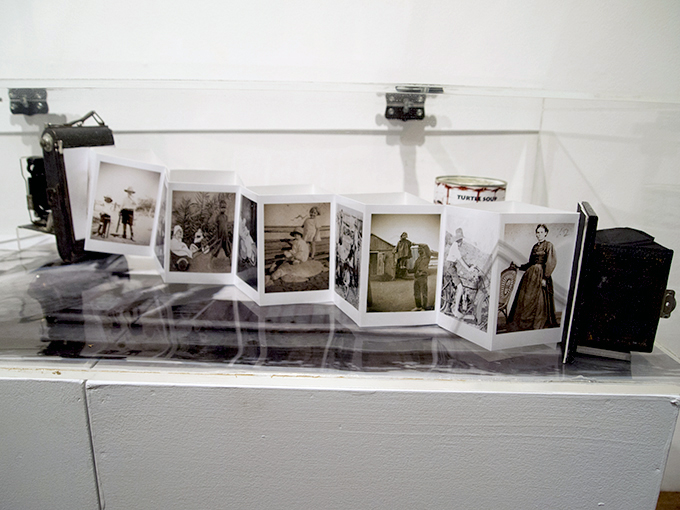
Preserved in Australia, Catherine McCue Boes
.
An early book, First Revolution (Macbeth) Lithographs 1989, represents the artist’s reference to the Shakespearian theatrical character of the same name. These stone lithographs are accompanied by screen-printed texts on the verso page. In the style of the livre d’artist this large format book with it’s thick deck-edged pages and codex binding make it a strident piece of work. Whilst the book is firmly enclosed in a vitrine and opened to one page only, individual prints from other pages of the book are presented as a framed artworks on the wall.
The First Revolution is also referential to the artist’s major influence, an 1800s book of rococo etchings she discovered in the 1980s and bought at an auction. She states in the exhibition materials that: ‘this was the catalyst for me to not only collect artist books but also create them’. The binding, its construction, materials and its red covering are echoed in many works.
.
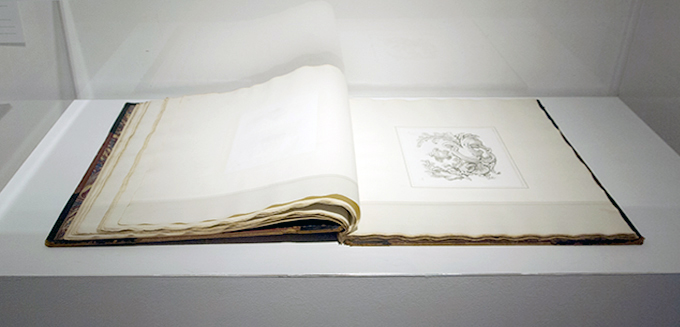
A New Book of Shields 1770-1800
.
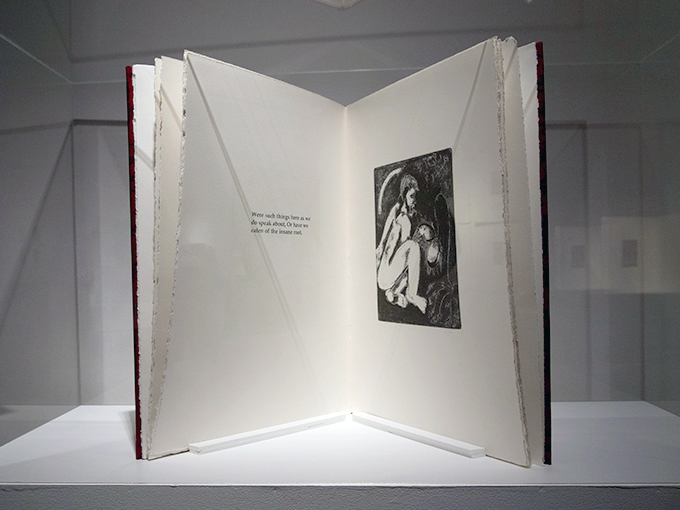
First Revolution (Macbeth) Lithographs 1989, Catherine McCue Boes
The hybrid mix of traditional printmaking and digital techniques creates an opportunity for McCue Boes to extend the artist’s vision and the nature of the outcome. In the 2005 book The Red Shoes, Mark 3 the artist references the Hans Christian Anderson children’s story of the same title. Seven linocuts have been enhanced through scanning into the computer, being redrawn and with text added – the result is a blending of the tradition of print with the graphic elements of typography to convey the story.
Catherine McCue Boes works with other artists in international mail art projects that are presented in another section of the exhibition. A collaborative work curated by the artist, entitled, Life Line, Flood project 2014, brings us back to the idea of the artist’s work being affected by the places they come from. In 2013 devastating floods inundated Bundaberg and upper reaches of the Burnett River. The swollen river gouged out land, animals, houses, trees and farms and significantly affected the land and people of the whole region. McCue Boes curated a collection of photos and texts from friends and assembled a concertina book that carries the sentiments of the contributors. The book is a narrative of many voices with text and image carrying the emotion and the spirit of the contributors. Art often has a dual role, that of the healing catharsis and also to present accounts that can inform those who did not witness the grief first-hand. While this work may be a little uneven in its attempt to blend the individual contributions it is profoundly successful in its purpose and outcome.
Working around to other books in the show a persistent source of inspiration is the artist’s surroundings and environment. I’m reminded of Lucy Lippard’s statement that: ‘Everybody comes from someplace, and the places we come from–cherished or rejected–inevitably affect our work[i]’. This is most notable in a body of work arranged on an island-like plinth towards the rear of the gallery. Assembled is a collection of books that relate to mining environments. McCue Boes works with photographic images, irony and conceptual play to present a variety of book forms and commentaries.
The book, Inspiration from the Artificial Environment 2012, consists of 16 photographic images and borders printed on canvas that are presented in a form that mimics wallpaper, soft furnishing and curtain material sample books. The patterns are photo elements flipped and flopped to form plausible, although somewhat 1960s dated looking designs for decorating your home. The reality of the source images is that they are the detritus of mining workspaces and consist of rusting drums, cable, pipes waste and pondage.
.
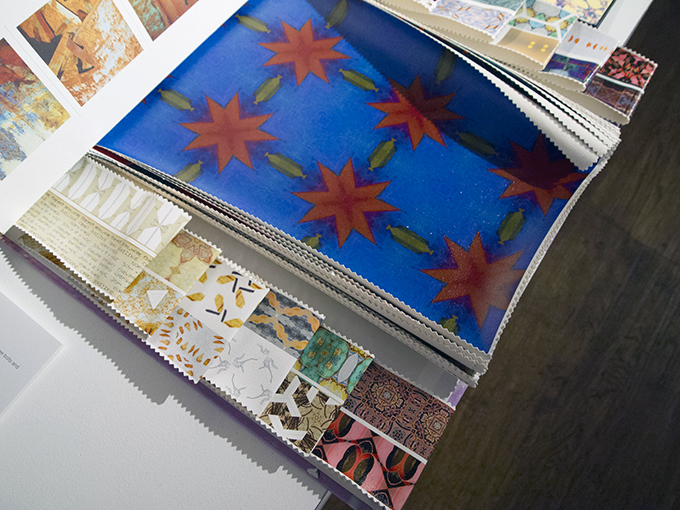
Inspiration from the Artificial Environment 2012, Catherine McCue Boes
.
Other books, some that are more book-like sculptural forms, are part of this body of work. Presentation includes commercial boxes, simulated strips of black and white negatives, abstracted photographs and industrial labels – one stating, ‘Danger – This energy source has been LOCKED-OUT’.
.
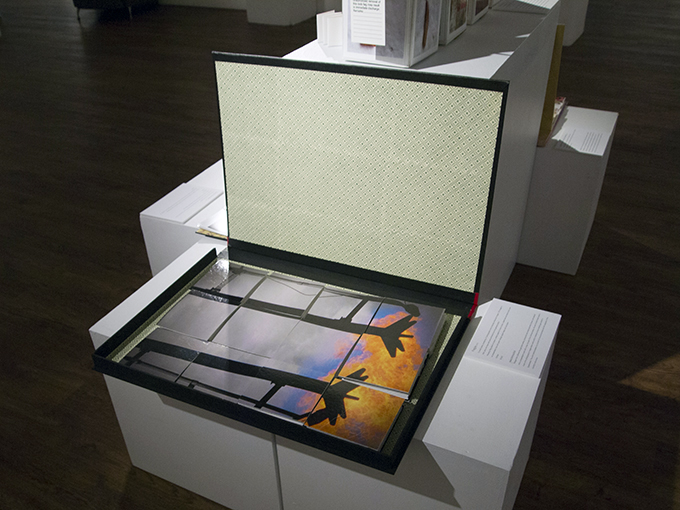
Fragile 2012, Catherine McCue Boes
.A major contribution to this environmentally themed piece is the book/s, Fragile 2012, which is a collection of 12 small concertina books each containing 10 photographs. When assembled the covers create a full-sized image of flaming torch-like structures. The unsuspecting viewer may encounter these little photobooks as a pleasant visual wander through shapes, forms and colours. However the artist has seductively blind-sighted the viewer – these are not pretty and benign subjects. The accompanying didactic explains the photographs were made while participating in an artist in residence in a gas mining plant in Queensland. The artist adds to the didactic that: ‘The work demonstrates my concern for the environment and the depletion of the country’s resources.’
A position pervades many works in the show and I’m reminded of Lucy Lippard’s closing comment in the catalogue for the exhibition Weather Report: Art and Climate Change, where she speaks of the artist as a commentator, communicator and as one who acts as a provocateur. Lippard proposes, ‘… it is the artist’s job to teach us how to see.’ (Lippard 2007:11) Through these works McCue Boes is as an artist ‘teaching us to see’. The strength of her communiqué in these political works is achieved through with irony and humour, and the association with reality of the photographic image.
Books as Art: 30 years in the making is not an exhibition about art, or about making, or even about books. It is an exhibition about the very stuff of life and the human experience of the world – an experience that needs to be shared.
.

Portrait: Catherine McCue-Bowes
.
I’ve made a note also about the importance of proximity in regional centres as well – the ‘big city’ should come visiting sometime. They may be amazed!
Doug Spowart
July 28, 2014
VISIT CATHERINE McCUE BOES Website: http://catherinemccue.blogspot.com.au/
.
Reference:
[i] Lippard, L. R. (1997). The Lure of the Local: Sense of Place in a Multicentered Society. New York, The New Press. P36.
.
Review text © 2014 Doug Spowart
All photographs © 2014 Doug Spowart
.

This work is licensed under a Creative Commons Attribution-NonCommercial-NoDerivs 3.0 Unported License.
.
.
A BOOK ABOUT DEATH: Now in Australia
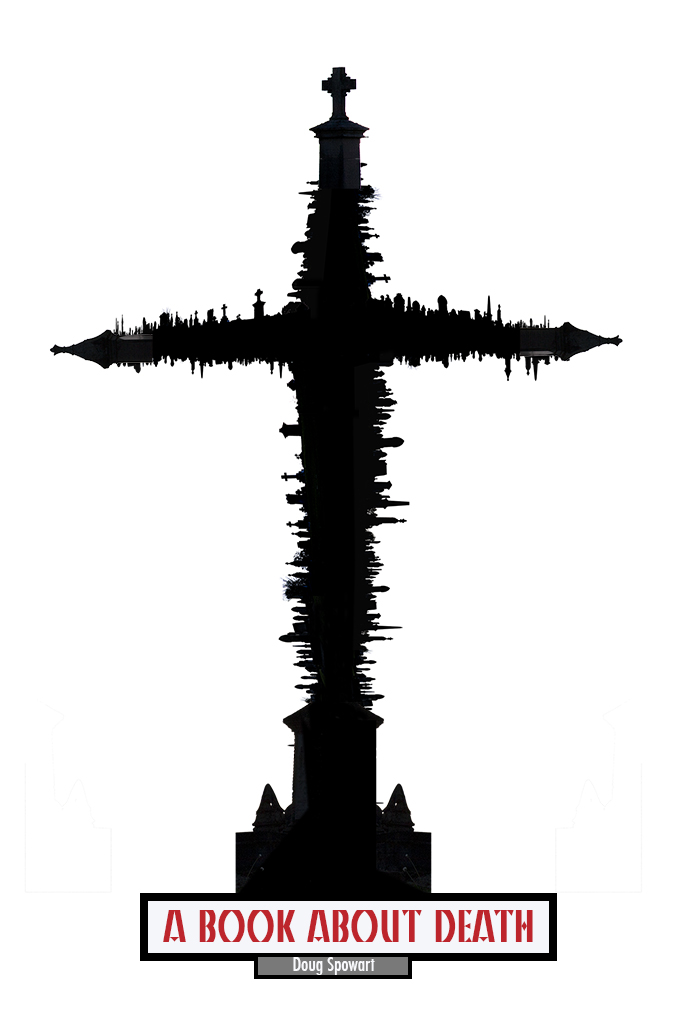
Doug’s contribution to A Book About Death
.
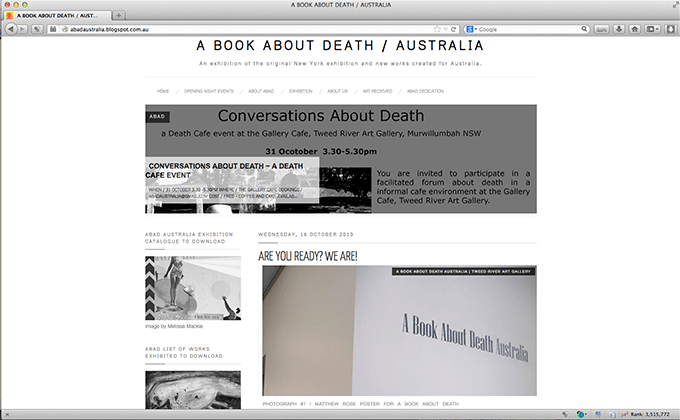
A new exhibition at the Tweed River Art Gallery presents an exhibition of mail art contributed by artists from all over the world which that deals with the topic of death. Entitled, A Book About Death (ABAD), this exhibition is the most recent iteration of the concept that began in 1963 by Mail Art ‘father’ Ray Johnson – The difference on this occasion being that most of the artists represented in the show are Australian. The coordination and curation of this ABAD exhibition has been overseen by Julie Barrett and Heather Matthew.
.
.
The following background information comes from the ABAD website:
.
First and foremost, the American artist Ray Johnson (1927-1995) the founder of the New York Correspondence School deserves all the credit for creating the concept of A Book About Death because he was really onto something when he came up with the concept in 1963. Between March of that year and February 1965, he sent out 13 pages or so of something he called A Book About Death. In framing one piece of a paper as one page of a conceptual book, he anticipated many literary developments of the four decades that have followed. Ray Johnson’s A Book About Death connects to hypertext, cyberpunk, the internet, as well as devices like the Kindle, a device that is an accumulator of electrons that shows its user pictures on a screen of what can be thought of as a book. But the Kindle, one of the possible signposts of what the future of reading will be like, cannot show us an entire book. It can only show us one page at a time.
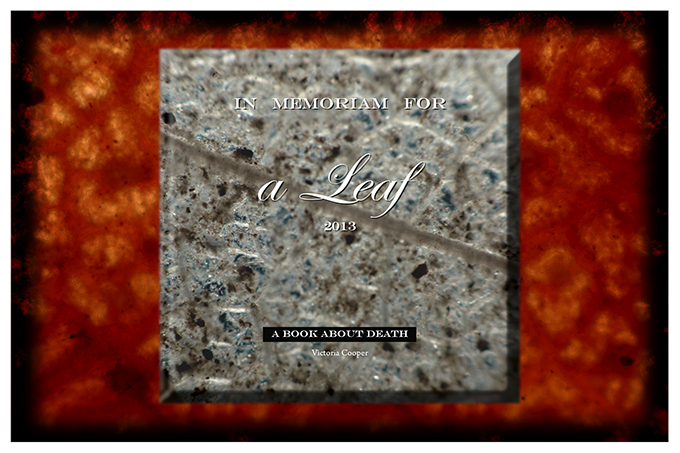
Vicky’s contribution to the ABAD exhibition
.
Vicky’s statement about the work:
Through the microscope I saw the death of a leaf as a metaphor for the forest.
In this leaf I could see
The searing flames of a bush fire,
The decay and recycling of its flesh and bones,
The crystallization of time
A fossil
The past and the future
The story of the forest
In the death of a leaf . . .
.
AN EVENT ASSOCIATED WITH THE EXHIBITION
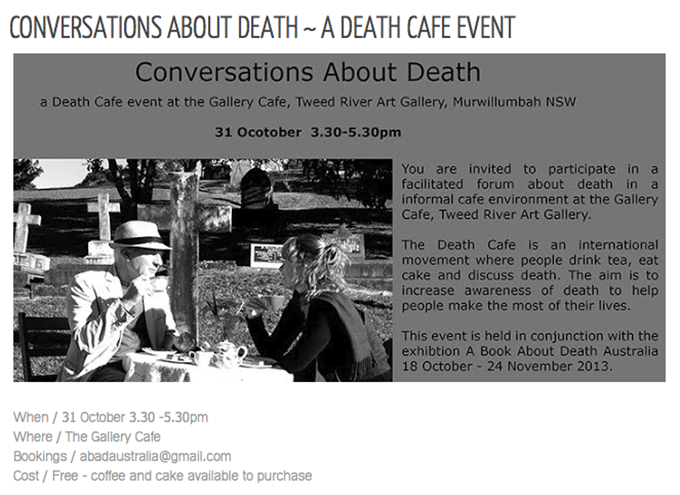
Death Cafe Event
.
The Cooper+Spowart text and work is licensed under a Creative Commons Attribution-NonCommercial-NoDerivs 3.0 Unported License.2012 FIELD STUDY MAIL ART PROJECT: Our contribution
On December 7, 2012 we mailed off to David Dellafiora in Geelong our contribution to the 2012 Field Study. We met David at the Artspace Mackay Artists Book Forum in 2010 where he presented a lecture on mail art and coordinated a collaborative project which dealt with the idea of the assembling book as a democratic multiple.
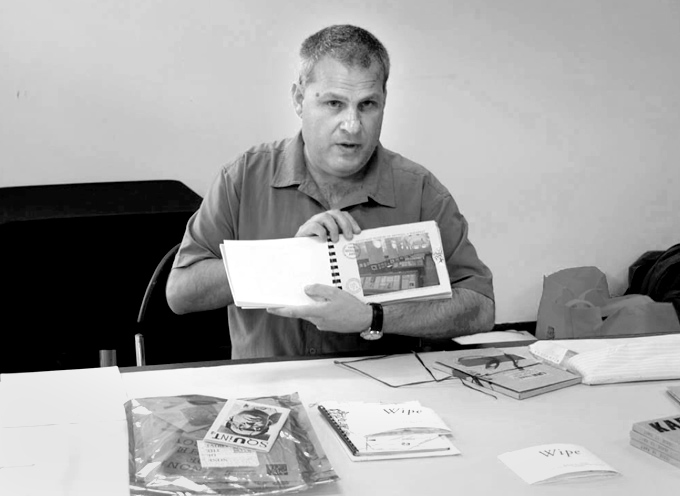
David Dellafiora Photo: Doug Spowart
.
David Dellafiora is a quietly spoken person and not one to push his significant history and activities in the world of mail art. He was however an enthusiastic distributor of A5 fliers, call-to-action invitations to participate in numerous mail art projects that he coordinates. Field Study, Kart, Wipe and others are projects that are essentially ‘assembling books’, where artists worldwide submit multiple artworks by mail to David. At specific times throughout the year David coordinates a team that assembles, packages and mails out to all contributors a copy of the compiled project. A part of the production run is retained with copies being offered for sale to artists, galleries and collectors. The income from this activity finances the production costs and the return postage. Field Study publications are included artists book collections such as the V&A, Museum of Modern Art New York, State Library of Victoria and the Ruth & Marvin Sackner Archive of Concrete & Visual Poetry.
The Field Study contributions are called emanations and can include all kinds of things including: ‘documentations of performances, actions and exhibitions, tracts, rants, instructions, manifestoes, reflections and experiments.’ A selection of pages can be seen in the illustrations from last year’s report at the end of this post. They are a mashup of Fluxus, DaDa, Surrealist inspired, zine-ish paste-up, rubber stamps, torn up letter ransom notes and concrete poetry. In its assembled form the power of Field Report is apparent as it becomes a snapshot of artistic, social and/or political commentary on the times that are current at the time of its publication.
.
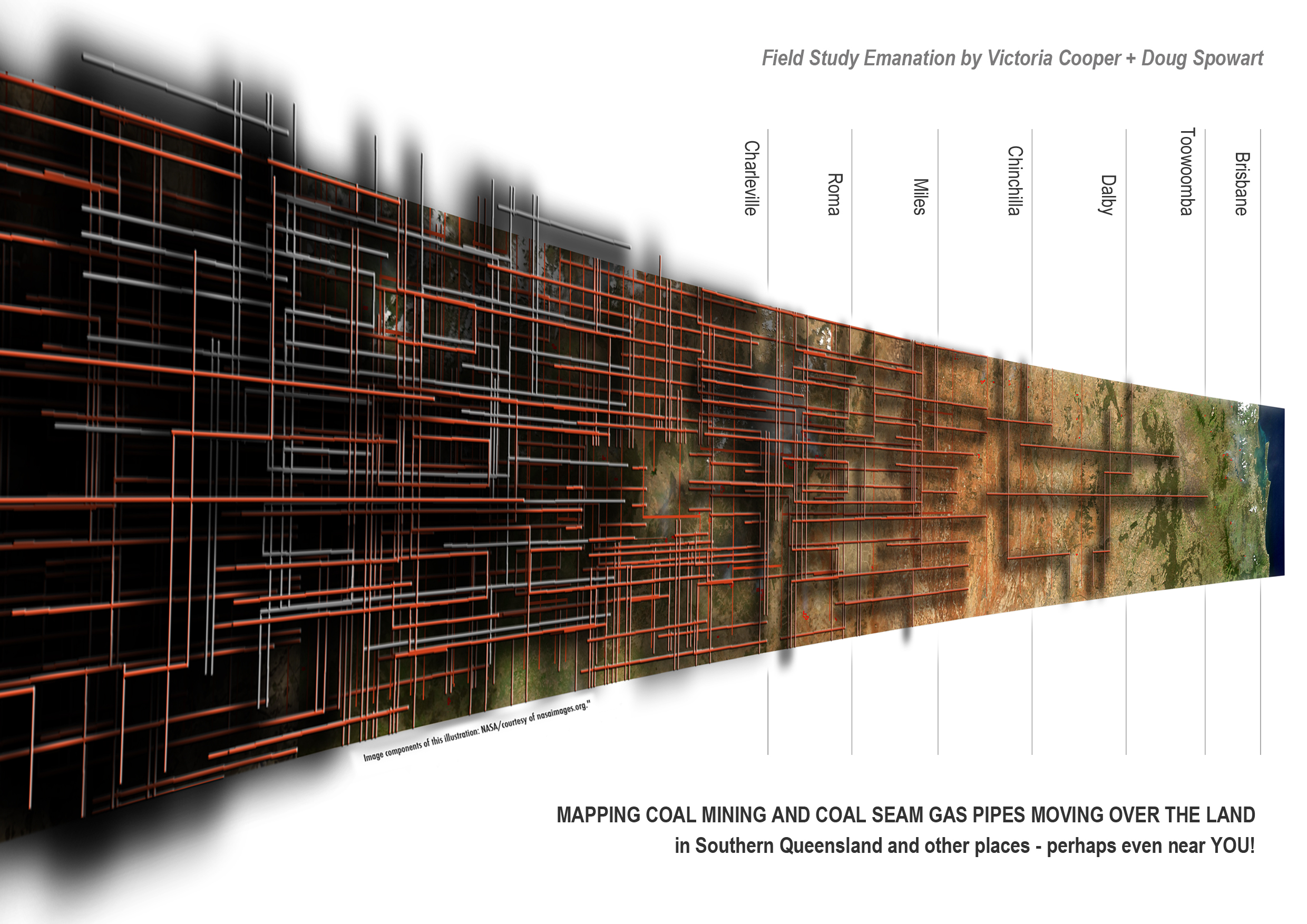
Our Field Study infographic about extractive mining industries in the Surat Basin
.
This year we contributed a piece that related to our commentary on extractive mining industries overtaking our regional communities. This is a variant to the Artists’ Survey Book #12 that has featured in past WOTWEDID posts. The page was printed using a high quality photocopier and each page, 100 in all, were signed and numbered by both of us. It was remarkable to see our workbench covered with the repeating pattern of 100 pages taking up an area of about 3 square metres.
.
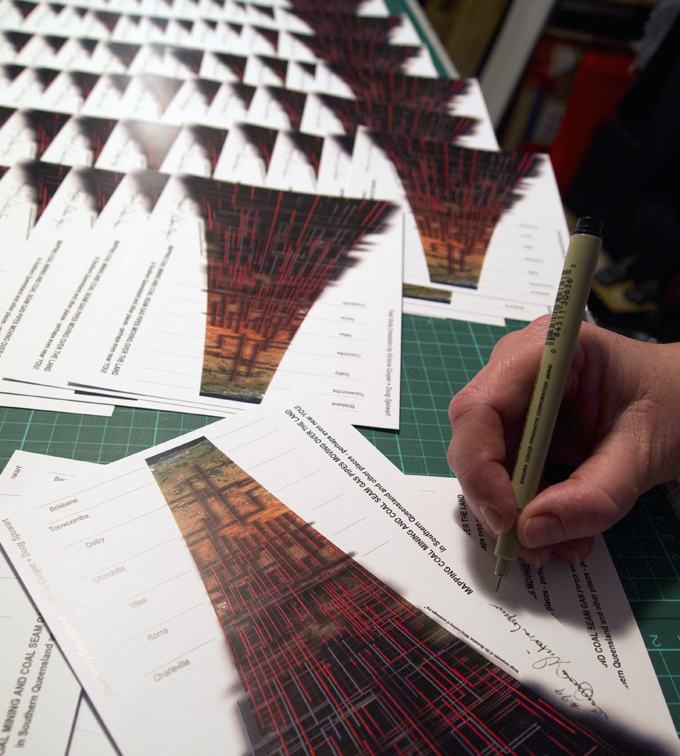
Signing our contribution
.
We look forward to receiving a package from Field Study International later on this year. And, for anyone interested in future Field Study projects, check out the Field Study Blog or review some of the accompanying documents that follow in this blog post.
Cheerio
Doug
.
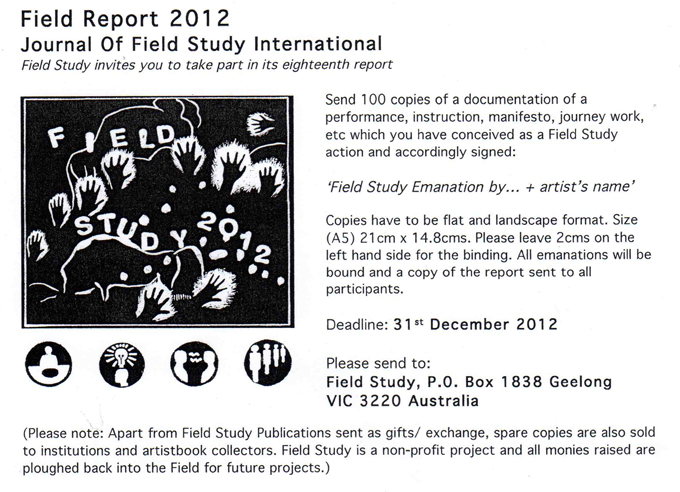
The call for 2012 contributions
.
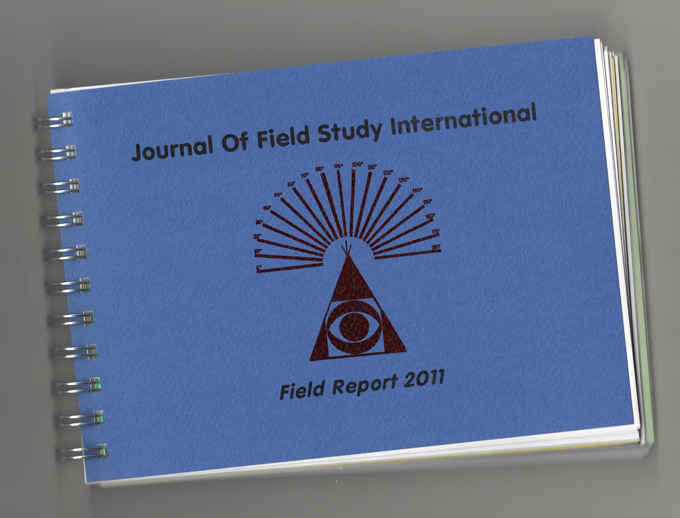
2011 Field Report cover
.
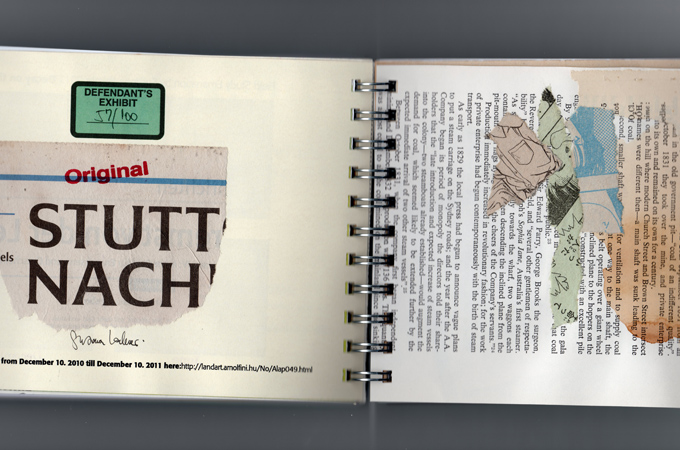
2011 Field Report pages
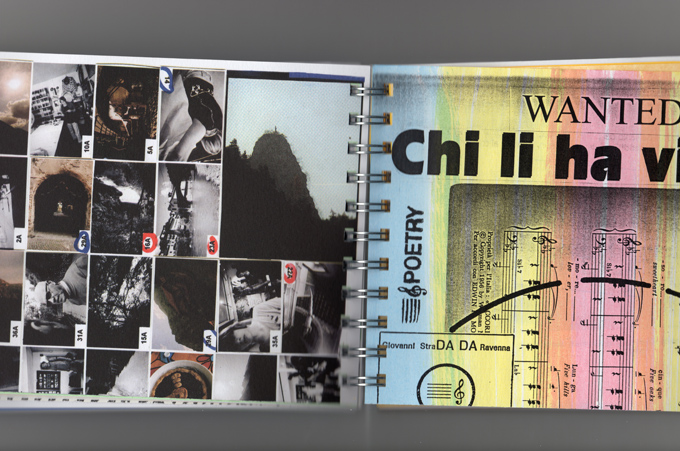
2011 Field Report
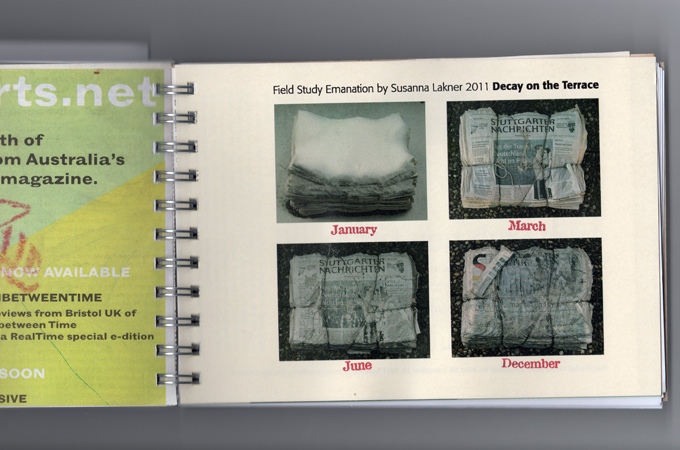
2011 Field Report pages
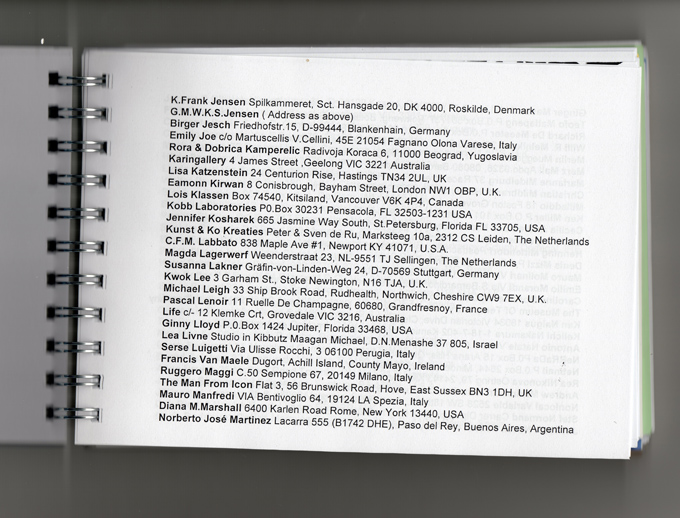
A page of participants – 2011 Field Report
.
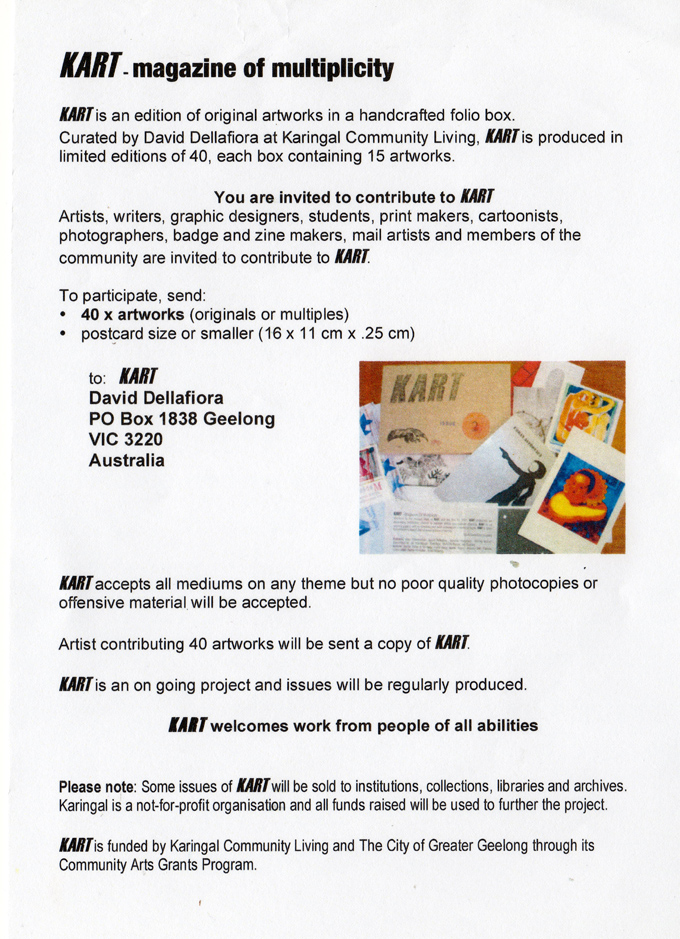
Kart Mail Art Project
.

 wotwedid